

The first time I saw mentorship happen, nobody called it mentorship. A new volunteer froze in front of a nasty alley piled with fast-food wrappers, wet cardboard, and broken glass, and one older volunteer just stepped beside him, grabbed a picker, and said, “Start with the edges.” A week later, that new guy was guiding someone else.
Your Guide to Building a Mentorship Program with Soul
That moment stuck with me because it was so ordinary. No clipboard. No speech. Just one person noticing another person's uncertainty and cutting the fear in half.
That's how a lot of volunteer mentor programs begin. They don't start with a logo or a handbook. They start with one human being saying, “Come with me. I'll show you.”

I've learned that the magic part is common. The reliable part is rare. Lots of groups get flashes of connection. Fewer groups build a repeatable way for those moments to happen again and again, even when the founder is tired, even when a mentor has a rough week, even when a mentee shows up guarded and skeptical.
Practical rule: If your program depends on one unusually charismatic person, you don't have a program yet. You have a lucky streak.
The blueprint that works has heart first, then structure. I don't mean “heart” in a cheesy way. I mean the honest reason you care enough to keep going when the first match gets awkward, when a volunteer ghosts you, or when you realize good intentions aren't enough.
You probably want to build something that changes people. Good. Keep that. But give it bones. Give it rhythm. Give it language that real volunteers can carry into real conversations.
That's what I'm going to walk you through here. Not a corporate template. A road-tested way to build something warm, clear, and durable.
Start With Your Story Not Your Structure
I think individuals often start in the wrong place. They open a document and type “Program Guidelines.” Then they make a form. Then they look for volunteers. That order feels productive, but it creates hollow work.
I'd start somewhere messier. I'd start with the wound, the frustration, the thing in your own life that made you care enough to build this at all.
For me, the Litter Caterpillars story began with failure at home. My own space felt impossible to clean. Every useless object carried a memory, so even trash felt heavy. Cleaning up somebody else's mess turned out to be easier than cleaning up my own, and that weird little truth changed my life.
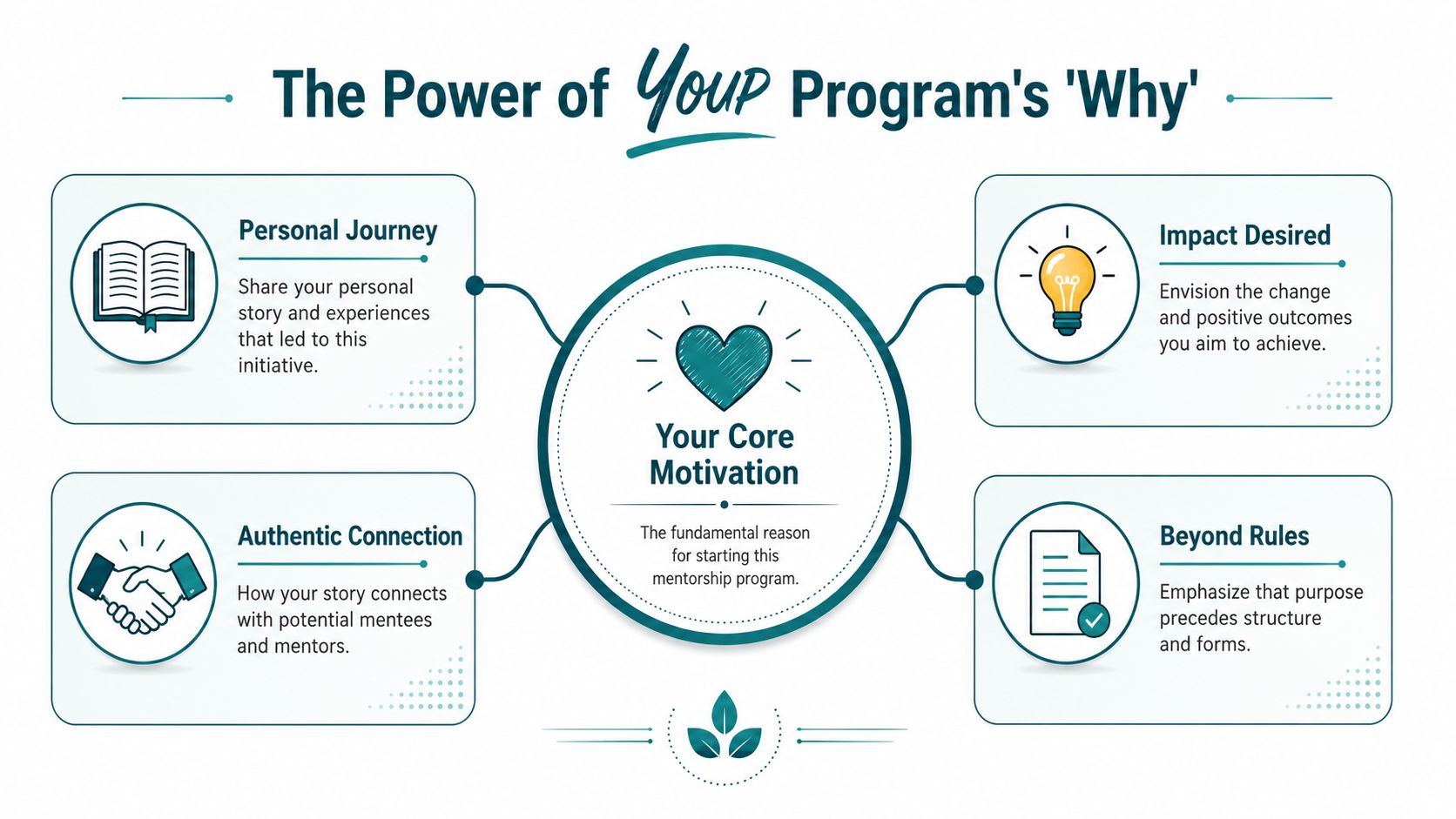
That kind of origin story does more than make your website sound human. It tells people what your program is really for. Are you helping teenagers find steadier adults? Are you connecting new immigrants with neighbors who know the city? Are you teaching practical skills through service? Your answer shapes everything after it.
Your why is your filter
When your story is clear, it starts doing the sorting for you.
The wrong volunteer hears your message and thinks, “That sounds like work.” Good. Let them walk away. The right volunteer hears it and thinks, “I know that feeling. I want in.”
I've seen groups fail because they recruited for availability instead of alignment. They filled slots with warm bodies. Then they acted surprised when mentors drifted, got frustrated, or treated mentees like projects instead of people.
A strong “why” fixes that early. It helps you recruit the right mentors, attract the right mentees, and decide what kind of relationship you're trying to build.
What makes this urgent is that the share of young adults ages 18 to 21 who said they had a mentor while growing up fell from 66% in 2013 to 60% in 2022, and 35% grew up without support from any mentor, according to the Annie E. Casey Foundation's summary of youth mentoring data.
That doesn't mean you should rush out and build a giant program tomorrow. It means your reason has to be real enough to survive contact with reality.
Later in this piece, I'll talk about process. For now, sit with the story.
Four questions I'd answer before writing any policy
Write these by hand if you can. Handwriting slows you down enough to tell the truth.
- What pain am I trying to answer: Name the human problem, not the admin task. “Young people need trusted adults” is better than “we need more volunteers.”
- What changed me personally: People trust lived conviction more than polished slogans.
- What kind of transformation do I hope happens: Be concrete. Confidence? Belonging? Leadership through service? Skill-building?
- What will I refuse to become: Every program drifts unless you draw a line. Maybe you refuse to become transactional. Maybe you refuse to match people without support.
If your purpose can't survive a hard conversation, it isn't your purpose yet. It's branding.
A mentorship program with soul is not vague. It is personal, specific, and sturdy enough to guide decisions when things get confusing.
Defining the Mentor and Mentee Roles
Once your story is clear, you need to reduce guesswork. Failing to do so causes many good-hearted programs to wobble. People think kindness will cover ambiguity. It won't.
A mentor needs more than a soft mission statement. A mentee does too. I like building a Role Charter instead of a stiff job description because a charter feels like a shared agreement, not a list of demands.
Why vague roles break matches
Research on youth mentoring is blunt about this. Better outcomes are linked to goal-directed mentor behaviors like teaching and coaching, while programs built mostly on generic social support don't consistently show larger effects. The same research says premature match endings often come from unrealistic expectations and weak relational skills, as discussed in this review of mentoring program practices.
That tracks with what I've seen in volunteer groups. Trouble usually doesn't begin with bad people. It begins with fuzzy expectations.
One mentor thinks, “I'm here to encourage.”
Another thinks, “I'm here to push.”
The mentee thinks, “I thought this would be casual.”
Then everyone feels slightly disappointed and nobody knows why.
Build a charter people can actually use
I'd keep the charter short enough that people read it and concrete enough that people can act on it. If you want a deeper philosophy on leading through service, I like the ideas in this piece on servant leadership.
Here's a simple version.
| Commitment Area | Mentor's Role | Mentee's Role |
|---|---|---|
| Time | Show up consistently for the agreed schedule and give notice when plans change | Respect the schedule and communicate early if something changes |
| First 30 days | Build trust, ask questions, and learn the mentee's goals | Share interests, concerns, and what support feels useful |
| Growth goal | Help define one concrete goal, like co-leading a project within a set period | Choose a goal and take ownership of progress |
| Communication | Keep messages clear, kind, and direct | Reply honestly and speak up when something feels off |
| Boundaries | Stay within program rules and ask staff for help when issues get serious | Respect boundaries and use the program as intended |
| Feedback | Give specific encouragement and practical corrections | Receive feedback, ask questions, and try again |
| Closure | End the match with care if it isn't working or if the term ends | Participate honestly in closure and reflect on what was learned |
What I'd put in plain language
Your charter should answer these questions without fluff:
- How long is the commitment: Say whether it's short-term, term-based, or open-ended.
- What does a good meeting look like: Conversation, skill practice, community activity, project planning.
- What is the first milestone: A shared goal prevents drifting.
- When do people ask for help: Don't make mentors guess when a problem is “serious enough.”
- How does the match end: Planned closure is kinder than vague silence.
A clear role is kindness. It keeps generous people from disappointing each other by accident.
If I were writing one sentence at the top of every charter, it would be this: “We are not here to impress each other. We are here to help each other grow.”
Finding Your Mentors and Preparing Them for the Journey
The first mentors I'd recruit are not the loudest people in the room. I want the ones who keep showing up, ask sincere questions, and don't need attention as payment. You can build a culture around those people.
When I talk to founders, they often say they need more volume. I usually think they need better aim. Early-stage volunteer mentor programs don't need a flood. They need a few people who believe in the mission enough to stay steady when the novelty wears off.
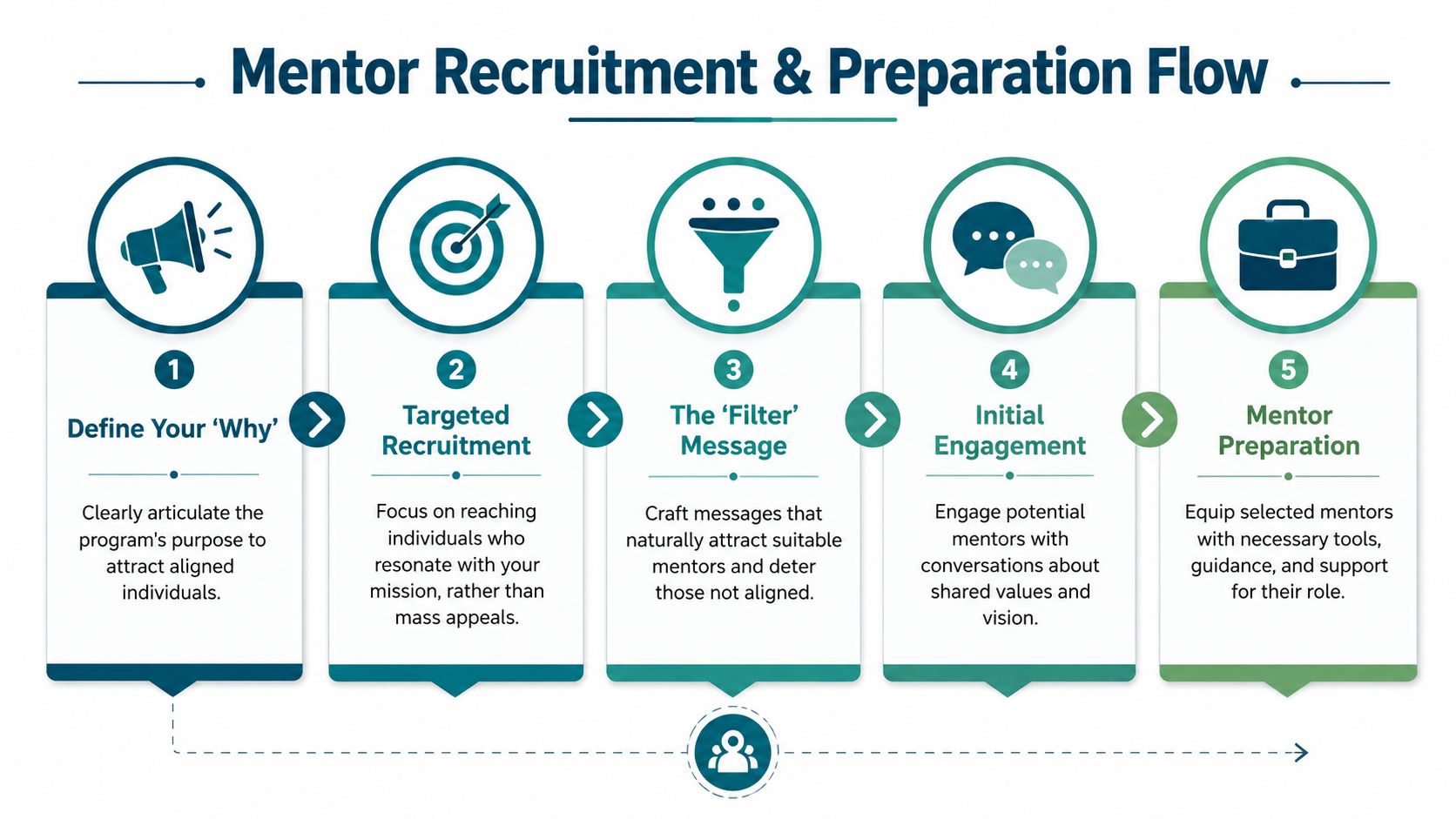
Recruit with a filter, not a net
The best recruiting message I ever wrote was a little uncomfortable. It asked for commitment before offering belonging. That scared off casual people. Perfect.
Here are a few lines I'd use:
- For social posts: “We need adults who can show up consistently, listen well, and guide without ego. If you want easy praise, this isn't for you.”
- For email outreach: “This program asks for steadiness, patience, and honesty. If that sounds like the kind of person you want to become, reply.”
- For one-on-one asks: “I'm not asking because you're free. I'm asking because you're dependable.”
That style works because it respects the role. If you want more ideas on attracting the right volunteers, I like this guide on volunteer recruitment strategies.
What I look for in an early mentor
I don't chase polish. I look for signals.
- They tell the truth: If their schedule is messy, they say so.
- They stay curious under stress: They don't panic when a conversation gets awkward.
- They can accept guidance: A person who can't be coached usually can't mentor well.
- They like people without trying to own them: That one matters more than almost anything.
I've made the mistake of picking people mainly because they were impressive. Impressive is not the same as safe. It's not the same as patient either.
Choose mentors the way you'd choose a hiking partner. You want someone steady when the trail gets muddy.
Training should build confidence, not just compliance
Many groups either overdo it or underdo it. They drown volunteers in policy, or they hand them a T-shirt and say, “You'll figure it out.”
I'd use a simple three-part training:
The mission
Tell the origin story. Tell the volunteers what pain the program exists to answer. Explain what kind of relationship you want them to build.
If people don't understand the heart, they'll treat mentoring like task management.
The role
Walk through the charter in plain language. Give examples of a strong first meeting, a weak first meeting, and a conversation that needs staff support.
Use scenario practice:
- A mentee stops replying.
- A mentor talks too much and never asks questions.
- A parent or guardian seems disengaged.
- A young person shares something emotionally heavy.
The scaffolding
This part is mandatory. Mentors need to know where the walls are and who's holding the roof up.
Effective mentorship for complex youth needs depends on trained mentors and staff support. The stronger models use structured volunteer systems or professionals because quality depends on more than goodwill, as shown in this overview of the Amplified Mentoring Program and related structured support approaches.
That means your prep should include:
- Screening: Background checks or reference checks if your setting requires them
- Safety rules: Where meetings happen, who knows about them, what documentation is required
- Escalation paths: Who mentors contact when something feels beyond their lane
- Ongoing support: A real staff contact, coordinator, or lead volunteer who answers messages
My favorite part of training
I like ending with this question: “What kind of adult did you need when you were younger?”
People get quiet when you ask that. Quiet is good. Quiet means they're telling themselves the truth.
From there, I ask one more question. “Can you become that person consistently, not perfectly?” That's the essential standard.
The First Match and Keeping the Wheels Turning
The first match always feels delicate. It should. You are introducing two people and asking trust to grow where there was no history before.
The mistake I see most is rushing to “make something happen.” A weak match made fast creates more cleanup work than a thoughtful match made a bit later.
Make matching simple and human
I'd use a short survey, not a personality test circus.
Ask things like:
- Why did you join
- What kind of support do you want to give or receive
- What schedule is realistic
- Do you prefer direct conversation or a slower warm-up
- What activity would make a first meeting feel easier
Then I'd read the answers myself if the program is still small. Early on, intuition matters, but only when it's paired with actual information.
A good first match often comes down to pace. Some people bond through conversation. Some bond by doing something side by side. I've watched people open up faster while cleaning a park, sorting donations, or planning a small event than they ever would over coffee.
The first meeting needs a shape
Don't leave it fully open. Freedom sounds nice, but anxiety fills empty space fast.
I'd give every first meeting this loose structure:
Start with a shared task or prompt
Something simple loosens people up. A walk, a cleanup route, a short project.Trade stories, not résumés
Ask about a challenge, a habit, a neighborhood, a turning point.Set one small next step
Not a life plan. Just the next action.Confirm the next check-in before leaving
Uncertainty kills momentum.
“Your job isn't to force chemistry. Your job is to lower the friction so trust has a chance.”
Watch the health of the program with a few numbers
I'm not a fan of drowning small programs in reports. I do believe in watching a few operational signs closely.
The mentoring literature points to tracking match formation rate and 90-day retention, along with consistent onboarding and check-ins. One cited example found 76% of program youth graduated from high school versus 40% of controls, and the same source warns that weakly managed matches can go badly if support is sloppy. That guidance comes from the National Institute of Justice summary on youth mentoring programs.
For a small volunteer program, I'd track:
- Applications to match: Are interested people becoming pairs?
- Ninety-day retention: Do matches survive the awkward beginning?
- Contact rhythm: Are they meeting as expected?
- Goal progress: Is anything concrete moving?
Those numbers tell a story without pretending numbers are the whole story.
What to do when a match starts wobbling
This part matters more than founders think. Many matches don't explode. They fade. Messages get shorter. Meetings get rescheduled. Both people get polite. Polite is dangerous when it hides disappointment.
I use a reset conversation early.
Here's a script I like:
“I want to check in before this gets heavier than it needs to be. What's felt easy so far, and what's felt harder than you expected?”
Then ask each person privately:
- What did you hope this would feel like by now
- What's one thing the other person could do differently
- Do you want to repair this match or end it kindly
Sometimes the right answer is repair. Sometimes it's closure. Ending a match with honesty is much better than dragging it into resentment.
Standardize support before you scale
If one mentor gets great check-ins and another gets silence, your program becomes random. Random programs lose trust.
Set a rhythm. Maybe it's a short check-in after the first meeting, another at one month, and another before the ninety-day point. Keep the questions consistent. Ask what's working, what feels unclear, and whether either person needs support.
You're not micromanaging. You're tending the garden before the leaves droop.
Sustaining the Fire and Growing Your Impact
Starting a mentorship program feels exciting. Keeping it warm after the launch is the essential craft.
Mentors give emotional energy, not just hours. If you don't pour some of that energy back into them, they slowly flatten out. I like simple rituals: coffee meetups, mentor-only group chats, handwritten notes, small milestones people can celebrate without embarrassment.
Build for repeatability
A durable program has memory. It remembers how to welcome people, how to train them, how to support them when things get messy, and how to thank them in a way that feels sincere.
Formal mentoring in the United States involved 2.0 million to 2.59 million adults annually, about 1% of the adult population, across a long period studied from 2006 to 2015. That stability suggests strong programs depend on lasting systems and partnerships, not one-off recruiting bursts, according to this review of formal mentoring participation trends and state partnership patterns.
That matches what I've seen on the ground. A program lasts when it has rhythm.
Grow carefully
If you want this work to last, protect the people doing it. Borrow ideas that keep volunteers connected and appreciated, like the ones in these volunteer retention strategies.
A few ways to keep the fire going:
- Celebrate specific moments: Thank a mentor for staying steady through a rough patch, not just for “helping out.”
- Create peer community: Mentors need each other, not just you.
- Use partnerships wisely: Schools, community centers, and nonprofits can help you find mentees and meeting spaces.
- Stay small longer than your ego wants: It's better to run a tight program than a sprawling, confused one.
I've learned that growth isn't about adding names to a spreadsheet. It's about keeping the original warmth alive while more people step into it.
If you want a real-world example of volunteer culture built on consistency, courage, and friendship, spend some time with Litter Caterpillars. You'll see what happens when people show up for a city, for each other, and for the slower kind of change that only comes from doing the work together.
Leave a Reply