Author: Kevin Tao

  • Severe Weather Preparedness Checklist for Volunteer Crews

    Severe Weather Preparedness Checklist for Volunteer Crews

    You've packed the trash bags, someone's bringing grabbers, and a new volunteer has just messaged to ask whether the cleanup will still happen if it rains. You check the forecast again. The harder question isn't whether people will show up. It's whether everyone can get somewhere safe when conditions change.

    A severe weather preparedness checklist should answer that question before you leave home. Agree on the limits together, give someone clear authority to stop, and plan a safe exit for the person who doesn't know anyone yet. You can replace a cancelled cleanup. You can't ask volunteers to gamble their safety for another bag of litter.

    Weather Limits That Decide Go or Stop

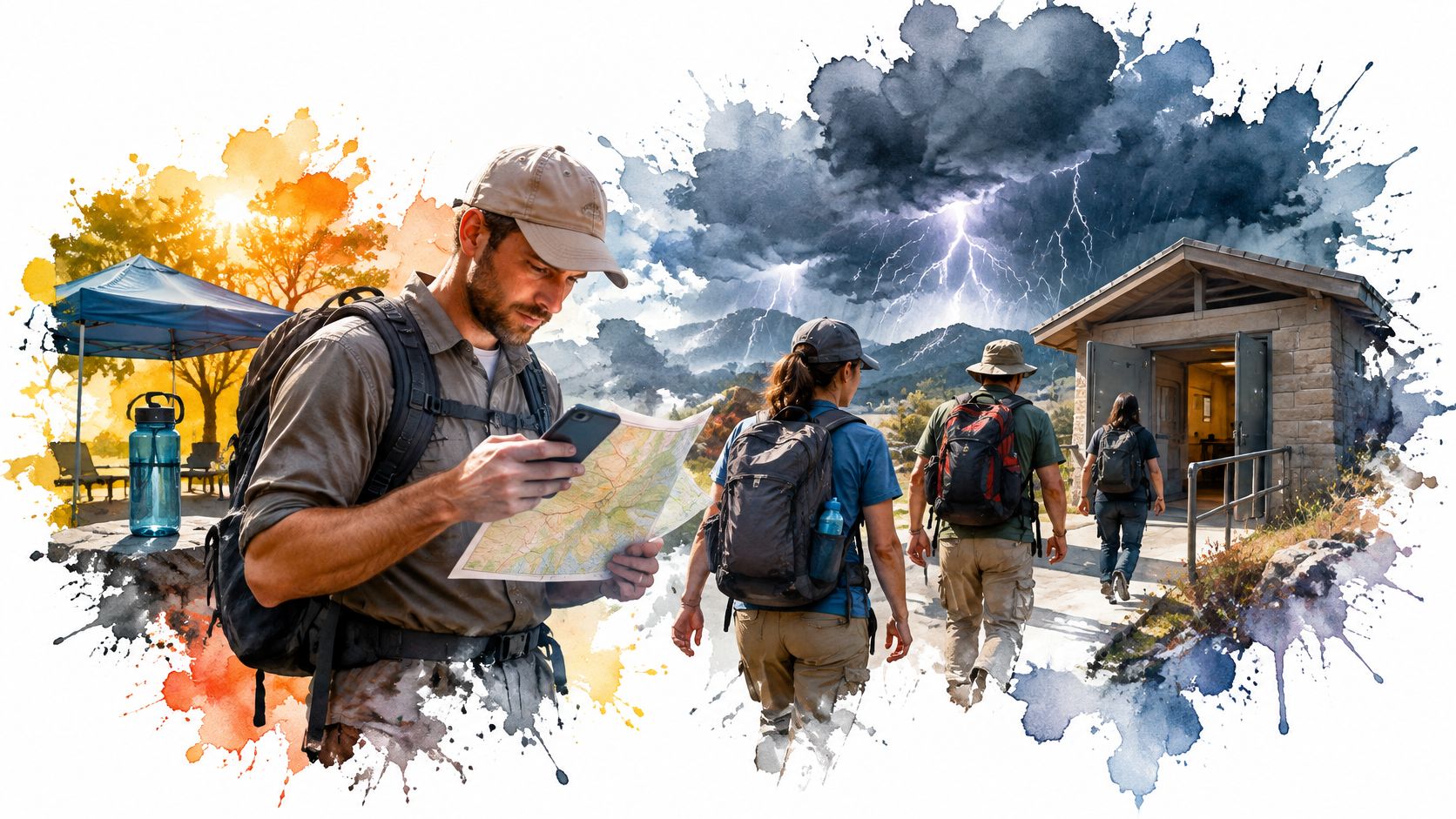
    Thunder rolls while the crew is still spread along the fence line. A new volunteer looks toward the road, and the regulars look toward the leader. That moment should only start a sequence everyone already knows; the stop rule needs to exist before the sky changes.

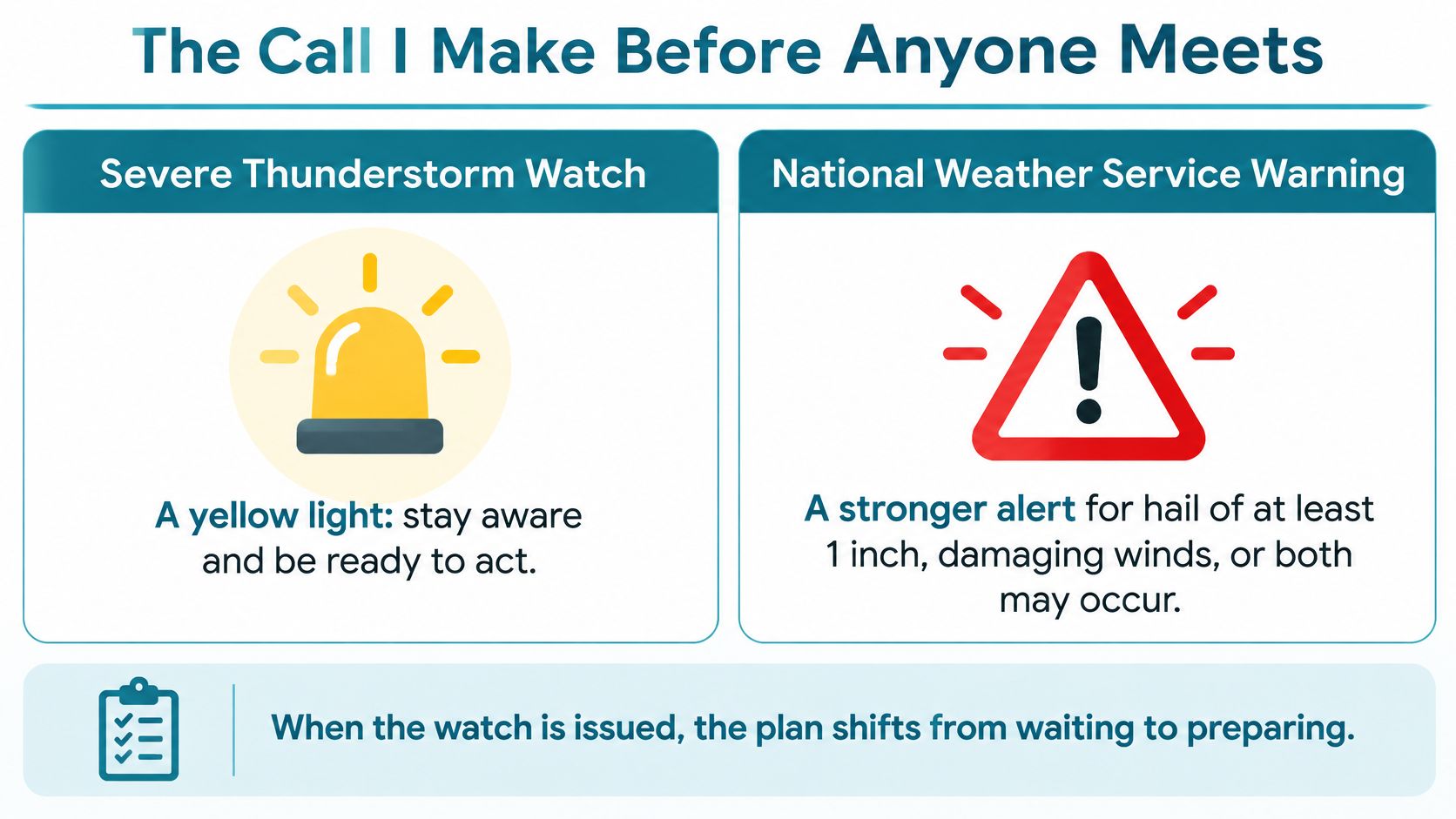
    Wind gusts of at least 58 mph, hail at least 1 inch across, or a tornado meet NOAA's definition of a severe thunderstorm. Do not wait to measure those conditions yourself. A severe-thunderstorm warning for your location means you stop and move to shelter.

    Set the limits together while the forecast is still a planning detail. Cancellation then becomes a shared instruction rather than an argument beside a pile of collected trash. A volunteer who joined that morning should be able to see the same trigger, follow the named person, and use a backup exit if the first shelter is closed or transport is delayed.

    When a stop trigger activates, the leader suspends outdoor work immediately, without a group vote.

    Stop triggers and the immediate action for each hazard

    Hazard Trigger Immediate action
    Severe thunderstorm Warning issued for your location, or conditions meeting NOAA's severe criteria Stop work and move to a substantial building or enclosed metal-topped vehicle
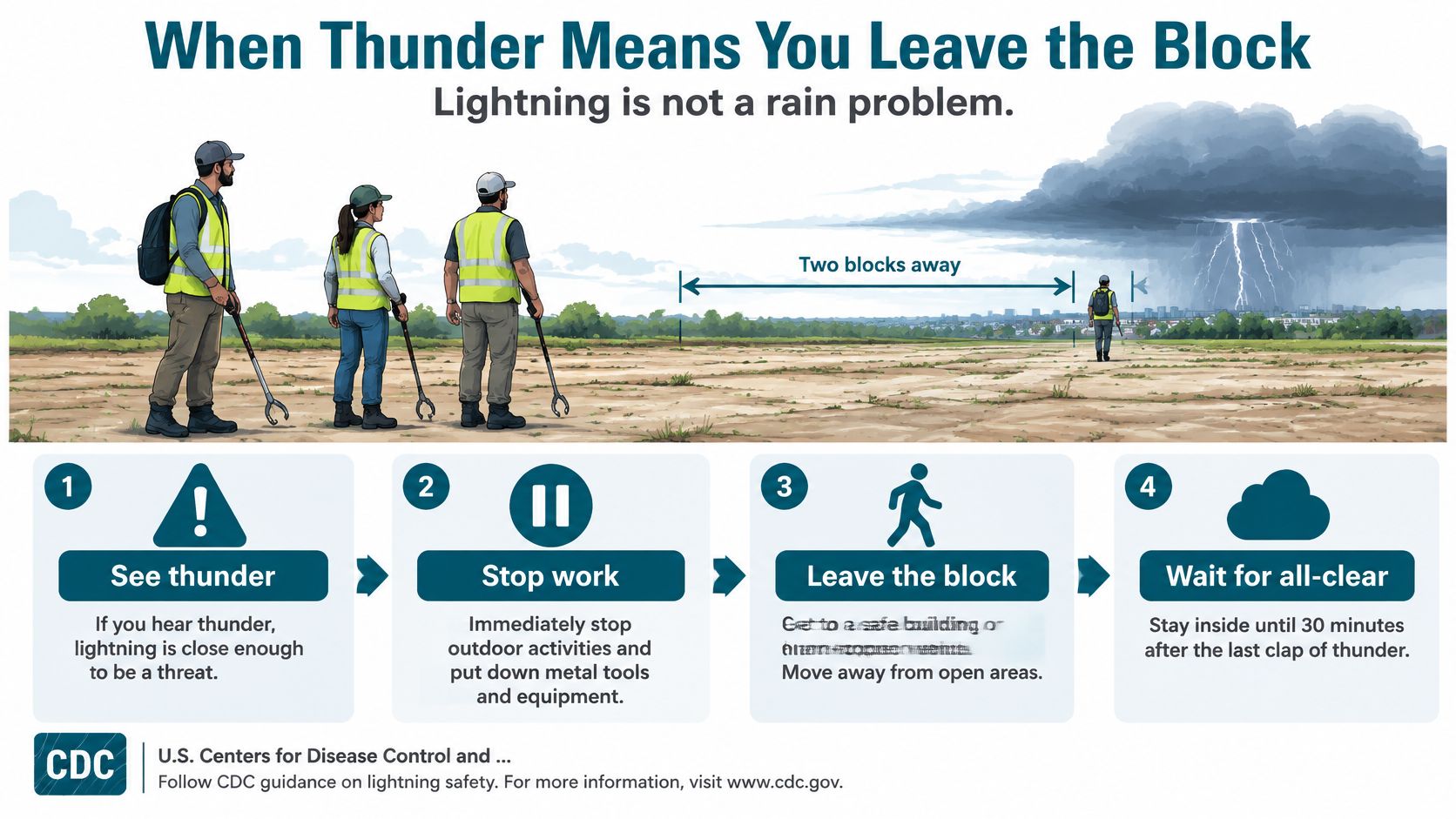
    Lightning Any thunder heard Move to shelter and remain until the full waiting period in your plan has passed
    Tornado warning Warning issued for your location Move to the tornado shelter you chose before the cleanup started
    Heat Your written heat-index limit or local heat-alert criteria Pause exposed work, shorten work intervals, add shade and hydration breaks, and cancel when your limit is reached
    Cold Wind chill at or below your set threshold Pause for warm-up intervals and stop when clothing gets wet or hands lose dexterity

    Use local criteria as the outside boundary, then choose tighter limits whenever shelter, transport, or recovery would take longer. A crew working far from a building needs less exposure than a crew beside an open door.

    Make the limits usable on site

    Write each trigger on the briefing sheet beside the shelter names. A warning on a phone does not help much if nobody knows which building will let your crew inside.

    Give alert monitoring, headcount, and shelter entry to different people. The leader can then watch conditions and gather the crew while someone else confirms everyone has reached the right place.

    Check access, opening hours, and the actual entrance before the bags come out. A locked recreation center across the street is not a shelter plan. Neither is a temporary tent, an isolated tree, or a gathering point beside metal tools.

    During the briefing, point out the entrance and the person a newcomer should follow. If entry depends on a side door, a code, or a staff member, write that detail beside the trigger.

    Practical rule: If your crew can't reach appropriate shelter quickly, postpone the cleanup or choose another site.

    Keep thunderstorm shelter and tornado shelter distinct. An enclosed metal-topped vehicle can provide thunderstorm shelter, but don't make it your tornado destination. Choose the protection that matches the hazard before anyone spreads out along the block.

    Gear and Kit for Every Cleanup

    Pack by location, so you don't leave everything useful in a closet while your crew works across town. Ready.gov's severe-weather toolkit recommends supplies at home, at work, and in the car, and includes winter vehicle equipment that supports both travel and an unexpected stop.

    The event bag

    Keep the bag with the crew, within reach of the roster keeper rather than buried beneath collected trash.

    • Paperwork: Pack a printed site map with shelter entrances and alternate evacuation routes, a headcount sheet, and emergency contacts. Protect the papers from rain.
    • Communication: Carry a whistle, charged phones, a compatible power bank, and charging cables. Test the whistle signal during the briefing.
    • Immediate care: Add a first-aid kit, drinking water, reflective vests, and weather-appropriate spare clothing.

    Use Barrons' DIY camping medical kit checklist to review your outdoor first-aid supplies, then adapt the contents to your crew's training and cleanup hazards. Don't mistake a full bag for medical competence. Know who can provide first aid and who will call emergency services.

    Use the severe weather safety kit checklist as a packing cross-check rather than relying on memory.

    The team car and home reserve

    In the team car, keep seasonal travel supplies: a shovel, windshield scraper, small broom, blankets, hats, gloves, flashlight, radio, spare batteries, jumper cables or a charger, traction material, emergency flares, and a fluorescent distress flag. Keep essential medication accessible to its owner. Don't make access depend on finding a driver who has wandered away.

    At home, build the longer-duration reserve. FEMA's emergency supply guidance recommends one gallon of water per person per day for at least three days, plus at least three days of nonperishable food. Add a manual can opener, flashlight and batteries, sanitation supplies, first-aid supplies, a whistle, and a battery-powered or hand-crank radio that receives NOAA Weather Radio tone alerts.

    Review the event bag before each cleanup, the vehicle equipment when the season changes, and household supplies on a recurring calendar. Replace expired items, recharge batteries, and replenish whatever you used. A flashlight with dead batteries adds weight, not protection.

    How to Run the Stop Sequence When an Alert Hits

    A warning should start a practiced action, like a fire alarm. You shouldn't need to negotiate while volunteers stand beside traffic with wet gloves and grabbers.

    Keep the sequence visible during your briefing.
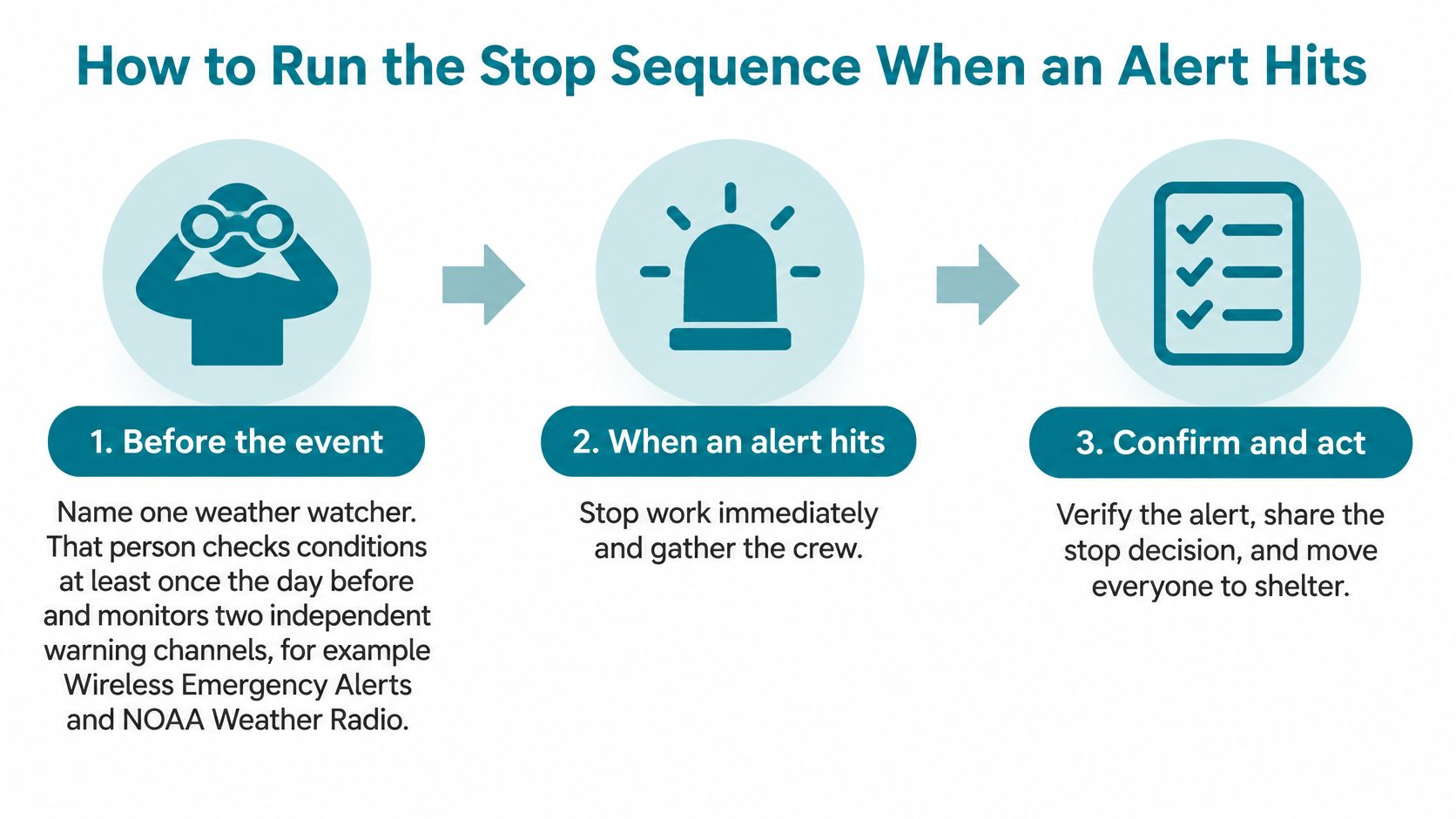
    An infographic showing a three-step checklist for running a stop sequence when severe weather alerts occur.

    Assign people before you assign cleanup areas

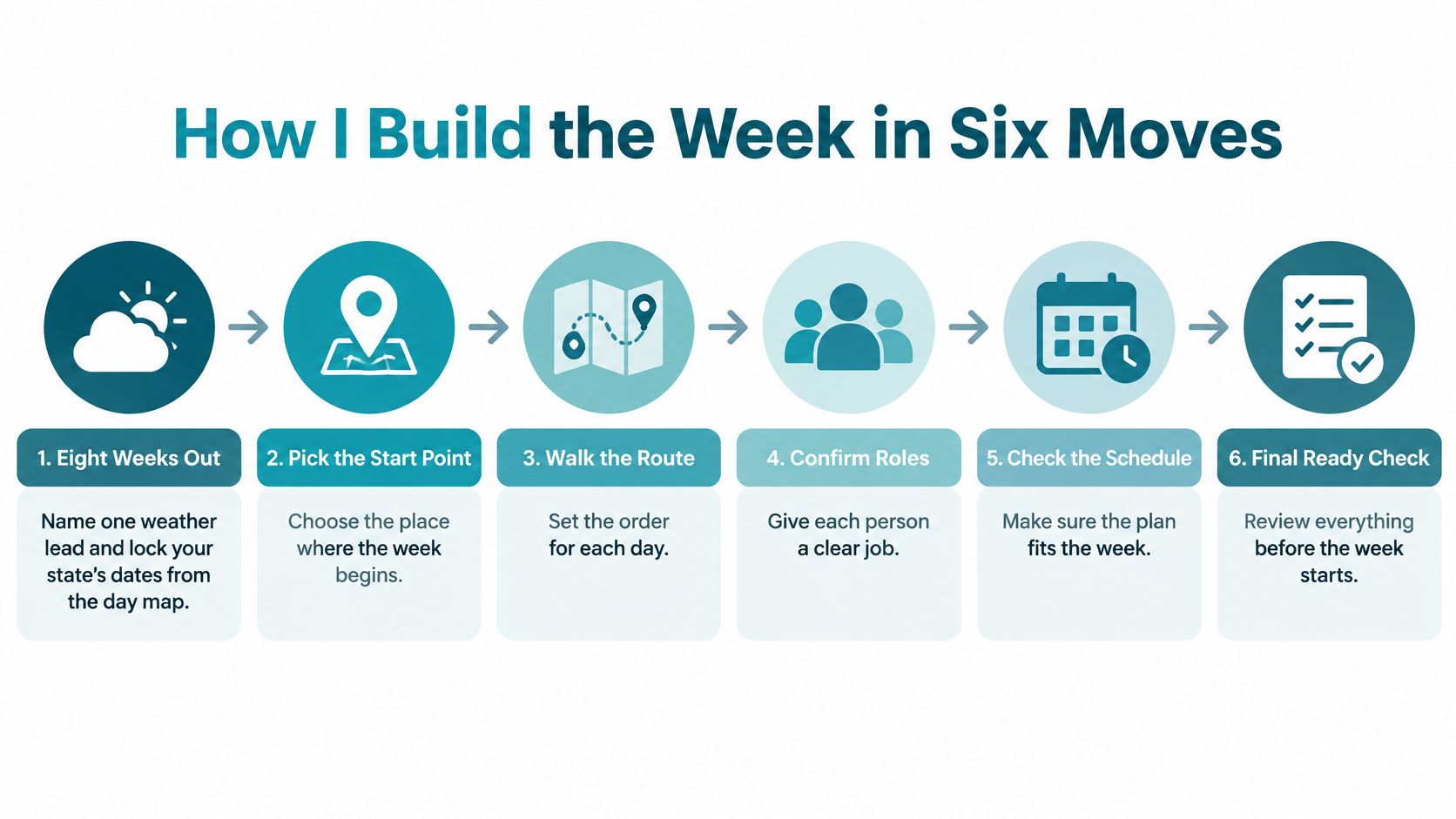
    1. Name the weather watcher. Have that person check conditions the day before and monitor independent warning channels during the event, pairing phone alerts with weather radio or local broadcasts. Give them permission to watch the weather instead of filling trash bags, because divided attention defeats the assignment.

    2. Name the cancellation lead. Tell everyone who can stop or cancel the cleanup without a vote, and name a backup if that person leaves. Agree on the rule together beforehand so nobody has to win an argument during the warning.

    3. Stop work when the warning arrives. Put down the cleanup task and start the shelter movement immediately, because finishing a section of sidewalk can delay everyone. Don't send someone back for a half-filled bag or a forgotten grabber.

    4. Move to the appropriate shelter. For tornadoes, Ready.gov recommends a safe room built to FEMA criteria or a storm shelter built to ICC 500 standards; without those options, choose the strongest available interior location and put as many walls as possible between you and the storm. Walk the route beforehand, account for mobility assistance, and take the emergency kit unless you suspect contamination.

    Account for people and communicate

    1. Gather and count against the roster. Ask buddies to confirm each other's location, then have the roster keeper check names rather than accept a rough estimate. Keep volunteers out of the hazard while you resolve missing-person information, and contact emergency services when someone may need rescue.

    2. Send a plain-language update. Use the group chat and phone tree to state the shelter location, stop decision, and next check-in. Verify the alert through an official channel without delaying protective movement, because confirmation shouldn't become an excuse to stand outside.

    3. Hold until conditions meet the restart rule. Apply the lightning waiting period and follow official instructions for other hazards rather than judging safety by the rain. Forecast probability describes a possibility; a warning requires immediate action, sometimes with very little lead time.

    4. Recount before departure. Check everyone against the roster, look for injury or exhaustion, and call emergency services first when someone needs more than first aid. Record the stop time and decision so the next safety lead can understand what happened.

    Use this video during a briefing, then practice your own route rather than treating a screen demonstration as the drill.

    Run a timed practice each season. Measure the crew's real movement, including the slowest safe pace, rather than the pace you hope everyone can manage.

    Heat and Cold Controls for Long Cleanups

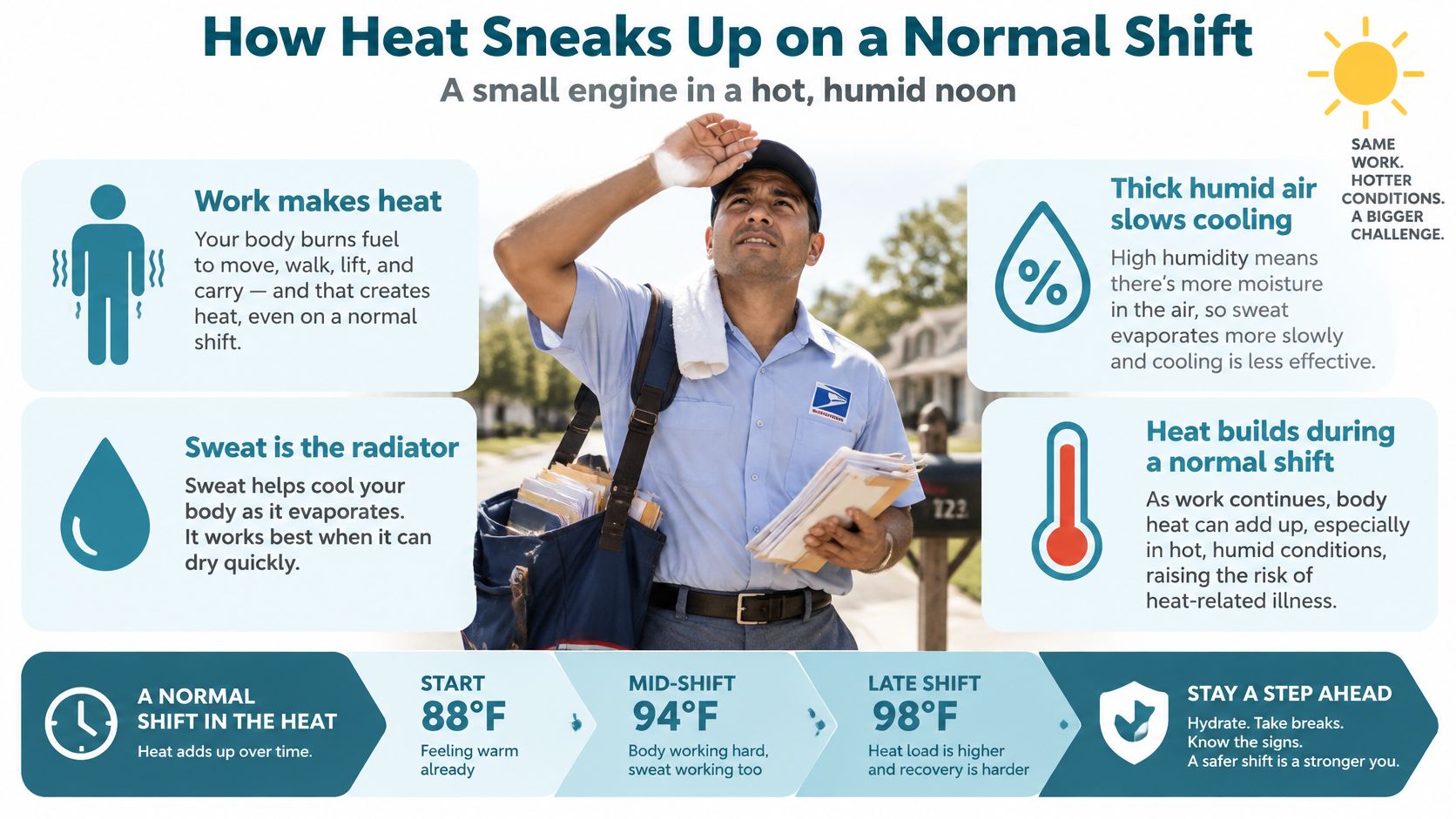
    A volunteer can feel fine at the meeting point and hit a wall an hour later, after hauling full bags along an exposed roadside with no shade in sight. Set exposure controls before anyone feels ill, and have your weather watcher track the heat index rather than air temperature alone.

    The National Weather Service CERT training reference gives an afternoon heat advisory range of 105–110°F for two or more hours and a warning reference of 110°F or higher for two or more hours, while local criteria govern. Cold deserves the same respect. Wind chill drops quickly as wind speed rises, so a windy 20°F day can feel far colder than the thermometer shows, and a body temperature that falls too low calls for immediate medical attention rather than another bag of trash.

    Write the heat and cold stop triggers into the same shared rule your crew uses for weather alerts, so the call is made in advance rather than improvised when someone is already shivering or dizzy.
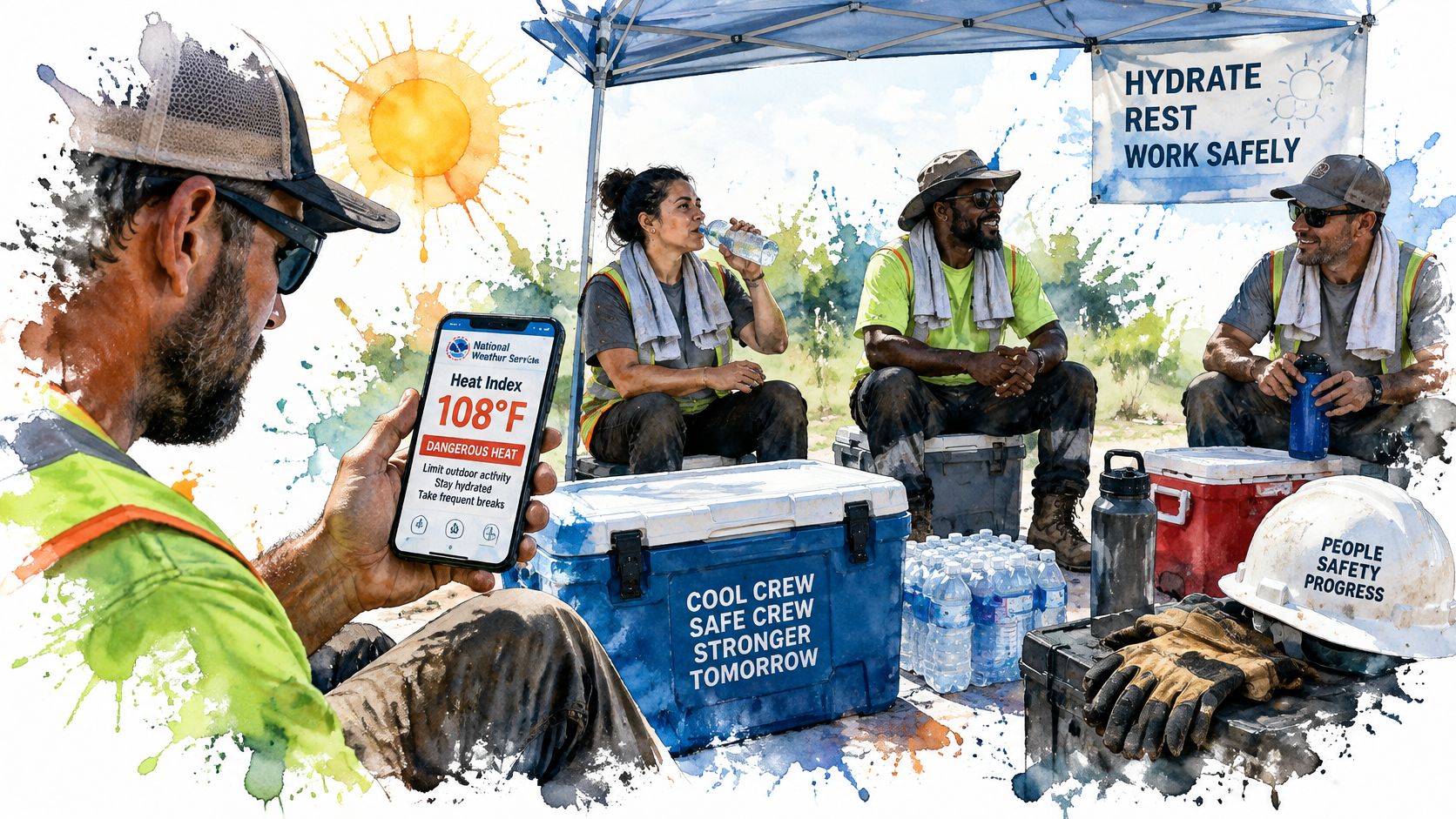
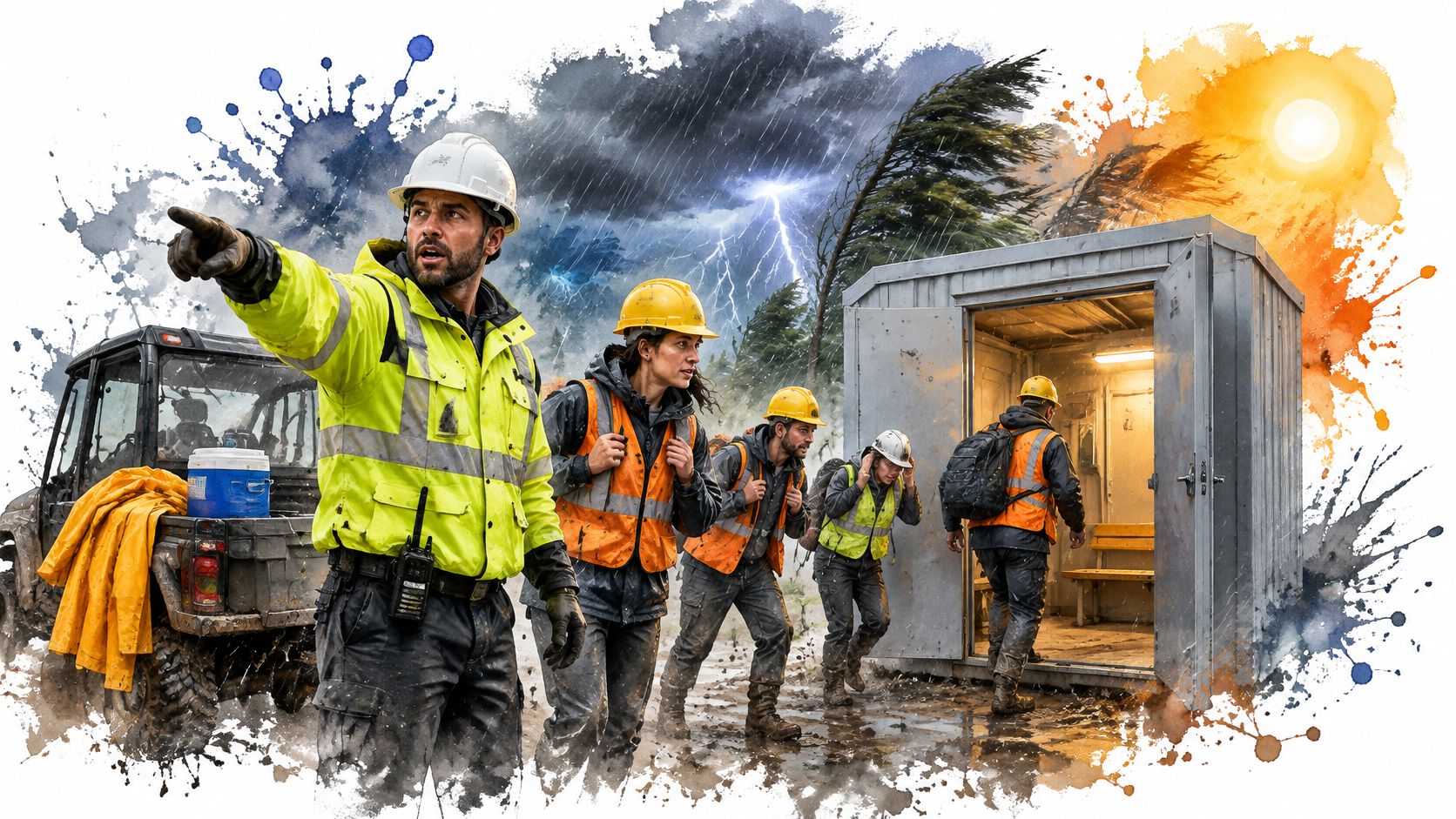
    A diverse crew of construction workers taking a break during dangerous high heat weather conditions.

    Shorten heat exposure before volunteers struggle

    Cut work intervals as the heat index rises. Schedule shaded recovery and hydration breaks for everyone, including the energetic volunteer who insists they don't need one. I recommend assigning buddies rather than relying on self-reporting, because the earliest signs, flushed skin, unusual fatigue, confusion, or a sudden change in behavior, are easier to spot from the outside. Review heat exhaustion prevention tips so you can lead those conversations calmly before the event. If someone starts stumbling or seems confused, stop their work and get appropriate medical help. Finishing the block is never the priority.

    Stopping work also requires a recovery destination. A bus stop in full sun doesn't give an overheated volunteer a useful place to wait, so name a shaded or air-conditioned spot before the event starts. For a newcomer who doesn't know the crew well, pair them with a buddy and point out the recovery spot during the briefing. Knowing exactly where to go makes stepping out feel allowed.

    Keep cold clothing dry and hands functional

    Require loose-fitting layers, dry gloves, face protection, and planned warm-up intervals. Stop when clothing gets wet or dexterity deteriorates. Someone who can't operate a zipper or hold a phone needs warmth, not encouragement to push through.

    Ask your buddy how they're doing while they can still answer clearly. Don't wait for them to announce a crisis.

    Watch for numbness, lost coordination, confusion, unusual fatigue, or shivering that stops. Arrange a warm destination and transportation before dismissing the crew, and give newcomers a named vehicle or indoor spot so nobody waits outside wondering whether they're allowed to leave.

    Log start and stop times, breaks, symptoms, and near misses after every event. If volunteers repeatedly struggle before your written limit, tighten the limit. A plan that keeps failing people isn't a plan worth keeping.

    Rain or Shine Is Not a Safety Plan

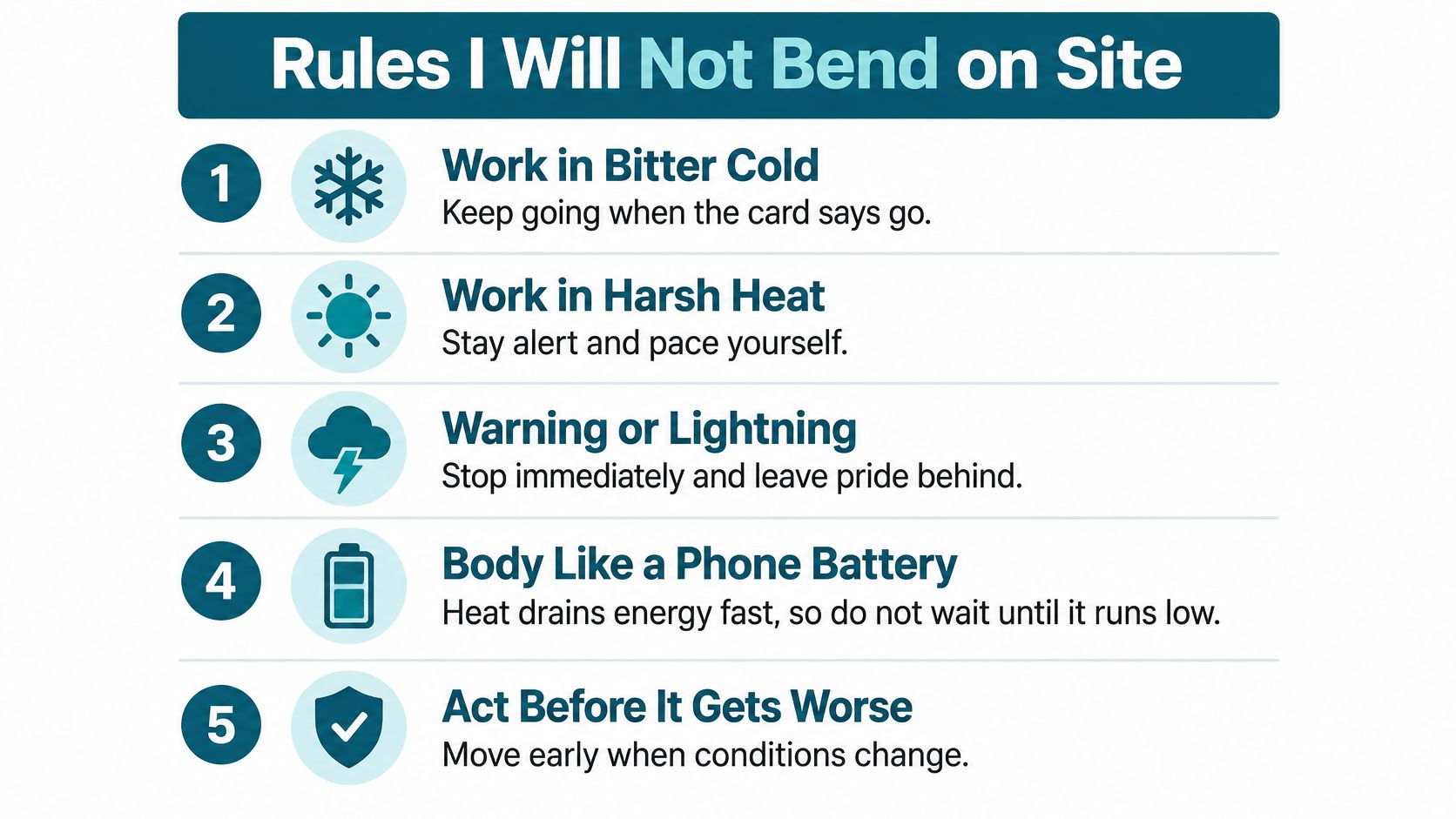
    Showing up matters. We pick up trash rain or shine, including on the coldest days of winter and the hottest days of summer. That determination can bring people together, but it doesn't give anyone permission to ignore a warning.

    For context, Climate Central counted 14 U.S. billion-dollar weather and climate disasters in the first half of 2025, including 13 severe-weather events. You don't need a disaster-scale event to endanger a small crew beside a busy road.

    Make the safety agreement visible before people spread out.
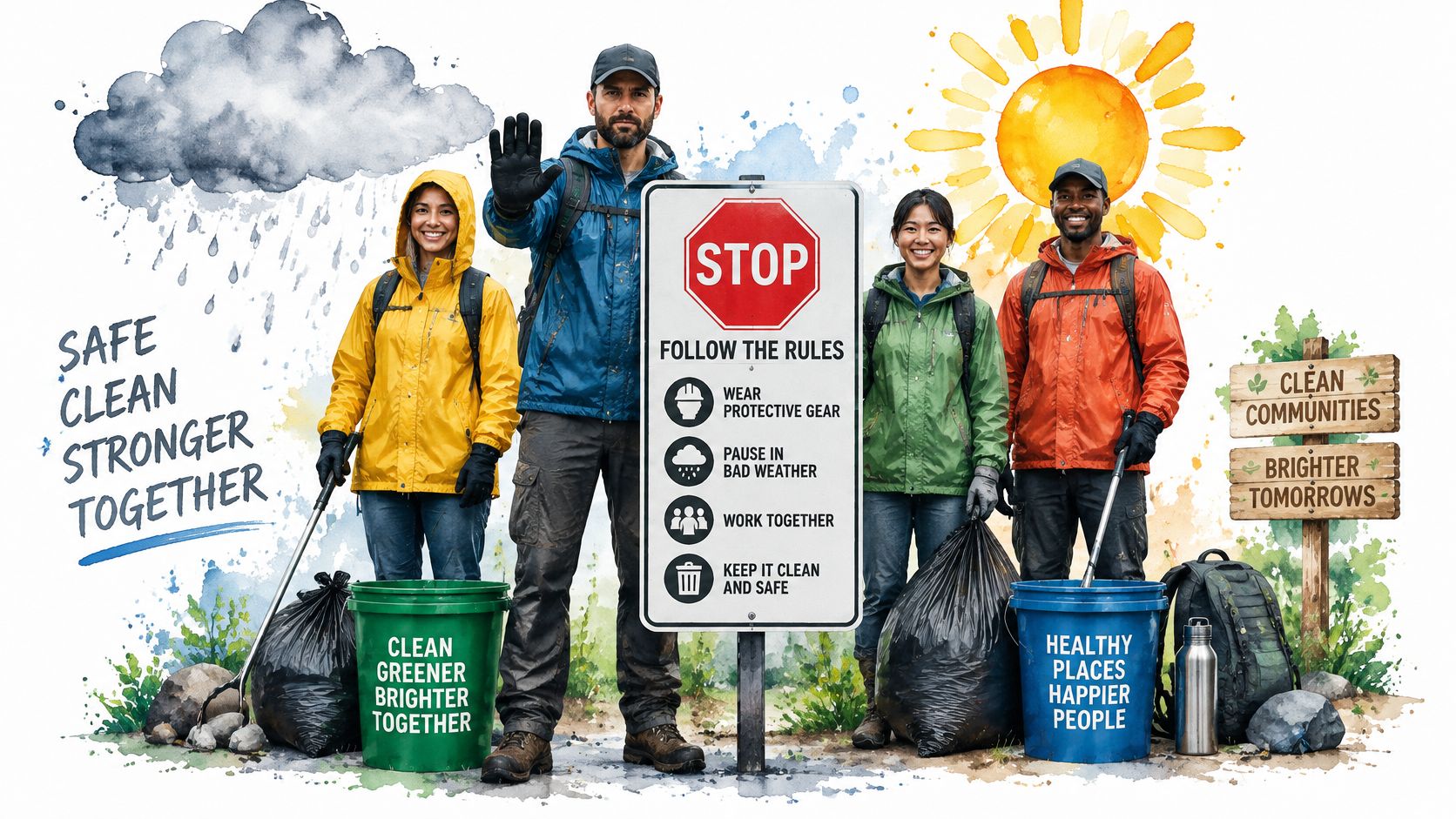
    Four volunteers wearing outdoor gear stand by a sign with safety rules for community cleanup projects.

    Separate inconvenience from danger

    • Manageable inconvenience: Drizzle, muddy shoes, a messy trash bag, or chilly hands that recover promptly with dry gloves and warmth.
    • Stop conditions: Lightning, a severe-weather warning affecting the site, a flooded exit, dangerous wind, or wet clothing in freezing conditions.

    Write your shared rule plainly: When a stop condition occurs, we stop cleanup work and move to the planned safe location.

    A newcomer may hear experienced volunteers joke about bad weather and assume leaving would disappoint the group. Remove that pressure at the briefing. Tell people they can step away without explaining a private health concern or proving they're tough enough.

    For newcomers: You don't owe the group another block, another bag, or an explanation before asking for help.

    Ask your regulars which conditions they wouldn't accept for their own family. Use that answer to test the plan. Praise the person who speaks up early, and help them leave safely. You teach the group's real priorities through that response.

    Transport and Check-Ins for Every Volunteer

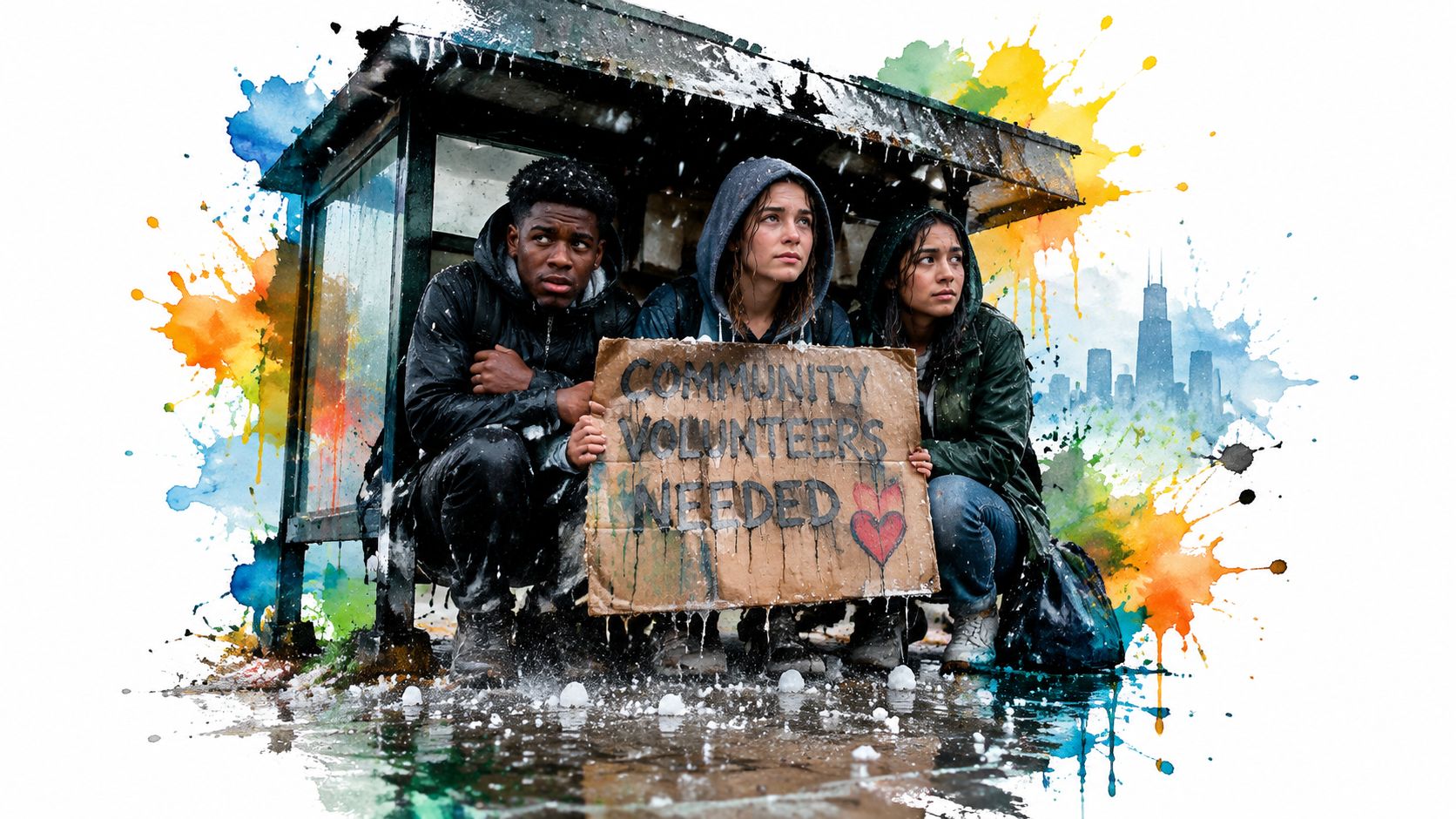
    During our first pickup, we got caught in a springtime hailstorm and blizzard while every Uber we called cancelled on us. That experience gives us a direct lesson: a ride app isn't a guaranteed exit.

    Put transportation arrangements in the event bag before the crew arrives.

    Copy these exits and check-in rules

    • Team car: Reserve available seats for volunteers with the longest or hardest journey home, while accounting for anyone who needs accessible transportation.
    • Named backup driver: Confirm a volunteer with spare seats before work starts. Record who they can take and where they will meet.
    • Mapped alternative: Mark a transit stop or a walking route to a safe building. Don't send people walking through the hazard because the route looks short.
    • Buddy check-in: Exchange phone numbers and confirm how each person will get home. Set check-in times during a disruption.
    • Missed contact: Have the buddy call first, then the roster keeper. Give the safety lead responsibility for deciding whether to request help.
    • Reunification: Name the person who keeps the roster and the person who helps separated volunteers reconnect.

    Make every message reachable

    Drexel's severe-weather community report calls for accessible, multilingual warnings and localized information. Apply that directly: pair an official alert channel with a named human confirmation, use plain language, and provide translations, spoken instructions, and visual information when volunteers need them.

    Walk mobility-safe shelter routes. Privately arrange medication, medical-device, and service-animal needs, plus access to cooling or warmth. Let someone send I need help with their location without posting medical details to the group.

    Name the official local alert authority and record when you receive its warning. Don't substitute a viral post for an official instruction. Add these assignments to your volunteer safety checklist so the next organizer can use them too.

    Confirm Your Plan Before the Next Cleanup

    Start this week, while you still have time to change the location or recruit a backup driver. You don't need a polished manual. You need named people, reachable shelter, working supplies, and a decision everyone understands.

    Turn the checklist into a rehearsal

    1. Write down the leaders. Name the safety lead and the person who can cancel, and attach their names to the event bag.
    2. Walk to shelter together. Time the route with the whole team and check the entrance, crossings, and accessibility.
    3. Inspect the supplies. Open the event bag and team car kit. Test equipment rather than ticking boxes from memory.
    4. Read the stop rule aloud. Ask volunteers to explain what they'll do when it activates, especially if they're working away from the meeting point.
    5. Book the next practice. Put the drill on the calendar and assign someone to organize it.

    In FEMA's 2023 National Household Survey, 37% of U.S. adults reported making a disaster plan, while 12% reported planning with neighbors, according to Disabled World's summary. A personal plan helps, but your crew also needs to practice together.

    A completed checklist isn't the finish. You finish preparing when people can carry out the plan.

    Set your next cleanup date and name the weather watcher before you post the event. Tell volunteers where they'll receive cancellation updates and whom they can contact privately for help. Schedule the rehearsal today, with the same care you give the pickup.


    We bring Chicago neighbors together through volunteer trash pickups, friendship, and hands-on service. Visit Litter Caterpillars to find a cleanup, then ask about the weather plan and bring your readiness to look out for the people beside you.

  • Volunteer Ocean Cleanup Near Me: 7 Chicago Groups to Join

    Volunteer Ocean Cleanup Near Me: 7 Chicago Groups to Join

    At our first Litter Caterpillars pickup, three of us huddled under a tree in a spring hailstorm, shivering while Ubers canceled one by one, and I realized that cleaning other people's messes felt much easier than cleaning my own. If you've searched volunteer ocean cleanup near me while staring at another weekend with no plans, I've got a practical Chicago map for you: seven lakefront and river options, with signup pages, directions for finding current dates, and an honest look at what each group asks of you.
    Your trash is someone else's treasure chest. I don't mean you should rescue every soggy object you find. I mean a cleanup can turn an ordinary morning into a story, a friendship, or a reason to explore another neighborhood.

    Bring what you already own. If you're organizing coworkers, you can find reusable company swag rather than add disposable giveaways to the pile.

    1. Alliance for the Great Lakes, Adopt-a-Beach

    A bottle cap near the volleyball courts. A wrapper beside the beach entrance. If you want a straightforward Lake Michigan cleanup, I'd start with Alliance for the Great Lakes' Adopt-a-Beach program.

    You can search public events by location and date, join a single cleanup, and help record what you collect. You don't need to adopt an ongoing commitment just because the program has “adopt” in its name.

    Best for a First Lakefront Cleanup

    I like the combination of picking up litter and counting it. You leave with cleaner sand, while organizers get a record of the objects volunteers keep finding.

    That approach has a practical precedent: Ocean Conservancy's International Coastal Cleanup report documents how 486,045 volunteers removed more than 14 million individual trash items across coastal and inland communities in 2023.

    • Materials: Team leaders bring the cleanup supplies.
    • Commitment: Join a public event without signing up for recurring work.
    • Cost: The public-cleanup information doesn't list a participation fee.
    • Trade-off: Local team leaders determine availability, and events can fill up.

    Open the event details before registering. Check the meeting point, the start time, and any leader instructions, then save them somewhere you can find without scrolling through email on a windy beach.

    2. Chicago Beach CleanUp

    Chicago Beach CleanUp

    Say you arrive at a Lake Michigan beach and don't know anyone. A coffee meetup gives you an easy first conversation, then a cleanup to do together. Chicago Beach CleanUp brings that social format to the city's lakefront.

    Its 2026 newsletter describes weekly summer beach cleanups, coffee meetups, and opportunities for friends and organizations. It also reports that the group removed more than 1,500 pounds of lakefront trash that season. Check current event posts for dates and registration details.

    Best for Coffee, Conversation, and Sand

    Use the Chicago beach guide to Lake Michigan to choose a location you can reach comfortably. A nearby beach makes it easier to say yes to a cleanup and come back another time.

    The draw is a Chicago-specific group with a shared outdoor activity to break the ice. Bring a friend if you'd rather not make your first introduction alone.

    Summer events don't guarantee a year-round schedule. Check the current listing before heading out, and confirm the beach entrance so you know where to meet.

    Choose a dated event, then check its details for this weekend's schedule and any registration requirements.

    3. Love Blue Chicago

    Love Blue Chicago

    Maybe you already know you'll want more than a single morning with a trash bag. I'd explore Love Blue if you want a beach-focused organization with a chapter structure and room for continued involvement.

    You can find Chicago among its community chapters. Through the wider network, you can explore environmental education, cleanup routines, organizational support, and leadership opportunities.

    Best for Growing Into a Regular Role

    Think of a chapter like a neighborhood team. You might arrive to collect litter, then decide you'd enjoy helping organize the next outing or learning how to lead volunteers.

    I'd keep the first step modest, though. Join a current local activity before treating the chapter as your recurring weekend plan.

    • Local fit: Look for Chicago-specific activity rather than relying on the national event feed.
    • Longer involvement: Explore chapter participation if you want training or leadership responsibilities.
    • Participation cost: The available public-cleanup information doesn't identify a fee.
    • Scheduling caution: The Chicago-specific cleanup posts available for this comparison date to 2024, so confirm current activity through Love Blue's website.

    That last point matters when you're choosing where to go soon. I wouldn't send you across town on the strength of an old cleanup photo.

    Check the chapter's latest updates and contact the organizers if you can't find a dated local event. Keep another lakefront option in mind while you wait for confirmation.

    4. Chicago Park District, Natural Areas Community Stewardship Days

    Chicago Park District Natural Areas Community Stewardship Days

    At a stewardship morning, you might collect litter, plant, or help remove invasive plants. I'd choose the Chicago Park District's Natural Areas Community Stewardship Days when you want outdoor service and don't mind a task beyond trash pickup.

    Look for lakefront locations including Calumet Beach and Osterman Beach Dunes. Read the individual workday description before registering, because organizers change activities with the location and season.

    Best for Habitat Work Alongside Cleanup

    You get a city-run route into local stewardship, with different sites and experience levels. You'll need to check each listing for tools, gloves, RSVP instructions, and the actual work.

    The Park District's volunteer guidance requires a waiver before work begins; children younger than 13 must attend with a parent or guardian, who must sign their waiver.

    • Wear: Long pants, closed-toe shoes, and clothes you can get dirty.
    • Bring: Water and a hat.
    • Plan: Check restroom access, since many locations lack bathrooms.
    • Confirm: RSVP with the site steward because dates, times, and capacity can change.

    My trade-off: You get more variety than a litter-only event, but you might spend the morning doing something else entirely. Sand and uneven ground can also make a site unsuitable for some volunteers.

    Ask about terrain and available tasks before you travel. Choose a role you can enjoy comfortably rather than pushing through a route that doesn't work for you.
    5. Urban Rivers, River Rangers

    Urban Rivers River Rangers

    Want to swap sand for a paddle? I'd check Urban Rivers' volunteer shifts, where River Rangers can help with trash cleanup, community science, and stewardship at Chicago River sites including the Wild Mile.

    You can look for land-based work or kayak cleanup opportunities. You don't need prior kayaking experience for every role, but you do need to distinguish a beginner-friendly opportunity from a shift with training requirements.

    Best for Kayakers and River-Curious Beginners

    For a kayak cleanup, follow the required safety training and confirm the age restrictions before booking. Read the task description carefully, because an open volunteer slot might involve stewardship work rather than the paddling session you had in mind.

    Before you paddle: Treat safety instruction as part of the cleanup, rather than an obstacle between you and the water.

    I like this option for someone who wants to learn while helping. You can also follow the newsletter and volunteer socials if you want a route back after your first shift.

    The trade-off: Availability varies, and some organized group workdays carry a fee. Don't assume that an individual volunteer shift and a private group booking have the same terms.

    Before registering, confirm where you'll work, what instruction you'll receive, and what equipment the organizer supplies. If kayaking doesn't suit you, look for a land-based shift instead of forcing the adventure.

    6. Friends of the Chicago River

    Friends of the Chicago River

    You've got willing friends, but nobody owns a litter grabber. I'd start with Friends of the Chicago River, especially if you want either an organized river event or support for a self-led cleanup.

    You can explore river-edge stewardship, Chicago River Day, paddle-and-plant events, and litter initiatives across the Chicago-Calumet River system. Sign up for the CREW newsletter if your calendar needs more flexibility than a single event date allows.

    Best for Flexible River Volunteering

    The practical tool here is equipment access. Through Friends' Litter Free supply stations, any person or group can borrow kits containing 10 to 15 grabbers, five buckets, bags, gloves, and a planning and safety toolkit.

    Afterward, you can add your project to its Litter Free Map and complete the cleanup survey. I'd use our Chicago River cleanup guide while narrowing down the type of outing you want.

    • For individuals: Look for public community events and stewardship opportunities.
    • For friends: Explore borrowed supplies before buying equipment.
    • For workplaces: Review organized group opportunities separately from individual signup.
    • Scheduling trade-off: Some activities run seasonally or require advance registration.

    Corporate River Action Days target organized groups, so I wouldn't treat them as a drop-in option. Choose the public event route when you're volunteering alone, or use the supply-station toolkit to plan responsibilities with friends.

    7. The Plastic Shark

    The Plastic Shark

    If you want to collect beach litter without sorting through planting days and general park work, I'd consider The Plastic Shark. The Chicago-based initiative focuses on beach cleanups and shares environmental information alongside volunteer activity.

    The group says you can join for free. Its available information doesn't confirm a current event calendar, so contact the organizers or check their latest updates before choosing a morning.

    Best for a Beach-Focused Mission

    You get a close match for shoreline cleanup, with a clear focus on keeping litter out of the water. For context before you go, our ocean plastic pollution guide explores the subject beyond the bag you carry home.

    The trade-off: You'll need to establish the event timing and meeting details rather than rely on a readily confirmed calendar. Ask about supplies, the cleanup route, and who will handle the collected waste.

    Safety first: Gloves protect your hands. They don't make every object safe to touch.

    The Chicago Park District's litter-pickup guidance warns volunteers about broken glass, sharp metal, wire, needles, unknown substances, and sanitary products, and tells them to avoid anything unsafe.

    I'd follow that cautious approach at any cleanup. Leave suspicious objects alone and alert your organizer; you don't need to collect the most dangerous thing on the beach to have a useful morning.

    Compare the 7 cleanup groups at a glance

    Waterfront focus Commitment level Gear provided Cost to volunteer
    Alliance for the Great Lakes, Adopt-a-Beach: Great Lakes beaches One-time participation welcome Team leaders bring cleanup materials No fee listed for public cleanups
    Chicago Beach CleanUp: Chicago lakefront beaches Community events; summer cleanups are seasonal Not specified Not clearly stated
    Love Blue Chicago: Chicago beach and community cleanups One-time or continued chapter involvement Not specified No fee identified for public cleanups
    Chicago Park District, Natural Areas Community Stewardship Days: Lakefront natural areas and beaches Public workdays; dates and RSVP requirements vary Some listings provide tools and gloves Not specified
    Urban Rivers, River Rangers: Chicago River sites, including the Wild Mile Sign up for available shifts; some roles require safety training Kayak instruction provided for kayak cleanup shifts Some group workdays have a fee
    Friends of the Chicago River: Chicago-Calumet River system One-time and recurring opportunities; some require advance signup Litter Free supply stations support some self-led cleanups Not specified
    The Plastic Shark: Chicago beaches and coastlines Join scheduled cleanups; check for current event details Not specified Free, according to the organization

    Pick One Saturday and Show Up

    Choose your water first. If you want sand underfoot and an open lake view, start with a beach group; if you want river-edge work or a possible kayak shift, look at the river programs.

    Pick a group from the comparison table and open its registration page today. Find an actual date, confirm the meeting point, and save the organizer's instructions before you close the tab.

    Make the First Morning Easy

    Bring gloves and water. Wear closed-toe shoes, plan your journey, and check the weather and cancellation instructions before leaving.

    If you need a shorter route, accessible terrain, or a role that avoids bending, ask before registering. You deserve enough information to decide whether the outing works for you.
    You can also join us at Litter Caterpillars as a bonus Chicago option. Kevin Tao founded our group after struggling with his own clutter, and we now meet every weekend morning, rain or shine.

    • Our reach: We've cleaned all 50 Chicago wards.
    • Our priorities: We put volunteer safety first and happiness second.
    • Our promise: We never pressure volunteers for money.

    Join through our website or find our Meetup to choose an upcoming morning. We build friendships through the work, so you don't need to arrive with a ready-made crew.

    I still think about that first pickup under the tree. I don't recommend freezing in hail as a weekend goal, but I understand why showing up together made that miserable weather into a story worth keeping.

    The first pickup is the hardest one, exactly like cleaning your own room. Every one after that gets easier: you know what to bring, you recognize a face, and you've already proved you can get out the door.


    We make weekend-morning trash pickups a way to explore Chicago, meet people, and care for the places around our waterways. Visit Litter Caterpillars to find your next outing and join us, with volunteer safety first and no pressure to donate.

  • Volunteer Safe Haven: How to Build One That Protects

    Volunteer Safe Haven: How to Build One That Protects

    You've set out your old sneakers, checked the cleanup address, and wondered whether anyone will notice if you arrive alone. Then the forecast changes. You still want to help, but you'd like to know who's in charge, what happens if you get cold, and whether you can leave early without disappointing the group.

    Those are fair questions. A volunteer safe haven starts with clear answers, before you pick up a bag.

    What a Volunteer Safe Haven Really Protects

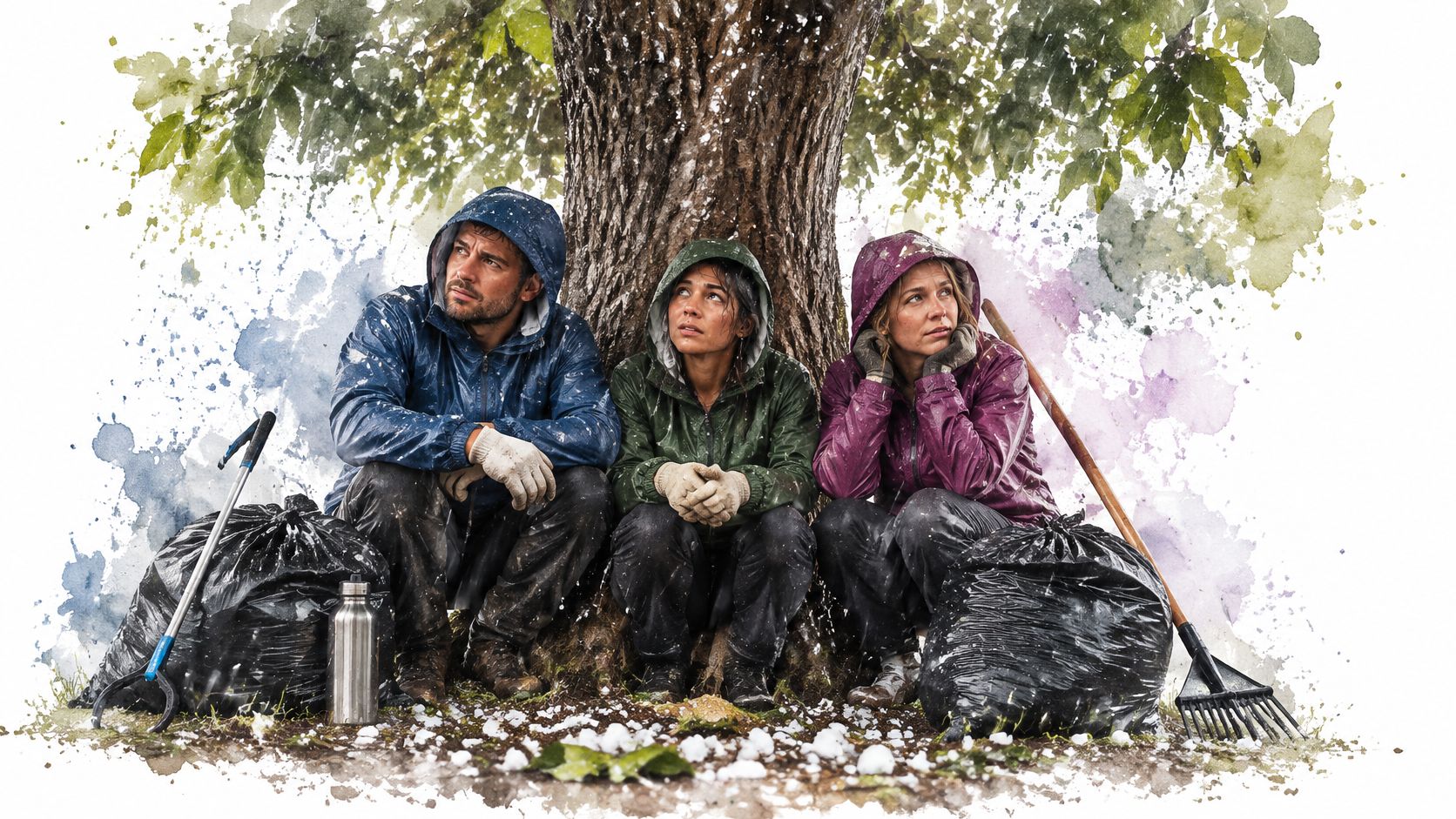
    Say you're part of a cleanup crew of three, huddling under a tree while hail rattles against the pavement. You look at each other, unsure whether to keep collecting or head home. Nobody wants to seem like the person who gave up.

    That uncertainty matters more than the unfinished route. I'd stop the cleanup and move everyone toward substantial shelter, rather than treat the tree as a safe waiting place.

    Keep that uncomfortable moment in mind as you look at this scene.

    Three volunteers huddled together under a large tree for shelter during a rainy outdoor cleanup session.

    A safe haven works like a harbor. You can't stop the sea, but you can give boats a clear entrance, somewhere to wait out bad weather, and a way to leave.

    Give people a way in and out

    For your group, that means protecting several parts of the experience:

    • Physical safety: You set boundaries around traffic, weather, sharp objects, and fatigue.
    • Emotional safety: You respect people's limits, respond to harassment, and make breaks ordinary.
    • Social safety: You help newcomers meet someone and find a dependable place to return.

    Say a newcomer gets tired halfway through the route. You can thank them, help them check out, and welcome them back. Or you can joke about their stamina and watch them smile awkwardly. The difference takes seconds.

    Practical rule: Judge the morning by how you treat the person who needs to stop.

    Before your next event, check each layer, name a gap, and choose a fix you can carry out. Maybe you need a shelter location, an introduction at check-in, or a clearer response to unwelcome comments.

    The haven exists to keep people coming back, rather than to remove all risk.

    Build a Pre-Cleanup Safety Plan

    The CDC's analysis of volunteer fatalities recorded 501 U.S. volunteer deaths from 1993 through 2002, with volunteer firefighting accounting for the largest share, a reason to examine the task itself when you assess risk.

    A neighborhood cleanup needs boundaries that match its work. At Litter Caterpillars, volunteer safety always takes first priority, and volunteer happiness takes second priority. I'd put that order directly into the morning's decisions: you can shorten a route; you can't undo an injury by collecting more trash.

    Make responsibility visible

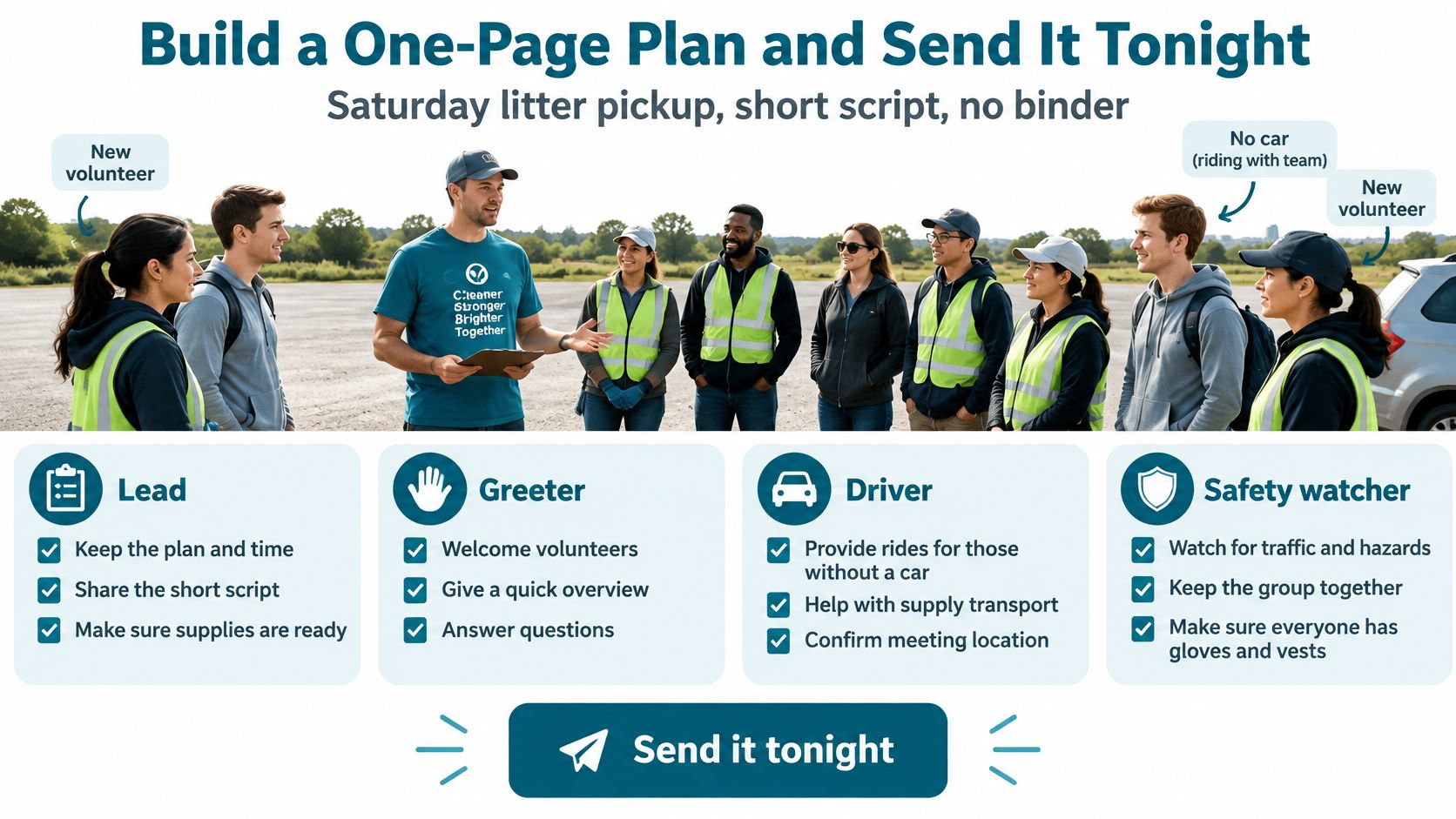
    1. Name a safety lead. Give that person a bright vest or another visible identifier, and introduce them before anyone heads out. A first-timer shouldn't have to guess which person can change the plan.

    2. Prepare the roster. Record names, emergency contacts, arrival times, and team assignments. Keep personal information with the lead rather than on a clipboard that everyone can browse, and leave room for departure times and incident notes.

    3. Walk the route before you deploy. Mark traffic lanes, unstable structures, and loading areas as prohibited zones. Point out the actual boundary, for example, the sidewalk corner where the team turns back, rather than telling people to stay nearby.

    4. Use the start point for check-in and check-out. Ask people to tell the lead when they leave, including when they finish early. That simple exchange separates a normal departure from a missing-person concern.

    Explain the decisions before anyone needs them

    1. Give a short hazard briefing. Show how to use pickup tools and protective equipment, describe no-touch items, and explain how volunteers should raise a concern. Ask someone to repeat the stop signal so you know the message reached the group.

    2. Agree on stop-work triggers. Severe weather, hazardous materials, violence, or a medical emergency should prompt a pause without a debate about finishing the block. Name a fallback meeting place and decide how you'll notify anyone working farther along the route.

    3. Post the escalation route. Keep emergency-service instructions, the property authority's contact details, a first-aid kit, and a charged phone with the lead. Include the site's precise location so a frightened caller doesn't have to work it out under pressure.

    For a useful comparison with coordination beyond a neighborhood event, HeyLocals explains who supports volunteers on trips abroad. Use that context to think through who handles questions, changing conditions, and practical support.

    FEMA's guidance on managing spontaneous volunteers identifies the controls behind this approach: a defined management structure, clear communication, risk awareness, and coordination by authorized local personnel. You don't need a complicated command center. You need people who understand their responsibilities and can act on them.

    Try a thirty-second arrival test: can a newcomer tell you who to call and where to stand within thirty seconds of reaching check-in?

    Hazard Rules for Heat, Cold and Sharp Objects

    Hazard Rule for volunteers When to stop or call
    Heat Screen conditions before the event, shorten work intervals, provide shade and water Stop when a volunteer shows signs of heat illness
    Cold, wet or windy weather Wear waterproof layers and keep a warm space within quick reach Stop during lightning or dangerous wind chill
    Heavy lifting Work in pairs, lift with legs and rest between loads Stop when someone can no longer keep good form
    Broken glass, sharp metal, wire Use tools and gloves that match the debris, never grab by hand Stop and mark the area when sharps cover a wide zone
    Needles or unknown liquids Don't touch, isolate the item and mark its location Notify the lead and contact the municipal service
    Chemicals or pressurized containers Don't touch, step back and mark the location Notify the lead and contact the municipal service
    Dead animals Don't touch, mark the location and tell the lead Contact the appropriate city service

    Change the work when conditions change

    OSHA's heat-stress guidance tells you to assess temperature, humidity, wind, radiant heat, clothing, and workload, then use controls that include water, shade, and work-rest schedules. Gloves and other protective equipment don't replace those controls.

    You might feel comfortable standing at check-in and overheat while repeatedly bending, lifting, and carrying. Shorten those work intervals and put recovery space within easy reach. If someone feels unwell, stop their work rather than asking them to finish the bag.

    In cold rain, plan waterproof layers and quick access to warmth before you leave the meeting point. SunnyBay's winter pain-prevention tips give you another preparation resource; use our injury-prevention strategies when you review movement and task choices.

    Match the equipment to the debris

    The Chicago Park District stewardship handbook directs leaders to inspect the area, supply bags and gloves, and match glove protection to the material. It also requires a guardian or supervisor for participants under 13, with close supervision in designated safe areas.

    Don't treat any glove as permission to handle a needle or unknown substance. Use pickup tools for approved debris, and leave uncertain items alone. For a Park District project, send items beyond the crew's safe scope to the Community Stewardship Program manager.

    A bag you leave empty is better than a hazard you handle without the right preparation.

    Which conditions would make you cancel your event, and who makes that call? Write the answer before you open registration.

    What Volunteers Collect and What They Report

    Item found Volunteer action Who handles it
    Loose litter, paper or bottles Bag and collect Volunteers
    Dumped furniture on a vacant lot Photograph, record the location and leave it in place Property owner or ward office through 311
    Abandoned vehicle Note the location and don't touch it City through 311
    Open raw garbage outside a container Note the address and report it Property owner or city sanitation staff through 311

    Use a collect-or-report rule. You collect loose litter you can safely bag; you report conditions that need city equipment, a property owner, or regulated waste handling.

    Under Chicago's sanitation rules, owners of vacant or unimproved lots must remove litter, debris, and abandoned vehicles and keep weeds below 10 inches. The rules also require tightly closed garbage-container lids and prohibit raw garbage outside containers, while ward superintendents coordinate sanitation enforcement and related services.

    Work the sidewalk, document the larger problem

    Say your crew reaches a vacant lot. You use grabbers to collect loose paper along the sidewalk, then spot a dumped sofa and an abandoned car farther inside.

    You don't climb over the sofa or try the car doors. Take photographs from a safe position, record the location, and send the issue through the ward or city reporting process. Include the nearest address and a plain description of what you found.

    • Collect safely: Keep your work inside the approved route and bag only familiar, manageable litter.
    • Report clearly: Describe the item and location without entering private property or disturbing the scene.

    Check municipal activity before choosing that route, too. Chicago's city-services information describes street sweeping across every ward, generally from April through November; use the ward schedule to avoid active sweepers and associated parking restrictions.

    A useful report gives city staff something they can act on. It also gives your volunteers a sensible endpoint: you've done the safe work available to you.
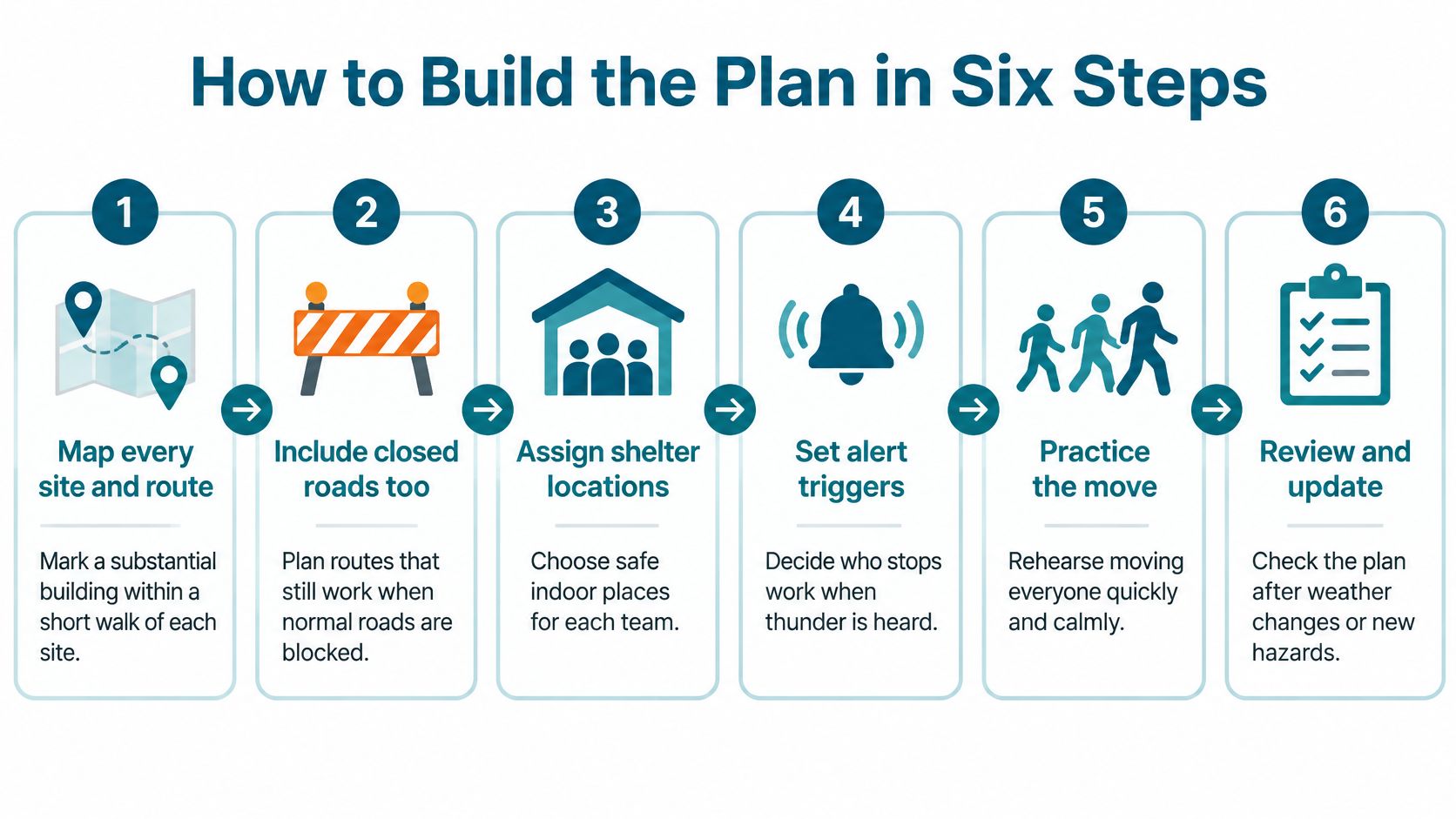
    Before the next cleanup, write a pocket card with items to collect on one side and items to report on the other. Review unfamiliar discoveries together instead of letting the most enthusiastic person improvise.
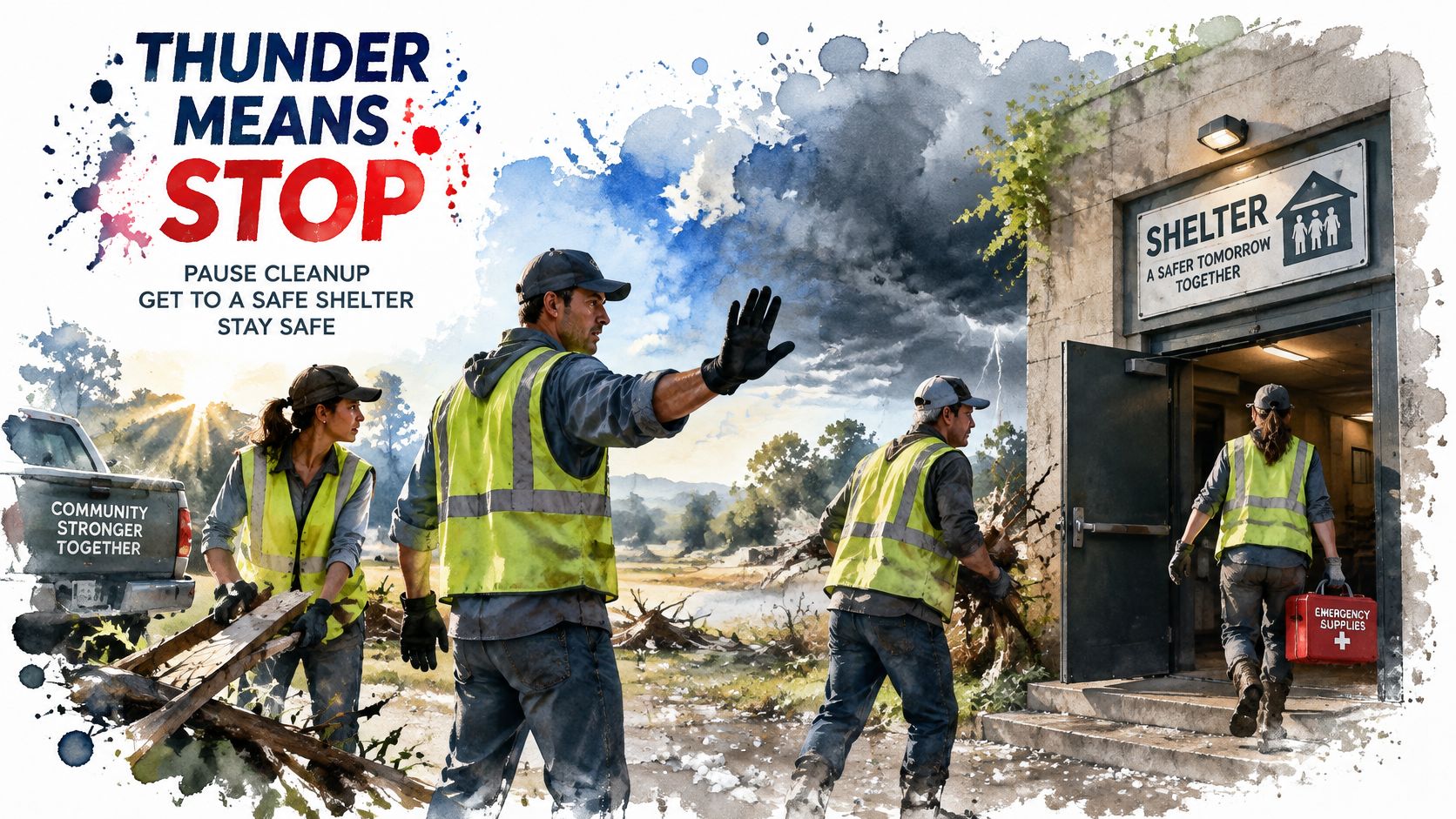
    When Something Goes Wrong

    A volunteer calls your name, holds up a bleeding hand, and points toward wire near a bus stop. Or someone becomes dizzy. Or you reach check-out and can't account for a teammate.

    As lead, stop the work, check the person's condition or whereabouts, and decide whether you need emergency services. Don't ask the crew to keep collecting while you sort it out.

    Pause, help, document

    1. Clear the immediate zone. Stop the task and move other volunteers away from the hazard. Keep someone available to guide responders to the location.
    2. Check the person. Give first aid within your training and call emergency services when the injury or illness needs urgent help. For a missing volunteer, check the roster and assigned team, then escalate promptly when you suspect danger.
    3. Record what happened. Write the time, place, names, observed conditions, and actions you took. Separate what you saw from what someone later told you.
    4. Notify the responsible authority. Contact the property owner or city office when the incident involves public property or a regulated item.
    5. Debrief before the next shift. Change the route, tools, briefing, or supervision to address what went wrong.

    In the wire-cut scenario, use the first-aid kit to provide care within your training, seek help for a deep wound, and record the event before anyone returns to the route. Reopen that area only after you've addressed the hazard.

    Prepare supplies and reporting routes

    When you review supplies, you can browse workplace first aid kits from Material Handling USA to compare contents. Choose equipment your designated helpers know how to use, and check your volunteer liability insurance arrangements before an incident tests them.

    Include harassment and exclusion in your response plan. Give volunteers an in-person route to the lead and an anonymous form, then assign a conduct owner who receives reports from the lead the same day.

    Protecting Feelings and Belonging

    You may enjoy a cold, muddy morning and the satisfaction of finishing a difficult block. Someone beside you may hear the same toughness talk as a warning that they'll have to endure discomfort to belong. Don't make either person prove themselves.

    Think about the welcome you'd want after a rough encounter.

    A group of diverse volunteers provide comfort, warmth, and support to a woman wrapped in a blanket.

    The UK government's inclusion guidance for volunteering identifies fear of rejection, low confidence, racism, discrimination, and inaccessible onboarding as barriers. Respond directly to prejudice instead of assuming an open invitation settles the matter.

    Make choices comfortable to use

    • Assign a buddy: Introduce each first-timer to a check-in partner. Use our volunteer peer-support guide to think through that connection.
    • Allow an uncomplicated exit: Let people stop without an explanation. Suggest lower-risk work, such as sorting supplies or observing the route from an approved position.
    • Publish conduct expectations: Explain boundaries around comments, identities, photographs, and unwanted attention, along with how leaders respond to reports.

    Say a first-timer stays silent in the group chat. Their buddy asks how the morning went, and they describe a hostile comment they didn't know how to challenge. Thank them, ask what support they want, and act through the conduct process without demanding a public retelling.

    Keep that kind of personal check-in in mind as you watch.

    The 2025 State of Volunteering Report warns that well-meant safety measures can create gatekeeping and reports that 68.4% of volunteer leaders view retention as a critical organizational challenge. Keep preparation proportional to the task rather than asking every newcomer to clear unnecessary hurdles.

    At Litter Caterpillars, we'll never pressure volunteers for money. Bring that same clarity to your own expectations: this week, write a conduct rule and a reporting route that someone can understand without asking permission.

    Set a Schedule Newcomers Can Keep

    Say you want to help, but you work alternating weekends. A weekly event could still suit you if the organizer welcomes occasional attendance. A demand for perfect consistency would close the door before you even meet anyone.

    A National Academies review of volunteerism describes people volunteering from 1 to 52 weeks per year, across weekdays, evenings, and weekends, in short concentrated periods or longer, less intensive stretches. Give people room to choose their own rhythm.

    At Litter Caterpillars, we hold events on weekend mornings. For a group planning its own calendar, the following example keeps a predictable anchor while leaving other ways in.

    Shift How often Who it suits
    Weekly weekend morning Every week Volunteers who want a steady habit
    Monthly weekday session Once a month People with weekday availability
    One-time first-timer shift Once Newcomers testing the group

    Make the invitation specific

    Treat a single weekend as real participation. If someone carries bags, meets a neighbor, and leaves at the agreed time, thank them without attaching an attendance pledge.

    You can also give busy volunteers a short task with a clear finish: help at check-in, prepare supplies, or join an opening stretch of the route. Don't make early departure feel like sneaking out.

    1. Publish safety basics: Name the lead, explain stop rules, and state your group's money expectations clearly.
    2. Write a first-timer guide: Explain where to meet and how to find a buddy.
    3. Send a brief follow-up: Ask what felt comfortable and what you should change.

    Pick a weekly slot and a shorter participation option, then write both into your event page. People can make a realistic commitment when you give them a realistic invitation.


    We organize weekend-morning Chicago cleanups at Litter Caterpillars, with volunteer safety first and happiness second. Visit Litter Caterpillars to find a cleanup and take your first step toward service, friendship, and a group you can return to at your own pace.

  • Trash Removal Service: Costs, Options and How to Choose

    Trash Removal Service: Costs, Options and How to Choose

    You stare at a garage corner on Friday night. You see a broken dresser, three bags you forgot to set out, a mattress you want gone, and a can of old paint you fear to touch. You want a trash removal service you can trust, and you want a price you can plan around.

    I hear you. I help neighbors sort messes like yours into three piles, and I watch relief hit your face when you see a clear path. You send everyday bags to your city crew, you book a hauler for heavy work, and you join neighbors for litter in shared space. You also learn where each option stops, because a wrong choice leaves you with a tagged cart, a soaked mattress, or a bag you should never carry.

    Trash Removal Options and What Each Costs

    You have three main lanes, and I want you to pick your lane before you lift a thing. Your city truck handles your weekly household bags. A private hauler takes the bulky load your city turns away. A volunteer group clears litter from sidewalks, alleys, and lots you share with neighbors.

    Think of your trash like mail. You put a letter in your mailbox for free pickup, you hire a courier for a heavy box, and you help your block sweep paper off a shared sidewalk. Each lane has a payer, a schedule, and a limit, and you save money when you match your item to the right lane.

    Option Who pays Typical cost How service runs Best for Main limit
    Municipal pickup Taxpayers or a city fee Often included in city services, sometimes a separate utility fee Fixed weekly or biweekly schedule Everyday household trash in carts Rejects bulky items and construction debris
    Private hauler You, per booking Typically $100 to $500 for a single load, more for dumpsters On demand, booked in advance Bulky items, moves and renovation debris Costs money each time and needs scheduling
    Volunteer cleanup group Volunteers, often funded by donations or city partners Free to residents Scheduled events, often on weekends Litter and debris in shared public spaces Cannot take household waste or hazardous items

    Four Things Move Your Quote Up or Down

    I tell you to confirm every price locally, because your city, your hauler, and your load move every range. You ask each hauler for a written quote that lists each item and each disposal fee. A verbal guess grows on pickup day, and a written list protects you.

    • Volume: You pay for truck space, so a quarter truck costs far less than a full truck, and you save cash when you measure before you call.
    • Access: You pay more labor when your crew climbs stairs, walks a long path from curb to pile, or squeezes a sofa through a tight door.
    • Item fees: You often pay a surcharge for a mattress, a tire, paint, or an appliance with refrigerant, because your hauler pays a special fee at disposal.
    • Timing: You pay more for a rush booking, especially on a weekend, and you pay less when you book a weekday slot with open access.

    Say you move a bedroom set from a second floor. You might pay twice what your friend pays for the same set in a ground floor garage, because your crew carries each piece down stairs and across a yard. A dumpster tells a similar story, because your flat fee includes a weight limit and overage charges grow fast when you load heavy remodel debris.

    My rule for you: You get a quote in writing, you name every item on the phone, and you ask what changes the price on site.

    You never pay to join a volunteer cleanup, and we hold that line at Litter Caterpillars. We will never pressure our volunteers for money, and you should walk away from any group that pressures you at signup. You give time, you grab a bag, and you leave with new neighbors.

    Municipal Pickup Covers the Everyday Basics

    Your city crew does your weekly basics well, and you often pay nothing extra per visit when your bill already includes service. You help your crew help you when you follow set-out rules every week. A clean routine keeps your cart empty on schedule, and you avoid a smelly wait until next week.

    You check your day and your holiday shift on the Chicago trash pickup schedule before you plan a move or a big family dinner. You put your cart out by the time your city names, you close the lid, and you keep the walk clear. Holiday weeks often shift your pickup by a day, so you confirm before you drag a cart to the curb in the cold.

    Rules That Keep Your Cart Moving

    • Close the lid: You pack bags inside the cart, and you leave nothing beside it, because crews often leave loose piles behind.
    • Keep bad items out: You keep batteries, paint, and chemicals out of your cart, and you take them to a proper drop-off instead.
    • Respect size: You brake down boxes, you avoid an overflowing cart, and you wait a week with extra bags inside your garage when you must.

    An overflowing cart often sits with a tag, and you lose a week. I would rather see you hold one bag for seven days than watch you chase a missed pickup for three days. You report a missed pickup inside your city window, often 24 to 48 hours, and you note your address and cart spot.

    You also plan ahead for bulky items. Many cities let you book a bulky pickup and allow a few free items each year, so you check your bulk schedule before you haul a couch outside. A couch you set out early can sit for days in rain, and your neighbors stare at your mistake.

    Pros you feel every week

    • No per-visit bill: Your fee often covers trash, recycling, and yard waste in the same weekly rhythm.
    • Predictable schedule: You plan cleanouts around a fixed day, and you know exactly when your alley clears.

    Limits you must respect

    • No construction debris: Your cart rejects remodel waste, tires, and hazardous items every time.
    • Slow bulky waits: Your bulky slot can sit days or weeks out, so you book before your lease ends.

    Hiring a Private Hauler, Step by Step

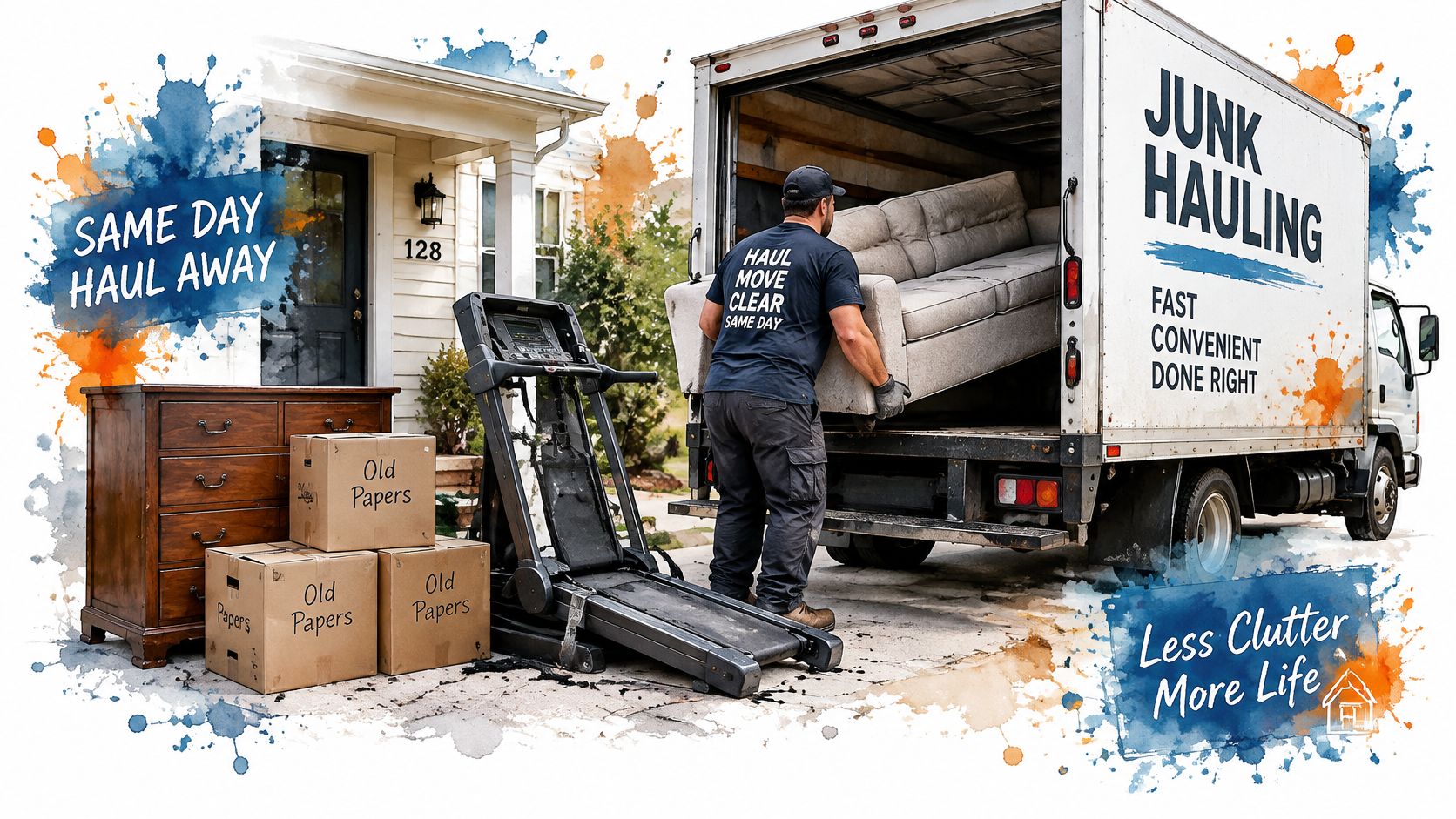
    You open your garage on a Saturday move-out, and you face a sofa, a dresser, three boxes of old paperwork, and a broken treadmill. You lack a truck, you lack a second pair of strong arms, and your landlord wants the keys by Sunday. A private hauler fits you here, because speed beats savings on a deadline.

    You watch a junk crew arrive, load your mixed pile, sort items for donation or recycling, and drive away in one visit. You pay for labor and truck space, and you reclaim your afternoon. I recommend this lane for small mixed jobs that mix furniture, boxes, and odd equipment.

    Your crew handles the heavy lift for you in this kind of visit.

    A professional mover loading a sofa into a junk removal truck near a suburban house home.

    A roll-off dumpster fits a different story. You remodel a bathroom over a week, you load heavy tile and drywall yourself, and you pay a flat fee that includes disposal up to a weight limit. I steer you to a dumpster for large, heavy, single-type work, and I steer you to a junk hauler when you want hands to carry the load.

    Six Steps I Want You to Follow

    1. List every item: You write size, count, and a weight guess for each piece, and you mark your path from curb to pile for your crew.
    2. Check free city options first: You review bulk and recycling rules, so you skip paying for items your city takes free on a schedule.
    3. Get three written quotes: You ask each company to list each item and disposal fee, and you compare lines side by side at your kitchen table.
    4. Verify license and insurance: You check the business license, liability insurance, and reviews from the past six months, and you ask in writing where your material goes.
    5. Book and stage the job: You confirm date, parking, and the person who meets your crew and approves your final load before the truck leaves.
    6. Keep your paper: You save receipts and disposal records, and you check your final bill against your quote the same day.

    Step four protects you more than any discount saves you. A company that cannot name a dump site puts you at risk, because improper dumping can bring cleanup demands and fines that land on you as the property owner. You build confidence fast when you spend ten minutes understanding licensed waste disposal before you sign, and you ask sharper questions on the phone.

    A cheap quote with no disposal address costs you more than a fair quote with a named facility and a receipt.

    You also plan your own calendar with care. Our volunteer events run on weekend mornings, so you book a hauler for a private load on a weekday and you save your Saturday morning energy for public litter with neighbors. You keep private work private, and you keep shared work social.

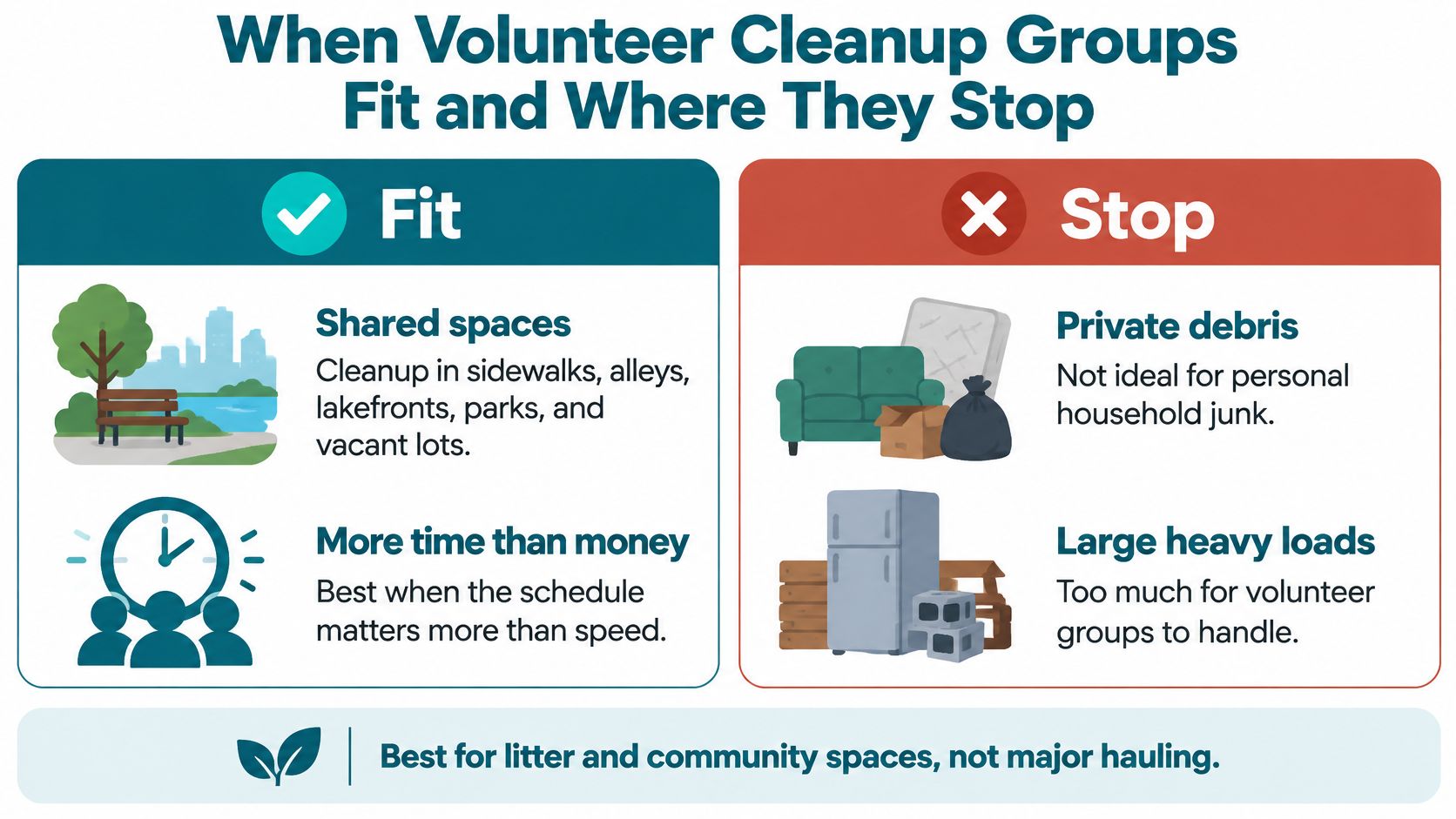
    When Volunteer Cleanup Groups Fit and Where They Stop

    You choose a volunteer cleanup group when mess sits in shared space and you have more time than money. You and I clear litter along sidewalks, alleys, lakefront paths, parks, and vacant lots that everyone sees. You finish a block together, and you feel pride every time you walk past it later.

    You see the fit and the stop lines at a glance here.

    An infographic showing guidelines for when volunteer groups should perform cleanup versus when to stop.

    We show up for you in a steady rhythm. Our group has picked up trash every single week, and we pick up trash rain or shine, including on the coldest days of winter and the hottest days of summer. You trust a group that still meets you on a windy morning, because consistency turns a one-time sweep into a cleaner block.

    Where we fit you well

    • Shared litter: You get free hands for cups, bottles, wrappers, and windblown debris in public space.
    • Visible wins: You see clean ground within an hour, and neighbors thank you on the spot.
    • New friends: You meet people from your block while you work side by side with a grabber and a bag.

    Where we stop for your safety

    • Private junk: We don't haul your sofa, collect your household bags, or clear your garage for you.
    • Hazardous finds: We leave sharps, unknown liquids, and pressurized cans alone, and we report them for trained crews.
    • Fixed dates: We run scheduled events, so you can't summon us on demand for a same-day emergency.

    I ask you to ask an organizer three questions before you join any group. You ask who provides bags, gloves, and high-visibility vests, you ask where collected litter goes, and you ask who decides what volunteers leave behind. Clear answers tell you the leader plans for your safety.

    Waste work carries real risk for you, and OSHA guidance on waste management hazards names lifting injuries, slips, trips, falls, cuts, and vehicle strikes as collection hazards. You wear gloves, you watch traffic, and you keep a partner in view on a roadside. You also track results, and Durham, North Carolina's Adopt-a-Street analysis reported 10,914 pounds of litter removed across 93 events, about 9.3 pounds per person-hour. You can log volunteers, hours, pounds, and ward after your event, and you can see whether your route improves month by month.

    You can watch a cleanup rhythm in action before you join us.

    What Volunteers Should Never Touch

    Ambiguous litter causes you the most trouble on a cleanup, and I give you one rule for every mystery item. If you can't name it, you leave it and you report it. You protect your hands, your lungs, and your teammates when you slow down for ten seconds.

    Think of a cleanup like berry picking. You eat the berries you know, and you leave the strange ones for someone with training and tools. Pride never beats safety on my route, and a smart refusal keeps you coming back next week.

    You use Chicago guidance on hazardous waste disposal when you face paint, chemicals, or fuel at home, and you use the scan table below on site. Your team lead photographs the item, notes the address, and sends the report while you keep working on safe litter nearby.

    Item you find Action you take Reason you act this way
    Used motor oil or unknown liquid Leave it, photograph it, report it Liquid can burn skin and pollute soil
    Needle or sharp object Leave it in place, warn your partner, report it through 311 or your city line A puncture can infect you fast
    Lithium-ion battery Keep it out of bags and carts, hand it to a team lead for special handling Batteries can spark fires in trucks and plants
    Aerosol can Leave a pressurized or damaged can, keep every aerosol can out of a Blue Cart Pressure and residue create facility danger
    Remodeling debris Note the location and leave it for the project owner The owner carries disposal duty for that material
    Cardboard box Flatten it and place it in recycling Flat cardboard sorts cleanly
    Can or carton Keep the shape and place it in recycling Crushed shapes sort poorly
    Plastic bag or film Bag it as trash, keep it out of a Blue Cart Film tangles sorting equipment

    Sorting Rules You Can Use in Chicago

    Chicago's What Goes Where recycling guidance tells you to flatten cardboard boxes and tells you to avoid crushing cans or cartons because crushing makes sorting harder. The same guidance names aerosol cans, lithium-ion batteries, hoses, plastic bags, and other film plastic as contaminants that should never enter Blue Carts. You can search the What Goes Where tool with an item description or a photo when you stall on a choice.

    Field habit: You pause, you point, you ask your team lead, and you only lift after you hear a clear yes.

    You wash your hands after you remove gloves, you drink water in heat, and you step back from traffic before you bend for a bottle. I want you proud at the end of a route, and I want you unhurt even more.

    Bulky Waste and Illegal Dumping Without Shifting the Problem

    Bulky items tempt good people into bad shortcuts, and I want you to plan an exit before you move a piece an inch. A mattress in an alley looks like someone else solved a problem, but your neighbors now live with your old bed. You break that cycle when you book a date, confirm a route, and set the item out at the right hour.

    New South Wales illegal dumping research from 2025.pdf) found bulky household waste was the most common type of dumped item. The same research found self-reported community dumping fell from 36% in 2014 to 13% in 2025. I read that drop as hope for you, because clear collection access and steady enforcement help neighbors choose the right lane.

    You help your block when you time a set-out with care. You put a sofa or mattress out only on a scheduled bulky date, because an early set-out can sit for days in full view. You also check proper routes for sleep items through Chicago mattress recycling options before you assume a landfill has to take your mattress.

    Find Your Ward Before You Call Anyone

    Chicago's City Council information explains that Chicago divides the city into 50 legislative districts called wards and each ward elects one alderperson to a four-year term. You use the ward map or an address tool, you name your ward on the phone, and a ward office routes your request faster. You also help a cleanup leader log results by ward, so your block gets credit for steady work.

    Chicago's sanitation ordinance guidance places responsibility for litter and debris removal on property owners and requires vacant and unimproved lots to remain maintained, with weed growth limited to no more than 10 inches. The same guidance requires owners of apartment buildings to provide enough garbage containers and arrange private or licensed collection. You respect that line during a cleanup, because volunteer bags don't erase an owner's duty.

    Say you find remodeling debris behind a fence during a Saturday sweep. You stop, you photograph the pile, you note the address, and you report illegal dumping through 311 with your photo. The project owner rents a dumpster for discarded building materials, and you keep your crew on loose litter everyone can handle safely.

    I also warn you about a quiet trap with free help. Residents learn fast when a volunteer crew clears every dumped chair for free, and some people dump again because you made dumping painless. You pair removal with a report, a kind door note about bulky dates, and a ward call, so you clean today and you prevent a repeat next month.

    Choose the Right Option for Your Situation

    You make a good choice when you match your situation to a lane and confirm details before you book or set out an item. I use the table below with neighbors at a kitchen counter, and I ask you to find your row first. You read the middle column for your fit, and you read the last column to test the trade-off against your time, money, and deadline.

    Situation Best fit Why it works
    Weekly household bags and recycling Municipal pickup Already paid for and runs on a schedule
    Old couch, mattress and a few boxes Junk removal, quarter or half truck The hauler lifts and hauls the same day
    Renovation debris from a remodel Roll-off dumpster You load it yourself for a flat weekly fee
    Litter in an alley, park or vacant lot Volunteer cleanup group Free labor for shared public space
    Batteries, paint or motor oil Hazardous waste drop-off Regular carts and volunteers cannot take these items
    Many bags plus one bulky item Municipal pickup for bags, hauler for the bulky item Splits cost and effort between two services

    Split a Job When Your Mess Spans Two Lanes

    Say you clean out an apartment after a roommate leaves. You fill six weekly bags, you own one sagging sofa, and you notice bottles and cups all over the alley behind your building. You let your city crew take your bags on schedule, you hire a hauler for your sofa on Friday, and you join us on Saturday morning for the alley litter you share with ten other households.

    That split saves you money and saves your back. You avoid paying truck space for bags your city already collects, and you avoid asking volunteers to carry furniture that belongs in a paid load. You also meet neighbors who care about the same alley, and you turn a lonely chore into a morning with purpose.

    Try a second split during a remodel. You rent a dumpster for tile and wood, you take paint and batteries to a hazardous drop-off yourself, and you keep daily kitchen bags in your city cart. Each stream moves through a safe route, and you avoid a mixed pile that every provider rejects.

    You write three facts on a sticky note before you act, and you let those facts pick your lane for you.

    • What needs to go: You name bags, furniture, debris, or chemicals in plain words, and you count big pieces out loud.
    • Where it sits: You note floor, stairs, alley access, and parking, because access changes labor and price.
    • Date it must vanish: You circle your deadline, because a lease end pushes you toward a hauler and a loose deadline lets you wait for a free city slot.

    You call with that note in your hand, and you sound clear in thirty seconds. A hauler quotes you faster, a ward office routes you cleaner, and a cleanup leader places you on a route that fits your energy. I want you to feel that calm click when your plan matches your mess.

    You started with a corner that stressed you on Friday night. You now own a simple map, you know what to touch and what to report, and you know how to keep a bulky problem from landing on your neighbor. Take your next step this week, book or set out one lane at a time, and watch your space open up for the life you want in it.


    You can turn a cleaner block into a Saturday habit with us, and you can meet neighbors across Chicago while you clear litter from streets, parks, and lots. Visit Litter Caterpillars to find your next weekend morning event, grab a bag and gloves with us, and leave your route cleaner than you found it.

  • Rain or Shine Weather: Stay Safe and Keep Showing Up

    Rain or Shine Weather: Stay Safe and Keep Showing Up

    You set your alarm for a Saturday cleanup, check the sky at dawn, and see rain on one street, sun on the next, and wind pushing both sideways. You pack a trash bag and a grabber, then you face the big question. Do you go, slow down, or stop?

    Read the Forecast and Make the Call

    Say you wake before a Saturday cleanup and find rain on the radar. Litter Caterpillars picks up trash rain or shine, including on the coldest days of winter and the hottest days of summer. Still, each shift needs a weather call: go, slow, or stop.

    Conditions What to check Default call
    Light rain, no lightning Radar shows showers clearing within an hour Go, with wet-weather gear and a shorter loop
    Steady rain for several hours Standing water on routes and soaked gear Slow, cut the shift to 60 minutes and use routes that drain
    Thunder or lightning Any lightning or thunder in the area Stop, and wait 30 minutes after the last thunder
    Heat advisory for the area Advisory posted for the shift window Slow, and check the heat index table before leaving
    Wind chill below 0°F Forecast wind chill for the shift Slow, with warm breaks every hour
    Ice on sidewalks Icy patches on the planned route Stop on those routes and choose another

    How I Read Each Signal

    Check the forecast about two hours before start time. Look at air temperature, wind chill, heat index, lightning, and radar. Ask whether volunteers can work safely in those conditions for the planned shift.

    A narrow band of showers moving away may call for a different route than rain expected to linger over the area. Match the route and shift length to the forecast, and treat heat and cold as part of the call even under clear skies.

    Practical rule: Set a time for the final call, such as 7 a.m. If new danger appears, reassess rather than sticking to the earlier decision.

    Post the call in the group chat so everyone gets the same message. Include the meeting point and gear guidance in a few clear lines. Safety comes first, and volunteer happiness comes second. A stop call is a normal part of showing up responsibly.

    After each shift, the weather lead writes down the call and any changes. Teams that review workflow runs in ContextFlow can keep a clear record of each step.

    What Chicago Weather Covers in One Year

    You stand under one tree with two friends during our first pickup. Spring hail hits your jacket, snow starts to fall, and every Uber you call cancels on you. You huddle, you shiver, and you laugh because nobody planned for this mix.

    Three people in rain gear huddle together under a tree showing transitions from spring to winter.

    Chicago swings wide. The National Weather Service Chicago records show a high of 105°F on July 24, 1934 and a low of −27°F on January 20, 1985. You face a 132°F difference between those two records.

    Rain swings hard too. Chicago got 50.86 inches in its wettest year, 2008, and only 22.22 inches in its driest year, 1962. Snow adds another swing, from 89.7 inches in 1978–79 down to 9.8 inches in 1920–21.

    Recent years keep you guessing. The National Weather Service 2025 calendar year summary reports that Chicago recorded 29.79 inches of liquid precipitation in 2025, 8.07 inches below normal. You can face a dry year and still meet a hard storm on your one cleanup morning.

    Pack Like You Plan a Road Trip

    I pack for a Chicago cleanup like I pack for a road trip across four climates in one week. Monday asks for sunglasses. Friday asks for wool socks. Saturday can ask for both before lunch.

    You will meet heat, freezing cold, heavy rain, and deep snow across one year here. Write down the weather you face at your own cleanup spot. Your list gives you honest ground to stand on.

    • Hot sun: You bring water, shade stops, and a hat.
    • Cold wind: You bring layers, gloves, and a warm break spot.
    • Hard rain: You bring a dry spare shirt and a short loop.
    • Snow and ice: You bring boots with grip and a route with cleared sidewalks.

    I start from that list, and I let conditions shape the day from there.

    Why a Bright Dry Morning Can Be the Riskiest

    You see a clear blue sky and you relax. I stay alert on that morning. A bright, dry morning can wear you down faster than a rainy one, because heat, sun, and hot pavement work on you while the sky looks friendly.

    Say you clean a treeless commercial street at 10 a.m. Sun hits your neck, pavement heats your shoes, and your water bottle empties fast. You feel fine at minute ten. You feel dizzy at minute forty.

    Warm months now run hotter in the recent record. The National Centers for Environmental Information report for July 2026 states that July 2026 was the warmest month in the contiguous United States' 132-year record, averaging 76.9°F, 3.3°F above the twentieth-century average. That same report puts precipitation in the driest third of the historical record.

    Heat waves also visit more often. The Environmental Protection Agency climate indicators page reports that U.S. heat waves now occur about three times as often as in the 1960s, roughly six per year compared with two, and the average heat-wave season runs 46 days longer.

    Heat Index Bands and Your Action

    A rain chance alone gives you a weak go or no-go measure. Warmth and rain can move in different directions on the same day. I check the heat index every time, and our heat exhaustion prevention tips give you signs and first steps in plain words.

    Heat index NWS category Volunteer action
    80°F to 90°F Caution Water every 30 minutes and a shade stop at each block
    90°F to 103°F Extreme caution Cut shifts to 45 minutes and run buddy checks
    103°F to 124°F Danger Move the event to early morning or cancel it
    125°F or higher Extreme danger Cancel the event

    I check the heat index at start time and again at the midpoint. Paved ground holds heat late into the afternoon, so a fair start can turn rough by the end. I plan shade like I plan bags and grabbers.

    I pair you with a buddy on hot days. You watch each other for dizziness, headache, or confusion. You move fast when you see those signs.

    You move your buddy into shade, you give water in small sips, and you end that person's shift for the day.

    Short shifts feel humbling on a pretty morning. I accept that feeling. You can clean three blocks well and go home steady on your feet.

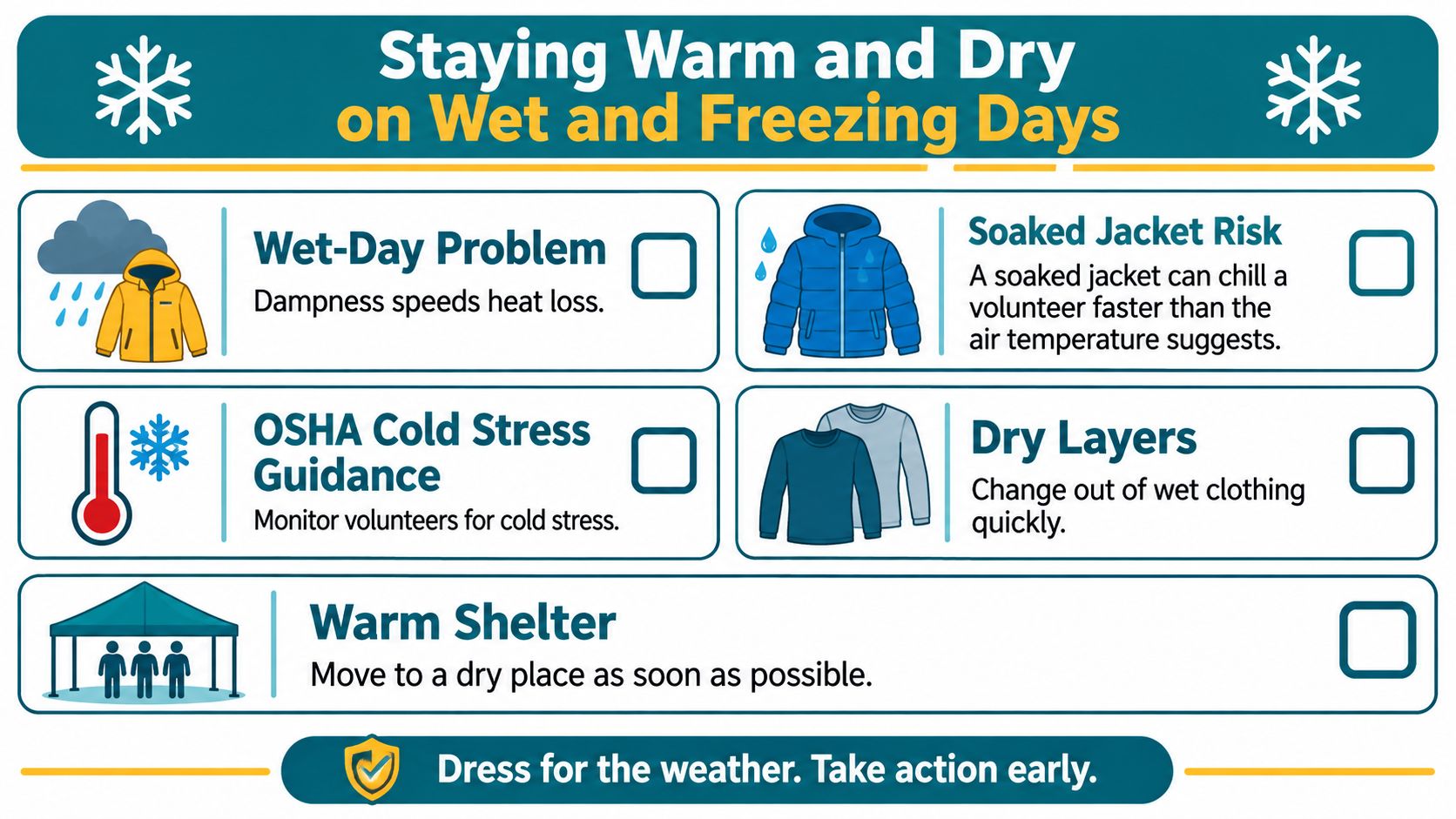
    Staying Warm and Dry on Wet and Freezing Days

    Say you reach the second block in light rain. Your jacket is damp, your gloves are wet, and your hands are starting to stiffen. Wet clothing pulls heat from your body, so the air temperature alone may not tell you how cold you are getting.

    The OSHA cold stress guide recommends monitoring participants, using a buddy system, scheduling work during the warmest part of the day, and providing frequent warm, dry breaks. On a long shift, plan those breaks indoors or in a heated space.

    An infographic titled Staying Warm and Dry on Wet and Freezing Days, providing safety tips for volunteers.

    Your Gear Checklist

    Before you leave, use this cold weather preparation guide to check what you need. Pack gear that keeps you dry, warm, and visible.

    • Waterproof outer layer: Keeps rain from soaking your warm layers.
    • Spare dry layer in a bag: Gives you something dry to change into if your clothes get soaked.
    • Wool or synthetic socks: Help keep your feet warm. Bring a second pair.
    • Gloves with grip: Help you hold a litter grabber while keeping your hands covered.
    • Hat that covers your ears: Protects your head and ears from wind.
    • Reflective vest: Helps drivers see you on gray, rainy days.
    • Closed shoes that drain: Protect your feet and let water escape.

    For a muscle strain after a shift, see cold and heat advice from MEDISTIK. During the cleanup, pay attention to cold stress instead of waiting until you get home.

    Use the buddy system to watch for shivering that won't stop, numb or pale fingers, slurred speech, or unusual clumsiness. If someone has slurred speech or unusual clumsiness, call for emergency medical help right away. Keep the person warm and out of the activity while help is on the way. For persistent shivering or numb or pale fingers, move them to a warm place and end their shift.

    Dry gloves and regular warm, dry breaks can make a wet shift more manageable. A stop call is part of looking after the group when the cold becomes too much.

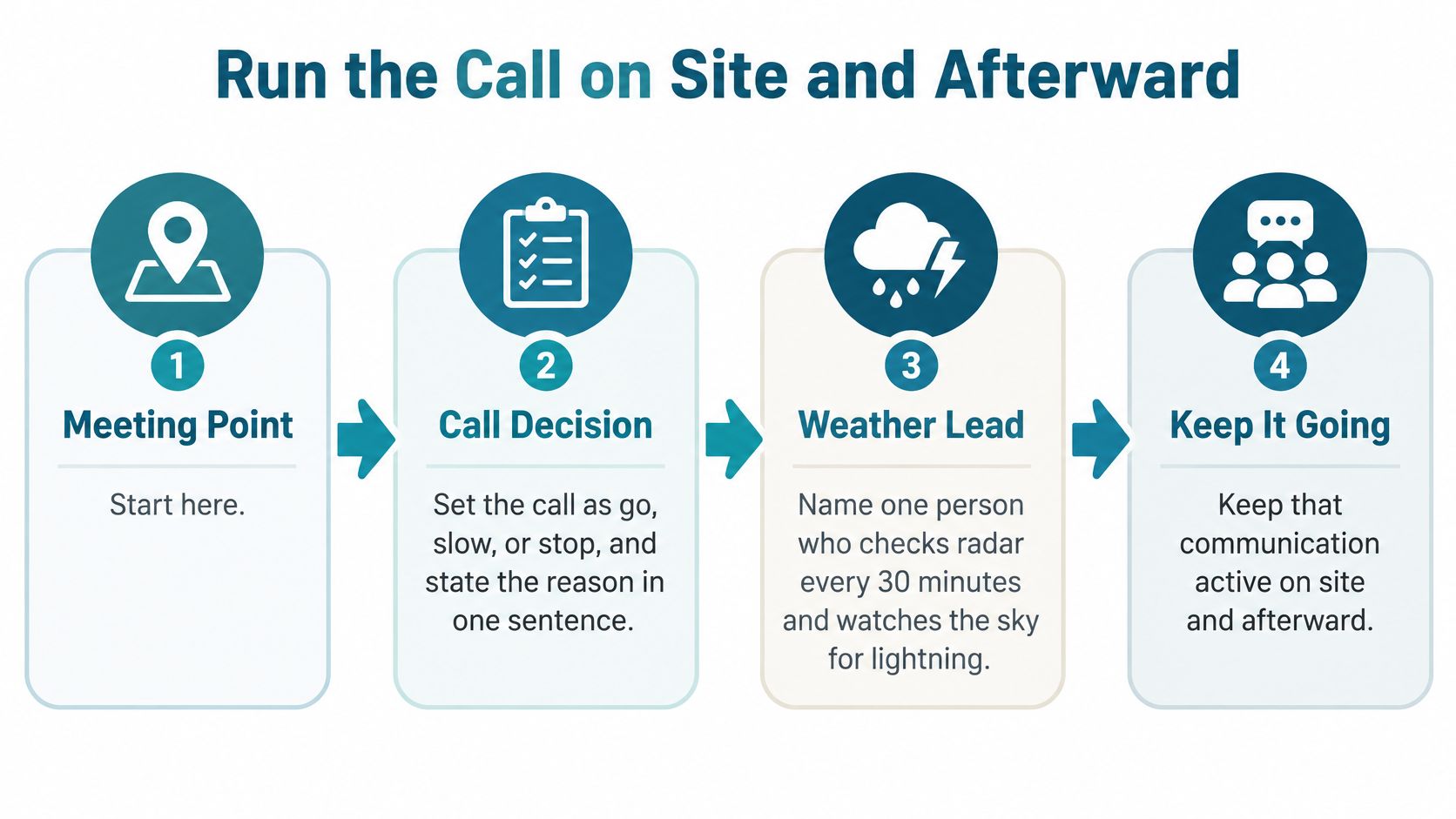
    Run the Call on Site and Afterward

    You meet me at the corner, bags in hand, and you want the plan in ten seconds. I state the call as go, slow, or stop. I give the reason in one sentence, and I point to the first block.

    A four-step infographic illustrating a process for managing outdoor calls with steps for meetings and weather monitoring.

    I name one weather lead for the whole shift. That person checks radar every 30 minutes and watches the sky for lightning. One owner gives you one voice, and one voice stops mixed messages.

    Our volunteer safety checklist fits in a phone note, and I ask the weather lead to keep that note open during the shift. You can read it while your buddy ties a full bag. Short tools work best outdoors.

    Three Steps During the Shift

    1. Mid-event pause: You hear thunder or you see ice form. You pause the group, you move into shelter, and you restart only after the stop rule clears.
    2. New call for everyone: Conditions shift. The weather lead announces the new call to every team at once, in person and in the chat.
    3. Clean close: The shift ends. You record the ward or route, the call you made, and any changes along the way.

    Say your team cleans two blocks, then thunder rolls in from the lake. Your weather lead raises a hand, calls stop, and walks you under a store awning. Nobody argues in the rain because you agreed on the rule at the curb.

    I keep my priority order plain. Safety of the volunteers always takes first priority, and happiness of the volunteers takes second priority. Comfort sits inside that second spot, and I treat it with care.

    A stop call draws no blame from me. You return next week when you trust the call.

    I close with a five-minute debrief. I write one line per call and one change for next time. I post the debrief in the group chat so a new volunteer can read real calls before a first shift.

    That short record helps the next organizer. You spot patterns fast. Maybe one corner floods after every hard rain, or one street traps heat by noon. You plan around those spots next time.

    Adapting Routes and Shifts When Skies Change

    Say the forecast shifts at noon and your planned route turns into a wet, slick mess. I drop the old route. Pride cleans zero blocks, and wet shoes on slick concrete end shifts early.

    I make three adjustments. First, I shorten the loop and clean the three blocks nearest the meeting point. You finish real ground, and you stay close to shelter if rain returns.

    Second, I switch route types. A rail line path or park path can drain faster than a street with water running along the gutters. You trade deep puddles for firmer ground.

    Third, I split one long shift into two shorter sessions with a warm break between them. You dry your hands, drink water, and decide again with a clear head.

    Three Checks Before You Move

    • Shelter check: You confirm a public shelter sits within a few blocks of the new route.
    • Access check: You confirm every volunteer can reach the meeting point on foot or by transit.
    • Ward check: You confirm the team knows which ward or route each block belongs to, so the record stays accurate.

    The City of Chicago ward maps list points of interest such as firehouses, libraries, police stations, schools, post offices, CTA rail lines, parks, and cemeteries. I use those marks to pick meeting points, find nearby public buildings for shelter, plan transit access, and flag blocks that need extra attention.

    One team can clean along a rail line while another team cleans around a park. Both teams still record the correct ward for the work. The map holds the boundary steady while you bend the route around weather.

    I pick the shelter list before I leave home. I save two options in my phone, such as a library and a firehouse lobby area nearby. You never want to hunt for shelter in hard rain.

    Then I tell you the new route in one sentence and post it in the chat. Nobody walks to the old meeting spot. Simple words save wet miles.

    Test Your Plan Before the Next Cleanup

    A volunteer checks the plan on Friday, then rain and cold wind arrive on Saturday. A one-page rehearsal helps you see whether the calls and gear notes fit the conditions before anyone reaches the curb.

    Write down the go, slow, and stop calls, along with the heat index bands, cold stress signs, weather lead's name, and backup meeting point. Then compare the plan with the last three forecasts for your area. Work through each day as a dry run.

    Two Fixes From Your Test

    • Too strict: A stop call would keep people home on a day that turns out fine. Adjust the threshold and record the reason.
    • Too loose: A go call would send people into danger. Tighten the call and name the sign the plan missed.

    Say the forecast calls for light rain and cold wind. Your plan says slow, with a 60-minute shift and a warm break. You notice a new volunteer might arrive in thin sneakers, so add a shoe note to the gear line.

    Share the finished page in the group chat before the next event. New volunteers can read the rules ahead of time and ask questions before the cleanup starts. If you're joining for the first time, ask one question in the chat before your shift.

    A clear plan makes a cleanup easier to prepare for. At Litter Caterpillars, volunteers pick up trash rain or shine, while safety comes first and volunteer happiness comes second.

    You can join a Litter Caterpillars cleanup in Chicago and learn the go, slow, and stop calls alongside friendly volunteers. You bring your bag and grabber; we bring a clear plan for the day. Visit Litter Caterpillars to find your first cleanup and meet us at the corner.

  • Community Health Resilience You Can Measure

    Community Health Resilience You Can Measure

    Say you stand on your corner on a Saturday morning and you know three neighbors by sight and nobody by name. You pick up trash for an hour, and you leave with a full bag and the same three faces. I want you to leave with a name you can call when heat or snow hits your block.

    A Scorecard You Can Keep After Each Cleanup

    I keep community health resilience plain. You build a habit on a block so people stay in touch and stay safer when heat, cold, storms, or a dirty street show up. You don't wait for a disaster to test the habit. You test the habit on a normal morning.

    You copy one sheet. You fill the sheet after each cleanup. You count people first and trash last.

    Five People Counts Before the Bags

    You count newcomer return first. You write how many first-timers come back within four weeks. A rising number tells you people found a reason to return.

    You count block or ward mix next. You write how many different blocks stand on the same corner with you. A crew from more than one block spreads warnings faster than one house can.

    You count buddy reach third. You ask each person one question. Can you name one person here you would text in a heat wave or a blizzard?

    You count safety stops fourth. You mark each day you shorten or cancel for heat, ice, bad air, or injury. You treat a stop as good work.

    You collect a belonging note fifth. You pass a scrap of paper and you ask for yes or no, no name. Did you leave with someone you would call?

    • You write fast: You finish the sheet while people drink water.
    • You keep one page per month: You stack the pages and you read the trend.
    • You rotate the pencil: You let a different person fill the sheet each time.

    You can use our page on ways you can measure community impact on your own block when you set up your first sheet.

    Why These Counts Fit Health

    A 2025 scoping review found that social resources appeared in 30 of 35 studies of community resilience to health emergencies. The review names social networks, social capital, social cohesion, social support, and cultural capital. I read that in plain terms. You meet often, you build trust, and you share news and help faster.

    Say a storm knocks out power on your street. You know who uses a wheelchair on the third floor. You know who has a car. You text both people in five minutes because you already traded numbers over trash bags.

    You build the phone tree on a calm morning. You use the phone tree on a hard night.

    You also need gear you can reuse and wash. A friend who works near water showed me an ocean cleanup collection and I use the same idea on land. You pick sturdy gloves, a grabber with a strong tip, and a bag you can rinse.

    What you count How you count it Healthy signal Warning sign
    Newcomer return Share of first-timers back within 4 weeks Share rises month to month Almost no one returns
    Block or ward mix Number of different blocks present More than the host block The same small circle only
    Buddy reach Volunteers who can name a storm or heat contact Most people name one person Nobody names a contact
    Safety stops Days shortened or canceled for heat, cold, air, or injury You stop before people get hurt You push through dangerous weather
    Belonging note Anonymous yes to leaving with someone you would call Yes answers rise over a month Silence or falling yes answers
    Litter removed Bags or pounds from the same block Litter stays lower on repeat visits Trash returns and the people counts stay flat

    A Weak Sheet and a Strong Sheet

    You see a weak sheet fast. Newcomers rarely return. Nobody names a buddy. You ran a pickup and you went home.

    You see a strong sheet just as fast. People return. People trade roles. People check on each other after the bags hit the curb. You have a network you can lean on, and you have paper that shows the network grows.

    Why Connection Counts as Health Work

    I put loneliness on the same page as litter because your body keeps a record of alone time. The World Health Organization news item from June 2025 reports that approximately 1 in 6 people globally, 15.8%, experience loneliness. The same item says about 21% of adolescents report loneliness, and the rate reaches 24.3% in low-income countries compared with 11% in high-income countries.

    WHO also estimated that loneliness is associated with approximately 871,000 deaths annually, or about 100 deaths every hour. I read those numbers and I think about one kitchen table. You eat alone night after night. You skip a walk because nobody waits for you. You miss a warning because nobody texts you.

    Social disconnection has links to higher risks of depression, anxiety, cardiovascular disease, stroke, type 2 diabetes, cognitive decline, and premature death. WHO says strong social ties help communities become safer and more resilient, including during disasters. I trust the plain path. You know a person, you hear news early, and you act early.

    An infographic by the World Health Organization illustrating how social connection benefits physical and mental health.

    A Crew Is a Bridge You Build by Hand

    You can picture a cleanup crew as a bridge. You arrive from separate lives. You share a task, you learn a name, and you leave with a person you can call.

    The U.S. Office of Disease Prevention and Health Promotion summary on civic participation links volunteering with better psychological and emotional health, more social support, and fewer anxiety and depressive symptoms. One study in the summary links volunteering to lower stress measured through cortisol, a hormone your body releases during stress. The summary also says formal groups and informal groups can increase social capital and reduce social isolation.

    I don't promise you a medical result from one Saturday. I promise you a repeat chance. You show up again, you see the same face, and trust has a place to grow.

    You can read more on our page about health gains you may feel as a volunteer before you join a morning crew.

    Contact and a Tie You Can Use

    Say you pose for one photo on a clean corner and you never learn a name. You had contact. You left with a picture.

    Say you work next to Maria for three weeks and she offers you a ride when your bus fails. You have a tie. You can use the tie when life gets hard.

    • You ask who returned: You count repeat faces.
    • You ask who made a friend: You use the anonymous note.
    • You ask who feels safe asking for help: You listen for a plain yes.

    You can thank health workers in the same plain way. A nurse on my block told me a small thank you lands well after a long shift, and she pointed me to a page where you can find hospital staff recognition gifts. You give thanks, you name the work, and you move on.

    A name you can call beats a photo you can post.

    You keep the health claim honest with those three questions. You count return, friendship, and trust. You let the body record change over weeks, one morning at a time.

    Follow a Bottle From Sidewalk to Lake

    I want you to see litter as a traveler. I don't want you to see litter as a stain on a neighbor. A bottle moves when wind and water push the bottle.

    Say a bottle rests by your curb on Monday. A truck wakes the bottle on Tuesday and the bottle rolls to a drain. A hard rain on Friday lifts the bottle and sends the bottle toward a river.

    The Illinois Environmental Council summary of Chicago environmental policy says Chicago produces more than 4 million tons of waste material each year, from the city's 2021 Waste Strategy. The same summary says 22 million pounds of plastic enter the Great Lakes annually, with more than half reaching Lake Michigan. The summary also says Chicago stormwater can carry litter and raw sewage into rivers and, in extreme cases, Lake Michigan.

    An infographic illustrating the path of plastic bottle litter from city sidewalks to Lake Michigan via drains.

    You Start Where the Bottle Starts

    You walk the path first. You look at the slope of the street. You find the drain the bottle would find.

    You start at the high ground and you work down. You clear the drain mouth with a grabber and you keep your hands out of dark water. You come back to the same drain next month and you see if litter stays lower.

    Shops on the block shape the trash you find. Cups, lids, and bags pile up near doors. A cafe owner near me reads packaging rules for café operators and swaps one item at a time. You can ask a shop owner one kind question and you can share what you find by the drain.

    Dirty water and flooded corners change how safe a block feels. Parents cross the street to avoid a flooded play lot. Older neighbors turn back when trash blocks a ramp. You clear the path and people use the street again.

    Corner type Main risk Crew approach
    Roads and highway shoulders Passing cars Slower hands, bright clothes, step back when cars come
    Drains and flood-prone corners Rising water Slower hands, step back when water rises
    Alleys and park edges Litter that reaches drains Start on the path a bottle would take

    Pace Changes With the Corner

    You treat a road shoulder as slow work. You face traffic, you wear bright clothes, and you step back when a car drifts close. You keep one person as a watcher and the watcher holds no bag.

    You treat a drain as slow work too. You stop when water rises. You never reach into a grate for a bottle. You mark the spot and you tell the city crew.

    You treat an alley as a route. You follow scraps toward the street. You learn which fence traps bags and which gate lets bags escape to the drain.

    You still put people counts above the bag count. A clean corner with nobody who returns gives you a short win. A crew that returns keeps the drain clear month after month.

    When the Same Neighbors Carry Too Much

    I get uneasy when resilience means tired people do more unpaid work. You know this person on your block. She watches kids, checks on a parent, works nights, and still gets the call when a pipe bursts.

    A page from the University of Maryland School of Public Health on community resilience shares a 2025 San Francisco Community Health Needs Assessment that found resilience can come at the expense of people with disabilities, BIPOC and LGBTQ+ communities, immigrants, and people living in poverty, particularly when language access and other systemic supports are weak. The page also shares a 2025 WHO report that names access to power, money, resources, and living conditions as drivers of avoidable health inequities.

    I ask a blunt question before I hand out gloves. Does this morning make your community stronger, or does this morning move a city job onto neighbors who already carry a heavy load?

    Guards You Set Before the Pep Talk

    You meet where buses and wheelchairs can arrive. You pick a corner with a ramp and shade. You write the meet spot in clear words and you add a photo of the corner.

    • You share the plan in more than one language: You ask a neighbor to check your words.
    • You set heat and air rules: You stop when a rule trips, and you thank people for leaving.
    • You offer seated roles: You let a person sort bags, hand out water, or greet newcomers from a chair.
    • You offer short shifts: You let a person work twenty minutes and go home with pride.
    • You help with rides: You pair drivers with riders before the morning starts.

    You name what volunteers won't do. You won't give medical care. You won't run overnight crisis calls. You won't climb into drains or stand in fast traffic.

    You can read our page on fair cleanup work across Chicago neighborhoods when you choose your next blocks.

    Costs You Count With the Gains

    You track injury on the sheet. You track burnout with one plain question each month. Do you dread Saturday now?

    You track who never hears about the meetup. You ask at the laundromat, the library, and the bus stop. Silence from one building tells you your flyer misses people.

    Dangerous weather is a stop rule. Dangerous weather is never a test you pass to belong.

    Freezing through one hailstorm can give you one good story. A story can't heal a fall on ice. You protect people first and you tell stories second.

    Say a high-need block sees volunteers each month and never sees city crews fix lights or drains. You say that fact out loud. You call a ward group or a health department and you ask the office to carry the part your crew can't carry.

    Three People in a Chicago Hailstorm

    I started Litter Caterpillars because my rooms were a mess and my life felt like my rooms. Each item in my home had a story and each story froze my hands. I stared at shelves and I moved nothing.

    The blueberry jam from a Michigan trip sat in my fridge for years. The bag of nuts from a failed health kick sat near the jam. Each item weighed less than a pound in my hand and a ton in my head.

    A diverse group of three people stands together under an umbrella in snowy weather, symbolizing community health resilience.

    A Breakup and a New Circle

    A long relationship with a selfish, always-partying person ended and my rooms got quiet. I sat with the quiet and I made a plan. I wanted givers around me.

    Kevin Tao resolved to mindfully engineer his social circle to filter out selfish people. I write about myself in plain words here because the plan still guides my weekends. I chose cleanliness, consistency, and bravery as daily practice.

    I picked weekend mornings on purpose. Morning people show up sober and ready. Givers give time early and party crowds sleep in.

    Hail Under a Tree

    Three of us went out for the first pickup and a Chicago spring hailstorm hit us fast. Hail bounced on the bags. Rides kept canceling on our phones.

    We stood under a tree and we laughed in wet shoes. I learned three things under the tree. Other people's messes feel easier than your own mess. Work with friends can feel fun. Bad weather can add flavor to a story for one day.

    Our logo comes from that first pickup. I keep the story close. I refuse to turn the story into a rule that says you must suffer to prove you care.

    You can watch a short clip from a cold morning crew here and you can see the pace we keep.

    Three Years of Saturdays

    About three years on, we still go out each week. We work in blizzards and in heat across all 50 wards, and we visit blocks people tell you to skip. You learn a city when you clean a city with your hands.

    We cleaned a highway during a bike-event shutdown. We won an empty lot at auction and we are building Caterpillar Park in Englewood. A lot that held trash can hold chairs, shade, and neighbors who know each other.

    Flags, a theme song, and badges give the crew pride, the way a team jersey gives a player pride. You wear a badge and a stranger asks you a question. You answer and the stranger may join you next week.

    You can come once. You can learn a few names. You can see if the circle fits your life and leave with no guilt if the circle misses your needs.

    Tracking One Block Over Six Months

    Say you lead a Saturday crew on one block and you meet every other week. You want proof you can read. You start with a baseline before the first cleanup.

    You walk the block with a notebook. You count litter by one drain. You write who lives nearby and who may need a check-in during heat.

    Month One on Paper

    I use invented numbers here for practice. I don't present these numbers as results from a real crew. You copy the method and you fill your own numbers.

    In month one, 6 people show up for the first time. You bag 12 pieces of litter along the same drain. Four weeks later, 2 of those 6 come back.

    You write the low return down without shame. You ask one returner one question. What brought you back?

    She may say she liked the coffee stop after the work. He may say he liked a clear start time. You keep the part people praise and you fix one rough part.

    Month Six on Paper

    By month six in this practice story, 9 regulars can name a buddy, up from 2. Block mix grows from one host block to three. One morning ends early for heat and you mark the stop with pride.

    The belonging note shows yes answers rising from 3 to 7. Bag counts along the drain fall to 5 pieces. You read the trend in order, people first and trash last.

    • You see litter fall and return stay flat: You have a clean corner with a short shelf life.
    • You see return rise and litter stay flat: You have a network in the making and you keep working the drain.
    • You see both move well: You keep the same route and you train a second leader.

    You Read the Sheet Out Loud

    You read the sheet to the crew in two minutes. You name one win and one fix. You let a regular suggest the next route.

    A case with no baseline proves little. You write the first count even when the first count embarrasses you.

    You write the trend next to your stop rules. You check if safety held while numbers rose. A strong return rate with injuries tells you to slow down.

    Say you lost the first page. You say so on the new page. Honest paper beats a smooth story, and your crew trusts you more when you admit a gap.

    Set Your Next Saturday Morning

    I want your next move small and dated. You pick a Saturday or Sunday morning in the next two weeks. You pick one block and one friend.

    You write stop rules before you buy gloves. Heat gets a line. Cold gets a line. Storms and bad air get lines too.

    A Morning You Can Run

    1. You pack the basics: You bring water, gloves, a small first-aid kit, bright clothes, bags, and one grabber per pair.
    2. You pair buddies: You send nobody alone near a road, and each pair shares one phone number before you start.
    3. You assign every pace a role: You give a seated greeter job, a supply job, and a slow route near benches.
    4. You set a finish time: You stop on time even when one corner still has litter.

    You greet each newcomer by name twice. You say the name at the start and you say the name at the end. A name sticks when you use the name with a smile.

    Safety of the volunteers always takes first priority, and happiness of the volunteers takes second priority. I run my mornings by that order. Bags come after people, each time.

    You Close With the Sheet

    You fill the scorecard before people drift away. You mark who was new and who came back. You count who can name a contact.

    You mark any safety stop. You collect one anonymous belonging note in a hat. You thank each person for one exact act you saw.

    I won't ask you for money to prove you care. You prove care with time, care with a text after a storm, and care with a second visit. One hour on most weekends adds up across a year.

    If you live in Chicago, you can join a crew that already meets this way. If you live in another town, you copy the morning, the stop rules, and the sheet, and you run the morning with your neighbors. You aim for people who can find each other when weather turns, plus a block that stays cleaner because you came back.


    Pick one Saturday in the next two weeks, bring one friend, and fill one scorecard with people counts first and bags last. Litter Caterpillars runs weekly Chicago cleanups where you can learn names, trade buddy contacts, and practice clear stop rules with a friendly crew. Visit the site, choose a morning near you, and come see if you leave with someone you would call.

  • Severe Weather Safety in the Workplace Guide

    Severe Weather Safety in the Workplace Guide

    Say you meet your crew at a vacant lot on Saturday, grabbers in hand, and the sky changes while you argue about one more block. You need one person who can end the morning before the weather ends it for you.

    The Hailstorm That Made Me Call a Stop

    I still see my first pickup clear as a photo on my phone. Three of us stand under a tree in Chicago while a spring hailstorm flips into a blizzard around us. I watch ice bounce off the sidewalk. I feel my gloves soak through. I pull my hood tight and I laugh because I do not know what else to do with my face.

    Three people in winter clothing stand in a snowy city, looking frustrated at their smartphones while waiting.

    We call for a ride. We watch every Uber cancel on us. We call again. We watch the little car on the screen vanish again. During that first pickup, we got caught in a springtime hailstorm and blizzard while every Uber we called cancelled on us, and I learned the shape of stuck. I feel brave. I also feel dumb. Nobody owns the sky call. Nobody owns the shelter call. Nobody owns the ride home call.

    A Seatbelt You Click Before You Drive

    I treat severe weather safety in the workplace like a seatbelt for a crew that still wants to show up. You click the belt. You drive the car. You do not debate the belt after the road turns slick. You do the same thing with weather. You name your stop signs at home, in calm air, with dry socks on your feet.

    You might lead a paid jobsite crew with a trailer, a time clock, and a safety binder. You might lead six volunteers with trash bags, a group chat, and no HR office at all. I write for you both. I write for the foreman who carries a radio. I write for the neighbor who brings extra gloves in a grocery sack.

    I count a canceled block as a finished job. I brought my people home whole. I win that day.

    You get a stop table you can read tonight first. You then get heat on an ordinary noon, the lightning shelter count, cold wind through wet clothes, and a one page plan a small group can run without a lawyer in the car. I keep each part short enough for a phone screen. I keep each call plain enough for a tired person to make at 9 a.m.

    The Pride Trap I Fell Into

    I learned a twist later, after the hail day turned into a story I told at every meetup. Rain or shine builds pride. Rain or shine builds friendship fast. Rain or shine also traps a new person. She looks at your wet flag, your loud laugh, your full bag. She swallows the words, "I need to quit," because she does not want you to call her soft.

    I refuse that trade now. I tell new people the quit rule before I hand out bags. I say it loud. I say it with a smile. I say, "You can stop. I will thank you. I will walk you to the car myself."

    Pick one person before your next morning outside. Give that person full power to end the work. Put the name in the group chat tonight. You just built the first bolt in your seatbelt.

    Stop Triggers You Can Read Before You Leave

    Circle one row before your boots hit the sidewalk. I read this table at my kitchen table, coffee in hand, forecast open on my phone. You read yours the same way.

    Hazard Call it when Your move Where people go
    Heavy work, new to the heat WBGT about 23°C (73.4°F) Shorten work, add water and shade Shade or a cool vehicle; treat under 1 to 2 weeks of recent heat as unacclimatized
    Heavy work, used to the heat WBGT about 26°C (78.8°F) Keep the same rest, cut the pace Shade and water for acclimatized crews
    Moderate work, new to the heat WBGT about 25°C (77°F) More breaks and fluids Shade for walking, picking, and bag hauling
    Moderate work, used to the heat WBGT about 28°C (82.4°F) Breaks, fluids, buddy watch Shade for regulars on moderate tasks
    Lightning Thunder is heard Stop at once and count heads Enclosed building or hard top vehicle for 30 minutes after the last thunder
    Serious cold Wet clothes plus confusion or a cold injury Call 911 and rewarm Warm room or vehicle, dry clothes, blankets, no drink if the person is not alert

    The Thermometer in a Wet Sock

    I explain wet bulb globe temperature, or WBGT, with a kitchen picture. You stick a thermometer in a wet sock. You set that sock in the sun. You let wind hit it. Now one number holds air heat, humidity, sun heat, and air movement at once. Air temperature on your phone tells you one part. WBGT tells you the load your body carries.

    You and I feel the gap on a humid Chicago noon. The phone says a mild number. Your shirt sticks to your back by the second block. Your sweat sits on your skin and does no cooling work. WBGT catches that sticky trap. Your phone app misses it.

    The OSHA heat hazards guidance gives screening values for effective WBGT that split people by recent heat exposure and by workload. For heavy work, the limit sits at approximately 23°C (73.4°F) for unacclimatized workers and 26°C (78.8°F) for acclimatized workers. For moderate work, you get 25°C (77°F) and 28°C (82.4°F) in that same order.

    How I Read the Heat Rows

    Say you haul full bags to a corner dumpster, again and again, up a slight grade. I call that heavy work. Say a college kid joins you after two weeks in an air conditioned dorm. I treat him as new to the heat. His row trips first. You shorten his work bouts. You park him in shade with water. You pair him with a regular who watches his face.

    Say you walk a flat route, pick light litter, and chat while you work. I call that moderate work. Your regulars who worked outside all last week carry more heat practice in their bodies. They still hit a row. They still need breaks, fluids, and a buddy watch. Practice buys a few degrees. Practice never buys forever.

    Watch your clothing, too. A rain jacket, thick gloves, or gear that blocks sweat pushes your effective WBGT hotter than the bare number. Your body makes heat when you lift and walk. Humid air and sealed clothing block sweat cooling. Your core heat climbs. That climb makes the call for you.

    The Thunder Row and the Cold Row

    You hear thunder. You stop. I give you no debate steps for this row. You do not wait for a bolt. You do not finish the block. You move people into a full building or a hard top vehicle. You stay put for 30 minutes after the last thunder. Trees fail you. Tents fail you. Picnic roofs fail you.

    You see wet clothes plus confusion, slurred words, or a real cold injury on a winter route. You call 911. You move the person into a warm room or warm vehicle. You swap wet clothes for dry clothes. You do not send that person around one more block to warm up by walking. Walking already failed.

    My table rule: The safety lead calls the row out loud, and any person can stop at any time with no penalty and no speech.

    A normal forecast can still match a row on this table. A calm news segment can still hide a hard noon. Read the row at home. Read it again at the lot. You protect the morning when you read early.

    How Heat Sneaks Up on a Normal Shift

    Say you walk beside a mail carrier at noon on a humid Tuesday. No news host calls it a heatwave. No alert buzzes your phone. She lifts a satchel, climbs porch steps, and wipes her forehead with the back of her glove. By the tenth porch, her smile thins out. By the twentieth porch, she answers you a beat late.

    I picture your body as a small engine in a delivery truck. Work burns fuel and makes heat. Sweat works as your radiator. Thick humid air clogs that radiator. A rain jacket clogs it faster. Heat piles up inside the engine block while you smile and say you feel fine.

    An infographic showing how body heat accumulates for a postal worker in hot, humid weather conditions.

    The Scale You Carry Into Noon

    The International Labour Organization report estimates that at least 2.41 billion workers, about 71% of the world's working population, face exposure to excessive heat at work each year. Gardeners, construction crews, utility crews, postal workers, farm workers, and cleanup volunteers all share that load during ordinary summer days. The same report links that exposure to approximately 22.85 million occupational injuries and 18,970 work related deaths each year, and it says 90% of occupational excessive heat exposure and 80% of related injuries occur outside officially declared heatwaves.

    In the United States, the OSHA rulemaking record with Bureau of Labor Statistics data counts 1,042 worker deaths from occupational heat exposure between 1992 and 2022, an average of about 34 deaths per year. OSHA also says 50% to 70% of outdoor heat fatalities occur during the first few days in a hot environment, before workers acclimatize. I read that line and I shorten every new person's first week without apology.

    Water, Watchers, and the Two Minute Check

    Name one person who watches heat for the whole shift. The opening talk helps. The all shift watcher saves you at minute forty, when pride gets loud and water bottles run low. I point at a person. I say the name out loud. I put the name in the chat.

    The OSHA heat planning guidance tells you to offer cool drinking water at 50 to 60°F and push small drinks often, before thirst shows up. I use our heat exhaustion prevention tips the same way at a cleanup table. I fill cups. I hand cups to people who wave me off. I smile and I keep the cup in the air until hands take it.

    What you see What it may mean Your move
    Headache, dizziness, or weakness Early heat illness Shade, cool water, rest, and a buddy stays close
    Heart rate over 110 beats per minute The work bout is too long Shorten the next work period by one third and keep the same rest
    Oral temperature over 37.6°C Body heat is climbing Shorten the next work cycle by one third
    Confusion, fainting, or odd behavior Possible heat stroke Call 911, cool with water, move to shade, and stay until help arrives

    Read the table like a traffic light. Headache and dizziness mean shade, water, rest, and a buddy at the elbow. Confusion, odd behavior, or fainting means you call 911, cool the person with water or ice, move the person to shade, remove outer clothing, wet the skin, fan air across the body, and stay until help arrives. You act first. You sort out the story later.

    Tell every new person this line on day one. "I expect you to stop early this week. You earn my trust when you tell me early." You just gave that radiator room to work.

    When Thunder Means You Leave the Block

    Say you hold a metal grabber on an open lot in Englewood. Your friend works the far fence line, two blocks away, with earbuds in one ear. A low rumble rolls under the traffic noise. You almost talk yourself out of it. You tell yourself a truck hit a pothole. You look at the sky and you bargain for ten more minutes.

    Stop bargaining. Lightning gives you a sound cue, and thunder gives you your marching orders. I treat thunder like a fire alarm in a school. I do not sniff for smoke. I move my people.

    A CDC infographic demonstrating lightning safety procedures for outdoor workers, including stopping work and seeking shelter.

    The U.S. Centers for Disease Control and Prevention lightning data page records 517 lightning related deaths from 2006 through 2025, and work related activities made up about 20% of those fatalities. Construction, farming, and ranching carry high counts in that data. Your cleanup route shares the same open sky, the same metal tools, and the same slow walk back to a car.

    Six Steps I Run Out Loud

    1. Before you start: Name the building and the hard top cars, and name one weather watcher with a charged phone.
    2. At the first thunder: The watcher calls stop by voice and in the group chat, and repeats the shelter name.
    3. Before anyone scatters: Gather a head count at the corner, names out loud, eyes on faces.
    4. Inside shelter: Go into a full building or a hard top vehicle, windows up, hands and bodies off metal surfaces.
    5. During the wait: Stay at least 30 minutes after the last thunder or lightning, and restart the clock at each new rumble.
    6. Before restart or dismissal: Count again, name by name, and only then release people to work or to home.

    I watch the short clip below with new leads before a storm week, and I make each lead say the six steps back to me without notes.

    The National Weather Service lightning rules page says you move promptly into a completely enclosed building or a hard topped vehicle when you hear thunder, and you stay sheltered for at least 30 minutes after the last thunder. Tents, picnic shelters, trees, and open sided structures give you no equal protection. A vehicle works as fallback shelter only when you stay inside with windows closed and avoid contact with metal surfaces.

    Fake Shelter Fails You Faster

    A tree gives you shade, wet bark, and a tall target. A picnic roof gives you dry hair and open sides. A pop up tent gives you a good photo and metal poles. I ban all three as lightning shelter at my meetup point. I say the ban before anyone grabs a bag, so nobody improvises under stress.

    A bright pause in the rain tricks good people. The sky lightens. The lot steams. Someone jokes about a free car wash. You still hold the clock. Lightning can strike before the worst rain and after the worst rain. Your thirty minute wait covers that sneaky edge.

    Say your route has no building within a quick walk. Your plan already failed at the kitchen table. Shrink the route next time. Move the meetup point near a library, a field house, or a row of parked hard top cars. I would rather carry wet bags to the car than explain a missing person.

    Wet Clothes and the Wind That Steals Heat

    Say you start a route at 35 degrees with a cheerful forecast and a thin sun. You bend for the first bag near a curb puddle. Splash water soaks your sweatshirt sleeve to the elbow. Wind cuts down the avenue between two brick buildings. By the third block, your teeth click when you try to joke.

    Wind chill stacks air temperature and wind speed into one bite. The forecast number tells you the air part. Wet cloth plus wind tells you the body part. The body part wins every argument. You feel fine at the car. You feel clumsy at the corner. You feel stupid slow at the alley mouth, and that slow feeling should scare you straight.

    I picture a wet, windy body as a thermos with the lid off on a bus bench. You pour hot cocoa into the thermos. Steam pours out the top at the same speed. You can drink warm liquid all morning and still lose the heat race through wet sleeves, wet socks, and a bare neck.

    The Duty Line and the Body Line

    The OSHA cold stress guidance says employers must protect workers from recognized cold stress hazards that can cause death or serious physical harm under Section 5(a)(1) of the Occupational Safety and Health Act, even without a specific cold work standard. A volunteer lead holds no employer badge. You still copy the same care. The body checks wind and wet cloth. The body never checks payroll.

    I use our own cold weather preparation habits before winter routes for the same reason. I check gloves at the meetup point. I look at shoes. I ask about spare socks with the same serious face I use for car keys.

    Six Rewarming Steps in Order

    1. Call 911: Call at once for a serious cold injury, confusion, or a person who stops shivering and goes quiet.
    2. Move the person: Move the person into a warm room or a warm vehicle, out of wind and off cold concrete.
    3. Swap the clothes: Remove wet clothing and replace it with dry clothing, socks and gloves included.
    4. Wrap the whole body: Wrap the entire body, head and neck included, in blankets, and add a tarp or garbage bag as a vapor barrier if you have one. Keep the face clear.
    5. Give a drink with care: Give a warm, sweetened drink only when the person stays alert, and never give liquid to someone who is unconscious.
    6. Place heat at the core: Place warm bottles or hot packs in the armpits, along the sides of the chest, and in the groin.

    Pack a dry layer and spare socks in the car before the witty group chat starts. Dry cloth beats brave talk at minute thirty.

    Watch hands for your early warning. Fingers fumble a knot. A zipper defeats a good glove. A volunteer drops the grabber twice in one block. I shorten the route at that sign. I turn the group toward the cars while people still laugh about it.

    You face a plain choice on wet, windy days. Gloves soak through, wind picks up, and your farthest walker still has six blocks to cover. You shorten the route now. You save the heroic loop for a dry morning. Your crew keeps fingers that work, and your crew comes back next week.

    Employers and Volunteer Groups

    You run a paid crew. You must protect your workers from recognized hazards that can kill them or cause serious physical harm under Section 5(a)(1) of the Occupational Safety and Health Act. OSHA has no separate cold work standard. That general duty still covers cold stress on your site.

    Heat guidance gives you concrete jobs. Assign one person to monitor conditions for the whole shift. Keep a reliable way to reach every worker fast. Hold the power to stop work or evacuate the site, and tell your crew who holds that power before the first task starts.

    The Gap at a Saturday Meetup

    You run a volunteer group on Saturday. You usually hold no employer role. You hold no HR office. You hold no legal authority over a neighbor who can walk away at any corner. The duty line from a jobsite maps onto your morning in a messy way.

    You still need the rule. Heat loads a volunteer heart the same way heat loads a paid heart. Lightning ignores your tax status. Wet wind pulls heat from a student in a hoodie at the same speed as a roofer in coveralls.

    Group What it owes Your move
    Paid employer Protect workers from recognized heat, cold, and lightning hazards Assign a monitor, keep a stop work rule, and run a reliable alert method
    Volunteer group Often outside OSHA employer duties, with no authority over participants Write a stop rule, name a safety lead, and use the same heat, lightning, and cold steps

    Read the table and then check your local rules. State and city laws can add requirements on top of federal guidance. Your park district permit can add rules. Your sponsor can add rules. I read permits at home, with a pen, before I promise a route to anyone.

    Use your sign up sheet as a safety tool. Ask about health limits in plain words. Ask about rides home. Ask about gloves, hats, and water bottles. You learn who needs a shorter loop before anyone lifts the first bag. You learn who needs a car seat held open during a storm wait. You learn who walks alone to a bus stop, and you pair that person with a buddy at dismissal.

    Build a One-Page Plan and Send It Tonight

    Say ten people meet you for litter pickup on Saturday at a wide open lot. Two people joined for the first time. One person arrived by bus and has no car. A regular brings a cooler. A student brings thin fashion gloves and a huge grin. We pick up trash rain or shine, including on the coldest days of winter and the hottest days of summer, and that pride puts real people in front of you in real weather.

    A team of volunteers wearing high-visibility vests preparing for a community litter pickup event outdoors.

    You need a short script for that lot. A binder in your trunk helps nobody at minute twenty. A one page plan on five phones helps everybody. Safety of the volunteers always takes first priority, and happiness of the volunteers takes second priority at my meetup point, and I say that order out loud before bags open.

    Four Roles Before Anyone Spreads Out

    • Safety lead: You can end the day, shrink the route, or send one person home, and the group backs your call without a vote.
    • Weather watcher: You check the forecast and the sky every hour, watch for thunder, wind shifts, and heat load, and you call out changes loud.
    • Head count buddy: You hold the sign in list, count faces at shelter time, and count again before restart or dismissal.
    • 911 caller: You hold the site address on your phone screen, you dial without hunting for words, and you stay on the line.

    Name the shelter next. Point at the actual building with your actual arm. Name the cars that count as hard top shelter. Say how long an ambulance may take on that block, and name the cross street you will give a dispatcher. A person under stress reads a screen better than a memory.

    The OSHA winter weather preparedness guidance tells employers to monitor winter weather, maintain a reliable way to communicate with workers, and keep the ability to stop work or evacuate when conditions require it. Heat plan details on that same worksite logic tell you to state what you do at heat illness symptoms, how you contact emergency services, how long responders may take, and what first aid you give until help arrives. For high body temperature or suspected heat stroke, you call 911, cool the worker immediately with water or ice, move the person to a cooler or shaded area when possible, and stay with the worker until help arrives.

    The Symptom Line You Say Out Loud

    I gather the circle. I hold up one finger. I say, "Headache, dizziness, or odd behavior means we stop that person. Maya dials 911. Jordan grabs water and shade. I stay with the person." Names beat job titles in a loud lot. Verbs beat good intentions every time.

    Train in two minutes. Show a new person the water cooler, the shade spot, the bathroom, and the shelter door. Tell newcomers they count as new to the heat this week. Give a person with asthma, a heart condition, or thin gloves a shorter loop without a speech about toughness. You protect pride when you assign the short loop as a smart job, like guarding the supply corner and sorting bags.

    Write a check in and check out habit into the page. Each person signs in with a phone number. Each person checks out with the head count buddy before a rideshare, a bus, or a solo walk home. Nobody vanishes from your count. Nobody becomes a rumor in the group chat at noon.

    I stock the car from our severe weather safety kit list, and I cross check first aid basics against the Adventure Medical Kits preparedness guide when I restock bandages, blankets, and cold packs at home. I check dates on packs. I replace the mystery granola bar from last season. I charge the spare battery while I brush my teeth.

    Four Actions You Take Tonight

    1. Copy the stop table: Paste the table into a phone note and send a photo of it to your safety lead and weather watcher.
    2. Name names and places: Write the safety lead, the shelter building, the hard top cars, and the site address for the next outing.
    3. Pack the car: Load water, cups, a dry layer, spare socks, blankets, a first aid kit, and a printed contact list.
    4. Post the quit rule: Send one group chat message that says any person may quit at any time and the lead may cancel without debate.

    We came to take care of the block and each other, and safety comes first.

    Say that line at the lot. Say it again when thunder tests your nerve. Say it again when a new person looks at wet gloves and wonders about worth. You build a crew people trust when your actions match the line on the hard morning, in front of witnesses, with full bags still on the ground.


    Join me at Litter Caterpillars for a Chicago weekend cleanup where we name a safety lead, read the sky before we spread out, and look after each other block by block. Bring your water bottle, your spare socks, and your brave Saturday self, and I will hand you a grabber, a buddy, and a route that fits your body that day.

  • Severe Weather Preparedness Week Playbook for 2026

    Severe Weather Preparedness Week Playbook for 2026

    Say you drag a trash bag across a wet Chicago lot, hail stings your ears, and your ride app cancels for the third time. You don't need a pep talk in that minute. You need a call you made before you left home.

    The 2026 Day Map I Copy First

    Say a café owner is setting out chairs on a Saturday morning when the sky turns the color of a bruise. A good week map starts before that moment: it gives the group a clear go-or-no-go plan, and a reason to come back next Saturday if conditions say stop.

    Severe Weather Preparedness Week gives you a prompt to organize the week around one hazard at a time. The National Weather Service says states generally schedule the week in late winter or spring, before their principal severe-weather season begins, and many hold a tornado drill during the campaign. You can build a realistic project timeline with a date, a task, and a clear finish line for each day.

    The card on my fridge

    The National Weather Service safety events calendar lists Illinois for March 2 to 6, 2026: Monday for a plan, Tuesday for lightning, Wednesday for tornadoes, Thursday for wind and hail, and Friday for flooding. It also lists a Required Weekly Test on Wednesday, March 4, at 11 a.m. Use that schedule as a local planning frame, not a reason to keep a route going when conditions turn unsafe.

    Place 2026 dates Day themes Drill
    Illinois March 2 to 6 Mon plan, Tue lightning, Wed tornadoes, Thu wind and hail, Fri flooding Required Weekly Test, Wed March 4, 11 a.m.

    Give each day one small job. Write down who can call off a meetup. Mark a nearby building on the route map, and make sure the group knows where to gather if the plan changes. A phone note or a message in the group chat can keep the plan within reach for volunteers arriving by bus or on foot.

    For the week's other tasks, check that your route avoids spots that collect water, and make sure loose items at the meetup point are secured. If the forecast or alerts make the route unsafe, call it off. A postponed cleanup protects the habit of showing up together; it also leaves room for people without a car, special gear, or spare hours to join when the weather allows.

    My fridge rule: If you can't point to shelter on the map, you don't pick a meetup corner yet.

    Use a severe weather safety kit as one part of your preparation, alongside a clear route and a shared plan.

    The Call I Make Before Anyone Meets

    Say a café owner is on the bus to our meetup when a storm watch arrives. The group needs one clear message: we meet, shorten the route, or stop. A quick call gives everyone the same answer before they leave home.

    An infographic explaining the difference between a severe thunderstorm watch and a National Weather Service warning.

    Yellow light means you get ready to move

    A severe thunderstorm watch means hail at least one inch in diameter or damaging thunderstorm winds may occur in the area during a three-to-eight-hour period. Use that time to charge phones, identify a sturdy building, bring loose signs inside, and tell the group the route may be cut short.

    A tornado watch means tornadoes are possible across a broad area. Review the plan, check supplies, and identify a safe room with the National Weather Service tornado watch and warning guide. Make sure everyone knows where to go and who will help keep the group together.

    Red light means you move now

    A tornado warning means take shelter in an interior room on the lowest floor of a sturdy building, away from windows. Drop the grabber and leave the trash. People come first. If you are in a car, mobile home, or open lot, get to the closest substantial shelter and protect your head from flying debris.

    Lightning, heat, tornadoes, and flash floods cause deaths every year. When thunder is in the area, CDC lightning guidance says no outdoor location is safe. Seek a fully enclosed building or vehicle, and never shelter under a tree. A tree may shade you on a calm day, but it is no shelter from lightning.

    Signal What it means Move
    Clear morning, no watch Hazards are not expected during the meetup window Meet, brief, start
    Severe thunderstorm watch Hail at least one inch in diameter or damaging winds may occur during a three-to-eight-hour window Pause new blocks, name shelter, keep watching
    Tornado watch Tornadoes are possible across a wide area Review the plan and identify the safe room
    Severe thunderstorm or tornado warning A threat is occurring or imminent in the area Stop, leave open ground, shelter now
    Lightning in the area No outdoor location is safe during a thunderstorm Go to a fully enclosed building or vehicle, never a tree
    Flooded street or underpass Water blocks the route Reroute or cancel that block
    Heat or cold people cannot safely tolerate Conditions can overwhelm people before the work is done Shorten, add breaks, or move the hour

    Before anyone arrives, name one weather lead to make the stop call. Check how each person can get home if the route ends early. A bus stop, a walking path, or a ride plan can make the difference between a safe cancellation and leaving someone stranded.

    Say the sky looks clear at 8 a.m., then a watch arrives at 8:40. Shorten the route, stay within an easy walk of shelter, and stop opening new blocks. If thunder rolls at 9:10, end the discussion, go inside, and count heads. When conditions call for a stop, call it. Postponing protects the habit of coming back, and you do not need a car, special gear, or a free morning to take part another day.

    How I Build the Week in Six Moves

    Say a forecast threatens a Saturday cleanup. The group needs a clear plan for who makes the call, where people can shelter, and how the week's practice will work. I build that plan in six moves, with room to postpone so people can come back next Saturday.

    A six-step infographic titled How I Build the Week detailing weather preparedness planning and scheduling steps.

    Moves one and two set the owner and the doors

    Eight weeks out, name one weather lead and set the dates. That person owns the forecast check, the stop call, and the cancel message. Write the name beside the dates, then share them with two backups. A clear owner keeps the decision from getting lost in a busy group chat.

    Six weeks out, write the go-or-no-go card and list indoor rooms near each meetup corner. Walk the route and check that the doors are accessible. A shelter listed on paper is no help if it is locked when hail starts. Set up a plain-text contact chain, too, in case the group app stops working. A volunteer event planning guide can help organize the practical details around a meetup.

    Moves three and four fill the kit and the morning

    Four weeks out, assemble a three-day kit and calculate the water. The FEMA disaster supplies checklist recommends one gallon of water per person per day for three days, along with nonperishable food and a manual can opener. Counting people makes the shopping list concrete.

    People Water for three days
    1 person 3 gallons
    2 people 6 gallons
    4 people 12 gallons
    6 people 18 gallons

    Add medications, pet food, a phone battery, and supplies for a baby or someone who uses mobility equipment. Store the kit in a cool, dark place, and replace expired food before storm season. A manual can opener still works when the power is out.

    Three weeks out, schedule meetups for weekend mornings. Litter Caterpillars holds its events on weekend mornings, a steady time for volunteers to show up and serve. Give new volunteers clear first-day jobs and safety instructions. VolunteerBadge's volunteer onboarding playbook offers ideas for setting up that welcome.

    Moves five and six invite people and run the drill

    Two weeks out, open signup and make it easy to opt out. Share the task, time, shelter, nearest bus stop, and any gear provided. Say plainly that people can skip this meetup and return another Saturday without explaining why. That keeps a difficult-weather decision from becoming a reason to disappear for good.

    On drill day, practice a real alert response. For Illinois' Severe Weather Preparedness Week, use Wednesday, March 4, at 11 a.m. to check who receives an alert by phone or weather radio, then walk to the planned room. Time the walk and check the curb cuts. If someone misses the alert, address that gap with a radio or buddy text.

    Before any morning activity that week, check the forecast before telling people to come. If conditions make the plan unsafe, postpone the practice and keep the next Saturday in reach.

    Rules I Will Not Bend on Site

    We pick up trash rain or shine, including on the coldest days of winter and the hottest days of summer. I say that with pride, and then I draw a hard line under it. A warning flips pride off. Lightning flips pride off. A faint volunteer flips pride off, and I don't negotiate with any of the three.

    An infographic titled Rules I Will Not Bend on Site listing five safety guidelines for outdoor work.

    Think of your body like a phone battery in the sun. You don't wait for zero and then act surprised. You shade the phone, you plug in early, and you stop running heavy apps in a heat wave. I run people the same way, with kinder words and colder water.

    Heat rules I say at the corner

    Before we step off, I check the forecast, I point at shelter and the way an ambulance enters, and I confirm phones. I put hard work in the cooler part of the hour. I set water where hands reach it without a hike, and I break in shade or air conditioning before faces turn red and quiet.

    The CDC page on heat and outdoor workers backs the habits I drill: acclimatization, hydration before thirst, earlier or later scheduling, cooling breaks, and buddy monitoring. I pair people up and I tell each buddy to watch for weakness, confusion, faintness, or abnormal behavior. New people get easier first days because a body learns heat the way legs learn a new route, in steps.

    If you feel faint or weak, you stop and you move to a cool place. I don't let you finish one last bag to prove a point. If I suspect serious heat illness, I call for emergency care and I stay with you until help arrives. I keep our volunteer safety checklist in the lead bag so a tired brain can follow printed steps.

    Drink before thirst. Sit before you wobble. Call before you hope.

    Cold rules I score before we start

    Cold lies to you in a different voice. It tells you the numb feeling means you adapted. Wet or tight layers steal heat, and a tired person stops noticing fingers and toes. Clothing alone gives you a thin promise, so I control time, turns, and warm breaks too.

    The NIOSH cold stress page lays out controls I copy: move work to the warmest part of the day, shorten outdoor rotations, add relief volunteers, provide warm liquids and heated break areas, and use loose insulating layers plus waterproof, insulated footwear with cover for head, face, hands, and feet. I pack spare clothes, a blanket, a thermometer, and chemical heat packs in the first aid kit. I name an observer because self-reports arrive late when pride and numbness team up.

    I score five controls before I open a single trash bag:

    • Forecast read: I check wind, cold, and storm timing that morning.
    • Warm shelter named: I point to a heated break spot we can enter.
    • Timed breaks set: I set rotation times before hands go numb.
    • Buddy checks live: I pair each person and I name the observer.
    • Cold kit packed: I confirm spare layers, a blanket, and heat packs.

    All five, or we don't deploy. My scoreboard counts process, and I write it down: 100% of volunteers briefed, 100% paired or accounted for, water and first aid out before start, and a written note for every pause or cancel call. That record teaches us more than a brag about a clean streak with no injuries, because the record shows the exact minute a rule saved a morning.

    Notes and Events That Fill a Morning

    Say a café owner wants to join a Saturday cleanup but has no car and only an hour to spare. A useful invitation makes the plan clear: where to meet, how long the walk lasts, and how to leave early without explaining why. Litter Caterpillars holds events on weekend mornings, and a simple note can help neighbors decide whether one fits their day.

    A person writing an invitation for a neighborhood walk while sitting at a table with coffee.

    Three scripts I copy word for word

    An invitation might read: “Saturday at 9 a.m., we'll walk one block. The bus stop is two minutes from the church door. Bring water, sunscreen, and gloves if you have them. Reply OUT if you need to skip.” Keep the route and time specific, and make the way home part of the plan.

    A cancellation text should be just as direct: “Weather card is red. We won't meet outside. If you've already left home, use the church basement as shelter. I'll share a new morning when conditions allow.” Send it early, before someone spends time traveling to the meetup.

    At the corner, say the route rules out loud. Buddies stay in sight. If someone feels weak, stop. If the call is to shelter, leave the bag and go inside. Ask a volunteer to repeat the shelter location so everyone knows where to head.

    Five small rooms, five weekdays

    Use short weekday sessions to practice decisions before a Saturday route. On Monday, write down a home plan and a meetup plan, including names, medications, and ways to get home. On Tuesday, walk from the corner to the doorway you would use during lightning. On Wednesday, practice the route to the lowest interior room. On Thursday, look for loose signs and talk through where to go during hail or high winds. On Friday, mark the block that floods, identify the underpass to avoid, and choose a dry street instead.

    Give each person a small job: keep time, write names, or check the door. A clear task gives someone a way to join without needing to lead a discussion.

    The NOAA National Centers for Environmental Information 2025 climate report says 2025 was the fourth-warmest year in the contiguous United States, 2.63°F above the twentieth-century average, and the preliminary tornado count reached 1,559, which is 127% of the 1991 to 2020 average. For an outdoor group, the practical lesson is to make a plan people can return to: know when to meet, when to shelter, and when to call off the route.

    Before leaving home, check your own basics:

    • Water and sunscreen: Bring what you may need for the time outdoors.
    • Gloves: Pack a pair suitable for handling litter.
    • Clothing: Dress for the forecast and the route.
    • Getting home: Check your transit or other travel plan, including how you'll leave if the meetup ends early.
    • Time: Set a clear point when you need to head out.

    A one-hour cleanup can fit into a crowded day. The plan should make it easy to take part, and easy to choose another Saturday when the weather says no.

    Score the Week and Pick the Next Saturday

    When Friday ends, I don't count bags first. Bags tell me we worked. They don't tell me we learned. I score whether the week taught us to move, and I keep the score to three marks so I will do the math while my shoes still drip by the door.

    Three marks on my notebook page

    First, I count how many phones and radios catch the Wednesday drill. I write names under heard it and missed it, and I stare at the missed column until it embarrasses me into action. If half the chat misses the alert, I add a weather radio at the meetup and a plain text chain. A new poster won't fix a silent phone.

    Second, I time the walk to shelter and I test that walk for real bodies. I ask a person with a cane to lead us once. I push a stroller over the same curb. If the walk runs long or a step blocks the door, I pick a closer room before spring thunder tests my choice for real. A shelter you can't reach in time is a story, not a shelter.

    Third, I count how many of the same people come back on the next safe Saturday. That return count tells me the truth about my rules. People return to a group that feeds them water, spells out the out, and quits a route without shame. People drift away from a group that drains them and calls the drain character.

    If people vanish after one cold morning, I ask what I failed to supply. Water? A vest? A bus plan? A real way out that spared them a speech? I write the answer down and I fix that one thing before I invite a single new face. Growth on top of a leak just gives me a bigger leak.

    We have picked up trash every single week, and that streak only matters if the people inside it stay well enough to keep it alive. Litter Caterpillars is the first and only trash pickup group to clean up all 50 wards of Chicago, including the ones people were told to stay away from, and I hold that fact next to a harder one. No ward, no block, and no bag count pays for a volunteer in an ambulance.

    So I pick the next Saturday with the card in my hand. I read the forecast, I name the lead, I text the invite with the shelter and the out, and I mean every word of both. If the card turns red, I cancel early and I protect the habit for the calm morning after. If the card stays green, we walk, we laugh, we fill bags, and we leave with the same energy we brought. That rhythm carried us through hail, heat, and bitter cold, and that rhythm will carry you too if you let the quit rule ride beside the work rule.

    Bring a friend who has never walked your ward. Hand that friend a vest, point at the shelter door, and walk one block well. Then decide together if you want block two.


    Come walk a Chicago block with us on the next weekend morning the weather card allows, learn the shelter on that corner, and leave the minute I call red. Visit Litter Caterpillars to find a meetup, grab a bag we supply, and build the habit of showing up for your neighbors in a way that sends everybody home safe.

  • Logo and Identity: A Practical Guide for Community Groups

    Logo and Identity: A Practical Guide for Community Groups

    Three volunteers had just finished a litter pickup on Chicago's South Side when hail drove them under a trail shelter. Their cardboard sign dissolved in the rain, but that night, from memory, we drew the first Litter Caterpillars logo.

    The Day Three Volunteers Got Caught in a Chicago Hail Storm

    The spring afternoon had started smoothly. Three of us walked back toward the trail shelter after picking up trash, carrying full bags, wet gloves, and the loose confidence that comes from thinking the weather will hold for one more block.

    Then the sky changed. Hail hit the path hard enough to sting our faces. The cardboard sign reading “volunteers needed” sagged in our hands, and every ride we tried to call canceled while we stood there shivering. We crowded beneath the shelter, watching the field we had just cleaned disappear behind a sheet of gray weather.

    Three young people huddled together in a rain-covered bus stop holding a community volunteers needed sign.

    That storm became our first identity lesson. We didn't create a logo after a long meeting about market position. We drew it later because we needed a way to remember what had happened. The mark carried the three people, the soaked sign, the cold, and the strange laughter that arrived after we realized we'd have to wait it out together.

    A mark born from the work

    Our name, Litter Caterpillars, already held a story. A caterpillar moves slowly, keeps going, and changes along the way. We weren't presenting ourselves as perfect organizers. We were people trying to practice cleanliness, consistency, bravery, and friendship through service.

    The first sketch captured that feeling. It gave us something to put on a sign, then a shirt, then a flag. Each use told a small part of the same story to someone who hadn't been under that shelter with us.

    A logo can carry memory in a compact form. One recent compilation reports that 75% of people say they recognize a brand by its logo, and consumers typically need 5 to 7 exposures before they remember a brand, according to logo recognition and memory data. Those figures describe brands broadly, yet the practical lesson works for a volunteer crew too. People need repeated chances to connect your mark with your people and your work.

    Our practical rule: Draw the thing your group has already lived. A polished mark with no story feels rented. A rough mark tied to a real memory can give people somewhere to belong.

    The rest of this guide follows that approach. Use what you have, keep the system easy to repeat, and let the identity grow from the mornings when people show up.

    What Logo and Identity Actually Mean for a Small Group

    A logo is the single mark people can recognize and remember. It might be a caterpillar, a hand, a tree, a neighborhood outline, or a wordmark built from your group's name.

    Identity is larger. It includes every repeated signal that makes the group feel like itself: colors, type, badges, flags, phrases, photographs, meeting rituals, and sound. When those pieces work together, a volunteer can spot your table across a park before reading the sign.

    An infographic titled What Logo and Identity Actually Mean for a Small Group, illustrating core branding components.

    Think in signals, not files

    The Caterpillar Park badge makes the difference easy to see. The badge has the mark, the group color, the park name, and the feeling of having helped turn an empty lot in Englewood into a place people could use. The badge isn't only a graphic file. It becomes a patch on a jacket, a small sign at an event, and a reminder that volunteers helped make the place.

    You can map your own system with a short list:

    • Logo: The mark people identify first.
    • Color: A repeatable visual cue for signs, shirts, and posts.
    • Typography: Letterforms people can read on a windy banner or a small phone screen.
    • Badge: A compact symbol for membership, service, or achievement.
    • Flag: A large signal that helps people locate your group from a distance.
    • Voice: The words and tone people hear in invitations and announcements.
    • Sound: A short theme or sonic signature that can bring the group to mind.

    Flags and badges already carry group meaning outside volunteer work. The Governor General of Canada's heraldry guide explains that flags can identify a country, school, sports team, province, or cause, while badges can show belonging to a group or belief in a cause. That matches what happens at a cleanup. A flag tells a newcomer where to walk. A badge tells a returning volunteer, “You're part of this.”

    For a deeper look at making a mark that remains useful over time, how to design a lasting logo gives practical design guidance. Keep your own standard simple: if a volunteer can't redraw the idea, explain it, or use it without special software, the system needs less complexity.

    The Pieces Inside a Real Identity System

    At a highway bike-event shutdown, our flying caterpillar flag did a job that a small logo couldn't do alone. Volunteers needed to know where the crew gathered, drivers needed to see the closed work area, and passersby needed a quick answer to the question, “Who is doing this?”

    One color can become a shortcut

    Our green started by accident. We used the green material we had, then repeated it because buying another color made no sense. Soon, green meant Caterpillars before anyone read the name.

    Color helps, but shape carries the mark when printing gets messy or a screen turns small. A 2026 cross-market analysis reported that shape-based assets reached 40% Fame and 71% Uniqueness, while color assets reached 12% Fame and 39% Uniqueness, as described in the analysis of shape and color brand assets. I take that as a useful budget rule. Protect the silhouette first, then choose colors that help people find it.

    Research on logo familiarity also shows that people remember color more strongly when they already know a brand, while low- and mid-familiarity conditions don't show the same memory-color effect, according to research on color and shape in logo memory. New groups should keep both the shape and the color consistent while people learn them.

    Type needs to survive the park

    We picked friendly, readable lettering because a banner can flap, fold, and sit several steps away from the person reading it. A decorative font might look lively on a laptop and become mud on a windy fence.

    Badges handle close viewing. Flags handle distance. A wordmark handles names and announcements. Supporting graphics, like a repeating caterpillar pattern or a simple leaf icon, fill empty space without forcing the main logo into every corner.

    A diagram titled The Pieces Inside a Real Identity System showing logo, typography, color, and applications.

    At the bike event, those pieces worked as a set. The flag helped people find us. The badge identified volunteers up close. The banner explained the temporary boundary. The same green and caterpillar shape made the separate objects feel connected.

    Budget test: Print the mark in one color, shrink it to a profile picture, and view it from across a room. If people lose the shape or the name, simplify before you buy more gear.

    Sound can join the system too. A sonic logo is a short sequence of notes, effects, or vocalizations that helps bring a brand to mind when people hear it, according to this review of sound branding and sonic logos. Our theme song gives event videos and group moments another way to feel connected.

    How a Volunteer Crew Builds Identity From Scratch

    You don't need an agency presentation to begin. You need a Saturday morning, a notebook, a few examples, and people willing to make decisions instead of leaving every choice open forever.

    Start with the story

    Gather examples that feel close to your group. Look at a park sign, a sports patch, a neighborhood flag, or an old volunteer shirt. Each person should bring one example and explain what they like about it. Don't copy the artwork. Notice the qualities: bold, welcoming, practical, playful, serious.

    Then sketch together. The Litter Caterpillars idea began as a chalk drawing on a sidewalk before it became a working badge, flag, and logo lockup. Draw quickly in a shared notebook. Try animals, tools, hands, streets, plants, and letter shapes. Keep the first round loose.

    Build the smallest usable set

    Use this sequence:

    1. Clean the badge: Choose one sketch and remove details that disappear when the mark gets small.
    2. Choose two colors: Pick colors that still print clearly through the cheapest printer setting. Keep green if it carries your group's story, but test it on white, dark fabric, and plain paper.
    3. Choose one wordmark: Use readable type for the full group name. Save decorative lettering for optional event art.
    4. Make a flag: Create a large version that people can spot at a rally, cleanup, or shared public space.
    5. Test a shirt: Put the badge on a sleeve or chest, then ask volunteers whether they can read it while moving.
    6. Write one page of rules: Show the primary logo, the small logo, the colors, the type choice, clear space around the mark, and examples of what not to do.
    7. Use a shared folder: Store editable files, print files, transparent images, and the one-page guide where the whole crew can find them.

    A step-by-step infographic showing five stages of a volunteer crew creating a new brand identity.

    Your group can build the visuals alongside its habits. The Litter Caterpillars approach to organizational culture building connects identity with the repeated choices volunteers make together. Keep the process friendly. A system that only one person understands will fail when that person misses a cleanup.

    Where Identity Shows Up in the Real World

    At Caterpillar Park, the flag hangs from the picnic shelter before volunteers arrive. Someone walking along the path can see the color moving in the wind and find the gathering point without checking a message thread.

    That same person sees the badge later on a hi-vis vest. At close range, the patch answers a different question. The flag says, “We're over here.” The badge says, “This person belongs to the crew.” A mark on a shirt can also open a conversation. People ask what the group does, and a volunteer can invite them to the next pickup.

    Objects give the system a place to live

    At the highway bike-event shutdown, a banner stretched across the closed lane made the temporary space readable. The logo didn't replace the safety instructions, cones, or event signs. It gave the work a visible owner and helped pedestrians connect the people managing the space with the group they had seen online.

    Volunteers also use smaller surfaces:

    • Shirts and vests: Put the badge where people can see it while working.
    • Totes and stickers: Use the single-color mark when printing space or budget is tight.
    • Event flyers: Keep the group name readable before adding extra artwork.
    • Meetup thumbnails: Use the silhouette so it survives a small crop.
    • Instagram posts: Repeat the same color treatment without forcing every photo into an identical template.

    If you need practical help preparing crisp custom apparel logos from Raccoon Transfers, focus first on the file format, size, placement, and fabric color your volunteers will use. A beautiful mark can still fail if the smallest text disappears into a vest seam.

    Digital identity needs the same field test as physical identity. Shrink your logo until it fits a profile image. Remove extra wording if the name becomes unreadable. Then check whether a new volunteer can identify the account among several event listings.

    The Litter Caterpillars guide to social media for volunteer recruitment treats posts as invitations to participate, not as a gallery of perfect designs. Show the gloves, bags, weather, jokes, and finished blocks. Your identity should help those moments feel connected.

    A group symbol can also change how people see the group around it. Research on logos, flags, and similar emblems found that shared symbols can make a collection of people seem more unified, effective, and coordinated, even when members don't look alike on their own, according to this summary of group-symbol research. That effect doesn't require expensive merchandise. It begins when people wear, carry, and repeat the same small signals while doing work together.

    Why Identity Is More Than Decoration

    A logo can look decorative when it sits alone on a file. It behaves differently when volunteers use it to make daily decisions.

    During the Caterpillar Park push in Englewood, the badge helped people recognize which meetings, signs, and workdays belonged to the effort. The green gave flyers a familiar thread. The same phrases and symbols helped new volunteers understand the group's tone before they knew everyone's names.

    A shared memory for a changing crew

    Volunteer groups rotate. One person moves, another starts a new job, and someone who organized every Saturday may disappear from the group chat. A consistent identity keeps a piece of the group's memory available when the original organizers aren't in the room.

    That doesn't mean every object needs the logo. It means the group can ask simple questions:

    • Does this invitation sound like us?
    • Would this sign make sense beside our flag?
    • Does this badge belong on a cleanup vest?
    • Will a new volunteer know what they're joining?

    The answers reduce arguments and save time. You don't need to debate every color for every flyer. You choose from a small set of decisions the crew already made.

    Shared symbols can also support pride. A study on national pride and sports found that identification with a national team before a final match predicted later pride in both the team and the country, as reported in research on team identification and national pride. A neighborhood cleanup isn't a championship, yet the emotional pattern feels familiar. People carry a shared symbol, do difficult work together, and feel connected to something beyond the single task.

    The Litter Caterpillars guide to stewardship puts service at the center of that feeling. The logo reminds volunteers what they chose to practice, even on a cold morning when the work feels heavier than expected.

    What Story Does Your Identity Tell

    The first Litter Caterpillars logo came from three people under a shelter, watching hail strike the field they had just cleaned. That story still gives the mark its shape. It says service can be hard, friendship can make hard work lighter, and a group can grow from one uncomfortable afternoon.

    Your group probably has a moment like that.

    Maybe it was the cleanup after the Fourth of July parade, when everyone found themselves carrying bags long after the crowd left. Maybe only one person arrived on a Saturday morning, and that person worked anyway. Maybe a child drew the first doodle on the back of a flyer while adults argued about the event name.

    Write the moment in one honest sentence. Then ask three questions:

    • What object appeared in that story?
    • What color belonged there?
    • What shape could someone recognize before reading the group name?

    Your answer might become a badge, a flag, a wordmark, or a theme song. It doesn't need to explain everything. It needs to help the right people recognize the feeling of showing up.

    Logo and identity work best when they compress belonging into something people can carry. Start with one sentence and one rough sketch. Let the volunteers test both in the places where your group works.


    Litter Caterpillars organizes volunteer trash pickups across Chicago, including workdays that bring neighbors together outdoors and build friendships through service. Visit Litter Caterpillars to find an upcoming event, meet the crew, and see how flags, badges, songs, and a simple logo can give a volunteer group a shared story.

  • How to Build a Severe Weather Safety Plan That Works

    How to Build a Severe Weather Safety Plan That Works

    Say you're halfway through a Saturday cleanup when thunder interrupts the scrape of litter grabbers, and someone asks whether you can finish the block. Your severe weather safety plan should give you an answer before anyone asks.

    Which Hazards Your Plan Must Cover

    Start with the question your crew will ask first: Which hazards can reach this site, and where do we go for each one? Use a lookup table so volunteers can choose a destination without debating under a darkening sky.

    Say you've spread a crew across a commercial strip when the weather turns. Without clear directions, someone heads toward a tree while someone else waits beside the supply cart. Give everyone the same destination before you hand out gloves.

    Hazards, triggers and shelter choices

    Hazard Trigger to act on Safe place Not safe
    Lightning and thunderstorms Any thunder, even with clear skies nearby Substantial enclosed building or enclosed hard-topped metal vehicle Trees, tents, picnic shelters, dugouts
    Tornado Tornado warning or siren Basement or lowest floor, small interior room without windows Vehicles, tents, temporary shelters
    Extreme heat Hot forecast with humid conditions or a heat advisory Air-conditioned building, or shaded rest area with water for preventive breaks Open lot at midday with no water
    Winter cold Wind chill reaching a dangerous level Heated building or warm vehicle Exposed work with bare skin
    Flooding Flash flood warning or water over the route Higher ground away from the water Low areas and floodwater crossings

    Give heat its own row

    You may picture a tornado first, but don't leave heat in the margins. A CDC analysis counted 10,527 U.S. deaths from heat-related conditions during 2004–2018, an average of 702 annually, with approximately 90% occurring from May through September.

    That warm-season concentration matters when you organize outdoor work. Put cooling access, water and an exit route beside the storm shelters on your site sheet.

    During our first pickup, we got caught in a springtime hailstorm and blizzard while every Uber we called cancelled on us. We huddled under a tree, a choice you shouldn't copy as storm protection.

    Practical rule: Choose your refuge before you choose your cleanup boundary.

    Write every site on a single sheet, then add its hazards, nearest substantial building, entrance and walking route. Confirm access with the person who controls the door. A building you can see through a locked gate isn't a usable destination.

    How to Build the Plan in Six Steps

    Build your severe weather safety plan around decisions you can make with cold hands and a wet phone. At Litter Caterpillars, we always put volunteer safety first and volunteer happiness second. Use that order when you decide what to shorten, move or cancel.

    NOAA's lightning safety guidance supports preassigned stop-work decisions, suitable shelter and a wait of at least 30 minutes after the last thunder before resuming. Treat that wait as a minimum, never a promise that you'll restart.

    Put an owner beside every action

    1. Map every site and route. Mark a substantial building within a short walk, confirm the entrance, and include detours around closed roads. We've cleaned a highway during a bike riding event shutdown, so we know a traffic-free worksite still needs an exit and shelter; watch for the mistake of treating a tree or picnic pavilion as refuge.

    2. Assign a weather lead who can cancel, a route sweeper, a communications lead and a roster keeper, then give each person a backup and each volunteer a buddy. The slip to avoid: leaving all authority with an organizer who also manages supplies, welcomes arrivals and answers messages.

    3. Write your stop triggers before departure. Include thunder, tornado warnings, locally chosen heat and wind chill limits, plus an evening-before cancellation deadline when forecasts justify an early decision. Don't rely on a limit that lives only in your head, and don't make volunteers travel into dangerous weather just to hear you cancel.

    4. Test the alert chain through both a group chat and a phone tree, including a message for people already traveling. Ask everyone to acknowledge the test, because a chat invitation doesn't prove that someone joined or receives notifications.

    5. Arrange transport before you need it. Identify drivers, available seats and a safe waiting place for volunteers without cars, including anyone who needs help after an early finish. Avoid a transport plan that ends with a stranded volunteer refreshing a ride-hailing app.

    6. Write the restart conditions and next review date on the page, with space for the weather lead's decision. The slip to avoid: accepting brighter skies as permission to return while you still have unresolved weather, attendance or route hazards.

    Use this visual as a prompt when you build your route-specific version.

    A six-step infographic illustrating a safety plan for severe weather with clear, actionable instructions and icons.

    Keep the working copy short

    Fit the decision sheet on a page: map, roles, stop triggers, shelter instructions and contact details for the lead and deputy. Carry the current roster alongside it, rather than squeezing private emergency contacts into a public handout.

    Pack the equipment that supports those decisions using the severe weather safety kit checklist. You need both the written decision and the means to carry it out.

    Who Does What and How Alerts Reach People

    Roles, authority and backups

    Role Owns during a warning Can cancel? Backup
    Weather lead Forecasts, cancellation deadline and stop-work call Yes Deputy weather lead with own phone
    Route sweeper Walks the route and confirms everyone reached shelter No Second sweeper on the opposite side
    Communications lead Sends alerts through the group chat and phone tree No Co-lead who holds a copy of the templates
    Roster keeper Attendance list, check-ins and reply tracking No Any leader who holds a printed roster
    Buddy pairs Watch each other for heat, cold or confusion No Team lead assigns a new pair

    Replace role labels with actual names before departure. Anyone can raise a concern or move out of danger; the authority column assigns responsibility for the whole-event decision, not permission to protect yourself.

    We put volunteer safety first and happiness second. That means the weather lead can cancel while enthusiastic volunteers still want to finish their bags.

    Send a message people can act on

    Use this cancellation template, and treat the reply window as an accountability deadline rather than permission to delay shelter:

    [Event] is cancelled. Move to [shelter address] now. Find your buddy and count off. Reply SAFE to [roster keeper name] within 15 minutes.

    The address removes guesswork. The buddy count helps you identify anyone missing, and the roster keeper follows up on unanswered messages immediately rather than assuming silence means safety.

    For a restart message, write:

    Weather lead all-clear for [event]. Restart at [time] from [meeting point]. Check in with [roster keeper] before leaving shelter. Stay sheltered until you receive this instruction.

    Only send that message after you meet the lightning waiting period, complete the headcount and check the route. The National Weather Service's severe-weather safety guidance calls for substantial enclosed shelter or a hard-topped vehicle during lightning, so don't send people outside merely to assemble.

    Keep alerts separate from conversation

    If your workplace already uses Pebb to share photos across your company, keep cleanup pictures separate from urgent weather messages. You don't want volunteers hunting through a photo thread for the shelter address.

    Store phone numbers offline and test the chain on a Saturday morning before the season starts. A cancellation works only when you reach the last person on the route.

    Shelter Rules for Thunder, Tornadoes and Hail

    Thunder means stop. Treat it like a smoke alarm: move when you hear it, even when you can still see blue sky.

    Use the scene below as a reminder to move together toward real shelter, rather than gathering around the equipment.

    Construction workers wearing high-visibility vests move to a safe shelter during a severe thunderstorm.

    Follow the National Weather Service's lightning guidance: enter a substantial enclosed building or enclosed metal-topped vehicle immediately, and stay sheltered for at least 30 minutes after the last thunderclap. Don't substitute a tent, shed, porch, picnic pavilion, dugout or tree.

    Start the clock again whenever you hear more thunder. Keep the crew together inside, and let the weather lead handle the decision instead of sending volunteers out to inspect the sky.

    Change your response for a tornado

    A vehicle can provide lightning shelter, but don't choose it as your main tornado refuge. Follow FEMA's shelter-in-place guidance when you choose and use a tornado shelter:

    1. Go low. Move to a basement or the lowest available floor of a sturdy building.
    2. Choose a small interior room without windows, and put as many walls as possible between you and the outside.
    3. Protect yourself. Crouch low and cover your head and neck with your hands or sturdy cover.

    Locate that building before starting near an open lot or roadway. Don't assume the lightning destination has a suitable tornado room.

    Use this video during your pre-event conversation about moving to safety.

    If you get caught outside, follow the National Weather Service's outdoor storm precautions: move away from hills, water, isolated tall trees and power poles, and protect your head from hail while seeking shelter. No outdoor position provides safe lightning shelter; avoid floodwater as you move.

    Carry a shelter card

    Write the address, walking time, entrance and indoor meeting point on each route's card. Count off at that meeting point so nobody searches neighboring rooms or walks back outside.

    Restart only after the required wait, a matching roster and headcount, and a clear route check. If you can't meet every condition, end the cleanup.

    Heat and Cold Limits for Volunteers

    A thermometer reading doesn't tell you how long you can work comfortably or safely. Wind, sun, clothing, effort and access to recovery all affect the decision you need to make.

    At 0°F with a 15-mph wind, you face a -19°F wind chill, and exposed skin can freeze in about 30 minutes, according to the National Weather Service's winter preparedness guidance. Don't use that example as a safe shift length. Shorten or cancel work before exposure becomes dangerous, cover skin and bring spare warm layers.

    We pick up trash rain or shine, including on the coldest days of winter and the hottest days of summer. You still need permission to stop, warm up or cool down without proving your toughness.

    Make recovery part of the route

    For hot-weather shifts, use these operating rules:

    • Shorten the work. Move strenuous tasks toward cooler morning conditions and reduce afternoon exposure.
    • Place supplies along the route. Put water and shade where volunteers can reach them without abandoning a buddy.
    • Keep people paired. Don't allow solo work when heat or cold could impair someone.
    • Ask directly. Check for dizziness, nausea or unusual fatigue instead of waiting for someone to admit trouble.

    Chicago's heat guidance advises staying indoors when possible during extreme heat. Shade helps with preventive breaks, but choose indoor cooling when outdoor conditions no longer allow safe recovery.

    You don't owe the route another bag when your body needs shelter.

    As a starting task-rotation rule, switch jobs every hour, and rotate sooner whenever conditions or symptoms demand it. Keep a spare hat, gloves, water and phone charger in the sweep kit.

    Plan for someone who feels unwell

    Review heat exhaustion prevention tips before a hot-weather event. Ask whether anyone feels dizzy or nauseous, but don't treat continued sweating as proof that someone is safe.

    Name a cooling location, a hospital route and someone who can help arrange a ride home or recovery space. Call emergency services for suspected heat stroke rather than treating a private ride as medical care.

    Before you approve the site, ask: Can everyone cool off or warm up within a short walk?

    Drills, Reviews and Your First Week

    Think of a weather drill like a fire drill. You don't expect trouble every Saturday, but you need to know the door before you need to use it.

    In a 2023 survey of 1,000 U.S. adults, 47% said they had created an evacuation or family preparedness plan for severe weather, according to Motorola Solutions' report based on Researchscape research. For your crew, take the next practical step: test whether you can carry out what you wrote.

    Rehearse an ordinary Saturday

    Set aside 20 minutes for a tabletop exercise. Use a hypothetical scenario: you hear thunder just after volunteers spread along the route, and a late arrival hasn't checked in.

    Ask the weather lead to announce the stop. Have the communications lead send a clearly labeled drill message, then ask the roster keeper to track replies and identify the missing arrival.

    Next, have the sweeper walk to the assigned entrance while someone checks the shelter card's walking time. If the sweeper can't make it within that time, shorten or change the route instead of stretching the promised time to fit.

    A plan you've walked once beats a perfect one you leave in a folder.

    Try a complication before you finish. Say the usual entrance is locked, the deputy's battery dies, or a volunteer needs help reaching shelter. Give each problem an owner and write the change onto the working copy.

    Drill and review cadence

    Drill or review How often What it checks Result that counts
    Contact roster check Monthly Phone numbers, group chat membership and roster accuracy Every volunteer confirms a working number
    Shelter walk-through Before each season Walking time and door access at every shelter Group reaches shelter within the stated walking time
    Tabletop storm drill Twice a year Who calls the stop and how fast the alert spreads Cancel decision and last reply within the set window
    Plan review Yearly and after any event where you use the plan Roles, sites, contacts and triggers You share the updated plan with every volunteer

    Give yourself a workable first week

    Use the severe weather safety video to open a crew discussion, then move from watching to doing. Keep your first round manageable:

    • Print the working copy. Put it in the sweep kit where the backup lead can find it.
    • Walk the route. Carry the shelter card and check the actual entrance.
    • Confirm authority. Name the weather lead and deputy who can cancel.
    • Share the messages. Let every volunteer see the cancellation and restart templates.
    • Write the next review date. Put it on the plan before you pack away the clipboard.

    After a weather interruption, ask where you hesitated, who missed a message and what transport problem remained. Thank people for naming awkward details, then change the document while everyone remembers them.

    Start with a site today. You can expand a tested routine much more confidently than an untried binder.


    We bring Chicago neighbors together for hands-on cleanups, friendship and service, with volunteer safety first and happiness second. Visit Litter Caterpillars to find a cleanup and explore our weather-safety resources before you head out with your crew.