
Tag: volunteer management

  • Volunteer Uniforms That Build Pride and Keep You Safe

    Volunteer Uniforms That Build Pride and Keep You Safe

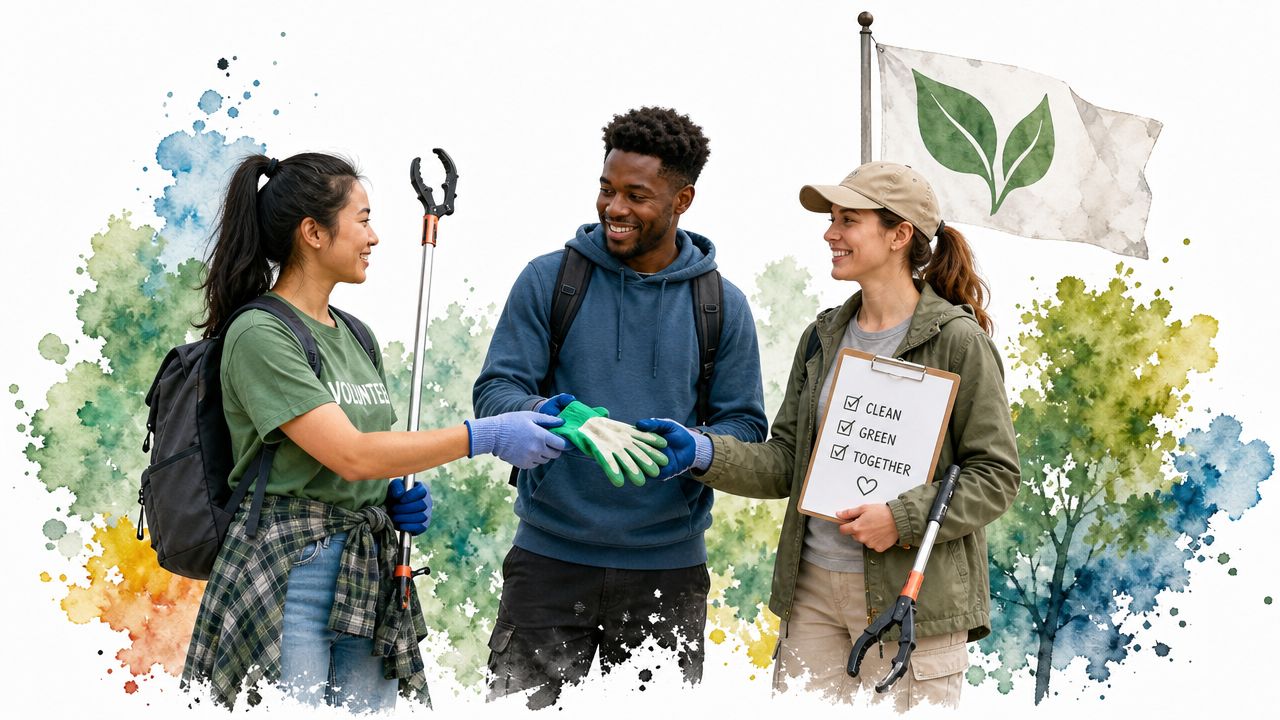
    A Chicago hailstorm caught three of us halfway through our first cleanup. We huddled under a tree, shivering while every Uber canceled, and our shared flags became the only clear sign that we belonged together.

    Why Volunteer Uniforms Matter More Than a Logo

    That day taught me something I still use when I think about volunteer uniforms. A shirt can carry a logo, but a uniform system has to do more work. It has to help the public find you, help volunteers find one another, and help a newcomer feel included before they know anyone's name.

    The first approved volunteer uniform in the U.S. National Park Service VIP program was an orange “pop-on” smock, approved in December 1970 when the program began. By 1975, the Service had introduced a distinctive cardigan vest, described in agency materials as sunny gold trimmed in loden green, with versions for men and women. Volunteers whose main duty involved visitor contact had to wear it. The National Park Service history of volunteer uniforms shows how quickly a simple garment can become a public signal.
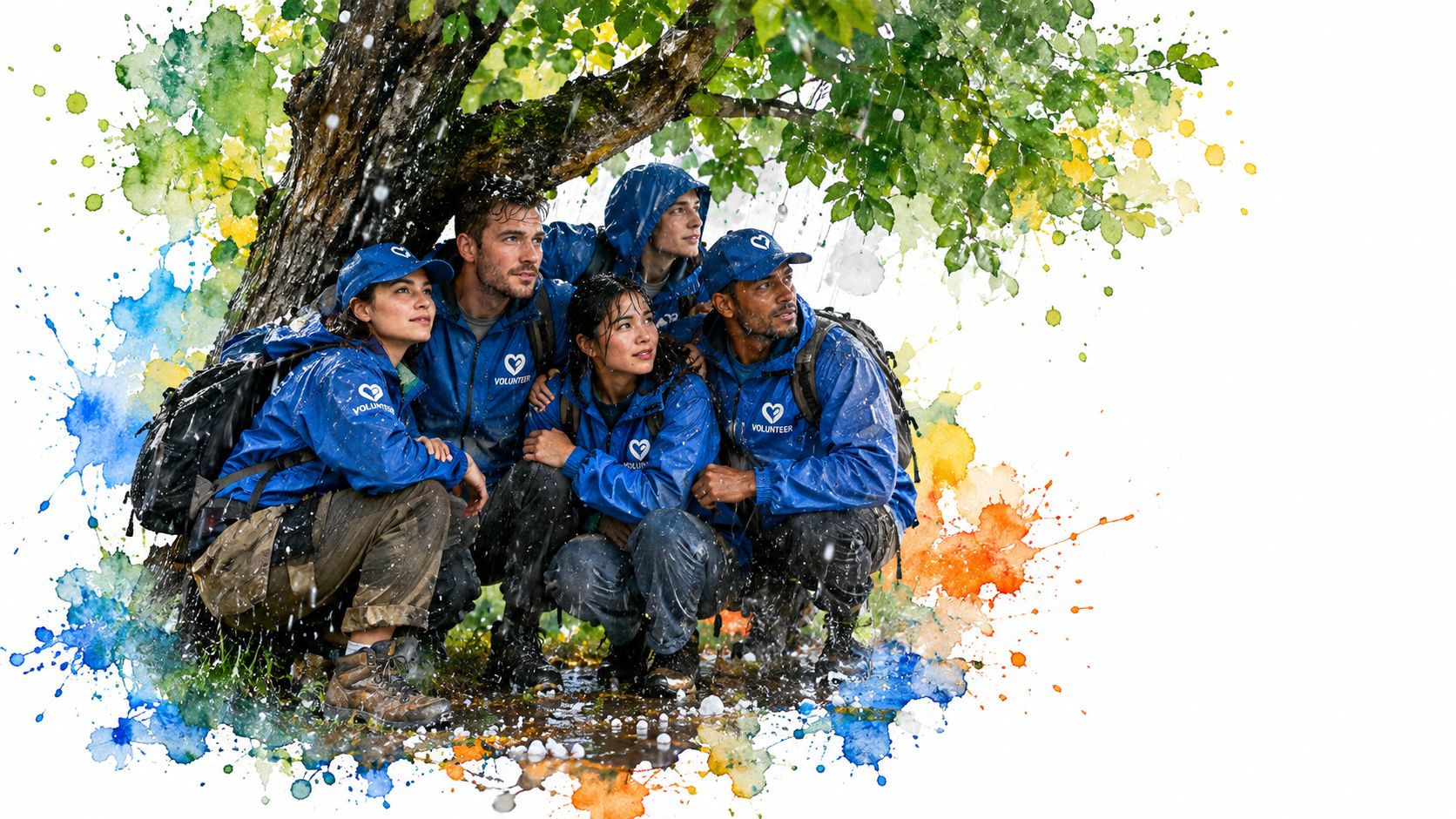
    A diverse group of volunteers in blue jackets and caps huddling under a tree during rain.

    The three jobs your uniform must do

    A stranger on a Chicago sidewalk shouldn't have to guess whether you're part of the cleanup. A bright flag, visible badge, or shared jacket gives them an answer before you speak.

    A volunteer arriving alone needs the same answer. They should spot the check-in table, recognize the group near the corner, and know whom to ask for gloves. That small moment can turn anxiety into movement.

    The third job happens. A newcomer puts on a vest, pins on a name tag, or receives a team flag. Suddenly, they aren't watching from the edge. They have a place.

    A useful test: If your uniform idea doesn't improve recognition, safety, comfort, or belonging, leave it out.

    I think about uniforms as a bridge between identity and action. The logo matters because it tells a story, yet the garment also has to survive bending, lifting, rain, sweat, and a hurried bus ride home. A practical campaign t-shirt guide can help you think through message, artwork, and shirt choices before you commit to a design.

    Uniforms can also shape group habits. You can read more about organizational culture building when you're trying to turn occasional attendance into a shared practice. Start with the people, the work, and the hazards. Add the logo after those pieces make sense.

    Design Your Volunteer Uniform System Before You Shop

    Start with a map, not a catalog. Before you buy shirts, write down where volunteers work, what they carry, how long they stay outside, and which roles face moving vehicles, poor light, wet pavement, or heavy lifting.

    I use two layers. The core identity layer carries the group's shared look. It might include a shirt, cap, name tag, or small flag. The functional layer comes on top when the task requires visibility, rain protection, cold-weather coverage, or a role marker.

    That separation keeps branding from carrying a safety burden it can't meet. Street clothes can work beneath a logo vest in some settings, yet roadway-facing volunteers need a complete compliant safety garment rather than a bright shirt paired with an unrelated vest.
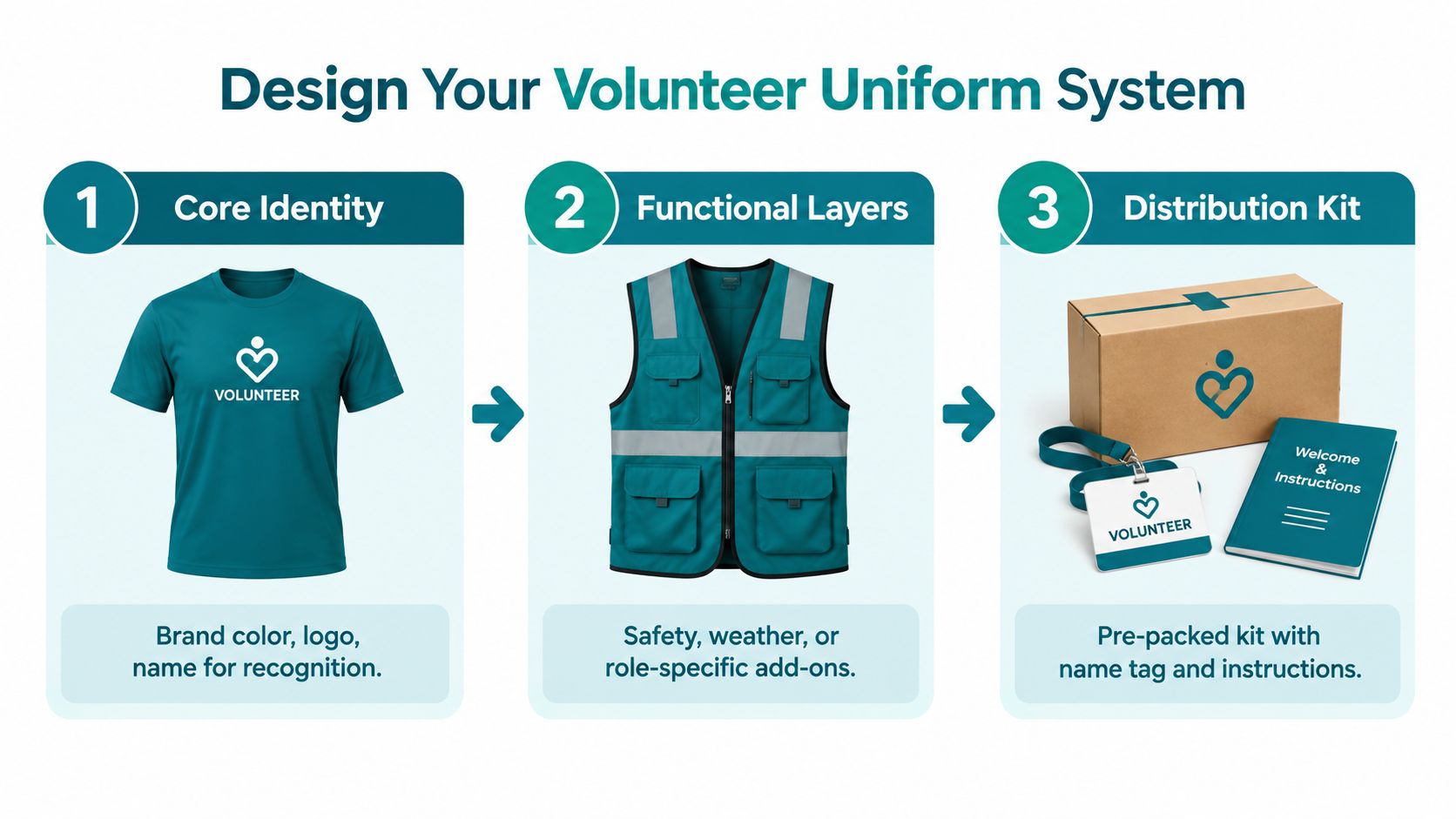
    A three-step guide to designing volunteer uniforms featuring a t-shirt, utility vest, and a distribution kit.

    Build the brief in four passes

    Map the roles. Separate sidewalk collectors, traffic-facing spotters, team leads, photographers, supply runners, and check-in volunteers. They don't all need identical clothing.

    Map the conditions. List normal weather, low-light periods, wet locations, wind, heat, and the movements each role makes. A person who bends for hours needs different comfort from someone standing at a check-in table.

    Choose the identity layer. Pick a color that stays readable in street scenes and photographs. Place the logo where a jacket, vest, or open coat won't hide it. Use names or role labels when volunteers need quick identification.

    Choose the safety layer. Specify the exact vest or outerwear model, the label class, the available sizes, and the conditions that trigger use. If you need help thinking through fabric weight, stretch, or garment construction, find custom team uniform fabrics before you send a purchase request.

    Your finished brief can fit on one page:

    • Identity: approved shirt, cap, badge, flag, or name tag.
    • Safety: approved high-visibility outerwear and label check.
    • Weather: rain, snow, heat, and cold layers.
    • Roles: who wears each add-on and when.
    • Fit: size range, alternate garments, and spare stock.
    • Care: washing, drying, storage, repairs, and returns.
    • Conduct: visible identification, photo rules, and prohibited lookalike gear.

    Keep the brief plain enough for a new volunteer lead to use without a meeting. If someone has to interpret every line, the system will change from event to event.

    Sourcing Volunteer Uniforms on a Grassroots Budget

    A low-cost uniform doesn't have to look careless. I've seen groups spend their limited money in the wrong place, then discover they can't replace a missing size or a damaged vest. The better question is simple: what can you issue, wash, repair, and replace through a full season of cleanups?

    Sourcing Option Best For Trade Off
    Bulk tees Groups that meet often and want one shared identity layer Sizes and fabric quality need careful planning
    Thrift shirts with iron-on marks Small pilots and mixed personal styles Matching color and long-term durability can vary
    Logo vests over personal clothing Inclusive programs with limited shirt stock The vest still needs clear fit and care rules
    Donated high-visibility vests Roadside work with a very tight budget Donations may arrive in mixed classes, sizes, and condition
    One approved hi-vis model Groups that need repeatable street-work practice Upfront sorting and replacement planning take attention

    Spend first on the layer that protects people

    For roadway work, spend on the safety garment before you spend on a polished shirt. Fluorescent high-visibility clothing grew from a longer safety-apparel history. Bob Switzer developed fluorescent garments in the 1930s after an injury, UK railway workers trialed high-visibility clothing in Glasgow in 1964, and the first ANSI/ISEA 107 standard arrived in 1999, according to this history of high-visibility clothing.

    A logo shirt can wait. A compliant vest can't when volunteers work near public access roads.

    Match the purchase to the group

    A small group can test a few shirt colors and issue reusable name tags. A growing group needs a size record, a storage bin, and a rule for who receives roadway gear. A group that works in changing neighborhoods may prefer logo vests over personal clothing, since volunteers can arrive in comfortable layers while the group still looks connected.

    I'd also reserve money for spare sizes and simple replacements. One approved hi-vis model makes training easier, reduces confusion at check-in, and lets a volunteer lead spot a mismatch quickly. A small badge or flag can carry group pride when shirts fade, stretch, or disappear into laundry baskets.

    Buy what your team can maintain. A cheap garment that no one can fit, wash, or replace becomes expensive friction.

    Ask every vendor the same questions. What sizes can you order later? Does the logo survive ordinary washing? Can you replace one damaged piece? Does the safety garment carry the required label? A grassroots budget works best when you protect repeatability rather than chase a perfect first order.

    Fit Distribution and Care That Keeps Volunteers Coming Back

    The clothing table can either welcome people or push them away. I've watched a volunteer arrive on a cold morning, wait while someone searches through a box, try on a shirt that pulls across the shoulders, then leave before the first bag fills. The cleanup lost a pair of hands before it reached the sidewalk.

    Treat distribution like a short ritual. Sort garments before people arrive. Label bins by size. Pre-pack a kit with the garment, name tag, role note, and return instructions. Keep a small fitting area where someone can change without an audience.
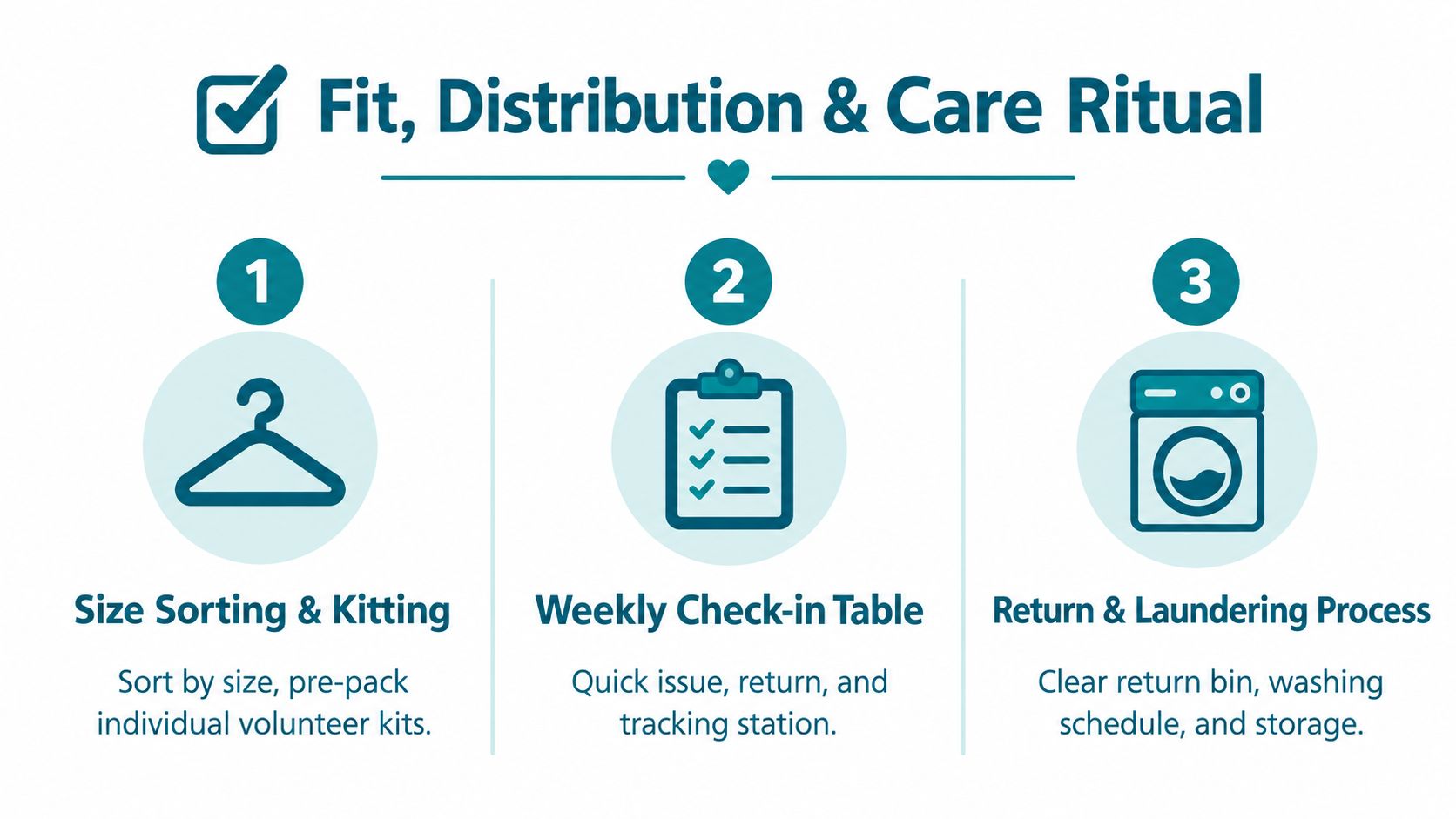
    A three-step process infographic for volunteer uniforms including sizing, distribution check-ins, and the laundering return cycle.

    Make fit part of safety

    Offer more than one cut when you can. Keep enough room for bending, reaching, layering, and walking. A volunteer uniform should allow comfortable movement without weakening a professional appearance, as described in this hospital volunteer clothing guidance.

    A vest over personal clothing can help when a volunteer can't use the standard shirt because of sensory needs, religious dress, mobility needs, body shape, or weather. An alternate garment still needs a clear safety rule and visible identification. Inclusion works best when you write the option into the policy instead of treating it like a special favor.

    Run the check-in table quickly

    Use a simple record with the volunteer's name, issued size, role layer, and return status. Keep a bin for clean stock and another for used garments. Put the return location on a small card inside every kit.

    Name labels can save time when several people own similar jackets. These tips for school uniform labels give useful ideas for durable placement and readable identification, even though cleanup teams need to adapt them for outdoor workwear.

    Care rule: Every issued item returns clean, dry, complete, and ready for the next person.

    The U.S. Forest Service volunteer-uniform manual calls for uniforms to remain neat, clean, and complete, and it treats high-visibility vests as an approved exception for special circumstances. That manual's uniform guidance supports a modular approach, identity underneath and safety or weather layers above.

    Wash according to the garment label. Dry wet gear before storage. Repair loose seams early. Retire damaged reflective material instead of hoping the next volunteer won't notice.

    Here's a short visual reminder you can share with team leads:

    A smooth clothing ritual tells volunteers that their time matters. They get in, get equipped, and get moving.

    You can pair this process with practical volunteer retention strategies that reduce avoidable friction before and after each cleanup.

    Safety Visibility and Weather Rules You Can Actually Enforce

    A roadside vest is not decoration. Seattle's Adopt-A-Street guide says volunteers must wear the safety vest at all times, and Texas DOT requires volunteers to wear the agency-provided safety vests during cleanup. Seattle's Adopt-A-Street safety guidance gives the plainest version of the rule: if you work beside traffic, keep the vest on.
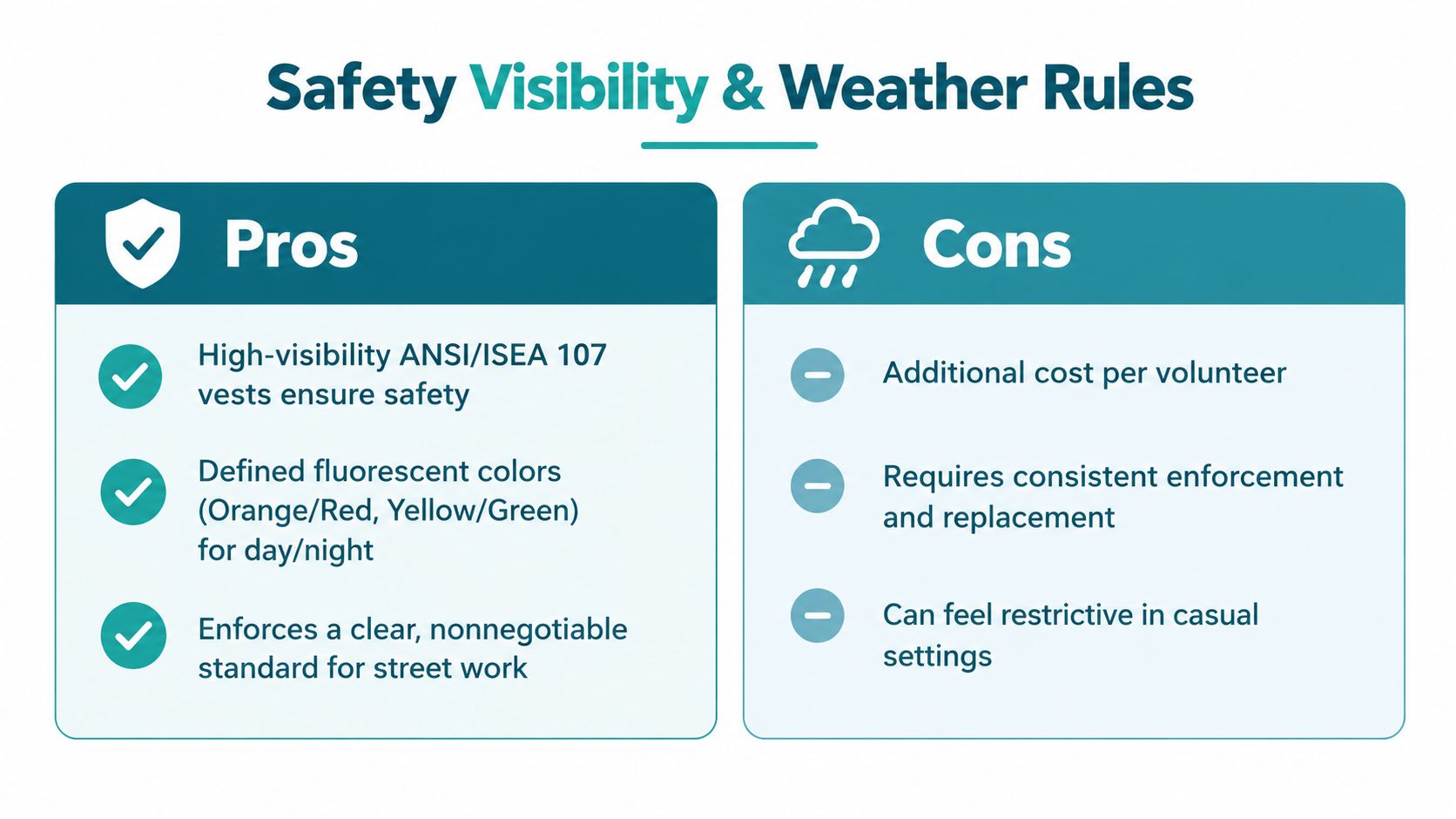
    A comparison chart outlining the pros and cons of implementing safety visibility gear and volunteer uniform rules.

    Treat the vest as tested equipment

    ANSI/ISEA 107 high-visibility safety apparel requirements cover fluorescent background colors and retroreflective materials. Roadway-facing volunteer work generally belongs in the worker PPE category, not the branding category.

    A bright vest alone doesn't prove compliance. Class 2 apparel has one cited benchmark of at least 775 square inches of fluorescent background material and 201 square inches of retroreflective material, with requirements around tested construction, minimum material areas, and 360-degree conspicuity. This ANSI/ISEA 107 explanation describes the benchmark and why a random bright garment can fall short.

    Assign hi-vis outerwear to the volunteers who face the road. Before each event, check the garment label and condition. Keep ordinary street clothes outside the compliance layer, since a mixed outfit can interrupt the intended visibility pattern.

    Give every weather condition a simple response

    Rain changes the system. Add waterproof outerwear over the identity layer, keep reflective areas visible, and replace soaked gear after the event. A hood shouldn't block side vision.

    Snow and cold require room for layers, dry socks, gloves, and footwear that lets volunteers walk and bend safely. Don't force a thin branded shirt to carry the whole weather burden.

    Heat calls for breathable base clothing, sun protection, water, and breaks. Long pants and sleeves may still fit the task, yet the fabric and fit must allow movement and airflow. Public volunteer guidance commonly names layered clothing, waterproof clothing, sunscreen, and season-specific protection. Hamilton's safety material also points volunteers toward bright or reflective clothing, closed-toe shoes, and garments that don't restrict vision or movement. The NCTCOG cleanup guide adds boots, hats or caps, long pants, and long-sleeved shirts for outdoor work.

    Kickoff rule: Roadside volunteers wear the approved vest. Everyone wears closed-toe shoes and clothing suited to the weather. Anyone who can't stay comfortable, visible, and mobile pauses or changes roles.

    Use this volunteer safety checklist to turn the rule into a pre-event habit. A policy works when a lead can explain it in one breath and enforce it without guessing.

    Make It Stick With Policy Templates and Pride

    A good uniform policy should fit on a page. It should tell people what to wear, when to add safety gear, how to request an alternative, and where to return issued items. It shouldn't make volunteers decode a legal document before they pick up a grabber.

    Copy-ready policy language

    Volunteer uniform policy: Wear the approved identity layer during group activities. Add the approved high-visibility garment when you work on or near a public access roadway, in low light, or in another condition named by the event lead. Keep identification visible. Wear closed-toe shoes and clothing that allows safe movement and fits the weather. Don't use garments that resemble police, military, or public security uniforms. Ask the lead for an approved alternative if the standard garment conflicts with faith, health, mobility, body-fit, or sensory needs.

    The Red Cross and Red Crescent volunteer security manual says volunteers should carry photo identification or wear a badge or recognized uniform, keep uniforms and emblems clearly visible, avoid police or military lookalikes, and avoid metal badges that could cause accidents. Its volunteer security guidance gives you a practical foundation for identification and appearance rules.

    Let pride have a place

    Policy handles the edges. Pride keeps the center alive.

    A small flag can lead a group down the block. A cloth badge can turn a borrowed vest into something people want to wear. A theme song can make a wet morning feel like the opening scene of a shared story. Those details don't replace safety gear. They give the safe gear a human face.

    I learned that under the tree during the hailstorm. Three strangers looked miserable, yet the flags, the jokes, and the shared colors gave us a reason to stay together. Years later, the same principle still works at a cleanup near an empty lot, a bus stop, or a corner where everyone else walks past.

    Write a one-paragraph volunteer agreement beside the policy:

    I'll wear the assigned gear for my role, keep identification visible, follow weather and roadway directions, tell a lead when my clothing or equipment doesn't fit safely, and return shared items clean, dry, and complete.

    Read it at check-in. Ask for consent before taking photos. Give people a way to decline or request a different image. Keep exceptions private, practical, and easy to approve.

    Your uniform system should feel like a hand on the shoulder, not a locked gate. Start with one identity layer, one approved safety model, a few weather options, and a distribution ritual you can repeat next weekend.


    Visit Litter Caterpillars to see how a Chicago volunteer cleanup group combines safety, friendship, flags, badges, and shared purpose in real field conditions. Join the next cleanup, test your uniform system with us, and help turn one cold or rainy morning into a team memory.

  • 8-Step Volunteer Safety Checklist for Cleanup Events

    8-Step Volunteer Safety Checklist for Cleanup Events

    Before the first bag fills, a cleanup crew can face a serious decision. Your team reaches a busy street, spots broken glass beside the curb, and must choose whether to keep moving, change the route, or stop and report it.

    A volunteer safety checklist works like a flight plan. It gives everyone a shared route, clear stop signals, and a way home when conditions change. The checklist below follows the volunteer journey from the first briefing to the final incident note, covering route hazards, equipment, buddy coverage, weather, biohazards, first response, inclusive roles, wellbeing checks, and cancellation decisions.

    At Litter Caterpillars, the litter count never outranks volunteer safety or happiness. Our Chicago group works across all 50 wards, including places where traffic, ice, construction, abandoned materials, or changing public activity can make a normal cleanup unpredictable. A good plan lets people act with courage without asking them to gamble with their health.

    1. Brief Your Team on the Day's Route and Hazards

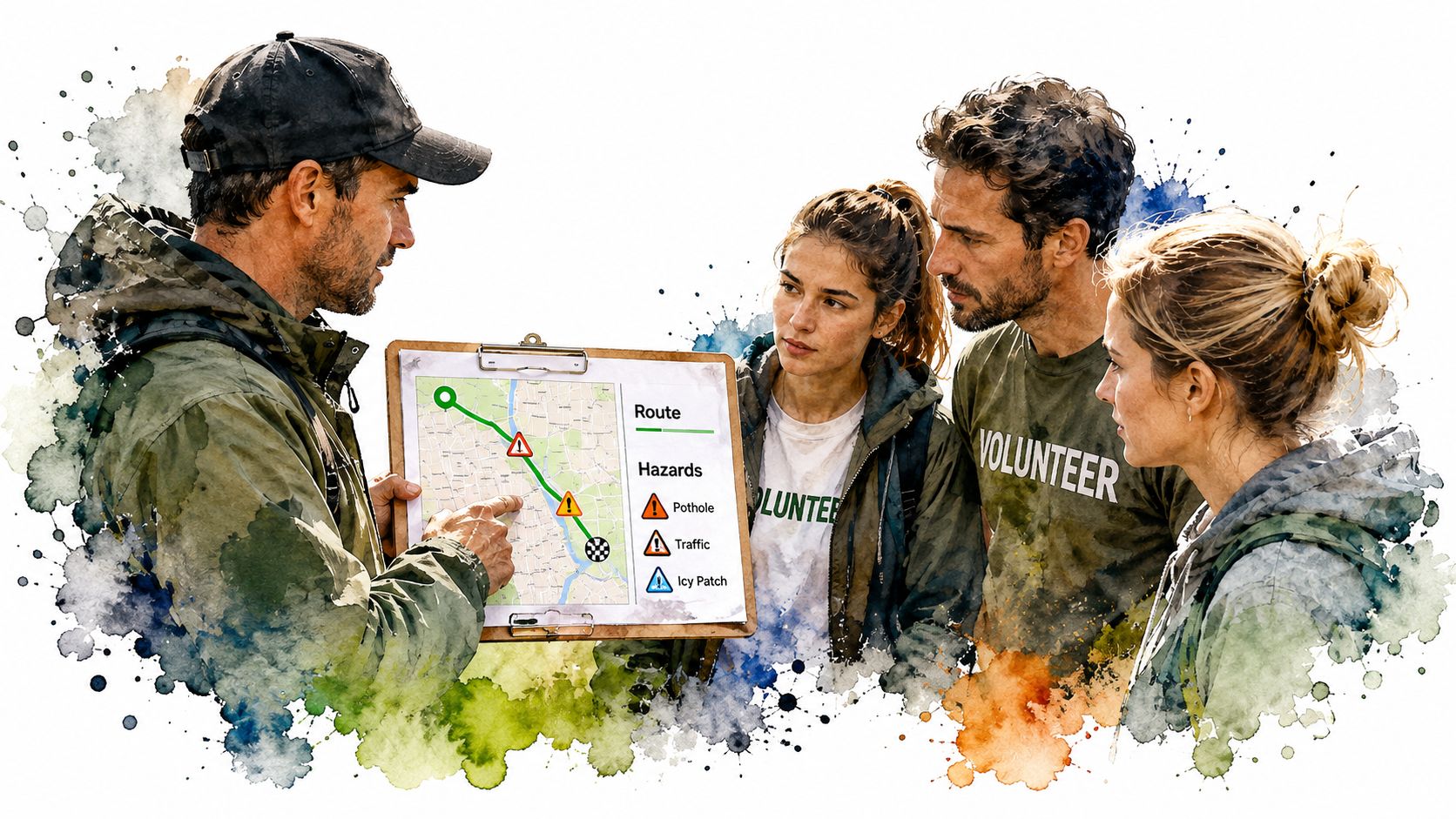
    Start with a map, then turn the map into a conversation. Tell volunteers which streets they'll walk, where the group will regroup, and what they might encounter. Point out broken-glass areas, busy crossings, aggressive dogs, potholes, poor lighting, ice, slippery pavement, and places where foot traffic changes quickly.

    I learned this during an early highway cleanup held during a bike-event shutdown. One volunteer nearly stepped into a pothole because the road condition hadn't made it into the briefing. Since then, I've treated route knowledge as equipment. Before heading into Englewood, where we won our lot for Caterpillar Park, I explained the potholes and the blocks with heavier foot traffic. Nobody got hurt because people knew what to watch for.

    Use landmarks instead of vague directions. “Stay near the blue mural and regroup at the corner store” gives people something they can see. Ask whether anyone has worked in the area before. Local observations often reveal a loose dog, a blocked sidewalk, or a slippery corner that a map won't show.

    Practical rule: Give volunteers enough information to make a safe choice. Specific warnings respect people. They don't frighten them.

    The IFRC volunteer safety guidance calls for risk assessment, situation analysis, basic information gathering, and scenario planning before volunteers act. Apply that logic in plain language. Explain what could change, who makes the call, and when volunteers should leave a threatening situation.

    2. Provide Proper Protective Equipment and Know How to Use It

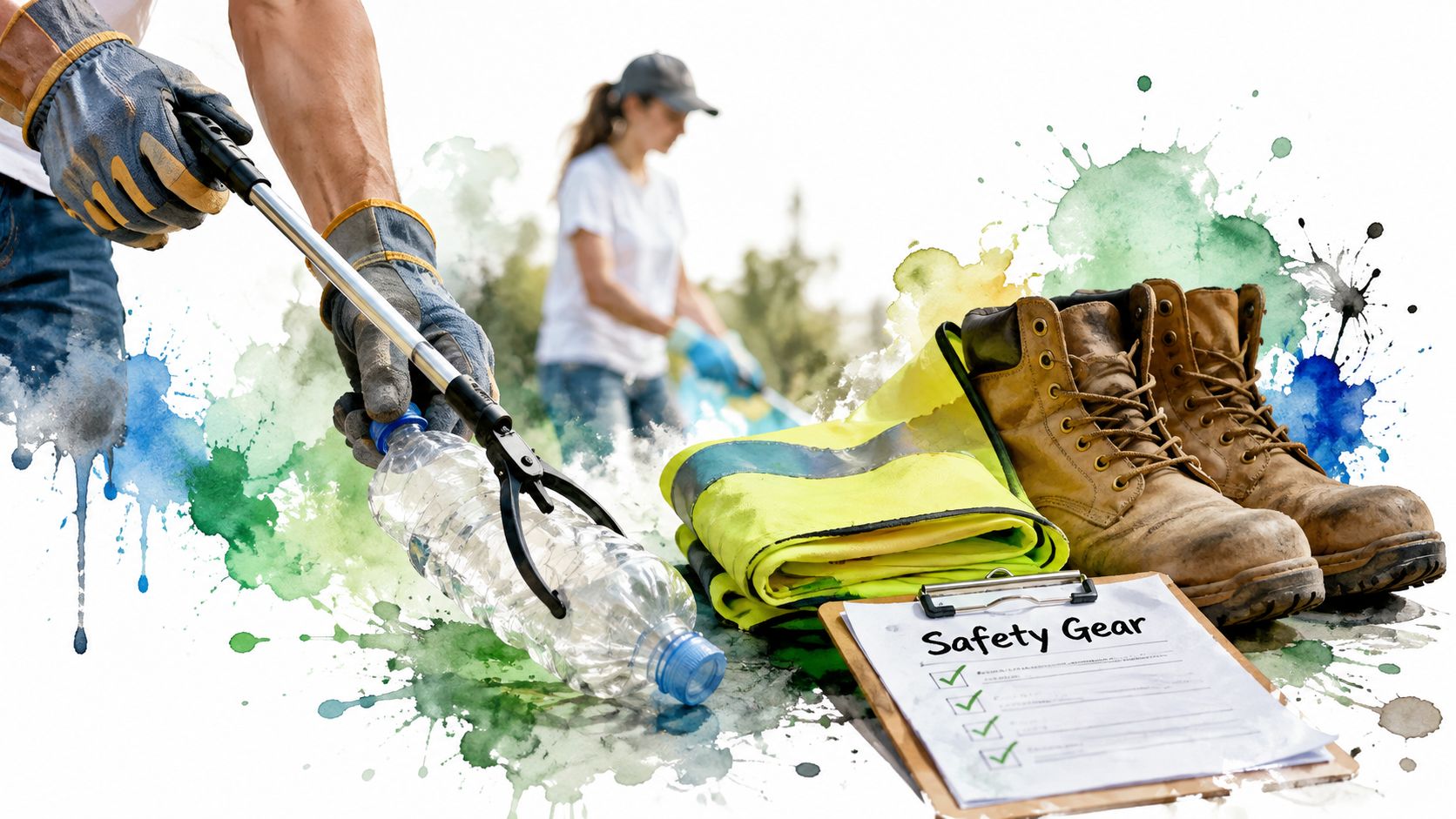
    A pair of thin gloves doesn't make every object safe. Cleanup crews need equipment that matches the work, fits the volunteer, and stays within reach. At a minimum, prepare sturdy gloves, grabbers, bright safety vests, suitable footwear, water, a first aid kit, and a reliable way to contact the coordinator.

    Greenville County's National Cleanup Day safety guidance says each group should carry a first aid kit, water, and a cell phone. It also calls for orange safety vests, group work, facing oncoming traffic, and working on one side of the road at a time. Those details turn a casual outing into a controlled field task.

    At Litter Caterpillars, volunteers can keep their bright vests. The color helps drivers see the group, and the vest gives the crew a shared identity. Volunteers have told me that wearing the gear makes the event feel organized rather than improvised. That feeling matters because people make better decisions when they understand that the team takes safety seriously.

    Read our guide to becoming a trash pickup volunteer before your first event, then demonstrate every tool at the opening briefing. Show how to squeeze a grabber, how to keep sharp objects away from the body, and how to place a filled bag without dragging it across a walkway. Never let a newcomer improvise with bare hands.

    A volunteer using a picker tool to collect a plastic bottle with safety gear nearby.

    Keep spare gloves and grabbers for late arrivals. Record what you issue, inspect damaged equipment, and replace items before someone needs them. If volunteers need eye protection, explain how to pick safety glasses for any work setting.

    A short demonstration prevents a dangerous shortcut.

    A team of volunteers reviewing a map of the route and safety hazards on a clipboard.

    3. Establish a Buddy System So Nobody Works Alone

    Pair people before the first bag leaves the staging area. A buddy gives each volunteer a nearby person who can notice a fall, hear a concern, help find the route, or call the coordinator. The system also reduces wandering, especially when a crew spreads across several blocks.

    Let people choose partners when practical, then mix newcomers with experienced volunteers when you need broader support. Give every pair a defined area. You should know which pair covers which block, path, or park edge without searching through a group chat.

    During winter events, I've watched buddy pairs spot icy patches before either person stepped forward. One volunteer points, the other slows down, and the pair changes direction. That small exchange can prevent a fall. Many friendships in our group began with two strangers sharing a grabber and watching the pavement for each other.

    Build coverage into the route

    Set a communication rhythm before the event begins. Check in with teams every 20 to 30 minutes, especially in unfamiliar neighborhoods. Use a call, text, group-chat message, or visible return to the staging point. The method matters less than the habit.

    A buddy system fails when partners separate without telling anyone. Ask pairs to stay within sight or voice range, avoid entering closed areas, and report route changes. If one person needs to leave, the pair tells the coordinator and returns together or receives a new partner.

    The OnRoute guide to safeguarding field teams can help organizers think through lone-worker exposure and communication coverage. Adapt the approach to your group, but don't allow “I'll only be gone for a minute” to become the default plan.

    4. Monitor Weather Conditions and Adjust Your Event Accordingly

    Weather decisions need an owner, a review time, and a defined response. Check conditions the night before and again on the cleanup morning. Then tell volunteers whether the event will start earlier, use a shorter route, change tasks, move indoors, pause, or cancel.

    Rain can hide potholes and turn pavement slick. Wind can shift loose debris or push objects toward the group. Heat can drain a volunteer before they recognize the warning signs. Cold can cause numbness, shivering, and poor hand control. Lightning means stopping work and leaving exposed areas. Assign one coordinator to make these calls rather than waiting for volunteers to interpret the sky.

    On hot days, our team has started at 7 a.m. instead of 9 a.m. and moved indoors for planning or meetings by noon. During severe cold, we ask volunteers to layer clothing, watch for numbness and shivering, and take shorter outdoor assignments. People can manage difficult conditions when they know the risks and can leave without shame.

    “If the forecast changes, the plan changes.”

    The IFRC implementation guide links volunteer safety with security and wellbeing at local and national levels. For a cleanup, weather belongs in the live operating plan, not only on the registration page.

    Put plain triggers in the group chat:

    • “Lightning nearby means stop work.”
    • “Confusion, weakness, numbness, or unusual cold means report it immediately.”
    • “The coordinator can pause or end the event.”

    Use the heat exhaustion prevention tips from Litter Caterpillars during the heat briefing, and give the coordinator clear authority to change the plan.

    5. Train Volunteers on Hazardous Materials and Biohazards

    Treat unknown objects as unknown. Volunteers may find broken glass, syringes, animal waste, chemical containers, medical waste, white powder, or material that looks dumped from a worksite. A cleanup crew shouldn't handle items that can cut, puncture, poison, infect, or expose people to contamination.

    Give the team one simple response: stop, step back, warn nearby volunteers, and flag the location. The coordinator can photograph the item from a safe distance and report it through the right city channel. Needles go to the Chicago Department of Streets and Sanitation. Animal-waste problems go to animal control, and chemical spills go to the city. Serious hazards need professional response.

    I've seen volunteers move toward a syringe because they wanted to help quickly. The right action took less time than a risky pickup. We stopped work around the area, reported the material, and moved the team to another section. A volunteer once spotted what looked like industrial dumping and reported it instead of touching it. That protocol protected the crew and gave the city useful information.

    Teach the stop-work phrase

    Put photos of syringes, chemical bottles, suspicious powders, and contaminated materials on a one-page handout. Keep the language direct:

    • Stop: Freeze the task and keep hands away.
    • Flag: Mark the area from a safe position.
    • Report: Contact the coordinator and the appropriate city service.
    • Move: Shift the group away until someone qualified handles the hazard.

    Share Chicago cleanup opportunities through Litter Caterpillars volunteer opportunities, then give every new volunteer the same hazard briefing. Consistency matters. A confident newcomer should know that bravery means reporting a danger, not touching it.

    6. Keep a First Aid Kit and Know Basic First Response

    Keep the first aid kit in the coordination bag, not buried in a vehicle under spare bags. Everyone should know where it sits. At least one event leader should know how to respond to bleeding, scrapes, sprains, shock, and the first steps of an emergency call.

    Stock the kit with antiseptic wipes, gauze, bandages, antibiotic ointment, elastic bandages, pain reliever, and a small emergency blanket. Check it regularly, replace used or expired supplies, and label it so a volunteer can find it without asking three people.

    A glass cut needs a calm response. Stop the activity, move the injured volunteer away from the work area, clean and cover the wound, and decide whether they need further care. A twisted ankle needs rest and assessment before anyone asks the person to continue. Light duty may work for a minor problem, but the injured volunteer gets the final say.

    Make emergency location simple

    Before volunteers spread out, identify the nearest accessible meeting point and the person holding the phone. If you call 911, describe the street, nearest landmark, route access, and what happened. A city block can feel confusing when someone is bleeding and traffic is moving around you.

    Take a first aid course by Cura Academy or use a local Red Cross training option. Training doesn't turn a volunteer into a medical professional. It does help a leader stay composed, protect the scene, and get appropriate help quickly.

    First response principle: Treat the person before you protect the schedule. The bags can wait.

    7. Communicate Clear Expectations About Physical Ability and Mental Readiness

    A cleanup may involve walking, bending, carrying, standing, watching traffic, tolerating noise, and working around unfamiliar conditions. Explain the terrain, route length, pace, weather, and physical tasks before volunteers arrive. Offer choices without asking anyone to disclose private medical details in front of the group.

    A volunteer may manage asthma, limited mobility, back pain, medication effects, sensory sensitivity, anxiety, or a difficult day. They may want to help while avoiding traffic exposure or an unfamiliar block. Give them a clear way into the work, and let them change roles without having to justify the decision.

    • Pickup role: Use a grabber on a suitable surface.
    • Supply role: Sort gloves, bags, water, and tools at the base point.
    • Welcome role: Greet volunteers, explain the route, and answer questions.
    • Documentation role: Record locations, photograph progress, or note hazards.
    • Low-exposure role: Work in a familiar area with close access to support.

    Match the role to the person's capacity that day. A volunteer with a chronic back issue may collect litter during one event, then manage supplies or greet newcomers at another. Both assignments keep the cleanup moving. A first-time volunteer can begin on an easier street and choose a more demanding route after gaining confidence.

    Use private check-ins, opt-in assignments, and clear permission to leave without penalty. Mental readiness matters too. Unfamiliar waste, traffic, conflict, or distressing scenes can affect participation, so explain what volunteers may encounter and identify a leader they can approach.

    Do not praise exhaustion as proof of service. Praise good judgment, steady participation, and helping someone find a role they can perform safely.

    8. Establish a Check-In System and Know When to Cancel or Pause

    A check-in only works when the leader listens to the answer. Ask how people feel, look for changes in pace or behavior, and accept “I need to stop” without debate. A volunteer who sits down more often, looks flushed, shivers, speaks unclearly, seems confused, or favors an injury needs attention before the issue grows.

    Use a simple group rhythm. Ask everyone how they're doing at regular intervals, then speak privately with anyone who looks unwell or unusually quiet. You can use a shared scale: “If you're at a 10, tell me you're great. If you're at a 5, tell me you're okay. If you're at a 1, tell me immediately.”

    Give leaders permission to change the plan

    One Saturday, our route was partly closed by construction. We regrouped, moved to a backup location, and kept the group together. On another hot day, I noticed a volunteer slowing down and sitting more often. I moved them into shade, brought water, and offered lighter work for the rest of the event.

    The Australian volunteer worker duties guidance uses numbered questions about induction, safe equipment, PPE, emergency procedures, hazard reporting, and contact arrangements. It says a “No” answer requires corrective action. Use that same discipline during the event. If the route, gear, communication, or weather fails the check, fix it before work continues.

    Cancel when you can't control the exposure. Pause for water, shade, warmth, route changes, or medical attention. Volunteers will remember that you protected them, and they'll trust the next event more because of it.

    Volunteer Safety: 8-Point Comparison

    Item Implementation Complexity 🔄 Resource & Logistics ⚡ Expected Outcomes 📊 Key Advantages ⭐ Quick Tip 💡
    Brief Your Team on the Day's Route and Hazards Low–Medium: 10–15 min briefing plus some advance scouting Low: leader time, route notes, map/clipboard Increased situational awareness; fewer surprises/incidents Prevents hazards; builds trust and readiness Keep it conversational; point out landmarks
    Provide Proper Protective Equipment and Know How to Use It Medium: sourcing, sizing, demos required Moderate–High: gloves, grabbers, vests, first aid; maintenance ($300–500 initial for small group) Fewer cuts/infections; higher volunteer confidence & professionalism Dramatically reduces injuries; improves visibility Bring extras; demonstrate grabber use; log gear
    Establish a Buddy System So Nobody Works Alone Low: pairing and basic coordination Low: assignment logistics, handle odd numbers Faster response to incidents; reduced isolation Improves safety; deters unwanted attention; builds bonds Mix experienced with newcomers; assign specific blocks
    Monitor Weather Conditions and Adjust Your Event Accordingly Medium: forecast checks and contingency planning Moderate: water, shade/warming stations, possible reschedule Prevents heat/cold illness; keeps events safe and adaptable Reduces weather-related injuries; shows planning maturity Check forecast night/morning; use heat/cold protocols
    Train Volunteers on Hazardous Materials and Biohazards Medium: brief training + reporting protocols Low–Moderate: one-page handouts, photos, contact lists, city coordination Fewer exposures; correct escalation to authorities; less liability Protects against bloodborne/toxic hazards; ensures proper reporting Use photo handout; adopt "stop and flag" system
    Keep a First Aid Kit and Know Basic First Response Medium: kit upkeep and at least one trained responder Low–Moderate: kit cost, occasional training, monthly checks Immediate care for minor injuries; reduced infections; documented incidents Prevents complications from minor injuries; builds trust Take a Red Cross course; check kit monthly
    Communicate Clear Expectations About Physical Ability and Mental Readiness Medium: prepare role options and communicate clearly Low: clear descriptions, support roles, flexible assignments Fewer injuries; higher inclusion; reduced burnout Inclusive participation; sustained volunteer retention State terrain/distances up front; offer light-duty roles
    Establish a Check-In System and Know When to Cancel or Pause Medium: scheduled check-ins and decision criteria Low–Moderate: leader attention, documentation for pauses/reschedules Catches problems early; prevents escalation; increases trust Encourages speaking up; protects volunteers; enables safe pivots Do group check-ins every 20–30 min; set clear stop-work rules

    Pack the Checklist With the Grabbers

    A printed event card should fit inside the coordinator's folder and answer one question quickly: Who does what, where, and what happens when conditions change? Don't leave responsibility floating between several friendly people. Assign each duty before volunteers arrive.

    Write the route, backup route, staging point, and no-go areas at the top. Add the route hazards you discussed, including broken glass, traffic patterns, dogs, potholes, ice, construction, steep slopes, guardrails, medians, bridges, roundabouts, concrete walls, utility sites, and private property. Seattle's cleanup guidance lists those areas as off-limits for litter pickup and tells volunteers to stay on public property.

    List the equipment owner next. Name the person carrying first aid supplies, the person holding the phone, the weather decision-maker, and the person who tracks buddy pairs. Record where the water, PPE, spare grabbers, and emergency contacts are located. The Nonprofit Risk Management Center field guide recommends learning the area, mapping the route, charging phones, leaving an itinerary, and checking vehicle lights, brakes, tires, and fuel before field assignments.

    Your event card should include:

    • Route and hazards: List streets, landmarks, restricted areas, and backup locations.
    • Equipment: Confirm gloves, grabbers, vests, water, bags, first aid, and safe footwear.
    • Buddy pairs: Record each pair and its assigned area.
    • Weather call: Name the person who can shorten, pause, switch, or cancel the event.
    • Hazard rules: Tell volunteers what they must never touch and how they report it.
    • Emergency response: Note the first aid location, phone holder, meeting point, and 911 details.
    • Accessible roles: Prepare lighter, seated, lower-exposure, supply, greeting, and documentation work.
    • Check-ins: Set the communication rhythm and the signs that require immediate action.
    • Incident notes: Record injuries, near misses, hazards, route changes, reports, and follow-up needs.

    Review the card aloud at the briefing. Ask volunteers to repeat the stop-work rule in their own words. If someone can't explain what to do after finding a syringe or seeing lightning, slow down and clarify before the crew moves out.

    After the cleanup, don't throw the card into a drawer. Record what happened while the details remain fresh. Note the icy corner, blocked sidewalk, loose dog, missing glove size, weather change, or confusing instruction. Then update the next event plan. A checklist earns its place when people use what they learned.

    Litter Caterpillars built its volunteer-first approach through weekly Chicago cleanups in rain, heat, blizzards, and cold wind. The group's identity includes flags, theme songs, badges, and shared pride, yet the operating rule stays plain: volunteers come first, happiness comes next, and the litter can wait. A safer cleanup gives people the chance to return next weekend with energy, trust, and a story worth telling.


    Litter Caterpillars gives Chicago volunteers a practical way to clean neighborhoods, meet people, and take on outdoor service with safety and friendship at the center. Visit Litter Caterpillars to find an upcoming cleanup, join the group chat, and bring this volunteer safety checklist into the field.

  • Organizational Culture Building for Volunteer Groups

    Organizational Culture Building for Volunteer Groups

    The hail hit us sideways that first morning. Three of us crouched beneath a tree, shivering while every Uber cancelled, and somehow we kept laughing.

    That scene taught me more about organizational culture building than any values workshop could have. People learn who they are together when the weather turns, the work gets awkward, and someone still hands you another trash bag.

    How Shared Struggle Creates Instant Culture

    Most advice about organizational culture building starts with mission statements, posters, and values sessions. I've found that order backwards. A group discovers its real culture when people face an unpleasant task together and decide whether they'll keep showing up.

    That first Litter Caterpillars cleanup gave us three lessons. Cleaning someone else's mess felt easier than cleaning our own. Suffering together created a strange kind of fun. The hail added flavor to the story, a difficult chapter we could retell whenever a new person joined.

    A diverse team of professionals collaboratively lifting a large table, symbolizing unity and building organizational culture together.

    Hard moments reveal the rules

    Comfort can hide selfishness. A pleasant event lets everyone act agreeable for a few hours. A cold morning reveals who checks on a stranger, who shares gloves, who carries the overloaded bag, and who stays after the official end time.

    You don't need to manufacture misery. You need a real task with a clear finish line and enough difficulty to require cooperation. A neighborhood cleanup, food distribution shift, trail repair day, or community garden work session can create that setting. Give people roles, let them solve small problems together, and let the group talk afterward about what happened.

    Practical rule: Choose a challenge that asks people to depend on one another, then make room for the story that follows.

    Groups often fail because they chase comfort before trust. They plan polished introductions, fill the schedule with announcements, and avoid anything that might feel inconvenient. Volunteers then leave with pleasant memories but few relationships and no shared language for future decisions.

    A useful guide to improving organizational culture can help leaders map values, behavior, communication, and feedback. For a volunteer group, I'd add one question: What hard thing will we do together often enough that it becomes part of our identity?

    Design the return

    Shared hardship only builds culture when people can return safely and willingly. Set a dependable meeting rhythm, explain the task before people arrive, and make sure a leader models the behavior you want. If rain changes the plan, communicate early. If a volunteer struggles, give them an easier role without making them feel small.

    Over time, the repeated pattern matters more than one dramatic day. People remember the hail, but they trust the group because someone kept organizing the next cleanup.

    Defining Values That Actually Filter People

    A value that never changes a decision isn't a value. It's decoration.

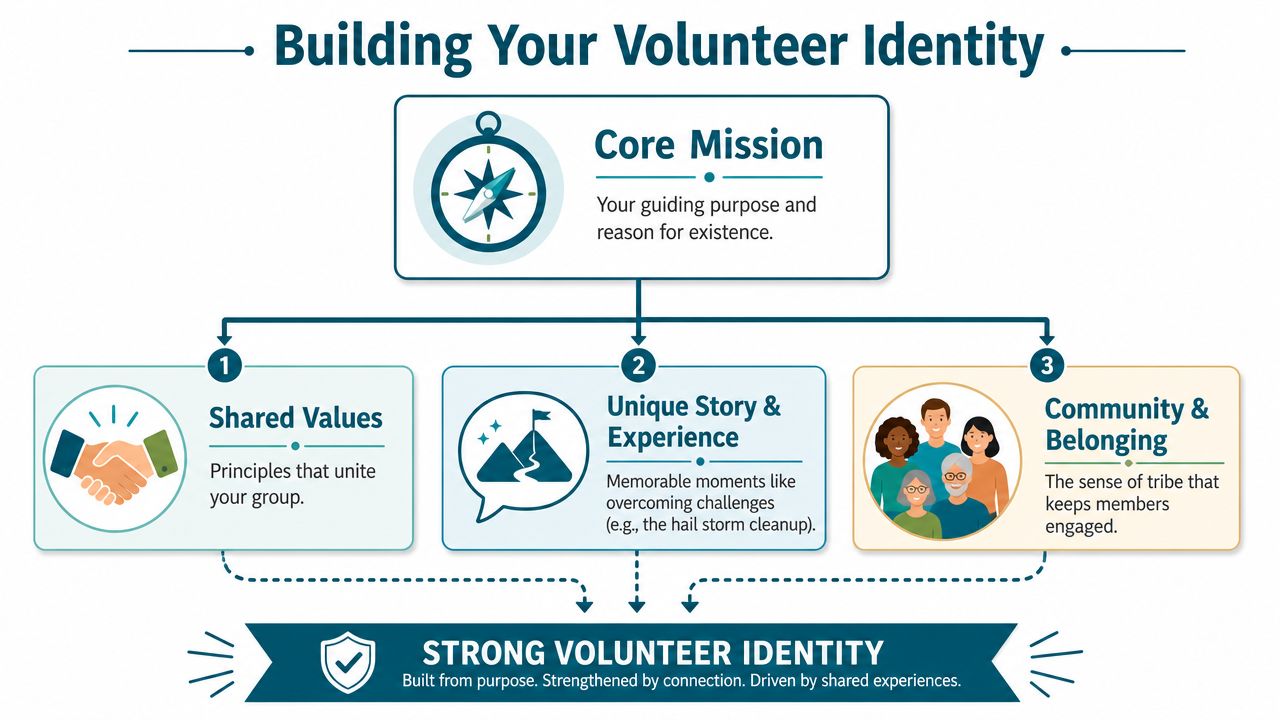
    I write values as instructions for behavior. Bravery means showing up when the work feels uncomfortable and trying again after failure. Kindness means treating residents, teammates, and yourself with care. Unity means moving with other people instead of treating service as a private performance.

    Those words matter because they filter. They tell people what kind of group they're joining, what the group expects, and what the group won't reward.

    Turn ideals into visible choices

    Start with a recent moment that tested your group. Ask what a good volunteer did, what a harmful volunteer did, and what a leader should have done sooner. Then write the value around the action.

    “Excellence” might sound impressive, but it doesn't tell a volunteer whether to slow down for a new participant. “Bravery in bad weather” gives people a clearer picture. “Kindness during disagreement” tells a coordinator how to handle conflict. “Unity across neighborhoods” guides who gets invited and how teams share work.

    Use your values to decide:

    • Who joins: Choose people who want to give time and attention, not people seeking a personal audience.
    • When you meet: Weekend mornings can filter for people ready to build a service habit. That schedule won't suit everyone, and that's part of its purpose.
    • How leaders act: A coordinator who leaves early while others finish teaches a different value than the one written on the website.
    • What you praise: Recognize the person who welcomes a newcomer, notices a safety issue, or helps another volunteer finish.

    Your volunteer job descriptions should carry the same behavioral language. A role description can say that a person sorts supplies, but it should also explain how that person treats the team and responds when plans change.

    Make effort feel like pride

    Tom Sawyer understood a useful social trick. He turned an unpleasant fence-painting task into an opportunity his friends wanted to claim. I don't use that story to disguise bad work or pressure people into pretending they enjoy it. I use it to ask how a group can give honest effort a sense of pride.

    A badge, a team name, or a simple recognition ritual can make service feel like a chosen identity. The work remains work. The volunteer also gets a story, a place in the group, and proof that they did something difficult.

    Write values that attract generous people and repel behavior that drains everyone else. Your culture gets clearer each time a leader makes a decision in public and explains which value guided it.

    Building Pride Through Symbols and Rituals

    On a cleanup morning, a flag can do what a long speech can't. It tells a new volunteer where to stand, gives the group a visible center, and lets people recognize one another from across a block.

    The Litter Caterpillars logo comes from that first hailstorm. It carries the memory of three people under a tree, waiting out the weather and choosing to keep the story going. A volunteer-made theme song gives arrivals another way to enter the group. Flags travel to events. Badges show progress. These objects help people say, “I belong here,” without needing a formal introduction.

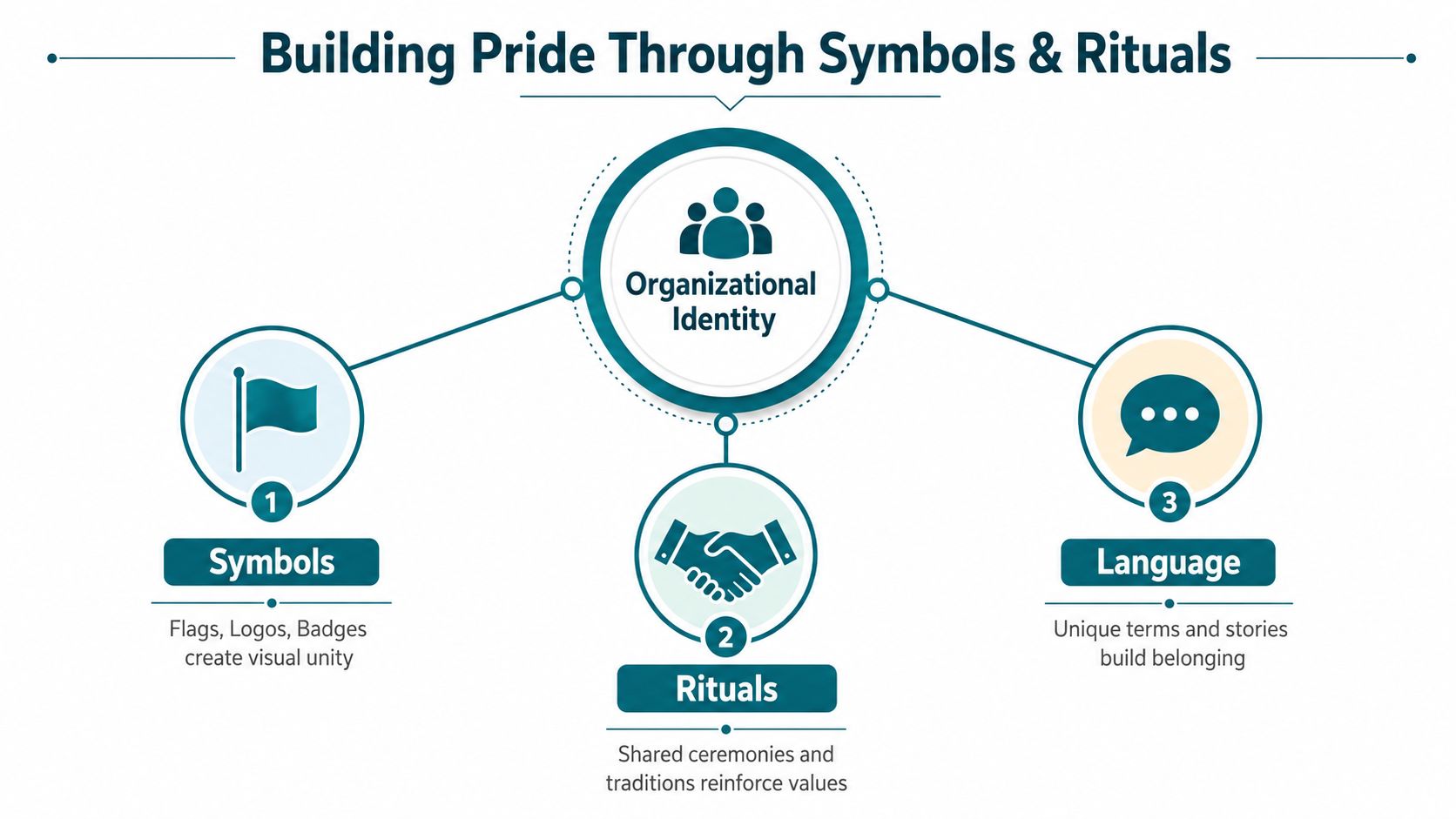
    A diagram illustrating how organizational identity is built through symbols, rituals, and unique language for employees.

    Give the story physical form

    Choose one symbol from your group's own history. It might be a patched tool bag, a hand-painted sign, a shared color, or a small object from the first event. Don't copy a corporate badge system because it looks polished. Use something that people can explain in one sentence.

    Then build rituals around real moments:

    • A short welcome for first-time volunteers.
    • A safety check before the work begins.
    • A group photo after the final bag leaves the site.
    • A thank-you circle where people name a helpful action they saw.
    • A badge or token for learning a new role.

    Consistency matters more than cleverness. If you change the ritual every week, people can't anticipate it or pass it to newcomers. Keep the shape stable while letting the stories change.

    Let repetition build resilience

    A rain-or-shine schedule can become a promise. Volunteers know the group will meet, leaders know they must prepare, and the neighborhood sees a dependable presence. That doesn't mean ignoring unsafe conditions. A leader must change or cancel an event when conditions put people at risk, then explain the decision plainly.

    Language matters too. Groups develop terms for tasks, places, and small victories. Those words compress shared experience. A new volunteer learns them by listening, then starts using them with someone else.

    Recognition can stay simple. A handwritten note, a public thank-you, or a badge tied to a real contribution often carries more weight than a generic announcement. You can find practical ideas in these volunteer recognition ideas.

    The song below gives another example of how a volunteer's creative work can become part of a group's shared memory.
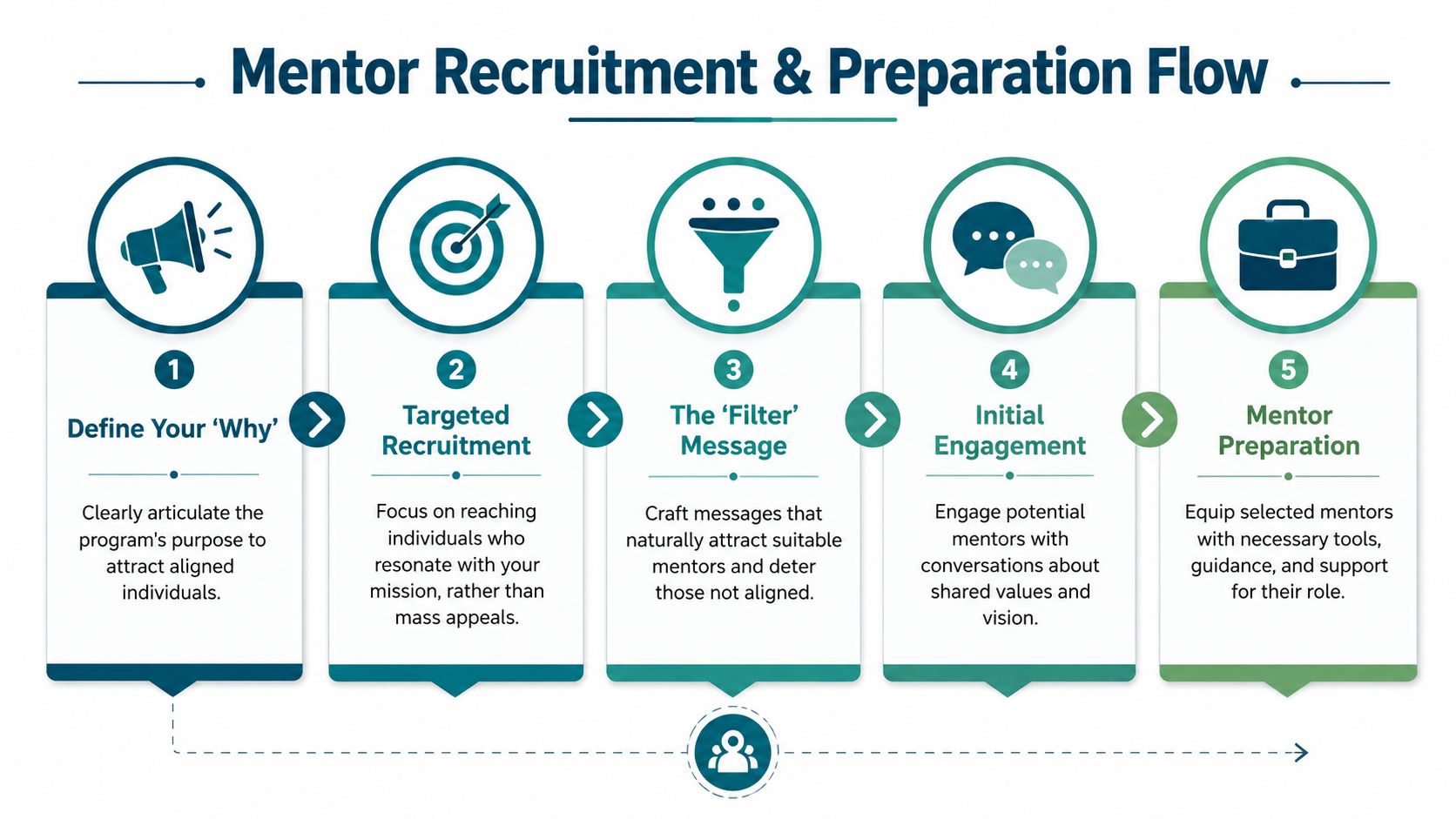
    Protecting Volunteer Energy With Safety First

    Volunteer energy lets a group keep moving, and it can disappear after one preventable injury, one humiliating interaction, or one event that leaves people confused and exhausted. I put safety first, happiness second, and fundraising somewhere outside the volunteer relationship.

    A volunteer-first policy starts with boundaries. Tell people what the task involves, what equipment you provide, which conditions can change the plan, and who makes the final call. Psychological safety matters too. People should be able to say “I'm uncomfortable,” “I need a break,” or “I don't know how to do that” without losing respect.

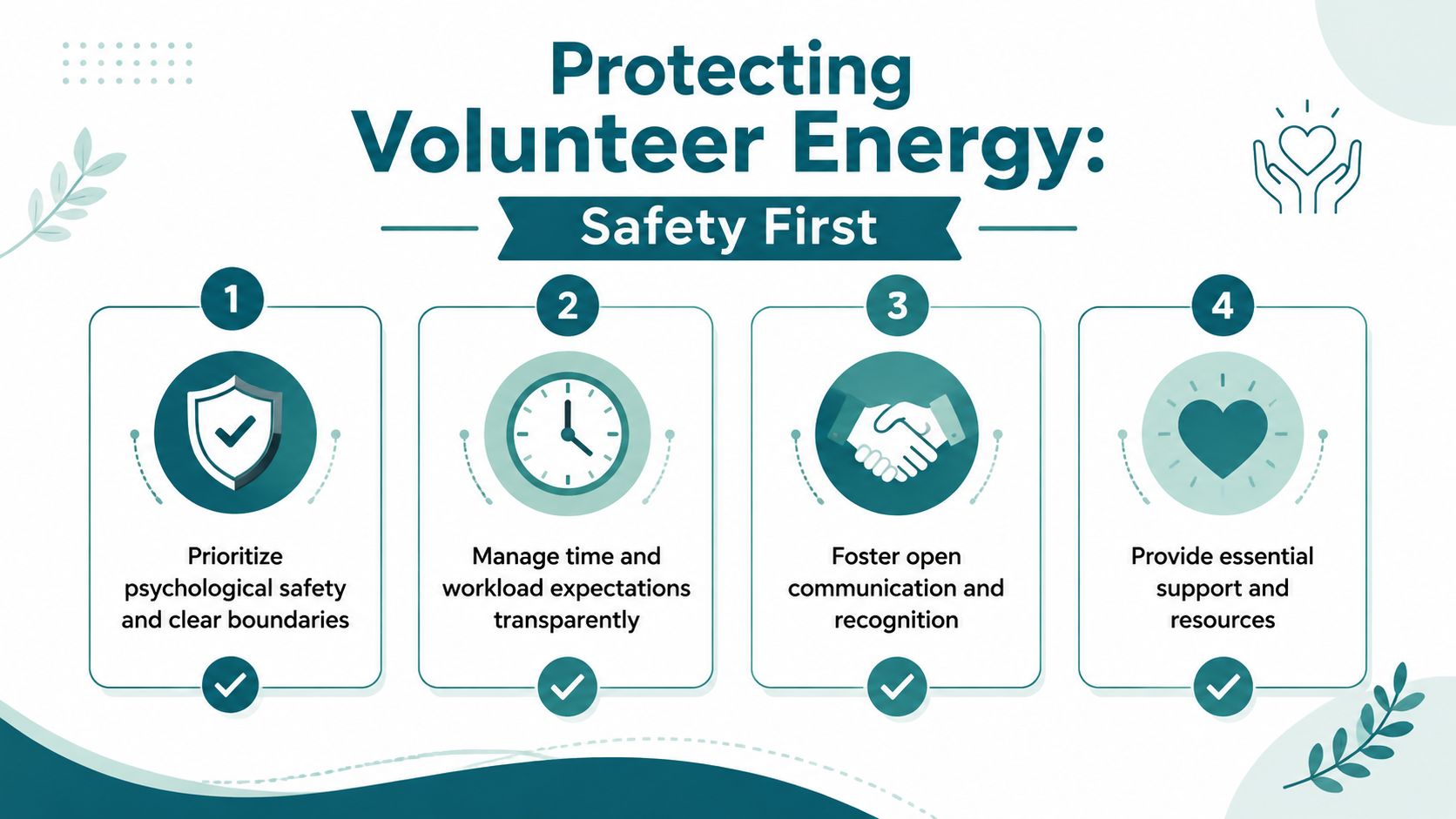
    A graphic titled Protecting Volunteer Energy showcasing four key steps for maintaining volunteer safety and well-being.

    Teach safety, then repeat it

    A safety orientation at the start gives people a common baseline. It should cover tools, lifting, traffic, sharp objects, weather, personal boundaries, and the process for reporting a concern. Keep the language plain and demonstrate the actions instead of reading a long policy aloud.

    Safety guidance for volunteer organizations recommends keeping current safe-work policies and procedures on a notice board or app, giving people a suggestions box for safety ideas, and holding regular meetings about safer ways to work. Safe Work Australia's volunteer safety guidance gives that rhythm a practical shape.

    A separate volunteer safety guide recommends an opening orientation followed by regular communication about health and safety. People forget instructions when they use them rarely, so repeat one small reminder before each event.

    Make participation easy and pressure-free

    Publish the meeting point, expected duration, clothing advice, accessibility notes, and cancellation process in the same place. Use Meetup, Instagram, and open group chats to help people find an event without a private invitation or a long application.

    Don't turn a service day into a donation pitch. A zero-pressure policy protects the reason people arrived. Let volunteers make friends, learn a role, and leave with enough energy to return. Schedule realistic work, provide pauses, and assign a person to welcome anyone standing alone.

    Volunteer-first practice: If your event needs volunteer energy to succeed, your planning must protect that energy before it asks for more.

    Leaders should watch for quiet signs of strain. Someone who stops talking, rushes through unsafe work, or avoids a familiar role may need a check-in. Ask privately, listen without defending the plan, and change the system when the same concern appears more than once.

    Measuring What Matters for Long-Term Retention

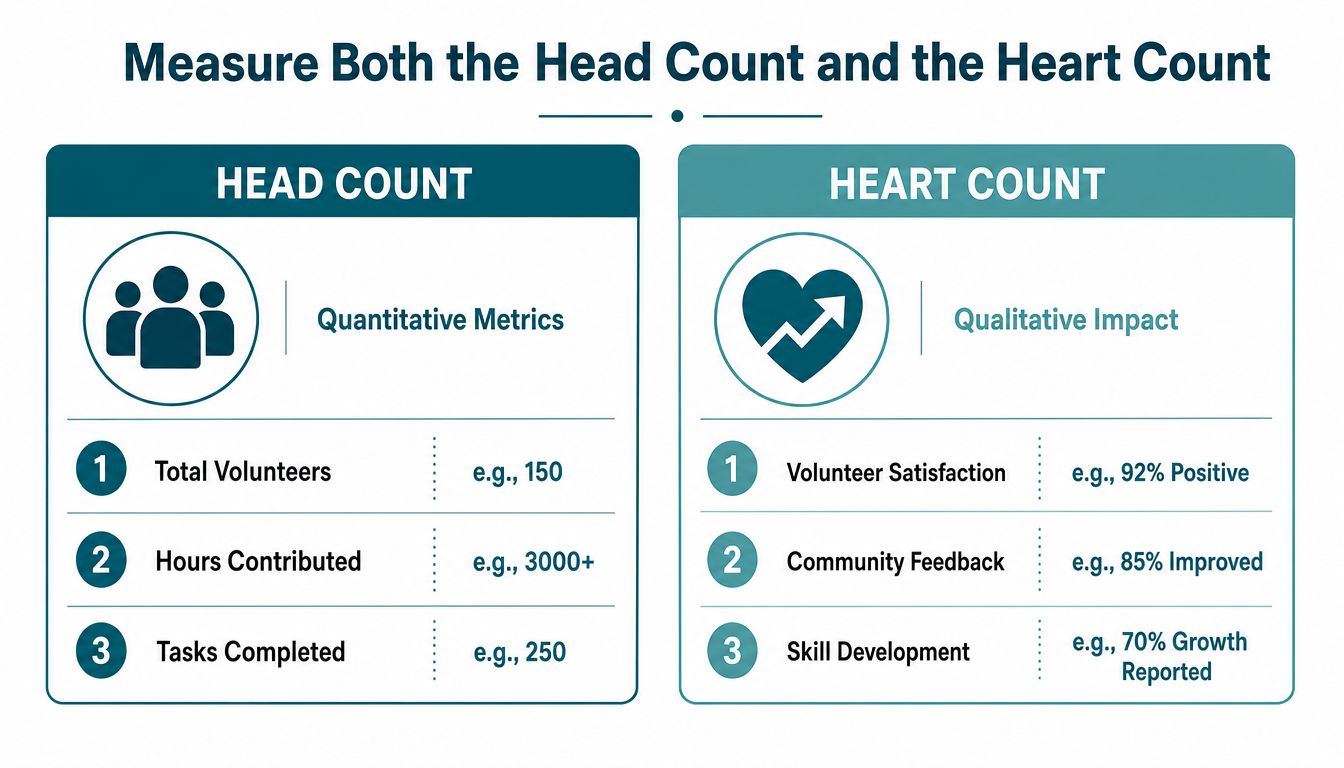
    At a cleanup in a neglected corner of the neighborhood, twelve people may sign in, yet only four return the following week. The attendance sheet records the first number. It cannot show who stood alone, who found a friend, or which confusing task sent someone home for good.

    Research on episodic volunteering found different retention drivers at different stages. For first-time volunteers, satisfaction and social norms predicted retention. For volunteers with 2 to 4 years of intermittent service, satisfaction and commitment predicted retention. Among sustained volunteers, financial support, social norms, satisfaction, and commitment all showed positive coefficients. The episodic volunteering research explains these distinctions.

    Track the reason behind the return

    Send a short pulse check after each event. Ask what felt good, what felt difficult, whether the volunteer felt welcomed, and whether they plan to return. Leave one open question for the detail a checkbox cannot capture.

    A small group can track:

    • First return: Did a new volunteer come back, and did someone introduce them to others?
    • Satisfaction: Did the work feel manageable, social, and worth the time?
    • Commitment: Does the volunteer take ownership of a role or invite someone else?
    • Support: Did the group provide the tools, information, and care experienced volunteers needed?
    • Friendship formation: Can people name someone they met through service?
    • Event consistency: Did cancellations, late starts, or unclear locations interrupt trust?
    • Ward coverage: Did the group reach the neighborhoods it planned to serve?

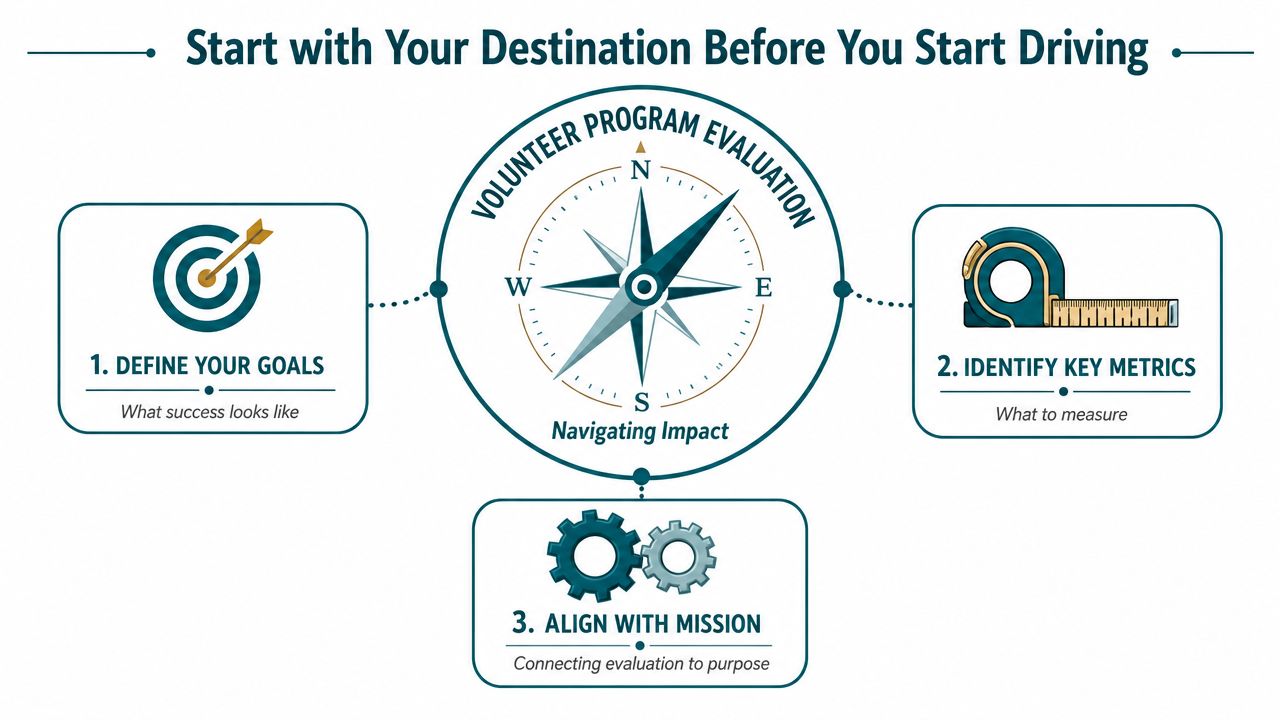
    A volunteer program evaluation framework can help organize these questions without turning a community ritual into paperwork.

    Read the answers by experience level, team, manager, location, and tenure where useful. An overall average can hide a local problem. One Litter Caterpillars crew may welcome newcomers at the curb while another leaves them at the edge of the circle.

    Experience Level Primary Retention Drivers What to Measure
    First-time volunteers Satisfaction and social norms Welcome quality, task clarity, social connection, return intention
    Volunteers with 2 to 4 years of intermittent service Satisfaction and commitment Role ownership, follow-through, feedback, continued participation
    Sustained volunteers Financial support, social norms, satisfaction, and commitment Support resources, leadership trust, recognition, mentoring, responsibility

    Keep the metric set small

    Culture-metrics guidance recommends 6 to 10 KPIs, combining early signals such as engagement or eNPS with outcomes such as voluntary turnover, absenteeism, productivity, and customer NPS, then segmenting results to find where culture breaks down. A volunteer group can borrow that approach without copying workplace measures.

    Choose one or two North Star measures, collect pulse responses on a fixed cadence, and pair the results with conversation. If satisfaction falls in one crew, speak with that crew before changing the whole program. Numbers mark the place to look. Volunteers explain what happened, and their experience shows whether the ritual is strong enough to bring them back.

    Common Mistakes That Kill Volunteer Culture

    I've watched groups chase a cheerful message while their actual schedule kept changing. I've seen leaders count every signup, ignore the people who felt lost, and call the result growth. A culture survives through repeated actions, so slogans can't rescue a broken routine.

    Gallup reports that 31% of U.S. employees were engaged at work in 2024, matching the low point last seen in 2014, while 17% were actively disengaged. Gallup also reports that global engagement declined again in 2025, reaching its lowest level since 2020. Those figures come from a workplace context, yet they give volunteer leaders a useful warning: enthusiasm needs daily reinforcement, not a one-time speech. Gallup's engagement report provides the details.

    Mistakes that look harmless at first

    Motivational messaging without action creates cynicism. If leaders praise kindness but ignore a volunteer who bullies others, people learn the actual rule quickly.

    Attendance as the only success measure rewards volume over experience. Ask whether people felt welcomed, learned a role, formed a friendship, and chose to return.

    Unsafe improvisation damages trust faster than a cancelled event. Give people orientation, repeat safety guidance, update policies, and accept that leaders may need to stop work.

    Donation pressure changes the relationship. Volunteers who arrived to serve can start feeling like customers on a list. Keep giving optional and separate from the welcome, recognition, and work itself.

    Inconsistent scheduling breaks the habit that brings people back. Publish a dependable rhythm, communicate changes early, and avoid making volunteers guess whether an event still exists.

    Trying to suit everyone makes the group hard to understand. Clear values will turn some people away, and that can protect the people who want the same kind of service.

    Fix the system, not the poster

    A culture review identifies three conditions that help people follow group norms: expectations must stay visible, people must broadly agree with them, and rewards or sanctions must carry enough intensity to matter. Read the culture review on norms and organizations for the underlying framework.

    Write the rules in plain language. Ask volunteers whether the rules match the lived experience. Praise behavior that keeps the group healthy, and address behavior that harms others quickly and consistently.

    Organizational culture change works better as a staged operating system than as a slogan campaign. One benchmark describes planning, analysis, integration, implementation, and operational maturity, while McKinsey reports that only about one in four large-organization transformations achieve long-term success, as summarized in this culture-change benchmark.

    For a volunteer group, the rollout can stay practical:

    1. Plan the behavior: Choose the actions you want people to repeat.
    2. Study the gap: Ask where current events fail those expectations.
    3. Integrate the rules: Put them into event plans, safety checks, recognition, and leader roles.
    4. Pilot the routine: Try it with a few teams and listen closely.
    5. Scale with evidence: Expand only after volunteers show that the routine works.

    Litter Caterpillars brings people together for weekly Chicago cleanups, rain or shine, with flags, badges, friendships, and safety practices that make service easier to repeat. Visit Litter Caterpillars to find an event, meet people who give their time, and help build a culture of care block by block.

  • Volunteer Job Descriptions: 10 Templates for Nonprofits

    Volunteer Job Descriptions: 10 Templates for Nonprofits

    I started Litter Caterpillars because my own room was a wreck, and my life felt like it was sinking under the same junk. Then three of us went out to pick up trash, got hit by hail, and somehow that made the whole thing click, cleaning other people's mess is easier than cleaning your own, and it can even be fun.

    If you've ever tried to recruit volunteers and heard crickets, I've got a guess, you're asking for help when people want a place to stand. A good volunteer job description gives them a name, a lane, and a reason to show up again. It makes the work feel real, like grabbing gloves, meeting a block captain, or learning how to run a cleanup when the weather turns ugly. The groups that write roles clearly aren't just filling shifts, they're building crews.

    The part that is often missed is that volunteering is not some tiny side hobby. The International Labour Organization treats volunteer work as unpaid voluntary activity, and U.S. labor data shows the scale is huge. In the year ending September 2023, 75.7 million Americans formally volunteered through an organization, or 28.3 percent of people age 16 and older, and on an average day in 2022 more than 11 million people volunteered, including about 4.7 million in administrative and support work and 470,000 in indoor or outdoor maintenance and cleanup activities, according to the ILO volunteer work overview. That's why the best role descriptions feel specific, grounded, and easy to step into.

    1. Community Cleanup Crew Lead

    The first role I'd write is the one I wish I had when I was trying to keep our early cleanups from turning into a free-for-all. A Community Cleanup Crew Lead takes one neighborhood and owns the morning, the route, the vibe, and the handoff. You are not dragging every bag yourself. You are keeping the crew moving like a captain on a field where everybody has a job.

    I learned fast that people don't all show up for the same kind of task. A federal volunteering survey shows the rate shifts a lot by occupation, with some groups stepping into service more often than others. That tells me volunteers bring different instincts with them. If you want someone to lead an Englewood cleanup or rally a downtown business district, spell out the turf, the pace, and the result you want.

    Practical rule: write the role like you're handing someone the keys to one block, not the whole city.

    That framing matters because the lead is part organizer, part steady hand. One volunteer can build relationships with longtime residents in Englewood, another can get shop owners on a business strip to join in, and both can feel like they're carrying real weight. I've seen crews settle down the second someone says, “I've got this block,” and then means it.

    • Pick a neighborhood you care about: People show up harder when they feel a block in their bones.
    • Start small and expand: One park or corridor is easier to run than a giant stretch of city.
    • Track the rough spots: Keep a list of the messiest corners so your routes have a plan.
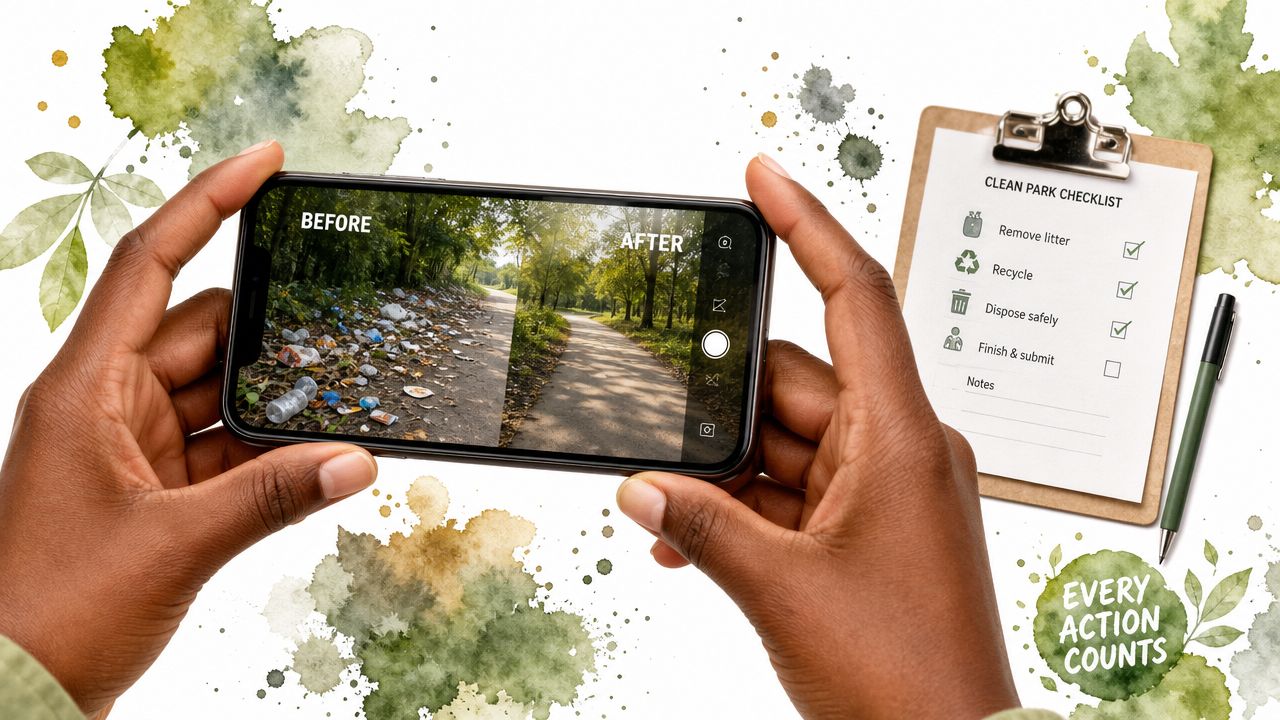
    • Use before and after photos: People like seeing the difference they made with their own hands.

    A clear role description turns a vague ask into a real invitation, something people can step into without guessing what comes next.

    A diverse group of volunteers planning a community cleanup project with a map in a park.

    2. New Volunteer Onboarding Buddy

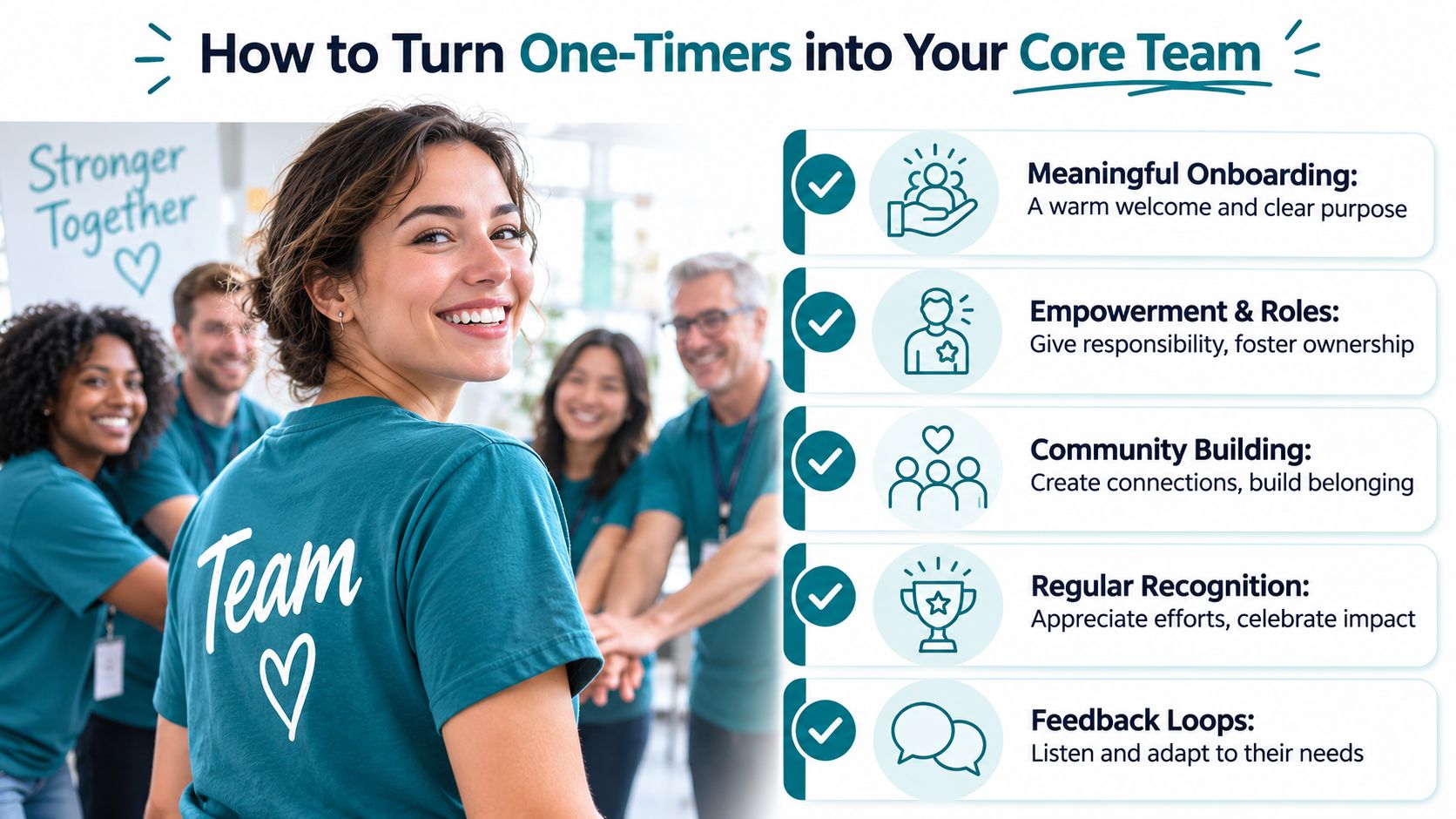
    The best volunteer I ever met at the door wasn't the loudest one, it was the one who noticed a nervous newcomer standing alone and walked over first. That's what a New Volunteer Onboarding Buddy does. You greet people like they belong before they've proven anything, and you turn that first awkward hour into a real welcome.

    This role needs warmth, but it also needs structure. A good buddy points out the grabbers, the gloves, the sharp-object rules, and the tricky blocks. The point is simple, people stick around when they know they won't get lost on day one.

    I like this role because it turns a first-timer into a regular without making a big speech about it. One nervous person realizes trash pickup is weirdly fun and keeps coming back, another gets connected with a few other volunteers in Chicago and starts carpooling with them. That's how crews grow, one human connection at a time.

    The old-school volunteer templates that just list duties miss this. A stronger description says who the buddy is for, what they explain, and how they make the new person feel seen. That's the whole game.

    • Remember your first day: If you felt confused, don't pretend the next person won't.
    • Share one or two neighborhood stories: A little local context makes the route feel alive.
    • Text them later that night: A quick message can make a stranger feel remembered.
    • Say the hard part out loud: Showing up is the hardest step, then the rest starts moving.

    If you want to shape this role with more confidence, I'd point people to volunteer coordinator training and build the buddy description around welcome, safety, and follow-up. That keeps the role human and useful at the same time.

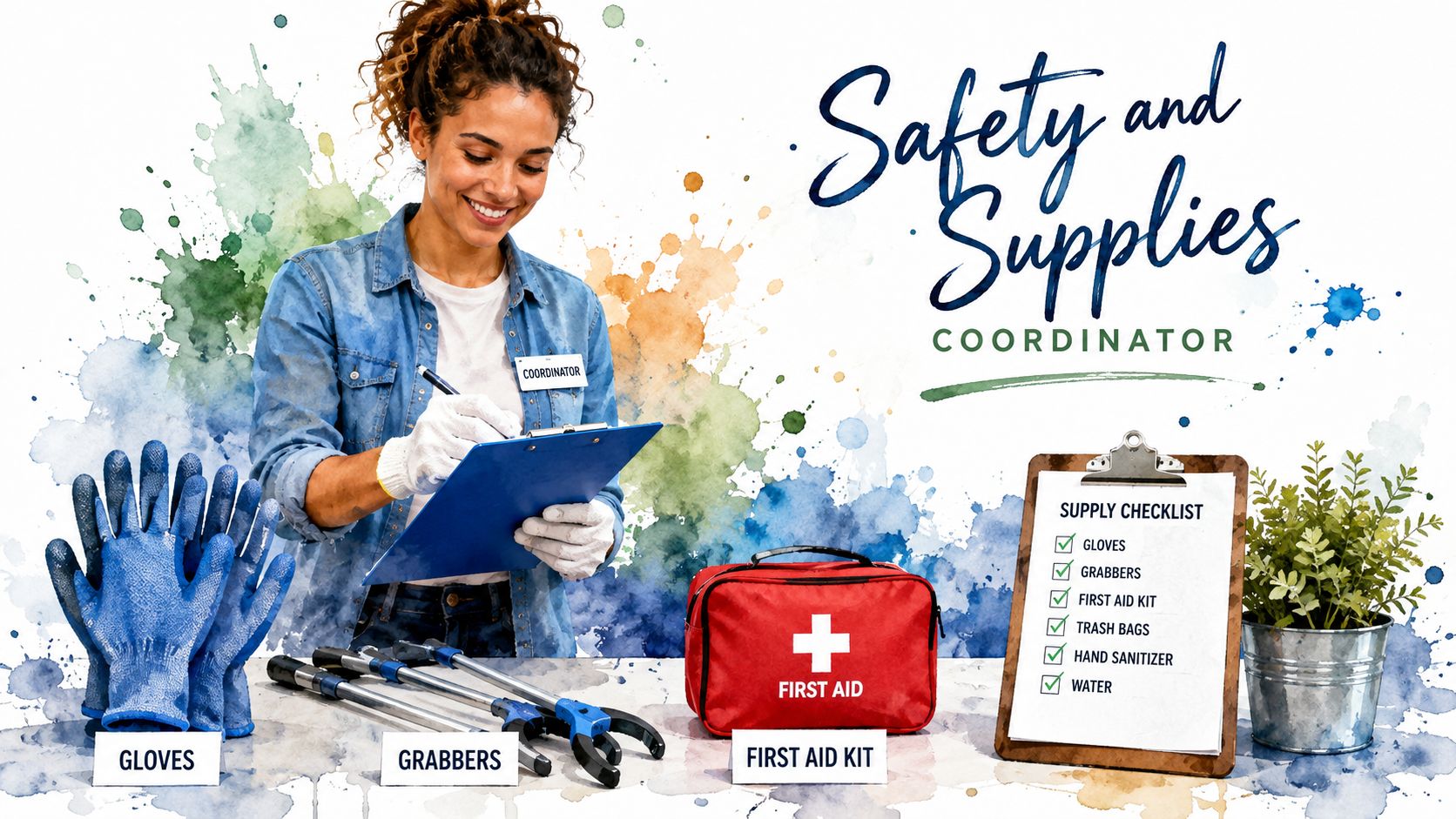
    3. Safety and Supplies Coordinator

    I've learned the hard way that a cleanup can fall apart over tiny gear problems. One broken grabber, one missing glove size, one empty first aid kit, and suddenly the morning feels sloppy. A Safety and Supplies Coordinator keeps that from happening.

    This role isn't glamorous, and that's exactly why it matters. You're checking equipment before someone gets hurt, stocking the right glove sizes, keeping the first aid kit ready, and making sure people know what to do around hazards. The crew can focus on service because somebody solid handled the boring, gritty parts first.

    A good volunteer description for this job should spell out the rhythm. Say what gets checked before the event, what gets logged after, and who gets told when something breaks. If the volunteer knows the checklist, the event runs smoother.

    Here's the kind of language I'd use:

    • Inspect grabbers and bins: Catch damage before the team heads out.
    • Track glove inventory: Make sure smaller and larger hands both get a fit.
    • Restock first aid supplies: Keep the kit ready, not half-empty.
    • Log near-misses: Write down the stuff that almost went wrong so the crew learns from it.

    Keep this role open to somebody detail-oriented who wants flexible hours, because a person like that often loves the quiet responsibility of it.

    This is also the spot where I'd talk plainly about support, supervision, and escalation. If a tool breaks or a route looks unsafe, the coordinator needs a clear way to flag it and move fast. On cleanup crews, that kind of role can save a whole Saturday.

    I'd also tell applicants exactly what the gear room looks like, what gets stored where, and what “done” means. The clearer you make it, the less you'll spend untangling messes later.

    Later in the day, I'd add a short training video like this event safety clip if you're building a role guide that people can absorb fast.

    4. Social Media and Event Storyteller

    The right post can do what a flyer never will, it can make someone feel the mood of a cleanup before they've even shown up. A Social Media and Event Storyteller doesn't just snap pictures. You catch faces, muddy shoes, laughter in bad weather, and the tiny moments that make people think, I want in.

    I've seen this in real time. A volunteer shares a hail-storm photo with a caption about finding joy in discomfort, and people who didn't know us suddenly care. That's because stories travel farther than task lists do.

    Write like a person, not a flyer rack

    If I were writing this role description, I'd ask for a few very concrete things. Post cleanup photos. Write event announcements. Ask volunteers why they came. Share block-by-block wins. The goal is to make the work feel like a living crew, not a pile of trash bags.

    This role also works best when it has boundaries. Don't make the storyteller guess what to post or who approves it. Give them a simple rhythm, maybe one pre-event post, one day-of story, and one wrap-up recap.

    • Shoot faces, not just debris: People connect to people.
    • Use short captions: Write like you're texting a friend who missed the event.
    • Ask for quick quotes: A volunteer's own words make the post feel real.
    • Tell before-and-after stories: The Caterpillar Park transformation is the kind of thing people remember.

    A lot of groups think social media is fluff. I don't. It's how somebody sees a muddy crew in motion and decides they want to join next week. That's not vanity, that's recruitment with a heartbeat.

    5. Partnership and Sponsorship Developer

    I like this role because it sounds fancy, but the job is simple, you walk into local spaces and make the cleanup feel like something worth joining. A Partnership and Sponsorship Developer talks to coffee shops, breweries, neighborhood groups, nonprofits, and companies, then finds a fit that feels mutual instead of pushy.

    The best version of this role keeps the volunteer-first spirit intact. You're not shaking people down for money. You're finding places that want to back the work with supplies, a venue, a team turnout, or a cleanup in their own neighborhood.

    One brewery might give cleanup kits and send a few volunteers once a month. Another partner might sponsor equipment because they want a team volunteer day. The point is to build relationships that help the crew without turning the crew into a sales pitch.

    If you want stronger partner conversations, lead with the story, the pictures, and the neighborhood, then ask for a fit.

    I'd write the role description so it sounds like an invitation to connect, not a cold outreach assignment. Someone in this role should know the tone of the group, the kinds of asks that feel right, and the kinds that don't. That's how you protect the culture while still bringing in support.

    I'd also keep the role flexible. Some people are better at walking into a room, others are better at follow-up emails and thank-yous. Both can work if the description says what success looks like.

    6. Route Planner and City Mapper

    Some people see a map. I see a puzzle with trash, timing, traffic, and tired legs all mixed together. A Route Planner and City Mapper studies the city like a chessboard, then chooses routes that make sense for safety, energy, and reach.

    This role matters when you're trying to cover a lot of ground without wearing people out. On a crew like mine, I'd want someone who looks at roads, parks, business strips, and neighborhood feedback, then says, “Next week, we're hitting this area because it needs us and it won't burn the team out.”

    The best role description names the tools and the rhythm. Google Maps helps, sure, but local knowledge matters too. Cleanup leads know which blocks get skipped, which corners get messy fast, and which routes feel bad on a hot day or after a storm.

    Build routes like a real person will walk them

    I'd ask the mapper to think about access, transit, and variety. Mix easy wins with harder stretches so the work doesn't turn into a grind. Keep one eye on where volunteers can park, where they can meet, and where they can safely cross streets.

    This job also benefits from feedback loops. If a cleanup lead says a route dragged or a corner felt dangerous, the mapper needs to hear it and adjust. That's not bureaucracy, that's respect for the people doing the walking.

    A good route plan keeps the crew moving without making them feel like they got sent into a bad bet.

    If you've ever watched a group lose energy because the route was clumsy, you know why this role belongs in a serious volunteer description. People don't just need places to go, they need routes that make sense to their bodies and their weekends.

    7. Event Day Operations Manager

    Saturday morning hits fast. Coffee, gloves, boxes, weather apps, greetings, and a dozen small decisions land at once, and the Event Day Operations Manager carries that whole pile without making it feel heavy.

    I'd write this role for the person who likes being early and hates chaos. You open the meeting spot, greet volunteers as they arrive, make the safety announcement, hand out tools, and keep the plan alive when weather or street closures mess with it. When the day shifts, you shift with it.

    If the earlier roles are the engine and the wheels, this one is the driver who keeps everyone pointed the same way. A good ops manager doesn't need to do every task, but they do need to notice when the event starts wobbling.

    I'd make the description concrete. Say how early they arrive, who they report to, and what they do if turnout is low or equipment fails. People relax when they know there's a calm person in charge of the flow.

    • Set up the meeting spot: Keep tools, water, and signs ready before the crowd arrives.
    • Give the day's briefing: Safety, mission, route, done.
    • Watch the weather and the street: Adjust before the crew gets stuck.
    • Ask for help early: A strong manager knows when to hand off.

    The old volunteer templates that only list “event support” don't cut it here. This role is about presence, timing, and the ability to keep people from feeling lost. A clear job description does that work before the first volunteer even shows up.

    I'd also link this one to volunteer event planning so people can see the event rhythm before they say yes.

    A smiling coordinator wearing gloves and holding a clipboard next to organized safety and volunteer supplies.

    8. Community Connection and Neighbor Engagement

    Some cleanup crews talk about neighborhoods. I want crews that talk to neighborhoods. A Community Connection and Neighbor Engagement volunteer knocks on doors, chats with residents, and lets people know the cleanup is happening on their block, not around them.

    That difference matters. When a neighbor feels heard, the cleanup stops being a drive-by service and starts feeling like a shared project. One shop owner becomes a regular volunteer, another resident points to a park that keeps getting ignored, and suddenly your route gets smarter because people on the ground spoke up.

    This role needs a friendly face and a steady ear. You ask more questions than you answer. You listen for the corners that need attention, the litter patterns that keep coming back, and the places where people want to help but don't know how.

    I'd write the description so it gives a volunteer room to be human. Tell them to smile, talk naturally, and avoid pressure. You're planting seeds, not closing a deal.

    A clean version of the role might sound like this:

    • Introduce the crew respectfully: Tell residents who you are and why you're there.
    • Ask what people notice: Residents know the block better than any map.
    • Share proof of work: Before and after examples make the effort concrete.
    • Invite, don't push: Leave space for people to join when they're ready.

    This role works especially well for people who like talking to strangers but don't want a loud, salesy job. It's about care, presence, and basic follow-through. If you write it right, the right people will feel that tone right away.

    9. Volunteer Experience Designer

    This is the role for somebody who notices the vibe before the trash pile. A Volunteer Experience Designer thinks about how the cleanup feels from the second people arrive to the second they head home. Songs, flags, badges, welcome language, celebration, all of it matters.

    I know that can sound extra until you watch people light up because they got a badge after their first cleanup. Pride changes behavior. Identity changes behavior. When you give service a little ceremony, people feel like they joined something with a face.

    That's why I'd write this description around atmosphere and ritual. Maybe you want a theme song. Maybe you want a small tradition for first-timers. Maybe you want people to carry a flag or earn badges for different neighborhoods. These aren't gimmicks if they help people feel they belong.

    Keep the role playful, but not vague

    The best volunteer experience designer listens first. Ask people what keeps them coming back. Watch when the energy rises and when it drops. Borrow what works from sports teams, military units, or any group that knows how to create pride without making it corny.

    • Test one idea at a time: Start small before you roll out a full system.
    • Use symbols people can hold: Flags, badges, or shirts can give a crew identity.
    • Celebrate consistency: People like being noticed for showing up.
    • Make the day feel like a win: Even a dirty morning can end with a little ceremony.

    I've seen crews get stronger when the experience feels intentional. Not fancy, just intentional. If the role description says that clearly, people who love culture design will find it fast.

    10. Data Tracker and Impact Documenter

    Spreadsheets don't look exciting until you realize they tell the story of the work. A Data Tracker and Impact Documenter keeps count of volunteers, routes, trash collected, and neighborhood coverage, then turns that into something the crew can use.

    This role got easier for me once I stopped treating numbers like homework and started treating them like memory. If you know which blocks you cleaned, which items showed up most, and how many people came back, you can make smarter decisions next month. You can also tell a clearer story to new volunteers.
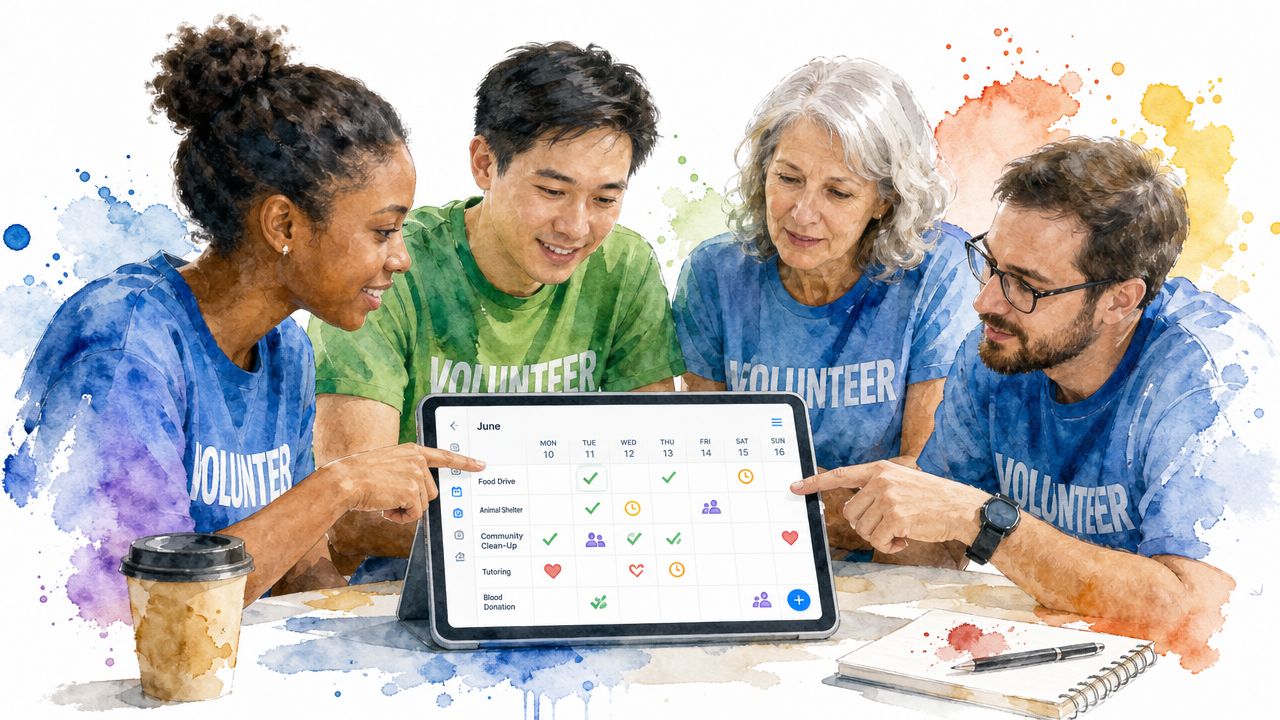
    I'd keep the system simple. Use Google Sheets. Keep the categories easy. If the form feels too heavy, nobody will fill it out after a long cleanup, and then the story gets fuzzy.

    A good description for this role should point to the output, not just the task. Maybe the volunteer creates a report, a map, or a simple summary for the crew. That kind of artifact helps people see what they built, and it helps leaders plan the next route with their eyes open.

    Simple tracking works better than fancy tracking nobody finishes.

    I'd also tell the volunteer why the data matters in plain language. When you can show which neighborhoods got covered or what trash keeps showing up, you can recruit better and route better. If the role fits, it usually means the person loves patterns, clean records, and a little quiet order after a loud morning.

    Top 10 Volunteer Role Comparison

    Role Complexity 🔄 Resources & Time ⚡ Expected Impact ⭐📊 Ideal Use Cases Advantages / Tips 💡
    Community Cleanup Crew Lead Intermediate 🔄🔄 Moderate; weekly mornings, coordination ⚡⚡ High ⭐⭐⭐; visible neighborhood improvements 📊 Lead recurring neighborhood cleanups; build local teams Builds leadership; start small and use before/after photos 💡
    New Volunteer Onboarding Buddy Beginner 🔄 Low; event-start presence + follow-ups ⚡⚡⚡ Moderate ⭐⭐; improves retention and newcomer comfort 📊 Welcome first-timers and convert them to regulars Greet warmly, collect contact info, follow up that night 💡
    Safety and Supplies Coordinator Intermediate 🔄🔄 Moderate; inventory, procurement, occasional repairs ⚡⚡ High ⭐⭐⭐; prevents injuries and enables smooth events 📊 Maintain gear, brief hazards, manage first aid Use checklists, track near-misses, plan common replacements 💡
    Social Media and Event Storyteller Intermediate 🔄🔄 Low–Moderate; flexible content work, occasional event presence ⚡⚡⚡ High ⭐⭐⭐; attracts volunteers and documents impact 📊 Recruitment, event promotion, storytelling Capture faces/emotion, write casually, use before/after visuals 💡
    Partnership and Sponsorship Developer Advanced 🔄🔄🔄 Moderate–High; meetings, pitches, relationship follow-up ⚡ Very high ⭐⭐⭐; secures resources and expands capacity 📊 Secure sponsorships, in-kind donations, organizational partners Start with familiar businesses; lead with volunteer-first ethos 💡
    Route Planner and City Mapper Advanced 🔄🔄🔄 Low–Moderate; map/data work plus occasional site visits ⚡⚡ High ⭐⭐⭐; maximizes citywide coverage and safety 📊 Strategic coverage, risk-aware routing across wards Use maps and feedback, mix easy wins with challenging areas 💡
    Event Day Operations Manager Intermediate 🔄🔄 Moderate; early arrival, on-site coordination ⚡⚡ High ⭐⭐⭐; improves volunteer experience and efficiency 📊 Run on-site logistics, troubleshoot, maintain morale Keep a setup checklist and backup plans for weather/equipment 💡
    Community Connection and Neighbor Engagement Intermediate 🔄🔄 Moderate; door-knocking, follow-ups, relationship building ⚡ High ⭐⭐⭐; builds trust and local volunteer recruitment 📊 Engage residents, recruit neighbors, gather local priorities Be authentic, ask more than tell, avoid pressuring residents 💡
    Volunteer Experience Designer Beginner–Intermediate 🔄🔄 Low–Moderate; project-based, creative experiments ⚡⚡⚡ Moderate ⭐⭐; improves morale and retention over time 📊 Design rituals, recognition, and event culture Test small ideas, gather feedback, borrow proven traditions 💡
    Data Tracker and Impact Documenter Beginner–Intermediate 🔄🔄 Low–Moderate; regular reporting and visualization ⚡⚡ High ⭐⭐⭐; informs strategy and supports fundraising 📊 Track volunteers, trash, locations; produce reports/maps Keep data simple, use shared sheets, create visual stories 💡

    Your Turn to Find Your Givers

    These aren't just descriptions, they're filters. They pull in the people who want to show up on a Saturday morning because the work is hard and it matters. When you stop asking for “help” and start naming leaders, storytellers, planners, and neighbors, you give the right people something real to grab.

    I've watched that happen in my own crew. Litter Caterpillars started with three people, a hailstorm, and a messy stretch of city, and it kept growing because the roles made it easier for people to see themselves in the work. One person wanted to lead, one wanted to welcome, one wanted to map, and each one found a place to belong.

    Take these ideas and write them in your own voice. Don't copy a template that sounds like it came from a filing cabinet. Write the kind of role description that makes a giver nod and think, yeah, I can do that. The right words don't just fill a shift, they build a crew.


    If you're building volunteer roles for a cleanup group, a neighborhood project, or a brand-new crew, I'd love for you to see how Litter Caterpillars writes the work in a way people can feel. Visit Litter Caterpillars and borrow what fits, then shape it into your own story so the right volunteers know exactly where to plug in.

  • Volunteer Retention Rates: Keep Your People Coming Back

    Volunteer Retention Rates: Keep Your People Coming Back

    She showed up in a long coat, hands stuffed in her pockets, staring at the gray water and the even grayer trash stuck in the rocks. By the end of that morning, she was laughing with two strangers over a muddy broken bucket, and that changed how I think about volunteer retention rates.

    Why I Stopped Counting New Volunteers and Started Counting Friends

    A few years ago, I would leave a cleanup feeling weirdly proud of a big signup list, even if half those names never showed up again.

    Then I started paying attention to what happened after the photos.

    One winter morning in Chicago, a new volunteer arrived looking like she regretted every decision that had led her there. The wind off the lake cut through everything. She picked up a few pieces of litter in silence, and I could tell she was close to making this a one-time thing.

    A sad woman wrapped in a warm coat standing by a cold, windy Chicago lakefront in winter.

    Then one of our regulars made a joke about how trash pickup in bad weather feels like a sports movie with no budget and no prize money. She laughed. They started racing to fill their bags. By the time we packed up, they were talking about coffee.

    She came back because that cold, awkward morning became a memory with other people in it. A week later, she knew names. A month later, she was the one welcoming someone new.

    That was the moment I stopped treating retention like a math problem first.

    The spreadsheet missed the point

    People usually hear volunteer retention rates and jump straight to percentages. I get it. Numbers help. I still track them, and I still believe every group should evaluate its volunteer program with a clear process that looks at return rates, experience, and team health.

    But a spreadsheet can only record the outcome. It cannot show you the moment someone stopped feeling like a guest and started feeling like part of the crew.

    So my favorite retention question changed. I stopped asking, "How many new people did we get?" and started asking, "Who left with a reason to come back?"

    That question changes how you run the day. You introduce people more carefully. You notice who is standing alone. You create small jobs people can win at. You leave room for inside jokes, shared snacks, muddy gloves, and the kind of conversation that makes the work feel lighter.

    Practical rule: Retention gets stronger when people leave knowing at least one name and one story from the day.

    A volunteer group works like a neighborhood potluck. Food matters, but people return because someone saved them a seat. Cleanup events are the same. Bags, grabbers, and logistics matter. Friendship is what gives the whole thing a pulse.

    Recruitment gets attention. Connection gets results

    I still want new volunteers. Any growing community does.

    What changed is what I celebrate. I get less excited by a crowded signup form and more excited when someone comes back and says, "I brought my roommate," or, "Are the glove people going to be there again?" That is when you know the group has started to become a story people want to rejoin.

    Here is the shift that changed everything for me:

    • Old mindset: Count signups and call it momentum.
    • Better mindset: Notice who returned after the first awkward visit.
    • Best mindset: Build the kind of morning that turns strangers into teammates.

    I still use the spreadsheet. I respect the number.

    But if you want an honest read on the health of your community, start with a human question. Did people leave as strangers, or did they leave already half excited for the next chapter?

    How to Measure What Matters

    One Saturday, a cleanup looked packed at 9:00 a.m. We had new faces, full supply bins, and the kind of signup sheet that makes an organizer feel proud for five minutes. By noon, I had a different question. Which of these people would I see again next month?

    That question changed the way I measured everything.

    A campfire analogy infographic explaining key volunteer retention metrics like growth, engagement, and long-term impact.

    The formula is simple

    Volunteer retention rate is:

    (Volunteers who returned from the last period / Total volunteers in the last period) × 100

    If 200 people volunteered in one season and 120 of them came back in the next one, your retention rate is 60%.

    The math is easy. The judgment is harder.

    A retention number is not just a score for your program. It is a clue about whether people felt steady enough, useful enough, and connected enough to step back into the story.

    What the number actually says

    A high retention rate usually means people found something worth returning to. They knew where to stand, what to do, and who they were doing it with. The morning made sense to them.

    A low retention rate points to friction. Sometimes it is logistical. More often, it is social.

    I start with four questions:

    • Did people understand the flow of the event? First-timers disappear fast when they spend half the morning wondering what happens next.
    • Did anyone learn their name? People rarely return to a place where they felt invisible.
    • Did the work feel concrete? A full trash bag, a cleaner block, a before-and-after photo. Those moments stick.
    • Did we follow up soon enough? The first 24 to 48 hours matter because that is when the day still feels alive in their body.

    That is why I do not treat retention like a grade. I treat it like checking a pulse.

    Why I like shorter measurement windows

    Annual tracking looks tidy in a spreadsheet. It also smooths over the exact problem you need to see.

    A year-end number can hide a weak welcome process. Your regulars may keep showing up and make the program look healthy, while first-timers vanish after one event. If you check by month, by season, or by event series, patterns show up sooner. You can see whether a rainy cleanup hurt turnout, whether a new team lead kept more people engaged, or whether one location keeps producing return volunteers because the vibe there is better.

    That kind of review gets even more useful when you pair retention with a broader volunteer program evaluation framework instead of staring at a single percentage in isolation.

    Shorter windows help you catch the human story before it turns into a yearly summary.

    A tiny worksheet you can use

    Period Volunteers in last period Returned this period Retention rate
    Winter season 200 120 60%
    Spring season add your number add your number calculate it
    Summer season add your number add your number calculate it

    You do not need fancy software.

    You need a habit of checking whether your community is growing roots, or just passing through.

    The Unspoken Reasons People Keep Showing Up

    People don't come back for the reasons managers like to imagine.

    They don't stay because your signup form is tidy or because your reminder email has a nice subject line. Those things help, but they are background music. The deeper reasons are emotional and social.

    The clearest pattern I've seen is this. People return when the group feels like their people, the mission feels like their mission, and the work feels real in their hands.

    Attachment beats convenience

    Among volunteers who are likely to continue, the strongest drivers are attachment to the organization itself at 52% and attachment to the cause at 50%, followed by seeing the tangible difference they are making at 37%. The most common reason for leaving is changing life circumstances at 33%, according to NCVO's volunteer retention findings.

    That tracks with what I've lived.

    If someone feels attached to the group, they forgive a lot. A cold morning. A messy site. An early alarm. They can absorb inconvenience because the experience means something to them.

    If they don't feel attached, even a tiny hassle becomes an exit ramp.

    Belonging has a physical feel

    You can feel belonging in a volunteer group before anyone says a word about it.

    A regular waves at a newcomer. Someone hands over gloves without being asked. Two people start trading stories while sorting bags. A first-timer stops standing on the edge and starts moving toward the center.

    That is retention happening in real time.

    If you want practical ways to reinforce that feeling after an event, thoughtful volunteer recognition ideas can help, especially when the recognition feels personal and specific instead of generic.

    The work has to feel visible

    Volunteers want to see the before and after.

    Trash work teaches this fast. One block starts ugly and ends cleaner. A path becomes walkable. A lot looks less abandoned. Nobody has to invent meaning. The bag in your hand gets heavier, and the street gets lighter.

    That visible change matters because it answers the quiet question every volunteer carries. "Did what I did today count?"

    When the answer is obvious, people feel pulled back.

    Shared hardship can glue people together

    This is the part many groups miss.

    Most advice treats discomfort only as a problem to reduce. I get that. Burnout is real. Bad logistics can absolutely push people away. But there is another side to hardship when people choose it together and understand why it matters.

    I've seen volunteers bond faster in rough weather than at polished social mixers.

    One freezing cleanup can do what three coffee chats can't. People laugh harder when conditions are ridiculous. They help each other more. They remember the day more clearly. The struggle becomes a shared scene, and shared scenes build loyalty.

    A research summary on the "great volunteer resignation" points to burnout as a turnover risk while also noting that peer support and autonomy are strong drivers of retention, in this evidence-based strategy for retaining volunteers. That tension makes sense to me. Misery by itself drives people away. Chosen challenge with good people can pull them closer.

    Some of the best volunteer memories come from mornings that were objectively a terrible idea.

    So I don't think the goal is to make volunteering painless. I think the goal is to make it meaningful, safe, and shared.

    That changes how you design an event. Don't flatten every rough edge. Give people enough support to feel secure, enough freedom to feel useful, and enough togetherness to turn effort into friendship.

    How to Turn One-Timers into Your Core Team

    The fastest way to lose a new volunteer is to let them drift alone through their first event.

    I've watched this happen. A new person arrives. They smile politely. They don't know where to stand, what bag to grab, or whether it's okay to ask basic questions. Everyone else already seems to know each other. By the time the event ends, they helped, but they never quite landed.

    That kind of first impression creates a silent goodbye.

    A diverse group of volunteers in matching teal shirts smiling together, with a checklist of team-building strategies.

    Start with one human bond

    The simplest fix I know is pairing a new volunteer with an experienced one.

    I don't mean assigning some stiff mentor role with paperwork and scripts. I mean a real human pairing. "Hey, this is Maya. It's her first time. Chris, can you two work this block together?" That small move changes the whole texture of the morning.

    The reason is straightforward. This volunteer retention article from Givebutter says social connection is the strongest predictor of whether a new volunteer returns, and that buddying rookies with experienced volunteers creates a direct friendship hook.

    I believe that because I've seen it.

    A buddy answers the embarrassing questions before they become reasons to leave. They explain why the group does things a certain way. They crack jokes when the work gets awkward. They turn "I showed up to volunteer" into "I met someone."

    One clean block matters. One real connection matters more.

    Give people a role they can own

    People return faster when they feel useful, not managed.

    That doesn't mean dumping responsibility on them. It means giving them a lane. Let one person handle grabbers. Let another sort full bags. Let a regular choose the route. Let somebody with a loud voice do the opening briefing. Ownership makes people feel woven into the group.

    If you want the broader operating side of that, I like keeping a few simple volunteer management best practices in view, especially around communication, clear roles, and follow-up.

    Here are three moves that work well together:

    • Pair them early: Don't wait for a new volunteer to self-integrate. Introduce them to one regular by name and give them shared work.
    • Name their contribution: Say exactly what they helped do. "You cleared the worst stretch of that alley" lands harder than "thanks for coming."
    • Invite the next chapter: Before they leave, mention the next event in a personal way. "You'd like next week's route. It's got a lot of weird stuff."

    Identity helps people stay

    Groups become sticky when they have personality.

    That can be small. A color everyone wears. A running joke. A song you always play while packing up. A silly phrase for the toughest jobs. These things sound cosmetic until you watch what they do. They create texture. They give people something to belong to.

    People don't only return to tasks. They return to identities that feel good to wear.

    This short video captures the spirit better than a paragraph can.

    Recognition is stronger when it feels earned

    I like milestones when they mean something.

    Not in a fake corporate way. In a "you've been here enough times that people know your laugh" way. Recognition works best when it reflects a real story. Maybe someone kept showing up through bad weather. Maybe they reliably helped every first-timer all month. Maybe they took ownership of a frustrating task nobody wanted.

    You don't need expensive rewards for that. You need attention.

    Try this checklist at your next event:

    • Welcome with context: Tell new people why today's work matters on this specific block, not in abstract terms.
    • Use names quickly: Names turn a crowd into a group.
    • Create a tiny tradition: Group photo, coffee stop, post-cleanup recap. Repetition builds memory.
    • End with a direct invitation: Don't let people leave in a vague cloud. Give them a next date and a reason to come.

    If you do these things well, your core team won't feel like a mystery. It will feel like the natural result of people getting attached to each other through useful work.

    A Simple Dashboard to Track Your Community's Health

    I like spreadsheets because they don't pretend to be smarter than you.

    A simple dashboard can tell you a lot if you feed it the right questions. You don't need a giant software stack. You need a file you will open, update, and understand.

    The biggest mistake I see is tracking only one annual retention number. That is too slow. You need a shorter rhythm.

    According to these volunteer turnover statistics, you should measure retention quarterly, not annually, set 65% as a benchmark, and aim for 70% or higher. The same source recommends segmenting by cohort like first-time volunteers, those with 50+ hours, and corporate partners so you can see exactly where you're losing people.

    Start with one sheet and four columns that matter

    Build one tab called "Volunteer Health Dashboard."

    Use this table layout:

    Metric Q1 2026 Q2 2026 Target Notes
    Overall retention rate 65% benchmark, 70%+ target
    First-time volunteer return rate
    50+ hour volunteer retention
    Corporate partner retention

    You can add more later. Don't start with more.

    What each row helps you see

    Each cohort tells a different story.

    • First-time volunteers: This row tells you whether your welcome experience is working.
    • 50+ hour volunteers: This row helps you spot fatigue among your most committed people.
    • Corporate partners: This row shows whether organized groups are treating your events like a one-off outing or a repeat habit.

    If your overall number looks stable but your first-timer row drops, you probably have an onboarding problem. If your veterans start slipping, the issue might be burnout, boredom, or life changes catching up with them.

    Review it like a coach, not an accountant

    A dashboard is only useful if you react to it like a human.

    At the end of each quarter, ask:

    1. Which group came back most reliably?
    2. Which group slipped?
    3. What changed in the actual event experience?
    4. Who should I call, thank, or ask for honest feedback?

    That's the whole game. Notice patterns early. Adjust while the season is still alive.

    If you want your tracking to stay useful, keep your notes concrete. "Cold weather event with weak turnout." "New volunteers had no clear greeter." "Veterans carried setup again." Short notes beat polished summaries.

    A healthy volunteer community leaves clues. Your dashboard helps you catch them before they become exits.

    Your Volunteers Are the Story

    I still think about that first winter volunteer by the lake.

    If I had looked only at a dashboard, she might have become a simple category. New volunteer. First event. At risk of churn. Instead, she became a returning face because one rough morning turned into friendship, and friendship turned into momentum.

    That is what volunteer retention rates are really measuring. They are not just counting who came back. They are tracing whether your group feels alive enough for people to re-enter it.

    The numbers change when people feel held

    A longitudinal study found that the median volunteer retention rate rose from 60% in 2019 to 2020 to 70% in 2020 to 2021, according to this study on predictors of volunteer turnover. I don't read that as a story about better spreadsheets. I read it as a story about organizations taking retention seriously enough to design for it.

    When groups care about who stays, they start behaving differently.

    They communicate better. They support people better. They create more room for belonging, trust, and useful work. The rate moves because the culture changed first.

    Build a story people want to keep joining

    I don't think the healthiest volunteer groups chase retention as a trophy.

    They build mornings, afternoons, and habits that people miss when they're gone. They create the kind of service where effort feels shared and the next event already has emotional gravity before it even starts. The strongest communities do this almost by instinct. They make people feel expected, useful, and known.

    Your retention rate is the shadow cast by your community. Fix the community, and the shadow changes.

    That is why I care so much about names, jokes, buddy pairings, post-event coffee, weird weather, visible work, and direct invitations to return. Each one is a line in the same story. Each one tells a volunteer, "You weren't extra. You were part of this."

    My advice is simple

    Stop treating volunteers like inventory.

    Track your numbers, yes. Measure quarterly. Watch your first-timers. Protect your regulars. Learn from the people who stop showing up.

    But don't build your whole approach around fear of dropout. Build around warmth, purpose, and memory. Make the day feel worth retelling. Make the work feel shared. Make the next event feel like a chapter nobody wants to miss.
    Then the numbers have a chance to become a reflection instead of a struggle.


    If you want to join a cleanup crew that cares about friendship as much as the work, check out Litter Caterpillars. Come for one morning, meet good people, and see if you want to be in the next chapter.

  • Volunteer Program Evaluation: A No-Nonsense Playbook

    Volunteer Program Evaluation: A No-Nonsense Playbook

    Three people stood under a tree in a Chicago hailstorm, holding trash bags and waiting for rides that never came. We were freezing, half laughing, and already learning the first rule of volunteer work. If you don't decide what counts as progress, the weather, the chaos, and other people's opinions will decide for you.

    Your Program is a Story Not a Spreadsheet

    After a cleanup, I do not start with the sign-in sheet. I start with the curb.

    Did the block feel different. Did the volunteers leave taller than they arrived. Did a neighbor stop to talk instead of walking past with that shut-down look city residents get when they have given up on a corner?

    That is evaluation at street level. It starts with what changed in real life, then works backward to the numbers that prove it. Groups that begin with a giant spreadsheet usually end up measuring whatever is easiest to log. Hours. Names. Bags. Posts. Those figures matter, but they are only fragments. A volunteer program lives or dies on whether the work changed the place, the people, or both.

    Corporate-style evaluation often strips out the part that matters most. It treats volunteers like labor inputs and outcomes like tidy boxes. That approach misses too much. A cleanup can produce fewer bags than usual and still be one of your best days if a nervous first-timer comes back next week, two neighbors trade numbers, or a teenager realizes they can lead a block instead of complaining about it.

    I have learned to treat evaluation more like field notes than office reporting. Gather proof from several angles, then line it up against the mission.

    Here is the kind of proof that holds up:

    • Visible proof: before-and-after photos, route maps, filled bags, finished tasks
    • Behavior proof: turnout, repeat attendance, friend referrals, volunteers who stay to help after the official end
    • Experience proof: short feedback forms, comments in the group chat, quick check-ins as the day concludes
    • Mission proof: signs that the work changed habits, trust, confidence, pride, or connection to place

    Mission proof is where many groups get sloppy. They assume everyone knows what the deeper goal is. They do not. If your mission is cleaner streets, document cleaner streets. If your mission is reducing isolation, ask whether people made new connections. If your mission is building courage, look for the shy volunteer who starts speaking up, leading a team, or inviting someone else.

    That is why stories belong in your evaluation system. A page of volunteer testimonials from cleanup experiences can show the human shift behind the numbers. It captures fear turning into confidence, strangers turning into teammates, and one-time volunteers turning into regulars. A spreadsheet cannot carry that by itself.

    Litter Caterpillars uses this approach because the mission is bigger than trash removal. We want cleaner blocks, yes. We also want people to feel ownership, pride, and connection in places that often get written off. If we only count bags, we miss half the work. If we only collect stories, we cannot improve the operation. Good evaluation does both. It keeps the soul of the group in view while giving you enough evidence to fix what is weak, repeat what works, and stay honest about what changed.

    Start with Your Destination Before You Start Driving

    If you got in your car, closed your eyes, and hit the gas, nobody would call that a road trip. They'd call it a bad decision. Yet that's how many groups run evaluation. They collect random data before they define success.

    Your mission is the destination. Your evaluation is the map in the glove box.

    A diagram illustrating a volunteer program evaluation framework with goal setting, key metrics, and mission alignment.

    Build a simple map

    People hear "logic model" and tense up. Relax. It's just a chain of cause and effect.

    You do an activity.
    That activity creates an output.
    That output should lead to a change.

    A volunteer group that picks up trash on weekend mornings might map it like this:

    Part of the map Plain-English version
    Inputs volunteers, gloves, bags, grabbers, time, leaders
    Activities cleanups, check-ins, group chats, photo posts
    Outputs hours served, blocks cleaned, bags filled, events run
    Outcomes stronger habits, new friendships, more neighborhood pride, repeat volunteers

    That map keeps you honest. It also stops you from measuring whatever is easiest.

    Start with baseline and mission outcomes

    Before you measure anything, set a baseline. VolunteerHub's practical guide to measuring volunteer impact makes that point clearly. You need to know where you are today or your future numbers mean nothing. The same guide says to clarify your top 3 mission outcomes and assign 2 to 3 metrics for each outcome, including at least one output measure and one outcome measure.

    That sounds formal, but it is freeing.

    If your mission outcome is cleaner public space, your output measure might be hours served and your outcome measure might be visible site improvement documented through photos and field notes.

    If your mission outcome is stronger community ties, your output measure might be event attendance and your outcome measure might be volunteer comments about friendships, trust, and whether they'd recommend the experience.

    A map doesn't make the work less human. It keeps the human part from getting lost.

    Use the five-step cycle

    A rigorous volunteer program evaluation follows a five-step methodology: Plan, Collect, Analyze, Report, and Improve, as explained in Qomon's volunteer program evaluation framework. I like this cycle because it cuts through nonprofit fog.

    The situation on the ground is as follows:

    1. Plan: pick the questions that matter.
    2. Collect: gather only the data you can use.
    3. Analyze: look for patterns, surprises, and weak spots.
    4. Report: tell the story in plain language.
    5. Improve: change the next event, training, or communication.

    That's the whole machine. No shrine to paperwork. No giant consultant deck.

    One rough example

    Say your group values bravery. Fine. Define it.

    You might describe bravery as people showing up in uncomfortable conditions, returning after a hard first event, or trying unfamiliar neighborhoods and tasks. Then you can observe it. You can note weather, turnout consistency, and volunteer reflections. Suddenly a value that sounded abstract becomes something you can watch in real life.

    That is what a good map does. It turns ideals into observable behavior.

    Measure Both the Head Count and the Heart Count

    At one of our early cleanups, I made the rookie mistake of calling the day a win because the pile of filled trash bags looked huge. Then I checked what happened after. A lot of first-timers never returned. We had moved a lot of rubbish, but we had not built much staying power.

    That is why I track two kinds of proof.

    Head Count shows what the group did in the world.
    Heart Count shows what the experience did to the people doing it.

    You need both if you want a volunteer program that lasts.

    An infographic comparing quantitative Head Count metrics and qualitative Heart Count impacts for measuring volunteer program success.

    Head Count metrics

    These are the plain, visible markers of effort. They matter because grassroots groups can drift into good intentions unless somebody keeps score.

    Useful measures include:

    • Participation rates: who registered, who showed up, and who came back
    • Total hours: how much volunteer time the work required
    • Task completion: whether the route, outreach shift, sorting job, or cleanup target got finished
    • Opportunity count: how often people had a real chance to serve
    • Retention: whether the same volunteers return often enough to build skill and trust

    I keep Head Count simple on purpose. If your team needs ten fields and a training manual just to record attendance, the system is too heavy for street-level work.

    Heart Count metrics

    Heart Count is where volunteer evaluation stops sounding corporate and starts sounding honest.

    People join for one reason and stay for another. They may come because a friend invited them, because the mission matters, or because they felt guilty scrolling past a littered park. They return because they felt useful, safe, welcomed, and connected to something real. If you never measure that part, you miss the reason your group grows or fades.

    Ask direct questions. Keep them short.

    • Did today feel worth your time?
    • Would you come again?
    • Would you bring a friend?
    • Did you feel safe and supported?
    • What frustrated you?
    • What made you feel proud?

    Heart Count can include:

    Heart Count signal What it tells you
    Satisfaction score whether the experience felt good enough to repeat
    Recommendation likelihood whether trust is strong
    Return behavior whether people want another round
    Open comments what the numbers miss
    Social spillover whether volunteers stay, talk, and build ties

    I trust return behavior more than smiles in a group photo. Plenty of events look cheerful for ninety minutes and still fail the ultimate test. The ultimate test is whether people come back on a wet Saturday when the novelty is gone.

    For more grounded systems, I like volunteer management best practices for grassroots groups because they keep the focus on habits, safety, and repeat participation instead of vanity metrics.

    Here's a short video take on the subject before I get more tactical:

    Don't confuse output with meaning

    A hundred bags of trash can mean the day went well. It can also mean the site was in terrible shape, the route was poorly chosen, or your group spent too much time fixing preventable mess.

    I have seen smaller cleanups produce better results. Fewer bags. Better volunteer energy. Safer movement through the area. Stronger conversations with passersby. Higher return rates the next week. That is a better day for a mission-driven group, even if the raw pile looks less dramatic on Instagram.

    Litter Caterpillars is a good example of this trade-off. If twelve people clear a modest stretch of street, talk with residents, take before-and-after photos, and eight of them sign up again, that session has more long-term value than a one-off turnout surge that burns people out.

    Measure the work. Measure the experience. Then compare them side by side.

    If the job gets done and people want to return, the program is healthy. If one side is strong and the other is weak, you found the problem early enough to fix it.

    Your Toolkit for Gathering Street-Level Data

    You don't need enterprise software. You need a system volunteers won't hate.

    The best data tools are the ones people will use while they're tired, dirty, sweaty, cold, or rushing to catch the train home. In practice, that usually means your phone, a free form, a shared sheet, and a habit.

    A person holds a phone showing a before and after comparison of a cleaned park path beside a checklist.

    Keep the tools boring and fast

    Use simple gear:

    • Google Forms: for post-event check-ins and short surveys.
    • Google Sheets: for attendance, hours, return visits, and site notes.
    • Meetup check-ins or a shared note: for quick turnout tracking.
    • Phone camera: for before-and-after proof.
    • QR codes: so nobody has to type a long survey link on the sidewalk.
    • Instagram analytics: to see which impact posts get people talking and sharing.

    Often, a lot of groups overbuild. They imagine a giant database when they really need one clean form.

    A practical method is the session snapshot. After each event, run a simple 3 to 5 question check-in. Qomon's volunteer impact measurement guide says this approach gives you immediate impact data and avoids burdening volunteers with long surveys, which helps you track things like total hours and task completion in near real time.

    The street version of a survey

    At the end of an event, ask only what you need. I like questions that fit on one phone screen:

    1. Rate your experience from 1 to 5.
    2. Would you recommend this to a friend?
    3. What did you work on today?
    4. About how long did you volunteer?
    5. One word for how today felt.

    That's enough to spot trends without turning service into homework.

    If your group works in different parts of a city, a route map helps too. A simple neighborhood tracker or geotagged map can show coverage, gaps, and repeated problem spots. A visual tool like the Northeastern Illinois cleanup map makes patterns easier to spot than a raw address list.

    Collect more than one kind of evidence

    One reason evaluation fails is that people trust only one channel. A survey catches some truth. It misses a lot too.

    Use a mixed bag:

    • Photos: good for visible change.
    • Field notes: good for safety issues and weird on-the-ground details.
    • Volunteer comments: good for culture and motivation.
    • Attendance logs: good for consistency.
    • Observation: good for things people don't write down, like who helps newcomers.

    If you're running regular shifts, the data should feel like part of the rhythm. Gloves on, cleanup, group photo, quick QR scan, done. If it takes longer than a few minutes, you will lose people.

    The Litter Caterpillars Case Study From a Mess to a Mission

    The first version of a volunteer group is usually messy. That's normal. At the start, the data is often just memory. Who came. What got cleaned. Which corner felt rough. Who stayed cheerful in bad weather.
    Over time, the trick is to turn those scraps into a pattern without killing the spirit that made people show up in the first place.

    Screenshot from https://www.littercaterpillars.com

    What the raw version looked like

    At the beginning, a cleanup group might know only a few things for sure. The weather was bad. The turnout was small. The site looked better at the end than it did at the beginning. Volunteers talked afterward. Somebody said, "That was weirdly fun."

    That isn't polished data, but it is data.

    The mistake would be to throw that away because it doesn't look formal. The better move is to organize it. Save photos by date and location. Keep a running sheet of turnout and hours. Write down one or two sentences after each event while the details are still fresh.

    How the story tightens

    Once a group gets more consistent, the pattern gets clearer. Weekend morning events attract a certain type of person. Hard weather filters for dedication. Before-and-after photos bring in fresh interest. Repeat attendance tells you whether the experience has enough pull to become habit.

    A strong volunteer program evaluation can use both numbers and narrative at once. For example:

    What happened What it may mean
    Same volunteers return across multiple events the culture is sticky
    New people join after impact photos are posted visual proof motivates action
    Certain routes draw stronger turnout location and comfort matter
    Volunteers ask for a permanent project the group is ready for deeper ownership

    That last point matters. A temporary action like a cleanup can awaken appetite for permanent work. When volunteers start wanting a place to keep building, you're no longer dealing with a one-off event series. You're dealing with a community.

    Numbers tell you the shape of the work. Stories tell you why the shape matters.

    What this kind of case study teaches

    The takeaway isn't that every group should track the exact same things, but that your evaluation should grow up with your mission.

    A scrappy city cleanup group might begin with turnout, hours, and photo evidence. Later it might add retention, recommendation likelihood, volunteer comments, and route coverage. Later still it might study which kinds of events produce stronger friendships or steadier habits.

    If your values include bravery, kindness, unity, and a volunteer-first culture, your evaluation should include signs of those values in action. Did people feel safe. Did new volunteers get welcomed. Did leaders respect the group's energy. Did people come back because the work made them stronger, calmer, or more connected.

    That is how a mess becomes a mission. You don't clean up the story by making it more corporate. You clean it up by making it more honest.

    Close the Loop Make Your Data Do Something

    I have watched groups collect feedback with good intentions, then do nothing with it. A volunteer says the meetup spot felt unsafe. Another says check-in was chaotic. Three people stop showing up. The form gets saved, everyone stays busy, and the same problem shows up at the next event.

    That is how trust leaks out of a volunteer group.

    Evaluation has to change the next decision. If a route feels off, move it. If new people keep arriving late because the instructions are muddy, rewrite the text message and post a map pin. If regulars are carrying the whole event, train one more person to lead check-in. Street-level evaluation lives on the calendar, in the group chat, and at the start of Saturday morning.

    Where groups get stuck

    The pattern is usually simple.

    • They over-rely on surveys. A form catches some truth, but not the look on a new volunteer's face when nobody greets them.
    • They never ask people why they stopped coming. Departing volunteers often say the quiet part out loud.
    • Nobody owns the fix. Feedback gets discussed, then drifts.
    • Volunteers never hear what changed. People stop giving useful input when it disappears into a void.

    I have learned more from a two-minute conversation after an event than from a polished spreadsheet sent a month later. Forms still help. They just cannot carry the whole load.

    Use a loop your volunteers can actually see

    Keep it plain.

    1. Collect it. Ask one or two questions after the event. Ask one honest question when someone leaves.
    2. Group it. Sort the responses into safety, logistics, culture, and mission fit.
    3. Pick one fix. Choose something small enough to change before the next event.
    4. Say it out loud. Tell volunteers what you changed and why.
    5. Check whether it worked. Ask again after the next few events.

    That last step gets skipped all the time. A leader changes one detail and assumes the issue is solved. Sometimes it is. Sometimes the underlying problem was something nearby, like poor signage instead of poor timing, or a cold welcome instead of a long route.

    A useful rhythm is to revisit the review process every few months so it still fits the group you have, not the one you had six months ago, as noted in VolPro's guide to outcome metrics for volunteer recruitment and retention.

    Give the group proof that feedback matters

    Volunteers do not need a glossy report. They need evidence that speaking up changes things.

    Say, "You told us the corner by the underpass felt rough, so we switched the start point to the library lot."

    Say, "You told us the first fifteen minutes felt awkward, so now one person is assigned to greet every newcomer."

    Say, "Several of you wanted shorter routes in the heat, so we split the team in two."

    Those sentences build credibility fast. They also protect the culture. People feel taken seriously, which makes them more honest next time.

    Do a real yearly review, even if your group is small

    A scrappy volunteer group still needs a moment each year to stop, look back, and make decisions on purpose.

    One practical model is to include more than one point of view in the review, such as leaders, volunteers, community members, and people affected by the work, as described in this overview of volunteer program performance evaluation. Another useful practice is to review participation, hours, feedback, changes, and ongoing problems in one place so leadership can decide what to keep, stop, or repair, as explained in Lodestar at ASU's guidance on systematic evaluation.

    For Litter Caterpillars, that kind of review would not look corporate. It would look like a table at the end of the season, phones out, route photos up, volunteer comments open, and a blunt conversation about what worked. Which cleanup sites built energy. Which ones drained it. Where new people became regulars. Where leaders protected the spirit of the group, and where we let sloppiness chew it up.

    The point is improvement you can feel.

    If your evaluation never changes the route, the welcome, the pace, the leadership, or the way volunteers experience the mission, it is just record-keeping. If it helps the group become safer, warmer, more effective, and more honest, then the numbers and stories are doing their job.

    If you want to join a group that puts this kind of street-level learning into practice, take a look at Litter Caterpillars. We pick up trash across Chicago, build friendships in the process, and treat volunteer energy like something worth protecting.

  • Volunteer Coordinator Training: Blueprint for Cleanup

    Volunteer Coordinator Training: Blueprint for Cleanup

    Three of us got caught in a Chicago hailstorm on our first cleanup. We huddled under a tree, shaking, while our rides kept canceling, and I realized a volunteer coordinator isn't there to hold a clipboard. You're there to hold the group together when the day goes sideways.

    Why Your Coordinators Need More Than a Clipboard

    That first cleanup taught me more than any neat classroom slide ever could. Bags were wet. Hands were numb. The city felt bigger than us. Yet that ugly little storm gave us a shared story, and shared stories are what turn a casual volunteer into a teammate.

    A lot of volunteer coordinator training still assumes calm rooms, predictable schedules, and controlled conditions. That works if your volunteers are guiding guests through a museum or staffing a check-in table. It falls apart when your crew is on a roadside shoulder, the weather flips, and somebody finds a needle in the grass.

    The job is leadership under pressure

    In rough outdoor work, the coordinator has to do several things at once. You read the street. You read the people. You decide when to push, when to pause, and when to pull everybody out.

    That's why generic training often feels thin. In hospice settings, coordinators have received live lecture-based training averaging 19 hours or less, according to a peer-reviewed hospice volunteer coordinator survey. If demanding care settings get training that short, you can see the problem for outdoor crews facing traffic, weather, sharp objects, and urban unpredictability.

    Practical rule: If your coordinator training fits neatly into a few lectures, you haven't trained for reality. You've trained for a calm day that probably won't happen.

    A street coordinator needs instincts, not just information. They need to know how to stop a volunteer from grabbing broken glass the wrong way. They need to know how to reset morale when turnout is low. They need to know how to say, “We're leaving now,” before pride turns into recklessness.

    Hardship can build the team if the leader knows what to do

    That hailstorm didn't make us strong by magic. The weather was miserable. What mattered was how we handled it. We laughed. We stayed kind. We looked after each other. We turned a rough day into a story worth repeating.

    That's the difference between administration and leadership. Administration tracks names. Leadership gives people a reason to come back.

    I've found that the best coordinators think like servant leaders in the field. They don't stand above the mess. They step into it first. That example gives volunteers courage.

    Here's what doesn't work:

    • Pure lecture: People nod in training, then freeze in the field.
    • Over-scripted plans: The first surprise breaks the script.
    • Safety as paperwork: Volunteers can tell when a leader treats risk like a form instead of a real human issue.

    Here's what does work:

    • Scenario drills: Let people practice calling off a task, redirecting a volunteer, or changing the route.
    • Field shadowing: New coordinators learn faster when they watch a calm leader handle a messy morning.
    • Clear values: Brave and kind beats loud and tough every time.

    If you train coordinators for chaos, they won't panic when it arrives. They'll steady the group, and the group will remember how that felt.

    Building a Volunteer-First Culture

    Before you teach route planning or supply counts, teach this: volunteer energy is precious. If you waste it, drain it, or exploit it, your program gets hollow fast.

    Some organizations still treat volunteers like future donors with free labor attached. I think that poisons trust. If a person shows up to serve and you keep nudging them toward their wallet, they feel the switch.

    A human hand holds a vibrant, colorful sphere surrounded by an artistic explosion of watercolor paint splatters.

    A source on volunteer management training says 42% of new volunteers quit because they felt pressured to donate, and that same piece argues for a volunteer-first model that rejects donation pressure. You can read that claim in Rosterfy's roundup on volunteer management training programs and resources. That number is ugly, but it matches what many people already know in their gut. Nobody likes feeling used.

    Train coordinators to protect energy

    A coordinator's first cultural job is protection. They protect safety, yes, but they also protect mood, trust, and dignity.

    That means your training should teach them how to notice:

    • The volunteer who goes quiet: They may be cold, overwhelmed, or embarrassed to ask for help.
    • The over-giver: They say yes to every task and burn out in silence.
    • The newcomer on the edge: They need one warm conversation to feel included.

    Volunteers give you their Saturday morning, their body, their attention, and their goodwill. Treat that gift with care.

    I like weekend mornings for a reason. People who show up then usually came to give, not to drift around killing time. That changes the tone. It creates a culture where service is normal and friendship grows around the work.

    Friendship is operational, not extra

    Many coordinators get trained on forms, scheduling, and compliance. Fine. You need that. But if you skip friendship, your team stays fragile.

    Friendship is what gets people through cold wind, missed buses, and hard sites. Friendship is what makes someone come back after the glamorous part wears off. Your coordinator training should include simple habits that make people feel seen.

    Try teaching these moves:

    Habit What the coordinator does Why it matters
    Name recall Learn and use names quickly People relax when they feel remembered
    Buddy pairing Match new people with regulars New volunteers stop feeling adrift
    Warm closing End with conversation, not just dismissal People leave with connection, not exhaustion

    A volunteer-first culture also means your coordinators don't squeeze every ounce of output from a person. They leave some energy in the tank. They invite people into a community that can last.

    What to tell coordinators on day one

    I'd put it this plainly in training:

    • Your people are not ATMs: Don't angle for money when they came to help.
    • Guard morale: A tired volunteer can recover. A used volunteer often doesn't come back.
    • Make room for joy: Service can be serious and still feel fun.
    • Watch for belonging: If one person keeps standing alone, that's your job.

    If your culture gets this right, the rest gets easier. Volunteers forgive a lot when they know you care about them for real.

    The Core Training Modules Blueprint

    Good volunteer coordinator training needs structure. Otherwise you get a pile of advice and no repeatable system. I build the curriculum around a simple six-phase method: set goals, create a warm welcome, use hands-on practice, ensure accessibility, track progress, and ask for feedback. That framework comes from Training magazine's piece on crafting an effective volunteer training program, and it fits outdoor cleanup work well because it pushes training out of theory and into action.

    A diagram titled Volunteer Coordinator Training Blueprint showing four key instructional modules for managing volunteers effectively.

    Module one is philosophy

    Start with the part many groups rush past. Your coordinator needs a moral compass before they need a checklist.

    Teach them how to answer these questions in plain language:

    • Why are we here?
    • What do we do when output conflicts with safety?
    • How do we treat a volunteer who is struggling?
    • What kind of culture are we building when nobody is watching?

    This module should include role-play. One person acts as an eager volunteer who wants to do something unsafe. The trainee has to step in kindly and firmly. If they can't do that in practice, they won't do it in a parking lot with a crowd watching.

    Module two is operational logistics

    At this point, many coordinators either become calm or become frazzled. They need a repeatable system for event flow.

    I train for logistics in sequence:

    1. Scout the site
      Walk access points, traffic risks, likely trash concentration, and safe regroup spots.

    2. Build the morning plan
      Decide where people meet, where supplies go, who watches the edges, and what the exit plan is if conditions change.

    3. Run the huddle
      Keep it short. Cover hazards, roles, boundaries, and how to ask for help.

    4. Close cleanly
      Count people before gear. Debrief before everyone scatters.

    The point isn't perfection. The point is lowering mental clutter so the coordinator can pay attention to humans.

    For practical field systems, I like to compare each trainee's plan against proven volunteer management best practices for organized teams. It helps them see where they're loose, where they're overcomplicating, and where they're forgetting the volunteer experience.

    Module three is crisis management and improvisation

    A cleanup rarely follows the script. Weather changes. A route is blocked. A volunteer gets upset. The wrong training treats these moments like exceptions. Real training treats them like part of the job.

    Field note: Don't ask, “What's the official response to every possible problem?” Ask, “Can this coordinator stay calm, protect the group, and make a decent call fast?”

    Here are scenarios worth drilling:

    • Sharp object discovery: Who approaches, who stays back, who documents, who calls it in if needed.
    • Traffic creep: A site looked safe at scouting, but live conditions feel different.
    • Emotional conflict: Two volunteers are snapping at each other and infecting the group mood.
    • Sudden storm: End early, shelter in place briefly, or relocate.

    Module four is leadership and empowerment

    Some coordinators secretly think leadership means controlling everything. That creates brittle teams. I want leaders who can spread confidence.

    Train them to delegate small ownership fast. Let one volunteer handle sign-in. Let another lead a micro-team. Let a regular welcome newcomers. This has two effects. It lightens the coordinator's load, and it gives volunteers a ladder to grow on.

    A strong coordinator says things like:

    • “You've got a good eye for detail. Can you watch this corner?”
    • “Take our new person with you and show them how we sort this safely.”
    • “I need your judgment on whether this patch is worth the extra time.”

    That language builds leaders. If your volunteer coordinator training never teaches delegation, you're training bottlenecks.

    Training for Chaos with Real Scenarios

    Most training programs miss the mark for groups like ours. They are built for predictable indoor settings and skip the skills needed for blizzards, heatwaves, roadside work, and rough urban zones. A Michigan volunteer training resource page shows how much volunteer management education still centers on general nonprofit operations rather than physical adversity in the field.

    A volunteer coordinator overseeing various aid efforts including sorting donations, construction, and distributing meals to people.

    I learned this the hard way on a cleanup near a highway during a bike-event shutdown. The site looked simple from a distance. Up close, it had fast-moving traffic nearby, debris in ugly places, and the kind of noise that makes communication sloppy. That day wasn't about who could pick up the most trash. It was about who could stay composed and keep the group tight.

    Scenario one is the weather turn

    You start with a normal morning. Then the sky changes. Wind rises. Rain starts hitting sideways.

    A weak coordinator does this:

    • keeps pushing because people already came out
    • mumbles a half-decision
    • waits too long because ending early feels embarrassing

    A trained coordinator does this:

    • regroups everybody fast
    • speaks loudly and clearly
    • chooses shelter, exit, or cancellation without drama
    • counts heads before moving

    That decision needs rehearsal. People don't rise to the occasion in chaos. They fall to the level of their training.

    Scenario two is volunteer conflict

    This one sneaks up on you. One volunteer says another person is working too slowly. The second person fires back. Now half the group can feel the tension.

    I don't train coordinators to act like referees with whistles. I train them to lower the temperature. Pull both people aside. Separate the task from the ego. Give each person something useful to do.

    Try language like this:

    Situation What the coordinator says
    One person feels criticized “I need you with me for a minute. Let's reset this.”
    Two people are escalating “We're not doing this in front of the group. Come talk with me.”
    Group mood is slipping “Quick water break. Then we're splitting into smaller teams.”

    A coordinator should know when an issue is fixable on site and when someone needs to step away. That judgment protects everyone else.

    Before you put someone in charge of people, make sure they understand volunteer liability insurance and risk planning for group service work. Good instincts matter. Clear guardrails matter too.

    Scenario three is morale collapse

    Sometimes the site is just worse than expected. The bags fill slowly. The smell is brutal. People start making jokes that have a tired edge to them.

    Here, your coordinator becomes a storyteller. You don't lie. You don't pretend the work is easy. You help the group frame the hardship as shared effort with meaning.

    “This is a rough one. Stay steady. We'll take it one patch at a time.”

    That kind of line works because it is honest. Honest leadership settles people.

    Here's a quick visual on training volunteers and leaders to coordinate under pressure:

    Role-play these scenarios in training. Then run them outdoors. Let the trainees feel a little confusion while the stakes are still low. That's how they learn to carry confidence into a real event.

    Practical Tools to Equip Your Leaders

    Warm intentions won't carry a coordinator through a messy morning. Tools will. Good tools reduce mental load, standardize judgment, and help a leader stay present with people instead of drowning in little decisions.

    There's also a retention angle here. Volunteers who receive high-quality training are 83% less likely to leave, according to VolunteerHub's guide to nonprofit volunteer management. If you want coordinators to deliver that kind of training experience, give them equipment for the mind, not just gloves for the hands.

    An infographic titled Practical Tools to Equip Your Leaders listing four essential event management resources for volunteers.

    Four tools I'd hand every new coordinator

    • Pre-event preparation checklist
      Include meeting point, weather review, hazard notes, supply count, team roles, and exit plan. This tool prevents the dumb mistakes that drain a leader before the event starts.

    • On-site incident reporting form
      Keep it simple. Time, place, what happened, who responded, and what changed after. You want clarity, not legal theater.

    • Volunteer feedback and engagement survey
      Ask what felt clear, what felt confusing, and whether the person felt welcomed. Don't bury your coordinators in data. Give them a few questions that lead to action.

    • Emergency contact and protocol sheet
      This should live in every event kit and on every lead coordinator's phone. In a tense moment, nobody wants to dig through old messages.

    What these tools should look like

    I don't like bloated forms. They usually die in a folder. A field tool should be short enough to use with cold hands and a busy brain.

    One hard rule: If a coordinator can't use the form on site in under a minute or two, the form is too fancy.

    Here's a lean setup that works:

    Tool Keep it short by including Leave out
    Checklist top hazards, gear count, roles, weather note long policy text
    Incident form facts, action taken, follow-up needed emotional essays
    Survey welcome, clarity, safety, return interest pages of demographics

    Why tools help people feel safer

    A waiver, for example, isn't just legal paperwork. It's a conversation starter. It tells volunteers, “This work is real. Here are the risks. Here is how we handle them.” That honesty builds trust.

    A shift plan does the same thing. It says nobody is drifting alone. Everybody has a zone, a point person, and a way to ask for help.

    Train your coordinators to carry these tools lightly. They shouldn't hide behind them. They should use them to free up attention for what matters most: reading the room, helping new people settle in, and making good calls while the day moves fast.

    Measuring Success the Caterpillar Way

    A lot of groups judge the day by the pile of bags at the end. I get it. Trash is visible. Weight feels concrete. But if you only measure output, you can miss the health of the team doing the work.

    I'd rather know whether people came back, whether a new volunteer felt included, and whether the group left more steady than they arrived. Those signs tell you if your volunteer coordinator training is working.

    Start with speed into belonging

    One of the easiest ways to lose somebody is to let them linger too long between interest and action. A volunteer management guide warns that a time-to-onboard longer than two months from application to active service drives churn, as explained in VolunteerHub's guide for coordinators reclaiming time and balance. That matches street reality. If people wait too long, life moves on.

    So the first score I care about is simple: how fast does a new person feel like part of the team?

    That doesn't mean rushing safety. It means removing drag. Answer quickly. Give clear instructions. Pair them with a regular. Make the first day easy to understand.

    Use a mixed scorecard

    Don't build your whole dashboard around trash volume. Use a mix of hard signals and human signals.

    • Return rate: Are people showing up again after the first event?
    • Regulars: Do you have a stable core who know the rhythm?
    • Friendship signs: Are people talking after the work instead of vanishing the second it ends?
    • Volunteer-led action: Do people start taking initiative without being pushed?

    Some of this is measurable. Some of it is observational. Both matter.

    If your team leaves with less trash on the block but more strain in their faces, something is off.

    Watch the room after the cleanup

    The best clues usually come after the bags are tied. Do people linger? Do they exchange numbers? Does a first-timer laugh with someone they met an hour ago? Those moments tell you whether your coordinators are building a group people want to belong to.

    I also pay attention to the tone of the debrief. If volunteers feel safe giving honest feedback, your coordinators are doing something right. If everyone is polite but guarded, trust may be thinner than it looks.

    A good training program changes the way leaders see success. They stop asking only, “How much did we collect?” and start asking, “Did we make this a place people want to return to?” That question builds stronger crews.

    Training coordinators for outdoor adversity is really training them to create courage, calm, and connection under strain. When they do that well, the cleanup lasts a morning. The transformation lasts longer.


    If you want to build a tougher, kinder volunteer culture, spend some time with Litter Caterpillars. You'll find a living example of brave, volunteer-first cleanup work in Chicago, plus the kind of energy that turns service into friendship.

  • How to Start a Volunteer Group: Your 2026 Playbook

    How to Start a Volunteer Group: Your 2026 Playbook

    Three of us stood under a tree in a spring hail storm, shaking, waiting for Ubers that kept canceling. We had trash bags in our hands, numb fingers, and one weird thought that changed everything: cleaning other people's messes felt easier than cleaning our own.

    The Spark That Starts the Cleanup

    I didn't start with a grand plan. I started with a mess.

    My apartment was a mess, but that wasn't the hard part. The hard part was that every useless object had a little emotional hook in it. An old jar of blueberry jam from a trip years ago. A stale bag of nuts from one of those short-lived healthy phases. None of it weighed much, but in my head it was all heavy.

    Then my life blew up a bit. A chaotic relationship ended. I looked around and realized I didn't trust myself much. I wasn't consistent. I avoided hard things. I let clutter win.

    So I tried something sideways. I went outside and picked up litter.

    A woman sitting on the floor surrounded by messy paperwork with a bright lightbulb icon above.

    Why other people's messes feel lighter

    This is the part most guides miss. Service isn't only about output. It changes you while you do it.

    When you clean your own mess, shame gets involved. Memory gets involved. Regret gets involved. When you clean a sidewalk, a vacant lot, or an alley, the task is cleaner in your mind. There's a bottle on the ground. You pick it up. The story ends there.

    That simplicity matters.

    I learned a strange truth fast: cleaning other people's messes is way easier than cleaning up our own. And because it's easier, you do it. Then you finish. Then you feel useful. Then your brain starts collecting proof that you can show up and make things better.

    Cleaning public messes gave me a way to practice self-respect without staring directly at my own failures.

    That's a solid starting point for how to start a volunteer group. Your first spark doesn't need to sound noble. It just needs to be honest. Maybe you're lonely. Maybe you're angry at what you keep seeing in your neighborhood. Maybe you need structure. Maybe you need sunlight and better friends.

    Any of those reasons can work.

    Find the part that hits you in the chest

    Your group's early energy comes from one thing: a real motive. People can feel the difference between borrowed language and a lived reason.

    Ask yourself:

    • What problem makes you stop walking? Trash on your block, seniors who need rides, a park nobody uses because it feels neglected.
    • What kind of action gives instant proof? Tangible work helps. You can see a clean street, a painted fence, a stocked pantry.
    • What personal wound does this work bypass? Sometimes service opens a back door into healing.

    A volunteer group gets stronger when the founder knows why they're doing it. Not the polished answer. The true one.

    Mine was simple. I wanted to become cleaner, braver, and more consistent. I wanted to build a social circle around giving instead of taking. Picking up litter gave me a practice field.

    And weirdly, the hardship helped. The cold. The rain. The hail. Shared discomfort gave the day flavor. It turned a chore into a story.
    That story is often where your group begins.
    Find Your Mission Before You Find Your People

    A lot of people start backwards. They make an Instagram page, brainstorm names, invite friends, and only then ask what the group is for.

    That's how you end up with vague energy and weak turnout.

    If you want to learn how to start a volunteer group that lasts, get specific before you recruit. The first real move is a needs assessment. Before you write a mission statement, you must conduct a thorough needs assessment to identify what your community lacks. Given that 6.5% of the global working-age population engages in formal volunteering, your group has to prove why your use of people's time is worth choosing.

    Start with the block, not the brand

    Don't ask, “What kind of organization should I build?”

    Ask, “What is broken near me, and what can I fix with a small crew?”

    Walk your area. Take notes. Talk to the people who already live with the problem. If you care about litter, don't just say, “The city is dirty.” That's too broad. Find the repeated pain points.

    A simple needs assessment can be ugly and still work:

    1. Walk three to five target areas and write down what you see.
    2. Look for repeated patterns like overflowing corners, illegal dumping spots, or neglected park edges.
    3. Ask locals one direct question. What do you wish somebody would fix around here?
    4. Check what already exists so you don't duplicate someone else's effort.
    5. Pick one visible win your group can own.

    That's enough to start.

    Choose a problem people can feel

    Some missions are worthy but fuzzy. Fuzzy missions are harder to recruit for.

    Visible problems have an advantage. If a volunteer shows up for two hours and can see the before and after, the work lands deeper. People feel the shift in their body. The street looks different. Their hands did that.

    Practical rule: Pick a mission that a stranger can understand in one sentence and spot from across the street.

    That's one reason cleanup groups are sticky. The result is concrete. The bag fills up. The lot opens up. The curb stops looking abandoned.

    Filter for the right people

    Focus is your friend. If you try to attract everyone, you attract almost no one.

    Weekend mornings, for example, create a quiet filter. People who show up then usually want to give. They chose service over sleeping in, brunch, or a late night. That doesn't make them better. It just means they fit the culture you're trying to build.

    Your mission needs three clean edges:

    • The problem you solve
    • The kind of person you want beside you
    • The kind of energy you won't build around

    Write your mission after that.

    Keep it plain. “We clean neglected blocks every Saturday morning.” “We visit shut-ins with groceries and conversation.” “We restore neighborhood gardens one bed at a time.” Short beats fancy. Direct beats broad.

    People don't join blur. They join clarity.

    Build an Identity People Want to Join

    Plenty of groups can get a volunteer to show up once. The hard part is getting them to feel like they belong.

    Identity does that job better than logistics ever will.

    My favorite example is still that first cleanup in the hail storm. Three people. Cold hands. No easy exit. It should have been miserable. Instead, it became funny, memorable, and weirdly bonding. We suffered a little together, and the day stopped being a task. It became an origin story.

    A group needs flavor

    Most volunteer groups stop at the practical layer. Gloves, sign-up form, safety talk, group photo. Fine. You need those.

    But if you stop there, your group feels like an errand.

    People stay when the group has flavor. I mean a real shared feel. A logo that means something. A phrase people repeat. A song. A flag. A ritual after the event. Even a running joke. These things sound small until you watch them work.

    An infographic titled Building Your Volunteer Identity, showing the core mission supported by values, stories, and community.

    Pride rituals matter because volunteering is not only labor. It is identity. According to Stand Together's volunteering piece, groups that use badges, theme songs, and flags retain 3.4 times more participants and report 68% higher happiness scores. The same source says 79% of volunteers report higher emotional fulfillment when they tackle visible, tangible problems like litter.

    That tracks with what I've seen. People don't only want to help. They want to feel part of a story worth repeating.

    Borrow from sports, not from office culture

    Sports teams understand something volunteer groups often ignore. People love symbols.

    A jersey, chant, flag, and mascot can turn strangers into a unit fast. You don't need to become corny, but you do need to give your people something to rally around. Office culture gives people name tags and stale muffins. Teams give people colors and songs.

    Use the team model.

    Here are a few identity tools that work:

    • A repeating symbol: A patch, sticker, button, or badge gives people a visible marker.
    • A ritual start: A short huddle, motto, or group photo at the same point each event builds rhythm.
    • A hardship story: Your hail storm, flat tire, muddy cleanup, or freezing morning becomes shared folklore.
    • A playful language: Little phrases and inside jokes make the group feel lived in.

    Pride is not vanity. Pride tells volunteers, “I'm the kind of person who does this.”

    Make volunteers the heroes

    A bad group identity makes the founder the main character. A good one makes the volunteers feel like they joined a crew with a mission.

    That changes how you speak. Don't build your story around your personal sacrifice. Build it around the kind of person your volunteers become when they keep showing up.

    You want someone to leave an event thinking:

    • I'm braver than I thought.
    • I can do hard things with other people.
    • This is my kind of crowd.
    • I want the next chapter.

    That's the deeper answer to how to start a volunteer group people remember. Give the work shape. Give the group a soul. Give the hard days a story people will laugh about later.

    Gather Your First Crew and Get to Work

    Your first crew doesn't need to be big. Mine wasn't. Three people is enough to start a story.

    What matters is that people can say yes fast. If your invite reads like homework, they'll scroll past. If it feels simple, safe, and concrete, you've got a shot.

    Screenshot from https://www.littercaterpillars.com

    Start with direct invitations

    Don't hide behind branding. Text people.

    A first invite should answer five things in plain English: what, where, when, why, and what to bring. Meetup, Instagram, and group chats are enough at the start. You don't need a polished funnel. You need clear words and a real event.

    Here's the shape I like:

    • What we're doing: “Neighborhood trash pickup”
    • Where we're meeting: “Corner of X and Y”
    • When: “Saturday at 9 a.m.”
    • Why it matters: “This block keeps getting ignored”
    • What to bring: “Closed-toe shoes, water, clothes you don't mind getting dirty”

    That's it.

    If you want more ideas on messaging and channels, this guide on volunteer recruitment strategies is a useful place to compare outreach approaches.

    Recruit by role, not by vague enthusiasm

    People respond better when they know the lane they're stepping into.

    That's especially true across age groups. When recruiting, know your audience. 27.2% of Gen X leads in formal volunteering, which makes them a strong fit for structured roles, while 58.7% of Baby Boomers lead in informal helping, which makes them a strong fit for flexible, ad-hoc actions.

    So don't post one mushy invitation and hope for the best. Match the ask to the person.

    A practical split looks like this:

    Group Better ask Example
    Gen X Structured roles Weekly route lead, supply organizer, check-in helper
    Baby Boomers Flexible actions Drop-in cleanup, snack support, one-off neighborhood push
    Students and young professionals Social plus visible work Morning cleanup followed by coffee
    Existing friends Starter roles with low friction Bring gloves, invite one person, help collect bags

    Plan day one like a small field operation

    The first event should feel easy to enter. I like a short script.

    1. Meet at a location people can find without confusion.
    2. Greet everyone by name.
    3. Hand out supplies fast.
    4. Give a short safety talk.
    5. Split into pairs or small teams.
    6. Set a clear end time.
    7. Take one group photo.
    8. End with a quick recap and casual hangout if people want it.

    You don't need to impress people. You need to remove uncertainty.

    If volunteers spend the first twenty minutes wondering what's happening, you've already lost energy you may not get back.

    A good first event also has a visible finish line. Don't try to clean an entire neighborhood on day one. Pick one stretch, one lot, one alley, one park edge. Let people experience completion.

    Here's a look at the kind of field energy that gets people moving:

    Keep the ask honest

    I've learned to avoid overpromising. Don't tell people they're joining a movement if you've never run a cleanup before. Tell them the truth.

    “We're starting small.”
    “We're trying this consistently.”
    “We're building a good crew.”
    “We want this to be useful and fun.”

    That honesty helps the right people trust you.

    And one more thing. End on time.

    A volunteer who gives you two clean hours and leaves smiling is more likely to come back than a volunteer trapped in a sloppy four-hour marathon. Respect the edge of people's energy. That's one of the oldest rules in the game.

    Create a Safe and Simple Structure

    A volunteer group falls apart in boring ways. Confusing sign-ups. Missing waivers. No safety rules. No one knows who is in charge. A new person arrives and just sort of stands there.

    That's avoidable.

    The structure you build is not bureaucracy. It is care. It tells people, “Your time matters. Your body matters. We thought about your first day before you got here.”

    Make joining easy

    The front door matters more than people think. A registration process that takes more than 3 minutes increases volunteer dropout by 45%, and 32% of early volunteer burnout comes from people feeling their role is meaningless according to CivicPlus on creating an effective volunteer program.

    That means your sign-up should feel almost frictionless.

    Use a simple mobile-friendly form. Ask only what you need. Name, contact info, emergency contact if relevant, and anything tied to safety. Don't bury people in fields and legal language before they've even met you.

    Then follow fast with a clear message:
    where to go, what to wear, what to expect, who to contact if they're lost.

    Give every person a role with edges

    A volunteer burns out faster when the role feels foggy. “Come help however” sounds relaxed, but it often creates confusion.

    People feel better when they know where they fit. Keep roles simple:

    • Greeter: Welcomes people and checks names
    • Safety lead: Reviews hazards and watches pace
    • Supply runner: Manages gloves, bags, grabbers, water
    • Route lead: Knows the area and keeps the team together

    That doesn't mean you need a huge hierarchy. It means each person can answer one question: what am I doing today?

    If your work carries physical risk, get smart about it. Review your legal setup, waivers, and coverage early. This overview of volunteer liability insurance is a practical starting point for thinking through protection.

    Your First Cleanup Event Checklist

    Category Item Notes
    Planning Meeting point Pick a place that is easy to find and easy to leave from
    Planning End time Tell people when the event ends before work starts
    Safety Gloves Bring extras in multiple sizes
    Safety Closed-toe shoe reminder Send this before the event, not at the event
    Safety Hazard policy Tell volunteers what they should never pick up
    Supplies Trash bags Bring more than you think you need
    Supplies Grabbers or pickers Helpful, but not required for a first event
    Supplies Water Keep extra on hand
    Communication Group chat or text thread Use one channel so updates don't scatter
    Onboarding Quick briefing Explain the route, the goal, and who to ask for help
    Onboarding New volunteer buddy Pair first-timers with someone calm and friendly
    Wrap-up Disposal plan Know where the collected trash goes before you start

    Field rule: If a first-timer doesn't know where to stand, what to do, or what matters, your system is too loose.

    Written policies calm people down

    Written policies sound formal, but they remove tension. Put basic rules in one place. Weather policy. Safety boundaries. Photo consent. Conduct expectations. What happens if someone finds a needle or other dangerous item. What to do if a volunteer feels sick or unsafe.

    Keep the tone human. Short sentences. Real examples.

    A simple structure lowers anxiety. And lower anxiety gives you more energy for the work itself.

    Keep the Fire Burning with Friendship and Purpose

    Starting is exciting. Staying steady is harder.

    A group lasts because people build habits and relationships around the mission. If your volunteers only feel useful, they may drift away. If they feel useful and connected, they start protecting the group with their own effort.

    Consistency beats intensity

    I like weekly rhythms. Same morning. Same general pattern. People begin to build their life around it.

    That consistency creates trust. It also lowers the mental cost of showing up. Nobody has to wonder when the next chance is. They already know.

    To keep that rhythm healthy, you must develop written policies for safety and consistency, and prepare training that gives volunteers space to ask questions and hear the rules clearly, as explained by VolunteerMatters on starting a volunteer program.

    That kind of structure doesn't make a group stiff. It makes the group dependable.

    Friendship is retention in human form

    I don't think money is the main fuel in volunteer work. Energy is. Attention is. Trust is. Friendship is.

    People come back when they know somebody will smile when they arrive. They come back when there's a shared joke, a post-cleanup coffee, a familiar walking partner, a sense that they'd be missed.

    If you want practical ways to keep people engaged over time, these volunteer retention strategies are worth reading alongside your own observations.

    Try a few simple habits:

    • Celebrate small wins: Name the block you finished, the lot you cleared, or the story from the day.
    • Protect volunteer energy: Don't guilt people. Don't pressure them for money. Don't treat goodwill like an unlimited resource.
    • Leave room for conversation: A few unhurried minutes before or after the event often matters more than one more bag of trash.

    A volunteer group becomes durable when people join for the mission and stay for the friendships.

    Keep reminding people who they are becoming

    The work changes people slowly. That's one of my favorite parts.

    Someone who felt shy starts greeting new volunteers. Someone who never woke up early starts protecting Saturday morning. Someone who felt stuck starts trusting themselves because they kept one promise over and over.

    That's the deeper reward. You clean a street, sure. But you also practice courage, consistency, and care in public with other people. Done long enough, that starts to spill into the rest of life.

    If you're thinking about how to start a volunteer group, start smaller than your ego wants and with more heart than your spreadsheet wants. Then keep showing up. The group will teach you what it needs next.


    If you want a real-world example of this kind of work in motion, visit Litter Caterpillars. You'll find a volunteer-driven cleanup group built on bravery, kindness, friendship, and the belief that service can change a block and the person holding the trash bag.

  • Volunteer Mentor Programs: A Blueprint for Changing Lives

    Volunteer Mentor Programs: A Blueprint for Changing Lives

    The first time I saw mentorship happen, nobody called it mentorship. A new volunteer froze in front of a nasty alley piled with fast-food wrappers, wet cardboard, and broken glass, and one older volunteer just stepped beside him, grabbed a picker, and said, “Start with the edges.” A week later, that new guy was guiding someone else.

    Your Guide to Building a Mentorship Program with Soul

    That moment stuck with me because it was so ordinary. No clipboard. No speech. Just one person noticing another person's uncertainty and cutting the fear in half.

    That's how a lot of volunteer mentor programs begin. They don't start with a logo or a handbook. They start with one human being saying, “Come with me. I'll show you.”

    A young man and an elderly mentor cleaning up litter from a street as part of community service.

    I've learned that the magic part is common. The reliable part is rare. Lots of groups get flashes of connection. Fewer groups build a repeatable way for those moments to happen again and again, even when the founder is tired, even when a mentor has a rough week, even when a mentee shows up guarded and skeptical.

    Practical rule: If your program depends on one unusually charismatic person, you don't have a program yet. You have a lucky streak.

    The blueprint that works has heart first, then structure. I don't mean “heart” in a cheesy way. I mean the honest reason you care enough to keep going when the first match gets awkward, when a volunteer ghosts you, or when you realize good intentions aren't enough.

    You probably want to build something that changes people. Good. Keep that. But give it bones. Give it rhythm. Give it language that real volunteers can carry into real conversations.

    That's what I'm going to walk you through here. Not a corporate template. A road-tested way to build something warm, clear, and durable.

    Start With Your Story Not Your Structure

    I think individuals often start in the wrong place. They open a document and type “Program Guidelines.” Then they make a form. Then they look for volunteers. That order feels productive, but it creates hollow work.

    I'd start somewhere messier. I'd start with the wound, the frustration, the thing in your own life that made you care enough to build this at all.

    For me, the Litter Caterpillars story began with failure at home. My own space felt impossible to clean. Every useless object carried a memory, so even trash felt heavy. Cleaning up somebody else's mess turned out to be easier than cleaning up my own, and that weird little truth changed my life.

    A diagram illustrating the four key components of a mentorship program's core motivation and purpose.

    That kind of origin story does more than make your website sound human. It tells people what your program is really for. Are you helping teenagers find steadier adults? Are you connecting new immigrants with neighbors who know the city? Are you teaching practical skills through service? Your answer shapes everything after it.

    Your why is your filter

    When your story is clear, it starts doing the sorting for you.

    The wrong volunteer hears your message and thinks, “That sounds like work.” Good. Let them walk away. The right volunteer hears it and thinks, “I know that feeling. I want in.”

    I've seen groups fail because they recruited for availability instead of alignment. They filled slots with warm bodies. Then they acted surprised when mentors drifted, got frustrated, or treated mentees like projects instead of people.

    A strong “why” fixes that early. It helps you recruit the right mentors, attract the right mentees, and decide what kind of relationship you're trying to build.

    What makes this urgent is that the share of young adults ages 18 to 21 who said they had a mentor while growing up fell from 66% in 2013 to 60% in 2022, and 35% grew up without support from any mentor, according to the Annie E. Casey Foundation's summary of youth mentoring data.

    That doesn't mean you should rush out and build a giant program tomorrow. It means your reason has to be real enough to survive contact with reality.

    Later in this piece, I'll talk about process. For now, sit with the story.

    Four questions I'd answer before writing any policy

    Write these by hand if you can. Handwriting slows you down enough to tell the truth.

    • What pain am I trying to answer: Name the human problem, not the admin task. “Young people need trusted adults” is better than “we need more volunteers.”
    • What changed me personally: People trust lived conviction more than polished slogans.
    • What kind of transformation do I hope happens: Be concrete. Confidence? Belonging? Leadership through service? Skill-building?
    • What will I refuse to become: Every program drifts unless you draw a line. Maybe you refuse to become transactional. Maybe you refuse to match people without support.

    If your purpose can't survive a hard conversation, it isn't your purpose yet. It's branding.

    A mentorship program with soul is not vague. It is personal, specific, and sturdy enough to guide decisions when things get confusing.

    Defining the Mentor and Mentee Roles

    Once your story is clear, you need to reduce guesswork. Failing to do so causes many good-hearted programs to wobble. People think kindness will cover ambiguity. It won't.

    A mentor needs more than a soft mission statement. A mentee does too. I like building a Role Charter instead of a stiff job description because a charter feels like a shared agreement, not a list of demands.

    Why vague roles break matches

    Research on youth mentoring is blunt about this. Better outcomes are linked to goal-directed mentor behaviors like teaching and coaching, while programs built mostly on generic social support don't consistently show larger effects. The same research says premature match endings often come from unrealistic expectations and weak relational skills, as discussed in this review of mentoring program practices.

    That tracks with what I've seen in volunteer groups. Trouble usually doesn't begin with bad people. It begins with fuzzy expectations.

    One mentor thinks, “I'm here to encourage.”
    Another thinks, “I'm here to push.”
    The mentee thinks, “I thought this would be casual.”

    Then everyone feels slightly disappointed and nobody knows why.

    Build a charter people can actually use

    I'd keep the charter short enough that people read it and concrete enough that people can act on it. If you want a deeper philosophy on leading through service, I like the ideas in this piece on servant leadership.

    Here's a simple version.

    Commitment Area Mentor's Role Mentee's Role
    Time Show up consistently for the agreed schedule and give notice when plans change Respect the schedule and communicate early if something changes
    First 30 days Build trust, ask questions, and learn the mentee's goals Share interests, concerns, and what support feels useful
    Growth goal Help define one concrete goal, like co-leading a project within a set period Choose a goal and take ownership of progress
    Communication Keep messages clear, kind, and direct Reply honestly and speak up when something feels off
    Boundaries Stay within program rules and ask staff for help when issues get serious Respect boundaries and use the program as intended
    Feedback Give specific encouragement and practical corrections Receive feedback, ask questions, and try again
    Closure End the match with care if it isn't working or if the term ends Participate honestly in closure and reflect on what was learned

    What I'd put in plain language

    Your charter should answer these questions without fluff:

    • How long is the commitment: Say whether it's short-term, term-based, or open-ended.
    • What does a good meeting look like: Conversation, skill practice, community activity, project planning.
    • What is the first milestone: A shared goal prevents drifting.
    • When do people ask for help: Don't make mentors guess when a problem is “serious enough.”
    • How does the match end: Planned closure is kinder than vague silence.

    A clear role is kindness. It keeps generous people from disappointing each other by accident.

    If I were writing one sentence at the top of every charter, it would be this: “We are not here to impress each other. We are here to help each other grow.”

    Finding Your Mentors and Preparing Them for the Journey

    The first mentors I'd recruit are not the loudest people in the room. I want the ones who keep showing up, ask sincere questions, and don't need attention as payment. You can build a culture around those people.

    When I talk to founders, they often say they need more volume. I usually think they need better aim. Early-stage volunteer mentor programs don't need a flood. They need a few people who believe in the mission enough to stay steady when the novelty wears off.

    A five-step flowchart illustrating a mentor recruitment and preparation process for volunteer mentor programs.

    Recruit with a filter, not a net

    The best recruiting message I ever wrote was a little uncomfortable. It asked for commitment before offering belonging. That scared off casual people. Perfect.

    Here are a few lines I'd use:

    • For social posts: “We need adults who can show up consistently, listen well, and guide without ego. If you want easy praise, this isn't for you.”
    • For email outreach: “This program asks for steadiness, patience, and honesty. If that sounds like the kind of person you want to become, reply.”
    • For one-on-one asks: “I'm not asking because you're free. I'm asking because you're dependable.”

    That style works because it respects the role. If you want more ideas on attracting the right volunteers, I like this guide on volunteer recruitment strategies.

    What I look for in an early mentor

    I don't chase polish. I look for signals.

    • They tell the truth: If their schedule is messy, they say so.
    • They stay curious under stress: They don't panic when a conversation gets awkward.
    • They can accept guidance: A person who can't be coached usually can't mentor well.
    • They like people without trying to own them: That one matters more than almost anything.

    I've made the mistake of picking people mainly because they were impressive. Impressive is not the same as safe. It's not the same as patient either.

    Choose mentors the way you'd choose a hiking partner. You want someone steady when the trail gets muddy.

    Training should build confidence, not just compliance

    Many groups either overdo it or underdo it. They drown volunteers in policy, or they hand them a T-shirt and say, “You'll figure it out.”

    I'd use a simple three-part training:

    The mission

    Tell the origin story. Tell the volunteers what pain the program exists to answer. Explain what kind of relationship you want them to build.

    If people don't understand the heart, they'll treat mentoring like task management.

    The role

    Walk through the charter in plain language. Give examples of a strong first meeting, a weak first meeting, and a conversation that needs staff support.

    Use scenario practice:

    1. A mentee stops replying.
    2. A mentor talks too much and never asks questions.
    3. A parent or guardian seems disengaged.
    4. A young person shares something emotionally heavy.

    The scaffolding

    This part is mandatory. Mentors need to know where the walls are and who's holding the roof up.

    Effective mentorship for complex youth needs depends on trained mentors and staff support. The stronger models use structured volunteer systems or professionals because quality depends on more than goodwill, as shown in this overview of the Amplified Mentoring Program and related structured support approaches.

    That means your prep should include:

    • Screening: Background checks or reference checks if your setting requires them
    • Safety rules: Where meetings happen, who knows about them, what documentation is required
    • Escalation paths: Who mentors contact when something feels beyond their lane
    • Ongoing support: A real staff contact, coordinator, or lead volunteer who answers messages

    My favorite part of training

    I like ending with this question: “What kind of adult did you need when you were younger?”

    People get quiet when you ask that. Quiet is good. Quiet means they're telling themselves the truth.

    From there, I ask one more question. “Can you become that person consistently, not perfectly?” That's the essential standard.

    The First Match and Keeping the Wheels Turning

    The first match always feels delicate. It should. You are introducing two people and asking trust to grow where there was no history before.

    The mistake I see most is rushing to “make something happen.” A weak match made fast creates more cleanup work than a thoughtful match made a bit later.

    Make matching simple and human

    I'd use a short survey, not a personality test circus.

    Ask things like:

    • Why did you join
    • What kind of support do you want to give or receive
    • What schedule is realistic
    • Do you prefer direct conversation or a slower warm-up
    • What activity would make a first meeting feel easier

    Then I'd read the answers myself if the program is still small. Early on, intuition matters, but only when it's paired with actual information.

    A good first match often comes down to pace. Some people bond through conversation. Some bond by doing something side by side. I've watched people open up faster while cleaning a park, sorting donations, or planning a small event than they ever would over coffee.

    The first meeting needs a shape

    Don't leave it fully open. Freedom sounds nice, but anxiety fills empty space fast.

    I'd give every first meeting this loose structure:

    1. Start with a shared task or prompt
      Something simple loosens people up. A walk, a cleanup route, a short project.

    2. Trade stories, not résumés
      Ask about a challenge, a habit, a neighborhood, a turning point.

    3. Set one small next step
      Not a life plan. Just the next action.

    4. Confirm the next check-in before leaving
      Uncertainty kills momentum.

    “Your job isn't to force chemistry. Your job is to lower the friction so trust has a chance.”

    Watch the health of the program with a few numbers

    I'm not a fan of drowning small programs in reports. I do believe in watching a few operational signs closely.

    The mentoring literature points to tracking match formation rate and 90-day retention, along with consistent onboarding and check-ins. One cited example found 76% of program youth graduated from high school versus 40% of controls, and the same source warns that weakly managed matches can go badly if support is sloppy. That guidance comes from the National Institute of Justice summary on youth mentoring programs.

    For a small volunteer program, I'd track:

    • Applications to match: Are interested people becoming pairs?
    • Ninety-day retention: Do matches survive the awkward beginning?
    • Contact rhythm: Are they meeting as expected?
    • Goal progress: Is anything concrete moving?

    Those numbers tell a story without pretending numbers are the whole story.

    What to do when a match starts wobbling

    This part matters more than founders think. Many matches don't explode. They fade. Messages get shorter. Meetings get rescheduled. Both people get polite. Polite is dangerous when it hides disappointment.

    I use a reset conversation early.

    Here's a script I like:

    “I want to check in before this gets heavier than it needs to be. What's felt easy so far, and what's felt harder than you expected?”

    Then ask each person privately:

    • What did you hope this would feel like by now
    • What's one thing the other person could do differently
    • Do you want to repair this match or end it kindly

    Sometimes the right answer is repair. Sometimes it's closure. Ending a match with honesty is much better than dragging it into resentment.

    Standardize support before you scale

    If one mentor gets great check-ins and another gets silence, your program becomes random. Random programs lose trust.

    Set a rhythm. Maybe it's a short check-in after the first meeting, another at one month, and another before the ninety-day point. Keep the questions consistent. Ask what's working, what feels unclear, and whether either person needs support.

    You're not micromanaging. You're tending the garden before the leaves droop.

    Sustaining the Fire and Growing Your Impact

    Starting a mentorship program feels exciting. Keeping it warm after the launch is the essential craft.

    Mentors give emotional energy, not just hours. If you don't pour some of that energy back into them, they slowly flatten out. I like simple rituals: coffee meetups, mentor-only group chats, handwritten notes, small milestones people can celebrate without embarrassment.

    Build for repeatability

    A durable program has memory. It remembers how to welcome people, how to train them, how to support them when things get messy, and how to thank them in a way that feels sincere.

    Formal mentoring in the United States involved 2.0 million to 2.59 million adults annually, about 1% of the adult population, across a long period studied from 2006 to 2015. That stability suggests strong programs depend on lasting systems and partnerships, not one-off recruiting bursts, according to this review of formal mentoring participation trends and state partnership patterns.

    That matches what I've seen on the ground. A program lasts when it has rhythm.

    Grow carefully

    If you want this work to last, protect the people doing it. Borrow ideas that keep volunteers connected and appreciated, like the ones in these volunteer retention strategies.

    A few ways to keep the fire going:

    • Celebrate specific moments: Thank a mentor for staying steady through a rough patch, not just for “helping out.”
    • Create peer community: Mentors need each other, not just you.
    • Use partnerships wisely: Schools, community centers, and nonprofits can help you find mentees and meeting spaces.
    • Stay small longer than your ego wants: It's better to run a tight program than a sprawling, confused one.

    I've learned that growth isn't about adding names to a spreadsheet. It's about keeping the original warmth alive while more people step into it.


    If you want a real-world example of volunteer culture built on consistency, courage, and friendship, spend some time with Litter Caterpillars. You'll see what happens when people show up for a city, for each other, and for the slower kind of change that only comes from doing the work together.

  • Top Picks: Volunteer Scheduling Software Free for 2026

    Top Picks: Volunteer Scheduling Software Free for 2026

    I learned this the hard way on cold Chicago mornings. I'd spend all week trying to organize a cleanup, then lose half my time chasing people through group chats, DMs, and a spreadsheet that looked fine on Tuesday and felt cursed by Saturday.

    Starting a volunteer group felt weirdly similar to trying to clean my old apartment. Every object had a story. Every loose end had emotion tied to it. A simple sign-up list somehow turned into a pile of messages, exceptions, late arrivals, weather changes, and one person asking, "Wait, are we meeting at the alley or the park?" The work itself was simple. The coordination wasn't.

    Nonprofit guides now describe volunteer management software as one system for recruitment, scheduling, communication, and hour tracking instead of patching things together with spreadsheets, and that's exactly why I went looking for volunteer scheduling software free options that regular people could use without a tech team or a budget according to this volunteer management software guide. I didn't want software for software's sake. I wanted fewer flakes, fewer lost messages, and a cleaner handoff between "I want to help" and "I'm here with gloves on."

    So here are the tools I'd recommend for a small, scrappy volunteer team. Some are simple sign-up sheets. Some feel more like a real volunteer system. All of them solve a real headache.

    1. SignUpGenius

    SignUpGenius

    When I need to get people into slots fast, I still think about SignUpGenius first. It feels like the paper signup board from a school hallway, except it lives on your phone and doesn't blow away in the wind.

    That's its superpower. You don't need to teach anyone how to use it. You send a link, people tap a time, and the thing moves forward. For volunteer groups, that low-friction start matters more than fancy dashboards.

    Why I'd use it

    If your group has recurring cleanups, supply lists, and simple roles like "picker," "spotter," or "snack runner," SignUpGenius keeps the machine moving.

    • Fast setup: I can build a new Saturday event quickly and share it in a text, post, or QR code.
    • Clear slot control: You can cap spaces so you don't get twenty people showing up for a job meant for six.
    • Built-in reminders: Automatic confirmations and reminders take pressure off your brain.

    The weak point is admin depth. On the free plan, ads are there, and if your team grows into multiple coordinators or deeper reporting, you'll feel the ceiling.

    Practical rule: If your volunteers are casual and you need them signed up in under a minute, simple beats sophisticated.

    I also like this tool for groups still learning the basics of coordination. If you need help tightening your process around communication, arrival flow, and event follow-up, my guide to volunteer management best practices pairs well with a tool this simple.

    2. SignUp.com

    SignUp.com

    SignUp.com feels like the neighbor who may not dress flashy but always shows up with the folding table, extra tape, and the right extension cord. It isn't glamorous. It is useful.

    I've seen tools lose people because the organizer gets excited and the volunteer gets confused. SignUp.com usually avoids that. It keeps the path short between "I might come" and "I'm on the list."

    Where it fits best

    I like this one for neighborhood events, school-style volunteering, and community groups that need straightforward self-signups without a lot of ceremony.

    A few things make it easy to live with:

    • Free sign-up sheets and calendars: Good for shifts, supply drops, and attendance planning.
    • Reminders and confirmations: Helpful when people signed up days ago and forgot.
    • Easy sharing: You can push the link out almost anywhere your volunteers already gather.

    The tradeoff is feel. Some organizers think the interface feels older, and if you care a lot about branding or cleaner visuals, you may want something more modern. Still, old and dependable can be a blessing.

    Sometimes the actual issue isn't software. It's that you don't yet have enough people in the funnel. If that's where you are, start there. This playbook on how to find volunteers will do more for you than any dashboard.

    "A tool can't rescue a weak invitation. It can only make a good invitation easier to answer."

    3. Timecounts

    Timecounts

    There comes a point when a sign-up sheet stops being enough. You don't just need names in slots. You need onboarding forms, volunteer history, rosters, and a cleaner way to remember who keeps showing up.

    That's where Timecounts starts to make sense to me. It feels like moving from sticky notes on the fridge to labeled shelves in the garage. You still have clutter, but now you can find the gloves, the grabbers, and the person who always arrives early.

    When I'd move up to it

    I'd pick Timecounts when your group has started to grow roots. Maybe you have recurring volunteers, special event volunteers, and people who came once through Instagram and might return if you keep in touch well.

    What I like:

    • Volunteer database and forms: Better than collecting info through random messages.
    • Shifts, rosters, and hour tracking: More structure for teams that need history.
    • Emailing and segmentation: Helpful when one cleanup crew wants river work and another prefers neighborhood routes.

    The downside is setup time. This isn't the "send a link in thirty seconds" option. You need a little patience at the front end.

    That extra structure can pay off if you're trying to keep people around. Retention usually breaks when volunteers feel forgotten or when rejoining is harder than joining. My guide on volunteer retention strategies gets a lot easier to apply once your software remembers people.

    4. Track It Forward

    Track It Forward makes me think of clipboards done right. If your group needs clean hour logs, approvals, and a record you can trust later, this one leans into that.

    Some volunteer tools treat hours like an afterthought. This one doesn't. That matters if you work with schools, grants, service requirements, or partners who ask, "Can you show me who did what?"

    Track It Forward

    Best for compact teams that track hours closely

    I wouldn't call this my first pick for huge, loose, come-and-go public events. I would call it a strong fit for a compact crew that wants accountability.

    • Event sign-ups tied to hours: Less manual cleanup after the event ends.
    • Approvals and portfolios: Useful when volunteers need proof of service.
    • Kiosk and mobile check-in: Good for coordinators who want cleaner attendance records.

    The biggest catch is scale. Coverage of free tiers notes that Track It Forward is free for volunteers, while organizations are capped at 25 volunteers on the free tier. If your team is tiny most weeks and spikes during special events, that matters. You don't want to get attached to a system that feels roomy in month one and cramped in month three.

    5. POINT

    POINT

    The first time I tried to recruit volunteers outside our usual friend circle, I made a mess of it. Sign-ups were in one place, reminders were in a text thread, and hour logs lived in a spreadsheet I forgot to update. A college student showed up asking where to check in, and I had no good answer.

    POINT would have saved me that scramble.

    What stood out to me is that POINT puts the volunteer-facing side front and center. People can find opportunities, sign up on their phones, get updates, and keep track of their service in one place. For a small grassroots crew, that matters because every extra step loses somebody.

    Best for groups that need scheduling and discovery in the same tool

    I would use POINT for the kind of event where half the room is new. Mutual aid drives, cleanup days, school supply sorting, one-off service projects. If your group depends on public sign-ups instead of the same ten reliable people every week, a mobile-first system helps keep that front door open.

    According to POINT's pricing page, the platform offers a free plan, which makes it a realistic place to start if you're trying to get organized before you have a software budget.

    Here's where I see it helping most:

    • Mobile sign-ups: Easier for volunteers who do everything from their phones.
    • Reminders and roster updates: Less manual follow-up from the organizer.
    • Public opportunity listings: Helpful when you want new people to find your work.
    • Hour tracking: Useful if volunteers need a record afterward.

    The catch is fit. Some groups need a simple private scheduler for a known team, and POINT can feel bigger than that. I'd check the account setup and feature limits early, especially if you're an informal community group and not a registered nonprofit.

    For the right team, though, it solves a real problem I learned about the hard way. Getting people to care is hard enough. Your scheduling tool should not make showing up harder.

    6. Sling by Toast

    Sling wasn't made just for volunteers, and that's part of why some scrappy groups love it. Sometimes volunteer scheduling software free options built for nonprofits can feel heavy. Sling feels like a shift scheduler that got dragged into community work and ended up being pretty good at it.

    If you run multiple crews, rotating roles, or a weekend operation with a lot of moving pieces, drag-and-drop scheduling is a relief. You stop rebuilding the same roster over and over.

    The roster machine

    The free plan covers up to 30 users, which makes it one of the more generous free scheduling setups in this space. For a neighborhood cleanup team with role-based staffing, that's enough room to test a real system before committing.

    Here's where Sling earns its keep:

    • Availability and open shifts: Easier for people to raise their hand for what they can do.
    • Messaging: Better than stuffing updates into unrelated chat threads.
    • Mobile notifications: Handy for weather changes and last-minute role swaps.

    But it isn't volunteer-specific. You won't walk in and find built-in waivers or a volunteer profile flow designed for nonprofits. You may have to adapt it.

    I see Sling as a strong "operations first" choice. If your problem is pure scheduling chaos, it can calm things down fast. If your problem is volunteer lifecycle stuff, another tool may fit better.

    7. Homebase

    Homebase

    Homebase makes sense to me when a volunteer event works a little like a shift-based team. Maybe everyone meets at one spot, checks in there, gets assigned, and heads out. In that setup, Homebase can feel surprisingly natural.

    I think of it as a meetup-point tool. If your cleanups begin at the same church parking lot, park fieldhouse, or corner storefront each week, that one-location setup can be a plus instead of a limitation.

    Good for a stable home base

    This is the kind of tool I'd test if I wanted scheduling plus a simple time clock feel for a small recurring team.

    • Basic scheduling and time tracking: Nice for leaders who want attendance in one place.
    • Shift reminders in the app: Good for volunteers who forget what they promised.
    • Single-location focus: Useful if your operation begins from one anchor spot.

    The catch is that Homebase is best when your structure is tight. If your volunteers scatter across many pickup zones with multiple leaders, you may outgrow it or have to bend your process to fit the tool.

    Cloud scheduling has become normal enough that even free or free-access systems now promise access from any device, automated reminders, and around-the-clock self-booking, and one cloud scheduling platform even advertises 99.96% uptime for schedule access. That's the standard volunteers are getting used to. Homebase benefits from that same expectation of always-on access.

    8. Volunteer Shift Manager

    Volunteer Shift Manager

    Sometimes I don't want a giant platform. I want the equivalent of a clean folding table with clipboards already set out. Volunteer Shift Manager fits that mood.

    This one is lightweight and purpose-built for shift-based volunteer work. You create events, set caps, publish sign-up pages, and move on with your life.

    Why small groups may love it

    Volunteer Shift Manager is the kind of tool I would hand to a new organizer who feels intimidated by larger systems. It keeps the center of gravity on the event itself.

    A few reasons it works:

    • Public sign-up pages: Easy for community sharing.
    • Roster exports: Useful if you still do some coordination off-platform.
    • Email confirmations and reminders: Helps keep attendance from getting fuzzy.

    Its free plan goes up to 50 volunteers, which is a practical middle ground for groups that have moved beyond a tiny core team but aren't running a giant operation. That's exactly the hidden-limit question many "free" roundups skip. They tell you a product is free, then go quiet on what happens when your volunteer count jumps from a normal week to a special event.

    Field note: Always test the free plan against your busiest month, not your calmest week.

    Because this tool is smaller, expect fewer integrations and fewer deep automations than the bigger names. For a lot of grassroots groups, that's a fair trade.

    9. Volntir

    Volntir

    Volntir caught my attention because it bundles a few annoying jobs together. Sign-up, digital waiver, check-in, and hours tracking in one mobile-friendly flow is the kind of thing that can save your Saturday morning.

    For cleanup groups, waivers are one of those details everybody remembers at the worst time. Usually that's when people are already arriving, someone forgot pens, and the wind is trying to steal your papers. A digital path is cleaner.

    A good bet if paperwork slows you down

    What I like here is the all-in-one feel for event day logistics.

    • Capacity-based shift sign-ups: Good for role control.
    • Digital waivers and signatures: Less paper chaos.
    • Check-in and hour tracking: Better records without extra steps.

    The caution is right in the product stage. It's in beta, so I'd expect changes, rough edges, and a smaller support setup. If you're comfortable testing newer tools, that's fine. If you need rock-solid stability for a large established program, maybe wait.

    This also ties into a bigger practical question I care about. Will a richer platform reduce no-shows and last-minute holes better than a simple spreadsheet or no-login sign-up? The honest answer is that tool complexity can help or hurt, depending on your volunteers. Some groups need structure. Some need less friction.

    10. Golden

    Golden

    One spring, our usual cleanup crew vanished into real life. Two families got sick, one team lead had to work, and the weather report scared off half the maybes. By Friday night, I was not looking for a better color-coded schedule. I was looking for actual people.

    That is the situation where Golden makes more sense to me than a plain sign-up sheet.

    Some tools are best once you already have a dependable bench of regulars. Golden stands out because it also helps people find your opportunities. For a small grassroots group, that matters. There were plenty of weeks when our problem was not organizing twenty volunteers. Our problem was finding six.

    Best for groups that need scheduling and visibility

    What I like here is the combination. You can post events and shifts, send reminders, track attendance, and put your opportunities where new volunteers can discover them. If your turnout changes from week to week, that extra exposure can do real work.

    Here is how I would use it:

    • Event and shift listings: Clear enough for people to claim a spot without a long back-and-forth text chain.
    • Volunteer communication: Helpful when you need reminders out before the morning rush.
    • Attendance tracking: Useful if you are trying to see who shows up and who might become a reliable lead later.
    • Discovery through Golden's network: A practical option when your own mailing list is still small.

    The trade-off is pretty simple. If your team is already full every weekend and everybody knows the routine, Golden may feel bigger than you need. But if you are still building your base, or you run public-facing events where new people join all the time, I can see the appeal fast.

    I also pay attention to why more tools like this keep showing up. Analysts at Dataintelo estimate the volunteer management software market will keep growing over the next several years, which helps explain why small groups now have more choices than they used to, including tools built for recruiting as well as scheduling. You can see that estimate in their volunteer management software market report.

    For me, Golden fits the stage where a group is still trying to become predictable. You are not just filling shifts. You are trying to build a volunteer habit around your mission.

    Top 10 Free Volunteer Scheduling Tools Comparison

    Tool Core features ✨ UX / Quality ★ Value & Pricing 💰 Best for 👥 Standout 🏆
    SignUpGenius Unlimited free pages, slot caps, reminders Familiar, very low learning curve ★★★★ Free (ads) → paid for multi-admin/advanced 💰 Weekend cleanups & quick shift claims 👥 Fast setup & volunteer familiarity 🏆
    SignUp.com Free sign-up sheets, calendars, reminders Straightforward but slightly dated UI ★★★ Free plan covers simple needs, ads on free 💰 Schools, neighborhood events, small nonprofits 👥 Reliable basic self-signups
    Timecounts Volunteer DB, onboarding, shift rosters, hours Clean modern interface volunteers like ★★★★ True nonprofit free plan; Pro for automations 💰 Growing groups needing CRM & onboarding 👥 Scales from casual to structured programs 🏆
    Track It Forward Event sign-ups + auto hours logging, timesheets Solid reporting and audit trail ★★★★ Free for <25 volunteers; paid tiers for scale 💰 Grants/partners & hour-sensitive reporting 👥 Best-in-class volunteer hours audit 🏆
    POINT Mobile apps, discovery, automated reminders Smooth mobile experience ★★★★ Core free for US 501(c)(3)s; Pro features paid 💰 Verified nonprofits seeking recruits & mobile checks 👥 Nonprofit-focused platform with discovery 🏆
    Sling (by Toast) Drag‑drop rosters, availability, swaps Fast roster building, team messaging ★★★★ Generous free tier up to ~30 users 💰 Multi-team logistics, rosters for larger crews 👥 Generous free scheduling for teams 🏆
    Homebase Scheduling + time clocks, shift reminders Practical app for small teams ★★★ Free for one location / small headcount 💰 Single meetup points & small volunteer squads 👥 Built-in clock & shift reminders 🏆
    Volunteer Shift Manager Events, shift rosters, public sign-up pages Simple, transparent, easy onboarding ★★★ Real free plan up to 50 volunteers 💰 Shift-based nonprofit events and rosters 👥 Clear pricing and quick setup 🏆
    Volntir Shift sign-ups, digital waivers, check-in & hours Mobile-friendly web, no app required ★★★ Permanently free core (beta) 💰 Groups needing waivers + simple workflows 👥 Waivers + sign-up + check-in in one flow 🏆
    Golden Event listings, self-scheduling, recruitment Decent UX, marketplace-centric ★★★ Free entry plan; paid for advanced features 💰 Teams wanting marketplace exposure to fill shifts 👥 Access to volunteer marketplace to fill shifts 🏆

    The Tool Is Just the Start, You Are the Engine

    No software is going to create a real volunteer culture for you. It won't make someone wake up early on a freezing Saturday. It won't make a nervous new person feel welcome. It won't turn a group of strangers into friends. You do that part.

    But the right tool can clear brush off the trail. That's how I think about it. When my life was messier, every little task felt heavier than it should've. Throwing away old junk felt impossible. Answering messages felt impossible. Planning one cleanup with good people somehow felt harder than walking a long block with a trash picker. Software didn't fix me. It did remove a few dumb obstacles that kept draining my energy.

    That's why I like to split these tools into three rough camps. If you need speed and almost no learning curve, start with SignUpGenius or SignUp.com. If you're growing and need real volunteer records, Timecounts or POINT makes more sense. If your events run like shifts and logistics matter more than nonprofit-specific extras, Sling or Homebase can do the job. Then you have the special cases. Track It Forward if hours are central. Volunteer Shift Manager if you want lightweight simplicity. Volntir if waivers are slowing you down. Golden if discovery matters.

    There's also a practical truth people don't say enough. "Free" is only free until your group hits the limits that matter to your real life. Maybe that's admin seats. Maybe it's volunteer count. Maybe it's reporting. Maybe it's whether people can self-book without creating a whole account. So don't choose based on the word free alone. Choose based on your Saturday morning. Choose based on your messiest event, your rainiest forecast, your flakiest week, your newest volunteer, your least technical team lead.

    I started Litter Caterpillars because I needed to change. I had spent too much of my life stuck in disorder, sentiment, and avoidance. Picking up trash with other people taught me something embarrassing and beautiful. Cleaning up someone else's mess was easier than cleaning up my own, and somehow that started helping me do both. Organization worked the same way. Once I found tools that took some weight off my brain, I had more room to lead, welcome people, and keep promises.

    So pick one. Don't overthink it for a month. Set up your next event, send the link, and learn by doing. Your community doesn't need perfect software. It needs you, a working system, and one clear invitation to show up.


    If you're in Chicago and you want a real-world example of volunteer energy done the hard way, come join Litter Caterpillars. We clean in weekend mornings, we make friends, and we keep showing up rain or shine. If you want to build your own group, partner with us, or just see how we organize messy, passionate volunteers into something steady, start there.