

Three of us huddled under a tree during our first cleanup as a Chicago spring hailstorm rolled in and our rides kept canceling. I remember the cold, but if you ask me how to start a trash pickup service, I'll tell you to begin with something less dramatic: decide what you can safely collect and where you can legally take it.
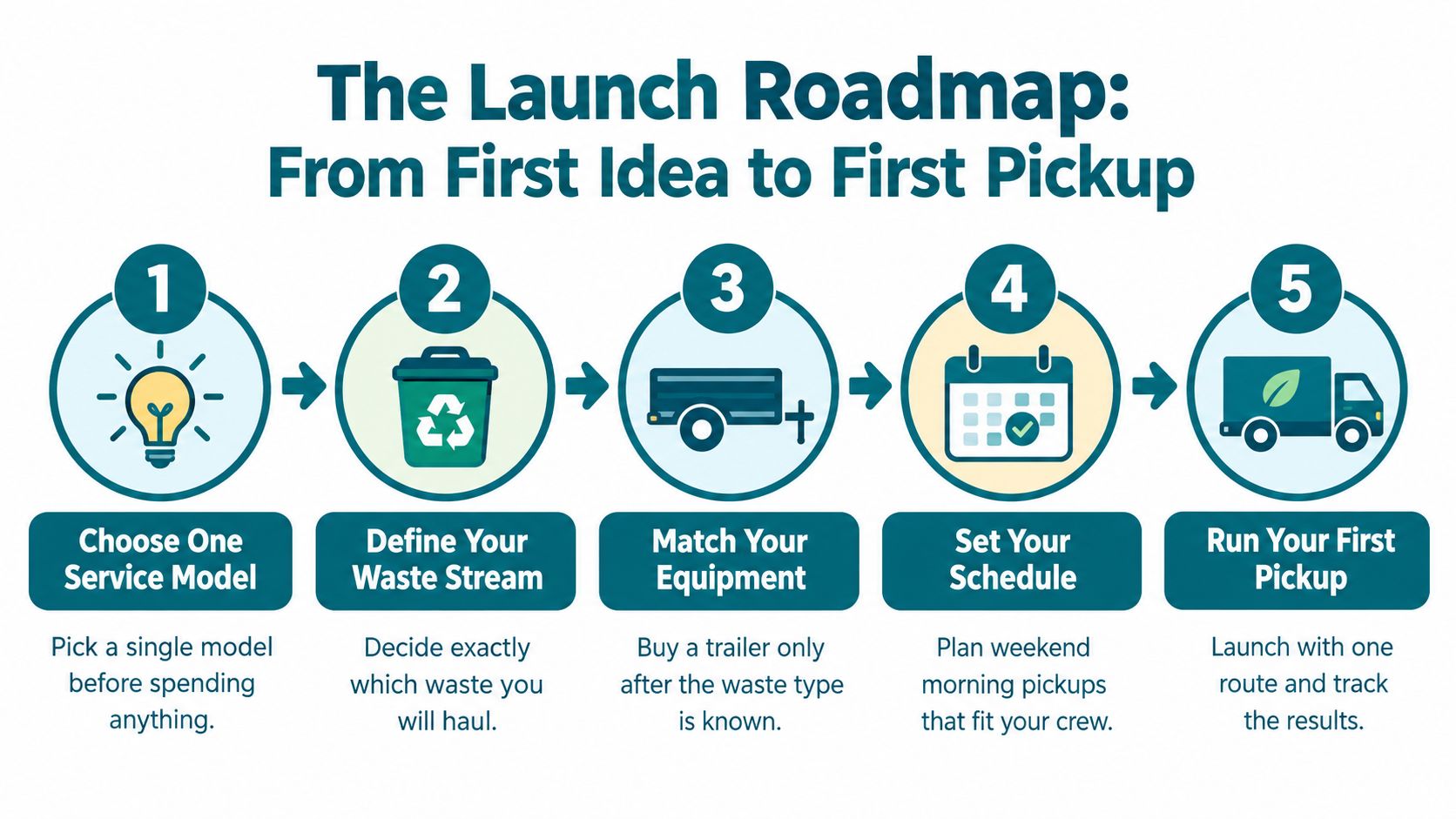
The Launch Roadmap From First Idea to First Pickup
Buying a trailer before choosing your waste stream is like buying shoes before deciding whether you'll swim or hike. You can spend money quickly and still have nothing useful for the job.
Choose one service model for your first season: volunteer litter removal, paid residential or business pickup, recycling collection, or bulky-item removal. Keep your first promise narrow enough that you can explain it without taking a breath.
Use this roadmap to keep your spending behind your decisions.
Treat the following timing as a suggested launch schedule, not a prediction or legal deadline.
Launch phases with timing and finish lines
| Phase | Timing | Finish line |
|---|---|---|
| Define the service model | Week 1 | One model chosen and written down |
| Count need by zone | Weeks 1-2 | Five to ten hotspots logged with photos and frequency |
| Confirm legal lines | Weeks 2-3 | Written answers from 311 and the state EPA for each waste type |
| Write the safety plan | Week 3 | One-page hazard analysis and cancel rules |
| Recruit a founding crew | Weeks 3-6 | Six to ten people committed to a first date |
| Buy starter gear | Weeks 4-6 | Vests, gloves, grabbers, bags and a bag scale |
| Publish a fixed weekly slot | Week 6 | Date, time and meeting point posted on Meetup or your group chat |
| Run three pilot pickups | Following the published launch slot | Bag counts, weights and labor hours logged for each |
Walk your proposed route with a clipboard before ordering equipment. Note loose wrappers, overflowing bins, broken glass, dumped furniture, and anything you won't touch. Photograph conditions without exposing neighbors' personal information.
Practical rule: Write the waste destination beside the waste type. An empty destination field means you haven't finished planning.
This week, choose your service model and put a provisional pilot date on your calendar. Confirm that date only after you settle disposal, safety, and permissions.
Which Waste Stays Free and Which Needs a Permit
Ask the sorting question first: What exactly am I agreeing to carry? A wrapper beside a bus stop and a sealed container of unknown liquid don't belong in the same collection plan.
Keep ordinary volunteer litter collection separate from commercial hauling. Charging nothing doesn't give you permission to enter property, leave bags beside someone else's dumpster, or transport regulated material.
Use this comparison to mark your accepted and excluded streams.
Waste types and the rule that applies to each
| Waste or activity | Rule that applies | What your group does |
|---|---|---|
| Ordinary litter bagged by volunteers | Keep cleanup free of service charges; confirm local permission and disposal arrangements | Bag, weigh, and deliver through an approved pathway; report bulky or dumped items to 311 |
| Paid pickup of household or business trash | Chicago requires a scavenger license under Municipal Code 4-6-130 | Keep paid work separate from volunteer events |
| Refuse containers left on a city street | Chicago requires container permits in four-month periods starting April 1, August 1, and December 1 | Skip container service until you hold the required permission |
| Recyclables collected for a fee | Chicago requires three-year records and an annual Recycling Hauler Report due February 28 | Write a load ticket for each route |
| Tires, chemicals, or other special waste | Check the Illinois waste-specific rules, including special-waste permit and certification requirements where applicable | Decline or subcontract until you confirm the rules |
| Hazardous waste | Obtain a U.S. EPA identification number through Form 8700-12 plus an Illinois special-waste permit | Exclude it from general litter service |
| Potentially infectious medical waste, including sharps | Illinois requires the appropriate PIMW hauling permit, with a $2,000 application and $250 per listed vehicle | Exclude it from your customer agreement |
Chicago's commercial refuse-container ordinance establishes the licensing and container-permit requirements above. For recycling, retain destination-facility details and the percentage delivered to each facility alongside your tonnage records, following Chicago's commercial recycling requirements.
Keep the exceptions narrow
For special waste, confirm the hauling permit, completed 39(i) certification, and application materials before moving a load; check hazardous-waste identification requirements through Illinois EPA's transportation-permit guidance.
Don't borrow a customer's small-generator exception. Illinois limits the relevant own-waste exception to qualifying generators moving their own waste from their own site, with 100 kilograms or less of special waste and less than 1 kilogram of acutely hazardous waste per calendar month; check manifest obligations through Illinois small-business permit guidance.
Medical-waste transport needs separate packaging, labeling, and manifest arrangements where applicable. Under Illinois medical-waste rules and fees, listing two vehicles brings annual permit-related charges to $2,500 before operating costs.
Treat a permit like a gate at the receiving facility. Don't load material until you know you can get through it legally.
Publish your exclusions and use this Chicago hazardous-waste disposal guide when preparing referrals. Ask 311 about dumping reports, ask the city about sidewalk or curb permissions, and ask your insurer what your liability policy covers. Don't assume a signed waiver replaces coverage.
Safety Rules That Keep Volunteers Coming Back
OSHA reported 20.3 fatalities per 100,000 full-time-equivalent workers in waste management and remediation in 2008, with nearly 60% involving transportation, according to its waste-management safety guidance. Those historical figures describe an industry, not a forecast for your volunteer event, but I'd take the traffic warning seriously.
Use this visual as a briefing aid, with a firm boundary: general volunteers leave needles alone, even when they carry grabbers.
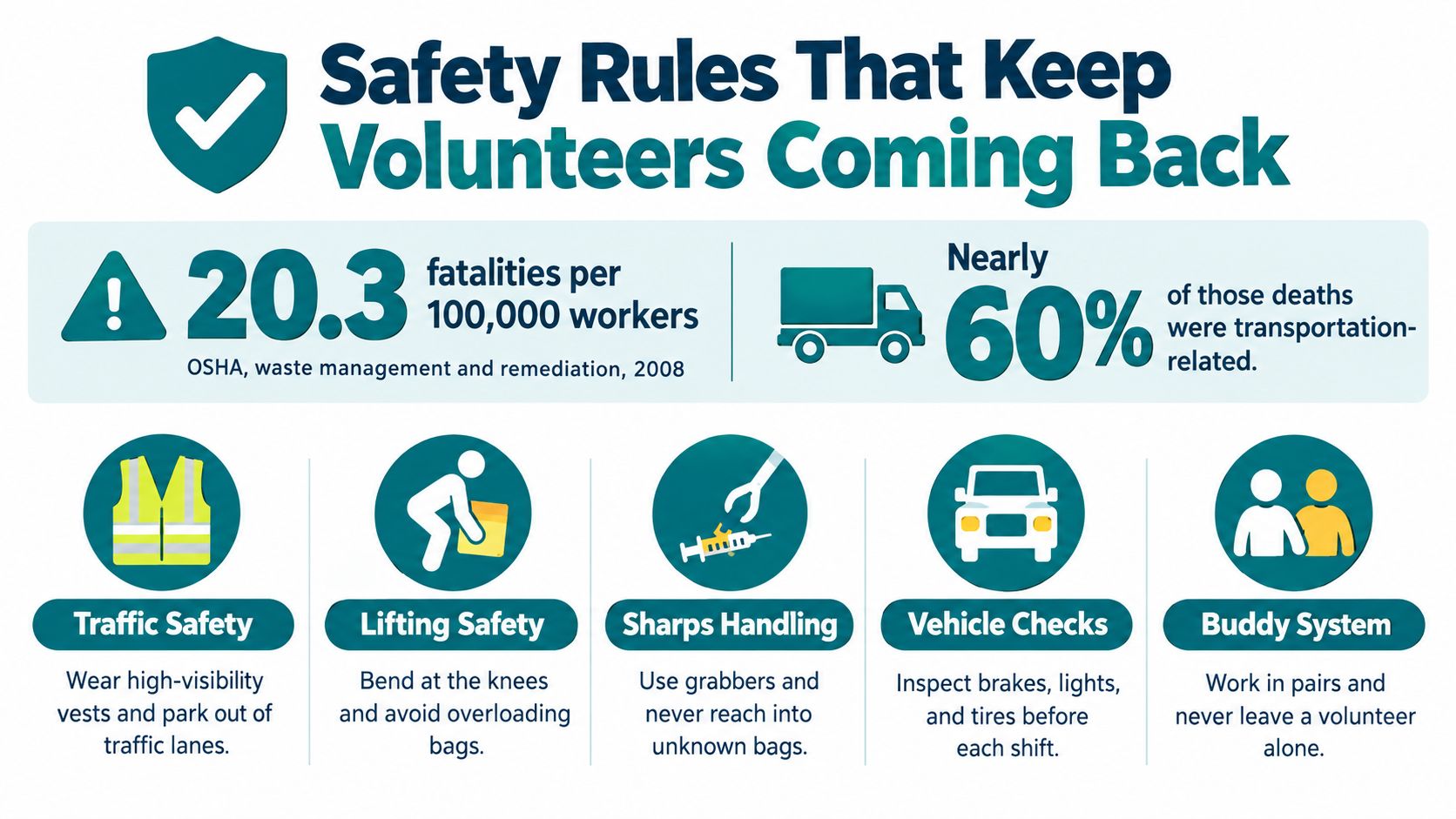
Write your hazard analysis before inviting the crew. Require high-visibility garments, puncture-resistant gloves, eye protection, and closed-toe boots. Keep volunteers away from chemicals, pressurized containers, unknown powders, and suspicious debris.
Make stopping an ordinary decision
Use hand tools and small wheeled carts. Teach team lifts, keep loads manageable, and keep a neutral back rather than twisting with a full bag. Plan frequent water breaks in heat, with a suggested check-in every 15 to 20 minutes, and shorten the outing when conditions demand it.
Use these as crew operating rules, alongside official litter-picking safety guidance.
Weather and site conditions with the action to take
| Condition | What your group does |
|---|---|
| Dry daylight, above freezing, no alerts | Run the planned route after checking the site |
| Thunder or lightning in the area | Cancel; adopt a minimum 30-minute wait after the last thunder before considering any restart |
| Wind or severe-weather warning | Stop and direct everyone to safe shelter |
| Dusk, darkness, or low visibility | End before light fades |
| Icy sidewalks or flooded curbs | Relocate or cancel |
| Poor air-quality alert | Choose a lower-exposure site or cancel |
| Work beside a moving lane | Choose another block unless you can maintain safe separation; use a spotter and authorized traffic controls where appropriate |
| Needles, unknown powders, or pressurized cans | Stop, leave the item, note the location from a safe distance, and report it to 311 |
A spotter doesn't make an active traffic lane safe for volunteers. Keep an exclusion zone around trucks and trailers, and never send someone into traffic to retrieve litter.
Use the video during preparation, then review your own site-specific instructions together.
Adapt the volunteer safety checklist for your route. Record near misses and first-aid cases alongside collection totals, and give your leader clear authority to stop without an argument.
Recruiting and Scheduling Volunteers Who Return
Our hailstorm beginning gave us a story. It didn't give us a reason to repeat unsafe conditions.
What I'd copy from that beginning is the small invitation: come outside, do something useful, and meet people who showed up for the same reason. You don't need a crowd before you can begin.
I choose weekend mornings because I want to build a service habit around the work. You can choose a different slot, but make it predictable enough that someone can arrange their weekend without messaging you for details.
Make the invitation easy to accept
Use Meetup, a simple event page, or an open group chat. Put the practical information above the inspirational language.
- Say where to meet. Name a visible landmark and explain how newcomers can identify the leader.
- Explain the effort. Describe the route, expected outing length, walking conditions, and available breaks.
- Name what to bring. State clothing requirements and distinguish personal items from equipment you supply.
- Welcome different limits. Give people a way to ask about access needs privately.
- Explain the return. Promise a shared task, friendly company, and optional photos rather than a heroic experience.
Start by inviting people you already know. Ask directly whether they'll come on the published date instead of asking whether they like the idea.
Keep that slot steady for a suggested eight-week trial before changing it. Treat the trial as a planning choice, not a rule you must defend against bad weather or volunteers' needs.
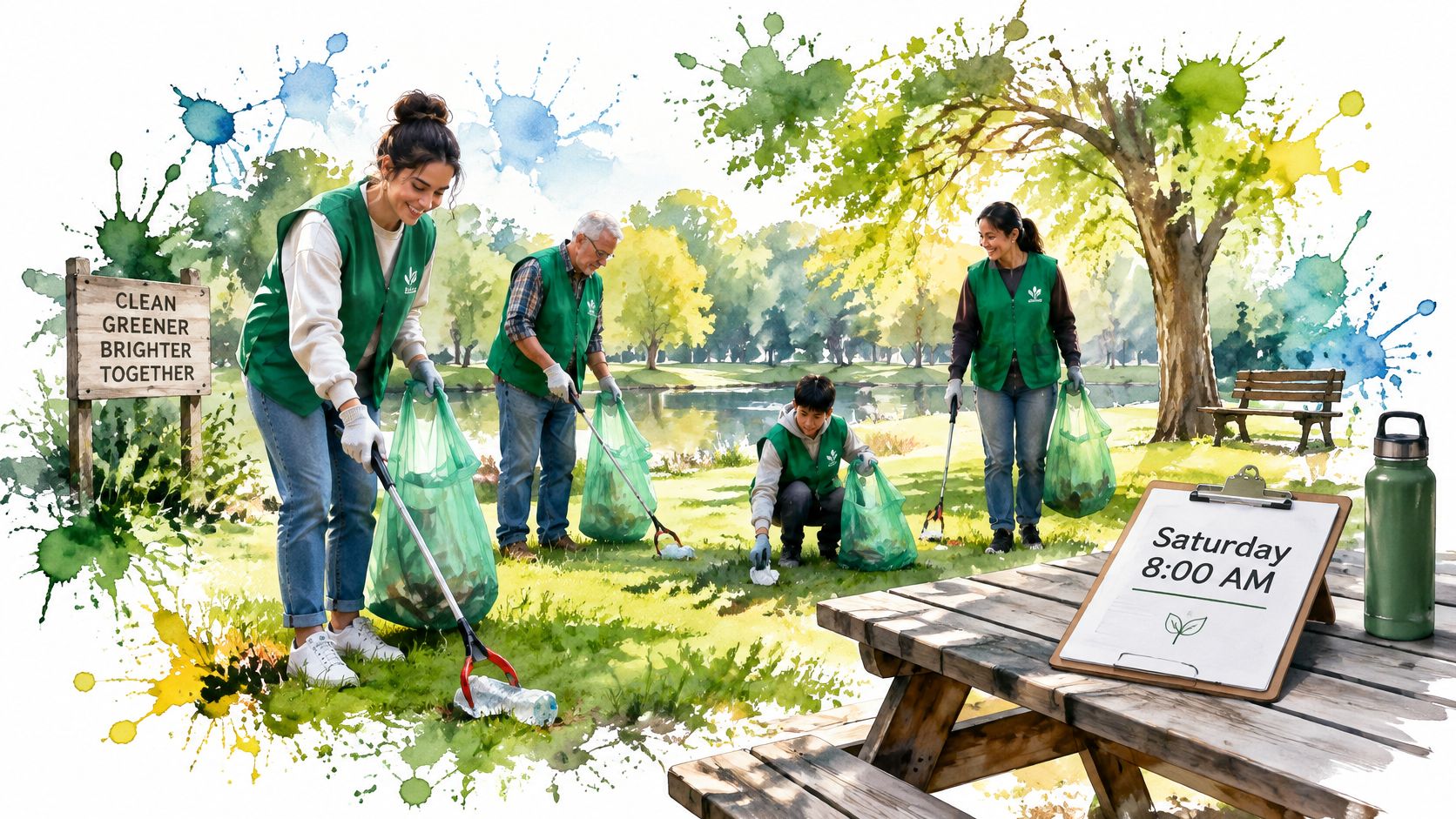
A welcoming cleanup can look ordinary, and that's useful.
Give people something to belong to
Choose a name, make a simple badge, or carry a flag. I like those small signals because newcomers can find us and regulars can feel part of the same crew.
My boundary: I ask volunteers for their time and care. I don't pressure them for donations.
Close with a suggested ten-minute circle. Ask what people noticed, what felt awkward, and what they'd change. Make speaking optional.
Track return visits, and send a kind check-in when someone disappears for a couple of outings. Ask how they're doing without making attendance feel like a debt.
Gear, Partners and Money Without Pressure
Buy protective equipment before buying capacity. Borrowing a wagon makes sense; improvising eye protection doesn't.
I'd compare purchases by what they let you do safely today. A cart helps you move manageable bags, while a trailer adds towing, parking, loading, and disposal questions you may not have answered.
Use the quantities below as an example shopping plan, not a safety standard or a claim that every route needs identical supplies.
Starter gear for a crew of ten volunteers
| Item | Quantity for 10 volunteers | Why it matters |
|---|---|---|
| High-visibility vests | 10, plus 2 spares | Help drivers notice the crew during permitted daylight work |
| Puncture-resistant gloves | 12 pairs | Reduce exposure to rough edges; don't make needles safe to handle |
| Reacher grabbers | 6 | Keep hands farther from litter |
| Heavy contractor bags | 100 | Provide spare capacity without encouraging overfilled bags |
| Five-gallon buckets | 2 | Separate suitable glass and cans |
| Wheeled cart or wagon | 2 | Move bags without repeated carrying |
| Sharps container | 1 | Support an authorized, trained responder's plan, not volunteer needle collection |
| First-aid kit | 2 | Keep supplies accessible at separate staging points |
| Bag scale | 1 | Record collected weight |
| Five-gallon water cooler | 2 | Keep drinking water available |
Have first-aid supplies ready from the first event. Borrow bulky equipment before buying it, and add your own carts or scale when your route and storage arrangements justify them.
Ask partners for a specific contribution
Compare a vague request for support with a concrete request for contractor bags or cart storage. I'd send the concrete request because the shop owner can answer it without designing your operation.
- Local shops and cafes. Ask for supplies, water, or storage. Only discuss collection bins after confirming who services them and what permissions apply.
- Ward offices and park staff. Ask about site access and approved bag-removal arrangements.
- Neighborhood associations. Ask for introductions, help sharing the date, or support reviewing the route.
Use nonprofit sponsorship packages as a starting point for defining a partner request. Put responsibilities in writing, especially who takes custody of collected bags.
Confirm disposal charges before collecting anything. If you accept donations, publish what you bought and keep receipts. Ask partners to support the work without turning your volunteer circle into a fundraising queue.
Run Your First Pilot Block
Choose a block you can supervise from beginning to end. Resist the urge to add the next street because someone spots more litter.
Use this suggested pilot sequence:
- Set the boundaries. Identify the start, finish, cart-staging area, and approved destination for collected bags.
- Check conditions. Apply your weather and site rules before sending the final group message.
- Brief the crew. Allow ten minutes to explain the route, exclusions, emergency contact, and stop signal.
- Assign people. Pair volunteers and name the spotter wherever your approved plan needs one.
- Collect within scope. Walk with the cart, leave excluded items alone, and stage full bags away from roadways.
- Measure the work. Weigh bags and record count, weight, labor minutes, destination, and any incidents.
- Close together. Hold your closing circle, hear concerns, and confirm the next date.
Copy the route sheet into your ledger while you still remember the details. Attach receiving receipts and note whether you used an estimated or measured weight.
I recommend three pilots using the same basic block pattern before expanding. Fix hazards immediately, but give yourself a comparable record before deciding you need a larger route.
Growing Past the First Year Without a Truck Fleet
SharpSheets published 2024 startup estimates of $324,000 to $456,000 for a waste-management business, with trucks accounting for approximately 80% of investment in its waste-management cost analysis. Treat those figures as estimates for a commercial operation, not a shopping list for your volunteer group.
You can grow through people and routes before buying vehicles. I'd rather have someone who can brief a crew calmly than a truck nobody knows how to operate responsibly.
Expand supervision before territory
Try a planning target of a zone leader for every eight volunteers, then adjust for visibility, experience, access needs, and site hazards. That's a suggested staffing approach, not an official safety ratio.
Rotate assignments so the same person doesn't inherit the hardest block forever. Invite regular volunteers to practice briefing, attendance checks, and route documentation before asking them to lead alone.
- Review together. Hold a quarterly planning meeting and compare collected weight, labor, return participation, incidents, and partner support.
- Prepare alternatives. Keep a shorter route ready for difficult seasons, without using it to work around cancellation rules.
- Publish an honest report. Separate measured weights from estimates and explain where collected material went.
- Price commercial work separately. If you later charge for hauling, include labor, access, travel, and receiving-facility costs rather than guessing by bag count.
For that last decision, review Chicago's commercial refuse-container rules before changing your operating model. Recheck permissions whenever you change the service, vehicle, container arrangement, or waste stream.
Write your growth trigger before enthusiasm makes the decision for you. For example, require two consecutive months of reliable staffing, complete route records, and trained backup leaders before adding a ward.
You can leave a block cleaner without owning a fleet. Grow when you can care for the next crew as well as the current one.
Litter Caterpillars has volunteer-led Chicago cleanups with gloves, bags, and grabbers, giving you a way to try community litter pickup before organizing your own route. Visit Litter Caterpillars to find a weekend cleanup, meet the crew, and see the work firsthand.
Leave a Reply