
My mess was my life, so I started cleaning up someone else’s.
I used to have trouble cleaning my own stuff. As my apartment got worse, my life got worse with it. The old blueberry jam from a trip to Michigan. The bag of nuts from a failed health kick. Every piece of trash had a little memory attached to it, and even though each thing weighed almost nothing, to me it felt like 500 pounds.
Then I ended a chaotic relationship with someone selfish, and I hit the kind of wall that makes you either stay stuck or do something weird. I decided I was done building my life around mess, fear, and flaky people. I wanted to face the stuff that had always beaten me up: cleanliness, consistency, and bravery.
So I tried something sideways. I cleaned up public spaces.
It was easier to pick up a bottle off the sidewalk than to throw away my own old junk. It was easier to show up for a block than to show up for myself. But after a while, that line started to blur. The more I helped clean a street, the more I could feel some of the static leaving my own head. It was work, sure. Sometimes cold, wet, gross work. But it was also weirdly fun.
That’s how the Litter Caterpillars started.
If you’re looking for community service ideas for college students, I want to give you more than a bland list you half-read between classes. I want to give you options you can picture yourself doing on a Saturday morning when your room is a mess, your brain is loud, and you need a reason to get outside and be around better people. Some of these ideas are simple. Some take real organizing. All of them can change your week if you let them.
You don’t need to wait until you feel polished. Start while you’re still a little lost. Sometimes service is how you find your footing.
1. Neighborhood Litter Cleanup Events
The first cleanup I ever led was small enough to fail unnoticed. A few gloves. A couple of trash bags. One block I was tired of walking past with my shoulders up around my ears.
What surprised me was how fast the mood changed. You bend down for one bottle, then a chip bag, then a pile of soggy flyers stuck to the curb, and suddenly you are not stuck in your own head anymore. You are doing something with your hands. You are standing next to other people who showed up for the same unglamorous reason. The street looks better in under an hour, and some part of you does too.
That is why neighborhood litter cleanup events work so well for college students. You do not need a big budget, a fancy title, or weeks of training. You need a spot people already care about, a time that works, and a clear place to meet. If your life feels scattered, this kind of service gives you a win you can see.
I would keep the first one almost boring on purpose. Pick a route you can finish. Pick a corner store, bus stop, park edge, or sidewalk near campus where people will notice the difference. If you want a real example of how simple cleanup work can grow into something bigger, the story behind this vacant lot project shows what can happen when people keep coming back to the same place.
How I’d make it stick
A cleanup becomes a real habit when people know it is not a one-time burst of guilt.
- Choose a short route: Finishing feels better than overpromising.
- Bring visible gear: Gloves, grabbers, buckets, and bright vests help people spot the group and join in.
- Make signup easy: A page like Litter Caterpillars volunteer trash pickup removes friction for busy students.
- Talk to people outside the group: A quick conversation with a nearby resident or shop owner can turn strangers into future volunteers.
- Stay for ten extra minutes: Coffee on the curb, bagels in the park, or just talking after the work is often what makes people return.
I love cleanup events because they strip away excuses. The problem is right there in front of you. The progress is right there too. You do not have to wonder if you helped.
And if you are in one of those seasons where your room is a mess, your phone is full of half-finished plans, and you do not totally trust yourself to follow through, start here. Pick up one block with other people. Come back the next week. Sometimes that is how you build courage. Not all at once. One bag at a time.
2. Vacant Lot Transformation Projects
A vacant lot can feel like a physical form of giving up. Broken glass, weeds, dumped furniture, old tires, random plastic, silence. Everybody walks past it like it belongs to no one.
That’s exactly why transforming one can hit so hard.
I love this idea because it starts ugly. You don’t need to pretend it’s charming. You take a dead-looking patch of land and ask, “What if this became a place kids could run through, neighbors could sit in, and volunteers could point at with pride?” That question alone changes how you walk through a neighborhood.
Here’s a real example from the Litter Caterpillars story. The group won an empty lot at auction and started turning it into a park in Englewood. If you want to see the story behind that move, read the tale of the vacant lot.
What the work actually feels like
At first, it’s not glamorous. It’s hauling junk, clearing brush, calling people back, and learning that “community project” often means “you will repeat yourself many times.” But that’s part of why this is such a strong service idea for college students. It forces you to grow up a little without making you hard.
Before-and-after photos matter here. So do neighborhood conversations. If the lot becomes a garden, a sitting area, or a mini-park, local people should shape that decision with you.
Watch a lot become something else:
Ground rule: Don’t “fix” a space for a neighborhood without talking to the people who already live there.
This kind of service has a long memory. A cleanup ends and you go home. A lot transformation keeps asking for your consistency. That’s why I’d recommend it to students who are ready for a longer arc, not just a one-day burst.
3. Highway and Major Corridor Cleanup
The first time I helped on a road-edge cleanup, I felt weirdly small. Trucks ripped past. The shoulder shook. Every bottle and fast-food wrapper looked like it had been pinned there by speed itself.
That’s what makes this kind of service stick with you.
A neighborhood cleanup can feel warm and local. A major corridor cleanup feels exposed. You’re standing in one of the hardest places to ignore, picking up what thousands of people passed without seeing. If your life feels noisy or scattered, there’s something honest about that setting. You cannot pretend your way through it. You put on the vest, grab the bag, and do the next ugly, simple thing.
I’ve heard students talk about these cleanups around closed-street events, bike races, and city-led road projects, and I like that model because access changes everything. A road that usually tells you to keep out suddenly becomes walkable. You notice how much trash collects in medians, along fences, near ramps, and under guardrails. You also notice your own nerves. Then, after twenty minutes, you’re just working.
How to do it without turning it into chaos
This project lives or dies on coordination. Call the city, transportation department, or event organizer early. Ask a few plain questions. Which sections are safe for volunteers? Where should filled bags go? Who removes large debris? What counts as off-limits?
Then keep the plan tight.
- Divide the route into short sections: People work better when they know exactly where their part begins and ends.
- Give one clear safety briefing: Cover traffic boundaries, protective gear, weather, and items nobody should touch.
- Choose visible bag drop spots: Long walks with full trash bags drain the group fast.
- Use shorter shifts: Major roads are tiring. An hour of focused work often beats a long, sloppy stretch.
This idea also does something quieter. It builds courage.
Not fake courage. Real, ordinary courage. The kind you get when you show up in an uncomfortable place, do a job that isn’t glamorous, and stay with it long enough to see a difference. For some college students, that matters as much as the cleanup itself. If you’ve been living in a fog of missed deadlines, bad habits, or low-grade panic, a project like this can cut through the noise. By the end, the roadside looks better, and you do too.
4. Student Environmental Education and Awareness Campaigns

The first time I helped with a cleanup lesson for kids, I made the classic college-student mistake. I showed up with facts, a recycling chart, and way too many words. Their eyes drifted fast.
Then one kid picked up a chip bag from the sidewalk outside and asked, "So this ends up in the drain?"
That was the whole lesson. Not my notes. Not my little speech. That crumpled bag in his hand.
If you care about the environment but do not want all your service hours to look like gloves, grabbers, and trash bags, education work gives you another lane. You can visit an after-school program, partner with a library, or run a short workshop in a residence hall or community center. The goal is simple. Help people connect the mess they see every day to something they can do about it.
Keep it close to real life
Students tune out fast when a campaign sounds like homework with a greener title. They pay attention when you bring the problem down to sidewalk level.
Show what washes into storm drains after rain. Bring common trash items and ask where each one usually gets dropped. Have kids map the litter they pass on the way to school, then compare notes. If you can pair the lesson with seed planting, a mini cleanup, or a trash audit, even better. People remember what they touch.
I would build two or three repeatable workshops and keep them tight. One on litter and runoff. One on recycling mistakes people make at home or on campus. One on gardens, trees, and public green spaces people use every week.
A good campaign changes you, too.
You learn how to hold a room. You learn how to explain something without hiding behind jargon. You learn that leadership is often one awkward conversation, one folding table, one group of restless middle-schoolers, and the choice to keep going anyway. If your own life feels scattered, this kind of service can steady you. You stop performing concern and start practicing it.
The best moment is usually small. A child points at the curb outside and says they have seen the same trash there for weeks. A classmate asks if your dorm can do a waste-sorting table at lunch. Someone starts noticing. That is where change begins.
5. Adopt-a-Block or Neighborhood Stewardship Programs
The first time I helped clean the same block twice, I almost missed what had changed.
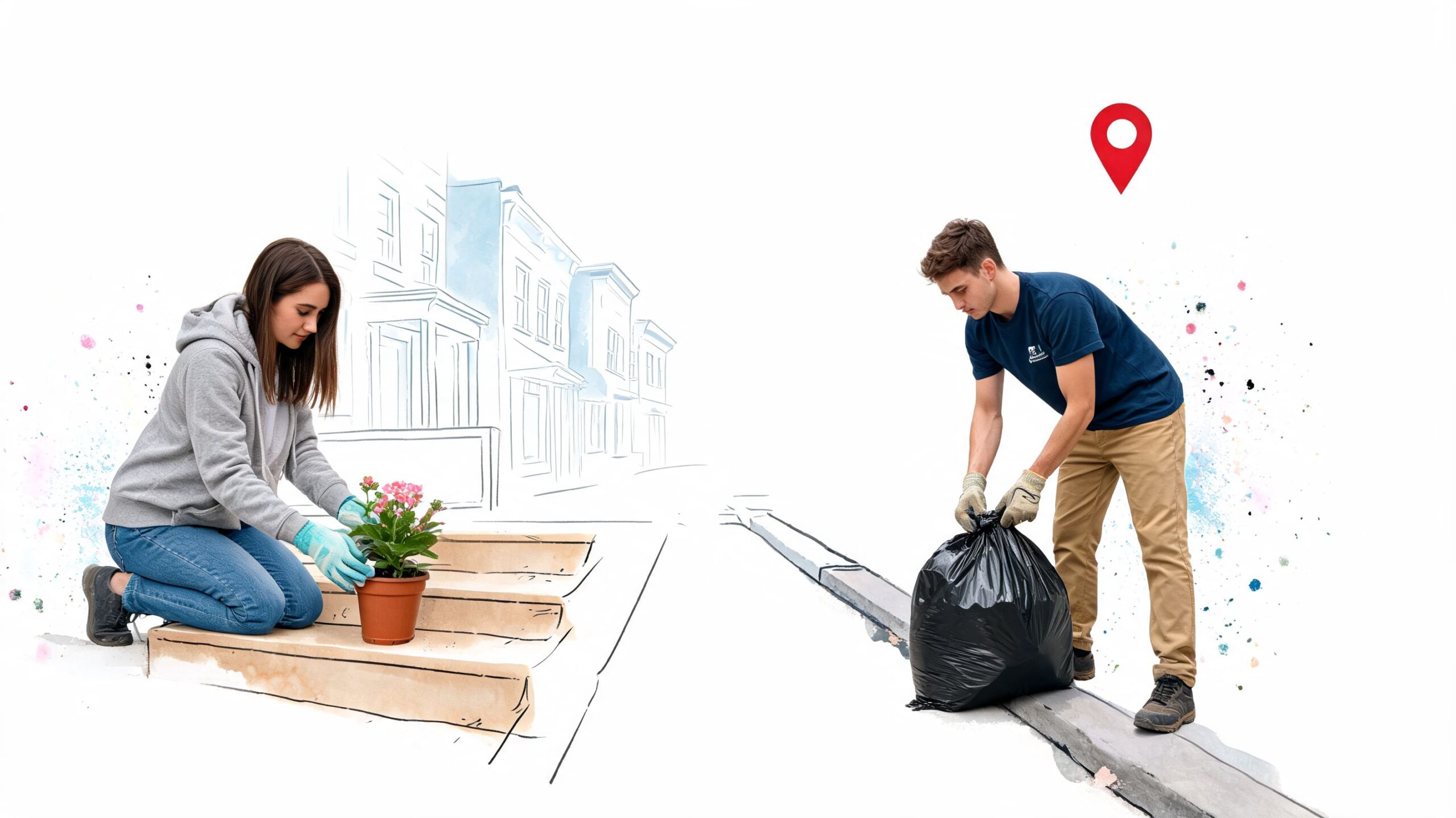
The chip bags were back by the fence. Someone had tossed a coffee cup near the curb again. But an older man walking his dog nodded at us like we belonged there. A woman from the corner house came out and said, "Glad you came back." That second part hit harder than the full trash bag in my hand.
Adopt a block, and the work gets personal fast. You stop treating a neighborhood like a weekend project and start treating it like a relationship. You learn where the gutters clog after rain. You notice which alley gets ignored. You remember the tree pit you cleared three Saturdays ago and feel weirdly proud when it stays clean a little longer.
That repetition changes you, too. If your life feels noisy, showing up to the same stretch of sidewalk every week can calm it down. You make one promise. Then you keep it. For a lot of college students, that is not small.
Why staying with one place works
A single cleanup can feel satisfying. A stewardship program lets you see cause and effect.
You start spotting patterns instead of reacting to random messes. Maybe flyers blow down from one pole every Friday. Maybe the problem is not careless neighbors, but a trash can that is always overflowing by Sunday night. Once you know the block, your help gets smarter. You are not just picking things up. You are paying attention.
I would keep the structure simple and local. Assign students to a block near where they already live, study, or commute. The easier it is to reach, the better chance people will stick with it when classes get heavy and motivation drops.
A few ways to keep it going:
- Keep shifts short: One hour works better than a big heroic Saturday that burns everyone out.
- Give each team a defined zone: Specific corners, alleys, planters, or bus stops help people know what they own.
- Use a simple check-in: A photo, a text update, or a shared note is enough.
- Build in backup: Let people swap weeks so the block does not depend on one perfect volunteer.
The best part is what happens after a month or two. You are no longer a stranger passing through with a grabber and gloves. You are one of the people who noticed, came back, and kept going. Sometimes that is how you start cleaning up more than a street. Sometimes that is how you start cleaning up your own life.
6. Community Cleanup-to-Event Model with Social Gathering
The first cleanup I helped organize that felt alive ended with pizza on a folding table.
We had spent the morning pulling bottles out of weeds behind a bus stop and scraping old flyers off a light pole. Everyone looked a little rough. Gloves dirty, shirts damp, hair wrecked by wind. Then somebody opened two pizza boxes, another person passed around clementines, and the whole mood changed. People stopped standing in their polite little circles. They started telling the truth. One student admitted she had come because she was lonely. Another said he signed up after a bad semester and needed a reason to leave his room on a Saturday.
That is why I believe in the cleanup-to-event model. The work cracks something open. The hangout is where people decide whether they want to come back.

For college students, this matters more than people admit. Service hours are nice. A cleaner park is nice. But sometimes the true win is smaller and more personal. You show up feeling scattered, awkward, half checked out. You leave with dirt on your shoes, three new names in your phone, and a weird little spark of courage. I have seen that happen over and over.
The social part should not be an afterthought. Build it into the day from the start.
Here’s a version that works:
- Start with a defined cleanup: one park edge, one alley, one stretch near campus, one hour or two
- End close to the site: food trucks, coffee, bagels, a picnic, or a potluck keeps the shift from dissolving the second the bags are tied
- Make conversation easier: name tags, simple icebreakers, or a question on a sign-in sheet gives shy people a way in
- Keep one small tradition: group photo, shared playlist, silly award for weirdest item found, or a post-cleanup snack everybody expects
I like this model because it does two jobs at once. It helps a neighborhood look cared for. It also gives students a low-pressure way to build community without pretending networking is fun.
And if I am being honest, that second part can change your life.
A lot of us arrive on campus carrying chaos we do not talk about. Grief. Debt. Anxiety. A breakup. Family mess. The simple act of cleaning a public space with other people can steady you for a minute. Then the meal after gives you room to breathe and be seen. You are no longer just completing a task. You are practicing how to belong.
The best gatherings are simple. Cheap food is fine. A shaded patch of grass is fine. Music from a phone speaker is fine. What matters is that you leave time for the part after the trash bags are full, because that is often where the bravery starts.
7. Partnership with Local Nonprofits and Environmental Organizations
The first time I partnered with a local cleanup group, I showed up thinking I was late to somebody else’s mission. I left feeling like I had borrowed a spine.
There were no big speeches. A woman in work gloves handed me a grabber, pointed toward a weedy stretch behind a neighborhood creek, and said they had been coming back to this spot for months because trash kept sliding down from the road above. That changed how I saw service. You stop treating a cleanup like a one-off volunteer day and start seeing it as a relationship. With a place. With the people protecting it. With the version of yourself that keeps coming back.
That is why partnerships matter.
You do not need to invent the whole project, recruit everyone yourself, or guess your way through permits and safety rules. A local nonprofit or environmental group already knows the terrain. They know which park floods after rain, which lot gets dumped on every weekend, which trail needs restoration instead of another bag count, and which neighbors have been carrying the work long before students arrived.
I’d look for groups doing river cleanups, habitat restoration, park stewardship, urban gardening, compost education, or neighborhood environmental justice work. The best fit is usually not the flashiest one. It is the group with a clear routine and a real need for steady hands.
What makes this different from the last section is the depth. You are not just showing up for one social afternoon and then drifting off after snacks. You are stepping into work that already has memory. That can humble you fast, and I mean that in a good way.
If you want to be useful quickly, do the plain jobs well first.
Show up to orientation. Learn the rules. Ask what keeps falling through the cracks. Sometimes that means hauling tools, signing people in, sorting gloves by size, or pulling invasive plants for two hours without posting about it once. That kind of service can feel small until you realize it is the reason the whole day holds together.
I also love partnerships because they test you in a different way. A student-run project lets you stay in your comfort zone. An established nonprofit puts you next to longtime organizers, retired neighbors, city staff, high school volunteers, and people who know the block better than you ever will. You learn how to listen. You learn how to take direction without shrinking. You learn that helping is not the same thing as leading.
And if your life feels messy, that matters.
There were seasons when I could not fix the bigger chaos. Money stress. Family stuff. My own head. But I could show up at 8 a.m., pull on gloves, and work beside people who had built something steady out of care and repetition. That steadiness rubbed off on me. Service did not solve everything. It gave me practice. Practice being reliable. Practice staying when a task got dull. Practice belonging to something bigger than my own spiral.
A good partnership can give you hours, experience, and references. More than that, it can give you a model for how to live. Find the people already tending a damaged place, then ask where your hands fit. That question can change more than your weekend.
8. Bike Event and Outdoor Festival Cleanup Coordination
The first time I helped clean up after a bike race, the fun was over before the actual work started. Music cut out. Food trucks pulled away. The crowd vanished fast. What stayed behind was the truth of the day. Crushed cans in the grass, zip ties near the barricades, paper plates stuck to the curb, and a little creek of trash drifting toward a storm drain.
I remember standing there with a grabber in one hand, sweaty and annoyed, thinking this looked a lot like my life at the time. Loud from a distance. Messy up close. Harder to ignore once everyone else went home.
That is why I think this kind of service hits differently.
Bike rides, street fairs, concerts, and outdoor festivals need cleanup crews before, during, and after the event. If you are the kind of person who does well with movement, noise, and a job you can see in front of you, this work gives you a clear target. You do not have to guess whether you helped. A trash-heavy block turns walkable again because you showed up.
Start by contacting organizers early. Ask where waste piles up, which areas get slammed, and who handles supplies and disposal. Event cleanup works better when students are assigned to zones and shifts instead of wandering around trying to look useful.
I would set it up like this:
- Pre-event crew: check trash and recycling stations, pick up old litter, and make sure high-traffic spots are covered before people arrive
- During-event crew: patrol food areas, entrances, restrooms, bike parking, and seating zones before overflow turns into a bigger mess
- Post-event crew: move fast once the event ends, covering the full route or festival footprint while volunteers still have energy
- Supply runner: keep gloves, bags, water, and sanitizer stocked so the whole team does not stall out
This work also teaches a blunt lesson. Public fun leaves a tab. Somebody has to pay it in labor.
You can be one of the people who pays attention, grabs a bag, and handles what everybody else steps around. And if your own life feels scattered, there is something grounding about restoring a place in plain sight. You pick up one bottle, then ten, then a whole corner. The block looks better. Sometimes you do too.
9. Student-Led Sustainability Initiatives and Campus-to-Community Outreach
I knew a student who got tired of watching move-out week turn the dorm dumpster area into a small disaster. Lamps with working bulbs. Half-full detergent. Mini fridges left in hallways. Good stuff, trashed because nobody had a plan. She started with one table, three bins, and a handwritten sign in her residence hall lobby. By the end of the week, students were dropping off food, clothes, and school supplies instead of shoving them into the trash room.
That is how a real sustainability project usually starts. Small. A little messy. Close enough to touch.
If you are the person who keeps asking why waste keeps showing up in the same places, this kind of service fits. You are not only cleaning up what is already broken. You are fixing the system that keeps making the mess.
Start on campus, where you already know the people, the routines, and the weak spots. Build something practical, then carry it beyond the edge of school property. A dorm recycling campaign can turn into apartment outreach for students living off campus. A compost pilot in one dining hall can grow into a partnership with a neighborhood garden. A move-out donation drive can feed a local mutual aid network instead of a landfill.
I like this model because it changes you while you build it. You stop waiting for permission. You make the sign. You reserve the table. You ask the facilities staff what keeps failing. You hear "no" a few times and keep going anyway.
Keep the first version small enough that tired students can still run it during midterms. One dorm. One residence hall floor. One monthly collection day. One student club and one nearby block. If the system only works when everybody is excited all the time, it will fall apart fast.
Write down the steps. Keep the handoff simple. Make a one-page guide the next student can follow without texting you twelve times.
That is the difference between a nice idea and a project that lasts.
If you want examples of how service work can shape confidence, purpose, and real-world skills, read these benefits of volunteering for students. Then build something other people can inherit.
This route works well for students who like organizing, teaching peers, and setting up repeatable habits. It is quieter than a big public cleanup. It is also how campuses stop creating the same pile of problems every semester.
10. Volunteer Team Building and Peer Leadership Development
The first time I asked another student to lead part of a cleanup, I was nervous for all the wrong reasons. I thought they would do it differently. I thought the check-in table would get messy, the route would run late, somebody would forget gloves, and I would spend the whole morning fixing it.
What happened was better. A quiet sophomore named Elena took ten volunteers down one side street, came back muddy and smiling, and told me two new people wanted to help run the next event. That was the day I stopped trying to be the hero and started building a crew.
If your service project depends on one exhausted organizer, it is already fragile. The strongest student groups spread responsibility early, while the stakes are still small. Give one person the sign-in sheet. Give another person the safety talk. Let someone else welcome first-timers so they do not spend twenty minutes standing around feeling awkward.
That shift changes the project, and it changes you. You stop proving you can carry everything alone. You start trusting people. You start seeing leadership for what it is during service work. Clear communication, calm decisions, and follow-through when the weather turns ugly and half the group is tempted to head back for coffee.
I like a simple progression that people can grow into:
- Show-up role: learns the basics, arrives on time, helps without needing much direction
- Crew lead: keeps a small team on task and watches pace, safety, and morale
- Support lead: handles supplies, check-in, photos, volunteer questions, or neighbor conversations
- Event lead: runs the day, solves problems, and helps new leaders take over next time
Keep it real. Titles mean nothing if they do not come with responsibility.
One of the best things about service is how fast it exposes your habits. If you avoid speaking up, leading a crew will force you to use your voice. If you panic when plans change, a rainy cleanup with missing supplies will teach you how to stay steady. If you have spent a semester feeling scattered, being responsible for five other students can pull you together in a way a classroom never does.
I have seen that happen.
A student who barely made eye contact at the first event becomes the person who can calm a late volunteer, redirect a confused group, and make a neighborhood resident feel heard in the same five minutes. That kind of growth is why these benefits of volunteering for students hit harder when you are not just participating, but helping other people show up too.
Ask for one volunteer to lead a small piece of the day. Then let them do it. That is how a service project becomes a team, and how a team becomes the place where you finally find your people.
10 College Community Service Ideas Comparison
| Initiative | 🔄 Complexity | ⚡ Resources | 📊 Expected outcomes | ⭐ Ideal use cases | 💡 Key advantages |
|---|---|---|---|---|---|
| Neighborhood Litter Cleanup Events | Low–Moderate: recurring coordination | Low: volunteers, gloves, bags | Immediate visible cleanliness; local morale boost | Quick neighborhood improvements; volunteer onboarding | Accessible entry; high visibility; builds community pride |
| Vacant Lot Transformation Projects | High: multi‑phase, months–years | High: funding, permits, design, skilled labor | Permanent greenspace; aesthetic and social uplift | Long‑term revitalization; leadership development | Lasting asset; attracts funding/media; deep ownership |
| Highway and Major Corridor Cleanup | High: city coordination and safety protocols | High: large crews, PPE, permits, logistics | Massive short‑term visual impact; media coverage | High‑visibility campaigns, event tie‑ins | Rapid broad impact; public recognition; safer with closures |
| Student Environmental Education & Awareness Campaigns | Moderate: curriculum and partnership building | Low–Moderate: materials, volunteers, digital tools | Gradual behavior change; increased awareness | Schools, youth outreach, scalable digital programs | Systemic change potential; low cost; builds teaching skills |
| Adopt‑a‑Block / Neighborhood Stewardship | Moderate: ongoing management and tracking | Low: supplies, volunteer time, tracking system | Sustained cleanliness; community relationships | Long‑term upkeep of specific blocks | Consistency; sense of ownership; litter prevention |
| Community Cleanup → Social Gathering Model | Moderate: cleanup + event logistics | Moderate: food, space, supplies, volunteers | Stronger bonds; higher retention; positive publicity | Volunteer recruitment, morale and community building | Combines service with celebration; boosts retention |
| Partnership with Local Nonprofits | Moderate: alignment with org processes | Low–Moderate: access to training, coordination time | Professionalized impact; documented service hours | Skill-building, advocacy, structured volunteering | Training, credibility, access to broader networks |
| Bike Event & Outdoor Festival Cleanup Coordination | High: event logistics, crowd and traffic management | High: organizer coordination, shifts, gear | Event‑centered impact; high participation | Festivals, city bike events, large gatherings | High engagement; strong visibility; organizer partnerships |
| Student‑Led Sustainability & Campus‑Community Outreach | Moderate: institutional coordination, planning | Moderate: campus resources, staff support, funding | Scalable environmental metrics; campus culture change | Campus programs expanded into neighborhoods | Leverages institutional support; measurable outcomes |
| Volunteer Team Building & Peer Leadership Development | Moderate: training programs and mentorship | Low–Moderate: time, training materials, small budget | Sustainable volunteer infrastructure; higher retention | Scaling volunteer programs; leadership cultivation | Builds leaders, resilience, and long‑term program stability |
You’ve Found Your People. Are You Bold Enough?
We believe in the power of service to our environment, to the outdoors, to sunlight, and to friendship. That’s why we are Caterpillars. We’re not perfect, but we’re all trying to transform ourselves. Through service, we can learn to trust ourselves and forgive ourselves.
I didn’t learn that from a book. I learned it while being cold and uncomfortable and slightly ridiculous with other people.
The first time we picked up trash, only three of us showed up. We got caught in a hail storm and ended up shivering under a tree while rides kept canceling on us. It should’ve been miserable. In some ways, it was. But I remember realizing that something strange was happening. Cleaning up other people’s messes was easier than cleaning up my own. Being out there with other people made the suffering feel less empty. It had texture. It had flavor. It pushed the story forward.
That’s still how I think about service.
A lot of people come looking for community service ideas for college students because they need hours, experience, or something decent to do on a weekend. Fine. Start there if you need to. I’m not going to pretend everybody starts from pure motives. Sometimes you just know your life feels stale and you need to get out of your room.
That’s enough.
Pick the version that feels doable. Maybe that’s a neighborhood litter cleanup. Maybe it’s teaching kids about waste. Maybe it’s helping a nonprofit with a project that already has structure. Maybe it’s adopting one block and taking care of it until the place starts to feel familiar. Maybe it’s leading your own small team and finding out you’re braver than you thought.
The point is to choose something that puts your body and your attention in the same place. That matters more than people admit. When you’re outside, using your hands, talking to real humans, and doing work with a visible end point, your head can quiet down a little. You stop spiraling for a minute. You stop performing. You just do the job in front of you.
And then something else happens.
You start to notice who shows up early. Who shares gloves. Who laughs when the weather gets bad. Who doesn’t act above the work. Who stays for the coffee after. Those are your people. That’s how you build a social circle with givers instead of takers. You don’t find them by talking about values all day. You find them by seeing who will hold a trash bag open while you dump in the gross stuff.
I think a lot of us are waiting to become more organized, more healed, more confident, more ready. I did that for too long. Service can be the thing that starts building those traits in you. You don’t have to arrive transformed. You can arrive awkward, unsure, inconsistent, a little ashamed, and still start.
That first step might look tiny. A sign-up. A text to a friend. A pair of gloves in your backpack. Waking up early on a Saturday when part of you wants to hide.
Do it anyway.
Your story doesn’t need a dramatic beginning. Mine started with trash. Maybe yours will too.
If you want a place to start, join Litter Caterpillars and come clean a block with us. Show up on a weekend morning, meet good people, get some sunlight, and do something real with your hands. You don’t need to be perfect. You just need to come outside.
Leave a Reply