Tag: community service ideas

  • 10 Team Building Ideas Chicago Teams Can Try

    10 Team Building Ideas Chicago Teams Can Try

    What will your teammates remember after the event ends, the winning score and a quick group photo, or the morning your crew tackled a hard Chicago block and left visible proof behind? Many team days disappear once the snacks run out. A shared challenge can stay with people because everyone carries part of the story.

    These team building ideas Chicago teams can try range from indoor creative work to outdoor service, recurring neighborhood programs, leadership tracks, and simple add-ons that give a one-off outing more shape. I'll help you compare group size, estimated cost, timing, accessibility, safety, weather backup, and the kind of connection each idea can create. Some activities need little more than gloves and a meeting point. Others need a sponsor, a trained coordinator, or advance transit planning.

    Chicago already gives service-based outings a strong starting point. In the Chicago-Naperville-Elgin metro area, 1,967,127 volunteers contributed 151.1 million hours, and 25.6% of residents volunteered, according to AmeriCorps's Chicago city profile. If your team wants to pick up litter together and build friendships through service, Litter Caterpillars gives you a Chicago-specific place to begin. You can even make the day feel like a team uniform exercise with embroidered hats for teams.

    1. Neighborhood Cleanup Challenges with Friendly Competition

    The first bag fills quickly. One squad finds bottles near a bus stop, another works beside an alley, and a third team spots the odd prize, perhaps a broken sign or a lonely kitchen object. Give each group a Chicago neighborhood or block, and the cleanup starts to feel like a mission instead of a chore.

    Litter Caterpillars can inspire a weekly ward rotation, while a company might assign teams to different neighborhoods for quarterly cleanups. A block club can run the same format on its own street and nearby alleys. Each squad owns its zone for the morning, then shares what it found.

    Use a simple scorecard. Track area covered, bags filled, unusual objects, or before-and-after photos. Keep the contest friendly, and celebrate persistence as much as the winning score. You want people to compare notes, not hide useful information from another squad.

    Make the zones personal

    Let people choose areas where they live, work, commute, or already feel curious. Rotate zones later so the group explores another part of Chicago. Before the first event, read this guide to organizing a neighborhood cleanup and confirm supplies, disposal plans, traffic boundaries, and a contact person.

    A small team can walk one compact route. A larger group can split into squads with one lead per zone. Cost stays low when volunteers bring weather gear and organizers arrange basic supplies, though hauling, disposal, and coordinator time still need attention. Choose wide paths for mobility needs, avoid active traffic lanes, and create a seated check-in spot.

    For another low-cost outdoor option, pair the cleanup with outdoor activities for any age. End with coffee, a group photo, and one sentence from each squad about the strangest thing it found.

    2. Trash Treasure Hunt and Upcycling Workshop

    A cracked chair leg becomes a design question. A piece of reclaimed wood becomes the start of a small library. Your team first searches for safe, reusable materials, then gathers around a worktable to turn those finds into something useful.

    Scout the route before the event. Mark objects that may work for art, furniture, gifts, or a neighborhood project, and remove anything sharp, contaminated, unstable, or difficult to transport. A maker, artist, or craft studio can provide space and guidance. Bring paint, wood stain, nails, wire, glue, and protective equipment.
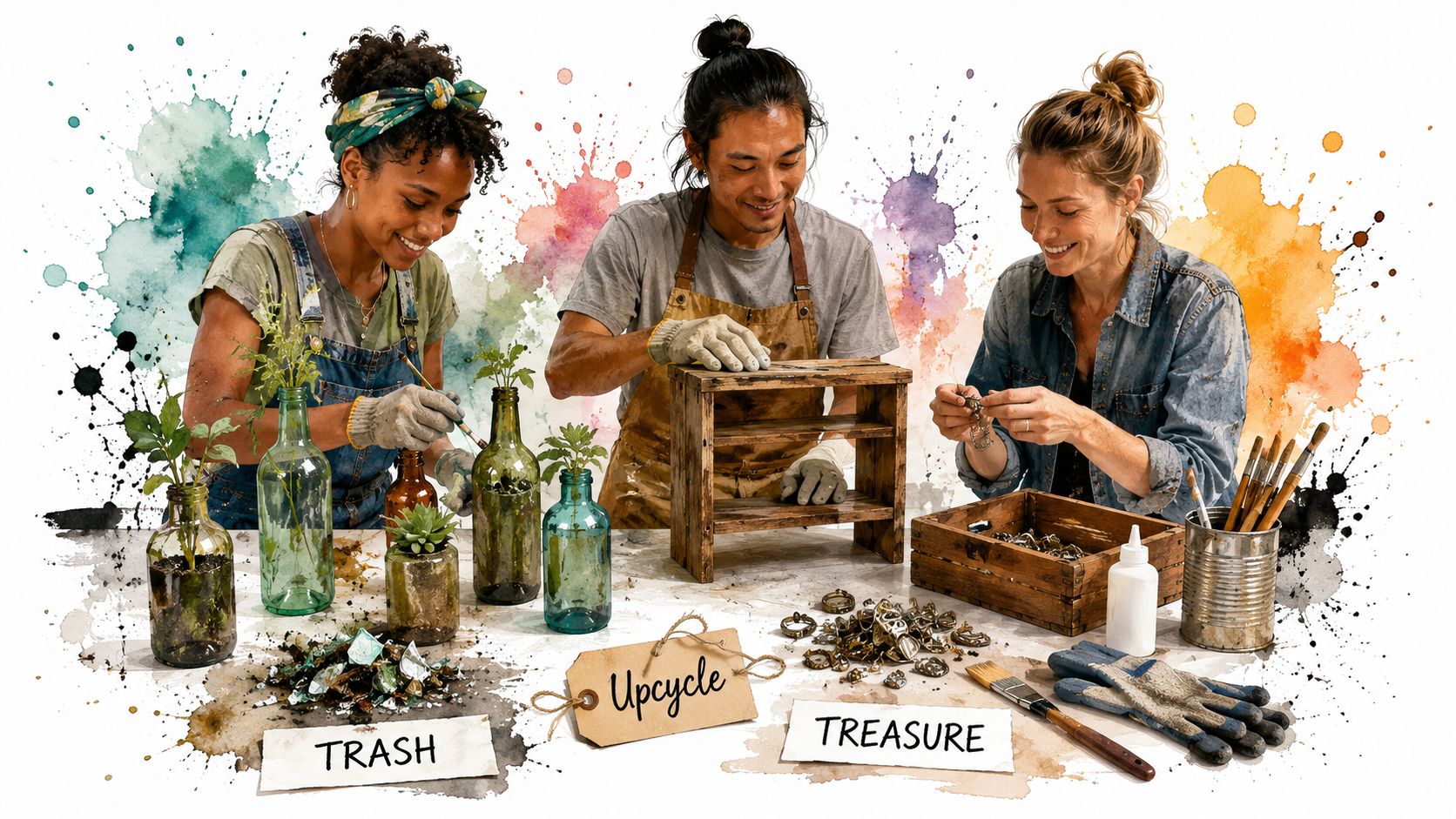
    A diverse team works together on a creative upcycling project, turning old materials into beautiful handmade treasures.

    Let the objects decide the project

    One team might build a small book-sharing box from reclaimed wood. Another might create a wall piece for a nonprofit office. The best result doesn't need to look perfect. It needs to show how people divided tasks, solved problems, changed plans, and finished something together.

    Keep the cleanup portion accessible by assigning walking, sorting, photography, carrying, and workshop roles. A compact group can use one studio table. A larger group should create stations, with one person managing safety at each station. Your main costs may include workshop space, tools, materials, transport, and disposal.

    Safety first: Treat every found object as unknown until someone checks it. Skip sealed containers, medical waste, needles, damaged electronics, and anything with chemical residue.

    Use a morning hunt, a midday meal, and an afternoon workshop. Close with a small exhibit of the finished pieces. Teams remember the moment someone holds up a rough object and says, “We can make something from this.”

    3. All-Weather Endurance Cleanups

    Rain taps the park shelter. Gloves cling to cold fingers. Someone suggests canceling, then another teammate points toward the first bag and starts walking. The weather becomes part of the story when your group prepares well and chooses safe limits.

    Litter Caterpillars describes a three-year track record of weekly pickups in all conditions, including blizzards and heat, through its own organization story. You can borrow the spirit without copying the risk. Weekend mornings work well for teams that want a consistent habit, while weekday groups can choose a shorter service window before work.

    Build toughness without ignoring safety

    Give volunteers clear gear guidance. Ask people to bring layers, water, sun protection, sturdy shoes, and gloves suited to the conditions. Plan warm-up locations for winter work, and prepare an indoor discussion, sorting session, or planning meeting for dangerous weather. Lightning, unsafe heat, flooding, and severe cold should end the outdoor portion.

    Chicago summer weekends can feel very different by hour. Daytime highs typically sit in the high 70s to high 80s Fahrenheit from mid-June through mid-September, and heatwaves can move past 90°F, while mornings often begin in the mid-60s to low 70s Fahrenheit, according to Offsite's Chicago planning guide. Start early, carry water, provide shade breaks, and shorten the route when the pavement starts radiating heat.
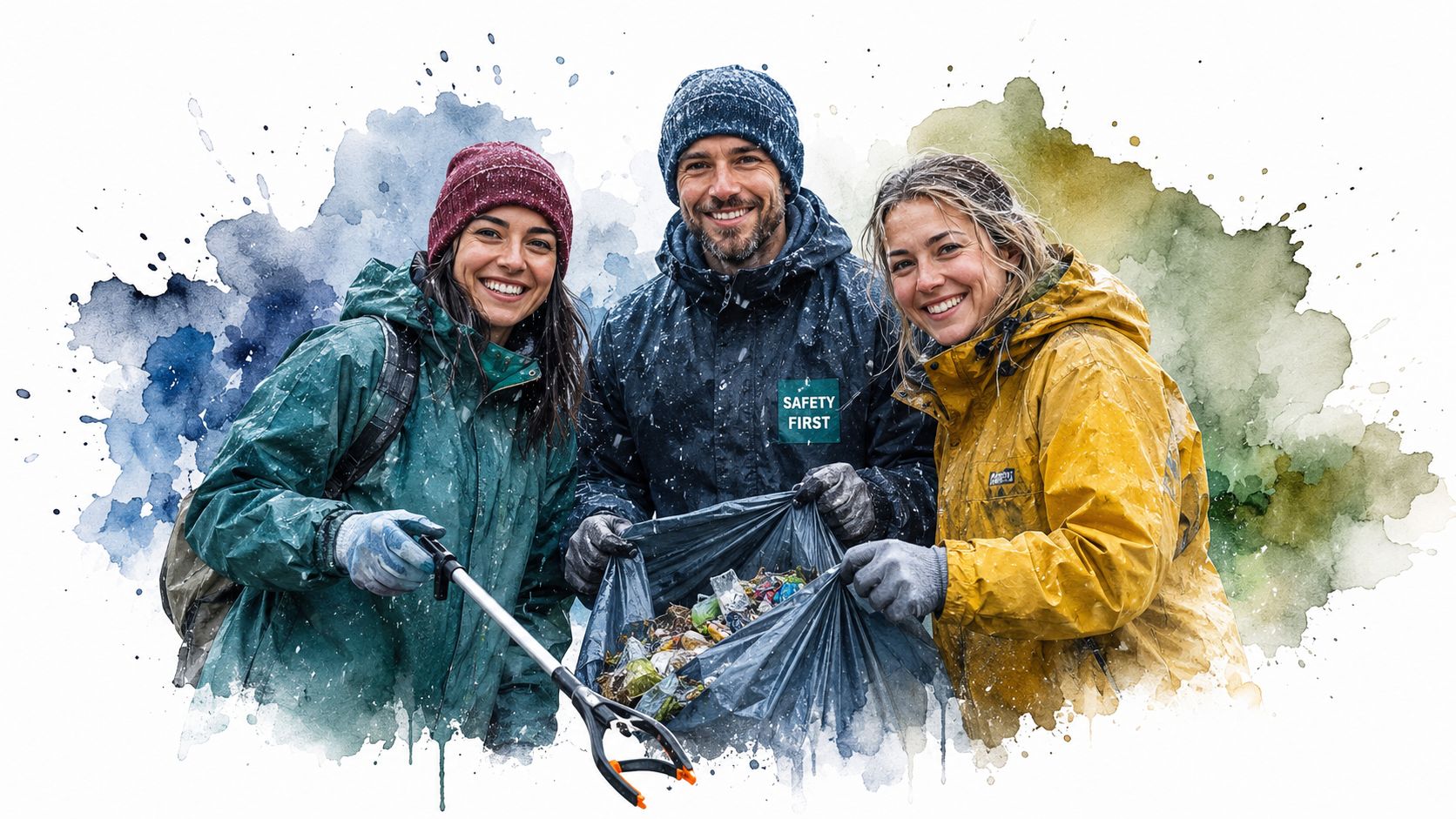
    Three smiling volunteers in rain gear working together to clean up litter in a public park.

    A small, committed team can build a strong rhythm with little spending. A large company needs more supervisors, supplies, rest points, and a firm emergency plan. Celebrate attendance, brave weather choices, and thoughtful decisions. The win is showing up prepared, then knowing when to stop.

    4. Adopt-a-Block Program with Recurring Ownership

    A single cleanup gives you a snapshot. A recurring block gives you a relationship.

    Choose one street, alley, plaza, or park edge that matters to your team. Return monthly or quarterly. The first visit may feel messy and slow. Later, your crew recognizes the problem spots, greets neighbors, and notices changes that a one-day group would miss.

    Litter Caterpillars points to the transformation of an Englewood lot into Caterpillar Park, a project that gives volunteers a shared place to care for over time. A block club can maintain its own street, and a company can adopt a park or plaza with local partners. Keep the promise manageable. A small team that returns regularly can do more than a large team that disappears after one event.

    Give the block a memory

    Invite neighbors to join. Ask nearby businesses about supplies, storage, or a place to meet. Take photos from similar angles during each visit, and record short notes about what changed. When your group reaches a chosen milestone, hold a simple gathering with food and stories.

    Accessibility needs attention from the first visit. Walk the route, check surfaces, identify seating, and provide roles for people who can't bend, lift, or walk far. Keep tools matched to the task. Separate traffic areas from work zones, and arrange disposal before volunteers arrive.

    This format works for teams that want a habit rather than a single morale event. Cost depends on equipment, transport, disposal, and any improvements you add. Start with cleanup. Let the larger project earn its way into the calendar.

    5. Themed Cleanup Days with Costumes, Celebration, Photo Documentary and Social Campaign

    Flags snap in the wind. A theme song starts from a phone speaker. Someone pins on a badge, and a routine pickup suddenly feels like a team tradition.

    Litter Caterpillars uses flags, a theme song, and badges to give volunteers a shared identity. Your team can create its own version with superhero capes, neighborhood colors, movie-inspired clues, or a theme chosen by vote. Keep costumes practical. A cape that catches on branches isn't worth a funny photo.

    Turn the morning into a small production

    Assign one or two people to document the event. Ask permission before sharing volunteer photos, especially when you post on Instagram, Meetup, or an internal company channel. Capture the empty route, the first bag, the group at work, unusual discoveries, and the final view. A before-and-after pair often tells the story better than a long caption.

    Make the theme repeatable. A monthly “superhero Saturday” or a rotating neighborhood color gives people something to anticipate. Create simple badges for first cleanup, route captain, safe sorting, new volunteer welcome, or perfect attendance. Let people earn recognition through helpful actions, not only through speed.

    A themed day can suit small teams in one park or large groups spread across several zones. Your main expenses may include badges, printing, music, costumes, food, and photography. Keep a quiet role available for people who dislike costumes or cameras. Someone can manage supplies, map routes, or document the day.

    Close with a meal and a short photo review. The group should leave with a cleaner place and a shared visual record of how it got there.

    6. Cleanup Skills Workshop and Training Series

    Before the bags come out, a local naturalist explains why one patch of weeds attracts more litter than another. A waste professional demonstrates sorting. An experienced volunteer shows a newcomer how to use a grabber without twisting a shoulder.

    A short workshop gives people confidence before they enter the route. Teach safe handling, sorting, recycling, first aid, local ecology, neighborhood history, traffic awareness, or safe responses to hazardous items. Keep each lesson practical and brief. The plan calls for 30 to 45 minutes maximum before hands-on work.

    Pair every lesson with practice

    A Chicago ecology session can lead into a park cleanup. A sorting lesson can lead into a station where teams separate materials. A safety session can lead into a route walk that identifies traffic boundaries and meeting points. Rotate instructors so your team develops more than cleanup muscle.

    You can build a simple progression with badges or certificates. Record sessions for people who miss them, and keep written instructions with the supplies. For a coordinator-focused version, use Litter Caterpillars' volunteer coordinator training as a planning reference.

    Accessibility improves when you provide seated learning, printed instructions, captions for recordings, and multiple work roles. A workshop also gives people an indoor backup when weather changes. Costs may include instructor time, room rental, training materials, first-aid supplies, and transportation.

    Finish with a real task. People retain a skill more easily when they use it immediately, then explain it to someone else.

    7. Community Partnership and Block Leader Network

    One cleanup crew can cover one route. A network can let neighbors lead where they already live.

    Start with block club presidents, community leaders, faith communities, neighborhood organizers, or trusted employees. Give each person a simple playbook, basic supplies, safety rules, and room to adapt the event. Litter Caterpillars describes distributed leadership across all 50 wards, a model that shows how separate neighborhood crews can connect under one shared identity.

    Give leaders tools and freedom

    Begin with three to five people you know and trust, as the planning model suggests. Meet monthly, trade stories, solve supply problems, and let leaders run their own style of cleanup. A private group chat can answer quick questions, welcome new volunteers, and keep people from planning alone.

    Supply kits might include bags, gloves, grabbers, route maps, badges, and emergency contacts. A company can train employees as neighborhood ambassadors. A faith community can ask its leaders to coordinate local squads. A block club can set its own meeting point and pace.

    Group size changes the work. One leader can guide a compact crew on a familiar route. Larger events need zone leads, check-in support, clear boundaries, and a central contact. Cost grows with supplies, printing, transportation, storage, and coordinator time, so set expectations before launch.

    Give leaders public thanks, but don't turn recognition into pressure. Some people want responsibility for a season, then need to step back. A healthy network makes room for that change. The best leader leaves a route organized enough for someone else to continue.

    8. Sustainability Challenge and Waste Reduction Goal Setting

    A poster goes up in the break room. Every cleanup adds a mark. The team watches the route fill in, then argues cheerfully about whether the next goal should focus on blocks, plastic, or total litter removed.

    Set a shared target that people can understand. Your group might choose a litter weight goal, a number of blocks, a plastic-removal aim, or a company waste-reduction project. The plan can include a target of 1,000 pounds of litter in a quarter, though you should choose a figure that matches your route, equipment, disposal access, and volunteer capacity.

    Measure what people can see

    Track progress on a poster, shared document, or digital dashboard. Break the larger aim into weekly or monthly steps. Celebrate each milestone, even when the team misses the final target. If a route produces less litter than expected, shift the goal toward coverage, sorting quality, or neighborhood participation.

    Don't let one number decide whether the day mattered. A crew may collect less material because another group cleaned the area earlier. A mobility-friendly route may cover less ground while bringing more people into the activity. Set goals around neighborhood needs, then use data to adjust the plan.

    Costs vary by the tool you use, printing, supplies, disposal, and any measuring equipment. Small teams can use a paper chart. Larger companies may want a coordinator who checks entries and posts updates.

    End each event with a quick review. Ask what worked, what slowed the group down, and what the next route needs. The dashboard should guide decisions, not turn volunteers into a scoreboard.

    9. Cross-Neighborhood Team Exchanges and Rotation Events

    A volunteer who usually works near home steps off the train in another neighborhood. A local block leader explains the route. New teammates pair up, trade questions, and discover that every area has its own patterns, stories, and problem spots.

    Use exchanges to move people through different Chicago zones. Litter Caterpillars describes work across all 50 wards, which gives teams a citywide model for pairing neighborhoods and connecting volunteers. You can arrange a smaller exchange between two block clubs, or create a citywide day where each group represents its own area.

    Choose meeting points carefully. Provide written directions, transit notes, a phone contact, and a visible check-in location. CTA has a dedicated Group Sales contact at 1-888-YOUR-CTA (968-7282), extension 12742, available weekdays from 8:30 a.m. to 4:30 p.m., according to CTA's group travel information. Contact the agency rather than guessing about fare arrangements for a larger outing.

    Make transit part of the team day

    Mix experienced volunteers with newcomers. Pair neighborhoods that can teach each other something. Keep the cleanup route manageable, then share food and stories afterward. A field-trip feeling helps people approach the day with curiosity.

    Metra's group policy applies discounted travel to groups of 25 to 135 paying riders traveling together, with arrangements made at least 21 days before travel. Full payment falls due at least 14 days before travel, and discounted travel windows include weekdays from 9 a.m. to 3 p.m., after 7 p.m., plus weekends and certain holidays, according to Metra group-travel details. Confirm current terms before booking.

    Transit access, walking distance, rest points, and weather backup matter more than a clever route. End with a photo that mixes neighborhoods, then ask each person what surprised them.

    10. Mentorship Ladder and Leadership Development Track

    A newcomer arrives unsure how to start. An experienced volunteer pairs with them, explains the tools, and checks in after the first route. Later, that newcomer leads a squad, trains another person, and takes responsibility for a block.

    Create a clear path from participant to Volunteer, Squad Lead, Mentor, and Block Leader. Give each stage a name, simple criteria, training, and recognition. Litter Caterpillars' volunteer mentor programs provide a Chicago-specific reference for building that kind of progression.

    Make advancement supportive

    Define what each role includes. A squad lead may welcome people, explain the route, and check supplies. A mentor may train newcomers and answer questions. A block leader may coordinate with neighbors and set recurring dates. Use attendance, skills, reliability, and contribution as guideposts, not as a rigid test.
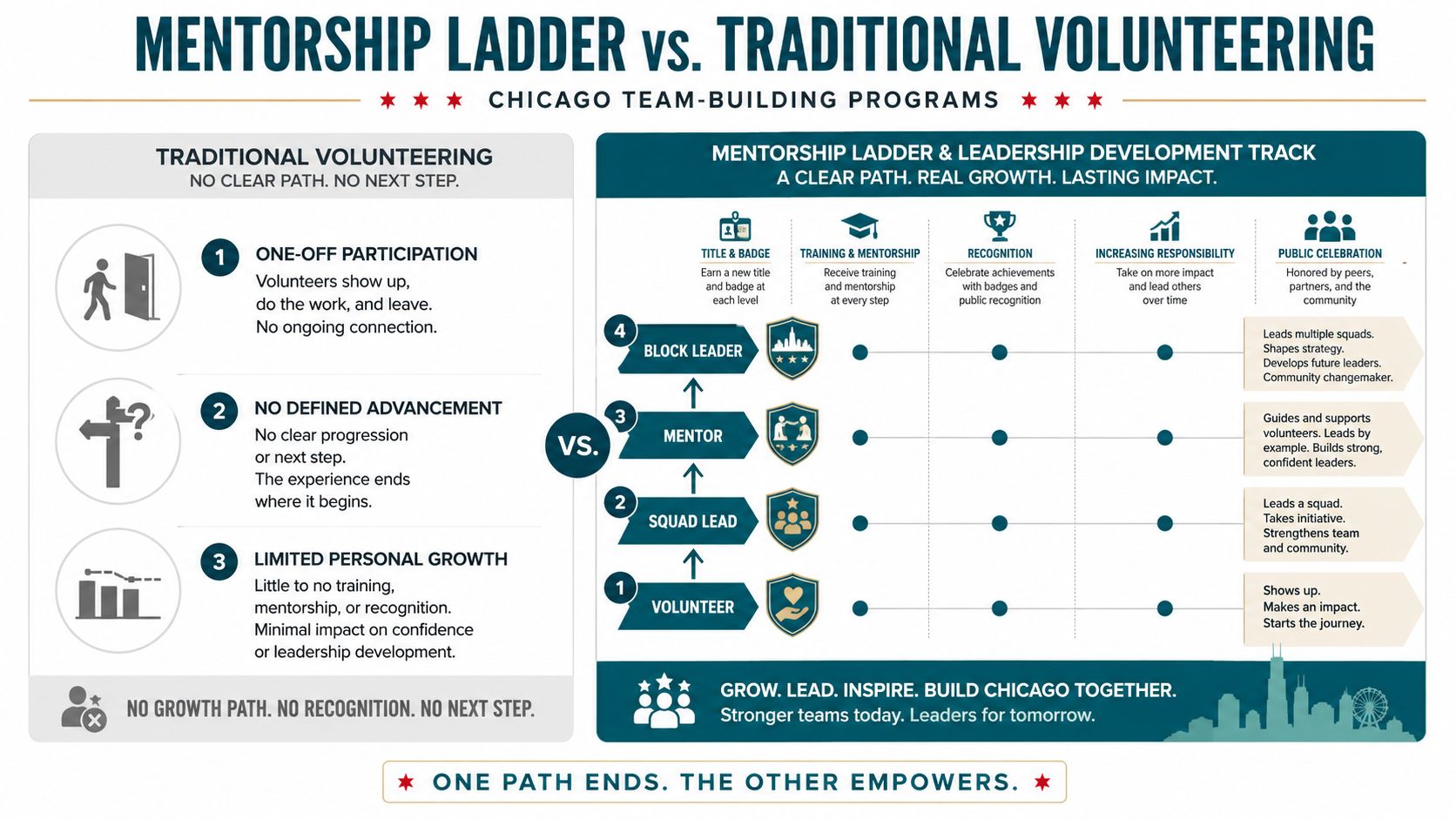
    A comparison chart showing the difference between traditional volunteering and a structured mentorship ladder for team building.

    Pair people one-on-one, celebrate advancement in person or online, and train every new lead before handing over a route. Rotate roles so volunteers can test different responsibilities. Let someone step back without embarrassment when work, family, health, or energy changes.

    A small organization can use a handwritten progression card. A company can connect the track to leadership development, service hours, or employee resource groups. Costs may include training time, badges, supplies, transport, and coordinator support.

    This idea works indoors and outdoors. Hold a planning session inside, then practice on a safe route. End with a conversation between mentors and newcomers about what felt easy, what felt strange, and what they want to try next.

    10 Chicago Cleanup Team-Building Ideas Compared

    Approach 🔄 Implementation complexity ⚡ Resource requirements & efficiency 📊 Expected outcomes (⭐ quality) Ideal use cases 💡 Key tips
    Neighborhood Cleanup Challenges with Friendly Competition 🔄 Medium, zone coord. and score tracking ⚡ Low–Medium, basic supplies, simple scorecards; quick setup 📊 Visible, measurable local impact; ⭐⭐⭐ Teams seeking fun competition and ward coverage 💡 Assign zones by interest, use scorecards, rotate zones
    Trash Treasure Hunt and Upcycling Workshop 🔄 Medium–High, salvage sorting + workshop logistics ⚡ Medium, workshop space, tools; low material cost (found items) 📊 Waste diversion + memorable artifacts; ⭐⭐⭐⭐ Creative groups, education, events that combine cleanup + craft 💡 Scout sites, partner with makers, set safety rules
    All-Weather Endurance Cleanups 🔄 High, safety protocols & leadership needed ⚡ Medium, quality gear required; slower in extreme weather 📊 Builds resilience, trust, strong retention; ⭐⭐⭐ Groups aiming to form a committed core and strong culture 💡 Provide gear, warm-up/heat breaks, indoor contingencies
    Adopt-a-Block Program with Recurring Ownership 🔄 Medium, scheduling and long-term coordination ⚡ Low–Medium, recurring supplies; logistics simplify over time 📊 Deep neighborhood trust and compound improvements; ⭐⭐⭐⭐ Long-term community transformation and partnership building 💡 Start with a meaningful block, invite neighbors, document progress
    Themed Cleanup Days with Costumes & Social Campaign 🔄 Medium, event planning, media coordination ⚡ Medium, costumes/props and photo coverage; high visibility per event 📊 High recruitment and social reach; memorable identity; ⭐⭐⭐ Recruiting, awareness campaigns, volunteer engagement boosts 💡 Let team pick themes, assign documenters, ask photo permissions
    Cleanup Skills Workshop and Training Series 🔄 Medium, instructor sourcing and curriculum ⚡ Medium, indoor space, materials; slower but builds capacity 📊 Increased competence, safety, and retention; ⭐⭐⭐⭐ Training volunteers, building leadership and safety standards 💡 Keep sessions short, follow with hands-on practice, record sessions
    Community Partnership & Block Leader Network 🔄 High, training infrastructure and coordination ⚡ Medium, starter kits and comms systems; highly scalable 📊 Multiplies impact citywide; sustainable local leadership; ⭐⭐⭐⭐ Scaling across neighborhoods, building distributed leadership 💡 Start with trusted leaders, provide playbook and supplies, meet monthly
    Sustainability Challenge & Waste Reduction Goal Setting 🔄 Medium, goal-setting and tracking systems ⚡ Low–Medium, dashboards and measurement tools; motivates action 📊 Measurable environmental impact and team focus; ⭐⭐⭐⭐ Goal-oriented teams, corporate sustainability programs 💡 Set team-created achievable goals, track visually, break into milestones
    Cross-Neighborhood Team Exchanges & Rotations 🔄 Medium, transport and cross-group coordination ⚡ Medium, transport logistics and scheduling; energizing but time-consuming 📊 Builds citywide solidarity and learning; ⭐⭐⭐ Building cross-community ties and shared understanding 💡 Partner with block leaders, mix experienced/new volunteers, debrief with social time
    Mentorship Ladder & Leadership Development Track 🔄 High, mentorship systems, criteria, training ⚡ Medium, time and training resources; high long-term ROI 📊 Strong retention and leadership pipeline; ⭐⭐⭐⭐ Long-term organizational growth and volunteer advancement 💡 Define clear criteria, mentor one-on-one, celebrate advancement, rotate roles

    Turn One Team Day Into a Habit

    Choose the idea by asking what your team can sustain, not what looks most exciting in a planning deck.

    A small group with limited funds can start with a neighborhood cleanup, a themed route, or a skills workshop. A larger company may need zones, team leads, transit coordination, and a disposal plan. Habitat Chicago's corporate builds can require a $5,000 sponsorship for 10 people, scaling at $500 per person, while other group programs work around 30-person construction-site capacity or 80-plus-person warehouse formats, according to Habitat Chicago's corporate group inquiry. Ask about minimum commitments before you promise a service day to your team.

    Your budget also depends on what you already have. Gloves, bags, grabbers, transport, food, workshop space, badges, photography, and disposal can all change the estimate. Write down the cost of supplies and coordination separately. A low-spend event still needs a clear owner.

    Season changes the plan. Chicago summer mornings can feel easier than midday heat, while rain, snow, and cold require layers, warm-up space, and a decision point for cancellation. Choose indoor training, upcycling, trivia, cooking, or planning when outdoor conditions become unsafe. For outdoor scavenger hunts and group missions, locations including Millennium Park, the Chicago Riverwalk, Grant Park, Navy Pier, and Lincoln Park can give you ready-made backdrops, according to Adventure Games' Chicago location guide.

    Mobility needs should shape the route before anyone arrives. Check surfaces, stairs, crossings, seating, restrooms, transit access, and the distance between meeting points. Offer roles that involve sorting, welcoming, documenting, mapping, teaching, or coordinating. People can contribute without walking the longest route or lifting the heaviest bag.

    Use this simple first step:

    • Pick a date: Choose a morning that gives people enough notice and leaves room for a weather decision.
    • Name a leader: Give one person authority over the route, supplies, safety, and final call.
    • Confirm materials: Check gloves, bags, grabbers, water, first aid, disposal, directions, and contact numbers.
    • Set safety rules: Explain traffic boundaries, hazardous items, buddy systems, heat breaks, and when volunteers should stop.
    • Create a backup: Prepare an indoor workshop, planning session, meal, or rescheduled date before the forecast turns.
    • Leave time to talk: Share food, compare discoveries, thank people, and ask what the team should repeat.

    The best first event may feel simple. A team meets, works, laughs, gets tired, and looks back at a cleaner route. Then someone asks when you're doing it again.

    For a ready-made Chicago service experience, explore Litter Caterpillars. The volunteer-driven group holds weekly trash pickups across Chicago, works in all 50 wards, schedules events on weekend mornings, and builds connection through shared service, flags, theme songs, badges, and open group communication. Its story includes difficult weather, neighborhood cleanup, friendship, and the transformation of an Englewood lot into Caterpillar Park.

    Choose the idea that fits your people today. Then give it a date, a leader, a safe route, and a reason to return. Your teammates may forget the score, but they'll remember the block they cleaned, the stranger they met, the storm they handled, and the story they carried home.


    Litter Caterpillars gives Chicago teams a way to join weekly trash pickups, meet other volunteers, and build a service habit across neighborhoods. Visit Litter Caterpillars to choose an upcoming event or explore a group cleanup that can give your team a shared story.
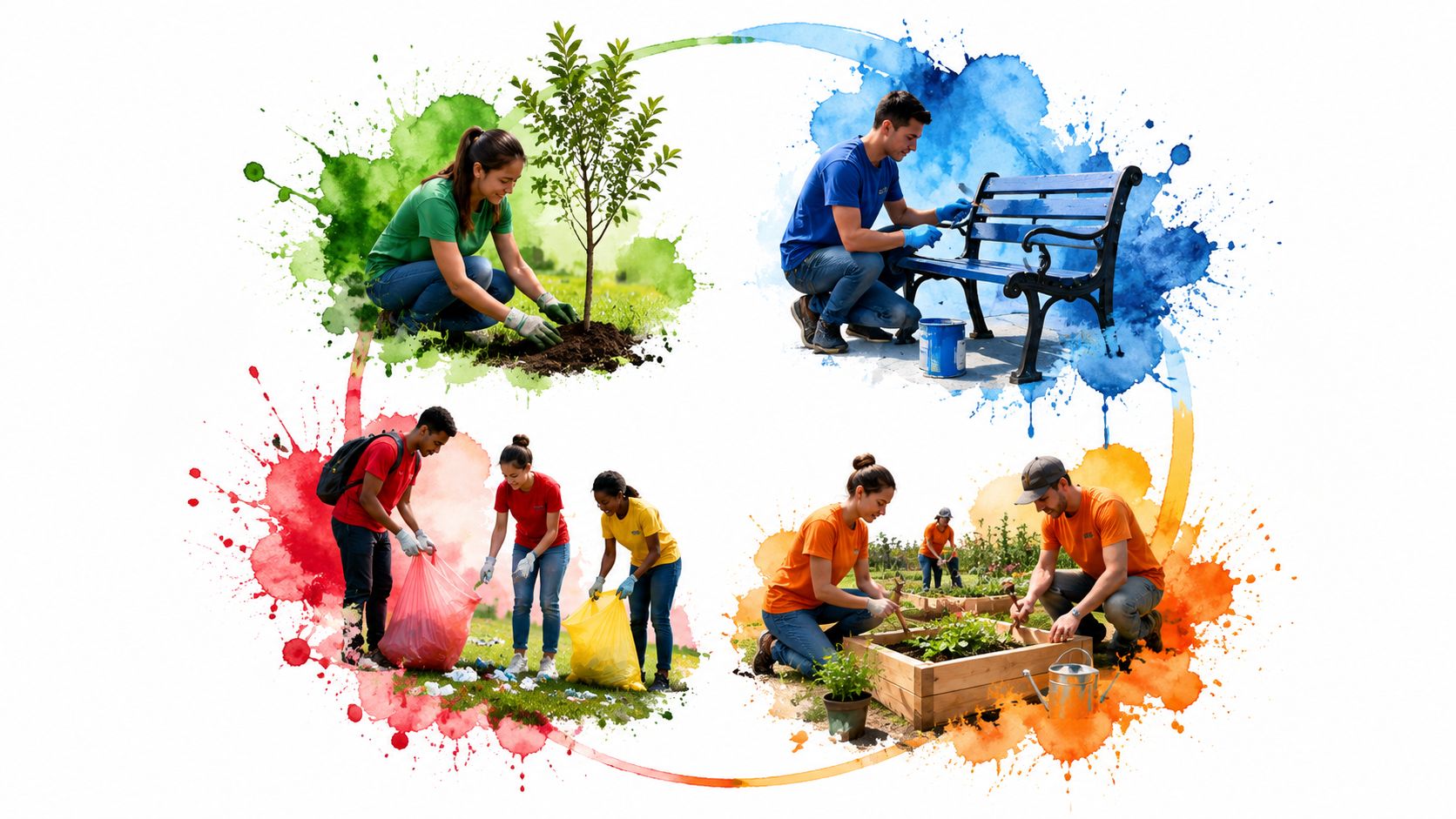
  • 10 Group Service Project Ideas to Transform Your City

    10 Group Service Project Ideas to Transform Your City

    I started Litter Caterpillars when my own life felt impossible to clean. My apartment had turned into a museum of stuck memories. An old jar of jam from a trip years earlier, a bag of nuts from a health kick I never kept, and all of it felt like it weighed 500 pounds even though it barely weighed anything.

    After a chaotic relationship ended, I hit a wall. I decided I had to train three muscles I'd avoided for years: cleanliness, consistency, and bravery. I also decided I wanted a social circle made of givers, not takers.

    Then I learned something funny. Cleaning up someone else's mess is way easier than cleaning up your own, and somehow it's more fun too. On our first cleanup, there were only three of us, and we got trapped in a spring hailstorm, hiding under a tree while rides kept canceling. I remember shivering and thinking, this is awful, and also, this is a great story.

    That's still how I think about service. Hardship adds flavor. It advances the plot. You show up, do something simple with other people, and suddenly your Saturday has meaning. You stop circling your own problems for a minute. You move your body. You laugh. You help.

    If you're looking for group service project ideas, I don't want to hand you a sterile list. I want to give you ideas that feel alive. Ideas you can start with friends, coworkers, classmates, or neighbors. Ideas that can grow into ritual, pride, and real community. These are the kinds of projects that taught me how to build something outside myself, and in the process, rebuild myself too.

    1. Neighborhood Cleanup Blitzes with Geographic Rotation

    For instant clarity in a project, I would begin here. Pick one neighborhood this week. Pick a different one next week. Keep rotating.

    That rhythm kept me interested because every area had its own personality. One block had fast-food wrappers everywhere. Another had dumped furniture. Another looked clean at first until you checked the curbs, alleys, and fence lines. Rotating keeps your eyes fresh, and it keeps the city from feeling like a blur.

    A cleanup format like this also fits a model people already understand. Key Club International says its members give more than 13.5 million hours of service each year, and its own project ideas include recurring group formats like park cleanups, roadway adoption, tutoring, drives, and car washes in its service project flyer.

    How I'd run it

    Weekend mornings work. People are calmer, more generous, and less distracted. Post the location in advance, keep the meeting point simple, and give everyone a small zone so nobody wanders around confused.

    If you want a real example of what that looks like, our Chicago litter cleanup events follow that basic logic. You don't need a giant operation to copy the pattern. You need consistency more than complexity.

    Practical rule: Give every event a clear start point, a clear route, and a clear ending photo.

    A few things make this stick:

    • Use a map people can follow: Mark where you've already cleaned so volunteers can feel progress.
    • Keep supplies boring and reliable: Gloves, bags, grabbers, water, done.
    • Name the day clearly: “West Side Sweep” is easier to remember than “Saturday volunteer event.”
    • Celebrate small wins: Finishing one block well beats vaguely “helping the city.”

    The best part is the visible before-and-after. People love seeing the proof. You can talk about service all day, but a clean sidewalk speaks faster.

    2. Vacant Lot Transformation Projects

    A vacant lot hits different. A sidewalk cleanup feels like a haircut. A lot transformation feels like surgery.

    I've stood in neglected spaces where the grass was wild, trash was tangled into the weeds, and the whole place felt like the city had given up on it. Then a few people show up with gloves, shovels, and stubbornness, and the story starts to change.

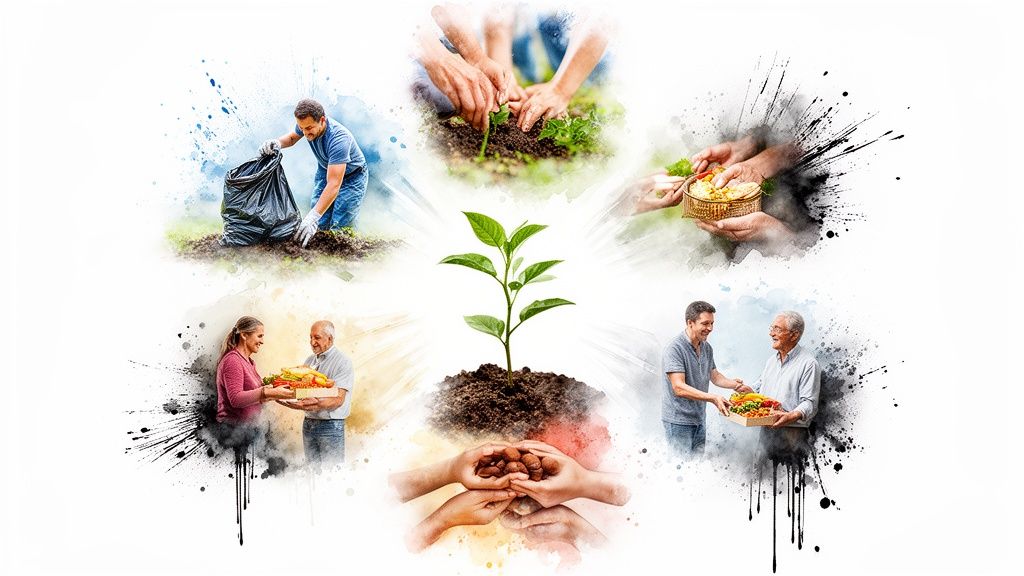
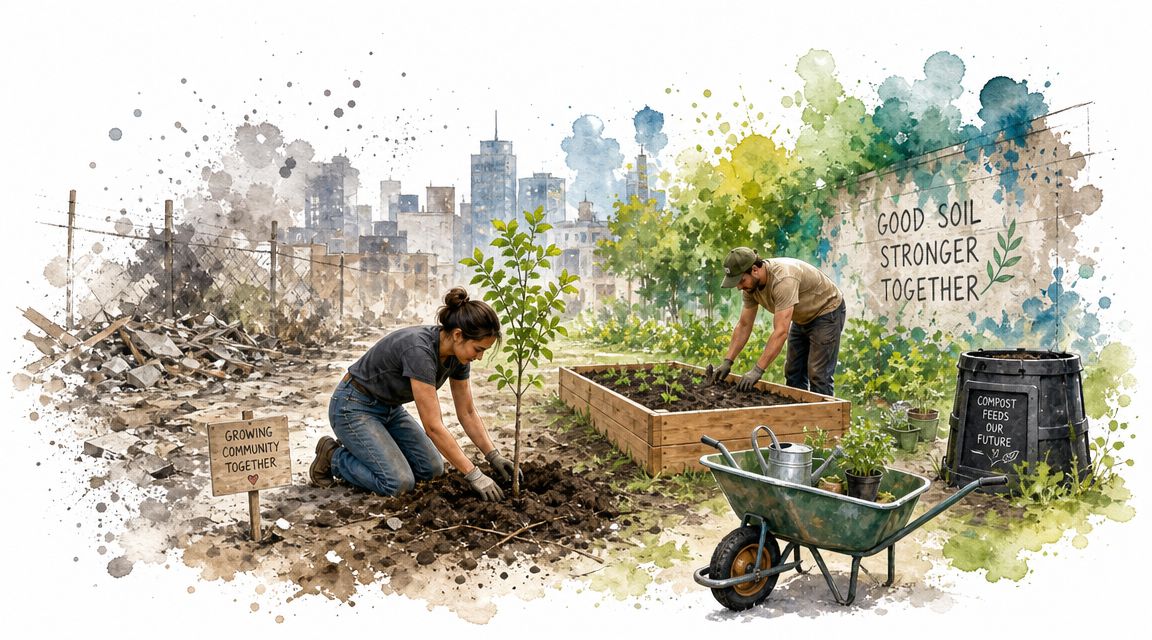
    A diverse group of volunteers planting a tree and gardening in an urban community vegetable garden.

    That's why this is one of my favorite group service project ideas. It asks more from you, but it gives more back. People don't just bag trash and leave. They imagine. They argue. They make plans. They come back.

    Start with the ugly stage

    The desire often is to skip to the garden sketch. Don't. First, learn to love the ugly stage. Take photos. Walk the perimeter. Ask neighbors what they want there. One person wants flowers. Another wants seating. Another wants a place where kids won't step on broken glass.

    That early listening matters. If you want a volunteer group to keep showing up, they need to feel that the place belongs to them.

    My own experience with lot work is part of why I think this way. If you want to see how a rough space can become something else, our story about transforming a vacant lot into Caterpillar Park gives the flavor of that journey.

    A simple phase plan helps:

    • Clear first: Remove litter, sharp debris, and obvious hazards.
    • Define edges: Paths, borders, or simple zones make a space feel intentional fast.
    • Add one visible living thing: A tree, flowers, or raised beds tell people this place has a future.

    Later, when the work starts to feel real, I like to show people examples of what steady outdoor labor can lead to.

    A vacant lot project is slower than a cleanup blitz. Good. Slow projects teach loyalty.

    3. Corporate-Community Partnership Cleanup Days

    I used to be suspicious of corporate volunteer days. Sometimes they feel too polished, like everyone showed up for a photo and a branded T-shirt. But I changed my mind when I saw what happens if you set the culture first.

    A business team can bring serious energy. You get people who might never join a neighborhood cleanup on their own, but once they're there, sweating and laughing and filling bags, a few of them catch the bug. Some come back without their company. That's when you know it was real.

    Keep the community in charge

    The biggest mistake is letting the company become the star. The block is the star. The residents are the star. The cleanup is the star.

    So I'd keep the structure simple. Give the company a defined task, a short briefing on how your group works, and a way to plug into the same rules as everyone else. If they want to help, great. They don't need to reinvent your process.

    If you want a practical model for that kind of collaboration, our page on corporate social responsibility cleanup partnerships shows the kind of local fit I like.

    The best company volunteer day feels less like a marketing activation and more like a neighbor showing up with extra hands.

    Try a few guardrails:

    • Set expectations early: Tell them what to wear, what the work is, and what respect looks like.
    • Choose visible routes: A park edge, business corridor, or commuter path gives quick proof of effort.
    • End with conversation: Don't let people scatter the second the bags are tied. Let them meet residents or regular volunteers.

    This kind of project works because it lowers the barrier for busy people. Someone says yes to one work-sponsored cleanup, then maybe yes to a second one on their own time. That's how a one-day event can turn into a habit.

    4. Environmental Education and Youth Engagement Programs

    Young people don't need another lecture about caring for the planet. They need gloves, a bag, a weird story, and a reason to feel proud.

    I've watched students show up shy and detached, then completely change once the task becomes concrete. Hand them a grabber and tell them, “Your team has this stretch of fence line.” Suddenly they're scanning the ground like detectives.

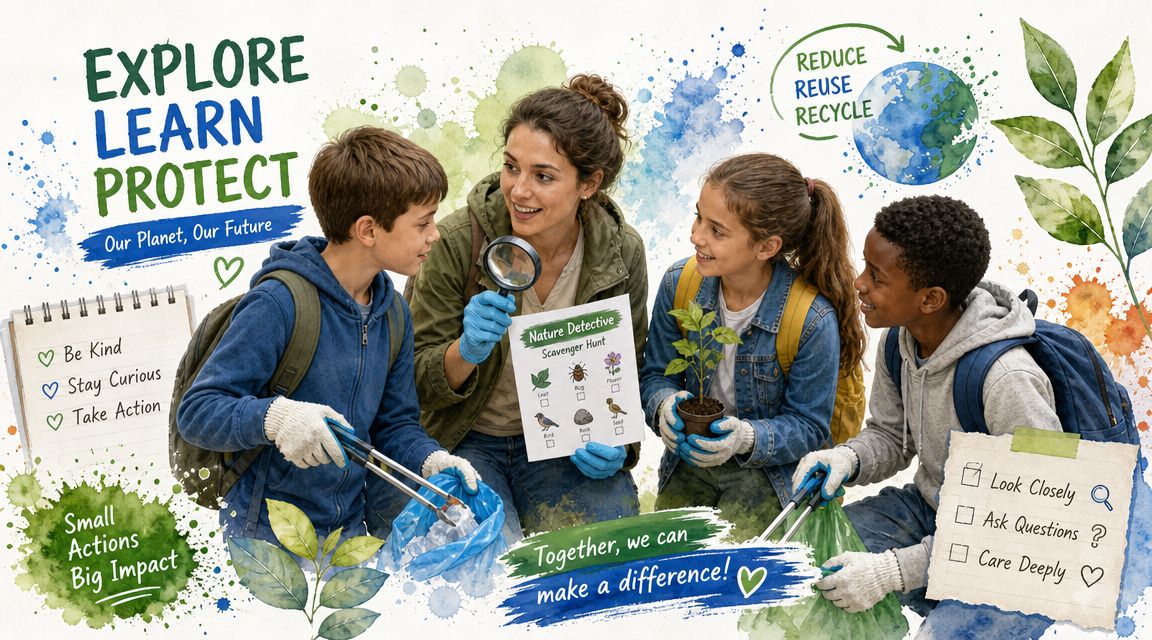
    A diverse group of children and a teacher participating in an outdoor nature cleanup service project.

    That's why youth programs work best when the education rides inside the action. Talk for a minute, work for an hour, reflect for ten minutes. Kids remember the dead batteries they found in the grass more than they remember a slideshow.

    Give them a ladder to climb

    A lot of youth volunteering feels flat. You show up once, get a service form signed, and disappear. I think that's a waste.

    Build a small ladder instead. First cleanup. Then team helper. Then route leader. Then the person who welcomes new students. People stay when they can grow.

    Rosterfy's roundup of community service project ideas for groups lists 99 ideas, and many of the repeat categories are the same ones that work well with young volunteers, including school supply collection, park cleanups, food drives, elder support, and thank-you card projects. I take that as proof that simple, team-based projects travel well.

    A youth service day gets stronger when you add a few pieces:

    • Give service-hour documentation: Students care about that, and that's fine.
    • Pair teens with adults who respect them: Nobody likes being talked down to.
    • Use group identity: A badge, a color, a team name, a chant. It sounds silly until it works.

    When a student starts saying “our block” or “our park,” something has clicked. That's the moment I look for.

    5. Themed Seasonal Cleanup Events with Community Celebration

    Some people join for the cause. Some join because their friend invited them. A lot of people join because the event sounds fun.

    I learned early that service needs some theater. Not fake theater. Human theater. A flag. A playlist. Matching shirts. A goofy tradition. Something that tells people, “You're part of this now.”

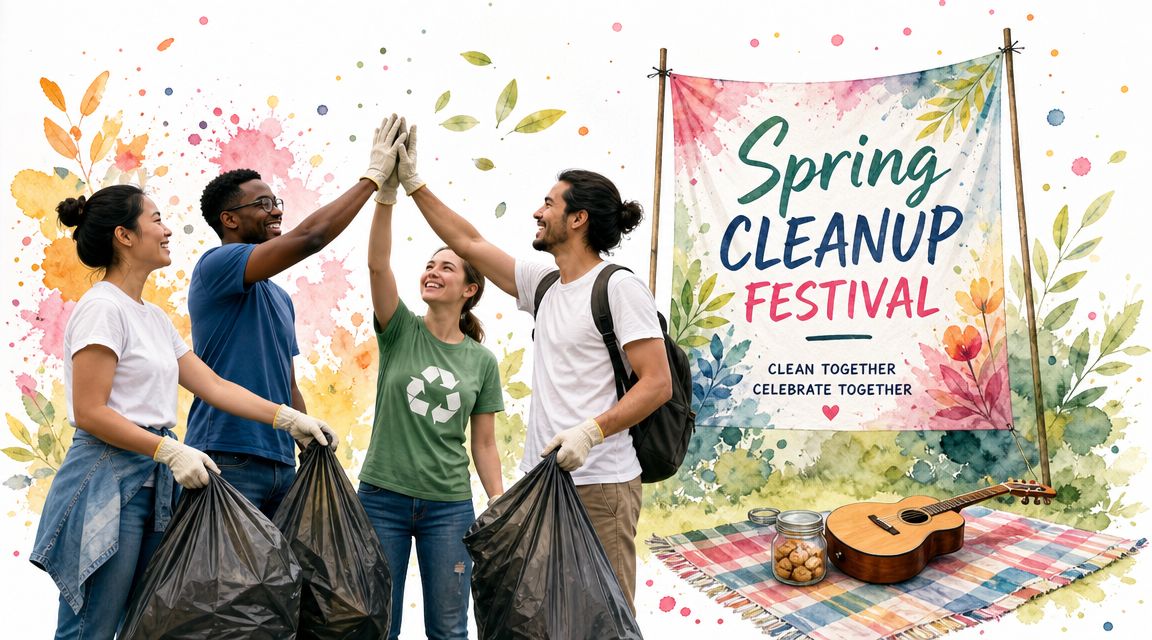
    A diverse group of volunteers celebrating after a community service spring cleaning event with trash bags.

    That's why seasonal events are so strong. Spring cleanup. Summer alley sweep. Fall neighborhood beautification day. Holiday donation and litter pickup combo. People like recurring rituals. They give the year shape.

    Make the hard work feel memorable

    Tom Sawyer understood something real. If you can frame hard work as a thing worth being proud of, people lean in. They stop acting like they're sacrificing. They start acting like they belong to a team.

    I'd build a seasonal event around one simple cleanup plus one social moment after. Maybe hot coffee before the route. Maybe music and snacks after. Maybe a group photo with a handmade sign and a ridiculous award for “strangest item found.”

    One thing I've noticed is that most lists of volunteer ideas stop at the activity itself. They don't say much about how to turn that activity into repeat participation. A group volunteer ideas article from Visions Service Adventures points to that gap by focusing on options more than retention. In real life, people come back for rhythm, identity, and friendship.

    One sentence test: If your event would still make sense without the cleanup, you've made a party. If it would still work without the people, you've made a chore. You need both.

    Try themes that fit the season and the neighborhood. Keep them light. Pride grows from repetition, not from grand speeches.

    6. Adopt-a-Neighborhood Program with Long-term Stewardship

    A rotating cleanup is great for exploration. An adopt-a-neighborhood setup is better for loyalty.

    When you return to the same area again and again, people start recognizing you. A store owner waves. A resident points out a dumping spot behind the alley. A kid asks if you're coming back next week. That changes the feeling of the work. You stop being random volunteers and start being familiar faces.

    Stay long enough to be known

    This kind of service is less exciting at first. It doesn't have the novelty of a new part of town every Saturday. But it has depth.

    If I were starting this from scratch, I'd assign small teams to a park, a corridor, or a few connected blocks. Let them learn the rhythm of the place. Which corner always collects windblown trash. Which bus stop needs attention. Which lot spills debris after storms.

    The nice thing about this model is that it matches patterns that keep showing up across service catalogs. Group project lists often circle back to neighborhood cleanups, food distribution, youth support, elder care, and advocacy because those are easy to repeat and easy to explain in a team setting. That repeatability matters more than novelty.

    You can strengthen stewardship with a few habits:

    • Name a neighborhood captain: One person who knows the route and says hello first.
    • Keep resident feedback informal: Short sidewalk conversations beat complicated surveys.
    • Track visible change by place: Before-and-after photos by block tell a story people remember.

    I love this format because it turns strangers into regulars. And regulars become the bones of your community.

    7. Innovative Technology and Documentation Tools

    Technology can help a volunteer group. It can also subtly kill one.

    I've seen people build systems so complicated that the project starts feeling like office work. Nobody wants to attend a cleanup that requires a training seminar just to sign a waiver and find the meeting point.

    Use tools that disappear into the background

    For volunteer groups, the best tech is almost invisible. A mobile sign-up page. A simple map. A reminder message. An easy place to post photos after the event.

    That matters because adoption problems often start with usability. In a BI and analytics benchmark, only about 25% of employees actively use analytics tools on average, and the barriers named most often were lack of proper training at 50%, lack of quality data at 41%, budget issues at 36%, and ease of use at 33% in BARC's adoption infographic. Different field, same lesson. If your tool is annoying, people stop using it.

    For a cleanup group, I'd keep the stack lean:

    • Use Meetup for event scheduling: People already know how to RSVP there.
    • Use Instagram for before-and-after storytelling: Visual proof recruits better than jargon.
    • Use Google My Maps for route planning: A volunteer should know where to stand within seconds.

    You do not need a dashboard that feels like an air traffic control room. You need a system your least technical volunteer can use while standing on a windy sidewalk.

    Documentation matters, but I'd always put the human layer first. A warm welcome does more for retention than a perfect app ever will.

    8. Skill-Building and Professional Development Workshops

    A lot of adults want to help, but they also want their time to shape them. I get that. Service can clean a block and still teach you something.

    That's why I like pairing practical workshops with hands-on events. After a cleanup, you can host a short session on community organizing, public speaking, environmental careers, safety basics, or even how to lead a volunteer team without sounding bossy.

    Let people leave stronger than they arrived

    The workshop doesn't need to feel corporate. In fact, please don't make it feel corporate. Keep it grounded in what the group does.

    If someone just spent the morning cleaning an alley, a short talk on route planning or community outreach suddenly matters. It isn't abstract anymore. It plugs into something they felt in their body.

    I'd keep the workshop cadence light. Quarterly is enough for most groups. Bring in a nonprofit organizer, a local gardener, a teacher, a city worker, or a volunteer who's grown into leadership.

    A strong workshop track might include:

    • Leadership basics: How to greet, guide, and encourage a group.
    • Neighborhood communication: How to talk with residents with respect and confidence.
    • Environmental pathways: Jobs and volunteer roles tied to parks, waste, or public space.

    This idea works well because it rewards commitment without turning volunteering into homework. A person comes for service and leaves with skills, confidence, and maybe a new direction.

    9. Accessibility and Inclusive Volunteer Pathways

    If your service project only works for athletic people with free weekends, cars, and endless energy, you've built a very small door.

    I care about this one a lot because group service gets better when more kinds of people can join. Some people can walk long routes. Some can sort supplies, take photos, check people in, translate, welcome newcomers, or manage snacks and water. That still counts. It all counts.

    Build more than one way to help

    The easiest mistake is assuming inclusion without designing for it. You have to say what the route is like. Is there seating? Is there parking nearby? How long will people stand? Is there a bathroom? Can someone join for just part of the event?

    When you answer those questions clearly, more people trust you enough to show up.

    I'd create multiple volunteer lanes from the start:

    • Low-mobility roles: Check-in table, photo documentation, sorting, data entry.
    • Short-shift roles: Thirty-minute or one-hour options for busy people.
    • Buddy roles: Pair first-timers with regulars so nobody feels lost.

    This kind of openness matters for culture too. When people feel welcomed for what they can do, not judged for what they can't do, they stay. They invite others. The group becomes less brittle and more human.

    A cleanup crew with mixed abilities can still run beautifully. Sometimes it runs better, because people communicate more and take care of each other.

    10. Restorative Justice and Community Healing Initiatives

    This one is the closest to my heart.

    I didn't start cleaning because I had some polished theory about civic engagement. I started because I was hurting and needed a way to move that pain through my body without drowning in it. Picking up litter gave me a simple job. See mess. Lift mess. Bag mess. Keep walking.

    That sequence calmed me down. It also gave me other people to stand beside.

    Let service hold the feelings without pretending to be therapy

    A group can become a place where people heal, but only if you're honest about what it is and what it isn't. A cleanup isn't therapy. It is a steady, practical act that can make room for connection, trust, and self-respect.

    That's why I like building in small rituals. A welcome circle. A quick safety talk. A moment after the route where people can share one thing they noticed. Those tiny repeated actions create safety.

    Some service catalogs keep the focus on the task itself. Bonterra's project library lists 63 community service ideas in its community service roundup, and that variety is useful, but the deeper challenge is cultural. How do you turn a one-time volunteer activity into a place where people feel known enough to come back?

    I think the answer is simple, even if it isn't easy:

    • Tell the truth: Say the work can be hard, awkward, and worth it.
    • Honor vulnerability: Let people be beginners.
    • Protect the group: Safety first, then joy, then growth.

    There's something comforting about fixing a visible problem with your hands while standing near other people who are trying too. That's more than cleanup. That's repair.

    10-Point Comparison of Group Service Project Ideas

    Initiative 🔄 Implementation Complexity ⚡ Resource Requirements & Speed 📊 Expected Outcomes 💡 Ideal Use Cases ⭐ Key Advantages
    Neighborhood Cleanup Blitzes with Geographic Rotation Moderate, weekly coordination and route planning Low–moderate (supplies, volunteer coordination; travel slows pace) Regular city-wide visible trash removal, broad coverage metrics City-wide equity efforts, short-time volunteers, consistent presence Ensures equitable coverage, predictable schedule, wide reach
    Vacant Lot Transformation Projects High, legal, remediation, phased development High (capital, specialists, permits, long-term maintenance) Permanent community assets, increased property values, lasting neighborhood change Long-term revitalization, grant-funded legacy projects Creates lasting impact, attracts investment, builds neighborhood pride
    Corporate-Community Partnership Cleanup Days Moderate, corporate contracts and scheduling Low (companies often fund supplies) but needs detailed coordination Large volunteer turnout, media exposure, measurable PR-ready metrics Team-building, corporate CSR, high-visibility campaigns Access to funding, equipment, and expanded volunteer pool
    Environmental Education and Youth Engagement Programs Moderate, curriculum design and school coordination Moderate (materials, staff time, supervision) Long-term behavior change, youth leadership pipeline, service-hour fulfillment Schools, after-school programs, youth recruitment initiatives Builds future volunteers, develops leadership and environmental literacy
    Themed Seasonal Cleanup Events with Community Celebration Moderate–high, event planning, permits, entertainment logistics Moderate (food, entertainment, permits; higher one-off costs) Spike participation, social cohesion, strong social-media content Family-friendly outreach, cultural festivals, awareness days Makes service festive, draws casual volunteers, builds traditions
    Adopt-a-Neighborhood Program with Long-term Stewardship Low–moderate, sustained coordination and resident engagement Low (supplies, coordinator time) with emphasis on retention Deep community trust, consistent visible improvement, neighborhood accountability Hyper-local stewardship, trust-building, focused problem-solving Fosters ownership, efficient logistics, strong resident relationships
    Innovative Technology and Documentation Tools Moderate, setup, integration, data governance Low–moderate (software subscriptions, content time) Improved coordination, data-driven decisions, compelling impact storytelling Scaling operations, funder reporting, tech-savvy volunteer bases Reduces admin burden, enhances visibility, enables scaling
    Skill-Building and Professional Development Workshops Moderate, curriculum and facilitator management Low–moderate (facilitators, venues, materials) Higher retention, trained volunteers, pathways to leadership Young professionals, capacity-building, volunteer development programs Attracts career-minded volunteers, builds internal capacity
    Accessibility and Inclusive Volunteer Pathways Moderate–high, accommodations, training, varied roles Moderate (transport, childcare, translation, accessibility) Broader, more diverse volunteer base, equitable participation Organizations prioritizing equity, family-friendly or disability-inclusive programs Expands reach, fosters inclusion, brings diverse skills and perspectives
    Restorative Justice and Community Healing Initiatives High, trauma-informed facilitation and ongoing support Low–moderate (training, professional consultation, facilitation time) Deep relational bonds, community healing, transformative volunteer experiences Communities with trauma histories, relationship-focused engagement Creates meaningful, trust-based relationships and mutual transformation

    Now, It's Your Turn to Build Something

    Remember Tom Sawyer painting the fence. He got punished, got handed an annoying job, and somehow turned it into the most desirable activity in town. His friends wanted in. They even paid for the privilege. I've always loved that story because it gets at something real. Bravery isn't always loud. Sometimes bravery is learning how to enjoy hard work enough that other people want to join you.

    That idea changed my life. When I started Litter Caterpillars, I wasn't trying to build some perfect organization. I was trying to survive my own mess by doing something useful with other people. I wanted a cleaner city, sure. But I also wanted better friends, stronger habits, and proof that I could keep showing up for something.

    That's why I care so much about these group service project ideas. They aren't random activities to me. They're doors. One door leads to a Saturday cleanup. Another leads to a neighborhood team. Another leads to a garden, a corporate partnership, a youth crew, a new friend, a new version of yourself.

    If you're stuck, start with the simplest version. Pick one block. Pick one park edge. Pick one neglected corner that annoys you every time you walk by. Bring two people. Bring trash bags. Start there. If it's awkward, good. If the weather is bad, fine. If only a few people come, that's still a beginning.

    The world runs on volunteer energy more than is commonly understood. It's fragile. You have to protect it. Keep the work easy to understand. Keep the culture kind. Keep the invitations open. Give people pride in showing up. A flag, a badge, a team name, a recurring time slot. Those things matter because they help people feel that they belong to something.

    And please don't wait until you feel fully prepared. I didn't. It's common not to. You learn by doing the work badly at first, then a little better, then better again. You learn by walking in the cold, getting rained on, laughing at the wrong moment, and coming back next week anyway.

    If you're in Chicago, Litter Caterpillars is one real option for that kind of rhythm. If you're somewhere else, build your own version. Find your own fence to paint. Find the hard thing that becomes fun when you do it together. Start small, stay consistent, and be brave enough to let service change you while you're trying to change your block.


    If you want a place to start, join Litter Caterpillars and come clean up Chicago with us. You'll meet people, do real work, and see what happens when a simple Saturday habit turns into a shared story.

  • My 10 Outdoor Event Ideas for 2026

    My 10 Outdoor Event Ideas for 2026

    Your mess is your message.

    I used to have trouble cleaning my own room. Old mail, dead batteries, a container in the back of the fridge from some optimistic week when I thought I'd become organized. None of it weighed much, but to me it all felt like it weighed 500 pounds.

    Then I learned something strange. Cleaning up other people's messes is easier. On our first outing, there were only three of us. We got trapped in a spring hailstorm, huddled under a tree, freezing, while ride after ride canceled. I remember laughing and thinking, this is fun. The pain gave the day texture. It turned an errand into a story.

    That was the birth of Litter Caterpillars.

    So when I share outdoor event ideas, I'm not talking about filler activities to kill a Saturday. I'm talking about building a life that pulls you toward courage, discipline, and friendship. I'm talking about using a simple public act, walking outside and doing a hard thing with other people, to become more reliable than you were last month.

    That's why I love outdoor events. People are already outside in huge numbers. The Outdoor Industry Association says 175.8 million Americans participated in outdoor recreation in 2023, equal to 57.3% of the U.S. population age 6 and older, up 4.1% from the previous year. You don't have to convince people to care about fresh air, movement, and public space. You have to give them a reason to show up together.

    Most lists stop at picnics and lawn games. Fine. Those can be fun. But if you want an outdoor event that actually changes people, build around service. Give people gloves, a route, a flag, a little dignity, and a reason to come back next week.

    1. Community Cleanup Walks

    Start here. If you only try one of my outdoor event ideas, make it a cleanup walk.

    A cleanup walk is simple on purpose. You pick a neighborhood, set a route, hand people bags and grabbers, and start walking. No stage. No complicated schedule. No overproduced nonsense. People talk more easily when their hands are busy and their feet are moving.

    I love this format because it removes pressure. New people don't have to perform. They just walk beside you, pick up litter, and settle into the rhythm. By the end, they've had a real conversation and left a street better than they found it.

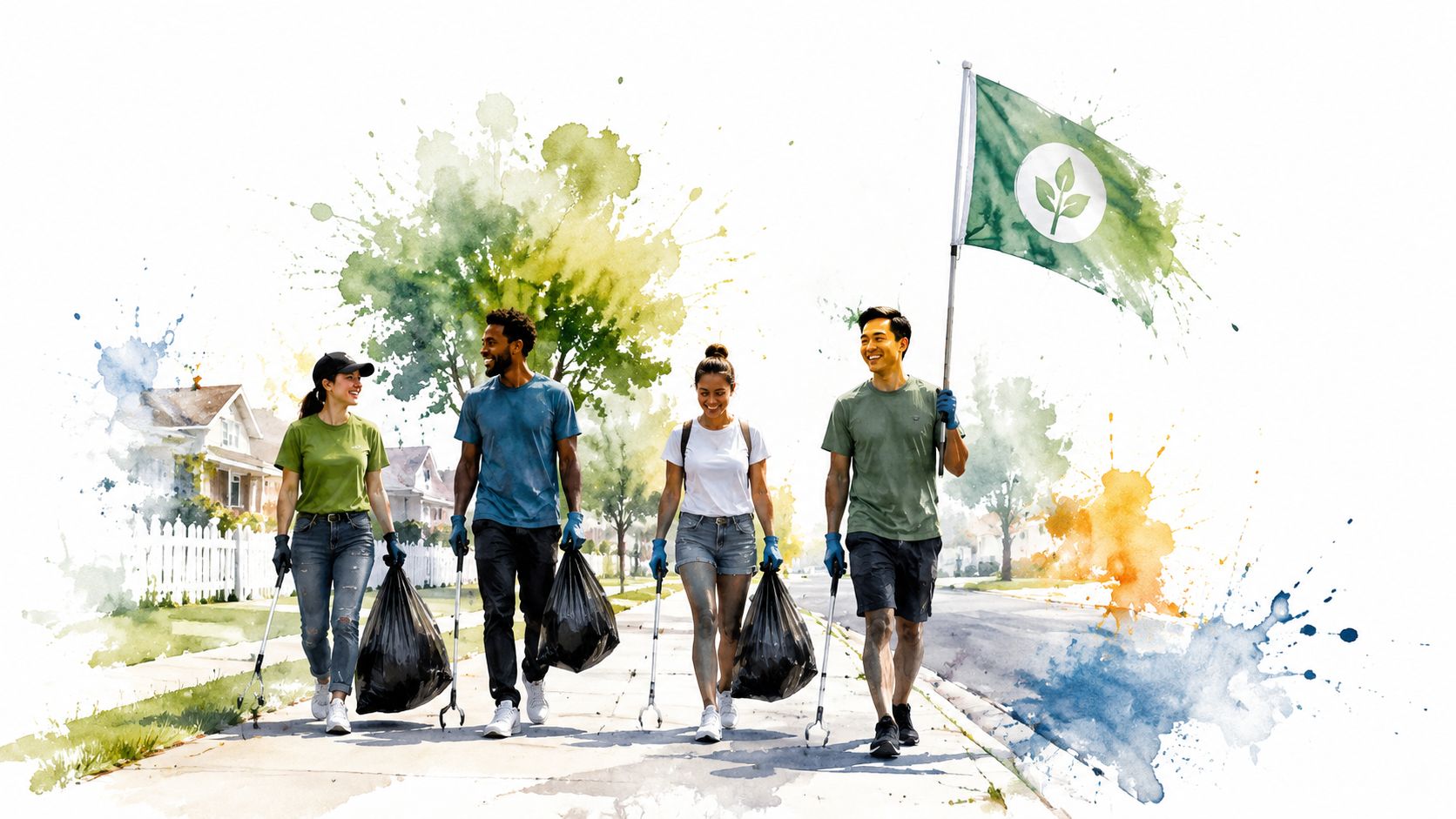
    A diverse group of volunteers walking down a street carrying trash bags and an environmental cleanup flag.

    Make it easy to join

    Your first job is to remove friction. If people need to buy supplies, guess where they end up? At home.

    • Bring the gear: Carry gloves, bags, sanitizer, and a few extra grabbers.
    • Pick one meeting point: Use an easy landmark like a train stop, coffee shop, or park entrance.
    • Keep the timing consistent: Same morning, same general length, every week if you can.
    • Pair people fast: Put a newcomer beside someone kind and experienced within the first few minutes.

    I've learned that consistency beats novelty. Weekend mornings work because they attract people who want to give, not people who want to drift.

    Practical rule: Don't make volunteers solve logistics before they've felt the joy of the work.

    Chicago gave us this lesson over and over. When we rotated neighborhoods, people kept coming because they weren't only cleaning. They were discovering the city block by block, seeing corners they'd never visit otherwise, and building trust through repetition.

    If you want a straightforward playbook for setting one up, use this guide to starting a volunteer trash pickup.

    2. Themed Service Events

    A theme can rescue a good event from feeling flat.

    I'm not talking about fake hype. I'm talking about giving the day a frame people can remember. A spring reset. A river day. A post-festival recovery cleanup. A holiday morning service walk. Same work, different emotional entry point.

    Themes help people answer the question, why this week?

    Give the event a story

    When I've seen service events really click, it's because people could explain them in one sentence. “We're cleaning the highway after the bike event shutdown.” “We're doing a costume cleanup before Halloween.” “We're cleaning this park before the neighborhood picnic.”

    That sentence matters. It gives the event shape.

    Use themes that connect to real local moments. Earth Day is obvious. A neighborhood fair is obvious. A change in season is obvious. Don't force an elaborate concept when a clear one will do.

    Here's what works best for me:

    • Name it: Pick a title people can repeat from memory.
    • Match the visuals: A small sign, flag, color, or dress code gives people instant cohesion.
    • Tie it to a place: Themes feel stronger when the location makes sense.
    • Capture the moment: Take one group photo that tells the whole story without explanation.

    I've found that themed events also help with return attendance. People who came for the novelty often stay for the people. That's the trick. The theme gets them through the door. The community gets them back.

    The business world has noticed that live gatherings still work. Statista reports the U.S. B2B trade show market is forecast to reach $15.8 billion in 2024, and a Cvent-cited survey says 72% of marketers consider events their most effective marketing channel, while HelloEndless reports 63% plan to invest more in live events and 95% agree live events help attendees form valuable in-person connections. I read that and think, of course. People remember what they do together in real life.

    3. Neighborhood Transformation Projects

    Sometimes a single cleanup is satisfying. Sometimes it isn't enough.

    You know the kind of place I mean. The empty lot that keeps collecting trash. The block edge everyone walks past. The patch of ground that suggests to people, nobody cares about this spot. When I see a place like that, I don't want a one-day event. I want a campaign.

    That's where neighborhood transformation projects come in.

    Adopt one place and stay with it

    Pick a site with emotional weight. A neglected lot. A stretch near a school. A corner by a bus stop. Then commit to it long enough that people can watch the place change.

    This is a different kind of outdoor event idea because it asks more from you. You need repeat visits, local relationships, and basic patience. But the payoff is deeper. People stop feeling like guests in the neighborhood. They start feeling responsible for it.

    A long-term project should have phases.

    • Phase one: Clean and clear.
    • Phase two: Remove the weird barriers that make the place feel abandoned.
    • Phase three: Add signs of care, like planters, seating, art, or regular stewardship.
    • Phase four: Hand some ownership to people who already live nearby.

    I love this format because it changes volunteer psychology. A one-time event says, “We helped.” A repeated project says, “We belong here.”

    You can feel that difference in people's posture.

    Here's a glimpse of what transformation can look like in practice:

    If you're building one of these, start smaller than your ego wants. Don't promise to save a district. Clean one lot so thoroughly and so consistently that nobody can deny the change.

    4. Social Service Integration Cleanups

    Some outdoor event ideas entertain people. I'd rather help people.

    A social service cleanup starts with a harder question. Who is living with the consequences of neglect right now? Once you ask that honestly, your planning changes. You stop chasing the prettiest park and start paying attention to the places where litter, dumping, and disrepair stack onto other burdens.

    That shift matters.

    Respect the neighborhood first

    When you enter an under-resourced neighborhood with volunteers, your attitude matters more than your trash bags. If you show up like a savior, people feel it. If you show up like a guest ready to work, people feel that too.

    I've made mistakes here. I've come in too eager, too fast, too convinced that action alone was enough. It isn't. You need local trust. That means talking to residents, local groups, block leaders, churches, mutual aid organizers, and small business owners before the event starts.

    Go where the need is. Then listen long enough that your help stops looking like a performance.

    A good social service cleanup has roles for residents, not just roles for visitors. Ask local people where the worst dumping is. Ask what time feels respectful. Ask what would make the day useful instead of theatrical.

    I also think food matters here. A real meal after cleanup changes the tone. It says, we didn't come to extract a feel-good moment. We came to share a morning.

    One thing I appreciate about the usual outdoor event ideas online is how clearly they reveal what's missing. Many lists focus on entertainment and skip service as a repeatable community ritual. That gap is exactly where some of the best events live. Service can become friendship, exercise, and visible neighborhood improvement all at once when you build it with care.

    5. Volunteer Badge and Achievement Systems

    People like progress. They like symbols. They like knowing their effort counts.

    I learned this early. If you give volunteers nothing but a vague thank you, many of them will still return. Good people are generous. But if you give them identity, memory, and a visible path forward, they start carrying the mission inside themselves.

    That's where badges come in.

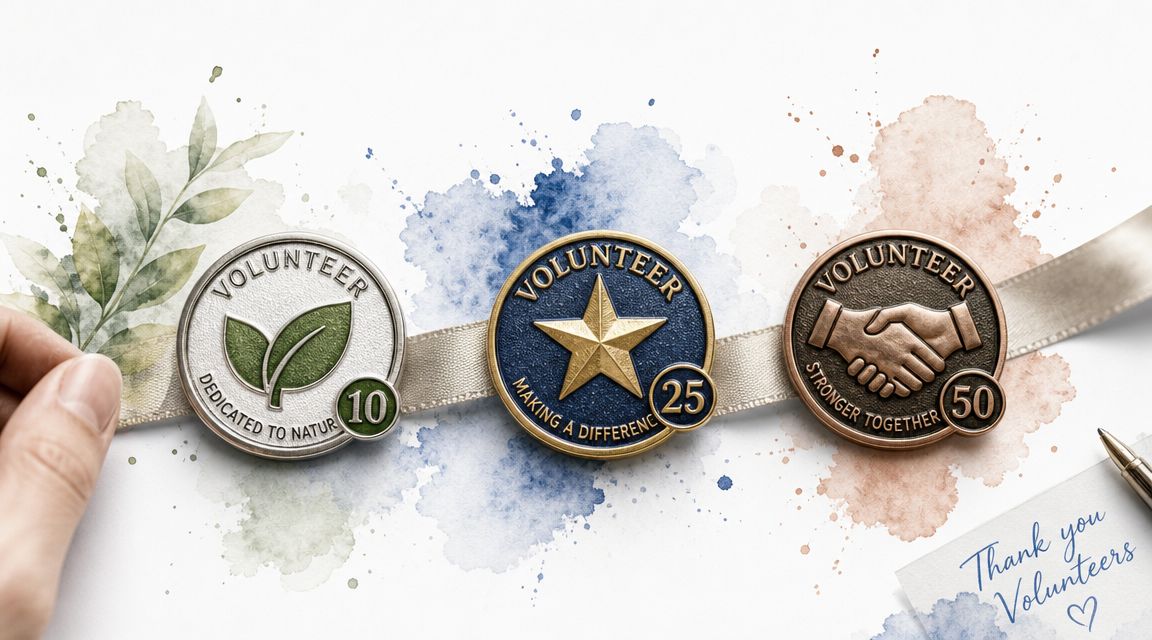
    Three volunteer milestone medals displayed on a ribbon with watercolor accents and a thank you note.

    Turn effort into identity

    A badge system works because it makes service legible. It tells a volunteer, you've shown up, you've grown, and we can all see it.

    I don't mean childish gold stars. I mean thoughtful markers of effort. Milestone badges. Seasonal badges. Leadership badges. Weather badges. Neighborhood badges. If sports teams and scouts understand the power of earned symbols, service groups should too.

    Here's how I'd build it:

    • Make badges beautiful: If it looks cheap, it feels cheap.
    • Reward different kinds of effort: Attendance, leadership, reliability, mentoring, hard routes.
    • Announce them publicly: Recognition should happen in front of peers.
    • Let people wear them: Bags, jackets, lanyards, Meetup photos. Let pride breathe.

    One thing I'd never skip: make recognition visible in the field, not buried in an email later.

    If you want inspiration for structuring it, I like this set of volunteer recognition ideas.

    There's a practical side too. Grand View Research estimates the global event management software market at $8.40 billion in 2024 and projects it will reach $17.33 billion by 2030, with North America holding over 45% of the market in 2024 and cloud-based deployments accounting for over 63%. That tells me tools for registration, check-in, volunteer tracking, and milestone systems are normal now. Use them. Don't run your community on memory alone.

    6. Friendship-First Volunteer Cohorts

    The strongest volunteer communities I've built never started with scale. They started with six people who kept showing up long enough to become part of each other's lives.

    That lesson changed how I organize outdoor events.

    Big turnouts look good in photos. Cohorts build the kind of trust that gets someone out of bed on a cold Saturday, brings them back after a hard week, and turns a cleanup into a real community. That is the whole point. Service should leave the block better and the people braver.

    A cohort works because people stop disappearing into the crowd. They get known. Somebody notices if they are late. Somebody remembers they hate soggy gloves. Somebody asks how the interview went. That sounds small. It is not small at all. It is how friendship starts, and friendship is what makes volunteer work durable.

    I've seen this happen over and over with Litter Caterpillars. A person joins for a cause. They stay because the same handful of people keep welcoming them back. After a few events, the cleanup is only half the story. The other half is breakfast after, the running jokes, the shared route, and the quiet sense that your absence would matter.

    Build cohorts on purpose:

    • Keep them small: Around 6 to 12 people is enough for energy and still small enough for memory.
    • Keep them stable: Let people serve with the same crew often enough to build rhythm and trust.
    • Give them a ritual: Coffee after, a group photo, a stretch circle, a post-route meal. Repetition turns strangers into friends.
    • Name the group: A route name, team color, or simple nickname gives people something to belong to.
    • Choose a cohort lead: Pick someone warm, reliable, and observant. Their job is to notice people, not manage them like staff.

    I care about this because outdoor service should do more than fill bags. It should change a person's relationship to their city and to themselves. A good cohort gives shy people a place to practice courage. It gives new residents a way into neighborhood life. It gives lonely people a reason to leave the house and a circle that expects them.

    That is why I recommend friendship-first design so strongly. If you want retention, build belonging. If you want stronger events, build smaller circles inside the larger one. If you want people to find purpose outdoors, give them people first.

    7. All-Weather and Extreme Condition Events

    Weather is not a side issue. Weather is the event.

    Most outdoor event ideas online pretend the sky will cooperate. That's fantasy. Real outdoor organizing means heat, wind, rain, surprise cold, and forecast drama. If you ignore that, you're not planning. You're wishing.

    I learned this while shivering under that tree in the hail on our first cleanup.

    Build for weather, don't pray against it

    Some of my favorite event memories came from rough conditions. But there's a line between invigorating and stupid. You need to know the difference before volunteers arrive.

    The National Weather Service keeps warning people about heat and storms during outdoor activity. I take that seriously. I still run all-weather events, but I do it with structure.

    Use a simple decision framework:

    • Heat: Start earlier, shorten the route, carry more water, add shade stops.
    • Cold: Keep people moving, bring hand warmers, plan a warm indoor landing spot after.
    • Rain: Expect muddy morale at the start, then watch people get weirdly cheerful once they accept it.
    • Wind or storms: Decide in advance what cancels the event and tell everyone clearly.

    The weather doesn't ruin the story. Confusion does.

    I also think you should name these events clearly. If it's a winter grit cleanup, call it that. If it's a rain-or-shine challenge day, say so. Some people want comfort. Some people want a little hardship because hardship wakes them up.

    Chicago taught me that suffering can add flavor. A hard-weather event, done safely, becomes a badge people carry in their chest. They remember who was there. They remember who laughed. They remember they were tougher than they thought.

    8. Neighborhood Discovery Tours with Purpose

    The first time I led one of these, a new volunteer showed up expecting a cute walk and a couple of photos. Forty minutes later, she was pointing at a storm drain clogged with cups, asking who on this block had to live with that every day. That was the moment the event worked. Curiosity turned into responsibility.

    That is the point of a neighborhood discovery tour with purpose.

    A city does not become home because you sampled the coffee and found a mural. It becomes home when you pay attention. You notice which sidewalks invite people in, which corners feel forgotten, which storefronts are fighting to stay open, and which public spaces clearly have people who care. Service sharpens your eyes. It also softens your heart.

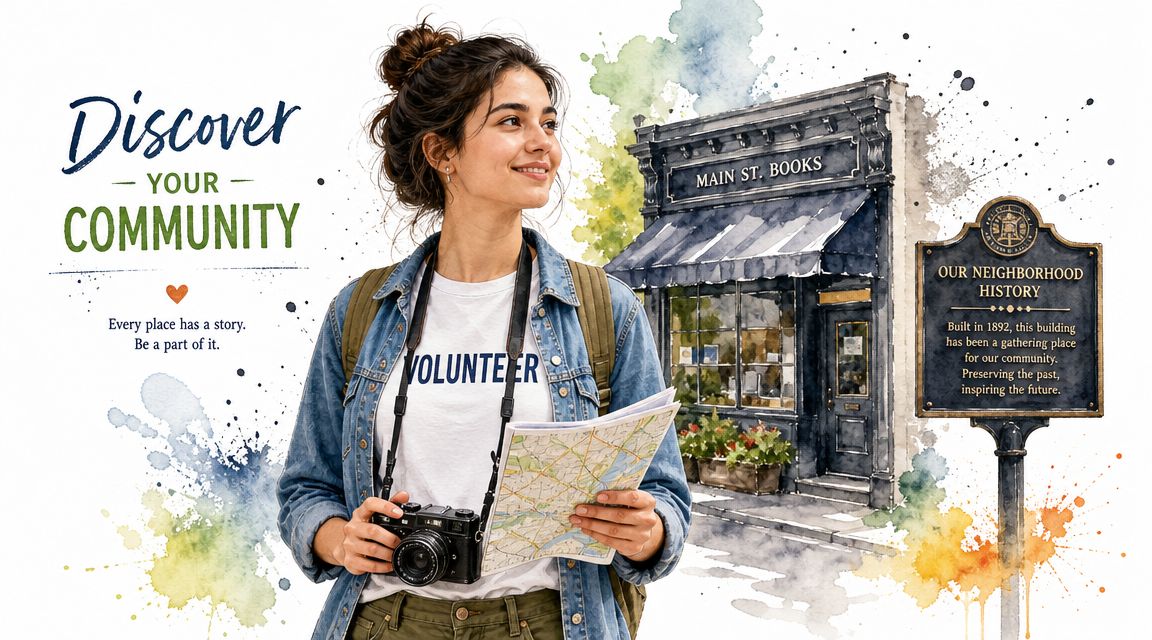
    A smiling young female volunteer holding a camera and map in front of a bookstore and plaque.

    Let the neighborhood teach the group

    I build these events around one local thread. Pick one. Architecture. Immigrant business history. A park system. A transit line. A residents' story. The thread gives the walk weight, and weight is what turns a casual outing into a shared memory.

    Do not overteach. You are not running a lecture. Give people just enough context to care, then let the street do the rest.

    Use a route like this:

    • Open with one sharp story: Keep it under two minutes and make it specific to the block.
    • Mark a few anchors: A bookstore, church, mural, school, garden, or corner store gives people something to remember.
    • Leave room for real conversation: If a resident or shop owner wants to talk, stop and listen.
    • Finish close by: A plaza, cafe, or simple stoop debrief helps people turn observations into connection.

    I love this format because it builds the kind of community that lasts. People do not only collect litter. They collect context. They start recognizing faces, greeting business owners, remembering street names, and caring what happens next on that block. Friendship grows faster when people are discovering something together and doing something useful with their hands.

    That has been a core lesson for me with Litter Caterpillars. Service is not only about cleaner streets. It is about helping people become braver, more rooted, and more available to each other. A purpose-driven neighborhood tour does all three. It gives newcomers a way in. It gives longtime residents a fresh way to love where they live. And it gives the whole group a better question than “What should we do this weekend?” The better question is “Who can we become together if we keep showing up here?”

    9. Leadership Development and Mentor Apprenticeships

    A volunteer group breaks when everything depends on one charismatic organizer.

    I know the temptation. You care the most, so you carry the most. You answer every text, haul every supply bin, explain every route, soothe every confusion. For a while, that feels noble. Then it becomes a bottleneck.

    The cure is apprenticeship.

    Teach leadership in the field

    The best leaders in service groups usually don't emerge from a formal application. They reveal themselves while carrying bags, checking on new people, solving small problems, and staying calm when the plan bends.

    When I spot that person, I don't wait. I give them a lane. Maybe they lead check-in next week. Maybe they welcome newcomers. Maybe they handle route pacing or post-event food coordination. Then I stay close enough to help without grabbing the wheel back.

    A good mentor system has a few parts:

    • Match on temperament: A nervous beginner needs a different mentor than a natural extrovert.
    • Give one concrete responsibility at a time: Don't dump the whole event on them.
    • Debrief after the event: What felt easy, what felt awkward, what needs practice.
    • Promote publicly: Let the group see who is stepping up.

    I love apprenticeships because they turn service into a ladder. People don't only attend. They grow. They gain confidence in public speaking, planning, conflict navigation, and emotional steadiness.

    That kind of growth is hard to fake. A person who can calmly lead a volunteer team through a messy morning can usually handle a lot more in the rest of life too.

    10. Corporate and Group Partnership Events

    I used to be suspicious of corporate volunteer days. Too polished. Too many matching shirts. Too much photo-op energy.

    Then I saw what happens when you design them well. A company brings a group of people who would never have met your mission otherwise. They work hard, ask real questions, and sometimes a few of them come back on their own. That's worth building for.

    Keep the mission intact

    If you run partnership events, don't let the partner flatten your culture. You are not a disposable activity vendor. You are inviting a group into your way of doing things.

    That means you set the tone. You explain the neighborhood. You make safety and volunteer dignity paramount. You keep the service real.

    Here's what I recommend:

    • Build one clean package: Clear meeting point, supplies, route, safety talk, and wrap-up.
    • Ask for one internal champion: Every company has one person who cares. Find them.
    • Mix structure with meaning: Give them a mission, not just a task list.
    • Create a return path: Tell people how to join again without their employer.

    If you want a starting point, I'd look at these corporate social responsibility program ideas.

    There's strong demand for events in the business world, and many teams still want real-life connection. That helps. But your real win isn't landing a one-off group day. Your real win is converting a few people from “my company sent me” to “I'm coming back because this matters to me.”

    10-Item Comparison of Outdoor Event Ideas

    Program Implementation Complexity (🔄) Resource Requirements (⚡) Expected Outcomes (📊⭐) Ideal Use Cases (💡) Key Advantages (⭐)
    Community Cleanup Walks 🔄 Moderate, regular scheduling & coordination ⚡ Low, basic supplies and volunteer coordination 📊 Consistent litter removal; ⭐ steady volunteer habits 💡 Neighborhood-scale recurring engagement ⭐ Easy to replicate; inclusive; visible impact
    Themed Service Events 🔄 Medium–High, extra planning and branding ⚡ Medium, merchandise, partnerships, promo 📊 Recruitment and media spikes; ⭐ varied volunteer experiences 💡 Holidays, awareness campaigns, recruitment drives ⭐ High novelty and shareability; attracts diversity
    Neighborhood Transformation Projects 🔄 High, multi‑phase planning & stakeholder agreements ⚡ High, sustained coordination, legal/maintenance costs 📊 Long‑term place change; ⭐ compelling before/after narratives 💡 Deep impact projects, fundraising, major partnerships ⭐ Systemic impact; strong partnership potential
    Social Service Integration Cleanups 🔄 High, cultural competency and relationship building ⚡ Medium–High, hospitality, transport, partner support 📊 Equity‑focused improvements; ⭐ authentic community trust 💡 Environmental justice and underserved neighborhoods ⭐ Builds trust; addresses social and environmental needs
    Volunteer Badge & Achievement Systems 🔄 Low–Medium, tracking and recognition workflows ⚡ Low, design, admin, occasional production 📊 Increased retention & social proof; ⭐ motivation & leadership pipeline 💡 Retention programs, gamification strategies ⭐ High psychological ROI; cost‑effective recognition
    Friendship‑First Volunteer Cohorts 🔄 Medium, facilitation of small stable groups ⚡ Low–Medium, social event support and facilitation time 📊 Deep retention and ambassador creation; ⭐ reduced isolation 💡 Building community, long‑term volunteer loyalty ⭐ Strong interpersonal bonds; organic recruitment
    All‑Weather & Extreme Condition Events 🔄 High, strict safety protocols and contingency plans ⚡ Medium–High, specialized gear, recovery support 📊 Memorable narratives and committed core volunteers; ⭐ resilience culture 💡 Identity‑building, storytelling, committed cohorts ⭐ Differentiation through shared hardship; strong pride
    Neighborhood Discovery Tours with Purpose 🔄 Medium, research and guided content integration ⚡ Low–Medium, guides, materials, local coordination 📊 Increased civic knowledge & local ties; ⭐ deeper place attachment 💡 Newcomer engagement, place‑based education ⭐ Blends learning with service; local partnership opportunities
    Leadership Development & Mentor Apprenticeships 🔄 High, structured curricula and mentor matching ⚡ Medium–High, training time, materials, supervision 📊 Sustainable leadership pipeline; ⭐ organizational scalability 💡 Succession planning, scaling volunteer leadership ⭐ Builds capacity; reduces founder dependence
    Corporate & Group Partnership Events 🔄 Medium, customization and account management ⚡ High, professional coordination, documentation, sponsorships 📊 Funding and high‑volume participation; ⭐ corporate visibility 💡 Fundraising, scaling capacity, CSR partnerships ⭐ Revenue and resources; access to new volunteer pools

    Find Your People, Find Yourself

    I keep coming back to Tom Sawyer.

    He was supposed to be miserable. He got punished and had to paint a fence. Instead, he made the thing look desirable. His friends wanted in. They even paid for the privilege. I've always loved that story because it gets at something often overlooked. Hard work can become joy when you wrap it in pride, story, and companionship.

    That is the heart of my favorite outdoor event ideas.

    I don't care much about making an outdoor event look impressive on paper. I care about whether it changes the people who show up. Did they leave braver? Did they make one new friend? Did they surprise themselves by doing something uncomfortable without retreating into excuses? Did they go home seeing their city, and maybe their own life, a little differently?

    That's why service matters so much to me. Entertainment has its place. I'm not against a picnic, a concert, or a scavenger hunt. But service gives people a cleaner mirror. It shows them who they are when the work is unglamorous, when the weather is annoying, when the neighborhood is unfamiliar, when the bags get heavy, when nobody is clapping.

    And if they keep showing up, that mirror changes them.

    I've seen shy people become organizers. I've seen people arrive guarded and leave with a breakfast crew. I've seen mornings that started with litter and awkwardness end with singing, laughing, and plans for next week. That kind of change doesn't happen because you found the perfect event concept on a content list. It happens because you built a ritual people could trust.

    That's my philosophy in one sentence. Build rituals, not spectacles.

    A ritual has a heartbeat. Same meeting time. Same spirit. Enough repetition that people can lean their life against it. Enough purpose that they feel proud inviting someone else. Enough challenge that the day means something when it's done.

    If you're planning your own event, keep it simple. Pick a place. Pick a time. Bring more gloves than you think you need. Make the first five minutes warm and welcoming. Give people one useful job. End somewhere people can talk. Then do it again next week.

    You do not need a perfect brand, a giant budget, or a polished speech. You need courage and follow-through.

    If Litter Caterpillars fits what you're looking for, it's one example of a Chicago group built around that idea. Weekly outdoor service can become friendship, consistency, and neighborhood care when people commit to it long enough.

    So my only question for you is this.

    Are you bold enough to start?


    If you want an outdoor event that builds friendship and leaves a block cleaner than you found it, join Litter Caterpillars. Show up on a weekend morning, bring your energy, and let service change you.

  • 10 Community Service Ideas for College Students

    10 Community Service Ideas for College Students

    My mess was my life, so I started cleaning up someone else’s.

    I used to have trouble cleaning my own stuff. As my apartment got worse, my life got worse with it. The old blueberry jam from a trip to Michigan. The bag of nuts from a failed health kick. Every piece of trash had a little memory attached to it, and even though each thing weighed almost nothing, to me it felt like 500 pounds.

    Then I ended a chaotic relationship with someone selfish, and I hit the kind of wall that makes you either stay stuck or do something weird. I decided I was done building my life around mess, fear, and flaky people. I wanted to face the stuff that had always beaten me up: cleanliness, consistency, and bravery.

    So I tried something sideways. I cleaned up public spaces.

    It was easier to pick up a bottle off the sidewalk than to throw away my own old junk. It was easier to show up for a block than to show up for myself. But after a while, that line started to blur. The more I helped clean a street, the more I could feel some of the static leaving my own head. It was work, sure. Sometimes cold, wet, gross work. But it was also weirdly fun.

    That’s how the Litter Caterpillars started.

    If you’re looking for community service ideas for college students, I want to give you more than a bland list you half-read between classes. I want to give you options you can picture yourself doing on a Saturday morning when your room is a mess, your brain is loud, and you need a reason to get outside and be around better people. Some of these ideas are simple. Some take real organizing. All of them can change your week if you let them.

    You don’t need to wait until you feel polished. Start while you’re still a little lost. Sometimes service is how you find your footing.

    1. Neighborhood Litter Cleanup Events

    The first cleanup I ever led was small enough to fail unnoticed. A few gloves. A couple of trash bags. One block I was tired of walking past with my shoulders up around my ears.

    What surprised me was how fast the mood changed. You bend down for one bottle, then a chip bag, then a pile of soggy flyers stuck to the curb, and suddenly you are not stuck in your own head anymore. You are doing something with your hands. You are standing next to other people who showed up for the same unglamorous reason. The street looks better in under an hour, and some part of you does too.

    That is why neighborhood litter cleanup events work so well for college students. You do not need a big budget, a fancy title, or weeks of training. You need a spot people already care about, a time that works, and a clear place to meet. If your life feels scattered, this kind of service gives you a win you can see.

    I would keep the first one almost boring on purpose. Pick a route you can finish. Pick a corner store, bus stop, park edge, or sidewalk near campus where people will notice the difference. If you want a real example of how simple cleanup work can grow into something bigger, the story behind this vacant lot project shows what can happen when people keep coming back to the same place.

    How I’d make it stick

    A cleanup becomes a real habit when people know it is not a one-time burst of guilt.

    • Choose a short route: Finishing feels better than overpromising.
    • Bring visible gear: Gloves, grabbers, buckets, and bright vests help people spot the group and join in.
    • Make signup easy: A page like Litter Caterpillars volunteer trash pickup removes friction for busy students.
    • Talk to people outside the group: A quick conversation with a nearby resident or shop owner can turn strangers into future volunteers.
    • Stay for ten extra minutes: Coffee on the curb, bagels in the park, or just talking after the work is often what makes people return.

    I love cleanup events because they strip away excuses. The problem is right there in front of you. The progress is right there too. You do not have to wonder if you helped.

    And if you are in one of those seasons where your room is a mess, your phone is full of half-finished plans, and you do not totally trust yourself to follow through, start here. Pick up one block with other people. Come back the next week. Sometimes that is how you build courage. Not all at once. One bag at a time.

    2. Vacant Lot Transformation Projects

    A vacant lot can feel like a physical form of giving up. Broken glass, weeds, dumped furniture, old tires, random plastic, silence. Everybody walks past it like it belongs to no one.

    That’s exactly why transforming one can hit so hard.

    I love this idea because it starts ugly. You don’t need to pretend it’s charming. You take a dead-looking patch of land and ask, “What if this became a place kids could run through, neighbors could sit in, and volunteers could point at with pride?” That question alone changes how you walk through a neighborhood.

    Here’s a real example from the Litter Caterpillars story. The group won an empty lot at auction and started turning it into a park in Englewood. If you want to see the story behind that move, read the tale of the vacant lot.

    What the work actually feels like

    At first, it’s not glamorous. It’s hauling junk, clearing brush, calling people back, and learning that “community project” often means “you will repeat yourself many times.” But that’s part of why this is such a strong service idea for college students. It forces you to grow up a little without making you hard.

    Before-and-after photos matter here. So do neighborhood conversations. If the lot becomes a garden, a sitting area, or a mini-park, local people should shape that decision with you.

    Watch a lot become something else:

    Ground rule: Don’t “fix” a space for a neighborhood without talking to the people who already live there.

    This kind of service has a long memory. A cleanup ends and you go home. A lot transformation keeps asking for your consistency. That’s why I’d recommend it to students who are ready for a longer arc, not just a one-day burst.

    3. Highway and Major Corridor Cleanup

    The first time I helped on a road-edge cleanup, I felt weirdly small. Trucks ripped past. The shoulder shook. Every bottle and fast-food wrapper looked like it had been pinned there by speed itself.

    That’s what makes this kind of service stick with you.

    A neighborhood cleanup can feel warm and local. A major corridor cleanup feels exposed. You’re standing in one of the hardest places to ignore, picking up what thousands of people passed without seeing. If your life feels noisy or scattered, there’s something honest about that setting. You cannot pretend your way through it. You put on the vest, grab the bag, and do the next ugly, simple thing.

    I’ve heard students talk about these cleanups around closed-street events, bike races, and city-led road projects, and I like that model because access changes everything. A road that usually tells you to keep out suddenly becomes walkable. You notice how much trash collects in medians, along fences, near ramps, and under guardrails. You also notice your own nerves. Then, after twenty minutes, you’re just working.

    How to do it without turning it into chaos

    This project lives or dies on coordination. Call the city, transportation department, or event organizer early. Ask a few plain questions. Which sections are safe for volunteers? Where should filled bags go? Who removes large debris? What counts as off-limits?

    Then keep the plan tight.

    • Divide the route into short sections: People work better when they know exactly where their part begins and ends.
    • Give one clear safety briefing: Cover traffic boundaries, protective gear, weather, and items nobody should touch.
    • Choose visible bag drop spots: Long walks with full trash bags drain the group fast.
    • Use shorter shifts: Major roads are tiring. An hour of focused work often beats a long, sloppy stretch.

    This idea also does something quieter. It builds courage.

    Not fake courage. Real, ordinary courage. The kind you get when you show up in an uncomfortable place, do a job that isn’t glamorous, and stay with it long enough to see a difference. For some college students, that matters as much as the cleanup itself. If you’ve been living in a fog of missed deadlines, bad habits, or low-grade panic, a project like this can cut through the noise. By the end, the roadside looks better, and you do too.

    4. Student Environmental Education and Awareness Campaigns

    A young Asian mentor teaching a diverse group of children about gardening and plants in a classroom.

    The first time I helped with a cleanup lesson for kids, I made the classic college-student mistake. I showed up with facts, a recycling chart, and way too many words. Their eyes drifted fast.

    Then one kid picked up a chip bag from the sidewalk outside and asked, "So this ends up in the drain?"

    That was the whole lesson. Not my notes. Not my little speech. That crumpled bag in his hand.

    If you care about the environment but do not want all your service hours to look like gloves, grabbers, and trash bags, education work gives you another lane. You can visit an after-school program, partner with a library, or run a short workshop in a residence hall or community center. The goal is simple. Help people connect the mess they see every day to something they can do about it.

    Keep it close to real life

    Students tune out fast when a campaign sounds like homework with a greener title. They pay attention when you bring the problem down to sidewalk level.

    Show what washes into storm drains after rain. Bring common trash items and ask where each one usually gets dropped. Have kids map the litter they pass on the way to school, then compare notes. If you can pair the lesson with seed planting, a mini cleanup, or a trash audit, even better. People remember what they touch.

    I would build two or three repeatable workshops and keep them tight. One on litter and runoff. One on recycling mistakes people make at home or on campus. One on gardens, trees, and public green spaces people use every week.

    A good campaign changes you, too.

    You learn how to hold a room. You learn how to explain something without hiding behind jargon. You learn that leadership is often one awkward conversation, one folding table, one group of restless middle-schoolers, and the choice to keep going anyway. If your own life feels scattered, this kind of service can steady you. You stop performing concern and start practicing it.

    The best moment is usually small. A child points at the curb outside and says they have seen the same trash there for weeks. A classmate asks if your dorm can do a waste-sorting table at lunch. Someone starts noticing. That is where change begins.

    5. Adopt-a-Block or Neighborhood Stewardship Programs

    A young man and woman volunteering together to improve their neighborhood by planting flowers and cleaning litter.

    The first time I helped clean the same block twice, I almost missed what had changed.

    The chip bags were back by the fence. Someone had tossed a coffee cup near the curb again. But an older man walking his dog nodded at us like we belonged there. A woman from the corner house came out and said, "Glad you came back." That second part hit harder than the full trash bag in my hand.

    Adopt a block, and the work gets personal fast. You stop treating a neighborhood like a weekend project and start treating it like a relationship. You learn where the gutters clog after rain. You notice which alley gets ignored. You remember the tree pit you cleared three Saturdays ago and feel weirdly proud when it stays clean a little longer.

    That repetition changes you, too. If your life feels noisy, showing up to the same stretch of sidewalk every week can calm it down. You make one promise. Then you keep it. For a lot of college students, that is not small.

    Why staying with one place works

    A single cleanup can feel satisfying. A stewardship program lets you see cause and effect.

    You start spotting patterns instead of reacting to random messes. Maybe flyers blow down from one pole every Friday. Maybe the problem is not careless neighbors, but a trash can that is always overflowing by Sunday night. Once you know the block, your help gets smarter. You are not just picking things up. You are paying attention.

    I would keep the structure simple and local. Assign students to a block near where they already live, study, or commute. The easier it is to reach, the better chance people will stick with it when classes get heavy and motivation drops.

    A few ways to keep it going:

    • Keep shifts short: One hour works better than a big heroic Saturday that burns everyone out.
    • Give each team a defined zone: Specific corners, alleys, planters, or bus stops help people know what they own.
    • Use a simple check-in: A photo, a text update, or a shared note is enough.
    • Build in backup: Let people swap weeks so the block does not depend on one perfect volunteer.

    The best part is what happens after a month or two. You are no longer a stranger passing through with a grabber and gloves. You are one of the people who noticed, came back, and kept going. Sometimes that is how you start cleaning up more than a street. Sometimes that is how you start cleaning up your own life.

    6. Community Cleanup-to-Event Model with Social Gathering

    The first cleanup I helped organize that felt alive ended with pizza on a folding table.

    We had spent the morning pulling bottles out of weeds behind a bus stop and scraping old flyers off a light pole. Everyone looked a little rough. Gloves dirty, shirts damp, hair wrecked by wind. Then somebody opened two pizza boxes, another person passed around clementines, and the whole mood changed. People stopped standing in their polite little circles. They started telling the truth. One student admitted she had come because she was lonely. Another said he signed up after a bad semester and needed a reason to leave his room on a Saturday.

    That is why I believe in the cleanup-to-event model. The work cracks something open. The hangout is where people decide whether they want to come back.

    A family cleaning up after a picnic, representing community service ideas for college students.

    For college students, this matters more than people admit. Service hours are nice. A cleaner park is nice. But sometimes the true win is smaller and more personal. You show up feeling scattered, awkward, half checked out. You leave with dirt on your shoes, three new names in your phone, and a weird little spark of courage. I have seen that happen over and over.

    The social part should not be an afterthought. Build it into the day from the start.

    Here’s a version that works:

    • Start with a defined cleanup: one park edge, one alley, one stretch near campus, one hour or two
    • End close to the site: food trucks, coffee, bagels, a picnic, or a potluck keeps the shift from dissolving the second the bags are tied
    • Make conversation easier: name tags, simple icebreakers, or a question on a sign-in sheet gives shy people a way in
    • Keep one small tradition: group photo, shared playlist, silly award for weirdest item found, or a post-cleanup snack everybody expects

    I like this model because it does two jobs at once. It helps a neighborhood look cared for. It also gives students a low-pressure way to build community without pretending networking is fun.

    And if I am being honest, that second part can change your life.

    A lot of us arrive on campus carrying chaos we do not talk about. Grief. Debt. Anxiety. A breakup. Family mess. The simple act of cleaning a public space with other people can steady you for a minute. Then the meal after gives you room to breathe and be seen. You are no longer just completing a task. You are practicing how to belong.

    The best gatherings are simple. Cheap food is fine. A shaded patch of grass is fine. Music from a phone speaker is fine. What matters is that you leave time for the part after the trash bags are full, because that is often where the bravery starts.

    7. Partnership with Local Nonprofits and Environmental Organizations

    The first time I partnered with a local cleanup group, I showed up thinking I was late to somebody else’s mission. I left feeling like I had borrowed a spine.

    There were no big speeches. A woman in work gloves handed me a grabber, pointed toward a weedy stretch behind a neighborhood creek, and said they had been coming back to this spot for months because trash kept sliding down from the road above. That changed how I saw service. You stop treating a cleanup like a one-off volunteer day and start seeing it as a relationship. With a place. With the people protecting it. With the version of yourself that keeps coming back.

    That is why partnerships matter.

    You do not need to invent the whole project, recruit everyone yourself, or guess your way through permits and safety rules. A local nonprofit or environmental group already knows the terrain. They know which park floods after rain, which lot gets dumped on every weekend, which trail needs restoration instead of another bag count, and which neighbors have been carrying the work long before students arrived.

    I’d look for groups doing river cleanups, habitat restoration, park stewardship, urban gardening, compost education, or neighborhood environmental justice work. The best fit is usually not the flashiest one. It is the group with a clear routine and a real need for steady hands.

    What makes this different from the last section is the depth. You are not just showing up for one social afternoon and then drifting off after snacks. You are stepping into work that already has memory. That can humble you fast, and I mean that in a good way.

    If you want to be useful quickly, do the plain jobs well first.

    Show up to orientation. Learn the rules. Ask what keeps falling through the cracks. Sometimes that means hauling tools, signing people in, sorting gloves by size, or pulling invasive plants for two hours without posting about it once. That kind of service can feel small until you realize it is the reason the whole day holds together.

    I also love partnerships because they test you in a different way. A student-run project lets you stay in your comfort zone. An established nonprofit puts you next to longtime organizers, retired neighbors, city staff, high school volunteers, and people who know the block better than you ever will. You learn how to listen. You learn how to take direction without shrinking. You learn that helping is not the same thing as leading.

    And if your life feels messy, that matters.

    There were seasons when I could not fix the bigger chaos. Money stress. Family stuff. My own head. But I could show up at 8 a.m., pull on gloves, and work beside people who had built something steady out of care and repetition. That steadiness rubbed off on me. Service did not solve everything. It gave me practice. Practice being reliable. Practice staying when a task got dull. Practice belonging to something bigger than my own spiral.

    A good partnership can give you hours, experience, and references. More than that, it can give you a model for how to live. Find the people already tending a damaged place, then ask where your hands fit. That question can change more than your weekend.

    8. Bike Event and Outdoor Festival Cleanup Coordination

    The first time I helped clean up after a bike race, the fun was over before the actual work started. Music cut out. Food trucks pulled away. The crowd vanished fast. What stayed behind was the truth of the day. Crushed cans in the grass, zip ties near the barricades, paper plates stuck to the curb, and a little creek of trash drifting toward a storm drain.

    I remember standing there with a grabber in one hand, sweaty and annoyed, thinking this looked a lot like my life at the time. Loud from a distance. Messy up close. Harder to ignore once everyone else went home.

    That is why I think this kind of service hits differently.

    Bike rides, street fairs, concerts, and outdoor festivals need cleanup crews before, during, and after the event. If you are the kind of person who does well with movement, noise, and a job you can see in front of you, this work gives you a clear target. You do not have to guess whether you helped. A trash-heavy block turns walkable again because you showed up.

    Start by contacting organizers early. Ask where waste piles up, which areas get slammed, and who handles supplies and disposal. Event cleanup works better when students are assigned to zones and shifts instead of wandering around trying to look useful.

    I would set it up like this:

    • Pre-event crew: check trash and recycling stations, pick up old litter, and make sure high-traffic spots are covered before people arrive
    • During-event crew: patrol food areas, entrances, restrooms, bike parking, and seating zones before overflow turns into a bigger mess
    • Post-event crew: move fast once the event ends, covering the full route or festival footprint while volunteers still have energy
    • Supply runner: keep gloves, bags, water, and sanitizer stocked so the whole team does not stall out

    This work also teaches a blunt lesson. Public fun leaves a tab. Somebody has to pay it in labor.

    You can be one of the people who pays attention, grabs a bag, and handles what everybody else steps around. And if your own life feels scattered, there is something grounding about restoring a place in plain sight. You pick up one bottle, then ten, then a whole corner. The block looks better. Sometimes you do too.

    9. Student-Led Sustainability Initiatives and Campus-to-Community Outreach

    I knew a student who got tired of watching move-out week turn the dorm dumpster area into a small disaster. Lamps with working bulbs. Half-full detergent. Mini fridges left in hallways. Good stuff, trashed because nobody had a plan. She started with one table, three bins, and a handwritten sign in her residence hall lobby. By the end of the week, students were dropping off food, clothes, and school supplies instead of shoving them into the trash room.

    That is how a real sustainability project usually starts. Small. A little messy. Close enough to touch.

    If you are the person who keeps asking why waste keeps showing up in the same places, this kind of service fits. You are not only cleaning up what is already broken. You are fixing the system that keeps making the mess.

    Start on campus, where you already know the people, the routines, and the weak spots. Build something practical, then carry it beyond the edge of school property. A dorm recycling campaign can turn into apartment outreach for students living off campus. A compost pilot in one dining hall can grow into a partnership with a neighborhood garden. A move-out donation drive can feed a local mutual aid network instead of a landfill.

    I like this model because it changes you while you build it. You stop waiting for permission. You make the sign. You reserve the table. You ask the facilities staff what keeps failing. You hear "no" a few times and keep going anyway.

    Keep the first version small enough that tired students can still run it during midterms. One dorm. One residence hall floor. One monthly collection day. One student club and one nearby block. If the system only works when everybody is excited all the time, it will fall apart fast.

    Write down the steps. Keep the handoff simple. Make a one-page guide the next student can follow without texting you twelve times.

    That is the difference between a nice idea and a project that lasts.

    If you want examples of how service work can shape confidence, purpose, and real-world skills, read these benefits of volunteering for students. Then build something other people can inherit.

    This route works well for students who like organizing, teaching peers, and setting up repeatable habits. It is quieter than a big public cleanup. It is also how campuses stop creating the same pile of problems every semester.

    10. Volunteer Team Building and Peer Leadership Development

    The first time I asked another student to lead part of a cleanup, I was nervous for all the wrong reasons. I thought they would do it differently. I thought the check-in table would get messy, the route would run late, somebody would forget gloves, and I would spend the whole morning fixing it.

    What happened was better. A quiet sophomore named Elena took ten volunteers down one side street, came back muddy and smiling, and told me two new people wanted to help run the next event. That was the day I stopped trying to be the hero and started building a crew.

    If your service project depends on one exhausted organizer, it is already fragile. The strongest student groups spread responsibility early, while the stakes are still small. Give one person the sign-in sheet. Give another person the safety talk. Let someone else welcome first-timers so they do not spend twenty minutes standing around feeling awkward.

    That shift changes the project, and it changes you. You stop proving you can carry everything alone. You start trusting people. You start seeing leadership for what it is during service work. Clear communication, calm decisions, and follow-through when the weather turns ugly and half the group is tempted to head back for coffee.

    I like a simple progression that people can grow into:

    • Show-up role: learns the basics, arrives on time, helps without needing much direction
    • Crew lead: keeps a small team on task and watches pace, safety, and morale
    • Support lead: handles supplies, check-in, photos, volunteer questions, or neighbor conversations
    • Event lead: runs the day, solves problems, and helps new leaders take over next time

    Keep it real. Titles mean nothing if they do not come with responsibility.

    One of the best things about service is how fast it exposes your habits. If you avoid speaking up, leading a crew will force you to use your voice. If you panic when plans change, a rainy cleanup with missing supplies will teach you how to stay steady. If you have spent a semester feeling scattered, being responsible for five other students can pull you together in a way a classroom never does.

    I have seen that happen.

    A student who barely made eye contact at the first event becomes the person who can calm a late volunteer, redirect a confused group, and make a neighborhood resident feel heard in the same five minutes. That kind of growth is why these benefits of volunteering for students hit harder when you are not just participating, but helping other people show up too.

    Ask for one volunteer to lead a small piece of the day. Then let them do it. That is how a service project becomes a team, and how a team becomes the place where you finally find your people.

    10 College Community Service Ideas Comparison

    Initiative 🔄 Complexity ⚡ Resources 📊 Expected outcomes ⭐ Ideal use cases 💡 Key advantages
    Neighborhood Litter Cleanup Events Low–Moderate: recurring coordination Low: volunteers, gloves, bags Immediate visible cleanliness; local morale boost Quick neighborhood improvements; volunteer onboarding Accessible entry; high visibility; builds community pride
    Vacant Lot Transformation Projects High: multi‑phase, months–years High: funding, permits, design, skilled labor Permanent greenspace; aesthetic and social uplift Long‑term revitalization; leadership development Lasting asset; attracts funding/media; deep ownership
    Highway and Major Corridor Cleanup High: city coordination and safety protocols High: large crews, PPE, permits, logistics Massive short‑term visual impact; media coverage High‑visibility campaigns, event tie‑ins Rapid broad impact; public recognition; safer with closures
    Student Environmental Education & Awareness Campaigns Moderate: curriculum and partnership building Low–Moderate: materials, volunteers, digital tools Gradual behavior change; increased awareness Schools, youth outreach, scalable digital programs Systemic change potential; low cost; builds teaching skills
    Adopt‑a‑Block / Neighborhood Stewardship Moderate: ongoing management and tracking Low: supplies, volunteer time, tracking system Sustained cleanliness; community relationships Long‑term upkeep of specific blocks Consistency; sense of ownership; litter prevention
    Community Cleanup → Social Gathering Model Moderate: cleanup + event logistics Moderate: food, space, supplies, volunteers Stronger bonds; higher retention; positive publicity Volunteer recruitment, morale and community building Combines service with celebration; boosts retention
    Partnership with Local Nonprofits Moderate: alignment with org processes Low–Moderate: access to training, coordination time Professionalized impact; documented service hours Skill-building, advocacy, structured volunteering Training, credibility, access to broader networks
    Bike Event & Outdoor Festival Cleanup Coordination High: event logistics, crowd and traffic management High: organizer coordination, shifts, gear Event‑centered impact; high participation Festivals, city bike events, large gatherings High engagement; strong visibility; organizer partnerships
    Student‑Led Sustainability & Campus‑Community Outreach Moderate: institutional coordination, planning Moderate: campus resources, staff support, funding Scalable environmental metrics; campus culture change Campus programs expanded into neighborhoods Leverages institutional support; measurable outcomes
    Volunteer Team Building & Peer Leadership Development Moderate: training programs and mentorship Low–Moderate: time, training materials, small budget Sustainable volunteer infrastructure; higher retention Scaling volunteer programs; leadership cultivation Builds leaders, resilience, and long‑term program stability

    You’ve Found Your People. Are You Bold Enough?

    We believe in the power of service to our environment, to the outdoors, to sunlight, and to friendship. That’s why we are Caterpillars. We’re not perfect, but we’re all trying to transform ourselves. Through service, we can learn to trust ourselves and forgive ourselves.

    I didn’t learn that from a book. I learned it while being cold and uncomfortable and slightly ridiculous with other people.

    The first time we picked up trash, only three of us showed up. We got caught in a hail storm and ended up shivering under a tree while rides kept canceling on us. It should’ve been miserable. In some ways, it was. But I remember realizing that something strange was happening. Cleaning up other people’s messes was easier than cleaning up my own. Being out there with other people made the suffering feel less empty. It had texture. It had flavor. It pushed the story forward.

    That’s still how I think about service.

    A lot of people come looking for community service ideas for college students because they need hours, experience, or something decent to do on a weekend. Fine. Start there if you need to. I’m not going to pretend everybody starts from pure motives. Sometimes you just know your life feels stale and you need to get out of your room.

    That’s enough.

    Pick the version that feels doable. Maybe that’s a neighborhood litter cleanup. Maybe it’s teaching kids about waste. Maybe it’s helping a nonprofit with a project that already has structure. Maybe it’s adopting one block and taking care of it until the place starts to feel familiar. Maybe it’s leading your own small team and finding out you’re braver than you thought.

    The point is to choose something that puts your body and your attention in the same place. That matters more than people admit. When you’re outside, using your hands, talking to real humans, and doing work with a visible end point, your head can quiet down a little. You stop spiraling for a minute. You stop performing. You just do the job in front of you.

    And then something else happens.

    You start to notice who shows up early. Who shares gloves. Who laughs when the weather gets bad. Who doesn’t act above the work. Who stays for the coffee after. Those are your people. That’s how you build a social circle with givers instead of takers. You don’t find them by talking about values all day. You find them by seeing who will hold a trash bag open while you dump in the gross stuff.

    I think a lot of us are waiting to become more organized, more healed, more confident, more ready. I did that for too long. Service can be the thing that starts building those traits in you. You don’t have to arrive transformed. You can arrive awkward, unsure, inconsistent, a little ashamed, and still start.

    That first step might look tiny. A sign-up. A text to a friend. A pair of gloves in your backpack. Waking up early on a Saturday when part of you wants to hide.

    Do it anyway.

    Your story doesn’t need a dramatic beginning. Mine started with trash. Maybe yours will too.


    If you want a place to start, join Litter Caterpillars and come clean a block with us. Show up on a weekend morning, meet good people, get some sunlight, and do something real with your hands. You don’t need to be perfect. You just need to come outside.

  • 10 Transformative Ways to Give Back to Community in 2026

    10 Transformative Ways to Give Back to Community in 2026

    I’ll let you in on a secret. My life used to be a wreck. A total mess. My apartment was a disaster, and if I'm being honest, so was my head. Every piece of trash had a story, a weight I just couldn't seem to lift. I felt stuck, completely paralyzed. Then, one day, something inside me just snapped. I decided I had to change. I needed to find people who were givers, not takers. So I started by cleaning up someone else's mess—the litter scattered across Chicago's streets.

    Huddled under a tree during a freak hailstorm with two new friends, shivering and laughing hysterically, I had an epiphany. Facing a little hardship together wasn't just fun; it was electric. It was transformative. That’s how my group, Litter Caterpillars, was born. You see, the most powerful ways to give back to community aren't just about changing the world out there; they're about rewiring the world inside you. It's about finding your strength. Your people. Your purpose. One small, brave act at a time.

    This guide is for you, for anyone who feels that same pull. We're going to skip the vague, fluffy advice and dive straight into things you can do today. This weekend. This year. Whether you have 30 minutes or want to lead a movement, I promise there’s a place for you here. Let’s find it together.

    1. Neighborhood Litter Cleanup Drives

    Imagine walking down your street and seeing it completely clean. No discarded wrappers. No bottles. No debris. This isn't a fantasy. It’s what happens when you organize a neighborhood litter cleanup, one of the most direct ways you can give back to your community. It’s a grassroots lightning strike. This effort pulls neighbors together, transforming shared spaces through pure collective action. You don't just clean up trash; you build relationships and shout from the rooftops that you care about your home.

    How It Works & Why It Matters

    A litter cleanup is simple yet profound. You and a group of volunteers gather on a specific day, armed with bags, gloves, and grabbers, and you systematically clear an area. The impact is immediate. It’s inspiring. You are reclaiming your environment, one block at a time. The real magic happens when people see you out there. They get inspired. Maybe they join in, or maybe they just think twice before dropping something. That ripple effect strengthens community pride and weaves a culture of shared responsibility.

    Getting Started: Actionable Tips

    • Rally Your Troops: I use tools like Meetup or Instagram to get the word out. Schedule your cleanups for weekend mornings; that's when you'll get the most people.
    • Equip for Success: You should provide all the necessary supplies, like gloves and trash bags, so anyone can join without a second thought. I've found that partnerships with local waste management can help with getting rid of the trash afterward.
    • Build a Brand: My group, Chicago's own Litter Caterpillars, created a strong identity that now spans all 50 city wards. Think about a fun name. A flag. Even team T-shirts. You need something that builds camaraderie.
    • Celebrate Your Impact: You should always track how many bags of trash you collect and share those numbers with your volunteers. Celebrating these wins builds momentum and keeps everyone fired up.

    Ready to make a visible difference in your neighborhood? Starting your own group is easier than you think. For a step-by-step guide, check out this fantastic resource on how to start a volunteer trash pickup and bring this incredible community-building activity to your own streets.

    2. Community Garden and Green Space Development

    Picture this: an overgrown, forgotten lot in your neighborhood transforms into a vibrant hub of life. I'm talking raised garden beds overflowing with vegetables and neighbors laughing together. This is the reality of community gardening, one of the most powerful ways you can give back to your community. You aren't just planting seeds in the ground; you're planting seeds of connection, improving local food access, and creating beautiful, shared spaces where friendships can bloom. It's like building a living room for your entire neighborhood.

    Three diverse people gardening in raised beds with a city skyline, in a vibrant watercolor style.

    How It Works & Why It Matters

    A community garden is a metamorphosis. It takes underused land and turns it into a productive green space where you and your neighbors can grow your own food or simply enjoy nature. The process builds a deep sense of ownership and pride. By working the soil side-by-side, you create more than just a garden; you weave a stronger social fabric. This effort directly tackles issues like food deserts, beautifies the neighborhood, and provides a peaceful sanctuary for everyone to enjoy. It’s a living testament to what you and your neighbors can achieve together.

    Getting Started: Actionable Tips

    • Build Your Team: Before you even touch a shovel, you need to gather neighbors who share your vision. I suggest using social media or flyers to host an initial interest meeting.
    • Secure the Land: You'll have to identify a vacant lot and work with your local government or the landowners to get permission. Organizations like the Trust for Public Land can be invaluable partners in this process.
    • Create a Plan: Sketch out your garden layout and create a sustainable maintenance plan. You should establish volunteer rotations for watering and weeding to ensure it succeeds long-term.
    • Engage Everyone: Host workshops, potlucks, and planting days in the garden. This keeps the community involved. And make sure you celebrate your first harvest together to build momentum.

    Ready to bring a green oasis to your block? Learn from pioneers like Ron Finley and see how you can start your own urban gardening movement. This is more than just a project; it's a legacy of health and community.

    3. Youth and Student Volunteer Programs

    Imagine taking the raw energy and idealism of students and aiming it directly at your community's challenges. That's the heart of youth and student volunteer programs, one of the most potent ways to give back to community. These initiatives create structured pathways for you and other young people to contribute your skills, learn about civic responsibility, and build a lifelong habit of service. It’s not just about getting a task done. It's about investing in the next generation of leaders and seeing your city through their fresh, determined eyes.

    How It Works & Why It Matters

    Think of it like a matchmaking service. Youth volunteer programs connect students with vetted opportunities that fit their schedules and interests. They often partner with schools, universities, and local nonprofits to address real community needs, from mentoring younger kids to restoring local parks. This matters because it provides a crucial doorway into civic life. For many of us, it's our first taste of meaningful community work, building confidence, leadership skills, and a network of peers who believe in making a difference.

    Getting Started: Actionable Tips

    • Connect with Campuses: If you want to recruit passionate students, partner with local high schools and university service centers, like those at Northwestern or the University of Chicago.
    • Offer Flexibility: You have to provide evening and weekend opportunities to accommodate academic schedules. Be ready to document service hours for school requirements or resumes.
    • Create Peer Leadership: Empower dedicated student volunteers with leadership roles. Let them help manage events and recruit friends. This fosters a deeper sense of ownership.
    • Build Community: You should host social events after service projects to help volunteers connect and build friendships. This transforms a one-time activity into a lasting community.
    • Leverage Social Media: I use platforms like Instagram to share our stories, post opportunities, and celebrate the impact my young volunteers are making.

    Ready to engage the next generation? Look into programs like Chicago ServiceCorps for inspiration on how structured service can empower young adults and transform neighborhoods.

    4. Environmental Education and Awareness Campaigns

    Picking up trash is powerful, I know. But what if you could stop it from ever being dropped in the first place? This is where education becomes one of the most transformative ways to give back to community. When you create awareness campaigns, you move beyond treating the symptoms and start attacking the cause. You’re not just cleaning a park; you’re planting seeds of consciousness that grow into lasting, sustainable change for everyone. You're changing hearts and minds.

    How It Works & Why It Matters

    An awareness campaign is like translating passion into knowledge. You use storytelling, data, and compelling visuals to inform your neighbors about environmental issues and inspire them to act. The goal is to shift mindsets from passive coexistence to active stewardship. When I understand why a plastic bottle harms local wildlife or how my actions contribute to a larger problem, my behavior changes. This creates a powerful, self-sustaining cycle of care that multiplies the impact of every single cleanup event.

    Getting Started: Actionable Tips

    • Tell a Visual Story: You should use social media platforms like Instagram to share dramatic before-and-after photos of cleaned areas. I create short, engaging Reels that show the process and the impact.
    • Partner with Schools: Connect with your local schools to develop simple, age-appropriate presentations or activities. If you educate the next generation, you build a foundation for a cleaner future.
    • Share Shocking Stats: You can create simple, shareable infographics about local environmental data. Something like, "Did you know our neighborhood produces X tons of single-use plastic waste each month?" can be a real eye-opener.
    • Host Community Workshops: Try organizing monthly info sessions at a local library or community center on topics like composting, recycling best practices, or reducing household waste.

    Ready to inspire your neighbors and create a ripple effect of change? You can learn from the masters of environmental storytelling at organizations like the Ocean Conservancy and adapt their powerful techniques to your own local campaigns.

    5. Neighborhood Friendship and Social Connection Networks

    What if volunteering wasn’t just about the task, but about the people I do it with? Giving back to the community can be the most powerful antidote to loneliness. You can create genuine friendships and social bonds that last long after the work is done. This approach recognizes that when we serve together, we don't just transform our environment; we transform ourselves. We build resilience, a sense of belonging, and real, human connections. It's like finding your tribe while changing the world.

    Four smiling volunteers, three men and one woman, enjoy a coffee break after a community cleanup.

    How It Works & Why It Matters

    A friendship network built on service intentionally carves out space for connection beyond the task at hand. Your goal becomes twofold: make a tangible impact and build a supportive "tribe." It's about seeing the same faces each week, learning their stories, and celebrating shared accomplishments. The magic here is simple but profound: a shared purpose forges unbreakable bonds. Organizations like Rotary Clubs and my own Litter Caterpillars prove that when you put people first, the mission becomes even more meaningful and sustainable.

    Getting Started: Actionable Tips

    • Create Social Rituals: Don't let the event end with the cleanup. I always schedule a post-service coffee or meal to let people unwind and connect on a personal level.
    • Build a Buddy System: You should pair new volunteers with experienced members. This mentorship helps newcomers feel welcome and integrated from day one.
    • Celebrate People, Not Just Stats: I make a point to acknowledge volunteer anniversaries and personal milestones. You have to make everyone feel seen and valued as an individual, not just a helper.
    • Foster Group Identity: Create a fun name, a group chat for non-event chatter, or even team T-shirts. This builds a shared sense of pride and belonging.

    Ready to find your community while making a difference? Explore some proven community building activities for adults to see how service and friendship can create an unstoppable force for good in your neighborhood.

    6. Corporate and Business Partnership Programs

    Imagine your grassroots volunteer group suddenly having the resources of a local company behind it. That's the power of corporate and business partnerships. It’s a strategic way for you to amplify your impact. Think of it as a collaboration where businesses offer support—funding, supplies, or employee volunteers—and in return, they boost their community presence and engage their teams. You’re not just asking for a handout; you’re building a symbiotic relationship that fuels positive change for everyone involved.

    How It Works & Why It Matters

    A corporate partnership is like a perfect marriage. You align your community initiative with a business that shares your values. The company might sponsor your cleanup event, provide professional services, or offer matching grants for employee donations. This collaboration gives your project credibility and provides the resources you need to scale up. The magic is in finding that perfect match, where a business’s brand mission and your community goals overlap, creating a powerful story of shared purpose. It’s one of the most effective ways to give back to your community.

    Getting Started: Actionable Tips

    • Find Your Match: You should look for businesses whose mission aligns with yours. For my environmental group, a partnership with a company like Patagonia or Seventh Generation makes perfect sense.
    • Create a Clear Proposal: Outline exactly what you need and what the business gets in return, such as brand visibility or structured volunteer events for their staff. You have to make it a win-win.
    • Offer Turnkey Opportunities: Businesses are busy. You should design volunteer-ready projects that are easy for their employees to join, like a pre-organized park cleanup or a donation sorting day.
    • Showcase the Impact: I always share success stories, photos, and metrics with my partners. Host appreciation events to celebrate your joint achievements and strengthen the relationship.

    Ready to find a business ally for your cause? Building these connections can be a game-changer. For inspiration on how companies integrate giving back, explore how B Corporations are redefining business success to include social and environmental performance.

    7. Accessibility and Inclusive Volunteering Models

    What if everyone who wanted to help their community actually could? This powerful idea is the heart of inclusive volunteering. It’s a model that intentionally designs opportunities to welcome people of all abilities, backgrounds, and life circumstances. It’s about you moving beyond a one-size-fits-all approach and asking, "How can we remove the barriers?" When we do this, we don't just expand our volunteer pool; we create a richer, more representative, and truly unified community effort.

    A diverse group, including a woman in a wheelchair, adults, and a child, plants flowers as community service.

    How It Works & Why It Matters

    Inclusive volunteering means you build flexibility into your program from the ground up. It could look like offering virtual roles for me if I have mobility challenges, providing childcare so parents can participate, or ensuring event instructions are available in multiple languages. This isn't just about being nice; it’s about recognizing that diverse life experiences are a community's greatest asset. By making volunteering accessible, you unlock untapped potential and ensure that the solutions you create are truly for everyone.

    Getting Started: Actionable Tips

    • Audit Your Events: Before you plan, think about accessibility. Is the location wheelchair accessible? Are there clear paths? Is it near public transportation?
    • Offer Flexible Roles: You should create both in-person and virtual tasks. Not everyone can show up on a Saturday morning, but they might be able to help with online outreach or data entry from home.
    • Provide Support: Consider offering childcare or a quiet space for volunteers who may need a sensory break. You should ask volunteers what they need to succeed when they sign up.
    • Use Inclusive Language: Ensure your recruitment materials speak to everyone. A simple phrase like, "We are committed to creating an accessible event; please let us know your needs," makes a huge difference.

    Making your volunteer efforts more inclusive is one of the most powerful ways to give back to your community because it multiplies your impact. To learn more about universal design principles that can guide you, explore the resources from the National Center on Accessibility.

    8. Neighborhood Exploration and City Discovery Initiatives

    Imagine giving back to your community not just in one place, but across every single unique corner of your city. This is the soul of neighborhood exploration initiatives. It's a powerful model that combines volunteer service with intentional city discovery. You get to help clean, build, or support different neighborhoods while connecting with the diverse cultures and people that make your city vibrant. You break out of your bubble, build city-wide relationships, and truly understand the fabric of your home. It’s like being a tourist in your own town, but with a purpose.

    How It Works & Why It Matters

    These initiatives are about purposeful movement. Instead of focusing on a single location, you and your volunteer group systematically plan events in different neighborhoods, often with a goal to visit every single one. This approach turns giving back into an adventure. It combats the geographic and social divisions that can exist in a large city. It’s a profound way to foster a sense of shared identity and responsibility, showing that every community, from the quietest residential street to the busiest downtown corridor, matters equally.

    Getting Started: Actionable Tips

    • Map Your Mission: You should set a clear goal, like visiting all 50 of Chicago’s wards, as we did with the Litter Caterpillars. I use a map to track our progress and build excitement around the journey.
    • Partner with Locals: Before you visit a new neighborhood, connect with local community organizations or long-time residents. Ask them to share stories or highlight specific areas of need.
    • Create Discovery Guides: Develop simple "neighborhood cards" with interesting historical facts, local landmarks, or fun trivia. You can share these with your volunteers and deepen their connection to the area.
    • Document and Share: I use photos and social media to chronicle our journey through the city. This not only celebrates our impact but also inspires others to explore and appreciate the diversity of their own city.

    Ready to see your city in a whole new light while making a tangible difference? For inspiration on city-wide exploration, check out local groups like Chicago Detours to see how they bring neighborhood stories to life.

    9. Resilience Building and Personal Transformation Through Service

    What if giving back to your community could also be a profound journey of self-discovery? This approach to service isn't just about the outcome; it's about what you become in the process. It's you, volunteering with the intentional goal of building your own resilience, courage, and self-compassion by embracing challenges. Whether that’s facing harsh weather, navigating difficult tasks, or overcoming personal fears. This is where service transforms you as much as you transform your community.

    How It Works & Why It Matters

    This isn't your average volunteer gig. It's a framework where I see challenges as opportunities for growth. Think of my Litter Caterpillars crew showing up in a blizzard, not just to clean, but to prove we can. It’s the same transformative spirit you find in military service or Outward Bound programs. When you intentionally step into discomfort for a greater cause, you rewire your brain. You build mental toughness. You discover a strength you never knew you had. It’s a powerful way to give back that also gives you an unshakable sense of purpose.

    Getting Started: Actionable Tips

    • Frame the Challenge: Don't just announce a cleanup; frame it as an opportunity. “Let’s show this heatwave what we’re made of!” I use storytelling to reframe difficulty as an adventure.
    • Create Rituals: You should start with a team huddle or end with a moment of reflection. Celebrate perseverance with group photos, or even create unique team badges for conquering tough conditions.
    • Embrace Vulnerability: Create a safe space where you and other volunteers can share your struggles and triumphs. BrenĂ© Brown's research taught me that vulnerability is the birthplace of courage and connection.
    • Build Peer Support: Encourage mentorship and a strong team bond. Knowing you’re facing a challenge together makes it far less daunting and builds lasting friendships.

    Ready to see what you're made of while improving your neighborhood? Explore how groups like the Litter Caterpillars turn tough days into transformative experiences and join a movement that builds stronger communities and stronger people.

    10. Volunteer-Led Advocacy and Policy Change Initiatives

    Picking up a piece of litter is a powerful act, but what if you could stop it from ever hitting the ground? This is where your volunteer efforts can evolve into something even bigger: advocacy. By using the data, stories, and networks from your service work, you can influence systemic change at the city level. This approach transforms you from a volunteer into a community organizer. You start tackling the root causes of problems and not just the symptoms. You become the change.

    How It Works & Why It Matters

    Volunteer-led advocacy turns your on-the-ground experience into a powerful weapon for change. When my cleanup group documents that a certain intersection is always full of trash from an overflowing public can, we have evidence. When I share that evidence with a local alderperson, I’m no longer just cleaning; I’m advocating for better waste management services. This is one of the most impactful ways to give back to your community because it creates lasting solutions that benefit everyone, long after a cleanup event ends.

    Getting Started: Actionable Tips

    • Document Everything: You must take photos and notes during your volunteer activities. Track the types and sources of litter you find. Data is your most persuasive ally.
    • Collect and Share Stories: The human element is powerful. I share my volunteers' firsthand accounts of what they see and how it affects them. You can use these stories on social media and in meetings with officials.
    • Build Relationships: Get to know your city council members and their staff. I attend local meetings and introduce myself. A familiar face is more likely to be heard.
    • Create Clear Asks: Don't just present a problem; you have to propose a solution. Advocate for specific policy changes, like more public bins, better recycling programs, or stronger anti-littering enforcement.

    Ready to take your community service to the next level? You can multiply your impact by organizing for policy change. To get started, learn more about the fundamentals with this great overview of what community organizing is and how you can use its principles to create a better neighborhood.

    10 Ways to Give Back — Comparison

    🔄 Implementation complexity ⚡ Resource requirements & speed 📊 Expected outcomes & ⭐ Ideal use cases 💡 Key advantages / Tips
    Neighborhood Litter Cleanup Drives — Low to Moderate (volunteer coordination, scheduling) ⚡ Low cost; basic supplies; rapid visible results Improved streetscape, recurring volunteer habits — ⭐⭐⭐⭐ Urban blocks, quick wins, community engagement 💡 Weekend mornings; supply provision; partner with waste services
    Community Garden & Green Space Development — High (land, legal, long-term maintenance) ⚡ High upfront capital and labor; slow-to-mature benefits Long-term assets, food access, property value uplift — ⭐⭐⭐⭐ Vacant lots, food-security projects, neighborhood revitalization 💡 Partner with city, clear maintenance plan, diversify funding
    Youth & Student Volunteer Programs — Moderate (supervision, calendar alignment) ⚡ Moderate resources; fast mobilization during term times Leadership development, energetic turnout, networks — ⭐⭐⭐⭐ Universities, high schools, recruitment and skill-building 💡 Offer service-hour docs, peer leaders, social events
    Environmental Education & Awareness Campaigns — Low to Moderate (content, outreach) ⚡ Low cost and highly scalable; behavior change is gradual Increased knowledge and motivation; broader reach — ⭐⭐⭐ Schools, city-wide outreach, digital audiences 💡 Use compelling visuals, school partnerships, shareable infographics
    Neighborhood Friendship & Social Connection Networks — Moderate (facilitation, inclusion) ⚡ Low–medium cost; impact on retention builds over time Strong social cohesion and volunteer retention — ⭐⭐⭐⭐ Newcomer integration, loneliness reduction, retention-focused efforts 💡 Host post-service socials, assign buddies, celebrate milestones
    Corporate & Business Partnership Programs — Moderate to High (relationship mgmt, agreements) ⚡ High resource potential (funding, skills); can scale rapidly Major resource boost, professional expertise; expanded capacity — ⭐⭐⭐⭐ Scaling initiatives, sponsorship needs, skilled pro support 💡 Align missions, clear agreements, protect volunteer-first ethos
    Accessibility & Inclusive Volunteering Models — Moderate to High (accommodations, training) ⚡ Medium resources to implement accommodations; expands pool quickly More diverse participation and equitable access — ⭐⭐⭐⭐ Programs serving diverse abilities, parents, multilingual communities 💡 Audit accessibility, offer multiple roles, provide childcare/transport
    Neighborhood Exploration & City Discovery Initiatives — Moderate (logistics, routing) ⚡ Medium resources (transport, coordination); novelty drives quick engagement Broadened city knowledge and cross-neighborhood ties — ⭐⭐⭐ New residents, adventurous volunteers, city-wide coverage goals 💡 Plan routes, partner with local groups, document stories/photos
    Resilience Building & Personal Transformation — High (skilled facilitation, support) ⚡ Medium–high resources for training and mentorship; outcomes long-term Deep personal growth, resilience, mental-health benefits — ⭐⭐⭐⭐ Cohort programs, leadership development, healing-through-service 💡 Frame challenges as growth, build peer support, share transformation stories
    Volunteer-Led Advocacy & Policy Change Initiatives — High (data, coalition building) ⚡ Medium resources; slower timeline but systemic impact Policy and structural change; scalable long-term improvements — ⭐⭐⭐⭐ Addressing root causes, municipal budget/policy influence 💡 Collect systematic data, train citizen advocates, build official relationships

    Go Far, Go Together

    We've walked through so many different avenues in this guide. We've seen everything from quick, impactful acts of kindness to deep, recurring commitments that reshape our neighborhoods. You've seen how a simple litter cleanup can blossom into a city-wide movement. How a community garden can nourish more than just our bodies. How your voice can spark real policy change. The core lesson isn't just about the what or the how, but the who you become along the way.

    Finding ways to give back to community is like planting a tree. You might not see the full-grown oak overnight, but every single act, every bag of trash I collect, every seed you plant, is a commitment to a future you believe in. It’s a declaration. A statement that you see the potential in your surroundings and, more importantly, in yourself. The journey we've explored is about transforming passive hope into active participation.

    Your Path is Your Own, But You Don't Have to Walk It Alone

    Think about the paths we've covered:

    • The Spark of Connection: You can build friendship networks and simply check on a neighbor.
    • The Power of Green: We can nurture community gardens and reclaim public spaces.
    • The Voice of Change: You can engage in advocacy and shape a more inclusive, accessible community.

    Each of these isn't a separate, isolated task. They are threads in a larger tapestry. When you pick up litter, you're not just cleaning; you're making a space more welcoming for a community gathering. When I teach a child about recycling, I'm not just sharing facts; I'm investing in a more sustainable future. Every action you take creates ripples that you may never fully see, but their effects are undeniable.

    The most crucial takeaway is this: you don't need a grand plan or a perfect moment to start. You just need to take a single step. The old saying is true: if you want to go fast, go alone, but if you want to go far, go together. Finding ways to give back to community is never just about the task. It's about the 'together.' It’s about realizing you’re not the only one who cares.

    It's about building the kind of friendships that can withstand a hailstorm and showing up for each other, week after week. We are Caterpillars because we know we're not perfect, but we are all trying to transform.

    Through service, sunlight, and friendship, you learn to trust and forgive yourself. You find your pride. So find your people, grab a flag, and start your own story. The community, and the person you're becoming, is waiting for you.


    If you're ready to take that first step and find your people in Chicago, join us at Litter Caterpillars. We make giving back to the community fun, social, and deeply rewarding, exploring a new neighborhood every weekend. Find your next adventure and your new friends at Litter Caterpillars.