
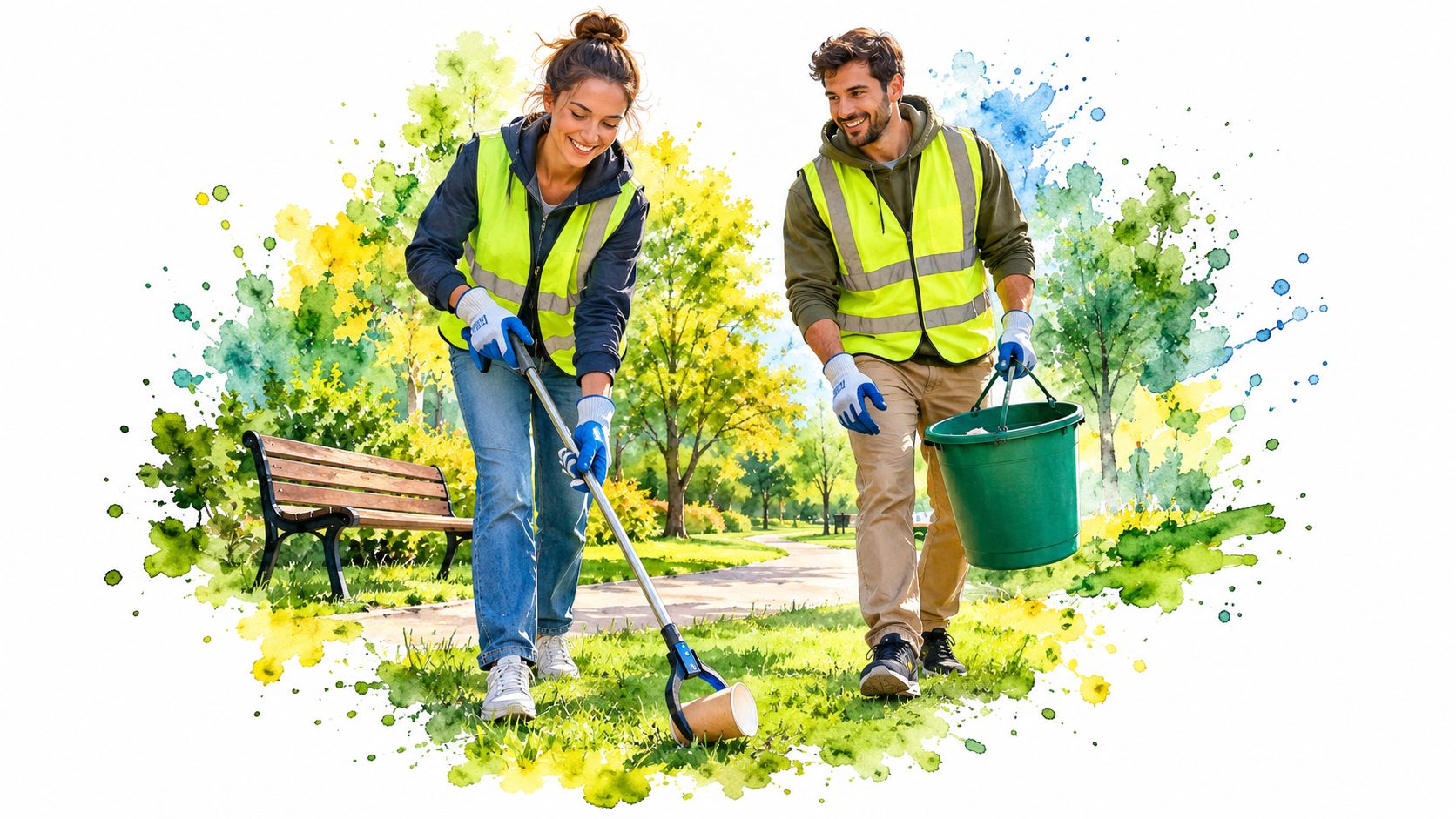
You arrive at the park on a sunny morning, ready to help. Cups sit beside a bench, wrappers cling to the grass near the playground, and a line of litter follows the path toward the parking area. It's tempting to grab a bag and start walking. Take a moment first. A calm plan helps you protect the crew, cover the right ground, and leave the park ready for the next visit.
Cleaning up the park works best as a small field operation. You don't need complicated equipment, but you do need clear boundaries, safe roles, a collection method, and a plan for what happens to the waste afterward.
Start With a Calm Park Cleanup Plan
I would walk the site before I ask anyone to pick up anything. The first few minutes should settle the basics: where the group meets, what area you'll cover, who watches for hazards, and what nobody should touch. Treat it like setting up a campsite. You choose a safe place to gather, mark the edges, assign simple jobs, and make sure everyone knows where to go for help.
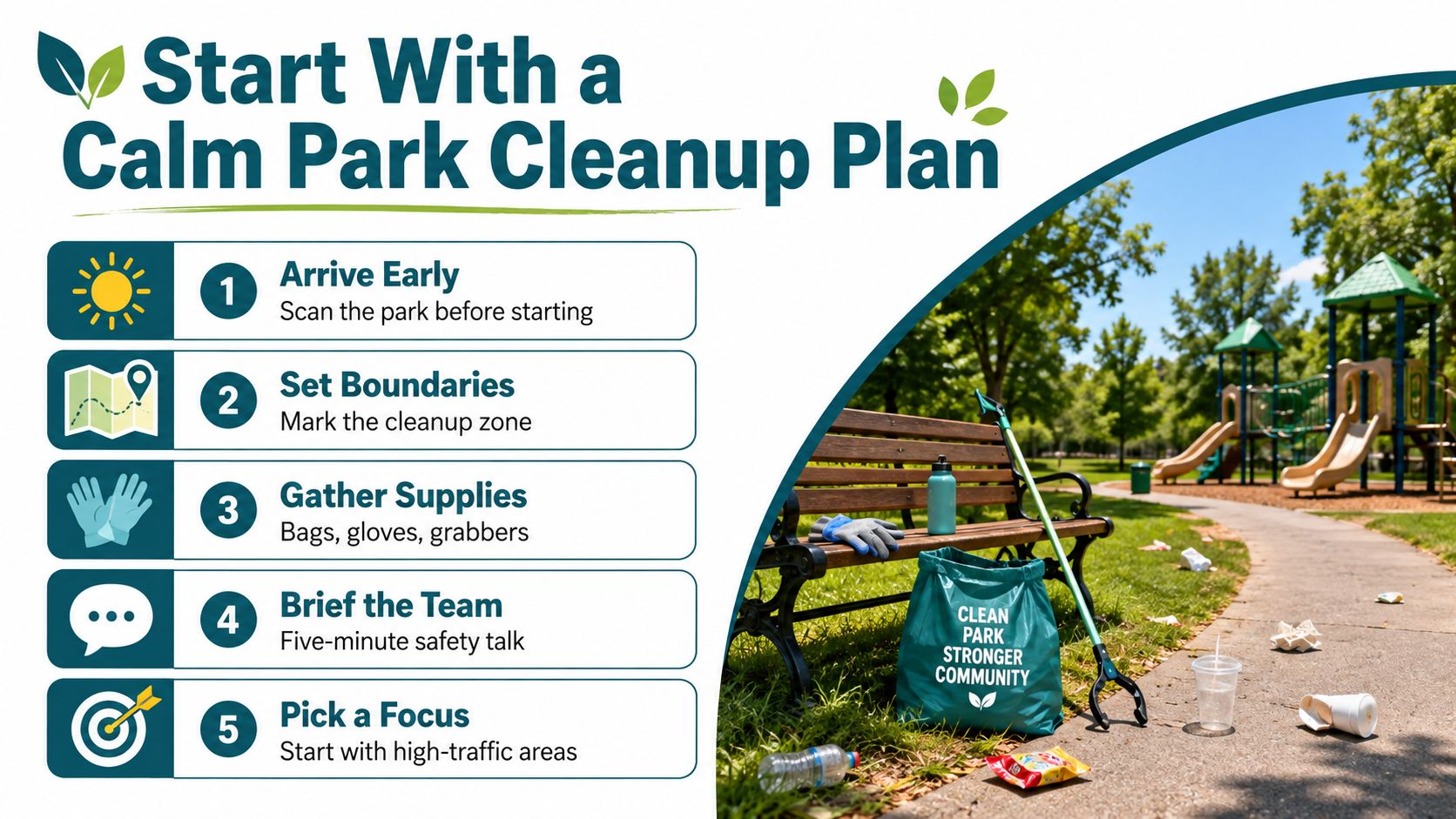
Bring sturdy bags or buckets, grabbers, gloves, drinking water, a first-aid kit, and a phone or other way to contact the right local service. Before you invite beginners, check that the route avoids unsafe slopes, active traffic, and areas where you can't see what lies underfoot. If the site includes hazards that need trained handling, change the route or wait for the proper response. A cleanup isn't a race, and nobody needs to prove their dedication by taking a risk.
For seasonal property work, Prestonwood Commercial Services has Prestonwood's 2026 landscape cleanup advice, which can help you think about how a cleanup fits alongside broader outdoor maintenance. For a volunteer event, keep your own scope modest and specific.
Before-You-Start Cleanup Checklist
| Planning item | What to confirm | Why it matters |
|---|---|---|
| Meeting point | Choose a visible, easy-to-find spot | The group can gather without blocking paths |
| Cleanup boundary | Name the path, lawn, or park segment | Volunteers know where to work and when to stop |
| Crew roles | Assign a lead, hazard watcher, and note-taker | People can ask the right person for help |
| Supplies | Check bags, gloves, grabbers, water, and first aid | The crew can work without sharing unsuitable gear |
| Stop-work rule | Agree that anyone can call a pause | Volunteers can step back from a hazard without debate |
Use one simple mental model from the start: inspect, brief, collect, sort, dispose, and check. That sequence keeps the morning steady, even when the park is busy.
Prepare the Site and the Crew
An open park can feel straightforward until volunteers spread out in different directions. Walk the perimeter first, then choose a route that keeps the crew together and away from risky edges. Note entrances, benches, playground edges, parking interfaces, picnic areas, waterways, and any spot where trash gathers. A quick sketch or written boundary is enough. Mark the place where everyone can rest and regroup.
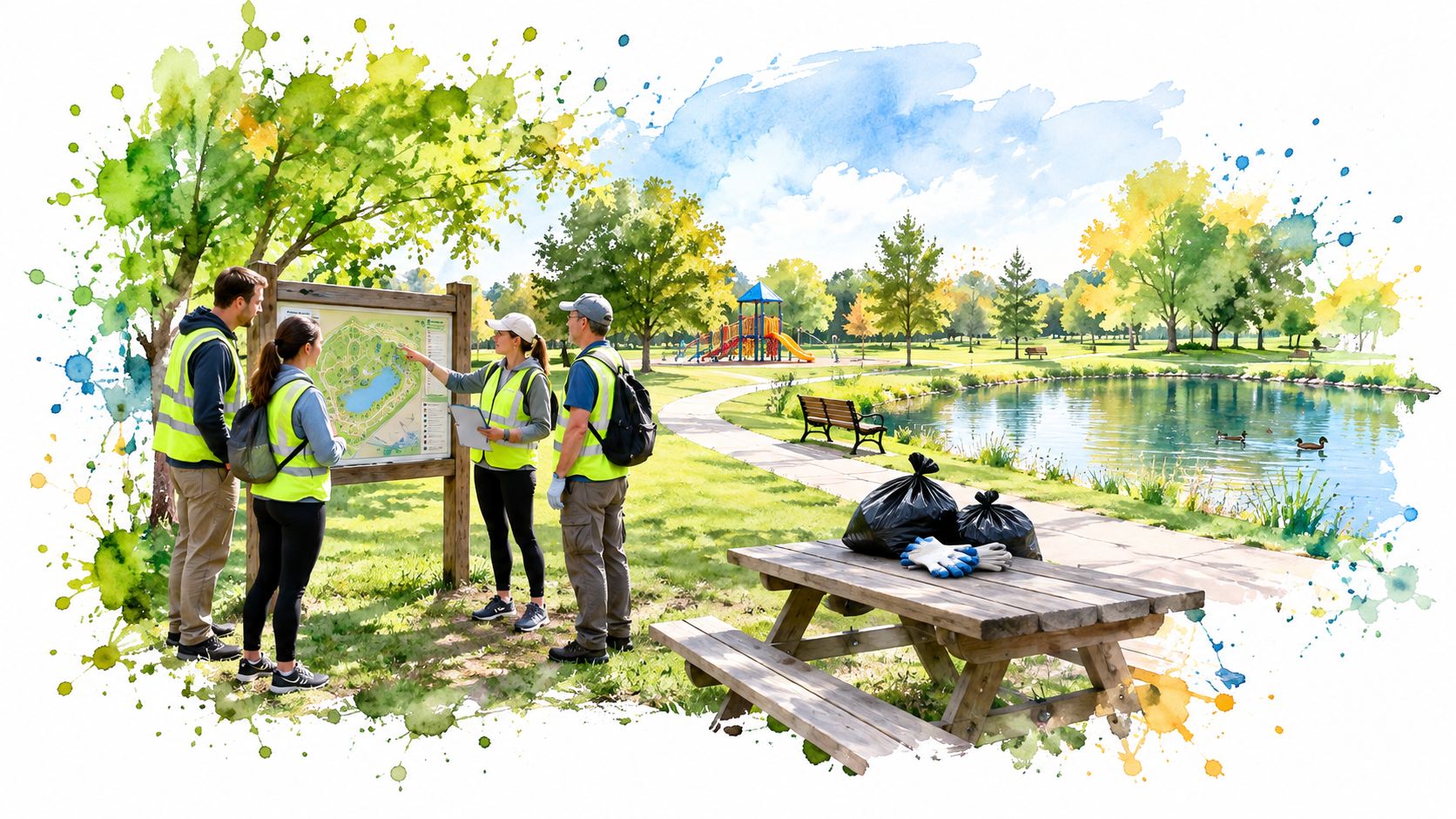
Give each volunteer a job that fits the work and the person. One person can collect ordinary litter, another can watch for hazards, and a sorting lead can keep the drop-off point organized. A first-aid contact should know where the kit is and how to reach the event lead. Ask someone to record the route, weather, crew size, and anything the group needs to report.
Cleanup Role Map
| Role | Main responsibility | Example decision |
|---|---|---|
| Crew lead | Keep the group on the planned route | Pause work when volunteers drift toward a risky edge |
| Collector | Pick up ordinary litter with tools or suitable gloves | Leave an unknown bag untouched |
| Hazard watcher | Scan ahead and alert the crew | Ask everyone to avoid a suspicious pile |
| Sorting lead | Separate ordinary waste from items needing another route | Keep clean recyclables apart if local rules allow |
| First-aid contact | Carry or locate the kit and help coordinate a response | Call for help if someone feels unwell |
| Note-taker | Record conditions, work, and follow-up needs | Photograph a recurring dumping spot |
Keep the briefing short and practical. Point out traffic, water, uneven ground, sharp objects, private property, and the rest area. Tell the crew how to contact local services and say plainly that anyone can stop work if something feels unsafe.
Pack puncture-resistant gloves, closed-toe shoes, grabbers, buckets, liners, water, shade, and a first-aid kit. Near roads or bike paths, add high-visibility clothing. Check the forecast and the ground conditions before volunteers arrive. Rain, heat, cold, or strong wind may call for a shorter route or a postponement. Nobody should feel pressured to keep working through conditions they can't manage.
Collect Litter Without Spreading the Mess
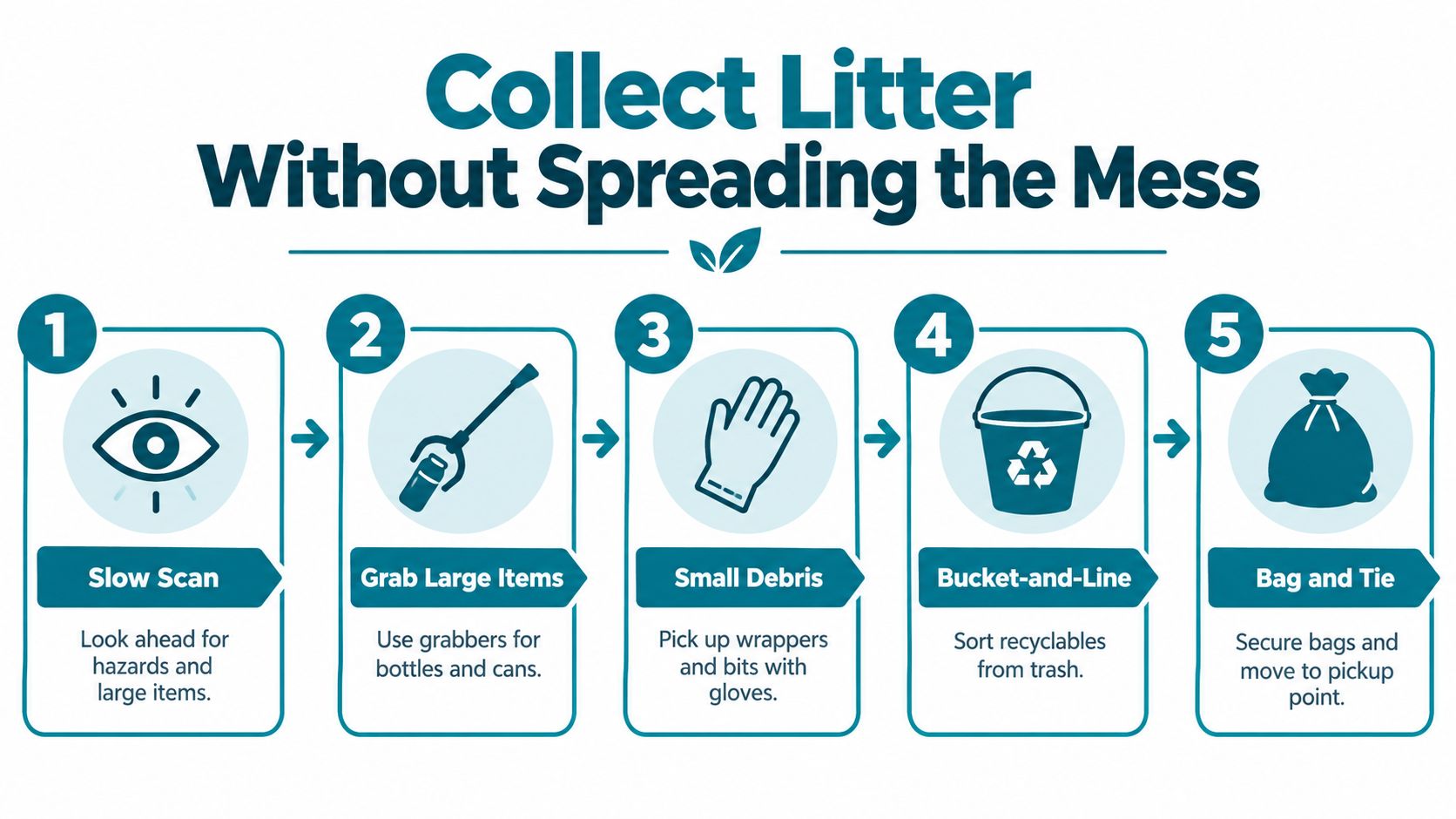
Start with a slow scan. Look ahead for sharp objects, unknown containers, traffic, and places where litter has gathered. Pick up ordinary items with grabbers, gloves, or a bucket-and-line setup. Keep your hands away from debris when a tool can do the job, and leave sealed or opaque bags alone.
Work in pairs when you approach a roadside edge or a water boundary. One person can collect from the safe side while the other keeps an eye on passing bikes, cars, and changing conditions. Don't cross into traffic or unstable ground to reach a stray bottle. If you can't retrieve it safely, mark its location and pass the information to the right service.
Make Two Passes
Use the same route twice when the site and crew can support it. On the first pass, collect larger visible items such as bottles, cans, and food containers. On the second, look for wrappers and fragments that blend into grass, mulch, and drainage edges. A second pass helps, but it doesn't make a risky spot safe to enter.
Keep the sorting simple. Separate ordinary litter from bulky objects and anything that needs special handling. Never hand-sort an opaque bag, compress waste, or squeeze a container to make it fit. If a sharp, chemical, biological, or unknown item appears, stop nearby work, mark the location from a safe distance, and contact the appropriate local service.
Take short work periods and pause for water and shade. A rest point gives volunteers a place to regroup, check their condition, and hand off full bags without wandering across the park. Let people switch tasks if they're tired. A steady crew can work safely without asking everyone to do the same job.
The flow below gives first-time volunteers a clear sequence to follow.
Field Collection Sequence
| Stage | What the crew does | Safety check |
|---|---|---|
| Slow scan | Look ahead and note hazards or hotspots | Stay on the agreed route |
| Large items | Use grabbers for bottles, cans, and other ordinary litter | Don't reach into hidden spaces |
| Small debris | Pick up suitable wrappers and bits | Use gloves and avoid sharp fragments |
| Sort | Separate ordinary waste from items needing another response | Don't open unknown bags or containers |
| Handoff | Secure ordinary waste and move it to the agreed collection point | Keep the route clear and bags uncompressed |
Protect Volunteers and Leave Hazardous Waste Alone
A volunteer doesn't need to collect every object to help the cleanup. Some materials need trained handling, and refusing to touch them is part of a safe field plan. Before work starts, hold a short briefing on boundaries, buddy assignments, traffic and water hazards, sharps, emergency contacts, hand hygiene, and everyone's authority to stop work.
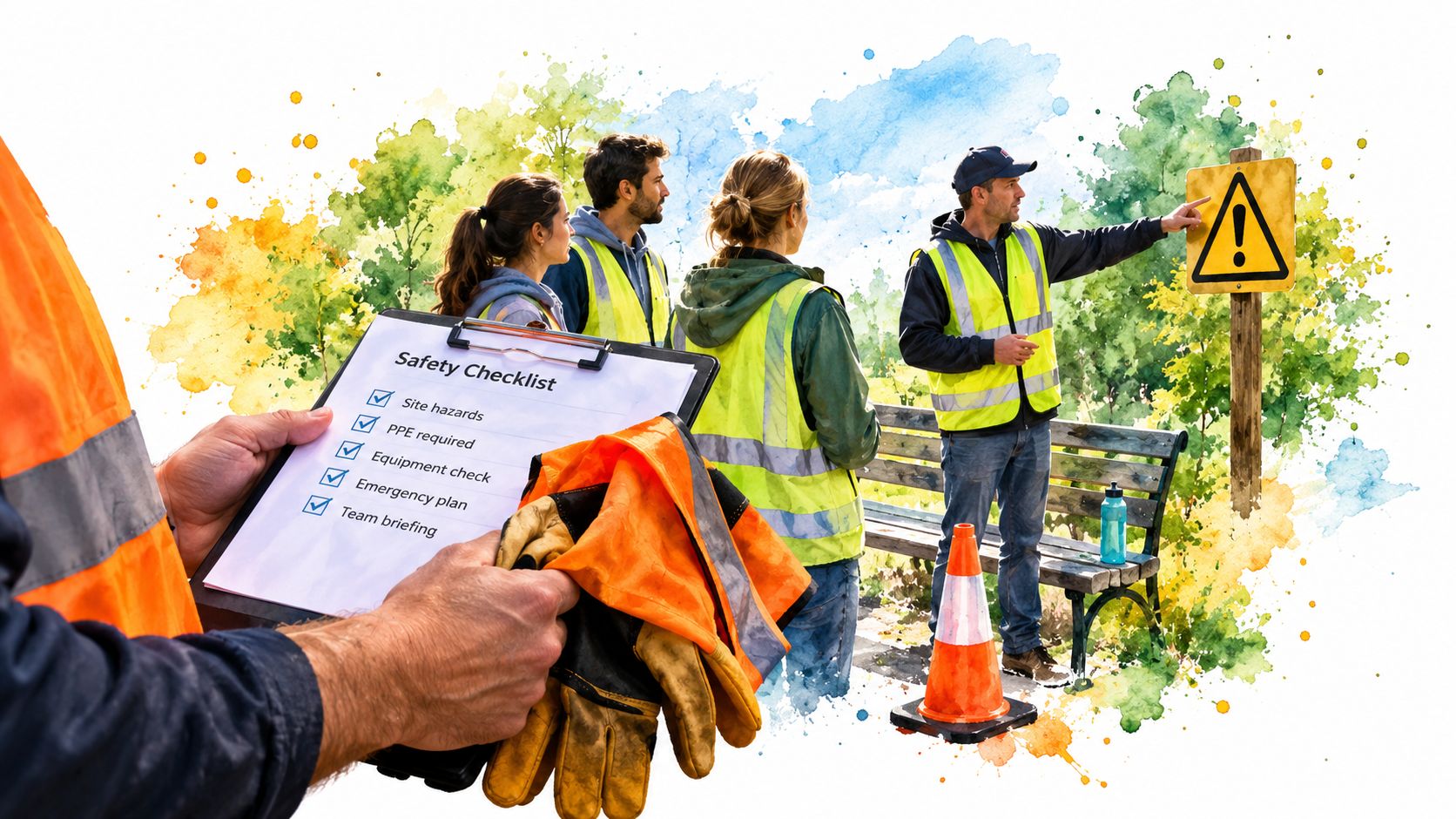
Wear puncture-resistant gloves and closed-toe footwear. Use high-visibility clothing near roads or bike paths, and choose grabbers or other tools that keep hands away from debris. Don't hand-sort opaque bags, press down on waste, or squeeze containers. Pressure can shift or release contents you can't see.
Do Not Collect by Hand
| Material or situation | Volunteer action | Reporting or disposal route |
|---|---|---|
| Needles or suspected sharps | Keep the group back and mark the location | Contact the municipality or an approved trained responder |
| Unknown chemicals or leaking containers | Don't move or open them | Report the location for professional guidance |
| Propane cylinders or batteries | Leave them in place | Ask the municipality which approved route applies |
| Human waste or dead animals | Don't handle or bag them | Contact the appropriate municipal service |
| Suspected asbestos-like materials | Keep people away | Request professional assessment and handling |
| Traffic, water, or unstable ground | Stop collection in that area | Redirect the crew or ask the responsible authority for help |
If a questionable item appears, step back and hand off the location. A clear report helps the trained responder find the problem without sending volunteers into it. Chicago volunteers can review the city hazardous-waste disposal guidance when they need to understand how to route materials that don't belong in an ordinary cleanup bag.
Plan for the weather as carefully as you plan for equipment. Schedule strenuous work during cooler morning hours when possible, provide water and shade, and check on one another. Heat, cold, dizziness, or confusion are reasons to pause and get help. A volunteer who says “I'm stopping” should never have to argue their case.
Field rule: If you can't identify it, don't handle it. Mark the location, keep others away, and call the proper service.
Handle Bulky Waste and Recyclables Correctly
Different waste needs different handoffs. A clean beverage container may fit a local recycling route, while a container with liquid can leak through a collection bag. Broken glass needs careful handling, and tangled cords, wet waste, oversized furniture, or a bag with unknown contents may fall outside an ordinary volunteer pickup.
Keep clean, dry recyclables separate only when local rules accept them. Identify what you've found, record where it is, and confirm the receiving route before moving anything unusual. Volunteers can sort and report. The municipality or approved facility decides how to handle the material after handoff.
Waste Handoff Decision Guide
| Waste type | What volunteers should do | What happens next |
|---|---|---|
| Ordinary litter | Collect with tools or suitable gloves | Dispose through the agreed park or municipal route |
| Clean recyclables | Keep separate if local rules allow | Follow local recycling instructions |
| Broken glass | Don't reach in by hand | Use an approved method or report it |
| Bulky furniture | Record the location and identify the item | Request an appropriate pickup |
| Unknown or hazardous material | Leave it untouched and mark the area | Contact a municipal or professional responder |
| Potential donation | Ask before moving or transporting it | Confirm the organization accepts the item |
For Chicago reporting, document illegal dumping or recurring vacant-lot conditions with a location and clear description. The city says owners of vacant and unimproved lots must remove litter, debris, and abandoned vehicles, and weeds can't grow higher than 10 inches. Garbage-container lids must stay tightly closed, and raw garbage can't sit outside containers. Volunteers can use Chicago's alderman and ward lookup to identify where a report belongs.
If you need background on equipment used for moving or spreading bulk material, this truck manure spreaders guide provides a point of comparison for specialized hauling equipment. For ordinary community cleanup, keep the practical handoff simple. Check Chicago recycling center information before directing collected materials to a facility.
Measure the Cleanup and Plan the Return
When the bags leave, walk the same route again. Check the places where litter gathered, look for items the crew missed, and record what remains. A cleanup needs a clear finish, but it also needs a way to see whether litter comes back.
The EPA's Wichita project gives a useful reason to measure small debris as well as larger items: citizen scientists collected and categorized 1,765 pieces larger than four inches across park cleanup events, along with an additional 30 gallons of smaller material. Plastic made up 47% of the recorded litter, and 75% of that plastic came from food and beverage wrappers or containers. The study also found that litter clustered around places people gather, including picnic areas, pavilions, and parking lots, even when bins were present. You can read the EPA Wichita litter study for its standardized approach to collecting, classifying, and documenting litter.
Before and After Cleanup Audit
| Measurement | Record it as | Use it to decide |
|---|---|---|
| Site boundary | A fixed path segment or mapped area | Keep future surveys comparable |
| Starting and ending litter | Counts by category and survey route | See what the crew removed and what remains |
| Work performed | Crew size and volunteer-hours | Understand the effort behind the result |
| Waste removed | Bags or kilograms, when you can measure them | Plan disposal capacity |
| Hotspots | Notes, map marks, and photographs | Decide where to focus the next visit |
| Follow-up | Repeat checks at 7-, 30-, and 90-day intervals when practical | See whether litter returns and where |
Record the date, weather, starting conditions, and route. Take photographs from fixed points so the next crew can compare the same locations instead of relying on memory. If litter counts rise later, look for a practical cause: a busy weekend, bins that can't keep up, rain moving debris toward drains, or a nearby source that keeps adding wrappers. The measure is useful only if it helps you decide what to change.
Chicago's Pitch In for the Parks program shows how repeated cleanup events can involve people across many sites. The Chicago Parks Foundation reported that its 2021 season engaged over 4,000 volunteers in more than 600 cleanup events between June and October, with participants collecting more than 6,400 trash bags; its volunteer program history also describes later seasons and work through host groups and Green Teams. Use that example to support a repeatable method, not to rank crews by bags collected.
Ask nearby residents which spots trouble them and invite them to choose the next route. A map can help a Chicago group track visits across the city's 50 wards, using official boundaries and lookup tools described on the City of Chicago facts page. If your group tracks waste costs or handoffs, this chart of accounts for waste firms can help explain how waste-related categories get organized. For a simple community record, a guide to measuring community impact can help you decide what to track. End the visit with a safer route, a documented result, and a date to return.
Run an Inclusive and Repeatable Cleanup
A cleanup reaches more people when it gives them more than one way to take part. Offer short shifts, clear transit and accessibility information, and instructions in the languages neighbors use. A volunteer who can't lift a full bag can map the route, take photographs, translate, coordinate sorting, speak with residents, or monitor the rest area.
Ask local residents and neighborhood leaders what needs attention before the crew arrives. Then invite feedback after the cleanup and during follow-up visits. A group that works across Chicago's wards should pair geographic reach with neighborhood input, so residents help set priorities rather than just receiving visitors.
Ways to Make the Cleanup More Welcoming
| Barrier | Practical adjustment | Who can help |
|---|---|---|
| Limited time | Offer a short shift or a defined route | Event lead |
| Lifting or mobility needs | Provide mapping, photography, or rest-area roles | Role coordinator |
| Unclear travel plans | Publish transit and accessibility details | Resident liaison |
| Language barriers | Share translated instructions and a briefing | Translator or local partner |
| First-time nerves | Explain the route, tools, and stop-work rule | Experienced volunteer |
I would make the first event small enough that newcomers can see the whole process and still feel useful. Track who returns and what residents say alongside the waste collected. Choose one park boundary, one safe morning, one documented route, and one return date. Then invite a neighbor to help decide what the crew should tackle next.
Litter Caterpillars organizes volunteer-led trash pickups in Chicago parks and public spaces, with supplies such as bags, gloves, and grabbers for participants. If you want a practical, volunteer-driven example of cleaning up the park and building a repeatable neighborhood routine, visit Litter Caterpillars to learn about its cleanups.
Leave a Reply