
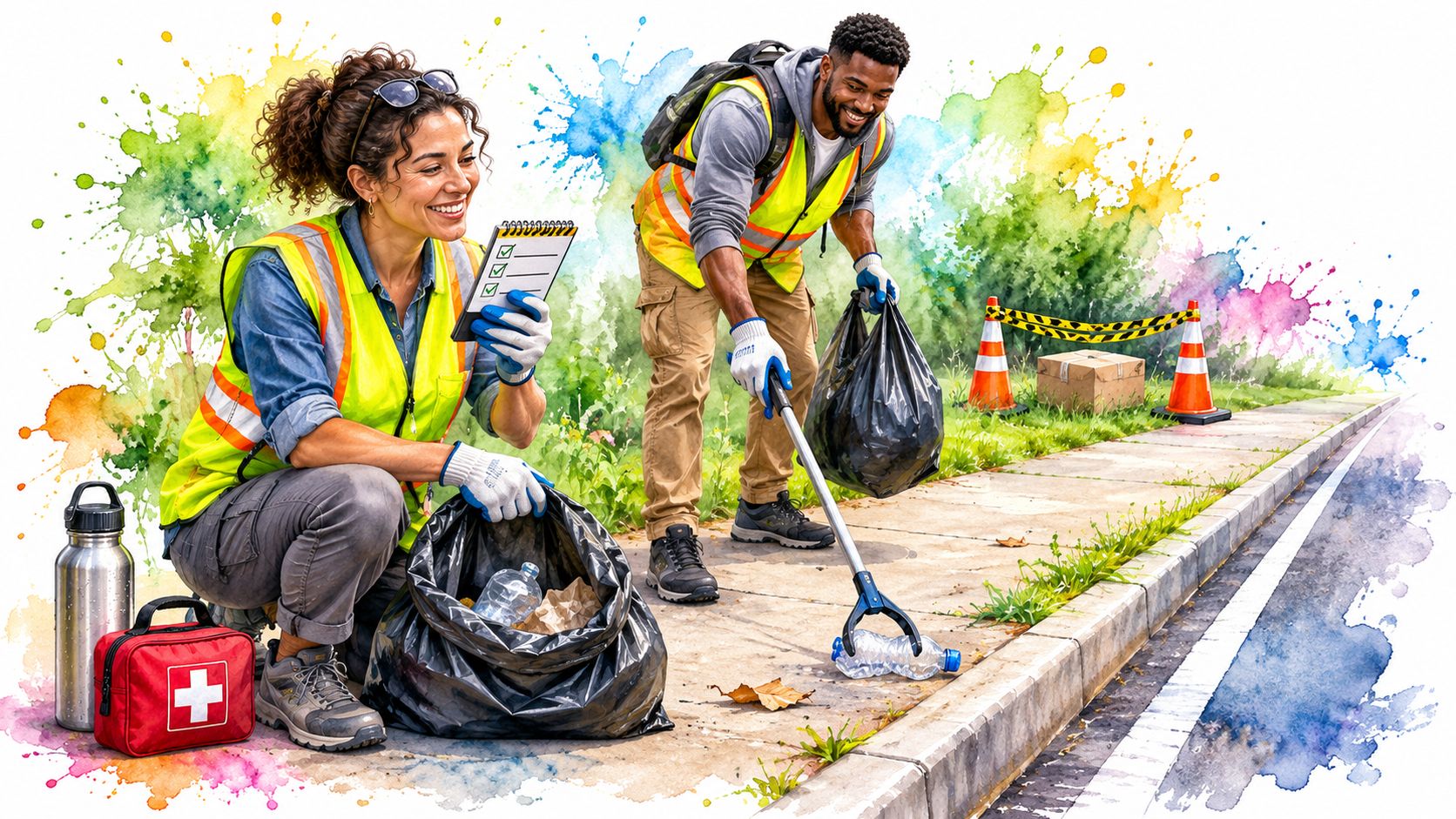
Say you arrive for a Saturday cleanup with coffee, gloves, and a friend who's never held a trash grabber. Then you spot a needle beside the bus stop, and the friendly morning needs a clear decision.
A Safety Plan You Can Carry in Your Pocket
I remember an old jar of blueberry jam from a Michigan trip. I couldn't bring myself to throw it away. That little jar felt impossibly heavy because I'd attached a story to it.
A litter bag can feel heavy for another reason. You reach for an ordinary wrapper, then notice traffic squeezing past your elbow or something sharp beneath the leaves. A safety plan of action is the short note you write before that moment, while you can still think without a horn blaring.
Our first Litter Caterpillars pickup ended with us shivering under a tree during a Chicago hailstorm while rides kept canceling. I can appreciate the friendship in that memory without recommending the shelter choice. A tree isn't a safe storm refuge.
Put the decisions within reach
I want you to leave home with these tools:
- A go or no-go card. Write what will make you change the morning.
- A no-touch list. Decide what stays on the ground before anyone reaches for it.
- A named stop-work lead. Give someone responsibility for gathering the group, while keeping every volunteer's right to stop.
Treat that note like a trail map. You need boundaries, an exit, and a meeting point.
The National Institute for Occupational Safety and Health reports that refuse and recyclable-material collection ranked as the seventh-deadliest U.S. occupation in 2021. Your neighborhood pickup differs from paid refuse collection, but I still put moving vehicles near the top of my route assessment.
Before you buy bags, name the meeting corner, route edge, and emergency-access point. A wrapper across a busy street can wait.
Keep that decision-making mindset alongside the everyday habits in The Green Living Guy's practical ways to protect the planet. Choose work you can complete without asking a volunteer to gamble.
Carry only what you can manage while keeping your footing and watching your surroundings.
Go and No Go Calls Before You Leave Home
Check the weather the night before, then check again before departure. I'd rather change a meetup while you're eating breakfast than gather people beside an exposed intersection and improvise.
Use heat index, rather than temperature alone, for your heat decision. Read wind chill, lightning risk, precipitation, flooding, wind, air quality, and daylight too. Then ask a practical question: can everyone reach suitable shelter from the actual work area?
Give heat a rest schedule
Oregon OSHA's heat-illness guidance specifies minimum recovery breaks of 10 minutes every two hours at a heat index of 90°F or higher, 20 minutes every hour at 95°F or higher, 30 minutes every hour at 100°F or higher, and 40 minutes every hour at 105°F or higher. I use those figures below as a planning reference for volunteers, not as a claim about Chicago volunteer law.
Cleanup Go and No Go Thresholds
| Trigger | Action | Who decides |
|---|---|---|
| Heat index 90°F or higher | 10 minutes rest every 2 hours and water at the start | Event lead |
| Heat index 95°F or higher | 20 minutes rest every hour and a shorter first loop for new people | Event lead |
| Heat index 100°F or higher | 30 minutes rest every hour or cut the route | Event lead |
| Heat index 105°F or higher | 40 minutes rest every hour or cancel | Event lead |
| Wind chill, poor daylight, or no shelter on the route | Shorten, move, or postpone | Event lead, and any volunteer may stop |
| Lightning, flood, high wind, or bad air | Postpone, shorten, or move the meetup | Event lead, and any volunteer may stop |
| Live traffic lane | Do not enter; vest and buddy near roads | Every volunteer |
| Sharps, chemicals, unknown containers, or bodily fluids | Do not touch; mark and call the disposal agency | Route scanner |
Treat each higher heat band as replacing the lower band. Don't add the rest periods together, and don't interpret a scheduled break as permission to continue through symptoms.
Put drinking water at the meeting point and a shaded recovery location. Give new or returning volunteers a shorter initial assignment. Nobody should need to prove stamina to earn a place in the group.
Make the call before people travel
The NIOSH heat-stress guidance calls for risk assessment, hydration, acclimatization, reduced physical load, and recurring training. Build those measures into the morning instead of relying on everyone to recognize trouble alone.
Watch your buddy. Stop work for confusion, faintness, unusual fatigue, headache, nausea, or lost coordination, and seek appropriate medical help. Call emergency services for confusion, collapse, or other signs of a serious emergency, and begin cooling while help comes.
For route-specific shelter and communication planning, use our severe-weather safety guide. Name a backup communication method in case someone loses reception or misses the group chat.
Morning rule: If you can't provide the protection your decision requires, change the event.
Say the forecast worsens while you're loading supplies. Post the revised location or cancellation with the time, reason, and next update. Ask volunteers to acknowledge the message so nobody heads toward an abandoned meeting corner.
Keep permits off this dawn card. You need to settle those before anyone plans their Saturday around you.
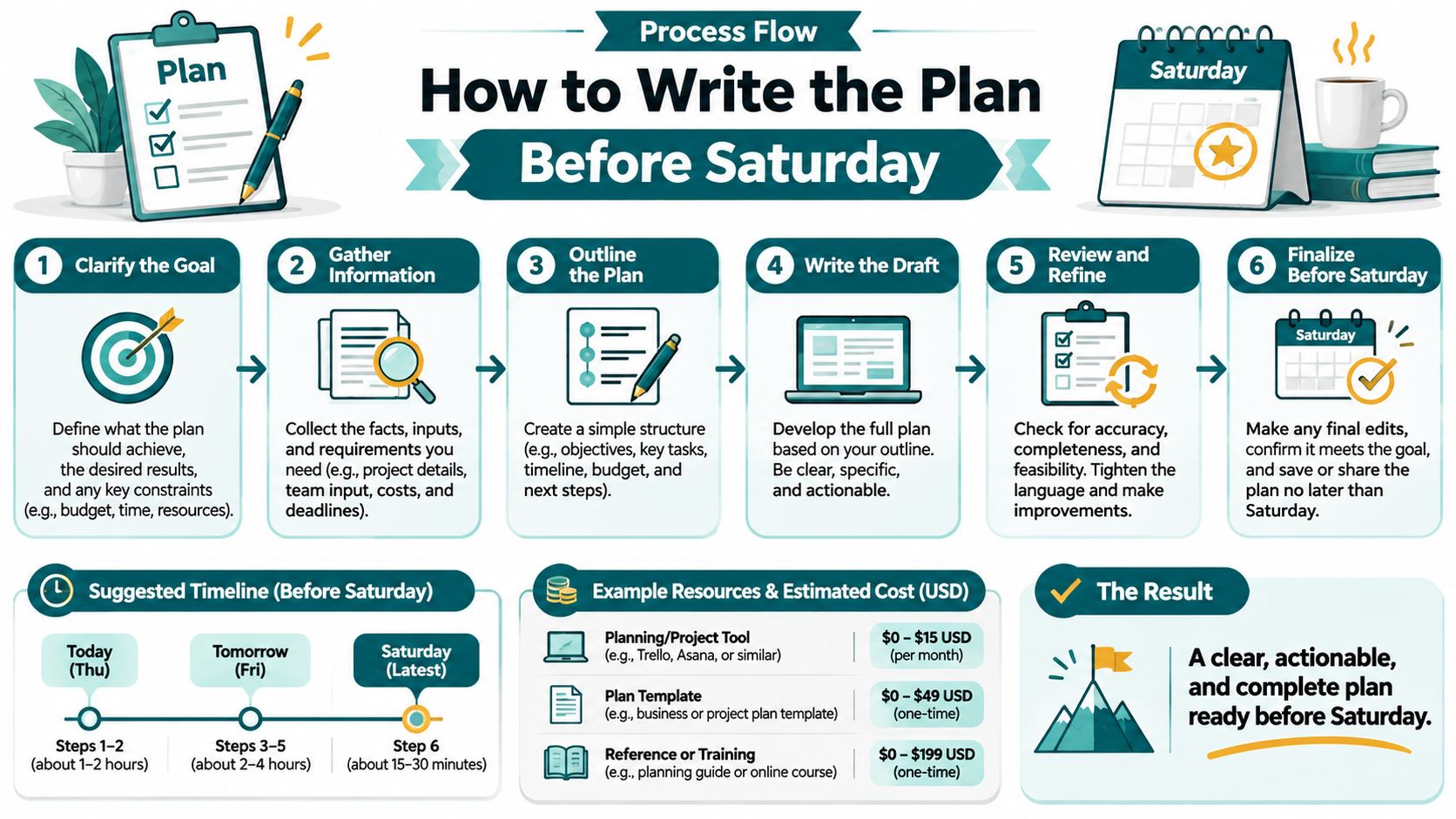
How to Write the Plan Before Saturday
Open a shared note with the route map beside it. Write for the person who joins late, has a nearly empty phone battery, and needs plain directions.
I use a Job Hazard Analysis, or JHA, to break the morning into tasks rather than writing a vague warning to be careful. OSHA's Job Hazard Analysis guide recommends prioritizing hazardous jobs, examining their steps, selecting controls, sharing the analysis, and updating it as conditions change.
Write the decisions in working order
Name the place and responsible people. Record the site owner, exact meeting corner, route boundary, event lead, backup, and emergency contact. Add an address responders can find, rather than a nickname only regulars understand.
Resolve public-way permission early. If you plan a Chicago public-way special event, check the permit process and include security and emergency handling. Don't assume that carrying trash bags gives you permission to occupy a street.
Count people and check the property rules. Confirm registration, supervision, supplies, and park requirements before publishing. A casual chat invitation can grow beyond the group you originally pictured.
Break the morning into observable tasks. Include arrival and parking, briefing, walking near roads, ordinary pickup, bulky objects, hazardous finds, bag transport, and departure. Give the awkward ending as much attention as the cheerful start.
Write a hazard beside each task. Record who faces it, where it occurs, what triggers exposure, and the likely consequence. Then select a control. Remove a fast-road segment before relying on a vest.
Set boundaries and check-ins. Assign buddy pairs, headcount points, and a check-in time. Explain what to do if someone loses sight of their partner or needs to leave early.
Practice the stop call. Ask a volunteer to name a reason they would stop. Let everyone hear you accept that answer without bargaining.
Close the loop afterward. Log incidents and near misses, name the person responsible for the fix, and set a completion date. Read that note before approving the next event.
Use the process graphic as a prompt while you write, then keep your route-specific decisions beside it.
Put administration on the calendar
The Forest Preserves of Cook County group-volunteering guidance requires groups larger than 10 people to register cleanup details and assigns organizing and supervision responsibilities to the leader. Request gloves, bags, and grabbers while you arrange the event.
The Alliance for the Great Lakes team-leader guidance describes a Chicago special-event application deadline of at least 21 days, and identifies Chicago park permit checks for attendance over 100 people, public-way interference, or activities including food sales. Confirm the classification and current requirements with the responsible authority before advertising.
Cleanup Calendar Checks
| Trigger | Action | When |
|---|---|---|
| More than 10 people in a Cook County forest preserve | Register, name a leader, request gloves, bags, and grabbers | Before you publish |
| Chicago public way used as a special event | File a permit at least 21 days ahead with a security plan | At least 21 days before |
| Park cleanup over 100 people, a blocked path, or food sales | Confirm permit rules with the park office | Before you publish |
| New route or a changed meetup | Write the job hazard steps and name the stop-work lead | Before you publish |
For help turning a warning into a repeatable instruction, consult the Mobile Systems Limited safety procedures guide. Write what the volunteer does, who receives the report, and what happens next.
Keep coverage questions in that same preparation folder. Our volunteer liability insurance guide can help you prepare those questions, but insurance never replaces a safer route.
Gloves Grabbers and the Things You Leave Alone
Hold the grabber like a long arm. Keep your real hands away from the part of the job you can't see.
Before opening a bag, check your gloves, grip, footwear, and walking surface. Wear sturdy closed-toe shoes, long pants, weather-appropriate clothing, and high-visibility apparel near roads. If you forgot suitable shoes, choose a safe alternative task rather than trying to make sandals work.
The City of Bellingham volunteer litter-cleanup guidelines direct volunteers to avoid sharps, glass, biohazards, toxic substances, encampments, steep slopes, unstable ground, and other hazardous areas. They also recommend gloves, grabbers, public-property boundaries, traffic awareness, and hand hygiene.
Take ordinary litter you can identify
Say you see a snack wrapper beside a shrub. You can see the whole wrapper, reach it from firm ground, and lift it with the grabber without stepping toward traffic. That's an ordinary pickup.
Now say you see the corner of a plastic bag beneath dense leaves. You can't tell what's inside or underneath. Leave it alone rather than probing until you find out.
Keep this division simple:
- Take visible ordinary litter. Pick up paper, cans, and identifiable nonhazardous packaging from a stable position.
- Leave hazardous material. Don't handle needles, glass, chemicals, bodily fluids, or suspicious containers.
- Report uncertainty. Tell the route scanner where you found the object without moving it closer for a better look.
Your glove is a barrier, not permission to touch everything. Don't squeeze bags to make room, press them against your leg, or reach blindly into bins and vegetation.
Use the grabber to keep distance while staying upright.

Leave a useful report instead of a dangerous souvenir
Mark a hazardous find's location from a safe distance. Give the responsible disposal agency the nearest address or recognizable landmark, the object's general appearance, and any immediate access concern. Don't carry it to the meetup.
Leave encampments and personal belongings alone. You're there to collect litter, and you don't know which items someone needs. Move the route away without photographing people or making them explain themselves.
For ordinary handling technique, use our guide to picking up trash. Practice opening the bag and releasing the grabber before reaching the messy stretch.
You don't owe the block a full bag. You owe yourself a safe trip home.
Stop filling a bag before you lose an easy grip or clear view of your feet. Ask for help with manageable loads, and leave bulky or uncertain objects for appropriate collection rather than improvising a team lift.
At the finish, remove gloves without rubbing their dirty surfaces across your skin. Wash your hands thoroughly before eating or touching your face. If washing facilities aren't available, use hand sanitizer, then wash when you can.
Keep snacks separate from collection supplies. That small bit of organization makes the end of the morning easier.
When a Person Not the Trash Needs Help
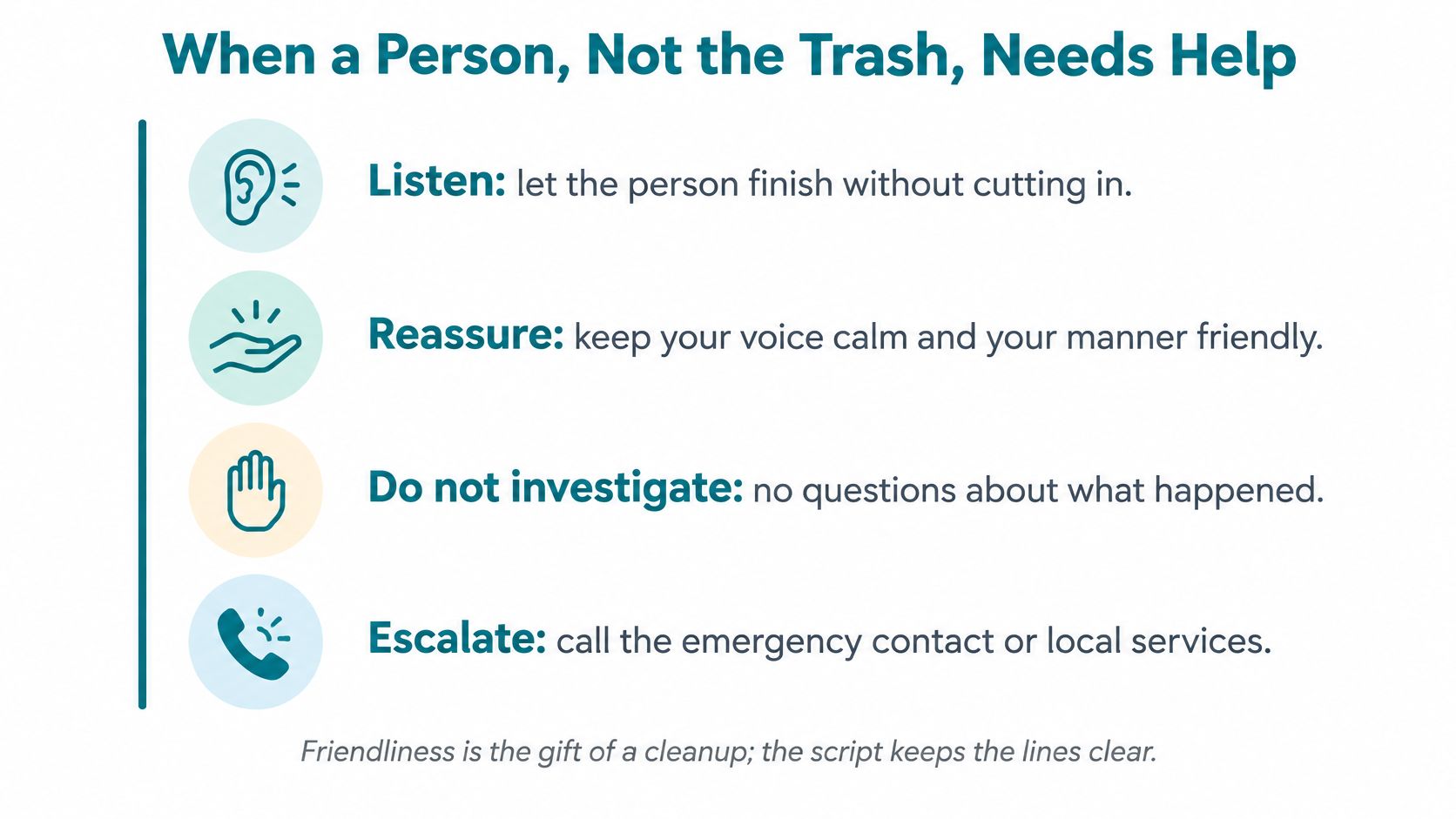
Listen, reassure, don't investigate, escalate. Say a young volunteer puts down their grabber and tells you someone has hurt them. Your job is to respond calmly and get appropriate help, not to extract a complete account beside the trash bags.
Let them finish without interrupting. Reassure them that they did the right thing by telling you, and don't promise secrecy. Explain that you'll share the concern with someone who can help keep them safe.
Keep the response simple enough to remember under stress.
Stay visible and know who to call
Name a safeguarding lead and backup before the event. Take concerns to that person promptly, and contact emergency services immediately when someone faces immediate danger. Don't delay a necessary report while trying to reach an unavailable group leader.
Keep interactions with minors visible to another responsible adult. Don't take a child away alone to hear more details, and don't confront the person they name.
Use these boundaries:
- Ask only what safety requires. Avoid leading questions or requests to repeat the account for other volunteers.
- Share on a need-to-know basis. Keep sensitive details out of the group chat.
- Document necessary facts. Record what you heard, what you observed, and what action you took without adding guesses.
- Check reporting duties. Learn the rules that apply to your role and location before supervising minors.
Prepare for medical needs too. The Arizona Department of Health Services outdoor-event heat guidance is a useful companion for planning environmental-health precautions at an outdoor gathering. Keep safeguarding responsibilities and medical-response arrangements clear rather than treating every distressed person as the same kind of emergency.
Leave conflict without winning it
Say a passerby starts threatening the group. Don't debate their motives or try to finish the last bag. Gather volunteers, move toward a safe location, and call emergency services if anyone faces a threat or immediate danger.
Keep volunteers out of solo interventions. You can care about a stranger without asking an untrained participant to handle a confrontation.
Use the video below during preparation, with time afterward to discuss your own emergency contacts and exit route.
After a disturbing encounter, check on the people who witnessed it before posting celebration photos. Offer a quiet place, help contacting someone they trust, or information about appropriate support. Don't make anyone retell the event to prove they need a break.
Ask permission before taking or sharing photographs. Skip identifiable images of children and people in distress when you can't establish appropriate consent.
You can leave the bags for later. Give the person in front of you your attention.
Make the Stop Call and Still Show Up
Tonight, open a phone note and give it a useful title: the location and planned cleanup date. Put the event lead and backup at the top. Add the decision card, route boundaries, emergency-access point, and reporting contacts.
Share that note before you share the meetup invitation. You want people to understand the conditions of participation while they still have a choice about their morning.
At Litter Caterpillars, volunteer safety always takes first priority, and volunteer happiness takes second priority. I don't want someone smiling through dizziness because they think leaving will disappoint me.
Make stopping socially easy
At the briefing, ask people to practice saying they want to stop. Thank them when they do. You teach the group more through that response than through another paragraph in a document.
Give a new volunteer permission to flag something without defending a technical argument. Maybe they notice a reversing vehicle you missed. Maybe they can't manage the route you chose.
A stop call should start a helpful conversation, never a test of belonging.
Don't put cancellation to a popularity vote. The people most comfortable with risk can easily outtalk the person who needs a safer plan. Let any volunteer trigger a pause, then have the lead coordinate the shorter route, relocation, or cancellation.
Use a clear message when you change plans:
- State the decision. Tell people whether you've canceled, shortened, or moved the pickup.
- Give the practical reason. Name the condition without blaming anyone.
- Preserve the connection. Share the next scheduled meetup or explain when you'll announce it.
Keep the friendship on the calendar
Rain-or-shine pride can stay. I want us to take equal pride in making a disciplined decision and seeing each other again.
If you cancel the outdoor work, don't pressure people to travel for an optional social gathering. Check that any replacement location is safe and accessible, and let everyone choose freely.
On Saturday, speak the stop rule while people still hold coffee. Point out the water, recovery location, and route edge. Then ask whether anyone needs a change before you begin.
I run Litter Caterpillars on Chicago weekends, and a stop call outranks a full bag. When the card says quit, we quit. Put the next morning on the calendar, and give your friends a reason to return.
Litter Caterpillars brings people together for weekend cleanup mornings in Chicago, with friendship and volunteer-first values at the center. Visit Litter Caterpillars to find your next meetup, bring sturdy closed-toe shoes, and join a group where you can speak up when the morning needs to change.
Leave a Reply