
Category: Uncategorized

  • Les Arends Forest Preserve: The Ultimate Visitor Guide

    Les Arends Forest Preserve: The Ultimate Visitor Guide

    I pulled off Route 31, killed the engine, and heard the Fox River before I saw it. A few steps later, the trees opened, and Les Arends Forest Preserve felt a lot bigger than its 60 acres should've allowed.

    A car side mirror reflecting an autumn forest landscape view next to a scenic river, watercolor style.

    Why This Small Preserve Deserves Your Attention

    The first time I came here, I expected a quick lap and a quiet drive home. What I got was a trail system that keeps folding back toward the river, then slipping into woods, then opening again where the water talks louder than the traffic on Route 31.

    That's the trick with Les Arends Forest Preserve. On paper, 60 acres and 2.48 miles of total trail mileage sound modest, almost easy to dismiss, but the place doesn't walk like a spreadsheet. It walks like a little puzzle box, with an 0.08-mile entry trail, a 0.52-mile interior trail, a 0.38-mile river trail, and the Fox River Regional Bike Trail running through the site, plus over 3,600 feet of Fox River shoreline to keep your attention trail map.

    I like this preserve on days when I want a break that still feels alive. You can hear the river, watch bikes roll by, and step into a pocket of oak woods without making a big production out of it.

    Practical rule: If you want a place that feels calm without being sleepy, this is your kind of stop.

    If you're trying to decide whether to keep it on your weekend list, you'll get the useful stuff here, trail logic, access notes, seasonal ideas, and a way to plug into stewardship once you've walked it. For a broader look at nearby preserve outings, I also point people to this forest preserve guide for Chicago-area day trips.

    The Story Behind the Name and the Land

    Les Arends wasn't a plaque on a wall. He was an Illinois congressman who, according to a county-produced video, helped push the forest preserve district to buy this property in the 1970s county video. That matters because this preserve didn't just appear as leftover green space. People wanted this strip of the Fox River protected, and they got the paperwork done.

    I think that story shows up when you walk the site. The preserve has white oak and chinkapin oak, floodplain islands, dolomite bedrock outcrops, and Mill Creek entering the Fox River in the southern part of the property site description. The land still feels like a river corridor that was left to keep doing river things.

    What you notice on the ground

    You don't need a history lecture to feel the point. You see the woods, the river edge, the mixed terrain, and you can tell people made a choice to keep this stretch open to the public instead of letting it vanish behind fences and cul-de-sacs.

    That's why the name sticks. Not because of ceremony, but because the site still behaves like the land somebody fought to save.

    Where the Preserve Sits and How to Get There

    Les Arends Forest Preserve sits along Route 31 in Batavia, Illinois, and that location makes the trip easy enough to manage if you're driving from most of Kane County. The same road can also back up fast, so I always tell people to treat the approach like a normal suburban errand, not a scenic back-road cruise.

    The preserve is open daily from sunrise to sunset trail map. That's the simple part. The slightly annoying part is that the parking lot, roadway work, and non-ADA-compliant routes are still on the county's radar in the 2024 master plan update, which says staff want to address those issues and bring the site into full ADA compliance master plan update.
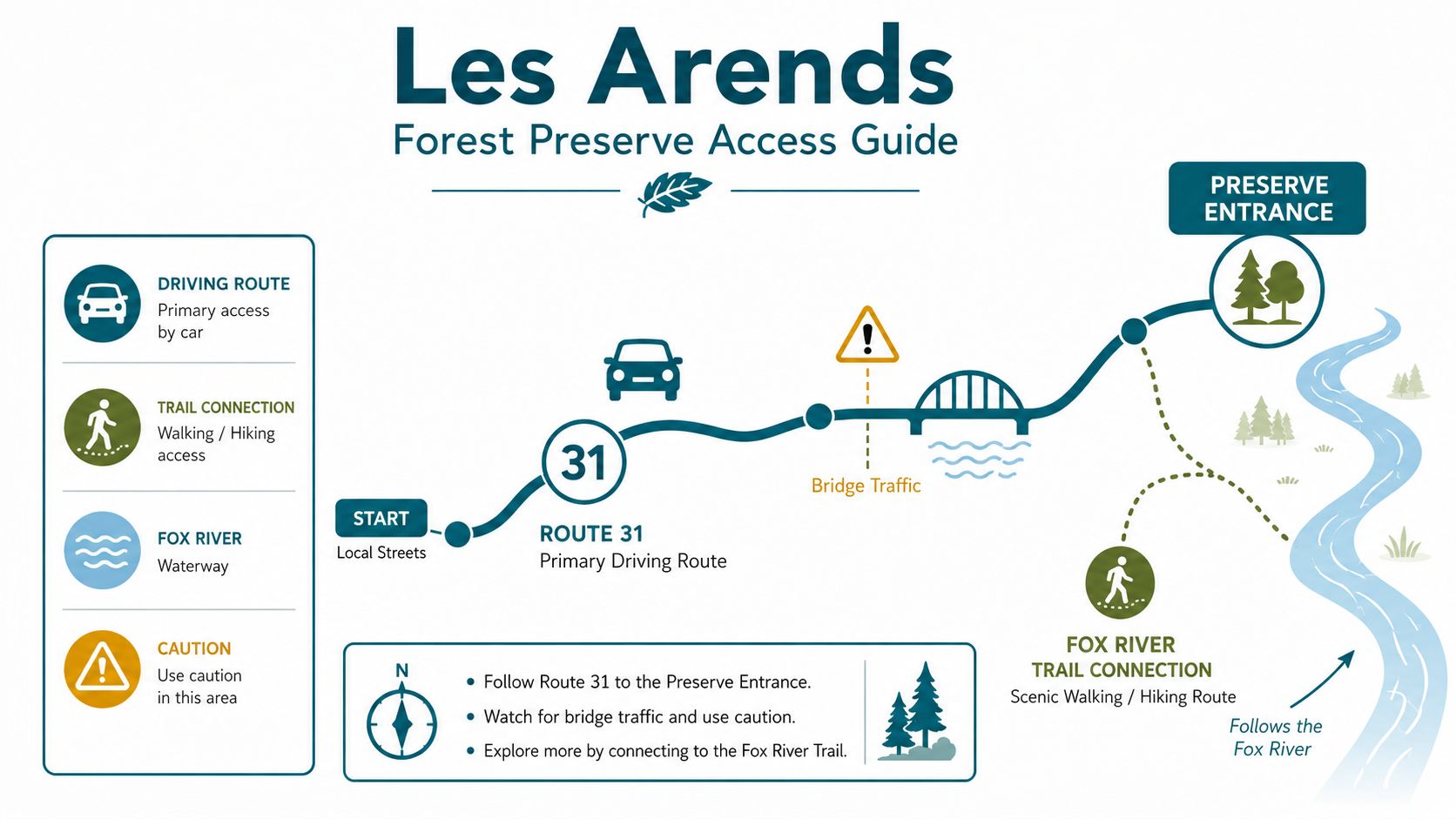
    A map showing directions for reaching the Les Arends Forest Preserve by car and hiking trail.

    A simple way to approach the visit

    1. Drive Route 31 with patience. The preserve sits right off the corridor, so you don't need a maze of side streets.
    2. Look for the preserve entrance and parking area near the trail access. That keeps the first part of your walk short and clean.
    3. Plan for a daylight visit. Sunrise to sunset is the operating window, so don't build a late-evening outing around it.
    4. If you use a wheelchair, stroller, or mobility aid, check the current route conditions first. The county's own master plan language tells you access work is ongoing, not finished.

    The smartest visit is the one you don't have to improvise.

    If you're coming without a car, you'll want to do more homework than most preserve pages ask from you. The public materials don't give a tidy transit answer, and that's exactly why I'd treat this as a car-friendly stop until you verify your route and the current site conditions yourself.

    The Trail System and What Each Route Offers

    The trail network here is compact, but it doesn't feel flat or repetitive. I'd think of it as four ways to meet the same river, each with its own mood and its own reason to bother.

    Start with the entry trail

    The 0.08-mile entry trail is the shortest piece of the puzzle, and it's the one I'd use if I wanted a fast look without committing to a full outing trail map. It gets you from the access point into the preserve without wasting time.

    If you're meeting friends, wrangling a kid who hates “long walks,” or just checking whether the place works for your day, this is your low-drama option.

    Move into the interior and river paths

    The 0.52-mile interior trail pulls you farther into the woods, where the pace drops and the river sound gets less obvious for a minute trail map. The 0.38-mile river trail gives you the more direct shoreline feel, with the Fox River close enough to keep you looking sideways trail map.

    For a casual hike, I'd pair those two and give myself enough time to stop and look around. For a quick stop, I'd stay on the shortest loop and save the longer meander for another day.

    Use the bike trail for longer movement

    The Fox River Regional Bike Trail runs through the site trail map. That matters if you want to stitch your visit into a longer ride or you just like the feel of a shared corridor where walkers and cyclists both keep moving.

    Trail choice in plain English: quick errand, use the entry trail. Quiet loop, use the interior and river paths. Longer movement, follow the bike trail connection.

    I'd be straight with you about the surface question. The preserve page gives the mileage and route layout, but it doesn't hand you a neat promise for every stroller, chair, or shoe type, so I'd plan conservatively and expect a mix of conditions until you see the route in person site page.
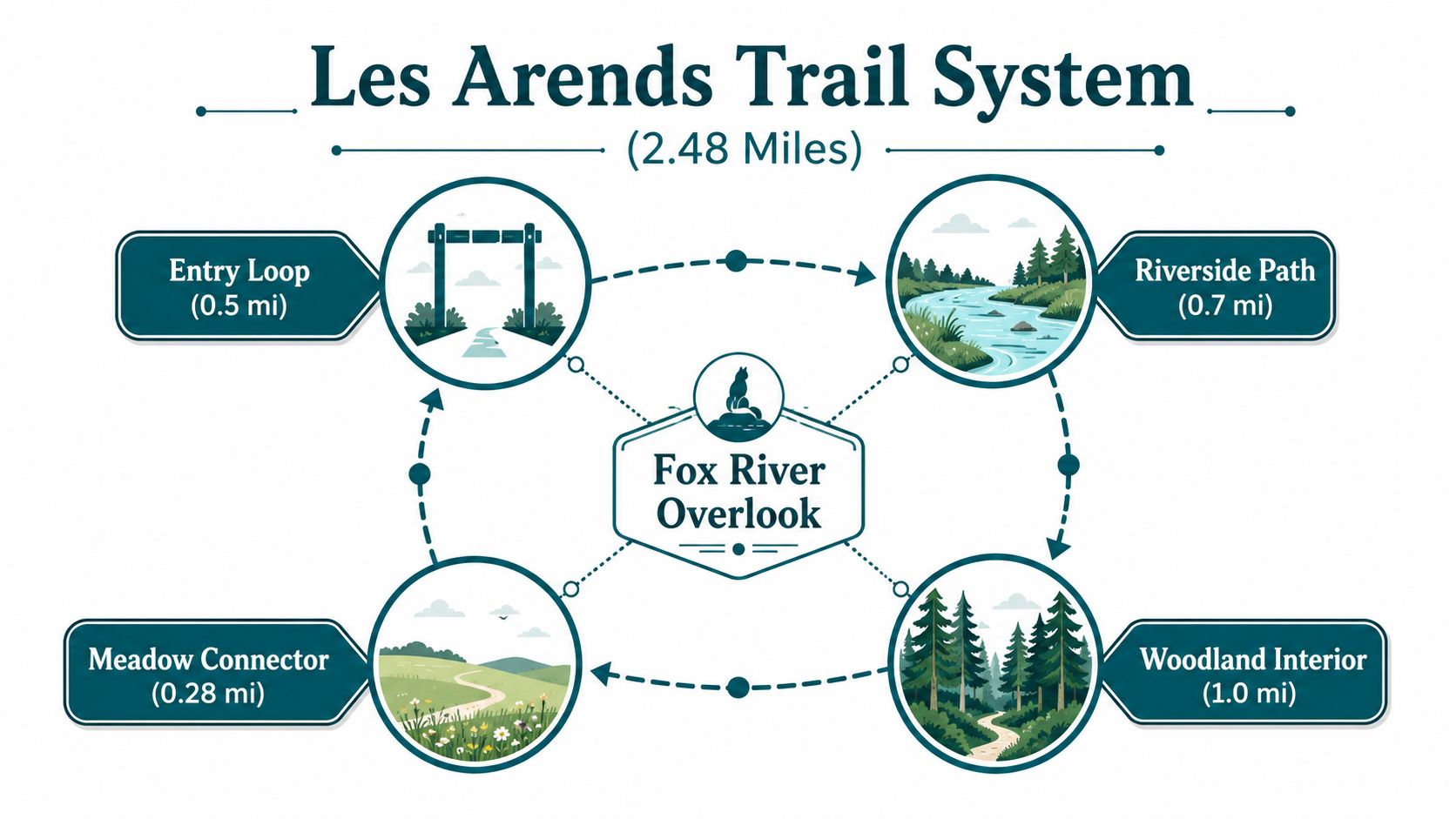
    A map diagram of the Les Arends Trail System, illustrating four trails connecting to a central overlook.

    Seasonal Highlights and What to Look For

    Spring is the season when I start watching the river trail a little closer. The woods wake up, birds move through fast, and the place feels like it's shaking off winter without making a speech about it.

    Summer changes the preserve into a green tunnel. If you go, go early, because the shade helps, the river edge feels cooler, and the whole route gets quieter before the day gets busy.

    Fall is when the white oak and chinkapin oak stands start to do their best work county video. The leaves shift, the light gets lower, and the preserve turns into one of those places where you keep pretending you're “just taking one more photo.”

    What each season gives you

    • Spring: better bird movement and fresher riverbank color.
    • Summer: early-morning shade and a longer, slower walk.
    • Fall: stronger color in the oak woods and easier photo days.
    • Winter: fewer distractions, more structure, and a louder river.

    Winter is my favorite for hearing the place. The trees strip down, the shoreline looks harder, and the Fox River takes over the soundscape in a way you don't notice when leaves are up.

    The preserve's floodplain islands, 3,600-plus feet of shoreline, Mill Creek entrance in the south, and dolomite bedrock outcrops give different corners of the site their own feel site description. If you like birding, plant spotting, or just a walk that doesn't feel identical every time, those details matter.

    Rules, Safety, and the Accessibility Reality

    The basics are simple. The preserve is open daily from sunrise to sunset trail map, and you should plan your visit inside those hours. I'd also keep your usual riverfront common sense with you, because shoreline trails mean wet spots, quick changes in footing, and more temptation than usual to wander too close to the edge.

    What I'd keep in my bag

    • Water: You'll want it, even on a short walk.
    • Bug protection: Ticks and bugs don't care that you came for a peaceful stroll.
    • Good shoes: The trail mix is short, but you still want traction.
    • A backup plan: If the river level or weather looks rough, come back another day.

    The accessibility picture needs honesty. The county's 2024 master plan update says staff want to deal with the parking lot, roadway conditions, and non-ADA-compliant routes, and it says they want to bring the preserve into full ADA compliance master plan update. That reads like active work, not a finished fix.

    If you use a wheelchair, push a stroller, or visit with limited mobility, I'd treat the site as a maybe until you confirm current conditions. The trail mileage is real, but mileage alone doesn't tell you where the rough patches, grades, or temporary construction issues sit.

    Plain truth: The preserve is worth your time, but you should check access details before you leave home if mobility matters to you.

    Nearby Attractions to Extend Your Visit

    If you're already in Batavia, it makes sense to keep the day moving. I usually think in simple pairings, a trail walk, a coffee stop, a riverfront stroll, maybe one more scenic bit before I head out.

    Downtown Batavia works well after Les Arends because the city already leans into the Fox River rhythm. You can slide from the preserve into a meal, a drink, or a slower walk without feeling like you changed worlds.

    The Batavia Riverwalk pairs nicely if you want a flatter, more urban river view after the preserve's quieter shoreline energy Batavia visit guide. If you want a longer preserve day, another Kane County stop along the Fox River can keep your legs happy without making the trip feel random.

    For a simple route, I'd do preserve first, food second, then one more river stop if daylight still looks good. If you want a fuller outing, this forest preserve adventure guide gives you more ideas for building a day around trail time.

    How to Give Back and Protect the Preserve

    I care about the volunteer side of a place like this because a clean trail doesn't stay clean by accident. People show up, pick up trash, pull invasives, and keep doing it when the weather gets annoying. That's the part of park life most visitors never see, and it's the part that keeps a preserve from turning into a shrug with a parking lot.

    The preserve already hosts hands-on stewardship through “Knockout the Noxious” on Saturday, Sept. 6, from 9:30 a.m. to noon. The Batavia public-works notice says participants take a riverside stroll while learning how to identify native and non-native plants and how invasive species affect the site Batavia notice. That's the kind of event I like, because you leave with dirt on your shoes and a little more respect for what grows where.

    Why volunteer work matters here

    The Fox River corridor keeps pressure on the land. Floodplain edges invite trash, invasives, and the kind of wear that comes from lots of people trying to enjoy the same stretch of shoreline. Infrastructure work matters, sure, but so does a person with gloves and a bag.

    That's where volunteer groups like Litter Caterpillars come in. Kevin Tao started the group after a rough personal stretch, and the crew now shows up weekly, rain or shine, to pick up trash across Chicago and build a habit of service that feels stubborn in the best way. They also keep public stewardship simple, which is the whole point if you want real people to keep coming back.

    If you want to go beyond a single visit, the group's environmental stewardship programs are a clean place to start. You can also follow the same energy at the preserve itself by showing up for cleanup and invasive-plant work when events are posted.
    Screenshot from https://www.littercaterpillars.com

    If you love Les Arends Forest Preserve for the river, the woods, and the easy trail time, give a little back and keep it that way. Litter Caterpillars puts people in the field with gloves on, trash bags in hand, and a no-nonsense habit of showing up. Join them, get your hands dirty, and help make sure your next walk at Les Arends feels just as good as the first one.

  • 7 Volunteer Events This Weekend in Chicago

    7 Volunteer Events This Weekend in Chicago

    Want to Change Your Life? Start by Picking Up Trash. Do you ever feel stuck, like the mess in your apartment follows you around all day? I've been there, and I found out something hard and useful, cleaning other people's messes can teach you how to face your own. If you're searching for volunteer events this weekend that give you a real job to do and a real story to walk away with, start here.

    1. Litter Caterpillars

    Litter Caterpillars

    The first time I heard about Litter Caterpillars, I thought of my own life in piles. One pile was trash, another was fear, another was the kind of inconsistency that makes you avoid your own calendar. Kevin Tao built this Chicago group around a simple idea, if you can keep showing up for the city, you can learn how to show up for yourself.

    What makes me trust this group is the rhythm. It meets every week, rain or shine, and it goes into all 50 wards, including places other people skip. That makes it feel less like a one-off service project and more like training for your character. You don't just pick up litter, you practice bravery, kindness, and unity with your hands in the work.

    Why I'd put this at the top of your list

    Litter Caterpillars has a volunteer-first culture. It puts safety and happiness before fundraising, never pressures people for money, and builds friendship into the event itself. The group's theme song, badges, flags, and group chats give the work a pulse that most cleanups never get.

    Show up tired anyway. That's usually where the change starts.

    It also has a story you can point to. The team won an empty lot at auction and is turning it into Caterpillar Park in Englewood, and it has taken on visible work like a highway cleanup during a bike-event shutdown. If you want to plug in, the group has a clear path through its volunteer pickup page, plus Meetup, Pie, Instagram, and open chats.

    I like that it doesn't pretend service is soft. It treats cleanup like a workout for your habits. You leave with sore arms, a clearer head, and maybe a new friend who gets why you showed up in the first place.

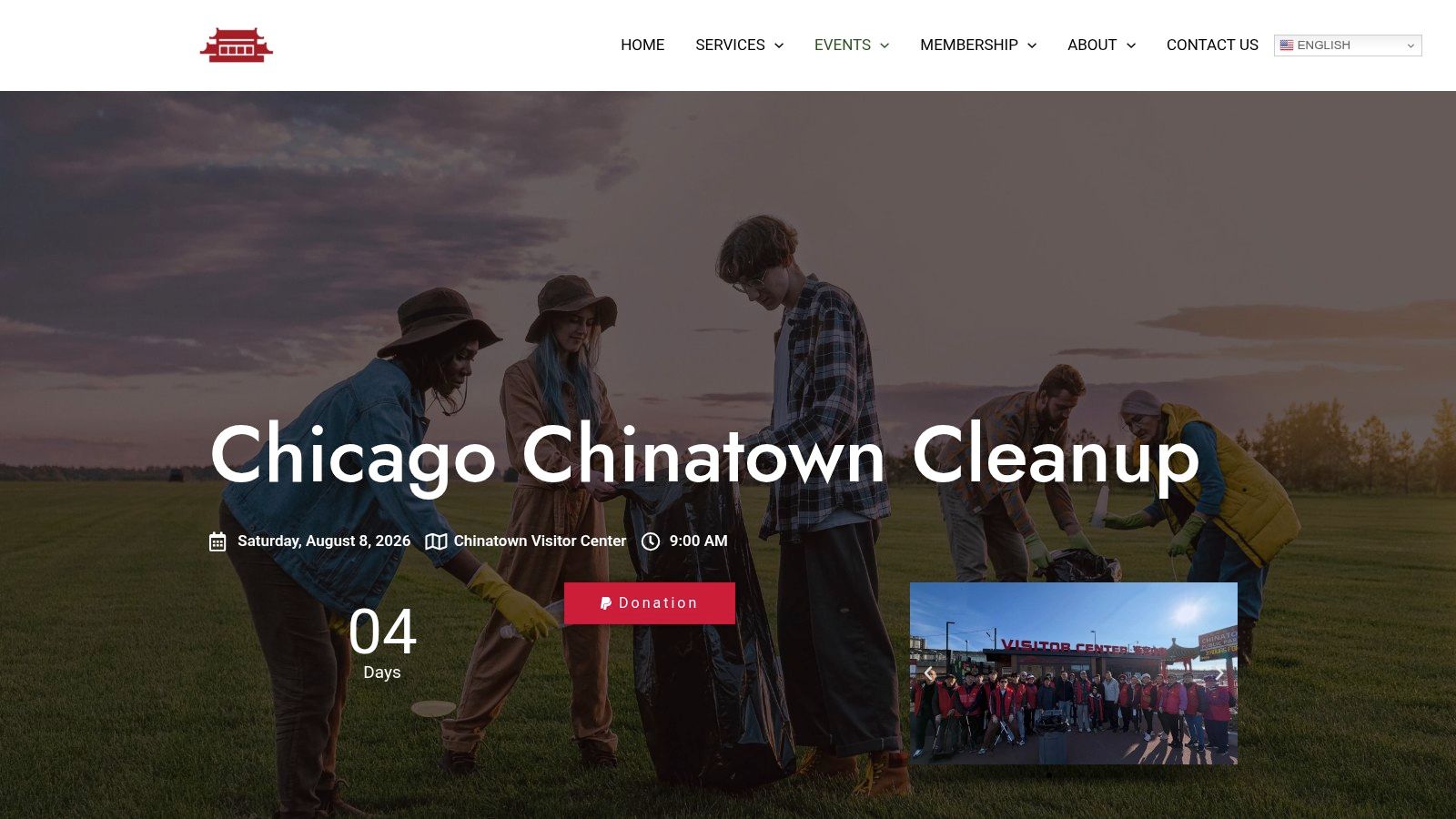
    2. Chicago Chinatown Monthly Cleanup

    Chicago Chinatown Monthly Cleanup

    If Litter Caterpillars feels like a hard reset, the Chicago Chinatown Monthly Cleanup feels like a steady walk home. I like events like this because they don't ask you to become a new person overnight. They ask you to bring your hands, your shoes, and a little patience.

    The Chicago Chinatown Chamber of Commerce runs this cleanup as a recurring neighborhood effort. You show up in the morning, pick up litter, and help keep the business corridors welcoming. That sounds simple, and that's the point. Simple service can still change how a block feels when you pass through it.

    What to expect when you go

    • Clear rhythm: It runs on a monthly cadence, so you can build a habit instead of chasing a random one-time slot.
    • Family-friendly setting: The work stays outdoors and works well for first-timers and small friend groups.
    • Fast visual payoff: You can see the difference in a short stretch of time, which helps if you need momentum to keep going.
    • Low-friction signup: You don't have to wade through a long onboarding maze before you help.

    The Chicago Chinatown site keeps the format practical, which matters more than people admit. When an event is easy to understand, I'm more likely to show up, and you probably are too. If your weekend needs a clean starting point, this is one of the easiest places to begin.

    3. Trash People of Ravenswood Community Clean-Up

    Some cleanups feel like chores. This one feels like a neighborhood walk with purpose. Trash People of Ravenswood, with The Eco Flamingo, pulls together volunteers who want to improve streetscapes without turning the morning into a stiff, formal commitment.

    The thing I'd tell you is this, if you want a social volunteer shift, don't look for ceremony. Look for momentum. A small crew, a walkable route, and a clear task can do more for your Saturday than another hour of scrolling ever will.

    Why it works for first-timers

    The event runs in a two-hour morning window from 10:00 a.m. to 12:00 p.m., which makes it easier to fit into a weekend that's already crowded. Supplies are usually available, so you're not spending your Friday night assembling gear like you're going on a wilderness expedition.

    Bring energy, not excuses. The route will do the rest.

    I also like the neighborhood scale. Ravenswood gives you enough room to work, but not so much that you feel lost in a crowd. If you're trying to meet neighbors without forcing small talk, this is a good setup. You can sweep a block, trade a few words, and leave with the odd satisfaction that your morning mattered.

    4. ChiTownBio August Beach Cleanup

    A beach cleanup changes the mood fast. The water opens up the day, and the trash you collect feels immediate and visible. ChiTownBio organizes this Lake Michigan shoreline cleanup with a community-science energy that draws students, young professionals, and people who like the idea of doing useful work in a place that doesn't feel boxed in.

    The shift runs for two hours on Saturday morning, which is perfect if you want a compact service block. You can still have the rest of your day, but you won't waste the early part of it. That balance matters more than people think, because the easiest volunteer plans are the ones you can keep.

    The part I'd prepare for

    The shoreline can be hot, sandy, and bright, so sunscreen and water matter. Weather and lakefront conditions can also change plans, which is part of the deal when you volunteer outdoors. I've learned that the best volunteers don't wait for perfect conditions, they learn how to work inside imperfect ones.

    ChiTownBio's format is friendly for recruiting a friend, too. You can go with someone who wants something light but meaningful, then spend the ride home comparing what you found. If you want a beach cleanup with a direct, hands-on feel, this one has the right mix of structure and ease.

    For anyone who wants to pair lakefront cleanup with another citywide habit, I'd point back to Litter Caterpillars' public beach focus, because the lesson is the same. Pick the mess you can face, then face it.

    5. Radical Generosity Chicago Back to School Block Party Volunteer

    This one has a different energy from a cleanup, and that's why I like it. A back-to-school block party asks you to serve in the middle of joy, noise, movement, and family life. Radical Generosity Chicago uses volunteers for setup, check-in, supplies, kids' activities, and cleanup, so you can fit into the event wherever your comfort level lands.

    That matters if you want to help but don't want to overthink your role. Some people like logistics. Some people like talking to families. Some people want to carry boxes and keep moving. This event gives you room to do that without pretending everyone should love the same job.

    How I'd read this one

    • Setup work: Good if you like arriving early and getting the space ready.
    • Check-in help: Good if you're calm, organized, and comfortable greeting people.
    • Kids' activities: Good if you want a lively, family-centered role.
    • Cleanup: Good if you prefer closing the loop after the noise settles.

    A block party can do something a quiet cleanup can't. It lets you see how service feels when people are smiling, kids are running around, and your job helps the whole thing hold together. If your weekend needs both heart and motion, this is a strong pick.

    6. Greater Chicago Food Depository Saturday Volunteer Shifts

    I keep coming back to food bank work because it asks for something simple and hard at the same time. You sort, repack, lift, stand, and keep moving because someone else's dinner depends on the boxes you handle well. The Greater Chicago Food Depository offers Saturday volunteer shifts that fit that rhythm, including warehouse repack work and help at partner pantries, and you can read more about the wider Chicago food bank volunteering path through Litter Caterpillars' food bank volunteer guide.

    That kind of shift suits people who want clear direction. You get instructions, orientation, and on-site guidance, so you can show up ready to work instead of guessing your way through the morning. It also works well for groups, which makes the invite easier if you've been trying to get a friend or two to commit with you.

    If you want meaning, don't chase a feeling. Chase a shift that needs your hands.

    The warehouse setting does require closed-toe shoes and some lifting or standing, so treat this like a real work block. Popular shifts can fill quickly, and that tells you something plain, people want in once they know where to start.

    For me, food bank volunteering has the same emotional shape as a hard workout. You may not feel graceful while you're doing it, but you feel straighter afterward. If you want your Saturday to end with a clear sense that you helped real neighbors, this is one of the strongest choices.

    7. Care for Real Saturday Pantry Volunteer

    Care for Real feels personal in a way that stays with you. The Saturday pantry shifts at its Edgewater and Rogers Park locations put you face-to-face with food and clothing support for neighbors who need it right now. You may distribute items, restock shelves, or support clients as they move through the space.

    I like this kind of volunteering because the distance between you and the work stays short. You're not guessing whether your effort matters. You can see the interaction, hear the thank-you, and keep going. That kind of direct service can change how you carry the rest of your day.

    Good reasons to pick this one

    The schedule has multiple shifts and locations, which helps if your weekend is already crowded. Many first-time volunteers can fit in here without a huge learning curve, and return visits make it easier to build real relationships with staff and neighbors. That repeat contact matters, because consistency often feels better than chasing novelty.

    The work can require standing and lifting, so you should go in ready to move. Holiday periods and back-to-school time can fill slots fast, which tells you the community already treats this as a place to show up when things get busy. If you want neighbor-facing service with a practical setup, this one belongs near the top of your list.

    7 Weekend Volunteer Events Comparison

    Item Implementation complexity 🔄 Resource requirements ⚡ Expected outcomes 📊/⭐ Ideal use cases 💡 Key advantages ⭐
    Litter Caterpillars Moderate–High, weekly citywide coordination, volunteer safety protocols Low monetary cost, high volunteer time and logistics (tools provided by group) High visible neighborhood change (ward coverage, park project) ⭐⭐⭐⭐ Regular, social volunteers who want bold, consistent civic action Consistent presence, volunteer-first culture, high visibility
    Chicago Chinatown Monthly Cleanup Low, monthly scheduled meetups with simple coordination Low, tools/supplies typically provided, family‑friendly Local corridor cleanliness with fast visible results ⭐⭐ First‑time volunteers, families, small groups looking for easy commitment Easy signup, strong local business engagement
    Trash People of Ravenswood Low, small neighborhood event with short time window Low, supplies usually available; walkable routes Modest streetscape improvement and neighbor connections ⭐⭐ North Side volunteers seeking casual, social cleanups Small social crews, walkable routes, neighborly atmosphere
    ChiTownBio: August Beach Cleanup Low–Moderate, one-off shore event with environmental focus Low, basic supplies; bring sun/sand gear; weather dependent Immediate shoreline debris removal and ecosystem benefit ⭐⭐⭐ Students, young professionals, science‑minded volunteers Scenic site, photo‑friendly, strong morale and recruitment appeal
    Radical Generosity, Back to School Block Party Moderate, one‑day event logistics and role coordination Moderate, supplies, setup/cleanup crews, child‑friendly materials Direct support for students and families; high community impact ⭐⭐⭐ Volunteers who want family engagement and varied roles Varied tasks, direct benefit to families, high energy event
    Greater Chicago Food Depository, Saturday Shifts Moderate, orientation, scheduling, and operational protocols Moderate–High, warehouse space, training, group slots High operational impact feeding many neighbors across Cook County ⭐⭐⭐⭐ Teams, corporate groups, volunteers seeking structured, repeatable shifts Large scale impact, polished operations, clear guidance
    Care for Real, Saturday Pantry Volunteer Low–Moderate, site distribution with routine procedures Moderate, distribution supplies, some lifting/standing Immediate person‑to‑person assistance and food security impact ⭐⭐⭐ Volunteers wanting direct client interaction and repeat shifts Direct neighbor-facing service, scheduling flexibility, relationship building

    Your Weekend Story Starts Now

    You have seven chances this weekend to write a new page for yourself and for Chicago. Don't wait until you feel more organized, more confident, or more “ready.” I've learned that readiness often shows up after the first hard step, not before it.

    Bring water. Wear comfortable shoes. Introduce yourself to one person you don't know. If you pick the right kind of service, you'll leave with more than a good deed on your record. You'll leave with proof that you can do hard things on purpose.

    I keep coming back to that because it changed me. My life didn't get cleaner by accident, and my mind didn't get clearer by wishing for it. I had to practice the same way you do in service, with repetition, discomfort, and a willingness to keep going when the first impulse is to stay home.

    So pick one event, sign up, and go. Don't turn the weekend into another plan you admire from a distance. Put your name down, show up, and let the work meet you where you are.


    If you want a place that treats volunteering like a habit, not a slogan, Litter Caterpillars is built for that. You can join a Chicago trash pickup crew that meets on weekend mornings, makes room for new people, and turns service into friendship, pride, and real neighborhood change.

  • Volunteer Job Descriptions: 10 Templates for Nonprofits

    Volunteer Job Descriptions: 10 Templates for Nonprofits

    I started Litter Caterpillars because my own room was a wreck, and my life felt like it was sinking under the same junk. Then three of us went out to pick up trash, got hit by hail, and somehow that made the whole thing click, cleaning other people's mess is easier than cleaning your own, and it can even be fun.

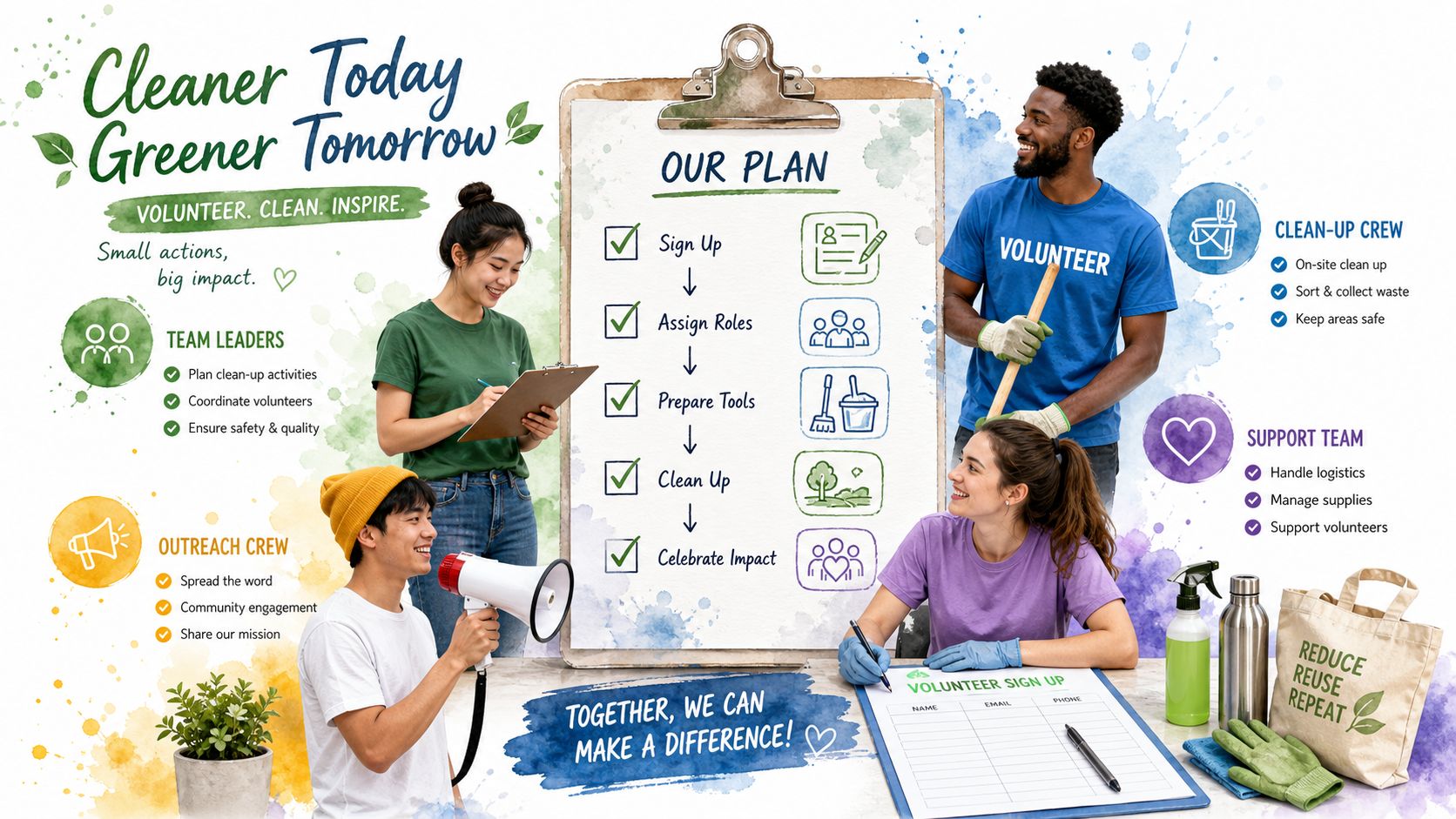
    If you've ever tried to recruit volunteers and heard crickets, I've got a guess, you're asking for help when people want a place to stand. A good volunteer job description gives them a name, a lane, and a reason to show up again. It makes the work feel real, like grabbing gloves, meeting a block captain, or learning how to run a cleanup when the weather turns ugly. The groups that write roles clearly aren't just filling shifts, they're building crews.

    The part that is often missed is that volunteering is not some tiny side hobby. The International Labour Organization treats volunteer work as unpaid voluntary activity, and U.S. labor data shows the scale is huge. In the year ending September 2023, 75.7 million Americans formally volunteered through an organization, or 28.3 percent of people age 16 and older, and on an average day in 2022 more than 11 million people volunteered, including about 4.7 million in administrative and support work and 470,000 in indoor or outdoor maintenance and cleanup activities, according to the ILO volunteer work overview. That's why the best role descriptions feel specific, grounded, and easy to step into.

    1. Community Cleanup Crew Lead

    The first role I'd write is the one I wish I had when I was trying to keep our early cleanups from turning into a free-for-all. A Community Cleanup Crew Lead takes one neighborhood and owns the morning, the route, the vibe, and the handoff. You are not dragging every bag yourself. You are keeping the crew moving like a captain on a field where everybody has a job.

    I learned fast that people don't all show up for the same kind of task. A federal volunteering survey shows the rate shifts a lot by occupation, with some groups stepping into service more often than others. That tells me volunteers bring different instincts with them. If you want someone to lead an Englewood cleanup or rally a downtown business district, spell out the turf, the pace, and the result you want.

    Practical rule: write the role like you're handing someone the keys to one block, not the whole city.

    That framing matters because the lead is part organizer, part steady hand. One volunteer can build relationships with longtime residents in Englewood, another can get shop owners on a business strip to join in, and both can feel like they're carrying real weight. I've seen crews settle down the second someone says, “I've got this block,” and then means it.

    • Pick a neighborhood you care about: People show up harder when they feel a block in their bones.
    • Start small and expand: One park or corridor is easier to run than a giant stretch of city.
    • Track the rough spots: Keep a list of the messiest corners so your routes have a plan.
    • Use before and after photos: People like seeing the difference they made with their own hands.

    A clear role description turns a vague ask into a real invitation, something people can step into without guessing what comes next.

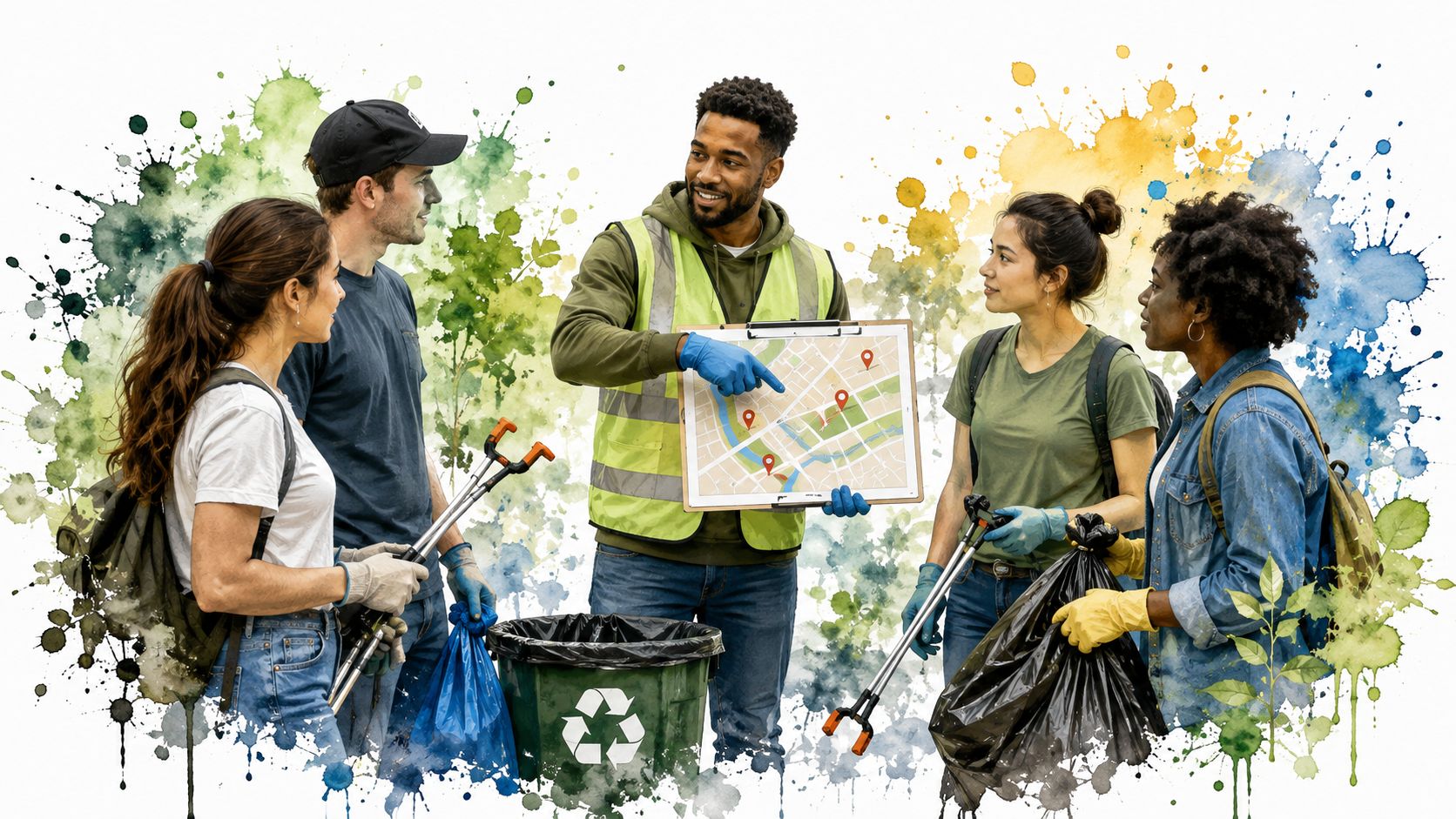
    A diverse group of volunteers planning a community cleanup project with a map in a park.

    2. New Volunteer Onboarding Buddy

    The best volunteer I ever met at the door wasn't the loudest one, it was the one who noticed a nervous newcomer standing alone and walked over first. That's what a New Volunteer Onboarding Buddy does. You greet people like they belong before they've proven anything, and you turn that first awkward hour into a real welcome.

    This role needs warmth, but it also needs structure. A good buddy points out the grabbers, the gloves, the sharp-object rules, and the tricky blocks. The point is simple, people stick around when they know they won't get lost on day one.

    I like this role because it turns a first-timer into a regular without making a big speech about it. One nervous person realizes trash pickup is weirdly fun and keeps coming back, another gets connected with a few other volunteers in Chicago and starts carpooling with them. That's how crews grow, one human connection at a time.

    The old-school volunteer templates that just list duties miss this. A stronger description says who the buddy is for, what they explain, and how they make the new person feel seen. That's the whole game.

    • Remember your first day: If you felt confused, don't pretend the next person won't.
    • Share one or two neighborhood stories: A little local context makes the route feel alive.
    • Text them later that night: A quick message can make a stranger feel remembered.
    • Say the hard part out loud: Showing up is the hardest step, then the rest starts moving.

    If you want to shape this role with more confidence, I'd point people to volunteer coordinator training and build the buddy description around welcome, safety, and follow-up. That keeps the role human and useful at the same time.

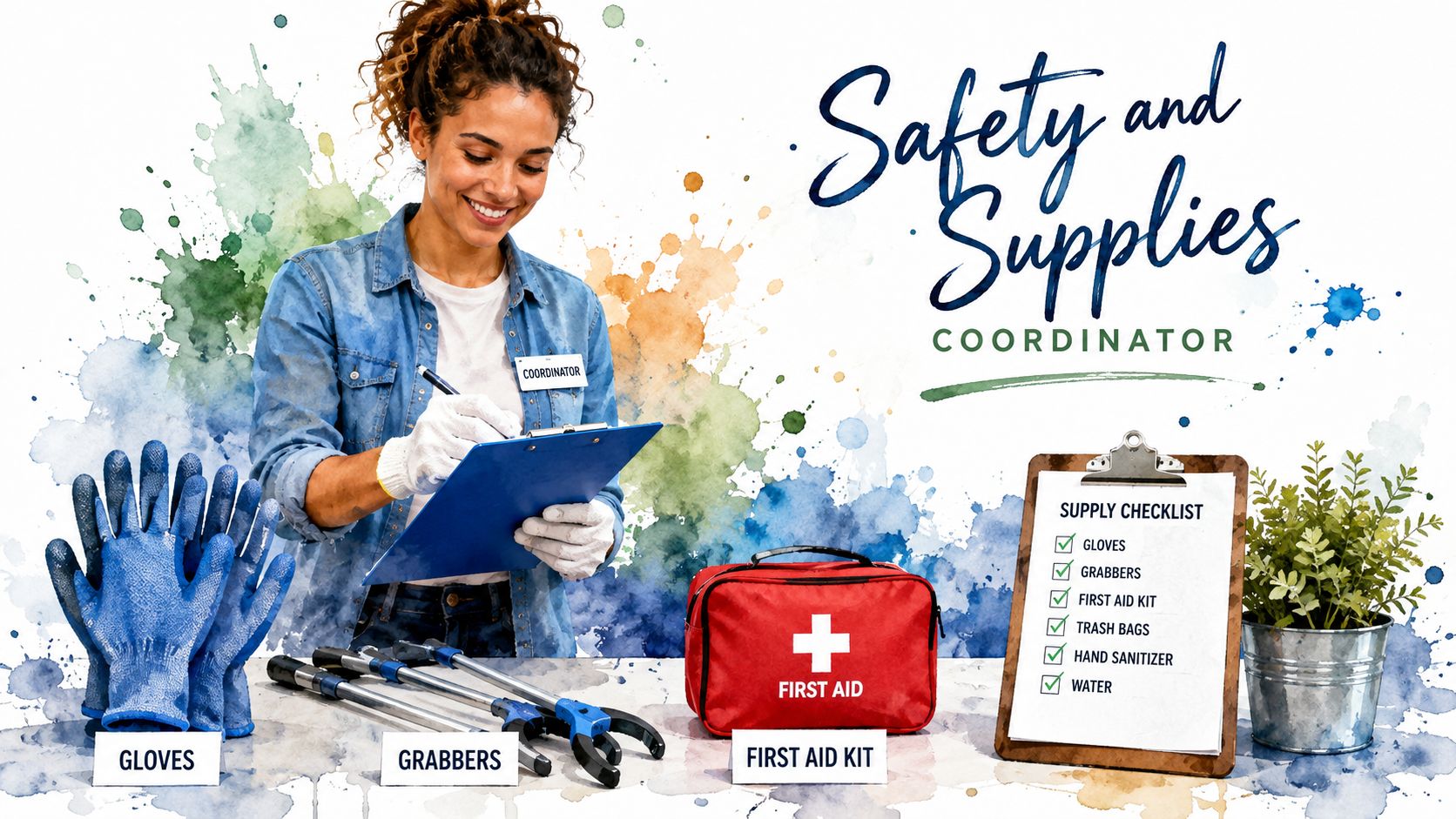
    3. Safety and Supplies Coordinator

    I've learned the hard way that a cleanup can fall apart over tiny gear problems. One broken grabber, one missing glove size, one empty first aid kit, and suddenly the morning feels sloppy. A Safety and Supplies Coordinator keeps that from happening.

    This role isn't glamorous, and that's exactly why it matters. You're checking equipment before someone gets hurt, stocking the right glove sizes, keeping the first aid kit ready, and making sure people know what to do around hazards. The crew can focus on service because somebody solid handled the boring, gritty parts first.

    A good volunteer description for this job should spell out the rhythm. Say what gets checked before the event, what gets logged after, and who gets told when something breaks. If the volunteer knows the checklist, the event runs smoother.

    Here's the kind of language I'd use:

    • Inspect grabbers and bins: Catch damage before the team heads out.
    • Track glove inventory: Make sure smaller and larger hands both get a fit.
    • Restock first aid supplies: Keep the kit ready, not half-empty.
    • Log near-misses: Write down the stuff that almost went wrong so the crew learns from it.

    Keep this role open to somebody detail-oriented who wants flexible hours, because a person like that often loves the quiet responsibility of it.

    This is also the spot where I'd talk plainly about support, supervision, and escalation. If a tool breaks or a route looks unsafe, the coordinator needs a clear way to flag it and move fast. On cleanup crews, that kind of role can save a whole Saturday.

    I'd also tell applicants exactly what the gear room looks like, what gets stored where, and what “done” means. The clearer you make it, the less you'll spend untangling messes later.

    Later in the day, I'd add a short training video like this event safety clip if you're building a role guide that people can absorb fast.

    4. Social Media and Event Storyteller

    The right post can do what a flyer never will, it can make someone feel the mood of a cleanup before they've even shown up. A Social Media and Event Storyteller doesn't just snap pictures. You catch faces, muddy shoes, laughter in bad weather, and the tiny moments that make people think, I want in.

    I've seen this in real time. A volunteer shares a hail-storm photo with a caption about finding joy in discomfort, and people who didn't know us suddenly care. That's because stories travel farther than task lists do.

    Write like a person, not a flyer rack

    If I were writing this role description, I'd ask for a few very concrete things. Post cleanup photos. Write event announcements. Ask volunteers why they came. Share block-by-block wins. The goal is to make the work feel like a living crew, not a pile of trash bags.

    This role also works best when it has boundaries. Don't make the storyteller guess what to post or who approves it. Give them a simple rhythm, maybe one pre-event post, one day-of story, and one wrap-up recap.

    • Shoot faces, not just debris: People connect to people.
    • Use short captions: Write like you're texting a friend who missed the event.
    • Ask for quick quotes: A volunteer's own words make the post feel real.
    • Tell before-and-after stories: The Caterpillar Park transformation is the kind of thing people remember.

    A lot of groups think social media is fluff. I don't. It's how somebody sees a muddy crew in motion and decides they want to join next week. That's not vanity, that's recruitment with a heartbeat.

    5. Partnership and Sponsorship Developer

    I like this role because it sounds fancy, but the job is simple, you walk into local spaces and make the cleanup feel like something worth joining. A Partnership and Sponsorship Developer talks to coffee shops, breweries, neighborhood groups, nonprofits, and companies, then finds a fit that feels mutual instead of pushy.

    The best version of this role keeps the volunteer-first spirit intact. You're not shaking people down for money. You're finding places that want to back the work with supplies, a venue, a team turnout, or a cleanup in their own neighborhood.

    One brewery might give cleanup kits and send a few volunteers once a month. Another partner might sponsor equipment because they want a team volunteer day. The point is to build relationships that help the crew without turning the crew into a sales pitch.

    If you want stronger partner conversations, lead with the story, the pictures, and the neighborhood, then ask for a fit.

    I'd write the role description so it sounds like an invitation to connect, not a cold outreach assignment. Someone in this role should know the tone of the group, the kinds of asks that feel right, and the kinds that don't. That's how you protect the culture while still bringing in support.

    I'd also keep the role flexible. Some people are better at walking into a room, others are better at follow-up emails and thank-yous. Both can work if the description says what success looks like.

    6. Route Planner and City Mapper

    Some people see a map. I see a puzzle with trash, timing, traffic, and tired legs all mixed together. A Route Planner and City Mapper studies the city like a chessboard, then chooses routes that make sense for safety, energy, and reach.

    This role matters when you're trying to cover a lot of ground without wearing people out. On a crew like mine, I'd want someone who looks at roads, parks, business strips, and neighborhood feedback, then says, “Next week, we're hitting this area because it needs us and it won't burn the team out.”

    The best role description names the tools and the rhythm. Google Maps helps, sure, but local knowledge matters too. Cleanup leads know which blocks get skipped, which corners get messy fast, and which routes feel bad on a hot day or after a storm.

    Build routes like a real person will walk them

    I'd ask the mapper to think about access, transit, and variety. Mix easy wins with harder stretches so the work doesn't turn into a grind. Keep one eye on where volunteers can park, where they can meet, and where they can safely cross streets.

    This job also benefits from feedback loops. If a cleanup lead says a route dragged or a corner felt dangerous, the mapper needs to hear it and adjust. That's not bureaucracy, that's respect for the people doing the walking.

    A good route plan keeps the crew moving without making them feel like they got sent into a bad bet.

    If you've ever watched a group lose energy because the route was clumsy, you know why this role belongs in a serious volunteer description. People don't just need places to go, they need routes that make sense to their bodies and their weekends.

    7. Event Day Operations Manager

    Saturday morning hits fast. Coffee, gloves, boxes, weather apps, greetings, and a dozen small decisions land at once, and the Event Day Operations Manager carries that whole pile without making it feel heavy.

    I'd write this role for the person who likes being early and hates chaos. You open the meeting spot, greet volunteers as they arrive, make the safety announcement, hand out tools, and keep the plan alive when weather or street closures mess with it. When the day shifts, you shift with it.

    If the earlier roles are the engine and the wheels, this one is the driver who keeps everyone pointed the same way. A good ops manager doesn't need to do every task, but they do need to notice when the event starts wobbling.

    I'd make the description concrete. Say how early they arrive, who they report to, and what they do if turnout is low or equipment fails. People relax when they know there's a calm person in charge of the flow.

    • Set up the meeting spot: Keep tools, water, and signs ready before the crowd arrives.
    • Give the day's briefing: Safety, mission, route, done.
    • Watch the weather and the street: Adjust before the crew gets stuck.
    • Ask for help early: A strong manager knows when to hand off.

    The old volunteer templates that only list “event support” don't cut it here. This role is about presence, timing, and the ability to keep people from feeling lost. A clear job description does that work before the first volunteer even shows up.

    I'd also link this one to volunteer event planning so people can see the event rhythm before they say yes.

    A smiling coordinator wearing gloves and holding a clipboard next to organized safety and volunteer supplies.

    8. Community Connection and Neighbor Engagement

    Some cleanup crews talk about neighborhoods. I want crews that talk to neighborhoods. A Community Connection and Neighbor Engagement volunteer knocks on doors, chats with residents, and lets people know the cleanup is happening on their block, not around them.

    That difference matters. When a neighbor feels heard, the cleanup stops being a drive-by service and starts feeling like a shared project. One shop owner becomes a regular volunteer, another resident points to a park that keeps getting ignored, and suddenly your route gets smarter because people on the ground spoke up.

    This role needs a friendly face and a steady ear. You ask more questions than you answer. You listen for the corners that need attention, the litter patterns that keep coming back, and the places where people want to help but don't know how.

    I'd write the description so it gives a volunteer room to be human. Tell them to smile, talk naturally, and avoid pressure. You're planting seeds, not closing a deal.

    A clean version of the role might sound like this:

    • Introduce the crew respectfully: Tell residents who you are and why you're there.
    • Ask what people notice: Residents know the block better than any map.
    • Share proof of work: Before and after examples make the effort concrete.
    • Invite, don't push: Leave space for people to join when they're ready.

    This role works especially well for people who like talking to strangers but don't want a loud, salesy job. It's about care, presence, and basic follow-through. If you write it right, the right people will feel that tone right away.

    9. Volunteer Experience Designer

    This is the role for somebody who notices the vibe before the trash pile. A Volunteer Experience Designer thinks about how the cleanup feels from the second people arrive to the second they head home. Songs, flags, badges, welcome language, celebration, all of it matters.

    I know that can sound extra until you watch people light up because they got a badge after their first cleanup. Pride changes behavior. Identity changes behavior. When you give service a little ceremony, people feel like they joined something with a face.

    That's why I'd write this description around atmosphere and ritual. Maybe you want a theme song. Maybe you want a small tradition for first-timers. Maybe you want people to carry a flag or earn badges for different neighborhoods. These aren't gimmicks if they help people feel they belong.

    Keep the role playful, but not vague

    The best volunteer experience designer listens first. Ask people what keeps them coming back. Watch when the energy rises and when it drops. Borrow what works from sports teams, military units, or any group that knows how to create pride without making it corny.

    • Test one idea at a time: Start small before you roll out a full system.
    • Use symbols people can hold: Flags, badges, or shirts can give a crew identity.
    • Celebrate consistency: People like being noticed for showing up.
    • Make the day feel like a win: Even a dirty morning can end with a little ceremony.

    I've seen crews get stronger when the experience feels intentional. Not fancy, just intentional. If the role description says that clearly, people who love culture design will find it fast.

    10. Data Tracker and Impact Documenter

    Spreadsheets don't look exciting until you realize they tell the story of the work. A Data Tracker and Impact Documenter keeps count of volunteers, routes, trash collected, and neighborhood coverage, then turns that into something the crew can use.

    This role got easier for me once I stopped treating numbers like homework and started treating them like memory. If you know which blocks you cleaned, which items showed up most, and how many people came back, you can make smarter decisions next month. You can also tell a clearer story to new volunteers.

    I'd keep the system simple. Use Google Sheets. Keep the categories easy. If the form feels too heavy, nobody will fill it out after a long cleanup, and then the story gets fuzzy.

    A good description for this role should point to the output, not just the task. Maybe the volunteer creates a report, a map, or a simple summary for the crew. That kind of artifact helps people see what they built, and it helps leaders plan the next route with their eyes open.

    Simple tracking works better than fancy tracking nobody finishes.

    I'd also tell the volunteer why the data matters in plain language. When you can show which neighborhoods got covered or what trash keeps showing up, you can recruit better and route better. If the role fits, it usually means the person loves patterns, clean records, and a little quiet order after a loud morning.

    Top 10 Volunteer Role Comparison

    Role Complexity 🔄 Resources & Time ⚡ Expected Impact ⭐📊 Ideal Use Cases Advantages / Tips 💡
    Community Cleanup Crew Lead Intermediate 🔄🔄 Moderate; weekly mornings, coordination ⚡⚡ High ⭐⭐⭐; visible neighborhood improvements 📊 Lead recurring neighborhood cleanups; build local teams Builds leadership; start small and use before/after photos 💡
    New Volunteer Onboarding Buddy Beginner 🔄 Low; event-start presence + follow-ups ⚡⚡⚡ Moderate ⭐⭐; improves retention and newcomer comfort 📊 Welcome first-timers and convert them to regulars Greet warmly, collect contact info, follow up that night 💡
    Safety and Supplies Coordinator Intermediate 🔄🔄 Moderate; inventory, procurement, occasional repairs ⚡⚡ High ⭐⭐⭐; prevents injuries and enables smooth events 📊 Maintain gear, brief hazards, manage first aid Use checklists, track near-misses, plan common replacements 💡
    Social Media and Event Storyteller Intermediate 🔄🔄 Low–Moderate; flexible content work, occasional event presence ⚡⚡⚡ High ⭐⭐⭐; attracts volunteers and documents impact 📊 Recruitment, event promotion, storytelling Capture faces/emotion, write casually, use before/after visuals 💡
    Partnership and Sponsorship Developer Advanced 🔄🔄🔄 Moderate–High; meetings, pitches, relationship follow-up ⚡ Very high ⭐⭐⭐; secures resources and expands capacity 📊 Secure sponsorships, in-kind donations, organizational partners Start with familiar businesses; lead with volunteer-first ethos 💡
    Route Planner and City Mapper Advanced 🔄🔄🔄 Low–Moderate; map/data work plus occasional site visits ⚡⚡ High ⭐⭐⭐; maximizes citywide coverage and safety 📊 Strategic coverage, risk-aware routing across wards Use maps and feedback, mix easy wins with challenging areas 💡
    Event Day Operations Manager Intermediate 🔄🔄 Moderate; early arrival, on-site coordination ⚡⚡ High ⭐⭐⭐; improves volunteer experience and efficiency 📊 Run on-site logistics, troubleshoot, maintain morale Keep a setup checklist and backup plans for weather/equipment 💡
    Community Connection and Neighbor Engagement Intermediate 🔄🔄 Moderate; door-knocking, follow-ups, relationship building ⚡ High ⭐⭐⭐; builds trust and local volunteer recruitment 📊 Engage residents, recruit neighbors, gather local priorities Be authentic, ask more than tell, avoid pressuring residents 💡
    Volunteer Experience Designer Beginner–Intermediate 🔄🔄 Low–Moderate; project-based, creative experiments ⚡⚡⚡ Moderate ⭐⭐; improves morale and retention over time 📊 Design rituals, recognition, and event culture Test small ideas, gather feedback, borrow proven traditions 💡
    Data Tracker and Impact Documenter Beginner–Intermediate 🔄🔄 Low–Moderate; regular reporting and visualization ⚡⚡ High ⭐⭐⭐; informs strategy and supports fundraising 📊 Track volunteers, trash, locations; produce reports/maps Keep data simple, use shared sheets, create visual stories 💡

    Your Turn to Find Your Givers

    These aren't just descriptions, they're filters. They pull in the people who want to show up on a Saturday morning because the work is hard and it matters. When you stop asking for “help” and start naming leaders, storytellers, planners, and neighbors, you give the right people something real to grab.

    I've watched that happen in my own crew. Litter Caterpillars started with three people, a hailstorm, and a messy stretch of city, and it kept growing because the roles made it easier for people to see themselves in the work. One person wanted to lead, one wanted to welcome, one wanted to map, and each one found a place to belong.

    Take these ideas and write them in your own voice. Don't copy a template that sounds like it came from a filing cabinet. Write the kind of role description that makes a giver nod and think, yeah, I can do that. The right words don't just fill a shift, they build a crew.


    If you're building volunteer roles for a cleanup group, a neighborhood project, or a brand-new crew, I'd love for you to see how Litter Caterpillars writes the work in a way people can feel. Visit Litter Caterpillars and borrow what fits, then shape it into your own story so the right volunteers know exactly where to plug in.

  • Service Learning Chicago: A Complete Guide

    Service Learning Chicago: A Complete Guide

    Three of us stood under a tree in a spring hailstorm, laughing while our Uber kept canceling and a strip of trash sat in the gutter like it had nowhere else to go. I remember thinking that cleaning up Chicago can feel weirdly human, messy, cold, a little funny, and a lot more social than people expect. If you want the sidewalk version of service learning Chicago, start right there, not in a worksheet.

    Why Service Learning in Chicago Starts on the Sidewalk

    The first time I really got service learning, I wasn't in a classroom. I was outside, hands cold, shoes damp, trying to grab wrappers before the wind pushed them under parked cars. The whole thing felt less like a school task and more like a small act of paying attention to the block in front of me.

    That's why I like to think of service learning as something you do with your body first. You show up, you notice what's there, and you work with other people who care enough to keep going when the weather turns stupid. If you want a cleaner, more practical way to think about neighborhood action, I've put together a simple guide on how to clean sidewalks, because the details matter when you're on concrete, not in theory.

    What the sidewalk teaches

    The sidewalk tells the truth fast. You learn where the trash gathers, which corners need gloves, and how much easier it is to keep moving when someone next to you is doing the same work. That's the part most guides skip, the human rhythm of service.

    Service learning in Chicago makes the city feel like a classroom without walls. You still need planning, but the lesson changes once you're outside. You see how a weekend cleanup, a school project, or a neighborhood partnership can start with one block and end with a better habit.

    I'd rather talk to you about that than give you a polished slogan. If you've ever wanted to do something useful with a Saturday morning, this is the lane.

    What Service Learning Actually Means

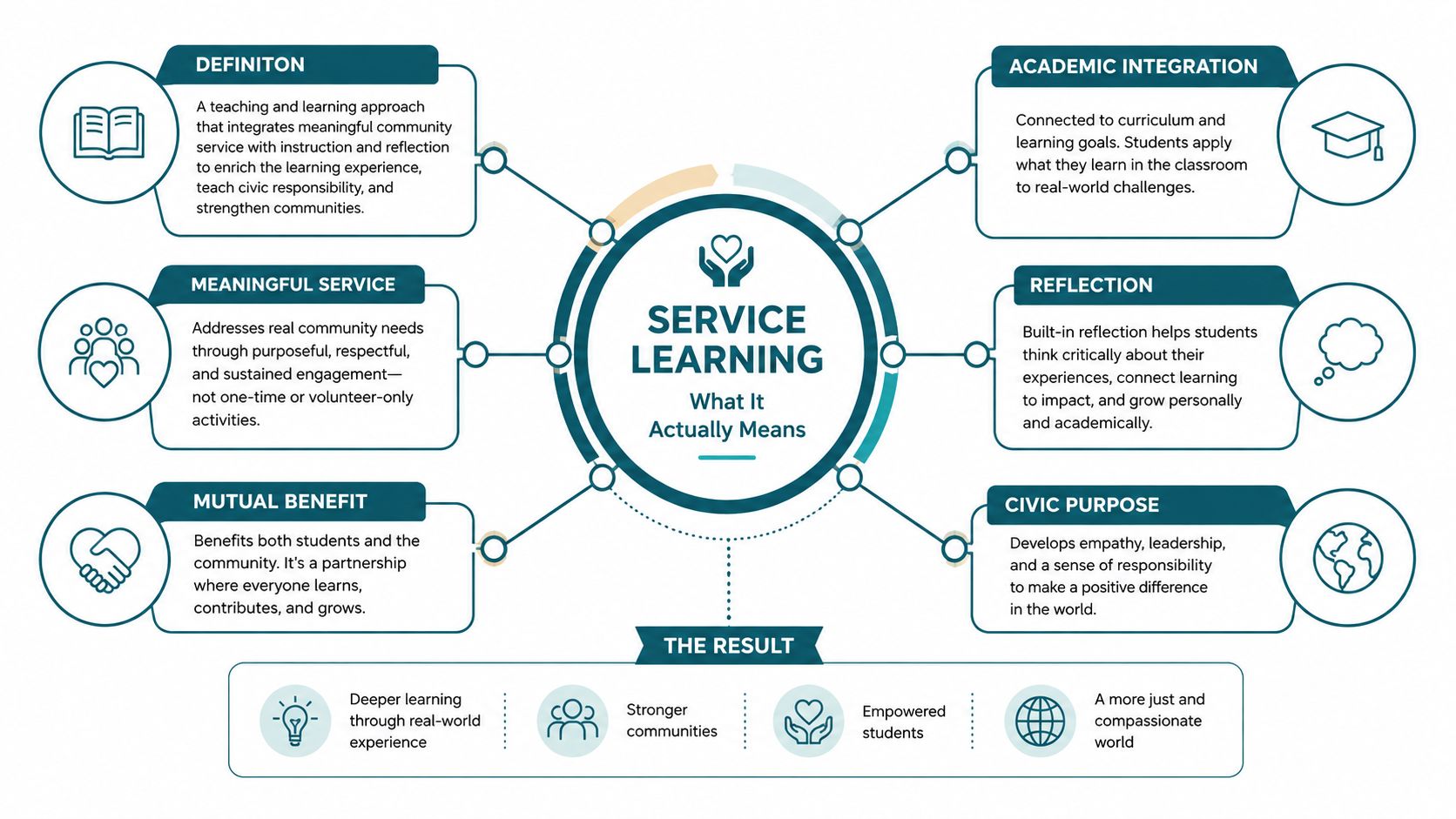
    Service learning isn't just volunteering with a nicer label. I can donate a few hours, take a photo, and leave, and that's still volunteer work. Service learning asks for more structure than that, because it ties the work to learning, reflection, and a real question about the world around you.

    Think of ordinary volunteering like running a race without a coach. You move, you sweat, you finish, and you might feel good. Service learning is more like training with someone who helps you study the route, run the miles, and then look at the splits afterward.

    The three parts that make it learning

    The structure is simple, even if people skip it all the time.

    • Preparation: You learn the issue, the site, the people involved, and what the work asks of you.
    • Action: You do the service in the world, not just in a classroom discussion.
    • Reflection: You write, talk, or think through what happened and what changed.

    That last part matters more than many admit. Without reflection, service can turn into motion with no meaning attached. With reflection, the student starts making sense of the work, the neighborhood, and their own assumptions.

    Chicago's school framing leans hard into classroom integration, which is why this feels different from a one-off volunteer shift. The work gets tied to what students are already studying, so service sits inside the curriculum instead of hanging off the side like an optional extra.

    An infographic explaining the definition, key components, and beneficial results of a service learning educational approach.

    Practical rule: if nobody asks what you learned, who benefited, and what you'd change next time, you're probably looking at volunteering, not service learning.

    That's the cleanest way I know to separate the three. Community service is useful. Volunteer work is useful. Service learning turns the usefulness into a learning loop.

    How Chicago Public Schools Built Service Learning at City Scale

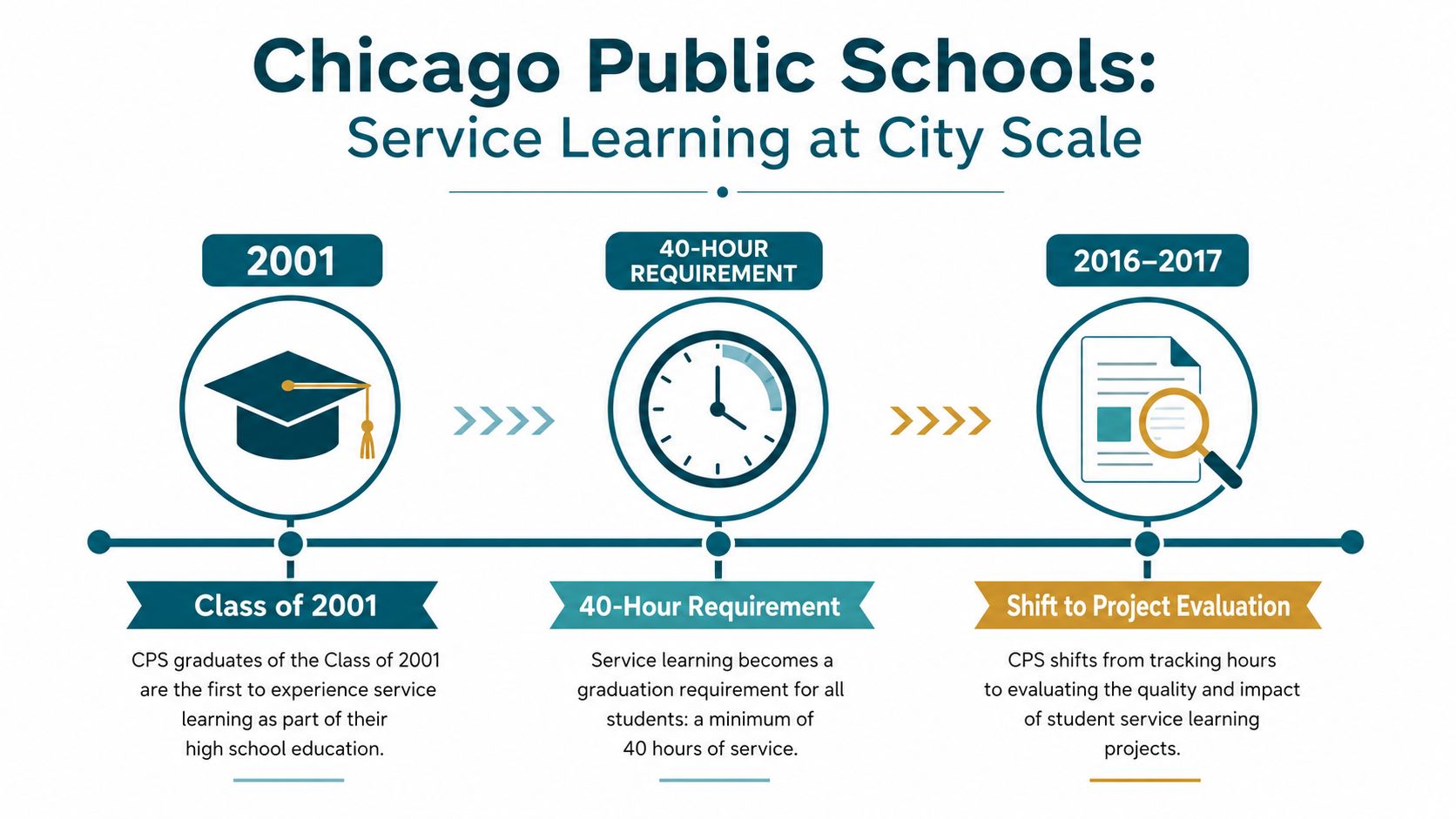
    I keep coming back to Chicago Public Schools because the district did something most systems only talk about. A student could finish school and have real neighborhood work attached to the transcript, not just a line about good citizenship. Beginning with the class of 2001, CPS made 40 hours of community service part of the graduation requirement, and by June 4, 2001, the district reported 82,224 students involved, 96.27% of seniors meeting the requirement, 1,719,747 service hours delivered to city recipients, and 188 agency partners (CPS report). That is a lot of clipboard work, bus rides, phone calls, and Saturday mornings stitched together across the city.

    From hours to projects

    The early model focused on time, which made sense for getting a citywide habit off the ground. Later, CPS pushed the work toward finished projects instead of raw hours. By the 2015-2016 school year, students completed 947 service-learning projects (CPS Ready to Engage). The district then shifted the graduation model in 2016-2017 from 40 service-learning hours to two service-learning projects (CPS service learning page).

    That change matters because it asks for more than attendance. A student has to identify a need, connect it to classwork, and finish something that leaves a mark beyond the day of service. CPS describes the current setup as two classroom-integrated service-learning projects, with one in Civics or AP U.S. Government and the other in a different course (CPS service learning). The district also frames the work around preparation, action, and reflection, along with student voice and curriculum links. That keeps service inside schoolwork, where teachers can connect it to what students are studying.

    A timeline infographic detailing the evolution of the service learning program at Chicago Public Schools since 2001.

    The broader context helps explain why Chicago stands out. CPS pointed to NCES survey data showing that only 32% of public schools nationwide had service-learning at all, including 46% of high schools, 38% of middle schools, and 25% of elementary schools (CPS Ready to Engage). Chicago chose a harder path than most districts, and it made that choice visible at scale.

    When I read the district's materials, I also think about how that structure lines up with the kind of weekend cleanup work I see around the city. A project only feels real when someone has to plan the route, show up, pick up the trash, and explain what changed afterward. That is the same logic behind how service learning benefits students and neighborhoods, even when the work starts with a broom instead of a classroom handout.

    Chicago moved from asking students to count service time to asking them to complete work tied to class, community, and reflection. That change feels concrete because it is concrete.

    The Benefits Students and Communities Feel

    I keep coming back to the same scene: a Saturday morning in Chicago, gloves on, grabbers in hand, and a few students trying to solve a sidewalk problem before the coffee gets cold. That is where service learning stops feeling like a school requirement and starts looking like real work. CPS names collaboration, communication, critical thinking/problem solving, and creativity as part of the learning around service, and those skills show up fast when the route changes, the bags fill up, and the group has to decide what to do next (CPS project-based service learning).

    What students gain and what partners need

    Students usually notice the shift first in their own bodies. They stop treating the day like a performance and start paying attention to the people beside them, the block in front of them, and the problem they are trying to solve together. I've watched that happen when a crew realizes that cleanup takes more than enthusiasm, it takes pacing, communication, and a little patience when one person misses a turn and the work slows down.

    Partner sites feel that difference too. When students show up as learners, they ask better questions, listen before they act, and leave space for the people already doing the work.

    For communities, the harder question sits underneath all of it. Does the project leave anything behind after the semester ends, or does it disappear when the last sign-in sheet gets packed away? A PubMed study on a culturally relevant, community-based service-learning health curriculum found gains for Latinx sixth graders' health knowledge and for nursing students who learned in ways classroom and clinical practicum could not. That tells me service learning can do more than fill a schedule, while also leaving the neighborhood question in place.

    That is why partnership-based work matters so much. Residents need a say in what gets done, how it gets done, and what success looks like once the work is over.

    If you want a plain-language breakdown of the payoff for students, organizers, and neighborhoods, I've also put together an overview of service learning benefits in practice.

    A Chicago Case Study in Service Learning Through Action

    Kevin Tao built Litter Caterpillars out of personal mess, and that matters to me because it keeps the whole thing grounded. He's said he struggled to clean and organize his own space, then decided to engineer his social circle around people who gave a damn about cleanup, consistency, and bravery. That's a very Chicago kind of origin story, blunt and practical, with no fake polish on it.

    The hailstorm that became a logo

    The first cleanup had only three volunteers. They got caught in a spring hailstorm, huddled under a tree, and watched Uber cancel after Uber cancel while trash sat there waiting for them. That moment became the logo story, and I love it because it sounds exactly like service in real life, inconvenient, a little absurd, and somehow fun once you're already in it.

    From there, the group kept going every week, rain or shine, in blizzards, negative wind chills, and scorching heat. They reached all 50 wards, including places other people warned against. That detail matters because it says the work didn't stay in easy neighborhoods or easy weather.

    The group also cleaned a highway during a bike-event shutdown and won an empty lot at auction to turn it into Caterpillar Park in Englewood. That's the part that makes the story feel less like a cleanup club and more like a habit that keeps finding new ground.

    The values that hold the group together

    Litter Caterpillars runs on bravery, kindness, unity, and volunteer-first values. The weekend-morning schedule filters out the energy they don't want, and the group protects volunteer safety and happiness before anything else. I respect that. It's a clean rule.

    Practical rule: if a service group treats people like free labor, I back away. If it treats people like humans who need safety, friendship, and clear expectations, I pay attention.

    The whole setup feels like service learning after the bell rings and after the syllabus closes. You can join, sweat, laugh, and leave with a story that sticks.

    How to Set Up or Join a Service Learning Project in Chicago

    I usually tell students to start with the shape of the class before they start hunting for a site. At CPS, service learning now centers on two service-learning projects, not hours alone, and the work has to connect to curriculum, student voice, and reflection. That means the cleanest projects usually begin with a teacher who already knows what the class is trying to learn, then find a neighborhood need that fits.

    A real example makes this easier. If your school already has an approved partner, use that. If it lets you propose a site, bring a contact person who can answer the phone, and explain why the site belongs in the class instead of just sounding charitable on paper. I've seen projects stall because the match looked good in a slide deck and fell apart once someone needed gloves, a meeting spot, or a backup plan for weather.

    A simple path for students, educators, and nonprofits

    For students, I'd keep the first move practical.

    1. Choose a partner or propose one. Make sure the site can host you and that someone there knows you're coming.
    2. Get the forms approved. Start with permission, not with a surprise.
    3. Do the work with a buddy system. Gloves, high-visibility vests, and weather planning are basics, not extras.
    4. Log what you did. Hours matter in some programs, projects matter in others.
    5. Write the reflection while the work is still fresh. That's where the learning lands.

    I've watched a Saturday cleanup go from awkward to useful once students knew exactly who was leading, what block they were covering, and where trash bags were going at the end. The job gets easier when the rules are plain.

    For educators, I'd build from the community need first, then map the class content onto it. Don't invent a fake problem so the lesson looks tidy. Start with something residents already care about, then build checkpoints for preparation, action, and reflection so the class can see its own progress without losing the neighborhood in the process.

    For nonprofits, the first job is to define the kind of learner you want in the space. Set a point of contact, write down the safety rules, and say what good behavior looks like before the day starts. If you want a model that keeps volunteers organized around repeated neighborhood work, Litter Caterpillars is one option I'd point to, and its service learning programs show how weekend cleanup events, open group chats, and clear social norms can keep people moving in the same direction.

    At the University of Chicago Laboratory Schools, the process gets more formal. Students start service learning in sophomore year, commit to 30 hours of service over the year, submit approved forms before they begin, turn in signed timesheets each quarter, and complete written reflections during and after the service (U-High service learning). It feels like a checkpoint trail, with each form opening the next gate.

    If a school or nonprofit wants a clearer picture of how a volunteer-led project gets organized from the ground up, that structure matters more than a polished slogan.

    Building Service Habits That Outlast a Semester

    One cleanup can feel good for a day. A weekly habit changes how you respond to discomfort, other people's mess, and your own excuses. That's why I keep coming back to repetition, because the first Saturday is about courage, and the twentieth Saturday is about identity.

    Tom Sawyer tricked his friends into painting a fence by making the work look like privilege instead of punishment. I think about that a lot in service learning. Pride changes behavior, and when people feel like they belong to something, hard work stops looking like a chore they have to survive.

    Chicago works the same way block by block. One ward at a time, one Saturday at a time, one pickup bag at a time, and you start seeing a city built out of ordinary people who kept showing up. That's not a slogan to me. That's a pattern you can join.

    Show up this weekend. Bring a friend. Let the habit do what it does.

    Service Learning Chicago Questions You Might Still Have

    I still get questions on Saturday mornings, usually while people are pulling gloves on, checking trash grabbers, or looking at the block and asking what service learning really means once you step outside the classroom. The quick version is this. It is structured work tied to learning, reflection, and community need, and in Chicago that can look a lot like a cleanup crew meeting before the city wakes up.

    How many hours do Loyola students need? Loyola University Chicago sets a minimum of 20 hours per semester for service-learning courses, and undergraduates also need at least one Engaged Learning course totaling at least 3 credit hours before graduation (Loyola service-learning courses).

    How does U-High handle it? At the University of Chicago Laboratory Schools, students begin in sophomore year, complete 30 hours over the year, get service forms approved before they begin, submit signed timesheets each quarter, and write reflections during and after the work.

    Is this the same as a club requirement? A club can ask for attendance. Service learning asks for preparation, action, and reflection tied to learning, so the work has to connect back to the experience, not just the calendar.

    Can adults outside universities join? Yes. Chicago neighborhood groups and volunteer projects often welcome adults, especially when they follow the site's safety rules and expectations. A weekend cleanup usually needs hands, attention, and people who will stay until the last bag is tied off.

    Litter Caterpillars is one Chicago option if you want weekend cleanup, real neighborhood work, and a group that treats service like a habit, not a performance. If you want to plug into that kind of Saturday morning action, visit Litter Caterpillars and find a way in that fits your schedule.

  • Nonprofit Sustainability: Real Strategies That Work

    Nonprofit Sustainability: Real Strategies That Work

    We were halfway through a Chicago hailstorm when three of us bent down to pick up cups, wrappers, and broken bottle glass from the curb. One Uber after another canceled, and we laughed because the trash was easier to move than our own plans.

    That day taught me something I still use every week. Nonprofit sustainability starts when people keep showing up through bad weather, awkward moods, and unfinished work.

    Why Most Nonprofits Fail Before They Start

    I remember that first cleanup because nothing about it felt polished. We had no polished pitch, no neat budget deck, no donor list, just three people, a storm, and a block that needed work. That kind of beginning is messy, but it tells the truth about how volunteer groups survive.

    Start with the person, not the spreadsheet

    My own life was a mess before the group ever existed. I had trouble cleaning and organizing my space, and every little thing I owned felt stuck in place because I had attached a story to it. Trash looked small from the outside, but inside my head it carried weight, and that made consistency hard.

    So I built the group around the problem I needed to solve in myself. I wanted a circle that filtered out selfishness, because I had already lived through a chaotic relationship that made me tired of people who only wanted to party and take. That choice shaped everything that came after, from the tone of our events to the people who stayed.

    Practical rule: If your mission only helps other people and never helps your volunteers become better versions of themselves, you will keep losing the people who make the work possible.

    That is why so many groups fade early. They ask people to care, but they never give them a reason to belong. They ask for labor, but they never build a rhythm that feels human.

    Build a repeatable habit, not a heroic sprint

    Our first cleanup in the hailstorm was awful in one way and perfect in another. We were freezing, traffic was bad, and the day felt ridiculous, but the chaos created a story that people wanted to return to. I learned that sustainability grows from repeatable habit, clear identity, and a group that knows why it gathers.

    The Community-Wealth green manual lays out a simple loop, measure impacts, survey employees, determine priorities, create an action plan, and repeat, plus practical moves like energy audits and switching printers to double-sided the manual's five-step process. I use that kind of sequence in my head all the time. First I look at what hurts. Then I ask who feels it. Then I choose the next action.

    The hardest mistake is thinking a nonprofit needs a perfect launch. It doesn't. It needs a reason people can feel in their bones, then a way to return next week without forcing themselves.

    Protecting Volunteer Energy Above All Else

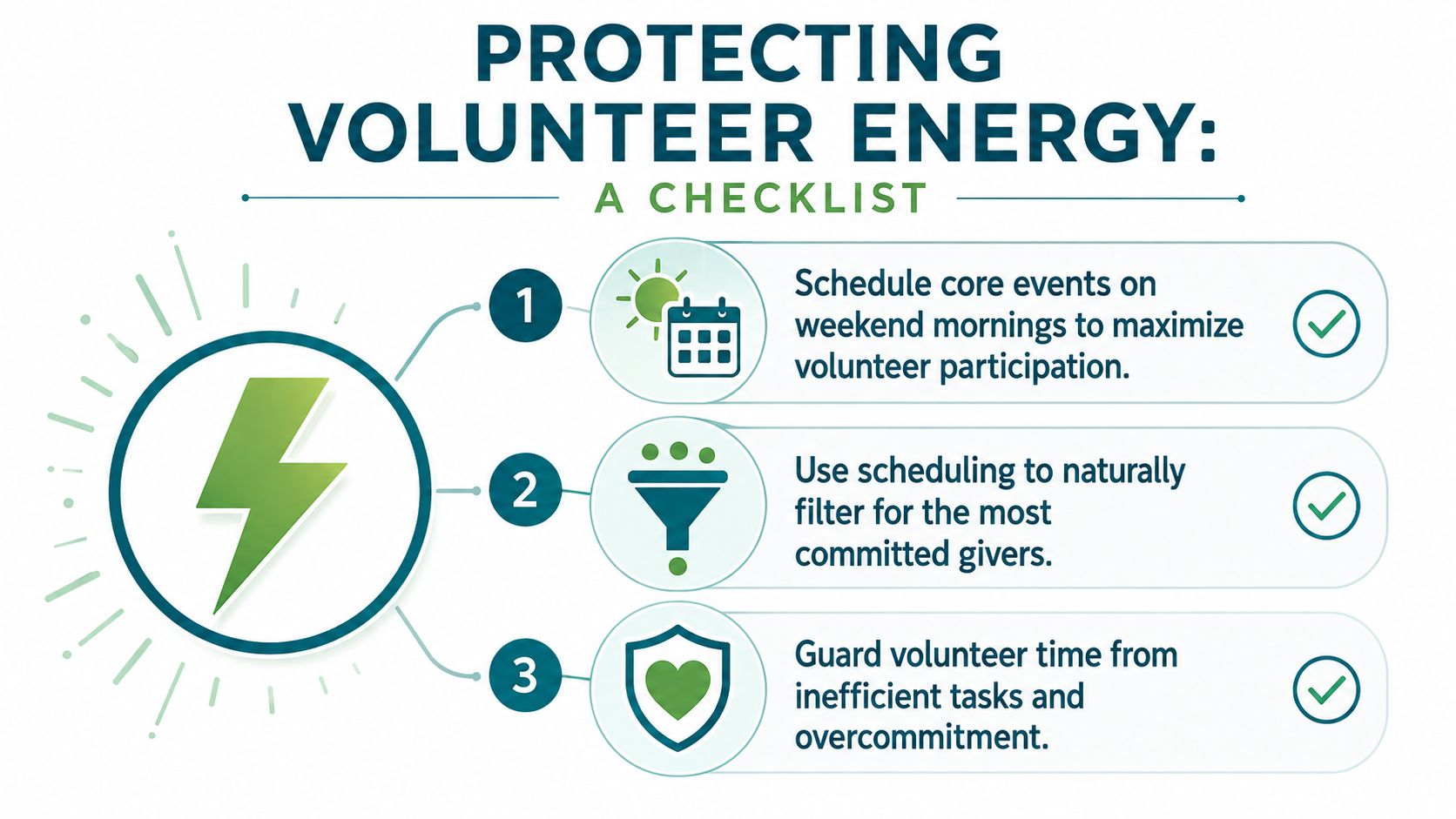
    A checklist infographic titled Protecting Volunteer Energy with three tips for managing and sustaining volunteer commitments.

    I treat volunteer energy like a battery that drains faster than money ever does. If you spend it badly, you don't get a loud failure. You get silence, no-shows, and a group chat that goes cold.

    Schedule for the people you want to keep

    Weekend mornings work because they reward intention. The people who wake up early to pick up trash usually want to be there, and that matters more than raw turnout. If you schedule like a party, you attract party energy. If you schedule like service, you attract givers.

    That is why I keep events simple and predictable. I want people to know when to show up, what to wear, and how long it'll take. I also want them to leave with enough energy to come back.

    Practical rule: Make the first hour easy to understand and hard to fake. The wrong people drift off, the right people stay.

    The group's own retention advice lives at our volunteer retention guide, and the lesson is plain. Clarity protects energy. Confusion burns it.

    Safety comes first, happiness comes second

    I never ask volunteers to prove toughness. I ask them to stay safe, because nobody returns to a group that treats bruises like badges. Happiness comes second, but it still matters, because people remember how they felt more than what they carried.

    That means I choose routes with care, keep the task list visible, and watch the weather with a practical eye. Blizzard, heat wave, slush, or calm morning, the rule stays the same. People come before output.

    Never turn volunteers into fundraisers

    I don't pressure people for donations, because that changes the whole mood. Once a cleanup group starts treating volunteers like a donor pool, people feel it. They stop feeling like neighbors and start feeling like targets.

    A volunteer-first group needs a clean emotional contract. Come help. Make friends. Leave proud. That's enough.

    When you protect volunteer energy, you stop treating participation like a transaction. You start treating it like a shared ritual.

    Building Financial Reserves Without Chasing Donations

    On a hard week, I'd rather open the books and see a cushion than start asking volunteers to cover the gap. A cleanup group can keep its dignity intact by building steady support from grants, partnerships, and public backing, instead of turning every person in a glove into a walking fundraiser. That path feels slower at first, but it keeps the work from resting on volunteer guilt.

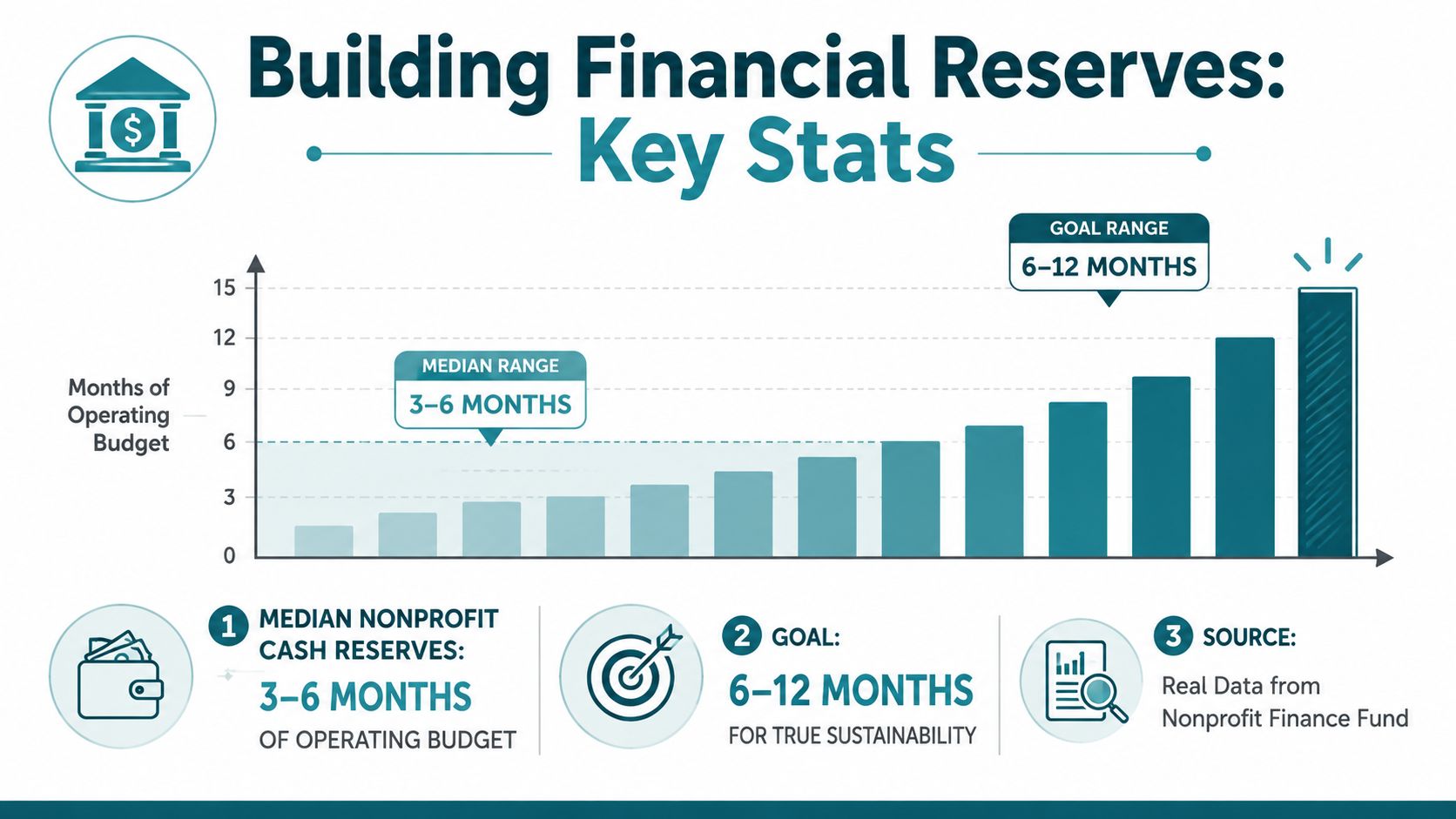
    The reserve numbers show why that matters. A 2025 survey found that 30% of nonprofits had no reserve funds at all, another 19% had reserves for less than three months of operating expenses, and only 15% had more than one year of reserves, while about two-thirds said unrestricted revenue did not increase from 2024 to 2025 (FNA Nonprofits Survey 2025 report). A thin cushion leaves no room for a missed payment, a broken tool, or a slow month.

    Read cash like weather

    I learned to read reserves the same way I read a storm line. If the forecast turns ugly and you already have supplies, you keep moving. If you do not, every surprise turns into a stoppage, and the crew feels it.

    A chart showing the recommended financial reserves for nonprofits as three to twelve months of budget.

    I start with simple cash targets. Cover the stretch you need to survive first, then build from there. The goal is not to pile up money for show, it is to keep the work alive when the month turns messy.

    Use outside support without changing your culture

    Public and philanthropic support already carries a lot of environmental work. In the United States, nonprofits focused on climate change were estimated to spend between $7.8 billion and $9.2 billion annually, with 49% going to mitigation and 14% to adaptation, and philanthropic sources supplied about 88% of that funding in fiscal year 2021 (Philanthropy News Digest). Federal energy and environmental infrastructure programs also invested $69.96 billion in nonprofit organizations from 2010 to 2024, with annual federal investment rising from $5.34 billion in 2010 to $29.79 billion in 2024.

    That gives you room to build a funding mix that respects volunteer time. You do not need to squeeze every dollar out of the same people who show up to haul bags and plant trees. A practical first pass is to look at corporate sponsorship ideas and judge them by fit, not desperation.

    A Practical Approach to Strategic Planning

    A lot of nonprofit planning fails because people confuse activity with direction. They make a long spreadsheet, then keep doing the same things with better formatting. I've done that too, and it doesn't save you.

    Pick a few outcomes and track them hard

    The strongest planning loop I've seen starts small. Define 3 to 5 mission-critical outcomes, turn each one into a quarterly metric, give each metric an owner, then review the results against resource, staff, and mission dashboards. That approach lines up with research that found a strong positive correlation between strategic planning and sustainability, with ρ = 0.759 and p < 0.01 (PMC study). The same study also reflects what McKinsey observed, nonprofits often track dollars raised, membership growth, people served, and overhead, but a better system also watches resource mobilization, staff effectiveness, and mission progress.

    I use three simple questions when I plan:

    1. What do we need to happen this quarter?
    2. Who owns each result?
    3. What will I check before the quarter ends?

    That keeps the work concrete. It also keeps me from hiding behind vague goals like “grow awareness” or “do more outreach,” which sound nice and do almost nothing.

    Measure more than money

    Money matters, but so do the people doing the work and the impact they create. If your dashboard only tells you how much money came in, you'll miss the moment your team starts fading.

    That is why I keep reviews short and regular. I want to know what broke, what held, and what needs a change before the next cleanup day arrives.

    For a visual version of that rhythm, the loop is simple. Define the outcomes. Build the action plan. Review, then adjust.

    The video below fits that same mindset.

    If you want a sample of how I think about partner work inside a plan, I'd point you to community partnership development.

    Earning Community Trust Block by Block

    The first time I saw an empty lot at auction, I didn't think about a logo or a media moment. I thought about what it would feel like to turn dead space into somewhere a neighborhood could use. That lot became Caterpillar Park in Englewood, and the path to it ran through a lot of small cleanup days.

    Trust grows from repetition

    We clean all 50 wards, including the places people avoid. That choice matters because trust usually forms where people expect you not to show up. When a group keeps showing up in rough weather and rougher blocks, neighbors start reading your behavior instead of your pitch.

    That's the deeper story behind community trust. People need to see consistency before they believe your words. They need to watch you pick up trash in the same place more than once. Then they start opening doors.

    Be a bridge, not a savior

    Research on low-infrastructure settings makes a sharp point. Many social problems persist because interventions don't reach underserved communities, and nonprofits often work best as bridging agents rather than inventing brand-new solutions from scratch (BYU Journal of Nonprofit and Social Innovation). I agree with that instinct. Most neighborhoods already know what they need. They need access, repetition, and someone who can keep the connection alive.

    That is why last-mile delivery matters more than clever branding. If a park, cleanup, or service path feels unreachable, the idea might be good but the impact stays out of reach.

    Make your reputation local and specific

    I don't think reputation comes from a big statement. I think it comes from one block, one event, one friendly face, and one follow-up text. People remember who listened, who came back, and who kept their word.

    The same logic applies to sustainable service. A nonprofit that earns trust block by block can keep going without shouting. It becomes familiar. Familiarity lowers friction, and lower friction keeps people involved.

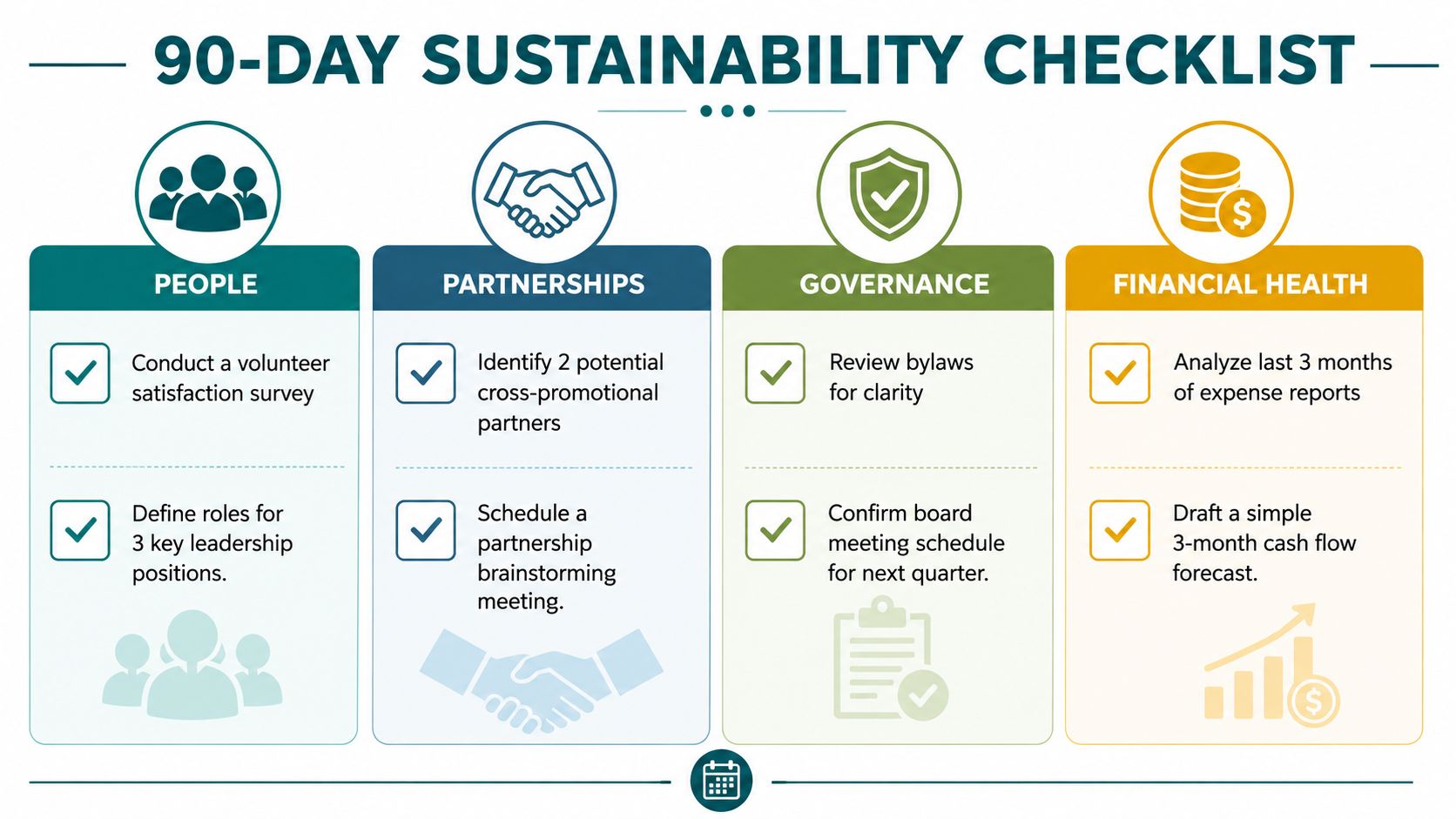
    Your Sustainability Checklist for the Next 90 Days

    If I had to rebuild a volunteer-first nonprofit from scratch, I'd stop talking about “big strategy” and spend the next 90 days on four things, people, partnerships, governance, and money. I've seen crews hold together through blizzards and heat waves when those four pieces were clear. I've also seen good missions stumble because nobody knew who was answering messages, who was checking supplies, or who was watching the bank balance.

    A 90-day sustainability checklist infographic for organizations covering people, partnerships, governance, and financial health categories.

    Days 1 to 30

    Start with the people who already carry the mission. Ask what helps them stay, what wears them out, and what makes the work feel worth it. Then name who owns the roles that keep things from slipping through the cracks, because volunteer energy disappears fast when every task floats around unanswered.

    A founder I know in Chicago keeps this simple. The group cleans across all 50 wards and helps build parks, but nobody gets pressured to donate money before they are welcomed onto a cleanup. That choice matters. It tells volunteers their time is the contribution, and it keeps the door open for people who want to help without being sold to.

    Days 31 to 60

    Move to partnerships and governance. Set one meeting with a possible partner, review your bylaws, and make sure your board schedule is clear for the next quarter. Write down what happens when a grant ends, who takes over, what changes, and what stays.

    Research on nonprofit sustainment shows that continuation can fall well below initial implementation, so the safe move is to plan for the handoff before the handoff arrives. A PMC study found that in one nonprofit partnership study, 56.8% of 937 partnerships continued for one year, even though implementation was very high at 98.4% overall and 89.1% for strongly implemented scoping items (PMC study). I use that gap as a warning. Getting a program started is not the same as keeping it alive.

    Days 61 to 90

    Finish with money and review. Look at your last three months of expenses, draft a simple three-month cash flow forecast, and set your first reserve target. Then run one quarterly planning review with your team and ask what moved, what stalled, and what needs a new owner.

    Practical rule: If you cannot explain your next 90 days in one page, your group is probably carrying too much guesswork.

    I also like to use one simple self-check at the end of each quarter. Did people show up? Did partners respond? Did the board stay useful? Did cash move in a stable direction? If the answer is mixed, that's fine. You adjust and keep going.

    If you want a crew that thinks this way in the world, Litter Caterpillars has built a volunteer-first model around cleanup, friendship, and steady action. Visit, join a cleanup, and see how a group can protect volunteer energy while staying useful block by block.

  • 8 Essential Blizzard Safety Tips for You and Your Crew

    8 Essential Blizzard Safety Tips for You and Your Crew

    The first time we picked up trash, there were just three of us, and Chicago surprised us with a burst of wild weather. We huddled under a tree, watched rides cancel one after another, and learned fast that cold is more than discomfort, it changes the whole mood of a day. I carry that memory into every winter cleanup, because blizzards ask the same question every time, who is prepared, who is calm, and who is willing to look out for the people nearby?

    That is why I treat blizzard safety tips like field lessons, not theory. You can use them at home, on a block walk, on a volunteer shift, or while checking on a neighbor who lives alone. The goal is simple, stay warm, stay connected, and stay sharp enough to help yourself and the people around you when the snow starts stacking up.

    1. Stay Inside During the Storm

    The cleanest decision is often the hardest one. When the wind starts cutting across the street and the snow turns the world into a white wall, I want you to stay where you are and wait it out. A short trip to the car, the mailbox, or the corner store can turn ugly fast when you cannot see well and you lose your footing on ice.

    I learned this the hard way from winter volunteer work. If I see the forecast turn bad, I cancel the cleanup and move it to another day, because no bag of litter is worth a twisted ankle or a stranded volunteer. That same judgment works at home too. Stock snacks, water, and something to do before winter starts, because boredom gets loud when you are stuck inside and your phone battery is low.

    Practical rule: if you can wait, wait.

    Use the time to charge your phone, check your heat, and tell friends or family you are staying put. A steady message like that keeps people from worrying and keeps you from making a careless dash outside just to “check.” If you need a place to start with neighborhood-minded preparation, I like the simple approach shared on Litter Caterpillars neighborhood safety, because it fits real life, not fantasy weather.

    A cold storm also eats your attention. If you have one eye on the road and one eye on the windows, your judgment slips. I would rather see you plan your next volunteer day, make soup, or sort out a future weekend cleanup than gamble with a blizzard outside your door.

    A woman wrapped in a blanket sits by a snowy window, holding a warm steaming mug.

    2. Dress in Layers with Waterproof Outer Gear

    A volunteer in our group once showed up for a winter cleanup in a heavy coat that looked warm from the parking lot. Ten minutes in, sweat had soaked the inside, the wind had found every seam, and she spent the rest of the shift flexing numb fingers instead of picking up trash. That day made the lesson plain. Winter clothing has to protect against wind and moisture while still letting you move.

    The CDC recommends several layers of loose-fitting clothing, plus a hat, scarf or knit mask, mittens, and water-resistant boots, and the National Weather Service warns that wet clothing, sweating, and overexertion speed up heat loss and raise hypothermia risk. In Chicago volunteer work, I have seen people arrive in the wrong coat and lose focus fast, because cold hands and wet sleeves steal attention from the job in front of them. A good jacket is not about style in a storm. It is about staying useful when conditions turn.

    What I look for before I leave the house

    • Start with the right fabric: choose wool or synthetic materials, because cotton hangs onto moisture and leaves you cold.
    • Block wind and snow: wear a windproof jacket over your insulation and add snow pants if you expect deep slush.
    • Protect your head and face: wear a hat, and add a balaclava or neck gaiter when the wind cuts hard.
    • Carry backup pieces: bring extra gloves and socks, because wet hands and feet ruin a day faster than bad attitude ever will.
    • Seal the gap at your boots: tuck your pants into your boots when snow is deep enough to creep inside.

    I keep telling volunteers this because comfort and safety are tied together. If your clothes hold sweat, you cool down as soon as you stop moving. If your gloves soak through, your hands stop helping you. Layers work like a cleanup crew, each piece does one job, and the whole group works better when no one is left exposed.

    3. Check Weather Forecasts and Create a Communication Plan

    I never trust my mood when winter is coming, I trust the forecast. On one Chicago volunteer shift, I watched a group leave the warmth of the meeting hall with clear skies overhead, only to meet harder wind and drifting snow a few blocks later. That kind of surprise is why I check wind, temperature, visibility, and timing before any outdoor plan, because a calm-looking day can turn mean once the gusts rise and the road starts to disappear under blowing snow.

    That same lesson carries over to volunteer groups. If I see a storm moving in, I call it early and I say it plainly, because last-minute confusion makes people split off, rush decisions, and miss the message. Everyone needs the same update, the same expectations, and the same contact list, so nobody is guessing while the snow is already falling.

    A communication plan should feel boring before the storm

    Stay off guesswork. Put your plan in place while the sky is still clear.

    • Use more than one forecast: compare weather alerts, hourly updates, and local forecast details instead of betting on one app.
    • Watch wind chill, not just temperature: the air can feel far worse than the number on your screen.
    • Set group chats early: build them before winter arrives, so you are not adding names while conditions get rough.
    • Share your route: tell at least one person where you are going and when you expect to be back.
    • Choose a cancel rule now: decide ahead of time what weather means “we stop.”

    In our Chicago cleanup work, that kind of planning keeps a simple outing from becoming an emergency. I have seen volunteers arrive steadier, ask better questions, and stay focused when they already know who to text, when to turn back, and who is watching the forecast from home. A clear plan does more than protect one person. It gives the whole group a steadier way to move through a hard day, and that is how a volunteer crew turns winter caution into shared strength.

    I also keep one local resource in mind for people who may need support if plans fall apart, and I share the link for the Casa Catalina Food Pantry in Chicago when a storm could complicate access to food or other basics. That kind of follow-through matters, because communication is not only about canceling a shift. It is about making sure people know where help is, who is safe, and how to stay connected when the weather gets sharp.

    4. Stock Essential Supplies Before Winter Arrives

    I learned this lesson on a January supply run for our volunteer group. The forecast had looked manageable that morning, then the snow thickened fast, and the people who had already stocked their homes were the ones who stayed calm when the roads turned slick and the stores started thinning out. That is why I shop for winter before I am tired, before the wind starts howling, and before I have to make decisions with cold hands.

    Food, water, batteries, a first aid kit, and the medicines you already rely on should all be ready before the first real storm. Ready.gov recommends a go-kit with at least three days of supplies, and I treat that as the baseline for anyone who lives where snow can trap you indoors. The point is not to build a bunker. It is to keep panic out of the picture when delivery slows, store shelves empty, and the street outside becomes a place you should not try to drive through. I have seen how much steadier people feel when the pantry and medicine cabinet are already set.

    My winter shelf has a plain rhythm to it, built from the kinds of things that keep a household going when the weather does not cooperate.

    • Food you will eat: canned beans, peanut butter, dried fruit, instant oatmeal, soup, pasta, rice, crackers, and a few comfort foods like tea, hot cocoa, or shelf-stable applesauce.
    • Water stored safely: use food-grade containers, and keep enough to cover several days.
    • Light and power backups: flashlights, extra batteries, a battery-powered radio, and candles you can use carefully if the power goes out.
    • Medicine with labels intact: keep prescriptions in original bottles, plus over-the-counter pain relievers, allergy medicine, and any daily inhalers or supplements you depend on.
    • A simple paper list: print your supplies and tape the list where you can see it, so you can check what needs replacing without guessing.
    • A place to find more help: if a storm puts a strain on your household, keep the page for the Casa Catalina Food Pantry in Chicago close by, along with other local resources you trust.

    I also think about the people in my life who depend on me, because a stocked shelf lowers stress before a volunteer shift and after one. If I know my home is ready, I can focus on helping others instead of worrying that my family will have to scramble while the snow piles up. That peace of mind matters in a blizzard. It gives you room to stay useful, and it gives the people around you a steadier example to follow.

    A person checking off items on an emergency preparedness list next to supplies like water, food, and medicine.

    5. Know the Signs of Frostbite and Hypothermia

    The cold does not always hit like a siren. Sometimes it creeps in through your fingers, your ears, or your nose, and the first sign is just numbness or tingling. Frostbite can make the skin turn white or waxy, and if you ignore that signal, you can turn a minor problem into a serious one.

    Hypothermia is trickier because it can fool the person who has it. At first, you shiver. Then you may feel confused, clumsy, or sleepy, and that is where danger gets nasty, because your own brain can stop warning you. In a group, I watch for the person who stops talking about the cold. Silence can mean they are too far gone to complain.

    The cues I look for in the field

    When I volunteer outdoors, I keep an eye on simple body-language tests. If someone starts stumbling, mumbling, grumbling, or fumbling, I treat that as a red flag for hypothermia. If I see white patches on skin, I move fast toward warmth and get the person inside.

    Do this early, not late. Check yourself and the people around you often enough that numb fingers never get ignored.

    • Check every 15 minutes in extreme cold: small injuries can grow fast when wind and wet snow are working against you.
    • Speak up about numbness immediately: no one should tough it out until the damage spreads.
    • Know the difference: frostbite is local cold injury, while hypothermia affects the whole body.
    • Never rub frostbitten skin: that can cause more harm.
    • Move slowly and gently: a person with hypothermia needs calm handling, not rough urgency.
    • Call 911 for serious symptoms: if someone is confused, hard to wake, or getting worse, get help.
    • Use a buddy system: let someone else watch you, because self-monitoring fails when your judgment slips.

    That quiet moment, when somebody stops joking or complaining, has saved my attention more than once. I do not wait for collapse. I treat odd silence as a warning and warmth as the next move.

    6. Keep Your Car Winter-Ready and Know What to Do If You Get Stuck

    I prepare my car like it might turn into a tiny shelter for a while, because sometimes it does. The National Highway Traffic Safety Administration reported 101,390 police-reported crashes in 2023 when snow or sleet was present, including 320 fatal traffic crashes and 22,293 injury crashes (NHTSA winter driving tips). Those numbers are enough for me to respect the road when the weather turns mean.

    That means I check tire tread, keep jumper cables in the trunk, and make sure I have a flashlight, blankets, water, snacks, and sand or kitty litter for traction. I also keep my fuel tank from running low in winter, because a car that quits at the wrong time gives you one more problem than you need. If the forecast looks rough, I would rather carpool, use transit, or stay home than roll the dice on a road that can trap me.

    Open car trunk packed with winter emergency supplies next to a snowy road with a vehicle driver.

    If you get stuck, stay in the car unless help is clearly close. The car gives you shelter, and leaving it can put you at risk of disorientation and fast heat loss. Turn on hazard lights so rescuers can spot you, crack a window a little for ventilation, and run the engine and heater only as needed so you stay warm without losing your sense of space.

    I keep the rule simple for volunteers and friends. If the storm is ugly, the safest drive is often the one you never start. If you do have to drive, tell somebody your route and keep your phone charged before you pull out.

    7. Stay Connected and Account for Vulnerable People

    A blizzard changes what kindness looks like. A neighbor who can handle a snowy walk to the store might still worry about someone older, someone on disability support, or someone living alone with a weak heat source. I make it a habit to check on the people around me before the storm gets bad, because waiting until the roads are ugly can turn a simple call into a missed chance.

    That is where real community work pays off. When I know the names of the people on my block, I know who needs medication, who might need food, and who should not be left alone too long. I also know that trust matters. If I have shown up before the storm, a knock on the door during the storm feels normal instead of invasive.

    The Red Cross points out that winter guidance often talks about staying inside, monitoring weather, and checking on others, but it leaves a gap around the messy part, how to keep a group calm and functional over several days of confinement (Red Cross winter storm guidance). I fill that gap with simple habits. I set check-in times, I make sure people know who to call, and I keep the buddy system loose enough to be useful and firm enough to matter.

    What I look for before the snow gets deep

    • Make contact early: do not wait for the crisis to exchange numbers with neighbors.
    • Learn who needs power: some people rely on medical equipment that can't sit through an outage.
    • Keep emergency contacts handy: write them down in case a phone dies.
    • Check even when people say they are fine: pride makes people underreport need.
    • Bring supplies if you visit: a warm blanket or extra food can help immediately.
    • Report serious concerns when needed: if you think someone is at risk, act on it.

    I learned this same habit through what community resilience looks like in practice. The point is not to become heroic, it is to become dependable. A connected block handles a blizzard with less panic because people already know who needs a hand.

    8. Have a Plan for Heat and Power Loss

    Snow and ice can take out power lines in a few rough hours, and then the house gets quiet in a way that feels wrong. Cold indoors is a problem I never want to improvise around, because once heat disappears, the clock starts moving fast. I want a backup heating plan before winter even begins.

    Ready.gov says generators and fuel should be used outdoors and at least 20 feet from windows, doors, and attached garages, which matters because carbon monoxide can build up without warning (Ready.gov winter weather). I keep that rule in plain language in my head. If something burns fuel, I do not put it inside the living space, and I do not cut corners because I feel cold.

    A real backup plan can look simple

    A fireplace, a wood stove, a safe generator setup, or propane or kerosene space heaters can help if you already know how to use them. I also keep carbon monoxide detectors that do not depend on the power staying on, because a quiet alarm is still an alarm. Extra blankets, sleeping bags, and a plan for where to go if the house gets too cold all matter too.

    If I need a warm place, I want that answer ready before the storm arrives. I keep a short list of warming centers and nearby neighbors who have backup heat, because standing in a freezing house and deciding what to do is a bad place to start. I also never use a stove, grill, or oven to heat a home. That shortcut can turn a power outage into something far worse.

    I have seen how much calmer people get when they know their options in advance. Some go to a neighbor, some head to a warming center, and some stay put because their fireplace or backup setup is ready. That decision should happen on a calm day, not in the middle of a freezing night.

    8-Point Blizzard Safety Comparison

    Item Implementation Complexity 🔄 Resource Requirements ⚡ Expected Outcomes 📊 Ideal Use Cases 💡 Key Advantages ⭐
    Stay Inside During the Storm Low 🔄, simple decision/reschedule Low ⚡, charged phone, basic prep 📊 Very high safety; fewer rescue needs Severe blizzard, whiteout or high winds ⭐ Maximizes personal and public safety
    Dress in Layers with Waterproof Outer Gear Medium 🔄, knowledge and dressing time Medium ⚡, quality layers and waterproof gear 📊 Sustained warmth; tolerates longer exposure Outdoor work/volunteering in cold/wet conditions ⭐ Effective thermal regulation; flexible removal
    Check Weather Forecasts and Create a Communication Plan Medium 🔄, ongoing monitoring & coordination Low ⚡, apps, group chats; some admin time 📊 Better timing, organized cancellations, fewer surprises Group events, volunteer meetups, travel planning ⭐ Improves decision-making and group safety
    Stock Essential Supplies Before Winter Arrives Low–Medium 🔄, one-time setup, periodic maintenance Medium ⚡, food, water, batteries, storage space 📊 Self-sufficiency for days; reduced panic & trips Staying home during prolonged snow/road closures ⭐ Enables calm preparedness and basic survival
    Know the Signs of Frostbite and Hypothermia Low 🔄, learnable awareness Low ⚡, training/education, routine checks 📊 Early detection reduces severe injury & fatalities Any outdoor exposure; supervising groups ⭐ Life‑saving recognition; enables timely medical action
    Keep Your Car Winter-Ready and Know What to Do If You Get Stuck Medium 🔄, maintenance and kit readiness Medium–High ⚡, tires, emergency kit, fuel 📊 Increased survivability if stranded; fewer accidents Winter travel, remote routes, emergency egress ⭐ Car as shelter; improved traction and signaling
    Stay Connected and Account for Vulnerable People Medium–High 🔄, relationship-building and checks Low–Medium ⚡, time, contact lists, coordination 📊 Fewer unnoticed emergencies; stronger community resilience Neighborhoods with elderly/isolated residents ⭐ Prevents crises among vulnerable populations
    Have a Plan for Heat and Power Loss Medium–High 🔄, planning, testing and safe operation High ⚡, generators, fuel, alternative heat sources 📊 Maintains warmth during outages; reduces health risks Areas prone to outages or long storms ⭐ Sustains life‑support needs; reduces evacuation need

    Be the Calm After the Storm

    True bravery is not loud when the snow stops. It shows up in the quiet part after the wind dies down, when you check on a neighbor, clear a safe path, or make one steady call that keeps a family from spiraling. I have learned that the best winter prep is less about looking tough and more about staying useful.

    That is the heart of what we do at Litter Caterpillars. We pick up trash, we build habits, and we build trust, so people know each other before a storm asks for help. A blizzard gives you a chance to practice that same spirit at home, on your block, and with the people who count on you.

    You do not need to be perfect to be dependable. You need a plan, a few good habits, and the willingness to act before fear gets louder than judgment. When you prepare well, you give yourself room to help someone else breathe easier.

    That is growth, too. It is the kind that shows up in boots, in warm gloves, in a charged phone, and in the message you send to the person who lives down the hall. When the road looks bad and the sky turns white, I want you to be the person who stays calm, stays inside when needed, and shows up for your community when it counts.


    If you want more chances to build that kind of steady, service-minded confidence, join the work at Litter Caterpillars. We clean Chicago together in rain, snow, and heat, and we do it in a way that helps people make friends, practice bravery, and look out for one another. Come visit us and see how winter readiness and community service fit together in real life.

  • Chicago Neighborhood Safety: A Complete Guide for 2026

    Chicago Neighborhood Safety: A Complete Guide for 2026

    I'm usually on a Chicago block before the coffee shops open, glove box full of trash bags, grabbers rattling in the back seat, and one eye on the street I'm about to walk. Some mornings I'm in a place my friends would never pick for brunch, never mind a lease, and I can tell you this, the curb line, the empty lot, the open corner store, and the way people move on foot tell a better story than a single citywide number ever will.

    If you're trying to judge Chicago neighborhood safety from your couch, I get the urge to search one clean answer. I've done it too. Then I've shown up on a block in work gloves and learned fast that Chicago doesn't hand out one safety score, it hands out blocks, corners, and routines that feel different from one another.

    Why One Chicago Number Is the Wrong Place to Start

    It was 7:30 on a Saturday, and my crew had just rolled up to a block many people I know would simply skip. We were carrying trash bags, grabbers, and the kind of stubborn mood you need when you've decided to spend your morning cleaning up someone else's mess. That block told me more than a citywide crime number ever could, because the garbage, the foot traffic, the broken glass, and the people who lived there all sat in the same frame.

    The citywide average hides the street level truth

    Chicago's own violence dashboard shows why a single number can mislead you. From 2018 through 2020, 15 community areas, only 24% of Chicago's population, accounted for 63% of the city's homicides and non-fatal shootings (Chicago violence dashboard). Between January 1, 2016 and December 31, 2020, the city recorded 3,276 homicides and 13,546 non-fatal shooting victims (Chicago violence dashboard).

    That's the part you miss when they ask, “Is Chicago safe?” Safe where? On what block? At what hour? The city's own dashboard logic treats violence as a spatial concentration problem, not a citywide-average problem, and that's the right way to think about it (Chicago All Safe Data).

    A neighborhood can feel calm on one street and rough two blocks over. That's normal here, and it's why block-by-block reading matters.

    I've seen that pattern up close on cleanup days. One stretch has kids biking past parked cars and a bakery opening its gate. Another stretch nearby has empty storefronts, loose trash, and nobody lingering outside unless they live there. If you only read the city as one number, you flatten both streets into something false.

    An infographic showing that citywide average crime statistics can obscure significant safety differences between Chicago neighborhoods.

    Why that matters when you move, visit, or volunteer

    Averages are useful for headlines, not for your actual life. If you're choosing an apartment, planning a Saturday walk, or organizing a cleanup crew, you need to know what happens on the block you'll touch, not what happens across the whole city. Chicago's own safety tools are built around that idea, because the risk is concentrated in specific community areas, often on the South and West Sides, while many other neighborhoods see far less serious violence (Chicago violence dashboard).

    I trust that reality more than I trust a single clean score. A person can move one mile and land in a totally different rhythm, different lighting, different business density, different sense of ease. That's why I never start with “Chicago is safe” or “Chicago is dangerous.” I start with the block.

    Reading the City's Crime Maps Without Misreading Them

    I've stood at curbs with a trash grabber in one hand and my phone in the other, checking a block before we start a cleanup. One street looks calm because the porches are full, the lighting is decent, and people are outside. Another street a few turns away has broken glass near the alley, a couple of vacant lots, and a different kind of quiet. That is the kind of difference a good map can help me see, if I read it carefully.

    I keep three tabs open when I want a real read on a neighborhood. First, the city's Violence Reduction Dashboard. Second, the Public Safety DataHub. Third, a neighborhood-level crime map that lets me look at the street, not the postcard. Each tool answers a different question, and if you use the wrong one, you end up arguing with the wrong data.

    The tools tell different stories

    The City of Chicago says its violence dashboard and Public Safety DataHub are built to show neighborhood-level crime and safety indicators, not just citywide aggregates (Chicago All Safe Data). That matters because the unit you choose changes the answer. If you look at a whole city, you smooth out the rough patches. If you zoom to a community area, or even tighter to an address-radius slice, you see the risk around a front door.

    That is why I like address-level incident pins and a ½-mile radius when I'm checking a place I might walk, visit, or clean. The city's dashboard approach also tracks violence in real time, which helps with practical choices like patrol routing, volunteer planning, and where to place neighborhood services.

    How I read the map without getting tricked by it

    I don't treat a map pin like a verdict. I look for clusters, repeated incidents, and what else is happening nearby. Building violations, 311 calls, crash patterns, and ordinary street use can change how a block feels long before a crime headline appears. A map that combines those layers gives me a better read than crime alone.

    Practical rule: if I'm choosing between two blocks, I care more about what the immediate radius looks like than what a neighborhood label says.

    I also check more than one source, because the picture shifts depending on how the map is built. One 2026 crime map puts Chicago's total crime index at 119, with an estimated 1 in 230 annual chance of violent crime and 1 in 38 annual chance of property crime (Chicago crime map). Another 2026 neighborhood analysis says 77% of Chicago's 86 analyzed neighborhoods earned an A or B safety grade, while the citywide overall grade was C- (DoorProfit Chicago crime map).

    I read those numbers like I read a street before a cleanup, slowly and with my eyes open. I want the pattern under the surface, the blocks where the same concerns keep showing up, and the corners that feel different once you stand there instead of staring at a summary.

    Safe by Block, Different by Ward, Uneven by Direction

    I notice the difference the minute I cross a few streets in Chicago. One block has porch chairs out front, kids cutting across the sidewalk, and somebody sweeping the stoop. Another block has everyone moving fast, doors shut, and fewer people lingering outside. I've done cleanup work in both kinds of places, and that street-level feel lines up with what I see when I read neighborhood safety by block instead of by broad label.

    The neighborhoods people call safe

    A neighborhood-level Chicago source lists Lincoln Park, Lakeview, River North, Gold Coast, and Hyde Park among the safer neighborhoods (Illinois Crime). Another Chicago guide aimed at homebuyers points to Lincoln Park as a high-demand area with strong school access and lakefront proximity, while also naming Beverly among the safer west-side options for buyers (Grilli Murphy Real Estate).

    Those places still feel different once you stand there. River North runs at a quicker pace than Hyde Park. Lakeview gives off a different rhythm than Gold Coast. Even so, when I'm helping a crew pick a cleanup route or checking a block for the first time, those names tend to come up because the street conditions are usually steadier there.

    The neighborhoods where risk feels heavier

    The same Chicago neighborhood source lists Englewood, Austin, West Garfield Park, Chatham, and Roseland among higher-crime areas (Illinois Crime). That is the part of the map people often talk around instead of naming. I'm not going to do that here. The South and West Sides carry more of the burden, and anyone who works block by block sees that quickly.

    Chicago Neighborhood Safety Snapshot Ward Area General Safety Profile
    Lincoln Park North Side Commonly cited as safer, with steady street activity
    Lakeview North Side Commonly cited as safer, with active residential blocks
    River North Near North Side Commonly cited as safer, with denser commercial activity
    Gold Coast Near North Side Commonly cited as safer, with high foot traffic and visibility
    Hyde Park South Side Often seen as safer than many nearby areas, with strong neighborhood identity
    Englewood South Side Higher-crime area, requires closer block-level review
    Austin West Side Higher-crime area, needs block-by-block attention
    West Garfield Park West Side Higher-crime area, requires careful route planning
    Chatham South Side Higher-crime area, with mixed block conditions
    Roseland Far South Side Higher-crime area, with sharper local variation

    That is the point I keep coming back to after enough miles on foot. Chicago safety is uneven, and the unevenness shows up by direction as much as by neighborhood name. If you're new here, don't start with a yes-or-no question about the whole city. Ask which side, which ward, which block, and which route you'll use.

    A Simple Framework for Assessing a Block Before You Commit

    I don't trust a block by vibes alone, and I don't think you should either. When I'm thinking about a lease, a weekend stay, or a cleanup site, I run the same quick test in my head. It takes less than ten minutes if I stay disciplined, and it saves me from bad guesses.

    My four-question block check

    A four-step checklist infographic titled A Simple Framework for Assessing a Block Before You Commit.

    1. Check the exact block on a map. I want the specific address area, not just the neighborhood name. If the surrounding pins cluster hard in one direction, I pay attention.

    2. Talk to at least three people who live there. I don't stop at the leasing agent or the first friendly face in a coffee shop. Residents tell you what happens after dark, where people park, and which corners they avoid.

    3. Visit at different times of day. A block can feel easy at 11 a.m. and tense at 8 p.m. I want to know what the street does when work ends and the lights change.

    4. Look for ordinary upkeep. Open businesses, clean sidewalks, active porches, and maintained green space tell me more than slogans do.

    What I watch for when I arrive

    I park where I can leave easily. I keep my crew together when we're on a new block. I don't split up unless I know the area, and I don't wander with my phone out. That sounds basic, because it is, and basic habits save you trouble.

    If a street feels empty, I ask whether it's empty because it's quiet or empty because people don't linger there.

    That question has saved me from bad assumptions more than once. A block with low foot traffic can be fine if it's residential and calm. The same pattern can feel different if storefronts are shuttered and nobody's outside. The point is to read the block in context, then decide.

    I also look at visible investment. Clean corners, functioning lights, and businesses that stay open into the evening tell me a lot about whether people still use the street. When those signs are missing, I slow down.

    The Hidden Layer Safety Actually Controls

    The perception of safety extends beyond the comfort of walking outside. It also impacts the ability to access essential services like grocery stores, pharmacies, and fitness centers without anxiety.

    A Chicago-based study found that poorer perceived neighborhood safety was linked to lower odds of having large grocery stores, pharmacies, and fitness resources within one mile, and that people with prior neighborhood crime exposure were more likely to bypass nearby pharmacies even when they existed (PMC study). That's a hard thing to ignore if you live without a car, or if you're helping a senior who relies on a short walking route.

    Safety shapes errands, not just feelings

    I've seen this in day-to-day cleanup work. A corner can have a pharmacy, a store, and a bus stop nearby, but if people don't feel settled walking there, that access isn't real in practice. It exists on paper and fades in the routine of the people who live there.

    Families feel that most sharply. So do seniors who keep strict habits and don't want to improvise. So do volunteers who want to help a block but don't know whether they can safely bring gear in, unload bags, and leave their cars for an hour.

    When I read that study, I thought about all the times a neighborhood looked “close enough” on a map and still felt too far in real life. Safety changes the radius of ordinary life.

    The access question most guides skip

    That's why I like asking a harder question than “Is this area safe?” I ask, “Can someone here live their day here?” Can they walk to food, medicine, and movement without treating every errand like a mission? That is where neighborhood safety stops being a score and starts shaping habits.

    If you care about that side of the story, the illegal dumping problem usually sits right next to it, because neglected blocks and worn-out routines travel together in the same neighborhoods. I keep coming back to this guide on illegal dumping prevention because the street-level fix is often the same, show up, clean up, and make the block easier to use.

    How Showing Up Changes How a Neighborhood Feels

    I started Litter Caterpillars because my own life was a mess in the same weird way a cluttered room gets under your skin. I held onto trash like it had a story, and I kept telling myself I'd deal with it later. Then came a breakup, a reset, and a decision to get better at the things I had been avoiding, cleanliness, consistency, and bravery.

    The first cleanup was absurd in the best way. There were three of us, and Chicago threw a hail storm at us while we were out there. We huddled under a tree, watched Uber keep canceling, and laughed because we had already committed. That day taught me two things. Cleaning other people's messes is easier than cleaning your own, and a little suffering gives the work a flavor that makes it stick.

    Why repeated presence matters more than a one-off cleanup

    A one-time sweep can make a block look better for a day. Repeated presence changes how people carry themselves. Kids notice. Adults notice. The street starts to feel visited instead of abandoned.

    I've watched that happen when a small, steady group shows up week after week with the same energy and the same bags. People begin to say hello. They stop pretending the block is someone else's problem. The cleanup crew becomes part of the street's rhythm, and that rhythm matters.

    My rule: if we can return to a block with the same faces and the same good mood, the block gets easier for everybody else to use.

    That logic is why we do the work in rain, blizzards, heat, and bad wind. It's also why we've done unusual jobs, like cleaning a highway during a bike-event shutdown and winning an empty lot at auction to build Caterpillar Park in Englewood. Those jobs aren't magic tricks. They're proof that visible service changes what people believe is possible on a street.

    What I've learned from the block

    Safety gets discussed like a fixed property. I don't think it is. It's shaped by what people do on the block, who returns, who stays visible, and whether the street feels cared for. Dashboards can't capture that mood, but a crew picking up trash on the same corner every Saturday can.

    If you want to see how we think about service, friendship, and getting people outside together, I'd point you to Care for Real. The same simple habit keeps showing up there too, people helping in public, on purpose, without acting like they're above the place they're cleaning.

    Plugging In Safely as a Volunteer or Advocate

    If this made you want to do something, start small and start where people already know the drill. Weekend-morning cleanups work well because they attract givers, not people looking to make the day about themselves. That matters to me. I want volunteers to feel safe, useful, and at ease before anyone asks them for more.

    An infographic titled Plugging In Safely with four steps for volunteers or community advocates to follow.

    A low-pressure way to begin

    1. Start with an established group. Litter Caterpillars runs scheduled weekend events, which makes it easier to know when and where to show up.

    2. Go with a friend the first time. I like groups because they keep the work comfortable while you learn the block.

    3. Keep the action small and regular. A steady hour on the same corner does more than a big burst you never repeat.

    4. Let the block introduce you to the rest of the network. Park stewards, CAPS beat meetings, ward cleanups, mutual aid groups, and local hearings all connect naturally once you start showing up.

    If you want to check the safety side of a group before you join, ask whether they brief volunteers on the site, whether they keep cleanup gear on hand, and whether they make room for beginners. If they can't answer plainly, keep looking. Safety and friendship are not extras. They're the whole point.

    I also care about liability, because a serious volunteer group should think about it before asking anyone to carry bags into a neighborhood they don't know. If you want to see how I think about that part of the work, look at volunteer liability insurance.


    If you want a first step that feels real, come out to a Litter Caterpillars cleanup, bring a friend, and let the block teach you what a dashboard can't. Visit Litter Caterpillars and plug into a weekend morning where you can pick up trash, meet good people, and get a clearer read on Chicago neighborhood safety while you're standing on the street.

  • 8 Service Learning Benefits That Change You Forever

    8 Service Learning Benefits That Change You Forever

    It's easier to clean someone else's mess. I learned that the hard way, standing in a freezing Chicago hailstorm with a trash bag in one hand and my own life feeling like a landfill in the other. When you pick up what other people left behind, you start noticing how much of yourself you can finally carry.

    Service learning didn't feel noble to me at first. It felt wet, cold, awkward, and weirdly honest. That's why it worked. It gave me a place to do hard, physical work with other people, and that work started changing how I handled my friendships, my fear, my city, and even the way I talked to myself.

    1. Building Real Friendships Through Shared Purpose

    You don't build the best friendships by sitting across a polished table and trying to sound impressive. You build them when your hands are cold, your shoes are muddy, and you're both dragging the same trash bag toward the curb. That's what makes service learning benefits feel different from casual socializing, it gives you a reason to keep showing up, and that consistency does the heavy lifting.

    I've seen strangers turn into the kind of people who text each other after pickups, plan side hangouts, and show up for celebrations that have nothing to do with trash. New Chicagoans often find their first real connection through weekly cleanups, because nobody cares if you're polished. They care if you're present. If you move away later, the bond can still hold. That's the kind of friendship that survives weather, schedule chaos, and ordinary life.

    A diverse group of four volunteers smiling and holding a sustainability flag after a community cleanup event.

    Say the unglamorous thing out loud

    If you want real connection, stop trying to look effortless. Introduce yourself to one new person, every week, and mean it. Tell people when you're having a rough day, because honesty builds faster than polish.

    Practical rule: the person who shows up in bad weather often becomes the person you trust in good weather too.

    If you want a group that builds that kind of bond on purpose, the spirit behind Litter Caterpillars' community-building activities for adults is exactly that, repeated effort with real people, not fake networking.

    2. Developing Personal Resilience and Grit

    The first time I worked outside in a spring hailstorm, my body wanted out before my mind did. That's the moment when resilience stops being a word you nod at and turns into a fact you can feel in your fingers. You learn that discomfort isn't the boss of you.

    That lesson matters because service learning asks you to stay put when the weather turns ugly, when the route feels long, and when your motivation drops off a cliff. The federal Learn and Serve America report said high-quality service learning helps school attendance, classroom engagement, and academic achievement, and it also connects students to their communities while reducing risky behaviors, which tells me grit isn't just about toughness, it's about follow-through in real life (federal Learn and Serve America report).

    Hard work gives you evidence

    You don't need to romanticize the cold to get the point. You need proof that you can keep moving when your mood says quit. The first time you finish a miserable pickup, you carry that evidence into everything else, a tough conversation, a job search, a bad week, a lonely stretch.

    You can't always choose the weather. You can choose whether you quit in it.

    That's why the gritty side of service learning benefits sticks. It gives you a body-level memory of strength. You don't just tell yourself you're capable, you've already done the thing, hands numb, bag full, and still standing.

    3. Gaining Practical Civic Knowledge and Neighborhood Literacy

    Three years of picking up trash across Chicago changes the way you see a city. You stop thinking of neighborhoods as names on a map and start reading them like lived-in places with patterns, habits, and pressure points. You notice what gets ignored, what gets maintained, and where people are trying anyway.

    That kind of civic learning beats a lecture because your shoes are in the dirt. The service-learning model has long been tied to active civic understanding, and a national youth leadership summary says it affects civic engagement along with attitudes toward self, school, social skills, and academic performance (National Youth Leadership Council summary). You feel those categories in real time when you're talking to neighbors, watching runoff pile up, or seeing which blocks get attention and which don't.

    City knowledge starts with your feet

    I've watched volunteers start asking sharper questions after a few cleanups. Why does this corner flood? Why does that block look cared for while another one gets buried in litter? Those are civic questions, not just cleanup questions. They lead you toward policy, maintenance, business habits, and the way people treat shared space.

    If you want to turn that attention into action, the mindset behind what is civic engagement is simple, pay attention where you stand, then act like the block belongs to you too.

    4. Developing Leadership and Initiative Skills

    Leadership usually gets described like a title. In real life, it looks more like a person noticing what needs doing and moving first. You grab extra bags, help a newcomer tie one off, or suggest the next street before anyone else says a word.

    That's how service learning builds leadership. You don't wait for permission to care, and nobody hands you a script. The work forces you to practice initiative, especially when the group needs somebody to make a decision fast. Over time, the shy person who barely spoke on day one starts leading a team or organizing a cleanup without making a big speech about it.

    The small moves count

    A lot of people think leadership begins when a crowd starts listening. I think it begins when one person sees a task and does it. That could mean setting the pace, checking on a tired volunteer, or stepping up for a stretch of highway cleanup no one wanted to claim.

    Leadership gets real when you stop waiting to be picked and start picking up the work yourself.

    That matters because service learning benefits don't wait until you feel ready. They show up while you're still learning how to act. You become reliable by being useful, not by sounding like a leader.

    5. Building Environmental Awareness and Stewardship

    You don't understand litter until you've held too much of it in your hands. One fast-food wrapper is an annoyance. Hundreds of wrappers, bottles, bags, and cups tell you a story about habits, convenience, and neglect. You start seeing patterns your old self ignored.

    That's where environmental stewardship gets personal. A lot of people think it starts with a speech. It usually starts with disgust, then curiosity, then responsibility. Volunteers often cut their own household waste after they've seen how much trash collects in the same places again and again. They start caring more about recycling, waste reduction, and the choices they make in their own kitchens and cars.

    Your habits stop feeling abstract

    Once you've cleaned a block, waste stops feeling invisible. You look at packaging differently. You notice how weather pushes trash into drains and parks. You start asking where it came from, who used it, and why it ended up where it did.

    If you want that eye-opening kind of awareness to stick, the lesson behind what is environmental stewardship is blunt, you can't claim to care about a place if you never touch the mess on its ground. That's a hard truth, and it changes you.

    6. Increasing Sense of Personal Agency and Control

    There's a specific kind of hopelessness that hits when you look at a dirty block and think nobody's going to fix this. Then you show up anyway, and by the end of the day the place looks different because of what you did. That's agency, and it feels better than waiting around for someone else to save the day.

    The booby trap for a lot of people is believing that change only counts if it comes from a big institution. Service learning cuts through that lie. You may not control the economy or city hall, but you can control your bag, your time, and your effort. That's enough to start moving your world.

    The Litter Caterpillars story started with Kevin Tao feeling stuck in his own messy apartment and chaotic life, then taking a hard look at the things he avoided. That same move, from helplessness to action, is what makes service learning benefits hit so hard in the body.

    Proof beats worry

    You don't need to feel powerful before you act. You act, then you feel powerful because you've got evidence. Before-and-after photos help, sure, but the proof lives in you, in the way your shoulders feel after a job done and in the way your mind stops repeating the same dead-end story.

    If you can clean one block, you can stop calling yourself helpless.

    That's not motivational fluff. It's a training ground. Once you've seen a real change happen because you showed up, you stop treating your life like a locked room.

    7. Developing Emotional Maturity and Self-Forgiveness

    A lot of people bring their worst self-talk into service work. I've done it too. You show up angry, ashamed, heartbroken, or embarrassed, and then the work asks you to keep going anyway. That's where emotional maturity starts, not in a calm self-help quote, but in the middle of real discomfort.

    Service learning teaches you that you don't have to be perfect to be useful. You don't have to have a spotless apartment, a clean record, or a tidy relationship history to matter to a group. You can be messy and still be welcome. You can be in progress and still be loved.

    The research summary from the Texas Tech service-learning review says service learning has positive effects on personal insight and cognitive development, and another meta-analysis found gains in self-esteem, self-efficacy, educational engagement, altruism, cultural proficiency, and academic achievement versus control groups (Texas Tech service-learning meta-analysis summary, Center for Engaged Learning summary). That lines up with what I've watched happen in the field, people start softening toward themselves because they finally have somewhere to belong while they work.

    You can't heal by hiding

    When someone joins a cleanup group while carrying shame, the work gives them a different mirror. Other people accept them as they are, not as a polished version they invented for public use. That repeated acceptance can be a relief so deep it almost feels strange.

    Self-forgiveness gets easier when your hands are busy and your people are kind.

    That's one of the clearest service learning benefits I know. It turns your inner critic down a notch by giving you a place to prove you're still worth something, even on a bad day.

    8. Creating Visible Community Impact and Pride

    Some kinds of service happen where nobody sees them. Cleanup work doesn't hide. The block changes, the street looks different, and neighbors notice right away. Kids ask questions. Business owners say thank you. People who used to walk past the mess now see a cleaner place and a group that cared enough to do something.

    That visible result matters because it gives you pride with no performance attached. You don't need applause to know the work landed. You can point to a corner, an empty lot, or a street and say, we made that better. The Litter Caterpillars' Caterpillar Park in Englewood does exactly that, turning an empty lot into a place people can use and care for.

    The best service learning benefits leave a trace. They don't vanish when the volunteer shift ends. They change what people expect from a neighborhood and what they expect from themselves.

    Pride gets stronger when people can see the result

    Visible work also builds group identity. Flags, theme songs, badges, and before-and-after photos all matter more than people think because they tell volunteers, this effort counts, and your neighbors can see it too. That kind of public care can pull other people in without a lecture.

    A split image showing a dirty street before cleanup and a clean street with volunteers after cleanup.

    A cleaner block is more than a cleaner block. It's proof that someone stayed.

    And yes, there's a video worth watching if you want to feel the rhythm of the work in motion.

    8-Point Service-Learning Benefits Comparison

    Outcome 🔄 Implementation Complexity ⚡ Resource Requirements 📊 Expected Outcomes 💡 Ideal Use Cases ⭐ Key Advantages
    Building Real Friendships Through Shared Purpose Low, regular scheduling and group coordination Low, volunteers, basic supplies (bags, grabbers) High social bonding; lasting friendships and trust Newcomer integration, community cohesion, volunteer retention Organic, durable friendships; diverse networks; mutual trust
    Developing Personal Resilience and Grit Medium, exposes volunteers to harsh conditions; safety planning needed Low–Medium, weather gear, safety protocols, buddy systems Increased grit, confidence, tolerance for discomfort Personal growth, resilience training, preparation for stress Builds authentic self-efficacy via real-world challenges
    Gaining Practical Civic Knowledge and Neighborhood Literacy Medium, broad geographic coverage and sustained engagement Medium, travel/time, documentation, local partnerships Deep neighborhood knowledge; civic understanding; advocacy readiness Civic advocacy, urban planning research, community organizing Firsthand insight into policy impacts and local dynamics
    Developing Leadership and Initiative Skills Low, informal roles emerge through action Low, volunteer coordination tools, recognition tokens Improved initiative, decision-making, team coordination Emerging leaders, grassroots project organizers Practice-based leadership with transferable skills
    Building Environmental Awareness and Stewardship Low, routine activities with observational learning Low–Medium, sorting supplies, educational materials Heightened stewardship; reduced personal waste; advocacy Environmental education, behavior-change campaigns Hands-on learning yields sustained behavior change
    Increasing Sense of Personal Agency and Control Low, direct action with immediate feedback loops Low, basic tools and autonomy to choose projects Stronger agency; motivation to initiate local change Empowerment programs, people feeling stuck or powerless Tangible proof of impact; boosts motivation and initiative
    Developing Emotional Maturity and Self-Forgiveness Medium, requires psychological safety and repeated participation Low–Medium, supportive culture; occasional facilitation Greater self-compassion, reduced shame, emotional growth Mental-health support groups, recovery, belonging-focused work Cultivates vulnerability, acceptance, and lasting self-forgiveness
    Creating Visible Community Impact and Pride Low, visible results but needs consistency for recognition Low–Medium, photo documentation, outreach, symbols (flags) Community recognition; increased local pride and engagement Neighborhood revitalization, public awareness efforts Immediate, visible change that inspires community participation

    So, Are You Bold Enough?

    These benefits aren't theory. They show up in the cold, in the heat, and in the awkward, ordinary minutes when you decide to keep going anyway. I'm talking about real friendship, real grit, real city knowledge, real leadership, real agency, real self-forgiveness, and real pride you can point to with your own hands.

    The hard truth is simple. You don't get those service learning benefits by thinking about them in bed on a Sunday night. You get them by showing up with other people, getting uncomfortable, and doing work that leaves a mark on the street and on you. That's where the story changes.

    I've watched people walk in feeling stuck and walk out carrying a different posture. They stand a little straighter, talk a little more openly, and stop acting like their life is already decided. That kind of change doesn't come from waiting for confidence. It comes from earning it.

    So ask yourself straight. Are you ready to stop treating your life like a mess you can't touch? Are you ready to pick up a bag, meet real people, and let hard work make you stronger? Your next version is waiting on the other side of one messy, honest Saturday.


    If you want that kind of change in Chicago, Litter Caterpillars gives you a weekly place to clean, connect, and build grit with people who show up. Come for the trash pickup, stay for the friendship, the pride, and the version of you that gets built while you work.

  • Community Partnership Development: A Lasting Guide

    Community Partnership Development: A Lasting Guide

    Three of us stood under a tree in a Chicago hailstorm, watching Ubers cancel one after another while trash bags flapped at our feet. We were cold, laughing, and weirdly thrilled, because the cleanup had turned into something more than a cleanup.

    I still think about that afternoon every time a partnership gets messy. The rain, the waiting, the tiny burst of joy, that's where I learned that community work doesn't need to feel polished to feel real.

    A Hailstorm, Three Friends, and a Strange New Kind of Fun

    We didn't start with a strategy memo. We started with a storm, a patch of sidewalk, and three people who refused to go home before the block looked better than we found it. The hail came down hard enough to make us hunch our shoulders, and every canceled ride felt like the city was asking whether we were serious.

    I remember thinking that cleaning someone else's mess felt easier than cleaning my own apartment. That sounds small, but it changed the way I look at volunteer work. Outside, the task has edges. You can see the bag fill up. You can point at the curb and say, “We did that.”

    Why the Weird Part Matters

    The strange part was the fun. Not polished-flyer fun. Not “team building” fun. More like, we were cold, annoyed, and still laughing because the whole thing had a pulse. That feeling told me something I still trust, people stay when the work gives them meaning, motion, and a little pride.

    That's why I care so much about volunteer-first thinking. If the people doing the work feel used, confused, or unsafe, the whole thing gets brittle fast. If they feel like they belong, they come back, bring a friend, and treat the cleanup like it belongs to them too.

    Practical rule: if a partnership would still look good on paper after the volunteers quit, you've probably written the wrong agreement.

    I've seen enough neighborhood projects to know that the best ones feel a little homemade. The coffee is never perfect. Someone forgets gloves. Someone else brings a speaker and a flag and suddenly the whole thing has personality. That's the kind of scrappy energy I trust, because it survives bad weather and awkward first meetings.

    What Community Partnership Development Actually Means

    Community partnership development is the work of building a relationship that can hold real shared action, not just a friendly email thread. The strongest versions feel less like a one-time outreach blast and more like a loop, we talk, try something, check it, fix it, and keep going. One widely used framework names four stages, advise, acclimate, activate, and accelerate, and it says partnerships should move through regular check-ins, feedback loops, monitoring, and adaptation instead of one-off outreach (ICRS briefing note on community partnerships).

    A four-stage flowchart illustrating the community partnership development process, from initial consultation to long-term sustainability.

    The Four Stages in Plain English

    Advise is the first handshake. I ask, “What's the actual problem here, and who feels it first?” If I skip that, I end up solving my own idea of the problem, which is a fast way to annoy everybody.

    Acclimate is where a lot of volunteer groups fall over. I think of it as the “learn the neighborhood” phase, where I listen, show up, and stop trying to move faster than trust. If I rush this part, I get a crowded first event and a dead second one.

    Activate is when the work starts moving with shared action. People know the rules, the roles make sense, and the plan has enough shape that no one is guessing mid-cleanup.

    Accelerate happens when the partnership can handle bigger effort without turning sloppy. That doesn't mean it gets fancy. It means the group can repeat the work, correct mistakes, and stay honest about what's changing.

    The Urban Institute's partnership guidance breaks the work into four habits, do your homework, create equity, commit to transparency, and build and maintain trust, and it says I should be clear about intentions, timelines, funding, and limits from the start (Urban Institute guide). That's the version I keep on my desk, because it cuts through the fog.

    If I can't explain who decides what, who pays for what, and who can walk away, I'm not ready to call it a partnership.

    What Partnership Is Not

    It isn't a nice conversation with no follow-through. It isn't a logo swap. It isn't “we asked the neighborhood once, so we're done.” The best community partnership development work has structure, clear roles, and a reason for both sides to stay in the room.

    A school or neighborhood group can make this practical by using a needs-assessment survey with students, staff, families, and community members, then building a site-based leadership team with those same voices plus partners and community members who meet regularly to plan, implement, and evaluate the work (Institute of Education Sciences). I like that model because it keeps me out of guesswork. Guesswork feels creative until it starts burning people out.

    The Outreach Script, the MOU Checklist, and the First Joint Event

    The first message I send is never long. I want a clear ask, a reason to care, and a clean yes or no. For me, that sounds like, “We're organizing a neighborhood cleanup on Saturday morning, we like your shop, and I'm asking whether you'd want to co-host water and coffee for volunteers or help us share the event. If that's a no, no problem, but I'd still love to meet and learn what your group cares about.”

    That message works because it doesn't hide the point. It respects time, and it leaves room for a real answer. A lot of partnership talk gets fuzzy right here, and fuzzy language wastes weeks.

    What I Put in the MOU

    I keep the agreement short enough that a busy person can read it. I want roles, decision rights, donation rules, branding rules, safety basics, and a clean exit path if the fit is wrong. The Community Partnership Agreement Checklist I use starts with who does outreach, who approves the plan, who pays for supplies, and who can speak for the event.

    Clause Why It Matters Example Language
    Roles and responsibilities Keeps the work from drifting “Partner A handles site setup. Partner B handles volunteer check-in.”
    Decision rights Stops confusion when plans change “Final event-day calls go to the named site lead.”
    Safety and weather rules Protects people who show up to do the work “We can cancel for extreme weather without penalty.”
    Donation and pressure rules Keeps volunteers from feeling cornered “No volunteer is asked to fundraise on-site.”
    Branding and credit Makes credit feel fair “Both groups can use approved event photos and names.”
    Exit terms Lets either side leave cleanly “Either partner can end the agreement with written notice.”

    If I need a deeper starting point for sponsor-facing language, I'd rather use a practical page like how to find corporate sponsors than invent a slick pitch from scratch. The best outreach feels plain, not performative.

    How I Plan the First Joint Event

    I keep the first event small enough to survive chaos. A block cleanup with a local coffee shop is enough. One group brings bags, gloves, and a route. The other brings coffee, a table, and a person who knows how to greet strangers without making them feel recruited.

    Simple event rule: if the first joint event needs a giant crowd to feel worth it, the plan is too heavy.

    I also decide in advance what happens if turnout is thin. We still clean the block. We still thank the partner. We still take photos, because one small win gives the next ask more oxygen.

    Volunteer-First Clauses That Protect the People Doing the Work

    Most agreements protect the organization. I want the agreement to protect the people in the rain. If I'm writing for volunteers, I need language that treats their time, comfort, and safety like real assets, not afterthoughts. That's where a volunteer-first clause matters.

    The clinical community partnership literature names five moving parts groups need to build together, relationship-building, system-barrier fixes, culturally relevant supports, meaningful involvement, and ongoing communication with feedback (active community partnerships paper). I read that as a reminder that a good agreement isn't just about nice feelings. It has to make the work possible for the people carrying it.

    The Clauses I Refuse to Skip

    I always want a weather escape hatch. If the forecast turns ugly, volunteers shouldn't have to prove bravery by getting soaked. I also want a small budget line for water, gloves, and the little things that make a cold morning bearable. Comfort is not fluff. It's what keeps people coming back.

    I also write in a no-pressure donation rule. Volunteers should never feel like they need to hand over money to prove they care. If a partner wants support, I'd rather make that a separate ask, in a separate channel, from people who want to give.

    Another clause I care about is media authority. I want to know who can speak to reporters, post official photos, and answer questions if something goes sideways. That keeps the partnership calm when attention shows up uninvited.

    Pride Is Part of Protection

    I've watched flags, theme songs, and badges do something simple and powerful. They give people a reason to feel seen. When someone puts on a badge before a cleanup, they're not just a pair of hands. They're part of the group, and that changes how they move through the work.

    That's why I like agreements that leave room for joy, not just rules. A partnership can be serious and still make room for laughter, music, and a little ritual. The point isn't decoration. The point is that people remember why they came.

    If you need the insurance side of this, I'd start with volunteer liability insurance before I'd let the group wing it. A safe partnership is easier to trust, and trust is what gets people to show up twice.

    How to Tell If the Partnership Is Actually Working

    I don't need a giant dashboard to know whether a partnership is alive. I need a short list, a calendar, and enough honesty to face the answer. The U.S. Chamber of Commerce recommends a formal written partnership agreement, regular check-ins, and a quarterly review, and it says to track concrete measures like referrals, website traffic, social media growth, volunteer hours, funds raised, donations, or people served (U.S. Chamber of Commerce).

    An infographic titled Is Your Partnership Working outlining metrics for evaluating community and organizational partnership success.

    My Weekend Measurement Setup

    I track a few numbers, and I keep them boring on purpose. Pick three to five measures that fit the work, then review them every month. For a cleanup partnership, that might be volunteer hours, people served, referrals, donations, and one basic sign of reach like website traffic or social growth.

    I pair the numbers with one short story. Maybe it's the first-time volunteer who came back with a cousin. Maybe it's the coffee shop owner who started greeting people by name. A story makes the numbers feel human, and that matters when you're trying to keep a partner excited instead of audited.

    Here's the rhythm I use:

    • Monthly pulse check: I ask what happened, what was weird, and what needs a fix.
    • Quarterly review: I sit down with the partner and look at the agreement, the numbers, and the friction.
    • Ninety-day question: I ask, “What should we stop doing, and what should we start?”

    That last question has saved me from stubborn habits more than once. It gives people permission to say the quiet part out loud before resentment settles in.

    What Good Tracking Looks Like

    I like plain language in review meetings. “We had more people” is weak. “We had more first-time volunteers, and our check-in took too long” is useful. One invites applause. The other invites action.

    If you want a simple template for reporting impact without making it feel corporate, I'd pair this practice with how to measure community impact. The point is to keep the feedback loop visible so both sides know the work still fits.

    Avoiding the Extraction Trap and Other Hard Lessons

    I've learned to flinch when I hear the phrase “community input” with no mention of money, authority, or credit. More engagement isn't automatically better. If the same institution still controls the budget, the decisions, and the public praise, the partnership can start draining trust instead of building it.

    Recent public-health guidance says community members should share decision-making power, get compensated, and receive credit through co-authorship or co-branding, and it warns that community organizations are often underfunded and asked to do unpaid short-term work (CHCS guidance). I agree with that direction, and I'd push it one step further. If the resources and authority don't move, I don't call it a partnership.

    Two Real Tests I Use

    The first test is a highway cleanup during a bike-event shutdown. City partners helped with access and logistics, and we split the work instead of pretending one side could carry it alone. That mattered because the task had moving parts, and nobody got to act like they owned the whole story.

    The second test was winning an empty lot at auction and turning it into a park. That process made every weak habit impossible to ignore. If one side had tried to hold all the control, the project would have turned into a fake collaboration fast.

    Hard rule: if the community gives time and the institution keeps control, something is off.

    I think a lot of groups get tripped up by convenience. It's easy to partner with whoever already sits near you. It's harder to ask whether the work serves the people who live with the result. Community partnership development gets real when I put the cause and the beneficiaries ahead of the institution's comfort.

    So I keep asking: who gets to decide, who gets paid, who gets named, and who can say no? If I can't answer those questions cleanly, I'm still in the extraction zone.

    Your First Partnership Conversation This Week

    Last cleanup, a first-time volunteer showed up quiet, took a bag, and by the end of the morning was leading a ward like she'd been doing it for years. That's the part I never get tired of, the moment someone moves from visitor to builder. It reminds me that the next good partnership often starts with one small, brave hello.

    Here's what I'd do this week. Pick one potential partner, send the short outreach script, draft the MOU with safety and role clauses, set one small joint event, and book the first quarterly review before the event even happens. That keeps the relationship from floating away into “we should do this sometime” territory.

    I keep three reminders above my desk. Bravery is a renewable resource. Kindness is a strategy. Showing up is most of the job.


    If you want a grounded way to build partnerships that respect volunteers, protect safety, and make room for real trust, Litter Caterpillars is where I'd start. We keep things scrappy, human, and built for people who want to do the work without losing their spirit.

  • Pilsen Wellness Center: What to Expect and How to Start

    Pilsen Wellness Center: What to Expect and How to Start

    Pilsen Wellness Center runs multiple Chicago-area sites, including a 24/7 mental health walk-in at 2259 South Damen Avenue. If you need help today, the right first step depends on whether you need crisis support, therapy, substance use treatment, or food assistance.

    I've walked that stretch of Damen, and I know how easy it is to get turned around by a name like “wellness center.” You might expect one front desk, one waiting room, one simple answer. That's not what you get here. You get a multi-site network, and if you walk into the wrong door, you can lose time you didn't have.

    The good news is simple. Pilsen Wellness Center is built for more than one kind of need, and that matters when you're tired, anxious, short on money, or trying to help somebody else. The trick is to stop thinking of it like a single clinic and start thinking of it like a set of doors, each one built for a different job.

    An infographic showing the core behavioral health services provided by the Pilsen Wellness Center network.

    What Pilsen Wellness Center Actually Is

    Pilsen Wellness Center is not a tiny storefront clinic with one waiting room and one kind of appointment. It is a multi-site behavioral health network with locations across Chicago and nearby suburbs, and the organization's own site frames its work around “education and prevention to treatment and recovery” (Pilsen Wellness Center). That phrase matters. It tells you this place thinks in terms of a full care path, not a one-shot visit.

    The name can fool people

    If you hear “wellness center,” you might picture yoga mats, smoothie counters, or light-touch support. That's not the model here. This organization deals with mental health care, substance use recovery, crisis access, pantry support, and residential and community services across several sites, so the name is softer than the work.

    The practical takeaway is blunt. Don't call only to ask for “the wellness center.” Call with a real problem in hand. Say whether you need a therapist, a psychiatric walk-in, substance use help, or food support. That cuts through a lot of confusion.

    Practical rule: if your need is urgent, start with the service that matches the problem, not the closest address.

    I'd think about it like a neighborhood transit map. The station name is useful, but only if you know which line you're trying to catch. If you mix up the line, you waste time standing on the platform.

    Pilsen Wellness Center's own location pages list sites in Pilsen, Little Village, Gage Park, South Chicago, Berwyn, Melrose Park, and Stone Park (locations). That spread tells you the center is set up to reduce travel friction for families who can't spare half a day for one appointment.

    Why that matters for you

    A lot of people quit before they ever get help because they guess wrong about the first step. They call one line for everything, or they show up at a site that doesn't handle their issue. This network works better when you treat it like a system with different entrances.

    If you want a mental picture of the area around the main Damen corridor, I'd also look at Harrison Park in Pilsen while you're mapping the neighborhood. That kind of local reference helps when you're trying to judge whether a site is doable on foot, by bus, or after work.

    The Services You'll Actually Find Inside

    The service list is broader than many expect, but it's not random. It's a stepped-care setup, which means you can come in through a low-barrier door and move toward more structured support if you need it. That is the right way to build behavioral health care.

    Mental health care and crisis access

    The most important site to know is the 24/7 walk-in “Red Door” at 2259 South Damen Avenue (mental health services). If you need help today and you can't wait for an appointment, that is the door I'd use first. Continuous access like that is rare in community behavioral health, and it gives you a place to go when the rest of life is loud.

    The center also has site-based mental health services across the city and nearby suburbs. That matters if you need follow-up after a crisis visit or if you want ongoing therapy after the first call goes through.

    Recovery programs and therapy styles

    Pilsen Wellness Center's substance-use program lists outpatient and regular outpatient treatment, and it names the kinds of therapy it uses: cognitive behavioral therapy, contingency management and motivational incentives, motivational interviewing, relapse prevention, and 12-step facilitation (substance use recovery). That mix tells me they are not guessing. They are using tools that match different stages of recovery.

    If you've never heard those terms before, don't get stuck on the labels. Ask which one fits your situation today.

    There's also a dedicated DUI phone line and multiple recovery-site phone lines, which gives justice-involved people and substance-use patients a separate intake path. That's the kind of detail that saves you from getting bounced around.

    Pantry support and community care

    The pantry at 2319 South Damen Avenue runs every Friday from 10 a.m. to 12 p.m. and, according to the school page, it has provided fresh fruits, vegetables, dry goods, and canned products to hundreds of low-income residents each month since 2008 (Orozco school page). That's not a side note. If food insecurity is part of the picture, it is part of care.

    If you're sorting out school-age family support at the same time, I'd also keep WIC Chicago Illinois on your list of community resources to check alongside clinic care.

    A diagram outlining the five core mental health and wellness services offered by Pilsen Wellness Center.

    Picking the Right Location for Your Situation

    The wrong location wastes time. The right one gets you moving. Pilsen Wellness Center's sites are spread across Chicago and nearby suburbs, and the hours tell you a lot about who each site is built for.

    Use the site that matches your day

    The Stone Park site runs 6:00 AM to 8:00 PM on weekdays (locations). That's the one I'd point to if you work early, work late, or spend your day juggling kids and buses. Several Chicago sites and the administration office also stay open until 8:00 PM on weekdays and on Saturdays, which tells me they built the schedule for working adults, not just for people who can slip away at 10 a.m.

    The 24/7 walk-in at 2259 South Damen Avenue is for crisis support and urgent mental health access (mental health services). If your question is, “Where do I go if I need help right now?” that is the answer.

    The pantry is simpler. Go to 2319 South Damen Avenue on Friday from 10 a.m. to 12 p.m. If you mix up pantry hours with therapy hours, you'll make a useless trip, and nobody needs that.

    Matching your need to the right site

    Your Situation Best Location How to Access
    You need urgent mental health help today 2259 South Damen Avenue Walk in, day or night
    You work long hours and need a later appointment Stone Park or another late-hour site Call ahead for scheduling
    You need food support 2319 South Damen Avenue Go on Friday morning
    You want ongoing therapy after an intake A site-based mental health location Call the site and ask for intake
    You need substance use help or DUI-related intake Recovery line or recovery site Call the correct recovery number first

    I like a simple rule here. If the need is acute, walk in. If the need is scheduled, call. If the need is tied to food, go to the pantry window. That keeps you from wandering through a system that already asks too much from people.

    How I'd think about transportation

    Chicago punishes lazy planning. If you can avoid a second trip, do it. Check the site hours, bring what you need, and use the location that matches your bus route, shift, or family schedule. The center's scattered footprint helps, but only if you choose the right door the first time.

    How to Actually Get Care, Step by Step

    Call the right line first. That sounds basic, but it's where people slip. Pilsen Wellness Center has separate pathways for mental health, substance use, and DUI-related help, so don't use one number for everything and hope for the best.

    Start with the reason you need help

    If you need mental health crisis support, go to the 24/7 walk-in at 2259 South Damen Avenue (mental health services). If you need substance use treatment, call the recovery line tied to that program. If you're dealing with DUI-related issues, use the dedicated DUI line. The right line gets you the right intake process.

    When you call, be ready to say three things clearly. What you need, how urgent it feels, and whether you already have Medicaid or another insurance plan. That gets the conversation moving faster than a long explanation about everything that's gone wrong this month.

    Bring the basics with you

    I'd pack a small folder before any visit. Put your photo ID, your insurance card or Medicaid number, a pen and paper, the name and phone number of any current prescriber, and a rough note about what you want to change in the next few months. That's enough to make the first conversation useful.

    Practical rule: don't wait to feel organized before you go. Bring the messy truth, and let the intake staff sort from there.

    If you need help understanding public benefits or family support while you're figuring out care, I'd look at building resilient communities too. I'm not saying a cleanup crew replaces clinical care. I am saying real support often starts with more than one kind of help.

    What to expect at intake

    Your first appointment is usually about information, goals, and next steps. You'll talk about symptoms, your schedule, your insurance, and what feels hardest right now. If you're already on medication, bring the names and doses. If you want sliding-scale help, bring whatever income information they ask for.

    If you're nervous, say that out loud. People at the front desk hear nervous all day. They're not there to grade you on your wording.

    Cost, Insurance, and What You Might Actually Pay

    Money is where people get scared off, so I'm going to be plain. Pilsen Wellness Center is a nonprofit behavioral health network, so you should expect billing, insurance questions, and program-specific intake rules rather than one flat price for everything.

    What usually costs what

    Crisis walk-in care is the first thing I'd use if you need immediate mental health help, because delay can cost more than money. Scheduled therapy and psychiatric care usually depend on insurance or enrollment status. Substance use treatment can also depend on the program path you enter and whether they need Medicaid or another payer on file.

    The pantry is the clearest low-cost option in the whole system. If food is the immediate problem, use the pantry first and keep your energy for the medical or counseling questions later.

    Questions to ask before you sit down

    Ask these before the visit ends, not after you get a bill:

    • What insurance do you accept for this site and this service?
    • Do I need a referral, a Medicaid number, or an enrollment step before therapy starts?
    • Is this visit tied to a walk-in crisis service or a scheduled intake?
    • If I'm uninsured, what paperwork do you want for sliding-scale review?
    • Is this location the right one for follow-up appointments?

    I'd rather hear a hard answer at the desk than find out later that I picked the wrong service line. That frustration is avoidable.

    Straight answer: the cheapest visit is the one you don't have to repeat because you went to the correct door first.

    If you're comparing options, use this simple filter. Crisis care gets priority, scheduled therapy needs a plan, recovery programs need the right intake line, and pantry support needs the right Friday morning. That ordering saves time and keeps the decision clean.

    Community Wellness Beyond the Clinic Walls

    I don't buy the idea that healing happens only in a waiting room. In Pilsen, people also get through hard weeks by showing up for each other in the street, at parks, and at cleanup meetups. That matters because some of the best support is ordinary, visible, and shared.

    Why a Saturday morning matters

    A volunteer cleanup changes your headspace fast. You show up with gloves, a bag, and a little skepticism. Then you spend an hour picking up what other people tossed, talking to strangers, and seeing a block look better when you leave. That kind of work can give you a clean break from the loop in your head.

    Litter Caterpillars runs that kind of volunteer-first trash pickup across Chicago, and if you want one example of how community care can sit next to clinic care, their community-building page makes the point clearly. I'm mentioning it because some people need a counseling office, and some people need a Saturday route where they can breathe and be useful at the same time.

    How I'd use both kinds of support

    If you're in crisis, go to Pilsen Wellness Center first. If you're steady enough to build routine, add a neighborhood volunteer habit to your week. A cleanup is not therapy, but it can help you keep a promise to yourself when the days feel slippery.

    That mix works because it gives you two different kinds of structure. One is clinical. One is communal. Together, they keep life from narrowing down to the problem of the day.

    If you want a simple next move, look for a group where you can show up without needing to perform. That's the kind of room where real habits get built.

    Your First-Visit Checklist

    Before you call or walk in, keep the list short. The more you try to remember in your head, the more likely you are to leave something behind.

    Pack this first

    • Photo ID. Bring a state ID, driver's license, or passport.
    • Insurance card or Medicaid number. Bring a clear photo of both sides if that's easier.
    • Pen and paper. Write down the questions that pop up while you wait.
    • Medication list. Include current prescriptions and doses.
    • Emergency contact info. Put a trusted name and phone number on paper.
    • Questions about your goal. Write down what “better” looks like in your own words.

    If you rely on transit, leave earlier than you think you need to. Chicago buses and weather don't care that your appointment is important. If you need language support, ask for it when you call. If child care is the barrier, say that too. The staff can't fix what they don't hear.

    Use the checklist like a map

    The goal is not to arrive polished. The goal is to arrive ready enough to start. That means your documents are in your hand, your questions are written down, and you know which service you're trying to reach before you leave the house.

    If you want a simple litmus test, ask yourself this. “If they asked me three direct questions at the front desk, could I answer them?” If the answer is yes, you're ready.

    Where to Go From Here

    If you need help today, go straight to the 24/7 walk-in at 2259 South Damen Avenue and use the crisis door instead of trying to sort everything out alone. If you're planning ahead for therapy or substance use treatment, call the correct intake line, bring your ID and insurance info, and pick the site whose hours fit your life.

    If food support is part of the problem, go to 2319 South Damen Avenue on Friday from 10 a.m. to 12 p.m. and take that pressure off the week. If you want a steady community habit outside the clinic, plug into a volunteer cleanup and let your body do something useful for a change.


    Litter Caterpillars organizes volunteer trash pickups across Chicago, and that kind of work gives you a real place to show up when you want structure, friendship, and a cleaner block. Visit Litter Caterpillars if you want one more way to build a routine that helps you keep going while you sort out the rest.