
Category: Uncategorized

  • Environmental Justice Chicago: A 2026 Guide for Residents

    Environmental Justice Chicago: A 2026 Guide for Residents

    The contractor bag split open beside the alley at 63rd and King Drive, and a dozen fast-food wrappers skittered under a parked car. I tied it shut again, then went back for the syringe near the fence.

    Why I Started Picking Up Trash Where Others Won't

    I spent that Saturday morning with the Litter Caterpillars, working through an alley on Chicago's South Side. We filled bags with wrappers, bottles, broken plastic, syringes, and black grit from worn tires. A child pulled a small wagon behind us. An older neighbor watched from her porch, then came out with gloves of her own.

    The alley told a story before I opened a city map. Industry and heavy traffic had pressed close to homes in many South and West Side neighborhoods. Residents saw the residue, the overflowing corners, and the places where people dumped waste. Official reports counted some of those conditions through different measures, often one pollutant or one permit at a time.

    That gap stayed with me. A clean block can still carry invisible exposure, and a block with litter can also sit near traffic, industrial activity, or missing air monitors. Picking up trash became my way into the larger question: who gets clean air, safe streets, shade, parks, and a real voice in decisions about land?
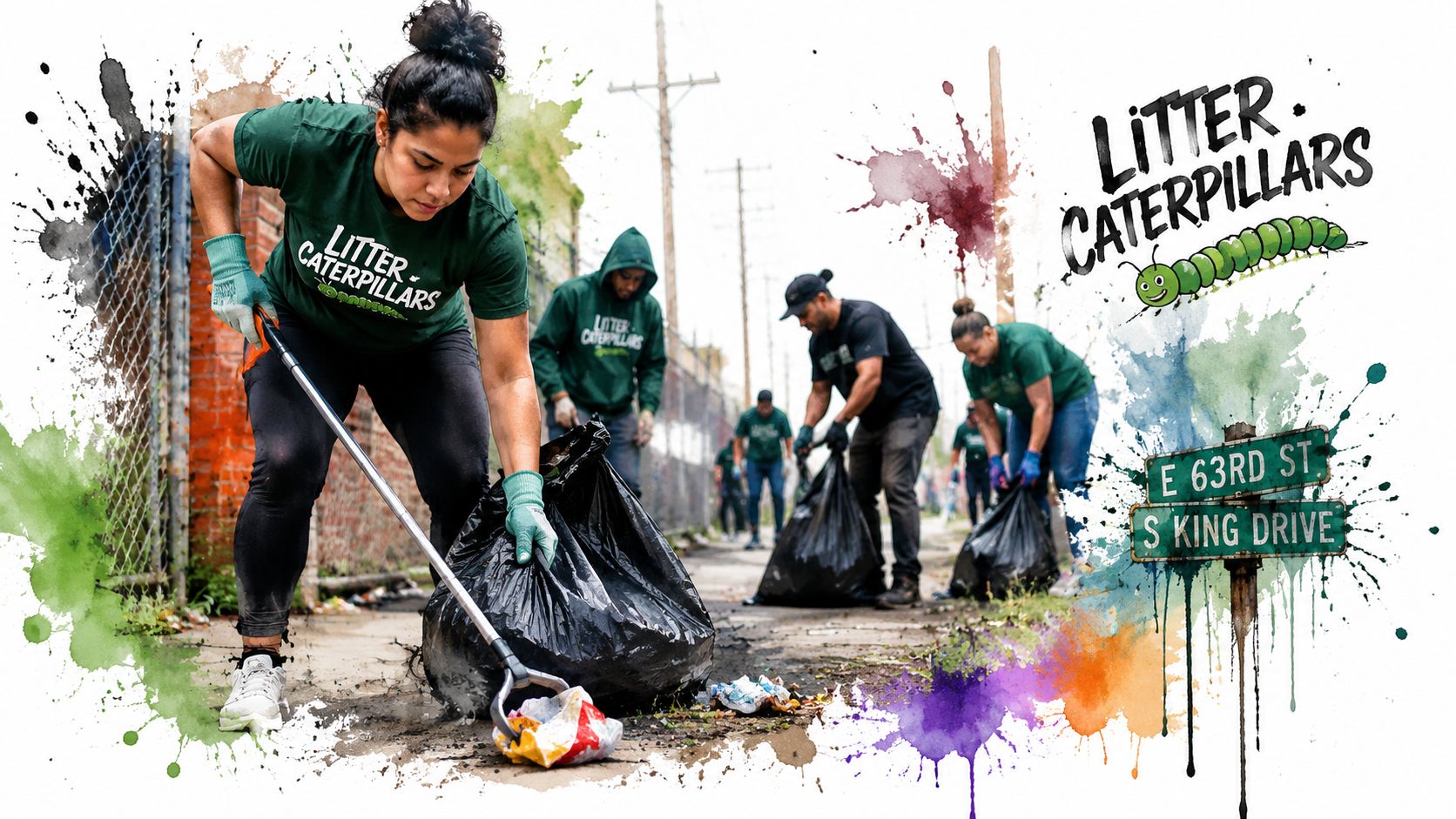
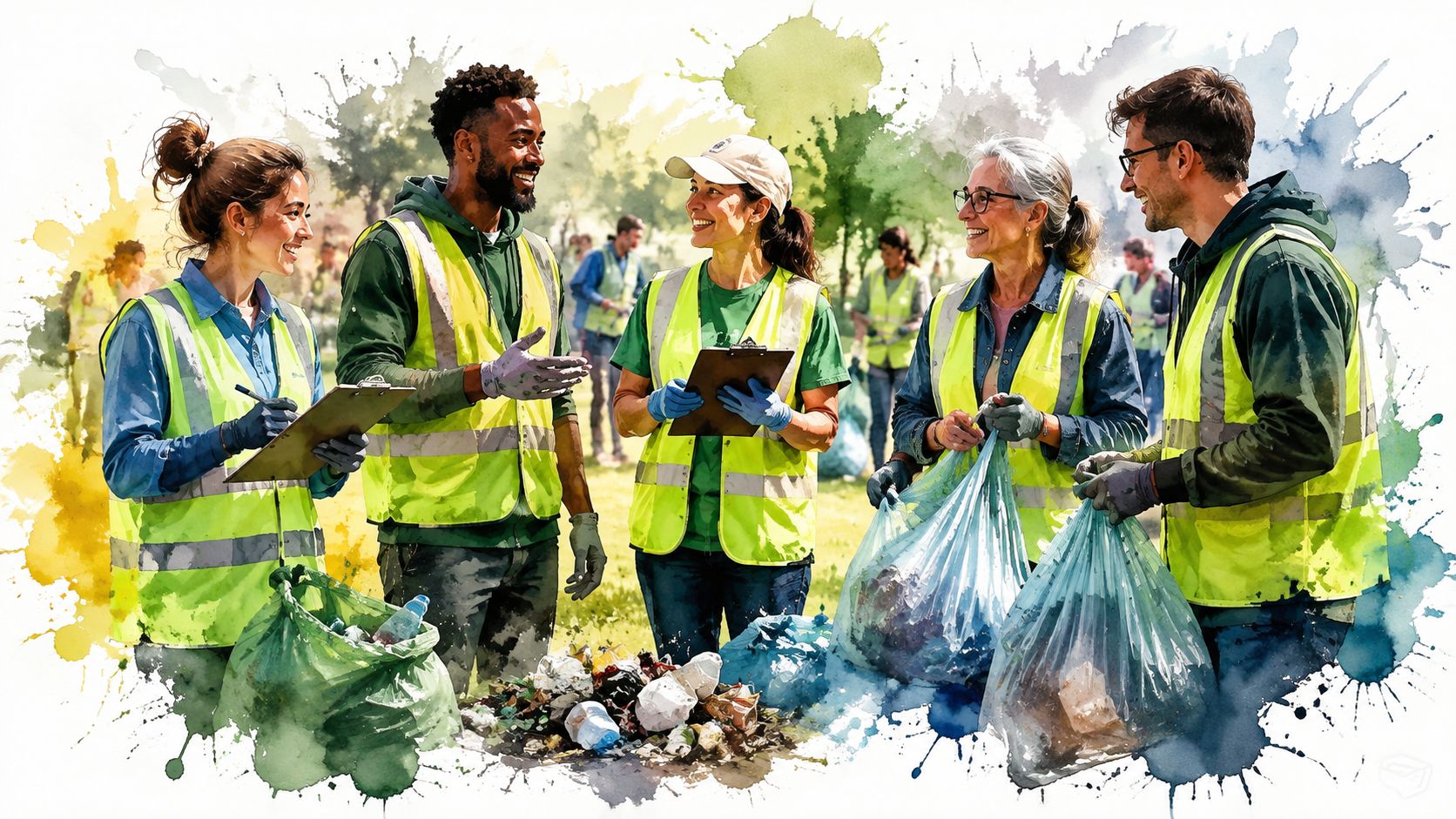
    A diverse group of volunteers cleaning up litter from a city street as part of a community project.

    What the bags can and can't tell us

    A cleanup gives me immediate work. I can remove a tire, clear a drain, or make a corner safer to walk past. It can't tell me what a child breathes each day, whether a proposed facility will add pollution, or whether a neighborhood has enough monitors to measure that exposure.

    That's why I use weekly cleanup work as a starting point, not a complete answer. The Litter Caterpillars and similar crews let us connect gloves-on service with neighborhood data, public meetings, and resident demands. In this guide, I'll move from South and West Side sidewalks to Chicago's history, maps, health pressures, and practical ways you can join the work.

    What Environmental Justice Actually Means in Chicago

    Environmental justice asks a direct question: does every community receive fair treatment and meaningful involvement when officials make environmental decisions? Chicago's Executive Order 2023-3 defines fair treatment as making sure no group carries a disproportionate share of harmful environmental consequences or receives an unfairly small share of environmental benefits. It also calls for meaningful involvement by all people, regardless of race, color, national origin, or income, in environmental laws, regulations, and policies. Chicago's Executive Order 2023-3 sets out that framework.

    I think about a coffee cup on a kitchen table. One spill takes a towel. A second spill lands beside it. Then someone keeps placing cups on the same corner, and the wood starts to swell. Cumulative impacts work the same way. Traffic, industrial emissions, flooding, limited green space, and social stress can pile up in one neighborhood even when each decision looks small by itself.

    Environmental equity often means distributing benefits and burdens fairly. Environmental justice goes further. It asks who made the decision, who had a chance to speak, whose knowledge counted, and whether officials considered the full load already carried by a place. Chicago's Environmental Justice Action Agenda and Just Transition framework fit that wider view, while Illinois law uses data to define Environmental Justice Communities for decisions about pollution and permits.

    For a plain explanation of the term, see what environmental justice means in Chicago.
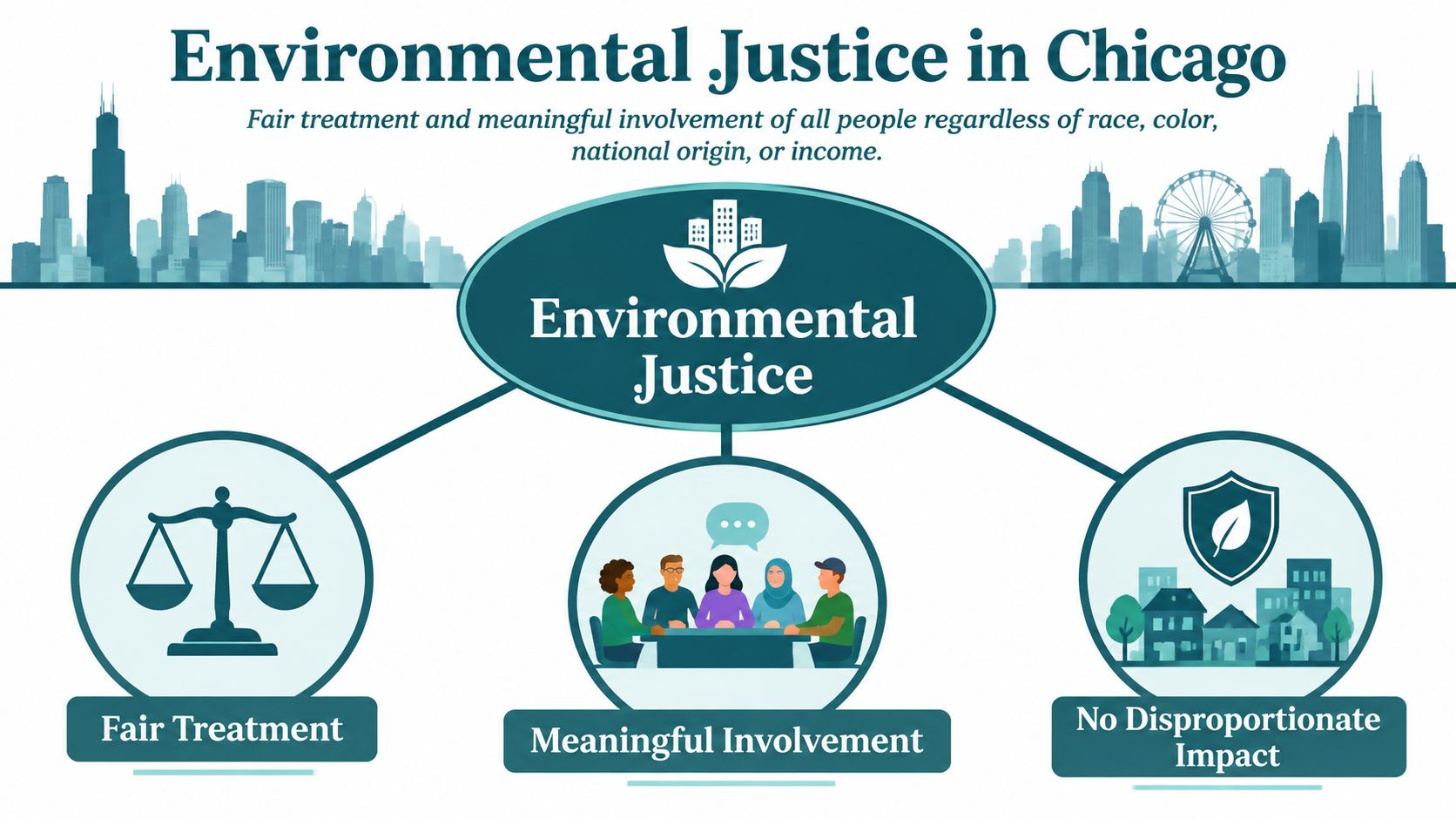
    An infographic titled Environmental Justice in Chicago displaying its core principles: fair treatment, meaningful involvement, and no disproportionate impact.

    Two sentences for a town hall

    “Please evaluate this proposal alongside the pollution and vulnerability already present in our census tract. Residents need meaningful involvement before officials approve a decision that could add another burden.”

    Those words keep the conversation grounded. You don't need to memorize legal language. You need to name the existing conditions, ask for cumulative review, and request a clear public process.

    Mapping the Neighborhoods That Carry the Heaviest Burden

    On a Saturday cleanup, I can cross a street and see the difference. One block has traffic rumbling past homes. Another sits beside an industrial corridor, a vacant lot, or a drainage problem. A citywide average can smooth over those details, so Chicago's Environmental Justice Index works at the census-tract level. It looks at pollution exposure, vulnerable populations, and socioeconomic stress together.

    Chicago designates a tract as an EJ Neighborhood when it scores 75 or higher, or when it scores 70 or higher and touches a tract scoring 75 or higher. The city's methodology explains how those thresholds work.

    Almost 30% of Chicago's 234 census tracts receive that designation, according to the city's cumulative-impact assessment. The highest burdens cluster on the South and West Sides. That changes how I plan a cleanup. A route near a highway or industrial corridor may call for more attention to air, traffic, and where volunteers stand, even if the litter looks no different from litter on another block.

    The highest-scoring group includes South Lawndale, East Garfield Park, North Lawndale, Austin, West Englewood, Englewood, Greater Grand Crossing, and Riverdale. Industrial corridors, former Stock Yards activity, scrap yards, sewage plants, metal work, coke and asphalt operations, and the I-57 corridor help explain the clusters. The Northeastern Illinois environmental map helps connect a Saturday's block-by-block work with the wider regional geography.

    A street-level reading of the map

    Community Area Dominant Pollution Sources Top Health Pressure
    South Lawndale Industrial corridors and heavy traffic Air pollution exposure
    East Garfield Park Traffic and nearby industrial activity Cumulative exposure
    North Lawndale Traffic and industrial corridors Air quality burden
    Austin Major roads and commercial activity Exposure combined with social vulnerability
    West Englewood Traffic and corridor activity Cumulative health stress
    Englewood Industrial and traffic-related sources Air pollution burden
    Greater Grand Crossing Highway and industrial corridor pressure Fine-particle exposure
    Riverdale Industrial sites, sewage facilities, and I-57 traffic Multiple overlapping exposures

    The table makes a complicated index easier to read, but it cannot replace local knowledge. A resident knows which gate stays open, which truck route rattles windows, and which vacant lot floods after rain. I bring that knowledge back from the cleanup, then use the map to place it in public planning.

    How Chicago Became the Birthplace of This Movement

    Hazel Johnson started with what she could see around Altgeld Gardens and nearby South Side neighborhoods. She found severe pollution problems and connected those hazards to racial inequity. In 1979, she founded People for Community Recovery, according to the organization's history of community environmental justice work.

    Johnson didn't begin with a polished policy vocabulary. She began with neighbors living near pollution and asking why their health and surroundings received so little protection. By 1985, People for Community Recovery had pressured the city to install water and sewer lines in Maryland Manor, a small development for elderly and low-income Black residents. That local win showed how a resident group could turn a neglected basic service into a public demand.

    From Altgeld Gardens to federal policy

    Chicago organizers helped connect neighborhood conditions with the language of environmental racism. In 1994, President Clinton issued Executive Order 12898, which required 17 federal agencies to address environmental justice in their work. Chicago's organizing helped place local experiences inside that federal conversation.

    The work continued through groups and residents across the city, including organizers on the Southeast Side and South Side. Janice Johnson carried her mother's work into present campaigns, keeping attention on the way permitting, health, and neighborhood voice fit together.
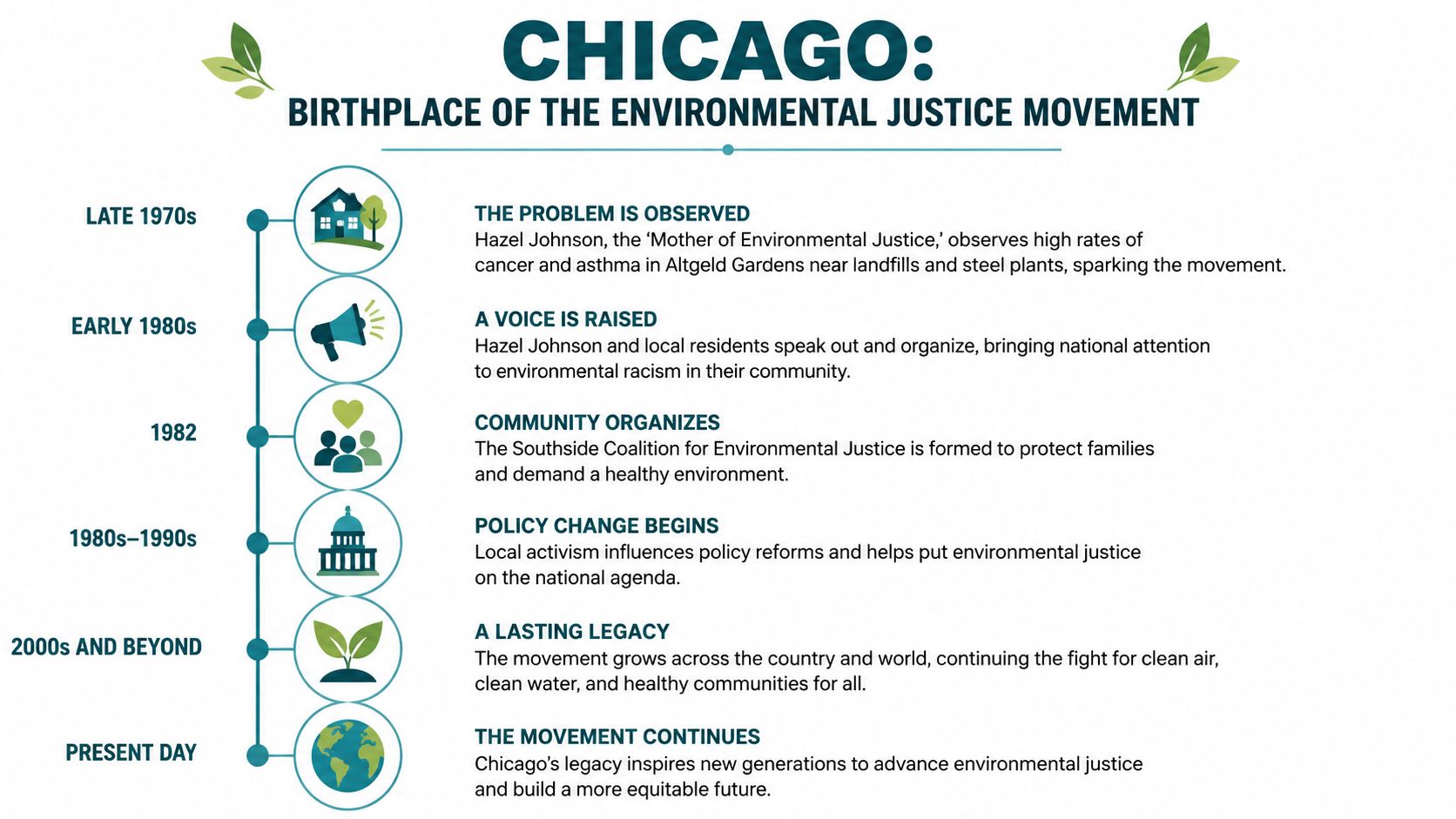
    A timeline infographic titled Chicago: Birthplace of the Environmental Justice Movement, detailing milestones from the 1970s onwards.

    In 2025, Mayor Brandon Johnson proposed the Hazel Johnson Cumulative Impacts Ordinance. The proposal would require applicants seeking zoning permits for heavy industrial land uses to complete a cumulative impact study, then face Special Use or Planned Development review. It would also create an Environmental Justice Advisory Board to review plans and support public education, as described in the mayor's ordinance announcement.

    The video below gives another way to hear the story and place current organizing beside the earlier fights.

    Where Pollution, Health, and Climate Risk Stack Up

    On a Saturday cleanup, I can fill a bag before lunch and still miss the pollution residents breathe every day. On Chicago's South and West Sides, a block may sit near industrial facilities, lack fine-particle monitors, and face flooding shaped by the same infrastructure that has served residents poorly. A peer-reviewed study found that more than 60% of industrial sites were in areas with the highest Social Vulnerability Index values, with a reported r² of 0.94 between industrial siting and social vulnerability. It also found that most vulnerable industrial hotspots lacked PM2.5 monitors. The peer-reviewed Chicago air-quality study records that measurement gap.

    That missing monitor matters on the block. A neighbor may smell diesel, see dust, or wipe soot from a windowsill without having a nearby instrument that records fine-particle exposure. Litter Caterpillars and other cleanup groups make visible waste easier to document, while residents still need monitoring advocacy for emissions that cannot be picked up with gloves and a trash bag. You can read more on Chicago's environmental issues and how they connect to EJ before deciding what evidence to collect.

    Flooding brings a second risk. The Little Calumet and Chicago Sanitary and Ship Canal corridors connect water exposure with roads, industry, and limited green space. Heat islands, legacy lead, food access, transportation, and public-health capacity also shape environmental justice. Chicago's Air Quality and Health resources publish block-group scores and indicator data, giving residents a way to examine conditions beyond smokestacks through Chicago's air quality and health data.

    Read the table without false precision

    Public materials do not offer one consistent set of neighborhood values for annual PM2.5 means, pediatric asthma rates, and flood-risk scores. I will not fill those cells with guesses. A fair comparison asks whether each measure covers the same geography, time period, and population.

    Neighborhood PM2.5 (annual mean) Pediatric asthma rate Flood risk score
    South Side EJ tracts Check block-group data Check city health data Check local flood mapping
    West Side EJ tracts Check block-group data Check city health data Check local flood mapping
    Southeast Side corridors Check monitor coverage first Check health indicators Check corridor flood exposure

    The practical lesson is simple. When residents ask for a new permit review, they should bring the whole record: monitor gaps, traffic, flooding, health indicators, and green-space conditions. A cleanup log can help start that record, connecting what we see on one corner with the cumulative impacts affecting the wider neighborhood.

    How You Can Plug In and Make a Difference

    I've learned to start with one action that fits your Saturday, your schedule, and your comfort level. You don't need to join every campaign at once. Pick a place where you can return, learn names, and notice what changes.
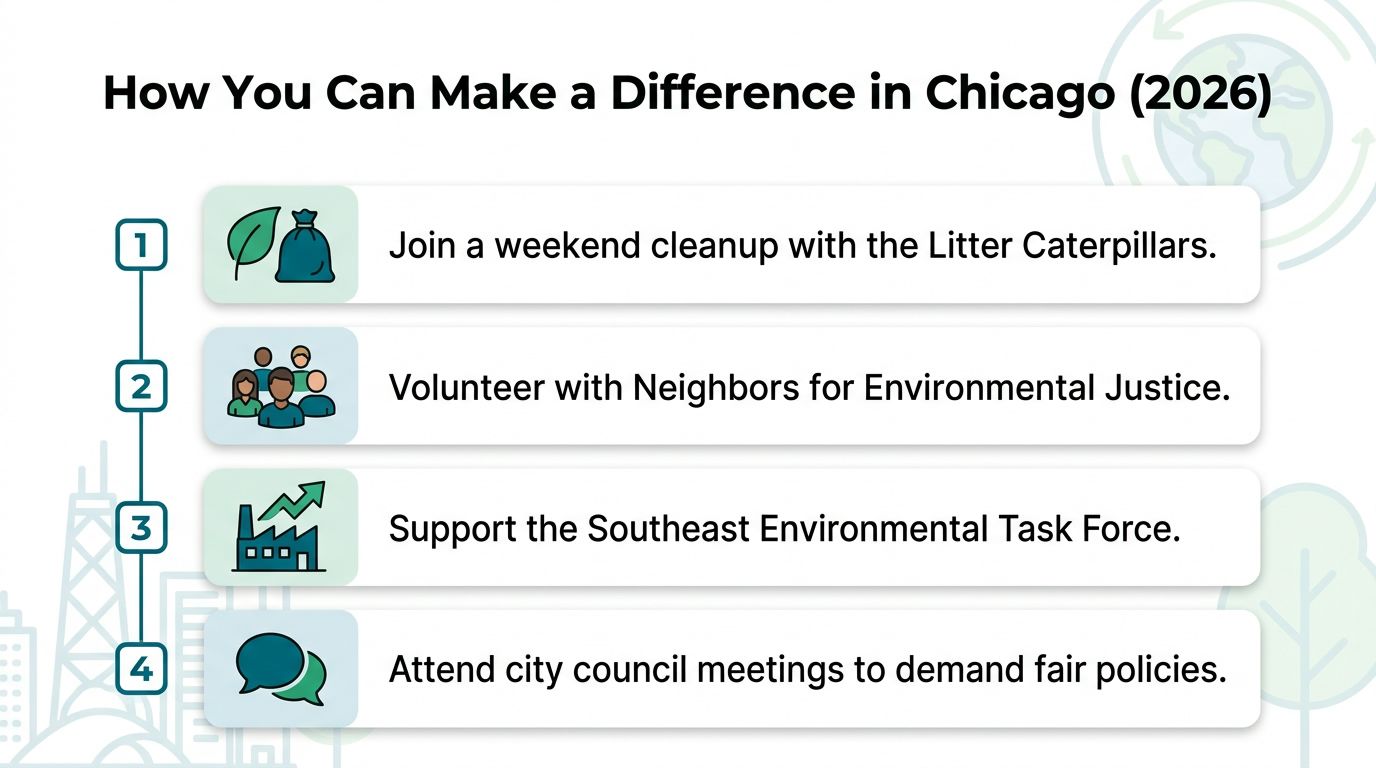
    A list showing four ways to make an environmental difference in Chicago in the year 2026.

    Start with your block

    • Join a cleanup: Sign up for a weekend event with Litter Caterpillars, Neighbors for Environmental Justice, or the Southeast Environmental Task Force. Ask about gloves, sharps procedures, weather plans, and where bags go after collection.

    • Bring a notebook: Record the location of illegal dumping, blocked drains, truck traffic, strong odors, and damaged sidewalks. Take photographs only from safe public places, and never handle needles or unknown containers.

    • Return to the same route: A one-time cleanup shows what sits on the ground. Repeated visits show what comes back, which corners need lighting, and where a public agency or property owner must act.

    Enter the public process

    The Environmental Justice Advisory Board gives residents a place to follow city plans and public education. Check the city's meeting notices, attend EJAB meetings at City Hall, and sign up for public comment when the agenda allows it. Bring a short statement with the address, the existing conditions, the harm you're concerned about, and the action you want officials to take.

    When a cumulative-impact permit application opens for public comment, read the application, share the notice with neighbors, and submit comments before the deadline. Contact your alderman and ask for support for the Hazel Johnson Cumulative Impacts Ordinance, stronger air monitoring, and meaningful resident participation.

    A useful public comment has a place, a condition, and a request.

    Support groups that already know the streets

    Volunteer with People for Community Recovery, the Little Village Environmental Justice Organization, or the Chicago Environmental Equity Network. Each group has its own campaigns and needs, so ask whether they need canvassing, translation, research, meeting support, legal-fund donations, or help sharing notices.

    You can also track the city's interactive EJ map for new permit filings. If energy costs or clean-energy access enter your neighborhood conversations, this community solar resource from Unitism can help you understand a shared-solar option before you discuss it with neighbors.

    Keep one folder on your phone for meeting dates, permit documents, photos, and contact names. Organized records help neighbors move from frustration to a specific request.

    Your Next Step in Chicago's Environmental Justice Story

    Last Saturday, a kid pulled a red wagon beside me while we worked along a South Side block. The wagon carried water, spare gloves, and a few sealed bags. A neighbor who had never joined us before walked over, put on a pair of gloves, and asked where we should begin.

    We started at the corner where wind pushed wrappers against a fence. Then we moved toward the vacant lot, checking the ground before we touched anything. Nobody solved industrial emissions that morning. Nobody rewrote a zoning rule. We did create a record of what residents faced, and we gave one more person a place to begin.

    That small scene connects to the larger work. The city's cumulative-impact method gives officials a way to see overlapping burdens at the tract level. The proposed Hazel Johnson ordinance would bring cumulative review into heavy industrial zoning decisions. EJAB meetings give residents a public room for questions and testimony. People's Climate Justice Chicago agenda work places clean air, green space, flooding, transportation, and health in the same neighborhood conversation.

    Choose one action and write it down

    Don't leave your next step floating in your head. Put one of these on your calendar this month:

    1. Attend one cleanup. Choose a South or West Side route, ask about safety procedures, and show up ready to listen as well as work.
    2. Attend one public meeting. Find the next EJAB hearing, read the agenda, and prepare one concise question.
    3. Contact your alderman. Ask for support for cumulative-impact review and better air-monitoring coverage in neighborhoods carrying overlapping burdens.

    Write down the date, the address, and the person you'll contact. Then tell one neighbor. Repeated block-level habits give residents the observations and relationships they need when a permit, zoning application, or public investment reaches the table.

    Chicago's environmental justice story continues through the 2026 election cycle, the next EJAB hearing, and ongoing fights around industrial corridors. I can't predict which proposal will arrive next or how officials will respond. I can say what helps: residents who read the map, protect one another during cleanups, document conditions, speak at meetings, and return after the meeting ends.

    The kid with the wagon may remember the bags. The first-time volunteer may remember a neighbor learning their name. I remember the corner looking different because several people decided that it belonged to all of us. Choose one action, write it down, and bring someone with you.


    Litter Caterpillars organizes volunteer trash pickups and neighborhood cleanup events across Chicago, giving you a practical way to connect block-by-block service with environmental justice work. Visit Litter Caterpillars to find a weekend cleanup, meet other residents, and take your next step.

  • Cold Weather Preparation for Outdoor Volunteers

    Cold Weather Preparation for Outdoor Volunteers

    The hail came sideways that morning. Three volunteers and I huddled beneath a tree while rides kept canceling, and I watched wet gloves turn stiff before we made the only sensible call: we stopped, got warm, and went home.

    That experience changed how I lead outdoor crews. Cold weather preparation isn't a clothing checklist. It connects warmth, safety, transportation, timing, communication, and morale into one field logistics problem. When people lose feeling in their hands or stop thinking clearly, the cleanup ends whether the leader planned for it or not.

    Why Cold Weather Preparation Matters for Volunteers

    On a freezing cleanup day, trouble often appears in small signals. A volunteer says, “I'm fine,” while rubbing one hand against a sleeve. Another keeps working with a soaked cuff. A third goes quiet and stops joking. If I wait for everyone to admit they are cold, the weather has already started directing the work.

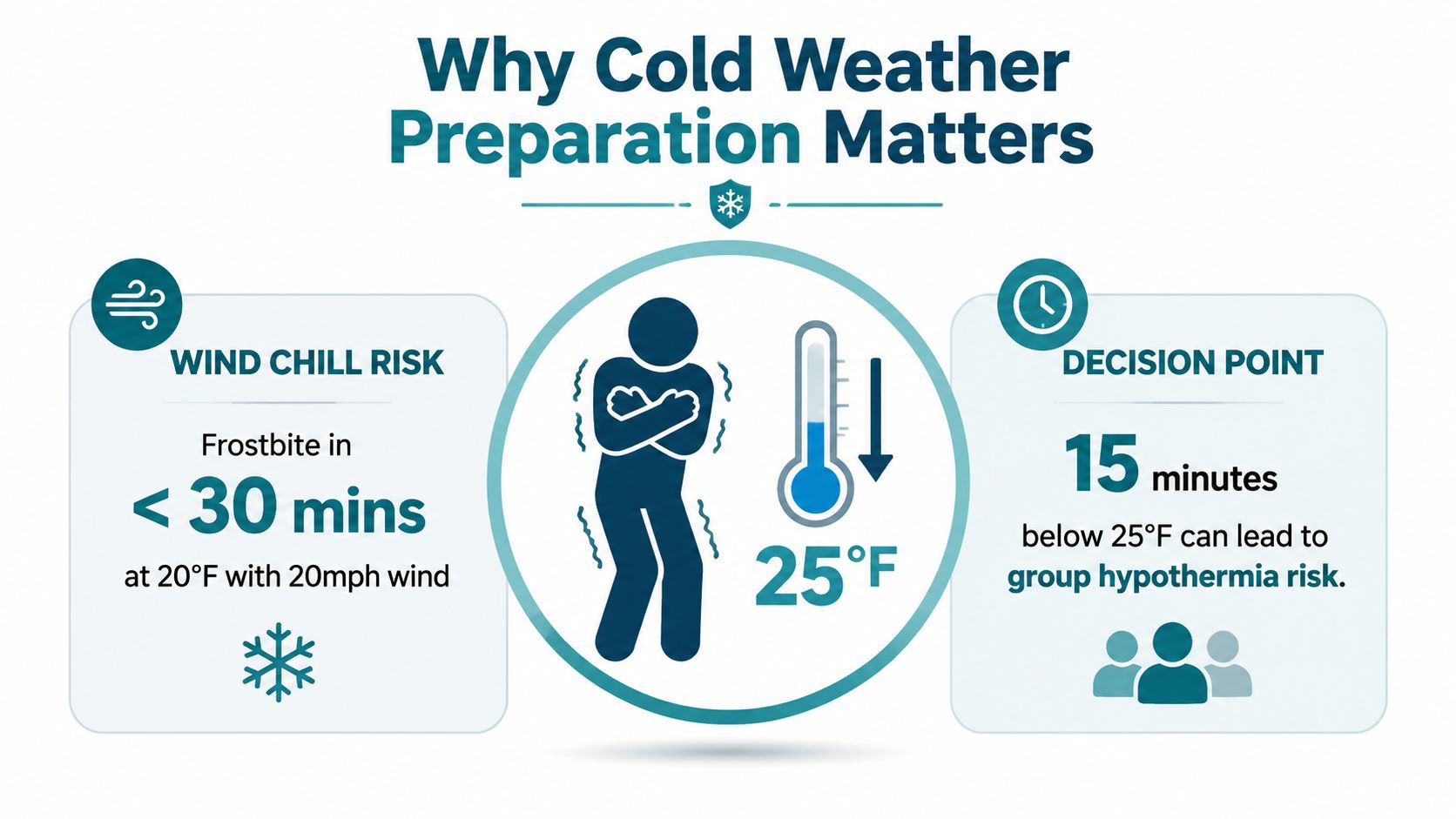
    Wind changes the calculation quickly. The National Weather Service says a wind chill of -20°F can cause frostbite in about 30 minutes (National Weather Service guidance on extreme cold). Fingers, ears, noses, and cheeks usually lose the fight first because wind removes heat from exposed skin, while wet fabric draws warmth away from the body.

    Cold exposure also carries a wider health burden. A global modeling study in The Lancet Planetary Health estimated that non-optimal ambient temperatures were associated with about 5.08 million deaths per year worldwide from 2000 to 2019. It attributed 4.59 million of those deaths to cold, roughly 8.52% of global deaths annually (The Lancet Planetary Health study00081-4/fulltext)). Those figures cannot decide whether a cleanup should continue on one particular morning. They do establish cold exposure as a genuine health hazard, not a minor inconvenience.

    An infographic titled Why Cold Weather Preparation Matters, showing frostbite risks and hypothermia decision points.

    Morale belongs in the safety plan

    Cold changes group behavior before it produces an obvious injury. Volunteers rush, skip warming breaks, hide discomfort, and make poorer decisions around ice, traffic, tools, and unstable debris. One frightened or badly chilled person can pull the crew toward panic when nobody knows who can stop the event or where people should warm up.

    Field rule: If the group cannot get warm, communicate clearly, and move safely, the workday is already over.

    England's winter health review identifies year-round planning and winter preparedness and action as the first two stages of its Cold Weather Plan (England winter weather and health review). That sequence matches practical volunteer leadership. Plan before the forecast looks dramatic, then act early when conditions reach the limits you set. Warmth, safety, and morale depend on the same logistics: clothing must preserve function, buddies must notice symptoms, and shelter must be close enough that volunteers will use it.

    Layering and Gear That Actually Works

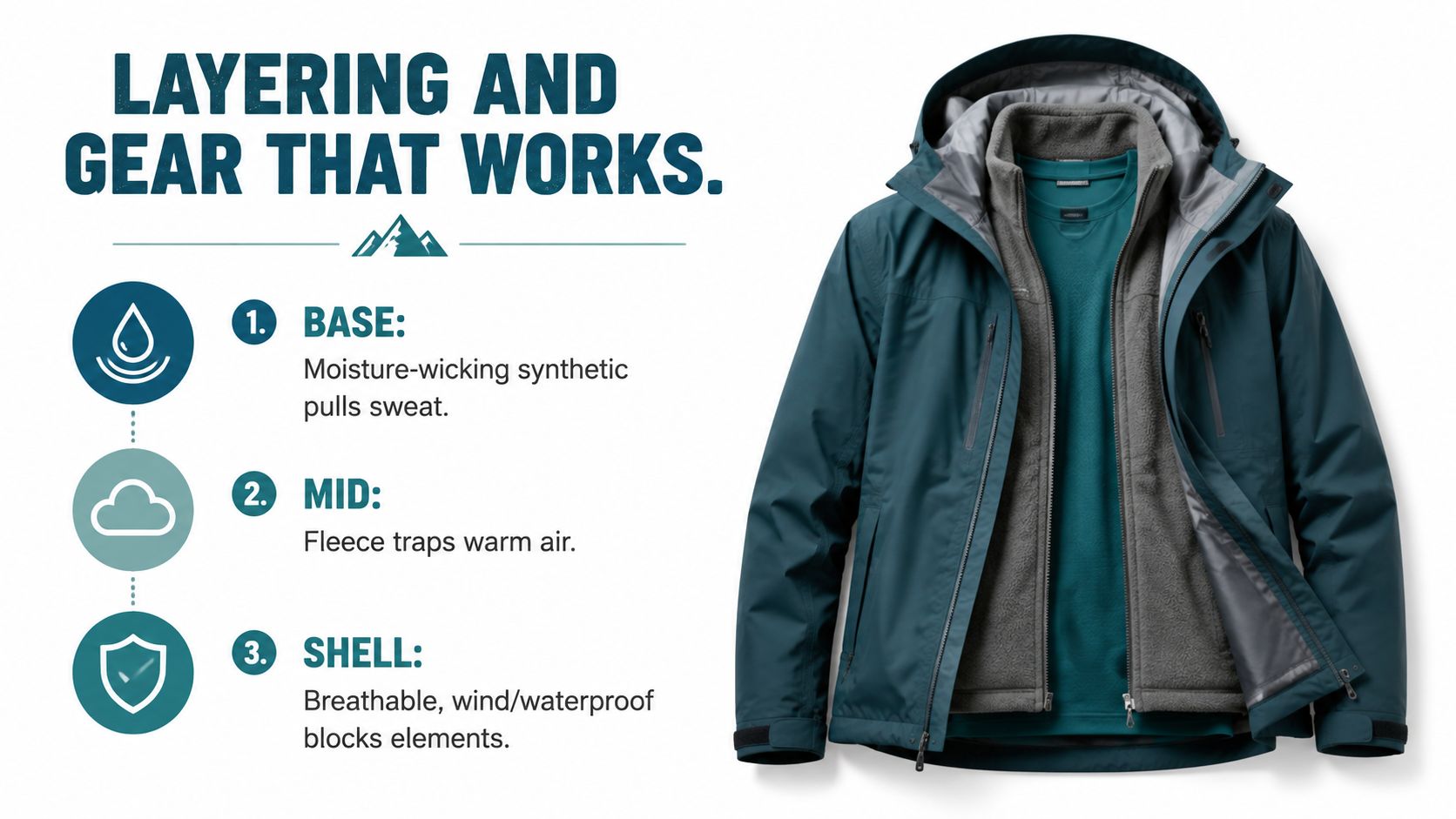
    Start with the layer touching the skin. Choose a moisture-wicking synthetic or wool base layer that moves sweat away from your body. Cotton feels comfortable at the start, yet it stays wet after exertion and then chills you when you slow down.

    The middle layer traps warm air. Fleece or a synthetic insulated jacket works well because it adds warmth without making movement impossible. The outer shell blocks wind and rain while allowing some moisture to escape. NIOSH recommends this three-layer system, along with loose clothing that preserves circulation (NIOSH cold stress guidance).

    A diagram explaining the three-layer clothing system for cold weather, featuring a base layer, fleece, and waterproof shell.

    Fit decides whether layers help

    You need room to move and enough space for warm air between layers. Zip the jacket, bend at the waist, and raise both arms before work begins. If the clothing pulls tight across your stomach or shoulders, add a larger shell rather than compressing the layers underneath.

    Protect the parts volunteers forget:

    • Feet: Wear waterproof insulated boots with wool socks. Pack backup socks in a sealed bag.
    • Head and neck: Use a warm hat with a balaclava or neck gaiter when wind reaches the face.
    • Hands: Wear insulated gloves with thin liners underneath. Keep spare gloves in a dry bin.
    • Pockets: Store hand warmers where volunteers can reach them before their fingers go numb.
    • Backpack: Carry a dry base layer sealed in a gallon bag, so a soaked shirt doesn't end the shift.
    • Group supplies: Bring extra hats, gloves, socks, jackets, and dry clothes. People lose gear, underestimate the cold, or arrive dressed for a short walk instead of active work.

    Schedule demanding cold jobs for the warmest part of the day, and assign relief workers when exposure lasts a long time, as NIOSH advises. Rotate people before they become exhausted. If your group handles overnight response or remote support, compare packable sleeping bag options before an event, since compact emergency sleep gear can support a shelter plan when travel gets disrupted.

    Clothing also belongs beside injury prevention. Use the group's injury prevention strategies to pair warmth checks with safe lifting, tool handling, and movement on frozen ground.

    Pre-Event Planning and Communication

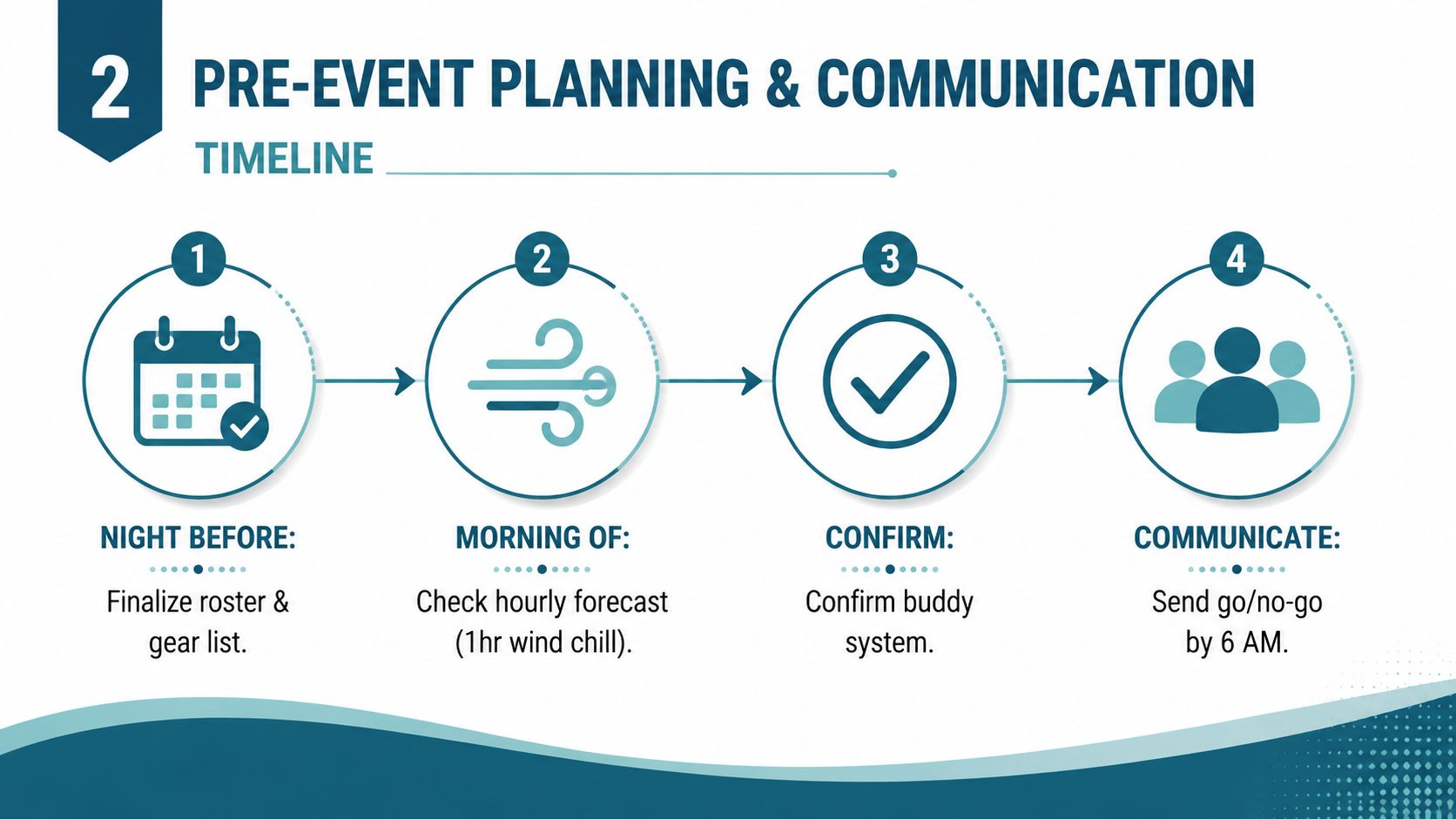
    The night before an outdoor event, I want fewer surprises than the forecast can provide. Check the hourly temperature, wind chill, precipitation type, and sunset time. Then decide the latest conditions you'll accept and write that decision into the event message.

    A useful plan has three messages. The first confirms the meeting point and start time. The second states what each person must bring, including a base layer, hat, gloves, and waterproof footwear. The third gives a clear go or cancel threshold, so volunteers don't travel while guessing.

    Build the plan around people

    Use a roster that includes phone numbers, emergency contacts, transportation notes, and any information volunteers choose to share about medical or mobility needs. Assign one person to make the final call. Group consensus sounds friendly, but it slows decisions when weather turns.

    A buddy system catches problems earlier than a leader walking past a dozen people. Pair volunteers and ask each pair to watch for pale skin, soaked gloves, unusual silence, heavy shivering, and clumsy movement. Nobody should work alone or move beyond the group's hearing range.

    A flowchart detailing a four-step pre-event planning and communication timeline for outdoor activities in cold weather.

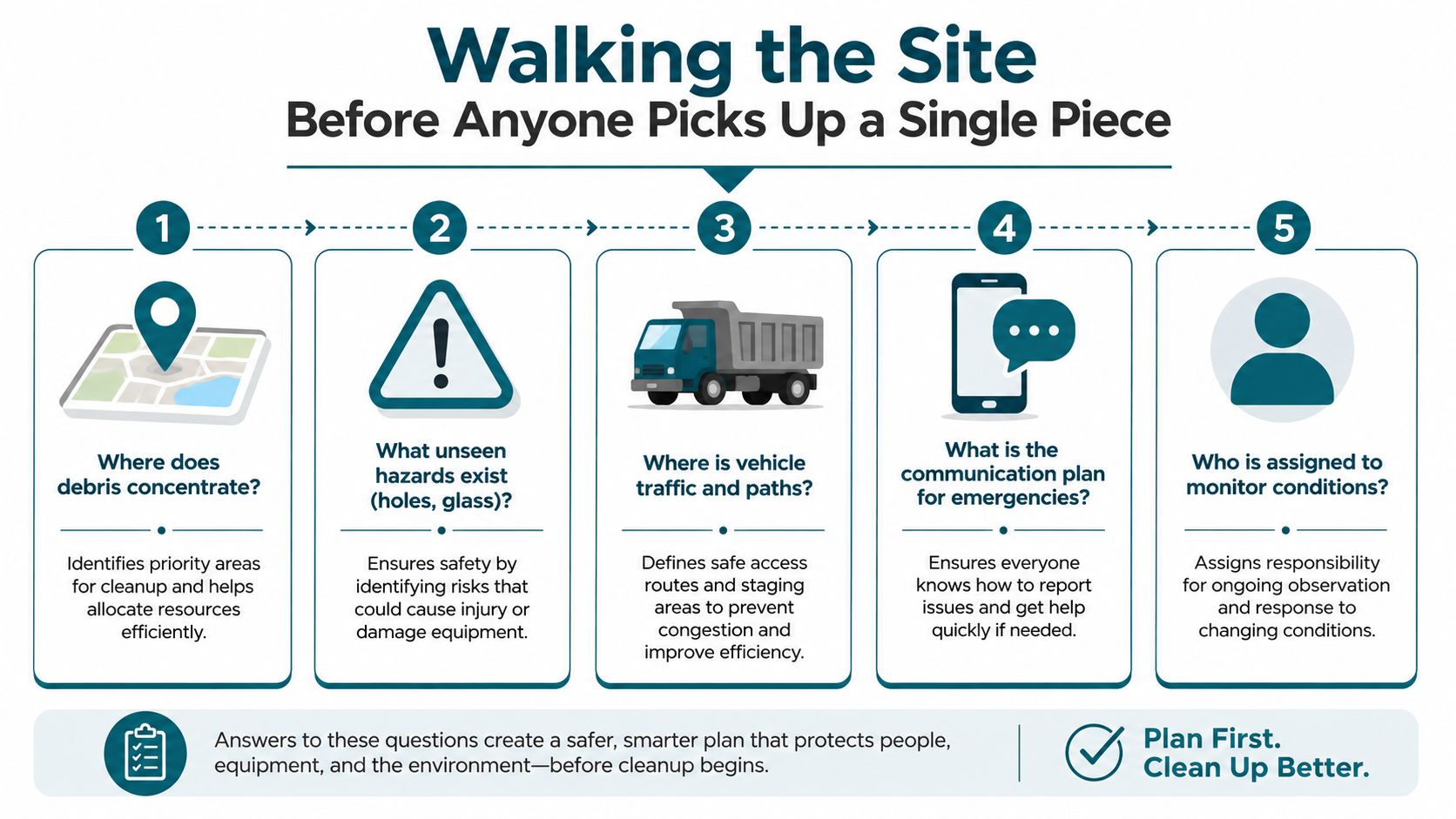
    Walk the site before tools come out

    Arrive early enough to inspect the route and work zone. Look for black ice, exposed metal, frozen puddles, steep edges, and unstable footing. Cold hands make small hazards harder to manage, so move the work boundary or remove the task before volunteers arrive.

    Keep the event message short enough to read outside. Link the team to a practical volunteer safety checklist and ask people to confirm their clothing before they leave home. A person who says, “I forgot gloves,” should receive a spare pair or a clear instruction to stay home, not pressure to improvise.

    Frostbite and Hypothermia Risk in Real Time

    You spot a volunteer standing too still near the north fence line. Check their hands, face, clothing, speech, and coordination before asking about the task. A thermometer cannot show soaked layers, fatigue, tight boots, or cold metal contact, all of which can shorten safe working time. Someone sweating during active hauling may cool rapidly once they stop.

    NOAA cold-weather operations guidance places a 30-minute exposure limit in at least the moderate-risk category, a 10-minute limit in the high-risk category, and a 5-minute limit in the extremely high-risk category (NOAA cold-weather operations guidance). Use these as operating limits, not comfort goals. Shorten shifts, add relief, or stop before symptoms force the decision.

    A wind chill of -20°F can produce frostbite in about 30 minutes, but that window does not apply equally to every volunteer. Wet gloves, restricted circulation, poor-fitting boots, and exhaustion can change the outcome. Set field rules around the most vulnerable conditions you can reasonably expect, not the strongest person in the group.

    Use a simple field alert system

    Green: Work in planned blocks. Buddies check faces, hands, clothing, and behavior while the lead keeps warming access available.

    Amber: Shorten shifts, increase checks, and move wet or numb volunteers indoors. Reassign exposed tasks before discomfort becomes impaired movement.

    Red: End outdoor work for exposed volunteers. Move anyone with confusion, slurred speech, severe clumsiness, persistent shivering, or pale, waxy skin to warmth, then seek medical help when symptoms concern you.

    Use the table as a pocket field reference. It adds staffing actions to the exposure categories, so the lead can adjust for wetness, wind, symptoms, and the group's actual pace.

    Exposure category Shift duration Buddy-check frequency Volunteer action
    At least moderate risk Short planned blocks At each task change and before relief Keep warming access ready and rotate exposed work
    High risk Brief shifts with relief At every handoff Restrict exposed tasks and move people through warming breaks
    Extremely high risk No exposed outdoor shift Before anyone leaves shelter End exposed outdoor work

    CDC mortality data recorded 1,024 U.S. deaths attributed to excessive cold or hypothermia in 2023, with 19.9% occurring in January (CDC mortality data cited in the CDC winter cold reference). A leader does not need to calculate a new threshold on site. Set the limit before the event, and let symptoms override the schedule.

    Warming Breaks and On-Site Care

    A warming break succeeds only if volunteers can use it before their hands and judgment deteriorate. I have seen crews crowd around a vehicle, hold one hand near a vent, and return to work while boots and gloves were still wet. The group looked supported, but no one had recovered enough to work safely.

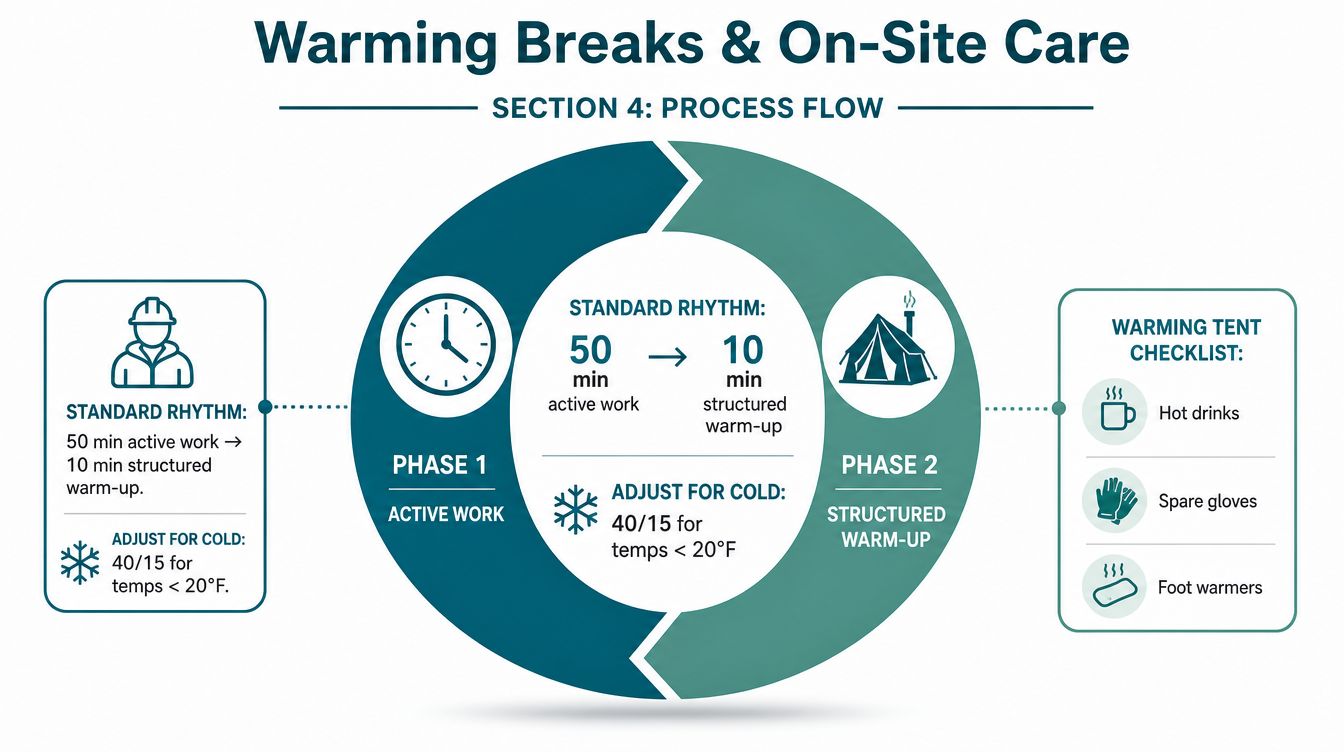
    Set a 50/10 rhythm: 50 minutes of active work, then 10 minutes of structured warming. As conditions worsen, shorten the work block to 40 minutes with 15 minutes of warmth, then use 30/20 when exposure becomes difficult to control. Post the schedule on the site board and cover it in the opening briefing. A planned break feels like part of the job, not a personal failure.

    Build a shelter people want to enter

    Place a heated vehicle or pop-up shelter close to the work area. Stock it with dry gloves, spare socks, hand warmers, blankets, and warm calorie-dense drinks in a thermos rotation. Keep fuel-burning heaters outside enclosed spaces unless an appropriate ventilation plan is in place. Never use a propane heater where carbon monoxide can collect.

    Rotate tasks instead of leaving one volunteer with the coldest assignment. Someone hauling wet debris or digging frozen soil can work in a short burst, then switch to sorting bags near the shelter. This keeps people active while limiting the exposure that drains warmth and morale.

    A diagram illustrating a two-phase cycle for cold weather work, alternating between active work and structured warm-up breaks.

    During each break, ask volunteers to check fingers and toes for numbness, unusual color, or reduced movement. Watch the person who has stopped complaining. Quiet may mean comfort, but it may also signal confusion, fatigue, or reduced awareness of danger.

    Break standard: A volunteer should leave the warming area able to speak clearly, move normally, and feel their hands well enough to handle ordinary tasks.

    Use the following video as a visual reminder of how an organized work and warming cycle can run:

    Transportation, Shelter, and Contingency Plans

    A warm crew can still get into trouble if the vehicles sit far away or the backup space can't hold everyone. Choose parking close to the work area, reserve one heated vehicle for emergency warming, and identify an indoor location that can take the full crew within ten minutes.

    Stage supplies the night before:

    • Dry replacements: Spare gloves, wool socks, hats, and hand warmers.
    • Emergency insulation: Mylar blankets and extra jackets.
    • Heating equipment: A propane heater with a clear ventilation plan.
    • Communication: A charged phone, power bank, and incident contact list.
    • Site access: Shovel, traction material, and a route that avoids the worst ice.

    Set contingency triggers before the first bag moves. Lightning, black ice, sustained winds above 25 mph, or any volunteer showing warning signs should prompt a pause or cancellation. The single decision-maker then shortens the event without asking a shivering group to debate.

    Transportation needs its own backup. Make a carpool list, record public transit options, and assume some drivers won't arrive. A no-one-drives-cold policy keeps tired, shivering volunteers off the road. If snow or ice changes the route, use the group's blizzard safety tips before asking people to travel.

    Food planning matters after the event, too. Ready.gov says to keep refrigerators and freezers closed during a winter power outage, and to throw away food that reaches 40°F or higher for two hours or more (Ready.gov winter readiness guidance). Assign one person to handle food decisions instead of letting volunteers make uncertain choices while tired.

    Volunteer Wellbeing and Post-Event Follow-Up

    After Chicago hailstorms and winter cleanups, the work is not finished when the last bag reaches the vehicle. Within 24 hours, hold a short debrief and ask what nearly went wrong. Log numb fingers, missed breaks, wet clothing, transportation failures, and shelter problems while details remain clear. The record should change the next gear plan, staffing decision, or cancellation trigger.

    Send each volunteer a personal thank-you that names their contribution. “Thanks for sorting the sharp debris near the fence” carries more weight than a generic group message. Ask whether symptoms continued after warming up, and encourage medical care when someone remains concerned.

    Give people a reason to return

    Retention depends on repeated proof that the group sees volunteers as people, not labor. Rotate leadership so one person does not always take the coldest or wettest assignment. After a difficult event, schedule an indoor gathering with drinks, food, and a brief conversation about what the crew accomplished.

    Recognition can take the form of photos, shoutouts, or partner organizations, when volunteers welcome that attention. Litter Caterpillars runs volunteer trash pickups in Chicago, including winter events, offering organizers a practical model for pairing outdoor service with group care.

    A volunteer who leaves cold, tired, or discouraged may not return, and could face greater risk at the next event without a better plan. Treat the event log, gear bin, warming break, and thank-you message as one leadership system. Cold weather preparation is care that continues from the first forecast check to the next invitation.

    Visit Litter Caterpillars to find Chicago cleanup events where volunteer safety and group connection guide the work. Review your layers, pack dry backups, and join prepared to serve without treating cold exposure as a test of toughness.

  • How to Report Illegal Dumping in Chicago

    How to Report Illegal Dumping in Chicago

    At dawn, I once found an alley packed with broken drywall, rotting mattresses, and black trash bags. A syringe glittered near my boot. I pulled out my phone before I touched anything.

    "Why I Started Caring About Illegal Dumping"

    The smell reached me before the pile came into view. Wet wood, spoiled food, mold, and something sharp hung between the brick walls. Construction debris spilled across the alley, mattresses leaned against a fence, and loose bags crowded the curb. I felt angry, then embarrassed, as if someone had entered our home and thrown their mess across the floor.

    That block already carried more than its share of neglect. Families on Chicago's South and West Sides work hard to keep their homes and streets in order, yet illegal dumping keeps landing in the same alleys, vacant lots, and roadside spaces. I saw how quickly one pile invited another. People treated the first dump as permission.

    A homeless man walking through a city alley filled with trash, debris, and discarded furniture items.

    Anger needs a direction

    For a while, I stood there feeling helpless. I couldn't remove the mattresses alone, and I didn't want to disturb evidence or touch anything dangerous. Then I opened my phone and filed a 311 report.

    That small act changed my relationship with the block. I stopped seeing a dump site as an ugly fact I had to tolerate. I started seeing it as a record I could create, a problem I could route, and a pattern neighbors could document together.

    Practical rule: Photograph first, report second, clean up only when you know the site is safe and the proper agency has what it needs.

    Reporting illegal dumping is a form of community power. Your report gives sanitation workers a location, gives investigators a lead, and gives neighbors a shared starting point. You can learn more about turning concern into hands-on neighborhood care through Litter Caterpillars' community care work.

    I've picked up trash in Chicago rain, heat, blizzards, and wind that cut through three layers of clothing. I've learned that a clean block doesn't happen because one person stays angry. It happens because someone documents the problem, makes the call, and invites others to keep showing up.

    "Gathering Evidence That Actually Gets Results"

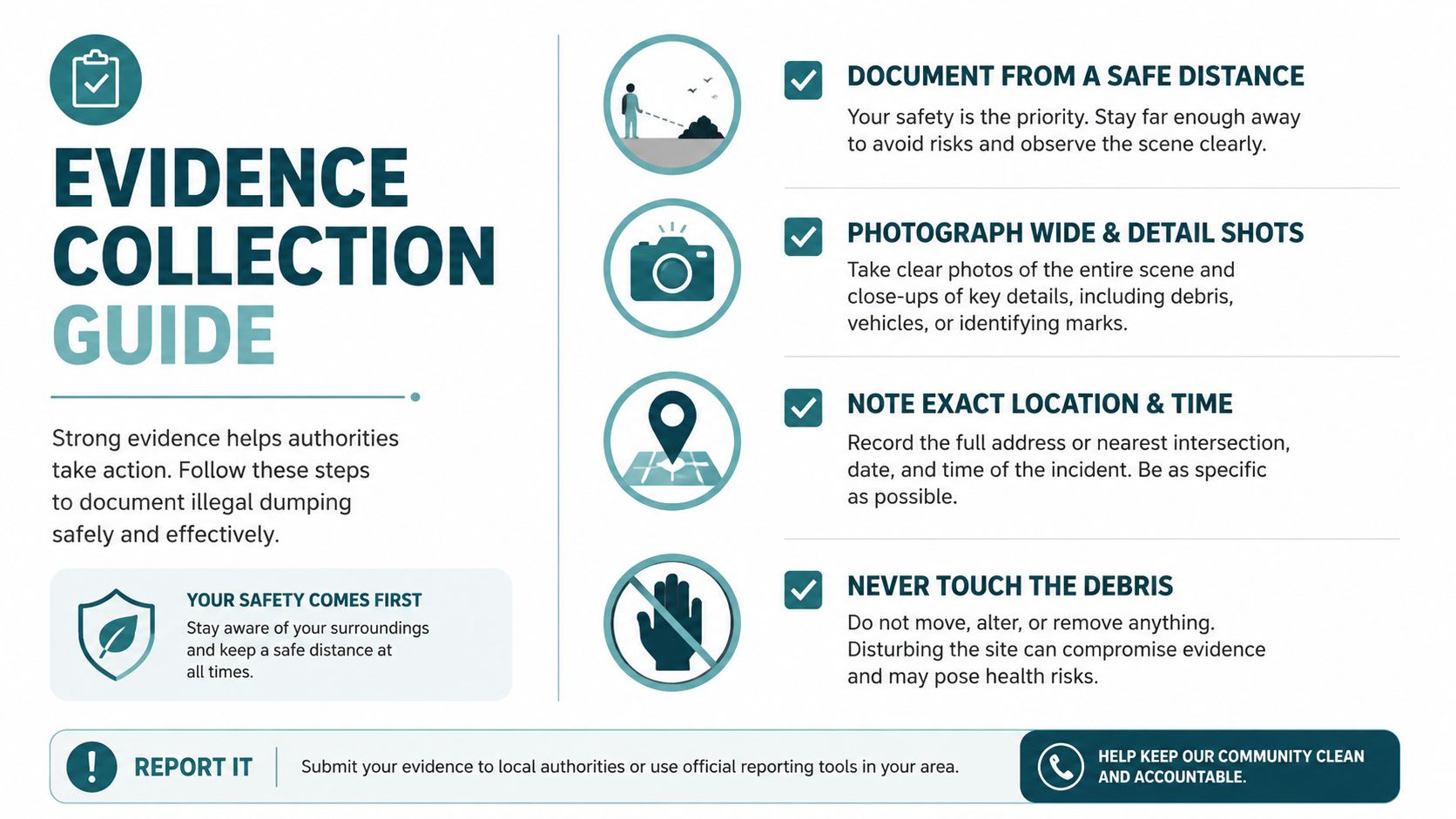
    Treat the site like a scene that can change quickly. Before you move a bag, lift a mattress, or ask someone else to help, step back and document what you see from a safe distance.

    A vague report says, “There's trash in the alley.” A useful report tells an inspector where to stand, what to look for, and whether the material might create a danger.

    Start with the full picture

    Take wide photographs from several angles. Include the alley, curb, vacant lot, fence line, or other surroundings so the agency can understand the site's scale and exact setting. Then take close photographs of details that may connect the waste to a person or business:

    • Vehicle information: Photograph a license plate, vehicle color, make, and model if you see a vehicle near the dump site.
    • Identifying marks: Capture business names, shipping labels, delivery stickers, addresses, and recognizable markings on boxes or materials.
    • Location markers: Photograph street signs, building numbers, alley entrances, landmarks, and nearby intersections.
    • Waste details: Record whether you see construction debris, furniture, household bags, tires, chemicals, or other hazardous material.
    • Activity status: Note whether dumping is happening now, appears to have happened recently, or looks like an older pile that has grown over time.

    Philadelphia asks reporters for a location, suspect description, vehicle make, model, color, license plate, and material details. Philadelphia's illegal-dumping reporting guidance shows the level of detail that helps an agency act. New York City also requests vehicle identification and reporter contact information, along with the date, time, waste type, and amount.

    Write down what your camera can't explain

    Open your phone's notes app and record the date, time, exact address, nearby cross street, and GPS location. Your phone may embed location data in a photograph, but write the location separately so you can paste it into a report.

    Estimate the volume in plain language. You might describe a small cluster of bags, a truckload of construction waste, or debris spread across most of an alley. Don't guess at an exact weight. Describe what you can see.

    An instructional infographic detailing safe and effective steps for documenting illegal dumping evidence for reporting to authorities.

    Never enter a pile, open containers, handle needles, or approach a person who may still be dumping. If a dashcam or security camera captured the event, save the original file when possible and note the camera's location and recording time. Ask a property owner for footage rather than trespassing or confronting anyone.

    For more field-ready precautions, keep a volunteer safety checklist with your phone supplies.

    Here's a short visual guide you can watch before your next cleanup or report:

    "Chicago Hotlines and Apps You Need to Know"

    Chicago residents usually start with 311 for an existing illegal-dumping site. You can call 311, use the CHI 311 mobile app, or submit a request through the city's online portal. Keep your notes and photographs nearby. The request should include the exact location, waste type, visible volume, date and time, and any vehicle or person details you captured safely.

    An active dumper creates a different situation. Don't approach the vehicle or block its path. If someone is dumping right now and you face immediate danger, call emergency services. For a non-emergency report involving suspected criminal activity, use the Chicago Police Department's non-emergency channel and give dispatch the location and vehicle information.

    Chicago's Department of Streets and Sanitation handles cleanup-related requests, while hazardous waste or a large commercial dump may need escalation to the Illinois Environmental Protection Agency. Ask the receiving agency whether it needs a direct inspection, additional photographs, or a separate environmental complaint.

    Choose the channel that fits the scene

    Channel Contact Info Best For Expected Response
    Chicago 311 Call 311, CHI 311 app, or city online portal Existing dumping sites and cleanup requests City routing and follow-up depend on the request
    Chicago Department of Streets and Sanitation Request through Chicago 311 Visible debris on public streets and alleys Inspection or cleanup routing depends on location and material
    Chicago Police Department Emergency services for immediate danger, department non-emergency channel for non-urgent incidents Active dumping, threats, or suspected criminal conduct Dispatch priority depends on safety and urgency
    Illinois EPA State environmental complaint channel Hazardous waste, major spills, or large commercial dumping Agency response depends on hazard and jurisdiction
    Ward and aldermanic office Your ward's aldermanic contact page Repeated sites and unresolved service requests Office follow-up varies by ward and case
    Litter Caterpillars Volunteer reporting network Shared documentation and neighborhood cleanup coordination Volunteer follow-up depends on group capacity

    Don't send the same vague message everywhere. Send a clear 311 request first for a routine site, then add the appropriate agency when the material, scale, or active danger calls for it. England, Scotland, and Wales use a similar split, with local councils handling ordinary fly-tipping and the Environment Agency handling large-scale dumping through its 24-hour hotline at 0800 80 70 60; anonymous reports can go to Crimestoppers at 0800 555 111 through the official fly-tipping reporting guidance.

    "What Happens After You File a Report"

    You press submit, receive a request number, and then the alley looks exactly the same. I know that silence. It can feel as if your report vanished into a machine with no person on the other side.

    A routine request usually enters a city queue for review, routing, inspection, or cleanup. The exact timing can change with the material, location, workload, weather, and whether the site creates an immediate hazard. A status that says “referred to inspector” generally means the request has moved beyond intake and needs someone to assess the site or determine the next agency.

    Cleanup and enforcement follow different paths

    A cleanup crew can remove visible debris without identifying who left it. An enforcement investigation needs evidence that connects the waste to a vehicle, person, business, time, or repeated pattern. That's why your photographs, notes, camera footage, and request number matter.

    New South Wales shows how reports can move through an enforcement pipeline. Over five years, its EPA received and actioned 1,507 illegal-dumping reports, including 641 investigations involving major incidents with more than 200 tonnes of waste. In 2016–17, the agency completed 11 waste prosecutions, with $411,000 in financial penalties, and issued 78 clean-up notices plus 53 penalty notices linked to illegal-dumping investigations. The figures appear in answers from the NSW EPA.

    That same NSW material says 98% of councils reported illegal dumping as an issue in their area, while one in seven spent more than $500,000 per year on cleanup and enforcement. Reporting gives agencies the information they need to decide whether a site needs removal, inspection, surveillance, or legal action.

    Follow up with a record, not a rant

    If the pile remains, use the original request number and submit updated photographs. Contact your alderman's office with the location, date of the first report, request number, current condition, and any new evidence. Ask the office to request a status update from Streets and Sanitation.

    For dangerous material, don't wait for ordinary cleanup. NSW directs people to call 000 for toxic fumes or large chemical spills, 131 555 for immediate threats, and use RIDonline for other reports with a photo and GPS location, according to its illegal-dumping reporting page. The same principle applies in Chicago. Match the channel to the danger.

    "How Volunteer Groups Multiply Your Impact"

    A single report gives a city one location. A group can give neighbors a shared map, repeated observations, photographs from different days, and people who know when a site changes.

    I've watched volunteers walk an alley before a cleanup, photograph every pile, and compare notes afterward. One person notices a contractor label. Another spots a plate. Someone else knows which property owner has a camera facing the alley. Together, they create a clearer account than any one rushed visit can provide.

    Turn scattered observations into a neighborhood record

    Volunteer groups can coordinate walking cleanups, dumping-watch shifts, shared photo folders, and group-chat alerts. They can also help residents keep request numbers organized and notice when the same location appears in multiple reports.

    That work doesn't replace 311, Streets and Sanitation, the police, or an environmental agency. It gives neighbors the structure to use those channels consistently. A group can also bring a chronic site to an aldermanic office with a dated record instead of a stack of disconnected complaints.

    A diverse group of volunteers in high-visibility safety vests working together to clean up litter in a park.

    Find a role that matches your energy

    You don't have to lift heavy debris to help. You can photograph from a sidewalk, enter report details, check a camera angle with a property owner, translate information for a neighbor, or attend a ward meeting.

    Chicago residents can browse local environmental groups and choose a group that fits their schedule and safety limits. Litter Caterpillars organizes volunteer trash pickups across Chicago, including work in neighborhoods that other cleanup crews may skip, while keeping volunteer safety and happiness ahead of fundraising.

    The work becomes easier when people share it. One neighbor makes the call. Another tracks the request. A third returns after the city visit and photographs what remains. That rhythm turns frustration into a practice.

    "Your Action Plan for Cleaner Streets"

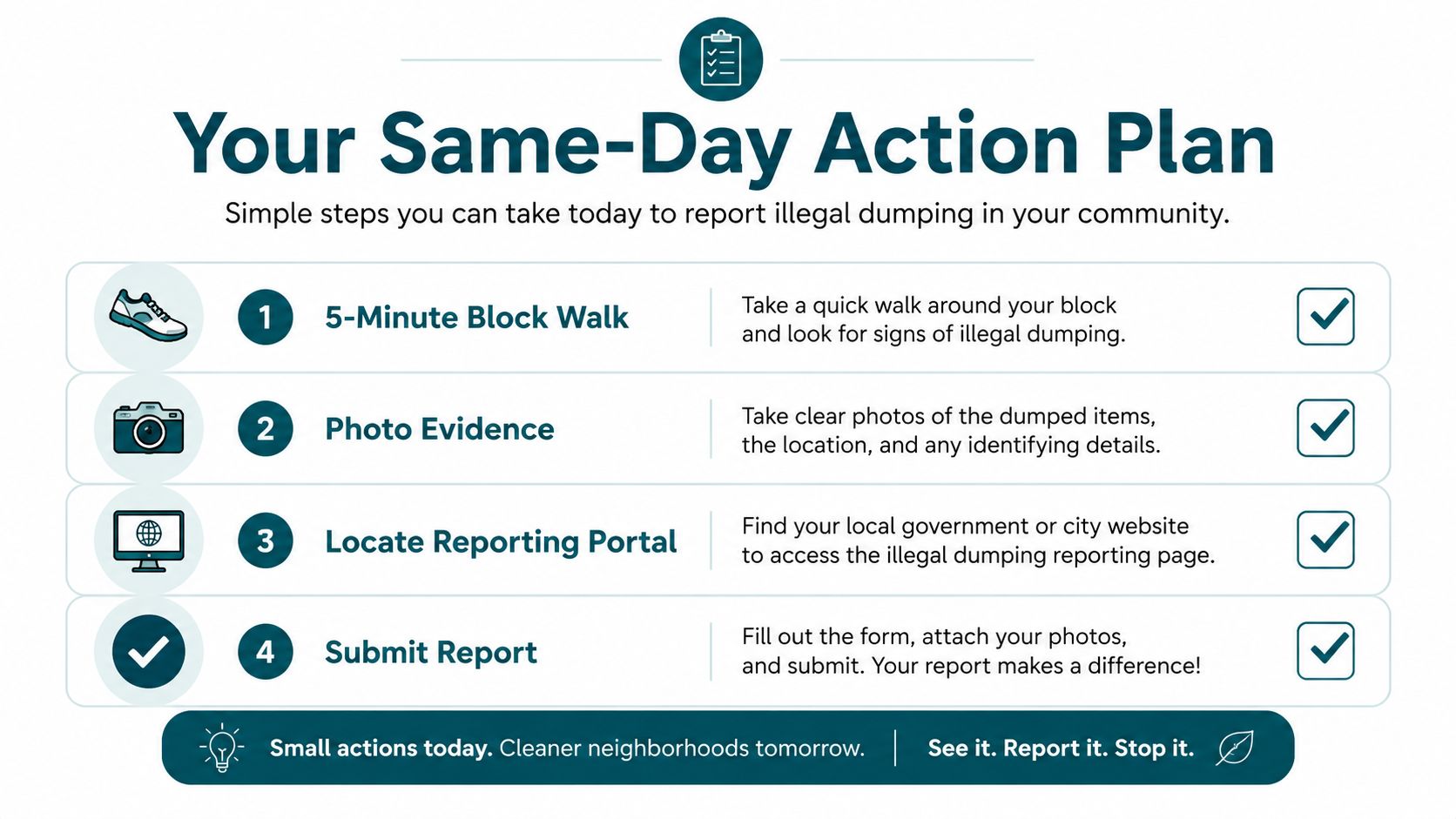
    Start today with a short walk around your block. Keep to public space, stay away from unstable piles and hazardous material, and photograph existing dumping before anyone moves it.

    Then take these steps:

    1. Save the channels: Put 311 and your alderman's contact page in your phone.
    2. Record the facts: Write down the address, cross street, date, time, waste type, and vehicle details.
    3. File the report: Use 311, the CHI 311 app, or Chicago's online portal.
    4. Create the follow-up: Save the request number and set a reminder to check the site again.

    An infographic titled Your Same-Day Action Plan showing four simple steps to report illegal community dumping.

    A report records what happened today. Follow-up reports can show a repeated problem at the same address, while volunteer work helps neighbors protect one another and care for the block.


    Litter Caterpillars organizes Chicago trash pickups, cleanup walks, and neighborhood friendships for people who want to act on problems like illegal dumping. Visit Litter Caterpillars to find a cleanup, join the volunteer network, and take your next step toward a cleaner block.

  • Chicago Ward Boundaries: Finding Your Neighborhood

    Chicago Ward Boundaries: Finding Your Neighborhood

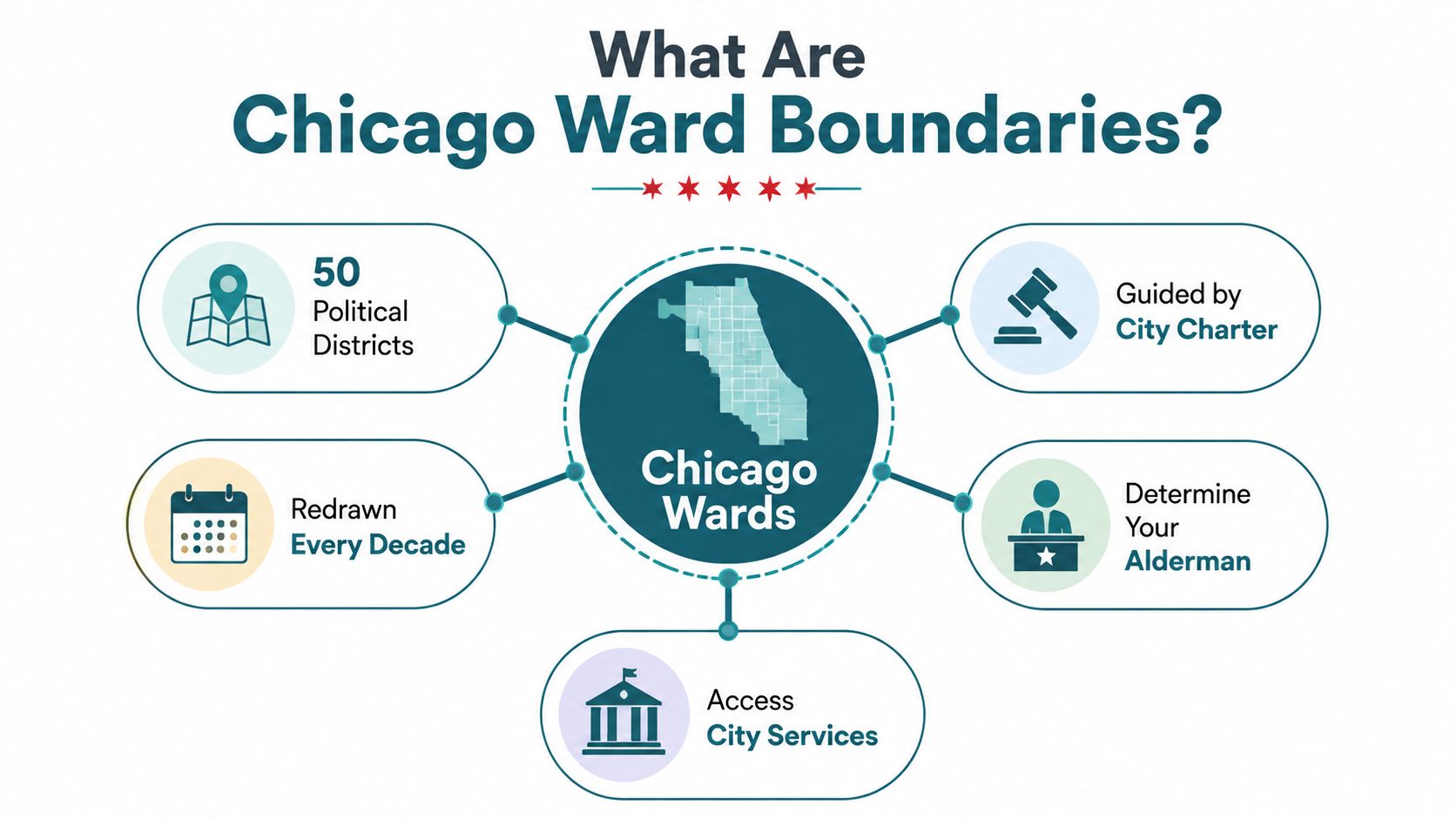
    Chicago ward boundaries divide the city into 50 official geographic divisions, with one alderman representing each ward, and the modern 50-ward structure has existed since 1923. Your ward helps determine who represents your address, where you vote, and how you access city services.

    Which ward are you in right now? Many Chicagoans can name their neighborhood, their nearest train station, and the street where the sidewalk suddenly changes, yet they can't place their home inside a ward line. That confusion makes sense because ward boundaries rarely follow the names people use in everyday conversation.

    I've found the easiest way to understand a ward is to treat it like a service and representation zone. A boundary on a map becomes practical when you need the right alderperson's office, want to organize a cleanup, or need to understand why a nearby block belongs to a different political district.

    What Are Chicago Ward Boundaries and Why Should You Care

    A resident might search for an alderman after seeing a damaged curb, then pause because two nearby addresses appear to have different representatives. The resident knows the neighborhood, but the neighborhood name doesn't answer the ward question. Chicago's official ward system does.

    Chicago has 50 wards, and each ward has one alderman. The city created the modern 50-ward structure in 1923, after earlier changes that followed the city's growth and annexation. Chicago had three districts in 1837, then expanded through several ward counts before reaching 50 wards by 1923. You can read the historical sequence in this history of Chicago's ward system.

    A ward boundary tells you which alderperson represents your address. It also helps you identify the correct voting information and gives you a starting point for questions about local services. If you're planning a block cleanup, reporting recurring dumping, or asking about a sidewalk issue, the ward gives you a practical political contact.

    An infographic titled What Are Chicago Ward Boundaries showing features like fifty districts and decennial redistricting.

    The line matters at street level

    The map can affect how you organize work. A cleanup route that crosses a ward line may involve two alderpersons' offices, separate outreach lists, or different reporting notes. The line doesn't change the pavement under your shoes, but it changes who receives your request and how you record the work.

    That makes ward knowledge part of civic engagement. You don't need to memorize all 50 wards. You need to identify your own ward, confirm the current map, and know when a nearby block falls outside your service area.

    Practical rule: Treat the ward as your first contact map, then check precinct and neighborhood boundaries separately.

    How Chicago Ward Boundaries Work and Who Draws Them

    Who decides whether your block belongs to one ward or another? Chicago redraws its ward map after each U.S. decennial census. Population shifts require the city to adjust boundaries so wards remain close in population, and the redistricting code requires the City Council to complete the map by December 1 of the year after the census. The City of Chicago's ward information describes the map and the redistricting process.

    The City Council draws and approves the map. Under the city's redistricting information and legal rules, wards should be as compact and contiguous as practicable and have substantially equal populations. Mapmakers also consider communities of interest and other valid objectives.

    At street level, those terms are easier to understand. A contiguous ward connects across its territory instead of splitting into separate pieces. Compactness discourages long, awkward shapes, while equal population keeps one ward from becoming much larger or smaller than another. Communities of interest recognize shared local ties, such as residents who use the same commercial corridor, park, or transit route.

    Why familiar places can move

    A neighborhood name does not determine the ward line. A boundary may run along an avenue, cross at an intersection, or turn around a cluster of blocks as population patterns and legal requirements change. Your neighborhood identity can stay the same even when the alderperson's office serving your address changes.

    The city's boundary files include effective dates, including a 2015-2023 file and a 2023-onward file. Match the file to the period you are studying. A cleanup volunteer comparing an older route log with today's map could assign a block to the wrong ward if the date is ignored.

    For community groups, the ward is a working map layer. Volunteers can divide cleanup routes by ward, coordinate with another alderperson's office when a route crosses the line, and direct residents to the right contact for service questions. The boundary turns census changes into practical decisions about contact lists, service areas, precinct comparisons, and shared neighborhood work.

    The Redistricting Timeline and the 2022 Map Change

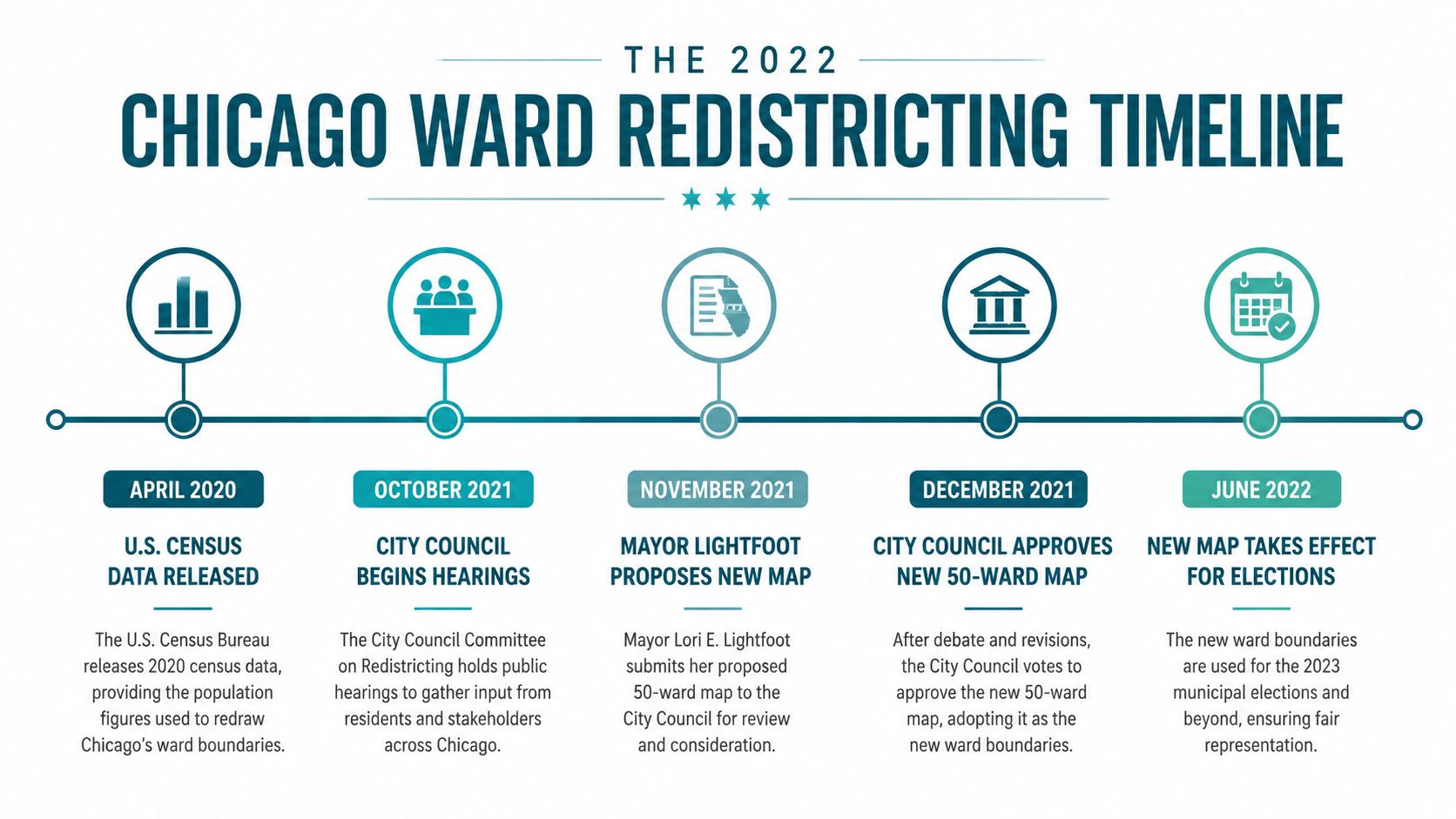
    Which ward serves an address can change even when the building stays put. Chicago's most recent major remap followed the 2020 census cycle. City rules require the Council to redraw ward boundaries by December 1 of the year after the census. The Council approved the new map on May 16, 2022, by a 43-7 vote. The city's official ward map information provides the boundary materials for reviewing that change.

    The map took effect for the 2023 municipal election cycle and preserved Chicago's 50-ward structure. That timing matters when volunteers compare an older cleanup sign-up sheet with a current route plan. A block can have the same address, residents, and neighborhood identity while belonging to a different ward in the newer map.

    A timeline graphic showing the 2022 Chicago ward redistricting process from April 2020 through June 2022.

    What changed in representation

    The approved plan created 14 Latino-majority wards, 16 Black-majority wards, 1 Black-plurality ward, and Chicago's first Asian-majority ward. Those changes show why a ward map is more than a set of lines. It affects which communities are grouped together for representation and which alderperson's office a resident or volunteer may contact.

    The remap also followed population equality, compactness, and contiguity requirements. Read the result in two ways: geography shows where the line runs, while representation shows how the remap changes the communities grouped within each ward.

    How to read an older map

    Use three checks before relying on any version:

    1. Check the effective date. Identify whether it covers the 2023-onward period or an earlier one.
    2. Check the purpose. Ward, precinct, neighborhood, and police district maps answer different questions.
    3. Check the source. Use official boundary files for GIS analysis, service routing, or historical comparison.

    The 2023 Chicago ward boundaries dataset records the current remap for data users. Save that file with a cleanup route, cross-ward volunteer plan, or neighborhood resource list so others can see which boundary version guided the work.

    How to Find Your Ward and Your Alderman Right Now

    Start with your address, not your neighborhood name. Type the street address into the City of Chicago's official ward lookup tool, then verify the ward number shown for that location. If you're checking a corner, test both addresses because a boundary can run close to an intersection.

    Next, use the City Clerk's interactive GIS maps if you want to inspect the line visually. The city's data portal also lets you explore official geographic files and download boundary data for mapping work. You can compare the result with a broader Northeastern Illinois map when you need regional context, but use the city's ward file for the actual ward assignment.

    A person sitting at a desk pointing at a computer screen showing the Chicago Ward Finder map.

    A simple lookup routine

    • Enter the full address: Include the street number, direction, street name, and ZIP code when the tool requests them.
    • Record the ward number: Save it with the address and the date you checked.
    • Find the alderman: Search the Chicago City Council site by ward number, then open the alderman's official page for contact details and office information.
    • Confirm the map vintage: Use the 2023-onward file for current work, and use an older file only when your project studies an earlier period.

    Don't assume a ward change automatically changes your precinct. Newer election data shows that precinct boundaries also changed in 2025-2026, while only two ward precinct pairs changed mutual boundaries and all other precincts remained the same, according to the 2025 ward and precinct boundary dataset.

    That distinction helps with election planning. Your ward may determine your alderman while your precinct information handles a different part of voting logistics. Check each boundary type for the question you're asking.

    Why Ward Boundaries Matter for Neighborhood Organizing

    A ward gives a volunteer group a clean way to divide work. Suppose you want to clean a long commercial corridor. You can place the route on the ward map, identify which blocks sit inside each ward, and prepare contact notes for the relevant alderperson's office. The map turns a vague citywide goal into manageable territory.

    The same method works for neighborhood resource navigation. A group can record where residents report litter, damaged sidewalks, missed collections, or park concerns, then sort those observations by ward. The Chicago Data Portal provides public datasets and mapping tools that can help residents examine city information around a location.

    Keep the boundaries separate

    Neighborhood identity and ward geography don't always match. A neighborhood can cross a ward line, and a single ward can contain several areas with different names and local concerns. Police districts and precincts follow their own geography too.

    Use this division of labor:

    Question Boundary to check
    Who represents this address on City Council? Ward
    Where do I handle election logistics? Precinct and election information
    How do residents describe this area? Neighborhood identity
    Which police service area applies? Police district or beat
    How should volunteers divide a cleanup route? Ward, then block and safety conditions

    A cleanup team can use one ward as its outreach unit while still honoring the neighborhood's own identity. If a route crosses a boundary, the team can split its notes, assign separate contacts, and report the work accurately.

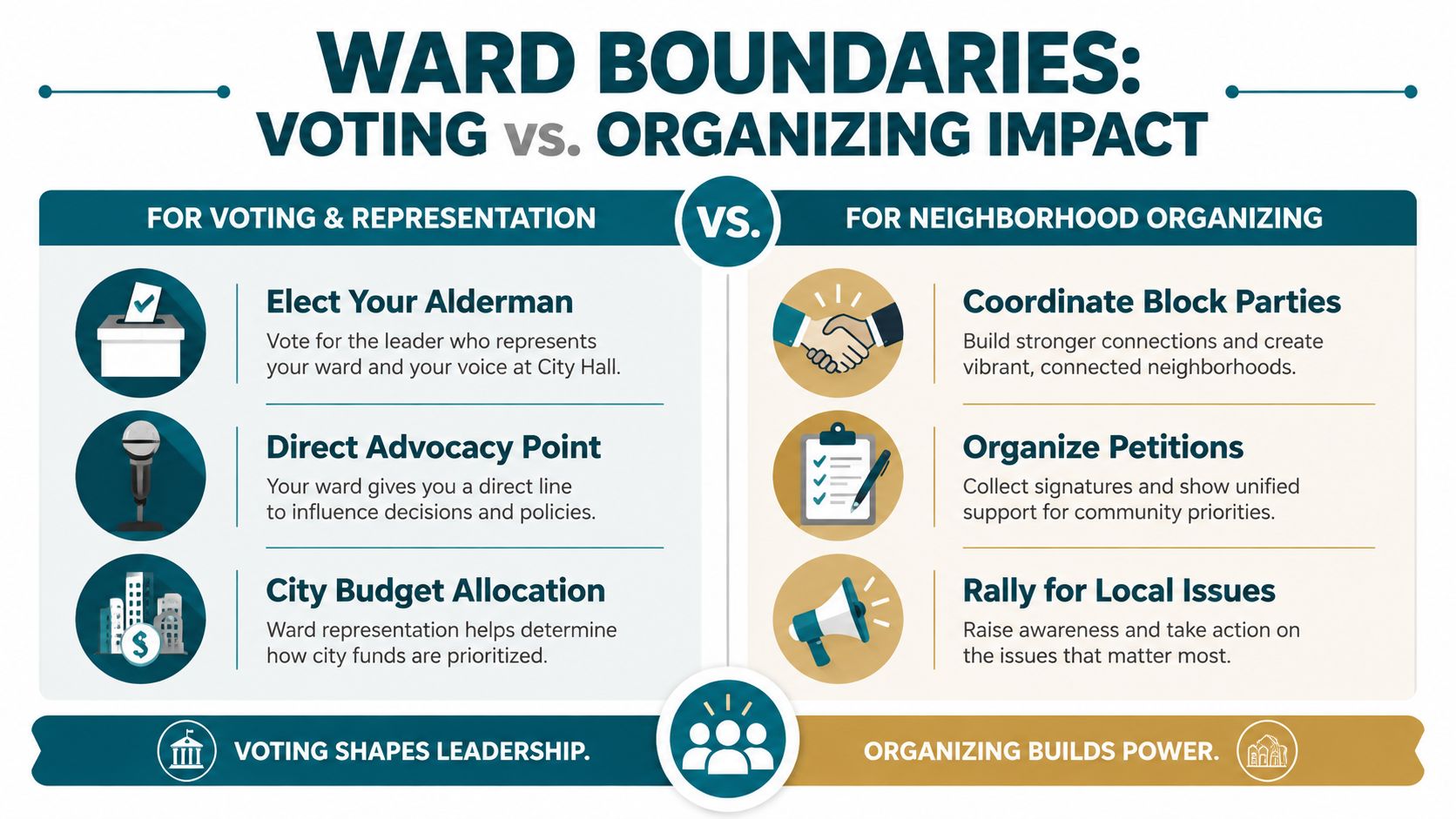
    An infographic comparing how Chicago ward boundaries impact local voting representation versus community neighborhood organizing efforts.

    A ward map helps you answer, “Who do we contact?” A neighborhood map helps you answer, “Who already calls this place home?”

    That difference prevents a common organizing mistake. Volunteers can work across a neighborhood while coordinating separately with the wards that contain it.

    Real Examples of Ward-Based Community Action in Chicago

    Consider a cleanup route that begins on one side of a ward boundary and ends on the other. The crew may see one continuous stretch of litter, yet the group's records should identify the blocks separately. That small habit helps volunteers contact the right aldermanic office, describe the exact area, and compare work across routes without mixing locations.

    A larger cleanup creates another problem. If volunteers assign routes by neighborhood name alone, two teams may cover the same familiar blocks while skipping a less visible edge. A ward map gives the coordinator another grid. The coordinator can assign a starting point, a boundary crossing, and a return route, then ask each team to report the blocks it covered.

    Cross-ward coordination in practice

    Litter Caterpillars has cleaned all 50 wards of Chicago, according to the organization's public description. That kind of citywide work requires volunteers to treat ward geography as a working reference, especially when a route moves between neighborhoods or crosses political boundaries.

    A group can build a simple field sheet with:

    • Starting intersection: Where the team begins.
    • Ward assignment: Which ward contains each block.
    • Contact note: Which aldermanic office receives follow-up.
    • Service observation: What volunteers saw, including recurring litter or access problems.
    • Completion record: Which blocks the team covered and which need another visit.

    This approach also helps residents find gaps. If one ward produces repeated litter complaints while nearby areas receive little volunteer attention, the difference may point to a route-planning problem, a reporting gap, or a service need that deserves a closer look. The map doesn't explain the cause by itself. It helps you ask a more precise question.

    A boundary can also guide cross-ward partnerships. Two groups can meet at the line, divide the route, and share a final record that shows where each team worked. Volunteers keep the neighborhood connected while giving each ward its own contact path.

    Get Involved and Start Cleaning Your Ward Today

    You now have a practical map-reading routine. Find your address, confirm the current ward, identify the alderman, and check precinct information separately when the question involves voting logistics. For organizing, save the boundary vintage, divide routes by block, and record every boundary crossing.

    That preparation makes a cleanup easier to coordinate. Volunteers can gather at a clear starting point, assign routes that don't overlap, and send useful follow-up instead of a general message about “the neighborhood.” A ward number gives the group a shared reference before anyone picks up a bag.

    You can also use civic engagement opportunities to find a practical way to move from map knowledge to local action. Litter Caterpillars operates across all 50 wards, meets weekly in different conditions, and connects cleanup work with friendship and community building. Its Caterpillar Park project in Englewood shows how consistent volunteer effort can turn an overlooked lot into a place with a community purpose.

    Your first cleanup plan

    1. Look up your ward by address.
    2. Choose a route that stays easy for the group to monitor.
    3. Mark any block where the ward line changes.
    4. Invite neighbors who know the area.
    5. Record what you cleaned and what still needs attention.

    You don't need a perfect map before you begin. You need a correct starting address, a safe route, and a habit of recording where the work happened. Once you know your ward, you can help your neighbors find their way around the city with more confidence and make your volunteer time easier to coordinate.


    Litter Caterpillars gives Chicago residents a way to join weekly cleanup work across the city's wards, meet neighbors, and turn ward maps into real street-level action. Find your ward, choose a cleanup route, and visit Litter Caterpillars to join the next opportunity.

  • Conflict Resolution Strategies for Volunteer Groups

    Conflict Resolution Strategies for Volunteer Groups

    The truck was due at nine, the bags were wet, and two longtime volunteers were shouting beside a pile of leaves that smelled like cold mud. One wanted the debris stacked by the street so the driver could load it quickly. The other wanted it hidden behind the fence because an alderman planned to take photos. Nobody had come to fight. They'd come with work gloves, a rake, and a few hours to give away.

    That's how conflict starts in volunteer crews. A small task carries a private meaning. One person hears “move the bags” and thinks efficiency. Another hears it and thinks respect for the neighborhood. Add fatigue, a borrowed trailer, unclear authority, and the fear that disagreement makes someone look selfish. Suddenly, a cleanup has a dispute that needs handling before the next bag hits the pavement.

    The conflict resolution strategies below come from that kind of morning. They're made for low-structure groups where you may be the organizer, the person holding the first-aid kit, and one of the people being corrected.

    Why Volunteer Groups Clash More Than You Expect

    The argument by the fence lasted less than ten minutes, but it gathered fuel quickly. The rake handle leaned against a trash grabber. A box of nitrile gloves sat open on the truck bed. Someone dragged a black bag through wet leaves, and the plastic made that sharp scraping sound that makes everyone feel behind schedule.

    Neither volunteer had a silly point. The street-side stack made pickup easier. The hidden stack looked cleaner for the camera. The trouble came from the fact that nobody had said who owned the decision. The organizer had handed out tools and locations, then stepped into the work. Once the disagreement arrived, everyone acted like the organizer and nobody acted like the organizer.

    Volunteer crews carry built-in friction:

    • No paycheck: People bring personal standards because money doesn't create a shared job description.
    • No hiring filter: A retired teacher, a college student, a contractor, and a first-time volunteer may work beside each other with different ideas about pace and politeness.
    • Blurry authority: The person who made the flyer may not know who can stop unsafe work or settle a deadlock.
    • Shared tools: One missing shovel or overloaded trailer can turn a practical delay into a personal accusation.
    • Mixed histories: Longtime members remember old slights. New people don't know which subjects already carry heat.
    • Moral pressure: Volunteers often believe everyone in the group is trying to be a good person. A disagreement can then feel like betrayal instead of coordination.

    A workplace dispute can also linger because people avoid formal routes. In Great Britain, 45% of workers said they handled workplace conflict by talking to a manager, while 30% spoke directly to the other person. Only 9% filed a formal grievance, and fewer than 0.5% went to tribunal, according to workplace conflict data from the UKMJ report. Informal talks matter, but the same report says 31% of conflicts remained mainly or completely unresolved.

    Practical rule: Conflict isn't proof that your crew is broken. It's what happens when people share work without a clear map for decisions.

    You need a map. The rest of these strategies give you words, roles, and a simple path for moving from heat to action.

    Active Listening When the Heat Is On

    When two volunteers argue beside a trailer, you don't need a speech. You need three moves that slow the exchange enough for each person to hear the room again.

    Pause before you fix

    Take one breath. Put down the tool if you're holding one. Say, “Give me a second. I want to understand what happened before we decide what to do.”

    That pause buys you control over your own voice. You can't ask people to calm down while you point, interrupt, or speak faster than they can answer.

    Then mirror the speaker. Use their words without adding your theory.

    “So you're saying you felt responsible for the gear and nobody checked with you.”

    Don't add, “because you always have to control everything.” Don't turn a mirror into a verdict. You're showing that you heard the complaint as the speaker means it.

    Name what sits underneath

    After the mirror, name the feeling you hear. If a volunteer discovered that someone left the trailer hitch unsecured, try this:

    “It sounds like that scared you.”

    The volunteer may say, “Yes, because the equipment could've gone into traffic.” Or they may correct you: “I wasn't scared. I was angry.” Either answer helps. You now have a real feeling to discuss instead of a loop of blame.

    Use I language when you describe your own part: “I felt worried when I saw the hitch open, so I want us to check it together.” Avoid “You always leave things loose.” The first sentence describes an event and your response. The second attacks a person and invites them to build a defense.

    For more practice with calm, direct group conversations, these tips for church team communication can help organizers build listening habits that transfer well to weekend service crews.

    Practice the missing feeling

    Tonight, replay last week's argument in your head. Write down the feeling word nobody said out loud. Was it embarrassed, ignored, afraid, rushed, or untrusted? The word may not solve the dispute, but it can tell you which question to ask next.

    Scripts for the Three Conflicts You Will Face

    A script won't make a hard conversation painless. It keeps you from reaching for the first sharp sentence that comes to mind.

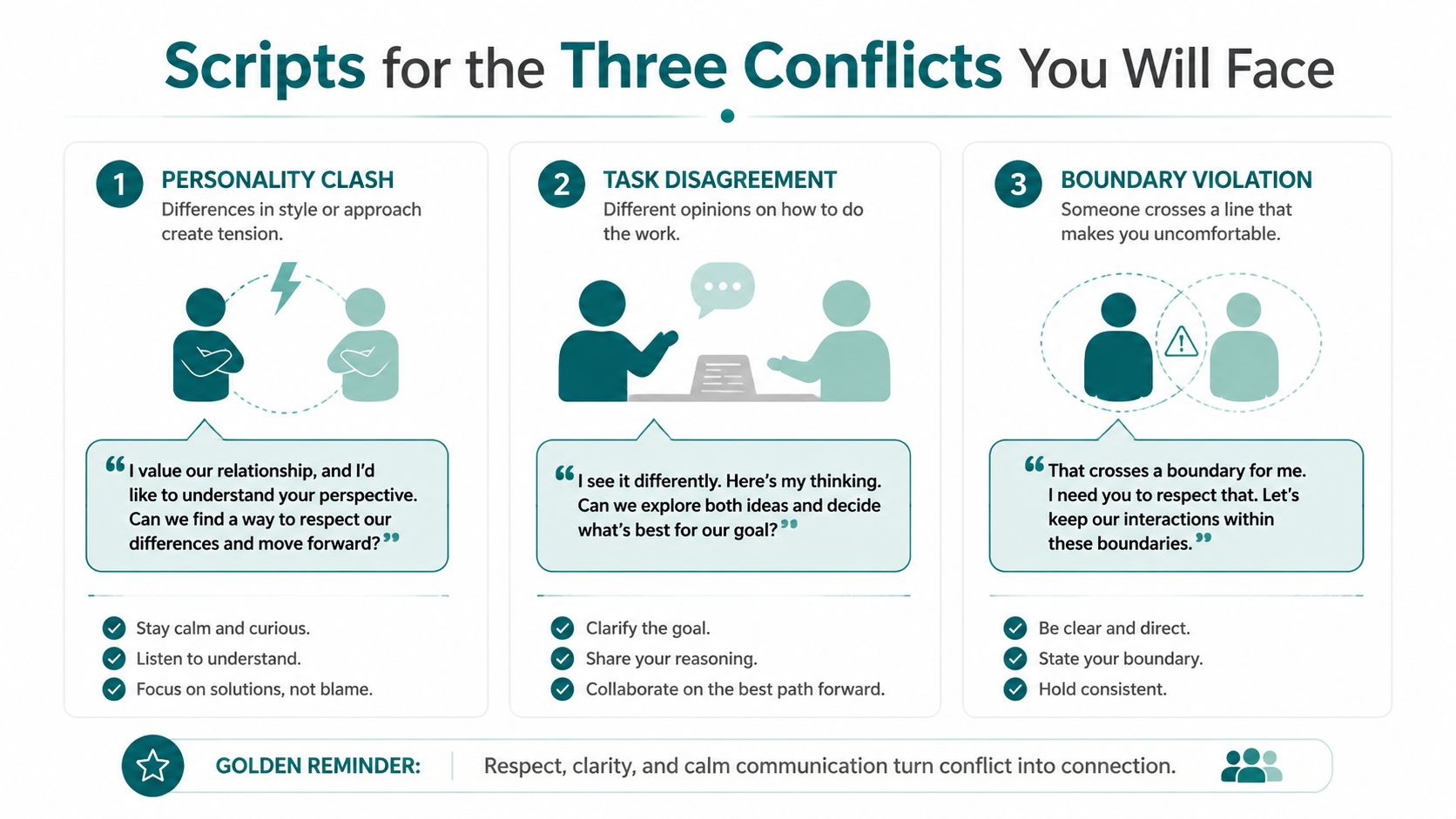
    An infographic titled Scripts for the Three Conflicts You Will Face, showing communication tips for personality clashes, task disagreements, and boundary violations.

    The personality clash

    Two strong volunteers may circle each other every cleanup. One corrects every sorting decision. The other rolls their eyes, takes over the cart, and complains to anyone within reach. Don't force a public showdown beside the bags.

    Give them a shared side-by-side task for one shift, such as checking the grabbers and sorting glass from general waste. Then say:

    “I want both of you here, so help me see what's getting in the way.”

    Let each person answer while the other listens. Ask, “What do you need from this task?” Finish with one observable agreement: “You'll decide the sorting rule together before the next section, and neither of you will correct the other in front of the full crew.”

    The safety disagreement

    A volunteer refuses gloves or a harness and says they've done this work for years. Lead with concern, not command:

    “I'd hate for you to go home hurt and miss next week.”

    Then point to the written rule. “Our safety policy requires gloves for this area. This isn't my opinion versus yours. It's the condition for joining this task. You can switch to the bag-counting table, or you can use the gloves and stay with the crew.”

    If the person still refuses, stop the task for that volunteer. A safety boundary needs a consequence people can understand before they test it.

    The person sitting on the curb

    Pull the volunteer aside. Keep the conversation private and specific:

    “I noticed you've been sitting by the curb while the rest of the crew hauls the bags. That leaves fewer people on the heavy work. What's going on?”

    Listen before you label them lazy. They may have a bad knee, feel lost, or have misunderstood the assignment. Offer a smaller role, such as sorting, directing the truck, or recording filled bags.

    “Would you take the lighter route with me for the next section?”

    If they refuse every role, explain the limit plainly: “You're welcome to return when you can take an assigned task. Today, I need you to step out of the work area.”

    Some conflicts reach beyond a volunteer crew's skill. Personal patterns may need therapy for relationship issues when the dispute involves an ongoing intimate relationship rather than a single cleanup decision.

    The scripts only work if you keep your own temper in check. If your jaw tightens, ask another organizer to stand beside you while you speak.

    Roles, Escalation, and Who Handles What

    A crew can handle disagreement quickly when people know who can decide. Assign the roles before anyone grabs a rake.

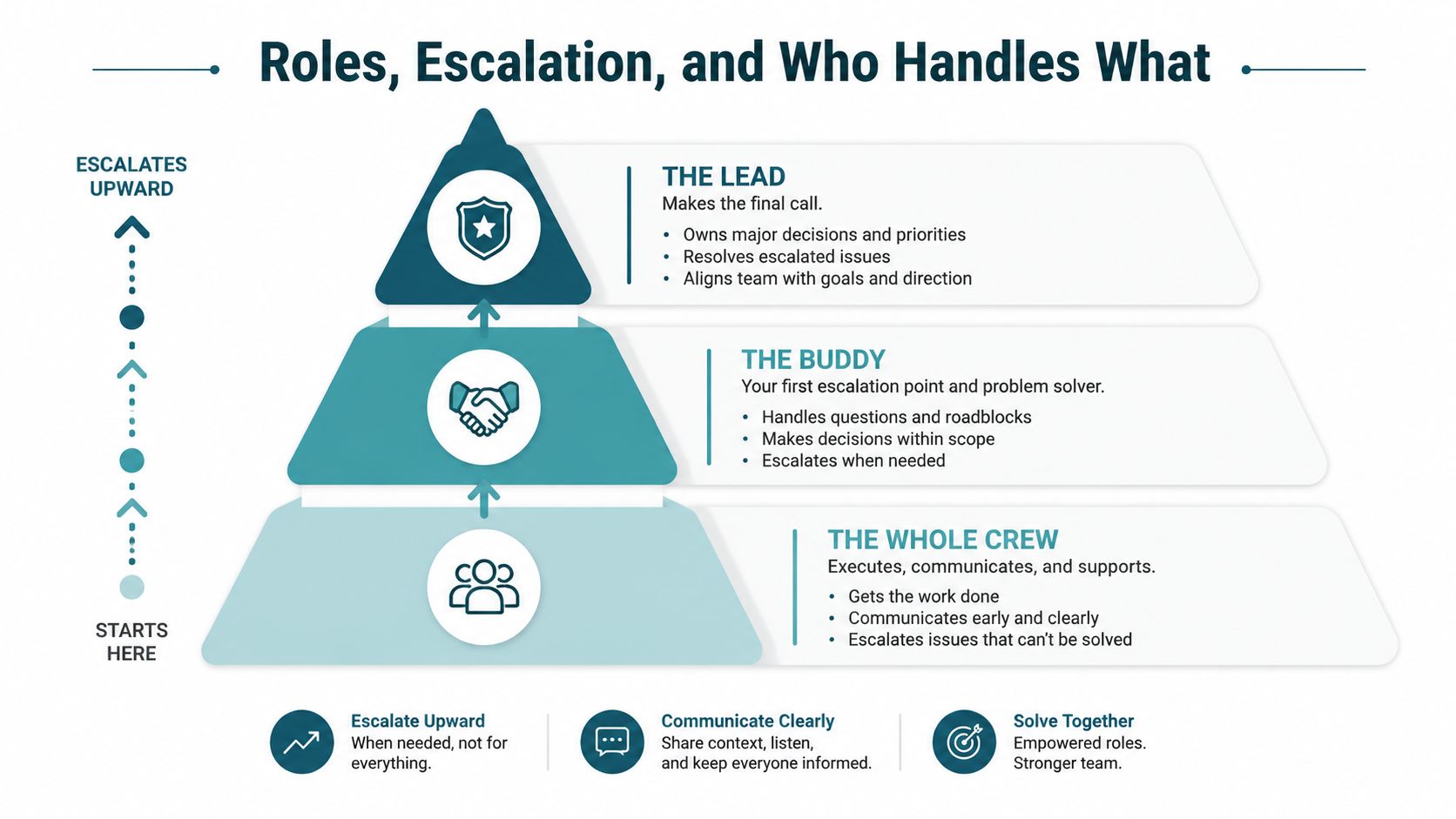
    The three standing roles

    The Lead decides the plan for the day and breaks deadlocks. The Lead can say, “We're stacking by the street today,” then explain the reason in one sentence.

    The Buddy pairs with each new volunteer for their first three events. The Buddy answers small questions before confusion turns into embarrassment.

    The Safety Person has sole authority to stop unsafe work. They don't need a group vote before asking someone to put on gloves, leave a traffic edge, or switch tasks.

    At the opening huddle, say:

    “I'm the Lead today. Maya is the Buddy for new volunteers. Devon is the Safety Person, and Devon can stop any task without debate. If you disagree with a decision, bring it to me after we move away from traffic.”

    You can use volunteer management best practices to build this kind of simple operating plan before an event.

    The four-step ladder

    1. Direct conversation: The two people speak privately, with a calm request and a specific example.
    2. Lead check-in: The Lead joins if the first conversation stalls.
    3. Neutral mediation: A neutral organizer meets with both people and helps them define the issue, separate interests from positions, generate options, and test each option against practical limits. This workflow appears in reviews of mediation programs, which report settlement rates commonly in the 50% to 85% range, including one study of 449 cases with a 78% settlement rate across court-referred and voluntary cases. The British Columbia mediation review also warns that signed settlements, partial agreements, and participant satisfaction measure different outcomes.
    4. Written warning and removal: If someone keeps violating safety or conduct rules, document the behavior and remove them from the group chat or event roster.

    Use this wording when moving up a step: “I'm not deciding who's right. The first conversation didn't settle the issue, so I'm bringing in the Lead to help us choose a workable next step.”

    A hierarchical pyramid diagram illustrating team roles, escalation paths, and responsibilities for conflict resolution in a workspace.

    Inclusivity and Safety Policies You Need on Paper

    Verbal norms disappear when the morning gets cold and everyone wants to finish. A short written policy stays available when memory gets selective.

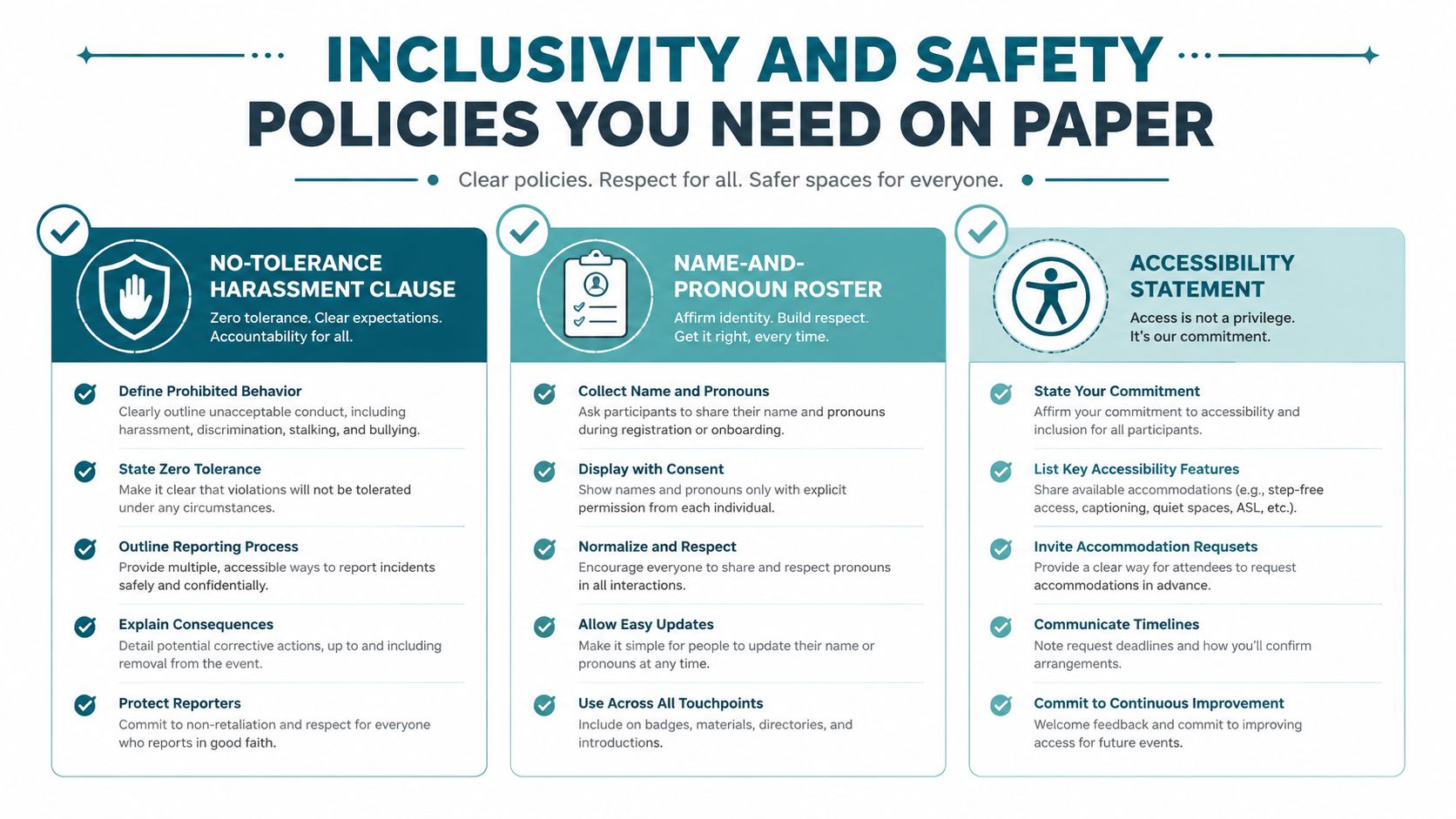
    Start with a plain harassment rule:

    “We don't tolerate harassment, threats, sexual comments, unwanted contact, slurs, or repeated disrespect. Tell the Lead or Safety Person. We'll separate people while we review what happened, protect the person who reports, and decide whether someone can return.”

    That language gives volunteers a route to use. It doesn't promise legal perfection. It tells them what behavior crosses the line and whom to approach.

    Write down the details people shouldn't have to guess

    Keep a name-and-pronoun roster at check-in, and ask every volunteer to update it at each event. If someone gets misgendered all morning because nobody asked, the group has created avoidable work for that volunteer. A roster lets the organizer correct the mistake without making the person repeatedly teach the crew.

    Add an accessibility statement that covers:

    • Physical tasks: Tell people which sites involve hills, lifting, stairs, or long walks.
    • Communication: Provide a written version of the spoken briefing and a clear contact method.
    • Childcare and timing: State whether children can attend and what supervision the group can or cannot provide.

    A volunteer with a bad knee shouldn't learn about a steep hill after arriving. Offer sorting, route mapping, supply checks, or check-in work before the assignment begins.

    Use two-person contact

    Create a two-person rule for one-on-one interactions between organizers and new volunteers. Meet in an open area or bring another organizer along. A flirtatious organizer cornering a recruit near the truck may claim they were joking, but the recruit experiences the power difference first.

    Give volunteers a short acknowledgment to sign at their third event:

    “I have read the group's conduct and safety rules. I know who handles concerns. I will respect names, pronouns, physical boundaries, and task limits. I understand that the Lead or Safety Person can pause my participation when a rule or safety condition requires it.”

    An infographic titled Inclusivity and Safety Policies detailing guidelines for harassment clauses, pronoun rosters, and accessibility statements.

    Keep the page with your event materials. For questions about protecting the organization, review volunteer liability insurance, then ask a qualified adviser what fits your group.

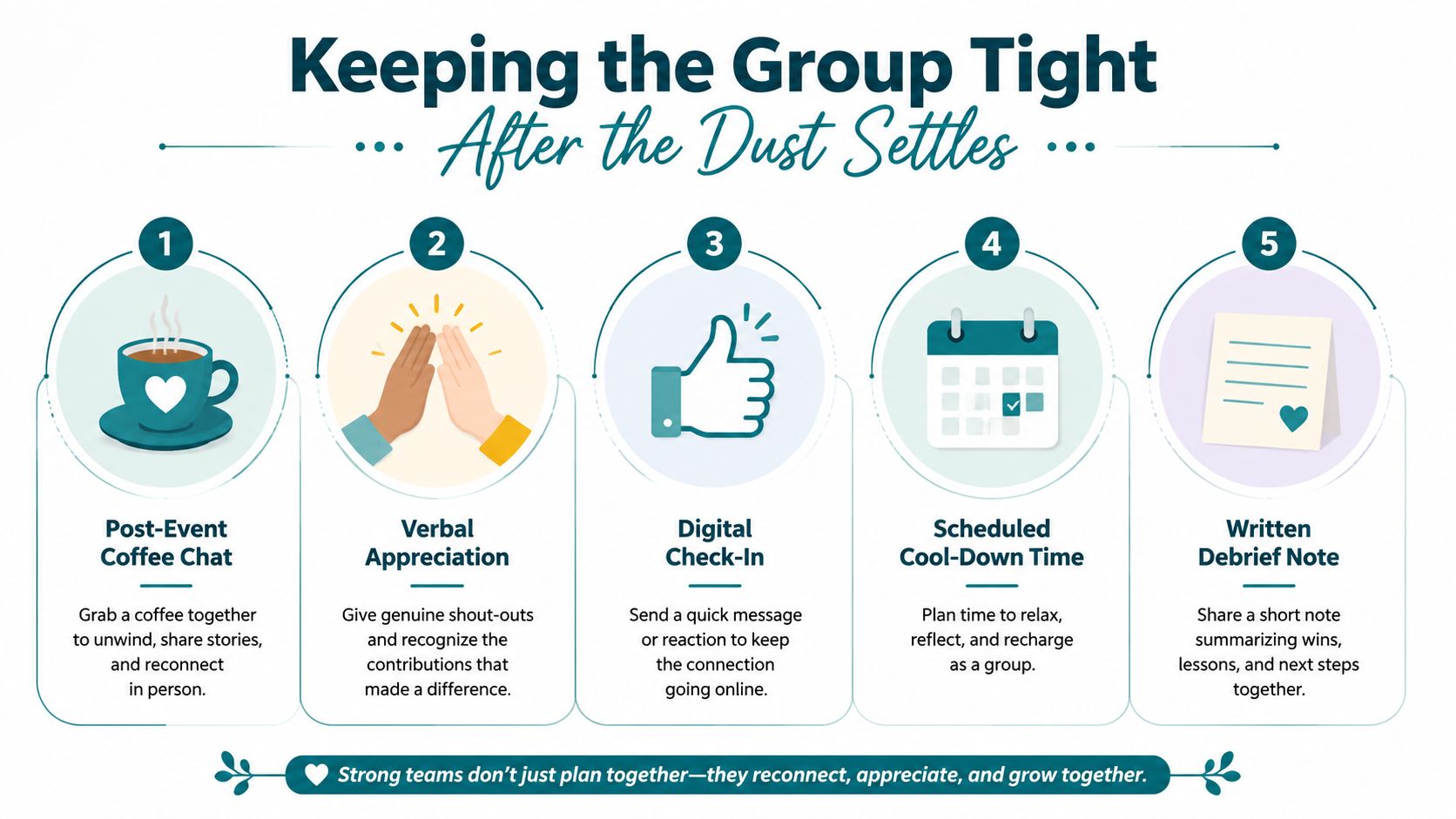
    Keeping the Group Tight After the Dust Settles

    A resolved argument can leave a strange silence. People finish the route, load the truck, and go home, but they still wonder who will speak first next Saturday.

    I've found that small rituals work better than forcing everyone into a feelings circle. After cold lakefront mornings and hot August cleanups, these habits gave people shared memories they could return to:

    • Fifteen-minute debrief: Ask what helped, what caused friction, and what one change would make the next event easier.
    • Rotating group-chat shoutout: Name one concrete act, such as carrying the awkward metal sign or checking the trailer latch.
    • Monthly shared meal: Keep work talk off the table for the first hour. Let people meet as neighbors, not task assignments.
    • Buddy text after tension: Two days after a rough event, send, “How are you feeling about Saturday? Anything you want me to know?”
    • Annual spring review: Rewrite the rules together. Keep what people used, remove what they ignored, and add what the last season taught you.

    A debrief might sound like this:

    “Where did we lose time?”
    “Did anyone feel unsafe or left out?”
    “What should we change before the next route?”

    Those questions create a record without turning the group into a committee. A shared meal creates another kind of record. Someone who argued over the trailer may later remember that the same person saved them a seat and passed the hot coffee.

    You can find more ideas for organizational culture building when you want to turn these habits into a regular rhythm.

    The smallest habit still matters most. Greet every volunteer by name at the start of every event, with no exceptions. People handle correction better when they know they belong in the room.

    An infographic titled Keeping the Group Tight after a project, showing five steps for team building.

    Your First Move This Week

    Stop hoping your crew will escape conflict. Design for the morning when two people disagree beside a full truck, a locked gate, or a pile of broken glass.

    You only need two completed actions this week.

    Write the one-page response sheet

    Use one page, not a binder. Put these lines on it:

    • Who leads the conversation: Name the person who can gather the people involved and decide the next step.
    • Where you meet: Choose a visible but private place away from the work area and the audience.
    • Which scripts you use: Add the lines for the personality clash, the safety refusal, and the person who isn't pulling weight.
    • Who can stop work: Name the Safety Person and state that safety decisions don't wait for a vote.
    • What happens next: List direct conversation, Lead check-in, neutral mediation, then written warning and removal.

    Read the page at the opening huddle. Volunteers can't follow a path they've never heard about.

    Schedule the debrief now

    Choose one upcoming shift and reserve fifteen minutes at the end. Ask three questions:

    1. “Where did communication break down?”
    2. “Did anyone feel unsafe, ignored, or overloaded?”
    3. “What one change should we make before the next event?”

    Write down the answers. Within a week, act on the loudest friction point. If people complain about unclear tools, label the bins. If new volunteers feel lost, assign Buddies. If one person keeps taking over, set the task boundary before the next route.

    Conflict readiness separates a volunteer group that survives its second year from one that falls apart by autumn. Pick the date for your debrief before you close this page, then send the invitation to the crew.


    Litter Caterpillars gives Chicago volunteers a practical place to build service habits, friendships, and calmer cleanup routines through regular weekend events. Visit Litter Caterpillars to join a crew, meet the organizers, and put these conflict resolution strategies to work on your next cleanup.

  • How to Stay Committed When Motivation Fades

    How to Stay Committed When Motivation Fades

    The first time three of us picked up trash together, a Chicago hailstorm trapped us under a tree while every Uber canceled. We were cold, annoyed, and laughing anyway. Three years later, we still meet every weekend, because I learned that staying committed has less to do with feeling motivated and more to do with designing a life where showing up feels possible.

    The Hailstorm That Changed Everything

    The hail hit hard enough to sting my face. We had planned a simple cleanup, yet the weather turned the morning into a small survival story. Three of us crouched under a tree, watching canceled ride requests pile up on our phones, while trash waited along the street.

    I had started Litter Caterpillars because I struggled to clean and organize my own life. A piece of litter felt strangely heavy, even when it weighed almost nothing. Cleaning someone else's mess felt easier. Doing it with friends felt unexpectedly fun. The hail added a little flavor, the kind that makes an ordinary morning memorable.

    That morning changed my idea of commitment. I used to think I needed motivation first, followed by action. The order works the other way around. I took action, shared the discomfort with other people, and built a story I wanted to keep living.

    My rule: Make the next showing-up decision easier than the quitting decision.

    For three years, our group has picked up trash every week through rain, snow, bitter wind, and hot days. We meet on weekend mornings because the time filters out many distractions and attracts people who want to give their time. We use group chats, social meetups, flags, badges, and a theme song to make service feel social and recognizable.

    That doesn't mean I always feel ready. Some mornings, I want to stay in bed. Sometimes I look at the forecast and wonder why I'm doing this. Then I remember that bravery doesn't require comfort. It requires a small action that matches the person I want to become.

    You can apply the same idea to almost anything. If you want to write, prepare the desk before you need it. If you want to exercise, choose a place and time that remove decisions. If you want to volunteer, find a group with a regular schedule and a culture that respects your limits. You can read more about the service mindset behind our work in Care for Real.

    Commitment grows when your surroundings support it. Give yourself a cue, a place, a person, and a reason to return.

    Why Habits Take Longer Than You Think

    Two weeks into a new routine, the excitement has usually faded. The shoes remain by the door, the notebook stays open, or the volunteer reminder appears on your phone, yet showing up still feels like a decision. Commitment grows through a designed experience that makes returning familiar and manageable.

    The popular 21-day habit idea makes early difficulty feel like failure. Research offers a slower, more forgiving timeline. Phillippa Lally and colleagues reported in a 2010 study that a new daily behavior took 66 days on average to reach peak automaticity, while individual participants ranged from 18 to 254 days. The University of Surrey's explanation of the 66-day habit research provides background on those findings.

    An infographic showing that forming a new habit takes an average of 66 days, not 21.

    A 2024 systematic review and meta-analysis examined 20 studies with 2,601 participants. It found median habit-formation times between 59 and 66 days, while mean times ranged from 106 to 154 days, with some behaviors taking as long as 335 days. A routine can need months before it feels nearly automatic.

    A slower timeline gives you room

    Those findings point toward repeated practice, not passive waiting. Two difficult weeks often mark the beginning of the learning period. The routine still requires attention because the cue, action, and reward have not settled into place.

    Saturday cleanups benefit from a recognizable setting. A weekend-morning schedule, meeting point, bags, gloves, group chat, and identity badges reduce fresh decisions each time. The same activity returns in the same social context, and the visible result, a cleaner block, gives the effort a clear reward.

    Give repetition a place on your calendar

    Reserve a stable block for the behavior before the week fills up. Using blocks of time for focus can turn an intention into a calendar appointment rather than a choice controlled by your mood.

    For a first cycle, choose a manageable 6-8 week block and measure attendance instead of performance. Repeat the smallest useful version, then let your identity catch up with your actions. A regular cue and setting can support intrinsic motivation, giving you an internal reason to return when enthusiasm is absent.

    Building Your If-Then Commitment Protocol

    At 7:45 on a rainy Saturday, I have stood by the park entrance wondering whether anyone else would show up. A promise like “I'll volunteer more” offers no answer about the morning's decisions. The problem with vague promises is that they leave when, where, and how open at the moment you most need a plan.

    An if-then rule closes those gaps. You name the situation, then pair it with an exact response. Research on 94 independent tests found a medium-to-large effect on goal attainment, d = 0.65, including starting tasks, resisting distractions, and leaving plans that no longer work. The research on implementation intentions explains how an anticipated cue can prompt a prepared action with less internal debate.

    A diagram outlining a three-step commitment protocol for achieving goals using a clear trigger, location, and action.

    Write the three parts

    Use a specific cue, place, and action:

    1. When: Name the situation. “If it's Saturday at 8 a.m.”
    2. Where: Identify the location. “At the park entrance.”
    3. How: State the behavior. “I'll put on my cleanup gloves and join the group for the first task.”

    My version reads: If it's Saturday at 8 a.m., then I'll meet my group at the park entrance, put on my gloves, and start with one bag of litter.

    The same structure works beyond volunteering:

    • Writing: If I finish breakfast, then I'll sit at my desk and write one paragraph.
    • Fitness: If I leave work, then I'll go directly to the gym and change before checking my phone.
    • Study: If I sit on the train, then I'll open my course notes and review one section.

    Specificity does the work. “Later” cannot start a routine. A named time and place can point you toward the first action.

    Write the rule before the difficult moment arrives.

    Put it on the fridge, in your calendar, or in a phone reminder. Then decide what happens when the plan meets resistance. If heavy rain cancels the cleanup, choose in advance whether you will reschedule, complete a smaller indoor task, or return the following week without guilt.

    An if-then plan cannot prevent every problem. It removes the argument that usually delays the first step.

    Designing Your Commitment System

    Three years of weekend cleanups taught me a humbling lesson. On rainy mornings, after poor sleep, or during a stressful week, I have wanted to stay home. The group still met because we designed the experience to carry us through those moods. Our system rests on three parts: a dependable schedule, a welcoming environment, and visible signs of belonging.

    A diagram illustrating a commitment system framework with scheduling tactics, design choices, and accountability mechanisms.

    Start with the calendar

    We chose a weekend-morning slot, before errands and family plans crowded the day. New volunteers could see exactly when to find us, without waiting for a special campaign or a burst of enthusiasm. After three years, that recurring appointment still does much of the remembering for us.

    Pick a time that fits your actual life. Put it on the calendar, prepare equipment early, and make the first version manageable on a difficult day. A six-to-eight-week block can also make the commitment feel defined. You are agreeing to a clear stretch of sessions, rather than making an indefinite promise.

    Add people who notice your absence

    Our group chat handles practical details, from questions about meeting points to plans for the next cleanup. It also gives someone permission to ask, “Are you still coming?” A partner can provide the same support for a personal goal. The useful response is curiosity and honesty, not shame.

    A short weekly check-in creates room to adjust. We name what worked, identify the source of friction, and change the setup before frustration becomes disappearance.

    Give the behavior a visible identity

    Flags, badges, and a theme song turned attendance into something people could recognize and share. A badge on a backpack, a marked calendar, or a shared playlist makes the habit part of daily life. It reminds us that we belong to a group with a real practice, even on mornings when motivation is thin.

    Our volunteer-first approach protects that experience. Safety comes before output, and enjoyment comes before pressure. People are more willing to return when they feel respected, effective, connected, and able to manage the time involved. NCVO's volunteer-retention research discusses these conditions, including enjoyment, belonging, trust, feeling effective, and manageable time demands, in its findings on volunteer retention.

    Build the same structure around your goal. Schedule the action, prepare the setting, invite accountability, and choose one identity marker. Familiarity, social contact, and a clear time limit can make consistency easier to repeat.

    What to Do When You Fall Off Track

    You will miss a week. You may miss two. That lapse doesn't erase the work you already did, and it doesn't require a dramatic return.

    Volunteer retention research gives a more practical explanation for absence. People stop when their circumstances change, their health interferes, or they feel they've already done enough. Those reasons call for pacing and re-entry, not a lecture about willpower.

    Build the return before you need it

    Create a re-entry rule while things are going well:

    • After a missed session: Return at the next regular meeting instead of inventing a perfect restart date.
    • During a difficult week: Attend for a shorter period or take a lighter task.
    • After illness or injury: Ask what safe participation looks like, and wait when participation isn't safe.
    • When interest fades: Talk with a partner about changing the task, location, or social format.

    A fixed cue helps you find your way back. Research on habit formation describes repetition in the same context as a central part of building automatic behavior. A regular time and place keep the cue familiar, even when a gap interrupts the routine. A field experiment on recycling found improvement during the first two weeks, and the behavior remained consistent at a two-month follow-up. The recycling field experiment gives you a useful model for early practice followed by continued repetition.

    Treat a lapse as information

    Ask what blocked you. Did the time conflict with family needs? Did the task feel too hard? Did you lack a ride, equipment, or a person expecting you? The answer points toward a design change.

    You can also use a practical guide to overcoming procrastination when delay becomes the pattern. Come back without making an apology tour. The next action can be small, ordinary, and scheduled.

    A missed session is a data point. Your return is the practice.

    Commitment means binding yourself to future behavior, yet a binding can include humane terms. Leave room for health, changing responsibilities, and honest reassessment. A plan that lets you step back can keep you from walking away permanently.

    Your 12-Week Commitment Plan

    I use a 12-week plan because it gives a new routine enough room to pass through excitement, boredom, friction, and adjustment. Real-world habit-building data found 6 to 8 week commitments, weekly reporting to an external referee, and monetary stakes among the most successful structures examined in that research on habit-building commitments. You don't need money to use the same structure. You can use a friend, group chat, or volunteer coordinator as your referee.

    A 12-week commitment plan infographic illustrating phases for building habits, consistency, and long-term success.

    Weeks 1 and 2, learn the route

    Show up and learn the routine. Don't measure yourself by bags collected, pages written, miles run, or any other performance result. Your milestone is simple: you know where to go, what to bring, and how to begin.

    Ask yourself, “What made starting easier, and what created friction?” Write the answer after each attempt. Change one practical detail, such as packing supplies the night before or placing your shoes beside the door.

    Weeks 3 and 4, add a witness

    Choose one accountability person. Send a short weekly message with three details: whether you showed up, what got in the way, and what you'll do next.

    Refine your if-then rule from the evidence you gathered. If your original cue fails, replace it with a cue you encounter reliably. Your milestone is a plan that describes the actual version of your week, not the imaginary version.

    Weeks 5 through 8, protect the middle

    Novelty fades. Keep the task small enough to survive a difficult morning, and let your group carry some of the social energy. Celebrate concrete wins, like arriving on time, completing one manageable task, or returning after a missed week.

    Ask, “What can I reduce without abandoning the goal?” Shorten the session, simplify the equipment, or choose a lighter role. Keep the appointment alive while you adjust the workload.

    Weeks 9 through 12, decide with evidence

    Look at your notes. Do you feel connected to the activity? Does the schedule fit? Does the group or setting help you feel effective? Are the costs to your health, time, or relationships reasonable?

    Your final milestone isn't automatic perfection. It's an honest decision to continue, change the format, or stop and choose a better goal. If you continue, renew the next block before the current one ends. If you pivot, carry the lessons into the next commitment rather than treating the experiment as wasted effort.

    Print the plan. Put the first appointment on your calendar. Then tell one person exactly when and where you'll begin.


    Litter Caterpillars meets on weekend mornings for volunteer trash pickups, with group chats and social meetups that help people find the routine and meet neighbors. Visit Litter Caterpillars to choose a cleanup, write your if-then rule, and take the first small step toward a commitment you can repeat.

  • Injury Prevention Strategies for Volunteer Cleanup Crews

    Injury Prevention Strategies for Volunteer Cleanup Crews

    You're standing beside a bus lane on a cold Saturday morning, one hand on a grabber and the other wrapped around a trash bag that's already too full. A tire fragment slides under your boot. Someone reaches for a shiny piece of metal near the curb. Traffic moves closer than expected. Cleanup work can turn from friendly service into an emergency in a few seconds.

    I've spent three years at weekly Chicago cleanups in rain, heat, snow, and sudden hail. The crews that stay safe don't rely on luck or a loud “watch out.” They plan the site, match equipment to hazards, watch the weather, and give volunteers permission to stop before a small problem becomes a serious injury. These injury prevention strategies belong in the plan before the first bag opens.

    Why Injury Prevention Belongs at Every Cleanup

    One Saturday, a volunteer lunged toward a slippery tire chunk beside a bus lane. Her boot lost traction, and she went down hard. The crew lead caught her arm before her shoulder hit the pavement, but the near miss exposed several gaps. Nobody had assigned a traffic watcher. The tire sat in a slick patch. The morning briefing had covered litter zones, yet nobody had discussed unstable debris near moving vehicles.

    That moment stayed with me because the volunteer hadn't acted recklessly. She saw something the crew wanted removed and tried to help. Good intentions can still put a person in danger when the plan leaves hazards unassigned.

    Injuries follow people home

    A sprained ankle can mean missed work shifts, canceled family plans, and weeks away from the cleanup group. A cut from a hidden shard can keep a regular volunteer off the street while the wound heals. The organizer carries another burden, too. If someone ignores a known hazard or sends people into an unsafe area without controls, the group may face liability and a damaged relationship with its volunteers.

    The World Health Organization reports that injuries and violence caused 4.4 million deaths in 2019, equal to 8% of deaths worldwide. Unintentional injuries caused about 3.16 million of those deaths, while violence-related injuries caused about 1.25 million. Low- and middle-income countries carried roughly 90% of injury-related deaths, according to the World Health Organization's injuries and violence fact sheet.

    Cleanup crews usually deal with smaller hazards, but the planning lesson still applies. Injury prevention covers traffic, falls, cuts, weather exposure, lifting, and sudden medical problems. Volunteers show up expecting care. They shouldn't have to prove toughness to earn it.

    Practical rule: If a hazard can be predicted, assign a control before the event starts.

    Start the plan the night before

    Check the forecast, inspect the route, charge phones, stage first aid supplies, and decide who can stop work. Use engineering and environmental controls whenever you can. A safer route, a moved sign-in table, a blocked-off hole, or a traffic buffer does more than repeated reminders about attention.

    WHO lists measures including seat belts, child car seats, smoke detectors, flame-resistant clothing, designated drivers, and fencing around water as proven injury controls. Its prevention model follows four actions, measure the problem, identify causes, design and apply interventions, then evaluate the results. The same approach works on a Chicago cleanup route. Record the hazards, change the setup, and learn from what happened.

    Personal Protective Equipment That Actually Fits the Job

    PPE should answer a specific question: what can hurt this volunteer at this site? A pair of thin gardening gloves might feel comfortable, yet sharp cans, broken glass, and metal scraps can shred them quickly. Choose cut-resistant gloves rated for glass and metal, then check that each volunteer can grip a grabber without losing control.

    Learn more about volunteer trash pickup practices before you build your gear station. The right equipment supports the work, but it doesn't replace a site walk or a clear rule about suspicious objects.

    A safety infographic illustrating essential personal protective equipment like gloves, boots, glasses, and high-visibility vests for workplace protection.

    Match each item to the hazard

    • Cut-resistant gloves: Use them for glass, wire, cans, and metal fragments. Volunteers should use a grabber for sharp or sketchy items rather than testing an object with a gloved hand.
    • Closed-toe boots: Sneakers leave feet exposed to broken glass, uneven pavement, and dropped objects. Boots with ankle support help on rubble, curbs, and sloped alleys. Steel-toe protection can make sense where crushing hazards exist.
    • Safety glasses: Glasses should stay in place while volunteers bend, reach, and shake out debris. They protect eyes from dust, fragments, and particles kicked up by another person.
    • Long sleeves: A breathable long-sleeve shirt limits scrapes from brush, fencing, and rough concrete. On warm days, choose light fabric and add shade and water instead of sending people out in heavy layers.
    • High-visibility vests: Street-adjacent work needs a clear visual boundary. A vest helps drivers and cyclists see the crew, especially near intersections, bus lanes, and driveway exits. For teams that need coordinated colors or printed names, find safety vests custom options can help.
    • Knee pads: Ground-level work punishes knees on concrete and gravel. Knee pads make it easier to keep a stable position while sorting low debris, which reduces rushed reaches.

    Volunteers often forget sun hats, extra socks, and a personal water bottle. Those items look minor until a wet sock creates a blister or direct sun leaves someone tired and careless.

    Make sign-in a gear checkpoint

    At sign-in, ask each person to show gloves, boots, eye protection, and a visible vest when traffic is nearby. Keep spare gloves, glasses, socks, hats, and water available. If someone lacks the right equipment, move that person to a lower-risk task or pause the assignment until you can fix the gap.

    Lifting, Bending, and Carrying Without Paying for It Tomorrow

    A full trash bag looks manageable until it swings into a knee. A long stick seems light until it catches on a fence and twists your shoulder. I've watched both mistakes appear during weekend pickups, usually because someone wants to work faster than the load allows.

    Set your feet about shoulder-width apart. Keep your back flat, bring the object close, and use your legs to drive upward. The cue I use is “nose over toes.” It reminds you to bring your body over the load instead of reaching away from it.

    Use a partner before the load wins

    For heavy debris, ask for help early. Two volunteers should stand at similar heights, agree on the route, and count the lift out loud. The count gives both people a shared start and prevents one person from jerking upward while the other still adjusts their grip.

    Tires, long scrap wood, and awkward furniture need a team carry. One person steers while the other watches foot placement and obstacles. Keep the load close, walk slowly, and stop before a curb or turn instead of trying to pivot under pressure.

    Fix the two habits that cause trouble

    An overfilled bag can drag across the ground, split open, or swing into someone's leg. Use smaller bags, tie them before they become heavy, and place them at a collection point instead of carrying an unstable load across the site.

    A drag-along trash stick twists the shoulder when it catches on pavement, roots, or fencing. Break it into shorter pieces if you can do so safely, or carry it with a partner. Never yank against resistance. Stop, reset your feet, and change the route.

    “Nose over toes” works because it gives volunteers a movement they can check while they're working.

    If a volunteer reports back pain, dizziness, or a sudden sharp sensation, stop the task. A cleanup can wait. A person shouldn't gamble with an injury to finish one more bag.

    Weather, Hydration, and the Two-Hour Check-In

    Chicago weather can change the job faster than the trash volume does. Heat drains judgment, cold stiffens hands, and lightning turns an open cleanup area into a place where nobody should work.

    For hot days above 85°F, use a 90/15 work-rest split. Work for 90 minutes, then take 15 minutes in shade or another cool location. Aim for 8 ounces of water every 20 minutes. Put water where volunteers can reach it without crossing traffic or walking back to the meeting point.

    A safety infographic titled Weather, Hydration, and the Two-Hour Check-In outlining health and safety protocols.

    Notice the quiet signs

    Crews often miss clammy skin, irritability, and skipped water breaks because the person still appears to function. A volunteer who snaps at a teammate or stops drinking may need shade, water, and a check from the safety lead. Use the heat exhaustion prevention tips as a planning reference, then give the group a simple response everyone understands.

    On mornings below 50°F, ask volunteers to layer clothing and bring gloves and a hat. Keep extra layers in the supply vehicle. Wet clothing and wind can make a mild morning feel much harsher, so watch for shivering, numb fingers, slow speech, and clumsy movement.

    Stop for thunder

    Stop work when thunder arrives within 30 seconds of a lightning flash. Move volunteers into a suitable shelter or vehicle, and wait 30 minutes after the last lightning strike before restarting. Don't leave this decision to the loudest person in the group. Name one safety lead who can end the shift.

    Use a named check-in pair

    Every two hours, a named pair should walk the group and ask three questions:

    1. Are you thirsty?
    2. Are you tired?
    3. Are you hot or cold?

    Log the answers and act on them. Rotate tasks, add a rest period, move someone into shelter, or end the assignment. A short conversation can catch a cramp before it becomes a hospital trip.

    Walking the Site Before Anyone Picks Up a Single Piece

    A five-minute site walk can rewrite the whole morning. I don't mean a casual glance from the parked car. Walk the actual route, look down, watch traffic, and ask questions that force the plan to meet the ground.

    The World Health Organization's prevention model begins with measuring the problem and identifying causes. A site walk does exactly that at street level. You're finding the conditions that a group briefing cannot reveal from a map.

    An infographic titled Walking the Site outlining five essential safety planning steps before beginning cleanup work.

    Ask five field questions

    • Where does traffic enter and exit? If cars cut through the cleanup zone, move sign-in away from the blind alley, assign a traffic watcher, or reroute volunteers.
    • What is underfoot? Look for holes, broken pavement, glass, mud, roots, and steep curb cuts. Mark the hazard, block the area, or give that stretch to a trained lead with the right equipment.
    • Where is water nearest? A distant water source creates skipped breaks. Put a hydration station where volunteers can reach it without crossing a roadway.
    • Where is shade or shelter? Identify the indoor partner site, warming vehicle, covered entrance, or shaded wall before people arrive.
    • What surprised me last time? Review the previous event. Was there a dumped mattress, unleashed dog, flooded alley, construction barrier, or pile that attracted unsafe attention?

    Turn observations into assignments

    Each answer needs an owner. A traffic problem needs a watcher. A glass-heavy patch needs a grabber and a controlled sweep. A weather concern needs a stop-work decision and a place to go.

    Take photos of hazards after the event, without exposing private information or identifying people. Add those images to the debrief so the next crew inherits a smarter map rather than the same surprise.

    First Aid Kits and Incident Reporting When Things Go Wrong

    A first aid kit should travel with the group, not sit locked in an organizer's car several blocks away. Stock nitrile gloves, gauze, trauma shears, cold packs, saline, a tourniquet, and a CPR face shield. Check the kit before volunteers arrive and replace anything used during the last event.

    Put gloves on before blood reaches your hands. If a wound looks serious, the person feels faint, or bleeding won't stop with direct pressure, call 911. Keep volunteers away from the scene so the responder has room to work.

    Follow four actions

    1. Assess the scene. Look for traffic, exposed glass, electricity, chemicals, or another danger before you approach.
    2. Clear the area. Move bystanders and stop nearby cleanup work.
    3. Treat or call 911. Give basic care within your training, and don't delay emergency help when the injury needs it.
    4. Send a runner. Assign someone to meet EMS at the nearest corner and guide responders through blocked streets or alleys.

    Organizers should also review practical guidance on common first aid mistakes at work. The point isn't to turn volunteers into medics. It's to prevent hesitation, confusion, and unsafe improvisation.

    Write the report while details remain clear

    A volunteer captain should complete the incident form within an hour. Record:

    • Time and weather: Include the work period, temperature conditions, rain, snow, hail, or wind.
    • Exact location: Name the block, alley, intersection, or cleanup zone.
    • What happened: Describe the action and hazard in plain language.
    • Witness names: Get names and contact details from people who saw the event.
    • Response: Note first aid, the 911 call, transport, or a decision to stop work.
    • Photos: Photograph the hazard and surrounding area when it's safe and appropriate.
    • Follow-up: Assign someone to contact the volunteer and someone to change the plan.

    A hidden shard once sliced a volunteer during a pickup. The injury report showed that the crew had skipped a glass sweep near the collection point. We changed the routine and added a pre-event hazard walk. The form did more than document pain. It showed us where our process had failed.
    The Volunteer-First Safety Checklist

    Print the checklist. Put a pen beside it. Assign every line to a person who can answer “done” before the group starts. A checklist that belongs to everyone often belongs to nobody.

    Pre-event

    • Site walk completed: Check traffic, footing, debris concentration, shelter, shade, water, and surprises from the last visit.
    • PPE stocked: Set out cut-resistant gloves, closed-toe boots guidance, eye protection, long sleeves, high-visibility vests, knee pads, hats, and spare socks.
    • Weather call made: Decide whether to proceed, shorten the route, add shelter, or cancel.
    • First aid staged: Place the kit where the safety lead can reach it quickly.
    • Contacts printed: Keep waivers, emergency contacts, the route map, and partner-site details together.

    On-site

    • Sign-in complete: Record arrivals and confirm basic gear.
    • Buddy assigned: Pair volunteers, especially in alleys, near traffic, and on unfamiliar routes.
    • Safety briefing delivered: Cover “nose over toes,” partner lifts, heat and cold rules, lightning, sharps, and the traffic plan.
    • Hydration station live: Put water where people can reach it.
    • Two-hour check-in scheduled: Name the pair and set an alarm.

    During cleanup

    • Gloves and high-visibility gear on: Check before volunteers leave the meeting point.
    • Three-foot debris pile rule active: Keep collected material in a controlled pile with room around it.
    • No lone workers in alleys: Keep buddies within sight or voice range.
    • Sharps protocol followed: Use a grabber and stop when an item looks dangerous or unknown.
    • Flaggers assigned: Place watchers at intersections, driveway exits, and street crossings.

    Post-event

    • Incident log reviewed: Discuss injuries and near misses before everyone leaves.
    • Near misses recorded: A fall that didn't happen still tells you something.
    • Kit restocked: Replace gauze, gloves, saline, cold packs, or any other used supply.
    • Debrief sent within 48 hours: Share route changes, weather lessons, hazard photos, and assigned fixes.

    A lakefront pickup once took a hard turn when hail arrived mid-shift. The organizer had printed the checklist, so tarps were already staged. The designated safety lead stopped the work, a buddy moved shivering volunteers toward the warming van, and one volunteer noticed the weather app change and called it out. The group rotated people indoors and completed a 15-minute handoff to the indoor partner site instead of leaving confused volunteers scattered along the route.

    The checklist worked because three real people owned the lines. A safety lead made the call. A buddy stayed with the affected volunteers. Another volunteer watched the forecast and spoke up. For more ideas on assigning repeatable operational tasks, review this facilities management checklists example, then adapt the format to your route.

    For organizers who want more support before the next event, volunteer coordinator training can help turn these written rules into a briefing people remember.


    Litter Caterpillars organizes Chicago cleanup events with safety briefings, grabber guidance, buddy awareness, and a volunteer-first approach. Visit Litter Caterpillars to join an upcoming cleanup, learn how the group prepares crews, and help make safer service a regular Saturday habit.

  • 8-Step Volunteer Safety Checklist for Cleanup Events

    8-Step Volunteer Safety Checklist for Cleanup Events

    Before the first bag fills, a cleanup crew can face a serious decision. Your team reaches a busy street, spots broken glass beside the curb, and must choose whether to keep moving, change the route, or stop and report it.

    A volunteer safety checklist works like a flight plan. It gives everyone a shared route, clear stop signals, and a way home when conditions change. The checklist below follows the volunteer journey from the first briefing to the final incident note, covering route hazards, equipment, buddy coverage, weather, biohazards, first response, inclusive roles, wellbeing checks, and cancellation decisions.

    At Litter Caterpillars, the litter count never outranks volunteer safety or happiness. Our Chicago group works across all 50 wards, including places where traffic, ice, construction, abandoned materials, or changing public activity can make a normal cleanup unpredictable. A good plan lets people act with courage without asking them to gamble with their health.

    1. Brief Your Team on the Day's Route and Hazards

    Start with a map, then turn the map into a conversation. Tell volunteers which streets they'll walk, where the group will regroup, and what they might encounter. Point out broken-glass areas, busy crossings, aggressive dogs, potholes, poor lighting, ice, slippery pavement, and places where foot traffic changes quickly.

    I learned this during an early highway cleanup held during a bike-event shutdown. One volunteer nearly stepped into a pothole because the road condition hadn't made it into the briefing. Since then, I've treated route knowledge as equipment. Before heading into Englewood, where we won our lot for Caterpillar Park, I explained the potholes and the blocks with heavier foot traffic. Nobody got hurt because people knew what to watch for.

    Use landmarks instead of vague directions. “Stay near the blue mural and regroup at the corner store” gives people something they can see. Ask whether anyone has worked in the area before. Local observations often reveal a loose dog, a blocked sidewalk, or a slippery corner that a map won't show.

    Practical rule: Give volunteers enough information to make a safe choice. Specific warnings respect people. They don't frighten them.

    The IFRC volunteer safety guidance calls for risk assessment, situation analysis, basic information gathering, and scenario planning before volunteers act. Apply that logic in plain language. Explain what could change, who makes the call, and when volunteers should leave a threatening situation.

    2. Provide Proper Protective Equipment and Know How to Use It

    A pair of thin gloves doesn't make every object safe. Cleanup crews need equipment that matches the work, fits the volunteer, and stays within reach. At a minimum, prepare sturdy gloves, grabbers, bright safety vests, suitable footwear, water, a first aid kit, and a reliable way to contact the coordinator.

    Greenville County's National Cleanup Day safety guidance says each group should carry a first aid kit, water, and a cell phone. It also calls for orange safety vests, group work, facing oncoming traffic, and working on one side of the road at a time. Those details turn a casual outing into a controlled field task.

    At Litter Caterpillars, volunteers can keep their bright vests. The color helps drivers see the group, and the vest gives the crew a shared identity. Volunteers have told me that wearing the gear makes the event feel organized rather than improvised. That feeling matters because people make better decisions when they understand that the team takes safety seriously.

    Read our guide to becoming a trash pickup volunteer before your first event, then demonstrate every tool at the opening briefing. Show how to squeeze a grabber, how to keep sharp objects away from the body, and how to place a filled bag without dragging it across a walkway. Never let a newcomer improvise with bare hands.

    A volunteer using a picker tool to collect a plastic bottle with safety gear nearby.

    Keep spare gloves and grabbers for late arrivals. Record what you issue, inspect damaged equipment, and replace items before someone needs them. If volunteers need eye protection, explain how to pick safety glasses for any work setting.

    A short demonstration prevents a dangerous shortcut.

    A team of volunteers reviewing a map of the route and safety hazards on a clipboard.

    3. Establish a Buddy System So Nobody Works Alone

    Pair people before the first bag leaves the staging area. A buddy gives each volunteer a nearby person who can notice a fall, hear a concern, help find the route, or call the coordinator. The system also reduces wandering, especially when a crew spreads across several blocks.

    Let people choose partners when practical, then mix newcomers with experienced volunteers when you need broader support. Give every pair a defined area. You should know which pair covers which block, path, or park edge without searching through a group chat.

    During winter events, I've watched buddy pairs spot icy patches before either person stepped forward. One volunteer points, the other slows down, and the pair changes direction. That small exchange can prevent a fall. Many friendships in our group began with two strangers sharing a grabber and watching the pavement for each other.

    Build coverage into the route

    Set a communication rhythm before the event begins. Check in with teams every 20 to 30 minutes, especially in unfamiliar neighborhoods. Use a call, text, group-chat message, or visible return to the staging point. The method matters less than the habit.

    A buddy system fails when partners separate without telling anyone. Ask pairs to stay within sight or voice range, avoid entering closed areas, and report route changes. If one person needs to leave, the pair tells the coordinator and returns together or receives a new partner.

    The OnRoute guide to safeguarding field teams can help organizers think through lone-worker exposure and communication coverage. Adapt the approach to your group, but don't allow “I'll only be gone for a minute” to become the default plan.

    4. Monitor Weather Conditions and Adjust Your Event Accordingly

    Weather decisions need an owner, a review time, and a defined response. Check conditions the night before and again on the cleanup morning. Then tell volunteers whether the event will start earlier, use a shorter route, change tasks, move indoors, pause, or cancel.

    Rain can hide potholes and turn pavement slick. Wind can shift loose debris or push objects toward the group. Heat can drain a volunteer before they recognize the warning signs. Cold can cause numbness, shivering, and poor hand control. Lightning means stopping work and leaving exposed areas. Assign one coordinator to make these calls rather than waiting for volunteers to interpret the sky.

    On hot days, our team has started at 7 a.m. instead of 9 a.m. and moved indoors for planning or meetings by noon. During severe cold, we ask volunteers to layer clothing, watch for numbness and shivering, and take shorter outdoor assignments. People can manage difficult conditions when they know the risks and can leave without shame.

    “If the forecast changes, the plan changes.”

    The IFRC implementation guide links volunteer safety with security and wellbeing at local and national levels. For a cleanup, weather belongs in the live operating plan, not only on the registration page.

    Put plain triggers in the group chat:

    • “Lightning nearby means stop work.”
    • “Confusion, weakness, numbness, or unusual cold means report it immediately.”
    • “The coordinator can pause or end the event.”

    Use the heat exhaustion prevention tips from Litter Caterpillars during the heat briefing, and give the coordinator clear authority to change the plan.

    5. Train Volunteers on Hazardous Materials and Biohazards

    Treat unknown objects as unknown. Volunteers may find broken glass, syringes, animal waste, chemical containers, medical waste, white powder, or material that looks dumped from a worksite. A cleanup crew shouldn't handle items that can cut, puncture, poison, infect, or expose people to contamination.

    Give the team one simple response: stop, step back, warn nearby volunteers, and flag the location. The coordinator can photograph the item from a safe distance and report it through the right city channel. Needles go to the Chicago Department of Streets and Sanitation. Animal-waste problems go to animal control, and chemical spills go to the city. Serious hazards need professional response.

    I've seen volunteers move toward a syringe because they wanted to help quickly. The right action took less time than a risky pickup. We stopped work around the area, reported the material, and moved the team to another section. A volunteer once spotted what looked like industrial dumping and reported it instead of touching it. That protocol protected the crew and gave the city useful information.

    Teach the stop-work phrase

    Put photos of syringes, chemical bottles, suspicious powders, and contaminated materials on a one-page handout. Keep the language direct:

    • Stop: Freeze the task and keep hands away.
    • Flag: Mark the area from a safe position.
    • Report: Contact the coordinator and the appropriate city service.
    • Move: Shift the group away until someone qualified handles the hazard.

    Share Chicago cleanup opportunities through Litter Caterpillars volunteer opportunities, then give every new volunteer the same hazard briefing. Consistency matters. A confident newcomer should know that bravery means reporting a danger, not touching it.

    6. Keep a First Aid Kit and Know Basic First Response

    Keep the first aid kit in the coordination bag, not buried in a vehicle under spare bags. Everyone should know where it sits. At least one event leader should know how to respond to bleeding, scrapes, sprains, shock, and the first steps of an emergency call.

    Stock the kit with antiseptic wipes, gauze, bandages, antibiotic ointment, elastic bandages, pain reliever, and a small emergency blanket. Check it regularly, replace used or expired supplies, and label it so a volunteer can find it without asking three people.

    A glass cut needs a calm response. Stop the activity, move the injured volunteer away from the work area, clean and cover the wound, and decide whether they need further care. A twisted ankle needs rest and assessment before anyone asks the person to continue. Light duty may work for a minor problem, but the injured volunteer gets the final say.

    Make emergency location simple

    Before volunteers spread out, identify the nearest accessible meeting point and the person holding the phone. If you call 911, describe the street, nearest landmark, route access, and what happened. A city block can feel confusing when someone is bleeding and traffic is moving around you.

    Take a first aid course by Cura Academy or use a local Red Cross training option. Training doesn't turn a volunteer into a medical professional. It does help a leader stay composed, protect the scene, and get appropriate help quickly.

    First response principle: Treat the person before you protect the schedule. The bags can wait.

    7. Communicate Clear Expectations About Physical Ability and Mental Readiness

    A cleanup may involve walking, bending, carrying, standing, watching traffic, tolerating noise, and working around unfamiliar conditions. Explain the terrain, route length, pace, weather, and physical tasks before volunteers arrive. Offer choices without asking anyone to disclose private medical details in front of the group.

    A volunteer may manage asthma, limited mobility, back pain, medication effects, sensory sensitivity, anxiety, or a difficult day. They may want to help while avoiding traffic exposure or an unfamiliar block. Give them a clear way into the work, and let them change roles without having to justify the decision.

    • Pickup role: Use a grabber on a suitable surface.
    • Supply role: Sort gloves, bags, water, and tools at the base point.
    • Welcome role: Greet volunteers, explain the route, and answer questions.
    • Documentation role: Record locations, photograph progress, or note hazards.
    • Low-exposure role: Work in a familiar area with close access to support.

    Match the role to the person's capacity that day. A volunteer with a chronic back issue may collect litter during one event, then manage supplies or greet newcomers at another. Both assignments keep the cleanup moving. A first-time volunteer can begin on an easier street and choose a more demanding route after gaining confidence.

    Use private check-ins, opt-in assignments, and clear permission to leave without penalty. Mental readiness matters too. Unfamiliar waste, traffic, conflict, or distressing scenes can affect participation, so explain what volunteers may encounter and identify a leader they can approach.

    Do not praise exhaustion as proof of service. Praise good judgment, steady participation, and helping someone find a role they can perform safely.

    8. Establish a Check-In System and Know When to Cancel or Pause

    A check-in only works when the leader listens to the answer. Ask how people feel, look for changes in pace or behavior, and accept “I need to stop” without debate. A volunteer who sits down more often, looks flushed, shivers, speaks unclearly, seems confused, or favors an injury needs attention before the issue grows.

    Use a simple group rhythm. Ask everyone how they're doing at regular intervals, then speak privately with anyone who looks unwell or unusually quiet. You can use a shared scale: “If you're at a 10, tell me you're great. If you're at a 5, tell me you're okay. If you're at a 1, tell me immediately.”

    Give leaders permission to change the plan

    One Saturday, our route was partly closed by construction. We regrouped, moved to a backup location, and kept the group together. On another hot day, I noticed a volunteer slowing down and sitting more often. I moved them into shade, brought water, and offered lighter work for the rest of the event.

    The Australian volunteer worker duties guidance uses numbered questions about induction, safe equipment, PPE, emergency procedures, hazard reporting, and contact arrangements. It says a “No” answer requires corrective action. Use that same discipline during the event. If the route, gear, communication, or weather fails the check, fix it before work continues.

    Cancel when you can't control the exposure. Pause for water, shade, warmth, route changes, or medical attention. Volunteers will remember that you protected them, and they'll trust the next event more because of it.

    Volunteer Safety: 8-Point Comparison

    Item Implementation Complexity 🔄 Resource & Logistics ⚡ Expected Outcomes 📊 Key Advantages ⭐ Quick Tip 💡
    Brief Your Team on the Day's Route and Hazards Low–Medium: 10–15 min briefing plus some advance scouting Low: leader time, route notes, map/clipboard Increased situational awareness; fewer surprises/incidents Prevents hazards; builds trust and readiness Keep it conversational; point out landmarks
    Provide Proper Protective Equipment and Know How to Use It Medium: sourcing, sizing, demos required Moderate–High: gloves, grabbers, vests, first aid; maintenance ($300–500 initial for small group) Fewer cuts/infections; higher volunteer confidence & professionalism Dramatically reduces injuries; improves visibility Bring extras; demonstrate grabber use; log gear
    Establish a Buddy System So Nobody Works Alone Low: pairing and basic coordination Low: assignment logistics, handle odd numbers Faster response to incidents; reduced isolation Improves safety; deters unwanted attention; builds bonds Mix experienced with newcomers; assign specific blocks
    Monitor Weather Conditions and Adjust Your Event Accordingly Medium: forecast checks and contingency planning Moderate: water, shade/warming stations, possible reschedule Prevents heat/cold illness; keeps events safe and adaptable Reduces weather-related injuries; shows planning maturity Check forecast night/morning; use heat/cold protocols
    Train Volunteers on Hazardous Materials and Biohazards Medium: brief training + reporting protocols Low–Moderate: one-page handouts, photos, contact lists, city coordination Fewer exposures; correct escalation to authorities; less liability Protects against bloodborne/toxic hazards; ensures proper reporting Use photo handout; adopt "stop and flag" system
    Keep a First Aid Kit and Know Basic First Response Medium: kit upkeep and at least one trained responder Low–Moderate: kit cost, occasional training, monthly checks Immediate care for minor injuries; reduced infections; documented incidents Prevents complications from minor injuries; builds trust Take a Red Cross course; check kit monthly
    Communicate Clear Expectations About Physical Ability and Mental Readiness Medium: prepare role options and communicate clearly Low: clear descriptions, support roles, flexible assignments Fewer injuries; higher inclusion; reduced burnout Inclusive participation; sustained volunteer retention State terrain/distances up front; offer light-duty roles
    Establish a Check-In System and Know When to Cancel or Pause Medium: scheduled check-ins and decision criteria Low–Moderate: leader attention, documentation for pauses/reschedules Catches problems early; prevents escalation; increases trust Encourages speaking up; protects volunteers; enables safe pivots Do group check-ins every 20–30 min; set clear stop-work rules

    Pack the Checklist With the Grabbers

    A printed event card should fit inside the coordinator's folder and answer one question quickly: Who does what, where, and what happens when conditions change? Don't leave responsibility floating between several friendly people. Assign each duty before volunteers arrive.

    Write the route, backup route, staging point, and no-go areas at the top. Add the route hazards you discussed, including broken glass, traffic patterns, dogs, potholes, ice, construction, steep slopes, guardrails, medians, bridges, roundabouts, concrete walls, utility sites, and private property. Seattle's cleanup guidance lists those areas as off-limits for litter pickup and tells volunteers to stay on public property.

    List the equipment owner next. Name the person carrying first aid supplies, the person holding the phone, the weather decision-maker, and the person who tracks buddy pairs. Record where the water, PPE, spare grabbers, and emergency contacts are located. The Nonprofit Risk Management Center field guide recommends learning the area, mapping the route, charging phones, leaving an itinerary, and checking vehicle lights, brakes, tires, and fuel before field assignments.

    Your event card should include:

    • Route and hazards: List streets, landmarks, restricted areas, and backup locations.
    • Equipment: Confirm gloves, grabbers, vests, water, bags, first aid, and safe footwear.
    • Buddy pairs: Record each pair and its assigned area.
    • Weather call: Name the person who can shorten, pause, switch, or cancel the event.
    • Hazard rules: Tell volunteers what they must never touch and how they report it.
    • Emergency response: Note the first aid location, phone holder, meeting point, and 911 details.
    • Accessible roles: Prepare lighter, seated, lower-exposure, supply, greeting, and documentation work.
    • Check-ins: Set the communication rhythm and the signs that require immediate action.
    • Incident notes: Record injuries, near misses, hazards, route changes, reports, and follow-up needs.

    Review the card aloud at the briefing. Ask volunteers to repeat the stop-work rule in their own words. If someone can't explain what to do after finding a syringe or seeing lightning, slow down and clarify before the crew moves out.

    After the cleanup, don't throw the card into a drawer. Record what happened while the details remain fresh. Note the icy corner, blocked sidewalk, loose dog, missing glove size, weather change, or confusing instruction. Then update the next event plan. A checklist earns its place when people use what they learned.

    Litter Caterpillars built its volunteer-first approach through weekly Chicago cleanups in rain, heat, blizzards, and cold wind. The group's identity includes flags, theme songs, badges, and shared pride, yet the operating rule stays plain: volunteers come first, happiness comes next, and the litter can wait. A safer cleanup gives people the chance to return next weekend with energy, trust, and a story worth telling.


    Litter Caterpillars gives Chicago volunteers a practical way to clean neighborhoods, meet people, and take on outdoor service with safety and friendship at the center. Visit Litter Caterpillars to find an upcoming cleanup, join the group chat, and bring this volunteer safety checklist into the field.

  • Organizational Culture Building for Volunteer Groups

    Organizational Culture Building for Volunteer Groups

    The hail hit us sideways that first morning. Three of us crouched beneath a tree, shivering while every Uber cancelled, and somehow we kept laughing.

    That scene taught me more about organizational culture building than any values workshop could have. People learn who they are together when the weather turns, the work gets awkward, and someone still hands you another trash bag.

    How Shared Struggle Creates Instant Culture

    Most advice about organizational culture building starts with mission statements, posters, and values sessions. I've found that order backwards. A group discovers its real culture when people face an unpleasant task together and decide whether they'll keep showing up.

    That first Litter Caterpillars cleanup gave us three lessons. Cleaning someone else's mess felt easier than cleaning our own. Suffering together created a strange kind of fun. The hail added flavor to the story, a difficult chapter we could retell whenever a new person joined.

    A diverse team of professionals collaboratively lifting a large table, symbolizing unity and building organizational culture together.

    Hard moments reveal the rules

    Comfort can hide selfishness. A pleasant event lets everyone act agreeable for a few hours. A cold morning reveals who checks on a stranger, who shares gloves, who carries the overloaded bag, and who stays after the official end time.

    You don't need to manufacture misery. You need a real task with a clear finish line and enough difficulty to require cooperation. A neighborhood cleanup, food distribution shift, trail repair day, or community garden work session can create that setting. Give people roles, let them solve small problems together, and let the group talk afterward about what happened.

    Practical rule: Choose a challenge that asks people to depend on one another, then make room for the story that follows.

    Groups often fail because they chase comfort before trust. They plan polished introductions, fill the schedule with announcements, and avoid anything that might feel inconvenient. Volunteers then leave with pleasant memories but few relationships and no shared language for future decisions.

    A useful guide to improving organizational culture can help leaders map values, behavior, communication, and feedback. For a volunteer group, I'd add one question: What hard thing will we do together often enough that it becomes part of our identity?

    Design the return

    Shared hardship only builds culture when people can return safely and willingly. Set a dependable meeting rhythm, explain the task before people arrive, and make sure a leader models the behavior you want. If rain changes the plan, communicate early. If a volunteer struggles, give them an easier role without making them feel small.

    Over time, the repeated pattern matters more than one dramatic day. People remember the hail, but they trust the group because someone kept organizing the next cleanup.

    Defining Values That Actually Filter People

    A value that never changes a decision isn't a value. It's decoration.

    I write values as instructions for behavior. Bravery means showing up when the work feels uncomfortable and trying again after failure. Kindness means treating residents, teammates, and yourself with care. Unity means moving with other people instead of treating service as a private performance.

    Those words matter because they filter. They tell people what kind of group they're joining, what the group expects, and what the group won't reward.

    Turn ideals into visible choices

    Start with a recent moment that tested your group. Ask what a good volunteer did, what a harmful volunteer did, and what a leader should have done sooner. Then write the value around the action.

    “Excellence” might sound impressive, but it doesn't tell a volunteer whether to slow down for a new participant. “Bravery in bad weather” gives people a clearer picture. “Kindness during disagreement” tells a coordinator how to handle conflict. “Unity across neighborhoods” guides who gets invited and how teams share work.

    Use your values to decide:

    • Who joins: Choose people who want to give time and attention, not people seeking a personal audience.
    • When you meet: Weekend mornings can filter for people ready to build a service habit. That schedule won't suit everyone, and that's part of its purpose.
    • How leaders act: A coordinator who leaves early while others finish teaches a different value than the one written on the website.
    • What you praise: Recognize the person who welcomes a newcomer, notices a safety issue, or helps another volunteer finish.

    Your volunteer job descriptions should carry the same behavioral language. A role description can say that a person sorts supplies, but it should also explain how that person treats the team and responds when plans change.

    Make effort feel like pride

    Tom Sawyer understood a useful social trick. He turned an unpleasant fence-painting task into an opportunity his friends wanted to claim. I don't use that story to disguise bad work or pressure people into pretending they enjoy it. I use it to ask how a group can give honest effort a sense of pride.

    A badge, a team name, or a simple recognition ritual can make service feel like a chosen identity. The work remains work. The volunteer also gets a story, a place in the group, and proof that they did something difficult.

    Write values that attract generous people and repel behavior that drains everyone else. Your culture gets clearer each time a leader makes a decision in public and explains which value guided it.

    Building Pride Through Symbols and Rituals

    On a cleanup morning, a flag can do what a long speech can't. It tells a new volunteer where to stand, gives the group a visible center, and lets people recognize one another from across a block.

    The Litter Caterpillars logo comes from that first hailstorm. It carries the memory of three people under a tree, waiting out the weather and choosing to keep the story going. A volunteer-made theme song gives arrivals another way to enter the group. Flags travel to events. Badges show progress. These objects help people say, “I belong here,” without needing a formal introduction.

    A diagram illustrating how organizational identity is built through symbols, rituals, and unique language for employees.

    Give the story physical form

    Choose one symbol from your group's own history. It might be a patched tool bag, a hand-painted sign, a shared color, or a small object from the first event. Don't copy a corporate badge system because it looks polished. Use something that people can explain in one sentence.

    Then build rituals around real moments:

    • A short welcome for first-time volunteers.
    • A safety check before the work begins.
    • A group photo after the final bag leaves the site.
    • A thank-you circle where people name a helpful action they saw.
    • A badge or token for learning a new role.

    Consistency matters more than cleverness. If you change the ritual every week, people can't anticipate it or pass it to newcomers. Keep the shape stable while letting the stories change.

    Let repetition build resilience

    A rain-or-shine schedule can become a promise. Volunteers know the group will meet, leaders know they must prepare, and the neighborhood sees a dependable presence. That doesn't mean ignoring unsafe conditions. A leader must change or cancel an event when conditions put people at risk, then explain the decision plainly.

    Language matters too. Groups develop terms for tasks, places, and small victories. Those words compress shared experience. A new volunteer learns them by listening, then starts using them with someone else.

    Recognition can stay simple. A handwritten note, a public thank-you, or a badge tied to a real contribution often carries more weight than a generic announcement. You can find practical ideas in these volunteer recognition ideas.

    The song below gives another example of how a volunteer's creative work can become part of a group's shared memory.

    Protecting Volunteer Energy With Safety First

    Volunteer energy lets a group keep moving, and it can disappear after one preventable injury, one humiliating interaction, or one event that leaves people confused and exhausted. I put safety first, happiness second, and fundraising somewhere outside the volunteer relationship.

    A volunteer-first policy starts with boundaries. Tell people what the task involves, what equipment you provide, which conditions can change the plan, and who makes the final call. Psychological safety matters too. People should be able to say “I'm uncomfortable,” “I need a break,” or “I don't know how to do that” without losing respect.

    A graphic titled Protecting Volunteer Energy showcasing four key steps for maintaining volunteer safety and well-being.

    Teach safety, then repeat it

    A safety orientation at the start gives people a common baseline. It should cover tools, lifting, traffic, sharp objects, weather, personal boundaries, and the process for reporting a concern. Keep the language plain and demonstrate the actions instead of reading a long policy aloud.

    Safety guidance for volunteer organizations recommends keeping current safe-work policies and procedures on a notice board or app, giving people a suggestions box for safety ideas, and holding regular meetings about safer ways to work. Safe Work Australia's volunteer safety guidance gives that rhythm a practical shape.

    A separate volunteer safety guide recommends an opening orientation followed by regular communication about health and safety. People forget instructions when they use them rarely, so repeat one small reminder before each event.

    Make participation easy and pressure-free

    Publish the meeting point, expected duration, clothing advice, accessibility notes, and cancellation process in the same place. Use Meetup, Instagram, and open group chats to help people find an event without a private invitation or a long application.

    Don't turn a service day into a donation pitch. A zero-pressure policy protects the reason people arrived. Let volunteers make friends, learn a role, and leave with enough energy to return. Schedule realistic work, provide pauses, and assign a person to welcome anyone standing alone.

    Volunteer-first practice: If your event needs volunteer energy to succeed, your planning must protect that energy before it asks for more.

    Leaders should watch for quiet signs of strain. Someone who stops talking, rushes through unsafe work, or avoids a familiar role may need a check-in. Ask privately, listen without defending the plan, and change the system when the same concern appears more than once.

    Measuring What Matters for Long-Term Retention

    At a cleanup in a neglected corner of the neighborhood, twelve people may sign in, yet only four return the following week. The attendance sheet records the first number. It cannot show who stood alone, who found a friend, or which confusing task sent someone home for good.

    Research on episodic volunteering found different retention drivers at different stages. For first-time volunteers, satisfaction and social norms predicted retention. For volunteers with 2 to 4 years of intermittent service, satisfaction and commitment predicted retention. Among sustained volunteers, financial support, social norms, satisfaction, and commitment all showed positive coefficients. The episodic volunteering research explains these distinctions.

    Track the reason behind the return

    Send a short pulse check after each event. Ask what felt good, what felt difficult, whether the volunteer felt welcomed, and whether they plan to return. Leave one open question for the detail a checkbox cannot capture.

    A small group can track:

    • First return: Did a new volunteer come back, and did someone introduce them to others?
    • Satisfaction: Did the work feel manageable, social, and worth the time?
    • Commitment: Does the volunteer take ownership of a role or invite someone else?
    • Support: Did the group provide the tools, information, and care experienced volunteers needed?
    • Friendship formation: Can people name someone they met through service?
    • Event consistency: Did cancellations, late starts, or unclear locations interrupt trust?
    • Ward coverage: Did the group reach the neighborhoods it planned to serve?

    A volunteer program evaluation framework can help organize these questions without turning a community ritual into paperwork.

    Read the answers by experience level, team, manager, location, and tenure where useful. An overall average can hide a local problem. One Litter Caterpillars crew may welcome newcomers at the curb while another leaves them at the edge of the circle.

    Experience Level Primary Retention Drivers What to Measure
    First-time volunteers Satisfaction and social norms Welcome quality, task clarity, social connection, return intention
    Volunteers with 2 to 4 years of intermittent service Satisfaction and commitment Role ownership, follow-through, feedback, continued participation
    Sustained volunteers Financial support, social norms, satisfaction, and commitment Support resources, leadership trust, recognition, mentoring, responsibility

    Keep the metric set small

    Culture-metrics guidance recommends 6 to 10 KPIs, combining early signals such as engagement or eNPS with outcomes such as voluntary turnover, absenteeism, productivity, and customer NPS, then segmenting results to find where culture breaks down. A volunteer group can borrow that approach without copying workplace measures.

    Choose one or two North Star measures, collect pulse responses on a fixed cadence, and pair the results with conversation. If satisfaction falls in one crew, speak with that crew before changing the whole program. Numbers mark the place to look. Volunteers explain what happened, and their experience shows whether the ritual is strong enough to bring them back.

    Common Mistakes That Kill Volunteer Culture

    I've watched groups chase a cheerful message while their actual schedule kept changing. I've seen leaders count every signup, ignore the people who felt lost, and call the result growth. A culture survives through repeated actions, so slogans can't rescue a broken routine.

    Gallup reports that 31% of U.S. employees were engaged at work in 2024, matching the low point last seen in 2014, while 17% were actively disengaged. Gallup also reports that global engagement declined again in 2025, reaching its lowest level since 2020. Those figures come from a workplace context, yet they give volunteer leaders a useful warning: enthusiasm needs daily reinforcement, not a one-time speech. Gallup's engagement report provides the details.

    Mistakes that look harmless at first

    Motivational messaging without action creates cynicism. If leaders praise kindness but ignore a volunteer who bullies others, people learn the actual rule quickly.

    Attendance as the only success measure rewards volume over experience. Ask whether people felt welcomed, learned a role, formed a friendship, and chose to return.

    Unsafe improvisation damages trust faster than a cancelled event. Give people orientation, repeat safety guidance, update policies, and accept that leaders may need to stop work.

    Donation pressure changes the relationship. Volunteers who arrived to serve can start feeling like customers on a list. Keep giving optional and separate from the welcome, recognition, and work itself.

    Inconsistent scheduling breaks the habit that brings people back. Publish a dependable rhythm, communicate changes early, and avoid making volunteers guess whether an event still exists.

    Trying to suit everyone makes the group hard to understand. Clear values will turn some people away, and that can protect the people who want the same kind of service.

    Fix the system, not the poster

    A culture review identifies three conditions that help people follow group norms: expectations must stay visible, people must broadly agree with them, and rewards or sanctions must carry enough intensity to matter. Read the culture review on norms and organizations for the underlying framework.

    Write the rules in plain language. Ask volunteers whether the rules match the lived experience. Praise behavior that keeps the group healthy, and address behavior that harms others quickly and consistently.

    Organizational culture change works better as a staged operating system than as a slogan campaign. One benchmark describes planning, analysis, integration, implementation, and operational maturity, while McKinsey reports that only about one in four large-organization transformations achieve long-term success, as summarized in this culture-change benchmark.

    For a volunteer group, the rollout can stay practical:

    1. Plan the behavior: Choose the actions you want people to repeat.
    2. Study the gap: Ask where current events fail those expectations.
    3. Integrate the rules: Put them into event plans, safety checks, recognition, and leader roles.
    4. Pilot the routine: Try it with a few teams and listen closely.
    5. Scale with evidence: Expand only after volunteers show that the routine works.

    Litter Caterpillars brings people together for weekly Chicago cleanups, rain or shine, with flags, badges, friendships, and safety practices that make service easier to repeat. Visit Litter Caterpillars to find an event, meet people who give their time, and help build a culture of care block by block.

  • 7 Student Volunteer Opportunities Near Me in Chicago

    7 Student Volunteer Opportunities Near Me in Chicago

    You've got a free Saturday morning, but it isn't wide open. Maybe you can spare two hours before work. Maybe your club wants a structured indoor shift. Maybe you're ready for a full-day project that teaches you something practical. You search student volunteer opportunities near me, then face a wall of listings that all sound alike.

    The right choice depends on more than the cause. Your age, neighborhood, transit route, physical comfort, weather tolerance, waiver requirements, and preferred social setting all matter. A cleanup crew can give you fresh air and new friends. A food bank can give you an organized indoor shift. A build site can give you teamwork and hands-on skills.

    This Chicago guide organizes seven options by the kind of service day you can fit into your schedule. You'll find weekend cleanups, beach work, river restoration, park stewardship, food support, neighborhood projects, and Habitat for Humanity Chicago roles. You'll also get practical notes on sign-up steps, transportation, safety, accessibility, service-hour records, and bringing a friend.

    If you're curious about safety skills for outdoor work, you can also compare local wilderness first aid training near me. For now, start with the option that matches the Saturday you really have, not the ideal schedule you wish you had.

    1. Litter Caterpillars

    A student can finish a weekend cleanup before the rest of Saturday begins. Arrive with gloves and sturdy shoes, meet the group at a marked corner, then follow volunteers along a block as they pull bottles from weeds, lift bags from sidewalks, and clear litter from places people have stopped noticing. By the end, the route looks easier to walk.

    That is the Litter Caterpillars experience. Founded by Kevin Tao, this Chicago volunteer group organizes recurring trash pickups across the city, including areas other groups may avoid. The group has cleaned all 50 wards and won an empty lot at auction to create Caterpillar Park in Englewood, according to its official story and mission.

    Joining takes only a few checks. Find an upcoming event through Litter Caterpillars on Meetup or follow Litter Caterpillars on Instagram. Read the meeting point, time, and task details, then arrive ready for outdoor work. Open group chats keep volunteers connected between cleanups. Flags, badges, and a theme song give the morning a shared rhythm. You pick up bottles from weeds while swapping stories and learning names, a surprisingly social morning.

    Litter Caterpillars

    A good fit for a short social morning

    Weekend mornings suit students balancing classes, jobs, commutes, and club obligations. You can test one shift before committing to a regular schedule, notice how your body handles the work, and return with a friend if the format fits.

    Outdoor labor brings real tradeoffs. Rain, cold, snow, heat, uneven ground, sharp objects, and heavy bags may shape the day. Wear clothes you can move in, protect your hands, and bring water. Ask organizers about the meeting point, expected tasks, restroom access, walking distance, and any accommodation you may need before attending.

    Practical rule: Choose Litter Caterpillars when you want hands-on work, a friendly group, and a service routine that begins with one manageable weekend morning.

    The volunteer-first approach keeps participation free and avoids pressure to donate. For a student building a service record, save the event details and ask an organizer how to confirm your hours. A quick note after the shift can also help you remember the date, location, tasks, and skills you practiced.

    Weekend cleanup is physical and sometimes messy. It is also a clear way to meet people, improve a familiar block, and see the result before you leave. Check the next listing on Meetup or Instagram, confirm what to bring, and choose a route you can reach safely by transit or with a friend.

    2. Alliance for the Great Lakes Adopt-a-Beach

    A beach cleanup gives you a clear before-and-after task. You walk a section of Lake Michigan shoreline, collect litter, sort what you find, and record the results. The lake supplies the scenery, but the work stays concrete. A wrapper caught in beach grass becomes a piece of evidence you can log instead of leaving behind.

    The Alliance for the Great Lakes runs Adopt-a-Beach cleanups on Lake Michigan and throughout the Great Lakes. You can join a public cleanup or register a team through the Adopt-a-Beach volunteer page. Students can also connect the work to school projects through the free K–12 Great Lakes in My World curriculum.

    This option works especially well for a class, environmental club, or group of friends that wants a shared assignment. The litter audit gives everyone a job. One person collects, another records, and another helps sort or carry supplies. You leave with a cleaner shoreline and organized observations that advocates and agencies can use in regional work.

    Plan around the shoreline

    Most activity takes place in the warmer parts of the year, and weather can change the experience quickly. Wind, sun, damp sand, and uneven ground may challenge students with mobility limitations or health concerns. Contact the event leader before registering if you need a specific surface, restroom access, seating, shorter walking distance, or another accommodation.

    You can join an existing event for a simpler first experience. If you lead a team, you'll need to create an online account, collect waivers, and follow the organizer guidance. That extra setup makes sense for a school group, but it can feel like too much for a student looking for a spontaneous Saturday shift.

    • Best for a club: Use the team format when you want shared transportation and a clear group task.
    • Best for a solo student: Pick a public cleanup with a meeting point near your train or bus route.
    • Best for a class project: Pair the litter audit with the Great Lakes curriculum and a short reflection.

    The Alliance for the Great Lakes gives students a way to connect outdoor service with observation and civic action. Choose it when you want a lakeshore morning, can handle weather exposure, and prefer a cleanup with a defined recording process.

    3. Friends of the Chicago River Cleanups and Habitat Restoration

    A student with one free Saturday might start by filling trash bags along a riverbank. On a different shift, the same student could pull invasive plants, work with soil, or care for a natural area beside the water. Friends of the Chicago River offers both litter removal and habitat restoration, giving students a choice based on the kind of service day they can handle.

    The organization runs the large Chicago River Day and recurring site-based workdays throughout the watershed. Its volunteer information covers event logistics, what to bring, age policies, and family-friendly rules for major events. Many sites suit school groups, and several are reachable by public transit.

    Students looking for environmental work that goes beyond collecting litter will find both litter removal and habitat restoration on different shifts. Litter removal gives you a clear, visible result. Habitat work may require careful movement around plants, soil, and river-edge areas. Ask about the assignment before registering if you have a physical limitation, dislike bending or kneeling, or need a lower-impact role.

    Choose the event, then check the details

    Chicago River Day can bring a large volunteer turnout. Other workdays vary by site and date. A major event may feel lively and easy to join with friends, while a smaller site day can offer closer guidance from the site leader.

    Before you sign up, confirm:

    • Age rules: Some restoration tasks may limit participation by age or require extra safety steps.
    • Meeting point: River sites are spread across the city, so map the route before event morning.
    • Supplies: Check what the organizer provides and what you should bring.
    • Accessibility: Ask about paths, terrain, restrooms, and the distance from transit.

    For another Chicago cleanup perspective, read this guide to Chicago River cleanup work from Litter Caterpillars. The guide can help you compare a scheduled river event with a grassroots trash-pickup morning, including the practical demands of weekend cleanup work.

    Friends of the Chicago River fits students who can adjust to changing dates and assignments. Choose a shift that matches your route, mobility needs, and available time, then invite a classmate or club member to make the morning more social. Each completed shift also gives you a specific service example to describe on a resume.

    4. Chicago Park District Community Stewardship and One-Day Park Cleanups

    You check your neighborhood park, find a Saturday shift, and show up without needing prior experience. By the end of the morning, you may have removed litter, pulled invasive plants, cared for a natural area, or helped prepare a shared outdoor space for its next visitors.

    The Chicago Park District runs public stewardship days and one-day cleanups across city neighborhoods. Its volunteer page lists opportunities connected to parks and natural areas, along with citywide events including Earth Day and It's Your Park Day. Students, families, clubs, and school groups can find a practical entry point because the program supports many locations and group sign-ups.

    Location is the main advantage. A nearby park can turn volunteering into a realistic habit instead of a rare event that consumes half your day in transit. Search by park, compare the start time with your class or work schedule, and ask a club leader to register the group if you want to attend together.

    Chicago Park District Community Stewardship and One-Day Park Cleanups

    Start simple, then consider ongoing roles

    Public stewardship days can suit a first-time volunteer because you don't need specialized experience. Ongoing or indoor positions may involve applications or background checks, so read the role description before assuming every shift works as a drop-in activity.

    Weather also shapes the day. Wear layers, bring water, and check whether the event will continue in rain or extreme temperatures. If you use a wheelchair, cane, or other mobility aid, ask about the trail surface, grass conditions, slope, restroom access, and the distance between the transit stop and the work area.

    A short park cleanup can also help you build a service record. Ask the event leader how the organization verifies hours, then save confirmation emails and record the date, location, and task in your own notes.

    If you want to compare park work with a grassroots crew, read Litter Caterpillars' Chicago park cleanup guide. The Park District is a practical choice when proximity matters most and you want many neighborhood dates to choose from.

    5. Greater Chicago Food Depository Warehouse and Community Food Support

    A student arrives after class, steps into a warehouse, and takes a place beside a table of food supplies. A supervisor explains the station, teammates sort items, and packed boxes begin stacking nearby. For students who prefer indoor work, this setting offers a clear task and visible progress.

    The Greater Chicago Food Depository provides sorting, repacking, and community distribution roles. Its volunteer information explains age pathways for family shifts, supervised youth participation, and independent volunteers who meet the listed requirements. Structured shifts can suit classes, clubs, and student groups, provided everyone meets the stated conditions.

    A food bank shift follows a different rhythm from a cleanup. You might stand at a station, move items, inspect packaging, fill boxes, or prepare food for distribution. Repetition gives the group a steady pace. You know what to do, questions have a natural place, and the finished packages beside you show what the team completed.

    Match the shift to your group

    Read the age rules before inviting younger students. The Depository outlines separate pathways for families, youth, and independent volunteers, while individual shifts may add their own conditions. A teacher, parent, or club leader should confirm supervision and waivers before the group travels.

    Transit can shape the choice. Depending on where you live, the trip may involve a long bus or train ride, transfers, delays, and a walk from the stop. Build that travel time into the plan. If you need seated work, lower lifting demands, or another accommodation, contact the volunteer team before registering.

    • For a class: Ask about group availability and choose a shift everyone can reach.
    • For a first-timer: Select a structured role with clear instructions.
    • For service hours: Confirm how attendance and hours are recorded.

    Weekend work may leave students tired, especially after standing or lifting, so check the task description and plan clothing and transportation accordingly. The shift can still give classmates a simple way to work side by side and start a conversation with people outside their usual circle.

    Read Litter Caterpillars' Chicago food bank volunteer guide to compare warehouse service with outdoor cleanup work. Choose the Greater Chicago Food Depository for a predictable indoor setting and hands-on support for food distribution in the Chicago area.

    6. My Block, My Hood, My City

    A student group meets near an alley or vacant lot on Chicago's South or West Side. The work starts with gloves, bags, and a short explanation of the block's needs. The group clears litter, improves the space, and leaves knowing exactly which neighborhood received the effort.

    My Block, My Hood, My City connects volunteers with neighborhood cleanups, seasonal projects, supply distributions, and youth-focused community events. The organization coordinates with 100+ block clubs, according to its official volunteer and community information. Current opportunities appear through the website and Linktree, so you should check the latest listing before making plans.

    This option fits students who want place-based service. You aren't choosing an abstract project. You're working in a specific area with resident-led partners and a local task. That can make a short shift feel direct and easy to explain to a club, teacher, or family member.

    Confirm the details before you travel

    Some events appear on short notice, and age rules vary by task. Minors may need a parent or guardian, a waiver, or additional supervision. Read the event listing carefully, then contact the organizer if the wording leaves room for doubt.

    Transit planning matters here because the best opportunity may sit outside your own neighborhood. Share the meeting point with your group, plan a return route, and use a buddy system. Ask about restroom access, terrain, lifting, and the expected walking distance if you need accommodations.

    The organization suits students who want a short, energetic service day with a clear neighborhood connection. It can also work well for a student club that wants to choose a project together rather than assign everyone to separate roles. Check the current event posts, confirm the requirements, and bring enough water for the expected outdoor work.

    7. Habitat for Humanity Chicago Build Sites and ReStore Volunteering

    A supervisor walks you through tool safety, your team splits into stations, and by noon you may already have helped raise a wall frame. The work shows how many coordinated tasks turn an unfinished site into a home.

    Habitat for Humanity Chicago offers two service paths. Build-site roles center on construction and supervised hands-on work. ReStore shifts involve retail tasks, warehouse organization, and sorting donated materials. Review current openings on Habitat for Humanity Chicago's individual volunteer page.

    Build sites suit students who want teamwork, practical skills, and visible neighborhood work. They usually require more time and physical energy than a short cleanup. The plan notes identify construction roles as commonly limited to people 18 and older, while minors often find opportunities through ReStore. Check the current age rule on the specific role page before signing up.

    Pick the right Habitat path

    ReStore may fit younger students, indoor-work preferences, or schedules that cannot accommodate a full construction day. Most build-site roles provide on-site training and supervision, but you still need to be comfortable lifting, kneeling, standing for several hours, and working around tools or unfinished surfaces. Closed-toe shoes are required, and some shifts take place outdoors.

    Before choosing a shift, ask:

    • Age and supervision: Does the role accept your age group, and must an adult attend?
    • Schedule: Can you remain for the complete shift?
    • Physical demands: Will you lift, climb, kneel, stand, or work outdoors?
    • Service records: How will Habitat confirm your attendance and hours?

    A student sorting donated materials at ReStore can describe a different skill set than someone assisting with supervised site preparation. Keep that distinction in your service log and resume. Use precise wording such as “sorted donated materials” or “assisted with supervised site preparation,” and record the hours Habitat confirms. That detail gives a teacher, club adviser, or future employer a clear picture of your contribution.

    7 Local Student Volunteer Opportunities: Quick Comparison

    Organization 🔄 Complexity ⚡ Resource Requirements ⭐📊 Expected Outcomes 💡 Ideal Use Cases ⭐ Key Advantages
    Litter Caterpillars 🔄🔄 Volunteer-led weekly coordination; low formal admin ⚡ Low, volunteers, basic supplies, strong branding ⭐⭐⭐⭐ Visible, citywide litter removal; community-building (50 wards, park) Neighborhood cleanups; social, recurring volunteerism in Chicago Strong identity/pride; consistent action; free to join
    Alliance for the Great Lakes – Adopt-a‑Beach 🔄🔄 Event registration + standardized data collection ⚡ Moderate, seasonal teams, curriculum, audit tools ⭐⭐⭐ Data-driven litter audits feeding regional advocacy K–12 classes; service-learning; lake/beach cleanups Standardized data; free K–12 curriculum; advocacy link
    Friends of the Chicago River 🔄🔄 Site coordination + large event logistics ⚡ Moderate, tools for restoration, many accessible sites ⭐⭐⭐ Mix of litter removal and habitat restoration; large annual mobilization School groups; family-friendly river work; ecological projects Transit-friendly sites; restoration exposure; clear FAQs
    Chicago Park District 🔄 Low, frequent public stewardship days, simple sign-up ⚡ Low–Moderate, many sites, basic park tools provided ⭐⭐⭐ Regular park care and stewardship; intro to urban ecology Students, families, weekend group shifts across neighborhoods High availability; group sign-up support; citywide events
    Greater Chicago Food Depository 🔄 Low–Moderate, scheduled, structured shifts ⚡ Moderate, indoor facility, staffing; possible travel ⭐⭐⭐⭐ Tangible food sorting/distribution output; predictable shifts Students seeking structured, indoor volunteer hours Reliable operations; clear age pathways; measurable impact
    My Block, My Hood, My City (MBMHMC) 🔄 Low, event-based, community-coordinated ⚡ Low, local volunteers, short-term supplies ⭐⭐⭐ Hyperlocal beautification and youth enrichment Place-based student service; short, high-impact shifts Strong resident partnerships; youth focus; easy opportunity discovery
    Habitat for Humanity Chicago 🔄🔄🔄 High for build sites; moderate for ReStore roles ⚡ High, trained supervision, tools, full-day commitment ⭐⭐⭐⭐ Skill-building and visible housing impact; recognized service hours Students needing service hours; those seeking construction skills On-site training; multiple entry points; team skill development

    Turn One Volunteer Shift Into a Habit

    The best choice usually starts with your next available block of time. If you have a weekend morning and want outdoor work with a social group, try Litter Caterpillars. If you want a lakeshore cleanup, choose Alliance for the Great Lakes. If river ecology interests you, check Friends of the Chicago River. A nearby Chicago Park District shift can remove the transit problem. The Greater Chicago Food Depository fits students who prefer structured indoor work. My Block, My Hood, My City fits place-based neighborhood service. Habitat for Humanity Chicago works well when you want training, teamwork, and a longer project day.

    Before you register, open the current event page. Dates, locations, age rules, waivers, supplies, and accessibility details can change. Treat the listing like a route map, not a promise that every event fits every student.

    Age requirements deserve special attention. New York Cares says children ages 5-13 can volunteer only with a parent or legal guardian on projects marked Family Friendly, while teens ages 14-17 can volunteer solo or with a parent or guardian on Teen Friendly projects. Teens in that age group also need volunteer orientation before joining, according to New York Cares' youth guidance. The American Red Cross says high school and college students can join or start a Red Cross Club, and current college students can apply for internships connected to their studies and professional skills, as described by the American Red Cross student opportunities page.

    Requirements can go beyond a simple age check. A University of Arizona community volunteer listing for teens describes programs that may require a 16-year-old minimum and several intake steps, including an application, tour, orientation training, fingerprint clearance, and a pre-employment physical, according to the teen volunteer listing. Meals on Wheels of Central Maryland lists age-specific requirements for teen roles. Meal packing can accept ages 14-17 with an adult or liability waiver, while grocery shopping can require an adult, orientation, a background check, and a 9-12 month commitment. One school program for rising 9th-12th graders requires volunteer and TAP applications plus a signed parent or guardian waiver, as listed by Meals on Wheels of Central Maryland.

    That range of rules explains why a quick event page check matters. A two-hour cleanup and a recurring service placement may both appear under “volunteering,” yet they ask for different preparation.

    Your pre-shift checklist

    • Weather: Check the forecast and dress for heat, cold, rain, wind, or muddy ground.
    • Water and food: Bring water and a snack if the organizer allows them.
    • Gloves and supplies: Confirm whether the group provides gloves, bags, tools, or protective equipment.
    • Transit time: Plan the full route, including transfers, walking, delays, and the trip home.
    • Accessibility: Ask about terrain, stairs, restrooms, seating, lifting, and alternate tasks.
    • Emergency details: Share the meeting point and an emergency contact with someone you trust.
    • Service records: Record the date, organization, location, task, supervisor, and completed hours.

    Your resume can benefit from precision. Write what you did, how you worked with others, and what tools or procedures you learned. “Participated in cleanup” says little. “Collected and sorted litter with a neighborhood volunteer team” gives a future employer or school a clearer picture.

    Friendship can make returning easier. Tell one person in your class, residence hall, workplace, or student club about the event. Pick a meeting point together. Share the route. After the shift, decide whether you'll return to the same group or try another option. Students already volunteer at a substantial scale in the United States. Between 2013 and 2015, nearly 2.8 million high school students ages 15 and older volunteered about 237 million hours each year, while nearly 3.1 million college students volunteered close to 331 million hours annually. Participation rates reached 28.5% for high school students and 26.1% for college students during that period, according to the Do Good Institute's student volunteering analysis. The same source notes that rates remained below the higher peak recorded in the years after 9/11.

    You don't need to copy an old pattern or commit to every weekend immediately. Start with a shift you can reach, complete, and remember positively. Student volunteers also report strong experiences when programs create a good social and practical fit. One university study found that 95.4% of student volunteers rated the experience positively and would recommend it. Another survey found an average of 14.5 volunteer events during college and 5.4 in the past academic year, with mean satisfaction at 5.03 on a 7-point scale, according to the published university study.

    A short, peer-friendly event can lower the pressure of starting. A 2025 Gallup survey summarized in 2026 reporting found that about 80% of U.S. youth ages 12-25 prefer short-term, peer-led volunteering, while time limits and lack of awareness remain barriers, according to the survey summary. That preference makes weekend-only and two-hour searches practical filters, especially for students balancing school, jobs, and commuting.

    Choose one option today. Open the event page, confirm the rules, plan the route, and invite a friend. If you want your first Chicago service day to include fresh air, visible cleanup work, and a welcoming group, try Litter Caterpillars through Meetup or Instagram. A weekend morning may involve cold hands, full trash bags, jokes with people you just met, and the satisfying walk back past a cleaner block. One manageable shift can become a steady routine.


    Litter Caterpillars gives Chicago students free, weekend-morning trash pickups with a grassroots crew that uses Meetup, Instagram, group chats, flags, badges, and shared energy to make service social. Visit Litter Caterpillars, find an upcoming cleanup, and bring a friend for your first shift.