
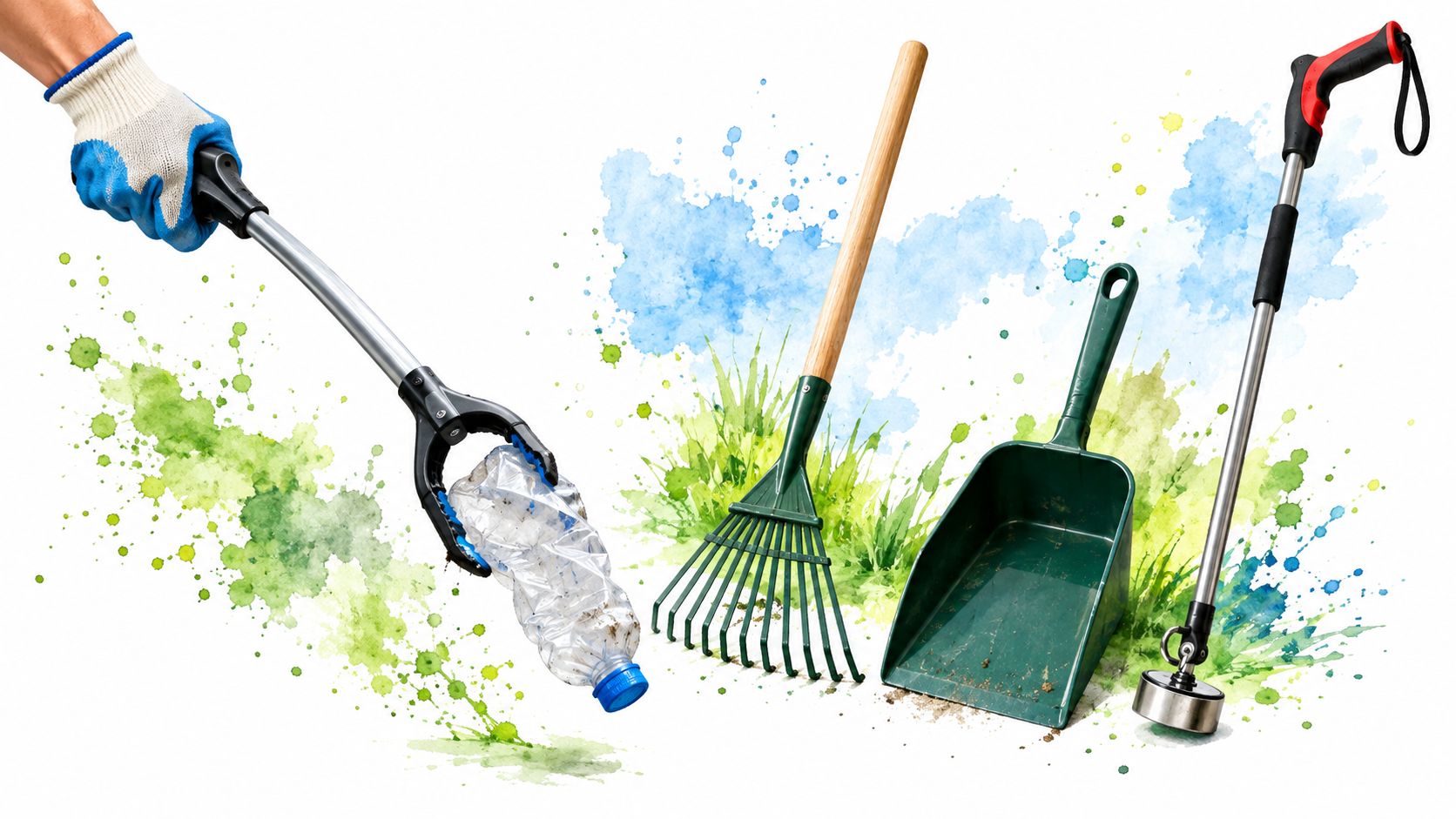
The first time I led a cleanup in a cold Chicago blow, I watched a new volunteer bend for every gum wrapper along the curb. Ten minutes later, I handed her a grabber, and her whole morning changed.
Why Your First Cleanup Feels Different With the Right Tool
I still think about one of our early Litter Caterpillars mornings, back when hail came sideways and we huddled under a tree waiting on rides that never showed. We were wet, shivering, and laughing anyway. What kept that cleanup from turning into a miserable slog was simple gear. A bag in one hand, a litter pickup tool in the other, and suddenly the work felt less like punishment and more like a strange little neighborhood adventure.

When you're new, you think pickup is about grit. Just bend down and get it done. I used to think that too. Then I saw what happens over a long sidewalk, a busy alley, or a park fence line. Bending for every cigarette pack and fast-food lid drains you fast. A decent tool keeps you upright, keeps your hands cleaner, and lets you stay in rhythm.
Why the tool changes the whole mood
A litter pickup tool doesn't just add reach. It changes your pace.
You stop doing this:
- Bend, grab, stand, step
- Bend again for the next tiny piece
- Break your rhythm every few seconds
You start doing this:
- Walk and scan
- Pinch and lift
- Drop into the bag and keep moving
That feels small until you've worked one long block. Then it feels like the difference between carrying groceries by hand and using a cart.
Practical rule: If your cleanup pace feels jerky and your back starts talking to you early, your tool choice is off.
I also want to be honest about the emotional side. The right gear makes cleanup more fun. That's not corny. When your body isn't fighting the work, your brain has room to notice the jokes, the murals, the weird little treasures people find, the conversations that start between strangers.
What you should expect from a good fit
I want you to leave your first cleanup thinking, "I can do that again next weekend."
A good litter pickup tool helps you:
- Save energy so you don't burn out halfway down the block
- Stay safer around sharp or nasty trash
- Move faster without rushing
- Feel more confident when the ground is muddy, windy, or full of mixed debris
There's a bigger cleanup economy around these tools too. Washington State's litter programs collected more than 5.2 million pounds of litter and cleaned more than 18,000 miles of road in 2024, and the same market coverage says the global litter picker market reached about USD 1.19 billion in 2024 with a projected 6.3% CAGR to roughly USD 2.06 billion by 2033 (Washington cleanup scale and litter picker market figures). I don't bring that up to sound fancy. I bring it up because these tools get used hard, at scale, by real cleanup crews and volunteers.
What a Litter Pickup Tool Is and How It Works
On a Chicago cleanup, I can usually tell who borrowed the wrong tool in the first five minutes. They are poking at a wet flyer by the curb, bending at the waist, then chasing a bottle cap that slips out of the jaws. The tool is in their hand, but it is not doing enough work for them.
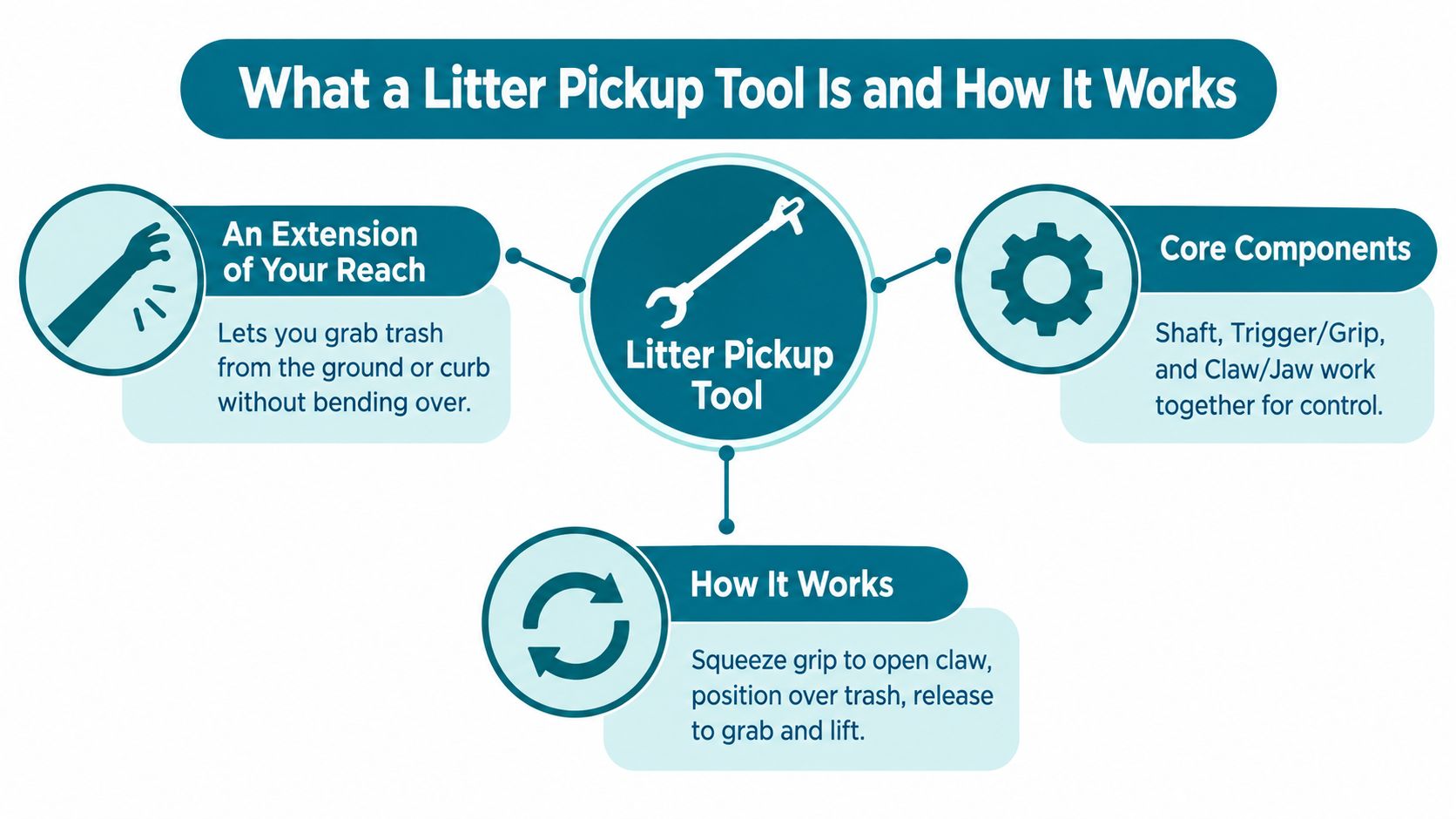
A litter pickup tool is a handheld tool that extends your reach so you can lift trash without touching it and without folding yourself over every few steps. On our routes, that usually means one thing. A grabber or tong-style picker with a handle, a long shaft, and a gripping end.
The basic idea works like kitchen tongs on a stick. Your hand makes a small motion at the grip. The tool turns that into a bigger motion at the far end, where the jaws open and close around the trash.
The three parts that matter most
Nearly every litter pickup tool has three working parts, and each one changes how the tool feels on a real block.
The handle or grip
This is your control point. Some tools use a trigger. Some use a full-hand squeeze. If you are picking along Milwaukee Avenue for an hour, a stiff grip will wear you out long before the bag is full.The shaft
The shaft gives you reach. It also sets your posture. On a flat sidewalk, the right length keeps you more upright. In a weeded lot or along a guardrail, it helps you reach trash without stepping into the mess.The grabbing end
This part meets the trash. Wide jaws can catch cups and bottles. Narrow tips do better with cigarette packs, caps, and scraps pinned in grass. That is why one tool can feel great on a boulevard and clumsy near a storm drain.
How the motion works
Most tools follow the same cycle:
- Squeeze the handle
- Open or close the jaws, depending on the design
- Set the jaws on the item
- Grip it firmly
- Lift and drop it into your bag or bucket
That cycle repeats hundreds of times in one cleanup.
A good tool makes that rhythm feel steady. A bad one turns every pickup into two or three tries, which is how a short route starts to feel long. The Conservation Volunteers describes the same basic benefit in its beginner guide. A grabber lets you pick litter at a distance, so you avoid constant bending and direct contact with trash (beginner litter-picking guidance from TCV).
Why length changes how the tool behaves
This part trips people up, so I keep it simple. Longer reach helps until it starts to hurt your control.
On open ground, a longer tool can save steps and cut bending. On a crowded city sidewalk, that same extra length can feel like carrying a canoe paddle into a hallway. You can reach farther, but you lose some precision around fences, parked cars, and bus-stop poles.
You will also see a big spread in tool lengths on the market, from shorter models around the low-30-inch range to specialty tools that go much longer. Sellers often list the reach and skip the tradeoff. More length can mean less control, more swing weight, and slower pickups in tight spaces (litter tool length and design variation examples).
Here is the curbside version I give new volunteers:
- Shorter tools feel quicker in tight spots but ask more from your back
- Mid-length tools fit the widest range of ward cleanups
- Very long tools help with ditches, slopes, or barriers, but they can feel awkward on narrow sidewalks
That is the whole machine. Your hand sends force through the handle. The shaft carries it outward. The jaws turn it into a grip on the trash. Once you see those three pieces working together, picking the right tool gets a lot less confusing.
Main Types of Litter Pickup Tools and When to Use Each
Chicago cleanup routes aren't all the same. A lakefront path, an alley behind a restaurant strip, and a highway shoulder each ask for different moves. That's why I don't like generic feature lists. I like matching the tool to the mess.
Grabbers for mixed city trash
If you only buy one tool, start with a standard grabber. This is the everyday workhorse. It handles wrappers, bottles, cups, cans, and all the annoying little curb pieces that collect around bus stops and chain-link fences.
I especially like a rotating-head grabber when I'm working parked-car edges or reaching under hedges. You can angle the jaws instead of twisting your whole wrist. That's handy when you're trying to pick a bottle off a sloped curb or fish a can from between weeds.
Rakes and scoops for light spread-out debris
A rake is useful when the ground is covered in leaves mixed with paper bits, napkins, or foam cups. I use that kind of setup in park edges and vacant-lot corners where litter sits in a thin layer across dirt or grass.
Scoops help when tiny scraps pile up in one spot. Think broken bits around a bench, mulch beds full of candy wrappers, or the grit line near a storm drain. A scoop can gather what a claw keeps missing.
If your route has mostly flat, light debris, a rake or scoop can beat a grabber on speed. If the trash is mixed and awkward, a grabber usually wins on control.
Magnet poles and simple DIY options
Magnet poles do one job. They pick up metal. If you're collecting nails, caps, or small ferrous scraps near construction edges, they help. For paper, plastic, or glass, they won't do much.
DIY tools can work in a pinch. I've seen people use barbecue tongs, improvised sticks, and garden tools. That's fine for a quick solo block if you're careful, but for group cleanups I want actual pickup tools with predictable grip and reach.
Here's the fast match guide I use.
Which Litter Pickup Tool Fits Your Cleanup Job
| Tool Type | Best For | Watch Out For |
|---|---|---|
| Standard grabber | Sidewalk litter, bottles, cans, wrappers, park paths | Cheap jaws can slip on thin or wet items |
| Rotating-head grabber | Curbs, fence lines, under bushes, awkward angles | More moving parts can feel looser over time |
| Rake | Leaves mixed with light litter on grass or dirt | Hard to control for single items |
| Scoop | Small scraps gathered in one area | Clumsy on uneven ground |
| Magnet pole | Metal bits near construction or alleys | Useless on plastic, paper, and most common street litter |
| DIY tongs or improvised tool | Very light personal use | Weak grip, less safe, poor control |
My Chicago ward rule of thumb
When I lead volunteers, I think in terrain first.
- Busy commercial strips: Bring a grabber for cups, receipts, and food containers around curbs and planters.
- Residential blocks after wind: Use a grabber, and add a small scoop if the tree lawn has shredded paper bits.
- Alleys: Choose a stronger jaw that can handle bottles, cans, and damp trash.
- Vacant lots: Mix tools. One person with a grabber, one with a rake for loose litter in grass.
- Shoulders and rough edges: Longer reach helps, but too much length makes control sloppy.
If you want to compare common cleanup gear before an event, I like using a practical roundup like trash pickup equipment for volunteer cleanups as a planning reference.
Safety and Ergonomics That Keep You Picking Longer
The fastest way to wear out a new volunteer is simple. Hand them a tool that fights their body.
I learned that on a cold ward cleanup near an alley off Milwaukee. One volunteer brought a short bargain grabber from home. It looked fine in the parking lot. Twenty minutes later, she was bending for every cup and twisting her wrist to reach under parked cars. Another volunteer had a longer, lighter tool with a grip that sat naturally in the hand. Same route. Same trash. One person was fading, and the other was still moving smoothly an hour later.
A litter pickup tool should feel like a good broom. It should extend your reach without changing the way your body wants to stand and move.
Start with posture, not features
On Chicago sidewalks, posture usually matters more than an extra gadget on the tool.
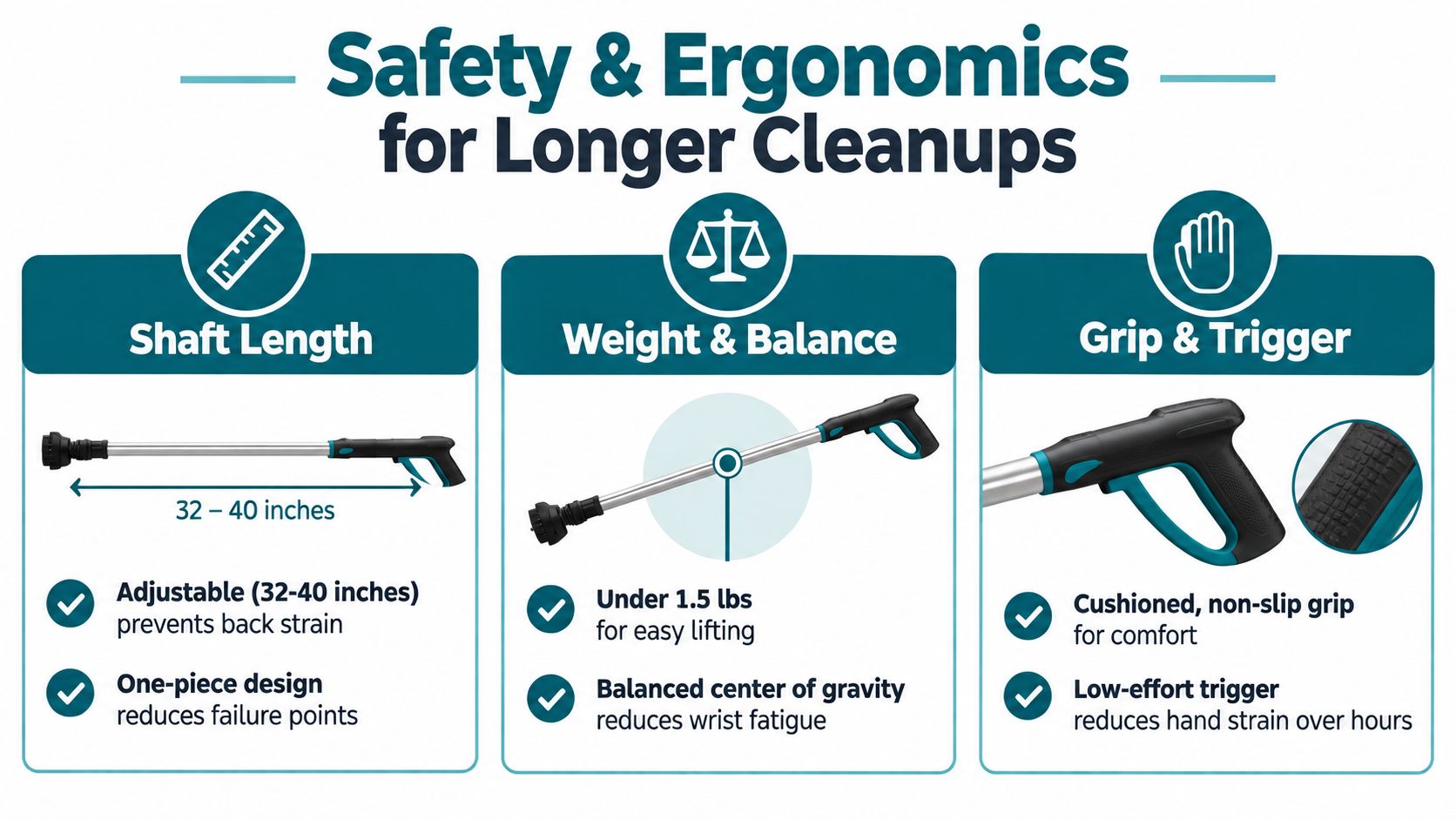
Your back should stay relaxed and fairly upright. Your shoulders should stay low. Your wrist should stay close to straight when the jaws meet the ground. If one of those three starts working too hard, the tool is the problem.
Length drives most of that. A tool that is too short makes you fold at the waist, especially on long curb runs. A tool that is too long can feel sloppy in tight spots like bus stops, chain-link fence lines, and the space between trash cans in alleys. Weight matters too. A heavy picker may feel solid for the first few grabs, then start dragging on your forearm once you have walked two or three blocks.
Before I send a group out, I ask people to do a simple test.
- Stand naturally with the tip near the ground
- Reach for a spot near your shoe without hunching
- Check your wrist to see if it stays mostly straight
- Swap tools if your shoulder lifts or your grip feels strained
That thirty-second check saves a lot of complaints later.
Match the tool to the block
Ergonomics are not just about your body in the abstract. They depend on where you are picking.
On a flat residential sidewalk with wrappers and cans, a standard reach tool usually lets you keep a nice rhythm. In an alley with damp bags, broken-down boxes, and heavy drink containers, stronger jaws and a steadier shaft matter because you do not want to squeeze twice for every pickup. Along a boulevard edge or a weedy vacant lot, extra reach helps, but only if you can still control the tip. Too much length out there feels like trying to write your name with a yardstick.
That is why I choose for terrain first, then comfort. The right ergonomic tool is the one that keeps your body neutral while handling the trash sitting in that ward.
Gloves are required
I never let volunteers treat gloves as optional.
You should always wear heavy-duty gloves and use a litter picker when possible. Safety guidance from Keep Britain Tidy warns against picking litter up by hand because sharp objects can hide inside ordinary trash (heavy-duty glove and tool guidance from Keep Britain Tidy).
Street trash hides surprises. A paper sack can cover broken glass. Wet leaves can hide a can lid. A crushed bottle near the curb can break again when the jaws press down on it. Gloves and a pickup tool give you one more layer between your skin and the mess.
Build the pause-before-you-pick habit
Good volunteers get faster by slowing down for one beat.
I teach people to pause, read the item, then grab. Volunteer risk guidance advises using litter pickers where possible and checking items for sharp edges or contamination before handling them (volunteer litter-picking risk guidance).
On the street, that habit looks like this:
- Look first for shine, jagged edges, or leaking spots
- Notice the surface if the item is wet, torn, or partly buried
- Grab from the safest angle instead of rushing straight in
- Leave it and report it if it looks hazardous
If you want a plain-language refresher, this guide on how to pick up trash safely during community cleanups pairs well with what I teach on weekend routes.
One last thing. If a tool makes you shrug your shoulders, clamp your hand too hard, or bend every few steps, do not try to tough it out. Switch tools early. A cleanup should leave you tired in the normal way, not sore from fighting your gear.
Cost Tiers and Volunteer Friendly Models You Can Trust
You don't need to overthink your first buy. You aren't outfitting a moon mission. You're trying to clean your block without wrecking your back or buying junk that quits after two Saturdays.
I sort litter pickup tools into three practical tiers. I don't need an exact sticker price to make the decision. I just look at use frequency, trash type, and whether I'm buying for one person or a whole crew.
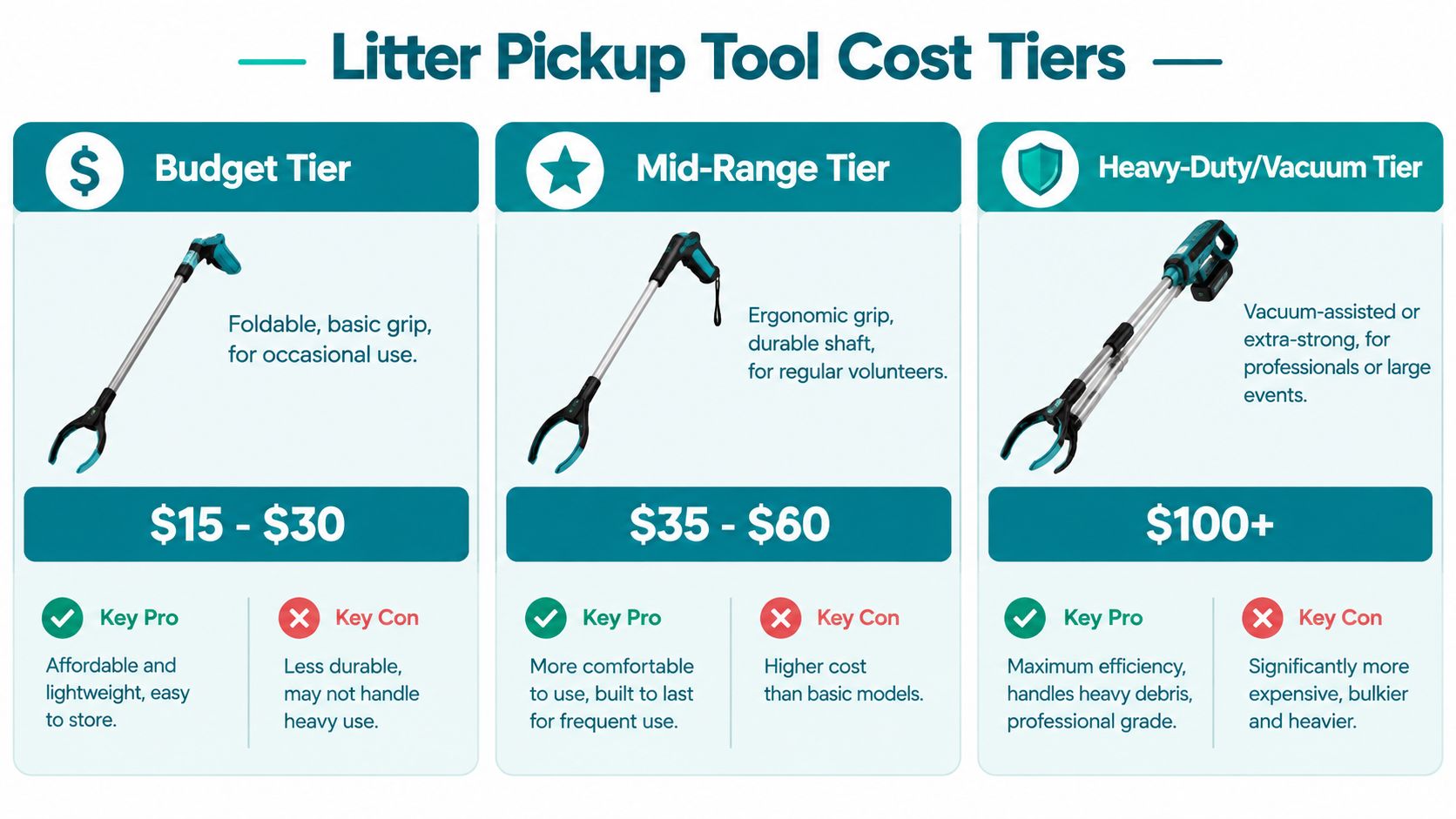
Budget tools for casual block walks
Foldable grabbers and basic pickup claws usually sit here. They're fine for occasional walks, quick curb checks, or someone who wants to keep a tool in the car.
The tradeoff is feel. Budget tools can be perfectly usable, but they often have shakier jaws, less comfortable grips, and more flex in the shaft. If you're only doing short sessions, that may not bother you. If you're doing weekly pickups, you'll notice.
Mid-range tools for regular volunteers
This is the sweet spot for those I clean with. A stronger shaft, better grip, and more reliable jaw shape make a difference over time. If you pick up mixed litter on sidewalks, alleys, and parks every weekend, this is usually where your money works hardest.
I also like this tier for student groups and neighborhood captains. The tools usually hold up better when different people use them back-to-back.
Heavy-duty and machine-assisted setups for big events
This tier is a different animal. Once you get into municipal or industrial cleanup, the upgrade is the collection system, not just the hand grip.
Some vacuum-based litter pickers pair with a 240-liter container and suction systems that can ingest mixed debris like cans, bags, and bottles. Larger municipal machines use 80-gallon tanks, 16-gauge steel construction, and about a 2:1 compaction ratio, which extends service time and cuts dump frequency because crews spend less time stopping to unload (industrial litter system container and compaction specs).
For a volunteer group, that idea matters even if you never touch a machine. Bigger bags, smarter staging, and fewer dump runs keep your crew working instead of walking trash back and forth.
How I buy for a group
I don't buy every tool at the same level. I mix the kit.
- For new volunteers: Keep a batch of simple, dependable grabbers that fit most.
- For regulars: Add sturdier ergonomic models for longer routes and rougher debris.
- For specialty jobs: Keep a few oddballs around, like stronger jaws for alley glass or a rake for lot edges.
If you're joining a cleanup instead of buying your own right away, one practical option is a group that already supplies tools. Litter Caterpillars runs volunteer trash pickups in Chicago where grabbers are part of the event setup, so you can test what feels right before spending money.
Simple Maintenance and Storage That Extends Tool Life
I've seen good tools die early from one lazy habit. People toss them in a wet trunk, leave grime in the jaws, and forget about them until next weekend. Then the spring sticks, the grip smells weird, or the claw stops closing cleanly right when the route starts.
You don't need a fancy routine. You need a repeatable one.
My three-minute post-cleanup reset
When I get back from a pickup, I do the same quick sequence every time.
Wipe the shaft
Dirt and street residue build up fast, especially after rain.Check the jaws
Look for lodged plastic, string, or sharp fragments.Dry the tool fully
Moisture is what turns a decent tool into a cranky one.Test the action
Open and close it a few times. You want a clean snap, not a sluggish chew.
Clean tools are safer to handle next time. They also make wear easier to spot before a volunteer ends up fighting a half-broken grip.
Where to store it in real life
Storage doesn't need to be pretty. It just needs to keep the tool dry and easy to grab.
- Apartment living: Hang it in a closet corner or behind a door so the jaws don't snag bags or coats.
- Garage setup: Keep it off the floor. Wall hooks work well.
- Group shed or shared space: Stand tools upright or hang them by type so people don't crush lighter grabbers under heavier gear.
What wear looks like before failure
A tool usually warns you before it quits.
Watch for:
- Loose jaws that wiggle side to side
- Sticky triggers that don't spring back smoothly
- Hairline cracks near the grip or hinge
- Bent shafts after rough alley work
When I see those signs, I pull the tool from group use until I can test it. Mid-route failures waste time, but worse than that, they frustrate new volunteers who are still deciding whether cleanup feels welcoming or annoying.
Pick Your Tool and Join the Next Chicago Cleanup
When you strip away the product chatter, the decision is pretty simple. Match your tool to your height, your route, and the kind of trash you see.
If you're cleaning a regular city sidewalk, start with a mid-length grabber that feels light and controlled in your hand. If you're taller, give yourself more shaft length so you can stay upright. If you're heading into grass, lot edges, or places with spread-out light debris, add a rake or scoop to the plan.
My simple choice filter
Ask yourself three questions:
- Where am I cleaning? Sidewalk, alley, park edge, vacant lot
- What am I picking up? Wrappers, bottles, cans, leaves, metal bits
- How long will I be out? Quick block walk or full morning shift
That gets you most of the way there. The right litter pickup tool should feel obvious once you stop shopping by gimmick and start shopping by route.
Why this matters on a weekend morning
When your gear fits the job, your attention shifts. You stop thinking about your lower back, your sore grip, or whether you should've stayed home. You start noticing the people next to you. You talk. You laugh. You finish a block and want one more.
That's the good stuff.
If you're ready to test your setup with other people, join a Chicago litter cleanup volunteer event and try your tool on real streets, real curbs, and real mixed trash. One solid morning will teach you more than a week of scrolling product pages.
Pick one tool. Walk one block. Let the city teach you the rest.
If you want a place to use a litter pickup tool with other kind, brave people, Litter Caterpillars organizes weekend Chicago cleanups where volunteers can show up, grab gear, and get to work together. It's a simple way to test what tool feels right on real sidewalks, meet people, and help clean the city one block at a time.
Leave a Reply