Tag: volunteer chicago

  • Your Guide to St. Teresa of Avila Chicago

    Your Guide to St. Teresa of Avila Chicago

    I once walked down Armitage half-distracted, coffee in hand, thinking about my own mess of a week, and I looked up at St. Teresa of Avila Church like I was seeing it for the first time. It stopped being background and started feeling like a door.

    More Than Just a Building on Armitage

    Some places in Chicago hide in plain sight. You pass them on your way to class, work, brunch, a bad date, a better date, the train, the grocery store. Then one day your life feels a little scraped up, and the same old building suddenly looks like a place where you could breathe.

    That's how I think about St. Teresa of Avila Chicago.

    It sits at 1037 W Armitage Ave, Chicago, IL 60614, right in the DePaul and Lincoln Park orbit, where people are always arriving and leaving, starting over, trying on new versions of themselves. In a city like this, that matters. You can feel surrounded all day and still feel unknown.
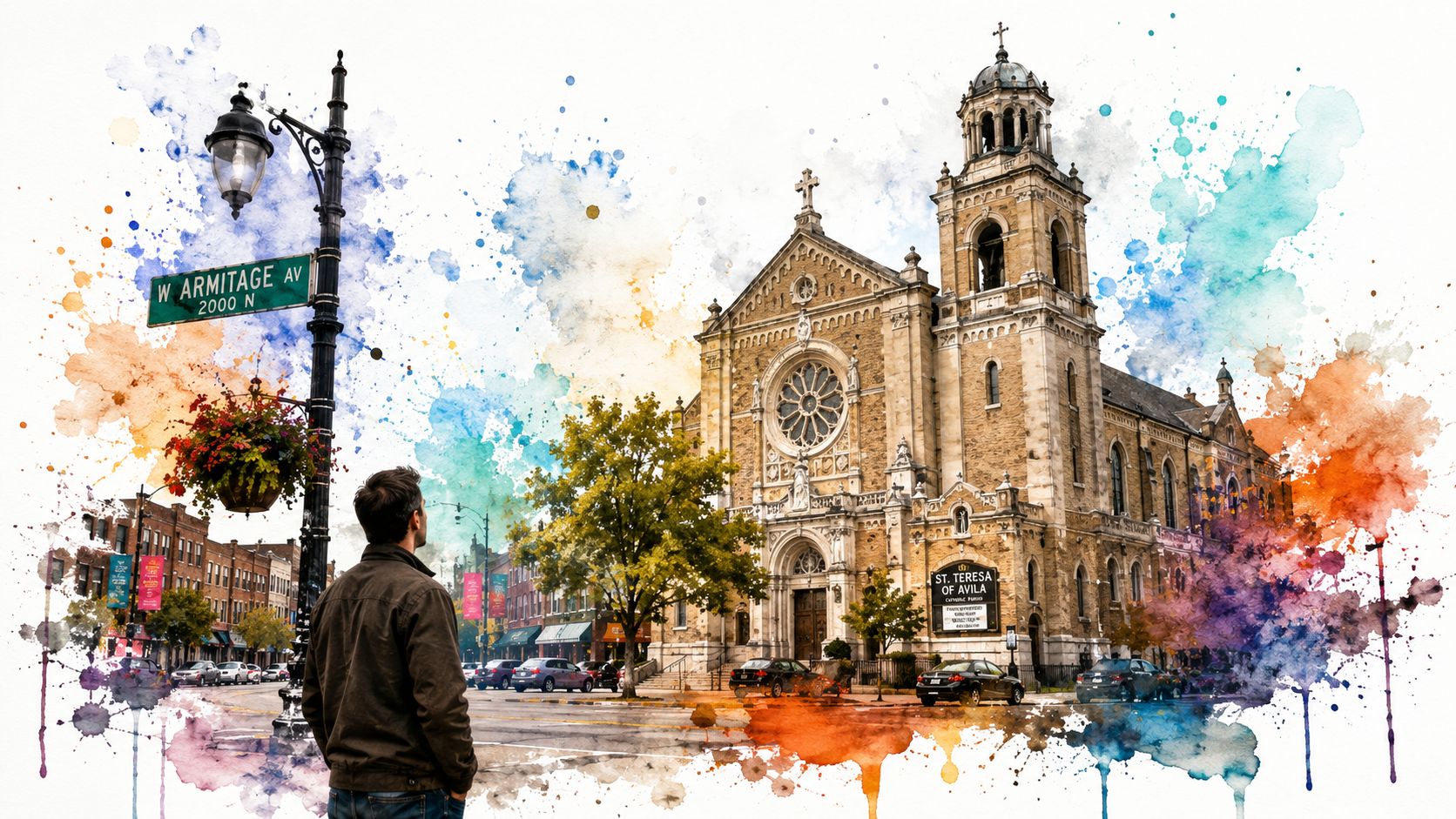
    A man stands on a street corner looking at the historic St. Teresa of Avila Church in Chicago.

    When a familiar place turns personal

    I've learned that neighborhoods are a lot like bookshelves. Most of us only pull down the titles we already know. We keep walking past the rest.

    Then something shifts. Maybe you're new to Chicago. Maybe you've lived here for years but your people moved away, your schedule changed, your faith got quieter, or your habits got too small. A church you ignored can start to look less like an old landmark and more like a bench after a long walk.

    St. Teresa's has that kind of pull. The parish says it welcomes everyone without exception, and that line lands differently when you're the one wondering where you fit. I like places that don't make you audition for belonging.

    Practical rule: If you keep passing a place and thinking, “I should go in sometime,” go in. Curiosity is often your better self trying to get your attention.

    What I notice on this block

    Armitage is busy, but the church changes the tempo. You feel it. The street still moves, but your eyes slow down.

    That's useful in Chicago. We rush so much here. We optimize, schedule, commute, swipe, compare. We can treat the whole city like a vending machine and then wonder why we feel hollow. A parish like this gives you another option. You can show up with no big speech ready. You can sit down. You can listen. You can let a neighborhood become more than a map.

    A church isn't magic. Bricks don't fix loneliness by themselves. But a real place with real people can interrupt the drift.

    How to see your own neighborhood differently

    If you're curious about St. Teresa of Avila Chicago, or any place like it, I'd start simple:

    • Walk slower: Don't arrive with headphones and your head down. Look at the doors, the bulletin boards, the people lingering after Mass.
    • Notice repeated life: A place becomes a community when you see the same faces doing ordinary things again and again.
    • Ask one small question: “When should I visit?” works better than waiting until you've solved your whole spiritual biography.
    • Let place shape you: You don't need a dramatic conversion story. Sometimes change starts with learning one corner of your neighborhood by heart.

    That's the first gift of a place like this. It reminds you that your life in the city doesn't have to stay scattered.

    The Story of This Chicago Parish

    Before you visit a church, it helps to know whose name is on the door. In this case, the story starts far from Lincoln Park.

    Saint Teresa of Ávila was born on March 28, 1515, in Ávila, Spain, and died on October 4, 1582, at 67. She was the first woman named a Doctor of the Church, an honor Pope Paul VI gave her in 1970, and Britannica's biography of Saint Teresa of Ávila notes that she founded 14 new Discalced Carmelite convents and played a major part in the Carmelite Reform despite years of ill health.

    Keep the two stories separate

    I think it helps to hold two facts in your head at once.

    First, the saint and the Chicago parish are not the same thing. The woman lived in 1500s Spain. The church on Armitage is a neighborhood parish in modern Chicago that carries her name.

    Second, names matter. When a parish takes the name of someone like Teresa, it borrows a kind of tone. Teresa's life had grit. She kept traveling, organizing, writing, and rebuilding even when her body made things hard. That doesn't mean a church named after her automatically becomes brave. It means the name itself is a challenge.

    A short way to understand the namesake

    If church history usually makes your eyes glaze over, think of Teresa this way. She was like the friend who walks into a cluttered room, opens the windows, and says, “We can live better than this.” Then she gets to work.

    Her major books include The Interior Castle, written in 1577 and published in 1588, and The Way of Perfection, both named by Britannica as major works of Spanish Renaissance literature and Christian mysticism. She was canonized on March 12, 1622, and her feast day is October 15, but what grabs me most isn't the list of honors. It's the stubbornness.

    Teresa's story feels less like a museum plaque and more like a hand on your shoulder saying, “Start with what you can repair today.”

    The parish in Chicago

    The Chicago church has its own long life. A multimedia book marks 125 years of parish history, and that tells me this isn't a pop-up community or a trendy experiment. People have been gathering here through different city eras, different neighborhood moods, different family stories.

    That matters in Lincoln Park, where so much can feel temporary. Apartments turn over. Students graduate. People move after a lease, a breakup, a job switch. A parish with that much local memory can become a steadying place for people who feel like they're always in transit.

    I wouldn't romanticize that history. Old institutions can get sleepy. But they can also become useful when they keep opening the door to the next wave of people who need a place to land.

    Planning Your Visit to St. Teresa of Avila

    If you want to visit, keep it easy. Don't turn it into a research project that never leaves your notes app.

    The basic facts are enough to get you out the door. According to the St. Teresa of Avila Catholic Church listing on Yelp, the church is at 1037 W Armitage Ave, Chicago, IL 60614, and Mass times include Saturday at 5:00 pm and Sunday at 9:00 am, 10:30 am (Spanish), 12:00 pm, and 6:00 pm.

    Parish details at a glance

    Service/Info Details
    Church name St. Teresa of Avila Catholic Church
    Address 1037 W Armitage Ave, Chicago, IL 60614
    Saturday Mass 5:00 pm
    Sunday Mass 9:00 am
    Sunday Spanish Mass 10:30 am
    Sunday Mass 12:00 pm
    Sunday Mass 6:00 pm

    How I'd choose a time

    If you're nervous, I'd pick the time that creates the least friction.

    • For families: The 9:00 am Sunday Mass is listed as the family Mass in the parish details noted earlier in the article.
    • For Spanish speakers: The 10:30 am Sunday Mass is in Spanish.
    • For a lower-pressure first step: A Saturday evening visit can feel easier if your Sunday mornings are chaos.
    • For students and working adults: The 6:00 pm Sunday Mass may fit better if weekends get swallowed by errands and recovery.

    If you're trying to build a fuller weekend around neighborhood connection, I'd also keep an eye on Chicago community events from Litter Caterpillars. Even if you're only browsing, it helps to think of a visit as part of a real life in the city, not an isolated errand.

    A few practical tips

    Lincoln Park can feel easy until you're circling the block. Give yourself extra time. Chicago punishes the person who leaves “just enough” buffer.

    Wear shoes you can walk in, arrive a little early, and let yourself sit for a minute before deciding what the place means to you.

    You don't need a perfect outfit, a polished prayer life, or insider knowledge. You just need to show up.

    Finding Community Inside and Out

    The most interesting thing about a parish usually isn't the building. It's the kind of human temperature you feel once you get close.

    At St. Teresa's, the language of welcome matters. The parish presents itself as open to everyone without exception, and that kind of sentence is easy to print and harder to live. In Lincoln Park, where people can sort themselves into tiny islands by age, income, politics, school, or comfort level, a church has to make welcome concrete or the words go flat.

    What welcome feels like

    I think real welcome has texture. It sounds like hearing different languages in the same place. It looks like a young person who doesn't know the routine standing next to someone who does. It feels like not being treated as a problem to solve.

    St. Teresa's has that possibility because of where it is and who passes by it every day. Students. longtime residents. people raising kids. people carrying grief. people who like church. people who haven't trusted church in a while but still miss the smell of candles and the rhythm of prayer.

    That mix can be awkward. Good. Awkward means real humans are in the room.

    Inside the walls and beyond them

    The church's modern identity is centered on caring for each other, faith, and community. I like that because it pulls faith out of the abstract. Caring for each other is concrete. It's casseroles, phone calls, names remembered, rides arranged, kids wrangled, prayers said for somebody who looks exhausted.

    But neighborhood community shouldn't end at the door. If you live near Armitage, then the sidewalk, the curb, the bus stop, and the park bench are all part of your moral life too. A parish that talks about social justice has a chance to make that visible in the everyday fabric of the block.

    If you're someone who wants friendship and service to grow together, I'd also read this guide on how to make friends in Chicago. I like advice that treats friendship as something you practice, not something that magically appears.

    Community gets real when people do ordinary work together often enough to stop being strangers.

    A simple test

    When I'm trying to understand whether a place could become part of my life, I ask three plain questions:

    • Do people seem reachable? Not polished. Reachable.
    • Is there room for my actual life? My schedule, my doubts, my energy level.
    • Can this place move from talk to action? Even small action counts.

    That last question matters most to me. Warmth is good. Shared work is better. That's where a neighborhood starts feeling less like rented space and more like home.

    A New Way to Serve the Neighborhood

    I keep thinking about a simple mismatch.

    St. Teresa's has language around social justice and service. It also has a neighborhood right outside its doors that needs care in ordinary, physical ways. Yet one documented gap keeps hanging in the air: while 72% of urban social-justice Catholics in Chicago prefer hands-on environmental service, St. Teresa's volunteer page focuses on indoor roles and shows no public collaboration with grassroots cleanup groups in the last year, according to this documented critique of the parish's public-facing service gap.

    That doesn't mean nobody at the parish cares about the street. It means the public path from belief to visible neighborhood cleanup is hard to see.
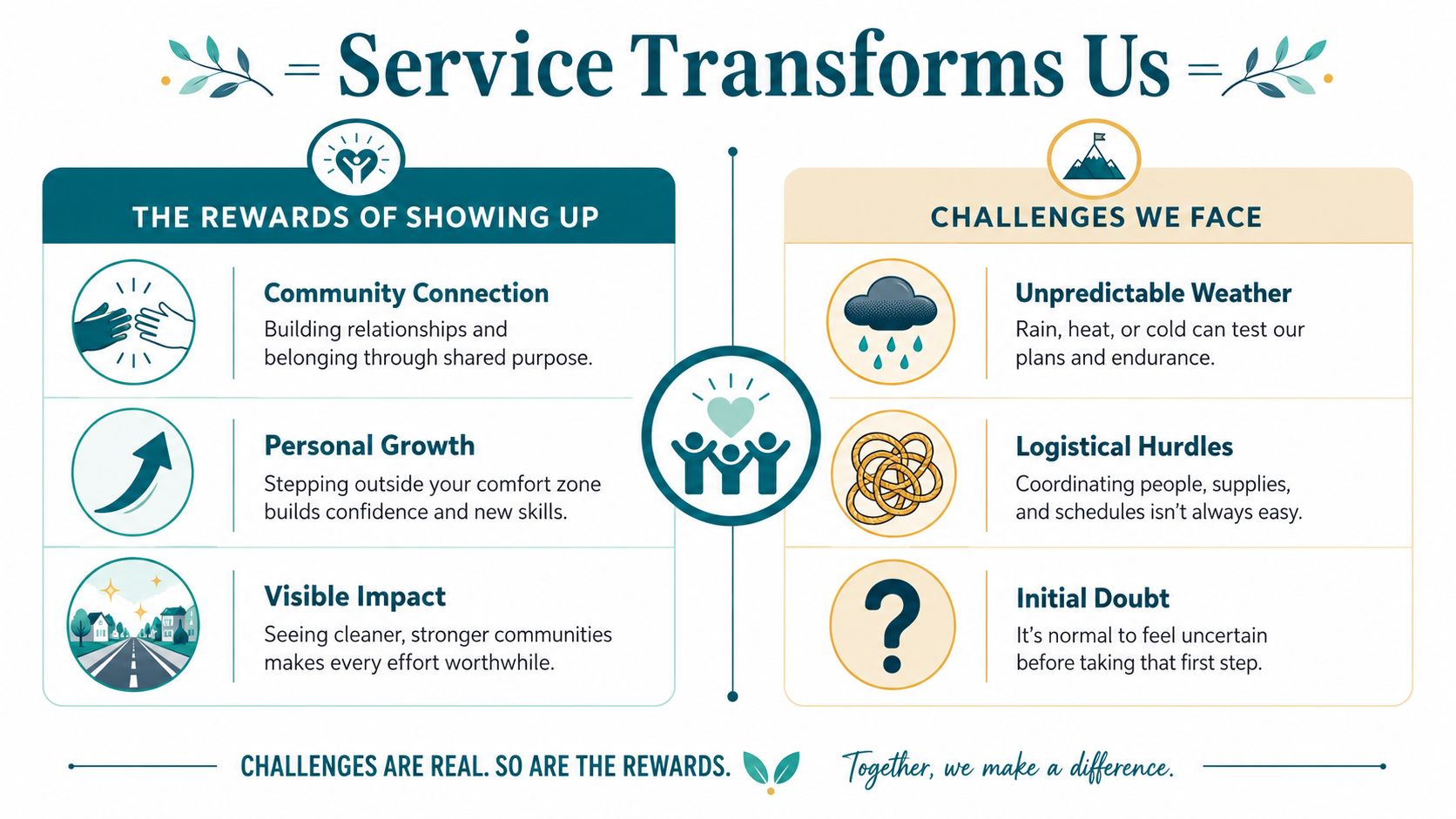
    An infographic titled Service Transforms Us, contrasting the rewards of volunteering with the challenges faced.

    Why outdoor service changes people

    Indoor volunteer work matters. Meals, hospitality, setup, administration, all of that counts. But outdoor service has a different feeling.

    You can't fake it on a sidewalk. A bag fills up or it doesn't. A block looks cleaner or it doesn't. You meet weather, mess, inconvenience, and your own resistance all at once. Then you work anyway.

    That kind of service strips away a lot of fluff. It gets you out of the “I support good things” posture and into “I bent down and picked that up with my own hand.” For people who are restless, skeptical, young, new to the city, or tired of talk, that matters.

    What this could look like near Armitage

    If I were sketching a practical model for St. Teresa of Avila Chicago, I wouldn't start with a giant program. I'd start small and visible.

    • A monthly neighborhood cleanup after Mass: One hour. Gloves, bags, simple route, clear meeting point.
    • A student-and-neighbor team: DePaul students and longtime parishioners working side by side changes the social chemistry fast.
    • A prayer-to-action rhythm: Gather, receive a short blessing, head outside, clean the block.
    • A recurring invitation for newcomers: The easiest way to meet people is to have a job together.

    You don't need complicated branding for that. You need consistency.

    A church says what it believes with its calendar almost as much as with its sermons.

    Why this fits the parish better than people might assume

    The namesake of the parish was a reformer. The parish itself talks about care, faith, and welcome. A neighborhood cleanup is one of the simplest ways to make those words solid.

    I'm not talking about replacing worship with activism. I'm talking about letting worship spill onto the sidewalk. If a church says “serve the Poor,” then cleaner streets, safer paths, and shared labor in public view are one honest way to say it with your body.

    And there's another gift in it. Outdoor service creates friendships with less awkwardness. People who hate small talk often do great with a trash grabber in hand because the work gives the conversation somewhere to stand. You don't have to invent connection from scratch. The task does part of the work for you.

    The courage piece

    Every service project has a small wall at the beginning. Weather might be bad. Turnout might be uneven. Somebody might feel silly. Somebody always does.

    But neighborhoods rarely change because everyone felt perfectly ready. They change because a few people decided that visible care was better than private approval.

    That's why this question matters to me: if St. Teresa of Avila in Chicago wants social justice to feel tangible, what would happen if the parish treated the block outside as part of its ministry?

    I think a lot of people are waiting for someone to ask that out loud.

    Show Up and Transform Yourself

    I've seen people change when they stop waiting for the perfect mood and just show up. You can watch it happen in tiny ways. A stiff face relaxes. A shy person starts joking. Someone who came alone leaves with plans for coffee.

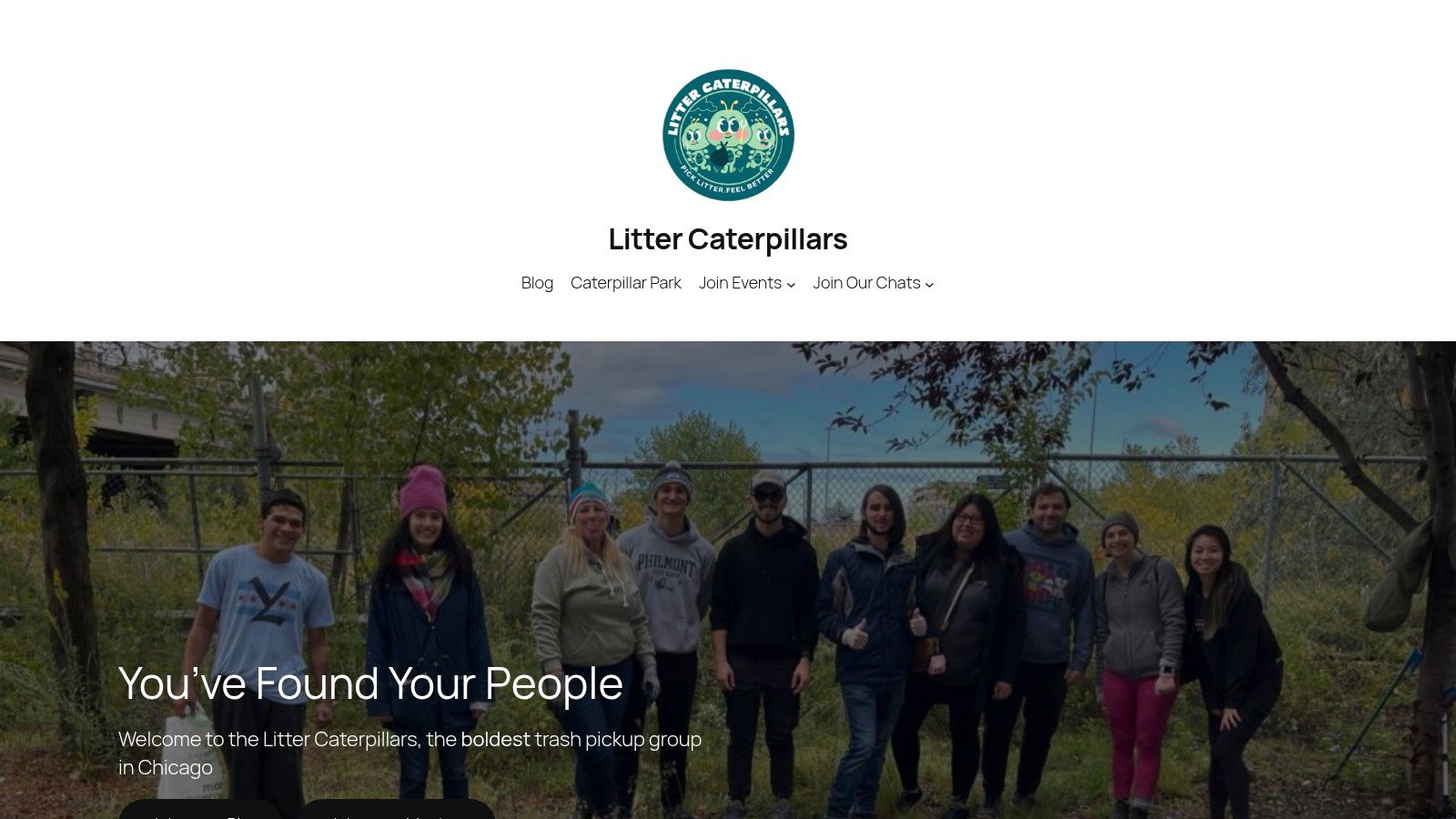
    That's why I keep coming back to the power of a weekend habit. According to Litter Caterpillars' own explanation of its volunteer schedule, the group intentionally places events on Saturday or Sunday mornings to attract “givers” and build a community around service, kindness, and friendship. I like the bluntness of that. Your calendar is a filter. It shapes who you become.
    Screenshot from https://www.littercaterpillars.com

    Start smaller than your excuses

    Maybe your version of showing up is simple. Visit St. Teresa's one weekend. Sit in the back if you want. Stay for a few minutes after. Learn the feel of the room.

    Maybe your next move is service. If that's you, this guide on how to start volunteering is a good nudge because it treats action like a thing you can begin before you feel fully ready.

    I think of Tom Sawyer and the fence. Work changes when you stop treating it like punishment and start treating it like participation in a story. The block needs care. Your life probably does too. Sometimes the best way to begin fixing your own scattered heart is to help clean one corner of your city.

    You don't need a grand plan. You need one honest morning.


    If you want a simple way to meet kind people and do visible good in Chicago, check out Litter Caterpillars. Show up for one cleanup, bring gloves if you have them, and let the city introduce you to a better version of yourself.
  • Harrison Smith Park: A Guide for Chicago Volunteers

    Harrison Smith Park: A Guide for Chicago Volunteers

    I once watched somebody show up to a cleanup in Chicago thinking they were headed to a park with a pool in Ohio. We laughed, handed them gloves, and by the end of the morning they said they were glad they got lost.

    Which Harrison Smith Park Are You Looking For

    You probably typed Harrison Smith Park because the name feels clear enough. It isn't. That name sends people in a few different directions, and I get why.

    One path takes you to Harrison Smith Park in Upper Sandusky, Ohio, at 525 E Wyandot Ave, Upper Sandusky, OH 43351, and it has a public swimming pool as its primary amenity according to the Harrison Smith Park listing in Upper Sandusky. If you wanted flip-flops, summer chlorine, and a pool deck, that's your place.

    The Chicago mix-up

    Then Chicago enters the chat and makes everything messier.

    Some people mean Harrison Park in Pilsen. Some mean Smith Park on the West Side. Some mash the names together and search for Harrison Smith Park as if the city fused them overnight. I like that confusion. It feels human. We do this with places the same way we do it with memories. We blur names, but we remember the feeling.

    If you're trying to sort out the Chicago side of this, start with this guide to Harrison Park in Pilsen. It helps if you're looking for the park by the museum, the courts, the fields, the neighborhood rhythm.

    A park name matters less than what your hands do when you get there.

    Why the confusion matters less than you think

    I care about this mix-up for a simple reason. Searchers aren't really searching for a noun. They're searching for a place to go, something to do, and maybe a reason to get out of their own head for a few hours.

    I've seen that search look a hundred different ways. One person wants a calm walk. One wants a place to volunteer. One wants to feel useful after a rough week. One just wants to be around decent people without needing to explain their whole life story first.

    So yes, there is a real Ohio park with a pool. Yes, there is a Harrison Park in Chicago. Yes, there is a Smith Park in Chicago that gets mixed into this too.

    Here's the simple version:

    Search phrase What you may mean What it has
    Harrison Smith Park Upper Sandusky, Ohio Public swimming pool
    Harrison Park Pilsen, Chicago Fields, courts, playground, garden
    Smith Park West Side, Chicago Historic park on former quarry and landfill land

    If you're in Chicago and you're looking for a park with grit in its story, dirt under its fingernails, and the kind of energy that makes you want to do more than stare at grass, you're probably looking for one of the Chicago parks. That's where this story really starts.

    A Chicago Park's Surprising History

    I love places with ugly beginnings. Maybe because I trust them more.

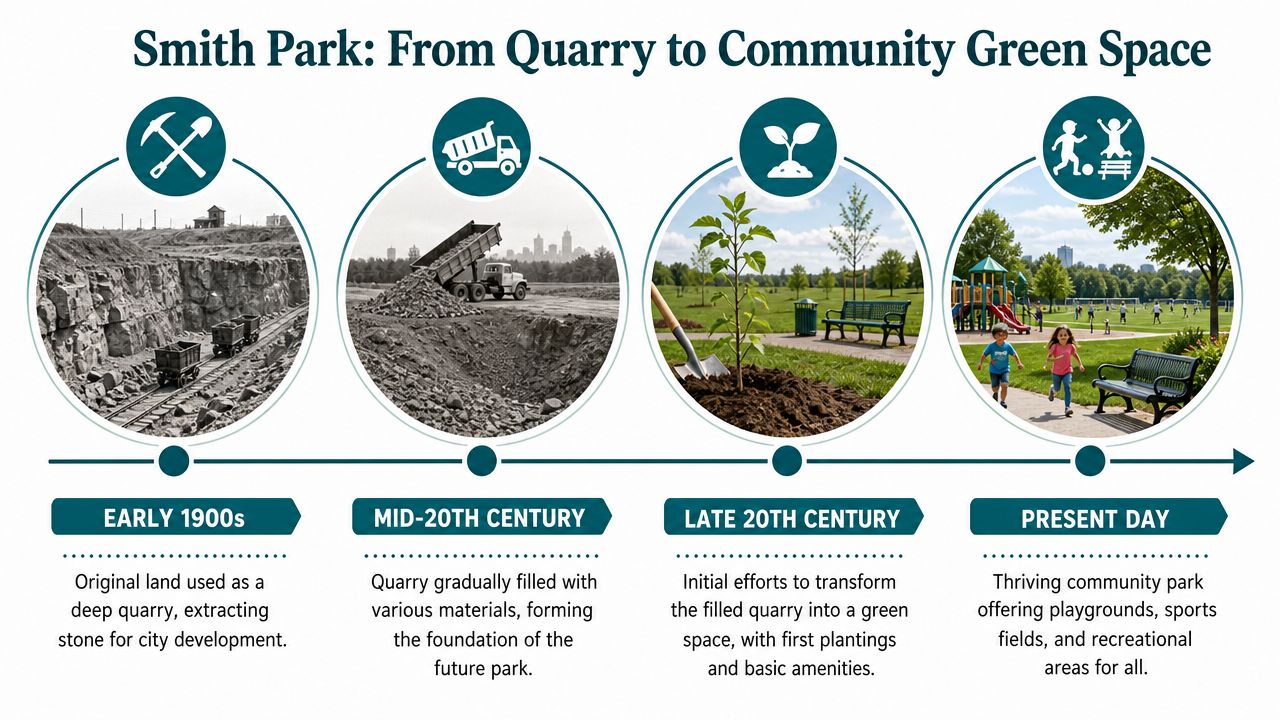
    Smith Park didn't begin as the kind of place where you'd toss a ball around or sit on a bench with a coffee. Smith (Joseph Higgins) Park in Chicago was founded in 1929 after a former quarry and landfill was filled to the brim by the mid-1940s, with the site transferred to the Bureau of Parks and Recreation in 1929, as described in this history of Chicago's West Side quarries.

    From hole to home ground

    Start there for a second. A quarry is a wound in the ground. People cut stone out of it. They take and take until the land looks like a giant missing tooth. Then people start dumping into it. Layer by layer, the city hides its mess in the same place it once carved for material.

    That story hits me hard because it feels familiar. I know what it's like to look at a mess and think, this thing is too old, too tangled, too embarrassing to fix. I know what it's like when every piece of junk has a memory attached to it, and moving one tiny thing feels like lifting a refrigerator with your bare hands.

    Then you look at a place like Smith Park and realize land can recover enough to become useful again. Not magically. Not cleanly. But well enough that kids run around there and neighbors gather there and life keeps happening on top of old damage.

    A timeline graphic showing the transformation of Smith Park from a stone quarry to a community park.

    Why I can't stop thinking about that story

    A lot of us carry quarry years. Then landfill years. Then maybe, if we're stubborn, we build something decent over the top.

    That doesn't erase what came first. It just means the old mess doesn't get the final word.

    Some places make sense only after you know what used to sit under your feet.

    When I walk through a park with that kind of past, I don't feel discouraged. I feel challenged. If a city can take a scar in the earth and turn it into a place where people meet, play, and breathe for a while, then you and I can probably face our own pile of wreckage too.

    Smith Park's history is earthy and blunt. That's why I like it. No fake perfection. Just dirt, trash, labor, time, and another chance.

    Exploring Chicago's Community Green Spaces

    If you want the practical version, here it is. Chicago gives you different flavors of public space, and the two parks tangled up in the Harrison Smith Park search each pull people in for different reasons.

    A vibrant illustration of people enjoying various outdoor activities in Chicago parks, including kayaking, basketball, and gardening.

    Harrison Park in Pilsen

    Harrison Park is the one many Chicago searchers want. You can find it at 1824 S Wood St, Chicago, IL 60608, right next to the National Museum of Mexican Art in Pilsen, according to the Harrison Park page on Tripadvisor.

    And the park itself gives you room to move. Harrison Park's nearly 18 acres include tennis courts, basketball courts, baseball fields, athletic fields for football or soccer, plus a playground and community garden, as noted in Time Out's Harrison Park overview.

    That list matters because it tells you how to use the place.

    • If you want motion: Hit the courts or fields. This is the park for people who don't want to sit still.
    • If you want family time: The playground gives kids something immediate to do while adults breathe for a minute.
    • If you want neighborhood texture: Walk by the garden, circle the edges, and look at who's using the place.

    I like parks more when they have jobs. Harrison Park has jobs. It hosts games, walks, rest, noise, waiting, and small daily rituals.

    Smith Park on the West Side

    Smith Park feels different. The history changes the way I move through it. I pay more attention to edges, low spots, and the way built structures sit in relation to the ground.

    Here's a little street-level look before you go further.

    How to use these parks like a local

    Locals don't overcomplicate it. They pick a reason and go.

    Your mood Better fit Why
    You want activity all around you Harrison Park Courts, fields, and steady movement
    You want to think about place differently Smith Park The ground itself has a story
    You want to explore Pilsen on foot Harrison Park It's next to the museum and easy to pair with a neighborhood walk

    Practical rule: Don't arrive asking, "What's the perfect park?" Ask, "What kind of day am I trying to have?"

    That's a better question. It gets you out the door faster.

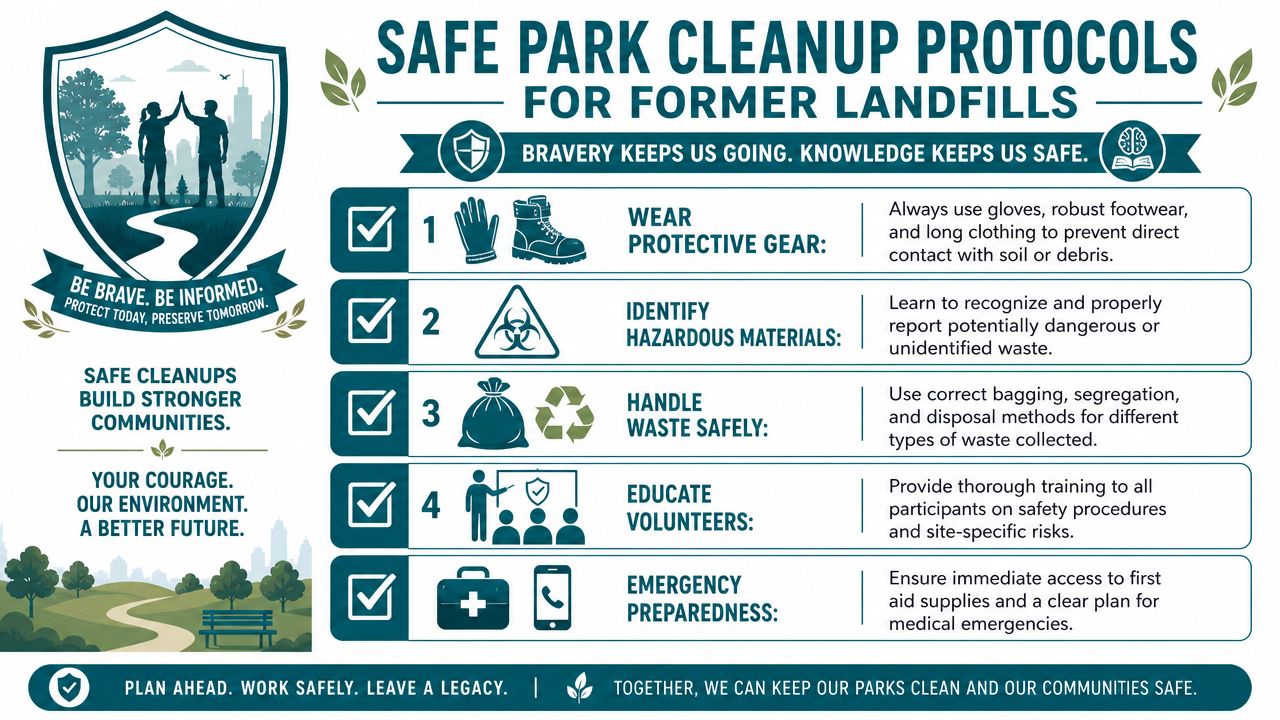
    How We Safely Clean Our Parks

    Good intentions aren't enough when you're cleaning ground with a complicated past. You need judgment. You need discipline. You need to know when a trash grabber and a bag are enough, and when they aren't.

    One hard truth sits underneath this work. Parks built on historic landfills in Chicago can have 3–5x higher concentrations of legacy contaminants such as lead, asbestos, and hydrocarbons than naturally formed parks, and that risk can be higher in zones like drainage ditches, as noted in this post about landfill-built park risks in Chicago.

    Brave doesn't mean reckless

    I hate the fake version of courage. The version where somebody acts fearless because they don't know enough to be careful. That's not courage. That's ego wearing work boots.

    Real courage looks more boring. It looks like gloves. It looks like long pants. It looks like stopping to assess a weird material instead of poking it with your hand. It looks like telling a volunteer, "Leave that one. We're not touching it today."

    An infographic detailing safety protocols for volunteers cleaning up former landfill sites to ensure community safety.

    The method I trust

    When I clean a park with old industrial or landfill history, I keep the approach simple and strict.

    • Dress for contact: Wear protective gear that covers skin and keeps your footing steady.
    • Respect the weird stuff: If an item looks sharp, chemical, dusty, sealed, or unfamiliar, don't improvise.
    • Watch the edges: Drainage paths, fence lines, and ditch areas collect trash and can collect risk too.
    • Train before heroics: A volunteer who knows what not to touch is more useful than a volunteer trying to prove something.
    • Have backup plans: First aid, communication, and clear roles matter before the first bag gets filled.

    A lot of volunteer groups skip this because safety sounds less exciting than action shots. I think that's backwards. Safety is what lets good people keep showing up week after week instead of getting burned out, hurt, or scared off.

    If you want to think through the legal and planning side before you organize your own effort, read up on volunteer liability insurance for community cleanups. It helps you understand why structure protects generosity.

    If a park has a rough history, your cleanup plan needs a backbone.

    That isn't fear talking. That's respect.

    Join Us for a Weekend Cleanup

    Weekend mornings have a special energy. The city is quieter, the air feels less chewed up, and the people who show up that early for unpaid work usually have something good inside them.

    I think about Tom Sawyer a lot. He got stuck painting a fence and turned the punishment into an invitation. That's part of the fun here. Work changes shape when you stop treating it like humiliation and start treating it like a dare.

    What your first cleanup feels like

    You arrive a little unsure. Maybe you wonder if everyone already knows each other. Maybe you worry you'll be awkward, underdressed, too quiet, too late, too soft for the job.

    Then somebody hands you a bag.

    That moment matters. Holding a trash bag in a park is strangely clarifying. You stop performing. You stop trying to look interesting. You just start scanning the ground, picking targets, moving forward. Cup. Wrapper. Bottle cap. Broken toy. Fast-food bag snagged under a bush like it was trying to disappear.

    And the weird thing is, your brain starts to quiet down.

    Why the work feels good

    Smith Park got major upgrades in the late 1930s, including a field house with a gymnasium and meeting rooms, according to the Chicago Park District's Smith Park page. I love that detail because it reminds me that parks aren't abstract ideas. They are places where bodies gather, sweat, talk, rest, and return.

    That's why cleanups matter in a practical way. You're not cleaning some symbol. You're clearing a path for an actual person. A kid running near a field. A neighbor walking past. Somebody heading toward a meeting room. Somebody trying to have one decent hour outside.

    If you want a way in, check out weekend volunteer opportunities near you.

    What to expect when you say yes

    Your first cleanup usually includes a few things:

    1. A small moment of hesitation when you realize you're doing real physical work.
    2. A rhythm shift once your hands get busy and conversation starts to happen naturally.
    3. A quiet hit of satisfaction when the pile of full bags grows and a messy patch looks human again.

    Hard work with good people is one of the cleanest pleasures left.

    That's the pitch. No fake glamour. Just a better Saturday morning than doomscrolling.

    Building Friendships One Bag of Trash at a Time

    The first time I went out with a tiny cleanup crew, Chicago threw hail at us like the city was testing our sincerity. We huddled under a tree, freezing, phones out, watching ride after ride cancel. It should have been miserable.

    It was miserable. And it was funny.

    That combination changes people. When you shiver through something dumb and difficult with strangers, they stop feeling like strangers way faster than they would at a bar or a networking event or some polished little mixer where everybody is trying to seem effortless.

    Shared discomfort is glue

    I learned something that day. Cleaning somebody else's mess is often easier than cleaning your own. Maybe because there isn't any shame in it. The ground doesn't judge you. The bottle in the weeds doesn't ask why your apartment is a mess or why your last relationship blew up or why you've been avoiding your own life.

    You just pick it up.

    And when somebody next to you is doing the same thing in cold rain or sharp wind, you trust them a little. They've already shown you one thing that matters. They came.

    Screenshot from https://www.littercaterpillars.com/

    Why people keep coming back

    Friendship doesn't always begin with deep conversation. Sometimes it begins with shared labor, an inside joke, and that look people exchange when a heavy bag finally gets tied shut.

    A cleanup group becomes social in sideways ways:

    • You earn trust fast: People see whether you help, drift off, complain, or stay steady.
    • You get stories immediately: Rain, weird finds, busted grabbers, lost gloves, surprise laughter.
    • You build identity through repetition: Same mission, different block, same people returning.

    I also think service scrubs away a lot of fake hierarchy. Out there, nobody cares who has the best resume. The wind doesn't care either. Trash equalizes people. That's one reason this kind of friendship feels less brittle.

    "We suffered a little together" is a stronger beginning than most small talk.

    If you've been lonely in a crowded city, this matters. You don't need a brilliant opening line. You need a reason to stand next to other people while doing something honest.

    Your Questions About Park Cleanups Answered

    People usually ask the practical stuff first. Good. Practical questions keep everybody safer and calmer.

    Is it actually safe to clean a park with a rough past

    It can be, if you respect the site and don't freeload on optimism. Use protective gear, avoid suspicious material, and treat certain areas with extra caution. If something looks off, leave it and report it through the right channel instead of trying to be a hero.

    What should you bring

    Keep it plain.

    • Wear sturdy clothes: Closed-toe shoes, long pants, and gloves are the baseline.
    • Bring water: Even short cleanups can sneak up on you.
    • Pack light: You don't need a whole expedition setup. You need mobility and common sense.

    Can you come alone

    Yes. A lot of people do. In fact, coming alone is often easier than dragging a half-interested friend who wants credit for almost showing up.

    The work gives you something to do with your hands right away, which takes pressure off conversation. That helps shy people more than they expect.

    What if you're nervous about not knowing anyone

    Then you're normal.

    It's common to feel that way before the first cleanup. The trick is to let the task carry the social weight for a while. You don't need to charm anybody. You just need to participate.

    Can you organize your own cleanup somewhere else

    Yes, including in a place like the Ohio park that comes up in the Harrison Smith Park search. Start small. Learn the site. Ask what risks are unique to that area. Keep your plan tighter than your ambition on day one.

    A simple checklist helps:

    Question Why it matters
    What kind of site is this Park history changes cleanup risk
    Who is coming Group size changes supervision needs
    What will you avoid Boundaries keep volunteers safe
    What happens if something looks hazardous You need a clear answer before you begin

    What mindset should you bring

    Bring humility. Bring energy. Bring a willingness to do unglamorous work.

    Don't bring the fantasy that one cleanup fixes everything. It won't. But one cleanup can fix one morning, one patch of ground, one conversation, one corner of your own drifting life. That's plenty.


    If you want a group that cleans Chicago with courage, humor, and actual care for the people doing the work, visit Litter Caterpillars. You'll find a crew that shows up on weekend mornings, takes safety seriously, and turns trash pickup into friendship, purpose, and a pretty wild kind of fun.

  • Pullman National Historical Park: A Visitor’s Guide

    Pullman National Historical Park: A Visitor’s Guide

    I turned a corner near 111th Street and felt that strange Chicago feeling where a block starts talking back to you. Brick rows, old factory bones, and quiet streets made me slow down and pay attention.

    More Than a Monument It Is a Chicago Story

    A few Saturdays ago, I watched a first-time visitor stop in the middle of Pullman and go quiet. Kids were riding bikes past red-brick homes. A neighbor was sweeping a front walk. The old industrial buildings stood in the background like they still had something to say. That mix is what gets me every time. Pullman does not sit in Chicago like a relic under glass. It lives as a neighborhood where history keeps bumping into ordinary life.

    That is why Pullman grabbed me so hard the first time I came through with a coffee in one hand and cleanup gloves in the other. The National Park Service recognizes it as Chicago's national historical park, but the title only gets you so far. The full story shows up on the street, in the preserved architecture, in the homes that are still occupied, and in the long shadow of work, power, and organizing that shaped this part of the South Side.

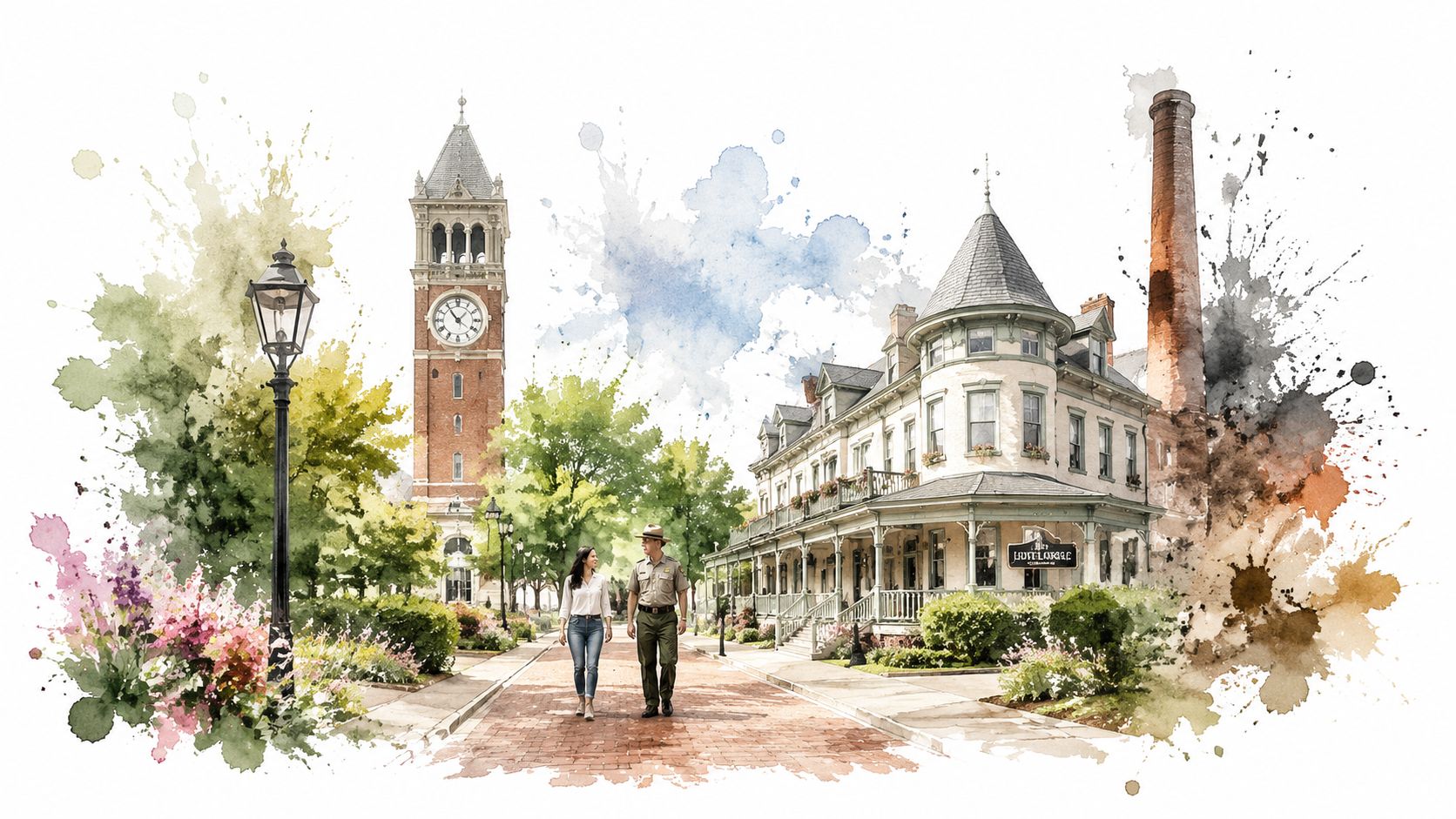
    A vintage Pullman passenger train sits at a station with a stylized watercolor Chicago city skyline backdrop.

    I run a volunteer group that spends time in places people too often pass by. We pick up litter, talk to neighbors, and learn a block by walking it slowly. Pullman fits that ethic perfectly. You can come for the history and leave with a sharper sense of what community care looks like when real people keep showing up for a place.

    That is what makes this park feel personal to me. The streets raise questions Chicago has been asking for generations.

    • Who gets to shape a neighborhood
    • What happens when too much control sits with too few people
    • How a community protects its story while still living its daily life

    I often tell friends to pair Pullman with other Chicago neighborhoods to explore, because the comparison teaches you something. In one part of the city, the story sits in a mural or a corner store. In Pullman, it sits in the bricks, the rail legacy, the worker housing, and the community memory that still holds the whole place together.

    Pullman changed the way I think about public history. A monument asks for your attention. This neighborhood asks for your participation. Walk it, listen well, and you start to see that the lesson is not only about the past. It is about what kind of city we want to care for right now.

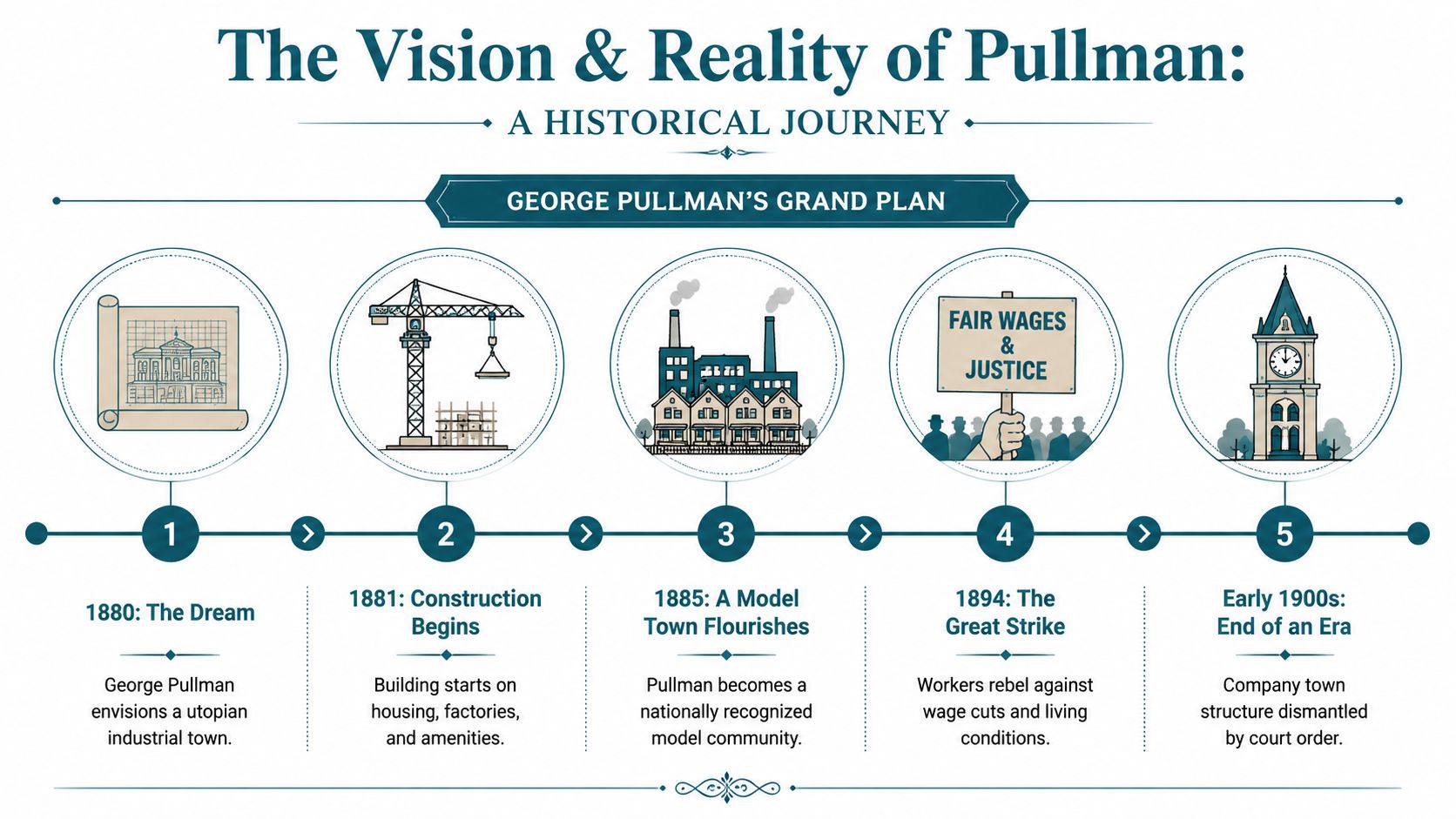
    The Story of the Town Pullman Built

    The first time I walked these blocks with the company-town history in mind, one detail stayed with me. The homes are handsome. The streets feel orderly. You can still sense why a working family in the late 1800s might have looked around and thought, at least on day one, that this place offered dignity.

    Then you learn who held the reins.

    A timeline infographic illustrating the historical rise and fall of the industrial company town of Pullman.

    George Pullman built the neighborhood around his railcar business with a clear vision of how workers should live. Brick row houses, shared green space, civic buildings, and factory life were tied together in one planned community. From the outside, it could look generous, even enlightened compared with the rougher industrial districts of its time.

    On the ground, the story gets more complicated.

    A beautiful block does not automatically mean a fair one. Workers lived in a town shaped by company priorities, company rules, and company power. The same design that made Pullman feel orderly also limited how much control residents had over daily life. That tension is part of what makes a walk here feel alive. You are not just looking at architecture. You are standing inside a debate about work, housing, and who gets to decide what a good community looks like.

    I often picture an ordinary evening here. Someone comes home tired from the factory, steps onto a clean street, then sits at the table to make hard choices about rent, food, and family needs. That is the part of Pullman that stays with me. History is not only in the grand plans of industrialists. It is in the private math of households trying to hold themselves together.

    The conflict that followed gave Pullman its sharpest lesson. Workers resisted the imbalance built into the system, and the Pullman strike turned this neighborhood into one of the defining labor stories in the country. When I stand near the old industrial spaces, I do not think first about dates in a textbook. I think about people gathering, arguing, risking income, and asking for a measure of dignity that the town's design could not provide on its own.

    That is why Pullman matters as more than a preserved historic district. It shows how a neighborhood can be carefully built and still fail its people if power only runs one way.

    It also shows something hopeful. Residents, preservationists, organizers, and neighbors kept this story from being flattened into a neat company legend. They protected the buildings, yes, but they also protected the harder questions. That part means a lot to me as someone who believes places improve when regular people care for them together, the same spirit that drives groups like Litter Caterpillars to treat streets and public spaces as shared responsibilities.

    Three questions from Pullman still feel close to home:

    Question raised here Why it still matters
    Who has power at work People still fight for fair pay, stability, and respect on the job
    What makes housing just Neighborhood change still tests who gets security and who gets pushed aside
    How do neighbors act together Communities still rely on solidarity when formal systems fall short

    Pullman stays with you because it never resolves into a simple moral. It is a story about vision, control, resistance, and community memory, all on the same set of blocks. Walk slowly enough, and the lesson becomes clear. A neighborhood is not defined only by what gets built. It is defined by whether people who live there can shape its future together.

    Your First Visit to Pullman National Historical Park

    The best way to start is simple. Go to the visitor center at 610 E. 111th Street, Chicago, IL 60628, which is open daily from 9:00 a.m. to 5:00 p.m., according to the Pullman visitor center listing.

    I like starting there because a neighborhood park can feel confusing at first. If you expect one big gate and one obvious route, Pullman may throw you off. The visitor center helps you get your footing.

    What to do when you arrive

    Walk in, slow down, and let yourself orient. You don't need a perfect plan before you step through the door. That's the whole point of beginning here.

    A first visit works well when you do these things:

    1. Check the exhibits first. They help you connect the buildings outside to the people who lived and worked here.
    2. Ask for self-guided materials. That gives you a path once you step back outside.
    3. Look at the district as a neighborhood, not a single attraction. You're not done when you leave the building. You're just ready to start.

    How I'd handle a first hour

    If I brought you with me for your first visit, I wouldn't rush. I'd spend a little time inside, get the basic story straight, then head back outdoors with a loose plan. Pullman works best when you mix orientation with wandering.

    Practical rule: Start indoors so the streets make sense later.

    You don't need to memorize every detail. You just need enough context that the brick row houses, factory remains, and nearby institutions stop being anonymous. Once that clicks, the whole district opens up.

    A good first-timer mindset

    Treat your visit like meeting a person for coffee, not like cramming for an exam. Stay curious. Let a few buildings pull your attention. Read some signs. Skip others. Sit for a minute if you need to.

    Here's the part many guides miss. You're not just visiting a building with historic objects inside. You're entering a public place where the story spreads across streets, corners, and everyday life. That shift matters. Once you understand it, Pullman gets much easier and much more rewarding.

    Planning Your Trip Itineraries and Tips

    One thing I like about Pullman is that you can shape the day around your energy. If you have a short window, you can still get a real feel for the place. If you have a relaxed afternoon, the neighborhood gives you room to wander.

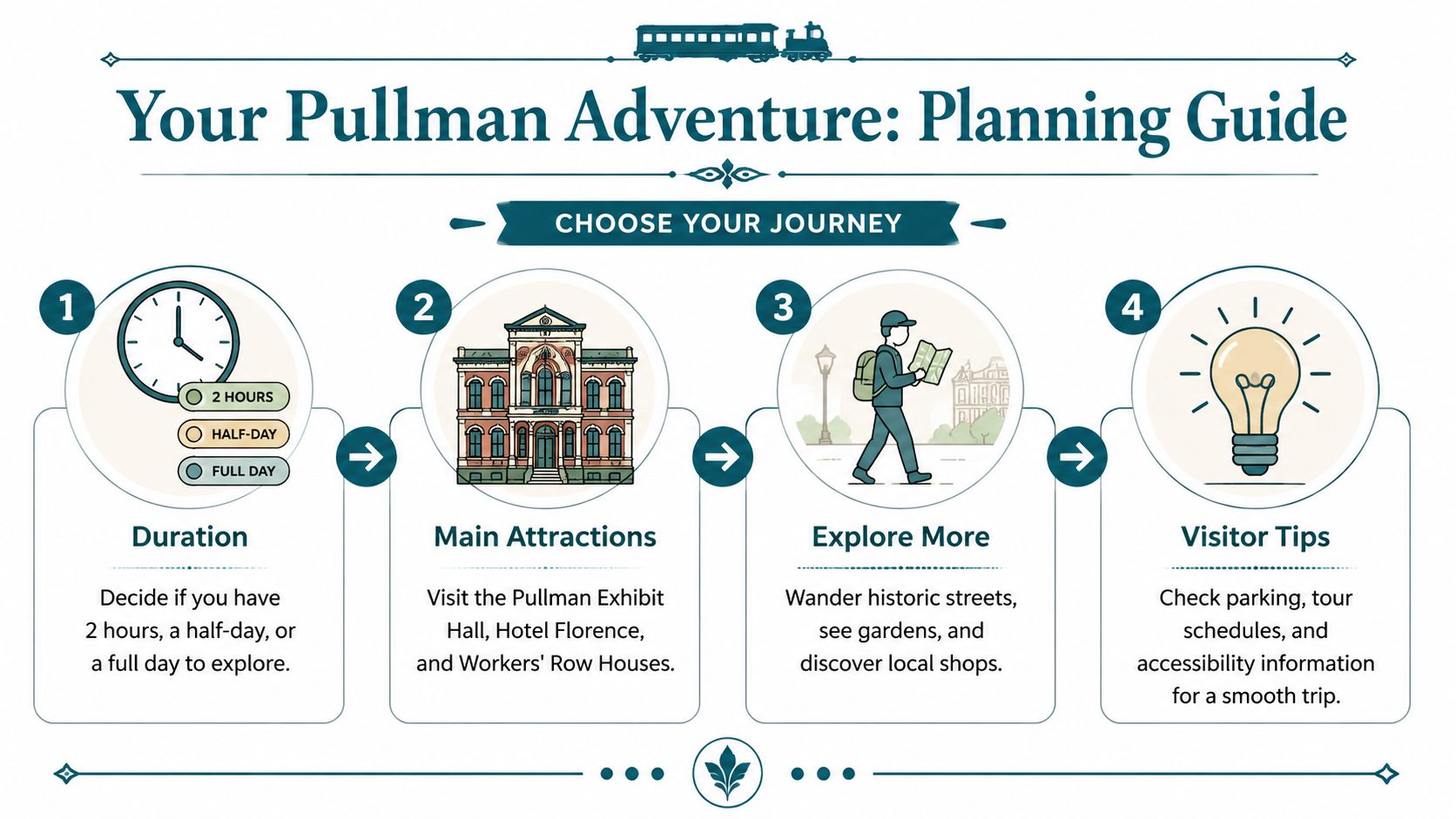
    The park grounds are open dawn to dusk, which means you can explore the historic area as public space even outside visitor center hours, according to the National Park Foundation park page. That changes how I plan a trip. I don't think of Pullman as a single timed attraction. I think of it as a walkable field trip.

    A planning guide infographic for Pullman National Historical Park showing four numbered steps to design your visit.

    If you only have a short visit

    A shorter outing works well if you want a clean, focused experience.

    • Start at the visitor center. Ground yourself before you roam.
    • Walk a few nearby blocks. Let the neighborhood scale sink in.
    • Pick two or three stops, not everything. Pullman gets better when you move slowly enough to notice details.

    I've found that a compressed visit still feels satisfying if you avoid checklist mode. This isn't the kind of place where speed makes you feel accomplished. Speed makes you miss the point.

    If you have a half day

    A half day is my favorite rhythm for Pullman. You can settle in without turning it into a marathon.

    Here's a simple way to do it:

    Time shape What I'd do
    Early part Begin at the visitor center and get oriented
    Middle stretch Walk the historic streets and stop at the major sites that catch your eye
    Final stretch Sit, reflect, grab food nearby, and take one more pass through the neighborhood

    If you enjoy city walking, you might also like these self-guided Chicago walking tours. Pullman fits that style well because the streets themselves carry so much of the experience.

    Local mindset for getting there

    I like using transit when I can because it changes the pace of the day. You arrive on the city's terms, not in a sealed bubble. But driving can make sense too, especially if you're visiting with family or anyone who wants fewer transitions.

    A few practical tips help:

    • Wear walking shoes. The best part of Pullman happens on foot.
    • Bring water. Historic curiosity doesn't cancel out basic comfort.
    • Plan food loosely. I'd rather leave space to notice a local option than lock myself into a rigid schedule.

    Pullman rewards the visitor who leaves room for one extra block, one extra corner, one extra pause.

    That's how I'd do it. Give yourself structure, then let the place interrupt you a little.

    Walk Through History Key Sites to See

    The visitor center gives you the map. The streets give you the feeling. Pullman's essence comes to life.

    I always tell friends to stop trying to “cover” Pullman and instead let each site act like a chapter. Some chapters are about work. Some are about class. Some are about Black labor history. Together they make the district feel layered, not flat.

    The factory grounds and the clock tower

    The factory area hits me first because it makes labor feel physical. You don't have to stretch your imagination very far. You can almost hear the churn of production and the movement of workers coming and going.

    The clock tower pulls your eye because clocks always do that in old industrial places. They remind you that work once ruled the day down to the minute. I stand there and think about how different time feels depending on who controls it. For an owner, time can look like efficiency. For a worker, time can feel like pressure.

    Hotel Florence

    Hotel Florence tells a different kind of story. This building lets you think about status, taste, and the social rules of the town. I like places like this because they show that power isn't only in the factory. It's also in the spaces where respectability gets performed.

    Walk around it and you can feel that Pullman wasn't built only to produce railcars. It was built to project an idea of order. That idea reached into daily life. It touched how people lived, where they gathered, and what kind of behavior fit the town's image.

    Some buildings tell you what happened. Others tell you what people wanted the world to look like.

    Hotel Florence does both.

    The A. Philip Randolph Museum

    Then there's the A. Philip Randolph Museum, which changes the emotional temperature of the visit. If the factory grounds make you think about labor under pressure, this site makes you think about labor organizing, dignity, and Black workers refusing to stay invisible.

    I always slow down here.

    The museum adds a chapter that many first-time visitors need. Pullman is not only about one strike in one year. It's also about the lives of Black railroad workers and the push for fair treatment. That part of the story gives the neighborhood a different voice. More determined. More personal.

    How I'd walk it

    If you want a simple field route, I'd do it this way:

    • Begin with the clock tower area so the scale of the industrial site clicks.
    • Move to the residential streets and pay attention to repetition, design, and how the homes sit together.
    • Pause at Hotel Florence and think about who the town was meant to impress.
    • End with the A. Philip Randolph Museum when you're ready for the labor story to deepen.

    That order works for me because it moves from structure to people. From the company's view of the town to the people who had to live and work inside it.

    From History to Action Get Involved in the Community

    The thing I love most about Pullman is that it doesn't leave me in spectator mode for very long. After a while, standing around and admiring old brick starts to feel incomplete. A place with this much history pushes me toward a simple question. What am I going to do for the neighborhoods I care about now?

    Screenshot from https://www.littercaterpillars.com

    That's where service comes in. Pullman is still a lived-in area. Since becoming a national park, the area has seen hundreds of millions of dollars in investment, according to a Pullman House Project video about the neighborhood today. I don't hear that and think, great, problem solved. I think, then this is exactly when ordinary people need to stay involved.

    Small acts change how a place feels

    If you care about Pullman, you don't need to arrive with a grand theory. Start small and stay consistent.

    • Join a cleanup if one is happening nearby. A public place feels different when people care for it with their hands.
    • Support preservation-minded community work. Attention matters. Presence matters.
    • Walk respectfully and spend locally when you visit. Neighborhood care isn't abstract.

    I believe service is one of the best ways to understand a place. You can read about labor solidarity all day, but picking up litter with other people teaches a related lesson fast. Shared effort changes strangers into teammates.

    One option is to look at community engagement strategies that turn good intentions into regular action. Another is to join a local volunteer event when one is scheduled. For example, Litter Caterpillars has done cleanup activity at the Pullman National Historical Park Visitor Center with the National Park Service's Trash Trekkers program.

    Care is a way of reading the city

    I want to show you a piece of that spirit in motion.

    When people sweep, plant, pick up trash, or help maintain public space, they aren't doing side work beneath the “real” story. They are writing the current chapter. That matters in Pullman because the neighborhood has always been about how people live together under shared conditions.

    My rule for any historic district: leave it a little better than you found it, even if all you can give is attention, respect, and one hour of work.

    That's the bridge for me. History becomes action when you stop asking only what happened here and start asking what care looks like here now.

    Your City Is Waiting for You

    Pullman stays with me because it asks for more than curiosity. It asks for honesty. When you walk those streets, you start thinking about work, fairness, housing, memory, and what neighbors owe each other. Then you leave and those questions follow you home.

    I think that's a gift.

    You don't need to become a historian to feel something at Pullman National Historical Park. You just need to show up ready to notice. Notice the brickwork. Notice the scale of the old company town. Notice how a neighborhood can carry conflict and care at the same time. Then notice your own block with that same level of attention.

    Chicago gets better when more of us do that.

    I've learned this through cleanup mornings, long walks, and conversations with people who love their neighborhoods in practical ways. The city opens up when you stop waiting for polished invitations. You pick a place. You go. You listen. Maybe you help. Then you come back different.

    Pullman is a good place to begin that habit.

    Go for the history if that's what pulls you in. Go for the architecture. Go because you want a thoughtful afternoon on the South Side. But once you're there, let the visit push you one step further. Join something. Care for something. Learn one neighborhood thoroughly enough that it stops being “somewhere else.”

    Your city isn't finished. That's the exciting part. It still needs hands, eyes, patience, and people who are willing to love it in public.


    If you want a hands-on way to explore Chicago while caring for it, take a look at Litter Caterpillars. It's a volunteer group that organizes neighborhood cleanups across the city and gives people a simple way to show up, meet others, and do real work together.

  • Your Guide to Crooked Creek Woods and How to Help It Thrive

    Your Guide to Crooked Creek Woods and How to Help It Thrive

    I bent down to grab a crushed bottle near the edge of the trees, and for a second I forgot the rest of my life. The noise in my head got quiet. That's what happened to me the first time I really paid attention in Crooked Creek Woods.

    Finding Your Path in Crooked Creek Woods

    I didn't come to the woods because I had myself figured out. I came because I was tired, scrambled, and carrying the kind of inner mess that follows you from room to room. Cleaning my own life felt impossible. Picking up one piece of litter on a trail felt doable.

    That's still one of the strangest truths I know. Sometimes it's easier to lift someone else's mess than your own. You reach down for a bottle, an old can, a wrapper snagged in brush, and somewhere in that simple motion, your shoulders drop. You breathe deeper. You remember you can act.

    Crooked Creek Woods gave me that feeling.

    I've walked into a lot of green spaces hoping for some kind of reset. Some places are pretty but distant, like they don't need you. Crooked Creek Woods doesn't feel like that to me. It feels approachable. Human-sized. A place where you can arrive restless and leave steadier.

    The first walk that changed me

    I remember one visit when I didn't even mean to stay long. I thought I'd walk a little, clear my head, then head back to the car. Instead, I kept going. The trees made a kind of shelter that didn't ask anything from me except attention. I started noticing small things. Bent grass. Bird calls I couldn't name. Mud at the creek edge. Sun through branches.

    That was enough.

    Practical rule: If your mind feels loud, don't wait for the perfect plan. Start with one short walk.

    You might come here because you want exercise. You might come because your kids need room to run. You might come because you're lonely and need to be somewhere alive. All of those reasons are good reasons.

    Why I want you to go

    I want you to think of Crooked Creek Woods as more than a place to pass through. I want you to treat it like a trailhead for your own next chapter. Maybe that sounds dramatic, but I mean it in a plain, everyday way. The same way a sink full of dishes can break your spirit, a quiet walk can put it back together a little.

    Here's what I love about starting here:

    • You can keep it simple. Show up, walk, breathe, notice.
    • You can come as you are. Tired, hopeful, annoyed, curious. The woods can handle all of it.
    • You can leave with momentum. One good hour outside can change the rest of your day.

    If you've been waiting to feel ready before you visit, don't. Read this like a note from a friend who wants to meet you at the trailhead and say, come on, let's go.

    Getting to Know the Woods and Its Creek

    The first time I crouched beside Crooked Creek, I saw a bluegill flash near the bank and a plastic wrapper snagged in roots a few feet away. That is Crooked Creek Woods in one frame. Life holding on, and people being asked to choose what kind of neighbors we want to be.

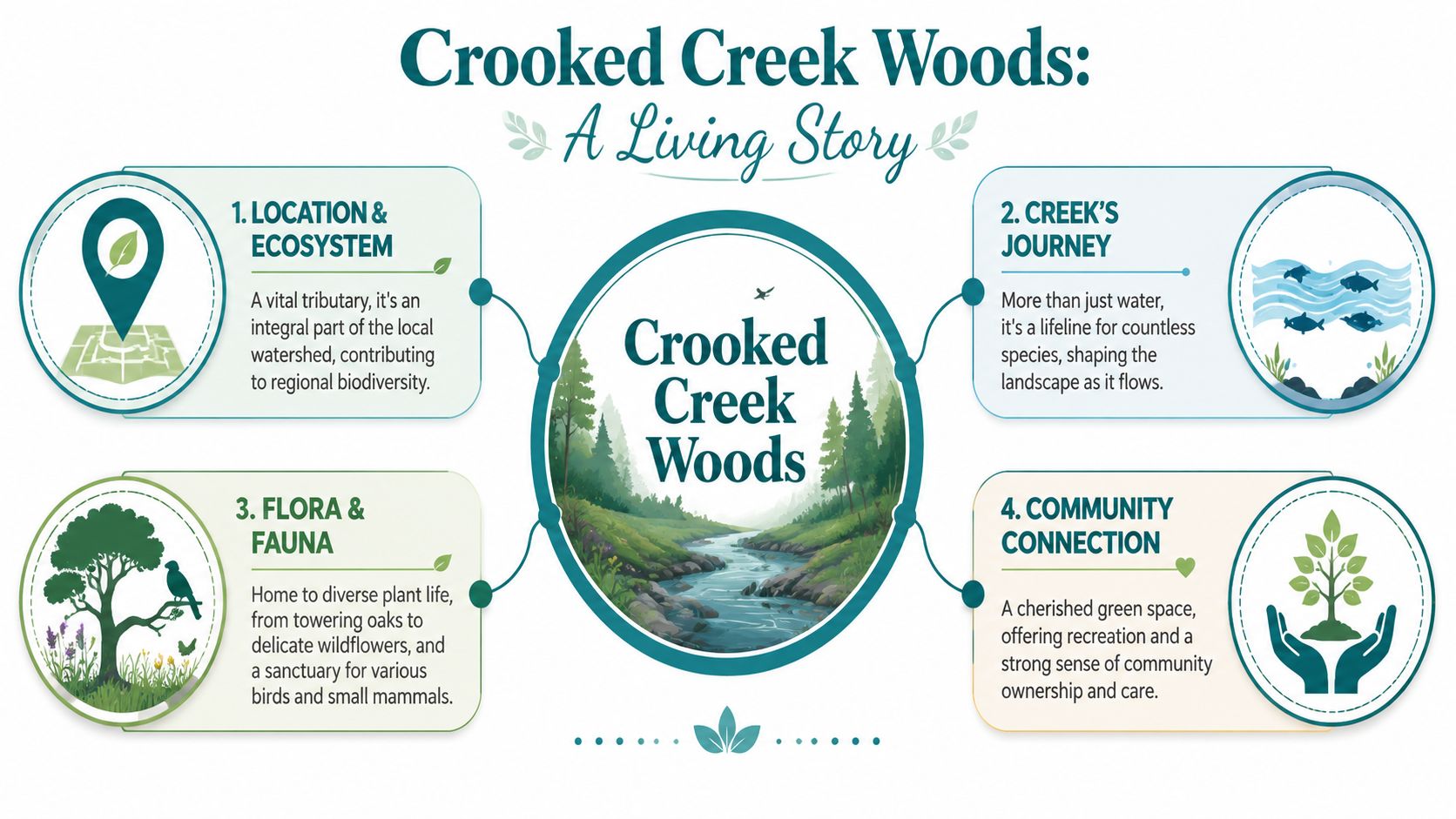
    Crooked Creek runs through a chain of wooded preserve corridors, including Country Lane Woods, Cranberry Slough, and Pioneer Woods, and it belongs to the larger Chicago River system. According to a Chicago River story on Crooked Creek, the waterway supports fish such as largemouth bass, bluegill, and pumpkinseed, and a restoration project was anticipated to begin in May 2017 to improve hydrologic processes and aquatic habitat.

    An infographic titled Crooked Creek Woods: A Living Story, detailing its ecosystem, creek journey, biodiversity, and community connection.

    The creek teaches by example

    I come here for that lesson as much as the scenery.

    Crooked Creek bends, slows, gathers itself, and keeps going. After a hard season in my own life, that mattered to me more than any brochure language ever could. You may feel it too when you stand at the edge and watch the current work around a fallen branch instead of fighting it head-on.

    That shape of persistence is part of why this place stays with people. The creek is not background. It is the organizing force of the woods. Trees cluster around it. Wildlife depends on it. Walkers keep drifting back toward it, even when they start out thinking they are only here for a short stretch under the canopy.

    A woods with an old foundation

    The ground here carries a much older story than any single visit. Crooked Creek Woods sits in the Palos and Sag Valley division, which the Forest Preserves of Cook County describes as mostly hilly and forested, with roots in glacial and geologic history. You can feel that history in the rises under your feet and the way the land folds around water instead of flattening it into something generic.

    I love that about this place. It asks you to pay attention to shape, slope, and time.

    For me, that attention changes behavior. Once you notice how a creek bank crumbles, how roots hold soil in place, or how a bottle can wash downstream after one rain, care stops being abstract. It becomes practical. You pick up the can. You step more lightly. You start reading the woods as a living system instead of a backdrop for exercise.

    That is the heart of the Litter Caterpillars philosophy. We do not only visit natural places. We build a relationship with them through small acts of service, steady observation, and shared responsibility. If you want to bring that spirit with you here, our guide to cleaning rivers and waterways is a good place to start.

    You do not need expert training to care for a creek. You need attention, respect, and the willingness to leave the bank better than you found it.

    When you get to know Crooked Creek Woods this way, the place gives you more than a pleasant walk. It gives you practice in noticing what matters, and then doing something about it.

    Your Guide to the Trails

    When you first arrive at Crooked Creek Woods, don't worry about doing it the “right” way. You don't need elite hiking gear or some secret route. You need decent shoes, enough water, and permission to wander a little.

    I like to think of trail choices the way I think of conversations. Some are easy and social. Some are quiet and long. Some are best when you bring kids along and let the pace stay loose.

    How to choose your walk

    If you're coming with family, I'd keep your first visit simple. Pick the path of least resistance. Let the day be about curiosity, not distance. If you're coming alone and need room to think, give yourself more time and take the route that lets the sounds of the road fade.

    Since trail conditions can shift and on-the-ground route patterns can vary, I'd treat the woods like a place to explore rather than a place to conquer. For nearby route ideas across the region, I often browse Chicago trail guides before heading out.

    Here's a planning table I'd use with a friend before we go.

    Trail Name Approx. Length (Miles) Difficulty Best For
    Creekside Start Short Easy First-time visitors, kids, slow walks
    Grove Connector Walk Moderate Easy to Moderate Families, casual conversation, picnic day add-on
    Quiet Woods Loop Moderate Moderate Solo walkers, birdwatching, decompression
    Extended Wandering Route Longer Moderate People who want more solitude and time outdoors

    If you're bringing kids

    Kids don't usually need a perfect trail. They need discoveries close together. A stick bridge. A patch of mud. A sudden bird call. Space to ask questions that don't have answers.

    I'd keep a family visit focused on rhythm instead of mileage:

    • Start early enough to go slow. Rushing turns every root and puddle into a problem.
    • Let children lead for stretches. They notice mushrooms, feathers, and odd-shaped leaves adults walk right past.
    • Stop before anyone melts down. The best ending is one that makes your kids want to come back.

    If you want quiet

    I know the difference between taking a walk and going somewhere to hear yourself think. If that's what you need, arrive with your phone on silent and resist the urge to track every turn. Walk until your thoughts stop performing for you.

    Look for the moments when the trees seem to close around the path and the outside world loosens its grip. That's where Crooked Creek Woods gets especially good.

    Go slower than you think you need to. The woods open up when you stop trying to win at walking.

    A few things I'd watch for

    I won't pretend nature works on cue, but some patterns repeat. If you come at the softer edges of the day, the whole place feels more alert. If you pause near openings in the trees, you may catch better views through the canopy. If you stay quiet near the creek, you'll notice more than if you stomp through like you're late.

    My own trail method is simple:

    1. Walk the first part without taking photos.
    2. Stop at the first place that makes you exhale.
    3. Turn around only after your pace changes on its own.

    That last one matters. Your body usually knows before your mind does. At some point your stride gets easier, and that's when the walk begins to do its real work.

    The Woods Through the Seasons

    My relationship with Crooked Creek Woods changed when I stopped treating it like a one-season place. I used to think a preserve had one best moment. Now I think that's like saying a friend has one best mood. You get a different truth each time you return.

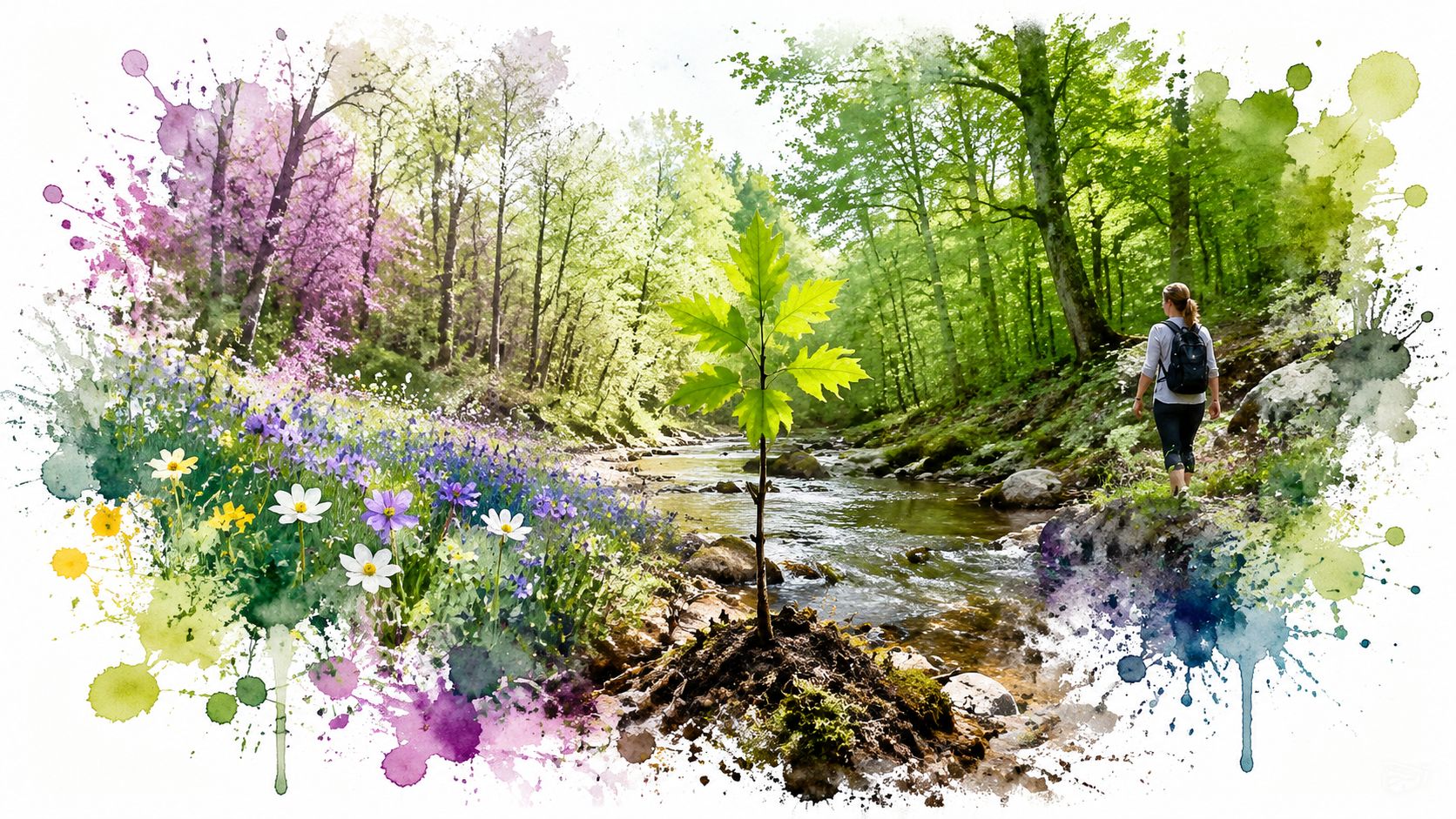
    A hiker walks along a scenic river in the crooked creek woods, featuring lush trees and blooming flowers.

    Spring wakes the place up fast

    Spring in the woods always feels a little reckless to me. Everything starts speaking at once. Birds get loud. The ground shifts from dull to alive. You smell damp soil and fresh growth before you can explain it.

    I like spring because it gives me hope without asking whether I earned it. You step onto the path carrying winter heaviness, and the woods answer with motion.

    Summer teaches you how to slow down

    Summer here is deep green shade and longer pauses. The air feels fuller. The trees create that cool cover that makes you want to stay out longer than planned.

    When I walk in summer, I stop expecting speed from myself. I let the day stretch. I pay attention to the smell of leaves warming in the sun and the places where the creek draws your eye even when you can't fully see it.

    A summer visit works well if you bring:

    • Water you'll want to drink
    • Shoes you trust on uneven ground
    • Patience for a slower pace

    Autumn is my favorite for thinking

    Autumn doesn't need much salesmanship. You know what leaves can do. But what gets me is the sound. That dry crunch underfoot makes every step feel counted.

    This is when I come to sort things out.

    A hard conversation. A decision I've delayed. A season of life that's ending before I'm ready. Fall gives me room for all of that. The woods feel honest then. Nothing hidden. Nothing rushed.

    Some days the best thing you can do is walk through leaves until your thoughts stop knotting themselves.

    Winter clears the noise

    A lot of people skip winter woods, and I think they miss something special. Without thick cover, you can read the shape of the land more clearly. You notice trunks, branches, slope, sky. The place feels stripped down to its lines.

    Winter doesn't flatter. It steadies.

    If there's snow, I look for tracks and follow them with my eyes until they disappear. If the air bites, I walk anyway because the silence feels clean. It's the season that reminds me strength doesn't always look cheerful.

    Come back in every season if you can. Let the place meet you in all your moods.

    Plan Your Visit the Smart Way

    The first time I brought a small volunteer crew here, one friend showed up in slick-soled shoes, another forgot water, and all of us had different ideas about where to meet. We still had a good day, but we spent the first half hour fixing preventable problems. Since then, I've learned that a better visit often starts before you leave home.

    According to the Forest Preserves of Cook County page for Crooked Creek Woods, the preserve is open sunrise to sunset year-round, has four groves with capacities of 100, 350, 100, and 200 people, and portable bathrooms are typically available from Memorial Day through Labor Day, weather permitting.

    Know the setup before you go

    Those details matter more than they sound like they should.

    If you are planning a birthday meal, a family reunion, or a quiet meetup after a walk, knowing the grove sizes helps you choose a gathering that fits the day instead of forcing the day to fit your plan. The larger groves with shelters can make a group visit feel calmer from the start.

    I also like knowing the hours before I arrive. Sunset comes faster than you think when conversation gets good and the creek keeps pulling you farther down the path.

    My simple visit checklist

    I pack for Crooked Creek Woods the same way I pack for a cleanup or a community walk. Light, useful, and honest.

    • Water you will drink
    • Shoes with grip for dirt, roots, and damp patches
    • A charged phone for maps and timing
    • A small bag for snacks, tissues, and hand sanitizer
    • An extra layer if the weather looks uncertain

    If you want to add one more thing, bring a spare bag or gloves so you can leave with a few pieces of trash if you spot them. That small habit changes the whole feeling of a visit. It turns a walk into participation, which is a big part of the spirit behind the Litter Caterpillars environmental stewardship programs.

    If you're meeting other people

    Group outings get better when someone claims the unglamorous job.

    Send the meeting point. Send the arrival time. Tell people what kind of walk this is going to be. A short wander? A picnic with kids? A longer afternoon with time to sit and talk? Clear plans make room for everyone to relax once they get there.

    I've also learned to arrive early if a grove is part of the plan. A few quiet minutes at the beginning can set the tone for the whole day.

    A few safety habits I always keep

    These are simple, and they work.

    1. Tell someone where you are going.
    2. Keep an eye on the time so you are heading out well before dark.
    3. Walk at a pace that lets you notice the ground and your own energy.
    4. Turn back if weather, footing, or your gut says it is time.

    I want you to have the kind of visit that leaves you steadier than when you arrived. Good planning helps with that. It gives you more room to listen, notice, and care for the woods while they care for you.

    Become a Guardian of the Woods

    There's a moment that happens after you visit a place enough times. It stops feeling like scenery. It starts feeling personal.

    You notice the bottle near the creek bank. The wrapper caught in low branches. The can half-hidden in leaves. And then you get to choose what kind of person you're going to be in that moment.

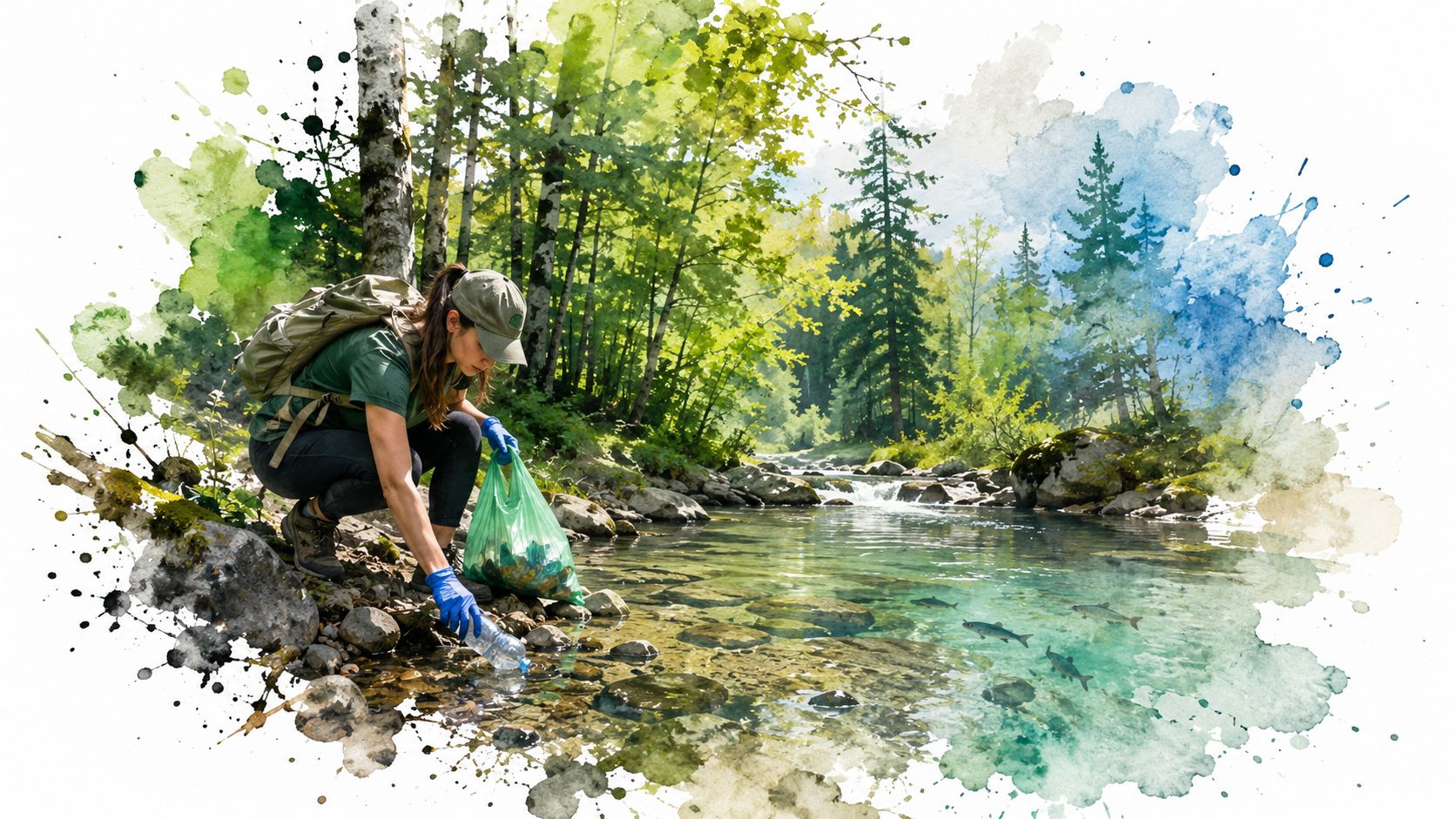
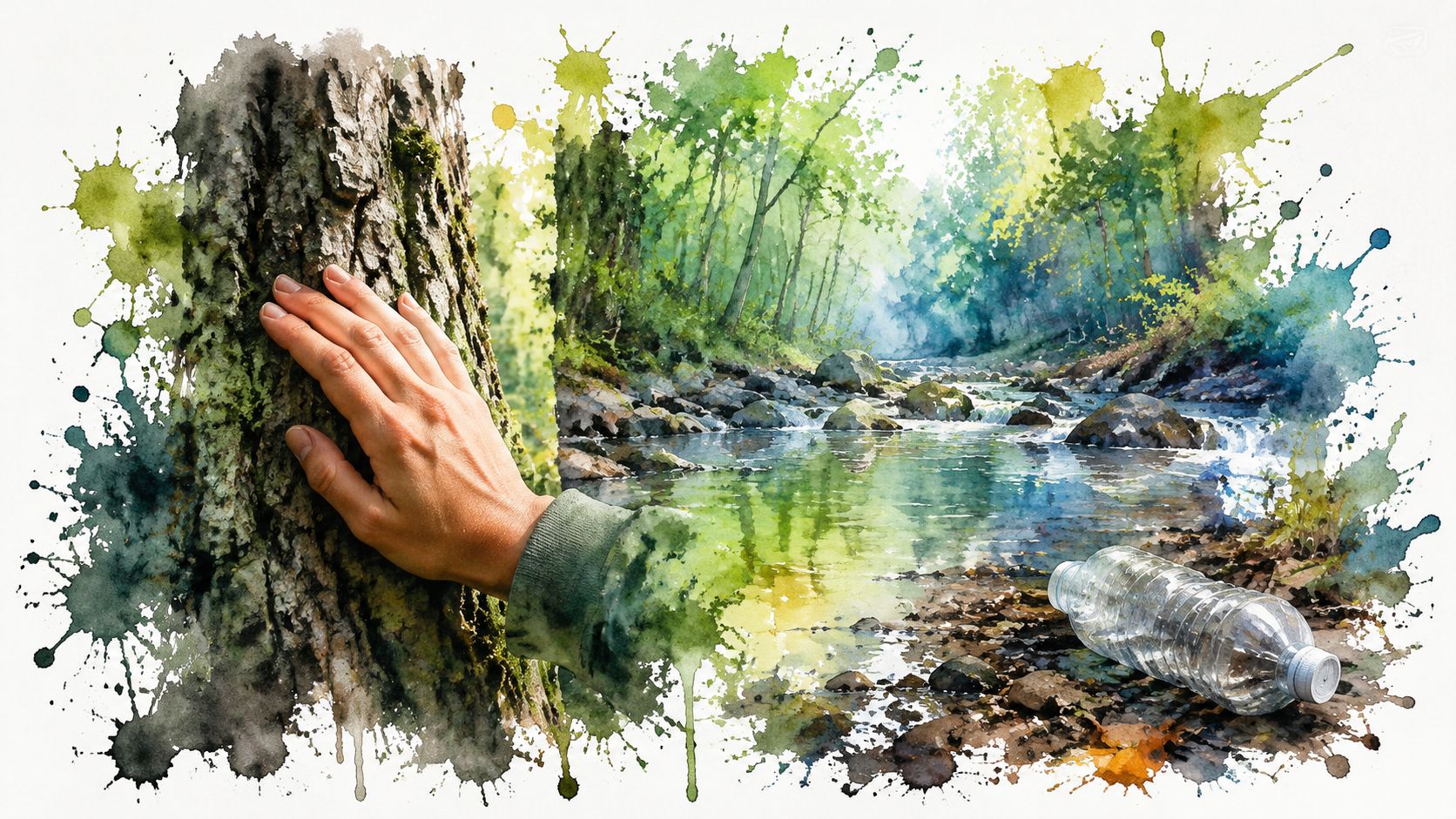
    A watercolor illustration shows a hand touching a tree trunk next to a forest stream with plastic pollution.

    Museum mindset or garden mindset

    I think a lot of people move through public land like they're walking through a museum. Look, admire, move on. Don't touch anything. Don't get involved. Keep your role small.

    I don't think that mindset helps us much.

    A better analogy is a community garden. In a garden, you don't own the place, but you still care for it. You pull a weed. You water what's thirsty. You leave it better than you found it. That's how I want you to think about Crooked Creek Woods.

    Small acts change the relationship

    The first time you pick up trash in a place you love, something shifts. You stop being only a visitor. You become a participant. Your walk gets a new layer to it.

    That change matters because action builds attachment. Attachment builds care. Care makes you come back.

    Here are a few easy ways to practice that:

    • Pick up one thing. You don't need a grand cleanup. Start with one bottle or one bag.
    • Carry a glove or grabber if you like structure. Tools make action easier when hesitation shows up.
    • Leave room for joy. Stewardship isn't punishment. It can be light, social, and even funny.

    Caring for a place is one way of practicing care for yourself.
    Service works on you too

    This is the part I learned the hard way. I used to think service was mainly about output. Bags filled. Ground cleared. Mess removed. But service changes the person doing it.

    When I started cleaning outdoor spaces, I got stronger in ways that had nothing to do with muscle. I got more consistent. Less afraid of starting small. Less trapped by perfection.

    That's why I care about environmental stewardship programs. They give people a simple doorway into responsibility. You show up, do one concrete thing, and your identity starts to shift around it.

    If you love Crooked Creek Woods, care for it in a visible way. Don't wait for someone else to be the kind of person who helps. You can be that person today.

    Join the Litter Caterpillars Adventure

    One Saturday at Crooked Creek Woods, I watched a teenager pull a crushed soda can from the creek bank while his grandmother held the trash bag open beside him. Ten minutes earlier, they had been quiet. By the time we reached the bend in the trail, they were trading stories about other parks they loved and arguing, happily, about who had found the strangest piece of litter. That is the kind of morning that stays with you.

    The Litter Caterpillars bring people together for cleanup events around Chicago, and the work has a way of turning a simple outing into something larger. You show up for a few hours outside, and you leave with muddy shoes, new names in your phone, and a stronger sense that public land belongs to all of us.

    Screenshot from https://www.littercaterpillars.com

    I love that nobody has to arrive with a perfect résumé in environmental service. You can come tired, curious, shy, or brand new. What matters is your willingness to pick up one piece of trash, walk one stretch of trail, and care for a place with other people who are learning the same habit.

    That is part of the Litter Caterpillars philosophy that changed me. Service is not only about removing litter. It is a practice of belonging. When you kneel to clear a bottle from the leaves or carry out a bag someone else ignored, you start seeing yourself differently. You are no longer passing through the woods. You are helping shape what kind of place it will be for the next child, dog walker, bird watcher, or exhausted neighbor who comes here to breathe.

    I have seen strangers become a crew in less than an hour. Gloves on, eyes scanning the ground, someone calls out a rusted can by the roots, someone else laughs at an ancient fast food cup, and the whole morning loosens up. If Crooked Creek Woods stirred something in you, follow it with your hands. Join a cleanup, bring a friend, and let your next walk become an act of care.

  • Black Partridge Woods: A Guide to Your Next Adventure

    Black Partridge Woods: A Guide to Your Next Adventure

    I still remember the first time I dropped into Black Partridge Woods. One minute I was carrying city-brain with me, all noise and errands and tabs-open-in-my-head energy. The next minute I was standing at the edge of a bluff, looking down into a ravine that felt older, rougher, and more real than anything I expected to find so close to home.

    Finding Adventure Close to Home

    Some places ease you in. Black Partridge Woods doesn't really do that.

    You arrive thinking you're heading to a simple forest preserve walk, then the ground starts falling away under the trees. The bluff edge gives you that good kind of jolt, the kind that makes you stand up straighter and pay attention. You look down and see the folds of the ravine, the way the woods dip and curl, and suddenly your quick little outing feels more like a real outing.

    A hiker with a backpack looking towards a distant cityscape through a gap in the trees.

    Why this place feels different

    I like a flat path as much as anybody, but Black Partridge Woods has texture. It has drop-offs, cool low spots, and those little shifts in air and sound that make you feel like you crossed a threshold instead of just parked your car and started walking.

    This is an 80-acre forest preserve in Cook County, Illinois, set on river bluffs above the Des Plaines River with ravine forests and spring-fed streams. It was designated an Illinois Nature Preserve in 1965, and it was the second site in Illinois to receive that distinction, according to the Forest Preserves of Cook County page for Black Partridge Woods.

    That fact matters because it helps explain the feeling. You're not wandering through a random leftover patch of green. You're walking into a place people recognized early as worth protecting.

    Practical rule: If you need a reset but don't have time for a big trip, pick a place with terrain. A ravine does more for your brain than another lap around a flat path.

    A small place with real character

    I've always loved the kind of adventure that fits into half a day. Grab water, throw on shoes you don't mind dirtying, maybe bring a bag in case you spot litter, and go. Black Partridge Woods fits that perfectly.

    If you usually think of Illinois preserves as broad, easy, and open, this place will change your picture a bit. It feels compact in the way a good bookstore feels compact. Small footprint, lots going on.

    If you want more ideas for this kind of local escape, I like this guide to a forest preserve in Illinois because it helps frame the simple truth that the good stuff is often closer than we think.

    Here's the part I keep coming back to. You don't need a plane ticket, a cabin reservation, or a grand plan. Sometimes adventure is just you, a bluff, a ravine, and the decision to go outside on purpose.

    The Stories Written in the Land

    The first time I learned where the name came from, the woods changed for me.

    Before that, “Black Partridge” sounded dramatic and a little mysterious, like the title of an old story. Then I found out the name comes from a major Potawatomi chief tied to the Chicago region around the 1812 Battle of Fort Dearborn. That turned the preserve from a nice place to walk into a place with memory in it.

    The name under your feet

    I think names matter because they tell you how to listen.

    When you walk through Black Partridge Woods with that history in mind, the place stops feeling like blank scenery. The roads nearby, the suburbs, the traffic, all of that starts to feel recent. The name pulls your attention backward and reminds you that people knew this region long before we chopped it into commute routes and parking lots.

    An account about Black Partridge describes him as active during 1795–1816 and notes that the woods were named in his honor, linking the preserve to Indigenous history in the Chicago area. That same account also notes one milestone in 1964 and the formal Illinois Nature Preserve designation in 1965. You can read that background in this history of Black Partridge.

    Water wrote the map

    Then there's the story the land tells without using words.

    Water carved this place. You can feel that the second you move from higher ground into the ravine system. It's like reading a sentence cut into the earth. The slope, the coolness, the stream, the way the trail bends with the contours. None of it feels accidental.

    According to the Illinois Department of Natural Resources, Black Partridge Woods is an 80-acre Illinois Nature Preserve with river bluffs, ravine forests, and spring-fed streams. Its cold, highly oxygenated waters support uncommon species like the mottled sculpin, and its mesic forests are dominated by sugar maple, basswood, red oak, and white oak. I love how much that tells you in one shot. Clean cold water. Mature hardwood forest. A place where the conditions still line up. Here's the Illinois Nature Preserves Commission page on Black Partridge Woods.

    When I know a stream can support a fish that needs cold, oxygen-rich water, I stop seeing “just a creek.” I start seeing a whole chain of things going right.

    If you want to get better at reading the canopy and understory when you're out there, this quick guide to trees in Illinois helps a lot.

    How I read the woods now

    Now when I walk there, I don't just see “trees.”

    I notice the hardwoods as a kind of neighborhood. I notice how the ravine holds moisture. I notice that a stream like that isn't only pretty. It has standards. If the water gets too warm or too poor in oxygen, life disappears from it.

    That changes your posture as a visitor. You stop treating the place like a backdrop. You start treating it like a living system that can be helped or harmed by small choices.

    Your Guide to the Trails

    The best way I can describe the trail at Black Partridge Woods is this. It feels a little like walking through a folded piece of paper. Up, down, crease, flatten out, then up again.

    That's part of the fun.

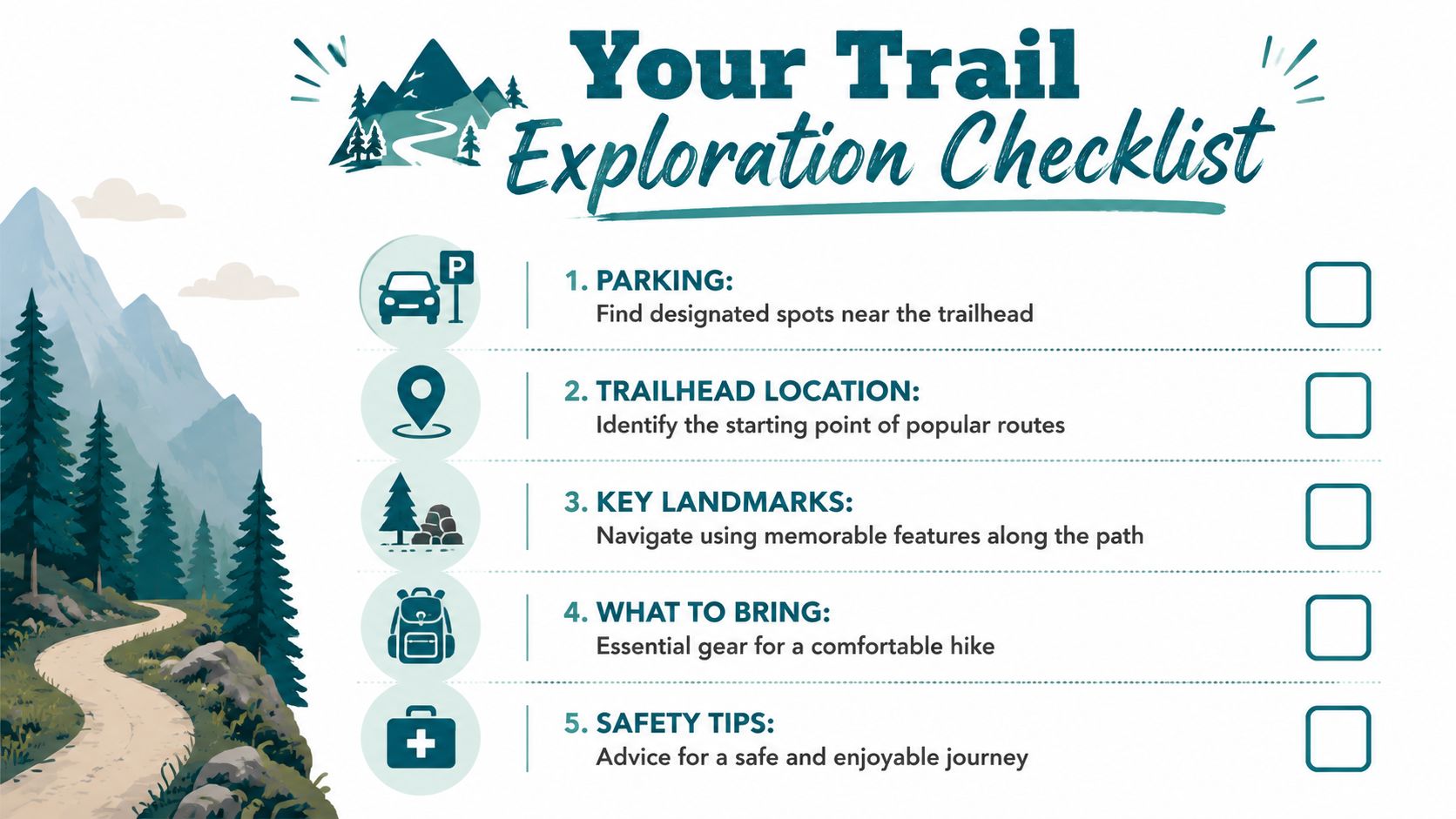
    A trail exploration checklist graphic with icons for parking, trailhead location, landmarks, gear, and safety tips.

    Getting started without overthinking it

    When I go to a new preserve, I try to keep the first visit simple. I'm not there to conquer it. I'm there to learn its rhythm.

    Look for designated parking near the preserve entrance, get your bearings, and give yourself a minute before you start walking. Listen. Check where the trail leaves the parking area. If something seems tucked away or less obvious than you expected, that's normal for wooded preserves.

    A good first lap is less about mileage and more about landmarks. I remember stairs, stream crossings, bluff views, and places where the air suddenly turns cooler.

    The shape of the walk

    Here's how I'd talk you through it if we were hiking together:

    • Start easy: Begin on the clearer, more obvious section and let your eyes adjust. Woodland trails can feel visually busy at first.
    • Watch for the stairs: Once you start descending, everything changes. The woods feel closer. The ravine walls hold sound in a different way.
    • Follow the water: Flat stretches near the stream usually feel calmer and cooler. That's your exhale section.
    • Respect the climb out: Going back up isn't brutal, but it will wake your legs up if you've been casually strolling.
    • Pause at openings: Any gap in the trees near the bluff is worth a stop. Even a short view can reset your whole mood.

    You don't need to move fast here. This is a place that gets better when you slow down enough to notice the temperature shifts.

    A short video can help you get the feel of it before you go:

    What to bring and how to move

    I don't like carrying a ton of gear for a short woods trip. But I also don't like being dumb about it.

    What matters Why I bring it
    Water Ravine walks feel cooler, but climbs still sneak up on you
    Good shoes Dirt, roots, and uneven footing are part of the experience
    Gloves and a spare bag Handy if you spot litter and feel like doing a tiny cleanup
    Phone with charge For maps, photos, and basic safety
    Layers Bluff tops and ravines can feel different on the same day

    The trail mindset I recommend

    Don't go there trying to optimize every minute. Go there trying to notice things.

    Notice how a stair descent changes your body from commuter mode to trail mode. Notice how the ravine floor feels like a different room than the bluff top. Notice how much more attached you feel to a place when you look at it instead of marching through it.

    That's the whole trick. Once you stop treating the walk like a task, the place opens up.

    The Woods Through the Year

    One visit gives you an introduction. Coming back in a different season gives you a relationship.

    Black Partridge Woods changes clothes all year, and I don't mean that in some fancy poetic way. I mean the same trail can feel like four different places.

    A scenic infographic displaying four distinct seasonal landscapes of Black Partridge Woods throughout the year.

    Spring and summer

    Spring is when I get nosy. I'm looking low, not far.

    The forest floor wakes up first. Fresh green pushes through old leaves, wet ground smells alive, and the whole place feels like it's inhaling. Spring-fed areas feel especially vivid because water is part of the story everywhere you turn.

    Summer flips the script. Now I'm grateful for shade. The ravine becomes a natural shelter, and even on a warm day the woods can feel like a cooler pocket tucked away from everything hard and bright.

    • In spring: Watch the ground near damp areas, check the bluffs, and take your time on the first half-mile.
    • In summer: Go earlier if you can, enjoy the denser canopy, and spend extra time near the lower trail sections.

    Fall and winter

    Fall is when the hardwood character really shows itself. You can feel those maples and oaks in the color and texture of the woods, even if you're not naming every tree as you go. Dry leaves underfoot, sharper air, and more open sightlines make the place feel lively in a totally different way.

    Winter strips everything down to structure. Ravines look steeper. The bluffs look bolder. Animal tracks become little headlines on the trail.

    Winter is the season that lets you see the bones of a place.

    My favorite way to revisit

    I like returning with one small mission each season.

    • Spring mission: Find the dampest, greenest part of the walk.
    • Summer mission: Follow shade and listen for water.
    • Fall mission: Stop looking at your feet so much and look up into the canopy.
    • Winter mission: Study the shape of the terrain.

    That keeps the place fresh. It also keeps me honest. I'm not “done” with a woods after one visit any more than I'm done knowing a person after one conversation.

    Become a Steward of the Woods

    Walking through a place is good. Caring for it changes you.

    I learned that in the simplest way possible. You see a bottle off the trail. You see a snack wrapper snagged in brush. You pick it up. Nothing dramatic happens. No orchestra swells. But the place feels more like yours after that, and you feel more responsible in a way that is weirdly calming.

    A artistic watercolor montage showing a hiking boot, a compass, a hand planting a tree, and a wildlife watcher.

    Start with simple trail manners

    Before cleanup talk, I always come back to basic respect.

    Stay on the path where appropriate. Don't yank plants, don't mess with streams, and don't treat the woods like your personal event venue. A preserve like this has delicate parts even when it looks rugged.

    The easiest stewardship habits are boring on paper and powerful in real life:

    • Pack your own stuff out: Every bottle cap and tissue matters.
    • Keep your eyes open: A small piece of litter now becomes a bigger mess later.
    • Move carefully near water: Stream edges and ravine bottoms are easy to impact.
    • Leave living things alone: Looking is enough.

    A tiny cleanup is plenty

    You do not need a permit, a branded shirt, or a giant group chat to do a small good thing.

    Take gloves. Bring one bag. Pick up what you can safely handle during your walk. If you're with two friends, that's even better. One person spots, one person bags, one person keeps an eye on footing and trail flow.

    I like this rough cleanup rhythm:

    1. Start the hike normally. Let yourself enjoy the place first.
    2. Choose one stretch. A parking edge, a trail entrance, or a streamside section with visible trash.
    3. Keep it short. Even a brief cleanup changes the feel of an area.
    4. Stop before you get sloppy. Safety first. Ravines aren't the place for reckless reaching.
    5. Leave with pride, not perfectionism. You helped. That counts.

    Don't wait for a big organized day. If you have gloves and a bag, you can practice stewardship right now.

    Why this changes the experience

    There's a difference between consuming a place and caring for it.

    When I only visit, I enjoy it. When I leave it cleaner, I remember it differently. I feel connected to it. I feel less like a customer and more like a participant.

    If that idea clicks for you, this page on what environmental stewardship is is a solid next read. It puts words to something many of us already feel when we help a place without being asked.

    And that's really it. Stewardship doesn't have to be grand. It can be one bag, one hour, one better-than-before ending to your walk.

    Wait Is This the Park in Metamora

    This mix-up happens a lot, so let me save you the wrong drive.

    Black Partridge Woods is the place in Cook County near Lemont. That's the one this guide is about. The bluff-and-ravine preserve, the spring-fed streams, the local adventure.

    There is also Black Partridge Park Woods in Metamora. That is a different place entirely.

    The quick difference

    The Metamora site is much larger. It is a 287-acre reserve with rolling, complex topography, steep ravines, and well-incised waterways, according to the Illinois Nature Preserves Commission page for Black Partridge Park Woods. That same source says it supports a breeding bird community with 17 area-sensitive species.

    That sounds like a great trip. It just isn't this trip.

    Place What you need to know
    Black Partridge Woods Cook County preserve near Lemont. This guide is about this one
    Black Partridge Park Woods Metamora site. Larger reserve, different destination

    My rule for avoiding the mix-up

    Double-check the county before you leave home.

    If you're planning a quick morning or afternoon nature reset from the Chicago area, you want the Cook County preserve. If you aim for Metamora by mistake, your “small local adventure” turns into a very different day.

    That's not the end of the world. But it is annoying, and I'd rather save you the trouble.


    If this kind of outing speaks to you, Litter Caterpillars is worth a look. It's a Chicago volunteer group built around a simple idea I love: go outside, do some good, make friends, and leave places better than you found them.

  • Amundsen Park Chicago: Your Complete Guide

    Amundsen Park Chicago: Your Complete Guide

    I remember the first time I stopped at Amundsen Park with a grabber in one hand and a trash bag in the other. A basketball rolled across the court, a kid shouted from the playground, and I thought, this is how a neighborhood tells you whether people still care.

    Discovering Your Neighborhood Anchor

    Some places don't look dramatic when you first pull up. They look ordinary. A fieldhouse. A few courts. A playground. A patch of city life doing its job.

    Then you stand there for a minute, and the place starts talking.

    Amundsen Park is a Chicago Park District facility at 6200 W. Bloomingdale Ave. in the Austin/Galewood area. That's the official description. Fine. Useful. But it doesn't tell you what it feels like to watch people drift in from surrounding blocks with strollers, gym shoes, grocery bags, and that tired-but-still-trying look most Chicagoans know by heart.

    A woman walking away on a pathway toward Amundsen Park with a stone park sign in the foreground.

    The moment a park stops being background

    I drive past a lot of parks in this city. It's a common urban experience. You catch a fence line out of the corner of your eye, maybe a baseball backstop, and you keep moving. Amundsen Park Chicago can be that kind of place if you let it. Background. Scenery. Something for other people.

    I don't think that's good enough.

    A neighborhood park is where you prove to yourself that you still know how to show up. You go outside. You meet somebody. You carry something heavier than your phone. You do one useful thing before noon, and your whole day changes shape.

    If you want to get a feel for parks across the city, I like browsing Chicago park guides from Litter Caterpillars before I head out. It helps me read a place better once I'm on the ground.

    A park looks simple until you ask who depends on it.

    Why this one gets under your skin

    Amundsen Park has a fieldhouse, and that matters more than people think. A fieldhouse means the park isn't only for nice weather. It means activity doesn't disappear the second Chicago acts like Chicago. Cold day, windy day, gray day, wet day. People still have somewhere to go.

    I care about that because I've seen what happens when public spaces feel neglected. People pull back. They stop trusting the place. They stop expecting much from each other. Trash starts to feel normal, and normal is dangerous.

    I tell new volunteers when we walk into a park like this:

    • Look at the entrances first. That's where people form their first opinion.
    • Watch where people slow down. Benches, courts, gates, corners. That's where litter piles up.
    • Notice who is here. Kids, parents, seniors, ballplayers, people cutting through. A park has a rhythm if you're paying attention.

    Amundsen Park isn't just grass and equipment. It's one of those places where you can restart your mood, your habits, even your social circle if you've been drifting too long.

    The Story Behind the Name

    I like names that make you earn them.

    When I first heard "Amundsen," I didn't think about a park sign. I thought about ice, maps, risk, and a guy stubborn enough to venture where others wouldn't. That's Roald Amundsen, the Norwegian explorer who lived from 1872 to 1928, and Chicago attached his name to public life fast. Amundsen High School opened in 1929, one year after his death.

    That detail sticks with me because cities don't name things by accident. Somebody decided the name meant action. Somebody wanted that word on a building where young people would walk in every day.

    Exploration isn't only snow and flags

    I don't care much for fake inspiration. You know the kind. Big words, no dirt on the shoes. But I do like the idea that exploration can shrink down to city size and still stay real.

    You don't need a ship frozen into polar ice. You need curiosity and a little nerve.

    For me, urban exploring looks like this:

    • Turn off the autopilot. Walk into a park you've ignored for years.
    • Learn the ground. Figure out where people gather, where they play, where they retreat.
    • Do something useful once you arrive. Pick up litter. Ask a question. Say good morning.

    Street rule: Exploration counts more when you come back with your hands dirty.

    Why the name fits the work

    Amundsen Park Chicago isn't the North Pole. Good. Most of us don't need a fantasy. We need a mission we can complete.

    A neighborhood cleanup has its own kind of expedition energy. You scan the terrain. You move as a team. You solve small problems fast. You deal with weather, awkward moments, and the occasional weird surprise near a fence line. Then you leave the place better than you found it.

    That's enough adventure for a Saturday morning. And unlike a lot of modern life, it's real.

    What You Will Find at Amundsen Park

    The first time I walked Amundsen with cleanup eyes on, I saw a kid cutting across the open grass with a soccer ball under one arm, two guys already shooting on the court, and a grandmother easing a stroller toward the playground. Three different reasons to be there. One park holding all of it together.

    That is what you need to notice before you pick up a single piece of trash.

    Amundsen Park covers 16.24 acres, and the park packs in a fieldhouse with a gymnasium, fitness center, and club rooms, plus baseball and softball fields, a football and soccer field, volleyball and basketball courts, and a playground, according to the Chicago Park District's Amundsen Park listing.

    An organizational chart showing the various indoor and outdoor amenities available at Amundsen Park.

    The fieldhouse sets the tone

    A fieldhouse changes a park. It gives people a reason to come in when the sky looks mean, when school is out, when they need a place to move, meet, or catch their breath.

    I pay attention to that because indoor space creates loyalty. Regulars start recognizing each other. Parents swap names. Teens find a place to burn off energy without getting hassled. Neighbors who would never call themselves volunteers still start acting like stewards because they use the place enough to care what happens to it.

    That is how a park becomes a neighborhood anchor instead of just a patch of city land.

    Outside, every area tells a different story

    You can read the whole park by watching where people stop.

    Courts collect fast traffic and fast mess. Ball fields spread people out, but the edges catch the leftovers. Playground areas need slower, more careful attention because little hands touch everything. Open grass looks clean from a distance and fools rookies every time. Walk the fence line after a windy day and you learn fast.

    Here is how we read it during a Litter Caterpillars pass:

    Area What happens there What we watch for
    Courts Pickup games, waiting around, spectators talking trash and laughing Drink bottles, snack wrappers, litter tucked against fencing
    Ball fields Practices, games, parents watching from the side Seed bags, cups near benches, debris along the perimeter
    Playground Families circulating, kids dropping things without noticing Small trash near benches, curbs, equipment bases
    Open field areas Running drills, crossing through, casual play Windblown paper, plastic caught in corners and fence lines

    That table came from work, not theory.

    One Saturday, a new volunteer wanted to start in the middle because it looked bigger and more important. I sent him to the court fence instead. Ten minutes later he came back with an armful of bottles and wrappers and a different look on his face. He had figured out what every cleanup crew learns. Parks do not wear down evenly. The pressure lands where people gather, wait, eat, and watch.

    If I were walking you through it

    I would tell you to slow down and stop acting like bigger means better.

    Start at the entrances and sidewalks. Those spots tell visitors whether anybody cares. Then hit the courts for a quick win. After that, work the field edges and bleacher areas, where trash drifts and settles. Save the playground for last so you have enough patience left to do it right.

    That order matters. Early wins keep people engaged. Careful zones demand more focus.

    And there is something else here people miss. A park like Amundsen gives you more than places to play. It gives you chances to serve without making a speech about service. You pick up a wrapper near the bench, a parent notices, a kid asks what you are doing, and suddenly you are not just passing through. You are part of the place.

    That is the good stuff. Friendship starts there. Pride starts there. So does the habit of showing up again.

    A Park for Everyone All Year Round

    Last winter, one of our volunteers showed up with a trash grabber in one hand and a cup of gas-station coffee in the other. The wind was sharp enough to make your eyes water. The playground was still quiet, but the park was not dead. A couple of seniors were heading toward the building. A parent was steering one kid away from a puddle and another toward the swings. That morning made the point better than any city brochure ever could. A neighborhood park has to work in bad weather, tired weather, ordinary weather.

    Amundsen Park holds up because people can use it in different ways across the year, and because the design choices matter to real bodies. The playground is accessible and has a rubberized surface. I care about that for a simple reason. It changes who gets to join in, who feels welcome staying longer, and what kind of cleanup work protects the space.

    A watercolor-style illustration showcasing various seasonal outdoor activities and community events at Amundsen Park in Chicago.

    What the ground teaches you

    Rubber surfacing looks easy until you kneel down and see what gets trapped there. Juice straw wrappers flatten out. Wet leaves glue small bits of plastic to the edge. Cigarette waste hides where the surface meets the curb or the base of the equipment.

    So the job changes.

    You do the obvious pass with grabbers. Then you slow down and work the seams with gloves on. If you rush that part, you leave behind the sharp stuff and the sticky stuff, which means the next family gets a park that only looks clean from ten feet away.

    That lesson carries beyond litter. Service gets personal fast in a place like this. A smooth surface helps a child move with more confidence. A careful cleanup keeps that same child from meeting broken glass first. That is not abstract community talk. That is Tuesday afternoon in a neighborhood park.

    Why all-season use changes people

    Summer has its own noise. Spray, sneakers, basketballs, somebody calling a kid's name for the third time. Cold months shift the rhythm, but they do not erase it. Indoor activity keeps people coming back, and that matters more than park planners and armchair critics usually admit.

    Routine builds attachment. Attachment builds responsibility.

    When people return to the same park in July, in October, in February, they start recognizing each other. They hold doors. They ask if a cleanup is happening next weekend. They bring a friend. That is how a park turns from public property into shared ground, and it is a big part of what we believe in with the Litter Caterpillars. You do not just use the park. You help carry it.

    Here is a closer look at the place in motion:

    I also push people to make the trip part of the habit. If you can get there without turning the outing into a production, you are more likely to come back and help again. That is why I like these eco-friendly transportation tips for getting around Chicago for park days and cleanup runs.

    What happens when a park's rhythm gets broken

    Residents felt it when regular use of the fieldhouse was disrupted. You could hear it in the way people talked about missed classes, changed routines, and one more neighborhood place feeling unstable for a while. Programming returning mattered because routine matters.

    That is the part I never want cleaned-up civic language to hide. A park is friendship with a location. It is kids burning energy, adults catching their breath, neighbors learning each other's names, and volunteers finding out they are tougher than they thought. Amundsen Park does that all year, if enough of us keep showing up for it.

    How to Get to Amundsen Park

    The first time someone joined one of our cleanup mornings at Amundsen Park, she texted me from her car: wrong entrance, low battery, already annoyed. Ten minutes later she found us, grabbed a spare bag, and by the end of the hour she was laughing with two neighbors she had never met. The park did its job. So did a decent set of directions.

    Use 6200 W. Bloomingdale Ave. as your starting point. Then give yourself a minute to arrive like a human being, not a package being dropped at a pin. Walk one side of the park before you choose where to settle in. You will spot the rhythm fast. A family heading toward the playground. Someone cutting across to the courts. A volunteer noticing the corners where trash likes to collect after a busy day.

    Getting there should be easy enough that you will come back.

    If you take transit, check the route before you leave. If you drive, build in a little time so parking does not put you in a bad mood before you even touch the grass. If you bike or want a lower-waste way to make the trip, I like these eco-friendly transportation tips for getting around Chicago because they help turn one park visit into a repeat habit.

    A few things make the visit better:

    • Carry less than you think you need. Water, gloves for cleanup, and one extra layer usually does it.
    • Wear shoes that can handle the whole park. Pavement, grass, rubber surface, and a muddy edge after rain are all part of the deal.
    • Know your main reason for going. Hoops, a walk, family time, or service. Pick one and let the rest happen naturally.

    That last part matters more than people think. A rough first visit is usually not the park's fault. It is being rushed, hungry, underdressed, or showing up with no plan and expecting the place to rescue your mood.

    If you are heading to the fieldhouse for a class or scheduled activity, check current programming before you leave home. As noted earlier, regular use has been returning, and the schedule can shift because this is a real neighborhood space, not a museum piece. Show up ready to adapt a little. That is community life.

    And if you see a few of us with grabbers and buckets, come say hello. Plenty of good days at Amundsen Park start with somebody asking a simple question: "Need a hand?"

    Help Us Build a Better Chicago

    I'll say something a little rude. A lot of people love the idea of community more than they love doing community.

    They like the word. They like the vibe. They like posting about it. But when it's cold, or early, or slightly inconvenient, they disappear. That's fine. I don't build around that type of person anymore.

    I built my life differently because I had to. Cleaning my own mess used to feel impossible. Other people's trash felt easier. Strange, but true. Once I learned that, I leaned into it. I started cleaning outside, and outside started cleaning me back.

    Why service changes a person

    When you pick up litter in a park, you get immediate proof that your effort matters. The bag gets heavier. The ground gets cleaner. A stranger nods at you. A kid notices. Your brain stops spinning in circles because your hands are busy doing one honest thing.

    That's part of why I believe in weekend morning service. It filters for people who are ready to give. Not perfect people. Ready people.

    The values I care about are simple:

    • Bravery. You go out when it's awkward, cold, or unfashionable.
    • Kindness. You improve a place that belongs to everybody.
    • Unity. You work beside people you might never have met otherwise.

    A poster inviting community members to volunteer for Amundsen Park with the Litter Caterpillars group in Chicago.

    What helping actually looks like

    You don't need a grand plan. You need a morning, decent shoes, and enough humility to do work that isn't glamorous.

    If you want a practical way in, park cleanup volunteering in Chicago is one path. It gives people a direct way to spend time outdoors and remove litter from public spaces.

    Here are the people who usually end up loving this work:

    Person What they get
    New to the city A low-pressure way to meet solid people
    Burned out by screens A task with a visible finish line
    Students and young professionals A weekend habit that feels real
    Longtime residents A chance to protect a place they already care about

    Cleaning up other people's messes can teach you how to face your own life with less fear.

    Why I want you there

    Because parks don't stay clean by accident. Because friendship grows faster when people carry a shared burden. Because a lot of us are starving for a reason to get out of bed and do something decent before the day gets hijacked.

    Amundsen Park Chicago isn't asking you for perfection. It is asking for presence.

    Show up once and you'll understand. Show up again and you'll start to trust yourself more. Keep going, and one day you'll look around and realize the city feels less anonymous than it used to.


    If you want that kind of Saturday, join Litter Caterpillars. We pick up trash, meet good people, and turn service into a habit you can keep.

  • Find a Soup Kitchen Chicago Il: Your 2026 Guide

    Find a Soup Kitchen Chicago Il: Your 2026 Guide

    More Than Just a Meal: Why Service Heals

    I used to think cleaning my own room was the hardest thing in the world. An old jar in the fridge, a shirt on the floor, some broken little thing in a drawer. None of it looked heavy, but every object carried a memory, and every memory pinned me down.

    Then I started cleaning other people's messes with Litter Caterpillars on the streets of Chicago. Somehow, that felt lighter. I could bend down, grab a bottle out of the weeds, laugh with strangers in gloves, and go home feeling more put together than when I left.

    That's why this guide to a soup kitchen in Chicago, IL means something to me.

    When you hand someone a tray, pour coffee, sort canned food, or walk into a dining room because you need help, you're doing more than handling hunger for one moment. You're letting another human being say, “Come in. Sit down. You matter today.” I've learned that cleaning the city and feeding the city come from the same place. You take one small patch of pain, and you make it easier to carry.

    Chicago has a huge emergency food network. The Greater Chicago Food Depository works with more than 700 food pantries, soup kitchens, shelters, and programs across the region. That tells me something simple. If you need a meal, you are not alone. If you want to help, there is room for your hands.

    1. Pacific Garden Mission

    Pacific Garden Mission (PGM)

    Pacific Garden Mission is the place I think of when someone says, “I need somewhere steady.” Some spots are best for one night a week. Some are best for pantry pickup. PGM is for the days when you need a place that keeps showing up.

    It has free meals every day, and it's built for people who need more than food. If you're trying to find a soup kitchen in Chicago, IL where meals connect with shelter, showers, clothing, and recovery support, PGM is one of the clearest options.

    What it feels like on the ground

    A place like this reminds me of our trash pickups after rough weather. You don't need poetry when the sidewalk is covered in broken glass. You need gloves, a bag, and somebody who's already there. Pacific Garden Mission has that same practical feeling.

    You walk in knowing the system is already moving. Meals are regular. Volunteers have a path. Donations have a path. People who need help aren't left guessing what happens next.

    • Best for consistency: You can count on breakfast, lunch, and dinner year-round.
    • Best for layered help: Food is only one part of what's available on-site.
    • Best for volunteers who like structure: The organization has clear ways to give time or resources.

    Practical rule: If you're referring someone who is exhausted and overwhelmed, predictable hours matter more than fancy wording.

    There is one thing to know before you send someone there or go yourself. PGM is faith-based, and gospel service may come before meals. For some people, that feels comforting. For others, it may not be the right fit.

    Why I'd point people here first

    I've met volunteers who want to help but freeze because there are too many choices. My advice is always the same. Pick the place with the clearest routine and start there. Pacific Garden Mission is a strong first step because it reduces uncertainty.

    If you're also looking at pantry-style help, I'd pair this with our guide to Casa Catalina Food Pantry in Chicago, IL. Sometimes the right answer is a hot meal today and groceries for tomorrow.

    Visit Pacific Garden Mission.

    2. Franciscan Outreach

    Franciscan Outreach

    Franciscan Outreach feels like the kind of place you discreetly suggest to a friend who's been sleeping badly for too many nights. It has shelter-based meal service, and that changes the mood. Food is part of the day's rhythm, not a random stroke of luck.

    I respect that. When life is unstable, rhythm is medicine.

    A meal inside a bigger reset

    At one of our Litter Caterpillars cleanups, we worked an area where everything looked temporary. Tents, carts, soaked blankets, plastic bags tied to fencing. You could tell that what people needed wasn't one good hour. They needed a chain of decent hours, one after another.

    That's why Franciscan Outreach matters. Meals connect with shelter and case management, and that can help someone move from pure survival toward something more stable.

    • Good for shelter referrals: Meals are woven into shelter life.
    • Good for evening volunteers: Nightly dinner service can be a practical way to help after work.
    • Good for people who need a handoff: Partner networks can matter when one organization alone isn't enough.

    There's a tradeoff. Many meals are focused on shelter residents first, so community access may be narrower than a fully open dining room. Visitors and volunteers may also need to deal with intake or sign-in steps.

    Some people need the wide-open front door. Some people need a front door with a plan behind it.

    Where this fits in your own giving life

    If you're the sort of person who likes direct service but wants a path into deeper volunteer work, Franciscan Outreach is worth your attention. You can show up for dinner service and still feel connected to a larger effort.

    I'd also keep our Chicago food bank volunteer guide open in another tab. Feeding people in Chicago isn't one lane. It's a relay race, and sometimes your best move is learning where your energy fits.

    Visit Franciscan Outreach.

    3. A Just Harvest

    A Just Harvest has the kind of name that could sound abstract until you picture the actual lunch in someone's hand. Then it gets real fast. This Rogers Park organization is one of those places where neighborhood energy meets practical food help.

    I like it because it feels local in the best way. You can imagine learning people's names there.

    Why North Side referrals often land here

    If someone on the North Side asks me where they should look for a meal, I don't always send them downtown first. Travel takes energy. Bus fare takes energy. Uncertainty takes energy. A Just Harvest is a useful option when staying closer to home matters.

    Its meal service has included a daily grab-and-go lunch, and it also has pantry distribution plus community programs. That mix matters because many people searching “soup kitchen Chicago IL” are really trying to solve a whole week, not just one lunch.

    • Useful for neighborhood access: Strong fit for North Side referrals.
    • Useful for volunteers who want repeated contact: Community-based work can feel more personal over time.
    • Useful for people balancing food needs: A pantry connection can stretch help beyond one meal.

    The human scale matters

    I've learned this from litter cleanup too. A giant city can make you feel small, but one block can make you feel capable. A Just Harvest has that one-block feeling. You can step in and understand what's happening.

    The only caution is practical. Service format and menus can shift, so check current details before you send someone over. A place can still be dependable even when the exact setup changes from dine-in to grab-and-go.

    If you want a neighborhood-centered option with meals, pantry access, and a volunteer-friendly vibe, visit A Just Harvest.

    4. Fourth Presbyterian Church Meals Ministry

    Fourth Presbyterian Church, Meals Ministry

    There's something different about a sit-down supper downtown. Not because downtown is magic. It isn't. It's loud, fast, and often lonely. That's exactly why a meal in a calm room can hit so hard.

    Fourth Presbyterian Church's Meals Ministry has Sunday and Monday evening suppers, plus bag lunches during the week. I'd point people here when they want a central location and a more formal dining-room feel.

    A place where the chair matters

    I once spent a windy morning picking litter near a busy commercial strip. Every person moved like they had somewhere to be, and nobody looked at each other. Later that day I got coffee with another volunteer, sat down, and felt my shoulders drop. A chair can do that. A table can do that.

    Fourth Presbyterian understands that. A sit-down meal changes the emotional texture of receiving help. You're not just grabbing calories and leaving. You're being invited to stay for a minute.

    • Best for downtown access: Good if location near the Near North side matters.
    • Best for a dining-room setting: Some guests feel more comfortable in a seated meal environment.
    • Best for volunteer groups: Churches and partner networks often create easy entry points for service.

    The limitation is simple. This isn't a daily meal site. Timing matters, and so does capacity. If someone is counting on it, tell them to check the current schedule and arrive with a little cushion.

    A good referral isn't only the nearest place. It's the place a person can actually use on that day, at that hour, in that part of the city.

    Visit Fourth Presbyterian Church Meals Ministry.

    5. The Chicago Help Initiative

    The Chicago Help Initiative (Wednesday Dinners at Catholic Charities)

    Wednesday can be a hard day. Monday still has momentum. Friday has hope. Wednesday is where a lot of people sag a little. I think that's one reason I'm drawn to the Chicago Help Initiative's dinner service.

    It runs a sit-down Wednesday dinner at Catholic Charities' dining room on LaSalle. Meals come through restaurant and hotel partners, and there are resource tables on-site too.

    Midweek help with some dignity built in

    I love practical beauty. Not expensive beauty. Practical beauty. A clean park after a pickup. A tray carried carefully. A meal plated like somebody tried.

    That's what this program brings to mind. It has a welcoming dinner format that can feel more like hospitality than emergency response, and that difference matters when someone's had a rough week or rough year.

    • Good for central-city access: Helpful for people already near downtown.
    • Good for volunteers who like events with energy: Group sponsorships and dinner service create a shared rhythm.
    • Good for guests who need referrals too: Resource tables can help people ask the next question after dinner.

    The biggest downside is obvious. It's Wednesday only, and people may line up early because capacity isn't endless. So I'd treat this as a great targeted option, not the only plan.

    Why I keep this one in the mix

    Some organizations are best because they're broad. Some are best because they're specific. The Chicago Help Initiative is specific, and I mean that as praise. If you know someone who needs a midweek evening meal downtown, this is the kind of referral that can stick.

    Visit The Chicago Help Initiative Wednesday Dinners.

    6. Catholic Charities Evening Meal and Supper Programs

    Catholic Charities, Evening Meal/Supper Programs

    A few winters ago, one of our Litter Caterpillars volunteers finished a cleanup with hands still stiff from the cold and asked me a simple question: “Where do people go tonight if they miss the usual spot?” That question stayed with me, because street service teaches you fast that need rarely lines up with one church basement, one block, or one hour on the clock.

    That is why Catholic Charities keeps earning a place in this guide. Its evening meal and supper programs reach across multiple locations, which gives people more than one shot at finding a meal that fits where they are and what they can reach.

    A wider net helps when life gets messy

    Some nights, the problem is not hunger alone. It is distance. A bus fare. A missed train. A family trying to piece together dinner and the next morning at the same time. A networked provider can help in those moments because the answer is not tied to one dining room.

    I like this option for the same reason I like a neighborhood cleanup crew that works in more than one corridor. If one alley is blocked, you do not quit on the whole block. You find another way in. Catholic Charities brings that kind of practical flexibility to food support.

    • Best for people comparing locations: Multiple sites can make it easier to find a workable evening option.
    • Best for referrals that need more than a meal: Many programs connect food with case management or other support.
    • Best for households with different needs: The broader network can serve older adults, families, and individuals in different settings.

    The drawback is straightforward. Hours, eligibility, and meal formats can differ by site, so you need to confirm the details before you send someone across town.

    If you want to pair food support with other ways of serving the city, our guide to Chicago charities doing hands-on community work is a useful next read.

    Visit Catholic Charities.

    7. The Salvation Army Freedom Center and Harbor Light

    The Salvation Army Freedom Center / Harbor Light

    Some help waits in a building. Some help gets in a vehicle and goes looking. I have a soft spot for the second kind.

    The Salvation Army's Freedom Center and Harbor Light combine on-site meal service with mobile feeding outreach. That mix matters when a person can't easily get to a fixed location, or won't.

    The meal that moves toward people

    At Litter Caterpillars, we don't only clean pretty blocks. We go where trash piles up because people stopped believing anyone would come. Mobile meal outreach carries that same spirit. Instead of asking someone in crisis to contend with transit, timing, weather, and fear, a team drives closer to where they already are.

    That's the strongest case for Harbor Light's approach. Weekend hot dinners are one thing. A nightly mobile feeding unit that meets people across the city is something else.

    • Best for unsheltered outreach: Food reaches people where they are.
    • Best for immediate handoffs: Mobile teams can connect people with shelter or treatment pathways.
    • Best for weekend fixed-site meals: Harbor Light gives another option when weekday programs aren't in play.

    The weakness is the same thing that makes it useful. Routes and stops can change, so you have to confirm the current schedule. And if someone wants a dining room every day, this isn't that.

    Visit The Salvation Army Harbor Light hunger relief page.

    8. The Night Ministry

    The Night Ministry

    The Night Ministry reaches people the way many systems should, but often don't. It goes out. It keeps a schedule. It mixes food with basic healthcare and street outreach. If you've ever watched someone try to solve three emergencies at once, you'll understand why that combination matters.

    This isn't a classic dining hall. It's more flexible and more street-level than that.

    Food plus care can change the whole interaction

    One of the most useful things I learned from local food assistance research is that “soup kitchen” can be too narrow a phrase. Some Chicago groups are doing much more than serving a bowl of food. Nourishing Hope describes its work as groceries, mental health counseling, and social services, and Friendship Center volunteer roles can include sorting, bagging, distribution, and client intake. That tells me a search for a soup kitchen in Chicago, IL can miss the true extent of assistance.

    The Night Ministry fits that bigger picture. Food, coffee, hygiene items, and basic health support can all meet a person at the same stop.

    If someone is hungry, cold, and sick, separating those problems into different buildings doesn't feel smart. It feels exhausting.

    Who this is best for

    I'd think of The Night Ministry for unsheltered neighbors, street outreach referrals, and situations where trust has to be built slowly. A bus stop or scheduled outreach location can feel less intimidating than a formal intake desk.

    • Good for low-barrier contact: People can connect without committing to a full program right away.
    • Good for outreach workers and neighbors making referrals: A regular schedule creates some predictability.
    • Good for human reality: Food and health needs often show up together.

    Since this is mobile outreach, supplies can run out and each stop has a time window. Still, if your instinct says someone needs care that comes to them, not the other way around, visit The Night Ministry.

    9. Dignity Diner

    I love the name Dignity Diner because it doesn't pretend food is only about fuel. Most of us know that already. We feel it when someone cooks for us after a bad day. The plate says one thing. The care says another.

    Dignity Diner leans into that feeling with a restaurant-style Tuesday dinner and indoor seating, plus extra to-go meals.

    Respect has a texture

    You can feel respect in small things. The way someone hands you utensils instead of tossing them. The way they make eye contact. The way a room is set up so you don't feel processed.

    Dignity Diner seems built around that texture. It's a strong pick for guests who'd rather sit down to a plated meal and for volunteers who want a warmer, more intimate service setting.

    • Best for a calmer dinner environment: Restaurant-style service changes the experience.
    • Best for small volunteer groups: The setup is approachable.
    • Best for Tuesday planning: If someone needs one dependable evening in the week, this can fit nicely.

    The limit is obvious. It's one night, and seating is first come, first served. But I'd still keep it on any serious list of soup kitchen Chicago IL options because dignity isn't some extra garnish. It's part of the meal.

    Visit Dignity Diner.

    10. Care for Friends

    One Saturday, our Litter Caterpillars crew finished a cleanup with sore backs, dirty gloves, and that familiar mix of pride and heartbreak. We had cleared bottles, fast-food bags, and broken glass from a stretch of sidewalk where people were also trying to get through the day hungry. A few hours later, I was thinking about how strange that is. You can make a block look better and still know someone nearby needs lunch more than they need a cleaner curb.

    That's why Care for Friends stays with me.

    Care for Friends offers hot lunch at multiple Chicago locations, and that simple fact matters more than it sounds like it should. Hunger hits in the middle of the day. So does exhaustion. So does the moment when someone decides whether to keep going or give up on finding help.

    Lunch can change the shape of a day

    I've seen how a small act at the right hour can steady somebody. After a cleanup, I've been the sweaty, drained volunteer who suddenly feels human again because somebody passed me a warm plate and looked me in the eye. Service does that twice. You give something, then realize you needed part of it too.

    Care for Friends fits that middle-of-the-day need well. Multiple locations make it easier for guests to find a site that works. The welcoming tone helps too, especially for people who are already carrying enough stress before they ever get in line.

    • Best for midday support: Hot lunch fills the gap before evening meal programs begin.
    • Best for people traveling across the city: Multiple locations give guests more than one possible stop.
    • Best for low-pressure access: The friendly, straightforward approach can make showing up feel easier.

    I also like what this program represents in a city like ours. At Litter Caterpillars, we talk a lot about what happens when care becomes visible. A clean corner tells your neighbor they matter. A hot lunch tells them the same thing in a deeper way.

    Visit Care for Friends.

    Top 10 Chicago Soup Kitchens Comparison

    Program Service Model (core features) Schedule & Access (UX) Cost & Volunteer Fit (value) Target Audience 👥 Unique Strengths 🏆/✨
    Pacific Garden Mission (PGM) Three free meals/day, shelter, showers, clothing, on‑site case management ✨ Open 365 days; high capacity but lines & faith component can be a barrier 💰 Free · Structured volunteer/donation paths · ★★★★ Unsheltered, recovery seekers 🏆 One‑stop wraparound services
    Franciscan Outreach Daily shelter meals, nightly volunteer dinner service, partner network Daily cadence; strong encampment→shelter transition; sign‑in protocols 💰 Free · Nightly volunteer roles · ★★★★ People transitioning from encampments, shelter residents 🏆 24‑hr transition support & coordinated partners
    A Just Harvest Daily grab‑and‑go lunch (currently), weekly pantry, community programs Consistent local North Side service; format may change, check schedule 💰 Free · Volunteer‑friendly · ★★★☆ North Side residents, community volunteers 🏆 Community organizing & urban agriculture
    Fourth Presbyterian, Meals Ministry Weekly sit‑down suppers + midweek bag lunches; dignified dining room Predictable Sun/Mon suppers; central downtown site; limited seating 💰 Free · Good for volunteer groups · ★★★★ Downtown guests, referral clients, volunteer groups 🏆 Dignified sit‑down experience near Michigan Ave
    Chicago Help Initiative (Wed Dinners) Weekly restaurant‑quality sit‑down dinner; partner‑donated meals & resources Wednesdays only; high‑quality food; on‑site resource tables 💰 Free · Group sponsorship/volunteer friendly · ★★★★ Mid‑week central‑city guests, referral clients 🏆 Restaurant‑quality meals + resource linkage
    Catholic Charities, Evening Programs Multiple meal sites, pantries, downtown dining hall, senior/family nutrition Citywide reach; schedules vary by site, verify before referring 💰 Free · Wide volunteer options · ★★★★ Seniors, families, citywide referrals 🏆 Large network & varied program types
    Salvation Army Freedom Center / Harbor Light Weekend on‑site dinners + nightly Mobile Feeding Unit with caseworkers Weekend hot dinners; nightly mobile stops (rotating), confirm schedule 💰 Free · Strong outreach volunteer roles · ★★★★ Unsheltered, weekend diners, outreach clients 🏆 Mobile feeding + on‑the‑spot referrals/transport
    The Night Ministry Mobile health/outreach bus: food, hygiene, sack suppers, street medicine Set weekly bus routes across North/West/South; limited time per stop 💰 Free · Outreach/medical volunteer roles · ★★★★ Unsheltered neighbors needing food & health care 🏆 Integrated street medicine + low‑barrier service ✨
    Dignity Diner Weekly three‑course, restaurant‑style dinner + to‑go meals (Tuesdays) Tuesdays only; indoor seating (~85) with extra to‑go capacity 💰 Free · Excellent for small volunteer groups · ★★★★ Local guests preferring dignified meals, volunteers 🏆 Warm, restaurant‑style service since 1992
    Care for Friends Hot lunches multiple days/week at several Chicago locations; clothing/health some days Daytime sit‑down meals across locations; schedules vary by site 💰 Free · Multiple volunteer sign‑ups · ★★★☆ Diverse citywide clients, daytime guests 🏆 Multiple locations & no‑questions‑asked policy

    Your First Step to Giving Back

    You've seen the list. Now I want to say the part that matters most to me. The hardest thing usually isn't finding a place. It's crossing the threshold.

    That's true if you need help. It's also true if you want to give it.

    I know that feeling well. The first Litter Caterpillars cleanup had only three of us, and Chicago hit us with one of its weird spring tantrums. Hail. Wind. Cold fingers. Ubers canceling while we hid under a tree. We could've called it a bad idea and gone home annoyed. Instead, somewhere in the middle of that nonsense, I realized I felt more alive than I had in months.

    I was cleaning up trash, yes. But I was also cleaning up some private wreckage inside myself.

    That's why I think this matters, whether you're searching for a soup kitchen in Chicago, IL because you need a meal, or because you want to serve one. Helping doesn't always begin with confidence. A lot of the time it begins with embarrassment, hesitation, grief, hunger, or plain old awkwardness. You show up anyway.

    And then something shifts.

    Maybe you volunteer once at Pacific Garden Mission and realize routine is good for you. Maybe you help at a Wednesday dinner and remember that strangers can still laugh together. Maybe you bring a friend to a lunch service and stop feeling so stuck in your own head. Maybe you walk into a dining room because you need food, and that simple act of accepting help breaks a loneliness you haven't been able to name.

    I've seen the same pattern in cleanup work over and over. People think service is only about sacrifice. Sometimes it is. Sometimes you're cold, wet, tired, and wondering why you signed up. But often, service gives back almost immediately. It gives you structure. It gives you movement. It gives you a reason to get out of bed and put your phone down. It gives you contact with reality.

    Chicago has plenty of reality.

    It has sidewalks with broken bottles, train stops with tired faces, church basements with coffee urns, mission dining rooms with long lines, and volunteers who came in nervous but stayed because something inside them loosened up. I trust those places. I trust people who keep showing up in them. And I trust the strange, quiet medicine of doing a useful thing with your hands.

    So don't overthink this.

    Pick one organization from this list. If you need help, call or visit and ask the simplest question you can ask. “What time should I come?” If you want to volunteer, do the same thing. “What do you need me to do?” You do not need a perfect plan. You need one honest action.

    That's how most good stories start. Not with certainty. With motion.

    If cleaning the city is your first doorway into service, come join us. If feeding the city is your doorway, walk through it. Either way, you're moving toward people instead of away from them. In my experience, that's where healing begins.


    If this guide stirred something in you, come meet Litter Caterpillars. We pick up trash across Chicago, make friends, laugh through bad weather, and practice the kind of service that changes you while you're busy changing a block. If you want a first step that's brave, simple, and real, we'd love to have you with us.

  • Possum Hollow Woods Your Guide to a Chicago Escape

    Possum Hollow Woods Your Guide to a Chicago Escape

    The first time I went to possum hollow woods, I was trying to escape my phone for an hour. I parked, started walking, and within a few minutes the noise in my head dropped from a shout to a murmur.

    My First Walk in Possum Hollow Woods

    I didn't go there chasing some grand outdoor breakthrough. I just needed a place where my thoughts could stop bumping into traffic, screens, and unfinished tasks. Possum hollow woods gave me that almost right away.

    The feeling reminded me of our first cleanup in a hailstorm. Three of us stood under a tree, freezing, while ride after ride got canceled. It was miserable in the normal sense, but it was also weirdly clarifying. Real weather does that. Real places do that. They strip away the fake urgency and leave you with something simple. You're cold. You're alive. You're doing something that matters to you.

    That first walk in the woods hit me in the same way, just quieter. Leaves moved. Gravel crunched. A bird called from somewhere I couldn't see. Nothing dramatic happened, and that was the point. Sometimes growth doesn't arrive like a movie scene. Sometimes it comes like a trail that keeps going when your mind finally stops racing.

    Why this place got under my skin

    I've spent a lot of time in Chicago parks and preserves. Some places are good for exercise. Some are good for meeting friends. Some are good for proving to yourself that you can get out the door on a hard day. Possum hollow woods is one of those places that lets you do all three without demanding a lot from you first.

    If you've ever walked into a preserve and felt like you needed special gear, special knowledge, or a big plan, this isn't that kind of place. It feels approachable. Human-sized. You can show up carrying stress and leave carrying less of it.

    Practical rule: If a place makes it easy to start, you'll come back more often.

    That matters more than people admit. A perfect outdoor plan that never happens is useless. A simple walk you take can change the whole tone of your week.

    I've felt that same kind of reset at other preserves too, including MacArthur Woods Forest Preserve, but possum hollow woods has a certain steadiness to it. It doesn't try too hard. It just lets you arrive.

    And if you let it, it'll tell you a small truth that has helped me a lot. Showing up is half the battle. The trail handles the rest.

    Finding Your Way to the Woods

    The best arrivals are the ones that lower your heart rate instead of raising it. Possum Hollow Woods has that kind of entry. You are not fighting downtown traffic patterns or guessing which lot belongs to the preserve. You head toward West 31st Street, watch for the entrance west of South La Grange Road near La Grange Park, and start your day with your attention still intact.

    A woman with a backpack walking toward the entrance of Possum Hollow Woods on a path.

    I care about that more than people expect. A preserve can be beautiful and still lose you at the parking lot if the approach feels confusing. Places that are easy to reach get revisited. Places that ask too much before the first step usually do not.

    If you're driving, set your route before you leave and pay attention as you get close to 31st Street. The roads around the preserve are manageable, which makes this a good pick for first-time visitors, families, or anyone bringing a friend who wants a calm start. The trade-off is predictable. Easy access attracts people, especially on good-weather weekends, so earlier arrivals usually make the whole outing smoother.

    Transit takes a little more effort here. That does not make the trip unrealistic. It just means the visit rewards a quick check of your route, your timing, and your walk from the nearest stop before you head out.

    Group plans need a bit more structure. Grove #1 gives you a clear home base with a shelter, and seasonal restroom access can make a real difference if you're organizing a cleanup, picnic, or community walk. I've learned this through Litter Caterpillars events across Chicago. People relax when they know exactly where to meet, where to return, and who is carrying the extra bags or water.

    Use this setup if you want the day to run cleanly:

    • Solo visit: Bring water, wear shoes you do not mind getting dusty, and keep your plan loose.
    • Meeting a friend: Pick one specific meeting point before anyone leaves home.
    • Bringing a group: Start at Grove #1, set a regroup time, and say it out loud twice.

    That last part sounds basic. It saves headaches.

    For people building a regular outdoor habit, I keep coming back to the same rule. Choose places that are easy enough to visit on an ordinary day, not just on your most organized day. If you want more ideas in that category, this guide to forest preserve spots around Chicago is a useful place to start.

    Possum Hollow Woods is good at meeting you where you are. Show up tired, curious, alone, or with a few neighbors. The place gives you a fair shot at settling in, and that is often what turns one visit into a relationship with the land.

    Exploring the Trails and Sights

    The part I like most about Possum Hollow Woods is that it does not force a single kind of day on you. You can treat it like a quick walk, a longer ride, or the kind of place where you stop more than you move because something in the trees keeps pulling your attention.

    An infographic titled Exploring Possum Hollow Woods with three hiking trail options for nature enthusiasts.

    That flexibility matters.

    A lot of green spaces are enjoyable only if you arrive with a plan, the right gear, and enough time to make the trip feel justified. This one is more forgiving. I have a soft spot for places like that because they help people build a real relationship with nature instead of turning every visit into a production.

    The first stretch helps you settle

    The opening part of a walk here feels approachable right away. The paths let you find your pace without much fuss, which is good for new walkers, families, and anyone whose brain is still running on city speed.

    I do not mean "calm" in some vague wellness way. I mean you stop checking your phone every thirty seconds. Your breathing evens out. You start noticing the shape of the canopy, the light on the path, the sound of your own steps.

    That shift is small, but it is the whole point.

    I have seen the same pattern during cleanup days with Litter Caterpillars. People arrive carrying stress, schedules, and a little skepticism. Ten minutes into steady outdoor work, they are more present. A trail can do that too, if you let it.

    The trails give you options without overcomplicating things

    Possum Hollow Woods connects to the Salt Creek Greenway Trail system, so a simple walk does not have to stay small. You can keep the outing local and easy, or you can stretch it into a longer trip on foot or by bike if the day opens up.

    That is a real advantage. Some preserves are best for one clear purpose. Possum Hollow Woods gives you range.

    Here is how I would size up the experience:

    Trail mood Best for What it feels like
    Short and easy Clearing your head without committing half a day A reset that asks very little from you
    Unhurried wandering Walking with a friend or walking alone to think Enough structure to keep moving, enough room to notice things
    Longer connected movement Biking or extending the day on foot A neighborhood walk that turns into a real outing

    That middle option is where the place shines for me. You are not marching toward a destination. You are letting the woods set the pace for a while, and that is rarer than it should be.

    Some walks help you cover distance. Some help you pay attention.

    If you like building a regular outdoor routine, this roundup of Chicago-area trails for walking, riding, and repeat visits is a useful next list to keep on hand.

    The main trade-off here is simple. If you rush through, you will get exercise but miss the place. Possum Hollow Woods gives more to people who slow down, look around, and treat the visit like the start of a relationship, not a box to check.

    The Wildlife and Natural World You'll Meet

    The woods aren't silent. They only seem silent when you're still carrying city noise inside your head.

    A cute squirrel peeking out from behind a textured tree trunk with artistic watercolor autumn leaves nearby.

    Give yourself a few minutes, and the cast of characters starts showing up. Squirrels act like tiny managers checking whether you're authorized to be there. Blue jays sound like they own the building. Cardinals cut through the background with bright flashes and sharp calls. If you slow down enough, the place stops looking like "trees" and starts feeling like a neighborhood.

    I love that shift. It humbles you fast. You realize you're not entering an empty space built for your convenience. You're visiting a place where life was already happening before you got there.

    The animals teach you how to move

    I've had mornings where a deer appeared almost by accident, stepping through the trees with the kind of calm that makes you lower your own volume. Deer don't stomp around demanding attention. They move like they know the world doesn't owe them a spotlight.

    That's a useful lesson. When we do cleanups, the best volunteers often work the same way. Steady. Alert. No drama. Just care in motion.

    You probably won't see an opossum in broad daylight, and that fits. They're the night-shift cleanup crew. I respect that. They do their work offstage.

    Here are the things I tell people to notice first:

    • Listen before you scan: Birds usually announce themselves before you spot them.
    • Watch the edges: Wildlife often appears where trail, brush, and open space meet.
    • Pause near water or damp ground: Frogs and other small life often reveal themselves by sound before sight.

    What patience gives you

    A woodpecker tapping on a trunk can change the whole tempo of a walk. Spring frogs can turn a quiet patch into a chorus. Even the ordinary creatures matter. A squirrel freezing mid-climb can be as memorable as a rare sighting if you are paying attention.

    Here's a short look at the mood of the place in motion:

    You're a guest here. Act like one.

    That rule covers almost everything. Stay on the path when you can. Don't chase animals for a photo. Keep your snacks to yourself. Pack out what you bring in.

    What works in possum hollow woods is patience. What doesn't work is trying to force a perfect nature moment. The woods don't perform on command. They reveal themselves to people who are willing to be quiet enough to notice.

    A Story of People and the Land

    On my first few walks through Possum Hollow Woods, I paid attention to the usual things first. The curve of the trail. The wet patches that hold sound. The way the trees create a little distance from the road and the week you just had.

    Then I started noticing the human fingerprints.

    A preserve like this does not stay usable, quiet, and alive on good intentions alone. Someone planned access. Someone maintained trails. Someone showed up after storms, after busy weekends, after the small careless choices that pile up in public places. That part matters to me because I spend a lot of my life picking litter out of parks and streets around Chicago. Clean ground is rarely an accident.

    Possum Hollow Woods sits within a larger corridor of paths and preserved land, part of a system that links neighborhoods to nature in a practical way. That connection changes who gets to build a relationship with a place like this. A preserve hidden behind complexity serves fewer people. A preserve you can reach, walk, return to, and care for becomes part of community life.

    Care shows up in visible ways

    You can read stewardship on the ground.

    A trail that is still passable after a wet stretch. A spot that feels visited but not trashed. Signs that people use the place without grinding it down. Those are results. They come from agencies doing maintenance, volunteers doing unglamorous work, and regular visitors deciding not to act like the woods are someone else's problem.

    That last group matters more than people think.

    Public land holds up best when visitors treat it like a shared responsibility. That can mean joining a workday. It can also mean taking the simple jobs seriously, carrying out your bottle, keeping to the trail, picking up the snack wrapper that is not yours. None of that is flashy. It works.

    Your story belongs here too

    I do not see Possum Hollow Woods as a backdrop for a quick photo and a coffee walk. I see it as the kind of place that asks something from you. Attention first. Respect next. Action if you are ready for it.

    Here is the trade-off. If you move through a preserve like a consumer, you get a short visit. If you move through it like a steward, you get a relationship.

    That relationship can start small:

    • Leave with more than you brought in: If you spot litter and can remove it safely, do it.
    • Learn one recurring feature: A bend in the trail, a stand of trees, a wet area that changes by season. Familiarity builds care.
    • Show up more than once: The second and third visit are when a place starts becoming part of your life.

    Public land stays healthy when regular people treat it like a trust, not a service.

    That is the story here. The land shapes people who spend time with it, and people return the favor by protecting what they have learned to value. I have seen that pattern in cleanup work across Chicago, and I feel it in Possum Hollow Woods too. Visit for the walk if you want. Come back if you want a deeper reason.

    Organize Your Own Cleanup A Step-by-Step Guide

    If possum hollow woods wakes something up in you, don't ignore it. Use it.

    Cleaning up a park sounds small until you've done it. Then you realize it's one of the fastest ways to turn vague care into visible action. A bag fills up. A path looks better. Your group starts joking around. The whole thing becomes more fun than it has any right to be.

    A checklist infographic titled Organize Your Own Park Cleanup, guiding users through five steps for community service.

    I've learned that the biggest mistake people make is overcomplicating the plan. They act like they need a committee, matching shirts, and a month of preparation. You don't. You need a date, some people, and enough structure to keep everyone safe.

    Step one and step two

    1. Pick a date you can defend
      Weekend mornings work well because they attract people who are ready to give real effort. Choose a start time that's clear and realistic. Early enough to feel fresh. Not so early that everyone bails.

    2. Invite a small crew first
      Start with friends who answer texts. Don't build your plan around flaky enthusiasm. A cleanup with three committed people beats a cleanup with fifteen maybes.

    A sample text works fine:

    "I'm doing a cleanup at possum hollow woods on Saturday morning. Gloves, bags, and good energy. Want in?"

    Short beats fancy. People decide faster when the ask is simple.

    Step three and step four

    1. Get basic supplies
      You can start with work gloves and trash bags. That's enough for many casual cleanups. Bring water. Wear closed-toe shoes. If you're the organizer, keep a few extra supplies because somebody always forgets something.

    2. Choose your zone before anyone starts
      Don't let a group scatter with no plan. Pick a meeting point and give people a rough area to cover. Trails, edges near parking, and spots where litter gathers are easier to manage when everyone knows the boundaries.

    This is also a good time to decide how you'll handle trash collection at the end. Don't save that question for the last minute.

    Step five and the safety talk

    1. Give a quick safety briefing
      The safety briefing determines whether many volunteer events feel solid or sloppy. Keep it direct.
    • Watch your footing: Uneven ground and hidden roots trip people up.
    • Skip hazardous items: If something looks sharp, leaking, or unsafe, don't play hero.
    • Stay aware of each other: Buddy energy beats lone-wolf energy.
    • Know the regroup time: People relax when they know the plan.

    Safety isn't boring. Safety is what makes the event feel trustworthy. If you're organizing repeatedly, that trust is everything.

    Step six and step seven

    1. Clean first, optimize later
      Start moving. Momentum matters more than perfection in the first few minutes. Once people get into rhythm, they'll naturally spread out and find their flow.

    2. End with proof and gratitude
      Take a group photo. Look at the filled bags. Thank people by name if the group is small enough. Celebration locks the experience into memory.

    Here's the trade-off I see all the time:

    Approach What happens
    Too much planning The cleanup never happens
    Too little structure People feel confused or unsafe
    Simple plan, clear roles People enjoy themselves and come back

    If you want an existing volunteer option instead of organizing from scratch, groups like Litter Caterpillars run Chicago-area trash pickups and make it easy to join a cleanup with a set meeting plan.

    The deeper reason to do this is personal. Cleaning someone else's mess can unearth something within you. It sounds odd, but it's true. The act is concrete. The result is visible. Your mind likes that. Your spirit does too.

    Tom Sawyer got people excited about painting a fence because he made effort feel meaningful. A cleanup works the same way, except this time the trick is honest. Picking up litter with friends is satisfying. It builds trust. It gives the day shape.

    And if you're nervous about leading, remember this. Leadership at a cleanup isn't a speech. It's showing up ten minutes early with extra gloves and a calm tone.

    Your Adventure Is Waiting

    Possum hollow woods isn't asking you to become a different person before you arrive. That's one reason I keep thinking about it. You can come tired, distracted, restless, or unsure. The place still meets you where you are.

    I think that's part of why outdoor service works so well for me. A trail doesn't care about your image. A cleanup doesn't care whether you had a perfect week. You show up, take a few steps, do one useful thing, and suddenly the day has traction.

    If you're craving a reset, go walk there. If you're feeling brave, bring a friend. If you see a piece of trash on the trail and pick it up, good. That's a start. Most changes worth making begin that way. Small, visible, real.

    Bravery isn't always dramatic. Sometimes it's driving to a preserve on a cold morning. Sometimes it's putting your phone away. Sometimes it's being the person who says, "Let's clean this up," and meaning it.

    Your story at possum hollow woods doesn't need to look like mine. That's the whole point. You get to find your own version of quiet, your own pace, your own reason to come back.


    If you want a practical way to turn that spark into action, check out Litter Caterpillars. We organize volunteer cleanups around Chicago, and it's an easy place to start if you want fresh air, real community, and a reason to leave a place better than you found it.

  • Winding Creek Park: A Guide for Chicago Adventurers

    Winding Creek Park: A Guide for Chicago Adventurers

    I remember standing at the edge of Winding Creek Park with a trash bag in one hand and a brain full of noise. The pond looked calm. I wasn’t.

    Years ago, when my own room felt impossible to clean, I learned a strange truth outside: picking up one bottle from the grass felt easier than throwing away one useless thing from my apartment. That small act gave me a grip on myself again. If you’ve ever felt stuck, you already understand this park better than you think.

    A Park Can Be More Than a Park

    I didn’t start caring about places like winding creek park because I was some polished outdoors person. I started because my life was messy, and I needed a job simple enough to do with my hands. See trash. Pick it up. Put it in the bag. Repeat.

    That rhythm helped me when my head wouldn’t slow down.

    My own clutter used to carry emotional weight that made no sense on paper. An old jar in the fridge, a half-dead receipt, a shirt I never wore. Each thing felt loaded. Outside, though, a crushed can in the weeds had no story I needed to protect. It was just trash. I could move it. And once I moved it, I felt a tiny shift inside myself too.

    That’s why I want you to think about winding creek park as more than a spot for a walk. It’s a place where you can practice becoming the kind of person you want to be. Patient. Useful. Awake.

    The first honest step

    The park won’t fix your whole life. I won’t insult you with that kind of promise. But it can give you a place to start.

    Practical rule: If your life feels too big to repair, choose something small enough to finish before lunch.

    At a park, “small enough” might mean carrying out a few pieces of litter. It might mean walking slowly enough to notice where the water meets the reeds. It might mean showing up with a friend and keeping your phone in your pocket for one hour.

    I think of personal change the way I think of trail work. You don’t rebuild the whole path in a single burst. You clear one blocked patch, then the next.

    A challenge for you

    Before you read another section, ask yourself one blunt question. What is one physical thing you can do with your body, in a real place, this week?

    • Pick up litter for ten minutes
    • Walk the pond edge and notice what needs care
    • Bring a kid and turn cleanup into a game
    • Take a photo of one damaged corner and one hopeful one

    That’s enough. Real change usually starts with something that looks too small to matter.

    Finding Your Way to Winding Creek Park

    The first time I headed out to winding creek park in Crystal Lake, I liked the drive because it felt like my mind was slowly unclenching. Chicago’s hard edges gave way to quieter streets, then more open space, then that little pulse of anticipation you get when you’re close to somewhere you haven’t met yet.

    You don’t need a dramatic expedition mindset. You just need a plan.

    A young man holding a map showing a path between Crystal Lake and Winding Creek Park.

    Getting there by car

    If you drive, use your map app and search for Winding Creek Park in Crystal Lake, Illinois. I’m keeping this plain on purpose. Addresses and parking access can change, and your phone will do a better job with current turn-by-turn directions than any static paragraph I could write here.

    What matters more is the arrival pattern. When you pull in, don’t rush out of the car. Sit for a minute. Look around. Let your body catch up to where you are.

    I like to do this:

    • First minute: turn off music and just listen
    • Second minute: spot the water line or tree line
    • Third minute: decide whether this visit is for walking, cleanup, photos, or all three

    That pause changes the whole day.

    Getting there from Chicago without a car

    Public transit takes more patience, but I think that’s part of the charm. Start with Metra service toward Crystal Lake, then use a rideshare, local taxi, or a short bike ride for the last stretch if needed. Before you leave, check current train schedules and station connections so you’re not making guesses on the platform.

    The trip out has its own mood. You watch the city thin out. Buildings get shorter. Your shoulders drop a little.

    Going by train turns the visit into a transition ritual. You leave your usual speed behind before you even touch the trail.

    What arrival feels like

    Some parks announce themselves with giant signs and noise. This one feels quieter. You reach it, step out, and sense that the day could go in a gentler direction if you let it.

    That matters. A lot of us don’t need more stimulation. We need a place where we can hear our own thoughts without being trapped inside them.

    Navigating the Trails and Waterways

    When I walk a new park, I need a simple mental map. Winding creek park is best understood as a body. The ponds are the heart. The paths are veins. The brushy edges are the skin, where much ecological drama unfolds.

    If you start with that image, you won’t feel lost.

    An infographic titled Navigating Winding Creek Park outlining three outdoor recreation areas including trails and water access.

    Start with the water

    The north and south pond areas pull your eye first. That’s fine. Let them. Water gives you orientation fast, and it slows people down in a good way. If you walk the edge at an easy pace, you’ll start noticing the layers. Open water. Margin plants. Muddy ground. Shrubs. Trees.

    That edge zone is where I tell people to be patient.

    If you stand still, you may catch bird movement, insect skims over the surface, ripples from fish, or the kind of sudden little splash that makes a kid stop talking mid-sentence. Those moments are easy to miss if you charge through the park like you’re trying to complete an errand.

    Three ways to move through the park

    You don’t need trail names memorized to have a good day. You just need to choose your mood.

    Approach Best for What it feels like
    Pond-edge loop First visits, families, reflection Slow, open, observant
    Tree-line path Shade, quiet, texture, birdwatching Closer, softer, more enclosed
    Creek-facing wander Curiosity, photography, sitting still Loose, exploratory, less rushed

    I usually tell first-time visitors to walk one full loop near the water before trying side paths. That gives you a center point in your head. After that, you can improvise.

    If you want movement

    If your body wants more action than a calm stroll, bring that energy with intention. A paddle day changes how you read a place, and if you like mixing water time with city adventure, I’d point you toward urban kayaking ideas in Chicago for inspiration you can carry into your next outing.

    That said, winding creek park isn’t a place I treat like a race course. I treat it like a conversation.

    Walk the first ten minutes without trying to “get somewhere.” A park usually tells you how to move through it if you stop bossing it around.

    What to look for with your eyes low

    A lot of people scan only at head height. I try to look lower.

    • Muddy margins: tracks, bent reeds, little signs of recent life
    • Roots near the path: erosion, texture, patterns worth photographing
    • Shoreline debris: where cleanup work often matters most
    • Young plants after clearing: the first signs that land is trying to recover

    That last one is important. You don’t always see healing in a dramatic form. Sometimes healing looks like a small green comeback in a place that used to be choked.

    Healing the Land A Deeper Purpose

    A park can look fine from ten feet away and still be struggling. I’ve learned that the hard way in a lot of green spaces. You see leaves, water, birds, maybe a nice reflection, and you think nature is handling itself. Then you get closer and realize one aggressive plant has started acting like a neighborhood bully.
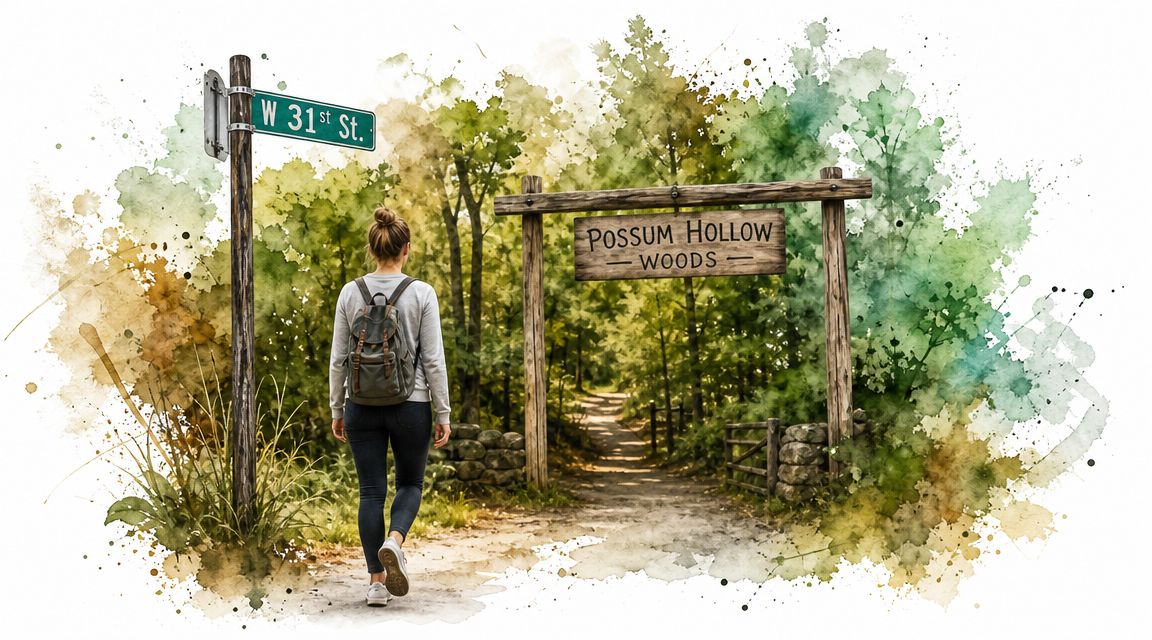
    That’s part of the story at winding creek park in Crystal Lake.

    According to the Crystal Lake Park District project update on Winding Creek Park, the park is going through invasive species control focused on plants like European black alder and common buckthorn. Those plants form dense thickets, smother native habitats, and European black alder can consume up to 30% more water than native plants. The work includes mechanical cutting and herbicide application, and it creates chances for volunteers to help with native replanting.

    A watercolor illustration of volunteers planting saplings at Winding Creek Park near the shores of Crystal Lake.

    What invasive plants actually do

    I want to make this concrete. Think about a good conversation in a group. Different people speak. Different people listen. There’s room. Native habitat works like that.

    Invasive thickets wreck that balance. They crowd light. They crowd water. They crowd physical space. Soon, the weaker plants don’t get a turn at all.

    That’s why cutting back invasives isn’t cosmetic work. It’s intervention.

    Why this work changes you too

    I’ve always found it easier to face damage outside myself first. Pulling trash. Clearing a patch. Carrying brush. Those tasks are blunt in a helpful way. They don’t ask me to have perfect feelings before I begin.

    Land restoration works like that too.

    When you help remove what’s choking a place, you start asking sharper questions about your own life. What have I let overgrow? What keeps taking more than it gives back? What am I avoiding because the fix looks ugly at first?

    If you want a grounded explanation of that mindset, I like this plain guide to environmental restoration and what the work involves.

    Healing land often starts with an unpleasant phase. Cutting. Hauling. Dirt. Sweat. Temporary ugliness. That doesn’t mean the process is wrong. It means the process is real.

    Ways you can help without pretending to be an expert

    You don’t need to arrive as a botanist. You need humility and willingness.

    • Learn the target species: know what European black alder and buckthorn look like before you touch anything.
    • Respect active management work: if staff are using cutting and herbicide methods, stay coordinated with them.
    • Help after removal: native replanting is where hope becomes visible.
    • Stay curious: ask why a cleared area looks rough. It may be in the middle of recovery, not abandonment.

    That’s the deeper purpose I want you to feel here. You aren’t only visiting winding creek park. You’re choosing whether to leave it as scenery or meet it as responsibility.

    Planning Your Visit Tips for Families and Photographers

    Some park days fall apart because people don’t match the plan to the people. I’ve done that enough times to know better. If you bring little kids, you need rhythm, snacks, and a mission. If you bring a camera, you need patience, decent shoes, and a willingness to wait for light instead of forcing it.

    Here’s the version of winding creek park I’d recommend for both.

    A split image showing a family having a picnic and a man photographing a bird at Winding Creek Park.

    If you’re bringing family

    Keep the day simple. Don’t try to squeeze every corner of the park into one outing. Start near the easiest walking area by the water, pick a picnic spot with a clear line of sight, and let the kids “collect” observations instead of objects.

    I like turning a walk into a scavenger hunt with no pressure.

    • Find a leaf with a strange edge
    • Spot two different bark textures
    • Listen for three bird calls
    • Look for a place where land meets water in a new way

    Kids usually care more when they’re given a mission that feels like detective work.

    If you’re carrying a camera

    Go early if you want softer light on the pond and less visual clutter from other visitors moving through your frame. Work the edges first. Reflections, reeds, bark, and low plants tell a fuller story than a wide shot alone.

    Don’t only chase the obvious scenic image. Photograph the details that show a place is alive and changing.

    Field note: The best park photos often come from kneeling down, not from standing taller.

    That means muddy boots. It’s worth it.

    A quick visual can help you think about the park in motion before you head out:

    A practical split plan

    If one person wants family time and another wants photos, don’t fight over the pace. Divide the visit in half.

    Part of visit Family focus Photo focus
    First half Short walk, snacks, easy discoveries Establishing shots, water light, path scenes
    Second half Rest, play, quiet looking Texture studies, wildlife patience, detail work

    That approach saves the day. Nobody feels dragged around.

    And if you’re on your own, borrow this same structure anyway. Spend the first half observing. Spend the second half making something, whether that’s photos, notes, sketches, or a cleanup bag.

    Join the Movement From Visitor to Volunteer

    The weirdest part of any cleanup is the first few minutes. You show up, maybe a little unsure, maybe wondering if you’ll know anyone, maybe asking yourself why you agreed to spend part of your weekend doing manual labor in public.

    Then somebody hands you a bag.

    That helps. A lot.

    Action cuts through awkwardness faster than small talk does. Once your hands are busy, people relax. You start pointing things out. Someone makes a joke about the strangest object on the ground. Someone else helps hold a bag open. An hour later, the place looks better and you feel less like a stranger.

    Why weekend mornings work

    I’m biased toward morning service because it sets the tone for the whole day. You do one brave, useful thing early, and the rest of your Saturday feels less slippery. You trust yourself more.

    Consistency matters more than intensity here. I’d rather see someone help in a modest, steady way than arrive once with a huge burst of guilt and disappear.

    You build courage the same way you fill a trash bag. Piece by piece.

    What a volunteer morning feels like

    A real volunteer morning is rarely glamorous. Sometimes it’s cold. Sometimes the ground is wet. Sometimes you find gross stuff and wish you hadn’t. Sometimes you get quiet because the work touches something emotional in you.

    And still, by the end, there’s pride.

    Not fake pride. The earned kind. The kind that comes from looking back at a stretch of land and knowing your body changed it for the better.

    How to take the first step

    If you want to stop reading about service and do it, keep your first move simple:

    1. Pick a date you can keep. Don’t wait for a perfect weekend.
    2. Wear clothes you can dirty. Old shoes beat stylish hesitation.
    3. Bring water and gloves if you have them.
    4. Invite one person if that helps you show up.
    5. Find a real event list. A practical place to start is these Chicago volunteer opportunities.

    You don’t need a dramatic personal backstory to volunteer. You just need willingness. In my experience, willingness changes people faster than self-analysis does.

    Exploring Further Other Local Gems and Good Works

    One lesson I keep relearning is that every park asks for a different kind of care. At one place, the work is litter removal. At another, it’s invasive species control. Somewhere else, care looks like following fishing rules so the water doesn’t get loved to death.

    That’s why I like comparing Crystal Lake’s winding creek park with the one in Naperville. Same name. Different job for the visitor.

    A different kind of stewardship in Naperville

    The Naperville Park District page for Winding Creek Park notes that the park supports regulated freshwater fishing for species like bluegill and largemouth bass. It also states that the Illinois Department of Natural Resources sets catch limits, including 6 largemouth bass per day with a 14-inch minimum, and that following those rules helps sustain fish populations.

    I like that because it turns conservation into something ordinary and disciplined. You don’t need a dramatic rescue moment. You need restraint.

    Parks teach different virtues

    Crystal Lake asks you to notice habitat struggle and recovery work. Naperville asks anglers to practice limits and patience. Both ask the same deeper thing from you in the end. Respect the place enough to adjust your behavior.

    I see it this way:

    • At a restoration site: your job is to help land breathe again
    • At a fishing pond: your job is to enjoy the resource without draining it
    • At a cleanup event: your job is to leave no excuse for neglect behind you

    That’s a useful way to see the whole region. Not as a list of destinations to consume, but as a series of relationships. Each place has its own terms.

    Keep going after one good visit

    One park visit can wake something up in you. The trick is not letting that feeling stay isolated.

    Make a habit of exploring local spaces with a service mindset. Bring a bag. Learn one rule. Notice one problem. Respect one boundary. That’s how ordinary people become steady caretakers without needing a title for it.

    Become the Butterfly

    I keep coming back to the caterpillar idea because it’s honest. A caterpillar isn’t finished. It doesn’t glide. It inches forward. It does the unglamorous stage first.

    That’s how change has felt in my life too.

    I didn’t become stronger because I had a beautiful breakthrough in perfect weather. I changed because I kept doing small physical acts of care when I didn’t feel sorted out yet. A bag of trash. A rough trail walk. A hard conversation with myself while looking at water. Winding creek park fits that kind of growth. It gives you somewhere to practice.

    You don’t need to arrive polished. You can arrive confused, restless, tired, hopeful, or all four at once. The park can hold that. The work can too.

    And if you return enough times, something subtle happens. The place stops being a backdrop. It becomes part of your personal code. You don’t walk through it asking only what you can get from it. You start asking what you can give.

    That’s the shift I want for you.

    So here’s the question. When you get your next free morning, will you use it to consume a place, or to care for one?


    If you want a group that turns that question into action, join Litter Caterpillars. We clean, explore, and grow through service, one neighborhood and one morning at a time.

  • South Shore Nature Sanctuary: A Chicago Hidden Gem Guide

    South Shore Nature Sanctuary: A Chicago Hidden Gem Guide

    I found the south shore nature sanctuary on a day when my brain felt like a traffic jam. I had spent the morning rushing, doom-scrolling, and snapping at people I like, then I walked toward the lake and suddenly heard wind moving through grasses instead of sirens.

    Finding Your Wild in the City

    The first time I stepped into this place, I did not feel like I was visiting a destination. I felt like I had surfaced.

    A young man wearing a dark hoodie stands in the middle of a city street intersection.

    Chicago can do that to you. It can fill your day so completely that you forget you have an inner life at all. You move from train to sidewalk to screen to grocery line, and somewhere in the shuffle your thoughts start to sound like loose change in a dryer.

    I know that feeling well.

    There was a stretch in my life when my apartment felt cluttered, my calendar felt louder than a fire truck, and even my free time felt like another chore. Then I wandered down by the lake at South Shore and took a path into the sanctuary. The city did not vanish. But it softened. That mattered.

    A place that changes your pace

    The south shore nature sanctuary is not one of those manicured spaces that asks you to admire it from a distance. It invites you to slow down enough to notice little things.

    I noticed sand holding its shape in the wind. I noticed birds moving with a purpose I did not share. I noticed that my shoulders had crept up near my ears and then, without any grand ceremony, dropped back down.

    That is why I love hidden green spaces in Chicago. They do not lecture you. They reset you.

    Tip: If you arrive feeling fried, do not start by trying to “see everything.” Stand still for a minute and listen. Let the place introduce itself.
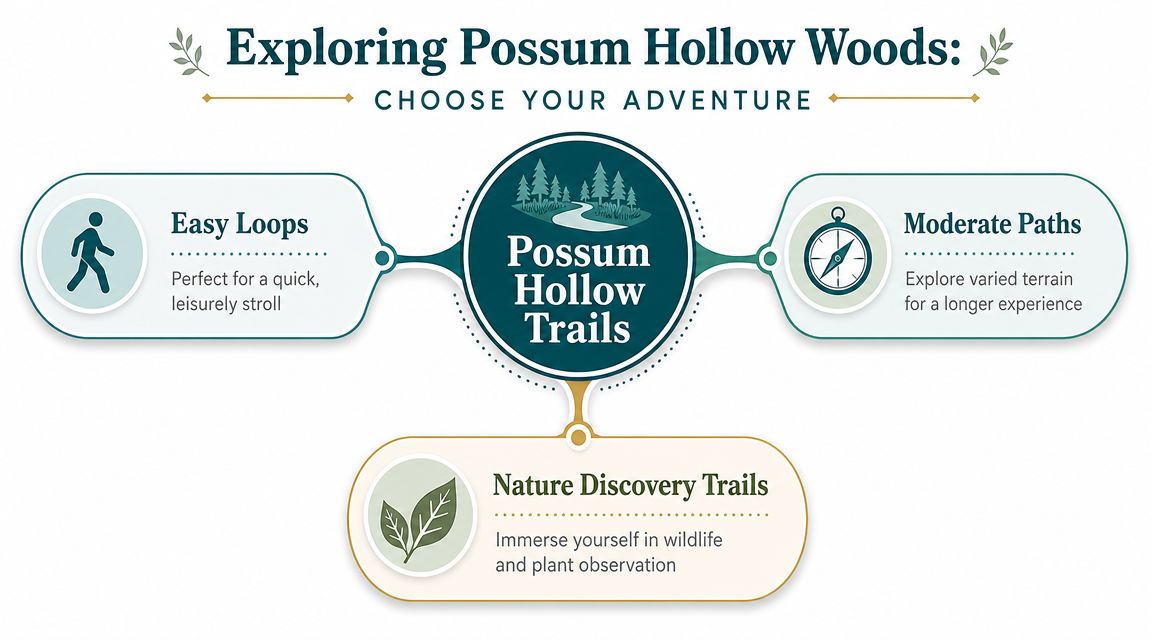
    Why this spot feels personal

    Some parks feel programmed. This one feels lived in. You can sense care in it.

    You can also sense struggle. This is still an urban natural area. It sits near beach activity, neighborhood life, and all the beautiful mess that comes with a real city. That tension is part of why the sanctuary means so much to me. It is not wild because people left it alone. It is wild because people chose to protect it.

    That distinction changed me.

    I used to think peace meant escape. Now I think peace often means relationship. You show up. You pay attention. You stop acting like the land is scenery and start treating it like a neighbor.

    What you may find there

    Some people come for birdwatching. Some come for a quiet walk after a hard week. I come for all of that, but also for something harder to name.

    • A reset button: Not a cure, not a miracle. Just a real pause.
    • A smaller scale of life: Grass, pond edge, moving water, drifting clouds. Things that do not care about your inbox.
    • A reminder: You are still part of nature, even if you spent the morning under fluorescent lights.

    That is the invitation of the south shore nature sanctuary. Not just “go take a walk.” More like, “come back to yourself.”

    The Story of a Resilient Oasis

    This place did not happen by accident. Someone had to imagine it first.

    The land along the South Peninsula could have remained just another overlooked edge of the lakefront. Instead, people saw possibility in it. They saw a chance to build something that would feel both local and bigger than the city around it.

    Built from community vision

    The sanctuary spans over six acres of habitat, and its path to existence started with the 1999 South Shore Cultural Center Framework Plan, which folded in community input about restoring and expanding natural habitats on the peninsula. Construction began in 2001, and the sanctuary opened in 2002, as described by the Chicago Park District page for South Shore Nature Sanctuary.

    I love that timeline because it tells a human story. Someone listened. Someone planned. Someone planted. Someone kept going long enough for the public to step into the finished space.

    That is how good citymaking works. You do not build a living habitat with one ribbon cutting and a speech. You build it seed by seed, trail by trail, season by season.

    A home assembled with intention

    When I walk there, I think about the sanctuary the way I think about an old Chicago bungalow that somebody restored with respect. The bones matter. The details matter. The purpose matters.

    This land became a kind of living library of native Chicagoland ecosystems. Not a museum behind glass. A breathing one. Wind runs through it. Birds use it. People lean on it after rough days.

    That matters even more because of where it sits. The sanctuary lives within South Shore Cultural Center Park along Lake Michigan. It offers a pocket of habitat inside one of the biggest urban regions in the country.

    Why its history still matters now

    A place like this tells you what a neighborhood believes is worth saving. The sanctuary says native natural areas deserve room in the city. It says restoration belongs on the lakefront. It says community input can shape something beautiful and durable.

    Here is the part I carry with me. The sanctuary is a vote against shrinkage.

    Cities can convince us to accept less sky, less silence, less habitat, less patience. This place pushes back. It says a peninsula can hold dune, wetland, pond, woodland, prairie, savanna, shrubland, and beach. It says even a compact urban site can carry ecological memory.

    Takeaway: The south shore nature sanctuary feels peaceful today because people made hard, hopeful choices years ago.

    A short timeline you can feel

    Moment Why it matters
    1999 framework plan Community voices helped shape the vision
    2001 construction began Restoration moved from idea to action
    2002 opening The public gained a new urban refuge

    That is the story I wish more park signs told. Not just what a place is, but how many hands and hopes it took to make it real.

    Exploring the Seven Worlds Within

    You can walk into the south shore nature sanctuary and feel like you crossed several states in one afternoon. That is the magic of it.

    The land shifts under your feet and in front of your eyes. Sand gives way to brush. Water opens up. Trees gather overhead. Then a meadow-like stretch changes the whole mood again.

    Infographic

    Start with the edge

    I like to begin where the lake announces itself.

    The sanctuary includes dune, beach, wetland, pond, woodland, prairie, savanna, and shrubland. That mix creates the feeling of moving through “worlds” rather than one flat park experience. The Chicago Park District describes the site as a vital microcosm of native Chicagoland ecosystems and notes that its lakeside position makes it an important stopover during spring and fall migration.

    The dune and beach areas always stop me first. The plants there look humble until you realize they are doing hard work in hard conditions. Rare dune-beach species such as sea rocket, marram grass, and sand reed hold their own in shifting sand and lake wind. They remind me of tough Chicagoans. Not flashy. Just built to endure.

    Walk inland and watch the logic unfold

    The wetland edge feels different immediately. It softens sound. It cools the mood.

    There you get plants like indigo bush, button bush, cardinal flower, bulrushes, and blue iris. These are not decoration. They create food and cover, and they help shape the sanctuary as a place where wildlife can pause, hide, feed, and move through.

    Then the shrubland starts speaking in berries and branches. Plantings include oaks, hawthorn, American plum, serviceberry, hazelnut, viburnum, and native roses. If the sanctuary is a roadside inn for migrating birds, this is the stocked kitchen and sheltered porch.

    Tip: Bring binoculars if you have them, but bring curiosity even if you do not. A “successful” walk does not depend on spotting a rare bird.

    A Bird Highway Rest Stop

    The sanctuary’s location along Lake Michigan makes it a critical migration stopover. I always tell friends to imagine it as a service plaza on a long interstate, except the travelers arrive on wings and read the shoreline instead of road signs.

    That idea changes how you walk.

    You stop asking, “What can I get out of this visit?” and start asking, “What does this place provide?” Food. Shelter. Rest. Safe transition. In a city full of hard surfaces, that is a profound gift.

    Use your eyes differently

    Try this on your next visit:

    • Look low first: Notice what grips the soil or sand. Roots tell the survival story.
    • Then scan the middle layer: Shrubs often hold the action. Birds dart, pause, and disappear there.
    • Finish by looking up: Tree canopies change the temperature and sound of a space.

    If you enjoy learning tree species before you go, this guide to trees in Illinois gives useful context for what native trees contribute to local natural areas.

    The seven worlds feeling

    I know the official habitat list is longer and more precise than “seven worlds.” I still love that phrase because it captures the experience.

    One path can feel spare and sandy. Another feels lush. Another opens like a room with a view of water. The sanctuary keeps changing its voice, but the song stays coherent.

    That is why I return. I do not go there to conquer a route. I go there to practice noticing how different forms of life hold each other up.

    Planning Your Visit Like a Pro

    My best visits happen when I do a little prep and then forget about logistics once I arrive. You do not need a complicated strategy. You need a simple one.

    What to bring and why

    I dress for the lakefront, not for the forecast app’s optimism. Wind off Lake Michigan can rewrite your plans fast.

    Here is my standard kit:

    • Water: Even for a short walk. The lake breeze can fool you into forgetting thirst.
    • Comfortable shoes: You are not climbing a mountain, but uneven natural surfaces still matter.
    • Binoculars or a camera: Optional, but rewarding.
    • A small bag: Keep your hands free.
    • Layers: Always. Chicago teaches this lesson the hard way.

    A notebook is a nice extra. This is a strong place for writing down one honest thought.

    Best visit style for your mood

    Some days you want a quick exhale. Other days you want to wander.

    Your mood Best approach
    Burned out Take a short slow loop and spend more time sitting than walking
    Curious Move gradually through different habitats and stop often
    Reflective Find a quieter edge, put your phone away, and stay still
    Bird-focused Arrive with patience and keep your pace gentle

    Tip: Morning light often feels softer and quieter by the water. If you crave calm, go early.

    How to make the day easy

    South Shore works best when you pair the sanctuary with the rest of the neighborhood instead of treating it like an isolated stop. Build in time to linger. Leave buffer room. Do not rush yourself out the moment you arrive.

    I also recommend checking transit, parking, and park conditions before you leave home. If you want to shape a broader neighborhood day around walking, this guide to Chicago walking tours you can do self-guided can help you think beyond a single destination.

    A few practical habits

    Respect the land

    Stay on marked paths where appropriate. Fragile habitat does not need our creativity underfoot.

    Keep your voice low

    You will hear more, and so will everyone else.

    Leave room for surprise

    The best sanctuary moments are often the unscheduled ones. Wind in grasses. A bird landing close by. That sudden feeling that your mind has finally unclenched.

    Go solo or with one good friend

    Big groups can be fun elsewhere. This spot shines when the pace stays gentle.

    I have had great visits in all kinds of moods, but the easiest ones shared one trait. I did not try to squeeze the sanctuary into my day. I let the day shape itself around the sanctuary.

    The Sanctuary Through the Seasons

    I never recommend waiting for the “perfect” time to visit. The south shore nature sanctuary does not have one perfect season. It has personalities.

    Each one teaches you something different about attention.

    Spring wakes the whole place up

    Spring feels like the sanctuary taking a deep breath after holding still.

    Because the site serves as a stopover during spring migration, the air can feel charged even when the area still looks half asleep. Bare branches hold movement. Mud looks promising instead of dreary. Early green feels like a rumor becoming fact.

    I love spring there because nothing is polished. Everything looks earned.

    Summer settles in

    Summer drapes the sanctuary in fullness. Green thickens. Edges blur a little. The place feels less like a sketch and more like a song held on one long note.

    This is when I notice texture most. Sun on leaves. Dense shrubland. The contrast between open water and enclosed plantings. Summer asks less of your imagination because the setting is already speaking loudly.

    Bring water. Wear a hat. Then take your time.

    Fall sharpens your senses

    Fall might be my favorite, though I say that cautiously because each season has a strong case.

    The air feels cleaner on the inhale. Movement overhead matters again as migration shifts. Seed heads, dried stalks, and changing leaves make the sanctuary look less lush but more legible. You start seeing structure. You notice how the place is built.

    Fall always reminds me that beauty does not depend on abundance alone. Sometimes beauty comes from clarity.

    Takeaway: If spring is arrival and summer is fullness, fall is understanding.

    Winter reveals the bones

    Winter strips the environment down to truth.

    A lot of people skip urban nature in cold weather. I think that is a mistake. Winter lets you see shape, spacing, and resilience. The sanctuary becomes quieter, sterner, and somehow more intimate.

    You can watch the wind work harder. You can see how plants hold their ground. You can feel the lake in a more direct way.

    That kind of visit has changed me more than once. On a cold day, you do not come for comfort alone. You come for honesty. The place gives it.

    Pick your season by what you need

    • Need hope: Go in spring.
    • Need ease: Summer helps.
    • Need perspective: Fall is generous.
    • Need toughness: Winter will meet you there.

    The sanctuary does not ask you to visit only when it looks easy. It rewards people who show up across the cycle.

    Becoming a Guardian of the Sanctuary

    A beautiful place can make you grateful. A vulnerable place can make you responsible.

    That is where the south shore nature sanctuary lands for me. I do not walk out thinking only, “That was nice.” I walk out thinking, “How do we deserve this place better?”

    Two hands gently cradling a young green plant growing out of rich dark soil with watercolor background.

    Start with the smallest promise

    The first form of stewardship is simple. Leave the space better than you found it.

    That can mean packing out your own stuff. It can mean staying on paths. It can mean not treating a shoreline habitat like your personal backdrop for chaos. Small acts are not glamorous, but they are real.
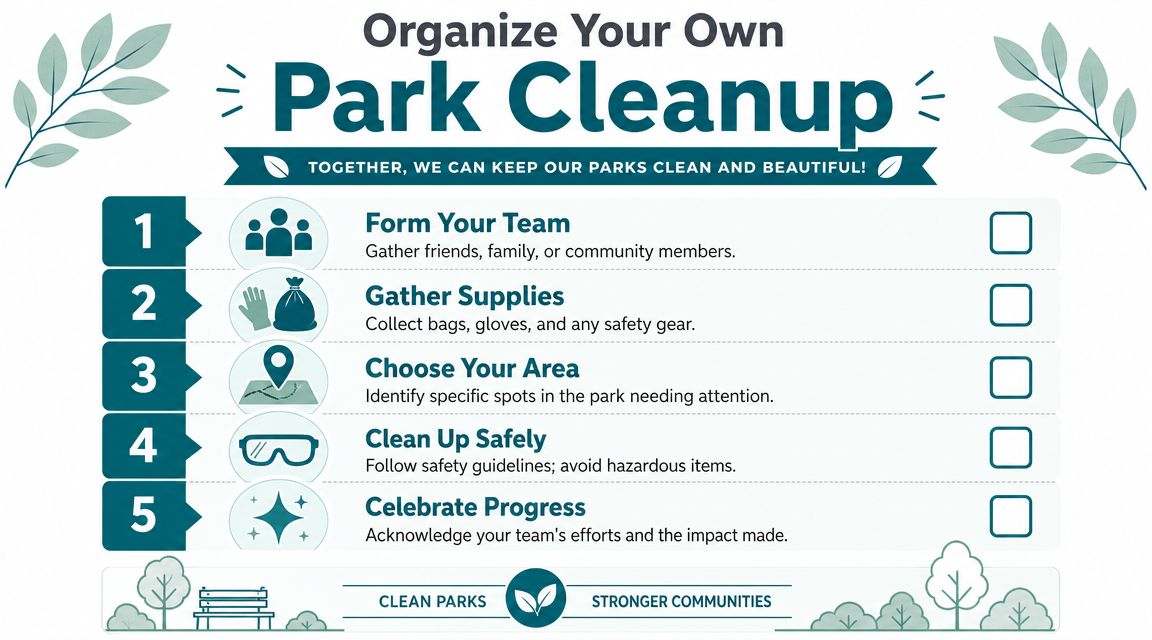

    I think of stewardship like sweeping your own front steps. No applause. Just care.

    The issue too many guides skip

    A lot of writing about the sanctuary celebrates its habitats, volunteer spirit, and migration value. That celebration is deserved. But existing content often fails to address litter challenges in this urban natural area, even though the issue matters for the visitor experience and for habitat health, as noted by the South Shore Nature Sanctuary website.

    That omission bothers me because litter changes how a place feels.

    You cannot fully sink into birdsong if a plastic bottle is jammed in the reeds near your feet. You cannot talk about restoration in glowing abstract language while pretending trash never blows in from nearby activity. A sanctuary can be precious and pressured at the same time.

    Why cleanup work changes people

    This is personal for me. Service outside has a strange way of clearing internal static.

    When you help care for a place, your role shifts. You stop being a consumer of scenery. You become part of the place’s defense. That can sound dramatic, but it feels practical when you are performing it.

    You bend down. You pick something up. The ground looks better. Your mind often does too.

    There is also something human about shared stewardship. Caring for a space with other people builds trust fast. You do not need perfect conversation. The task itself gives the day shape.

    Tip: If you feel intimidated by volunteering, remember that stewardship is often just a series of small useful choices made side by side.

    What care can look like in real life

    The sanctuary already has a volunteer ethos. People contribute through seed collection and scattering, native planting, trash pickup, vegetation and bird monitoring, and invasive species removal, as described by the Chicago Park District in the earlier section. You do not need to be a botanist to respect that work. You only need to see that every healthy urban natural area rests on repeated acts of attention.

    If you want your visits to mean more, try one of these approaches:

    • Carry out more than you carried in: If you safely remove a stray piece of litter on your way out, that counts.
    • Learn one plant community: Knowing what belongs helps you notice what threatens it.
    • Return often: Stewardship grows from familiarity.
    • Support organized volunteering: Group effort creates momentum and safety.

    If you want to turn that instinct into regular service, these environmental volunteer opportunities in Chicago can help you find a way in.

    Protection is also belonging

    The sanctuary sits on the traditional unceded homelands of the Council of the Three Fires and other tribal nations identified by the Chicago Park District. I try to remember that land respect did not begin when I discovered a favorite walking path. It runs deeper than my personal story.

    That thought keeps me humble.

    It also keeps me hopeful. Urban biodiversity preservation is not some abstract expert-only concern. It lives in local habits. Native propagation. Cleanup. Monitoring. Showing up. Refusing to let neglect define a place.

    The sanctuary receives highly positive feedback and numerous reviews on the Chicago Park District page, telling me people already feel its value. I want that appreciation to mature into guardianship.

    Love for a place should leave fingerprints. Good ones.

    Your Perfect Sanctuary Day Itinerary

    The best day at the south shore nature sanctuary depends on what you need from it. I have seen this place hold people in very different ways.

    Here are three ways to spend your day well.

    The Solo Recharger

    Arrive early if you can. Start slow and keep your phone in your pocket for the first stretch.

    Walk without trying to document anything. Find a spot where you can see water or shifting grasses. Sit down and write a few lines in a notebook, even if all you write is, “I am more tired than I thought.”

    Stay until your breathing feels less rushed.

    The Urban Naturalist

    Bring binoculars, water, and one field guide or plant app you are familiar with. This is not the day to overpack.

    Move through the sanctuary with patience. Spend time at transitions between habitats because that is often where the environment teaches you the most. Look at ground cover, then shrubs, then canopy. Pay attention to food sources, shelter, and movement.

    Leave with one new name in your head. One tree, one bird, one flower. That is enough to make the place feel more alive next time.

    The Community Builder

    Come with a friend, or come open to meeting one. Walk first.

    Talk while you move, but let the surroundings interrupt you. Good conversation often gets better when you both stop to watch something. After your sanctuary visit, keep the service spirit going by joining a neighborhood cleanup or another local stewardship effort later in the day.

    That pairing works beautifully. You get serenity, then purpose. Or maybe purpose, then serenity.

    A simple rule for all three

    Do not treat the sanctuary like a box to check.

    Let it be an encounter. Drink water. Notice what steadies you. Respect the habitat. Leave room for the place to surprise you. If a city can exhaust you block by block, a place like this can restore you step by step.

    The south shore nature sanctuary is one of my favorite reminders that Chicago is not only made of concrete, traffic, and hurry. It is also made of dunes, shrubs, birds, pond edges, volunteer care, and people who still believe a patch of restored land can change a day.

    Sometimes that is enough to change more than a day.


    If this piece stirred something in you, take the next step with Litter Caterpillars. They give Chicagoans a practical, welcoming way to turn love for places like this into real service, friendship, and visible care for the city block by block.