Tag: volunteer chicago

  • Your Guide to Busse Forest South and Its Wonders in 2026

    Your Guide to Busse Forest South and Its Wonders in 2026

    Are you tired of the city's concrete jungle? I know a place. It’s a place where all that noise just dissolves, and you can finally hear yourself think. I call it Busse Forest South, and it's so much more than a park. For me, it's a sanctuary. It’s my training ground. It's where I go to touch something real again.

    Your Adventure into Chicago's Secret Garden

    I want you to think of Busse Forest South as a living, breathing piece of Chicago's soul, like a secret garden that most people just speed past on the highway. My mission here is to personally walk you through this incredible spot, sharing the trails I’ve hiked a hundred times and the lessons this forest has taught me. Consider this guide your key. A key to unlocking its deepest secrets, from the most silent paths for a quiet walk to the easiest places to park your car.

    The air out here just feels different, doesn't it? It’s a place where you can truly breathe again. But like anything precious, keeping it this way takes real work. This isn't just me showing you a pretty trail; it’s an invitation. I'm asking you to join us and become part of its story.

    A Legacy Worth Protecting

    The very ground you're walking on has a story that stretches way, way back. You see, Busse Forest South is just one part of the larger Ned Brown Forest Preserve, a massive area that some incredibly forward-thinking people started protecting way back in 1918. It’s like they left a gift for us, a gift from a century ago. They had the foresight to set this land aside for you and me. That's over 100 years of history right under your feet.

    Knowing that makes our work feel so much bigger than just picking up someone else's trash. When I’m out here cleaning up with my crew, I feel like we’re honoring a promise made a hundred years ago. We are continuing that legacy.

    The map below gives you a bird's-eye view of just how immense the Ned Brown Forest Preserve really is. You can see Busse Lake, a glittering jewel, and the web of trails spun around it—our little corner, Busse Forest South, is tucked right in there.

    This map helps you grasp the scale. It's a huge network of ancient woods and quiet waters, a wild kingdom right in our own backyard.

    More Than Just a Walk in the Park

    My real goal here is to show you how a simple visit can become something more. It's an opportunity to build a community, to push yourself physically and mentally, and to do some actual good for a place that gives us so much. For me and my friends at Litter Caterpillars, this forest preserve in IL is where our core values of service and friendship really come to life.

    This guide is my personal invitation. It’s a challenge, really. I’m daring you to turn a simple weekend walk into something truly meaningful. It's a chance to find your people and become a guardian of this incredible place. Let's start this adventure together.

    Hitting the Trails and Waterways

    Alright, you've made it. Now for the fun part: deciding what to conquer first. Busse Forest South isn't just a park; it's a sprawling, living network of trails and water that practically begs you to explore it. Imagine its nearly 13 miles of paths as arteries, pumping life and adventure throughout the entire landscape.

    I’ll never forget my first time trying to navigate this trail system. It felt like a massive, beautiful maze, a labyrinth of green, until I finally found my way to the main 7.3-mile loop. This paved path is the absolute heart of the preserve. It’s the perfect place for hikers, runners, and cyclists to really stretch their legs. The trail is mostly flat and wide, which makes it an amazing spot for a family bike ride or a long, meditative run where you can just get lost in your own thoughts.

    But here’s the real secret, the bit of magic I want to share with you. The best parts happen when you dare to venture off that main drag. The smaller spurs branching off are where I've discovered my favorite quiet spots—hidden groves and peaceful watersides that most people just pedal right past, completely unaware.

    Charting Your Course

    The trails here cater to just about every mood you could possibly be in. Some are easy, paved paths perfect for a casual stroll with a friend or for pushing a stroller. Others are unpaved, giving you that satisfying, primal crunch of leaves and dirt under your shoes. It’s this rich mix of experiences that keeps me coming back, again and again.

    The forest is so much more than just a place to get your steps in; it's a central hub connecting adventure, history, and our local community.
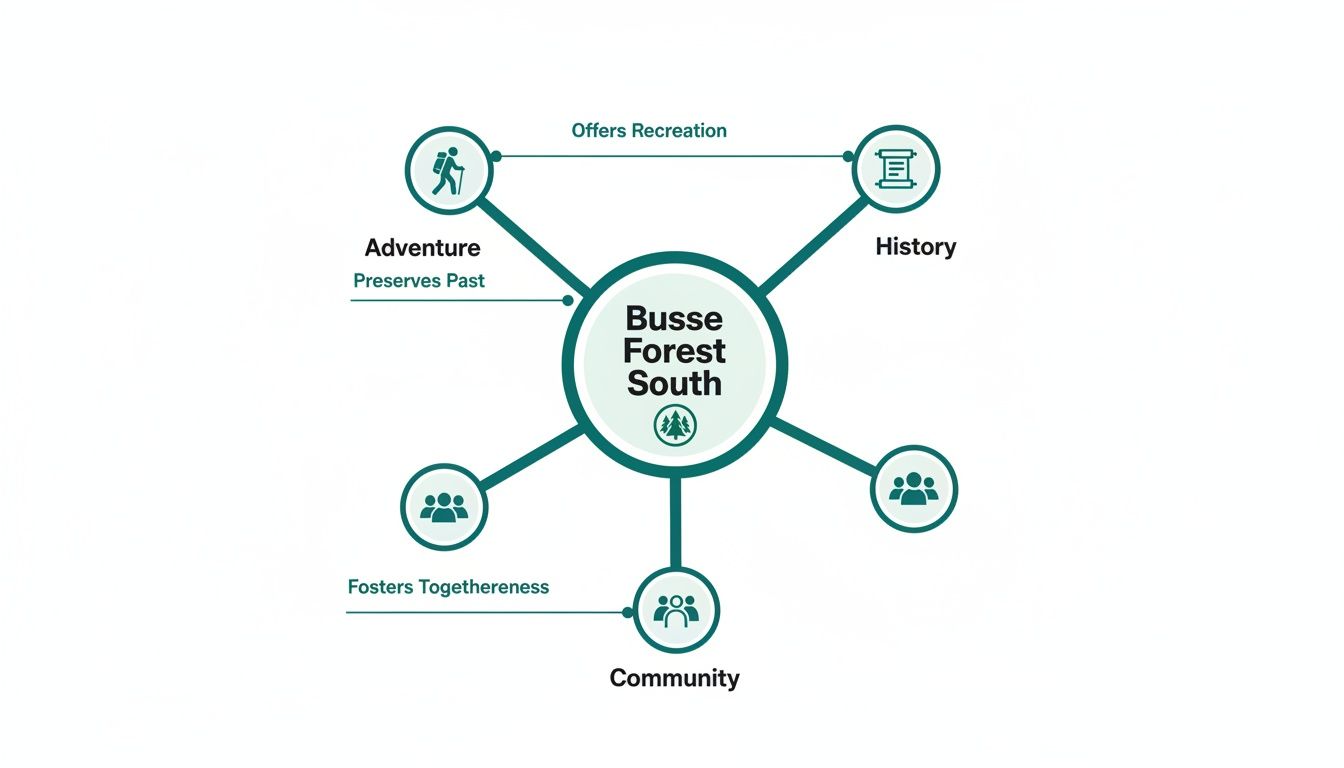
    A concept map showing Busse Forest South offering adventure, history, community, recreation, and preserving the past.

    You can see how everything weaves together, a beautiful tapestry proving this preserve is a living, breathing part of our area.

    More Than Just Dirt Paths

    Are you looking for something beyond the trails? The massive 590-acre Busse Lake is waiting for you. It’s the largest body of water for paddling in all of Cook County, a shimmering expanse that’s a dream for kayakers, canoers, and anglers. Trust me on this one, there is nothing quite like gliding across that calm water as the sun comes up and the morning mist hangs heavy in the air. It’s a kind of peace that’s hard to find these days.

    To give you a quick idea of what's available, I’ve put together a simple breakdown of the main activities.

    Activities at Busse Forest South

    Activity Best For What to Expect
    Hiking & Running All levels The main 7.3-mile paved loop is flat and totally accessible. The smaller, unpaved trails offer a more rugged, challenging terrain.
    Biking Families, long-distance cyclists You get a smooth, easy ride on the main loop with plenty of room. It’s a fantastic way to cover a lot of ground quickly.
    Paddling Kayakers, canoers A huge, open lake with multiple boat launches awaits you. Perfect for a long, peaceful day spent out on the water.
    Fishing Anglers of all skill levels Shoreline and boat fishing are both super popular here. The lake is regularly stocked with a wide variety of fish species.

    This table is just a starting point. The best way to get to know this forest is to just get out there and explore it for yourself.

    This entire playground is part of the larger 3,700-acre Ned Brown Forest Preserve, which beautifully balances ancient, primeval forests with modern recreation. It's no wonder it's one of Illinois' most-visited natural spots, open every single day from sunrise to sunset.

    The forest has a personality all its own, and the best way I know to get acquainted is by wandering its trails and waterways. If you love exploring trail systems like this one, you should definitely check out our guide to the Des Plaines River Trail for another incredible local adventure.

    A Living Museum of Rare Habitats

    When I tell you Busse Forest South isn't just another walk in the park, I really mean it. This place is different. It’s a living museum, a time capsule holding onto some of Illinois's rarest habitats, and it’s so important that it's officially recognized as a National Natural Landmark.

    Watercolor painting of a misty forest with red-barked trees, white trilliums, and Jack-in-the-pulpits by a pond.

    I want you to picture the ground you're standing on as the floor of an ancient, shallow bowl carved out by glaciers thousands of years ago. It's like a geological memory. Those depressions created something very special called "flatwoods," a type of damp-ground forest that used to be common around here but is now incredibly, heartbreakingly rare. This isn't just some random feature of the forest; it is the heart and soul of Busse Forest South.

    A Fragile, Timeless World

    Walking through these flatwoods feels like stepping into the past. It’s a journey back in time. You’re surrounded by towering swamp white oaks and brilliant red maples. In the spring, the ground is a carpet of delicate trilliums and the weird, hooded shape of jack-in-the-pulpit flowers.

    This isn’t just a pretty picture; it's a fragile, delicate ecosystem that desperately needs our protection. That’s why back in January 1965, this specific 440-acre section was designated as the third Illinois Nature Preserve. This status officially protects these flatwoods and all the life they support—from the black ash trees to the vibrant blueflag iris. You can read more about this special designation on the Illinois DNR website.

    Knowing this history really changes how you see the place. It connects you to a story much, much older than any of us.

    The Threats This Museum Faces

    But just like any precious museum, this one is under constant attack. The quiet beauty of these woods is in a constant, silent battle, and it's a fight we can see happening right in front of our eyes.

    Here’s what we’re up against:

    • Invasive Species: These are like bullies on a playground. Aggressive, non-native plants are always trying to push out the native wildflowers and saplings that belong here, stealing space and vital resources.
    • The Emerald Ash Borer: This tiny, destructive beetle has absolutely wrecked ash tree populations all over the Midwest. You can see the damage here, with huge gaps in the canopy where massive trees used to stand proud.
    • Deer Over-browsing: The deer population is so high that the tender shoots of young trees and wildflowers get eaten before they even have a chance to grow. The forest can't regrow on its own.

    Understanding these struggles makes a simple walk in the woods feel so much more meaningful. You’re not just a visitor; you're a witness to a living, breathing history that needs our help to survive.

    This is where service gets personal for me. When you join one of our cleanups, you’re not just picking up a plastic bottle. You’re becoming a guardian of this living museum, actively protecting its story for the future.

    Join Us and Become a Forest Guardian

    This is where you come in. I’ve always found that cleaning up other people's messes is WAY easier than cleaning up our own. This is your chance to prove it. Joining one of our cleanups at Busse Forest South is about so much more than just picking up trash—it’s about finding a strength inside yourself you never knew you had.

    This whole group started in a hailstorm. Seriously. There were only three of us, freezing and laughing at how absurd it all was. In that struggle, we found a strange, profound kind of joy. That’s the spirit we bring to every single event, and it’s something you can find here, too.

    How We Turn Service into Adventure

    We meet on weekend mornings, rain or shine. I schedule them that way on purpose because it acts as a filter. It’s like a magnet for givers—the kind of people who show up not because it's easy, but because it matters. When you volunteer with Litter Caterpillars, you'll find yourself surrounded by folks who just get it, people who believe in bravery, kindness, and sticking together.

    We bring the flags, the theme song, and the community. All you have to bring is yourself.

    Our events are designed to be simple and empowering. Here’s what you can expect:

    • Safety and Happiness First: Your well-being is everything to me. We provide all the supplies—gloves, bags, and litter grabbers—so you can just focus on the mission.
    • No Pressure, Just Purpose: We will never, ever ask you for money. Ever. Your volunteer energy is the most valuable thing we have, and we protect it fiercely.
    • Building Friendships: These events are a powerful way to meet people who think like you. The shared work and seeing the tangible impact you've made creates bonds that last long after the cleanup ends.

    Finding Your Power in the Forest

    This isn't about obligation. It's about you finding your own power in a simple act of service. It’s about turning what some people see as a chore into a real, thrilling adventure. Each piece of trash you pull from the beautiful trails of Busse Forest South is a small victory, a tiny battle won for this incredible place.

    You’re not just cleaning; you are reclaiming the landscape. You are pushing back against neglect and showing the world that people actually care. This is an act of defiance, a powerful statement that this place is worth protecting.

    We see our work as a kind of personal transformation. Through service, we learn to trust ourselves and each other. We prove that small, consistent actions can lead to massive change, both in our parks and deep inside ourselves. It’s a journey of growth, and I'm personally inviting you to take that first step with us.

    If you’re ready to see how service can change your whole perspective, check out our environmental stewardship programs to learn more about our philosophy. We’re building a community of guardians, and there’s a place for you here.

    Finding Your Way to Nature's Doorstep
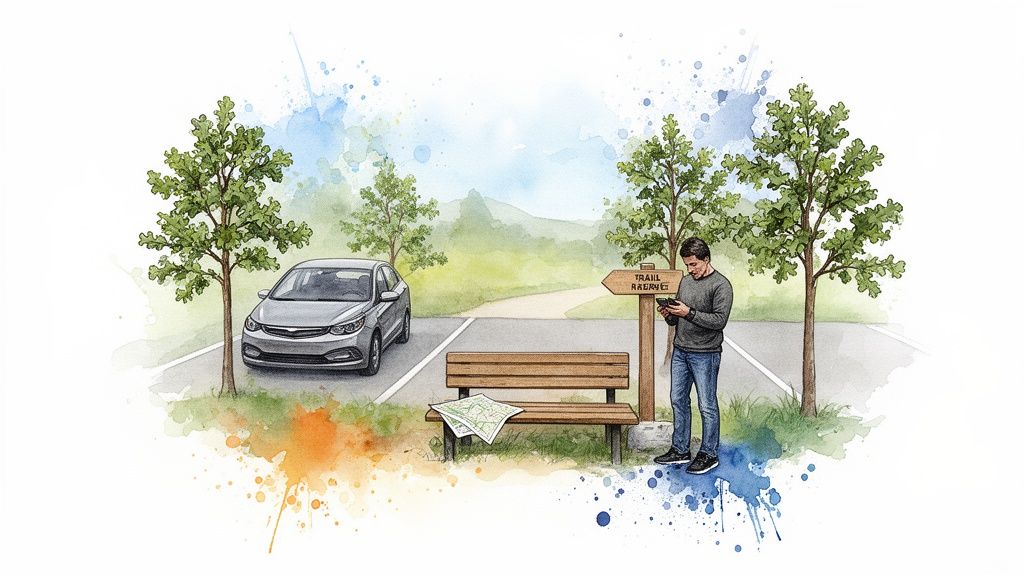
    Watercolor illustration of a man checking his phone at a trailhead with a car and map.

    Getting to Busse Forest South is your first test. It’s the gatekeeper’s riddle. Pass it, and you're rewarded with something that feels like a hidden treasure. Fail it, and you’ll end up like I did my first time—driving in frustrating circles while my GPS confidently led me to a dead end.

    Don't be that person. Let me give you the cheat codes so your adventure starts the second you step out of your car, not while you’re cursing at a map.

    Finding the right entrance is like knowing a secret handshake. Once you know it, you’re in. There are a few ways in, but not all of them drop you right where you want to be.

    Parking Made Simple

    Listen up. For the easiest, most no-fuss access, you want the lots right off Higgins Road (Route 72). These put you right at the heart of the main trail loop and give you an incredible, sweeping view of Busse Lake right from the get-go.

    • The Main Boating Center: This is your command center. It’s a huge lot and the perfect spot to launch a hike, bike ride, or paddle. On a weekend morning, this place is buzzing. It's where all the action is.
    • Smaller Trailhead Lots: Sometimes you don’t want the buzz. If you’re like me and you need a quieter start, hunt for the smaller, almost-hidden lots along the southern and eastern edges. They’re a much more peaceful gateway into the woods.

    My pro tip? Get here early. I’m serious. Getting here before everyone else doesn’t just mean you get a prime parking spot. It means you get the forest all to yourself, when it’s at its most magical and still.

    Arriving by Public Transit

    No car? No problem at all. You don’t need one. The Pace bus system is your ticket in. Several routes run through Schaumburg and Elk Grove Village, dropping you within walking or biking distance of the preserve.

    I’ve had friends take the bus to a stop near Higgins and just walk the last little bit. Think of it as a small urban warm-up before your real hike begins.

    Just do yourself a huge favor and check the Pace bus schedules online before you leave. Weekend service can be a different beast entirely. Consider it the first leg of your journey.

    Questions I Get All The Time About Busse Forest South

    Got questions before you head out? Good. That means you're already thinking like an adventurer. Whether you're coming out for the first time or you're joining us for a cleanup, a little bit of prep goes a long, long way.

    Here’s the inside scoop on the most common things people ask me. Think of it as our little pre-game huddle.

    Is Busse Forest South a Good Spot for Beginners?

    Totally. You absolutely do not need to be a grizzled, trail-worn expert to have a blast here. The main paved trail is a 7.3-mile loop that’s wide and pretty flat—perfect for a chill hike, a bike ride, or even pushing a stroller. It’s a fantastic first step into the woods.

    And when you feel that little itch for something more, there are plenty of unpaved side trails. You get that real "dirt under your feet" feeling without it being some crazy-hard challenge. It’s the perfect place to level up your outdoor confidence.

    What Gear Do I Need for a Litter Caterpillars Event?

    This is the best question because the answer is so simple: just you. Bring your energy and a good attitude, and you’re set. That’s it. We’ve got the gloves, the bags, the grabbers—all of it. My only advice? Wear comfy shoes you don’t mind getting a little dirty and check the weather before you leave the house.

    Look, we’re here to make volunteering as easy as possible. We’re filtering for givers and good people, not for folks with expensive gear. Your willingness to show up is what truly matters to us.

    Can I Bring My Dog to Busse Forest South?

    Yes! And you absolutely should. You’ll see tons of happy dogs out on the trails. It's a fantastic spot to explore with your four-legged buddy.

    Just be sure to keep them on a leash that's 10 feet or shorter, and—this is a huge one for us—always, always clean up after them. It’s a simple act of kindness that keeps the park beautiful for everyone.

    Where’s the Best Place to Park?

    My go-to spot is the main Boating Center lot right off Higgins Road (Route 72). It’s huge, and it drops you right in the middle of everything. You can’t go wrong.

    If you’re looking for a quieter start or those lots are full, the smaller lots scattered along the southern end of the preserve are great little secrets.


    At Litter Caterpillars, we know that showing up for our parks is how we show up for ourselves and our city. It’s how we transform. If you’re ready to be part of something real, we’d love to have you. Find your next cleanup adventure at https://www.littercaterpillars.com.
  • 10 Transformative Adventures at a Forest Preserve in IL You Can’t Miss in 2026

    10 Transformative Adventures at a Forest Preserve in IL You Can’t Miss in 2026

    I know what it’s like to feel stuck. Imagine your life is a refrigerator full of old jam and bags from failed health kicks. That was me. Each piece of trash felt like a 500-pound weight, a story I couldn't move past. I had to end a bad relationship to finally see it. I realized I needed to face the things that terrified me: cleanliness, consistency, and being brave enough to start over.

    So, I started picking up trash. It's a strange hobby, I know. But cleaning up other people's messes felt so much easier than tackling my own. And you know what? I found a weird kind of fun in it, especially when things got tough. I remember my very first cleanup, huddled under a tree with two friends during a freak Chicago hailstorm. We were shivering. Ubers were canceling. But in that moment, I realized something powerful. Suffering together adds flavor to the story. It moves the plot forward.

    That’s how I started Litter Caterpillars. We believe in showing up—for our city, for our parks, and for ourselves. The spaces in this guide, from a sprawling forest preserve in IL to a dense city park, are not just land. Think of them as canvases for your own transformation. Let me show you 10 places where you can find that for yourself.

    1. Schiller Woods Forest Preserve: A Gateway to the Des Plaines River Trail

    You step into Schiller Woods and feel it instantly. The city's hum fades away, replaced by the rustle of ancient oak trees. This classic forest preserve in IL is more than just green space; it's a living portal, a doorway to the vast Des Plaines River Trail. For me and my crew, it’s a frontline where we protect a vital waterway.

    Cleaning along the riverbanks here feels incredibly direct. It’s like being a goalie for the environment. I remember one Saturday morning, we were pulling out forgotten fishing lines, picnic leftovers, and all the usual city debris from the water's edge. Each piece I grabbed was one less item that could float downstream and pollute the river. It's a powerful act of interception.

    Why You Should Go

    Schiller Woods is a perfect spot whether you're new to this or a seasoned pro. The trails are mostly flat and easy, so you can cover a lot of ground. Plus, its connection to the Des Plaines River means your work sends ripples of positive change through an entire ecosystem.

    "When you tackle the litter here, you feel like you're healing a small part of something much larger. You watch the river flow on, relentless and steady, and you know you helped it stay clean."

    Get Involved:

    • Your Mission: Focus on the riverbanks. That's where trash gets stuck before the water can sweep it away.
    • Actionable Tip: You should bring waders or waterproof boots. This lets you safely grab the litter tangled just offshore that other people can't reach.
    • Learn More: Find details on parking and trail maps on the Forest Preserves of Cook County website.

    2. The Chicago Botanic Garden (Glencoe)

    When you walk into the Chicago Botanic Garden, you don't feel like you're in a typical forest preserve. It's more like a perfectly curated masterpiece of nature. This 385-acre living museum isn’t just for looking at beautiful flowers; it’s a powerhouse for restoring native habitats. For us, it offers a unique chance to protect delicate ecosystems where manicured gardens and wild nature meet.

    I once volunteered during a prairie cleanup here, working right alongside their expert staff. We weren't just picking up stray wrappers. No. We were learning to identify and remove invasive plants that were choking out the native grasses. Pulling each invasive thistle felt like a direct action, a way to help the local ecosystem flourish. It was a hands-on lesson in ecological stewardship.

    Why You Should Go

    The Garden is an amazing place if you want a deeper, more educational cleanup experience. The work here is about precision and care, like a surgeon protecting sensitive plant life while removing litter. Your effort supports the conservation of rare and beautiful native Illinois flora in a truly world-class setting.

    "Working here is like being a surgeon for the prairie. You’re not just clearing debris; you are making careful, intentional moves to help a beautiful, complex system heal and thrive."

    Get Involved:

    • Your Mission: You should focus on the edges of the naturalized areas, like the Skokie River Corridor and the Dixon Prairie. That’s where litter and invasive species often sneak in.
    • Actionable Tip: Partner up with the Garden’s volunteer coordinator. They can align our cleanup efforts with their seasonal needs, like seed collecting or invasive species removal days.
    • Learn More: Discover volunteer opportunities and plan your visit on the Chicago Botanic Garden website.

    3. Lincoln Park: Urban Oasis, Crucial Cleanup Zone

    You might not think of Lincoln Park when you hear “forest preserve in IL,” but don't be fooled. This sprawling urban oasis is a critical ecosystem on the front lines of our city. It stretches for miles along Lake Michigan, a mosaic of beaches, gardens, and wooded paths right in the heart of Chicago. For us, its high visibility and heavy foot traffic make it a top priority for litter interception.

    I remember leading a cleanup at North Avenue Beach right after a big storm. The sheer amount of plastic debris washed ashore was jarring. It was a plastic graveyard. But as my group and I worked, clearing section by section, we saw the immediate difference. We weren't just cleaning sand; we were stopping that pollution from going back into the lake, protecting a vital source of fresh water for millions of people.

    Why You Should Go

    Lincoln Park's incredible diversity makes it an ideal spot for any kind of cleanup. You can tackle high-traffic picnic areas one day and feel like you're in a remote nature sanctuary the next. Its location makes it super accessible, letting you organize focused, neighborhood-based efforts that have a massive impact.

    "Cleaning Lincoln Park is a direct act of service to the city itself. You’re protecting a shared space that brings joy to so many, and you can see the immediate, positive result of your work right before your eyes."

    Get Involved:

    • Your Mission: Focus on areas right after big events or storms. That's when debris is most concentrated, especially along the lakefront.
    • Actionable Tip: You should divide and conquer. Split the park's six-mile stretch into zones and assign a team to each. This systematic approach ensures no area gets missed.
    • Learn More: Connect with the Lincoln Park Conservancy for resources and to coordinate your cleanup efforts with their ongoing work.

    4. Humboldt Park: Urban Preservation and Community Power

    Humboldt Park stands as a testament to the power of a community green space. This 207-acre park on Chicago's West Side isn't just a bunch of trees and fields; it's the vibrant, breathing heart of its neighborhoods. It’s an urban forest preserve in IL where our mission goes beyond just picking up litter and into building real, human connections.

    I’ll never forget a cleanup we organized around the lagoon. We partnered with a local neighborhood group, and what I thought would be a small event blossomed into a full-on community gathering. We shared stories, we shared donuts, and we shared a common goal. Removing bags of storm debris and picnic trash from the water's edge felt like we were restoring a community landmark, not just cleaning a park.

    Why You Should Go

    Humboldt Park is where our work feels most connected to people. It's the perfect spot if you want to see your efforts build community pride. The mix of manicured parkland, natural wooded areas, and the iconic lagoon presents a unique set of challenges and incredibly rewarding moments.

    "Cleaning here is about more than the environment; it’s about showing love for a neighborhood. You can see the 'before and after' in the landscape and in the smiles of the people who call this park their own."

    Get Involved:

    • Your Mission: You should concentrate on the lagoon edges and the natural wooded sections where trash often gets hidden from view.
    • Actionable Tip: Schedule cleanups for early weekend mornings, between 8 and 10 AM. This is a sweet spot for safety and attracting the most community volunteers before the park gets too busy.
    • Learn More: Discover more about this historic park on the Chicago Park District website.

    5. Grant Park: Restoring Chicago's Iconic Front Yard

    While it's not a traditional forest preserve in IL, Grant Park is Chicago's public heart. It's our sprawling front yard along Lake Michigan. For us, cleaning here is an act of pure civic pride, a high-visibility effort that shows thousands of people what community care looks like in action. It’s about protecting the city's most iconic gathering space.

    I’ll never forget a post-festival cleanup we organized. The sheer volume of discarded items was overwhelming. It looked like a party had exploded. But as we worked, dozens of passersby stopped to thank us, and a few even jumped in to help. We weren't just picking up trash; we were inspiring a sense of collective ownership over this incredible public asset.

    Why You Should Go

    Grant Park is the ultimate stage for showing what we do. The high foot traffic means your efforts are seen by everyone, creating a powerful recruiting opportunity. By partnering with the Grant Park Conservancy or joining post-event cleanups, you can directly support Chicago’s cultural backbone and keep its most famous park beautiful.

    "Cleaning in Grant Park feels different. You’re not hidden away in the woods; you are on full display, restoring a space that belongs to everyone. Each piece of litter you grab is a direct contribution to the city's spirit."

    Get Involved:

    • Your Mission: Focus on the less-maintained borders of Millennium Park and Museum Campus, where trash often piles up.
    • Actionable Tip: You can schedule your cleanup to coincide with a major cultural event. You’ll find more volunteers and create opportunities to partner with event organizers.
    • Learn More: Connect with the Grant Park Conservancy to find official volunteer events and coordinate your own group cleanup.

    6. Busse Woods Forest Preserve (Rolling Meadows/Des Plaines)

    Busse Woods feels like you've stepped into a completely different world. With over 3,000 acres, it’s a vast expanse of woodlands and wetlands that shows what a dedicated forest preserve in IL can truly protect. This isn't just a park; it's a genuine ecosystem where our work feels less like tidying up and more like real habitat restoration.

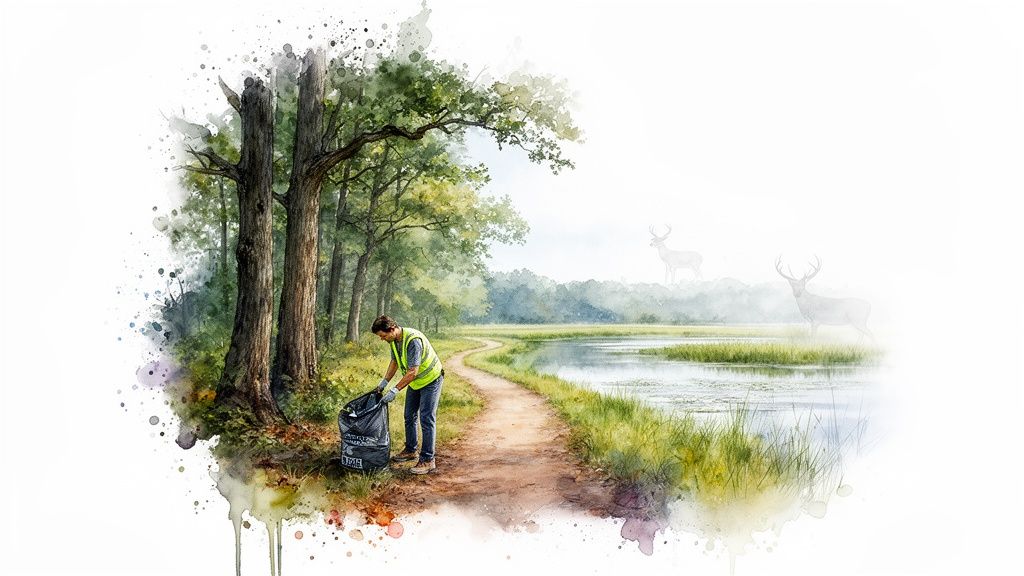
    A person in a high-visibility vest cleans a forest path beside a lake, with two deer in the misty background.

    Our first volunteer day trip here was an eye-opener for me. We partnered with the Forest Preserve District and focused on a section of trail near the elk pasture. Instead of just picking up wrappers, we were learning to identify and remove invasive garlic mustard. It felt like we were giving the native wildflowers a fighting chance, directly contributing to the health of the entire forest understory.

    Why You Should Go

    Busse Woods is perfect for you if you want to go deeper than just a surface-level cleanup. It’s an opportunity to learn about habitat restoration and see the direct impact of removing invasive species. The sheer scale of the preserve means our efforts are crucial for maintaining its wild character for both wildlife and visitors.

    "Working in Busse Woods is like being a gardener for a giant, wild forest. You're not just picking up trash; you're helping native plants thrive and protecting the homes of countless animals. It’s a powerful feeling."

    Get Involved:

    • Your Mission: Focus on trail edges and undergrowth for invasive species removal and accumulated litter. Its immense size means there's always a new area to restore.
    • Actionable Tip: You should organize a carpool day trip. Since it’s a bit of a drive from the city, making it a group event with shared transport builds community and makes it easier for everyone to participate.
    • Learn More: Explore volunteer opportunities and preserve details on the Forest Preserves of Cook County website.

    7. Garfield Park (Douglas Park Historic District): A Partnership in Urban Renewal

    Garfield Park isn't just a park; it's the heart of a community. Spanning 185 acres on the West Side, its historic lagoons, formal gardens, and the stunning Garfield Park Conservatory act as a vital green haven. For us, this isn't a typical forest preserve in IL; it's a chance to build deep community partnerships and restore a piece of Chicago's legacy.

    I'll never forget a cleanup we did near the lagoon. We worked alongside a neighborhood group that had been caring for the park for years. We weren’t just picking up litter. No, we were sharing stories, learning about the area’s history, and becoming part of a local movement. It showed me that our work here is about more than just trash; it's about solidarity.

    Why You Should Go

    Garfield Park is where you can make a profound, visible impact. The need is significant, but the potential for collaboration with groups like the Garfield Park Conservancy is even greater. This is a place to invest your energy where it will be seen, felt, and celebrated by the people who call this park their home.

    "Cleaning up here is an act of respect. You're showing the community that you see their efforts and want to stand with them. It’s about building trust, one piece of litter at a time."

    Get Involved:

    • Your Mission: Your first goal should be to build relationships. You need to connect with local organizations before you even plan a cleanup.
    • Actionable Tip: Schedule early morning cleanups (7-9 AM) with clear safety protocols. This respects the park's daily rhythm and ensures your volunteers feel comfortable.
    • Learn More: Discover the incredible community work happening and see how you can join in by exploring our guide to Garfield Park.

    8. Navy Pier Lakefront & Easternmost Edge

    While not a traditional forest preserve in IL, the public lakefront surrounding Navy Pier offers a unique and vital urban cleanup frontier. The pier itself is private, but the surrounding pedestrian paths and shoreline are where the city’s energy meets Lake Michigan’s vastness. This intersection creates a high-impact zone for our cleanup efforts, protecting a world-renowned waterfront.

    I’ll never forget an early morning cleanup we organized here. The city was just waking up, and we patrolled the eastern edge, collecting countless plastic bottles, food wrappers, and windblown debris. With the iconic skyline behind us, every bag we filled felt like a direct gift back to the city and the lake. It was like giving Chicago a thank-you note.

    Why You Should Go

    The Navy Pier lakefront is an incredible spot to show the power of community action in a highly visible area. The constant foot traffic means there is always work to be done, and the urban setting allows us to engage with tourists and locals alike, spreading awareness about litter prevention.

    "Cleaning here is a powerful statement. You’re standing at the edge of one of the world's great cities, physically stopping pollution from entering one of the world's great lakes."

    Get Involved:

    • Your Mission: You need to target the water’s edge and the rocky revetments along the easternmost point where trash gets trapped by the waves.
    • Actionable Tip: Schedule your cleanups for early mornings or weekdays to avoid the largest crowds. This gives you better access and makes the work much more efficient.
    • Learn More: Coordinate with the Navy Pier sustainability team for access and to see how your efforts can support their larger environmental initiatives.

    9. Des Plaines River Corridor & Restoration Areas

    The Des Plaines River isn't just one forest preserve in IL; it's a vital artery flowing through dozens of them. It snakes over 80 miles, a long, winding corridor connecting communities and ecosystems. For us, this isn't a single site but a massive, linear opportunity to defend an entire watershed from pollution.

    A man in a green shirt cleans up litter by a winding river with reeds in watercolor.

    I think of the river as a story that we can help rewrite. We've worked at access points from the Salt Creek confluence all the way north, and the mission is always the same: stop trash before it travels. A single plastic bottle you remove here won't end up miles downstream, and that’s a victory you can see and feel in real-time.

    Why You Should Go

    The Des Plaines River Corridor is perfect for you if you want to see your impact scale up. Cleaning just one section contributes to the health of the entire river system. It’s an ideal setting for ongoing projects, where you can "adopt" an access point and witness its transformation week after week.

    "Working along the river feels like you're part of a relay race for conservation. Every cleanup event passes the baton of a cleaner waterway to the next community downstream."

    Get Involved:

    • Your Mission: You should focus on the riparian zone—that critical area where land meets water. This is where litter gets snagged in reeds and roots.
    • Actionable Tip: You can partner with a group like the Des Plaines River Watershed Group for larger, coordinated cleanups that will amplify your impact.
    • Learn More: Discover more about the many access points by exploring our guide to the Des Plaines River Trail.

    10. Cantigny Park & Neighboring Woods (Wheaton/DuPage): A Fusion of History and Habitat

    Cantigny Park offers something different. It’s a beautifully curated estate where manicured gardens meet authentic woodland habitat. While not a traditional forest preserve in IL, its 500 acres in Wheaton represent a significant commitment to preserving natural spaces. For us, it’s an opportunity to blend our cleanup mission with history, education, and community partnership.

    I think of it as a destination cleanup. We once organized a day-trip here. We started the morning by clearing debris from the edges of the woodland trails, where nature meets the more formal park areas. After our work, we explored the museums and gardens. It turned a simple cleanup into a rich, rewarding experience for everyone, showing that stewardship can be part of a larger, wonderful day out.

    Why You Should Go

    Cantigny is ideal for a more structured volunteer event. The park is well-maintained, but the borders between the wilder sections and curated landscapes are prime spots for stray litter. It’s a perfect place to introduce new volunteers to our work in a setting that feels safe, inspiring, and full of other activities.

    "Cleaning up at Cantigny feels like you’re protecting a living museum. You’re not just picking up trash; you’re helping preserve a piece of Illinois history and its natural legacy for families and visitors."

    Get Involved:

    • Your Mission: Focus on the woodland trail edges and the borders of the native plant gardens. These transitional zones are where litter often gets overlooked.
    • Actionable Tip: You must contact the park’s volunteer office beforehand to coordinate your group's visit. This can open doors for partnerships and ensure you’re helping in the most impactful way.
    • Learn More: Plan your trip and explore partnership opportunities on the Cantigny Park website.

    Top 10 Illinois Forest Preserves & Parks Comparison

    Site 🔄 Implementation Complexity ⚡ Resource Requirements 📊 Expected Outcomes (⭐) 💡 Ideal Use Cases ⭐ Key Advantages
    Millennium Park & AT&T Plaza High — permit coordination & crowd management Medium — volunteer teams, early-morning staffing, park coordination ⭐⭐⭐⭐ — immediate visible improvement & media attention Urban volunteer recruitment; high-visibility campaigns Partnerships with city/cultural institutions; strong media appeal
    Chicago Botanic Garden (Glencoe) Medium — sensitive habitats require coordination with staff Medium — trained volunteers, transport for urban groups, educational materials ⭐⭐⭐⭐ — habitat restoration & volunteer retention Ecology-focused cleanups and educational workshops Established volunteer network; strong education potential
    Lincoln Park High — large geographic scope and multi-agency logistics High — many volunteers, equipment, ongoing scheduling ⭐⭐⭐⭐ — sustained lakefront and neighborhood impact Rotating weekly zones; large-group lake/beach cleanups Diverse ecosystems for varied volunteer experiences; strong recruitment
    Humboldt Park Medium — safety planning and community trust-building Medium — consistent volunteer commitment, local partnerships ⭐⭐⭐⭐ — neighborhood pride and meaningful environmental justice impact Building community relationships in underserved areas Strong local engagement; visible neighborhood benefits
    Grant Park High — event schedules, permits, dense crowds High — large volunteer drives, coordination with institutions ⭐⭐⭐⭐⭐ — maximum visibility and media/social reach Media-focused recruitment; post-event cleanups Iconic location; high volunteer influx and partnership potential
    Busse Woods Forest Preserve Medium — transportation logistics to suburban site Medium — trail tools, day-trip coordination, fewer volunteers needed ⭐⭐⭐⭐ — strong habitat and trail preservation outcomes Authentic forest preservation and trail maintenance trips True natural preserve experience; safer, less-crowded work
    Garfield Park (Douglas Park Historic District) Medium–High — community engagement and safety protocols Medium — regular volunteer cadence, conservatory coordination ⭐⭐⭐⭐ — deep community impact and restoration gains Long-term neighborhood partnership projects Conservatory partnerships; multigenerational volunteer potential
    Navy Pier Lakefront & Easternmost Edge High — intense crowds, commercial coordination, water safety High — strict timing, safety gear, coordination with Navy Pier ⭐⭐⭐⭐⭐ — high social-media impact and visible litter removal Tourist engagement; photo-driven volunteer recruitment Iconic skyline/backdrop; exceptional social visibility
    Des Plaines River Corridor & Restoration Areas Medium — dispersed sites require transport planning Medium — trail/river gear, partner coordination, variable access ⭐⭐⭐⭐ — measurable watershed and riparian habitat benefits Sequential ward-by-ward or watershed restoration campaigns Linear coverage enables consistent weekly presence; educational value
    Cantigny Park & Neighboring Woods Low–Medium — coordinate with institutional staff, smaller scale Medium — transport, small-group tools, museum coordination ⭐⭐⭐⭐ — combined preservation and educational outcomes Day-trip volunteer experiences blending history and ecology Strong educational partnerships; intimate woodland stewardship

    Your Story Is Waiting in the Woods

    We’ve walked together, virtually, through ten incredible green spaces. From the sculpted gardens of the Chicago Botanic Garden to the wild, sprawling trails of the Des Plaines River Corridor, each place offers you more than just scenery. They are invitations. They are blank pages waiting for your story.

    I remember my first real cleanup. It was a cold, drizzly Saturday at Busse Woods. Honestly, I didn't want to go. I was tired, feeling a little lost in my own life, and the idea of picking up soggy fast-food wrappers felt anything but inspiring. But I showed up. And within an hour, something inside me shifted. Working alongside strangers, sharing a thermos of hot coffee, and watching a patch of woodland slowly return to its natural state changed me. It wasn't about the trash. It was about the shared effort. It was about taking a small, messy corner of the world and making it whole again.

    That simple act became my lifeline. I found that every piece of litter I picked up felt like I was clearing away a piece of my own internal clutter. Every restored prairie I saw was a metaphor for my own potential to grow. These places, these beautiful examples of a forest preserve in IL, are not just for you to look at. They are dynamic arenas for action and connection.

    You don't need a grand plan to start. Your journey can begin with a single step onto a trail at Cantigny Park or a quiet moment watching the birds in Humboldt Park. Let the peace of the woods settle your mind.

    But if you feel a deeper calling, a pull to do more, then that’s where the real story begins.

    • Your Next Step: You should choose one location from this list that speaks to you. Don't overthink it. Just pick one and make a plan to visit within the next week.
    • Your First Action: Go for a walk. That's it. No pressure. Just observe. Notice the light filtering through the trees, the sound of your own footsteps, the feel of the air. See what feelings come up for you.
    • Your Community: If you feel that spark, that desire to protect these spaces, then you know where to find us. You know there’s a community waiting for you with open arms, a trash bag, and a shared purpose.

    This is your story. It might start with a simple walk in a park, but it can lead you to discover your own strength, find your people, and realize you have the power to create real, tangible change. Your transformation is waiting for you. It might just be under a piece of litter in a forest preserve in IL.


    Ready to turn your inspiration into action? Join Litter Caterpillars and become part of a community dedicated to restoring the beauty of our local parks and preserves. We provide the gear and the camaraderie; you provide the heart. Find your next cleanup event and start your story with us at Litter Caterpillars.

  • Your Guide to Chicago Food Bank Volunteer Opportunities

    Your Guide to Chicago Food Bank Volunteer Opportunities

    You feel that nudge, don't you? A quiet but persistent pulse telling you to do something real for Chicago. I know it well. Becoming a chicago food bank volunteer is one of the most direct ways I’ve found to answer that call, turning my time into a full table for a neighbor.

    Why This Work Actually Changes Everything

    I know that feeling. It’s a deep pull, a yearning to connect with your city beyond just living in it, to be a participant, not a spectator. It's the same energy that grabbed me and pulled me into community work years ago. This isn’t about checking off a "good deed" box; it's about answering an inner summons.

    When you sign up for a shift at a food bank, you make a conscious choice. You choose to be the reason a family gets to sit down together for a meal tonight. You become the hands that bridge a gap too wide for some to cross alone.

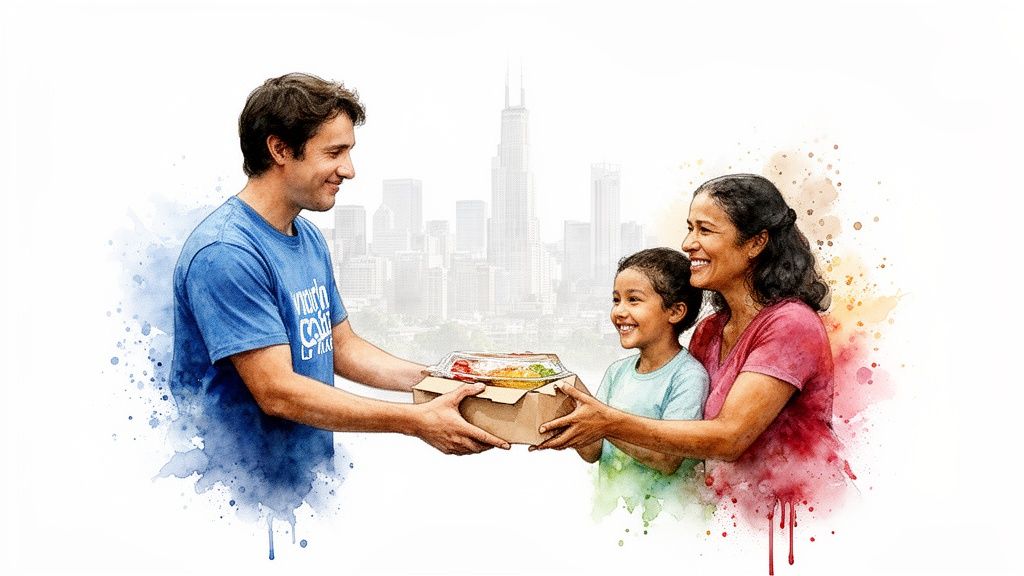
    A smiling volunteer gives a food box with fresh food to a happy mother and child with a city skyline.

    From One Person to a Citywide Movement

    Your single act of showing up is a stone tossed into Lake Michigan. The ripples spread, touching lives in neighborhoods you might never even visit, spreading outward in unseen waves of impact. You aren't just sorting cans. You aren’t just packing boxes. You are weaving resilience into the very fabric of our city.

    I remember my first shift. My stomach was a knot of nerves. I had no idea what to expect. But within minutes, I found myself shoulder-to-shoulder with strangers who felt like teammates, our focus narrowed to one simple, powerful goal. The energy was electric, a shared current running through us all.

    Your time is the fuel that powers Chicago’s fight against hunger. It’s not just about the food; it’s about you and me showing up for each other, proving this community takes care of its own.

    This collective effort creates a staggering impact. Think about the Greater Chicago Food Depository—every year, more than 25,000 volunteers like you and me put in nearly 100,000 hours of service. Our work gets over 7 million pounds of food repacked and out the door. That's millions of meals. You can read more about the vital role of volunteers on their site to see how it all adds up.

    Tying Your "Why" to the Work

    What really matters is the "why" that brought you here. Are you moved by a desire to fight injustice? Do you crave a real connection with people? Or is it just a simple, powerful urge to help?

    Hold onto that reason. It's the engine that transforms a few hours of your time into something monumental.

    • You're giving hope. For a family struggling, a box of groceries is a lifeline. It’s breathing room. It’s a moment of peace.
    • You're building community. When we serve together, we build trust. We tear down the invisible walls that separate us.
    • You're changing yourself. You will walk away different, with a clearer sense of your own power to make an impact.

    Becoming a Chicago food bank volunteer isn't just about what you give. It’s about who you become in the process. You are stepping up to be part of the solution, one shift at a time.

    Alright, you’re fired up and ready. But in a city as huge as Chicago, finding the right place can feel like searching for a specific face in a packed L train. It’s not just about finding an opening; it’s about finding your opening. Let’s find the spot where you don’t just show up, but where you truly belong.

    Think of it like choosing your spot at a Cubs game. Do you want to be in the bleachers, part of a massive, loud, energetic crowd? Or do you prefer a seat closer to the action, where you can see every play up close?

    The big players, like the massive Greater Chicago Food Depository, are the bleachers. They are incredible, well-oiled machines. I’ve volunteered at their repack shifts, and the sheer scale is mind-blowing—you’re part of a huge team making a dent in hunger on an industrial level. It's fast, loud, and you can physically see the pallets of food piling up around you.

    But the real heart of Chicago often beats on the side streets.

    Discovering Neighborhood Gems

    Tucked away in church basements and small storefronts, you'll find hundreds of local food pantries. These places serve their immediate blocks with a fierce, personal dedication. They know their neighbors by name. The St. Cyprian food pantry in Dunning is a perfect example of this.

    Volunteering at a smaller spot is a completely different vibe. It’s intimate. You’re not just packing a box; you might be having a real conversation with the person you’re helping. It’s less about the massive numbers and more about that direct, human connection. So, how do you find these hidden spots?

    • Go hyper-local with your search: I want you to forget generic terms. Try "food pantry near me" or "volunteer [your neighborhood] food bank." This will turn up places you walk by every day and never noticed.
    • Check the old-school spots: Look for flyers at your local library, coffee shop, or even your alderman’s office. I've found these places are still the central nervous system for community action.
    • Just walk around your block: Seriously. I have discovered some of the most dedicated, under-the-radar organizations just by being curious about a sign on a church door in my own neighborhood.

    Choosing where to be a Chicago food bank volunteer is a gut-check moment. Ask yourself: Do I want the energy of a huge team, or the quiet connection of a small one? There’s no wrong answer, only what’s right for you.

    Matching Your Vibe and Your Schedule

    Finding the right fit also means being brutally honest with yourself. Can you actually commit to a weekly shift every Tuesday morning, or is a one-off Saturday thing more your speed? Most places have online sign-up calendars where you can see every available slot. If you want to cast a wider net, our guide on the best volunteer opportunities in Chicago has even more ideas for you.

    Your personality matters, too. Some roles are all about being on your feet and interacting with people, while others are more focused and behind-the-scenes. I want you to think about what kind of work will leave you feeling energized, not drained.

    To give you a better idea, here's a quick breakdown of the most common jobs you'll find. Think about which one sounds less like work and more like you.

    Common Chicago Food Bank Volunteer Roles

    Volunteer Role Typical Tasks Best For You If…
    Warehouse Repacker I've sorted bulk food donations, packed boxes, and labeled cans. You love a fast-paced, physical task and the energy of a big team. Great for audiobook or podcast lovers.
    Pantry Distributor You'll greet guests, hand out groceries, and help people "shop" for their items. You're a people person who enjoys direct interaction and making others feel welcome and respected.
    Delivery Driver I've seen volunteers transport food from a central hub to smaller, local pantries across the city. You enjoy driving, know the city's streets, and prefer working more independently.

    The goal here isn't to just fill a slot—it's to find a role that lights you up. When you match what you’re good at with what the community needs, you’re not just helping out. You’re bringing your best self to the table, and that’s an impact that lasts.

    What Your First Volunteer Shift Will Really Be Like

    I get it. That little knot in your stomach before your first shift is real. You're probably wondering what it's actually going to be like. Will I know what to do? Will I just get in the way? I have been there, and I’m going to pull back the curtain for you.

    Forget any ideas about being thrown into chaos. These places are like a well-rehearsed play, and the shift supervisor is your director for the day. Their job is to get you up to speed and put you right where you're needed most.

    From Arrival to Action

    The moment you walk in, you’ll sign in, get a quick lay of the land, and meet the other folks you’ll be working alongside. The energy is usually upbeat and focused. We’re all there for the same reason—to get things done.

    You won't be left to figure things out on your own. The first few minutes are all about orientation. I’ll walk you through it: you’ll learn the basic rules (like how to safely lift boxes), get your specific task for the shift, and have a chance to ask any last-minute questions. It’s a smooth process, and you’re a key part of it for the next few hours.

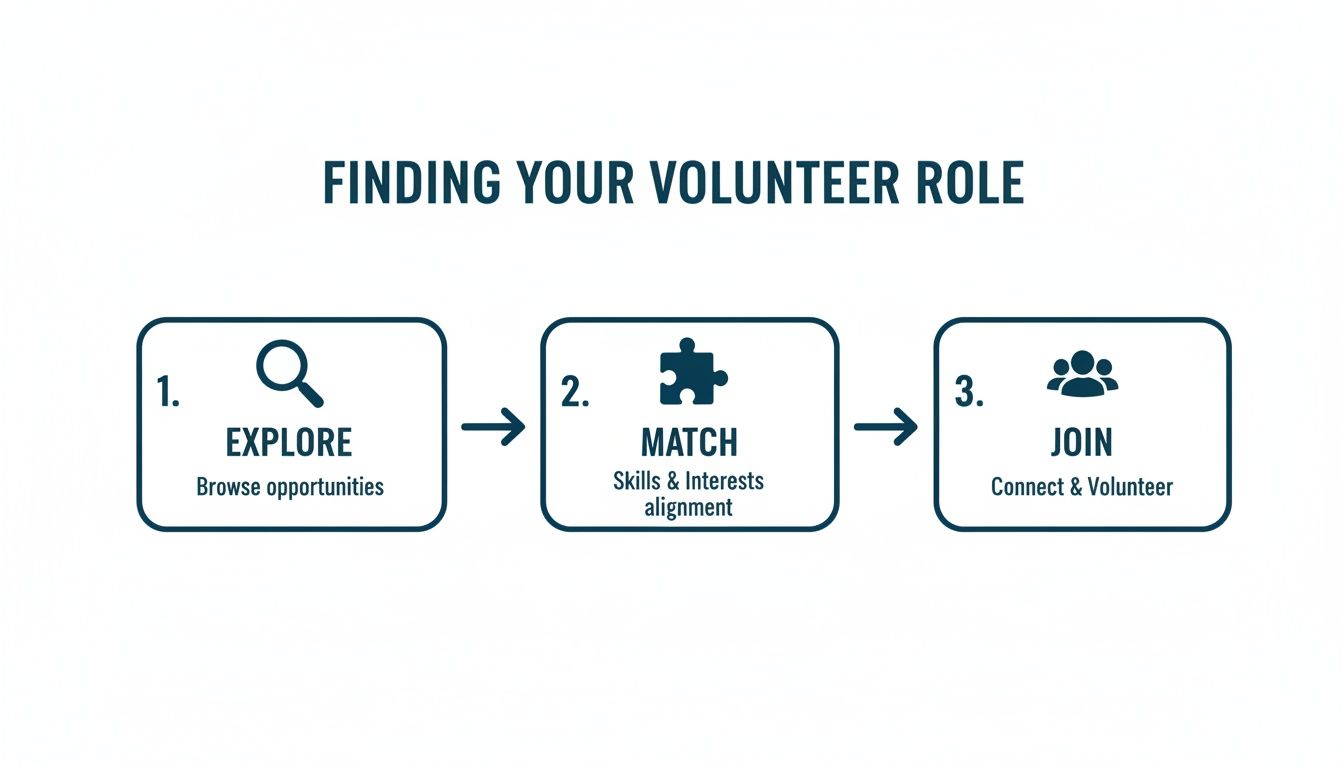
    This simple path from finding an opportunity to joining the team on the floor is designed to be straightforward.

    A three-step process for finding a volunteer role: explore opportunities, match skills, and join.

    By making it easy for you to find a role that fits, you show up for your shift ready to make a real impact from the get-go.

    What You'll Actually Be Doing

    Your job for the day depends entirely on the immediate need. A typical chicago food bank volunteer shift could have you doing any number of things:

    • Repacking Bulk Foods: You might find yourself on an assembly line, transforming giant bags of rice, pasta, or oats into smaller, family-sized packages. I've done this many times; it's rhythmic and satisfying.
    • Sorting Donations: This is like a treasure hunt with a purpose. You’ll be checking expiration dates and sorting canned goods, fresh produce, and other groceries into the right bins.
    • Building Emergency Boxes: This is where you assemble pre-packed boxes with a variety of staple foods, getting them ready to ship out to local pantries like the one at Casa Catalina. You can learn more about their work here.

    The work is tangible. I love that you can physically see the results of your effort as the pile of unsorted donations shrinks and the pallets of ready-to-go boxes grow taller.

    You're not just moving food around a warehouse. You’re moving hope. Every single box you pack is a direct lifeline to a family, a senior, or a child in our city.

    This is especially true as food distribution evolves. For instance, I've watched initiatives like Chicago's Community Kitchens work to distribute up to 10,000 prepared meals every day. And now, 32 percent of all food distributed is fresh fruits and vegetables. Your hands-on work is what makes this push for healthier, more dignified food access a reality.

    The hours will fly by. Before you know it, the shift manager will call out the final tally—how many pounds of food you sorted or how many boxes you packed. It’s a moment of shared victory with people who were strangers just a few hours before. You’ll leave tired, but you’ll also leave full, knowing you didn’t just spend your time; you invested it.

    Think Outside the Box: More Ways to Fight Hunger

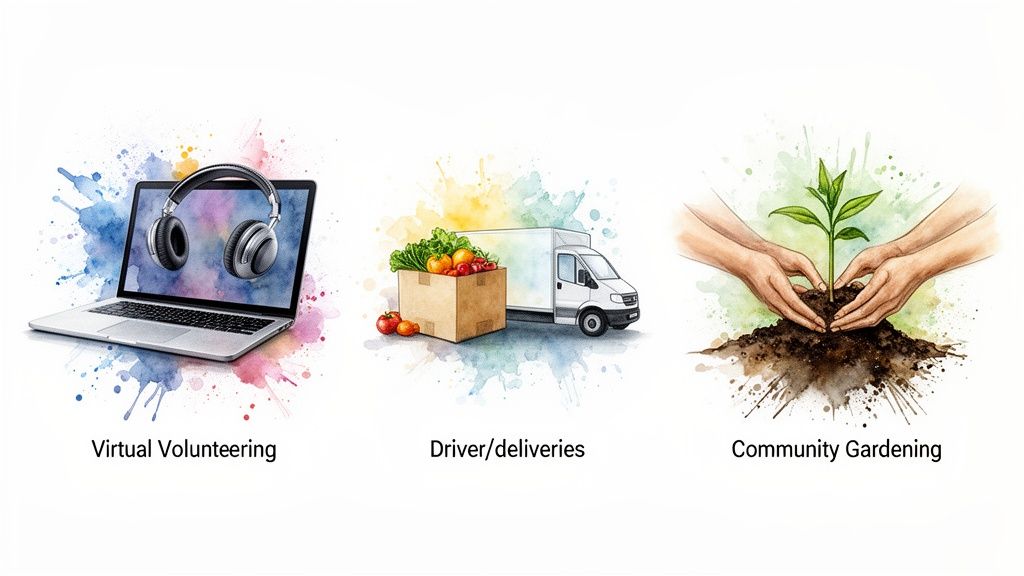
    Three illustrations showing virtual volunteering, food delivery, and community gardening activities.

    So, maybe the fast-paced warehouse shift just isn't your vibe. Or maybe your schedule is as unpredictable as Chicago weather in April. That’s more than okay. The most important thing you bring to this is your will to help.

    Fighting hunger is not a single-lane road; it's a giant highway with on-ramps everywhere. If packing boxes feels like a bad fit, I want you to know there are tons of other ways to be a chicago food bank volunteer. It's all about finding the role that just clicks for you.

    Your Skills Are a Superpower

    Seriously. Your professional talents are a secret weapon. Are you a wizard with spreadsheets? A creative genius with graphic design? A wordsmith who can tell a compelling story? I've seen firsthand how desperately food banks need these skills, and you can often contribute right from your own couch.

    It’s a different kind of impact, but it’s huge. Think about it:

    • Data Entry: You could be the person organizing volunteer lists or donation records from home, creating order from chaos.
    • Grant Writing: Your writing could be the very thing that secures thousands of dollars in funding for an organization.
    • Social Media: You could design a single post that brings in a flood of donations for a food drive.

    This is the behind-the-scenes work that keeps the whole operation moving. It’s like being the mission control for the rocket ship. While others are on the front lines, you're the one drawing the map that gets everyone where they need to go. You’re using your brain to tackle a massive problem.

    Hit the Road or Dig in the Dirt

    If you’d rather be out in the world but still want something different, there are some incredible options. Do you love driving and seeing the city? Volunteer drivers are the unsung heroes of this whole thing. I’ve heard stories from guys like Thomas LeClair, who’s put in hundreds of hours and says he meets the “most beautiful people” delivering food across Chicago. It's a way you can feel the real pulse of the city, one delivery at a time.

    Sometimes the most powerful work happens far from the main building. Your car can become a vehicle for hope. Your voice can become an engine for change.

    Or maybe you’re someone with a green thumb. I’ve seen urban farms and community gardens that supply fresh produce to food pantries, and they are always looking for help. Imagine spending a morning tending to basil and parsley, knowing it will end up on someone’s plate that very week.

    It all connects. When we take care of our communities—whether I’m delivering food or you’re beautifying a public space—we’re building a sense of pride and wellness that goes hand-in-hand with food security. You can even see how different acts of service add up by exploring other charities in Chicago and finding your fit. Every small act gets us closer to a stronger Chicago.

    From One Shift to Part of the Family

    You finish that first shift. You’re tired, your back might be a little sore, but you’re buzzing. It’s a good feeling—a real, earned sense of purpose.

    But that buzz from one shift? It’s just the ignition. The real magic happens when you decide to come back. That first time is a spark. Consistency is what builds the fire that keeps a community warm.

    Making It Your Thing

    I remember feeling that pull. That feeling that once wasn't enough. I needed to make my chicago food bank volunteer work a regular thing. The first real step was simple: I put it on my calendar. I treated it just like a doctor's appointment or a meeting with my boss.

    It became “my Tuesday morning shift.” It was no longer a question of if I was going, but when.

    This is how a good deed transforms into a habit of service. This is how you go from just helping out to being part of the bedrock of the organization. It's like a single drop of water, which does little, but a steady drip over time can carve stone. Your consistent effort has that same power.

    This isn't just a nice thought; it’s how massive change happens. Look at the Greater Chicago Food Depository. They went from distributing 500,000 pounds of food in their first year to 11.2 million pounds just four years later. That’s what a dedicated, volunteer-driven effort does. You can see how that grassroots fire started by learning about the Food Depository's early history.

    Finding Your People

    Then something else starts to happen. As you keep showing up, the faces you see every week stop being strangers. They become your crew.

    You start to learn their stories. You meet the retired firefighter who tends the hydroponic garden. You meet the flight attendant who’s a natural at guiding new volunteers. You meet the group of college friends who make packing produce boxes their weekly catch-up.

    You don't just find a place to volunteer; you find your tribe. You find the people who share your commitment to showing up for Chicago, and together, you become an unstoppable force.

    This is what keeps you coming back, even on those mornings when you’re tired or the weather sucks. You’re not just accountable to the mission anymore. You’re accountable to each other.

    Here’s how you make that happen:

    • Stick to the same shift. If you can, try to sign up for the same day and time. That's how I built connections with a core group of regulars.
    • Just be open. Ask people their names. Share a little about yourself. I’ve made some of my closest friends in this city just by starting a conversation over a pallet of potatoes.
    • Learn the ropes. Once you're a regular, people start to trust you with more. Maybe you’ll train newcomers or take the lead on a specific project. This is you, growing from a helper to a leader.

    Before you know it, volunteering stops being something you do. It becomes part of who you are. You start seeing Chicago not just as the place you live, but as the community you are actively building, one shift at a time.

    Got Questions? Let's Get Real.

    It's normal to have a million questions running through your head before your first shift. I’ve been there. You want to show up and do a good job, not get in the way. Let’s cut through the noise and get you some straight answers based on what I've seen and what I hear other first-timers ask all the time.

    Am I Too Young (or Old) for This?

    Every place is different, but most have a spot for you. Big operations like the Greater Chicago Food Depository are amazing—they often welcome volunteers as young as 11 as long as an adult is with them. I've seen it myself, and it's an incredible thing for a kid to witness that kind of impact firsthand.

    Smaller neighborhood pantries might need you to be 14 or 16 just because of the work or the size of their space. The golden rule is simple: just check the volunteer description before you sign up. They're always crystal clear about age.

    Can I Bring My Friends?

    Heck yes! Volunteering with your crew is one of the best ways I know to do it. It stops being a "shift" and starts being a bonding experience. I’ve seen corporate teams, high school clubs, and just groups of friends have an absolute blast sorting food and making a difference together.

    Most food banks love groups and have a separate sign-up for them. One piece of advice I can give you: plan ahead. Those group spots, especially on weekends or near the holidays, get snatched up months in advance.

    The most important skill you can bring to a Chicago food bank is a good attitude and a real willingness to help. I can teach you everything else you need to know in five minutes.

    Do I Need Any Special Skills?

    For 99% of the roles, you don't need any special skills. I'm serious. The work is designed for everyday people like you and me to show up and get it done. Your most powerful tool is your willingness to just be there and help.

    You'll get a quick orientation at the start that shows you exactly what to do, whether it's packing boxes or sorting produce. It's simple, satisfying work that adds up to something huge.

    What If I Have to Cancel?

    Life happens. Your kid gets sick, your boss moves a meeting, you just feel off. I get it, and so do the food banks. They rely on people like us, and they know that means being flexible.

    Most places have an online system where you can cancel your shift with a few clicks. When you do that, your spot opens up for someone else who's been waiting for a chance to help. The key is to give as much notice as you can—they plan their whole day around the number of volunteers they expect. Don't feel guilty, just be courteous and cancel as soon as you know.


    At Litter Caterpillars, we believe that showing up for your community—whether you’re packing food boxes or cleaning a park—is how you find your people and build a better Chicago. If you're looking for another way to serve, join us for a cleanup event and see the city change right before your eyes.

  • Your Guide to the Casa Catalina Food Pantry Chicago IL

    Your Guide to the Casa Catalina Food Pantry Chicago IL

    That feeling when you open the fridge and it’s almost empty? It’s a heavy weight, a stone in your gut. I get it. I want to help lift some of that weight by walking you through exactly how you can get help at the Casa Catalina Food Pantry Chicago IL. No confusing steps, no judgment—just me giving you a straightforward guide so you know exactly what to expect.

    Your Practical Guide to Visiting Casa Catalina

    Watercolor illustration of smiling people outside Casa Catalina Food Pantry, a woman holding a branded bag.

    Walking up to a new place to ask for help can feel incredibly intimidating. I’ve been there. My goal here is to vaporize that anxiety. Let's make sure you arrive at Casa Catalina feeling prepared and welcome, not stressed out and lost.

    This place is so much more than just a food pantry. Seriously. In the very heart of the Back of the Yards neighborhood, it’s a pillar of hope, a real-life testament to what happens when a community truly cares for its own. Here, they treat you like a neighbor, not a number.

    A Beacon in the Back of the Yards

    For over 30 years, Casa Catalina has been a steady presence at 4537 S Ashland Ave. It’s run by Catholic Charities, but its doors are flung wide open for everyone, no matter your story or what you believe. It’s a lighthouse, cutting through the fog for this neighborhood.

    Every single week, this pantry helps between 300 and 350 families. That’s roughly 1,500 to 1,750 of our Chicago neighbors getting the support they need to get by. This only happens because of the monumental deliveries they get—I'm talking about 5,000 to 7,000 pounds of food from the Greater Chicago Food Depository. It’s an incredible, powerful operation.

    I want you to see this not just as giving your time, but as this amazing opportunity for connection, for growth. It's a chance to become part of something truly meaningful in our community.

    My whole mission with Litter Caterpillars is to show you how service can transform us. Casa Catalina operates with that same spirit, treating every person who walks through its doors with a deep, profound sense of dignity. It's about so much more than a meal; it’s about respect. If that fires you up, you should check out our guide on how to start volunteering and find even more ways you can make an impact.

    What It’s Really Like Inside

    Walking into a new place, especially when you’re looking for a little help, can be nerve-wracking. I get it. So let’s walk through the doors of the Casa Catalina food pantry together, you and me, so you know exactly what to expect.

    First thing’s first: forget any old, sad picture you might have in your head of grim lines and identical, pre-packed bags of depressing food. What you'll find here is something else entirely. It's a place built on respect, plain and simple.

    This Isn't a Handout, It's Your Choice

    Casa Catalina was a trailblazer with its "client choice model"—an idea so simple yet so powerful it changes everything. Imagine it less like a pantry and more like a small neighborhood grocery store where you are the shopper. Instead of getting a bag someone else packed, you get to walk the aisles yourself and pick out the items your family will actually eat and enjoy.

    It’s about dignity. Do your kids tear through oatmeal for breakfast? Go ahead and grab it. Is your family all about black beans instead of pinto beans? The choice is entirely yours.

    This system puts you in the driver's seat. It also brilliantly slashes food waste, making sure groceries end up on a dinner plate, not forgotten in the back of a cupboard. It respects you and what your family needs, with options for things like eggs or no eggs, and meat or no meat, depending on your diet.

    "The client choice pantry is a dignified way to help people. It gives them the choices to select food that they want, that they are going to use, and it is a better way to respect people."

    And the support doesn't stop with groceries. Casa Catalina often runs extra programs during the winter, fall, and summer to give even more support to families, kids, and teens. You can read more about how they are bridging Chicago's food gap and creating a place where people feel genuinely supported.

    The volunteers here are amazing. They aren’t there to rush you along; they are there to guide you with a smile and make you feel like a welcome neighbor.

    Why This Pantry Is a Lifeline for Chicago

    Food insecurity isn't some abstract concept. It's a quiet crisis hitting our neighbors, right here in Chicago's vibrant Latino communities. It's a real, heavy struggle that's only gotten worse, and I want to show you the reality behind the numbers.

    The need for a place like Casa Catalina Food Pantry Chicago IL has absolutely exploded. The reasons are both simple and complicated. Just think about summertime. School's out, and suddenly that safety net of free breakfast and lunch is gone. For a family already stretching every single dollar, their grocery budget is now expected to cover a ton of extra meals.

    The Real-Life Impact of the Growing Need

    This isn't a vague issue; it's a full-blown crisis you can measure. Food insecurity among Chicago's Latino families has hit staggering, heart-breaking levels, with 28% of households with children struggling to put food on the table.

    Casa Catalina felt this surge firsthand. They saw 200 new clients walk through their doors between May and June alone as summer kicked off. It’s not just them, either. Across the city, Catholic Charities agencies have seen a staggering 62% jump in need since 2019. This isn't just a small uptick; it's a seismic shift, an earthquake under our feet. You can get a deeper look into these trends from a WTTW news report on Chicago food insecurity.

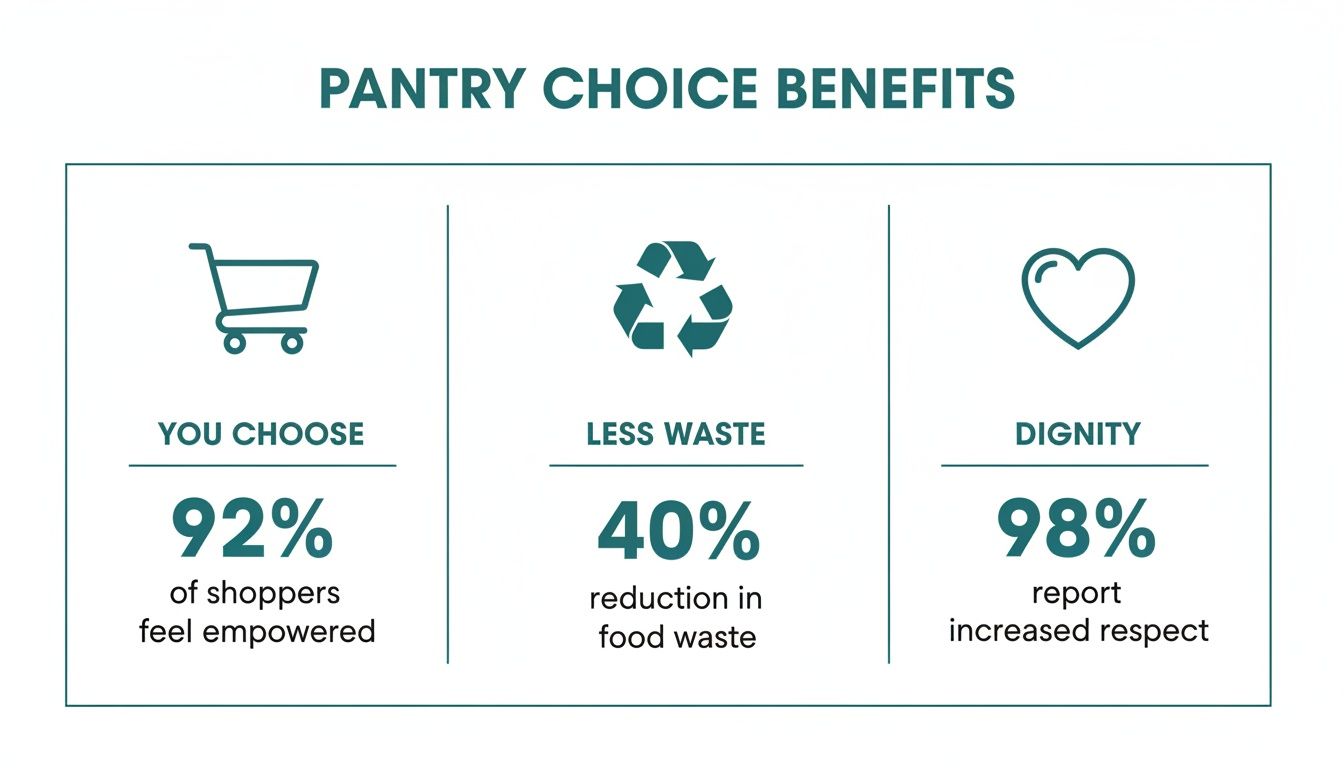
    This infographic gets to the heart of why Casa Catalina’s client-choice model is so powerful—it’s about giving people control, cutting down on waste, and, most importantly, showing profound respect.

    Infographic showing food pantry choice benefits: shopper empowerment, less waste, and increased respect.

    The big takeaway here is that how we give is just as important as what we give. It turns a handout into a powerful, transformative gesture of dignity.

    This growing need can feel overwhelming, but that’s exactly why places like Casa Catalina are so vital. They are the frontline defense against hunger, a place of refuge in the storm.

    Seeing the "why" isn't about getting discouraged. It's about understanding the incredible purpose behind every single donation and every volunteer hour you give. Every meal you help provide makes a real, tangible difference for a family in our city.

    Every can of beans, every hour you spend sorting produce, every dollar you give—it all becomes part of a much bigger story. It's a story of neighbors showing up for each other with incredible resilience and a hell of a lot of heart.

    Ready to Actually Do Something?

    Four diverse volunteers happily unload boxes and cans from a white delivery van, surrounded by watercolor splashes.

    You know that feeling when you just want to stop talking and start doing? That’s what volunteering at the Casa Catalina Food Pantry Chicago IL is all about. This isn't about feeling good; it's about doing good.

    It's a place where your hands can finally do the work your heart has been asking for.

    Picture this: you're part of a team unloading a truck packed with 7,000 pounds of food. It's real work. You can feel the satisfying weight of the boxes. You're a critical link in the chain that gets that food from a truck bed into the kitchen of a family down the street. It’s so tangible.

    It's Not a Task List, It's Connection

    Sure, there's work to do, but it’s not all about heavy lifting. The real magic happens in the small moments.

    You might be the person who walks with a mom through the aisles, sharing a smile as she finds her kids' favorite cereal. Or maybe you're the one keeping the shelves stocked, making sure the space feels organized and dignified for everyone who walks in.

    There are different jobs for different people, and every single role matters. The team is always looking for new folks to join the crew, and they're flexible with time.

    This isn't just about giving away a few hours of your time. It’s an investment. You're building a real connection to your city and seeing firsthand the impact of showing up. It’s the kind of work that sticks with you long after you go home.

    This is the kind of hands-on service we live for at Litter Caterpillars. If this gets you fired up, you should check out the other volunteer opportunities in Chicago we've found to keep that incredible momentum going.

    Signing up is your first step. It’s your chance to join a community that believes in the simple, powerful act of being there for others. Time to get to work.

    How to Support Through Donations

    It’s easy to feel overwhelmed by the sheer scale of hunger in a city as big as Chicago. But you don't need to solve the whole problem to make a real, concrete difference.

    You can absolutely make sure one family has a good meal on their table tonight. That single can of soup you donate is a direct line of support to a neighbor. It feels incredible to give, doesn't it? Let’s talk about how to turn that powerful feeling into action at the Casa Catalina Food Pantry Chicago IL.

    Donating Food The Smart Way

    When you're grabbing items to donate, I want you to think like you're stocking a pantry from scratch. What are the absolute essentials? What items form the backbone of a week's worth of meals? That’s where you can make the biggest, most direct impact.

    These are the items that are like gold to a food pantry:

    • Shelf-stable proteins: Canned tuna, chicken, and beans (black, pinto, kidney) are the foundation of so many hearty, filling meals.
    • Grains and starches: You can never go wrong with rice, pasta, and cereal. They are absolute must-haves for stretching a budget and keeping bellies full.
    • Jarred and canned goods: Think peanut butter, pasta sauce, and canned vegetables. These provide crucial nutrition and flavor that turn basic ingredients into a real, satisfying meal.

    Here's a pro tip from me to you: always check the expiration dates. Handing over food that’s fresh and ready to use is a small detail that shows a huge amount of care and respect.

    The Power of a Financial Gift

    Donating food is fantastic, but giving money is like handing the pantry a superpower. Why? Because cash is unbelievably flexible.

    A financial gift allows the team at Casa Catalina to use their deep expertise and buying power to get exactly what they need, right when they need it most.

    Every single can of soup, every dollar you give, is a direct act of kindness that makes a world of difference for a family right here in our city.

    This flexibility is a complete game-changer. Maybe they just ran out of eggs, or a local farm is offering a massive discount on fresh produce. Your donation gives them the freedom to jump on those opportunities instantly. Supporting the groups that strengthen our communities is one of the most powerful things we can do. If this fires you up, check out our guide to other impactful charities in Chicago.

    Your Questions, Answered

    Got questions? Good. Hesitation is normal, but I don't want it to stop you from getting help or giving it. Let's clear up the common stuff people ask about Casa Catalina Food Pantry Chicago IL so you can get moving.

    Think of this as the final push from me to you. No more uncertainty. Just clear, direct answers so you can take that first step, whether you're walking through their doors for a bag of groceries or to lend a hand.

    What Paperwork Do I Actually Need?

    Usually, you'll want to bring some form of ID and proof of address, like a recent utility bill. This is just standard procedure to confirm you're in their service area.

    But listen to me, and I mean this: Casa Catalina is a safe zone. They are here for everyone, especially immigrant families who might be worried about this stuff. Don't let a piece of paper stop you from feeding your family. Their mission is food, not gatekeeping.

    If you're stressed about what to bring, just call them. Seriously. A two-minute phone call will solve everything. They want to help you, not turn you away.

    Can I Bring My Whole Crew to Volunteer?

    Hell yes! Volunteering as a group is one of the best ways to make a real dent. It’s like a flash mob of helpfulness—you can knock out a mountain of work in a few hours and have a damn good time doing it.

    Just be smart about it. Have your group leader call their volunteer coordinator and schedule a time. That way, they're ready for you and can put your team to work on something meaningful, like sorting a huge delivery before a big distribution day. Don't just show up.

    What Food Donations Are Most Needed?

    Think basics. Think foundation. The best things you can donate are the non-perishable staples that a family can build a week's worth of meals around.

    • Pantry Powerhouses: I'm talking rice, pasta, cereal, and peanut butter. The stuff that fills bellies and lasts.
    • Canned Heroes: Beans (black, pinto, kidney), canned veggies, and proteins like tuna or chicken are always in high demand.

    These items are absolute gold because they don't spoil. Just do one simple thing: check the expiration date. It's a small act of respect that goes a very long way.


    Here at Litter Caterpillars, we're all about showing up. Whether we're cleaning an abandoned lot or backing up a crucial spot like Casa Catalina, we believe in action. If you're ready to stop thinking about it and start doing it, come find your place with us. We’re out there every single week, making Chicago better and building a community of people who aren't afraid to get their hands dirty. Join the mission at https://www.littercaterpillars.com.
  • Discover community service options chicago il that fit your schedule

    Discover community service options chicago il that fit your schedule

    You know Chicago. It’s not just a grid on a map. It’s the deep rumble of the ‘L’ train under your feet, the sweet, buttery scent of Garrett Popcorn that grabs you on Michigan Avenue, the collective roar when the Cubs finally, finally win. But I bet you've felt it, too. That feeling of being a spectator in your own city, watching this incredible story unfold from the sidelines. You see the gaps, the quiet needs, the spots where just a little bit of help could change everything, and you think to yourself, "I want in. I want to be part of that."

    This is your invitation. Your call to jump off the bench and get in the game. You're holding the pen now. Think of this guide as your playbook, designed to get you straight into the action. I’ve sliced through the noise to hand you the most effective, inspiring, and direct community service options Chicago IL offers. Forget the black hole of endless searching and confusing sign-up forms. What you have in your hands is a curated map to making a real, tangible impact, whether you've got a single Saturday morning or you're ready to go all-in for a cause that sets your soul on fire.

    I'm giving you the direct lines to organizations that are actively reshaping this city. We're talking about everything from rolling up your sleeves for neighborhood cleanups with a powerhouse group like Litter Caterpillars to plugging into city-wide initiatives through platforms like Chicago Cares and VolunteerMatch. Every entry I've listed is a clear, actionable starting point with direct links, inside tips on scheduling, and exactly what you need to know to get started this week. This isn't just about finding a volunteer gig. It’s about finding your place in Chicago’s story. It's about finding your way to leave a mark and discovering your community within this incredible, sprawling city. Your chapter starts now.

    1. Litter Caterpillars

    If you're hunting for community service options in Chicago that give you that immediate, see-it-with-your-own-eyes satisfaction and a powerful sense of tribe, then your search starts and ends with Litter Caterpillars. Let me tell you, this is not just another neighborhood cleanup. It's a city-wide movement, a force of nature built by volunteers, for volunteers. Picture this: a guy named Kevin Tao, overflowing with dedication, starts a group that transforms sleepy weekend mornings into vibrant, crackling displays of community action and real connection. They prove, weekend after weekend, that a few hours of our time can radically change the face of a street and the spirit of a city.

    Litter Caterpillars is the living definition of "showing up." You'll find them out there every single weekend. It doesn't matter if it's a perfect, sun-drenched day or a brutal Chicago blizzard that has everyone else hiding indoors. This relentless, beautiful consistency is how they achieved something truly legendary: they have cleaned every single one of Chicago's 50 wards. They don't just hit the easy spots, either. They go where the need is greatest, showing a kind of courage and commitment that lights a fire in everyone who joins them.

    A group of Litter Caterpillars volunteers in high-visibility vests posing with trash bags and pickup tools on a Chicago street, showcasing their community cleanup efforts.

    Why Litter Caterpillars Stands Out

    What makes this group so magnetic isn't just the mountains of trash they bag up; it's the community they forge in the process. Imagine you start your Saturday not just with a chore, but with a mission. You show up and you're suddenly part of this energetic crew of like-minded people. You grab a picker, a bag, and set off. As you work, you talk, you laugh, and you build these incredible friendships born from shared effort. The group makes it fun, too. It’s like a game. They have flags, a theme song, and even achievement badges, turning a simple cleanup into a source of immense personal pride.

    Their impact echoes far beyond clean streets. In a move that still blows my mind, Litter Caterpillars won an empty lot at a city auction. Now, they're transforming it into Caterpillar Park in Englewood. This is a real, lasting legacy that you can be a part of. You can literally point to a park and say to your friends, "I helped build that."

    Getting Plugged In: Your First Cleanup

    Joining them is refreshingly simple. It’s like walking into a party where you’re instantly welcome. There are no fees, and the group is fiercely protective of its rule: they never, ever pressure you for money. Your time and your energy are the only currency that matters here.

    1. Find an Event: Just check their website, Meetup page, or Instagram for the next weekend cleanup. They post schedules and locations so clearly you can't miss them.
    2. Just Show Up: I mean it. They provide everything you need—gloves, bags, trash pickers. You just wear comfortable clothes that fit the weather.
    3. Join the Community: After your first event, you can jump into their open group chats to stay connected, share stories, and make plans with the new friends you just met.

    This straightforward, no-barriers approach makes it one of the most accessible and deeply rewarding community service options Chicago IL has to offer.

    A Closer Look: The Experience

    Feature What It Means For You
    Volunteer-First Model It's truly free. I love this. You can show up and give your time without ever feeling like you're going to be hit up for a donation. The focus stays pure: action and community.
    All 50 Wards Covered You get to explore your city. You'll discover neighborhoods you never knew existed, all while making this beautiful, visible difference.
    Caterpillar Park Project You can build something permanent. This is such a rare chance to contribute to a lasting community asset from the ground up.
    Weekend Consistency It becomes a reliable habit. You can count on an event being there every single weekend, making it easy to build volunteering into your life.
    Bold & Adventurous You go where you're needed most. I admire their courage. The group’s willingness to work in all areas ensures your efforts have the biggest possible impact.

    Pros:

    • High-Impact & Visible: Your work creates cleaner streets and community projects you can literally see and touch.
    • Strong Community: You'll build real, solid friendships through shared, consistent effort.
    • Completely Free: No fees or donation pressure means the environment is always welcoming.
    • Consistent & Reliable: Events happen every weekend, no matter what.

    Cons:

    • Physically Demanding: The work is active, and you'll be out there in all kinds of weather.
    • Informal Structure: Since it's not a formal 501(c)(3), it might lack things like official volunteer hour tracking or tax-deductible donation options.

    If you are ready to make a difference you can see, explore Chicago's incredible neighborhoods, and find a community that values action above all else, Litter Caterpillars is waiting for you.

    Get Started: Visit the Litter Caterpillars website or find them on Meetup and Instagram.

    2. Chicago Cares

    If you're searching for the North Star of Chicago volunteering, you’ve found it. I think of Chicago Cares as my personal concierge for making a difference. For over 30 years, this organization has been the bridge connecting compassionate Chicagoans like you with the local nonprofits that are the city's very backbone. They’ve spent decades building deep, trusted relationships, so when you sign up, you're not just finding a task to do; you're plugging directly into the heartbeat of a community.

    What I love most about them is how they smash the barriers that so often stop us from taking that first leap. Their website is like a dynamic, citywide calendar, bursting with diverse, meaningful projects. It feels less like a sterile directory and more like a curated menu of opportunities to connect with your city and its people on a human level.

    A group of diverse volunteers working together outdoors on a community service project in Chicago.

    Why It's a Go-To Resource

    The real magic of Chicago Cares, in my opinion, is its laser focus on accessible, high-impact engagement. They are masters of the "done-in-a-day" event. This is perfect if your schedule is a chaotic beast or if you're just dipping your toes into community service for the first time. One weekend, you could find yourself sorting donations at a food pantry in Pilsen, and the next, you might be helping seniors get the hang of new technology in Lincoln Park.

    They also offer these fantastic orientations, like the "Power of Service," which help you understand the why behind your work. It's not just about showing up and doing a task; it's about understanding the bigger picture and why your presence truly matters.

    Getting Started: A Quick Guide

    Using their platform is a breeze, but let me give you a couple of tips to make the most of it:

    1. Create Your Profile: You'll need a free account to sign up for projects. It's a quick process and it lets you track your impact and manage your schedule all in one place.
    2. Filter and Find: Use their calendar filters. They're powerful. You can sort by your passion (like hunger, education, or the environment), your neighborhood, the date, and even whether it's family-friendly. This helps you find the perfect fit, fast.
    3. Sign Up Early: I've learned this the hard way. Popular projects, especially on weekends, can fill up in a flash. If you see something that sparks your interest, don't wait!

    Pro Tip: Set up alerts for your favorite causes or neighborhoods. The system will ping you when new opportunities pop up, giving you a head start on registration.

    Chicago Cares excels at providing a diverse range of community service options Chicago IL residents can easily access, making it a cornerstone for both new and experienced volunteers.

    Feature Breakdown My Take
    Project Variety Excellent. From environmental cleanups to serving meals, the options feel limitless.
    Ease of Use The user portal is intuitive. I find signing up and tracking my hours to be simple and clean.
    Commitment Level Perfect for me as a one-time volunteer, but they also have recurring options if you want to go deeper.
    Cost & Access Free to use. The only thing you have to do is create an online account.

    The Bottom Line: Chicago Cares is an essential, user-friendly hub that makes finding and participating in local service projects feel both inspiring and totally achievable.

    Find your next project: https://www.chicagocares.org

    3. VolunteerMatch (Chicago)

    If Chicago Cares is your personal concierge, then I want you to think of VolunteerMatch as the city’s massive, bustling marketplace for doing good. It's a national platform, but it has this powerful local focus that presents a sprawling, almost overwhelming inventory of ways for you to connect and contribute. It feels like wandering through an open-air market where hundreds of grassroots organizations, big-name nonprofits, and tiny community groups have all set up their stalls, each calling out with a unique mission and a specific need.

    What I find so empowering about VolunteerMatch is its sheer, unadulterated scope. You get this incredible bird's-eye view of the entire nonprofit landscape. This isn't just a curated list of a few dozen partners; it's a comprehensive database that lets you be the architect of your own volunteer journey. It connects you with these amazing opportunities you might never have discovered otherwise.

    Why It's a Go-To Resource

    The power of VolunteerMatch is hidden in its robust search and filter capabilities. It’s built for you, the volunteer who either knows exactly what you want or wants to explore every single possibility. Are you a graphic designer who wants to offer your skills remotely to an animal shelter? There's a filter for that. Are you looking for a family-friendly opportunity in Rogers Park this Saturday? You can drill down to that specific need.

    The platform is a champion of skills-based volunteering. It connects your professional talents directly with organizations that desperately need them but often can't afford them. This transforms your volunteering from just lending a hand to leveraging your unique expertise for maximum impact. You're not just helping; you're empowering.

    Getting Started: A Quick Guide

    Navigating the ocean of options is easy once you know how to use the platform's tools to your advantage:

    1. Set Your Location: Start by making sure your search is centered on Chicago. This simple step ensures you see all the local results first.
    2. Use Advanced Filters: Don’t just scroll. Click into the filters to sort by cause area, your specific skills (like marketing or event planning), in-person vs. virtual, and even "Great For" tags (kids, teens, groups, 55+).
    3. Read the Listings Carefully: Remember, any nonprofit can post here. Pay attention to the details. I always look for clear role descriptions, specific time commitments, and good contact information. A well-written listing is usually a good sign of a well-organized group.

    Pro Tip: Use the "Save Opportunity" feature to create a shortlist. This lets you compare a few options side-by-side before you commit, helping you make the most informed decision for you.

    This site is an absolute powerhouse for anyone exploring the full spectrum of community service options Chicago IL has to offer. For more great advice on connecting with the right role, check out this guide on how to find volunteer work.

    Feature Breakdown My Take
    Project Variety Unbeatable. The sheer volume of listings from countless organizations is its biggest strength. You can find anything here.
    Ease of Use The search filters are powerful and intuitive. I find it easy to narrow down the vast selection to exactly what I'm looking for.
    Commitment Level It caters to everyone. I've found one-off events, remote projects, and even long-term board positions listed here.
    Cost & Access Free for me, the volunteer, to search and apply for opportunities.

    The Bottom Line: VolunteerMatch is an essential tool for the proactive volunteer, offering an unparalleled database to find niche, skills-based, and diverse opportunities all across Chicago.

    Find your next project: https://www.volunteermatch.org/city/Chicago

    4. Idealist (Chicago volunteer listings)

    I want you to think of Idealist as the wise, well-connected librarian of the volunteering world. It’s a global platform, yes, but its Chicago-specific section is a genuine treasure trove for anyone like me who's looking to connect their skills and passions with a real cause. While some platforms feel like a chaotic bulletin board, Idealist feels more like a professional network for people who want to be changemakers. It skillfully bridges the gap between grassroots needs and the people who have the heart to help, offering you a direct line to established, reputable nonprofits.

    What I truly appreciate is the platform's depth. It goes beyond simple one-day tasks to showcase roles that might require a specific skill you have or a more regular commitment. This is where I go when I’m ready to find a role that not only fills a need but also helps me grow, both personally and professionally. It’s a resource built on the beautiful belief that every single one of us has something unique and valuable to offer.

    Idealist (Chicago volunteer listings)

    Why It's a Go-To Resource

    The power of Idealist is in its professional, mission-driven approach. The listings often provide these wonderfully detailed descriptions of the organization's goals and the specific impact you’ll have, which helps you feel connected before you even apply. It's a fantastic place to find roles that are a bit more structured, like becoming a tutor for an after-school program in Logan Square or a grant-writing assistant for a housing advocacy group down in Hyde Park.

    You'll find a healthy mix of on-site, remote, and flexible opportunities. This variety makes it an invaluable tool for finding community service options Chicago IL that align with your lifestyle, whether you're a student with a tricky class schedule or a professional like me looking to lend expertise from home.

    Getting Started: A Quick Guide

    Navigating Idealist is all about using its powerful search tools to your advantage:

    1. Target Your Search: I recommend you head straight to the Chicago volunteer page. From there, you can immediately start filtering to narrow your results.
    2. Use Keywords: Don't just browse aimlessly. Search for keywords that connect to your interests, like "mentoring," "food justice," or "arts." This will help you surface more specific and relevant roles.
    3. Filter by Commitment: Be honest with yourself about your availability. Use the filters for "one-day event," "short-term," or "ongoing" to find a match that you can actually sustain.

    Pro Tip: Create a profile and set up alerts for specific keywords or organizations you're interested in. Idealist will email you when a new opportunity that matches your criteria is posted, so you can be among the first to apply.

    Idealist excels at connecting you with substantive, often skill-based volunteer roles at established nonprofits across the city.

    Feature Breakdown My Take
    Project Variety Great mix of professional, administrative, and direct-service roles. I always find something interesting.
    Ease of Use The search and filter functions are powerful and easy for me to master.
    Commitment Level Excellent for both one-time events and deeper, ongoing commitments.
    Cost & Access Free for you to browse and apply for volunteer opportunities.

    The Bottom Line: Idealist is the perfect resource when you're looking for a volunteer role that feels less like a task and more like a meaningful position within an organization.

    Find your next project: https://www.idealist.org/en/volunteer-in-chicago/

    5. Chicago Park District — Volunteer

    If your idea of community service involves rolling up your sleeves under an open sky, then let me tell you, the Chicago Park District's volunteer portal is your playground. This isn't just about picking up litter; it's about you becoming a guardian of your neighborhood's green soul. Imagine you transforming the very park you walk through every day, making it a more vibrant and welcoming place for your neighbors, your family, for everyone. This platform connects you directly to that tangible, see-it-with-your-own-eyes kind of impact.

    The Chicago Park District manages hundreds of parks, from those tiny, hidden pocket parks to the sprawling, magnificent lakefront. When you volunteer with them, you're investing your time right where you live. You're not just a resident anymore; you become an active steward of your community’s natural treasures. It’s a chance for you to literally put down roots and watch your efforts grow.

    Volunteers working together in a Chicago park, tending to a community garden.

    Why It's a Go-To Resource

    The beauty of this resource is its hyper-local focus. You can find opportunities to beautify the very park your kids play in or the garden you admire on your morning jog. I love that. The Park District regularly hosts "Pitch In for the Parks" events, which are these fantastic one-day commitments perfect for groups, families, or just you. These events bring neighbors together for everything from mulching trees and planting flowers to sprucing up pathways.

    For those of you looking for a deeper connection, there are long-term stewardship roles where you can "adopt" a specific natural area or help out with youth programs. This lets you truly see the seasonal changes and the long-term results of your dedication, fostering a profound sense of ownership and pride in your work.

    Getting Started: A Quick Guide

    Navigating the opportunities is simple, but here’s how I'd suggest you get involved effectively:

    1. Explore the Opportunities: Start by visiting their main volunteer page. They list one-day events, group projects, and long-term roles separately, so you can easily find what fits your commitment level.
    2. Contact the Park Supervisor: For many neighborhood-specific projects, your first step is to get in touch with the local park supervisor. Their contact info is often listed, making it easy to coordinate a group cleanup or pitch a new project.
    3. Complete the Waiver: For most one-day events, all you need to do is sign a volunteer waiver, either online or on-site. For more involved roles, like working with children, you should expect a more formal application and a background check.

    Pro Tip: Follow your local park's advisory council (PAC) on social media. They often post the most up-to-date calls for volunteers for park-specific events that you might not find on the main district site.

    This platform provides some of the most hands-on community service options Chicago IL offers, connecting you directly to the environment right in your own backyard.

    Feature Breakdown My Take
    Project Variety Good. There's a strong focus on environmental and beautification projects, with some youth support roles mixed in.
    Ease of Use The website can feel a bit decentralized; I've found that finding my specific park's needs sometimes requires a direct call.
    Commitment Level Excellent range, from single-day cleanups you can just drop into, to long-term stewardship.
    Cost & Access Free to volunteer. Just know that long-term roles might require you to go through a background check process.

    The Bottom Line: The Chicago Park District is the perfect choice for you if you want to make a visible, lasting impact on your immediate neighborhood and connect with nature.

    Find your next project: https://www.chicagoparkdistrict.com/volunteer

    6. Friends of the Forest Preserves (Cook County) — Volunteer

    If you feel that deep, primal pull to trade the city's concrete jungle for a quiet canopy of green, then Friends of the Forest Preserves is your calling. Let me be clear: this isn't just about planting a single tree. This is about you becoming a hands-on steward of the vast, wild landscapes that ring our city like a green embrace. They are the essential link, the bridge between people like me who want to protect our local wilderness and the sprawling 70,000 acres of Cook County forest preserves that desperately need our help to thrive.

    What truly resonates with me is the direct, tangible impact of the work you do with them. You can literally see the difference you make in a single morning. One day you're clearing invasive buckthorn that chokes out our beautiful native plants, and the next you might be collecting precious seeds that will grow into the next generation of mighty oaks. It’s your chance to get your hands dirty for a cause you can stand on.

    A group of volunteers clearing brush and invasive species in a Cook County forest preserve as part of an environmental community service project.

    Why It's a Go-To Resource

    The beauty of their program is its powerful simplicity. They organize these year-round "stewardship workdays" that are perfect for both seasoned ecologists and first-time volunteers like me. You don't need any special knowledge or gear; they provide all the tools, gloves, and expert guidance you'll need right on-site. You just need to bring your energy and a willingness to connect with nature.

    This is such a fantastic way for you to explore parts of the county you may have never seen before, from the incredible Palos Trail System to the North Branch of the Chicago River. Each event I've attended feels like a mini-adventure and a powerful act of conservation all rolled into one. If you're passionate about local ecology, they offer a wide range of environmental volunteer opportunities in Chicago that directly benefit our region's biodiversity.

    Getting Started: A Quick Guide

    Jumping into a workday is easy, but I've found a little prep goes a long way:

    1. Check the Calendar: Head to their volunteer page to see a full calendar of upcoming workdays across the county. They list events by date and location, making it super simple.
    2. Find a Workday: Look for an event at a preserve near you or one you’d like to explore. Each listing details the type of work you’ll be doing.
    3. RSVP and Prepare: While some events let you just drop in, it's always best to RSVP so the site steward knows you're coming. And please, dress for the weather in sturdy, closed-toe shoes and clothes you don’t mind getting dirty.

    Pro Tip: Bring a reusable water bottle and a snack. The work can be physical, and staying hydrated is key. I've also found that many regular volunteers are incredibly knowledgeable about local plants and animals, so don't be shy about asking questions!

    Friends of the Forest Preserves provides some of the most rewarding community service options Chicago IL has for nature lovers like me.

    Feature Breakdown My Take
    Project Variety Excellent. A deep focus on ecological restoration, including invasive species removal, trail maintenance, and planting.
    Ease of Use The online calendar is crystal clear and makes finding and signing up for events totally straightforward.
    Commitment Level Mostly one-off workdays. It's perfect for weekend volunteering with no long-term commitment required.
    Cost & Access Free to participate. Events are located throughout Cook County, accessible by car and sometimes public transit.

    The Bottom Line: For a truly grounding and impactful volunteer experience that gets you outdoors and connecting with the earth, Friends of the Forest Preserves is an unparalleled choice.

    Find your next workday: https://fotfp.org/get-involved/volunteer/

    7. Chicago Animal Care & Control — Official Volunteer Portal

    For those of you whose hearts beat a little faster at the sight of a wagging tail or the sound of a gentle purr, this is your call to action. The Chicago Animal Care & Control (CACC) volunteer portal is your direct gateway to making a profound, hands-on difference in the lives of our city's most vulnerable animals. Let me be clear: this isn't just about petting puppies. It's about you providing essential care, comfort, and socialization that helps these beautiful animals find their forever homes.

    What I find so powerful about this platform is its clarity and its purpose. It's a structured, real-time system that shows you exactly where and when you're needed most. You’re not just sending a general interest email into the void; you’re signing up for a specific shift to walk dogs, comfort cats, or help with an adoption event. You become a crucial part of the CACC's daily mission to save lives.

    Chicago Animal Care & Control — Official Volunteer Portal

    Why It's a Go-To Resource

    The CACC portal’s strength is in its direct, tangible impact. The tasks you sign up for—like dog walking or cat enrichment—directly improve an animal’s well-being and its chances of being adopted. This structured approach ensures that both you, the volunteer, and the animals are in a safe and productive environment. Yes, there's an onboarding process, but it's there for a good reason: to prepare you to handle animals confidently and correctly.

    They also offer group and corporate volunteer days, often coordinated with partners like Safe Humane Chicago, which I think is a fantastic option for team-building. The experience gives you a unique perspective on civic responsibility and compassion, and for younger people, there are so many benefits of volunteering for students that go far beyond the classroom.

    Getting Started: A Quick Guide

    The process is designed to make sure everyone is prepared for the important work ahead. Here's how you can join the team:

    1. Create Your Volunteer Profile: You start by registering on their portal. This will be your hub for waivers, training materials, and all your shift sign-ups.
    2. Complete the Onboarding: This is a multi-step process. You'll watch orientation videos and complete online training modules. It’s absolutely essential for understanding shelter protocols and animal handling basics.
    3. Find Your Shift: Once you're approved, you get access to the live calendar. You can filter by the role you want (e.g., Dog Walker, Cat Socializer) and sign up for an available time slot.

    Pro Tip: New volunteer orientations and certain high-demand shifts can fill up fast. I'd recommend you check the portal regularly and be ready to sign up as soon as new training dates or shifts are posted.

    The CACC portal is one of the most hands-on community service options Chicago IL has for animal lovers, offering you a clear path to making a real, life-saving difference.

    Feature Breakdown My Take
    Project Variety Good. It's focused on animal care, but that includes dog walking, cat care, and event support.
    Ease of Use The portal itself is clear, but I'll be honest, the multi-step onboarding requires some initial dedication.
    Commitment Level Structured. It's best for you if you can commit to scheduled shifts after you complete the training.
    Cost & Access Free to volunteer. It just requires you to complete the mandatory online onboarding process.

    The Bottom Line: If you're passionate about animal welfare and ready to follow a structured process, the CACC offers an incredibly rewarding way for you to give back.

    Find your next shift: https://volunteer.chicagoanimals.org/

    7 Chicago Community Service Options — Quick Comparison

    Initiative Implementation complexity 🔄 Resource needs ⚡ Expected outcomes 📊 Ideal use cases 💡 Key advantages ⭐
    Litter Caterpillars Low — volunteer-run, informal logistics Low financial; high volunteer time & physical effort High visible neighborhood cleanup; community-built park Hands-on street/park cleanups; social volunteers seeking fast friendships Free, high-impact, consistent weekend events
    Chicago Cares Medium — coordinated nonprofit operations and onboarding Moderate staff/partnership support; platform administration Broad citywide matches; frequent one-day impacts and trainings First-time volunteers, groups, short-term commitments Deep local partnerships; variety of projects
    VolunteerMatch (Chicago) Low for users; listings vary in organization Low personal cost; time to search; relies on many orgs Large, varied opportunity set; mixed listing quality Comparing many nonprofits; skills-based or remote roles Huge inventory; advanced search filters
    Idealist (Chicago) Low–Medium — platform-curated listings and filters Low personal cost; platform curation and updates Reputable, frequently updated postings across causes Those seeking vetted nonprofits and varied time commitments Trusted global platform with diverse roles
    Chicago Park District — Volunteer Medium — seasonal scheduling; some role screening Moderate: park staff coordination; waivers; occasional background checks Local park improvements; seasonal and group-friendly projects Neighborhood stewardship, school or corporate groups Direct neighborhood impact; structured group options
    Friends of the Forest Preserves Low–Medium — recurring stewardship days and training Low (tools/guidance provided); physically demanding Clear ecological impact: trails, invasive removal, planting Outdoor conservation volunteers; weekend morning availability Hands-on ecological work; leadership training
    Chicago Animal Care & Control — Official Volunteer Portal Medium–High — multi-step onboarding and prerequisites Moderate: trainings, scheduled shifts, facility needs Tangible animal care support; reliable shelter operations Animal lovers seeking scheduled, hands-on shifts Clear shift calendar and reservation system; direct shelter impact

    Your Story Is Waiting—Just Turn the Page

    We've just walked through a city brimming with possibility, haven't we? A Chicago that isn't just a collection of stunning skyscrapers and sprawling parks, but a living, breathing mosaic of communities waiting for your touch. I want you to think of this article as your personal map. You started with a destination in mind—finding meaningful community service options Chicago IL—and now you have seven distinct paths laid out right in front of you. Each one leads to a different version of the same incredible reward: a deeper, more profound connection to this city and the people you share it with.

    I know it’s easy to feel like a single drop in the vast, shimmering expanse of Lake Michigan. You might ask yourself, "Can my one afternoon of pulling weeds or walking a shelter dog really make a difference?" Let me tell you, the answer is a resounding yes. Every single action you take creates a ripple. The bag of litter you collect with Litter Caterpillars is one less piece of plastic harming wildlife. The hour you spend with Chicago Cares is an hour of genuine connection for someone who might have felt utterly isolated. The trail you help maintain with the Friends of the Forest Preserves becomes a safe haven for both people and nature.

    Finding Your Chapter in Chicago's Story

    Choosing where to start can feel like standing in front of a massive library. Do you pick a short story for a quick, satisfying experience, or do you dive headfirst into an epic novel? Let's break it down, just you and me.

    • For the Spontaneous Adventurer: If your schedule is unpredictable and you thrive on flexibility, then tools like VolunteerMatch and Chicago Cares are your best friends. They are the "choose your own adventure" books of volunteering. They let you filter by date, cause, and neighborhood to find that perfect one-off event that fits into your weekend.
    • For the Nature Lover: If you find your peace under a canopy of trees or along the wind-swept lakefront, your path is clear. The Chicago Park District and Friends of the Forest Preserves are calling your name. This isn't just about service; it's about stewardship. It's about you protecting the green and blue spaces that are the very lungs of our city.
    • For the Animal Advocate: If your heart just melts for furry faces, your story begins at Chicago Animal Care & Control. This is a commitment, a recurring role where you become a vital part of an animal's journey toward a forever home. You provide them comfort, socialization, and hope.
    • For the Career-Driven Changemaker: Are you looking to blend your professional skills with a real sense of purpose? Idealist is your resource. It's where you can find roles that not only do good but also build your resume, connecting your passion with your profession.

    The most important thing I want you to remember is that there's no "wrong" choice here. This isn't a test. It's an invitation. Your first volunteer day doesn't have to be a lifelong commitment. Think of it as a first date. See if the cause speaks to you. See if the work energizes you. If it does, great! If not, you’ve still made a positive impact, and now you know more about what you're looking for.

    "The beauty of community service in Chicago is its diversity. You can spend one Saturday morning cleaning up a beach in Rogers Park and the next helping sort donations in Pilsen. Each experience adds another layer to your understanding and love for the city."

    Your journey into Chicago's community service landscape is a story that's just waiting for you to write it. You are the author. You hold the pen. The blank pages are the weekend mornings, the free afternoons, the moments you decide to turn your good intentions into real action. Will your story be one of environmental revival, of animal compassion, of neighborhood pride? It’s entirely up to you. Don't wait for the perfect moment. The perfect moment is now. Pick a path, take that first step, and start writing.


    Ready to write your first, most colorful chapter? Join a Litter Caterpillars event to transform a neighborhood cleanup into a fun, social, and impactful art project. We make finding and participating in community service options chicago il easy and beautiful; visit us at Litter Caterpillars to find your next adventure

  • 10 Unforgettable Chicago Neighborhoods to Explore and Transform in 2026

    10 Unforgettable Chicago Neighborhoods to Explore and Transform in 2026

    I get it. You've seen the bean, you've walked the Mag Mile. But what if I told you the real soul of this city isn't in the landmarks, but in its stories, its quiet corners, and the people who show up for it? My own life was once a cluttered room, packed with old memories and things I just couldn't release. Imagine a four-year-old jar of jam, not just as a condiment, but as a story that weighed a thousand pounds.

    I discovered a strange truth: cleaning up someone else’s mess is infinitely easier than sorting through your own. It’s a start. This isn’t just another list of places to see; consider it an invitation to explore Chicago in a way that actually remakes you. You find real friendship not in some dimly lit bar, but huddled under a tree during a freak hailstorm, laughing because you’re doing something brave and a little bit crazy together.

    This guide is your map. It’s for discovering the authentic, thrumming pulse of the city, block by block, one piece of litter at a time. These are the Chicago neighborhoods to explore if you want to find the real city, and maybe, just maybe, a stronger, kinder version of yourself along the way.

    1. Englewood: From Neglected Lots to Community Green Spaces

    When you explore Englewood, you don't just visit a place on a map; you step directly into a story of incredible, community-led alchemy. This South Side neighborhood is a potent testament to how people can reclaim their streets and literally build beauty from the ground up. We looked upon vacant lots, those stark symbols of neglect, and envisioned them as vibrant hubs for human connection.

    This isn't some abstract theory. We, at Litter Caterpillars, experienced this raw and unfiltered by winning an empty lot at auction. With the help of countless volunteers like you, we transformed that forgotten space into Caterpillar Park. It’s now a green oasis where neighbors gather and children play. This is what makes Englewood one of the most inspiring Chicago neighborhoods to explore: you can see and feel the direct, tangible impact of your service.

    Watercolor illustration of three diverse people gardening in Caterpillar Park, planting a tree and flowers.

    Why Volunteer in Englewood?

    Volunteering here offers a unique chance to bridge divides. You work alongside residents who are passionately, fiercely invested in their community's future. It’s about more than just picking up litter; it’s about forging relationships and supporting a genuine grassroots movement.

    Actionable Tips for Your Visit:

    • Connect First: Before starting any cleanup, you have to introduce yourself to residents. Building that initial bridge of trust is the most crucial step you'll take.
    • Safety in Numbers: I invite you to join our scheduled weekly cleanups, which we always hold during daylight hours for everyone's comfort and safety.
    • Celebrate Progress: We make a point to take before-and-after photos. It’s a fantastic way to boost morale and show the palpable difference you are making.
    • Long-Term Vision: This isn't a one-and-done effort. We partner with established neighborhood groups to ensure spaces like Caterpillar Park are maintained for years to come.

    Englewood’s journey from disinvestment to vibrant community gardens shows me that with consistent effort, real change is not just possible; it's inevitable. To see more stories of urban greening, you can learn more about Chicago's community gardens and witness how they are changing the city, one plot at a time.

    2. Pilsen: Vibrant Arts District with Street-Level Stewardship

    Exploring Pilsen is like walking through a living art gallery. This historic Mexican-American neighborhood bursts with color, culture, and a profound sense of community pride. The vibrant murals that adorn the buildings aren't just decorations; they are the neighborhood's very soul, telling stories of heritage, struggle, and resilience. I see our role here as helping to protect this incredible outdoor museum.

    Our work in Pilsen is about more than just tidiness; it’s an act of cultural preservation. When we organize cleanups along the 18th Street corridor, we're ensuring that the stunning artwork remains the main attraction. This is what makes Pilsen one of the most unique Chicago neighborhoods to explore: you get to be a guardian of public art, helping to keep the community’s visual story bright and clean for everyone to enjoy.

    A vibrant watercolor mural of diverse faces, with a man sweeping and another standing nearby.

    Why Volunteer in Pilsen?

    Volunteering in Pilsen gives you the chance to connect directly with the artistic heart of Chicago. You’ll work alongside residents and artists who pour their souls into their streets, and your efforts directly support the cultural fabric that makes this neighborhood so special. It’s a beautiful synthesis of environmental service and cultural appreciation.

    Actionable Tips for Your Visit:

    • Connect with Artists: I always start by connecting with local galleries and cultural centers to understand their needs and show our respect for their work.
    • Time It Right: You should schedule cleanups before big community events like art walks or festivals to help the neighborhood put its best foot forward.
    • Focus on Preservation: Our messaging for these events highlights mural preservation, framing the cleanup as an act of celebrating and protecting local art.
    • Build Diverse Teams: We intentionally build volunteer groups that reflect the diversity of Pilsen itself, creating a welcoming space for all.

    Pilsen teaches us that cleaning can be a form of stewardship, a way to honor the creativity and history that make a place truly alive. By keeping the streets clean, you help ensure the neighborhood’s powerful art continues to inspire.

    3. Rogers Park: Diverse, Student-Friendly North Shore Hub

    The first time we organized a cleanup in Rogers Park, I was struck by the incredible energy. This far North Side neighborhood is a true mosaic, home to Loyola University students, young professionals, and vibrant immigrant communities from every corner of the globe. The constant foot traffic and density present unique cleanup challenges, but they also offer a powerful opportunity for us to build one of our most diverse volunteer teams.

    Exploring Rogers Park means seeing this diversity in action. It's where different cultures, languages, and life experiences converge. For me at Litter Caterpillars, this neighborhood embodies our mission of connection. I’ve seen firsthand how a simple weekend beach cleanup can unite students looking for service hours with longtime residents passionate about their shoreline, creating friendships that bridge generational and cultural divides.

    Why Volunteer in Rogers Park?

    Volunteering here is a chance to tap into the neighborhood's youthful energy and progressive spirit. You’ll work alongside a dynamic mix of people, from university students to established community leaders, all dedicated to preserving the beauty of their shared home.

    Actionable Tips for Your Visit:

    • Partner with Students: We actively recruit through Loyola and other local student organizations, tapping into their passion for service.
    • Build Weekend Habits: Join our weekend morning cleanups. I designed them to be a consistent, accessible way for students and professionals to start their weekend with purpose.
    • Create Buddy Systems: We often pair new volunteers with experienced ones. This helps everyone feel welcome and builds stronger, more inclusive teams.
    • Celebrate Diversity: I believe our strength is in our differences. Our Rogers Park cleanups are a fantastic way for you to build friendships across different ethnic and cultural backgrounds.

    4. Lakeview: East-West Divide and Neighborhood Consciousness

    When you explore Lakeview, you encounter a neighborhood of powerful contrasts. It's home to both affluent, pristine lakefront areas and more transitional blocks further west that often get overlooked. This diversity makes it a fascinating case study in how cleanup efforts can bridge economic divides and foster a unified sense of neighborhood pride. I see this as an opportunity to connect residents who might not otherwise interact.

    The sheer number of young professionals here presents a huge opportunity for volunteer recruitment. Our challenge, and our goal, is to channel that energy strategically, focusing our efforts on the blocks that need the most attention. Lakeview is one of the essential Chicago neighborhoods to explore because it shows how visible, consistent service can shift a community's consciousness toward collective responsibility, connecting people across different streets and backgrounds.

    Why Volunteer in Lakeview?

    Volunteering in Lakeview allows you to be part of an intentional effort to unite a diverse community. It’s about more than just cleaning; it’s about demonstrating that every block deserves care and attention. You can help build those bridges and show that neighborhood pride has no boundaries.

    Actionable Tips for Your Visit:

    • Focus West: We often concentrate our cleanups on the blocks west of Broadway, where I know our efforts can make a more visible impact.
    • Build Bridges: We intentionally create mixed volunteer teams, bringing together people from different parts of the neighborhood to foster new friendships.
    • Inspire Action: We use the cleanliness of the lakefront as a positive example, inspiring a broader effort to bring that same level of care to every street.
    • Partner Locally: We coordinate with Lakeview neighborhood associations and local groups to support their ongoing efforts and ensure our work is aligned with community needs.

    Lakeview’s dynamic landscape offers a powerful lesson in unity. By working together, we can ensure the entire neighborhood shines, proving that community care can connect us all.

    5. Logan Square: Creative Community and Gentrification Frontline

    When you explore Logan Square, you feel its vibrant, creative pulse. It's a place where thriving murals, artist collectives, and historic boulevards converge. But this neighborhood is also a frontline where long-time Latino residents and new arrivals navigate the complex, often painful, realities of rapid gentrification. This is what makes Logan Square one of the most vital Chicago neighborhoods to explore through service.

    Our work here isn't just about cleaning streets; it's about showing up as allies. I’ve learned that true community stewardship means building trust, not just picking up trash. By partnering with established Latino organizations and centering the voices of those who have called this neighborhood home for generations, we practice a form of service rooted in deep respect and solidarity. This is how we ensure our efforts strengthen the community fabric, rather than contributing to displacement.

    Why Volunteer in Logan Square?

    Volunteering here is a powerful lesson in conscious community engagement. It’s an opportunity for you to support the cultural heart of Logan Square while actively practicing anti-gentrification values. You're not just cleaning; you're helping preserve the very soul of a neighborhood.

    Actionable Tips for Your Visit:

    • Build Authentic Relationships: Before organizing a cleanup, we first connect with Latino-serving organizations to understand their needs and priorities.
    • Communicate with Intention: We are always explicit in our messaging. Our goal is community stewardship and support, not paving the way for developers.
    • Center Long-Time Residents: Cleanup planning and execution are guided by the voices of those who know the community best. Their leadership is essential.
    • Strengthen Existing Networks: We use our events as opportunities to connect neighbors and reinforce the strong social bonds that already exist in Logan Square.

    Logan Square teaches me that meaningful service requires deep listening and profound respect for a community's history and future. To understand more about how we approach these complex dynamics, you can read about our commitment to responsible volunteering.

    6. Wicker Park: Neighborhood Transformation Through Consistent Presence

    Wicker Park shows us what happens when people commit to showing up, week after week, rain or shine. This neighborhood’s story isn’t about a single grand event; it's about the powerful, cumulative impact of consistent presence. I’ve seen how this steady effort, from residents and volunteers alike, has been central to its revitalization, transforming it into the vibrant community it is today.

    Exploring Wicker Park with us isn't just a visit; it's a lesson in the long game of community care. When we commit to being there every week, we do more than clean the streets. We become a familiar, trusted presence, building the relationships that are the true foundation of a strong neighborhood. This is why Wicker Park is one of the most rewarding Chicago neighborhoods to explore: you get to witness how persistence truly pays off.

    Why Volunteer in Wicker Park?

    Volunteering here is an opportunity for you to see long-term change unfold before your very eyes. It’s about being part of a sustained effort that honors the neighborhood's history while contributing to its future, proving that small, repeated actions create massive, tectonic shifts.

    Actionable Tips for Your Visit:

    • Be Consistent: Join us for our regularly scheduled cleanups. Showing up at the same time and place builds momentum and deepens our community connections.
    • Document the Journey: I love capturing the long-term transformation with photos. It's a powerful way to celebrate our collective progress and inspire others.
    • Partner with Purpose: We actively build relationships with local institutions like the Wicker Park Bucktown Chamber of Commerce to amplify our impact.
    • Listen First: We prioritize the voices of longtime residents in our planning to ensure our efforts serve the people who call Wicker Park home.

    Wicker Park’s journey teaches us that real change is a marathon, not a sprint. To dive deeper into building these kinds of lasting connections, you can explore our proven community engagement strategies and see how you can apply them.

    7. Uptown: Overlooked Gem with Highest Need for Consistent Service

    When you explore Uptown, you witness a neighborhood rich in history and bursting with a diversity that few other places can claim. Home to vibrant Vietnamese, Cambodian, LGBTQ, and Native American communities, this area is a true cultural mosaic. I saw beyond the outdated stigmas and recognized a community with the highest need for consistent service, a place where showing up truly, deeply matters.

    This isn't just about picking up litter on a Saturday. We, at Litter Caterpillars, see our work in Uptown as an act of solidarity. By committing to weekly cleanups along the historic Broadway corridor and lakefront, we build trust with residents and honor the neighborhood's resilience. This is what makes Uptown one of the most rewarding Chicago neighborhoods to explore: you become part of a story of compassion and unwavering commitment.

    Why Volunteer in Uptown?

    Volunteering here is an opportunity to practice our core value of serving overlooked communities. It's a chance to build deep, meaningful friendships and learn from residents who are fiercely proud of their home, while addressing real challenges with compassion.

    Actionable Tips for Your Visit:

    • Lead with Compassion: We train our volunteers on how to engage with individuals experiencing homelessness and addiction with respect and kindness, sometimes even inviting them to join our efforts.
    • Build Partnerships: We actively collaborate with cultural centers and social service providers to ensure our work supports their long-term community goals.
    • Reframe the Narrative: Our efforts focus on celebrating Uptown's diversity and strength, not on "fixing" a "bad" neighborhood. I use our platform to share positive stories.
    • Show Up Consistently: Our presence every week, rain or shine, demonstrates a reliable commitment that builds trust and encourages residents to join in.

    Uptown’s spirit teaches me that true service is about consistent presence and genuine connection. To see how we support diverse communities across the city, you can learn more about our neighborhood initiatives and find a cleanup that speaks to you.

    8. Bridgeport: Industrial History and Community Pride in Cleanup Work

    Stepping into Bridgeport feels like connecting with the very heart of Chicago's industrial soul. This is a neighborhood built on hard work and deep-rooted pride, a place where generations of families have forged a tough, authentic community. I see its working-class heritage not just in the architecture, but in the residents' incredible commitment to their home.

    The proximity to the Chicago River offers a unique challenge and a powerful opportunity. I envision transforming the waterfront from an industrial remnant into a cherished community space. This makes Bridgeport one of the most rewarding Chicago neighborhoods to explore; you’re not just cleaning a street, you’re helping to reclaim a vital natural artery for the people who live here.

    Why Volunteer in Bridgeport?

    Volunteering in Bridgeport is an exercise in respect and partnership. It’s about showing up consistently and working shoulder-to-shoulder with residents who have a fierce love for their neighborhood. Here, your effort directly supports the pride that has defined this community for decades.

    Actionable Tips for Your Visit:

    • Partner First: You must always connect with established groups like local churches or community organizations before you start. Their trust is essential.
    • Show Up Consistently: Bridgeport residents value commitment. A consistent weekly presence on the same blocks builds familiarity and trust over time.
    • Respect the Identity: You should acknowledge and celebrate the neighborhood's working-class and immigrant heritage in all your interactions.
    • Empower Residents: We make it a priority to include longtime residents in our volunteer leadership teams. Their guidance is invaluable.

    Bridgeport teaches us that community stewardship is built on a foundation of mutual respect and consistent effort. To join a team that values this approach, you can find a volunteer trash pickup event near you and become part of the story.

    9. Humboldt Park: Historical Community Hub with New Volunteer Energy

    When we bring our cleanup efforts to Humboldt Park, I feel the immense pride of a community rich in history and culture. This neighborhood, a long-standing heart of Chicago's Puerto Rican community, is a vibrant tapestry of art, music, and activism. Exploring Humboldt Park isn’t just about seeing the sights; it’s about engaging with a legacy of resilience and profound community strength.

    I see our role here as supporting, not leading. Our work is to amplify the efforts of the incredible people and cultural institutions that have nurtured this neighborhood for generations. It’s a chance to build diverse teams that honor and center the voices of longtime residents, ensuring our service is rooted in respect and genuine partnership.

    Volunteers clean a park near a lake, reflecting the Puerto Rican flag with watercolor effects.

    Why Volunteer in Humboldt Park?

    Volunteering in Humboldt Park gives you a front-row seat to the power of cultural preservation and community action. It's an opportunity to learn, serve, and connect with the activists, artists, and families who are the backbone of this neighborhood. You get to be part of a mission that celebrates history while building a cleaner future.

    Actionable Tips for Your Visit:

    • Partner with Cultural Anchors: We always connect with historic institutions like the National Museum of Puerto Rican Arts & Culture to guide our efforts.
    • Center Local Leadership: Our first step is to listen. We ensure longtime residents and community leaders are at the forefront of planning and decision-making.
    • Use the Park as a Focal Point: The iconic park itself is a source of immense neighborhood pride. Our cleanups here are celebrations of this beloved green space.
    • Be Clear About Your Intentions: We openly communicate our commitment to supporting the community without contributing to displacement, building trust through transparency and action.

    Humboldt Park teaches me that the most meaningful service happens when we honor the cultural fabric of a place. To dive deeper into how community and culture intersect, you can explore our guide to local Chicago arts and culture and see how creativity fuels change.

    10. All 50 Wards Systematic Rotation: The Litter Caterpillars Philosophy of Equitable Service

    This final "neighborhood" isn't one place but our core philosophy for how we explore them all: a systematic rotation through all 50 Chicago wards. Instead of staying in well-resourced areas, I believe in equitable service. This commitment means we show up everywhere, from the South Side to the West Side to the North Side, rain, snow, or shine. It’s our promise to every single community.

    We practice true citywide service. One week, you’ll find us clearing a highway ramp during a bike event in Uptown; the next, we’re nurturing Caterpillar Park in Englewood. This rotation isn't just about logistics; it’s about a deeply held belief that every neighborhood deserves care and attention. By visiting all 50 wards, we get to know the true fabric of Chicago and ensure our volunteer energy is distributed fairly, not just concentrated in a few popular spots.

    Why Volunteer Across All 50 Wards?

    Volunteering with this philosophy allows you to see the entire city and understand its intricate interconnectedness. It’s an opportunity to break out of your bubble and contribute to a unified vision of a cleaner, more connected Chicago, proving that consistent effort across all communities creates the most profound impact.

    Actionable Tips for Your Visit:

    • Follow the Schedule: Check our public rotation schedule to see which ward we're visiting next. It's the best way for you to explore new Chicago neighborhoods.
    • Embrace the Journey: You should use the rotation to learn the city's geography. Each cleanup is a mini-adventure into a new part of Chicago.
    • Share Stories Widely: Help us document and celebrate our work in every community. Your photos and stories highlight the equal importance of all 50 wards.
    • Be Consistent: True transformation happens through consistency, not by picking and choosing the "easy" spots. Show up, and you’ll be part of building something citywide.

    This approach is the foundation of everything we do. To see our philosophy in action and find our next cleanup location, you can view our upcoming events and join us in serving every corner of this great city.

    10 Chicago Neighborhoods: Community & Service Comparison

    Neighborhood / Program 🔄 Implementation complexity ⚡ Resource requirements 📊 Expected outcomes 💡 Ideal use cases ⭐ Key advantages
    Englewood: From Neglected Lots to Community Green Spaces High — safety planning, long-term stewardship Medium‑High — volunteers, maintenance, partnerships Reclaimed lots, visible pride, community gardens Volunteers seeking max environmental impact in underserved areas High visible impact and strong community relationships
    Pilsen: Vibrant Arts District with Street-Level Stewardship Medium — coordinate with cultural orgs and event timing Medium — frequent cleanups due to foot traffic, artist liaisons Preserved murals, cleaner commercial corridors, cultural protection Culturally‑minded volunteers supporting arts districts Protects visual identity; strong local buy‑in
    Rogers Park: Diverse, Student-Friendly North Shore Hub Low‑Medium — student recruitment and scheduling Low — easy campus recruitment, institutional partners Diverse volunteer cohorts, improved lakefront/blocks Students and young professionals seeking regular service High recruitment potential and institutional partnerships
    Lakeview: East‑West Divide and Neighborhood Consciousness Medium — strategic targeting across affluent/transitional blocks Medium — large volunteer pool but targeted deployment Bridges economic divides; shifts neighborhood responsibility Volunteers aiming to bridge socioeconomic gaps Access to resources and broad volunteer base
    Logan Square: Creative Community and Gentrification Frontline High — requires culturally sensitive, anti‑displacement approach Medium — partnerships with resident groups and artists Cultural stewardship when resident‑centered; reduced displacement risk Volunteers committed to anti‑displacement, resident‑centered work Strong cultural engagement when led by community
    Wicker Park: Neighborhood Transformation Through Consistent Presence Low‑Medium — routine scheduling & documentation Medium — sustained weekly commitment Cumulative visible transformation and maintained revitalization Volunteers seeking long‑term impact through consistency Demonstrated long‑term results and established partners
    Uptown: Overlooked Gem with Highest Need for Consistent Service High — anti‑stigma training, safety, sensitive engagement High — ongoing presence, training, social‑service coordination High‑need impact, trust building, cross‑cultural friendships Volunteers prepared for challenging, high‑impact service Deep community appreciation and transformative impact
    Bridgeport: Industrial History and Community Pride in Cleanup Work Medium — respectful outreach, waterfront logistics Medium — some physical demands, community liaisons Authentic resident relationships; waterfront improvements Volunteers seeking authentic working‑class community ties Strong neighborhood pride and fewer competing orgs
    Humboldt Park: Historical Community Hub with New Volunteer Energy Medium‑High — center Puerto Rican leadership; anti‑displacement care Medium — park/event coordination, cultural partnerships Park stewardship, cultural preservation, inclusive teams Volunteers serving culturally‑rooted communities Strong institutional partnerships and cultural relevance
    All 50 Wards Systematic Rotation: Equitable Citywide Service Very High — complex logistics, scheduling, communication High — transportation, coordination, documentation Equitable coverage, citywide visible impact, volunteer growth Volunteers wanting democratic, citywide service experience Ensures equity and comprehensive impact across the city

    Your Turn to Write the Next Page

    You’ve just journeyed through a handful of Chicago’s most dynamic communities, from the artistic streets of Pilsen to the industrial heart of Bridgeport. We've seen how Englewood is reclaiming its green spaces and how Rogers Park thrives on its diverse, student-led energy. Each neighborhood I’ve highlighted isn't just a dot on a map; it's a living, breathing story of resilience, creativity, and change.

    This guide was never meant to be a static list. Think of it as a book of short stories, where each chapter gives you a glimpse into a different world. But here's the secret: the most important chapter is the one that hasn't been written yet. It’s the one you’re about to write.

    More Than Just a Cleanup

    Remember how I mentioned that suffering through hail adds flavor to the story? It’s true. It advances the plot. You can't just read about a city; you have to become a character in its narrative. Every piece of trash you pick up, every new street you walk down in Uptown or Humboldt Park, every conversation you have with a neighbor—that's you, advancing the plot for Chicago.

    I’m not pretending we're perfect saviors. We’re caterpillars, all of us, in a constant state of trying to transform our city and ourselves. This mission was never about one heroic, picture-perfect cleanup. It’s about the small, consistent, sometimes-unseen act of showing up, week after week. It’s about building a new kind of community pride, one rooted in service instead of spectacle.

    Find Your Place in the Story

    Our bright flags, our theme song, our matching gear—they aren't silly distractions. They are symbols. They are our jersey, a reminder that kind people can and should have power. They remind us that we are a team, united in a shared purpose to make our city a little brighter. I believe that caring for our streets is a powerful act of love and defiance against neglect.

    So, I ask you: which of these Chicago neighborhoods to explore will be your first chapter? Will you join us in Lakeview to bridge the east-west divide, or will you help us bring new energy to the historic parks of Humboldt? The invitation is open. The story is waiting for a new hero. And that hero is you. Let’s go far, together.


    Ready to turn your curiosity into action? Join Litter Caterpillars this weekend and explore a new part of the city while making a real difference. Visit our website at Litter Caterpillars to see our schedule and find your next adventure.

  • 7 Great Community Service Options Chicago Has to Offer in 2026

    7 Great Community Service Options Chicago Has to Offer in 2026

    I remember the exact moment. The click. Standing under a tree, me and two friends, shivering in a freak Chicago hailstorm. We just wanted to do a simple neighborhood cleanup. But the city threw everything at us. Ubers kept canceling. Soaked. And yet…it was fun. Like we were characters in a story, and the plot had just kicked into high gear.

    That was the day I realized cleaning up someone else's mess is a million times easier than dealing with your own. It plugs you into something bigger. If you're reading this, you feel that same pull. You want to connect. You want to make a real, visible dent in this amazing, chaotic city of ours. But where do you start? Finding the right fit can feel like trying to find the perfect deep-dish pizza—everyone has an opinion, and the options? Overwhelming. You just want a place where you can show up, be you, and leave things a little better than you found them.

    Think of me as your friend who already did the homework. I’ve cut through the noise. I'm bringing you the best community service options Chicago has, from on-the-ground groups like the fantastic Litter Caterpillars to giant platforms like Chicago Cares and VolunteerMatch. These are places where you can forge friendships, learn something new about yourself, and see the real-world result of your time and energy.

    Want to get your hands dirty on a weekend morning? Mentor a kid? Lend your professional skills to a cause you believe in? There’s a spot for you here. Each entry breaks down exactly what you'll find, who can join, and how you can sign up, with direct links to get you moving. Let’s dive in and find your perfect match. Together.

    1. Litter Caterpillars

    If you're looking for a community service option in Chicago that feels less like a chore and more like an adventure with friends, I want you to meet Litter Caterpillars. This isn't your average, once-a-year neighborhood cleanup. I want you to imagine a dedicated crew, led by founder Kevin Tao. A crew that gathers every single weekend, rain or shine or blizzard, to make a visible, block-by-block difference across all 50 of Chicago's wards. They’ve been out there in the worst weather, driven by a simple yet powerful mission of bravery, kindness, and unity.

    What started with just three of us in a hailstorm has exploded into a citywide movement. Litter Caterpillars is this incredible mix of direct action and a vibrant, playful culture that makes you want to come back. It’s a community. You show up, grab a picker, and immediately start making things better alongside people who share your passion for this city.

    Litter Caterpillars volunteers cleaning a Chicago neighborhood street

    Why Litter Caterpillars Is a Standout Choice

    What makes this group so special is its volunteer-first philosophy. I’ve seen so many organizations where fundraising becomes the whole point. But Litter Caterpillars flips that script. Their core belief? Your time and energy are the most valuable gifts you can possibly offer. You will never, ever be pressured to donate; the focus is 100% on creating a positive, safe, and empowering experience for you.

    This approach makes it incredibly easy for you to get involved. No long-term commitment. No special skills needed. You just find their next event on Meetup or Instagram, show up on a weekend morning, and you’re in. It's a fantastic way for you to meet people or for you to explore parts of the city you’ve never seen.

    The group’s impact isn't just picking up trash. They have achieved incredible, concrete wins that show you how ambitious they are:

    • Citywide Coverage: They are the first group to consistently clean in all 50 Chicago wards. All of them. Including areas that often get overlooked.
    • Highway Cleanup: They organized a massive cleanup of a highway during a bike event shutdown. Just pure creativity and high-impact thinking.
    • Caterpillar Park: In a truly inspiring move, they won an empty lot at auction and are transforming it into Caterpillar Park in Englewood, a lasting green space for the community.

    What to Expect When You Volunteer

    When you join Litter Caterpillars, it's more than service. You're joining a tribe. They have a strong identity—flags, a theme song, even merit badges to celebrate your milestones. This sense of camaraderie and fun is what turns a one-time volunteer into a regular. The weekly weekend morning schedule is designed to build a consistent habit, creating a reliable rhythm of service and friendship in your life.

    Their social media channels on Instagram and TikTok are bursting with testimonials from people just like you, showing off the joyful and welcoming atmosphere you'll find.

    How to Get Started

    Getting involved is simple. Your best bet is to connect with them on their social channels to see where they'll be this weekend.

    Resource How to Use It
    Official Website Visit their main site so you can understand their mission and values.
    Meetup & Instagram Follow these channels for the most up-to-date event schedules and locations.
    Group Chats Join their open chats to connect with other volunteers before you even show up.

    If you're ready to dive in and learn more about their approach to making a difference, you can find detailed information on how to participate in a volunteer trash pickup on their website.

    Pros:

    • Citywide Impact: Consistently serves all 50 Chicago wards.
    • Community-First Culture: Weekly meetups build strong friendships and consistent habits.
    • Volunteer-Focused: Zero pressure to donate; your time is the priority.
    • Proven Results: Ambitious projects like Caterpillar Park create lasting change.
    • Strong Identity: A fun and engaging culture keeps morale high.

    Cons:

    • Grassroots Model: As a volunteer-run group, resources can fluctuate.
    • Limited Schedule: Events are primarily on weekend mornings, which may not work for everyone.

    Website: https://www.littercaterpillars.com

    2. Chicago Cares

    If you're looking for the Grand Central Station of volunteering in Chicago, you've found it. I want you to think of Chicago Cares as your personal concierge for community service. Instead of you spending hours searching for individual organizations, this platform brings hundreds of vetted, one-time, and recurring opportunities right to your screen. It's the perfect launchpad if you feel that pull to help but you just don't know where to start.

    A group of volunteers working together at a Chicago Cares event, sorting donations and smiling.

    The power of Chicago Cares is its simplicity. Its scope. You create a free account, browse a live calendar packed with projects, and sign up for a spot with just a few clicks. It’s that easy. One Saturday you could be sorting fresh produce at a food pantry in Pilsen. The next, you might be helping seniors with technology in Lincoln Park. The variety is insane. This whole structure just removes the guesswork, making it one of the best community service options Chicago offers for first-timers or anyone with a busy, unpredictable life like mine.

    Making the Most of Chicago Cares

    To get started, you just head to their website and create a profile. It’s free. From there, you can filter opportunities by cause area (like education or hunger relief), day of the week, or neighborhood. This lets you find something that genuinely speaks to you and fits your life.

    A huge benefit here is that every project is led by a trained Chicago Cares volunteer leader. This means you’re never just dropped into a situation cold. When you show up, someone is there to welcome you, explain the tasks, and make sure the whole experience is meaningful and organized. It’s an ideal setup for you as an individual, but they are also masters at coordinating group and corporate volunteer events.

    At a Glance: Chicago Cares

    Feature Details
    Primary Focus Centralized hub for diverse, staff-led volunteer projects across Chicago.
    Best For First-time volunteers, weekend service, corporate teams, trying different causes.
    Time Commitment Flexible; most projects are 2-4 hour, one-time commitments.
    Neighborhoods Citywide, with a searchable calendar to find projects near you.
    Access Free account creation is required to sign up for projects.

    Pro Tip: I have to tell you, popular weekend projects can fill up a week or more in advance. I recommend you browse the calendar on a Monday or Tuesday to snag a spot for the upcoming weekend. A little reminder on your phone can make all the difference.

    While I've found their website can sometimes be a little tricky on a mobile browser, the sheer convenience and reliability of their events are just unmatched. For a structured, impactful, and easy way for you to dive into the local service scene, Chicago Cares is an essential tool.

    Website: https://www.chicagocares.org/

    3. VolunteerMatch (Chicago city page)

    If Chicago Cares is the curated boutique of volunteering, then I see VolunteerMatch as the sprawling, vibrant marketplace. It's a massive, searchable database. A digital warehouse where thousands of nonprofits post their needs, giving you an unparalleled view of the city's entire service landscape. This is where you go when you want to see everything at once. From tiny neighborhood block clubs to major citywide institutions, all in a single feed. It’s less hand-holding, more of a powerful DIY tool for finding your perfect fit.

    The real strength of VolunteerMatch is its powerful filtering tools. You can take a seemingly endless list of possibilities and narrow it down by cause, skills you want to use, age group, and even whether the opportunity is virtual or in-person. This makes it one of the most efficient community service options Chicago has if you have a specific goal in mind. You want to use your graphic design skills for a youth arts program in Logan Square? A few clicks will show you exactly who needs your help.

    Making the Most of VolunteerMatch

    The key to success on VolunteerMatch is using its filters like a pro. Start by creating a free account, then dive into the search page. Don't just browse. You should actively filter by "Homeless & Housing," "Environment," or "Seniors" to connect with your passion. You can also filter by date, which is perfect for finding a last-minute weekend project or something to do on a specific day off. You'll quickly see how this platform is your gateway to finding volunteer work that aligns perfectly with your schedule and your interests.

    I need you to keep one thing in mind: VolunteerMatch is an aggregator, not a direct organizer. When you express interest, your info is sent to the nonprofit, and then the conversation usually moves to email. This means the experience can vary. Some organizations respond in hours. Others might be slower. The platform puts the power of choice directly in your hands, giving you the freedom to explore a huge volume of roles and connect with causes that truly speak to you.

    At a Glance: VolunteerMatch

    Feature Details
    Primary Focus A large, open marketplace connecting volunteers to nonprofits.
    Best For Finding specific roles, using professional skills, exploring a wide variety of causes.
    Time Commitment Highly variable; from one-time event help to long-term, recurring roles.
    Neighborhoods Citywide and suburbs, with strong location and distance-based filtering.
    Access Free account is recommended to track applications and get alerts.

    Pro Tip: You should set up saved searches for your favorite causes or neighborhoods. VolunteerMatch will then email you a digest of new opportunities that match your criteria. It does the searching for you, making sure you never miss a chance to help.

    While you might occasionally find an outdated post, the sheer volume and variety of listings make it an indispensable tool. If you're a self-motivated volunteer who wants to cast a wide net and see all that Chicago has to offer, you have to visit VolunteerMatch.

    Website: https://www.volunteermatch.org/city/Chicago

    4. Idealist (Chicago Hub)

    If you're looking to find a volunteer role that feels less like a task and more like a calling, I think Idealist is your platform. Think of it as the thoughtful, mission-driven cousin to the big volunteer marketplaces. Idealist specializes in connecting passionate people with nonprofits doing impactful work, and its Chicago hub is a curated collection of meaningful opportunities. It's the place you go when you want to align your service with your personal values and even your career goals.

    A screenshot of the Idealist website showing a search for volunteer opportunities in Chicago.

    What I love about Idealist is the quality of its listings. The platform is less about sheer volume and more about depth. You'll find a fantastic mix of one-time events alongside more substantial, ongoing roles. Things like mentoring a high school student, assisting with grant writing, or providing admin support for a cultural institution. This makes it one of the premier community service options Chicago has for students, young professionals, and anyone seeking to build skills while you make a difference.

    Making the Most of Idealist

    The user experience on Idealist is clean. Straightforward. You can immediately filter your search in Chicago by cause, skills you want to use, or even if the role is family-friendly. The real power, I've found, is in its alert system. You can save a specific search—say for "environmental justice volunteer roles on weekends"—and Idealist will email you whenever a new opportunity matching your criteria is posted. This takes the repetitive work out of your search.

    I find this platform particularly useful if you're looking for something more consistent than a single Saturday event. Many organizations on Idealist are seeking volunteers for longer-term commitments, which is perfect for building relationships and seeing the direct impact of your contributions over time. It’s a space built for you to find your nonprofit home.

    At a Glance: Idealist (Chicago Hub)

    Feature Details
    Primary Focus Connecting volunteers with mission-aligned, often skill-based, nonprofit roles.
    Best For Students, professionals, mission-driven individuals, finding long-term roles.
    Time Commitment Varies widely, from one-time events to ongoing weekly commitments.
    Neighborhoods Citywide; listings specify the organization's location.
    Access Free to browse and apply; creating a profile allows you to save searches and get alerts.

    Pro Tip: You have to use the "Skills" filter to your advantage. If you're a graphic designer, accountant, or writer, you can find specific roles where your professional expertise is desperately needed. It's a fantastic way to build your portfolio while you support a great cause.

    While its inventory might not be as vast as some larger platforms, the quality and integrity of the organizations featured are consistently high. For a focused, intentional search that connects your heart and your hands to a cause you believe in, Idealist is an invaluable resource for you.

    Website: https://www.idealist.org/en/volunteer-in-chicago

    5. My CHI. My Future.

    If you know a young person in Chicago eager to make a difference, or if you're an adult looking to support youth-led initiatives, this is your resource. I'm talking about My CHI. My Future. It's the City of Chicago's official digital playground for connecting teens and young adults with safe, meaningful, and impactful opportunities. It’s less of a volunteer clearinghouse and more of a curated launchpad. A launchpad for the next generation of Chicago's leaders, thinkers, and helpers.

    The homepage of the My CHI. My Future. website, showcasing programs for Chicago youth during the winter season.

    What truly sets this platform apart is its youth-centric design and its direct connection to city-vetted programs. You won't find just any listing here. You'll find structured pathways like the Chicago Youth Service Corps, which provides stipends for participants. It's an incredible tool that transforms the abstract idea of "getting involved" into a tangible, browsable map of possibilities. You can join a local park advisory council or participate in a neighborhood beautification project. This focus on structured, supervised engagement makes it one of the most trusted community service options Chicago offers for young people.

    Making the Most of My CHI. My Future.

    The best way for you to dive in is by using the interactive map on their website. You can filter by interest tags like "Helping Your Community" or "Leadership & Activism" to see what's happening right in your neighborhood. The platform is designed to be incredibly user-friendly, especially for a younger audience, with a bright interface and clear program descriptions.

    A key highlight is its emphasis on both one-off events and longer-term, paid opportunities. This mix provides an accessible entry point for someone just starting their service journey. It also offers a clear path toward deeper, skill-building engagement. It's a fantastic resource for parents, educators, and mentors who want to guide young people toward productive and positive activities that look great on a resume and build real-world experience.

    At a Glance: My CHI. My Future.

    Feature Details
    Primary Focus Connecting youth (ages 13-24) to city-vetted programs, jobs, and service opportunities.
    Best For Teens, young adults, parents/mentors, and youth group leaders.
    Time Commitment Varies widely from single-day events to summer-long paid corps programs.
    Neighborhoods Citywide, covering all 77 community areas with a strong focus on local access.
    Access The website and app are completely free to use and browse.

    Pro Tip: You should look for seasonal applications for programs like the Chicago Youth Service Corps. These often open months in advance of the program start date (like spring applications for summer programs). If you sign up for email alerts, you can get a head start.

    While its strength is its focus on youth, if you're an adult looking for general volunteering roles you might find the options limited. However, for its target audience, My CHI. My Future. is an unparalleled, official guide to becoming an active and engaged young citizen in Chicago.

    Website: https://explore.mychimyfuture.org/

    6. United Way of Metro Chicago

    When you want to tap into the deeply rooted network of service in Chicago, United Way is a powerhouse. You should think of it as a strategic partner in your volunteer journey. It connects you not just to random events, but to the core needs identified by community leaders across the metro area. It excels at aggregating opportunities from its vast network of trusted partner agencies and creating large-scale, high-impact events perfect for groups.

    A group of corporate volunteers from United Way of Metro Chicago working together to assemble kits for community members.

    What sets United Way apart is its focus on organized, often turnkey, projects. While you can find individual opportunities like mentoring or helping at a food pantry, their signature strength lies in coordinating "Days of Action" and kit-packing events. These are perfect for corporate teams, school groups, or even a large group of your friends who want to make a tangible impact together. This curated approach makes it one of the most reliable community service options Chicago offers for anyone looking to organize a group effort without the logistical headache.

    Making the Most of United Way

    To get started, you should head to their volunteer portal. There, you can browse a curated list of needs from their partner organizations. The portal allows you to search for opportunities and sign up directly with the agencies that align with your passion, whether it's workforce support or neighborhood beautification. It's a great way to find established and vetted programs.

    The real magic, especially for teams, is in their signature events and turnkey projects. These are pre-organized, high-energy events where all you have to do is show up ready to work. Packing hygiene kits. Assembling school supply bags. Participating in a citywide day of service. These are common examples. This structured format is one of the most effective ways to give back to the community when you have a group ready to mobilize.

    At a Glance: United Way

    Feature Details
    Primary Focus Connecting volunteers to a network of partner agencies and hosting large-scale, turnkey group projects.
    Best For Corporate teams, school groups, organized "Days of Action," and kit-building events.
    Time Commitment Varies; individual opportunities are flexible, while signature events are typically a half-day or full-day commitment.
    Neighborhoods Metro-wide, with projects spanning across the city and suburbs.
    Access Free to browse the portal; some corporate team projects may involve sponsorship or material costs.

    Pro Tip: If you're a team leader at your workplace or school, I recommend you reach out to United Way directly about their corporate engagement opportunities. They can often customize a project that aligns perfectly with your group's size and mission, making you look like a volunteer-coordinating superstar.

    While the portal might have fewer spontaneous, last-minute listings than other platforms, the quality and impact of its partnerships are top-notch. For a structured, reliable, and powerful way for you to engage with Chicago's foundational nonprofit network, United Way is an incredible resource.

    Website: https://liveunitedchicago.org/get-involved/volunteers/

    7. Chicago Park District (Volunteer Programs)

    If the concrete jungle sometimes makes you long for a patch of green, here’s your chance to nurture it. The Chicago Park District isn't just a place for picnics and pickup games. It’s a living, breathing network that depends on hands like yours to thrive. Volunteering here is your direct line to beautifying the spaces you walk, jog, and relax in every single day. It's one of the most personal and impactful community service options Chicago provides.

    A group of volunteers with the Chicago Park District planting flowers and gardening in a public park space.

    What makes this so special is its hyper-local focus. You can literally roll up your sleeves and improve the park at the end of your block. Opportunities range from one-day park cleanups and mulching events to more dedicated roles. You can support the Special Olympics, become a steward for a natural area, or help maintain a community garden. It's a tangible way for you to see your effort bloom right in your own neighborhood.

    Making the Most of the Park District

    The best way for you to get started is by visiting the volunteer portal on their website. For one-day events, the process is often as simple as signing a waiver. If you’re looking for something more consistent, like becoming a regular garden volunteer or a play garden attendant, you’ll likely need to complete a background check. It's a straightforward online process.

    A huge advantage is the sheer variety of roles that cater to different interests. If you love nature, the "Natural Areas Stewardship" program lets you help restore native habitats. If you're great with people and events, you can assist with everything from races to cultural festivals. They are also incredibly welcoming to groups, making it a fantastic choice for a corporate service day or a weekend activity with your friends.

    At a Glance: Chicago Park District

    Feature Details
    Primary Focus Neighborhood beautification, park maintenance, and event support.
    Best For Outdoor enthusiasts, neighborhood groups, group service days, environmentalists.
    Time Commitment Varies; one-day cleanups to recurring stewardship and garden roles.
    Neighborhoods Citywide; opportunities available in nearly every park across Chicago.
    Access Simple waiver for one-day events; background check for long-term roles.

    Pro Tip: Don't just look at the main website. I want you to know that many individual parks have their own Advisory Councils (PACs) that organize specific volunteer days. You should find your local park's page or Facebook group to tap into events that might not be on the central calendar.

    While finding opportunities can sometimes require you to reach out to a specific park's supervisor, the ability to directly serve your immediate community is unparalleled. For a hands-on, see-the-results-of-your-work experience, there’s nothing quite like giving back to Chicago’s beloved green spaces.

    Website: https://www.chicagoparkdistrict.com/volunteer

    7-Way Comparison: Chicago Community Service Options

    Program 🔄 Implementation complexity ⚡ Resource requirements 📊 Expected outcomes 💡 Ideal use cases ⭐ Key advantages
    Litter Caterpillars Low — volunteer-led, repeat weekly meetups Low — volunteers, basic tools, occasional coordination Visible block-by-block cleanup, community habit-building Hands-on neighborhood cleanups, social volunteering, newcomers Citywide ward coverage, strong culture and retention
    Chicago Cares Moderate — staff-organized, scheduled events Moderate — staff, partner orgs, sign-up system Reliable, structured projects across multiple causes First-time volunteers, corporate/group service days Large curated calendar, onboarding and hour-tracking
    VolunteerMatch (Chicago) Low for volunteers; variable by org Low — platform search; orgs supply roles Wide variety of opportunities; quality varies Last-minute, one-off, skill-based searches Huge volume and powerful filters, fast applications
    Idealist (Chicago) Low–Moderate — curated nonprofit listings Low — search tools and alerts Higher-quality, mission-aligned ongoing roles Students, early-career volunteers, recurring commitments Consistent, reputable postings and helpful filters
    My CHI. My Future. Moderate — city-run, program enrollment Moderate — city departments, supervised staff Structured youth pathways and supervised opportunities Teens, youth groups, supervised service programs Official city hub with youth-focused, neighborhood reach
    United Way of Metro Chicago Moderate — partner coordination, signature events Moderate–High — partner logistics, material costs for kits Reliable group experiences and community partner impact Corporate/team days, turnkey kit/pack events Strong partner network and turnkey team projects
    Chicago Park District (Volunteer Programs) Moderate — park coordination, some background checks Moderate — tools, staff liaison, possible clearances Park beautification, stewardship, event support Outdoor cleanups, community gardening, Special Olympics City-run park reach, many outdoor and weekend options

    Your Turn: Go Make Your Mark on Chicago

    So, there you have it. You've journeyed through a landscape of connection. The grassroots energy of Litter Caterpillars. The massive, city-spanning networks of Chicago Cares and VolunteerMatch. We’ve seen how you can find opportunities tailored to your skills on Idealist, mentor the next generation with My CHI. My Future., or join forces with major players like the United Way and the Chicago Park District. Each one is a different door, but they all open onto the same street: a more vibrant, connected Chicago.

    That feeling you have right now? That little spark telling you to get involved? That’s your starting line. I want you to think of it like a seed. It’s small, but it holds immense potential. You can’t just let it sit on a shelf; you have to plant it somewhere it can grow. And the good news is, this city is fertile ground.

    Choosing Your Starting Point

    The list in front of you isn't a ladder you have to climb. It’s a menu. You don't have to pick the "best" one, just the one that feels right for you, right now.

    • Craving Immediate, Tangible Impact? You saw it with Litter Caterpillars. You show up, you clean, you see the difference in ninety minutes. It’s direct, satisfying, and you’re side-by-side with your neighbors.
    • Need Flexibility and Variety? Dive into VolunteerMatch or Chicago Cares. These platforms are your personal volunteering concierges, letting you filter by cause, date, and neighborhood until you find that perfect fit.
    • Ready to Use Your Professional Skills? Head over to Idealist. This is where your day-job expertise in marketing, finance, or tech can become a superpower for a nonprofit that desperately needs it.
    • Passionate About Chicago's Youth? The answer is clear: My CHI. My Future. You can become a mentor, a guide, a consistent presence that can genuinely alter the course of a young person’s life.

    I started my own journey because my life felt messy. I needed to clean something. It began as an external fix for an internal feeling of chaos. But something unexpected happened. Showing up to pick up trash gave me consistency when I felt adrift. Bravery when I felt timid. And a whole new community when I felt alone. That's the beautiful, transformative secret of service. It has a funny way of giving back far more than you put in.

    Your First Step is the Only One That Matters

    The sheer number of community service options in Chicago can feel overwhelming, I get it. It’s so easy to get stuck in "analysis paralysis," endlessly comparing missions and schedules, trying to find the absolute perfect volunteer gig. But perfection is the enemy of action.

    My only real advice is this: just pick one. Don’t overthink it. Click a link from this article, find one event that fits your calendar, and you sign up. Then, the most important part: just show up. See how it feels for you to be there. You might get caught in a little rain. You might meet your new best friend. Or you might just discover a stronger, more connected version of yourself waiting for you. This city isn't just a place you live in; it’s a story you help write. Go find your chapter.


    Ready to make a visible impact and meet awesome people this weekend? Check out the event calendar for Litter Caterpillars. We're a grassroots crew making Chicago neighborhoods sparkle, one block at a time, and we’d love for you to join the story at Litter Caterpillars.

  • My Guide to 7 Amazing Chicago Community Gardens & Resources for 2026

    My Guide to 7 Amazing Chicago Community Gardens & Resources for 2026

    I remember standing on a cracked sidewalk, surrounded by the rumble of the ‘L’ and the distant wail of sirens. A freak hailstorm had me huddled under a lonely tree with two strangers, all of us determined to clear trash from a forgotten lot. That awkward, muddy moment unlocked a different Chicago for me—one where shared effort can transform both land and spirit.

    That day planted the seed. An obsession, really. I swapped my digital routine for spades and shovels, and I discovered that these green havens are neighborhood anchors. They’re outdoor living rooms. Even impromptu classrooms. I learned that real change—and real connection—grows best when you get your hands dirty.

    In this roundup, I'll walk you through seven top platforms that guide you straight to Chicago’s greenest corners. You'll meet the Chicago Community Gardeners Association, NeighborSpace land trust, Park District plots, Urban Growers Collective, Windy City Harvest, Gethsemane Garden Center, and The Urban Canopy compost hub. Each entry includes screenshots and direct links so you can instantly:

    • Browse locations by neighborhood
    • Check volunteer and membership details
    • RSVP for upcoming events
    • Access safety, accessibility, and tool lists

    These websites solve the biggest hurdle for newcomers and longtime advocates alike—finding the right plot, the right people, and the right time to step in. You won’t waste hours scrolling generic search results or guessing if a garden needs help. Instead, you’ll dive into clear, actionable info that gets you planting, partnering, or sponsoring. Fast.

    Whether you’re a student, a sustainability advocate, a nonprofit seeking a green partner, or just an adventurous soul craving fresh air and community, this guide points you straight to your perfect patch. Let’s dig in and turn pavement into paradise. Your next garden awaits.

    1. Your First Friend in the Dirt: Chicago Community Gardeners Association (CCGA)

    Imagine you're trying to learn a new language. You could buy a book. Struggle alone. Or you could join a conversation group where everyone is sharing tips, trading vocabulary, and cheering each other on. That's the Chicago Community Gardeners Association (CCGA). They are the city's ultimate conversation group for anyone wanting to get their hands dirty. I remember feeling completely overwhelmed when I first thought about joining one of the many chicago community gardens. Questions just swirled in my head: Where do I get seeds? How do I even build a raised bed?

    The CCGA was the answer. They’re not some faceless organization; they're a grassroots network of people just like you and me who have been there. They centralize everything. A friendly librarian for the city's gardeners. Their website is a lifeline that cuts through the noise and gets you straight to the good stuff: the knowledge and the resources you need to get growing, fast. It’s all about making sure no garden feels like an island.

    Your First Friend in the Dirt: Chicago Community Gardeners Association (CCGA)

    What You'll Find on Their Website

    The CCGA website is your command center for all things community gardening in Chicago. It’s a clean, straightforward platform designed to connect you with what you need without a fuss. You can find more information about the organization’s mission and how they support the city's green spaces by checking out this overview of the CCGA.

    Here are the key features you should explore immediately:

    • Garden Plot Interest Form: If you're looking for a plot, start here. Submitting this form gets you on their list for openings and updates.
    • Events Calendar: This is where the magic happens. Find dates for seasonal plant distributions, educational workshops (on topics like composting or seed saving), and resource days where you can get free materials.
    • Working Groups: Want to get more deeply involved? You can learn about their volunteer-led committees for Education, Resources, Membership, and Communications.

    How to Use CCGA Effectively

    To get the most out of the CCGA, think of it as an active resource, not just a static website. You should sign up for their newsletter to get event alerts delivered directly to your inbox. The seasonal plant distributions are a must-attend. They feel like a holiday, with everyone excitedly swapping stories while picking up flats of seedlings. Just remember to RSVP early, as spots and supplies are limited and go quickly. These distributions are typically pick-up only within specific time windows, so plan accordingly.

    Feature Highlights The Inside Scoop
    Seasonal Plant Distributions Free or low-cost seedlings for community gardens. A fantastic way to fill your plot.
    Citywide Events Calendar Your one-stop-shop for workshops, seed swaps, and garden workdays across the city.
    Directly Tailored Content Everything is focused on the unique needs of community gardeners, not just home gardeners.
    Resource Connections They connect gardens with essential resources like compost, wood chips, and tools.

    Website: https://chicagocommunitygardens.org/

    2. The Guardians of Green Space: NeighborSpace

    If the CCGA is the friendly conversation group, think of NeighborSpace as the wise landlord who ensures you'll always have a place to meet. Ever walked past a vibrant, flourishing community garden and wondered, "What if the owner sells this land for a condo?" That's a real fear. A gut-punching fear for many gardens, and it's the exact problem NeighborSpace was created to solve. They are Chicago's nonprofit urban land trust, the silent guardians who work behind the scenes to protect these precious green oases.

    I used to think a community garden was just about plants and people. But there's so much more. Insurance. Water bills. The constant threat of development. NeighborSpace steps in and takes that burden off our shoulders. They acquire the land, lease it back to the garden group for a nominal fee (often just $1 a year), and handle the legal and logistical headaches. This allows us gardeners to do what we do best: build community and grow food, without worrying that our hard work will be bulldozed away. They are the foundation upon which many of the most beautiful chicago community gardens are built.

    The Guardians of Green Space: NeighborSpace

    What You'll Find on Their Website

    The NeighborSpace website serves as a portfolio of their protected sites and a resource hub for existing and aspiring community garden groups. It’s less about finding an individual plot and more about understanding the framework that keeps these gardens alive for the long haul. You can also explore their effective stewardship models and get inspired by their work; you can learn more about their community engagement best practices here.

    Here are the key features you should explore immediately:

    • Our Gardens Map: An incredible interactive map showcasing the 100+ sites they protect across the city. It’s a great way to discover gardens in your neighborhood and see the sheer scale of their impact.
    • Stewardship Resources: For those already running a garden (or dreaming of starting one), this section is gold. It offers guidance on everything from bylaws and leadership structure to fundraising and conflict resolution.
    • Become a NeighborSpace Garden: This outlines the process and eligibility requirements for a community group to have their garden protected. It’s the starting point for securing a garden's future.

    How to Use NeighborSpace Effectively

    Your primary interaction with NeighborSpace as an individual will likely be through one of their protected gardens. I recommend you use their map to find a garden near you, then visit that garden's specific website or social media to learn about joining. If you are part of a group trying to start a new garden on vacant land, their website is your first and most important stop. Read through their application materials thoroughly to understand what they look for in a partner garden. It’s all about demonstrating long-term community commitment.

    Feature Highlights The Inside Scoop
    Permanent Land Protection The ultimate peace of mind. They ensure a garden site is preserved for community use forever.
    Liability Insurance & Water Access They handle the big, scary administrative tasks that can cripple a volunteer-run garden.
    A Network of Stewards Joining the NeighborSpace family connects your garden to a citywide support system.
    Mini-Grants & Support They offer small grants and direct support to help their gardens thrive and overcome challenges.

    Website: https://neighbor-space.org/

    3. Chicago Park District – Community Gardens in the Parks

    Think of Chicago's vast network of parks as our shared backyard. Now, imagine having your very own patch within that backyard to grow your own food and flowers. That's precisely the opportunity the Chicago Park District offers through its Community Gardens in the Parks program. When I was first exploring the different chicago community gardens, I was amazed to learn how many were located right inside the public parks I already knew and loved. This felt like the most official, direct route to securing a plot of land.

    The Park District’s website isn't just a list. It's the formal gateway. It’s where you go to cross the T's and dot the I's, transforming a dream of gardening into a legitimate, recognized space. They provide the land. The framework. And the rules of engagement, ensuring that these green spaces are well-managed and accessible. It’s a structured path for those of us who want a clear process for starting or joining a garden on public land.

    Chicago Park District – Community Gardens in the Parks

    What You'll Find on Their Website

    The Park District’s Community Gardens portal is your official application center. It’s designed to be a bureaucratic, yet straightforward, hub for all the paperwork and guidelines you need to garden legally on park property. The interface is clean and government-like, focused entirely on process and information.

    Here are the key features you should explore immediately:

    • Garden Directory: An interactive map and list that shows you exactly which parks currently host community gardens, helping you find one in your neighborhood.
    • Application Forms: This is the core of the site. You'll find downloadable PDF packets to apply for an individual allotment plot or to propose an entirely new community garden.
    • Program Guidelines: Essential reading. These documents detail the rules and responsibilities for all park gardeners, covering everything from plot maintenance to approved plant types.

    How to Use the Park District Website Effectively

    To succeed with the Park District, you have to think like you're applying for a permit. Be thorough. Be patient. The most crucial first step is to use their map to identify a garden near you and then contact the designated garden leader or Park District coordinator to check on plot availability. Waitlists are common, so getting your name in early is key. If you're ambitious and want to start a new garden, be prepared to rally your neighbors; the Park District requires a dedicated group of at least 10 members to approve a new site.

    Feature Highlights The Inside Scoop
    Official Plot Access The most direct and legitimate way to secure a gardening plot on public park land.
    Clear, Documented Process No guesswork. The application and renewal processes are spelled out in formal guidelines.
    Variety of Garden Types Supports different models, including individual allotment plots and communal pantry gardens.
    New Garden Proposals Provides a clear pathway for motivated residents to establish a brand-new garden in a local park.

    Website: https://www.chicagoparkdistrict.com/parks-facilities/community-garden

    4. Urban Growers Collective (UGC)

    If the CCGA is the city's friendly librarian for gardeners, then Urban Growers Collective (UGC) is the master chef teaching you how to use your harvest. They just get it. UGC takes the idea of community gardening a step further, connecting your little plot to the entire urban food system. I used to think my garden was just about what I could grow for myself, but seeing UGC's work showed me it can be part of something much bigger. Food justice. Community health. Economic empowerment.

    UGC operates a network of farms across Chicago, focusing on growing food in and for communities that have historically lacked access to fresh produce. Their website isn't just a resource. It's an invitation to join a movement. It connects your passion for gardening with real-world impact, showing you how your efforts in the soil can help build a more equitable city, one harvest at a time. They prove that chicago community gardens can be powerful engines for change.

    Urban Growers Collective (UGC)

    What You'll Find on Their Website

    The UGC website is your gateway to participating in Chicago's local food economy. It’s beautifully designed and easy to navigate, with clear pathways to get involved whether you want to buy produce, learn new skills, or volunteer your time. It’s an inspiring platform that showcases the power of urban agriculture. If you're passionate about hands-on work, you can explore volunteer opportunities with UGC and other amazing local organizations.

    Here are the key features you should explore immediately:

    • CSA & Farm Stands: This is where you can buy directly from their farms. Sign up for a Community Supported Agriculture (CSA) share for a season's worth of fresh veggies, or find the schedule for their farm stands and the Fresh Moves Mobile Market.
    • Community Composting: UGC offers a fantastic compost drop-off program. The site gives you all the details on how to join, what you can bring, and when to drop off your food scraps to be turned into rich soil.
    • Workshops & Volunteering: Find a schedule of on-farm events, from practical workshops on composting to volunteer days where you can help with planting, weeding, and harvesting.

    How to Use UGC Effectively

    To really benefit from UGC, you need to think beyond just your own garden plot. Use their resources to close the loop on your gardening journey. For example, I joined their composting program to turn my kitchen scraps into "black gold" for my garden beds. The compost program is seasonal and has limited slots, so sign up early. Attending one of their volunteer days is also a fantastic way to learn farming techniques at a larger scale, which you can then apply back in your own community garden. Their CSA is priced to be accessible, but shares sell out, so keep an eye on their website for registration dates.

    Feature Highlights The Inside Scoop
    Community Composting Program A practical way to recycle food scraps and get high-quality compost. Great for garden groups.
    Fresh Moves Mobile Market A "produce aisle on wheels" that brings fresh, affordable food to different neighborhoods.
    On-Farm Volunteer Days Get hands-on experience on a working urban farm and connect with like-minded people.
    Strong Equity Mission Your support directly contributes to building food sovereignty in Chicago's South and West side communities.

    Website: https://www.urbangrowerscollective.org/

    5. The Professional Power-Up: Windy City Harvest (Chicago Botanic Garden)

    If the CCGA is your friendly neighborhood conversation group, think of Windy City Harvest as the university program you can enroll in. It’s a different level. This is the Chicago Botanic Garden's urban agriculture arm, and they bring a level of professionalism, deep scientific knowledge, and structured support that can transform a patch of soil into a powerful community engine. I’ve always been amazed by their approach; it’s not just about growing food, it’s about growing skills, jobs, and healthier communities from the ground up.

    Windy City Harvest takes the concept of chicago community gardens and elevates it into a comprehensive ecosystem of learning and production. They provide the kind of institutional backing that can feel like a dream for a small garden group, offering everything from formal training programs to vital resources like safe, tested soil. For gardens that are ready to level up their impact and connect to a larger city-wide food system, this is the ultimate partner.

    Windy City Harvest (Chicago Botanic Garden – Urban Agriculture)

    What You'll Find on Their Website

    The Windy City Harvest section of the Chicago Botanic Garden website is less of a simple directory and more of a portal into their world of urban agriculture. It's clean, professional, and packed with information about their multi-faceted programs. It showcases their mission to create jobs, improve community health, and strengthen the local food system.

    Here are the key features you should explore immediately:

    • Training & Jobs: Explore their acclaimed certificate programs like the Urban Farm Training and an Apprenticeship, which provide a direct pipeline to careers in urban agriculture.
    • Community Support: Learn how they partner with community organizations to establish gardens, providing essentials like raised beds, safe soil, seeds, and ongoing technical assistance.
    • VeggieRx Program: Discover their innovative program that connects fresh produce from the farms directly with healthcare patients to improve health outcomes.
    • Farms & Farm Stands: Find locations and hours for their urban farms and seasonal farm stands where you can buy fresh, locally grown produce and support their mission.

    How to Use Windy City Harvest Effectively

    To truly leverage what Windy City Harvest offers, you need to think in terms of partnership and programs. If you represent a community organization, their support can be a game-changer for starting or sustaining a garden. Explore their partnership criteria to see if your garden qualifies for resources. For individuals, their educational courses are a fantastic way to gain serious skills. These aren't just one-off workshops; they are in-depth training programs that require a commitment but offer incredible rewards. Keep an eye on their site for enrollment periods and information sessions.

    Feature Highlights The Inside Scoop
    Formal Training Programs Go from hobbyist to professional with certificate courses and apprenticeships.
    Partnership Resources Provides qualifying gardens with infrastructure like raised beds, soil, and plants.
    Emphasis on Safe Soil A huge benefit; they are experts in urban soil safety and remediation.
    Health-Focused Initiatives Connects gardening directly to community health through programs like VeggieRx.

    Website: https://www.chicagobotanic.org/urbanagriculture

    6. Gethsemane Garden Center (Andersonville)

    Every community garden needs a reliable source for its lifeblood. Plants. Soil. Tools. Think of Gethsemane Garden Center as the master library for gardeners, a place where you can find not just the supplies, but the wisdom to make things grow. When I was starting my first plot in one of the local chicago community gardens, I felt like an artist with an empty canvas. Gethsemane was the art supply store that didn't just sell me the paint; the staff taught me how to mix the colors.

    This isn't just a big-box store with a few sad-looking tomato plants. No. It's a year-round, independent institution in Andersonville that feels more like a botanical wonderland. Their deep inventory is a huge asset for community gardeners who often need specific, hardy cultivars that can thrive in our unique urban environment. Walking through their aisles, especially during the spring rush, is an experience in itself, filled with the buzz of fellow gardeners sharing tips and inspiration.

    Gethsemane Garden Center (Andersonville)

    What You'll Find on Their Website

    While Gethsemane’s magic is best experienced in person, their website is your go-to guide for planning your visit. It’s a clean, visually appealing site that gives you a preview of their massive selection and keeps you updated on what’s happening at the store. It’s less of an e-commerce platform and more of a digital welcome mat.

    Here are the key features you should check out before you go:

    • Seasonal Departments: Explore what's currently in stock, from annuals and perennials to vegetables, herbs, and even houseplants for your windowsill.
    • Gardening Resources: Find helpful guides, tips, and articles written by their expert staff on topics relevant to Chicago-area growers.
    • Events and Workshops: Check for information on seasonal events, sales, and educational opportunities that can help you level up your gardening skills.

    How to Use Gethsemane Effectively

    The best way to use Gethsemane is to treat its staff as your personal gardening consultants. Don’t be shy. I bring in leaves with strange spots all the time and ask them which tomato variety is best for container gardening. For community garden planning, I recommend visiting during a weekday to avoid the weekend crowds and get more dedicated time with the staff. Follow them on social media for real-time updates on new arrivals; popular and rare plant starts can sell out within a day. Remember, this is a local business deeply invested in the community, so building a relationship here can pay dividends in knowledge and support.

    Feature Highlights The Inside Scoop
    Expert On-Site Staff Invaluable for diagnosing plant problems and getting specific, local advice.
    Vast Plant Selection Find everything from heirloom vegetables to native pollinator-friendly plants.
    Year-Round Availability Open all year, so you can get supplies for season extension or indoor gardening.
    Community Focus They actively support local school and community gardens with donations and resources.

    Website: https://www.gethsemanegardens.com/

    7. The Urban Canopy – Healthy Soil Compost

    Building a garden is like baking a cake. You can have the best pan and the most beautiful decorations, but if you start with subpar flour and sugar, the result will be disappointing. In gardening, your "flour and sugar" is the soil, and in a city like Chicago, you can't always trust what's already in the ground. That’s where The Urban Canopy’s Healthy Soil Compost becomes your secret ingredient. I’ve seen community gardens struggle with nutrient-poor, compacted urban earth, wondering why their plants are failing to thrive.

    The Urban Canopy provides the solution. They offer locally produced, high-quality, finished compost. It’s not just dirt; it's life. This isn't some generic bag from a big-box store; it's a Chicago-born product designed to breathe vitality into our city's green spaces. Their website is a straightforward portal to acquiring this black gold, whether you need a small jar to amend a single container or a massive truckload to build an entire garden from scratch. For the many chicago community gardens built on reclaimed lots, this service isn't just a convenience. It's a necessity.

    What You'll Find on Their Website

    The Urban Canopy's website for Healthy Soil Compost is clean, focused, and mission-driven. It's built for action, helping you get the compost you need without any fuss. The platform makes it clear that good soil is the foundation of any successful urban farm or community garden.

    Here are the key features you should explore immediately:

    • Product Options: Clearly displayed choices for finished compost, from small 1/2-gallon jars to 5-gallon buckets perfect for topping off a few raised beds.
    • Bulk Order Form: A simple request form for large deliveries ranging from 1 to 30 cubic yards, essential for new garden builds or large-scale soil amending projects.
    • Compost Use Guidance: Practical advice on how to use their compost effectively, whether you're filling new beds, top-dressing existing ones, or making container mixes.

    How to Use The Urban Canopy Effectively

    To get the most from their service, start by assessing your garden's true needs. If you're just refreshing your plots for the season, the 5-gallon buckets are a fantastic, manageable option. Pro-tip: if you're already part of their food scrap composting program, you get a discount on the bucket swap. For new garden projects, coordinating a bulk order is the way to go. I recommend getting your garden members together, pooling your funds, and using the online form to schedule a delivery. Just be sure to plan ahead, as bulk deliveries require coordination and scheduling.

    Feature Highlights The Inside Scoop
    Locally Produced Compost Made right here in Chicago, so you're supporting a local, circular food economy.
    Flexible Sizing From tiny jars to massive 30-cubic-yard deliveries, they serve every scale of urban gardener.
    Certified Quality Their compost is USCC-certified, ensuring it's a safe, high-quality product for growing food.
    Bucket Swap Discount A great perk for existing customers that encourages a closed-loop system of sustainability.

    Website: https://www.theurbancanopy.org/healthy-soil-finished-compost

    Chicago Community Gardens — 7-Organization Comparison

    Organization Implementation complexity 🔄 Resource requirements ⚡ Expected outcomes 📊⭐ Ideal use cases 💡 Key advantages ⭐
    Chicago Community Gardeners Association (CCGA) Low — volunteer-run events and swaps Low (volunteer time, donated supplies) ⭐⭐⭐⭐ — improved access to seeds, trainings, peer support New or existing community gardens needing supplies, trainings, and quick resource sharing Tailored garden-focused programs; frequent low-cost/free events
    NeighborSpace (land trust) Moderate — application/eligibility and stewardship agreements Moderate (membership coordination, stewardship commitments) ⭐⭐⭐⭐ — long-term land protection and liability reduction Gardens seeking legal protection, insurance, and land stewardship Long-term land security, insurance support, mini-grants
    Chicago Park District – Community Gardens Moderate–High — formal applications and site approvals Moderate (compliance with park rules, staff coordination) ⭐⭐⭐ — legal access to park plots; formalized operations Groups wanting to start or secure plots on Park District land Official pathway to plots, clear documentation and staff contacts
    Urban Growers Collective (UGC) Low–Moderate — program sign-up for CSA/compost Moderate (CSA fees, volunteer time, seasonal limits) ⭐⭐⭐ — improved composting skills and food access Gardens needing compost know-how, volunteer programs, local market ties Community composting, neighborhood-based produce programs
    Windy City Harvest (Chicago Botanic Garden) Moderate–High — institutional partnerships and program enrollment High (program capacity, targeted resources) ⭐⭐⭐⭐ — technical training, safe-soil practices, health outcomes Gardens seeking formal training, institutional partnerships, wholesale channels Deep technical expertise, training/jobs pipeline, emphasis on safe soil
    Gethsemane Garden Center (Andersonville) Low — retail purchases and in-person advice Moderate (budget for plants, tools, amendments) ⭐⭐⭐⭐ — immediate access to diverse plants, tools, expert guidance Sourcing starts, tools, soil amendments; in-person diagnosis and support Extensive inventory, knowledgeable staff, year-round accessibility
    The Urban Canopy – Healthy Soil Compost Low — ordering or scheduling bulk deliveries Moderate (costs for buckets/bulk, delivery coordination) ⭐⭐⭐⭐ — certified compost for safer raised beds and soil refresh Raised-bed construction, soil remediation, top-dressing in food gardens USCC-certified compost, small/bulk options, guidance on use

    Your Turn to Dig In and Transform Our City

    So there you have it. We've journeyed from the big-picture networks that protect our green spaces to the very soil itself, the literal foundation of this movement. Seeing these incredible resources laid out, I hope you feel what I feel: a powerful, almost electric sense of possibility.

    This city, with all its concrete and steel, isn't just something that happens to us. It's something we can actively shape. Nurture. Transform. Just like we do at Litter Caterpillars, every piece of trash we pick up is a small act of redemption. Every seed you plant in one of these Chicago community gardens is an act of hope.

    It's a vote for a greener, kinder, more connected Chicago. I started my own community work because I needed to clean up my own life. I found that cleaning up my city was the best way to do it. It taught me about consistency, bravery, and the strange, wonderful fun that comes from shared effort.

    Choosing Your First Step

    The list we've explored can feel like a buffet. It's easy to get overwhelmed by all the delicious options. But don't let analysis paralysis stop you. Your path is unique, and the "right" tool is simply the one that gets you started.

    Let me break it down for you:

    • If you're looking for structure and protection: Start with NeighborSpace or the Chicago Park District. These organizations are like the sturdy trellis for a climbing vine. They provide the land, the legal framework, and the security, giving you the freedom to focus purely on growing.
    • If you crave knowledge and skill-building: Your first call should be to the Chicago Community Gardeners Association (CCGA) or Windy City Harvest. Think of them as the wise, experienced gardeners who have seen it all. They'll teach you not just what to do, but why you're doing it, turning your curiosity into genuine expertise.
    • If you're driven by social impact and food justice: You belong with the Urban Growers Collective. They are the heart of this movement, connecting the act of gardening directly to the health and well-being of our communities. Working with them means your effort multiplies, feeding not just your soul but your neighbors, too.
    • If you're ready to get your hands dirty right now: Head to Gethsemane Garden Center to get your supplies and then look into The Urban Canopy for that rich, life-giving compost. These are your tactical resources, the shovel and seeds that turn intention into action today.

    Your own transformation is waiting for you in the soil. It might be in a small pot on a balcony, a shared bed in a park, or a volunteer day at a sprawling city farm. The first step is the hardest. But it's also the most important.

    Pick one of these resources. Send an email. Show up for a volunteer day. Get your hands in the dirt. You won't just be growing plants. You'll be growing a better version of yourself and a better, more beautiful version of our shared home.

    Let's get to work together.


    Ready to take that first step beyond the garden gate? Join us at Litter Caterpillars for a neighborhood cleanup and see how tending to our streets is just as powerful as tending to our soil. Find your next opportunity to make a visible, immediate impact at Litter Caterpillars.

  • 7 Life-Changing Community Service Options in Chicago for 2026

    7 Life-Changing Community Service Options in Chicago for 2026

    I remember my apartment. It was a mirror of my life: cluttered, chaotic, stuck. Every old jam jar and forgotten bag of health food was a tiny monument to a past I just couldn't shake. It felt like trying to swim through molasses. Then came the messy breakup. I knew I needed a change, a real one, not just in who I dated but in who I was. I had to face the things that always felt impossible for me: being clean, being consistent, being brave.

    And that's how I started Litter Caterpillars. The first cleanup? A disaster. Just three of us, caught in a freak Chicago hailstorm, huddled under a tree as Ubers canceled on us one by one. It was miserable. And yet, something clicked. It was fun. It was a story we were writing together. I realized cleaning up someone else’s mess is so much easier than tackling your own. It gives you this weird, wonderful sense of purpose.

    This whole journey isn't just about picking up trash. It's a metaphor for living. You're taking action. You're finding your crew. You're transforming yourself one small, brave step at a time. If you're looking for that same feeling, that spark of connection and the pride of making a real, visible difference, you're in the right place. I've put together a list of some of the best community service options in Chicago, starting with my own story, to help you find where you belong. Let's find your 'why'.

    1. Litter Caterpillars

    You probably think cleaning up trash is a chore, right? A thankless, boring task. But what if it were an adventure? What if picking up litter was your ticket to discovering every corner of Chicago, making real friends, and joining a city-wide movement that turns forgotten spaces into points of pride? That's what we do at Litter Caterpillars. We're a volunteer crew that has turned street cleaning into an inspiring, unstoppable force for good.

    I founded this group, and we're anything but ordinary. We show up. Every single weekend. Rain, shine, blizzard, or heatwave, we're out there cleaning a different neighborhood. For us, this isn't just about tidying up; it's about reclaiming our public spaces with joy and a little bit of grit. We've become one of the most reliable and impactful community service options in Chicago for anyone who wants to see an immediate, tangible difference from their work.

    A group of volunteers from Litter Caterpillars posing with their cleanup tools and collected trash bags in a Chicago neighborhood, smiling and demonstrating community spirit.

    Why It’s a Standout Choice

    We built a powerful community around the simple act of showing up. We don't just clean; we connect. We have our own theme song, flags, and even merit badges that turn each cleanup into a shared mission. It's a celebration. This identity transforms a civic duty into a social movement where values like bravery, kindness, and unity are everything.

    Our impact goes way beyond tidy streets. We dream big and pull off some ambitious, creative projects that catch the city's imagination.

    • Caterpillar Park: We found an empty lot in Englewood, advocated for it, and transformed it into a vibrant community park. It's a lasting symbol of what you can achieve when you just decide to do something.
    • Highway Cleanup: In a bold move, we organized a massive cleanup along a highway during a bike event shutdown. We saw an opportunity and we took it.

    A Fresh Perspective: "Litter Caterpillars proves that community service doesn't have to be a quiet, solemn act. It can be loud, joyful, and adventurous. It’s about building the city you want to live in, one block and one friendship at a time."

    Getting Involved: How It Works

    Joining us is incredibly easy. I designed it to be as welcoming as possible. You won't find any complicated applications or fees here. Our philosophy is volunteer-first. That means I prioritize your safety and happiness above everything else. We will never pressure you for donations; your time and your good energy are the only things that matter.

    • How to Join: Find our upcoming events on Meetup or follow our journey and get announcements on Instagram. We also have open group chats to help you connect with other volunteers before you even show up.
    • Who It’s For: This is perfect for you if you're new to the city and want to make friends, if you're a student who needs service hours, or if you're a long-time resident who wants to explore new neighborhoods while making a difference. It’s for the adventurous at heart.
    • A Quick Reality Check: Remember, this is a grassroots, volunteer-run organization. Our strength comes from our dedicated members, not a big budget. Our weekend morning schedule might not fit everyone's calendar, but that consistency is also what makes us so reliable.

    Feature Analysis Description
    Consistency & Reach Weekly cleanups are held across all 50 city wards, ensuring a reliable and widespread presence.
    Community Culture Strong identity with a theme song, flags, and badges fosters camaraderie and a sense of belonging.
    Impactful Projects Proven ability to execute high-visibility projects like creating a park and organizing a highway cleanup.
    Accessibility No fees or formal applications required. Joining is as simple as showing up to an event.

    Litter Caterpillars offers more than just a volunteer opportunity; it's my invitation to you to become an active, positive force in your city.

    Ready to join the movement? Visit littercaterpillars.com to learn more and find your first cleanup.

    2. Chicago Cares

    Have you ever felt that spark to help but got lost wondering where to even start? Think of Chicago Cares as your personal guide to giving back. It's one of the biggest volunteer hubs in the city, acting like a skilled matchmaker between your desire to do good and the grassroots organizations that desperately need you. Instead of drowning you in an endless sea of listings, they hand-pick high-impact, staff-led projects that are ready for you to join.

    The platform is designed to remove all the guesswork. Imagine you want to help with food insecurity but have no idea which pantry actually needs people this Saturday. Chicago Cares vets these opportunities for you, partners directly with neighborhood groups, and lays it all out in an easy-to-use portal. You can filter by cause, location, or skill, making it simple to find something that feels right for you.

    A diverse group of Chicago Cares volunteers working together at an event, smiling and engaged in community service.

    Why It Stands Out

    What makes Chicago Cares so unique is its focus on creating structured, meaningful experiences. They don't just post a link and walk away. They often have a trained volunteer leader right there with you, guiding the project, making sure your time is used effectively, and helping you feel connected to the mission. This is a huge help if you're a first-time volunteer or maybe feel a bit shy about jumping in alone.

    Their seasonal "Serve-a-thons" and "Find Your Cause" events are another highlight. These are massive, citywide days of service that bring hundreds of people like you together for a day of concentrated impact. It's an incredible way to feel the collective energy of our city uniting for good.

    Getting Started with Chicago Cares

    Using the platform is simple. Your first step is to create a free account, which unlocks the full details of all their projects and lets you register. This personal account also helps you track your volunteer hours and save the organizations you really connect with.

    • Access: Free to create an account and sign up for projects.
    • Commitment Level: Varies widely, from one-time two-hour shifts to recurring weekly roles and even board service opportunities.
    • Project Types: Hands-on (serving meals, park cleanups), skills-based (resume building, marketing support), and leadership roles.
    • Best For: Individuals, corporate groups, and anyone seeking well-organized, staff-supported community service options in Chicago.

    Feature What You Get
    Curated Projects Vetted, high-impact opportunities with trusted neighborhood partners.
    Volunteer Leaders On-site guidance at many events to ensure a smooth and meaningful experience.
    • Pros: Highly organized, great for beginners, citywide coverage, group-friendly.
    • Cons: Requires account creation to see full details, popular weekend spots can fill up quickly.

    Ready to find your cause? Visit Chicago Cares

    3. Chicago Park District — Volunteer Programs

    If your idea of giving back involves fresh air, sunshine, and maybe getting your hands a little dirty, then the Chicago Park District’s volunteer portal is your gateway. You can make a real impact on the green spaces you love. This isn't just about picking up litter; it’s about becoming a guardian of your neighborhood park, whether that’s for a single morning or as a long-term steward. The platform connects you directly to the lungs of our city, giving you a chance to watch your efforts bloom right in front of you.

    Imagine the satisfaction you'll feel mulching trees at your local playground. Or removing invasive plants to help native wildflowers thrive. The Park District's website makes finding these opportunities simple. It cuts through the noise and offers clear paths for everyone, from families looking for a weekend activity to dedicated environmentalists ready to adopt a natural area. You can easily find one-day cleanups, special event support, and ongoing stewardship projects all across the city.

    A group of volunteers with the Chicago Park District smiling as they work together on a park cleanup project.

    Why It Stands Out

    What makes the Chicago Park District program so special is its intense local focus and accessibility. You’re not just volunteering for some big, faceless entity; you’re investing your time in the park down your street, the one where you walk your dog or take your kids. The Community Stewardship Program is a powerful example of this, empowering dedicated volunteers like you across more than 30 natural area sites to lead conservation efforts. It creates a deep sense of ownership. A community.

    This direct connection to nature offers a refreshing change from other service projects. Instead of being stuck indoors, you're out there helping restore prairies, woodlands, and wetlands. It's an amazing way to learn about our local ecology while making the city more beautiful. This hands-on work perfectly complements the efforts of people involved in community gardens in Chicago, all contributing to a greener, healthier city. This focus on tangible, local improvement makes it one of the most rewarding community service options in Chicago.

    Getting Started with the Park District

    Jumping in is easy, especially for casual workdays. For most one-day events, you just need to show up, sign a waiver, and get to work. If you're looking for something deeper, the process is a bit more structured to make sure it's a great fit for you.

    • Access: Free. One-day events are open to all; longer-term roles may require an application and background check.
    • Commitment Level: Extremely flexible, from one-off two-hour cleanups to regular participation as a Community Steward or Nature Ambassador.
    • Project Types: Hands-on environmental work (planting, mulching, invasive species removal), park cleanups, and special event support.
    • Best For: Nature lovers, families, and anyone who wants to see an immediate, physical impact in their own neighborhood.

    Feature What You Get
    Hyperlocal Impact Volunteer opportunities directly in your neighborhood park or a nearby natural area.
    Stewardship Program A pathway to take on a leadership role in restoring and maintaining specific sites.
    • Pros: Direct impact on your neighborhood, great for families, clear options for both casual and dedicated volunteers.
    • Cons: Long-term roles require a screening process, workday schedules can sometimes change due to weather.

    Ready to get your hands dirty? Visit Chicago Park District Volunteer Programs

    4. Chicago Parks Foundation — Volunteer

    If you believe that a great city is built on great public spaces, then the Chicago Parks Foundation is your direct line to making that happen. Think of them as the ultimate enabler for anyone who wants to roll up their sleeves and beautify our shared backyards. They're the nonprofit partner to the Park District, and their whole mission is to empower you, your friends, or your company to become stewards of the parks you love.

    They specialize in taking the logistical headache out of organizing a cleanup. Instead of you having to figure out where to get supplies or how to coordinate with the city, the Foundation provides a ready-made solution. They offer everything from a seasonal calendar of citywide events like "It’s Your Park Day" to providing free cleanup kits directly to groups like yours that want to host their own events. It's all about making park stewardship accessible to everyone.

    A group of volunteers with the Chicago Parks Foundation smiles for a photo while holding trash bags and tools after a park cleanup event.

    Why It Stands Out

    What makes the Chicago Parks Foundation so effective is its focus on empowerment. They remove the barriers. Their "Pitch In for the Parks" program is a perfect example. You can get your friends together, pick a park, and they will literally deliver the supplies you need to make it happen. This is a game-changer for schools, faith groups, and neighborhood associations that have the passion but not always the resources.

    Their corporate Green Team events are another highlight. They provide a structured, staff-led experience for companies that want to give back. They handle all the on-site logistics, turning a simple day of service into a powerful team-building activity that leaves a visible, lasting mark on a local park. It’s one of the most direct and rewarding community service options in Chicago for those of us who love the outdoors.

    Getting Started with the Chicago Parks Foundation

    Engaging with the Foundation is designed to be as simple as possible. You can browse their seasonal calendar to join an existing public event or fill out a simple form to request support for your own group cleanup. Their website clearly outlines the steps for each path you might want to take.

    • Access: Free to join public events or request supplies for your own cleanup. Corporate events request a donation.
    • Commitment Level: Flexible, ranging from a single-day event like "It's Your Park Day" to organizing a recurring cleanup for your local park.
    • Project Types: Primarily hands-on park beautification, including litter cleanup, mulching, planting, and invasive species removal.
    • Best For: Environmental groups, schools, corporate teams, and anyone who wants a turnkey solution for organizing a group service day.

    Feature What You Get
    Turnkey Group Support Logistics, planning, and on-site leadership for corporate and community groups.
    Complimentary Supplies Free cleanup kits delivered to registered groups, removing a key barrier.
    • Pros: Turnkey group service is incredibly easy to organize, supplies are included, strong citywide presence.
    • Cons: Most programming is seasonal (June–October), corporate events require a donation and minimum group size.

    Ready to beautify your park? Visit the Chicago Parks Foundation

    5. Friends of the Forest Preserves (Cook County)

    Do you feel a pull toward nature? Do you want your service to have a lasting ecological impact? Friends of the Forest Preserves (FOTFP) is your gateway to the wild side of Chicago. This is not just about picking up litter; it's about actively healing our local ecosystems. I want you to think of it as joining a countywide team of environmental medics, dedicated to restoring the prairies, woodlands, and wetlands that make our region unique.

    This organization connects you directly with hands-on conservation work. Instead of just reading about environmental issues, you get to be part of the solution. You'll remove invasive species, plant native seeds, and maintain trails. Their website is a constantly updated calendar of restoration workdays, making it simple for you to find a weekend event where you can roll up your sleeves, get your hands dirty, and breathe some fresh air.

    A group of volunteers with Friends of the Forest Preserves (Cook County) working in a natural area, restoring the environment.

    Why It Stands Out

    What truly sets FOTFP apart is its focus on deep, meaningful stewardship and the clear paths it offers for your growth. You can start as a first-timer at a weekend workday and, if you catch the conservation bug, grow into trained leadership roles like becoming a Trailblazer. They give you the training and certifications you need to take on more responsibility, empowering you to lead your own volunteer groups.

    Their work is also incredibly real. At the end of the day, you can look back at a patch of woodland cleared of invasive buckthorn or a prairie where you've sown native seeds and see the immediate difference you've made. It’s a powerful feeling. A connection to the land. This kind of focused effort is a fantastic example of the different ways you can get involved with cleaning up trash and restoring natural spaces.

    Getting Started with Friends of the Forest Preserves

    Jumping in is easy, and you don't need any prior experience. The website's calendar is your main tool. You can see all the upcoming workdays and register for an event that fits your schedule and location. All you need is a willingness to learn and a love for the outdoors.

    • Access: Free to sign up for all public workdays and events.
    • Commitment Level: Flexible, with single-day events perfect for beginners, as well as recurring opportunities and formal leadership programs for those who want to commit more time.
    • Project Types: Ecological restoration (invasive species removal, seed collection), trail maintenance, litter cleanups, and stewardship training.
    • Best For: Nature lovers, environmental advocates, and anyone seeking physical, outdoor community service options in Chicago.

    Feature What You Get
    Year-Round Events Consistent restoration workdays available every season, including weekends.
    Leadership Pathways Opportunities to gain skills and certifications to become a trained steward.
    • Pros: Meaningful outdoor restoration work, consistent weekend options, clear learning and leadership pathways for dedicated volunteers.
    • Cons: Many sites are in the preserves and may require travel from the city center, tasks can be physical and events are weather-dependent.

    Ready to restore our natural treasures? Visit Friends of the Forest Preserves

    6. My Block My Hood My City (M3)

    If you believe that change starts right on your own street corner, My Block My Hood My City (M3) is the organization that puts that belief into powerful action. M3 was founded on the simple idea that every block matters. They focus on providing care and support to under-resourced neighborhoods, especially on the South and West Sides. This isn't about some abstract, city-wide campaign; this is about you showing up, tools in hand, to make a tangible, visible difference where it's needed most.

    M3 is your direct connection to the heartbeat of Chicago's communities. Imagine you get an alert that seniors in Englewood need their sidewalks shoveled after a blizzard. You can join a group to clean up a specific block in North Lawndale ahead of a community festival. The organization mobilizes volunteers for these hyper-local, high-impact initiatives, ensuring that your energy directly serves residents and strengthens neighborhood pride.

    Why It Stands Out

    What makes M3 so special is its radical focus on direct, neighborhood-level action. This is volunteering you can see and feel. You don't just sign up for a cause; you join a movement that's actively transforming blocks one by one. Their entire model is built on listening to community leaders and block clubs, then sending in resources and people to meet those specific, expressed needs.

    Their seasonal initiatives are incredibly powerful. The "Snow Crew" gets hundreds of volunteers like you to shovel for seniors during Chicago's brutal winters, while summer efforts might mean delivering water and setting up cooling centers during heat waves. For corporate groups, M3 provides fully staffed and equipped block cleanups, turning a team-building day into a meaningful contribution to a local community. This is one of the most hands-on community service options in Chicago you can possibly find.

    Getting Started with M3

    Joining an M3 event is simple. The website clearly lists upcoming public volunteer opportunities, and you can sign up for their email list to get alerts for new initiatives. There's no complex application, just your desire to show up and work.

    • Access: Free for individual volunteers to sign up for public events. Corporate cleanups have a participation fee.
    • Commitment Level: Primarily single-day events, often just a few hours on a weekend.
    • Project Types: Block cleanups, senior snow shoveling, holiday light installations, heat-relief efforts, and other direct-action neighborhood projects.
    • Best For: Anyone wanting to see an immediate impact, corporate teams, and volunteers passionate about supporting South and West Side communities.

    Feature What You Get
    Hyper-Local Focus Directly support specific blocks and neighborhoods with visible, tangible results.
    Structured Group Events Offers fully managed, staffed, and equipped cleanup events perfect for corporate and community groups.
    • Pros: Highly tangible and visible impact, strong focus on under-resourced neighborhoods, handles large corporate groups effectively.
    • Cons: Corporate cleanups have a significant fee, public event frequency can vary based on season and community requests.

    Ready to hit the block? Visit My Block My Hood My City

    7. Idealist — Chicago Volunteer Hub

    If you’re the kind of person who wants to see all your options laid out on the table, Idealist is your digital bulletin board for good deeds in Chicago. Think of it less like a guided tour and more like a massive, open market, overflowing with opportunities. It’s an aggregator. It pulls in hundreds of current volunteer roles from nonprofits big and small across every single corner of our city.

    You go to this platform when you have a specific idea in mind or when you just want to cast a wide net. Are you looking for a family-friendly activity this weekend? A remote project you can do from your couch? Or a recurring role at an animal shelter in your neighborhood? Idealist’s powerful search filters are its superpower. They let you slice and dice the possibilities until you find the perfect match for your schedule, your skills, and your passion.

    A person's hands planting a small green sprout in the soil, symbolizing growth and community service.

    Why It Stands Out

    What makes Idealist so valuable is its sheer volume and variety. While other platforms might hand-pick a few opportunities for you, Idealist gives you a direct, unfiltered look into the immediate needs of the entire nonprofit community. This makes it an incredible resource for spontaneity. You can often find a last-minute event to join if you suddenly find yourself with a free Saturday.

    The breadth of listings is another huge draw. You'll find everything from one-day festival support and park cleanups to long-term mentorship programs and specialized roles needing legal or tech expertise. It empowers you to explore different types of service, discover new organizations you've never even heard of, and truly customize your journey of giving back.

    Getting Started with Idealist

    Diving into Idealist is as simple as visiting the website and starting your search. You can browse freely without an account, but creating one lets you save opportunities and streamline your applications. Just be prepared that some listings will send you to the nonprofit's own website to finish the sign-up process.

    • Access: Free to search and apply for volunteer positions.
    • Commitment Level: Extremely varied, from single-day events to ongoing weekly or monthly roles.
    • Project Types: A massive mix including hands-on work, administrative help, skills-based projects (tech, marketing, legal), board service, and remote tasks.
    • Best For: Self-starters, experienced volunteers, and anyone looking for a wide variety of community service options in Chicago.

    Feature What You Get
    Robust Filters Narrow your search by cause, skills, location, schedule, and even language needs.
    Direct Postings Continuously updated listings straight from hundreds of local nonprofits.
    • Pros: Huge selection of diverse opportunities, great filters for specific needs, good for last-minute plans.
    • Cons: Quality of postings can vary, requires you to vet each organization, application process sometimes redirects to external sites.

    Ready to explore the marketplace of opportunities? Visit Idealist

    Chicago Community Service — 7-Option Comparison

    Program Implementation complexity 🔄 Resources & logistics ⚡ Expected impact 📊 Ideal use cases 💡 Key advantages ⭐
    Litter Caterpillars Low 🔄 grassroots coordination, volunteer-led Low ⚡ minimal supplies; volunteer time High 📊 ⭐⭐⭐⭐ visible weekly cleanups; occasional high‑visibility wins Community bonding, regular weekend pick‑ups, reclaiming neglected lots Consistent weekly presence; strong identity; creative, bold projects
    Chicago Cares Medium 🔄 staff‑curated programs and partner coordination Medium ⚡ staff support, account system for registration High 📊 ⭐⭐⭐⭐ curated citywide activations; reliable turnout Individuals or groups wanting staff‑led, curated volunteer experiences Curated listings; activation weeks; good for groups and first‑timers
    Chicago Park District — Volunteer Programs Medium 🔄 formal steps for casual and long‑term roles Medium ⚡ park tools, waivers; background checks for long‑term roles Medium‑High 📊 ⭐⭐⭐ direct neighborhood park improvements Family‑friendly park workdays, longer stewardship roles Direct impact on local parks; clear pathways for long‑term engagement
    Chicago Parks Foundation — Volunteer Low–Medium 🔄 turnkey event support with seasonal schedule High ⚡ supplies delivered; staff‑led corporate/hosted events High 📊 ⭐⭐⭐⭐ large seasonal reach; many organized cleanups Schools, faith groups, companies seeking turnkey cleanups Supplies included; turnkey logistics; strong large‑group support
    Friends of the Forest Preserves Medium 🔄 organized restoration with training pathways Medium ⚡ expert guidance; travel to preserves may be required High 📊 ⭐⭐⭐⭐ meaningful ecological restoration and stewardship Outdoor restoration, training, leadership development Year‑round stewardship; training/certifications; expert‑led workdays
    My Block My Hood My City (M3) Medium 🔄 staffed block events and seasonal initiatives Medium‑High ⚡ staffed events with tools; corporate fee for large groups High 📊 ⭐⭐⭐ tangible neighborhood results, visible changes South/West Side block cleanups, corporate volunteer days Staffed block cleanups; structured corporate events; strong local partnerships
    Idealist — Chicago Volunteer Hub Low 🔄 aggregator marketplace, user‑driven searches Low ⚡ online filters and listings; users apply directly Variable 📊 ⭐⭐–⭐⭐⭐⭐ depends on host organization Quick search for many opportunities; last‑minute or niche causes Large, frequently updated listings; robust filtering across causes

    Your Turn to Write the Next Chapter

    So here we are. We've walked through this landscape of possibilities together. From the grassroots energy of My Block My Hood My City to the structured projects with Chicago Cares, you've seen the incredible diversity of community service options in Chicago. It’s like standing in front of a giant mural of the city, a mosaic made of a thousand different pieces. Each one is a chance for you to add your own color, your own touch.

    I remember my first cleanup. I was nervous. I felt out of place, clutching a trash grabber like it was my lifeline. But then something amazing happened. A woman with kind eyes and paint-splattered jeans showed me how to tie the garbage bag just right. A few minutes later, a college kid and I were laughing as we tried to untangle a kite from a tree branch. By the end of the day, my anxiety was gone. It was replaced by a warm, buzzing feeling of connection. I wasn't just a person living in the city anymore; I was part of its pulse.

    That feeling is what this is all about. It’s not just about picking up litter or planting trees. It’s about rewriting the story of your relationship with this city.

    How to Choose Your Starting Point

    So, where do you begin? It’s not about finding the "perfect" fit. It's about taking that first, brave step. Think of it like choosing a path in a forest preserve. You don’t need to know where every trail leads. You just need to pick one and start walking.

    • If you crave connection and a team vibe: You should look at a Litter Caterpillar event or a Chicago Cares project. I designed these for you to just show up, meet people, and immediately become part of a group working toward a common goal. It’s the fastest way to turn strangers into teammates.
    • If you love nature and want to get your hands dirty: The Chicago Park District, the Parks Foundation, or Friends of the Forest Preserves are calling your name. This is your chance to feel the earth, to see the direct results of your labor in a blooming garden or a cleaner shoreline, and to reconnect with the wilder side of Cook County.
    • If you have a specific passion and want a deeper dive: You need to use a resource like Idealist. It's your compass for navigating the vast world of nonprofits to find a mission that truly speaks to your heart, whether it's tutoring, animal welfare, or social justice advocacy.

    The most important thing I want you to take away isn't this list; it’s the realization that you have the power to create change. Your two hands, your Saturday morning, your willingness to show up—that’s the real tool. You are the missing piece someone’s project is waiting for. You are the friendly face that will make another first-time volunteer feel welcome.

    Don’t get stuck staring at the options. Just pick one. Show up. See how it feels to be part of the solution. You might discover that the community you were trying to serve was also the community you were searching for all along. This isn't just about making Chicago better; it’s about letting Chicago make you better. Your next chapter is waiting. Go write it.


    Ready to turn inspiration into action with a fun, social, and high-impact event? Join us at Litter Caterpillars for a neighborhood cleanup where you can immediately see your effect and meet amazing people. Find your first event and sign up in seconds at Litter Caterpillars.

  • Your Guide to the 10 Best Public Beach Lake Michigan Cleanup Spots for 2026

    Your Guide to the 10 Best Public Beach Lake Michigan Cleanup Spots for 2026

    Imagine the Chicago skyline shimmering across the water. A postcard view, for sure. But look down. At the tideline. The real story isn't just the grand vista, but the tiny details—the plastic bottle caps, the forgotten snack wrappers, the ghosts of yesterday's picnics. My life felt like that once. A collection of forgotten things, a jumble of messes I couldn't face. A chaotic relationship. A messy apartment. A deep, sinking feeling of being stuck. Strangely, tackling other people's messes, sorting through the city's forgotten bits, became the key that unlocked my own. It taught me something profound: cleaning up isn’t a chore; it’s a metamorphosis.

    It's like being Tom Sawyer, tricking his friends into painting a fence. The task itself is mundane, but through shared effort, it becomes an adventure, a source of pride, a point of connection. So this guide? It’s more than a list of the best public beach Lake Michigan spots. It's an invitation to find that same transformation, to see the shoreline not just as a place to relax, but as a stage for action. Each beach is a different act in the play, a unique opportunity to connect, to serve, and to grow. For our volunteer group, the Litter Caterpillars, these shores are our dojo—a training ground for bravery, kindness, and building a city we can all be proud of. This article won’t just show you where to lay your towel. It reveals where you can make a tangible difference, find your tribe, and maybe even discover a new version of yourself. Let's find your beach.

    1. North Avenue Beach

    Step onto the sands of North Avenue Beach, and you feel the city's heartbeat. It’s right there, pulsing against the glittering Gold Coast skyline. This iconic public beach on Lake Michigan is a living thing, a vibrant hub of city life more than just a place for a tan. Its sprawling shoreline, a battlefield of volleyball nets dominated by the unique, ocean-liner-shaped beach house, draws thousands, creating an energy that is pure, uncut Chicago. And that very popularity, that immense human gravity, makes it a place of incredible opportunity for community action.

    The high foot traffic is a double-edged sword. It means that, inevitably, litter accumulates like snow in a blizzard, dimming the sparkle of this urban oasis. This is where the story changes. This is where the magic of community effort shines brightest. For volunteer groups like the Litter Caterpillars, North Avenue Beach isn't a mess; it's a canvas. It’s a chance to paint a powerful, visible picture about our shared responsibility for these beautiful public spaces.

    Making an Impact on an Iconic Shoreline

    Picture a Saturday morning. The sun is just climbing over the lake, casting a golden glow on the Hancock Tower. A small group gathers, armed with gloves and bags, ready to restore the beach to its pristine state before the city truly wakes. This is the golden hour to act. Focusing on high-traffic zones—the volleyball courts, the picnic areas—yields the most dramatic results, transforming the landscape from chaotic to calm in just a couple of hours.

    "Cleaning North Avenue Beach is like polishing a diamond. The beauty is already there; we're just helping it shine its brightest for everyone to see. The immediate transformation is incredibly rewarding and shows what a handful of dedicated people can accomplish."

    This high-profile stage is a powerful recruitment tool. A successful cleanup here, captured in before-and-after photos against that stunning backdrop, tells a compelling story on social media. It’s a story of action, of community, of a deep love for our city. It’s an open invitation, inspiring others to join the movement and become stewards of their favorite public beach on Lake Michigan.

    2. Montrose Beach

    Venture north of the downtown hustle, and you'll find it. Montrose Beach. A serene and sprawling public beach on Lake Michigan that feels like another country. As Chicago's largest beach, its mile-long shoreline is a patchwork quilt of sandy expanses, a chaotic dog-friendly area, and, most uniquely, a designated natural habitat. This isn't just a playground; it's a vital sanctuary for wildlife, including the federally endangered Great Lakes Piping Plover. It's a place with two souls.

    A plover on a sandy beach with dune grass, ocean waves, and a sailboat, accented with watercolor splatters.

    The unique dual-purpose nature of Montrose Beach presents a special calling, a higher purpose for community volunteers. Litter here isn’t just an eyesore; it's a landmine in a fragile ecosystem. For groups like the Litter Caterpillars, a cleanup at Montrose is an act of conservation, a chance to guard a rare piece of wild nature nestled within our concrete city. Here, community action becomes habitat stewardship. This is where we protect the vulnerable.

    Making an Impact on a Living Shoreline

    Imagine a crisp autumn morning. The beachgoers have thinned, and the migratory birds are packing their bags for a long journey south. This is the prime time for a focused cleanup, carefully scheduled outside the plovers' sensitive nesting season (typically April-August). Volunteers can become detectives, combing the tide line and the delicate dune areas, removing the plastic villains and debris that could harm nesting birds and other wildlife.

    "Cleaning Montrose Beach feels different. You're not just picking up trash; you're protecting a home. When you see a tiny plover chick, you understand that a bottle cap isn't just a piece of litter—it's a real danger. Our work here is a promise to share our shoreline responsibly."

    This powerful conservation narrative makes for an incredibly compelling volunteer story. It's not just about cleaning; it's about protecting life. Partnering with organizations like the Audubon Society for an educational cleanup event amplifies the impact, transforming participants from helpers into passionate advocates. Documenting these efforts, especially with the story of the plovers as the central character, creates a powerful recruitment tool, inviting others to join one of the most meaningful environmental volunteer opportunities in Chicago and help preserve this precious public beach on Lake Michigan.

    3. Rainbow Beach

    Journey to the South Side, and you’ll discover Rainbow Beach, a public beach on Lake Michigan with a story etched into its very shoreline. This isn't the slick downtown scene; this is a place with deep community roots and a rugged, industrial beauty. Its name comes from the colorful rocks, a ghost of nearby steel mills, that line the water's edge, creating a mosaic of history and resilience. For a group like the Litter Caterpillars, Rainbow Beach represents a profound opportunity to live out a core value: that every Chicago neighborhood deserves care. Every single one.

    A person picks up trash on a vibrant, watercolor-style beach with colorful rocks by the ocean.

    This is where commitment is tested. This is where it's proven. The work here goes beyond a simple cleanup; it's about building trust, about demonstrating that our mission extends to all 50 wards, not just the ones with the best views. Showing up, consistently, in areas that are often overlooked sends a powerful message of unity and equity. It’s a chance to partner with the proud, hardworking community that calls this place home and amplify their efforts.

    Forging Bonds and Building Trust

    Picture a consistent, dedicated cleanup, the first Saturday of every month, rain or shine. This is how you build something that lasts. Not with grand gestures, but with reliability. By establishing a dependable presence, Litter Caterpillars can transform from an outside group into a familiar, welcome part of the neighborhood fabric. Partnering with local community centers and South Side nonprofits for recruitment doesn't just bring in more hands; it fosters genuine local ownership. It builds pride.

    "Working at Rainbow Beach is about more than just trash. It’s about showing up. It’s about listening. When a local resident joins us and tells us stories about this beach, we're not just cleaning a space; we are honoring a community's history and its future."

    This location is a testament to the Litter Caterpillars' city-wide promise. Documenting the transformation here, showcasing the restored beauty of the colorful shoreline, powerfully illustrates the organization's dedication. This story, shared far and wide, isn't just about cleaning up a public beach on Lake Michigan; it's about bridging divides and proving that a united effort can make every single shore a cherished community asset. To get involved with these essential city-wide efforts, you can Learn more about cleaning up trash on littercaterpillars.com.
    4. Olive Park / Ping Tom Beach

    Venture beyond the downtown bustle to Olive Park, a sprawling natural sanctuary on the far South Side. This isn't just another stretch of sand; it's a vibrant ecosystem, a place where wetlands kiss the shores of Lake Michigan. This hidden gem provides a unique opportunity to expand our impact, to graduate from simple beach cleaning to holistic habitat restoration. It offers a profound connection to the nature thriving within our city's limits.

    The diverse landscape here, a tapestry of beach and wetland, calls for a more ambitious kind of stewardship. It’s a challenge. For Litter Caterpillars, this public beach on Lake Michigan is a living laboratory. It’s a chance to host transformative events that combine the simple satisfaction of a cleanup with the deep-seated reward of healing a vital local habitat, engaging volunteers on a whole new, much deeper level.

    Making an Impact on a Living Shoreline

    Picture a full-day adventure. The morning is a blitz, clearing the shoreline of debris. But the afternoon is dedicated to something more subtle, removing invasive species from the precious wetlands alongside partners like Friends of the Chicago Parks. This isn't just a cleanup; it's an immersive educational experience. By adding elements like water quality testing or workshops on local ecology, we turn a volunteer day into a powerful lesson in environmental science. The focus here shifts from just picking up what’s visible to understanding the root causes of pollution and its invisible effects. To learn how individual actions can prevent this kind of pollution, check out our guide on reducing plastic use.

    "Working in Olive Park is like helping a wild garden grow. You're not just weeding; you're nurturing an entire ecosystem. It connects you to the lake's wild heart in a way no other beach can, and it builds a team spirit that lasts long after the day is done."
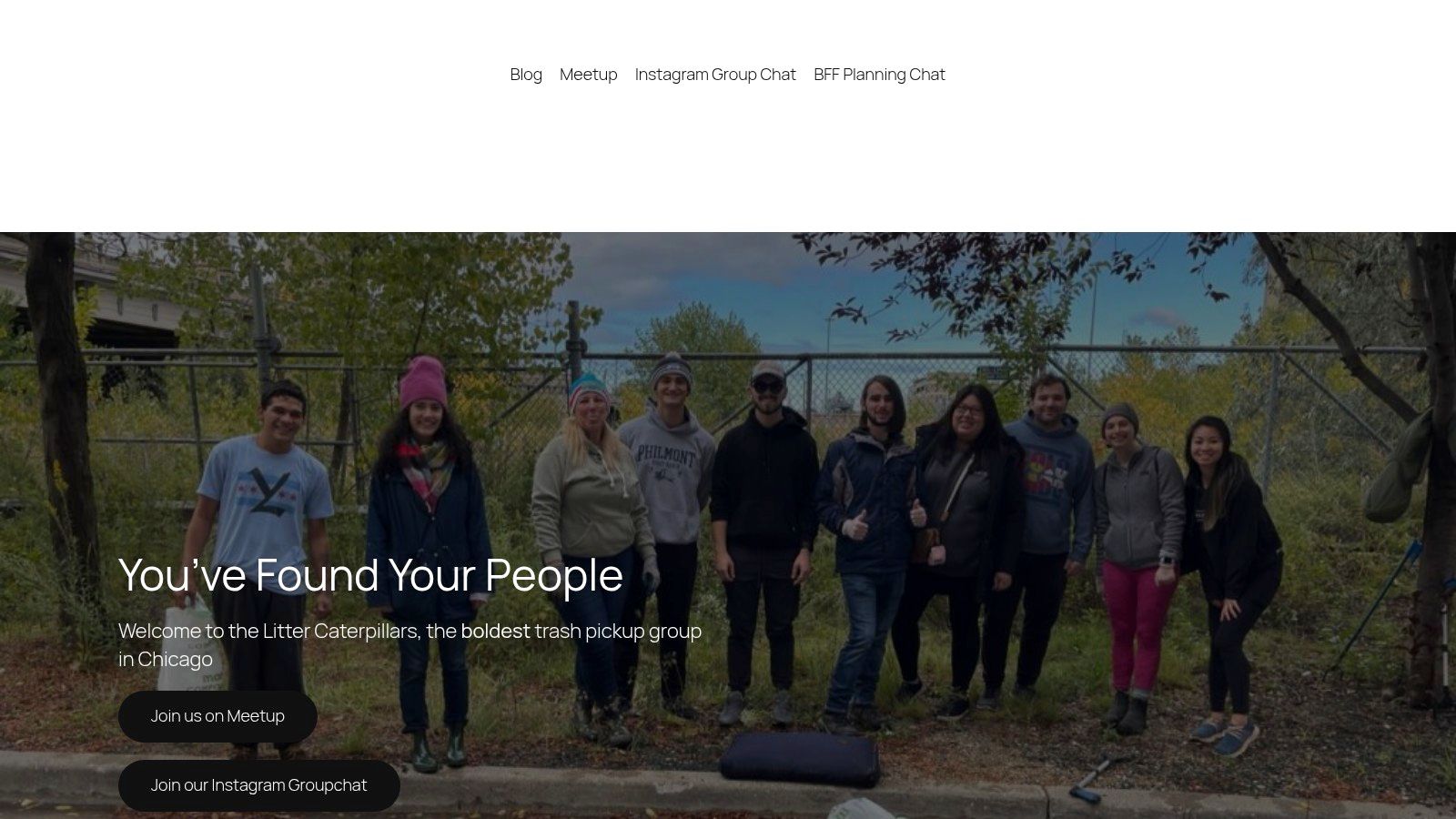
    This type of destination event is a forge, perfect for creating deeper bonds within our volunteer community. We can market it as an "urban eco-adventure," a call to arms for those who crave a more hands-on, exploratory experience. By emphasizing discovery and education, we inspire a dedicated group of advocates who understand that protecting Lake Michigan means caring for every part of its diverse and beautiful shoreline.
    5. Juneway Beach / Rogers Beach

    Travel to Chicago's Far North Side, and you’ll discover the quiet charm of Juneway Terrace and Rogers Beach. These are not the sprawling, chaotic shorelines of downtown. They are intimate, neighborhood gems where the city feels a world away. Flanked by residential streets and local parks, these beaches are the living heart of the Rogers Park community, offering a peaceful retreat and a unique opportunity to build something lasting.

    This strong neighborhood identity makes these smaller beaches the perfect ground for cultivating a dedicated community of caretakers. It's like tending a small garden instead of a massive farm. Unlike a one-off event at a major tourist spot, efforts here are about building relationships, about fostering a deep sense of local ownership. For a group like the Litter Caterpillars, this public beach on Lake Michigan is an ideal place to plant seeds of change that can grow into a permanent, self-sustaining movement, nurtured by the very people who call this shoreline home.

    Cultivating Community Ownership, One Block at a Time

    Picture a small team of neighbors. They gather every other Saturday morning, not as strangers, but as friends united by a common purpose. This isn't just a cleanup; it's a neighborhood ritual. Focusing on a regular, predictable schedule, like the second and fourth Saturday of each month, builds powerful habits. It makes volunteering a natural part of community life. The goal is to make caring for their beach as routine as walking the dog or grabbing coffee.

    "At Rogers Beach, we're not just picking up litter; we're building a family. When you clean alongside the same people week after week, you create bonds. The beach becomes 'our' beach, and protecting it becomes personal. It’s amazing to see that pride take hold."

    The impact here is measured in relationships as much as in bags of trash. Partnering with the local alderman's office or Rogers Park community associations amplifies the message, weaving the cleanup effort into the very fabric of the neighborhood. By framing the work through the lens of Rogers Park pride, you transform a simple task into a powerful act of community love, inspiring a lasting legacy of stewardship on this beloved public beach on Lake Michigan.

    6. Loyola Beach / Sheridan Beach Area

    Where the vibrant energy of Rogers Park and Edgewater meets the serene shoreline of Lake Michigan, you'll find Loyola Beach. This long, curving stretch of sand is a backyard for thousands of residents and the students of nearby Loyola University. It creates a unique blend of quiet neighborhood charm and youthful dynamism. It's a place where families build sandcastles, students unwind between classes, and the community comes together.

    This constant, diverse flow of visitors makes Loyola Beach an ideal ground for nurturing the next generation of environmental stewards. The proximity to a major university presents an incredible opportunity for Litter Caterpillars to tap into a wellspring of passion, idealism, and a structured desire to give back. For us, this isn't just another public beach on Lake Michigan; it's a living classroom for community engagement.

    Cultivating the Next Generation of Stewards

    Imagine a cleanup event that’s more than just picking up litter. It’s a partnership. By collaborating with Loyola University's student organizations and community engagement office, a simple beach cleanup can become a credited service-learning project or a fulfilling weekend activity for students eager to make a difference. Scheduling events to align with the academic calendar—maybe as a welcome week activity or a pre-finals stress reliever—ensures maximum participation.

    "Working with students at Loyola Beach is like planting a forest. You're not just cleaning up for a day; you're cultivating a mindset of stewardship that these young leaders will carry with them for a lifetime. Their energy is infectious and brings a whole new level of purpose to our work."

    This location is perfect for building a sustainable volunteer base. A self-renewing resource. By creating specific leadership roles for students and offering formal documentation for their service hours, we can establish a powerful pipeline of committed advocates. A cleanup here becomes a story of intergenerational collaboration, showing how a community and its university can unite to protect a shared and cherished natural resource.

    7. 31st Street Beach

    Just south of the city's bustling center lies 31st Street Beach, a gem nestled in the historic Kenwood neighborhood. This isn't just another stretch of sand; it's a shoreline with a story, deeply woven into the fabric of one of Chicago’s most culturally rich and diverse communities. For a volunteer group, this public beach on Lake Michigan offers a unique opportunity to connect with history and support a vibrant, community-focused neighborhood.

    The energy here is different. It’s not the tourist-heavy downtown beaches. It's more intimate, more rooted, reflecting the strong spirit of the South Side. This provides a chance for Litter Caterpillars to move beyond simple cleanup and engage in meaningful community building. Our efforts here aren't just about removing litter; they are about honoring a legacy and contributing to the ongoing revitalization of a proud and historic area.

    Making an Impact on a Historic Shoreline

    Imagine a crisp autumn morning. Volunteers from the Litter Caterpillars partner with the Kenwood Community Association. Together, they don't just clean the sand; they share stories about the neighborhood's past and discuss its future, forging genuine connections over shared work. This is the perfect setting for education-focused events that highlight environmental stewardship as an act of community pride and social justice.

    "Working at 31st Street Beach feels like we're tending to a community garden. We're not just pulling weeds; we're nurturing the soil, connecting with the history of the place, and ensuring it continues to be a beautiful, welcoming space for generations to come."

    By aligning our cleanups with neighborhood events, by partnering with local institutions, our impact multiplies. Documenting our work here tells a powerful story of South Side revitalization and environmental stewardship. It's a narrative that resonates deeply, attracting a civically-engaged audience and inspiring a new wave of volunteers dedicated to preserving the unique character of this essential public beach on Lake Michigan.

    8. Garfield Park Beach / 61st Street Beach

    Step onto the sands of 61st Street Beach, and you'll find a different kind of urban energy. Tucked away on the South Side, adjacent to the vital Burnham Wildlife Corridor, this public beach on Lake Michigan feels less like a city hotspot and more like a meeting point. A borderland. A place where the urban landscape and a resilient natural world shake hands. It’s a place of quiet beauty, where the focus shifts from skyscrapers to the subtle rustle of native grasses.

    This unique setting offers a profound opportunity. Community action here goes beyond simple litter removal. The beach's proximity to a major ecological restoration site means that every piece of trash collected has a direct, measurable impact on the health of local wildlife and plant communities. For volunteer groups like the Litter Caterpillars, 61st Street Beach is a classroom and a sanctuary, a place to connect community cleanup with the larger, more hopeful story of Chicago's habitat recovery.

    Making an Impact on a Living Shoreline

    Picture a crisp autumn morning, with migrating birds passing overhead like a whispered secret. A group of volunteers gathers not just with bags, but with a shared purpose: to protect this fragile ecosystem. The work here is strategic, focusing on the boundary where the sandy beach meets the restored dunes and grasslands of the Burnham Wildlife Corridor. This is the frontline, where urban debris most threatens the native habitats that organizations like the Audubon Society work so hard to protect.

    "Cleaning 61st Street Beach feels like tending a garden for the whole city. We’re not just picking up trash; we're protecting a home for birds and pollinators. It's a powerful reminder that our small actions support a vast, interconnected web of life."

    This location is a perfect ground for creating a deeper connection. A cleanup here, paired with an educational walk led by a local naturalist, transforms a volunteer event into an inspiring lesson on urban ecology. Documenting this work with photos of volunteers against the backdrop of the restored prairie tells a story of stewardship and environmental justice, motivating others to join the effort to preserve this vital public beach on Lake Michigan.

    9. Foster Avenue Beach / Edgewater Beach

    Step onto the sands of Foster Avenue Beach, and you feel the vibrant, diverse heartbeat of Chicago's Edgewater neighborhood. This expansive public beach on Lake Michigan is a cultural crossroads. It's a place where families from dozens of backgrounds come together to enjoy the sun and waves. Its unique character, shaped by a strong neighborhood identity and a rich tapestry of communities, makes it more than just sand and water; it’s a living celebration of the city's diversity.

    This cultural mosaic presents a beautiful opportunity for community action that goes beyond a simple cleanup. The presence of so many distinct groups means that litter can sometimes become a byproduct of joyful gatherings. A sign of life. For volunteer groups like the Litter Caterpillars, Foster Avenue Beach is a chance to build bridges, fostering connection and shared ownership across different cultures through the common goal of protecting this cherished space.

    Making an Impact by Building Community Bridges

    Picture an early Saturday morning. The sun is just beginning to warm the shore. Volunteers gather, not just with bags and gloves, but with greetings in multiple languages. This is the perfect time to act, restoring the beach's natural beauty before the daily crowds arrive. Focusing on the high-use picnic groves and the shoreline near the pier allows a small team to make a significant, visible difference. Quickly.

    "Cleaning Foster Beach is like weaving a community quilt. Each person brings a different thread, a different story, and together we create something warm and beautiful. It's about more than just picking up trash; it's about showing that we all care for this shared home, no matter where we come from."

    This location is a powerful incubator for inclusive action. A cleanup event here, promoted with bilingual flyers and shared through local community centers, tells a story of unity. By aligning events with neighborhood festivals or creating family-focused cleanups, we can transform a simple volunteer effort into a multigenerational cultural celebration, inspiring a deeper, more personal connection to this incredible public beach on Lake Michigan.

    10. Osterman Beach (Hollywood Beach)

    Step onto the fine sands of Osterman Beach, and you'll find a different kind of energy. Known affectionately to locals as Hollywood Beach, this Uptown gem offers a more relaxed, community-focused atmosphere compared to its larger, more chaotic neighbors. It's a place where families gather and neighbors connect, creating a close-knit vibe that feels like a shared backyard. This intimate setting makes it the perfect public beach on Lake Michigan to cultivate deep, lasting community engagement.

    The smaller scale and strong neighborhood feel of Osterman Beach mean that volunteer efforts here aren't just about cleaning; they're about building relationships. It's a long-term investment. For Litter Caterpillars, this beach is fertile ground for growing a dedicated, recurring volunteer group. It’s an opportunity to move beyond one-off events and create a sustainable tradition of stewardship, woven directly into the fabric of the Uptown community.

    Building a Legacy of Local Stewardship

    Imagine a "Hollywood Sunday." A weekly ritual where neighbors meet, not just as volunteers, but as friends. They arrive with coffee in hand, sharing stories as they walk the shoreline, collecting the stray litter left behind from the week. This isn't a massive, impersonal event; it's a habit, a cherished routine that deepens their connection to both the place and each other. The focus shifts from the scale of the cleanup to the consistency of the commitment.

    "At Osterman, we're not just picking up trash; we're building a family. Each week, we see the same faces, and new ones become regulars. It's like a neighborhood watch for our beach, powered by pride and a shared desire to protect this beautiful public space."

    This consistent presence fosters a powerful 'neighbors helping neighbors' dynamic. Partnering with a local Uptown community center or business can provide a home base and amplify the message. By cultivating local volunteer leaders and celebrating milestones—like a family’s tenth cleanup—the effort becomes a multi-generational tradition. It’s a testament to how small, consistent actions on a beloved public beach on Lake Michigan can create a powerful and enduring legacy of community care.

    10 Lake Michigan Public Beaches Comparison

    Beach 🔄 Implementation Complexity ⚡ Resource Requirements 📊 Expected Outcomes 💡 Ideal Use Cases ⭐ Key Advantages
    North Avenue Beach 🔄 Moderate — crowd management; Park District coordination ⚡ High — large volunteer teams, early starts, limited parking 📊 High visibility; large trash volume collected; strong recruitment 💡 Flagship events, community awareness, high-profile campaigns ⭐ Iconic skyline, excellent transit access, broad demographics
    Montrose Beach 🔄 Moderate–High — nesting season restrictions; dune care ⚡ Moderate — habitat protection gear; partner coordination 📊 Significant ecological impact; strong education outcomes 💡 Habitat protection, environmental education, seasonal cleanups ⭐ Extensive dunes; appeals to eco-focused volunteers
    Rainbow Beach 🔄 Moderate — community trust-building; safety planning ⚡ Moderate — transport planning; local partnership needs 📊 Deep community relationships; visible neighborhood improvement 💡 Underserved neighborhood engagement; recurring monthly events ⭐ Strong local ties; mission-aligned equity impact
    Olive Park / Ping Tom Beach 🔄 High — remote logistics; wetland restoration coordination ⚡ High — full-day events, transport, safety oversight, testing supplies 📊 High ecological restoration impact; strong team cohesion 💡 Wetland restoration, destination events, educational workshops ⭐ Diverse habitat; restorative volunteer experience
    Juneway / Rogers Beach 🔄 Low–Moderate — small-scale coordination; repeat scheduling ⚡ Low — local volunteers; transit access 📊 Steady volunteer retention; strong neighborhood ownership 💡 Weekly/biweekly routines; family and multigenerational engagement ⭐ Intimate scale; easy habit formation and local pride
    Loyola / Sheridan Beach 🔄 Low — campus coordination; academic calendar alignment ⚡ Moderate — student recruitment channels; university liaison 📊 High student engagement during term; recurring volunteers 💡 Student service programs; leadership development; credit partnerships ⭐ Large student pool; strong campus partnership potential
    31st Street Beach 🔄 Moderate — multi-stakeholder coordination ⚡ Moderate — institutional outreach; targeted recruitment 📊 Neighborhood revitalization support; civic engagement 💡 Quarterly community cleanups; cultural-institution partnerships ⭐ Cultural significance; engaged and civically active community
    Garfield Park / 61st Street Beach 🔄 High — technical habitat work; remote coordination ⚡ High — specialized restoration tools, transport, monitoring 📊 Strong ecological restoration and long-term habitat benefits 💡 Habitat-focused cleanups; partnerships with conservation orgs ⭐ Connection to wildlife corridor; measurable conservation impact
    Foster Avenue / Edgewater 🔄 Moderate — event timing; festival coordination ⚡ Moderate — bilingual materials, early scheduling, transit 📊 Diverse volunteer participation; cross-cultural community building 💡 Bilingual outreach, festival-aligned cleanups, family events ⭐ High cultural diversity; very good public transit access
    Osterman Beach (Hollywood) 🔄 Low — simple coordination; small scale ⚡ Low — transit-friendly, consistent volunteer core 📊 High volunteer retention; steady visible impact 💡 Signature weekly events; core volunteer development ⭐ Consistency, strong neighborhood relationships, repeatable program

    Join the Transformation: Your First Cleanup Awaits

    We’ve journeyed together along the shimmering coastline of Lake Michigan. We've explored ten distinct slices of urban paradise. From the iconic energy of North Avenue Beach to the serene, community-focused shores of Loyola Beach, each location tells a unique story. You now have the ultimate guide to every public beach Lake Michigan has to offer in Chicago, complete with details on parking, accessibility, and the best times to visit. You’re equipped. You have the knowledge to find your perfect patch of sand, whether you’re seeking a volleyball match, a quiet sunrise, or a family picnic.

    But this guide is more than just a list of places. It's an invitation. It’s a map to the heart of the city, and the heart of a community dedicated to protecting these precious spaces. The real story isn't just about finding a beach; it's about what you do when you get there. It’s about leaving a place better than you found it. And in the process, transforming a piece of yourself.

    More Than a Shoreline: It's Our Story

    Each of these beaches tells a story. The laughter echoing from the playground at 31st Street Beach. The quiet dignity of Rainbow Beach's vast expanse. The dedicated birdwatchers at Montrose. They all contribute to the soul of our city. But this story isn't finished. You are the next chapter.

    I remember my first cleanup. Three of us, huddled under a small tree during a freak hailstorm, watching our Uber drivers cancel on us one by one. We were drenched, cold, and a little defeated. It was miserable. And it was perfect. That struggle, that completely unexpected adventure, was the 'flavor' that made the memory powerful. It’s in those moments of shared challenge that real connection is forged. We believe that fear, failure, and even a little suffering are good. They're the essential ingredients of transformation. They are the friction that polishes the stone.

    "By cleaning up messes that aren't ours, we learn to forgive ourselves for our own."

    That’s why we are Caterpillars. We aren’t perfect. But we show up, rain or shine, to become something more. We embrace the messy, the imperfect, and the difficult because that’s where growth happens. When you bend down to pick up a piece of forgotten trash on a public beach in Lake Michigan, you’re doing more than cleaning. You are casting a vote for the kind of city you want to live in. You’re performing a small act of radical care, an act that ripples outward.

    Your Invitation to Become a Part of It

    This article has given you the 'where' and the 'how' for enjoying Chicago's beaches. Now, we want to give you the 'why'. Why show up for a shoreline you don’t own? Why spend a Saturday morning with strangers and a garbage bag? Because it’s how we build community. It’s how we turn a collection of individuals into a unified force for good. It's how we write our chapter in the ongoing story of this great lake and this great city.

    You don't need to be an expert environmentalist. You just need to be willing to show up. We have the gloves, the bags, and maybe even a cheesy theme song ready to go. All we need is you. Are you ready to add your page to the story?


    Ready to turn your love for a public beach Lake Michigan into meaningful action? Join Litter Caterpillars for a cleanup event where we combine community, purpose, and a bit of adventure. Find our next event and become part of the transformation at Litter Caterpillars.