Tag: chicago volunteer

  • Local Environmental Groups: Chicago Impact 2026

    Local Environmental Groups: Chicago Impact 2026

    I used to stare at trash in my own apartment like it was haunted. A jar of blueberry jam from a trip years ago. A bag of nuts from the week I swore I'd become healthy and then didn't. I couldn't throw them out. They felt heavier than they were, like every wrapper and expired thing had a memory glued to it.

    Then I ended a bad relationship and got honest with myself. I wanted to build a life around givers, not takers. I wanted to train the parts of me that were weak: cleanliness, consistency, and bravery. So I started with something strange but simple. I picked up trash outside.

    I learned fast that cleaning up someone else's mess is easier than cleaning up your own. It can even be fun. I showed up for a neighborhood cleanup to challenge myself, and I walked away with new friends, a lighter mind, and a reason to get out of bed on a weekend morning. If you've felt that pull too, this is for you. These local environmental groups can help you find a mission, but more than that, they can help you find your people.

    1. Litter Caterpillars

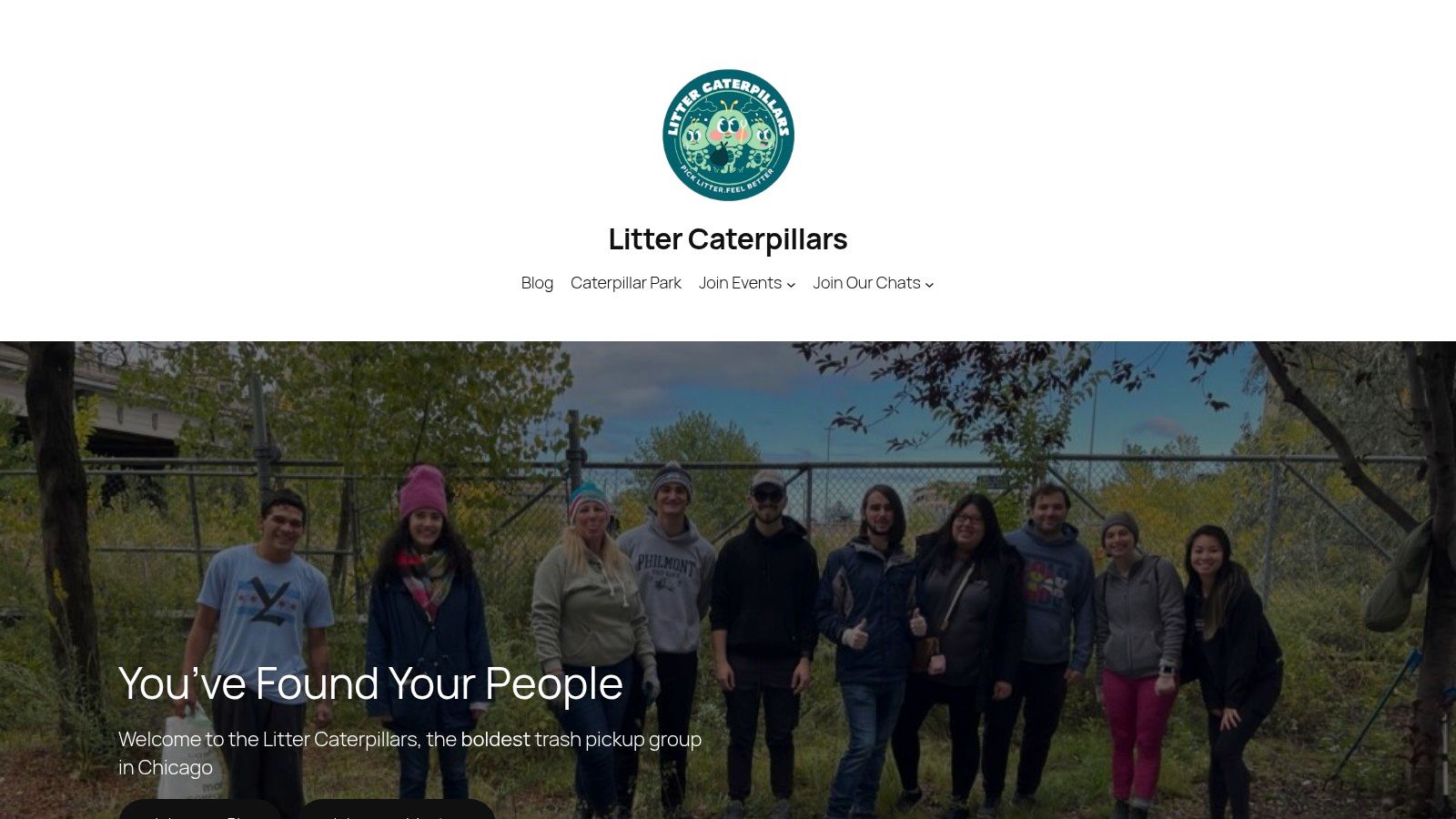
    Litter Caterpillars

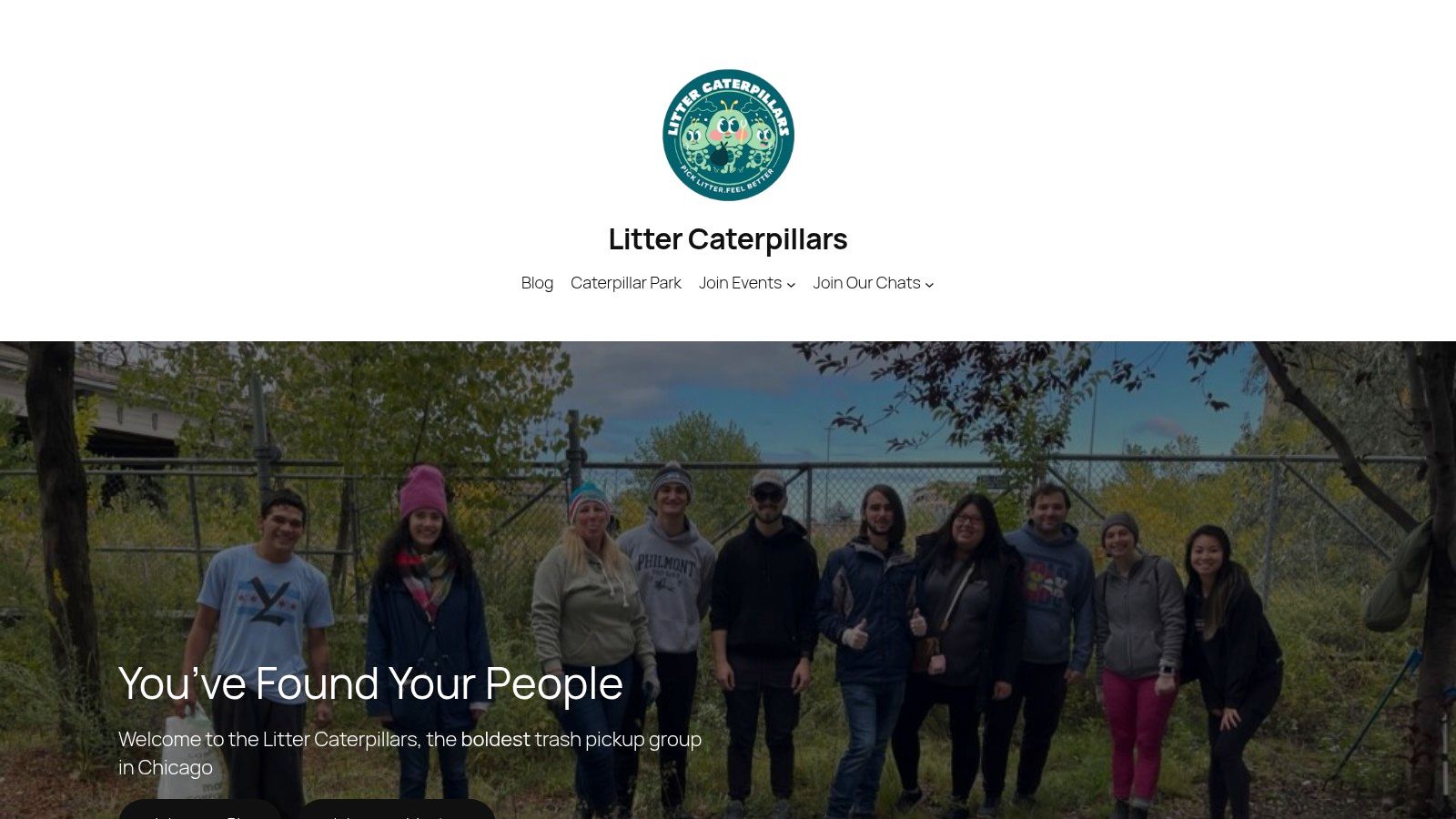
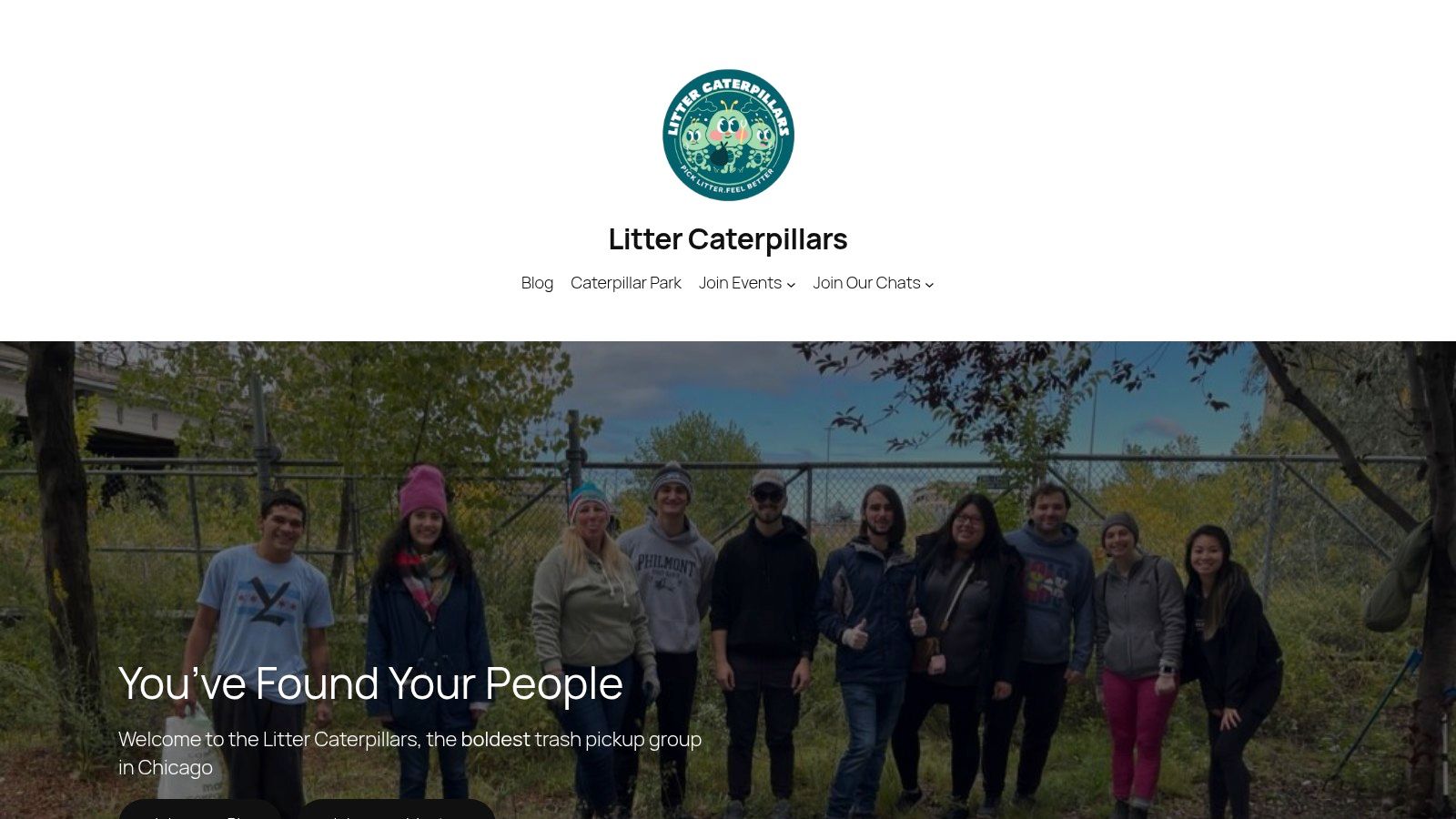
    One cold weekend morning, a few people in gloves filled bag after bag while the rest of the block stayed quiet. By the end, the sidewalk looked different, but so did the group. Strangers were teasing each other, comparing the weirdest things they had found, and making plans for the next cleanup. That is why I keep coming back to Litter Caterpillars in my head. It is not only about trash. It is about what happens to you when you keep showing up.

    Litter Caterpillars is the group I would point you toward if you want action fast and you do better with movement than meetings. They gather on weekend mornings, head out in rough weather, and make it easy to join. You do not need a background in activism. You need shoes you can get dirty and enough curiosity to try one morning outside with other people who care.

    Their style is simple. Show up, clean a block, talk to the people beside you, come back next time. For some personalities, that rhythm works better than formal committees or polished events. If you have been lonely, stuck, or tired of living too much in your head, this kind of work can reset you.

    Why this group stays with people

    Litter Caterpillars has cleaned in all 50 wards of Chicago, including places volunteers are often told to avoid, according to the group's Meetup page for Litter Caterpillars. That says a lot about their character. They do not chase easy wins or pretty backdrops. They go where the mess is real and keep coming back.

    One of the clearest examples is Caterpillar Park in Englewood. The group won a vacant lot at public auction, turned it into a community space, and still has to fight illegal dumping there, as reported in the Chicago Tribune's story on Caterpillar Park. I find that weirdly comforting. The work repeats. You clean a place, life happens, and you return. If you are trying to build resilience in your own life, that lesson lands hard.

    Practical rule: Join this group if you want to see a result before lunch. Carrying a full trash bag back to the meeting point changes your mood more than another hour of scrolling.

    I also like how openly they treat cleanup as community, not just service hours. The flags, badges, songs, group chats, and inside jokes might sound small. They are not. They give shy people a way in. They help new volunteers feel known. They turn a hard, dirty task into something closer to belonging.

    If river work interests you too, their guide to cleaning up rivers in Chicago gives a good sense of how street litter and water pollution connect.

    • Best for grit: A good fit if you like physical work, repetition, and neighborhoods that feel lived in.
    • Best for friendship: A strong choice if you want a group with personality and rituals that help people connect.
    • Best for new habits: Weekend cleanup can anchor your week and make consistency feel natural.

    The tradeoff

    Litter Caterpillars feels hands-on, improvised, and human. If you want a more formal nonprofit structure, another group on this list may suit you better.

    But if you are looking for a place where service can change your city and also change you, this one has a strong pull. You come for the cleanup. You stay because you start to recognize faces, trust yourself more, and feel a little less alone.

    2. Friends of the Chicago River

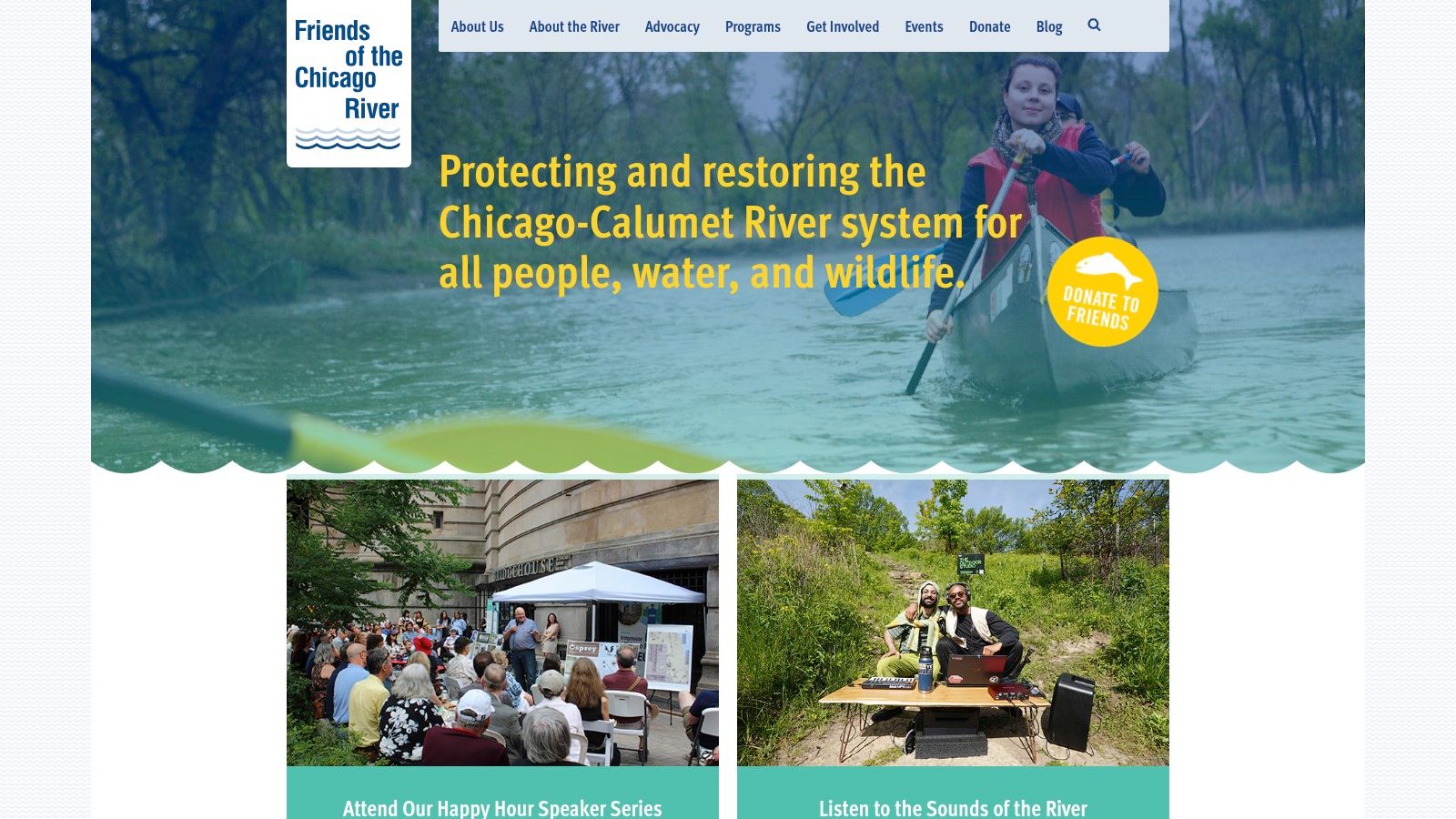
    Friends of the Chicago River

    If street litter makes you angry, river litter hits differently. It feels like the city's bloodstream is clogged. Friends of the Chicago River is a good fit when you want your volunteer time tied to water, habitat, and a long-running civic rhythm.

    Their home base is the Friends of the Chicago River website, and they run recurring stewardship work tied to the Chicago-Calumet River system. If you're curious how river cleanups connect to broader trash work, I also like this piece on cleaning up rivers in Chicago.

    Who I think should join

    This is the group for people who like structure. You sign up, get clear guidance, and plug into a larger machine. If Litter Caterpillars feels like a scrappy pickup basketball game, Friends of the Chicago River feels more like joining a league with refs and a schedule.

    I also think it's good for students, companies, and neighborhood groups that want a shared project with a clear setting. Water gives people a focal point. When you're standing by the river with gloves on, it's easier to feel what you're protecting.

    The river gives your effort a shape. You can point to a bank, a path, a canoe launch, and say, "I helped right there."

    Where it fits in your life

    The work can be seasonal and weather-sensitive, so you may need to plan ahead. Popular volunteer dates can fill quickly. But if you want logistics, recurring stewardship, and a mission that feels bigger than one block, this is a solid place to start.

    I wouldn't choose this one because it's trendy. I'd choose it if your brain likes order and your heart likes water.

    3. Urban Rivers (The Wild Mile)

    Urban Rivers (The Wild Mile)

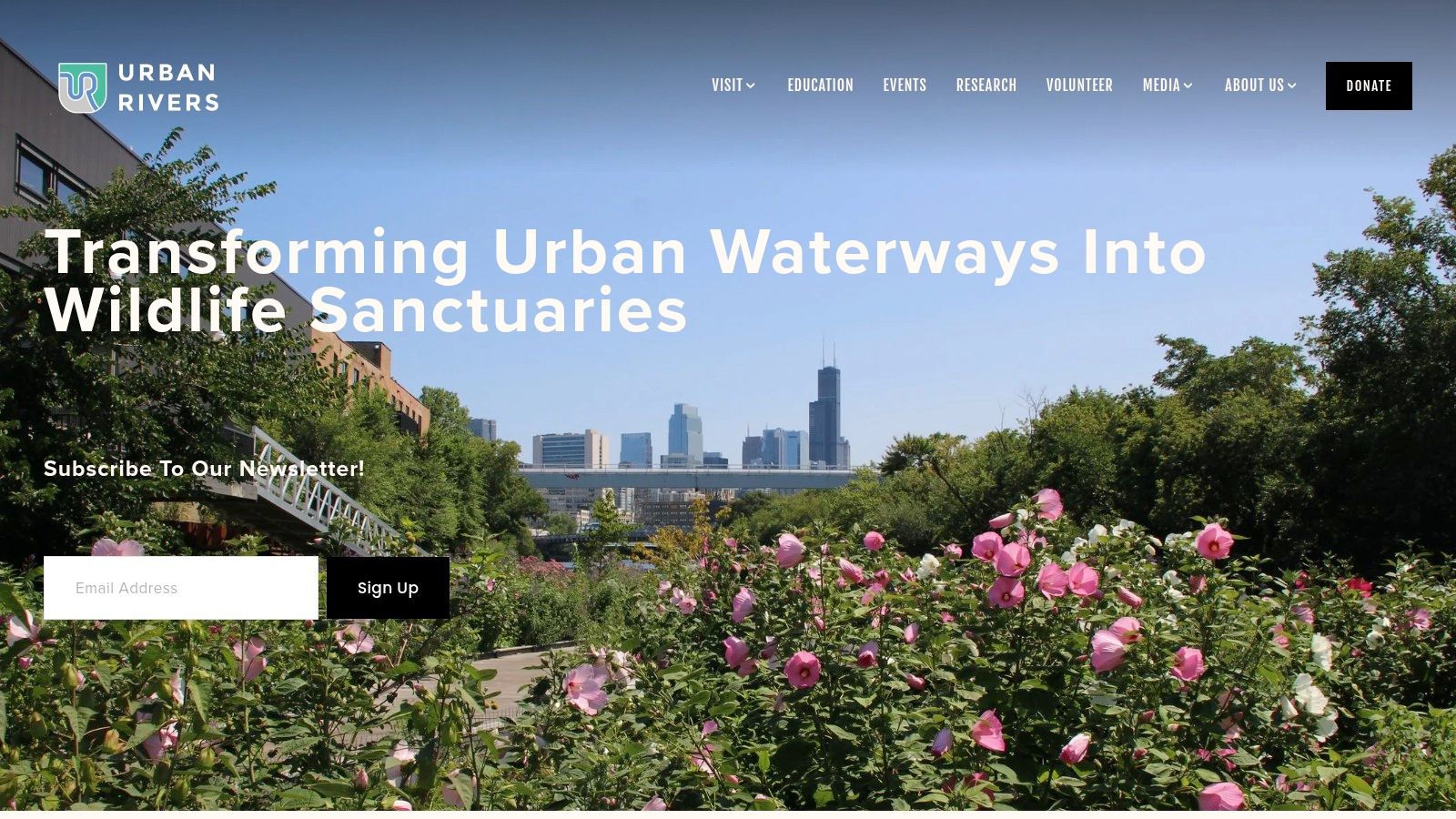
    Urban Rivers is for the person who wants an environmental group that feels a little weird in the best way. Floating wetlands. Kayaks. Habitat work in the middle of the city. The whole thing feels like a science project built by people who refused to accept that an urban river has to stay dead-looking.

    You can browse projects and volunteer options on the Urban Rivers website. The Wild Mile is the sort of place that makes a skeptic stop walking and ask questions.

    Why this one feels different

    Some local environmental groups ask you to clean. Urban Rivers lets you clean and build. That mix changes the experience. You aren't only removing damage. You're helping put something living back into place.

    Their River Ranger training also makes this a nice fit for people who want to learn while they volunteer. If your personality leans curious, if you like being taught how systems work, this one can scratch that itch.

    • Best for visual thinkers: You can see the floating habitat and understand the idea fast.
    • Best for hands-on learners: Training adds depth that simple litter pickup sometimes doesn't.
    • Best for people who want a story to tell: Friends will ask what you did, and you'll have an answer better than "I stood around at a fundraiser."

    What to know before you go

    Some roles need planning, training, and comfort on the water. That can be a plus or a barrier, depending on who you are. If you want a fast drop-in volunteer option, another group may be easier.

    Still, I love that Urban Rivers makes environmental work feel inventive. It reminds me that some people heal themselves by restoring order, and some heal themselves by helping build something new.

    4. Alliance for the Great Lakes (Adopt-a-Beach)

    Alliance for the Great Lakes (Adopt‑a‑Beach)

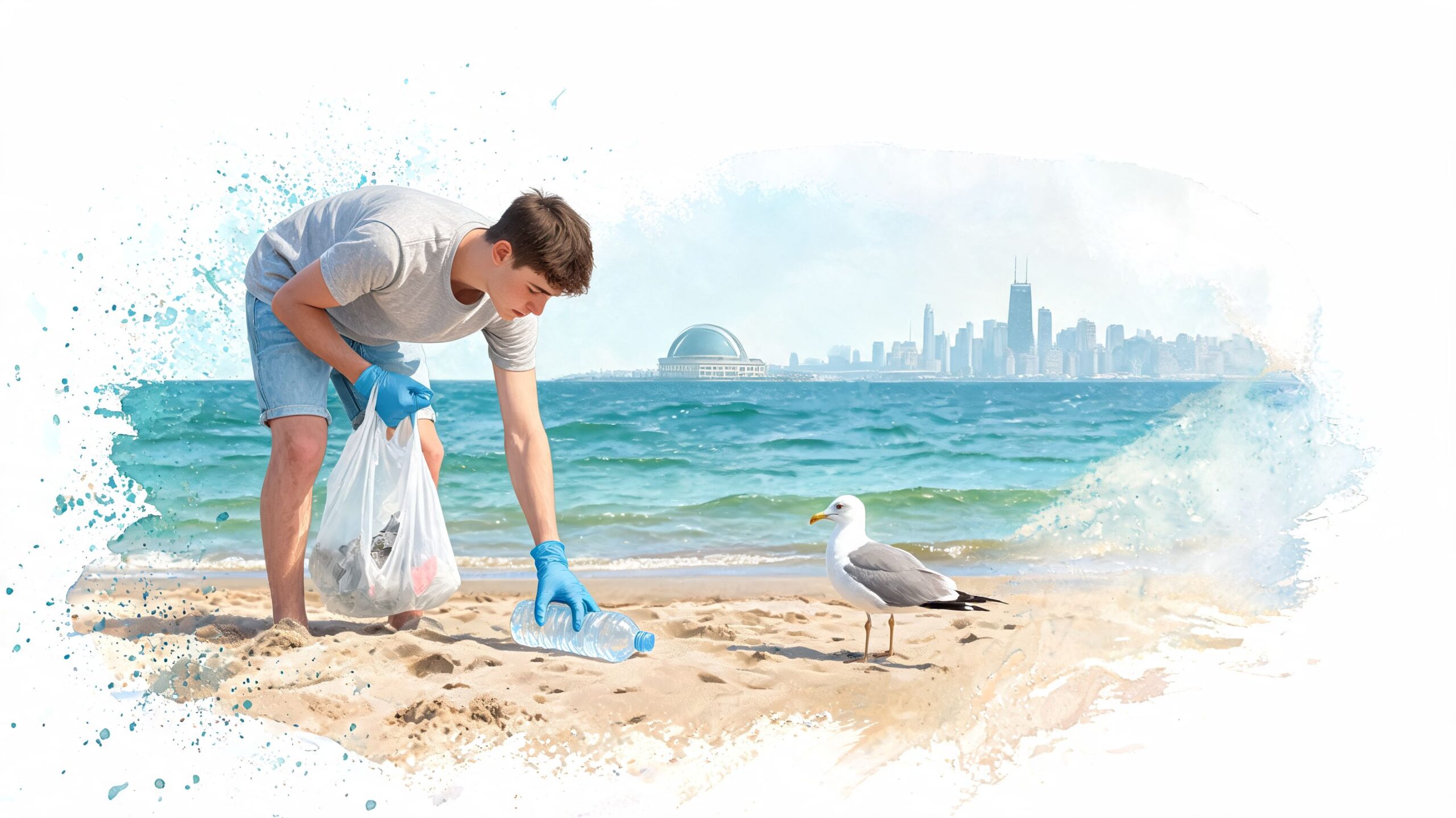
    The first time I joined a beach cleanup, I thought it would feel like a prettier version of picking up trash on a sidewalk. It did not. I filled one bag, looked up, and saw the lake stretching out like it had all the time in the world. The work felt small and big at once. Small in my hands. Big in my chest.

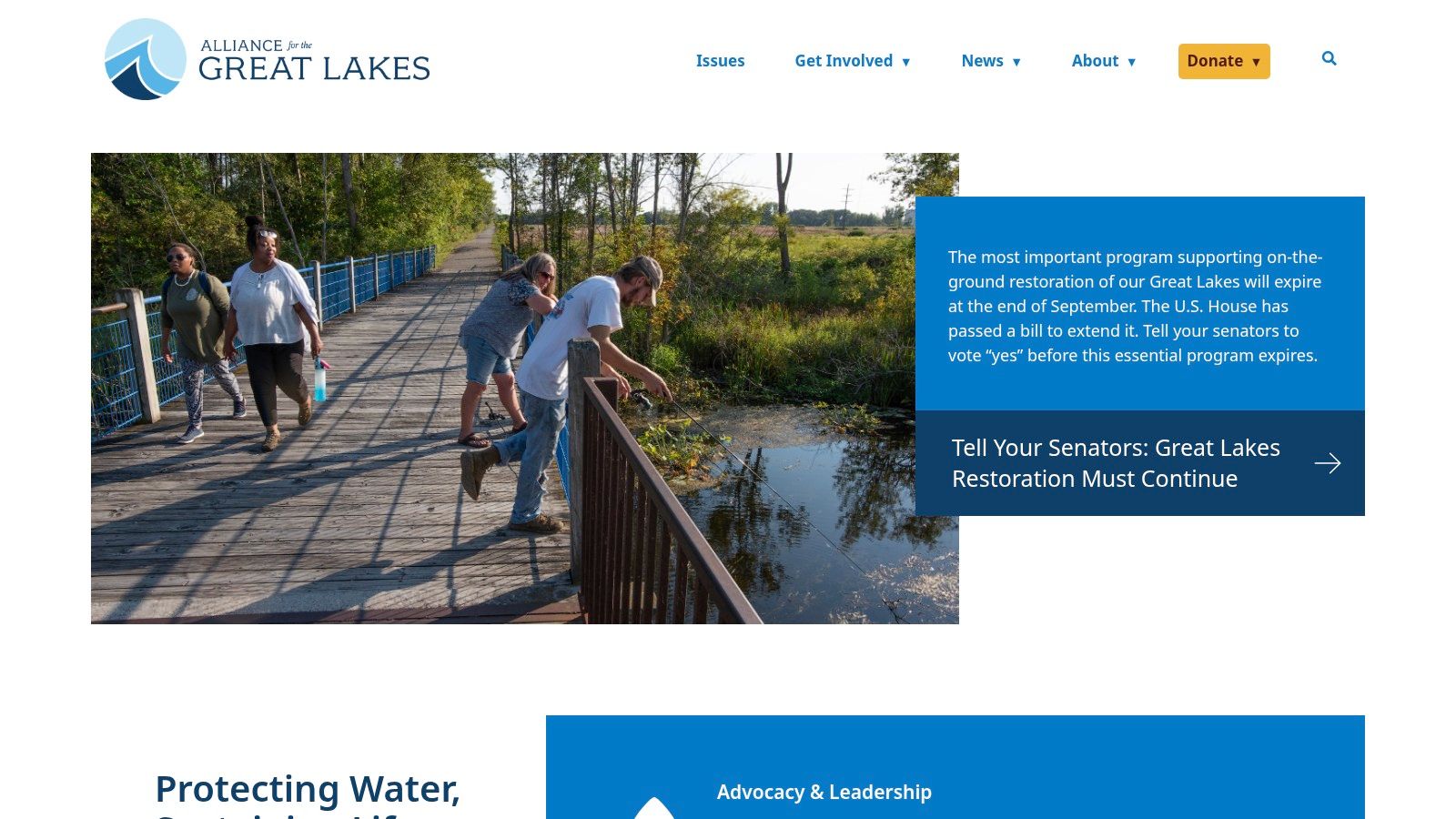
    That is the mood of the Alliance for the Great Lakes. Their Alliance for the Great Lakes site is where you can find the Adopt-a-Beach program and sign-up options for shoreline cleanups. If you end up liking this kind of work, this guide to cleaning up a Chicago park or public green space can help you keep the habit going closer to home too.

    Why some people click with beach cleanups fast

    This one suits people who like patterns. You are not only picking up cups, wrappers, and bottle caps. You are noticing where trash collects, what keeps washing back, and how a place that looks peaceful can still carry a steady stream of human mess.

    That rhythm changes the experience. A beach cleanup can feel less like a chore and more like paying close attention. If you are the kind of person who likes sorting, spotting, and seeing what other people miss, you may feel useful here right away.

    It is also one of the easier groups to bring someone into. A sibling. A date. Your kids. A coworker who says they want to help but never knows where to start. The lakefront does part of the social work for you because people already want to be there.

    What I tell first-timers: If you want your first volunteer day to feel open, calm, and easy to share with other people, start at the beach.

    The honest tradeoff

    This is a seasonal fit for a lot of volunteers. Chicago weather decides a lot for you, and shoreline work is not always the thing you will want in January.

    Still, some personalities need that horizon. They need wind, water, and a task simple enough to quiet the noise in their head for two hours. If that sounds like you, Adopt-a-Beach is more than civic duty. It is a way to find your people while you clear space in yourself too.

    5. Friends of the Parks

    Friends of the Parks

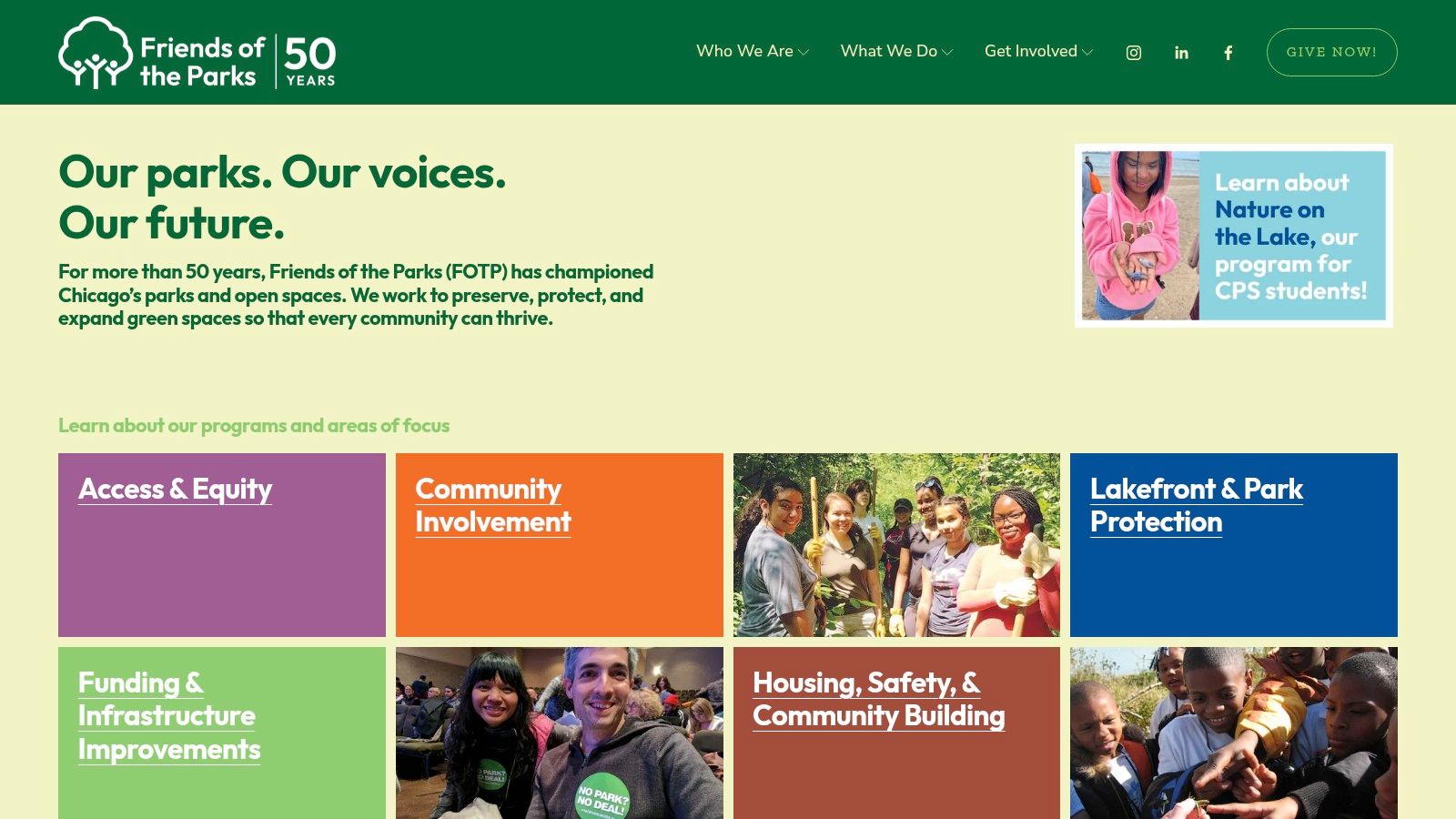
    Some people don't want the edge of alley cleanup or the planning of habitat work. They want a park. Trees, fieldhouses, paths, playgrounds, and a task they can explain to a friend in one sentence. Friends of the Parks is good for that.

    Their Friends of the Parks website is a good place to find citywide park stewardship and major volunteer days. If you're already thinking in neighborhood-park terms, this page on how to clean up a park in Chicago pairs well with it.

    Why parks are emotionally easier

    A park is where city life softens. Kids play there. Grandparents sit there. Dogs drag people there before sunrise. When you clean a park, you get immediate emotional feedback because you can picture who uses it.

    That makes this a great first step for shy people. You're still doing public work, but the setting feels familiar. It doesn't demand a new identity from you on day one.

    • Best for first-timers: Parks are accessible and easy to understand.
    • Best for neighborhood pride: You can return later and see the same bench, path, or ballfield.
    • Best for people who want broad coverage: Citywide park networks give you lots of entry points.

    One honest downside

    The biggest mobilizations cluster around annual events, so if you're chasing frequent large-scale action, you may need to combine this with another group. Still, I think Friends of the Parks is one of the easiest ramps into local environmental groups because the mission feels close to daily life.

    6. Friends of the Forest Preserves (Cook County)

    Friends of the Forest Preserves (Cook County)

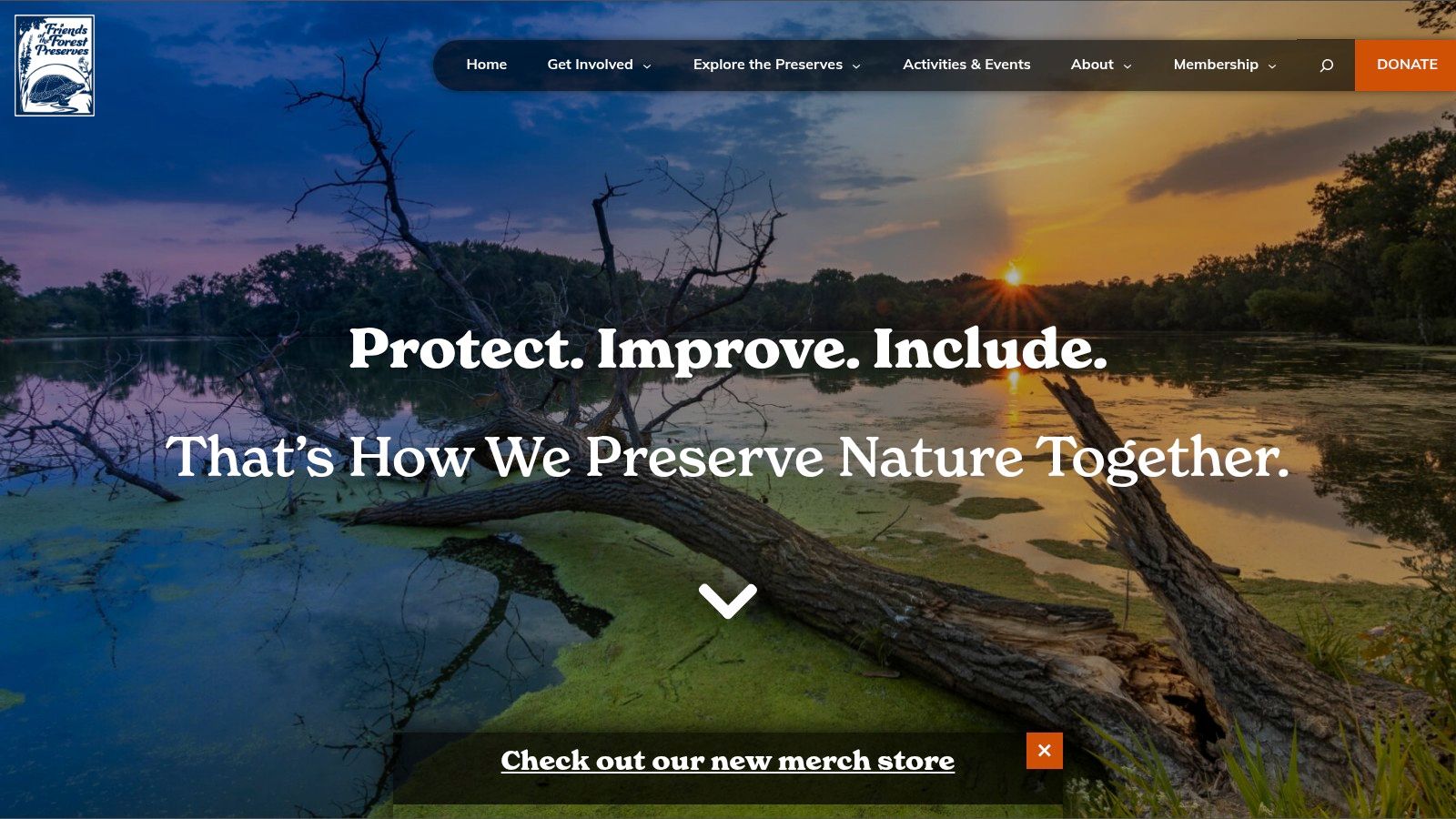
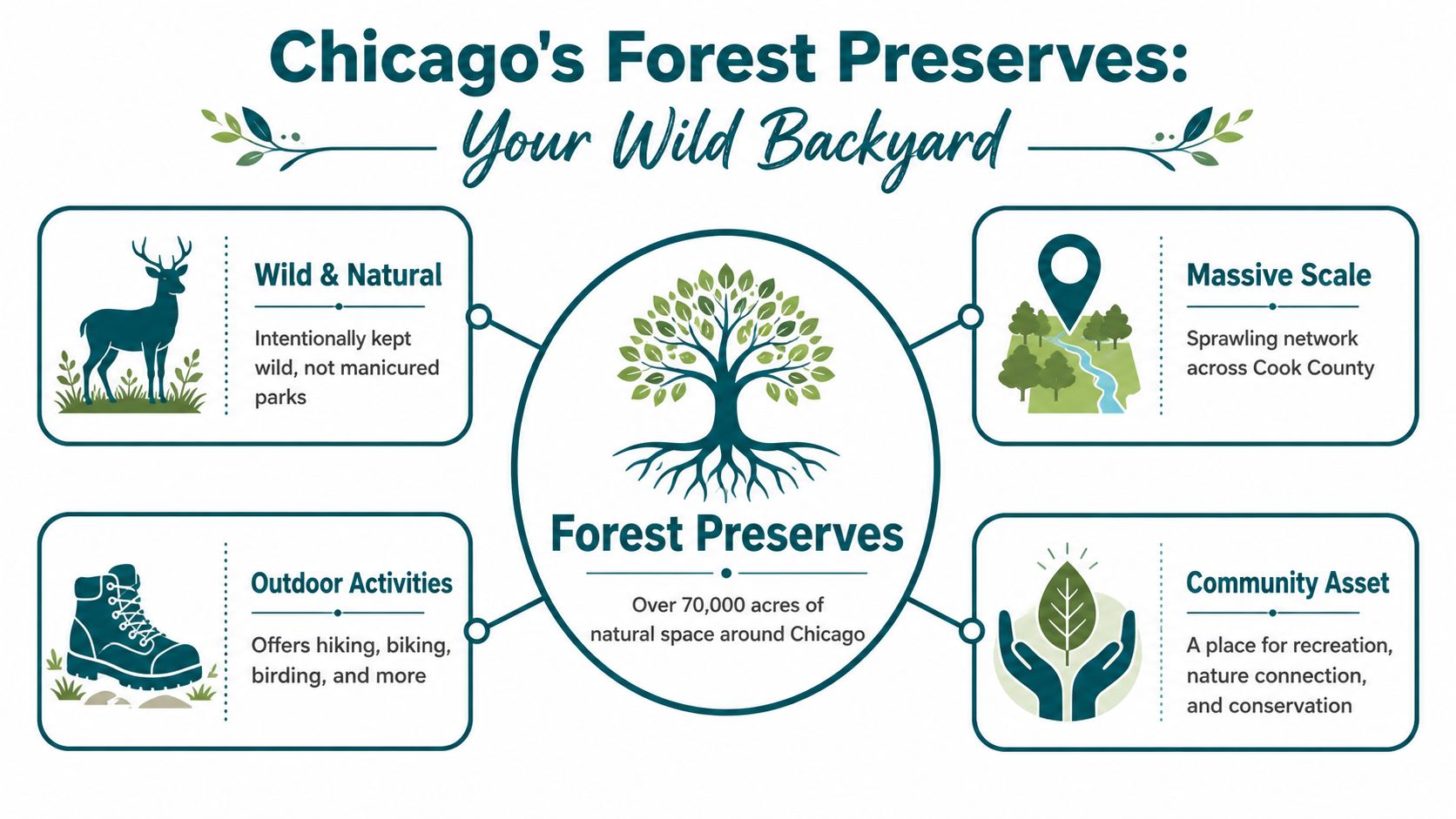
    If the city noise is frying your nerves, go farther out. Friends of the Forest Preserves gives you a different kind of volunteer day. Less concrete. More brush, trails, invasive removal, and work that feels slower and deeper.

    You can check current programs and stewardship options on the Friends of the Forest Preserves website. I think this group works well for people who want environmental service to double as recovery time.

    When this is the right fit

    Some local environmental groups meet your need for action. This one can meet your need for quiet. You still sweat, carry, cut, and clear, but the mood is different. It feels less like battling the city and more like caring for a place that can still surprise you.

    I also like this path for people who want to build practical outdoor skills over time. Brush work, stewardship habits, and guided workdays can teach patience. You're not just grabbing obvious trash. You're learning to notice what doesn't belong and what needs room to grow.

    Sometimes the best volunteer choice isn't the loudest one. It's the one that calms you down enough to come back next week.

    What might frustrate you

    Some preserve sites take more travel. If you live in a dense neighborhood and don't drive, getting there can be harder than joining a local block cleanup. And on certain days, the work leans more toward habitat care than simple litter pickup.

    That said, I think this is one of the best options for people who want service without constant urban intensity.

    7. Cleanup Club Chicago (Chicago Environmentalists)

    Cleanup Club Chicago (Chicago Environmentalists)

    A lot of people want to help their city. Fewer people know what kind of group will keep them coming back.

    Cleanup Club Chicago feels like the answer for the person who does better with a text thread than a formal orientation. You show up, grab gloves and a bag, and spend a morning doing something clear and useful with other people who also wanted a reason to get outside. That low-pressure setup matters more than it sounds. For some volunteers, this is the kind of group that turns good intentions into an actual habit.

    You can find them through Cleanup Club Chicago at Chicago Environmentalists. I like this option for people who want environmental service to fit into real life instead of taking it over.

    The kind of person who thrives here

    This group makes sense if your energy comes in waves. Maybe one week you want a scheduled cleanup with other people. Maybe the next week you want to do your own pickup close to home and still feel connected to something bigger. Cleanup Club Chicago leaves room for both.

    It also works well if you are looking for community first and a perfect volunteer identity second. That is part of what made Litter Caterpillars stand out earlier in this article too. Sometimes you do not find your purpose and then join a group. Sometimes you join a group, pick up one bag of trash, meet two good people, and realize your life feels a little less stuck.

    The work itself is simple, which is part of the appeal. You are not trying to learn a complicated system before you can help. You are cleaning a street, a park edge, a sidewalk, or a problem corner that everybody has walked past. That simplicity gives you room to talk, joke, and build friendships while your hands stay busy.

    • Best for flexibility: Easy to join and easy to fit around a changing schedule.
    • Best for social motivation: Good for people who stay committed when service also helps them meet people.
    • Best for straightforward impact: You can see the difference by the end of the cleanup.

    The limitation

    The same loose, grassroots energy that makes this group inviting can also make it less predictable. Some weeks will feel bigger than others. Some cleanup days will depend on who shows up and what the weather does.

    If you want a highly structured program with formal training and a fixed path, another group may fit you better. If you want a welcoming entry point, visible results, and a community that can grow with you, Cleanup Club Chicago is a strong choice.

    Comparison of 7 Local Environmental Groups

    Organization 🔄 Implementation complexity ⚡ Resource requirements 📊 Expected outcomes Ideal use cases ⭐ Key advantages / 💡 Tips
    Litter Caterpillars Low, volunteer‑first, recurring weekly meetups Low, volunteer time, basic tools; limited centralized funding High local visibility and steady neighborhood litter removal Low‑barrier volunteer engagement, neighborhood/lot cleanups, regular weekend volunteers ⭐ Strong community bonds and relentlessness; 💡 Expect physical outdoor work and minimal formal infrastructure
    Friends of the Chicago River Medium, structured nonprofit programs and event coordination Moderate, staff, logistics, water‑safety gear Reliable multi‑site river cleanups and advocacy outcomes Waterway stewardship, corporate/team days, media‑friendly events ⭐ Established reputation and logistics; 💡 Seasonal work, register early
    Urban Rivers (The Wild Mile) Medium‑High, specialized habitat projects and training High, kayaks, floating wetland materials, trained staff High‑visibility habitat restoration and biodiversity monitoring Innovative habitat restoration, storytelling events, trained volunteer roles ⭐ Distinctive site and skills development; 💡 Requires training and water comfort
    Alliance for the Great Lakes (Adopt‑a‑Beach) Medium, standardized shoreline program with protocols Moderate, volunteers, data collection tools, beach supplies Consistent shoreline cleanup with standardized data for advocacy Beach/adopt‑a‑beach programs, corporate beach days, citizen‑science events ⭐ Credible data and family‑friendly events; 💡 Best spring–fall, weather‑dependent
    Friends of the Parks Medium, large annual mobilizations plus year‑round support Variable, major event logistics and steady volunteer base Large‑scale park cleanups and broad community engagement Earth Day mass cleanups, neighborhood park stewardship, volunteer onboarding ⭐ Broad geographic reach and clear logistics; 💡 Peak activity in spring, site work may depend on PACs
    Friends of the Forest Preserves Medium, hands‑on land management with trained leaders Moderate, tools, trained leaders; may require travel to preserves Strong habitat restoration and volunteer skill building Preserve stewardship, teams wanting hands‑on conservation skills ⭐ Strong safety/training culture; 💡 Sites often require driving and can be physically demanding
    Cleanup Club Chicago (Chicago Environmentalists) Low, grassroots, flexible pop‑up cleanups Low, minimal supplies and social media coordination Frequent neighborhood cleanups and campaign amplification DIY pop‑ups, quick partner activations, neighborhood street/park cleanups ⭐ Flexible and fast to mobilize; 💡 Less formal training, best for straightforward litter work

    The Work Is Never Done. That Is the Good Part.

    One Saturday, you fill a trash bag and head home tired, a little sore, and oddly lighter. The next week, there is a fresh fast-food cup in the curb, two bottles by the bus stop, and a torn bag caught in the fence again. For a second, it can feel pointless. Then you realize the ultimate win was never a perfectly clean block. It was becoming the kind of person who comes back.

    That is what Litter Caterpillars made clear earlier in this piece. The bags matter. The cleaner sidewalk matters. But the deeper change happens in repetition. You keep showing up, and somewhere along the way, your weekends gain shape, your body gets stronger, and a few familiar faces turn into friends.

    This field is bigger than any one cleanup crew. Cause IQ's directory of U.S. environmental organizations lists 33,649 environmental organizations employing 154,254 people, generating over $32 billion in annual revenue, and holding $96 billion in assets. Still, almost nobody joins because they studied the numbers first. People join because they are restless, grieving, angry, lonely, or ready to stop scrolling and do something with their hands.

    And people stay for reasons that surprise them.

    A Saturday morning by the river can clear your head better than sleeping in. A park cleanup can introduce you to the neighbor whose name you should have learned three years ago. A beach pickup can give a teenager their first taste of being counted on. Service changes the city a little. It changes the volunteer, too.

    The environmental world also has real blind spots. The American Sociological Association article "Race, Diversity, and Transparency in Environmental Organizations" reports that a 2015 analysis of 324 organizations found people of color made up about 16% of the workforce, while 31.4% of organizations collected diversity data internally and only 4.5% reported it publicly. That matters on the ground. If you join a group, notice who gets welcomed, who makes decisions, and whether the room reflects the neighborhood it wants to serve.

    Trust matters just as much as good intentions. Duke University's Nicholas Institute report, "Understanding Rural Attitudes Toward the Environment and Conservation in America," found that some rural communities trust farmers, ranchers, and scientists more than environmental advocacy groups. City volunteers can learn from that. Listen before proposing fixes. Ask what people need. Help without performing expertise.

    So choose the group that fits your temperament and your season of life. If you like grit, early mornings, and visible results, start where the trash is. If water calms you, go to the river. If you need a gentler entry point, try a park day with families and regulars.

    You do not need to save everything.

    You just need to find your people, pick a corner of the city, and return often enough that the work starts building you back.

  • Your Northeastern Illinois Map for Action

    Your Northeastern Illinois Map for Action

    I once followed a clean-looking map to a park edge on Chicago's northwest side and found the mess fifty feet off the path, hidden behind a fence where the map showed nothing. We filled bag after bag in a place no pin had named.

    Starting Your Journey on the Map

    The first time I stared at a Northeastern Illinois map, I felt dwarfed by it. Streets stacked on streets. Forest preserves. industrial strips. River bends. Rail lines. Neighborhoods I hadn't walked and places I couldn't pronounce yet. It looked less like guidance and more like a dare.

    That feeling is normal. You open a map of the Chicago region and your brain starts bargaining with you. Stay local. Keep it easy. Pick one block you already know. Don't wander into the unknown. I've heard that voice in my own head plenty of times.

    Then I learned to look at the map like a scavenger hunt.

    A park isn't just green space. It's where cups collect at the edge of a parking lot after a windy weekend. A commercial corridor isn't just a strip of stores. It's where receipts, scratch-offs, and takeout bags tumble toward a storm drain. A dead-end street isn't boring. It's where dumped furniture and busted contractor bags like to hide.

    Maps don't tell you where courage begins. They just get you close enough to step out of the car.

    That's the shift. A map is not there to comfort you. It's there to get you moving. When you stop treating it like a sterile tool and start treating it like a field notebook, the whole region changes shape.

    The first real lesson

    I've had mornings where I picked a spot because it looked simple on the screen and then spent hours finding weird pockets the map never warned me about. A sidewalk ended. A service road curved behind warehouses. A patch of brush swallowed cans, bottles, and fast-food wrappers like a magnet. The map got me to the block. My eyes did the rest.

    So when you start, don't ask, “Can I master all of northeastern Illinois?” Ask something smaller and better.

    • What can I learn in one morning: One ward, one trail entrance, one ugly strip behind one shopping center.
    • What can I carry: Gloves, bags, water, and enough humility to change plans when the ground tells you more than the screen.
    • What am I willing to notice: Overflowing bins, no bins, desire paths, bus stops, fence lines, creek edges.

    A good journey on the map starts with one honest act. You go. You look. You do the work.

    Defining Our Territory

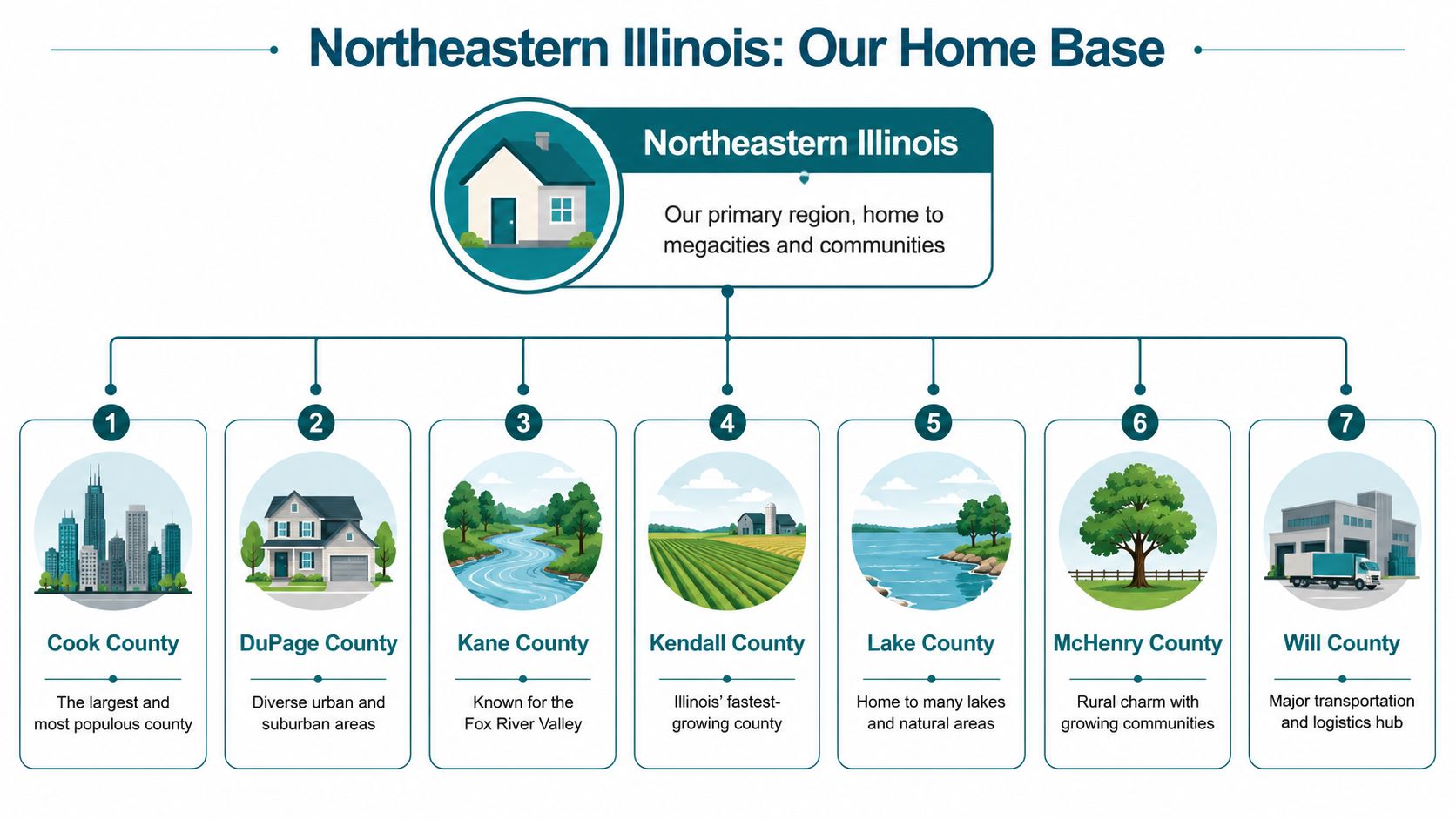
    When I say northeastern Illinois, I don't mean some vague blob around Chicago. I mean a real operating zone. Cook, DuPage, Kane, Kendall, Lake, McHenry, and Will. Big city blocks. Quiet cul-de-sacs. Forest preserve trails. Warehouse belts. Old downtowns. New subdivisions.

    A diagram illustrating the seven counties of Northeastern Illinois with descriptions for each of the regions.

    When you look at the region that way, the map stops feeling abstract. It becomes a work area. You can see where pressure builds. More people, more roads, more parking lots, more edges where litter gets trapped and forgotten.

    The scale matters. Northeastern Illinois, specifically the region containing Chicago, accounts for 84 percent of the entire state's population growth, and the seven fastest-growing municipalities, Chicago, Aurora, Naperville, Joliet, Waukegan, Cicero, and Elgin, are all clustered here, according to the Chicago Metropolitan Agency for Planning archive.

    What that means on the ground

    I don't read that fact like a planner sitting in an office. I read it like somebody holding a trash grabber. Growth means traffic at curbs. Packaging in parking lots. More use of trails and preserves. More pressure on public bins. More corners that look fine on a county map and ugly when you walk them.

    If you want to understand your territory, break it down like this:

    • Cook County: Dense blocks, alleys, transit stops, commercial corridors, and endless little trouble spots.
    • Collar counties: Big roads, retail clusters, creek edges, trailheads, and suburban spaces where people assume somebody else will clean it.
    • Outer edges of the region: Places that look open on a map but still collect roadside dumping and windblown trash.

    How I read the region fast

    I start with a simple scan.

    What I look for Why it matters
    Major roads and interchanges Trash gathers where cars stop, merge, and idle
    Preserves and trails Beautiful places still catch bottles, cans, and snack waste
    Retail strips High turnover means high litter risk
    Borders between land uses The seam between businesses, roads, and green space is often rough

    When I want a reset from city blocks, I spend time studying nearby preserves too. A page like forest preserve paths around Chicago reminds me that “territory” isn't only concrete. It's also woods, water, and the places people use to breathe.

    Field rule: If a map shows connection, look for neglect at the edges of that connection.

    That's the territory. Not glamorous. Real.

    Choosing the Right Map for the Mission

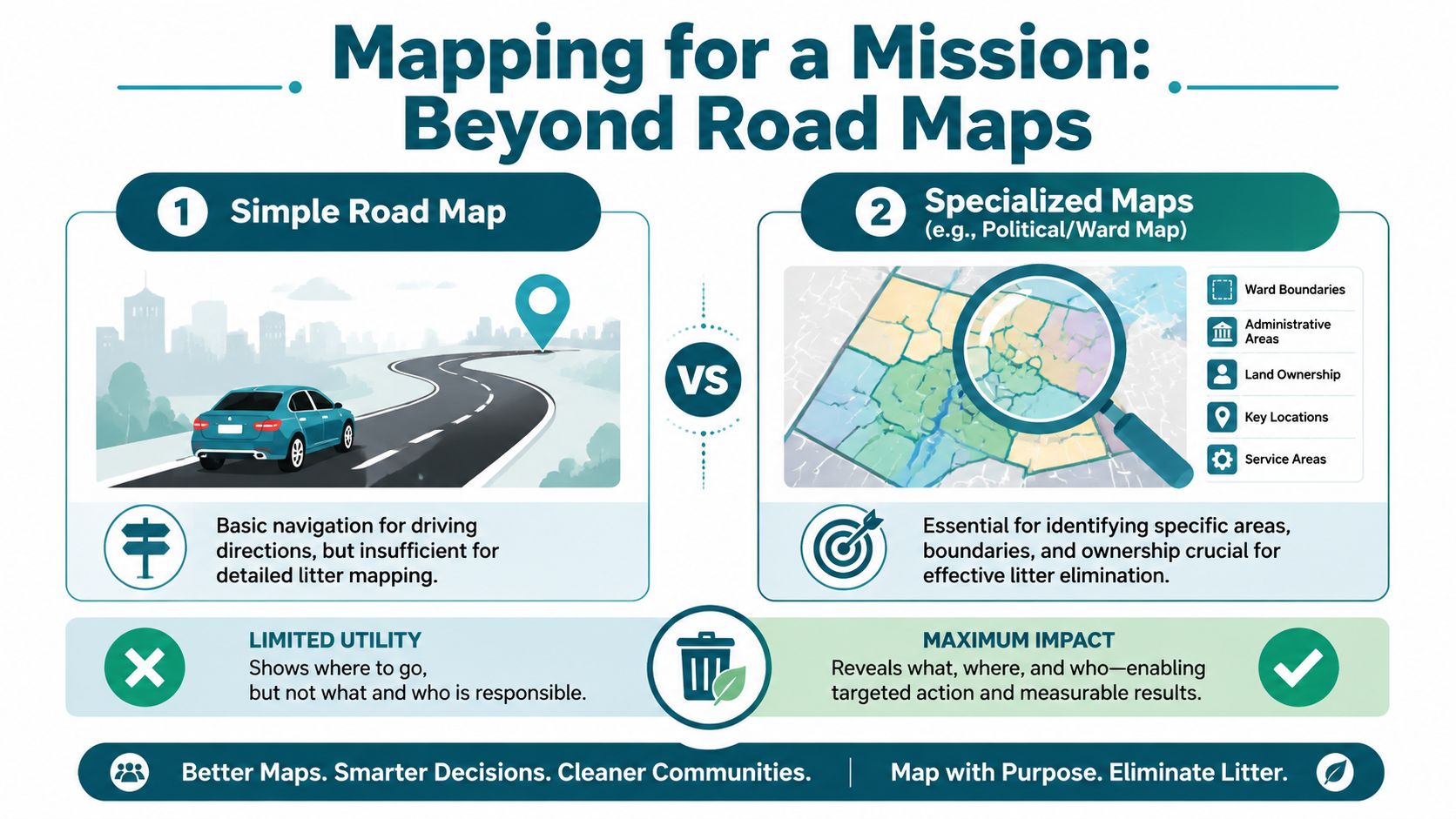
    A road map is fine if all you want is directions. It's weak if you're trying to solve a mess. For cleanup work, I need different maps for different jobs, the way a mechanic needs more than one wrench.

    An infographic comparing simple road maps to specialized maps for effective community litter management and environmental planning.

    The easiest mistake is trusting one map to answer every question. It won't. One map gets you there. Another tells you whose boundary you're crossing. Another hints at why trash keeps showing up in the same ugly pocket after every rain.

    The side by side test

    Here's how I compare map types when I'm planning a mission.

    Map type What it helps me do Where it falls short
    Road map Reach a site fast It hides ownership, terrain, and odd dead spaces
    Ward or political map Track cleanup coverage by area It doesn't show slope, dumping pockets, or trail cut-throughs
    Trail map Find entrances, paths, and hidden access points It may skip nearby commercial spillover
    Historical map Expose old corridors and forgotten uses of land It needs current ground truth to matter

    A ward map can turn a giant city into a checklist. A trail map can show a hidden entrance where volunteers can safely walk in. A historical map can explain why one strange strip behind businesses keeps attracting dumping. Old patterns linger.

    That last part matters in northeastern Illinois. The region's settlement pattern was largely determined in the 1830s by federal surveys that mapped and sold “Canal Lands” to private interests, drastically redrawing where new towns and farms would spring up, as described by the Encyclopedia of Chicago entry on northeastern Illinois. You can still feel that old carving-up of land when you run into awkward corridors, industrial leftovers, and disconnected spaces where nobody quite feels responsible.

    Map choice changes your behavior

    I've learned to match the map to the problem.

    • For block cleanups: I want ward boundaries and street grids.
    • For river or trail days: I want path maps and entry points first.
    • For weird dumping zones: I want old land-use clues and current satellite views.
    • For volunteer planning: I want transit access, parking, bathrooms, and a sane walking route.

    Sometimes I'll study a route before heading toward a trail system like the Des Plaines River Trail near Chicago, because linear spaces fool people. They look simple. Then you arrive and realize the actual work is at the trailhead, under the bridge, beside the lot, and in the brush off the curve.

    The wrong map wastes your legs before you even start.

    If you want a Northeastern Illinois map that helps you act, stop asking which map is best. Ask which map matches the mess in front of you.

    Finding and Using Digital Maps

    Paper maps still have charm, but digital maps are where planning gets sharp. I use them before I leave the house because I'd rather spend my energy cleaning than wandering in circles.

    A hand holding a smartphone showing wildfire risk data next to a computer displaying complex environmental maps.

    The phrase GIS scares people off, but it shouldn't. Geographic Information Systems just means layered maps with useful information. You click around, turn layers on and off, and start seeing a place in context instead of as one flat picture.

    A simple way to scout from home

    One tool worth knowing is the northeastern IL Development Database Web Map. It is an interactive platform built on ArcGIS Online that lets users click on map shapes to get detailed information about development projects, helping groups target areas with high potential for litter and community impact.

    That kind of map is practical. New construction can mean debris on edges, disrupted foot traffic, temporary fencing, and all the little spillover messes that show up when a place is in transition.

    Here's how I use digital maps before a cleanup:

    1. Start broad: Find the zone, then zoom in to the blocks or parcels that look active.
    2. Check access: Parking, sidewalks, trailheads, transit stops, and whether volunteers can move safely.
    3. Look for tension points: Construction near retail, open lots near busy roads, green space near commuter routes.
    4. Save notes: Mark likely hotspots so you're not relying on memory in the field.

    Use the map, then test it

    A screen can save you time, but it can also lie by omission. That's why I like planning digitally and confirming physically. I might spot a development area online, then pair it with a real-world route through a place like the Fox River Valley where public use, natural edges, and commercial activity can overlap in messy ways.

    This quick video helps if you want to think more visually about map-based environmental planning.

    Practical rule: Digital maps are for reducing guesswork, not replacing your judgment.

    The shift is mental. You stop acting like a random person showing up with gloves and start acting like somebody who studied the terrain. That confidence matters. It gets more people to say yes, because your plan sounds real and feels safe.

    Reading Between the Lines What Maps Miss

    The most honest thing I can tell you is this. A map is never the whole truth.

    I've cleaned spots that sat a few yards away from clean lines on a screen and looked like a different universe in person. The official map had roads, parcels, and green patches. What it didn't have was the strip behind the business where cups and mini liquor bottles had piled into wet leaves. It didn't show the shoulder by an event route where people tossed trash fast because they thought nobody would come back for it.

    A hand pointing to a blank space on a colorful watercolor map illustrating urban city planning.

    That blind spot is more extensive than generally perceived. Public maps often define “underserved areas” too broadly for targeted action, and research shows many high-litter zones are in micro-locations like unmarked vacant lots or commercial blocks without bins that standard GIS layers don't capture, according to the CMAP Data Hub material on persistent poverty areas in northeastern Illinois.

    The block is not the block

    A census tract can look like one thing on paper and feel totally different from corner to corner. One side has a bus stop, no public bin, and a stream of foot traffic. The next side has a fence line where wind pins every wrapper. Across the alley, there's an empty lot nobody claims with any pride.

    If you're trying to help a place, broad labels don't save you. Specific observation does.

    • Look behind the front face: Retail strips often hide their worst mess behind the building, not in front.
    • Check the edges of movement: Bus stops, corner stores, trail entrances, and parking lot exits are repeat offenders.
    • Notice what's missing: No trash can is a map detail too. You feel its absence when you're standing there.

    Bravery starts where the map gets fuzzy

    Here, people either level up or stay comfortable. It's easy to clean the obvious park path. It takes a little nerve to inspect the unnamed cut-through, the weedy curb behind the loading dock, or the blank patch beside a highway ramp where the map turns vague.

    Trust your eyes when the map gets quiet.

    I don't mean be reckless. I mean be awake. Go with a buddy. Stay aware. Respect property and safety. But don't let a polished map trick you into thinking the worst problems come with neat labels.

    The true work often lives in the margins. That's why the best Northeastern Illinois map is half official tool and half memory. You build it by walking, noticing, returning, and refusing to avert your eyes.

    Drawing Your Own Map of Impact

    After enough mornings outside, your map changes. So do you.

    You start by thinking you're learning streets, wards, preserves, and counties. Then you notice something else. You're learning your own habits. You're teaching yourself to show up in the cold. To do work that doesn't get applause. To stay cheerful when the corner is worse than you expected.

    That's why I keep coming back to the old Tom Sawyer idea. He turned fence painting into an adventure. I think cleanup work can work the same way, if you choose to see it that way. A hard job gets lighter when you bring curiosity, grit, and a little play into it.

    What your own map starts to include

    • Places you no longer avoid: The weird block doesn't scare you once you've served it.
    • People you know by effort: Friends made while hauling bags feel different from casual acquaintances.
    • Proof that you can change: Every return trip to a cleaner corner teaches your brain that action beats despair.

    You don't need to know every inch of the region before you begin. You just need to claim one piece of it with your own hands. Then another. Then another.

    A Northeastern Illinois map can guide your route. It can't supply your courage. That part is yours.


    If you want to turn Saturday morning into something bold, join Litter Caterpillars. We clean Chicago block by block, make real friends, and go where others usually keep driving. Show up, grab a bag, and help us leave the city better than we found it.

  • 7 Ideas for Community Service for Students (2026)

    7 Ideas for Community Service for Students (2026)

    I've stood in my kitchen staring at an old bag of nuts and a sticky jar in the back of the fridge like they were boulders. Then I went outside, picked up a stranger's crushed coffee cup, and it felt weirdly easy. That's when community service for students clicked for me.

    Your own mess has history. Other people's mess usually doesn't. You can move it. You can finish something. You can look down at a cleaner sidewalk, a sorted shelf, a planted tree, a happier classmate, and say, “I did that.” That's why service works so well when your brain feels jammed. It gets you out of rumination and into motion.

    This isn't only about hour logs and application blurbs. It's about finding out who you are when it's cold, or awkward, or early, or inconvenient, and you still show up. If you want community service for students that changes you, start with something real, visible, and easy to repeat.

    1. Litter Caterpillars

    Litter Caterpillars

    One of the clearest service stories I've seen starts with a cold Chicago morning, a grabber in your hand, and a block nobody else felt like claiming.

    You show up half-awake. There's fast-food trash pressed into the curb, bottles in the grass, a wet flyer stuck to the sidewalk. An hour later, the pile is in bags, people are laughing, and the street looks like somebody finally cared. That shift matters. You came out to clean a corner, but you also proved to yourself that you can finish something.

    That's the pull of Litter Caterpillars, the Chicago cleanup crew started by Kevin Tao. The idea behind it is stronger than “pick up litter.” If your own life feels backed up, helping clean up somebody else's mess can get you moving again. Weekly cleanups, rough weather, missed sleep, awkward first introductions. It all becomes training. You build courage by doing a simple hard thing on purpose, over and over, with other people beside you.

    Why students remember this one

    Some service programs give you a task and send you home. Litter Caterpillars built a culture people want to return to. Flags, badges, group chats, rituals, a theme song. That sounds goofy until you realize how many students quit volunteering because nothing pulls them back the next week.

    Practical rule: Pick a service group that gives you a reason to come back when your motivation disappears.

    That return factor is a real issue. Researchers at the Do Good Institute found that millions of U.S. high school and college students volunteered each year, while participation rates still sat far below half, according to the Good Intentions Gap in Action report. Interest is not the problem. Repetition is.

    Litter Caterpillars is strong at repetition because the work is visible and the identity is shared. You are not staring at a vague goal. You can point to a cleaner alley, an emptied lot, a park edge with fewer cans and wrappers, and say, “We changed that today.” If you want to understand more about why volunteering helps students grow over time, this kind of visible, recurring service is a powerful example.

    What stands out, and what can test you

    The biggest strength is how concrete it feels. Trash cleanup gives you a before and after in the same morning. Litter Caterpillars also pushed past one-day service and helped transform an empty lot into Caterpillar Park in Englewood. That kind of result changes how you see “small” volunteer work. A few bags of trash can become a habit. A habit can become a crew. A crew can change a block.

    A few practical notes matter.

    • Best part: You can join without money pressure, and the focus stays on volunteering, safety, and community.
    • Best for: Students, new residents, and anyone who wants friendship built into the work.
    • Hard part: It's physical. Weather, walking, and early mornings can wear on you.

    I like that last part more than I used to. Waking up early for a cleanup is not glamorous. That's why it works. You start to see yourself differently when you keep showing up anyway. For some students, community service is a line on a resume. For others, it becomes the place where they get their life back in order. Litter Caterpillars makes a strong case for the second version.

    2. DoSomething.org

    Some days you don't need a grand mission. You need one decent action that fits between class, work, and dinner. That's where DoSomething.org has an edge.

    It's built for teens and young adults who want service without needing a car, a huge time block, or a big group. The platform runs short actions you can do online or in person, and it gives you step-by-step guidance instead of dumping you into confusion. If you've ever wanted community service for students that feels less like “join a committee” and more like “start now,” this one is strong.

    When I'd choose this over an in-person crew

    I'd pick DoSomething if your life is scattered. Maybe your schedule changes every week. Maybe transportation is a pain. Maybe you need a smaller on-ramp before you try a recurring volunteer commitment.

    Its appeal is flexibility. Actions are usually compact, and the platform has photo-proof submission plus downloadable volunteer hour certificates. If you're trying to learn why volunteering helps students grow, this kind of low-friction action is a good first experiment because it removes a lot of excuses.

    Sometimes the best volunteer opportunity is the one you'll actually complete this week.

    There's also a real historical reason this matters. Student service has been common for a long time when schools and organizations make it organized and easy to join. The National Center for Education Statistics reported in 1999 that 64% of public schools had students participating in community service activities recognized by or arranged through the school, and 57% of public schools organized those activities. In schools where students participated, 89% had school-organized opportunities. That data is in the NCES report on student community service.

    The tradeoff

    DoSomething is clean and convenient, but some schools still prefer logs signed by a live supervisor. So before you bet your graduation or club requirements on a certificate, check what your school counselor or advisor accepts.

    • Great fit: Solo students, students with limited transportation, and students who need fast hour documentation.
    • Less ideal: Anyone whose school only accepts supervisor-signed paper forms.
    • Nice bonus: You can test different causes without getting locked into one identity too early.

    3. Habitat for Humanity Youth and Campus Chapters

    If you want service that feels solid, Habitat is hard to ignore. There's something powerful about touching materials, stocking a ReStore shelf, or helping a campus chapter run projects that support housing work. You leave with sore legs sometimes, but also with the feeling that your Saturday had a backbone.

    Habitat for Humanity youth programs give students a few paths in. You can volunteer locally, join or start a campus chapter, help with advocacy and fundraising, work in a ReStore, or try a Collegiate Challenge trip if you're old enough and ready for more commitment.

    Why students keep coming back to Habitat

    Habitat has structure. For a lot of students, that's a gift. You don't need to invent the opportunity from scratch or wonder if the adults know what they're doing.

    If you're searching for more community service ideas for college students, Habitat is one of the cleanest bridges between one-time volunteering and a longer service habit. It also works well for students who like team projects and don't mind rules, waivers, and clearer supervision.

    What I'd tell a nervous first-timer: Start with a ReStore or non-construction role if heights, tools, or job-site noise make you tense.

    The part people forget

    Habitat feels accessible, but local rules matter. Build-site tasks can change by age and affiliate, and some break-trip options bring travel costs or fees. So this isn't always the cheapest path.

    Still, there's a reason many students trust it. It's recognizable, visible, and easy to explain on an application without sounding fake. You worked with people. You showed up. You learned how much planning goes into something as basic as a safe, stable place to live.

    4. buildOn

    buildOn (U.S. Service Learning Program)

    buildOn is for students who don't want service to be random. If you do better when service is tied to school, mentors, teachers, and a long runway, buildOn's U.S. programs make a lot of sense.

    I like this model because it treats service like a practice, not a burst of guilt. In partner high schools, students get after-school and in-class service-learning tied to real community work. That can mean meals programs, tutoring, support for seniors, and leadership development over time instead of a single “volunteer day” photo.

    Why the school-based setup matters

    By the mid-1990s, student participation in service was already broad. One source summarized that an estimated 49% of U.S. students in grades 6 through 12 reported participating in a community service activity during the 1995–96 school year, and later national volunteer data showed continued large-scale adult volunteering as well. The same summary notes that in the year ending September 2023, 75.7 million Americans formally volunteered through organizations, or 28.3% of people age 16 and older. That overview is in the University of Nebraska Omaha service-learning summary.

    That doesn't mean every student turns service into a lasting habit. It does tell me that organized channels work. buildOn leans straight into that reality. If your school is already part of the network, you don't have to wrestle the logistics alone.

    For students curious about service-learning programs, this is one of the clearer examples of what “integrated into school life” looks like.

    The friction point

    The downside is access. buildOn is strongest inside partner schools, so if your campus isn't connected, you may need a teacher or administrator to help open the door. And the international Trek side takes extra commitment.

    • Best for: High school students who want sustained service and leadership, not occasional hour-chasing.
    • Hard part: You may need school buy-in before any of it becomes real.
    • Why I'd still consider it: Consistency gets easier when the opportunity already lives where you spend your week.

    5. Student Conservation Association

    Student Conservation Association (SCA)

    A lot of students do better once they get outside and start using their hands. I've seen what happens when someone spends a morning hauling brush, clearing a trail, or planting trees with a crew. They stop performing “being helpful” and start feeling useful.

    That's why Student Conservation Association stands out. It gives high school and college-age students real conservation work, often in crews and internships that put you in parks, public lands, urban forestry projects, and other outdoor assignments. If Litter Caterpillars begins with picking up one ugly mess on your own street, SCA feels like the next level. You learn what it means to care for a whole place with other people counting on you.

    Why this one changes people

    The shift happens fast. You show up early. You get dirty. You carry tools correctly or somebody gets hurt. You learn that “I forgot” does not help your crew when there's a trail to repair or invasive brush to remove before the heat gets bad.

    That kind of service gets under your skin in a good way.

    A school service club can teach responsibility. Outdoor crew work tests it. You feel the day's effort in your legs, your shoulders, and the quiet way your team starts trusting you more. For some students, that is the moment service stops being a college application line and starts becoming identity.

    There's a practical side too. Organized volunteer programs track hours, placements, and participation carefully, and the systems around volunteer work keep getting more formal. The Credence Research volunteer management platforms report says Independent Sector and the Do Good Institute estimate the value of a volunteer hour at $36.14 in 2025. That does not make your time meaningful by itself, but it does show that serious organizations treat volunteer work as real work.

    What I'd weigh before joining

    SCA makes a lot of sense if you care about climate, parks, forestry, restoration, or outdoor careers and want service that could grow into job skills. Some programs may offer stipends or education awards, depending on the role.

    The hard part is fit. Your region, the season, transportation, and gear can all affect what's available. Some opportunities are local and manageable. Others ask for more planning than a busy student can realistically give.

    Still, I keep coming back to this kind of work because it can straighten you out a little. A cold morning on a conservation crew has a way of cutting through excuses. You show up, do your part, and head home different than you arrived.

    6. Key Club International

    If you want community service for students that lives right inside school, Key Club International is the classic answer. I mean that in a good way. You don't have to build a service life from scratch when your club calendar, sponsor, and officer team already exist.

    Key Club is student-led, which changes the feeling of the work. You aren't only attending projects. You can plan them, recruit friends, run meetings, and learn how messy group leadership really is. That's useful. Service gets more real the second you have to remind other people to bring supplies and show up on time.

    Why this works for shy students too

    A lot of students think leadership clubs are only for polished extroverts. I don't buy that. School clubs are one of the safer places to practice taking up space because the stakes are lower and the rhythm is familiar.

    Key Club has school-based chapters, officer roles, guides, and a path to start or reactivate a chapter. It also has mentorship through Kiwanis sponsors, which can help if you want adults around who understand how to move a project from “good idea” to actual event.

    The downside nobody should hide

    The quality depends a lot on the local club. A strong chapter feels alive. A weak one can feel like a spreadsheet with snacks. There are also dues. The plan notes international dues at US$10, and district or local dues can vary.

    • Strong fit: Students who want recurring service with friends from school.
    • Better than it sounds for: Students who want to learn logistics, public speaking, and project ownership.
    • Watch out for: Dead chapters, uneven energy, and joining for the title instead of the work.

    If your school has a good chapter, it can become the simplest way to make service part of your normal week.

    7. Best Buddies Schools Programs

    Best Buddies – Schools Programs

    Trash cleanup changes a block fast. Best Buddies changes a room more subtly. You feel it when students who usually stay on the edge of school life are suddenly included in the joke, the lunch table, the event, the friendship.

    Best Buddies schools programs pair students with and without intellectual and developmental disabilities through one-to-one friendships, group activities, and leadership roles. There are middle school, high school, and college chapters, plus e-Buddies for virtual connection in some cases.

    Why this can change you

    This kind of service asks more from you than one good Saturday. It asks for patience, attention, consistency, and respect. If you're flaky, people feel it. If you show up, they feel that too.

    I think that's why this model can shape students so profoundly. You aren't dealing with an abstract cause. You're dealing with a person, a name, a conversation, and the responsibility of being someone safe and reliable.

    Community service gets personal fast when somebody notices whether you came back.

    What to know before you jump in

    Best Buddies has a clear chapter structure and strong materials for officers and advisors. That helps. But in-person matching can vary by school or region, and some students may need to help relaunch a chapter instead of stepping into a polished one.

    The plan notes that high school and college chapters are often expected to pay annual chapter dues, commonly around US$350. That cost can be a real barrier, so ask questions early instead of getting excited and then stuck.

    Still, if what you want from service is friendship, empathy, and a reason to become more dependable, this one is hard to fake your way through. That's part of its strength.

    Student Community Service: 7-Program Comparison

    Program 🔄 Implementation Complexity ⚡ Resource Requirements 📊 Expected Outcomes 💡 Ideal Use Cases ⭐ Key Advantages
    Litter Caterpillars Low–moderate (volunteer-run weekly events) Low (volunteers, grabbers, bags; minimal funding) High visible neighborhood cleanups; community projects (e.g., park) Weekend hands-on cleanups; local community-building Consistent visible impact; strong volunteer culture
    DoSomething.org Very low (digital, step-by-step actions) Minimal (internet access, short time blocks) Quick documented actions; volunteer-hour certificates Students needing quick/remote volunteer hours Very accessible and scalable for youth
    Habitat for Humanity – Youth & Campus Chapters Moderate (affiliate coordination; chapter setup) Moderate (training, possible trip fees, volunteer time) Tangible housing/neighborhood impact; resume value Structured campus service, ReStore roles, build projects Recognized brand with training and local support
    buildOn (U.S. Service Learning Program) Moderate (school partnerships; program integration) Low for partners (free in-class resources); requires teacher buy-in Sustained logged service, SEL and leadership gains Partner high schools seeking curriculum-aligned service Structured, school-integrated programs that boost retention
    Student Conservation Association (SCA) Moderate (applications, age limits, crew logistics) Variable (paid crews/stipends available; gear/travel may apply) Skill-building, paid field experience, AmeriCorps pathways Students pursuing conservation, urban forestry, career prep Paid opportunities and clear conservation career pathways
    Key Club International Low–moderate (school chapter with sponsor) Low (student time, small membership dues) Ongoing school-based service; leadership development High school students seeking leadership and service roles Large network, officer training, mentorship pipeline
    Best Buddies – Schools Programs Moderate (chapter setup, buddy matching, training) Moderate (advisor support, possible chapter dues) Measurable inclusion and improved school climate Schools aiming to increase inclusion for students with IDD Comprehensive training/resources and measurable social impact

    Making It Real Your First Step

    You've got options now. Good. Don't turn that into procrastination.

    Pick one thing and move. Send one message. Fill out one form. Join one cleanup. Ask one teacher about a chapter. Community service for students works best when you stop treating it like a personality trait and start treating it like a calendar event.

    If you care about hours, track them like they matter because they do. Use a notebook or a spreadsheet. Log the date, organization, what you did, how long you served, and the name and contact info of the adult in charge. Get signatures or confirmations right away. Don't trust your future self to remember details after three busy weeks.

    Safety matters too. Go with a friend the first time if you can. Tell a parent, guardian, or roommate where you're going. Wear clothes that match the job. If it's outdoor service, think about weather, water, gloves, and sunscreen. If anything feels off, leave. You don't owe anyone your discomfort just because the event has a good cause attached to it.

    Then there's the part students usually mess up on applications. They list duties and forget the story. Don't write like a robot. Write like a person who changed. Say you got up early every Saturday and learned that discipline feels less dramatic than movies make it look. Say you picked up trash with strangers and made actual friends. Say you joined a chapter, kept showing up, and found out reliability is a form of kindness.

    I also think you should be realistic about motivation. You won't always feel inspired. That's normal. Sometimes service is cold hands, awkward introductions, a long bus ride, or a morning when your bed is winning the argument. Go anyway, at least once or twice past the point where the novelty wears off. That's where the true stuff starts. That's where you stop borrowing identity from the cause and start building your own.

    If I had to give you one final push, it's this. Don't wait until your life feels organized enough to help other people. A lot of us started helping because our lives weren't organized. Service gave us a place to practice being the person we wanted to become.


    If you want a version of community service for students that gets you outside, gives you visible wins, and helps you build courage with other people, join Litter Caterpillars. Show up on a weekend morning, pick up one piece of trash, and see what happens to your mood, your habits, and your circle.

  • 10 Bold Examples of Kindness in Action

    10 Bold Examples of Kindness in Action

    My first lesson in kindness came from a refrigerator I dreaded opening.

    Old jars stacked in the back felt heavier than they were. A half-used jam I should have tossed months earlier carried a memory, so I kept it. Then another bottle. Another bag. Before long, that fridge looked like a museum of postponed decisions, and my life felt the same. Every small mess asked for courage I did not think I had.

    So I borrowed courage somewhere public.

    I showed up to pick litter off a sidewalk before I had any clue how to clean up my own routines. That choice surprised me. Public mess felt simpler than private mess. A curb did not argue with me. A storm drain did not carry family history. I could put on gloves, grab a soaked fast-food bag, and finish one clear task from start to end. That was kindness in action for me at first. Not a big speech. A small act with dirt on it.

    Later, standing under a tree while hail smacked our jackets and three of us laughed through a ruined morning, I started to see the bigger pattern. Kindness is not only about being nice. It is about building systems that help people show up. Pick the right hour and you attract people who came to give. Rotate neighborhoods and the work stays fair. Give volunteers a name, a song, a reason to feel proud, and they return with friends. Small acts matter. The structure around them matters too.

    The American Psychiatric Association reported in its poll on small acts of kindness that many Americans had both given kindness recently and felt better after doing it. I believe that because I have felt it in my own body. Help someone else, and the knot in your chest can loosen a little.

    I have also learned that goodwill alone is flimsy. Communities get stronger when kindness has a schedule, a place to stand, and a little grit. If you want one simple example of what that can look like, these volunteer trash pickup events from Litter Caterpillars show how a straightforward invitation can turn strangers into teammates.

    Here are 10 examples that get past slogans and into the actual mechanics of helping.

    1. Community Litter Cleanup Events

    The first cleanup I joined that felt real had terrible weather. Three of us got caught in a springtime hail storm, huddled under a tree, and watched ride after ride get canceled. I should've hated it. Instead, I had fun.

    That's when I learned something weird and useful. Picking up other people's trash can be a training ground for your own life. You get movement, sunlight, conversation, and a visible result in about an hour.

    Why weekly beats occasional

    A cleanup works best when it's regular enough that people don't need to guess. Weekend mornings are especially good if you want people who came to give, not people who drifted in because they were bored the night before. That time filter matters more than most organizers think.

    If you want a model for joining one, Litter Caterpillars volunteer trash pickup events show how simple the invitation can be. Pick a place. Pick a time. Bring bags, grabbers, and a decent attitude.

    Practical rule: Start with the smallest version that still feels real. Three people on one block is enough.

    I also think rotating neighborhoods helps. It keeps the work fair, keeps the group curious, and stops the same volunteers from carrying the whole load in the same place every time. A cleanup can remove litter, sure, but it can also create that rare modern thing: a room without walls where strangers become teammates fast.

    2. Neighborhood Beautification Through Service

    Trash pickup is often the first chapter, not the whole story. A neglected space usually needs a sweep before it needs flowers, paint, or a bench. I like that order because it's honest. You deal with what's broken before you decorate.

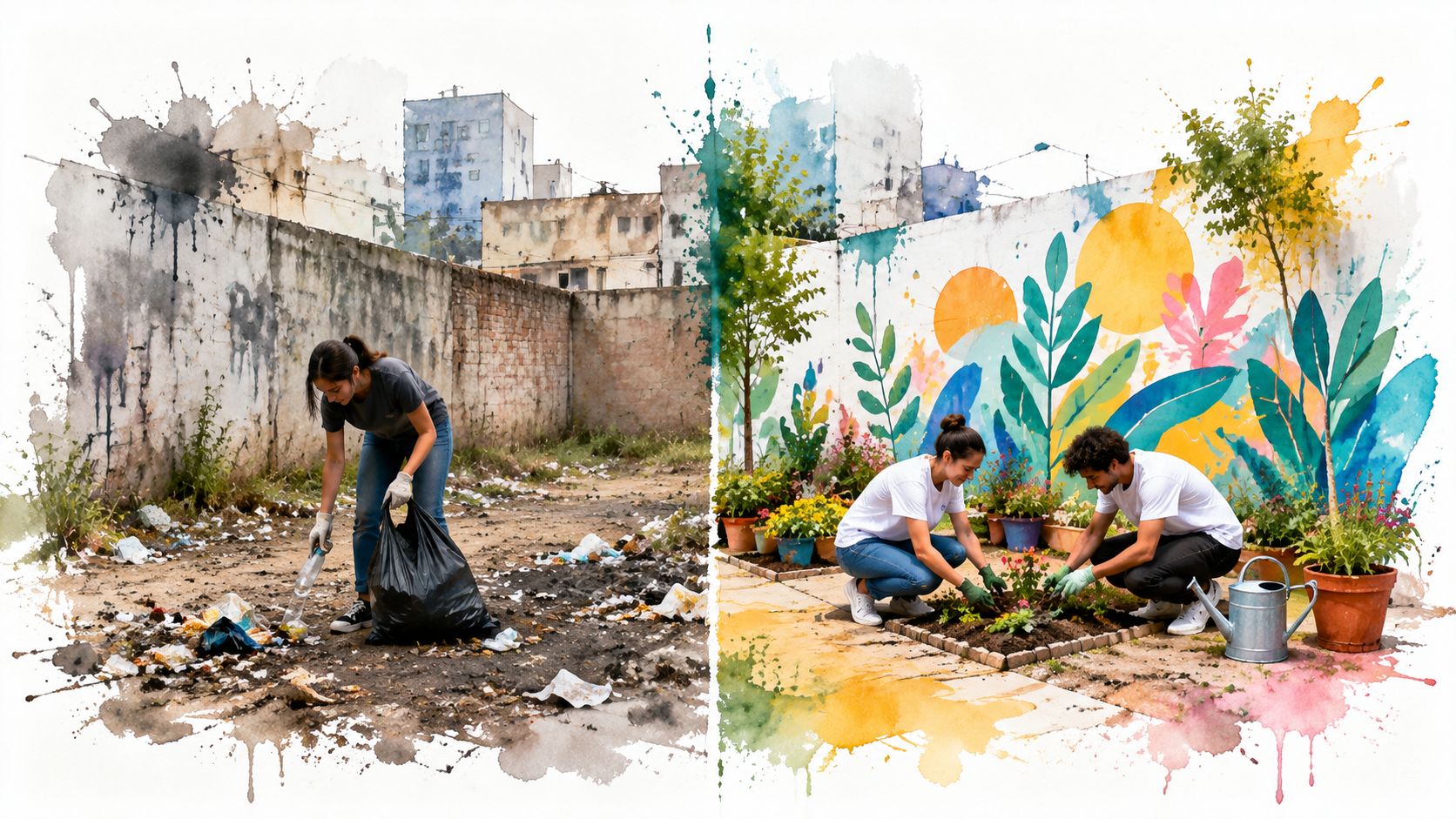
    A split-screen illustration showing a person cleaning up trash and then gardening in the same space.

    I've seen people fall in love with a place only after they put sweat into it. A lot that looked forgotten starts to feel personal once you've hauled out debris, cut back weeds, and imagined what could go there next. That's how service turns into ownership.

    First clean, then build

    One of my favorite examples is when a group takes an empty or ignored patch of land and turns it into a small community place people want to stand in. That could mean planting, painting, setting up signs, or making the space feel watched over instead of abandoned.

    The trick is to ask local residents what they want before you start making decisions. A volunteer's vision can be energetic and still be wrong.

    • Start with removal: Get the trash, broken glass, and dead clutter out first.
    • Ask neighbors early: The people closest to the space should shape what comes next.
    • Create a maintenance rhythm: A beautiful place falls apart fast if nobody comes back.

    I like seeing this process in motion because it makes kindness visible. Cleanup changes the ground. Beautification changes the mood.

    If you want to watch that kind of transformation energy, this short video captures the spirit well.

    3. Building Social Circles and Intentional Community

    I don't think community happens by accident as often as people claim. Usually, somebody picked a time, a place, a tone, and a set of values. That's not fake. That's care.

    After a chaotic season in my own life, I became much more deliberate about who I spent time with. I wanted to be around people who'd wake up, show up, and help. A Saturday morning cleanup is a pretty strong filter for that.

    Filter for the people you want beside you

    A service group has a hidden gift. It lets you meet people while doing something useful, so the conversation has less pressure and more honesty. You're not trying to impress each other over drinks. You're carrying bags, joking about gross finds, and seeing who keeps their word.

    I like groups that create more than one place for connection. The event matters, but the follow-up matters too. A group chat, a social post, a repeat invite next week. That's where familiarity grows.

    If you're trying to build that kind of circle, these community building activities for adults give a practical starting point.

    Say what your group is for. People relax when they know the values in the room.

    I've found that friendship grows faster when people share why they're there. Not a polished speech. Just the truth. Maybe you're lonely. Maybe you're recovering from a hard breakup. Maybe you need a reason to get outside and stop spiraling. That's the stuff that turns a volunteer event into an actual community.

    4. Volunteer Pride and Identity Building

    A flag sounds silly until you're the one holding it. A badge sounds childish until someone earns one and suddenly stands taller. A theme song sounds over the top until the group starts smiling when it plays.

    Service work can disappear into the background if you let it. People get dirty, tired, and anonymous. I think that's a mistake. If athletes get jerseys and teams get logos, kind people can have symbols too.

    A diverse group of three young adults standing together, holding a flag and wearing pins with colorful handprints.

    Give service a uniform, even a playful one

    A visible identity helps volunteers feel like they belong to something concrete. It also gives first-timers a way to step into the mood of the group faster. You're not just "helping out." You're joining a crew.

    I love this because pride can support bravery. When someone wears a pin, carries a flag, or sings the goofy song with everybody else, they stop hovering on the edge and start participating fully.

    Try a few simple moves:

    • Use symbols with a story: A logo means more when people know where it came from.
    • Mark milestones: Badges, pins, or little traditions can reward consistency.
    • Make photos fun: Group pictures help people remember that service looked good on them.

    This isn't vanity. It's morale. People often need permission to feel proud of doing something decent in public.

    5. Reframing Difficult Tasks as Adventures

    Some jobs are ugly. Some weather is rude. Some days your gloves are soaked, your back hurts, and the alley smells like defeat. You can still decide what story you're living in.

    That hail storm cleanup changed me because it made suffering funny. Not fake-funny. Real funny. We were cold, stranded, and ridiculous, and that gave the day flavor. Hardship stopped feeling like proof that we'd made a bad choice. It felt like the plot thickening.

    Turn discomfort into story

    I think groups last longer when they talk about tough days like adventures instead of burdens. That doesn't mean ignoring safety. It means refusing to let inconvenience become the main character.

    You can build this attitude on purpose.

    • Tell the stories afterward: The worst weather often creates the best memories.
    • Keep inside jokes alive: Shared language bonds people fast.
    • Take photos on rough days: People love evidence that they did the hard thing.

    One reason this matters is emotional stamina. If every hard cleanup feels like a failure, people burn out. If a hard cleanup feels like a campfire story in progress, they come back with a grin.

    I've learned to ask a strange question before difficult service days: what will be funny about this later? That question has rescued me more than once.

    6. Cross-Neighborhood Equity and Inclusion

    Kindness gets shallow fast if it only goes where the sidewalks already look polished. I don't trust service that keeps choosing the easiest block.

    A stronger version of kindness in action moves across neighborhoods on purpose. It doesn't avoid places because people assume they're too far, too forgotten, or too uncomfortable. If a city belongs to all of us, the care should move that way too.

    Go where people feel skipped over

    I respect groups that make a rotation and stick to it. That kind of schedule tells residents, "You don't need to compete for our attention. We're coming." It also pushes volunteers to see more of their city than they normally would.

    This matters for the people serving too. You learn humility when you leave your comfort zone. You stop talking about neighborhoods like headlines and start connecting them to faces, blocks, and conversations.

    A youth-led kindness organization described in this Channel Kindness story has supported 5,068 people, donated 30,062 supplies, and helped 955 underserved families since April 2025. I take one lesson from that. Service can scale quickly when people protect the energy behind it and keep showing up where help is needed.

    Every neighborhood deserves attention. You don't need a trendy zip code to earn care.

    If you organize across a whole city, say the schedule out loud. Make the route public. Let people know you mean it.

    7. Protective Volunteer Energy and Donation Resistance

    I've seen volunteer groups make a simple mistake. They get people excited about helping, then turn around and squeeze them for money every chance they get. That changes the mood fast.

    Volunteer energy is fragile. If somebody gives up their morning, travels across town, works hard, and then feels like a wallet with legs, they'll disappear. I would too.

    Treat presence like the top contribution

    I prefer groups that make this plain from the start. Show up. Help out. Be safe. Have a good time. If somebody wants to support financially later, fine. But don't build the relationship on pressure.

    This matters even more when a group grows. A service model can move fast when people stay energized. One Atlanta kindness group has turned into a year-round effort documented on YouTube, and I think part of the lesson is consistency without draining the people who make it happen.

    A few habits help:

    • State the policy clearly: Tell volunteers they won't be pressured for donations.
    • Ask for time first: Service groups live or die on attendance and morale.
    • Find other support paths: Grants, in-kind supplies, and partnerships can carry costs.

    The emotional effect is bigger than it sounds. When people know they're welcome without opening their wallets, they relax. Relaxed people make friends. Friends come back.

    8. Addressing Root Causes Through Environmental Stewardship

    For me, environmental stewardship started as therapy in work clothes. I couldn't throw out my own emotional junk, so I started picking up literal junk off the street. That sounds backwards, but it worked.

    Cleaning a block doesn't magically solve grief, chaos, or shame. It does give your hands something honest to do while your mind catches up. Sometimes that's enough to begin.

    Outer order can train inner order

    The reason I care about this so much is personal. My apartment mess and my life mess fed each other. Once I started doing regular cleanup outside, I began to believe I could also create order inside my own routines.

    That's one reason I like the language in this guide to environmental stewardship. It treats care for shared spaces as active responsibility, not a vague attitude.

    The science on kindness also gave me language I didn't have before. A National Institutes of Health review on kindness and health reports that a meta-analysis of 27 experimental studies found a small-to-moderate positive effect on well-being for people practicing acts of kindness. That same review notes four meta-analyses covering 22, 21, 19, and 10 randomized controlled trials on kindness-based meditation, with reductions in depressive symptoms, anxiety, and stress, plus increases in compassion, self-compassion, and positive emotions.

    I don't read that and think, "Great, cleaning up is medicine." I read it and think, "No wonder this helped me." Kindness in action changes your environment, and sometimes your environment changes you back.

    9. Easy Participation Entry Points and Accessibility

    A lot of kind projects fail at the front door. The cause is good, but the signup is clunky, the instructions are vague, and nobody knows where to stand when they arrive. People won't say that out loud. They'll just never come.

    I like making participation stupidly easy. Clear time. Exact address. What to bring. What if it rains. Where the group chat lives. Whether a nervous first-timer can just walk up and join. That's the difference between a wish and a real invitation.

    Remove friction before you ask for courage

    The easier the logistics, the more energy people have left for service. That matters for shy people, busy people, new residents, students, and anyone who already feels awkward trying something alone.

    A simple structure works well:

    • Use multiple channels: Meetup, Instagram, and group chats catch different people.
    • Say exactly what happens: People show up more confidently when they know the plan.
    • Welcome walk-ups: Some people decide at the last minute and still become regulars.

    The emotional side matters too. When someone arrives, greet them fast. Hand them supplies. Give them one easy task. Introduce them to one friendly regular. That first five minutes can decide whether they come once or keep coming all season.

    Kindness in action isn't only the service itself. It's also the care you put into the doorway.

    10. Consistent Show-Up Culture and Reliability Building

    The strongest groups I know aren't glamorous. They're reliable.

    That sounds boring until you live inside it. A fixed day and time can change people. It teaches self-trust. It tells the neighborhood that somebody will be there. It gives lonely or drifting people a recurring place to land.

    Reliability is a form of kindness

    I love the feeling of not having to wonder. If cleanup is every week, rain or shine, then the decision gets easier. You stop renegotiating with yourself. You just go.

    That consistency can become a culture. People start telling stories about the snowy day, the hot day, the day only a few people came and it still counted. Those stories teach the group what it values.

    Try building that with a few simple habits:

    • Pick one recurring slot: Don't keep changing the day or time.
    • Celebrate attendance, not hype: A small crew that shows up is a win.
    • Let people rest without guilt: Reliability grows better when people feel free, not trapped.

    I've learned that a city starts to trust you when you keep your promises in ordinary weather and ugly weather alike. That's one of the purest forms of kindness in action I know.

    Kindness in Action, 10-Point Comparison

    Title 🔄 Implementation complexity ⚡ Resource requirements 📊 Expected outcomes 💡 Ideal use cases ⭐ Key advantages
    Community Litter Cleanup Events Low–Moderate: recurring logistics and volunteer coordination Low: volunteers, basic supplies, simple admin Visible cleaning, habit formation, local pride Rapidly mobilizing community volunteers for regular cleanup Immediate visible impact; low cost; accessible
    Neighborhood Beautification Through Service Moderate–High: multi‑phase planning, permits, maintenance High: materials, skilled volunteers, partner funding Long‑term public space transformation, increased value Revitalizing neglected lots, creating community spaces Lasting physical legacy; attracts investment
    Building Social Circles and Intentional Community Moderate: values‑based recruitment and facilitation Low material / High time: facilitation, leadership effort Deep friendships, higher retention, mutual support Creating trusted volunteer cohorts, reducing loneliness Authentic connections; sustained commitment
    Volunteer Pride and Identity Building Low–Moderate: branding and distribution systems Moderate: design, production, small budgets Improved retention, higher visibility, recruitment lift Boosting morale and social proof for volunteer groups Increases motivation and group identity
    Reframing Difficult Tasks as Adventures Low: narrative framing and cultural practice Low: storytelling, leaders modeling behavior Higher participation in hard conditions; resilience Tasks with unpleasant conditions or low appeal Turns toil into memorable bonding experiences
    Cross‑Neighborhood Equity and Inclusion High: complex scheduling, safety and outreach protocols Moderate–High: logistics, partnerships, training Equitable service coverage, trust in underserved areas City‑wide programs prioritizing underserved wards Ensures attention reaches forgotten communities
    Protective Volunteer Energy and Donation Resistance Moderate: policy design and alternative funding strategy Moderate: grant seeking, sponsor relations, admin Preserved volunteer morale; clearer volunteer motives Volunteer‑first organizations avoiding solicitation Protects volunteer motivation and trust
    Addressing Root Causes Through Environmental Stewardship High: integrates therapy, training, and facilitation Moderate–High: trained staff, support resources Personal transformation, habit change, wellbeing gains Programs linking service with mental‑health or behavior change Deeper meaning and longer‑term individual impact
    Easy Participation Entry Points and Accessibility Low: multi‑platform presence and clear logistics Low–Moderate: platform accounts, comms, coordination Increased signups, lower friction to join Onboarding newcomers; scaling casual participation Dramatically lowers barriers to entry
    Consistent Show‑Up Culture and Reliability Building Moderate: governance, leadership continuity, backup plans Moderate: core team, recognition systems, planning Sustained presence, neighborhood trust, habit formation Long‑term community presence and habit building Builds reliability identity and long‑term momentum

    Your Adventure Starts Now

    One Saturday morning, I almost stayed in the car.

    The alley smelled like old beer and rain. A torn fast-food bag was wrapped around a fence. Someone else had beaten us there and started filling a black trash bag by hand because they forgot a grabber. That was the moment I remembered what kindness looks like in real life. It is rarely polished. It usually starts with somebody doing the unglamorous job first.

    That kind of morning changed me more than any inspiring quote ever did. I did not begin with a grand plan. I began while my own life felt sloppy, while my apartment was cluttered, while I was still figuring out how to keep promises to myself. Picking up one block forced me to practice a better way of living in public. Then I saw the deeper lesson. Communities do not get stronger from good intentions alone. They get stronger because someone picks a time, brings extra gloves, makes the work feel welcoming, and comes back next week.

    That is the part people skip.

    Kindness in action is logistical. It has a calendar. It has backup supplies. It has little decisions that shape who shows up and whether they return. A Saturday cleanup at 9 a.m. attracts different people than a loose evening plan that starts whenever. A group name, a shared joke, even a dumb little theme song can turn service into identity. That sounds small until you watch volunteers stand taller because the work belongs to them now.

    I have seen the mood of a street change from one visible act. A person with a bag and gloves signals that this place is worth caring for. A neighbor notices. Someone waves. Someone asks when the group is coming back. Small public acts carry weight because they interrupt the story that nobody cares.

    The harder truth is that generosity needs protection. If the same reliable people do all the lifting, they burn out. If every gathering turns into a pitch for money, trust gets thin. If the work feels like punishment, people disappear. Good groups handle that head-on. They make it easy to join, they respect people's time, and they frame the ugly jobs as a shared mission people can be proud of.

    Start smaller than your excuses.

    Pick one block, one corner, one vacant lot, one bus stop you are tired of pretending not to see. Text one friend. Set a time. Bring one extra pair of gloves for the person who says yes at the last minute. If you live in Chicago, Litter Caterpillars is one practical place to begin. If you do not, the model still holds. Small crew. Clear task. Regular return. That is how strangers become dependable neighbors.

    Look at your street with fresh eyes. Where is the neglect. Who gets left out. What would make it easier for an older neighbor, a busy parent, or a shy newcomer to join you for twenty minutes.

    Go put your hands on the problem.

    Then make the work feel like something worth coming back to.

  • Your Guide to 2026 Chicago Community Events

    Your Guide to 2026 Chicago Community Events

    I remember moving to Chicago and feeling lonely in a way that surprised me. I could ride the train with a hundred people, walk past a street festival, grab food on a packed block, and still feel like I was watching someone else's city. The place was huge. I was tiny inside it.

    Then I learned something simple. Chicago doesn't become yours because you consume it. It becomes yours when you help build it with other people. That's when strangers turn into your crew, and a Saturday turns into a story you want to keep living.

    If you're searching for chicago community events, I want to save you time. This isn't just a pile of calendars. It's a list of tools and groups that can help you find your people, get outside, and become part of the city instead of circling around it.

    1. Litter Caterpillars

    Litter Caterpillars

    One Saturday morning, I watched a few strangers turn into a crew over a pile of trash bags and coffee. Someone cracked a joke. Someone handed over gloves. An alley that looked ignored started looking cared for. That is why I start with Litter Caterpillars. It shows what a community event can do when it gives people a job, a rhythm, and a reason to come back.

    The group meets on weekend mornings and cleans Chicago block by block. The work is simple, physical, and public. You feel the city under your shoes, and by the end of the cleanup, you can point to a corner and say, we changed that together.

    What stays with me is the deeper shift. Founder Kevin Tao has spoken openly about struggle, consistency, and how small acts of care can change a life from the inside out. That spirit gives the group its pull. You arrive to pick up litter. You leave with names, faces, and the feeling that you belong somewhere.

    If you want a practical place to start, their guide to volunteer opportunities in Chicago gives you a feel for the kind of action-first community they've built.

    Practical rule: Belonging grows faster in groups that meet often enough for people to recognize you.

    Litter Caterpillars also has a real identity. There are flags, badges, recurring rituals, and enough humor to help shy people relax. That matters. A lot of event roundups focus on what is happening. I care just as much about whether anyone will notice if you come back next week. Here, they probably will.

    • Best for belonging: Familiar faces show up again, which makes friendship easier.
    • Best for visible impact: The result is right in front of you. Cleaner sidewalks, fuller bags, better blocks.
    • Best for people who want action: You are not standing around making small talk for an hour before anything happens.

    It is not for everyone. Weekend mornings are real. Weather is real. The work can be messy. If you want polished programming and lots of structure, another option on this list may fit you better. But if you want service with grit, repetition, and heart, Litter Caterpillars is a strong first example of what chicago community events can become. They can help you find your people while you help rebuild a place.

    2. Choose Chicago Citywide Events Calendar

    Choose Chicago – Citywide Events Calendar

    Sometimes you don't need a deep philosophy. You need to know what's happening this weekend and where to start. That's where the Choose Chicago events calendar helps.

    I think of it as the wide-angle lens. If Litter Caterpillars is the friend who texts, “Come help us clean this block at 9 a.m.,” Choose Chicago is the giant city bulletin board. It's good for scanning neighborhood festivals, parades, cultural events, and recurring public happenings without hopping between a dozen sites.

    When I'd use it

    Use this one when you're in exploration mode. Maybe you just moved here. Maybe your family is visiting. Maybe you want chicago community events that feel public, easy to join, and spread across the city.

    Chicago's Department of Cultural Affairs and Special Events said it served all 77 neighborhoods in 2023, awarded more than $23.5 million in grants, and distributed 749 grants, which was the most in the department's history, according to the DCASE annual report. When I browse citywide calendars, I keep that scale in mind. Chicago has real neighborhood reach. You can feel it in how many different corners of the city keep generating public events.

    • Best for broad discovery: Great for seeing a lot quickly.
    • Best for newcomers: You can scan by neighborhood and get your bearings.
    • Watch for one gap: Smaller volunteer meetups and hyperlocal cleanups won't always appear.

    If you like the bigger public calendar but want a more hands-on service angle, I'd pair it with this guide to volunteer opportunities in Chicago. That combination works well. One tool helps you scan the city. The other helps you step into it.

    3. Chicago Park District Event Finder

    Chicago Park District – Event Finder

    I've learned that parks are where a city relaxes enough to tell the truth about itself. You see parents with snacks, teens pretending not to have fun, aunties in folding chairs, pickup games, summer movie nights, and volunteers trying to keep a corner of the world in decent shape.

    That's why the Chicago Park District event finder is one of my favorite tools for chicago community events. It pulls you away from giant downtown gravity and into neighborhood life.

    Why parks work so well

    This calendar has date, location, and category filters. You can search for park-centered programs, family activities, local gatherings, and seasonal events. I like it because park events feel less performative. People often arrive in a more open mood.

    The interface is plain, and that's fine. I'm not asking a community calendar to charm me. I'm asking it to tell me where the people are.

    If you want community fast, start where people already bring their kids, chairs, and snacks.

    The Park District is also useful if you're trying to connect cleanup work with longer-term neighborhood life. A litter pickup, garden day, or outdoor program can pull you into the same local ecosystem. If that's your lane, this piece on community gardens in Chicago, IL is a strong companion read.

    One limitation is detail. Some event pages tell a fuller story than others. And if you want a volunteer-only filter, you may need extra clicking. Still, when I want something grounded, local, and outdoors, this is the place I look.

    4. Chicago Public Library Citywide Events Calendar

    Chicago Public Library – Citywide Events Calendar (BiblioCommons)

    Libraries are one of the few places left where you can walk in without being asked to buy something. That alone makes the Chicago Public Library events calendar worth your time.

    If parks are where the city exhales, libraries are where it gathers itself. You'll find workshops, clubs, talks, resource fairs, practical help, and neighborhood programs across branches all over the city. It's a good pick if you want chicago community events that are quieter, more welcoming for first-timers, and often free.

    For people who want low-pressure entry

    I recommend this one to people who feel nervous about jumping into a loud festival or a physically demanding volunteer shift. A library event gives you an easy on-ramp. You can sit, listen, join a conversation, or attend something useful without needing to “perform community” on day one.

    That matters because resident input has shaped Chicago's arts and public programming for a long time. The report The Arts in Chicago A Report to the Community described a process where members of the cultural community spoke for themselves through focus groups and named recurring concerns like financial support, audience growth, cultural diversity, management training, and freedom of expression. I love library calendars partly because they still feel close to that spirit. They feel like places where people can speak, ask, and return.

    • Best for free access: Great if cost is a concern.
    • Best for inclusive programming: Useful filters by age group, date, and branch.
    • Less ideal for outdoor action: You won't get the same volume of cleanup or festival listings.

    If your first step into community needs to be calm and human-sized, the library is a strong choice.

    5. My Block My Hood My City

    My Block My Hood My City feels like the friend who wants you to care about Chicago on purpose. Their events and programs center neighborhood connection, service, and getting people to cross lines they usually don't cross.

    I like this platform when I'm tired of browsing giant directories. Instead of drowning you in random listings, it points you toward a tighter set of mission-driven opportunities. That can be a relief.

    Good for people who want direction

    My Block My Hood My City has a live events area and recognizable initiatives tied to neighborhood improvement, youth experiences, seniors, and city connection. If your brain shuts down when it sees too many options, this one is easier to act on. You can look at what's coming up and decide, “Yes, I'm doing that.”

    There's also something healthy about joining a group with a clear point of view. You're not just attending. You're stepping into work that already has a heartbeat.

    You don't always need more options. Sometimes you need one clear invitation.

    The tradeoff is volume. You won't get the same giant stream of listings you'd get from an aggregator. Events are tied to the organization's own initiatives, and some programs fit certain audiences more than others. Still, if you want purpose and neighborhood connection in the same room, this is a strong bet.

    6. Meetup Chicago Community and Social Categories

    Meetup – Chicago Community & Social Categories

    Meetup is messy. I mean that kindly. It's messy the way a neighborhood bulletin board is messy. Some flyers are gold. Some are weird. Some lead nowhere. But if you know what you're looking for, Meetup in Chicago can help you find your people fast.

    I especially like it for recurring groups. One cleanup is nice. A repeating event with the same rough time, same organizer, and same cluster of regulars is where friendship starts.

    Best for recurring connection

    Meetup has built-in RSVPs, group organization, recurring events, and neighborhood discovery. If you're searching chicago community events with a grassroots feel, it has real range. Volunteer crews, social circles, civic groups, outdoor folks, hobby weirdos. They're all in there.

    That said, you need judgment. Quality depends on the organizer. Safety practices differ. Some groups say “community” when they really mean “let's drink somewhere loud.”

    Chicago also has a giant event culture behind all this. In a localized Arts Alliance Illinois study, 466 nonprofit arts and cultural organizations reported 36.3 million aggregate attendances in 2015, and surveyed attendees spent an average of $50.56 per person per event, with event-related spending totaling $1.84 billion in the city, according to the Arts Alliance Illinois customized report. I don't read that and think, “Wow, big market.” I read it and think, “No wonder discovery feels crowded.” In a city with that much activity, Meetup helps smaller recurring groups stay visible.

    • Best for hyperlocal groups: Strong for neighborhood-based connection.
    • Best for repeat attendance: Recurring schedules help people bond.
    • Use filters carefully: Service and social often sit side by side.

    If you want ideas for gatherings that create real connection, this guide to community building activities for adults pairs well with Meetup.

    7. Eventbrite Chicago Community Category

    Eventbrite – Chicago Community Category

    Eventbrite is where I go when I want momentum. I don't want to think too hard. I want to filter by date, neighborhood, and price, then pick something before I talk myself out of leaving the house. The Eventbrite Chicago community category is good for that.

    It has a mixed-bag energy. You'll see volunteer listings, resource fairs, local gatherings, and community-oriented events next to stuff that's more commercial or niche. That's not a flaw if you use the filters with intention.

    Good for last-minute action

    This is one of the easiest places to answer a practical weekend question. What's happening soon? Is it free? Is it nearby? Can I reserve a spot now?

    That matters because event discovery in Chicago is fragmented. The search results themselves show the problem. Broad directories and organization-specific calendars often leave people doing extra sorting in their heads. The Eventbrite community-engagement search in Chicago makes that gap obvious. People aren't always asking for more events. They're asking for better curation.

    CMAP's Community Data Snapshots can also help if you're organizing rather than browsing. The tool gives neighborhood-level context across demographics, employment, transportation, housing, land use, revenue, and water indicators. I like that because turnout is practical. Transit access matters. Density matters. If you want people to show up, you need to think about where they live and how they move.

    Better event discovery starts with a simple question. What fits my actual Saturday?

    Eventbrite's weakness is uneven quality control. Read listings carefully. Still, for fast discovery and easy sign-up, it does the job.

    Chicago Community Events: 7-Source Comparison

    The first time I watched a Litter Caterpillars cleanup roll down a block, it changed how I judge a community event. I did not see a calendar listing. I saw neighbors waving from porches, kids grabbing gloves, and strangers finishing the morning with inside jokes and plans to come back. That is the bar for this table. Which source helps you find people, not just fill time?

    Item What it feels like in real life What it asks from you What you're likely to get back Best fit Why it stands out
    Litter Caterpillars A cleanup that turns a stretch of sidewalk into common ground Show up, work with your hands, talk to people Visible change, repeat faces, a reason to return Anyone who wants belonging through action Volunteer-led, neighborhood-based, easy to join
    Choose Chicago – Citywide Events Calendar Big city energy, polished listings, lots of options Sort for what matches your neighborhood and mood Broad awareness of festivals, parades, and public happenings Visitors, explorers, people planning around major events Official citywide coverage and dependable updates
    Chicago Park District – Event Finder Programs tied to real places where families already gather Search by park, date, or activity Steady neighborhood events with a familiar local feel Parents, regulars, residents who want something close to home Year-round reach across the city's parks
    Chicago Public Library – BiblioCommons Rooms where people learn together without pressure to spend money Pick a branch or topic and walk in Free workshops, civic programs, and welcoming public space Anyone easing into community life Inclusive programming and strong branch-level variety
    My Block My Hood My City (MBMHMC) Service with a clear mission and visible neighborhood care Join organized efforts and follow the nonprofit's lead Shared purpose, volunteer momentum, local impact People who want structured service opportunities Strong community trust and partnership-driven work
    Meetup – Chicago Community & Social Small groups built around recurring connection Try a group, then decide if the vibe fits New friendships, regular meetups, mixed quality by organizer People looking for “my people” energy Easy RSVPs and recurring grassroots gatherings
    Eventbrite – Chicago Community Category Fast browsing for what is happening soon Filter carefully and read listings closely Quick sign-up options and broad event discovery Last-minute planners and larger public events Useful registration tools and wide visibility

    What I like about this comparison is how clearly the tradeoff shows up. Some sources are better at breadth. Some are better at trust. A few can change your week because they put you shoulder to shoulder with people who care about the same block you do.

    If your real goal is transformation, not entertainment, start with the places that ask something from you. A cleanup, a service day, a branch workshop, a recurring neighborhood group. We become part of a city by contributing to it.

    That is why Litter Caterpillars stays with me. It is a simple idea carried out in public, with other people, on a schedule you can return to. If you want one place to begin, start there: Litter Caterpillars

    Your Turn to Paint the Fence

    I keep thinking about Tom Sawyer and the fence. He got handed a chore and turned it into a story people wanted to join. That's what good community work feels like to me. You arrive expecting effort, and you leave with a memory, a new friend, dirt on your gloves, and a reason to come back next week.

    That's why I care about chicago community events in the first place. I'm not chasing a packed calendar for the sake of being busy. I'm chasing that moment when the city stops feeling like a backdrop and starts feeling like a shared project. A cleanup can do that. A library workshop can do that. A park event can do that. A neighborhood volunteer day can do that too.

    And people want more than a random listing now. They want to know what kind of event this is, who it's for, and whether anything real comes from it. That hunger for visible, local change is part of why service-based events hit so hard. The Center for Community Health Equity events page points to ongoing community healing and support work, and I think that gets at something important. People want participation that means something in their own block, their own weekend, their own life.

    You don't need to solve Chicago. You just need to show up somewhere small and real.

    Pick one thing from this list. Go to the cleanup. Join the park event. Sit in the library room. RSVP to the Meetup. Walk into the thing that feels slightly outside your comfort zone. That feeling is often the doorway.

    Your people probably aren't going to appear because you stayed home and kept scrolling. They're waiting in a park fieldhouse, on a library calendar, at a volunteer check-in table, or on a windy sidewalk with a trash picker in hand.

    Go meet them.


    If you want the fastest path from “I should get involved” to “I know these people now,” join Litter Caterpillars. Show up on a weekend morning, do something useful with your hands, and let the city change you while you help change a block.

  • 7 Volunteer Opportunities for 17 Year Olds

    7 Volunteer Opportunities for 17 Year Olds

    When I was 17, I felt like my life was a messy room I couldn't clean. Every choice felt huge, and finding friends who cared about the same things I did seemed impossible. I just wanted to do something real.

    It turned out that cleaning up someone else's mess was way easier than cleaning up my own. That was my back door into purpose. I showed up, grabbed a trash bag, and met the kind of people who didn't just talk about caring. They woke up early and proved it.

    If you're looking for volunteer opportunities for 17 year olds, I want to make this simple. You do not need a perfect résumé, a polished speech, or some grand life mission. You need one place to start.

    The good news is that teens already show strong interest in volunteering. In the American Red Cross State of Gen Z Volunteerism Study, 13 to 17 year olds were substantially more likely to be actively volunteering than 18 to 25 year olds, and 62% reported weekly or monthly participation.

    That tracks with what I've seen. Seventeen is an age where you're old enough to care strongly and young enough to still jump in before cynicism hardens. So let's skip the school-counselor pamphlet voice and get to what's important.

    1. Litter Caterpillars

    Litter Caterpillars

    One Sunday morning, I watched a teenager in work gloves drag a bag of cans and fast-food wrappers to the curb, step back, and grin at a sidewalk that looked human again. Nobody handed out a certificate. Nobody made a speech. The reward was right there on the ground. A block people had given up on looked cared for again.

    That feeling is why Litter Caterpillars stands out for 17-year-olds. You do the work yourself, you see the difference right away, and you meet people who would rather show up than posture online.

    Why this one feels different

    Litter Caterpillars is a volunteer trash pickup group in Chicago. Kevin Tao started it from a personal low point and turned that energy into weekly cleanup work across all 50 wards. Weekend after weekend, the group goes into places many people pass by without seeing, or see and avoid.

    A lot of teen volunteering keeps you close to the edges. You check people in, stack papers, or help from a safe distance. Here, you are on the block holding the bag, picking up the bottle, and leaving a place better than you found it. That changes how service feels. It stops being a résumé line and starts feeling like ownership.

    Such a great way to kick off a Sunday!

    The group also has a personality, and that matters more than adults sometimes admit. Flags, badges, meetup posts, group chats, even a theme song. On paper, that can sound silly. In real life, it gives people something to belong to. You are not just doing a task. You are joining a crew.

    What you get from showing up

    The barrier to entry is low. You do not need experience. You do not need to be the loudest person there. You just need to come ready to work.

    For a 17-year-old, a few things stand out:

    • You can see the result: One hour of effort can change a sidewalk, alley, lot, or bus stop in a way you can point to.
    • The routine helps: Weekend morning cleanups make volunteering part of your life instead of a one-off thing you forget by Tuesday.
    • Friendships form faster: Walking, hauling, and joking around over a gross pile of trash is a more natural way to connect than forced icebreakers.
    • You build grit: Cold mornings, wet gloves, heavy bags. You learn you can do harder things than you thought.

    They have also pulled off projects that feel bigger than a typical service club outing. The group cleaned a highway during a bike-event shutdown. It also won an empty lot at auction, which became Caterpillar Park in Englewood. That is what I mean by real civic action. You are not helping from far away. You are changing the shape of a place.

    If you want a fuller picture of how service work can affect school, confidence, and direction, this guide on the benefits of volunteering for students is worth reading.

    Practical rule: Pick volunteer work with a clear before and after. It is easier to stay committed when you can see what your effort did.

    The tradeoff is pretty simple. This is outdoor, physical volunteering, and the schedule is built around weekend mornings. Litter Caterpillars is also not a formal 501(c)(3), so that may matter if you need a very traditional setup for paperwork. If you want service that feels real in your body, your neighborhood, and your friend group, this one is hard to forget.

    2. American Red Cross Youth and Young Adult Volunteers

    American Red Cross, Youth & Young Adult Volunteers

    Some people want a clear system. Sign up, train, get placed, learn the ropes. If that sounds like you, American Red Cross Youth Opportunities is a strong fit.

    I think of Red Cross as the friend who's always early and always brings a plan. You know where to go, what to do, and who you're helping.

    Best for teens who like structure

    At 17, you can get involved through local chapters, school-based Red Cross Clubs, and youth leadership tracks. A lot of teen-friendly roles revolve around blood drive support, preparedness education, and chapter projects.

    That structure can feel good when life already has enough chaos. You log into the volunteer portal, see openings, and move forward without guessing what the next step is.

    Here are the parts I like most:

    • Training is built in: You don't have to fake confidence on day one.
    • Leadership paths are real: Clubs and youth councils can keep you involved longer than one event.
    • School-friendly credibility: Service hours from a familiar organization are usually easy to document.

    Some roles do have age limits. Field disaster roles and some positions with extra screening often begin at 18, and minors usually need parent or guardian consent. So if your dream is jumping straight into emergency deployment, this probably won't scratch that itch yet.

    If you're nervous about starting, a structured volunteer system can be a gift. You don't need to invent your own path on day one.

    This is a good choice for a 17-year-old who wants people skills, consistency, and a recognizable organization without having to build everything from scratch.

    3. Habitat for Humanity local affiliates

    I still remember the first time I helped carry supplies on a workday like this. I wasn't some natural builder. I mostly worried I'd hold the wrong thing, stand in the wrong place, or look clueless. Then someone handed me a task, showed me how to do it, and five minutes later I felt useful.

    That's the magic of Habitat for Humanity volunteer opportunities. You walk onto a site unsure of yourself, and by the end of the shift you're talking like part of the crew.

    If you like team projects and tangible work

    Local Habitat affiliates often let teens ages 16 and 17 volunteer on build sites with safety restrictions. If the construction side isn't open to you at your location, many affiliates also have ReStore, garden, or office support roles. Parent or guardian waivers are usually part of the process.

    I like Habitat because the work has weight to it. You're not guessing whether your time mattered. Walls go up. Spaces get cleaned. Materials get sorted. Something physical moves forward because people showed up.

    A few things make this one especially good:

    • Hands-on learning: You can build practical confidence even if you've never touched a jobsite before.
    • Strong teamwork: It's hard to stay shy when you're solving small problems together.
    • Different entry points: ReStore and support roles help if your local site has stricter age rules.

    If you're still looking around and comparing options, this guide on how to find volunteer work is useful. It helps you think beyond whatever your school happened to mention.

    The tradeoff

    Age restrictions are real here. Teens usually can't do every task. Roofing, some ladder heights, and power tools may be off-limits. Build schedules also vary by affiliate, and some shifts may land on school days.

    That said, if you want your volunteer work to feel like joining a jobsite with a purpose, Habitat is one of the strongest picks on this list.

    4. Feeding America food banks and pantries network

    Feeding America, Food Banks and Pantries Network

    Food bank volunteering has a rhythm to it. Open box. Sort cans. Pack produce. Slide the next crate over. Talk while your hands keep moving. I love that kind of work because awkwardness burns off fast when everyone is focused on the same simple task.

    That's why Feeding America volunteer options are great for teens who want a straightforward way in.

    Good for busy schedules

    Feeding America's network connects you with local food banks and pantries. A lot of sites run short shifts that fit around school, sports, or a part-time job. Common roles include sorting food, repacking items, assembling boxes, and helping with distribution.

    This one is especially useful if your week already feels packed. You can often find shorter volunteer blocks instead of making a huge commitment right away.

    What I like:

    • Easy to learn: Most shifts don't need much training.
    • Quick sense of momentum: You can process a lot of food in one session.
    • Group friendly: This is an easy one to do with classmates, siblings, or teammates.

    The main catch is local variation. Some food banks let 16 and 17 year olds volunteer independently, while others have different rules. Mobile distributions and special events may also have stricter age requirements.

    My advice: Call or check the local calendar before you get attached to a shift. National networks are helpful, but local rules decide your actual experience.

    If you want volunteer opportunities for 17 year olds that are practical, steady, and easy to start, food banks are hard to argue with.

    5. Special Olympics event and season support

    This one has heart in a very direct way. You don't need to make a speech about inclusion to feel it. You feel it when you hand someone a medal, keep score, cheer from the sideline, or help an event run smoothly so athletes can have their moment.

    Special Olympics volunteer roles are great if you like sports, high-energy events, and being around people who are there to support each other.

    A social option that doesn't feel fake

    Depending on the state program, teens can often help with scorekeeping, escorting, awards, health support, and season roles. Unified Champion Schools can also give high school students a way to volunteer and participate alongside athletes.

    I like this option for teens who want people-centered service without having to force conversation. The event gives you a job. The job gives you a reason to connect. That makes everything easier.

    A few reasons this one works well:

    • You can start small: One-day events are perfect if you're testing the waters.
    • You can stay longer: Season support can turn a one-time experience into a real commitment.
    • The energy is high: If you hate quiet, formal volunteer settings, this is a breath of fresh air.

    What to watch for

    Some roles and major events require volunteers to be 18 or older, and some teen volunteers need an adult chaperone depending on the event. Always check the state chapter page before signing up.

    If you're the kind of person who comes alive around games, teamwork, and loud encouragement, this one can feel less like volunteering and more like joining a community event that needs you.

    6. National Park Service Volunteers in Parks

    National Park Service, Volunteers-In-Parks (VIP)

    Some volunteer work happens under fluorescent lights. Some happens with dirt on your shoes and sap on your hands. If you need air, sunlight, and a reason to get off your phone for a few hours, look at the National Park Service volunteer program.

    I think outdoor service has a special kind of honesty. A trail either got cleared or it didn't. The weeds either came out or they didn't. You don't leave wondering if you helped.

    For teens who want outside work

    The National Park Service places volunteers across more than 400 parks and sites. Roles can include trail work, habitat restoration, visitor services, and historic site support. Many parks accept minors with written parent or guardian consent, though age rules change by park and project.

    That variety is the big draw here. Maybe you want to restore habitat. Maybe you want to help visitors at a historic site. Maybe you just want to spend a Saturday doing physical work somewhere beautiful and quiet.

    Why I like it:

    • You get outside: That alone can reset your whole mood.
    • The work sticks in your memory: Trail and restoration days usually feel more vivid than indoor paperwork.
    • There are different commitment levels: Some projects are one-day cleanups, while others are ongoing.

    The downside is inconsistency. Each park has its own rules, forms, and task limits for volunteers under 18. Some equipment and duties are restricted.

    If your ideal volunteer day includes gloves, fresh air, and coming home pleasantly tired, this belongs high on your list.

    7. DoSomething.org online and local teen campaigns

    DoSomething.org, Online and Local Teen Campaigns

    Sometimes you want to help, but transportation is messy, your schedule is weird, or you're not ready to walk into a room full of strangers yet. I get that. Starting small still counts.

    That's where DoSomething.org comes in. It builds campaigns for young people ages 13 to 25 that you can do from home, at school, or in your local area.

    Best when you need flexibility

    DoSomething.org runs mobile-friendly campaigns around issues like climate action, mental health, civic engagement, and cleanup work. You can complete actions on your own or with friends, then document your work through the platform. Some campaigns also come with scholarship opportunities for participants who complete the required submissions.

    I like this option because it lowers the pressure. You don't need a ride across town. You don't need to commit to every Saturday morning. You can begin where you are.

    Here are the upsides:

    • Very easy to start: Great for shy teens or overloaded schedules.
    • Self-paced: You work around school, sports, or family obligations.
    • Good as a bridge: Online action can build confidence before you join in-person volunteering.

    If you're trying to move from intention to action, this guide on how to start volunteering is a good companion. It helps if you've been stuck in the "I should do something" phase.

    Where it falls short

    This usually won't replace the feeling of showing up in person with a crew and doing physical work side by side. A lot depends on your own follow-through and whether you complete the documentation process.

    Still, for volunteer opportunities for 17 year olds, this is one of the easiest entry points on the internet. Sometimes the smallest open door is the one you walk through.

    7 Volunteer Opportunities for 17-Year-Olds, Quick Comparison

    Program Implementation complexity 🔄 Resource requirements ⚡ Expected outcomes 📊 Ideal use cases 💡 Key advantages ⭐
    Litter Caterpillars Low formal complexity; ongoing volunteer coordination (weekly) 🔄 Minimal funding; volunteer time, basic cleanup supplies ⚡ Visible neighborhood cleanup, community projects like parks 📊 Hands-on local cleanup, community-building in Chicago Strong volunteer culture, consistent grassroots impact ⭐
    American Red Cross, Youth & Young Adult Volunteers Moderate; structured onboarding, training, and policies 🔄 Chapter staff, training materials, background checks for some roles ⚡ Skill development, recognized service hours, leadership pathways 📊 Teens seeking structured roles, resumes, school service credit Nationwide network, standardized curricula, high credibility ⭐
    Habitat for Humanity (local affiliates) Moderate; site safety protocols, waivers, supervised builds 🔄 Tools, safety gear, affiliate staff; non-construction roles require less equipment ⚡ Tangible housing contributions, practical skills, service hours 📊 Group builds, students wanting hands-on construction experience Hands-on builds with lasting community impact ⭐
    Feeding America, Food Banks and Pantries Network Low; short shifts with brief orientation 🔄 Minimal equipment; space for sorting/packing and volunteer coordination ⚡ High-throughput food distribution; measurable meals/boxes processed 📊 Flexible, short shifts for students and families Low barrier to entry, frequent opportunities, clear impact ⭐
    Special Olympics, Event and Season Support, Unified Sports Low–moderate; role-specific briefings and occasional clearances 🔄 Event materials, volunteer training, possible chaperones for teens ⚡ Inclusive sports support, social inclusion, event success metrics 📊 Sport-minded volunteers, one-day events or season commitments Inclusive environment, mix of one-off and recurring roles ⭐
    National Park Service, Volunteers-In-Parks (VIP) Moderate; park-specific rules, permits, and consent forms 🔄 Outdoor tools, supervision, travel/logistics to park sites ⚡ Environmental stewardship, hands-on conservation learning 📊 Trail work, habitat restoration, visitor services, family days Wide variety of roles across many parks; strong stewardship focus ⭐
    DoSomething.org, Online and Local Teen Campaigns Low; online campaigns and self-directed actions 🔄 Minimal, internet access and participant time; optional materials ⚡ Youth engagement, awareness campaigns, possible scholarship recognition 📊 Remote or flexible volunteering, campaign-based activism Very low barrier, youth-focused, scalable digital reach ⭐

    Your First Step Is the Best Step

    Look, fear and failure are good. They push you forward. Showing up to a new place with new people is scary, and I don't want to pretend otherwise. I still feel that weird flutter before I join anything new.

    But that's where the best stories begin. You step onto a sidewalk with a trash grabber. You walk into a food bank warehouse and don't know anyone. You arrive at a build site, a park project, or a sports event, and for the first ten minutes you wonder if you made a mistake. Then someone hands you a task. Then you help. Then the day starts moving.

    The Bureau of Labor Statistics data discussed in Tobi Johnson's write-up on recruiting young volunteers noted that 16 to 19 year olds had a 26.4% volunteer rate in 2015, compared with 18.4% for ages 20 to 24. That feels believable to me. At 17, you're at this strange, powerful age where you're still open enough to jump in and old enough to matter right away.

    I also like one point from that same write-up. It notes that 44% of adult volunteers began in adolescence, and they were twice as likely to continue if they started young. I wouldn't use that as pressure. I'd use it as permission. You do not need to have your whole life figured out. You just need to start practicing being the kind of person who shows up.

    Tom Sawyer got punished and had to paint a fence. He could've sulked. Instead, he made it look fun enough that other people wanted in. That's closer to real volunteering than is often acknowledged. The trick is finding pride in the work and fun in the effort.

    So pick one. Join the cleanup. Pack the boxes. Show up for the athletes. Clear the trail. Build the wall. Run the campaign. Send the email today, not next week.

    Your story is waiting for the next page. Are you bold enough?


    If you want the kind of volunteering that gets you outside, gets you moving, and helps you find your people fast, join Litter Caterpillars. Show up on a weekend morning, grab a bag, and watch how quickly a stranger can become a teammate.

  • 7 Best Trails in Chicago to Explore in 2026

    7 Best Trails in Chicago to Explore in 2026

    More Than a Trail: A Path to Yourself

    I used to think my life was a mess because my apartment was a mess. Every old jar and forgotten bag of nuts in my kitchen told a story of failure. They were small, but to me they might as well have weighed 500 pounds.

    Then I started picking up trash outside.

    That shift changed me faster than any journal prompt ever did. When I cleaned a sidewalk, a park edge, or the weeds near a trail fence, I could see the story change in real time. One bottle gone. One bag gone. One corner less defeated. It was easier to clean up the city than to clean up myself, and that was exactly why it worked.

    Now when I think about trails in Chicago, I don't think first about cardio or scenery. I think about missions. I think about showing up on a cold morning with gloves on, coffee in hand, and a few people who also want to do something honest with their weekend. I think about how service strips away your excuses. You stop performing. You start doing.

    If you're looking for trails in Chicago, start with a path that can carry both your feet and your conscience. Walk it. Notice it. Clean it. Let the city train you into someone tougher, kinder, and less afraid of hard things.

    1. Chicago Lakefront Trail

    Chicago Lakefront Trail

    One Saturday at sunrise, I filled half a bag before I had walked a single mile. Coffee cups gathered near a bench. A plastic fork hid in the grass by the path. A gull pecked at a crumpled wrapper while runners streamed past the water as if the mess belonged to someone else.

    That morning is why I send new volunteers here first.

    The Chicago Lakefront Trail puts you face to face with the city you claim to love. It stretches along Lake Michigan and cuts through some of Chicago's best-known park space, including Lincoln Park, Grant Park, Burnham Park, and Jackson Park, as described by the Chicago Park District's Lakefront Trail page. You do not have to guess where to start or wonder whether your work will matter. Pick an access point, grab gloves, and begin.

    I like this trail for first Litter Caterpillars missions because the feedback is immediate. A short cleanup can change the look of a curve, a fence line, or a patch of grass in less than an hour. You see families, cyclists, commuters, and tourists pass through the space you just cleared. Service becomes public. So does your effort.

    That does something to a person.

    On the lakefront, there is nowhere to hide from your own standards. The wind is sharp. The path is open. If you say you care about Chicago, this is a good place to prove it with your hands. I have shown up here tired, distracted, and full of excuses. I have left steadier every time.

    Practical rule: Start with one defined stretch, clean it well, and let visible progress build your momentum.

    This trail also works for people who want a mission and movement in the same morning. Clean for an hour. Then keep walking. Let the shoreline settle your head while your bag gets heavier. If you want to map out nearby green spaces for your next service day, I often use this guide to Chicago parks we can clean next.

    • Best for: First cleanup meetups, visible public service, long post-cleanup walks
    • Watch for: Crowds, lakefront wind, and fast bike traffic in busy areas
    • Start mindset: Do the unglamorous work in front of you

    For me, the Lakefront Trail is not a leisure route first. It is a proving ground. I go there to remember that growth rarely starts with insight alone. Sometimes it starts with bending down, picking up somebody else's mess, and deciding you are strong enough to leave a place better than you found it.

    2. The 606

    The 606 (Bloomingdale Trail)

    The first time I brought a grabber onto The 606, I made the mistake of thinking a raised trail would stay clean on its own. Then I spotted a coffee lid pinned against a bench, a candy wrapper tucked under prairie grass, and a crushed water bottle caught near the fence above somebody's backyard. I filled half a bag before I reached the next ramp.

    That changed how I see this trail.

    The 606 runs through neighborhoods instead of beside them, so every cleanup feels personal. You are not out at the edge of the city. You are inside its daily life, passing murals, apartments, gardens, and people carrying groceries home. For a Litter Caterpillars mission, that matters. Service here is not abstract. You clear a path that your neighbors will use before the hour is over.

    The Bloomingdale Trail opened in June 2015 as a major elevated rail trail project built from a former rail line. That history gives the place its character. The route sits above the street like a reused piece of muscle, built for movement once, rebuilt for community now.

    I have learned to read this trail by who shows up. Early morning belongs to people trying to get somewhere. Later in the day, the pace softens. Parents stop with strollers. Friends talk while walking side by side. Cyclists cut through. Teenagers linger near the art. A cleanup on The 606 teaches a different kind of discipline than the lakefront. You work with interruptions, foot traffic, and constant reminders that public space survives only if ordinary people treat it like shared responsibility.

    Mission rule: On The 606, pick a short segment, work it thoroughly, and let consistency beat distance.

    That lesson stayed with me after the pandemic closures and reopening changed how people used public paths across Chicago. People returned because this trail does more than move bodies. It stitches neighborhoods together. When I show up with a bag and a picker, I feel that stitch in my own habits too. I stop waiting for perfect conditions. I do the small work in front of me, then the next piece, then the next.

    The service angle is what gives The 606 its weight. This corridor added green space in built-up neighborhoods that need public room to breathe. If I say I care about community, this is one place where I can prove it with my hands.

    • Best for: Short volunteer meetups, repeat cleanup laps, neighborhood-level service
    • Watch for: Crowding, fast bikes, and tight moments near access points
    • Start mindset: Treat every wrapper like it landed on your block

    Check current access and programming on The 606 official site.

    3. Chicago Riverwalk

    Chicago Riverwalk

    Some trails ask you to go long. The Chicago Riverwalk asks you to pay attention.

    I like bringing newer volunteers here because it teaches a lesson fast. You don't need mud, woods, or a giant route to practice stewardship. You just need eyes open and ego down. A wrapper near a stair landing is still a job. A cup wedged by the river wall is still your problem if you decide this city is partly yours.

    Short path, sharp lesson

    The Riverwalk is a pedestrian promenade with architecture, water, public art, and constant movement. It works well for people who want a shorter outing but still want that feeling of being inside the pulse of downtown. You can walk, talk, pick up a few things, and still leave feeling like you did something concrete.

    I think of this place as a white shirt trail. Every stain shows.

    That isn't a bad thing. It means your work is visible. If you're trying to invite a friend into service and they feel intimidated by a huge cleanup, the Riverwalk is a good first rep. It's urban, central, and easy to pair with coffee, conversation, and a little courage.

    Street-level truth: A short cleanup still counts. Stop pretending impact only happens when you're exhausted.

    The downside is obvious. Some segments get tight, and the flow of people can make stop-and-start cleanup awkward. I wouldn't choose it for a hard run or a big bike outing. I would choose it for outreach, reflection, and helping someone understand that civic care isn't abstract. It lives in handrails, corners, planters, and the edge where a city meets its water.

    If that's your style, use the City of Chicago Riverwalk page to plan your visit.

    4. Major Taylor Trail

    Major Taylor Trail

    I trust trails that make me work a little.

    Major Taylor Trail has that feeling. It doesn't flatter you. It asks you to stay alert, notice transitions, and keep your head in the game. That's part of why I respect it as a service trail. When a route isn't spoon-feeding you comfort, you show up with more intention.

    Why this South Side route stays with me

    This trail connects neighborhoods, parks, and preserve space on the South Side. I like it for cleanup rides because it feels less polished than the most famous downtown routes. That means you notice edges, crossings, fencing, brush lines, and all the places where litter can collect and then stay ignored.

    There is a moral lesson in that.

    We all clean the places people already praise. Real character shows when you clean the places people skip.

    • Best for: South Side rides, focused cleanup sessions, volunteers who like a route with texture
    • What I like: More room to think, less tourist energy, stronger sense of local stewardship
    • What to respect: Pay attention at crossings and connectors

    When I walk or ride here, I think about the version of me who once avoided difficult tasks because they felt awkward or unglamorous. Then I think about how much of adulthood is doing the awkward useful thing before someone congratulates you for it.

    This trail helps train that muscle. You don't need applause. You need gloves, patience, and enough pride to care for a route that deserves effort.

    Clean where you are tempted to look away. That's where growth usually lives.

    If you want route details, use the Chicago Park District's Major Taylor Bike Trail page.

    5. North Branch Trail

    North Branch Trail

    When I need to think through my life without staring directly at it, I go somewhere with trees. North Branch Trail gives me that kind of cover. The city noise softens. My thoughts stop shouting. The work becomes simple again.

    Among trails in Chicago, this is one of my favorites for endurance days. You can settle into a rhythm and keep going. For a cleanup crew, that means you need a plan. Long, calmer routes can trick you into thinking litter isn't there. It is. It just hides better.

    The trail for steady people

    North Branch Trail is the one I pick when I want distance without the crush of the lakefront. The shaded feel changes your pace. You stop performing your workout for strangers and start listening to your breathing, your footsteps, your group, your own excuses.

    That matters more than is commonly understood.

    I also like this trail because it invites expansion. One section can become a longer day. A casual walk can become a service mission and then a ride. If you're exploring connected green routes beyond the city core, I often compare it with the ideas in this guide to the Des Plaines River Trail near Chicago.

    • Best for: Long rides, long runs, quiet volunteer mornings
    • What to bring: Water and a little self-discipline
    • What to expect: Fewer built-in amenities than a high-traffic city corridor

    I think of North Branch as the cast-iron pan of Chicago trails. It isn't flashy. It gets better when you use it often. It can handle heat. It can handle neglect. And if you care for it, it pays you back for years.

    You can review access points and maps through the Forest Preserves map portal.

    6. Cal-Sag Trail

    Cal-Sag Trail

    Cal-Sag Trail feels like a sentence still being written. I mean that in a good way.

    Some people only want finished things. I don't. A trail with gaps, detours, and active development reminds me of actual self-improvement. You don't become solid all at once. You build in sections. You connect what you can. You keep moving while parts of you are still under construction.

    Why I respect a work-in-progress route

    This trail gives you long flat stretches that are great for steady movement. I like it for rides where the goal is less about speed and more about consistency. Put your head down, keep your cadence honest, and let the miles scrape the nonsense off your brain.

    For service, the route has another draw. Work-in-progress corridors can attract less casual care. People use them, but they don't always feel fully claimed. That creates an opening for volunteers who want to step in early and build a habit of ownership before a place becomes trendy or polished.

    I also keep a data mindset when I think about routes like this. Chicago has neighborhood analytics tools that use 20+ years of demographic, business, and real estate data to model neighborhood types and intervention points. I don't need to copy that exact system to learn from it. If you're planning cleanup efforts, random isn't always noble. Sometimes it just wastes energy. Smarter route choice can help you put volunteer hours where they matter most.

    Field note: Pick a segment, define a turnaround point, and commit. Wandering burns energy. Purpose saves it.

    • Best for: Steady cycling, long service rides, people who like emerging routes
    • Watch for: Gaps, detours, and more spread-out amenities
    • Start mindset: You don't need a perfect corridor to do honest work

    For maps and current route information, check the Cal-Sag Trail website.

    7. Burnham Greenway

    I have a soft spot for places that feel unfinished but full of promise. Burnham Greenway gives me that feeling. It pulls together the Southeast Side, preserves, wetlands, rail history, and a future path that still needs patient people.

    That patience matters. In cleanup work, in friendship, in building a better self, you rarely get the clean uninterrupted route right away.

    A trail that asks for faith

    Burnham Greenway isn't fully continuous today. That's part of the experience. You may need street links and a bit more planning than you would on a simpler route. But I like what that asks of you. It asks you to pay attention instead of drifting through the day.

    This corridor also points toward a service ethic I care about. Mainstream trail chatter often gravitates toward polished destination routes, while underserved neighborhoods with trail assets get less practical attention. One gap analysis on Chicago trail coverage calls out missing discussion around neighborhood-level access, safety, maintenance, and volunteer engagement in places like Englewood, Pilsen, and South Shore, while noting the lack of attention to trails in underserved areas in this review of Chicago day-hike coverage.

    That hit me hard because it's true to what I see on the ground. If you only go where praise already lives, you'll miss where help is needed.

    I also think trails should teach us history, not just mileage. Some of Chicago's present routes and streets trace older Native trade paths created by Ojibwe, Odawa, Potawatomi, and Miami nations. Diagonal routes like Milwaukee, Lincoln, Clark, and Vincennes followed that older network, as described in this discussion of Indigenous trail history in Chicago. When I pick up trash on or near these corridors, I try to remember that stewardship didn't begin with me.

    If you're exploring preserve-linked routes on the Southeast Side, this guide to Chicago forest preserve ideas can help you think bigger than a single segment.

    For route documents, use the Burnham Greenway guide on TrailLink.

    Chicago Trails: 7-Point Comparison

    Trail 🔄 Implementation complexity ⚡ Resource requirements 📊 Expected outcomes 💡 Ideal use cases ⭐ Key advantages
    Chicago Lakefront Trail Moderate, major coordinated upgrades completed (Trail Separation Project) High, frequent maintenance, restrooms, water points, transit integration Very high visibility and heavy year‑round use (weather permitting) Long runs, group meetups, high‑visibility volunteer events, sightseeing Iconic skyline/lake views; continuous separated paved paths; many access points
    The 606 (Bloomingdale Trail) Low–Moderate, adaptive reuse of elevated rail, routine upkeep Moderate, lighting, access ramps, programming, winter plowing Strong neighborhood connector with steady local usage and events Short outings, arts/fitness programming, quick car‑free commutes Elevated, car‑free link with frequent access and regular programming
    Chicago Riverwalk Moderate, urban waterfront infrastructure and seasonal operations High, seasonal concessions, docks, security and crowd management High visibility for outreach; intense short‑stay foot traffic Short urban strolls, tours, concessions, public outreach Central, photogenic riverfront with public art and water access
    Major Taylor Trail Moderate, multi‑jurisdiction coordination; some on‑street transitions Moderate, signage, crossing improvements, community stewardship Good for training miles and community engagement with lower congestion Training rides, community cleanups, South Side connectivity Less crowded, strong local stewardship, regional linkages
    North Branch Trail Moderate, long corridor through preserves; connecting multiple segments Moderate, parking, trail upkeep; fewer on‑trail amenities Excellent for long endurance outings and nature immersion Long runs/rides, customizable distances, nature trips Shaded, long continuous miles; access to Skokie Lagoons and Botanic Garden
    Cal‑Sag Trail High, phased build‑out with gaps and multi‑agency coordination Moderate–High, development of segments, remote amenities, mapping Growing regional spine for steady‑pace training and neighborhood links Long cycling, steady‑pace training, east–west regional connectivity Long, flat sections; less crowded and strong regional potential
    Burnham Greenway High, incomplete today; requires funding, grade separations and connectors High, ongoing construction, coordination across agencies and crossings High potential connectivity and nature access once completed Future regional link and nature‑rich access for Southeast Side communities Planned high‑impact connectivity linking preserves, wetlands and regional networks

    Are You Ready to Walk the Walk?

    You've seen the paths. You know the way. Each trail is a choice.

    I mean that directly, but I also mean it in the way that matters more. You can treat trails in Chicago like content. A backdrop. A fitness box to check. A pretty place to spend two hours before brunch. Or you can treat them like training grounds for your character.

    That's what changed me.

    I didn't become stronger because I had some sudden burst of discipline at home. I became stronger because I kept showing up outside. I met people who were willing to wake up early, carry bags, laugh in bad weather, and do a humble job with real pride. I learned that bravery often looks boring from a distance. It's just consistency with dirt on it.

    These trails each teach something different. The Lakefront Trail teaches scale. The 606 teaches neighborhood care. The Riverwalk teaches attention. Major Taylor teaches respect. North Branch teaches steadiness. Cal-Sag teaches patience with works in progress. Burnham Greenway teaches faith in places that still need love and connection.

    You don't need to master all of them this month. You just need to start.

    Pick one trail. Bring gloves. Bring water. Bring a friend if that helps, or come alone if that's the brave thing for you right now. Walk a section and ask a hard question: when I leave, will this place be better, worse, or exactly the same because I was here?

    Try to become the kind of person who can't tolerate leaving it the same.

    The journey isn't just seeing Chicago's trails. It's changing them, and letting that work change you back. One bottle. One can. One cracked little corner of the city at a time. The next step isn't on a map. It's a decision.

    Find a Litter Caterpillars meetup on one of these trails. Show up. Let's see what story we can write together.


    If you're ready to stop scrolling and start serving, join Litter Caterpillars. We pick up trash across Chicago, make real friends, and build courage the old-fashioned way: by showing up on weekend mornings and doing the work.

  • Forest Preserve Chicago: A Guide to Wild Escapes

    Forest Preserve Chicago: A Guide to Wild Escapes

    The first time I ducked into a forest preserve outside Chicago, I still had grit from the Kennedy on my shoes and a bad week sitting in my chest. I thought I was going to a park. I ended up in a place that felt half feral, half forgiving.

    More Than Just Trees

    I came to the preserves because I was stuck.

    Not movie-stuck. Real stuck. Too much noise, too much scrolling, too many little failures piling up in my apartment and my head. In the city, you can keep moving and still go nowhere. You can bounce from train to coffee shop to grocery store and never once feel your own feet on the ground.

    Then I walked into a patch of woods in Cook County and the whole script changed.

    The trail wasn't polished. The mud didn't care about my schedule. Branches scratched my sleeves. I heard birds before I saw water, and then I saw water before I understood where I was. That mattered to me. Chicago teaches you to read blocks, lights, corners, crowd flow. A forest preserve chicago trail teaches you something else. It teaches you to slow down enough to notice.

    The day I stopped needing everything neat

    I expected picnic tables and a tidy loop. I found something rougher. I found fallen logs, wind in tall grass, and that strange feeling you get when a place doesn't perform for you.

    That roughness helped me.

    When your life feels overmanaged on the outside and chaotic on the inside, a little honest wildness is medicine. The preserves don't ask you to impress anybody. You show up sweaty, annoyed, sad, restless, hopeful. The land takes all of it.

    You don't have to arrive balanced. You just have to arrive.

    I've brought friends out there who thought they hated nature. Usually what they hated was pressure. Out in the preserves, pressure drops. You walk. You breathe. You get dirt on your shoes. Somewhere between the parking lot and the tree line, your shoulders stop trying to live near your ears.

    That's why I don't talk about these places like they're just good for a casual stroll. They can be that. They can also be where you practice courage in small doses. A longer trail. A colder morning. A muddy path you almost turned away from. Sometimes bravery starts there.

    What Are Chicago's Forest Preserves Anyway

    The first time a friend asked me that question, we were standing at a trailhead with mud on our shoes and burrs stuck to our socks. He looked around and said, "So what is this, exactly? A park?" I told him no, not because I wanted to sound smart, but because a preserve asks something different of you. A park often gives you a tidy break. A forest preserve gives you room to work on yourself while the land keeps being itself.

    These places are protected public lands spread across Cook County. They hold woods, prairie, wetlands, creeks, bike trails, picnic groves, and quiet corners where you can hear your own thoughts again. Some areas feel welcoming right away. Others feel rough, half-hidden, and a little humbling. I like that. It reminds you that the county left space for life that does not need to entertain you.

    An infographic titled Chicago's Forest Preserves highlighting natural space, massive scale, outdoor activities, and community assets.

    Why that matters when your life feels too tight

    You feel it fast.

    One minute you're coming off a packed street, running on noise and habit. Twenty minutes later you're watching cattails move in the wind, or standing under oaks that were here before your deadlines, your landlord, your latest dumb argument, all of it. That shift is part of the point. The preserves protect habitat, yes, but they also protect a kind of honesty that city life can sand down.

    I have seen that honesty change people. On Litter Caterpillars cleanup days, someone always starts a little guarded. They keep conversation safe. They joke about the smell, the bugs, the mud. Then an hour passes. They fill a few bags, sweat a little, stop performing, and settle in. A preserve will do that to you. Service helps too. You stop asking, "What can I get from this place?" and start asking, "What do I owe it, and what can it teach me?"

    My plain answer

    Chicago's forest preserves are shared ground we chose to keep wild enough to matter.

    That means you should expect more than a flat walking loop and a bench every few yards. You might hit a shaded trail, open grassland, wet patches near the water, or a grove full of families cooking on a Sunday afternoon. You might also find restoration work, closed-off habitat areas, and signs asking you to stay on trail because the place is alive, not decorative.

    If you want a good example of how a preserve can feel both challenging and welcoming, look at our guide to Waterfall Glen Forest Preserve near Chicago. That kind of place offers a complete experience. Big space. Real terrain. Enough beauty to pull you in, enough grit to keep you honest.

    Here is the version I give friends before we get out of the car:

    • Go in expecting real land: You are still in Cook County, but it can feel a long way from traffic and concrete.
    • Expect different moods: Some preserves feel social and easy. Some feel quiet, raw, and better for solitude.
    • Remember the purpose: People come to walk, bike, bird, fish, picnic, volunteer, and breathe. The land is also there for plants, animals, and long-term care.

    A good preserve does not revolve around you. That is why it helps. You enter, pay attention, and earn your calm the old-fashioned way.

    Your First Adventures Three Preserves to Explore

    The first time I took a new volunteer out after a cleanup, he stood by the car and stared at the map like it was a test he had not studied for. City habit. Too many options, too much second-guessing. I told him the same thing I will tell you. You do not need the perfect preserve. You need a first one, then a second, then the kind of grit that comes from showing up again.

    A smiling young man holding a watercolor drawing featuring paths to a forest, lake, and meadow.

    Three places. Three moods. Pick the one that fits the life you have this week.

    Busse Woods is your easy first yes

    Busse Woods is where I send people who want a win.

    I brought my cousin there after months of hearing him say he needed to "get outside more." You know the type. Burned out, overbooked, always one more text away from changing the plan. We got out, started walking, and within ten minutes his shoulders dropped. Nothing dramatic. Just that small shift when your body remembers it was made for more than chairs, screens, and parking lots.

    Busse gives you room without throwing you into the deep end. The paths feel approachable. The water changes the air. You can walk, ride, pause, and figure out what kind of day you are having without feeling judged by the place.

    Go there if you need:

    • A clean first outing: enough space to breathe, not so much that you feel swallowed up
    • A social nature day: good for bringing a friend who is curious but cautious
    • A return to yourself: good when you have let your world shrink to errands and obligations

    Some trips are about ambition. Some are about rebuilding trust with your own habits. Busse Woods is good at the second one.

    Waterfall Glen is the tough trainer

    Waterfall Glen asks more from you, and that is why I love it.

    I have gone there angry, distracted, restless, full of noise. The trail does not care. It just keeps going. Step after step, the junk in your head starts to lose its grip. You stop performing your stress and start working through it.

    If you want a better sense of the route before you commit, read this Waterfall Glen trail guide from Litter Caterpillars. It gives you a grounded feel for the place from people who spend real time outdoors and do the work.

    Here is what Waterfall Glen has given me over the years:

    Mood What the preserve gives you
    Restless Distance and a steady pace
    Doubting yourself A hard thing you can finish
    Mentally cluttered Enough quiet for your thoughts to settle

    One afternoon I brought a friend there after a rough stretch at work and home. He talked nonstop for the first mile. By the middle, he got quiet. Near the end, he looked up and said, "I forgot I could feel this clear." That is what a demanding trail can do. It strips you down to breath, legs, effort, and the next honest step.

    Chicago Portage is the wise old soul

    Chicago Portage slows me down in a different way.

    I do not go there to chase miles. I go when I need perspective. The ground carries an older kind of weight, and you can feel it if you stop rushing. Routes mattered here long before any of us started pinning locations on our phones. People crossed difficult ground because they had to. Trade, travel, survival, community. The place still holds that feeling.

    That matters to me.

    After enough cleanup days, enough hikes, enough mornings spent dragging bags of trash out of places that deserve better, I have stopped seeing preserves as scenery. Some places train your legs. Chicago Portage trains your sense of belonging. It reminds you that land can hold memory, labor, and responsibility all at once.

    Some places steady you before they inspire you.

    Chicago Portage does that. You leave with less ego and more respect, which is a pretty good trade.

    Pick your preserve by the life you have right now

    Keep it simple.

    • If you're new and a little unsure: Go to Busse Woods.
    • If you need to test yourself and clear your head: Go to Waterfall Glen.
    • If you need quiet, history, and perspective: Go to Chicago Portage.

    You do not need to become an outdoor person before you go. You go, you work a little, you pay attention, and little by little the wild part of you wakes back up.

    Beyond the Hike What You Can Actually Do

    The first time I brought a new volunteer out after a cleanup, he thought we were done once the bags hit the truck. He was smoked, sweaty, and ready to go home. I told him to sit for ten minutes first.

    A young man riding a bicycle through a sunny park with people picnicking and birdwatching nearby.

    We sat near the trail, said almost nothing, and watched a rider coast past, a family spread lunch at a grove, and a bird pick through the reeds like it had all day to do one small job well. His shoulders dropped. Mine did too. That is the part people miss. A forest preserve in Chicago is not only a place to log steps. It is a place to work, recover, notice, and come back a little steadier than you arrived.

    Ride when your head is too loud

    I use the preserves for motion when life gets noisy.

    On those days, a bike does more for me than a slow walk. You get a rhythm going. Your legs handle the argument your mind has been losing all week. Trees blur, then open field, then a stretch of water, and somewhere in that sequence you stop rehearsing conversations and start paying attention to the ground under you.

    If you want a few more ideas for routes and day plans, this guide to an Illinois forest preserve outing gives you a solid starting point.

    Stay still long enough to be changed by it

    Birding sounded boring to me years ago. Then I learned what stillness can do.

    When you watch long enough, the preserve stops being background. You catch movement in the corner of your eye. You hear one sharp call, then another. You start noticing layers. High branches, low grasses, mud line, current, wind. Patience is not soft work. It takes discipline to stand there and let the place reveal itself on its own terms.

    Bring binoculars if you have them. If you do not, bring time.

    Water teaches the same lesson. Sit by a riverbank, paddle if you can, or just watch the surface change with the breeze. Chicago trains you to rush. Water trains you to hold your line, adjust, and keep going without panic.

    This clip gives a good feel for that shift from city tempo to preserve tempo.

    Match the day to the work you need

    I do not use the preserves the same way every time. You should not either.

    • If you're fried: Walk slow. Leave the headphones in your pocket and let your senses come back online.
    • If you're restless: Ride hard enough to earn your quiet.
    • If you're lonely: Bring one good person, share food, and talk without screens between you.
    • If you need courage: Go alone for an hour, pay attention, and prove to yourself you can keep good company.
    • If you need perspective: Find water or an open meadow and stay put until your breathing settles.

    That is what these places offer when you meet them honestly. Recreation, yes. But also practice. Practice at patience, effort, attention, and being useful. I have seen that work on cleanup crews, and I have seen it happen on an ordinary afternoon under the trees. You show up one version of yourself. You leave with a little more grit, a little more calm, and a better shot at being the kind of neighbor this city needs.

    Planning Your Visit The No-Nonsense Guide

    I like simple plans because simple plans happen.

    If you wait for the perfect weather window, the perfect gear, the perfect group text, you'll stay home. Chicago life eats intention for breakfast. You need a basic system and a little grit.

    What I actually use before leaving

    I start with the Forest Preserves website for closures, maps, and rules. Then I double-check the weather on my phone and look at the route the same way I would for any unfamiliar part of the region. If I'm trying a new preserve, I screenshot the map before I leave. Signal can get flaky, and confidence drops fast when your battery does.

    I also ask myself one blunt question. Am I going for effort, rest, or company? That answer changes everything.

    Bring less gear than your anxious brain wants, and more water than your optimistic brain thinks you need.

    My honest logistics advice

    If you have a car, great. Start early, park, and beat the churn. If you don't, combine transit with a bike or pick a preserve that doesn't require a heroic multi-transfer mission. Your first trip should feel possible, not noble.

    My favorite times are early morning and cooler parts of the day. Sunrise puts a different skin on everything. You hear more. You move better. You also dodge some of the crowds and most of the indecision.
    A few practical habits help:

    • Wear shoes you don't worship: Mud is part of the deal.
    • Pack a tiny kit: Water, snack, charged phone, basic layers.
    • Check group needs early: If you're planning a big picnic or event, look up permit details before inviting everybody.

    Don't overplan the soul out of it

    A preserve visit dies when it turns into a military operation.

    Set a destination. Pick a rough time. Bring what you need. Then go. The city already gives you enough friction. Nature doesn't need your spreadsheet.

    Giving Back How to Clean and Protect These Spaces

    The walk is good. Picking up trash changes you faster.

    I mean that. I've seen it in myself. I've seen it in people who showed up shy, annoyed, hungover, grieving, lonely, or just curious. You bend down, pick up one ugly piece of litter, and something inside you gets more honest. Service does that. It cuts through performance.

    A person disposing of a plastic cup into a bag with a watercolor illustration of forest life.

    Why cleanup work hits deeper than a hike

    Hiking helps me clear my head. Cleanup work makes me use my hands on a problem I can touch.

    That matters because a lot of modern frustration is abstract. Bad news, bad systems, bad vibes, endless opinions. Trash is concrete. It's there. You remove it. The ground looks better. Your body knows you did something real.

    I started doing this kind of work because cleaning my own mess felt weirdly impossible at times. Public litter was easier. Less emotional. Less haunted. Then I learned something almost embarrassing in its simplicity. Cleaning a shared space with other people made me stronger at facing my own life.

    If you want organized ways to do that kind of work, environmental stewardship programs are one route.

    Bravery is good. Preparation is better.

    I respect the rain-or-shine spirit. I live by it. But I don't romanticize recklessness.

    There is a real gap in public guidance for volunteer risk management during preserve cleanup events in extreme weather or tricky locations. The Forest Preserves talk about access and connection, but the practical side of volunteer safety in heat, hail, or near high-traffic edges is still thin, according to the Big City, Small Spaces overview from the Forest Preserves. If you're leading cleanups, you need your own judgment.

    Here's the field logic I trust:

    Before the event

    • Check weather twice: Once the day before, once right before leaving. Chicago weather lies for sport.
    • Know the terrain: Water edges, broken glass zones, steep banks, and roadside shoulders all change the plan.
    • Keep the group small if you're new: A smaller crew is easier to watch, direct, and protect.
    • Set a hard stop rule: If thunder, hail, dangerous heat, or visibility problems hit, you leave. No debate.

    During the cleanup

    Some people think courage means pushing through anything. That's not courage. That's ego in outdoor clothing.

    I want people spread out enough to work, close enough to communicate, and alert enough to spot problems early. If someone looks overheated, distracted, shaky on uneven ground, or too eager near traffic, I pull them back. A successful cleanup includes getting everyone home in one piece.

    Field note: If the weather turns ugly or the site feels off, call it early. Trash will still be there tomorrow.

    What I tell first-time volunteers

    I say this plain because sugarcoating gets people hurt.

    Situation What I do
    Heat and direct sun Slow the pace, shorten the route, watch for signs people are fading
    Hail or sudden storms Stop immediately and seek shelter
    Near roads or busy edges Keep the group tight and avoid risky reaches
    Near water or slick ground Work farther back unless you know the footing

    Stewardship builds community fast

    Cleanup work creates a certain kind of friendship. You skip the polished version of yourself. You're outside, maybe sweating, maybe freezing, maybe laughing at something gross somebody found in the weeds. It's real fast.

    That honesty is part of why I keep going back to the preserves. You don't just protect a place. The place starts sanding down your excuses. You become more useful. More reliable. A little less fragile.

    And yes, sometimes that growth starts with a grabber, gloves, and a trash bag on a cold Saturday morning.

    Staying Safe and Respectful Out There

    The first time I brought a new volunteer into the preserves, he stepped off the trail to get a better photo of wildflowers near a wet patch. I stopped him fast. Not because I wanted to kill the mood, but because that little patch was doing real work. Holding water. Feeding insects. Giving small things a place to live where boots and bikes had not crushed them yet. Out here, one careless step can be louder than you think.

    That is the mindset I want you to bring. Calm. Observant. Steady. A forest preserve chicago outing goes better when you remember these places are not empty green backdrops. They are living ground, and they ask something from you.

    Respect the land first

    Stay on marked trails unless you are in a designated area that clearly allows more freedom. Give animals room to move. Leave plants where they are. If you pack something in, pack it back out.

    You do not need a big dramatic mistake to leave damage behind. A shortcut through brush opens a path other people follow. A dog off leash can blow up a quiet morning for birds and ground-nesting animals. A tossed snack wrapper can sit in the grass long after your good mood is gone.

    I have seen people soften once they understand that. They stop treating the preserves like scenery and start treating them like a place they are lucky to enter.

    Keep your judgment on

    The preserves can feel wild in one moment and very close to the city in the next. That mix is part of their beauty, but it also means you should act like someone who wants to come home clear-headed.

    Go with a friend if you are new to a preserve or trying a longer route. Keep your phone charged. Tell someone where you are going if you plan to stay out a while. Pay attention to trail conditions, especially after rain, near water, or on leaf-covered hills where the ground can slide under you.

    A few habits help a lot:

    • Keep one ear on the world: If you use headphones, keep the volume low enough to hear bikes, people, and changes around you.
    • Watch your footing: Roots, mud, hidden holes, and broken pavement show up fast.
    • Dress for brush and bugs: Long pants and sleeves can save you a lot of regret.
    • Turn around early: A shorter day is better than a dumb injury.

    If something feels off, leave. You do not owe a trail your pride.

    Respect other people too

    These paths belong to a lot of us. Early birders with binoculars. Kids trying to spot turtles. Cyclists moving at a real clip. Older regulars who know exactly when the owls start calling. Your job is simple. Share the space without acting like you own it.

    Yield where appropriate. Keep your group from spreading across the whole trail. Keep noise down in quiet areas. Clean up after yourself and your dog. If a section is posted as closed for restoration, stay out of it. Restoration crews are not being dramatic. They are trying to give damaged ground a chance to recover.

    I also want you to notice the people doing the unglamorous work. Staff hauling tools. Volunteers dragging out bags of trash. Folks cutting back invasives in the cold. Give them room. Give them courtesy. Public land stays worth visiting because somebody keeps showing up to care for it.

    That kind of respect is not softness. It is discipline. And discipline is what lets more people find something good out there without wrecking it for the next person.

    Get Out and Find Your Wild

    I don't think the preserves fix everything. I do think they strip away some lies.

    They strip away the lie that you need to be fully ready before you begin. They strip away the lie that comfort is the same thing as peace. They strip away the lie that your life only changes through big dramatic moments. Sometimes change starts with mud on your ankles and a little more breath in your lungs.

    I've gone into the preserves angry and come out steadier. I've gone in tired and come out cleaner in the head. I've picked up trash on days when I didn't trust myself much, and by the end of the morning I trusted myself more because I had done one simple hard thing.

    That's what I want for you.

    Go take the easy walk if that's what you can do. Go push yourself on the longer trail if that's what you need. Go sit near water until your thoughts stop sounding like traffic. Pick up one piece of trash on your way out. Let the place work on you a little.

    There is wildness in Cook County. There is wildness in you too.

    Go meet both.


    If you want a practical way to turn that energy into action, check out Litter Caterpillars. They organize volunteer trash pickups around Chicago and give people a simple way to show up, work hard, and build friendships through service.

  • 12th Street Beach: A Complete Chicago Guide (2026)

    12th Street Beach: A Complete Chicago Guide (2026)

    I once stood at 12th street beach with a trash bag in one hand and a knot in my chest. The sand was cleaner than my apartment, and somehow picking up a stranger's bottle cap felt easier than throwing away my own old junk at home.

    Discovering 12th Street Beach Through New Eyes

    I didn't come to 12th street beach as a polished beach person. I came as someone who had let too many little messes pile up. Old receipts. Half-dead plans. The kind of clutter that starts on a desk and then creeps into your habits, your friendships, your courage.

    Then I learned something strange. Cleaning up someone else's mess can loosen your grip on your own.

    That first time, I bent down for a tangled scrap of plastic near the shore and felt a small click in my head. The task was simple. See trash. Pick it up. Keep moving. No old memory attached to it. No story. No guilt. Just action.

    A watercolor illustration of a hand picking up tangled plastic debris from a sunny beach shore.

    Why this beach feels different

    At first glance, 12th street beach is easy to read. Sand. Water. Skyline. People spread out on towels, kids darting in and out of the edge of Lake Michigan, cyclists rolling by. You can come here for an easy afternoon and leave happy.

    But if you slow down, the place changes.

    You start noticing the way a public beach asks something from you. Not much. Just attention. A little care. The willingness to leave it better than you found it. That tiny shift changes the whole day. You're not only visiting. You're participating.

    Practical rule: Bring one small bag. If you see a few pieces of litter on your way out, pick them up. That single habit changes how you experience the place.

    A different kind of beach guide

    Most guides tell you where to park, where to sit, and where to buy a snack. I like those guides. I use them too. But 12th street beach gave me something more useful than convenience.

    It gave me a way back into myself.

    When your life feels jammed up, service is like opening a stuck window. The room doesn't become perfect. You just get some air. A beach cleanup can do that. A swim can do that. A quiet walk along the edge of Northerly Island can do that too.

    If you've been here before, I want you to see it again. If you've never been, I want your first trip to mean more than a checklist. Come for the skyline, sure. Come for the sand. But also come because this is a good place to practice being the kind of person who notices things and helps.

    The Story of a Man-Made Oasis

    The first time I helped clean here, a volunteer held up a bottle cap and said, "Somebody had a whole summer day around this." I looked out at the curve of sand, the calm pocket of water, the skyline rising behind it, and remembered that this place did not appear by accident. People argued for it. People built it. People kept coming back until it became part of Chicago's memory.

    12th Street Beach sits on Northerly Island, a man-made piece of the lakefront born from Daniel H. Burnham's 1909 Plan of Chicago. Construction began in 1920, and by 1925 workers had formed the island with a sheet iron wall, landfill, and dredged material. It was the only island from Burnham's chain-of-islands vision that was fully completed, as noted in the 12th Street history project.

    What moves me most is how early Chicagoans fought over what this shoreline should become.

    Some people wanted a landing strip. Women's organizations pushed for a public bathing beach instead, and the beach was established in the early 1920s. That choice still shapes the feeling of the place today. Families got shoreline access. Swimmers got a protected stretch of lake. Ordinary people got room to rest, gather, and belong.

    By the 1930s and 1940s, the island had grown into more than a strip of engineered land. It had paths, grassy areas, trees, and beach space, and later it changed again as the area developed around the World's Fair era and the Adler Planetarium. Then came another chapter. Meigs Field operated here for decades before closing in 2003, and a new beach house followed in 2004.

    So the ground under your towel carries a strange and beautiful history. Public recreation, aviation, civic planning, and reinvention all meet here.

    The beach also holds family memory. A historical image record of Black families enjoying summer at 12th Street Beach ties the shoreline to multigenerational gathering in the 1960s and 1970s, a reminder that this was not only a place to cool off. It was a place to be seen, to celebrate, to claim joy in public, documented in this archival Alamy image listing.

    I think about that whenever our Litter Caterpillars crew heads out with buckets and grabbers. We are not caring for an empty backdrop. We are caring for a place that generations shaped with pressure, presence, and love.

    That is why even the trip here matters. Choosing a lighter-footprint route to the lakefront can be part of the practice. Our guide to eco-friendly ways to get to the beach helps you arrive with that spirit already switched on.

    A man-made oasis sounds like a planning term. Here, it feels personal. Every cleanup, every picnic, every child racing into the shallows adds another layer. The story of 12th Street Beach is still being written, and if you show up with care, you become part of it.

    How to Get to 12th Street Beach

    The first time a new volunteer joined our cleanup at 12th Street Beach, she arrived on a bike with a small backpack, a water bottle clipped to the side, and no idea what to expect. She told me later that the ride down the lakefront had already changed her mood. By the time she rolled past Northerly Island and saw the sand open up beside the skyline, she felt less like she was rushing to an attraction and more like she was arriving for something that mattered.

    That is still how I like to guide people here. Getting to 12th Street Beach is part of the experience. You are heading toward the Museum Campus edge, just south of Adler Planetarium, then following the path toward Northerly Island and the beach.

    The simple way to choose your route

    Pick the route that fits the kind of day you want.

    Method Details Best For
    Walking Walk south from the Museum Campus area toward Northerly Island and follow the path to the beach. Anyone already visiting the lakefront or nearby museums
    Bike Ride the Lakefront Trail, then turn off toward Northerly Island. Solo visitors, couples, and anyone who wants a calm trip along the water
    Car Drive toward the Adler Planetarium and Northerly Island area, then look for nearby parking if available. Families carrying chairs, snacks, and beach gear
    Rideshare or taxi Set your drop-off near Adler Planetarium or Northerly Island. Visitors who want the shortest walk-in
    Bus and train plus walk Take CTA service toward the Loop or Museum Campus area, then finish the trip on foot. Visitors who want a lower-stress city outing

    Driving works best when you are hauling a lot. On bright summer weekends, though, the last stretch can test your patience. Parking fills up fast, and the walk from your spot can still be longer than expected.

    If you are packing light, biking, walking, or transit usually makes the day feel easier from the start. Our guide to eco-friendly ways to get to the beach can help you choose a route that leaves less trash, less traffic, and less stress behind.

    Walking or biking in changes the whole tone.

    You hear the gulls before you hit the sand. The air shifts. The city stays beside you, but it loosens its grip. For a lot of us in Litter Caterpillars, that approach has become a small ritual. We show up more grounded, more observant, and more ready to care for the place once we arrive.

    A few practical habits help:

    • Travel light: A towel, sunscreen, water, and sandals cover most visits.
    • Secure loose items: Lakefront wind grabs hats, wrappers, and napkins in seconds.
    • Give yourself extra time: The final walk can feel longer when you are carrying gear or guiding kids.

    What you'll find when you arrive

    Once you reach the beach, you will find the basic supports that make it easier to stay awhile, regroup, and settle in for a full day. That matters more than people expect. A restroom, a place to rinse off, a spot to pause with older relatives, or a moment out of the sun can be the difference between a rushed visit and one that feels generous.
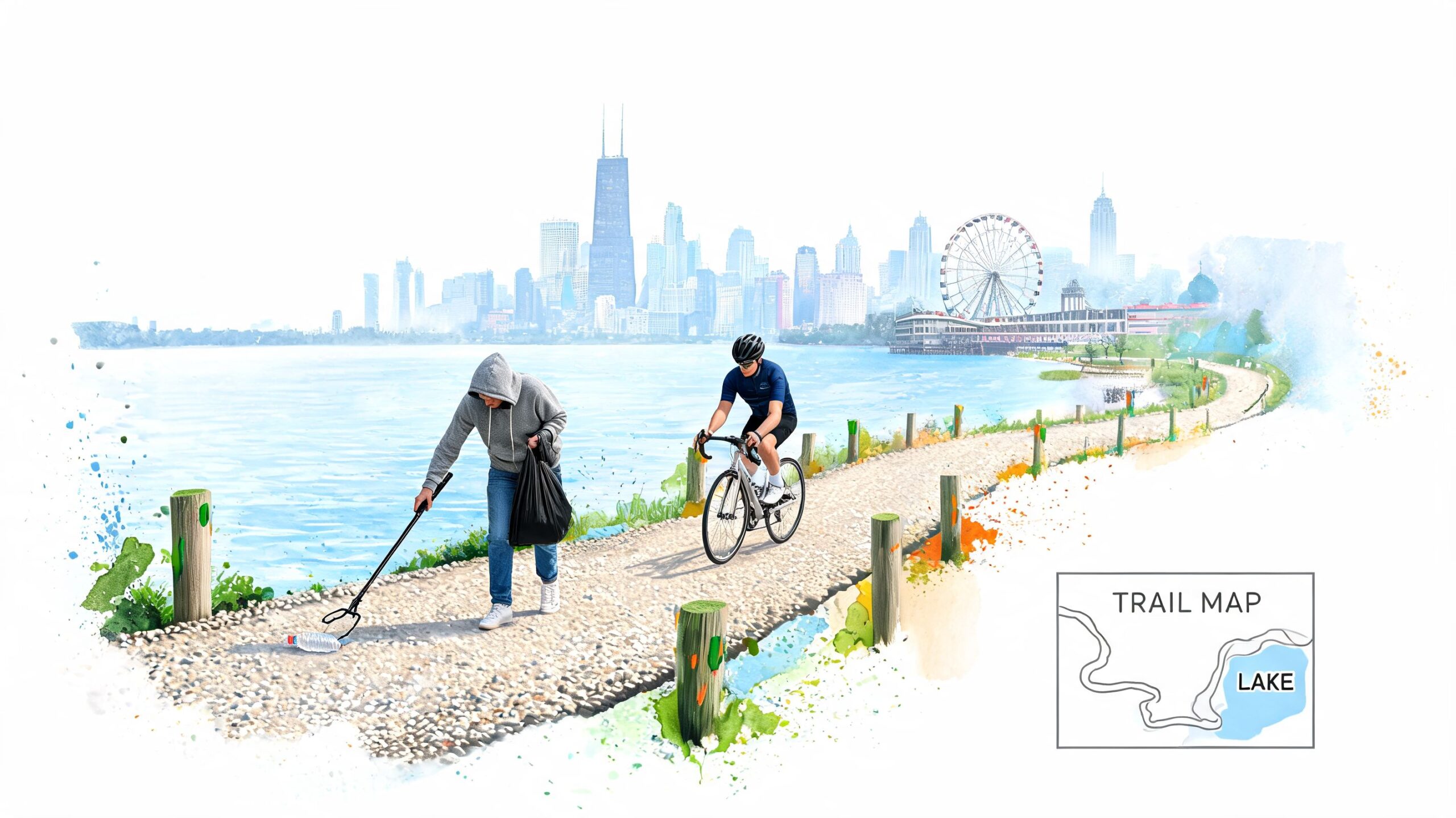
    I have seen that play out during cleanup days too. Someone comes for an hour, stays for three, then ends up sharing lunch on the sand with people who were strangers that morning. Access and comfort shape whether a beach feels welcoming enough for community to grow.

    If accessibility is part of your planning, check current Chicago Park District conditions before you leave home. Paths, beach equipment, and seasonal operations can change, so a quick check can save you a hard trip.

    Our Lakefront Environment and Its Challenges

    The first time I watched someone pull a handful of chip bags and sticky drink lids from the sand at 12th Street Beach, the water was sparkling. Kids were laughing. The skyline looked polished enough for a postcard. Then one of our Litter Caterpillars volunteers pointed to the gulls circling the snack debris and said, "That is how a beautiful beach starts slipping."

    That moment changed me. I stopped seeing cleanup as cosmetic work. I started seeing cause and effect.

    A scientist standing in water, examining a test tube against a backdrop of a city skyline illustration.

    What the water tests are checking

    At 12th Street Beach, summer water quality checks track Enterococci bacteria, and advisories are posted when levels rise above the safety threshold. The Swim Guide page for 12th Street Beach also notes that the beach often meets standards during peak season, while still facing periodic warnings tied to birds, runoff, and changing conditions.

    For visitors, the lesson is simple. Check the daily status before you swim. A clear, sunny morning can still come with a warning, especially after rough weather or heavy bird activity.

    I treat that habit the same way I treat sunscreen. Part of the trip.

    Why the beach sometimes gets a warning

    The two troublemakers show up again and again. Gull droppings. Stormwater runoff.

    Gulls gather where food scraps and litter collect. Rain washes pollutants from streets and walkways toward the lake. Put those together, and a beach that looked perfect at breakfast can become a poor choice for swimming by noon.

    That is one reason our cleanup work feels personal. Every bottle cap, sandwich wrapper, and abandoned snack bag changes the beach a little. If you want a clearer picture of that chain reaction, this guide to how littering on the beach affects wildlife and cleanup efforts connects the small stuff people leave behind with the bigger problems everyone else has to live with.

    A quick visual can make all of this easier to picture:

    The beach is built, not natural in the simple sense

    I love telling people this because it changes how they stand on the shore. 12th Street Beach is a perched beach, held in place by engineered protection below the waterline. It is public space, yes, but it is also maintained infrastructure, shaped and defended so Chicago can keep a swimmable beach along a hard-working urban lakefront, as reported by WTTW's Ask Geoffrey on the seawall and rail tracks.

    So caring for this beach means caring for something built with intention and kept alive through attention. Sand, water, wildlife, weather, and city use all meet here in one narrow band.

    I have seen people arrive for a cleanup thinking they are just picking up trash. An hour later, they are asking better questions. Where does runoff come from? Why are the gulls clustering here? Who maintains the shore after storms? That shift matters. A beach visit becomes stewardship.

    And that is the invitation 12th Street Beach keeps offering. Come for the swim, the skyline, the soft sand under your feet. Stay long enough to notice what the place needs. A tiny act on shore can ripple outward.

    How to Join a Beach Cleanup

    The first cleanup I ever joined felt less like volunteer work and more like the opening scene of a weird little adventure film. There were only three of us. Then Chicago did what Chicago does. The sky cracked open, hail started flying, and we huddled under a tree while ride after ride canceled on us.

    I was freezing. I was laughing. I also had a thought I still trust. Shared discomfort is strangely good at turning strangers into teammates.

    Why cleanup feels better than you think

    A lot of people hear "beach cleanup" and imagine scolding, drudgery, or a school requirement with bad snacks. My experience is the opposite. Cleanup has a little Tom Sawyer energy in it. The job looks plain from a distance, but once you're in it, the thing changes shape.

    You start spotting weird objects. You trade stories. Someone finds an impossible item half-buried in sand and everybody crowds around. A task becomes a game of attention. Then, after an hour or two, the place looks better because you were there. That feeling is hard to fake.

    Work gets lighter when people do it together and treat it like an outing instead of a punishment.

    A five-step infographic showing how to join and participate in a community beach cleanup event.

    What your first cleanup day usually looks like

    The practical side is simple. Most beach cleanups follow a rhythm that is easy to learn on the spot.

    1. You sign up ahead of time. Look for the event listing, RSVP, and read the notes so you know the meeting point.
    2. You show up in clothes you don't mind getting sandy. Closed-toe shoes help if the cleanup covers paths as well as sand.
    3. You check in and listen. Organizers usually explain the route, the boundaries, and basic safety.
    4. You collect litter with the group. Some people like grabbers. Some just use gloves and bags.
    5. You wrap up together. This is when people compare strange finds, sort what they can, and usually chat longer than expected.

    If you're looking for the setting many volunteers care about most, this page on a public beach on Lake Michigan captures why shoreline cleanups feel different from a random errand.

    How to actually find one

    This part stops a lot of people, even when they want to help. They assume there must be a secret process. There isn't.

    Try this:

    • Search Meetup first: Many volunteer groups post cleanups there because RSVP tools are simple.
    • Check Instagram: Stories and recent posts often have the freshest meeting details.
    • Read the event notes: Look for start time, exact meeting point, and whether supplies are provided.
    • Message if unsure: Organizers usually want you to ask. It helps everyone arrive ready.

    I like weekend morning cleanups best. The mood is better. People come because they mean to come. There is a generous, clear-headed energy to a morning group that you can feel within minutes.

    If you want to organize one yourself

    You don't need to become a superhero. You need a date, a meeting point, bags, gloves, and enough nerve to invite a few people.

    Start small. Three friends is enough. Pick a visible area. Keep the time short. Make safety the first rule and morale the second. If weather turns rough, adjust. Courage isn't acting reckless. Courage is showing up, paying attention, and making good calls.

    A cleanup works a lot like exercise. The hardest part is not the activity itself. It's crossing the distance between "I should" and "I'm here."

    Tips for Your Perfect Beach Day

    The best beach days I have seen at 12th Street Beach did not begin with a perfect forecast. They began with attention.

    One Saturday, a woman joined one of our Litter Caterpillars cleanups with a coffee in one hand and a look that said she had almost talked herself out of coming. We spent an hour picking bottle caps from the sand and snack wrappers from the rocks. Afterward, she stayed. Shoes off. Phone away. She sat near the water longer than anyone else in our group. Before she left, she told me, "I came here tense. I am leaving like my chest finally opened up."

    That is my favorite kind of beach day. You enjoy the place more because you helped care for it.
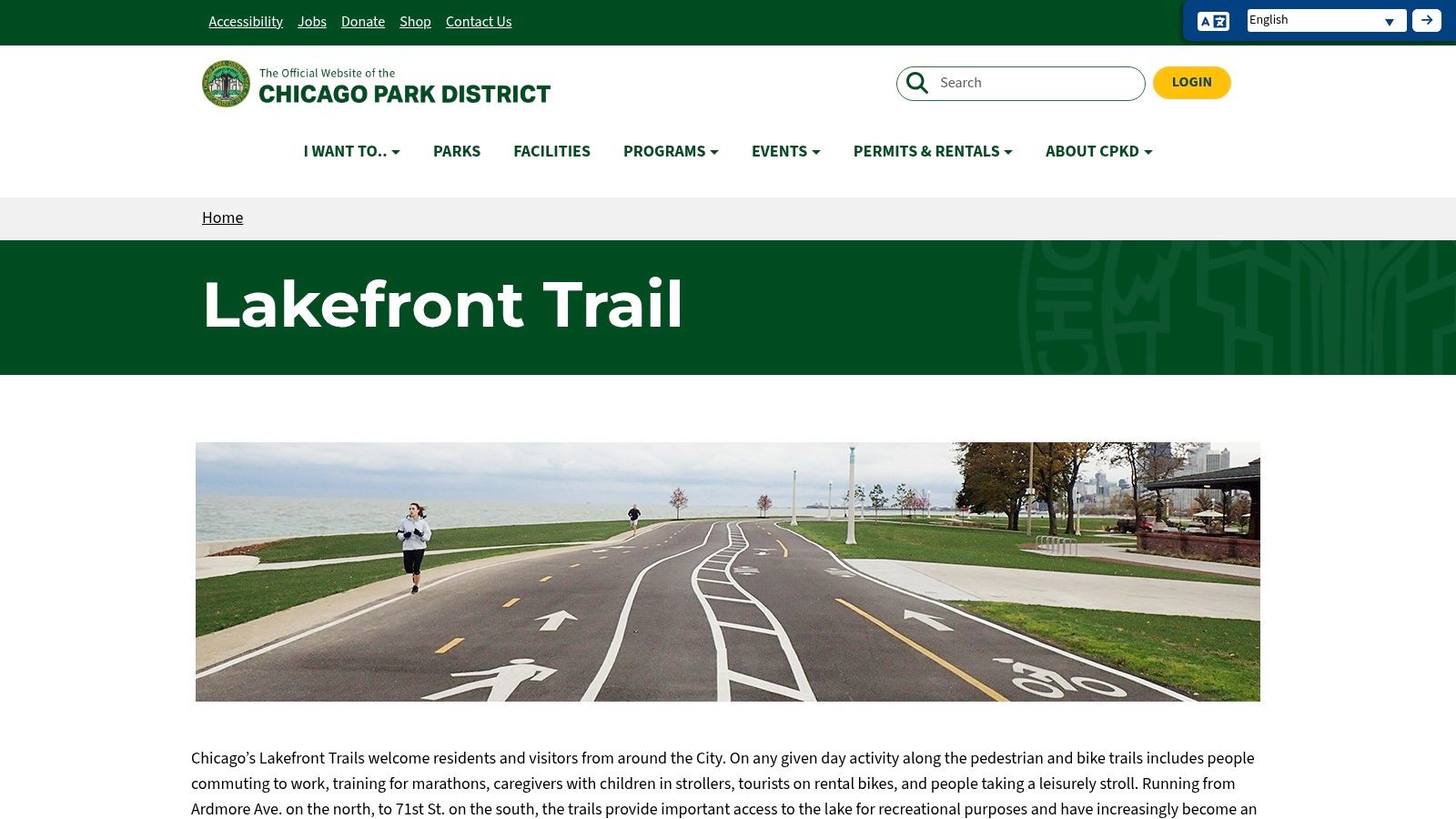
    What to bring and why

    I have learned to pack for ease, not for a grand production. The people who look most at peace out there are usually carrying a towel, water, and a small bag, not half their apartment.

    Bring a few things that earn their spot:

    • Water and sunscreen: The sun off the lake can sneak up on you.
    • A towel and one extra layer: Even warm afternoons can turn cool when the wind shifts.
    • Snacks in reusable containers: You eat better, and you create less trash that can blow into the water.
    • A small bag for your own waste: It takes almost no effort, and it changes how you leave a place.

    That last one matters more than people think. A good beach setup is not only about comfort. It is about leaving your patch of sand cleaner than you found it.

    Best timing for a calmer visit

    Early hours feel different here. The water looks steadier. The path is quieter. You hear gulls, bike wheels, and the soft slap of waves against the rocks before the bigger crowds arrive.

    Late afternoon has its own kind of magic. The skyline starts to glow, people settle down, and the beach feels less like a rush and more like a long exhale.

    If swimming is the heart of your day, check conditions before you go. If your plan is to read, talk, walk, or sit near the water, you still have plenty of room for a beautiful visit even when the lake is not inviting you in.

    A young man wearing sunglasses relaxes on a striped beach towel at 12th Street Beach.

    Make the day mean more

    One reason I keep returning to 12th Street Beach is that it can hold two truths at once. It is easy fun. It is also a place that asks something small and good of us.

    You can swim, stretch out on the sand, then wander toward Museum Campus and keep the day going on foot. You can come for the skyline, the water, and the relief of being outdoors in the middle of the city. You can also notice the corners where litter gathers after a busy weekend, pick up a few stray pieces on your way out, and leave the shoreline a little better for the next family, the next solo swimmer, the next tired person who comes looking for peace.

    My rule for a perfect beach day is simple.

    Leave with less than you brought. Less stress, less trash, less hurry.

    That is how a visit becomes something larger than a visit. It becomes practice for the kind of city we want to live in.

    Your Questions Answered

    Do I need to bring supplies for a cleanup

    Usually, no. Many cleanup groups provide bags, gloves, and grabbers. Still, read the event listing before you go. If you already own work gloves or a reusable water bottle, bring them.

    What if the weather turns bad

    Chicago weather likes drama. A little rain doesn't always stop a cleanup, but safety comes first. If conditions become risky, organizers usually adjust, pause, or cancel. Check the event page the morning of.

    Can I come alone

    Yes. In fact, coming alone is often the easiest way to meet people. You already have a built-in activity, which removes a lot of the awkwardness. You don't need a partner to belong there.

    Do I have to stay the whole time

    Usually not. Many groups appreciate any time you can give. If you can only stay for part of the event, say so at check-in and help for the time you have.

    What should I wear

    Wear clothes you can move in and don't mind getting dirty. Closed-toe shoes are a smart choice when the cleanup reaches paths, rocks, or hidden debris.


    If this stirred something in you, come meet the Litter Caterpillars. We're a Chicago volunteer group that picks up trash, builds friendships, and turns ordinary mornings into small adventures. If you want a way to care for the city while changing your own habits from the outside in, you'll fit right in.