Tag: chicago volunteer

  • A Guide to Lyons Woods Forest Preserve

    A Guide to Lyons Woods Forest Preserve

    Sometimes you just need to escape the city's noise, you know? That constant buzz. I’ve found my go-to spot just outside of Chicago, where the only sounds are rustling leaves and birdsong. It's called Lyons Woods Forest Preserve, and it's this little slice of wild in Waukegan that I've gotten to know really well. It's not just some park; it’s a whole story of nature and people coming together, and I want to tell you all about it.

    Your Guide to a Waukegan Hidden Gem

    Let me be your guide here. I want you to see Lyons Woods the way I do—not just as a spot on a map, but as a living, breathing place that calls to hikers, birders, and anyone who just needs a quiet minute. It's this deep feeling of finding the wild so close to home that keeps me and my friends at Litter Caterpillars going, making us fight to protect these places for everyone. You see, these pockets of nature are like lungs for the city, and when you step into one, you can finally take a full, deep breath.

    How This Place Came to Be

    This isn't just another park. Lyons Woods is what happens when a community decides to save a piece of nature for itself. I see it tucked away in Waukegan, a refuge covering 345 acres of woods, prairies, and wetlands that feel worlds away from the city. You know, the land was pieced together between 1976 and 1986, but it wasn't until 1996 that the trails and parking lot officially opened. You and I owe that to the voters who stepped up and supported a Forest Preserve referendum. When you walk here, you can still feel that community spirit under your feet.

    Today, you’ll find those 2.5 miles of gravel trails are perfect for hiking, biking, or even cross-country skiing when the snow flies. The best part? They link up with other regional paths, making it a key piece of a much larger greenway.

    I like to think of it as a neighborhood, but for nature. Each preserve has its own personality, but they're all connected, making the whole system stronger and more alive. It's a beautiful, sprawling tapestry woven from individual threads of green.

    To give you a quick idea of what to expect, here's a rundown of the essentials I put together.

    Lyons Woods at a Glance

    This table breaks down the key features and amenities you'll find when you visit. I find it’s a great little cheat sheet for planning your first trip.

    Feature Details
    Total Area 345 acres
    Trail Length 2.5 miles (gravel surface)
    Permitted Activities Hiking, Biking, Cross-Country Skiing, Fishing
    Dogs Allowed? Yes, on leash
    Parking On-site lot available
    Key Habitats Woodlands, Prairie, Wetlands

    It’s a straightforward, no-fuss kind of place, which is exactly why I love it.

    It’s More Than Just a Trail

    The first thing you’ll notice is how the scenery changes. One minute you're deep in the woods, wrapped in a cool, earthy scent, and the next, you're looking across a wide-open prairie where the sun warms your face. This mix is exactly what makes it such a critical sanctuary for wildlife. It reminds me a lot of the same feeling I get when we're out cleaning up other local gems. You can see what I mean by reading about our adventures at MacArthur Woods Forest Preserve.

    What I really want you to get from this is a sense of possibility. This place is a blank canvas. Every time you visit, you'll see something new. Whether you’re trying to catch the perfect sunrise with your camera or just looking for a quiet bench to sit and think, Lyons Woods has you covered. It's a place where you can feel the rhythm of nature and find a piece of yourself you didn't know was missing.

    So, let's get you ready to explore it.

    Exploring the Trails of Lyons Woods

    Alright, let's talk trails. When you’re at Lyons Woods, this is where the real magic happens. I want to take you on a walk with me, show you what I see, and get you ready to hit the ground running.

    The heart and soul of the preserve is a 2.5-mile gravel loop trail. This isn't some hardcore, expert-only path. It’s for everyone. I see families with rugged strollers, runners getting their miles in, and people just looking for a quiet place to think. I find myself on this loop all the time because of its gentle, rolling hills—just enough to make you feel like you’re working, but not so tough you miss the beauty around you.

    It’s a friendly trail that just flows, like a good conversation.
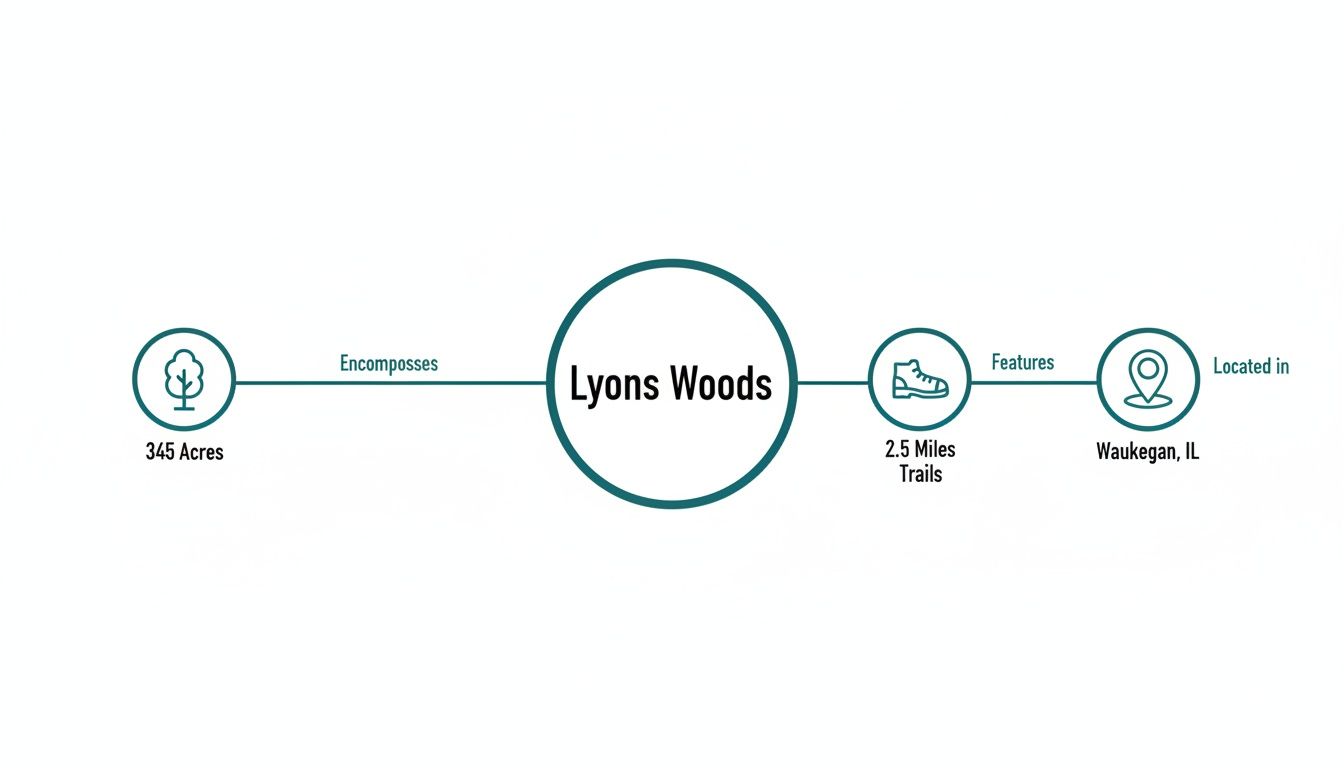
    Infographic about Lyons Woods: 345 acres, 2.5 miles of trails, located in Waukegan, IL.

    Navigating the Trail System

    One of my favorite things about this loop is that it’s not the end of the story. It’s the beginning. As you walk, you’ll spot little connector paths branching off. You follow them, and suddenly you find yourself on the McClory Trail.

    This is where your adventure can really expand. Suddenly, your simple 2.5-mile walk can become a serious journey. It’s awesome for you cyclists or anyone wanting to go the distance. Think of the main loop as your friendly neighborhood street and the McClory Trail as the highway it connects to, opening up the whole area for you to discover.

    I always tell people to treat the main loop as your home base. Explore it, learn its rhythm, and then when you're ready, take one of the side paths. See where it leads. You never know what you'll find. It’s like a choose-your-own-adventure story written in dirt and gravel.

    The feel of these trails changes completely depending on when you go.

    • Spring and Summer: The gravel is packed down and fast. In some spots, the trees are so full they form this incredible green tunnel. It feels like you’ve found a secret world.
    • Autumn: My absolute favorite time. You get the crunch of leaves under your feet, the crisp air, and the wild colors—it’s perfect. As the leaves fall, you start to see views you missed all summer.
    • Winter: After a good snow, the whole place goes quiet. It becomes this peaceful escape for cross-country skiing or just a bundled-up hike. You feel the silence; it’s something special.

    My Personal Tips for Your Hike

    A little bit of prep makes all the difference. While the trail is mostly gentle, a couple of the hills can sneak up on you. I think they’re great for getting your heart pumping!

    Also, you should keep an eye out for the benches along the loop. I’ve stopped at every single one. They’re in the perfect spots to catch your breath, have some water, and just listen to the woods.

    If you love this kind of trail system, you should definitely check out our guide on Waterfall Glen Forest. It's another one of my go-to spots, with its own unique vibe and challenges.

    No matter what you do out here—walk, run, or ski—the trails at Lyons Woods give you a chance to just be. They’re an invitation to slow down, breathe deep, and reconnect.

    Discover a Sanctuary for Wildlife

    When I first stepped into Lyons Woods, I didn't just see a bunch of trees. I saw a secret, bustling city, one that’s alive with creatures most people never notice. This place isn't just a park for us; it’s a living, breathing sanctuary for an incredible amount of wildlife. Let me introduce you to some of the locals.
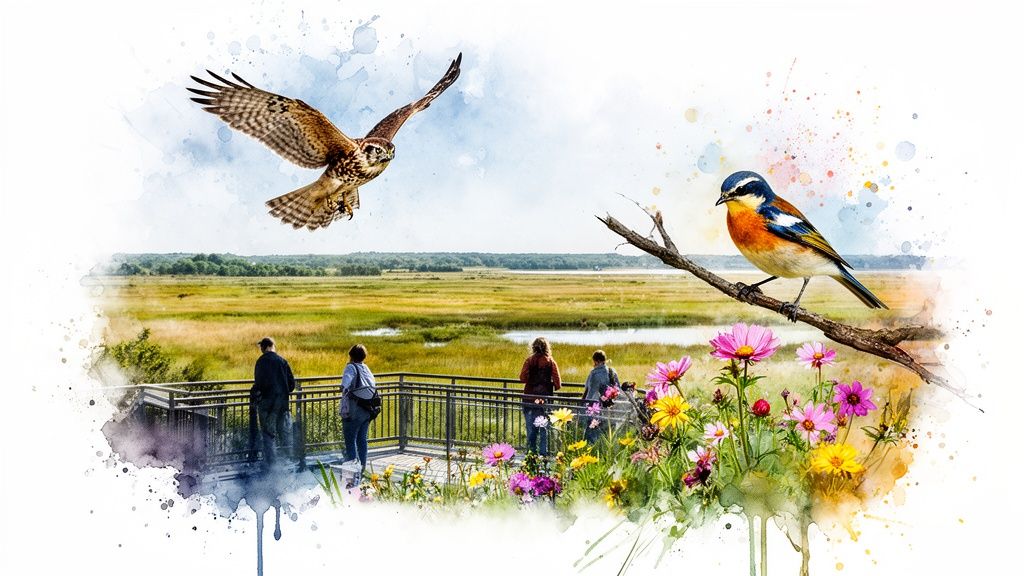
    People watch a hawk and a small bird over a beautiful, vibrant marsh landscape.

    This place is an ecological powerhouse. It's a safe harbor for five state-endangered species, with one so rare its very existence is on the line. To give them a fighting chance, ecologists and volunteers have been putting in the work, planting over 1,000 native trees and shrubs. You can see them constantly battling invasive species with controlled burns and hard-nosed clearing.

    That's a story of resilience that hits close to home for me. It's exactly what we do at Litter Caterpillars—showing up, doing the tough stuff, and making a real, visible difference. If you want the full story on what makes this habitat tick, you can learn more about the ecological treasures of Lyons Woods on LCFPD.org.

    A Paradise for Birdwatchers

    If you’re a birder, you need to get here. Lyons Woods is smack-dab on the Lake Michigan flyway, which is basically a superhighway for migrating birds. I’ve lost hours just watching them pass through. In spring and fall, the sky just explodes with life.

    I remember one crisp autumn morning, standing on the observation deck, watching a northern goshawk just circle high above the prairie. Total freedom. It’s moments like that that remind you why you're out here in the first place. You feel a connection to something ancient and wild.

    The sheer variety is unreal. You might spot:

    • Majestic Raptors: Keep your eyes peeled for the northern goshawk, a powerful and elusive hunter.
    • Rare Visitors: Birds like the Townsend's solitaire and the white-winged crossbill sometimes make special appearances during their long journeys.
    • Colorful Warblers: The preserve hosts one of Lake County's highest diversities of breeding warblers, including the common yellowthroat, blue-winged warbler, and ovenbird.

    Their songs are the soundtrack of the woods. It’s a constant, cheerful chatter that fills the air. It’s like nature’s own orchestra, and you’ve got a front-row seat.

    Life Beyond the Birds

    But the life here isn’t just in the sky. As you walk the trails, you're moving through a whole world of prairies, woodlands, and savannas, each buzzing with its own unique community.

    I love climbing the observation deck and just taking it all in. From up there, you can see the whole dance unfold—butterflies drifting over fields of wildflowers, tall prairie grasses swaying, maybe even a white-tailed deer slipping out from the treeline at dusk. The landscape itself is part of the story, a patchwork of habitats that supports everything.

    This rich variety of plant life is the foundation holding it all together. Once you start to understand what's growing here, you see the whole ecosystem differently. If you’re curious about the flora that makes places like this possible, check out our guide on native and notable trees in Illinois.

    Lyons Woods teaches you a crucial lesson: everything is connected. The soil, the plants, the insects, the birds, and us. Protecting these places isn’t just about saving a few rare species. It’s about protecting the entire, fragile web of life—and proving that this wild city will keep thriving for generations to come, all because we cared enough to try.

    Uncovering the History Beneath Your Feet

    Every time I walk through Lyons Woods, I get this feeling that I'm not just walking on dirt and leaves. I'm walking through layers of history. It's like flipping through a really old book, and it gives a totally different weight to my experience.

    The story starts way back in 1843. A settler named Isaac Reed Lyons claimed this land as his own. You can almost picture it—a wild, untouched canvas that he was just beginning to shape. That was the first chapter.

    But this isn't just a story about one family's homestead. This land was meant for something much, much bigger.

    A Sanctuary for Freedom

    The property eventually ended up in the hands of an abolitionist, Philip Blanchard. And this is where the story gives me chills. Blanchard's home became a critical stop on the Underground Railroad, a secret network offering a path to freedom for people escaping slavery.

    Just stop and think about that for a second. Right where you might be standing, listening to the birds, a family could have been hiding, praying for the cover of darkness. The rustle of leaves you hear today might have been the sound that signaled safety—or danger—to someone risking everything for their life.

    This ground is hallowed. It was a place of unbelievable courage, for both the freedom seekers who risked it all and for allies like Blanchard who opened their homes and their hearts. It’s a powerful reminder that this land has always been a place of sanctuary and hope. It’s like a quiet monument to human bravery.

    This history of quiet, brave action hits me right in the gut. It's exactly what we believe in at Litter Caterpillars—that small acts of courage, done with real conviction, can literally change the world for someone.

    From Private Land to Public Trust

    The story keeps going. For a long time, the land was a patchwork of private properties, but its deeper meaning was never lost. The land that belonged to Isaac Lyons and later Philip Blanchard eventually became part of a bigger vision for conservation. Now, it's owned by the Lake County Forest Preserve District, which is Illinois' second-largest, taking care of over 31,200 acres and 200 miles of trails since it started in 1958. This move from private hands to a public trust means these powerful stories and precious habitats are protected for good. You can dig deeper into the history of this incredible spot on the Illinois DNR website.

    This whole arc—from settler's claim to a stop on the road to freedom, and finally to a preserved public space—is what makes Lyons Woods so special. I feel it’s more than just a beautiful hike; it’s a pilgrimage.

    • 1843: Isaac Reed Lyons settles the land.
    • Mid-1800s: Philip Blanchard's property becomes a stop on the Underground Railroad, a lifeline for those escaping slavery and heading toward Canada.
    • 1958: The Lake County Forest Preserve District is born, kicking off a new era of conservation.
    • Today: The preserve stands as a monument to both the power of nature and the bravery of people.

    Knowing these stories changes everything about your visit. You're not just a hiker anymore; you're a witness. You're connecting with the generations who fought for liberty, who found sanctuary here, and who had the vision to protect this place for you, right where you stand. It fills me with a sense of purpose every single time I'm here.

    How to Plan Your Visit to Lyons Woods

    Every adventure, even a small one, starts with knowing where you're going. You wouldn't just wander into a new neighborhood without a map, right? So let’s get the practical stuff out of the way.

    This is our pre-hike huddle. I’ll give you the basic details so you can show up ready to explore, not scrambling to figure out logistics.

    Getting There and Getting Started

    Finding Lyons Woods is easy. The main parking lot is right at the corner of Blanchard Road and Sheridan Road in Waukegan. You can't miss it. You pull in, you park, and the trails are right there waiting for you.

    The preserve is open every single day of the year, from 6:30 a.m. to sunset. That means you can get there for a quiet sunrise or catch that amazing late afternoon light filtering through the trees. No excuses.

    This place is a reliable escape. For a group like our Litter Caterpillars, a spot that's open 365 days a year is a goldmine for volunteer cleanups. It’s where we can practice bravery and come together to protect these natural spots so close to the city. You can get more of the official details from the Lake County Forest Preserve District's official page.

    The Rules of the Trail

    Don't think of these as "rules." I think of them as the basic respect we show the place and each other. It’s how you and I keep the woods healthy for the animals and safe for everyone.

    • Dogs: You should bring your four-legged friends! They're welcome, but you have to keep them on a leash (no more than 10 feet long) and on the trails.
    • Bikes: You can ride your bike on the main gravel trails. It’s a great, casual ride and even connects over to the McClory Trail if you want to go farther.
    • Fishing: Yes, you can fish here. Just make sure you have your Illinois fishing license first.

    Following these is just common sense. It's a simple handshake with nature, a sign of mutual respect that makes it a good experience for you and everyone else.

    Staying Safe and Prepared

    Your safety is the top priority. It's the same thing I stress at every Litter Caterpillars cleanup. A little bit of prep makes all the difference, especially with Chicago weather being so famously unpredictable. I always check the forecast and dress in layers you can add or remove.

    If you see wildlife, like a deer or a coyote, just give it space. You’re in their home. Watch from a distance, appreciate the moment, and move on. Never, ever feed them.

    And one last thing—I tell someone where I'm going and when I think I'll be back. I do this every time I go out, whether I'm with a group or by myself. It's a simple habit that brings peace of mind. Now you're ready. Go explore and let the wildness of Lyons Woods do its thing.

    Are You Tough Enough to Protect This Place?

    Feeling something? Good. When you walk through Lyons Woods Forest Preserve, you get this quiet but powerful feeling—a sense of what’s possible when people actually show up for the places they love. Now, I’m personally asking you to turn that feeling into action.
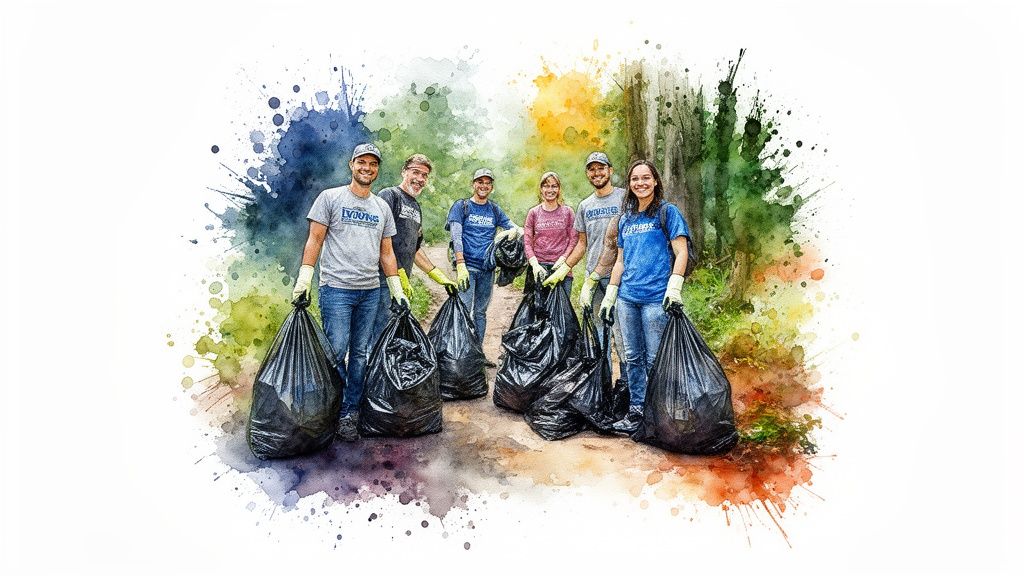
    Six smiling volunteers hold black trash bags in a forest preserve cleanup, wearing t-shirts and gloves.

    This isn’t just about picking up some trash. It’s about transforming ourselves and our city, one empty bottle and chip bag at a time. It’s about you and me building a crew of people who care enough to do something.

    We’re Not Your Average Cleanup Group

    At Litter Caterpillars, we have this crazy idea that cleaning up other people's messes can actually be fun. I know, it sounds nuts. But something happens when you’re out there with a group of people who are just as committed as you are. You make friendships. You actually look forward to the next weekend. This habit of service just becomes part of who you are.

    It’s like I always say: cleaning other people's messes is WAY easier than cleaning up our own.

    We have just one rule: you show up. That’s it. That’s the first step to changing everything.

    I’ve learned that suffering and freezing in a Chicago hailstorm is way easier with friends. It adds flavor to the story. It advances the plot. This is how we build resilience, together, by turning challenges into adventures.

    The spirit of restoration is baked into this place. The Lyons Prairie and Woods Nature Preserve, a 272-acre section right inside the larger forest, was officially dedicated on March 1, 2002. It protects some of the last original habitat in the area—the kind of stuff Illinois looked like before we paved everything over. I see that dedication as a mirror of our own grit. You can read more about this dedicated nature preserve on the Illinois DNR website.

    Your Invitation to Join the Movement

    So, how do you get in on this? I want to make it dead simple for you to join us. We’re a friendly bunch, I swear. This is your personal invitation to jump in.

    Here’s how you can connect with the Litter Caterpillars and find your first cleanup, whether it’s at Lyons Woods or another one of our spots around Chicago:

    • Find Our Next Event on Meetup: This is our command center. You can see where we’ll be this weekend, what time to meet, and what to expect. Just search for "Litter Caterpillars" and join the group.
    • Connect With Us on Instagram: Follow our story @littercaterpillars for a look behind the scenes, event photos, and your daily dose of inspiration. It’s the best way to see our community in action.
    • Just Show Up: Seriously. You find an event that works for you and come say hi. We’ll have all the gear you need—gloves, bags, the works.

    This is your shot to be part of something real. It’s about taking pride in our city, making friends who give a damn, and proving that kind, brave people can make a huge difference.

    I can't wait to see you out there.

    A Few Final Things

    Got some questions before you head out? Good. I think planning is part of the adventure. I get tons of questions about Lyons Woods, so I've put the most common ones right here. Let’s get them sorted so you can get out there.

    Can I Bring My Dog to Lyons Woods?

    Yes! Your dog is welcome. I love seeing dogs on the trail, but you and I have to be good neighbors to the space and to other people.

    Just keep them on a leash—no longer than 10 feet—and stay on the paths. And, of course, you have to pick up what they leave behind. It’s a simple act of respect that keeps the preserve beautiful for the wildlife and for every single person who comes after you.

    How Accessible Is the Preserve?

    This is a really important question. The main loop is a 2.5-mile trail made of crushed gravel. I've seen some heavy-duty strollers and wheelchairs make it through, but it’s not a smooth, paved path. For some, it could be a real challenge.

    There is accessible parking, which is great.

    My advice is to think of it like any adventure: know your gear and know your limits. If you have specific accessibility needs, I'd give the Lake County Forest Preserves a call before you go. A little prep work makes sure your day is about enjoying nature, not fighting with the terrain.

    What's the Best Season to Visit?

    People ask me this all the time, and honestly, there's no wrong answer. Asking me for the "best" season at Lyons Woods is like asking which part of a song is the best—you need the whole thing to get the full story.

    • Spring is a straight-up explosion of life. You see wildflowers are everywhere, and the birds are back, making a racket.
    • Summer is all about that deep, lush green. The tree canopy creates these cool, shaded tunnels that are a gift on a hot day.
    • Fall is a show-off. The colors get so intense you’ll think your eyes are playing tricks on you. It's breathtaking.
    • Winter is quiet and peaceful. A fresh snowfall turns the whole place into a silent, white wonderland. I find it perfect for a walk to clear my head.

    Like we say at Litter Caterpillars, don’t let the weather dictate your life. A little rain or snow just adds flavor to the story.


    Ready to turn your inspiration into action? At Litter Caterpillars, we believe in the power of showing up and making a difference together. Find our next cleanup event and join a community that’s changing Chicago one piece of trash at a time. Learn more and join us here.

  • What Is Environmental Restoration and How Can You Be a Part of It

    What Is Environmental Restoration and How Can You Be a Part of It

    So, what exactly is environmental restoration? I find the textbook answer a bit dry: assisting the recovery of an ecosystem that has been degraded, damaged, or destroyed.

    That definition misses the soul of it. A better way I think about it is giving nature a helping hand, like a friend, so it can start to heal itself. It's an act of hope.

    What Is Environmental Restoration Anyway?

    Have you ever felt like your own life was a total mess? I know I have. There were times my apartment got so cluttered, old food piling up in the fridge, that every single object felt like it weighed 500 pounds, loaded down with stories I just couldn't let go of. My life felt just as disorganized as my living space.

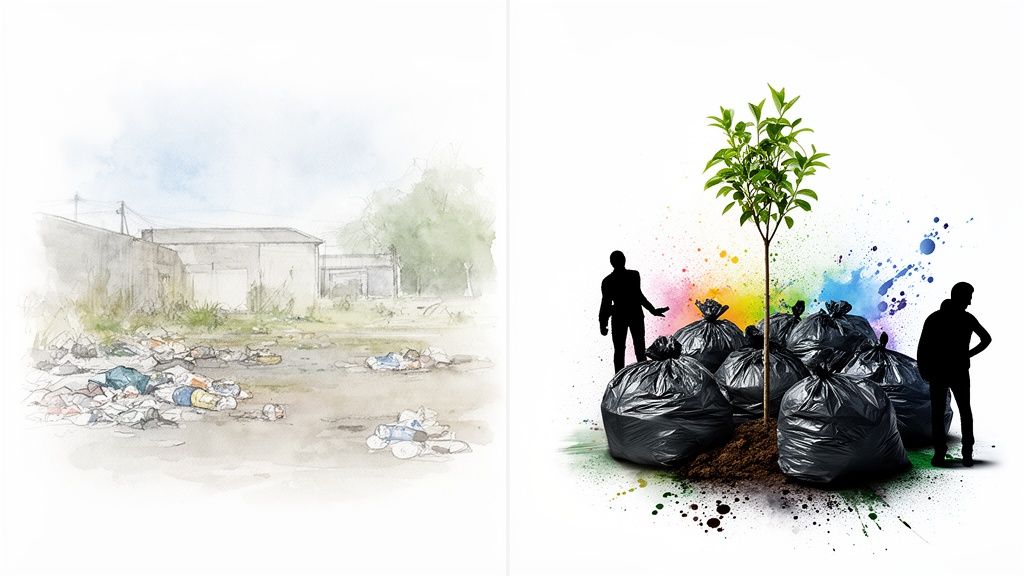
    This personal struggle I faced is the perfect analogy for understanding environmental restoration. Imagine a vacant city lot. It's choked with weeds. It's covered in trash and broken glass. This is a space that's been neglected, damaged, and forgotten. You can't just leave it alone and hope for the best; the damage is already done.

    That’s where you and I come in. Environmental restoration is our act of stepping into that lot, clearing out all the junk, and actively working to bring it back to life. I want you to see that it’s not just about cleaning up—it’s about rebuilding from the ground up, with purpose.

    More Than Just a Cleanup Job

    Honestly, the real reason I started Litter Caterpillars was to clean up my own life. I discovered something strange: cleaning up someone else’s mess—the city's mess—was way easier and more empowering. This is the exact same idea in restoration. We aren't just tidying up a space; we are creating the right conditions for life to come roaring back.

    This process involves a few key, deliberate steps I've learned to take:

    • Removing Harm: This means you get rid of the bad stuff first. Think pollutants, invasive weeds, or all the physical trash that’s stopping the ecosystem from working properly.
    • Reintroducing Life: Once the junk is gone, we bring back the good stuff. You can plant native flowers, trees, and grasses that actually belong in that specific place.
    • Rebuilding Structure: Sometimes you have to rebuild the foundation itself, like restoring the natural bends in a stream or rebuilding the soil health so new plants can actually take root.

    Essentially, we’re giving that little piece of land the tools it needs to start its own healing journey. I see it as a true partnership with nature.

    It helps me to see how restoration stacks up against other environmental actions people talk about. They're all important, but you'll see they are not the same thing.

    Restoration vs Other Green Actions

    Understanding the key differences between common environmental terms.

    Action What It Means Real-World Analogy
    Restoration Actively rebuilding a damaged ecosystem to its former state. Performing surgery and physical therapy after a serious injury.
    Conservation Protecting existing healthy ecosystems from future harm. Eating healthy and exercising to prevent future health problems.
    Remediation Focusing specifically on cleaning up pollutants from soil or water. Detoxing the body by removing a specific harmful substance.
    Rehabilitation Improving a degraded ecosystem without aiming for its original state. Helping someone walk again with a prosthetic leg—it's functional, but not the original.

    Each of these plays a role, but restoration is unique because it's about actively turning back the clock on damage.

    A Journey of Transformation

    My own transformation started the moment I decided to face the things that were hardest for me: cleanliness, consistency, and bravery. I started a trash pickup group to intentionally build my social circle with givers and to prove to myself I could actually show up, week after week.

    This act of service became a mirror for my own restoration. By cleaning up our city, I was cleaning up my own internal landscape. We are all caterpillars, trying to transform ourselves. Helping our environment is a powerful way for you to begin.

    This is the core of what environmental restoration feels like. It’s an active, hopeful process. It’s about taking a broken piece of the world and, with our own two hands, helping it become whole again.

    For anyone curious about how this connects to a broader sense of responsibility, you might be interested in our guide on environmental stewardship. It's a powerful framework for understanding our role in protecting and healing the planet.

    From Your Block to the Entire Planet

    Have you ever picked up a single plastic bottle and wondered, does this even matter? I’m here to tell you: it’s everything. That one small act connects you to a massive, global movement of healing. Each piece of trash you bag, each native seed you plant, creates a ripple that travels far beyond your block.

    I’ll never forget our first Litter Caterpillars outing. A wild story. There were only three of us, and in classic Chicago fashion, a beautiful spring day turned on us and unleashed a freak hailstorm. We huddled under a tree, shivering, watching every single Uber cancel on us one by one. And in that moment, I had a strange thought: this is actually fun. The suffering added a kind of flavor to it.

    Cold and miserable, that's where our identity was forged. We learned that cleaning up other people's messes is incredibly empowering. I realized it takes a certain kind of bravery to serve your community, especially when it’s uncomfortable.

    The Power in a Single Action

    That spirit of "bravery in service," born in a hailstorm, is the exact same energy that fuels enormous international restoration projects. Your effort on a Saturday morning isn't some isolated good deed; you are part of something huge. The core of what is environmental restoration is simply taking action, no matter how small it feels.

    The decision to show up for your patch of earth—your park, your block, your riverbank—is the first and most important step. It’s a vote of confidence in the future, a declaration that you believe things can get better.

    This is what we're talking about. Restoration isn't some fuzzy concept; it's about real work.

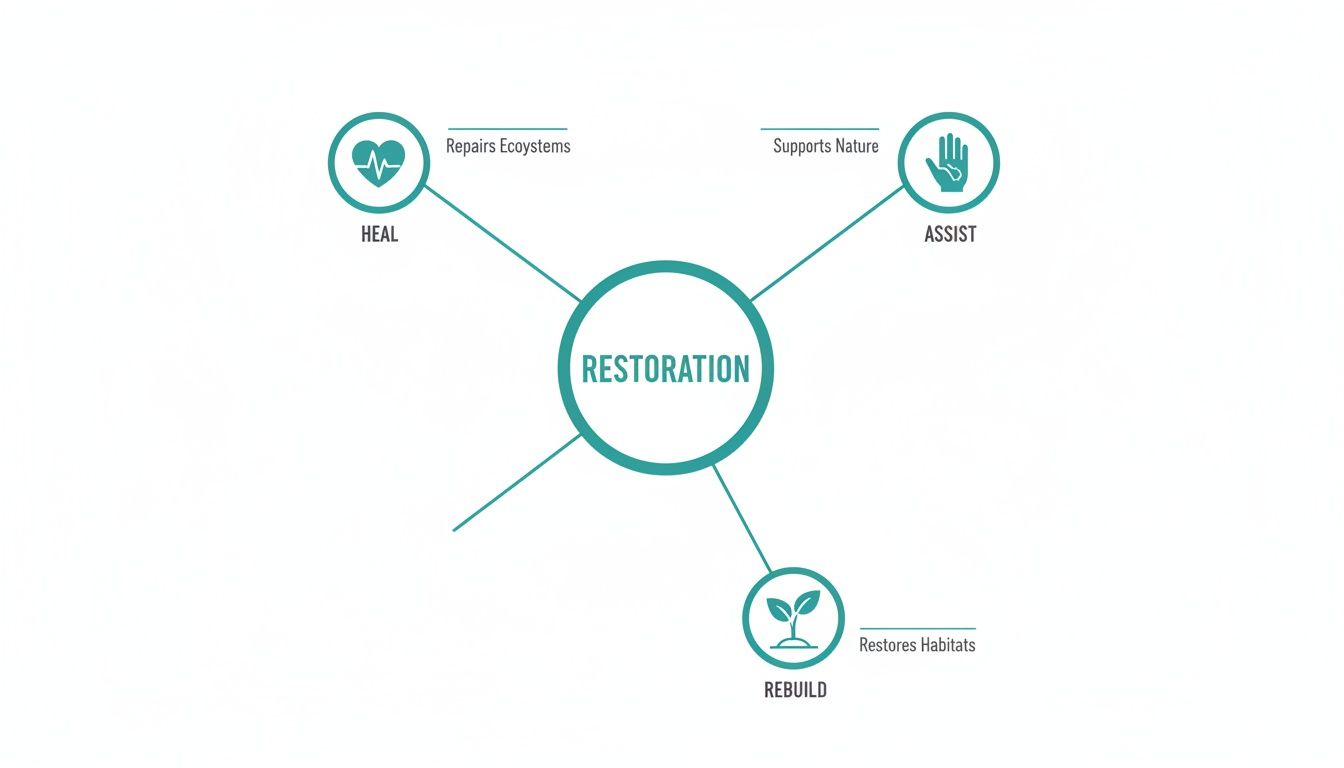
    Diagram explaining environmental restoration through healing ecosystems, assisting nature, and rebuilding habitats with icons.

    It boils down to healing what's broken, giving nature a helping hand to recover, and actively rebuilding habitats that have been lost. It’s a powerful mix of hands-on help and letting nature do what it does best.

    A Global Ripple Effect

    Those small, local actions you take? They add up to a tremendous global force. Our planet is facing huge challenges from deforestation, unchecked city growth, and a climate that’s spinning out of control. But people everywhere are responding. They're creating not just ecological change but massive economic momentum, too.

    The push to restore degraded lands is now a booming industry. In 2023, the global ecological restoration market was valued at an incredible USD 14.25 billion. It’s projected to surge to USD 24.65 billion by 2033, growing at a steady 5.63% each year. This isn't just about planting trees; it’s about creating jobs, building resilient communities, and investing in a healthier planet. You can see the explosive growth for yourself in recent market reports.

    This growth proves that governments and big industries are finally catching on to what volunteers like you have known all along: healing our environment is one of the best investments we can possibly make. It's proof that the work you do matters on a scale you might not even be able to see.

    You Are Part of the Wave

    When we started Litter Caterpillars, we weren’t thinking about global markets. I was thinking about the trash on our streets in Chicago. But the truth is, the two are directly connected.

    Community-led projects like ours create waves. They inspire others, they build local skills, and they show what's possible when people work together. This local momentum often pushes for bigger, system-wide changes.

    • You build community resilience: Cleaning a park with your neighbors isn't just about picking up litter. You're building relationships and a shared sense of ownership.
    • You create a proof of concept: A small, successful project can attract more resources for bigger efforts down the line. It shows the world what works.
    • You inspire a culture of stewardship: Your actions show others that they can make a difference, too, creating a cycle of positive change.

    So, the next time you’re out there, know that your hands are part of a global force for good. That one bottle you grab is one less piece of plastic in the ocean. That one invasive weed you pull gives a native plant a fighting chance. You are part of the answer.

    The Different Ways We Heal Our World

    Environmental restoration isn’t some magic wand you can wave over a trashed-out landscape. It’s more like a doctor's bag, but for the Earth. You wouldn't put a band-aid on a broken bone, right? Same idea here. You can’t use the same technique for a forest after a wildfire as you would for a polluted river snaking through a city.
    Every single place has its own story of what went wrong. Our job is to listen to that story—really listen—and then pick the right tools to help it start healing. The real skill behind what is environmental restoration is knowing what to do and when. It’s creative, it’s hands-on, and it’s happening all around you.

    From Forests to Floodplains

    When most people I talk to think of restoration, they probably picture planting trees. And yeah, reforestation is a huge one. After a fire torches a mountainside, I see replanting as giving it a fresh start. It stops the soil from washing away and brings back a home for all the critters that lost theirs.

    Then you have wetland restoration. I think of this as unclogging our planet's kidneys. Wetlands are supposed to be these incredible natural filters that clean our water and soak up floods. But for centuries, we've just been draining them to build stuff. Bringing them back means restoring that natural sponge, which is one of our best defenses against pollution and crazy weather.

    And of course, you've got coastal restoration. This is all about rebuilding sand dunes, replanting marshes, and even restoring oyster reefs to protect our shorelines. These living barriers honestly work better than concrete seawalls, and they’re usually cheaper too.

    This isn't just some niche hobby for nature lovers anymore; it's becoming a massive global movement. The market for this kind of work is projected to be worth $5 billion in 2025 and is expected to shoot up to $9 billion by 2033. That growth is happening because we’re finally getting serious about biodiversity loss and climate change, and people are realizing nature has the best solutions. You can read more about these exciting market trends to see how healing nature is becoming big business.

    Urban Restoration: A Special Kind of Healing

    My passion, and the work we do every single week at Litter Caterpillars, is a special category: urban restoration. Here in Chicago, we see firsthand how even the most forgotten, junk-filled corners of a city can be brought back to life. We’re turning trashed-out lots into vibrant green spaces that actually serve the community.

    Urban restoration is different because it’s not just about healing the land; it’s about healing people and neighborhoods, too. When we turn an empty lot into a little park, we're not just planting flowers. We’re creating a place for neighbors to meet, for kids to play safely.

    There are some amazing techniques we can use right here in the city:

    • The Miyawaki Method: This is an incredible approach where you plant a super-dense, diverse mix of native plants in a small area. Because they have to compete for sunlight, they grow insanely fast—up to 10 times faster than normal. You can basically create a tiny, self-sufficient forest in just a few years.
    • Soil Bioremediation: Sometimes the ground itself is sick, contaminated with all sorts of nasty stuff. We can actually use special plants and microbes to "supercharge" the soil, helping it break down those toxins and become healthy enough to support life again.
    • Green Infrastructure: This just means using nature to solve city problems. Think rain gardens that soak up stormwater so our sewers don't overflow, or green roofs that cool down buildings and cut energy bills.

    At its heart, urban restoration is an act of hope. It’s a declaration that no space is too small or too damaged to be healed. It’s about seeing the potential for life in a patch of dirt and having the bravery to help bring it forth.

    From a massive coastline to a small park down your street, the idea is the same. We figure out what’s wrong, pick the right remedy, and give nature the support it needs to come roaring back. You have the power to be a part of this healing, right where you are.

    Stories of Transformation: Real Restoration in Action

    A man plants a young tree in a field of vibrant wildflowers with a spade.

    It’s easy for me to talk about restoration methods, but seeing a place change with your own eyes? That’s something else entirely. The real power is in the stories. They show that behind all the science, there are people—full of hope and bravery—making a real difference.

    Let me tell you one of those stories. It’s one that’s still being written, and it’s one that I and the Litter Caterpillars are incredibly proud to be a part of. It’s the story of Caterpillar Park.

    From Abandoned Lot to Community Asset

    In the heart of Englewood, on Chicago’s South Side, there was an empty lot. Like a lot of them, it was just a forgotten space, collecting trash and telling a story of neglect. But we looked at it and saw something totally different. We saw potential.

    So we did something that felt a little nuts at the time: we entered a city auction and bought it. Just like that, this abandoned piece of land was ours. This wasn't just a purchase; it was a commitment. It was us putting our values of bravery, kindness, and unity into action.

    Our dream for this lot is to turn it from a forgotten space into a living, breathing part of the community. This is what environmental restoration is all about on the ground floor. It’s about taking ownership, getting your hands dirty, and believing you can bring life back to a place that desperately needs it. Caterpillar Park is our living experiment in urban restoration.

    This project is more than just planting flowers. It's about planting roots in a community and showing that with a little courage and a lot of teamwork, we can create pockets of beauty and hope right where we live.

    The Big Picture: A Global Goal

    Our work in Englewood is just one tiny piece of a huge puzzle. While we’re focused on a single lot in Chicago, it’s inspiring to know we’re not alone. People all over the world are working toward the exact same goal, but on a massive scale.

    In fact, the world has set some incredibly ambitious targets. One of the boldest is a global agreement to get at least 30% of the world’s degraded lands and seas under effective restoration by 2030. This isn't some vague promise; it's a real, measurable target that countries are working on right now under the Kunming-Montreal Global Biodiversity Framework. Starting in 2026, nations will report their progress, turning these big ideas into real action. If you're curious, you can learn more about countries advancing their restoration monitoring.

    It just goes to show that from a small group of volunteers in one city to a coordinated global effort, the mission is exactly the same: to heal our planet, piece by piece.

    Inspiring Projects Near and Far

    This spirit of restoration is catching fire everywhere, with incredible stories popping up all over. These projects, big and small, show the amazing creativity and dedication people bring to healing their own local environments.

    Here are a few that I find really inspiring:

    • Oyster Reef Restoration: On Long Island Sound, I see groups rebuilding oyster reefs. This isn't just about seafood; these reefs are natural walls that protect coastlines from erosion and act as powerful water filters, cleaning the entire area.
    • Indigenous-Led Learning: A project in Connecticut is building a center that mixes modern green design with traditional Tribal knowledge. I find this a beautiful example of how respecting cultural heritage can lead to stronger, more sustainable communities.
    • From Soil to Sound: A college in New York is showing urban agriculture students how soil health directly impacts the health of nearby waterways. They’re learning firsthand how to use green infrastructure to fight city pollution.

    These stories, from our own Caterpillar Park to the shores of the Atlantic, are all part of the same powerful movement. They prove that restoration is happening everywhere, driven by people who believe in a better future. The problems we face, like waste and pollution, are everywhere, which is why actions even far from the coast matter. For a closer look at that connection, you can read also about the impact of littering on our beaches. Every piece of land is connected to our water.

    Why This Is So Much Bigger Than a Clean Park

    The benefits of environmental restoration go way beyond just having a cleaner-looking neighborhood. When we get our hands dirty, we’re not just picking up litter; we’re transforming ourselves and our communities from the inside out. I see it happen every single week.

    This work sparks change on three different levels all at once: for nature, for us as people, and even for our wallets. It's an investment that pays you back in ways you’d never expect.

    The Big Win for Nature

    First, let's talk about the ecological win. When we restore a piece of land, we’re doing a lot more than just making it look nice. We’re bringing back biodiversity. A healthy ecosystem isn't some neat, tidy lawn; it’s a chaotic, beautiful symphony of different plants, insects, and animals all working together.

    Think of a restored area as a stronger, more resilient community. I've seen how a single native garden can support hundreds of species of bees and butterflies. A mowed lawn? It supports almost nothing. By bringing back what's supposed to be there, we’re creating a much tougher, more adaptable environment.

    It's like building an immune system for our planet. A diverse ecosystem can handle shocks like droughts or floods, just like a healthy body can fight off a cold. Restoration makes our shared home stronger.

    This resilience is everything. I've read about how a healthy floodplain can soak up massive amounts of rainwater, protecting homes from getting destroyed. Restored coastal marshes become natural shields against storm surges. We're not just planting flowers; we're rebuilding nature's own defense system.

    The Big Win for People

    This is the part that gets me the most fired up. When I first started Litter Caterpillars, I had a secret mission: I wanted to engineer my social circle with givers. I was sick of selfishness and wanted to surround myself with people who show up. It worked better than I ever could have imagined.

    Our weekend morning meetups do exactly that. They build real, solid friendships. When you work side-by-side with someone—sweating, laughing, and getting dirty for a cause you both believe in—you build a kind of trust you just can't get anywhere else.

    • Building Real Community: These projects become magnets for people who actually care. You meet your neighbors, you hear their stories, and you build a shared pride in the place you all call home.
    • Fixing Your Headspace: Being outside, working with your hands, and seeing the direct impact of your effort is unbelievably good for the soul. I find it fights that feeling of helplessness and gives you a powerful sense of purpose.
    • Learning to Trust Yourself: This has been a huge one for me personally. The simple act of service—of just showing up, again and again—helps you learn to trust and forgive yourself. It’s not just about the trash; it’s about personal growth, unity, and the redemption that comes from serving something bigger than yourself.

    The Big Win for Your Wallet

    Okay, let's talk about the money. It might sound weird to connect volunteer work with economic benefits, but the link is there and it's crystal clear. Environmental restoration is actually an economic engine.

    It all starts with jobs. I see ecologists, landscape architects, equipment operators, and nursery workers—all these people are needed for bigger projects. This creates stable, green jobs that put money directly back into local communities.

    But the benefits don't stop there. Study after study shows that green spaces jack up property values. A clean, beautiful park makes a neighborhood a place where people want to live. That empty lot we turned into a garden? It just made the whole block more valuable.

    So, the next time you see a group of volunteers out on a Saturday morning, remember what’s really going on. They aren’t just cleaning a park. They’re rebuilding an ecosystem, forging a stronger community, and creating real economic value—all at the same time. This is the profound, layered impact of what we do.

    How You Can Step Up and Join Us

    Watercolor art of cleaning tools, a trash bag, and a smartphone with a 'Cleanup 10AM' reminder.

    Okay, so you feel it, right? That little fire starting inside you. The voice that says, "I can do that. I want to do that." Good. That's exactly how this whole thing starts. The best part is, you don’t need a special degree or a bunch of free time to make a real, visible impact.

    I get it, though. It can feel like a big leap. But joining a group like ours, the Litter Caterpillars, is about as simple as it gets. We post all our cleanups on Meetup and Instagram. There are never any strings attached. We put the happiness and safety of our volunteers above all else—it’s our core belief. Just show up, and we'll put everything you need right in your hands.

    Find Your Crew (Or Build It)

    If you're in Chicago, finding us is easy. But what if you're not? The spirit of environmental restoration isn't confined to one city. You can bring this energy right to your own hometown. Remember Tom Sawyer? He was stuck with a boring chore—painting a fence—but he convinced all his friends it was the most fun thing they could possibly do.

    You can create that exact same magic. Here's a simple way I'd start:

    • Find Your Spot: Is there a park, a street corner, or a local trail that’s been bugging you? That’s it. That’s your ground zero.
    • Rally a Couple of Friends: Just send a text. "Hey, I'm going to clean up this spot on Saturday at 10 AM. Want to join for an hour?" Keep it simple.
    • Embrace the Adventure: Bring some gloves, bags, and just begin. I promise, the first five minutes might feel a little awkward, but that feeling will melt away fast. You might even get hailed on, and you’ll walk away with an amazing story to tell.

    This is your chance to step into your power, make new friends, and become a part of your city's transformation story. It’s not just about picking up trash; it’s about choosing to be a giver.

    It All Starts With One Small Step

    The most critical part is simply starting. The journey from a trashed-out lot to a beautiful community garden begins with one person deciding to pick up one piece of litter. Every single restoration project, no matter how big, starts with that one small act of bravery.

    You have that bravery in you. You have the power to organize a small group and carve out a pocket of beauty and hope in your own neighborhood. We’ve put together some practical advice if you'd like to learn more about how to start a volunteer trash pickup. I think you'll find it's a lot simpler than you imagine.

    Your community is waiting for someone just like you to take that first step. Will it be you?

    Your Questions, Answered

    Whenever I share our story, people get fired up. I love it. But then the questions start bubbling up—the "buts" and "what ifs" that can stop you from taking that first step. I get it. I’ve been there. Let's tackle some of the big ones.

    "But I Don't Have Any Skills… Or a Grabber."

    You don't need them. Seriously. The only thing you need to bring is yourself.

    Your willingness to show up on a chilly Saturday morning is the only skill that matters. At Litter Caterpillars, we handle the rest—gloves, bags, the plan. My job is to make sure you're safe and that you connect with someone new. A positive attitude is the only tool we require. Just show up.

    "How Do I Know It's Not Just a Waste of Time?"

    This is a real question. You want to know that your sweat and effort are actually changing things, not just a feel-good moment. I respect that. Look for the groups who are obsessed with the "after" picture.

    The best projects are the ones that are in it for the long haul. They use native plants, they bring in local experts, and they build a community that keeps coming back. If a group is tracking things—like counting the birds that return or testing the water to see if it’s getting cleaner—that’s a huge sign they’re serious about real, lasting change.

    "Isn't This Just Conservation?"

    Ah, yes. The classic. They sound the same, but they're worlds apart. Let me break it down the way I see it:

    • Conservation is about protecting what's already perfect. It's building a fortress around a pristine, untouched forest to keep it safe. It’s important, but it's a defensive game.
    • Restoration is about healing what's broken. It's active. It's like being a surgeon for the land, stitching wounds and helping that struggling patch of earth grow back stronger than before.

    One prevents the wound; the other heals it. Both are crucial, but restoration is where we get our hands dirty. It’s where we get to bring life back to the places our cities forgot.


    Ready to stop asking questions and start making a difference? Litter Caterpillars is your crew. We make it simple to find a cleanup, meet other givers, and become part of your city's comeback story. Check out our upcoming events and join us!

  • Littering on Beach: How One Act Sparked a Citywide Movement

    Littering on Beach: How One Act Sparked a Citywide Movement

    You know that feeling, right? That dream of a perfect beach day—sun, sand, waves crashing. But you arrive, and the dream shatters. The shoreline is a graveyard of plastic bottles, soggy wrappers, and cigarette butts. It’s more than just an ugly sight. It’s a punch to the gut, and for me, it was a personal call to arms, a siren's song I couldn't ignore.

    A boy stands on a polluted beach, looking sadly at plastic bottles and trash near the ocean.

    Confronting the Reality of Littering on Beach

    I remember a time my apartment was its own kind of polluted shoreline. A chaotic mess. It was a mirror, reflecting the clutter storming inside my head. Every single object held a story I felt I couldn't part with, and the sheer weight of all that stuff left me paralyzed.

    Funnily enough, clarity didn't come from cleaning my own disaster. It struck me when I started cleaning up someone else’s—our public mess. That simple, repetitive act of picking up trash on a Chicago beach began to untangle the chaos inside me, too. This strange connection, the one between our inner worlds and our outer spaces, gets right to the heart of the problem with littering on beach.

    The True Scale of the Problem

    When you see a single plastic bottle lying on the sand, what do you really see? Is it just one piece of trash? I want you to see it for what it is: the tip of an enormous, deadly iceberg.

    Think about it like this. Imagine every person who visited a beach last year left behind just one small thing. A bottle cap. A stray straw. A chip bag. Now, multiply that by the millions upon millions of beachgoers across the globe. The number explodes into something so vast it’s hard to even imagine.

    We’re not just talking about an eyesore here. We are talking about a relentless tide of harmful stories washing ashore. Each fragment of plastic is a potential killer for marine life and a real, tangible risk to our own health.

    Why This Mess Is Deeper Than You Think

    This isn't just about a few careless tourists. A gigantic portion of the trash on our beaches is a long-distance traveler. It gets swept from inland cities, flowing through storm drains and rivers, embarking on a secret journey that ends on our coastlines. A plastic fork dropped in a city park can, without a doubt, become part of the littering on beach crisis a hundred miles from where it was forgotten.

    Think of our waterways as the planet's circulatory system. When you and I start clogging those arteries with our garbage, the whole system begins to fail. This hits us exactly where it hurts:

    • Marine Ecosystems: Animals mistake our plastic for food. They get tangled in our discarded junk. They die.
    • Human Health: I've seen sharp objects hiding in the sand, just waiting for a bare foot. And those tiny microplastics? They're getting into the very water you swim in.
    • Local Economies: Those beautiful coastal towns you love? The ones that depend on tourism? They lose big when their main attraction is buried under garbage.

    The mess on the sand is a physical symptom of a much bigger, systemic sickness. It’s the accumulated result of millions of individual choices and collective oversights, all piled up in one tragic monument.

    Once you look at it that way, everything changes. It stops being someone else’s problem. It becomes our shared story. It becomes our shared responsibility. It’s an invitation to stop looking away and start seeing the solution, right there at your feet.

    The Ghost Tsunami Clogging Our Shores

    You know that feeling? You step onto a beach, bracing for the sand and sun, and it’s just… a warzone of waste. It looks like some invisible, ghostly wave of trash slammed the coast overnight. You’re not entirely wrong, but that wave didn't start in the ocean. Its source is often miles and miles and miles from the nearest shoreline.

    Let me paint you a picture. I want you to imagine a plastic bottle, tossed from a car window onto a street in Chicago. It sits in the gutter, completely forgotten. Then the next big storm rolls in. That bottle gets washed into a storm drain, starting a secret, silent journey through the city's hidden arteries.

    This is the real story of beach litter. It's a whole system, a complex web, not just one person being careless on one day.

    The 80/20 Rule That Changes Everything

    There’s a concept in this field that completely flipped how I see the problem. It’s the idea that roughly 80% of all the trash in our oceans and lakes comes from land. Let that sink in for a moment. The overwhelming majority of the junk we pull off our beaches didn’t come from boats or even from people at the beach.

    It’s coming from places you’d never suspect:

    • City Storm Drains: Just like that bottle in Chicago, tons of trash gets flushed from our streets straight into rivers and lakes.
    • Inland Garbage Cans: I see it all the time. A windy day flips the lid on a full trash can in a park fifty miles from the coast, and that’s the beginning of the journey.
    • Your Washing Machine: This one is a real shocker for people. Tiny synthetic fibers—microplastics—from our clothes wash down the drain with every single load you do, eventually making their way into our water systems.

    This is why yelling at someone on the beach to "pick up your trash!" feels like I’m trying to bail out a sinking ship with a teaspoon. The real flood is starting way, way upstream. It’s a systemic problem flowing from the heart of our cities right to the shores we're trying so desperately to protect.

    Think of it like this: Our cities are constantly shedding a skin of plastic wrappers, cigarette butts, and coffee cups. Our storm drains and rivers act like veins, pumping that waste directly into the heart of our planet—the oceans and the Great Lakes.

    And this isn't some abstract theory I cooked up. A massive cleanup effort not long ago covered just over 53 miles of shoreline across 25 countries. Volunteers hauled away a staggering 47.4 tons of trash. You can’t imagine what they found—medical syringes in Tanzania, and the usual suspects like Marlboro and Coca-Cola products everywhere else. It’s a direct receipt showing how our daily habits on land are trashing our beaches. You can dig into the full global cleanup results and what they found.

    This ghost tsunami of trash is relentless, a silent monster made of a million tiny choices happening far from the water. Understanding that path—from a street in Chicago all the way to the shores of Lake Michigan—is the first, most critical step. It shows me, and it shows you, that to really stop the littering on beach hotspots, we have to look upstream and choke off the source. We have to fix the system, not just point fingers at the person by the sea.

    The Devastating Impacts of Beach Litter

    When you see trash on a beach, it’s easy to feel that quick, sharp pang of disappointment. But that feeling doesn't even begin to scratch the surface. The real damage runs deep, like an invisible infection spreading through an entire ecosystem. What we see—the plastic bottles and bags—is just the symptom. The disease of littering on a beach is actively poisoning our wildlife, our health, and even our bank accounts.

    The sheer scale of this is hard to wrap your head around. Picture this: a staggering 80% of all trash found polluting shorelines across the globe is plastic. Every single year, about 8 million tons of plastic waste floods into our oceans. And much of it doesn't just disappear; it washes right back up onto the very sand where you and I hope to relax and play. The data behind this is eye-opening, and you can dig into the specifics of beach litter's impact to see for yourself.

    A Death Trap for Wildlife

    Let me tell you a story I’ve seen play out in my mind a thousand times, because I know it happens every single day.

    A sea turtle, ancient and graceful, glides through the water. It spots what looks like a jellyfish—its favorite food—dancing in the current. But it's not a jellyfish. It's a plastic bag that someone, somewhere, left behind.

    The turtle swallows it. That one mistake becomes a death sentence. The plastic gets lodged in its gut, leading to a slow, agonizing starvation. This isn’t some freak accident; it’s a constant, heartbreaking tragedy I see in my nightmares.

    And it’s not just about what they eat. Think of a seabird, trying to find food for its young, getting its legs hopelessly tangled in a discarded fishing line. The more it struggles, the tighter the invisible trap becomes, until it can no longer fly, can no longer feed, can no longer escape.

    Every bottle cap, every plastic straw, every six-pack ring you see left on the sand is a potential weapon. It’s an indiscriminate killer that doesn't care if its victim is a curious dolphin, a soaring albatross, or a gentle sea turtle.

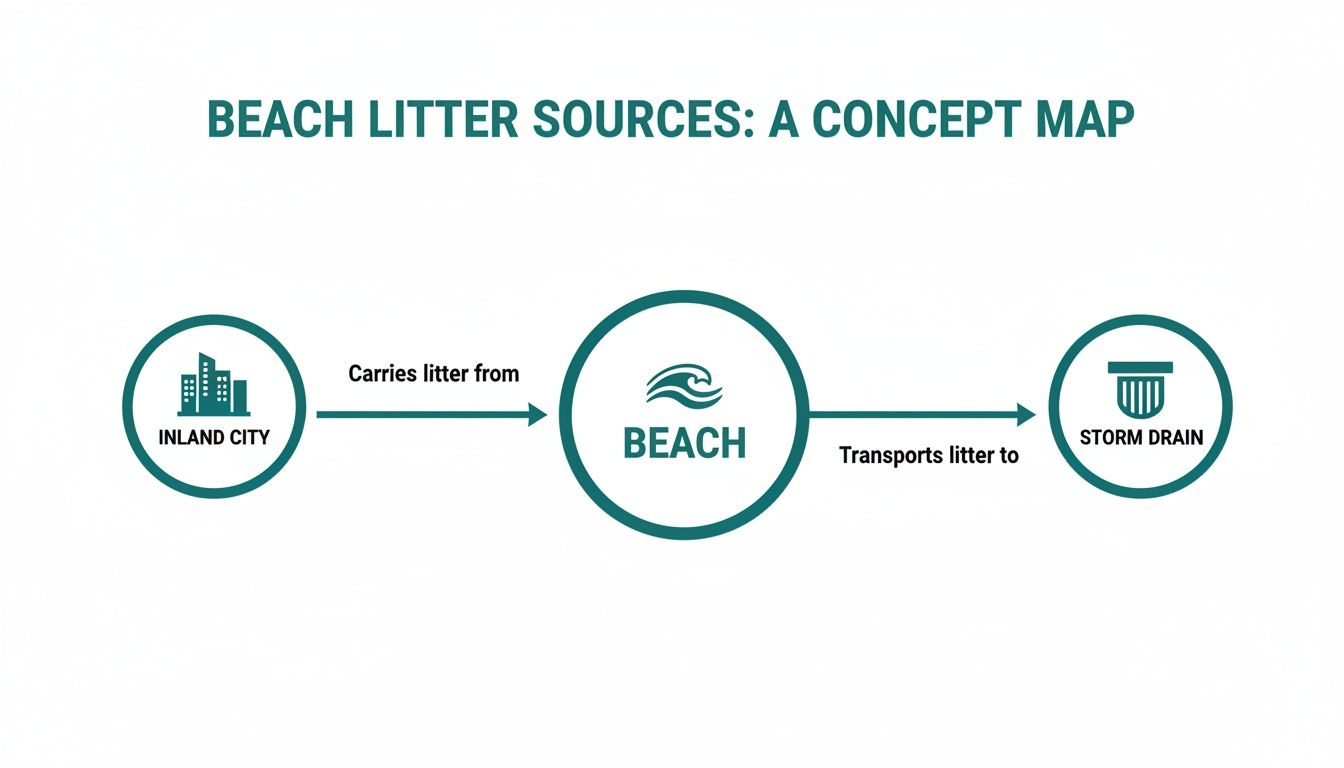
    A lot of this trash travels a long way to become a coastal threat. The problem often starts miles inland, as this visual makes painfully clear.

    Concept map illustrating beach litter sources, showing litter flowing from inland cities to the beach and then to storm drains.

    It’s a direct pipeline from our cities, down storm drains, and straight onto the beaches we cherish.

    The Hidden Costs of Littering on a Beach

    The mess on the sand is more than just an eyesore. It represents a web of consequences that ripple through our environment, our health, and our local economies. The table below breaks down these hidden costs, showing how a single piece of trash contributes to a much larger problem.

    Impact Area Description of Harm Real-World Example
    Environmental Wildlife can mistake plastic for food, leading to internal injuries and starvation. Animals also become entangled in discarded items like fishing nets and plastic rings, causing injury, drowning, or strangulation. A sea turtle ingesting a plastic bag it mistook for a jellyfish.
    Public Health Sharp objects like broken glass, rusted metal, and medical waste buried in the sand pose a direct physical threat. Over time, plastics break down into microplastics and leach toxic chemicals (like BPA) into the sand and water. A child stepping on a shard of glass hidden just beneath the sand, resulting in a deep cut and a trip to the emergency room.
    Economic Coastal communities spend millions on beach cleaning. Littered beaches deter tourists, which hurts local businesses like hotels, restaurants, and shops. Property values in areas with chronic litter problems can decline significantly. A small beach town sees its summer tourism revenue drop by 20% after images of its littered shoreline go viral online.

    Each piece of litter contributes to this cycle of harm. It's a heavy price to pay for a moment of carelessness.

    The Dangers to You and Your Family

    The impact of beach litter isn't just "out there" in the ocean; it's right here, directly affecting you and me.

    Imagine your kid running barefoot through the sand, laughing one second and screaming in pain the next. A buried piece of broken glass or a rusty can has just turned your perfect beach day into a nightmare. These are the booby traps left behind by others.

    But the danger is also invisible. Over time, all that plastic trash doesn't just go away. The sun and waves break it down into microscopic pieces—microplastics. At the same time, those plastics leach toxic chemicals like BPA and phthalates right into the sand where we build castles and the water where we swim. You and I are literally soaking in a chemical soup of our own making.

    The Crushing Economic Cost

    On top of the ecological and health crises, beach litter comes with a massive price tag. Coastal towns are forced to spend millions of dollars every year—your tax dollars—just to clean up the mess. That's money that could be going to our schools, our parks, or our roads.

    Think about a small town that lives and breathes on summer tourism. What happens when its number one asset, a beautiful beach, is consistently covered in garbage?

    • Tourists Stop Coming: Families choose to go elsewhere. The photos they might have shared of a beautiful sunset are replaced with pictures of trash.
    • Local Businesses Go Under: The hotels, cafes, and surf shops that depend on those visitors watch their income dry up.
    • Property Values Plummet: Who wants to buy a house with a view of a landfill?

    A trashed beach isn't just an environmental issue. It’s a community-killer. It’s a wake-up call showing us that the consequences are personal, painful, and incredibly expensive for every single one of us.

    How Personal Mess Became a Public Mission

    I have to be honest with you. I didn't start Litter Caterpillars from some grand, noble vision. I started it because my own life was a complete and utter mess. I mean that literally. My apartment felt just as trashed as a shoreline after a long holiday weekend—disorganized, chaotic, and totally overwhelming.

    Looking back, my place was a perfect physical metaphor for the chaos storming in my head. Every single object had a story. That jar of blueberry jam from a trip I took four years ago? It wasn't just jam; it was a memory I was afraid to lose. That bag of nuts from a failed health kick? A stinging reminder of good intentions gone wrong.

    Each item might have weighed less than a pound, but to me, it felt like it weighed 500 pounds. I was completely frozen, unable to clean up the trash in my own home. I was just… stuck. The real breaking point, the moment the dam finally burst, came after I ended a long, turbulent relationship that had mirrored the mess around me. I knew then I had to build a new life from the ground up, one centered on cleanliness, consistency, and a bravery I didn't think I had.

    The Spark in the Storm

    Here’s the crazy part: I found the solution not by tackling my own personal disaster, but by cleaning up someone else's. I discovered it was infinitely easier to clean up the public’s mess than my own. This strange little insight became the bedrock, the founding principle, of Litter Caterpillars.

    Our very first cleanup was a true Chicago welcome. There were just three of us, buzzing with a nervous, electric energy, ready to take on the littering on beach problem one piece at a time. Of course, the second we started, the sky just tore open. Not rain. A full-on springtime hailstorm.

    We found ourselves huddled under a tree, soaked and shivering, watching as every single Uber we tried to order canceled on us. But right there, in that moment of shared misery, something amazing happened. We started laughing. It was cold, it was uncomfortable, but it was also… fun.

    We realized that suffering together, facing a ridiculous challenge, adds a special kind of flavor to life. It advances the plot. In that freezing hailstorm, huddled together while picking up strangers' trash, the very soul of Litter Caterpillars was born.

    From Personal Struggle to Public Service

    That first day taught me something profound. Cleaning up a public space wasn't just about making a beach look nicer. For me, it was a way to practice the very things I was struggling with in my own life.

    • Cleanliness: By tidying a park, I was building the muscle for tidying my own life.
    • Consistency: Showing up every week, no matter what the weather threw at us, taught me the discipline I craved.
    • Bravery: Facing down a blizzard to pick up trash? That’s a crash course in courage you can't get anywhere else.

    This journey, from a messy room to a city-wide movement, is my proof that you can change your inner world by changing your outer one. It’s not about being perfect from day one. It’s about taking that first small, absurd step. It’s about finding a weird new form of "fun" in the struggle and discovering that helping others is one of the best ways to help yourself.

    That simple act of picking up trash became my mission. It’s grown from three people in a hailstorm to a community of hundreds who show up every single week, ready to build a better city and, in the process, better versions of ourselves. If this idea fires you up and you want to join us, you can learn more about how to volunteer and clean up beaches with us. It all starts with one small act.

    Making Beach Cleanups Fun and Meaningful

    Three smiling volunteers on a beach with a flag and trash bag, participating in a cleanup.

    How do you get people to give up their Saturday morning to pick up someone else's trash? It's simple. You don't ask them to do a chore. You invite them on an adventure. That’s the entire heart of what we do at Litter Caterpillars. It’s how I turn what sounds like a tedious duty into something you actually look forward to.

    I have this little philosophy I call the 'Tom Sawyer' approach. You remember the story, right? He was stuck painting a fence as a punishment. He didn’t complain. Instead, he made it look like the most incredible, fun thing in the entire world—so much so that his friends started paying him for the privilege of helping out.

    That's our entire playbook. Service isn't a burden; it's a privilege. It’s an opportunity to grow, to connect, and to build a type of resilience you can't find anywhere else. The moment you see it that way, everything shifts. It stops being about the littering on beach problem and starts being about our shared power to fix it.

    Our Three Core Values

    Everything we do is built on three simple, powerful ideas: Bravery, Kindness, and Unity. These aren't just empty words I stick on a website. They're how we operate, week in and week out.

    • Bravery: This just means showing up. It means you are willing to pick up trash in a Chicago blizzard or a scorching summer heatwave. When you face challenges together, even when it’s uncomfortable, you build a unique kind of strength.
    • Kindness: We have a volunteer-first rule. Your safety and your happiness come before anything else. It's not just about being nice; we intentionally create an environment where real friendships can actually grow while you work.
    • Unity: We bring people together from every walk of life. You’ve heard the old saying: "If you want to go fast, go alone. If you want to go far, go together." We’re in this for the long haul.

    The Power of Pride and Identity

    Have you ever noticed how sports teams use flags, songs, and uniforms to build this intense, powerful feeling of pride and belonging? Why should that power only belong to sports or nations? I believe it’s time for kind people to step into our power, too.

    That’s why we have flags. That’s why we award badges. That's why we even have our own theme song.

    These aren't gimmicks. They are tools. They transform a scattered group of individuals into a unified team with a shared mission. They give us an identity to be proud of, turning a simple cleanup into a bold statement of who we are and what we stand for.

    This gives you a sense of belonging that’s so hard to find these days. We aren't just cleaning a park; we are representing a movement. We are showing the world what it looks like when kind, brave people decide to take ownership of their community. It’s a powerful, incredible feeling.

    Turning a Chore into a Calling

    When you join one of our events, you’re not just some anonymous volunteer. You become part of a team, and that changes everything. You get to explore a new Chicago neighborhood, meet people who actually share your values, and see the immediate impact of your work with your own two eyes.

    We've found that this structure helps people build consistency and purpose in their own lives. If you want to see exactly how we use these principles to create powerful group experiences, you should check out our guide on inspiring volunteer team building activities. It’s a deep dive into our methods.

    By mixing a spirit of adventure with a strong sense of identity, we've turned the thankless job of cleaning up after others into a meaningful and joyful calling. This is an open invitation for you to join us, get your hands dirty, and discover just how good it feels to do good.

    Your Guide to Taking the First Step

    You feel that little spark, don't you? That quiet voice in the back of your head that says, "I should do something about this." I know that voice intimately. It's the same one that got me started.

    It's so easy to feel that fire and then, almost immediately, feel crushed by the sheer size of the problem. But I'm telling you, taking real, meaningful action is so much simpler than your brain wants you to believe.

    This is your map. It’s a practical, no-fluff guide to turning that good intention into a pile of filled trash bags. Let's take that first step together.

    How to Join a Cleanup

    If you’re in Chicago, finding us is easy. We always want new faces and new energy. The best way to link up with the Litter Caterpillars is through our main channels:

    1. Meetup: This is our home base for all event schedules. Every weekly cleanup gets posted here with the date, time, and exact spot we'll be.
    2. Instagram: Follow us for the play-by-play. You'll get real-time updates, see photos from our cleanups, and catch the vibe of our community.

    Seriously, just show up. That’s the only rule. You don't need special equipment or experience; I promise we have everything you'll need. All we ask from you is a willingness to help.

    The most important thing you can do is simply start. Pick up one piece of trash. Invite one friend. Every great journey begins not with a giant leap, but with a single, small, deliberate step forward.

    Starting Your Own Cleanup Crew

    What if you're not in Chicago? That's even better. It means you have the power to bring this same energy to your own community. This whole thing grows when people like you decide to start their own crew.

    It feels like a massive undertaking, I get it. But remember our origin story: just three people caught in a hailstorm. You don't need a 501(c)(3) or a flashy website to make a difference. You just need a starting point.

    Here's the blueprint, straight from my playbook:

    • Pick a Spot: Find a local park, a messy riverbank, or a specific public beach that could use some love. Starting small keeps it from feeling impossible. If you want to know why some areas, like the public beaches near Lake Michigan, need so much consistent help, we break it down here.
    • Set a Time: Choose a date and block out a two-hour window. Weekend mornings are magic for attracting the kindest, most dedicated people you'll ever meet.
    • Get the Word Out: Make a simple event on Facebook, Meetup, or just text a few friends. Your invite can be as simple as, "Hey, I'm cleaning up [Location] on Saturday at 10 a.m. Want to join?"
    • Gear Up (Simply): You only need two things to start: gloves and trash bags. That's it. I beg you, don't overthink it.
    • Create a Vibe: On the day of the cleanup, just be a welcoming human. Thank every single person for showing up. Remember, the goal isn't just to clean—it's to build connections. Make it feel like a get-together, not a chore.

    This process strips away all the excuses. It takes that huge, scary idea of "saving the world" and turns it into a simple plan you can launch this weekend.


    Your First Cleanup Action Plan

    Feeling ready? It’s normal to feel a little unsure of where to begin. This checklist is your simple, step-by-step guide to get you from "I want to help" to actually making it happen.

    Step Action Item Litter Caterpillars' Tip
    1. Find Your Spot Choose a park, beach, or street that needs attention. Start small! A single block or a small park is a perfect first mission.
    2. Pick a Date & Time Set a 2-hour window on a weekend morning. Saturday at 9 a.m. is our go-to. It attracts dedicated folks and leaves the rest of the day free.
    3. Rally Your Crew Invite friends via text, social media, or a Meetup event. Don't be shy! A simple, "Want to help me clean up our park?" is all it takes.
    4. Gather Supplies Get basic gloves and heavy-duty trash bags. Ask people to bring their own if they can. Many hands make light work.
    5. On Cleanup Day Greet everyone, do a quick intro, and get to work. The goal is connection as much as cleaning. Make it fun, not a chore.
    6. Share Your Impact Take a "before" and "after" photo. Celebrate your success! Post it online. Your small victory will inspire someone else to take their first step.

    Following these steps transforms a vague idea into a concrete plan. You've got this. Your community—and the planet—is waiting for you.


    Got Questions? I've Got Answers.

    I get it. When you look at the scale of the litter problem, it feels massive. It’s easy to feel overwhelmed, to think, what can one person even do? That hesitation is normal, but I've learned that clear answers are the best way to turn that doubt into action. Let's tackle some of the questions I hear all the time.

    What’s the Worst Stuff We Find Out There?

    It changes from place to place, but the villains are almost always the same: single-use plastics. We're talking bottle caps, food wrappers, and straws. But the number one thing we find, by sheer count, is cigarette butts. They look so small, but their plastic filters are like little poison sponges, leaching a nasty chemical cocktail straight into the sand and water.

    Think about it—these tiny, throwaway items are landmines for birds and fish that mistake them for a meal. And don't even get me started on discarded fishing gear. Those nets and lines are devastating, causing a slow, cruel death for anything that gets tangled. The convenience you and I crave for a few minutes creates a disaster that lasts for centuries.

    But I Don't Live Near a Beach. How Can I Help?

    This is my favorite question because it cuts right to the core of the problem. A huge chunk of ocean trash doesn't start at the coast. It starts on a street, in a park, or along a river hundreds of miles inland. Your actions right here in Chicago matter. Immensely.

    Start simple. Cut back on single-use plastics in your daily routine. And make sure your trash and recycling bins have lids that actually close tight. A strong gust of wind is all it takes to turn your garbage into street litter.

    Every river, every storm drain, every little creek eventually leads to the ocean. Cleaning up a riverbank in the Midwest is a direct blow to the litter piling up on a beach far away. It’s all connected.

    Does Picking Up Trash Really Make a Difference?

    Yes. A thousand times, yes. It makes a world of difference, and don’t let anyone tell you otherwise. Every single piece of trash you pick up is one less hazard for an animal. Every cleanup you join shows your neighbors that you care, sparking something in them, too.

    The numbers can be scary. Some studies say ocean plastic could double by 2030. But here’s another number for you: a recent Global Ocean Cleanup pulled 47.4 tons of trash out of the water across 25 countries. You can read more about these global plastic crisis insights and solutions.

    That’s what we do at Litter Caterpillars every single week. We’re part of that hopeful, worldwide movement. Your action isn't just a drop in the bucket; it's the start of a wave.


    At Litter Caterpillars, we turn that desire to help into real, muddy, satisfying action every week in Chicago. If you're ready to stop wondering and start doing, to build real friendships, and to be part of the solution, we're ready for you. Join our next cleanup and see for yourself how good it feels to do good. https://www.littercaterpillars.com

  • My 7 Favorite Chicago IL Parks: A Neighborhood Guide for 2026

    My 7 Favorite Chicago IL Parks: A Neighborhood Guide for 2026

    I used to live in a mess. A beautiful, sentimental, story-filled mess, but a mess. Every old jam jar or bag of stale nuts in my apartment was a chapter I couldn't close. Each piece of trash, though weighing less than a pound, felt like it carried the weight of my past, pinning me down.

    Then a chaotic breakup happened. I realized I needed to clean house—literally and figuratively. I had to build a life around giving. Around consistency. Around being brave. And that's how I started Litter Caterpillars. I discovered that cleaning up someone else's mess was surprisingly easier than tackling my own. Doing it with others, even shivering in a freak Chicago hailstorm, sparked this weird joy. It moved my life's plot forward.

    I want you to feel that. This isn't just another list of the best Chicago IL parks. It’s an invitation. Think of it as a map to find your own story, your own transformation, in the green spaces that help this city breathe. Each park is a blank page. Waiting for you.

    Together, we’ll explore these incredible places not just for their beauty, but for what they can become. You’ll find everything you need: the best playgrounds, hidden dog-friendly spots, and how to get there on the 'L'. More importantly, you'll discover how you can become part of their story. How you can fill the blank pages of Chicago's parks and, in the process, write a braver chapter for yourself.

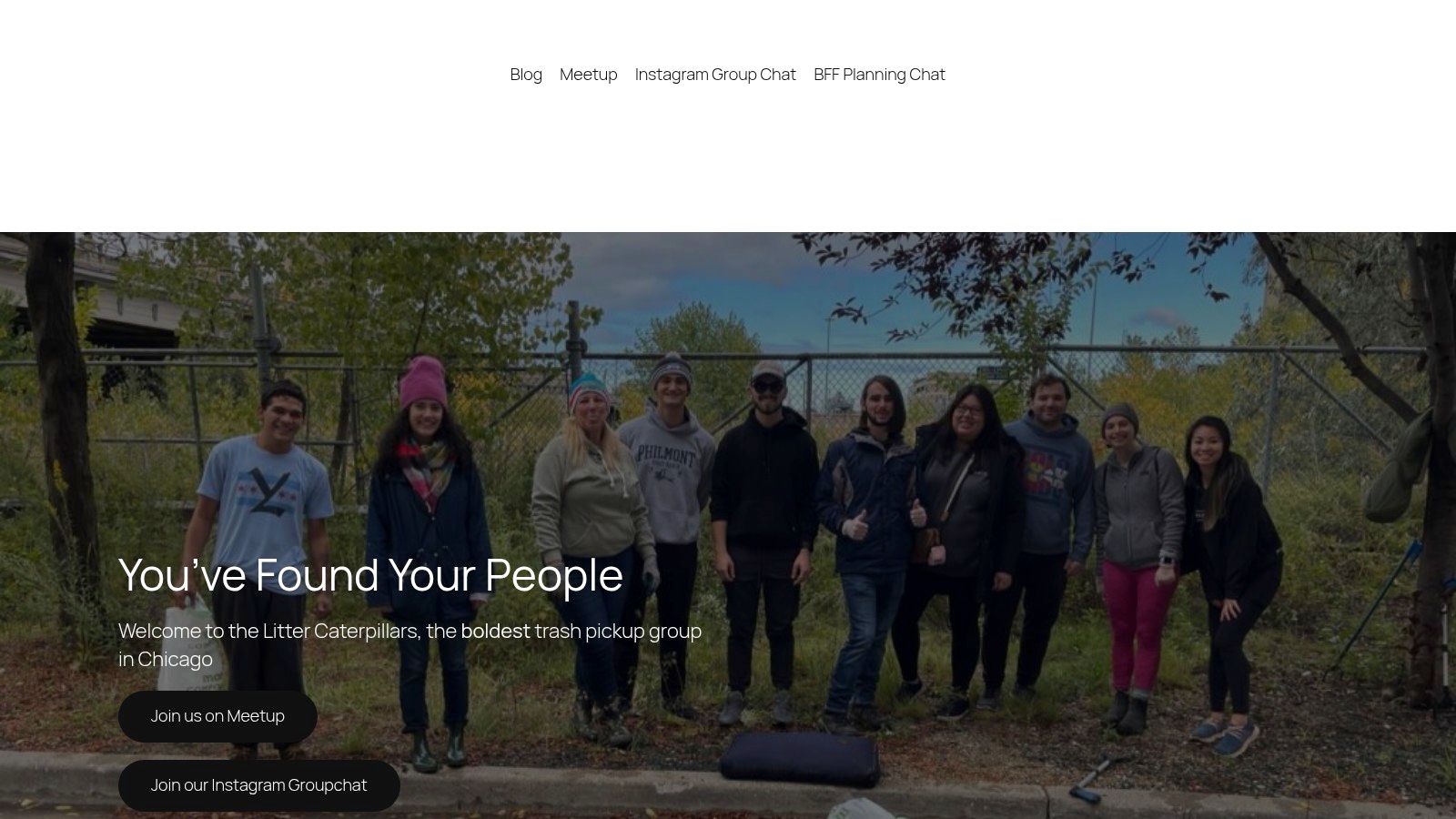
    1. Litter Caterpillars

    What if you could do more than just visit the beautiful Chicago IL parks? What if you became part of the very fabric that keeps them alive? Litter Caterpillars isn't just a group. It’s a movement. A weekly ritual. It invites you to put your hands to work creating a cleaner city, one park at a time. It’s for you, if you’ve ever walked through a park and wished you could do something about the trash, turning that fleeting thought into a powerful habit.

    I founded this crew on a simple, profound idea: showing up. Every single weekend, without fail, we gather. It doesn't matter if it's a perfect sunny morning or a biting blizzard. Our commitment is absolute. This isn't your occasional cleanup. This is a lifestyle. A way to build friendships and see the direct result of your effort in neighborhoods across all 50 wards.

    A group of Litter Caterpillars volunteers in high-visibility vests posing with trash bags and pickup tools in a Chicago park.

    Why Litter Caterpillars Stands Out

    I've seen many volunteer groups, but Litter Caterpillars has a unique energy. It’s less about obligation and more about a shared identity. We have flags, a theme song, even merit badges. Quirky? Maybe. But it works. It builds a genuine camaraderie. You’re not just picking up litter; you’re a Caterpillar, part of a team making a visible dent in the city's upkeep.

    Our impact goes beyond just cleaning parks. We’ve cleaned a major highway during a bike event. Most impressively, we won an empty lot at a city auction to create "Caterpillar Park" in Englewood. This shows our grit and vision, turning grassroots energy into something permanent.

    "We are the crazy ones who show up in a blizzard. We are the ones who clean where no one else will. We do it because we believe in bravery, kindness, and unity-and because it’s how we make friends and build the city we want to live in."

    Getting Involved and Making an Impact

    Joining us is simple. No dues. No long applications. You just show up.

    • How to Join: Find our next event on Meetup or follow our Instagram for real-time updates. We have open group chats, making it easy to connect and ask questions before your first time.
    • What to Expect: We provide all the supplies: bags, gloves, and trash grabbers. Your job is to bring a positive attitude. The atmosphere is welcoming. We focus on your happiness and safety above all else. You’ll never be pressured for donations.
    • Best For: This is perfect for you if you're looking for a consistent weekend activity, want to explore different Chicago neighborhoods, and are eager to meet like-minded people. It’s a way to turn a desire for change into a concrete, social, and deeply rewarding practice.

    Key Details at a Glance

    Feature Details
    Primary Focus Hands-on, volunteer-led cleanups of parks and public spaces across Chicago.
    Cost to Participate Free. All supplies are provided.
    Frequency Weekly meetups, every weekend, year-round, rain or shine.
    Pros Consistent & Reliable: Builds a real habit of service.
    Community-Focused: Excellent for making friends.
    High-Impact: Tangible results you can see.
    Cons Physically Demanding: Requires being outdoors in all weather conditions.
    Informal Structure: Not a formal 501(c)(3), limiting some large-scale funding options.
    Website https://www.littercaterpillars.com

    If you want to be part of the solution and help maintain the Chicago IL parks you love, Litter Caterpillars offers an inspiring and effective way to get involved.

    2. Millennium Park

    Millennium Park isn't just a park. It's the city's living room. A vibrant stage where art, nature, and community collide. Imagine standing before "The Bean" (officially Cloud Gate), its polished surface mirroring the iconic Chicago skyline and the smiling faces of people from every corner of the world. This is a place that reminds you that you are part of something bigger, a pulsating urban heart in the middle of downtown.

    Millennium Park

    This park is a testament to what a city can achieve when it dreams big. From the whimsical faces of Crown Fountain that surprise you to the serene pathways of Lurie Garden, every corner invites exploration. It feels less like a traditional park and more like an open-air museum where you are part of the exhibit.

    What You'll Find Here

    The park's website, millenniumpark.org, is your guide to this dynamic space. It’s simple to use. It clearly lays out all the free events, from summer film series to morning yoga on the Great Lawn. You can quickly check schedules, find accessibility information, and see what's blooming in the Lurie Garden.

    • Key Features: Jay Pritzker Pavilion, Cloud Gate ("The Bean"), Crown Fountain, Lurie Garden.
    • Best For: First-time visitors, iconic photo ops, free concerts, and large community gatherings.
    • Family & Dog Friendliness: Incredibly family-friendly, but dogs are only allowed on the perimeter paths. They aren't permitted on the Great Lawn, in Lurie Garden, or near Cloud Gate.

    Plan Your Perfect Visit

    My ideal day here starts with a morning stroll through the Lurie Garden before the crowds arrive. Then, I’d grab a coffee and find a spot near the Pritzker Pavilion, just listening to the city wake up. In the summer, the real magic happens during the free concerts and movies. It’s a shared experience that unites thousands of strangers under the stars. The park is free to enter, though some special events might have a fee.

    Pro Tip: Use the BP Pedestrian Bridge to cross over to Maggie Daley Park. You get an incredible, elevated view of the skyline and connect to even more adventure without ever crossing a busy street.

    A Stage for Community Action

    Millennium Park is Chicago’s most visible public space. That makes it a powerful spot for making a statement. Organizing a volunteer meetup here sends a clear message about civic pride. The high foot traffic means your group’s efforts will be seen by thousands, inspiring others. This visibility is perfect for groups like Litter Caterpillars that want to raise awareness. If you want to learn how to organize a community-focused cleanup in a high-profile location like this, we have resources to help you get started with your own event.

    3. Lincoln Park

    Lincoln Park is where Chicago exhales. It’s not just one of the best Chicago, IL parks; it's an enormous, sprawling sanctuary. A green ribbon stretching for miles along the lakefront, tying together beaches, prairies, ponds, and even a world-class zoo. Standing on the Nature Boardwalk, with the honeycombed pavilion arching over you and the city skyline rising behind a serene pond, feels like you've found a secret intersection of human ingenuity and natural wonder. You can lose track of time here. You can just be.

    Lincoln Park

    This park is a living ecosystem. A constant reminder of the wildness that can thrive even in the heart of a metropolis. From the sandy dunes at Osterman Beach to the quiet trails around North Pond, you can watch seasons change and witness nature’s resilience. It feels less like a manicured garden and more like an invitation to explore the diverse landscapes of the Great Lakes region.

    What You'll Find Here

    The Chicago Park District website for Lincoln Park is your starting point for navigating this massive space. It's a standard city government page, but it provides essential details like hours for the conservatory, locations for natural areas, and contact info. For day-to-day happenings, you'll want to check the sites for individual attractions like the Lincoln Park Zoo or the Conservatory.

    • Key Features: Lincoln Park Zoo, Lincoln Park Conservatory, Nature Boardwalk, North Pond Nature Sanctuary, North Avenue Beach, Alfred Caldwell Lily Pool.
    • Best For: Nature lovers, families looking for free activities, bird watching, and long walks or bike rides with lake views.
    • Family & Dog Friendliness: Extremely family-friendly, especially with the free zoo. Dogs are welcome on most paths but must stay on-leash. They're not allowed in the zoo, conservatory, or designated nature sanctuaries like the Lily Pool.

    Plan Your Perfect Visit

    My perfect day in Lincoln Park begins with an early morning walk around the North Pond to see what birds have stopped by. From there, I’ll head to the Lincoln Park Conservatory to escape into a tropical paradise before the crowds arrive. The best part is that the park’s main attractions are free. This makes it an accessible adventure for everyone. Just know that parking near the zoo and conservatory fills up incredibly fast on weekends. Public transit or arriving early is your best bet.

    Pro Tip: Pack a picnic and find a spot on the lawn south of the Nature Boardwalk. You get a perfect, unobstructed view of the skyline over the South Pond. It's one of the most iconic and peaceful photo spots in the entire city.

    A Stage for Community Action

    The sheer diversity of habitats in Lincoln Park makes it an incredible place for community action with a real educational impact. Organizing a volunteer day here isn't just about picking up litter. It's a chance to protect delicate prairie ecosystems or preserve the shoreline for migratory birds. The park’s blend of high-traffic attractions and quiet natural areas means a group like Litter Caterpillars can make a huge difference. You can clean a popular beach one day and restore a quiet sanctuary the next. To learn how to organize an event that blends community service with nature education, you can find resources to help you get started with your own event.

    4. Grant Park

    People call Grant Park "Chicago's front yard," and it truly feels that way. It's a grand, sprawling expanse. It connects the city's towering architecture to the calming presence of Lake Michigan. Standing near Buckingham Fountain as it erupts into its majestic water show, you feel the city’s historic pulse. A sense of timelessness. You remember Chicago's enduring spirit and ambition.

    Grant Park

    This isn't just a park; it's a massive canvas where Chicago hosts its biggest moments, from music festivals to marathons. Yet, even on a quiet day, you can find a peaceful corner in one of its formal gardens or watch skaters perfect their craft at the skate park. It’s a place of both epic scale and personal reflection, offering a different experience every time you visit.

    What You'll Find Here

    The Chicago Park District website for Grant Park is your starting point. While it's a standard park district page, it gives you crucial info on event permits, field conditions, and a general map to get your bearings. It’s the official source for knowing which parts of the park might be closed for a major event like Lollapalooza.

    • Key Features: Buckingham Fountain, Museum Campus access, Grant Park Skate Park, Rose Gardens, Butler Field, Hutchinson Field.
    • Best For: Iconic Chicago views, major city festivals, museum hopping, and long walks along the lakefront.
    • Family & Dog Friendliness: Very family-friendly, with plenty of open space. Dogs are welcome on-leash throughout the park, making it a great place for a scenic walk with your furry friend.

    Plan Your Perfect Visit

    My favorite way to experience Grant Park is to start at the Museum Campus. I take in the incredible skyline view, then walk north through the gardens toward Buckingham Fountain. I try to time my visit for the top of the hour to catch the water display. In the summer, packing a picnic and finding a spot on the grass with the fountain in the background feels like a classic Chicago moment. The park is always free to enter.

    Pro Tip: Don't miss the smaller, more intimate gardens tucked away from the main paths. The Court of Presidents and the Abraham Lincoln statue area offer beautiful, quieter spots for reflection away from the crowds.

    A Stage for Community Action

    The sheer scale and visibility of Grant Park make it an unparalleled location for a high-impact community cleanup. Hosting a volunteer event here is a bold statement about your group's commitment to preserving Chicago's most celebrated public spaces. The constant flow of tourists and locals means your cleanup crew will be seen. This creates a ripple effect of inspiration. It’s an ideal spot for organizations like Litter Caterpillars to demonstrate civic pride on a grand scale. If you’re inspired by these large-scale efforts but want to see how to make a difference in a cozier neighborhood setting, you can read the story of Fulton River Park.

    5. Jackson Park

    Stepping into Jackson Park feels like entering a living history book. This is a place crafted by visionaries for the 1893 World’s Columbian Exposition. You can still feel that grand ambition in its sweeping meadows and tranquil lagoons. It’s a park that asks you to slow down. To watch the herons on Wooded Island. To remember the layers of stories that have unfolded right where you stand. It’s not just a South Side gem; it’s a cornerstone of Chicago’s identity.

    Jackson Park

    This immense park offers a sense of escape that’s hard to find elsewhere in the city. One moment you can be walking through the serene, Japanese-style Garden of the Phoenix. The next you can be feeling the lake breeze on the 63rd Street Beach. It’s this incredible diversity that makes Jackson Park a constant source of discovery, a place where every visit feels completely new.

    What You'll Find Here

    The website jacksonpark.cpdgolf.com focuses on one of the park's core assets: the golf course. The site is straightforward. It provides essential information on tee times, course layout, and community programs. It’s a great starting point for understanding how recreation and history merge here. For broader park information, the Chicago Park District site is your companion.

    • Key Features: Wooded Island and the Garden of the Phoenix, 63rd Street Beach, Jackson Park Golf Course, multiple lagoons.
    • Best For: History buffs, bird watchers, golfers, and anyone seeking a peaceful escape with diverse scenery.
    • Family & Dog Friendliness: Very family-friendly with lots of open space. Dogs are welcome on leashes on the paths but should be kept out of sensitive natural areas like the Garden of the Phoenix.

    Plan Your Perfect Visit

    My perfect day in Jackson Park begins with an early morning bird-watching session on Wooded Island. The spot feels miles away from urban life. Afterwards, a walk through the Garden of the Phoenix is a must for its calming atmosphere. In the afternoon, hitting a few balls at the driving range or just relaxing by the lagoons makes for a perfect, unhurried day. The park is free to enter, though activities like golf have fees.

    Pro Tip: Pack a picnic. Find a spot near the Statue of The Republic. It’s a powerful historical marker from the World's Fair and offers a stunning, wide-open view of the park's landscape.

    A Stage for Community Action

    The sheer scale and variety of Jackson Park make it an incredible canvas for community-focused environmental work. You can organize a shoreline cleanup along the lagoons, a trail maintenance day on Wooded Island, or a beautification project in the meadows. The strong South Side community pride here creates a welcoming environment for volunteers. An organized event in this historic park honors its legacy and shows a deep commitment to one of Chicago’s most important green spaces. To learn how to structure a cleanup in such a large, diverse park, we have resources to help you get started with your own event.

    6. Humboldt Park

    Humboldt Park is more than just green space. It's the cultural soul of its neighborhood. A place where history, nature, and vibrant community spirit blend into something truly special. Walking its paths feels like stepping into a story. The historic boathouse reflecting in the lagoon. The striking architecture of the old stables, now a museum, standing proudly. This isn't just a park you visit; it's a park you experience. A living celebration of Puerto Rican culture and Chicago's rich West Side heritage.

    Humboldt Park

    This nearly 200-acre park invites you to slow down and connect. From the surprising sight of an inland beach in the summer to the quiet lagoons perfect for a paddle, every corner offers a different rhythm. It feels authentic and deeply rooted. A place where families have gathered for generations and where new memories are made every single day.

    What You'll Find Here

    The Chicago Park District website for Humboldt Park is your starting point for navigating this massive space. It's a practical resource where you can find hours for the fieldhouse, check on sports league sign-ups, and get details on renting a community room. The site gives you all the core information you need to plan a visit or an event.

    • Key Features: Historic fieldhouse and boathouse, lagoons with an inland beach, National Museum of Puerto Rican Arts & Culture, multiple athletic fields and courts.
    • Best For: Cultural immersion, neighborhood festivals, family picnics, and enjoying a unique, non-downtown park experience.
    • Family & Dog Friendliness: Very family-friendly with lots of open space. Leashed dogs are welcome on the paths, but be sure to check specific rules for buildings and the beach area.

    Plan Your Perfect Visit

    My perfect day here involves grabbing some food from a restaurant on nearby Paseo Boricua and having a picnic near the lagoon. Afterward, I'd visit the National Museum of Puerto Rican Arts & Culture to see the latest exhibit. The park is free to enter, and the sense of community you'll find here is priceless. It's a place that shows you a different, yet equally essential, side of the Chicago park system.

    Pro Tip: The park is huge. If you're meeting friends or attending an event, be specific about your meeting spot. Using the boathouse or the museum as a landmark is much clearer than just saying "meet me in Humboldt Park."

    A Stage for Community Action

    The deep-seated community pride here makes Humboldt Park an incredible location for a volunteer event. Organizing a cleanup isn't just about picking up litter. It’s about honoring the space and the culture it represents. The park’s large size is a challenge, but it’s also an opportunity. You can assign teams to specific zones—like the lagoons, the playground, or the garden beds—to make a significant, visible impact. Because this park is a true community hub, your group’s work will be noticed and appreciated by the residents who cherish it most. To learn how you can effectively organize a cleanup in a large, culturally significant space like this, we have great advice to help you get started with your own event.

    7. Garfield Park Conservatory and Grounds

    Stepping into the Garfield Park Conservatory is like leaving Chicago. You enter a lush, green world where it’s always summer. It's a living museum. A glass palace where ancient ferns unfurl and tropical palms reach for the sky, no matter the season outside. This isn’t just a place to see plants. It’s a place to breathe differently. To feel the warm, humid air on your skin and remember our deep connection to the natural world. It’s an escape and an education all in one.

    Garfield Park Conservatory and Grounds

    This historic conservatory, one of the largest in the country, offers a year-round sanctuary that feels both grand and deeply personal. Whether you're wandering through the cacti in the Desert House or marveling at the vibrant colors of a seasonal flower show, you feel a sense of wonder. The sheer scale of the Palm House makes you feel small in the best way possible. It reminds you of nature's enduring power and beauty.

    What You'll Find Here

    The conservatory's website, garfieldconservatory.org, is your portal to this botanical wonderland. It's essential for planning your visit, as you must make a free, timed reservation online before you go. The site clearly lists current hours, special exhibits like the seasonal flower shows, and educational programs. It's also where you can find accessibility details for navigating the historic glass houses and grounds.

    • Key Features: Eight indoor display gardens (Palm House, Fern Room, Desert House), seasonal flower shows, more than 10 acres of outdoor gardens, and a nature play space.
    • Best For: Year-round nature lovers, educational outings, a peaceful escape from the city, and anyone seeking a tropical vibe in the winter.
    • Family & Dog Friendliness: Very family-friendly with dedicated play areas. Dogs are not permitted inside the conservatory buildings but are welcome on the outdoor grounds on a leash.

    Plan Your Perfect Visit

    My perfect day here involves booking an early morning slot to enjoy the quiet solitude of the Fern Room, which feels like stepping back into prehistoric times. After exploring the indoor gardens, I love to wander the outdoor grounds to see what’s in bloom. Because admission is free (though donations are encouraged), it’s one of the most accessible and inspiring among the many chicago il parks. Just remember to book your reservation online ahead of time, as walk-ins are not guaranteed.

    Pro Tip: Don't miss the smaller, more intimate rooms like the Aroid House or the Show House. They often contain some of the most unique and beautiful specimens and are less crowded than the main Palm House.

    A Stage for Community Action

    The Conservatory's mission of education and conservation makes it a perfect backdrop for community-focused events. Organizing a volunteer day to help tend the outdoor gardens connects your group directly to the mission of this cherished Chicago institution. It's a hands-on way to contribute to a space that gives so much back to the community. The educational focus also provides a great tie-in for groups like Litter Caterpillars who want to teach about local ecosystems. To get a better sense of the area and its potential, you can learn more about Garfield Park and its community and see how your efforts can make a real difference.

    Chicago, IL Parks — 7-Park Comparison

    Item 🔄 Implementation complexity ⚡ Resource requirements 📊 Expected outcomes 💡 Ideal use cases ⭐ Key advantages
    Litter Caterpillars 🔄 Low–Medium — weekly volunteer coordination, simple logistics ⚡ Low — volunteers + basic cleanup gear; minimal funding 📊 High visible neighborhood cleanups; recurring local impact 💡 Regular weekend hands‑on cleanups, social volunteer onboarding ⭐⭐⭐⭐ — strong volunteer retention, community identity
    Millennium Park 🔄 Medium — high‑visibility site coordination; permits for big events ⚡ Medium — crowd management, staffing; excellent transit access 📊 Very high public awareness and photo‑ready outreach 💡 Awareness campaigns, large meetups, media‑facing cleanups ⭐⭐⭐⭐ — iconic location with heavy foot traffic
    Lincoln Park 🔄 Medium — multi‑zone planning across beaches, ponds, trails ⚡ Medium — volunteers + environmental guidance; family friendly 📊 Strong conservation and educational outcomes 💡 Nature‑focused cleanups, family days, education tie‑ins ⭐⭐⭐⭐ — diverse habitats and zoo access for engagement
    Grant Park 🔄 Medium–High — frequent events require schedule/permit navigation ⚡ Medium–High — large‑group logistics, possible paid parking 📊 High outreach potential; strong public‑facing impact 💡 Large‑scale volunteer events, partner activations, publicity ⭐⭐⭐⭐ — central, landmark spaces for amplification
    Jackson Park 🔄 Medium — dispersed features need clear meetup points and routing ⚡ Medium — navigation, safety for shoreline/meadow work 📊 Broad environmental impact across shoreline, lagoons, meadows 💡 Shoreline cleanups, habitat projects, South Side partnerships ⭐⭐⭐⭐ — extensive varied terrain supporting many projects
    Humboldt Park 🔄 Medium — cultural coordination and zone assignment required ⚡ Medium — rentable spaces, cultural liaisons, water‑edge safety 📊 Strong neighborhood engagement and culturally aligned results 💡 Community‑centered cleanups, cultural events, post‑event socials ⭐⭐⭐⭐ — cultural hub with event spaces and authentic engagement
    Garfield Park Conservatory & Grounds 🔄 Low–Medium — timed reservations and capacity windows ⚡ Medium — reservation coordination, staff‑led programming 📊 Year‑round engagement and horticulture education impact 💡 Weather‑proof volunteer days, plant‑focused workshops, families ⭐⭐⭐⭐ — indoor/outdoor flexibility and robust educational offerings

    Your Turn to Write the Next Chapter

    So there you have it. A glimpse into Chicago's soul, told through its sprawling, breathing green spaces. We've journeyed from the iconic gleam of Millennium Park's "Bean" to the quiet, historic lagoons of Jackson Park. We've seen how each of the great chicago il parks offers more than just grass; they are vibrant ecosystems of community, history, and personal discovery.

    Think of this guide not as a finished map, but as a blank journal. Its pages are filled with starting points. The winding paths of Lincoln Park. The lush, tropical air inside the Garfield Park Conservatory. But the real story isn't written yet. That part is up to you.

    From Observer to Participant

    It’s one thing to read about these places. To see their pictures. It’s another thing entirely to feel the cool Lake Michigan breeze at Grant Park or hear the vibrant sounds of a festival at Humboldt Park. The magic happens when you stop being a visitor and start becoming part of the park's story.

    This is where service comes in. Not as a chore, but as an invitation. Do you remember Tom Sawyer painting his fence? He could have seen it as a punishment, a miserable task. Instead, he reframed it. He turned it into an adventure so compelling, so full of purpose and fun, that his friends actually paid him for the privilege of helping.

    That’s the power you have. Picking up a stray bottle, joining a group to clear a trail, or simply showing up with a positive attitude isn't just about cleaning. It's about connection. It's about taking ownership and saying, "This is my city. This is my park. I am part of its future."

    “We, the Litter Caterpillars, are all trying to transform. Through service, sunlight, and friendship, we learn to trust and forgive ourselves. These parks are our training grounds.”

    Choosing Your Starting Line

    Where do you begin? Look back at the places we've explored.

    • Feeling reflective? Maybe a quiet morning walk through Jackson Park's Garden of the Phoenix is your first step.
    • Craving energy and art? Start with Millennium Park and see the city's ambition reflected back at you.
    • Want to get your hands dirty with us? Find a Litter Caterpillars meetup and see how a few hours of shared effort can completely change your perspective on a place, and maybe even on yourself.

    The most important thing is to simply start. Pick a park that calls to you. Go there with intention, not just to pass through, but to truly be there. Notice the details. Feel the ground beneath your feet.

    These parks are not static monuments. They are living, breathing entities shaped by every person who walks their paths. Your presence, your care, and your story add a new layer to their rich history. Now it's your move. Pick a park, show up, and start writing your own story of transformation. We’ll be out there, rain or shine, ready to welcome you.


    Ready to turn your love for chicago il parks into meaningful action and community? Join Litter Caterpillars at one of our next cleanup events. We provide the gear and the good vibes; you just bring yourself and a willingness to make a difference. Find your first event and become part of our story at Litter Caterpillars.

  • 10 Life-Changing Benefits of Volunteering for Students in 2026

    10 Life-Changing Benefits of Volunteering for Students in 2026

    I get it. Your schedule is a beast. Juggling classes, staring down study guides, maybe even slinging coffee for cash, makes volunteering feel like a luxury you can't afford. I was there. My own life was a disaster zone, literally and figuratively. My apartment was a museum of things I'd failed at, and every piece of trash felt like it weighed a ton. I was stuck.

    Then I stumbled onto a secret. Cleaning up someone else's mess is a million times easier than cleaning up your own. It's like hitting the reset button on your own life. For me, that reset switch flipped in a Chicago hailstorm, picking up soggy napkins with a handful of friends. Sounds insane, right? But that single moment—that shared battle against the ridiculous—changed everything. It was the birth of Litter Caterpillars, and it showed me a truth I have to share with you.

    The real benefits of volunteering for students aren't just about fluffing up your resume or checking a box for service hours. It's about building a life that feels lighter. More connected. A life humming with purpose. It's realizing that by showing up for your community, you are, in the most profound way, showing up for yourself. Let’s dive into the 10 ways giving your time can completely rewire your world.

    1. Build a Real Professional Network (Without the Awkward Handshakes)

    Forget those stuffy networking nights where you nervously orbit a cheese plate and swap business cards like they're trading cards. Picture this instead: you're building a powerful connection with a software engineer while pulling a rusty bike frame out of a bush. This is one of the most incredible benefits of volunteering for students: authentic networking. It puts you shoulder-to-shoulder with established pros from every corner of Chicago, all focused on a goal you actually believe in.

    Diverse young volunteers with gloves and trash bags cleaning up a park area.

    You will meet people in tech, healthcare, the arts. Not because you're trying to sell them something, but because you're both dedicated to making the city better. I've personally watched students land amazing internships and find mentors for life just by striking up a conversation over a full trash bag. These aren't just flimsy business connections. They are real friendships, cemented by a shared mission. You're not just a student asking for a favor; you're a teammate making a real difference.

    How to Make it Happen

    • Show Up Consistently: Attend cleanups regularly. This is how you build deep roots with other volunteers. Familiar faces bloom into meaningful conversations.
    • Be Curious: Ask people about what they do and what lights them up. You'll be floored by who you meet.
    • Share Your Goals: Don't be shy about your own dreams. Volunteers genuinely want to lift each other up.
    • Take the Lead: Volunteer for a role like a ward coordinator. It raises your visibility and lets you work side-by-side with community leaders.

    This approach turns networking from a cringe-worthy chore into an adventure. You can find more about building your career through service at our young professional networking events.

    2. Develop Leadership and Responsibility Through Consistent Commitment

    True leadership isn't a title someone gives you; it's the reputation you earn by showing up when it's hard. It's proving you are the person people can count on, especially when the rain is pouring down or the task is gritty. This is where consistent volunteering forges a kind of responsibility that no classroom can teach. It’s one of the most powerful benefits of volunteering for students: building resilience through unwavering dedication.

    This is not a one-and-done event. It is a promise. At Litter Caterpillars, we've been cleaning up Chicago every single weekend for over three years. Rain. Shine. Blizzards. Negative wind chills. When you show up, week after week, you're not just a volunteer anymore; you're a pillar of a team. You build the kind of accountability that defines a true leader. I've seen students like Kevin Tao completely transform their own habits, building a three-year weekly tradition of service that has inspired hundreds of people. That is the kind of story that defines your character.

    How to Make it Happen

    • Start with Attendance: Your first mission is just to show up. Week in, week out. Consistency is the bedrock of trust and responsibility.
    • Lead a Ward: Once you're a familiar face, volunteer to be a ward coordinator. You'll manage logistics, guide others, and take direct ownership of your community's success.
    • Mentor Newcomers: Take a new volunteer under your wing. Guiding someone else is an incredible way to solidify your own leadership chops.
    • Embrace the Challenge: Don't duck out on the tough days. Leading a cleanup during a surprise downpour shows a level of commitment people never forget.

    This journey from participant to leader is at the very core of what we do. You can start building your own leadership legacy by joining one of our upcoming cleanup events.

    3. Improve Mental Health Through Outdoor Service and Community Connection

    The relentless drumbeat of exams, deadlines, and social pressure can seriously mess with your head. Volunteering offers a powerful way out. It's a cocktail of physical activity, sunlight, and genuine human connection. Getting outside and focusing on a simple, tangible mission—like cleaning a park—quiets the frantic buzzing in your brain. Think of it as active mindfulness. It grounds you in the present, pulling you away from academic stress and the endless scroll of digital isolation.

    Smiling woman on a park bench with a full trash bag, holding a coffee cup, surrounded by watercolor art.

    This benefit of volunteering for students is deeply personal for me. I've watched students use our weekend cleanups as their escape hatch, finding that a few hours of service does more for their mood than a whole day locked inside. Research from the University of Chicago even backs this up, confirming that outdoor volunteering can slash symptoms of depression and anxiety. You are not just cleaning a street; you are clearing your mind. Building your own resilience. The simple act of turning a trashed space into a beautiful one is a mirror for the personal growth you're experiencing inside.

    How to Make it Happen

    • Be Consistent: Try to attend cleanups for at least a month. You'll feel the mental health benefits multiply as it becomes a restorative habit.
    • Practice Mindfulness: Focus on the physical task. The sounds of the city, the fresh air, the feeling of making a visible difference. Let your worries dissolve.
    • Connect with Others: Don't be afraid to share what's on your mind. Real community is built on mutual support, and you'll find others who just get it.
    • Invite a Friend: If you know someone who's feeling isolated, invite them to join you. Sharing this experience can strengthen your bond and their well-being.

    Volunteering is this unique space where you get to care for your community and yourself at the exact same time. See how our community comes together at our next neighborhood cleanup event.

    4. Create Lasting Friendships and Find Your People

    College can feel like an island, and making friends who really get you isn't always easy. But imagine finding your tribe not in a chaotic dorm party, but while working together to bring a neglected park back to life. This is one of the most powerful benefits of volunteering for students: it blasts past superficial small talk and forges connections based on shared values and action. It’s about building a real community.

    Five diverse, joyful volunteers in blue shirts embracing, with colorful watercolor art splashes.

    At Litter Caterpillars, we're all about building friendships. Our inside jokes, our badges, and our consistent weekend cleanups create this incredible sense of belonging, like a sports team but with more trash bags. I have seen students who felt completely adrift find their closest friends here, bonding over a shared mission to serve all 50 Chicago wards. These are not flimsy connections. They are friendships forged in the trenches of shared purpose—and sometimes shared absurdity, like when our three co-founders bonded forever during that sudden hailstorm cleanup.

    How to Make it Happen

    • Pick a Ward and Stick With It: Show up at the same neighborhood cleanup consistently. Seeing the same faces week after week is the fastest way to turn strangers into friends.
    • Be Brave, Exchange Info: After a few cleanups, don't be shy. Suggest grabbing a coffee or swap social media handles to stay in touch.
    • Invite a Friend Along: Bringing a buddy can make the first time less intimidating, and the shared mission will strengthen your bond.
    • Get Involved Online: Jump into the group chats and follow the social media pages. Stay plugged into the community vibe between cleanups.

    This transforms the hunt for community from a stressful chore into a natural side effect of doing good. You can find more ideas for connection in our guide to community building activities for adults.

    5. Gain Real-World Environmental and Sustainability Impact

    Reading about climate change can leave you feeling powerless, like a tiny boat in a giant storm. You might wonder if anything you do even matters. When you volunteer with an organization like Litter Caterpillars, you get to see the immediate, undeniable results of your hard work. This is one of the most incredible benefits of volunteering for students: you witness environmental change with your own eyes, one filled trash bag at a time.

    Contrasting scenes: a polluted lot with trash on the left, and a planted tree, people, and trash bags with vibrant splatters on the right.

    This is not a theoretical discussion. This is direct action. You are physically removing garbage that chokes wildlife, reclaiming public spaces for people to enjoy, and stopping waste from clogging our city's arteries. I have seen our teams transform a neglected, trashed-out lot in Englewood into a beautiful community park. I’ve seen us collect literal tons of litter during a highway shutdown for a bike event. Your efforts create a measurable ecological impact and provide concrete proof that your actions are powerful.

    How to Make it Happen

    • Track Your Impact: Keep a personal log of bags you've filled or blocks you've cleared. Watching the numbers climb is insanely motivating.
    • Document Everything: Snap before-and-after photos of the areas you clean. This visual proof is gold for your portfolio or for sharing on social media to inspire others.
    • Understand the 'Why': Dig into local environmental issues. See how your cleanup work plugs into the bigger picture of urban sustainability.
    • Connect Your Actions: Realize that every piece of plastic you pick up helps protect local birds and improves water quality in our lake.

    This hands-on work transforms abstract environmental worries into a personal, winnable mission. You can explore a deeper understanding of these principles and learn more about what environmental stewardship means on our blog.

    6. Build Resilience and Overcome Fear Through Consistent Courage

    Academic pressure and life's sudden left turns can feel crushing. What if you could train your brain to see challenges not as walls, but as jungle gyms? This is another core benefit of volunteering for students: it builds real psychological armor. It’s about learning that fear, failure, and even suffering are not things to be dodged, but ingredients for a stronger, more interesting you.

    When you show up for a cleanup in a blizzard, with negative wind chills clawing at your face, you're doing more than just picking up trash. You are teaching yourself that you can handle discomfort. That you are tougher than you think. I will never forget our first hailstorm cleanup; that's when it hit me that suffering truly adds flavor to life and moves the plot forward. This mindset, forged in the crucible of Chicago weather, becomes a superpower you can use to ace exams, tackle tough projects, and face down any obstacle life throws at you.

    How to Make it Happen

    • Embrace Discomfort: Intentionally sign up for a cleanup on a day with "bad" weather. Consider it your resilience training ground.
    • Reframe Your Mindset: When you feel challenged, tell yourself, "This is making me stronger." Turn that negative inner voice into your personal hype man.
    • Share Your Fears: Be open with other volunteers about what scares you. Vulnerability is a superpower that builds incredible bonds and shows you you're not alone.
    • Transfer the Skill: Apply the same courage you used to face the freezing cold to that intimidating class presentation or that difficult conversation you've been avoiding.

    This is how you build an unbreakable spirit, one brave choice at a time. You can start practicing this unique form of courage at our next Litter Caterpillars cleanup event.

    7. Explore Chicago Neighborhoods and Discover Community Resources

    Your life as a student can easily become a bubble, trapped between campus and a few favorite haunts. Volunteering pops that bubble. It turns the entire city of Chicago into your living classroom. Imagine truly getting to know the diverse, vibrant soul of this city—from the murals of Pilsen to the lakefront trails of Rogers Park—not as a tourist, but as a community partner. This is a huge benefit of volunteering for students: it’s a ground-level education in urban geography and sociology.

    With Litter Caterpillars' mission to serve all 50 wards, you're not just cleaning a street; you are unlocking a new part of the city every single weekend. You will meet the small business owners who are the beating heart of their communities. You will learn from residents who have watched their neighborhoods change over decades. You will discover incredible local nonprofits you never knew existed. I have seen students find their favorite taco spot in Englewood after a cleanup or connect with a community garden in Humboldt Park that sparks a whole new passion. This is how you weave yourself into the real fabric of the city.

    How to Make it Happen

    • Be a Neighborhood Explorer: Intentionally sign up for cleanups in wards you've never even heard of. Make a goal to volunteer in a new corner of the city each month.
    • Talk to Locals: Ask long-time residents about their neighborhood’s story and what makes it special. Their memories offer insights you'll never find in a guidebook.
    • Support Local Businesses: After your cleanup, grab a coffee or a bite to eat at a neighborhood spot. It's a fantastic way to support the community you just served.
    • Document Your Journey: Take photos and jot down notes about what you discover in each neighborhood. It will deepen your love for Chicago’s incredible diversity.

    This transforms your service into an urban adventure, making you not just a student in Chicago, but a true Chicagoan. Ready to start exploring? Check out our upcoming city-wide cleanup events.

    8. Develop Practical Skills in Project Management and Event Coordination

    Your resume says you have "leadership skills," but what does that even mean? Volunteering is your chance to prove it. Forget abstract classroom theories; this is where you can manage a real project from start to finish. It’s one of the most practical benefits of volunteering for students because it gives you a low-stakes place to gain high-stakes professional skills. You are not just picking up trash; you are coordinating logistics, managing people, and executing a plan that gets real results.

    Imagine telling a future employer you organized a 50-person cleanup event across three different neighborhoods. You had to manage supplies, communicate schedules, pivot when the weather suddenly changed, and make sure everyone had a great experience. That is project management. When I see students step up to lead a ward cleanup, they are learning how to allocate resources, motivate a team, and track outcomes—skills that are directly transferable to any career path you can imagine.

    How to Make it Happen

    • Ask for Responsibility: Raise your hand to be a ward coordinator or help plan a special event. Leadership roles are often just waiting for someone to ask.
    • Document Everything: Create supply checklists, draft communication templates for volunteers, and track key metrics like attendance or bags collected. This is how you build your project portfolio.
    • Shadow an Expert: Learn from experienced coordinators. Watch how they handle curveballs and manage group dynamics before you take the lead yourself.
    • Master the Tools: Get comfortable using platforms like Meetup or group chats to manage RSVPs, send out updates, and keep your team fired up.

    This kind of hands-on experience is worth a thousand lines on a resume. You can start building these skills today by signing up to help lead a local cleanup at our volunteer opportunities page.

    9. Build Confidence and Self-Trust Through Demonstrated Accomplishment

    Classes and exams often test what you know in theory, which can leave you wondering what you're actually capable of in the real world. This is where volunteering offers one of its most life-changing benefits for students: it builds rock-solid confidence through tangible results. You are not just studying theories of social change; you are making change happen, one filled trash bag at a time. It’s about proving to yourself, through undeniable action, that you can make a real impact.

    When you see a park go from neglected to beautiful because of your work, that visual proof is electric. Our founder, Kevin Tao, started out feeling swamped by even the smallest tasks, but consistent, focused action turned that doubt into a city-wide movement. Each cleanup you do provides concrete evidence of your competence and your contribution. This feeling of self-efficacy doesn't stay in the park; it follows you into your exams, your interviews, and your future career challenges, reminding you that you are a person who can overcome obstacles and create real results.

    How to Make it Happen

    • Track Your Impact: Keep a running tally of your attendance or the number of bags you help fill. Seeing those numbers grow over months is undeniable proof of your dedication.
    • Take Before-and-After Photos: Document the spaces you help transform. Visually seeing the change you created is a massive confidence booster.
    • Celebrate Small Wins: Acknowledge every achievement. Filling your first bag. Making a new friend. Leading a small group. Each one is a brick in the foundation of your self-trust.
    • Journal Your Journey: Write down how you feel before and after a cleanup. Notice your own evolution from feeling nervous at your first event to feeling like a seasoned community leader.

    This process turns volunteering into a powerful personal development tool, transforming you just as you transform our neighborhoods. You can start your own transformation story at our next community cleanup event.

    10. Learn Kindness, Unity, and Service-Oriented Values Through Practice

    You can read about values like kindness and unity in a book, but you can only truly learn them by living them. This is where volunteering becomes more than a resume booster; it becomes a character-building forge. It is your chance to actively practice service-oriented values in a community that lives and breathes them, transforming who you are from the inside out. This is one of the most profound benefits of volunteering for students: it’s a workout for your integrity.

    At Litter Caterpillars, I see this magic happen every single weekend. Our "volunteer-first" philosophy means we put your safety and happiness above everything else, rejecting the typical donation-based model to keep the focus purely on service. This culture is deliberate. By showing up on a Saturday morning, you are choosing to be part of a group that values community over comfort. You are internalizing principles not through lectures, but through repeated choices—like deciding to help a new volunteer or working together to clear a tough spot. These small actions build a foundation of character that will guide your decisions for the rest of your life.

    How to Make it Happen

    • Notice Values in Action: Pay attention to how people treat each other. See how decisions are made. Ask yourself what principles are guiding this group.
    • Discuss What You See: Talk with other volunteers about the values you observe. These conversations make your own commitment deeper.
    • Reflect on Your Growth: After each event, take a moment. Think about how your own choices reflected values like kindness or teamwork.
    • Bring Values Elsewhere: Apply the service-oriented mindset you're building to your studies, your friendships, and your future career.

    This is not passive learning; it is an active process of becoming a more compassionate and community-minded person. You can start building your character with us at our next neighborhood cleanup event.

    10-Point Student Volunteering Benefits Comparison

    Program 🔄 Implementation complexity ⚡ Resource requirements 📊 Expected outcomes ⭐ Ideal use cases 💡 Key tips
    Build Professional Network and Career Connections Low–Medium: recurring meetups + informal outreach Low: weekly time, basic social tools New professional contacts, mentorships, internship leads Students seeking internships, career connections Attend consistently, share goals, connect on socials
    Develop Leadership and Responsibility Through Consistent Commitment Medium–High: sustained commitment, coordination roles Medium: time, coordination skills, minimal admin tools Verifiable leadership experience, project ownership Applicants needing leadership evidence, résumé builders Start with steady attendance, volunteer as ward coordinator
    Improve Mental Health Through Outdoor Service and Community Connection Low: simple to join but needs routine Low: time, outdoor attire, travel to sites Reduced anxiety/isolation, improved routine and resilience Students needing routine, mood support, social contact Commit 4–8 weeks, practice mindfulness, bring a friend
    Create Lasting Friendships and Find Your People Low: social engagement through repeat attendance Low: time, participation in events Deepened friendships, sense of belonging Students seeking authentic social networks Attend same ward regularly, exchange contacts, join events
    Gain Real-World Environmental and Sustainability Impact Medium: scalable logistics for measurable projects Medium–High: supplies, coordination, data tracking Tangible cleanup results, park creation, local ecological benefits Environmental coursework, civic engagement, advocacy Track metrics, take before/after photos, partner with orgs
    Build Resilience and Overcome Fear Through Consistent Courage Medium: repeated exposure to discomfort required Low: time, willingness to face challenging conditions Increased grit, growth mindset, greater tolerance for adversity Personal development, resilience training Start with a challenging cleanup, reframe discomfort as growth
    Explore Chicago Neighborhoods and Discover Community Resources Medium: travel logistics across wards Medium: time, transport, basic research Geographic knowledge, community contacts, resource discovery Urban studies, local internships, community research Research wards beforehand, talk with residents, take notes
    Develop Practical Skills in Project Management and Event Coordination High: complex logistics, multi-ward planning Medium: tools, communication platforms, leadership time Project management experience, logistics and budgeting skills Students pursuing nonprofit/business/administration roles Volunteer for coordinator roles, document processes, track metrics
    Build Confidence and Self-Trust Through Demonstrated Accomplishment Low–Medium: consistent participation and reflection Low: time, tracking tools (simple log/journal) Improved self-efficacy, reduced imposter syndrome Those building self-confidence, preparing applications Log attendance and outcomes, celebrate small wins, journal progress
    Learn Kindness, Unity, and Service-Oriented Values Through Practice Low: cultural immersion via repeated service Low: time, engagement in community norms Internalized service values, stronger ethical habits Character development, values-based leadership Discuss values with peers, reflect, model behaviors consistently

    Ready to Start Your Transformation? Here’s Your First Step.

    You’ve reached the end of this list. But you’re really standing at a new beginning. We’ve journeyed through ten powerful benefits of volunteering for students, blowing past the simple resume boost. We've seen how picking up a single piece of litter can be the first move in building a professional network, developing unshakeable confidence, and finding friendships that feel like coming home.

    This isn't just a theory. It's your map. Think of your life as a tangled ball of yarn. Each thread is a different part of you: your career dreams, your hunger for connection, your need for purpose, your mental health. Volunteering is the act of gently pulling on just one of those threads. As you pull, you find it’s connected to all the others. And slowly, the entire knot begins to loosen, revealing a clear, strong line.

    Your Path from Insight to Impact

    The journey from reading this article to changing your life is paved with one simple action: showing up. The gap between the person you are right now and the person you want to become isn't some giant chasm you have to leap across. It's just a series of small, doable steps.

    • You learned that consistent commitment builds leadership. Your first step is to sign up for just one event. Forget next month. Just focus on this weekend.
    • You saw how service forges real friendships. Your first step is to smile and say "hello" to the person working next to you.
    • You discovered that small actions build self-trust. Your first step is to pick up one bag of trash and feel that immediate rush of a job well done.

    This is the real secret behind the benefits of volunteering for students. The transformation isn't a lightning strike. It is the gentle, persistent growth that comes from planting a seed and actually tending to it. We are the Litter Caterpillars because we believe in this process of metamorphosis. We aren't perfect people. We are just people trying to grow. To become something more. Through service, you learn to trust yourself, forgive your past mistakes, and build a life defined not by your plans, but by your purpose.

    It all starts with that first courageous step. You don't have to have it all figured out. You don't have to be the most outgoing person there. You just have to be willing. Your future self is waiting for you to take this chance. Let’s get to work.


    Ready to take that first step and experience the benefits of volunteering firsthand? Join Litter Caterpillars at our next Chicago cleanup. Find an event and connect with a community dedicated to transformation by visiting our website at Litter Caterpillars.

  • What Is Environmental Activism: A Guide for People Ready to Make a Difference

    What Is Environmental Activism: A Guide for People Ready to Make a Difference

    What is environmental activism, really?

    Let me tell you. At its core, it's the conscious choice you make to stop being a bystander and start being a participant in the story of our planet's future. It's any action—big or small—you take to protect our shared home.

    Redefining What It Means to Be an Activist

    When you hear "environmental activism," your mind probably leaps straight to dramatic protests, people chaining themselves to ancient trees. And yes, that's one theatrical scene in a much larger play. But the real story? It's much simpler, much closer to home, and frankly, much more accessible to you and me. It's less a job title and more a state of mind.

    Imagine our world as a vast, sprawling garden. Some people possess the influence to plant entire forests, shifting national policies with the stroke of a pen. Others, like me, start by pulling a single, stubborn weed when we pick up litter on a Chicago street. Both actions matter. Both are, in their own way, profound acts of activism.

    I founded Litter Caterpillars during a time when my own life felt chaotic, completely out of my control. The simple, tangible act of cleaning up trash became my anchor; I could make one small corner of the world visibly, undeniably better. It returned a sense of purpose to me.

    That's the essence right there—recognizing a problem, whether it's the colossal threat of global climate change or a single plastic bottle marring your sidewalk, and deciding you will be part of the solution.

    From Global Ideas to Personal Action

    The beautiful thing about activism is its scalability. A global concern, like the deluge of plastic choking our oceans, can cascade down to inspire local community action, which is ultimately powered by your personal decision to show up. It's a direct current flowing from the grand, abstract idea right down to your own two hands.

    This map illustrates precisely how those levels interconnect, from the highest echelons of global awareness to the local and personal actions you can take.

    The crucial takeaway? You don't have to carry the weight of solving the world's problems all at once. Your true power lies in translating those big, intimidating ideas into small, consistent actions, right where you stand.

    This concept of taking personal responsibility for our shared spaces is incredibly potent. It's often the first step toward something even bigger: what is known as environmental stewardship. If you're curious how these ideas intertwine, our guide breaks it all down. It begins with that simple, powerful choice to care.

    The Many Faces of Environmental Activism

    Activism is not a monolith; it's a vibrant spectrum of action. There's a place for you, regardless of your personality or resources. Here’s a glimpse at the different ways people show up, from sweeping global movements right down to what you can do on your own block.

    Type of Activism What It Looks Like Who It's For
    Community-Based Action Organizing neighborhood cleanups, planting community gardens, setting up local recycling drives. People like you who love hands-on work and seeing immediate, tangible results in their own neighborhood.
    Policy & Legal Advocacy Calling elected officials, signing petitions, supporting environmental legislation, or even filing lawsuits. Those of you passionate about systems-level change, unafraid to engage with the political machinery.
    Education & Awareness Writing blog posts, creating social media content, giving talks at schools, or just sharing what you know with friends and family. The natural teachers and storytellers among us who want to inspire others to join the cause.
    Direct Action & Protest Participating in marches, sit-ins, and public demonstrations to draw urgent attention to a critical issue. Anyone willing to be a visible, vocal presence for a cause that sets their heart on fire.
    Lifestyle Choices Reducing personal waste, composting, choosing sustainable products, biking instead of driving. Absolutely everyone. This is the foundation—the daily, personal choices that reflect your deepest values.

    This table merely scratches the surface, but it proves there's no single "right" way to be an activist. It’s about you finding the method that resonates with your spirit and fits into your life.

    This reframing is vital. Environmental activism isn't some exclusive club for a heroic, chosen few. It is a series of choices available to every single one of us, every single day. You find it in the reusable cup you carry, the local cleanup you join, or the conversation you start with a friend.

    It’s you, deciding to make a difference.

    How a Single Spark Can Ignite a Global Movement

    Every monumental movement you've ever read about in a history book began with a single person. You and I forget this so easily when we see massive crowds on the news, but it is the simple, unvarnished truth. It always starts with one individual who looks at a problem and decides, “Okay, I’m going to do something about this.” Everything else is just a ripple effect.

    Think about Greta Thunberg. She was just a teenager who decided one Friday to skip school and protest climate inaction outside the Swedish parliament. Can you imagine how small, how utterly futile that might have felt at first? But that single, solitary act of courage was a spark.

    That spark ignited a wildfire that swept the globe. Her solo protest inspired millions of students across the world to join her, birthing the Fridays for Future movement. That is the incredible, almost alchemical power of one person’s conviction.

    Your individual actions, no matter how insignificant they seem to you, possess the latent potential to create massive, unpredictable waves of change. It’s not about becoming a perfect hero; it's about being a person who simply shows up.

    The Power of Showing Up

    I know this from my own experience. I will never forget the very first Litter Caterpillars cleanup. There were just three of us, and we were ambushed by a freak Chicago hailstorm. We huddled under a tree, shivering, watching Ubers cancel on us one after another.

    It felt small, miserable, and frankly, a bit ridiculous. But that shared ordeal forged an unbreakable bond between us. We learned the most important lesson about what environmental activism truly is: simply showing up, especially when it’s hard, is how real movements are born.

    That small, soggy beginning blossomed into a community that meets every single week, regardless of the weather. It all started because three people decided to try.

    From One Voice to Millions

    This isn't just some feel-good story; it’s a proven pattern. The initial spark from one person can snowball into something that shapes history. For example, the youth-led movements inspired by that single school strike culminated in the Global Climate Strike of 2019, which mobilized an estimated 4 million protesters worldwide.

    It was the largest coordinated climate demonstration in history. Protests erupted in over 150 countries, all because one person decided her voice mattered. You can dive into more data about global protest trends at the Carnegie Endowment for International Peace.

    This is the central lesson for anyone wondering how they can possibly make a difference. It doesn't begin with a crowd. It begins with you. It begins with your decision to pick up one piece of trash, join one local meeting, or have one difficult conversation. That’s your spark.

    Does All That Noise Actually Work?

    You see the headlines, the massive crowds, the passionate speeches. It's only natural to wonder if all that noise actually adds up to tangible change.

    The short answer is yes, but the mechanism is not as straightforward as you might think. Marches and protests are exceptionally good at one thing: seizing attention. They get people talking, dominate news cycles, and can genuinely make people care about an issue. They force a conversation that might otherwise remain buried under the weight of indifference.

    But here’s the strange paradox I keep observing. More and more people tell surveyors they're deeply worried about the climate, but that visceral fear doesn't consistently translate into action. It's a bizarre sensation, like knowing your house is on fire but feeling like you don't have a bucket.

    The Growing Gap Between Knowing and Doing

    This is the great challenge we face: how do we transform that helpless anxiety into real, meaningful action? It’s something I ponder constantly. The problem feels so colossal that picking up a single piece of trash can feel like trying to empty Lake Michigan with a teaspoon.

    The data tells a fascinating, almost contradictory story. On one hand, research absolutely confirms that activism works. A comprehensive review of 50 different studies found 'strong evidence' that protests crank up climate awareness without alienating the public. In Germany, major climate events actually boosted public concern by 1.2 percentage points.

    But then you look at another global survey and see a punch to the gut: the number of people who identify as 'activists or willing contributors' is actually decreasing. You can delve into the nitty-gritty of these studies over at The Commons Social Change Library.

    That’s the chasm, right there. More awareness, but less action. People feel the immense weight of the problem, but they don't see their own role in the solution.

    How Your Own Two Hands Bridge That Gap

    I see this gap play out every single weekend with Litter Caterpillars. People arrive at our cleanups feeling utterly overwhelmed by the tide of trash choking Chicago’s parks and streets. They carry all this frustration and awareness bottled up with nowhere for it to go.

    Then something incredible happens.

    They spend just one morning with us, and by the end, they are holding a full garbage bag. They can point to a patch of ground and say, "I cleared that." They have transmuted that giant, crushing feeling into a concrete, physical result.

    That is the magic of rolling up your sleeves and getting your hands dirty. It closes that chasm between knowing and doing. It takes an impossibly big problem and shrinks it down to a single bag of trash—a visible task you can complete right alongside other people who feel the exact same way you do. It’s the perfect first step.

    Finding Your First Step Into Activism in Chicago

    So, you feel that fire in your gut. You’re ready to do something. But the question looms large: what can I actually do?

    Let's make this simple. Forget about saving the entire world by next Tuesday. Your entire journey can begin with one single step, and I believe the easiest, most powerful first step is to just volunteer.

    Find a local group whose mission resonates with you, and just show up. That’s it. For us at Litter Caterpillars, that simple idea is everything.

    We meet every single weekend, rain or shine. You don't need any experience—just bring yourself. We have the gloves, the bags, the grabbers, and most importantly, the community. Showing up to clean a local park is environmental activism in its purest, most immediate form.

    Why Volunteering Is Your Secret Weapon

    Volunteering might seem like a small thing, but it’s a direct conduit to making a real difference. It’s not about sending an email and hoping someone reads it; it's about physically transforming the space around you for the better. This hands-on work builds a crucial bridge between your concern and a concrete result.

    It is also the ultimate antidote to feeling overwhelmed. The world's problems can feel crushing, but a few hours of service provide you with a tangible victory. You can look at a clean stretch of sidewalk and know, "I did that."

    That feeling is everything. It’s not about guilt or obligation. It's about you finding genuine joy in the action itself. That joy is what keeps you coming back, turning a one-time event into a lifelong habit of making an impact.

    How to Find Your Tribe in Chicago

    Finding the right group is like finding the right friends—it’s about shared values and a vibe that feels like home. Chicago is brimming with amazing people doing incredible work. You just need to know where to look.

    Here are a few practical ways for you to start your search:

    • Explore Local Cleanup Groups: Start with organizations in your own neighborhood. We operate all over the city, but you can also find groups dedicated to specific parks, rivers, or communities. Check out our guide on environmental volunteer opportunities in Chicago to see a whole list of groups you can join.
    • Check Out Community Gardens: If you love getting your hands dirty, look for urban farms or community gardens. These are amazing hubs for people who care about local food, green spaces, and sustainability.
    • Connect with Nature Preserves: The Forest Preserves of Cook County and other local conservation groups often need volunteers for trail maintenance, invasive species removal, and habitat restoration.

    Your first step doesn't need to be perfect. Just pick one, sign up, and show up. You will be amazed at how quickly you find your place and your people. It’s all about building a better world, one garbage bag and one new friend at a time.

    Building a Movement One Friendship at a Time

    Here’s a secret about activism they don't always tell you: it’s not just about the cause. It's about the people.

    The real reason Litter Caterpillars has survived Chicago blizzards and brutal heatwaves isn't just because we all hate litter. It’s because we have built something much stronger: a real community. We've built friendships.

    When you’re standing in the freezing cold with someone, sharing a laugh while picking up soggy pizza boxes from a gutter, you form a bond that plunges far deeper than a shared interest. That shared struggle, that moment of doing something hard together, is the very adhesive that holds a movement together.

    The Power of Showing Up for Each Other

    I started this group with a clear purpose: to mindfully filter selfish people out of my life and find fellow 'givers.' Our weekend morning schedule is not an accident; it is part of that filter. It takes a certain kind of person to consistently choose service over sleeping in.

    This shared commitment creates a powerful foundation. Lasting change, the kind that survives bad weather and burnout, is always powered by human connection. It's the feeling that you’re not just fighting for something, but you’re fighting with people who have your back.

    Activism is sustained by relationships. The cause gets you in the door, but the community is what makes you stay. When you feel like you belong, you feel like you can change the world.

    This section is all about the 'how' behind building that kind of resilient community. It’s about creating an environment where you feel seen, valued, and inspired to keep coming back.

    More Than a Cleanup, It’s a Team

    We intentionally borrow ideas from sports teams and other groups that build incredible pride and identity. I want people to feel like they are part of something special, because they are.

    • Flags and a Theme Song: We use flags and even have our own theme song to build a sense of unity and pride. It might sound silly, but it gives us an identity—it makes our shared effort feel like a celebration, not just a chore.
    • Core Values: Everything we do is guided by our core values: bravery, kindness, and unity. These aren't just words on a website; they are the principles that shape how we treat each other and the city we serve.
    • Building Friendships First: I always say that our real mission is to help people make friends. The clean city is just a happy byproduct of that. You can learn more about how we structure our events to encourage connection in our guide to community building activities for adults.

    Making the world a better place shouldn't feel like a punishment. It should be inspiring, joyful, and make you feel like you’ve finally found your people. That's the energy that fuels a true movement, one friendship at a time.

    Why Your Local Action Is More Important Than Ever

    Let's be real for a moment. Despite all the headlines, the protests, and the billions thrown at clean energy, we are not winning the fight against climate change. When you look at the actual data, it's a gut punch.

    The global response is falling tragically short, and almost every single indicator is flashing bright red. It's so easy to hear that and just feel… defeated. I get it. I really do.

    But I don't see that as a reason to give up. I see it as a call to arms. It means the gritty, volunteer-led, local work—the work we do right here on the ground—is more critical now than it has ever been.

    When Top-Down Fails, We Rise From the Bottom Up

    When the big, top-down solutions falter, bottom-up change becomes our most potent hope. This is the entire reason we do what we do at Litter Caterpillars.

    It’s why my friends and I bought an empty lot at a city auction to build a community park in Englewood. It’s why we cleaned an entire highway during a bike event.

    These are not just feel-good stories; they're acts of defiance against despair. They are living, breathing proof that a small group of dedicated people can physically reshape their own environment. You do not have to wait for anyone's permission.

    This is the hard truth that should light a fire under you: the global progress is 'alarmingly inadequate.' Your energy, your time, and your hands are the most valuable resources we have left.

    The World Resources Institute's 2025 climate report is brutally blunt. It shows that while clean energy investment hit a record $1.3 trillion in 2023, nearly all of the 45 key climate indicators are "well off track." This means the pace of change needs to literally double or even quadruple to hit our goals. You can see all the details in the State of Climate Action 2025 report.

    Your Energy Is the Resource That Matters Most

    That gap—the one between all that money and the real-world results—is where you come in. It’s where environmental activism on a local scale becomes the true engine for change.

    We aren't waiting for some perfect global plan to save us. We are out here picking up trash, planting gardens, and building community on our own streets, right now.

    Your choice to show up for your neighborhood isn't just a drop in the ocean. In a world of inadequate responses, it's the start of a tidal wave.

    Your Questions Answered

    Jumping into something new always brings questions. I get it. Every weekend, I see new faces at our cleanups, and many of you share the same worries. It’s completely normal, so let’s get those out of the way right now.

    The biggest thing I want you to hear is this: your willingness to show up is the only qualification you will ever need.

    "Do I Need Any Special Skills?"

    Nope! Absolutely not. This is probably the number one myth that keeps good people like you on the sidelines. You do not need a degree in environmental science or a background in policy to make a real difference. Honestly, the most powerful activism begins with just showing up.

    For a group like ours, the only "skill" you need is being able to pick something up off the ground. We handle the rest—the gloves, the bags, the plan. A good attitude is worth more to me than a PhD out here. You will learn everything you need to know on the job, side-by-side with people who are happy to show you how it’s done.

    "What if I Don't Have Much Time?"

    That’s life! It’s busy, and I don't expect you to drop everything. Any time you can give is a gift, so never feel bad about what you can't do. People often think they need to commit their whole lives to a cause, but even one hour a month sends ripples out into the community.

    We meet at Litter Caterpillars every week, but we have zero attendance requirements. Some folks are with us every Saturday, rain or shine. Others pop in once a season when they have a free morning. Both are perfect.

    The goal is for you to find a rhythm that feels good and sustainable for you. Don't let the idea of a "perfect" commitment stop you from doing any good at all.

    Whatever you can give, it matters. Period.

    "Is It Safe?"

    Safety is everything. It is, without a doubt, my number one priority. Nothing else happens if our volunteers aren't safe—it's the foundation of everything we do.

    We provide high-visibility safety vests, tough gloves, and I give clear instructions before anyone picks up a single piece of trash. We stick together in groups, and we make sure everyone knows the game plan. Any group worth its salt will have safety locked down, but if you ever feel unsure, just ask the organizer. Your well-being is what makes all of this possible.


    Ready to see for yourself? Come join Litter Caterpillars at our next cleanup. We’re a no-pressure, friendly crew making Chicago beautiful and building a real community, one block at a time. Find our next event and sign up here!

  • Your Guide to Becoming a Trash pickup Volunteer in Chicago

    Your Guide to Becoming a Trash pickup Volunteer in Chicago

    Becoming a trash pickup volunteer does more than just clean up the streets. It's a real, hands-on way for you to reclaim your community and, weirdly enough, find a little piece of yourself you didn't know was missing. This simple act connects you with people who actually care. It creates an immediate, visible impact you can point to and say, "I did that."

    How Volunteering Transforms More Than Just the Streets

    Let's be real. When you picture a life-changing experience, picking up soggy fast-food wrappers on a Saturday morning probably doesn’t come to mind. I get it. Three years ago, my apartment was a mess, my mind was a mess, and my life felt completely stuck. The last thing I thought I needed was to clean up someone else's disaster.

    But I was so wrong.

    I stumbled onto something incredible: tackling the clutter on the streets was way easier than facing the chaos in my own home and my own head. It was a first step. Each piece of litter I bagged felt like a small win, a tiny bit of order I could create in a world that felt out of control. Think of it like organizing one bookshelf before you try to tackle the entire library of your life. That small action gave me the momentum I desperately needed.

    This journey from my messy apartment to founding Litter Caterpillars showed me a surprising truth. The simple act of cleaning, of serving, of just showing up for your city, builds a unique kind of resilience. It's an adventure in self-discovery disguised as community service.

    The Ripple Effect of Showing Up

    This isn't just my story; it's a movement. Since it kicked off, National Cleanup Day has sparked over 10 million volunteer hours across the country, turning neglected lots into points of pride. The impact is huge: these events boost environmental awareness by 70% and strengthen community ties for 72% of participants, forging real connections block by block.

    This infographic breaks down some of the awesome stats behind what happens when people like you decide to show up.

    Infographic showing the impact of volunteer cleanup: 10M+ hours, 72% community boost, and 70% environmental awareness.

    The numbers don't lie. Your time and effort add up to a massive collective impact, building stronger neighborhoods and a greater understanding of our environment. For more practical advice on getting started, you should check out our guide on cleaning up trash effectively.

    Finding Your First Cleanup Event

    So, you're feeling that urge to get out there and actually do something. Awesome. That's the most important part—that little spark that gets you off the couch. Finding your first event can feel like trying to find the start of a hidden trail, but once you know where to look, it’s a piece of cake.

    Most of our new crew members find us through simple platforms like Meetup and Instagram. Seriously, a quick search for hashtags like #ChicagoCleanup or #VolunteerChicago will drop you right into the middle of the action. It's how you find your people.

    Two happy volunteers picking up trash in the rain, holding bags and grabber tools.

    What to Expect on Your First Day

    Your first cleanup will probably be on a weekend morning. You’ll show up, maybe a little nervous, and see a bunch of us in bright vests, armed with grabbers and trash bags. There's this immediate feeling of, "Okay, we're all here for the same reason." We do a quick welcome, go over the game plan, and then we’re off.

    I’ll never forget our first-ever cleanup. It was just three of us. A classic Chicago spring day decided to hit us with a hailstorm out of nowhere. We were huddled under a tree, shivering, watching Ubers cancel on us one by one. It was equal parts miserable and hilarious.

    In that moment, freezing our butts off, we figured something out: cleaning up someone else’s mess is way easier than cleaning your own. And that shared struggle? It builds friendships faster than any sunny, easy day ever could.

    That memory is the core of what Litter Caterpillars is all about. It’s not about waiting for perfect weather. It’s about you showing up, laughing at the absurdity of it all, and knowing the person next to you is in it with you. You'll go home with tired arms, muddy shoes, and a feeling of accomplishment that’s hard to beat.

    Locating Groups in Your Area

    Finding a group is easier than you’d think. Social media is great, but don't forget to check with local environmental organizations or even your park district—they often have scheduled cleanups that are perfect for first-timers.

    • Meetup.com: You can just search for "litter pickup," "environmental volunteer," or "community cleanup." This is where we post all our events.
    • Local Community Pages: Your neighborhood Facebook group is a goldmine for grassroots cleanups organized by passionate locals.
    • Environmental Non-Profits: Groups like the Alliance for the Great Lakes or Friends of the Parks host massive, impactful events.

    My best advice? Just pick one and show up. Don't overthink it. If you're in our neck of the woods, you can check out our upcoming volunteer opportunities in Chicago to find one that fits your schedule. Just bring yourself—we'll handle the rest.

    Essential Gear and Your Safety Checklist

    Before you charge into your first cleanup, let's talk about what to bring to the battle. You don’t need a superhero’s utility belt, but a few simple items can make the difference between a great morning and a frustrating one.

    It all starts with the basics. We’re out there in Chicago weather, which means we see it all—rain, sun, and even snow. Dressing in layers is your best strategy. And good, sturdy, closed-toe shoes are a must. You’ll be walking on uneven ground, and the last thing anyone wants is a twisted ankle or something sharp poking through a flimsy sneaker.

    A flat lay of volunteer cleanup essentials: gloves, vest, trash bag, grabber, first-aid kit, and shoes.

    Most importantly, we bring thick, sturdy gloves for everyone. They are your first and best line of defense. This isn't about being reckless; it’s about being prepared so we can be brave and effective together.

    Our Volunteer-First Philosophy

    Here’s something you need to know about us: your safety and well-being are everything. That's our volunteer-first philosophy.

    We will never ask you for money. Your time, your energy, your positive spirit—that’s the real currency that powers this whole operation. We take safety seriously so you can focus on the fun and the impact. This means we always stick together, we stay aware of our surroundings, and we have a simple protocol for anything that looks tricky.

    We teach everyone how to handle potentially sharp objects—like broken glass or metal—by clearing the area and using tools, never bare hands. It's common sense, but it’s a rule we live by. Your hands are precious; we protect them.

    We also stress staying hydrated, even on cool days. You're moving your body, and that requires fuel. Simple acts of preparation are what allow us to be bold and tackle the tough spots nobody else will touch.

    Your Trash Pickup Go-Bag Checklist

    I keep a simple "go-bag" ready for every event. It makes getting out the door on a Saturday morning that much easier. Here's a quick look at what I recommend you bring along to stay comfortable and ready for anything.

    Item Category Essential Items Why It's Important
    Hydration & Fuel Reusable Water Bottle, Snack (granola bar, fruit) You'll be surprised how much you sweat! A quick snack is a game-changer when your energy dips.
    Protection Sunscreen, Hat/Beanie, Layers You need to protect your skin from the sun (even on cloudy days) and stay warm or cool as needed.
    Personal Hand Sanitizer, Small First-Aid Kit For a quick clean-up before you grab that snack or head home. You should be prepared for minor scrapes.
    Footwear Sturdy, Closed-Toe Shoes (boots, sneakers) This is crucial for protecting your feet from sharp objects and navigating uneven terrain safely.

    We provide the main gear like bags, grabbers, and safety vests, but having these personal items will make your day so much more comfortable.

    Finally, for the stuff we can't pick up—like batteries, chemicals, or other weird finds—it helps to know the rules. You can learn more from our guide on hazardous waste disposal in Chicago. It's all about being smart, safe, and ready for action.

    The Unspoken Rules of Community Cleanups

    Every crew has its own vibe, and we're no different. When you show up to a Litter Caterpillars event, you’re joining a group that’s built on respect and a shared mission. I’ve always loved that old saying: "If you want to go fast, go alone. If you want to go far, go together." We’re all about going far.

    This is about more than just trash bags. It's about bringing together people from every corner of Chicago—all different backgrounds, all walks of life—to do something good. It’s a simple act, but it creates this incredible sense of unity.

    Four diverse volunteers in blue shirts high-fiving over a trash bag with colorful splashes.

    And it’s not just us feeling this. This is a global thing. During the 2023 International Coastal Cleanup, nearly 470,000 volunteers got together across 97 countries. The results? 72% of them felt more connected to their local community. Almost half were brand new to volunteering. You can read more about the powerful impact of these cleanups to see just how big this movement really is.

    How to Be a Great Team Member

    Being a great trash pickup volunteer isn't about how much you can carry. It’s about how you show up for the people next to you.

    • Talk it out. If you see a really nasty spot that needs backup, yell it out. If your bag is getting too heavy, ask for a hand. We're a team, not a bunch of solo acts.
    • Celebrate the little things. Give someone a high-five after clearing a gnarly corner. A simple "nice job!" makes a huge difference, especially on those cold Chicago mornings. That’s the energy that keeps us going.
    • Be patient. Some people are sprinters, others are methodical. There's no "right" way for you to do this. Just be kind, be supportive, and remember we're all here for the same reason.

    Why We Own Our Weekend Mornings

    Our schedule isn't random. There’s a reason we meet on Saturday or Sunday mornings. It attracts a certain kind of person: a giver.

    When you choose to get up early on a weekend to serve your community, you’re making a statement. You’re showing you’re serious about making a difference. It’s a built-in filter for people who are truly dedicated.

    That simple decision helps us build a core group of kind, brave, and consistent people. It creates an environment where real friendships start. You’ll find yourself surrounded by folks who inspire you, and honestly, that’s a powerful way to kick off a weekend. You’re not just cleaning a street; you’re finding your people.

    How to Turn Volunteering Into a Habit

    Showing up for one cleanup is awesome, but the real change happens when you keep coming back. That's how you really become a caterpillar—slowly, steadily transforming yourself through the simple act of service. It’s about turning a one-time thing into a habit that actually gives back to you.

    At Litter Caterpillars, we have what I call our "Tom Sawyer" philosophy. If you know the story, Tom gets stuck with the punishment of painting a fence. But instead of moping, he flips the script. He convinces all his friends that painting the fence is an amazing, exclusive privilege. Before you know it, they're literally paying him for a turn with the brush.

    That’s exactly what this is. The work is tough, no doubt. But it's your perspective that makes it fun. Think of it as an adventure, not a chore.

    Building Pride in Your Service

    So, how do you drag yourself out of bed when it's freezing cold or you'd rather be doing anything else? You build an identity around it. You make it a part of who you are. We borrow from the best—sports teams, countries, social movements—to give our crew a powerful sense of pride.

    Think about it. A flag isn't just a piece of fabric. A theme song isn't just a catchy tune. They are powerful symbols of belonging and shared purpose.

    • Our Flag: When we plant our Litter Caterpillars flag at a cleanup, we’re making a statement. It says, "We are here. We care about this place."
    • Our Badges: We give out badges for hitting milestones. It might seem like a small thing, but it’s a tangible symbol of your commitment and your bravery.
    • Our Theme Song: Yep, we have a theme song! It's a little goofy, totally heartfelt, and it instantly connects us. It’s a reminder that we're all part of something bigger than just picking up trash.

    You can check out our official theme song, created by the amazing Ella Duke, on SoundCloud. It perfectly captures our spirit: turning hard work into a joyful adventure.

    This isn't just about cleaning up the streets. It's about building a culture where service is celebrated. A culture where you can be proud of the dirt under your fingernails.

    The Power of Showing Up for Yourself

    Ultimately, making volunteering a habit is an act of self-care. Every time you show up, you're doing more than cleaning a park; you're building trust with yourself. You're proving to yourself that you can be consistent, brave, and kind—even when it's hard.

    I know this firsthand. My own life was a mess, and the idea of being consistent at anything felt impossible. But each cleanup was a small promise I kept to myself. One cleanup at a time, I learned to forgive myself for my past messes and started to believe I could build something better—one full trash bag at a time. This is your chance to do the same.

    Alright, you're ready to jump in. You get the mission, you understand the "why," and you know that just showing up is half the battle. So, what's next?

    This is your official invitation to roll with us, the Litter Caterpillars.

    Look, we’re not perfect. We’re just a bunch of regular, brave, and kind people who got tired of waiting for someone else to clean up our city. We’re out there every single week, no matter what Chicago decides to throw at us—blizzards, heatwaves, you name it. We do it to make our home a little better and, honestly, to make ourselves a little stronger.

    And this isn't just some small Chicago thing. We're part of a massive global pulse. In 2023, World Cleanup Day got an insane 19.1 million volunteers on the streets in over 91% of the world's countries. Together, they collected a mind-blowing 205,000 tons of trash. Think about that. From a 101-year-old in Curaçao to moms with their babies in Estonia, people are proving that anyone, anywhere, can be part of the fix. You can read the full story on this global effort and see the scale of what we're all a part of.

    So, How Do You Find Us?

    Joining is easy. No complicated applications, no membership fees. Just show up with an open mind and be ready to get your hands a little dirty. We post all our events in two main spots to make it simple for you to find us.

    • Our Meetup Group: This is home base. Every cleanup, every special event, and any last-minute plans get posted here first. It's the most reliable way for you to see what's coming up and RSVP.
    • Our Instagram Page: Want a preview of the action? Our Instagram is where we post the pictures, the stories, and the real-life vibe of our cleanups. It’s the perfect way for you to see the impact we’re making week after week.

    This isn't just a call to action; it’s a call to adventure. It’s an invitation to find your people, to fall in love with Chicago all over again, and to discover what you’re capable of when you decide to serve something bigger than yourself. We’re out there. Come find us.

    Got Questions? We've Got Answers.

    Jumping into something new always brings up a million questions. I get it. When I first started this, I had plenty of my own. So let's tackle a few of the most common things people ask before their first trash pickup volunteer event.

    "What If I Can't Come Every Week?"

    This is probably the biggest one. Life is chaotic, schedules change, and sometimes you just need a weekend to sleep in.

    Let me be clear: this isn't a job. There's no time clock for you to punch. You should show up when you can, and don't sweat it when you can't. We're just happy to have you when you're here. Every single person who shows up, even just once, makes a real difference.

    "Do I Need to Bring My Own Gear?"

    Nope! We’ve got you covered. We bring all the gloves, bags, and those super-clutch trash grabbers.

    You just show up dressed for the weather—and you know how Chicago weather is. Layers are your friend. We'll handle the rest.

    "Is It Safe to Go Into All These Neighborhoods?"

    Absolutely. Your safety is our number one priority, full stop. We never go it alone. We always work in groups, we stay aware of our surroundings, and we have experienced leaders at every single event.

    Look, we're on a mission to clean up all 50 wards of Chicago. All of them. That includes the ones some people might tell you to avoid. Why? Because we believe breaking down those invisible walls is the only way to build real unity in this city.

    It’s about showing up for all of our neighbors and discovering the true fabric of Chicago, from Rogers Park to Englewood. It's an adventure, and we always, always do it together.


    Ready to join the adventure? Come find your people and discover your city with Litter Caterpillars. All our events are posted on our Meetup page.

  • 7 Incredible Charities in Chicago You Can Get Behind in 2026

    7 Incredible Charities in Chicago You Can Get Behind in 2026

    I'll tell you a story. For years, my apartment was a perfect mirror of my life: cluttered, chaotic, a fortress built of memories I couldn't part with. Every jam jar, every half-eaten bag of almonds, felt like a 500-pound anchor chaining me to the past. It was a physical manifestation of feeling stuck, a mess so tangled I couldn’t even imagine where to begin.

    My life shattered after a breakup. I knew I needed a change. I craved something simple, something consistent, something that felt… brave. So I started picking up trash. Sounds absurd, right? But out there, on the streets, cleaning up someone else’s mess, I found a strange liberation. It's a peculiar kind of fun, especially when you're huddled with strangers under a tree during a freak Chicago hailstorm, realizing that a little shared suffering adds an incredible flavor to the story.

    This article isn't just another list. Think of it as an invitation. It's for you, if you’re looking to get unstuck, to meet people who actually give a damn, and to find the right charities in Chicago to pour your soul into. This is my guide to making a real, tangible dent in the world, one small, courageous act at a time. I'll walk you through the best platforms and local groups to find your tribe, from city-wide databases like Charity Navigator to the get-your-hands-dirty crew at Litter Caterpillars. I’ll give you the links and the roadmap you need to start right now.

    1. Litter Caterpillars

    When you start digging into charities in Chicago, you'll find a sea of incredible organizations. But if you’re looking for something you can feel, something you can do this weekend, something that gets you on the ground exploring the city’s heart while leaving it better than you found it, let me introduce you to Litter Caterpillars. This isn't your average nonprofit. It’s a volunteer-powered force of nature, a community, and a living testament to what joyful, relentless action can build.

    I remember first hearing about them and thinking, "A trash pickup group? Cool, but how different can it be?" The answer: profoundly different. Kevin Tao founded Litter Caterpillars from the ashes of his own life, rebuilding it one small, steady step at a time. That’s the engine of the group: show up, clean a block, meet someone new, and do it again next week. Rain. Shine. Blizzard. They are out there. That relentless consistency is what sets them apart from everyone else.

    A group of Litter Caterpillars volunteers in Chicago, smiling and holding trash grabbers and bags, with the city skyline in the background.

    This isn't just about picking up litter. It’s a bold, disciplined adventure. This crew has cleaned every single one of Chicago's 50 wards—a feat that speaks volumes about their city-wide commitment. They've tackled audacious projects, like cleaning a highway during a bike event shutdown. Their biggest triumph? Winning an empty lot at a city auction to build "Caterpillar Park" in Englewood, turning a symbol of neglect into a beacon of community hope.

    Why It's a Standout Choice

    What makes Litter Caterpillars so special is its volunteer-first culture. The entire experience is designed around you.

    • Zero Financial Pressure: I promise you, you will never be asked for a donation. The focus is purely on your time, your energy, your happiness. This creates an environment free of obligation, where you show up because you want to be there.
    • Built for Community: From the custom theme song and team flags to the achievement badges and buzzing group chats, every element is engineered to forge connection. You’re not just a volunteer; you're part of a team.
    • Safety and Positivity: The leaders prioritize a safe, welcoming, and uplifting atmosphere. It feels less like a chore and more like a block party with a purpose.

    It's one thing for an organization to say it builds community; it's another thing to see it in action. People join to clean a neighborhood and end up making lifelong friends, exploring corners of Chicago they've never seen, and feeling a genuine surge of accomplishment. The energy is electric. You can feel it just by scrolling through the comments on their social media.

    How to Get Involved

    Getting started is as simple as it gets. Every event is free. You don’t need any experience. Just bring a good attitude.

    1. Find an Event: Head over to their website or check their Meetup and Instagram pages for the weekly schedule. They post crystal-clear details on where and when to meet.
    2. Just Show Up: They provide everything you need: grabbers, bags, gloves, and hand sanitizer.
    3. Make an Impact: Spend a couple of hours cleaning, chatting, and watching the immediate results of your work unfold before your eyes.

    My Take: If you're tired of abstract charity work and crave seeing your effort translate directly into a cleaner block, a new park, and a stronger community, Litter Caterpillars is an unparalleled choice. It's a powerful reminder that changing the world can start with one piece of trash and one new friend.

    Sure, the work can be tough, and you'll be out in every flavor of Chicago weather, but the payoff is immense. This is a grassroots organization running on pure passion, offering a uniquely authentic and impactful way for you to give back. You can dive deeper into their mission and see how their volunteer trash pickup events work on their website.

    Website: https://www.littercaterpillars.com

    2. Charity Navigator

    Imagine you've got a few bucks to give and a heart full of hope for your city, but you're paralyzed. Which of the thousands of incredible charities in Chicago will use your donation to actually move the needle? How can you be sure your gift will do more than just keep the lights on? That's the exact problem Charity Navigator solves for you. Think of it as your personal, data-driven guide to giving with confidence. It's like having a wise, experienced friend who has already done all the meticulous, painstaking research for you.

    Instead of just feeding you a charity's mission statement, Charity Navigator cracks open the books. It dives deep into the numbers and practices that truly matter. It rates organizations on a four-star scale, but what’s truly revolutionary is how it arrives at that rating. It’s moved beyond outdated, simplistic metrics like overhead costs and now paints a much richer, more holistic picture of a nonprofit's health and its real-world impact.

    A screenshot of the Charity Navigator website showing the search bar where users can find charities in Chicago.

    Making Informed Decisions with Powerful Tools

    When you land on the site, you can immediately search for "Chicago" and filter by the causes that set your soul on fire, whether it's animal welfare, housing and homelessness, or arts and culture. Each charity profile gives you a clear, digestible breakdown of its performance.

    • Financial Health: How efficiently do they use their funds?
    • Accountability & Transparency: Do they follow best practices for governance? Are they open about their operations?
    • Leadership & Adaptability: This new "Encompass" rating assesses strategic planning and their ability to pivot in a changing world.
    • Impact & Results: Where available, this score looks at the actual outcomes a charity achieves.

    This multi-faceted approach empowers you to find organizations that are not just well-intentioned but also incredibly well-run.

    How to Use Charity Navigator Effectively

    To get the most out of the platform, I suggest you think like an investigator. Use the search filters to create a shortlist of 3-5 Chicago-based charities working on the same issue. Compare their star ratings and, more importantly, click into their profiles to see why they got those scores. A four-star rating in "Accountability & Transparency" tells you a hell of a lot about an organization's integrity.

    One feature I love is the Giving Basket. You can add multiple charities to your basket and donate to all of them in a single, secure transaction, making it incredibly easy to support a portfolio of causes you believe in. While some people, including me, often prefer donating directly on a charity's site, the Giving Basket is a fantastic tool for streamlined, diversified giving. The platform is completely free for you to use, putting powerful philanthropic tools right at your fingertips.

    Website: https://www.charitynavigator.org

    3. Candid (GuideStar + Foundation Directory)

    If you're the kind of person who likes to lift the hood and see exactly how the engine works before you commit, then Candid is the platform for you. Think of it as the ultimate research library for the nonprofit world. Where other sites give you a great summary, Candid hands you the original blueprints, the raw data, and the forensic tools to conduct a truly deep dive into the charities in Chicago you’re considering. It’s for the donor who wants to move beyond ratings and understand the "why" behind an organization's every move.

    Candid was born from the merger of GuideStar and the Foundation Center, creating an absolute powerhouse of nonprofit information. It offers an unparalleled, comprehensive look into more than 1.9 million organizations. I'm not talking about a surface-level directory; this is a treasure trove of financial data, official IRS filings, and detailed program information that lets you vet potential partners with incredible precision.

    A screenshot of the Candid website showing the search filters available to find charities in Chicago.

    Unlocking In-Depth Due Diligence

    When you search for charities on Candid, you’re not just browsing a list; you're accessing a database that goes light-years beyond a simple mission statement. The platform is designed for serious due diligence, whether you're a major donor, a corporate partner, or simply a citizen like me who wants to be absolutely certain of your impact.

    • Financial Deep Dive: You get direct access to an organization's IRS Form 990, the detailed annual report that tax-exempt organizations file. This gives you a direct look at their revenue, expenses, and even leadership compensation.
    • Seals of Transparency: Nonprofits can earn Bronze, Silver, Gold, and Platinum Seals by sharing more information about their operations, leadership, and results. A Platinum Seal means they're an open book.
    • Powerful Filters: You can zero in on what matters to you. Filter Chicago-based organizations not just by cause but by the specific populations they serve, their budget size, and more.
    • Leadership and Mission: You can review key personnel, board members, and the exact language of their stated mission and programs, ensuring their values truly align with yours.

    This level of detail empowers you to make giving decisions with the same rigor you'd apply to a major financial investment.

    How to Use Candid Effectively

    I'd suggest you start with the free version, which just requires a quick registration. Use the "Nonprofit Profiles" search to look up specific charities in Chicago or browse by cause. A great strategy is to use the Seals of Transparency as your first filter; organizations that have earned Gold or Platinum seals are actively committed to being open about their work.

    Don't let the Form 990 intimidate you. I focus on a few key areas: check the "Program Service Revenue" to see how much of their income is directly related to their mission, and review the "Statement of Functional Expenses" to understand how they allocate their money. While the full feature set is geared toward professionals and costs money, the free access gives you more than enough data to make a highly informed choice.

    Website: https://candid.org/candid-search

    4. United Way of Metro Chicago

    What happens when you want to help, but the sheer number of charities in Chicago feels like a tidal wave? You see the need everywhere—food insecurity in one neighborhood, a lack of after-school programs in another. How can you make the biggest splash without spending weeks researching hundreds of organizations? This is where I find the United Way of Metro Chicago so valuable. Think of it as a powerful, central hub for community impact, a lens that focuses your generosity into a coordinated, region-wide force for good.

    For over 90 years, they have been weaving together a vast network of community partners, donors, and volunteers to tackle Chicago's toughest challenges. Instead of focusing on a single issue, United Way takes a holistic approach. They get that strong neighborhoods are the bedrock of a thriving city. They do the vetting for you, directing your resources to where they are needed most.

    A group of volunteers in blue shirts from United Way of Metro Chicago working together on a community project.

    Uniting for Neighborhood-Level Impact

    When you explore their website, you’ll see their strategy isn't just about funding programs; it's about investing in entire communities. They partner with local leaders and residents through their 17 Neighborhood Networks, ensuring that solutions are born from the community itself and built to last. This model recognizes that the people living in a neighborhood know best what they need to succeed.

    • Pooled Giving: Your donation joins thousands of others in a community fund, tackling systemic issues like economic stability and access to healthcare across the entire region.
    • Designated Giving: If you have a specific partner agency in their network that you’re passionate about, you have the option to direct your funds straight to them.
    • Corporate & Group Volunteering: United Way are masters of logistics, organizing large-scale volunteer projects perfect for companies, friends, or community groups looking to make a hands-on difference together.
    • Impact Reports: They provide clear, accessible reports showing you exactly how your contributions are being used to create measurable change in communities throughout Chicagoland.

    This structure allows you to support a broad, proven strategy for community improvement, trusting that your contribution is part of a much larger, coordinated plan. It’s a powerful way for organizations to keep their helpers engaged, a key component of effective volunteer retention strategies.

    How to Use United Way Effectively

    The easiest way for you to get started is by using the "Donate" or "Volunteer" portals on their website. If you're looking for a simple, fire-and-forget way to support the entire Chicago region, I think donating to their Impact Fund is an excellent choice. It’s a high-trust model where you let their experts allocate the funds based on real-time community needs.

    For those of you who want a bit more control, you can explore their list of over 140 agency partners and designate your gift. The platform offers multiple ways to give, including credit card, stock transfers, and DAFs, making it flexible for any philanthropic style. While you might give up the granular control of donating directly to a small, specific charity, you gain the immense power and strategic oversight of a long-standing community institution. The platform is free to access and explore, offering you a direct path to becoming part of a united force for good in Chicago.

    Website: https://liveunitedchicago.org

    5. 211 Metro Chicago

    Imagine this: someone in your neighborhood is facing eviction. A family is struggling to find their next meal. A senior needs help with their utility bills. These aren't abstract problems; they are urgent, immediate crises happening every single day. But how do you, as a potential donor or volunteer, find the frontline organizations tackling these specific, real-time fires? You use 211 Metro Chicago. It's the city's official information and referral lifeline, which doubles as an incredible, living map to the most pressing needs in our community.

    Think of it as the central nervous system for social services in Chicago. It’s not a donation platform itself. Instead, it’s a powerful directory and referral service that connects people in desperate need with the exact charities in Chicago equipped to help them. For you and me, this provides an unparalleled, ground-level view of where our support can have the most immediate impact. It answers the question, "Who is doing the real work, right here, right now?"

    A screenshot of the 211 Metro Chicago website showing the search function for finding local social services.

    Uncovering Community Needs to Guide Your Giving

    While platforms like Charity Navigator help you vet an organization's financial health, 211 Metro Chicago helps you understand the demand for their services. By exploring their comprehensive online directory, you can see which organizations are on the front lines of specific issues in particular neighborhoods. This is a complete game-changer for strategic giving.

    • Massive Service Directory: You can search for thousands of vetted local health and human service programs covering everything from food pantries and mental health counseling to legal aid and housing assistance.
    • 24/7 Live Support: Trained specialists are available around the clock via phone (by dialing 2-1-1), text, or online chat to guide people to resources. This gives them a real-time pulse on community needs.
    • Hyper-Local Focus: The platform is laser-focused on Chicago and suburban Cook County, ensuring the information is relevant, current, and specific to our local ecosystem.

    This direct line to community challenges allows you to move beyond generalized giving and target your support with surgical precision.

    How to Use 211 Metro Chicago for Philanthropy

    Instead of just searching for charities, I want you to think like a community researcher. Start by exploring a category you care about, like "Food" or "Housing," and filter by your zip code or a neighborhood you want to support. You'll get a list of the specific organizations providing those services on the ground. These are the groups that 211 operators are referring your neighbors to every single day.

    From there, you can visit the websites of these frontline charities to donate or find volunteer opportunities. While 211 Metro Chicago is primarily a service-finder, its greatest strength for donors like you and me is its authenticity. It’s not a curated list; it's a living, breathing database reflecting the real, day-to-day work of making Chicago a better place for everyone. The service is completely free to use, offering you a priceless window into the heart of our city.

    Website: https://211metrochicago.org

    6. VolunteerMatch (Chicago)

    You feel it, don't you? That powerful pull to do more than just write a check. You want to roll up your sleeves, meet people who think like you, and see the impact of your effort with your own two eyes. But where do you even start? Scouring the websites of individual charities in Chicago is exhausting. This is where VolunteerMatch comes in. I think of it as a bustling, vibrant marketplace for your time and talent. It’s less of a research library and more of a community bulletin board, connecting your desire to help directly with the organizations that need you most.

    VolunteerMatch bridges the chasm between good intentions and real-world action. Instead of evaluating financial health, its sole purpose is to show you a massive, searchable database of hands-on opportunities happening right now, in your neighborhood. It's the digital equivalent of walking into a community center and seeing flyers for every park cleanup, food pantry shift, and tutoring session available, all organized perfectly for you.

    Finding Your Perfect Hands-On Role

    The power of VolunteerMatch lies in its incredibly robust search and filtering capabilities. You can instantly search for "Chicago" or your specific zip code and then narrow the results to find the perfect fit for your schedule, your interests, and your skills. Whether you have a Saturday morning free or you want a regular weekly commitment, the platform makes it simple for you.

    • Cause Areas: Filter by what you're passionate about, from animals and the environment to education and literacy.
    • Skills & Interests: Are you a great photographer, a marketing whiz, or just love being outdoors? You can find roles that use your specific talents.
    • Flexibility: Easily find opportunities that are in-person, virtual, great for groups, or suitable for different age groups.

    This personalized approach removes all the friction from finding your next service project, connecting you directly with nonprofits that are actively looking for your help.

    How to Use VolunteerMatch Effectively

    I recommend you think of VolunteerMatch as your starting point. Use the filters to create a list of 3-5 intriguing opportunities. When you find one, click the "I Want to Help!" button, which zips your information directly to the nonprofit coordinator. Because it's a marketplace, not a vetting site, I think it's wise to do a little extra homework. If you find a new-to-you organization, you might cross-reference it on a site like Charity Navigator to make sure it’s a good fit.

    The platform is completely free for you as a volunteer and serves as a fantastic discovery tool. It shines by showcasing the sheer volume and variety of ways you can get involved, from one-off events to ongoing roles. If you're looking for a comprehensive list of service projects, you can explore some of the best volunteer opportunities in Chicago to see what's out there. The key is for you to be proactive; once you express interest, be ready to follow up directly with the organization to get started.

    Website: https://www.volunteermatch.org/city/Chicago

    7. Chicago Cares

    You feel that pull. That urge to do something real, to get your hands dirty and see the immediate impact of your effort right here in your own city. But where do you even start? Finding the right volunteer opportunity can feel like searching for a needle in a haystack. This is where Chicago Cares steps in. I see them as a master connector, a powerful force for good, linking your desire to help with the real, on-the-ground needs of our communities. It's more than a website; it's a bridge between your compassion and Chicago’s heartbeat.

    Chicago Cares specializes in creating and leading structured volunteer projects with a vast network of partner nonprofits and schools. Instead of just listing opportunities, they design experiences. They make them meaningful, accessible, and often group-friendly, making it incredibly easy for you to jump in and make a difference. They handle the logistics so you can focus on the service.

    Volunteers with Chicago Cares working together on a community project.

    Mobilizing a City of Volunteers

    The platform is your central hub for civic engagement. You create an account, browse projects by cause or neighborhood, and sign up with just a few clicks. The variety is immense. You could be revitalizing a community garden in Pilsen or helping students with their reading skills in Englewood. It’s a beautifully simple way for you to explore different charities in Chicago through direct action.

    • Citywide Programs: They design their own signature programs that address pressing needs like food insecurity and educational equity.
    • Partner Projects: They work directly with smaller nonprofits that need volunteers but may not have the resources to recruit and manage them.
    • Corporate Engagement: Chicago Cares is a leader in organizing large-scale service days for companies, turning teams into forces for community good.
    • Staff-Led Events: Many projects are led by a trained Chicago Cares staff member or volunteer leader, ensuring the experience is organized and impactful for everyone.

    This curated approach removes the guesswork. It makes it perfect for you if you're a first-time volunteer or just looking for a well-structured way to give back.

    How to Use Chicago Cares Effectively

    To get started, I suggest you create a profile and explore the project calendar. Don’t be afraid to try something new; you might discover a passion for a cause you never even considered. A great strategy is to sign up for a "New Volunteer Information Session" to get a full overview of how they operate and what you can expect.

    One of the platform’s biggest strengths is its focus on group and team-based volunteering. If you want to organize a service day with friends or coworkers, this is the place I'd start. While project availability can fluctuate and some large-scale signature events might request a registration fee to cover costs, the vast majority of opportunities are free. It’s a powerful tool designed not just to fill volunteer slots, but to build a more connected and caring Chicago, one project at a time.

    Website: https://www.chicagocares.org

    7-Point Comparison of Chicago Charities

    Item 🔄 Complexity ⚡ Resource requirements 📊 Expected outcomes 💡 Ideal use cases ⭐ Key advantages
    Litter Caterpillars Low organizational complexity; high physical demand 🔄 Low funding, high volunteer time & coordination ⚡ Visible neighborhood cleanup and community-built assets 📊 Hands-on cleanups, community building, recurring volunteer commitment 💡 Grassroots, consistent weekly impact; strong volunteer culture ⭐
    Charity Navigator Low user complexity; structured rating process 🔄 Platform-level data aggregation; minimal user time ⚡ Quick, comparable charity ratings to inform donations 📊 Donor due diligence and fast charity comparisons 💡 Clear, componentized ratings and Giving Basket for multiple donations ⭐
    Candid (GuideStar + FD) Moderate to high complexity for deep research 🔄 Extensive data access; paid features for full use ⚡ Comprehensive vetting (financials, Form 990s) for informed funding decisions 📊 Funders, grantseekers, and detailed nonprofit research 💡 Deep, updated nonprofit data and side-by-side comparisons ⭐
    United Way of Metro Chicago Moderate complexity (centralized programs) 🔄 Established admin, pooled funds, partner network ⚡ Broad regional impact and coordinated volunteer projects 📊 Corporate giving, pooled impact, group volunteer projects 💡 Large partner network and multiple giving methods; regional reports ⭐
    211 Metro Chicago Low user complexity; live referral service 🔄 Staffed 24/7 helpline and searchable directory ⚡ Real-time needs mapping and direct service referrals 📊 Residents seeking services; donors mapping frontline needs 💡 Comprehensive, up-to-date local referral hub tied to county systems ⭐
    VolunteerMatch (Chicago) Low complexity to use; variable listing quality 🔄 Platform access; volunteer time; org responsiveness ⚡ Broad discovery of hands-on volunteer opportunities 📊 Individuals/groups seeking specific skills, dates, or locations 💡 High volume of local listings and robust filters for matching ⭐
    Chicago Cares Low volunteer friction; staff-run projects 🔄 Staff coordination, partner sites, occasional fees ⚡ Structured group service and large-scale days of service 📊 Corporate teams, first-time volunteers, organized service days 💡 Chicago-focused, staff-designed projects with citywide reach ⭐

    Your Turn to Paint the Fence

    Do you remember that old story about Tom Sawyer? He was handed a punishment, a chore: paint a massive, boring fence. But Tom, he didn't see a burden. He saw an opportunity. He reframed the whole thing. He acted like painting that fence was the greatest, most exclusive privilege in the entire world. Soon enough, his friends weren't just helping him; they were paying him for the chance to take a turn with the brush.

    That’s the secret, isn't it? Giving back isn't a chore. It's not an obligation you have to dutifully check off some list. It's a mindset. It’s about discovering the joy in the work, the pride in a tangible result, and the profound connection you build with the people standing right beside you, brushes in hand. This entire guide I've laid out for you has been about showing you all the different "fences" across our city and the tools you can use to start painting.

    From Digital Tools to Dirty Hands

    You and I, we’ve covered a lot of ground together, exploring the incredible landscape of charities in Chicago. You've seen how powerful, data-driven platforms can give you the confidence to donate wisely, and how hyper-local networks can connect you with an opportunity just around the corner from your home.

    Let’s quickly revisit the tools in your new toolkit:

    • For the Researcher: You have Charity Navigator and Candid to peel back the layers, inspect the financial health, and ensure your dollars make a real, measurable impact. This is your due diligence, your way of investing smartly in Chicago's future.
    • For the Connector: You have United Way of Metro Chicago and 211 Metro Chicago as your broad-spectrum guides. They paint a picture of the city’s most pressing needs and can direct you to the organizations on the front lines, addressing systemic issues from housing to education.
    • For the Action-Taker: You have VolunteerMatch and Chicago Cares as your personalized search engines for service. I use them to match my specific skills, passions, and availability with the perfect role, whether it’s a one-day event or a long-term commitment.
    • For the Community Builder: And, of course, you have Litter Caterpillars. This isn't just about picking up trash; it's about reclaiming our shared spaces, one block at a time. It's the most direct, hands-on way for you to see your effort transform a street corner right before your eyes.

    How to Pick Up Your Brush

    So, what now? The options can feel overwhelming, but I promise the choice is simpler than you think. It's not about finding the "perfect" charity. It's about finding the one that’s perfect for you, right now.

    I want you to think about what truly energizes you. Is it seeing immediate, visible change? Then grabbing a picker with a group like Litter Caterpillars might be your calling. Are you a planner, a strategist who wants to ensure your contribution has the maximum possible leverage? Then spending an evening diving into reports on Charity Navigator is your first step. Do you crave human connection and want to meet new people from different walks of life? Chicago Cares is waiting for you.

    You don't have to be a superhero. You don't need a grand plan or a massive donation. You just have to show up. Find your crew. Find your cause. Pick up a brush and start painting. You will be absolutely astonished by how much fun you have, how much you learn, and how a simple act of service can make this huge, sprawling city feel like home.


    Ready to make an immediate, visible impact while exploring Chicago's diverse neighborhoods? I invite you to join a cleanup event with Litter Caterpillars and see how a few hours of teamwork can transform our community spaces. Find your next adventure in service and sign up at Litter Caterpillars.