Author: Kevin Tao

  • Adopt a Block Program: How It Works in Chicago

    Adopt a Block Program: How It Works in Chicago

    Chicago doesn't have a single city-wide adopt-a-block application. You'll need to contact your local alderman or neighborhood organization to start or join one, then agree on a defined area and a recurring cleanup schedule.

    At dawn, I've stood on a Chicago sidewalk with frozen fingers, a reacher in one hand, and a black bag dragging behind me. The wind cut through my coat. The trash still waited.

    Why I Pick Up Trash in a Blizzard

    Our first Litter Caterpillars cleanup began with three people under a tree during a spring hailstorm. Every Uber kept canceling. We shook from the cold, laughed because the situation had become ridiculous, and waited for the sky to calm down.

    Then we went back to the sidewalk.

    That day taught me something strange. Picking up somebody else's mess felt easier than facing my own. A wrapper has no argument. A bottle doesn't ask you to explain your past. You grab it, carry it, and put it where it belongs.

    A person in winter gear picking up trash with a reacher tool in a snowy city street.

    An adopt a block program turns that small act into a promise. You choose a piece of ground. You learn its corners, alleys, storm grates, bus stops, and trouble spots. You return often enough that the place stops feeling random.

    A sidewalk becomes personal

    I started the group while my own life felt cluttered and disorganized. I had trouble cleaning my apartment. I held on to objects because each one carried a story. A jar of blueberry jam reminded me of Michigan. A bag of nuts reminded me of an abandoned attempt to eat better.

    Those objects weighed almost nothing. To me, they felt impossible to move.

    Street cleanup gave me a different kind of practice. I learned to act before I felt ready. I learned that bravery doesn't mean feeling calm. It means showing up with cold hands, bad weather, and a little fear, then doing the next useful thing.

    A group doesn't need a large budget to begin. It needs a boundary, a meeting point, bags, tools, and people who will return. The District of Columbia's documented model asks each group to adopt at least two residential blocks, include alleys and both sides of the streets, clean up at least once every three months, and stay involved for two years. The DC program document gives a practical shape to the promise.

    My rule: Pick a block you can keep visiting. A heroic first day means little if nobody comes back.

    What You Actually Gain From Stewardship

    At first, you see wrappers. Then you see patterns.

    You notice the broken streetlight near the corner. You learn which alley fills with fast-food containers after the weekend. You meet the person who walks a dog before work. You start recognizing the neighbor who waves from the porch.

    That attention creates useful information. Washington, D.C.'s Office of the Clean City asks organizers to record volunteer turnout, cleanup date, block coordinates, and total trash bags through its reporting application. Approved results can populate a public cleanup map through the Office of the Clean City. A volunteer event becomes a field record instead of a vague memory.

    Repetition changes what people see

    Durham's cost-benefit analysis reported a 15% self-reported littering rate on adopted streets, compared with 33% on non-adopted streets, a difference of 18 percentage points. The analysis doesn't prove adoption alone caused the change. Neighborhood motivation, income, enforcement, and existing conditions may differ. Still, the numbers support a clear working idea: repeated, visible care can influence local habits. Durham's Adopt-a-Street analysis explains both the service value and the limits of the comparison.

    I don't clean because I expect every passerby to change overnight. I clean because a cared-for corner tells people somebody notices. That message can make careless behavior feel less anonymous.

    You also gain a record of what your group needs. Count bags. Sort cigarette waste from food packaging. Note broken glass, bulky debris, and dumping. Use the same route each time. With consistent records, you can compare a block with its own earlier condition and ask for better bins, lighting, removal, or enforcement.

    For a wider view of everyday habits, HYDAWAY's guide to sustainable living gives useful context around reducing waste and making practical choices. I also keep returning to Litter Caterpillars' explanation of environmental stewardship because stewardship starts with repeated behavior, not a single dramatic gesture.

    The human return

    You meet people while your hands smell like old coffee and wet cardboard. That helps. Conversation comes easier when everyone has a task.

    You don't need to perform charity. You need to carry a bag, pass a grabber, and keep your word. In a cold city, a block can become a warm spot because people make it one.

    How to Find or Start a Program in Chicago

    Chicago doesn't have one central page where you click a button and receive a block. Start with the people who already work in your ward.

    Begin with your alderman's office

    Call or email your local alderman and say you want to start or join an adopt a block program. Ask who handles sanitation coordination, neighborhood cleanup requests, permits, and bag collection. Your ward office may connect you with a neighborhood association, community group, or local advisory body.

    Bring a simple proposal:

    • Choose a boundary: Name the streets, alleys, sidewalks, or public space you want to maintain.
    • Set a rhythm: Pick a recurring day and decide who coordinates each visit.
    • Clarify disposal: Ask where filled bags should go and who will collect them.
    • List hazards: Note traffic, illegal dumping, broken glass, sharps, or difficult access.
    • Invite residents: Let people living nearby decide what improvement should come first.

    The Chicago Department of Streets and Sanitation can help you confirm city contacts and disposal details. Don't promise volunteers a smooth process until you know what happens after the bags leave their hands.

    Start small, then make it real

    If no group exists, ask a few friends to join you. Walk the proposed route before the first cleanup. Take notes. Find the nearest safe meeting point. Decide who carries supplies and who reports hazards.

    You can use a simple paper sheet or phone form. Record the date, names or headcount, route, time spent, bag count, approximate volume, and litter categories. The goal isn't paperwork for its own sake. The goal is to know whether your effort reaches the same places and whether conditions change.

    This volunteer trash pickup guide can help a new group think through turnout, tools, and event flow. Be direct with your invitation. Tell people where to meet, how long the work may take, what to wear, and what your group won't touch.

    Trust grows when nobody has to guess.

    Staying Safe While You Serve

    A volunteer who gets hurt may never return. I care more about that than a full bag count.

    Charleston's program requires at least four cleanups per year, asks groups to report results, bans alcohol and intoxicated participants, and tells volunteers to wear gloves, sunscreen, long pants, and long sleeves. It also calls for a nearby first-aid kit and warns people away from syringes, condoms, broken glass, insects, snakes, fire ants, and poisonous plants. Charleston's Adopt-A-Block rules give a useful baseline for group leaders.

    Build a stop-work culture

    The National Environmental Education Foundation recommends using the heat index, not temperature alone, when planning outdoor events. At an 80°F heat index, its guidance calls for slower work, frequent breaks, hydration, shade, sunscreen, and consideration of a cooler time or postponement. The NEEF outdoor-event guidance also recommends activity assessment and risk-mitigation policies.

    I apply the same judgment in winter. A blizzard can make a cleanup unsafe. High wind can turn loose material into a hazard. Ice can send a volunteer into traffic. Canceling protects the group's future.

    Practical rule: “Too dangerous today” is a complete reason to stop.

    Use grabbers instead of bare hands. Wear high-visibility clothing near roads. Pair volunteers so nobody works alone in an isolated alley. Keep water, first aid, charged phones, and emergency contacts available. For route decisions after dark or in unfamiliar places, this practical route planning guide gives useful considerations.

    Give every person a safe job

    Not everyone needs to lift bags. One person can record data. Another can photograph dumping without touching it. Someone else can greet residents, watch the route, or sort clean equipment.

    Teach children to stay with an adult. Tell everyone to leave sharps, chemicals, unknown liquids, and suspicious containers alone. Mark the location and report it through the right city channel.

    Before each event, review the Litter Caterpillars volunteer safety checklist. Your volunteers should leave tired, maybe dirty, and still willing to come back.

    What Real Commitment Looks Like

    A one-day cleanup clears a surface. A recurring crew learns what returns.

    Minneapolis asks volunteers to maintain all four sides of a block, plus the alley when one exists. The work includes public sidewalks, curbs, and boulevards on both street and alley sides. Volunteers stay for two years and clean at least four times each year. The city supplies bags and cotton gloves, and volunteers place bagged litter beside their garbage cart for collection. Minneapolis' Adopt-a-Block rules make the work feel like tending a small outdoor garden.

    Washington, D.C. uses a larger service area in its program materials. Groups adopt at least two square blocks, cover alleys and both sides of every street, hold a community cleanup at least once every three months for two years, and may also handle weekly litter pickup. The DC Adopt-A-Block program document shows how a program can combine light maintenance with a larger quarterly day.

    Minimum Commitment Requirements in Major Cities

    City Area Requirement Frequency Duration
    Minneapolis Entire block, all four sides, plus alley when present At least four cleanups each year Two years
    Charleston Adopted area defined by the group and city agreement At least four cleanups each year, with results reported Two years
    Washington, D.C. At least two square blocks, including alleys and both sides of every street Weekly litter pickup described in program materials, plus a cleanup at least every three months Two years
    Vancouver Adopted blocks and cleanup sites within the city program Recurring cleanups paired with annual litter audits Program reporting period

    Vancouver's audits tracked litter type and quantity. The city reported a 31% reduction in cigarette butts and other debris as a share of total small-litter items compared with its 2015 baseline survey. Vancouver's zero-waste report connects recurring cleanup work with measurement.

    The point isn't to copy one city's rules exactly. It is to stop calling a single Saturday a long-term program.

    How Litter Caterpillars Changed Our Blocks

    We began with three people under a tree, soaked by hail and watching ride after ride disappear. We could have gone home. Instead, we picked up trash as soon as the weather gave us a little room.

    Since then, we've met every week. Rain, heat, snow, and ugly wind. We work across Chicago's 50 wards, and we take on streets, alleys, parks, highways during event shutdowns, and places where illegal dumping has piled up. The work can feel rough. The laughter keeps it moving.
    Screenshot from https://www.littercaterpillars.com

    We don't ask new volunteers to solve the whole city. We ask them to arrive, learn the route, and help with the next bag. Weekend mornings work well for us. People come ready to give, and the group has time to talk before the day gets loud.

    From empty lot to Caterpillar Park

    We won an empty lot at auction in Englewood. Now we're building Caterpillar Park from the ground up.

    That work changed how I think about block adoption. A cleanup can become a park project. A park project can become a place where neighbors recognize each other. The first step still looks ordinary. Someone picks up a bottle near a curb.

    We use flags, badges, and a theme song because service can carry joy. Pride helps people return. Friendship does the rest.

    A good group records the work too. Washington, D.C.'s reporting model tracks turnout, dates, coordinates, and bags. We can adapt that idea to Chicago by recording route coverage, crew size, time, volume, and material types. EPA-supported fieldwork in Wichita documented 1,765 litter items larger than four inches across 12 municipal parks and separately collected 30 gallons of smaller material. Those categories show why one bag count can't tell the whole story.

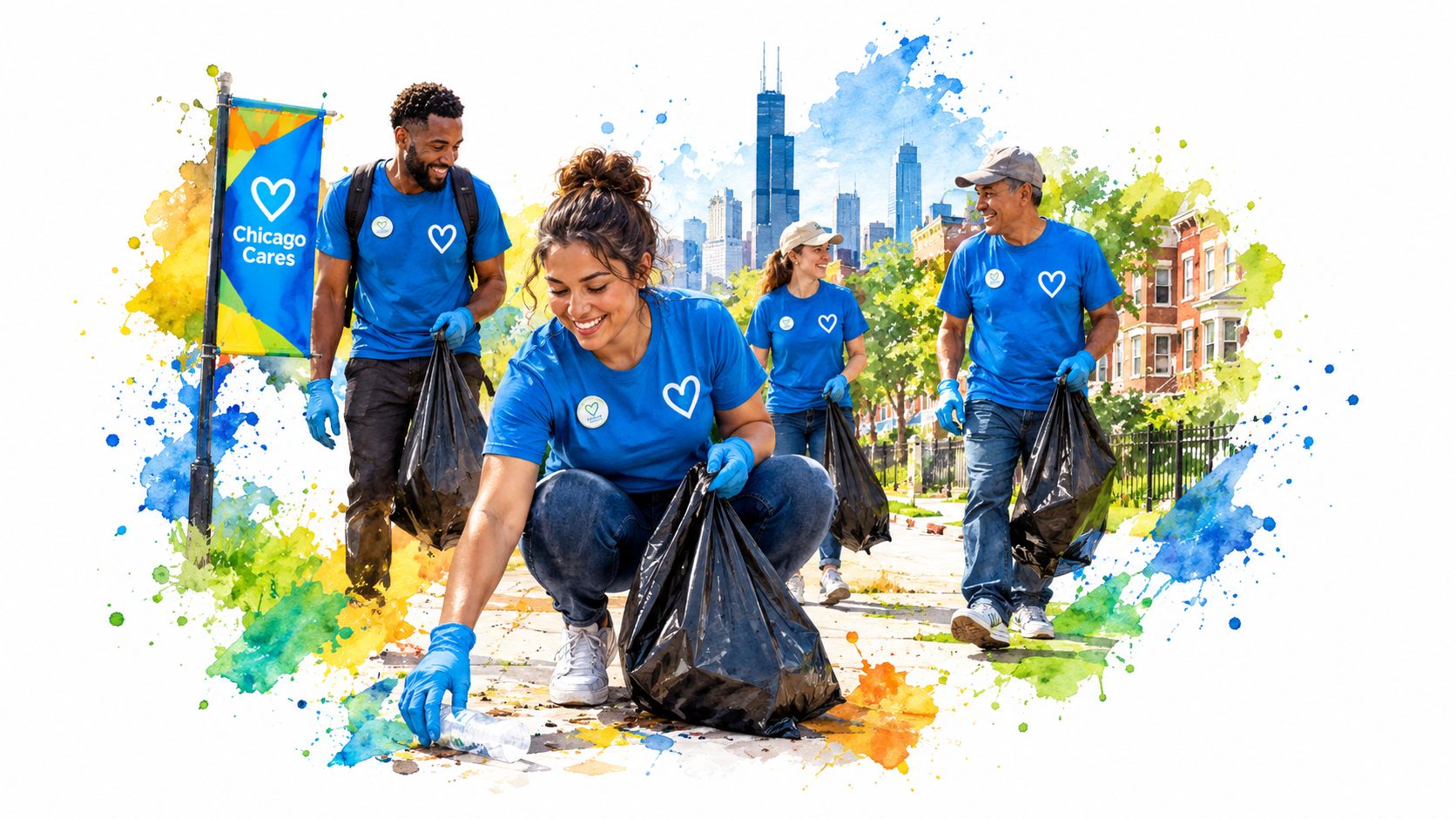
    Here's a look at the spirit that keeps us moving:

    You can start with one corner. Bring one friend. Keep coming back until the block knows your footsteps.

    Cleaning Fairly in an Unequal City

    The easiest block isn't always the right block.

    If I only clean near my own home, I may polish the places with the most visibility while other residents keep living beside illegal dumping, weak lighting, overflowing bins, or heavy traffic. Equal hours can preserve unequal conditions when some blocks carry a much heavier burden.

    Chicago's Environmental Justice Index and Cumulative Impact Assessment combine pollution exposure, sensitive populations, and socioeconomic conditions. The city's Environmental Justice and cumulative impact information gives groups a stronger starting point than convenience or a good photo backdrop.

    Let residents define the work

    Use several signals when choosing a location:

    • Resident requests: Ask people who live on the block what they see each day.
    • Litter observations: Record repeated dumping, cigarette waste, food packaging, and bulky debris.
    • Public data: Review sanitation concerns, transit access, school proximity, and environmental justice indicators.
    • Local partnerships: Work with block clubs, schools, churches, businesses, and tenant groups.
    • Clear reasons: Publish why you selected the block and what the group plans to measure.

    A resident may ask for cleanup. Another may ask for better bins or lighting. Someone else may want illegal-dumping documentation rather than a volunteer crew arriving once and leaving.

    Chicago's planned trash-trap work also points toward prevention. Researchers report that 85% of collected waterway garbage is consumer-based plastic, much of it food packaging, bottles, wrappers, and takeout containers. That kind of finding can change what you do next. You may need outreach near a food corridor, better disposal points, or a city service request instead of endless pickup.

    I want residents to decide what “clean” means on their own block. Volunteers bring labor and attention. Neighbors bring lived knowledge. Put those together before you choose a route.

    A fair adopt a block program doesn't spread identical service everywhere. It sends more help where conditions demand more help, then measures whether residents feel the difference.


    Litter Caterpillars organizes recurring weekend cleanups across Chicago, including block-by-block work in all 50 wards, with a focus on safety, friendship, and steady service. Visit Litter Caterpillars to join a cleanup, meet the group, or find out how to turn your own block into a place people care for together.

  • Small Appliances Disposal Done Right

    Small Appliances Disposal Done Right

    Rain hit the alley behind a Chicago apartment building when I found a cracked coffee maker beside a busted toaster. I could've tossed both into a dumpster and called the cleanup done. That would've moved the mess, not solved it.

    Why Tossing Electronics in the Trash Fails Us

    A small appliance looks harmless until you open the wrong waste stream. A toaster carries metal, wiring, insulation, and electrical parts. A coffee maker may hold mineral residue, plastic, a circuit board, and a cord. A vacuum can contain a battery, dust, and tightly packed components that workers can't safely sort from ordinary garbage.

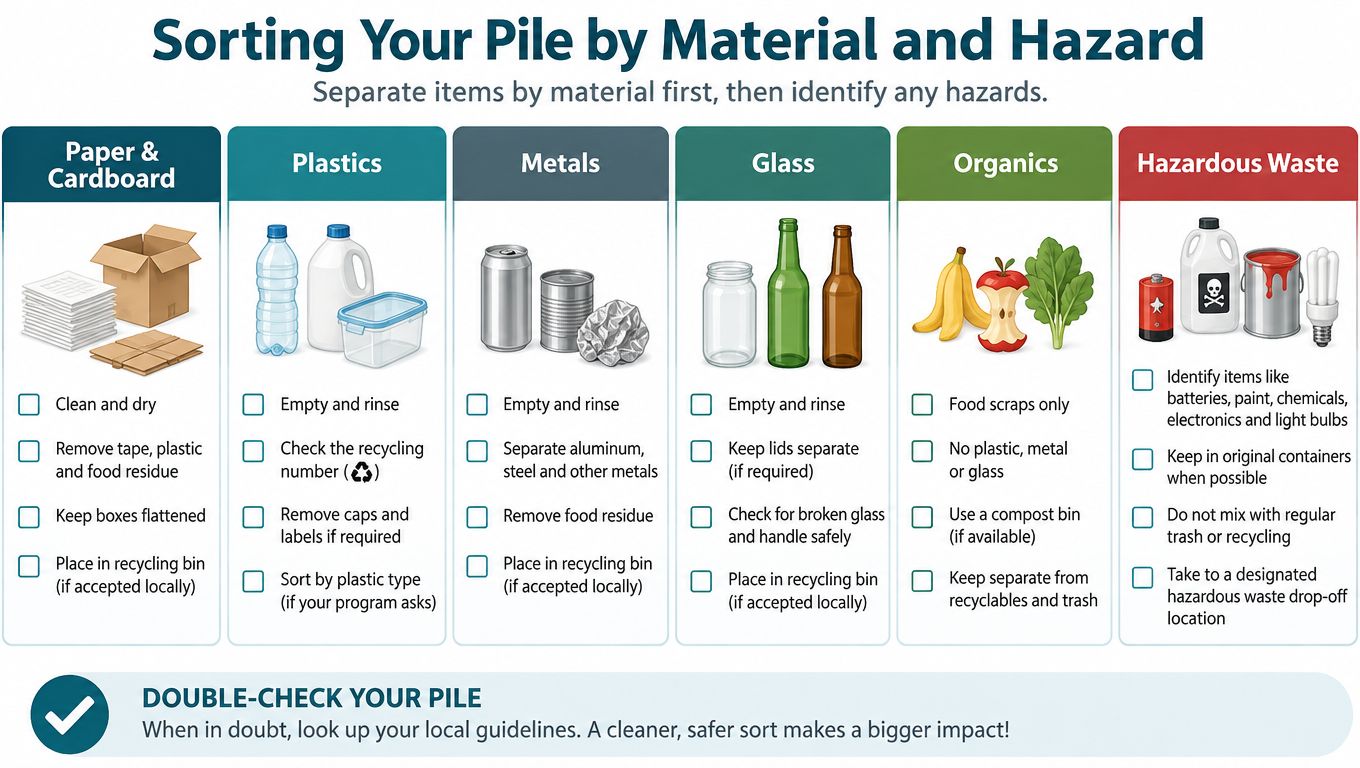
    When I clean an alley, I separate litter removal from responsible disposal. A bag of fast-food wrappers belongs in a different lane from a microwave, hair dryer, blender, or electric kettle. The item may look like junk, but its final destination determines whether a processor can recover materials or whether a landfill receives the whole device.

    Street rule: Removing an appliance from public space is only the first job. You still need to send it through the right channel.

    Chicago residents should check local guidance before loading a device into a car. The city directs residents toward designated drop-off locations, and its seasonal collection period runs from April 1 through December 30. Rules can differ by appliance type, location, and program, so the Chicago hazardous waste disposal guidance can help you sort the next step before you travel.

    The safer approach starts with three questions. Does it still work? Can someone repair it safely? Does it need e-waste, battery, refrigerant, or hazardous handling? Those questions take a minute. They also prevent a cleanup crew from creating a second problem after solving the first one.

    A city block gets cleaner when volunteers act with nerve and discipline. Grab the appliance, protect yourself, identify the material, and send it somewhere that can process it.

    The Massive Gap in Global E-Waste Recovery

    The scale of small-appliance disposal makes casual dumping hard to defend. The Global E-waste Monitor data summarized by UNITAR reports that the world generated approximately 62 billion kilograms of e-waste in 2022, or about 7.8 kilograms per person.

    Small equipment accounted for approximately 20.4 billion kilograms, roughly 33% of all e-waste. That category includes household devices such as microwave ovens, vacuum cleaners, radios, toys, and similar equipment. Yet documented formal collection and recycling reached only about 12% of small equipment.

    That leaves almost 88% outside documented formal recycling systems. Across every e-waste category, only 22.3% of the 2022 total entered documented collection and recycling. Those figures describe more than a landfill problem. They describe a materials problem involving metals, plastics, circuit boards, batteries, and components that need controlled handling.

    The United States baseline

    The U.S. Environmental Protection Agency's durable-goods data estimated approximately 2.2 million tons of small-appliance waste in 2018. The category included toasters, hair dryers, and electric coffee pots.

    Only about 5.6%, or approximately 123,000 tons, went to recycling. The EPA estimated that 75.9% went to landfill and 18.5% went to energy recovery. In rounded terms, for every 100 tons generated, about 76 tons went to landfill, 19 tons went to energy recovery, and fewer than 6 tons went to recycling.

    That baseline explains why careful sorting matters during a Chicago cleanup. A volunteer who pulls one appliance from a mixed waste pile creates an opportunity for recovery, but only if the team keeps the item out of the general stream and confirms the processor's route.

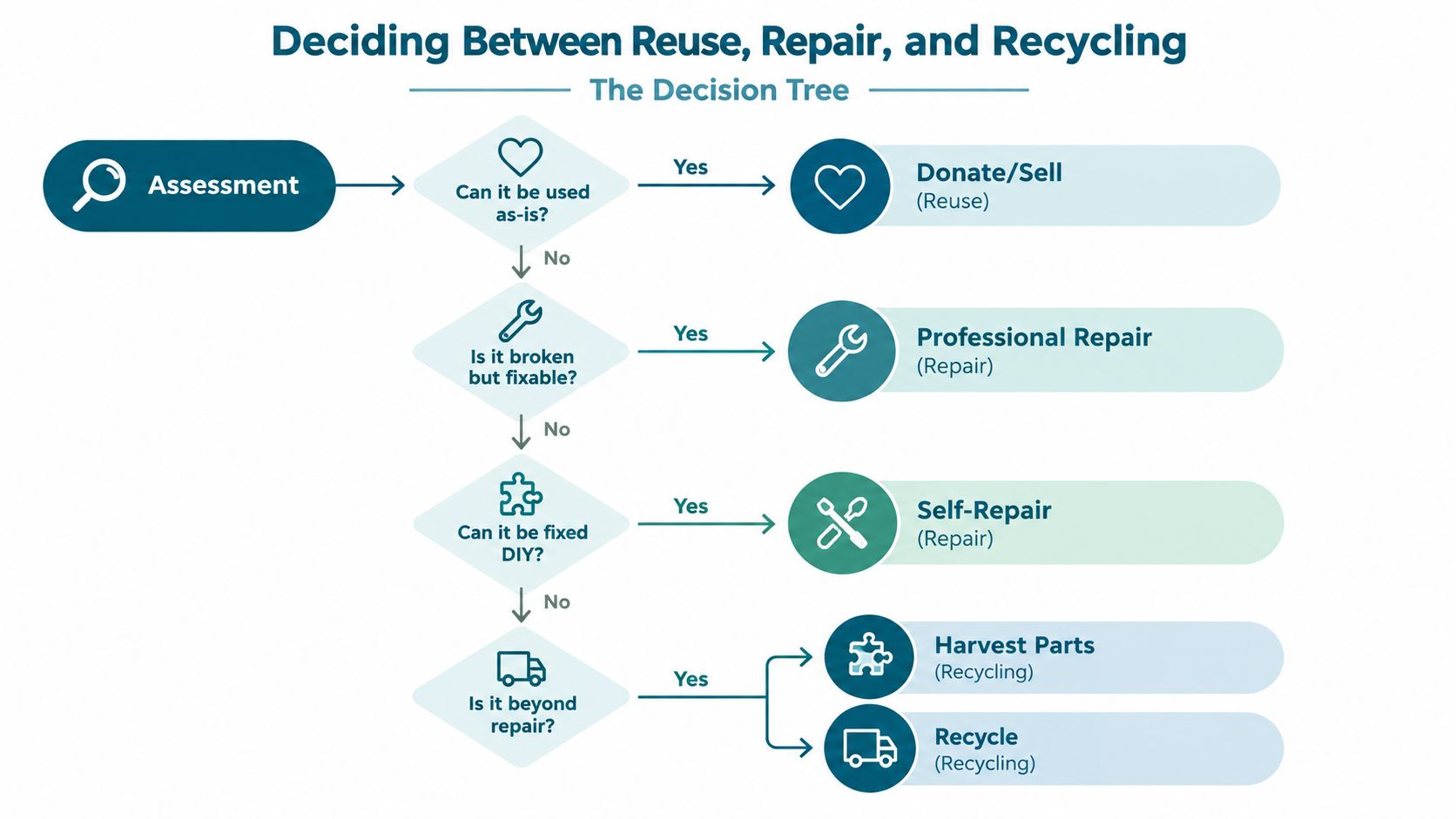
    A decision tree flowchart illustrating the process for choosing between reuse, repair, or recycling for items.

    What recovery actually requires

    Recycling doesn't happen because an appliance reaches a parking-lot collection point. A processor must separate material, remove pollutants, and document the treatment. If you want a plain-language example of how responsible material handling fits within a wider sustainability program, review sustainability at Used Mobiles 4 U.

    Watch this short video for another practical look at sorting and recovery decisions.

    The best habit is simple: separate first, transport safely, and ask for proof of final treatment. A clean alley matters. So does what happens after the truck leaves.

    Deciding Between Reuse Repair and Recycling

    A dead appliance doesn't automatically belong in a recycling bin. Start with its condition, then choose the least harmful realistic route.

    A working coffee maker with a clean reservoir may go to a neighbor, community group, resale channel, or donation site. A blender with a loose jar and an intact motor may deserve repair. A vacuum with a swollen battery needs isolation and specialist direction. A microwave with severe damage may need an appliance or e-waste processor.

    Use this decision order

    1. Test function only when the item looks safe. Check the plug, cord, housing, switches, and signs of overheating. If you see exposed wire, burn marks, a melted plug, a cracked battery case, or moisture inside the unit, don't plug it in.

    2. Choose direct reuse for clean, working equipment. Include the model, accessories, operating condition, and any known fault. A donation center can't use your honesty if you hand over a device that trips a breaker or smells hot.

    3. Choose professional repair when the fault needs electrical diagnosis. A repair shop can assess a coffee maker, vacuum, fan, or countertop mixer without forcing a volunteer to open a mains-powered appliance in an alley.

    4. Try self-repair only for low-risk tasks. Replacing a removable filter, cleaning a detachable container, or tightening an approved external fitting differs from opening a sealed heating or electrical assembly. Keep the manual nearby and stop when the job reaches wiring, capacitors, heating elements, or damaged batteries.

    5. Harvest parts or recycle the rest. A repair technician may use a motor, switch, jar, tray, or cord. If no safe reuse path exists, route the whole device to an authorized processor rather than stripping it on the sidewalk.

    A working appliance deserves a real test. A dangerous appliance deserves distance.

    The research repository review on small waste electrical and electronic equipment reports that collected appliances often need evaluation for repair or refurbishment before anyone can call them reusable. That makes donation a decision, not a reflex.

    For vacuum-specific handling, use this guide to recycle vacuum cleaners. Keep dust, hair, and loose debris contained, and isolate battery-powered models before transport.

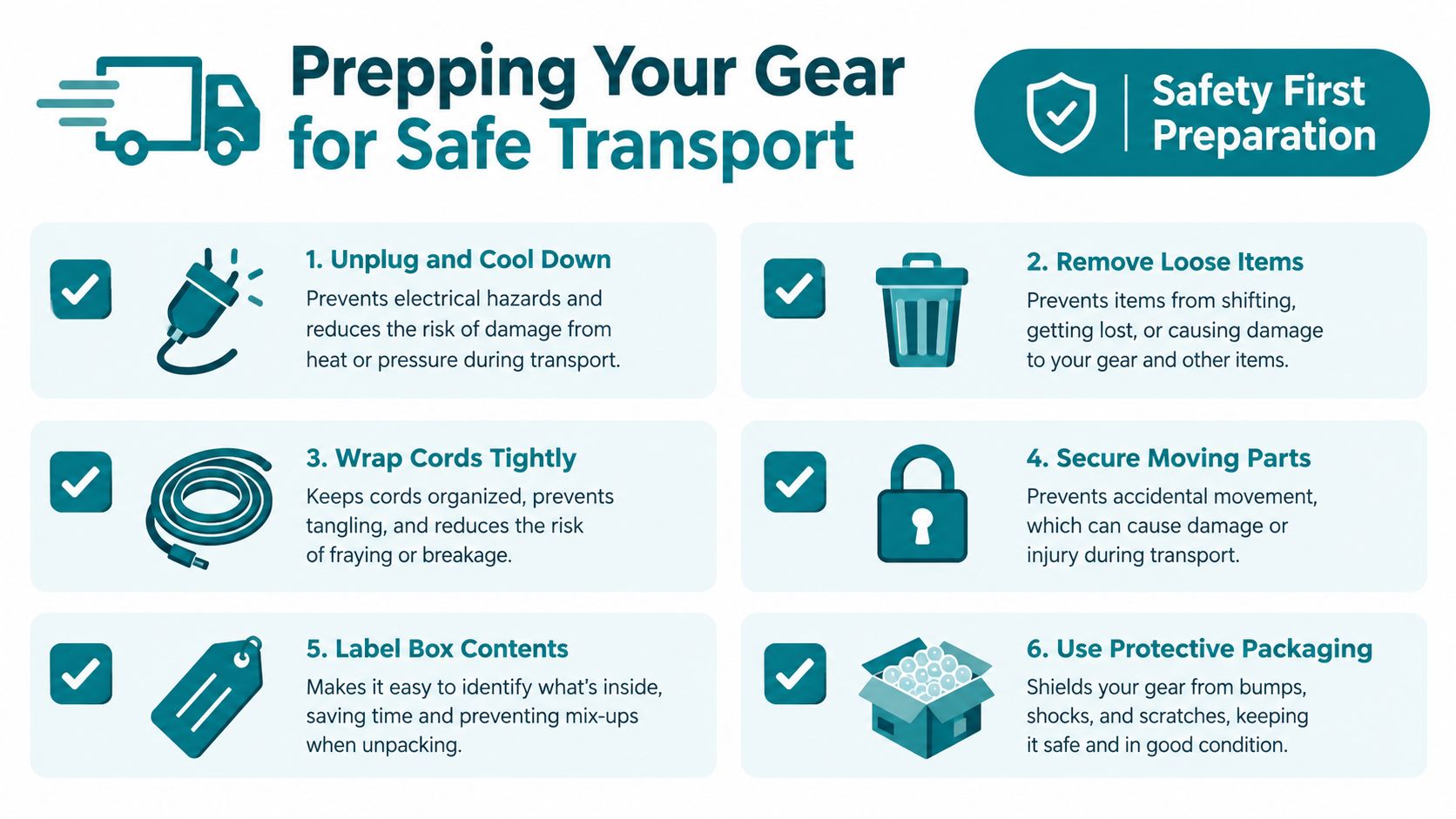
    An infographic titled Prepping Your Gear for Safe Transport listing six safety tips for packing and moving appliances.

    The brave choice isn't always the fastest choice. Sometimes it means carrying a working item to someone who can use it. Sometimes it means admitting that a frayed cord makes donation irresponsible.

    Prepping Your Gear for Safe Transport

    Before you lift an appliance into a truck, make it stable, dry, and identifiable. A volunteer team should treat every device as a separate object, not as one anonymous pile.

    Clear the easy hazards

    Unplug the device and let hot parts cool. Empty coffee grounds, water, crumbs, dust, hair, and food residue where the design permits. Remove detachable trays, jars, bags, filters, and loose accessories, then place them with the main unit or label them separately.

    Remove batteries when you can do so without opening sealed electrical housing. Put loose batteries in a separate, protected container and isolate any battery that looks swollen, hot, leaking, crushed, or damaged. Don't throw a damaged lithium battery into a box with metal tools or other batteries.

    Keep appliances dry. Water inside a coffee maker, humidifier, or dehumidifier can leak into a vehicle or processor load. A sealed bag can contain residue, but don't seal a hot device or a leaking battery in a way that traps heat.

    Keep the load intact

    Don't crush appliances to save space. Don't dismantle mains-powered devices in the field. Crushing can damage circuit boards, release residues, or turn a battery problem into a fire problem during storage, transport, or shredding.

    Use a labeled quarantine container for leaking, swollen, hot, or damaged battery-containing devices. Keep that container away from heat, sparks, and direct sun, and ask the receiving facility for instructions before you move the item.

    Cooling appliances need a separate level of care. Refrigerators, freezers, window air conditioners, and similar units can contain refrigerant and compressor oil even when they no longer run. The EPA appliance disposal rules prohibit knowingly releasing most refrigerants during disposal.

    You can't cut a refrigerant line, remove a compressor, or puncture the unit yourself. EPA rules place responsibility on the final disposer to recover refrigerant before landfill disposal or recycling. If another company already recovered it, the disposer needs a signed statement naming that company and giving the recovery date.

    Transport rule: Dry, separate, label, and protect the appliance. If it contains refrigerant or a damaged battery, call before you move it.

    Illinois also bans disposal of white goods with their components still inside. The Illinois EPA disposal guidance covers refrigerators, freezers, ranges, water heaters, air conditioners, humidifiers, and similar domestic or commercial appliances. A landfill needs component removal and an Illinois EPA-approved plan and permit, so contact the hauler, transfer station, or recycling facility before loading a large unit.

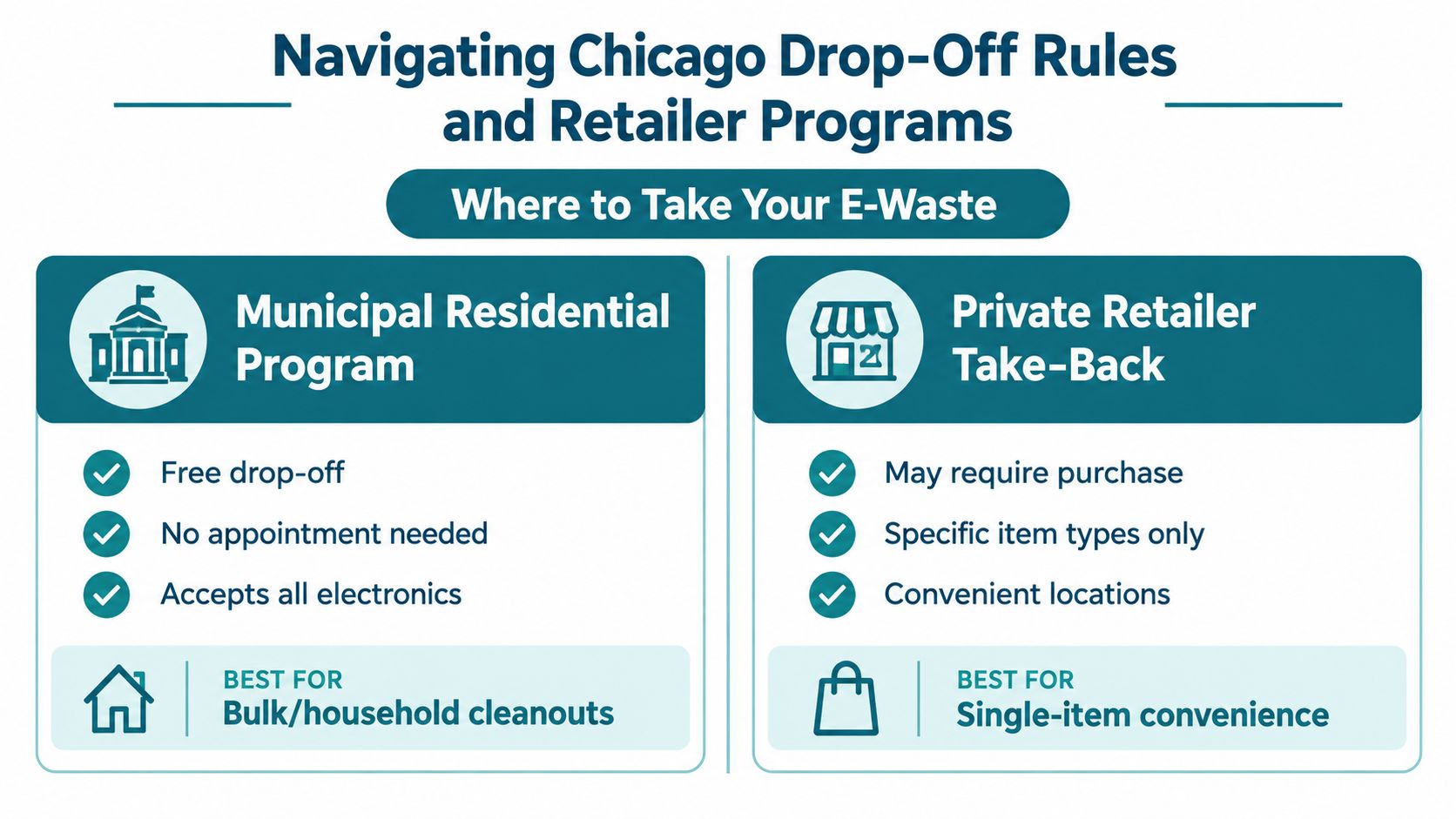
    An infographic comparing Chicago municipal residential e-waste drop-off programs with private retailer take-back options for electronics.

    Navigating Chicago Drop-Off Rules and Retailer Programs

    Chicago's municipal program and a private retailer may both collect electronics, but you can't assume they accept the same items. A location that takes a laptop may reject a microwave. A store that accepts a countertop device may not handle a refrigerant unit.

    Start with the exact appliance name and condition. Say “countertop microwave with cord,” “cordless vacuum with removable lithium battery,” or “window air conditioner containing refrigerant.” That description gets you a better answer than “I have some electronics.”

    Compare the routes before you drive

    Route What you should confirm Where it fits
    Chicago residential drop-off Current accepted-item list, location, hours, and seasonal availability Household electronics when the city confirms the item
    Retailer take-back Accepted brand or product type, purchase conditions, quantity limits, and fees A single item or a store-specific return route
    Authorized e-waste processor WEEE acceptance, battery handling, refrigerant service, and documentation Mixed loads, unusual items, and verified downstream treatment
    Reuse or repair destination Function, cleanliness, safety, parts, and testing expectations Working or repairable appliances

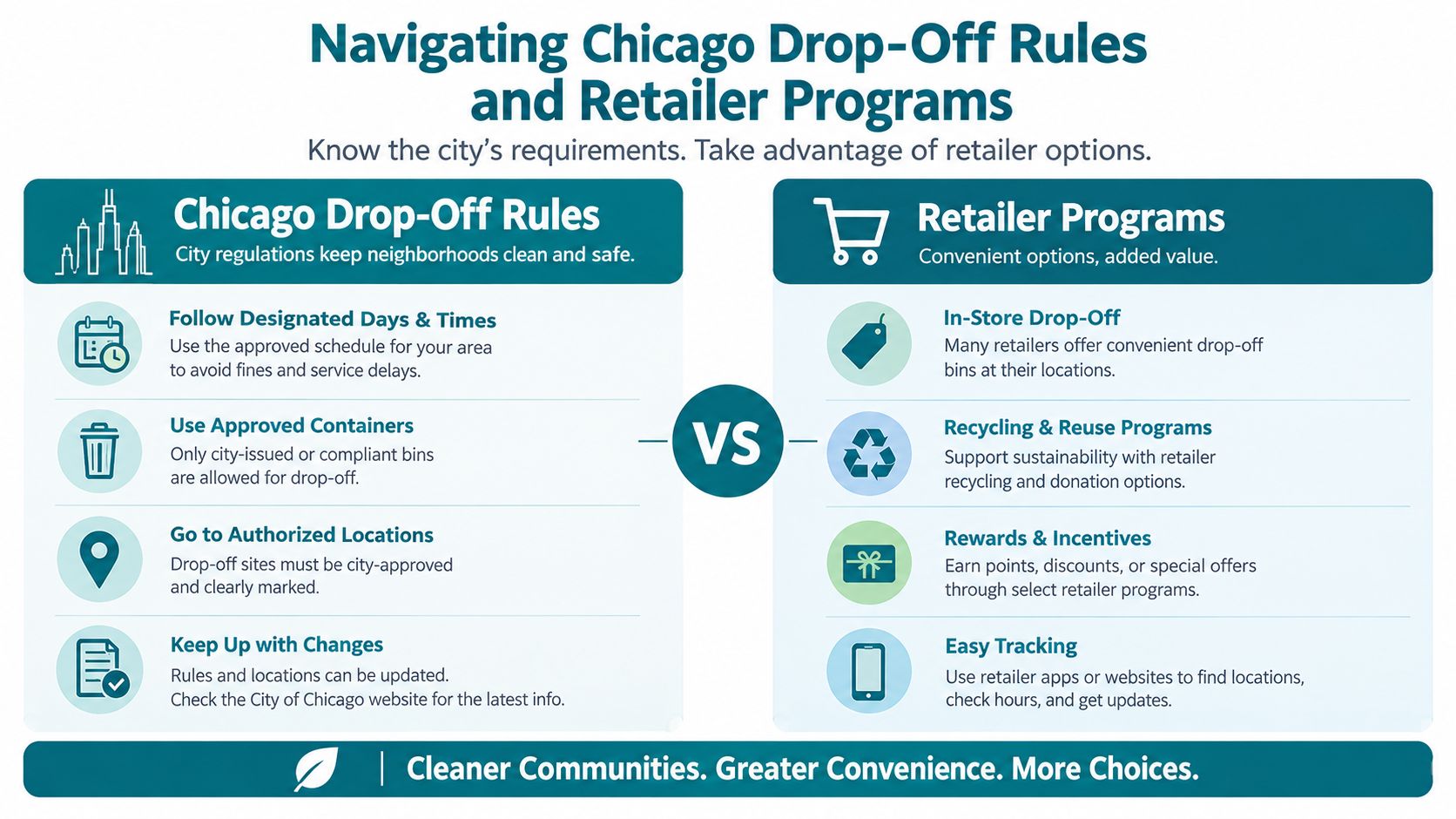
    Chicago residential electronics locations don't accept commercial electronics. Residents also can't leave materials at a site outside operating hours. Leaving a box beside a closed gate turns a good recycling attempt into illegal dumping.

    The city program limits seasonal collection to April 1 through December 30, according to Chicago's official other-wastes guidance. Confirm the current dates and accepted items immediately before you go because local rules can change.

    One Chicago-area provider lists small appliances but excludes microwaves, while another city resource describes broader electronics collection. That conflict makes a phone call worthwhile. Don't spend an hour crossing the city only to carry the same appliance home.

    For broader questions about finding electronics recycling options near me, use a location-finding resource as a starting point, then verify the destination's own acceptance rules.

    When a city site confirms your item, follow its hours and household limits. When it doesn't, call a certified processor or retailer. Use this small household appliances recycling guide to organize the item list before you make those calls.

    An infographic titled Navigating Chicago Drop-Off Rules and Retailer Programs, comparing city disposal regulations with retail service options.

    A successful trip ends with the facility accepting the appliance, not with you leaving it beside a locked entrance.

    Tracking Your Real Recycling Impact

    A drop-off receipt can prove that you delivered an appliance. It can't always prove that a processor recycled the material. Volunteers who want an honest account should track the item from intake through final treatment.

    The Global E-waste Monitor methodology calls for measuring both collection and final treatment. Weigh appliances when they arrive, record categories, photograph unusual or hazardous items, and request processor receipts.

    Record what your team handles

    Use a simple intake sheet with:

    • Item category: Toaster, microwave, vacuum, coffee maker, battery device, or cooling appliance.
    • Condition: Reusable, repairable, parts candidate, recyclable, or hazardous hold.
    • Mass: Record the accepted weight at intake.
    • Destination: Write the facility name and the date of handoff.
    • Evidence: Keep the weight ticket, receipt, processor statement, or chain-of-custody report.

    Don't count a transfer as recycling. Resale, donation, repair referral, and parts recovery each describe a different outcome. A working coffee maker may reach reuse. A damaged blender may reach material separation. Your report should name the result instead of placing every destination under one convenient word.

    Calculate the verified recycling rate as material recycled divided by total accepted appliance mass. That formula prevents a collection event from claiming success based only on the number of items removed from a sidewalk.

    Measure the ending, not only the pickup.

    Ask processors direct questions. Do they weigh the load? Do they separate batteries? Do they document refrigerant recovery? Can they identify downstream treatment? Do they issue a receipt that distinguishes reuse, repair, parts, and recycling?

    A volunteer crew doesn't need a complicated database. A shared spreadsheet, labeled photos, and a folder for receipts can expose weak handoffs quickly. If a facility won't explain what happens after intake, choose another route when safety and access allow.

    Chicago cleanups run on trust. Protect that trust by reporting only what you can verify. Record the appliance, record the weight, save the receipt, and tell neighbors exactly which part you completed.


    Join Litter Caterpillars for Chicago cleanup events that tackle litter in every kind of weather, then bring your small appliances to the right reuse, repair, or recycling channel. Visit the group to find a weekend morning event, meet volunteers who care about safe disposal, and help clean the next block with us.

  • Ogden Park Chicago: What to Know Before You Go

    Ogden Park Chicago: What to Know Before You Go

    At 7:30 on a Saturday morning, I usually find the first scraps along Ogden Park's athletic-field fence, before runners arrive and before families reach the playground. A grabber, a bucket, and a pair of gloves can change that edge of the park in one quiet hour.

    A Saturday Morning at Ogden Park

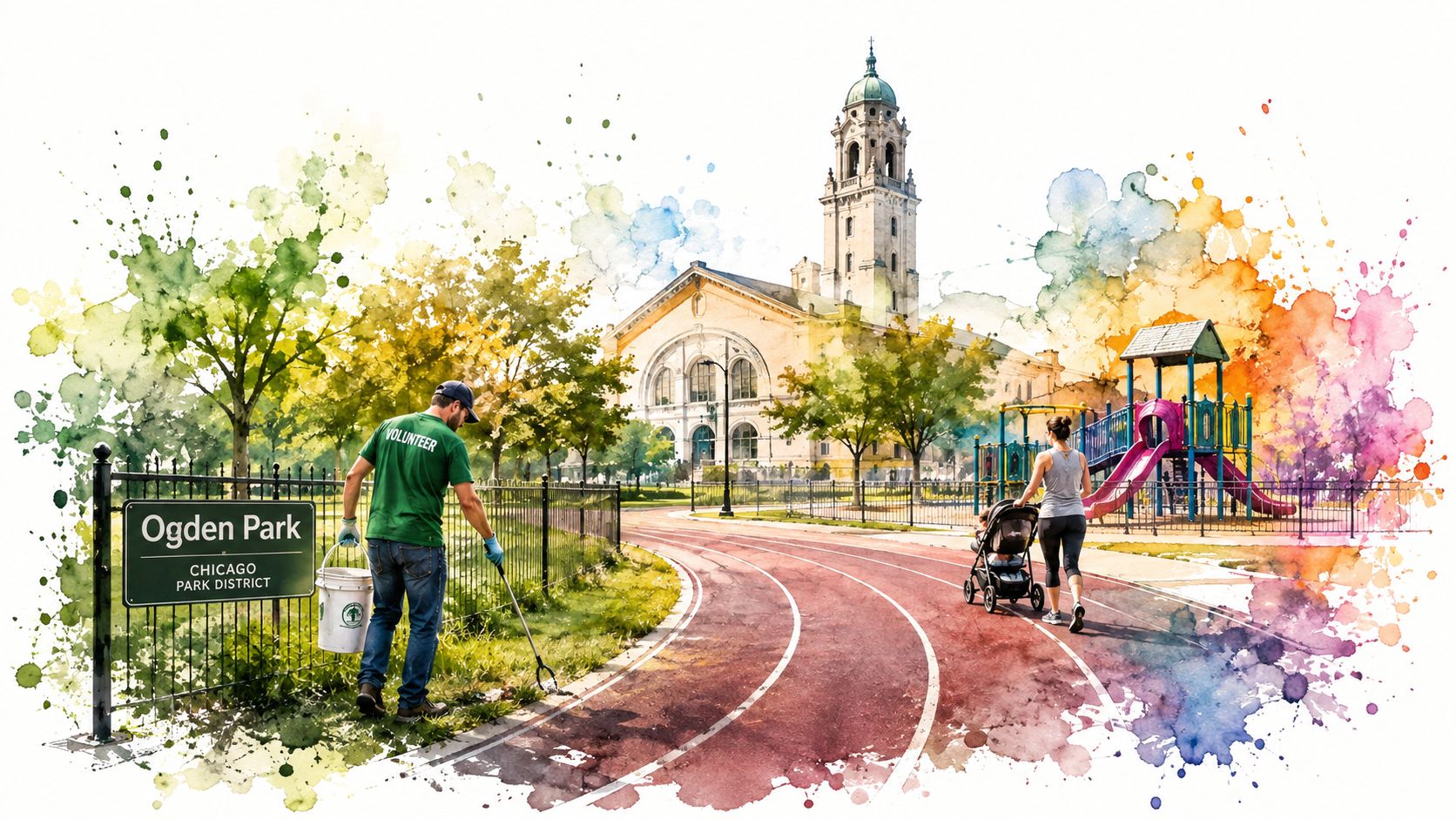
    I arrive at Ogden Park Chicago early enough to see the park change by the minute. Night damp still clings to the grass, and the concrete paths look gray under the morning light. Near the fence, wind and foot traffic have collected plastic wrappers, food packaging, and cigarette waste. Those are usually the first spots our cleanup crew checks.

    A parent pushes a stroller toward the playground while a runner tests the track. Someone carries coffee across the grounds, slowing down to watch volunteers clear litter from the edges. I have seen all of them share the same space without wanting the same kind of visit. One person needs a workout, another needs somewhere for children to play, and another wants to make the park cleaner before heading home.

    Ogden Park sits in Chicago's Englewood community. The Chicago Park District's park history places it among the historically significant neighborhood parks created during Daniel Burnham-era planning for overcrowded tenement districts. You can feel that older purpose in the layout, while the current questions are immediate: which entrance is open, what can you use today, and which areas remain under construction?

    I show up on weekends because Ogden Park is still taking shape. It has a track, athletic field, pool, playground, and nature garden, alongside an aging fieldhouse and a planned replacement. That mix makes the park useful, but it also means a visit may involve checking conditions rather than assuming every facility is ready.

    The park is a living work-in-progress, not a finished recreation complex. Before leaving, I check current program details, bring a specific plan, and leave time for the everyday scenes that give this Englewood park its character.

    Where Ogden Park Sits and How to Get There

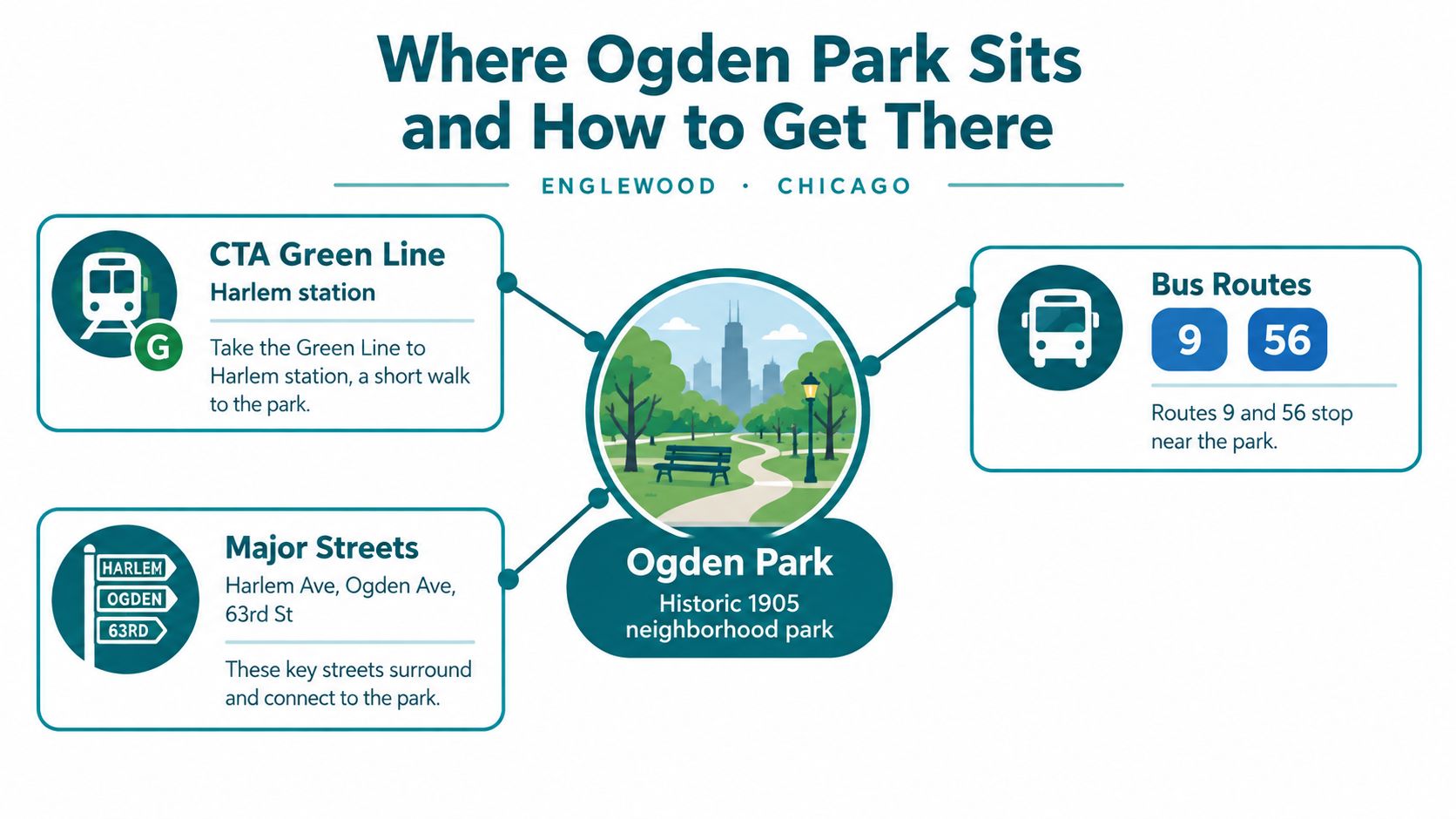
    Ogden Park is in Englewood on Chicago's South Side. Use the streets around the park as your first orientation point, then confirm the exact entrance and transit details before you travel. Park conditions, programs, and route information can change, so I don't rely on memory alone.

    If you drive, plan your arrival around the activity you want. A track workout, pool visit, or cleanup shift may require a different entrance from a playground stop. I also avoid assuming that every visible gate leads directly to the facility I want. Once I arrive, I walk the perimeter first and look for the fieldhouse, athletic area, pool access, and playground before unloading anything.

    An infographic showing directions to Ogden Park in Chicago via public transport and major local streets.

    The park's location makes it reasonable for a short local visit, especially if you already live in or near Englewood. Public transit may work better than driving when you're joining a group, visiting the pool, or planning to stay outdoors for a while. I'd check the CTA trip planner on the morning of your visit instead of treating any route graphic as a live schedule.

    Start with the purpose of your visit

    Your destination inside the park matters more than the park name alone.

    • Track and field: Head toward the all-weather athletic area if you're running, watching a game, or meeting a sports group.
    • Pool: Confirm seasonal access and current hours before you leave, then bring only what the pool rules allow.
    • Playground: Give yourself extra time if you're visiting with children, since the playground can turn a quick stop into the whole morning.
    • Nature garden: Walk slowly and stay on the gravel paths.
    • Fieldhouse: Check current programming and construction updates, since the older building is due for replacement.

    I use the fieldhouse as my mental center, then work outward. The athletic field and track sit in one activity zone, the playground serves families, and the garden gives visitors a quieter place to walk. That simple map keeps the visit manageable when you're carrying supplies, supervising children, or meeting people who may arrive from different directions.

    How a 1905 Park Still Shapes Englewood Today

    On a weekend morning, I can watch Ogden Park serve several generations at once. Runners circle the track, families head toward the playground, and neighbors pass through with their own routines. The park opened in 1905, after the South Park Commissioners acquired the land between 1903 and 1904. By 2026, it is more than 120 years old, yet it still feels like working neighborhood infrastructure rather than a preserved monument.

    Its original purpose was practical. City planners wanted residents of overcrowded tenement districts to have space for recreation, health, and community life. Ogden was one of ten neighborhood parks developed during the Daniel Burnham era. By late fall of 1905, Ogden, Sherman, Hamilton, Bessemer, Palmer, Armour, Russell, Cornell, Mark White, and Davis parks had opened.

    The name honors William B. Ogden, Chicago's first mayor, who lived from 1805 to 1877. I remember that history most clearly when I see the park in use. The name belongs to Chicago's civic past, while the field, playground, and paths belong to the people showing up today.

    The park changed as the neighborhood changed

    Ogden joined the unified Chicago Park District in 1934, when the city consolidated its 22 previously separate park districts. The system became citywide, but the park's daily meaning stayed local. Residents continued to use it as a place to exercise, meet, bring children, and spend time outdoors.

    Physical changes followed. Workers drained and filled the park's waterway in 1940. They remodeled the classically designed fieldhouse in 1972, and the park gained a major regional playground in 1998. Each project changed the choices available to visitors. A child running toward the playground may never see that history, but those spaces exist because the park kept adapting.

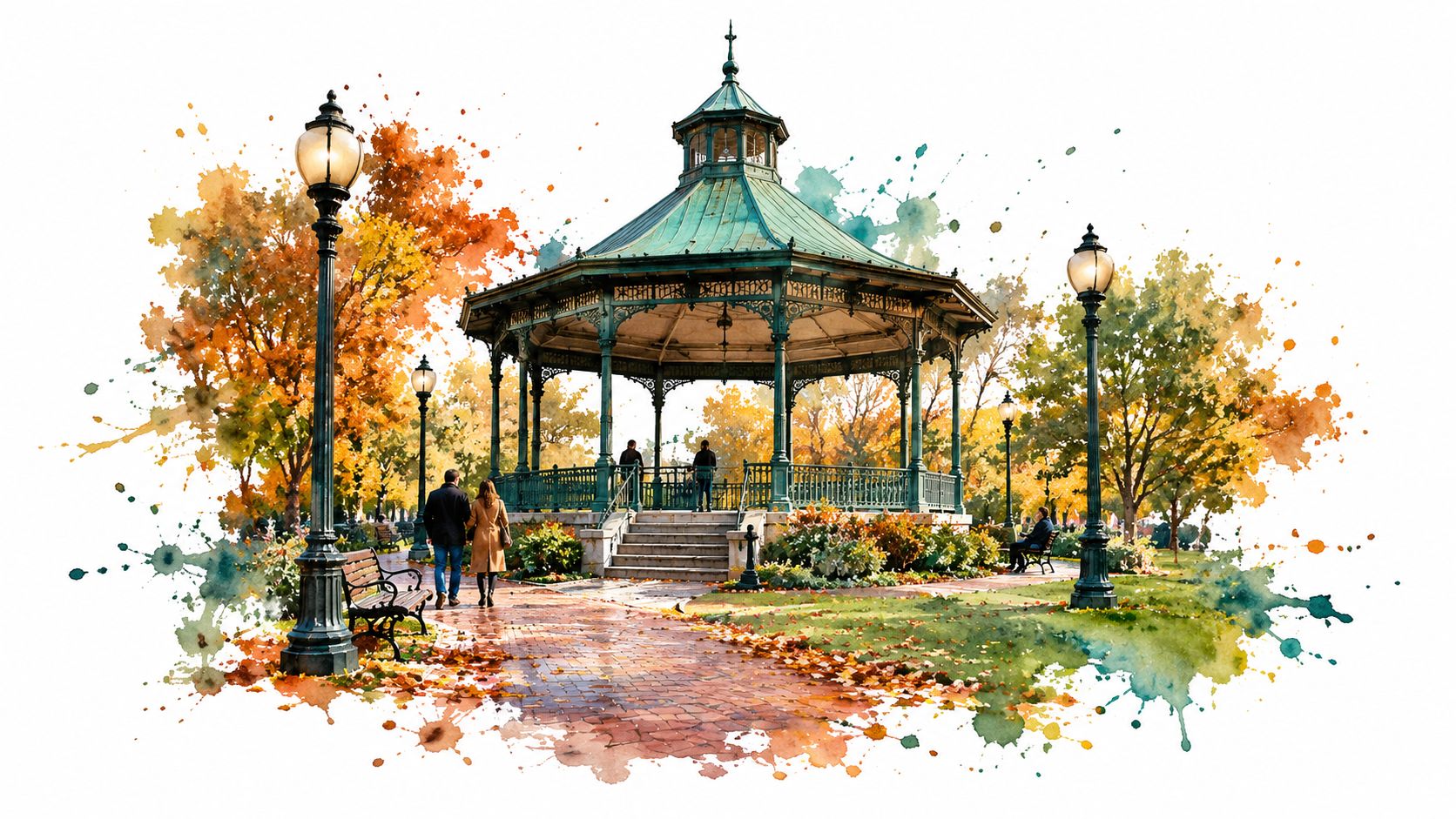
    A watercolor-style painting of a gazebo in Ogden Park Chicago surrounded by vibrant autumn trees.

    The fieldhouse is the next major change. City officials describe the existing 1904 fieldhouse as deteriorated, inaccessible, and too limited for present community needs. The planned replacement includes a gymnasium, dedicated boxing gym, fitness room, dance room, teen room, clubroom, restrooms, storage, offices, and utility rooms.

    The Chicago Park District announcement about the new fieldhouse says construction is expected to begin in late 2026, with an anticipated opening in 2028. It also describes an approved tax-increment-financing amount of $12 million. Those details describe a proposed future, not facilities available during today's visit.

    Before you visit: Treat the fieldhouse as a building in transition. Check current access and programs instead of assuming the planned rooms are already open.

    That tension defines Ogden Park in 2026. The grounds support everyday outdoor use, while the building shows what Englewood is still waiting to receive. For volunteers, families, and regular park users, the work-in-progress is part of the visit.

    What You Can Actually Do Once You Arrive

    I usually decide how to use Ogden Park before I step through the gate. The park works better when you match your activity to the surface and the facility, especially around the athletic field and nature garden.

    The athletic area has an all-weather, eight-lane track and an athletic turf field with sports lighting. The field supports football, soccer, and track and field, while the lighting extends usable hours. Synthetic turf and track surfaces need careful treatment, so I keep cleanup tools and casual foot traffic on the edges.

    A graphic infographic showcasing recreational facilities and activities available at Ogden Park including sports and events.

    Match the activity to the place

    • Running: Use the track for laps, but check the surface before you start and keep loose objects away from the lanes.
    • Football, soccer, and track events: Stay clear of active play and follow any staff direction around the synthetic turf.
    • Spectating: Look along the bleachers, gates, and paved circulation routes for a comfortable place to watch.
    • Playtime: The regional playground gives children a dedicated area, while adults can keep an eye on movement from nearby paths.
    • Quiet walking: The nature garden has a 0.4-acre enclosed space with native plants, trees, and gravel paths, as described in the city's Ogden Park athletic-field announcement.

    The garden asks for a lighter touch. I stay on the gravel paths, hand-pick visible litter, and keep collected material away from planted beds. A volunteer with a grabber can do useful work there without stepping into habitat or pulling at anything that looks rooted.

    Where cleanup makes sense

    The fence line, spectator areas, access gates, and paved paths usually need more attention than the playing surface. Wind pushes plastic and food packaging into those edges, while cigarette waste can settle near entrances. I inspect those places first, then move outward only when the activity around the field allows it.

    If you want a weekend service project, Chicago park cleanup opportunities can help you find a group and a suitable site. The same rule applies whether you arrive alone or with volunteers: protect the turf, avoid sharp tools near specialized surfaces, and never block a gate or active route.

    The fieldhouse remains useful as a reference point, though the replacement project means indoor access can change. I'd check the current schedule before promising a gym, class, or room to someone coming with you.

    Pool Rules, Hours, and How to Plan a Visit

    Ogden Park Pool works best when you treat the rules as part of your packing list. I'd check the Chicago Park District's current schedule before leaving because pool availability, fieldhouse programs, and seasonal hours can change. A quick phone check can save a long trip with a child in swim gear.

    The Chicago Park District pool rules require swimmers to shower before entering. Staff also prohibit food, drinks, smoking, running on the pool deck, street clothes, and street shoes in the pool area. Wear clean swimwear, and don't plan to enter if you have an open wound, unhealed abrasion, excessive sunburn, or a bandage.

    Ogden Park Pool Rules at a Glance

    Rule Area What's Required What's Not Allowed
    Before swimming Shower before entering and wear clean swimwear Entering without a pre-entry shower
    Pool deck Follow staff directions and walk Food, drinks, smoking, or running
    Clothing Use proper swimwear Street clothes or street shoes
    Health Wait until wounds, abrasions, sunburn, or bandages no longer prevent entry Open wounds, unhealed abrasions, excessive sunburn, or bandages
    Children Supervise children age eight and younger when they don't stand at least eight inches taller than the shallow end Leaving a child without the required adult supervision
    Flotation devices Use only a device with U.S. Coast Guard approval when permitted Bringing unapproved flotation devices

    The child-supervision rule deserves a careful read. Children age eight and younger need adult supervision when they don't stand at least eight inches taller than the shallow end. I'd stay close even when a child seems confident, since pool depth and swimming ability don't always match.

    Build a flexible visit

    I plan a pool visit in three parts. First, I check the current pool hours and program information. Next, I pack clean swimwear, a towel, and only the items the facility allows. Finally, I leave time for changing and the walk between the pool and the rest of the park.

    The same approach works for the broader grounds. Park users may come for a morning workout, a playground stop, or a weekend event, but exact facility hours can shift. Ogden Park is easiest when you check before you go, arrive with the right equipment, and accept that outdoor spaces and indoor programming may run on different schedules.

    Joining a Cleanup Crew at Ogden Park

    By Saturday morning, the litter usually tells a simple story. Wind carries plastic toward the fence. People drop food packaging near a place where they stop to watch a game. Cigarette waste collects around gates and paved edges. Those areas make good cleanup targets because volunteers can remove debris without walking across synthetic turf or disturbing planted beds.

    I've seen the work become easier as soon as people stop treating it like a lonely chore. One person holds the bucket, another scans the grass, and someone else checks the gate line. The task has a rhythm, and the park looks different before the first daytime activities begin.

    What a group cleanup feels like

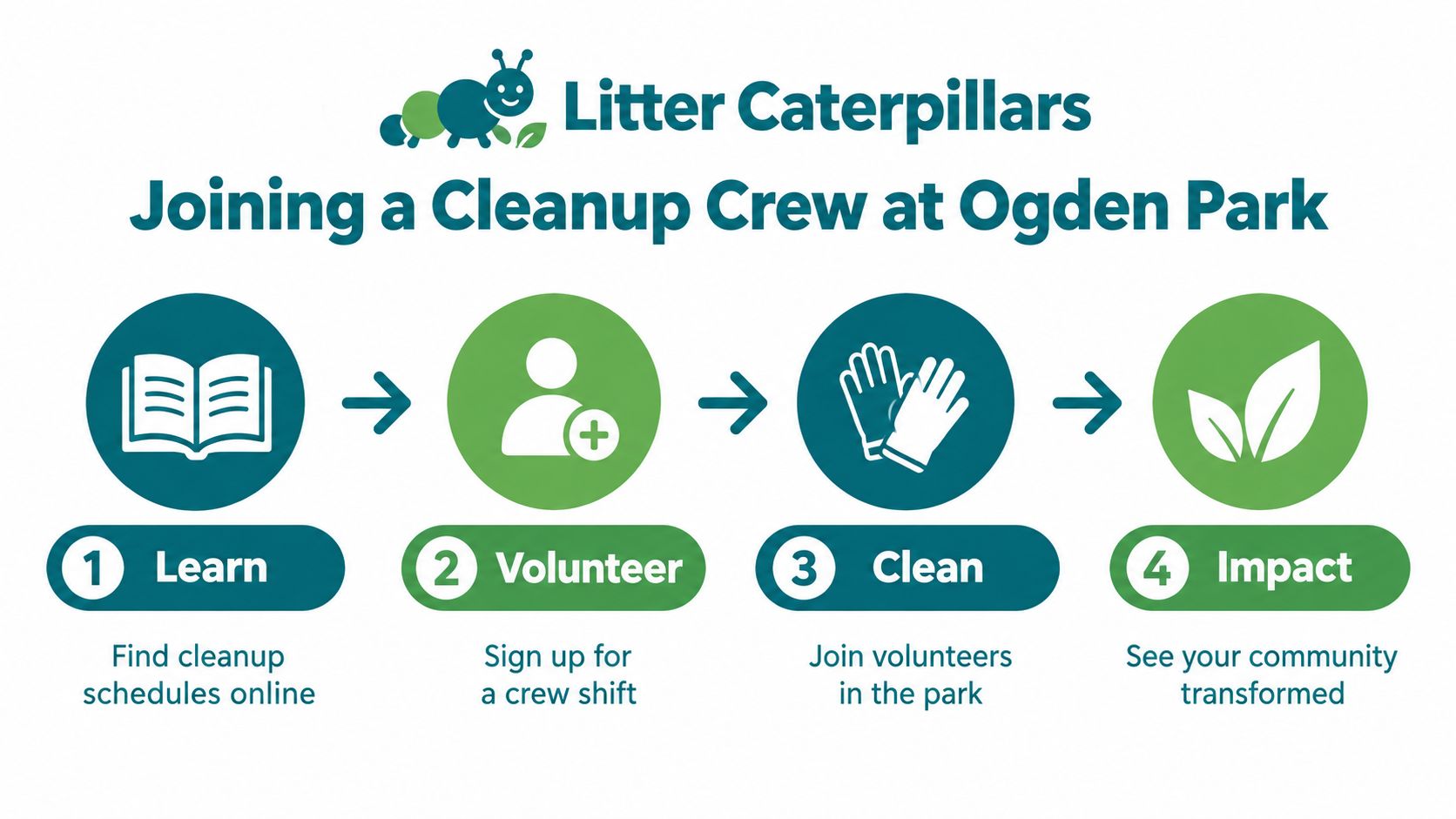
    Litter Caterpillars is a Chicago volunteer group that meets weekly, rain or shine, and works across the city's wards. The group uses weekend-morning meetups, grabbers, buckets, flags, and a theme song to make service feel social rather than formal. Volunteers don't need to donate, and the group puts safety first, followed by volunteer happiness.

    You can use its Meetup page or Instagram as an entry point. I'd look for the event details, confirm the meeting place, and arrive ready to work outdoors. A cleanup shift can fit naturally around a run, playground visit, or pool trip, as long as the group's activity doesn't interfere with park users.

    A four-step infographic showing how to join a Litter Caterpillars cleanup crew at Ogden Park.

    A first-time volunteer checklist

    • Find the meetup: Check the group's Meetup page or Instagram for the current Ogden Park schedule.
    • Dress for the ground: Wear shoes and clothes you can use outdoors, with gloves if you have them.
    • Bring water: A morning outside can feel longer than expected, especially in changing weather.
    • Follow the route: Start at the assigned fence line, gate, bleachers, or paved path rather than choosing an active playing area.
    • Ask before moving anything: Keep sharp objects, large debris, and unfamiliar material separate for group leaders.
    • Leave the surface alone: Don't drag tools across the track or synthetic turf, and don't disturb garden beds.

    Bring curiosity, not perfection. The first useful action is showing up and asking where the work is.

    That is why Ogden Park works well for hands-on service. The cleanup zones are visible, the task has a clear finish, and volunteers can leave the park ready for the people arriving later.

    Beyond the Park, Exploring the Surrounding Neighborhood

    I like to leave Ogden Park with enough time to see a little of Englewood instead of turning the visit into a parking-lot stop. After a cleanup or workout, walk toward the nearby commercial corridors and look for a local coffee shop or food spot that feels open and convenient. Availability changes, so I check current listings before promising a particular business.

    You can also pair the park with another green space or Chicago Park District site if you want a longer outdoor morning. I keep the plan simple: one main activity, one nearby meal or coffee stop, and enough time to get home without rushing. That works better than building an ambitious itinerary around places I haven't checked.

    Englewood has its own pace, and a respectful visit means keeping sidewalks clear, following posted rules, and treating residents as neighbors rather than scenery. The practical advice in this Chicago neighborhood safety guide fits the same approach I use at the park: stay aware, travel with purpose, and look after the space you're using.

    Ogden Park feels most useful when you let it remain ordinary. Run, swim when the pool schedule allows, bring a child to the playground, walk the garden paths, or spend a Saturday morning clearing the edges. Then take your time heading home through the neighborhood.


    Litter Caterpillars gives Chicago volunteers a friendly way to join weekend cleanup crews, meet people, and remove litter from parks and neighborhood blocks. Visit Litter Caterpillars to find an upcoming event and bring your hands, your curiosity, and a willingness to help Ogden Park look better before the weekend gets busy.

  • 7 Small Native Bushes for Chicago Gardens

    7 Small Native Bushes for Chicago Gardens

    Could a small Chicago yard handle wind, salt splash, clay, shade, drought, or standing moisture with one “easy” shrub? Probably not. The better question asks which bush fits the hardest corner. Small native bushes work like well-chosen tools. New Jersey tea suits a dry curb strip. Bush honeysuckle handles shade and slopes. Black chokeberry likes wet beds. Leadplant takes sun and poor soil. Coralberry brings winter berries to woodland edges. Prairie willow helps early pollinators, while meadowsweet enjoys rain-garden moisture.

    Before you buy, check mature height, mature spread, sunlight, drainage, salt exposure, and room around utilities or windows. A nursery pot gives you a temporary snapshot. The adult shrub needs a permanent parking space. Illinois planting guidance also recommends fall planting, with spring as the next-best season, followed by regular watering while roots develop (Northeastern Illinois native tree and shrub list).

    A neighborhood planting can feed pollinators and birds while giving residents a hands-on way to care for shared spaces. Litter Caterpillars fits naturally where cleanup and planting meet, especially around visible community spaces that need steady volunteer care.

    1. New Jersey tea

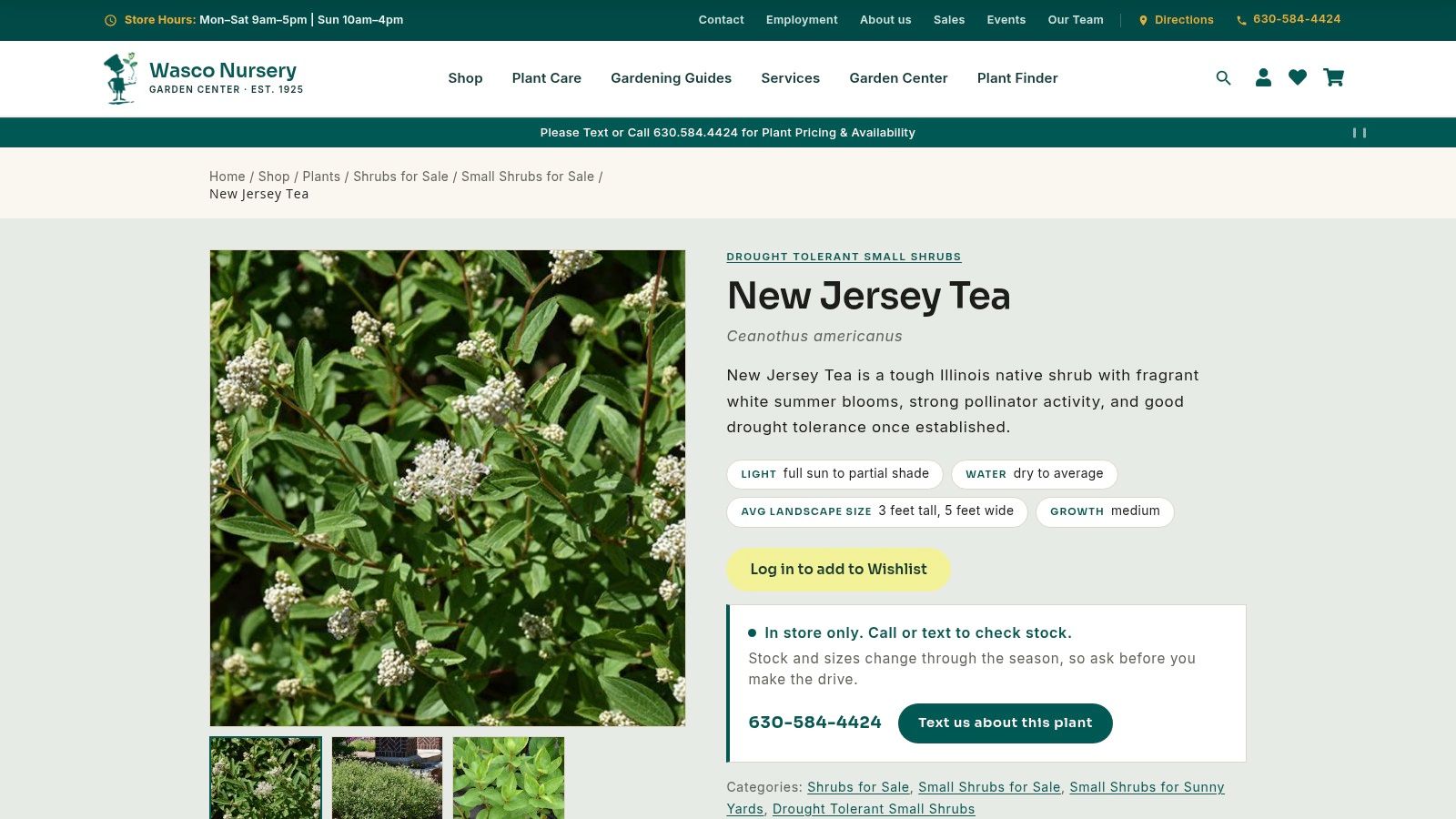
    A hot, dry parkway can punish thirsty shrubs. New Jersey tea, Ceanothus americanus, handles that kind of corner with a compact form that usually reaches about 2 to 4 feet. Its deep roots help it manage drought and hold soil on a sunny slope or berm. Regional nursery guidance describes the shrub as a fit for dry, lean conditions (New Jersey tea from Wasco Nursery).

    Late spring into summer brings frothy white flower clusters. Native pollinators visit the nectar, and the shrub also hosts several native butterfly species. The flowers give you a long seasonal display without turning a narrow bed into a wall of stems. Deer-resistant foliage adds another practical benefit for exposed Chicago lots.

    Placement rule: Give New Jersey tea full sun, lean soil, and room for air to move around the branches.

    This shrub takes patience. It establishes slowly, and heavy clay plus frequent watering can create trouble around the roots. Use it where irrigation stays limited rather than planting it beside a downspout that keeps the soil saturated. Its tidy habit works beneath windows, below power lines, along a sunny sidewalk edge, or in a small front yard.

    I'd pair it with prairie grasses or low wildflowers instead of filling the whole bed with one shrub. That mix gives insects several flower shapes and bloom times. If you're planning a Chicago planting with neighbors, connect the bed to a native plant sale from Litter Caterpillars and choose plants that volunteers can water, mulch, and inspect without specialist care.

    New Jersey tea (Ceanothus americanus)

    2. Northern bush honeysuckle

    Shade changes the planting problem. A foundation bed beneath a mature tree may receive only broken light, while a sloped park edge may need roots that hold soil. Northern bush honeysuckle, also called dwarf bush honeysuckle, Diervilla lonicera, handles sun through part shade and grows about 2 to 4 feet tall (Diervilla lonicera from Prairie Moon Nursery).

    Yellow summer flowers give native pollinators a reason to visit. In spring, bronze new growth catches the eye before the flowers arrive. Fall brings another color change. You can plant several together as a low hedge or let them knit a loose mass across a slope.

    The shrub spreads by suckers. That habit helps bind soil, but it can also move beyond a tightly measured foundation bed. Install an edge where you need a firm boundary, then inspect the bed during the growing season. A quick removal of unwanted shoots takes less effort than reclaiming an overgrown path later.

    • Best corner: Part shade, poor soil, a slope, or an urban bed that needs little fuss.
    • Seasonal moment: Watch the bronze spring flush, yellow summer blooms, and fall color.
    • Maintenance warning: Edge the planting if you need a strict outline.
    • Wildlife use: Pollinators visit the flowers, while the dense form adds low cover.

    Cultivar labels deserve attention. Different selections may grow differently, and a cultivar may provide different wildlife value from the straight species. I'd use bush honeysuckle where you want a forgiving shrub with a natural shape, not where every branch must stay inside a narrow geometric box.

    3. Black chokeberry

    A low bed beside a downspout needs a shrub that can accept wet soil, yet many compact foundation plants dislike standing moisture. Black chokeberry, Aronia melanocarpa, gives you a different rhythm through the year. Spring flowers arrive first, glossy black berries follow, and the foliage turns bright red in fall (Black chokeberry from Possibility Place).

    Compact selections, including Low Scape Mound, Ground Hug, and Iroquois Beauty, stay around 2 to 3 feet tall. That size works beside a walkway, beneath a window, or along a streetscape where a taller shrub would block views. The species also tolerates sun and wet to average soil, so you can place it near a rain garden or in a bed that dries between storms.

    Think of chokeberry as a seasonal switchboard. Spring feeds insects, summer develops fruit, and fall puts the planting into a bright red display.

    Birds use the berries. People can use them for preserves, though the fresh fruit tastes very astringent. Fruit can drop onto pavement, so set the shrub back from hardscape if you want fewer stains and less sweeping. Compact cultivars can also sucker slowly, which makes occasional inspection sensible.

    A spring planting may look modest at first. By late summer, the foliage and fruit give the bed more weight. In autumn, the red leaves make a small group visible from the sidewalk. I'd use two or three plants with a low grass or sedge in front, leaving a clear access path for watering and cleanup.

    4. Leadplant

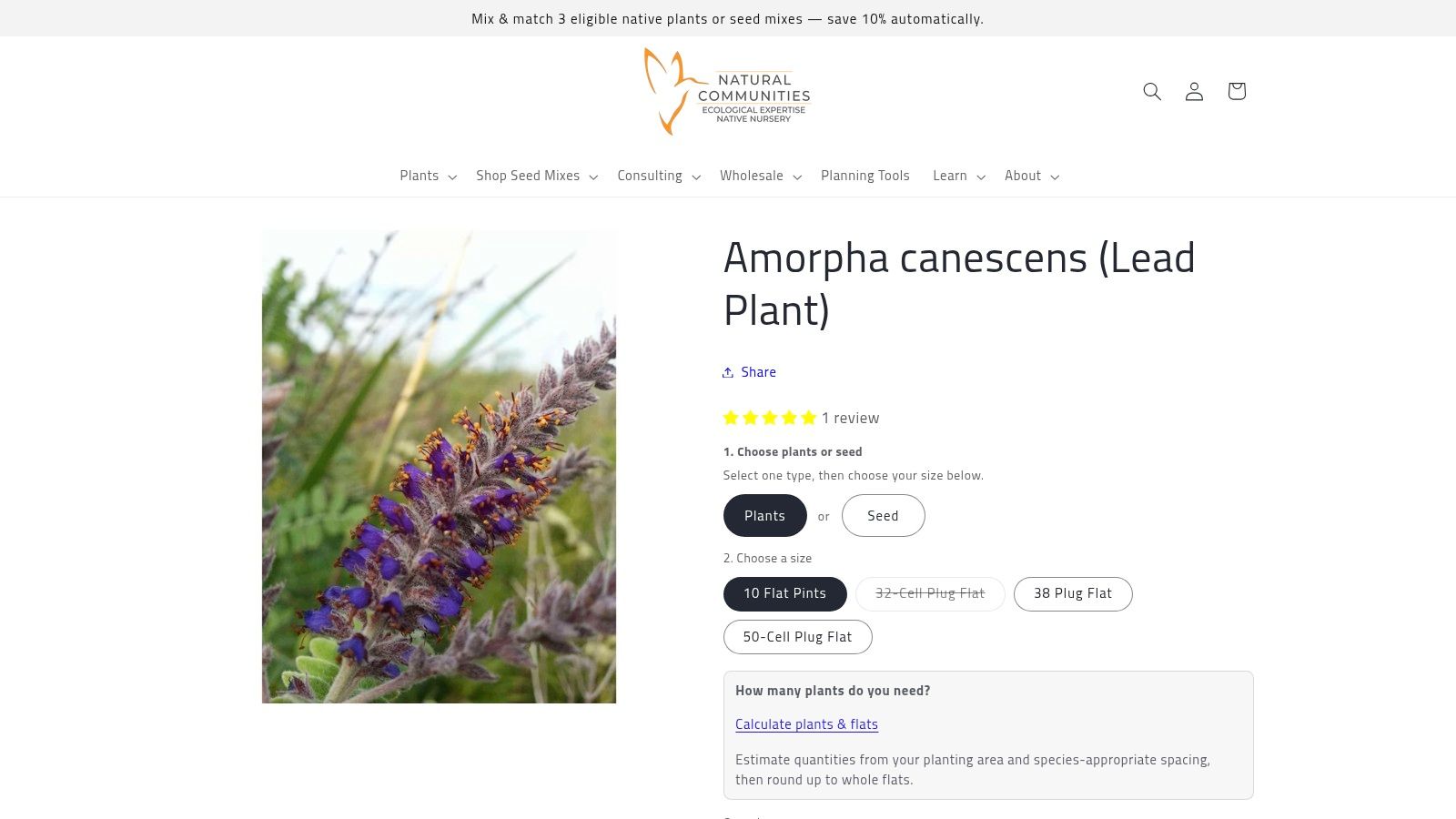
    Compacted soil beside a sunny alley can feel like brick by midsummer. Leadplant, Amorpha canescens, prefers that tough prairie assignment. It grows about 1 to 3 feet tall, carries silvery foliage, and sends up purple flower spikes in midsummer. Colorado State University Extension places leadplant among native shrubs under 4 feet at maturity and describes its drought tolerance and poor-soil performance (Colorado native shrubs guide).

    The foliage gives you a soft silver contrast against dark mulch or concrete. Bees visit the flowers, including specialist bees. Deep roots help the plant manage dry conditions and hold soil on a sunny berm. Its nitrogen-fixing habit can also improve soil over time.

    Leadplant establishes slowly. During the first year, water when the soil dries, then let the plant build its root system. Once established, it needs little irrigation. Full sun matters. In shade, the stems can flop and the plant loses the compact prairie shape that makes it useful in a narrow bed.

    Leadplant (Amorpha canescens)

    Use leadplant at the upper edge of a slope, beside a hot sidewalk, or in a dry community garden bed where volunteers can water it during establishment. The Des Plaines Dolomite Prairies Land and Water Reserve gives Chicago-area volunteers a place to connect native planting with hands-on outdoor care.

    Give leadplant time. Its first season may look quiet, while the roots do the work below the soil.

    5. Coralberry

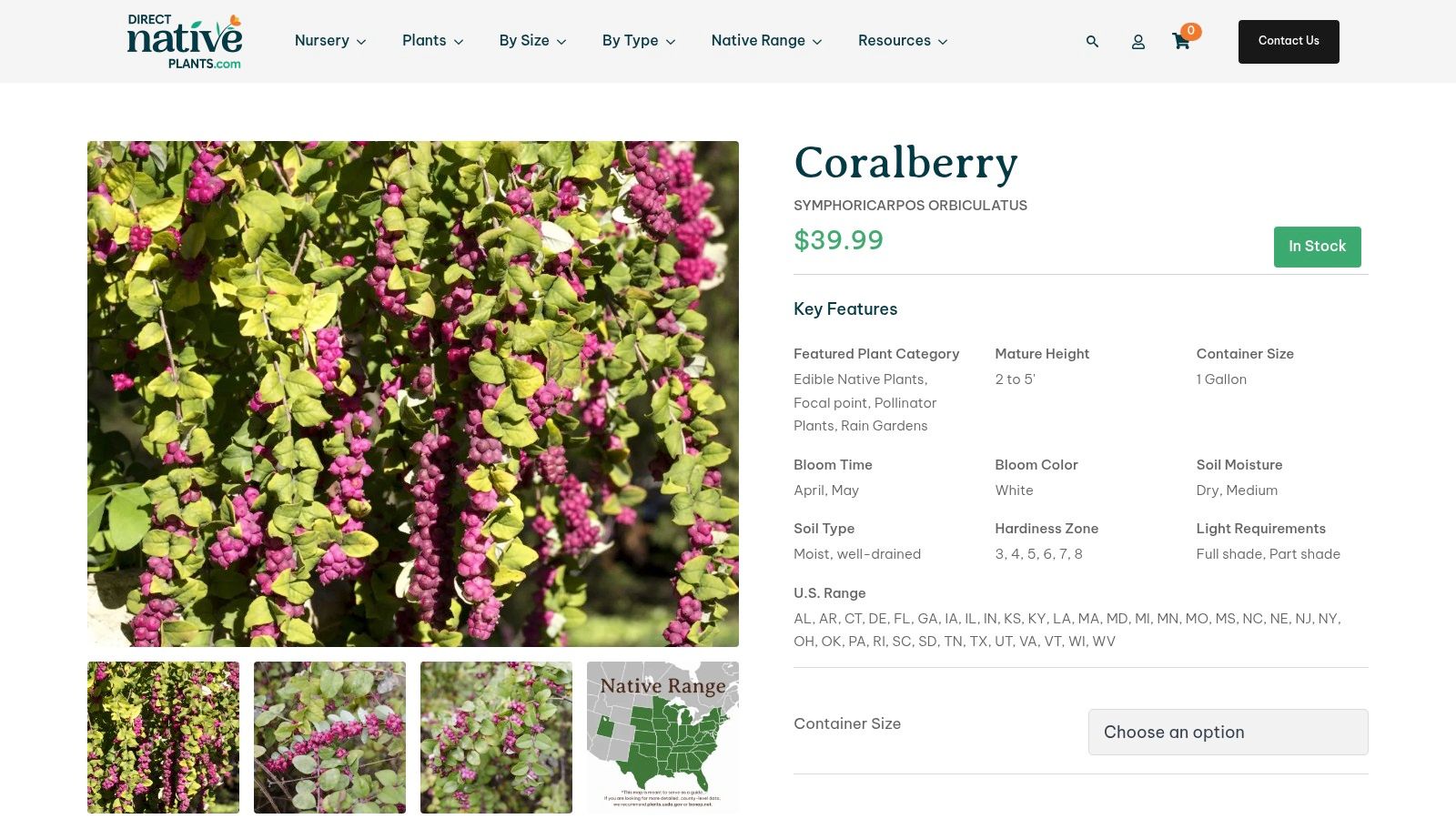
    A shaded parkway needs more than a shrub that survives. It needs winter structure, visible fruit, and enough tolerance for compacted urban soil. Coralberry, Symphoricarpos orbiculatus, grows about 2 to 5 feet tall, with arching stems and pink-to-coral berries that can persist into winter (Coralberry from Direct Native Plants).

    Birds use the berries, and the branches create cover. In part shade, coralberry can form a modest thicket along a woodland edge or behind a community garden fence. It also tolerates dry urban soil, alkaline conditions, and compacted ground. That combination makes it useful where a delicate woodland plant would struggle.

    The same spreading habit that creates cover can move into a path or neighboring bed. Edge it when you need control. Prune with a purpose, removing old or misplaced stems rather than shearing the whole shrub into a hard block. In humid shade, give the plant airflow because anthracnose and leaf spot can develop when branches stay crowded and damp.

    • Winter use: Persistent berries give birds food while bare branches provide cover.
    • Best placement: Part shade, a woodland edge, or a tough parkway with alkaline soil.
    • Maintenance warning: Check suckers and thin crowded growth.
    • Human use: Keep sightlines open beside sidewalks, driveways, and entrances.

    Coralberry (Symphoricarpos orbiculatus)

    A community planting needs access as much as habitat. Leave a clear strip for litter pickup, watering, and winter inspection. A Chicago community garden project with Litter Caterpillars can pair coralberry with shared stewardship, provided volunteers can reach the bed without pushing through dense branches.

    6. Prairie willow

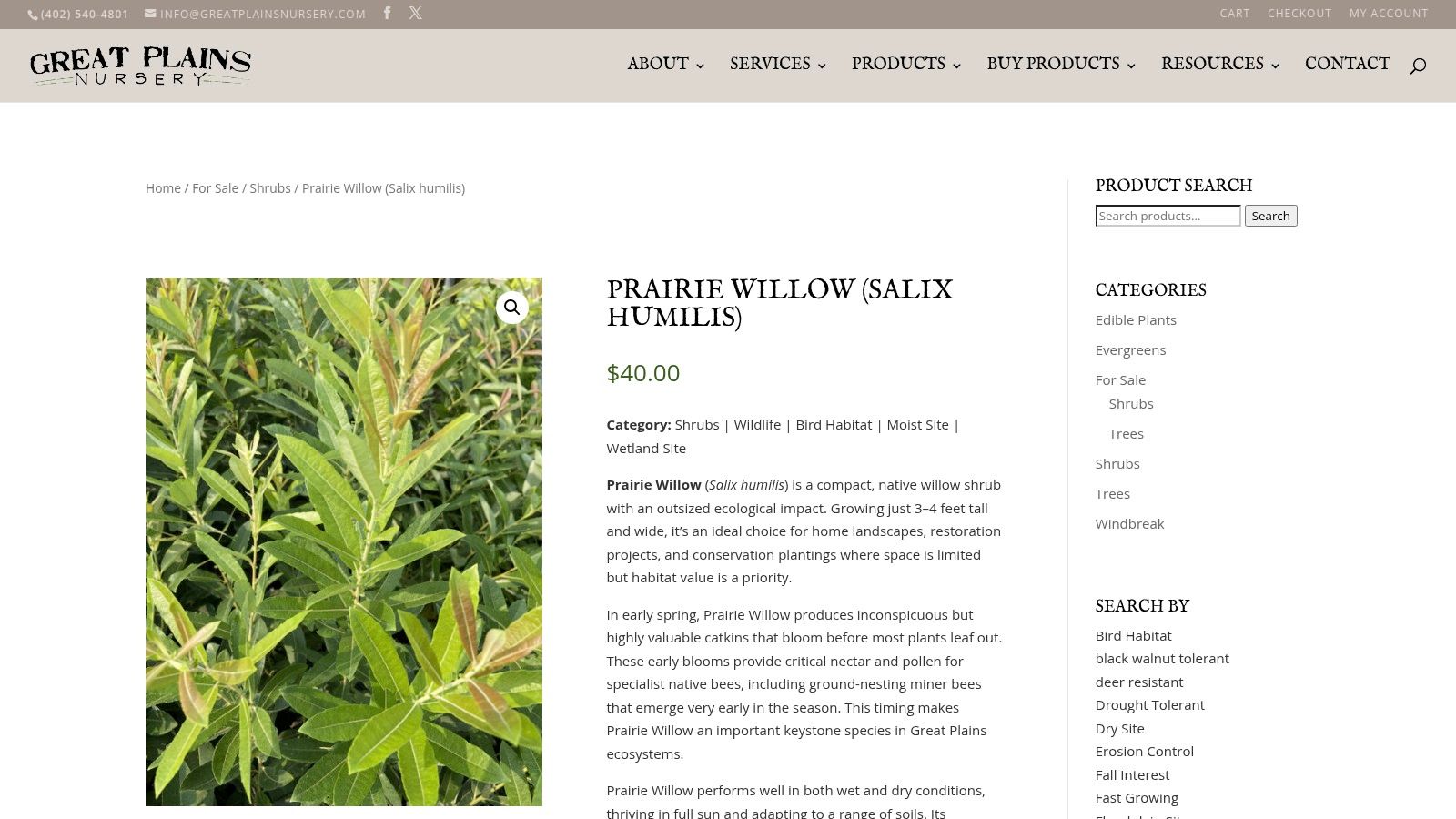
    Early spring can leave a garden looking bare while native insects begin moving. Prairie willow, Salix humilis, answers that timing problem with early catkins and a dense twig structure. It usually reaches 3 to 6 feet, though dry sites can keep it smaller (Prairie willow from Great Plains Nursery).

    Unlike many willows, this compact native handles drier, poor, sandy, or prairie soil. Full sun gives it the strongest growth. The branches create screening and low wildlife cover without demanding the footprint of a large tree. On a berm or slope, the roots also help hold soil.

    Prairie willow establishes quickly and responds well to pruning. That makes it useful when you need a screen that looks intentional, but you should resist placing it directly beside a narrow gate or utility box. Root suckers can spread, so give the plant room or install an edge before the bed fills.

    Use prairie willow where early food and dense twigs matter more than a perfectly compact outline.

    In late winter and early spring, inspect the stems and shape the plant before new growth accelerates. In summer, let the branches provide cover rather than stripping them into a thin ornament. Pollinators use the early catkins when few other flowers have opened. Birds and small animals can use the twiggy interior later.

    Prairie willow (Salix humilis)

    I'd plant it at the back of a sunny community bed, along a dry slope, or beside a vacant-lot edge where a little spread won't create a safety problem. Keep entrances, sidewalks, and street corners open. Habitat works better when residents can still see, reach, and care for the planting.

    7. Meadowsweet

    Where does stormwater collect after a Chicago downpour? A lower rain-garden edge, bioswale, or damp foundation bed suits Meadowsweet, Spiraea alba, better than a dry curb strip. This petite native spirea grows about 2 to 4 feet tall. Upright stems carry fluffy white flower clusters from early through late summer (Meadowsweet from Prairie Moon Nursery).

    Its placement works like a sponge's edge. Set it where water lingers after rain, but where the bed can still drain between storms. Choose medium-wet to wet soil, and keep the path side open. In a small yard, its compact form can soften a drainage area without blocking a foundation, walkway, or view.

    Bees and other beneficial insects visit the flowers. Meadowsweet offers a cleaner native alternative to nonnative Japanese spirea, with a summer display that keeps a rain garden active after spring blooms fade.

    • Wet-site fit: Use it in medium-wet to wet soil, especially at the lower edge of a rain garden or beside a bioswale.
    • Summer moment: White flower clusters brighten the bed through much of summer.
    • Maintenance warning: Water during dry spells if the root zone loses moisture. Lightly prune to shape the stems, or cut the shrub back when it outgrows its space. It may seed modestly if flower heads remain, so deadhead for a tighter planting.
    • Wildlife use: Bees and other beneficial insects visit the flower clusters.

    Leave room to check mulch, remove litter, and walk safely. Group Meadowsweet with lower plants, then maintain a clear edge so the wet bed stays useful rather than becoming an inaccessible thicket.

    7-Plant Comparison: Small Native Bushes

    Plant 🔄 Implementation Complexity ⚡ Resource Requirements 📊 Expected Outcomes 💡 Ideal Use Cases ⭐ Key Advantages
    New Jersey tea (Ceanothus americanus) Moderate, slow to establish but low maintenance once established Low, drought-tolerant, thrives in lean soils; avoid overwatering Pollinator-rich long bloom, slope/berm stability, tidy multi-season structure Sunny parkways, curb strips, dry small lots Long bloom/nectar, deer-resistant, butterfly host
    Northern / dwarf bush honeysuckle (Diervilla lonicera) Low, easy to establish; suckering may require edging Low, tolerates sun–part shade and poor soils; minimal care Durable massing/low hedge, extended pollinator blooms, erosion control Low hedges, mass plantings, shady/urban tough sites Very low maintenance, wildlife value
    Black chokeberry (Aronia melanocarpa) Low, straightforward; compact cultivars reduce suckering Moderate, tolerates wet to average soils; low irrigation needs Multi-season interest: spring flowers, edible berries, bright fall color Rain gardens, foundations, streetscapes Versatile, edible berries, strong fall color
    Leadplant (Amorpha canescens) Moderate, slow to establish first year; needs full sun Low, extremely drought-hardy, deep roots, nitrogen-fixer Long-term drought stability, pollinator attraction, soil improvement Sunny dry/compacted sites, prairie restorations, slopes Unique silvery texture, very low irrigation once established
    Coralberry (Symphoricarpos orbiculatus) Moderate, suckering habit; may need pruning/edging Low, tolerates part shade, dry/alkaline urban soils Persistent winter berries for birds, naturalized thickets, cover Parkways, woodland edges, naturalized hedges Winter interest, bird food/cover, urban soil tolerance
    Prairie willow (Salix humilis) Moderate, fast to establish; can spread by root suckers Moderate, tolerates dry prairie soils; responds well to pruning Early-season catkin forage, dense twig habitat, screening/stabilization Slopes, berms, small-screening plantings High wildlife value in small footprint, good for stabilization
    Meadowsweet (Spiraea alba) Low, easy to prune; may self-seed if not managed Moderate, prefers medium-wet to wet soils; may need irrigation in drought Long bloom, attracts bees/beneficial insects; fits wet edges Bioswales, rain gardens, wet to medium-wet sites Native alternative to nonnative spirea; easy to shape

    Build a Small Bed That Works All Year

    Start with the site, not the plant tag. Stand in the corner you want to fill and watch it through the day. Does sun reach the soil, or does a tree keep it in shade? Does rain disappear quickly, or does water sit after a storm? Does winter salt splash over the bed? Does a walkway, window, driveway, or utility line limit the shrub's adult spread?

    Then match the bush to the problem. Choose New Jersey tea or leadplant for dry sun. Pick bush honeysuckle or coralberry for shade and difficult soil. Use black chokeberry or meadowsweet where moisture stays longer. Try prairie willow where early catkins, twig cover, and quick establishment matter.

    Check mature height and width before purchase. A shrub that looks tiny in a nursery pot can eventually crowd a building, block a sightline, or spill across a path. Chicago-area guidance recommends regular supplemental watering during the first three growing seasons, especially during dry weather, so plan a hose route or volunteer watering schedule before planting (Northeastern Illinois planting guidance).

    Plant for the adult shrub, then design the care route around it.

    Group plants by shared needs. Don't force a dry prairie shrub into a wet bed, or place a moisture-loving bloomer beside a hot curb where the soil dries quickly. A small mix can include one dry-sun shrub, one shade-tolerant berry shrub, and one wet-soil bloomer. That combination gives you seasonal changes without asking one plant to solve every problem.

    Use mulch to retain moisture, but keep it away from the stems. Watch for litter pockets beneath dense branches. Leave deliberate sightlines beside paths and entrances. Check the planting after spring growth, summer heat, fall leaf drop, and winter storms. Native doesn't mean maintenance-free. Light, regular care keeps the bed useful for people and wildlife.

    Add a few small native bushes this season, then observe who visits. Look for bees on the flowers, birds near the berries, and shelter inside the twig structure. A neighborhood planting becomes easier to sustain when residents can see its seasonal changes and share simple jobs.


    Litter Caterpillars organizes volunteer trash pickups across Chicago and brings people together through regular, hands-on neighborhood service. Visit Litter Caterpillars to join a cleanup, meet fellow residents, and help keep shared spaces ready for native bushes and wildlife.

  • Douglas Neighborhood Chicago: The Bronzeville Cleanup Guide

    Douglas Neighborhood Chicago: The Bronzeville Cleanup Guide

    A spring hailstorm once left Kevin Tao and three other people shivering beneath a tree while Uber cars repeatedly cancelled around them. Instead of going home, they picked up trash, and that uncomfortable morning became the first chapter of a volunteer habit that now reaches every Chicago ward.

    How a Hailstorm Started a Movement in Chicago

    Kevin Tao had always found it difficult to clean his own space. An old jar of blueberry jam could carry a memory from a trip to Michigan. A bag of nuts could remind him of an abandoned attempt to eat better. Each object became heavier in his mind than it was in his hand.

    Then came the storm. Kevin and three other people stood under a tree during a Chicago springtime hailstorm, watching Uber after Uber cancel while the cold worked through their clothes. They had every reason to quit. Instead, they started picking up other people's trash.

    A man stands in a snowy Chicago neighborhood during winter with Uber cars showing cancelled status signs.

    That first cleanup taught Kevin something he hadn't expected. Other people's messes felt easier to move than his own. The work gave the group a strange kind of fun, and the freezing weather added a story they could share later. Suffering didn't disappear, but the group turned it into part of the adventure.

    A practical lesson: You don't need perfect motivation to begin. You need a meeting point, a small task, and enough courage to stay when the weather changes.

    Showing up before feeling ready

    The idea behind cleaning litter from public spaces starts with a simple reversal. You don't wait until you feel organized, fearless, or fully prepared. You step outside, pick up one piece of waste, and let the next action become easier.

    Kevin built the group around that idea. He wanted service to help people work on cleanliness, consistency, and bravery at the same time. A volunteer doesn't need to arrive as a polished environmental champion. Someone can arrive distracted, shy, tired, or unsure and still hold a bag.

    That matters in a place like Douglas, where volunteers may walk past apartments, transit approaches, small businesses, parks, and historic streets within the same outing. A cleanup becomes less like an abstract environmental project and more like a conversation with the block. You notice which corner collects food packaging, where a bin overflows, and which route residents use every morning.

    Why discomfort can bring people together

    The group didn't build its identity around convenience. It meets weekly in rain, heat, blizzards, and difficult wind conditions. The point isn't to prove that bad weather feels good. The point is to show that people can keep a promise to one another when conditions aren't comfortable.

    That promise changes the social experience. Volunteers share gloves, carry full bags together, laugh at the strange things they find, and learn names while walking. A difficult morning gives everyone a common memory before they know each other well.

    For someone searching for a way into the Douglas neighborhood Chicago community, that structure can feel more approachable than a formal meeting. You don't need a long speech or a special title. You can start with a route, a pair of gloves, and the decision to return.

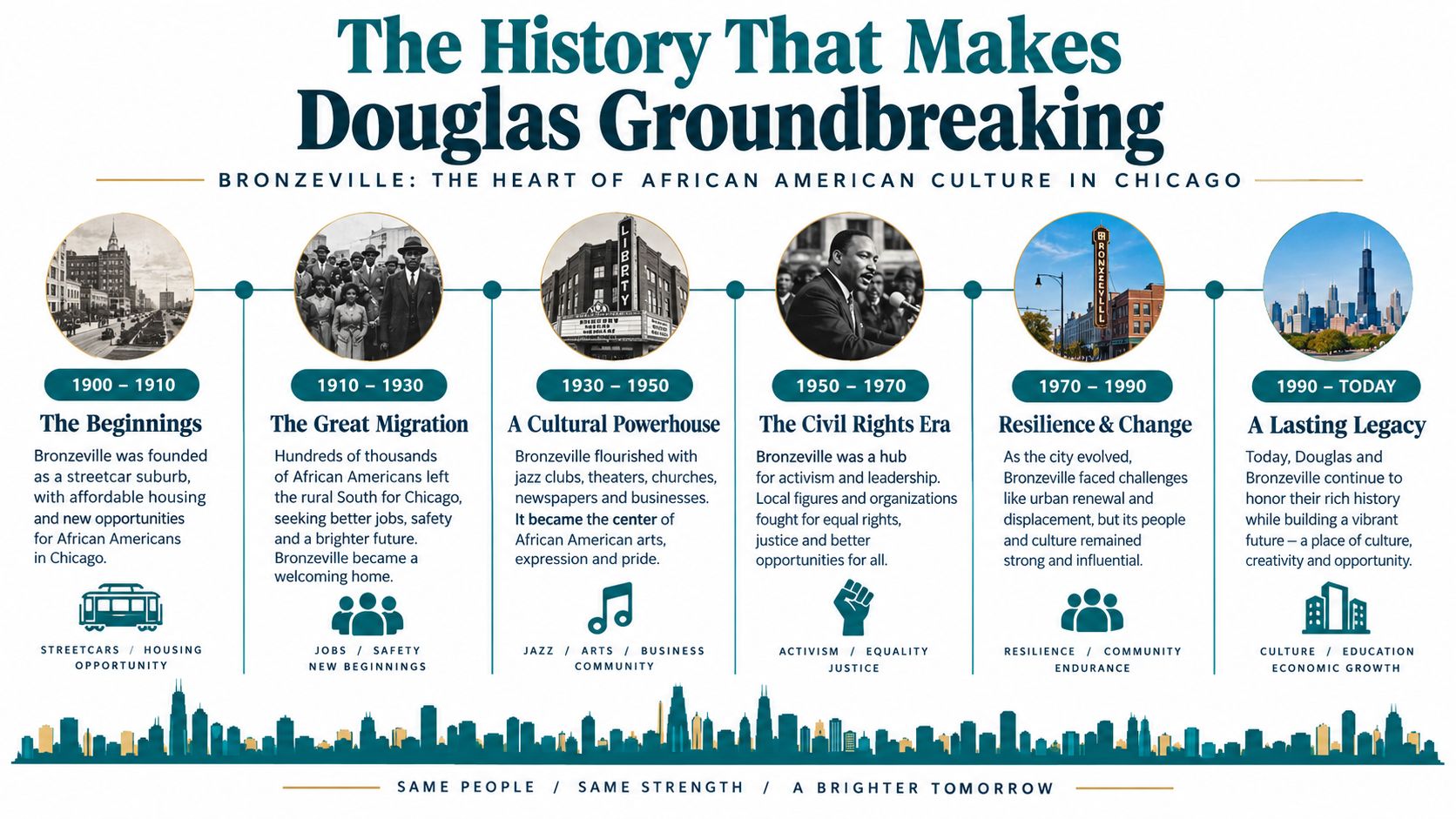
    The History That Makes Douglas Groundbreaking

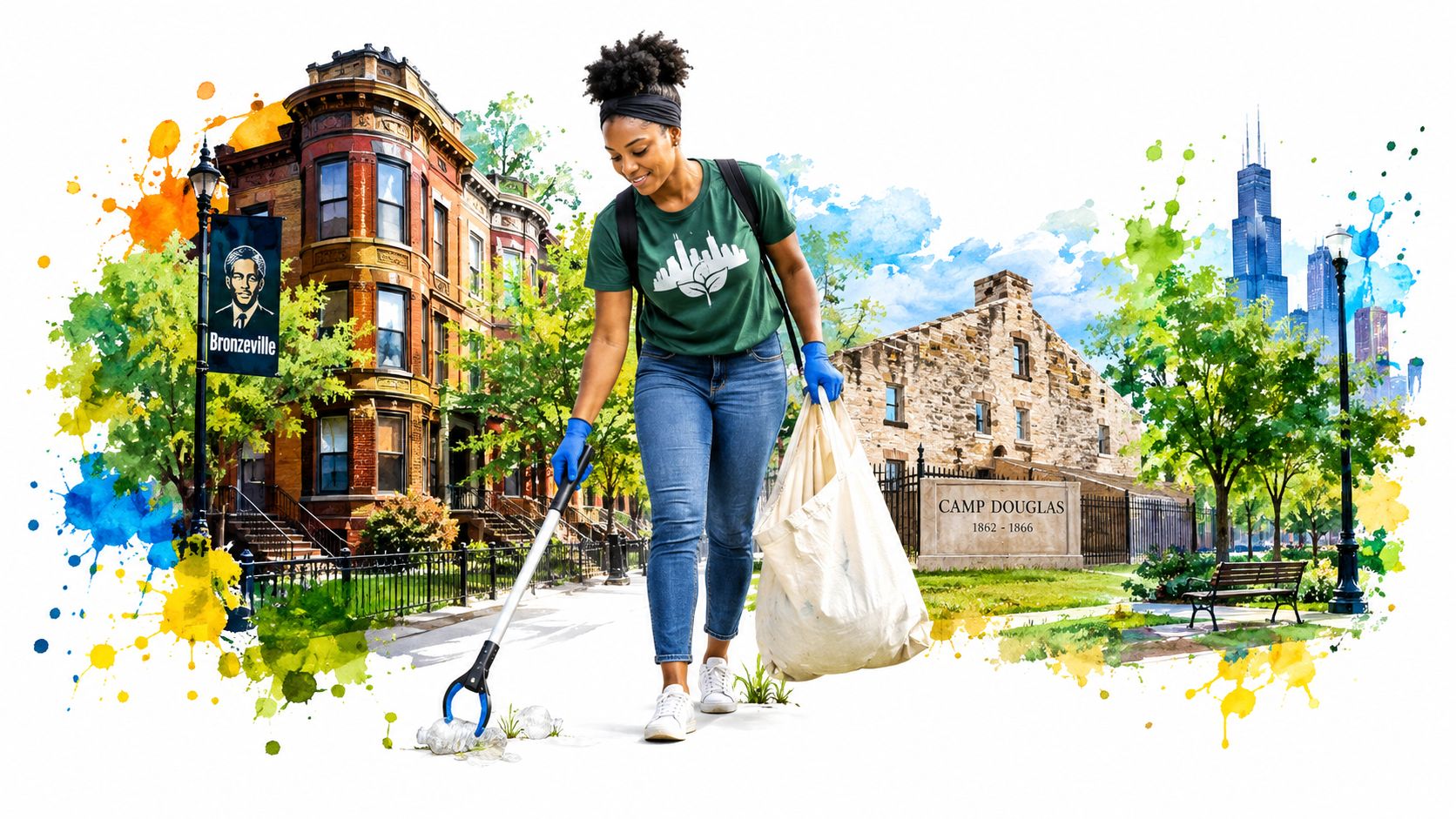
    A volunteer can walk through Douglas and encounter several eras before the morning is over. The community area includes the northern portion of Bronzeville, where residential blocks meet churches, businesses, public spaces, transportation routes, and buildings connected to Black Chicago history. A cleanup here follows streets shaped by migration, conflict, enterprise, and memory.

    The name Douglas reaches back to Stephen A. Douglas, the Illinois senator and 1860 presidential candidate who debated Abraham Lincoln over slavery. His former estate later became Camp Douglas, first a Union training site and then a Confederate prisoner-of-war camp during the Civil War. Camp Douglas held as many as 10,000 Confederate prisoners at one time and about 26,000 during the war. An estimated 4,200 Confederate soldiers who died there were buried in a mass grave at Oak Woods Cemetery, according to the University of Chicago's account of Chicago history.

    A historical timeline infographic detailing the development and cultural significance of the Douglas neighborhood in Chicago.

    From migration to the Black Metropolis

    During the Great Migration, Black southerners came to Chicago and built homes, businesses, newspapers, churches, music scenes, political organizations, and arts institutions in Douglas and the surrounding Bronzeville district. From the 1910s through the 1940s, these efforts helped establish the area as part of Chicago's Black Metropolis.

    Families built support networks while discriminatory housing and employment practices restricted where Black residents could live and work. Businesses along streets such as State Street supported daily needs. The stretch known as “The Stroll” gave people a place to shop, meet, hear music, and exchange news. A history of Bronzeville's development follows the area's earlier Jewish community, later Black migration from the Near South Side and the Jim Crow South, and the growth of its commercial life.

    That history gives a cleanup route a human scale. A volunteer may collect wrappers near a sidewalk once used by families walking to work, school, worship, or a neighborhood business. The task does not recreate those lives or give outsiders ownership of their history. It offers a practical way to care for the same streets where community networks took root.

    Walking beside landmarks

    Chicago's historic designations also shape how volunteers should move through Douglas. Major sites include the Chicago Defender Building, Chicago Bee Building, Wabash Avenue YMCA, Victory Monument, and Supreme Life Building. They can help orient a walking route while reminding visitors to act with care around places that carry meaning for residents and descendants.

    Do not move historic objects, enter restricted property, or treat a residential block like an outdoor museum. Keep your attention on the pavement, the people nearby, and the work at hand. A respectful cleanup leaves room for residents, visitors, students, workers, and neighbors to share the streets without turning the community into a backdrop.

    The area also sits near the site of the 1919 Chicago race riot, a five-day episode that left 38 people dead and about 500 injured, as documented in the University of Chicago's account of Chicago history. That history calls for care rather than spectacle. Douglas holds beauty, pain, ordinary routines, and active community life at the same time.

    Service can also connect to the wider issue of environmental justice in Chicago. Start by listening to the place. Pick up litter without erasing context, learn the street names, respect the people who live there, and choose actions that remain useful after your gloves come off.

    Who Lives in Douglas and Why It Matters

    A volunteer walking through Douglas can cross a busy sidewalk, a residential block, and a commercial corner within a short route. The community area had an estimated 2024 population of 21,088 across about 1.65 square miles, according to the Douglas neighborhood profile. With about 12,781 residents per square mile, Douglas is roughly 4.7 times as dense as Chicago overall, based on that population and area.

    That density gives a discarded wrapper a wider effect. One piece of waste may seem minor beside a single doorway, yet the same sidewalk can serve residents, workers, students, and visitors throughout the day. A cleanup team can cover several pedestrian corridors in one outing, reaching more people without moving a vehicle between every location.

    A community with many histories

    Douglas has a predominantly Black population, alongside Asian, White, Hispanic, multiracial, and other residents, as the same community profile reports. Those categories describe part of the area's composition, not the experience or priorities of each person who lives there. A useful cleanup begins with that distinction.

    A resident may know that a corner collects fast-food packaging after school dismissal, that an alley needs a different approach, or that a public space has a maintenance problem volunteers cannot solve with bags and gloves. Ask before choosing a route. Use plain language, listen to the answer, and adjust the work when local knowledge changes the plan.

    The neighborhood's population history adds another layer. Douglas reached its earlier peak during the period when the Great Migration helped establish Bronzeville as a center of Black life. Later population loss followed deindustrialization, disinvestment, segregation, and public-housing demolition. The 2020 census showed an 11.3% increase over the prior decade, as the same profile records. Volunteers now work in a community with deep roots and signs of renewed growth.

    That history makes cleanup a form of participation in community resilience. Picking up litter does not repair segregation, restore lost housing, or replace public investment. It can, however, support the everyday spaces where neighbors build trust, run businesses, care for children, and move through the area.

    Treat density as a planning tool

    A compact area rewards careful route design. Divide the work into small sectors, record bag counts and hazard types by street segment, and revisit the same routes each month. Those notes can show whether litter repeatedly gathers near food businesses or transit stops, or whether it appeared after a storm or event.

    A group can keep volunteers connected between outings with clear messages, welcoming introductions, and focused local tasks. This guide on community building for social media offers ideas organizers can adapt for those updates.

    Residents already care for their buildings, sidewalks, children, businesses, and neighbors in ways visitors may never see. A volunteer contributes capacity to a defined task. The goal is to support the public realm while respecting the people and history that make Douglas a living community.

    Getting Around and Finding Your Spot

    Start with a visible meeting point near public transit, then choose a route that keeps the group together. Douglas connects residential streets with transit corridors, parks, commercial edges, and lakefront access, so you don't need to move a vehicle between every cleanup sector.

    The community area's mean commute time is 32.1 minutes, and 10,665 residents are in the labor force, according to the Chicago Metropolitan Agency for Planning profile of Douglas. Those figures suggest a simple courtesy for event organizers. State the meeting point, service area, expected finish time, and return route before volunteers arrive.

    Pick a route with purpose

    Dunbar Park gives you a clear recreation anchor. The Chicago Park District lists 21.80 acres and includes four baseball diamonds, athletic fields, picnic groves, tennis courts, a running track, a batting cage, an interactive water feature, and a reading garden among its facilities, as shown on the Dunbar Park information page.

    A park route needs more than a quick sweep of the entrance. Check paths near sports areas, picnic spaces, courts, water play, and access points. Keep volunteers away from active games and ask park users to move around your group rather than forcing them into the street.

    For other parts of Douglas, use a route plan that divides the work:

    • Transit approaches: Inspect sidewalks leading toward stations and bus stops, where food packaging and drink containers can gather.
    • Commercial edges: Walk slowly near storefronts and corners, but leave entrances clear and speak with business owners before placing bags nearby.
    • Residential blocks: Keep noise down, protect parked cars, and avoid entering private property or alleys without permission.
    • Parks and lakefront connections: Watch for broken glass, sharp metal, needles, and unstable waste. Report hazards instead of handling them.

    A 60-to-90-minute service block can reduce friction for residents balancing work, commuting, and caregiving. Keep the same route when possible, measure bags per volunteer-hour, and record hazards separately from ordinary litter. Community-area data can guide your first plan, but block-level observation should guide the next one.

    Plan around safety, not reputation

    Douglas has comparatively high crime, yet one recent assessment reported that incidents declined by about 28% over the analyzed period and averaged roughly 62 incidents per month, according to the Douglas safety assessment. Those figures don't predict what will happen on your exact block or at your exact time.

    Choose daylight routes with good visibility. Use busy streets and public transit approaches, travel in groups, keep a charged phone available, and tell a contact when the event will end. If a volunteer feels uneasy, the group should change the route or stop. No bag of litter deserves a risky decision.

    For ward-level planning, organizers can also use Chicago ward boundary information to understand where a route sits administratively. That context can help you direct questions about public services to the right office, while your own observations show what volunteers encounter on the ground.

    Why We Pick Up Trash Rain or Shine

    A volunteer cleanup can begin with a forecast that looks unpleasant. Rain taps against the meeting point, wind pushes wrappers along the curb, and someone wonders whether the group will still arrive. Then one person puts on gloves, another opens a bag, and the morning gains a direction.

    Litter Caterpillars meets weekly, rain or shine, and has cleaned up all 50 wards of Chicago, including areas other groups avoid. The group also won an empty lot at auction to build Caterpillar Park in Englewood. Those actions express a simple belief: service works best when people protect the habit of showing up.

    Screenshot from https://www.littercaterpillars.com

    Bravery changes the first step

    Bravery doesn't require you to feel calm. It asks you to act while you still feel uncertain. You might worry that you won't know anyone, that you won't know what to do, or that a difficult weather forecast will make the morning awkward. Once you pick up a bag and walk with another person, the uncertainty becomes a shared task.

    The group uses flags, theme songs, and badges to give service a visible identity. That may sound playful, but play helps people stay engaged with work that could otherwise feel repetitive. A wrapper becomes one small part of a route. A route becomes a shared accomplishment. A shared accomplishment can bring strangers into conversation.

    Volunteer-first rule: Safety comes before the cleanup goal, and volunteer happiness comes before a full bag.

    That rule creates room for judgment. Volunteers can refuse hazardous items, leave a location that feels unsafe, and ask organizers for a different assignment. A group that protects its people can keep serving without treating exhaustion or fear as proof of dedication.

    Kindness needs a schedule

    Weekend mornings provide a predictable time for service-minded people to meet. The schedule creates a useful filter. People who want to give their time can find one another before the day fills with errands, parties, work, or family responsibilities.

    The point isn't to criticize anyone who spends a Saturday differently. People need rest and recreation. The point is to create a regular place for people who want to practice generosity with others.

    Organizers can make that experience easier by explaining what to bring and what the group will provide:

    • Wear practical clothing: Choose closed-toe shoes, weather-appropriate layers, and clothes that can handle dirt.
    • Protect your hands: Use gloves, and don't touch sharp or unknown objects.
    • Share the route: Keep the group aware of boundaries, meeting times, and the location of filled bags.
    • Leave room for friendship: Talk while you work, welcome new people, and avoid turning the event into a competition.

    The group doesn't pressure volunteers for donations. It protects volunteer energy and puts safety first. That approach makes service feel like a relationship rather than a transaction.

    After you read the group's story, you can watch how its weekly work feels in practice:

    Rain doesn't automatically make a cleanup meaningful, and sunshine doesn't guarantee a good one. The value comes from the people who prepare, communicate, notice hazards, and return. In Douglas, that discipline can connect a simple bag of litter with a stronger habit of caring for shared streets.

    Joining the Legacy of Service

    A Douglas cleanup begins with a present-day decision, but the street already carries many human stories. Black migrants built homes and institutions during the Great Migration. Business owners served customers despite discrimination. Journalists, musicians, teachers, faith leaders, and neighbors created routines that helped Bronzeville function as a community.

    You don't honor that work by pretending to belong to someone else's history. You honor it by behaving responsibly in the place you visit. Learn before you arrive, listen when residents speak, keep public paths usable, and leave the block safer and cleaner than you found it.

    A useful first outing

    Choose one defined route rather than trying to cover the whole community area. Meet near a visible transit point or a public recreation site, work in small sectors, and set a clear finish time. Afterward, record the bag count, the kinds of hazards you found, and the locations that need attention from city services or property managers.

    Use public records and direct observation together. Chicago's 311-related data includes issues involving basement flooding, vacant buildings, fly dumping, and possible building violations. When litter appears alongside those problems, volunteers should report the wider maintenance issue instead of treating every condition as a cleanup task.

    Safety planning belongs in the same conversation. Use daylight, maintain group visibility, stay alert around traffic, and change course when conditions call for it. A clean route matters, but people matter first.

    Let the habit grow

    The Douglas neighborhood Chicago community gives volunteers many ways to return. You can walk a residential block, check a park edge, observe a transit approach, or help a group build a monthly record of recurring waste. Each outing teaches you something specific about the route.

    The work may look small from a distance. Up close, it involves hands, feet, conversations, weather, and decisions. You learn which waste belongs in a bag, which hazard needs a report, which resident has useful local knowledge, and which volunteer may need help carrying a full load.

    That is how service becomes practical community resilience. You don't need to claim the neighborhood or solve every problem. You need to show respect, do the task in front of you, and return often enough for your presence to become dependable.

    Are you willing to show up when the morning feels inconvenient? Bring your gloves, choose a route, and let your first cleanup teach you what the next one should look like.


    Litter Caterpillars gives Chicago volunteers a weekly, rain-or-shine way to pick up trash, meet neighbors, and work across communities including Douglas. Visit Litter Caterpillars to find an upcoming cleanup and take your first step toward serving the neighborhood in person.

  • Recycling Small Household Appliances in Chicago

    Recycling Small Household Appliances in Chicago

    I once carried a dead blender from my kitchen to the alley and back three times because I couldn't decide where it belonged. By the fourth trip, I realized the appliance weighed less than two pounds, but the decision felt like it weighed five hundred.

    The Heavy Weight of Kitchen Clutter

    A broken toaster can disappear behind a cereal box for months. A cracked coffee maker can wait beneath the sink, while a blender with a burned-out motor settles into the kitchen like another piece of furniture. Each time you spot it, you think, “I need to deal with that,” and then dinner, work, or the next trash pickup takes over.

    I learned that pattern in my own apartment before I started picking up litter across Chicago's wards. The appliance was never the whole problem. I did not know which facility would accept it, whether the cord changed its category, or whether it belonged in a recycling bin. In the end, uncertainty kept the clutter in place.

    Start with one shelf. Set the dead kettle, the coffee grinder that stopped grinding, and the toaster with one working slot on the floor. Look at each item as a collection of materials rather than a memory from your kitchen. A plastic shell, steel frame, circuit board, cable, and possible battery may each require a different route through Chicago's disposal system.

    The pile behind the pile

    Small appliances form a large part of the global e-waste stream. In 2022, global e-waste reached 62 billion kilograms, and small equipment represented about 33% of that total by mass, roughly 20.4 million tonnes. The same assessment records documented collection and recycling at about 12% for small equipment, compared with 22.3% overall in 2022, and projects that the overall figure could fall to 20% by 2030 if current trends continue, according to the Global E-waste Monitor executive summary.

    That category includes familiar objects such as microwave ovens, vacuum cleaners, radios, toys, and e-cigarettes. Their housings and wiring contain recoverable metals, plastics, and other materials, but those materials stay mixed together when an appliance is left in a closet or tossed into the wrong stream.

    The pile usually grows without notice. One dead kettle becomes a coffee maker, a charger, and a hand mixer before you notice the shelf has disappeared.

    My first rule: If an appliance has lived in your closet long enough to gather dust, give it a decision date.

    Keeping a broken appliance indoors does not recover anything inside it. Recycling small household appliances begins when you claim responsibility for the pile and identify what each object contains. If one crowded cabinet feels hard to start, this guide to moving unwanted items out of your home can help you turn the mess into a manageable task.

    Sorting Your Pile by Material and Hazard

    You can't treat a coffee maker, a cordless vacuum, and a metal toaster as the same object. They may all sit on the kitchen counter, but their parts can send them to different collection streams.

    Start with a table or a clean patch of floor. Unplug each item, remove loose attachments, and look for labels that mention batteries, rechargeable power, refrigerant, or electronic controls. You don't need to dismantle the housing. You need enough information to describe the item accurately when you call a facility.

    A recycling guide infographic showing how to sort materials into categories like paper, plastic, metals, glass, organics, and hazardous waste.

    Four questions for every appliance

    • Does it contain a rechargeable battery? Pull out the battery when the design allows it. Cordless vacuums, electric toothbrushes, shavers, and portable kitchen gadgets need extra care. If you want to understand why damaged lithium-ion cells can ignite, read this practical explanation of why li-ion batteries catch fire.
    • Does it have a circuit board or programmable controls? A digital coffee maker and a basic manual can opener belong to different conversations. San Diego says programmable small appliances, including microwave ovens and many coffee pots, shouldn't go in trash or recycling bins because their circuit boards contain heavy metals. The same San Diego disposal guidance says non-programmable small appliances may go to an appliance recycling location or into the trash.
    • Which material dominates? A stand mixer may contain a heavy metal body, while a hair dryer may combine plastic, wiring, and electronic parts. Put metal-heavy items in one group, electronics in another, and plastic-heavy devices in a third.
    • Does it contain a special component? Refrigerant, cartridges, lamps, and sealed power units can change the route. Don't guess when a label or product manual can answer the question.

    A battery removal step can prevent trouble in a recycling truck or sorting facility. Set aside removed batteries in a separate container and check Chicago's current battery recycling guidance before you travel.

    Let the material decide

    A common mistake involves the product name. People search for “coffee maker recycling” and expect one universal answer. In practice, the construction matters more than the name printed on the front.

    Write a short note for each item: “programmable, corded, plastic body,” or “metal-heavy, no battery, manual controls.” That note gives a drop-off site useful information and keeps you from placing a device in a curbside bin just because it looks small.

    Here's a short visual guide to the sorting mindset:

    Prepping Devices for Safe Transport

    A recycler's machinery can separate materials, but it can't make every unsafe item safe after collection. You need to do the first cleanup at home.

    Licensed WEEE facilities commonly use a sequence that starts with manual pretreatment, then moves through crushing, picking, shredding, and separation. Workers remove batteries, cartridges, cables, and other problem parts before shredding because those pieces can contaminate material fractions and lower their purity, according to European WEEE processing guidance.

    A person preparing to recycle batteries while plugging in a blender on a marble kitchen counter.

    A clean handoff starts at home

    1. Disconnect the power. Unplug the appliance and let heated parts cool. Never carry a device with a damaged cord still connected to an outlet.
    2. Remove accessible batteries. Check the underside, handle, charging dock, and battery compartment. If the battery sits inside a sealed housing, don't force the casing open with a kitchen knife. Ask the receiving facility what it accepts.
    3. Protect exposed terminals. Follow the battery program's packaging directions. Keep loose cells from touching metal objects, keys, or other batteries.
    4. Secure the cord. Wrap a cord around the appliance and hold it with paper tape or a reusable strap. A loose cable can tangle during handling and can make a pile harder to move.
    5. Empty and wipe the item. Rinse a blender jar, empty a vacuum canister, and remove crumbs from a toaster oven. You don't need to polish the appliance. You do need to remove food, liquids, hair, and dust that can make manual sorting unpleasant.
    6. Keep parts together. Put a coffee pot with its base, a blender with its jar, and a vacuum with its charger when the facility accepts those parts together.

    Watch for special hazards

    Refrigerant, batteries, and electronic controls can change the process. A small appliance that looks harmless may contain a component that a general scrap operation cannot accept. Call before you load your car, describe the exact item, and ask whether the facility wants batteries, chargers, cords, and accessories separated.

    Before you leave: Photograph the pile and write down every facility's acceptance answer. That small record saves a second trip when a worker asks what sits inside the box.

    Pack heavier metal objects at the bottom of a sturdy container. Place small plastic parts in a separate bag so they don't disappear under a microwave or stand mixer. Keep batteries away from the main appliance pile until you confirm their route.

    Finding the Right Chicago Drop-Off Option

    Chicago residents need to match the appliance to the receiving stream. A facility that accepts electronics may reject a metal-heavy item. A scrap yard may want the metal but lack the process for a programmable device. A pickup service may save your back while giving you less control over the final destination.

    The United States provides a useful warning. The EPA estimated that Americans generated 2.2 million tons of small appliances in 2018. Only about 5.6% entered recycling, while 18.5% went to energy recovery and 75.9% went to landfill, according to the small-appliance figures reported from EPA data.

    Chicago Appliance Disposal Routes

    Method Best For Key Rule
    Dedicated e-waste facility Programmable appliances and mixed electronic devices Confirm the accepted-items list before driving
    Scrap metal yard Metal-heavy appliances with simple construction Ask whether the yard accepts complete small appliances
    Battery collection point Loose rechargeable batteries and battery-powered devices Remove batteries only when the design allows safe removal
    Scheduled municipal option Residents who can follow local collection rules Check the current Chicago schedule and set-out requirements
    Reuse or donation route Clean, working appliances Confirm that the organization accepts the exact item

    The most convenient route isn't always the cleanest route. A dedicated e-waste facility may require a drive and a specific drop-off window, but staff can sort mixed materials with the right equipment. A scrap yard may handle steel efficiently, while a battery program can keep a loose cell away from a metal pile.

    Make the call before the trip

    Write down the brand, product type, power source, and condition. Say “programmable countertop microwave with cord” rather than “small appliance.” That wording helps the receiving staff answer without guessing.

    You can compare local options through Chicago recycling centers and drop-off guidance. For businesses, landlords, or households clearing many devices, a specialist such as the Beyond Surplus ITAD partner may provide a more structured handoff for electronics and equipment.

    Bring a box that you can lift safely. Put the fragile glass carafe somewhere it won't roll, and keep batteries separate from cords and metal objects. If a facility rejects one item, take it home rather than leaving it beside the entrance or placing it in a public bin.

    Protecting Your Data and Handling Fees

    A smart appliance can hold more information than its stainless-steel body suggests. A Wi-Fi coffee maker may remember a network connection. A robot vacuum may store account details, maps, or device settings. A connected slow cooker can retain setup information even when the heating element no longer works.

    Before you hand over a working smart appliance, open its app and remove the device from your account. Sign out, erase saved networks, and use the factory reset option. If the appliance won't turn on, ask the recycler whether staff can handle data-bearing parts or whether you need a specialized electronics service.

    A broken screen doesn't prove that a device forgot everything.

    Ask about the receiving process

    Many small appliances don't fit one universal recycling category. Sonoma County explains that local rules may send small appliances to e-waste, scrap metal, or garbage, depending on their construction and the local program, as described in its appliance disposal guidance.

    That variation affects fees. A facility may accept a simple metal item at no charge but charge for a device that requires manual dismantling, battery handling, or special processing. A municipal event may accept only certain electronics. A private recycler may quote a handling fee after you describe the appliance.

    Call and ask four direct questions:

    • Does this exact model qualify?
    • Do you charge for drop-off or dismantling?
    • Should I remove the battery, cord, or accessory?
    • Can you handle stored account information or memory chips?

    Don't assume a free electronics event accepts every countertop device. Don't assume a paid service gives you documented data handling. Write down the answer, bring the confirmation if the facility provides one, and keep your items sorted when you arrive.

    Joining the Movement to Keep Chicago Clean

    I feel a small release each time I move a broken appliance out of a closet. The counter opens up. The cabinet closes. I can cook without shifting three dead machines out of the way first.

    That change comes from making one clear decision. You looked at the appliance, identified its materials, removed what needed special care, and sent it toward a route that fits its construction. You took responsibility for one object instead of waiting for the problem to disappear.

    The same habit changes how you see an alley. After you sort your own pile, a crushed can near a curb becomes easier to notice. A torn bag caught in a fence stops looking like background scenery. You start carrying gloves, a grabber, and a spare bag because you know a block can look different after someone decides to act.

    Chicago gives us plenty to clean, from alleys and viaducts to parkways and vacant lots. You don't need perfect weather or a perfect schedule. You need a safe meeting point, a pair of gloves, and enough patience to pick up one piece after another.

    Community work also changes the emotional weight of cleanup. A dead toaster feels private when it sits in your closet. A neighborhood cleanup turns that same feeling into motion, conversation, and a reason to step outside. You meet people who want a cleaner block, share practical habits, and leave with proof that small actions can change the place where you live.


    Litter Caterpillars brings Chicago volunteers together for weekend trash pickups across all 50 wards, with safety, friendship, and service at the center. If recycling small household appliances has helped you take ownership of your home, visit Litter Caterpillars and find a cleanup where you can show up for your neighborhood.

  • 9 Chicago Weekend Activities for a Better City

    9 Chicago Weekend Activities for a Better City

    Coffee warms my hand as lake wind cuts across the morning, and Chicago gives me several good choices at once. I can wander beside the water, learn inside a museum, meet neighbors over music or food, or pick up litter with people who decided to spend part of their weekend caring for the city.

    The best Chicago weekend activities don't only fill empty hours. They take me through parks, public art, local businesses, family spaces, and volunteer work, so the city feels close and touchable. I plan one morning anchor, one flexible afternoon activity, and one evening option, then check the weather, travel time, admission rules, event schedule, and expected crowds before I leave. Chicago's skyline, river tours, museums, ballparks, and lakefront attractions give me plenty of ways to build that rhythm, as this Chicago weekend guide also shows.

    1. Join a Litter Caterpillars Cleanup in Your Ward

    Saturday morning feels different when you trade a slow start for gloves, a bag, and a block that needs attention. Litter Caterpillars moves through all 50 Chicago wards, so you can volunteer near home or use a cleanup as a reason to visit a neighborhood you rarely see. The group meets on weekend mornings and keeps its focus on people, safety, and the simple work of removing trash together.

    Kevin Tao started the group after finding that cleaning someone else's mess felt easier than cleaning his own. That idea gives the morning a warm, honest energy. You pick up wrappers and bottles, but you also talk with people who chose service, friendship, and a little discomfort over another hour indoors.

    A diverse group of volunteers in blue shirts picking up litter on a Chicago street sidewalk.

    Start simply and stay connected

    Bring sturdy gloves, wear clothes that can get dirty, and sign up through the group's Meetup or Instagram pages to find the next gathering. You can check the Chicago ward boundaries before choosing a location. The group has cleaned a highway during a bike-event shutdown and turned an empty Englewood lot into Caterpillar Park after winning it at auction.

    Practical rule: Start with one cleanup, arrive early, and give yourself time to learn names before the work begins.

    The group works through rain, heat, and winter weather, so check the forecast and dress for the conditions. After the cleanup, stay for a nearby coffee or meal. That small follow-up turns a service morning into a neighborhood connection.

    Here's what the rhythm can look like: volunteer in the morning, eat nearby, then spend the afternoon exploring the same area instead of rushing across the city.

    2. Explore Navy Pier and Lake Michigan

    Walk toward Navy Pier with coffee in hand, and the city gradually opens into water, boats, sky, and a long view down the shoreline. You can ride the Ferris wheel, browse food vendors, play arcade games, or sit at the edge and watch the lake change color. I like this plan when I want movement without a strict itinerary.

    Go early on Saturday if you want more room to walk before the crowds build. Check the pier's event calendar before leaving because concerts and other gatherings can change the feel of the afternoon. Bring sunscreen and water, then use public transit or check parking details before you arrive.

    Turn a waterfront visit into a longer route

    Navy Pier works well as a starting point rather than a final stop. Walk toward the Riverwalk, continue through nearby streets, or use the pier as a meeting place before a cleanup in the surrounding area. A public beach and Lake Michigan plan can help you connect the water with practical care for shared outdoor spaces.

    A woman sits by the water looking at the Ferris wheel and boats during a Chicago sunset.

    A clear afternoon can carry several moods. Families gather around the attractions, couples watch boats return, and solo visitors find a bench with a wide view. You don't need to buy a ticket to enjoy the walk, so you can set your spending around food, rides, or a simple lakeside pause.

    Bring a reusable bottle, keep food waste contained, and leave the water's edge as clean as you found it.

    If weather turns rough, shorten the outdoor portion and move into an indoor attraction nearby. If the sky stays bright, let the walk stretch into sunset.

    3. Visit the Art Institute of Chicago

    The bronze lions outside the Art Institute make an easy meeting point on Michigan Avenue. I like to start inside with one gallery, then follow whatever catches my attention. A room of paintings may lead to sculpture, design, or objects from another period, but there is no need to chase the whole collection in one visit. An hour can feel full, while an unhurried afternoon leaves room for surprises.

    The museum suits a solo outing, a family break, or a quiet reset after time outdoors. Wear comfortable shoes, use the museum app to shape your route, and leave space to stop. One painting may hold your attention longer than planned.

    Check the admission window first

    The museum lists Thursday evening hours from 5 to 8 p.m. Admission rules, Illinois resident eligibility, free dates, and special exhibition details can change. Check the summer museum admission guide alongside the Art Institute's own admission page before building the weekend around a visit.

    A Sunday morning may offer a calmer gallery experience than a busy afternoon, though the current schedule should decide your timing. Afterward, walk through Grant Park, eat nearby, or join an afternoon cleanup. That combination gives the day a cultural stop and a practical way to care for the city.

    Choose one gallery before entering. A smaller plan leaves more time to look, discuss what you see, and remember it later.

    Your cost check should cover admission, resident eligibility, timed entry, and special exhibitions. Confirm each detail before leaving home, then bring only the spending you expect to use.

    4. Bike Along the Lakefront Trail

    A bike gives the lakefront a different pace. I can leave downtown, follow the water north toward Lincoln Park, or ride south toward Hyde Park, passing beaches, parks, piers, joggers, walkers, and other cyclists along the way. The city becomes a sequence of small scenes instead of a list of destinations.

    Rent a Divvy bike or use a local shop, then choose one place to reach before you start. A specific destination makes the ride easier to pace than an open-ended promise to keep going. Start early if you want less heat and fewer people, bring water and sunscreen, and wear bright clothing where traffic crosses the route.

    Give the ride a purpose

    The Lakefront Trail works well as the outdoor anchor in a weekend plan. Ride in the morning, stop for food near your destination, and use the afternoon for a museum, neighborhood walk, or volunteer event. The Chicago trail guide can help you connect the ride with places that need attention.

    A woman riding a blue bicycle along the Chicago lakefront path with the city skyline in background

    You can also pause when you notice litter, record the location, and pass it to a cleanup group rather than trying to carry everything yourself. Litter Caterpillars once cleaned a highway during a bike-event shutdown, so cycling and service already fit naturally together.

    Ride with a finish line: Pick a beach, museum, café, or park before you roll out.

    If you prefer another kind of urban ride, compare options with this guide to choosing your perfect urban ride. Then check bike access, weather, and transit connections before committing to a long route.

    5. Catch Live Music at Venues Across Neighborhoods

    A weekend music plan can begin in a small room where the stage sits close enough for you to see every hand move. Try jazz at Green Mill in Uptown, blues at Buddy Guy's Legends on the South Side, or indie and rock at Empty Bottle in West Town. House music venues in warehouse districts bring a different kind of night, with the room itself becoming part of the experience.

    Chicago's music venues give you a reason to cross neighborhood lines. A basement show, a theater set, and a late jazz performance each ask for a different evening pace. I check Songkick, Bandsintown, and venue websites, then look at doors, start times, age rules, and transit before I buy a ticket.

    Let the neighborhood shape the night

    Arrive early at a small venue if you want a good view. Use public transit when parking feels difficult, buy a drink or merchandise if you can, and give local musicians your attention instead of spending the entire set on your phone. The night feels more personal when you learn where you are, not only who is playing.

    Pick a venue in a neighborhood you haven't explored, then return another weekend to help care for that area.

    A concert can become the evening portion of a simple three-part plan. Start with a park or cleanup, eat near the venue, and let the music finish the day. You don't need to force every activity into one neighborhood, but keeping the route practical helps you enjoy the show.

    Check last-train times before the first song begins. If you plan to walk afterward, choose a well-lit route and keep your group together.

    6. Walk Through Millennium Park and Cloud Gate

    Early morning light turns Cloud Gate into a quiet mirror before the busiest crowds arrive. I walk around the curved steel surface, watch reflections bend and multiply, then move through Millennium Park toward gardens, fountains, and open gathering spaces. The park gives families, artists, visitors, and downtown workers room to share the same few blocks.

    You can enter and explore without paying admission, which makes this an easy choice when your weekend budget needs room for another activity. Check the event calendar for a free concert or performance, then take a slower route through Lurie Garden if you want a quieter stretch. The surrounding streets lead naturally toward museums, restaurants, and the lakefront.

    Notice the work behind a public space

    A well-kept park invites a practical question: what would this place feel like if nobody cared for it? As you walk, look at the paths, planting beds, bins, seating, and shared areas. That observation can lead to a cleanup plan in another park or neighborhood.

    Keep food contained, use the bins provided, and don't touch artwork or plantings. If you bring children, give them a simple challenge, such as finding three textures or noticing how the sculpture changes with the angle of the sun.

    A free morning walk can leave room for a paid museum, meal, or evening show later.

    Cloud Gate works as a short stop or a full downtown outing. You can meet friends there, take photographs, then walk until the city gives you a new direction.

    7. Visit Chicago's Museum Campus and the Lakefront Museums

    By late morning, Museum Campus gives families three distinct choices within walking distance. The Field Museum puts dinosaur skeletons and ancient objects at the center of the visit. Shedd Aquarium brings aquatic life close, while Adler Planetarium turns the group's attention toward space. The lakefront sits just beyond them, ready for a slower finish.

    I usually choose one museum, or two at most, then protect time for the water. A child who has just met SUE at the Field Museum may need a quiet bench afterward, while another visitor may stay absorbed by Shedd Aquarium's 32,000 aquatic animals, as described in this Chicago attractions guide. Leaving room between stops keeps the afternoon from becoming a race.

    Build the day around curiosity

    Reserve tickets online if you want a more predictable arrival, and check each institution's current hours before leaving home. Free admission policies vary by museum. The Chicago museum day guide lists institution-specific windows, including select dates for Illinois residents, so compare those details with your schedule before paying.

    Plan the lakefront break around your budget. Pack a picnic if museum food costs more than you want to spend, and bring a reusable bottle to reduce waste. Keep food contained, use the available bins, and leave plantings and wildlife undisturbed.

    Choose the museum that fits your group's attention span, then give the lakefront time to reset the day.

    Check weather, walking distances, stroller needs, and return transit. If your family enjoys hands-on service, finish by joining a nearby cleanup through Litter Caterpillars or carrying a small bag for litter you find along the route. The visit becomes more meaningful when care for the shoreline follows the learning inside.

    8. Explore Neighborhood Breweries and Local Businesses

    An afternoon taproom visit gives you a reason to slow down and ask where you are. Logan Square, Pilsen, and Lakeview each give the experience a different setting, and many breweries pair drinks with food trucks, music, games, or a conversation with staff. You can start close to home, then choose another neighborhood for a later weekend.

    I like asking brewers what they recommend and what else sits within walking distance. That question often leads to a bookstore, bakery, market, record shop, or small restaurant. Supporting the business matters, but so does spending time in the area with care.

    Pair a stop with a service plan

    Visit in the afternoon if you want a less crowded room, try a house specialty, and use public transit if you plan to visit more than one taproom. Keep the route simple and choose a sober ride plan before the first pour. A custom foldable koozie can fit a picnic or outdoor gathering, but keep drinks within the rules of the place you visit.

    You can also ask whether a brewery would welcome a cleanup partnership. A volunteer group might meet nearby, clean the surrounding blocks, then finish with food or a nonalcoholic drink. Litter Caterpillars works across all 50 wards, so neighborhood exploration can become a way to find new service routes.

    Spend locally, walk lightly: Buy from the businesses you visit, use the bins available, and leave the block ready for the next person.

    Check age policies, event times, transit, and whether a taproom takes reservations. The best brewery outing leaves room for conversation rather than forcing too many stops.

    9. Walk and Explore Neighborhood Murals and Street Art

    Pilsen can fill a walk with Mexican and Chicano murals, while Logan Square brings contemporary work into its streets and South Side community projects give public walls their own stories. Wicker Park adds artist-driven pieces and changing views around busy blocks. I like mural walks because the route stays open. You can follow a planned list or turn down the next street when a color catches your eye.

    Use daylight hours, go with friends, and research the artist or community story behind each mural when you can. Search the #ChicagoMurals tag for ideas, but confirm that a piece still exists before building the entire walk around it. Street art can change, so every route carries a little surprise.

    Respect the wall and the people nearby

    Photograph public art without blocking doorways, entering private property, or touching painted surfaces. Keep voices low near homes, carry your waste, and remember that a mural can sit beside someone's daily life rather than inside a tourist route.

    A mural walk pairs naturally with cleanup work. You can spend the morning picking up litter, eat nearby, then walk through the neighborhood with a camera in hand. Caring for the ground around public art shows respect for the work on the walls.

    Look closely at the whole block, not only the biggest painting. Small signs, storefronts, gardens, and repaired corners tell you where you are.

    Choose a route that matches your group's walking pace and check transit for the return trip. If rain arrives, save the walk for another day and move into a museum, gallery, or neighborhood café.

    9 Chicago Weekend Activities Compared

    Activity 🔄 Complexity ⚡ Resource requirements ⭐ Expected outcomes 📊 Ideal use cases 💡 Key advantages
    Join a Litter Caterpillars Cleanup in Your Ward Low, simple sign-up, recurring schedule Minimal, gloves/bag, 2–3 hours, local coordination ⭐⭐⭐⭐⭐, measurable litter removal, strong social bonds Regular volunteer engagement, neighborhood restoration No cost, builds friendships, city-wide reach
    Explore Navy Pier and Lake Michigan Low, self-guided, walkable site logistics Moderate, transit/parking, attraction fees optional ⭐⭐⭐, scenic views, recreational enjoyment Sightseeing, meetups before nearby cleanups Accessible, varied attractions, event programming
    Visit the Art Institute of Chicago Moderate, advance planning, ticketing Moderate, admission, time for galleries ⭐⭐⭐⭐, high cultural/educational value Cultural enrichment, educational groups, prep before service World-class collection, flexible visit length
    Bike Along the Lakefront Trail Low–Moderate, route planning, bike rental options Low–Moderate, rental or own bike, safety gear ⭐⭐⭐, exercise, broad neighborhood exposure Active recreation, paired bike cleanups, touring neighborhoods Low cost, covers distance quickly, scenic route
    Catch Live Music at Venues Across Neighborhoods Moderate, ticketing, variable venue logistics Low–Moderate, tickets, transit, possible late hours ⭐⭐⭐, cultural discovery, neighborhood connection Nightlife exploration, discovering local artists Affordable entertainment, authentic local scenes
    Hike or Walk Through Millennium Park and Cloud Gate Low, public access, minimal planning Low, transit, comfortable shoes ⭐⭐⭐, iconic photos, public-space experience Quick visits, people-watching, meeting points for groups Free, central location, mix of art and nature
    Visit Chicago's Museum Campus and the Lakefront Museums Moderate–High, multiple venues, scheduling High, multiple admissions, full-day commitment ⭐⭐⭐⭐, diverse educational experiences Full-day museum visits, family or tourist outings Multiple world-class institutions in one area
    Explore Neighborhood Breweries and Local Businesses Low–Moderate, route and timing planning Moderate, spending on food/drink, transit ⭐⭐⭐, local economic support, social connection Social outings, neighborhood discovery, post-cleanup meetups Supports small business, neighborhood authenticity
    Walk and Explore Neighborhood Murals and Street Art Low, self-guided or guided tours, map use Low, walking, camera, daytime safety ⭐⭐⭐, cultural insight, visual inspiration Cultural exploration, photography, community context for cleanups Free, authentic community expression, easy to combine with walks

    Build a Weekend You Will Remember

    A good Chicago weekend doesn't need a packed calendar. I can build one around three simple movements: service first, outdoor discovery next, and culture or neighborhood connection at night.

    For a service-first morning, I can join Litter Caterpillars on Saturday or Sunday, bring gloves and clothes that can get dirty, and meet volunteers in a Chicago ward I know well or want to understand better. After the cleanup, I can eat nearby and spend the afternoon exploring local shops, murals, or a park. The Chicago Park District says parks generally stay open from 6:00 a.m. to 11:00 p.m., unless a sign says otherwise, so I can plan an early walk, picnic, or cleanup inside that daily window using the park hours guidance.

    For an outdoor route, I can start with the Lakefront Trail, ride toward Lincoln Park or Hyde Park, then stop at a beach, museum, or café. I can also walk from Navy Pier toward the Riverwalk, or begin at Millennium Park and let the morning unfold through gardens, public art, and nearby streets. Chicago has a walkable park catchment, with 98% of residents living within a 10-minute walk of a park, according to the ParkScore data, so a park-based plan can work in many parts of the city.

    For a culture or neighborhood evening, I can choose the Art Institute, Museum Campus, a live music venue, a brewery, or a mural route. I check the exact event time, admission rule, weather, transit connection, and crowd level before I leave. Some weekend activities use fixed entry windows, and a first-Friday gallery event can keep venues open until 8 p.m., so the current Chicago weekend listings deserve a quick look before I set the route.

    Group size changes the logistics for service and park gatherings. The Chicago Park District says groups of 50 or more, or gatherings with a tent, bounce house, alcohol, or speaker, need a permit filed at least two weeks ahead, as this Chicago parks permit guide explains. If your plan includes a large volunteer crew, handle that step before you announce the date.

    Chicago's visitor profile also gives leisure planners a useful clue. 96% of leisure travel parties visiting Chicago take part in at least one activity, compared with a 95% U.S. benchmark, according to the Illinois and Chicago visitor profile. You don't need to copy a tourist itinerary. Choose one thing that gets you outside, one thing that helps you learn or connect, and one small act that leaves the place better.

    If I had one open weekend, I'd choose a Litter Caterpillars cleanup in the morning, a lakefront walk or bike ride after lunch, and live music or a neighborhood mural walk before the day ends. I'd bring a friend, check the details, and leave enough empty space for an unexpected conversation or turn down a new street. The city feels less like a backdrop when I give part of my weekend to caring for it.

    When you choose your plan, think about the kind of memory you want to carry home. Maybe it's the lake wind after a long ride, a child asking a museum question, a song in a small room, or a clean sidewalk that looked different because you helped. The activity matters, and so does the way you move through the place.


    Litter Caterpillars brings Chicago volunteers together for weekend morning cleanups across all 50 wards, with open group chats and regular events that make it easier to meet people while caring for local streets and parks. Choose one neighborhood from this list, bring a friend, and visit Litter Caterpillars to find your next cleanup.

  • 7 Chicago Environmental Groups to Join in 2026

    7 Chicago Environmental Groups to Join in 2026

    Want to help Chicago's environment but don't know which door to open? One group may feel like a Sunday cleanup crew, another like a river classroom, and another like a training ground for a neighborhood project. Chicago has room for all three. One directory counted 553 environmental organizations across the greater Chicago metro area, with 2,878 employees, more than $394 million in annual revenue, and about $1 billion in assets. That directory's Chicago listing shows how many paths exist.

    This roundup helps you compare hands-on work, schedules, locations, training, accessibility, and partnership options. You'll find recurring litter pickups, river stewardship, tree care, kayak work, family action days, and neighborhood leadership. If you want a low-pressure way to meet people while serving the city, start with Litter Caterpillars. If you need a small daily habit before your first cleanup, learn how to care for and clean a daily tote, then choose the kind of service that fits your week.

    1. Litter Caterpillars

    Litter Caterpillars

    A Litter Caterpillars cleanup starts with a simple assignment, pick up what other people left behind, then keep walking together. Kevin Tao founded the group after confronting his own struggles with cleanliness, consistency, and bravery. That personal story gives the crew a human feel. You aren't signing up for a distant cause. You're joining people who want to make service easier to repeat.

    The group meets on weekend mornings, rain or shine, across all 50 Chicago wards, including places other crews may avoid. Litter Caterpillars' volunteer opportunities make it easy to find a meetup through the group's open channels, including Meetup, Instagram, Pie, and group chats. The crew has cleaned a highway during a bike-event shutdown and won an empty lot at auction to create Caterpillar Park in Englewood.

    Why this door fits

    Litter Caterpillars builds its identity around bravery, kindness, unity, and a volunteer-first approach. Flags, badges, a theme song, and group rituals give each event a shared rhythm. The group prioritizes volunteer safety and happiness, and it doesn't pressure members for donations.

    That style suits students, young professionals, newcomers, and anyone who wants recurring neighborhood service with a social side. It also gives businesses or community groups a straightforward partnership conversation, especially when they need dependable weekend cleanup support.

    Best fit: You want a recurring cleanup community, visible block-by-block work, and a reason to get outside on weekend mornings.

    The trade-off comes from that same intensity. Weekend mornings won't suit every schedule, and extreme heat, blizzards, highway closures, or other difficult conditions can make events physically demanding. Litter Caterpillars also doesn't present itself as a formal institutional service-credit program, so volunteers seeking extensive paperwork or a traditional nonprofit structure may need to ask questions before organizing a partnership. Visit the Litter Caterpillars website before you plan your first event.

    2. Friends of the Chicago River

    Friends of the Chicago River

    You might arrive at a Friends of the Chicago River event with gloves, a water bottle, and little idea what the river corridor needs. You'll leave with a more practical view of stewardship. Volunteers clean litter, mulch trails, and remove invasive plants across river and public-space sites during Chicago-Calumet River Day.

    The event has taken place every year since 1992, according to Friends of the Chicago River's River Day information. The organization also runs the Litter Free Chicago-Calumet River Initiative, along with year-round habitat and stewardship work across multiple river reaches. This Chicago river cleanup guide can help you compare the experience with other local options.

    A practical choice for groups

    Friends of the Chicago River has a clear path for first-time volunteers. Join a public event, bring your team to a scheduled stewardship activity, or ask about a structured corporate River Action Day. The organization also has partnerships across government and community networks, which can help companies, schools, and civic groups find a well-organized entry point.

    A River Action Day suits a group that wants a planned service experience with instructions, coordination, and a defined site. You won't need to invent a project from scratch. The organization handles much of the structure, while your group supplies time and energy.

    The main trade-off involves timing. Corporate River Action Days need advance booking, and public volunteer spots may fill near major events. Check the calendar early instead of waiting until the week before your preferred date. You should also ask about river reach, tools, physical demands, weather plans, and whether your group needs a reservation.

    3. Alliance for the Great Lakes Adopt-a-Beach

    Alliance for the Great Lakes Adopt-a-Beach

    Some volunteers want a fixed beach, a repeatable schedule, and a way to record what they find. Alliance for the Great Lakes Adopt-a-Beach gives them that format. You can join or start a team at a preferred beach or river shoreline, plan recurring cleanups, and submit standardized debris data to a central database.

    The program works across all five Great Lakes, while Chicago volunteers can choose lakefront and shoreline sites that fit their location. The Alliance for the Great Lakes connects the hands-on cleanup with regional policy and prevention work. If you want a Chicago beach cleanup that feels flexible rather than heavily programmed, this Lake Michigan volunteer guide provides another useful point of comparison.

    A good match for repeat teams

    Adopt-a-Beach works well for a neighborhood association, school, company, or group of friends that wants to return to the same place. You can build a habit without waiting for one large annual event. The data collection also gives volunteers a clear task beyond filling bags. You record the debris, submit the results, and create a more consistent picture of what reaches the shore.

    The program's regional scope can help a partner explain why local cleanup data matters to a broader Great Lakes organization. The format also makes sign-up relatively simple for people who want a defined assignment.

    Seasonal weather can limit lakefront work, and teams usually handle much of their own logistics and materials unless a partner helps. Ask who supplies gloves, bags, grabbers, disposal support, and data instructions. Then set a schedule your team can realistically keep. A smaller recurring effort works better than a grand plan nobody can maintain.

    4. Openlands TreeKeepers and TreePlanters

    Openlands TreeKeepers and TreePlanters

    A tree project gives you a different kind of service story. You don't leave with a full trash bag. You leave with a planted tree, a pruning lesson, or a block that now has neighbors working together.

    Openlands connects volunteers with trees, land, and water work across the region. Its TreeKeepers program provides a month-long certification in tree care, including planting, pruning, and urban canopy advocacy. Its TreePlanters Grant helps blocks organize volunteers for free or low-cost tree plantings. Openlands' volunteer and conservation programs also connect with City forestry, the Park District, and regional partners.

    From learner to neighborhood organizer

    TreeKeepers fits volunteers who want training before taking on more responsibility. You'll gain a clearer understanding of how trees need care, rather than treating planting as a one-day photo opportunity. TreePlanters suits neighbors who already have a block, apartment community, school, or local group ready to organize.

    That combination creates a natural progression. You can learn the basics, help with hands-on work, then bring those skills back to your own neighborhood. Regular events take place across different communities, so you may find a site near home or work.

    The schedule requires planning. Certification cohorts run on fixed calendars, and seats can fill quickly. Tree planting also depends on neighborhood coordination, resident participation, and follow-up care. Before you contact Openlands about a group partnership, decide who will recruit volunteers, communicate with neighbors, prepare the site, and maintain the trees afterward.

    5. Urban Rivers and the Wild Mile

    Urban Rivers and the Wild Mile

    You may come to Urban Rivers because you want your volunteer day to feel like an expedition. River Rangers work around the Wild Mile, a floating eco-park on the North Branch, where volunteers install and maintain floating wetlands, remove litter by kayak, and help with habitat monitoring.

    The water changes the experience. Instead of walking a trail with a grabber, you may paddle toward floating debris, inspect wetland plantings, or learn how a habitat project works from inside the river corridor. Urban Rivers keeps a live calendar with regular shifts, training, and different sign-up times.

    Choose adventure, then check the details

    This group suits volunteers who want an unusual service setting and a chance to grow into leadership. Experienced participants can take on roles such as event facilitator. The Wild Mile also gives schools, companies, and community groups a memorable place to introduce people to river care.

    Kayak shifts bring clear trade-offs. Weather can cancel or change a session, and some roles may not suit every ability level. Read the event description closely before signing up. Ask about water access, equipment, physical movement, training, and alternatives for volunteers who can't kayak.

    The live calendar helps people who need flexibility. You can look for a time that fits instead of waiting for one annual event. If you want to build a team, contact Urban Rivers early and describe your group size, experience, accessibility needs, and preferred work.

    6. Shedd Aquarium Action Days

    A family cleanup needs clear instructions, a manageable pace, and a place where first-time volunteers won't feel lost. Shedd Aquarium Action Days provide free, all-ages service days along Lake Michigan, the Chicago River, and nearby forest preserves.

    Volunteers may remove litter, collect seed, weed, plant, or help gather litter data. Shedd works with partners including the Alliance for the Great Lakes and the Park District, so participants can move between coastal and woodland restoration. Shedd Aquarium's Action Days include public sign-ups and group reservation options for schools, scouts, community organizations, and some corporate teams.

    A gentle first step

    Action Days suit families who want to serve together, teachers who need a practical outdoor activity, and companies that want a structured day with straightforward safety guidance. The multiple city locations can make travel easier, while the public calendar gives new volunteers a simple starting point.

    Schools and scout groups should ask about group reservations, age requirements, supervision, equipment, and the exact work planned. Companies should ask whether the event fits their team size and whether the organizer supplies materials. Every participant needs to complete the required waiver.

    Weather can reschedule an event, and popular dates may fill quickly. Read the instructions before you leave home, including clothing, footwear, water, meeting location, and cancellation notices. A family service day works best when everyone knows what the day will ask of them.

    7. Chicago Conservation Corps at the Peggy Notebaert Nature Museum

    Chicago has plenty of environmental work for people who want to attend an event. It also has a place for people who want to design one. The Chicago Conservation Corps, hosted by the Peggy Notebaert Nature Museum, trains adult residents to lead sustainability projects across the city.

    The program's Sustainability Leadership Training includes mentorship, tools, and access to small project funds after completion. Participants can work on community projects involving energy, waste, food, and climate. The Chicago Conservation Corps also runs public Explorer events, which create a lower-barrier way to meet the program before applying for training.

    When you want to lead

    C3 fits a resident who keeps noticing the same issue on their block and wants a plan for addressing it. You might organize a waste project, build a food initiative, or help neighbors understand a climate concern. The training gives you curriculum, mentors, and a community of alumni across Chicago neighborhoods.

    Explorer events work well if you're curious but not ready to apply. Attend one, ask questions, and learn what the training expects. If you already have a neighborhood project in mind, prepare a short description of the problem, the people you want to involve, and the first practical action.

    Cohorts have application deadlines and limited seats. Some training tracks close between seasons, so don't assume you can enroll whenever you feel ready. Ask about the next application window, attendance schedule, project requirements, mentorship, and fund access before you promise your neighbors a launch date.

    Chicago Environmental Groups, 7-Point Comparison

    Organization Implementation Complexity 🔄 Resource Requirements ⚡ Expected Outcomes 📊 Ideal Use Cases 💡 Key Advantages ⭐
    Litter Caterpillars Low 🔄, volunteer-led weekly meetups with simple coordination Low ⚡, volunteers, grabbers, bags; occasional permits High 📊, consistent visible litter removal; ward-wide coverage Neighborhood cleanups, community building, routine volunteer shifts ⭐ Strong volunteer-first culture, high reliability, tangible local results
    Friends of the Chicago River Moderate 🔄, scheduled, partner-coordinated events Moderate ⚡, staff, logistics, equipment; advance booking for corporate days High 📊, large-scale river cleanups and habitat restoration Corporate team days, high-visibility river stewardship ⭐ Established nonprofit with deep government/community partnerships
    Alliance for the Great Lakes (Adopt-a-Beach) Low 🔄, DIY adopt model with standardized protocols Low–Moderate ⚡, volunteer teams, seasonal supplies, data submission Moderate–High 📊, recurring beach cleanups + data for policy use Seasonal lakefront efforts, data-driven advocacy and repeat teams ⭐ Science-backed data collection and regional credibility
    Openlands (TreeKeepers + TreePlanters) Moderate–High 🔄, certification cohorts and grant application steps Moderate ⚡, training time, volunteers, trees, partner coordination High 📊, increased canopy, trained neighborhood leaders, block plantings Tree care training, neighborhood planting campaigns ⭐ Clear training pathway and strong city forestry partnerships
    Urban Rivers (The Wild Mile) Moderate 🔄, on-water logistics and safety training Moderate ⚡, kayaks/boats, wetland materials, trained volunteers High 📊, innovative habitat restoration with strong public visibility On-water restoration, adventurous volunteer experiences, outreach ⭐ Memorable, high-visibility projects with leadership opportunities
    Shedd Aquarium – Action Days Low 🔄, public sign-ups with clear instructions; waivers required Moderate ⚡, institutional staff, partners, materials Moderate–High 📊, reliable public participation and habitat work Family-friendly events, schools, community group service days ⭐ Strong institutional support and multi-site reliability
    Chicago Conservation Corps (C3) – Peggy Notebaert High 🔄, multi-week training, applications, cohort scheduling Moderate–High ⚡, curriculum, mentors, small project funds High 📊, trained leaders who run sustained neighborhood projects Volunteers aiming to design and lead long-term sustainability projects ⭐ Leadership training, mentorship, and seed funding for community projects

    Choose One Saturday and Start There

    Chicago's environmental groups give you different ways to enter service. Choose the kind of work you want to try first. You may want litter pickup with Litter Caterpillars, river work with Friends of the Chicago River, beach stewardship through Adopt-a-Beach, tree care with Openlands, kayak work at the Wild Mile, family habitat restoration through Shedd Aquarium, or project leadership with the Chicago Conservation Corps.

    Then check the current calendar. Dates, meeting points, weather plans, equipment, waivers, and registration rules can change. Read those details before you leave home, especially if you're bringing children, arranging transportation, or planning around limited mobility. A quick email can prevent a long trip to a full event or an unsuitable worksite.

    Start small: Pick one event you can attend this month, then decide what you want to repeat.

    Companies, schools, and neighborhood groups should contact the organizer before announcing a team partnership. Ask about group reservations, recurring cleanup support, volunteer coordination, materials, disposal, training, accessibility, and schedule fit. Tell the organizer what your group can provide, such as people, transportation, tools, outreach, or a reliable return date.

    Chicago's stewardship network includes more than 400 environmental stewardship groups and organizations, including 189 not-for-profit organizations, 72 local government agencies, and 63 community groups, according to the Chicago Stewardship Mapping Project. That range means you don't need to force yourself into the most visible type of activism. You can start with a riverbank, a tree pit, a shoreline, a forest preserve, or a neighborhood conversation.

    You also don't need a perfect long-term plan. Attend one morning. Notice what you enjoy, what your body handles well, and whether you want more training or more social connection. Then return, invite someone, or contact a second group.

    For a recurring weekend cleanup built around friendship, reliability, and visible neighborhood work, visit Litter Caterpillars.


    Litter Caterpillars gives Chicago volunteers weekly weekend-morning trash pickups across all 50 wards, with a volunteer-first culture built around safety, friendship, and shared service. If you want a hands-on doorway into Chicago's environmental groups, visit Litter Caterpillars and choose your first cleanup.

  • How to Become a Park Cleanup Volunteer: Your Complete Guide

    How to Become a Park Cleanup Volunteer: Your Complete Guide

    You've probably seen the same scene on your last walk through a local park: a drink container under a bench, snack wrappers caught in the grass, and a plastic bag pressed against a fence. You think, “Someone should clean this up,” then keep walking because you don't know who organizes the work or what you'd need to bring. Becoming a park cleanup volunteer is simpler than many expect, but a good experience depends on more than showing up with a trash bag.

    You need the right event, clear instructions, suitable clothing, and a plan for hazards that don't belong in a volunteer's hands. The work can be muddy, repetitive, and occasionally unpleasant. It can also give you a practical way to improve a place you use, meet people who care about the same streets and trails, and see exactly what your time accomplishes.

    Why You Want to Volunteer for Park Cleanups

    A park cleanup often begins with a small irritation. You notice litter beside the walking path, then spot more around the playground or picnic tables. One person may start by picking up a few pieces during a walk. Another may sign up for a Saturday event because they want outdoor service hours. Someone else may want to spend a morning with neighbors instead of staring at a screen.

    Those reasons don't need to sound heroic. They need to get you out the door.

    Keep America Beautiful reports that more than 400,000 volunteers logged over 2.9 million volunteer hours across more than 64,000 events last year. Its latest litter study also found 35 billion pieces of litter on the ground in the United States, about 96 pieces per American. You can read the organization's current litter and cleanup information for the full context. A local crew may collect only what fits in its assigned area, yet that work still answers a problem people can see immediately.

    What you actually gain from showing up

    The first benefit is practical. A clean path is easier to use, a clear drainage area handles fewer obstructions, and a park feels easier to care for when people can move through it without stepping over waste. You also learn how public spaces work. You begin to notice where litter gathers, which bins overflow, and which edges need repeated attention.

    The second benefit is personal. A cleanup gives you a defined task with a visible finish. You fill a bag, walk a route, and leave with evidence of what you did. For more ideas about the personal side of service, explore these health benefits of volunteering outdoors.

    Practical rule: Choose a reason you can repeat. One pleasant cleanup feels good, but a manageable routine changes how you relate to the park.

    A cleanup won't fix every cause of litter, and it won't always feel rewarding while you're doing it. You may spend twenty minutes pulling small scraps from wet grass while a fresh wrapper blows into the area behind you. I still find the work worthwhile because the task stays honest. You pick up what you can reach, record what you collect, and leave the next crew a cleaner starting point.

    How to Find and Sign Up for a Park Cleanup Event

    Start with the organization that manages the place you want to clean. Search the local park district, municipal parks department, neighborhood association, or “friends of” group. These organizations usually publish the meeting point, date, duration, age rules, task list, and registration instructions. You can also search environmental volunteering opportunities near you when you want several options in one place.

    A smiling young woman holding a smartphone showing a community cleanup map in front of Riverside Park.

    Check the event before you register

    Read the event page carefully. A park cleanup may involve litter pickup, raking, trail clearing, planting, or invasive plant removal. Choose a task you can handle physically and a location you can reach without rushing. If you need service-hour documentation, ask the organizer before the event whether they provide sign-in records or completion confirmation.

    Registration helps organizers plan supplies and crew assignments. Some events provide gloves, bags, grabbers, or rakes, while others expect you to bring personal protective equipment. A Chicago Park District Earth Day page says materials are provided and welcomes all ages, but conditions vary by organizer, so check the specific event rather than assuming every cleanup works the same way.

    Before you submit your name, look for:

    • Meeting details: Confirm the exact entrance, not only the park name. Large parks may have several access points.
    • Weather policy: Find out whether the group cancels for storms, high heat, or unsafe ground conditions.
    • Safety contact: Save the coordinator's contact information in case you arrive late or cannot find the crew.
    • Task boundaries: Ask whether volunteers will work near roads, water, steep slopes, or areas with restricted access.
    • Supply information: Check whether the organizer supplies bags, gloves, tools, water, and first aid.

    Make attendance easy

    Put the event on your calendar as soon as you register. Set out long pants and closed shoes the night before, check the forecast, and plan your route with extra time for parking or public transit. If you can't attend, cancel promptly so another person can take the place and the organizer can adjust the crew list.

    Your first event should feel manageable. A short, clearly organized cleanup close to home is often a better starting point than a remote site with uncertain access and complicated terrain.

    What Different Volunteer Groups Offer

    Volunteer groups differ in the amount of structure they provide. A municipal parks department may assign a coordinator, provide tools, and direct you to a specific trail segment. A neighborhood group may meet at a familiar corner, divide into pairs, and rely on members to bring gloves and bags. A formal nonprofit may schedule recurring workdays, track hours, and train volunteers for more specialized tasks.

    Choose based on the work you want and the support you need.

    Group Type Focus Area Structure Notable Features
    Municipal parks program Parks, trails, playgrounds, and public grounds Registration, assigned meeting points, staff or site coordinators Public equipment, defined tasks, and access to park staff
    Neighborhood cleanup group Local streets, pocket parks, and shared spaces Informal or recurring meetups Flexible attendance and close knowledge of local problem areas
    Highway or roadside program Roadsides and routes near vehicle traffic Route assignments and stricter visibility rules Safety vests, bright clothing, and traffic-aware boundaries
    Park friends group One park or a small group of nearby parks Volunteer-led planning with recurring workdays Local relationships, seasonal maintenance, and park-specific knowledge
    Chicago volunteer-led group Parks and public spaces across city neighborhoods Recurring weekend events and open group communication Supplies for cleanup work, neighborhood coverage, and social connection

    A highway group may suit someone who wants a defined route and doesn't mind wearing high-visibility clothing. A park friends group may suit a parent who wants to help at the same playground each season. A neighborhood crew can work well for someone who wants flexibility and already knows where litter collects.

    Ask what “organized” means

    A polished registration page doesn't always mean the event has strong field coordination. Ask who gives the safety briefing, how the group handles full bags, and what happens when someone finds a sharp object. A casual group can run an excellent cleanup if one person accepts responsibility for boundaries, supplies, and final collection.

    An organization may also use identity and social activities to help people return. Some crews include badges, flags, songs, outdoor games, or informal meals after the work. Those extras don't replace safety or planning, but they can make a cold morning easier to remember.

    The right fit comes down to clear expectations, reasonable risk, and a task you can repeat. You don't need the largest group in town. You need a group that treats volunteers like people rather than free labor.

    What to Bring and Wear on Cleanup Day

    Wear clothing you can kneel in, wash easily, and sacrifice if the ground is wet. Published park cleanup guidance recommends gloves, thick-soled closed shoes, long pants, and long-sleeved shirts. Bright colors or a safety vest matter when the work takes place near a roadside, where drivers may not expect people on foot. You can review a detailed park cleanup clothing and equipment guide before you attend.

    An infographic showing six essential items for park cleanup volunteers: heavy-duty gloves, closed-toe shoes, long pants, hand sanitizer, water bottles, and trash bags.

    Pack for ordinary problems

    Bring water, weather protection, and a small personal first-aid kit if the organizer doesn't provide one. Hand sanitizer helps when you finish a section, though it doesn't replace proper handwashing. A hat, sunscreen, rain shell, and spare socks can make the difference between finishing comfortably and leaving early.

    Use sturdy gloves that fit your hands. If you want a coordinated option for a group, a promotional work gloves pair can help organizers identify volunteers while providing hand protection. Ask the organizer whether gloves are supplied before buying anything, because some events provide all basic gear.

    Pack only what you can carry without getting in the way. A phone in a sealed pocket, water, tissues, and a small snack usually matter more than a large collection of tools. For a broader equipment checklist, use this guide to trash pickup equipment.

    Know what stays on the ground

    You should pick up ordinary litter only when you can identify it and handle it safely. Don't touch syringes, needles, jagged glass, dead animals, urine bottles, suspected toxic material, or anything extremely heavy. A safety guide for park maintenance volunteers gives the same basic limit: leave suspected hazardous or unclear objects for trained staff.

    Stop work and tell the coordinator when you find a hazard. Keep other volunteers away from the area, remember its location, and let the organizer contact parks staff or sanitation workers. Don't carry an unknown item to the nearest bin because the group needs to finish the route.

    Work with a partner whenever possible, stay within park hours, drink regularly, and don't fill bags beyond a manageable level. One county safety guide recommends filling bags no more than two-thirds full so volunteers can tie and move them without straining. Weather also sets a boundary. Leave when lightning, dangerous heat, flooding, or severe conditions make the site unsafe.

    What Happens During a Park Cleanup Event

    Most well-run events begin with a short briefing. The coordinator explains the site, assigns boundaries, reviews protective equipment, identifies hazards, and tells you where to place filled bags. Listen even if you've cleaned parks before. Every location has different slopes, water edges, traffic patterns, and disposal rules.

    The EPA-backed Wichita park study provides a useful operating model. Across 24 volunteer data-collection events at 12 municipal parks, volunteers removed 1,765 pieces of litter larger than 4 inches and 30 gallons of smaller material. The site coordinator handled safety instructions, boundary control, and confirmation that volunteers completed a final removal check. See the Wichita litter study report for the study details.

    Follow the site instead of wandering

    A coordinator may divide the park into sectors and assign one person or pair to each area. Walk the boundary first, then work inward so you don't leave a strip untouched. Keep bags at a collection point when they become awkward to carry, and record counts or weights when the organizer asks for them.

    Standardized logging makes one event easier to compare with the next. Write down the sector, number of bags, weight if available, and unusual hazards. The point isn't to turn a Saturday cleanup into paperwork. It helps the organizer see which areas need another visit and whether the crew cleared its assigned ground.

    Field habit: Finish with a slow sweep. Fast picking fills bags, but a final walk catches the small wrappers and bottle caps people miss while looking down.

    At the end, return tools, report hazards, and confirm that every assigned sector has received its final pass. If the group has time for social activities afterward, a few outdoor games for families at the park can give children something to do while adults finish sorting supplies.

    The Bigger Picture Do Cleanups Actually Help

    Yes, cleanups help. They remove litter people can trip over, touch, or carry into waterways. They also give park managers better information about recurring problem areas. The honest limit is that a cleanup treats visible waste after it appears. It doesn't automatically change bin placement, product packaging, enforcement, dumping behavior, or collection schedules.

    The scale of volunteer work makes that limit easier to understand. Keep America Beautiful reported more than 2.3 million volunteers, 621,000 acres improved, and 18 million pounds of litter collected across over 60,000 cleanup events in a 2025 summary. The same summary said litter declined from 152 pieces per person in 2020 to 96 pieces per person in 2026. Review the published cleanup summary and litter-study discussion for those figures.

    Measure the work without pretending it solves everything

    A full bag can feel like proof that the problem is getting smaller. It proves that your crew removed that bag. Those are different statements. A park may look clean after Saturday's event and collect more waste before the next weekend, especially near entrances, food areas, transit stops, or overflowing bins.

    Recurring work gives you a clearer picture than a one-time photo. Track the same route, use the same categories, and record weights when possible. North Carolina's 2024 litter report recorded 1,053,495 pounds from Adopt-A-Highway volunteers, 154,890 pounds from other volunteers, and 12,656,160 pounds across all litter programs. In Washington, the Department of Ecology estimates that parks, recreation areas, and rest areas collect 11.6 million pounds of litter each year statewide. Those figures show why a volunteer group needs a repeat schedule rather than a single annual push.

    Performance can change even when attendance looks similar. Burlington County reported 340 volunteers and 1,020 hours removing 2,160 pounds in 2023, compared with 351 volunteers and 1,053 hours removing 4,780 pounds in 2022. The difference can come from site conditions, litter density, weather, access, and bag handling. Count the work, then use the record to decide where to return.

    Your cleanup matters most when you pair it with a practical request. Tell the parks department where bins overflow, ask for safer disposal systems near problem areas, report illegal dumping, and return to sites that collect litter quickly. Volunteers can remove what sits on the ground today. Public agencies, businesses, and residents must also reduce what reaches the ground tomorrow.


    If you want a free, hands-on way to clean parks and public spaces in Chicago, Litter Caterpillars organizes volunteer workdays across all 50 wards, with cleanup gear such as bags, gloves, and trash grabbers supplied for participants. Visit the group to find an upcoming event, meet other volunteers, and help clean or build up Caterpillar Park.

  • Volunteer Onboarding Process for Cleanup Groups

    Volunteer Onboarding Process for Cleanup Groups

    On our first cleanup, hail struck so hard that we huddled beneath a tree while rides canceled around us. I watched the crew shiver, laugh, and stay, and I learned that a volunteer onboarding process must prepare people for the work and for one another.

    Why Your Intake System Dictates Your Crews Survival

    A spring hailstorm taught me more about volunteer intake than any tidy registration spreadsheet ever could. We had eager names, scattered messages, unclear expectations, and no shared plan for what happened after someone said, “I'm in.” When the weather turned, enthusiasm alone couldn't hold the group together. People needed to know where to go, what to bring, who would meet them, and whether the people beside them would act with care.

    That first day separated curiosity from commitment without humiliating anyone. A person who wants a quick line on a résumé may disappear when the wind bites. Someone who wants community, service, and a challenge may stay under the tarp, pass around gloves, and ask what needs doing next.

    Make intake a welcome

    A clean intake flow lets you learn what each person can handle while giving them a clear first connection. Ask about availability, physical limitations, emergency contact details, preferred tasks, and questions about the work. Keep the form short enough for a phone, then follow it with a human message.

    Your intake should answer four questions:

    • Who are you? Learn a name, a reliable contact method, and the reason the person wants to help.
    • Where do you fit? Match people with litter pickup, supply carrying, route support, photography, or check-in duties.
    • What happens next? Give the first event date, meeting point, clothing guidance, and a named contact.
    • How do we work together? Introduce bravery, kindness, safety, and respect before the first shift.

    Practical rule: Paperwork should open the door to a relationship, not replace the relationship.

    I use a short welcome video to show the meeting point, demonstrate grabbers, and let newcomers hear a real voice before they arrive. A guide to onboarding video integration with MEDIAL can help you place that material inside your welcome flow. You can pair it with free volunteer scheduling software so applicants see their next step instead of waiting in an inbox.

    High-quality training also supports retention. Volunteers who receive it are 83% less likely to stop working with an organization, according to VolunteerHub's volunteer-management guide. I've felt the reason in the field. When someone understands how to lift a soaked mattress, avoid broken glass, signal a passing cyclist, and ask for help, that person can work with confidence.

    A volunteer-first philosophy protects the crew from burnout. I don't treat every signup as a guaranteed shift. I treat intake as a careful introduction where both sides learn whether the work, pace, and culture fit. That honesty gives committed people a place to grow and gives uncertain people room to step back without guilt.

    Moving Signups To Their First Shift Fast

    Momentum disappears during silence. Someone sees a cleanup invitation, fills out a form, and feels ready to help. A week later, the person has made other plans and may not remember why they signed up.

    One 2026 nonprofit benchmarking summary says the average organization takes 3 to 6 weeks to move a volunteer from application to first shift, and 41% of applicants disengage during that window. The same summary breaks the delay into 1 to 3 days for acknowledgment, 3 to 7 days for background-check steps, 5 to 14 days from screening to orientation, and another 7 to 14 days from orientation to a first shift, as reported in this volunteer-management automation summary.

    You can shorten the emotional distance with a simple sequence.

    Day zero

    Send an instant confirmation when the application arrives. Thank the person by name, repeat the chosen role, and state the next action. If you need a background check or waiver, explain why and provide one clear button.

    A form system can collect required fields without burying you in messages. For example, a volunteer signup form backend can pass submissions into the workflow you already use. Keep the first message warm and brief. A newcomer should feel noticed, not processed.

    A four-step infographic showing the volunteer onboarding process from initial signup on day zero to first shift.

    Day one

    Call or send a personal voice message. I like a five-minute conversation because it lets me hear whether someone feels excited, nervous, or confused. Ask what drew them to the cleanup, describe the physical work clearly, and invite questions that may feel too awkward for a group chat.

    Then give the person a tiny task. They might confirm their shoe size for loaner gear, read a short safety page, introduce themselves in the open chat, or choose between two shift options. A finished task turns intention into movement.

    Day three

    Confirm the shift date and location. Send the meeting point, transit notes, weather plan, clothing guidance, and the name of the person who will greet them. If someone hasn't completed a required form, send one reminder with a direct link and a human sentence.

    Use this guide to organizing volunteers to shape the handoff from signup to scheduled service. The new volunteer shouldn't have to hunt through old messages for basic details.

    Day five

    Send a final readiness note. Include the start time, gear list, emergency contact, route information, and a short description of the first task. Give the newcomer permission to ask for a slower assignment or a pause. Fast onboarding works because it removes uncertainty, not because it rushes people into unsafe work.

    Teaching Safety And Group Culture Together

    A trash grabber and a signed waiver don't prepare someone for a sharp piece of metal hidden under wet leaves. You need to teach people how to work safely, and you need to show them how the crew treats one another when a route gets hard.

    I begin orientation with the reason we clean. I tell a short story about a block that looked forgotten until a few people cleared the sidewalk, sorted the debris, and gave neighbors room to walk. Then I move into hazards, boundaries, and the behavior I expect from every volunteer.

    Start with the field

    Show the tools instead of reading a long list. Demonstrate how to use a grabber, how to hold a filled bag, where to place sharp objects, how to watch traffic, and when to stop. Walk through heat, cold, poor air quality, broken glass, needles, aggressive animals, and unsafe structures in plain language.

    Give volunteers a simple call-and-response:

    • See a hazard: Stop and point it out.
    • Need help: Call a buddy or crew lead.
    • Feel unwell: Step away and tell someone.
    • Unsure about an item: Leave it for a trained person.

    The volunteer safety checklist can turn those reminders into a resource people keep on their phones. Let new members practice the safety language before they need it. A person who rehearses “I'm stopping here because this isn't safe” can say it faster in the street.

    Give the crew a shared identity

    After safety, I introduce the culture. We use flags, theme songs, badges, and names because small rituals help strangers act like a crew. I tell people that bravery doesn't mean pretending to feel fearless. It means naming the risk, accepting help, and taking the next sensible step.

    Kindness needs specific behavior. We greet newcomers, share supplies, leave room for different abilities, and never mock someone who needs instruction. We also protect volunteers from pressure. Nobody has to donate, prove toughness, or stay in dangerous weather to earn respect.

    Orientation should cover safety basics and written policy acknowledgment. Guides also recommend collecting signatures for code of conduct forms, liability waivers, and photo releases before you mark onboarding complete, as explained in this volunteer onboarding checklist. Explain each form in everyday language, answer questions, and connect every rule to a real moment someone may face outside.

    Automating The Paperwork So You Can Lead

    Manual tracking turns a community leader into a reminder machine. You open a spreadsheet, find missing waivers, send messages, update a cell, and repeat the same work while the crew waits for route decisions.

    Automated sequences handle predictable steps. A completed signup can trigger a welcome email, a waiver request, a safety lesson, a schedule invitation, and a reminder when a document remains incomplete. I still make the personal call. The system handles the memory work so I can focus on people.

    A comparative operations table in Qomon's volunteer-program guide reports the following figures for a 40-volunteer cohort:

    Metric Manual Onboarding Automated Sequences
    Median staff time per cohort 140 to 180 hours 10 to 18 hours
    Document completion within 7 days 55% to 65% 85% to 92%
    Day-30 retention 60% to 70% 78% to 86%

    The contrast changes how I spend a weekend. With manual tracking, I chase missing documents and guess who can safely attend. With automated sequences, I review a clear list, contact the people who need a human answer, and prepare the route.

    Build a sequence people can understand

    Use one task per message. A welcome email should welcome. A waiver request should explain the waiver. A training message should name the lesson and tell the volunteer how to confirm completion.

    A useful sequence includes:

    1. Signup receipt: Confirm the submission and name the next action.
    2. Form request: Collect waivers, emergency details, and policy acknowledgments.
    3. Role match: Assign a cleanup task based on the person's answers.
    4. Training prompt: Send safety material before orientation.
    5. Shift reminder: Deliver the time, place, contact, and gear list.
    6. Follow-up task: Ask how the first shift felt and record the response.

    Keep your dashboard simple. I want to see who has completed documents, who has a scheduled shift, who needs a buddy, and who hasn't answered a follow-up. That view lets me call the person who feels lost instead of sending another generic reminder to everyone.

    Automation shouldn't make the crew feel automated. Use it to protect the moments that require attention, a nervous first question, a difficult weather decision, or a conversation with someone who wants to take on more responsibility.

    Making The First Shift Unforgettable

    A new volunteer can forget an orientation slideshow by the time they reach the sidewalk. They remember the person who greeted them by name, handed them gloves that fit, and walked beside them through the first messy pile.

    I pair each newcomer with an experienced volunteer for the first few events. The buddy answers small questions before confusion turns into embarrassment. They show where supplies go, demonstrate safe sorting, and notice when the newcomer needs water or a lighter task.

    A middle-aged man and a young woman wearing safety vests picking up trash during a volunteer event.

    I schedule cleanup events on weekend mornings. That timing suits people who want to give their energy to the neighborhood, and it creates a steady rhythm that helps service become part of life. We begin with a circle, a route assignment, and one visible target, perhaps the bus stop, the vacant lot entrance, or the block around a school.

    The first task should end quickly enough for a newcomer to see progress. A full bag, a cleared corner, or a safe path gives the person proof that their hands changed something. Then I name the result out loud. “We opened this sidewalk,” feels more personal than “Good job, everyone.”

    Let hard weather create conversation

    Heat and cold expose the quality of a crew. On a hot day, we watch one another for fatigue, carry extra water, and shorten the route when needed. In freezing wind, we check gloves, keep people moving safely, and stop before discomfort becomes danger.

    The weather gives us stories, but I never use suffering to pressure people. A brave crew knows when to quit. The bond comes from sharing honest work, trading jokes, talking about neighborhoods, and seeing a street change block by block.

    I close the shift with three questions: What felt good? What felt confusing? What should we change before the next event? I write down the answers and send a personal follow-up soon after. Stronger management practices improve retention, and median retention across nonprofits rose from 60% in 2019 to 70% in 2021, according to volunteer-engagement research summarized here.

    A first shift becomes memorable when people feel useful, protected, and known. Give newcomers a real task, a patient buddy, a visible result, and a reason to return.

    Your Launch Checklist For New Members

    I keep the launch sequence beside my event calendar. Before a new member reaches the street, I want every practical question answered and one real person assigned to notice them.

    Before the first shift

    Use this checklist for each new volunteer:

    • Send the welcome email within 24 hours: Thank the person, confirm the signup, name the next step, and provide one contact.
    • Share the volunteer agreement form: Collect the code of conduct acknowledgment, liability waiver, photo release, emergency information, and any required screening details.
    • Confirm the first shift date and location: Send the meeting point, route, arrival instructions, weather plan, and contact person.
    • Prepare the vest, gloves, and name tag: Set aside gear that fits and explain what the volunteer should bring from home.
    • Schedule a check-in after week one: Ask what felt clear, what felt difficult, and what role the person wants next.

    A five-step volunteer onboarding checklist for new members including sending emails, forms, and scheduling shifts.

    A complete volunteer onboarding process moves through five stages: application and screening, mission and role orientation, role-specific training, a first-shift walkthrough, and a follow-up check-in, as described in this volunteer orientation guide. Each stage answers a different need. Screening protects the group, orientation gives meaning, training builds confidence, the walkthrough removes first-day confusion, and follow-up tells people you noticed their effort.

    After the first shift

    Send a personal message that names something real. Thank someone for spotting a hazard, helping another volunteer, finishing a difficult corner, or asking a useful question. Invite the person into the open planning chat once they understand how the group communicates, and give them a simple path toward the next shift.

    You don't need a perfect system before you start. Write the welcome message, prepare the form, choose the first route, assign the buddy, and set the follow-up reminder. Then step outside with the new volunteer and make the first block cleaner together.

    Litter Caterpillars gives new volunteers a clear path from Meetup RSVP to their first cleanup, with event details, open group chats, and buddy support for early questions. Visit Litter Caterpillars to find a cleanup, meet your crew, and start building a volunteer onboarding process that helps people return.