Author: Kevin Tao

  • 7 Best State Park in Illinois Near Chicago (2026 Guide)

    7 Best State Park in Illinois Near Chicago (2026 Guide)

    I remember staring at a moldy jar in my fridge like it was a moral failure. Then I went outside, picked up trash with other people, and felt lighter before the bag was even full.

    Your mess is heavier than any trash bag. The mail pile. The stale relationship. The habits you keep stepping around. I know that weight because I built Litter Caterpillars out of it. My own life was chaotic, and I learned something weirdly hopeful. Cleaning up someone else’s mess is way easier than cleaning up your own. That’s not avoidance. It’s a doorway. You grab a bag, step onto a trail, and your body learns a lesson your mind has been refusing. You can show up. You can do hard things. You can leave a place better than you found it. If you’re hunting for the best state park in Illinois near Chicago, don’t just ask where the prettiest overlook is. Ask where you’ll finally breathe. Ask where your hands can help your head catch up. Start there.

    1. Adeline Jay Geo-Karis Illinois Beach State Park
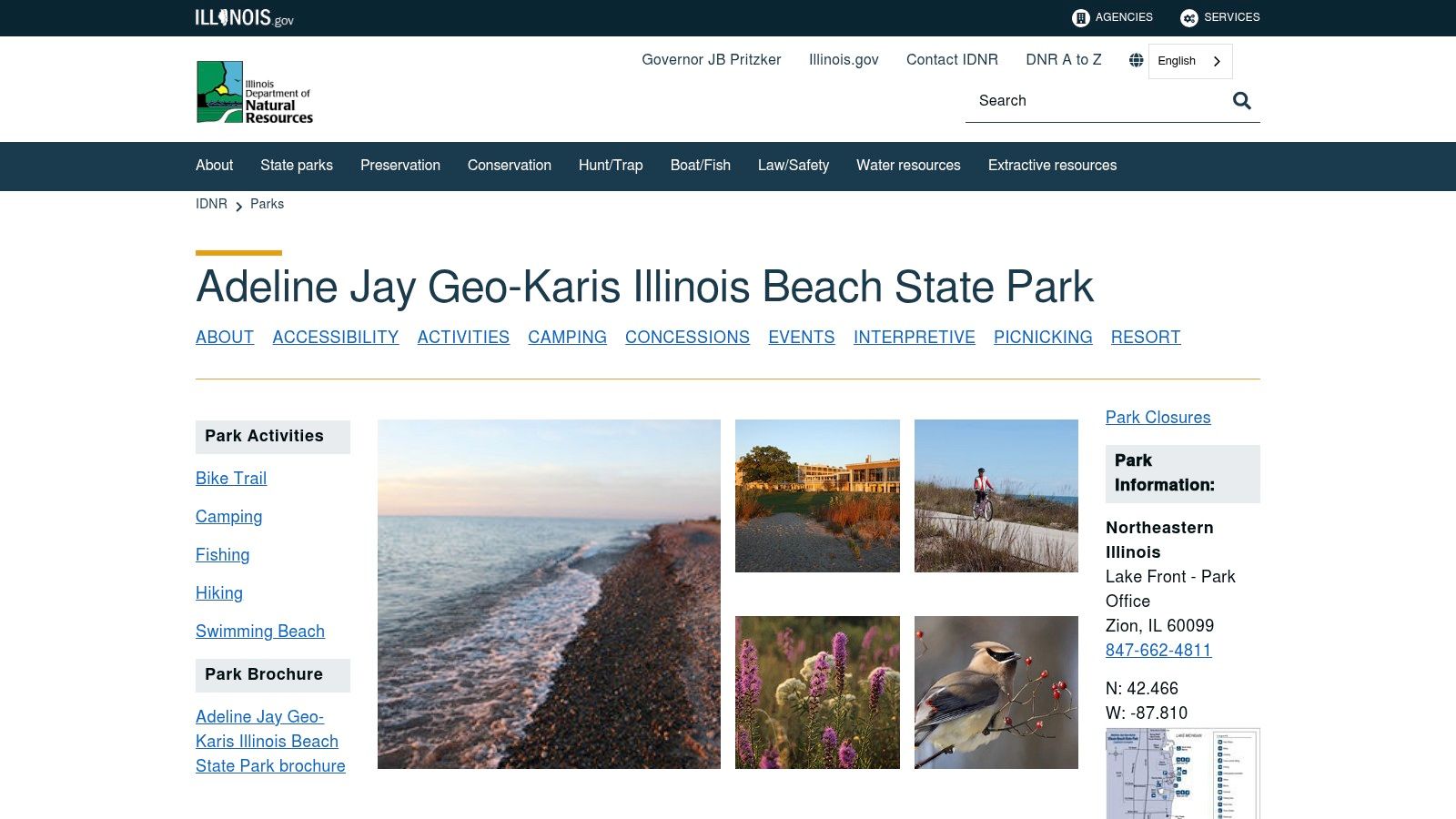
    Adeline Jay Geo-Karis Illinois Beach State Park

    When Chicago starts feeling like concrete stacked on top of stress, I want water. Not a decorative fountain. Not a riverwalk with traffic humming behind me. I want a real shoreline and enough wind to blow the stale thoughts out of my skull.

    That’s why Illinois Beach hits hard. It gives you Lake Michigan in a state park setting, which feels different from a city beach. Wilder. Less managed. More honest.

    If you want the official park page, use the Adeline Jay Geo-Karis Illinois Beach State Park website.

    Why this one works

    This park is a strong first answer to the question “what’s the best state park in Illinois near Chicago if I need a reset fast?” because it’s built for simple wins.

    • Water changes your mood: Shoreline walks force your brain to stop clenching.
    • You can keep it easy: Beach access and paved areas make this less intimidating for beginners.
    • You can stay longer: Camping and on-site lodging make it easy to turn a shaky day trip into a real weekend.

    I also like it for cleanup-minded people. Beaches make litter visible. You don’t need some grand environmental theory to understand a bottle cap in the sand. You see it. You pick it up. The place looks better immediately. So do you, on the inside.

    If you spend a lot of time closer to the city, you might also like these ideas for a forest preserve in IL. Sometimes the right first step is the closest one.

    Practical rule: Go early if you want the healing version of the lake, not the crowded version.

    The tradeoff is real. Summer can get busy. Lake conditions can change what areas are pleasant or accessible. That doesn’t ruin the park. It just means you should go with a little humility and check conditions before you drive.

    Illinois Beach is for the person who wants nature without a huge commitment. You can walk, breathe, touch the water, and remember you still belong to the physical world. That matters more than people admit.

    2. Chain O' Lakes State Park
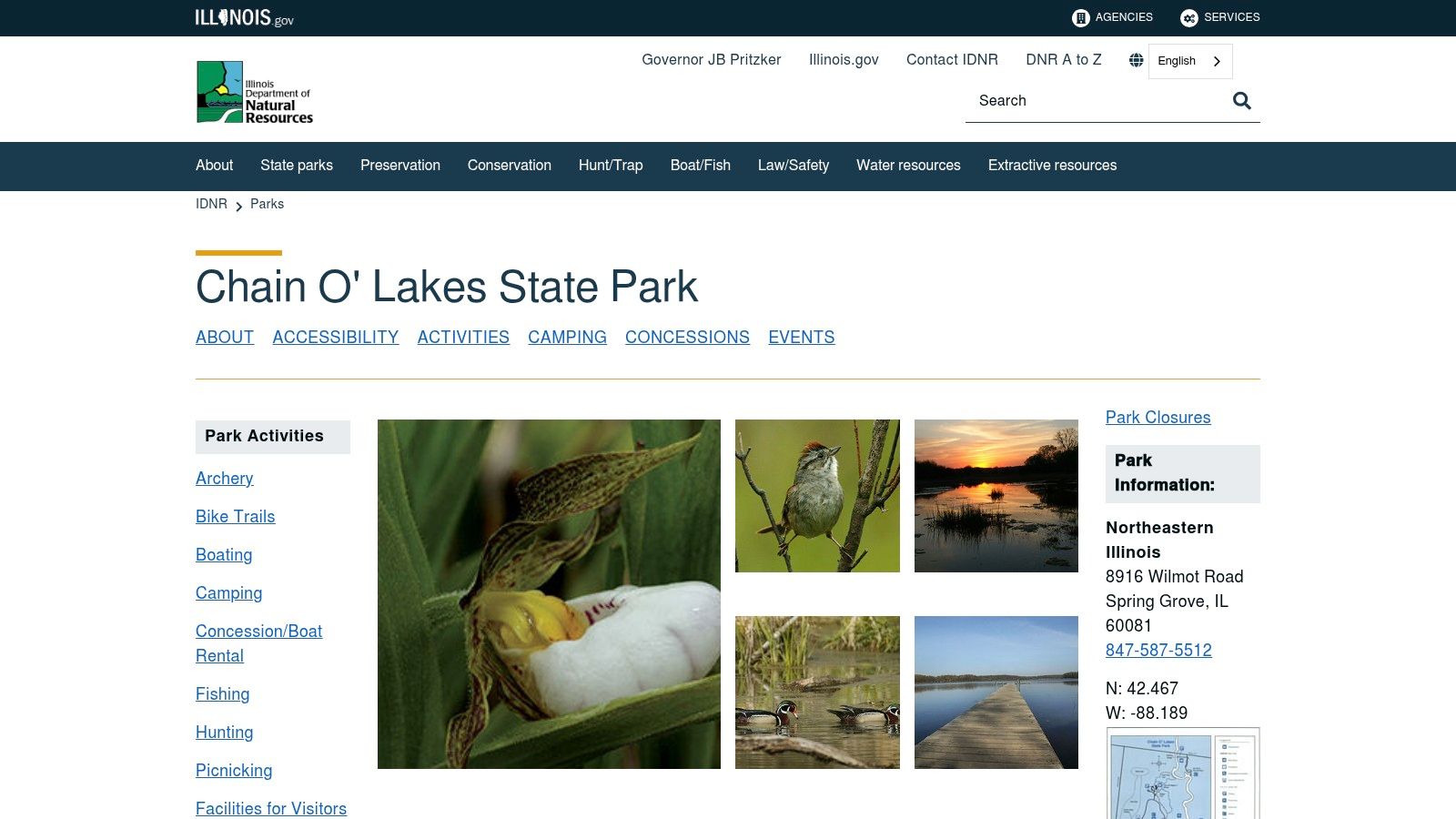
    Chain O' Lakes State Park

    Some parks ask you to hike. This one asks you to move with water.

    Chain O’ Lakes feels social in the best way. Boats. Launches. Camp spots. Trails. People cooking breakfast outside. Kids learning to paddle badly. Adults pretending they know how to tie things down. It has energy. If Starved Rock is drama, Chain O’ Lakes is motion.

    You can check details on the Chain O’ Lakes State Park website.

    Best for people who need momentum

    I recommend this park to people who say they’re “stuck.” Not sad, exactly. Not broken. Just spiritually parked in neutral.

    Water systems teach a blunt lesson. You’re not supposed to sit still forever.

    Here’s what I like about it:

    • You get options: Paddling, boating, fishing, trails, camping. That matters when your group can’t agree on one thing.
    • It works for friend-building: Shared activity kills awkwardness fast.
    • It rewards a full day: You don’t show up, take one photo, and leave. You settle in.

    And that’s the deeper point. A good state park in Illinois near Chicago shouldn’t just entertain you. It should interrupt you. Chain O’ Lakes does that because it makes idleness inconvenient. Once you’re there, you start doing things.

    Some people need silence to reset. Other people need motion. Be honest about which one you are.

    The downside is obvious. Busy water brings busy people. Peak season can feel crowded, and marshy areas can come with mosquitoes. Late-season activity changes can also affect what parts of the park feel open or quiet. None of that is a dealbreaker. It just means this park rewards planning more than spontaneity.

    I’d bring friends here when I want service and fun to sit in the same day. Paddle in the morning. Clean a shoreline edge if you’re doing your own informal stewardship. Eat lunch tired. Laugh harder than you expected. That’s not small. That’s how people start becoming useful to each other.

    3. Moraine Hills State Park & McHenry Dam State Park
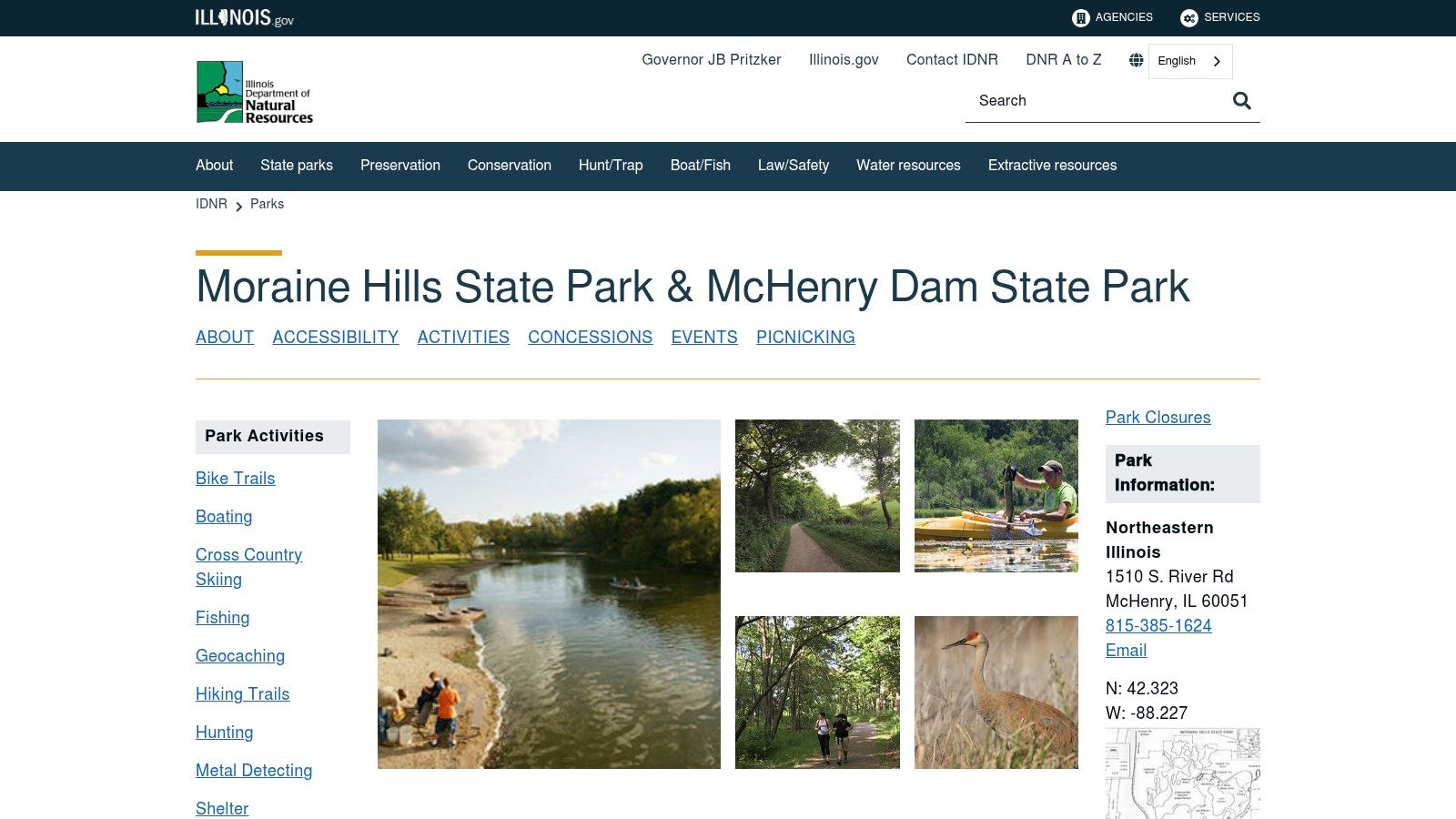
    Moraine Hills State Park & McHenry Dam State Park

    This is the pair I’d hand to a beginner.

    Not everyone needs the grand canyon version of Illinois. Some of you need a place where you can show up without pressure, walk without performance, and leave feeling steadier than when you arrived. Moraine Hills and nearby McHenry Dam do that well.

    Use the Moraine Hills State Park website for current park info.

    Easy doesn’t mean weak

    I get annoyed when people act like only the dramatic parks count. That’s ego talking. If your life is messy, the best park is the one you’ll visit.

    Moraine Hills gives you trails, wetlands, lake views, river edges, and bird-heavy quiet without demanding some rugged identity. McHenry Dam adds more river access and fishing energy. Together they create a day that feels full but not punishing.

    A few reasons I’d send a mixed group here:

    • Low-friction day trip: Good if half your group is enthusiastic and the other half almost canceled.
    • Different trail vibes: Helpful when fitness levels don’t match.
    • No camping pressure at Moraine Hills: That makes planning simpler for people who just need a clean morning outdoors.

    I also like this area for volunteer-minded walks. Day-use parks create a psychological boundary. You come, you do the thing, you leave. That can be perfect for someone rebuilding consistency. No overthinking. No giant production. Just a date on the calendar and shoes by the door.

    The real gift

    This place teaches gentleness without laziness. That’s rare.

    A lot of us swing between two bad modes. We either avoid hard things or make everything harder than it has to be so we can feel heroic. Moraine Hills rejects both. It says, take the walk. Notice the water. Pick up the wrapper. Be normal and decent. Repeat.

    The main limitation is also the strength. This is not an overnight adventure base in the same way some other parks are. It’s better for a half-day or full day reset. If that sounds too plain, good. Plain saves lives. Ordinary habits rescue people more often than dramatic breakthroughs do.

    4. Kankakee River State Park
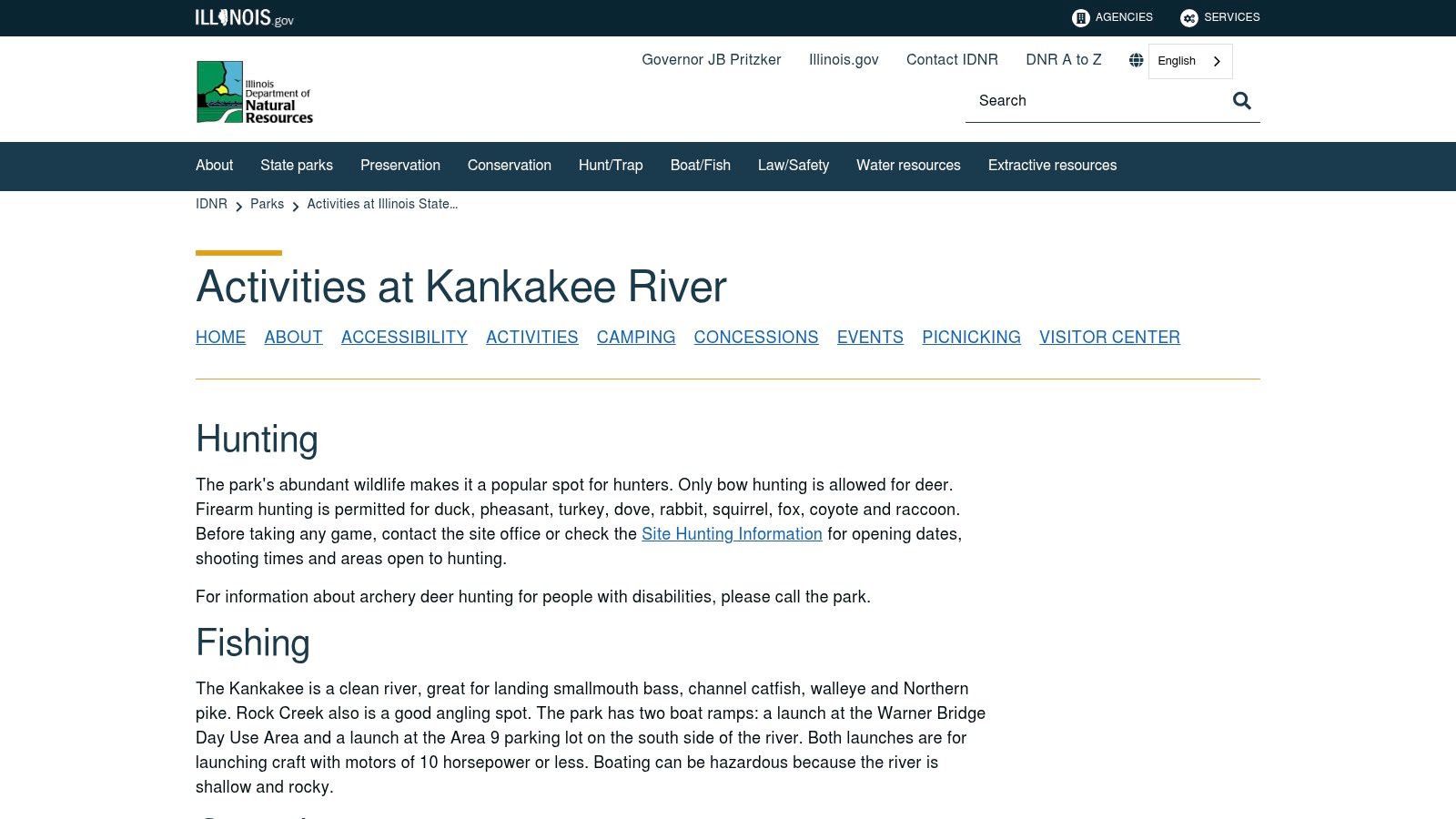
    Kankakee River State Park

    Kankakee River State Park feels like a place where you go to get your head knocked straight.

    Not by cruelty. By clarity.

    There’s something about a rocky river corridor that strips away self-pity. You hear current. You see stone. You understand, very quickly, that nature is not your therapist. It’s better. It doesn’t flatter you.

    You can plan through the Kankakee River State Park website.

    For people who need edge, not comfort

    This park works when you want more than a stroll. The river, the canyon trail, the bike path, the shelters, the campgrounds. It gives you ways to spend your energy on something real.

    That’s why I like it for groups. A park like this lets people spread out across activities and still share one story together.

    If you already love linear trail systems and riverside miles, you might also enjoy the Des Plaines River Trail near Chicago. It scratches a similar itch in a different way.

    Don’t come here to drift around indecisively. Pick the trail. Pick the shelter. Pick the plan.

    I respect Kankakee because it has rules that force respect back. You can’t swim in the park because of the currents and rocky bottom. Good. Not every place should bend to what you feel like doing that day. Sometimes growth starts when you accept the terrain instead of arguing with it.

    Why it sticks with you

    This is one of the better answers if you want a state park in Illinois near Chicago that can hold both activity and reflection. Bike for a while. Sit by the river. Cook something simple. Pick up trash along a corridor where litter looks especially insulting against the natural setting. That contrast wakes people up.

    The caution is straightforward. Check park notices before you go. Infrastructure or area access can shift. If your whole trip depends on one access point being open, you’re planning too tightly anyway.

    Kankakee is a park for rebuilding backbone. Not with motivational speeches. With motion, rock, current, and a day that asks something from you.

    5. Starved Rock State Park
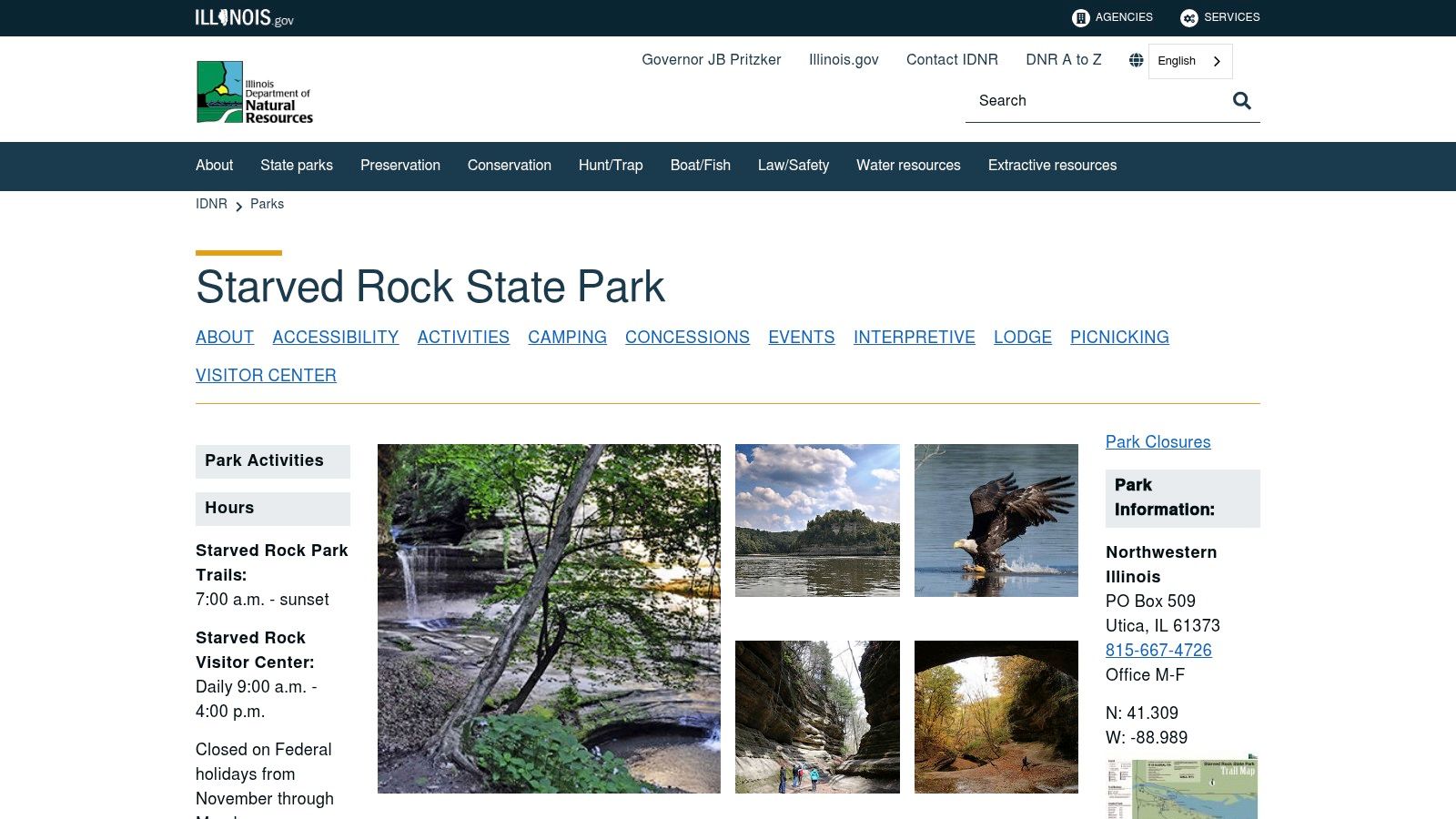
    Starved Rock State Park

    I watched a family spill out of an SUV at Starved Rock like they had been holding their breath since Joliet. Kids sprinted toward the overlook. Dad was still checking his phone. Mom was already pointing at the trees like she needed proof that the world was bigger than errands and bills.

    That’s Starved Rock.

    You drive down from Chicago carrying your own noise, then a canyon wall, a waterfall, or a sweep of the Illinois River cuts straight through it. The park is famous for good reason. It pulls huge crowds, and Time Out Chicago’s report on the Google Maps ranking points to just how many people keep showing up. Use the official Starved Rock State Park website before you go.

    The beauty is real. So is the test.

    A place this loved gets worn down.

    You’ll feel that tension fast. One minute you’re staring into a sandstone canyon, the next you’re stepping around mud, noise, and the leftovers people were too lazy to carry out. Good. Let that bother you. That irritation is useful. It means you still know the difference between a gift and a mess.

    This is why Starved Rock matters to me more than some quieter park with easier logistics. It puts the whole Litter Caterpillars idea right in front of your face. You came out here to clear your head. Fine. Now prove it by helping clear the trail. If you want to turn that impulse into action, start with this guide on how to clean up a park.

    Come for the canyon. Leave with dirt on your hands and a better reason for being there.

    You also need to plan like an adult. High traffic changes the day. Closures change the day too. Enjoy Illinois notes that Starved Rock’s Trail Project Phase 1 is scheduled to run from late March through June 2026, with closures affecting areas including French Canyon and Tonti Bridge, so your route and meetup plan may need to change according to this Enjoy Illinois overview of state parks and forests.

    Who should go

    Go if you need scale.

    Go if your mind has been shrinking to the size of your inbox, your rent, your grudges, your excuses. Starved Rock is big enough to interrupt that. It gives you overlooks, canyon trails, river views, and enough human traffic to remind you that beauty does not stay beautiful by accident.

    I would not send you here for quiet on a busy weekend. I would send you here if you need a first honest step. Show up early. Walk hard. Pick up what somebody else dropped. Sometimes the way out of your internal mess starts with kneeling down in a famous park and doing one unglamorous thing well.

    6. Matthiessen State Park
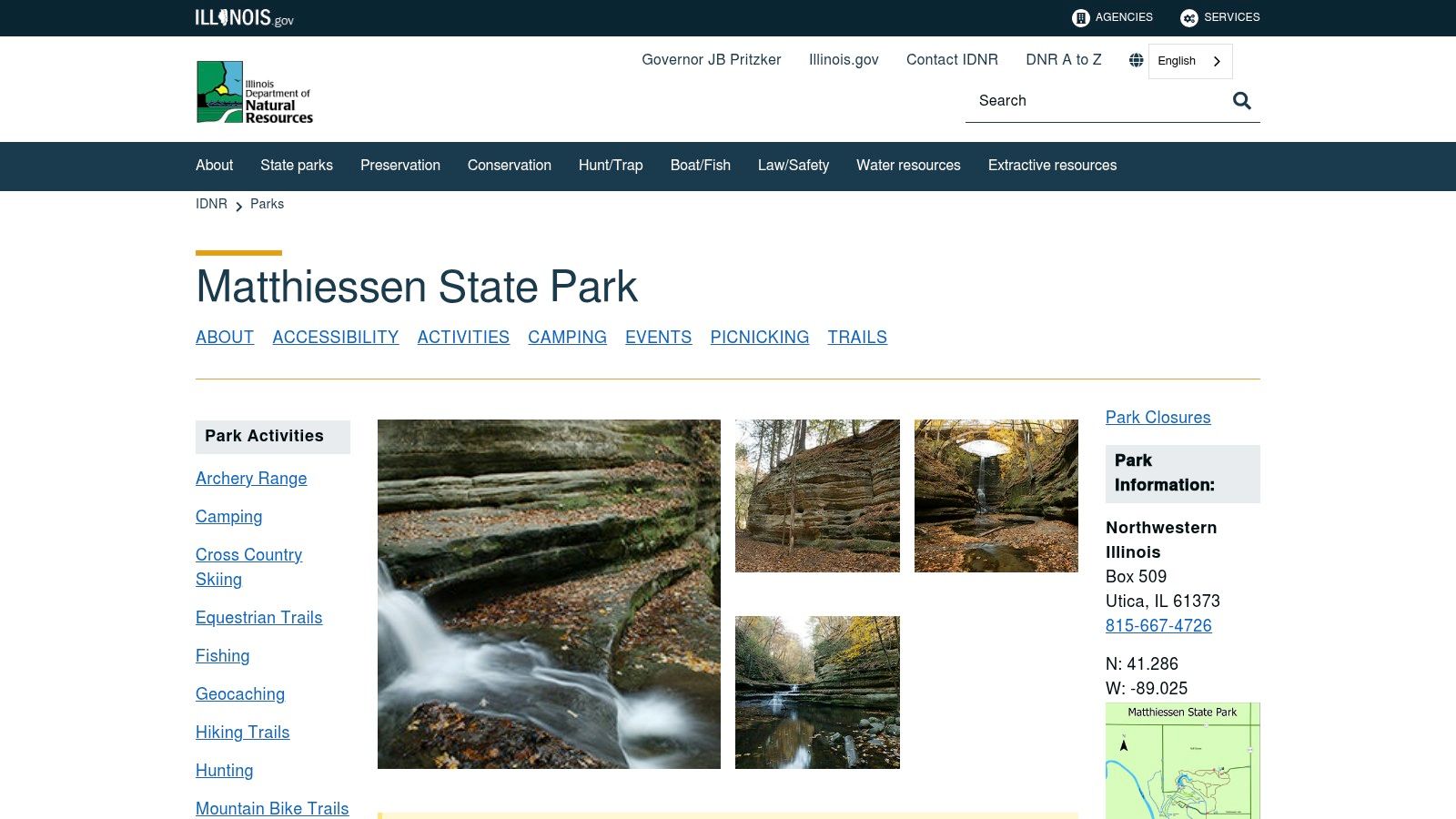
    Matthiessen State Park

    Matthiessen is the friend of the famous guy.

    It sits near Starved Rock, and that’s exactly why some people overlook it. Big mistake. If you want canyons, bridges, and that sudden feeling that Illinois has more drama in it than outsiders assume, Matthiessen delivers. Sometimes the side character is the one with the better soul.

    You can get official details at the Matthiessen State Park website.

    Smaller stage, sharp payoff

    I love parks like this because they expose a common flaw in people. We chase the place with the giant reputation, then act surprised when everyone else had the same idea.

    Matthiessen often feels like the smarter move. You still get sandstone scenery and waterfall energy, but the experience can feel more compact and manageable. It’s easier to combine with a bigger trip. It’s easier to recommend to someone who wants beauty without spending the whole day in one famous funnel of people.

    That makes it a great “prove it” park.

    • Prove you’ll wake up early: Pair it with another stop.
    • Prove you’ll keep moving: Take the stairs and trails seriously.
    • Prove you don’t need hype: Let the park speak for itself.

    I especially like this park for people who are learning to choose substance over prestige. That sounds dramatic for a park recommendation, but it’s true. Life gets better when you stop outsourcing your judgment to popularity.

    A good test of your honesty

    If you say you want nature, Matthiessen asks whether you mean actual nature or just recognizable nature.

    The tradeoff is simple. Services are more limited than at a larger destination with a lodge and broader built amenities. Capacity can also become a problem on popular weekends. So show up with a little discipline. Bring what you need. Respect closures and access limits. Don’t act shocked that a beautiful place attracts people.

    For me, Matthiessen feels like the park version of quiet confidence. Less chest-thumping. More depth. If your inner life has been noisy lately, that’s a good match.

    7. Buffalo Rock State Park & Effigy Tumuli
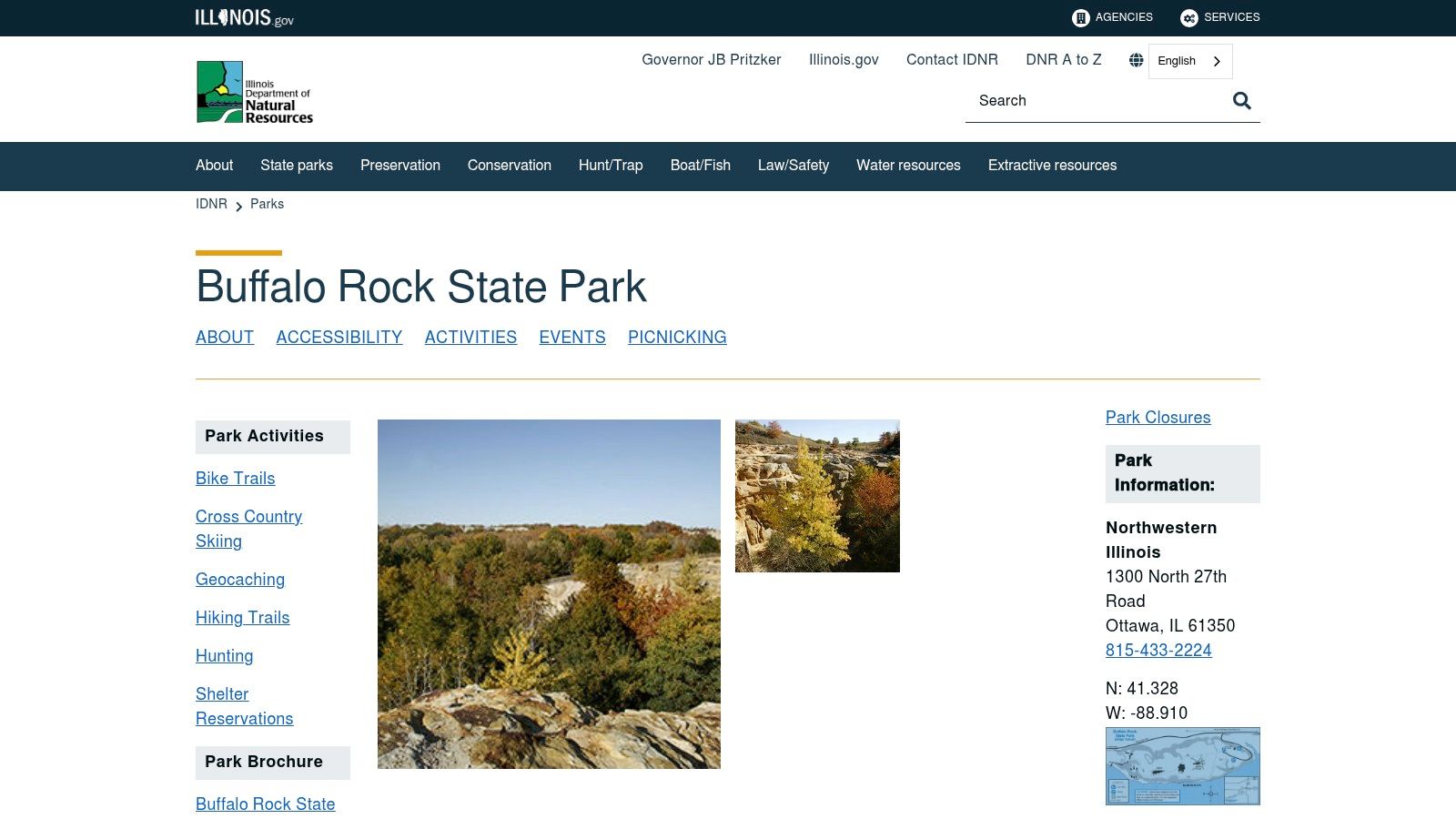
    Buffalo Rock State Park & Effigy Tumuli

    Buffalo Rock doesn’t win by size. It wins by surprise.

    You walk short trails. You get river overlooks. You move through prairie restoration space. Then you encounter the Effigy Tumuli, giant earthwork forms shaped into animals and land-based imagination. It’s quieter than the headline parks nearby, and that quiet gives it teeth.

    The official page is the Buffalo Rock State Park website.

    This one is for people who need softness

    Not every breakthrough comes from exhaustion. Some come from walking gently through a place that asks you to pay attention.

    Buffalo Rock is a good choice if your group has mixed abilities, mixed energy, or mixed willingness. It doesn’t demand a huge day. It invites one.

    That invitation matters. A lot of people won’t start if the first step looks too heroic. They’ll start if the day feels possible.

    I also like Buffalo Rock as a counterweight to tourism brain. You don’t need a giant checklist to have a meaningful outdoor day. You need place, time, and enough openness to be affected.

    Quiet parks can still change you

    Illinois state parks as a whole saw 41 million visits in 2024, the highest annual total in 15 years, and the nine parks with more than 1 million annual visitors accounted for 14.2 million visits, about 35% of total traffic. That concentration near accessible corridors tells me something simple. Big parks absorb attention. Smaller parks can absorb you according to NPR Illinois reporting on statewide visitation.

    Buffalo Rock benefits from that contrast. It can feel like a side road off the louder story.

    Its limitations are real. Fewer facilities. Less trail mileage. Less room for large, complicated plans. But if what you want is a humane day outdoors, those limits can become strengths. You don’t need abundance to be transformed. You need contact. With land. With friends. With your better self, the one that’s been waiting for less noise.

    Comparison of 7 Illinois State Parks Near Chicago

    Park (Location) 🔄 Access & ⚡ Travel time Resource requirements (permits / gear) ⭐ Experience quality / Key advantages 📊 Expected activities / Outcomes 💡 Ideal use cases / Tips
    Adeline Jay Geo‑Karis Illinois Beach State Park (Zion, ~50 mi N of Chicago) Easy–moderate access; ~1–1.5 hr from Chicago; seasonal closures possible Campground reservations via ExploreMoreIL; basic beach/swim gear; check erosion/beach advisories ⭐⭐⭐, best for natural Lake Michigan shoreline, dunes & unique plant communities Shoreline walks, swimming (seasonal), camping, trail biking/hiking Visit weekdays or shoulder seasons to avoid crowds; monitor lake/erosion advisories
    Chain O' Lakes State Park (Spring Grove, ~60 mi NW) Moderate access; ~1–1.25 hr; peak boat traffic on busy weekends Extensive camping (230+ sites), boat rentals/concessions; boating/fishing gear recommended ⭐⭐⭐, versatile water‑recreation hub with many launch/trail options Boating, paddling, fishing, family camping, equestrian trails Reserve campsites/boat rentals in advance for summer weekends; expect mosquitoes in marsh areas
    Moraine Hills & McHenry Dam State Park (McHenry, ~50 mi NW) Easy access; ~1 hr; day‑use focused with straightforward parking No camping at Moraine Hills; boat rentals at McHenry Dam; binoculars for birding ⭐⭐, strong for short day outings, birding and mixed‑ability trails Birdwatching (200+ species), short hikes, fishing, half‑day visits Good for short trips from suburbs; bring birding/fishing gear and plan half‑day routes
    Kankakee River State Park (Bourbonnais/Bradley, ~60 mi S) Moderate access; ~1–1.5 hr; linear river corridors with some closures possible Multiple campgrounds (reservable), bike & fishing gear; no swimming due to currents ⭐⭐⭐, excellent river scenery and fishing/biking opportunities Riverfront biking, smallmouth bass/walleye fishing, group picnics, equestrian camping Bring sturdy footwear for rocky trails; check bridge/area closure notices before visiting
    Starved Rock State Park (Utica/Oglesby, ~95 mi SW) Moderate–high access effort; ~1.5–2 hr; very high visitor impact on peak days Campground/resort/lodge reservations available; visitor center; permit for large groups ⭐⭐⭐⭐, iconic canyons & waterfalls with robust visitor services Canyon hikes, waterfall viewing, guided programs, overnight lodge or campground stays Arrive early on weekends or visit off‑peak; verify phased trail closures before travel
    Matthiessen State Park (Oglesby, ~95 mi SW) Moderate access; adjacent to Starved Rock; possible weekend capacity limits No lodge; multi‑use trails (hike/mtb/equestrian); picnic gear ⭐⭐⭐, dramatic canyons with fewer crowds than Starved Rock Canyon photography, hiking, mountain biking, equestrian rides Pair with Starved Rock on the same trip; expect limited services and weekend capacity closures
    Buffalo Rock State Park & Effigy Tumuli (Ottawa, ~85 mi SW) Easy access; ~1.5 hr; small park with short loops and overlooks Minimal facilities; good for educational groups and casual hikers ⭐⭐, quiet river overlooks and unique effigy earthworks Short, flat hikes, river overlooks, educational/nature programs Ideal for mixed‑ability groups, school visits, or as a quieter alternative to nearby canyon parks

    Go Far by Going Together

    You’ve seen the parks. Good. Now I want to challenge you.

    Don’t turn this into content consumption. Don’t just forward this list to a friend, save three tabs, and keep living exactly the same way. That’s what people do when they want the feeling of change without the cost of change.

    Go outside.

    Pick one state park in Illinois near Chicago and commit. Not someday. Not when your apartment is cleaner. Not when your schedule is magically less annoying. Go while your life still feels imperfect. Especially then.

    Because that’s the secret I keep relearning. Nature doesn’t require you to arrive polished. Service doesn’t require you to be fixed. You get fixed by showing up. Slowly. Through repetition. Through weather. Through carrying a bag. Through walking a trail with people who also want to become a little better than they were last month.

    I started Litter Caterpillars because I was losing to my own mess. I’m serious. Old food, clutter, emotional chaos, bad social patterns. It all felt fused together. Then one day I learned that picking up trash outside gave me access to a version of myself I couldn’t reach alone in my room. A braver version. A cleaner version. A kinder version. Not perfect. Just moving.

    That’s why I care about these parks as more than destinations. Illinois Beach can wake you up. Chain O’ Lakes can get you moving. Moraine Hills can make starting feel possible. Kankakee can toughen your spine. Starved Rock can humble you. Matthiessen can teach you to value substance over hype. Buffalo Rock can quiet you enough to hear your own conscience again.

    And the transformation gets bigger when you do it with others.

    I still think about that first hailstorm cleanup. We were cold, stuck, half-laughing, half-miserable, trying to get home while every ride seemed to vanish. It should’ve been awful. Instead it became a story. That’s what shared effort does. It turns discomfort into meaning. It gives your life texture. Suffering together, in the right spirit, stops being pointless. It becomes glue.

    We believe service, sunlight, and friendship can change everything. We are the Litter Caterpillars. We aren’t perfect, but we’re all trying to grow. When you’re ready to stop just visiting beautiful places and start helping heal them, come with us on a Saturday morning. You’ll find out fast that it was never really about the trash. It was about becoming someone who shows up.


    If this stirred something in you, don’t let it die in another open tab. Join Litter Caterpillars and come pick up trash with us in Chicago. You’ll get sunlight, movement, real people, and a chance to build courage the physical way. One bag. One block. One park. One Saturday at a time.
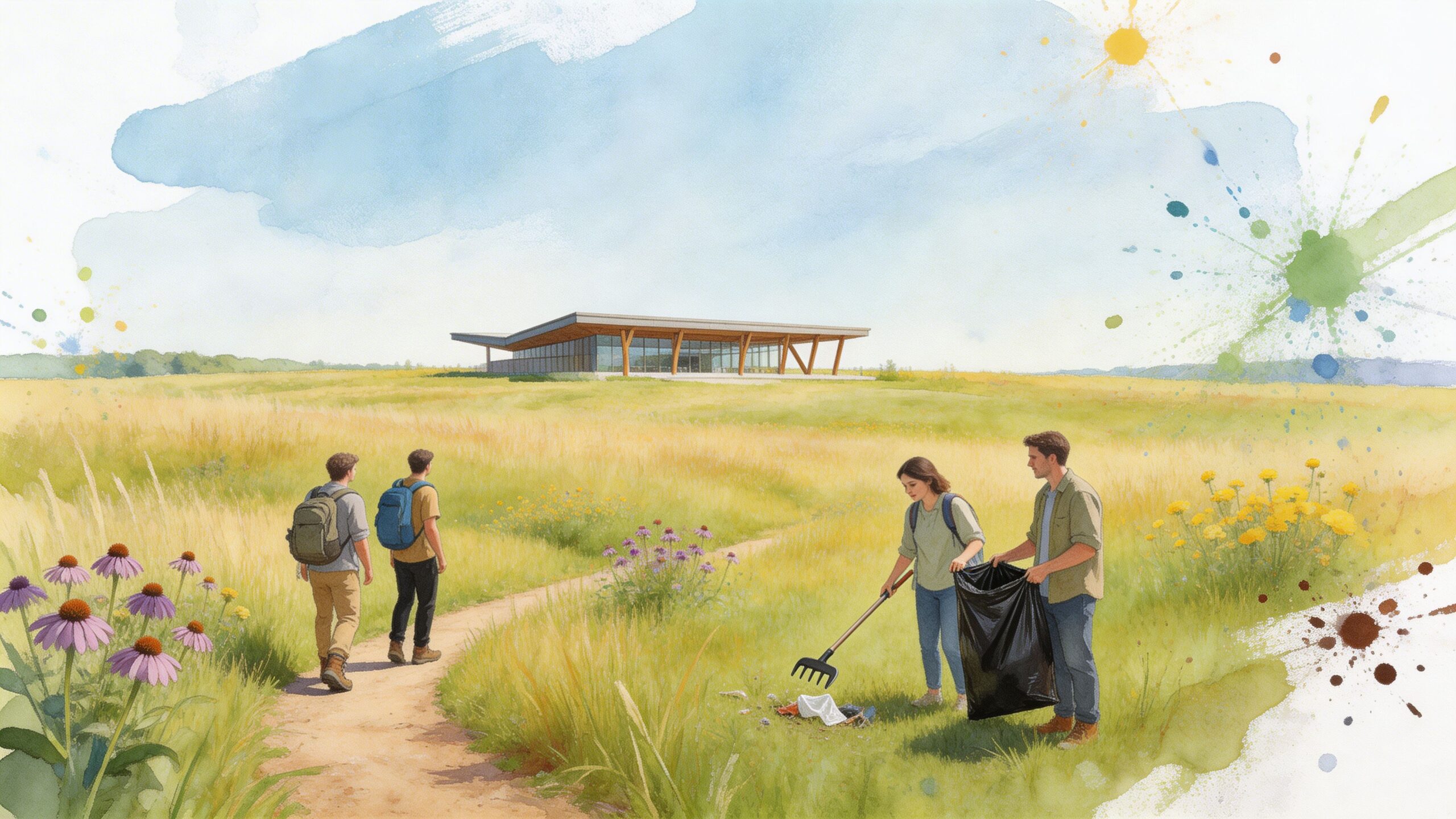
  • Springbrook Prairie Pavilion: Your Guide to Adventure

    Springbrook Prairie Pavilion: Your Guide to Adventure

    I once walked out of a big-box parking lot near dusk with a coffee in one hand and a grocery bag in the other, then looked up and saw open prairie instead of more asphalt. That jolt stayed with me. Springbrook Prairie Pavilion felt like one of those rare places where your errands and your better instincts can meet.

    Finding Your Open Space

    A lot of us know the feeling of being crowded long before we step into a crowded place. I’ve had seasons where every object in my life seemed loaded with memory and guilt. A half-used jar. An old receipt. A bag I meant to donate. None of it looked heavy, but all of it felt heavy.

    Then you get somewhere open, and your chest notices before your mind does.

    That’s what springbrook prairie pavilion represents for me. Not just a shopping center. Not just a nearby preserve. It feels like a release valve. You can arrive carrying stress, indecision, stale routines, and leave with wind in your face and a small sense that your life can change shape.

    The first reset

    My favorite way to think about this place starts with a simple afternoon. You park. You do one ordinary thing first. Pick up groceries. Grab a bite. Walk past storefronts and people moving through their day. Then, absurdly close by, the land opens.

    The contrast matters.

    You don’t need a grand vacation or a dramatic reinvention. Sometimes you need a place that lets you move from noise to horizon in a single outing. Springbrook does that. It gives you a practical entry point into a wider emotional space.

    Some places entertain you. Others loosen the knot you’ve been carrying for weeks.

    That’s why I don’t think of this area as just a destination. I think of it as a threshold. You cross from consumption into attention. You stop asking, “What can I buy?” and start asking, “What can I notice? What can I care for? What can I contribute?”

    Why open space changes you

    Open land does something cluttered rooms can’t. It returns proportion. A problem that looked huge at your kitchen table can shrink when you’re standing under a broad sky with grasses moving in every direction.

    If you already love public green spaces, you’ll enjoy this broader guide to Chicago parks worth exploring. Springbrook belongs in that emotional category, even though it has its own strange and wonderful personality.

    Here’s the practical truth beneath the feeling:

    • You can start small: One walk can reset your mood.
    • You can pair errands with reflection: That makes it easier to show up.
    • You can turn a personal slump into public care: Places like this invite that shift.

    I think that’s why I keep coming back to springbrook prairie pavilion in my mind. It offers room. Physical room, yes, but also moral room: room to breathe, to look up, to become more useful to the place you live.

    Discovering a Place with Two Hearts

    The first time I watched this place reveal itself, a family pushed a cart toward the stores while a child pointed past the parking lot at the open grass beyond it. The adults had come for errands. The child had already spotted the bigger invitation.

    That moment stayed with me because it captures what springbrook prairie pavilion is. It holds two kinds of energy in one shared space, and if you let both of them reach you, a routine stop can turn into a small act of awakening.

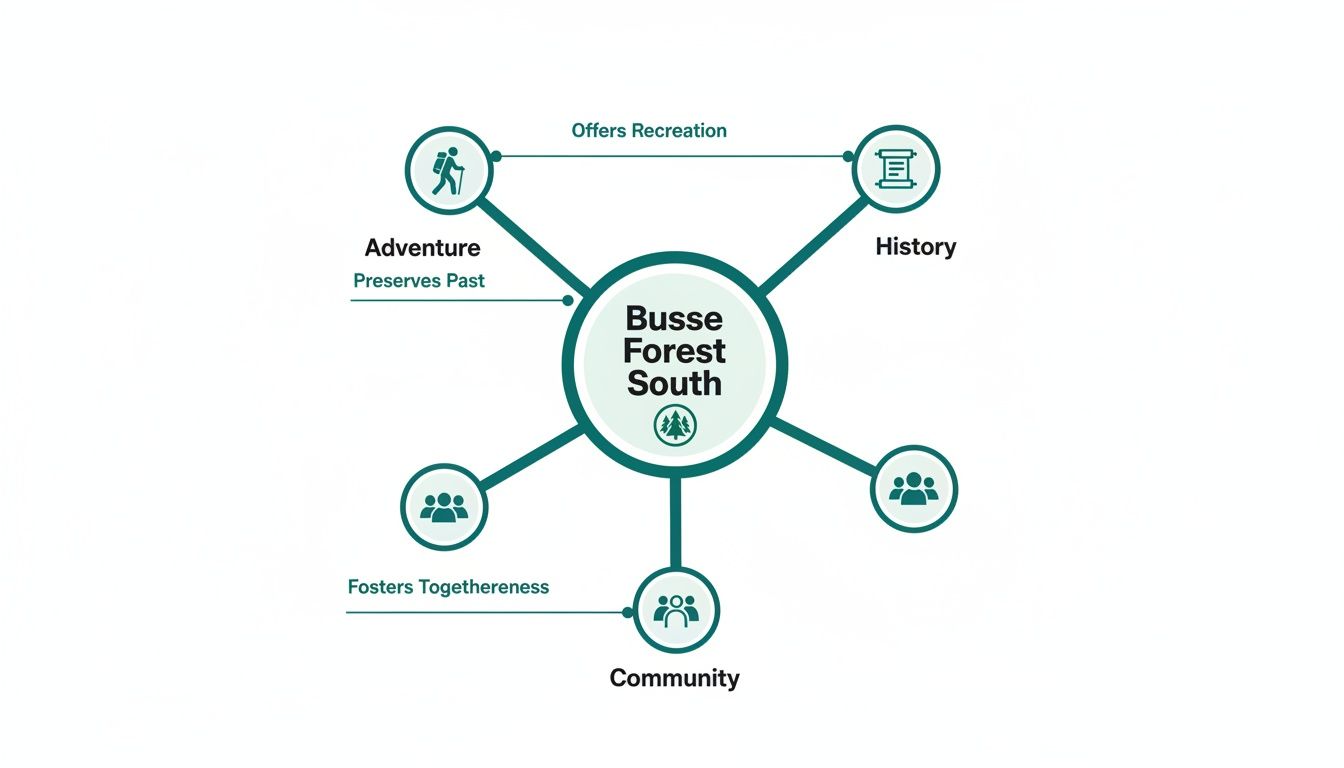
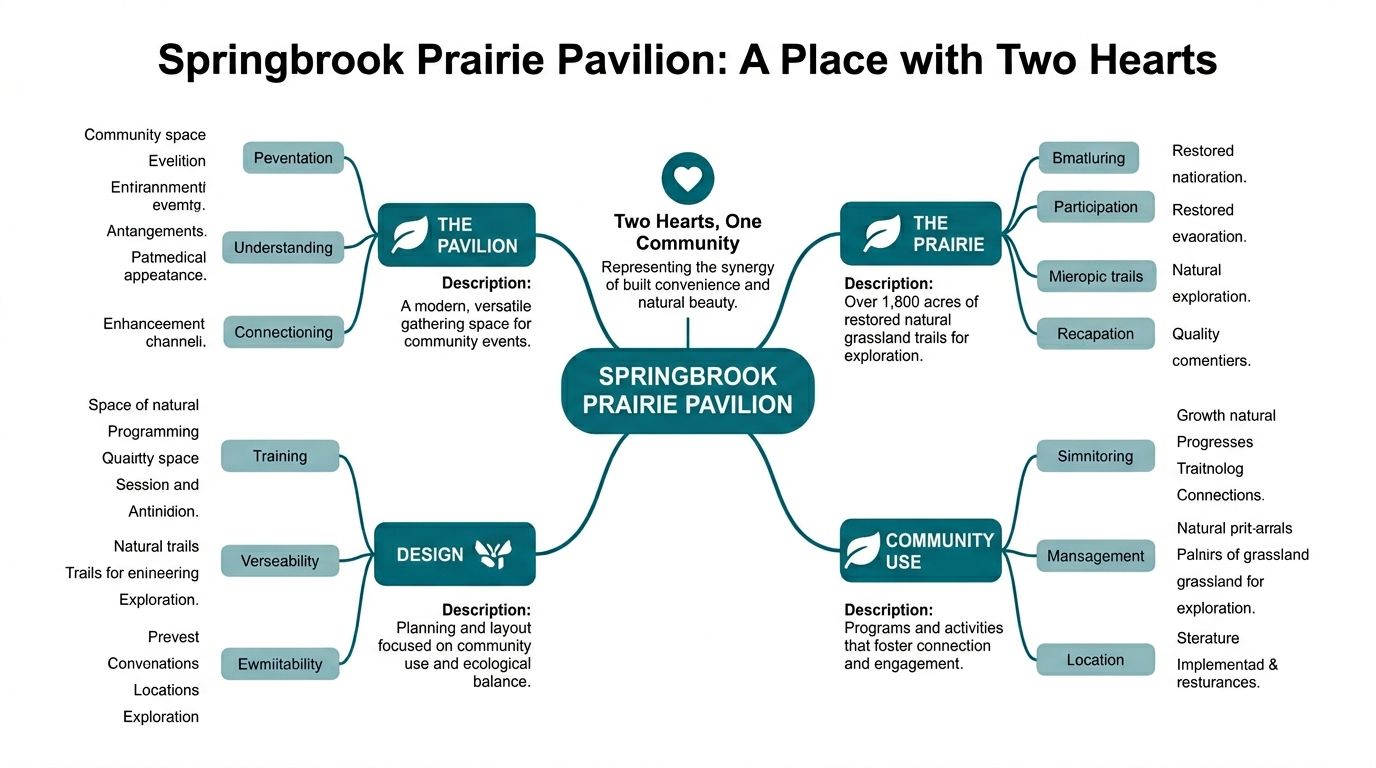
    A mind map illustrating the Springbrook Prairie Pavilion, focusing on its dual nature as community space and prairie.

    Heart one is the pavilion

    On one side, you have a place people know how to use right away. They meet for coffee, grab groceries, pick up what the week requires, and keep life moving. The retail center has been part of that daily rhythm for years, and that familiarity matters.

    A useful place can become a gathering place. A gathering place can become a starting place.

    I keep returning to that idea because community action rarely begins in perfect conditions. It begins where people already are. A parking lot meeting point. A shared meal. A quick errand that leaves twenty extra minutes. The pavilion side of springbrook gives you that practical doorway.

    Heart two is the prairie

    Then the scale shifts.

    The nearby preserve opens into a broad grassland protected through years of public care, and the DuPage Forest Preserve’s Springbrook Prairie page describes why it matters for habitat, birdlife, and the region’s living prairie story. You feel that history under your feet. Somebody chose to keep this land breathing.

    I love places where that choice is visible. You can sense it here. The stores say people live here. The prairie says people also decided this life needed room, restraint, and responsibility.

    That is where the two hearts meet. One supports daily needs. The other asks what kind of neighbor you want to be.

    How to read the place

    If you walk in expecting only convenience, you will miss half the lesson. If you come only for scenery, you may miss the civic miracle hiding in plain sight. This corner of suburbia shows what happens when usefulness stands beside preservation and neither one cancels the other out.

    Part What you notice first What it gives you
    Pavilion Stores, parking, daily movement A gathering point, familiar routines, a place to start
    Prairie Trails, grassland, sky Perspective, habitat, and a reason to care for something beyond yourself

    I think that is why this place feels bigger than its map pin. It is not only a stop. It is a test of attention.

    You can rush through it and leave with bags. You can slow down and leave with purpose. For anyone who has ever needed a gentle way back into service, the two hearts of springbrook prairie pavilion offer a simple invitation. Come for what you need. Stay long enough to notice what your community needs too.

    Your Practical Guide to Visiting

    Good adventures usually begin with plain logistics. If you handle the basics well, the place opens up.

    I like to treat springbrook prairie pavilion as a split-purpose outing. One part of your plan belongs to the retail center. The other belongs to the preserve. If you decide which one matters more before you leave home, the whole visit gets easier.

    Start with your purpose

    Ask yourself one question first. Are you going there to walk, to shop, or to blend both?

    If you want trail time, wear shoes you don’t mind putting miles on. If you want errands plus a walk, keep water in the car and leave enough time so the outing doesn’t feel rushed. The beauty of this place is the transition between modes, but only if you give yourself margin.

    Here’s the preparation checklist I’d hand a friend:

    • For a trail-first visit: Bring water, a hat if the sun is strong, and a small bag for your own waste.
    • For a store-first visit: Finish the must-do errand first so your mind can relax later.
    • For sunset seekers: Get there early enough that you’re not racing the light.
    • For mixed groups: Set a meeting point before anyone wanders off toward shops or trails.

    Know what kind of place you’re standing in

    The pavilion itself reflects care for the land beside it. Springbrook Prairie Pavilion is a LEED Gold certified retail center, the first of its kind in the Chicago area, and its design includes high-performance insulation and native plantings that reduces irrigation needs by 50% while cutting operational energy demands by up to 30% compared to standard developments, according to MGNCE’s project page on Springbrook Prairie Pavilion.

    That detail changes how I see the site. I’m not just walking through another shopping center. I’m standing in a place that at least tried to build with some respect for its environmental context.

    A few field-tested habits

    You don’t need much ceremony, but a few choices can improve the day.

    Practical rule: Do the most time-sensitive thing first. Stores have schedules. Walking space gives you more emotional flexibility.

    I also like to keep expectations simple:

    • Don’t overpack the itinerary. This area works best when you leave room to drift.
    • Check the weather before you go. Open prairie feels different when wind picks up.
    • Wear layers if the day looks uncertain. The land has a way of reminding you that forecasts are only forecasts.

    The best visits don’t feel optimized. They feel balanced. You arrive prepared enough that nothing distracts you, then you let the place do the rest.

    Exploring the Trails Beyond the Stores

    The trails are where springbrook prairie pavilion stops being merely convenient and starts becoming memorable.

    You can feel the shift in your body. Concrete gives way to path. Storefront noise fades. The horizon stretches. You start noticing birds, seed heads, the shape of clouds, the long flat language of Illinois land.

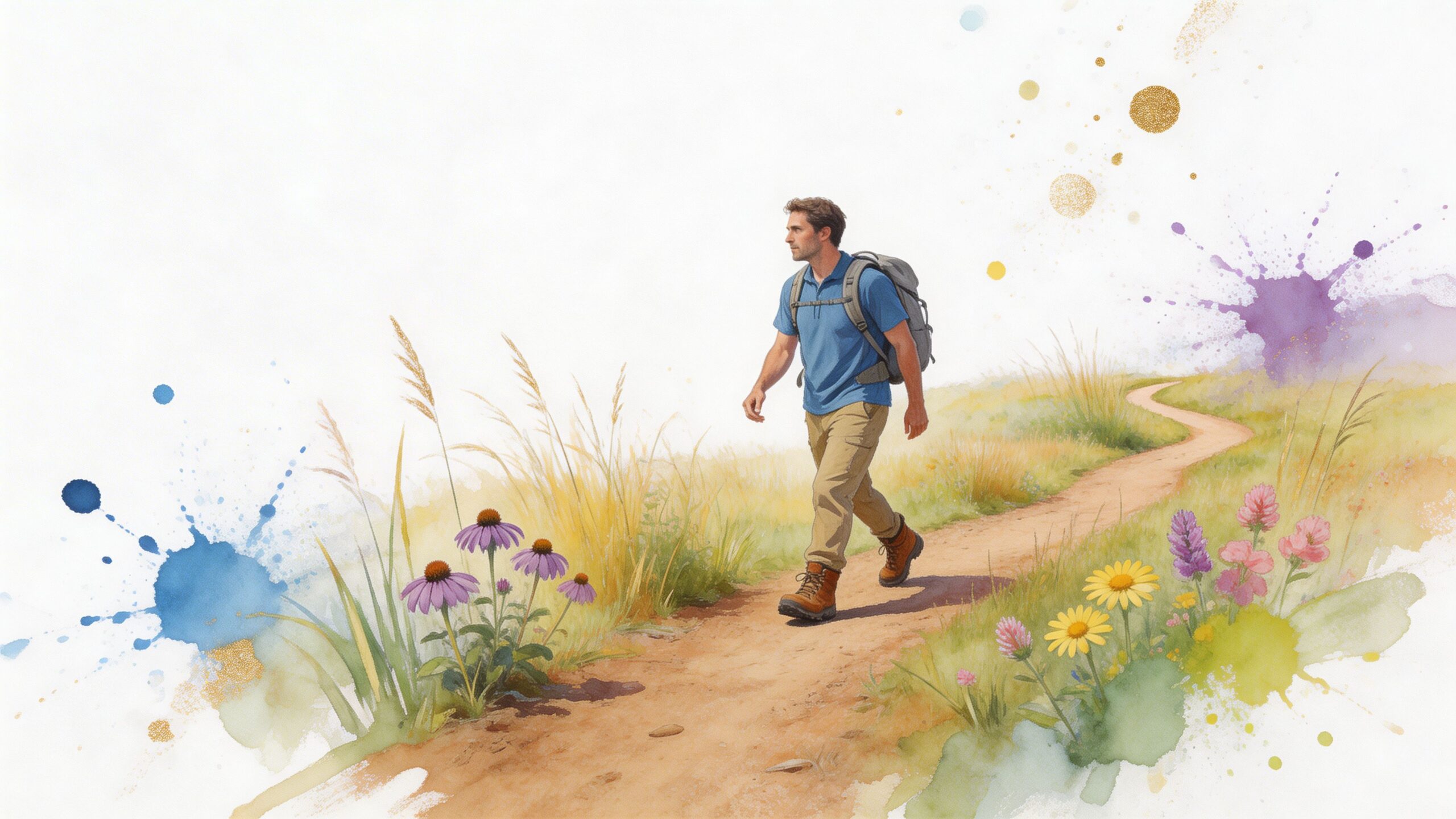
    A man with a backpack hiking along a scenic trail surrounded by wildflowers at Springbrook Prairie.

    The trails change your pace

    The preserve offers a 5.5-mile paved trail and a 2-mile hiking-only Henslow’s Trail, according to the DuPage forest preserve information cited earlier. Those two experiences feel different.

    The paved route invites rhythm. You can walk it with a friend, bike it, or use it as a long exhale after a busy week. The hiking-only trail asks for more attention. It narrows your focus. Your steps get quieter. Your thoughts usually do too.

    That’s why I think these trails matter beyond recreation. They create a kind of honest mental reset. Not an expensive one. Not a branded one. The old human relief of moving through open land.

    Why beauty also creates responsibility

    This preserve gets described as a birder’s paradise, and that phrase makes sense. The habitat is precious, and people come because it’s worth seeing. But beauty draws pressure with it.

    An underserved angle stands out here. Despite the preserve’s strong reputation and 5.5 miles of trails, there’s room for volunteer-led cleanups because high foot traffic and proximity to retail create litter risks for endangered bird habitats, especially as restoration projects continue through 2028, as noted on this Springbrook Prairie Pavilion area page.

    That point landed hard for me. We celebrate access, but access creates responsibility. A snack wrapper dropped near a trail edge doesn’t stay “small” for long when habitat is the thing at stake.

    Beauty isn’t self-protecting. People have to protect it.

    I like this short video because it helps put the place in motion rather than in brochure language.

    What to notice while you walk

    If you go, pay attention to more than distance.

    • Listen for contrast: retail hum in the distance, wind close to your ears.
    • Watch the edges: trail edges often reveal where human care is strongest or weakest.
    • Notice what doesn’t belong: cups, plastic, pet waste bags, scraps of packaging.
    • Look up often: prairie settings reward people who stop staring at their shoes.

    That’s the argument I’d make to anyone on the fence. These trails aren’t just a pleasant extra beside the stores. They’re a vital public resource. They help people think better, breathe deeper, and remember that developed places still need wild neighbors. A space like this deserves visitors, and it deserves guardians too.

    The Sawyer Effect Turning Cleanup into Adventure

    I’ve always loved the Tom Sawyer lesson, not because tricking your friends is admirable, but because he understood something real. Energy changes when people feel pride instead of punishment.

    A cleanup can feel like drudgery. Or it can feel like a mission.

    At springbrook prairie pavilion, that shift happens more easily than you’d expect. The setting helps. You’re in a visible, active place where service shows in the surroundings and in the eyes of passing strangers.

    A diverse group of cheerful volunteers cleaning up litter in a community environmental service project together.

    What makes a cleanup feel alive

    The pavilion sits on Naperville’s busiest retail corridor, with 75th Street seeing 60,100 vehicles per day, and that visibility gives volunteer groups a big public audience. The same area also reaches an affluent local demographic with average household income of $118,722, according to Perform Properties’ Springbrook Prairie Pavilion page.

    I don’t read that as a marketing stat. I read it as social influence.

    When people see volunteers working in a prominent place, the act stops being private virtue. It becomes a civic signal. It tells drivers, shoppers, and families that care is normal, effort is admirable, and somebody is willing to go first.

    A simple cleanup script

    If I were organizing a morning there, I’d keep the plan lean and human:

    1. Choose a clear zone. Start with an obvious edge. Parking lot borders, trail access points, or the seam where retail activity meets natural space.
    2. Bring visible tools. Gloves, grabbers, sturdy bags, and bright markers of group identity help people feel part of something.
    3. Give the morning a mood. A shared playlist before or after, coffee, a group photo, a funny team name. Small rituals matter.
    4. End before people burn out. Leave while spirits are still high.

    Field note: People come back when service feels social, safe, and a little bit heroic.

    If you want ideas for organizing your own crew, this guide to volunteer trash pickup is a useful starting point.

    The point is bigger than the bags

    The best cleanup events don’t remove litter; they alter identity.

    Someone arrives thinking, “I’m tagging along.” Then they spend an hour improving a visible place with other people. They leave standing straighter. They start seeing themselves as the kind of person who acts instead of complains.

    That’s the Sawyer effect. You reframe service as participation in a story worth joining.

    At springbrook prairie pavilion, that story writes itself. Cars pass. Shoppers notice. The prairie sits nearby like a reminder of what’s worth defending. You bend down, pick something up, and the act feels oddly dignified; it's not glamorous, but better than glamorous, it is necessary.

    Hosting Your Own Event at the Pavilion

    The first time I saw a community table work in a place like this, it was almost disarmingly simple. Two folding chairs. A handwritten sign. A bin for winter gloves. People who came for groceries slowed down, asked a question, dropped something in, and kept going. By the end of the morning, that little setup had done more than collect supplies. It had changed the mood of the whole corner.

    That is why Springbrook Prairie Pavilion matters. As noted earlier, it already has the visibility and daily rhythm that many organizers spend weeks trying to create from scratch. You are not begging people to find a hidden cause in a hidden place. You are meeting them where life is already happening.

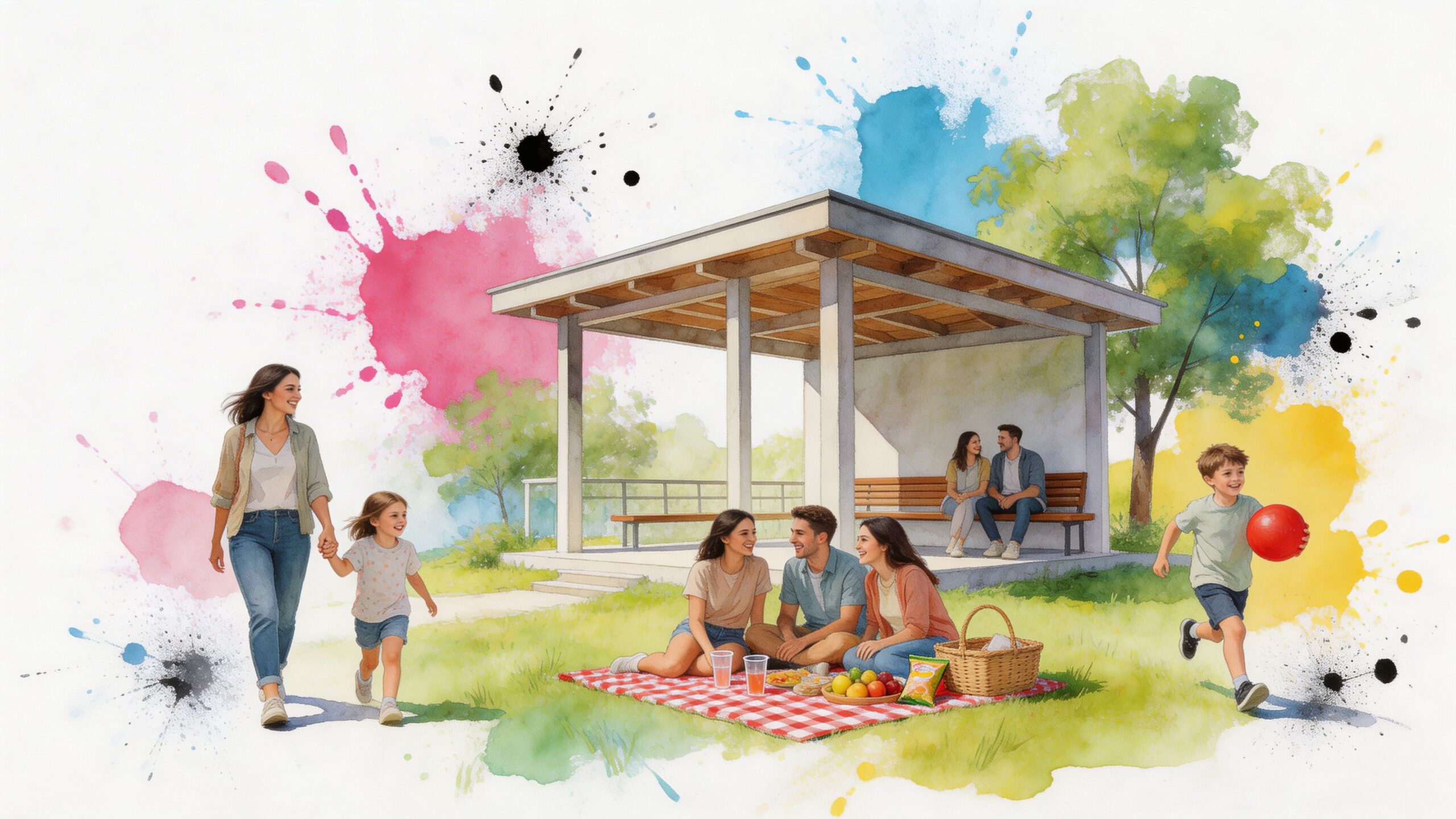
    A diverse group of families and children enjoying a sunny picnic and playtime at a local park pavilion.

    Why this location helps good ideas catch on

    A pavilion tied to everyday errands gives your event a kind of honest momentum. Parents are already out. Teens are already gathering. Neighbors are already passing through with ten spare minutes they did not know they had.

    For service work, that matters.

    A cleanup sign-in table near a recognizable storefront feels approachable. A supply drive here feels visible, not hidden. A meetup before a stewardship walk starts with less confusion because nobody has to decode where to park, where to wait, or whether they are in the right place.

    I love places like this because they have two audiences at once. The people who came on purpose. And the people who discover your effort by accident, then decide to join.

    Build a gathering people can say yes to fast

    You do not need a festival plan. You need a clear invitation.

    A school club can meet here, share a quick welcome, then head toward nearby green space for a service hour. A neighborhood group can set up a donation point with one volunteer greeting passersby and another keeping things organized. A family-led cleanup morning can begin with coffee, gloves, and a simple promise that kids will get to help in a real way, not just stand around while adults talk.

    If budget is the sticking point, start small and study how to find corporate sponsors for local community events. Even one donated batch of water, gloves, snacks, or printed flyers can make a local effort feel cared for.

    Formats that fit the pavilion well

    The best event here is usually the one people understand at a glance.

    Event idea Why it works at the pavilion
    Cleanup meetup Gives volunteers an easy public meeting point before heading out
    Donation or supply drive Catches everyday foot traffic from people already running errands
    Club meetup before a walk Reduces confusion and makes turnout less intimidating
    Family service morning Combines convenience, visibility, and a nearby outdoor purpose

    One caution, learned the hard way. Keep your first event modest enough that you can greet people warmly, answer questions, and end on time. A well-run hour builds trust faster than an ambitious three-hour plan that leaves everyone tired and scattered.

    This is a significant opportunity here. You are not just borrowing a convenient location. You are helping turn an ordinary commercial stop into a place where neighbors notice one another, act on what they care about, and leave feeling a little more responsible for the ground under their feet.

    Your Questions Answered

    A few practical questions decide whether a visit happens this weekend or gets postponed for months. So here are the straight answers.

    Are dogs allowed in the preserve

    Yes. Dogs are welcome on most trails, and they need to stay leashed. The preserve also has an off-leash dog area that requires a permit from the Forest Preserve District of DuPage County.

    The important part isn’t just rule-following. It’s habitat respect. If you bring a dog, clean up after it and keep the place pleasant for wildlife and other visitors.

    Is there a fee to enter the preserve

    Individual entry for hiking, biking, and picnicking is free. That matters because it removes one of the biggest barriers to trying a new outdoor place.

    The preserve is generally open during posted hours from one hour after sunrise to one hour after sunset. I’d check official postings before you go, especially if weather looks rough or your timing is tight.

    Can you fish or picnic there

    Yes to both.

    Picnicking is a natural fit because the setting already invites lingering. You don’t need much. A blanket, simple food, and a willingness to stay off your phone for a while can turn a regular afternoon into something restorative.

    Fishing is allowed in Spring Brook creek if you have a valid Illinois fishing license. That part of the experience connects you to the water side of the preserve, which is easy to overlook when the grassland views take center stage.

    What should you bring for the best visit

    Keep it simple:

    • For walking: good shoes, water, and weather-appropriate layers.
    • For dogs: leash, waste bags, and patience around others.
    • For picnics: pack light and leave no trace.
    • For service-minded visitors: a small bag and gloves can turn a regular walk into a helpful one.

    Springbrook prairie pavilion works best when you treat it as more than a transaction stop. Give yourself enough time to notice what’s around you. That’s when the place starts giving something back.


    If you want more than a solo visit, join Litter Caterpillars. It’s a volunteer-driven Chicago cleanup group built on bravery, kindness, unity, and the simple idea that showing up for a place can change you too.

  • Van Patten Woods Lake County IL: Trails & Wildlife

    Van Patten Woods Lake County IL: Trails & Wildlife

    I once pulled into Van Patten Woods with a head full of noise and a coffee gone cold in the cup holder. By the time I stood near the lake and heard my own footsteps on the gravel, the day felt less like something attacking me and more like something I could shape.

    Your Adventure Begins at Van Patten Woods

    Some places meet you where you are. Van Patten Woods Lake County IL does that for me.

    I don't mean that in a soft, postcard way. I mean it in a genuine way. The way a place feels when your mind is packed with old conversations, unfinished plans, and that stale sense that you've been standing still too long.

    I know that feeling.

    I’ve had seasons when my life looked manageable from the outside but felt cluttered underneath. Not just physically cluttered. Spirit cluttered. The kind where every task feels heavier than it should, and even a simple day trip feels like too much effort.

    Then you get out of the car. You smell damp earth. You see water through the trees. You start walking.

    That’s the invitation here.

    A person standing by a window looking out at a lush forest scene with scattered paint splashes.

    When a walk becomes a reset

    I’ve learned that a forest preserve can do what a pep talk can’t. It gives your body something honest to do. Step. Breathe. Look up. Keep going.

    Van Patten Woods doesn't ask you to become a new person before you arrive. It just asks you to show up.

    That matters.

    If you've ever had one of those mornings where your room is a mess, your phone is full of notifications, and your head feels like a junk drawer, this place can break the spell. Not because it magically fixes your life. Because it gives you one clean action.

    Walk forward.

    You don't need a grand breakthrough in the woods. Sometimes you just need one hour without friction.

    Why this place feels different

    This preserve has a grounded energy. Water, woods, open trail, old history in the soil. It feels close enough to daily life to be reachable and far enough away to let your thoughts loosen their grip.

    If you like pairing one preserve with another, I also like the contrast between this place and MacArthur Woods Forest Preserve. One day can feel expansive and river-worn. Another can feel tucked away and quiet. Both teach the same lesson. Your mind changes when your surroundings change.

    Here’s how I’d frame your first visit:

    • If you feel restless: Start with movement. Don’t overthink the route.
    • If you feel worn down: Go to the water early and sit longer than feels productive.
    • If you feel numb: Pay attention to textures. Gravel under shoes, bark under your palm, wind off the lake.

    The woods won't sort your whole life in an afternoon. But they can help you clear one shelf in your mind. Sometimes that's how change starts.

    How to Get There and What to Expect

    The hardest part of a restorative day is often the front door. Once you commit to leaving home, the rest gets easier.

    Van Patten Woods sits in Wadsworth, Illinois. If you're coming from the Chicago area, the drive feels like a gradual exhale. Buildings thin out. The pace softens. You stop thinking about errands and start thinking about weather, trail shoes, and whether the water will be still.

    Arrive with a simple plan

    Don’t turn this into a military operation. Give yourself a basic plan and let the place do the rest.

    Try this:

    1. Choose your anchor activity. Pick one thing before you leave. Walking, sitting by the lake, paddling, or fishing.
    2. Pack for mud, not for fantasy. Bring water, decent shoes, and one extra layer.
    3. Keep your first visit light. Let curiosity lead more than ambition.

    When you pull in, expect a preserve that feels practical rather than flashy. That’s part of the charm. You’re not there for spectacle. You’re there for contact with something steady.

    You’re stepping into local history

    Van Patten Woods carries weight beyond its tree line. It was the very first forest preserve established by the Lake County Forest Preserves district in 1961, and that first step helped launch a system that now protects over 31,200 acres and more than 200 miles of trails in Lake County, as noted by the Lake County Forest Preserves overview on Wikipedia.

    I like knowing that when I arrive.

    It changes the mood of the place. You’re not just wandering into a random patch of green. You’re walking into the starting point of a larger act of care.

    Practical rule: Treat the arrival like part of the experience. Don’t rush from parking lot brain into trail brain. Pause for a minute before you move.

    What the first few minutes feel like

    Many visitors need those first minutes to recalibrate. You get out. You hear less traffic. You notice more sky. Your shoulders drop a little without asking permission.

    That’s when the preserve starts working on you.

    A few things to expect on the ground:

    • Trail variety: You can keep things easy or stretch into a longer outing.
    • Water access: The lake draws anglers, paddlers, and people who need a horizon line.
    • A lived-in preserve feel: This place feels used in the best sense. It invites return visits.

    If you tend to hesitate before trying somewhere new, this is a good antidote. It’s approachable. It doesn’t demand expertise. It rewards attention.

    Trails for Every Mood and Fitness Level

    Some days I want a trail that asks nothing from me except motion. Other days I want a path that pushes back a little. Van Patten Woods gives you both.

    The preserve has five miles of trails that support hiking, biking, horseback riding, and cross-country skiing, and those routes connect with the Des Plaines River Trail, according to the background details provided earlier in this guide. What matters on the ground is simpler. You can choose the conversation you want to have with yourself.

    The easy loop mood

    When my brain feels overcrowded, I start near the lake.

    That kind of walk works like wiping steam off a mirror. You don’t solve everything. You just see better. A wider, easier route gives you room to settle in without constantly watching your feet.

    This is the route for:

    • Mental overload: You need rhythm more than challenge.
    • A first visit: You want confidence before exploration.
    • A shared walk: You’re with someone and want easy conversation.

    The woods path mood

    Then there are the unpaved stretches through the trees.

    These ask more from your attention. Roots, turns, softer ground, changing light. I like those paths when I’ve been scattered. They pull me back into my body because they require me to notice where I am.

    That’s the hidden gift of a slightly rougher trail. It doesn’t let you drift too far into your own static.

    A dirt path can do what a meditation app can't. It keeps asking, "Are you here or not?"

    The long-haul mood

    Some visitors hit the connector routes and keep going. That’s the day for endurance, for seeing what happens when you stay with your effort a little longer.

    If that sounds like your kind of outing, the regional connection to the Des Plaines River Trail near Chicago gives the whole preserve a bigger horizon. Van Patten Woods can be a destination, but it can also be a launch point.

    Van Patten Woods Trail Overview

    Trail Name Length (Round Trip) Surface Best For
    Sterling Lake area route Flexible Crushed gravel and developed path Easy walks, strollers, calm starts
    Woodland side paths Flexible Unpaved natural surface Presence, quiet, a little more focus
    Des Plaines River Trail connection Flexible Mixed multiuse trail Longer outings, biking, momentum

    I’m keeping the table honest on purpose. The exact route you create depends on your choices once you arrive.

    Pick the trail by feeling, not ego

    A lot of us choose the wrong path because we want to impress ourselves. We pick the longer route when what we need is the gentler one.

    Try asking a better question. Not “What should I accomplish?” Ask “What kind of return do I need?”

    Maybe you need sweat. Maybe you need stillness. Maybe you need to walk until your inner monologue gets bored and goes quiet.

    Van Patten Woods is good at all three.

    What You'll See When You Look Closely

    The lake is the part that catches many people first. Water does that. It gathers your attention and holds it there.

    But Sterling Lake means more when you know what it used to be.

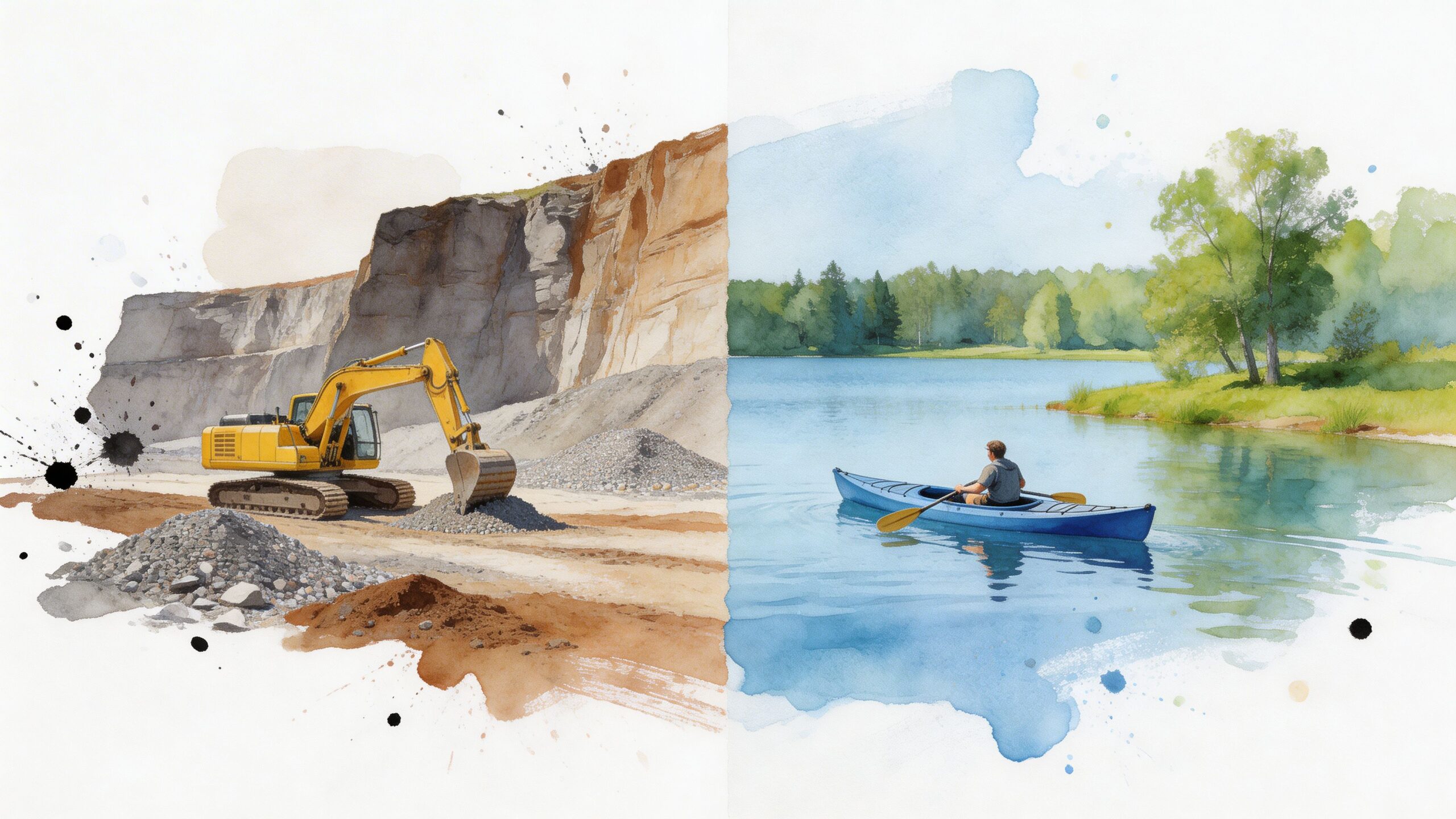
    A split-screen watercolor illustration showing an industrial quarry on the left and a peaceful lake on the right.

    The scar beneath the beauty

    Sterling Lake covers 86 acres, and it began as a gravel quarry mined from the 1930s to the mid-1970s. Then a major restoration effort from 1989 to 1993 reshaped the contaminated site into a stable aquatic ecosystem through sediment capping and shoreline revegetation, as described by Visit Lake County's Van Patten Woods page.

    I love that story because it refuses the easy version of beauty.

    This lake did not appear untouched. People wounded this land first. Then people helped heal it. You can stand at the water’s edge and feel both truths at once.

    That lands hard if you’ve ever looked at your own life and seen old damage.

    Restoration changes how you view a natural area

    When I know the history, I stop seeing a pretty lake and start seeing a record of repair. The shoreline feels more meaningful. The calm feels earned.

    That changes the whole visit.

    You start noticing that recovery usually looks ordinary from the outside. It looks like reeds, water, stable banks, birds moving through space that once held extraction. In a person, recovery often looks ordinary too. Better routines. Cleaner choices. More patience. Less chaos.

    Healing rarely arrives with fireworks. Most of the time it looks like steadier ground.

    Watch the season, not just the scene

    This is a place worth revisiting because the woods keep changing their language.

    Here’s how I think about the seasons:

    • Spring: raw hope, bright mud, the feeling of starting before you feel ready.
    • Summer: full canopy, longer light, a more generous kind of energy.
    • Fall: clarity, edge, the beauty of things letting go.
    • Winter: honesty. No cover. No decoration. Just shape and silence.

    The preserve also carries the practical life of a working natural area. It sits along the Des Plaines River floodplain, and that terrain plays a role in holding and slowing water during heavy rain. I respect places more when they do a job as well as offer comfort.

    Looking takes practice

    A lot of people visit nature and still don’t quite see it. I’ve done that too. I’ve walked while mentally answering emails and left with almost no memory of where I was.

    If you want the woods to hit deeper, slow down enough to notice one thing fully.

    Try one of these:

    • Follow the shoreline with your eyes instead of rushing to the next turn.
    • Stand still under the oaks and listen until the loudest sound changes.
    • Look for contrast between restored water, floodplain, and forest.

    Van Patten Woods teaches a blunt lesson. A damaged place can become generous again. That’s not just ecology. That’s a way to live.

    Designing Your Perfect Day

    A good day in the woods doesn’t happen by accident. It helps to choose your purpose before you arrive.

    When I started getting serious about changing my own habits, I stopped hoping my days would somehow improve on their own. I started designing them. A visit to Van Patten Woods gets better when you do the same.

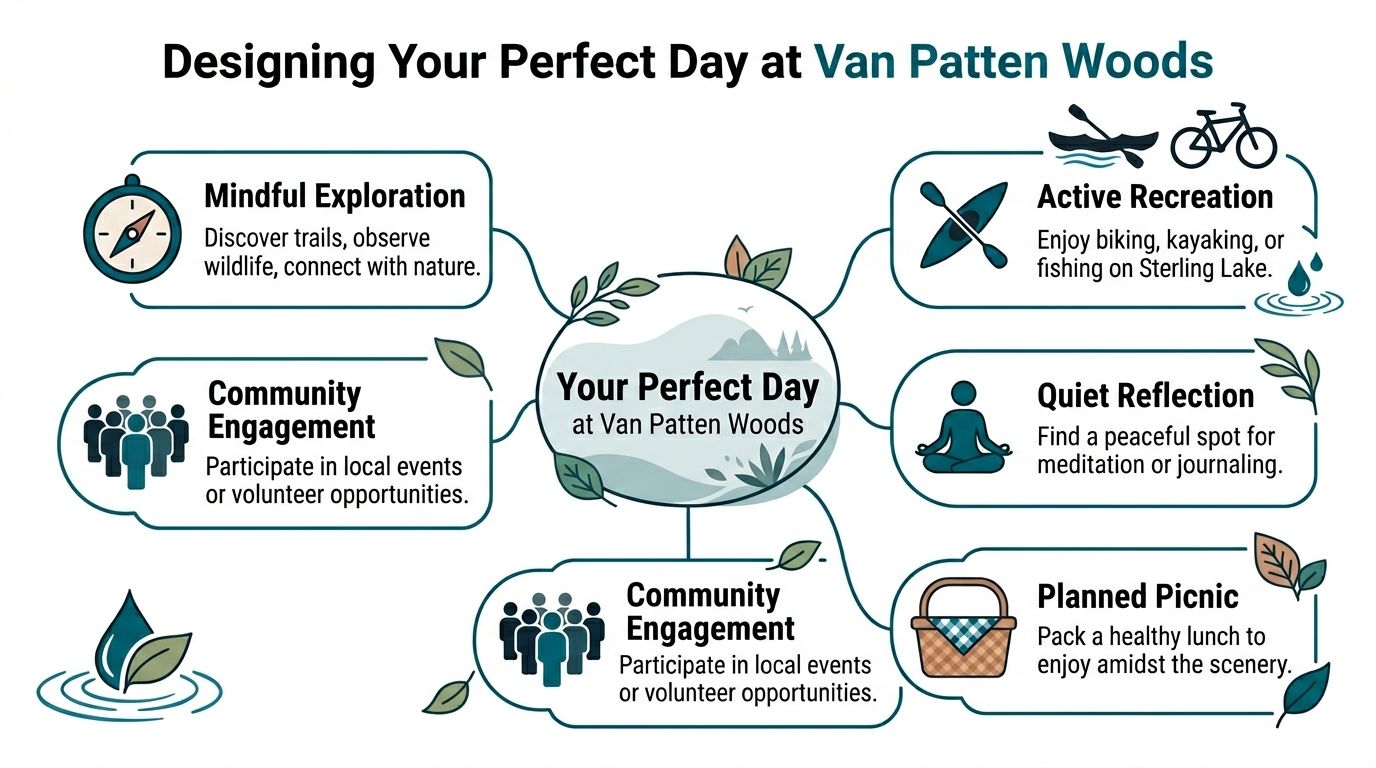
    An infographic titled Designing Your Perfect Day at Van Patten Woods listing various recreational activity ideas.

    The Solo Reset

    This is the one I recommend when life feels too loud.

    Arrive early. Walk at a brisk pace until your thoughts stop tripping over each other. Then sit by the lake without reaching for your phone.

    That last part matters more than people admit. If you fill every quiet second, you never hear what your mind has been trying to say.

    Good ingredients for this version:

    • A thermos or water bottle
    • Shoes you don’t mind getting dusty
    • A small notebook if thoughts come loose

    The Connector Day

    Some places make conversation easier because your bodies have something simple to do while your minds open up.

    Bring one friend. Keep the plan loose. Walk, pause, point things out, maybe eat lunch after. You don’t need entertainment when the environment does the heavy lifting.

    This kind of day works especially well if a friendship has felt rushed, distracted, or trapped inside restaurants and screens.

    The Water-and-Motion Day

    Sterling Lake gives you more than a view. The preserve offers a wheelchair-accessible floating dock, two fishing piers, and a boat ramp for non-motorized craft, with electric trolling motors allowed, based on the verified park details provided for this article.

    That opens up a different kind of outing.

    Try this blend:

    1. Start with a trail walk.
    2. Shift to fishing or paddling if that’s your thing.
    3. End with a quiet sit before leaving.

    The day feels fuller when it includes both movement and pause.

    The Intentional blueprint

    If you don’t know what to choose, use this filter.

    Day style Best if you feel What to prioritize
    Solo Reset Overstimulated Silence and slow observation
    Connector Day Disconnected Easy walking and conversation
    Water-and-Motion Day Restless Variety and physical engagement

    I think intention is underrated. You don’t need a perfect day. You need a day with shape. Van Patten Woods gives you enough options to build one that meets you where you are.

    Leaving the Woods Better Than You Found It

    Many visitors think a park visit ends with a nice walk, a photo, maybe tired legs. I think that’s too small.

    A place gives you something. You can give something back.

    A happy diverse family picking up trash and cleaning litter from the grass in a park.

    Don’t stay a spectator

    I used to think stewardship belonged to experts, staff, or the especially outdoorsy. That idea falls apart fast once you spend time in real public spaces.

    Public land stays beautiful because people decide it matters.

    At Van Patten Woods, that can be simple. Pick up a stray bottle near the shoreline. Grab a snack wrapper from the trail edge. Set a better tone than the one you found.

    This isn't about guilt. It's about identity.

    Small acts build a stronger self

    One of the strangest truths in life is that helping with an outer mess can steady something inside you.

    There’s a satisfaction in doing one direct, useful thing with your own hands. No performance. No abstract opinions. Just action.

    That’s why I think environmental care is personal care too.

    If this idea resonates, I like the framing in this piece on environmental stewardship. It treats care for a place as a lived practice, not a slogan.

    A field note: Pride grows when you leave evidence that you contributed.

    How to do it without making it weird

    You don’t need to turn your outing into a full cleanup operation. Keep it light and respectful.

    A practical approach:

    • Bring gloves: Lightweight work gloves make it easier to help safely.
    • Use a spare bag: One small bag is enough for incidental litter.
    • Know your limit: Leave hazardous items alone and report them if needed.

    That last point matters. Courage doesn’t mean carelessness.

    Service changes the flavor of the day

    A walk can refresh you. A small act of service can strengthen you.

    That’s the difference.

    When you leave Van Patten Woods after giving something back, the visit sticks differently. The memory has more grit. More ownership. More meaning. You weren't just a consumer of scenery. You joined the life of the place for a moment.

    I think that’s part of growing up, no matter your age. You stop asking only, “What can I get from this place?” You start asking, “How can I honor it?”

    That question improves more than parks.

    Your Questions About Van Patten Woods Answered

    Let’s keep the last details clean and useful.

    Can you bring a dog

    Yes. Dogs are generally welcome if you keep them leashed and clean up after them. Good trail manners make the day better for everyone.

    Are there restrooms

    Yes. You can expect restroom access near main visitor areas. I still recommend handling the basics before you arrive if you want a low-stress start.

    Can you fish at Sterling Lake

    Yes, fishing is part of the draw here. Sterling Lake includes two fishing piers and a wheelchair-accessible floating dock, based on the verified preserve details already referenced in this article.

    Bring whatever licenses and gear Illinois requires for your outing. Check current rules before you go.

    Can you bring a kayak or canoe

    Yes. Non-motorized boats such as canoes, kayaks, and paddleboards are allowed, and electric trolling motors are permitted. The launch is free, and the setup is designed for cartop-style access according to the verified preserve information provided for this piece.

    Is Van Patten Woods accessible

    Parts of it are built with accessibility in mind. The floating dock is accessible, and the easier lake-adjacent routes tend to work better for wheelchairs and strollers than rougher woodland paths.

    Can you camp there

    Yes, but not in the casual, show-up-and-pitch-a-tent sense. The preserve has a rustic campground for organized youth groups of up to 60 participants, and reservations require a permit through the district offices, based on the verified details provided for this article.

    What activities fit best here

    That depends on your mood.

    If you want a short answer, use this:

    • Need peace: walk and sit by the lake
    • Need movement: bike or hike the trail system
    • Need focus: fish, paddle, or take the woods slowly
    • Need connection: bring one good friend and let the preserve carry the conversation

    Van Patten Woods works best when you don’t demand too much from it. Show up ready to notice, and it gives a lot back.


    If you want to turn that energy into action after your visit, check out Litter Caterpillars. It’s a Chicago volunteer group built around service, friendship, and the idea that caring for the environment can also reshape your own life.

  • South Shore Nature Sanctuary: A Chicago Hidden Gem Guide

    South Shore Nature Sanctuary: A Chicago Hidden Gem Guide

    I found the south shore nature sanctuary on a day when my brain felt like a traffic jam. I had spent the morning rushing, doom-scrolling, and snapping at people I like, then I walked toward the lake and suddenly heard wind moving through grasses instead of sirens.

    Finding Your Wild in the City

    The first time I stepped into this place, I did not feel like I was visiting a destination. I felt like I had surfaced.

    A young man wearing a dark hoodie stands in the middle of a city street intersection.

    Chicago can do that to you. It can fill your day so completely that you forget you have an inner life at all. You move from train to sidewalk to screen to grocery line, and somewhere in the shuffle your thoughts start to sound like loose change in a dryer.

    I know that feeling well.

    There was a stretch in my life when my apartment felt cluttered, my calendar felt louder than a fire truck, and even my free time felt like another chore. Then I wandered down by the lake at South Shore and took a path into the sanctuary. The city did not vanish. But it softened. That mattered.

    A place that changes your pace

    The south shore nature sanctuary is not one of those manicured spaces that asks you to admire it from a distance. It invites you to slow down enough to notice little things.

    I noticed sand holding its shape in the wind. I noticed birds moving with a purpose I did not share. I noticed that my shoulders had crept up near my ears and then, without any grand ceremony, dropped back down.

    That is why I love hidden green spaces in Chicago. They do not lecture you. They reset you.

    Tip: If you arrive feeling fried, do not start by trying to “see everything.” Stand still for a minute and listen. Let the place introduce itself.

    Why this spot feels personal

    Some parks feel programmed. This one feels lived in. You can sense care in it.

    You can also sense struggle. This is still an urban natural area. It sits near beach activity, neighborhood life, and all the beautiful mess that comes with a real city. That tension is part of why the sanctuary means so much to me. It is not wild because people left it alone. It is wild because people chose to protect it.

    That distinction changed me.

    I used to think peace meant escape. Now I think peace often means relationship. You show up. You pay attention. You stop acting like the land is scenery and start treating it like a neighbor.

    What you may find there

    Some people come for birdwatching. Some come for a quiet walk after a hard week. I come for all of that, but also for something harder to name.

    • A reset button: Not a cure, not a miracle. Just a real pause.
    • A smaller scale of life: Grass, pond edge, moving water, drifting clouds. Things that do not care about your inbox.
    • A reminder: You are still part of nature, even if you spent the morning under fluorescent lights.

    That is the invitation of the south shore nature sanctuary. Not just “go take a walk.” More like, “come back to yourself.”

    The Story of a Resilient Oasis

    This place did not happen by accident. Someone had to imagine it first.

    The land along the South Peninsula could have remained just another overlooked edge of the lakefront. Instead, people saw possibility in it. They saw a chance to build something that would feel both local and bigger than the city around it.

    Built from community vision

    The sanctuary spans over six acres of habitat, and its path to existence started with the 1999 South Shore Cultural Center Framework Plan, which folded in community input about restoring and expanding natural habitats on the peninsula. Construction began in 2001, and the sanctuary opened in 2002, as described by the Chicago Park District page for South Shore Nature Sanctuary.

    I love that timeline because it tells a human story. Someone listened. Someone planned. Someone planted. Someone kept going long enough for the public to step into the finished space.

    That is how good citymaking works. You do not build a living habitat with one ribbon cutting and a speech. You build it seed by seed, trail by trail, season by season.

    A home assembled with intention

    When I walk there, I think about the sanctuary the way I think about an old Chicago bungalow that somebody restored with respect. The bones matter. The details matter. The purpose matters.

    This land became a kind of living library of native Chicagoland ecosystems. Not a museum behind glass. A breathing one. Wind runs through it. Birds use it. People lean on it after rough days.

    That matters even more because of where it sits. The sanctuary lives within South Shore Cultural Center Park along Lake Michigan. It offers a pocket of habitat inside one of the biggest urban regions in the country.

    Why its history still matters now

    A place like this tells you what a neighborhood believes is worth saving. The sanctuary says native natural areas deserve room in the city. It says restoration belongs on the lakefront. It says community input can shape something beautiful and durable.

    Here is the part I carry with me. The sanctuary is a vote against shrinkage.

    Cities can convince us to accept less sky, less silence, less habitat, less patience. This place pushes back. It says a peninsula can hold dune, wetland, pond, woodland, prairie, savanna, shrubland, and beach. It says even a compact urban site can carry ecological memory.

    Takeaway: The south shore nature sanctuary feels peaceful today because people made hard, hopeful choices years ago.

    A short timeline you can feel

    Moment Why it matters
    1999 framework plan Community voices helped shape the vision
    2001 construction began Restoration moved from idea to action
    2002 opening The public gained a new urban refuge

    That is the story I wish more park signs told. Not just what a place is, but how many hands and hopes it took to make it real.

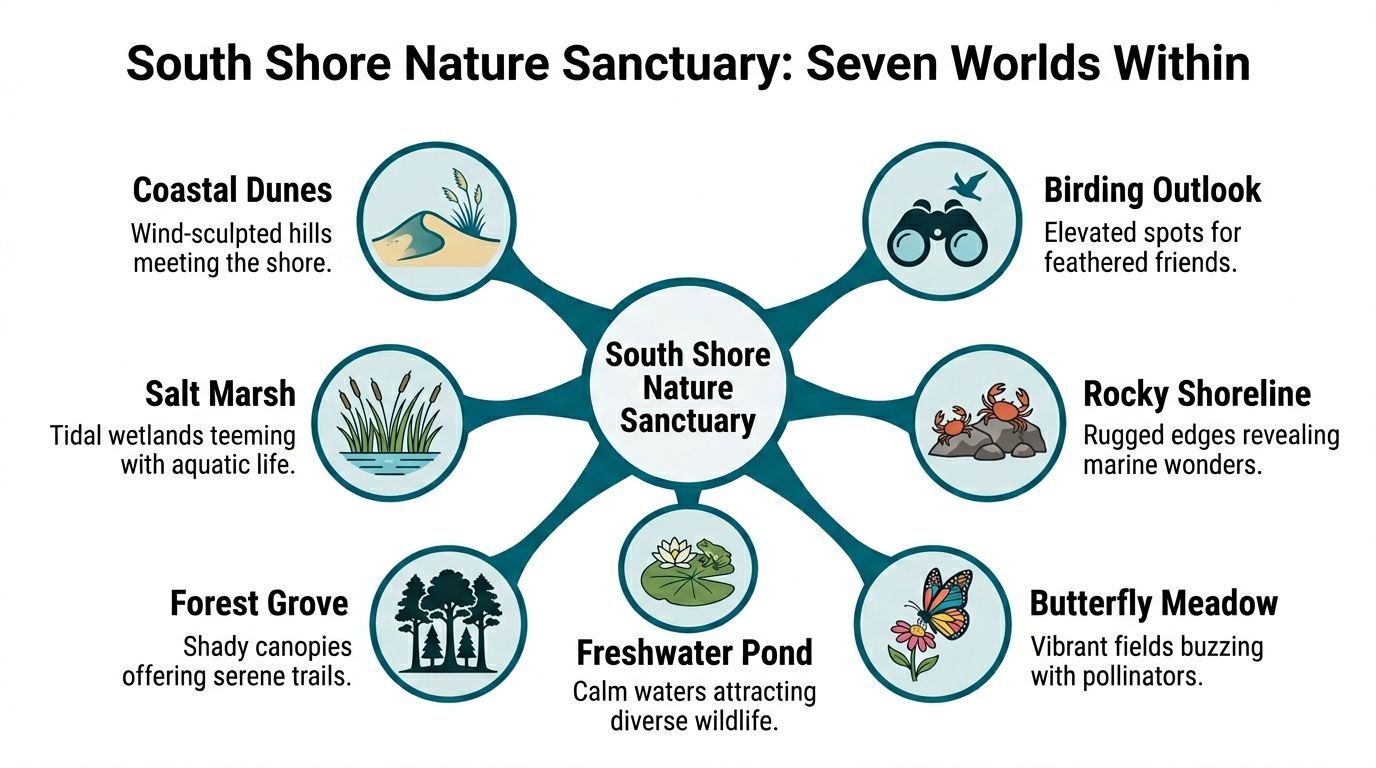
    Exploring the Seven Worlds Within

    You can walk into the south shore nature sanctuary and feel like you crossed several states in one afternoon. That is the magic of it.

    The land shifts under your feet and in front of your eyes. Sand gives way to brush. Water opens up. Trees gather overhead. Then a meadow-like stretch changes the whole mood again.

    Infographic

    Start with the edge

    I like to begin where the lake announces itself.

    The sanctuary includes dune, beach, wetland, pond, woodland, prairie, savanna, and shrubland. That mix creates the feeling of moving through “worlds” rather than one flat park experience. The Chicago Park District describes the site as a vital microcosm of native Chicagoland ecosystems and notes that its lakeside position makes it an important stopover during spring and fall migration.

    The dune and beach areas always stop me first. The plants there look humble until you realize they are doing hard work in hard conditions. Rare dune-beach species such as sea rocket, marram grass, and sand reed hold their own in shifting sand and lake wind. They remind me of tough Chicagoans. Not flashy. Just built to endure.

    Walk inland and watch the logic unfold

    The wetland edge feels different immediately. It softens sound. It cools the mood.

    There you get plants like indigo bush, button bush, cardinal flower, bulrushes, and blue iris. These are not decoration. They create food and cover, and they help shape the sanctuary as a place where wildlife can pause, hide, feed, and move through.

    Then the shrubland starts speaking in berries and branches. Plantings include oaks, hawthorn, American plum, serviceberry, hazelnut, viburnum, and native roses. If the sanctuary is a roadside inn for migrating birds, this is the stocked kitchen and sheltered porch.

    Tip: Bring binoculars if you have them, but bring curiosity even if you do not. A “successful” walk does not depend on spotting a rare bird.

    A Bird Highway Rest Stop

    The sanctuary’s location along Lake Michigan makes it a critical migration stopover. I always tell friends to imagine it as a service plaza on a long interstate, except the travelers arrive on wings and read the shoreline instead of road signs.

    That idea changes how you walk.

    You stop asking, “What can I get out of this visit?” and start asking, “What does this place provide?” Food. Shelter. Rest. Safe transition. In a city full of hard surfaces, that is a profound gift.

    Use your eyes differently

    Try this on your next visit:

    • Look low first: Notice what grips the soil or sand. Roots tell the survival story.
    • Then scan the middle layer: Shrubs often hold the action. Birds dart, pause, and disappear there.
    • Finish by looking up: Tree canopies change the temperature and sound of a space.

    If you enjoy learning tree species before you go, this guide to trees in Illinois gives useful context for what native trees contribute to local natural areas.

    The seven worlds feeling

    I know the official habitat list is longer and more precise than “seven worlds.” I still love that phrase because it captures the experience.

    One path can feel spare and sandy. Another feels lush. Another opens like a room with a view of water. The sanctuary keeps changing its voice, but the song stays coherent.

    That is why I return. I do not go there to conquer a route. I go there to practice noticing how different forms of life hold each other up.

    Planning Your Visit Like a Pro

    My best visits happen when I do a little prep and then forget about logistics once I arrive. You do not need a complicated strategy. You need a simple one.

    What to bring and why

    I dress for the lakefront, not for the forecast app’s optimism. Wind off Lake Michigan can rewrite your plans fast.

    Here is my standard kit:

    • Water: Even for a short walk. The lake breeze can fool you into forgetting thirst.
    • Comfortable shoes: You are not climbing a mountain, but uneven natural surfaces still matter.
    • Binoculars or a camera: Optional, but rewarding.
    • A small bag: Keep your hands free.
    • Layers: Always. Chicago teaches this lesson the hard way.

    A notebook is a nice extra. This is a strong place for writing down one honest thought.

    Best visit style for your mood

    Some days you want a quick exhale. Other days you want to wander.

    Your mood Best approach
    Burned out Take a short slow loop and spend more time sitting than walking
    Curious Move gradually through different habitats and stop often
    Reflective Find a quieter edge, put your phone away, and stay still
    Bird-focused Arrive with patience and keep your pace gentle

    Tip: Morning light often feels softer and quieter by the water. If you crave calm, go early.

    How to make the day easy

    South Shore works best when you pair the sanctuary with the rest of the neighborhood instead of treating it like an isolated stop. Build in time to linger. Leave buffer room. Do not rush yourself out the moment you arrive.

    I also recommend checking transit, parking, and park conditions before you leave home. If you want to shape a broader neighborhood day around walking, this guide to Chicago walking tours you can do self-guided can help you think beyond a single destination.

    A few practical habits

    Respect the land

    Stay on marked paths where appropriate. Fragile habitat does not need our creativity underfoot.

    Keep your voice low

    You will hear more, and so will everyone else.

    Leave room for surprise

    The best sanctuary moments are often the unscheduled ones. Wind in grasses. A bird landing close by. That sudden feeling that your mind has finally unclenched.

    Go solo or with one good friend

    Big groups can be fun elsewhere. This spot shines when the pace stays gentle.

    I have had great visits in all kinds of moods, but the easiest ones shared one trait. I did not try to squeeze the sanctuary into my day. I let the day shape itself around the sanctuary.

    The Sanctuary Through the Seasons

    I never recommend waiting for the “perfect” time to visit. The south shore nature sanctuary does not have one perfect season. It has personalities.

    Each one teaches you something different about attention.

    Spring wakes the whole place up

    Spring feels like the sanctuary taking a deep breath after holding still.

    Because the site serves as a stopover during spring migration, the air can feel charged even when the area still looks half asleep. Bare branches hold movement. Mud looks promising instead of dreary. Early green feels like a rumor becoming fact.

    I love spring there because nothing is polished. Everything looks earned.

    Summer settles in

    Summer drapes the sanctuary in fullness. Green thickens. Edges blur a little. The place feels less like a sketch and more like a song held on one long note.

    This is when I notice texture most. Sun on leaves. Dense shrubland. The contrast between open water and enclosed plantings. Summer asks less of your imagination because the setting is already speaking loudly.

    Bring water. Wear a hat. Then take your time.

    Fall sharpens your senses

    Fall might be my favorite, though I say that cautiously because each season has a strong case.

    The air feels cleaner on the inhale. Movement overhead matters again as migration shifts. Seed heads, dried stalks, and changing leaves make the sanctuary look less lush but more legible. You start seeing structure. You notice how the place is built.

    Fall always reminds me that beauty does not depend on abundance alone. Sometimes beauty comes from clarity.

    Takeaway: If spring is arrival and summer is fullness, fall is understanding.

    Winter reveals the bones

    Winter strips the environment down to truth.

    A lot of people skip urban nature in cold weather. I think that is a mistake. Winter lets you see shape, spacing, and resilience. The sanctuary becomes quieter, sterner, and somehow more intimate.

    You can watch the wind work harder. You can see how plants hold their ground. You can feel the lake in a more direct way.

    That kind of visit has changed me more than once. On a cold day, you do not come for comfort alone. You come for honesty. The place gives it.

    Pick your season by what you need

    • Need hope: Go in spring.
    • Need ease: Summer helps.
    • Need perspective: Fall is generous.
    • Need toughness: Winter will meet you there.

    The sanctuary does not ask you to visit only when it looks easy. It rewards people who show up across the cycle.

    Becoming a Guardian of the Sanctuary

    A beautiful place can make you grateful. A vulnerable place can make you responsible.

    That is where the south shore nature sanctuary lands for me. I do not walk out thinking only, “That was nice.” I walk out thinking, “How do we deserve this place better?”

    Two hands gently cradling a young green plant growing out of rich dark soil with watercolor background.

    Start with the smallest promise

    The first form of stewardship is simple. Leave the space better than you found it.

    That can mean packing out your own stuff. It can mean staying on paths. It can mean not treating a shoreline habitat like your personal backdrop for chaos. Small acts are not glamorous, but they are real.

    I think of stewardship like sweeping your own front steps. No applause. Just care.

    The issue too many guides skip

    A lot of writing about the sanctuary celebrates its habitats, volunteer spirit, and migration value. That celebration is deserved. But existing content often fails to address litter challenges in this urban natural area, even though the issue matters for the visitor experience and for habitat health, as noted by the South Shore Nature Sanctuary website.

    That omission bothers me because litter changes how a place feels.

    You cannot fully sink into birdsong if a plastic bottle is jammed in the reeds near your feet. You cannot talk about restoration in glowing abstract language while pretending trash never blows in from nearby activity. A sanctuary can be precious and pressured at the same time.

    Why cleanup work changes people

    This is personal for me. Service outside has a strange way of clearing internal static.

    When you help care for a place, your role shifts. You stop being a consumer of scenery. You become part of the place’s defense. That can sound dramatic, but it feels practical when you are performing it.

    You bend down. You pick something up. The ground looks better. Your mind often does too.

    There is also something human about shared stewardship. Caring for a space with other people builds trust fast. You do not need perfect conversation. The task itself gives the day shape.

    Tip: If you feel intimidated by volunteering, remember that stewardship is often just a series of small useful choices made side by side.

    What care can look like in real life

    The sanctuary already has a volunteer ethos. People contribute through seed collection and scattering, native planting, trash pickup, vegetation and bird monitoring, and invasive species removal, as described by the Chicago Park District in the earlier section. You do not need to be a botanist to respect that work. You only need to see that every healthy urban natural area rests on repeated acts of attention.

    If you want your visits to mean more, try one of these approaches:

    • Carry out more than you carried in: If you safely remove a stray piece of litter on your way out, that counts.
    • Learn one plant community: Knowing what belongs helps you notice what threatens it.
    • Return often: Stewardship grows from familiarity.
    • Support organized volunteering: Group effort creates momentum and safety.

    If you want to turn that instinct into regular service, these environmental volunteer opportunities in Chicago can help you find a way in.

    Protection is also belonging

    The sanctuary sits on the traditional unceded homelands of the Council of the Three Fires and other tribal nations identified by the Chicago Park District. I try to remember that land respect did not begin when I discovered a favorite walking path. It runs deeper than my personal story.

    That thought keeps me humble.

    It also keeps me hopeful. Urban biodiversity preservation is not some abstract expert-only concern. It lives in local habits. Native propagation. Cleanup. Monitoring. Showing up. Refusing to let neglect define a place.

    The sanctuary receives highly positive feedback and numerous reviews on the Chicago Park District page, telling me people already feel its value. I want that appreciation to mature into guardianship.

    Love for a place should leave fingerprints. Good ones.

    Your Perfect Sanctuary Day Itinerary

    The best day at the south shore nature sanctuary depends on what you need from it. I have seen this place hold people in very different ways.

    Here are three ways to spend your day well.

    The Solo Recharger

    Arrive early if you can. Start slow and keep your phone in your pocket for the first stretch.

    Walk without trying to document anything. Find a spot where you can see water or shifting grasses. Sit down and write a few lines in a notebook, even if all you write is, “I am more tired than I thought.”

    Stay until your breathing feels less rushed.

    The Urban Naturalist

    Bring binoculars, water, and one field guide or plant app you are familiar with. This is not the day to overpack.

    Move through the sanctuary with patience. Spend time at transitions between habitats because that is often where the environment teaches you the most. Look at ground cover, then shrubs, then canopy. Pay attention to food sources, shelter, and movement.

    Leave with one new name in your head. One tree, one bird, one flower. That is enough to make the place feel more alive next time.

    The Community Builder

    Come with a friend, or come open to meeting one. Walk first.

    Talk while you move, but let the surroundings interrupt you. Good conversation often gets better when you both stop to watch something. After your sanctuary visit, keep the service spirit going by joining a neighborhood cleanup or another local stewardship effort later in the day.

    That pairing works beautifully. You get serenity, then purpose. Or maybe purpose, then serenity.

    A simple rule for all three

    Do not treat the sanctuary like a box to check.

    Let it be an encounter. Drink water. Notice what steadies you. Respect the habitat. Leave room for the place to surprise you. If a city can exhaust you block by block, a place like this can restore you step by step.

    The south shore nature sanctuary is one of my favorite reminders that Chicago is not only made of concrete, traffic, and hurry. It is also made of dunes, shrubs, birds, pond edges, volunteer care, and people who still believe a patch of restored land can change a day.

    Sometimes that is enough to change more than a day.


    If this piece stirred something in you, take the next step with Litter Caterpillars. They give Chicagoans a practical, welcoming way to turn love for places like this into real service, friendship, and visible care for the city block by block.

  • Aurora Forest Preserve: Your Complete Guide

    Aurora Forest Preserve: Your Complete Guide

    The first time I walked into aurora forest preserve, I had that tight, overfull feeling in my chest that city weeks can give you. Ten minutes later, I was standing still beside tall grass, listening to wind move through it like someone slowly turning down the volume on my life.

    Discovering a Place to Breathe Near the City

    One Saturday last spring, I met a young volunteer at the trail edge who had come straight from a brutal workweek. He kept checking his phone for the first five minutes. By the time we reached the grasses, he slipped it into his pocket and laughed at himself. "I forgot I could feel this calm without earning it first," he said.

    That is the gift of aurora forest preserve.

    It gives city-tired people a place to soften. No polished outdoor persona required. You arrive carrying too much, and the land does not ask for an explanation.

    A young man with closed eyes enjoys a peaceful moment in a lush green forest park.

    When your mind needs a wider horizon

    I have learned to notice a certain warning sign in myself. My thoughts get cramped. Every small task starts acting bigger than it is. On days like that, I need open ground, a place where my eyes can travel farther than my worry.

    Aurora West offers that feeling of room. You step out, hear wind comb through the grasses, and the body begins to unclench before the mind has caught up. And that sense of space is significant.

    A preserve like this changes your scale. The inbox, the dishes, the awkward conversation you keep replaying, they still exist. They just stop being the only thing in view.

    A walk in a preserve can feel like sweeping a cluttered floor. You still own the room, but now you can move through it again.

    I have felt that same reset in other restored places too, especially on mornings spent walking the quiet trails at Waterfall Glen Forest Preserve, where the first mile can loosen a week of mental knots.

    Why restored land feels personal

    What stays with me here is not perfection. It is recovery.

    Aurora West was not preserved because nobody touched it. People put their hands back into damaged ground and chose to help it heal. Former farmland became habitat again through patient work, season after season. I am moved by that story of restoration. It is a reminder that repair is rarely dramatic.

    That lesson sits close to the heart of the Litter Caterpillars. We show up with bags, gloves, sore backs, and ordinary hope. We pick up what was discarded. We leave a place better than we found it. Then we come back and do it again. A forest preserve teaches the same rhythm. Care is repetitive. So is renewal.

    That is why a visit here never feels like escapism to me. It feels like recalibration.

    What you feel when you stop rushing

    Your first visit does not need to be ambitious. Some of the best hours I have spent in a preserve came from walking one easy stretch, then standing still long enough to hear red-winged blackbirds before I spotted them.

    If you want the day to open up a little more, try this:

    • Start with one easy loop: Let curiosity set the pace.
    • Keep your headphones in your pocket: Wind, birds, and rustling grass do better work than another playlist.
    • Watch the transitions: Prairie meeting marsh, shade meeting sun, still water beside moving stems. Life gathers at those edges.
    • Pause for a full minute: The preserve changes when you stop acting like a person passing through it.

    That small pause can do more than lower your pulse. It can remind you that healing is not always a dramatic turn. Sometimes it is a quiet return to attention, to gratitude, and to your place in a living community that includes soil, water, birds, neighbors, and you.

    Your Guide to Reaching Aurora Forest Preserve

    The first time I drove out there, I missed the mental turn before I ever missed a road. I was still carrying the city in my shoulders. Emails. Noise. That itchy habit of checking the time. Then the streets widened, the buildings thinned, and I remembered a small truth I have learned on cleanup days with the Litter Caterpillars. Sometimes the trip is part of the repair.

    If you are searching for aurora forest preserve, you are usually looking for Aurora West Forest Preserve, as noted earlier. The name matters because a calm morning can get scrambled fast when your map sends you somewhere close, but not quite right.

    I keep the plan simple. Pick your route the night before. Save the location in your map app before you leave. Put water and a pair of trail-ready shoes by the door. Those tiny acts feel ordinary, yet they create the kind of margin that lets you arrive open instead of rushed.

    Driving with less friction

    From Chicago or the inner suburbs, I like an early start.

    Morning light changes the whole approach. The roads feel quieter. The parking area usually feels easier. You step out with more patience, and patience is one of the best things you can bring to a preserve.

    I use the same rule I use for volunteer cleanup mornings. Leave early enough that one wrong turn, one train, or one stretch of traffic does not steal your mood. If you have done longer day trips like Waterfall Glen Forest Preserve, you already know how much smoother the day feels when travel is not a race.

    What to expect when you arrive

    Arrival here is gentle.

    You park, open the door, and the pace shifts. Gravel underfoot. Air that feels less used. Fewer signs asking for your attention. That first minute can do a surprising amount of good if you let it.

    A few habits help:

    1. Use the official entrance information from the forest preserve district before you leave. Access points can be labeled differently across apps.
    2. Bring your own water and a small snack. I have seen good walks cut short by simple underpacking.
    3. Wear shoes that can handle mixed ground. Restored land changes with the weather.
    4. Keep a towel or paper towels in the car. Mud, wet grass, and damp paws have a way of joining the trip home.

    Give the visit room to work on you

    I have brought friends to preserves when they were worn thin by work, grief, or just too much screen light. The ones who got the most from the day were not the ones with the tightest schedule. They were the ones who left space around the outing.

    Build your visit around daylight, weather, and your actual energy. Check the district listing for current hours, parking details, and any notices before you go. Then protect a little unclaimed time on both sides of the trip.

    That extra hour matters. It gives you room to walk slowly, sit longer than planned, and notice what service-minded people learn sooner or later. Care takes time. So does returning to yourself.

    Choose Your Adventure on the Trails

    Some days I want a trail that lets me think. Other days I want one that tires me out enough to stop thinking.

    Aurora forest preserve works well for both moods because the terrain feels varied, even when it stays approachable. You can walk it like a reflective pilgrim, a casual stroller, a birdwatcher, or the friend who says, “Let’s just keep going and see where this leads.”

    Infographic

    Three trail moods I come back to

    I do not think of preserve paths as lines on a map. I think of them as different conversations.

    A prairie path talks in long sentences. A woodland loop speaks more softly. A route near water keeps interrupting itself with flashes of movement and reflection.

    Here is the simple version.

    Aurora Forest Preserve Trail Overview Approx. Length (Miles) Difficulty What You'll See
    Gentle Prairie Stroll Varies Easy Open grassland views, breeze moving through tall plants, good sightlines for birds
    Forest Immersion Loop Varies Easy to moderate More shade, layered plant life, quieter stretches for slow walking
    Marsh and Edge Route Varies Easy Wetland scenery, shifting light, strong chance for still-water reflections and animal movement

    I am keeping the distances broad on purpose. Trail conditions, route choices, and your own wandering style can change how long a walk feels. On a preserve day, exact mileage matters less to me than matching the land to my state of mind.

    If you want calm, take the open route

    Open prairie paths do something special.

    They give your eyes distance. That sounds small, but it is not. When I spend too much time indoors, my focus narrows. Screens train you to stare at near things. Prairie trains you to widen again.

    Choose the broadest, flattest-looking route if you want:

    • A gentle reset: Less technical footing, more room to settle into rhythm.
    • Sky therapy: Big cloud views can change the whole emotional tone of a walk.
    • Birdwatching without effort: You can often notice movement from far off.

    This is the route I choose when my brain feels hot and crowded.

    If you want intimacy, take the wooded loop

    Woodland sections feel different right away. The air cools. Sound tightens. Your attention gets pulled closer to bark, leaves, and shadows.

    I like these loops when I need to get out of performance mode. Trees do not care if you have answers. They only ask that you notice them.

    A wooded walk fits you well if you want a bit more enclosure and a slower kind of discovery. It pairs nicely with solo walks, quiet conversation, and the kind of afternoon where you leave your phone in your pocket.

    For a broader look at protected natural spaces across the state, I also like this guide to a forest preserve in IL. It helps frame Aurora West as part of a larger culture of preserved land, not just a one-off escape.

    If you want distance, follow the connection outward

    One of the best features here is the preserve’s multi-purpose trail connection to the Virgil Gilman regional bike trail, noted on the preserve’s official listing earlier in this guide.

    That changes the feel of the place. It means your outing can stay local and contained, or it can become a longer moving day.

    The right trail is not the hardest one. It is the one that meets the version of you who showed up.

    If you are with friends, I suggest asking one question before you start. “Do we want to talk, wander, or move?” That answer usually picks the route for you.

    Meeting the Wild Heart of the Preserve

    I once stopped beside a wet patch at dusk and heard frogs before I saw anything else. The sound came up from the ground like the preserve had switched itself on.

    That is the part I love most. Not the map. Not the parking lot. The life.

    This land is alive because people repaired it

    Aurora West does not hide its history. The beauty here has effort behind it.

    The preserve is part of a restoration story shaped by work on hydrology, wetland recreation, prairie plant reintroduction, and invasive species removal, according to the preserve information cited earlier. You feel that in the variety of habitats. One minute you are looking across open prairie. Then you move toward marsh. Then woodland closes around the trail.

    That mosaic changes the way you walk. You stop scanning for one big attraction and start noticing many small ones.

    A gentle deer peeking through lush green leaves beside a sparkling stream in a watercolor art style.

    What to look for by season

    I do not treat wildlife spotting like a checklist. I treat it like learning the preserve’s mood.

    In spring, I look low first. Fresh growth, wetter ground, the sense that the whole place is waking up from underneath.

    In summer, the preserve feels full-bodied. Taller plants, stronger insect song, thicker greens, more motion if you stand still long enough.

    Fall sharpens everything. Seed heads catch the light. Grasses take on warmer tones. Birds seem to announce themselves differently because the visual texture changes around them.

    Winter strips the place to structure. Trails feel more skeletal, but also more honest. You notice shape, spacing, and the architecture of the land.

    Here are the clues I use:

    • Listen before you scan: Sound often reveals water, birds, and hidden movement first.
    • Watch transition zones: Where marsh meets prairie or woodland meets open ground, life tends to gather.
    • Pause near still water: Reflections pull your eye down, and animals often do the same.
    • Look twice at “empty” spaces: A lot of the preserve’s magic starts as something barely moving.

    Learning to see, not just look

    The first few times you visit a preserve, you may think nothing is happening.

    Then your eyes adjust.

    You notice how one patch of grass bends against the rest. You catch a bird rising where you thought there was only reeds. You see tracks in softer ground. The surroundings stop being background and start becoming conversation.

    That shift matters far beyond the trail. It teaches patience. It teaches attention without force. It reminds you that a restored place can hold more life than a rushed person first notices.

    Nature rewards the second look. Most beauty does not shout.

    When I bring someone new to a preserve, I never try to impress them with names. I just ask, “What changed since we stopped?” That question works almost every time.

    Making Your Trip Comfortable and Safe

    A good preserve day feels loose, but it works better when you prepare with respect. I have learned that simple habits give you more freedom once you are on the trail.

    Pack for comfort, not for fantasy

    I used to overpack for outdoor trips. Then I realized many individuals need less gear and better judgment.

    My standard setup is plain:

    • Water you already trust drinking
    • Shoes with grip
    • One extra layer
    • A snack that does not melt into chaos
    • A small bag for your own trash

    That last one matters. Nothing breaks the spell of a beautiful place faster than leaving a wrapper behind because there is no convenient bin in sight.

    Read the day before the trail reads you

    Weather around northern Illinois can turn quickly. I check conditions before I leave and again when I arrive.

    Wind changes how open areas feel. Recent rain changes footing. Strong sun can tire you out faster than a cool morning forecast suggests.

    A few safety habits carry most of the load:

    1. Stay on marked paths when possible. You protect both yourself and sensitive habitat.
    2. Give wildlife space. A good sighting is one that does not disturb the animal.
    3. Tell someone your rough plan if you are going alone.
    4. Turn back early if the day feels off. Pride is not a trail skill.

    Amenities and expectations

    I do not assume every preserve day comes with polished convenience. That mindset helps.

    Check the official district information before you go if you need specifics on restrooms, accessibility, picnic areas, or seasonal site details. If those features matter to your group, confirm them in advance rather than hoping the trailhead answers the question for you.

    I also keep expectations flexible. A preserve is not a theme park. Sometimes a bench is wet. Sometimes a path is muddy. Sometimes the best seat for lunch is a patch of sun beside the car after your walk.

    Comfort outdoors comes less from perfect amenities and more from bringing what lets you adapt calmly.

    If you are visiting with kids, older relatives, or anyone new to nature walks, start shorter than you think you need. Ending with energy still in the tank makes the next visit much easier.

    Join Us in Protecting These Wild Spaces

    Every preserve asks a quiet question.

    You came here for peace. Will you help protect the place that gave it to you?

    I think that question matters because restoration does not stay restored by accident. Trails need care. Habitats need attention. Invasive plants do not remove themselves. Litter does not walk out on its own.

    Conservation becomes real when you touch the work

    The first time you help care for land, the preserve stops feeling like scenery. It starts feeling like shared responsibility.

    Aurora West already carries the mark of public commitment. In Kane County, a 2001 referendum passed with 52% yes vote and authorized $68.5 million for land acquisition. Surveys also found 72% of residents were concerned about protecting existing open space, as reported in the DuPage Forest Preserve District year in review document that summarizes regional conservation context and Kane County support.

    I love those numbers because they do not feel abstract to me. They feel like trailheads, shade, frogsong, and places where a tired person can recover for an afternoon.

    A diverse group of people planting trees and cleaning up litter to help the environment together.

    Small acts count more than grand intentions

    You do not need to lead a major initiative to become useful.

    Start with one act that is easy to repeat:

    • Pick up a little litter on your way out: Bring a glove or bag and leave a stretch cleaner than you found it.
    • Join an official volunteer day: Habitat work feels better when local staff or stewards guide the effort.
    • Respect closures and restrictions: That includes wildlife protection rules, especially in sensitive areas.
    • Bring one friend next time: Stewardship spreads through relationships faster than speeches.

    That last point matters most. Care is contagious when people watch someone they know practice it.

    Why service changes the person doing it

    I have never believed environmental stewardship is only about the environment.

    It also changes the volunteer. You begin to trust yourself differently when you show up for something that cannot praise you back. Land does not flatter you. It only responds to care over time.

    That is why cleanup work, seed collection, invasive removal, and trail respect all matter. They train a deeper muscle than productivity. They train fidelity. You say you value beauty, and then you act like it.

    If that idea resonates with you, I recommend exploring examples of hands-on environmental stewardship programs. Practical service gives all this inspiration somewhere to go.

    Aurora forest preserve is not just a place to consume peace. It is a place to practice guardianship.


    If this kind of service speaks to you, Litter Caterpillars offers a welcoming way to turn that feeling into action. Join a cleanup, meet people who care, and build the habit of leaving every place better than you found it.

  • Eco Friendly Transport: Our Chicago Cleanup Guide

    Eco Friendly Transport: Our Chicago Cleanup Guide

    The first time I huddled under a tree in Chicago hail after a cleanup, every Uber kept canceling on us. We were cold, wet, carrying grabbers, and somehow more alive than we had felt all week.

    Why Your Commute Is Part of Our Cleanup Story

    I started picking up litter for a strange reason. I could not clean my own life.

    My room felt heavy. My fridge felt heavy. Old containers, expired food, random objects with emotional history. None of it weighed much, but every item felt enormous to me. I knew I needed a way to move again.

    Then I started cleaning public spaces, and something clicked. A bottle on a sidewalk did not come with years of guilt. A chip bag in a bush did not come with a memory attached. I could bend down, pick it up, and keep walking. That simple act started loosening something inside me.

    A woman looking thoughtfully out a window with a city street scene and a messy desk overlaid.

    The mission starts before the cleanup

    I learned that service begins long before your glove touches a piece of trash.

    It starts when you leave your home. It starts with the shoes you put on. It starts with whether you rush into a car in frustration or step outside with intention.

    When you walk to a cleanup, you notice the broken glass near the curb, the alley that needs help, the mural half-hidden behind weeds. When you bike, you feel the distance between neighborhoods in your legs. When you take the train, you see how one city contains many worlds, all stitched together by tracks and effort.

    That matters.

    Eco friendly transport is not just a technical choice. It is a mental shift. You stop treating the trip as dead time and start treating it as part of the work.

    Travel can clean your mind too

    I love the quiet discipline of a good commute. You grab your gloves. You check the weather. You head out even when the sky looks rude. That small act builds character.

    A cleanup day can fail before it begins if you arrive angry, flustered, and disconnected. I have felt that. I have also felt the opposite. I have walked to a site with the cold air waking me up and arrived ready to serve.

    Those are two different versions of the same morning.

    Your route shapes your mindset. If you travel with intention, you arrive with intention.

    For me, green travel and cleanup work belong together because both fight the same enemy. Carelessness. One kind leaves trash on the ground. Another kind treats every trip like someone else will absorb the cost.

    A Saturday morning feels different when you earn it

    There is a special feeling in getting somewhere the hard but honest way. Not miserable hard. Meaningful hard.

    You bike through wind. You wait on a platform with a grabber tucked under your arm. You walk the last few blocks and see the street you came to help before anyone else does. That does something to you.

    It turns you from a spectator into a participant.

    I think a lot about bravery. People usually save that word for giant moments, but I think bravery often looks small. Getting out of bed on a freezing weekend morning is brave. Showing up in a neighborhood you have never visited is brave. Choosing a cleaner way to move through the city when the easier option calls your name is brave too.

    Here is what I want you to carry with you. Your commute is not separate from the cleanup. It is the first bag you pick up. The first act of discipline. The first way you tell the city, and yourself, that you care.

    What Makes Transport Eco-Friendly Anyway

    A lot of people hear the phrase eco friendly transport and think it means buying something expensive or becoming some perfect climate saint. I do not see it that way.

    It's like tools.

    If you need to tighten one screw, you do not grab a sledgehammer. If you need to carry one backpack across a neighborhood, a private car can be the same kind of overkill. Big machine. Big space. Big side effects.

    Use the right tool for the job

    That is the simplest definition I know.

    Eco-friendly transport means choosing a way to move that matches the task with less waste. Sometimes that is walking. Sometimes it is a bike. Sometimes it is a train. Sometimes it is sharing a ride instead of driving alone.

    The point is not purity. The point is fit.

    A short trip to a cleanup with light gear might call for walking. A medium trip with some flexibility might fit a bike. A longer cross-city trip might belong to the train or bus. If you need to haul supplies with friends, carpooling can make sense.

    Why this matters in plain English

    Road traffic carries a giant environmental burden. Road vehicles account for 75% of global transport CO2 emissions, with passenger cars and buses contributing 45.1%, and road transport responsible for about 15% of all global CO2 emissions, according to Neste’s transport emissions data room.

    You do not need to memorize that. You just need to understand the pattern.

    When a city leans too hard on private road travel for everything, the costs spread everywhere. Air. Noise. Space. Stress. Streets stop feeling like places for people and start feeling like channels for machines.

    Green is not only about carbon

    I care about emissions, but I also care about what a trip feels like on the ground.

    A greener mode often does a few things at once:

    • It uses less space: One person walking or biking takes up less room than one person in a car.
    • It creates less noise: Quiet movement changes the mood of a street.
    • It invites awareness: You see more when you are not sealed away from your surroundings.
    • It can build community: Shared routes create chance encounters and repeated human contact.

    That is why I resist reducing this topic to a lecture. The issue lives in your body. You feel it in a loud intersection. You feel it on a calm side street. You feel it when a train drops you off and the neighborhood opens up on foot.

    Eco friendly transport is less about looking virtuous and more about wasting less.

    My rule for daily decisions

    I use a rough filter.

    Ask yourself three questions before you go:

    1. How far am I really going
    2. What am I carrying
    3. What choice gets me there with the least unnecessary impact

    That is it.

    Not every trip will be ideal. Life is messy. Schedules break. Weather turns. But if you keep choosing the right tool more often, your habits change. Then your city changes with you.

    Choosing Your Ride A Chicago Volunteer's Guide

    Chicago does not ask for one perfect commuting style. It asks for adaptability.

    Some cleanup mornings start with calm sunshine and a coffee. Others start with wet gloves, missed trains, and a grabber poking awkwardly out of your tote bag. I have learned to stop asking, “What is the best mode?” and start asking, “What is the best mode for this mission?”

    Infographic

    Four ways I think about the trip

    Walking gives you intimacy.

    You notice dumped cups in tree pits. You spot alleys you want to come back to. You arrive warmed up and grounded. If the event is close, walking is beautiful because it asks almost nothing except your attention.

    Divvy gives you freedom.

    You can improvise. You can stop. You can take the long way through a park if your mind needs air. A bike also turns the city into something you can feel, not just pass through. If you want inspiration for routes beyond cleanup day, I like this guide to bike trails in Illinois for 2026.

    The CTA gives you reach.

    Chicago stretches. A lot. Public transit lets you cross that stretch without making the whole trip about parking. And trains are strong on pure efficiency. Electric trains emit 88 grams of CO2 per mile per passenger, compared with 100 grams for buses and 400 grams for standard cars, according to this electric rail comparison.

    Carpooling gives you practicality.

    Sometimes you have extra supplies. Sometimes the site sits far from your easiest train route. Sometimes you are bringing snacks, water, gloves, and one oddly shaped sign. Sharing a ride can still be a thoughtful choice when it replaces multiple separate car trips.

    Chicago Volunteer Transport Comparison

    Mode Eco-Impact Avg. Cost Gear Friendly? Adventure Factor
    Walking Very low impact Low Best for light gear High if you like neighborhood detail
    Divvy Bike Low impact Moderate Good with backpack and clipped tools High and playful
    CTA L / Bus Strong option for cross-city trips Moderate Good if you pack compactly Medium-high, feels like an expedition
    Carpooling Better than solo driving Shared cost Best for bulky supplies Medium, social and practical

    What I would choose in real volunteer situations

    If the cleanup is near your home, walk.

    You save yourself the hassle of locking up a bike or timing a train. You also get a preview of the street conditions before you arrive.

    If you live a few neighborhoods away and the weather is decent, bike.

    A bike works especially well when you want to stay mobile after the cleanup. Maybe you want to grab lunch with volunteers or explore a new stretch of the city while your energy is high.

    If the event is across town, take the CTA.

    The train and bus network let you show up without the mental drag of driving. I like that public transit turns travel into shared space. You are not isolated. You are already in public life.

    If your group is hauling things, carpool on purpose.

    Fill seats. Consolidate supplies. Make one trip do the work of several.

    If you are unsure, choose the option that makes it easiest to show up. Consistency beats fantasy.

    The hidden factor nobody talks about enough

    The best commute is the one that leaves you ready to serve.

    Some modes save time but drain your patience. Others take a bit longer but hand you your focus back. Pay attention to that. Your body knows the difference.

    A cleanup is physical, social, and emotional work. Choose a ride that helps you arrive open, not depleted.

    Navigating Chicago The Caterpillar Way

    I fell in love with Chicago more once I stopped moving through it only for convenience.

    The city changed when I started traveling through it for service. A station was no longer just a station. It became the threshold to a block that needed care. A bike lane stopped being paint on pavement and became a thread connecting people willing to help.

    A young woman wearing a green Litter Caterpillar shirt travels on a train past the Chicago skyline.

    The train turns distance into possibility

    One winter morning, I rode through gray skies toward a cleanup site with a grabber angled against my leg and gloves stuffed in my pocket. The platform was cold enough to make you question your life choices.

    Then the train came. Doors opened. Heat. Light. Other people heading somewhere with their own reasons.

    That is one of my favorite things about the CTA. It rescues the day from self-importance. You are just one person on a city artery, trying to do something useful.

    Chicago’s train lines let you string together neighborhoods that too many people keep mentally separate. If you care about service, that matters. You cannot clean a whole city if you only move through the parts that already feel comfortable.

    For a slower, street-level way to know the city beyond the tracks, I also like these self-guided Chicago walking tours. They help you build neighborhood memory, and that memory makes service more personal.

    The bike convoy feeling

    Bikes create a different mood.

    A small group rolling to a cleanup has its own energy. You feel slightly ridiculous, slightly heroic, and fully awake. Someone has a trash grabber strapped to a rack. Someone else has work gloves clipped to a backpack. Somebody forgot water and realizes it halfway there.

    Good. That is real life.

    I love that kind of travel because it keeps the mission human-sized. You hear each other. You stop for a red light and joke around. You pass blocks where you want to return. The route itself becomes shared memory.

    Protected infrastructure makes all of this more dependable. As noted in Earth911’s discussion of resilient bike infrastructure, Minneapolis has shown that year-round cycling is possible with protected bikeways, and the lesson is simple. Paint isn’t protection. If you want people to ride in rough weather, give them something real.

    That line sticks with me because it applies beyond bikes. People act brave more often when a city meets their courage halfway.

    Here is a short look at the spirit of getting out there anyway.

    Bad weather reveals what you believe

    Some of my favorite cleanup stories start with ugly forecasts.

    Chicago has a way of testing whether your values are decorative or real. Wind, sleet, surprise snow, summer heat. The city asks, “Do you still mean it?”

    Traveling to a cleanup in rough weather strips away excuses fast. If the sidewalks are bad, you learn what curb cuts matter. If the bike lane vanishes under slush, you learn what infrastructure was never serious. If the bus is your lifeline that morning, you learn what reliability feels like in your bones.

    A city shows its character in blue-sky conditions. It shows its truth in bad weather.

    I think that is why eco friendly transport has to be practical, not performative. It has to work on ordinary days and difficult ones. Otherwise it is just marketing.

    Gearing Up for Your Green Commute

    A good commute starts the night before. Not with philosophy. With packing.

    I have made enough dumb mistakes to respect preparation. I have carried awkward gear in flimsy bags. I have underdressed, overdressed, forgotten water, and tried to look cool instead of being ready. Every one of those choices made the mission harder than it needed to be.

    A person holding a travel card next to a water bottle, sneaker, and map on watercolor background.

    Pack like you plan to move

    Your gear should help you travel, not trap you.

    If I am taking transit, I want one bag that stays close to my body and leaves my hands free. If I am biking, I want the weight off my shoulders as much as possible. If I am walking, I want no item bouncing, swinging, or digging into my side.

    Here is the practical checklist I would hand a new volunteer.

    • Gloves first: Put them where you can grab them fast. Outer pocket beats buried at the bottom.
    • Water matters: A reusable bottle saves you from starting tired and dehydrated.
    • Compact layers: Chicago weather changes its mind. Wear light layers you can tie around your waist or pack easily.
    • Transit card or phone ready: Do not fumble at the gate while holding gear.
    • Small snack: Cleanup work feels longer when you are hungry.
    • Simple bag: Backpack beats tote when you are moving through stations, curbs, and crowds.

    Carrying odd gear without hating your life

    Trash grabbers are useful. They are also awkward.

    If you bike, strap a grabber to a rear rack or slide it along the frame if it fits securely. Test it before you leave. You do not want your heroic setup turning into roadside nonsense at the first bump.

    If you take the train, collapse or shorten gear when possible and keep it vertical. That makes you a better neighbor on a crowded car. If you walk, switch hands often and avoid overpacking everything else.

    I also like to use work gloves with enough grip to be useful but not so bulky that I lose dexterity. You do not need fancy. You need reliable.

    Safety is part of the ethic

    I do not think preparation is boring. I think it is respectful.

    You respect your own energy. You respect the people meeting you. You respect the mission enough to arrive ready instead of scattered.

    A few habits help a lot:

    1. Check the route before you leave: Especially if you are combining train, bus, and walking.
    2. Use lights on a bike when visibility drops: Early mornings and cloudy days can get dim fast.
    3. Wear shoes you trust: Cleanup work punishes flimsy shoes.
    4. Tell someone your route if conditions look rough: Basic, simple, smart.

    Bravery works best when you pair it with preparation.

    I have learned that eco friendly transport feels much easier when friction disappears. Pack the right bag. Secure the weird tool. Dress for movement. Then the trip becomes part of your rhythm instead of a problem you must solve from scratch every time.

    Making Green Transport Fair for Every Neighborhood

    If you only talk about eco friendly transport as a personal lifestyle choice, you miss the hardest part.

    Not everyone starts from the same curb.

    Some neighborhoods have better sidewalks, easier train access, safer bike routes, and more visible investment. Other neighborhoods get told to wait, adapt, or settle. Then people act shocked when the greener option feels harder to choose.

    Access is a justice issue

    That is not just inconvenient. It is unfair.

    The U.S. Department of Transportation identifies 35% of census tracts as transportation disadvantaged, and work highlighted by the Systems Change Lab on access to green mobility notes significant disparities in public EV charging access for Black and Hispanic communities in major cities like Chicago.

    I care about that because the gap shows up in everyday life. The cleanest option on paper means less if reaching it is harder, less safe, or less reliable depending on where you live.

    What this means on the ground

    When a neighborhood lacks dependable green mobility, people lose more than a convenient commute.

    They lose time. They lose flexibility. They lose the sense that the city belongs to them equally.

    That also affects volunteer work and neighborhood care. If people from one part of the city can move easily to serve and explore while others face extra barriers, the map of participation gets warped. The neighborhoods that most need solidarity can end up hardest to reach sustainably.

    I think about this a lot when people praise urban sustainability in broad terms. Broad terms can hide sharp edges.

    What I want cities and communities to fight for

    I want a city where green movement does not feel like a privilege badge.

    That means supporting improvements that make sustainable travel real in every ward, not just the fashionable ones. Better connections. Safer routes. Reliable service. Charging access where renters and residents in multi-unit buildings can use it. Infrastructure that respects people who do not have backup options.

    If you care about clean streets, you should care about this too. Environmental work and mobility justice touch the same nerve. They both ask who gets protected, who gets ignored, and who gets told to work around preventable problems.

    For a deeper look at the moral side of this, I recommend reading about environmental justice and how you create change.

    A greener city that excludes whole neighborhoods is not a greener city. It is just a prettier version of the same old inequality.

    I do not want that. I want the kind of city where a kid, a renter, a student, a retiree, and a volunteer with a trash grabber all have a fair shot at moving safely and sustainably.

    Partner With Us to Keep Chicago Moving and Clean

    A cleanup group can remove litter from a block. A network can change what a city believes about itself.

    That is why I think local businesses, schools, clubs, and community groups have such a powerful role here. Eco friendly transport becomes real when people support it together. A lone volunteer can be brave. A whole neighborhood can make bravery normal.

    What partnership can look like

    It does not need to be complicated.

    A bike shop can host a pre-cleanup tune-up morning. A café near a train stop can become a meeting point where volunteers gather before heading out. A community center can offer storage for supplies so fewer people need to haul everything across town. A local employer can encourage staff to join by transit, on foot, or by shared ride.

    Those are small moves. They create real momentum.

    Why this matters for businesses too

    When a business backs cleaner and smarter movement through the city, it is not doing charity theater.

    It is investing in streets people want to spend time on. It is helping neighbors meet one another. It is reducing the friction that stops good intentions from becoming action.

    I think a lot of organizations underestimate how much people remember practical support. If you help volunteers get somewhere warm before a winter cleanup, they remember. If you offer bike parking, water refills, or a reliable meet-up corner, they remember that too.

    That kind of support has soul.

    The bigger story

    The best version of Chicago is not just cleaner. It is more connected.

    People travel across neighborhoods they were taught to fear. They discover local businesses they never would have seen from an expressway. They build confidence using trains, bikes, sidewalks, and shared rides in service of something bigger than themselves.

    That is a city with momentum.

    I want more of that. I want partnerships that make sustainable movement feel welcoming, capable, and full of pride. Not preachy. Not polished to death. Just real. Real people helping other real people get where they need to go so they can do good work together.

    If you run a business or lead an organization, you do not need to solve every transit problem. You just need to take one honest step that makes green movement easier for your community.

    That is how cities change. Not only by plans on paper, but by people who decide to make the next trip better.


    If you want to turn a Saturday morning into something brave, useful, and memorable, join Litter Caterpillars. You can show up, make friends, explore Chicago, and help build a cleaner city one block and one green commute at a time.

  • Hope for Every Island with Trash

    Hope for Every Island with Trash

    A jar of blueberry jam sat in the back of my fridge for years. I could not throw it away, not because it was useful, but because it had a memory attached to it, and that memory made the jar feel heavier than glass.

    We All Have Our Own Island of Trash

    My first island with trash was not in the Pacific. It was my room.

    I know how strange that sounds when people use the phrase to talk about floating plastic far out at sea. But for me, the feeling started at home. A bag of nuts from my failed healthy phase. Old receipts. Empty boxes. Food I was “saving” because part of me still believed I might become the person who used it all wisely.

    None of it looked dramatic on its own. That was the trick.

    When trash carries a story

    Every object had a tiny emotional hook in it. The jam reminded me of a trip. The nuts reminded me of hope. A shirt on the floor reminded me of who I was when I bought it. I was not staring at garbage. I was staring at unfinished chapters of my life.

    That is why mess can feel impossible. You are not just cleaning. You are deciding what version of yourself to keep.

    I used to look around and feel pinned in place. A single piece of trash weighed almost nothing in my hand, but inside my mind it felt like a boulder. My space became crowded, then my schedule became crowded, then my relationships got crowded too. Chaos on the floor started to rhyme with chaos everywhere else.

    The room and the planet

    That personal mess taught me something uncomfortable. Trash does not stay “outside” the story. It enters it.

    The same thing happens on a global scale. A bottle tossed somewhere else does not disappear. It travels. It waits. It lands in someone else’s life, or on someone else’s shore, or in the path of an animal that never asked for any of it.

    My apartment was a tiny model of the larger world. Delay the hard decision long enough, and the pile grows into a vast accumulation. Ignore enough objects, and they start shaping how you move, how you think, how you feel.

    Key takeaway: The first battle with an island with trash is often emotional, not physical.

    That is why I do not like shame-based talk about cleanup. Shame freezes people. It makes the room feel smaller and the pile feel taller. Compassion does the opposite. Compassion gives you enough air to pick up one thing.

    One piece at a time

    I did not wake up one morning and become organized. I started smaller than that.

    I threw away one expired thing. Then another. Then I wiped one shelf. Then I tied one trash bag and took it outside. None of those actions felt heroic. But each one broke the spell.

    That matters because the world’s trash crisis also feels too big when you stare at it all at once. Too much plastic. Too much drift. Too much history already baked into the mess.

    So I come back to the same lesson. You do not defeat chaos by arguing with its size. You defeat it by touching one piece and moving it somewhere better.

    That is how I learned to look at any island with trash, whether it is a room, a street, a beach, or a patch of ocean. Not as proof that people are hopeless, but as an invitation to begin.

    Understanding the Two Types of Trash Islands

    The first time I understood this, the whole problem stopped feeling like one giant blur.

    A beach choked with bottles and fishing rope is one kind of island with trash. A drifting mass of plastic caught in ocean currents is another. They are related, but they are not the same thing, and that difference changes how we respond.

    Type one is a real island that keeps receiving what the world throws away

    Some islands are what you picture. Shoreline. Birds. Plants. Quiet.

    Then the currents arrive with our leftovers.

    Henderson Island is one of the clearest examples. It is remote, uninhabited, and known for its ecological importance. Yet wave after wave of debris has washed onto its beaches, turning a protected place into a receiving point for plastic from far beyond its own shores.

    I keep coming back to that image because it feels familiar. Sometimes a person becomes like that island. You did not create every part of the mess around you, but somehow you are still the one standing in the middle of it, sorting what arrived.

    That is one type of trash island. A real piece of land that becomes a collection point.

    Type two forms out at sea

    The second kind has no firm ground under it.

    It develops in open water where large circulating currents, called gyres, gather floating debris and keep it moving in broad loops. The plastic does not pile up into a walkable heap. It spreads across the surface and through the upper water in fragments, nets, containers, pellets, and pieces too small to spot from far away.

    The Great Pacific Garbage Patch is the example many people know best. It sits between California and Hawaii, not as a solid island, but as a vast accumulation zone.

    Infographic

    That misunderstanding matters. People hear “island” and picture something they could step onto with a trash bag and a pair of gloves. Open-water patches do not work like that.

    A simple way to separate them

    Type What it is How it collects trash What it feels like
    Remote landfill beach A real island or shoreline Currents and waves wash debris onto land A beautiful place forced to hold what drifted in
    Floating plastic patch A moving accumulation zone in open ocean Rotating currents keep debris circulating A diffuse, hard-to-reach spread of plastic in many sizes

    Cleanup changes with the setting.

    • On land: People can remove debris from beaches and coves, even when the work is slow and access is difficult.
    • At sea: Crews have to deal with a scattered field of floating and submerged plastic across an enormous area.
    • In both cases: The waste usually started somewhere else.

    That last part stays with me most. An island can suffer from trash it never used. A patch in the ocean can hold pieces from thousands of ordinary decisions made far away.

    Once I saw those two forms separately, I also saw something hopeful. If trash can travel piece by piece, care can travel that way too. One bottle refused. One bag picked up. One beach cleaned with friends. That is how a global mess starts, and it is also how change starts.

    The Unsettling Life on Floating Trash Islands

    The strangest part of this story is that floating plastic does not remain empty for long. Life moves in.

    A bottle cap or polyethylene fragment drifts through the sea, and tiny organisms begin treating it like real habitat. That should unsettle us, because the ocean is adapting to our garbage in ways that make the problem harder, not easier.

    Plastic becomes a raft

    Scientists now describe floating trash islands as novel ecosystems. Plastic’s hydrophobic surfaces show biofouling rates 2 to 5 times higher than natural substrates, and polyethylene fragments can gather up to 1,000 barnacles per square meter within 60 days, according to this report on the research.

    That means the plastic becomes less like litter and more like a raft. Algae cling to it. Barnacles stack onto it. Small creatures use it as shelter or transport.

    A surreal illustration of an island made of discarded plastic bottles and waste floating in water.

    Wood and seaweed break down. Plastic lingers. It keeps offering a ride.

    The ocean did not ask for this architecture

    I find that detail hard to shake. We did not just dirty the water. We accidentally built floating neighborhoods.

    Those neighborhoods can carry species across entire ocean basins. Organisms that would never have crossed naturally can now hitch a ride on our debris and arrive in places where they do not belong. That changes competition, feeding patterns, and local balance.

    The visual is almost absurd. A cracked fragment of consumer plastic, once part of a throwaway object, drifts across blue water carrying life on its back like a little stolen continent.

    Why cleanup gets more complicated

    This changes the moral picture in a subtle way. Most of us think of trash as dead matter. Pick it up and the job is done.

    At sea, it is no longer that simple. The debris is still pollution, but it can also host living communities. Removing it remains necessary, yet the delay creates extra ecological knots. Every extra day gives more time for colonization, transport, and disruption.

    A few realities sit side by side here:

    • Plastic is still harmful. Its presence alters where species can live and travel.
    • Life is opportunistic. Organisms use whatever stable surface they can find.
    • Cleanup timing matters. Fresh debris is different from long-drifting debris coated in growth.

    Practical insight: The longer plastic stays afloat, the more it stops behaving like a simple piece of trash and starts behaving like infrastructure.

    That is what makes an island with trash so eerie in open water. It is not only a monument to waste. It is a world we should never have built.

    A World Tour of Infamous Trash Islands

    The first time I saw photos of Henderson Island, I felt the same shame I feel when a junk drawer spills open and proves I have been postponing a mess for too long. Henderson is remote, uninhabited, and famous for its ecological value. Still, waves keep laying our leftovers at its feet.

    A conceptual illustration showing a world map with various people and a large pile of plastic waste

    Henderson Island feels like a betrayal

    Researchers found Henderson covered with plastic at a scale that shocked even people who study pollution for a living. As noted earlier, the island holds millions of pieces of trash, much of it plastic, and a large share is buried in the sand rather than sitting plainly on top.

    That buried detail stays with me.

    A beach can look quiet and still be full of evidence. You see a little on the surface, then learn that much more is packed underneath, like personal clutter stuffed into closets before guests arrive. Henderson makes the global crisis feel intimate in that way. We hide nothing from the ocean. We only send it somewhere else, and the tide keeps returning it.

    Scientists tracing the problem have linked debris there to both fishing activity and land-based waste carried by currents. The island did not create this mess. It received it.

    The Great Pacific Garbage Patch is a spread-out trap

    Far offshore, the Great Pacific Garbage Patch gathers waste into a huge circulating zone between California and Hawaii. It is not a neat raft or a solid island. It is a loose field of floating debris, ghost gear, and tiny fragments suspended through the water.

    A 2018 Nature study, summarized by Iberdrola, describes it as spanning 1.6 million square kilometers and containing 80,000 tonnes of plastic made up of 1.8 trillion pieces, with 94% microplastics too small to spot from satellites, according to Iberdrola’s overview of the Great Pacific Garbage Patch.

    That mismatch matters. People hear “island” and picture something they could point to, walk across, and clean in a weekend with enough gloves and grit. The situation is harder. The mess is dispersed, weathered, and constantly moving.

    What the patch reveals about us

    The materials in the patch tell a blunt story about human habits. Iberdrola’s summary says 46% of the mass is fishing gear such as nets, ropes, and buoys. It also notes major origin shares from Japan, China, South Korea, the USA, and Taiwan.

    So this is not only a story about careless beachgoers dropping bottles after a picnic. It is also a story about industry, supply chains, lost gear, and systems big enough to feel faceless. If you want a clearer explanation of how these currents gather debris, the Litter Caterpillars guide to the ocean garbage patch breaks it down in plain language.

    A short visual can help turn those facts into something your brain can hold.

    Two places, one human pattern

    Henderson Island and the Great Pacific Garbage Patch are different forms of the same confession. One catches debris on shore. The other gathers it in motion. Both exist because people made something, used it briefly, and let distance hide the consequence.

    That is why cleanup matters at more than one scale.

    A person picking up a bottle from a park is not solving the Pacific alone. But that act pushes against the same habit that created these infamous trash islands in the first place. The outer mess and the inner mess come from a similar lie, that someone else will deal with it later.

    The hopeful part is simple. Communities can interrupt that pattern. One bag filled on a local walk. One fishing system improved. One crew deciding that service is better than denial. That is how an abstract horror on a world map becomes a personal practice, one piece of trash at a time.
    The Hidden Scars Our Plastic Leaves Behind

    A piece of plastic rarely harms the world in only one way. It keeps changing form, and each form creates a new kind of damage.

    First it is a visible object. Then it becomes fragments. Then it enters bodies, habitats, and food chains. The bottle you ignore today can become tomorrow’s invisible problem.

    Big plastic hurts in obvious ways

    On beaches and in open water, larger debris can trap animals or block their movement. The Henderson findings describe entanglement and ingestion risks to nesting sea turtles and endangered petrels. The Great Pacific Garbage Patch also kills marine animals through ingestion and entanglement, as noted in the earlier section’s cited reporting.

    This is the kind of harm that people can picture fast. A turtle caught in a net. A bird feeding plastic to its chick. A seal dragging line behind it.

    The pain is direct. The cause is direct too.

    Small plastic slips past our defenses

    Then the sun, salt, and wave action grind larger objects into smaller pieces. In the Great Pacific Garbage Patch, 94% of the pieces are microplastics, according to the Iberdrola source cited earlier.

    That detail changes everything. You cannot clean microplastics the same way you pick up a bottle from sand. Tiny fragments spread through water, move through ecosystems, and become easy for animals to swallow. This is comparable to breaking a plate on the kitchen floor. A whole plate is easy to see. The glittering dust afterward is what keeps cutting you.

    The scar is ecological and personal

    Plastic also changes the places it touches. On Henderson, much of the debris is buried in sediment, which means the mess is not only on the surface. It works its way into the structure of the beach itself.

    In floating patches, colonized plastic carries organisms across the sea, altering habitats in motion. That does not stay “out there.” Oceans feed coastlines, wildlife, weather patterns, and human communities. The line from a city sidewalk to the ocean is longer than one might assume, but it is still one line.

    A few connections matter in daily life:

    • Street litter can travel. Rain pulls it into drains, rivers, and eventually larger waters.
    • Single-use habits add up. One item feels trivial until millions of people repeat the same motion.
    • Invisible pollution still counts. When plastic becomes tiny, it becomes harder to confront, not less dangerous.

    Remember: The ugliest part of plastic pollution is not what you can see on top. It is what keeps happening after the item breaks apart.

    That is why cleanup matters so much. You are not just making a place look better. You are interrupting a chain reaction.

    How to Paint the Fence and Clean the World

    I stopped seeing cleanup as punishment when I remembered Tom Sawyer.

    He got stuck painting a fence, then turned the whole thing inside out. He made the task look meaningful, playful, even desirable. His friends wanted in. That old story sticks because it names a deep truth. The frame changes the feeling.

    A chore can become a dare

    When I hit a breaking point in my own life, I realized something odd. Cleaning my own mess felt emotionally loaded. Cleaning somebody else’s mess felt lighter.

    Not because the work was easier in a technical sense. It was easier because the shame was gone. I could step into service instead of self-judgment.

    That shift matters for any island with trash, from a cluttered block to an overwhelmed shoreline. If you tell yourself, “I have to fix everything,” you freeze. If you tell yourself, “I get to help this place breathe,” your body moves.

    A group of happy children painting a colorful picket fence made from recycled plastic bottles together outdoors.

    Shared hardship changes the mood

    Some of my favorite cleanup memories were not comfortable. Cold wind. Wet shoes. Bad timing. The kind of day when any reasonable person would stay home.

    But shared discomfort can turn into glue. When people face a hard task together, the story changes. It stops being “I did a chore.” It becomes “We survived that ridiculous morning together.”

    That is one reason service builds friendship so fast. You are not only collecting trash. You are making a memory in public, with a purpose.

    The practical side of this mindset is simple:

    • Bring symbols of pride. A flag, a shirt color, a team name, a little ritual before you begin.
    • Treat the event like an adventure. Walk a route. Notice the neighborhood. Celebrate weird weather.
    • Measure success by showing up. The habit matters as much as the haul.

    If you want ideas for larger-scale ocean responses, this overview of solutions for pollution in the oceans offers a useful set of approaches.

    Bravery matters more than perfection

    Many individuals wait to help until they feel ready. I think that is backwards.

    Bravery comes first. Readiness often follows. You show up awkward, unsure, underdressed, a little embarrassed, maybe carrying the wrong gloves. Then you learn by doing.

    I love that because it gives ordinary people a real entry point. You do not need to become a perfect environmental saint. You need to become someone willing to touch the mess.

    Best mindset: Do not ask whether cleanup feels glamorous. Ask whether it makes you more alive, more useful, and more connected.

    That question has changed my life. It can change yours too.

    An island with trash can break your heart. It can also train your courage. The same hands that once avoided the mess can become the hands that start clearing it.

    Join the Transformation and Find Your Crew

    A giant ocean patch can make you feel tiny. Your own block can make you feel powerful again.

    That is where I would start. Not with fantasies of solving the whole planet by yourself. Start with one corner, one morning, one bag, one friend.

    Why people hesitate

    The primary obstacle is often emotional before it is practical. On remote islands like Henderson, psychological barriers and isolation can deter volunteers. That same pattern shows up in cities too. Personal “trash stories” and the heaviness we attach to mess can stop us from acting, while cleaning other people’s messes often feels easier and shared hardship can make the work feel fun, according to Atlas Obscura’s reporting on the human side of cleanup.

    That insight gave me relief. If cleanup feels easier in a group, that is not weakness. It is a clue.

    How to build a cleanup crew

    You do not need a complicated system. You need a repeatable one.

    1. Pick a simple time
      Weekend mornings work well because they attract people who want to give their energy, not just squeeze in an obligation.

    2. Protect safety first
      Choose visible areas. Wear gloves. Bring bags. Watch traffic. Stop if conditions feel risky. Service should strengthen people, not grind them down.

    3. Make the group memorable
      Names matter. So do songs, badges, inside jokes, photos, and little traditions. People return to belonging, not just to tasks.

    4. Keep the first event small
      A short route beats an overambitious one. End while people still feel good.

    5. Stay volunteer-first
      Nobody likes feeling used. Build friendship. Share water. Thank people. Let the group become a place where people can breathe.

    For anyone ready to find a hands-on event, this volunteer trash pickup page shows what joining a cleanup community can look like.

    What transformation looks like

    Transformation is not dramatic most days. It is quiet.

    You become the kind of person who notices a bottle and picks it up. You become the kind of friend who invites somebody else. You become the kind of neighbor who leaves a place lighter than you found it.

    That identity grows slowly, like anything alive.

    • You gain trust in yourself because you did what you said you would do.
    • You gain resilience because weather, awkwardness, and inconvenience stop scaring you as much.
    • You gain community because useful people tend to find each other.

    Start where you stand: You do not need to reach a remote island with trash to join this story. Your sidewalk counts.

    I think that is the most hopeful part of all this. The world’s waste crisis is enormous, yes. But service shrinks the distance between helplessness and action. One bag closes that distance. One morning closes it more. One crew closes it faster.

    And somewhere along the way, while you are cleaning the street, you may notice that another mess is clearing too. The one inside you.


    If this way of serving speaks to you, join Litter Caterpillars. Show up for a cleanup, meet people who care, and turn one ordinary morning into a small act of transformation.

  • 10 Native Trees of Illinois to Plant in 2026

    10 Native Trees of Illinois to Plant in 2026

    I remember the first time I got caught in one of those wild Chicago spring storms, hail and all, with our tiny group of Litter Caterpillars. We huddled under a shivering tree. And I realized something powerful. Cleaning up a mess that isn't yours is easier than facing your own. That suffering, that shared struggle—it advances the plot of your life. It’s the same with planting a tree. You’re not just putting a sapling in the ground. It’s an act of bravery. A vote for the future.

    You're planting a landmark for future volunteers to meet under. You're giving shade for summer picnics. You're adding a new character to your neighborhood's story. Just like cleaning up, planting these native trees of Illinois is my way, our way, to transform ourselves and our city, one brave act at a time. It’s how I turned a messy lot, like my own life once was, into something with purpose and beauty.

    I wrote this guide as your blueprint for that transformation. It’s more than a list; it’s a story starter. For each tree, you’ll find:

    • Actionable ID Tips: I'll show you how to spot a Bur Oak on your block or a Serviceberry in a park.
    • Site-Specific Advice: You'll learn which trees thrive in the tight spaces of Lincoln Park versus the open areas of Pullman.
    • Planting & Care: I give you simple, direct guidance to help your tree survive and flourish.
    • Community Projects: I've included ideas to rally your neighbors and make a real, visible impact.

    We're not just picking up trash anymore; we're building a forest. I invite you to help us write the next chapter. Let's dig in.

    1. White Oak (Quercus alba)

    The White Oak is more than just a tree; it’s a living monument. When you plant a White Oak, you are making a promise to the future, a commitment that will stand strong for hundreds of years. Imagine it like building a natural cathedral. It’s a place of shelter and life that will serve generations long after you and I are gone. Its incredible longevity, often stretching past 300 years, makes it one of the most foundational native trees of Illinois. For me and the Litter Caterpillars, the White Oak symbolizes the permanence we strive for. It will provide shade for future volunteers gathering in the very parks we clean today.

    A Keystone for Urban Ecosystems

    This isn't just a pretty tree. It's an ecological powerhouse. The White Oak supports more than 500 species of caterpillars alone, making it a critical food source for birds and other wildlife. You can see majestic examples standing tall in historic Chicago parks like Lincoln Park or within the restored oak groves of Grant Park. These trees are living proof that nature can thrive in the heart of the city. They create pockets of biodiversity that enrich our urban landscape. Planting one is like plugging an entire ecosystem into your neighborhood.

    The White Oak is a true legacy tree. Planting one is an act of profound optimism, a gift to a future you may never see, but one you are helping create right now.

    How to Plant a Legacy

    Are you ready to make a long-term impact? Planting a White Oak is a powerful step. Here’s how you can ensure its success:

    • Timing is Key: You should plant in the fall, ideally between October and November. This gives the tree's roots time to establish before the ground freezes, setting it up for strong spring growth.
    • Site Selection: Find a spot with well-drained soil, away from areas where road salt accumulates in winter. You must give it plenty of room to grow to its magnificent full size.
    • Initial Care: You need to water it deeply once a week during its first year. Apply a 3-4 inch layer of mulch around its base, but be sure to keep the mulch from touching the trunk itself to prevent rot.

    Imagine a White Oak as the centerpiece of a new community pocket park or lining a restored streetscape. Its strong branches and dense summer canopy offer incredible shade and beauty. If you want to dig deeper into choosing the right species, you can explore our guide to trees in Illinois for more project ideas.

    2. Black Walnut (Juglans nigra)

    The Black Walnut is a tree with a powerful, almost magical quality. It’s an architect of its own environment, thoughtfully clearing the space around it to ensure it can thrive. For me, the Black Walnut represents nature’s own tidying crew. Its roots release a substance called juglone, which acts as a natural herbicide, preventing many invasive plants from crowding its space. This tree teaches me that sometimes, creating a healthy ecosystem means setting boundaries. It means curating a space for what truly matters. As one of the most distinctive native trees of Illinois, it’s a living lesson in self-regulation and strength.

    A Keystone for Urban Ecosystems

    This is a tree of immense character and value. The Black Walnut is a living workshop. It produces rich, dark wood prized by artisans and delicious nuts that are a high-energy food source for wildlife and people like you and me. You can find beautiful specimens in the native groves of DuPage County or standing proudly in the University of Illinois research forests. In an urban setting, this tree offers a unique opportunity for education. Its ability to manage its understory shows how ecosystems can maintain their own balance, a powerful concept I love to share with volunteers cleaning up our city parks.

    The Black Walnut is nature's minimalist. It reminds me that a healthy environment isn't about having more, but about having what’s right, and clearing out what doesn't belong.

    How to Plant a Legacy

    Are you ready to plant a tree that actively manages its own little corner of the world? A Black Walnut makes a bold statement. Here’s how you can help it succeed:

    • Timing is Key: Plant your Black Walnut in late fall, after it has gone dormant but before the ground freezes solid. This helps the roots acclimate without the stress of summer heat.
    • Site Selection: This is the most critical step. You have to choose a location with deep, well-drained soil, at least 50-60 feet away from gardens, sensitive shrubs, or other trees that might be affected by its juglone. It’s perfect for a large, open area in a park restoration zone.
    • Initial Care: You should water it generously during its first few growing seasons, especially during dry spells. An annual application of compost in the spring will give it the nutrients it needs to grow strong and healthy.

    Imagine a grove of Black Walnuts in a newly restored natural area, their fallen branches used in community nature art projects. Their presence naturally reduces weedy ground cover, making long-term maintenance easier for volunteer teams like ours. If you want to dig deeper into choosing the right species, you can explore our guide to trees in Illinois for more project ideas.

    3. Sugar Maple (Acer saccharum)

    The Sugar Maple is the artist of the Illinois autumn. It paints our neighborhoods in brilliant shades of yellow, orange, and red. When you plant one, it’s like setting a yearly appointment with beauty. A promise that every fall will bring a breathtaking finale to the season. For me, the Sugar Maple represents renewal and transformation. It’s a living symbol of how my cleanup efforts pave the way for lasting, visible change, turning a forgotten corner into a community landmark. Its reliable beauty and sturdy presence make it one of the most cherished native trees of Illinois.

    A vibrant autumn tree with bright orange and red leaves, a bench, and two people in a watercolor style.

    A Keystone for Urban Ecosystems

    Beyond its spectacular fall display, the Sugar Maple is a workhorse for urban health. Its dense canopy provides significant summer shade, cooling your streets and reducing energy costs, while its root system helps manage stormwater runoff. You can see glorious examples adding grace to the tree-lined streets of the North Shore or standing as focal points within the Chicago Botanic Garden. These trees are living proof that ecological function and stunning aesthetics can go hand-in-hand. They improve our city one block at a time.
    The Sugar Maple reminds me that community work is not just about cleaning up; it’s about creating moments of shared joy, like a neighborhood walk under a canopy of autumn fire.

    How to Plant a Legacy

    Ready to bring this seasonal spectacle to your neighborhood? Planting a Sugar Maple is a wonderful community project you can start. Here’s how you can get it started:

    • Timing is Key: You should plant in the fall to give its roots a head start. This allows the tree to establish itself during the dormant season for vigorous growth in the spring.
    • Site Selection: Choose a location protected from road salt and heavy foot traffic, which can compact the soil. You need to give it room to spread, spacing it 30-40 feet from other large trees or buildings.
    • Initial Care: Water it regularly during its first year, especially during dry spells. You should apply a 3-4 inch layer of organic mulch around the base, keeping it away from the trunk to prevent moisture buildup and potential rot.

    Imagine organizing community "fall foliage walks" where your neighbors can connect and admire the trees you planted together. If you want to dig deeper into choosing the right species, you can explore our guide to trees in Illinois for more project ideas.

    4. Eastern Redbud (Cercis canadensis)

    The Eastern Redbud is the joyful announcement that spring has officially arrived. After a long gray winter, its burst of vibrant magenta-pink flowers is a powerful symbol of renewal and hope. For me, the Redbud represents the beauty that emerges from our collective effort, like a splash of color appearing in a park we just finished cleaning. This small, graceful tree doesn't demand vast open spaces. It thrives in the margins, bringing life to the edges of our urban world and reminding me that beauty can flourish anywhere you make a little room for it.

    A Beacon of Hope for City Spaces

    The Eastern Redbud is perfectly suited for city life. Its smaller stature and tolerance for partial shade make it a star player in tight urban quarters where larger trees won't fit. You can see its spectacular spring show at the Chicago Botanic Garden or brightening the restored landscapes of Grant Park. Imagine clusters of these trees transforming a neglected neighborhood pocket park into a springtime destination. Planting a Redbud is like painting with nature; you're adding a stroke of brilliant color that signals new beginnings for your whole community. As one of the most brilliant native trees of Illinois, it’s a perfect choice for beautification projects.

    The Eastern Redbud teaches me that even in the toughest urban environments, startling beauty can emerge. It's a living reminder that our work creates space for hope to bloom.

    How to Plant a Pop of Color

    Are you ready to bring this burst of spring joy to your neighborhood? Planting an Eastern Redbud is a simple yet impactful project. Here’s how you can get it started:

    • Group for Impact: You should plant Redbuds in small clusters of 3-5. This mimics their natural growth habit and creates a stunning, concentrated floral display in the spring.
    • Find the Right Spot: Choose a location with well-drained soil that gets some afternoon shade. This protects the tree from the harshest summer sun and helps it thrive.
    • Planting and Care: The best time for you to plant is in the fall, around October, to give its roots a head start. It needs minimal pruning; just remove any dead wood each year to keep it healthy and shapely.

    A row of Eastern Redbuds can turn a simple sidewalk into a breathtaking spring walkway. You might consider underplanting them with shade-loving perennials to create a layered garden effect. If you're inspired to organize a community planting day, you can find saplings and other native plants at our upcoming Litter Caterpillars native plant sale.

    5. Red Maple (Acer rubrum)

    The Red Maple is the sprinter of the urban forest. While an oak builds its legacy over centuries, the Red Maple bursts onto the scene. It offers quick, visible change that can transform a neglected space in just a few years. It’s a symbol of accelerated results. The perfect tree for demonstrating the immediate connection between your cleanup efforts and the beautiful, green future you’re building. For me, the Red Maple represents a 'quick win' for a neighborhood, showing everyone how fast their hard work can bear fruit, making it one of the most rewarding native trees of Illinois.

    A Keystone for Urban Ecosystems

    Don’t let its speed fool you; the Red Maple is a versatile champion. Its brilliant red flowers are among the first signs of spring, providing a critical early-season nectar source for bees. Its adaptability is remarkable. It thrives in the wet, compacted soils often found in urban areas where other trees struggle. You can see its vibrant fall colors lighting up the perimeters of Millennium Park and along campus walkways at the University of Chicago. It’s a fantastic choice for wetland restoration projects, proving that even challenging sites can become havens for wildlife.

    The Red Maple is a catalyst for change. Planting one is an investment in rapid transformation, a way for you to show a community that a greener, more beautiful tomorrow can start today.

    How to Plant a Legacy

    Ready to bring some fast-growing beauty to your neighborhood? Planting a Red Maple is a fantastic way to create immediate impact. Here’s how you can make sure it thrives:

    • Timing is Key: You should plant in early spring or fall. This allows the tree to establish its root system during cooler, wetter weather, preparing it for summer heat or winter cold.
    • Site Selection: Red Maples are incredibly adaptable but perform best with full to partial sun. They are an excellent choice for rain gardens or areas with poor drainage. You need to give each tree about 25-30 feet of space to allow its crown to develop fully.
    • Initial Care: Water it deeply once a week during its first two years, especially during dry spells. If you prune it early, you will help establish a strong central leader and a good branching structure for a long, healthy life.

    Imagine a row of Red Maples bringing a splash of year-round color to a once-barren street, their growth documented month-by-month to inspire your fellow volunteers. For more ideas on how to use fast-growing species in your projects, you can explore our guide to trees in Illinois to get started.

    6. Shagbark Hickory (Carya ovata)

    The Shagbark Hickory is a tree with character. I can spot it from a distance by its unique, shaggy bark that peels away in long, curving strips. It looks like it’s wearing a rugged, layered coat. For me and the Litter Caterpillars, this tree is a landmark. Its unforgettable texture stands out in a forest, serving as a perfect meeting point or a natural marker showing how far we’ve cleaned. More than just a visual anchor, the Shagbark Hickory is one of the most resilient and historically significant native trees of Illinois, a living sculpture that connects me to the state's primeval forests.

    An Anchor for Restored Woodlands

    This tree is a true survivor. It's a cornerstone of forest health. It’s not one for your manicured city streets; it belongs in wilder spaces where its deep taproot can dig in without disturbance. You can find beautiful specimens in the restored woodlands of the Midewin National Tallgrass Prairie or within the forest remnants of Cook County, where they provide food and shelter for countless species. The nuts are a vital food source for squirrels, woodpeckers, and foxes, and their sweet flavor was prized by Native Americans and early settlers. Planting one is an act of rewilding, bringing a piece of Illinois's untamed spirit back to our parks and preserves.

    The Shagbark Hickory teaches me that true strength often has a rough exterior. Its shaggy bark is a record of its journey, a beautiful testament to its resilience and longevity.

    How to Plant a Forest Landmark

    Are you ready to add this distinctive character to a restoration project? The Shagbark Hickory requires a bit more patience from you, but the payoff is a tree that will define the landscape for over a century. Here's how you can plant one:

    • Timing is Key: Plant in the fall to allow its sensitive taproot to get established before winter. I've found that growing from a locally sourced nut is often the best way to ensure it’s adapted to your specific site.
    • Site Selection: You must find a spot in a larger, naturalized area with well-drained soil. It needs room to grow and does not tolerate soil compaction, so you have to keep it away from high-traffic paths.
    • Initial Care: Water it deeply during its first few years. You'll want to apply a thick, 4-6 inch layer of mulch to mimic a natural forest floor, conserve moisture, and protect its roots, but keep mulch from touching the trunk.

    7. American Elm (Ulmus americana)

    The American Elm is a story of resilience, a symbol of Chicago’s ability to recover and rebuild. For decades, its graceful, vase-shaped canopy formed cathedral-like arches over our city streets, defining the character of entire neighborhoods. While Dutch Elm Disease devastated these urban forests, the story isn't over. I’ve seen new disease-resistant cultivars making a comeback, allowing us to restore this iconic species. For me, planting an American Elm is an act of reclamation, a way to bring back a piece of Chicago's soul and provide a majestic canopy for the communities you and I serve.

    Restoring a Living Legacy

    This isn't just about planting a tree. It's about restoring a historic streetscape and reviving a key part of our urban forest. The American Elm’s fast growth and arching branches create magnificent shade. This makes it a perfect choice for parks and wide parkways. You can witness the beginning of this comeback in restoration projects within Lincoln Park and Grant Park, where new generations of elms are taking root. Planting these trees is my way of honoring the past while building a greener, more beautiful future, one street at a time.
    The American Elm represents urban renewal in its purest form. When you replant it, you are not just restoring a tree; you are restoring neighborhood identity and a piece of our shared history.

    How to Plant for a Comeback

    Ready to join the elm revival? Planting disease-resistant American Elms is a powerful statement of hope and dedication you can make. Here's how you can ensure these graceful giants thrive:

    • Choose Wisely: You must only plant certified disease-resistant cultivars like 'Accolade', 'Princeton', or 'New Harmony'. This is the most critical step for long-term survival.
    • Give It Space: You need to select a site with excellent drainage and good air circulation. To create that classic arched canopy, space trees 40-50 feet apart.
    • Plant for Impact: I suggest you organize a community planting event to restore an entire block. This creates a powerful visual and celebrates Chicago's heritage, turning a simple planting day into a story of neighborhood transformation.

    Imagine a row of young American Elms lining a street that your team just cleaned, their branches beginning to reach for each other. They stand as a living testament to community effort and renewal, one of the most inspiring native trees of Illinois. To get involved in similar restoration projects, you can explore our guide to trees in Illinois for more ideas.

    8. Bur Oak (Quercus macrocarpa)

    The Bur Oak is the definition of strength through adversity. With its thick, corky bark that can resist fire and its massive, spreading form, this tree embodies sheer resilience. I see the Bur Oak as a symbol of our own work at Litter Caterpillars: thriving in difficult urban environments and transforming neglected spaces into shaded, welcoming gathering areas. This iconic savanna tree is one of the toughest native trees of Illinois. A true survivor built for the long haul. Its presence on the landscape is a quiet declaration of persistence.

    A Keystone for Urban Resilience

    This is a tree built for the city’s challenges. The Bur Oak is incredibly tolerant of drought, heat, and poor soils once it’s established, making it a perfect candidate for harsh urban sites where other trees might fail. You can witness its powerful stature in the restored oak savannas of Grant Park or as a signature tree standing against the open skies at Midewin National Tallgrass Prairie. Planting a Bur Oak is like installing a living anchor in your community, a point of stability that will grow stronger with each passing year.

    The Bur Oak teaches me a lesson in patience and strength. Its slow, steady growth is a testament to the idea that lasting change doesn't happen overnight, but through your consistent, determined effort.

    How to Plant a Survivor

    Ready to plant a tree that will stand as a landmark for future generations? The Bur Oak is a powerful choice for you. Here’s how you can give it a strong start:

    • Start Young: You should plant young nursery stock (1-2 inches in trunk diameter) for a much higher survival rate and better root establishment.
    • Site Selection: Give it what it craves: full sun and well-drained soil. This tree needs space, so you must plan for its mature crown by spacing it 40-50 feet away from buildings and other trees.
    • Initial Care: Water it deeply during its establishment period, which can last 3-5 years. After that, it’s remarkably self-sufficient. Minimal pruning is required; just let it develop its natural, majestic form.

    Imagine a row of young Bur Oaks transforming a barren parkway or a single, magnificent specimen becoming the centerpiece of a community garden. You can see similar historic oaks anchoring the landscapes in many of our local nature sanctuaries. To get inspired by these foundational ecosystems, you can discover the beauty of Forest Preserves in Illinois and see what’s possible.

    9. Serviceberry/Amelanchier (Amelanchier species)

    The Serviceberry is the quiet artist of the Illinois landscape. While some trees shout for attention with their size, the Serviceberry whispers. It has delicate white spring flowers that offer a gentle beauty that feels personal and welcoming. For me, it represents the power of subtle, yet meaningful, transformation. It shows how even the smallest spaces, like forgotten corners of a park or narrow planting strips, can be turned into something beautiful and productive. This graceful tree is one of the most versatile native trees of Illinois, a perfect fit for the intimate scale of your neighborhood greening.

    An Edible Oasis in Urban Spaces

    This small tree is a powerhouse of generosity. It offers something for everyone. Its early spring blossoms are among the first food sources for pollinators, and its sweet, blueberry-like summer fruits are a feast for birds and people like us. You can see its multi-stemmed elegance in the understory plantings at the Chicago Botanic Garden or tucked into the woodland edges at the University of Chicago. When you plant a Serviceberry, it's like opening a small, four-season cafe for local wildlife, creating a reliable source of food and shelter right where it’s needed most.

    The Serviceberry reminds me that true impact isn't always about grand scale. It's about providing consistent, accessible nourishment and beauty, one small, graceful act at a time.
    How to Plant a Community Gem

    Ready to bring this four-season star to your neighborhood? Planting a Serviceberry is a simple way you can add beauty and ecological value. Here’s how you can make it thrive:

    • Timing is Key: You should plant in the fall or early spring. This allows the root system to establish before the stress of summer heat or winter cold.
    • Site Selection: Find a spot with dappled sunlight, mimicking its natural understory habitat. It’s adaptable to various soils but prefers good drainage. I suggest you plant in groups of 3-5 for a stunning floral display and better berry production.
    • Initial Care: Water it deeply once a week during its first year, especially in dry spells. You should apply a 3-4 inch layer of mulch to retain moisture, but keep it from touching the trunk. A little pruning to remove dead wood will maintain its lovely form.

    Imagine a small grove of Serviceberries at the entrance to a community garden, welcoming you with spring flowers and offering a sweet snack in the summer. For more ideas on integrating understory trees into your projects, you can explore our guide to trees in Illinois to find the perfect fit.

    10. American Sycamore (Platanus occidentalis)

    The American Sycamore is a tree of dramatic presence. Its most striking feature is its beautiful, exfoliating bark. It peels back to reveal a patchwork of white, gray, and tan, almost like a natural work of camouflage art. For me, the Sycamore represents visible, breathtaking transformation. Just as its bark sheds its old layers to reveal something bright and new beneath, you can transform overlooked, damp corners of your communities into stunning landmarks. A single Sycamore can redefine a forgotten streamside, turning it into a destination.

    Watercolor art of a sycamore tree with green leaves, textured bark, water, and colorful paint splatters.

    A Guardian of the Waterways

    This tree is an absolute giant. A true master of moist bottomlands and riverbanks. It thrives in wet soil, growing quickly and providing immense ecological benefits. You can see these magnificent trees along the Des Plaines River greenway or as part of riparian restoration efforts along Salt Creek, where their roots stabilize the soil and prevent erosion. By planting Sycamores, you’re not just adding beauty; you are actively restoring the health of our local waterways and creating vital habitats. It’s a perfect choice for one of the most important native trees of Illinois.

    The American Sycamore is a living sculpture. Its ghostly white branches reaching into the winter sky are an unforgettable sight, a reminder that you can find beauty and strength even in the harshest seasons.

    How to Plant a Riverside Giant

    Ready to create a neighborhood landmark? The Sycamore needs a specific home, but when you site it correctly, it works wonders. Here’s how you can make it happen:

    • Location, Location, Location: This is not a tree for a small, dry yard. You must plant it exclusively in moist to wet areas like stream banks, detention basins, or low-lying parklands where water collects.
    • Give It Space: This tree gets enormous. You have to plan for its mature size by spacing it at least 50-60 feet away from buildings, power lines, and other trees.
    • Waterway Restoration: Coordinate with local watershed groups or your park district. Planting Sycamores as part of a riparian buffer is a powerful way for you to contribute to larger conservation goals and improve water quality.

    Imagine a line of Sycamores marking a newly restored creek, their white branches visible from blocks away, creating a beautiful and functional green corridor. Their massive, welcoming shade is perfect for your future volunteer gatherings after a clean-up event. If you want to dig deeper into choosing the right species, you can explore our guide to trees in Illinois for more project ideas.

    Comparison of 10 Native Illinois Trees

    Tree 🔄 Implementation Complexity ⚡ Resource Requirements 📊 Expected Outcomes 💡 Ideal Use Cases ⭐ Key Advantages
    White Oak (Quercus alba) High — large specimen planting, slow establishment (3–5+ yrs) High space/cost; deep soil, long-term maintenance Long-term canopy, legacy shade, high biodiversity (200–300+ yrs) Parks, major streetscapes, legacy community plantings Exceptional longevity, wildlife support, stormwater benefits
    Black Walnut (Juglans nigra) Medium–High — juglone planning, large root system Medium — wide spacing, nut/branch management, timber value Cleaner understory, nut production, ecological demonstration Large restoration zones, educational sites, woodcraft projects Natural understory control, edible nuts, timber value
    Sugar Maple (Acer saccharum) Medium — moderate establishment, sensitive to salt/compaction Medium — moisture needs early, spaced planting, moderate cost Strong seasonal aesthetics, cooling and stormwater mitigation Streetscapes, parks, neighborhood beautification Brilliant fall color, cooling, long-lived landmark
    Eastern Redbud (Cercis canadensis) Low–Medium — small tree, prone to canker if stressed Low — small footprint, minimal initial maintenance Early spring color, pollinator support, quick visual uplift Pocket parks, understory plantings, school projects Early blooms, ideal for tight spaces, pollinator attraction
    Red Maple (Acer rubrum) Low — fast-growing, needs early pruning for form Low–Medium — adaptable soils, regular early watering Rapid canopy cover, four‑season interest, quick neighborhood impact Rapid greening, wet areas, rain gardens Fast growth, adaptable, cost-effective for quick wins
    Shagbark Hickory (Carya ovata) High — slow establishment, sensitive taproot, woodland preference Medium–High — well‑drained uplands, long-term care, nut cleanup Distinctive landmark, wildlife food source, long-term woodland recovery Woodland and savanna restorations, legacy plantings Unique bark, edible nuts, drought-tolerant once established
    American Elm (Ulmus americana) Medium — use certified resistant cultivars, disease monitoring Medium — certified stock, good drainage, spacing for vase form Rapid shade restoration, historic streetscape re-establishment Streetscapes, community canopy restoration, memorial plantings Iconic vase form, fast establishment, disease-resistant options
    Bur Oak (Quercus macrocarpa) High — very slow growth, long-term planning required Medium–High — full sun, well-drained sites, young stock preferred Durable canopy, exceptional drought/heat tolerance, savanna character Harsh urban sites, savanna restoration, climate-resilient projects Extreme resilience, long lifespan, wildlife-supporting acorns
    Serviceberry (Amelanchier spp.) Low — easy understory planting, simple pruning Low — small footprint, low cost, moderate moisture early Multi-season interest (flowers, berries, fall color), wildlife food Pocket parks, understory buffers, community foraging areas Edible berries, low maintenance, four‑season appeal
    American Sycamore (Platanus occidentalis) High — very large, needs riparian siting and structural pruning High — significant space, consistent moisture, professional planting Dramatic landmark tree, rapid transformation, riparian benefits Floodplains, waterways, riparian restoration corridors Extremely fast growth, striking exfoliating bark, massive shade

    Your Turn to Paint the Fence

    Do you remember Tom Sawyer? He was punished and forced to whitewash a fence, but he reframed the entire experience. He convinced his friends it wasn't a chore; it was a rare and wonderful opportunity. Soon, they were not only doing the work for him but actually paying him for the privilege.

    That's the spirit I want you to carry forward from this article. Planting native trees of Illinois isn't a task for you to check off a list. It’s a chance to "paint the fence" in your own corner of the world, to turn a simple action into an act of creation, community, and profound connection.

    From List to Legacy

    We've just walked through a gallery of Illinois's most resilient and beautiful residents. You've met the stately White Oak, a living monument that can stand for centuries. And the cheerful Eastern Redbud, which paints our gray cityscapes with vibrant magenta each spring. You've learned how the rugged Bur Oak can thrive even in the packed clay of a Chicago parkway, and how a single Serviceberry can feed dozens of bird species.

    This isn't just botanical trivia. This is your toolkit. These are the "paintbrushes" I was talking about. Each species offers you a different stroke, a different color, a different texture for the canvas of our community.

    • A Shagbark Hickory you plant in a park isn't just a tree; it’s a future food source for wildlife and a living sculpture with its unique, peeling bark.
    • An American Sycamore along a riverbank isn't just for shade; its massive roots are actively fighting erosion, holding our precious soil in place.
    • A row of Sugar Maples on a residential street isn't just for curb appeal; it’s a promise of fiery autumn color and a collective memory for generations of your neighbors.

    The most important takeaway for you is this: you hold the power to make a tangible, lasting impact. You don't need a massive budget or a city permit to start. You just need a shovel, a bit of knowledge from this guide, and the will to begin.

    Your First Brushstroke

    So, where do you start? The thought of planting a tree can feel big, but your first step is small. It starts with you looking at your own block with new eyes.

    Is there a barren patch of grass in front of your apartment building? That's a spot for a Redbud. Is there a wide-open space in your local park that gets tons of sun? That’s where a mighty Oak belongs. The real magic happens when you stop seeing empty spaces and start seeing possibilities.

    I believe in the power of service, sunlight, and friendship to transform us, just like a caterpillar. You don't have to be perfect. You just have to be willing to show up.

    This isn’t about you becoming a master arborist overnight. It’s about you taking one small, courageous action. It’s about choosing a tree from this list, finding a spot that needs it, and putting a root ball in the ground. It’s about watering it through that first hot summer and watching, with a sense of pride, as it begins to grow.

    The fence is waiting. Our city is waiting. It’s your turn to pick up a brush and leave your mark, to help us paint Chicago a vibrant, living green.


    Ready to stop reading and start doing? Join Litter Caterpillars this weekend. I turn the work of planting native trees and beautifying neighborhoods into a fun, social event where you’ll make a real impact and even better friends. Find your next project and grab a shovel with us at Litter Caterpillars.

  • My Top 7 Picks for a Bike Trail in Illinois for 2026

    My Top 7 Picks for a Bike Trail in Illinois for 2026

    Have you ever felt that pull? The one that says you need to get outside, feel the wind, and see something new. For me, that feeling almost always leads to my bike. It's not just about exercise; it’s about changing my perspective, one pedal stroke at a time. My bike feels like my own personal transformation machine.
    I started Litter Caterpillars because I needed to clean up my own life, literally and figuratively. I found that cleaning up other people's messes was way easier, and it connected me with incredible, giving people. That same spirit of transformation and discovery is what I chase on a bike trail in Illinois. It's a feeling of freedom and purpose rolled into one. You're not just moving through a landscape; you're moving through your own thoughts, finding clarity with every mile.

    This isn't just another list of trails. This is a collection of my favorite places to find that feeling-places where you can ride, reflect, and maybe even find a piece of yourself you didn't know was there.

    I’ll walk you through the very best paths the state has to offer, from Chicago’s iconic lakefront to the quiet, tree-canopied tunnels of Southern Illinois. For each trail, I'm sharing everything you need to know:

    • The practical details: distance, difficulty, and surface type.
    • My personal stories: what I love about each spot.
    • How to get there: trailheads, parking, and transit options.
    • Ways to give back: connections to Litter Caterpillars volunteer events nearby.

    Think of this as your personal guide to your next great adventure. Let’s get rolling and find your new favorite bike trail in Illinois.

    1. Chicago Lakefront Trail

    To ride the Chicago Lakefront Trail is to feel the city’s pulse. This isn't just a path. It’s the main artery of Chicago's cycling soul, an 18-mile ribbon of pavement unspooling between the iconic skyline and the vast, freshwater sea of Lake Michigan. I’ve found that no two rides here are ever the same. You become part of a moving mosaic of commuters, marathon trainers, families, and tourists, all sharing this incredible public space. It's a journey that feels like watching a highlight reel of Chicago itself, gliding past world-class museums, sandy beaches, bustling harbors, and serene nature sanctuaries.

    Chicago Lakefront Trail

    I once started a ride at the southern terminus at dawn. I watched the sun climb over the lake and set the skyscrapers ablaze with golden light. It was one of those unforgettable moments that solidifies your love for this city. That's the magic of the Lakefront Trail; it’s more than just a place to pedal, it's a shared experience connecting millions of us to the water, the sky, and each other.

    Planning Your Ride

    The Chicago Park District website is your essential co-pilot for any Lakefront adventure. It’s a no-frills, practical resource that gives you exactly what you need to plan your outing.

    • Section Maps: The site provides clear maps that break the 18-mile trail into manageable sections. I use these to plan shorter rides, deciding whether I want the architectural grandeur of the downtown segment or the quieter, more natural feel of the south shore.
    • Access & Facilities: You can easily find info on parking, restroom locations, and water fountains. Multiple CTA and Metra stops are located just blocks from the trail, making a car-free trip completely doable.
    • Alerts: I check the website for any closures or detours, especially after big storms when wind and waves can wash sand and debris onto the path.

    Why It Belongs at #1

    What makes this the premier bike trail in Illinois is its sheer energy and accessibility. It's a continuous, car-free path that offers unparalleled views and a seamless connection through the heart of the city. While it can get crowded on beautiful weekend afternoons, recent improvements have separated bike and pedestrian paths along most of its length, which has made a huge difference in safety and flow. The trail is free and open 24/7, though parks and beaches along the route close at 11 PM. If you're looking for another great urban ride that offers a different kind of scenery, you can explore the wooded escape of the Des Plaines River Trail for a more rustic experience.

    Visit the Chicago Park District's Lakefront Trail Page

    2. Illinois Prairie Path

    If the Lakefront Trail is the city’s pulse, the Illinois Prairie Path is its quiet, contemplative breath. This trail is a different kind of Illinois journey, a 60-mile network that trades skyscrapers for leafy canopies and the roar of traffic for the crunch of limestone under your tires. I think of it as a time machine. As you pedal along this historic rail-to-trail conversion, you're rolling through the very corridors that once connected the suburbs to the city, passing through charming town centers that feel preserved in amber. It’s a ride that encourages you to slow down, to notice the wildflowers, and to feel a connection to the state’s pioneering spirit.

    Illinois Prairie Path

    My favorite rides on the Prairie Path involve making a day of it. I’ll pick a branch, ride from one town to the next, grab lunch at a local cafe, and then pedal back. It feels less like training and more like exploring. The path connects you to the authentic, everyday life of suburban Chicago, offering a peaceful, low-stress escape that’s incredibly accessible. This is where you go to clear your head and cover some serious, uninterrupted miles.

    Planning Your Ride

    The official Illinois Prairie Path website (ipp.org) is the definitive guide for this sprawling network, run by the very nonprofit that stewards the trail. It’s a passion project, and it shows, offering everything you need to plan a successful ride.

    • Interactive Maps: The site's greatest strength is its detailed map, which clearly shows the Main Stem and its offshoots like the Aurora, Elgin, and Batavia spurs. I use this to visualize longer routes and see exactly how the path connects to Metra stations or other trails.
    • Trail Conditions & News: This is your source for real-time information. You can check for any temporary closures, detours, or even find out about volunteer cleanup events. I see it's kept up-to-date by people who genuinely care about the path.
    • Access Points: The website lists numerous trailheads and access points, often with details on parking. I find it most useful for planning point-to-point rides using the Metra, as it helps me locate the nearest station to hop on or off the trail.

    Why It Belongs at #2

    The Illinois Prairie Path earns its spot as a top-tier bike trail in Illinois for being a monumental achievement in conservation and recreation. It’s one of America’s first rail-to-trail successes, providing a massive, mostly flat, and car-free greenway for long-distance riding. While the crushed limestone surface is best for hybrid or gravel bikes, it’s a forgiving and scenic ride. The path’s genius is how it links dozens of communities, allowing you to create countless ride variations. For another excellent example of a suburban trail connecting multiple towns, you can check out the paved and forested Old Plank Road Trail south of the city.

    Visit the Illinois Prairie Path's Official Website

    3. Fox River Trail

    If the Lakefront Trail is the city's pulse, the Fox River Trail is its gentle, flowing breath. This corridor is where I go to escape the urban grid and follow the current. Spanning more than 40 miles along the beautiful Fox River, it connects a string of charming river towns like a thread of pearls, from Algonquin down to Aurora. The scenery shifts constantly but gracefully. One moment you're gliding through a dense forest preserve with a canopy of green. The next you're rolling past a historic dam or crossing an old steel truss bridge into a town center. It's a trail of discovery, with each bend in the river revealing something new.

    I remember a perfect fall afternoon ride starting in St. Charles, with the leaves just starting to turn. I stopped for a coffee, then rode south towards Batavia, the low sun glinting off the water. The path is a social one, shared with families and fellow cyclists, but it never feels crowded. You feel connected to the towns and the nature that thrives between them. That’s the real appeal of the Fox River Trail; it’s a journey that feels both invigorating and incredibly peaceful.

    Planning Your Ride

    The Fox Valley Park District website is your primary resource for navigating this extensive trail system. While it's a municipal site, I've found it to be surprisingly helpful for planning longer, multi-town rides, offering the core details you need to set out with confidence.

    • Trail Maps & Access: The site offers downloadable maps that show the trail's route, major trailheads, and key access points within towns like Batavia, Geneva, and St. Charles. I use these to plan my entry and exit points, especially when I'm meeting up with friends.
    • Connections: A key feature is understanding how the Fox River Trail links to other major routes. You can see exactly where it intersects with the Illinois Prairie Path and the Great Western Trail, which lets you plan epic, multi-trail adventures.
    • Facilities & Parks: The website provides information on the various forest preserves and parks along the route. This is essential for locating parking, restrooms, and picnic areas, making it easy to plan a full day out.

    Why It Belongs at #3

    The Fox River Trail earns its spot as a top bike trail in Illinois for its incredible variety and accessibility. It delivers a perfect blend of natural scenery and small-town charm that you just can't find on a city path. The trail is mostly paved or crushed limestone, making it suitable for all kinds of bikes and skill levels. Its length and numerous access points mean you can ride for 5 miles or 50. While certain segments through towns can get busy, the sheer scale of the trail means you can always find a quiet stretch. For a similar long-distance experience with a more historic, railroad-grade feel, try exploring the Illinois Prairie Path, which conveniently connects to this trail.

    Visit the Fox Valley Park District's Trail Page

    4. Cal-Sag Trail

    There's a gritty, determined beauty to the Cal-Sag Trail. A path forged where industry and nature meet. This isn't a ride through manicured parks. It’s a 26-mile journey along the Calumet-Sag Channel, telling a story of the region's working past and its ecological renewal. I find this trail offers a different kind of inspiration. It’s a long, straight shot that allows you to get into a rhythm, to just pedal and think, watching as barges glide by and herons stalk the wetlands. It feels real, powerful, and deeply connected to the South Side's spirit of endurance and transformation.

    Cal-Sag Trail

    My favorite part of the Cal-Sag is its honesty. You'll pedal past old industrial sites, then suddenly find yourself in a quiet, restored prairie within a forest preserve. This contrast makes you appreciate the resilience of nature and the dedication of the people who envisioned and built this greenway. It’s less crowded than the lakefront. This makes it perfect for those days when you need to clear your head and just put in the miles.

    Planning Your Ride

    The Cal-Sag Trail's official website is a testament to the community spirit behind the trail. It's built and maintained by advocates, and their passion shines through in the practical, rider-focused information they provide.

    • Trail Facts & Map: The "Trail Facts" page is your primary resource. It has a clear, interactive map showing the full route, trailheads, and crucial connection points to other trail systems like the I&M Canal Trail. I use it to plan my entry points, whether I'm starting in Lemont or further east.
    • Parking & Access: The site clearly marks parking locations at various forest preserves and access points along the 26-mile stretch. This is essential, as services are more spread out than on urban-center trails.
    • Event Information: Because the trail is a favorite for group rides, I've noticed the website often lists organized events and volunteer opportunities. It’s a great way to connect with the local cycling community.

    Why It Belongs at #4

    The Cal-Sag Trail earns its spot as a top bike trail in Illinois because it provides a fantastic corridor for serious, uninterrupted riding. It’s a long, paved, and relatively flat path that’s ideal for training and building endurance away from tourist crowds. Its real strength is its role as a super-connector, linking dozens of communities and vast networks of forest preserve trails in the Palos region. The trail is free and open from sunrise to sunset. While you will encounter some road crossings and a few windy, open sections, the feeling of discovery and connection to this unique landscape is well worth it. For another ride that mixes natural beauty with historic infrastructure, consider checking out the I&M Canal State Trail which connects directly to the Cal-Sag.

    Visit the Cal-Sag Trail's Trail Facts Page

    5. Illinois & Michigan (I&M) Canal State Trail

    Riding the Illinois & Michigan Canal State Trail is like pedaling back in time. This isn't just a path through nature. It's a 61.5-mile journey along the very towpath where mules once pulled barges down a canal that changed American history. You can feel the quiet importance of the place as you glide on the crushed limestone, paralleling the calm waters of the canal. The ride connects you to a story of industrial ambition and westward expansion, with original locks, aqueducts, and historic canal towns dotting the route from Rockdale to LaSalle. It’s a beautifully serene and historically rich experience.

    Illinois & Michigan (I&M) Canal State Trail

    I remember a long weekend I spent bike-packing a large portion of the trail. The steady rhythm of the pedals on the flat terrain became almost meditative. Passing by a hulking, silent lock tender's house and then bursting out into an open prairie with the Illinois River bluffs in the distance creates a powerful sense of scale and history. This trail offers a deeper, quieter kind of ride, one that connects you to the landscape and the stories buried within it.

    Planning Your Ride

    The Illinois Department of Natural Resources (DNR) website for the I&M Canal is your primary source for planning this historical expedition. It’s a straightforward, functional site that gives you the core details you need to prepare for a day trip or a multi-day adventure.

    • Trail Map & Guide: The site offers a downloadable map and guide that is essential for your trip. I used it to identify trailheads, parking areas, and points of historical interest like the Gebhard Woods and Channahon State Parks.
    • Park Information: You can find specifics on the various state parks that the trail runs through. This helps you plan where to stop for restrooms, picnics, or just a scenic break. These parks are the main hubs for services along the trail.
    • Trail Conditions: The DNR site is the place to check for any official alerts on trail status. Given the limestone surface, I always recommend checking for updates after heavy rain, as some sections can become soft and muddy.

    Why It Belongs at #5

    The I&M Canal State Trail earns its spot as a top bike trail in Illinois because it offers a unique blend of history, endurance, and natural beauty. It’s one of the best places in the state for a gravel bike or a long, uninterrupted ride away from city noise. The flat, consistent terrain is perfect for building mileage, while the historical artifacts provide a constant source of fascination. Though you need to be self-sufficient with water and snacks between towns, the sense of accomplishment and connection to Illinois's past is incredible. The trail also passes through some beautiful natural areas, and if you’re inspired by the trail’s journey through state parks, you can find out more about your local forest preserve in IL and its unique ecosystems.

    Visit the DNR's I&M Canal State Trail Page

    6. North Branch Trail System

    If the Lakefront Trail is the city's pulse, the North Branch Trail System is its deep, calming breath. This is where you go to escape the concrete. You can feel the deep shade of a true forest canopy. The trail follows the meandering North Branch of the Chicago River, creating a green corridor that feels worlds away from the city's hustle. I’ve spent countless hours on this trail, watching deer graze in the early morning and listening to the rustle of leaves instead of the roar of traffic. It's a journey through serene woodlands, past tranquil lagoons, and all the way to the curated beauty of the Chicago Botanic Garden.

    North Branch Trail System

    One of my favorite memories is packing a simple picnic and riding from the city's edge to the Skokie Lagoons. We spent the afternoon just watching kayakers paddle by. We felt completely disconnected from our daily routines. The North Branch Trail isn’t just a path. It's a transportive experience, a reminder of the wild, natural beauty that coexists with our urban environment. It's the perfect place for a long, meditative training ride or a slow, exploratory family outing.

    Planning Your Ride

    The Forest Preserves of Cook County (FPCC) website is your guide for this woodland adventure. While the site covers the entire county's vast network, it provides all the necessary details for tackling the North Branch Trail.

    • Interactive Maps: The FPCC's interactive web map is great for seeing the whole system at a glance. I use it to locate specific trailheads, picnic groves, and restrooms along the nearly 20-mile main spine. You can see how the loops and spurs connect, which helps in planning a ride that's just the right length.
    • Trail Information: The site lists key access points, mileage, and surface types. This is essential because while the main trail is paved, some connectors and loops are crushed stone, so you can choose your route based on your bike and comfort level.
    • Permits & Alerts: Before you go, it's smart to check for any trail closures, especially during spring thaws or after heavy rains which can cause flooding in low-lying areas near the river.

    Why It Belongs at #6

    The North Branch Trail System earns its spot as a top bike trail in Illinois for offering a genuine, car-free forest escape that’s incredibly accessible to millions of city and suburban residents. Its tree cover provides welcome relief from the summer sun and wind, making it a reliable and comfortable ride. The direct, seamless access into the Chicago Botanic Garden is a unique feature that turns a simple bike ride into a full day's destination. While it gets busy near popular groves and the Botanic Garden entrance on weekends, the trail's length provides plenty of space to find your own quiet stretch. The trail is free, but your access is limited to daylight hours, from sunrise to sunset.

    Visit the FPCC's North Branch Trail System Page

    7. Tunnel Hill State Trail

    If Illinois has a ride that feels like a true backcountry adventure, this is it. The Tunnel Hill State Trail is a journey into the wild heart of Southern Illinois, a 45-mile gravel path that cuts through the forests and wetlands of the Shawnee Hills. Riding here is a complete escape. The only skyline you see is made of ancient bluffs and towering oak trees. I remember my first time approaching the namesake tunnel. The air grew cool. The world outside faded into a pinprick of light as I plunged into the 543-foot darkness. It's moments like that, surrounded by the quiet sounds of nature and the crunch of gravel under your tires, that make this trail so special.

    Tunnel Hill State Trail

    This isn't a quick urban loop; it’s a destination. You feel a real sense of accomplishment as you cross the two dozen trestle bridges, some soaring high above the canopy, offering views that stretch for miles. It’s a place for long, contemplative rides where you can challenge your endurance and reconnect with a quieter, more rugged side of the state.

    Planning Your Ride

    The Illinois Department of Natural Resources (DNR) website is your go-to guide for preparing for a Tunnel Hill expedition. It’s a straightforward, facts-first resource that gives you all the critical details for a safe and successful trip.

    • Trail Map & Access: The site offers a detailed map showing the main trail from Harrisburg to Karnak, plus access points and facilities along the way. I use this to plan my entry point and decide how long of a segment I want to tackle.
    • Facilities & Rules: You'll find a clear list of what's available at each trailhead, like parking, water, and vault toilets. Critically, it also outlines trail rules, like the requirement for a bright headlight and taillight for navigating the unlit tunnel.
    • Regional Connections: I noticed the DNR page mentions the trail's connection to larger routes like the River-to-River Trail and the American Discovery Trail, which is perfect for planning multi-day bike-packing adventures.

    Why It Belongs at #7

    The Tunnel Hill State Trail earns its spot as a premier bike trail in Illinois by offering an unmatched long-distance gravel experience. Its gentle railroad grade makes it accessible to most endurance levels, while its remote character provides a genuine sense of adventure that you just can't find on a city path. While you need to be self-sufficient with water and repair kits, and a bike with wider tires (I’d suggest at least 32mm) is a must, the payoff is immense. It's a free trail, open year-round, that invites you to lose yourself in some of the state's most stunning natural landscapes.

    Visit the DNR's Tunnel Hill State Trail Page

    7 Illinois Bike Trails Comparison

    Trail 🔄 Implementation complexity ⚡ Resource requirements 📊 Expected outcomes 💡 Ideal use cases ⭐ Key advantages
    Chicago Lakefront Trail Low — fully developed, mostly separated lanes; clear signage Urban/road or hybrid bike; minimal gear; frequent services & transit access Scenic waterfront rides; reliable commuting; can be crowded on warm weekends Commuting, fitness, sightseeing Continuous 18-mile lakefront path; abundant amenities and transit links
    Illinois Prairie Path Medium — multi-branch crushed‑limestone network; some at‑grade crossings Hybrid/gravel or wider tires; moderate upkeep; strong volunteer maintenance Long, low‑stress suburban rides with town connections Endurance suburban rides, connectors between towns/trails 60+ mile network; strong stewardship; many town access points
    Fox River Trail Medium — riverside corridor with bridges and occasional detours Road/hybrid bike; services in towns; wayfinding available Varied scenery and easy mileage; family‑friendly; busy in popular towns Family/group rides, scenic tours, stops at river towns River views, town amenities, strong regional connections
    Cal‑Sag Trail Medium — long paved corridor with some road crossings and open stretches Road/fitness bike; services spread out — plan for supplies Steady training mileage; less tourist traffic; windy/open sections possible Training rides, longer steady efforts, organized group rides 26‑mile continuous paved greenway; good connectivity to regional trails
    I&M Canal State Trail Medium — long crushed‑limestone towpath with historic infrastructure; some soft segments after rain Gravel/fitness bike with wider tires; carry water and spares; limited services between towns History‑rich bike‑packing and day trips; consistent endurance surface Bike‑packing, history‑centric trips, long day rides 61.5 miles of towpath; historical features and state park facilities
    North Branch Trail System Low–Medium — paved main spine plus loops and connectors; many access points Road/hybrid bike; easy access to parking/transit; family facilities Shaded forest rides; good training and family outings; weekend congestion near attractions Family rides, training, nature outings, botanic garden visits Car‑free forest riding; multiple loops and abundant access points
    Tunnel Hill State Trail Medium — long gravel rail‑grade with tunnel and many trestles; remote stretches Gravel/32mm+ tires; lights for tunnel, water and spares; limited services Highly scenic long gravel experience; ideal for bike‑packing; remote sections Gravel touring, bike‑packing, scenic endurance rides Signature 543‑ft tunnel and 20+ trestles; gentle grades through Shawnee hills

    Become a Trail Guardian With Us

    We’ve journeyed together across the state. From the shimmering edge of Lake Michigan to the deep, cool quiet of a southern Illinois tunnel. You've seen the urban energy of the Chicago Lakefront Trail, the pioneering spirit of the Illinois Prairie Path, and the serene flow of the Fox River Trail. We've explored the industrial rebirth along the Cal-Sag, traced history on the I&M Canal, found woodland peace on the North Branch, and discovered the unique thrill of the Tunnel Hill State Trail. Each bike trail in Illinois is more than just a path. It's a story. A living artery pumping life, health, and connection through our communities.

    Riding these trails always brings me back to a core belief I hold dear, one that fuels our work at Litter Caterpillars: service to our environment is really service to ourselves. It's about a deep, meaningful connection. Think of it like tending a garden. You don't just plant the seeds and walk away. You water them. You pull the weeds. You nurture the soil. The reward isn't just the eventual harvest, but the act of caring itself. It grounds you and makes the final bloom that much sweeter.

    From Rider to Guardian: Your Next Adventure

    So, how do you go from simply using a trail to truly connecting with it? It starts with a simple shift in perspective. You're not just a visitor passing through; you're part of its ecosystem. Here are a few ways you can start your own journey as a trail guardian:

    • The One-Bag Challenge: The next time you gear up for a ride, tuck a small, foldable bag and a pair of gloves into your pack. As you ride, or when you stop for a water break, take just two minutes to pick up any litter you see. It sounds small, but imagine if a hundred riders did this on a single Saturday. The impact is huge. It’s an immediate, tangible way you can say "thank you" to the path that carries you.
    • See with New Eyes: You must begin to notice the details. Is there a section where water is eroding the path? Is there an invasive plant species creeping in? You don't have to be an expert to observe. Simply being aware is the first step. I believe sharing these observations with local park districts or trail authorities can provide them with valuable on-the-ground information they might not have.
    • Share the Story: Your experience on a bike trail in Illinois has power. When you get home, don’t just post a picture of your bike. Tell the story of the trail. Talk about the wildlife you saw, the kindness of a fellow rider, or the sense of peace you found. I think inspiring others to appreciate these places is a powerful form of stewardship.

    Finding Your Path, Finding Your Purpose

    Every one of these trails tells a story. They are veins of joy, health, and connection for our communities. But like any precious resource, they need our care. This isn't just about keeping things clean. It's about strengthening our connection to these places, about earning our right to enjoy them. It's about changing ourselves by changing our surroundings.

    When you're out there, feeling the wind and the burn in your legs, what if you also felt a sense of ownership? A sense of pride? I challenge you to see the trail not just as a route, but as a place you can give back to. Find your trail, find your rhythm, and find a way to leave it a little better than you found it. That’s the real adventure.


    Ready to turn your inspiration into action? Join us at Litter Caterpillars. We organize community cleanups along many of these trails and the parks they connect, making it easy and fun to give back to the places you love. Find your next volunteer adventure and become part of a community that cares at Litter Caterpillars.

  • Your Guide to Busse Forest South and Its Wonders in 2026

    Your Guide to Busse Forest South and Its Wonders in 2026

    Are you tired of the city's concrete jungle? I know a place. It’s a place where all that noise just dissolves, and you can finally hear yourself think. I call it Busse Forest South, and it's so much more than a park. For me, it's a sanctuary. It’s my training ground. It's where I go to touch something real again.

    Your Adventure into Chicago's Secret Garden

    I want you to think of Busse Forest South as a living, breathing piece of Chicago's soul, like a secret garden that most people just speed past on the highway. My mission here is to personally walk you through this incredible spot, sharing the trails I’ve hiked a hundred times and the lessons this forest has taught me. Consider this guide your key. A key to unlocking its deepest secrets, from the most silent paths for a quiet walk to the easiest places to park your car.
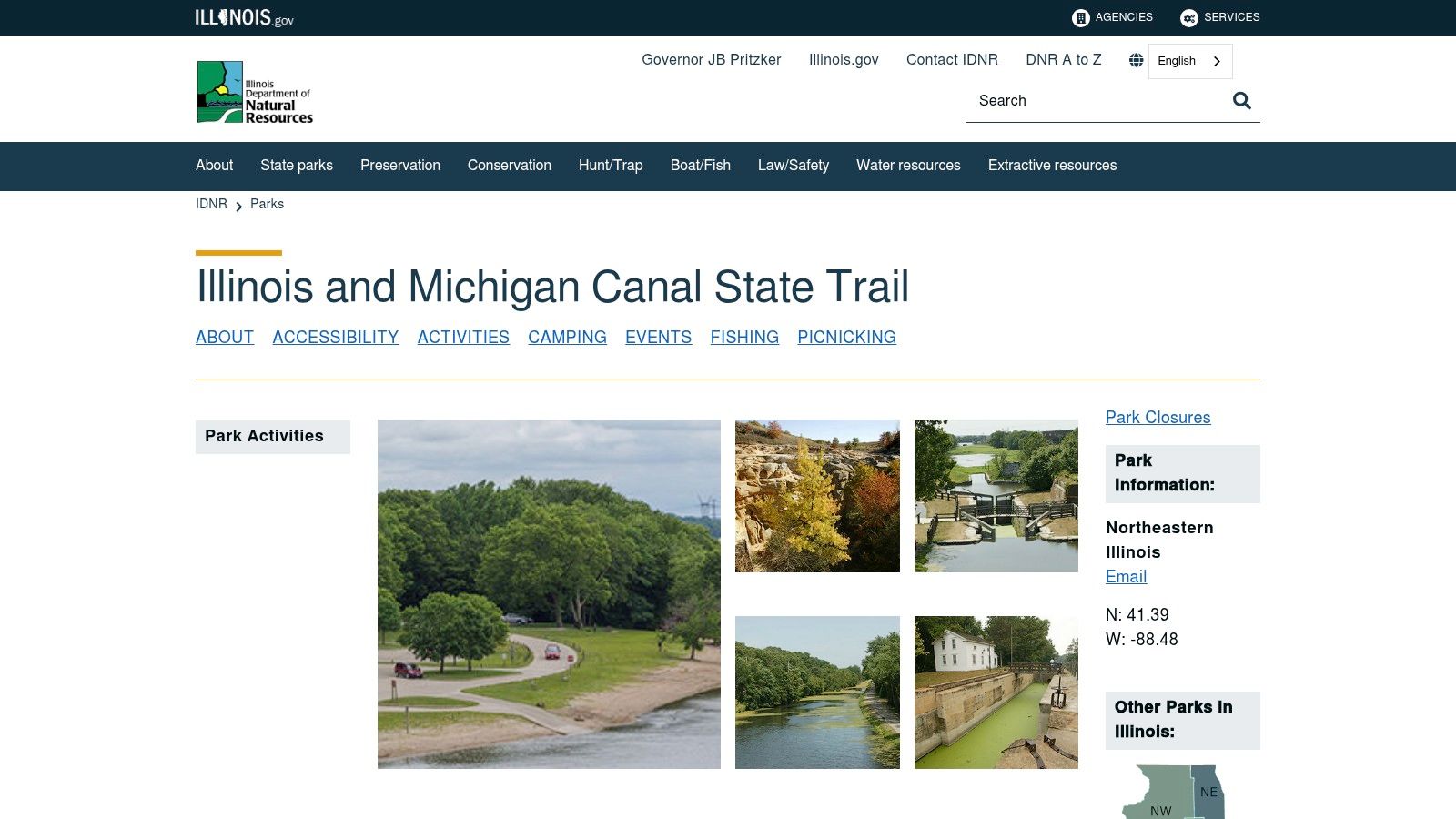
    The air out here just feels different, doesn't it? It’s a place where you can truly breathe again. But like anything precious, keeping it this way takes real work. This isn't just me showing you a pretty trail; it’s an invitation. I'm asking you to join us and become part of its story.

    A Legacy Worth Protecting

    The very ground you're walking on has a story that stretches way, way back. You see, Busse Forest South is just one part of the larger Ned Brown Forest Preserve, a massive area that some incredibly forward-thinking people started protecting way back in 1918. It’s like they left a gift for us, a gift from a century ago. They had the foresight to set this land aside for you and me. That's over 100 years of history right under your feet.
    Knowing that makes our work feel so much bigger than just picking up someone else's trash. When I’m out here cleaning up with my crew, I feel like we’re honoring a promise made a hundred years ago. We are continuing that legacy.

    The map below gives you a bird's-eye view of just how immense the Ned Brown Forest Preserve really is. You can see Busse Lake, a glittering jewel, and the web of trails spun around it—our little corner, Busse Forest South, is tucked right in there.

    This map helps you grasp the scale. It's a huge network of ancient woods and quiet waters, a wild kingdom right in our own backyard.

    More Than Just a Walk in the Park

    My real goal here is to show you how a simple visit can become something more. It's an opportunity to build a community, to push yourself physically and mentally, and to do some actual good for a place that gives us so much. For me and my friends at Litter Caterpillars, this forest preserve in IL is where our core values of service and friendship really come to life.

    This guide is my personal invitation. It’s a challenge, really. I’m daring you to turn a simple weekend walk into something truly meaningful. It's a chance to find your people and become a guardian of this incredible place. Let's start this adventure together.

    Hitting the Trails and Waterways

    Alright, you've made it. Now for the fun part: deciding what to conquer first. Busse Forest South isn't just a park; it's a sprawling, living network of trails and water that practically begs you to explore it. Imagine its nearly 13 miles of paths as arteries, pumping life and adventure throughout the entire landscape.

    I’ll never forget my first time trying to navigate this trail system. It felt like a massive, beautiful maze, a labyrinth of green, until I finally found my way to the main 7.3-mile loop. This paved path is the absolute heart of the preserve. It’s the perfect place for hikers, runners, and cyclists to really stretch their legs. The trail is mostly flat and wide, which makes it an amazing spot for a family bike ride or a long, meditative run where you can just get lost in your own thoughts.

    But here’s the real secret, the bit of magic I want to share with you. The best parts happen when you dare to venture off that main drag. The smaller spurs branching off are where I've discovered my favorite quiet spots—hidden groves and peaceful watersides that most people just pedal right past, completely unaware.

    Charting Your Course

    The trails here cater to just about every mood you could possibly be in. Some are easy, paved paths perfect for a casual stroll with a friend or for pushing a stroller. Others are unpaved, giving you that satisfying, primal crunch of leaves and dirt under your shoes. It’s this rich mix of experiences that keeps me coming back, again and again.

    The forest is so much more than just a place to get your steps in; it's a central hub connecting adventure, history, and our local community.

    A concept map showing Busse Forest South offering adventure, history, community, recreation, and preserving the past.

    You can see how everything weaves together, a beautiful tapestry proving this preserve is a living, breathing part of our area.

    More Than Just Dirt Paths

    Are you looking for something beyond the trails? The massive 590-acre Busse Lake is waiting for you. It’s the largest body of water for paddling in all of Cook County, a shimmering expanse that’s a dream for kayakers, canoers, and anglers. Trust me on this one, there is nothing quite like gliding across that calm water as the sun comes up and the morning mist hangs heavy in the air. It’s a kind of peace that’s hard to find these days.

    To give you a quick idea of what's available, I’ve put together a simple breakdown of the main activities.

    Activities at Busse Forest South

    Activity Best For What to Expect
    Hiking & Running All levels The main 7.3-mile paved loop is flat and totally accessible. The smaller, unpaved trails offer a more rugged, challenging terrain.
    Biking Families, long-distance cyclists You get a smooth, easy ride on the main loop with plenty of room. It’s a fantastic way to cover a lot of ground quickly.
    Paddling Kayakers, canoers A huge, open lake with multiple boat launches awaits you. Perfect for a long, peaceful day spent out on the water.
    Fishing Anglers of all skill levels Shoreline and boat fishing are both super popular here. The lake is regularly stocked with a wide variety of fish species.

    This table is just a starting point. The best way to get to know this forest is to just get out there and explore it for yourself.

    This entire playground is part of the larger 3,700-acre Ned Brown Forest Preserve, which beautifully balances ancient, primeval forests with modern recreation. It's no wonder it's one of Illinois' most-visited natural spots, open every single day from sunrise to sunset.

    The forest has a personality all its own, and the best way I know to get acquainted is by wandering its trails and waterways. If you love exploring trail systems like this one, you should definitely check out our guide to the Des Plaines River Trail for another incredible local adventure.

    A Living Museum of Rare Habitats

    When I tell you Busse Forest South isn't just another walk in the park, I really mean it. This place is different. It’s a living museum, a time capsule holding onto some of Illinois's rarest habitats, and it’s so important that it's officially recognized as a National Natural Landmark.

    Watercolor painting of a misty forest with red-barked trees, white trilliums, and Jack-in-the-pulpits by a pond.

    I want you to picture the ground you're standing on as the floor of an ancient, shallow bowl carved out by glaciers thousands of years ago. It's like a geological memory. Those depressions created something very special called "flatwoods," a type of damp-ground forest that used to be common around here but is now incredibly, heartbreakingly rare. This isn't just some random feature of the forest; it is the heart and soul of Busse Forest South.

    A Fragile, Timeless World

    Walking through these flatwoods feels like stepping into the past. It’s a journey back in time. You’re surrounded by towering swamp white oaks and brilliant red maples. In the spring, the ground is a carpet of delicate trilliums and the weird, hooded shape of jack-in-the-pulpit flowers.

    This isn’t just a pretty picture; it's a fragile, delicate ecosystem that desperately needs our protection. That’s why back in January 1965, this specific 440-acre section was designated as the third Illinois Nature Preserve. This status officially protects these flatwoods and all the life they support—from the black ash trees to the vibrant blueflag iris. You can read more about this special designation on the Illinois DNR website.

    Knowing this history really changes how you see the place. It connects you to a story much, much older than any of us.

    The Threats This Museum Faces

    But just like any precious museum, this one is under constant attack. The quiet beauty of these woods is in a constant, silent battle, and it's a fight we can see happening right in front of our eyes.

    Here’s what we’re up against:

    • Invasive Species: These are like bullies on a playground. Aggressive, non-native plants are always trying to push out the native wildflowers and saplings that belong here, stealing space and vital resources.
    • The Emerald Ash Borer: This tiny, destructive beetle has absolutely wrecked ash tree populations all over the Midwest. You can see the damage here, with huge gaps in the canopy where massive trees used to stand proud.
    • Deer Over-browsing: The deer population is so high that the tender shoots of young trees and wildflowers get eaten before they even have a chance to grow. The forest can't regrow on its own.

    Understanding these struggles makes a simple walk in the woods feel so much more meaningful. You’re not just a visitor; you're a witness to a living, breathing history that needs our help to survive.

    This is where service gets personal for me. When you join one of our cleanups, you’re not just picking up a plastic bottle. You’re becoming a guardian of this living museum, actively protecting its story for the future.

    Join Us and Become a Forest Guardian

    This is where you come in. I’ve always found that cleaning up other people's messes is WAY easier than cleaning up our own. This is your chance to prove it. Joining one of our cleanups at Busse Forest South is about so much more than just picking up trash—it’s about finding a strength inside yourself you never knew you had.

    This whole group started in a hailstorm. Seriously. There were only three of us, freezing and laughing at how absurd it all was. In that struggle, we found a strange, profound kind of joy. That’s the spirit we bring to every single event, and it’s something you can find here, too.

    How We Turn Service into Adventure

    We meet on weekend mornings, rain or shine. I schedule them that way on purpose because it acts as a filter. It’s like a magnet for givers—the kind of people who show up not because it's easy, but because it matters. When you volunteer with Litter Caterpillars, you'll find yourself surrounded by folks who just get it, people who believe in bravery, kindness, and sticking together.

    We bring the flags, the theme song, and the community. All you have to bring is yourself.

    Our events are designed to be simple and empowering. Here’s what you can expect:

    • Safety and Happiness First: Your well-being is everything to me. We provide all the supplies—gloves, bags, and litter grabbers—so you can just focus on the mission.
    • No Pressure, Just Purpose: We will never, ever ask you for money. Ever. Your volunteer energy is the most valuable thing we have, and we protect it fiercely.
    • Building Friendships: These events are a powerful way to meet people who think like you. The shared work and seeing the tangible impact you've made creates bonds that last long after the cleanup ends.

    Finding Your Power in the Forest

    This isn't about obligation. It's about you finding your own power in a simple act of service. It’s about turning what some people see as a chore into a real, thrilling adventure. Each piece of trash you pull from the beautiful trails of Busse Forest South is a small victory, a tiny battle won for this incredible place.

    You’re not just cleaning; you are reclaiming the landscape. You are pushing back against neglect and showing the world that people actually care. This is an act of defiance, a powerful statement that this place is worth protecting.

    We see our work as a kind of personal transformation. Through service, we learn to trust ourselves and each other. We prove that small, consistent actions can lead to massive change, both in our parks and deep inside ourselves. It’s a journey of growth, and I'm personally inviting you to take that first step with us.

    If you’re ready to see how service can change your whole perspective, check out our environmental stewardship programs to learn more about our philosophy. We’re building a community of guardians, and there’s a place for you here.

    Finding Your Way to Nature's Doorstep

    Watercolor illustration of a man checking his phone at a trailhead with a car and map.

    Getting to Busse Forest South is your first test. It’s the gatekeeper’s riddle. Pass it, and you're rewarded with something that feels like a hidden treasure. Fail it, and you’ll end up like I did my first time—driving in frustrating circles while my GPS confidently led me to a dead end.

    Don't be that person. Let me give you the cheat codes so your adventure starts the second you step out of your car, not while you’re cursing at a map.

    Finding the right entrance is like knowing a secret handshake. Once you know it, you’re in. There are a few ways in, but not all of them drop you right where you want to be.

    Parking Made Simple

    Listen up. For the easiest, most no-fuss access, you want the lots right off Higgins Road (Route 72). These put you right at the heart of the main trail loop and give you an incredible, sweeping view of Busse Lake right from the get-go.

    • The Main Boating Center: This is your command center. It’s a huge lot and the perfect spot to launch a hike, bike ride, or paddle. On a weekend morning, this place is buzzing. It's where all the action is.
    • Smaller Trailhead Lots: Sometimes you don’t want the buzz. If you’re like me and you need a quieter start, hunt for the smaller, almost-hidden lots along the southern and eastern edges. They’re a much more peaceful gateway into the woods.

    My pro tip? Get here early. I’m serious. Getting here before everyone else doesn’t just mean you get a prime parking spot. It means you get the forest all to yourself, when it’s at its most magical and still.

    Arriving by Public Transit

    No car? No problem at all. You don’t need one. The Pace bus system is your ticket in. Several routes run through Schaumburg and Elk Grove Village, dropping you within walking or biking distance of the preserve.

    I’ve had friends take the bus to a stop near Higgins and just walk the last little bit. Think of it as a small urban warm-up before your real hike begins.

    Just do yourself a huge favor and check the Pace bus schedules online before you leave. Weekend service can be a different beast entirely. Consider it the first leg of your journey.

    Questions I Get All The Time About Busse Forest South

    Got questions before you head out? Good. That means you're already thinking like an adventurer. Whether you're coming out for the first time or you're joining us for a cleanup, a little bit of prep goes a long, long way.

    Here’s the inside scoop on the most common things people ask me. Think of it as our little pre-game huddle.

    Is Busse Forest South a Good Spot for Beginners?

    Totally. You absolutely do not need to be a grizzled, trail-worn expert to have a blast here. The main paved trail is a 7.3-mile loop that’s wide and pretty flat—perfect for a chill hike, a bike ride, or even pushing a stroller. It’s a fantastic first step into the woods.

    And when you feel that little itch for something more, there are plenty of unpaved side trails. You get that real "dirt under your feet" feeling without it being some crazy-hard challenge. It’s the perfect place to level up your outdoor confidence.

    What Gear Do I Need for a Litter Caterpillars Event?

    This is the best question because the answer is so simple: just you. Bring your energy and a good attitude, and you’re set. That’s it. We’ve got the gloves, the bags, the grabbers—all of it. My only advice? Wear comfy shoes you don’t mind getting a little dirty and check the weather before you leave the house.

    Look, we’re here to make volunteering as easy as possible. We’re filtering for givers and good people, not for folks with expensive gear. Your willingness to show up is what truly matters to us.

    Can I Bring My Dog to Busse Forest South?

    Yes! And you absolutely should. You’ll see tons of happy dogs out on the trails. It's a fantastic spot to explore with your four-legged buddy.

    Just be sure to keep them on a leash that's 10 feet or shorter, and—this is a huge one for us—always, always clean up after them. It’s a simple act of kindness that keeps the park beautiful for everyone.

    Where’s the Best Place to Park?

    My go-to spot is the main Boating Center lot right off Higgins Road (Route 72). It’s huge, and it drops you right in the middle of everything. You can’t go wrong.

    If you’re looking for a quieter start or those lots are full, the smaller lots scattered along the southern end of the preserve are great little secrets.


    At Litter Caterpillars, we know that showing up for our parks is how we show up for ourselves and our city. It’s how we transform. If you’re ready to be part of something real, we’d love to have you. Find your next cleanup adventure at https://www.littercaterpillars.com.