

Say a neighbor texts you a dropped pin and asks whether you can help clear the corner by the bus stop on Saturday morning. You hold the phone at arm's length, squint, and realize you can't tell whether that corner sits inside Chicago IL 60651 or one street past it.
Chicago IL 60651 Numbers You Can Use Today
Think of the ZIP as a full bus. Every seat is taken, the aisle is crowded, and one person opening a window changes the air for everyone aboard. About 63,335 residents live across 3.5 square miles, and the Census Reporter profile of Chicago ZIP 60651 turns that into a population density of 18,289 people per square mile. One swept corner in a place packed that tightly reaches more neighbors than the same hour of work would on a wide suburban cul-de-sac.
Money and age tell you who stands next to you at the curb. That same profile puts estimated per-capita income at $25,220, close to half the metro figure of $49,513, and it counts 25.8% of residents, an estimated 16,171 people, below the poverty line, against 11.2% across the surrounding metro area. Median age is 35.5 years for 2024, per Data Commons, roughly three years younger than the 38.6-year metro median. Median gross rent runs $1,264 a month for 2020 through 2024, per Seayora's compilation of American Community Survey data.
Those figures change how you plan a morning. When rent takes a large slice of a household budget, an activity with bags and gloves already on site costs a neighbor nothing but the walk over. You're asking for time, not money.
| Measure | 60651 figure | Compare with |
|---|---|---|
| Population | 63,335 residents | All inside one ZIP boundary |
| Land area | 3.5 square miles | Crossable on foot in an afternoon |
| Population density | 18,289 people per square mile | Compact urban blocks |
| Median age | 35.5 years | Metro median 38.6 years |
| Per-capita income | $25,220 | Metro figure $49,513 |
| Below poverty line | 16,171 people, 25.8% | Metro rate 11.2% |
| Median gross rent | $1,264 per month | 2020-2024 period |
Read the Row That Answers Your Question
A common question at a census table is whether a block is young or old, whether the rent is heavy, or how many neighbors share the same stretch of sidewalk. Pick the row that matches your question, then walk outside and look. A table gives you the shape of a ZIP. It can't tell you that the alley behind the laundromat floods every spring, or that the corner store already sweeps its sidewalk at seven every morning.
What I do first: I take one walk with a bag in hand and no event planned. The trash tells me where the foot traffic goes.
Density is the number I lean on when someone asks why a small pickup matters at all. 18,289 people per square mile means a single block face can serve hundreds of households. Clean ten feet of curb and you've touched people you'll never meet.
Three of those numbers also explain turnout. Younger residents, high density, tight budgets. People say yes to a short, clear, no-cost morning. They say no to a six-hour commitment and a donation pitch.
If your walk turns up a pile that someone dumped, tires, bags of construction debris, a mattress against a fence, don't haul it yourself. Log it with the city, and this walkthrough on how to report illegal dumping shows the fields and the photos a crew needs. That report moves more weight than a volunteer trunk full of bags.
One more thing about a ZIP this dense. Noise travels, eyes travel, and kids on bikes cover ground faster than you do. An eight in the morning start gets the sidewalk before the crowds and catches neighbors while they're still on their porches.
Neighbors You Will Meet on These Blocks
Two households share one two-flat. One family has been on the block nineteen years and speaks Spanish at the kitchen table. The other moved in last spring, has two kids in the local school, and works evenings. Both are annoyed by the same bottle in the gutter. Both will help you on Saturday if you ask in a way they can say yes to.
The ZIP code profile for 60651 puts African American residents at about 49.8% of the population and Hispanic or Latino residents at about 44.5%. Any invitation you write reaches both communities, or it reaches half a block. That profile also counts an estimated 21,843 households with an average household size of 2.87 people, so a single stoop often holds more adults than your flyer assumes.
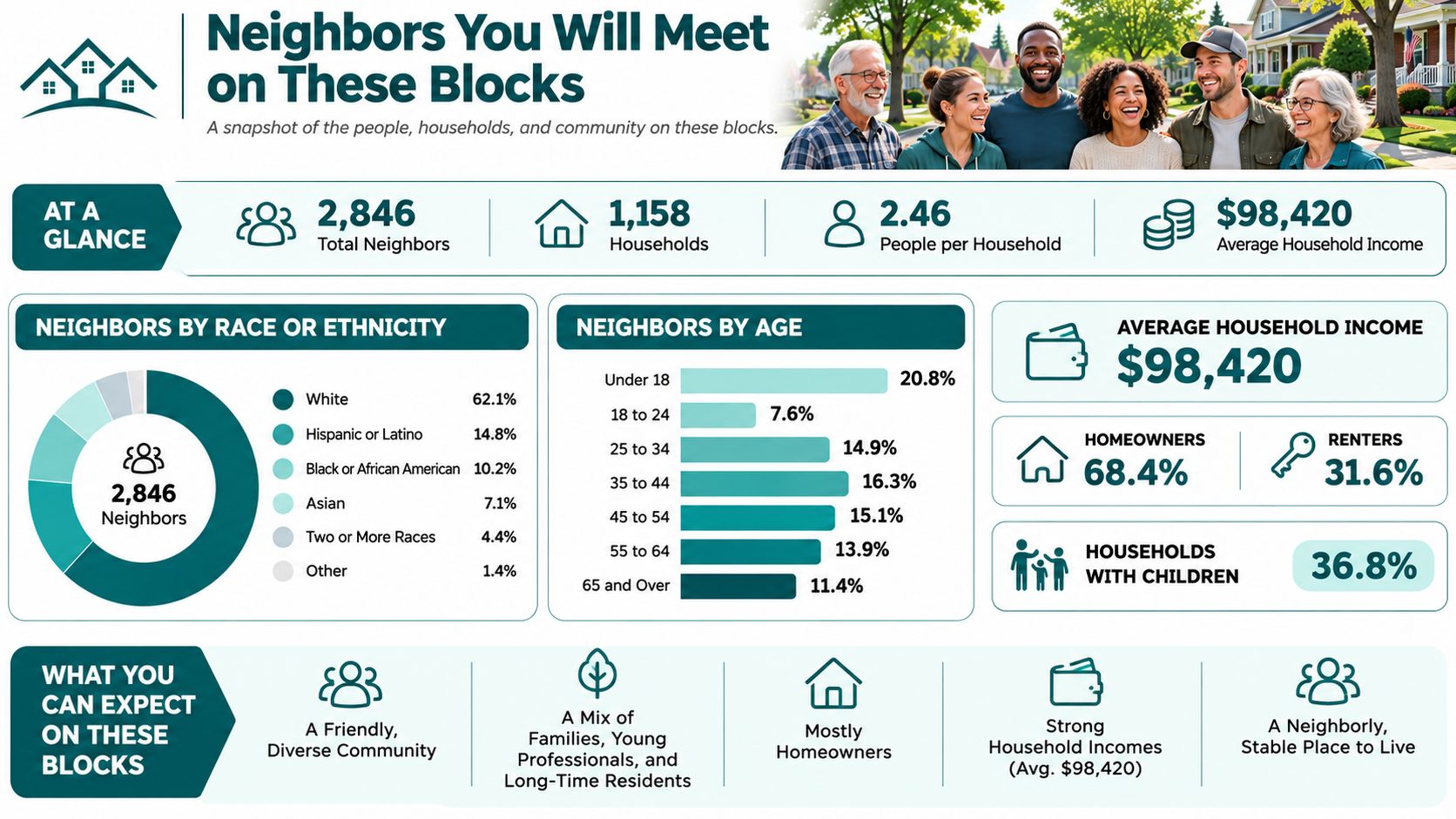
Schooling in the ZIP splits wide. The same profile reports that 35% of adults hold a high-school diploma or equivalent as their highest credential, 20% have less than a high-school education, 11% hold a bachelor's degree, and 7% hold a graduate degree. Write your sign the way you'd write a text to a neighbor, not the way you'd write a grant application.
How I Ask a Block to Show Up
- One sentence, not a paragraph. "Saturday, 8 a.m., corner of the park, bags and gloves provided." That's the whole ask.
- A set hour with an end time. People guard their weekends. Knowing it wraps by ten makes the yes easy.
- Gloves already in the bin. Nobody wants to hunt for gear at 7:55.
- No lecture. Skip the speech about the planet. Hand someone a grabber and let the work talk.
- Two versions of the sign if your block runs in two languages. Same time, same corner, same bags.
Stand on a porch in this ZIP long enough and you'll meet working adults, teenagers, grandparents raising kids, and a neighbor who knows exactly which lot gets dumped in every week. Treat that last person like gold. They'll save you two hours of wandering.
Check the Block and the Landlord Before You Invite
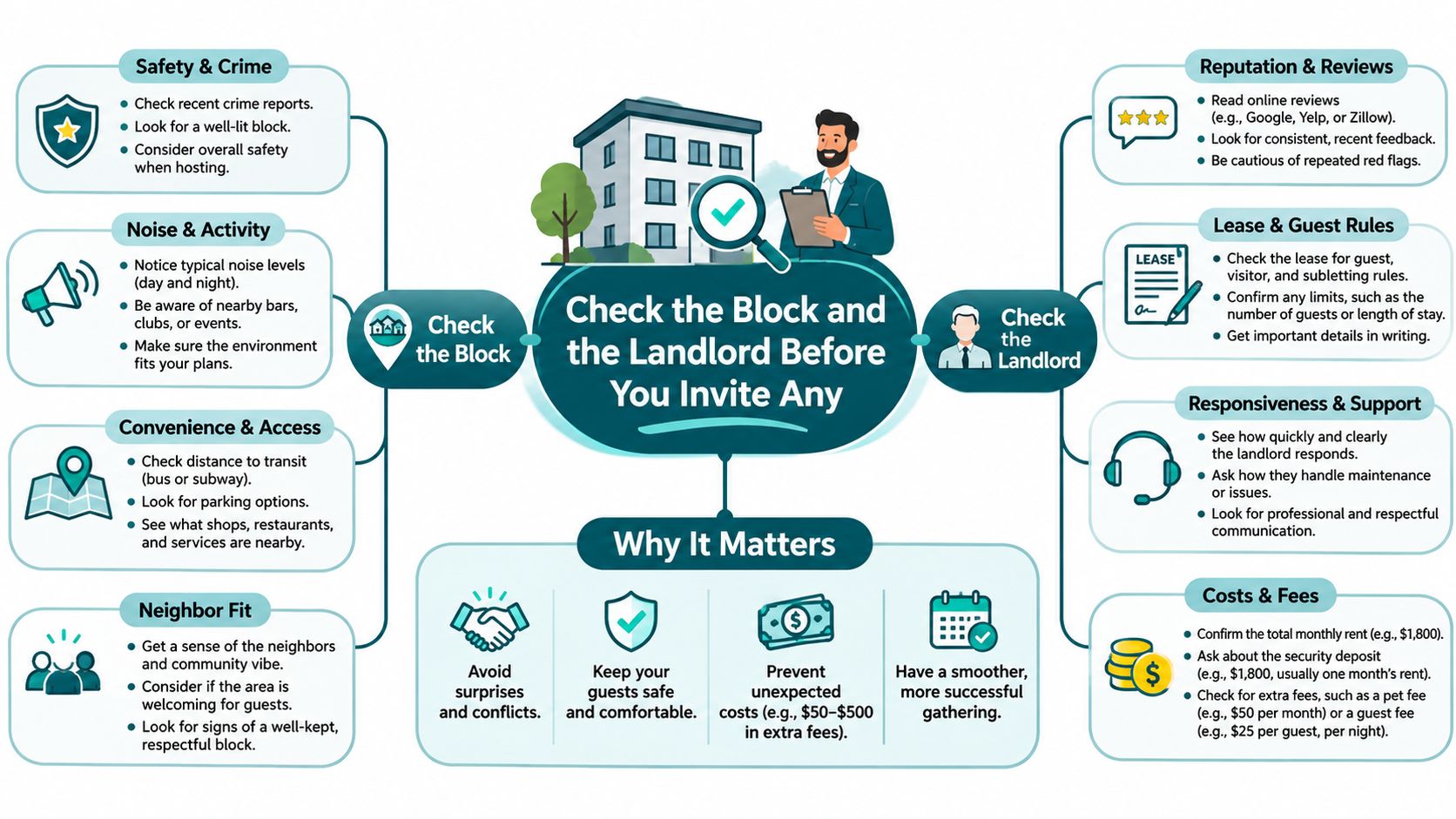
You print thirty flyers that say "Cleanup in 60651, Saturday, 8 a.m." Then a neighbor points out the lot you circled sits on the other side of a line, and now you're handing out apologies instead of bags. I'd rather move a meetup by a week than learn the rule while everyone stands on the grass holding gloves.
Here's the trap. The Census Bureau treats 60651 as a ZIP Code Tabulation Area, not as a legally defined neighborhood, as Neilsberg's overview of the ZIP explains. Other geographic listings place it mainly in Chicago's Humboldt Park area and point to nearby or overlapping references that include Austin. The ZIP sits around latitude 41.90 and longitude -87.74, with roughly 3.46 square miles of land and no reported water area. Think of the ZIP as the chalk line a mail carrier walks. Ward lines and park names are different chalk on the same sidewalk.
The Four-Step Check I Run Before Any Date
I do this in about ten minutes, in this order, every time.
- Drop the exact address into a city map. Not the ZIP, the address.
- Read the neighborhood name the map hands back. It may not match what you call the area.
- Match that name to the park, lot, or corner you mean. Zoom to street level and look for the curb you're picturing.
- Name the land manager and check that manager's rule. City park, forest preserve, ward street, and private lot each take a different path.
That fourth step matters more than most organizers expect. The Forest Preserves of Cook County group volunteering page sets a hard trigger: any group larger than ten people must register the details of its litter-cleanup event. A team of ten stays under the line. Person eleven changes your paperwork. Count heads before you pick a date, not after.
Here's the video I point new organizers toward before they set anything in stone.
If the spot is a vacant lot, someone owns it. Find that owner and ask before you promise a crowd of twenty. A ten-minute phone call beats a Saturday morning where the whole group stands around while a security guard explains the situation.
| Place | Rule you hit | What you do |
|---|---|---|
| Chicago Park District park | Litter pickup is allowed year-round; hazards stay separate from ordinary trash | Gloves on, grab safe litter, report the rest |
| Forest Preserves of Cook County | A group larger than 10 must register event details | Keep the team at 10 or register before person 11 |
| Sidewalk, ward street, or other public spot | ZIP, neighborhood, and ward lines can differ | Verify the block before you advertise it as 60651 |
| Vacant lot or other owned land | Another owner may control the ground | Ask that owner before you promise a crowd |
New to these blocks and unsure what a route feels like after dark or in an unfamiliar stretch? This 3rd-i guide to walking alone covers the basics of scouting a street on your own before you bring a group.
How I Run a Safe Park Pickup
A park cleanup works like cooking in a shared kitchen. You grab the safe scraps, you wipe the counter, and you leave the mystery jar in the back of the fridge alone. Nobody wins a prize for opening it.
The Chicago Park District volunteer handbook allows volunteers to pick up litter in parks year round, and it draws a firm line between ordinary wrappers and the things that can hurt you. It names broken glass, sharp metal, wire, needles, containers holding unknown substances, and sanitary products as injury risks. Gloves go on before anyone bends down. Look at the item before you reach for it.
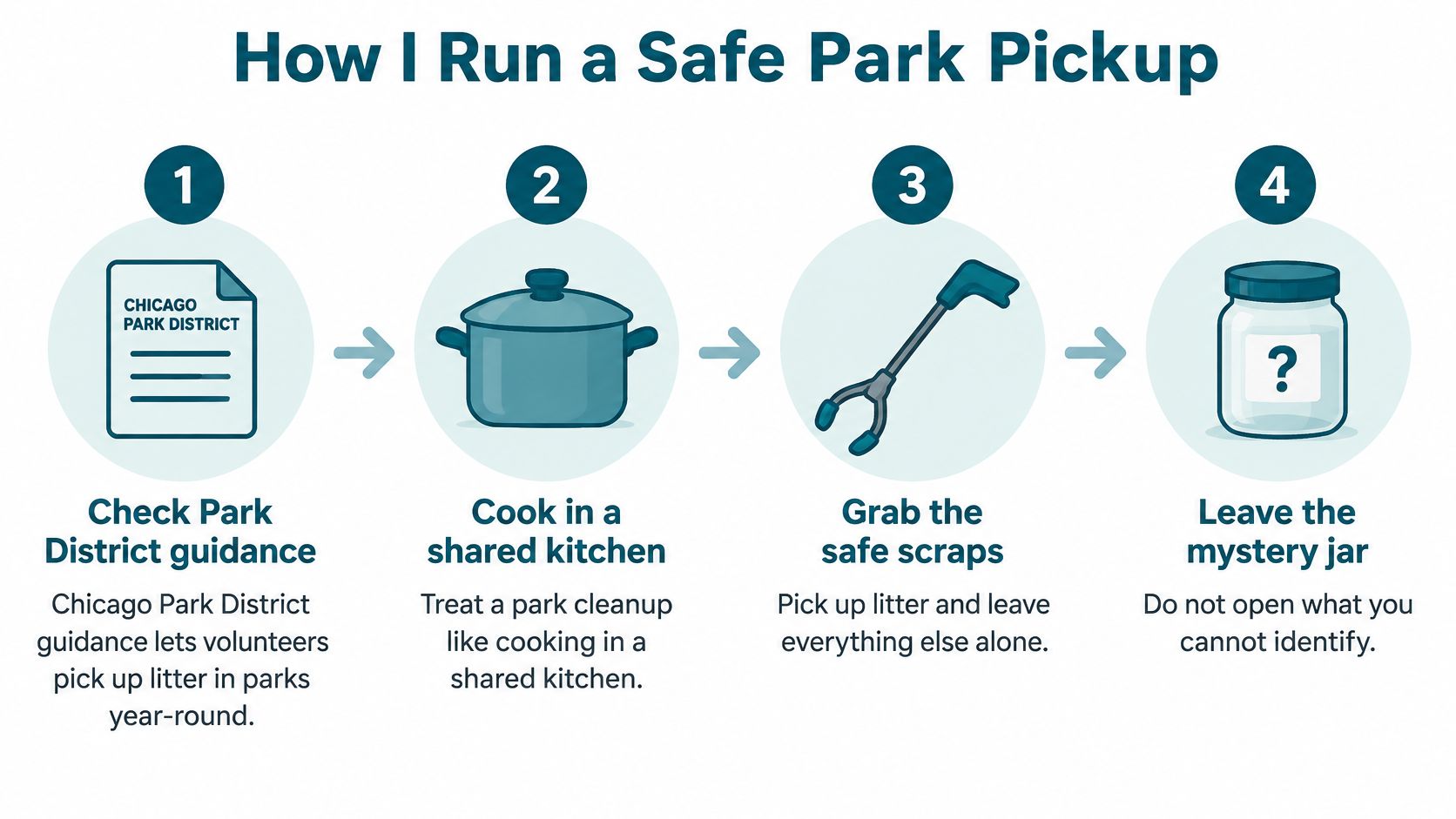
Anything you don't feel comfortable handling stays where it is, and you report it to the Community Stewardship Program. That's not a failure of nerve. That's the rule working the way it's meant to.
Six Steps I Run on Site
- Meet in daylight and count your people against the land rule you already checked.
- Hand out gloves and bags before anyone wanders off toward the field.
- Walk the edge of the route and point out hazards before the first grab.
- Collect the ordinary stuff. Wrappers, bottles, paper, cans.
- Leave sharp or unknown items in place. Mark the spot with a cone or a stick and write down the location.
- Stop when someone is tired, cold, or unsure. A shorter morning that ends well gets repeated.
The sorting rule that fits on a note card: grab safe litter, avoid mystery hazards, report the rest.
I'd add one piece of advice the handbook doesn't cover. Give every volunteer a buddy for the loop. Two people notice a needle faster than one, and two people also notice when one of them has gone quiet or drifted too far from the group. A service morning should end with stories and a lighter corner, never a ride to a clinic.
Three Block Fixes You Can Repeat
One ugly corner teaches a whole block to look away. You can break that habit with three small fixes, and none of them needs a speech or a permit.

One bag, one corner, every week. Pick the corner you already walk past and give it fifteen minutes on the same day each week. People start to expect the clean patch the way they expect the bus. Then they start nodding at you. Then one of them picks up a wrapper without being asked.
The front ten feet of a vacant lot. You don't need to clear the whole field. Cut the first ten feet back from the sidewalk and the change shows from the street on day one. We took that idea further than most when we bought an empty lot at auction and turned it into Caterpillar Park in Englewood, but the small version works on any block with a mowed edge.
A swept pocket where two neighbors can stand. If the land manager says yes, clear a small square of pavement near a bench or a fence corner. A milk crate isn't a plaza, but a swept spot changes how a block feels at five in the afternoon when everyone gets home.
I keep one story next to these fixes. Our very first pickup drew three people, and a springtime hail storm caught us mid-block. We huddled under a tree, shivering, watching ride after ride cancel, and I realized two things. Cleaning someone else's mess feels lighter than cleaning your own kitchen. Bad weather adds flavor to a plain pot of a day, and it gives the story a plot.
You copy the pattern, not the drama. Pick a corner you've already verified sits inside the ZIP, come back to it, and let the block watch you return. A second visit does more for a street than a single bright morning ever will.
Join a Weekend Morning Near 60651
If you live in the ZIP, or you can reach it on a Saturday, the next move is the simple one. Show up.
Litter Caterpillars runs weekend litter pickups across Chicago, and you'll find upcoming dates on the weekend community service page. We're the boldest trash pickup group in Chicago, and the first and only one to clean all 50 wards, including the ones people were told to stay away from. Kevin Tao founded the group along with NeuEve and Chicago Brandstarters, and he built it around a volunteer-first rule: safety first, happiness second, and no pressure to donate.
Bring closed shoes and a willing pair of hands. Tell the team which corner you care about, because a named corner turns a generic Saturday into a route someone can plan around. Follow the sorting rule from the pickup steps, and flag anything you'd rather not touch.
Start with one corner. Come back the next month. People notice a repeat visitor faster than they notice a single bright morning.
Litter Caterpillars picks up trash every weekend in Chicago, rain or shine, and we'd like you on a morning near 60651 with a bag in your hand. We bring the gloves, the grabbers, and the route; you bring shoes and an hour. Visit Litter Caterpillars to find the next pickup and claim the corner you've been staring at.
Leave a Reply