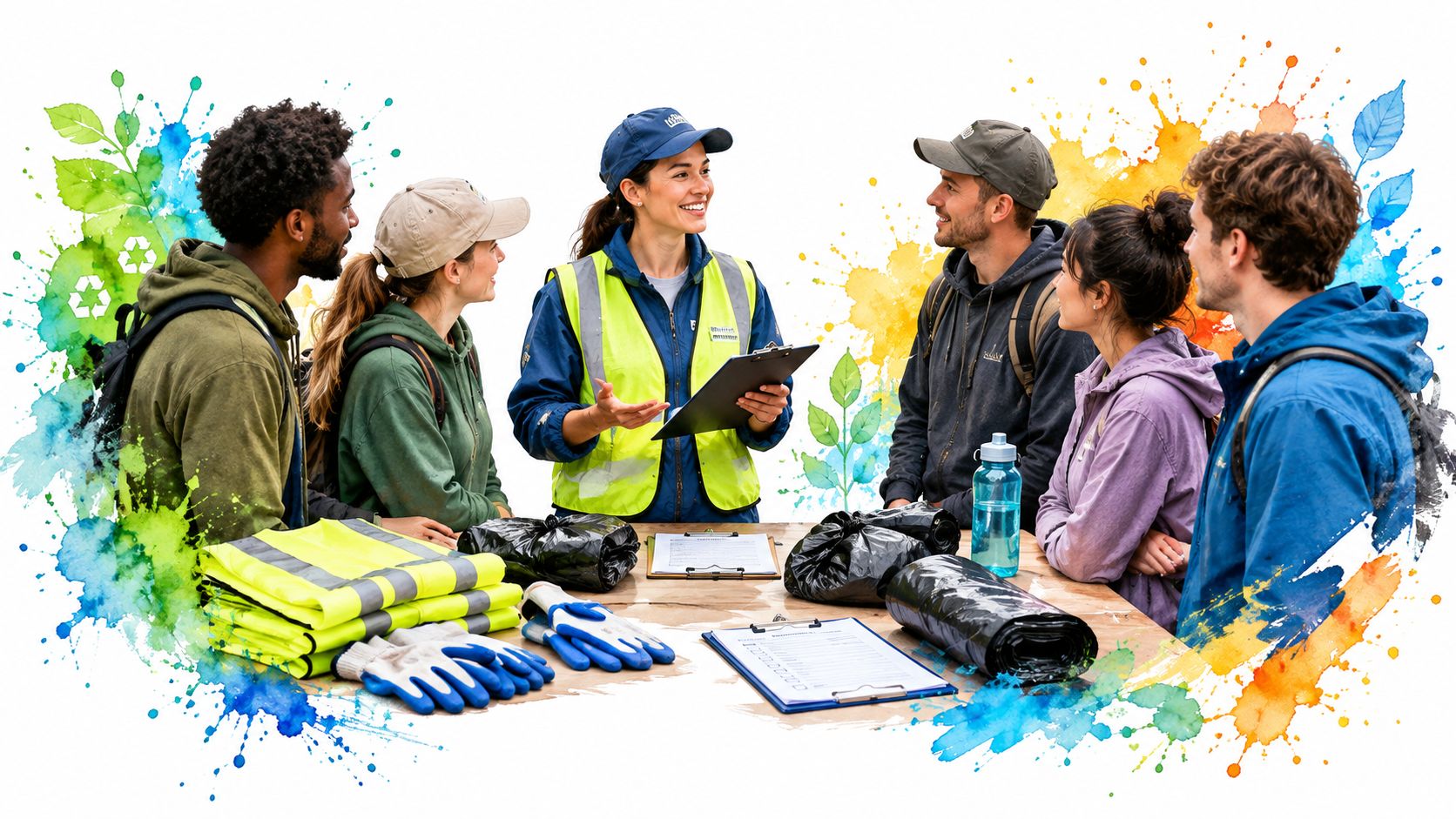
On our first cleanup, hail struck so hard that we huddled beneath a tree while rides canceled around us. I watched the crew shiver, laugh, and stay, and I learned that a volunteer onboarding process must prepare people for the work and for one another.
Why Your Intake System Dictates Your Crews Survival
A spring hailstorm taught me more about volunteer intake than any tidy registration spreadsheet ever could. We had eager names, scattered messages, unclear expectations, and no shared plan for what happened after someone said, “I'm in.” When the weather turned, enthusiasm alone couldn't hold the group together. People needed to know where to go, what to bring, who would meet them, and whether the people beside them would act with care.
That first day separated curiosity from commitment without humiliating anyone. A person who wants a quick line on a résumé may disappear when the wind bites. Someone who wants community, service, and a challenge may stay under the tarp, pass around gloves, and ask what needs doing next.
Make intake a welcome
A clean intake flow lets you learn what each person can handle while giving them a clear first connection. Ask about availability, physical limitations, emergency contact details, preferred tasks, and questions about the work. Keep the form short enough for a phone, then follow it with a human message.
Your intake should answer four questions:
- Who are you? Learn a name, a reliable contact method, and the reason the person wants to help.
- Where do you fit? Match people with litter pickup, supply carrying, route support, photography, or check-in duties.
- What happens next? Give the first event date, meeting point, clothing guidance, and a named contact.
- How do we work together? Introduce bravery, kindness, safety, and respect before the first shift.
Practical rule: Paperwork should open the door to a relationship, not replace the relationship.
I use a short welcome video to show the meeting point, demonstrate grabbers, and let newcomers hear a real voice before they arrive. A guide to onboarding video integration with MEDIAL can help you place that material inside your welcome flow. You can pair it with free volunteer scheduling software so applicants see their next step instead of waiting in an inbox.
High-quality training also supports retention. Volunteers who receive it are 83% less likely to stop working with an organization, according to VolunteerHub's volunteer-management guide. I've felt the reason in the field. When someone understands how to lift a soaked mattress, avoid broken glass, signal a passing cyclist, and ask for help, that person can work with confidence.
A volunteer-first philosophy protects the crew from burnout. I don't treat every signup as a guaranteed shift. I treat intake as a careful introduction where both sides learn whether the work, pace, and culture fit. That honesty gives committed people a place to grow and gives uncertain people room to step back without guilt.
Moving Signups To Their First Shift Fast
Momentum disappears during silence. Someone sees a cleanup invitation, fills out a form, and feels ready to help. A week later, the person has made other plans and may not remember why they signed up.
One 2026 nonprofit benchmarking summary says the average organization takes 3 to 6 weeks to move a volunteer from application to first shift, and 41% of applicants disengage during that window. The same summary breaks the delay into 1 to 3 days for acknowledgment, 3 to 7 days for background-check steps, 5 to 14 days from screening to orientation, and another 7 to 14 days from orientation to a first shift, as reported in this volunteer-management automation summary.
You can shorten the emotional distance with a simple sequence.
Day zero
Send an instant confirmation when the application arrives. Thank the person by name, repeat the chosen role, and state the next action. If you need a background check or waiver, explain why and provide one clear button.
A form system can collect required fields without burying you in messages. For example, a volunteer signup form backend can pass submissions into the workflow you already use. Keep the first message warm and brief. A newcomer should feel noticed, not processed.
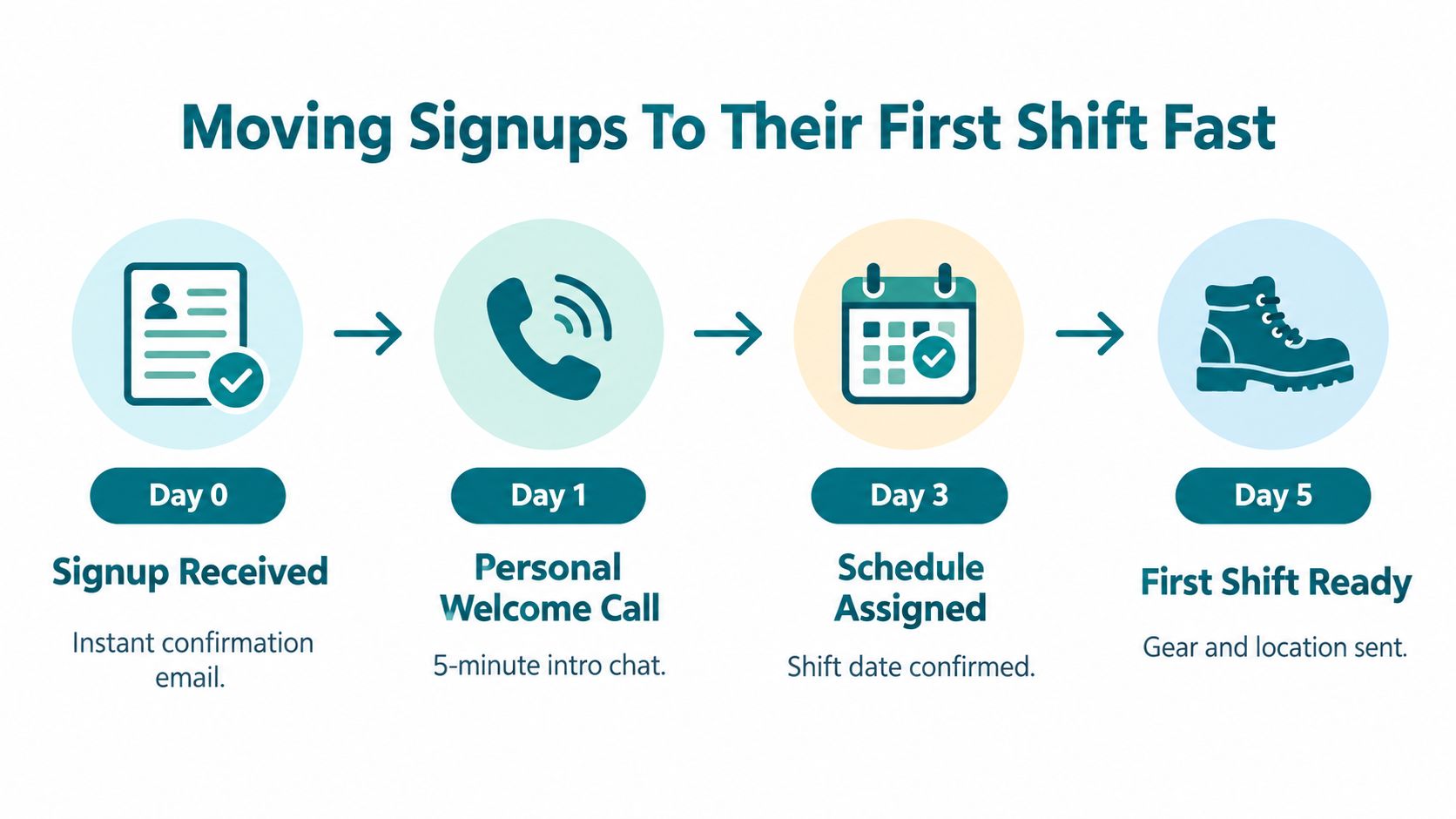
Day one
Call or send a personal voice message. I like a five-minute conversation because it lets me hear whether someone feels excited, nervous, or confused. Ask what drew them to the cleanup, describe the physical work clearly, and invite questions that may feel too awkward for a group chat.
Then give the person a tiny task. They might confirm their shoe size for loaner gear, read a short safety page, introduce themselves in the open chat, or choose between two shift options. A finished task turns intention into movement.
Day three
Confirm the shift date and location. Send the meeting point, transit notes, weather plan, clothing guidance, and the name of the person who will greet them. If someone hasn't completed a required form, send one reminder with a direct link and a human sentence.
Use this guide to organizing volunteers to shape the handoff from signup to scheduled service. The new volunteer shouldn't have to hunt through old messages for basic details.
Day five
Send a final readiness note. Include the start time, gear list, emergency contact, route information, and a short description of the first task. Give the newcomer permission to ask for a slower assignment or a pause. Fast onboarding works because it removes uncertainty, not because it rushes people into unsafe work.
Teaching Safety And Group Culture Together
A trash grabber and a signed waiver don't prepare someone for a sharp piece of metal hidden under wet leaves. You need to teach people how to work safely, and you need to show them how the crew treats one another when a route gets hard.
I begin orientation with the reason we clean. I tell a short story about a block that looked forgotten until a few people cleared the sidewalk, sorted the debris, and gave neighbors room to walk. Then I move into hazards, boundaries, and the behavior I expect from every volunteer.
Start with the field
Show the tools instead of reading a long list. Demonstrate how to use a grabber, how to hold a filled bag, where to place sharp objects, how to watch traffic, and when to stop. Walk through heat, cold, poor air quality, broken glass, needles, aggressive animals, and unsafe structures in plain language.
Give volunteers a simple call-and-response:
- See a hazard: Stop and point it out.
- Need help: Call a buddy or crew lead.
- Feel unwell: Step away and tell someone.
- Unsure about an item: Leave it for a trained person.
The volunteer safety checklist can turn those reminders into a resource people keep on their phones. Let new members practice the safety language before they need it. A person who rehearses “I'm stopping here because this isn't safe” can say it faster in the street.
Give the crew a shared identity
After safety, I introduce the culture. We use flags, theme songs, badges, and names because small rituals help strangers act like a crew. I tell people that bravery doesn't mean pretending to feel fearless. It means naming the risk, accepting help, and taking the next sensible step.
Kindness needs specific behavior. We greet newcomers, share supplies, leave room for different abilities, and never mock someone who needs instruction. We also protect volunteers from pressure. Nobody has to donate, prove toughness, or stay in dangerous weather to earn respect.
Orientation should cover safety basics and written policy acknowledgment. Guides also recommend collecting signatures for code of conduct forms, liability waivers, and photo releases before you mark onboarding complete, as explained in this volunteer onboarding checklist. Explain each form in everyday language, answer questions, and connect every rule to a real moment someone may face outside.
Automating The Paperwork So You Can Lead
Manual tracking turns a community leader into a reminder machine. You open a spreadsheet, find missing waivers, send messages, update a cell, and repeat the same work while the crew waits for route decisions.
Automated sequences handle predictable steps. A completed signup can trigger a welcome email, a waiver request, a safety lesson, a schedule invitation, and a reminder when a document remains incomplete. I still make the personal call. The system handles the memory work so I can focus on people.
A comparative operations table in Qomon's volunteer-program guide reports the following figures for a 40-volunteer cohort:
| Metric | Manual Onboarding | Automated Sequences |
|---|---|---|
| Median staff time per cohort | 140 to 180 hours | 10 to 18 hours |
| Document completion within 7 days | 55% to 65% | 85% to 92% |
| Day-30 retention | 60% to 70% | 78% to 86% |
The contrast changes how I spend a weekend. With manual tracking, I chase missing documents and guess who can safely attend. With automated sequences, I review a clear list, contact the people who need a human answer, and prepare the route.
Build a sequence people can understand
Use one task per message. A welcome email should welcome. A waiver request should explain the waiver. A training message should name the lesson and tell the volunteer how to confirm completion.
A useful sequence includes:
- Signup receipt: Confirm the submission and name the next action.
- Form request: Collect waivers, emergency details, and policy acknowledgments.
- Role match: Assign a cleanup task based on the person's answers.
- Training prompt: Send safety material before orientation.
- Shift reminder: Deliver the time, place, contact, and gear list.
- Follow-up task: Ask how the first shift felt and record the response.
Keep your dashboard simple. I want to see who has completed documents, who has a scheduled shift, who needs a buddy, and who hasn't answered a follow-up. That view lets me call the person who feels lost instead of sending another generic reminder to everyone.
Automation shouldn't make the crew feel automated. Use it to protect the moments that require attention, a nervous first question, a difficult weather decision, or a conversation with someone who wants to take on more responsibility.
Making The First Shift Unforgettable
A new volunteer can forget an orientation slideshow by the time they reach the sidewalk. They remember the person who greeted them by name, handed them gloves that fit, and walked beside them through the first messy pile.
I pair each newcomer with an experienced volunteer for the first few events. The buddy answers small questions before confusion turns into embarrassment. They show where supplies go, demonstrate safe sorting, and notice when the newcomer needs water or a lighter task.

I schedule cleanup events on weekend mornings. That timing suits people who want to give their energy to the neighborhood, and it creates a steady rhythm that helps service become part of life. We begin with a circle, a route assignment, and one visible target, perhaps the bus stop, the vacant lot entrance, or the block around a school.
The first task should end quickly enough for a newcomer to see progress. A full bag, a cleared corner, or a safe path gives the person proof that their hands changed something. Then I name the result out loud. “We opened this sidewalk,” feels more personal than “Good job, everyone.”
Let hard weather create conversation
Heat and cold expose the quality of a crew. On a hot day, we watch one another for fatigue, carry extra water, and shorten the route when needed. In freezing wind, we check gloves, keep people moving safely, and stop before discomfort becomes danger.
The weather gives us stories, but I never use suffering to pressure people. A brave crew knows when to quit. The bond comes from sharing honest work, trading jokes, talking about neighborhoods, and seeing a street change block by block.
I close the shift with three questions: What felt good? What felt confusing? What should we change before the next event? I write down the answers and send a personal follow-up soon after. Stronger management practices improve retention, and median retention across nonprofits rose from 60% in 2019 to 70% in 2021, according to volunteer-engagement research summarized here.
A first shift becomes memorable when people feel useful, protected, and known. Give newcomers a real task, a patient buddy, a visible result, and a reason to return.
Your Launch Checklist For New Members
I keep the launch sequence beside my event calendar. Before a new member reaches the street, I want every practical question answered and one real person assigned to notice them.
Before the first shift
Use this checklist for each new volunteer:
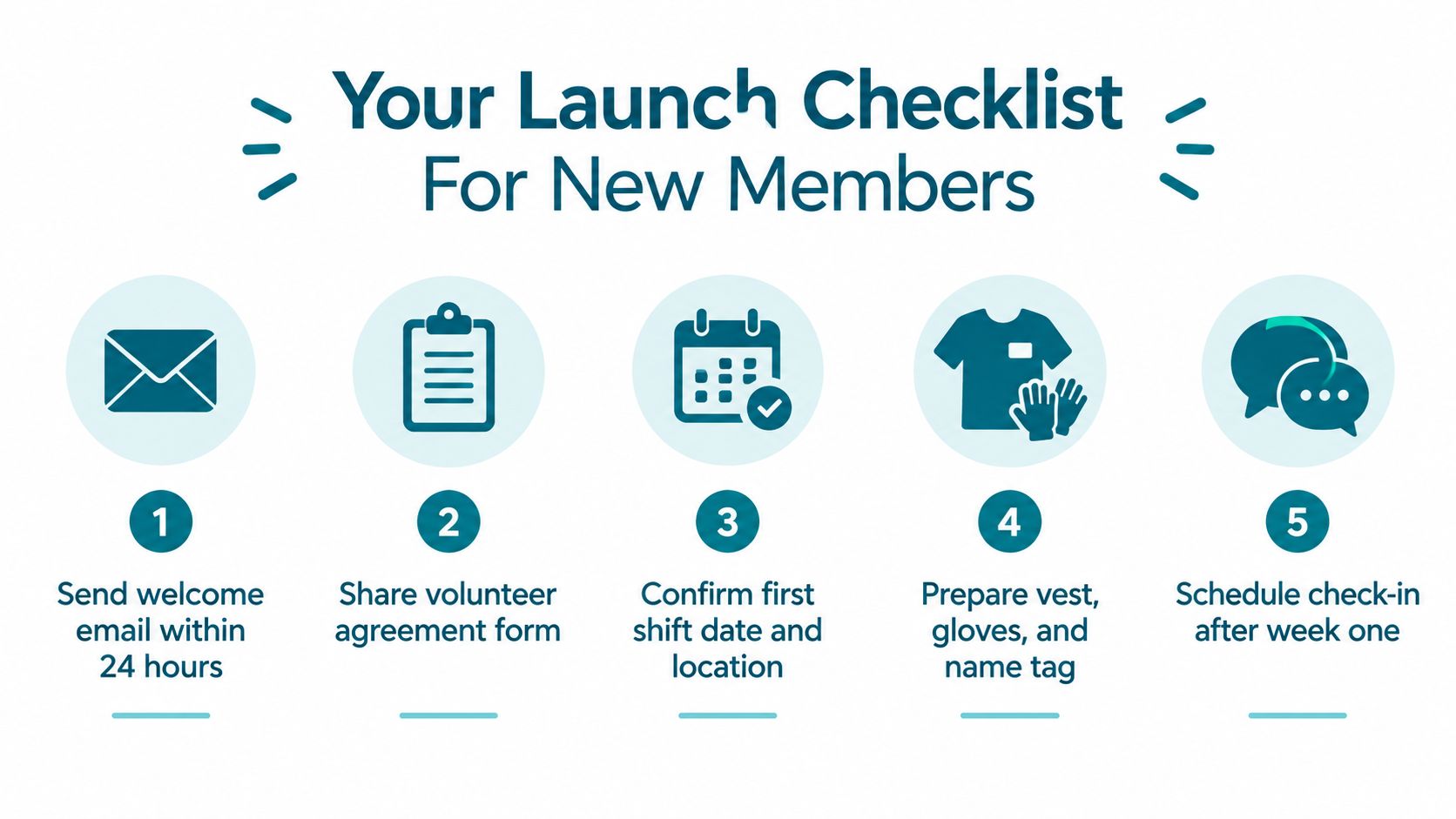
- Send the welcome email within 24 hours: Thank the person, confirm the signup, name the next step, and provide one contact.
- Share the volunteer agreement form: Collect the code of conduct acknowledgment, liability waiver, photo release, emergency information, and any required screening details.
- Confirm the first shift date and location: Send the meeting point, route, arrival instructions, weather plan, and contact person.
- Prepare the vest, gloves, and name tag: Set aside gear that fits and explain what the volunteer should bring from home.
- Schedule a check-in after week one: Ask what felt clear, what felt difficult, and what role the person wants next.
A complete volunteer onboarding process moves through five stages: application and screening, mission and role orientation, role-specific training, a first-shift walkthrough, and a follow-up check-in, as described in this volunteer orientation guide. Each stage answers a different need. Screening protects the group, orientation gives meaning, training builds confidence, the walkthrough removes first-day confusion, and follow-up tells people you noticed their effort.
After the first shift
Send a personal message that names something real. Thank someone for spotting a hazard, helping another volunteer, finishing a difficult corner, or asking a useful question. Invite the person into the open planning chat once they understand how the group communicates, and give them a simple path toward the next shift.
You don't need a perfect system before you start. Write the welcome message, prepare the form, choose the first route, assign the buddy, and set the follow-up reminder. Then step outside with the new volunteer and make the first block cleaner together.
Litter Caterpillars gives new volunteers a clear path from Meetup RSVP to their first cleanup, with event details, open group chats, and buddy support for early questions. Visit Litter Caterpillars to find a cleanup, meet your crew, and start building a volunteer onboarding process that helps people return.
Leave a Reply