
The first Litter Caterpillars cleanup had three people, a Chicago hailstorm, and a tree that barely kept us dry. We shivered while Uber drivers cancelled, then laughed because the mess outside felt easier to handle than the mess we had carried in.
Why I Started Picking Up Trash
I didn't start with a polished plan. I started with a room I couldn't keep clean and a life that felt just as scattered. Every object carried a story, from an old jar of blueberry jam to a forgotten bag of nuts. Each item weighed almost nothing, yet moving it felt impossible.
A difficult relationship finally pushed me to change. I wanted a different social circle, so I decided to build one around cleanliness, consistency, bravery, and kindness. Picking up trash gave me a small task I could finish with other people beside me.
That first outing tested us immediately. Hail came down, the temperature dropped, and our rides disappeared from the map. We could have called it a failure. Instead, we huddled under a tree, complained, laughed, and learned that shared discomfort can turn strangers into friends.

The first lesson
Cleaning someone else's mess felt easier than cleaning my own. The work had a visible edge. I could fill a bag, tie it, and point to the patch of sidewalk we had cleared. That small result gave me a reason to return.
I kept returning each week, in rain, snow, cold wind, and heat. The weather never became comfortable, but it gave each cleanup a story. A routine that once felt impossible became something I could share with people who wanted to practice showing up.
Sustainable community service starts at that human scale. You don't need to feel perfectly organized before you help. You need one task, a safe meeting place, and a reason to invite someone else along.
Practical rule: Build the service habit around an action people can complete together, then give them a clear date for the next one.
Building Your Volunteer-First Team
A volunteer program becomes durable when people know what they're joining and what you'll protect. I treat volunteer energy as limited fuel. If a cleanup drains people through confusion, unsafe conditions, or pressure to donate, they may not return.
Start with the calendar. Litter Caterpillars schedules events on weekend mornings because that time attracts people who want to give part of their day to the neighborhood. Choose a regular slot, publish it clearly, and keep the promise. A predictable rhythm helps people make service part of their lives.
Give people an easy first step
Don't make a newcomer fill out a complicated application before they can help. Use an open group chat, a simple Meetup listing, and a short event description that answers practical questions:
- Meeting point: Name the exact corner, entrance, or landmark.
- What to bring: Tell people about shoes, water, weather layers, and personal limits.
- What you provide: Explain which supplies volunteers can use.
- What happens next: Describe the welcome, safety talk, cleanup route, and closing check-in.
Assign roles before the event begins. One person greets newcomers, another leads the route, another watches traffic and hazards, and another counts bags or records hours. Rotate these jobs so no volunteer becomes the permanent fixer.
I also explain our approach through servant leadership in action. The leader carries responsibility for the conditions, while volunteers choose how much work they can safely handle.
Protect happiness without lowering standards
Safety comes first, happiness comes second, and fundraising stays out of the volunteer relationship. I don't pressure people for donations. I ask them to bring attention, patience, and respect for one another.
A volunteer-first team welcomes different abilities and energy levels. Someone may collect light litter along a sidewalk, sort supplies, photograph the route, or help newcomers feel comfortable. Those roles still move the work forward.
The strongest recruitment message stays honest: come help, meet people, and leave when your body or schedule says it's time. People trust a program that treats them like neighbors rather than free labor.
Operational Pillars for Lasting Impact
A cleanup needs more than enthusiasm. It needs a repeatable operating system with three parts: schedule, safety, and support.
I start by choosing routes that volunteers can understand. A busy road may contain plenty of litter, but traffic can turn a simple task into a dangerous one. I prefer a clear meetup point, visible boundaries, a route leader, and a defined end location.
Minneapolis gives adopted-block volunteers a firm rhythm. The city asks them to clean their block at least four times per year, serve for at least two years, and cover all four sides, including the alley when one exists. That cadence from the Minneapolis Adopt-a-Block program shows how a service promise becomes manageable when people attach it to a calendar.
Safety has to become routine
Charleston's guidance gives volunteers a practical checklist. Wear gloves, bring water, watch for traffic and broken glass, keep a first-aid kit nearby, and work during daylight. Avoid syringes, condoms, and other hazardous items. A grabber lets you keep distance from objects you can't identify.
Weather changes the plan. Newcastle advises warm, dry clothing during cold, wet, or windy conditions. Edison Township advises volunteers to avoid extreme heat and cold, drink water, and take breaks. I use those principles as a stoplight system. Comfortable conditions mean we proceed, difficult conditions mean we shorten the route, and dangerous conditions mean we cancel.
Safety rule: A cancelled cleanup protects the next cleanup. No bag of litter deserves an injured volunteer.
Partnerships reduce friction
Local businesses can provide storage, water, meeting space, or disposal guidance. A neighborhood association can point you toward neglected routes. Instagram can help you show the work, while Meetup and open chats can help people find the next event.
Keep the partnership request specific. Ask a shop to hold clean bags, ask a property manager about access, or ask a city contact where volunteers should place filled bags. Small agreements prevent large headaches on event day.
Creating a Culture of Pride and Service
A bag of litter gives you a result. A shared identity gives people a reason to return.
I use flags, a theme song, and badges because rituals make an ordinary task easier to remember. Sports teams use colors and songs to help people feel connected before the game begins. A cleanup group can use the same simple tools without pretending the work is a performance.

Turn effort into a shared story
Give the group language that guides behavior. Litter Caterpillars uses bravery, kindness, and unity. Bravery means taking on an unpleasant route without pretending danger is acceptable. Kindness means respecting a volunteer's limits and treating residents with care. Unity means leaving room for people with different backgrounds and abilities.
Celebrate small wins in public. Thank the person who welcomed a newcomer. Mention the volunteer who spotted a hazard before someone touched it. Take a closing photo when the route looks cleaner, then tell the group what changed.
That feedback loop matters. People see their action, hear that it counted, and receive a clear invitation to return. Recognition doesn't need expensive prizes. A badge, a song, a group cheer, or a sincere thank-you can carry the moment.
Here's the group's theme song, created by Ella Duke:
Keep pride connected to care
Ritual can create pressure if leaders use it to push people beyond safe limits. I never treat endurance as a test of loyalty. A volunteer who leaves early can still belong.
The culture works when people feel proud of the service and safe enough to be honest. Someone can say, “I'm tired,” “I can't lift that,” or “This route feels unsafe,” and the team adjusts. Sustainable community service depends on that trust more than on dramatic stories about hardship.
Measuring What Matters in Community Service
At Litter Caterpillars, I start with the route, not a spreadsheet. After each cleanup, I ask who came, how long they stayed, what we removed, which streets we covered, and what volunteers or residents noticed. Those answers show whether the operation is growing, improving, or creating avoidable strain.
Large programs offer useful reference points. In 2025, Keep America Beautiful's Great American Cleanup involved more than 300,000 volunteers and participants, removed more than 8.1 million pounds of litter and debris, improved 168,000 acres, cleaned 18,000 miles of streets, recovered 1.6 million pounds of recyclables, and recorded 685,000 volunteer hours, according to its 2025 cleanup report.
Ocean Conservancy's 2023 figures describe nearly 470,000 volunteers across 97 countries removing more than 4,000 tons of trash and plastics. Its Greece activities involved more than 90,000 volunteers across 2,850 beach and underwater cleanup events, removing 260 tons of debris. These examples show the scale that consistent, accessible actions can support, while a local team still needs measures suited to its own route and capacity.
Compare the numbers before you collect them
| Metric Category | Example Indicator | Source/Benchmark |
|---|---|---|
| Participation | Volunteers and participants | Keep America Beautiful 2025 Great American Cleanup Report |
| Time | Volunteer hours | Keep America Beautiful 2025 Great American Cleanup Report |
| Waste | Pounds of litter and debris | Keep America Beautiful 2025 Great American Cleanup Report |
| Recyclables | Recovered recyclable material | Keep America Beautiful 2025 Great American Cleanup Report |
| Experience | Volunteer feedback and stories | VSO recommends combining quantitative and qualitative reporting in its volunteering impact framework |
VSO recommends setting a baseline before launch, defining indicators of change, and keeping reports focused on a small group of meaningful measures. I record turnout and hours separately from bags or pounds collected. I also ask what felt safe, confusing, useful, or discouraging, because those answers often reveal an operational problem before attendance drops.
A lower collection count can mean the route is cleaner. A strong return rate can show that volunteers feel supported. Track both outcomes through community service impact tracking, then use the results to adjust routes, briefings, equipment, and follow-up. A useful report respects the material removed and the people who made the work possible.
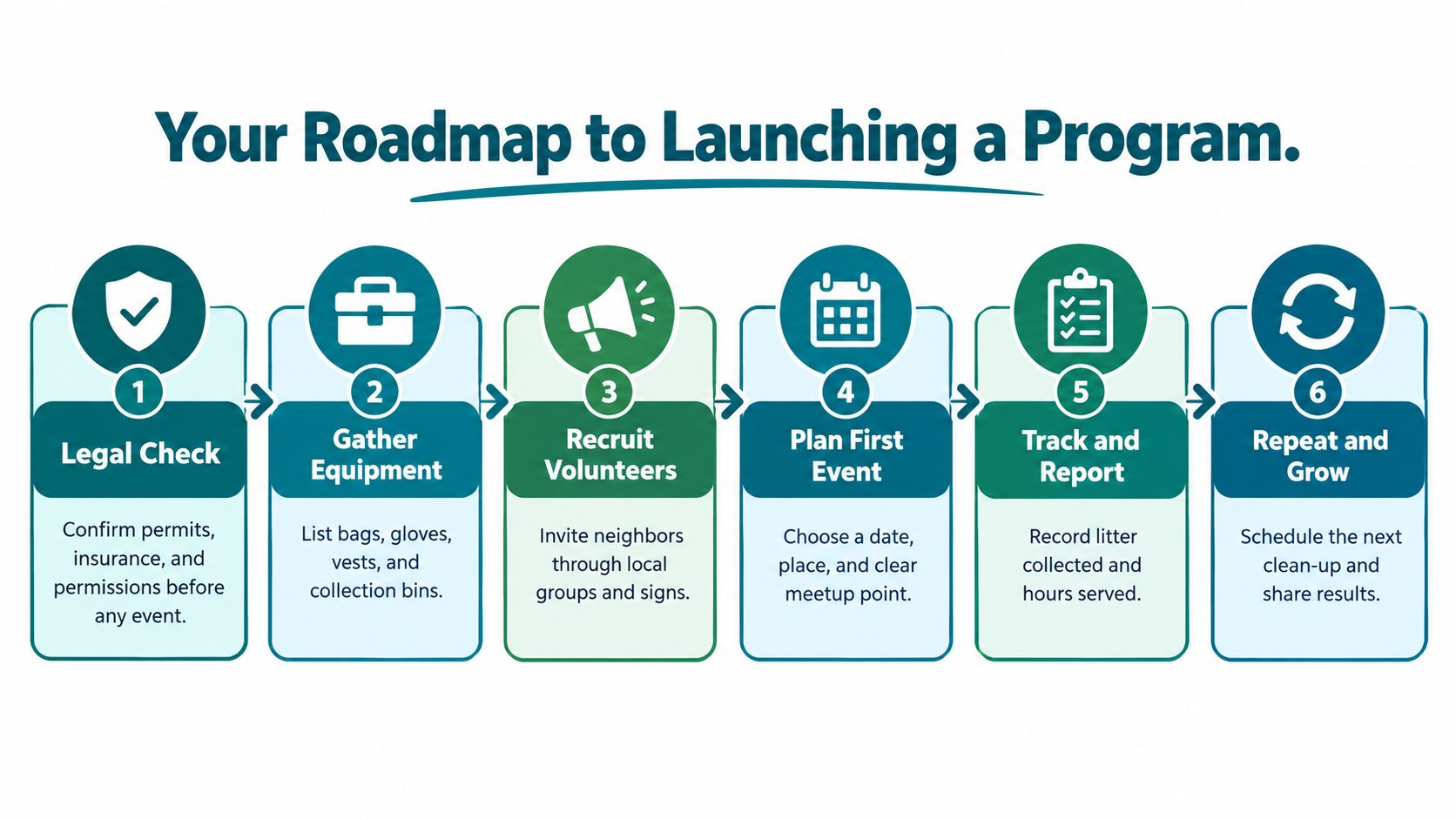
Your Roadmap to Launching a Program
Start small enough to finish the first event without heroic effort. Pick one route, set one meeting point, and recruit a few people who can help you test the process.
Before you announce anything, run this checklist:
- Permissions: Check local rules, access conditions, disposal arrangements, and any needed permits or insurance.
- Equipment: Gather bags, gloves, grabbers, reflective clothing, water, first-aid supplies, and a way to separate hazardous items.
- People: Name a route leader, greeter, safety watcher, and note-taker.
- Message: Write a short invitation with the date, time, place, expected activity, weather plan, and contact method.
- Exit plan: Decide where filled bags go and how volunteers report hazards.
Use the first three months as a test
During the first month, focus on preparation and listening. Walk the route alone, note traffic and difficult areas, confirm disposal details, and invite people through neighborhood groups, signs, Meetup, and personal conversations.
During the second month, run the first event and one follow-up. Keep the safety talk short, divide the route clearly, and record attendance, hours, collected material, and hazards. Ask every volunteer one simple question before they leave: “What should we change next time?”
During the third month, repeat the event and publish a plain report. Share what you removed, where you worked, what volunteers said, and what you'll adjust. Then schedule the next date before enthusiasm fades.
The community litter cleanup program guide can help you turn those notes into reusable sign-up language, role descriptions, and event routines.
Don't build a large system before you learn what your neighbors need. A simple spreadsheet, a group chat, and a reliable route can carry the first stage. Add tools only when they solve a problem you've already seen.
Common Misconceptions About Volunteer Cleanup
A clipboard, route map, and clear roles were enough to get our first Litter Caterpillars pickups moving. The team did not need a polished operation. We needed a route people could understand, supplies ready at the meeting point, and someone prepared to adjust when turnout or conditions changed.
That experience challenged another common assumption: volunteers cannot match professional crews. Volunteers should not handle hazardous materials, traffic risks, or heavy equipment without proper support, and they cannot replace specialized services. They can cover local routes, spot recurring problems, and return regularly to places that paid crews may not visit often.
The task remains a real field operation, even when the equipment is simple. The safety routines from the operational pillars section apply here too: gloves, daylight work, and a no-sharps rule keep a quick pickup from becoming a hazardous one. I also plan the route around access, disposal, and an easy exit, because tired volunteers need a clear way to finish safely.
Consistency beats occasional excitement
A large turnout can produce impressive photos, but lasting programs depend on people returning. Keep America Beautiful reports more than $20 million in measurable benefits from the Great American Cleanup across thousands of communities. Trash Hero recorded 2,071 cleanups, 37,089 volunteers, and 115.1 tonnes of trash in 2025, according to its annual results. These figures come from different operating models, so I treat them as benchmarks rather than promises for a new group.
Retention needs its own measure. U.S. formal volunteers contributed an estimated 4.99 billion hours worth more than $167.2 billion from September 2022 to September 2023, while average volunteer hours fell from 96.5 in 2017 to 70 in 2023, according to the Keep America Beautiful report. For a small organizer, that gap makes return visits and volunteer wellbeing as important as attendance.
A difficult weather event may become a shared memory, but it should never test loyalty. Cancel when conditions turn dangerous, shorten the route when people tire, and let volunteers leave without guilt. Sustainable service gives ordinary people a safe, manageable reason to return.
Litter Caterpillars runs volunteer-led trash pickups across Chicago, providing free cleanup supplies, weekend events, open group chats, Meetup coordination, and a focus on friendship, safety, and service. Visit Litter Caterpillars to join an upcoming cleanup or study a practical model for starting one in your neighborhood.
Leave a Reply