

Before you can find your people, you have to know what you're even looking for. I'm not talking about some rigid checklist for the perfect friend. It’s about you figuring out your own internal compass—the core values that guide you—so you can naturally find people who just get it.
The Search for Your People Begins with You

I get it. You can be in a room full of people and feel totally, completely alone. For a long time, my social life felt like I'd shown up to a costume party and everyone else got the memo on the theme except me. It was exhausting. And you know what? I felt more lonely in a crowd than I ever did by myself.
This isn't some rare, weird feeling you have. As we get older, finding a real tribe gets way, way harder. School was like a built-in petri dish for friendships, a constant, swirling experiment. But adult life? It often leaves us trying to force connections that just don’t click, like trying to fit a square peg into a round hole. It never works.
The hard truth is that you don’t just stumble into meaningful relationships. You have to build them with intention. That's why your first move isn't joining another club or suffering through another awkward happy hour. It's looking in the mirror.
Your Values Are Your Compass
Before you can spot your people out in the wild, you need a crystal-clear picture of who you are and what really matters to you. "Like-minded" is just a vague buzzword until you define it for yourself. This isn't about finding your clones; it's about connecting with people whose fundamental values vibrate on the same frequency as yours.
Think of your values as an internal compass. This compass doesn’t point to a specific person. It steers you toward environments and interactions that feel energizing and authentic, and away from the ones that leave you feeling drained, hollowed out. When you let your values lead, you stop desperately searching for friends and you start effortlessly attracting them.
So, how do you find this compass? Start by figuring out your non-negotiables.
- Radical Kindness: Do you absolutely need people who lead with empathy?
- Unwavering Consistency: Is it critical for you to have reliable friends who show up, time and time again?
- Bold Creativity: Do you find yourself drawn to the artists, the innovators, the weirdos who see the world in a different color?
- Unfiltered Honesty: Do you need friends who will tell you the hard truth, even when it’s uncomfortable?
These aren't just personality quirks; they're the bedrock of who you are. So make a list. Be brutally honest with yourself. This isn’t a wishlist for a "perfect friend"—it’s a reflection of your own soul.
The most powerful magnet for the right people is your own authentic self. When you know what you stand for, you naturally draw in others who stand for the same things.
Turning Your Struggles into Strengths
My own journey to building a community—the very one that became Litter Caterpillars—was born from a real messy place. I was inconsistent, disorganized, and pretty lost after a chaotic relationship ended. I knew I had to change, not just for me, but to attract the kind of solid, good-hearted people I wanted in my life.
I realized I craved people who were brave, kind, and committed. People who weren't afraid to get their hands dirty. So instead of just hoping to find them, I decided I had to become one of them.
This is the secret sauce. Your biggest challenges are often the most powerful magnets for your people. The very things you've overcome, or are still working through, create a deep, unspoken bond with others walking a similar path. It’s a shared language.
When you're open about your journey—the good, the bad, and the ugly—you give other people permission to be real, too. That vulnerability is the shortcut to genuine connection. It filters out all the superficial fluff and leaves you with people who see you, respect your fight, and want to cheer you on. Your story, with all its messy, beautiful parts, is your greatest asset.
Find Your People Where Passion and Purpose Intersect

Alright, you’ve done the internal work. You know what you stand for. You're ready. So… where are these people?
Telling you to "just get out there more" is useless advice. It's like telling a sailor to "just sail." You need a map. A destination. You need a reason to even leave the shore in the first place.
This is your map. We're skipping the awkward networking events and the forced small talk. Instead, we’re going straight to the places where passion and purpose are alive and kicking—the fertile ground where real connections actually grow.
The ultimate shortcut to finding your people is through shared activities. Think about it. When you're totally absorbed in something you love—whether it's learning a new skill, fighting for a cause, or tending a garden—you stop trying to be someone. You just are. And that raw authenticity? It's a magnet for the right people.
Beyond the Usual Suspects
Let's move past the generic advice of "join a book club." While those can be great, the real magic happens in the niches. The goal here is to find environments that naturally filter for the kind of people you want in your life.
Imagine you join a pottery class. You're not just learning to shape clay; you’re sharing a space with people who value creativity, patience, and aren't afraid to get their hands dirty. Or picture a coding bootcamp. You’re suddenly surrounded by problem-solvers, logical thinkers, and builders who are all in on their own growth.
These activities are like a secret handshake. They broadcast your interests and your values without you having to say a single word. You automatically have a built-in topic of conversation, a shared struggle, and a common goal. It’s all right there.
When your hands are busy with a shared task, your heart has a funny way of opening up. Shared purpose is the soil where the strongest friendships take root.
So, where do you find these places?
- Skill-Building Workshops: Look for classes on things you've always wanted to learn. Woodworking, public speaking, digital photography—these attract lifelong learners and curious minds.
- Niche Hobby Groups: Get specific. Don't just look for a "hiking group"; find the "weekend trail maintenance crew." Instead of a generic "gardening club," find the "urban rooftop beekeeping collective." The more specific the interest, the more passionate the people.
- Platforms with a Pulse: Use tools like Meetup or Eventbrite, but you need to learn to read between the lines. Look for groups with consistent events and photos of people genuinely interacting, not just posing. A group that meets weekly for a Dungeons & Dragons campaign is a community; a monthly "Young Professionals Mixer" is often just a transaction.
My Goldmine: The Power of Volunteering
I’ll be honest with you. Of all the paths you can take, my personal favorite—and the one I believe is a true goldmine for connection—is volunteering.
When you give your time to a cause you believe in, you're showing up with your heart. Service-oriented groups naturally attract doers, givers, and people with a deep sense of purpose. There's a shared understanding that you're all there for something bigger than yourselves. That mutual respect is an incredible foundation for a real friendship.
And it's not just a niche thing. The global volunteering movement has exploded. Approximately 862 million people worldwide volunteer at least once a month—that's nearly 15% of the global population. Data from the UN Volunteers website shows that dedicating time to service has become one of the most powerful and accessible ways to meet people who share your values.
I see this every single weekend at Litter Caterpillars. People don't show up on a chilly Saturday morning to pick up trash because it's glamorous. They show up because they care. They're consistent. They're kind. They're exactly the kind of people I want in my corner, and we all found each other by choosing to serve. If this sounds like you, check out my guide on how to find the right volunteer work for you.
Turn a Shared Interest into a Real Conversation

So you did it. You showed up. You’re in the room, surrounded by people who nerd out about the same stuff you do.
And then it hits you. That awkward silence. The internal panic of, "Okay, now what?" This is the moment where so many of us freeze up, retreat into our phones, and completely miss the very connection we came for.
Let's just throw that entire script out the window. Your goal isn’t to be clever or smooth. It's to be genuinely curious. That’s it. Here’s how you turn that shared interest into a real, human conversation that feels natural, not forced.
My Simple Rule: Observe, Question, Share
I’ve learned that the best conversations ignite from the simplest things. Forget about witty one-liners. Instead, I use a dead-simple, three-part method that has never failed me: Observe, Question, Share.
It’s like building a little bridge between you and someone else. You just start with what’s right there in front of you.
- Observe: Notice something in your shared environment. It can be anything at all.
- Question: Ask a genuine, open-ended question about what you saw.
- Share: Offer a tiny piece of your own story related to their answer.
I remember being at a cleanup once, and someone pulled a perfectly intact, ridiculously old-looking toy car out of the mud. I just laughed and said, "Wow, I wonder what that car's story is." The other person smiled and replied, "Probably a better story than my actual car." We ended up chatting for 20 minutes about life, purpose, and the weird things we hold onto. All from a piece of trash.
The most interesting people aren't the ones with the best lines; they're the ones who are the best listeners. Genuine curiosity is the ultimate conversation starter.
Breaking the Ice Without Feeling Awkward
Your body language screams louder than your words ever will. Before you even say a thing, make sure your posture is open and inviting. Uncross your arms, put your phone away, and make gentle eye contact. It’s a non-verbal signal that says you’re present and ready to connect.
Then, when you do speak, focus on asking questions that invite stories, not just "yes" or "no" answers. Instead of asking, "Did you have a good weekend?" try something like, "What was the best part of your weekend?" See the difference? One is a dead end; the other is an open door.
The key is to really listen to the answer. Don’t just wait for your turn to talk. Active listening means you pick up on the little details and ask follow-up questions that show you’re actually engaged. It makes the other person feel seen and valued—and that's the foundation of any real connection.
Reaching Out in the Digital World
Starting conversations online can feel even more daunting. How do you slide into someone's DMs in a group without coming across as creepy or weird? The secret is exactly the same: shared context and sincere interest.
Never, ever send a generic "Hey." Instead, reference something specific. Maybe they posted a great photo from a recent hike or asked a thoughtful question in a forum. Your opening message should be a direct, respectful response to that.
Conversation Starters That Actually Work
Use these simple, adaptable scripts to start conversations in person or online without feeling awkward. They're grounded in your shared environment, which is what makes them work.
| Scenario | What You Can Say |
|---|---|
| In a Facebook group for a shared hobby | "Hey [Name], I saw your post about [specific topic] and was so impressed by [specific detail]. I'm also trying to learn more about that—do you have any tips for a beginner?" |
| After a volunteer event | "It was great meeting you today at the [event name]! I was really inspired by what you said about [their comment]. Hope to see you at the next one!" |
| In a Meetup group chat | "Hi [Name], that picture you posted from the [last event] was amazing. I was thinking of checking out that spot myself. Was it as cool as it looks?" |
Notice the pattern? Each message is specific, complimentary, and ends with a low-pressure question. You aren't demanding their time; you're inviting them to continue a conversation that has, in a way, already started. It's about being you, being kind, and showing that you were paying attention.
Build the Bridge from Acquaintance to True Friend
Making that first connection is a huge win. You found your people, started a conversation, and felt that little spark. Awesome. But that's just the start.
The real work—the real magic—is in the follow-through. It's about fanning that spark until it becomes the warm, steady glow of a real friendship. This is where a little bit of guts and consistency change everything. It’s about being the one who makes the next move.
Friendship is built on a series of "small yeses." Each small agreement to connect again adds another plank to the bridge you're building between your world and theirs. You don't need grand gestures. Just an invitation.
The Gentle Art of the Next Step
Think of it like a middle school dance. The music is playing, everyone's standing around, and someone has to have the courage to ask someone else to dance. If you just wait for them to ask, you'll be standing on the sidelines all night.
You have to be the one who suggests the next step. It doesn't need to be intense or scary. The trick is to keep it super casual and low-pressure. You have to make it incredibly easy for them to say yes.
I see this happen all the time in our Litter Caterpillars group chats. A conversation about a cool pair of hiking boots turns into someone saying, "Hey, a few of us are checking out the trails at Starved Rock next Saturday. Anyone want to join?"
It’s not some formal, engraved invitation. It’s an open door. That’s how you turn a shared interest into a shared experience. And shared experiences? That's the glue that holds friendships together.
From Cleanup Crew to Family
I've had the privilege of watching these small invitations blossom into the most incredible relationships. Seriously. I know volunteers who met picking up soggy pizza boxes and are now each other’s emergency contacts.
One little crew started a side-chat about their favorite fantasy novels, and now they have a monthly book club that’s been running for over a year. Another pair discovered they both loved board games and now host a game night that’s become legendary in our circles.
These friendships didn't just happen. They happened because one person was brave enough to say, "Hey, I like talking to you. Let's do it again, but over here." It’s such a simple act, but it signals something profound: I see you, I value you, and I want more of your energy in my life.
Don't wait for an invitation to the community you crave. Be the one who creates it. The simplest gathering can become the anchor for a whole network of friendships.
Become the Community Hub
You don't have to wait for someone else to organize the fun. You have the power to become a community hub yourself. This sounds like a big deal, but it's really not. Hosting doesn’t mean throwing some elaborate, stressful party.
It can be as simple as this:
- Host a "Co-Working" Session: Send a message in a group chat: "I'm working from Dollop Coffee on Thursday morning if anyone wants to join for some focused work and good coffee."
- Organize a Simple Potluck: Find a park and tell people, "Let's all bring a dish and hang out at Horner Park on Sunday. No pressure, just good food and good company."
- Start the Group Chat: Create a group for people from your volunteer event or workshop to share photos and keep in touch.
By creating the gathering, you are showing people that you value their company and want to build something real. You can find more inspiration for this in our list of community-building activities for adults that go beyond the basics.
The most magnetic people are the ones who create spaces for others to connect. You can be that person. All it takes is that first, small invitation.
How a Chicago Cleanup Crew Became a Community
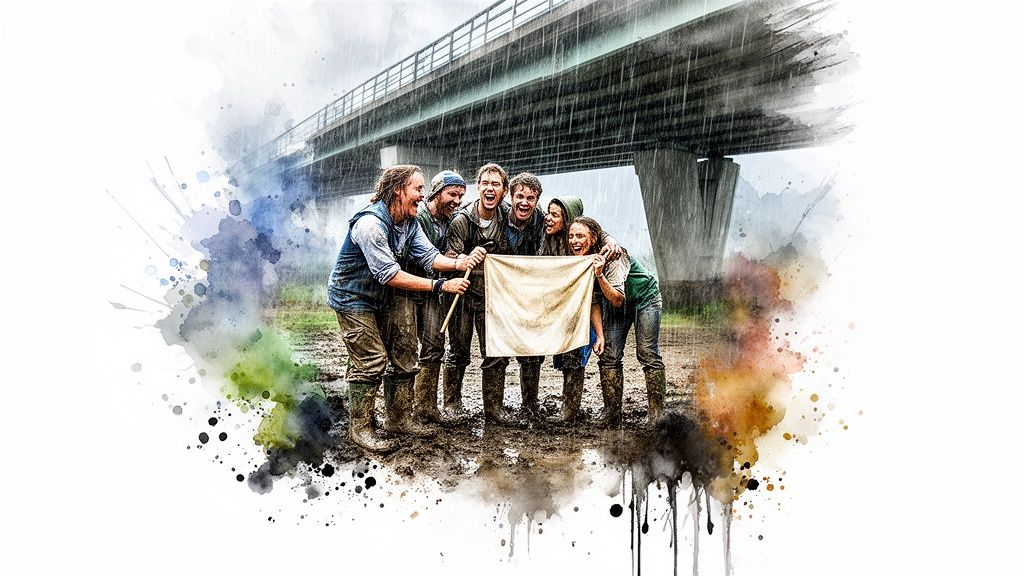
Let me tell you how all this theory actually plays out in the messy, real world. I want to take you back to the very first Litter Caterpillars event. There were just three of us, completely soaked in a freak Chicago hailstorm, huddled under a bridge for our lives.
That moment of shared misery should have been the end of it. But it wasn't.
Freezing together, watching Ubers cancel on us one by one, didn’t break us. It bonded us. It was the moment I realized that shared challenges are the ultimate superglue for friendships. This is the story of how a simple idea—picking up trash—became a blueprint for building a tribe from scratch.
The Power of Showing Up When It’s Hard
We figured out pretty quickly that our best filter for finding the right people wasn't a questionnaire; it was the Chicago weather. We meet every single weekend, rain or shine. Blizzards. Scorching heat. It doesn’t matter.
Why? Because anyone who voluntarily shows up on a freezing Saturday morning to pick up other people's garbage is, by definition, a giver. They're consistent. They’re kind. They're exactly the kind of people you want in your corner.
This self-selecting process is powerful. It filters for heart. We don’t have to guess if someone shares our values of consistency and service—their presence on a cold morning says it all. You can easily apply this logic if you're looking for ways on how to make friends in Chicago, no matter what you're into.
And this isn't just some niche idea. Between September 2022 and September 2023, over 75.7 million Americans formally volunteered. That’s a massive wave of people actively seeking connection and purpose. It creates millions of opportunities for friendships to form between people united by a shared mission. You can check out more volunteering statistics at ActivateGood.org.
Creating a Culture of Belonging
From day one, I knew Litter Caterpillars had to feel less like an organization and more like a team—a family. We needed symbols. We needed an identity.
So, we got a flag. It sounds silly, but that simple flag became a powerful symbol. When a new person shows up and we hand them the flag to hold for a photo, their whole posture changes. They stand a little taller. They're not just a volunteer anymore; they're one of us.
We built our entire culture around one core philosophy: volunteer-first.
This means a few key things:
- We protect your energy. Your time and happiness are everything. We will never, ever hound you for money.
- We celebrate your presence. Just showing up is the victory. We make sure every single person feels seen and appreciated.
- We engineer for friendship. Our open group chats and social media are designed to make newcomers feel like old friends from the minute they join.
Building a community isn't about throwing a party and hoping people show up. It's about building a home and handing people the key. You have to make them feel not just welcome, but wanted.
The Digital Campfire
Our community doesn't just exist on the sidewalks of Chicago; it thrives online. We use group chats and Instagram not just for logistics, but as a digital campfire where people share stories, jokes, and support.
When someone posts a picture of a funny piece of trash they found, the group chat lights up. When someone’s having a rough week, there's an instant flood of encouragement. We intentionally foster this environment so the connection doesn't stop when the cleanup does.
This constant, low-stakes interaction is the bedrock of our community. It keeps the fire warm between events, ensuring that when we finally meet in person, it feels less like a reunion of strangers and more like a gathering of old friends.
The Stuff That Freaks You Out (And Why It Shouldn't)
Putting yourself out there is scary. I know, because I've been there. I still remember huddling under a bridge during that first cleanup, freezing in a hailstorm, wondering if I was crazy and if anyone would ever show up again. So believe me, I get the questions and the fear.
You're not alone in feeling this way. Being brave enough to seek connection is a huge step, and it's totally normal to have doubts. The trick is to feel them, nod at them, and then do the thing anyway. Here are the big ones I hear all the time.
“But I’m Too Shy/Introverted…”
This is the biggest myth out there—that you have to be some bubbly, life-of-the-party extrovert to make friends. It's just not true.
Friendship isn't a performance. Being an introvert is actually a superpower in this mission. You're naturally observant. You're a great listener. Those are two of the most magnetic qualities a person can have.
So, forget trying to command the room. Your goal isn't to talk to 20 people; it's to have one meaningful conversation. Focus on one-on-one connections and let your natural curiosity do the heavy lifting.
Real connection isn’t about being the loudest person in the room. It’s about being present. Your ability to listen—really listen—is more powerful than any witty one-liner.
How Do I Handle Rejection?
It’s gonna happen. You'll invite someone to hang out and they'll say no. Or worse, you'll get ghosted. It stings. There's no way around that. Let yourself feel it for a minute, then let it go.
Think about it like this: not every seed you plant is going to grow. That doesn't mean you're a bad gardener. Some seeds are duds. Some soil just isn't the right fit. It’s not personal.
Rejection isn't a verdict on your worth. It’s just incompatibility. Every "no" is a filter, saving you time and energy that you can now spend on the people who will be a "hell yes!" It’s just data, not a disaster.
Am I Too Old to Make New Friends?
No. Absolutely not. It might feel harder as we get older, but the friendships we make later in life are often deeper and more real. Why? Because you finally know who you are.
You’re not desperately trying to fit in like you were in high school. You’re looking for genuine alignment with people who get you.
Your age and life experience are your greatest assets. They give you stories to share and wisdom to offer. Own where you are in life. I promise you, there are people in your exact same boat, right now, looking for someone just like you.
- Look for shared life stages: Find groups for new parents, recent empty-nesters, or people who just moved to the city.
- Share what you know: Your experience is valuable. Offer to mentor someone, lead a workshop, or just share your perspective.
Finding your people is one of the most important things you can do. It's not about finding perfect people. It's about finding your people—the ones who see you, celebrate you, and are willing to stand with you in a freak Chicago hailstorm. You deserve that. Go find them.
Ready to stop searching and start connecting? The fastest way to find your tribe is by taking action together. At Litter Caterpillars, we build our community one block at a time, every single weekend. Join us for a cleanup and see how service, sunshine, and a little bit of grit can forge the strongest friendships.
Find your next event here: https://www.littercaterpillars.com
Leave a Reply