
Tag: building community

  • How to Make Friends as an Adult: A Real-World Guide

    How to Make Friends as an Adult: A Real-World Guide

    I once stood in my kitchen holding a jar of ancient blueberry jam like it was evidence from a lost life. Then I looked around at the clutter, the silence, the fallout from a relationship that had drained me, and I realized I didn’t just need to clean my apartment. I needed to rebuild my people.

    The Loneliness Problem I Couldn't Clean Up

    My place used to look like my inner life felt. Crowded. Stale. Weirdly sentimental about things that should’ve gone out weeks ago.

    I had trash with backstories. A half-finished bag of nuts from my brief healthy era. Old receipts from days I couldn’t even remember. The blueberry jam from a trip that mattered more in my memory than it ever did in real life. None of it weighed much, but every item felt heavy. I’m talking emotional cinder block heavy.

    Then a chaotic relationship ended, and the whole illusion cracked. I had spent too long tolerating selfishness, too long calling inconsistency “chemistry,” too long acting like loneliness would solve itself if I just stayed busy. It didn’t. It spread.

    A sad woman crying on a sofa while looking at a torn photograph of a couple.

    When your life gets smaller

    The hardest part of loneliness as an adult isn’t always dramatic. Sometimes it’s stupidly ordinary. You go through a whole weekend and realize nobody saw you outside of a cashier and a screen. You have a funny story and no one to text it to. You need help moving a chair and think, “Who would I even ask?”

    That private pain isn’t just in your head. A 2021 survey on close friendships among U.S. adults found that the share of adults reporting 10 or more close friends fell from 33% in 1990 to 13% in 2021, while 12% reported having no close friends at all.

    That hit me because it explained something I had felt but couldn’t name. I wasn’t failing at adulthood because friendship got harder. Friendship had gotten harder, period.

    Practical rule: If your social life feels broken, stop treating it like a personality defect. Treat it like a problem that needs design, repetition, and courage.

    Why cleaning up someone else’s mess helped me

    I learned something strange when I started helping clean outdoor spaces. Other people’s mess felt easier to face than my own. A candy wrapper on the sidewalk didn’t come with shame. A bottle in the grass didn’t carry my history. I could bend down, grab it, toss it, and feel one tiny burst of order.

    That mattered.

    Because once you’ve spent enough time stuck, momentum matters more than insight. You don’t need another podcast telling you to “put yourself out there.” You need a place to stand, something useful to do with your hands, and a reason to show up when your feelings say stay home.

    I’ve written before about fighting social anxiety one piece of trash at a time, and that phrase still feels true to me. Service gave me a side door into connection. I didn’t have to be dazzling. I just had to be present.

    That’s when I started seeing friendship differently. Not as luck. Not as chemistry. Not as something that falls from the sky when your life gets cute enough.

    More like cleanup.

    You show up. You pick one thing up. Then another. Then another. And one day the place looks different.

    So do you.

    How to Find Your People by Filtering for Givers

    Most adult friendship advice is too polite. It tells you to join a club, download an app, go to a mixer, smile more. Fine. But if you’re serious about how to make friends as an adult, you need a better question than “Where do I meet people?”

    Ask this instead. What kind of activity makes selfish people less likely to show up?

    That question changed everything for me.

    I used to think I had a bad picker in romance and friendship. But the truth was less mysterious. I kept putting myself in environments that rewarded charm, spontaneity, and vibes. Those places can be fun, but they’re terrible filters. A loud room hides a lot. So does a casual social scene where nobody has to sacrifice anything.

    If you want better friends, pick better proving grounds.

    A diverse group of adults and an elderly man sharing cookies and flowers in a park setting.

    Why challenge reveals character

    A warm café is great for catching up with people you already trust. It’s not great for screening new ones. Everybody looks generous when the lighting is soft and the stakes are zero.

    A service activity in bad weather tells you more.

    You notice who shows up early.
    You notice who shares gloves.
    You notice who complains for two hours and who makes the whole thing feel lighter.
    You notice who sees an older volunteer struggling with a bag and helps without turning it into theater.

    That’s what I mean by filtering for givers. Not saints. Not perfect people. Givers. People who can carry a little discomfort without making it everyone else’s problem.

    A strong social life doesn’t come from collecting whoever is available. It comes from building around people with the right instincts.

    The activity is the filter

    The best social settings aren’t always the most comfortable. They’re the most revealing.

    A weekend morning volunteer shift does something a random happy hour doesn’t. It asks for effort. It asks for wakefulness. It asks for a tiny act of selflessness before brunch and errands and scrolling can swallow the day. That alone changes who walks through the door.

    The logic here is simple. If the activity requires consistency, a little grit, and some public usefulness, it naturally attracts people who value those things.

    That isn’t just my opinion. Jen Hatmaker’s article on finding your people includes this idea directly: strategically engineering social circles by activity design is a powerful filtering tool, and scheduling volunteer events on weekend mornings can naturally attract givers over partiers. The same verified material notes that a 2025 Corporation for National & Community Service report found volunteer retention doubles in adversity-groups, which supports the point that shared struggle builds committed circles.

    If you keep meeting flaky, self-involved people, stop blaming your luck and start auditing your settings.

    What this looks like in real life

    I’ve watched people bond faster while carrying trash bags through wind than they ever did at polished networking events. Not because suffering is magical. Because challenge strips away performance.

    Here’s what service-based challenge gives you that generic social advice doesn’t:

    • A built-in job: You don’t have to invent conversation from thin air. You already share a task.
    • Visible character clues: You see kindness, patience, grit, and selfishness in motion.
    • Low-pressure repetition: People come back regularly, so you don’t have to force instant intimacy.
    • A reason to care together: Shared purpose gives the interaction weight.

    That’s why meeting like-minded people through intentional community settings works better than floating through random social noise. The right structure does half the work for you.

    Stop waiting for spontaneous friendship

    A lot of adults still cling to a high school fantasy. You sit near someone enough times, say a few funny things, and suddenly you’re close. That happened more easily when life shoved us into shared spaces every day. Adult life doesn’t do that.

    You have to build your own ecosystem now.

    That means choosing places where the social outcome isn’t the only point. Ironically, that’s what makes connection more likely. When people focus on helping, hauling, sorting, carrying, or fixing, they relax. They reveal themselves. They become easier to trust.

    And trust is the whole game.

    You don’t need to become more universally appealing. You need to become more intentional about where you invest your hours. Friendship grows best where values show up in behavior.

    If you want a tribe, don’t just chase people. Chase a cause that forces good people to become visible.

    Your Step-by-Step Guide to Making the First Move

    The first move feels huge when you’ve been lonely for a while. Your brain turns “say hi” into “perform a TED Talk while being judged by a panel.” I know that feeling well.

    I used to stand near people I wanted to know and act busy. I’d tie a bag. Adjust my sleeve. Look very interested in a random leaf. I was physically present and socially absent. That’s a brutal habit because it lets you tell yourself you’re trying when you’re really hiding.

    The fix started with one idea. You probably think people like you less than they do.

    The liking gap is messing with you

    Dr. Marisa G. Franco’s Acceptance Prophecy Methodology addresses the liking gap, where people underestimate how much others like them by 50-60%. Her approach is simple but powerful. Assume baseline likability. That shift can increase your own friendliness by up to 40% and can raise the success rate of turning group acquaintances into one-on-one friends to 70%, as described in Dr. Franco’s guide to making friends as an adult.

    That idea changed the script in my head.

    Before, I’d leave an interaction thinking, “I was awkward.” After learning this, I started asking, “What if they enjoyed that more than I think?” That one question made me warmer, more direct, and less weirdly defensive.

    You do not need certainty before you act. You need a more generous interpretation of how you’re being received.

    The four-part move

    I like simple systems because anxiety loves fog. Here’s the one I use.

    1. Show up enough times for familiarity to do its job

    Don’t treat the first event like speed dating for best friends. Your first task is repeat exposure. Come back. Let people see your face enough times that your presence starts to feel normal.

    If you disappear after one appearance, nobody has enough material to trust you yet.

    2. Assume they’ll be glad you spoke

    This is the inner move. Before you walk over, say something like, “They probably don’t need me to be impressive. They just need me to be human.”

    That sounds small. It isn’t. It changes your body language. You smile sooner. You stop overediting. You become easier to talk to.

    3. Open with the obvious truth in front of you

    Forget clever. Use what’s happening right now.

    A lot of people freeze because they think the opener has to sparkle. It doesn’t. It has to land. Real life already gives you material.

    Here are a few openers that work because they’re specific and low-pressure:

    Conversation Starters That Actually Work
    The Situation Your Opening Line
    You’re both grabbing supplies “Hey, have you done this route before, or are you winging it like me?”
    It’s freezing or raining “I can’t decide if this weather is miserable or kind of funny.”
    They did something helpful “That was kind of you. You noticed that fast.”
    You keep seeing them each week “I think we’ve been orbiting the same events for a while. I’m glad we finally said hi.”
    You’re walking between tasks “What made you start coming out to this kind of thing?”
    The event just ended “I’m starving after that. Are you headed straight home or doing a recovery snack somewhere?”

    4. Make the tiny invitation before the moment closes

    Many hesitate at this stage. They have a decent conversation, then leave with a polite smile and no bridge to the next one.

    You need a bridge.

    Not a giant one. A wooden plank. Something easy.

    Try these:

    • After a good chat: “I liked talking with you. Want to grab coffee after this next time?”
    • When you’ve seen them more than once: “You seem fun and solid. Want to swap numbers so we can coordinate next week?”
    • When you share a local connection: “You’re in my area too? We should do a neighborhood walk sometime.”

    None of these lines are too much. They’re clear. Adults appreciate clear.

    What awkward people do wrong

    I say this with love because I’ve done every one of these.

    • You hover instead of entering: You stand nearby and hope someone rescues you.
    • You wait for perfect timing: There isn’t any.
    • You talk once and vanish: Repetition builds trust.
    • You confuse chemistry with momentum: A pleasant moment means nothing if nobody follows up.
    • You make the invitation too big: Don’t jump to “we should all take a weekend trip.” Start with coffee.

    A script for the whole interaction

    If you want a practical sequence, use this:

    1. Approach: “Hey, I’m [your name].”
    2. Anchor to the moment: “This wind is trying to humble us.”
    3. Ask one simple question: “How’d you get into this?”
    4. Reflect something back: “That makes sense. I like that.”
    5. End with a small next step: “I’m glad we talked. Want to swap numbers and say hi next time?”

    That’s enough. Really.

    For more ideas on community-building activities for adults, look for settings where people do something together instead of only talking about doing something someday. Shared action makes every one of these steps easier.

    The tough-love truth

    Nobody is coming to tap you on the shoulder and announce that now it’s socially safe for you to begin. Adult friendship often starts when one person decides to risk a mildly awkward moment on purpose.

    Let that person be you.

    You don’t need swagger. You need reps. You need to stop worshipping coolness and start practicing contact. Most friendship failure doesn’t come from rejection. It comes from stalled effort.

    Say hi. Stay a few minutes longer. Ask the follow-up. Make the small invitation.

    That’s how strangers stop being scenery.

    The 200-Hour Journey From Acquaintance to Friend

    Most adults quit too early.

    They meet someone good, have one nice conversation, maybe even exchange numbers, and then they expect the friendship to self-assemble. When it doesn’t, they decide the spark wasn’t real. I used to do that too. I thought closeness should feel spontaneous if it was “meant to be.”

    Friendship is less like lightning and more like stacking firewood. One log doesn’t heat the house. Enough logs, placed regularly, will.

    Friendship takes longer than you think

    Research from the University of Kansas found that adult friendship grows through time spent together. It takes about 50 hours to move from acquaintance to casual friend, 90 hours for a real friendship, and more than 200 hours for a close bond, according to this summary of the University of Kansas friendship research.

    That number can feel discouraging until you understand what it means. It doesn’t mean you need one giant emotional marathon. It means closeness comes from repeated ordinary contact.

    A timeline chart titled The 200-Hour Journey to Friendship showing the time needed for different friendship levels.

    Why recurring activities are a friendship accelerator

    This is why recurring service matters so much. A weekly event solves three adult friendship problems at once.

    First, it removes decision fatigue. You don’t have to keep inventing plans.
    Second, it gives you a stable backdrop for repeated contact.
    Third, it creates a rhythm where following up feels normal instead of random.

    A one-off party gives you a spike. A weekly habit gives you a ladder.

    A working rule: Don’t ask, “Did we click?” Ask, “Did we spend enough time together for trust to form?”

    What those hours actually look like

    People hear 200 hours and picture some dramatic montage. Real friendship is usually built from much less glamorous moments.

    It’s the walk to the train after the event.
    It’s the ten-minute chat while sorting supplies.
    It’s the shared snack afterward.
    It’s texting, “You still going tomorrow?”
    It’s seeing how someone acts when plans get messy.

    The hours count because they accumulate context. You stop knowing only their funny side. You start learning how they handle stress, disappointment, lateness, weather, tiredness, small joy, and boring tasks. That’s when trust stops being theoretical.

    A practical rhythm for the long game

    If you’ve met someone promising, don’t leave it to chance. Use a rhythm.

    Week one

    Talk at the event. Keep it light. Find one point of overlap. Neighborhood, work rhythm, food, books, weird weather tolerance, anything.

    Send a short follow-up if you swapped numbers:
    “I liked talking with you today. Glad we met.”

    Week two

    Find them again. Reference the earlier conversation.
    “How did that exam go?”
    “Did you ever try that coffee place?”
    “Are you still on for next weekend?”

    That one callback matters. It tells them you weren’t just being socially polished. You were paying attention.

    Week three or four

    Add a small one-on-one extension connected to the shared activity.

    • Grab coffee after
    • Walk to the station together
    • Share a meal nearby
    • Invite them to a related errand or neighborhood stop

    Short is better than elaborate. You’re not trying to impress them. You’re trying to widen the lane.

    The mistake of waiting for intensity

    A lot of adults think a real friend should arrive with instant emotional depth. That expectation wrecks good beginnings.

    Close friendship usually starts off humble. You joke about gloves. You compare terrible apartment stories. You complain about wind chill. You remember each other’s names. You carry bags. That can look small from the outside. It isn’t.

    Small interactions are deposits. Keep making them.

    Here’s what helps those deposits grow:

    • Consistency beats charisma: I trust the person who returns.
    • Specific invitations beat vague hopes: “Coffee after next Saturday?” works better than “We should hang sometime.”
    • Shared labor beats endless talking: Doing a task together gives the bond a spine.
    • Follow-up beats fantasy: If you don’t act on a good interaction, it evaporates.

    How to know when to deepen the friendship

    You don’t need a formal milestone. Watch for these signals instead:

    • Conversation expands naturally: You’re not forcing topics anymore.
    • They initiate too: They text first, save you a spot, or ask if you’re coming.
    • You’ve seen each other in different moods: Tired, rushed, happy, annoyed.
    • The hangouts leave the original setting: You talk before or after, not just during.

    When that happens, deepen carefully. Offer a little more of yourself. Not a trauma dump. Just more reality.

    Try:
    “I’ve been trying to build a more solid circle lately.”
    “I’m glad I started showing up here. I needed this more than I realized.”
    “You seem like someone who follows through. I appreciate that.”

    That kind of honesty opens the door without kicking it off the hinges.

    A simple model for reaching 200 hours

    You don’t need to calculate this like a spreadsheet, but it helps to think in seasons.

    If you spend a few hours a week around the same people, plus occasional follow-ups outside the event, those hours add up. The magic isn’t speed. It’s regularity. Adult closeness grows when time stops being accidental.

    I like to think of it in layers:

    1. Recognition
      You know each other’s names and faces.

    2. Familiarity
      You’ve had enough repetition that the interaction feels easy.

    3. Reliability
      You expect to see each other and notice when the other person isn’t there.

    4. Trust
      You share more truth. You help each other. The friendship starts existing outside the original context.

    5. Belonging
      The person becomes part of your real life, not just your Saturday life.

    That’s the journey.

    The emotional payoff of the slow build

    The beauty of recurring challenge is that it sneaks the hours past your resistance. You’re not sitting across from a stranger trying to force intimacy over one expensive drink. You’re living side by side for a while. That’s closer to how childhood and college friendships formed. Not by magic. By repeated exposure, shared inconvenience, and enough ordinary moments to become known.

    If you’ve struggled with how to make friends as an adult, this is the part to tattoo on your brain. Stop judging early connections by intensity. Start judging them by whether the structure allows enough hours to accumulate.

    A good recurring activity isn’t just where you meet people. It’s the machine that turns contact into closeness.

    Show up. Keep showing up. Then make the extra half-step after the event. That’s how acquaintance becomes friend without either of you needing to force it.

    Friendship Is the Reward for Becoming a Better You

    At some point I realized I had been asking the wrong question.

    I kept asking, “How do I get friends?”

    A better question was, “Who am I becoming when nobody’s watching?”

    That question annoyed me at first because I wanted a social solution, not a character arc. I wanted a better calendar, not a better backbone. But friendship kept teaching me the same lesson. The people I most wanted in my life were drawn to bravery, steadiness, kindness, and effort. So if I wanted that kind of circle, I had to practice those traits before I felt fully ready.

    Service changes your posture

    When you serve, something subtle happens. You stop standing in the center of your own insecurity. You still feel shy sometimes. You still overthink. But your attention has somewhere better to go.

    A bag needs carrying.
    A corner needs cleaning.
    A new person looks nervous.
    Someone forgot gloves.
    The job is right there.

    That shift matters because self-consciousness is sticky. Purpose unsticks it.

    I’ve seen people arrive withdrawn, unsure, half-apologetic for taking up space. Then they spend enough time doing useful work beside good people and their whole posture changes. Their jokes come out easier. Their eye contact steadies. Their standards rise. They stop chasing random approval because they’ve started building earned self-respect.

    Friendship often arrives as a side effect. You become more trustworthy to yourself first.

    You don’t attract what you want. You attract what you rehearse

    Tough love enters the scene.

    If you rehearse flakiness, you’ll keep building flaky dynamics.
    If you rehearse hiding, you’ll keep collecting shallow contact.
    If you rehearse chasing exciting but unreliable people, you’ll keep ending up lonely in crowded rooms.

    You need new reps.

    Mark Manson’s Selective Effort Principle argues that investing 10+ hours a week in personal growth can boost your baseline attractiveness by 40%, and that passionate people attract 2.7x more invitations, as described in Mark Manson’s article on making friends. The deeper point matters more than the numbers. Shift from hunting for friends to becoming a person who naturally draws healthier connection.

    That tracks with what I’ve lived. The strongest friendships in my adult life didn’t start when I got more charming. They started when I got more solid.

    Pride helps more than people admit

    A lot of adults feel embarrassed by visible belonging. They think pride is corny. I used to think that too.

    Now I think pride is fuel.

    Teams know this. Marching bands know this. Cities know this. Shared symbols matter because they turn a loose gathering into a living identity. A badge, a ritual, a nickname, a song, a repeated joke, a familiar route, even a goofy tradition after the work is done. Those things say, “We are not just random individuals floating near each other. We are building something.”

    That sense of identity protects friendship because it gives people a reason to return even when life gets messy.

    Here’s what healthy group pride can do:

    • It makes consistency easier: People return to identities, not just events.
    • It softens awkwardness: Ritual gives shy people a script.
    • It creates memory: Shared symbols make ordinary effort feel meaningful.
    • It strengthens courage: Belonging helps people try harder things.

    I’m not saying you need costumes and chants. I’m saying don’t underestimate the power of shared spirit. Adults need it too.

    The caterpillar lesson

    I love the image of a caterpillar because it’s honest. A caterpillar isn’t sleek. It’s not glamorous. It crawls. It does the work slowly. It looks a little ridiculous if you judge it too early.

    That’s most of us in the middle of rebuilding.

    We are not polished when we begin. We are trying. We are carrying our own mess, our old habits, our fear of rejection, our shame about how long we stayed isolated. We are learning consistency after years of drift. We are learning bravery in public. We are learning to be kinder than our old environments taught us to be.

    And if we keep going, we change.

    Not in the fake self-help way where your life becomes perfectly curated. In the real way. You trust yourself more because you’ve kept promises to yourself. You forgive yourself more because you’ve done something useful with your pain. You become easier to love because you’re no longer living entirely from defense.

    That’s when friendship deepens. Not because you performed your way into a circle, but because the person standing there is more available, more grounded, and more aligned.

    What to do this week

    If you’re lonely, don’t turn this article into a thought exercise. Pick a challenge with a purpose and put it on your calendar.

    Do it even if you feel awkward.
    Do it even if you don’t feel instantly at home.
    Do it even if you have to go alone.

    Then return.

    Talk to one person.
    Remember their name.
    Ask one follow-up question.
    Make one tiny invitation.
    Come back next week.

    That’s the playbook. Not glamorous. Effective.

    You do not build a tribe by wishing for one. You build it by becoming someone who can help carry the bags, laugh in bad weather, and stay when the novelty wears off.

    And the wild part is this. Once you start doing that, you won’t just find better friends.

    You’ll like yourself more in their company.


    If you want a place to practice this in real life, Litter Caterpillars offers a simple, brave way in. You show up on a weekend morning, help clean a piece of Chicago, and meet people who chose service over sleep and excuses. That’s a strong starting point for anyone serious about how to make friends as an adult.


  • How to meet like minded people: Find your tribe and thrive

    How to meet like minded people: Find your tribe and thrive

    Before you can find your people, you have to know what you're even looking for. I'm not talking about some rigid checklist for the perfect friend. It’s about you figuring out your own internal compass—the core values that guide you—so you can naturally find people who just get it.

    The Search for Your People Begins with You

    A person meditating in lotus position, holding a golden compass, surrounded by colorful watercolor splashes.

    I get it. You can be in a room full of people and feel totally, completely alone. For a long time, my social life felt like I'd shown up to a costume party and everyone else got the memo on the theme except me. It was exhausting. And you know what? I felt more lonely in a crowd than I ever did by myself.

    This isn't some rare, weird feeling you have. As we get older, finding a real tribe gets way, way harder. School was like a built-in petri dish for friendships, a constant, swirling experiment. But adult life? It often leaves us trying to force connections that just don’t click, like trying to fit a square peg into a round hole. It never works.

    The hard truth is that you don’t just stumble into meaningful relationships. You have to build them with intention. That's why your first move isn't joining another club or suffering through another awkward happy hour. It's looking in the mirror.

    Your Values Are Your Compass

    Before you can spot your people out in the wild, you need a crystal-clear picture of who you are and what really matters to you. "Like-minded" is just a vague buzzword until you define it for yourself. This isn't about finding your clones; it's about connecting with people whose fundamental values vibrate on the same frequency as yours.

    Think of your values as an internal compass. This compass doesn’t point to a specific person. It steers you toward environments and interactions that feel energizing and authentic, and away from the ones that leave you feeling drained, hollowed out. When you let your values lead, you stop desperately searching for friends and you start effortlessly attracting them.

    So, how do you find this compass? Start by figuring out your non-negotiables.

    • Radical Kindness: Do you absolutely need people who lead with empathy?
    • Unwavering Consistency: Is it critical for you to have reliable friends who show up, time and time again?
    • Bold Creativity: Do you find yourself drawn to the artists, the innovators, the weirdos who see the world in a different color?
    • Unfiltered Honesty: Do you need friends who will tell you the hard truth, even when it’s uncomfortable?

    These aren't just personality quirks; they're the bedrock of who you are. So make a list. Be brutally honest with yourself. This isn’t a wishlist for a "perfect friend"—it’s a reflection of your own soul.

    The most powerful magnet for the right people is your own authentic self. When you know what you stand for, you naturally draw in others who stand for the same things.

    Turning Your Struggles into Strengths

    My own journey to building a community—the very one that became Litter Caterpillars—was born from a real messy place. I was inconsistent, disorganized, and pretty lost after a chaotic relationship ended. I knew I had to change, not just for me, but to attract the kind of solid, good-hearted people I wanted in my life.

    I realized I craved people who were brave, kind, and committed. People who weren't afraid to get their hands dirty. So instead of just hoping to find them, I decided I had to become one of them.

    This is the secret sauce. Your biggest challenges are often the most powerful magnets for your people. The very things you've overcome, or are still working through, create a deep, unspoken bond with others walking a similar path. It’s a shared language.

    When you're open about your journey—the good, the bad, and the ugly—you give other people permission to be real, too. That vulnerability is the shortcut to genuine connection. It filters out all the superficial fluff and leaves you with people who see you, respect your fight, and want to cheer you on. Your story, with all its messy, beautiful parts, is your greatest asset.

    Find Your People Where Passion and Purpose Intersect

    Three smiling people plant seedlings together in a raised urban garden bed, city skyline in background.

    Alright, you’ve done the internal work. You know what you stand for. You're ready. So… where are these people?

    Telling you to "just get out there more" is useless advice. It's like telling a sailor to "just sail." You need a map. A destination. You need a reason to even leave the shore in the first place.

    This is your map. We're skipping the awkward networking events and the forced small talk. Instead, we’re going straight to the places where passion and purpose are alive and kicking—the fertile ground where real connections actually grow.

    The ultimate shortcut to finding your people is through shared activities. Think about it. When you're totally absorbed in something you love—whether it's learning a new skill, fighting for a cause, or tending a garden—you stop trying to be someone. You just are. And that raw authenticity? It's a magnet for the right people.

    Beyond the Usual Suspects

    Let's move past the generic advice of "join a book club." While those can be great, the real magic happens in the niches. The goal here is to find environments that naturally filter for the kind of people you want in your life.

    Imagine you join a pottery class. You're not just learning to shape clay; you’re sharing a space with people who value creativity, patience, and aren't afraid to get their hands dirty. Or picture a coding bootcamp. You’re suddenly surrounded by problem-solvers, logical thinkers, and builders who are all in on their own growth.

    These activities are like a secret handshake. They broadcast your interests and your values without you having to say a single word. You automatically have a built-in topic of conversation, a shared struggle, and a common goal. It’s all right there.

    When your hands are busy with a shared task, your heart has a funny way of opening up. Shared purpose is the soil where the strongest friendships take root.

    So, where do you find these places?

    • Skill-Building Workshops: Look for classes on things you've always wanted to learn. Woodworking, public speaking, digital photography—these attract lifelong learners and curious minds.
    • Niche Hobby Groups: Get specific. Don't just look for a "hiking group"; find the "weekend trail maintenance crew." Instead of a generic "gardening club," find the "urban rooftop beekeeping collective." The more specific the interest, the more passionate the people.
    • Platforms with a Pulse: Use tools like Meetup or Eventbrite, but you need to learn to read between the lines. Look for groups with consistent events and photos of people genuinely interacting, not just posing. A group that meets weekly for a Dungeons & Dragons campaign is a community; a monthly "Young Professionals Mixer" is often just a transaction.

    My Goldmine: The Power of Volunteering

    I’ll be honest with you. Of all the paths you can take, my personal favorite—and the one I believe is a true goldmine for connection—is volunteering.

    When you give your time to a cause you believe in, you're showing up with your heart. Service-oriented groups naturally attract doers, givers, and people with a deep sense of purpose. There's a shared understanding that you're all there for something bigger than yourselves. That mutual respect is an incredible foundation for a real friendship.

    And it's not just a niche thing. The global volunteering movement has exploded. Approximately 862 million people worldwide volunteer at least once a month—that's nearly 15% of the global population. Data from the UN Volunteers website shows that dedicating time to service has become one of the most powerful and accessible ways to meet people who share your values.

    I see this every single weekend at Litter Caterpillars. People don't show up on a chilly Saturday morning to pick up trash because it's glamorous. They show up because they care. They're consistent. They're kind. They're exactly the kind of people I want in my corner, and we all found each other by choosing to serve. If this sounds like you, check out my guide on how to find the right volunteer work for you.

    Turn a Shared Interest into a Real Conversation

    Watercolor illustration of a man and woman conversing across a table with a vibrant painted rock.

    So you did it. You showed up. You’re in the room, surrounded by people who nerd out about the same stuff you do.

    And then it hits you. That awkward silence. The internal panic of, "Okay, now what?" This is the moment where so many of us freeze up, retreat into our phones, and completely miss the very connection we came for.

    Let's just throw that entire script out the window. Your goal isn’t to be clever or smooth. It's to be genuinely curious. That’s it. Here’s how you turn that shared interest into a real, human conversation that feels natural, not forced.

    My Simple Rule: Observe, Question, Share

    I’ve learned that the best conversations ignite from the simplest things. Forget about witty one-liners. Instead, I use a dead-simple, three-part method that has never failed me: Observe, Question, Share.

    It’s like building a little bridge between you and someone else. You just start with what’s right there in front of you.

    • Observe: Notice something in your shared environment. It can be anything at all.
    • Question: Ask a genuine, open-ended question about what you saw.
    • Share: Offer a tiny piece of your own story related to their answer.

    I remember being at a cleanup once, and someone pulled a perfectly intact, ridiculously old-looking toy car out of the mud. I just laughed and said, "Wow, I wonder what that car's story is." The other person smiled and replied, "Probably a better story than my actual car." We ended up chatting for 20 minutes about life, purpose, and the weird things we hold onto. All from a piece of trash.

    The most interesting people aren't the ones with the best lines; they're the ones who are the best listeners. Genuine curiosity is the ultimate conversation starter.

    Breaking the Ice Without Feeling Awkward

    Your body language screams louder than your words ever will. Before you even say a thing, make sure your posture is open and inviting. Uncross your arms, put your phone away, and make gentle eye contact. It’s a non-verbal signal that says you’re present and ready to connect.

    Then, when you do speak, focus on asking questions that invite stories, not just "yes" or "no" answers. Instead of asking, "Did you have a good weekend?" try something like, "What was the best part of your weekend?" See the difference? One is a dead end; the other is an open door.

    The key is to really listen to the answer. Don’t just wait for your turn to talk. Active listening means you pick up on the little details and ask follow-up questions that show you’re actually engaged. It makes the other person feel seen and valued—and that's the foundation of any real connection.

    Reaching Out in the Digital World

    Starting conversations online can feel even more daunting. How do you slide into someone's DMs in a group without coming across as creepy or weird? The secret is exactly the same: shared context and sincere interest.

    Never, ever send a generic "Hey." Instead, reference something specific. Maybe they posted a great photo from a recent hike or asked a thoughtful question in a forum. Your opening message should be a direct, respectful response to that.

    Conversation Starters That Actually Work

    Use these simple, adaptable scripts to start conversations in person or online without feeling awkward. They're grounded in your shared environment, which is what makes them work.

    Scenario What You Can Say
    In a Facebook group for a shared hobby "Hey [Name], I saw your post about [specific topic] and was so impressed by [specific detail]. I'm also trying to learn more about that—do you have any tips for a beginner?"
    After a volunteer event "It was great meeting you today at the [event name]! I was really inspired by what you said about [their comment]. Hope to see you at the next one!"
    In a Meetup group chat "Hi [Name], that picture you posted from the [last event] was amazing. I was thinking of checking out that spot myself. Was it as cool as it looks?"

    Notice the pattern? Each message is specific, complimentary, and ends with a low-pressure question. You aren't demanding their time; you're inviting them to continue a conversation that has, in a way, already started. It's about being you, being kind, and showing that you were paying attention.

    Build the Bridge from Acquaintance to True Friend

    Making that first connection is a huge win. You found your people, started a conversation, and felt that little spark. Awesome. But that's just the start.

    The real work—the real magic—is in the follow-through. It's about fanning that spark until it becomes the warm, steady glow of a real friendship. This is where a little bit of guts and consistency change everything. It’s about being the one who makes the next move.

    Friendship is built on a series of "small yeses." Each small agreement to connect again adds another plank to the bridge you're building between your world and theirs. You don't need grand gestures. Just an invitation.

    The Gentle Art of the Next Step

    Think of it like a middle school dance. The music is playing, everyone's standing around, and someone has to have the courage to ask someone else to dance. If you just wait for them to ask, you'll be standing on the sidelines all night.

    You have to be the one who suggests the next step. It doesn't need to be intense or scary. The trick is to keep it super casual and low-pressure. You have to make it incredibly easy for them to say yes.

    I see this happen all the time in our Litter Caterpillars group chats. A conversation about a cool pair of hiking boots turns into someone saying, "Hey, a few of us are checking out the trails at Starved Rock next Saturday. Anyone want to join?"

    It’s not some formal, engraved invitation. It’s an open door. That’s how you turn a shared interest into a shared experience. And shared experiences? That's the glue that holds friendships together.

    From Cleanup Crew to Family

    I've had the privilege of watching these small invitations blossom into the most incredible relationships. Seriously. I know volunteers who met picking up soggy pizza boxes and are now each other’s emergency contacts.

    One little crew started a side-chat about their favorite fantasy novels, and now they have a monthly book club that’s been running for over a year. Another pair discovered they both loved board games and now host a game night that’s become legendary in our circles.

    These friendships didn't just happen. They happened because one person was brave enough to say, "Hey, I like talking to you. Let's do it again, but over here." It’s such a simple act, but it signals something profound: I see you, I value you, and I want more of your energy in my life.

    Don't wait for an invitation to the community you crave. Be the one who creates it. The simplest gathering can become the anchor for a whole network of friendships.

    Become the Community Hub

    You don't have to wait for someone else to organize the fun. You have the power to become a community hub yourself. This sounds like a big deal, but it's really not. Hosting doesn’t mean throwing some elaborate, stressful party.

    It can be as simple as this:

    • Host a "Co-Working" Session: Send a message in a group chat: "I'm working from Dollop Coffee on Thursday morning if anyone wants to join for some focused work and good coffee."
    • Organize a Simple Potluck: Find a park and tell people, "Let's all bring a dish and hang out at Horner Park on Sunday. No pressure, just good food and good company."
    • Start the Group Chat: Create a group for people from your volunteer event or workshop to share photos and keep in touch.

    By creating the gathering, you are showing people that you value their company and want to build something real. You can find more inspiration for this in our list of community-building activities for adults that go beyond the basics.

    The most magnetic people are the ones who create spaces for others to connect. You can be that person. All it takes is that first, small invitation.

    How a Chicago Cleanup Crew Became a Community

    A joyful group of muddy people holding a blank banner under a bridge in the rain, with watercolor effects.

    Let me tell you how all this theory actually plays out in the messy, real world. I want to take you back to the very first Litter Caterpillars event. There were just three of us, completely soaked in a freak Chicago hailstorm, huddled under a bridge for our lives.

    That moment of shared misery should have been the end of it. But it wasn't.

    Freezing together, watching Ubers cancel on us one by one, didn’t break us. It bonded us. It was the moment I realized that shared challenges are the ultimate superglue for friendships. This is the story of how a simple idea—picking up trash—became a blueprint for building a tribe from scratch.

    The Power of Showing Up When It’s Hard

    We figured out pretty quickly that our best filter for finding the right people wasn't a questionnaire; it was the Chicago weather. We meet every single weekend, rain or shine. Blizzards. Scorching heat. It doesn’t matter.

    Why? Because anyone who voluntarily shows up on a freezing Saturday morning to pick up other people's garbage is, by definition, a giver. They're consistent. They’re kind. They're exactly the kind of people you want in your corner.

    This self-selecting process is powerful. It filters for heart. We don’t have to guess if someone shares our values of consistency and service—their presence on a cold morning says it all. You can easily apply this logic if you're looking for ways on how to make friends in Chicago, no matter what you're into.

    And this isn't just some niche idea. Between September 2022 and September 2023, over 75.7 million Americans formally volunteered. That’s a massive wave of people actively seeking connection and purpose. It creates millions of opportunities for friendships to form between people united by a shared mission. You can check out more volunteering statistics at ActivateGood.org.

    Creating a Culture of Belonging

    From day one, I knew Litter Caterpillars had to feel less like an organization and more like a team—a family. We needed symbols. We needed an identity.

    So, we got a flag. It sounds silly, but that simple flag became a powerful symbol. When a new person shows up and we hand them the flag to hold for a photo, their whole posture changes. They stand a little taller. They're not just a volunteer anymore; they're one of us.

    We built our entire culture around one core philosophy: volunteer-first.

    This means a few key things:

    • We protect your energy. Your time and happiness are everything. We will never, ever hound you for money.
    • We celebrate your presence. Just showing up is the victory. We make sure every single person feels seen and appreciated.
    • We engineer for friendship. Our open group chats and social media are designed to make newcomers feel like old friends from the minute they join.

    Building a community isn't about throwing a party and hoping people show up. It's about building a home and handing people the key. You have to make them feel not just welcome, but wanted.

    The Digital Campfire

    Our community doesn't just exist on the sidewalks of Chicago; it thrives online. We use group chats and Instagram not just for logistics, but as a digital campfire where people share stories, jokes, and support.

    When someone posts a picture of a funny piece of trash they found, the group chat lights up. When someone’s having a rough week, there's an instant flood of encouragement. We intentionally foster this environment so the connection doesn't stop when the cleanup does.

    This constant, low-stakes interaction is the bedrock of our community. It keeps the fire warm between events, ensuring that when we finally meet in person, it feels less like a reunion of strangers and more like a gathering of old friends.

    The Stuff That Freaks You Out (And Why It Shouldn't)

    Putting yourself out there is scary. I know, because I've been there. I still remember huddling under a bridge during that first cleanup, freezing in a hailstorm, wondering if I was crazy and if anyone would ever show up again. So believe me, I get the questions and the fear.

    You're not alone in feeling this way. Being brave enough to seek connection is a huge step, and it's totally normal to have doubts. The trick is to feel them, nod at them, and then do the thing anyway. Here are the big ones I hear all the time.

    “But I’m Too Shy/Introverted…”

    This is the biggest myth out there—that you have to be some bubbly, life-of-the-party extrovert to make friends. It's just not true.

    Friendship isn't a performance. Being an introvert is actually a superpower in this mission. You're naturally observant. You're a great listener. Those are two of the most magnetic qualities a person can have.

    So, forget trying to command the room. Your goal isn't to talk to 20 people; it's to have one meaningful conversation. Focus on one-on-one connections and let your natural curiosity do the heavy lifting.

    Real connection isn’t about being the loudest person in the room. It’s about being present. Your ability to listen—really listen—is more powerful than any witty one-liner.

    How Do I Handle Rejection?

    It’s gonna happen. You'll invite someone to hang out and they'll say no. Or worse, you'll get ghosted. It stings. There's no way around that. Let yourself feel it for a minute, then let it go.

    Think about it like this: not every seed you plant is going to grow. That doesn't mean you're a bad gardener. Some seeds are duds. Some soil just isn't the right fit. It’s not personal.

    Rejection isn't a verdict on your worth. It’s just incompatibility. Every "no" is a filter, saving you time and energy that you can now spend on the people who will be a "hell yes!" It’s just data, not a disaster.

    Am I Too Old to Make New Friends?

    No. Absolutely not. It might feel harder as we get older, but the friendships we make later in life are often deeper and more real. Why? Because you finally know who you are.

    You’re not desperately trying to fit in like you were in high school. You’re looking for genuine alignment with people who get you.

    Your age and life experience are your greatest assets. They give you stories to share and wisdom to offer. Own where you are in life. I promise you, there are people in your exact same boat, right now, looking for someone just like you.

    • Look for shared life stages: Find groups for new parents, recent empty-nesters, or people who just moved to the city.
    • Share what you know: Your experience is valuable. Offer to mentor someone, lead a workshop, or just share your perspective.

    Finding your people is one of the most important things you can do. It's not about finding perfect people. It's about finding your people—the ones who see you, celebrate you, and are willing to stand with you in a freak Chicago hailstorm. You deserve that. Go find them.


    Ready to stop searching and start connecting? The fastest way to find your tribe is by taking action together. At Litter Caterpillars, we build our community one block at a time, every single weekend. Join us for a cleanup and see how service, sunshine, and a little bit of grit can forge the strongest friendships.

    Find your next event here: https://www.littercaterpillars.com

  • How to Make Friends in a New City: A Practical Guide

    How to Make Friends in a New City: A Practical Guide

    The first step feels like a leap of faith, but it’s surprisingly simple: you have to show up somewhere new, on purpose. That’s it. That’s the entire secret. The whole winding road from stranger to friend is paved with shared moments, with the intentional act of putting yourself in the same room with the same people, over and over again. It’s how you transform a cold map of unfamiliar streets into a place that finally feels like home.

    Why This Adventure Feels So Damn Hard

    Moving to a new city like Chicago is supposed to be this grand, cinematic montage, isn't it? You cram your entire existence into cardboard boxes, a current of excitement buzzing under your skin for the glittering skyline, the new job, the blank-slate beginning.

    But then, the quiet arrives. An uninvited guest. It’s the echo in your empty apartment on a Friday night. It’s the ocean of anonymous faces flowing past you on the train. Suddenly, that grand "adventure" begins to feel a lot more like simple, stark solitude.

    If this is you, you’re not failing. Not even close. Forging friendships as an adult is just plain difficult. The built-in social scaffolding we had in school—orientation week, dorm life, those mandatory group projects we all complained about—has been dismantled. We're left to navigate the wilderness without a map.

    The Campfire Analogy

    Building a social circle from scratch is like trying to start a campfire in a cold, steady drizzle. You have the spark, that innate human desire for warmth and connection, but the world around you feels damp. Unresponsive. Every unanswered text, every solo weekend, feels like another wet log tossed onto the pile, making it harder and harder to coax a real flame into existence.

    This isn’t a personal failing; it’s a modern phenomenon. The architecture of our lives has changed, and with it, the very mechanics of how we connect. The truth is, millions of people are in your exact same boat. In the US, about 27–30 million people move every year, a huge number of them landing in totally new cities, blinking in the unfamiliar light.

    Yet, our collective muscle for friendship is atrophying. Surveys reveal a startling trend: the share of adults with no close friends has quadrupled since 1990. Meanwhile, Americans now spend a mere 4 hours per week with friends, a precipitous drop from over 6.5 hours in the past. If this stings with familiarity, you can discover more about this friendship recession and the lost art of connecting.

    Shifting Your Mindset

    So, what does this mean for you, standing in the middle of a bustling new city feeling utterly alone? It means passively hoping for connection is like waiting for rain in a desert. The strategy has to change from passive to active.

    The data itself points to a clear path forward:

    • About 35% of people meet friends right in their neighborhood.
    • Around 40% connect through the branches of existing friendships.
    • A crucial 19% find their people through clubs or organizations.

    That last one? That’s where the magic is hidden. You have to intentionally embed yourself in groups that revolve around a shared purpose. Think of a weekly cleanup crew that meets across all 50 of Chicago's wards, a book club wrestling with the same story, or a sports league striving for a common goal. This is how you plug directly into the most reliable circuit for building a new social life.

    It creates the perfect conditions for that soggy campfire to finally roar to life, turning the cold isolation into a warm, crackling community.

    Find Your People Through a Shared Purpose

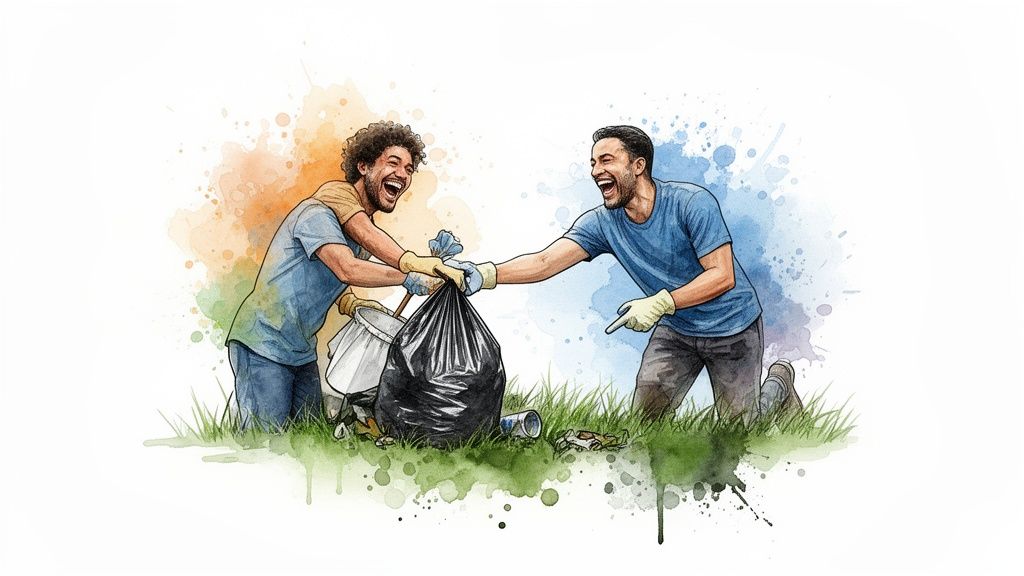
    Two cheerful men in gloves clean up trash, putting litter into a black bag, smiling happily.

    Real friendships, the kind with deep roots, aren't constructed from the flimsy material of small talk. They are forged in the trenches of shared experiences, built while working side-by-side with people who genuinely care about the same things you do.

    So, instead of just showing up to another random happy hour, think about finding a mission.

    Imagine this: you join a crew to clean up a neglected park on a Saturday morning. You're both picking up discarded coffee cups, you share a laugh over a bizarre piece of trash, and suddenly, you’re not just strangers anymore. You’re teammates. This is the simple, profound alchemy of a shared purpose.

    Why a Mission Matters More Than a Mixer

    Activities built around a common goal create a low-pressure greenhouse where connection just happens. You're not there with the slightly desperate, awkward goal of "making friends." You’re there to do something that matters, and friendship becomes the beautiful byproduct of that shared effort.

    Volunteering, for example, acts as a natural filter. It attracts people who are kind, community-minded, and willing to give their time to something beyond themselves. These are precisely the qualities you want in a new friend.

    It’s an incredible shortcut. You get to bypass all the superficial interview questions and see someone’s character in action. You see who shows up when it’s cold, who encourages others when the work gets tough, and who finds joy in the simple act of contribution. These are the real, solid building blocks of trust.

    "A shared purpose is like a compass for your social life. When you follow what you care about, it doesn't just lead you to interesting activities; it guides you to interesting people who are walking the same path."

    The Data Backs It Up

    This isn't just a feel-good idea—it’s a strategically sound approach. National surveys show that about 19–21% of Americans met a close friend through an organization or club, which is exactly what a recurring volunteer group feels like.

    In fact, over 50% of people who made a new friend last year did it through in-person situations like work, school, or organizations. In contrast, only 5–8% met online. Committing to a visible, city-wide effort like a cleanup in Chicago puts you right in the heart of where real, in-person ties are being built.

    If you're wondering where to start, check out our guide on how to find volunteer work that actually clicks with your passions. This approach works because you’re joining the small group of people who are actively forming friendships through organizations—in a city already known for its strong sense of community. You can discover more insights about the state of American friendship here.

    The Unspoken Power of Just Showing Up

    A great conversation over coffee is a spark. But it’s not the fire. The fire is built through the quiet, unglamorous act of just showing up, week after week after week.

    This is the exact point where most people’s efforts to make friends in a new city completely fall apart. Not in the first hello, but in the silent follow-through.

    Think of it like tending a garden. You can't just toss a seed on the ground, walk away, and hope a beautiful flower appears. It needs consistent watering, patient attention. Showing up to your book club, your volunteer group, your running club—that's the watering. It's the simple, powerful signal that communicates you’re invested, you’re reliable, you’re here to stay.

    I’ll never forget the story a friend told me about her volunteer group that met during a freak Chicago blizzard. The entire city had ground to a halt. Roads were impassable. Yet, a handful of them still showed up, huddled together in the shared absurdity of it all. That moment of collective struggle became a foundational memory, a story they would retell for years. It deepened their bond in a way a sunny, easy day never could.

    The Art of a Steady Presence

    When you're new and the loneliness bites, the urge to try everything at once is a powerful siren song. A book club one week, a pottery class the next, a hiking group after that. But this "group-hopping" rarely leads to anything deep. You just become a familiar face to many but a true friend to none.

    The real move is to commit. Pick one or two core activities and just stick with them for a few months. This steady, reliable presence does something magical: it moves you from being a guest in the room to being part of the fabric of the group.

    This consistency is especially vital for adults. Research shows that as we get older, our routines become more rigid, and we take longer to grant our trust to new people. While little kids form bonds in an instant on the playground, we're more like cautious teenagers, sticking to the friends we already have.

    In fact, a staggering 22% of Americans say it’s been five years or more since they last made a new friend. Passively waiting for serendipity in a new city will likely land you in that exact same spot. You can learn more about how friendship patterns change as we age.

    From Familiar Faces to Your People

    By repeatedly showing up, you create the high-frequency contact that friendship needs to germinate and grow. It’s the slow, steady process that transforms "that person from the cleanup group" into the friend who checks in when you’re sick.

    It’s about choosing an active strategy over a passive one. So many people wait for friendship to happen to them, but the ones who succeed are the ones who go out and build it, brick by patient brick.

    Friendship Building Methods: A Comparison

    Approach Passive Method (Low Success) Active Method (High Success)
    Consistency Hops between different groups and events weekly. Commits to 1-2 recurring activities for several months.
    Effort Waits for others to initiate conversation and plans. Actively participates and becomes a reliable presence.
    Outcome Meets many people but forms few lasting bonds. Builds trust and familiarity, turning acquaintances into friends.

    The active method isn't about being the loudest person in the room. It’s about being a quiet constant. It’s hauling trash bags in the subzero wind or sweating together in the thick July humidity. This shared effort, this simple commitment to showing up, is the raw material for building the kind of friendships that finally make a new city feel like home.

    How to Turn Acquaintances Into Friends

    So you did it. You found a group, you've been showing up, and now you’re starting to see the same faces every week. This is where the real work—and the real fun—begins. But it's also the chasm where a lot of us get stuck, staring at the other side.

    Making the leap from a friendly "see you next week" acquaintance to a real-deal friend comes down to one small, brave move: you have to be the one to initiate.

    You have to be the one to send that first text. I know, it feels like a test. A pop quiz on your own social value. But it’s not a test of your coolness or popularity; it’s a test of your courage. Every single time you put yourself out there and ask, you're planting a seed. Trust me, most people are just as nervous and hopeful as you are about taking that next step.

    That fear of rejection is a monster. It whispers, "What if they say no?" "What if it's super awkward?" Let's reframe this. The "win" isn't getting a "yes." The win is in the asking. The victory is in being brave enough to try, no matter the outcome. You're showing you're interested, and that simple act is what propels a relationship forward.

    From Shared Activity to Shared Lives

    Here’s the thing: if you only ever see your book club friends at the monthly meeting, they'll always just be your book club friends. The goal is to move the connection outside of the place where you first met. You have to create a new, shared context for your budding friendship.

    Your consistency up to this point is the launchpad that makes this next move possible.

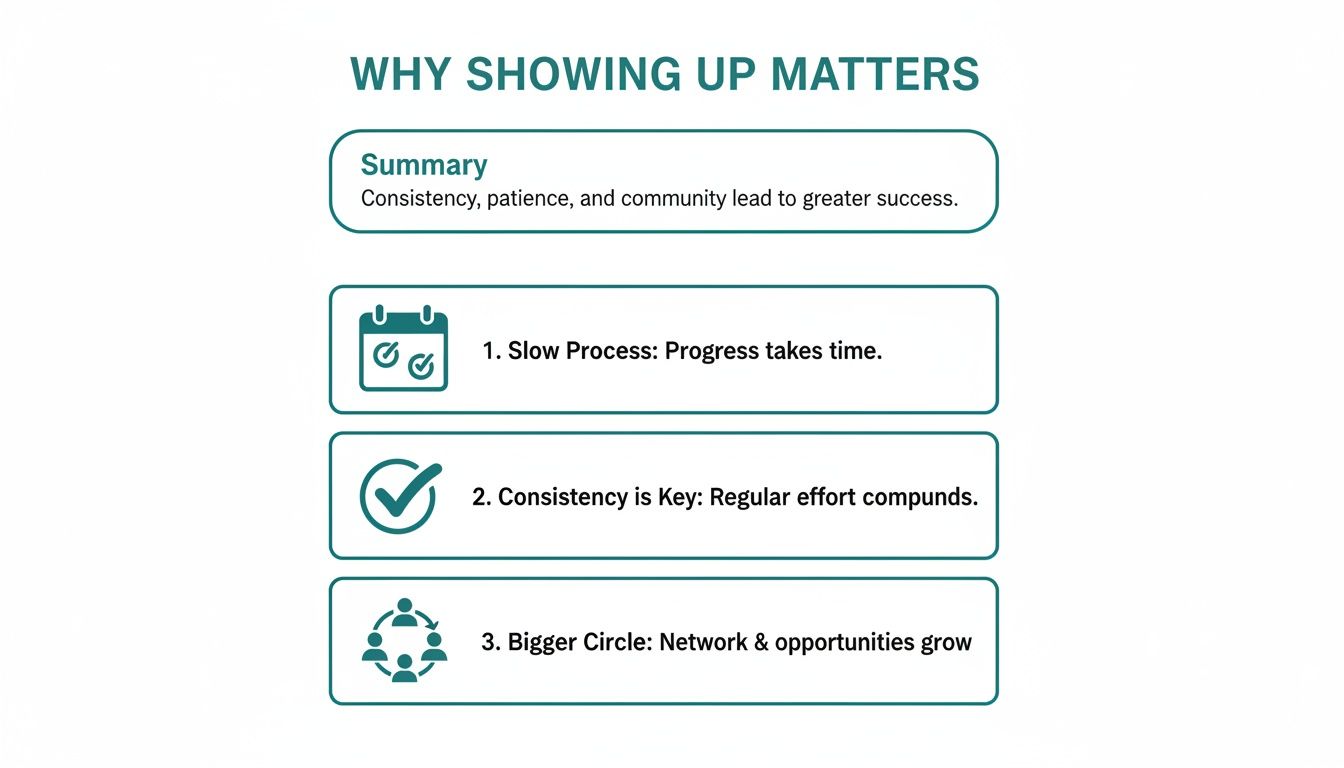
    An infographic titled 'Why Showing Up Matters' with a summary and three points on consistency, progress, and networking.

    As you can see, just showing up consistently builds the foundation. Now, you’re ready to build the house on top of it.

    Your Script for Taking the Leap

    You don't need some grand, perfectly-planned event. Small, low-stakes invitations are your secret weapon. The whole idea is to make it casual and incredibly easy for them to say yes.

    Give these a shot. They're simple, direct, and they work:

    • The Group Invite: "Hey, a few of us are grabbing coffee after this, want to join?" This is my go-to. It's low-pressure because it’s not a one-on-one spotlight.
    • The Callback: "I loved hearing about your hiking trips. I'm checking out a new trail next weekend if you're free." This is powerful. It demonstrates that you were actually listening and remembered something specific about them.
    • The Neighborhood Connection: "You mentioned you live in Logan Square too, right? There’s this amazing taco spot I’ve been meaning to try if you’re around next week." This uses shared geography to make a get-together feel super convenient and organic.

    Each of these lines is a bridge. It takes your connection from the "public square" of your group activity to a more personal space. If you're looking for more inspiration, checking out different community building activities for adults can spark some great ideas. It's all about turning a shared moment into a real friendship, one small invitation at a time.

    Embracing Your New City and Your New Self

    Landing in a new city feels like you've been given a blank social calendar to fill, but it’s so much bigger than that. It’s an invitation to meet a new version of yourself—someone who’s a little braver, more resilient, and deeply connected to the world around them.

    This whole journey isn't just about finding people. It's about becoming someone you’re actually proud to be.

    Picture your new city like a giant, unfinished sculpture, and you've just been handed the chisel. Every time you show up for your community, you’re not just carving out a spot for yourself; you’re literally shaping the city itself. When you join a group to clean up a neglected park, you're not just picking up trash. You're making a statement: "I care. I am part of this place now."

    From Stranger to Stakeholder

    That mindset shift—from a passive bystander to an active participant—changes everything. Suddenly, the city isn't just a backdrop anymore. It's yours. That sense of ownership is an incredibly potent force. It’s the difference between renting a life and truly building one.

    By pouring your time and energy into your new home, you're also investing in yourself. You’re teaching yourself that you can show up, even when it’s uncomfortable, and proving that your actions have a tangible, visible impact.

    "The friendships you build will be a direct reflection of this newfound confidence and resilience. They're not just a reward for your effort; they are the evidence of your growth."

    The discomfort of being new isn't a red flag; it's the raw material for transformation. Every awkward conversation, every solo outing, every pang of uncertainty is an opportunity. It’s a chance to shed old habits and step into a more courageous version of yourself.

    The Real Reward of Showing Up

    The real goal here isn’t just to have people to call on a Friday night. It's about building a life that feels meaningful from the inside out. The kindness you show your city, you learn to show yourself. The consistency you bring to a volunteer group, you learn to bring to your own goals.

    The friendships that grow from this kind of fertile ground are just different. They’re rooted in shared values, mutual respect, and the quiet understanding that comes from working side-by-side on something bigger than yourselves.

    • You learn resilience when you show up on a cold morning you’d rather spend in bed.
    • You build confidence every time you start a conversation with a stranger.
    • You discover kindness by doing something for a community that is now yours.

    This entire process is about more than just finding your people. It’s about becoming one of them. It's about looking at the map of intimidating streets and finally seeing a home, filled with faces you know and stories you helped write. If you're ready to dive deeper, exploring different community engagement strategies can give you a powerful roadmap.

    Questions Everyone Asks About Making Friends

    Trying to build a social circle in a new city feels a lot like fumbling through a foreign language. You know what you want to connect about, but everything feels awkward and clunky at first. That's totally normal. Here are a few things people always wonder about.

    How Long Does This Actually Take?

    Let's be real: there’s no magic number here. Think in terms of seasons, not weeks. Building the kind of trust and inside jokes that friendships are made of takes real, consistent effort. It's a slow burn, not a house fire.

    Commit to one weekly group for at least 3-6 months. That's a realistic runway. It gives you enough time to get past the initial "hello, what do you do?" phase and lets some real roots grow. It's way slower than it was in school or college, and that’s okay. The goal isn't speed; it's finding your people.

    What if I'm an Introvert?

    If the thought of non-stop socializing makes you want to curl up and hide, I get it. The trick is to focus on activity-based groups where the shared task is the main event, not the conversation.

    When you're all focused on gardening, cleaning up a park, or building something, the pressure to be "on" just melts away. You can chat about the task at hand, have short, natural conversations, and then step back when your social battery is low—without anyone thinking you're being rude. You'll leave feeling energized by what you accomplished together, not drained by small talk. A shared purpose is an introvert's secret weapon.

    "Reframe the act of asking as a victory in itself—it's an act of courage. One 'no' is just a data point, not a verdict on your worth. Consistency and bravery will always win out over time."

    What if They Say No?

    Rejection stings. It just does. But it's almost never as personal as it feels in that gut-punch moment. People have messy, complicated lives. A "no" is usually about their own chaotic schedule, a bad day, or a prior commitment they can't break. It's about their life, not about you.

    Don't let it throw you off your game. Keep showing up. Keep being that friendly, reliable person in the group. And then, extend another small, low-pressure invitation to someone else. You can even try asking the same person again in a few weeks! Each time you ask, you're practicing courage. You're building resilience. And you're getting one step closer to the "yes" that's definitely on its way.


    At Litter Caterpillars, we know that showing up for your city is the best way to find your people. Our weekly cleanups are about so much more than trash. They’re about building real connections, practicing bravery, and creating a community where everyone belongs. Come see how picking up litter can completely change your social life.

    Learn more and sign up for a weekend event at https://www.littercaterpillars.com.