Category: Uncategorized

  • A Giver’s Guide to the Trees in Illinois

    A Giver’s Guide to the Trees in Illinois

    Illinois is home to an incredible world of trees. You've got the mighty Bur Oak—our state tree—the tough-as-nails Shagbark Hickory, and countless others just trying to make it in the city. The best trees in Illinois really just depend on where you’re standing. Are you in one of our sprawling oak-hickory forests, or are you navigating the concrete jungle of Chicago where only the strong survive?

    This guide is my personal introduction to all of them.

    Our Story Begins Under a Chicago Tree

    Happy people under umbrellas in a rainy watercolor cityscape with a large tree.

    Let me tell you how this all started. It wasn’t in some stuffy meeting room with slide decks and goals. No. It was me, a few friends, and some strangers who’d soon become family, all huddled together under a single tree during a wild Chicago hailstorm. You know the kind. The sky just opens up, throwing marbles at you from above.

    We were all freezing, maybe a little scared, but we were safe. That single, sprawling tree was our shelter. In that moment, it wasn't just wood and leaves; it was our guardian. It was a silent protector in a city that can feel so harsh.

    Finding Connection in Our Urban Forest

    Something clicked for me then. That tree taught me a lesson I’ll never forget: our connection to the world around us is real. It's powerful. It's personal. It’s a bond you feel deep in your bones, a primal sense of belonging that you can't just read about in a book.

    This guide is my invitation for you to find that same connection. I want you to see the trees in Illinois not as green background noise, but as living, breathing partners in our mission. They are our allies in building a better, kinder, and tougher city.

    This is your field guide to becoming an ally for our urban and wild forests. It's inspired by the simple, powerful act of showing up for your community and for the nature that protects it.

    From the ancient, gnarled oaks that have stood for centuries to the tiny, hopeful saplings we plant in forgotten city lots, these trees are symbols of resilience. They’re beacons of hope that remind me that growth is always possible. We see it firsthand in our work, like our efforts to bring more green life to communities like Garfield Park.

    This guide is more than just tree ID. I want to help you understand the stories these silent giants tell and learn how we can become part of their story, too. Let’s explore the magnificent trees that make Illinois our home.

    The Incredible Comeback Story of Illinois Forests

    Watercolor illustration of young trees, old stumps, and birds in a field at sunset.

    It’s hard to picture now, driving past endless miles of corn and soybeans, but Illinois was once almost entirely wrapped in a blanket of forest. Can you imagine it? A near-unbroken canopy of oaks, hickories, and maples stretching from the Wisconsin border clear down to the Ohio River. An ocean of green.

    Then, we showed up. For a century, from 1820 to 1920, the constant sound was the ring of axes and the grind of saws. In what felt like the blink of an eye, we cleared the land with brutal efficiency to build our farms and our cities.

    The loss was staggering. We wiped out nearly all of our original, ancient forests. It’s a loss so big it’s hard to even wrap my head around. It’s like tearing down a cathedral to build a parking lot. But that’s not where the story ends. It’s where the real work begins.

    The Quiet, Powerful Return

    This is the story of resilience that inspires everything I do. Since the middle of the 20th century, the trees in Illinois have been staging a quiet, powerful comeback. It wasn’t a single grand plan, but millions of small, stubborn acts of regrowth. Life finds a way.

    This isn't just a history lesson. It's living proof that recovery is possible. It’s a testament that even after we’ve made a huge mess, new life can take root, find the light, and flourish again.

    The numbers tell an amazing story. After hitting rock bottom in the early 1900s, our forests have bounced back to cover nearly 5 million acres. That’s a gain of around 2 million acres—an area bigger than the entire state of Delaware—reclaimed by nature. You can explore the full story of this remarkable forest recovery and what it means for the future.

    And it wasn't just about the number of trees, but the type of trees. Between 1962 and 1985 alone, the number of maples exploded, increasing by an almost unbelievable 41-fold. The forest was changing its own identity. It was adapting.

    From Wasteland to Woodland

    So how did this happen? It’s a story of changing priorities and a lot of dedicated people. As old farm fields were abandoned, pioneer trees like cottonwoods and silver maples were the first ones to rush in, their seeds carried on the wind and water to reclaim the bare soil.

    They were the first responders, preparing the ground for the slower, more patient species. Oaks and hickories started to follow, their acorns planted by squirrels who’d long forgotten their winter stashes. Slowly, decade by decade, the deep woods started to breathe again.

    This comeback story is the exact reason we do what we do as Litter Caterpillars. I look at a trashed-out lot—a forgotten space choked with weeds and garbage—and I see the potential for life. I see the ground where a new tree could grow.

    Every piece of litter we pick up is like clearing the way for a sapling. Each bag we fill is an act of faith in the future. We’re proving, block by block, that transformation is possible and that even the most damaged places can become vibrant and full of life again. The trees themselves showed us how.

    Meet the Real Stars of Our Neighborhoods

    Forget the skyscrapers for a second. It's time for you to meet the real, living landmarks of our local ecosystem. Think of this as my personal introduction to the most important native trees you'll find all across Illinois, from the wild riverbanks to your own city block.

    Getting to know these trees is like learning the names of the old-timers in your neighborhood. It changes how you see the place. A simple walk becomes a conversation, connecting you to the natural world in a way that feels like coming home after being away for too long.

    The Wise Old Guardian: Bur Oak

    Let's start with the undisputed king of the prairie, our official state tree: the Bur Oak (Quercus macrocarpa). When you stand next to a mature Bur Oak, you feel it. This isn't just wood and leaves; it's an ancient being. Its bark is so thick and deeply furrowed it looks like the wise, wrinkled face of a grandparent who has seen it all.

    That thick, corky bark isn't just for looks. It's fire-resistant armor. For centuries, as natural fires tore across the Illinois prairies, these oaks just stood their ground, their tough exteriors protecting the life inside. They are true survivors. Finding one is like shaking hands with history itself.

    You’ll know a Bur Oak by its acorns, too. They have a unique, fuzzy look, wearing a fringed, shaggy cap that covers more than half the nut. It’s unmistakable.

    The Rugged Individualist: Shagbark Hickory

    Next up is a tree with a personality you can't ignore: the Shagbark Hickory (Carya ovata). If the Bur Oak is a stoic king, the Shagbark is a rugged frontiersman. You’ll recognize it instantly by its bark, which peels away from the trunk in long, curving strips. It looks like it’s wearing a shaggy coat it refuses to take off.

    This isn't just a fashion statement. Those peeling strips of bark create tiny, sheltered apartments, perfect for small bats and insects. It’s a living high-rise for some of our state's most important tiny creatures.

    The Shagbark Hickory reminds me that sometimes, our weirdest features—the things that make us look a little rough around the edges—are the very things that provide shelter and value to others. It’s a powerful lesson in finding strength in what makes you different.

    In the fall, squirrels go crazy for their nuts. If you're lucky enough to find some, they have a sweet, rich flavor that’s a true taste of the Illinois woods.

    The Sky-Reaching White Pine

    We think of Illinois as a land of hardwoods, but we have our own magnificent native evergreen: the Eastern White Pine (Pinus strobus). These trees absolutely tower over the landscape, especially in places like Starved Rock State Park. Their feathery needles create a soft, hushing sound in the wind. It's a sound that stills your soul.

    Here’s a simple trick I use to identify a White Pine. Just count the letters in the word "W-H-I-T-E"—there are five. Now, look at the pine needles; they grow in bundles of five. It's a handy trick that never fails.

    These pines bring a different kind of beauty, especially in winter. Their green branches are a bold promise of life against the stark white snow. Their presence offers a sense of permanence and peace, a vertical reach for the sky that inspires you to stand a little taller yourself.

    Learning to Speak Tree

    Getting to know the trees around you is a journey, not a pop quiz. You don’t need to memorize Latin names or become a botanist overnight. Just start small. Start paying attention.

    • Look at the bark: Is it smooth like a Beech, shaggy like a Hickory, or deeply ridged and tough-looking like an Oak?
    • Check out the leaves: Are they shaped like an open hand, like a Maple? Are they simple and oval, or are they complex, made up of many smaller leaflets?
    • Notice the shape: Does it stand tall and straight like a Tulip Tree, or does it have wide, muscular branches like an old Oak?

    Each of these details is a clue, a piece of a story. By learning to read them, you start to understand the language of the forest. You’ll begin to notice the subtle shifts—the first buds on a Redbud, the insane fall color of a Sugar Maple, the stark and beautiful silhouette of a Sycamore against a winter sky. These are the unsung heroes of Illinois, and they have so much to tell us if we just take a moment to stop and listen.

    Planting the Right Tree in the Right Place

    Planting a tree is an act of hope. I get it. I see it as a promise to the future, a gift you’re giving to a neighborhood you might not even live in 30 years from now. But in a city like Chicago, it’s not just about digging a hole and walking away. You have to be a matchmaker.

    You’ve got to pair the right tree with the right spot. It’s like building a team—you wouldn’t put your toughest member on an easy job and expect them to feel useful. I’ve learned this the hard way, by seeing what thrives and what dies on our city streets. This is my playbook, learned from getting my hands dirty.

    The Street Fighters

    Let's start with the toughest job: the parkway. That little strip of hell between the sidewalk and the street. It’s a battleground. The soil is packed down like concrete, it gets blasted with road salt all winter, and it bakes in the summer heat reflecting off the asphalt. Only the strong survive here.

    These are the trees I call the ‘street fighters.’ They’re built for the front lines.

    • Ginkgo (Ginkgo biloba): These trees are basically living fossils, and they act like it—they’re almost indestructible. They take pollution, salt, and tight spaces without a fuss. Their fan-shaped leaves turn a crazy, brilliant yellow in the fall. Just one crucial tip: you must plant a male tree. The females drop fruit that smells famously awful. Trust me.

    • Honeylocust (Gleditsia triacanthos inermis): You see this tree everywhere in Chicago, and for good reason. It’s a workhorse. Its fern-like leaves create a nice dappled shade that doesn’t plunge your street into darkness, and it’s tough as nails. The ‘inermis’ part is key—it means you’re getting a thornless variety!

    • London Planetree (Platanus x acerifolia): A hybrid cousin of our native Sycamore, this tree is an absolute champion of city life. Its best feature is its peeling, camouflage-patterned bark. It sheds in patches to show off layers of cream, olive, and brown. It's a true piece of living art you can enjoy all year.

    Small Yards, Big Impact

    Got a small backyard? You don’t need a giant space to make a huge difference. For the smaller spots, you need a tree that delivers a big show without taking over the whole yard. You’re looking for a specialist, not a giant.

    My absolute go-to for this is the Serviceberry (Amelanchier). In spring, it’s covered in delicate white flowers, a critical first meal for waking bees. By summer, you get delicious berries you can share with the local robins (if you're fast enough). Then in fall, its leaves erupt in shades of orange and red. It’s a perfect, four-season performer that gives back constantly.

    Choosing the right tree isn't just a gardening decision; it's a community one. A well-placed tree becomes a shared asset—giving shade, beauty, and a home for wildlife that benefits everyone on your block for generations.

    A great first step on this whole journey is just learning to see the trees already around you. This flowchart is a simple starting point. I use it to help people figure out what they’re looking at by focusing on two of the biggest clues: the bark and the leaves.
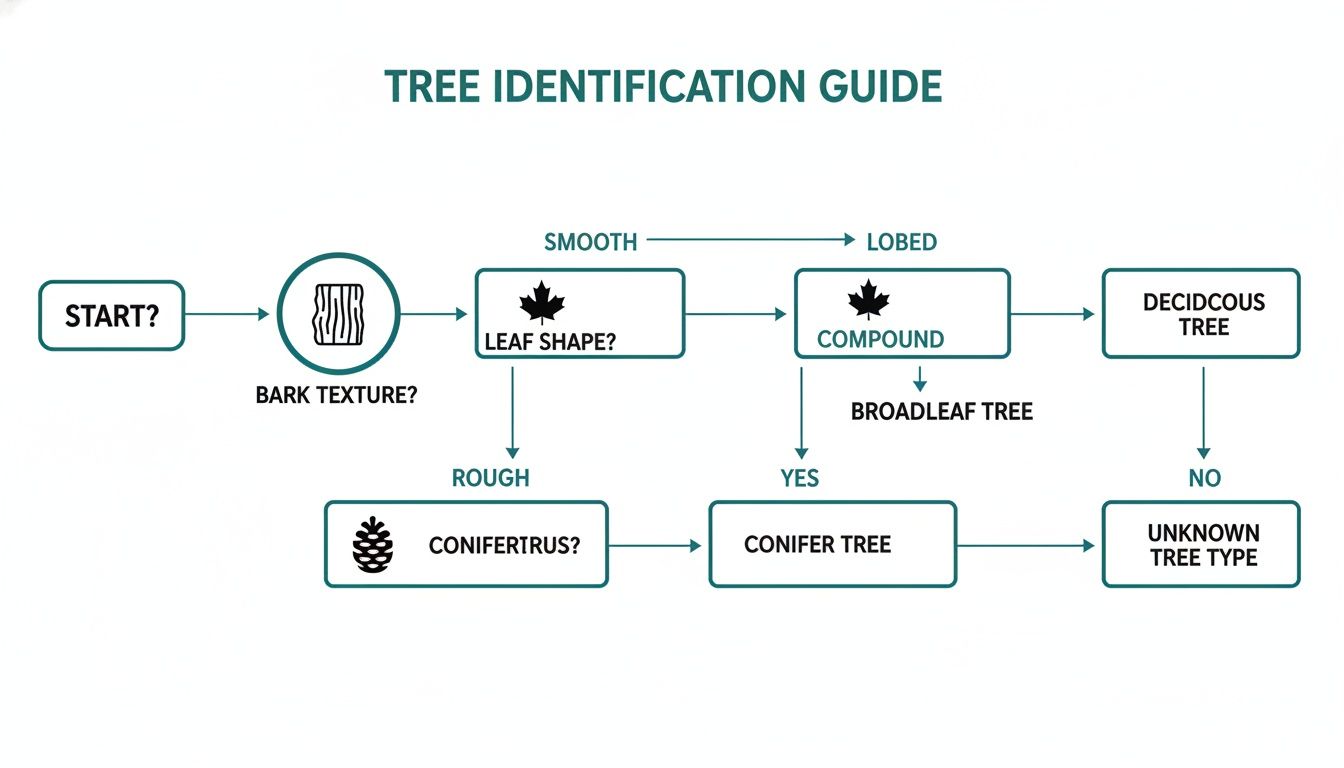
    A tree identification guide flowchart illustrating steps to determine tree type based on bark texture and leaf characteristics.

    By just looking—really looking—at a couple of key features, you start to unlock the identities of the silent giants that make up Chicago's urban forest.

    For a quick reference, think of choosing a tree like picking a teammate for a specific challenge. Here’s a breakdown I put together for some common Chicago situations.

    Choosing Your Chicago Tree Teammate

    Situation Top Tree Choices Why It Works
    The Parkway "Hellstrip" Ginkgo (male), Honeylocust, London Planetree Ultra-tough. Handles salt, pollution, and compacted soil.
    Small City Backyard Serviceberry, Redbud, Pagoda Dogwood Four-season interest without getting huge. Great for wildlife.
    Need for Fast Shade Freeman Maple, Northern Catalpa Grows quickly to provide canopy, but be mindful of placement.
    Under Power Lines Crabapple, Hawthorn, Serviceberry Stays short and won't interfere with utility lines.

    This isn't an exhaustive list, but it's a solid start for finding a tree that won't just survive, but actually thrive, where you plant it.

    Trees to Think Twice About

    Just as important as knowing what to plant is knowing what not to plant. Some trees are just a headache waiting to happen in a city. The Silver Maple (Acer saccharinum) is a perfect example. Sure, it’s beautiful and grows incredibly fast, but its wood is weak and branches snap off in storms. Its aggressive, shallow roots are notorious for cracking sidewalks and busting into sewer lines.

    I love a Weeping Willow as much as the next person, but its water-hungry roots make it a huge risk near any kind of plumbing. Being a good tree matchmaker means thinking about the long game. It means you’re planting a legacy, not a liability.

    Why Every Single Tree Is a Community Treasure

    So why do I do this? Why do we haul ourselves out of bed on a Saturday morning to plant saplings or pick nasty, soggy trash from the base of a tree? Why are we so obsessed with the trees in Illinois?

    I'll tell you why. Because I’ve learned that every single tree is a quiet, tireless fighter.

    It's easy to walk past one and just see, well, a tree. Shade and leaves. But you're not just walking past a plant; you're walking past a living, breathing piece of infrastructure that’s working its branches off for you, 24/7.

    The Invisible Economics of Our Urban Forest

    Let's talk about money. Yeah, money. Because that leafy canopy over your street? That’s not just pretty. It’s an economic powerhouse. It's literally money growing on trees.

    It's a hard fact, not some fuzzy feeling. Those trees are boosting property values and slashing our insane summer energy bills by being the best natural air conditioners on the market.

    When you add up all the trees lining our streets across the state, the numbers get wild. Illinois has an estimated 6.5 million street trees, and their combined value is over $3 billion. They aren't just decorations; they're an asset, a public investment paying us back every single day. If you don't believe me, just read more Illinois forest facts and see how crucial these green giants are.

    An Ecological Goldmine in Our Backyard

    Okay, the money is cool. But that’s just the tip of the iceberg. The real magic is what these trees do for the living world all around us. They are the foundation of everything.

    Think of our forests as sprawling, chaotic, vibrant cities for wildlife. They're the apartments, the grocery stores, and the nurseries for a staggering number of creatures. You take away the trees, and the whole symphony of life in Illinois just stops.

    A single oak tree can support over 500 species of caterpillars. Those caterpillars then become the baby food that keeps our bird populations alive. When you plant one native tree, you’re not just planting a tree—you’re opening a five-star, all-you-can-eat buffet for the entire local food web.

    These giants are also our planet’s lungs, and we get to breathe the fresh air they pump out for free. They're constantly scrubbing the filth from our cars and factories out of the air we breathe. They suck up the carbon dioxide warming our planet and trade it for the clean oxygen we need to exist.

    Just look at the workload they carry:

    • Air Purifiers: They trap dust, ash, and all sorts of nasty junk floating in the air.
    • Water Managers: Their roots are like a massive sponge, soaking up stormwater runoff that would otherwise flood our streets and basements.
    • Wildlife Sanctuaries: They are the backbone of the habitats that support 75% of our state’s native wildlife.

    Every single tree is a champion, fighting for a healthier, wealthier, and more alive Illinois. That’s why we show up. That’s why we fight for every sapling and protect every old giant. We’re not just picking up litter; we’re defending our community’s most valuable treasures.

    So, You Want to Help? Here's How You Can Actually Do It.
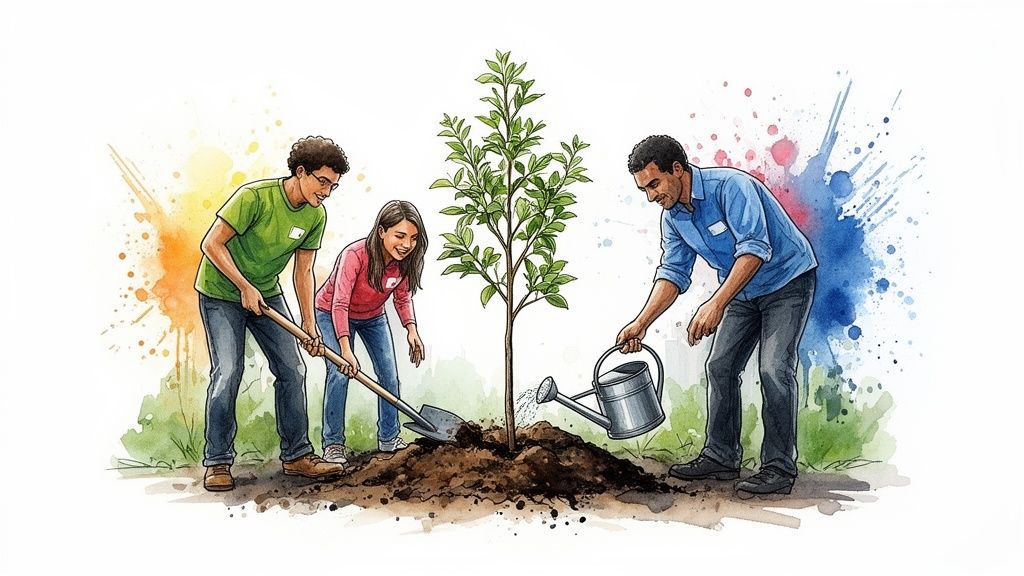
    A diverse group of people planting a young tree, one person watering it.

    You feel that little nudge, right? That feeling after reading all this that you should do something. Good. Hold onto that. Inspiration is the easy part. The hard part—the part that matters—is turning that feeling into action.

    This is my personal invitation to you. This is where you stop just reading and start doing. I'm going to show you exactly how to get your hands dirty with us, the Litter Caterpillars.

    From Feeling Good to Doing Good

    Our mission is simple. We show up. Every single week, we’re out there cleaning up our city, and a huge part of that is protecting the trees in Illinois. When we haul bags of garbage away from the base of a tree, we're doing more than just making the street look pretty.

    It's a rescue mission.

    That trash isn't just ugly; it’s poison. It leaches chemicals and microplastics into the soil, contaminating the water and nutrients a tree desperately needs. It literally suffocates the roots, blocking out the air and rain they need to breathe. Our cleanups are the first line of defense for these silent giants.

    It’s about taking that good feeling you have right now and turning it into good work. It’s about building a real legacy of growth and kindness that you can point to and say, "I helped make that happen."

    Just look at Caterpillar Park in Englewood. We won that forgotten, trash-covered lot at a city auction. Now, we're transforming it from a wasteland into a living, breathing park, one cleanup and one tree at a time. This is the story we’re writing, proving no place is a lost cause if someone is willing to show up.

    Your Hands Can Build the Future

    Joining us is step one. You’re not just picking up somebody else's mess. You are reclaiming land for the community and for nature. You are becoming a guardian for the trees that give us shade, clean air, and life.

    The history here shows you just how big the stakes are. Illinois went through one of the most insane deforestation events in American history, losing an estimated 13.8 million acres of forest between 1820 and 1920. That history shows how fast things can be destroyed, but it also sets the stage for the comeback story that groups like ours are fighting for. You can read more about this historical shift to see why our work is so damn important.

    We’re just one part of a bigger movement. If you want to do even more, I want you to check out these other incredible organizations:

    • Openlands: These guys do amazing work planting trees all over Chicago and pushing for huge green spaces. Their community tree planting events are a perfect way to make a direct impact.
    • The Morton Arboretum: It’s a bit outside the city, but they have tons of volunteer opportunities. You can help with big forest restoration projects or care for their world-famous tree collections.
    • Chicago Parks District: They’re always looking for people to help with park cleanups, gardening, and stewardship days in local parks across all neighborhoods.

    This is all about becoming a guardian of your own environment. If you want to dig deeper into what that means, you might want to check out our guide to environmental stewardship.

    We are so much stronger together. That feeling you have right now? That's the beginning of something real. Let’s get to work.

    Answering Your Questions About Illinois Trees

    Out on the streets, picking up trash or digging a hole for a new sapling, I get asked a lot of questions. I love it. Questions mean you're starting to look closer. You're seeing the trees in Illinois not just as green background noise, but as living, breathing parts of our community.

    You're not the only one asking. Every question is a sign that you’re ready to become a real guardian for our city's forest. Here are the real answers to the things people ask me most often.

    What Is the Most Common Tree in Illinois?

    That’s like asking what the most common food is in Chicago—it really depends on where you are. If you head out into what's left of our wild spaces, you'll find yourself in oak-hickory country. Trees like the massive White Oak, the Red Oak, and the rugged Shagbark Hickory are the undisputed kings, the true backbone of our state's natural heritage.

    But here in the city? It’s a totally different ballgame. Life on a Chicago street is brutal. We depend on the tough guys: Honeylocusts, different kinds of Maples, and Lindens. I've seen these trees planted time and again because they have the grit to survive compacted soil, road salt, and everything else we throw at them.

    Can I Plant a Tree on My Parkway in Chicago?

    Yes, but you absolutely have to play by the city's rules. That little strip of grass between the sidewalk and the street—the parkway—isn't yours. It belongs to the city, so you can't just start digging.

    The best and easiest way is to request a free tree directly from Chicago's Bureau of Forestry. You can also sometimes get a permit to plant one yourself, but it has to be a species from their approved list. This isn't just red tape; I've seen it firsthand, it’s to keep you from planting something that will eventually destroy a sewer line or get tangled in power lines. Your first move is always to call 311 or search for the "Street Trees" program on the city's website.

    Think of it like this: cleaning up litter is a health check for our urban trees. When you join one of our cleanups, you're not just making a park look better—you're giving our trees a fighting chance to actually breathe and grow.

    How Does Cleaning Up Litter Actually Help Trees?

    It helps more than you can imagine. Picture a tree’s roots like its mouth. When trash sits on the ground, every rainfall washes a nasty cocktail of chemicals, oil, and microplastics from that junk straight into the soil. You're literally poisoning the tree's dinner.

    Worse, a thick mat of litter acts like a plastic bag over the soil. It smothers it, blocking water and oxygen from getting to the roots. It's like forcing the tree to drink through a clogged straw. Even holiday cheer can turn into trash; I always tell people to learn how to recycle Christmas trees in Chicago to help cut down on waste.


    Your journey to becoming a steward for Illinois's trees starts with one small action. Join Litter Caterpillars at our next event. We’ll supply the gloves, the bags, and the community. You just bring your willingness to do the work. Find your event at https://www.littercaterpillars.com.

  • 7 Incredible Sources for Plastic Pollution Pictures to Inspire Action in 2026

    7 Incredible Sources for Plastic Pollution Pictures to Inspire Action in 2026

    A single picture can change your world. Think about it. One photograph ignites a movement. It shifts your perspective. It can inspire you to take action. This is the power you hold when you share compelling plastic pollution pictures. But finding the right image, one that tells a story and moves people, feels like searching for a message in a bottle. Where do you even begin?

    I’ve been there. I’ve scrolled endlessly, trying to find that one perfect shot, the one that screams with the urgency of our planet’s plastic crisis for my social media post or a community presentation. That’s why I created this guide for you. It's not just a list; it’s your personal atlas to the most impactful visual resources I’ve found online.

    I will show you a curated collection of the best platforms for sourcing powerful images. For each one, I’ll show you exactly what they offer, complete with screenshots, direct links, and my clear guidance on usage rights. We'll explore everything. From free, high-quality photos perfect for activists like you on a budget to professional-grade editorial content for major campaigns. My goal is simple: I want to help you find the visuals you need to tell your story, inspire your community, and make a real difference. Let’s dive in and find your spark.

    1. NOAA Marine Debris Program – Photo & Multimedia Galleries

    When you need authoritative, compelling plastic pollution pictures for your school project, a nonprofit report, or a community presentation, the NOAA Marine Debris Program’s gallery is your first stop. Imagine it’s a national archive of our country’s fight against marine debris. It’s not just a random collection of images; it's a curated library, and it tells the real stories of pollution and cleanup from our oceans, our rivers, and our Great Lakes.

    What I love about this resource is its credibility. These aren't just snapshots; they are pieces of evidence. Each image I find there often comes with detailed captions telling me exactly where and when it was taken, providing the context I need to build a powerful narrative for you. You can see the direct impact of a hurricane on a coastline in Florida or the dedicated work of volunteers cleaning a beach in Oregon. It’s real.

    Why It's a Go-To Source

    This platform stands out because it's a U.S. government resource. That means most of the imagery NOAA created is in the public domain for us to use within the United States. For activists, educators, and nonprofits like us working on a shoestring budget, this is gold. You get high-quality, mission-aligned content without worrying about complex licensing fees. It’s an incredible tool for anyone documenting the problem and exploring the many solutions for pollution in our oceans.

    Getting the Most Out of the NOAA Galleries

    The website is straightforward, but here’s how I use it like a pro, and you can too:

    • Filter with a Purpose: Don't just browse. You should use their curated galleries like "Types of Marine Debris" or "Cleanup Activities" to find exactly what you need. Are you focusing on abandoned fishing gear? There's a section for that.
    • Check the Fine Print: I always do this. While most images are public domain, some are contributed by partners and may have different usage rights. Always click on an image and check the "Credit" or "Image Use" line. It's a simple step that ensures you're using the photo correctly. NOAA kindly requests a credit from you, which is a small price to pay for such a valuable resource.
    • Tell the Full Story: I suggest you pair a shocking image of debris with an inspiring one of a cleanup effort from the same gallery. This helps you create a more complete and hopeful message that moves people from awareness to action.
    Feature Summary How You Can Use It
    Public Domain (U.S.) I use images freely for educational, editorial, and nonprofit work without licensing costs. You can too.
    Authoritative Captions You can add credibility to your reports and presentations with accurate location and date information.
    Curated Galleries I quickly find specific types of pollution or cleanup photos to fit my campaign's theme.
    U.S. Focus You can showcase local and national impact, from the Great Lakes to the Gulf Coast.

    This isn't just a place for you to find plastic pollution pictures; it's a tool I use to build a more persuasive and authentic case for protecting our waters.

    Visit the NOAA Marine Debris Program Gallery

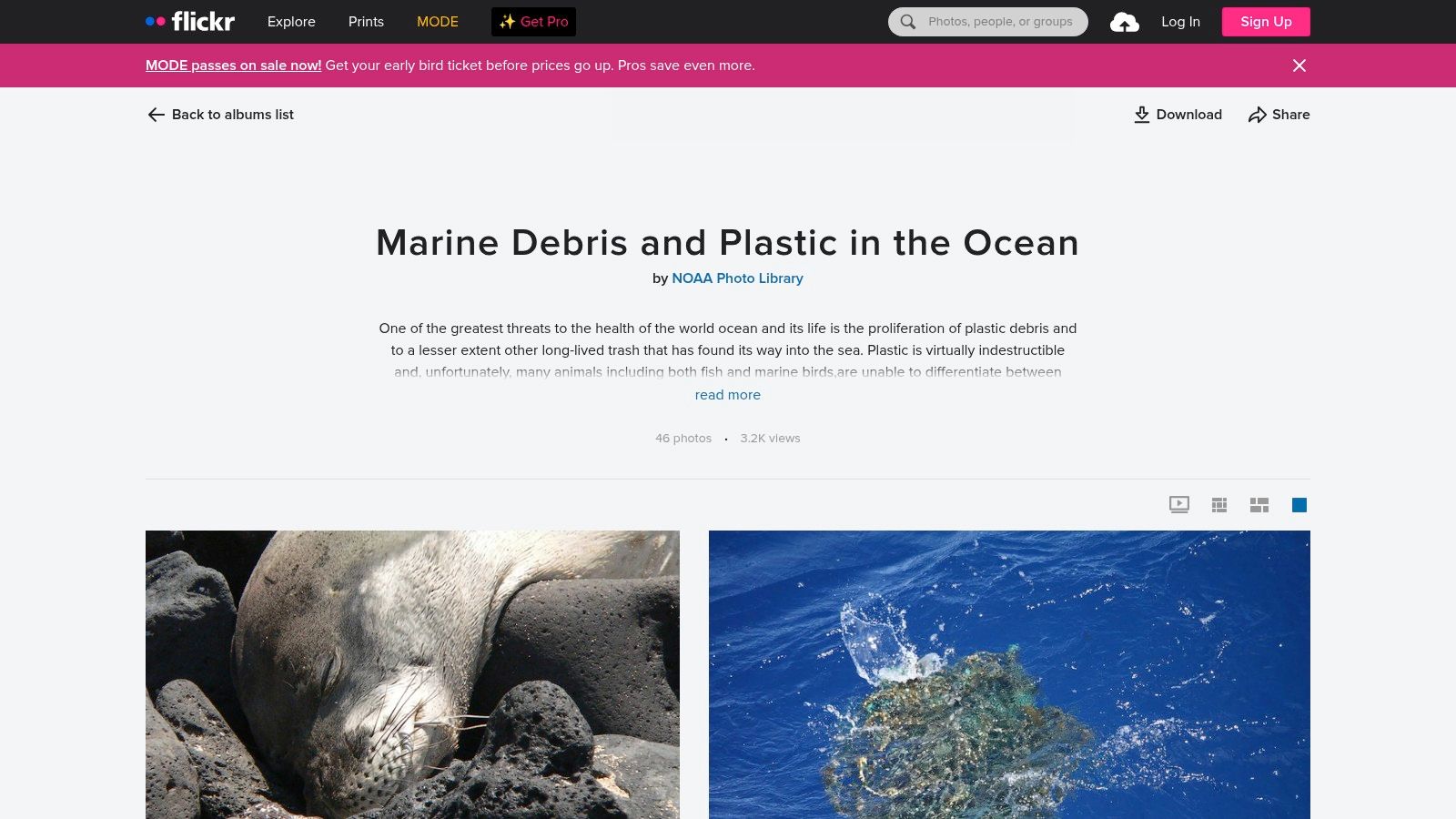
    2. NOAA Photo Library – Marine Debris & Plastic (Flickr albums)

    If the main NOAA gallery is a curated museum, then its Flickr presence is the sprawling, public archive in the museum’s basement. I think of it that way. This collection is a treasure trove for anyone like you who is digging deeper into the history and scope of plastic pollution pictures. It feels less formal, but it's vast, containing hundreds of historical and contemporary images that document decades of my country's research and cleanup efforts.

    I often find myself lost in these albums. Not just because of the shocking photos of entangled wildlife, but because of the stories they tell me. You can find a black-and-white photo of debris from the 1980s right next to a high-resolution shot of a modern-day beach cleanup. It's a powerful visual timeline of how long we’ve been fighting this battle and how the problem has evolved. It tells a story.

    NOAA Photo Library – Marine Debris & Plastic (Flickr albums)

    Why It's a Go-To Source

    I find this source fantastic for its sheer volume and the raw, unfiltered nature of its content. Because it’s on Flickr, a platform I know was built for photographers, you get multiple download sizes for free. The public-domain status of most NOAA-created images makes this a goldmine for students, activists, and small nonprofits who need powerful visuals without a budget. You'll find it perfect for showing the long-term impact of our throwaway culture.

    Getting the Most Out of the NOAA Flickr Albums

    The Flickr interface can feel a bit chaotic if you're used to polished stock sites. Here’s how you can navigate it effectively:

    • Explore the Albums: You shouldn't just search. Start with the dedicated album, "Marine Debris," to see the most relevant images grouped together. From there, you can dive into tags and related photos.
    • Always Double-Check Credits: This is crucial for you. I can't stress this enough. While most images are public domain in the U.S., some are from partners and have different rules. You must look at the description on each photo page for "Credit:" or "Image Use:" notes before you download. It’s a simple check that keeps your work honest.
    • Use for "Then and Now" Stories: The historical depth is this collection's superpower. I love pairing an old photo of plastic bottles from the 90s with a new one to show that this problem isn't new. This creates a compelling narrative about urgency and the need for lasting solutions for you.
    Feature Summary How You Can Use It
    Public Domain (U.S.) You can download and use high-resolution images for free in your projects, especially for NOAA-created content.
    Historical & Deep Catalog You can create powerful before-and-after or "then vs. now" visual stories for educational content.
    Flickr Album Structure I browse themed collections like "Marine Debris" to find specific, relevant images quickly.
    Multiple Download Sizes You can get the right image resolution for any use, from a social media post to a large presentation slide.

    This isn't just a random photo dump; it’s a living archive I use that offers a unique perspective on our long and complicated relationship with plastic.

    Visit the NOAA Photo Library on Flickr

    3. Getty Images – Plastic Pollution (Creative + Editorial)

    When your project demands the kind of plastic pollution pictures that stop you in your tracks, Getty Images is the industry standard. Imagine it as the world’s premiere visual archive, a place where top-tier photojournalists and creative photographers document our plastic crisis with unparalleled artistry and emotional impact. This is where I go for broadcast-quality visuals that can anchor a national campaign or a high-stakes corporate presentation you might be giving.

    What I admire about Getty is the sheer quality and scope. These aren’t just pictures; they are visual statements. One search can give you a heartbreaking editorial shot of a turtle entangled in a plastic bag, a powerful image from a G7 summit discussion on marine litter, and a polished creative photo of a family cleaning a beach. It’s a complete visual ecosystem for you to tell the story of plastic from every conceivable angle.

    Why It's a Go-To Source

    Getty Images stands out for its professionalism and reliability, especially for high-visibility projects. Their Rights & Clearance services provide me with peace of mind, ensuring that an image is legally sound for commercial or sensitive use. For organizations like yours that need to know their visuals are 100% buttoned up, this is an essential service. It moves your work from simply raising awareness to confidently leading the conversation and exploring how to reduce plastic pollution on a global stage.

    Getting the Most Out of Getty Images

    The platform is massive. I know. But with the right approach, you can find the perfect shot:

    • Differentiate Creative vs. Editorial: You should use the "Editorial" filter for real-world, news-focused events (like protests or policy meetings). Then you switch to "Creative" for more conceptual, art-directed images that evoke a specific mood or idea. Knowing the difference is key to finding the right fit for your message.
    • Plan Your Budget: Getty is a premium service. I've learned that you can purchase single images or use prepaid "image packs" for a better per-image rate. For ongoing needs, a subscription might be cost-effective. Plan ahead so you don't get sticker shock.
    • Read the License Carefully: You have to pay close attention to the license type. Editorial images often have restrictions and I find they can't be used for advertising. If you need to use a photo to promote a product or service, you'll need to find one with a commercial license or work with Getty to clear the rights.
    Feature Summary How You Can Use It
    Pro-Grade Curation I find high-impact, emotionally resonant images for major campaigns and presentations here. You can too.
    Rights & Clearance Services You secure legal peace of mind for commercial or rights-sensitive uses.
    Editorial & Creative I choose between real-world journalism and art-directed concepts to fit my narrative.
    Global Scope You can access a deep well of photos covering policy, wildlife, and cleanup efforts worldwide.

    For those moments when only the best will do, Getty Images provides you with the professional plastic pollution pictures needed to make a powerful, lasting impression.

    Visit Getty Images – Plastic Pollution

    4. Shutterstock – Plastic Pollution (Stock photos, vectors, footage)

    When your project demands a specific look or a creative concept beyond simple documentation, Shutterstock is the commercial powerhouse you turn to. This isn't a government archive; it's a massive global marketplace. A bazaar of plastic pollution pictures created by professional photographers, illustrators, and videographers. It’s your creative toolkit for building campaigns, social media assets, and marketing materials with a polished, professional edge.

    What I appreciate about Shutterstock is the sheer volume and variety. You can find everything. I've seen a heartbreakingly artistic shot of a turtle tangled in a plastic bag and a clean, minimalist vector icon of a recycling symbol. It's a different kind of resource, one I designed for when you need to buy a license to create derivative works like website banners, infographics, or even merchandise for a fundraiser.

    Why It's a Go-To Source

    Shutterstock stands out for its commercial flexibility. While I love free resources for reports and educational slides, Shutterstock gives you the licensing you need to confidently run a paid social media ad or print a large-scale banner. With a subscription, I get a consistent supply of fresh, high-quality content, making it a cost-effective choice for organizations that are constantly communicating with their audience about plastic pollution.

    Getting the Most Out of Shutterstock

    The platform is huge, but I can help you find the perfect asset quickly if you know how:

    • Think Beyond Photos: Don't just search for "plastic pollution." You should try "plastic waste vector" to find graphics for an explainer video, or "ocean cleanup aerial footage" for a dramatic opening to a campaign video. The combination of media types is its strength.
    • Use the Advanced Filters: On the search results page, I want you to use the filters on the left to narrow down by orientation (vertical for stories, horizontal for banners), color, and even the number of people in the shot. This saves you from scrolling through thousands of images.
    • Understand the License: For most digital and small print runs, I find the Standard License is fine. But if you're planning a massive print campaign or creating merchandise to sell, you'll need the Enhanced License. You must always check the licensing page before you commit.
    Feature Summary How You Can Use It
    Vast Creative Library You can find photos, vectors, illustrations, and videos to fit any creative brief or campaign style.
    Flexible Licensing You can purchase assets with clear usage rights for commercial marketing, advertising, and web content.
    Subscription Models I access a steady stream of content affordably; you can too if you have ongoing marketing needs.
    Powerful Search Tools You can quickly find specific image styles, orientations, and compositions for your exact needs.

    This is where you go when you need guaranteed quality and the legal clearance to use powerful plastic pollution pictures in every part of your campaign.

    Visit Shutterstock's Plastic Pollution Collection

    5. Adobe Stock – Plastic Pollution (Royalty-free creative)

    For those of us crafting professional-grade social media campaigns, designing flyers, or building impactful reports, Adobe Stock is where creative polish meets powerful messaging. When you need high-quality, royalty-free plastic pollution pictures that have a more artistic or conceptual feel, this is your destination. Think of it as your creative partner that lives right inside your design software, ready to supply the perfect image to make your project shine.

    Adobe Stock – Plastic Pollution (Royalty-free creative)

    What I find incredibly useful is the direct integration with Adobe Creative Cloud. You can search for an image, test it in your Photoshop or Illustrator layout, and then license it right there without breaking your creative flow. I see the pricing and licensing are clear and predictable, which removes my anxiety of accidentally misusing an image.

    Why It's a Go-To Source

    Adobe Stock stands out for designers and marketers like you who need more than just documentary photos. It's filled with illustrations and conceptual photos that can convey the feeling of the plastic crisis, not just the reality. The platform is less about raw photojournalism and more about providing a versatile creative asset for you. While I know the images require payment, the clear licensing terms and easy-to-use platform provide me with peace of mind and save valuable time.

    Getting the Most Out of Adobe Stock

    Here’s how I make this premium resource work for me, and you can too:

    • Test Before You Buy: I want you to use the Creative Cloud integration to place watermarked comps directly into your designs. This lets you see exactly how an image will look before you commit your budget.
    • Go Beyond Photos: Don't just search for "plastic pollution." You should try searching for illustrations, vectors, or even video clips. An animated graphic I use for social media can often be more engaging than a static photo.
    • Understand the License: Pay close attention to the Standard vs. Extended license. A Standard License is perfect for most digital and small-print uses (like your social posts or local event flyers). If you're planning a large-scale ad campaign or creating merchandise, you'll need an Extended License, which I know comes at an additional cost.
    Feature Summary How You Can Use It
    Creative Cloud Integration You can seamlessly search and license images directly within Photoshop or Illustrator to speed up your workflow.
    Clear Licensing Tiers You can confidently use images for web, social, or print by choosing the right license without legal guesswork.
    Illustrations & Vectors I create unique campaign visuals with artistic graphics that complement photographic content.
    Conceptual Imagery You can find powerful, artistic metaphors for plastic pollution to create an emotional connection with your audience.

    Adobe Stock is the perfect tool for you when your message needs that extra layer of professional design to capture hearts and minds.

    Visit Adobe Stock – Plastic Pollution

    6. Unsplash – Free “Plastic Pollution” Photos

    When you need visually stunning plastic pollution pictures that are both artistic and impactful for your blog, social media, or a design project, Unsplash is a goldmine. It's a massive community library of high-resolution photos contributed by photographers from around the world. I want you to think of it less like an evidence locker and more like an art gallery, offering creative, often beautiful, interpretations of the pollution crisis.

    What I find so powerful about Unsplash is its accessibility. For grassroots activists, student groups, or anyone like you working with a zero-dollar budget, this platform provides the visual fuel to get a message out. I find the quality is often breathtaking, giving you polished, professional-looking images that can stop someone from scrolling and make them think. You'll find everything from macro shots of microplastics to vast, somber beachscapes.

    Why It's a Go-To Source

    Unsplash is the go-to for speed and style. The Unsplash License is incredibly straightforward: you can use the photos for free, even commercially, without asking my permission. While attribution is appreciated, it’s not required. This simplicity removes a huge barrier for creators like you who need compelling visuals right now. It's the perfect resource for you to build a beautiful website or craft an eye-catching social media campaign to raise awareness about solutions for pollution in our oceans.

    Getting the Most Out of Unsplash

    The sheer volume of photos can be overwhelming, but I know you can navigate it like an expert:

    • Be Specific in Your Search: Instead of just "plastic," I want you to try "plastic bottle ocean," "ghost net," or "beach cleanup volunteer." The more targeted your keywords, the better your results.
    • Create Collections: You should use the "Add to Collection" feature to save your favorite images. This helps you curate a visual theme for a campaign or project before you start downloading.
    • Mind the Context: Because these are community-submitted photos, you must always self-vet them. Be careful with images featuring recognizable people or prominent brand logos to avoid any implied endorsement. I know the standard Unsplash license does not include model or property releases.
    Feature Summary How You Can Use It
    Free Unsplash License You can use high-quality photos for social media, blogs, and web design without any licensing costs.
    Community-Contributed You can discover diverse and artistic perspectives on plastic pollution from global photographers.
    Simple Search & Download You can quickly find and download the exact images you need to make your content pop.
    Creative Variety I move beyond typical documentary shots with more abstract and emotionally resonant imagery.

    Unsplash isn’t just for finding free plastic pollution pictures; it’s for finding the right picture that tells your story with beauty and urgency.

    Visit Unsplash for Plastic Pollution Photos

    7. The Ocean Cleanup – Media Gallery

    If you're looking for images that scream “solutions,” The Ocean Cleanup’s media gallery is your destination. This isn't just a collection of sad plastic pollution pictures; it's a visual diary of innovation in action. You get a front-row seat to their massive engineering feats, from the river-scouring Interceptors to the massive System 03 tackling the Great Pacific Garbage Patch. It’s storytelling gold for anyone like you who wants to pair the problem with a powerful, tangible solution.

    The Ocean Cleanup – Media Gallery

    What I find so compelling here is the narrative focus. Each album is a chapter in their mission. You can see the sheer scale of plastic they're removing from the ocean or watch an Interceptor prevent trash from ever reaching it. I see the images are professionally shot, dramatic, and perfectly suited for explaining complex technology in a single, powerful frame. They help you tell a story of hope and progress, which is just as important as showing the problem.

    Why It's a Go-To Source

    The Ocean Cleanup’s gallery stands out for its high-impact, solutions-oriented visuals. While other sites show the widespread nature of debris, this one gives you a focused look at one of the world's most ambitious cleanup operations. For content creators, educators, and advocates like you, these images provide the “after” to the typical “before” shot, illustrating that large-scale change is possible. I find it’s especially helpful if you want to contrast global efforts with local ones, like the community cleanups on a public beach at Lake Michigan.

    Getting the Most Out of The Ocean Cleanup Gallery

    The platform is designed for media and supporters. Here’s how you can use it effectively:

    • Follow the Story: I want you to browse the albums by project. If you're explaining how river cleanup works, head straight to the "Interceptor" album. Need to show the scale of ocean gyres? The "Great Pacific Garbage Patch" section is where you need to be.
    • Credit with Care: The Ocean Cleanup requires credit for their images. It's a simple request for access to their incredible library. You should always check the usage guidelines provided, as you’re not just using a photo—you’re sharing their story.
    • Use the B-Roll: Don't forget the video content! They offer broadcast-quality b-roll footage, which I find perfect for creating engaging social media reels, short documentaries, or presentation openers that capture your attention immediately.
    Feature Summary How You Can Use It
    Solutions-Focused Imagery You can show the "after" picture of cleanup technology at work, inspiring hope and action.
    Project-Based Albums You can quickly find visuals related to specific cleanup systems, like Interceptors or ocean systems.
    Clear Credit Guidelines You can easily understand how to properly attribute photos and videos to support their mission.
    High-Quality Video B-Roll I create dynamic video content for social media, presentations, and educational purposes. You can too.

    This gallery is more than a source for plastic pollution pictures; it's a visual testament to human ingenuity and a powerful tool I use for inspiring you to believe in a cleaner future.

    Visit The Ocean Cleanup – Media Gallery

    Plastic Pollution Photo Resources — 7-Source Comparison

    Source 🔄 Implementation Complexity ⚡ Resource Requirements ⭐ Expected Quality 💡 Ideal Use Cases 📊 Key Advantages / Expected Outcomes
    NOAA Marine Debris Program – Photo & Multimedia Galleries Low 🔄 — curated, browseable Low ⚡ — mostly public domain; verify credits ⭐⭐ — variable resolution Education, nonprofit storytelling, community cleanup reports Public-domain NOAA images with authoritative captions and location metadata
    NOAA Photo Library – Marine Debris & Plastic (Flickr albums) Low–Medium 🔄 — album/tag navigation Low ⚡ — free for NOAA content; check contributor notes ⭐⭐ — large historical catalog, mixed resolution Historical comparisons, project documentation, education Extensive archive and downloadable sizes; useful for before/after visuals
    Getty Images – Plastic Pollution (Creative + Editorial) Medium–High 🔄 — licensing/clearance workflows High ⚡ — premium licensing and clearance fees ⭐⭐⭐ — pro-grade, editorial depth Press, legal-sensitive publications, high-end presentations Strong legal support, consistent professional imagery and global coverage
    Shutterstock – Plastic Pollution (Stock photos, vectors, footage) Medium 🔄 — straightforward licensing options Medium ⚡ — subscription or on-demand costs; license limits apply ⭐⭐ — broad creative range; some “stock” look Marketing, social, web assets, composites Cost-effective scalable sourcing with many formats (photos, vectors, video)
    Adobe Stock – Plastic Pollution (Royalty-free creative) Medium 🔄 — integrated into Adobe workflows Medium ⚡ — predictable pricing; extended license cost for wide use ⭐⭐ — high-quality creative, less editorial Design workflows, quick edits for reports/flyers/social Smooth Creative Cloud integration with clear licensing tiers
    Unsplash – Free “Plastic Pollution” Photos Low 🔄 — simple search and download Very Low ⚡ — free (attribution appreciated); vet releases ⭐⭐ — high-res but variable and fewer editorial sequences Nonprofits, quick web/social content, volunteer groups Budget-friendly variety; easy downloads but releases not guaranteed
    The Ocean Cleanup – Media Gallery Low 🔄 — curated by project Low–Medium ⚡ — free with credit guidelines; some restrictions ⭐⭐⭐ — compelling, project-focused visuals Explainers, project storytelling, before/after cleanup posts Strong story-driven imagery with project context, captions and reuse guidance

    Beyond the Frame: Turning Plastic Pollution Pictures into Action

    We've just walked through a gallery of powerful resources. I showed you everything from the scientific archives of NOAA to the creative collections on Adobe Stock and Unsplash. You've seen the stark, heartbreaking reality of plastic suffocating our oceans and the quiet tragedy of a single bottle marring a beautiful landscape. These aren't just images; they are stories. They are data points. They are urgent calls for your help, all captured in a single frame.

    Remember the photo of the sea turtle tangled in a six-pack ring? I do. Or the stark overhead shot of a river choked with plastic waste? These plastic pollution pictures do more than just inform us. They make us feel something. They bypass the logical part of our brain that gets bogged down in statistics and connect directly to our hearts. This is their true power: to spark our empathy and ignite a desire for change.

    But looking at a picture, feeling that pang of sadness or anger in your gut, is only the first step. The real journey begins when you decide to do something about it.

    Choosing Your Lens for Change

    I want you to think of the tools we explored not just as image libraries, but as different lenses for your activism. Your choice depends on the story you want to tell:

    • For the Educator: If your goal is to teach and inform, especially with a focus on scientific accuracy, the NOAA Photo Library and Marine Debris Program galleries are your go-to. Their detailed captions and scientific context provide an unshakeable foundation for your presentations, school projects, or community workshops in places like Chicago.
    • For the Social Media Warrior: Do you need a steady stream of high-impact, emotionally resonant content? Unsplash offers stunning, free-to-use visuals perfect for your Instagram feed. Meanwhile, Getty and Shutterstock provide a massive arsenal of both creative and editorial images that I've seen stop the scroll and drive a message home.
    • For the Hopeful Innovator: If you want to inspire people with solutions and progress, The Ocean Cleanup’s media gallery is your best bet. Their images of massive cleanup systems in action offer a powerful narrative of hope and human ingenuity that you can share.

    The most important takeaway for you is this: you don't have to be a professional photographer to make a difference. You just have to be a storyteller. Use these plastic pollution pictures as your prompts. I want you to pair them with your own experiences, with the story of a cleanup you joined at Montrose Beach, or a conversation you had with a neighbor. Make the global problem personal, local, and undeniable.

    This journey from awareness to action is where I see real change born. It starts with an image that moves you, grows into a conversation you have, and finally blossoms into tangible action, right here in our own communities. Don't just share a picture; share a mission. Let these images be the fuel, not your final destination.


    Ready to move from seeing the problem to solving it? Our Litter Caterpillars are designed for exactly that-transforming your local cleanup efforts. These durable, reusable mesh bags make collecting litter more efficient and sustainable, so you can spend less time juggling trash bags and more time making a real impact on the plastic pollution you see in your own neighborhood. Get your Litter Caterpillars today and become part of the solution.

  • Littering on Beach: How One Act Sparked a Citywide Movement

    Littering on Beach: How One Act Sparked a Citywide Movement

    You know that feeling, right? That dream of a perfect beach day—sun, sand, waves crashing. But you arrive, and the dream shatters. The shoreline is a graveyard of plastic bottles, soggy wrappers, and cigarette butts. It’s more than just an ugly sight. It’s a punch to the gut, and for me, it was a personal call to arms, a siren's song I couldn't ignore.

    A boy stands on a polluted beach, looking sadly at plastic bottles and trash near the ocean.

    Confronting the Reality of Littering on Beach

    I remember a time my apartment was its own kind of polluted shoreline. A chaotic mess. It was a mirror, reflecting the clutter storming inside my head. Every single object held a story I felt I couldn't part with, and the sheer weight of all that stuff left me paralyzed.

    Funnily enough, clarity didn't come from cleaning my own disaster. It struck me when I started cleaning up someone else’s—our public mess. That simple, repetitive act of picking up trash on a Chicago beach began to untangle the chaos inside me, too. This strange connection, the one between our inner worlds and our outer spaces, gets right to the heart of the problem with littering on beach.

    The True Scale of the Problem

    When you see a single plastic bottle lying on the sand, what do you really see? Is it just one piece of trash? I want you to see it for what it is: the tip of an enormous, deadly iceberg.

    Think about it like this. Imagine every person who visited a beach last year left behind just one small thing. A bottle cap. A stray straw. A chip bag. Now, multiply that by the millions upon millions of beachgoers across the globe. The number explodes into something so vast it’s hard to even imagine.

    We’re not just talking about an eyesore here. We are talking about a relentless tide of harmful stories washing ashore. Each fragment of plastic is a potential killer for marine life and a real, tangible risk to our own health.

    Why This Mess Is Deeper Than You Think

    This isn't just about a few careless tourists. A gigantic portion of the trash on our beaches is a long-distance traveler. It gets swept from inland cities, flowing through storm drains and rivers, embarking on a secret journey that ends on our coastlines. A plastic fork dropped in a city park can, without a doubt, become part of the littering on beach crisis a hundred miles from where it was forgotten.

    Think of our waterways as the planet's circulatory system. When you and I start clogging those arteries with our garbage, the whole system begins to fail. This hits us exactly where it hurts:

    • Marine Ecosystems: Animals mistake our plastic for food. They get tangled in our discarded junk. They die.
    • Human Health: I've seen sharp objects hiding in the sand, just waiting for a bare foot. And those tiny microplastics? They're getting into the very water you swim in.
    • Local Economies: Those beautiful coastal towns you love? The ones that depend on tourism? They lose big when their main attraction is buried under garbage.

    The mess on the sand is a physical symptom of a much bigger, systemic sickness. It’s the accumulated result of millions of individual choices and collective oversights, all piled up in one tragic monument.

    Once you look at it that way, everything changes. It stops being someone else’s problem. It becomes our shared story. It becomes our shared responsibility. It’s an invitation to stop looking away and start seeing the solution, right there at your feet.

    The Ghost Tsunami Clogging Our Shores

    You know that feeling? You step onto a beach, bracing for the sand and sun, and it’s just… a warzone of waste. It looks like some invisible, ghostly wave of trash slammed the coast overnight. You’re not entirely wrong, but that wave didn't start in the ocean. Its source is often miles and miles and miles from the nearest shoreline.

    Let me paint you a picture. I want you to imagine a plastic bottle, tossed from a car window onto a street in Chicago. It sits in the gutter, completely forgotten. Then the next big storm rolls in. That bottle gets washed into a storm drain, starting a secret, silent journey through the city's hidden arteries.

    This is the real story of beach litter. It's a whole system, a complex web, not just one person being careless on one day.

    The 80/20 Rule That Changes Everything

    There’s a concept in this field that completely flipped how I see the problem. It’s the idea that roughly 80% of all the trash in our oceans and lakes comes from land. Let that sink in for a moment. The overwhelming majority of the junk we pull off our beaches didn’t come from boats or even from people at the beach.

    It’s coming from places you’d never suspect:

    • City Storm Drains: Just like that bottle in Chicago, tons of trash gets flushed from our streets straight into rivers and lakes.
    • Inland Garbage Cans: I see it all the time. A windy day flips the lid on a full trash can in a park fifty miles from the coast, and that’s the beginning of the journey.
    • Your Washing Machine: This one is a real shocker for people. Tiny synthetic fibers—microplastics—from our clothes wash down the drain with every single load you do, eventually making their way into our water systems.

    This is why yelling at someone on the beach to "pick up your trash!" feels like I’m trying to bail out a sinking ship with a teaspoon. The real flood is starting way, way upstream. It’s a systemic problem flowing from the heart of our cities right to the shores we're trying so desperately to protect.

    Think of it like this: Our cities are constantly shedding a skin of plastic wrappers, cigarette butts, and coffee cups. Our storm drains and rivers act like veins, pumping that waste directly into the heart of our planet—the oceans and the Great Lakes.

    And this isn't some abstract theory I cooked up. A massive cleanup effort not long ago covered just over 53 miles of shoreline across 25 countries. Volunteers hauled away a staggering 47.4 tons of trash. You can’t imagine what they found—medical syringes in Tanzania, and the usual suspects like Marlboro and Coca-Cola products everywhere else. It’s a direct receipt showing how our daily habits on land are trashing our beaches. You can dig into the full global cleanup results and what they found.

    This ghost tsunami of trash is relentless, a silent monster made of a million tiny choices happening far from the water. Understanding that path—from a street in Chicago all the way to the shores of Lake Michigan—is the first, most critical step. It shows me, and it shows you, that to really stop the littering on beach hotspots, we have to look upstream and choke off the source. We have to fix the system, not just point fingers at the person by the sea.

    The Devastating Impacts of Beach Litter

    When you see trash on a beach, it’s easy to feel that quick, sharp pang of disappointment. But that feeling doesn't even begin to scratch the surface. The real damage runs deep, like an invisible infection spreading through an entire ecosystem. What we see—the plastic bottles and bags—is just the symptom. The disease of littering on a beach is actively poisoning our wildlife, our health, and even our bank accounts.

    The sheer scale of this is hard to wrap your head around. Picture this: a staggering 80% of all trash found polluting shorelines across the globe is plastic. Every single year, about 8 million tons of plastic waste floods into our oceans. And much of it doesn't just disappear; it washes right back up onto the very sand where you and I hope to relax and play. The data behind this is eye-opening, and you can dig into the specifics of beach litter's impact to see for yourself.

    A Death Trap for Wildlife

    Let me tell you a story I’ve seen play out in my mind a thousand times, because I know it happens every single day.

    A sea turtle, ancient and graceful, glides through the water. It spots what looks like a jellyfish—its favorite food—dancing in the current. But it's not a jellyfish. It's a plastic bag that someone, somewhere, left behind.

    The turtle swallows it. That one mistake becomes a death sentence. The plastic gets lodged in its gut, leading to a slow, agonizing starvation. This isn’t some freak accident; it’s a constant, heartbreaking tragedy I see in my nightmares.

    And it’s not just about what they eat. Think of a seabird, trying to find food for its young, getting its legs hopelessly tangled in a discarded fishing line. The more it struggles, the tighter the invisible trap becomes, until it can no longer fly, can no longer feed, can no longer escape.

    Every bottle cap, every plastic straw, every six-pack ring you see left on the sand is a potential weapon. It’s an indiscriminate killer that doesn't care if its victim is a curious dolphin, a soaring albatross, or a gentle sea turtle.

    A lot of this trash travels a long way to become a coastal threat. The problem often starts miles inland, as this visual makes painfully clear.

    Concept map illustrating beach litter sources, showing litter flowing from inland cities to the beach and then to storm drains.

    It’s a direct pipeline from our cities, down storm drains, and straight onto the beaches we cherish.

    The Hidden Costs of Littering on a Beach

    The mess on the sand is more than just an eyesore. It represents a web of consequences that ripple through our environment, our health, and our local economies. The table below breaks down these hidden costs, showing how a single piece of trash contributes to a much larger problem.

    Impact Area Description of Harm Real-World Example
    Environmental Wildlife can mistake plastic for food, leading to internal injuries and starvation. Animals also become entangled in discarded items like fishing nets and plastic rings, causing injury, drowning, or strangulation. A sea turtle ingesting a plastic bag it mistook for a jellyfish.
    Public Health Sharp objects like broken glass, rusted metal, and medical waste buried in the sand pose a direct physical threat. Over time, plastics break down into microplastics and leach toxic chemicals (like BPA) into the sand and water. A child stepping on a shard of glass hidden just beneath the sand, resulting in a deep cut and a trip to the emergency room.
    Economic Coastal communities spend millions on beach cleaning. Littered beaches deter tourists, which hurts local businesses like hotels, restaurants, and shops. Property values in areas with chronic litter problems can decline significantly. A small beach town sees its summer tourism revenue drop by 20% after images of its littered shoreline go viral online.

    Each piece of litter contributes to this cycle of harm. It's a heavy price to pay for a moment of carelessness.

    The Dangers to You and Your Family

    The impact of beach litter isn't just "out there" in the ocean; it's right here, directly affecting you and me.

    Imagine your kid running barefoot through the sand, laughing one second and screaming in pain the next. A buried piece of broken glass or a rusty can has just turned your perfect beach day into a nightmare. These are the booby traps left behind by others.

    But the danger is also invisible. Over time, all that plastic trash doesn't just go away. The sun and waves break it down into microscopic pieces—microplastics. At the same time, those plastics leach toxic chemicals like BPA and phthalates right into the sand where we build castles and the water where we swim. You and I are literally soaking in a chemical soup of our own making.

    The Crushing Economic Cost

    On top of the ecological and health crises, beach litter comes with a massive price tag. Coastal towns are forced to spend millions of dollars every year—your tax dollars—just to clean up the mess. That's money that could be going to our schools, our parks, or our roads.

    Think about a small town that lives and breathes on summer tourism. What happens when its number one asset, a beautiful beach, is consistently covered in garbage?

    • Tourists Stop Coming: Families choose to go elsewhere. The photos they might have shared of a beautiful sunset are replaced with pictures of trash.
    • Local Businesses Go Under: The hotels, cafes, and surf shops that depend on those visitors watch their income dry up.
    • Property Values Plummet: Who wants to buy a house with a view of a landfill?

    A trashed beach isn't just an environmental issue. It’s a community-killer. It’s a wake-up call showing us that the consequences are personal, painful, and incredibly expensive for every single one of us.

    How Personal Mess Became a Public Mission

    I have to be honest with you. I didn't start Litter Caterpillars from some grand, noble vision. I started it because my own life was a complete and utter mess. I mean that literally. My apartment felt just as trashed as a shoreline after a long holiday weekend—disorganized, chaotic, and totally overwhelming.

    Looking back, my place was a perfect physical metaphor for the chaos storming in my head. Every single object had a story. That jar of blueberry jam from a trip I took four years ago? It wasn't just jam; it was a memory I was afraid to lose. That bag of nuts from a failed health kick? A stinging reminder of good intentions gone wrong.

    Each item might have weighed less than a pound, but to me, it felt like it weighed 500 pounds. I was completely frozen, unable to clean up the trash in my own home. I was just… stuck. The real breaking point, the moment the dam finally burst, came after I ended a long, turbulent relationship that had mirrored the mess around me. I knew then I had to build a new life from the ground up, one centered on cleanliness, consistency, and a bravery I didn't think I had.

    The Spark in the Storm

    Here’s the crazy part: I found the solution not by tackling my own personal disaster, but by cleaning up someone else's. I discovered it was infinitely easier to clean up the public’s mess than my own. This strange little insight became the bedrock, the founding principle, of Litter Caterpillars.

    Our very first cleanup was a true Chicago welcome. There were just three of us, buzzing with a nervous, electric energy, ready to take on the littering on beach problem one piece at a time. Of course, the second we started, the sky just tore open. Not rain. A full-on springtime hailstorm.

    We found ourselves huddled under a tree, soaked and shivering, watching as every single Uber we tried to order canceled on us. But right there, in that moment of shared misery, something amazing happened. We started laughing. It was cold, it was uncomfortable, but it was also… fun.

    We realized that suffering together, facing a ridiculous challenge, adds a special kind of flavor to life. It advances the plot. In that freezing hailstorm, huddled together while picking up strangers' trash, the very soul of Litter Caterpillars was born.

    From Personal Struggle to Public Service

    That first day taught me something profound. Cleaning up a public space wasn't just about making a beach look nicer. For me, it was a way to practice the very things I was struggling with in my own life.

    • Cleanliness: By tidying a park, I was building the muscle for tidying my own life.
    • Consistency: Showing up every week, no matter what the weather threw at us, taught me the discipline I craved.
    • Bravery: Facing down a blizzard to pick up trash? That’s a crash course in courage you can't get anywhere else.

    This journey, from a messy room to a city-wide movement, is my proof that you can change your inner world by changing your outer one. It’s not about being perfect from day one. It’s about taking that first small, absurd step. It’s about finding a weird new form of "fun" in the struggle and discovering that helping others is one of the best ways to help yourself.

    That simple act of picking up trash became my mission. It’s grown from three people in a hailstorm to a community of hundreds who show up every single week, ready to build a better city and, in the process, better versions of ourselves. If this idea fires you up and you want to join us, you can learn more about how to volunteer and clean up beaches with us. It all starts with one small act.

    Making Beach Cleanups Fun and Meaningful

    Three smiling volunteers on a beach with a flag and trash bag, participating in a cleanup.

    How do you get people to give up their Saturday morning to pick up someone else's trash? It's simple. You don't ask them to do a chore. You invite them on an adventure. That’s the entire heart of what we do at Litter Caterpillars. It’s how I turn what sounds like a tedious duty into something you actually look forward to.

    I have this little philosophy I call the 'Tom Sawyer' approach. You remember the story, right? He was stuck painting a fence as a punishment. He didn’t complain. Instead, he made it look like the most incredible, fun thing in the entire world—so much so that his friends started paying him for the privilege of helping out.

    That's our entire playbook. Service isn't a burden; it's a privilege. It’s an opportunity to grow, to connect, and to build a type of resilience you can't find anywhere else. The moment you see it that way, everything shifts. It stops being about the littering on beach problem and starts being about our shared power to fix it.

    Our Three Core Values

    Everything we do is built on three simple, powerful ideas: Bravery, Kindness, and Unity. These aren't just empty words I stick on a website. They're how we operate, week in and week out.

    • Bravery: This just means showing up. It means you are willing to pick up trash in a Chicago blizzard or a scorching summer heatwave. When you face challenges together, even when it’s uncomfortable, you build a unique kind of strength.
    • Kindness: We have a volunteer-first rule. Your safety and your happiness come before anything else. It's not just about being nice; we intentionally create an environment where real friendships can actually grow while you work.
    • Unity: We bring people together from every walk of life. You’ve heard the old saying: "If you want to go fast, go alone. If you want to go far, go together." We’re in this for the long haul.

    The Power of Pride and Identity

    Have you ever noticed how sports teams use flags, songs, and uniforms to build this intense, powerful feeling of pride and belonging? Why should that power only belong to sports or nations? I believe it’s time for kind people to step into our power, too.

    That’s why we have flags. That’s why we award badges. That's why we even have our own theme song.

    These aren't gimmicks. They are tools. They transform a scattered group of individuals into a unified team with a shared mission. They give us an identity to be proud of, turning a simple cleanup into a bold statement of who we are and what we stand for.

    This gives you a sense of belonging that’s so hard to find these days. We aren't just cleaning a park; we are representing a movement. We are showing the world what it looks like when kind, brave people decide to take ownership of their community. It’s a powerful, incredible feeling.

    Turning a Chore into a Calling

    When you join one of our events, you’re not just some anonymous volunteer. You become part of a team, and that changes everything. You get to explore a new Chicago neighborhood, meet people who actually share your values, and see the immediate impact of your work with your own two eyes.

    We've found that this structure helps people build consistency and purpose in their own lives. If you want to see exactly how we use these principles to create powerful group experiences, you should check out our guide on inspiring volunteer team building activities. It’s a deep dive into our methods.

    By mixing a spirit of adventure with a strong sense of identity, we've turned the thankless job of cleaning up after others into a meaningful and joyful calling. This is an open invitation for you to join us, get your hands dirty, and discover just how good it feels to do good.

    Your Guide to Taking the First Step

    You feel that little spark, don't you? That quiet voice in the back of your head that says, "I should do something about this." I know that voice intimately. It's the same one that got me started.

    It's so easy to feel that fire and then, almost immediately, feel crushed by the sheer size of the problem. But I'm telling you, taking real, meaningful action is so much simpler than your brain wants you to believe.

    This is your map. It’s a practical, no-fluff guide to turning that good intention into a pile of filled trash bags. Let's take that first step together.

    How to Join a Cleanup

    If you’re in Chicago, finding us is easy. We always want new faces and new energy. The best way to link up with the Litter Caterpillars is through our main channels:

    1. Meetup: This is our home base for all event schedules. Every weekly cleanup gets posted here with the date, time, and exact spot we'll be.
    2. Instagram: Follow us for the play-by-play. You'll get real-time updates, see photos from our cleanups, and catch the vibe of our community.

    Seriously, just show up. That’s the only rule. You don't need special equipment or experience; I promise we have everything you'll need. All we ask from you is a willingness to help.

    The most important thing you can do is simply start. Pick up one piece of trash. Invite one friend. Every great journey begins not with a giant leap, but with a single, small, deliberate step forward.

    Starting Your Own Cleanup Crew

    What if you're not in Chicago? That's even better. It means you have the power to bring this same energy to your own community. This whole thing grows when people like you decide to start their own crew.

    It feels like a massive undertaking, I get it. But remember our origin story: just three people caught in a hailstorm. You don't need a 501(c)(3) or a flashy website to make a difference. You just need a starting point.

    Here's the blueprint, straight from my playbook:

    • Pick a Spot: Find a local park, a messy riverbank, or a specific public beach that could use some love. Starting small keeps it from feeling impossible. If you want to know why some areas, like the public beaches near Lake Michigan, need so much consistent help, we break it down here.
    • Set a Time: Choose a date and block out a two-hour window. Weekend mornings are magic for attracting the kindest, most dedicated people you'll ever meet.
    • Get the Word Out: Make a simple event on Facebook, Meetup, or just text a few friends. Your invite can be as simple as, "Hey, I'm cleaning up [Location] on Saturday at 10 a.m. Want to join?"
    • Gear Up (Simply): You only need two things to start: gloves and trash bags. That's it. I beg you, don't overthink it.
    • Create a Vibe: On the day of the cleanup, just be a welcoming human. Thank every single person for showing up. Remember, the goal isn't just to clean—it's to build connections. Make it feel like a get-together, not a chore.

    This process strips away all the excuses. It takes that huge, scary idea of "saving the world" and turns it into a simple plan you can launch this weekend.


    Your First Cleanup Action Plan

    Feeling ready? It’s normal to feel a little unsure of where to begin. This checklist is your simple, step-by-step guide to get you from "I want to help" to actually making it happen.

    Step Action Item Litter Caterpillars' Tip
    1. Find Your Spot Choose a park, beach, or street that needs attention. Start small! A single block or a small park is a perfect first mission.
    2. Pick a Date & Time Set a 2-hour window on a weekend morning. Saturday at 9 a.m. is our go-to. It attracts dedicated folks and leaves the rest of the day free.
    3. Rally Your Crew Invite friends via text, social media, or a Meetup event. Don't be shy! A simple, "Want to help me clean up our park?" is all it takes.
    4. Gather Supplies Get basic gloves and heavy-duty trash bags. Ask people to bring their own if they can. Many hands make light work.
    5. On Cleanup Day Greet everyone, do a quick intro, and get to work. The goal is connection as much as cleaning. Make it fun, not a chore.
    6. Share Your Impact Take a "before" and "after" photo. Celebrate your success! Post it online. Your small victory will inspire someone else to take their first step.

    Following these steps transforms a vague idea into a concrete plan. You've got this. Your community—and the planet—is waiting for you.


    Got Questions? I've Got Answers.

    I get it. When you look at the scale of the litter problem, it feels massive. It’s easy to feel overwhelmed, to think, what can one person even do? That hesitation is normal, but I've learned that clear answers are the best way to turn that doubt into action. Let's tackle some of the questions I hear all the time.

    What’s the Worst Stuff We Find Out There?

    It changes from place to place, but the villains are almost always the same: single-use plastics. We're talking bottle caps, food wrappers, and straws. But the number one thing we find, by sheer count, is cigarette butts. They look so small, but their plastic filters are like little poison sponges, leaching a nasty chemical cocktail straight into the sand and water.

    Think about it—these tiny, throwaway items are landmines for birds and fish that mistake them for a meal. And don't even get me started on discarded fishing gear. Those nets and lines are devastating, causing a slow, cruel death for anything that gets tangled. The convenience you and I crave for a few minutes creates a disaster that lasts for centuries.

    But I Don't Live Near a Beach. How Can I Help?

    This is my favorite question because it cuts right to the core of the problem. A huge chunk of ocean trash doesn't start at the coast. It starts on a street, in a park, or along a river hundreds of miles inland. Your actions right here in Chicago matter. Immensely.

    Start simple. Cut back on single-use plastics in your daily routine. And make sure your trash and recycling bins have lids that actually close tight. A strong gust of wind is all it takes to turn your garbage into street litter.

    Every river, every storm drain, every little creek eventually leads to the ocean. Cleaning up a riverbank in the Midwest is a direct blow to the litter piling up on a beach far away. It’s all connected.

    Does Picking Up Trash Really Make a Difference?

    Yes. A thousand times, yes. It makes a world of difference, and don’t let anyone tell you otherwise. Every single piece of trash you pick up is one less hazard for an animal. Every cleanup you join shows your neighbors that you care, sparking something in them, too.

    The numbers can be scary. Some studies say ocean plastic could double by 2030. But here’s another number for you: a recent Global Ocean Cleanup pulled 47.4 tons of trash out of the water across 25 countries. You can read more about these global plastic crisis insights and solutions.

    That’s what we do at Litter Caterpillars every single week. We’re part of that hopeful, worldwide movement. Your action isn't just a drop in the bucket; it's the start of a wave.


    At Litter Caterpillars, we turn that desire to help into real, muddy, satisfying action every week in Chicago. If you're ready to stop wondering and start doing, to build real friendships, and to be part of the solution, we're ready for you. Join our next cleanup and see for yourself how good it feels to do good. https://www.littercaterpillars.com

  • How I Fought My Social Anxiety, One Piece of Trash at a Time

    How I Fought My Social Anxiety, One Piece of Trash at a Time

    Let me tell you a story about a four-year-old jar of blueberry jam. For me, social anxiety wasn't just sweaty palms in a crowd. It wasn’t a racing heart before a party. It was a physical weight, a quiet paralysis that made my world shrink day by day until it was the size of my messy apartment.

    It was the force that kept me from cleaning out my own fridge. That jam jar sat in the back, a small, sticky monument to a life I had put on hold. A souvenir from a Michigan trip four years ago. And like so many other things in my home, it felt immovable. Each item tethered to a memory, a failure, a future I was too scared to face. Cleaning up my own space felt impossible. Each piece of trash, no matter how small, carried the weight of my past. To me, that jar might as well have weighed 500 pounds.

    My Breaking Point

    My life hit a wall after a chaotic, painful breakup. Suddenly I was alone, surrounded by the physical and emotional clutter of a relationship that had drained every ounce of my energy. I was stuck. The person I’d been with was always out, always partying. I realized I had been living a life that wasn't mine. At all.

    That’s when I knew. Something had to change. A deep, fundamental shift.

    I made two promises to myself. First, I would mindfully engineer my social world. I would filter for kindness and filter out selfishness. I desperately needed people who gave more than they took. Second, I would directly confront the things that had always been my personal demons: cleanliness, consistency, and bravery.

    This journey to beat social anxiety didn’t start at a loud party. It didn’t begin at a networking event. It started with a quiet decision to face myself, my apartment, and the life I had let spiral completely out of control.

    Surprisingly, this path didn’t lead me to a therapist's office. Not at first. It led me to picking up other people's trash on the streets of Chicago.

    From a Messy Fridge to a Cleaner City

    I stumbled on a strange truth. Cleaning up other people's messes was profoundly easier than cleaning up my own. It disconnected the task from all the emotional baggage I was carrying. My own trash screamed failure; a stranger's trash was just… trash. This small insight was the seed that grew into Litter Caterpillars, a community cleanup group I started.

    This is the raw story of how I began to dismantle my fear. If you're struggling to figure out how to overcome social anxiety, you might find the answer isn't always about forcing yourself into the situations you dread most.

    Sometimes, it’s about finding a new way to show up in the world. It's about discovering an activity with a purpose that's bigger than your fear. If this approach resonates with you, you can learn more about how to start volunteering and find a group that fits.

    This was my first step. It wasn't about conquering a crowd. It was about conquering my own life, one small, messy, and surprisingly empowering step at a time.

    What Social Anxiety Actually Feels Like

    Let's get real about what it’s like to live with social anxiety. It’s not just being “shy.” It’s not being an “introvert.” It’s a full-body, five-alarm fire that goes off in situations most people don’t even think twice about. A complete system meltdown.

    For me, it was that gut-wrenching panic before making a simple phone call. I’d spend an hour scripting the first line, rehearsing it over and over, only to let the call go to voicemail anyway. Then, for hours, my mind would spin. A vicious cycle, replaying every word I managed to say in a conversation, absolutely convinced I sounded like a complete and utter idiot.

    And the inner critic? That voice is relentless. It’s the constant whisper that everyone is judging you. That your hands are shaking too much. That the blush creeping up your neck is a giant neon sign broadcasting your own inadequacy to the entire world. It’s an emotional and physical beatdown. Day after day.

    Why Your Brain Gets Stuck on Red Alert

    Think of your brain's fear center—the amygdala—as a security guard who’s had way too much coffee. A jumpy, overzealous guard. In social anxiety, that guard works overtime, flagging everything as a potential threat. A quick chat with a cashier? Threat. A team meeting at work? Major threat. It sees danger everywhere.

    Your brain actually gets rewired by this constant alarm. It carves a well-worn path for that fear response. The more you avoid the things that set off the alarm, the more you convince your brain the danger is real. You're teaching it to be afraid.

    The urge to just stay home—to say no to the party, to ignore the call—feels like self-protection. But that avoidance is the very thing that feeds the anxiety. It makes its cage smaller and tighter every single time you give in.

    This is the trap. The thing you do to feel safe in the moment is what keeps you stuck for the long haul. My own path out started when I saw this cycle for what it was. Sometimes, you have to hit a low point before you can find the fire to break free.

    A three-step process graphic illustrating the path from anxiety to rock bottom and ultimately to change.

    As you can see, that breaking point is often the catalyst. It’s the moment that finally forces us to find a new way forward. To decide to face the fear head-on.

    You Are So Far from Alone in This

    If this struggle makes you feel isolated, I need you to hear this: you're not. That feeling of your heart pounding as you think about joining a group of strangers for a weekend cleanup? That exact feeling is shared by 7.1% of U.S. adults. That’s about 15 million people. Think about that. You are part of a huge, unseen community.

    And there’s so much hope in what we know works. The science is on our side. Exposure therapy, the gold standard for treatment, shows that 60-90% of people see a huge drop in their symptoms after just 12-16 weeks of practice. That's incredible.

    In fact, studies show that getting out there in the real world—like joining a friendly group to pick up litter—can slash avoidance behaviors by 75% on average. You can read more about these stats straight from the National Institute of Mental Health.

    The numbers prove your experience is valid, but they also light up the path forward. It’s not about suddenly becoming a social butterfly. It’s about learning to sit with the discomfort and retrain your brain. It's about teaching that over-caffeinated security guard that it can finally, finally stand down. You can learn that the "threats" aren't threats at all.

    Finding Your Purpose to Push Through the Fear

    My biggest breakthrough didn't come from a therapist's couch. It happened on a miserable Saturday, stuck in a freak Chicago hailstorm with two people I’d just met. It was my first cleanup with a group I founded, Litter Caterpillars. As we huddled under a flimsy awning, something clicked. We were cold. We were wet. Our Ubers kept canceling. But we were suffering with a purpose.

    That hailstorm became my anchor. It taught me that having a "why" that’s bigger than your fear is the most powerful weapon you can wield. This is how you find your own hailstorm moment—an activity that completely flips the script on what you think you can handle.

    Three cheerful people in reflective vests participating in an outdoor community cleanup.

    Building Your Personal Exposure Ladder

    The idea of "exposure" therapy sounds terrifying, I know. It makes you think of being forced into your worst nightmare, like giving a speech to a stadium packed with critics. That's not what this is. We’re building a ladder. One tiny, manageable step at a time. The first step should feel almost laughably small.

    Your first step might literally be opening your front door and standing outside for 60 seconds. That's it. Or maybe walking to the end of the block and back. The point isn’t to conquer a huge fear on day one. It's to do one tiny thing your brain is screaming at you not to do, and survive.

    The secret is finding a structured, low-pressure social setting where the focus isn't on you. It's about having a shared task. A mission. Something that gives you something to do with your hands and a natural reason for being there.

    This changes everything. That crushing pressure to be charming or funny just melts away when the real goal is, say, pulling an old, rusty tire out of a bush together.

    The Power of a Shared Task

    My time with Litter Caterpillars taught me a crucial lesson. When you show up to clean a park, the task itself creates a perfect social buffer. It's like a shield. It solves three of the biggest problems social anxiety throws at you:

    • The Pressure to Talk: You don't have to scramble for things to say. The trash is the built-in talking point. "Wow, can you believe someone just left this here?" is the easiest conversation starter in the world. No clever anecdotes required.
    • The Fear of Awkward Silence: Silence isn't awkward when you're both focused on picking up litter. It’s just comfortable, parallel activity. You can work next to someone for 20 minutes without a word, and it feels completely normal. Productive, even.
    • The Worry About Being Judged: Let’s be real. Anyone willing to spend their Saturday morning picking up trash is probably not there to scrutinize your every move. An activity like this naturally filters for kind, non-judgmental people. The jerks are still in bed.

    It’s like being a character in a play. You have a role (cleaner), a set (the park), and even a loose script (talk about the trash). This structure removes the terrifying guesswork of a normal social event. It gives your anxious brain a job, pulling its focus away from the internal chaos and onto the outside world.

    Finding an activity with this kind of built-in purpose taps into a special kind of drive. You can learn more about how this works by exploring what intrinsic motivation is and how it helps you push through discomfort.

    Finding Your "Why"

    Your "why" doesn't have to be some grand mission to save the planet. It just has to matter to you more than staying home does. Think about what genuinely pulls at you. What do you care about?

    • Do you love animals? Volunteer to walk dogs at a shelter. The dog gives you a purpose and is an instant, non-judgmental buddy. They don't care if you say something awkward.
    • Find peace in nature? Join a group that maintains hiking trails or works in a community garden. Feel the dirt under your fingernails.
    • Are you passionate about books? See if you can help sort donations at your local library. The quiet rustle of pages is a comforting soundtrack.

    The key is to connect your action to a value you truly hold. When your motivation comes from a place of real purpose, it creates a strange and powerful kind of courage. You stop thinking, "I'm so anxious about meeting people," and start thinking, "Those dogs really need a walk," or "This park needs our help."

    This is how you find a reason to show up that's more compelling than your fear's reason for you to hide. It's how you start turning that suffering into a story. And your fear into fuel.

    Building Resilience Through Community and Action

    Social anxiety loves to keep you isolated. It's a hermit. It whispers that you’re the only one who feels this way and that hiding is the safest bet. But community is its kryptonite. Getting involved with other people on a shared mission is where the real, lasting change happens.

    I’m talking about the simple, almost profound act of just showing up. Again and again. Week after week. It's a quiet promise you make to yourself and to the group. Over time, that consistency builds a new kind of self-trust you can actually lean on. A foundation.

    The Psychology of Getting Your Hands Dirty

    The real shift happens when you’re forced to get out of your own head. An activity-based community service, like a cleanup, yanks your focus outward. You stop replaying every awkward word you might have said because you’re too busy looking for the next piece of trash or asking someone to help you lift a heavy bag. Your brain literally has a better job to do.

    This gives you a tangible sense of competence. You're not just thinking; you are doing. Your hands are busy, your body is moving, and you can see the direct result of your effort. A cleaner park is undeniable proof that you showed up. That you made a difference.

    Your inner story starts to change. The narrative shifts from, "I am the anxious person in this group," to, "I am one of the people cleaning this park." You begin to define yourself by your actions, not just your internal feelings.

    This action-oriented identity is a powerful shield against anxiety's lies. You're building a new mental muscle, one that gets stronger every single time you show up.

    Finding a Safe Place to Be Brave

    A truly supportive community doesn't happen by accident. You have to build it. At Litter Caterpillars, we built our entire philosophy on three pillars: bravery, kindness, and unity. We deliberately created a space where it's safe to be imperfect. Bravery isn't about being fearless; it's about showing up even when you're scared. Especially then.

    Kindness is our filter, and unity is our glue. You aren't just picking up litter. You are picking up resilience. You're building a new foundation for yourself, piece by piece, alongside people who actually get it.

    It's a surprisingly common struggle, and this approach is more effective than you might think. While an estimated 5-10% of people worldwide grapple with social anxiety—making it the third most common mental disorder—consistent community service acts as a powerful antidote.

    In fact, data shows that weekly group activities can lead to a 50-65% reduction in symptoms within just 3-6 months. One analysis even tied volunteering to a 40% drop in anxiety scores, a trend we’ve seen firsthand at Litter Caterpillars through three years of weekly cleanups. It's a clear roadmap for shifting your focus from internal fear to external purpose. If you want to go deeper, you can explore more social anxiety epidemiology research.

    How to Build Your Crew

    The goal is to find or create a community where your presence genuinely matters. You don't have to start something as big as Litter Caterpillars. It can be small. You just have to start.

    • Look for purpose-driven groups. Search for local park cleanups, trail maintenance crews, or animal shelter volunteer days. The shared task is your social safety net.
    • Start with one friend. Ask one person to join you for a simple, consistent activity, like a weekly walk to pick up litter on your own block. Building consistency with just one other person is a huge win. A massive step.
    • Be the spark. If you can't find a group, be the person who creates one. Post on a neighborhood board or a local social media page. You’d be surprised how many people are out there, just waiting for someone else to take the first step.

    By doing this, you're not just hoping to find friends; you're actively building your own support system. For more ideas on getting started, check out our guide to community building activities for adults. You're rewriting your story from 'I am anxious' to 'I am someone who shows up and contributes.'

    Rewriting Your Inner Story from Anxious to Brave

    A person gently places a caterpillar on another person, who has colorful butterfly wings, symbolizing transformation.

    Let's get one thing straight: you're never going to "cure" fear. It's not a disease. Trying to erase it is an impossible mission that will just burn you out. The real work is changing how you see it. Fear doesn't have to be a stop sign. It can be a compass, pointing you directly toward growth.

    It reminds me of the Tom Sawyer principle. His aunt punishes him by making him paint a fence, a boring chore. But he doesn't sulk. He flips the script. He masterfully reframes the work as an exclusive, can't-miss adventure, and soon his friends are begging him for a chance to paint.

    You can do the same thing with your anxiety. Those scary social moments aren't punishments. They are opportunities. Chances to practice being the person you want to become. This is about the internal work—the mental tools you need to fight back against the stories that keep you stuck.

    Challenge Your Anxious Thoughts

    Your anxious brain is an incredible storyteller. Seriously, it could win an Oscar for fiction. It can spin a whole epic of rejection and humiliation from a single missed glance. Someone looks away while you're talking, and your mind doesn't just think, "Oh, they're distracted." It screams, "I'm boring! They hate me! Everyone thinks I'm a fraud!"

    This is what therapists call cognitive distortions. It’s your mind playing tricks on you, and the first step is to stop falling for them. You have to become a detective. You must search for the facts, not just the feelings.

    When you feel that spiral starting, pull out these questions:

    • "What's the actual evidence this person is judging me right now?" (Spoiler: there's usually none.)
    • "What are some other, way more likely reasons for what just happened?" (Maybe they're tired. Maybe their shoe is untied. Maybe they're thinking about lunch.)
    • "If my best friend told me this exact story, what advice would I give them?" (You'd tell them to stop being so hard on themselves, wouldn't you?)

    Fighting these thoughts feels like house-training a puppy. It's messy at first. It feels like you're getting nowhere. But with enough consistency, you can train your mind to stop jumping to the worst-case scenario every single time.

    Build a New Identity

    For years, my identity was just "the anxious guy." That was the label I wore. It decided what I did and, more often, what I didn't do. But you are not your anxiety. It's something you experience, not who you are.

    This sounds small, but it’s a massive shift. At Litter Caterpillars, we do things that might seem a little silly, like using theme songs and giving out badges for milestones. But it's all intentional. These symbols create a sense of shared pride and forward motion. They give you a new identity to try on.

    You stop being "the anxious person" and start becoming a "Caterpillar"—someone who shows up, someone who helps out, someone who is brave enough to be in the middle of a transformation. Your identity gets tied to your actions, not your fears.

    What new identity could you build? Maybe you want to be "the person who loves walking dogs at the shelter" or "the one who helps out at the community garden." Give yourself a new role to play, and then start showing up for it. Act as if.

    Forgive Your Past Self

    One of the heaviest parts of social anxiety is the shame. All the parties you bailed on. The friendships that faded. The opportunities you watched fly by while you stood frozen on the sidelines. That regret can chain you to the person you used to be.

    You have to forgive yourself. Your past self wasn't weak or flawed. They were just trying to protect you from what felt like a very real danger, using the only tools they had at the time.

    Think of it this way: avoidance was a coping strategy. A flawed one, sure, but it's what you knew. Thank that part of you for trying to keep you safe, and then gently let it know that you’ve got a new strategy now. You're taking the wheel.

    This self-compassion is absolutely non-negotiable. Beating yourself up for past avoidance just fuels more anxiety for the future. True bravery starts with being kind to the person you were. You aren't erasing that chapter of your story; you're just finally, finally turning the page.

    Got Questions? Let's Talk.

    If you're still reading, it means a part of you is ready. Ready to do something different. That’s huge. But I also know that's when the "what ifs" start getting really loud. I’ve been there. Let’s get into those fears, because they’re real and they’re what hold us back.

    It’s completely normal to feel that knot in your stomach. The idea of just showing up somewhere new is terrifying. It feels like jumping into a cold lake—you know the shock is coming. But we aren't about cannonballing into the deep end here. We're about dipping a toe in. Then maybe an ankle.

    "But What if I Have a Panic Attack?"

    This is the big one, right? The fear that you’ll lose control. That you'll melt down right there, in front of everybody. I get it. I’ve had my heart try to beat its way out of my chest in a room full of people. I’ve felt that hot wave of dread that makes you want to dematerialize.

    Here’s the thing I had to learn the hard way: the point isn’t to never feel panic. The point is to learn you can handle it. That you can ride the wave.

    With a group like Litter Caterpillars, the focus is already on something else—the trash, the park, the task at hand. If you feel that panic creeping in, you have built-in outs. You can take a minute to yourself. You can get really focused on bagging up litter. You can just quietly tell someone, "Hey, I need a second." People are a lot more understanding than your anxiety wants you to believe.

    A game-changer for me was creating an escape plan that wasn't just "bolt for home." My plan became: "I'll walk to the end of the block, do my breathing exercise for two minutes, and then I will walk back." Just doing that proves to your brain that you are in charge, not the anxiety.

    "I'm Not in Chicago. How Can I Find a Group?"

    What we do at Litter Caterpillars isn't about some kind of Chicago magic—it’s about a simple, powerful formula you can find or create almost anywhere. You just need a shared activity and a regular meetup. That's the secret sauce.

    • Look for activity-first volunteer groups. Check out sites like VolunteerMatch or Meetup, and even local groups on Facebook. Search for things like park cleanups, animal shelter dog walking, or community gardens.
    • The shared purpose is everything. The activity needs to be the main event. This takes all the pressure off you to be a sparkling conversationalist. You’re there to do a thing together, and any chat that happens is a bonus, not a requirement.
    • Don't be afraid to start it yourself. Seriously. If you can’t find a group, be the one who starts it. It can be as simple as you and one friend deciding to clean up a local park every other Saturday. You might just be the person other people have been waiting for.

    "When Is It Time for Professional Help?"

    Community and self-help are incredibly powerful. They are life-changing. But they aren't a substitute for professional care, especially when things are really tough. I think of it this way: our group is the practice field where you run the plays. A good therapist is your expert coach, helping you perfect your technique and strategy.

    If your social anxiety is making it impossible to work, to keep up with your relationships, or even to leave your house, that's a clear signal to get professional help. If you're also struggling with depression or have any thoughts of harming yourself, please, reach out to a professional immediately. Today.

    A therapist who specializes in Cognitive Behavioral Therapy (CBT) can give you a structured plan that works right alongside the real-world practice you're getting. There is zero shame in getting that kind of expert guidance. It's a sign of strength to build the best support team you possibly can.


    This whole journey is about transformation. One small, brave step at a time. If you're in Chicago and you're ready to take that step with a crew that gets it, come join us at Litter Caterpillars. We’re here to help you find your purpose, build your confidence, and make a real difference—for the city and for yourself.

    Learn more and sign up at https://www.littercaterpillars.com. We'll see you out there.

  • Hazardous Waste Recycling Chicago: Your Guide to a Cleaner Home and City

    Hazardous Waste Recycling Chicago: Your Guide to a Cleaner Home and City

    My apartment used to be a graveyard for things I meant to deal with… eventually. I'm talking about expired supplements, half-empty paint cans from a project I bailed on, and old electronics that felt like souvenirs from a past life. I know that figuring out hazardous waste recycling in Chicago feels like a huge, complicated mess. But trust me, it’s one of the best first steps you can take to reclaim your space and help me build a cleaner city.

    Tackling Your Toughest Clutter in Chicago

    Woman holds paint bucket and device, with Chicago skyline and household hazardous waste at her feet.

    Honestly, every one of those things in my old apartment was an anchor. A chain. That ancient laptop held forgotten projects, sure. The nearly-empty cleaning bottles were just monuments to chores I’d started and never finished, a constant reminder of failure. Each one weighed less than a pound, but emotionally, you know this, they might as well have been 500 pounds apiece. The weight crushes you.

    It wasn't until I started cleaning up other people's messes on the streets of Chicago that I finally figured out how to deal with my own. That’s how my group, Litter Caterpillars, was born. I discovered a weird truth: tackling a stranger’s discarded junk was way easier than facing the junk in my own closet. This small act of service for the city started a ripple effect, a cascade, a revolution in my own life.

    From Personal Mess to Public Mission

    That feeling of being crushed by clutter is just a small-scale version of the city’s much bigger challenge with waste. It's a mirror. Chicago has a messy, toxic history here, with over 240 historical Superfund sites. A lot of these are the direct result of people improperly dumping stuff for decades. This isn't just a history lesson; it’s a powerful reminder of why what you and I do today matters so much.

    When you and I handle our waste correctly, we aren't just cleaning our homes. We are actively preventing our neighborhoods from becoming the toxic legacies of tomorrow. I see it as a small act with huge, profound implications for environmental justice.

    The Power of One Small Victory

    I need you to see that managing your household hazardous waste isn't just another chore to add to your list. No. It’s a powerful first step in taking back control. It’s a single, decisive action. Think of it like a domino.

    • It Declutters Your Mind: Getting rid of that old paint can or bag of dead batteries frees up mental space you didn't even realize was occupied. Suddenly, you can breathe.
    • It Protects Our Community: You're making sure that nasty chemicals don't end up in our water or soil, which protects the health of every single Chicagoan. Me. Your neighbors.
    • It Builds Momentum: Success breeds more success. Once you conquer this task, you’ll feel that surge, that power. You'll feel ready to take on the next one, and the one after that.

    Starting small is a huge win—for you and for our city. In this guide, I'm going to show you exactly how to do it. I will turn that "I don't even know where to begin" feeling into a clear, confident plan. You'll see that hazardous waste recycling in Chicago is something you can absolutely, definitely do.

    Figuring Out What's Hazardous in Your House

    A cabinet holds household hazardous waste like bleach, batteries, a laptop, and a light bulb.

    Okay, let's be real. Cleaning our own space is sometimes the hardest battle. I know for me, my life got messy when my apartment got messy. It's a reflection. It's so easy to let things pile up under the sink or in the back of a closet—that can of mystery paint, those old dead batteries, the half-used bottle of something powerful and smelly.

    This isn’t just about tidying up. This is about taking control. You and I are going on a hunt. An expedition into the forgotten corners of your home to make your space—and our city—safer.

    The Secret Language of Warning Labels

    Here's my go-to rule: if you pick up a bottle and it screams "DANGER," "POISON," "WARNING," or "CAUTION" at you, you must listen to it. Those aren't just suggestions. They're telling you this stuff is serious business, not a toy.

    Pouring it down the drain is a direct pipeline to Lake Michigan, where we all get our drinking water. Tossing it in the trash means it could leak, hurt a sanitation worker, or poison the ground. It doesn't just disappear. It’s like a ghost that comes back to haunt you.

    It’s a bit like our philosophy at Litter Caterpillars. What you do in your own space has a ripple effect on the world outside. I truly believe that taking on hazardous waste recycling in Chicago is just another way we prove that small, brave actions create huge, positive change.

    The Usual Suspects Lurking Around

    You'll be shocked at what you find. I promise. That old laptop shoved in a closet? That crusty can of antifreeze in the garage? All of it is considered household hazardous waste (HHW). It’s wild to think that globally, only about 22.3% of e-waste ever gets recycled properly. So when you find and sort yours, it's a massive win. You are an exception.

    To help you sort things out before you head to a drop-off, I’ve put together a quick cheat sheet for you.

    Accepted vs Not Accepted at Chicago HHW Facilities

    This table is your quick reference guide. It'll help you separate what the city's facilities will take from what you need to leave behind or handle differently. I don’t want you to get to the drop-off spot only to be turned away! That’s a real punch to the gut.

    Accepted Items (Bring These!) Not Accepted (Leave These at Home!)
    Aerosol cans (even if they feel empty) Explosives or ammunition
    All types of batteries (alkaline, rechargeable, lithium-ion, etc.) Fireworks
    Automotive fluids (antifreeze, motor oil, gasoline) Medical waste (including needles/syringes)
    Cleaning products (bleach, drain cleaners, oven cleaners) Propane tanks (small camping-style are sometimes okay, but check first!)
    Compact Fluorescent Light Bulbs (CFLs) & other fluorescent tubes Smoke detectors (many can be mailed back to the manufacturer)
    Old electronics (laptops, cell phones, VCRs, etc.) Business or industrial waste (this is for residential stuff only!)
    Hobby chemicals & paint (oil-based and latex-based paints, thinners) Fire extinguishers (contact your local fire department for disposal)
    Lawn and garden chemicals (pesticides, herbicides, fertilizers) Latex-based paint is often accepted, but the city prefers you dry it out and dispose of it in your regular trash. However, they will take it if you bring it in.
    Mercury-containing items (thermometers, thermostats) Tires

    This list makes it way less intimidating, right? Now you know exactly what to grab.

    So, where should you look?

    • Garage & Basement: This is the jackpot. Look for old paint cans, weed killer, motor oil, and antifreeze. The forgotten soldiers of projects past.
    • Under Sinks: The classic spot for harsh cleaners, drain openers, and corrosive chemicals. A dark kingdom of grime.
    • Closets & Bathrooms: Nail polish remover, old-school mercury thermometers, and even some hair treatments. Who knew?
    • Your "Junk" Drawer or Office: This is where electronics, old phones, and all those batteries hide out. Waiting.

    Speaking of batteries, those little button cells and the ones in your power tools are especially nasty if they end up in a landfill. We have a whole guide on how to recycle batteries in Chicago if you want to dive deeper on that.

    Sorting this stuff isn’t just a chore. It’s an act of taking responsibility. It's you deciding that these powerful chemicals belong in the hands of professionals, not in our water or soil. You are turning a boring task into an act of service. And that’s what we’re all about.

    How to Prepare and Transport Hazardous Waste Safely

    Alright, you’ve done the hard part. You’ve hunted down and gathered up all those sketchy, half-used chemicals from the shadows of your home. A true warrior. So, what’s next? Getting this stuff ready for its final ride is all about simple, safe preparation. I’m going to share some real-world tips we’ve picked up at our Litter Caterpillars cleanups, where we handle every kind of forgotten, leaky mess you can possibly imagine.

    Think of it like you're packing for a road trip, but your passengers are a bunch of grumpy chemicals. Your main job is to make sure nothing spills, breaks, or throws a tantrum in the back of your car. It’s not complicated; it’s just about being mindful.

    Secure Your Cargo Before You Go

    First things first, you need to keep products in their original, labeled containers whenever you can. This is a huge help to the recycling staff because it tells them exactly what they’re dealing with. If the original container is leaking, just place the whole thing inside a second, bigger container that you can seal up, like a sturdy plastic tub or even a heavy-duty trash bag. Think of it as putting a troublemaker in a timeout.

    I’ll never forget one cleanup where we found a can of old paint thinner that had rusted clean through the bottom. The moment we moved it, this small, stinky stream started running down the curb. A toxic little river. We had to double-bag it and stick it in a bucket just to move it safely—a perfect little lesson in always planning for the worst-case scenario.

    Before you even think about loading up, give every bottle and jar a quick check. Make sure you screw all the lids on as tight as they’ll go. It's such a tiny step, I know, but it prevents some seriously massive, car-ruining messes.

    Loading Up and Hitting the Road

    Once everything is sealed up and secure, it's time to load your vehicle. Here’s a simple checklist to make sure your trip to the Chicago hazardous waste facility is a smooth and safe one.

    • Keep It Upright: Place bottles and cans snugly in a box or bin so they can’t tip over when you take a turn. I usually just grab a cardboard box or a laundry basket. Simple.
    • Use Your Trunk: If you can, transport everything in your trunk or the bed of your truck. This is a big one—it keeps any potential fumes away from you while you’re driving and contains any surprise spills. It’s a firewall.
    • No Passengers Allowed: Never, ever transport hazardous waste right next to people or pets. If you absolutely have to carry something in the main cabin, you must keep the car well-ventilated by cracking a window.

    This whole process is really just an exercise in mindfulness, a skill we practice every single week at our cleanups. For a full breakdown of the city's rules and all the drop-off locations, you can find more information in our complete guide to Chicago's hazardous waste disposal. Following these simple steps makes sure you, the sanitation workers, and our environment all stay safe.

    Where to Take Your Hazardous Waste in Chicago

    Alright, you’ve done the hard part. You’ve gone through your closets and garage, wrangled all those weird chemical containers, and packed them up safely. Now for the satisfying finale: getting it all out of your house for good. Let me tell you where to take this stuff so it’s handled right.

    This is one of those city services that actually works, and works well. You have two solid, free options for disposing of your household hazardous waste. There are no excuses.

    The Permanent Drop-Off on Goose Island

    The city’s main hub for this is the Household Hazardous Waste (HHW) facility at 1150 N. North Branch Street. I’ve been there plenty of times, and I can tell you, it’s a smooth operation. It’s a simple drive-through, so you don’t even have to get out of your car. It's a beautiful thing.

    Here’s how it usually goes down when I pull up:

    • You’ll see the signs and get directed into a line. It moves pretty quick.
    • When it's your turn, a crew of trained staff comes right to your car to unload the items from your trunk or back seat. You just pop the trunk and they handle the rest. You are the hero, and they are your pit crew.
    • Best of all, it costs absolutely nothing. Zero fees for Chicago residents. It's a resource you and I should all be using.

    The folks working there are pros—they know how to handle this stuff safely. You can drive away knowing you did the right thing for our sanitation workers and the environment. I recommend you do a quick check on the city’s website for their current hours before you head over, because they can change.

    Community Recycling Events

    If getting to Goose Island is a haul for you, you need to keep an eye out for the Community Recycling Events. The city sets these up in different neighborhoods throughout the year, bringing the drop-off point right to your corner of Chicago. They bring the mountain to you.

    I love these events. It's a powerful thing to see your neighbors lined up with their old paint cans and used batteries. It’s a real, visible sign that people care and that we're all in this together. You can find the schedule for these pop-ups on the Department of Streets and Sanitation website.

    Using these dedicated drop-offs is non-negotiable if you want to make a real impact. This is how we fight back against lazy, wishful recycling and make sure our efforts aren't wasted.

    This matters so much, especially when you remember Chicago's history. The old Blue Bag program back in the 90s was a disaster, a complete and utter failure, recovering only about 10% of recyclables because everything was contaminated. That failure taught us a hard lesson: separating our waste properly and using the right facilities is the only way to guarantee materials are handled correctly.

    These drop-off sites are our best allies in this fight. If you’ve got other stuff to get rid of, you can also check out our guide on other Chicago recycling centers. Now you know exactly where to go. No more excuses—let's get it done.

    Beyond the Bin: Why We Clean the Streets

    Let's get real for a minute. Complaining about how bad recycling is in Chicago doesn't get us anywhere. I get it, it feels good to vent. But it doesn't stop a single plastic bottle from ending up in the lake. It doesn’t stop another bin from being tagged as "contaminated" and dumped in a landfill.

    This is where you and I come in. This is where we stop waiting for someone else to fix things. It’s the entire reason I started Litter Caterpillars in the first place. When the system fails you, you build your own.

    Forget the Blue Bins. We’re Building a New System.

    The hard truth? Chicago’s recycling rate is a disaster. For years, it’s been stuck at a pathetic 9%. That’s one of the worst in the whole country. We’ve all heard the stories of private contractors marking whole truckloads as ‘contaminated,’ trashing public trust and sending perfectly good recyclables to a landfill grave.

    This is exactly why relying on the blue bins is a losing game. A bet you can't win. I decided we had to change the rules of the game.

    Our approach is different. What if we stop the problem before it even starts? By picking up litter directly off the streets and sorting it ourselves, we make sure it never has a chance to contaminate someone's blue bin. It’s a direct strike against a broken system.

    We are the quality control the city can’t—or won’t—provide. Every piece of trash we pick up is a small victory. It's an act of defiance that says to me, and to you, "This block will be clean. This part of our city will be cared for."

    The Power of Just Showing Up

    This was never just about trash. It’s about what happens when you decide to act. When we first started our weekly cleanups, there were only a few of us. A tiny army. But then something amazing happened. Consistency creates its own kind of gravity. It pulls people in.

    People saw us out there. Week after week. In the freezing cold and the summer heat. They saw us making friends, having a weird kind of fun, and making a difference you could actually see. It’s proof that a small, determined crew can build something real where top-down systems have failed. It is the story of David and Goliath, retold on the city streets.

    This Is About More Than Just Trash

    This work changes you. I’ve seen it in myself and in every person who joins us. You find a strength you didn't know you had.

    • You find your grit. There’s nothing like picking up trash in a Chicago winter to teach you how tough you really are. You become forged in that cold.
    • You find your people. You connect with others who actually give a damn. People who show up. Your tribe.
    • You feel that pride. Seriously, there's no feeling like looking back at a block that was covered in filth an hour ago and seeing it clean. That’s your work. You did that.

    This is so much bigger than just hazardous waste recycling in Chicago. It’s about building a culture where we take care of our own home. It’s proving that we—the people who live here—are the most powerful force for change in this city. Every can you sort, every battery you drop off, every piece of litter you pick up is a vote for the Chicago you actually want to live in.

    If dealing with all this hazardous waste has you fired up about building a better, cleaner Chicago, then I have an invitation for you. A challenge, really.

    This is about way more than just picking up trash. It’s about forging real friendships, testing your own limits, and completely transforming yourself through the simple, gritty act of service.

    Come grow with us.


    At Litter Caterpillars, I believe service can transform you and our city. Join our next cleanup event and become part of the movement.

  • Discover what is environmental justice and how you create change

    Discover what is environmental justice and how you create change

    Forget the dry, academic stuff. I want to tell you what environmental justice really is. It’s a simple, ferocious idea: everyone, and I mean everyone, deserves to live in a healthy, clean place, no matter who you are, how much you make, or where you live.

    It's about fairness. It’s that simple.

    What Is Environmental Justice Really About?

    Vibrant park with children playing contrasts with a dark, polluted industrial landscape.

    Have you ever driven across town and noticed how things just… change? In one part of town, you’ll find yourself surrounded by big, beautiful parks where kids laugh and the air feels crisp. But then, just a few miles away, the story is completely different. Maybe a factory looms over homes, spewing smoke, or the streets are littered with trash, and you wouldn't dream of letting your kids play outside.

    I promise you, that's not a coincidence. That’s injustice.

    Imagine your city is one giant house. For decades, all the trash, all the pollution, all the gross, unwanted stuff gets dumped into the same few rooms, over and over again. The people living in those rooms? They'd get sick. They couldn’t sleep. You’re telling them their health, their dignity, doesn’t matter. It’s fundamentally wrong.

    The fight for environmental justice is you standing up and shouting, "Enough. Everyone deserves a clean room." It's about demanding basic human dignity.

    The Four Pillars of This Fight

    At its core, this whole battle for environmental justice comes down to a few key ideas. These aren’t just words on a page; they're the roadmap I use to fight for a fairer world, and they explain why we do what we do at Litter Caterpillars.

    When you look at it this way, a huge, complicated problem suddenly becomes something you and I can actually tackle.

    The Four Pillars of Environmental Justice

    These core principles break down the environmental justice movement into clear, actionable ideas for building a fairer world.

    Principle What It Means for You and Me
    Distributive Justice This is all about where we put the bad stuff. It means one neighborhood shouldn't be the designated dumping ground for landfills, polluting factories, or highways just because of the race or income of the people who live there. You spread the burden fairly.
    Procedural Justice You get a seat at the table. This means you have a real, powerful voice in any decision that affects your environment—from where a new plant gets built to how your local parks are taken care of. No more backroom deals.
    Corrective Justice This is about cleaning up old messes. If your community has been choked by pollution for decades, you deserve to have that damage undone. We clean up the old sites and make things right for the people who have suffered.
    Recognitional Justice This means we see you, we hear you, and we respect you. It’s about finally admitting that different people and cultures have unique connections to the environment and that your knowledge and traditions are valuable.

    These principles show you that cleaning a street isn’t just cleaning a street. It’s a bold act of justice. It’s my way of showing up and fighting for your right to a healthy, safe home.

    This is what I’m all about at Litter Caterpillars. When we clean up a neglected lot or haul bags of junk off a forgotten street, we're not just picking up litter. We’re taking a stand. We're screaming, "This community matters. You matter."

    It connects directly to a much bigger picture, something you can read about in my guide on what is environmental activism. This whole fight isn't some distant political game; it’s about you and me showing up for each other, right here, and making our world better one piece of trash at a time.

    My Journey From Personal Mess to Public Mission

    Split image: a man in a dark, messy room contrasted with him smiling in a clean, colorful room, holding a trash bag.

    Long before I ever thought about big ideas like "environmental justice" for Chicago, I had to face the chaos in my own apartment. It was a disaster, buried under a mountain of stuff I couldn't let go of. Each old takeout box, every forgotten gadget, felt like a tiny anchor holding me down.

    That clutter was a mirror for my life. A long, turbulent relationship had just ended, and my world felt just as messy, just as stuck. I knew I needed a complete reset, not just a quick fix.

    I had to build a new life from the ground up, and I wanted it to be filled with kind, giving people. That meant I had to confront the things I was worst at: cleanliness, consistency, and bravery. That's the little seed from which Litter Caterpillars sprouted.

    From Personal Cleanup to Public Action

    My journey started with a selfish need to fix my own life. It’s strange, but cleaning up someone else’s mess felt so much easier than tackling my own. Picking up trash in a park didn't have the emotional weight of, say, finally tossing a four-year-old jar of jam from my own fridge.

    Doing something for you, for others, for a whole community… it was liberating. By showing up for a neighborhood, I was also, unexpectedly, showing up for myself. I was building that consistency and bravery I so desperately needed.

    The lesson hit me like a ton of bricks: Transforming your immediate world gives you the strength and vision to help transform the community around you. You find this incredible power in serving others, a power that helps you clean up your own life in the process.

    This is the bridge from your own struggle to a public mission. You start by cleaning your own room, so to speak, and before you know it, you’re looking at the whole city. That’s how a simple act of tidying up can blossom into an act of environmental justice.

    The Uncomfortable Truth About Environmental Injustice

    This idea of environmental justice didn't just appear out of nowhere. Its story is woven into the fabric of the Civil Rights movement of the 1960s. For decades, activists on the ground just knew something was deeply wrong. By the 1980s, they started connecting the dots with data, and the picture that emerged was horrifying.

    What they uncovered wasn't an accident. It was a brutal, intentional pattern.

    I saw how communities of color and low-income neighborhoods were systematically chosen to be the city’s dumping grounds. The landfills nobody wanted, the toxic waste sites, the factories spewing poison into the air—they all ended up in the same kinds of places. This wasn’t bad luck. It was policy.

    A Pattern Proven by Numbers

    The real bombshell dropped in 1987. A groundbreaking study, "Toxic Wastes and Race," exposed the entire rotten system. It proved, with cold, hard facts, that race was the single biggest factor in deciding where a hazardous waste facility was built. It mattered more than how much money you made, the value of your home, or anything else.

    And this isn't some ghost story from the past. I see it happening right now, in our own backyards. The numbers just punch you in the gut.

    The disparity is shocking: today, more than half of the people living within just one mile of America's most hazardous waste sites—the ones the EPA has targeted for cleanup—are people of color.

    This tells you everything you need to know. Environmental injustice isn’t a series of unfortunate events. It's a system. It's a machine built over generations that sorts people by the color of their skin and decides who gets clean air and who gets a toxic inheritance.

    From History to Action

    When you understand this history, it changes everything. It shows you that when we fight for a clean park or push back against a new polluting factory, we're not just talking about trees and trash. We are fighting for racial justice. We are trying to dismantle a system that has always treated certain lives as disposable.

    This is where the real work begins—right here, where you and I live. When we get together to clean up a street, we are directly defying that history of neglect. To see how you can turn this anger and understanding into real power, check out my guide on what is community organizing. It’s the next logical step after you see the problem: you do something about it.

    Bringing the Fight for Justice to Chicago's Backyards

    Environmental injustice isn't some abstract idea you read about. It's right here, in Chicago's own neighborhoods. You and I see it every single day. It's stitched into the very fabric of our city, a place where the air you breathe can change with your zip code.

    For years, people in our own communities have been fighting battles they shouldn't have to. I think about Little Village, a proud, majority-Latino neighborhood on the Southwest Side. For decades, the people there lived under the smokestacks of the Crawford and Fisk coal plants, fighting for every clean breath against a constant rain of soot that was making their families sick.

    They organized, they protested, they refused to give up. And they won. But then, the fight just changed its costume.

    New Battles, Old Wounds

    Soon after the plants shut down, a new giant moved in—a massive warehouse for Target. This brought endless fleets of diesel trucks rumbling down their residential streets, trading one kind of poison for another. This is exactly what environmental injustice feels like when you live it. It’s a suffocating cycle of having to fight for the basic right to be safe in your own home.

    Or I think about Englewood on the South Side. For years, you could look out your window there and see nothing but vacant lots and crumbling buildings. These aren't just ugly; they're open wounds, physical signs that say, "This place has been forgotten."

    But these aren't just stories of struggle. They're stories of unbelievable strength. When you stand up to a polluting company or fight to turn a derelict lot into a park, you are practicing environmental justice. It’s about looking at your home and refusing to let it be a sacrifice zone.

    This is the entire reason I started Litter Caterpillars. When we show up to clear a trash-filled lot in Englewood, we’re doing so much more than picking up garbage. We’re sending a message, loud and clear: this neighborhood is not forgotten. The people here deserve beauty, safety, and respect.

    A Small Park, A Big Victory

    I saw this power with my own eyes. A small group of us volunteers decided to bid on an empty, junk-filled lot at a city auction. We scraped together what little money we had and, honestly, against all odds, we won it. That little piece of land is now becoming Caterpillar Park—a green space for the community, built by the community.

    That one small act—taking back one forgotten lot—was a direct punch against the story of neglect. It was environmental justice in action, born from my simple idea of bringing something good to a place that deserved it. Our weekly cleanups are a continuation of that same fight. We show up, week after week, with our bags and gloves to prove that every single backyard in Chicago matters to me.

    How Picking Up Trash Becomes an Act of Justice

    You’re probably thinking, “It’s just litter. How is picking up a potato chip bag going to fix a massive, complicated problem?” I get it. I’ve thought it too. But the line from that chip bag to real justice is deeper than you can imagine. It's everything.

    Think about it with me. Which neighborhoods have the most trash blowing down the street? Where do you see dumpsters overflowing for weeks on end? It’s almost always the same communities already choked by industrial pollution and ignored for decades.

    Litter is the most in-your-face symptom of systemic neglect. It’s a daily, soul-crushing reminder that someone with power decided this place, and the people in it, weren't worth the effort to keep clean. When garbage piles up, it screams a message: this community is disposable.

    From Neglect To Action

    So when we, the Litter Caterpillars, show up every single week—rain, shine, blizzard, or heatwave—we're screaming a different message. We are shouting from the sidewalks, "This neighborhood matters! You who live here matter!"

    Our work is an act of pure defiance. It’s my direct challenge to the quiet apathy that let the mess grow in the first place.

    This is the simple, powerful process we live by. We interrupt neglect and we transform it into real, tangible justice.

    A process diagram showing Neglect (trash) leading to Action (shoveling), which sparks Environmental Justice and achieves Justice (park bench).

    This image tells the whole story. A simple, direct action shatters the cycle of neglect. It’s the very first step toward justice and restoring a community’s spirit.

    Cleaning messes someone else made is how you and I give a place its dignity back. It’s an immediate, hands-on way to fight. We’re showing up with bravery and kindness, together. Every single bag of trash we haul away is a small victory, a piece of reclaimed pride for a neighborhood that deserves it.

    This is how we answer the big questions with our own two hands.

    It’s a powerful statement. We are physically mending the tears in our social fabric, one fast-food container at a time. We're not just cleaning a street; we are healing a small part of our city.

    And that’s the beautiful thing about this work. It isn’t some abstract idea. You can see the impact right away.

    If you feel that fire and want to take this kind of direct action yourself, check out my guide on how to start a volunteer trash pickup in your own neighborhood. It always starts with one person, you, deciding to show up.

    You Can Join This Movement Today

    Are you feeling that fire in your gut right now? That little spark that says, “This isn’t right, and I want to do something about it”? I know that feeling intimately. It’s what started this whole crazy journey for me, and I’m personally inviting you to join us.

    You don’t have to be a policy wizard or a seasoned activist to make a real, lasting difference. Real change starts small. It starts with the simplest and bravest step you can take: just show up.

    Your First Step Is Showing Up

    Every weekend morning, we gather to build a real community of givers. I’m not asking for your money; I’m asking for your time and your energy. We provide the gloves, the bags, the grabbers, and the great company—you just have to bring yourself.

    This is how we put the big ideas of environmental justice into action. For us Chicagoans, this is personal. Our weekly cleanups across all the city's wards, from highways to the future Caterpillar Park in Englewood, are my way of fighting back. We intentionally go to the neglected spaces where low-income and minority residents live surrounded by litter-choked streets, showing you that you are seen and valued. Read more about these climate inequality findings to see how this work makes equity visible.

    What to Expect at Your First Cleanup

    Throw away any idea you have about volunteering being a boring chore. This is different. Your first cleanup with us is more than just picking up trash; it’s an adventure. You’ll meet people from every walk of life, all connected by a shared desire to do something good.

    You’ll probably get a little sweaty, share some laughs, and feel an incredible sense of purpose. We make it fun with music, our iconic flags, and a genuine spirit of teamwork that’s hard to find anywhere else.

    The real magic isn't in the trash we take away; it's in the friendships we forge and the personal strength we discover. By investing your time to transform your city, you end up transforming yourself.

    This is how we fight back against the idea that some neighborhoods are disposable. We prove it wrong with our actions, our bravery in blizzards and heat waves, and our shared pride. Come find our next event, show up, and see for yourself how good it feels to be part of the solution.

    Your Questions Answered

    When you start digging into this stuff, questions pop up. That’s good. It means you’re paying attention. I get asked these all the time, so let me tell you what I think.

    Isn't Cleaning up Litter the City's Job?

    Yes. Of course it is. But have you ever noticed how some neighborhoods seem to be consistently skipped over? I see it all the time. Our work isn't about replacing city services; it's about forcing the issue.

    When we show up and clean a neglected block, we're planting a flag. We're saying, "This place matters. These people matter." It's our way of taking pride back into our own hands, and it puts friendly pressure on the city to spread its resources more fairly. You and I lead by example.

    I'm Just One Person. Can I Really Make a Difference?

    Yes. I'm going to say it again: yes. This whole group started with me, one person, feeling totally crushed by my own mess. Now, we're a community of hundreds, changing the face of Chicago.

    It’s all about momentum. One person picking up trash is a start. But 50 people showing up together, week after week, doesn't just clean a street—it transforms a neighborhood. You build a wave that's impossible to ignore. Your presence alone gives someone else the courage to join you.

    You are never just one person. When you show up, you are a symbol of hope and an invitation for others to join. You are the spark.

    What if I'm Not in Chicago? How Can I Help?

    Environmental justice isn't just a Chicago problem, so the solution can't be just in Chicago. If you're not here with me, I challenge you: find a group doing this work in your town. And if you can't find one? Start your own.

    Seriously, my model couldn't be simpler:

    1. Find a spot in your community that everyone else ignores.
    2. Grab a few friends who want to do some good.
    3. Start cleaning. And don't forget to have some fun with it—that part's crucial.

    Post what you're doing online. Tell people your story. That positive energy is what builds a community and gives you the power to push for real change. The Litter Caterpillars spirit can and should exist everywhere.

    Does This Work Actually Change Policy?

    It can, and it does. I’ve learned there's almost nothing more powerful than a community that consistently shows up. When we clean a forgotten alley and I share its story, we're not just picking up junk. We're creating public proof that a problem exists, and we're putting firm, friendly pressure on officials to act.

    My work has directly led to more city services in overlooked spots. I’ve seen community gardens pop up in lots that used to be filled with trash. I've seen residents find their voice and speak with confidence at local meetings. We clean with our hands, and we advocate with our voices. It’s a one-two punch for justice.


    Ready to stop asking and start doing? At Litter Caterpillars, I know that service changes us and our city. Come to our next cleanup. It’s time for you to show up, make some real friends, and be the change.

    Learn more and find your place with us at https://www.littercaterpillars.com.

  • How to Start Volunteering and Transform Your Life

    How to Start Volunteering and Transform Your Life

    Starting to volunteer is a lot simpler than you think. You just have to find a problem you care about and look for the people who are already trying to solve it. You don't need some perfect, elaborate plan. I promise you, the biggest changes I've ever seen, both in my life and in my city, started with one small step that gets you out of your head and into the real world.

    From Personal Chaos to Public Purpose

    Smiling young man in a volunteer shirt and green gloves holding a trash bag in a room.

    Let me be straight with you. When I started Litter Caterpillars, my mission wasn't to save the world. I was trying to save myself. My apartment was an absolute disaster, my motivation had bottomed out, and I felt completely, utterly stuck in the mud.

    Every single object in my place told a story of failure. That old jar of blueberry jam hiding in the back of the fridge? It was from a trip I took four years ago. That bag of nuts on the counter? A remnant of a health kick that lasted about a day. Each piece of trash, even if it weighed less than a pound, felt like it weighed 500. It was immovable, a monument to my inertia.

    Things finally hit a breaking point after I got out of a long, chaotic relationship. I remember looking around at my messy life and my even messier apartment and knowing, deep in my bones, that something had to change. The problem was, I was so overwhelmed by my own junk that I couldn't even think about where to begin. It was like trying to climb a mountain of my own making.

    Channeling Messy Energy

    So I tried something weird. Instead of dealing with my own mess, I decided to go clean up someone else’s. It just felt easier, less personal. I grabbed a trash bag and just went outside, no plan, no destination.

    The most incredible thing happened. By focusing on a problem I could actually see and solve—a sidewalk full of litter—I found this strange sense of freedom. The weight of my own chaos, that 500-pound trash, suddenly felt a little lighter.

    That’s the secret I want to share with you, especially if you're trying to figure out how to start volunteering. Sometimes, the best way to fix your own world is to step out your front door and into the bigger one. You don't have to have your life all figured out. In fact, I've found it often works better if you don't.

    That little bit of hesitation you're feeling right now? That worry about starting something new or not knowing anyone? I've been there. I know that feeling. You're not the only one who feels overwhelmed.

    • You feel like you don't have enough time.
    • You worry you don't have the right skills.
    • You're shy and dread the idea of meeting a bunch of new people.

    I get it. But that messy, chaotic energy you feel inside? That's not a weakness; it's fuel. My whole point is to show you how a city-wide movement like Litter Caterpillars can grow from a place of total personal chaos. It’s all about taking that restless energy and turning it into something that builds you, and your community, up.

    Finding Your People and Your First Event

    Three diverse, smiling friends at a volunteer meetup, looking at a smartphone with colorful splashes.

    Alright, you feel that restless energy, that undeniable need to do something. Now it's time to give it a direction. You don't need a grand, five-year plan. You just need a place to start. One single point on the map.

    Finding your first volunteer event is a lot like searching for a good book club. You don't just want any old group—you want the one that geeks out over the same stories you do. The goal isn't just to find any opportunity; it's to find your opportunity.

    How to Find Your People

    Forget those giant, overwhelming databases with thousands of soulless listings. I found the first Litter Caterpillars using the same simple tools you probably use every day. We didn't have a fancy website or a marketing budget. We just grew through real connections, one person at a time.

    And you're not alone in this search. It might feel like it sometimes, but a staggering 2.1 billion people volunteer their time monthly. That’s 34.5% of the world's working-age population! Litter Caterpillars started that way too—just three of us huddled under a tree in a Chicago hailstorm. We were a tiny part of the 860 million people who volunteer somewhere in the world every month.

    Want to know where I would look to find your own crew? This table breaks down the simple methods I use to find like-minded people.

    Finding Your First Volunteer Opportunity

    Platform / Method What to Look For Pro Tip
    Meetup Groups with frequent events, active members, and clear descriptions. Look for photos of past events to see the vibe. This is my #1 tool. I use specific keywords like "trail cleanup" or "community garden," not just "volunteer."
    Instagram & Facebook Search local hashtags like #[yourcity]volunteers or #[yourpassion]. This is where you find the groups with real heart. Look for behind-the-scenes stories and genuine engagement.
    Community Boards Check local coffee shops, libraries, or community centers for flyers. Old school, I know, but it's super effective for finding grassroots efforts that aren't online yet.

    These are the same tools we use to get the word out for our weekend morning cleanups. It’s all about finding the people who share your energy.

    You can spot a great volunteer group a mile away. They communicate clearly, their photos show real people having a good time (not just staged shots), and they have a volunteer-first attitude. Their goal isn't to get your money; it's to get your time and energy.

    Showing Up Is the Hardest Part

    A few months ago, someone named Sarah messaged our Instagram page. She was full of hesitation. "I'm super nervous to come alone," she wrote. "I don't know anyone."

    I told her what I tell everyone: almost everyone comes alone the first time. That's the secret. The beauty of a shared task, like picking up litter, is that it kills the awkward small talk. You have an instant purpose. You're on a mission together.

    She showed up that Saturday, quiet and keeping to herself. But within twenty minutes, I saw her laughing with another first-timer about a weird toy they'd found in a bush. By the end, she was helping organize the group photo.

    That's it. That’s the whole "secret" to starting. You just have to show up once. The biggest step you'll ever take is the first one out your front door. For a deeper dive, you can also check out our complete guide on how to find volunteer work for even more ideas.

    The Adventure of Showing Up No Matter What

    Three smiling friends in raincoats laugh under a tree in the rain, sharing a thermos.

    Let's be real: volunteering isn’t always a feel-good photo op. Sometimes, it’s just plain miserable out there. And honestly? That's where the good stuff happens. It’s in those shared struggles that you find the story, the connection, and the real reason you do this.

    I'll never forget our very first cleanup. There were just three of us, total strangers who met up to pick up some trash. Then, a freak Chicago hailstorm came out of nowhere. We were soaked, freezing, and huddled under a single tree, watching our Ubers cancel on us, one by one.

    It was awful. And it was perfect.

    In that moment of shared misery, shivering together, a bond formed that you just can't fake. We weren't three strangers anymore. We were a team that had survived something together. If you really want to know how to start volunteering, you have to understand this: the best parts are often hidden inside the hardest moments.

    The Power of Showing Up in the Rain

    Bravery isn't about being fearless; it's about being scared and doing it anyway. It's about dragging yourself off the couch when every bone in your body is screaming to stay home.

    That’s where pride comes from. I always think about the story of Tom Sawyer painting that fence. He didn’t treat it like a chore. He reframed it as an honor. He actually convinced his friends that this miserable task was an exclusive, once-in-a-lifetime opportunity.

    That’s exactly what we do at Litter Caterpillars. We bring flags. We have a theme song. We award badges. Why? Because kindness and service deserve the same pride and identity as a sports team or a country. It turns a task into a mission.

    These symbols aren't just for show. They remind us that what we’re doing matters. They help us step into our power, especially when the weather is terrible and the work is hard.

    This isn’t just a Litter Caterpillars thing, either. I see this same spirit in our friends at Care For Real, who consistently show up to serve their community's needs, transforming simple acts of kindness into a powerful, unified force for good.

    Uniting Strangers Through a Shared Goal

    The things that turn volunteering into a life-changing experience aren't complicated. They’re the simple, core values that bring strangers together and turn them into a family.

    • Bravery: Having the guts to show up, especially when it’s uncomfortable or inconvenient.
    • Kindness: Putting the community’s needs first, without expecting a trophy for it.
    • Unity: Realizing that we go so much farther together than we ever could alone.

    This was never just about picking up litter. It’s about embracing the adventure, finding your people in the middle of a hailstorm, and discovering a stronger part of yourself you never knew was there. If you're looking for a real story, not just a task, this is for you.

    How to Build a Volunteering Habit That Sticks

    Showing up once is easy. But how do you make volunteering a real, consistent part of your life? It’s not about having more willpower than everyone else. It’s about being smart and intentionally designing your life—and especially your social circle—for success.

    I learned this firsthand building Litter Caterpillars. I schedule our events for weekend mornings on purpose. It's a natural filter. It weeds out the party people and attracts dedicated givers, the kind of people who choose service over sleeping in.

    It’s how I built a community I actually want to see every week.

    Engineer Your Social Circle for Success

    Think of your motivation like a tiny campfire. If you leave it out in the open, the first gust of wind—a busy week, a rainy day—will blow it right out. But if you build a circle of rocks around it, that fire will burn hotter and longer.

    Your fellow volunteers are those rocks.

    The social connection is the real fuel. When you know you’ll see friends, share some laughs, and maybe grab coffee afterward, the "chore" of volunteering becomes the highlight of your week.

    You stop thinking, "Ugh, I have to go pick up trash," and start thinking, "I can't wait to see my friends."

    Consistency isn't about forcing yourself to do something. It's about creating a system where showing up feels more rewarding than staying home. It’s about finding a group that respects your energy and gives back more than it takes.

    And this approach is catching on. After the pandemic, formal volunteering in the US saw a huge rebound. We’re talking 75.7 million people, or 28.3% of the population, getting back out there and pitching in. That's almost back to pre-2019 levels.

    A lot of that is driven by groups that make it simple and rewarding to join, using tools like Meetup or just a simple group chat to keep everyone connected. When you find the right crew, you'll realize every hour you give—valued at $34.79 by some measures—pays you back tenfold in real, human connection.

    Find Your Rhythm and Don't Burn Out

    You can’t pour from an empty cup. That's just a fact. A real, sustainable volunteer habit has to respect your energy and your time. I've seen too many good people burn out because they joined groups that demanded way too much, way too fast.

    The secret is finding a rhythm that works for you.

    • Start small and own it. Committing to just one event a month is a huge win. Don't compare your first step to someone else's marathon.
    • Find a "no-commitment" first event. Look for drop-in opportunities where there's no pressure to sign your life away. It makes just showing up that much easier.
    • Let your values guide you. Connect with a mission that actually fires you up. For us, it’s bravery and kindness. When the work aligns with your soul, you’ll want to come back.

    Seeing the results of your work is also a game-changer. When we won an empty lot in Englewood to build our volunteer-led Caterpillar Park, it wasn't just a win for the neighborhood. It was proof to every single volunteer that their time, their sweat, their effort—it all mattered.

    You can build a habit that sticks. I did it, and I know you can, too. For more on how we keep our community strong, check out our guide on volunteer retention strategies.

    The Ripple Effect of Your Contribution

    A hand plants a small green tree next to a black garbage bag in a watercolor park.

    It’s easy to get stuck on the small stuff. The gloves, the trash bags, whether you really want to get out of bed on a Saturday morning. But I need you to see what happens when you decide to show up anyway.

    When you start volunteering, you're doing more than just picking up a single piece of trash. You're casting a stone into a pond, starting a ripple. It’s small at first. But then it spreads, getting bigger and stronger until it changes everything.

    That’s the real secret of this work. It’s how one person, one afternoon, one small act, can completely transform a community. It all starts with you.

    From Empty Lots to Community Parks

    One of our proudest moments at Litter Caterpillars was born from a forgotten patch of dirt. It was an abandoned, overgrown lot in Englewood, full of junk and ignored by pretty much everyone. So, we just started showing up. Week after week, we kept clearing it out.

    Then we did something crazy. We entered an auction and, against all odds, we won the lot. That empty patch of dirt is now becoming Caterpillar Park—a green space built entirely by the hands of volunteers. This wasn't some city project. It was us, a community, taking back our own space because we decided our neighborhood was worth fighting for.

    Another time, the city shut down a major highway for a huge bike event. Most people saw a traffic nightmare. We saw our chance. Our crew got permission to get out on that empty expressway and clear out years of caked-on trash. We turned a city-wide headache into a massive win for the environment.

    These aren't just feel-good stories. They’re proof of a simple idea.

    Your small, consistent effort creates massive, beautiful change. You don't need a million-dollar grant or a government decree. You just need to show up with your friends.

    The Real Transformation Happens Inside You

    As incredible as building a park is, the biggest ripple effect is personal. It's the change that happens inside you and the people picking up trash next to you. The most powerful thing we build isn't a park—it's friendship.

    I’ve watched deep, lasting friendships form over shared garbage bags and weekend coffee. I’ve seen shy, nervous first-timers grow into confident leaders who now organize their own cleanups. This is why we call ourselves Caterpillars. We are all transforming.

    Our entire vision is built on three simple things:

    • Service: Giving your time to something bigger than yourself.
    • Sunlight: The healing power of getting outside and into the real world.
    • Friendship: The connections that turn a chore into a joy.

    Volunteering helps you learn to trust yourself again. It’s a reminder that you have the power to make a real difference—not just in your community, but in your own life. Every piece of litter you pick up is a small act of forgiveness for all the times you felt stuck or helpless.

    This is the inspiration I want to leave you with. Your journey to start volunteering isn't just about cleaning up a neighborhood. It's about rebuilding a part of yourself, one small, brave step at a time.

    Answering the Nagging Questions

    Look, I get it. The moment before you jump into something new is always full of “what ifs.” I want to tackle those head-on, with honest answers based on my experience building this community from the ground up and seeing hundreds of people face the same doubts.

    Let’s cut through the noise and talk about what’s really on your mind.

    What if I’m Shy and Don't Know Anyone?

    This is the number one fear I hear, and it's the entire reason groups like ours exist! I can promise you, almost everyone comes alone their first time. I did. We all did.

    The shared mission—picking up trash—is the ultimate icebreaker. There's zero pressure to make small talk because you already have a purpose. You’re in the trenches together, and that creates an instant bond. We've all been that new person standing awkwardly on the sidewalk, so we make sure no one ever feels that way for long. Just show up, grab a bag, and you’ll see people are just happy you’re there.

    Do I Need Any Special Skills or Equipment?

    Nope. Absolutely not. Any good volunteer group, especially for community cleanups, will have everything you need. We bring the gloves, the bags, the trash grabbers—all of it.

    Our rule is volunteer-first. That means we make it as simple as possible for you to show up and help. The only thing you need to bring is yourself. Just wear comfy shoes and clothes you don’t mind getting a little dirty.

    This isn't just a nice idea; it's how successful groups run. Making things accessible is everything. In fact, research I've seen shows that structured programs can have 1.9X higher engagement because they remove these exact barriers. It's why 29% of people find their first opportunities on easy-to-use platforms like Meetup or through social media. If you're curious about the data behind it, you can check out these corporate and individual volunteering trends on Goodera.

    My Schedule Is Crazy. What if I Can't Commit?

    That’s life! Nobody I know has a perfect schedule, and there is zero pressure for perfect attendance here. A healthy volunteer group isn't another stressful obligation to add to your calendar.

    I announce our events, and you come when it works for you. That’s it. Showing up once a month is just as awesome as showing up every week. The whole point is to build a habit that energizes you, not one that drains you.

    When you can't make it, others will be there to carry the flag. That’s the power of community. Just stay in the loop and come when you can. We'll be glad to see you.


    Ready to take that first step? At Litter Caterpillars, we turn the simple act of cleaning up into an adventure of friendship and transformation. I hope you join our next event and see for yourself. You can find your people and your purpose at https://www.littercaterpillars.com.
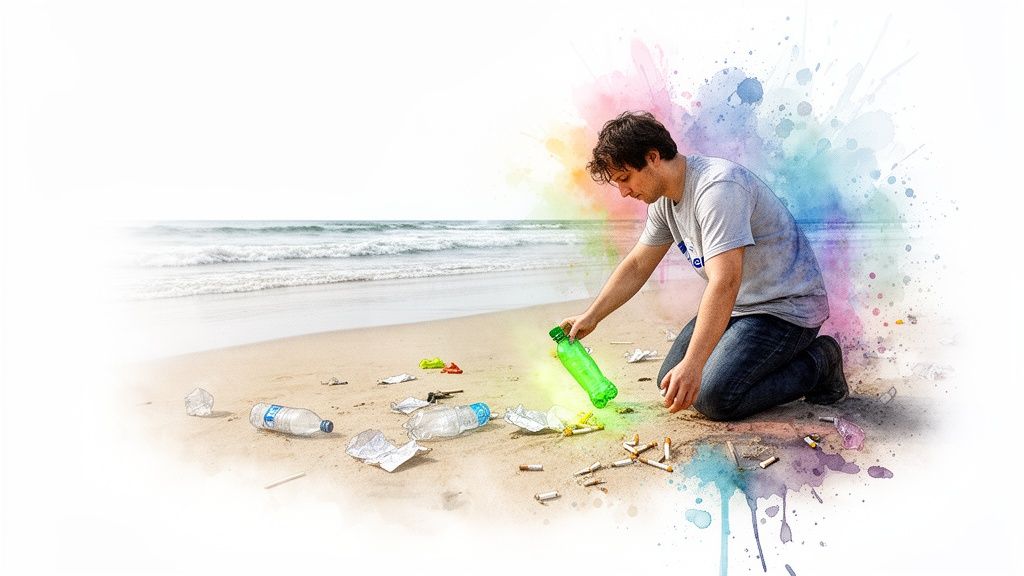
  • Paint Disposal Chicago IL: Your Guide to a Clutter-Free Home

    Paint Disposal Chicago IL: Your Guide to a Clutter-Free Home

    Are you staring at that growing pyramid of old paint cans in your garage? I’ve been there. It’s a familiar sight for so many of us in Chicago. When it comes to paint disposal in Chicago IL, figuring out what to do can feel like a heavy task. But the first step is actually pretty simple. Your whole plan really just comes down to one thing: is your paint latex or oil-based?

    The First Step to Responsible Paint Disposal in Chicago

    That collection of half-used cans is a colorful monument to past projects, isn't it? I remember looking at my own pile, feeling the weight of the chore, the silent judgment of a task I kept putting off. But then I imagined turning that clutter back into a clean, usable space. That's where you and I start.

    Before you can figure out the right way to get rid of your old paint, you've got to know exactly what you're working with. This one detail—latex vs. oil—changes everything about how you'll handle it, like choosing between a gentle garden hose and a powerful pressure washer.

    The Can-Side Detective Trick

    I'll let you in on a little trick I use to figure this out in seconds. You don't need a chemistry degree, just the can itself. Flip it over and play detective, looking for the cleanup instructions on the label.

    • If it says "clean up with soap and water," you've got latex paint on your hands.
    • If it tells you to use "mineral spirits" or "paint thinner," you're dealing with oil-based paint.

    It's that easy. A simple sentence that unlocks your next move.

    To make it even clearer, here's a quick reference table I put together.

    Quick Guide to Identifying Your Paint Type

    Use this simple table I made to quickly identify your paint and understand the right disposal path in Chicago.

    Characteristic Latex Paint (Water-Based) Oil-Based Paint (Alkyd)
    Cleanup Instructions "Clean with soap and water" "Clean with mineral spirits or paint thinner"
    Common Use Interior walls, ceilings, general purpose Trim, doors, cabinets, high-moisture areas
    Disposal Path Can be dried and thrown in regular trash Must go to a Household Hazardous Waste facility

    Once you know which type you have, your next steps become crystal clear, like a path emerging from a fog.

    This quick check instantly separates your paint into two completely different disposal paths.

    A flowchart decision guide helping identify paint type: latex or oil, based on cleanup method.

    This simple check instantly separates your paint into two distinct disposal paths, making your next steps clear.

    You might wonder why getting this right is such a big deal. Tossing liquid paint in the alley isn't just a mess; it’s against city regulations and terrible for the environment. Leftover paint is a huge issue. In fact, paint has historically been one of the largest waste streams in Illinois household hazardous waste collections. Old data from the Illinois EPA shows that roughly 75% of participants were bringing paint to disposal events. Imagine a football stadium filled three-quarters full with people, and every single one is holding an old can of paint. That's the scale we're talking about.

    Let's turn that pile of "I'll deal with it later" into a simple, straightforward plan. It's time for you to take back your space and do right by our city.

    How to Handle Old Latex Paint at Home

    A can of latex paint with a brush, a pile of granules, and newspapers for paint disposal.

    So you found out your old paint is latex. Good news! This is the easiest kind of paint to deal with in Chicago. You can actually handle the whole thing right at home, no special trip required.

    Your goal is to turn that sloshing can of liquid into a solid, harmless puck that you can legally toss in your regular trash. Think of it like a weird, satisfying science experiment on your back porch, like making a peculiar cake you have no intention of eating. You’re taking something messy and making it simple.

    The Art of Drying Out Paint

    Your mission, should you choose to accept it, is to get all the water out of the paint. The trick is to use stuff you probably already have lying around the house to soak up the moisture and speed things along.

    I’ve had a lot of success with a few common household items. They’re basically sponges, soaking up all the liquid and leaving behind a solid block of pigment and binders.

    • Cat Litter: This is my go-to. The cheap, clay-based kind works like a charm.
    • Shredded Newspaper: If you have a paper shredder, you’ve got an endless supply of paint-drying magic.
    • Sawdust: Just finished a woodworking project? I put that sawdust to good use.
    • Paint Hardeners: You can also grab commercial paint hardeners at any hardware store. They're made for this exact job and work super fast.

    I'll never forget the first time I tried this. I had a full gallon of "Greige" left from my living room project. I figured I’d just dump a whole bag of cat litter into the can and be done with it. The result was a volcanic, gloopy mess that oozed all over my garage floor like a creature from a B-horror movie. That taught me a valuable lesson: work in small batches!

    My Foolproof Method for Small Batches

    If you only have less than an inch of paint left in the can, just pop the lid off and let it air dry. I find a well-ventilated spot, away from kids and pets. It might take a few days, but it’s the simplest way to do it.

    For bigger amounts, here’s the process I follow now. Find a sturdy cardboard box and line it with a trash bag. I pour a thin layer of paint into the box, no more than an inch deep. Then, I sprinkle in my absorbent of choice—cat litter, sawdust, whatever I’ve got. I stir it all up with a paint stick until it has the consistency of thick oatmeal.

    Let it sit for a day or two until it's completely solid. You can keep adding layers on top until the can is empty. Once the entire mixture is hard as a rock, I tie up the bag and toss the whole box into my regular black garbage cart.

    This simple act is part of a bigger effort to manage waste responsibly—a core part of what we do as Litter Caterpillars. You can check out more tips in my comprehensive guide to recycling in Chicago. It’s a small step that makes a big difference.

    Your Game Plan for Oil-Based Paint Disposal

    Alright, let's talk about oil-based paint. This stuff is a completely different beast from latex. It's officially classified as household hazardous waste (HHW), meaning you absolutely cannot dry it out and toss it in your black cart. The solvents and chemicals inside are serious business, and we have a responsibility to keep them out of our environment.

    I know, "hazardous waste" sounds intimidating. It conjures images of people in hazmat suits. But don't let it scare you off. The process for paint disposal in Chicago IL for oil-based products is actually pretty straightforward, and I’m here to walk you through it. Consider this your personal game plan for handling it the right way.

    Your Destination: Goose Island

    The City of Chicago has a permanent Household Hazardous Waste (HHW) drop-off facility, and it’s your best friend for this task. I found it at 1150 N. North Branch Street on Goose Island—a place that feels a world away from the alleyways where this kind of waste used to end up.

    I think of this place as a dedicated guardian for our city's health. It’s built specifically to handle materials that are too potent for our regular waste stream. Taking your old oil-based paint here isn't just about following the rules; it's a real act of civic care.

    I’ll never forget the feeling of relief the first time I went. Driving away, my car felt lighter, not just because the cans were gone, but because a weight of responsibility had been lifted. I knew I had done my part.

    Insider Tips for a Smooth Drop-Off

    I’ve made this trip more than a few times, and I’ve picked up some tricks to make it as quick and painless as possible. Here’s my advice for a spill-free, stress-free drop-off.

    • Pack Your Car Securely: This is my number one tip. I always place the paint cans inside a sturdy cardboard box or a plastic tub. It keeps them from tipping over on a sharp turn. A paint spill in your trunk is a cleanup nightmare you do not want to deal with.
    • Time Your Visit: The facility gets packed on weekend mornings. If your schedule allows, aim for a weekday afternoon. You’ll be in and out in a flash.
    • Know What to Expect: When you pull up, attendants will wave you into the right lane. You just stay in your car while they do all the heavy lifting, safely unloading the cans for you. It’s a totally contactless and surprisingly efficient system.

    This little journey to Goose Island is more than just an errand. It's a conscious choice to protect our shared home. Every can you drop off is a victory for Lake Michigan, a safeguard for our soil, and a promise to our neighbors that we’re all in this together.

    Properly managing these materials is a huge part of my mission. If you want to dive deeper into what else qualifies as HHW, check out my full guide on Chicago hazardous waste disposal.

    Give Your Unwanted Paint a Second Life

    Hands exchange a 'Free to reuse' paint can and an artist's palette with a smiling woman.

    Before you go through the hassle of drying out that half-used can of ‘Agreeable Gray’ or schlepping it to a drop-off site, I want you to stop for a second. What if that leftover paint is exactly what your neighbor needs to finish their kid's nursery? Or the perfect color for a local high school’s stage play?

    I really believe in the magic of turning one person's "trash" into another's treasure, and that leftover can in your garage is a classic example. It’s not just old paint; it’s untapped potential. Hands down, reuse is the most powerful, community-building, and inspiring way for you to handle paint disposal in Chicago IL.

    This isn't about just ditching something you don't need. It's about seeing your "clutter" as a resource for someone else.

    Turn Your Leftovers into Local Art

    Think about the vibrant murals in Pilsen or Logan Square. Every single one started with a can of paint, with an idea. Your leftovers, no matter how little is in the can, can be part of that same creative energy.

    I’ve learned that tons of local groups are genuinely thrilled to get usable paint. They don't see it as waste; they see it as a gift that helps them stretch their super-tight budgets. Look around your own neighborhood, and you'll find plenty of people who could use it:

    • Community Theaters and School Art Programs: These guys are always looking for paint for sets, props, and art projects. That crazy bright color you used on one accent wall could be the main feature of a school play.
    • Non-Profits and Housing Charities: Groups that fix up homes for people in need can almost always use basic, neutral interior colors.
    • Local Artists and Muralists: I just do a quick search on Instagram for Chicago artists. You'll often find people or collectives who are happy to take paint donations for their next public art piece.

    Giving your paint a second life is the ultimate win-win. You clear out your garage, a deserving group gets a free resource they genuinely need, and together, we keep perfectly good materials out of the waste stream. It’s a small act that ripples outward with positive impact, a story of connection rather than disposal.

    Connecting with Neighbors Who Need Paint

    Sometimes, the best new home for your paint is just a few houses down the street. And finding that home is easier than ever. I’ve had awesome luck using local online groups to pass along stuff I don't need anymore.

    These sites are like the digital version of borrowing a cup of sugar from your neighbor. My absolute favorite way to do this is through my local Buy Nothing Project group on Facebook. I once posted about a half-gallon of perfect white trim paint, and literally within an hour, a guy from three blocks away was at my door. He was so excited because he was just about to go buy the exact same thing! His story was one of gratitude, and my story was one of relief.

    Other great options are Freecycle or even the "free" section on Facebook Marketplace. It’s a dead-simple, direct way to make sure your paint gets used to the very last drop by someone who actually wants it. This is the Litter Caterpillar spirit in action: turning a small problem into a chance for connection and doing some good in your community.

    Discover the PaintCare Illinois Drop-Off Program

    Let me tell you about a secret weapon in the fight against paint can clutter. It’s a true game-changer for paint disposal in Chicago IL that a lot of people I talk to still don’t know about: PaintCare Illinois. This program is like having a magic wand that makes both your old latex and oil-based paint disappear, responsibly and for free.

    I think of it as a neighborhood co-op for leftover paint. It’s an industry-sponsored program that creates a whole network of drop-off sites, turning a massive chore into a simple errand. It’s no longer something you have to plan a special Saturday trip for; it’s just a quick stop on your way to pick up some new lightbulbs.

    From Garage Clutter to Quick Errand

    The real genius of PaintCare is how it uses the places you already go. Your local hardware store or neighborhood paint shop becomes a partner in this effort. I was amazed when I first used their online locator tool and found a drop-off point less than a mile from my apartment. It felt like uncovering a hidden convenience right under my nose, a secret shared just for me.

    Here’s the basic rundown of how you can make this work for you:

    • Find Your Spot: The first move I make is to hit up the PaintCare Illinois website. They have an easy-to-use map where you just punch in your zip code, and boom—it shows you all the participating retail stores nearby.
    • Check the Details: Most spots have a limit, usually around 5 gallons per visit. I always call the specific store ahead of time just to double-check their hours and make sure they have space. Nothing's worse than loading up your car for nothing.
    • Prep Your Cans: Make sure your paint cans are sealed up tight with their original lids. They need to be in their original, labeled containers—no leaky, unlabeled mystery cans. I just pack them upright in a box or tub in my car so they don’t tip over.

    The first time I did this, I took three cans of oil-based paint that had been mocking me from a corner of my closet for years. The whole process at the store took less than five minutes. I just handed them over at the counter, and that was it. No paperwork, no hassle. It was an incredible feeling of accomplishment for such a tiny effort.

    Using programs like PaintCare is more than just convenient; it’s a vital act of city stewardship. The reality we face is stark. The Chicago metropolitan area has less than 10 years of landfill capacity remaining, a critical situation that demands we all embrace zero-waste practices. Choosing proper disposal methods directly extends the life of our regional landfills and protects our environment. You can learn more about the local solid waste plan and see how your actions contribute to a more sustainable Chicago.

    This network transforms paint disposal from a headache into a simple, inspiring act. It’s a powerful reminder that when we create easy, accessible systems, people are eager to do the right thing. It’s a small choice that collectively makes a huge impact, something we at Litter Caterpillars see every single weekend. For more on local waste solutions, you might be interested in my guide to Chicago recycling centers.

    Your Chicago Paint Disposal Questions Answered

    I get tons of questions about the nitty-gritty details of getting rid of old paint. It's totally normal to feel confused—it feels like every can has its own story and its own weird set of rules. My goal is to tackle those nagging questions head-on, so there’s nothing standing between you and a clean, responsibly managed home.

    When you and I make the right way the easy way, we all win. Let's dig into the most common questions I hear about paint disposal in Chicago IL, so you can get this chore done with total confidence.

    What Should I Do with Empty or Rusted Paint Cans?

    This is a great question. The can itself can be a source of confusion, like having an empty bottle of a strange potion—you're not sure if the container itself is still a problem. The short answer is: it depends on what was inside.

    If I have a latex paint can that's totally empty and dry, I can usually just toss it in my blue bin with other metals. The key is to take the lid off. That’s how the recycling collectors can see it’s empty and not a liquid mess waiting to happen.

    For oil-based paint cans, it’s a different story. Even if they seem bone-dry, I treat them as hazardous waste. That chemical residue is no joke. These need to go to a Household Hazardous Waste (HHW) facility or a PaintCare drop-off. If a can is rusted and actually leaking, I seal it up in a plastic bag to contain the mess and get it to an HHW or PaintCare site ASAP.

    Can I Dispose of Spray Paint Cans the Same Way?

    No, and this is a super important one. Aerosol spray paint cans are a totally different animal. I have learned that they are always, without exception, considered hazardous waste.

    Think of them as tiny, pressurized chemical tanks. They’re filled with flammable propellants that can explode or catch fire in sanitation trucks or at recycling centers. It doesn’t matter if you think you’ve sprayed every last drop—that propellant is still in there, waiting to cause trouble.

    You must take all aerosol spray paint cans, empty or not, to a Chicago HHW drop-off facility. I never, ever put them in my blue recycling cart or my black trash cart. It’s a simple rule that protects our sanitation workers and prevents some really dangerous accidents.

    Is There a Limit to How Much Paint I Can Drop Off?

    Yep, there are usually limits. They’re in place to keep these programs running smoothly for everyone and not get overwhelmed. It's all about being a good neighbor. These services are designed for regular folks like you and me cleaning out our garage, not for a contractor emptying a warehouse.

    The City of Chicago's HHW facility on Goose Island is strictly for residential waste. They’re generally pretty cool about it, but if you show up with a pickup truck loaded to the brim, you might get some questions.

    For the PaintCare retail sites, the limit is typically 5 gallons per visit. It’s always a brilliant idea to call the specific store ahead of time. I just confirm their policy and make sure they have room for my drop-off that day.

    Every can you dispose of correctly is a small but powerful act for our city's health. The scale of our collective waste is mind-boggling; in 2020, Chicago generated 4.13 million tons of materials. This staggering number really drives home why every little bit of effort you and I make to manage waste properly matters. You can learn more about Chicago's waste strategy in the city's comprehensive report.


    At Litter Caterpillars, I believe taking care of our city, one small act at a time, is how we build a stronger community. If you're inspired to do more, come join me for a cleanup. You can learn more and sign up at https://www.littercaterpillars.com.
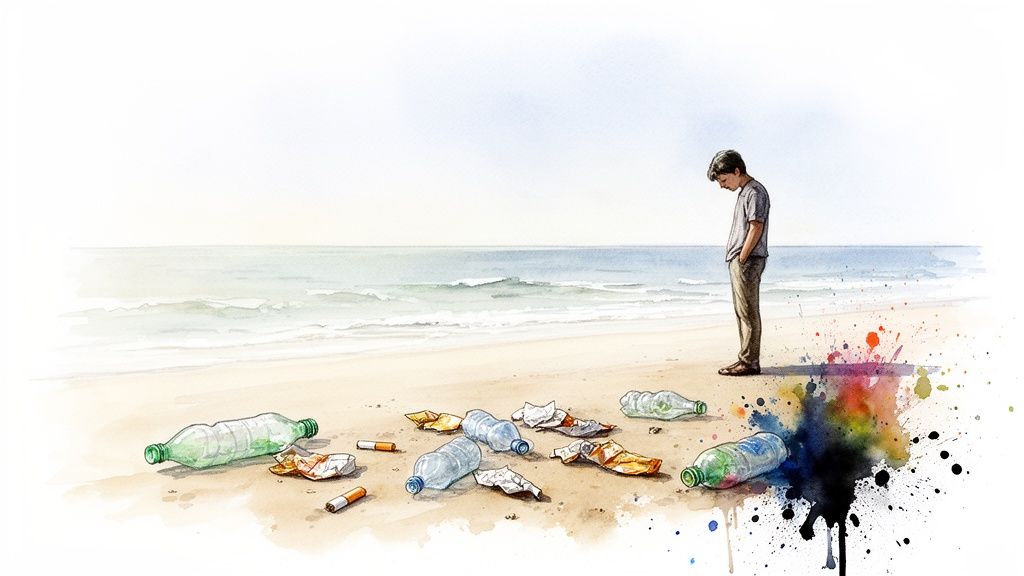
  • A Practical Guide to Chicago Mattress Recycling

    A Practical Guide to Chicago Mattress Recycling

    You can absolutely recycle that old mattress in Chicago. Yes, you can. It’s a choice, really. It's a fork in the road between two very different destinations. You have the city’s bulk pickup, which I've seen far too often just means a sad, lonely trip to the landfill. Or, you can choose the path less traveled—a private recycler, someone who will actually dismantle it and give its bones and guts a brand new life. This guide is your map, your compass, to navigate chicago mattress recycling the way it was meant to be.

    Your Mattress Is More Than Just Junk

    A man operates a mattress cleaning machine next to an old mattress with a city skyline.

    I know that feeling. It’s a gnawing presence in the back of your mind. That old mattress, propped awkwardly against the wall, isn't just an eyesore; it's a heavyweight problem you keep pushing to "tomorrow." It feels immovable, like a forgotten boulder in your guest room, a task that might as well weigh 500 pounds.

    For me, dealing with my own clutter has always been the hardest part of any project. It's as if every single item whispers its own sentimental story, a tiny ghost making it impossible for me to let go. But I stumbled upon something truly powerful through my work with Litter Caterpillars and our community cleanups here in Chicago.

    Turning a Burden Into a Community Win

    Cleaning up someone else's mess—like a mattress heartlessly dumped on a sidewalk—is surprisingly, profoundly empowering. It's a clean, visible, undeniable act that transforms a neighborhood problem into a shared point of pride. That single action sends a ripple of care, a silent message, through the whole community.

    You can harness that same energy to finally tackle your own mattress. This isn't just about hauling junk to the curb. It’s about you, consciously choosing to do better for our city and for the ground beneath our feet.

    Think of this as your first step toward a cleaner Chicago. By choosing recycling over the landfill, you're not just getting rid of an old item; you're actively becoming part of the solution.

    This guide will show you exactly how to handle that mattress, transforming it from your personal burden into a community win. It just feels good, deep in your bones, knowing you’re doing the right thing.

    Why Chicago Mattress Recycling Matters

    The sheer volume of mattress waste is insane. Americans, you and I, throw away roughly 20 million mattresses every single year. It’s a staggering number. That breaks down to over 50,000 of them hitting landfills every single day. This creates a colossal environmental problem, but it’s a story we can change, right here in Chicago. You can read the full research about these mattress waste statistics and see for yourself why this matters so damn much.

    Recycling isn’t just about dodging the landfill; it's about giving valuable materials a second act. When you use a proper recycling service, you make sure that:

    • Steel springs are melted down, reborn as scrap metal for new creations.
    • Foam padding gets shredded and re-spun into soft carpet padding or warm insulation.
    • Wood frames are chipped into fragrant mulch for our city's landscaping.
    • Fibers and fabrics find a new life in other industrial products, continuing their journey.

    Up to 80-90% of a mattress can be recycled. We'll walk through the real-world options for Chicago mattress recycling, turning a chore into an act of profound change for our city.

    So, Why Has Recycling in Chicago Been So Messy?

    Let's be real for a minute. Trying to figure out recycling in Chicago can feel like you've been dropped into a labyrinth with no map. I've been there, standing in front of that blue cart, second-guessing everything, wondering if I'm actually helping or just making things worse. It’s a feeling a lot of us share, a quiet frustration.

    For years, the whole system has made us skeptical, and honestly, we had every right to be. It’s felt a bit like being on a team that keeps telling you they’re winning, but the scoreboard says something completely different. After a while, you just start to lose faith.

    I remember the old 'Blue Bag' program from the 90s. We all did our part, didn't we? We dutifully bagged our recyclables, only to find out so much of it ended up in a landfill anyway. That kind of history sticks with you. It leaves a mark.

    A History of Broken Trust

    The 'Blue Cart' system that came next didn't exactly have a smooth start either. A gigantic part of the problem was a classic, almost storybook conflict of interest. For the longest time, the very company hired to manage our city’s recycling also owned the landfills. It's like asking a fox to guard the henhouse—you can pretty much guess how that story ends, can't you?

    When the company that gets paid to recycle also gets paid to dump, the entire incentive to do the right thing gets twisted and warped. This isn't just a random fact; it's the core reason why our own personal actions matter so, so much.

    This long history of shady dealings is a massive hurdle we’re still trying to clear. In fact, records show that the 1995 'Blue Bag' program only hit about one-third of its reported recycling rates. That little detail, uncovered years later, only poured more fuel on the fire of public distrust. Thankfully, recent reforms are finally starting to rebuild some of that confidence. You can get a clearer picture of Chicago's rocky recycling journey by exploring the challenges and improvements our city has faced.

    Your Mattress Matters More Than You Think

    This history is exactly why figuring out what to do with a big, bulky item like a mattress is so incredibly important. It's our chance to sidestep a system that has failed us and make sure we get a win. Instead of just tossing it into a program with a sketchy track record, you can take control of its destiny.

    Choosing a dedicated Chicago mattress recycling service is a direct, personal action. It's you, with your own two hands, ensuring that your old mattress doesn't become another landfill statistic. You're creating a small, personal victory for the environment where the larger system has dropped the ball for so long.

    This is your chance to write a different story. If you're fired up to learn more, you can also check out our guide on how to recycle more effectively in Chicago. Every small piece of knowledge gives us the power to do better.

    Exploring Your Mattress Disposal Options

    Alright, you’re ready. You're ready to get that mattress out of your space for good. I get it. Let's break down your real options here in Chicago so you can make a choice that actually feels right to you. The path you pick is a big deal—it decides whether your mattress gets a second life or just takes up space in a landfill for the next hundred years.

    First up, you've got the city's bulk pickup service. You can request this by calling 311 or firing up the CHI311 app. It sounds easy, and honestly, it is. But here's the unvarnished truth I've learned from seeing this process up close, again and again: this is a disposal service, not a recycling program. Your mattress will almost certainly be hauled away with regular trash and sent straight to a landfill.

    If you’re just trying to get it gone, that's one route. But if you’re reading this article, I have a feeling you want something better for it.

    Finding True Mattress Recycling Heroes

    This brings us to the real stars of this story: private mattress recyclers. These are the companies doing the hard, dusty, often thankless work of dismantling your old mattress piece by piece. They're the ones who make sure the steel, foam, and wood are actually turned into new materials instead of just becoming more garbage.

    Finding a good one takes a little bit of homework, but believe me, it’s worth the effort. It's like finding a mechanic you trust; once you find them, you stick with them because you know they do the job right.

    • Ask About Their Process: A legitimate recycler will be proud to tell you exactly what they do. You should ask them straight up: "Where do the mattresses go?" and "How are they broken down?"
    • Check for Fees: Real recycling costs money. I know, it stings. But there's labor and transportation involved. Expect a fee, usually somewhere between $70 to $200. If a service sounds too cheap to be true, it probably is.
    • Read Reviews: See what your fellow Chicagoans have said. You should look for comments about punctuality, professionalism, and whether they seemed truly committed to recycling.

    The Donation Dilemma

    What about donation? I get this question all the time. It feels like the kindest option, but it's also the trickiest, like navigating a minefield. Because of strict health and hygiene laws, most big charities like Goodwill or The Salvation Army simply can't accept used mattresses. It’s a huge liability for them.

    It's not completely impossible, though. A few specialized, local organizations like the Chicago Furniture Bank sometimes accept mattresses, but their standards are incredibly high.

    Your mattress would need to be in nearly pristine, stain-free, and structurally perfect condition. You absolutely must call them beforehand to confirm they're even accepting donations and that your mattress meets their strict, non-negotiable criteria.

    This quick decision tree can help you see the paths for responsible Chicago mattress recycling.

    Flowchart detailing Chicago mattress disposal options: donate, recycle, or bulk trash pickup.

    As you can see, the path to true recycling or donation requires a more deliberate choice from you than just dragging it to the curb. To find a drop-off location that might be a good fit, you can check out our guide on Chicago recycling centers. It’s all about giving you real choices for a solution you can actually be proud of.

    Preparing Your Mattress for Pickup

    A smiling couple moves a mattress using a hand truck, with stairs and watercolor splashes.

    So you've scheduled your pickup. Awesome! That’s a huge step. Now for the real work: wrestling that beast from your bedroom to its next destination. I want you to think of it like prepping a fragile package for an important delivery—a little effort now makes all the difference in the world.

    First things first: keeping it clean and dry is non-negotiable. This is especially true if you’re using a chicago mattress recycling service or attempting a donation. A wet, grimy mattress will almost certainly be rejected, and all your careful planning goes right down the drain.

    It's like dressing for a Chicago blizzard. You wouldn’t step outside without a coat, right? Your mattress needs that same level of protection against the elements.

    Wrap It Right

    Your new best friend is a humble plastic mattress bag. You can snag one for just a few bucks at any hardware store or online. Sliding your mattress into one of these is the single most important thing you can do.

    This bag is your mattress's armor. It's a shield against rain, snow, dirt, and any potential pests looking for a new, cozy home. It's a simple step that ensures recyclers can actually work with the materials inside. It shows you care. It shows you respect the process.

    A clean, dry mattress is a recyclable mattress. A wet, forgotten one left in the alley becomes a public health problem and a heavy burden for our city crews.

    This small act of wrapping it properly makes a massive difference for everyone, from your neighbors to the collection team who has to pick it up. It’s a sign of respect for the process and for the people who make it all happen.

    The Safety Dance

    Now, let's talk about the move itself. I can't stress this enough: hauling a king-size mattress down three flights of a narrow Logan Square walk-up is a team sport. Please, please don’t try to be a hero and do it alone.

    Grab a friend. A roommate. A neighbor. It’s not just about the weight; it's the sheer awkwardness and the complete lack of good handholds. It’s way too easy to lose your grip, stumble, or punch a hole in the wall. You'll move faster, you'll move safer, and you'll probably share a few laughs along the way.

    Finally, a critical point on timing. Never, ever leave your wrapped mattress on the curb or in the alley until the morning of your scheduled pickup. Leaving it out for days is basically an open invitation for scavengers, pests, and bad weather to undo all your careful prep work.

    And while you're getting your disposal game in order, it's a good time to think about other tricky items. You can check out our guide on how to handle City of Chicago hazardous waste disposal to keep our city even cleaner.

    Thinking Bigger Than Your Own Four Walls

    Okay, so you've figured out how to get rid of your own mattress. That’s a fantastic win. I mean that. Seriously. But what happens when you start looking past your own front door? What if you could take that same energy and wipe out the mattress problem for your entire block, maybe even your whole neighborhood?

    This is where things get really exciting for me. It's where we shift from thinking "my problem" to "our project." I've seen it happen time and again: one person, with just a bit of drive, can spark something huge, turning a dozen separate headaches into one big, collective solution.

    Rally the Neighborhood for a Collection Day

    Picture it: one Saturday morning, everyone on your street drags out that old, dusty mattress they’ve been hiding in the basement. You could organize a neighborhood-wide mattress collection day. It's an incredible way to solve a bunch of problems at once, forge some real community bonds, and see a tangible, visible difference on your block.

    I want you to think of it like a block party, but instead of a potluck where everyone brings a dish, everyone brings an old mattress. The outcome is the same—a cleaner, stronger, more connected neighborhood.

    This isn't just about hauling away junk. It’s an act of collective pride in the places we share. It shows that a few determined people can build a better Chicago, one mattress at a time.

    How to Pull It Off

    The idea might sound massive, I know, but the steps are surprisingly simple. And you don't have to go it alone—in fact, it’s way better if you don’t.

    • Find Your Crew: You should link up with a local community group, your neighborhood association, or even your alderperson's office. They have the megaphone (and often the resources) to get the word out.
    • Team Up with a Recycler: Give one of the private chicago mattress recycling companies we've mentioned a call. A lot of them are eager to partner on community events and might even cut you a deal for a bulk pickup from one single spot.
    • Pick a Time and Place: Grab a weekend day and find a central, easy-to-access location. A church or school parking lot, or a corner of a local park (with permission, of course!) can work perfectly.
    • Spread the Word: You have to use every tool you have. Plaster it on neighborhood Facebook groups, hang flyers in local coffee shops, and just talk to people. Build the hype!

    This kind of volunteer-powered effort is exactly what our city and state need. It’s grassroots action that delivers real, visible results that no policy alone can achieve.

    Illinois has some ambitious goals: a 40% waste diversion rate by 2025 and 50% by 2035. We don't have a state-mandated mattress recycling program like California or Connecticut yet, so these volunteer events are what bridge the gap and push us toward those targets. You can see for yourself how your work fits into Illinois's materials management plan and the bigger picture.

    Taking this on transforms you from someone just handling their own stuff into a true community leader. It’s an inspiring way to show up for your city and your neighbors, proving that real change starts right here on our streets, with us.

    Your Mattress Recycling Questions, Answered

    Getting rid of a mattress in Chicago can feel like a huge headache. I get it. I’ve heard all the questions from people just like you, trying to do the right thing but not knowing where to start. After years of dealing with this stuff, I’ve collected the most common questions to give you the straight-up answers you need.

    Think of me as your guide who’s already been down this road a hundred times. I know the shortcuts, I know the dead ends, and I know how to get it done right.

    Can I Just Leave My Mattress in the Alley?

    I wish it were that simple, but absolutely not. Just dumping your mattress in the alley without scheduling a pickup is asking for a hefty fine and, frankly, making our neighborhood look terrible. You must schedule a bulk item pickup first. You can do this by calling 311 or, even better, by using the CHI311 app.

    But here’s the thing—and it’s a big one—this is a disposal service, not recycling. More often than not, that mattress is taking a one-way trip to a landfill. If you want true Chicago mattress recycling, you need to call a private service that actually breaks these things down.

    Are There Free Mattress Recycling Services in Chicago?

    This is a tough one. A truly free service that promises your mattress gets recycled is pretty much a myth here in the city. Private junk removal and recycling companies are your best bet, but they’ll charge a fee, usually somewhere between $70 and $200.

    I tell people to think of this fee as an investment, not a cost. It’s you doing your part to make sure up to 90% of your mattress gets a new life instead of just sitting in a landfill for a century.

    The city's 311 bulk pickup is technically "free"—in the sense that you already pay for it with your taxes—but again, it's not a recycling program. It’s the difference between tossing a plastic bottle in the trash versus putting it in the blue cart. One is easy, the other is right.

    What Actually Happens When a Mattress Is Recycled?

    It's actually a pretty cool process, like watching a skilled butcher break down an animal, making sure every single part is used. Workers at a recycling facility literally dismantle the mattress by hand, layer by layer, with incredible efficiency.

    • Steel Springs: They pull these out and sell them as scrap metal. They get melted down and forged into something entirely new.
    • Foam & Padding: This stuff gets shredded and is reborn as carpet padding or home insulation. A super practical second life.
    • Wood Frame: The wooden skeleton of the mattress gets chipped into mulch for landscaping or burned for fuel.
    • Fabrics & Fibers: Even the outer fabric can be reused for different industrial things, continuing its useful journey.

    It’s a perfect, beautiful example of turning what we see as "waste" into a whole collection of valuable materials.

    Can I Donate My Mattress if It Is in Good Condition?

    Donating is really, really tricky. Because of strict health rules, big places like Goodwill and The Salvation Army won't touch used mattresses. No exceptions. It's just not worth the risk for them.

    Your best shot might be a smaller, local place like the Chicago Furniture Bank. They might take a mattress, but only if it’s in almost perfect shape—absolutely no stains and it must meet their super high standards. You must call them first to see what their policy is before you even think about hauling it over there.


    I hope these answers clear things up and make you feel ready to take the next step. If doing this one small thing makes you want to build a bigger habit of service, come join us at Litter Caterpillars. We’re a volunteer group dedicated to cleaning up our city and making friends while we do it. Find out more and join an event at https://www.littercaterpillars.com.
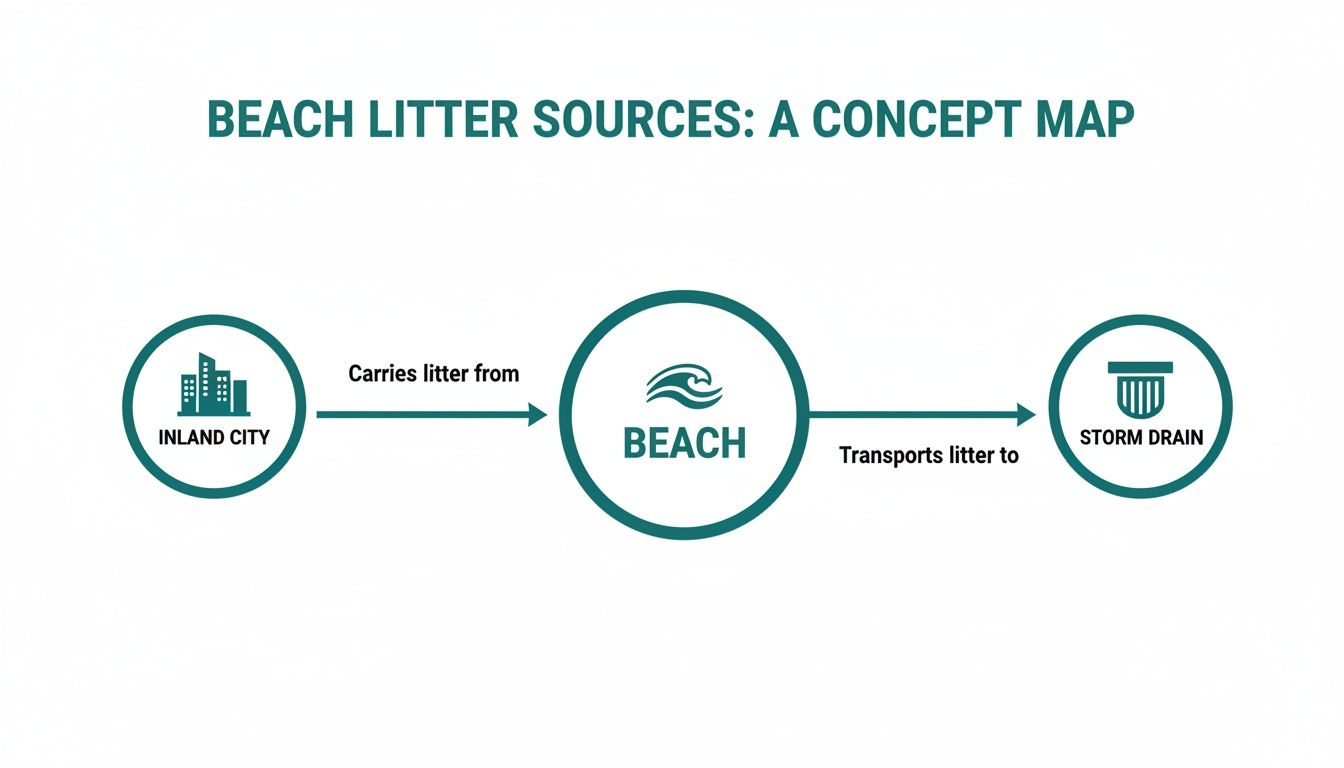
  • A Real-Life Guide to Composting in Chicago

    A Real-Life Guide to Composting in Chicago

    Composting in Chicago isn't just about shrinking your landfill pile or making nice soil. It’s a way for you to take back a little bit of control, to make a real, tangible dent in our city’s waste problem. Whether you have a sprawling backyard, a tiny balcony, or just a sliver of space under your kitchen sink, I can show you how you can join in.

    My Journey Into Composting in Chicago

    My story starts with a feeling I bet a lot of you know: being completely, utterly overwhelmed by my own stuff. My apartment felt choked with clutter. The trash can was this ever-growing monument to my own procrastination. Every item, every scrap, felt like it held a story, a memory, and it was all just sitting there, weighing me down.

    This heavy feeling of being stuck pushed me. I had to do something, anything. I started with the kitchen trash, which was overflowing as usual. As I found myself sorting through old coffee grounds and slimy vegetable peels, a strange thought hit me. What if this "trash" wasn't trash at all? What if this was a beginning, not an end?

    That one question kicked off my entire journey into composting in Chicago. I stopped seeing food scraps as gross, smelly waste and started seeing them as pure potential. That little mental flip was surprisingly, powerfully freeing.

    Turning Waste Into a Weapon for Good

    I quickly learned something surprising. Cleaning up messes—not just in my own apartment, but the city's messes too—felt incredible. It’s this weird kind of fun, a way for you to connect with your community and maybe even find a tougher, more resilient version of yourself. Composting stopped being some eco-friendly chore and turned into something that was actively changing me.

    This simple act of turning food scraps into something useful gave me the courage to tackle bigger things. It was undeniable proof that your small, consistent actions really could lead to huge changes. I started to see the deep, unbreakable link between my own growth and the health of my community. This is the very idea that fuels everything I do with Litter Caterpillars.

    Composting is an act of hope. You're taking something that would otherwise rot and stink in a landfill and giving it a new purpose, turning decay into vibrant life. It's your small rebellion against a throwaway culture.

    Why It Matters for Our City

    And let me tell you, we need this kind of rebellion right now. I was floored when I found out that food scraps make up about 20% of Chicago's total waste stream. All of that stuff—your fruit peels, your eggshells, your coffee grounds—gets dumped in landfills where it rots and releases methane, a really nasty greenhouse gas. For a city our size, that adds up to hundreds of thousands of tons of pollution we could be preventing every single year. You can discover more insights about Chicago's waste challenges and what we're doing to fix them.

    Composting is our chance to flip that script. When you decide to compost, you're not just making some dirt for a garden. You are actively becoming part of the solution. You are taking a stand and joining a growing movement of Chicagoans building a healthier, tougher city from the ground up.

    Finding Your Perfect Chicago Composting Method

    Figuring out how you can start composting in Chicago is a lot like choosing how you want to get around the city. You wouldn't take the L if you were only going two blocks, right? It’s all about picking the method that fits your life, your space, and honestly, your personality. Let's figure out what works for you.

    When I first started, I jumped straight into worm composting—vermicomposting—thinking it was the only real option for my tiny apartment. It was a spectacular, slimy failure. My first bin became a science experiment gone horribly wrong because I just kept dumping food in without balancing it. But I learned a ton from that mess, and that’s what this is all about: I’m here to share the simple, practical advice that makes this stuff easy.

    From Big Yards to Balconies

    If you’re lucky enough to have a backyard, say in a neighborhood like Beverly or Sauganash, an open-air pile is your best friend. Think of it as a slow-cooker for your soil. You just layer your "greens" (kitchen scraps) and "browns" (leaves, cardboard) and let nature do most of the work. I find it’s super low-effort and perfect for handling a lot of yard waste along with your food scraps.

    For those of us with smaller yards or a bit of patio space—like what you might find in Lincoln Square or Andersonville—a compost tumbler is a game-changer. Imagine a personal cement mixer for your scraps. It’s a sealed barrel you turn every few days. This keeps pests out and, even better, speeds up the process like crazy. You can get finished compost in a matter of weeks, not months.

    The most important step you can take is just to start. Don't let yourself get paralyzed trying to pick the "perfect" method. Choose one that seems doable and adjust as you learn. Your first batch of compost is a teacher, not a test.

    And for my fellow apartment dwellers in the Loop, Logan Square, or anywhere else where space is tight, vermicomposting is pure magic. It’s a compact bin filled with special red wiggler worms that eat your food scraps and turn them into some of the richest fertilizer you’ll ever find. My early disaster taught me the key: go slow, don't overfeed them, and keep a good balance of bedding. Once you get the hang of it, it's odorless and incredibly efficient.

    This little chart really nails that first moment of decision. It's about you turning that feeling of being overwhelmed into action.

    A decision tree flowchart for waste reduction, asking 'Is your trash overwhelming?'. Yes leads to 'Try Composting', No leads to 'Learn More'.

    When your trash feels like too much, composting is a direct, empowering way for you to take back control.

    Chicago Composting Methods at a Glance

    Choosing isn't just about space; it's also about the time and effort you want to put in. Each approach has its own rhythm. To make it a little clearer for you, here’s a quick breakdown of the options we just talked about.

    Composting Method Best for… Space Needed Effort Level
    Open-Air Pile Single-family homes with yards A corner of the yard Low
    Compost Tumbler Small yards, patios, decks A few square feet Medium
    Worm Bin Apartments, condos, balconies Under the sink, a closet Medium

    No matter where you live in this incredible city, there's a way for you to turn your waste into something wonderful. You just have to pick one and start.

    What to Compost: A Chicago Cheatsheet

    A hand adds a banana peel to a vibrant, layered compost pile with soil, green waste, and cardboard.

    I’ve been there. You're standing over your kitchen bin, soggy banana peel in hand, completely frozen. Does this go in? That hesitation is real, but I’m here to give you the confidence to never second-guess your scraps again.

    I want you to think of building a healthy compost pile like making a perfect lasagna. It’s all about the layers. You need the right balance of two key things: Greens and Browns. If you get this ratio right, you're well on your way to creating that beautiful, soil-enriching "black gold" right here in your Chicago home.

    The Greens: Nitrogen Powerhouses

    "Greens" are the fresh, wet materials that add nitrogen to your pile. This is the fuel that gets the microscopic organisms fired up and working their magic. These are the items that you generate directly from your kitchen prep.

    You're probably creating a ton of these already:

    • All your fruit and vegetable scraps (banana peels, apple cores, carrot tops)
    • Coffee grounds and paper filters
    • Tea bags (just make sure you remove any staples)
    • Crushed eggshells
    • Stale bread, pasta, and grains (use these in moderation)

    These items break down fast and heat up the pile, kickstarting the whole decomposition process. They're like the zesty tomato sauce and rich ricotta in our compost lasagna. And if you're looking for more ways to cut down on waste, you might want to check out my guide on how to properly recycle in Chicago, which tackles a whole different set of materials.

    The Browns: Carbon Builders

    "Browns," on the other hand, are the dry, woody materials that provide carbon. These are crucial for structure and airflow, preventing your compost from becoming a smelly, slimy mess. I think of browns as the sturdy pasta layers in our lasagna, giving it substance.

    The secret to happy, odor-free composting in Chicago is a simple ratio: I aim for roughly two to three parts "Browns" for every one part "Greens." This balance keeps air flowing and stops the pile from getting too wet.

    You can find browns all around your home and yard:

    • Dried leaves, twigs, and grass clippings
    • Shredded newspaper and non-glossy cardboard (like toilet paper rolls and pizza boxes)
    • Wood chips and sawdust (from untreated wood only)
    • Napkins and paper towels

    And yes, you can even compost that leftover deep-dish pizza crust! Just tear it into small pieces to help it break down faster.

    A final, crucial tip is knowing what you should leave out. To avoid attracting unwanted city critters like rats and raccoons, you should never add meat, fish, bones, or dairy products to your home compost pile. Oily or greasy foods are also a no-go. You just stick to the greens and browns, and you'll create a clean, effective system that works for you and our city.

    How to Join Chicago's Composting Movement

    Look, you don’t have to do this all on your own. I get it. Starting to compost can feel like you're the only one on your block doing it, but I promise you, there’s a whole network of support growing right here in our city. Joining the composting in Chicago movement is about finding your people and your place, whether that’s a city-run program or a neighborhood garden.

    It’s like finding a new favorite coffee shop. Once you know where to go, it becomes part of your routine—a simple, rewarding stop that plugs you into your community. Chicago is finally building the infrastructure to make composting a real option for everyone, and you’re getting in at the perfect time.

    Chicago's Food Scrap Drop-Off Program

    The city has officially stepped up its game by launching its own food scrap drop-off program. I remember the excitement when this was first announced. For so long, we apartment dwellers and folks without yards felt left out of the composting game. This program is your official invitation.

    Think of it as a special recycling bin just for your food waste. You collect your scraps at home in a little container, and then you bring them to a designated spot when it’s full.

    A few things I learned for my first trip:

    • Find Your Spot: The city has a bunch of drop-off locations, so you can find one that’s easy to hit on your commute or during weekend errands.
    • Know What's Accepted: They usually take all the "greens" we talked about—fruit and veggie scraps, coffee grounds, eggshells. But it’s always a good idea for you to double-check the city's specific list before you go.
    • It’s Simple: The bins are clearly marked and super easy to use. You just dump your scraps and go! It’s a small step that makes a massive difference.

    The Power of Community Gardens

    Long before the city program existed, community gardens were the unsung heroes of composting in Chicago. These were our pioneers, the trailblazers who saw the value in turning neighborhood food scraps into life-giving soil for their vegetable beds. These gardens aren't just drop-off points; they are vibrant hubs of knowledge, connection, and grassroots action.

    These local efforts were more than just a convenience; they were a statement. Research from DePaul University's Harvest Study found that between 2016 and 2018, an incredible 57% of community gardens studied were already composting on-site. I saw this happen even when city laws made it a pain, proving that the drive to build healthier communities was unstoppable. This powerful grassroots movement showed me that composting worked on a local level, paving the way for the city-wide programs we have today.

    When you join a community garden's compost program, you're doing more than just diverting waste. You're plugging into a network of givers, learners, and doers who have been nurturing our city's soil for years.

    Many of these gardens accept food scraps from their neighbors. It’s a beautiful, circular system where your kitchen waste directly helps grow food for your community. It’s an inspiring reminder that when we work together, we can reshape our city for the better, one bucket of scraps at a time. If you’re inspired by their work, you can check out our guide on how to get more involved with community gardens across Chicago.

    How Composting Fuels Our Mission for a Better Chicago

    Three men planting green seedlings in an urban garden with a watercolor city skyline.

    For me at Litter Caterpillars, picking up trash and turning food scraps into soil are two sides of the same coin. It might seem strange—one is about getting rid of decay, the other is about creating new life from it—but I believe they both come from the exact same place.

    An act of service.

    When you decide to show up for your city, whether that’s by bagging up litter or separating your coffee grounds, you’re making a powerful choice. You’re choosing to give. This is where I find we build character, bravery, and a real, tangible sense of community that you can feel in your bones.

    Service Builds Stronger People

    I’ve learned that the only way to grow is to face a challenge head-on. Picking up trash in a Chicago blizzard, with hail stinging your face, isn’t something you forget. It teaches you what you're made of.

    Tending a compost pile has its own quiet tests. Is it too wet? Too dry? Does it have enough "browns" to balance the "greens"? Just like cleaning up a neglected street corner, composting asks you to pay attention, to be consistent, and to care for something outside of yourself.

    These acts strengthen you. They teach you that you’re capable of more than you think. You learn to embrace the discomfort because you know it's the price of transformation—for you and for the world around you. This is the heart of my ethos at Litter Caterpillars.

    From Empty Lot to Caterpillar Park

    My big dream is to take an empty, forgotten lot in Englewood and turn it into Caterpillar Park. This isn't just some fantasy; it's a plan I am actively building. And how are we going to nourish the soil for this new green space? With the very compost we create.

    This vision makes the whole process intensely personal. Every banana peel and eggshell you save is a direct contribution to that future park. It’s the literal fuel for our mission, turning what was once thrown away into the foundation for a place where kids can play and neighbors can connect.

    Composting in Chicago is my way of proving that nothing is truly lost. It’s a promise that even from decay and neglect, we can cultivate beauty, nourishment, and a stronger community.

    This is kindness and unity in action. It’s the belief that every small, positive effort you make ripples outward. When you separate your kitchen scraps, you're not just diverting waste. You are actively participating in a cycle of renewal that will physically reshape a piece of our city for the better.

    You Are Part of a Movement

    So, when you start composting in Chicago, you’re doing so much more than just making dirt. You are joining a movement of givers. You are aligning yourself with a community of people who show up, who aren't afraid of a little hard work, and who believe in the future of this city.

    This isn’t about you being perfect. It's about you being willing to try, to learn, and to contribute in whatever way you can. Your compost bucket is a symbol. It’s a declaration that you believe in building a better Chicago from the ground up, one handful of rich, dark earth at a time.

    Your Chicago Composting Questions Answered

    I get a ton of questions about the real-deal, nitty-gritty of composting in Chicago. The "what ifs" and "is this actually possible for me?" moments are totally normal. So let's just get right into the ones I hear the most. For every single worry you have, I promise there’s a simple, real-world answer.

    First up, the big one: "What if my compost starts to smell?" I hear you. Nobody wants a stinky mess, especially not in a city apartment or a crowded three-flat. That smell is almost always a sign that your compost lasagna is out of whack. It means you’ve got too many "greens" (your wet food scraps) and not nearly enough "browns" (dry carbon stuff like cardboard or dead leaves).

    Think of it this way: your greens are the party, but your browns are the chaperones. You need about two to three times more chaperones to keep things from getting smelly and out of control. Just tear up some newspaper or a cardboard box, toss it in, give it a good mix, and that smell will disappear.

    City Life and Composting Challenges

    Another question I get all the time is, "I live in a high-rise, is composting really for me?" Absolutely. Vermicomposting—that's a worm bin—is your secret weapon here. When you keep it under a sink or in a closet, a well-managed worm bin is totally odorless and out of the way. My best tip for you? Don't overfeed your worms. Just give them small amounts of food every few days and always, always cover the new scraps with plenty of bedding.

    Then there’s the whole "city drop-off vs. private service" debate. City drop-offs are free, which is a massive plus, but you're the one schlepping your scraps across town. Private services are super convenient with their curbside pickup, but they come with a fee. It really just boils down to your budget and what you've got time for. There's no wrong answer here, only the answer that works for you. You can even learn more about handling other types of waste in our guide to hazardous waste disposal in Chicago.

    Learning From Our City's Past

    Finally, people ask me how Chicago's recycling history plays into all this. It's a fair question, and the truth is, our city has struggled. Hard. With a waste diversion rate of just 9%, we're lagging way behind other big cities. Part of that is the ghost of failed programs like the old "Blue Bag" system, which just didn't work.

    But that history is exactly why composting is so important right now. It gives us a direct, hands-on way to pull our own waste out of the system. We're learning from the past to build a better future, as you can see in reports about our city's waste programs. You can read the full story on Chicago's recycling challenges.

    Composting gives you control. While the city-wide systems slowly get better, your compost bucket is a direct line from your kitchen to a healthier planet. It's an immediate, tangible impact that you can see and feel every single day.


    Jumping into composting is one of the most powerful things you can do for a cleaner, tougher city. At Litter Caterpillars, we turn that spirit into action every single week. If you're ready to make new friends, build your own resilience, and help us transform Chicago, I'd love for you to join our crew. Find your next event and become part of the story at https://www.littercaterpillars.com.