
Tag: volunteer opportunities

  • Sanad Social Services: Your Guide to Support in Chicago

    Sanad Social Services: Your Guide to Support in Chicago

    A parent opens the fridge, sees half a bottle of ketchup and a light that makes the emptiness look bigger, and starts doing the math again. Dinner, bus fare, the gas bill, school tomorrow. Something has to give.

    More Than Just a Food Pantry

    I've learned that hunger rarely walks into a room alone. It brings stress with it. It brings that tight feeling in your chest when a child asks what's for dinner and you need ten more minutes to figure out an answer that sounds calm.

    That's why Sanad Social Services matters to me in a very human way. When you hear the words food pantry, you might picture a shelf of cans and a quick handoff at the door. You might picture a transaction. Sanad feels more like a neighbor pulling up a chair and saying, “Let's get through this week first. Then we'll think about the next one.”

    A warm watercolor illustration of a mother and daughter embracing in a cozy kitchen setting.

    What help looks like up close

    A box of food can sound small on paper. In real life, it can change the whole tone of a home. It can mean a parent cooks instead of skips. It can mean a kid eats breakfast before school. It can mean the argument about money doesn't happen that night because there's one less emergency on the table.

    Sanad Social Services works with low-income, diverse households in Chicago. I don't think of that as an abstract category. I think of families carrying grocery bags with numb hands in winter. I think of grandparents stretching meals. I think of people who work hard and still hit a wall.

    Food help is never just about food. It gives a family room to breathe.

    Why people keep coming back

    A place like this becomes part of your routine the way a steady bus line or a trusted clinic does. You learn where it is. You learn the faces. You stop feeling like you have to explain every hard thing from the beginning each time you ask for help.

    That's what I want you to know from the start. This isn't a dry directory entry. This is a story about support that feels practical and personal at the same time. If you need help, I want you to feel less alone. If you want to help, I want you to see the people behind the pantry, not just the program names.

    Here, support feels less like charity dropped from above and more like someone bracing the ladder while you climb.

    The Story and Mission of Sanad

    Back in 1991, Fatima Abueid started Sanad in Chicago. I keep coming back to that date because every long-running community effort begins with one person deciding that waiting politely for someone else to fix things isn't good enough. That first decision matters.

    Sanad began at 6248 S Spaulding Ave in Chicago, and I imagine the early work the way many neighborhood efforts begin. One person sees the gap. One person knows families are carrying too much. One person starts where they are, with what they have, and refuses to look away.

    The meaning inside the name

    The word Sanad means support or anchor in Arabic. I love that because an anchor doesn't make the storm disappear. It keeps you from drifting away while the storm is still going.

    That's the clearest way I can explain the mission. Sanad Social Services isn't trying to dress up hardship with polished language. It is trying to hold people steady when life starts sliding. If your budget is cracking, if your kitchen is bare, if one overdue bill is about to knock over everything else, support has to be sturdy. It has to hold.

    Practical rule: The best community work starts with a simple question. “What do people need today?”

    A mission built from lived reality

    I don't read Sanad's story as an institution first. I read it as an act of attention. Fatima Abueid saw hunger in her city and answered it with structure, repetition, and care. That matters because families in crisis don't need grand speeches. They need people who keep showing up.

    And showing up year after year changes the tone of a place. You can feel it. Work like this gets built in ordinary moments. A volunteer loading food. A parent asking a quiet question. A staff member remembering a family's name. Those moments stack up like bricks.

    Here's how I see it:

    Part of the mission What it feels like in real life
    Support Someone helps carry weight you can't carry alone that week
    Anchor Your life stops spinning quite so fast
    Dignity You don't feel reduced to your hardest month
    Consistency Help isn't random. You know where to turn

    That kind of mission doesn't need flashy language. It needs trust. And trust grows when people keep their doors open, keep their word, and keep treating you like a person instead of a problem.

    Finding Support Through Sanad Programs

    A mother finishes a late shift, gets home, and opens the fridge to do the kind of math nobody should have to do. What feeds the kids tonight. What gets saved for tomorrow. What can wait. In neighborhoods across Chicago, that pressure shows up in different forms, so support has to meet people in different ways too.

    Sanad does that through onsite help, mobile pantry access, utility relief, and educational seminars. The model matters because families do not all face the same barrier. One person can stop by a fixed location after work. Another is caring for children, covering two bus rides, or trying to keep the lights on before the shutoff notice becomes real.
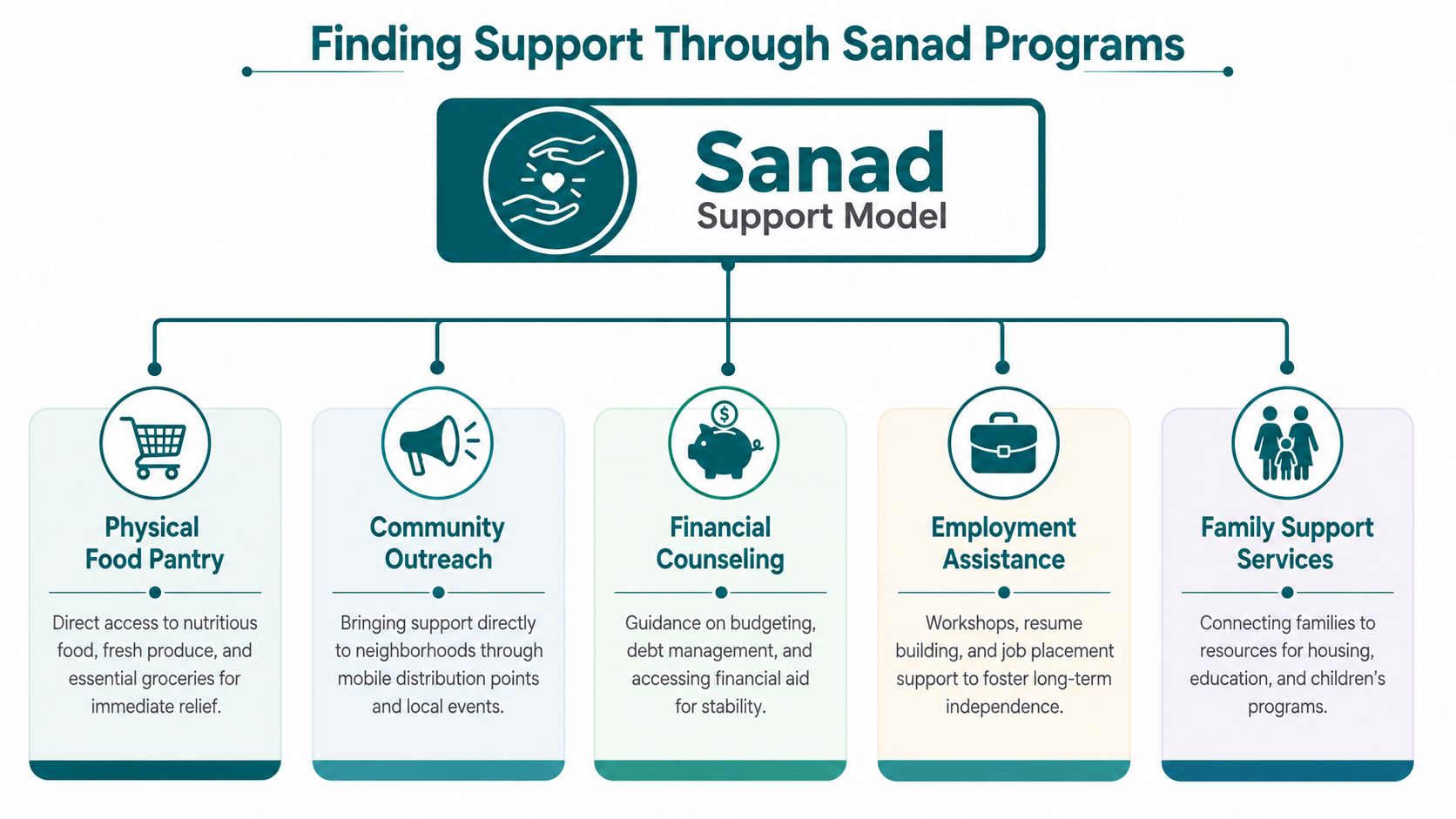
    An organizational chart showing five types of Sanad social support programs offered to the community.

    What support can look like in real life

    I keep coming back to one simple truth. Hunger rarely arrives alone.

    Sometimes the need is groceries. Sometimes it is groceries plus an overdue utility bill. Sometimes it is a family that needs food this week and better information so next month feels less fragile. Sanad's programs make more sense when you look at them through that lens.

    A pantry visit can give someone staples for the kitchen. A mobile distribution can reach people who cannot easily cross town. Utility help can protect a household from slipping from financial stress into full disruption. Seminars can give people practical guidance they can carry into the next month, not just the next meal.

    That mix feels grounded. It respects how real life works.

    The programs, person by person

    If you can get to a set location and want direct contact with staff or volunteers, onsite pantry support may feel steadier. You know where to go. You can ask questions face to face. For some people, that kind of routine lowers the stress.

    If travel is the problem, mobile pantry support can make the difference between getting help and going without. A service model that moves closer to people matters when transportation, work hours, health, or caregiving responsibilities keep tightening the day.

    Utility relief speaks to a different kind of fear. You can have food in the house and still feel the month falling apart if the gas or electric bill is overdue. Help in that area can protect more than a budget. It can protect a household's sense of stability.

    Educational seminars serve another purpose. They create room for longer-term support, whether someone wants guidance, clearer information, or a stronger footing after a hard stretch.

    If you're comparing nearby options, this guide to Casa Catalina Food Pantry in Chicago shows how different neighborhood programs serve families in different ways.

    Why people stay connected

    I have seen people ask for help only after they have run through every private option first. They skip meals. They stretch rice. They tell themselves they can hold out one more week. What often brings them back to a place like Sanad is not only the food. It is the feeling that the help fits the shape of their actual problem.

    A family dealing with hunger, transportation trouble, and utility stress does not need a one-note response. They need support that can hold more than one burden at a time. That is what makes these programs feel human. They leave room for dignity, practical relief, and the kind of follow-through that helps a hard month stop becoming a harder year.

    How to Get Help From Sanad

    Asking for help can feel heavier than carrying the problem another week. I know that. A lot of people know that. You rehearse what to say, wonder if you'll qualify, and worry someone will make you feel small.

    Sanad's location is 6248 S Spaulding Ave, Chicago, and sometimes having one clear place to start is half the battle. You don't need a perfect script. You just need a first step.

    A friendly Sanad representative explains service steps to a woman using an informative visual guide.

    Start with the simplest move

    If I were helping a friend do this, I'd say keep it basic.

    1. Reach out directly. Use the contact pathway listed on Sanad's website and ask the plain question: you need food support and want to know how to receive it.
    2. Ask what they need from you. Requirements can change, so it's better to hear it straight from the organization than guess.
    3. Tell them what pressure feels biggest right now. Food, utilities, transportation, schedule conflicts. Be direct about your primary need.
    4. Ask whether onsite or mobile support fits your situation better.

    That last point matters. If getting across town is hard, say so. If your work hours are unpredictable, say so. Clear information helps people match you to the right option faster.

    Keep your questions short and honest

    You don't need polished words. Try something like this:

    • “I need help with food for my household.”
    • “I'm not sure if I should come in person or ask about mobile distribution.”
    • “I'm also struggling with utility bills. Can you tell me what support might fit?”

    That's enough. You don't have to defend your hardship like you're in court.

    The fastest way to get useful help is to say what's happening in plain language.

    If you're also looking at other meal support options in the city, this Chicago soup kitchen guide may help you compare what kind of immediate food access fits your day.

    A few things to remember before you go

    I won't invent hours or eligibility details that I can't verify. So here's the honest version. Check Sanad's official contact information before you visit. Ask about current pantry times, any paperwork they may request, and whether they have neighborhood or household guidelines.

    Use this quick checklist:

    Before you contact Sanad Why it helps
    Write down your address They may need it to match you with the right service area
    List household basics It helps explain your food need clearly
    Note scheduling limits This can shape whether mobile or onsite support fits better
    Ask about documents It saves you an extra trip

    The hard part is often the first call, first message, or first visit. After that, the path usually gets clearer.

    Join the Mission to Support Our Neighbors

    Some people read about a pantry and think, “I wish somebody would do more.” I always want to answer that sentence with one word. You.

    Community support runs on people who decide to show up. Not people with perfect schedules. Not people with endless money. Just people who are willing to give a few hours, a little energy, a bit of care, and treat that offering like it counts.

    A diverse group of volunteers sorting donated goods and food items for a community social service project.

    What your help can look like

    Maybe you sort food. Maybe you donate money. Maybe you connect a family to the pantry because you know they're struggling privately and too proud to ask. Maybe you partner through a workplace, faith group, school, or block club.

    I like to think of community help the way I think of carrying groceries up a walk-up apartment staircase. One bag is awkward alone. Four people make the whole load feel possible.

    Here are a few real ways to step in:

    • Give time: Volunteer for pantry operations, distribution days, or community support tasks.
    • Give funds: Financial gifts help cover food, logistics, and day-to-day operations.
    • Spread the word: Tell families where to go when they need steady help.
    • Build partnerships: If you run a group or business, ask how you can support ongoing work.

    If you want a wider view of places doing hands-on good in the city, this roundup of charities in Chicago is a useful place to browse.

    Why volunteering feels different from donating alone

    Money matters. Of course it does. But human presence matters too. When you sort food, carry boxes, greet visitors, or help organize distribution, you become part of the atmosphere people walk into. You help turn a stressful errand into a decent encounter.

    That's no small thing. Dignity lives in details. It lives in a warm greeting, clear directions, patience, and a room that doesn't make people feel like a burden.

    A short look at community action can make that easier to picture.

    If you've been waiting for a sign

    This is it. If you care about families eating well, keeping the lights on, and getting through rough stretches with dignity intact, then your help has a place. You don't need to arrive with a grand plan. You can begin with one hour, one donation, one conversation.

    A strong neighborhood is built by people who decide someone else's hard week matters to them.

    Your Questions Answered

    The questions people ask at the door are rarely just about hours or paperwork. They sound more like this: Will I be judged. Will anyone understand what my family is carrying right now. If I call, will a real person talk to me like I matter.

    Those are the questions worth answering.

    What if my situation feels too complicated to explain

    Start small. You do not need a perfect summary of your life before you reach out.

    A parent trying to keep up with rent, groceries, school forms, and a shutoff notice may only have the energy to say, “We're having a hard month.” That is enough to begin. From there, the conversation can get clearer, one detail at a time.

    What if I have asked for help before and had a bad experience somewhere else

    That history can stay with you. One cold front desk, one rude comment, one long wait with no answer can make the next phone call feel heavier than it should.

    If that is you, I hope you hear this plainly. A bad experience somewhere else does not mean you should stop asking for support. You still deserve to be treated with care, patience, and respect.

    Can I reach out for someone else

    Yes, if you are trying to help a neighbor, parent, friend, or family member take the first step. Sometimes the strongest person in the room is the one making the call on someone else's behalf because that person is overwhelmed, ashamed, sick, or exhausted.

    That kind of help matters.

    What if I do not know the right words to say

    Use your own words. Everyday words are enough.

    “I'm behind.”
    “We're stretched.”
    “I need help figuring out what to do next.”

    Nobody should need polished language to ask for support.

    What if I need help, but I am afraid of being seen as a burden

    I have met so many people who carry this fear unspoken. You may be one of them.

    But communities do not survive because everyone handles every crisis alone. Communities survive because people step in for each other during the weeks when life breaks its usual rhythm. Asking for help is part of how neighborhoods stay human.

    How can I support Sanad if I am not in a position to volunteer regularly

    Steady support does not always look like a weekly shift. You can mention Sanad in conversation when someone needs a place to turn. You can share updates with a friend who wants to help. You can keep the organization in mind during holidays, hard winters, and back-to-school season, when family budgets often feel tightest.

    Small acts travel farther than you think.

    If you believe cleaner, kinder neighborhoods start with people who show up, spend some time with Litter Caterpillars. You'll find a Chicago group built around service, friendship, and the simple act of making a block feel more cared for.


  • Open Arms Ministry: A Guide to Finding Help and Hope

    Open Arms Ministry: A Guide to Finding Help and Hope

    I watched a woman at a library computer open three tabs for Open Arms Ministry, then close two of them with a tired sigh. She wasn't confused because she wasn't trying hard enough. She was confused because the name is real, welcoming, and used by many different groups.

    Your Search for Open Arms Ministry Starts Here

    If you've ever typed Open Arms Ministry into your phone while your stomach was tight and your battery was low, I get it. You might need groceries. You might need a place where your teenager can stay safe after school. You might be trying to help a brother, son, or friend come home after jail and start over. Then the search results start piling up, and suddenly one name points in several directions.

    A watercolor illustration of a person holding a smartphone displaying the Open Arms Ministry support app.

    Imagine walking down a block where three doors all say “welcome,” but each one leads to a different room. One room has pantry shelves. One room has youth staff and a Wi-Fi password on the wall. One room has church volunteers talking about reentry and second chances. The sign over the door sounds the same. The help inside does not.

    Why the name feels confusing

    A lot of people search for one thing and land on another. A parent may hope for counseling for a teen and find pantry hours instead. A person coming home from incarceration may hope for job help and find a soup kitchen listing. A neighbor who wants to donate may assume there's one national office when there often isn't.

    You're not lost because you missed something. The map is messy.

    That's why I'm writing this in a plain way. I want you to find the right door faster.

    What you'll want to pin down first

    Before you call or visit, ask yourself one simple question: What kind of help do I need today?

    • Food for this week: look for pantry hours, meal times, and address details.
    • Youth support: look for age range, drop-in hours, classes, or mentoring.
    • Reentry help: look for language about jail ministry, church welcome teams, housing, or community support.
    • A place to give help: look for volunteer contacts, donation needs, and local service schedules.

    Once you know your need, the search gets easier. The name “Open Arms Ministry” is warm. Your next step is making it specific.

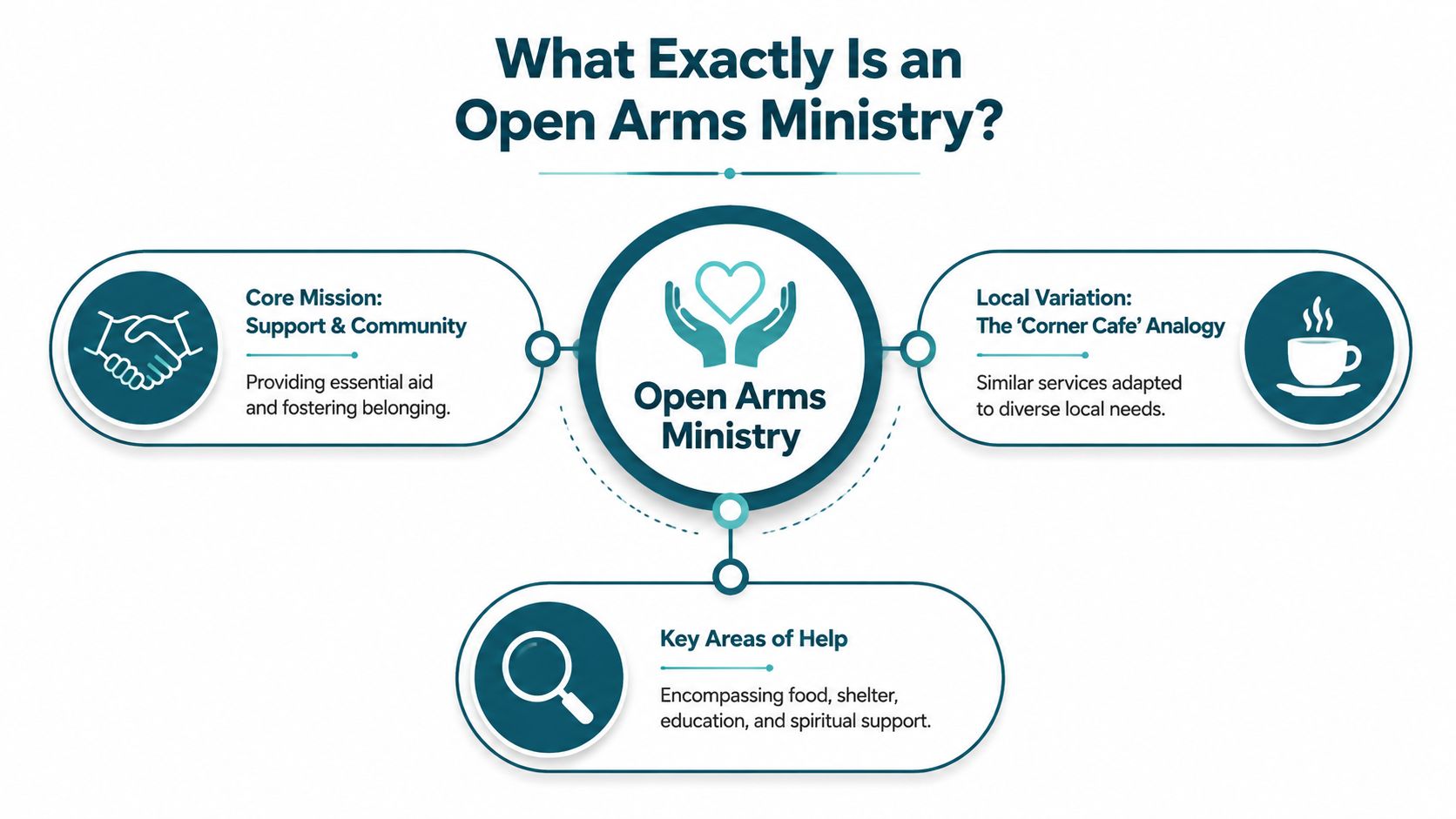
    What Exactly Is an Open Arms Ministry

    Think about a place called Corner Cafe. You could find a Corner Cafe in one city that sells pancakes, another that sells tacos, and another that closes before lunch. Same name. Different owners, different habits, different purpose. Open Arms Ministry works a lot like that.

    An infographic titled What Exactly Is an Open Arms Ministry outlining its core mission and local variations.

    When I say Open Arms Ministry, I'm usually talking about a local faith-based group using that name to welcome people and meet needs in its own way. That's the common thread. The structure, programs, and daily work can change a lot from one city to another.

    Same spirit, different missions

    Some groups using this name focus on the basics first. Food. Clothing. A hot meal. A short conversation that helps a person breathe again.

    Others build their whole identity around children and family care. For example, Open Arms Christian Ministries has worked for over 40 years on child welfare by providing safe homes and a structured community to help minors recover from trauma, as described on the Open Arms Christian Ministries website. That's very different from a pantry model, even though the name feels familiar.

    Here's the simplest way I sort it out:

    Type of group What you may find
    Pantry-based ministry Grocery pickup, meal service, basic needs
    Youth-centered ministry Drop-in support, snacks, classes, trusted adults
    Family or child welfare ministry Safe homes, structured care, long-term support
    Reentry-focused ministry Church connection, support after release, community welcome

    What the name does and doesn't tell you

    The name tells you something about tone. It tells you the group likely wants to receive people warmly. It does not tell you exactly what services exist, what hours they keep, or who they serve.

    That's where people get tripped up.

    Practical rule: Treat “Open Arms Ministry” as a starting clue, not a full description.

    If you're searching online, don't stop at the homepage name. Look for these details right away:

    1. Street address
      That helps you tell one ministry from another.

    2. Service type
      Pantry, youth center, housing, church ministry, or another model.

    3. Hours and days
      A kind mission statement won't help if you arrive on the wrong day.

    4. Who they serve
      Families, teens, adults, returning citizens, or children in care.

    Once you start looking at the name this way, the confusion eases. You stop asking, “What is Open Arms Ministry?” and start asking, “Which Open Arms Ministry is this?”

    Finding Food and Immediate Help

    The first time I walked into a pantry years ago, I kept rehearsing what I'd say. I thought I needed the right words. I thought I had to explain myself. Then a volunteer looked up, smiled, and asked if I needed a bag.

    That's what immediate help often feels like at its best. Simple. Human. No speech required.

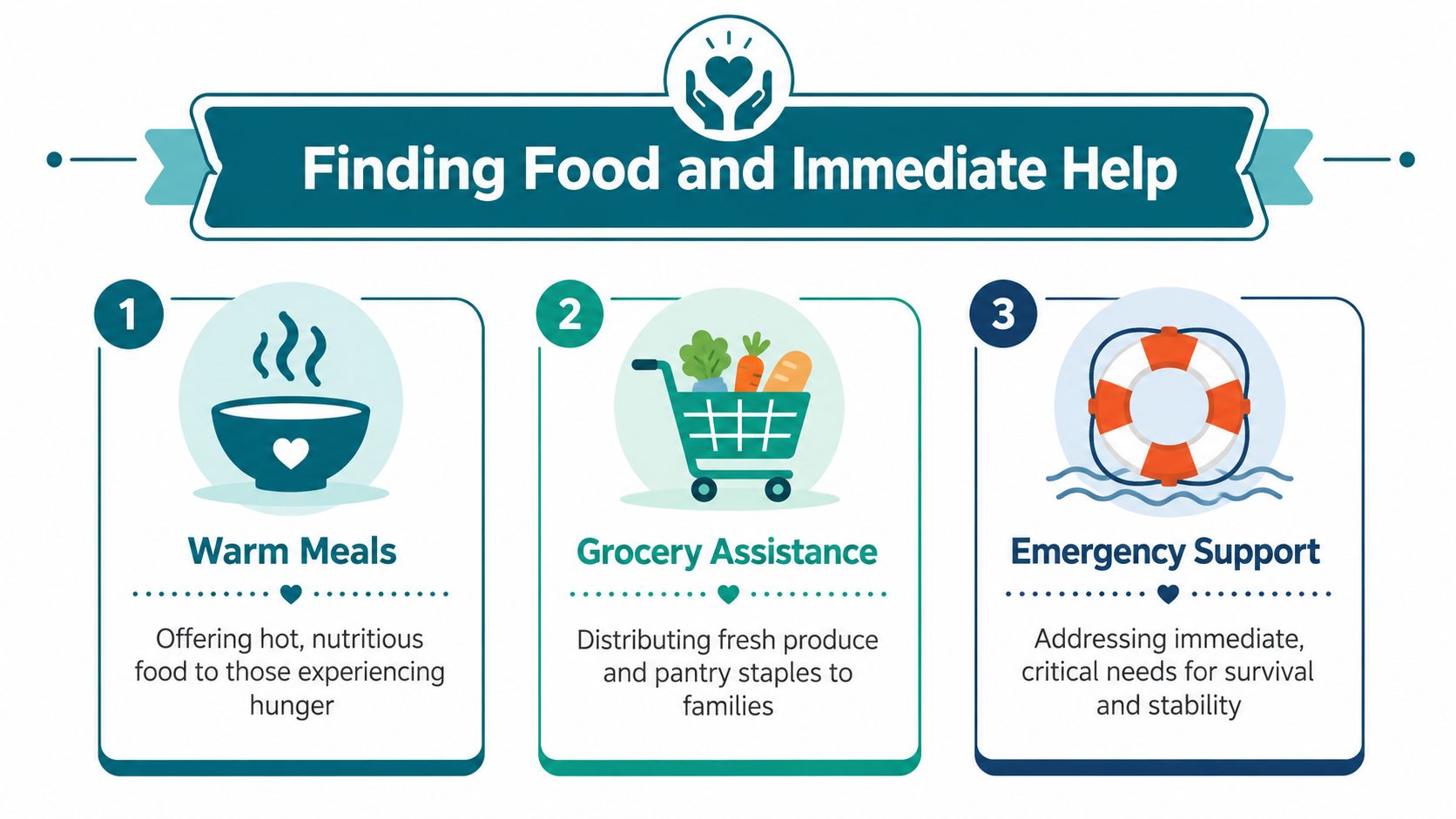
    An infographic titled Finding Food and Immediate Help, detailing three services: Warm Meals, Grocery Assistance, and Emergency Support.

    Many ministries using the Open Arms name are closest to this model. They deal with the need that can't wait. Empty cupboards. Thin paychecks. A week that went off the rails.

    A real Chicago example

    In Chicago, Open Arms Ministry at 2649 N Francisco Ave is a verified food pantry in the Greater Chicago Food Depository network, and it serves residents every Wednesday from 4:00 PM to 6:00 PM, according to the Greater Chicago Food Depository location listing for Open Arms Ministry.

    That kind of detail matters. Address. Day. Time. Those are the facts that turn a vague search into an actual trip.

    A lot of people need that kind of certainty. If you're juggling work, the bus, kids, or plain exhaustion, “Wednesday from 4:00 PM to 6:00 PM” is better than a paragraph full of warm words.

    Here's a short visual that may help if you're trying to picture what food support can look like:

    What a first visit usually feels like

    A parent heading into a pantry for the first time often carries two bags. One is for food. The other is invisible. Shame, nerves, pride, fear of being judged.

    Most of the time, the room gets lighter once the first hello happens.

    You may see folding tables, canned goods, produce boxes, or volunteers directing people into a line. You may need to sign in. You may be asked basic questions. Every pantry runs a little differently, so call first if you can.

    Here's a practical checklist:

    • Bring basic documents if you have them: some sites may ask for ID or proof of address, and some may not.
    • Bring a cart or sturdy bags: food gets heavy fast.
    • Arrive early if possible: lines can form before opening time.
    • Ask what else they know nearby: pantry volunteers often know meal sites, clothing closets, and other neighborhood help.

    If you're in Chicago and comparing options, this local guide to the Casa Catalina Food Pantry in Chicago can also help you think through what to expect from a neighborhood pantry visit.

    What to look for in search results

    Don't trust the name alone. Look for signs that a listing is current.

    • A clear address
    • Current pantry hours
    • Connection to a food network or local directory
    • Phone contact or location notes

    If your need is food tonight or groceries this week, search for hours before mission statements.

    That one habit saves time, gas, and heartache.

    Support and Safe Spaces for Youth

    A teen doesn't always say, “I need help.” Sometimes it comes out as hanging around too late, skipping home, or asking where the Wi-Fi is and pretending that's the only reason they came.

    That's why youth support matters so much when it exists. A safe room can change the shape of an afternoon.

    When an Open Arms name means youth support

    Some ministries using the Open Arms name are built for young people. One example is the San Bernardino Open Arms drop-in center, which caters to youth ages 14 to 24, while many ministry websites still don't make youth services clear, as described on the Open Arms youth center page from Family Assistance Program.

    That contrast is what makes searching hard. One site may plainly describe youth ages, snacks, classes, and hygiene support. Another may say almost nothing beyond a name and a church address.

    So if you're a parent, aunt, uncle, teacher, or teen, don't assume. Ask.

    What youth help can look like on the ground

    I think of a teenager walking in after school with a dead phone and a face that says, “I'm fine,” when they aren't. In a good youth space, nobody rushes them. Someone points to snacks. Someone knows their name by the second visit. Homework happens at one table. Quiet conversation happens at another.

    That kind of place has rhythm. A fridge humming in the corner. A charger basket. A staff person who notices when a kid gets quieter than usual. It may not look dramatic from the outside. But inside, it can feel like a railing on a steep staircase.

    If you're trying to locate youth-friendly community support in Chicago, this page about the Friendship Center in Chicago may help you compare what a service-oriented neighborhood resource can look like.

    Questions I'd ask before showing up

    Call or message first and keep it simple. You don't need to perform. You just need answers.

    • What ages do you serve
    • Do teens need a parent with them
    • Do you have after-school hours
    • Do you provide snacks, hygiene items, or help with schoolwork
    • Is there someone my child can talk to one-on-one

    Ask direct questions. A vague website usually means you need a real conversation.

    If the person answering sounds unsure, that tells you something too.

    If the website says almost nothing

    That doesn't always mean the ministry is uncaring. Sometimes small groups are busy doing the work and bad at explaining it online. But if you're in a moment of need, missing details still create a real barrier.

    So trust clarity. If one ministry says who it serves and when, and another gives only a logo and a verse, start with the place that gives you usable information.

    A young person looking for safety shouldn't have to solve a puzzle first.

    A New Start After Being Behind Bars

    When someone comes home from jail or prison, people around them often say, “Just stay out of trouble.” That line is cheap. It asks for a new life without naming what a new life needs.

    A new life needs people. It needs a place to land. It needs someone who doesn't flinch at your past and then leave you alone with your paperwork, fear, and empty pockets.

    Why many searches hit the wrong kind of help

    A lot of people assume an Open Arms Ministry will have reentry support built in. That would make sense. The name sounds like the place you'd go when the world has shut its doors.

    But the situation is more uneven. A major gap exists because most public-facing Open Arms Ministry locations focus on food, not the specialized reentry support needed by the 640,000 people released from state prisons annually, and specialized jail ministry programs are not always integrated with local food pantries, according to the Open Arms jail ministry page.

    That means a person may search for one kind of welcome and find another. Pantry help matters. It just isn't the same as reentry support.

    What reentry help usually needs

    If I were helping someone home after incarceration, I wouldn't stop at “Do they give out food?” I'd ask deeper questions.

    Need What to ask
    Community Do you have a mentor, church contact, or welcome team?
    Stability Can you point me toward housing or practical support?
    Next steps Do you help people reconnect with work, family, or local services?

    A reentry ministry often works more like a bridge than a pantry shelf. It may connect churches to people coming home. It may build relationship first and services second. It may involve listening, consistency, and lots of small steps.

    What I'd say to someone searching tonight

    If you or someone you love is coming home, don't assume every local ministry with a warm name is prepared for reentry. Call and ask plainly:

    1. Do you have specific support for people returning from jail or prison?
    2. Is this a pantry ministry, or do you also help with reentry needs?
    3. Do you partner with a jail ministry or church reentry team?

    Food support can steady a week. Reentry support helps steady a life.

    That difference matters. You're not asking for too much by wanting the right kind of help. You're asking the right question.

    How You Can Be the Open Arms for Someone Else

    Sometimes the person reading this isn't looking for food, youth help, or reentry support. Sometimes you're reading because you feel that tug in your chest that says, “I need to do something.”

    Good. Hold onto that.

    Local ministries with names like Open Arms often need help that is humble and specific. Not grand speeches. Not rescue fantasies. They need the kind of help that shows up on time and asks what's useful.

    Start local and stay practical

    Because these ministries are often independent, the best move is direct contact. Find the one in your town. Call. Send a short email. Ask what they need this month, not what you assume they need.

    Here are the questions I'd use:

    • Where are you short right now
    • Do you need volunteers, donated goods, or both
    • What days are hardest to staff
    • What should I avoid dropping off
    • Who should I talk to before I show up

    That last question matters. Good intentions can still create extra work if you arrive with the wrong items or at the wrong time.

    Ways to help that people often overlook

    Some ministries need cash. Some need canned food. But many also need plain, unglamorous labor.

    One person sorting donations for two hours can save staff energy. One driver with room in a car can move supplies. One calm adult who greets guests kindly can change how a room feels.

    If you're new to service work, this guide on how to start volunteering is a useful way to think through consistency, attitude, and showing up in a way that helps.

    The best volunteer is often the one who asks, listens, and comes back.

    Give in a way that fits the place

    A pantry may need grocery staples and sturdy bags. A youth space may need snacks, hygiene items, chargers, or art supplies. A reentry ministry may need mentors, rides, and people willing to build trust slowly.

    That's why I don't like one-size-fits-all advice here. The name may be shared. The need is local.

    If you have money, give locally and ask what fills a real gap. If you have time, offer a small repeatable block instead of one dramatic burst. If you don't have much of either, be the person who spreads accurate information. That counts too.

    People find help faster when one neighbor says, “I called them. Here's what they do.”

    Your Questions About Local Ministries Answered

    A lot of last-minute questions come up right before someone makes the call or walks through the door. I hear that hesitation all the time. It usually sounds practical on the surface, but underneath it is fear of being turned away.

    Do I have to be religious to receive help

    Usually, people look for help because they need help. If a ministry has food, youth support, or other aid open to the public, start by calling and asking about eligibility and hours. You don't need to sound polished. Just say what you need and ask if they can help.

    If you're thinking about volunteering, ask what their expectations are for volunteers. Some ministries are church-based and some roles may fit their faith setting more directly than others.

    Will I need an ID or paperwork

    Sometimes yes, sometimes no. Pantry rules, sign-in practices, and intake steps vary by location. That's why I always tell people to call before going if they can, and ask, “What should I bring with me?”

    If you don't have documents handy, still call. Don't disqualify yourself in your head before a real person answers.

    How do I know I found the right Open Arms Ministry

    Match the name with the details. Check the address, days, service type, and who they serve. If the listing is vague, call and ask direct questions like, “Are you a food pantry?” or “Do you work with youth?” or “Do you help people after incarceration?”

    You are allowed to be specific. In fact, being specific is the fastest path to actual help.

    If one place can't meet your need, ask them if they know a nearby group that can. People doing community work often know each other better than websites do.


    If reading about open hands and local help makes you want to step outside and do some good close to home, take a look at Litter Caterpillars. It's a Chicago volunteer group that meets weekly and has cleaned all 50 wards of the city over about three years, including through the 50 Ward Challenge and in hard-hit places that need steady care, as their Meetup page describes. If you want a human way to help your city, meet people, and build a habit of service, it's a good place to start.

  • Midewin Welcome Center: Gateway to the Prairie

    Midewin Welcome Center: Gateway to the Prairie

    I once left a Chicago cleanup with black gloves, a full trash bag, and that familiar feeling that I had only shaved a corner off a much bigger mess. A few days later I drove out to Midewin, walked into the Midewin Welcome Center, and felt that same feeling again, except this time it came with wind, grass, and hope.

    Finding a Bigger Mess to Clean

    The first time I drove south after a city cleanup, my gloves were still on the passenger seat. They smelled like wet cardboard and old coffee. At a stoplight, I looked at that crumpled pair of gloves and had the oddest thought. Street litter was not the only mess I wanted to help with anymore.

    Midewin pulled me for that reason.

    It was once the site of the Joliet Army Ammunition Plant. Now people come there to witness a long repair job in progress, the kind that takes patience, public will, and a willingness to keep showing up after the novelty wears off. That made sense to me right away. Litter Caterpillars know that feeling. You clear one block, then come back next week and clear it again, and somewhere in that repetition your own habits start changing too.

    Why this place hit me

    A restored prairie sounds romantic from far away. Up close, it feels more honest than romantic. You are standing near ground that carries a heavy history, and you are also standing in a place where people chose not to leave the damage as the final story.

    That landed hard for me.

    In the city, our work can feel small. One bottle. One fast-food bag. One storm drain pulled clear before the rain comes. At Midewin, the scale gets bigger, but the lesson stays the same. Repair happens through repeated care. People remove what harms, protect what can return, and make room for life to come back slowly.

    Practical rule: Go to Midewin when you need proof that slow work still counts.

    A trip for people who like sleeves rolled up

    I would not call Midewin a polished attraction. I liked that. The place feels like a public invitation to witness recovery while it is still underway.

    That is why the Welcome Center matters before you ever set foot on a trail. It gives you a way to enter the prairie with the right frame of mind. You are not arriving to consume a pretty view and leave. You are arriving to learn how damaged ground gets another chance, and what your part in that story can be.

    For me, that changed the whole drive. I was not heading out for a break from cleanup work. I was heading toward a bigger version of the same calling. Restore what has been neglected. Respect the time it takes. Come back. Bring others. Let the work outside you shape the work inside you too.

    Your First Step into the Prairie

    The first time I drove down from the city, I felt that familiar cleanup-day doubt. Did I pack enough water. Was I leaving too late. Was this going to be one of those trips where I spend more time in the car than on the ground. Then the roads opened up, the buildings fell back, and the whole day started to loosen its grip on me.

    That shift matters.

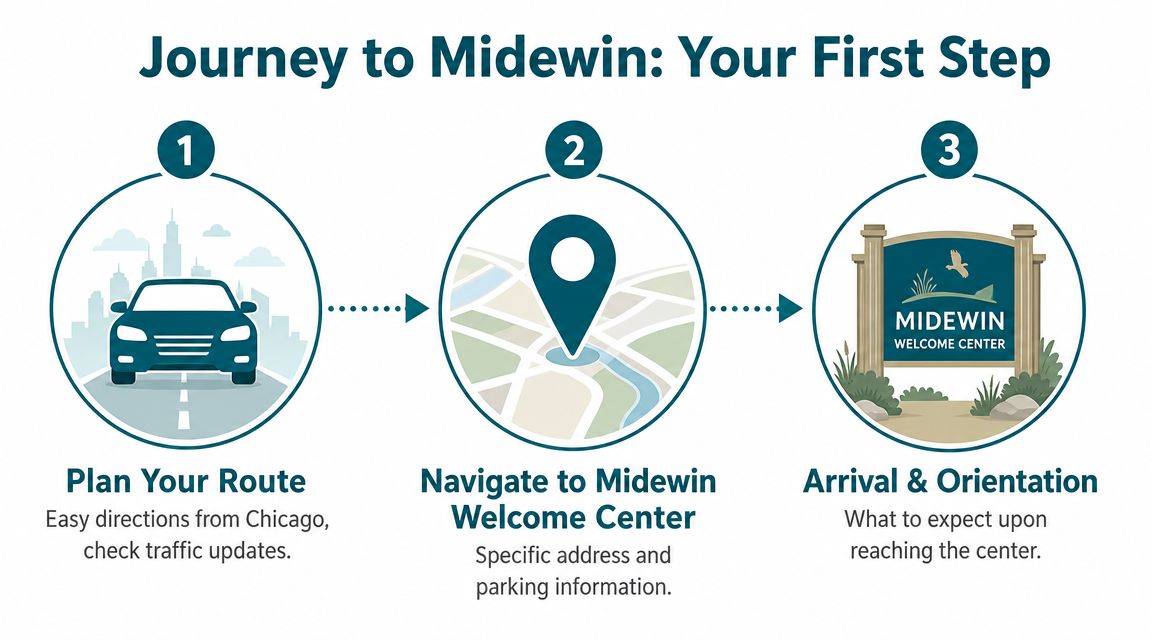
    For Litter Caterpillars people, the drive to Midewin can feel like going to meet an older cousin of the work we already do. In the city, we clear a block, a curb line, a patch of weeds behind a fence. Out here, you arrive at a place trying to recover at prairie scale. The Welcome Center gives that feeling a place to land before your feet hit the trail.

    A three-step infographic showing how to plan a visit to the Midewin Welcome Center.

    The part that makes the day go better

    Keep the plan simple. Pick a morning when you are not already depleted. Leave early enough that you do not turn the whole trip into a rushed errand. Bring what you would bring for a long, open walk instead of a quick stop.

    I have learned that prairie time punishes sloppy city habits. A late start feels later. Sun feels bigger. Wind has opinions. If you roll in hungry, underdressed, or irritated, you will notice all of that before you notice anything beautiful.

    A few things earn their place in the car every time:

    • Water and a snack
    • Good walking shoes
    • One extra layer
    • A notebook, or your phone notes app, if quiet places tend to pull thoughts out of you

    If you have ever visited Goose Lake Prairie State Natural Area and watched your pace change once the horizon opened up, you already know the rhythm I mean.

    Why the Welcome Center comes first

    The Welcome Center works like a reset point. You stop being a driver passing through and become a visitor who is paying attention.

    I would not skip it, even on a day when you feel eager to get straight outside. Starting here helps you settle your mind, use the restroom, look over the layout, and shake off that city habit of treating every destination like something to conquer quickly. That small pause changes the visit. You arrive less like a consumer and more like a participant.

    That distinction stayed with me. Restoration asks for a different kind of presence. It asks you to notice what has returned, what is still missing, and how much care sits behind ground that looks calm.

    What it feels like when you pull in

    You are not arriving at a flashy attraction. You are arriving at a working threshold.

    I like that. It fits the place.

    The Welcome Center is the point where scattered intentions become an actual day in the prairie. You get your bearings. You slow down enough to be teachable. You remember that healing land, like healing a neighborhood or your own habits, starts with one honest step taken on purpose.

    What You Will Discover Inside

    The first time I stepped into the Midewin Welcome Center, I expected something plain and procedural. A counter. A brochure rack. Maybe a map and a quick restroom stop. Instead, I felt the day slow down in a good way.

    Inside, the story of the land starts taking shape. The Forest Service says the center has exhibit clusters on glaciers, wetlands, prairies, wildlife, and the site's restoration timeline, and it has trail maps, program guides, and brochures that help you plan your way through the large trail system on the Midewin Welcome Center page from the Forest Service.

    The room changes what you see outside

    That matters more than it sounds. Before you go in, you may think you're driving out to see “some grass.” After you spend a little time with the exhibits, the prairie gets sharper. The ground has a past. The water has a story. The animals stop feeling random. Even the flatness starts to read differently.

    I had that same shift at Goose Lake Prairie State Natural Area. Once you learn how a prairie works, your eyes stop sliding over it. You notice textures, little changes in height, wet areas, bird movement, and the strange power of a place that doesn't scream for attention.

    What stayed with me

    The restoration timeline hit hardest. I'm drawn to any place that admits, openly, that repair takes a long time. In a city, we often want proof fast. We want the before-and-after photo. We want the cleaned lot, the organized room, the redeemed week.

    Midewin doesn't let you think that way for long. Inside the Welcome Center, you start to understand that renewal is a chain of ordinary acts. Someone studies. Someone plants. Someone monitors. Someone explains. Someone comes back.

    A map is useful, but context is better. Once you know what you're walking through, every mile feels less like exercise and more like attention.

    Don't rush this part

    If you're anything like me, your instinct might be to hurry outside. Fight that instinct. Spend a little time with the exhibits. Ask questions if staff are available. Take the brochure. Study the trail map.

    That indoor pause is like sorting your cleanup supplies before hitting the street. It doesn't look dramatic, but it changes the whole day. You leave the building carrying more than paper. You leave with a way of seeing.

    From the Center to the Trails

    The first time I walked out of the Welcome Center, I stopped after maybe twenty steps.

    Nothing dramatic happened. No bison crossed the road. No hawk swooped overhead on cue. I just felt the city pace fall off my body. The building had given me names, history, and a map. Outside, all of that turned into a real place with wind in it.

    What struck me most was the room. Midewin gives you space to settle down and pay attention. You stop checking how fast you are going. You start noticing where the ground holds water, where the grasses shift, where a bird keeps returning to the same patch. For Litter Caterpillars people, that change feels familiar. It is the same shift that happens on a cleanup when you stop rushing for a full bag and begin seeing the block clearly.

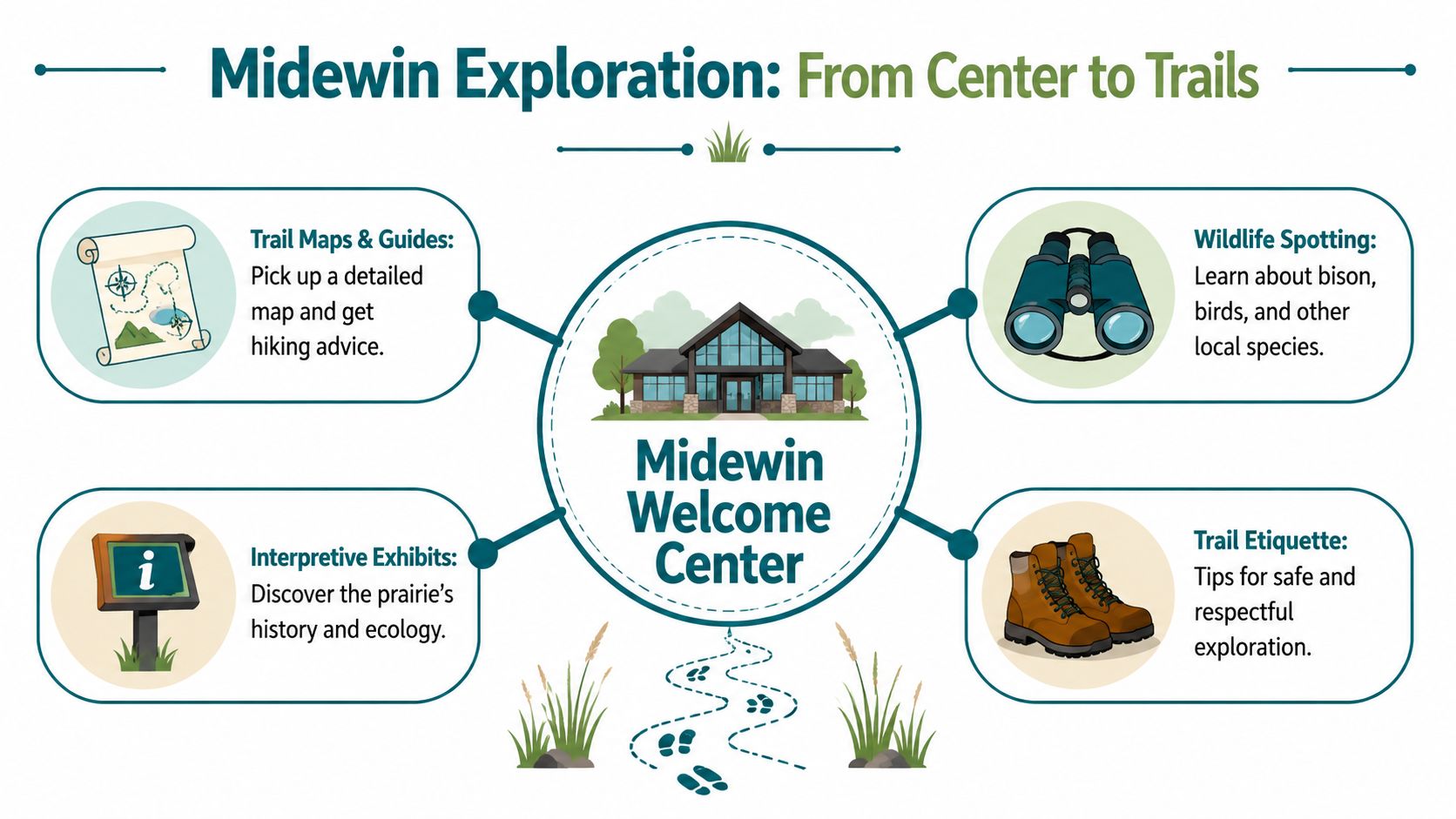
    An infographic titled Midewin Exploration showcasing resources like maps, wildlife spotting, exhibits, and trail etiquette tips.

    How I choose a trail day

    I do better here when I choose the day before I choose the route.

    Day you want What I'd do
    Quiet reset Take a shorter walk and stop often. Let the place slow you down.
    Longer effort Use the map from the center and commit to a fuller hike. Bring more water than you expect to need.
    Learning day Match your walk to one or two things you noticed inside. Watch for wetlands, birds, and plant changes rather than trying to see everything.

    That little decision saves me from turning a prairie visit into another city habit where I chase completion instead of paying attention.

    Start with a basecamp mindset

    The Welcome Center works best as a place to gather yourself, then head out with purpose. A prairie can look simple from a distance, but openness asks something from you. It asks for patience, water, and a little humility.

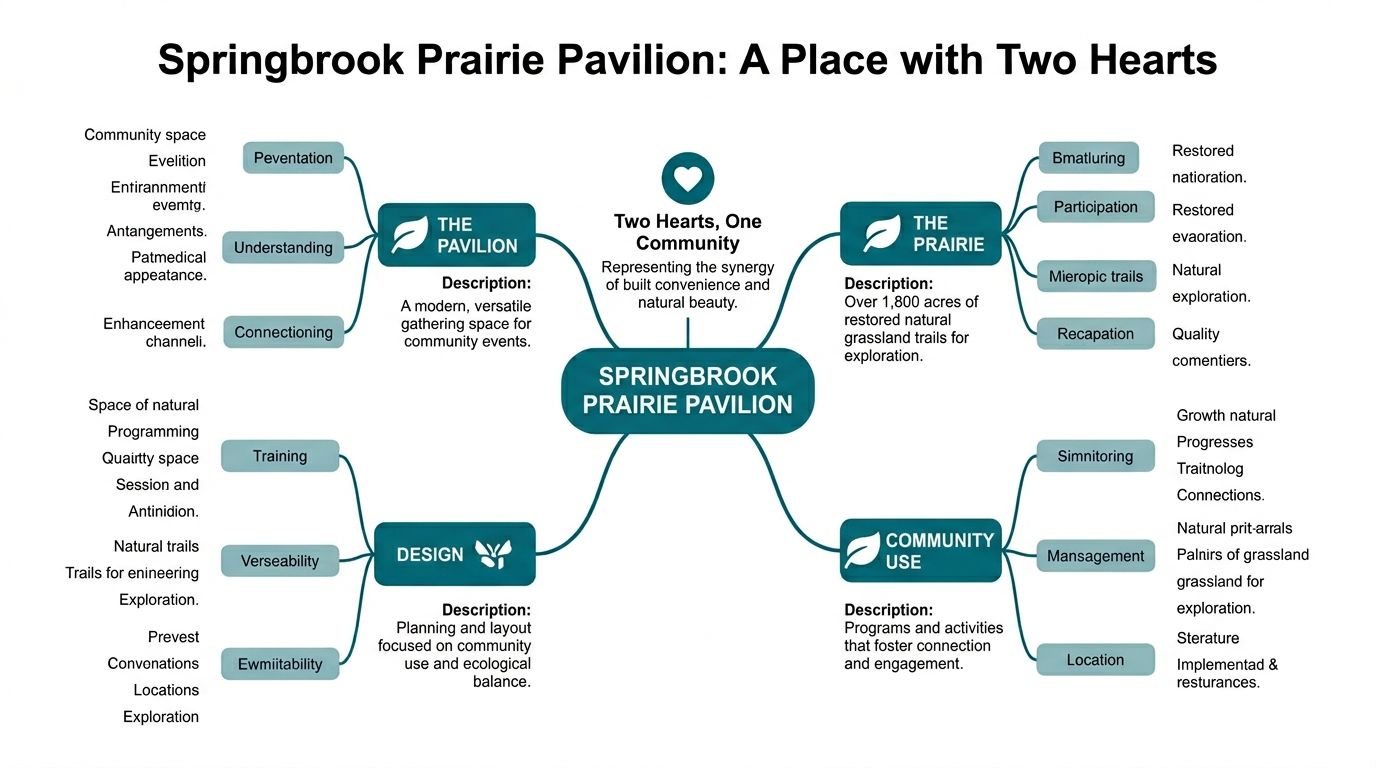
    I learned that same lesson at Springbrook Prairie Pavilion. Wide ground is not empty ground. It rewards people who slow down enough to catch small signs of life and recovery.

    Trail etiquette that feels close to cleanup ethics

    A first visit goes better when you carry the same respect you would bring to a neighborhood cleanup.

    • Keep the map with you so you can stay oriented without guessing.
    • Walk carefully because restoration is ongoing and the place is still being tended.
    • Pause longer than feels normal. The prairie reveals itself in layers.
    • Leave with care in your body. Even when you take nothing and change nothing physically, your attention matters.

    That last part stays with me. In the city, we pick up what was dropped and try to leave a corner better than we found it. At Midewin, the service is quieter. You practice restraint. You let the prairie be what it is. You learn that restoration is not always about doing more. Sometimes it is about moving through a recovering place without adding to the mess.

    How We Can Partner with the Prairie

    A few steps outside the Welcome Center, I watched a kid crouch beside the path and study a plant like it was giving instructions. His dad stood over him with the map folded wrong, smiling anyway. Nobody looked polished. They looked the way our cleanup crews look at the start of a Saturday morning. Ready to help, not fully sure how yet.

    That is the spirit I would bring to Midewin.

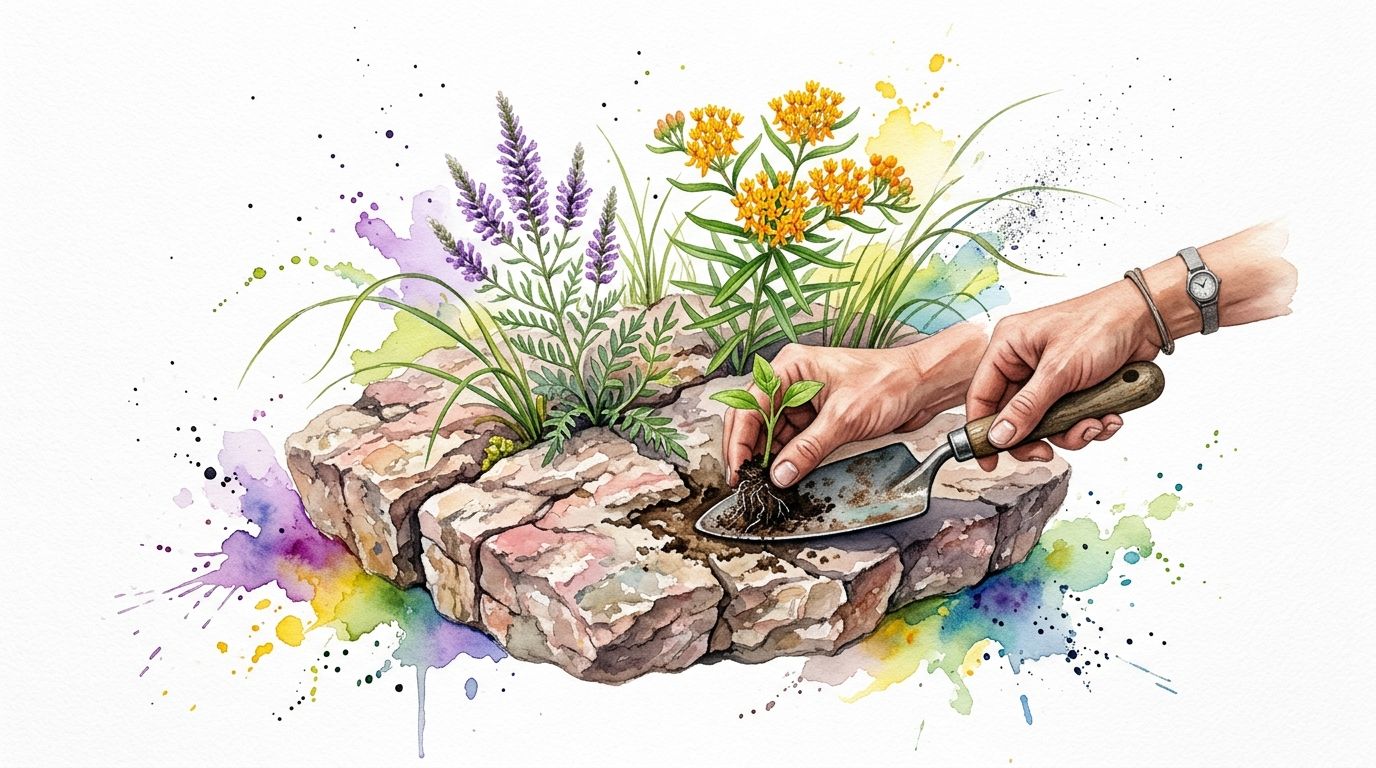
    A conceptual illustration of hands planting a sapling at Midewin National Tallgrass Prairie featuring diverse community involvement.

    Service changes the day

    As noted earlier, the Welcome Center offers different ways to learn through the year, including guided programs in the warmer season and educational events in colder months. I love that rhythm. It lets your first visit be simple. You show up, listen, walk, and let the place work on you a little.

    That pattern feels familiar to me because it matches the way restoration usually starts in the city. We do not begin with mastery. We begin by noticing what has been neglected, then returning with more care the next time.

    If you want language for that shift, this guide on what environmental restoration means in practice puts clear words to it. Repairing land and repairing ourselves often follow the same motions. Show up. Remove what harms. Protect what can grow. Repeat.

    A few ways to show up well

    One good day at Midewin can start a longer habit. Here are a few honest ways to make the visit feel like participation instead of consumption:

    • Join a program or tour if one is available. A guided walk can help you notice signs of recovery you would pass right by on your own.
    • Bring one person who has been tired in the city kind of way. The prairie has a way of stretching out your thoughts until they stop bumping into each other.
    • Make it a service-minded outing with a community group. Litter Caterpillars does that through volunteer trash pickups across Chicago, and a prairie visit can carry the same spirit of care into a different kind of environment.

    Here's a good video to watch if you want the mood before the drive:

    Stewardship starts smaller than you think

    I do not think stewardship begins with a title.

    It begins the moment you stop asking, “What can I get from this place?” and start asking, “How can I move through this place without making recovery harder?” At Midewin, that may mean staying on the trail, paying attention during a program, or bringing home a steadier idea of what care looks like. Quiet service still counts.

    That is why a trip here can feel bigger than a day trip. You leave with more than prairie photos. You leave with a sharper standard for your own life. The grasslands are being restored over time, through patience and repeated care. Our blocks, our habits, and our own worn-out parts usually heal the same way. One return. One better choice. One piece of trash, or one careful step, at a time.

    Your Midewin Field Guide Questions Answered

    I've found that most hesitation about a first trip has less to do with desire and more to do with tiny practical questions. So here are the answers I'd give a friend the night before we go.

    What should I wear

    Wear clothes you can walk in for a while without fussing. I'd choose comfortable shoes, light layers, and something you don't mind getting a little dusty. Prairie weather can feel open and direct, so I'd rather have one extra layer in the car than wish I'd packed it.

    If it's sunny, act like you're going to spend time with very little shade. If it's cooler, don't let the city fool you into thinking the open ground will feel the same.

    What should I bring

    Keep it simple.

    • Water because open trails can dry you out fast.
    • Snacks if you think you'll stay longer than planned.
    • Your phone or a paper note with your basic plan for the day.
    • Curiosity. I know that sounds corny, but this place gets better when you slow your eyes down.

    Is it good for a first-time prairie visitor

    Yes. In fact, I think the Midewin Welcome Center makes it easier for first-timers because you can orient yourself inside before you head out. You don't need to pretend you already understand what you're seeing. Start with the exhibits. Get a map. Ask a question.

    Is it good for kids

    I think so, especially if you frame the trip the right way. Don't sell it as a forced march through educational content. Sell it as a discovery day. Let kids look for birds, notice water, compare grasses, and learn that restoration is real work done by real people.

    What if the weather shifts

    Treat weather as part of the day, not a betrayal. Still, use judgment. If conditions look rough, adjust your walk, spend more time inside, or save the longer trail for another visit. There's no prize for pretending discomfort is wisdom.

    Field note: The best prairie days usually come from flexibility. A shorter walk with full attention beats a stubborn epic hike every time.

    Should I plan around programs

    If you like structure, yes. Educational programming and tours are especially available from April to October, so that's a good window if you want your visit to include more guided learning. If you prefer a quieter day, just use the center for orientation and head out on your own path.

    What mindset should I bring

    Bring the same mindset you'd bring to service. Be useful. Be observant. Don't rush the process. Let scale humble you a little.

    That's really why I keep thinking about this place. The Midewin Welcome Center isn't just where you pick up a map. It's where a regular person from a messy city life can remember that repair is possible, even when it happens slowly, even when it happens over years, even when the work looks plain from the outside.


    If you want more days like this, and more chances to turn service into friendship and self-respect, take a look at Litter Caterpillars. We organize volunteer cleanups around Chicago for people who want to show up, do good work, and grow through it.

  • Des Plaines Dolomite Prairies Land and Water Reserve

    Des Plaines Dolomite Prairies Land and Water Reserve

    I once brought a friend here after a week when my head felt as cluttered as an alley after a windy day. We stepped out of the car, heard the grass moving before we really saw it, and my shoulders dropped for the first time all week.

    More Than Just a Patch of Grass

    The first time I walked into the Des Plaines Dolomite Prairies Land and Water Reserve, I expected something polite. A few nice plants. A trail. Maybe a sign or two. What I got felt closer to stepping into an old argument between stone, weather, and stubborn life.

    You know that feeling when your room gets messy enough that you stop seeing individual objects and just see one big failure? I know that feeling too well. For me, city life can do that. Sirens stack on top of deadlines. The sidewalk has broken glass, a fast-food bag pinned to a fence, and one lonely weed forcing itself through concrete like it has something to prove.

    Then I come here, and the whole lesson changes.

    This place doesn't look manicured. It doesn't flatter you. It asks you to pay attention. The grasses lean, the rock sits close beneath the soil, and the ground feels like it's holding a memory older than anything bothering you today. That honesty is part of why I love it.

    A man sits on a park bench, blending from a grayscale city into a colorful, vibrant natural landscape.

    What this place felt like to me

    I didn't come here as some polished nature guy with perfect hiking habits. I came here as a person who needed a reset. I needed a place that wasn't trying to sell me calm with curated signs and gift-shop energy. I needed a place that felt earned.

    The prairie gave me that.

    It reminded me of a forgotten city corner that still has dignity. A vacant lot can look dead until you kneel down and see volunteer sunflowers, ants hauling impossible crumbs, and roots splitting bad pavement. This reserve gives me that same feeling, except bigger, older, and wilder.

    If you spend most of your days in Chicago, you might like places with rough edges because they tell the truth. This reserve tells the truth.

    Some places cheer you up by distracting you. This one helps by making you smaller in the best way.

    If you're looking for a doorway out of noise

    Maybe you're tired. Maybe you want to get outside but don't want a fake version of nature. Maybe you want a place where you can walk slowly and feel your thoughts sort themselves out without forcing it.

    That's what this can be.

    If you're already exploring nearby preserves, you might also like this guide to the forest preserve experience around Chicago. But this reserve has its own mood. It feels leaner. Sharper. Like a place built for people who don't mind getting a little dirt on their shoes and a little perspective in their chest.

    A Prairie Forged in Floods

    The first time I understood this place, I was standing beside a volunteer on a cool morning after rain. He scraped the toe of his boot across a bare patch near the trail and said, "There. That's the whole lesson." Under a skim of soil, the rock sat close to the surface, plain and stubborn. You could feel right away that this prairie had not been given easy terms.

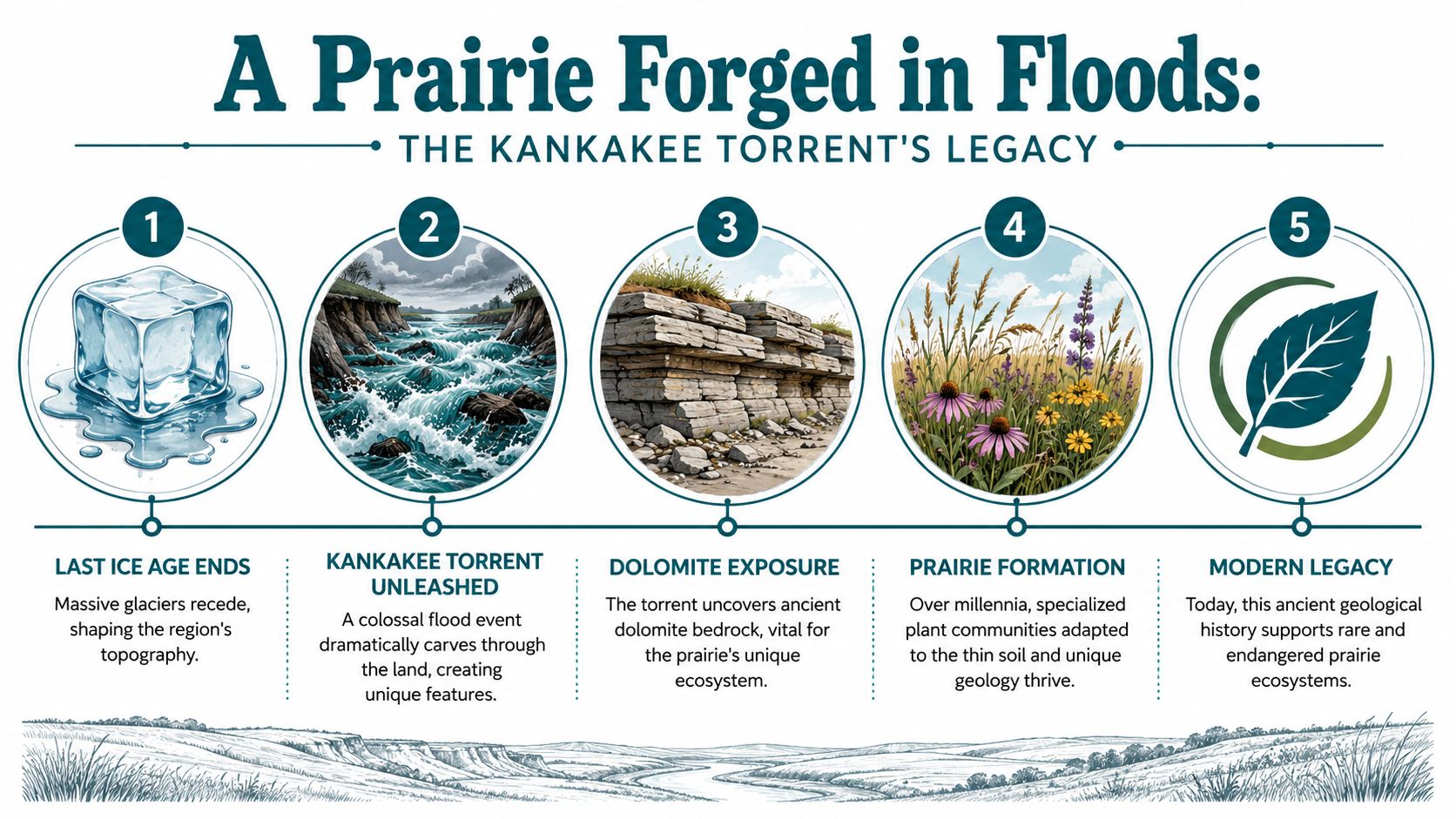
    Long before our workdays, field notebooks, and muddy gloves, floodwater carved the ground hard enough to expose dolomite bedrock. That old force still sets the rules here, as described by the Illinois Department of Natural Resources page for the reserve.

    An infographic showing the geological history of Kankakee Torrent and the formation of dolomite prairie ecosystems.

    The bones of the place

    A lot of Illinois hides its bedrock under deeper, softer soil. Here, the ground often feels spare. Thin soil dries fast in some spots. Water lingers differently in others. Plants do not get much room for laziness, so the ones that last are the ones built for pressure.

    That is one reason I bring new volunteers here when they are unsure of themselves. The prairie runs on limits. It grows beauty out of hard conditions. If you have ever felt scraped down by life and still kept going, this ground makes sense in your body before it makes sense in your head.

    I usually explain the sequence like this:

    • Ancient floodwater tore through the area.
    • Dolomite bedrock ended up close to the surface.
    • Soil stayed thin across many patches.
    • Prairie and wetland communities adapted to those constraints.

    Why the ground keeps changing under your feet

    You can hear it in how people talk once they have walked a little farther. One person says the trail felt dry and open. Another swears the next stretch felt damp, almost hidden. They are both right.

    The reserve holds several prairie and wetland community types, including a large area of Grade C dolomite prairie. That mix grows from the same rough geologic base noted earlier. The result is a place that keeps shifting mood as you move, a training field for attention. You learn to notice small changes. You slow down. You get less sure of your first impression, which is healthy work for a person, not just a hiker.

    This short video helps if you want a visual companion before your visit.

    How I explain a dolomite prairie to a friend

    I keep it simple. A dolomite prairie is a place where life has to earn its footing.

    Roots grip shallow soil. Water comes and goes on unforgiving terms. The plants that stay are the ones that can handle exposure, scarcity, and change. That is why volunteer work here never feels like charity to me. The prairie is teaching the same lesson it asks of its plants. Stand firm. Adapt. Work with others. Keep going.

    Field note: When the trail goes quiet, look down. The ground usually explains the rest.

    Discovering the Prairie's Treasures

    The first time I brought a new volunteer here, she stopped after ten minutes and said, "I thought this place would ask me to look far out." Instead, she was crouched over a hand-sized patch of ground, grinning at a tiny bloom pushing up through stone and short grass. That is how this reserve gets you. It trains your eyes first, then your character.

    You start to understand the place by getting low, staying quiet, and letting small things matter.

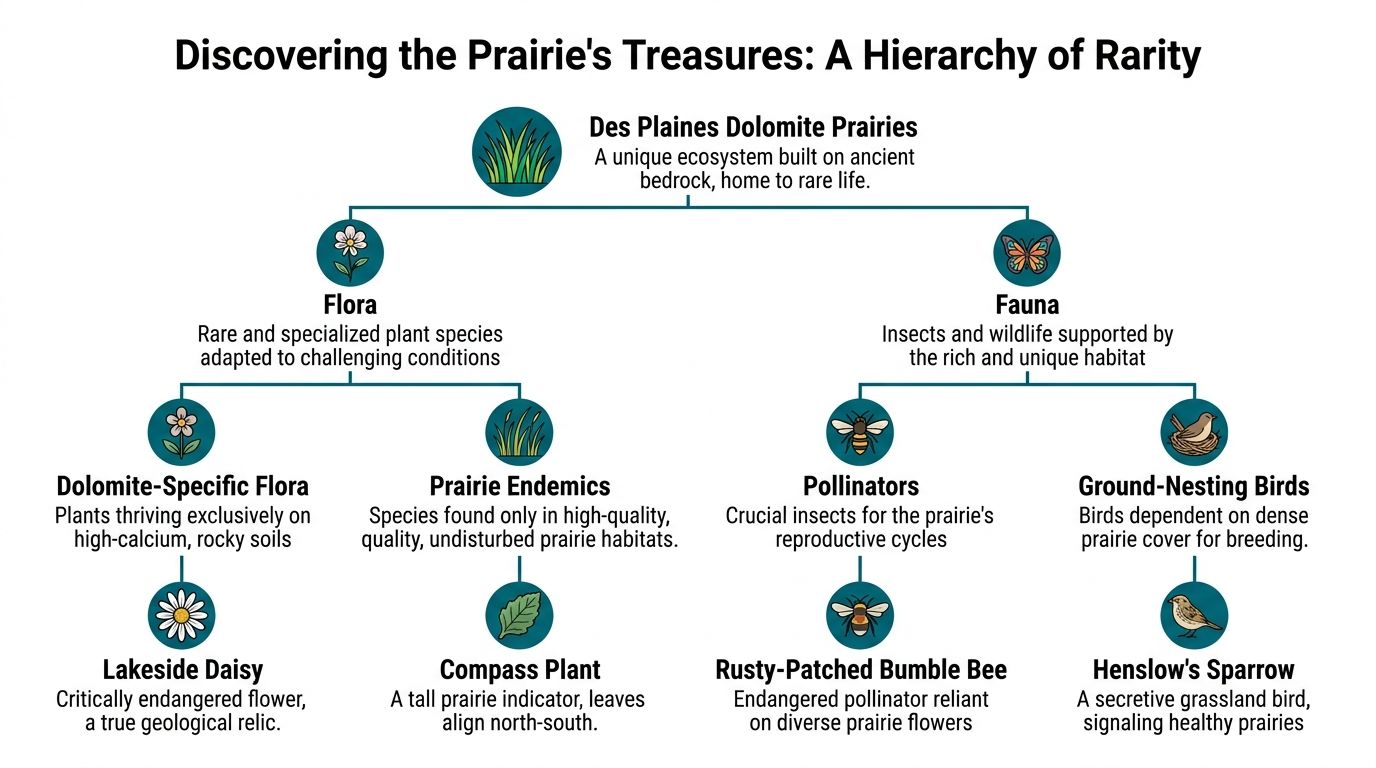
    A hierarchical flowchart describing the rare flora and fauna found in Des Plaines Dolomite Prairies ecosystem.

    Why a small remnant can change how you walk

    A friend once asked why our group gets so protective over what, to an untrained eye, looks like a modest stretch of prairie. I told him about the moment that changed me. I had paused to pull trash near a rough, open patch, and one of the older stewards waved me over like he was pointing out a jewel. He did not raise his voice. He just said, "Look carefully. Almost none of this is left."

    That landed hard.

    As noted earlier from state conservation material, this reserve holds a rare, high-quality remnant of dry-mesic dolomite prairie. Once you know that, your pace changes. You place your boots with more care. You stop treating the ground like background and start treating it like an elder that barely survived.

    What the prairie gives to people who pay attention

    I do not promise dramatic sightings on command. Prairie days do not work like that. What I can promise is that attention gets rewarded here, and the reward often comes in forms that make you better at more than hiking.

    Here is what I tell new volunteers to watch for:

    • A change in footing: Ground that turns stonier or thinner often marks a shift in the living community around you.
    • Small flowers close to the soil: The prairie hides some of its best work down low, where hurried visitors never look.
    • Busy insects over one patch: Pollinators will often show you the best stopping point before your own eyes do.
    • Birds dropping into cover: That quick movement tells you the structure of the grass is doing real work for wildlife.

    State information also notes that the reserve supports threatened and endangered species. I never turn that into a scavenger hunt. A place like this asks for respect, not conquest. Sometimes the bravest thing a person can do outdoors is accept that seeing less can still teach more.

    One volunteer in our group learned that the hard way, then the good way. He came hoping for a big checklist day. Instead, he spent an hour helping clear a small stretch near the trail and left talking about one insect he had watched move from flower to flower. He had noticed a pattern, slowed his breathing, and finally stopped trying to win the walk. That proved to be the most valuable discovery.

    A better way to search for treasure

    Kneel if the ground allows it. Stay with one square foot longer than feels natural. Let your eyes sort out stem from shadow, bloom from gravel, movement from wind.

    That simple act becomes practice for the rest of life. You get steadier. You get humbler. You become more useful to the people beside you because you are finally paying attention.

    If you want to build a longer day around that same habit of slow observation, this guide to the Des Plaines River Trail near Chicago is a good companion route.

    And when you find something beautiful, leave it where it is. The best thing you carry home from this prairie is sharper attention, and maybe a little more courage than you had when you arrived.

    Finding Your Way Around the Reserve

    The first visit always feels easier when somebody gives you the plain version. So here's my plain version.

    Treat the Des Plaines Dolomite Prairies Land and Water Reserve like a field trip, not a rush job. Give yourself time to park, stand still for a minute, and let your eyes adjust to open ground. Prairie spaces can seem visually quiet at first, then suddenly full.

    I also like pairing a visit here with other nearby outdoor routes. If you want another option for the same general part of the region, this guide to the Des Plaines River Trail near Chicago can help you build a longer day outside.

    My advice before you leave home

    Don't overpack. You don't need to dress like you're crossing a mountain range. Wear sturdy shoes, bring water, and expect uneven ground in places. If the weather turns, let that be part of the day instead of a crisis.

    Here's the quick-reference version I wish somebody had handed me early on.

    Item Details
    Setting A protected reserve within the Des Plaines Fish and Wildlife Area in Will County, Illinois
    Best first move Start slow and let your eyes adjust before you try to "find" anything
    Footwear Closed-toe shoes with grip make the walk more comfortable
    What to bring Water, sun protection, and patience
    Mindset Come ready to observe more than to conquer mileage
    Facilities Check current official guidance before you go, since access details can change
    Pets and rules Verify current site rules before your visit and stay on marked paths where allowed
    Ideal pace Unhurried. This place rewards people who stop often

    How I move through a place like this

    I don't chase every turn. I pick a direction, walk gently, and pay attention to changes underfoot. That matters more here than trying to rack up distance.

    Three habits help a lot:

    1. Start with the edges. Transitional areas often wake up your attention.
    2. Turn around halfway. The view back often feels completely different.
    3. Leave margin in your schedule. The best moments usually happen when you aren't rushing to the next thing.

    Practical rule: If you catch yourself checking your phone every few minutes, stop walking and listen for one full minute.

    How to Visit with Purpose

    A lot of people visit prairies the way they scroll. Fast eyes. Quick judgment. If nothing flashy appears, they move on.

    I think this place asks for another kind of visit. Slower. More deliberate. More willing to let small things matter.

    Pick a season, then pick a question

    I like giving each visit one question instead of one goal. In spring, my question might be, "What's waking up low to the ground?" In late summer, I ask, "Which plants are holding themselves tallest?" In fall, I pay attention to color, seed heads, and the sound of dry grass moving in the wind.

    That little shift changes everything. You stop grading the day by whether you got a perfect sighting. You start noticing patterns.

    A few simple ways to make the visit deeper:

    • Get low once or twice. Crouching changes your whole relationship with the prairie.
    • Look at one square of ground. Stay with it longer than feels natural.
    • Follow one sound. Wind, insects, birds, your own footsteps. Let one sound lead your focus.
    • Notice the rock story. Even if you can't see bedrock directly, remember what's shaping the plants.

    Respect is a form of attention

    Purpose isn't only about curiosity. It's also about restraint.

    Stay on the path where you're supposed to. Leave flowers, seed heads, and anything living where you found them. Don't treat the reserve like a backdrop for content. Treat it like a place with its own rules and its own pace.

    I learned this the hard way in nature spaces. I used to arrive wanting a payoff. A beautiful photo. A breakthrough thought. A clean emotional reset. Now I try to arrive ready to receive whatever the day gives me.

    That makes the good moments stronger.

    Some visits feel full right away. Others feel quiet until the drive home, when you realize your mind got lighter out there.

    Small practices that change the day

    If you're bringing a friend, ask them what they noticed before you tell them what you noticed. That keeps the place from turning into a lecture. If you're coming alone, try walking one stretch in silence with no music.

    You don't need a grand ritual. You need a little patience and a willingness to be taught by details.

    Answering the Call to Protect This Place

    The older I get, the less I believe in the idea that special places stay special on their own. They need help. Usually practical help. Hands, time, restraint, and people who are willing to do unglamorous work.

    Prairie care often looks like that. You don't always get a dramatic before-and-after reveal. Sometimes the work is slow, repetitive, sweaty, and absolutely worth doing.

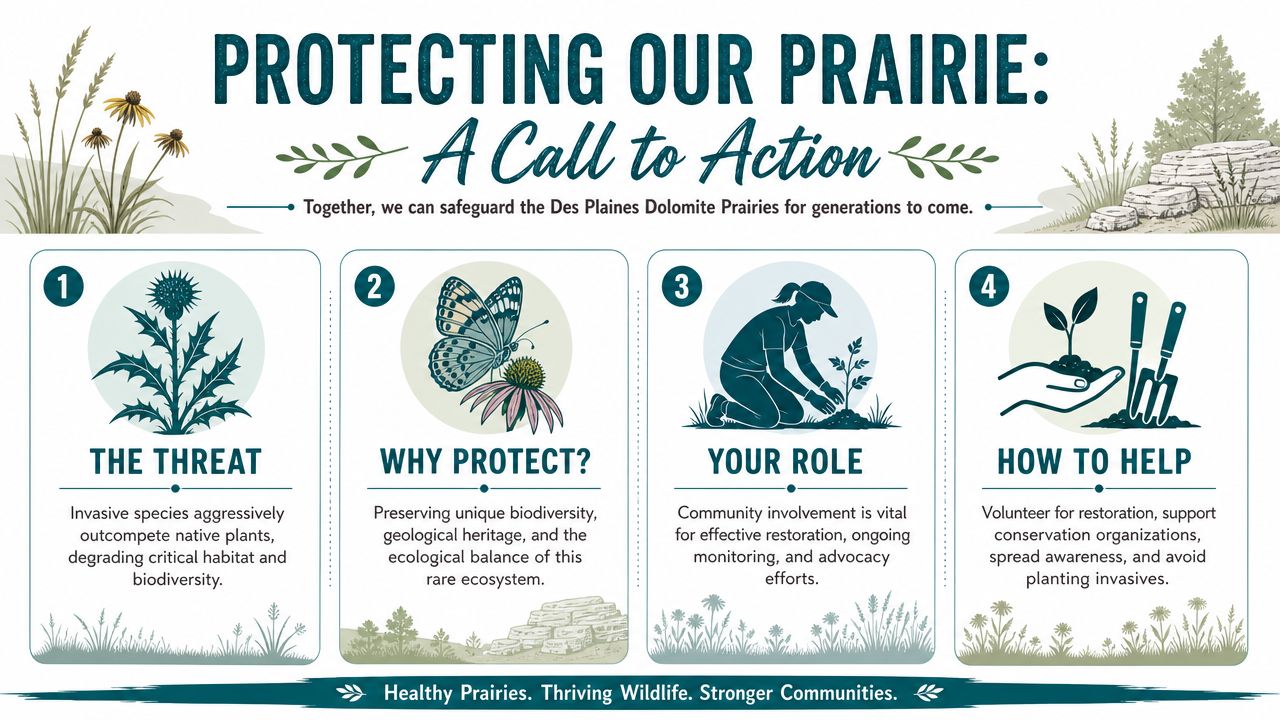
    An infographic detailing the conservation importance and community action steps for protecting the Des Plaines Dolomite Prairies.

    Why service changes the person doing it

    I've seen this over and over in outdoor volunteer spaces. Someone arrives a little shy, a little unsure, maybe just wanting to do one decent thing with their morning. Then they spend a couple hours picking up debris, hauling brush, or helping with habitat work. By the end, they stand differently.

    Work with your hands can do that.

    Nature service is good medicine for people who overthink. It gives your mind a job it can finish. You pull, carry, bag, clear, stack. The body understands what the mind has been circling.

    That's one reason I think stewardship matters so much. It doesn't only help the place. It trains you.

    What protecting a prairie can look like

    I don't mean everybody needs to become a full-time field ecologist. I mean regular people can become useful fast.

    That help can take a few forms:

    • Show up for workdays. Habitat care often needs willing hands more than perfect expertise.
    • Learn the rules of the site. Respect prevents damage.
    • Stay observant. Care starts with noticing what doesn't belong.
    • Bring a friend. Courage spreads socially. So does care.

    If you want a grounding idea for that mindset, I like the language in this piece on environmental stewardship. It puts words to something simple. A place does better when people decide it is partly their job.

    Bravery can be quiet

    When people hear "be brave," they often picture something loud. I think bravery out here is quieter than that.

    Bravery is waking up early and going anyway. Bravery is joining a volunteer day when you don't know anyone. Bravery is getting dirty, asking dumb questions, and learning in public. Bravery is deciding that care isn't embarrassing.

    If you want to feel less powerless, help a real place with your real hands.

    I love that prairie work can humble you without humiliating you. The plants don't care about your résumé. The ground doesn't care how polished you sound. You either help, or you don't. That's very freeing.

    And once you've done that kind of work, even once, a reserve like this stops being scenery. It becomes somewhere you feel responsible to.

    Your Story with the Prairie Starts Here

    By the time I leave this place, I usually feel two things at once. Smaller, and steadier.

    That's a good combination.

    The Des Plaines Dolomite Prairies Land and Water Reserve has its own long story in rock and grass and thin soil, but that isn't the only story here. There's also the one you bring with you. Maybe yours is a solo walk because your week got too loud. Maybe it's a family morning where somebody young sees prairie ground up close for the first time. Maybe it's the day you decide you want your weekends to include service, sweat, and actual human connection.

    I don't think personal growth always arrives through giant breakthroughs. Sometimes it starts when you walk into a place that asks you to slow down, pay attention, and care for something outside yourself. A prairie can train that in you. Subtly. Repeatedly.

    So go. Wear the shoes you don't mind getting dusty. Bring water. Give the place more time than feels efficient. Let the grasses, stone, and open sky work on you a little.

    Then come back.

    Because that's how a place changes you. Not in one dramatic scene, but through return.


    If this kind of outdoor service and honest community speaks to you, take a look at Litter Caterpillars. It's a Chicago volunteer group built around bravery, friendship, and caring for the environment with your own two hands.

  • 10 Environmental Services Examples That Build Community

    10 Environmental Services Examples That Build Community

    Cleaning up my life started with a trash bag.

    My room used to feel like a museum of stalled decisions. Old jam jars, half-finished snacks, random paper piles. After a messy breakup, I hit a point where even throwing away one useless thing felt heavy. So I tried a strange workaround. I went outside and picked up other people's trash first.

    That worked better than I expected. Street litter didn't carry the same emotional weight as the junk in my apartment, but it still asked something from me: consistency, courage, and a willingness to be seen doing awkward work. That's when I started to understand environmental services examples in a very human way. They aren't only contracts, trucks, and policy terms. They're also real acts you and I can do with our hands, our weekends, and our friends.

    The phrase itself can confuse people. Sometimes it means ecosystem services, like water purification or flood control in nature, as the U.S. EPA's ecosystem services overview explains. Other times it means operational work like sewage treatment, recycling, landfill management, and remediation. I've learned you usually need the second meaning when you're standing on a block with gloves on, staring at bottles in a storm drain.

    Here are 10 environmental services examples that feel real to me because they change streets and people at the same time.

    1. Community-Based Litter Cleanup Programs

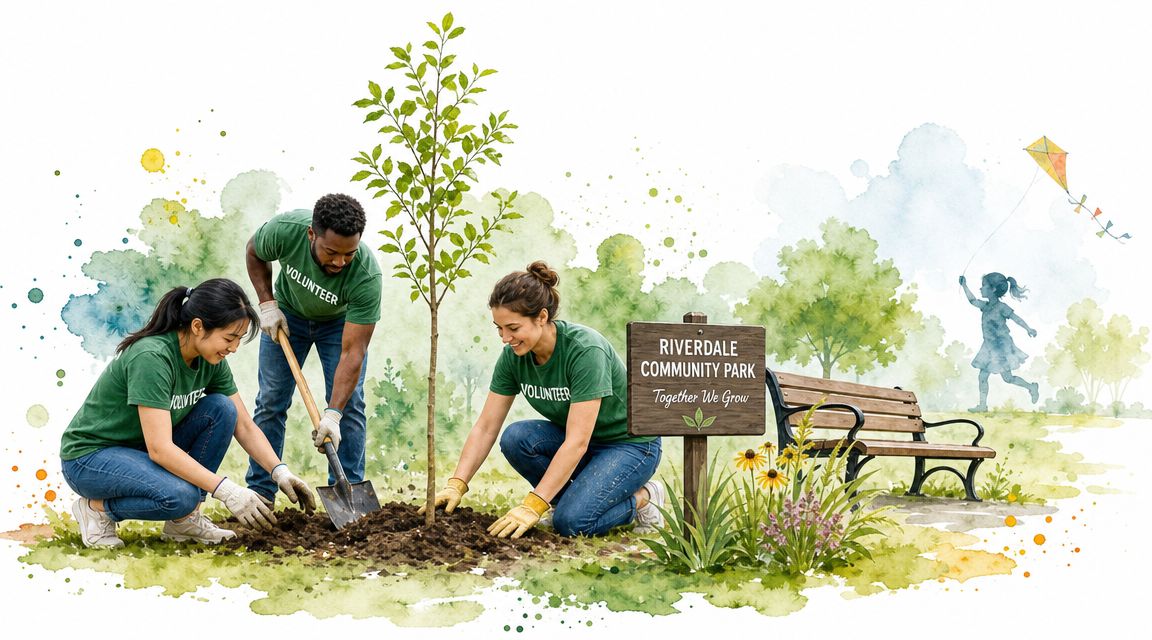
    The simplest example is still my favorite. A few people meet on a sidewalk, grab bags and pickers, and clear a block, a park edge, or a bus stop corridor. It sounds small until you do it. Then you feel how fast one clean stretch of sidewalk changes the mood of a morning.

    I've seen how a cleanup becomes a friendship machine when it repeats. Same day, same time, same spirit. That rhythm matters more than fancy branding, though I'll admit that flags, badges, and a goofy team identity help people feel brave enough to come back. If you want one real model, I like the way Litter Caterpillars organizes neighborhood litter cleanups around weekly volunteer action in Chicago.

    Why this feels bigger than a trash bag

    A cleanup group gives shy people a script. You don't need perfect social skills because the task carries you. You walk, you pick up litter, you talk when you want, and silence never feels strange because everyone is working.

    In the broader economy, this kind of work connects to a much larger operational field. The U.S. waste management and remediation services industry grew from $47.8 billion in 2010 to $65.5 billion in 2021, according to the USITC working paper. That helped me realize I wasn't stepping into a quirky hobby. I was touching one visible edge of a real service world.

    Practical rule: Start with one block and one recurring time. Consistency recruits better than hype.

    • Pick an easy meeting point: A train stop, school corner, or park gate makes first-time volunteers less nervous.
    • Keep tools simple: Gloves, bags, grabbers, and a clear route beat overplanning.
    • End with something social: Coffee, tacos, or just chatting on the curb helps people attach good memories to the work.

    2. Environmental Remediation of Vacant Lots and Public Spaces

    Some places don't need a quick cleanup. They need a second life.

    I remember the first time I looked at a vacant lot and stopped seeing “empty.” I saw dumped debris, hard soil, weeds, maybe broken fencing. But I also saw a future bench, a few trees, kids cutting across safely, neighbors pausing to talk. That's environmental remediation in a form you can feel with your body.

    A cleanup group can grow into land stewardship if it stays patient. Litter Caterpillars has a story like that in Englewood, where an empty lot became a community project. You can read that journey in their vacant lot story. I like examples like this because they show that environmental work isn't only removal. It's repair.

    From neglected ground to shared ground

    The hard part is staying with the site after the first burst of excitement. A lot can look good for one Saturday and then slide backward if nobody owns the follow-through. I've learned that maintenance is where trust gets built. Watering a tree in July doesn't look glamorous, but it changes whether a place lives or dies.

    International policy descriptions also help explain why this work branches into different specialties. ESCAP describes environmental services as a broad mix that commonly includes sewage, refuse disposal, sanitation, and related pollution-control and remediation activities, with infrastructure services often being capital-intensive and non-infrastructure work often more competitive and business-to-business in nature, according to its environmental services and GATS paper. That distinction matches what I see on the ground. Some fixes need a few volunteers. Others need permits, engineering, hauling, and long-term care.

    If you want a visual dose of courage for this kind of work, this story helps:

    • Start with a site visit: Walk the whole perimeter and notice drainage, dumping patterns, and who already uses the space.
    • Ask neighbors what they want: A garden, seating, open play space, or just a cleaner lot can lead to very different choices.
    • Plan the boring stuff early: Water access, trash pickup, tools, and mowing schedules matter more than inspirational sketches.

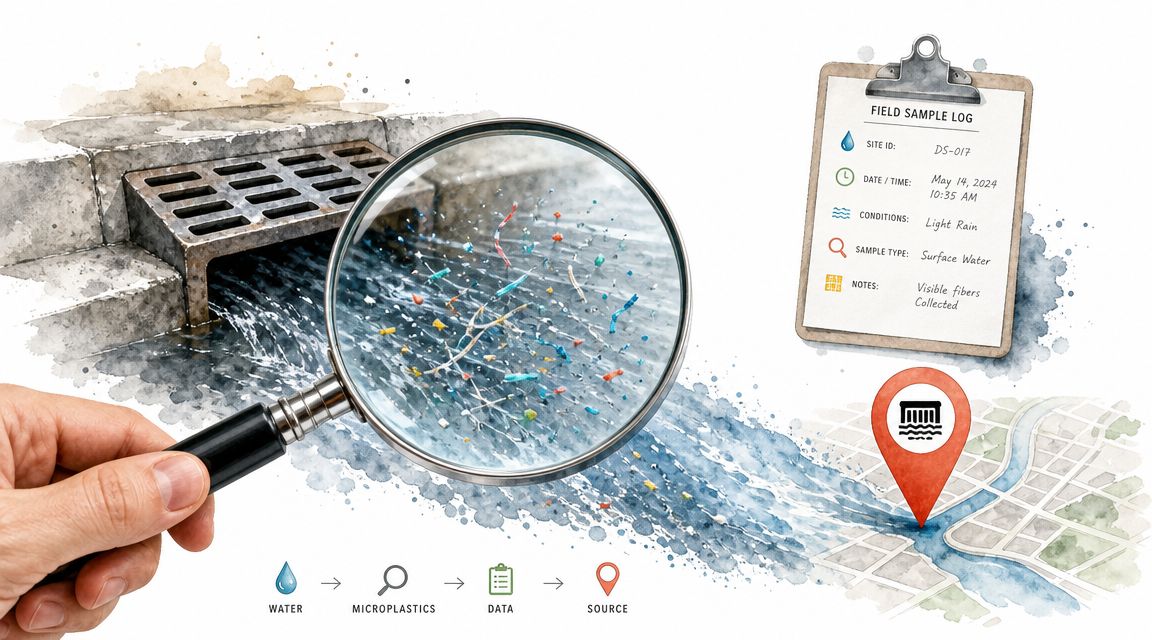
    3. Microplastics and Urban Litter Source Identification

    One day I picked up the same snack wrapper brand five times near one storm drain and finally thought, “This trash has a route.” That changed how I saw cleanup work. I stopped seeing random mess and started seeing patterns.

    That's where source identification comes in. This environmental service asks where litter starts, how it travels, and where it breaks down into smaller fragments. In cities, storm drains, curbs, convenience store corners, bus stops, and construction edges often tell the story better than a speech ever could.

    A magnifying glass inspecting microplastics in urban runoff water near a storm drain with a sample log.

    I like pairing cleanup with simple audits. Count cigarette butts, cups, mini liquor bottles, plastic film, and food packaging. Note wind direction, drain location, and nearby businesses. If you want a jumping-off point for thinking about plastic pollution, this Litter Caterpillars page on 5 Gyres is a useful community-facing entry.

    What real-time monitoring changes

    When groups add sensors and continuous monitoring, they can react faster than manual inspection allows. A case study on IoT environmental monitoring describes how real-time, high-frequency data can replace sporadic sampling and support earlier detection, threshold-based alerts, and better crew prioritization in places where conditions change quickly, as explained in Ignitec's environmental monitoring technology case study.

    You don't need a full sensor network to learn from that lesson. The mindset is the gift. Check often. Watch flows. Notice timing. Look for cause, not only aftermath.

    Trash usually tells on itself if you return to the same drain after rain.

    • Use one shared template: Keep categories short so volunteers fill them out.
    • Photograph repeat trouble spots: Visual evidence helps when you talk to local businesses or city staff.
    • Track seasons: Leaves, snowmelt, and summer storms move litter in different ways.

    4. Neighborhood Beautification Through Strategic Litter Prevention

    Cleanup feels good. Prevention feels smarter.

    I learned that after clearing the same corner again and again. If a spot looks abandoned, people treat it that way. If it looks cared for, many people hesitate before dropping the first cup. So beautification is a real environmental service example because it changes behavior before the next mess lands.

    Small design choices that change the block

    Fresh mulch around a tree bed, a painted planter, a maintained fence line, a visible trash can, or a tidy storefront edge can interrupt the feeling of neglect. I've watched one swept sidewalk pull the rest of the block upward like a zipper.

    This work blends aesthetic judgment with routine labor. You don't need grand plans. You need repetition and visible care. Community gardens, adopted streets, and local merchant corridors all use this logic.

    • Choose a short stretch first: Two or three blocks are enough to prove a concept.
    • Make the change obvious: Before-and-after photos help neighbors believe maintenance is possible.
    • Give residents a way in: Ask who wants to water flowers, report overflow, or sweep one storefront edge.

    A clean block often starts to police itself in a gentle way. Neighbors notice. Kids notice. You notice too. And once you've felt that, it's hard to walk past a collapsing corner without imagining how little it might take to steady it.

    5. Social Cohesion Building Through Environmental Volunteerism

    This one surprised me the most. I thought I was joining cleanup work to fix streets. Really, I was also learning how to belong to people again.

    Environmental volunteerism is one of the few social spaces where nobody has to impress anybody. You don't need polished networking lines. You can meet while doing something useful, which lowers the temperature for everyone. That's why cleanup groups, trail crews, park stewardship teams, and beach volunteers often form fast friendships.

    Why hard mornings make better friends

    A weekend morning cleanup filters for a certain type of person. You're meeting people who chose service over sleeping in, brunch, or scrolling in bed. I don't mean that in a smug way. I mean it in a practical way. Shared inconvenience creates trust fast.

    My favorite moments haven't always been the cleanest ones. Sometimes it's the cold day, the weird weather, or the muddy shoes that make the memory stick. That's the social chemistry. You do uncomfortable work together and leave feeling less alone than when you arrived.

    Shared effort is one of the fastest ways I know to turn strangers into teammates.

    • Welcome first-timers by name: People come back when they feel expected.
    • Build simple rituals: Group photos, coffee after, or a theme song create continuity.
    • Protect volunteer energy: Don't make people feel used. Let the experience stay generous.

    In healthcare settings, the same human truth appears in a different form. Recent healthcare-focused coverage describes EVS as frontline infection-prevention work that includes disinfecting patient rooms, high-touch surfaces, and biohazard disposal in addition to cleaning tasks, as noted in SoFi's overview of the environmental services sector. Different setting, same lesson. Care work creates bonds because people can feel when others take responsibility for shared space.

    6. Environmental Justice and Equitable Neighborhood Coverage

    I used to notice how some blocks got cleaned fast while others seemed invisible. Once you see that pattern, you can't unsee it.

    Environmental justice in cleanup work means you don't chase only the pretty, central, or easy locations. You go where neglect has piled up and where residents have had to carry too much of the burden for too long. That takes humility. You can't arrive acting like a savior. You have to listen first.

    What fairness looks like on the ground

    Fair coverage starts with a map and a conscience. Which neighborhoods have overflowing corners, illegal dumping, broken sidewalks, poor trash infrastructure, or chronically littered commercial strips? Which places get volunteer love only when a camera appears?

    The answer isn't guilt. The answer is repetition in overlooked places. I've found that when a group returns regularly, people stop reading it as charity and start reading it as respect.

    • Talk to local residents first: Ask what cleanup would be most effective instead of guessing.
    • Return more than once: One visit can feel like a stunt. Repeated visits feel sincere.
    • Share leadership: Let people from the neighborhood shape the route and priorities.

    This is one of the clearest environmental services examples because it deals with the lived reality of who gets a clean environment and who doesn't. You don't need a policy paper to understand that. You just need to walk across a few different neighborhoods with your eyes open.

    7. Youth and Newcomer Integration Through Environmental Engagement

    When you're new to a city, loneliness can make even a crowded street feel empty. I know that feeling. You want a way in, but bars, apps, and random events can feel slippery or performative.

    Cleanup gives newcomers and younger people a cleaner entry point. You show up, get a task, learn a neighborhood, and meet people without having to invent a social persona. That's why I think environmental service is one of the best low-pressure ways to get attached to a place.

    A city tour with a purpose

    Every cleanup is also a geography lesson. You learn which blocks flood, where litter collects, which parks feel loved, and which corners need help. That knowledge makes a city feel less abstract. It becomes yours.

    For students and young professionals, that matters a lot. Service work can turn a strange city into a map of memories. “That's the alley we cleared in the rain.” “That's the park where I met my now-best friend.” Those memories root you faster than small talk does.

    • Give newcomers a buddy: One friendly face can calm first-day nerves.
    • Keep instructions plain: New volunteers shouldn't have to decode jargon.
    • Make room for fun: Photos, inside jokes, and post-cleanup snacks help people attach joy to service.

    I've seen people arrive unsure and leave with dirt on their gloves, a few names in their phone, and a stronger reason to stay in the city.

    8. Seasonal and Weather-Responsive Environmental Cleanup

    Some of my favorite cleanup memories are objectively miserable. Cold fingers. Wet socks. Wind that turns a trash bag into a kite. That sounds awful on paper. In real life, it can be weirdly bonding.

    Weather-responsive environmental service means you don't treat the outdoors like a fair-weather hobby. You adapt the route, gear, timing, and safety plan to the season. Winter has salt-stained curbs and windblown packaging. Spring has storm drain blockages. Summer has heat, smell, and overgrown lots. Fall has leaves hiding broken glass and litter.

    Bravery needs a forecast

    I'm not romantic about danger. Safety comes first. But I do think there's something healthy about learning you can function in discomfort without falling apart. A rainy cleanup taught me that better than any self-help book ever did.

    The practical side matters too. Gloves change with temperature. Water breaks matter more in heat. Bright gear matters when days are short. A nearby café, field house, or library can save the day if weather turns ugly.

    The goal isn't to suffer for style. The goal is to keep showing up without being careless.

    • Scale the route to conditions: Shorter routes can be smarter in heat or deep cold.
    • Bring backup gear: Extra gloves, hand warmers, ponchos, and water solve small crises fast.
    • Offer alternate roles: Some people can sort supplies or greet volunteers even if they can't work the whole route.

    Bad weather has a way of stripping away excuses. If you and I can laugh while freezing under a tree, we can probably handle more of life than we thought.

    9. Community-Driven Urban Parks and Green Space Development

    The first time I watched a bare, tired lot start to feel like a park, it happened before a single bench went in. A few of us were pulling trash from the edges, talking about where shade would matter most, where kids might run, where an older neighbor could sit without feeling exposed to traffic. By the end of that morning, the land looked only slightly cleaner. But it felt different. You could sense that people had started claiming it together.

    Diverse volunteers planting a tree in Riverdale Community Park with a child flying a kite nearby.

    That is why this belongs on a real list of environmental services examples. Community-driven green space work includes clearing neglected land, planting trees, building small paths, adding seating, caring for garden beds, and returning week after week so the place stays alive. It is physical work, yes, but it is also relationship work.

    I keep thinking about what groups like the Litter Caterpillars model so well. They do not wait for a polished master plan or a perfect grant cycle to make a place matter. They start with care, with cleanup, with showing up long enough for a forgotten patch of ground to become familiar. Then familiar becomes shared. Shared becomes protected.

    A park changes the way people meet

    The change I notice first is rarely visual. It is social.

    Someone lingers instead of hurrying through. Two neighbors who used to nod from a distance start talking near a planting bed. A child treats the path like it has always been there. Those moments are small, but they are the fundamental infrastructure. The green space starts teaching people that this block can hold more than neglect.

    The best community parks grow from local choices. One block may want raised beds for food and flowers. Another may need open grass, shade trees, and a simple bench where grandparents can rest. A space people helped shape carries a different kind of loyalty. You can feel it in how gently people treat it.

    • Start with one visible improvement: A planted tree, a cleaned gathering spot, or a bench area gives the project a center of gravity.
    • Ask who will care for it in July and November: Watering, litter pickup, and weeding matter more than a flashy launch day.
    • Use the space right away: A picnic, reading circle, or kids' nature activity helps the area become part of daily life.

    I love this kind of environmental service because it asks for courage without making a speech about courage. You bend down, clear space, plant something, and trust that other people will meet you there. Sometimes they do. Sometimes they surprise you. And sometimes a patch of land changes because a few friends decided the neighborhood deserved somewhere soft to land.

    10. Digital Community Organizing and Volunteer Coordination for Environmental Action

    A lot of environmental work still starts on a screen. One post, one group chat, one event page, one friend tagging another. I used to dismiss that as shallow. I don't anymore. Digital organizing is often the bridge between caring privately and acting publicly.

    This form of environmental service includes recruiting volunteers, sharing route details, posting weather updates, celebrating participants, and documenting changes over time. Meetup, Instagram, WhatsApp, Nextdoor, and text threads all have their place if you use them clearly.

    Online tools that lead back to real sidewalks

    The best digital organizing doesn't replace in-person community. It feeds it. A good event page tells me where to meet, what to bring, how long we'll be out, and whether I'll feel awkward arriving alone. A good post after the event helps the next shy person believe they can come too.

    I also like when groups share the whole texture of the day, not only polished after shots. Muddy gloves, funny moments, weird finds, and ordinary volunteers matter. People join people, not perfect graphics.

    • Post clear logistics: Time, meeting point, duration, and gear should be easy to find.
    • Show real volunteers: Faces and stories make groups feel reachable.
    • Keep the invitation simple: “Come for one hour” works better than giant commitments.

    Digital coordination also mirrors what larger environmental service systems do in a more technical way. Sensors, alerting systems, and real-time communication help teams respond faster. At the neighborhood level, your version might be much simpler: a weather text, a route map, and a photo album that proves the work is real.

    10-Point Comparison: Community Environmental Services

    Initiative Complexity 🔄 Resources ⚡ Expected outcomes ⭐📊 Ideal use cases 💡 Key advantages ⭐
    Community-Based Litter Cleanup Programs Low–Moderate: volunteer coordination and scheduling Low: basic tools, volunteer time, social channels Immediate visible cleanliness; stronger local social ties Quick neighborhood cleanups; engaging diverse volunteers Low cost; scalable; builds social capital
    Environmental Remediation of Vacant Lots and Public Spaces High: land acquisition, permitting, remediation planning High: capital, professional remediation, long-term maintenance Permanent community assets; higher property values; improved health Transforming blight into parks/gardens; long-term investment projects Durable impact; attracts funding and media attention
    Microplastics and Urban Litter Source Identification Moderate–High: consistent methodology and analysis Moderate: sampling tools, apps, research partnerships Evidence-based prevention strategies; policy recommendations Informing policy; targeting systemic litter sources High diagnostic value; supports grants and advocacy
    Neighborhood Beautification Through Strategic Litter Prevention Moderate: infrastructure placement and agency coordination Moderate: receptacles, street furniture, maintenance budgets Sustained litter reduction; improved perception and safety High-visibility corridors, BIDs, pilot block interventions Cost-effective prevention; creates positive feedback loops
    Social Cohesion Building Through Environmental Volunteerism Moderate: intentional facilitation and leadership Low–Moderate: social programming, volunteer support Strong friendships, reduced isolation, higher retention Newcomer integration; community resilience efforts High volunteer retention; mental-health and leadership gains
    Environmental Justice and Equitable Neighborhood Coverage High: sustained outreach, cultural humility, trust-building Moderate–High: targeted investment, partnerships, safety measures Reduced environmental inequities; local leadership development Prioritizing underserved areas; justice-driven campaigns Promotes equity; builds political will for systemic change
    Youth and Newcomer Integration Through Environmental Engagement Low–Moderate: onboarding, mentorship, adaptable schedules Low–Moderate: training, outreach, social events Faster social integration; youth leadership pipelines Cities with high newcomer/student populations; campus programs Attracts diverse volunteers; builds long-term engagement
    Seasonal and Weather-Responsive Environmental Cleanup Moderate: season‑specific planning, safety protocols Moderate: specialized gear, contingency plans, insurance Year‑round cleanliness; resilient volunteer culture Regions with extreme seasons; identity‑building groups Demonstrates commitment; addresses seasonal litter peaks
    Community-Driven Urban Parks and Green Space Development High: design, permitting, construction, stewardship High: capital, design expertise, ongoing maintenance Multifunctional green spaces; health, stormwater and habitat benefits Neighborhood revitalization; long-term placemaking Multiple co‑benefits (health, environment, social)
    Digital Community Organizing & Volunteer Coordination Low–Moderate: content, moderation, platform management Low: platforms, staff time, content tools Scalable recruitment; higher participation and visibility Rapid scaling; targeting young/newcomer demographics Low-cost amplification; easy onboarding; real-time coordination

    Are You Brave Enough to Start?

    I learned that cleaning up someone else's mess is way easier than cleaning up your own. It's a strange kind of fun. I also learned that suffering through a hailstorm with new friends adds flavor to life. It advances the plot.

    That's why I keep coming back to these environmental services examples. They aren't only about waste streams, public-space maintenance, remediation categories, or volunteer logistics. They're also about what happens inside you when you decide to stop waiting for motivation and just pick up one piece of trash. Then another. Then a whole bag. Then a habit. Then maybe a friendship.

    You don't have to be organized to begin. I wasn't. You don't have to be fearless either. Fear is often a good sign. It means you're close to something honest. Maybe you're scared of looking silly with a grabber on a busy street. Maybe you're scared nobody will join you. Maybe you're scared you'll start strong and then disappear. I get all of that.

    But I've found that service is a forgiving teacher. It doesn't ask you to arrive polished. It asks you to arrive. If you keep doing that, your confidence changes shape. It stops being loud and starts being dependable. You trust yourself more because you've watched yourself show up in cold weather, on sleepy mornings, on awkward first days, and on blocks that need more love than applause.

    If you live in Chicago, Litter Caterpillars is one real option for that kind of practice. If you don't, you can still borrow the blueprint. Pick a block. Pick a park edge. Pick a vacant lot perimeter, a trail segment, a creek bank, or a bus stop corridor. Bring a friend if you can. Go alone if you must. Keep it small enough that you'll do it again.

    We are all caterpillars in some way. We're all trying to transform while carrying old messes, old fears, and old stories. Sometimes the first honest step isn't inward. Sometimes it's outward. A trash bag in your hand. Morning air on your face. A tiny act of order in a chaotic week.

    So here's my question for you. What are you afraid of?

    Good. Start there.


    If you want a simple place to begin in Chicago, Litter Caterpillars organizes volunteer trash pickups that make it easy to show up, meet people, and help clean a block.

  • Your Guide to the Fox River Valley: Adventure & Action

    Your Guide to the Fox River Valley: Adventure & Action

    I bent down to grab a soaked fast-food cup near the river on a cold morning, and my fingers went numb before I filled half a bag. That was the moment the fox river valley stopped being a pretty backdrop to me and became a place where I had a job to do.

    Many visitors visit the fox river valley with a camera brain. I think you should come with work gloves, trail shoes, and a little more courage than comfort.

    My Fox River Valley Story

    The first time I really paid attention to the fox river valley, I wasn't chasing some perfect day. The weather was ugly. The riverbank was messy. My plan had already fallen apart before breakfast.

    That helped.

    When a place meets you on a polished day, you can stay shallow. You snap a few photos, eat something decent, walk a trail, and leave feeling pleased with yourself. But when a place catches you tired, cold, and a little annoyed, you find out whether you're there to consume it or join it.

    I started joining it.

    The fox river valley stretches over 80 miles in Northern Illinois and is home to around 1 million people, with communities that include Aurora and Elgin according to Fox River Valley facts. That means this isn't some tiny hidden pocket you can romanticize from a distance. People live here. Kids grow up here. Trash blows here. Water rises here. Work needs doing here.

    What changed in me

    I used to think connection came from knowing facts, names, and local trivia. I don't think that anymore. I think connection comes from effort.

    You learn a river differently when you walk beside it with a bag in your hand. You learn a town differently when you don't just buy coffee there but stay long enough to notice which block gets ignored. You learn yourself differently when you choose a hard morning over an easy excuse.

    Practical rule: If you want to know the fox river valley, don't start with "What's the best photo spot?" Start with "Where can I help, walk, paddle, and pay attention?"

    That shift changed how I move through places. I stopped acting like a spectator and started acting like a neighbor, even when I was only there for a day.

    Your story won't look like mine

    Maybe you'll find your way into the valley through a bike ride. Maybe through a kayak. Maybe you'll sit on a bench in Geneva or St. Charles and just watch the water until your head finally goes quiet. Good. That's a real entry point.

    But I want to push you a little. Don't let your whole relationship with the fox river valley stay soft and observational.

    Try one of these instead:

    • Walk with purpose: Pick a stretch of trail and carry a small bag. If you see litter, grab it.
    • Stay after the fun: If you paddle, don't rush home. Walk the launch area and leave it cleaner.
    • Talk to people: Ask someone who lives nearby what part of the river gets ignored.
    • Choose discomfort on purpose: Go on a gray day, not only a sunny one. You'll notice more.

    The valley gave me a strange kind of peace. Not the lazy kind. The earned kind. The kind you get after doing something small and physical and useful with your own hands.

    That's the kind I'm inviting you into.

    Get to Know the Valley's Towns

    Some towns in the fox river valley feel like old boots. Some feel like a sketchbook. Some feel like a place where you should slow down before you miss what's right in front of you.

    Don't try to "do it all." Pick the town that fits your mood, then let the river pull you to the next one another day.

    A watercolor-style illustration of an Aurora landmark building with a violinist, people, and a pottery artisan.

    Aurora for energy

    Aurora has movement in it. You feel it fast. Bigger streets, bigger civic bones, more reasons to linger if you like a place with some muscle and some grit.

    I like Aurora when I don't want my day to feel precious. It has the kind of presence that lets you mix your day. Walk by the river. Find a place to eat. Sit for a while. Keep moving. If you're the kind of person who gets bored in places that feel too polished, start here.

    Elgin for texture

    Elgin has that layered feeling I always trust. You can sense history, daily life, and change all sitting in the same frame. I like towns that don't feel scrubbed clean of personality, and Elgin gives me that.

    If you're curious by nature, Elgin rewards wandering. Don't over-plan it. Walk, stop, look up, cross the bridge, double back. Let your attention lead.

    Some places ask you to spend money. Better towns ask you to notice things.

    Geneva and St. Charles for slowing down

    These are the towns I recommend when someone's nervous, overstimulated, or carrying too much noise in their head. Geneva and St. Charles are good for recovery. You can walk downtown, find the river, and exhale without trying too hard.

    That doesn't mean they're sleepy. It means they give you room.

    I think a lot of people need that more than they admit. They don't need another packed itinerary. They need one honest afternoon with water, sidewalks, and enough quiet to hear their own thoughts again.

    Batavia for people who like the in-between

    Batavia feels good to me because it doesn't beg for attention. Some places perform. Batavia doesn't need to. That makes it a strong stop for walkers, cyclists, and anyone who likes to stitch together a day instead of consuming it in chunks.

    Here's how I think about the towns:

    Town Best for My advice
    Aurora Energy and variety Stay loose. Let the day build as you go.
    Elgin Wandering and observation Walk without a strict destination.
    Geneva Quiet reset Go when you need your shoulders to drop.
    St. Charles Riverfront strolling Give yourself extra time to sit and watch.
    Batavia A steady, grounded day Pair it with trail time or a bike ride.

    Pick a town like you pick a friend

    This is my blunt advice. Don't ask which town is "best." Ask which one you're ready for.

    • If you're restless: Go to Aurora.
    • If you're curious: Go to Elgin.
    • If you're worn out: Go to Geneva.
    • If you need a gentle day: Go to St. Charles.
    • If you want calm without fuss: Go to Batavia.

    The fox river valley gets better when you stop treating towns like checklist items. Let one place get under your skin a little. That's when you start coming back for the right reasons.

    Find Your Path on the Trails and Parks

    A trail tells the truth on you. If your mind is scattered, you'll feel it in the first mile. If you're carrying too much, the walk starts scraping it loose.

    That's why I keep coming back.

    A hiker with a backpack walks along a scenic trail overlooking the Fox River valley.

    The fox river valley has the kind of outdoor rhythm that works for both hard chargers and people who just need a reason to get off their phone. I think trails are one of the best ways to meet the area honestly. No ticket booth. No polished script. Just your feet, your breath, and whatever the day gives you.

    The trail that clears your head

    When I need to think, I want a path that doesn't demand too much. I want to move forward and let my brain stop clawing at itself. River trails do that well because the water gives your attention a place to rest.

    If you're biking, pick a stretch where you can settle into a pace and stop whenever something catches your eye. If you're walking, don't rush to rack up distance. A slow walk with your head up beats a fast walk with your mind somewhere else.

    I also like mixing a walk with a cleanup mindset. Even one glove and a small bag changes how you move. You stop floating through the place and start noticing edges, corners, benches, and brush lines.

    If you want a practical jumping-off point for nearby outdoor planning, take a look at this guide to the Aurora forest preserve.

    Parks are for more than exercise

    A lot of people treat parks like outdoor gyms. I think that's too narrow. Parks are where you practice attention.

    Sit near the river and watch how long it takes for your body to settle. Notice who's using the space. Families. Solo walkers. Cyclists. Anglers. People escaping something for an hour. You start realizing public space isn't abstract. It's personal.

    A good park doesn't ask you to perform. It lets you arrive as you are and leave a little better.

    That matters more than people admit.

    Here's a look at the kind of mood the trails can put you in:

    How I choose where to go

    I don't use the same trail mindset every time. I pick based on what I need.

    • For clarity: Choose a simple route along the river and walk alone for a while.
    • For momentum: Bring a bike and cover more ground. Speed can shake you loose.
    • For recovery: Find a quieter park section and sit before you move.
    • For service: Bring gloves and collect what you can safely reach.

    The mistake people make is thinking they need the perfect plan before they go. You don't. You need a water bottle, decent shoes, and enough honesty to admit what kind of day you're having.

    A better way to use the valley

    Don't race through three parks in one day. That's consumption disguised as adventure. Pick one trail, one park, one stretch of river. Learn its mood.

    Come back in different weather. Come back in a different season. Come back when you're happy, and come back when you're a mess.

    The same path will meet you differently every time. That's why it's worth returning to.

    The River's Story of Power and People

    I love rivers that don't feel decorative. The Fox doesn't feel decorative to me. It feels like a force that people tried to harness, reroute, build around, and profit from.

    You can still feel that argument between water and people if you pay attention.

    Water that moved industry

    The Fox River drops about 167 feet in just 39 miles, and that descent helped create the highest concentration of pulp and paper mills in the world, with companies like Charmin and Quilted Northern starting along it, as described in the Fox River background on Wikipedia). I don't bring that up as trivia. I bring it up because it explains why the river has such a charged feeling in places shaped by work, machinery, and control.

    A river with that kind of drop isn't passive. People saw motion and turned it into mills, jobs, noise, wealth, and damage. That's the bargain they made.

    And you can still see the leftovers of that bargain. Old industrial bones. Dammed stretches. Buildings that started in one era and got dragged into another.

    Transformation isn't always pretty

    People love clean redemption stories. River history isn't one. The Fox gave power. People took it. Towns grew. Industry expanded. Then the consequences stuck around.

    That's a human story too.

    I've changed my own life in ugly stages. Not graceful stages. Ugly ones. Pick something up. Slip. Come back. Clean one corner. Ignore another. Try again next week. The river's story feels closer to that than to some polished before-and-after fantasy.

    Hard truth: Transformation usually leaves scars you can still see.

    I trust places more when they don't hide that.

    What to look for when you walk

    When you're near the river, stop looking only for scenic views. Look for evidence. Look for what people built to control water. Look for what got repurposed. Look for where the natural line of the river and the built line of the city rub against each other.

    That tension is part of the fox river valley's personality.

    Try this the next time you're out:

    • Pause near older infrastructure: Ask yourself what problem it was built to solve.
    • Notice reused buildings: A place can change function without erasing its past.
    • Watch the current: Even where people shaped the river, water still tells its own story.
    • Read the banks: Neat edges and rough edges both reveal human choices.

    I think that makes the valley more interesting, not less. A flawless place is easy to admire and easy to forget. A place shaped by effort, greed, ingenuity, and repair sticks with you.

    The river changed towns. Towns changed the river. Now it's our turn to decide what kind of relationship we want with it.

    How to Join the Action on the Water

    If you've been standing on the bank thinking, "Maybe someday I'll get on the river," I want to push back. Someday is a soft word. Pick a date.

    Getting on the water is one of the fastest ways to stop being a spectator in the fox river valley. The river changes when you're inside it. Distances feel different. Noise shifts. Your body starts paying attention.

    Start simple and start local

    Don't make your first outing a giant production. That's how people talk themselves out of it. Choose a short paddling day, wear clothes you don't mind getting wet, and keep your plan humble.

    For beginners, I always prefer a calm, low-drama outing over an ambitious route. You want your first trip to build confidence, not ego. The point is to learn how the boat feels, how your shoulders settle, and how the river asks you to move.

    If you're nervous about the whole idea, browsing a practical beginner-friendly paddling guide like this one on Urban Kayaks in Chicago can help you think through gear, comfort, and the basics before you commit.

    What to bring and why

    A sloppy prep job ruins good outings. I keep it simple.

    • Water and a snack: Hunger sneaks up on people fast outdoors.
    • Dry bag or sealed pouch: Phones and keys don't need heroics.
    • Gloves for before or after: Shorelines and launch spots often need a quick cleanup.
    • Sun and weather gear: Dress for exposure, not for your car ride.
    • A buddy if you're new: Confidence grows faster with company.

    I also think you should tell someone where you're going if you're heading out alone. That's not paranoia. That's just adult behavior.

    Use the day well

    A river day gets better when you stop treating paddling as the only event. Build a full day around it. Walk before you launch. Sit somewhere after. Eat somewhere local. Do a quick litter pass at the access point if you see obvious debris.

    That little extra effort changes the spirit of the day. You're no longer just taking recreation from a place. You're entering a relationship with it.

    If you leave the launch cleaner than you found it, the day lands differently in your chest.

    Good judgment beats bravado

    Let me be blunt. Don't act tough around water. Water doesn't care.

    If conditions feel off to you, listen to that feeling. If you're too tired, simplify the plan. If you don't know the stretch, ask questions before you go. The coolest person on the river is the one who gets home safely and wants to come back next week.

    A solid first outing looks like this:

    1. Pick an easy time of day when you won't feel rushed.
    2. Keep your route manageable so you can enjoy it instead of surviving it.
    3. Launch with intention and pay attention to how your body responds.
    4. End before you're exhausted because that's how good habits stick.

    The fox river valley is better from the water. But it's best when you approach it with humility, not swagger.

    Protect the Fox River and Get Your Hands Dirty

    This is the part where I stop being polite.

    If you love the fox river valley, prove it with your hands.

    A lot of people say they care about rivers. Fewer people bend down for the bottle in the weeds, the plastic jammed in brush after rain, or the junk stranded near a rough access point. Caring that never leaves the mouth doesn't do much for a river.

    An infographic comparing environmental challenges and positive community contributions to the health of the Fox River.

    The river has real problems

    Parts of the Fox River watershed in northeastern Wisconsin face water quality problems tied to legacy industrial pollution and agricultural runoff, with public information noting suspended solids, high-flow spikes, and heavy metal concerns in monitored areas, according to Fox Valley Technical College watershed context. I don't use that to scare you. I use it because vague environmental talk makes people sleepy.

    Concrete problems wake people up.

    The same background material also points to combined sewer overflow pressure in 15+ municipalities, and it describes green infrastructure and trash-trap style interventions as practical responses in this watershed context. That means cleanup work isn't random. It can be targeted. It can be smarter after storms. It can focus on the places where litter moves and piles up.

    Go where help is thinner

    I care a lot about this part. Some areas east of the Fox River have less access to cleanup resources and green infrastructure, which creates a real opening for volunteer action in neglected neighborhoods, as noted in the St. Charles active river opportunity analysis.

    That matters.

    If you only clean the easy, photogenic, already-loved places, you're doing maintenance. If you show up where resources are thinner, you're doing justice.

    I think more volunteer groups should admit that. The map is not neutral. Some blocks get attention. Some don't. Some shorelines get regular love. Some get shrugged at until the mess becomes normal.

    The place that needs your help most is often the place people talk about least.

    My advice for direct action

    Don't wait for the perfect event. Start with one clean, focused act.

    Here is how I'd approach the fox river valley if I wanted my effort to matter:

    • After storms, move fast: Water shifts debris. Fresh litter lines and snag points are easier to spot then.
    • Target access points and tributary edges: People drop trash where they enter, exit, park, or pause.
    • Bring basic sorting habits: Separate obvious recyclables when practical, and handle hazardous items carefully by reporting them if needed.
    • Keep notes: Write down what you saw. Which bank? What kind of trash? Was it repeat litter or flood-carried debris?
    • Return to the same place: One cleanup feels good. Repeated cleanups teach you the pattern.

    If you want a broader volunteer model for this kind of work, this page on how to clean up rivers is a useful place to start.

    Don't outsource your conscience

    People often act like environmental repair belongs to agencies, boards, or somebody with a title. I don't buy that. Formal work matters, sure. But ordinary people can remove real trash from real ground this weekend.

    And once you do that, something changes in you.

    You stop seeing litter as background. You stop seeing neglected places as somebody else's problem. You stop waiting for permission to care in a practical way.

    Here's the simplest version of the job:

    What you see What you do
    Trash after rain Show up quickly with gloves and bags
    Neglected bank edges Work in pairs and clear visible debris
    Repeated litter at access points Return often and track the pattern
    Uneven resource access Choose underserved areas on purpose

    I think the fox river valley needs more people who are willing to get a little dirty, a little tired, and a little less self-conscious. That's where real belonging starts.

    Your Fox River Valley Itineraries

    Some people freeze because they have too many options. So I'm going to make this plain. Pick one of these day plans and go.

    A good day in the fox river valley doesn't need to be expensive, elaborate, or optimized. It needs only a shape.

    A watercolor illustration of the Fox River featuring people picnicking, kayaking, and cycling along a trail.

    Solo reset day

    This is for the person who's burned out, over-socialized, or stuck in their own head.

    Start in one town, not three. Walk near the river in the morning before the day gets noisy. Find a bench or quiet stretch and stay there longer than feels productive. Then take a trail walk with no pressure to go far.

    Bring a notebook if that helps, but don't force insight. Let the place do some work on you.

    Best use of the day

    • Morning: Slow river walk
    • Midday: Simple lunch and zero rush
    • Afternoon: Trail time or a park sit
    • Before leaving: Pick up a few pieces of litter if you safely can

    Family day with movement

    Families don't need a perfect outing. They need a forgiving one.

    Choose a riverfront area where kids can move, adults can breathe, and nobody has to pretend to enjoy a packed schedule. Keep snacks easy. Keep expectations lower than your Pinterest brain wants them to be. Mix one active thing with one restful thing.

    A family day works best when adults stop trying to control every minute. Let the river be part of the entertainment.

    Cleanup crew day

    This is my favorite because it leaves a mark.

    Pick one target area. A shoreline edge, trail entrance, launch point, or park border. Meet in the morning while energy is still high. Work in gloves, bring enough bags, and decide your boundaries before you start. After the cleanup, wash up, eat together, and take a walk somewhere nearby.

    That sequence matters. Service first. Joy second. That's a powerful rhythm.

    Field note: Small groups win when they stay focused. One area cleaned well beats a scattered day of half-effort.

    Adventure day on purpose

    This is for people who need a little more adrenaline to feel awake. Pair paddling with walking, or biking with a river stop. Keep the route realistic and the gear simple.

    The mistake adventurous people make is turning every outing into a test. Don't test yourself all day. Leave room for play. Leave room for a detour. Leave room for the kind of moment you couldn't have scheduled anyway.

    The safety rules I want you to actually follow

    I don't believe in fear-heavy safety talk. I believe in preparation.

    • Check conditions: If weather or water feels wrong, change the plan.
    • Dress for the day's conditions: Sun, wind, mud, and wet shoes count.
    • Know your limits: Pride is heavy. Leave it in the car.
    • Bring water and charge your phone: Basic things prevent dumb problems.
    • Use gloves for cleanup: Your hands are not trash tools.
    • Leave if something feels off: You don't need to win against discomfort every time.

    The fox river valley is better when you stop waiting for the ideal day and start building honest ones. Go there to move, breathe, notice, paddle, walk, sit, clean, and come home different than you arrived.


    If you're ready to stop admiring from a distance and start doing the work, join Litter Caterpillars. It's a volunteer group built for people who want friendship, service, bravery, and real impact. Show up, grab a bag, and help clean the places people forget.

  • Fun Community Service Ideas to Connect & Grow

    Fun Community Service Ideas to Connect & Grow

    Cleaning up other people’s mess is easier than your own. I know because my own life was a mess, and I mean the kind of mess where an old jar in the fridge feels emotionally heavier than a dumbbell. I started picking up litter because I needed a way to practice bravery and consistency when I couldn't seem to do either at home.

    The weird part is that it became fun.

    The first time my group got caught in a spring hailstorm, we stood under a tree, freezing, while ride after ride canceled on us. I should’ve hated it. Instead, I felt more alive than I had in months. Doing something hard with other people gave the day flavor. It turned suffering into a story, and the story made me want to come back.

    That’s how I learned something I wish more people would say out loud. Community service can help other people, sure. It can also help you. It can pull you out of your head, get you into your body, and put you next to the kind of people who show up on cold mornings and mean it. A lot of fun community service ideas sound cute on paper but feel stiff in real life. These are different. I’ve seen them work on blocks, in parks, in ugly weather, and in neighborhoods people usually avoid.

    If you want friendship, courage, structure, and a cleaner city, start here.

    1. Neighborhood Block Cleanups with Team Identity

    The first block I cleaned with the Litter Caterpillars looked ordinary from a car window. On foot, it felt different. Crushed cups in the gutter. A wet sweatshirt caught in a chain-link fence. Cigarette packs tucked into the grass like the street had given up on itself. I almost turned around that morning because my own apartment was a mess and I felt like a hypocrite. Instead, I grabbed a neon bag, followed a woman in a yellow beanie, and started picking up one stupid wrapper at a time.

    By the end of the hour, the sidewalk looked better, but that was not the part that got me. It was hearing people yell, "Caterpillars over here," like we were an actual crew. Same color hoodies. Same playlist. Same meeting spot every week. I had shown up to clean a block. I left feeling less alone.

    That is why team identity matters.

    Pick one block. Or three. Bring gloves, bags, and grabbers. Give your crew a name people will remember. Carry a flag if you want to be a little ridiculous. Ridiculous helps. Wear the same color. Put one person in charge of the speaker. Suddenly the cleanup stops feeling like a chore you should do and starts feeling like something you belong to.

    A good block cleanup has a shape people can trust. Ours got stronger when we stopped improvising every detail and kept a few things the same each time.

    • Meet at the same corner so nobody has to guess where the group is
    • Use the same crew name and colors so neighbors recognize you fast
    • Walk a simple route so energy goes into the work, not into debating
    • End with coffee, snacks, or a park bench debrief so strangers become friends
    • Take one group photo so people have proof they were part of something real

    Practical rule: If a new volunteer cannot find you in 30 seconds or explain your group to a friend in one sentence, make the cleanup simpler and more visible.

    I love block cleanups because they are small enough to start now and hard enough to change you. You do not need permits for a giant event or a polished nonprofit vibe. You need a time, a place, a few tools, and the nerve to look a little silly in public. That last part matters more than people admit. Wearing the same color shirt and carrying a grabber down a busy street can feel strangely vulnerable. Then a neighbor waves, a kid asks to help, somebody thanks you from a porch, and your embarrassment shrinks.

    Some Saturdays we rotate to a block nobody in the group has touched before. The mood changes every time. One street gives you friendly hecklers and grandmas cheering from stoops. Another gives you silence, broken bottles, and wind that cuts through your gloves. Both count. Both teach the same lesson. Cleaning up a mess outside can help you face the mess inside, especially when you are doing it beside people who keep showing up.

    2. Park and Green Space Restoration Projects

    The first time our Litter Caterpillars crew restored a park, it was cold enough that my fingers hurt through my gloves. The place looked tired. Crushed cans in the grass. Fast-food wrappers pinned under wet leaves. A bench half-hidden by weeds. I remember thinking, this park looks like how I felt that winter.

    So we started there.

    A park project changes you because you stay in one place long enough to watch it come back to life. On a block cleanup, you move through the mess. In a park, you kneel in it. You pull trash out of bushes, rake dead stuff away, and notice the ground under your feet again. Then something strange happens. As the space looks less abandoned, you do too.

    A diverse group of volunteers planting a young tree together in a vibrant community park garden.

    Start with cleanup. End with care.

    The mistake is trying to make it beautiful on day one. What works better is a simple first pass that gives people a quick win, then a reason to return.

    Here’s the version that has worked for us:

    • Clear litter and obvious hazards first so the change is visible within the first hour
    • Take before photos because you will forget how rough it looked
    • Talk to nearby residents or regular park users because they know which corners get ignored
    • Pick one small add-on for the same day or the next visit like mulch, bulbs, or a planter bed
    • Return often enough to make the space feel claimed because one cleanup helps, but repeated care changes the reputation of the place

    I like these projects because they have a second act. After the bags are full, hope gets practical. You can plant a tree, spread mulch around a bare patch, repaint a sign, or set a bench area right again. Kids start cutting across the grass instead of around it. Dog walkers slow down. Someone who never spoke to you before asks when you’re coming back.

    That part matters more than people think. Plenty of volunteers want service that fits real life, feels social, and lets them see the result with their own eyes, as noted earlier. Park restoration does that well. You can show up for a morning, work hard beside other people, and leave with proof that your effort mattered.

    One of my favorite Litter Caterpillars days ended with muddy boots, six trash bags, two new planters, and a conversation with a guy who said he had avoided that park for months. A week later, he came back and helped. That is how these projects grow. Not through polished speeches. Through visible care.

    Here’s a good visual for what this kind of work can feel like in motion.

    3. Highway and Major Corridor Cleanup Events

    Some service projects feel gentle. This one feels epic.

    If your city lets you partner on a cleanup near a highway, major corridor, or event route, do it. These are the places where litter gathers in a way that feels almost offensive. Cups tumble into fences. Plastic bags snag on brush like sad flags. You fill bags fast, and that speed gives the day momentum.

    I still think about cleaning a highway during a bike-event shutdown. It felt like being allowed backstage in the city.

    Respect the danger

    This kind of project has more edge, so you need more discipline. Bright vests. Safety briefing. Clear boundaries. A meeting point. A trash-drop plan. Somebody in charge who is calm.

    Big corridors make volunteers feel the scale of a city. They also remind you that service is physical work, not an abstract opinion.

    I wouldn’t make this your first volunteer event if your group is brand new. I would make it your third or fourth. By then people know how to move together, listen, and take care of each other.

    There’s also a practical upside. Main roads are visible. When drivers see real humans out there cleaning, the work stops being invisible. That can pull in future volunteers, business partners, and the curious friend who always says, “You should invite me sometime,” and finally means it.

    4. Volunteer-Led Neighborhood Walking Tours and Cleanup

    This one is half service, half field trip, and I love it for newcomers.

    If you’ve ever moved to a city and felt lonely in that weird floating way, a walking tour cleanup is medicine. You’re not just standing around making small talk in a coffee shop. You’re moving. You’re listening. You’re learning where you live while you make it better.

    Ask one volunteer to lead the walk and share stories about the neighborhood. Nothing fancy. A favorite mural, a local bakery, a church that anchors the block, a vacant lot that deserves better. Then clean as you go.

    A male volunteer and a female companion pointing towards a sketch of a house for community planning

    Let curiosity do some of the work

    The social magic here is simple. You don’t need to force connection when the route gives you things to react to. A broken sign. A beautiful courtyard. A bus stop full of trash. A tiny community garden someone clearly fought for.

    I’d keep the group small enough that people can hear each other and cross the street without chaos. Then end somewhere easy, like coffee, tacos, or a park bench if the weather is kind.

    Some of the best fun community service ideas work because they lower the social pressure. Walking side by side is easier than staring across a table. Picking up litter gives your hands something to do while your guard drops.

    5. Youth and Student Leadership Service Corps

    The first time I handed a teen volunteer the clipboard, I could see the panic rise in her face. It was cold, her friends were watching, and our Litter Caterpillars crew was about to head out under a gray sky with wind cutting through every layer. I almost took the job back. I’m glad I didn’t.

    Ten minutes later, she was checking people in, matching first-timers with returning volunteers, and calling out who still needed gloves. By the end of the cleanup, she was the one answering questions from adults.

    That shift matters.

    Young people often show up with more courage than they realize. They just need a real job, not a symbolic one. If you want to build a youth or student service corps, give them work that would inconvenience the group if they dropped it.

    Let students carry the day

    In our group, the fastest way to help someone grow is to trust them in public. A student can lead the safety talk. A high school senior can map the route. A college volunteer can handle the after-photos and write the recap while the details are still fresh. If they mess up a little, good. That’s part of how they get steadier.

    I’ve watched this happen over and over. A quiet kid starts by holding extra bags. Then they greet one new volunteer. Then they explain the plan to the whole group. A month later, they’re the person keeping everyone focused when the weather turns ugly and people want to quit. Cleaning up a block sounds small. Sometimes it’s where a young person finds out, very plainly, that they can stay calm, be useful, and help other people feel safe.

    A student service corps works best with clear roles and one or two adults who know how to stay supportive without taking over.

    Try roles like these:

    • Route captain who learns the area and keeps the team moving
    • Supply lead who tracks gloves, grabbers, and bags
    • Photo lead who documents the work and the people behind it
    • Welcome buddy who stays near first-timers and helps them settle in

    I like youth crews because they bring urgency. They haven’t made peace with broken things yet. They see a trashed lot, an alley full of bottles, a sidewalk that tells everyone nobody cares, and they want to do something now. Being around that changed me. I used to think I was helping young volunteers build confidence. Sometimes they were the ones helping me remember how to stop standing on the sidelines of my own life.

    6. Corporate Team Building Service Days

    The first time the Litter Caterpillars hosted a company cleanup, I expected forced smiles and name tags nobody could read. Instead, I watched a project manager in office shoes crouch beside a storm drain with a guy from accounting, pulling out a wet pile of cups and receipts with two grabbers and a lot of laughter. Twenty minutes in, they had stopped talking about work. By the end, they were arguing about who had found the strangest piece of trash and whether they should come back next month without the company banner.

    That day changed my mind about team building.

    A service day works because the job is honest. You start with a messy block, a parking lot edge full of wrappers, or a fence line everyone has ignored for months. Then you work until the place looks cared for again. If your team has been stuck in meetings, politics, or polite distance, that kind of visible progress cuts through a lot of nonsense. I’ve felt it in myself too. When my head was crowded and my life felt sloppy, picking up trash with other people gave me one clean thing I could finish.

    Corporate groups do best when the day feels grounded in a real place, not staged for a photo.

    What I’ve seen work:

    • Pick a route with an obvious problem so nobody has to wonder why they’re there
    • Keep teams small so people talk, notice things, and stay useful
    • Give one short local briefing about the street, park edge, or corridor they’re serving
    • End with coffee, lunch, or pizza so the conversation keeps going after the bags are tied
    • Share a simple recap with photos and volume collected instead of a long internal presentation

    One more thing matters. Let people get uncomfortable.

    I don’t mean unsafe. I mean real. Wind in your face. Mud on your gloves. That moment when you realize the alley behind the office park is worse than you thought, and you still keep going. Hard things done together have a way of introducing people properly. I’ve seen quiet employees take over bag runs, skeptical managers carry full loads back to the truck, and coworkers who barely spoke in the office start moving like a practiced crew.

    The best company service days leave people a little tired, a little less guarded, and proud in a way happy hour rarely touches. If a few of them come back later on their own, you did more than fill a volunteer slot. You helped them find a sturdier version of themselves outside, and sometimes inside too.

    7. Environmental Education and Cleanup Workshops

    One winter, our Litter Caterpillars crew met in a church basement while sleet tapped the windows hard enough to make a few people question their life choices. A teenager asked why trash always seemed to collect near the same fence line. An older neighbor pointed at the storm drain map on the wall and said, “Because this whole block tilts that way.” Twenty minutes later we were outside, cold, wet, and suddenly seeing the street for what it was. Not random. A system.

    That kind of workshop changed me more than I expected. I used to look at a dirty block and just feel overwhelmed. Learning how litter moves gave the mess edges. It made the problem smaller, clearer, and strangely easier to face. Sometimes that is what you need when your inner life feels scattered too. You pick one thing up, then another, and your brain stops spinning long enough to breathe.

    A good cleanup workshop starts indoors, but only briefly. Use a library room, school cafeteria, field house, or church basement. Show people a few real things they can spot outside: how debris collects near bus stops, how wind pins cups against fences, how neglected corners turn into permission slips for more dumping, how storm drains carry a block’s bad habits downhill.

    Then get outside before the room gets sleepy.

    I’ve found this format works especially well for people who want a reason before they want a grabber. They are curious, a little cautious, and often one good explanation away from joining in. Once they can connect the bottle in the bushes to runoff, foot traffic, or absentee maintenance, the cleanup stops feeling like random labor. It becomes attention. It becomes care.

    The best part is what happens to people’s eyes. After one short lesson, they stop walking past the same old mess half-blind. They notice patterns. They ask better questions. They start saying things like, “This corner needs a can,” or “That alley is feeding this whole curb line.”

    That’s a different kind of service. You are not only clearing trash for an hour. You are teaching people how to read their own neighborhood, and sometimes how to read themselves a little better too.

    8. Social Media Campaign and Volunteer Ambassador Program

    The first post that brought new people into the Litter Caterpillars was not clever. It was a photo of my frozen glove holding a bent license plate we found half-buried in slush. My face looked rough. The sky looked mean. A friend reposted it, wrote, “They were out here in this?” and two strangers showed up at the next cleanup.

    That taught me something fast. People respond to proof.

    A good volunteer ambassador program starts with a few regulars who already tell the truth online. Not the polished person. The honest one. The one who will post the muddy curb, the overloaded bag, the laugh after somebody finds a toy dinosaur in a storm drain, and the coffee stop when everybody finally warms up.

    Let real people carry the message

    Give a handful of volunteers a simple job. Share what happened. Show the meeting spot, one ugly corner, one small win, and one reason you came back.

    That is enough.

    I would also put a QR code on a handout or sign if you have one. It gives passing neighbors an easy way to join before courage fades and life fills the space back in. No pitch. Just a clean path from “I saw you out here” to “I’ll come next time.”

    You do not need perfect branding. You need a voice that sounds like a person with cold hands and a full trash bag.

    Prompts help, especially for people who want to post but freeze up:

    • Why I came today
    • What this block looked like before
    • The weirdest thing I found
    • Who I met
    • Why I’m coming back

    The ambassador part matters because service can feel lonely until you see your people. A post says, “I was here.” Another post says, “You can be here too.” For me, that changed more than turnout. When I started sharing cleanup days openly, I stopped hiding in my own head so much. Picking up a mess outside gave me a way to face my mess inside, and saying that out loud gave other people permission to do the same.

    That is how a cleanup group becomes a magnet. One real story at a time.

    9. Adopt-A-Ward Community Stewardship Program

    One winter, the Litter Caterpillars kept returning to the same ward even after a blizzard packed trash into hedges, chain-link fences, and frozen gutters. The first day, it felt like we were losing. The second week, we knew which alley would be the worst, which bus stop needed extra bags, and which neighbor would wave from the porch and ask if we wanted hot tea.

    That changed me more than any one-off cleanup ever did.

    Adopt-a-ward work is what you do when you stop chasing the easy photo and start building a relationship with a place. You pick a neighborhood zone, corridor, or cluster of blocks, then you keep showing up. Same area. New weather. New mess. New chances to prove to yourself that you can come back even when the excitement is gone.

    Stay long enough to know the route

    Repetition turns cleanup into stewardship. After a few weeks, you stop saying “that part of town” and start saying “our ward.” You know the lot that catches windblown cups, the corner where broken glass keeps coming back, and the stretch of sidewalk that looks better now because your group refused to give up on it.

    I would give each area a captain and a simple group chat. Nothing fancy. Just a person who notices when turnout dips, remembers where supplies are stored, and says, “We’re still on for Saturday.”

    Tracking helps, too, but it does not need to feel corporate. Keep a short log of which blocks you covered, what kinds of trash showed up, who came, and what looked different from last time. A shared note and a few before-and-after photos are enough to help people feel progress in their hands.

    That mattered for me more than I expected. When my own head was a mess, returning to the same streets gave me proof that ugly things can change slowly. You clear one fence line. You come back. It is still better than it was. Sometimes that is the exact reminder you need about your own life.

    A ward program works because it asks for commitment, not novelty. And commitment is where bravery usually starts.

    10. Friendship and Social Connection Facilitation Events

    The first time I felt this click, our Litter Caterpillars crew had finished a cold, miserable cleanup and nobody rushed to their cars. Gloves were off. Trash bags were stacked. Somebody passed around gas station coffee and stale donuts, and we stood there talking like we had known each other longer than two hours. I went home with frozen hands and a quieter mind.

    That surprised me.

    I had shown up for the obvious reason. The block was a mess, and I was a mess too. What I got was a roomless kind of friendship. Side by side, looking outward, doing something useful. For a lot of adults, that is easier than trying to make friends across a dinner table.

    If you want this kind of event to work, build for connection on purpose. Friendship does not always appear just because people wore the same gloves for an hour. Shy people drift. New people hover near the edge. Good intentions are not enough.

    A few things helped our group:

    • Match new volunteers with regulars so nobody spends the first ten minutes pretending to check their phone
    • Ask simple opening questions like what street they grew up on or what weird thing they found during a cleanup
    • Leave time after the work ends for coffee, fruit, soup, or whatever gives people a reason to stay
    • Mark the small stuff like a first event, a birthday, or someone finally getting brave enough to invite a friend

    Four joyful friends laughing during a picnic celebration with a small cake and drinks outdoors

    I stopped caring whether people came only for the cause. Some came because they wanted company. Good. That is honest. A cleanup can give you a job to do with your hands while your guard slowly drops.

    That inner part matters to me more than I expected. Picking up litter with kind people helped me practice being seen without performing. It helped me keep promises to myself. You show up on a windy Saturday, do one hard thing, laugh with somebody near a dumpster, and the knot inside you loosens a little. Cleaning up a mess outside will not fix your whole life, but it can prove you are still capable of change, and sometimes that is how the actual cleanup begins.

    Top 10 Fun Community Service Ideas Comparison

    Program / Model Implementation Complexity 🔄 Resource Requirements ⚡ Expected Outcomes 📊 Effectiveness / Quality ⭐ Key Advantages 💡
    Neighborhood Block Cleanups with Team Identity Moderate, recurring scheduling; occasional permits Low–Moderate, volunteers, basic supplies, branded gear Regular litter reduction; visible neighborhood presence; habit formation High, sustained engagement and local pride Builds camaraderie; flexible participation; strong social component
    Park and Green Space Restoration Projects High, multi‑phase planning, permitting, partnerships High, materials, specialists, funding, equipment Permanent site improvements; improved safety and property perceptions Very High, tangible long‑term transformation Lasting legacy; attracts media/business partners; educational benefits
    Highway and Major Corridor Cleanup Events High, extensive safety/traffic coordination and permits High, many volunteers, traffic control, PPE, insurance Dramatic visual improvement; media attention; volunteer recruitment spikes High, large scale visibility but less frequent Media buzz; attracts new volunteers; often qualifies for city support
    Volunteer‑Led Neighborhood Walking Tours and Cleanup Moderate, guide recruitment and training; scheduling Low–Moderate, trained guides, small supplies Deeper neighborhood knowledge; engaged participants; modest litter removal Moderate, strong for engagement/education, lower volume efficiency Combines tourism + service; appeals to newcomers and explorers
    Youth and Student Leadership Service Corps High, curriculum, mentorship structures, coordination Moderate, staff oversight, training materials, tracking systems Leadership development; sustained volunteer pipeline; documented service hours High, builds long‑term capacity and peer recruitment Scales volunteer base; supports retention; educational credentials
    Corporate Team Building Service Days Moderate, customized logistics and client coordination High, corporate volunteers, coordinators, supplies; funding Large short‑term impact; sponsorships; media/photo opportunities Moderate, strong short‑term results; variable long‑term engagement Generates funding/partnerships; efficient large‑group work; PR value
    Environmental Education and Cleanup Workshops Moderate, curriculum and expert coordination Moderate, speakers, materials, venue More informed volunteers; potential behavior change beyond cleanups High for education impact; moderate for immediate cleanup volume Builds credibility; attracts sustainability advocates; enables deeper impact
    Social Media Campaign and Volunteer Ambassador Program Moderate, content strategy and ambassador training Low, phones, small incentives, management time Increased awareness; youth recruitment; organic reach and storytelling Moderate, strong reach potential; conversion to active volunteers varies Low‑cost marketing; peer‑driven growth; scalable storytelling
    Adopt‑A‑Ward Community Stewardship Program High, coordination across many wards; leadership network Moderate, many volunteers, training, tracking tools Year‑round stewardship; scalable city coverage; measurable progress Very High, sustained local ownership and accountability Deep community relationships; localized identity; scalable model
    Friendship and Social Connection Facilitation Events Moderate, plan social elements and mentorship pairings Low–Moderate, refreshments, spaces, coordinators Higher retention; stronger volunteer networks; improved well‑being High for retention and community health; indirect on immediate metrics Increases retention; fosters belonging; transforms volunteers into advocates

    Go Find Your Fence to Paint

    Tom Sawyer got stuck painting a fence and somehow made other boys want in on it. I love that story because it gets at something simple and honest. Hard work becomes magnetic when you wrap it in pride, friendship, and a little play.

    That’s what these fun community service ideas do. They take dirty, ordinary work and turn it into a challenge you want to accept. A block cleanup becomes a team ritual. A park restoration becomes a place you care about. A walking tour becomes a map into your new city. A post-cleanup coffee becomes the start of a real friendship.

    I didn’t start doing this because I had my life together. I started because I didn’t. My own mess felt impossible. Picking up trash outside gave me a smaller, clearer battle. Bag by bag, block by block, I learned that action can come before feeling ready. That’s true for cleaning a street. It’s true for rebuilding yourself too.

    You don’t need a perfect nonprofit plan or a giant volunteer roster. You need a date, a place, a few supplies, and the nerve to invite somebody. Start with one block. Start with one park edge. Start with one weird little route under the train tracks that everyone ignores. If you keep showing up, the work gets lighter because the story gets stronger.

    There’s plenty of service out there that feels dry and dutiful. I think people are hungry for something more alive. They want structure, but they also want laughter. They want to help, but they also want belonging. They want to do good without pretending they have no needs of their own. I respect that. I think it’s honest.

    If you’re in Chicago, Litter Caterpillars is one real option for this kind of work. The group meets weekly, often on weekend mornings, and builds cleanup around bravery, kindness, and friendship. If you’re somewhere else, steal the spirit and build your own version.

    Go find your fence to paint. Go pick the block everybody skips. Go clean a mess outside and see what happens inside. The point isn’t to fix your whole life in one Saturday. The point is to show up for your city and for yourself, then do it again next week.


    If you want a place to start, Litter Caterpillars has weekly Chicago cleanup events, group identity, and a volunteer-first approach that makes it easy to join, make friends, and do the work.

  • Nippersink Lake Illinois A Guide for Chicago Adventurers

    Nippersink Lake Illinois A Guide for Chicago Adventurers

    I once stood in my kitchen staring at a takeout container I should've thrown away days earlier, then drove out of Chicago the next morning because I needed a place bigger than my own mess. By the time I reached nippersink lake illinois, the water had done what my apartment couldn't. It gave me something outside myself to pay attention to.

    An Escape from Your Mess

    I know what it feels like when every object in your room seems to carry a whole little biography. A receipt from a date that went nowhere. A cracked mug from a version of you that swore you'd get it together. Sometimes the clutter isn't cardboard and dust. Sometimes it's shame, delay, avoidance, and the dull ache of being tired of your own patterns.

    That's why a place like Nippersink hits differently.

    You leave the city with your head full of static, and then the road loosens its grip. Trees replace brick. The air changes. Your brain, which was acting like a browser with too many tabs open, starts closing a few of them on its own. You aren't fixed. You're just finally quiet enough to hear yourself think.

    A man steps through a doorway from a cluttered room out into a beautiful sunset lakeside view.

    Why leaving helps

    I learned something strange a long time ago. I can freeze when I look at my own mess, but when I step outside and care for a place that isn't mine, I wake up. My hands know what to do. My mind follows later.

    Nippersink Lake is good for that kind of reset. It isn't a sterile escape. It has mud, traffic on busy days, weeds, birds, anglers, shifting weather, and the kind of shoreline that makes you want to walk a little farther just to see what turns up next. That mix matters. A perfect place can make you feel like a tourist. A real place asks more from you.

    Practical rule: If your life feels jammed up, don't wait until you feel organized before you go outside. Go first. Let motion do some of the thinking for you.

    A different kind of challenge

    When I talk about getting out to the lake, I don't mean you should chase some polished weekend fantasy. I mean you should treat the trip like practice. Practice showing up. Practice noticing. Practice caring for something without needing applause for it.

    That is what drew me to nippersink lake illinois in the first place. It felt like a place where I could stop performing and start paying attention. Some people go to a lake to consume it. Boat, fish, snack, leave. I think the better trip starts when you ask a harder question.

    What can I give this place while I'm here?

    Your Path from Chicago to the Water

    One Saturday, I left Chicago still carrying a week’s worth of static. Coffee in one hand, work still buzzing in my head, trunk half-packed. By the time I got north of the tightest traffic, something had started to loosen. The buildings thinned out. The roads stopped feeling combative. I rolled the windows down and remembered that a trip to nippersink lake illinois starts before you see water.

    That matters to me.

    If you come out here the same way you move through the city when you are late, irritated, and trying to win every red light, you bring the mess with you. If you treat the drive like part of the work, part of the reset, you arrive ready to notice things. A heron lifting off the reeds. A quiet launch in the morning. A candy wrapper near the parking area that you can pick up before it blows into the water.

    Make the drive part of the service

    I pack the night before now because I have learned what happens when I do not. I show up thirsty, distracted, and annoyed at problems I created myself. A better start is simple. Fill your water bottle. Toss gloves in the bag. Bring a snack, a small trash bag, hand sanitizer, and an extra layer. If you expect to get near the shoreline, pack a towel too.

    Leave early if you can. Morning gives you more patience and more room.

    Route choice changes the tone of the day as much as gear does. Interstates get you there fast, but a quieter approach helps your attention catch up with your body. If getting there with a lighter footprint matters to you, look over these eco-friendly ways to drive less wastefully before you go.

    Pay attention on the way in

    I know people who use GPS like a sleeping pill. Destination in, brain off, memory gone. I used to do that too.

    Now I watch for the shift. Side streets give way to longer stretches of road. Dense rows of buildings break into yards, open patches, and tree lines. The whole trip feels less crowded, then less urgent, then finally honest. That slow change is useful if you let it work on you.

    The road to the lake can train you to arrive calmer than you left.

    Get close without forcing it

    As you near the preserve, use public access points and posted guidance instead of hunting for your own shortcut. A day outdoors turns sour fast when it starts with a bad parking choice, an argument, or a stomp across ground that was never yours to cross.

    I stop trying to beat the clock once I am close. No weaving. No muttering. No turning a day outside into another little contest. By the time the water comes into view, I want to feel like someone prepared to be useful there, not someone who rushed in ready to take.

    What to Do on the Water and Trails

    The first time I got near the water here, I didn't try to conquer the day. I watched a kayaker slide along the edge of the lake like a needle through fabric, quiet and steady, and I realized that was the right speed. Nippersink isn't a place I want to dominate. I want to meet it honestly.

    A man wearing glasses and a life jacket paddling a kayak on Nippersink Lake in Illinois.

    Paddle the edges

    If you bring a kayak or canoe, the shoreline changes the day. You notice reeds, little pockets of calm water, sudden bird movement, and the strange peace that comes from doing one repetitive thing well. Dip, pull, glide. Dip, pull, glide. It's almost like sweeping a floor, except the floor keeps reflecting the sky back at you.

    If you're new to paddling, stay humble. Hug calmer areas. Wear your life jacket. Let the lake teach you its pace. If you need a push to get started, these urban kayaking ideas from Chicago can help you build confidence before your trip out here.

    The bigger Chain can feel busy. Historical reporting on the system says the Fox Chain of Lakes had 4,000 boats in 1915 and later estimates put that number at 35,000 boats moored in these waters, according to the Illinois State Water Survey publication on the Chain of Lakes. That tells you something simple. Go expecting company, especially in the warmer months.

    Fish, sit, or just watch

    You don't need to keep moving all day. Some of my favorite lake hours happen when almost nothing happens.

    You find a spot along the shoreline. You hear tackle clicking against a rod. Somebody farther off laughs. Wind pushes a pattern over the water that disappears before you fully register it. A bird lands and stands there with absurd seriousness, like it has an appointment.

    If you fish, pay attention to local rules and come prepared. If you don't, then practice a rarer skill. Sit still long enough for the place to stop reacting to your arrival.

    Here's a look at the feel of being out on the water:

    Trails and water routes

    The area has shoreline access and a longer water-trail feel if you're up for more time outside. Official material notes 1.7 miles of shoreline near the preserve area and a 16-mile water trail used by canoeists and anglers in the broader Nippersink area, described on the preserve page already mentioned earlier. That's enough room to choose your own level of effort.

    I think of the options like this:

    Activity Best for What it feels like
    Kayaking or canoeing People who want motion and quiet Like your thoughts finally finding a rhythm
    Fishing Patient, observant days Like having a conversation without words
    Trail walking Mixed groups or slower outings Like turning down the volume in your body
    Shoreline sitting Burnt-out people Like doing less, on purpose

    One more detail from that same water-survey history stuck with me. It notes high sand concentrations in the sediment are found in Nippersink Lake, partly because of flow from the Fox River. I like facts like that because they make the lake feel less like a postcard and more like a living system with movement, pressure, and memory.

    The Lake in Sun Hail and Snow

    I don't trust places that only look good in perfect weather. I trust places that still say something when the sky turns weird.

    Nippersink changes with the season, and I think you should let it. If you only go when the forecast is flattering, you'll miss the version of the lake that asks for a little grit. That's often the better visit.

    Summer asks for patience

    Warm months bring energy. More voices, more motion, more people trying to squeeze everything they can out of one day outside. That can be fun if you expect it and irritating if you don't.

    Go in summer if you want activity, but don't demand privacy from a place people love to use. Start earlier. Pick a purpose. If the water feels too crowded, shift to walking, birdwatching, or shoreline time.

    Fall and winter strip things down

    Fall is when the day starts telling the truth faster. The air sharpens. The colors near the water make even a short walk feel earned. You don't have to invent meaning out there. You just have to keep your eyes open.

    Winter is a different teacher. Quiet takes over. The place gets spare and honest. If you've had a noisy month, that kind of silence can feel like someone finally turned off a machine you didn't know was running.

    Go when the conditions are slightly inconvenient. A place reveals more of itself then, and so do you.

    Spring is messy on purpose

    Spring is mud, thaw, surprise wind, wet shoes, and the kind of sky that can look friendly one minute and rude the next. I like that. Real change rarely arrives neat.

    If your own life feels half-finished, spring at the lake will make immediate sense to you. Water rises, ground softens, trails shift, and everything looks like it's in the middle of becoming something else. That's honest terrain. You don't need polished courage to go there. You just need enough courage to leave the house.

    A Guide to Being a Good Guest

    I like simple rules because they reveal character fast. A lake doesn't need your speech about respect. It needs your behavior.

    When you visit nippersink lake illinois, think like a guest in someone's home. If you fish, get the license you need. If you boat, follow the rules for boating. If you walk the trails, stay on them. Small acts of discipline are how people share a place without grinding each other down.

    Respect looks ordinary

    Most good behavior outdoors isn't dramatic. It's boring in the best way.

    • Pack it out: If you brought it in, take it back with you.
    • Keep noise in check: Other people came for air and room, not your speaker.
    • Stay on marked paths: Plants and soft ground don't recover because you wanted a shortcut.
    • Watch where gear ends up: Loose fishing line and random plastic don't become harmless because they're small.

    Safety is kindness

    I don't put safety in a separate category from care. They are the same thing. A person who plans well creates less risk for everyone else.

    Bring a life jacket if you'll be on the water. Check weather before you leave and again when you arrive. Tell somebody where you're going if you'll be out a while. Charge your phone, but don't depend on it to solve every problem after the fact.

    One habit that matters: Prepare enough that nobody has to rescue you from your own carelessness.

    A quick self-check before you head out

    Ask yourself these questions in the parking area or at the launch:

    1. Do I have what I need to leave no trash behind?
    2. Do I know the basic rules for what I'm doing today?
    3. If the weather turns, do I have a backup plan?
    4. Am I acting like this place exists for me alone?

    If the answer to that last one is yes, reset. Good guests leave a place easier to share, not harder.

    The Unseen Story of Nippersinks Health

    The first time I heard someone call Nippersink "clean," we were standing at the water after a volunteer morning with muddy gloves in our back pockets and a half-full trash bag at our feet. The surface looked fine. Sun on the water. Reeds moving. A quiet kind of beauty that makes people assume the whole story is simple.

    It isn't simple.

    The broader Nippersink Creek watershed holds real ecological value. Earlier source material on the watershed describes it as one of Illinois' higher-quality stream systems, with important habitat and protected natural areas woven through it. That matters because Nippersink is not just a pretty stop for an afternoon. It belongs to a living system that still supports things more fragile than our weekend plans.

    A gentle hand reaching into clear blue water towards a small, vibrant, orange and blue goldfish.

    The contradiction in plain language

    A place can carry beauty and stress at the same time. Anyone who has tried to rebuild a hard season of life already knows that.

    As noted earlier, parts of the watershed have faced primary-contact concerns tied to fecal coliform and runoff from agricultural activity. That means the story of Nippersink's health is not a clean fairy tale about untouched nature. It is a story about pressure, recovery, and the limits of what water can absorb from the people living around it.

    I relate to that more than I wish I did. In Chicago, you learn fast that a block can have strong bones and still need work. A family can love each other and still leave damage behind. A person can want better and still track in a mess from somewhere upstream. Water systems are no different.

    What pressure looks like in real life

    Pressure rarely arrives as one dramatic event. It shows up as runoff after a storm. Disturbance near habitat that needs stability. Growth from the metro area that brings more pavement, more use, and more strain on natural resources.

    That kind of pressure is easy to miss if you only visit on a good-weather day.

    The watershed includes sensitive species and habitats that react badly to changes in water quality and human activity. Water also moves through this system in ways that spread the effects of what happens upstream. So the hidden story of Nippersink's health is not only about what you see at the launch or from the trail. It is about connection. Farm field to creek. Road to runoff. One careless decision to consequences somewhere else.

    Why that should make you care more

    I don't hear any of this as a reason to back away. I hear a call to show up with more honesty.

    If all you want from a lake is a clean backdrop for your Saturday, you will miss the best thing this place offers. Nippersink can teach you to stop consuming beauty and start protecting it. It can teach you that repair is usually local, ordinary, and done by people without titles.

    That is the unseen story I want you to carry with you. Nippersink Lake Illinois is worth visiting because it is beautiful. It is worth serving because beauty under pressure needs allies.

    Become Part of the Lakes Story

    The first time I brought a cleanup bag to a lake day, a teenager in our group groaned like I had ruined the whole trip. He wanted the kayak launch, the snacks, the photos, the easy part. Twenty minutes later he was knee-deep at the shoreline, pulling tangled fishing line from reeds with two fingers and a look I knew well. It was the face people make when they realize a beautiful place is asking something from them.

    Nippersink does that.

    By the time you reach the water from Chicago, you have already carried a lot with you. Rush hour impatience. Work stress. Family static. The city teaches grit, but it can also leave you restless and raw. A place like this gives you a chance to set some of that weight down by doing one plain, useful thing with your hands.

    An infographic list detailing five ways to help keep Nippersink Lake clean and healthy.

    The kind of help that matters

    You do not need to arrive as an expert naturalist or a perfect environmentalist. You need eyes open to the ground, the shoreline, and the little signs of carelessness that wear a place down over time.

    A good day of service at the lake can be simple:

    • Bring a bag on purpose: Treat cleanup as part of the trip, not an afterthought.
    • Grab the small stuff: Bottle caps, line, bait containers, and torn wrappers do real harm when they stay behind.
    • Pack lighter: Fewer disposable items in your bag means fewer chances to leave a mess.
    • Correct gently: If someone in your group gets sloppy, say it with respect and keep the day moving.
    • Report the big problems: Oil, dumping, or dangerous debris need the right local response.

    If you want a steadier way to serve beyond one afternoon, these environmental stewardship programs show what organized care can look like over time.

    What cleanup work gives back

    I have watched volunteers show up carrying private wreckage. A layoff. A breakup. The fog that comes after months of scrolling and postponing your own life. They come because they want fresh air, then they find something harder and better.

    A piece of litter gives you a clear decision. Bend down or keep walking.

    That clarity can change a person for an afternoon. Sometimes longer. You stop performing concern and start practicing it. You notice where your feet go. You notice what other people ignore. You leave with sore legs, dirty gloves, and a steadier mind than the one you brought from the city.

    That is part of the lake's story too. Public repair and personal repair often happen side by side.

    Your invitation

    If you visit nippersink lake illinois, let the day ask more of you than a photo and a quiet paddle. Bring one extra bag. Pick one patch of trail edge. Leave one corner of shoreline cleaner than you found it.

    Start there.

    You do not have to save the whole lake. You do have to decide what kind of guest you want to be. The people I trust most in wild places are not the loudest advocates or the most polished outdoorsmen. They are the ones who kneel in the mud, do the small job in front of them, and head home having added a little order to a world that badly needs it.

    If you want a crew that treats cleanup like an adventure and believes service can change a person from the inside out, join Litter Caterpillars. Come as you are. Bring gloves, courage, and a willingness to help.

  • 5 Gyres Organization: A Guide to Fighting Plastic Smog

    5 Gyres Organization: A Guide to Fighting Plastic Smog

    Last year, I picked up a crushed water bottle near a storm drain and felt that old familiar panic. Not because the bottle mattered by itself, but because I knew it stood for a thousand other small things we leave behind until they become an overwhelming accumulation.

    From My Messy Room to Our Planet's Oceans

    The first cleanup that changed me did not happen on a beach. It happened on my bedroom floor.

    I remember crouching beside a pile of takeout containers, grocery bags, receipts, and plastic wrappers, holding one bottle cap in my hand like it had personally offended me. The room smelled stale. Every surface looked busy. I kept telling myself I would deal with it later, and then later turned into the kind of mess that makes you feel ashamed before you even start.

    I've felt that same knot in my chest during neighborhood litter walks. You spot one cup in the gutter, then a straw by the curb, then a snack wrapper pressed into wet leaves near the storm drain. A few steps later, you stop seeing separate items. You see a pattern. You see habits. You see what happens when small acts of neglect pile up until a whole place feels harder to love.

    That is how plastic pollution became real to me.

    A distressed man sits surrounded by trash and plastic pollution with the ocean in the background.

    When small things become a system

    A fork in the grass looks petty. A bottle by the curb looks temporary. Plastic film snagged on a fence looks like somebody else's problem.

    Then it rains.

    The gutter carries that forgotten scrap toward a drain. The drain carries it into a creek, or a river, or water you may never see with your own eyes. What felt local was never only local. That is the part that keeps me showing up for cleanups in my own neighborhood. The candy wrapper near my shoe and the plastic found far offshore belong to the same story.

    I think that is why the 5 gyres organization matters to me on such a human level. I do not picture some distant institution speaking in charts I will never read. I picture people willing to look at an enormous, scattered, ordinary-looking mess and treat it like it matters.

    Because it does.

    Practical rule: If a mess feels too big to face, pick up one piece, then the next one.

    That rule works in a bedroom. It works on a block. It works in a movement.

    Why their work feels close to home

    What drew me to 5 Gyres was not the scale of the problem alone. It was the discipline of paying attention. The same instinct that helps a local volunteer group notice cigarette butts collecting at the same bus stop or food packaging gathering beside the same storm drain also drives larger efforts to ask harder questions about where plastic goes, why it spreads, and what kind of harm follows.

    That connection matters if you have ever joined a cleanup and wondered whether your bucket of trash changed anything. It did. You removed real waste from a real place. You also trained your eyes to see systems, not just symptoms. Once you notice that litter travels, breaks apart, and becomes part of water, soil, and food chains, a Saturday cleanup stops feeling small.

    It starts to feel like the front line.

    For me, cleaning up my own space was practice. It taught me that avoidance feeds mess, and attention interrupts it. The same lesson scales outward. A plastic bottle on your block may look minor for an afternoon. Left alone, it becomes part of a much bigger burden that someone downstream has to carry.

    The Birth of a Movement Against Plastic Smog

    The first cleanup I joined as a volunteer felt small. We were working one curb, one storm drain, one weedy fence line behind a row of shops. By the end, our bags were full of bottle caps, food wrappers, foam fragments, and those brittle scraps of plastic that look too tiny to matter until you see how many there are.

    That is why the beginning of 5 Gyres hits me so hard.

    In 2009, Marcus Eriksen and Anna Cummins founded the organization after a sailing expedition in the North Pacific showed them something easy to miss from shore. Plastic was not sitting in one neat heap. It was already woven into ocean life, showing up in the places where animals feed and where pollution can move through the food chain.

    A man looks over the side of a sailboat towards icebergs floating in the open ocean.

    They went looking for a trash island and found something worse

    A lot of us were taught to picture ocean plastic as a giant floating garbage patch you could point at on a map. That picture sticks because it sounds concrete. It also lets us believe the problem is somewhere else.

    What 5 Gyres helped clarify was more unsettling. Plastic in the ocean often behaves like smog. It spreads, drifts, breaks apart, and mixes into the water column and food web until you cannot separate the pollution from the living system around it.

    That idea changed my own relationship to local litter.

    A cup left by the sidewalk does not stay local for long. Rain pushes it to a gutter. The gutter feeds a storm drain. The storm drain carries pieces outward. What starts as one careless toss on one block becomes part of a much larger circulating mess. The ocean version of that mess is what 5 Gyres set out to document with clarity and persistence.

    What a gyre really means

    The five gyres are the major subtropical ocean current systems where floating plastic tends to accumulate: the North Pacific, South Pacific, North Atlantic, South Atlantic, and Indian Ocean. I do not hear that word and think of a textbook. I think of a current-driven holding pattern. The ocean keeps returning our waste to us, just in altered form.

    That matters for anyone who has ever done neighborhood cleanup work. You start to see that litter is mobile. It travels, fragments, and settles in places far from the hand that dropped it.

    As noted earlier, 5 Gyres built its early work through expeditions that turned rumor into observation. Crew members collected samples, logged what they saw, and treated scattered plastic as a research problem instead of a gruesome curiosity. That choice matters. A volunteer with a bucket can show that a place is hurting. A research team at sea can show how far the harm extends and why it keeps repeating.

    If you want a feel for that spirit, this short video helps.

    Adventure was only the vehicle

    The sailing makes a good story, but the actual story is discipline.

    For years, the organization kept returning to the water, gathering evidence across long distances and different regions so plastic pollution could be studied as a planetary pattern. That is what connects a group like 5 Gyres to a local crew like Litter Caterpillars. Both start with attention. Both refuse to call the mess normal. Both understand that if you want change, you have to document what is happening, keep showing up, and make it impossible for other people to look away.

    That is how movements begin. Someone sees clearly, keeps records, tells the truth, and invites the rest of us to act where we stand.

    Uncovering the True Scale of Ocean Plastic

    The first time I learned the garbage patch was not a solid island, I thought about the gutter at the end of my block after a storm. Bottle caps. Foam crumbs. Torn snack wrappers. Nothing dramatic on its own. Then rain carries it away, sunlight breaks it down, and suddenly the mess is harder to see and harder to stop.

    That is the scale problem 5 Gyres helped bring into focus.

    In 2014, 5 Gyres published the first global estimate of plastic floating on the ocean's surface. The numbers were staggering: 5.25 trillion plastic particles weighing 269,000 metric tons. For a lot of people, that shifted ocean plastic from a sad impression into a measured reality.

    An infographic detailing the shocking reality of ocean plastic pollution and its environmental impact on marine life.

    The number that changed the conversation

    A number like that does something powerful. It gives organizers, teachers, reporters, and local cleanup crews a common ground to stand on. You are no longer arguing with shrugging guesses. You are pointing to documented pollution spread across the planet.

    Then 5 Gyres research pushed the picture further. In 2023, the organization reported more than 170 trillion plastic particles, weighing about 2 million metric tons, floating in the world's oceans based on long-term trends. That sharp rise matters because it shows accumulation, fragmentation, and delay all happening at once.

    I read those figures and think about what volunteers see on neighborhood walks. The same pattern repeats at a smaller scale. You pick up a water bottle in April. By July, the cap is gone, the label has peeled off, and brittle shards are tucked into weeds by the curb. Ocean plastic starts with ordinary litter acting exactly like that, over and over, in thousands of places.

    A hard comparison to sit with

    Estimate What 5 Gyres reported
    2014 5.25 trillion plastic particles, 269,000 metric tons
    2023 More than 170 trillion plastic particles, about 2 million metric tons

    That table hits me in the chest.

    It shows why small local action and global science belong in the same story. Researchers can map the spread across oceans. Community groups can interrupt the flow before a cup, fork, or food wrapper ever reaches a storm drain. If you want a clearer picture of why the patch is more like a diffuse soup than a floating landfill, this guide on what the Pacific Ocean garbage patch really is and how we fix it explains it well.

    Why this matters on your own street

    Huge numbers can make people feel helpless. I think they should make us specific.

    They should make us ask what keeps showing up in schoolyards, parking lots, creek edges, and sidewalk corners. They should make us notice which items dominate every cleanup bag. They should push us to stop treating local litter as a separate issue from ocean plastic, because it is the same stream at different points in its journey.

    That is what the 5 gyres organization offers to a group like Litter Caterpillars. A neighborhood cleanup gives you the close-up view. 5 Gyres gives you the wide shot. Put them together, and the connection becomes impossible to miss. The plastic on your block is part of the same planetary problem, which means your block is also one place the solution begins.

    Beyond the Science Major Campaigns and Victories

    At one creek cleanup in my own community, we kept pulling out the same handful of things. Snack wrappers. Bottle caps. Shredded foam. A plastic fork wedged in reeds like it had grown there. By the end, I was sweaty, annoyed, and staring at one bag of trash thinking the same thing I always think. We will be back here next week if nothing changes upstream.

    That is why the work of the 5 gyres organization matters to me. They do more than document what is floating far from shore. They push the fight back to the places where plastic gets designed, sold, used once, and tossed aside. For a local group, that changes the whole mood of the work. You stop seeing cleanup as the final answer and start seeing it as evidence.

    Why upstream work matters so much

    Cleanup is personal. You feel it in your hands. You see the bag fill up. You watch a park, curb, or shoreline look better in an hour than it did that morning.

    But cleanup alone leaves communities stuck in permanent reaction mode.

    5 Gyres has kept attention on source reduction, including issues like microfiber textiles and plastic packaging alternatives, as noted earlier. That focus matters because a candy wrapper on your sidewalk and microplastics in ocean water belong to the same chain of decisions. Someone made the product. Someone chose the material. Someone profited from a throwaway design. Local volunteers are left to pick up the consequences.

    That is the connection I wish more people could feel in their bones. The bottle cap in a storm drain and the plastic fragments sampled at sea are part of one story.

    What their campaigns and victories actually show

    Publicly available material does not offer a neat, itemized scorecard for every win tied directly to 5 Gyres. I want to stay honest about that. Still, their body of work points to a model that community groups can learn from.

    They keep showing up in three places that matter.

    • On the water and in the field. Their research starts with direct observation and sampling, not abstract guesses.
    • In public education. They turn technical findings into language that teachers, residents, and advocates can use.
    • In policy conversations. They argue for cutting plastic at the source, where prevention has more force than endless cleanup.

    That combination is powerful because it mirrors what strong neighborhood organizing looks like at a smaller scale. You notice a pattern. You document it. You tell the story clearly. Then you ask for a rule, a redesign, or a local practice that stops the mess before it starts.

    If you want practical examples of that bigger shift, this guide to solutions for pollution in the oceans shows how prevention, redesign, and community action fit together.

    What I take from their example

    I do not look at 5 Gyres and think, "That is work for scientists somewhere else."

    I look at them and think about a school lunch area after dismissal. I think about the convenience store block where the same wrappers gather along the fence. I think about volunteers sorting cleanup bags and realizing half the pile came from a few predictable products. That is campaign material. That is a pattern you can photograph, count, bring to a city meeting, and use to ask better questions.

    Who keeps putting these materials into circulation? Which businesses or institutions could switch to reusables? Which local rules could cut the flow?

    That is the core victory inside the 5 Gyres model. They help shift people from sad witness to organized action. Science gives the problem shape. Communities give the response muscle.

    A Clear-Eyed Look at Challenges and Limitations

    Last spring, I stood with a few neighbors beside a storm drain after a cleanup. We had pulled out the usual suspects. Chip bags, bottle caps, takeout forks, soggy scraps of packaging. Somebody asked the question that always changes the mood: "Okay, but what keeps this from being here again next week?"

    That is the question I bring to 5 Gyres, too.

    I respect the organization more when I ask hard things of it. Their research has helped the world see plastic pollution more clearly. Their campaigns have pushed the conversation beyond beach cleanups and toward source reduction. But if you're a local group trying to learn from them, copy what works, or explain their impact to your own city council, some public-facing details still feel thin.

    The policy gap

    The broad mission is clear. The path from campaign to law is less clear in the public materials.

    On the organization's advocacy page, 5 Gyres presents itself as active in policy work. What I had trouble finding were the concrete, traceable examples a neighborhood organizer wants to study. Which piece of legislation changed because of their pressure? In which place? What coalition helped get it through? What arguments persuaded decision-makers who were hesitant?

    Those details matter on the ground. A volunteer group in a park, a parent speaking at a school board meeting, or a block captain dealing with repeat litter does not need applause lines. They need a playbook. They need to see how scientific credibility turns into rules, procurement changes, product redesign, or enforcement.

    Without that level of specificity, "policy impact" can remain a little abstract.

    The justice gap

    I feel this one personally.

    In plenty of neighborhoods, plastic pollution is not an ocean-only story. It is a flooding story. A rat story. A broken-bin story. A vacant-lot story. A kids-walking-past-trash-on-the-way-to-school story.

    Public materials I reviewed did not make it easy to find specific programs or research centered on the unequal burden plastic pollution places on marginalized or low-income urban communities. That absence does not prove the work is not happening. It does mean the connection is not being shown clearly enough for someone like me, or for a local group trying to build trust where environmental promises have come and gone before.

    A movement for cleaner oceans should show, in plain view, how it stands with communities living beside clogged drains, illegal dumping, neglected sidewalks, and chronic waste overflow.

    Why this criticism matters

    I am not looking for perfection. I am looking for a stronger bridge between global science and street-level reality.

    Here is the plain version:

    Challenge Why it matters
    Limited public detail on policy wins Local groups need examples they can study, adapt, and bring into city-level fights
    Limited public detail on equity-centered community work Neighborhoods carrying heavier waste burdens need to see how the mission includes their daily conditions

    Environmental groups often get celebrated for the parts that photograph well. The expedition. The lab work. The alarming samples. Those pieces matter. But a movement gets stronger when a person holding a trash bag on a neighborhood corner can trace a line from that moment to a bigger system change, and can see who is being protected first, not last.

    From Global Gyres to Your Neighborhood Block

    Here, the whole story stops feeling distant.

    When I first learned about plastic smog, I had a weird reaction. I didn't feel smaller. I felt more responsible. Not in a guilt-heavy way. In a practical way. If plastic reaches the ocean by traveling through countless ordinary places, then ordinary places are where the defense begins.

    A split watercolor illustration showing ocean plastic pollution on the left and people cleaning a park.

    What local action really does

    A piece of litter on your sidewalk is still in an early chapter of its story. It hasn't become microplastic yet. It hasn't washed through drains and waterways yet. It hasn't entered the giant circulating systems 5 Gyres studies.

    That means local action is not symbolic. It's preventive.

    I think a lot of volunteers underestimate this. They think, "I'm just cleaning a park" or "I'm just grabbing a few wrappers after work." No. You're intercepting material before it spreads, shreds, and disappears into a much harder problem.

    A practical way to join the same fight

    If you want your daily life to line up with the mission behind the 5 gyres organization, keep it simple.

    1. Start with your route
      Don't wait for a perfect event. Walk the block you already walk. The parking lot you already cross. The bus stop you already use.

    2. Notice the repeat offenders
      Some places keep trapping waste. Corners by drains. Fence lines. Fast food exits. Convenience store edges. Those are local versions of accumulation zones.

    3. Reduce what you personally feed into the system
      If you want ideas that feel practical instead of preachy, this guide on how to reduce plastic use is a useful starting point.

    4. Support research and advocacy when you can
      Cleanup handles today's litter. Research and policy shape tomorrow's supply.

    Your neighborhood is not separate from the ocean. It's upstream from it.

    What I want people to remember

    You do not need to sail across the Pacific to be part of this story.

    You need eyes. You need a bag. You need a little consistency. You need the willingness to treat one bottle cap on one corner like it belongs to the same planetary narrative as the samples collected at sea.

    That's the bridge. That's how global science becomes local courage.

    Conclusion You Are Part of the Solution

    I started with a storm drain and a bottle because that is how most real change begins. Not with a grand gesture. With a moment when you finally decide the mess is not invisible.

    The 5 gyres organization matters because it gives us a language for a problem many people can sense but struggle to describe. They turned floating myths into documented reality. They showed that ocean plastic isn't just a pile somewhere far away. It's a dispersed, circulating, human-made smog that starts with everyday choices and systems.

    I love that their story begins with people who saw something firsthand and refused to look away. I also love that their story doesn't let me hide behind distance. If plastic on land can become plastic in the sea, then care for the ocean begins long before the shoreline.

    That changes the emotional math for me.

    It means cleaning up isn't only about trash. It's about identity. It's about becoming the kind of person who acts before a problem grows teeth. It's about learning that consistency beats despair. It means your small act is not laughable. It's how large systems get interrupted.

    The best thing science can do is clarify the problem. The best thing community can do is answer it with action.

    You don't have to solve everything. You do have to stop pretending your corner of the world is disconnected from the rest of it. It isn't. Your block touches the planet. Your habits touch the water. Your courage touches other people.

    That is enough to begin.


    If you want a real-world way to turn that belief into action, join Litter Caterpillars. It's a Chicago volunteer group built around bravery, friendship, and the simple power of showing up to clean one block at a time.

  • Springbrook Prairie Pavilion: Your Guide to Adventure

    Springbrook Prairie Pavilion: Your Guide to Adventure

    I once walked out of a big-box parking lot near dusk with a coffee in one hand and a grocery bag in the other, then looked up and saw open prairie instead of more asphalt. That jolt stayed with me. Springbrook Prairie Pavilion felt like one of those rare places where your errands and your better instincts can meet.

    Finding Your Open Space

    A lot of us know the feeling of being crowded long before we step into a crowded place. I’ve had seasons where every object in my life seemed loaded with memory and guilt. A half-used jar. An old receipt. A bag I meant to donate. None of it looked heavy, but all of it felt heavy.

    Then you get somewhere open, and your chest notices before your mind does.

    That’s what springbrook prairie pavilion represents for me. Not just a shopping center. Not just a nearby preserve. It feels like a release valve. You can arrive carrying stress, indecision, stale routines, and leave with wind in your face and a small sense that your life can change shape.

    The first reset

    My favorite way to think about this place starts with a simple afternoon. You park. You do one ordinary thing first. Pick up groceries. Grab a bite. Walk past storefronts and people moving through their day. Then, absurdly close by, the land opens.

    The contrast matters.

    You don’t need a grand vacation or a dramatic reinvention. Sometimes you need a place that lets you move from noise to horizon in a single outing. Springbrook does that. It gives you a practical entry point into a wider emotional space.

    Some places entertain you. Others loosen the knot you’ve been carrying for weeks.

    That’s why I don’t think of this area as just a destination. I think of it as a threshold. You cross from consumption into attention. You stop asking, “What can I buy?” and start asking, “What can I notice? What can I care for? What can I contribute?”

    Why open space changes you

    Open land does something cluttered rooms can’t. It returns proportion. A problem that looked huge at your kitchen table can shrink when you’re standing under a broad sky with grasses moving in every direction.

    If you already love public green spaces, you’ll enjoy this broader guide to Chicago parks worth exploring. Springbrook belongs in that emotional category, even though it has its own strange and wonderful personality.

    Here’s the practical truth beneath the feeling:

    • You can start small: One walk can reset your mood.
    • You can pair errands with reflection: That makes it easier to show up.
    • You can turn a personal slump into public care: Places like this invite that shift.

    I think that’s why I keep coming back to springbrook prairie pavilion in my mind. It offers room. Physical room, yes, but also moral room: room to breathe, to look up, to become more useful to the place you live.

    Discovering a Place with Two Hearts

    The first time I watched this place reveal itself, a family pushed a cart toward the stores while a child pointed past the parking lot at the open grass beyond it. The adults had come for errands. The child had already spotted the bigger invitation.

    That moment stayed with me because it captures what springbrook prairie pavilion is. It holds two kinds of energy in one shared space, and if you let both of them reach you, a routine stop can turn into a small act of awakening.

    A mind map illustrating the Springbrook Prairie Pavilion, focusing on its dual nature as community space and prairie.

    Heart one is the pavilion

    On one side, you have a place people know how to use right away. They meet for coffee, grab groceries, pick up what the week requires, and keep life moving. The retail center has been part of that daily rhythm for years, and that familiarity matters.

    A useful place can become a gathering place. A gathering place can become a starting place.

    I keep returning to that idea because community action rarely begins in perfect conditions. It begins where people already are. A parking lot meeting point. A shared meal. A quick errand that leaves twenty extra minutes. The pavilion side of springbrook gives you that practical doorway.

    Heart two is the prairie

    Then the scale shifts.

    The nearby preserve opens into a broad grassland protected through years of public care, and the DuPage Forest Preserve’s Springbrook Prairie page describes why it matters for habitat, birdlife, and the region’s living prairie story. You feel that history under your feet. Somebody chose to keep this land breathing.

    I love places where that choice is visible. You can sense it here. The stores say people live here. The prairie says people also decided this life needed room, restraint, and responsibility.

    That is where the two hearts meet. One supports daily needs. The other asks what kind of neighbor you want to be.

    How to read the place

    If you walk in expecting only convenience, you will miss half the lesson. If you come only for scenery, you may miss the civic miracle hiding in plain sight. This corner of suburbia shows what happens when usefulness stands beside preservation and neither one cancels the other out.

    Part What you notice first What it gives you
    Pavilion Stores, parking, daily movement A gathering point, familiar routines, a place to start
    Prairie Trails, grassland, sky Perspective, habitat, and a reason to care for something beyond yourself

    I think that is why this place feels bigger than its map pin. It is not only a stop. It is a test of attention.

    You can rush through it and leave with bags. You can slow down and leave with purpose. For anyone who has ever needed a gentle way back into service, the two hearts of springbrook prairie pavilion offer a simple invitation. Come for what you need. Stay long enough to notice what your community needs too.

    Your Practical Guide to Visiting

    Good adventures usually begin with plain logistics. If you handle the basics well, the place opens up.

    I like to treat springbrook prairie pavilion as a split-purpose outing. One part of your plan belongs to the retail center. The other belongs to the preserve. If you decide which one matters more before you leave home, the whole visit gets easier.

    Start with your purpose

    Ask yourself one question first. Are you going there to walk, to shop, or to blend both?

    If you want trail time, wear shoes you don’t mind putting miles on. If you want errands plus a walk, keep water in the car and leave enough time so the outing doesn’t feel rushed. The beauty of this place is the transition between modes, but only if you give yourself margin.

    Here’s the preparation checklist I’d hand a friend:

    • For a trail-first visit: Bring water, a hat if the sun is strong, and a small bag for your own waste.
    • For a store-first visit: Finish the must-do errand first so your mind can relax later.
    • For sunset seekers: Get there early enough that you’re not racing the light.
    • For mixed groups: Set a meeting point before anyone wanders off toward shops or trails.

    Know what kind of place you’re standing in

    The pavilion itself reflects care for the land beside it. Springbrook Prairie Pavilion is a LEED Gold certified retail center, the first of its kind in the Chicago area, and its design includes high-performance insulation and native plantings that reduces irrigation needs by 50% while cutting operational energy demands by up to 30% compared to standard developments, according to MGNCE’s project page on Springbrook Prairie Pavilion.

    That detail changes how I see the site. I’m not just walking through another shopping center. I’m standing in a place that at least tried to build with some respect for its environmental context.

    A few field-tested habits

    You don’t need much ceremony, but a few choices can improve the day.

    Practical rule: Do the most time-sensitive thing first. Stores have schedules. Walking space gives you more emotional flexibility.

    I also like to keep expectations simple:

    • Don’t overpack the itinerary. This area works best when you leave room to drift.
    • Check the weather before you go. Open prairie feels different when wind picks up.
    • Wear layers if the day looks uncertain. The land has a way of reminding you that forecasts are only forecasts.

    The best visits don’t feel optimized. They feel balanced. You arrive prepared enough that nothing distracts you, then you let the place do the rest.

    Exploring the Trails Beyond the Stores

    The trails are where springbrook prairie pavilion stops being merely convenient and starts becoming memorable.

    You can feel the shift in your body. Concrete gives way to path. Storefront noise fades. The horizon stretches. You start noticing birds, seed heads, the shape of clouds, the long flat language of Illinois land.

    A man with a backpack hiking along a scenic trail surrounded by wildflowers at Springbrook Prairie.

    The trails change your pace

    The preserve offers a 5.5-mile paved trail and a 2-mile hiking-only Henslow’s Trail, according to the DuPage forest preserve information cited earlier. Those two experiences feel different.

    The paved route invites rhythm. You can walk it with a friend, bike it, or use it as a long exhale after a busy week. The hiking-only trail asks for more attention. It narrows your focus. Your steps get quieter. Your thoughts usually do too.

    That’s why I think these trails matter beyond recreation. They create a kind of honest mental reset. Not an expensive one. Not a branded one. The old human relief of moving through open land.

    Why beauty also creates responsibility

    This preserve gets described as a birder’s paradise, and that phrase makes sense. The habitat is precious, and people come because it’s worth seeing. But beauty draws pressure with it.

    An underserved angle stands out here. Despite the preserve’s strong reputation and 5.5 miles of trails, there’s room for volunteer-led cleanups because high foot traffic and proximity to retail create litter risks for endangered bird habitats, especially as restoration projects continue through 2028, as noted on this Springbrook Prairie Pavilion area page.

    That point landed hard for me. We celebrate access, but access creates responsibility. A snack wrapper dropped near a trail edge doesn’t stay “small” for long when habitat is the thing at stake.

    Beauty isn’t self-protecting. People have to protect it.

    I like this short video because it helps put the place in motion rather than in brochure language.

    What to notice while you walk

    If you go, pay attention to more than distance.

    • Listen for contrast: retail hum in the distance, wind close to your ears.
    • Watch the edges: trail edges often reveal where human care is strongest or weakest.
    • Notice what doesn’t belong: cups, plastic, pet waste bags, scraps of packaging.
    • Look up often: prairie settings reward people who stop staring at their shoes.

    That’s the argument I’d make to anyone on the fence. These trails aren’t just a pleasant extra beside the stores. They’re a vital public resource. They help people think better, breathe deeper, and remember that developed places still need wild neighbors. A space like this deserves visitors, and it deserves guardians too.

    The Sawyer Effect Turning Cleanup into Adventure

    I’ve always loved the Tom Sawyer lesson, not because tricking your friends is admirable, but because he understood something real. Energy changes when people feel pride instead of punishment.

    A cleanup can feel like drudgery. Or it can feel like a mission.

    At springbrook prairie pavilion, that shift happens more easily than you’d expect. The setting helps. You’re in a visible, active place where service shows in the surroundings and in the eyes of passing strangers.

    A diverse group of cheerful volunteers cleaning up litter in a community environmental service project together.

    What makes a cleanup feel alive

    The pavilion sits on Naperville’s busiest retail corridor, with 75th Street seeing 60,100 vehicles per day, and that visibility gives volunteer groups a big public audience. The same area also reaches an affluent local demographic with average household income of $118,722, according to Perform Properties’ Springbrook Prairie Pavilion page.

    I don’t read that as a marketing stat. I read it as social influence.

    When people see volunteers working in a prominent place, the act stops being private virtue. It becomes a civic signal. It tells drivers, shoppers, and families that care is normal, effort is admirable, and somebody is willing to go first.

    A simple cleanup script

    If I were organizing a morning there, I’d keep the plan lean and human:

    1. Choose a clear zone. Start with an obvious edge. Parking lot borders, trail access points, or the seam where retail activity meets natural space.
    2. Bring visible tools. Gloves, grabbers, sturdy bags, and bright markers of group identity help people feel part of something.
    3. Give the morning a mood. A shared playlist before or after, coffee, a group photo, a funny team name. Small rituals matter.
    4. End before people burn out. Leave while spirits are still high.

    Field note: People come back when service feels social, safe, and a little bit heroic.

    If you want ideas for organizing your own crew, this guide to volunteer trash pickup is a useful starting point.

    The point is bigger than the bags

    The best cleanup events don’t remove litter; they alter identity.

    Someone arrives thinking, “I’m tagging along.” Then they spend an hour improving a visible place with other people. They leave standing straighter. They start seeing themselves as the kind of person who acts instead of complains.

    That’s the Sawyer effect. You reframe service as participation in a story worth joining.

    At springbrook prairie pavilion, that story writes itself. Cars pass. Shoppers notice. The prairie sits nearby like a reminder of what’s worth defending. You bend down, pick something up, and the act feels oddly dignified; it's not glamorous, but better than glamorous, it is necessary.

    Hosting Your Own Event at the Pavilion

    The first time I saw a community table work in a place like this, it was almost disarmingly simple. Two folding chairs. A handwritten sign. A bin for winter gloves. People who came for groceries slowed down, asked a question, dropped something in, and kept going. By the end of the morning, that little setup had done more than collect supplies. It had changed the mood of the whole corner.

    That is why Springbrook Prairie Pavilion matters. As noted earlier, it already has the visibility and daily rhythm that many organizers spend weeks trying to create from scratch. You are not begging people to find a hidden cause in a hidden place. You are meeting them where life is already happening.

    A diverse group of families and children enjoying a sunny picnic and playtime at a local park pavilion.

    Why this location helps good ideas catch on

    A pavilion tied to everyday errands gives your event a kind of honest momentum. Parents are already out. Teens are already gathering. Neighbors are already passing through with ten spare minutes they did not know they had.

    For service work, that matters.

    A cleanup sign-in table near a recognizable storefront feels approachable. A supply drive here feels visible, not hidden. A meetup before a stewardship walk starts with less confusion because nobody has to decode where to park, where to wait, or whether they are in the right place.

    I love places like this because they have two audiences at once. The people who came on purpose. And the people who discover your effort by accident, then decide to join.

    Build a gathering people can say yes to fast

    You do not need a festival plan. You need a clear invitation.

    A school club can meet here, share a quick welcome, then head toward nearby green space for a service hour. A neighborhood group can set up a donation point with one volunteer greeting passersby and another keeping things organized. A family-led cleanup morning can begin with coffee, gloves, and a simple promise that kids will get to help in a real way, not just stand around while adults talk.

    If budget is the sticking point, start small and study how to find corporate sponsors for local community events. Even one donated batch of water, gloves, snacks, or printed flyers can make a local effort feel cared for.

    Formats that fit the pavilion well

    The best event here is usually the one people understand at a glance.

    Event idea Why it works at the pavilion
    Cleanup meetup Gives volunteers an easy public meeting point before heading out
    Donation or supply drive Catches everyday foot traffic from people already running errands
    Club meetup before a walk Reduces confusion and makes turnout less intimidating
    Family service morning Combines convenience, visibility, and a nearby outdoor purpose

    One caution, learned the hard way. Keep your first event modest enough that you can greet people warmly, answer questions, and end on time. A well-run hour builds trust faster than an ambitious three-hour plan that leaves everyone tired and scattered.

    This is a significant opportunity here. You are not just borrowing a convenient location. You are helping turn an ordinary commercial stop into a place where neighbors notice one another, act on what they care about, and leave feeling a little more responsible for the ground under their feet.

    Your Questions Answered

    A few practical questions decide whether a visit happens this weekend or gets postponed for months. So here are the straight answers.

    Are dogs allowed in the preserve

    Yes. Dogs are welcome on most trails, and they need to stay leashed. The preserve also has an off-leash dog area that requires a permit from the Forest Preserve District of DuPage County.

    The important part isn’t just rule-following. It’s habitat respect. If you bring a dog, clean up after it and keep the place pleasant for wildlife and other visitors.

    Is there a fee to enter the preserve

    Individual entry for hiking, biking, and picnicking is free. That matters because it removes one of the biggest barriers to trying a new outdoor place.

    The preserve is generally open during posted hours from one hour after sunrise to one hour after sunset. I’d check official postings before you go, especially if weather looks rough or your timing is tight.

    Can you fish or picnic there

    Yes to both.

    Picnicking is a natural fit because the setting already invites lingering. You don’t need much. A blanket, simple food, and a willingness to stay off your phone for a while can turn a regular afternoon into something restorative.

    Fishing is allowed in Spring Brook creek if you have a valid Illinois fishing license. That part of the experience connects you to the water side of the preserve, which is easy to overlook when the grassland views take center stage.

    What should you bring for the best visit

    Keep it simple:

    • For walking: good shoes, water, and weather-appropriate layers.
    • For dogs: leash, waste bags, and patience around others.
    • For picnics: pack light and leave no trace.
    • For service-minded visitors: a small bag and gloves can turn a regular walk into a helpful one.

    Springbrook prairie pavilion works best when you treat it as more than a transaction stop. Give yourself enough time to notice what’s around you. That’s when the place starts giving something back.


    If you want more than a solo visit, join Litter Caterpillars. It’s a volunteer-driven Chicago cleanup group built on bravery, kindness, unity, and the simple idea that showing up for a place can change you too.