
Tag: litter caterpillars

  • 10 Community Service Opportunities in Chicago

    10 Community Service Opportunities in Chicago

    I bend down for one bottle, then spot a wrapper under a parked car. A minute later, someone beside me fills a bag, and the work feels lighter because we're moving together. Chicago has community service opportunities for a one-hour neighborhood cleanup, a park partnership, a school project, a vacant-lot garden, and plenty between them. Meetup, local nonprofits, schools, neighborhood groups, and open chats can help you find a starting point. Weekend mornings make a practical first try. Choose a place you can reach, a pace your body can keep, and a group that makes returning feel realistic. Litter Caterpillars gives Chicago volunteers one example of that approach, with regular trash pickups built around showing up together.

    1. Weekly Neighborhood Cleanup Groups

    A weekly cleanup gives service a dependable shape. You meet at a familiar time, pick up a bag and gloves, and learn the rhythm of the street. The first visit may feel like a small errand. After a few visits, you start noticing which corner collects cups, which alley needs attention, and which neighbors wave as you pass.

    Litter Caterpillars runs weekly pickups across all 50 Chicago wards, according to the group's publisher information, while neighborhood associations organize cleanups in specific areas. Lincoln Park groups often focus on lakefront paths and park zones. You can also search Meetup for an event that fits your Saturday instead of building a project from scratch.
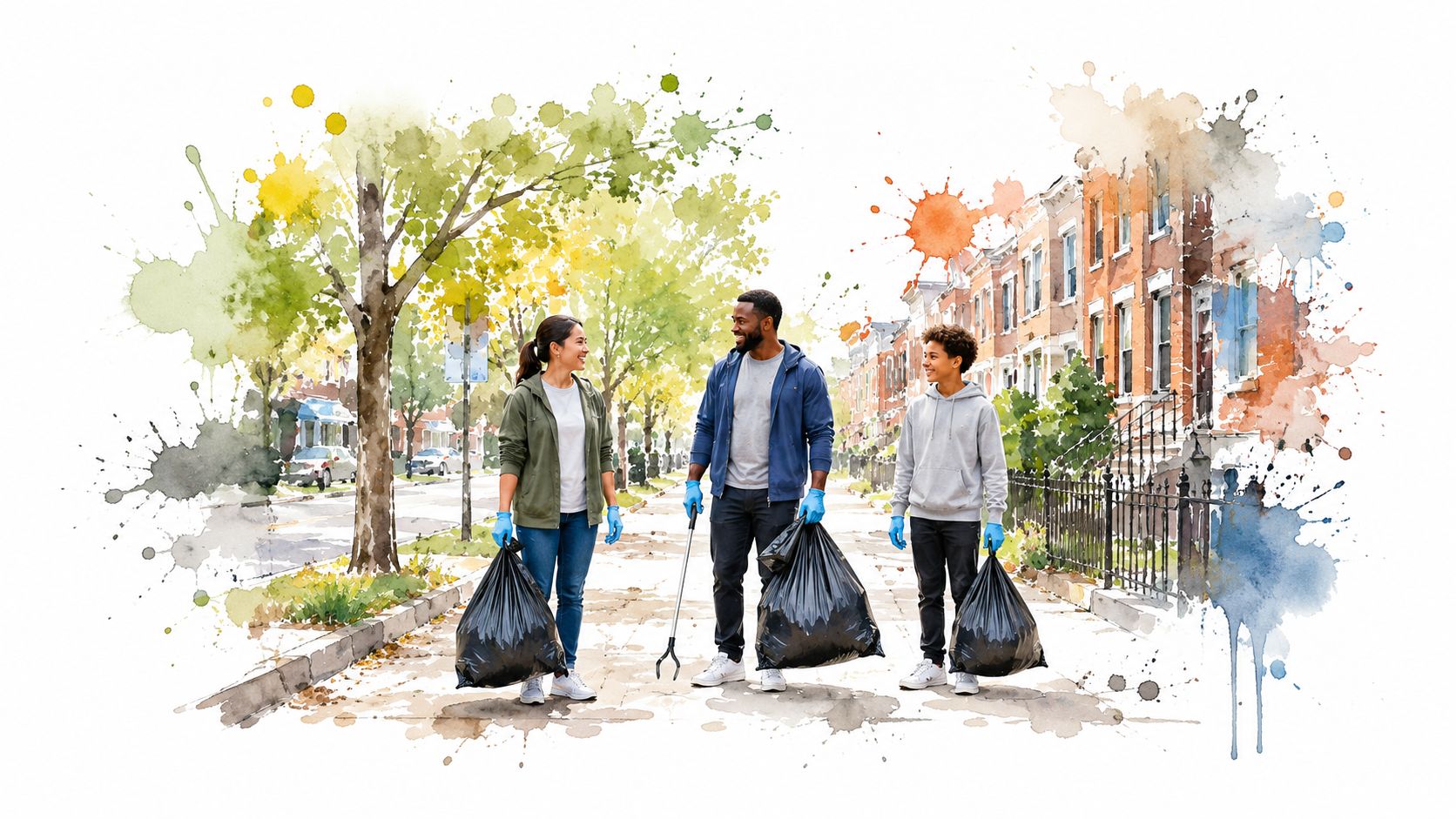
    A diverse group of three people walking down a city street while collecting litter in trash bags.

    Make repetition easy

    Organizers can schedule events at 9 AM or earlier when they want a steady weekend routine. A simple RSVP page removes needless steps. Group shirts, flags, badges, or another shared marker can help strangers recognize one another quickly, while before-and-after photos give the team a small record of each morning.

    Rotate neighborhoods when you can. A cleanup in Lincoln Park feels different from one in Englewood or on the South Side, and moving around Chicago helps volunteers meet more people.

    Practical rule: Choose a recurring time before you choose a grand mission. A routine you can keep beats an ambitious plan you abandon.

    If you're organizing your own crew, use this guide to organize a neighborhood cleanup. The best group may be the one that makes a bag, a meeting point, and a friendly hello feel enough to begin.

    2. Adopt-a-Highway and Major Corridor Programs

    A major road changes the experience of picking up litter. Cars move quickly, the shoulder can feel exposed, and a loose team needs clear boundaries before anyone lifts a bag. In return, volunteers take responsibility for a defined stretch instead of treating cleanup as a one-off walk.

    Chicago groups can work with IDOT on safety equipment and road-closure coordination. Litter Caterpillars cleaned a highway during the shutdown for the Bike the Drive event, and corporate teams can adopt sections of Lake Shore Drive. Community groups may also maintain portions of Ashland Avenue or Western Avenue.

    Treat the corridor like a worksite

    Schedule service after a large event or a season that leaves extra litter behind. Ask nearby businesses to help with water, bags, gloves, and volunteer recruitment. Give every participant a clear job, such as bag collection, supply support, route observation, or communication with the lead.

    High-visibility vests and trained flaggers belong in the plan. Volunteers should never improvise around moving traffic. Take photos from safe locations, record what the team completed, and use those records in community updates or partnership conversations.

    A corridor project needs more than enthusiasm. It needs a route map, a meeting point, a weather decision, and an exit plan.

    For prevention work beyond pickup, explore ways to prevent illegal dumping. Removing waste helps today. Learning why people dump materials, where repeat problems appear, and whom to contact can shape the next response.

    3. Vacant Lot Transformation and Urban Gardening

    A vacant lot asks for patience. You may begin with broken glass, tangled weeds, old furniture, and soil that needs professional attention. The first cleanup clears the view. Later, neighbors can decide whether the space should become a garden, a gathering place, a play area, or another useful community resource.

    Caterpillar Park in Englewood grew from Litter Caterpillars' work, while Growing Home in Englewood transforms lots into urban farms. The Local Initiatives Support Corporation, or LISC, supports vacant-lot projects across Chicago. Each example points to the same practical truth, a lot needs a plan for its next life before people invite the public in.
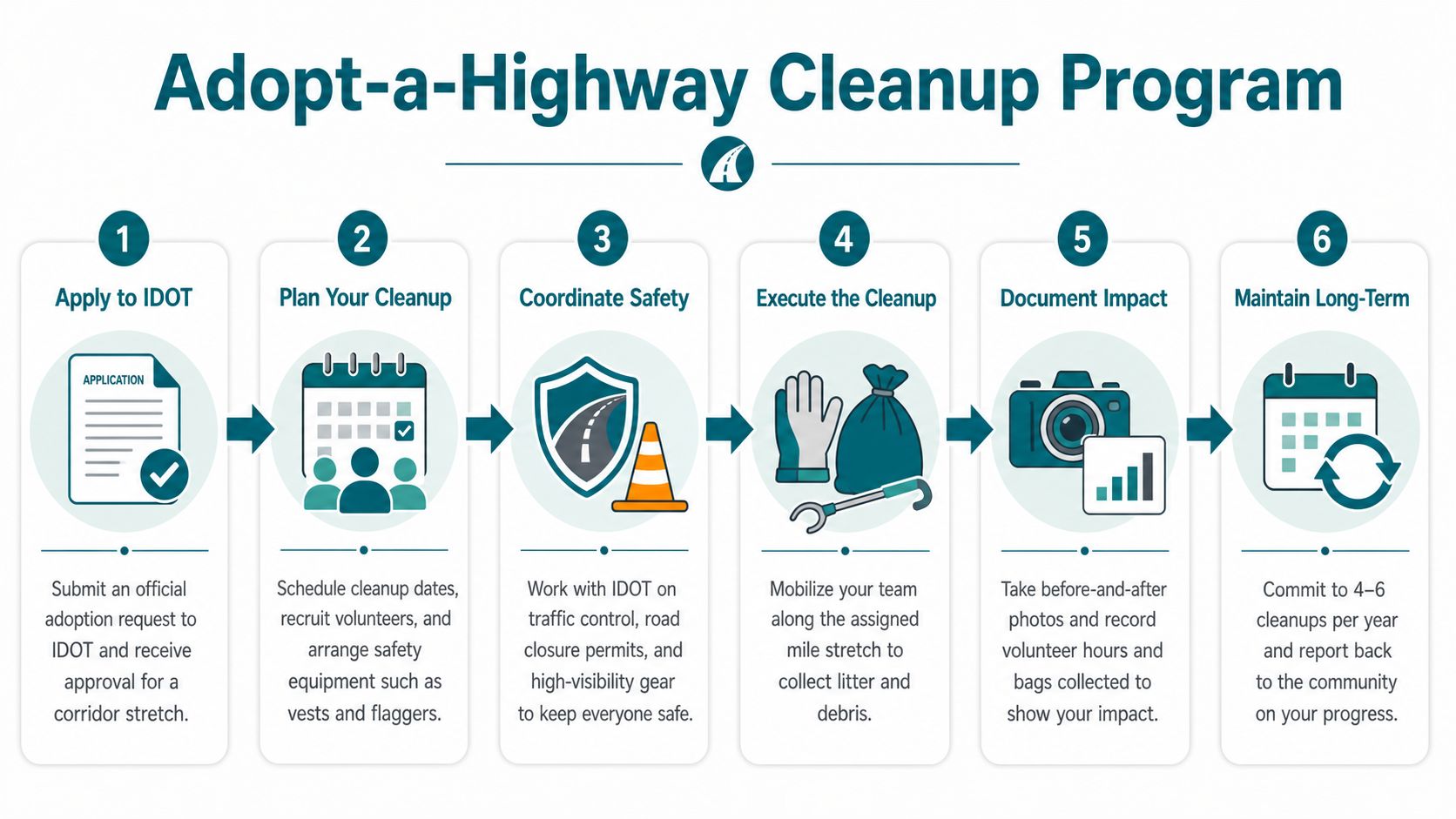
    A six-step infographic illustrating the process to join the IDOT Adopt-a-Highway cleanup volunteer program.

    Build the next phase early

    Start with one property. Get the owner's agreement before volunteers invest time, and work with a nonprofit that understands land management, soil questions, permits, and maintenance. Ask neighbors what they want to see, then create a schedule for watering, mowing, repairs, trash removal, and winter care before opening the space.

    • Choose a manageable footprint: A smaller project lets people learn the site before expanding.
    • Invite local design voices: Neighbors should help decide paths, planting, seating, and use.
    • Plan funding carefully: Environmental and community-development funders may support eligible work.

    The transformation takes shape in stages. First, people remove hazards. Then they create a place that asks for regular care.

    See Chicago community gardens for a place-based route into this kind of service. The video below gives the project a more tangible feel.

    4. School and Youth Organization Volunteer Partnerships

    A school cleanup can start with a short walk, a few pairs of gloves, and a teacher who knows how to keep the group moving. Chicago Public Schools can partner with environmental nonprofits for cleanup days. Boys and Girls Clubs can place service inside summer programming, and Kenwood Academy students have taken part in lakefront cleanups.

    Young volunteers need jobs they can understand. One student can track supplies, another can collect safe litter, and another can photograph the work with permission. Give older participants a chance to lead a briefing or welcome new members. A service habit grows more naturally when students can see their own progress.

    A woman and three children smiling while participating in community service activities like cleaning and planting trees.

    Connect service to school life

    Start with an environmental coordinator, service coordinator, teacher, or youth-program director. A cleanup can support lessons about waste, water, wildlife, civic life, or local geography. Libraries and schools can also run low-barrier projects such as making cards for veterans, decorating materials for care homes, or creating bookmarks for young readers, based on examples described by the American Library Association's school-library blog.

    Ontario students who need a comparison for school service requirements can look to Ontario's graduation guidance, which requires 40 hours of unpaid community involvement for the Ontario Secondary School Diploma. Students can begin recording hours in July before Grade 9, and the guidance suggests aiming for about 10 hours per year. Ontario school guidance provides those details.

    Keep the activity hands-on, recognize participation with certificates or a thank-you, and give students a route from helper to team leader.

    5. Corporate Team Building and Volunteer Days

    A company volunteer day works best when nobody has to guess what happens next. Employees arrive at a neighborhood or park, receive a short briefing, split into defined roles, and leave with a clear picture of the site they helped. The day can feel social without turning service into a forced office exercise.

    Chicago environmental groups can work with technology, finance, law, consulting, and other companies. Google and Salesforce organize employee volunteer days, and local nonprofits partner with firms that want a practical group project. Organizers can package the experience around a site, a meeting time, supplies, safety guidance, and a simple follow-up.

    Give the team a story and a job

    Before the event, explain why the neighborhood needs the work without reducing the community to a problem. Show the route, name the local partner, and tell employees what to bring. On site, assign a company lead and a service lead so questions have a clear home.

    Afterward, send before-and-after photos and a concise account of what the team completed. Ask what felt easy, what felt confusing, and whether anyone wants to join a recurring cleanup.

    Small details can make the day feel shared. A group flag, a team photo, or a playful sign can help participants remember the morning. If a project uses branded site markers, organizers can review guidance on designing effective hole signs for ideas about readable, visible messaging, even outside a golf setting.

    The trade-off is simple. A company day can bring many hands at once, while a recurring group builds deeper continuity. A thoughtful organizer can invite both.

    6. Environmental Education and Workshops

    Some volunteers want to understand the route from a discarded cup to a clogged drain or polluted waterway. A cleanup followed by a workshop gives them that connection. You can talk about what litter does in waterways, how materials break down, and which daily choices prevent waste from reaching the street.

    Chicago Public Schools can use environmental lessons about waste and litter. Lincoln Park Zoo can connect wildlife education with plastic concerns, and the League of Women Voters Chicago hosts workshops about environmental sustainability. Schools, libraries, and community centers already have rooms and audiences, so a local partnership can make the first session easier to arrange.

    Teach with objects people can see

    Avoid leading with shame. Put a storm-drain image beside a bag of collected items. Show a clean sorting station, a composting example, or a sealed container that demonstrates how litter can travel through water. Ask participants to name one change they can make that day.

    • Use a local route: Walk from the meeting point to a drain, park edge, or shoreline.
    • Let young people speak: Students can create messages for classmates and neighbors.
    • End with action: Give people a simple next step, such as joining a cleanup or checking local recycling guidance.

    A workshop should leave people with something to do, not only something to worry about. Pair the lesson with a short service activity so the idea becomes physical.

    You can also create remote participation for people who can't attend outdoors. A student might design a litter-prevention poster, a volunteer might help organize event information, and a community member might share a workshop invitation through a local group chat.

    7. Parks and Lakefront Stewardship Programs

    A park volunteer notices more than a bottle. You may spot a damaged bench, a broken sign, a bare planting bed, or a path that needs attention. Stewardship gives you a way to report those problems while you pick up litter and care for the place over time.

    Friends of the Parks organizations run volunteer stewardship programs. The Lakefront Cleanup Initiative coordinates beach and shoreline work, and the Lincoln Park Conservancy works on park improvements and maintenance. A group can adopt one section, establish a recurring schedule, and keep a simple record of what needs follow-up.
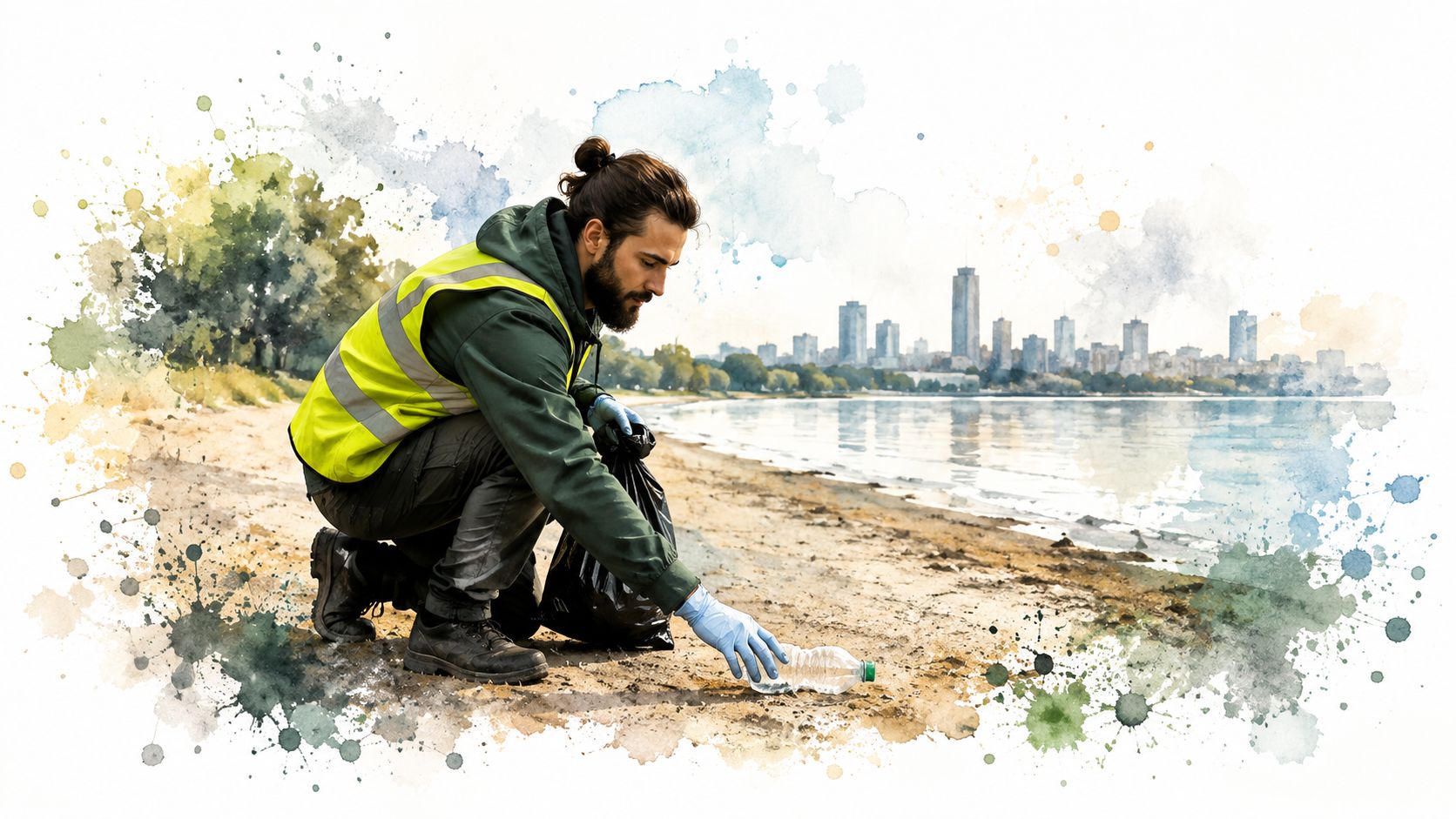
    A volunteer wearing a high-visibility vest picks up a plastic bottle from a beach, cleaning the coastline.

    Care for the place between events

    Build a working relationship with the Chicago Park District or the relevant park partner before assigning tasks. Decide how volunteers should report maintenance issues, where filled bags go, and which work requires staff or trained professionals. Monthly or twice-monthly gatherings can keep the site familiar without making every volunteer promise a permanent obligation.

    Families can join when the activity suits different ages. One person may collect litter, another may photograph conditions, and children may help with safe, supervised tasks. Document the park across seasons so returning volunteers can see changes without relying on memory.

    A beach cleanup also needs a weather plan, sturdy footwear, water, gloves, and a way to avoid sharp or unknown objects. Volunteers should report unsafe conditions, accidents, and injuries immediately, and they should know where first-aid supplies and evacuation routes are located, as described in this volunteer safety training checklist.

    8. Neighborhood Association and Block Club Integration

    A block club already knows who lives on the street, which alley creates frustration, and when neighbors gather. That knowledge can save an organizer from starting with a blank page. Instead of asking people to join a new institution, you can add a cleanup to a communication channel they already use.

    Pilsen neighborhood groups coordinate environmental work. The Lincoln Square Chamber of Commerce can partner on street and alley cleanups, while Rogers Park community organizations organize block cleanups. Each group may have different priorities, so listen before you propose a route.

    Earn trust before asking for turnout

    Attend an association meeting or contact a leader with a short plan. Explain how the cleanup supports the group's existing goals, then offer to handle logistics such as supplies, reminders, route planning, and waste disposal. Schedule around a neighborhood event, a seasonal change, or a day when residents already expect activity outside.

    • Ask about the problem first: Residents may prefer an alley, vacant edge, school route, or business strip.
    • Bring a finished plan: Include a meeting point, time, supply list, and safety contact.
    • Return with updates: Share photos, thank participants, and report what still needs work.

    You can connect cleanup with neighborhood pride without making promises about property values. People usually respond better when they can see a specific place, a reasonable task, and a group that will return.

    This route also works for newcomers. A block club can turn a new city into a set of familiar faces, one street at a time.

    9. Faith-Based Organization Service Programs

    A church, synagogue, mosque, or temple often has a service calendar, a gathering place, and people who already know the surrounding blocks. A cleanup can fit that rhythm when organizers approach the community with respect instead of treating it as a list of available volunteers.

    Trinity United Church of Christ in Chicago runs community service initiatives. The Jewish Federation of Chicago coordinates volunteer projects, and interfaith groups have worked on environmental stewardship in Chicago's South and West sides. These partnerships can bring together people who care about service for different reasons.

    Start with relationship, not recruitment

    Meet with a clergy member or community-service coordinator first. Explain the work, listen to the organization's priorities, and ask where a cleanup might fit. Respect major religious observances and the group's calendar. Bring a plan that includes supplies, safety, accessibility, transportation questions, and a clear end time.

    Invite faith leaders to share why service matters to their community, but don't ask them to promote a project they haven't reviewed. Offer to facilitate the cleanup and manage the details. Afterward, send thanks and a short update about the work.

    • Keep the invitation open: Make room for people who can contribute time, planning, hospitality, or translation.
    • Protect the group's culture: Follow local expectations around food, clothing, prayer, and photographs.
    • Build a return path: Invite interested participants to a recurring cleanup or another service day.

    Groups can use congregation-focused tools such as Taja AI for faith-based communities when they need help communicating with members. The human conversation still comes first.

    10. Social Media and Community Mobilization Networks

    A volunteer may discover Saturday's cleanup while scrolling in bed, then decide to attend because the post gives a time, a place, and a short list of what to bring. That small amount of information can remove the uncertainty that keeps people home. Instagram, Meetup, Facebook groups, and open chats can work as doors into in-person service.

    Litter Caterpillars uses Instagram storytelling and Meetup for events. Chicago Loves Its Parks uses Facebook for volunteer coordination, and environmental groups use branded hashtags to help participants recognize related activities. A clean event post should answer the practical questions before anyone has to send a message.

    Make the post do useful work

    Share photos with clear lighting and framing, then tell a short volunteer story about why that person returns. Before-and-after images give the audience a visible record. Post regularly, respond quickly, and use stories for weather changes, route updates, or last-minute reminders.

    • Write the basics first: Include the time, location, meeting point, duration, and what to bring.
    • Use a consistent identity: A hashtag, flag, shirt, or badge can help people find the same group again.
    • Thank people directly: Public appreciation can make a first-time volunteer feel seen.
    • Keep RSVP simple: Use Meetup or an open chat when a long application would add needless friction.

    You can also draw ideas from this guide for artists on community platforms, especially when you need to make a group feel welcoming online. Digital mobilization works best when it leads to a real meeting, a real task, and a clear way to return.

    Community Service Opportunities: 10-Item Comparison

    Activity 🔄 Implementation Complexity ⚡ Resource Requirements 📊 Expected Outcomes & Ideal Use Cases ⭐ Key Advantages 💡 Tips
    Weekly Neighborhood Cleanup Groups 🔄 Low, recurring coordination and simple logistics ⚡ Low, bags, gloves, grabbers, volunteer time Gradual visible neighborhood improvement; ideal for local blocks/wards ⭐⭐⭐ Strong community-building; low barrier to entry 💡 Schedule mornings; document before/after; create group identity
    Adopt-a-Highway and Major Corridor Programs 🔄 Medium–High, permits, safety planning, agency coordination ⚡ Medium, safety gear, larger crews, formal reporting High-visibility corridor improvements; ideal for long-term adopters and corporate sponsors ⭐⭐⭐ Official recognition; high visibility; sponsor appeal 💡 Coordinate with IDOT; use vests/flaggers; schedule after busy events
    Vacant Lot Transformation and Urban Gardening 🔄 High, land access, remediation, permitting, design ⚡ High, heavy removal, soil testing, funding, skilled partners Lasting beautification and community space; ideal for long-term investment projects ⭐⭐⭐⭐ Creates permanent change; attracts funding and deep ownership 💡 Start small; secure owner buy-in; plan maintenance & funding early
    School and Youth Organization Volunteer Partnerships 🔄 Medium, schedule alignment, supervision, curriculum links ⚡ Low–Medium, adult supervisors, basic supplies, educational materials Builds service habits and environmental literacy; ideal for schools and youth programs ⭐⭐⭐ Reliable volunteer base; educational & leadership benefits 💡 Tie activities to curriculum; provide recognition and leadership roles
    Corporate Team Building and Volunteer Days 🔄 Medium, packaged logistics, single-day coordination ⚡ Medium, supplies, staffing, possible sponsorships Rapid, high-output events; ideal for companies seeking team bonding and PR ⭐⭐⭐ Large short-term impact; potential funding and partnerships 💡 Offer turnkey packages; assign clear roles; follow up with impact metrics
    Environmental Education and Workshops 🔄 Medium, content development and skilled facilitation ⚡ Low–Medium, presenters, materials, demo supplies Behavior change and advocacy; ideal for classrooms, libraries, community centers ⭐⭐⭐ Addresses root causes; builds advocates 💡 Lead with stories and data; include hands-on demos and immediate takeaways
    Parks and Lakefront Stewardship Programs 🔄 Medium, coordinate with Parks Dept and monitoring systems ⚡ Medium, tools, reporting system, regular volunteer schedule Maintained public recreation spaces; ideal for families and intergenerational groups ⭐⭐⭐ City support; visible community benefit 💡 Establish formal Parks relationship; schedule regular stewardship; report issues
    Neighborhood Association and Block Club Integration 🔄 Low–Medium, navigate local governance and meetings ⚡ Low, access to lists, modest supplies, volunteer coordination Efficient recruitment and sustained campaigns; ideal where associations exist ⭐⭐⭐ Trusted channels; potential small grants 💡 Attend meetings first; offer to manage logistics; align with priorities
    Faith-Based Organization Service Programs 🔄 Low–Medium, schedule and cultural coordination with congregations ⚡ Low, volunteer pools, meeting space, occasional meals/supplies Values-driven sustained volunteering; ideal for faith communities and neighborhood outreach ⭐⭐⭐ Deep commitment; strong volunteer base 💡 Meet with clergy; align with calendars; explain mission alignment
    Social Media and Community Mobilization Networks 🔄 Medium, sustained content, moderation, and event management ⚡ Low, platform accounts, time for posts, RSVP tools Rapid recruitment, visibility, and ad-hoc turnout; ideal for outreach and youth engagement ⭐⭐⭐ Low barrier to entry; visual storytelling boosts participation 💡 Post 2–3x/week; use before/after photos; create branded hashtags and quick logistics

    Turn One Cleanup Into Your Regular Thing

    Chicago gives you many ways to begin. You can join a weekend-morning event on Meetup, contact a local nonprofit or school, ask a block club about a service day, or speak with a faith group that already organizes community work. You can explore Litter Caterpillars at littercaterpillars.com and see whether its weekly Chicago pickups fit your routine.

    Before you RSVP, run a quick fit check. How long will travel take from your home, school, or workplace? Can you manage the walking, bending, heat, cold, or uneven ground? Does the organizer explain safety plans, supplies, meeting points, and what happens if weather changes? Do people greet newcomers, answer questions, and respect different abilities? Can you keep the schedule without turning service into another source of stress?

    People volunteer through formal organizations and through direct help in their communities. Updated United Nations Volunteerism reporting estimates that about 2.1 billion people worldwide, or 34.5% of the working-age population, volunteer each month. The same reporting places monthly direct helping at 25.0% and organizational volunteering at 11.7%, showing why a neighborhood group or informal cleanup can be a genuine entry point, not a lesser version of service. Read the United Nations Volunteerism monthly volunteering estimates for the measurement details.

    If you need community service for a housing requirement, check your local housing authority before choosing an event. HUD guidance says many public housing residents in the United States must complete 8 hours per month of community service or an economic self-sufficiency program, with a combined total of 8 hours per month allowed. Residents may bank fewer hours in a month, but they must reach 96 hours before the next annual reexamination, according to this HUD community service and self-sufficiency guide.

    Safety deserves the same attention as scheduling. Wear the clothing the organizer requests, bring water, and ask before handling sharp, heavy, or unknown items. If you have COVID-19 symptoms, stay home. California volunteer guidance also advises keeping 6 feet of distance, washing hands before, during, and after a project, disinfecting surfaces, and covering coughs and sneezes with a tissue or elbow. See California Volunteers' safety guidance before joining a group that uses shared tools or works closely together.

    Make your first test small. RSVP, bring the requested supplies, introduce yourself to one volunteer, and return once before deciding whether the group fits. One morning can show you whether the route, people, pace, and purpose feel right.


    Litter Caterpillars hosts scheduled trash pickups across Chicago, with weekend-morning events, Meetup listings, Instagram updates, and open group chats that help volunteers join without a complicated process. Visit Litter Caterpillars to find an upcoming cleanup, meet people who care about their neighborhoods, and choose a service routine you can keep.


  • How to Report Illegal Dumping in Chicago

    How to Report Illegal Dumping in Chicago

    At dawn, I once found an alley packed with broken drywall, rotting mattresses, and black trash bags. A syringe glittered near my boot. I pulled out my phone before I touched anything.

    "Why I Started Caring About Illegal Dumping"

    The smell reached me before the pile came into view. Wet wood, spoiled food, mold, and something sharp hung between the brick walls. Construction debris spilled across the alley, mattresses leaned against a fence, and loose bags crowded the curb. I felt angry, then embarrassed, as if someone had entered our home and thrown their mess across the floor.

    That block already carried more than its share of neglect. Families on Chicago's South and West Sides work hard to keep their homes and streets in order, yet illegal dumping keeps landing in the same alleys, vacant lots, and roadside spaces. I saw how quickly one pile invited another. People treated the first dump as permission.

    A homeless man walking through a city alley filled with trash, debris, and discarded furniture items.

    Anger needs a direction

    For a while, I stood there feeling helpless. I couldn't remove the mattresses alone, and I didn't want to disturb evidence or touch anything dangerous. Then I opened my phone and filed a 311 report.

    That small act changed my relationship with the block. I stopped seeing a dump site as an ugly fact I had to tolerate. I started seeing it as a record I could create, a problem I could route, and a pattern neighbors could document together.

    Practical rule: Photograph first, report second, clean up only when you know the site is safe and the proper agency has what it needs.

    Reporting illegal dumping is a form of community power. Your report gives sanitation workers a location, gives investigators a lead, and gives neighbors a shared starting point. You can learn more about turning concern into hands-on neighborhood care through Litter Caterpillars' community care work.

    I've picked up trash in Chicago rain, heat, blizzards, and wind that cut through three layers of clothing. I've learned that a clean block doesn't happen because one person stays angry. It happens because someone documents the problem, makes the call, and invites others to keep showing up.

    "Gathering Evidence That Actually Gets Results"

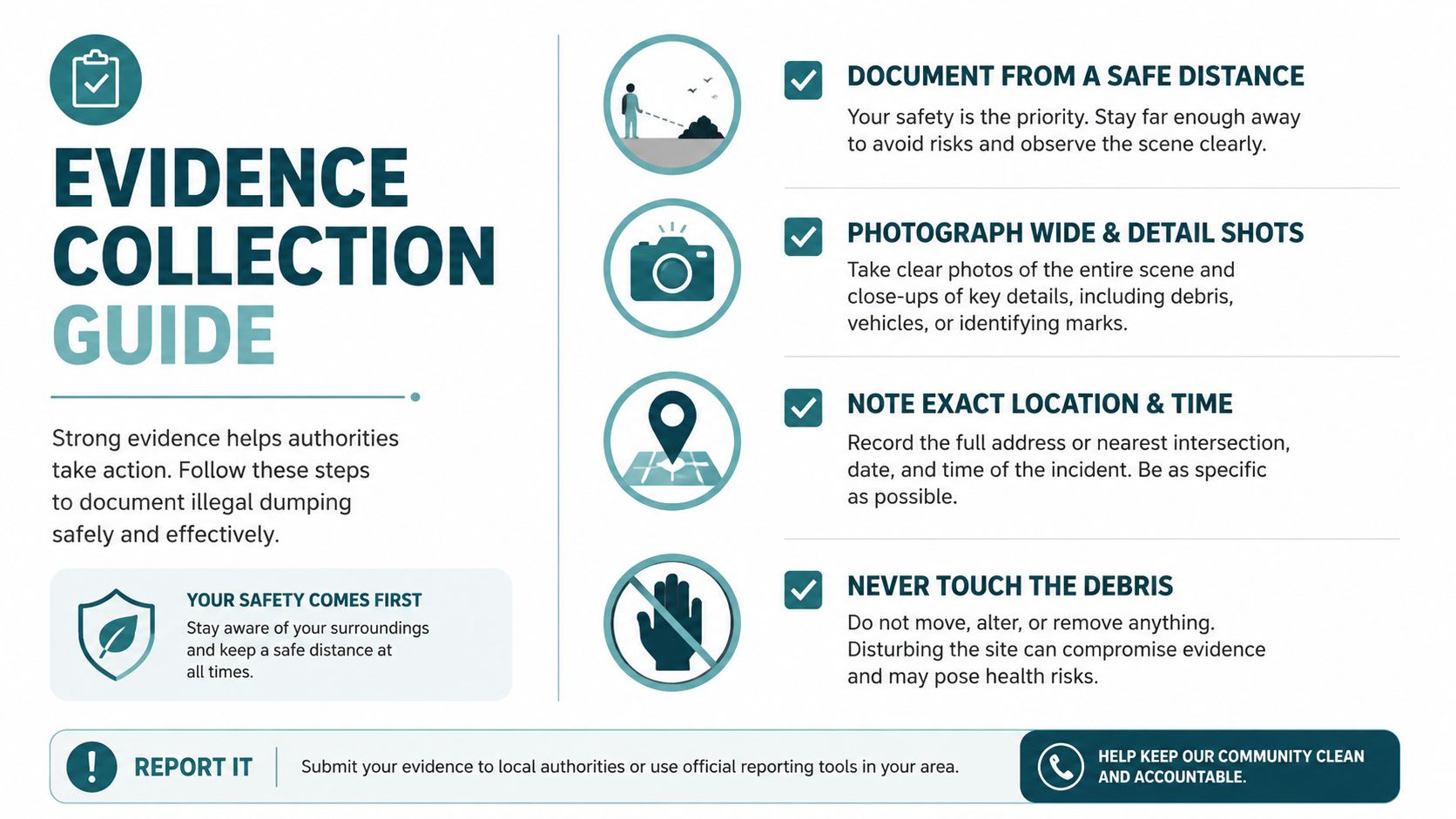
    Treat the site like a scene that can change quickly. Before you move a bag, lift a mattress, or ask someone else to help, step back and document what you see from a safe distance.

    A vague report says, “There's trash in the alley.” A useful report tells an inspector where to stand, what to look for, and whether the material might create a danger.

    Start with the full picture

    Take wide photographs from several angles. Include the alley, curb, vacant lot, fence line, or other surroundings so the agency can understand the site's scale and exact setting. Then take close photographs of details that may connect the waste to a person or business:

    • Vehicle information: Photograph a license plate, vehicle color, make, and model if you see a vehicle near the dump site.
    • Identifying marks: Capture business names, shipping labels, delivery stickers, addresses, and recognizable markings on boxes or materials.
    • Location markers: Photograph street signs, building numbers, alley entrances, landmarks, and nearby intersections.
    • Waste details: Record whether you see construction debris, furniture, household bags, tires, chemicals, or other hazardous material.
    • Activity status: Note whether dumping is happening now, appears to have happened recently, or looks like an older pile that has grown over time.

    Philadelphia asks reporters for a location, suspect description, vehicle make, model, color, license plate, and material details. Philadelphia's illegal-dumping reporting guidance shows the level of detail that helps an agency act. New York City also requests vehicle identification and reporter contact information, along with the date, time, waste type, and amount.

    Write down what your camera can't explain

    Open your phone's notes app and record the date, time, exact address, nearby cross street, and GPS location. Your phone may embed location data in a photograph, but write the location separately so you can paste it into a report.

    Estimate the volume in plain language. You might describe a small cluster of bags, a truckload of construction waste, or debris spread across most of an alley. Don't guess at an exact weight. Describe what you can see.

    An instructional infographic detailing safe and effective steps for documenting illegal dumping evidence for reporting to authorities.

    Never enter a pile, open containers, handle needles, or approach a person who may still be dumping. If a dashcam or security camera captured the event, save the original file when possible and note the camera's location and recording time. Ask a property owner for footage rather than trespassing or confronting anyone.

    For more field-ready precautions, keep a volunteer safety checklist with your phone supplies.

    Here's a short visual guide you can watch before your next cleanup or report:

    "Chicago Hotlines and Apps You Need to Know"

    Chicago residents usually start with 311 for an existing illegal-dumping site. You can call 311, use the CHI 311 mobile app, or submit a request through the city's online portal. Keep your notes and photographs nearby. The request should include the exact location, waste type, visible volume, date and time, and any vehicle or person details you captured safely.

    An active dumper creates a different situation. Don't approach the vehicle or block its path. If someone is dumping right now and you face immediate danger, call emergency services. For a non-emergency report involving suspected criminal activity, use the Chicago Police Department's non-emergency channel and give dispatch the location and vehicle information.

    Chicago's Department of Streets and Sanitation handles cleanup-related requests, while hazardous waste or a large commercial dump may need escalation to the Illinois Environmental Protection Agency. Ask the receiving agency whether it needs a direct inspection, additional photographs, or a separate environmental complaint.

    Choose the channel that fits the scene

    Channel Contact Info Best For Expected Response
    Chicago 311 Call 311, CHI 311 app, or city online portal Existing dumping sites and cleanup requests City routing and follow-up depend on the request
    Chicago Department of Streets and Sanitation Request through Chicago 311 Visible debris on public streets and alleys Inspection or cleanup routing depends on location and material
    Chicago Police Department Emergency services for immediate danger, department non-emergency channel for non-urgent incidents Active dumping, threats, or suspected criminal conduct Dispatch priority depends on safety and urgency
    Illinois EPA State environmental complaint channel Hazardous waste, major spills, or large commercial dumping Agency response depends on hazard and jurisdiction
    Ward and aldermanic office Your ward's aldermanic contact page Repeated sites and unresolved service requests Office follow-up varies by ward and case
    Litter Caterpillars Volunteer reporting network Shared documentation and neighborhood cleanup coordination Volunteer follow-up depends on group capacity

    Don't send the same vague message everywhere. Send a clear 311 request first for a routine site, then add the appropriate agency when the material, scale, or active danger calls for it. England, Scotland, and Wales use a similar split, with local councils handling ordinary fly-tipping and the Environment Agency handling large-scale dumping through its 24-hour hotline at 0800 80 70 60; anonymous reports can go to Crimestoppers at 0800 555 111 through the official fly-tipping reporting guidance.

    "What Happens After You File a Report"

    You press submit, receive a request number, and then the alley looks exactly the same. I know that silence. It can feel as if your report vanished into a machine with no person on the other side.

    A routine request usually enters a city queue for review, routing, inspection, or cleanup. The exact timing can change with the material, location, workload, weather, and whether the site creates an immediate hazard. A status that says “referred to inspector” generally means the request has moved beyond intake and needs someone to assess the site or determine the next agency.

    Cleanup and enforcement follow different paths

    A cleanup crew can remove visible debris without identifying who left it. An enforcement investigation needs evidence that connects the waste to a vehicle, person, business, time, or repeated pattern. That's why your photographs, notes, camera footage, and request number matter.

    New South Wales shows how reports can move through an enforcement pipeline. Over five years, its EPA received and actioned 1,507 illegal-dumping reports, including 641 investigations involving major incidents with more than 200 tonnes of waste. In 2016–17, the agency completed 11 waste prosecutions, with $411,000 in financial penalties, and issued 78 clean-up notices plus 53 penalty notices linked to illegal-dumping investigations. The figures appear in answers from the NSW EPA.

    That same NSW material says 98% of councils reported illegal dumping as an issue in their area, while one in seven spent more than $500,000 per year on cleanup and enforcement. Reporting gives agencies the information they need to decide whether a site needs removal, inspection, surveillance, or legal action.

    Follow up with a record, not a rant

    If the pile remains, use the original request number and submit updated photographs. Contact your alderman's office with the location, date of the first report, request number, current condition, and any new evidence. Ask the office to request a status update from Streets and Sanitation.

    For dangerous material, don't wait for ordinary cleanup. NSW directs people to call 000 for toxic fumes or large chemical spills, 131 555 for immediate threats, and use RIDonline for other reports with a photo and GPS location, according to its illegal-dumping reporting page. The same principle applies in Chicago. Match the channel to the danger.

    "How Volunteer Groups Multiply Your Impact"

    A single report gives a city one location. A group can give neighbors a shared map, repeated observations, photographs from different days, and people who know when a site changes.

    I've watched volunteers walk an alley before a cleanup, photograph every pile, and compare notes afterward. One person notices a contractor label. Another spots a plate. Someone else knows which property owner has a camera facing the alley. Together, they create a clearer account than any one rushed visit can provide.

    Turn scattered observations into a neighborhood record

    Volunteer groups can coordinate walking cleanups, dumping-watch shifts, shared photo folders, and group-chat alerts. They can also help residents keep request numbers organized and notice when the same location appears in multiple reports.

    That work doesn't replace 311, Streets and Sanitation, the police, or an environmental agency. It gives neighbors the structure to use those channels consistently. A group can also bring a chronic site to an aldermanic office with a dated record instead of a stack of disconnected complaints.

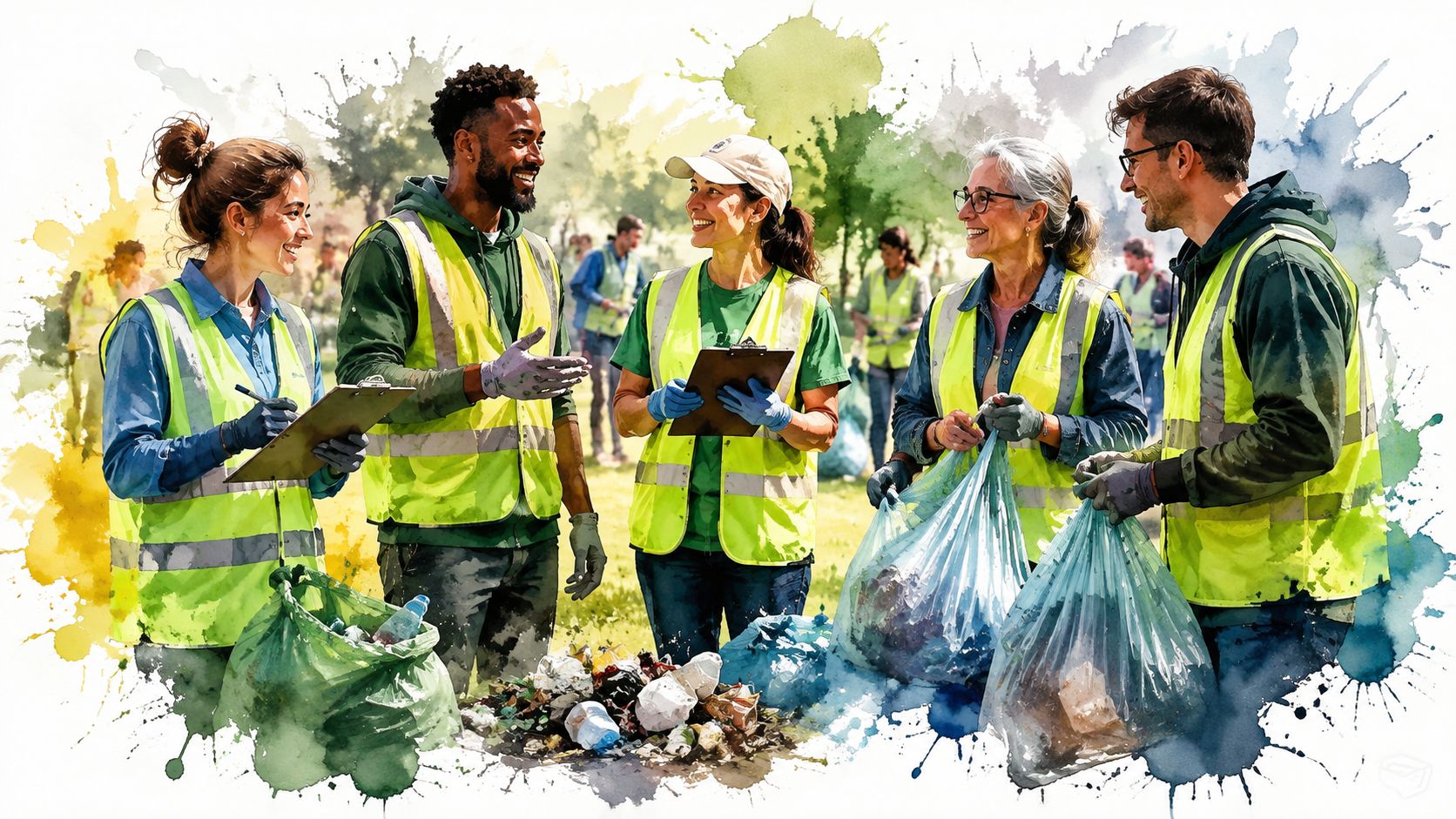
    A diverse group of volunteers in high-visibility safety vests working together to clean up litter in a park.

    Find a role that matches your energy

    You don't have to lift heavy debris to help. You can photograph from a sidewalk, enter report details, check a camera angle with a property owner, translate information for a neighbor, or attend a ward meeting.

    Chicago residents can browse local environmental groups and choose a group that fits their schedule and safety limits. Litter Caterpillars organizes volunteer trash pickups across Chicago, including work in neighborhoods that other cleanup crews may skip, while keeping volunteer safety and happiness ahead of fundraising.

    The work becomes easier when people share it. One neighbor makes the call. Another tracks the request. A third returns after the city visit and photographs what remains. That rhythm turns frustration into a practice.

    "Your Action Plan for Cleaner Streets"

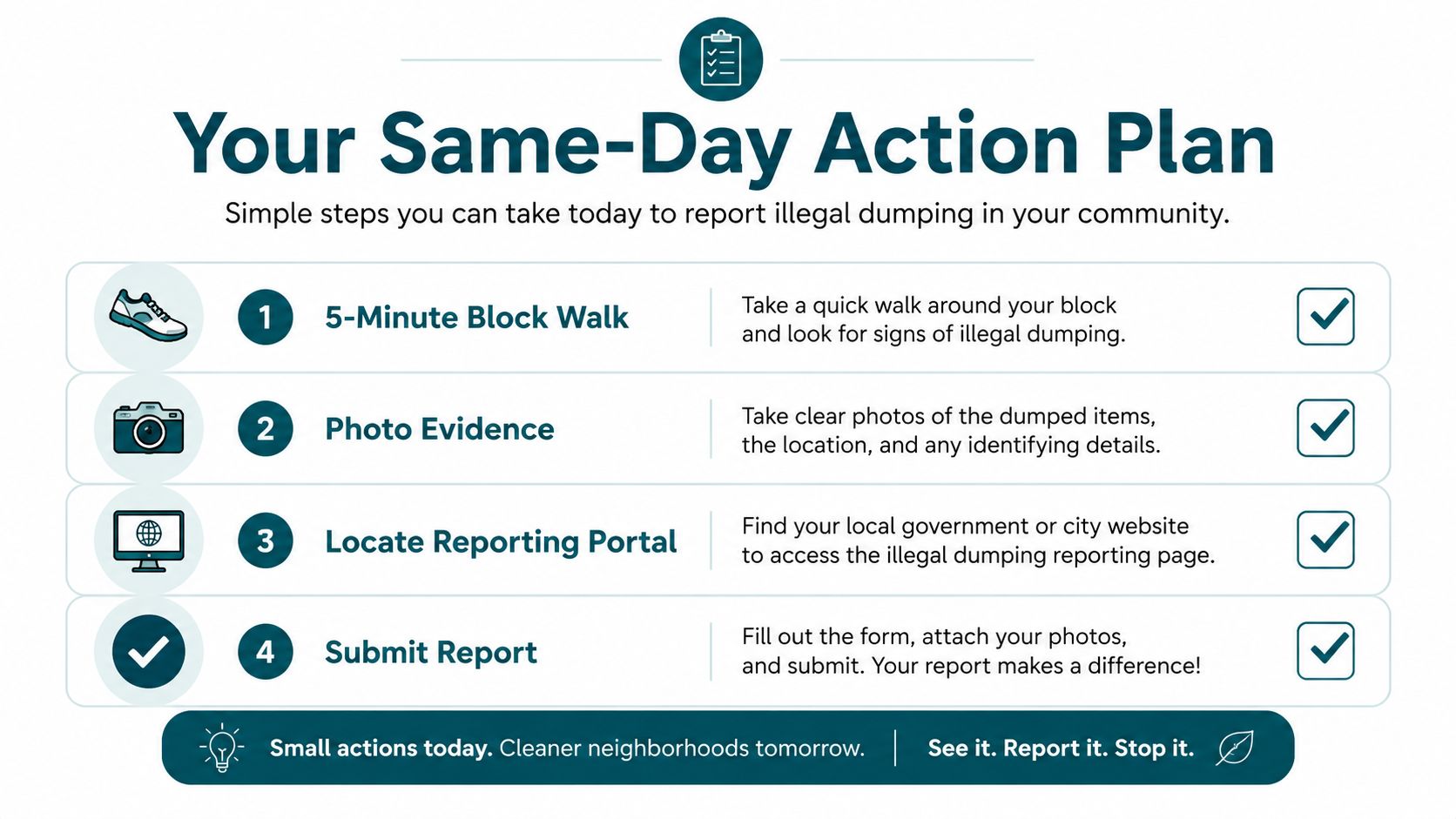
    Start today with a short walk around your block. Keep to public space, stay away from unstable piles and hazardous material, and photograph existing dumping before anyone moves it.

    Then take these steps:

    1. Save the channels: Put 311 and your alderman's contact page in your phone.
    2. Record the facts: Write down the address, cross street, date, time, waste type, and vehicle details.
    3. File the report: Use 311, the CHI 311 app, or Chicago's online portal.
    4. Create the follow-up: Save the request number and set a reminder to check the site again.

    An infographic titled Your Same-Day Action Plan showing four simple steps to report illegal community dumping.

    A report records what happened today. Follow-up reports can show a repeated problem at the same address, while volunteer work helps neighbors protect one another and care for the block.


    Litter Caterpillars organizes Chicago trash pickups, cleanup walks, and neighborhood friendships for people who want to act on problems like illegal dumping. Visit Litter Caterpillars to find a cleanup, join the volunteer network, and take your next step toward a cleaner block.

  • Chicago Ward Boundaries: Finding Your Neighborhood

    Chicago Ward Boundaries: Finding Your Neighborhood

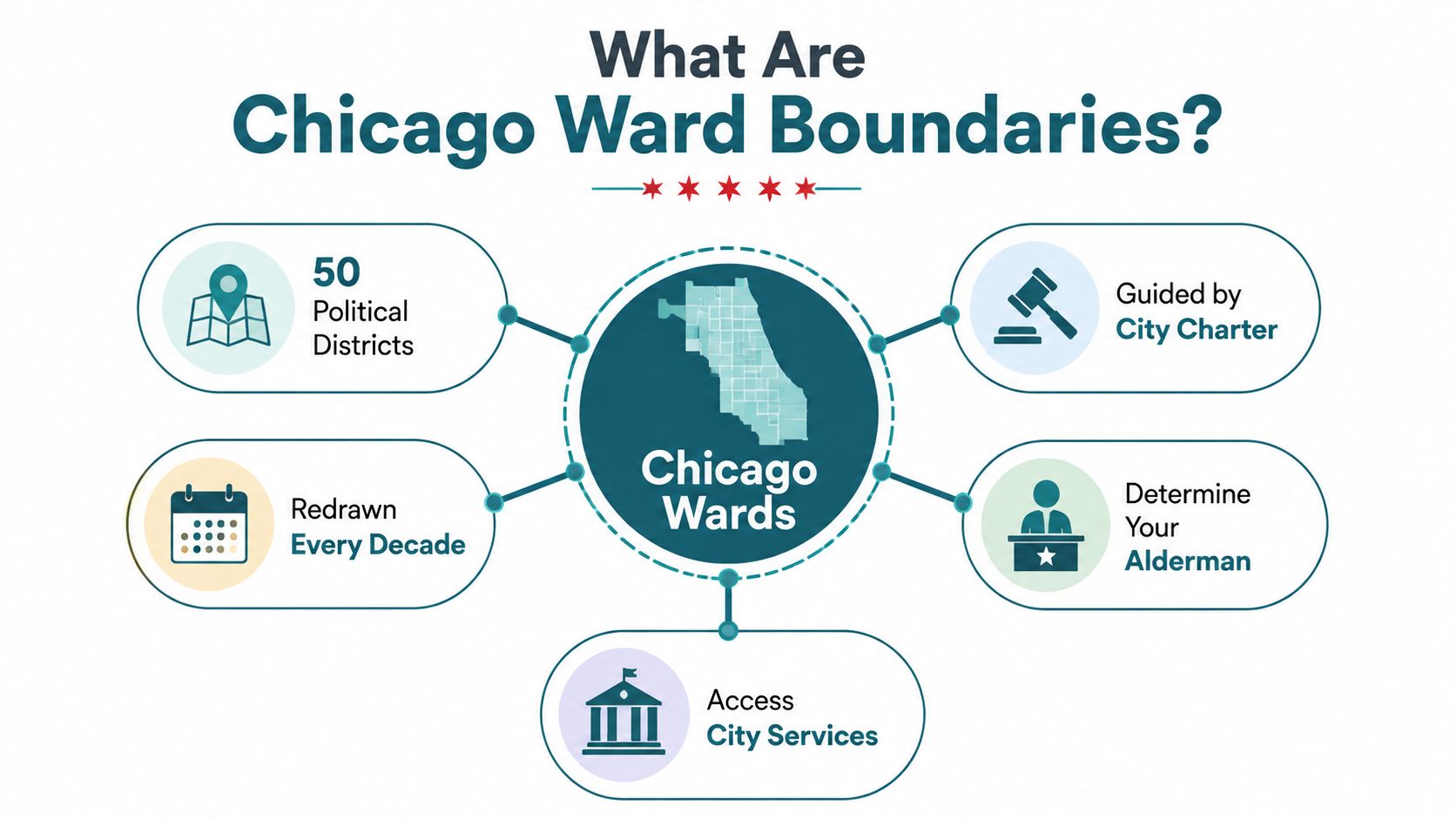
    Chicago ward boundaries divide the city into 50 official geographic divisions, with one alderman representing each ward, and the modern 50-ward structure has existed since 1923. Your ward helps determine who represents your address, where you vote, and how you access city services.

    Which ward are you in right now? Many Chicagoans can name their neighborhood, their nearest train station, and the street where the sidewalk suddenly changes, yet they can't place their home inside a ward line. That confusion makes sense because ward boundaries rarely follow the names people use in everyday conversation.

    I've found the easiest way to understand a ward is to treat it like a service and representation zone. A boundary on a map becomes practical when you need the right alderperson's office, want to organize a cleanup, or need to understand why a nearby block belongs to a different political district.

    What Are Chicago Ward Boundaries and Why Should You Care

    A resident might search for an alderman after seeing a damaged curb, then pause because two nearby addresses appear to have different representatives. The resident knows the neighborhood, but the neighborhood name doesn't answer the ward question. Chicago's official ward system does.

    Chicago has 50 wards, and each ward has one alderman. The city created the modern 50-ward structure in 1923, after earlier changes that followed the city's growth and annexation. Chicago had three districts in 1837, then expanded through several ward counts before reaching 50 wards by 1923. You can read the historical sequence in this history of Chicago's ward system.

    A ward boundary tells you which alderperson represents your address. It also helps you identify the correct voting information and gives you a starting point for questions about local services. If you're planning a block cleanup, reporting recurring dumping, or asking about a sidewalk issue, the ward gives you a practical political contact.

    An infographic titled What Are Chicago Ward Boundaries showing features like fifty districts and decennial redistricting.

    The line matters at street level

    The map can affect how you organize work. A cleanup route that crosses a ward line may involve two alderpersons' offices, separate outreach lists, or different reporting notes. The line doesn't change the pavement under your shoes, but it changes who receives your request and how you record the work.

    That makes ward knowledge part of civic engagement. You don't need to memorize all 50 wards. You need to identify your own ward, confirm the current map, and know when a nearby block falls outside your service area.

    Practical rule: Treat the ward as your first contact map, then check precinct and neighborhood boundaries separately.

    How Chicago Ward Boundaries Work and Who Draws Them

    Who decides whether your block belongs to one ward or another? Chicago redraws its ward map after each U.S. decennial census. Population shifts require the city to adjust boundaries so wards remain close in population, and the redistricting code requires the City Council to complete the map by December 1 of the year after the census. The City of Chicago's ward information describes the map and the redistricting process.

    The City Council draws and approves the map. Under the city's redistricting information and legal rules, wards should be as compact and contiguous as practicable and have substantially equal populations. Mapmakers also consider communities of interest and other valid objectives.

    At street level, those terms are easier to understand. A contiguous ward connects across its territory instead of splitting into separate pieces. Compactness discourages long, awkward shapes, while equal population keeps one ward from becoming much larger or smaller than another. Communities of interest recognize shared local ties, such as residents who use the same commercial corridor, park, or transit route.

    Why familiar places can move

    A neighborhood name does not determine the ward line. A boundary may run along an avenue, cross at an intersection, or turn around a cluster of blocks as population patterns and legal requirements change. Your neighborhood identity can stay the same even when the alderperson's office serving your address changes.

    The city's boundary files include effective dates, including a 2015-2023 file and a 2023-onward file. Match the file to the period you are studying. A cleanup volunteer comparing an older route log with today's map could assign a block to the wrong ward if the date is ignored.

    For community groups, the ward is a working map layer. Volunteers can divide cleanup routes by ward, coordinate with another alderperson's office when a route crosses the line, and direct residents to the right contact for service questions. The boundary turns census changes into practical decisions about contact lists, service areas, precinct comparisons, and shared neighborhood work.

    The Redistricting Timeline and the 2022 Map Change

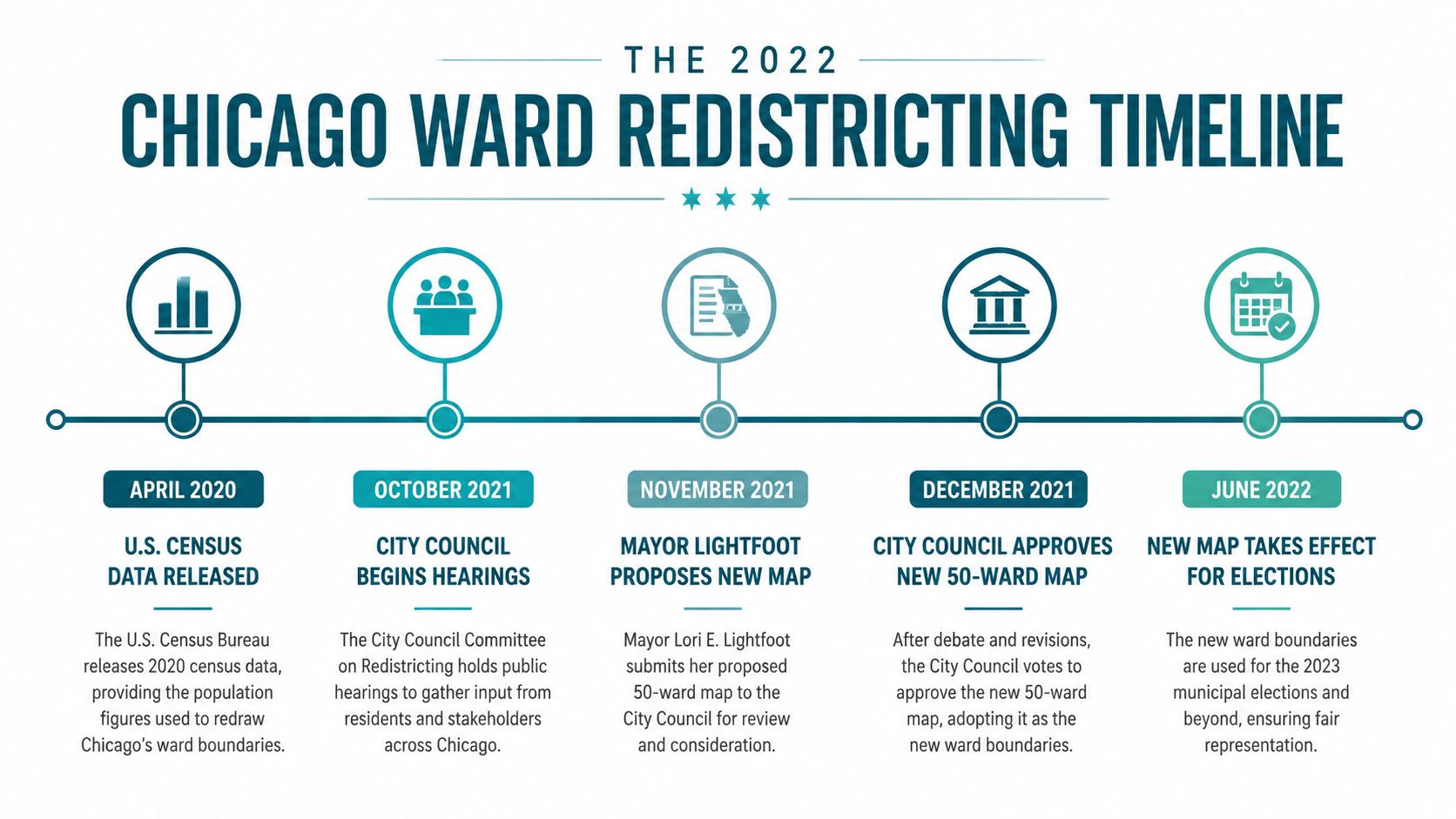
    Which ward serves an address can change even when the building stays put. Chicago's most recent major remap followed the 2020 census cycle. City rules require the Council to redraw ward boundaries by December 1 of the year after the census. The Council approved the new map on May 16, 2022, by a 43-7 vote. The city's official ward map information provides the boundary materials for reviewing that change.

    The map took effect for the 2023 municipal election cycle and preserved Chicago's 50-ward structure. That timing matters when volunteers compare an older cleanup sign-up sheet with a current route plan. A block can have the same address, residents, and neighborhood identity while belonging to a different ward in the newer map.

    A timeline graphic showing the 2022 Chicago ward redistricting process from April 2020 through June 2022.

    What changed in representation

    The approved plan created 14 Latino-majority wards, 16 Black-majority wards, 1 Black-plurality ward, and Chicago's first Asian-majority ward. Those changes show why a ward map is more than a set of lines. It affects which communities are grouped together for representation and which alderperson's office a resident or volunteer may contact.

    The remap also followed population equality, compactness, and contiguity requirements. Read the result in two ways: geography shows where the line runs, while representation shows how the remap changes the communities grouped within each ward.

    How to read an older map

    Use three checks before relying on any version:

    1. Check the effective date. Identify whether it covers the 2023-onward period or an earlier one.
    2. Check the purpose. Ward, precinct, neighborhood, and police district maps answer different questions.
    3. Check the source. Use official boundary files for GIS analysis, service routing, or historical comparison.

    The 2023 Chicago ward boundaries dataset records the current remap for data users. Save that file with a cleanup route, cross-ward volunteer plan, or neighborhood resource list so others can see which boundary version guided the work.

    How to Find Your Ward and Your Alderman Right Now

    Start with your address, not your neighborhood name. Type the street address into the City of Chicago's official ward lookup tool, then verify the ward number shown for that location. If you're checking a corner, test both addresses because a boundary can run close to an intersection.

    Next, use the City Clerk's interactive GIS maps if you want to inspect the line visually. The city's data portal also lets you explore official geographic files and download boundary data for mapping work. You can compare the result with a broader Northeastern Illinois map when you need regional context, but use the city's ward file for the actual ward assignment.

    A person sitting at a desk pointing at a computer screen showing the Chicago Ward Finder map.

    A simple lookup routine

    • Enter the full address: Include the street number, direction, street name, and ZIP code when the tool requests them.
    • Record the ward number: Save it with the address and the date you checked.
    • Find the alderman: Search the Chicago City Council site by ward number, then open the alderman's official page for contact details and office information.
    • Confirm the map vintage: Use the 2023-onward file for current work, and use an older file only when your project studies an earlier period.

    Don't assume a ward change automatically changes your precinct. Newer election data shows that precinct boundaries also changed in 2025-2026, while only two ward precinct pairs changed mutual boundaries and all other precincts remained the same, according to the 2025 ward and precinct boundary dataset.

    That distinction helps with election planning. Your ward may determine your alderman while your precinct information handles a different part of voting logistics. Check each boundary type for the question you're asking.

    Why Ward Boundaries Matter for Neighborhood Organizing

    A ward gives a volunteer group a clean way to divide work. Suppose you want to clean a long commercial corridor. You can place the route on the ward map, identify which blocks sit inside each ward, and prepare contact notes for the relevant alderperson's office. The map turns a vague citywide goal into manageable territory.

    The same method works for neighborhood resource navigation. A group can record where residents report litter, damaged sidewalks, missed collections, or park concerns, then sort those observations by ward. The Chicago Data Portal provides public datasets and mapping tools that can help residents examine city information around a location.

    Keep the boundaries separate

    Neighborhood identity and ward geography don't always match. A neighborhood can cross a ward line, and a single ward can contain several areas with different names and local concerns. Police districts and precincts follow their own geography too.

    Use this division of labor:

    Question Boundary to check
    Who represents this address on City Council? Ward
    Where do I handle election logistics? Precinct and election information
    How do residents describe this area? Neighborhood identity
    Which police service area applies? Police district or beat
    How should volunteers divide a cleanup route? Ward, then block and safety conditions

    A cleanup team can use one ward as its outreach unit while still honoring the neighborhood's own identity. If a route crosses a boundary, the team can split its notes, assign separate contacts, and report the work accurately.

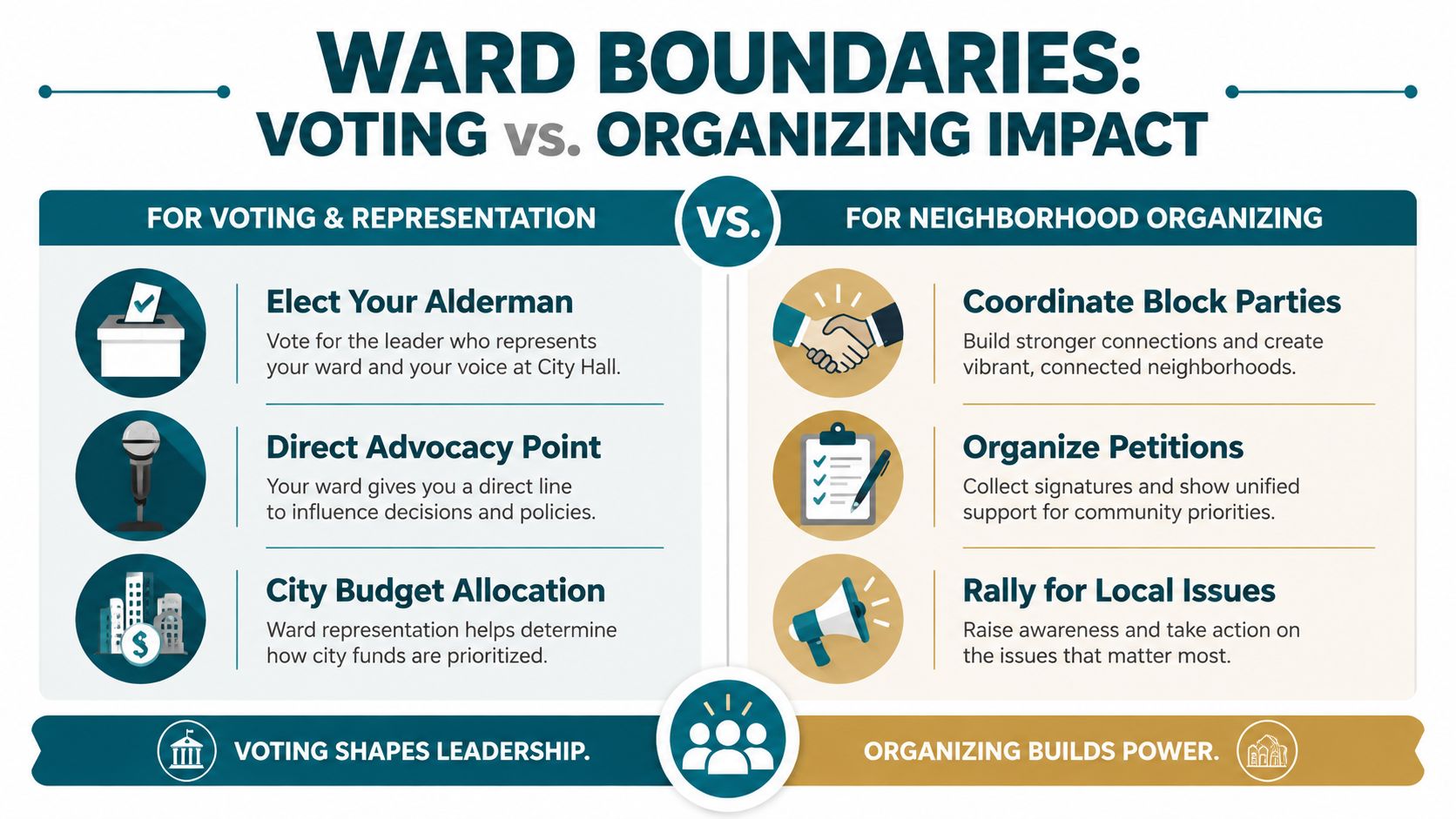
    An infographic comparing how Chicago ward boundaries impact local voting representation versus community neighborhood organizing efforts.

    A ward map helps you answer, “Who do we contact?” A neighborhood map helps you answer, “Who already calls this place home?”

    That difference prevents a common organizing mistake. Volunteers can work across a neighborhood while coordinating separately with the wards that contain it.

    Real Examples of Ward-Based Community Action in Chicago

    Consider a cleanup route that begins on one side of a ward boundary and ends on the other. The crew may see one continuous stretch of litter, yet the group's records should identify the blocks separately. That small habit helps volunteers contact the right aldermanic office, describe the exact area, and compare work across routes without mixing locations.

    A larger cleanup creates another problem. If volunteers assign routes by neighborhood name alone, two teams may cover the same familiar blocks while skipping a less visible edge. A ward map gives the coordinator another grid. The coordinator can assign a starting point, a boundary crossing, and a return route, then ask each team to report the blocks it covered.

    Cross-ward coordination in practice

    Litter Caterpillars has cleaned all 50 wards of Chicago, according to the organization's public description. That kind of citywide work requires volunteers to treat ward geography as a working reference, especially when a route moves between neighborhoods or crosses political boundaries.

    A group can build a simple field sheet with:

    • Starting intersection: Where the team begins.
    • Ward assignment: Which ward contains each block.
    • Contact note: Which aldermanic office receives follow-up.
    • Service observation: What volunteers saw, including recurring litter or access problems.
    • Completion record: Which blocks the team covered and which need another visit.

    This approach also helps residents find gaps. If one ward produces repeated litter complaints while nearby areas receive little volunteer attention, the difference may point to a route-planning problem, a reporting gap, or a service need that deserves a closer look. The map doesn't explain the cause by itself. It helps you ask a more precise question.

    A boundary can also guide cross-ward partnerships. Two groups can meet at the line, divide the route, and share a final record that shows where each team worked. Volunteers keep the neighborhood connected while giving each ward its own contact path.

    Get Involved and Start Cleaning Your Ward Today

    You now have a practical map-reading routine. Find your address, confirm the current ward, identify the alderman, and check precinct information separately when the question involves voting logistics. For organizing, save the boundary vintage, divide routes by block, and record every boundary crossing.

    That preparation makes a cleanup easier to coordinate. Volunteers can gather at a clear starting point, assign routes that don't overlap, and send useful follow-up instead of a general message about “the neighborhood.” A ward number gives the group a shared reference before anyone picks up a bag.

    You can also use civic engagement opportunities to find a practical way to move from map knowledge to local action. Litter Caterpillars operates across all 50 wards, meets weekly in different conditions, and connects cleanup work with friendship and community building. Its Caterpillar Park project in Englewood shows how consistent volunteer effort can turn an overlooked lot into a place with a community purpose.

    Your first cleanup plan

    1. Look up your ward by address.
    2. Choose a route that stays easy for the group to monitor.
    3. Mark any block where the ward line changes.
    4. Invite neighbors who know the area.
    5. Record what you cleaned and what still needs attention.

    You don't need a perfect map before you begin. You need a correct starting address, a safe route, and a habit of recording where the work happened. Once you know your ward, you can help your neighbors find their way around the city with more confidence and make your volunteer time easier to coordinate.


    Litter Caterpillars gives Chicago residents a way to join weekly cleanup work across the city's wards, meet neighbors, and turn ward maps into real street-level action. Find your ward, choose a cleanup route, and visit Litter Caterpillars to join the next opportunity.

  • 8-Step Volunteer Safety Checklist for Cleanup Events

    8-Step Volunteer Safety Checklist for Cleanup Events

    Before the first bag fills, a cleanup crew can face a serious decision. Your team reaches a busy street, spots broken glass beside the curb, and must choose whether to keep moving, change the route, or stop and report it.

    A volunteer safety checklist works like a flight plan. It gives everyone a shared route, clear stop signals, and a way home when conditions change. The checklist below follows the volunteer journey from the first briefing to the final incident note, covering route hazards, equipment, buddy coverage, weather, biohazards, first response, inclusive roles, wellbeing checks, and cancellation decisions.

    At Litter Caterpillars, the litter count never outranks volunteer safety or happiness. Our Chicago group works across all 50 wards, including places where traffic, ice, construction, abandoned materials, or changing public activity can make a normal cleanup unpredictable. A good plan lets people act with courage without asking them to gamble with their health.

    1. Brief Your Team on the Day's Route and Hazards

    Start with a map, then turn the map into a conversation. Tell volunteers which streets they'll walk, where the group will regroup, and what they might encounter. Point out broken-glass areas, busy crossings, aggressive dogs, potholes, poor lighting, ice, slippery pavement, and places where foot traffic changes quickly.

    I learned this during an early highway cleanup held during a bike-event shutdown. One volunteer nearly stepped into a pothole because the road condition hadn't made it into the briefing. Since then, I've treated route knowledge as equipment. Before heading into Englewood, where we won our lot for Caterpillar Park, I explained the potholes and the blocks with heavier foot traffic. Nobody got hurt because people knew what to watch for.

    Use landmarks instead of vague directions. “Stay near the blue mural and regroup at the corner store” gives people something they can see. Ask whether anyone has worked in the area before. Local observations often reveal a loose dog, a blocked sidewalk, or a slippery corner that a map won't show.

    Practical rule: Give volunteers enough information to make a safe choice. Specific warnings respect people. They don't frighten them.

    The IFRC volunteer safety guidance calls for risk assessment, situation analysis, basic information gathering, and scenario planning before volunteers act. Apply that logic in plain language. Explain what could change, who makes the call, and when volunteers should leave a threatening situation.

    2. Provide Proper Protective Equipment and Know How to Use It

    A pair of thin gloves doesn't make every object safe. Cleanup crews need equipment that matches the work, fits the volunteer, and stays within reach. At a minimum, prepare sturdy gloves, grabbers, bright safety vests, suitable footwear, water, a first aid kit, and a reliable way to contact the coordinator.

    Greenville County's National Cleanup Day safety guidance says each group should carry a first aid kit, water, and a cell phone. It also calls for orange safety vests, group work, facing oncoming traffic, and working on one side of the road at a time. Those details turn a casual outing into a controlled field task.

    At Litter Caterpillars, volunteers can keep their bright vests. The color helps drivers see the group, and the vest gives the crew a shared identity. Volunteers have told me that wearing the gear makes the event feel organized rather than improvised. That feeling matters because people make better decisions when they understand that the team takes safety seriously.

    Read our guide to becoming a trash pickup volunteer before your first event, then demonstrate every tool at the opening briefing. Show how to squeeze a grabber, how to keep sharp objects away from the body, and how to place a filled bag without dragging it across a walkway. Never let a newcomer improvise with bare hands.

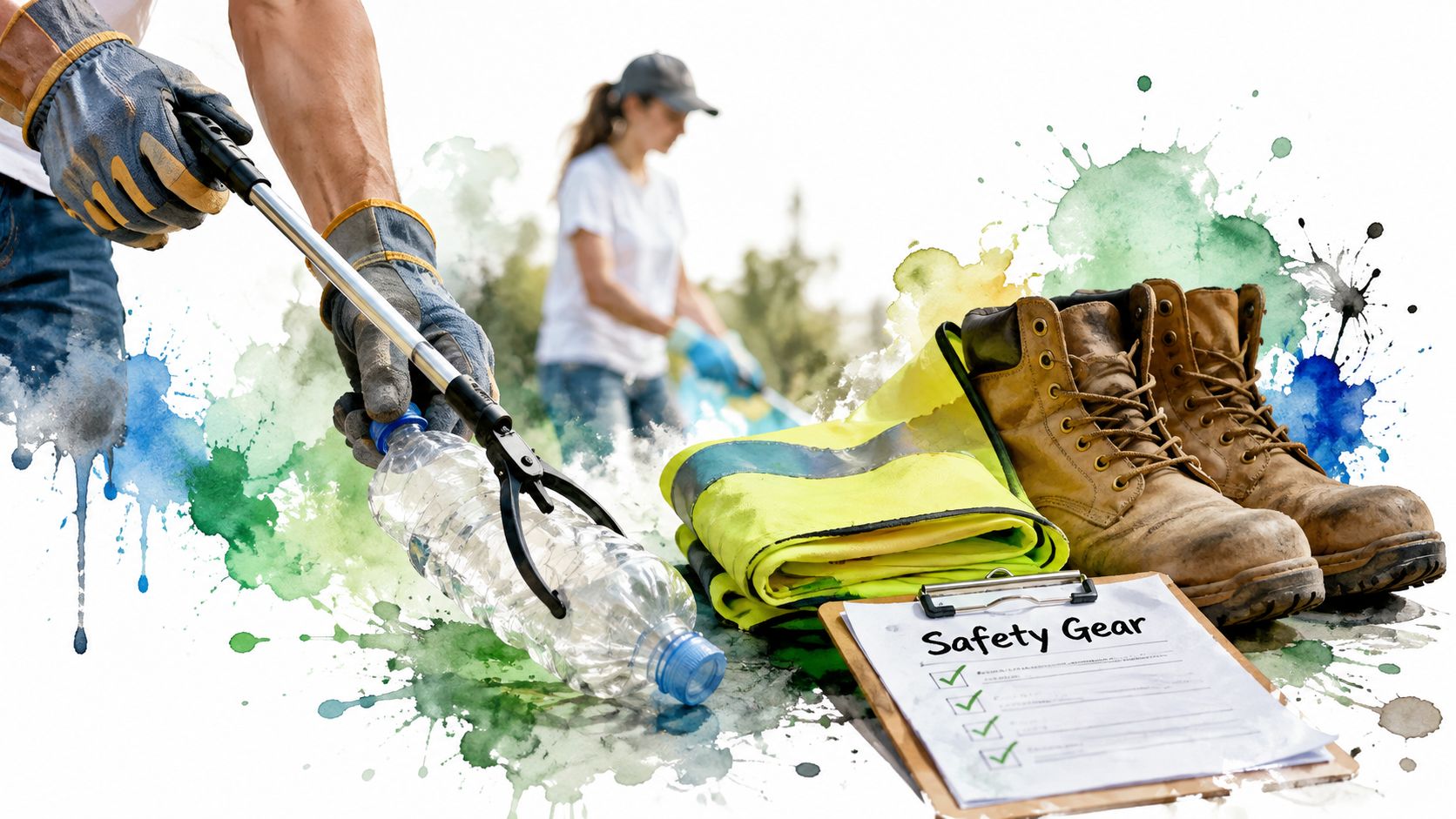
    A volunteer using a picker tool to collect a plastic bottle with safety gear nearby.

    Keep spare gloves and grabbers for late arrivals. Record what you issue, inspect damaged equipment, and replace items before someone needs them. If volunteers need eye protection, explain how to pick safety glasses for any work setting.

    A short demonstration prevents a dangerous shortcut.

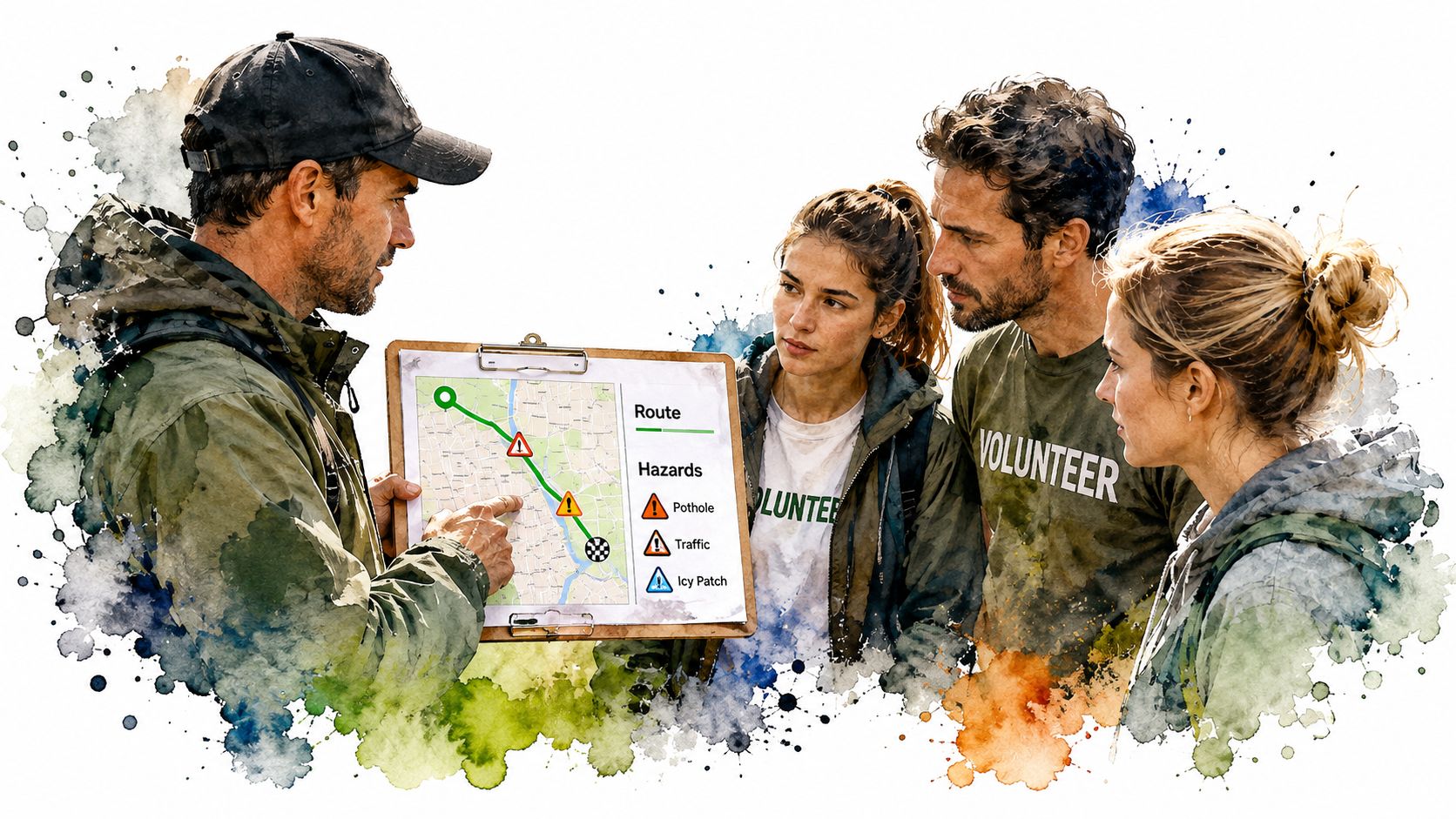
    A team of volunteers reviewing a map of the route and safety hazards on a clipboard.

    3. Establish a Buddy System So Nobody Works Alone

    Pair people before the first bag leaves the staging area. A buddy gives each volunteer a nearby person who can notice a fall, hear a concern, help find the route, or call the coordinator. The system also reduces wandering, especially when a crew spreads across several blocks.

    Let people choose partners when practical, then mix newcomers with experienced volunteers when you need broader support. Give every pair a defined area. You should know which pair covers which block, path, or park edge without searching through a group chat.

    During winter events, I've watched buddy pairs spot icy patches before either person stepped forward. One volunteer points, the other slows down, and the pair changes direction. That small exchange can prevent a fall. Many friendships in our group began with two strangers sharing a grabber and watching the pavement for each other.

    Build coverage into the route

    Set a communication rhythm before the event begins. Check in with teams every 20 to 30 minutes, especially in unfamiliar neighborhoods. Use a call, text, group-chat message, or visible return to the staging point. The method matters less than the habit.

    A buddy system fails when partners separate without telling anyone. Ask pairs to stay within sight or voice range, avoid entering closed areas, and report route changes. If one person needs to leave, the pair tells the coordinator and returns together or receives a new partner.

    The OnRoute guide to safeguarding field teams can help organizers think through lone-worker exposure and communication coverage. Adapt the approach to your group, but don't allow “I'll only be gone for a minute” to become the default plan.

    4. Monitor Weather Conditions and Adjust Your Event Accordingly

    Weather decisions need an owner, a review time, and a defined response. Check conditions the night before and again on the cleanup morning. Then tell volunteers whether the event will start earlier, use a shorter route, change tasks, move indoors, pause, or cancel.

    Rain can hide potholes and turn pavement slick. Wind can shift loose debris or push objects toward the group. Heat can drain a volunteer before they recognize the warning signs. Cold can cause numbness, shivering, and poor hand control. Lightning means stopping work and leaving exposed areas. Assign one coordinator to make these calls rather than waiting for volunteers to interpret the sky.

    On hot days, our team has started at 7 a.m. instead of 9 a.m. and moved indoors for planning or meetings by noon. During severe cold, we ask volunteers to layer clothing, watch for numbness and shivering, and take shorter outdoor assignments. People can manage difficult conditions when they know the risks and can leave without shame.

    “If the forecast changes, the plan changes.”

    The IFRC implementation guide links volunteer safety with security and wellbeing at local and national levels. For a cleanup, weather belongs in the live operating plan, not only on the registration page.

    Put plain triggers in the group chat:

    • “Lightning nearby means stop work.”
    • “Confusion, weakness, numbness, or unusual cold means report it immediately.”
    • “The coordinator can pause or end the event.”

    Use the heat exhaustion prevention tips from Litter Caterpillars during the heat briefing, and give the coordinator clear authority to change the plan.

    5. Train Volunteers on Hazardous Materials and Biohazards

    Treat unknown objects as unknown. Volunteers may find broken glass, syringes, animal waste, chemical containers, medical waste, white powder, or material that looks dumped from a worksite. A cleanup crew shouldn't handle items that can cut, puncture, poison, infect, or expose people to contamination.

    Give the team one simple response: stop, step back, warn nearby volunteers, and flag the location. The coordinator can photograph the item from a safe distance and report it through the right city channel. Needles go to the Chicago Department of Streets and Sanitation. Animal-waste problems go to animal control, and chemical spills go to the city. Serious hazards need professional response.

    I've seen volunteers move toward a syringe because they wanted to help quickly. The right action took less time than a risky pickup. We stopped work around the area, reported the material, and moved the team to another section. A volunteer once spotted what looked like industrial dumping and reported it instead of touching it. That protocol protected the crew and gave the city useful information.

    Teach the stop-work phrase

    Put photos of syringes, chemical bottles, suspicious powders, and contaminated materials on a one-page handout. Keep the language direct:

    • Stop: Freeze the task and keep hands away.
    • Flag: Mark the area from a safe position.
    • Report: Contact the coordinator and the appropriate city service.
    • Move: Shift the group away until someone qualified handles the hazard.

    Share Chicago cleanup opportunities through Litter Caterpillars volunteer opportunities, then give every new volunteer the same hazard briefing. Consistency matters. A confident newcomer should know that bravery means reporting a danger, not touching it.

    6. Keep a First Aid Kit and Know Basic First Response

    Keep the first aid kit in the coordination bag, not buried in a vehicle under spare bags. Everyone should know where it sits. At least one event leader should know how to respond to bleeding, scrapes, sprains, shock, and the first steps of an emergency call.

    Stock the kit with antiseptic wipes, gauze, bandages, antibiotic ointment, elastic bandages, pain reliever, and a small emergency blanket. Check it regularly, replace used or expired supplies, and label it so a volunteer can find it without asking three people.

    A glass cut needs a calm response. Stop the activity, move the injured volunteer away from the work area, clean and cover the wound, and decide whether they need further care. A twisted ankle needs rest and assessment before anyone asks the person to continue. Light duty may work for a minor problem, but the injured volunteer gets the final say.

    Make emergency location simple

    Before volunteers spread out, identify the nearest accessible meeting point and the person holding the phone. If you call 911, describe the street, nearest landmark, route access, and what happened. A city block can feel confusing when someone is bleeding and traffic is moving around you.

    Take a first aid course by Cura Academy or use a local Red Cross training option. Training doesn't turn a volunteer into a medical professional. It does help a leader stay composed, protect the scene, and get appropriate help quickly.

    First response principle: Treat the person before you protect the schedule. The bags can wait.

    7. Communicate Clear Expectations About Physical Ability and Mental Readiness

    A cleanup may involve walking, bending, carrying, standing, watching traffic, tolerating noise, and working around unfamiliar conditions. Explain the terrain, route length, pace, weather, and physical tasks before volunteers arrive. Offer choices without asking anyone to disclose private medical details in front of the group.

    A volunteer may manage asthma, limited mobility, back pain, medication effects, sensory sensitivity, anxiety, or a difficult day. They may want to help while avoiding traffic exposure or an unfamiliar block. Give them a clear way into the work, and let them change roles without having to justify the decision.

    • Pickup role: Use a grabber on a suitable surface.
    • Supply role: Sort gloves, bags, water, and tools at the base point.
    • Welcome role: Greet volunteers, explain the route, and answer questions.
    • Documentation role: Record locations, photograph progress, or note hazards.
    • Low-exposure role: Work in a familiar area with close access to support.

    Match the role to the person's capacity that day. A volunteer with a chronic back issue may collect litter during one event, then manage supplies or greet newcomers at another. Both assignments keep the cleanup moving. A first-time volunteer can begin on an easier street and choose a more demanding route after gaining confidence.

    Use private check-ins, opt-in assignments, and clear permission to leave without penalty. Mental readiness matters too. Unfamiliar waste, traffic, conflict, or distressing scenes can affect participation, so explain what volunteers may encounter and identify a leader they can approach.

    Do not praise exhaustion as proof of service. Praise good judgment, steady participation, and helping someone find a role they can perform safely.

    8. Establish a Check-In System and Know When to Cancel or Pause

    A check-in only works when the leader listens to the answer. Ask how people feel, look for changes in pace or behavior, and accept “I need to stop” without debate. A volunteer who sits down more often, looks flushed, shivers, speaks unclearly, seems confused, or favors an injury needs attention before the issue grows.

    Use a simple group rhythm. Ask everyone how they're doing at regular intervals, then speak privately with anyone who looks unwell or unusually quiet. You can use a shared scale: “If you're at a 10, tell me you're great. If you're at a 5, tell me you're okay. If you're at a 1, tell me immediately.”

    Give leaders permission to change the plan

    One Saturday, our route was partly closed by construction. We regrouped, moved to a backup location, and kept the group together. On another hot day, I noticed a volunteer slowing down and sitting more often. I moved them into shade, brought water, and offered lighter work for the rest of the event.

    The Australian volunteer worker duties guidance uses numbered questions about induction, safe equipment, PPE, emergency procedures, hazard reporting, and contact arrangements. It says a “No” answer requires corrective action. Use that same discipline during the event. If the route, gear, communication, or weather fails the check, fix it before work continues.

    Cancel when you can't control the exposure. Pause for water, shade, warmth, route changes, or medical attention. Volunteers will remember that you protected them, and they'll trust the next event more because of it.

    Volunteer Safety: 8-Point Comparison

    Item Implementation Complexity 🔄 Resource & Logistics ⚡ Expected Outcomes 📊 Key Advantages ⭐ Quick Tip 💡
    Brief Your Team on the Day's Route and Hazards Low–Medium: 10–15 min briefing plus some advance scouting Low: leader time, route notes, map/clipboard Increased situational awareness; fewer surprises/incidents Prevents hazards; builds trust and readiness Keep it conversational; point out landmarks
    Provide Proper Protective Equipment and Know How to Use It Medium: sourcing, sizing, demos required Moderate–High: gloves, grabbers, vests, first aid; maintenance ($300–500 initial for small group) Fewer cuts/infections; higher volunteer confidence & professionalism Dramatically reduces injuries; improves visibility Bring extras; demonstrate grabber use; log gear
    Establish a Buddy System So Nobody Works Alone Low: pairing and basic coordination Low: assignment logistics, handle odd numbers Faster response to incidents; reduced isolation Improves safety; deters unwanted attention; builds bonds Mix experienced with newcomers; assign specific blocks
    Monitor Weather Conditions and Adjust Your Event Accordingly Medium: forecast checks and contingency planning Moderate: water, shade/warming stations, possible reschedule Prevents heat/cold illness; keeps events safe and adaptable Reduces weather-related injuries; shows planning maturity Check forecast night/morning; use heat/cold protocols
    Train Volunteers on Hazardous Materials and Biohazards Medium: brief training + reporting protocols Low–Moderate: one-page handouts, photos, contact lists, city coordination Fewer exposures; correct escalation to authorities; less liability Protects against bloodborne/toxic hazards; ensures proper reporting Use photo handout; adopt "stop and flag" system
    Keep a First Aid Kit and Know Basic First Response Medium: kit upkeep and at least one trained responder Low–Moderate: kit cost, occasional training, monthly checks Immediate care for minor injuries; reduced infections; documented incidents Prevents complications from minor injuries; builds trust Take a Red Cross course; check kit monthly
    Communicate Clear Expectations About Physical Ability and Mental Readiness Medium: prepare role options and communicate clearly Low: clear descriptions, support roles, flexible assignments Fewer injuries; higher inclusion; reduced burnout Inclusive participation; sustained volunteer retention State terrain/distances up front; offer light-duty roles
    Establish a Check-In System and Know When to Cancel or Pause Medium: scheduled check-ins and decision criteria Low–Moderate: leader attention, documentation for pauses/reschedules Catches problems early; prevents escalation; increases trust Encourages speaking up; protects volunteers; enables safe pivots Do group check-ins every 20–30 min; set clear stop-work rules

    Pack the Checklist With the Grabbers

    A printed event card should fit inside the coordinator's folder and answer one question quickly: Who does what, where, and what happens when conditions change? Don't leave responsibility floating between several friendly people. Assign each duty before volunteers arrive.

    Write the route, backup route, staging point, and no-go areas at the top. Add the route hazards you discussed, including broken glass, traffic patterns, dogs, potholes, ice, construction, steep slopes, guardrails, medians, bridges, roundabouts, concrete walls, utility sites, and private property. Seattle's cleanup guidance lists those areas as off-limits for litter pickup and tells volunteers to stay on public property.

    List the equipment owner next. Name the person carrying first aid supplies, the person holding the phone, the weather decision-maker, and the person who tracks buddy pairs. Record where the water, PPE, spare grabbers, and emergency contacts are located. The Nonprofit Risk Management Center field guide recommends learning the area, mapping the route, charging phones, leaving an itinerary, and checking vehicle lights, brakes, tires, and fuel before field assignments.

    Your event card should include:

    • Route and hazards: List streets, landmarks, restricted areas, and backup locations.
    • Equipment: Confirm gloves, grabbers, vests, water, bags, first aid, and safe footwear.
    • Buddy pairs: Record each pair and its assigned area.
    • Weather call: Name the person who can shorten, pause, switch, or cancel the event.
    • Hazard rules: Tell volunteers what they must never touch and how they report it.
    • Emergency response: Note the first aid location, phone holder, meeting point, and 911 details.
    • Accessible roles: Prepare lighter, seated, lower-exposure, supply, greeting, and documentation work.
    • Check-ins: Set the communication rhythm and the signs that require immediate action.
    • Incident notes: Record injuries, near misses, hazards, route changes, reports, and follow-up needs.

    Review the card aloud at the briefing. Ask volunteers to repeat the stop-work rule in their own words. If someone can't explain what to do after finding a syringe or seeing lightning, slow down and clarify before the crew moves out.

    After the cleanup, don't throw the card into a drawer. Record what happened while the details remain fresh. Note the icy corner, blocked sidewalk, loose dog, missing glove size, weather change, or confusing instruction. Then update the next event plan. A checklist earns its place when people use what they learned.

    Litter Caterpillars built its volunteer-first approach through weekly Chicago cleanups in rain, heat, blizzards, and cold wind. The group's identity includes flags, theme songs, badges, and shared pride, yet the operating rule stays plain: volunteers come first, happiness comes next, and the litter can wait. A safer cleanup gives people the chance to return next weekend with energy, trust, and a story worth telling.


    Litter Caterpillars gives Chicago volunteers a practical way to clean neighborhoods, meet people, and take on outdoor service with safety and friendship at the center. Visit Litter Caterpillars to find an upcoming cleanup, join the group chat, and bring this volunteer safety checklist into the field.

  • Chicago River Cleanup: Join or Organize Your Own Event

    Chicago River Cleanup: Join or Organize Your Own Event

    The first time I hauled trash off the Chicago River bank, a spring hail storm rolled in so hard it felt like somebody was throwing ice cubes at my face. Three of us crouched under a tree, wet through, while every Uber canceled one by one, and we laughed anyway because the river had finally found a way to humble us together.

    That day taught me something I still believe. A Chicago River cleanup is never only about the trash in your bag, it's about the person who shows up beside you when the weather turns rude and the work gets real.

    Why Showing Up Matters More Than You Think

    The weird truth about river cleanup is that the messy part isn't the litter. It's your own excuses, your own comfort, your own habit of saying “next weekend” when the bag is already in your hand. When I think about that hail-storm day, I don't remember the trash pile as much as I remember who stayed cheerful, who helped, and who turned a miserable afternoon into a story we still tell.

    What a rough cleanup day reveals

    You learn fast that cleanup work filters people. The ones who arrive on a freezing Saturday morning and still smile usually bring that same energy to friendship, work, and life. That matters because a cleanup group isn't built on one heroic day, it's built on repeated small acts, the kind that make strangers recognizable and then familiar.

    Practical rule: if someone only shows up when the weather is perfect, they're a visitor. If they show up in sleet, they're part of the crew.

    The culture around the river gets better when people treat service like a habit instead of a performance. That's why weekend mornings work so well for groups that want steady, service-minded volunteers. You're not just collecting trash, you're building a circle of people who don't flinch when the work gets uncomfortable.

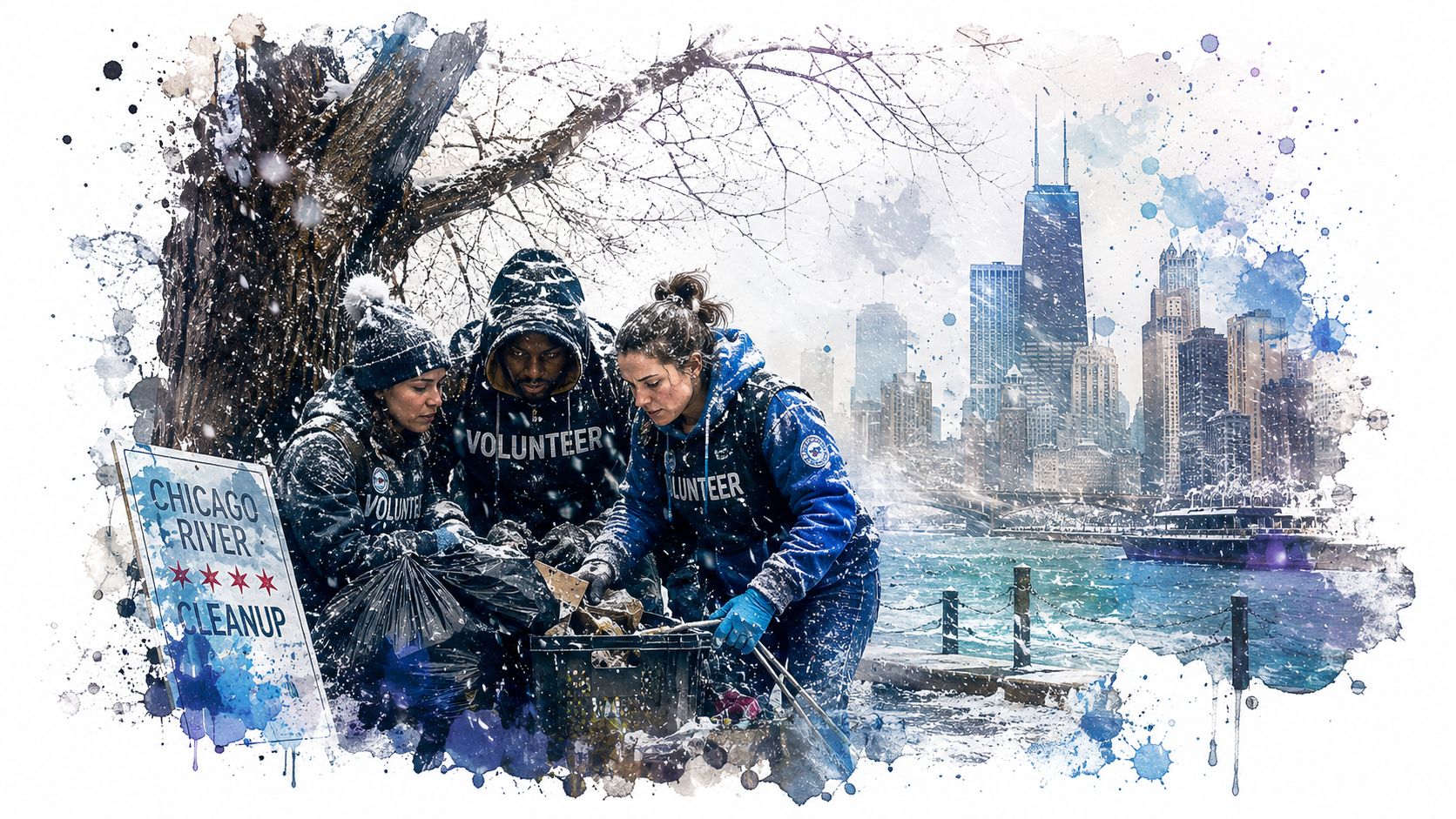
    Three volunteers cleaning trash from the Chicago River bank during a snowy winter day in the city.

    Why the best groups feel like a team

    The strongest crews I've seen have a simple rhythm. They greet each other, they divide the load, and they laugh at the absurdity of pulling soda cups and snack wrappers out of cattails while their fingers go numb. That shared grit builds trust faster than small talk ever could.

    Litter Caterpillars talks about bravery, kindness, and unity, and that language makes sense to me because service changes how you carry yourself. You stop asking, “How little can I do?” and start asking, “Who can I help stand up a little straighter today?”

    Planning Your Cleanup From Permits to Site Selection

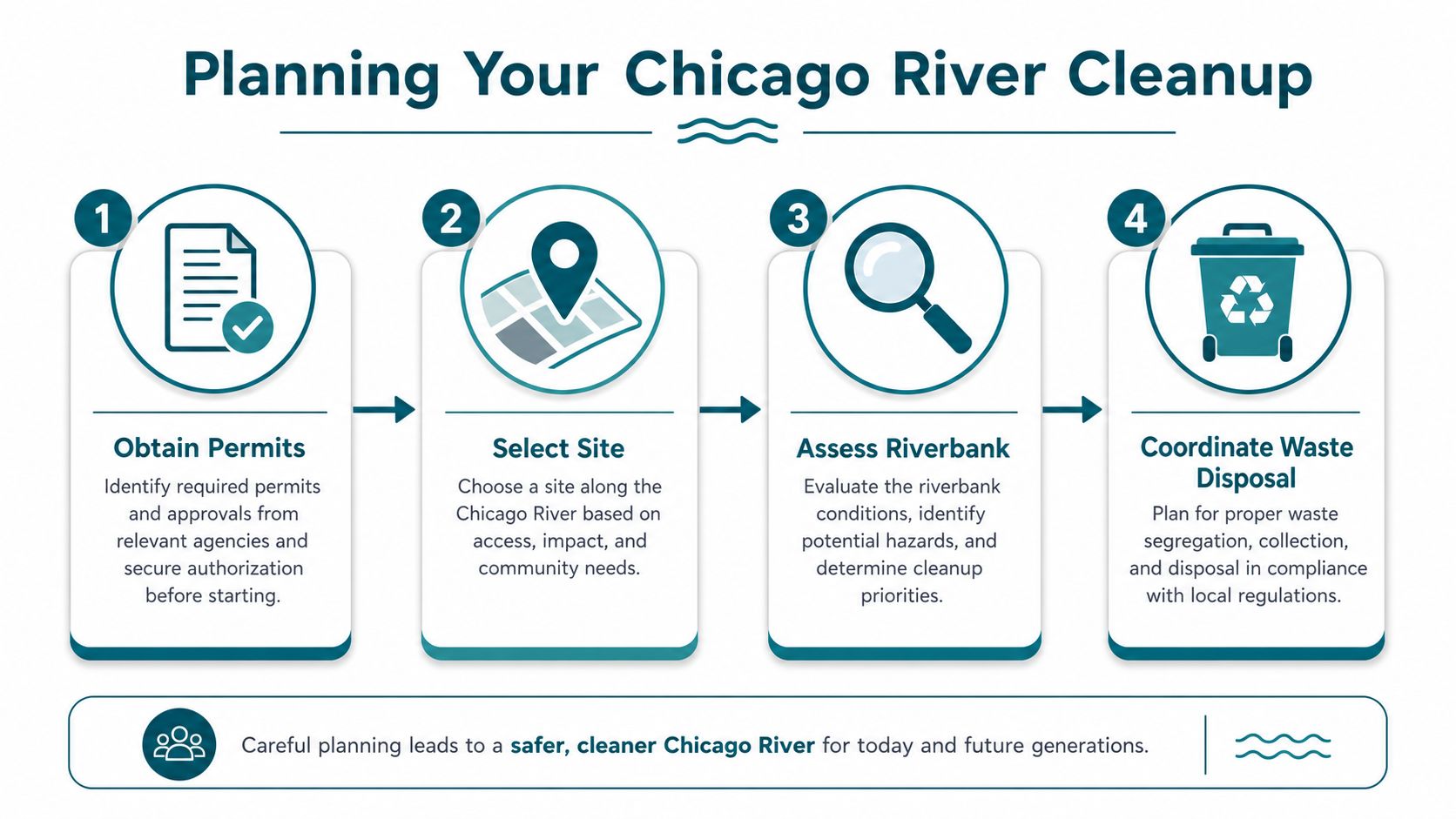
    A good cleanup starts before the first glove goes on. I've watched eager crews waste half a morning because nobody checked who owned the bank, where people could enter, or whether the ground near the water would hold a boot. The Chicago Rivers Demonstration Program handbook says strong projects begin with an in-depth understanding of ownership, permits, bank condition, wildlife use, access, vegetation, and public safety What's Working on Working Rivers.

    Start with the riverbank, not the trash bag

    I always tell people to stand on the site first and look around like they're new to the city. Who controls this stretch of bank? Can volunteers safely reach the edge? Is the ground muddy, steep, fenced, or packed with roots? If you can't answer those questions, you don't have a cleanup site yet, you have a problem in search of a plan.

    A smart organizer also maps where trash keeps coming from. Street runoff, storm drains, and access points often matter more than the single pile of litter you can see from the path. The city's guidance on cleanup work says debris washed from streets can enter the river, which is why street sweeping, source control, and proper trash disposal all belong in the same conversation Chicago River Agenda.

    Practical rule: don't chase every piece of visible litter if the same runoff path keeps feeding the river tomorrow.

    That mindset changes how you choose between a bank cleanup and a boat cleanup. Bank work is great for access points, embankments, and public-facing stretches. Boat work makes sense where litter gathers in the channel or where shore access is poor. I've seen crews get better results when they match the tool to the leak, instead of forcing one method onto every site.

    Use a simple planning checklist

    Before I invite volunteers, I want these questions answered.

    • Permits and permission: Who approves the work, and what limits apply to the site?
    • Access and exits: How do people get in safely, and how do they get out fast if weather shifts?
    • Bank condition: Is the ground stable, slippery, or cluttered with hazards?
    • Wildlife and vegetation: Are there nesting areas, sensitive plants, or protected habitat zones?
    • Waste handling: Where does the collected trash go after the event?

    If you want a practical planning template, I'd point you to Litter Caterpillars' volunteer event planning page, because the right prep makes the day feel calm instead of chaotic.

    An infographic showing four steps for planning a Chicago River cleanup, including permits, site selection, assessment, and disposal.

    If you want the organizing side of cleanup to feel less like guesswork, use the same method every time. Pick the site, walk it, note the leaks, then choose the cleanup style that fits the river instead of the one that looks best in a group photo.

    Safety Protocols for Bank and Boat Cleanups

    I've cleaned the river in scorching heat, in damp cold, and in wind so sharp it made my ears hurt. The day always starts the same way for me. A small crowd gathers, gloves on, coffee in hand, and somebody asks where the worst trash will be hiding. Then I give the same answer, the spots that look ordinary until you bend down and find glass, metal, or something nobody wants to name out loud.

    Safety comes first, then volunteer happiness, because once people feel rushed or exposed, the day goes sideways fast. That is why I never start an event without a briefing, even if everybody looks eager and ready to sprint. The point is to send people home tired, dirty, and proud, not limping back with a story nobody wants.

    What to cover before anyone touches trash

    A good safety talk should be short, direct, and specific. Tell people where sharp objects are likely to hide, how to handle anything that looks like medical waste or chemical waste, and where to go if they need help. Put the emergency contacts in everyone's phone before the event starts, not after someone loses a shoe in mud.

    For bank cleanups, I want gloves, sturdy boots, and a clear rule about staying away from unstable edges. Loose gravel, slick algae, hidden drop-offs, and half-buried rebar can turn a cheerful morning into a bad scene quickly. For boat cleanups, I want life vests, a calm operator, and an honest read on water conditions before launch. If weather changes, I'd rather stop early than pretend grit can cancel lightning, icy wind, or rising water.

    If the forecast looks ugly and the site feels worse, call it early. Volunteers remember that you protected them.

    Build a buddy system and respect the weather

    I like cleanup crews to move in pairs. One person scans the ground, the other watches the surroundings. That simple habit cuts down on missed hazards and keeps nobody isolated if something goes wrong.

    The same goes for temperature. On hot days, you need shade, water, and a pace that doesn't turn volunteers into fried extras in a riverbank movie. On bitter days, you need warm-up breaks and a hard line on frostbite risk. Volunteer-first groups get this right because they treat energy as fragile, not infinite.

    If you're organizing with boats, I'd also look at Litter Caterpillars' urban kayaks page for another example of how people approach water-based work and access.

    A safety infographic for bank and boat cleanups covering protective gear, weather awareness, and emergency contact procedures.

    The best safety culture I've seen is calm, not dramatic. Nobody gets praised for pushing through a bad call. People get praised for saying, “Hold up, this doesn't feel right,” and saving the group from a stupid mistake.

    Supplies, Disposal, and Partner Organizations

    A cleanup starts to feel real the moment the gloves come out of the bin and the trash bags stop looking symbolic. I've seen crews stall because nobody brought a grabber, and I've seen crews finish strong because one neighbor showed up with a box of extra work gloves and a steady hand for the sharp stuff. Good supplies keep the day moving, and good disposal plans keep the river from becoming a temporary storage unit for everything we just pulled out.

    What I pack and why it matters

    For a typical crew, I want gloves, grabbers, heavy-duty bags, and a first aid kit at minimum. I also want a way to separate sharp trash from regular trash, because nobody enjoys fishing a broken bottle out of a sagging sack with their elbow. The city asks residents to report dumping through 311, which helps teams respond where the litter keeps coming from. For hazardous items, I send people to Chicago hazardous waste disposal guidance so they know what belongs in a cleanup bag and what needs a different route.

    Essential Cleanup Supplies and Sources Quantity per 10 Volunteers Where to Source
    Work gloves 10 to 12 pairs Hardware stores, community donations
    Grabbers 4 to 6 Cleanup supply vendors, borrowed gear
    Heavy-duty bags 15 to 20 City supplies, bulk retailers
    First aid kit 1 Pharmacy, outdoor store
    Hand sanitizer 2 bottles Grocery store, pharmacy
    Sharps container or rigid box 1 Medical supply source or approved disposal partner

    How disposal and partnership work together

    The City of Chicago and the Metropolitan Water Reclamation District already run boats that clean the river and respond to citizen complaints. Their work matters because cleanup doesn't stop at the shoreline. It keeps moving through the system, from the street to the storm drain to the channel.

    Friends of the Chicago River keeps that reality in view. The group says the Chicago and Calumet system still gets an average of 3,095 cubic yards of trash a year from the Metropolitan Water Reclamation District and the City of Chicago, and it cites the 2020 National Litter Study showing U.S. litter cleanup costs at $11.5 billion each year, with 80% of that cost paid by businesses, plus property values can drop by over 7% in communities with heavy litter Friends of the Chicago River.

    That's why I like to think in partnerships, not just supplies. A local café can sponsor water. A neighborhood group can recruit hands. A city contact can help with disposal. A cleanup works better when each partner owns one piece of the job and nobody tries to carry the whole river alone.

    The newer floating-trash systems and skimmer boats point in the same direction. City and MWRD boats have pulled about 3,400 cubic yards of debris over two years from the river, and that kind of output comes from routine, not luck.

    Building a Volunteer Culture That Lasts

    A cleanup group can't run on guilt. It runs on belonging. People come back when they feel seen, when the work feels meaningful, and when the room has enough warmth to make a cold morning worth it.

    Identity beats obligation

    I've watched groups grow faster when they give people a shared identity. Flags, theme songs, badges, and inside jokes sound silly until you see them work. They turn “I helped once” into “I'm one of us.”

    That matters because service gets easier when it feels like home. Weekend morning events help with that, because they sort out people who want to give from people who want applause. The result is a crew that feels less like a sign-up sheet and more like a team.

    People don't stay for the trash bags. They stay for the friend who remembers their name and saves them a pair of dry gloves.

    Make joining easy, then protect the energy

    I like simple entry points. Meetup helps people find the event. Instagram helps them see the culture before they arrive. An open group chat helps the first-timer ask, “Where do I park?” without feeling awkward. That low-friction welcome is how strangers become regulars.

    A volunteer-first group also has to guard its tone. Don't pressure people for money. Don't make every conversation about output. Don't treat burnout like a badge of honor. When people trust that their energy won't get squeezed, they come back with friends.

    Litter Caterpillars fits naturally for me as one option among many. It runs cleanup events, uses a volunteer-first approach, and builds social glue around the work, which is exactly what a lot of river cleanup efforts need when they want people to return week after week.

    I've learned that a crew with good chemistry can survive bad weather, ugly debris, and long walks back to the car with soggy bags. A crew without that culture usually falls apart the first time the weather acts like Chicago.

    Your Event Timeline and Day-Of Checklist

    The best cleanup days feel smooth because somebody did the unglamorous prep early. I like a simple timeline that keeps people calm and gets the trash off the ground without turning the event into a circus.

    A timeline you can actually use

    • Two weeks before: lock the site, confirm permissions, recruit volunteers, and line up disposal.
    • One day before: check the forecast, prep supplies, and message the team with the meeting spot.
    • Day-of morning: do check-in, give the safety briefing, split people into zones, and hand out gear.
    • Event wrap-up: count heads, bag the last load, confirm waste removal, and thank the crew.

    A checklist that keeps the day on rails

    Use this before every event.

    • Permits and site access: confirmed
    • Supplies: gloves, bags, grabbers, first aid kit, water
    • Volunteer communication: meeting time, address, weather note
    • Safety plan: buddy system, emergency contacts, hazard rules
    • Weather watch: forecast checked one last time
    • Disposal plan: pickup or drop-off confirmed
    • Wrap-up plan: headcount, photos, partner updates

    A four-step cleanup event timeline and day-of checklist infographic to organize community cleaning activities successfully.

    A good wrap-up matters because it gives people closure. Send the photos, thank the volunteers, and tell them what changed block by block. That little habit turns one Saturday into the next one, and that's how a cleanup becomes a habit instead of a one-off.


    If you want to turn river cleanup into a real weekend rhythm, Litter Caterpillars runs volunteer-driven cleanup events in Chicago and keeps the focus on safety, friendship, and getting out there together. Visit the site, pick a date, and bring a friend who doesn't mind a little mud, because the river always has room for one more person willing to show up.

  • 7 Volunteer Events This Weekend in Chicago

    7 Volunteer Events This Weekend in Chicago

    Want to Change Your Life? Start by Picking Up Trash. Do you ever feel stuck, like the mess in your apartment follows you around all day? I've been there, and I found out something hard and useful, cleaning other people's messes can teach you how to face your own. If you're searching for volunteer events this weekend that give you a real job to do and a real story to walk away with, start here.

    1. Litter Caterpillars

    Litter Caterpillars

    The first time I heard about Litter Caterpillars, I thought of my own life in piles. One pile was trash, another was fear, another was the kind of inconsistency that makes you avoid your own calendar. Kevin Tao built this Chicago group around a simple idea, if you can keep showing up for the city, you can learn how to show up for yourself.

    What makes me trust this group is the rhythm. It meets every week, rain or shine, and it goes into all 50 wards, including places other people skip. That makes it feel less like a one-off service project and more like training for your character. You don't just pick up litter, you practice bravery, kindness, and unity with your hands in the work.

    Why I'd put this at the top of your list

    Litter Caterpillars has a volunteer-first culture. It puts safety and happiness before fundraising, never pressures people for money, and builds friendship into the event itself. The group's theme song, badges, flags, and group chats give the work a pulse that most cleanups never get.

    Show up tired anyway. That's usually where the change starts.

    It also has a story you can point to. The team won an empty lot at auction and is turning it into Caterpillar Park in Englewood, and it has taken on visible work like a highway cleanup during a bike-event shutdown. If you want to plug in, the group has a clear path through its volunteer pickup page, plus Meetup, Pie, Instagram, and open chats.

    I like that it doesn't pretend service is soft. It treats cleanup like a workout for your habits. You leave with sore arms, a clearer head, and maybe a new friend who gets why you showed up in the first place.

    2. Chicago Chinatown Monthly Cleanup

    Chicago Chinatown Monthly Cleanup

    If Litter Caterpillars feels like a hard reset, the Chicago Chinatown Monthly Cleanup feels like a steady walk home. I like events like this because they don't ask you to become a new person overnight. They ask you to bring your hands, your shoes, and a little patience.

    The Chicago Chinatown Chamber of Commerce runs this cleanup as a recurring neighborhood effort. You show up in the morning, pick up litter, and help keep the business corridors welcoming. That sounds simple, and that's the point. Simple service can still change how a block feels when you pass through it.

    What to expect when you go

    • Clear rhythm: It runs on a monthly cadence, so you can build a habit instead of chasing a random one-time slot.
    • Family-friendly setting: The work stays outdoors and works well for first-timers and small friend groups.
    • Fast visual payoff: You can see the difference in a short stretch of time, which helps if you need momentum to keep going.
    • Low-friction signup: You don't have to wade through a long onboarding maze before you help.

    The Chicago Chinatown site keeps the format practical, which matters more than people admit. When an event is easy to understand, I'm more likely to show up, and you probably are too. If your weekend needs a clean starting point, this is one of the easiest places to begin.

    3. Trash People of Ravenswood Community Clean-Up

    Some cleanups feel like chores. This one feels like a neighborhood walk with purpose. Trash People of Ravenswood, with The Eco Flamingo, pulls together volunteers who want to improve streetscapes without turning the morning into a stiff, formal commitment.

    The thing I'd tell you is this, if you want a social volunteer shift, don't look for ceremony. Look for momentum. A small crew, a walkable route, and a clear task can do more for your Saturday than another hour of scrolling ever will.

    Why it works for first-timers

    The event runs in a two-hour morning window from 10:00 a.m. to 12:00 p.m., which makes it easier to fit into a weekend that's already crowded. Supplies are usually available, so you're not spending your Friday night assembling gear like you're going on a wilderness expedition.

    Bring energy, not excuses. The route will do the rest.

    I also like the neighborhood scale. Ravenswood gives you enough room to work, but not so much that you feel lost in a crowd. If you're trying to meet neighbors without forcing small talk, this is a good setup. You can sweep a block, trade a few words, and leave with the odd satisfaction that your morning mattered.

    4. ChiTownBio August Beach Cleanup

    A beach cleanup changes the mood fast. The water opens up the day, and the trash you collect feels immediate and visible. ChiTownBio organizes this Lake Michigan shoreline cleanup with a community-science energy that draws students, young professionals, and people who like the idea of doing useful work in a place that doesn't feel boxed in.

    The shift runs for two hours on Saturday morning, which is perfect if you want a compact service block. You can still have the rest of your day, but you won't waste the early part of it. That balance matters more than people think, because the easiest volunteer plans are the ones you can keep.

    The part I'd prepare for

    The shoreline can be hot, sandy, and bright, so sunscreen and water matter. Weather and lakefront conditions can also change plans, which is part of the deal when you volunteer outdoors. I've learned that the best volunteers don't wait for perfect conditions, they learn how to work inside imperfect ones.

    ChiTownBio's format is friendly for recruiting a friend, too. You can go with someone who wants something light but meaningful, then spend the ride home comparing what you found. If you want a beach cleanup with a direct, hands-on feel, this one has the right mix of structure and ease.

    For anyone who wants to pair lakefront cleanup with another citywide habit, I'd point back to Litter Caterpillars' public beach focus, because the lesson is the same. Pick the mess you can face, then face it.

    5. Radical Generosity Chicago Back to School Block Party Volunteer

    This one has a different energy from a cleanup, and that's why I like it. A back-to-school block party asks you to serve in the middle of joy, noise, movement, and family life. Radical Generosity Chicago uses volunteers for setup, check-in, supplies, kids' activities, and cleanup, so you can fit into the event wherever your comfort level lands.

    That matters if you want to help but don't want to overthink your role. Some people like logistics. Some people like talking to families. Some people want to carry boxes and keep moving. This event gives you room to do that without pretending everyone should love the same job.

    How I'd read this one

    • Setup work: Good if you like arriving early and getting the space ready.
    • Check-in help: Good if you're calm, organized, and comfortable greeting people.
    • Kids' activities: Good if you want a lively, family-centered role.
    • Cleanup: Good if you prefer closing the loop after the noise settles.

    A block party can do something a quiet cleanup can't. It lets you see how service feels when people are smiling, kids are running around, and your job helps the whole thing hold together. If your weekend needs both heart and motion, this is a strong pick.

    6. Greater Chicago Food Depository Saturday Volunteer Shifts

    I keep coming back to food bank work because it asks for something simple and hard at the same time. You sort, repack, lift, stand, and keep moving because someone else's dinner depends on the boxes you handle well. The Greater Chicago Food Depository offers Saturday volunteer shifts that fit that rhythm, including warehouse repack work and help at partner pantries, and you can read more about the wider Chicago food bank volunteering path through Litter Caterpillars' food bank volunteer guide.

    That kind of shift suits people who want clear direction. You get instructions, orientation, and on-site guidance, so you can show up ready to work instead of guessing your way through the morning. It also works well for groups, which makes the invite easier if you've been trying to get a friend or two to commit with you.

    If you want meaning, don't chase a feeling. Chase a shift that needs your hands.

    The warehouse setting does require closed-toe shoes and some lifting or standing, so treat this like a real work block. Popular shifts can fill quickly, and that tells you something plain, people want in once they know where to start.

    For me, food bank volunteering has the same emotional shape as a hard workout. You may not feel graceful while you're doing it, but you feel straighter afterward. If you want your Saturday to end with a clear sense that you helped real neighbors, this is one of the strongest choices.

    7. Care for Real Saturday Pantry Volunteer

    Care for Real feels personal in a way that stays with you. The Saturday pantry shifts at its Edgewater and Rogers Park locations put you face-to-face with food and clothing support for neighbors who need it right now. You may distribute items, restock shelves, or support clients as they move through the space.

    I like this kind of volunteering because the distance between you and the work stays short. You're not guessing whether your effort matters. You can see the interaction, hear the thank-you, and keep going. That kind of direct service can change how you carry the rest of your day.

    Good reasons to pick this one

    The schedule has multiple shifts and locations, which helps if your weekend is already crowded. Many first-time volunteers can fit in here without a huge learning curve, and return visits make it easier to build real relationships with staff and neighbors. That repeat contact matters, because consistency often feels better than chasing novelty.

    The work can require standing and lifting, so you should go in ready to move. Holiday periods and back-to-school time can fill slots fast, which tells you the community already treats this as a place to show up when things get busy. If you want neighbor-facing service with a practical setup, this one belongs near the top of your list.

    7 Weekend Volunteer Events Comparison

    Item Implementation complexity 🔄 Resource requirements ⚡ Expected outcomes 📊/⭐ Ideal use cases 💡 Key advantages ⭐
    Litter Caterpillars Moderate–High, weekly citywide coordination, volunteer safety protocols Low monetary cost, high volunteer time and logistics (tools provided by group) High visible neighborhood change (ward coverage, park project) ⭐⭐⭐⭐ Regular, social volunteers who want bold, consistent civic action Consistent presence, volunteer-first culture, high visibility
    Chicago Chinatown Monthly Cleanup Low, monthly scheduled meetups with simple coordination Low, tools/supplies typically provided, family‑friendly Local corridor cleanliness with fast visible results ⭐⭐ First‑time volunteers, families, small groups looking for easy commitment Easy signup, strong local business engagement
    Trash People of Ravenswood Low, small neighborhood event with short time window Low, supplies usually available; walkable routes Modest streetscape improvement and neighbor connections ⭐⭐ North Side volunteers seeking casual, social cleanups Small social crews, walkable routes, neighborly atmosphere
    ChiTownBio: August Beach Cleanup Low–Moderate, one-off shore event with environmental focus Low, basic supplies; bring sun/sand gear; weather dependent Immediate shoreline debris removal and ecosystem benefit ⭐⭐⭐ Students, young professionals, science‑minded volunteers Scenic site, photo‑friendly, strong morale and recruitment appeal
    Radical Generosity, Back to School Block Party Moderate, one‑day event logistics and role coordination Moderate, supplies, setup/cleanup crews, child‑friendly materials Direct support for students and families; high community impact ⭐⭐⭐ Volunteers who want family engagement and varied roles Varied tasks, direct benefit to families, high energy event
    Greater Chicago Food Depository, Saturday Shifts Moderate, orientation, scheduling, and operational protocols Moderate–High, warehouse space, training, group slots High operational impact feeding many neighbors across Cook County ⭐⭐⭐⭐ Teams, corporate groups, volunteers seeking structured, repeatable shifts Large scale impact, polished operations, clear guidance
    Care for Real, Saturday Pantry Volunteer Low–Moderate, site distribution with routine procedures Moderate, distribution supplies, some lifting/standing Immediate person‑to‑person assistance and food security impact ⭐⭐⭐ Volunteers wanting direct client interaction and repeat shifts Direct neighbor-facing service, scheduling flexibility, relationship building

    Your Weekend Story Starts Now

    You have seven chances this weekend to write a new page for yourself and for Chicago. Don't wait until you feel more organized, more confident, or more “ready.” I've learned that readiness often shows up after the first hard step, not before it.

    Bring water. Wear comfortable shoes. Introduce yourself to one person you don't know. If you pick the right kind of service, you'll leave with more than a good deed on your record. You'll leave with proof that you can do hard things on purpose.

    I keep coming back to that because it changed me. My life didn't get cleaner by accident, and my mind didn't get clearer by wishing for it. I had to practice the same way you do in service, with repetition, discomfort, and a willingness to keep going when the first impulse is to stay home.

    So pick one event, sign up, and go. Don't turn the weekend into another plan you admire from a distance. Put your name down, show up, and let the work meet you where you are.


    If you want a place that treats volunteering like a habit, not a slogan, Litter Caterpillars is built for that. You can join a Chicago trash pickup crew that meets on weekend mornings, makes room for new people, and turns service into friendship, pride, and real neighborhood change.

  • Community Partnership Development: A Lasting Guide

    Community Partnership Development: A Lasting Guide

    Three of us stood under a tree in a Chicago hailstorm, watching Ubers cancel one after another while trash bags flapped at our feet. We were cold, laughing, and weirdly thrilled, because the cleanup had turned into something more than a cleanup.

    I still think about that afternoon every time a partnership gets messy. The rain, the waiting, the tiny burst of joy, that's where I learned that community work doesn't need to feel polished to feel real.

    A Hailstorm, Three Friends, and a Strange New Kind of Fun

    We didn't start with a strategy memo. We started with a storm, a patch of sidewalk, and three people who refused to go home before the block looked better than we found it. The hail came down hard enough to make us hunch our shoulders, and every canceled ride felt like the city was asking whether we were serious.

    I remember thinking that cleaning someone else's mess felt easier than cleaning my own apartment. That sounds small, but it changed the way I look at volunteer work. Outside, the task has edges. You can see the bag fill up. You can point at the curb and say, “We did that.”

    Why the Weird Part Matters

    The strange part was the fun. Not polished-flyer fun. Not “team building” fun. More like, we were cold, annoyed, and still laughing because the whole thing had a pulse. That feeling told me something I still trust, people stay when the work gives them meaning, motion, and a little pride.

    That's why I care so much about volunteer-first thinking. If the people doing the work feel used, confused, or unsafe, the whole thing gets brittle fast. If they feel like they belong, they come back, bring a friend, and treat the cleanup like it belongs to them too.

    Practical rule: if a partnership would still look good on paper after the volunteers quit, you've probably written the wrong agreement.

    I've seen enough neighborhood projects to know that the best ones feel a little homemade. The coffee is never perfect. Someone forgets gloves. Someone else brings a speaker and a flag and suddenly the whole thing has personality. That's the kind of scrappy energy I trust, because it survives bad weather and awkward first meetings.

    What Community Partnership Development Actually Means

    Community partnership development is the work of building a relationship that can hold real shared action, not just a friendly email thread. The strongest versions feel less like a one-time outreach blast and more like a loop, we talk, try something, check it, fix it, and keep going. One widely used framework names four stages, advise, acclimate, activate, and accelerate, and it says partnerships should move through regular check-ins, feedback loops, monitoring, and adaptation instead of one-off outreach (ICRS briefing note on community partnerships).

    A four-stage flowchart illustrating the community partnership development process, from initial consultation to long-term sustainability.

    The Four Stages in Plain English

    Advise is the first handshake. I ask, “What's the actual problem here, and who feels it first?” If I skip that, I end up solving my own idea of the problem, which is a fast way to annoy everybody.

    Acclimate is where a lot of volunteer groups fall over. I think of it as the “learn the neighborhood” phase, where I listen, show up, and stop trying to move faster than trust. If I rush this part, I get a crowded first event and a dead second one.

    Activate is when the work starts moving with shared action. People know the rules, the roles make sense, and the plan has enough shape that no one is guessing mid-cleanup.

    Accelerate happens when the partnership can handle bigger effort without turning sloppy. That doesn't mean it gets fancy. It means the group can repeat the work, correct mistakes, and stay honest about what's changing.

    The Urban Institute's partnership guidance breaks the work into four habits, do your homework, create equity, commit to transparency, and build and maintain trust, and it says I should be clear about intentions, timelines, funding, and limits from the start (Urban Institute guide). That's the version I keep on my desk, because it cuts through the fog.

    If I can't explain who decides what, who pays for what, and who can walk away, I'm not ready to call it a partnership.

    What Partnership Is Not

    It isn't a nice conversation with no follow-through. It isn't a logo swap. It isn't “we asked the neighborhood once, so we're done.” The best community partnership development work has structure, clear roles, and a reason for both sides to stay in the room.

    A school or neighborhood group can make this practical by using a needs-assessment survey with students, staff, families, and community members, then building a site-based leadership team with those same voices plus partners and community members who meet regularly to plan, implement, and evaluate the work (Institute of Education Sciences). I like that model because it keeps me out of guesswork. Guesswork feels creative until it starts burning people out.

    The Outreach Script, the MOU Checklist, and the First Joint Event

    The first message I send is never long. I want a clear ask, a reason to care, and a clean yes or no. For me, that sounds like, “We're organizing a neighborhood cleanup on Saturday morning, we like your shop, and I'm asking whether you'd want to co-host water and coffee for volunteers or help us share the event. If that's a no, no problem, but I'd still love to meet and learn what your group cares about.”

    That message works because it doesn't hide the point. It respects time, and it leaves room for a real answer. A lot of partnership talk gets fuzzy right here, and fuzzy language wastes weeks.

    What I Put in the MOU

    I keep the agreement short enough that a busy person can read it. I want roles, decision rights, donation rules, branding rules, safety basics, and a clean exit path if the fit is wrong. The Community Partnership Agreement Checklist I use starts with who does outreach, who approves the plan, who pays for supplies, and who can speak for the event.

    Clause Why It Matters Example Language
    Roles and responsibilities Keeps the work from drifting “Partner A handles site setup. Partner B handles volunteer check-in.”
    Decision rights Stops confusion when plans change “Final event-day calls go to the named site lead.”
    Safety and weather rules Protects people who show up to do the work “We can cancel for extreme weather without penalty.”
    Donation and pressure rules Keeps volunteers from feeling cornered “No volunteer is asked to fundraise on-site.”
    Branding and credit Makes credit feel fair “Both groups can use approved event photos and names.”
    Exit terms Lets either side leave cleanly “Either partner can end the agreement with written notice.”

    If I need a deeper starting point for sponsor-facing language, I'd rather use a practical page like how to find corporate sponsors than invent a slick pitch from scratch. The best outreach feels plain, not performative.

    How I Plan the First Joint Event

    I keep the first event small enough to survive chaos. A block cleanup with a local coffee shop is enough. One group brings bags, gloves, and a route. The other brings coffee, a table, and a person who knows how to greet strangers without making them feel recruited.

    Simple event rule: if the first joint event needs a giant crowd to feel worth it, the plan is too heavy.

    I also decide in advance what happens if turnout is thin. We still clean the block. We still thank the partner. We still take photos, because one small win gives the next ask more oxygen.

    Volunteer-First Clauses That Protect the People Doing the Work

    Most agreements protect the organization. I want the agreement to protect the people in the rain. If I'm writing for volunteers, I need language that treats their time, comfort, and safety like real assets, not afterthoughts. That's where a volunteer-first clause matters.

    The clinical community partnership literature names five moving parts groups need to build together, relationship-building, system-barrier fixes, culturally relevant supports, meaningful involvement, and ongoing communication with feedback (active community partnerships paper). I read that as a reminder that a good agreement isn't just about nice feelings. It has to make the work possible for the people carrying it.

    The Clauses I Refuse to Skip

    I always want a weather escape hatch. If the forecast turns ugly, volunteers shouldn't have to prove bravery by getting soaked. I also want a small budget line for water, gloves, and the little things that make a cold morning bearable. Comfort is not fluff. It's what keeps people coming back.

    I also write in a no-pressure donation rule. Volunteers should never feel like they need to hand over money to prove they care. If a partner wants support, I'd rather make that a separate ask, in a separate channel, from people who want to give.

    Another clause I care about is media authority. I want to know who can speak to reporters, post official photos, and answer questions if something goes sideways. That keeps the partnership calm when attention shows up uninvited.

    Pride Is Part of Protection

    I've watched flags, theme songs, and badges do something simple and powerful. They give people a reason to feel seen. When someone puts on a badge before a cleanup, they're not just a pair of hands. They're part of the group, and that changes how they move through the work.

    That's why I like agreements that leave room for joy, not just rules. A partnership can be serious and still make room for laughter, music, and a little ritual. The point isn't decoration. The point is that people remember why they came.

    If you need the insurance side of this, I'd start with volunteer liability insurance before I'd let the group wing it. A safe partnership is easier to trust, and trust is what gets people to show up twice.

    How to Tell If the Partnership Is Actually Working

    I don't need a giant dashboard to know whether a partnership is alive. I need a short list, a calendar, and enough honesty to face the answer. The U.S. Chamber of Commerce recommends a formal written partnership agreement, regular check-ins, and a quarterly review, and it says to track concrete measures like referrals, website traffic, social media growth, volunteer hours, funds raised, donations, or people served (U.S. Chamber of Commerce).

    An infographic titled Is Your Partnership Working outlining metrics for evaluating community and organizational partnership success.

    My Weekend Measurement Setup

    I track a few numbers, and I keep them boring on purpose. Pick three to five measures that fit the work, then review them every month. For a cleanup partnership, that might be volunteer hours, people served, referrals, donations, and one basic sign of reach like website traffic or social growth.

    I pair the numbers with one short story. Maybe it's the first-time volunteer who came back with a cousin. Maybe it's the coffee shop owner who started greeting people by name. A story makes the numbers feel human, and that matters when you're trying to keep a partner excited instead of audited.

    Here's the rhythm I use:

    • Monthly pulse check: I ask what happened, what was weird, and what needs a fix.
    • Quarterly review: I sit down with the partner and look at the agreement, the numbers, and the friction.
    • Ninety-day question: I ask, “What should we stop doing, and what should we start?”

    That last question has saved me from stubborn habits more than once. It gives people permission to say the quiet part out loud before resentment settles in.

    What Good Tracking Looks Like

    I like plain language in review meetings. “We had more people” is weak. “We had more first-time volunteers, and our check-in took too long” is useful. One invites applause. The other invites action.

    If you want a simple template for reporting impact without making it feel corporate, I'd pair this practice with how to measure community impact. The point is to keep the feedback loop visible so both sides know the work still fits.

    Avoiding the Extraction Trap and Other Hard Lessons

    I've learned to flinch when I hear the phrase “community input” with no mention of money, authority, or credit. More engagement isn't automatically better. If the same institution still controls the budget, the decisions, and the public praise, the partnership can start draining trust instead of building it.

    Recent public-health guidance says community members should share decision-making power, get compensated, and receive credit through co-authorship or co-branding, and it warns that community organizations are often underfunded and asked to do unpaid short-term work (CHCS guidance). I agree with that direction, and I'd push it one step further. If the resources and authority don't move, I don't call it a partnership.

    Two Real Tests I Use

    The first test is a highway cleanup during a bike-event shutdown. City partners helped with access and logistics, and we split the work instead of pretending one side could carry it alone. That mattered because the task had moving parts, and nobody got to act like they owned the whole story.

    The second test was winning an empty lot at auction and turning it into a park. That process made every weak habit impossible to ignore. If one side had tried to hold all the control, the project would have turned into a fake collaboration fast.

    Hard rule: if the community gives time and the institution keeps control, something is off.

    I think a lot of groups get tripped up by convenience. It's easy to partner with whoever already sits near you. It's harder to ask whether the work serves the people who live with the result. Community partnership development gets real when I put the cause and the beneficiaries ahead of the institution's comfort.

    So I keep asking: who gets to decide, who gets paid, who gets named, and who can say no? If I can't answer those questions cleanly, I'm still in the extraction zone.

    Your First Partnership Conversation This Week

    Last cleanup, a first-time volunteer showed up quiet, took a bag, and by the end of the morning was leading a ward like she'd been doing it for years. That's the part I never get tired of, the moment someone moves from visitor to builder. It reminds me that the next good partnership often starts with one small, brave hello.

    Here's what I'd do this week. Pick one potential partner, send the short outreach script, draft the MOU with safety and role clauses, set one small joint event, and book the first quarterly review before the event even happens. That keeps the relationship from floating away into “we should do this sometime” territory.

    I keep three reminders above my desk. Bravery is a renewable resource. Kindness is a strategy. Showing up is most of the job.


    If you want a grounded way to build partnerships that respect volunteers, protect safety, and make room for real trust, Litter Caterpillars is where I'd start. We keep things scrappy, human, and built for people who want to do the work without losing their spirit.

  • Lake Renwick IL: Your Guide to Birds, Trails, and Action

    Lake Renwick IL: Your Guide to Birds, Trails, and Action

    I once pulled a plastic bag out of the weeds near a pond edge and looked up just in time to catch a heron lifting off over the water. That's Lake Renwick to me. You bend down for the mess, then the place makes you look up.

    A Place Where You Can Transform

    Some places clean you out a little.

    Lake Renwick in Illinois has that effect on people who show up ready to pay attention. You come for birds, water, quiet, a walk, maybe a reset after a rough week. Then you start noticing the smaller things. A snagged fishing line. A crushed bottle by the grass. A trail edge that stays better when people act like they belong there instead of passing through like consumers.

    That's why I keep coming back to places like this. I don't only want scenery. I want a place that asks something from me.

    Beauty after damage

    Lake Renwick works on me because it didn't begin as some perfect postcard. It came out of hard use, disturbance, and time. I like places with that kind of honesty. They remind me of people who had messy years and still learned how to become steady.

    You don't have to start pure to become useful. A place can recover. So can a person.

    When you walk around Lake Renwick IL, keep that in mind. Don't rush straight into checklist mode. Let the place tell on itself a little. Watch the water. Watch the edges. Notice how care shows up in ordinary forms, from trail rules to seasonal closures to the simple fact that some areas stay cleaner because somebody bothered to pick up what didn't belong.

    Visit with your eyes open

    If you need a reset, this is the kind of outing that can change the day without pretending to solve your life. Go outside. Slow your pace. Bring binoculars if you have them. Bring a trash bag if you're that kind of person. If you need a nudge toward that mindset, spend a little time with this idea of reconnecting with nature through direct action.

    That's the mood I'd bring here. Curious, grateful, and ready to leave the place a little better than I found it.

    From Gravel Pit to Heron Haven

    The first time you learn what this place used to be, the quiet hits differently.

    Waterbirds now nest where machines once tore into the ground for gravel. Lake Renwick did not begin as a protected refuge. It came out of extraction, abandonment, and a long stretch of patient recovery. The preserve grew through land acquisition by the Forest Preserve District of Will County between 1989 and 2010, and today it covers 836 acres. A 320-acre portion with the heron rookery became an Illinois Nature Preserve in 1992. The lake itself took shape after a gravel quarry stopped operating in 1983, and the pits filled with water from an underground spring, according to the Lake Renwick Preserve entry.

    A worker in safety gear watches heavy mining machinery operating at a construction site near a scenic lake.

    The ground remembers

    You can still feel that history if you walk with your eyes open. The lake has a worked look to it. The edges, the depth, the open water, even the way the habitat lays out, all carry the mark of what happened here first.

    That matters.

    People often want nature stories to be tidy. Lake Renwick gives you the harder and better version. Damage happened. Recovery followed. Protection had to be chosen, then enforced, then maintained. Anyone who has spent a morning hauling bottles and bait containers off a shoreline knows the pattern. A place improves because somebody does the unglamorous work and keeps doing it.

    The gravel base helped create conditions that now support colonial nesting birds. That is one of the trade-offs written into this preserve. Industry altered the land. Time, water, habitat management, and restraint turned that altered land into something worth defending.

    If you care about reclaimed wild places, Hackmatack National Wildlife Refuge shows a similar kind of restoration work in action.

    Recovery needs protection

    The rookery now supports nesting by Black-crowned Night-Herons, Great Blue Herons, Great Egrets, and Double-crested Cormorants. That fact matters less as trivia than as responsibility. Birds returned because the site became usable for them. They stay because people are willing to limit access, respect closures, and keep pressure off sensitive areas during nesting season.

    That is the part visitors miss if they only chase the pretty view.

    The Litter Caterpillars mindset fits here perfectly. First remove what harms. Then protect what can grow. Then come back often enough that your care counts for something. Lake Renwick is one of the clearest examples I know of a place that rewards that attitude.

    Practical rule: If a landscape recovered from heavy use, treat every trail, overlook, and closure sign as part of the restoration work, not as a suggestion.

    Why this history stays with people

    A lot of preserves feel pleasant. Lake Renwick feels earned.

    You stand beside calm water, but the calm came after digging, truck traffic, and disruption. You watch herons lift over the rookery, and that sight carries more weight once you know what the ground had to become for them to use it. I have seen the same truth on cleanup days all over northern Illinois. People change when they help repair a place. Places change when enough people stop treating them like somebody else will handle it.

    That is why this preserve sticks with people who pay attention. It proves that restoration is real, but it also proves restoration is never finished.

    The Birds You Will Meet

    The first thing many people notice at Lake Renwick is sound. Wingbeats. Sharp calls. Rustling reeds. A sudden burst of motion over water that looked still a second earlier.

    The preserve has around 200 documented bird species, and the Heron Rookery Nature Preserve closes from March 1 to August 15 to protect nesting waterbirds during breeding season, according to this guide on visiting Lake Renwick Preserve and the Heron rookery.

    A woman sits on a wooden dock overlooking a lake with various birds and abstract colorful patterns.

    Start with your ears

    If you're new to birding, don't force yourself to identify everything at once. Start with contrast.

    Listen for the place where the sound gets busy. Then stop moving. Let your eyes work after your ears do. That one habit will get you more sightings than stomping around with your binoculars already raised.

    The birds people talk about most here are the big, memorable ones. Great Blue Herons have that tall, patient look. They can seem like they're carved out of driftwood until they shift one leg or spear forward. Great Egrets carry themselves differently. Cleaner lines. Brighter presence. They catch light fast. Black-crowned Night-Herons feel stranger to me, almost secretive, the kind of bird you appreciate more each time you see one.

    If you like places where waterbirds dominate the mood, you'd probably also enjoy reading about Hackmatack National Wildlife Refuge, another spot where slowing down pays off.

    What to watch for

    Try this on your first visit:

    • At the shoreline: Scan slowly for still shapes before you look for movement. Herons often beat you by freezing.
    • In open water views: Watch for flight paths. Big birds announce themselves with spacing and rhythm.
    • Near morning or evening light: Look at silhouettes first. Size and posture often tell you more than color.
    • When the place feels quiet: Stay put. Quiet often means birds are active but you haven't tuned in yet.

    The best birdwatchers I know don't chase every sound. They let the place come toward them.

    The nesting season matters because these birds need room. Human pressure changes behavior fast. That's why access gets tighter when breeding activity ramps up. You may want the closer view. The birds need distance more.

    A little motion helps if you want to get the feel before you go.

    You are entering their schedule

    That's the mindset that makes a trip to Lake Renwick IL better. You are not arriving at a performance made for you. You are stepping into a living place already in progress.

    When people understand that, they stop asking, “How close can I get?” and start asking, “How respectfully can I be here?” That second question is the right one.

    How to Explore Lake Renwick

    Some people visit once, walk a little, stare at the water, and leave thinking they “did” Lake Renwick. You can do better than that.

    This preserve rewards intention. If you know why you came, you'll move differently. Birdwatchers should hunt for sightlines and patience. Walkers should treat bends, edges, and pauses as part of the route. Anyone who likes a useful outing should bring one small bag for litter and grab what's safe on the way out.

    If you came for birds

    Don't start by marching as far as possible. Start by finding a clean view and staying there longer than feels normal. Waterbirds punish impatience. The first few minutes can look dead, then a neck lifts from the reeds, a wing opens, and the whole scene wakes up.

    My own rule is simple:

    1. Stop early: Your first decent overlook may be all you need.
    2. Scan left to right: Don't jerk your binoculars around.
    3. Wait after movement: Birds often settle and reappear.
    4. Keep your voice low: Even when other visitors don't.

    If you want a more active trail day after a quieter preserve visit, the Des Plaines River Trail near Chicago scratches a different itch.

    If you came to walk

    Walk Lake Renwick like you're reading margin notes, not speed-running a route. The good stuff sits at the edges. Wind on cattails. Ripples changing the light. Mud tracks. Feathers caught in grass. Those details give the preserve its character.

    Here's what works well on foot:

    • Travel light: Water, decent shoes, binoculars if you have them.
    • Leave your pace loose: Fast miles are for other trails.
    • Take the side glance seriously: Some of the best sightings happen off your main line of sight.
    • Respect barriers and closures: If an area is blocked off, treat that as part of the care plan, not a suggestion.

    What doesn't work is treating the preserve like a gym loop. You miss too much when every minute is about distance.

    If you want a fuller outing

    Lake Renwick has different access areas, and each creates a different mood. One visit might be mostly birding. Another might be more about a calm walk with a few stops to watch the water. Another might center on Turtle Lake and whatever pace that part of the preserve invites.

    I like to think of the place like a conversation. Some days it talks back fast. Some days you have to sit through the silence first.

    Field note: A good visit usually has one moment where you stop because something small caught your eye. Trust that moment. Don't rush past it trying to get to the “main attraction.”

    One more thing. If you carry out your snack wrapper and one extra piece of trash, your trip changes from recreation to stewardship. That switch matters. It changes how you remember the day.

    Planning Your Visit The Right Way

    The first mistake I see is simple. People pull into Lake Renwick assuming every entrance works the same, then they spend the first part of the day correcting avoidable problems instead of settling into the preserve.

    A little planning changes that.

    Lake Renwick Preserve has three public access points in Plainfield. Copley Nature Park and Turtle Lake Access are open year-round from 8 a.m. to sunset. Heron Rookery Nature Preserve is open from August 16 to February 28, with limited access during public programs from March 1 to August 15, according to the Forest Preserve access page for Lake Renwick.

    Read the rules like a caretaker

    If you want the preserve at its best, treat posted rules as part of the habitat management plan, not as obstacles between you and a good outing.

    The rookery has tighter seasonal controls for a reason. Nesting birds need distance and predictability. Extra noise, close approach, dogs, and bikes add pressure fast, especially in breeding areas. People who care about wildlife behavior should be the first ones to respect those limits.

    That is the trade-off here. Access gets narrower so the living part of the place stays strong.

    Access points and what to expect

    Access Point Open Season Key Rules
    Copley Nature Park Year-round, 8 a.m. to sunset Stay on marked areas, keep noise down, and give wildlife space.
    Heron Rookery Nature Preserve August 16 to February 28. Limited public programs during March 1 to August 15 Seasonal restrictions apply. No dogs or bicycles. Respect all closures.
    Turtle Lake Access Year-round, 8 a.m. to sunset Quieter entry point for a slower visit. Follow posted rules and pack out everything you bring in.

    Before you leave home

    Good visits usually come from four smart choices:

    • Check which access point fits your day: Birding, a quiet walk, and a short stop all call for different entry plans.
    • Confirm seasonal access before you drive: The rookery schedule can change what is possible.
    • Dress for waiting, not just walking: You may spend more time standing still than covering ground.
    • Bring one small stewardship item: A glove or spare bag is enough if you want to pick up safe litter on the way out.

    That last habit matters more than it sounds.

    I've seen people arrive ready to consume a place. I've also seen people arrive ready to notice, protect, and leave a trail edge cleaner than they found it. The second group gets more out of Lake Renwick. They pay closer attention. They act with more restraint. They start to understand that appreciation and responsibility belong together.

    Lake Renwick rewards that kind of visitor.

    Become Part of the Story

    The best visits change your role.

    You arrive as a watcher. You leave wanting to help. That shift matters more than any species list you jot down in your phone. A place like Lake Renwick doesn't need one more person treating it like a backdrop. It needs people who notice when a trail edge is cleaner, when litter near the water is dangerous, and when their own habits either add stress or reduce it.

    Service changes the outing

    I've learned something simple from cleanup work. It's often easier to pick up someone else's mess than your own. That sounds backward until you live it. Public service can train parts of you that private life keeps avoiding. You practice consistency. You build stomach for discomfort. You stop waiting for the perfect mood.

    That same ethic belongs at outdoor spaces. If you carry a small bag and pick up what's safe, you start seeing the preserve as shared responsibility. If you join a cleanup, even better. You meet people who act instead of only admire.

    Screenshot from https://www.littercaterpillars.com

    What that looks like in practice

    You don't need a grand plan. Start small and stay real.

    • Bring a glove and a bag: Pick up easy litter on your walk out, not on the way in when your hands and attention are full.
    • Model the tone: Keep your volume down, follow closures, and make that behavior normal for whoever comes with you.
    • Join local efforts when you find them: Cleanup groups build momentum because people see immediate results.
    • Leave one corner better: That's enough for a day. You don't need to fix the whole world before lunch.

    A public place becomes yours in the healthiest way when you care for it, not when you claim it.

    Growth is part of the work

    This is the piece people don't always say out loud. Service toughens you up in a good way. You get less precious. Less passive. You stop needing every outing to entertain you. Sometimes the meaningful part of the day is the muddy shoe, the full trash bag, the extra few minutes spent doing the boring thing that helps.

    Lake Renwick gives you plenty to admire. Birds. Water. Quiet. Recovery. But admiration alone is thin. Action sticks.

    So go. Walk slowly. Watch carefully. Respect the rules. Pick up one thing that shouldn't be there. Bring someone who needs fresh air and a better habit. That's how a preserve gets woven into your life. Not through slogans. Through repetition, attention, and a little earned pride.


    If you want a service-minded way to get outside, make friends, and leave places cleaner than you found them, check out Litter Caterpillars. It's a practical way to turn appreciation into action.

  • 8 Litter Caterpillars Volunteer Testimonials That Inspire

    8 Litter Caterpillars Volunteer Testimonials That Inspire

    More Than Just Picking Up Trash

    You've seen us out there in the snow and the sun, flags flapping, grabbers clicking, coffee going cold in our hands. You might wonder what keeps us coming back when the wind is rude and the sidewalks smell like old beer and wet cardboard.

    I started this because my own life was a mess, and cleaning someone else's mess felt easier than facing my own. Then I found friendship and bravery in freezing hail, and I learned that a rough morning outside can do something strange and good to a person. Here are 8 ways to tell volunteer testimonials that feel real, the kind that come from sore hands, awkward first hellos, and the little shifts that happen when you keep showing up.

    1. The Personal Transformation Story

    The strongest volunteer testimonials usually start before the first trash bag.

    Mine does. My apartment used to feel like a museum of bad decisions. Old food sat around because every item had a memory attached to it. A jar of blueberry jam from a trip years ago. A half-forgotten bag of nuts from the week I promised myself I'd get healthy. None of it weighed much, but in my head it felt impossible to move.

    Then my life cracked open. I got out of a chaotic relationship, looked around at the mess, and realized I needed a different kind of momentum. I couldn't force myself to become perfect, but I could go outside and pick up one bottle, then another, then a whole bag.

    Start with the mess you can name

    That's the shape of a real transformation story. You don't say, “Volunteering changed me.” You say what was broken, what you did next, and what feels different now.

    A good version sounds more like this:

    • Name the exact struggle: “I kept sleeping through weekends and wasting them.”
    • Name the first action: “I dragged myself to a cleanup anyway.”
    • Name the concrete change: “Now I trust myself a little more when I say I'll do something.”

    That kind of honesty lands because it has dirt on it.

    A volunteer stands on a sidewalk by a small plant with a messy living room background overlay.

    I still struggle with mess. I still have days when my brain tries to turn a sock on the floor into a moral failure. But week after week, service taught me something that thinking never did. Action creates traction. If you want language for that inner engine, I like this piece on intrinsic motivation and why people keep showing up.

    Practical rule: Start your testimonial with one ugly, specific memory. Readers trust a stained sink more than a polished slogan.

    2. The Friendship and Community Angle

    One Saturday, you're standing next to a stranger at an hour when many are still in bed. Your nose is running from the cold, you're both pretending this feels normal, and then one of you says something dumb about how a crushed energy drink can has more social life than either of you.

    That's how friendships start here. Not with perfect chemistry. With shared discomfort and a joke that saves the morning.

    I've watched people arrive stiff and careful, doing that city thing where you try to seem unfazed. Then a bag rips. Someone lends gloves. Somebody else starts humming the theme song. By the end, two people who didn't know each other are talking about breakups, job hunts, or where to get soup nearby.

    Show the awkward part

    If you want your volunteer testimonial to feel alive, keep the awkward beat in the story. Don't cut it out.

    Say the part where you worried everyone already knew each other. Say the part where you almost stayed in your car. Say the part where the person who became your friend first looked intimidating because they were carrying a grabber like a spear and drinking coffee like they meant business.

    Three diverse volunteers in colorful sweatshirts smiling while sharing a drink and holding cleanup tools.

    A real friendship story might be simple. You met Maria on a freezing morning because both of you complained about waking up early. Then you kept ending up on the same block. Then you started texting during the week. Then Chicago stopped feeling so anonymous.

    That's why I'd tell anyone new to read our thoughts on how to meet like-minded people in a way that doesn't feel forced. Volunteering gives you a side-by-side way to connect. You don't have to perform. Your hands already have a job.

    People bond faster when they have something concrete to do together. A trash bag is a weirdly good icebreaker.

    3. The Neighborhood Discovery Narrative

    Chicago changes when you walk it slowly with a grabber in your hand.

    A block you used to speed through in a car starts talking back. You notice the mural with chipped paint. The barber sweeping his own sidewalk before opening. The old lady who watches from the window and gives you a nod on the third visit because now you aren't random anymore.

    That's the heart of a neighborhood discovery testimonial. You tell the story of a place becoming real to you.

    Tell me the block, not the idea

    Don't say, “I got to know the city better.” Say where. Say Englewood. Say the lot at 6316 and 6318 S Sangamon. Say how that patch of ground used to be vacant, and how it became Caterpillar Park after I bought the 6,000-square-foot lot for exactly $10,000 in a citywide land auction organized by Hilco in April 2025, then turned it into a garden space with mulch, raised tomato beds, and native Illinois flora including prairie grass and yelloweflow, as reported by the Chicago Tribune's story on Caterpillar Park in Englewood.

    A traveler with a backpack and map walking past colorful city buildings with a compass location pin

    That kind of detail makes a story breathe. A vacant lot isn't an abstraction. It's a place where your boots sink a little after rain. It's a place where you can point and say, “I know what this looked like before.”

    When you write your own version, include one local person if you can. The shop owner who waved. The neighbor who asked for a bag. The kid who wanted to help for five minutes and ended up taking it very seriously. Cities become lovable that way. One face at a time.

    4. The Overcome-Your-Fear Story

    Fear has texture. It makes your stomach tight. It makes your hands weird. It makes you stare at your phone and bargain with yourself.

    A lot of people think bravery means you stop feeling that. I don't buy it. Bravery is when you feel the whole storm in your chest and still lace your boots.

    My favorite fear stories are the ones people almost don't tell because they think the fear sounds small. “I was scared I'd look stupid.” “I was scared of the cold.” “I was scared to go to a neighborhood I didn't know.” Those are real. Those count.

    Put your body back in the story

    If your first cleanup happened in bad weather, say what your body did. Were your ears aching? Did your face sting? Did you keep checking whether anyone else seemed miserable, just to measure if your misery was acceptable?

    We meet every single weekend morning at our lots at 6316 and 6318 S Sangamon, and we do it regardless of blizzards, negative wind chills, or scorching heat, because that's how Litter Caterpillars invites people to help clean all 50 wards of Chicago, according to the Litter Caterpillars Meetup page.

    That matters inside a testimonial because weather and place strip away fantasy fast. You can't fake courage when your fingers are numb.

    • Cold fear: Tell the story of the first morning you almost turned around.
    • Social fear: Tell the story of standing there not knowing where to put your hands.
    • Neighborhood fear: Tell the story of learning that unfamiliar doesn't always mean unsafe, and that being with a group changes your nervous system.

    If social anxiety is your thing, I'd point you toward this page on how to overcome social anxiety through action. It matches what I've seen in the field. Repetition softens fear better than pep talks do.

    I've seen people shake on their first day and laugh on their fourth. That's how courage usually looks. Uneven. Earned.

    5. The Visible Impact Moment

    Some volunteer testimonials need a turning point you can point at with a gloved finger.

    A corner changes. An alley opens up. A lot stops looking abandoned and starts looking claimed. You feel that in your chest because the work is no longer theoretical. It's sitting right there in front of you, cleaner than it was an hour ago.

    A split image showing a messy trash pile on the left and a clean, inviting corner with a volunteer.

    I like these stories because they answer the quiet question people carry into service work. Does this do anything?

    Yes. But your testimonial gets stronger when you show the scene instead of declaring the lesson.

    Use the before, the after, and the witness

    Say what the space felt like before. Maybe it had that defeated look some corners get when everyone assumes nobody cares. Then say what changed after the cleanup. Maybe the sidewalk looked wider. Maybe the storefront looked less tired. Maybe you came back later and noticed it stayed cleaner because somebody nearby had started paying attention too.

    One smart way to build this kind of story is to collect words right after the work. In volunteer impact reporting, beneficiary testimonials are ranked as the second most effective indicator for showing volunteer impact, while “dollar value of time” is fourth even though it's the most commonly collected data point. The same analysis says the strongest reporting blends qualitative stories with concrete outputs into a focused story, and it recommends end-of-shift check-ins with 3 to 5 focused questions so people capture what just happened while it's fresh, as explained in Greater Giving's piece on volunteer impact reporting and testimonial collection.

    That's a fancy way of saying this. Ask people what they saw while their boots are still dirty.

    A quick video can help people feel that shift too.

    When you write your own visible impact story, don't only tell me what you cleaned. Tell me when you realized the place looked loved again.

    6. The Unlikely Volunteer Profile

    Some of the best volunteer testimonials come from the person who almost talked themselves out of coming forever.

    Maybe that's the office worker who thought they were too busy. Maybe it's the person who hates dirt under their nails. Maybe it's the newcomer who doesn't know anybody and worries they'll look like they wandered into the wrong friend group.

    I love those stories because they cut through excuses with honesty instead of shame.

    Let the hesitation stay on the page

    Say, “I thought this wasn't for me.” Then say why.

    Maybe you didn't own gloves. Maybe you assumed everybody else would be more outdoorsy, more socially smooth, more morally organized. Then you arrived and found out the group had all kinds. Some people looked like they came from the gym. Some looked like they rolled out of bed. Some were loud immediately. Some took a month to relax.

    That's normal. Good groups are mixed.

    A strong unlikely-volunteer story often turns on one small detail. Somebody handed you a spare grabber. Somebody remembered your name the second time. Somebody made room for you without making a production out of it.

    What to keep: The awkward outfit, the borrowed gloves, the feeling of being slightly out of place.

    What to cut: The fake “I instantly belonged” line if that's not how it happened.

    I'd tell my former self this. You don't need to already be “the volunteering type.” You become that type by repeating the act. Same as running, gardening, cooking, or making friends. Identity often comes after behavior, not before.

    7. The Ripple Effect Story

    Sometimes you pick up trash. Sometimes you light a fuse.

    A ripple effect testimonial starts with one act and follows what happened next. A friend joins you once and becomes a regular. A neighbor who watched from a stoop starts doing their own stretch of sidewalk. A business owner notices your group and cleans around the storefront more often because now there's a little social gravity pulling in a better direction.

    The point isn't to exaggerate. The point is to notice influence while it's happening.

    Stick to what you actually saw

    This format gets mushy when people start claiming too much. Keep it grounded.

    If a kid asked for a bag and copied what you were doing for ten minutes, say that. If your friend came because you kept talking about the weird fun of cold mornings, then came back alone the next week, say that. If a neighbor thanked you and started sweeping their curb while you worked, that's gold because you witnessed it yourself.

    There's another layer here too. People keep coming back when they feel appreciated. A clinical umbrella review on volunteering found that feeling appreciated is a moderator for positive health outcomes, and all 7 out of 7 unique studies in that review supported a statistically significant positive effect on general well-being when moderators like recipient response, meaning feeling appreciated, were present, with a p-value of .016, according to the umbrella review on volunteering and health outcomes.

    That sounds academic, but the street version is simple. When somebody thanks you, or when your work nudges somebody else to act, your body understands that your effort landed somewhere real.

    So put that in the testimonial. The exact sentence a neighbor said. The grin on your friend's face after they filled their first bag. The tiny copycat behavior that told you the energy had spread.

    8. The Seasonal Consistency Reflection

    Chicago weather is a character, not a backdrop.

    It heckles you. It tests your sincerity. It asks, “Do you mean it, or did you only mean it in mild temperatures?”

    That's why seasonal volunteer testimonials have teeth. They aren't polished. They smell like wet gloves and sunscreen.

    Let the season teach the lesson

    Start with the harshest day you remember. Maybe winter slapped your face so hard your eyes watered before you even opened the car door. Maybe summer cooked the sidewalk and made your shirt stick to your back before the first full bag.

    Then tell the truth. Maybe you almost didn't come. Maybe you stared out the window and tried to make a reasonable case for staying home. Then something tipped you over the line. Pride. Habit. Curiosity. Loyalty to the group. The knowledge that other people were already on their way.

    There's a part of this that still doesn't get talked about enough. A lot of writing about volunteer testimonials talks about feeling better after service, but far less of it really gets into how hardship itself can become part of the story people cherish. Behavioral Health News points to a gap here. Volunteers report confidence and growth after new challenges, but the way discomfort itself gets reframed into resilience and pride is still underexplored in the discussion of how volunteering changes people's lives.

    That rings true to me. Some of our best mornings were objectively miserable. Hail. Slush. heat that made the grabber handle slick. Yet that hardship often became the flavor of the memory. Like the rough edge on a good story that keeps you coming back to tell it again.

    If you write a seasonal story well, people won't just know the weather. They'll feel it in their jaw, their hands, their breath.

    8 Volunteer Testimonial Types Comparison

    Testimonial Format Implementation Complexity 🔄 Resource Requirements ⚡ Expected Outcomes 📊 Ideal Use Cases 💡 Key Advantages ⭐
    The Personal Transformation Story Moderate, requires honest, crafted narrative and vulnerability Low–Moderate: time to reflect and a supporting image High 📊⭐: builds trust and motivates individuals to commit Recruit individuals seeking personal growth and consistent involvement Authenticity and relatability; models long-term commitment
    The Friendship and Community Angle Low, simple social anecdotes and moments suffice Low: group photos, names, short quotes Medium–High 📊⭐: increases sense of belonging and repeat attendance Attract newcomers, social volunteers, and community seekers Conveys fun and belonging; strong social proof
    The Neighborhood Discovery Narrative Moderate, needs place-specific detail and contextual sensitivity Moderate: neighborhood photos, place names, possible permissions Medium–High 📊: appeals to explorers and shows citywide reach Outreach across wards; recruiting volunteers who love discovery Highlights coverage and deepens connection to place
    The Overcome-Your-Fear Story Moderate, requires careful framing around fear and safety Low: personal account, supportive group context Medium 📊⭐: models bravery and lowers psychological barriers Encourage anxious or hesitant potential volunteers Normalizes fear; motivates through attainable, small wins
    The Visible Impact Moment High, requires documentation, before/after visuals and metrics High: photos, counts, follow-up evidence, testimonials High 📊⭐: convinces skeptics with concrete, measurable results Donor appeals, impact reports, persuading skeptical audiences Provides tangible proof of effect; fosters volunteer pride
    The Unlikely Volunteer Profile Low–Moderate, simple profile but requires respectful tone Low: profile photo and concise background details Medium 📊: reduces perceived barriers and broadens appeal Target people who don't see themselves as “volunteer types” Breaks stereotypes; emphasizes inclusivity and accessibility
    The Ripple Effect Story Moderate, requires tracing influence and clear attribution Moderate: follow-ups, quotes from those inspired, timeline detail Medium–High 📊⭐: shows cultural spread and secondary impacts Advocacy, demonstrating broader community or cultural change Demonstrates multiplicative impact beyond direct action
    The Seasonal Consistency Reflection Moderate, needs longitudinal detail across seasons Moderate: seasonal photos, attendance logs, weather anecdotes Medium 📊: signals resilience and long-term commitment Show organizational identity; recruit dedicated, resilient volunteers Emphasizes reliability and shared hardship bonding

    Are You Ready to Write Your Story?

    Every story here starts the same way. Somebody showed up.

    They didn't wait until they felt sorted out. They didn't wait until they had the perfect boots, the perfect confidence, the perfect belief in themselves. They came tired, awkward, curious, lonely, hopeful, skeptical, or all of that at once. Then the story grew around the action.

    That's what I want you to remember when you write volunteer testimonials. Don't reach for the polished version first. Reach for the true version. Start with the moment you almost didn't come. Start with the block you can still picture. Start with the person whose name you still remember because they made the morning easier. Start with the weather. Start with the fear. Start with the ugly little fact that your own life felt heavy and somebody else's litter felt easier to lift.

    There's another reason honesty matters. A lot of nonprofit storytelling slides toward fundraising language, and people can smell that drift fast. For groups that want a volunteer-first, no-donation culture, there's still a real gap in guidance on how to make testimonials inspiring without making them sound transactional, a gap discussed in the Administration for Community Living's brief on volunteer stories and volunteerism. I think the fix is plain. Write like a person who was there. Write to honor effort, friendship, discomfort, and joy. Leave the sales pitch out of it.

    That's how we do it. I protect your volunteer energy by never asking for donations. Our volunteer-first culture puts safety first and happiness second, and you don't have to give money to participate, as we say on the Litter Caterpillars website about our volunteer-first culture.

    So if you're wondering whether you have a story in you, you do. Maybe yours is about consistency. Maybe it's about finding your people. Maybe it's about learning that bravery isn't clean and glorious. Maybe it's just a Saturday morning where you finally felt useful in a way that made your chest loosen.

    We meet every weekend. Come find out what your story is.


    Join Litter Caterpillars if you want your weekends to mean something concrete. Come pick up trash with us, make friends, test your bravery, and help clean Chicago block by block. You don't need to donate. You just need to show up.

  • Your Guide to St. Teresa of Avila Chicago

    Your Guide to St. Teresa of Avila Chicago

    I once walked down Armitage half-distracted, coffee in hand, thinking about my own mess of a week, and I looked up at St. Teresa of Avila Church like I was seeing it for the first time. It stopped being background and started feeling like a door.

    More Than Just a Building on Armitage

    Some places in Chicago hide in plain sight. You pass them on your way to class, work, brunch, a bad date, a better date, the train, the grocery store. Then one day your life feels a little scraped up, and the same old building suddenly looks like a place where you could breathe.

    That's how I think about St. Teresa of Avila Chicago.

    It sits at 1037 W Armitage Ave, Chicago, IL 60614, right in the DePaul and Lincoln Park orbit, where people are always arriving and leaving, starting over, trying on new versions of themselves. In a city like this, that matters. You can feel surrounded all day and still feel unknown.

    A man stands on a street corner looking at the historic St. Teresa of Avila Church in Chicago.

    When a familiar place turns personal

    I've learned that neighborhoods are a lot like bookshelves. Most of us only pull down the titles we already know. We keep walking past the rest.

    Then something shifts. Maybe you're new to Chicago. Maybe you've lived here for years but your people moved away, your schedule changed, your faith got quieter, or your habits got too small. A church you ignored can start to look less like an old landmark and more like a bench after a long walk.

    St. Teresa's has that kind of pull. The parish says it welcomes everyone without exception, and that line lands differently when you're the one wondering where you fit. I like places that don't make you audition for belonging.

    Practical rule: If you keep passing a place and thinking, “I should go in sometime,” go in. Curiosity is often your better self trying to get your attention.

    What I notice on this block

    Armitage is busy, but the church changes the tempo. You feel it. The street still moves, but your eyes slow down.

    That's useful in Chicago. We rush so much here. We optimize, schedule, commute, swipe, compare. We can treat the whole city like a vending machine and then wonder why we feel hollow. A parish like this gives you another option. You can show up with no big speech ready. You can sit down. You can listen. You can let a neighborhood become more than a map.

    A church isn't magic. Bricks don't fix loneliness by themselves. But a real place with real people can interrupt the drift.

    How to see your own neighborhood differently

    If you're curious about St. Teresa of Avila Chicago, or any place like it, I'd start simple:

    • Walk slower: Don't arrive with headphones and your head down. Look at the doors, the bulletin boards, the people lingering after Mass.
    • Notice repeated life: A place becomes a community when you see the same faces doing ordinary things again and again.
    • Ask one small question: “When should I visit?” works better than waiting until you've solved your whole spiritual biography.
    • Let place shape you: You don't need a dramatic conversion story. Sometimes change starts with learning one corner of your neighborhood by heart.

    That's the first gift of a place like this. It reminds you that your life in the city doesn't have to stay scattered.

    The Story of This Chicago Parish

    Before you visit a church, it helps to know whose name is on the door. In this case, the story starts far from Lincoln Park.

    Saint Teresa of Ávila was born on March 28, 1515, in Ávila, Spain, and died on October 4, 1582, at 67. She was the first woman named a Doctor of the Church, an honor Pope Paul VI gave her in 1970, and Britannica's biography of Saint Teresa of Ávila notes that she founded 14 new Discalced Carmelite convents and played a major part in the Carmelite Reform despite years of ill health.

    Keep the two stories separate

    I think it helps to hold two facts in your head at once.

    First, the saint and the Chicago parish are not the same thing. The woman lived in 1500s Spain. The church on Armitage is a neighborhood parish in modern Chicago that carries her name.

    Second, names matter. When a parish takes the name of someone like Teresa, it borrows a kind of tone. Teresa's life had grit. She kept traveling, organizing, writing, and rebuilding even when her body made things hard. That doesn't mean a church named after her automatically becomes brave. It means the name itself is a challenge.

    A short way to understand the namesake

    If church history usually makes your eyes glaze over, think of Teresa this way. She was like the friend who walks into a cluttered room, opens the windows, and says, “We can live better than this.” Then she gets to work.

    Her major books include The Interior Castle, written in 1577 and published in 1588, and The Way of Perfection, both named by Britannica as major works of Spanish Renaissance literature and Christian mysticism. She was canonized on March 12, 1622, and her feast day is October 15, but what grabs me most isn't the list of honors. It's the stubbornness.

    Teresa's story feels less like a museum plaque and more like a hand on your shoulder saying, “Start with what you can repair today.”

    The parish in Chicago

    The Chicago church has its own long life. A multimedia book marks 125 years of parish history, and that tells me this isn't a pop-up community or a trendy experiment. People have been gathering here through different city eras, different neighborhood moods, different family stories.

    That matters in Lincoln Park, where so much can feel temporary. Apartments turn over. Students graduate. People move after a lease, a breakup, a job switch. A parish with that much local memory can become a steadying place for people who feel like they're always in transit.

    I wouldn't romanticize that history. Old institutions can get sleepy. But they can also become useful when they keep opening the door to the next wave of people who need a place to land.

    Planning Your Visit to St. Teresa of Avila

    If you want to visit, keep it easy. Don't turn it into a research project that never leaves your notes app.

    The basic facts are enough to get you out the door. According to the St. Teresa of Avila Catholic Church listing on Yelp, the church is at 1037 W Armitage Ave, Chicago, IL 60614, and Mass times include Saturday at 5:00 pm and Sunday at 9:00 am, 10:30 am (Spanish), 12:00 pm, and 6:00 pm.

    Parish details at a glance

    Service/Info Details
    Church name St. Teresa of Avila Catholic Church
    Address 1037 W Armitage Ave, Chicago, IL 60614
    Saturday Mass 5:00 pm
    Sunday Mass 9:00 am
    Sunday Spanish Mass 10:30 am
    Sunday Mass 12:00 pm
    Sunday Mass 6:00 pm

    How I'd choose a time

    If you're nervous, I'd pick the time that creates the least friction.

    • For families: The 9:00 am Sunday Mass is listed as the family Mass in the parish details noted earlier in the article.
    • For Spanish speakers: The 10:30 am Sunday Mass is in Spanish.
    • For a lower-pressure first step: A Saturday evening visit can feel easier if your Sunday mornings are chaos.
    • For students and working adults: The 6:00 pm Sunday Mass may fit better if weekends get swallowed by errands and recovery.

    If you're trying to build a fuller weekend around neighborhood connection, I'd also keep an eye on Chicago community events from Litter Caterpillars. Even if you're only browsing, it helps to think of a visit as part of a real life in the city, not an isolated errand.

    A few practical tips

    Lincoln Park can feel easy until you're circling the block. Give yourself extra time. Chicago punishes the person who leaves “just enough” buffer.

    Wear shoes you can walk in, arrive a little early, and let yourself sit for a minute before deciding what the place means to you.

    You don't need a perfect outfit, a polished prayer life, or insider knowledge. You just need to show up.

    Finding Community Inside and Out

    The most interesting thing about a parish usually isn't the building. It's the kind of human temperature you feel once you get close.

    At St. Teresa's, the language of welcome matters. The parish presents itself as open to everyone without exception, and that kind of sentence is easy to print and harder to live. In Lincoln Park, where people can sort themselves into tiny islands by age, income, politics, school, or comfort level, a church has to make welcome concrete or the words go flat.

    What welcome feels like

    I think real welcome has texture. It sounds like hearing different languages in the same place. It looks like a young person who doesn't know the routine standing next to someone who does. It feels like not being treated as a problem to solve.

    St. Teresa's has that possibility because of where it is and who passes by it every day. Students. longtime residents. people raising kids. people carrying grief. people who like church. people who haven't trusted church in a while but still miss the smell of candles and the rhythm of prayer.

    That mix can be awkward. Good. Awkward means real humans are in the room.

    Inside the walls and beyond them

    The church's modern identity is centered on caring for each other, faith, and community. I like that because it pulls faith out of the abstract. Caring for each other is concrete. It's casseroles, phone calls, names remembered, rides arranged, kids wrangled, prayers said for somebody who looks exhausted.

    But neighborhood community shouldn't end at the door. If you live near Armitage, then the sidewalk, the curb, the bus stop, and the park bench are all part of your moral life too. A parish that talks about social justice has a chance to make that visible in the everyday fabric of the block.

    If you're someone who wants friendship and service to grow together, I'd also read this guide on how to make friends in Chicago. I like advice that treats friendship as something you practice, not something that magically appears.

    Community gets real when people do ordinary work together often enough to stop being strangers.

    A simple test

    When I'm trying to understand whether a place could become part of my life, I ask three plain questions:

    • Do people seem reachable? Not polished. Reachable.
    • Is there room for my actual life? My schedule, my doubts, my energy level.
    • Can this place move from talk to action? Even small action counts.

    That last question matters most to me. Warmth is good. Shared work is better. That's where a neighborhood starts feeling less like rented space and more like home.

    A New Way to Serve the Neighborhood

    I keep thinking about a simple mismatch.

    St. Teresa's has language around social justice and service. It also has a neighborhood right outside its doors that needs care in ordinary, physical ways. Yet one documented gap keeps hanging in the air: while 72% of urban social-justice Catholics in Chicago prefer hands-on environmental service, St. Teresa's volunteer page focuses on indoor roles and shows no public collaboration with grassroots cleanup groups in the last year, according to this documented critique of the parish's public-facing service gap.

    That doesn't mean nobody at the parish cares about the street. It means the public path from belief to visible neighborhood cleanup is hard to see.

    An infographic titled Service Transforms Us, contrasting the rewards of volunteering with the challenges faced.

    Why outdoor service changes people

    Indoor volunteer work matters. Meals, hospitality, setup, administration, all of that counts. But outdoor service has a different feeling.

    You can't fake it on a sidewalk. A bag fills up or it doesn't. A block looks cleaner or it doesn't. You meet weather, mess, inconvenience, and your own resistance all at once. Then you work anyway.

    That kind of service strips away a lot of fluff. It gets you out of the “I support good things” posture and into “I bent down and picked that up with my own hand.” For people who are restless, skeptical, young, new to the city, or tired of talk, that matters.

    What this could look like near Armitage

    If I were sketching a practical model for St. Teresa of Avila Chicago, I wouldn't start with a giant program. I'd start small and visible.

    • A monthly neighborhood cleanup after Mass: One hour. Gloves, bags, simple route, clear meeting point.
    • A student-and-neighbor team: DePaul students and longtime parishioners working side by side changes the social chemistry fast.
    • A prayer-to-action rhythm: Gather, receive a short blessing, head outside, clean the block.
    • A recurring invitation for newcomers: The easiest way to meet people is to have a job together.

    You don't need complicated branding for that. You need consistency.

    A church says what it believes with its calendar almost as much as with its sermons.

    Why this fits the parish better than people might assume

    The namesake of the parish was a reformer. The parish itself talks about care, faith, and welcome. A neighborhood cleanup is one of the simplest ways to make those words solid.

    I'm not talking about replacing worship with activism. I'm talking about letting worship spill onto the sidewalk. If a church says “serve the Poor,” then cleaner streets, safer paths, and shared labor in public view are one honest way to say it with your body.

    And there's another gift in it. Outdoor service creates friendships with less awkwardness. People who hate small talk often do great with a trash grabber in hand because the work gives the conversation somewhere to stand. You don't have to invent connection from scratch. The task does part of the work for you.

    The courage piece

    Every service project has a small wall at the beginning. Weather might be bad. Turnout might be uneven. Somebody might feel silly. Somebody always does.

    But neighborhoods rarely change because everyone felt perfectly ready. They change because a few people decided that visible care was better than private approval.

    That's why this question matters to me: if St. Teresa of Avila in Chicago wants social justice to feel tangible, what would happen if the parish treated the block outside as part of its ministry?

    I think a lot of people are waiting for someone to ask that out loud.

    Show Up and Transform Yourself

    I've seen people change when they stop waiting for the perfect mood and just show up. You can watch it happen in tiny ways. A stiff face relaxes. A shy person starts joking. Someone who came alone leaves with plans for coffee.

    That's why I keep coming back to the power of a weekend habit. According to Litter Caterpillars' own explanation of its volunteer schedule, the group intentionally places events on Saturday or Sunday mornings to attract “givers” and build a community around service, kindness, and friendship. I like the bluntness of that. Your calendar is a filter. It shapes who you become.

    Screenshot from https://www.littercaterpillars.com

    Start smaller than your excuses

    Maybe your version of showing up is simple. Visit St. Teresa's one weekend. Sit in the back if you want. Stay for a few minutes after. Learn the feel of the room.

    Maybe your next move is service. If that's you, this guide on how to start volunteering is a good nudge because it treats action like a thing you can begin before you feel fully ready.

    I think of Tom Sawyer and the fence. Work changes when you stop treating it like punishment and start treating it like participation in a story. The block needs care. Your life probably does too. Sometimes the best way to begin fixing your own scattered heart is to help clean one corner of your city.

    You don't need a grand plan. You need one honest morning.


    If you want a simple way to meet kind people and do visible good in Chicago, check out Litter Caterpillars. Show up for one cleanup, bring gloves if you have them, and let the city introduce you to a better version of yourself.