
Tag: community cleanup

  • Volunteer Health Benefits: How Trash Picking Boosts Wellness

    Volunteer Health Benefits: How Trash Picking Boosts Wellness

    On a cold Chicago morning, I stood with three volunteers under a tree while hail slapped the sidewalk and every ride share canceled one after another. We laughed anyway, grabbed the last bag of trash, and kept going, because the mess on the block felt easier to carry than the mess some of us had been carrying inside.

    The Day Everything Changed in a Hail Storm

    I still remember that first cleanup like it had weather stuck to it. The sky turned mean, the wind cut through our gloves, and we huddled under a bare tree while our phones lit up with more canceled rides. Nobody called it heroic. We were just cold, muddy, and stubborn.
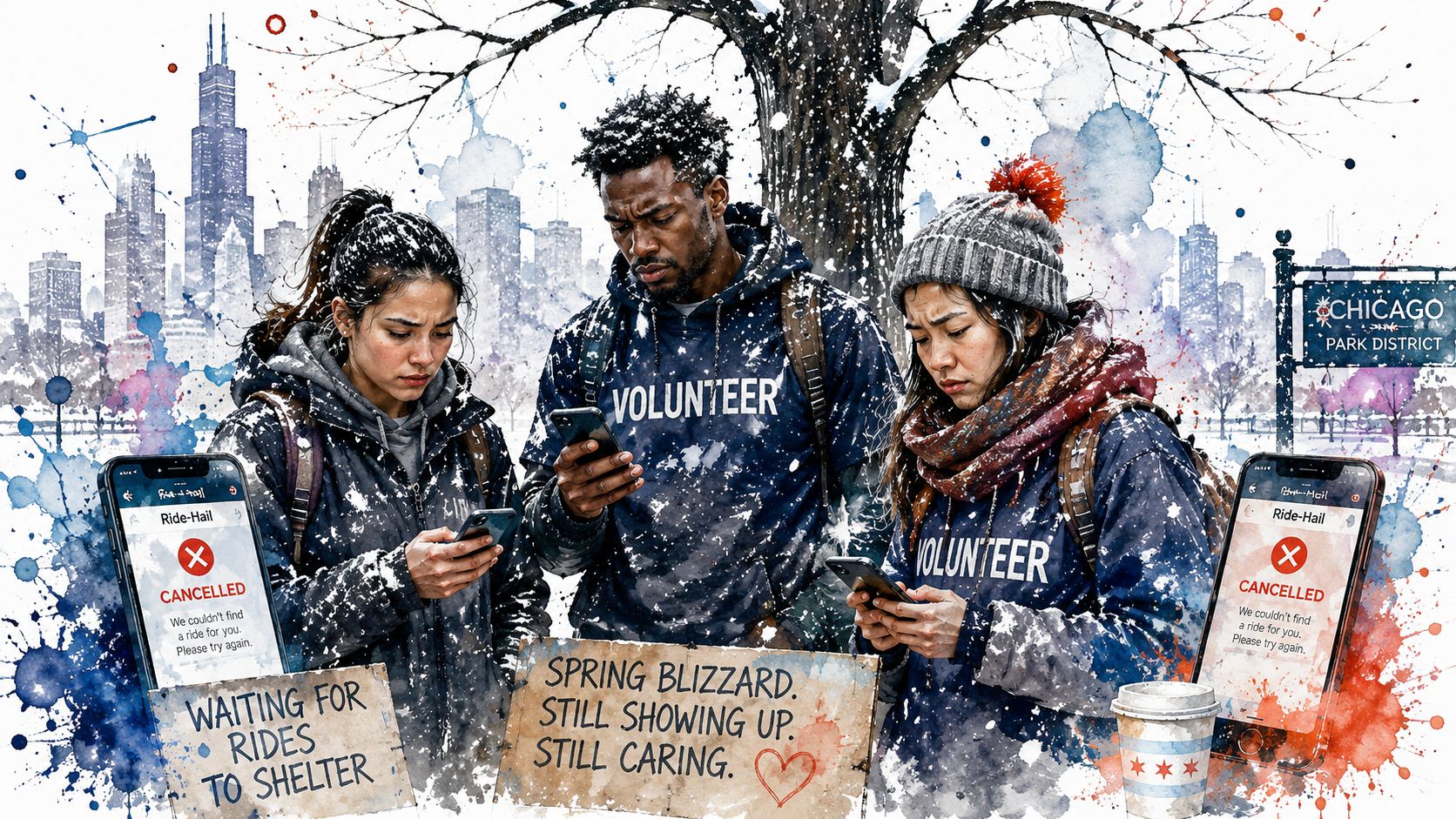
    Three volunteers standing in a snowy Chicago blizzard looking at cancelled ride-share apps on their smartphones.

    What surprised me wasn't the trash. It was how fast the cleanup turned into something we wanted to keep doing. The founder of Litter Caterpillars talks about that same moment as the first time he felt cleaning other people's messes could feel easier than cleaning his own. I understand that now. When your hands are busy, the same painful thoughts lose some of their grip for a while.

    Movement makes the day feel different

    Outdoor service changes the texture of a day. You bend, lift, walk, look up, and scan the curb, and all that motion gives your mind somewhere to go. That is part of why volunteers keep showing up even when the weather gets ugly, because the work has a pulse to it.

    I have watched people arrive tense and leave lighter, not because the block got perfect, but because they made something cleaner with their own hands. That visible change matters. You can point to the bag, the sidewalk, the cleared patch of grass, and say, “I helped that happen.”

    Practical rule: If the work leaves you smiling while your hands are dirty and your legs are tired, you are probably feeling the kind of strain that can still be good for you.

    The health piece does not live only in feelings. A major 2020 study of U.S. adults age 50+ found that people who volunteered at least 100 hours per year, about 2 hours per week, had a 44% lower risk of mortality and a 17% lower risk of physical functioning limitations over 4 years compared with people who volunteered 0 hours per year. That is not a vague mood boost. That is a real, concrete dose tied to health outcomes in a longitudinal study of older adults.

    The same kind of steady service is part of what people look for in service learning benefits, because the work reaches beyond the curb and into how people carry themselves afterward.

    What the Research Shows About Volunteer Longevity

    I think about the men I've seen show up for cleanup after a long week on the South Side, gloves on, coffee in hand, quiet at first. By the time the bags start filling and the block looks different under their feet, they are standing a little taller. That kind of change is hard to fake, and the research points in the same direction, steady service seems to matter more than a single burst of effort.

    The health effect is not built around one heroic day. It comes from showing up often enough that volunteering starts to feel like part of ordinary life, the way walking to the train or making dinner does.

    The minimum dose looks smaller than people expect

    A source cited by the American Heart Association says about 2 hours a week may be the point where health benefits start to appear, and Carnegie Mellon research in that same report found that older adults who volunteered at least 200 hours per year cut their risk of high blood pressure by 40% AHA-cited report. That gives people something practical to work with. You do not need a perfect schedule. You need a repeatable one.

    Other reviews point in the same direction. A systematic review and meta-analysis of volunteering outcomes found that volunteers had a 22% lower mortality risk than non-volunteers after adjustment, with a risk ratio of 0.78 and 95% CI 0.66-0.90. Another review of older-adult volunteering found a 24% adjusted mortality reduction and a 47% reduction in unadjusted analyses meta-analysis. The pattern is clearer than any single number. Service seems to help most when it becomes part of the week, not a rare event.

    A practical way to see it is through routine. If volunteering fits beside walking, cooking, or church, the body appears to notice. If you want a place to build that habit around cleanup work, the routines described in service-learning benefits from group volunteer work offer a useful starting point.

    Why Cleaning Other People's Messes Heals Your Own

    I've watched people show up to a cleanup carrying more than gloves and grabbers. A man in Pilsen once worked a whole stretch of sidewalk after losing a job, saying almost nothing until the bag at his feet started filling up. A mother from the South Side told me she came for the litter pickup after a rough week at home, then admitted the first hour of picking up bottles gave her enough distance to breathe again. The trash did not erase what they were carrying, but the work gave their minds a smaller, concrete problem to hold.

    Emotional weight feels lighter when your hands move

    That is the part people miss. A candy wrapper on the curb is simple to grab, even when the rest of life feels stuck in place. You bend, reach, bag, and keep moving. That sequence gives your brain proof that at least one thing can change right now.

    Research supports that feeling without flattening it into a slogan. The major 2020 study reported better self-rated health and higher physical activity among volunteers. A systematic review of volunteering and mental health also found favorable effects on depression, life satisfaction, and wellbeing.

    Clean a block for an hour, and your mind gets a moving target instead of a closed loop.

    Sunlight matters when you are outside instead of stuck in a room with your own thoughts. Movement matters because your body has something to do besides sit in worry. Visible progress matters because you can watch a curb shift from ugly to usable right in front of you.

    Purpose grows from visible repair

    Outdoor cleanup feels different from a lot of other good deeds because the change is right there in your hands. The bag gets heavier, the sidewalk gets clearer, and the work leaves a mark you can point to before you go home.

    That visible repair changes the inner rhythm too. When you spend an hour sorting through bottles, wrappers, and fast-food boxes, your attention has to stay with the next grab, the next step, the next bag tie. A review on volunteering and physical health outcomes says the strongest gains show up when service increases physical activity, functioning, and social support. That matches what I have seen on Chicago streets, where the body stays busy, the group keeps pace together, and the mind gets a break from its usual replay mode.

    Physical Demands Versus Physical Benefits

    I still remember a cleanup crew on a windy Chicago morning, each person working a little differently because each body brought something different to the block. One volunteer bent to grab cans from the curb, another filled bags and tied them off, and a third took the slower path along the alley because a sore knee made fast steps a bad idea. Outdoor cleanup can be rough on the body, and I do not want to gloss over that part.
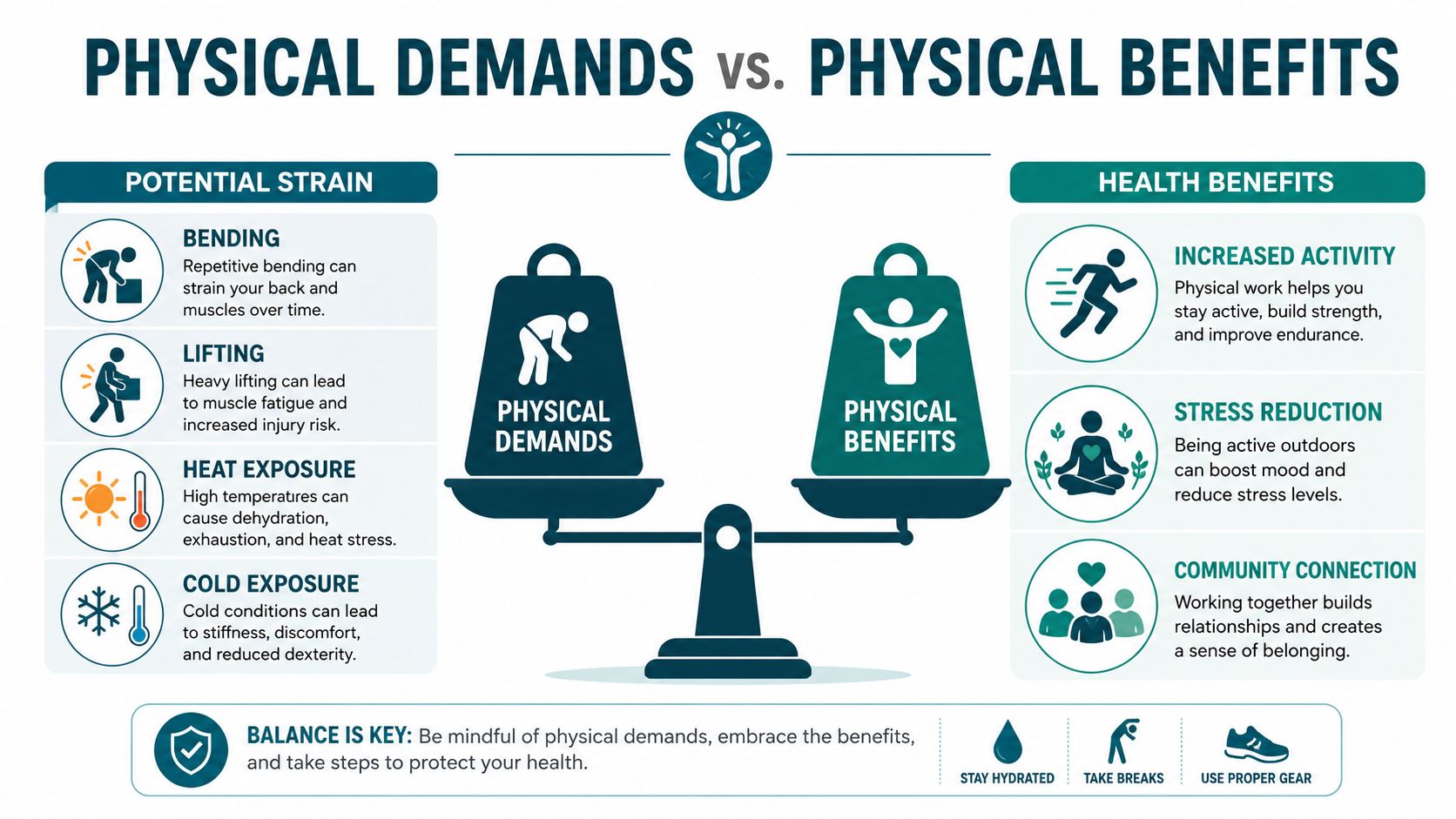
    An infographic comparing physical demands like strain with health benefits from physical activity and community work.

    The benefit grows when the task fits the body

    A volunteer shift pays off most when the work matches what people can safely do that day. Lifting bags, gripping grabbers, walking blocks, and standing in the sun all ask something real of the body, so the gain comes from good task design, not from pushing everyone through the same pace. A review on volunteering and multidimensional health outcomes found benefits across mental, physical, and social health, which fits the fact that outdoor service works best when the movement, the role, and the group rhythm all line up.

    I have seen crews get that right on the street. One person handled the heavier bags, one stayed on a shorter route, and another rotated in after a rest break so nobody had to fight through pain just to stay useful. That kind of setup keeps the work moving without asking a volunteer with joint pain, high blood pressure, or mobility limits to carry a load that does not belong to them.

    A cleanup can also help the body in a quieter way. It gets people bending, walking, reaching, and carrying, but it should never turn into a strain contest. When the route is too long, the bags are too heavy, or the heat and cold are ignored, the body stops getting the upside and starts paying the cost.

    Good service design keeps the work humane

    The body notices details that a flyer never mentions. Uneven sidewalks, wet grass, broken glass, icy curbs, and long stretches without a break all change what a volunteer can do safely, so the event plan should account for those conditions before anyone starts. Park restoration, street cleanup, and alley pickups each ask for different kinds of effort, and role rotation helps crews keep going without wearing one person down.

    I've watched a small crew split a litter pickup into pieces that made sense. One volunteer packed bags, one used tongs near traffic, and one handled the slow lane for anyone who needed less bending or less walking. That is the sort of planning that lets service stay active without turning into punishment.

    The volunteer event planning guide is useful here because it keeps the focus on roles, pacing, and the kind of setup that lets people contribute without overreaching. When the task matches the body, the work feels steady instead of punishing, and people leave with enough strength to come back again.

    Staying Safe While Showing Up Rain or Shine

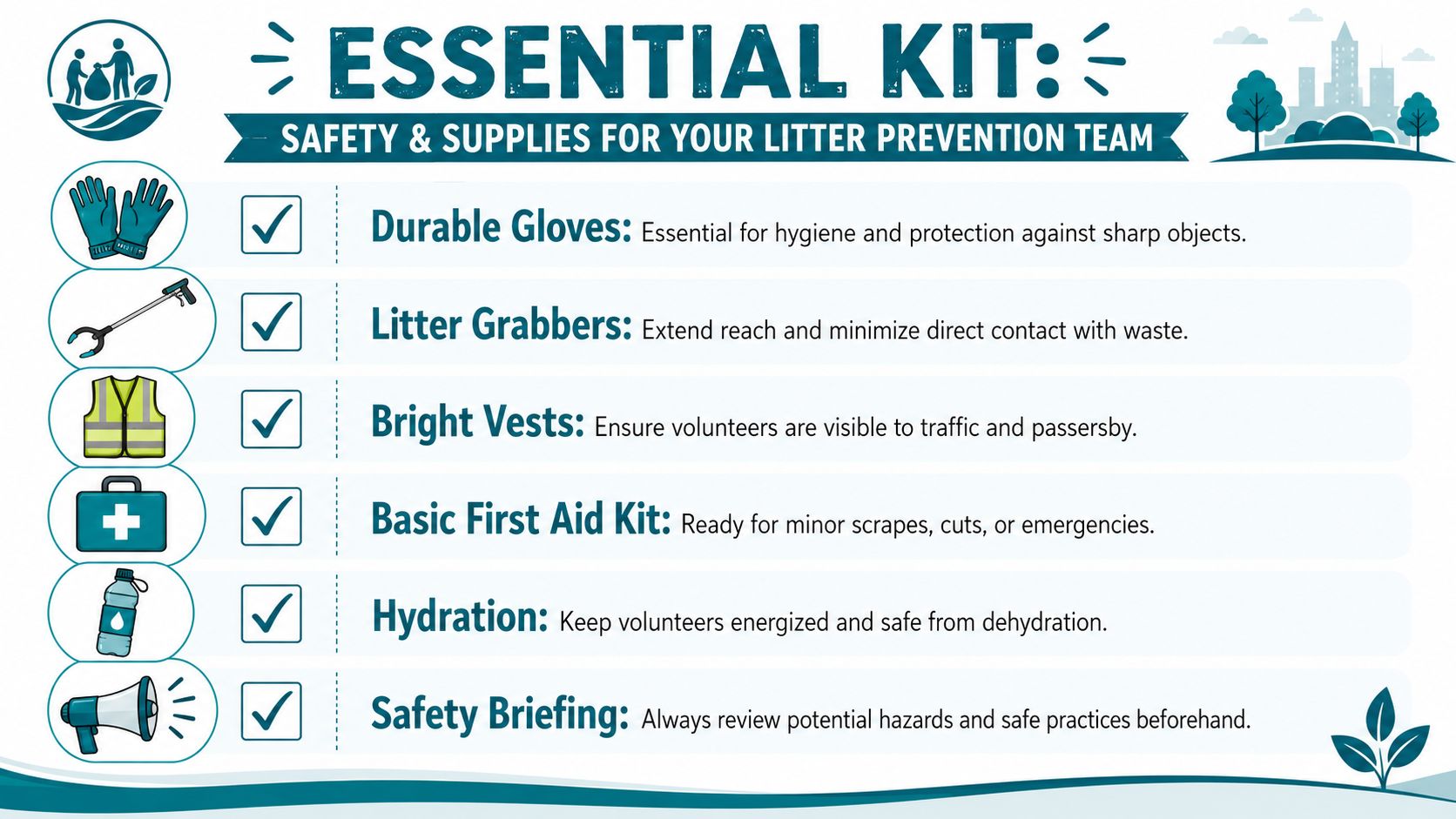
    Chicago weather doesn't care about your good intentions. Hot pavement will drain you, cold wind will cut through a wet hoodie, and a long cleanup can go bad if nobody pays attention to simple signals. I treat safety like part of the volunteer kit, right next to the grabber and gloves.
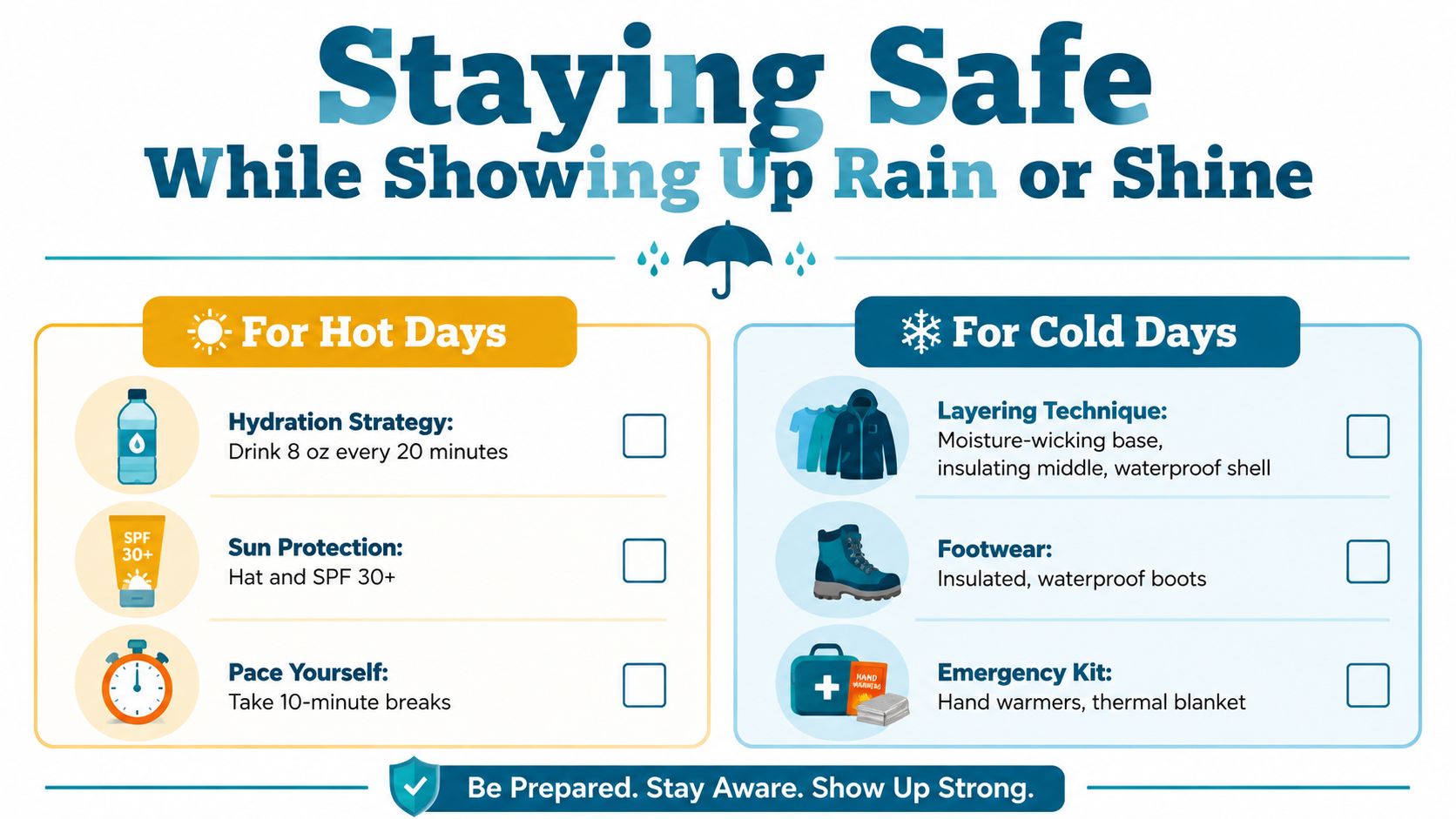
    A safety infographic outlining hydration, sun protection, and cold weather clothing tips for volunteers working outdoors.

    Hot days need pacing, water, and shade

    Drink before you feel thirsty, and keep water close enough that you use it. On scorching days, I want volunteers to slow down early, not after they've already gotten shaky. If someone looks confused, stops sweating, or gets a pounding headache, I stop the work and move them to shade.

    • Hydration strategy: Carry water and sip regularly.
    • Sun protection: Wear a hat and SPF 30+.
    • Pace yourself: Take short breaks before you feel wiped out.

    Cold days need layers and a backup plan

    Cold cleanup can feel fine for ten minutes and then turn sharp fast. I tell people to dress in layers that pull moisture away from the skin, then trap warmth, then block wind and rain. Insulated, waterproof boots matter more than style, and hand warmers or a thermal blanket belong in the car or event bag.

    If you want help planning an event that doesn't push people past their limits, the volunteer planning guide at Litter Caterpillars' event planning page is a practical place to start. The point is simple. You can still show up in rough weather, just don't pretend rough weather is free.

    Building Friendships That Keep You Coming Back

    The best cleanup crews feel less like errands and more like a team you want to see again. I've watched people arrive alone, take a flag, learn a theme song, earn a badge, and leave with a group chat full of new names. That social glue matters because people don't keep doing hard things just for abstract goodwill. They return for the people.

    Belonging turns service into habit

    Litter Caterpillars leans into that on purpose. The group schedules events on weekend mornings, which helps attract people who want to give their time with a clear head and a steady rhythm. It also filters out the kind of chaos that can turn a volunteer event into a drain.

    That idea lines up with what we already know from the health data. Volunteers show better mental and physical health, lower depression and anxiety, and lower mortality in older adults even after researchers control for age, gender, and physical health Mayo Clinic Health System summary. Social connection is part of why that happens. When you keep seeing the same faces, you build trust before the work even starts.

    Small rituals make people stay

    Flags, songs, and badges may sound playful, but they do serious work. They give people a shared identity, and that identity helps them show up again when the weather is bad or the street looks worse than expected. I've seen the same thing in sports and neighborhood groups. People want to feel like they belong to something that knows their name.

    Open group chats and consistent meetups help too. They make it easy to say yes on a random Thursday and still feel like part of the circle on Saturday morning. That's how friendship grows in real life, through repeated contact, shared strain, and a little bit of joy after the trash bags are tied off.

    If you want the health benefits to stick, keep the people close, keep the schedule predictable, and keep the work human.

    That's the part I trust most. Not the hype. Not the speeches. Just the simple truth that when people clean a block together, they often leave with stronger legs, clearer minds, and friends they didn't have before.


    If you want a volunteer crew that treats safety, friendship, and visible neighborhood change as part of the same job, join Litter Caterpillars. You'll find Chicago cleanup events that make it easy to show up, move your body, and build a habit that feels good on the street and in your own head.
  • Volunteer Event Planning That Actually Works

    Volunteer Event Planning That Actually Works

    Three of us showed up for that first Chicago pickup with gloves, trash bags, and too much optimism. The sky flipped from spring to hail to blizzard, Ubers kept canceling, and we ended up huddled under a tree like a bad weather cartoon.

    The First Pickup That Started Everything

    I remember looking at the street, the slush, and the mess on the curb and thinking one weird thing at once. Cleaning other people's trash was easier than cleaning up my own life, and somehow it was also more fun.

    That first outing taught me what most volunteer event planning guides miss. People do come for the task, but they come back for how the task feels, who they met, and whether the day had a pulse. If your event feels like a chore with a clipboard, people vanish. If it feels like a small crew with a shared mission, a little chaos, and a good reason to laugh, they return next week.

    I didn't know the terms for any of that then. I just knew I wanted a group where people could show up, do something real, and leave with a story worth telling. In Chicago, that story might involve hail, wind, heat, or a bike lane closed at the last second. That's fine. The plan only works if it can hold a little weather and a little personality.

    Volunteer event planning gets better when you stop treating it like a one-time cleanup and start treating it like a hangout people respect. The trash matters. The people matter more. The best events I've run have had both pieces in the right order.

    Define the Event Before You Recruit Anyone

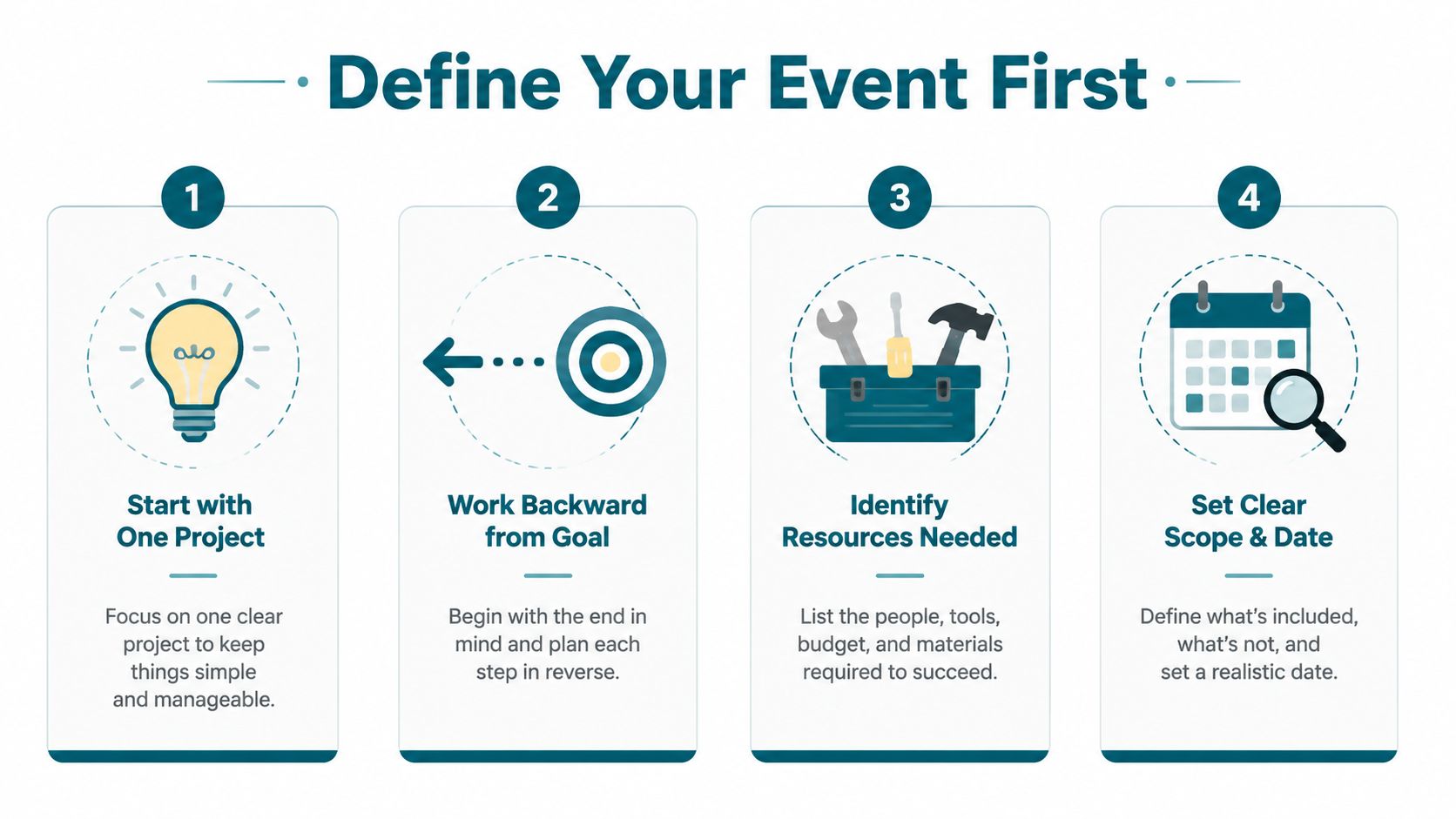
    Start with one project, not a pile of them. That rule saves you from vague planning, and it keeps the event easy to explain when someone asks what you're doing, where you're doing it, and why they should care.

    Pick the scope first

    For a neighborhood cleanup, I start with a block, a park edge, or a route I can describe in one breath. Then I write the purpose in plain language, like cleaning litter from a specific stretch, helping a partner site, or testing a new volunteer route. After that, I choose the date and time around the people I want to recruit, the neighborhood's access, and how much daylight I can count on.

    A one-page brief is enough if it answers the basics. What is the project, where does it happen, who is coming, what do they need, and what permission do I need before anyone touches the site? The UK government's voluntary-event guide pushes planners to define the purpose, size, safety and access needs, budget, publicity, day-of schedule, and cleanup before anything else, and that sequence keeps me from recruiting into a foggy plan. I've found that same order works when I'm emailing a park office, a business group, or an alderman's office, because nobody wants a soft answer about scope.

    Practical rule: lock the event before you ask for help. Volunteers forgive a lot, but they don't forgive confusion.

    Build the timeline with slack

    The planning calendar needs room for real life. A simple event-volunteer checklist recommends adding a 15 to 20 percent time buffer, and that fits the way cleanup events go, with weather shifts, last-minute cancellations, and gear delays. I use that buffer whenever I know the site has road access, tricky parking, or a partner who needs extra lead time.

    If you want a reference point for what a cleaner signup flow looks like, I also keep a plain internal guide on how to find volunteers, because recruitment works better when the event brief and the outreach message are built together. The brief tells people what they're walking into, and the message tells them why the day is worth their Saturday morning.

    A four-step infographic illustrating a process for defining an event with clear planning and project goals.

    Fill the page in under an hour

    If I can't write the event brief fast, the scope is too wide. I want a short document that names the goal, the site, the minimum permissions, the rough headcount, the budget, and the backup date logic. That is enough to move forward and still flexible enough to survive a rainy forecast.

    The trick is simple. Decide what the event is, then decide who needs to know, then ask for volunteers. When I reverse that order, I get no-shows, mixed expectations, and extra cleanup on the back end.

    Recruit Volunteers and Design Real Roles

    A signup sheet is not a plan. It's a pile of names with no shape, and that's where volunteer events start to wobble.

    Give every person a job that feels real

    I recruit where people already gather, on Meetup, Instagram, neighborhood Facebook pages, university service boards, corporate volunteer leads, and group chats that already have trust. Then I write the post like a person, not a flyer. I say what the cleanup is, where we're meeting, what kind of shoes people should wear, and what kind of energy the group has. If the post sounds like a county form, it attracts nobody.

    Then I split the work into roles. A check-in lead greets people and confirms names. A supplies lead hands out bags, gloves, and grabbers. A route lead keeps people moving through the block or park zone. A safety lead watches road edges, weather, and strain. A photo and storytelling lead gets consent and captures what the day looked like. A social lead keeps the chat alive before and after the event. Each role needs a backup, because one sick text can leave a hole.

    Keep the roles small enough that a new volunteer can say yes without guessing what the day will feel like.

    Match the role to the person

    Some people walk in talking to everybody. Put them near check-in, the welcome loop, or the route lead slot. Detail-oriented people do well on supplies or roster work. Calm, steady communicators work as team leads because they can answer questions without turning every question into a lecture.

    Role Core Responsibility Time Commitment Who Fits
    Check-In Lead Greet arrivals and confirm names Arrive early, stay through the opening huddle Friendly, fast with names
    Supplies Lead Hand out gear and track extras Early setup and end-of-day count Organized, practical
    Route Lead Keep the cleanup moving through assigned zones Full event block Clear communicator, good at pacing
    Safety Lead Watch weather, road edges, and buddy checks Full event block Calm, observant, steady under pressure
    Photo and Storytelling Lead Capture moments and note consent Flexible, part of the day Social, quick with a phone
    Social Lead Run the chat and reminders before and after Before, during, after Responsive, warm, consistent
    Backup Lead Step in if a lead drops out On call Reliable, nearby, easy to brief

    I keep a waitlist, too. If someone cancels, I don't leave the hole open and hope. I move the next person in and send a short message that tells them where to show up and who will meet them. Recruiting is a pipeline, not a post, and follow-up messages are part of the job.

    The best recruiting language sounds like an invitation, not a pitch. It should tell people they'll do something useful, meet people who care, and leave without getting trapped in a huge commitment. That's how you get first-timers to say yes.

    Build a Safety and Weather Plan You Will Actually Use

    Chicago weather has taught me not to trust optimism. I've cleaned in snow, heat, wind, rain, and the kind of cold that makes a phone battery give up before the volunteer does.

    Write the weather rules before the day

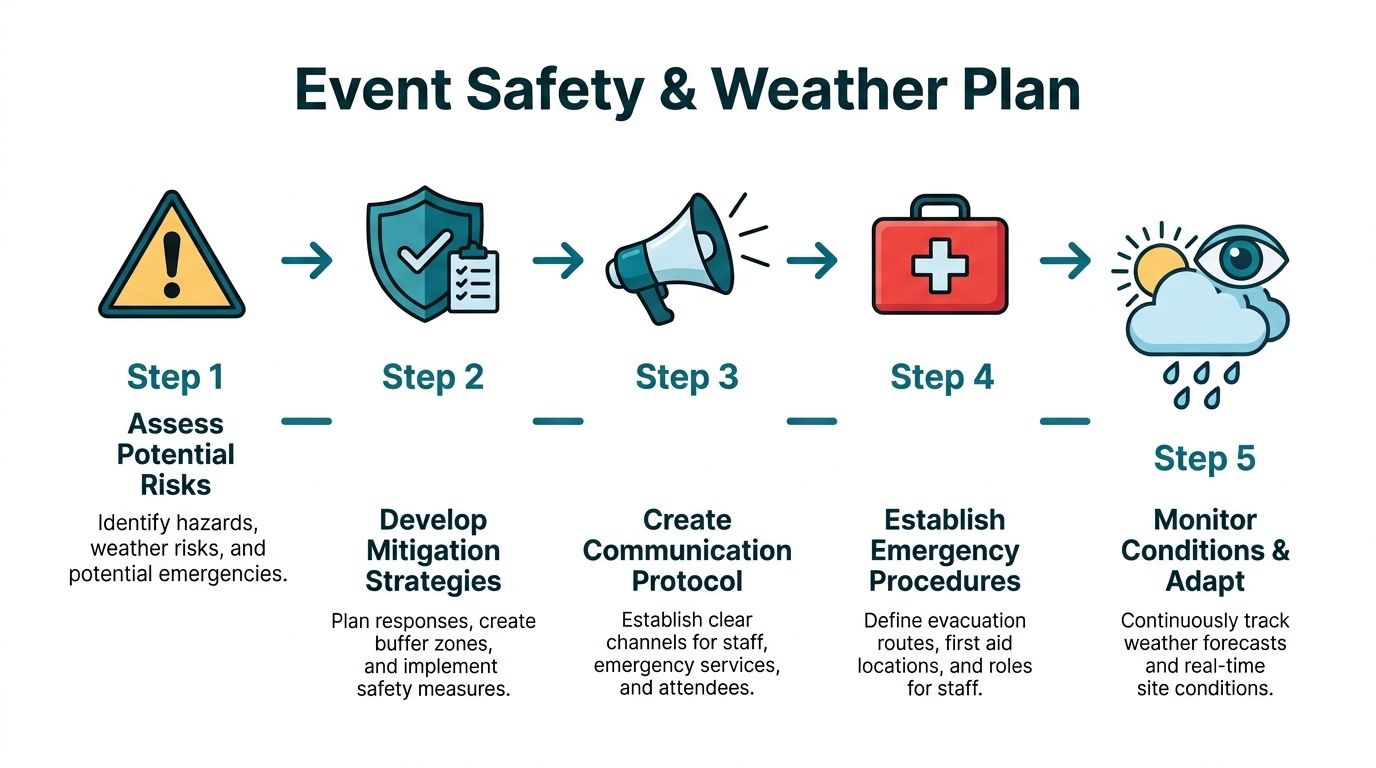
    A safety plan works when it is short enough to read at 6 a.m. I split mine into three parts. First, I write the weather thresholds for heat, cold, lightning, and rain. Second, I list the on-site rules for hydration, gloves, eye protection, sunscreen, and buddy checks. Third, I write the cancellation or pivot rule so nobody has to improvise when the forecast turns ugly.

    That matters even more for outdoor cleanup work near roads. If anyone steps onto a shoulder, I want cones, a spotter, clear permissions, and bright gear. During one highway shoulder cleanup tied to a bike-event shutdown, reflective vests and cones did more to keep people safe than any speech I could've given. The point was simple, the edge was dangerous, and everyone knew it.

    If you want a wider planning reference, the volunteer liability insurance guidance is a useful place to think through risk, because insurance, permissions, and a written safety plan belong in the same conversation.

    Use the weather to make the fallback, not to make the decision later

    One snowy cleanup ended with us huddled under a tree, cold and laughing while the cars kept sliding past. That day taught me to build a pivot into the plan, so I can move a crew to a covered park, switch to an indoor service task with a partner nonprofit, or defer to a new date with a message that goes out fast.

    The same logic helps in summer. On a hot day, gloves and water stop being optional. People tire sooner, tempers get shorter, and the day gets sloppy if I pretend the heat is a small thing. I'd rather shorten the route, add shade breaks, and keep the group moving than watch people fade halfway through.

    A five-step infographic titled Event Safety and Weather Plan outlining the process for emergency preparation.

    Keep the rules visible

    A one-page safety sheet at check-in solves more problems than a long speech. I want people to know where to meet, what to do if someone gets hurt, who carries the first aid kit, and who makes the call if the sky turns. That sheet keeps me from repeating the same instructions ten times.

    The best weather plan is the one you can use without thinking too hard. If it feels fancy, it will fail when the wind picks up.

    Run the Day With a Simple Operating System

    The event day gets easier when I treat it like a small operating system instead of a scramble.

    Use a clean sequence from arrival to closeout

    I ask the lead team to arrive 15 minutes early for gear check and setup. The check-in table gets a printed roster, name tags, and a visible place to stand so new people don't wander around wondering if they're late. Then I open with a short huddle, a route map, a safety reminder, and a clear answer to the two questions every volunteer has, where do I go and what do I do now.

    The event itself runs in short shifts, and I keep them at no more than three hours when I can, because people stay sharper when the work block feels human. That schedule also gives me room for a water break, a snack pause, and a quick correction if a route gets messy or a bag pile grows too fast. DAV's guidance on short shifts fits what I've seen in the field, because nobody volunteers for a cleanup to get trapped all day with no structure.

    The day ends with a closing huddle, a fast feedback question, a group photo if people want one, and a clear handoff of supplies. That closing rhythm matters more than people think, because it tells everyone the day had a beginning, a middle, and a clean finish.

    Keep one channel, one map, one table

    I use one group chat for the day so updates don't scatter. I print a map with zone assignments so people can move without checking their phone every two minutes. I keep one check-in table visible so nobody has to guess where to start.

    For a basic scheduling setup, I keep a simple system in free volunteer scheduling software, because any tool is better than a dozen text threads when people are arriving at different times.

    Opening huddle script: “I'm [name]. We're cleaning [site]. Your role is [role]. Stay in your zone, wear your gear, check in with your buddy, and come to me if you see a hazard or get hurt.”

    Avoid the failures that sink cleanup days

    The worst day-of failures are easy to spot. No check-in table, no printed roster, and no backup lead will turn a decent morning into a mess. I also watch for vague route calls, because people need a clear start point more than they need a motivational speech.

    A clean operating system keeps volunteers calm. Calm volunteers work longer, ask better questions, and leave with enough energy to come back.

    Turn First-Timers Into a Crew That Comes Back

    The bags are only part of the work. A cleanup becomes a group when people leave with a reason to return, and that usually comes down to how they were treated after the trash was picked up.

    Make the follow-up feel immediate and human

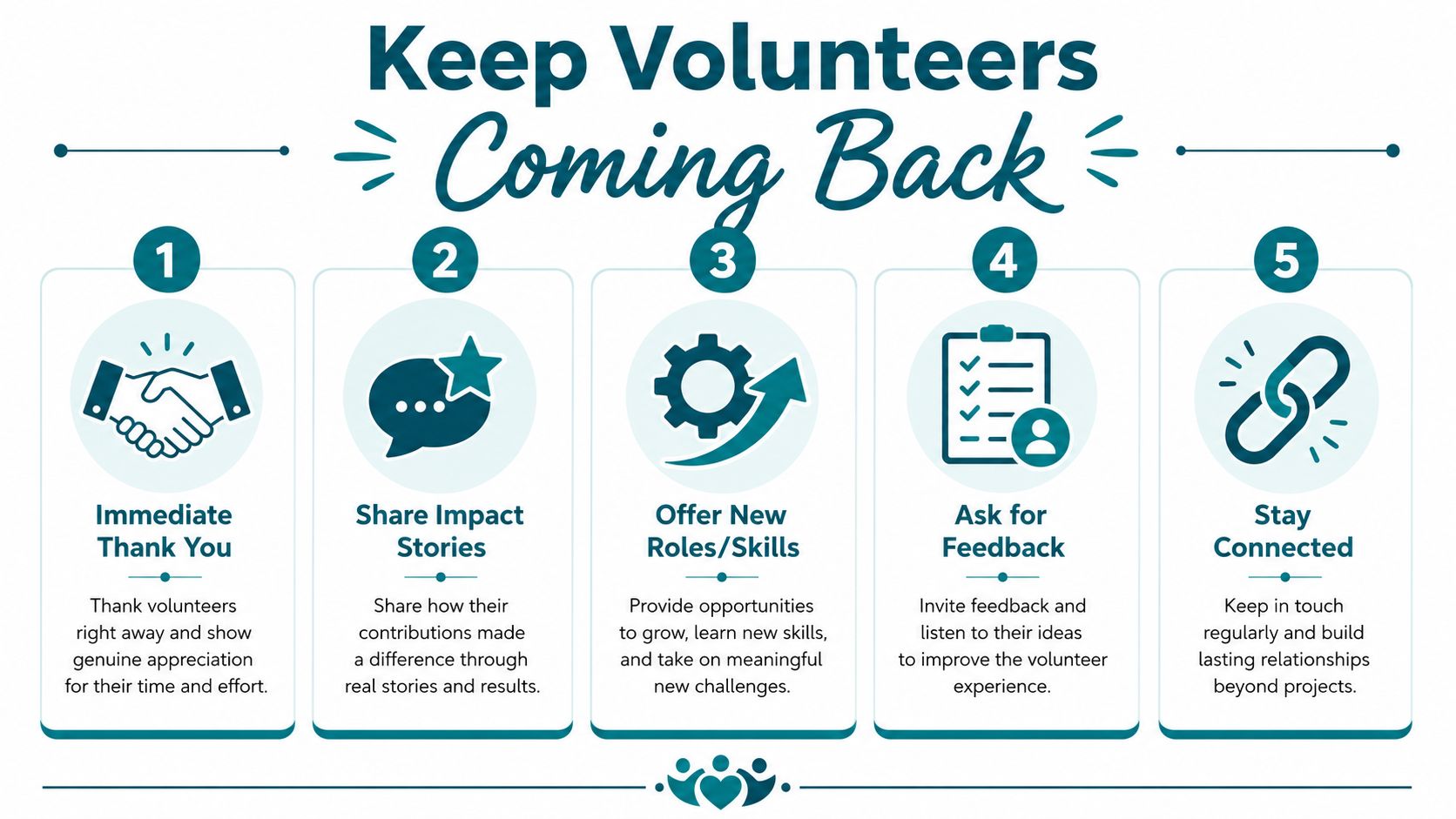
    I send a same-day thank-you in the chat while the day still feels fresh. On Monday, I post a recap photo and tag everyone who said yes to being tagged. Then I send a one-question survey that asks what was clear, what was confusing, and what would have made the day easier. Short surveys get replies because they respect people's time.

    Small rituals help here too. A flag, a badge, a theme song, or one weekly habit people recognize right away gives the crew a shared marker to come back to. That is not decoration. It gives people an identity they can carry home, and identity is what kept me showing up when the weather got ugly and my mood did the same.

    Build the social layer on purpose

    Group chats, planning threads, and quick meetups are the social scaffolding that holds the work together. They let first-timers hear from regulars before the event, and they give new people a low-pressure place to ask what to wear, where to park, and whether they need to bring anything. Public recognition helps here too, as long as it never turns into a donation ask.

    Retention habit What I do What it changes
    Same-day thank-you Send a message right after cleanup People feel seen before the day fades
    Monday recap Post photos and tag opt-ins The event stays alive in memory
    Quick survey Ask one useful question I learn what confused people
    Small ritual Use a badge, flag, or theme song People start to feel like part of a crew
    Ongoing chat Keep one open thread New volunteers have a place to return

    What holds true across volunteer programs is simple. People do not volunteer once and disappear for no reason. They return when the day feels social, clear, and worth repeating. If sponsors ask for metrics, I track recurring participation and referral rate, even if I do it in a simple spreadsheet.

    An infographic titled Keep Volunteers Coming Back outlining five tips for volunteer retention and engagement.

    Make belonging visible

    People come back when they feel known. A volunteer who gets a thank-you, a photo tag, and a place in the chat is much more likely to become a regular than someone who only gets a sign-up link and silence afterward.

    That is the part most guides skip. The cleanup is real, but the crew is the reason the cleanup survives winter.

    Your Pre-Event Checklist and a Call to Show Up

    I keep my pre-event check simple enough to screenshot.

    Category Check Before Event Day
    Scope and date One project, one site, one time
    Permissions Park, business, or city contact confirmed
    Roles and backups Every role filled, backup names set
    Supplies and gear Bags, gloves, grabbers, name tags, water
    Safety and weather Heat, cold, rain, lightning, and pivot rule written
    Communication One chat, one roster, one map
    Check-in system Table, printed list, clear arrival spot
    Follow-up plan Thank-you, recap, survey, next invite

    Screenshot from https://www.littercaterpillars.com

    If you want a real Chicago example of this playbook in action, Litter Caterpillars uses weekly weekend morning cleanups, open group chats, Meetup, and Instagram to help people plug in and stay connected. Pick one project, pick one date, recruit eight people, and run it. Then fix the next one based on what happened.


    If you want a living example of volunteer event planning that puts people first, visit Litter Caterpillars. You'll see how a cleanup group can mix safety, structure, and friendship without turning the day into a boring form. If you're in Chicago and want a place to start, that's where I'd send you.

  • How to Measure Community Impact: Guide for Volunteer Groups

    How to Measure Community Impact: Guide for Volunteer Groups

    You finish a cleanup and your body knows it before your brain does. Your gloves stink. Your back is tight. Your water bottle is empty. You look down the block and see a street that looked defeated three hours ago and now looks like somebody finally cared.

    Then you look at the pile.

    Bags. Broken glass. Fast food cups. Rusted cans. Cigarette packs. Maybe a tire if your day got weird.

    And then the question hits you. Sure, we filled bags. But what did we really change?

    I know that question well. I started cleaning streets during a season when my own life felt cluttered and jammed up. Cleaning other people's messes felt easier than facing my own. Strange but true. Out on the street, with a grabber in my hand and wind in my face, things got simple. Pick it up. Keep moving. Come back next week. Somewhere in that rhythm, I changed.

    That's why I care so much about measurement. Not because I love spreadsheets. I don't. I care because volunteers give you their Saturday morning, their sweat, their safety, and their hope. You owe them a real answer when they ask, “Did this matter?”

    If you want to learn how to measure community impact, start there. Start with respect. Start with honesty. Start with the belief that visible work deserves visible proof.

    More Than Just Bags of Trash

    You already know the first trap. You clean a block, count the bags, post the photo, and call it impact. I get it. A pile of trash is satisfying. It feels like a scoreboard.

    But a cleanup group isn't in the bag business. You're in the change business.

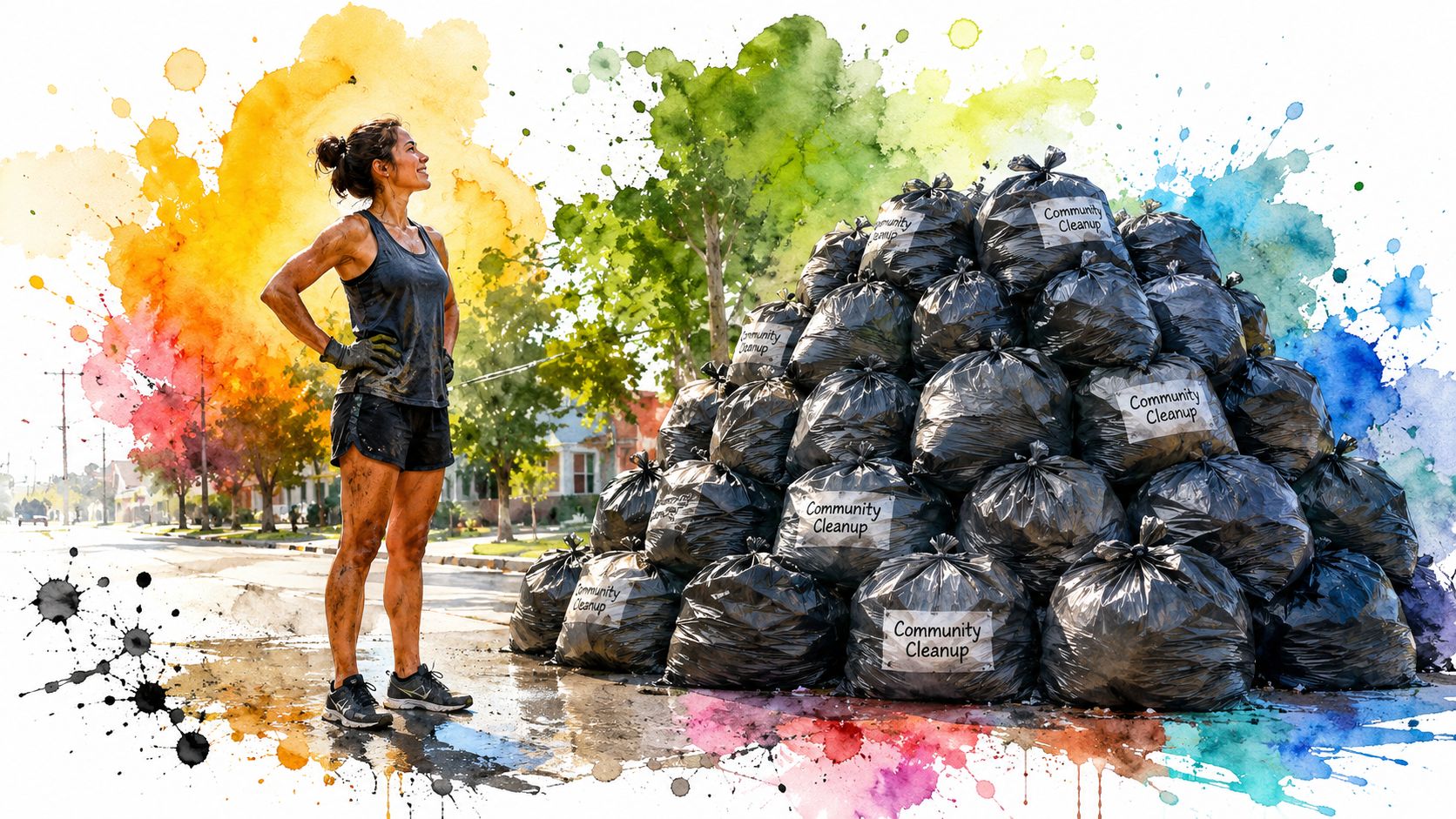
    A woman stands proudly next to a large pile of garbage bags labeled Community Cleanup, symbolizing environmental impact.

    When I first got serious about neighborhood cleanup, I thought hard work would speak for itself. It doesn't. Streets change. People forget. New volunteers show up with no memory of what the block looked like before. Residents notice a difference, but if you never capture it, the story disappears.

    That's why I treat measurement like cleanup's second half. The first half is doing the work. The second half is proving the work changed something.

    What the pile can't tell you

    A pile of bags can't tell you if the same volunteers came back because they felt connected. It can't tell you whether a resident finally stopped to say thanks after ignoring your group for months. It can't tell you if a corner that always felt abandoned now feels watched over.

    That kind of proof takes intention.

    Practical rule: If all you track is what you removed, you miss what you repaired.

    Sometimes the strongest record of your work is simple. A before photo. An after photo. A note that says, “Two residents asked how to join.” A screenshot of the group chat after the event. A quick log of which block got cleaned and who showed up. That's how a cleanup turns into a body of evidence, not a fading memory.

    If you want an example of what visible service looks like in the world, spend a minute looking at trash cleanup work in action. You can feel the difference between activity and proof.

    Measurement is respect

    I've seen groups burn out because they kept asking people to show up without showing them what their effort built. People need fuel. Proof is fuel.

    So yes, count the bags. Then go one step further. Ask what changed on that block, in your crew, and in the people who watched you work. That's where community impact starts to come into focus.

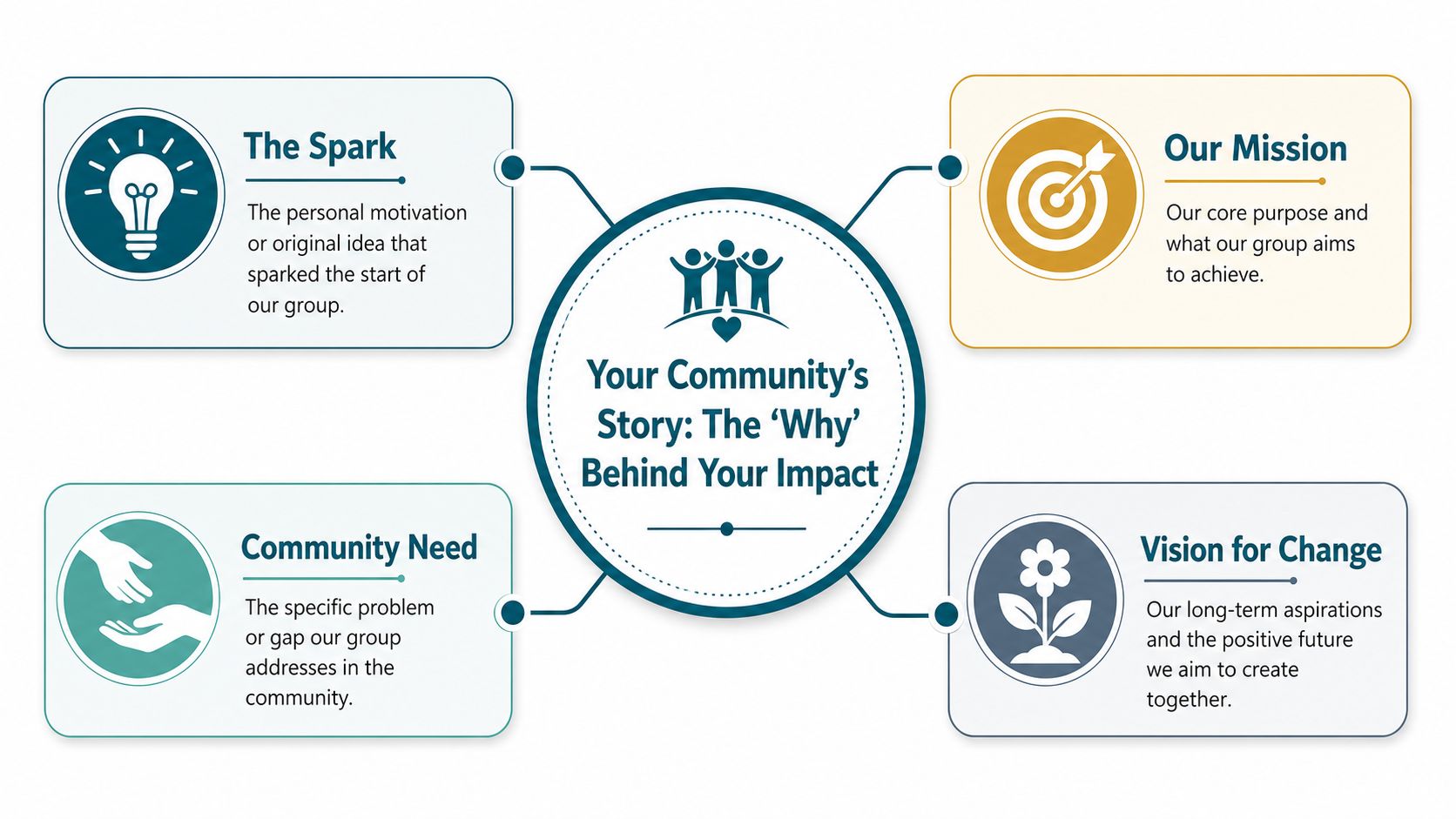
    Start with Your Story Not Your Numbers

    Most volunteer groups mess this up at the beginning. They start with a spreadsheet before they start with a sentence.

    That's backwards.

    If you don't know your story, your numbers will drift. You'll track whatever is easy. Bags collected. Gloves handed out. Posts published. None of that means much if it isn't tied to a living reason for why your group exists.

    Find the spark

    My own spark was personal. I had trouble cleaning and organizing my own life. Trash felt heavier than it should have. Tiny things carried emotional weight. Service outside gave me a way to build discipline and bravery inside. That became the engine.

    Your spark may be different. Maybe your block got trashed every Monday after the weekend crowds. Maybe your kids had to walk past broken glass on the way to school. Maybe you moved to a new city and needed friends who cared about more than brunch and talk.

    Write that down in plain language.

    A diagram illustrating the four key components to define a community story and understand its impact.

    Turn the spark into a mission

    A usable mission is short and human. It says who you help, what you do, and what change you expect.

    Try this fill-in-the-blank:

    • Who we show up for
      The residents, volunteers, and small businesses on neglected blocks.

    • What we do
      We clean littered areas consistently and invite people to join us.

    • What we think will change
      Streets look cared for, people build trust, and more neighbors step into service.

    That's enough to guide your measurement. You don't need corporate language. You need clarity.

    One good way to test your mission is this: if a new volunteer reads it in ten seconds, do they understand what they're joining?

    Build goals from the mission

    Once your story is clear, your goals stop being random. They become evidence of your values in motion.

    The best practice is plain. You need a baseline before the work starts, clear goals tied to your mission, people affected by the work helping define the metrics, mixed methods that combine numbers with stories, and honest reporting about what went well and what didn't, as outlined in this guidance on measuring community impact effectively.

    That means you should decide things like:

    1. What your baseline is
      What did the block look like before regular cleanups began? How many volunteers usually showed up? How did residents talk about the area?

    2. What “better” means
      Cleaner sidewalks? Stronger volunteer retention? More conversations with neighbors? Fewer repeat problem spots?

    3. Who helps define success
      Volunteers. Residents. Store owners. School staff. The people near the work usually know what progress looks like.

    If your mission is personal but your metrics are generic, your proof will feel hollow.

    For a good gut check, read a few volunteer testimonials from cleanup experiences. Listen for what people remember. They rarely start with numbers. They start with belonging, courage, routine, pride, and visible change. Your metrics should support that story, not replace it.

    Choose What to Count and What to Ask

    Here's the cleanest way I know to explain measurement. Outputs are the reps. Outcomes are the muscle.

    A cleanup group can do a ton of reps. Bags filled. Blocks covered. Volunteer hours logged. Those matter. But if you stop there, you're mistaking motion for change.

    Outputs tell you what you did

    Outputs are the easiest things to count because they happen right in front of you. You can tally them while still wearing gloves.

    Examples include:

    • Volunteer participation. Who came, how often, and from which neighborhoods or backgrounds.
    • Cleanup activity. Bags filled, blocks covered, sharp objects removed, graffiti reported.
    • Time invested. Start time, end time, volunteer hours, repeat attendance.

    These numbers help you stay organized. They also help you answer simple operational questions. Which locations need more tools? Which dates pull the best turnout? Which team leads keep events moving?

    Outcomes tell you what changed

    Outcomes are tougher. They ask whether your work had an effect beyond the event itself.

    Maybe residents start greeting the team. Maybe a business owner asks you to come back. Maybe volunteers say they feel safer, more connected, or more rooted in the neighborhood. Maybe a stretch of sidewalk stays cleaner longer because people stop treating it like a dumping zone.

    A strong warning from practice is this: many groups over-rely on outputs like trash bags collected and miss outcomes like whether residents feel safer or better about the area. To keep your measurement valid, use 3+ indicators and mix hard secondary data with qualitative input. Also, break your data apart by demographics because that kind of disaggregation reveals participation disparities in 60–70% of community projects, according to Bridgespan's discussion of impact measurement.

    That one habit changes everything. If the same type of person always shows up, your group may be active but still narrow. You won't see that unless you look.

    A simple table for cleanup leaders

    Metric Type What It Measures Example Why It's Useful
    Output Work completed Bags of trash removed from one corridor Shows effort and event scale
    Output Participation Number of volunteers who attended Helps with planning and retention
    Output Coverage Blocks, alleys, or lots cleaned Shows geographic reach
    Outcome Resident response Short comments about how the block feels now Captures lived experience
    Outcome Volunteer experience Group chat poll on pride, connection, or safety Shows whether people want to return
    Outcome Neighborhood condition over time Repeat photos of the same hotspot across weeks Shows whether change sticks

    Pick fewer metrics and ask better questions

    Most volunteer crews don't need a giant dashboard. They need a tight set of indicators they'll track.

    Try a small stack like this:

    • One operational metric
      Attendance by event.

    • One visible condition metric
      Repeat photo of the same corner each visit.

    • One experience metric
      A one-question volunteer poll after each cleanup.

    • One community voice metric
      A short note from a resident, worker, or passerby.

    That's enough to start seeing patterns.

    If you want a practical benchmark for shaping your own system, this kind of volunteer program evaluation approach is a smart model. It keeps measurement tied to real people instead of turning it into paperwork theater.

    Your data should fit in your hands. If tracking it feels heavier than the cleanup itself, you built the wrong system.

    Simple Ways to Gather Your Proof

    You don't need fancy software to measure community impact. You need habits. Your phone already has most of the tools.

    The trick is to collect proof while the day is still alive. If you wait until Sunday night to remember what happened Saturday morning, half the good stuff is gone.

    Screenshot from https://www.littercaterpillars.com

    Use the four-layer street version

    A solid framework breaks impact into four layers: participation, experience, outcome, and return. It also treats measurement as continuous capture instead of a once-a-year survey, as described in Sopact's overview of community impact measurement. I like this because it matches how cleanup groups live. You don't work once a year. You show up again and again.

    Here's the street version of those four layers:

    • Participation
      Track who came, who led, who was new, and who returned.

    • Experience
      Ask how people felt. Safe? Proud? Included? Tired but happy?

    • Outcome
      Record what changed in the place or in the people.

    • Return
      Show the evidence back to your volunteers and neighbors, then ask if it rings true.

    That last part matters. If your report says one thing and the block says another, trust the block and fix your method.

    Scrappy tools that actually work

    I like tools that survive dirt, rain, and low attention spans. Use what your crew will keep using.

    • Before-and-after phone photos
      Stand in the same spot each time. Face the same direction. If you can, save them in a shared Google Drive folder labeled by date and location.

    • Pinned Google Map
      Drop a pin for each cleanup site. Add photos and a one-line note. Over time, you build a visual trail of where your crew has worked.

    • Notes app or Google Form
      One volunteer can log attendance, unusual finds, resident comments, and follow-up needs in under two minutes.

    • Tally counter
      Cheap and effective for counting needles, tires, shopping carts, or illegal dump items.

    • Group chat poll
      Ask one question after the event. “How connected did you feel today?” or “Would you return to this spot next month?”

    Keep it moving while the energy is high

    Your best data often comes in the first ten minutes after cleanup ends. People are still buzzing. Don't waste that window.

    Ask a volunteer to record a quick voice memo. Grab one sentence from a resident. Snap the final photo before the bags get hauled away. Log the location before you drive off and forget the cross street.

    This short clip captures the kind of hands-on energy that numbers alone can't carry:

    Don't make data a second job

    The system should feel light. If your volunteers dread the paperwork, they'll skip it. I'd rather see a group consistently gather five simple data points than attempt a giant form nobody finishes.

    A clean weekly routine might look like this:

    1. Before cleanup
      Take the opening photo and note the location.

    2. During cleanup
      Count a few chosen items and track who joined.

    3. Right after cleanup
      Take the after photo and run one quick poll.

    4. That afternoon
      Save everything in one folder and write three sentences about what stood out.

    That's it. Small proof, gathered often, beats a perfect system you never use.

    Turn Your Data into a Powerful Story

    Raw data is like a pile of bricks. Useful, but nobody wants to live in a pile of bricks. You have to build something with it.

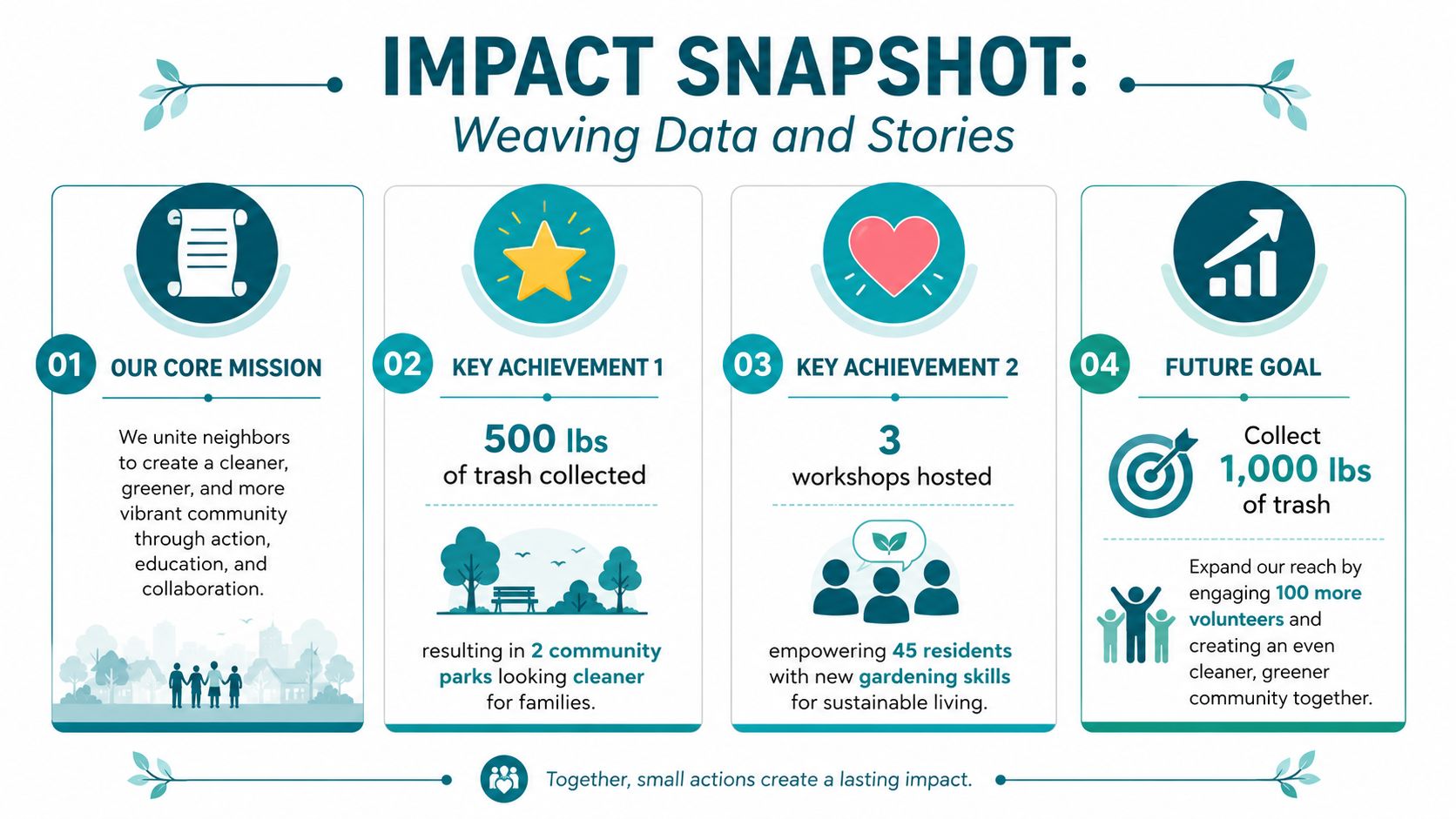
    For cleanup groups, that “something” is an Impact Snapshot. One page. One image. One fast read. People should understand the win before they finish their coffee.

    What goes in the snapshot

    Your snapshot should feel like a movie trailer, not a tax return. It needs just enough structure to be credible and just enough human texture to feel alive.

    An infographic titled Impact Snapshot showing community mission, achievements in trash collection and workshops, and future goals.

    Use this template:

    • Top section
      Your strongest before-and-after photo pair.

    • Middle section
      A few numbers from the event or the month. Keep them tied to the metrics you already decided to track.

    • Bottom section
      One short quote from a volunteer, resident, or local partner.

    • Footer
      The next action. Join us. Partner with us. Follow the next cleanup route.

    Pair evidence with voice

    A number proves activity. A quote proves meaning. Put them together and the story lands.

    A good quote isn't polished. It's real. Something like, “I'd walked past this lot for months and felt defeated. Today it finally looked cared for.” That line gives your numbers a heartbeat.

    When your numbers and your people say the same thing, trust grows fast.

    If you don't have a quote every time, use a short field note. “Two residents thanked the team and asked when we'd return.” Simple works.

    Keep the design rough but clean

    You do not need a designer to make this. Canva is enough. Google Docs is enough. Even an Instagram carousel can work if you keep it consistent.

    Stick to a repeatable layout:

    • same title placement
    • same photo size
    • same metric order
    • same closing invitation

    That consistency builds memory. After a few weeks, people start recognizing your receipts on sight.

    Build a public record

    One snapshot is nice. Ten snapshots become proof. People stop seeing your cleanup group as a one-off burst of energy and start seeing a pattern. Patterns earn trust.

    Many volunteer groups accidentally gain power through consistency. They keep showing up, keep documenting, keep reporting. Then a resident, funder, school, alderman, or store owner can scroll back and see that the work is real. No inflated claims. No fog. Just evidence stacked over time.

    Use Your Proof to Grow Your Army

    Proof changes how people respond to you.

    Without proof, you sound hopeful. With proof, you sound solid.

    That matters when you ask someone to wake up early and spend their weekend picking up litter. It matters when you ask a small business for gloves, trash bags, or water. It matters when you invite a neighbor who feels cynical and tired.

    People join what they can see

    Most volunteers don't join because of a mission statement alone. They join because they can picture themselves inside the work.

    An Impact Snapshot gives them that picture. They see the block. They see the faces. They see the kind of change a small group made in a short stretch of time. Suddenly joining doesn't feel abstract. It feels doable.

    Use your proof in a few direct ways:

    • Recruiting posts
      Share snapshots on Instagram, Meetup, email, or group chats with one clear invite.

    • Partner asks
      Bring a printed snapshot when you talk to a hardware store, coffee shop, school, or church.

    • Volunteer retention
      Send the snapshot to everyone who joined. Let them feel the win again while it's fresh.

    • Neighborhood trust
      Post it where local residents can see what happened on their block.

    Proof also keeps you honest

    This part matters just as much. Measurement doesn't only help you grow. It helps you correct.

    If a site keeps getting trashed again in two days, your method may need to change. If first-time volunteers come once and vanish, your experience may be weak even if the cleanup looked productive. If your demographic breakdown shows the same slice of people every week, your outreach may be narrow.

    That's good news. Honest proof gives you something to fix.

    Brave groups don't hide weak spots. They learn in public and keep moving.

    If you want to know how to measure community impact in a way that helps your crew, this is the answer. Track what you did. Listen for what changed. Show the evidence. Invite more people in. Repeat.

    That's how a cleanup turns into a movement. One block. One morning. One clear receipt at a time.


    If you want to join a crew that cleans hard, builds real friendships, and shows its work, check out Litter Caterpillars. Show up on a weekend morning, grab a picker, and help turn service into something people can see and feel.

  • Volunteer Coordinator Training: Blueprint for Cleanup

    Volunteer Coordinator Training: Blueprint for Cleanup

    Three of us got caught in a Chicago hailstorm on our first cleanup. We huddled under a tree, shaking, while our rides kept canceling, and I realized a volunteer coordinator isn't there to hold a clipboard. You're there to hold the group together when the day goes sideways.

    Why Your Coordinators Need More Than a Clipboard

    That first cleanup taught me more than any neat classroom slide ever could. Bags were wet. Hands were numb. The city felt bigger than us. Yet that ugly little storm gave us a shared story, and shared stories are what turn a casual volunteer into a teammate.

    A lot of volunteer coordinator training still assumes calm rooms, predictable schedules, and controlled conditions. That works if your volunteers are guiding guests through a museum or staffing a check-in table. It falls apart when your crew is on a roadside shoulder, the weather flips, and somebody finds a needle in the grass.

    The job is leadership under pressure

    In rough outdoor work, the coordinator has to do several things at once. You read the street. You read the people. You decide when to push, when to pause, and when to pull everybody out.

    That's why generic training often feels thin. In hospice settings, coordinators have received live lecture-based training averaging 19 hours or less, according to a peer-reviewed hospice volunteer coordinator survey. If demanding care settings get training that short, you can see the problem for outdoor crews facing traffic, weather, sharp objects, and urban unpredictability.

    Practical rule: If your coordinator training fits neatly into a few lectures, you haven't trained for reality. You've trained for a calm day that probably won't happen.

    A street coordinator needs instincts, not just information. They need to know how to stop a volunteer from grabbing broken glass the wrong way. They need to know how to reset morale when turnout is low. They need to know how to say, “We're leaving now,” before pride turns into recklessness.

    Hardship can build the team if the leader knows what to do

    That hailstorm didn't make us strong by magic. The weather was miserable. What mattered was how we handled it. We laughed. We stayed kind. We looked after each other. We turned a rough day into a story worth repeating.

    That's the difference between administration and leadership. Administration tracks names. Leadership gives people a reason to come back.

    I've found that the best coordinators think like servant leaders in the field. They don't stand above the mess. They step into it first. That example gives volunteers courage.

    Here's what doesn't work:

    • Pure lecture: People nod in training, then freeze in the field.
    • Over-scripted plans: The first surprise breaks the script.
    • Safety as paperwork: Volunteers can tell when a leader treats risk like a form instead of a real human issue.

    Here's what does work:

    • Scenario drills: Let people practice calling off a task, redirecting a volunteer, or changing the route.
    • Field shadowing: New coordinators learn faster when they watch a calm leader handle a messy morning.
    • Clear values: Brave and kind beats loud and tough every time.

    If you train coordinators for chaos, they won't panic when it arrives. They'll steady the group, and the group will remember how that felt.

    Building a Volunteer-First Culture

    Before you teach route planning or supply counts, teach this: volunteer energy is precious. If you waste it, drain it, or exploit it, your program gets hollow fast.

    Some organizations still treat volunteers like future donors with free labor attached. I think that poisons trust. If a person shows up to serve and you keep nudging them toward their wallet, they feel the switch.

    A human hand holds a vibrant, colorful sphere surrounded by an artistic explosion of watercolor paint splatters.

    A source on volunteer management training says 42% of new volunteers quit because they felt pressured to donate, and that same piece argues for a volunteer-first model that rejects donation pressure. You can read that claim in Rosterfy's roundup on volunteer management training programs and resources. That number is ugly, but it matches what many people already know in their gut. Nobody likes feeling used.

    Train coordinators to protect energy

    A coordinator's first cultural job is protection. They protect safety, yes, but they also protect mood, trust, and dignity.

    That means your training should teach them how to notice:

    • The volunteer who goes quiet: They may be cold, overwhelmed, or embarrassed to ask for help.
    • The over-giver: They say yes to every task and burn out in silence.
    • The newcomer on the edge: They need one warm conversation to feel included.

    Volunteers give you their Saturday morning, their body, their attention, and their goodwill. Treat that gift with care.

    I like weekend mornings for a reason. People who show up then usually came to give, not to drift around killing time. That changes the tone. It creates a culture where service is normal and friendship grows around the work.

    Friendship is operational, not extra

    Many coordinators get trained on forms, scheduling, and compliance. Fine. You need that. But if you skip friendship, your team stays fragile.

    Friendship is what gets people through cold wind, missed buses, and hard sites. Friendship is what makes someone come back after the glamorous part wears off. Your coordinator training should include simple habits that make people feel seen.

    Try teaching these moves:

    Habit What the coordinator does Why it matters
    Name recall Learn and use names quickly People relax when they feel remembered
    Buddy pairing Match new people with regulars New volunteers stop feeling adrift
    Warm closing End with conversation, not just dismissal People leave with connection, not exhaustion

    A volunteer-first culture also means your coordinators don't squeeze every ounce of output from a person. They leave some energy in the tank. They invite people into a community that can last.

    What to tell coordinators on day one

    I'd put it this plainly in training:

    • Your people are not ATMs: Don't angle for money when they came to help.
    • Guard morale: A tired volunteer can recover. A used volunteer often doesn't come back.
    • Make room for joy: Service can be serious and still feel fun.
    • Watch for belonging: If one person keeps standing alone, that's your job.

    If your culture gets this right, the rest gets easier. Volunteers forgive a lot when they know you care about them for real.

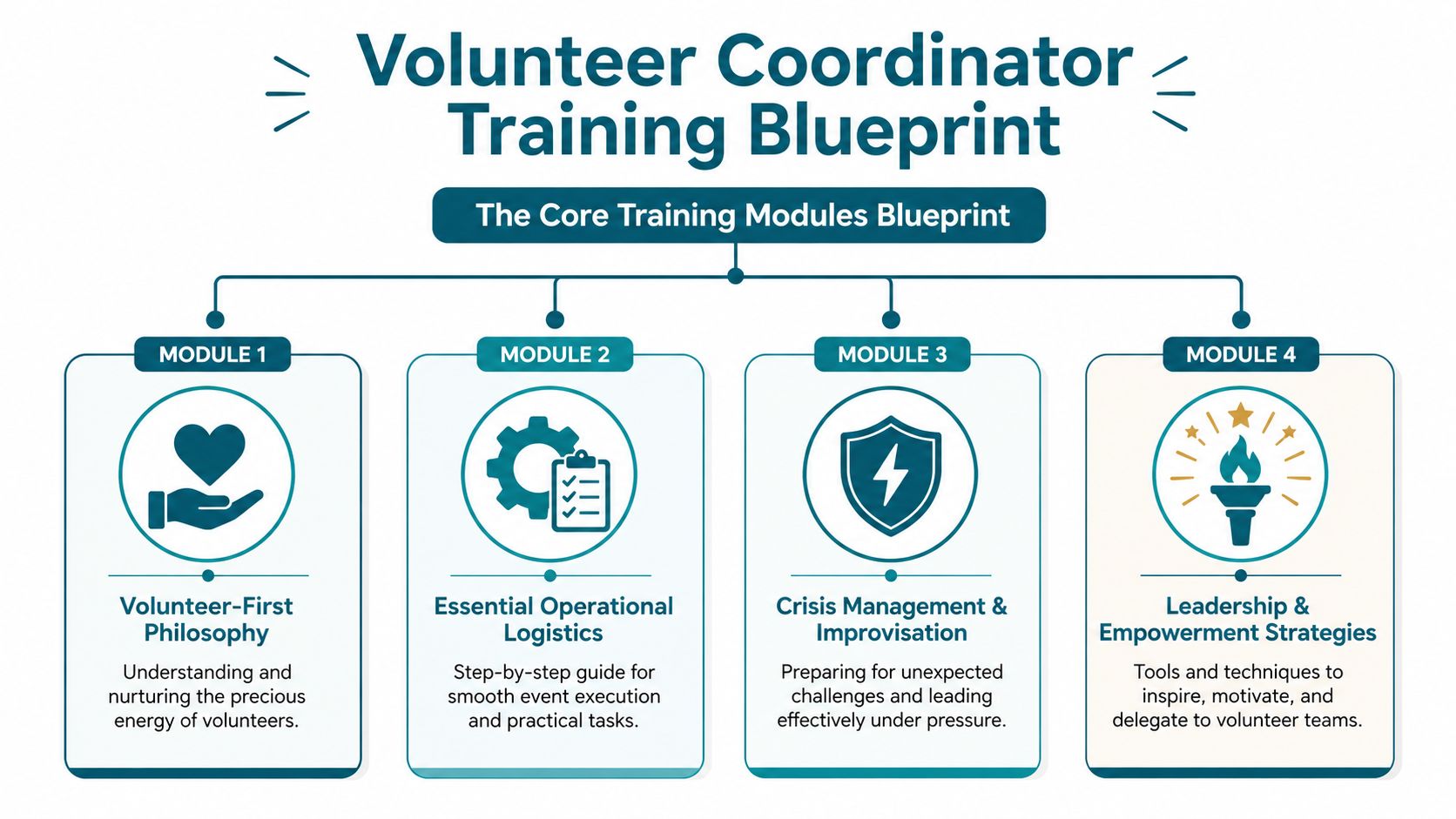
    The Core Training Modules Blueprint

    Good volunteer coordinator training needs structure. Otherwise you get a pile of advice and no repeatable system. I build the curriculum around a simple six-phase method: set goals, create a warm welcome, use hands-on practice, ensure accessibility, track progress, and ask for feedback. That framework comes from Training magazine's piece on crafting an effective volunteer training program, and it fits outdoor cleanup work well because it pushes training out of theory and into action.

    A diagram titled Volunteer Coordinator Training Blueprint showing four key instructional modules for managing volunteers effectively.

    Module one is philosophy

    Start with the part many groups rush past. Your coordinator needs a moral compass before they need a checklist.

    Teach them how to answer these questions in plain language:

    • Why are we here?
    • What do we do when output conflicts with safety?
    • How do we treat a volunteer who is struggling?
    • What kind of culture are we building when nobody is watching?

    This module should include role-play. One person acts as an eager volunteer who wants to do something unsafe. The trainee has to step in kindly and firmly. If they can't do that in practice, they won't do it in a parking lot with a crowd watching.

    Module two is operational logistics

    At this point, many coordinators either become calm or become frazzled. They need a repeatable system for event flow.

    I train for logistics in sequence:

    1. Scout the site
      Walk access points, traffic risks, likely trash concentration, and safe regroup spots.

    2. Build the morning plan
      Decide where people meet, where supplies go, who watches the edges, and what the exit plan is if conditions change.

    3. Run the huddle
      Keep it short. Cover hazards, roles, boundaries, and how to ask for help.

    4. Close cleanly
      Count people before gear. Debrief before everyone scatters.

    The point isn't perfection. The point is lowering mental clutter so the coordinator can pay attention to humans.

    For practical field systems, I like to compare each trainee's plan against proven volunteer management best practices for organized teams. It helps them see where they're loose, where they're overcomplicating, and where they're forgetting the volunteer experience.

    Module three is crisis management and improvisation

    A cleanup rarely follows the script. Weather changes. A route is blocked. A volunteer gets upset. The wrong training treats these moments like exceptions. Real training treats them like part of the job.

    Field note: Don't ask, “What's the official response to every possible problem?” Ask, “Can this coordinator stay calm, protect the group, and make a decent call fast?”

    Here are scenarios worth drilling:

    • Sharp object discovery: Who approaches, who stays back, who documents, who calls it in if needed.
    • Traffic creep: A site looked safe at scouting, but live conditions feel different.
    • Emotional conflict: Two volunteers are snapping at each other and infecting the group mood.
    • Sudden storm: End early, shelter in place briefly, or relocate.

    Module four is leadership and empowerment

    Some coordinators secretly think leadership means controlling everything. That creates brittle teams. I want leaders who can spread confidence.

    Train them to delegate small ownership fast. Let one volunteer handle sign-in. Let another lead a micro-team. Let a regular welcome newcomers. This has two effects. It lightens the coordinator's load, and it gives volunteers a ladder to grow on.

    A strong coordinator says things like:

    • “You've got a good eye for detail. Can you watch this corner?”
    • “Take our new person with you and show them how we sort this safely.”
    • “I need your judgment on whether this patch is worth the extra time.”

    That language builds leaders. If your volunteer coordinator training never teaches delegation, you're training bottlenecks.

    Training for Chaos with Real Scenarios

    Most training programs miss the mark for groups like ours. They are built for predictable indoor settings and skip the skills needed for blizzards, heatwaves, roadside work, and rough urban zones. A Michigan volunteer training resource page shows how much volunteer management education still centers on general nonprofit operations rather than physical adversity in the field.

    A volunteer coordinator overseeing various aid efforts including sorting donations, construction, and distributing meals to people.

    I learned this the hard way on a cleanup near a highway during a bike-event shutdown. The site looked simple from a distance. Up close, it had fast-moving traffic nearby, debris in ugly places, and the kind of noise that makes communication sloppy. That day wasn't about who could pick up the most trash. It was about who could stay composed and keep the group tight.

    Scenario one is the weather turn

    You start with a normal morning. Then the sky changes. Wind rises. Rain starts hitting sideways.

    A weak coordinator does this:

    • keeps pushing because people already came out
    • mumbles a half-decision
    • waits too long because ending early feels embarrassing

    A trained coordinator does this:

    • regroups everybody fast
    • speaks loudly and clearly
    • chooses shelter, exit, or cancellation without drama
    • counts heads before moving

    That decision needs rehearsal. People don't rise to the occasion in chaos. They fall to the level of their training.

    Scenario two is volunteer conflict

    This one sneaks up on you. One volunteer says another person is working too slowly. The second person fires back. Now half the group can feel the tension.

    I don't train coordinators to act like referees with whistles. I train them to lower the temperature. Pull both people aside. Separate the task from the ego. Give each person something useful to do.

    Try language like this:

    Situation What the coordinator says
    One person feels criticized “I need you with me for a minute. Let's reset this.”
    Two people are escalating “We're not doing this in front of the group. Come talk with me.”
    Group mood is slipping “Quick water break. Then we're splitting into smaller teams.”

    A coordinator should know when an issue is fixable on site and when someone needs to step away. That judgment protects everyone else.

    Before you put someone in charge of people, make sure they understand volunteer liability insurance and risk planning for group service work. Good instincts matter. Clear guardrails matter too.

    Scenario three is morale collapse

    Sometimes the site is just worse than expected. The bags fill slowly. The smell is brutal. People start making jokes that have a tired edge to them.

    Here, your coordinator becomes a storyteller. You don't lie. You don't pretend the work is easy. You help the group frame the hardship as shared effort with meaning.

    “This is a rough one. Stay steady. We'll take it one patch at a time.”

    That kind of line works because it is honest. Honest leadership settles people.

    Here's a quick visual on training volunteers and leaders to coordinate under pressure:

    Role-play these scenarios in training. Then run them outdoors. Let the trainees feel a little confusion while the stakes are still low. That's how they learn to carry confidence into a real event.

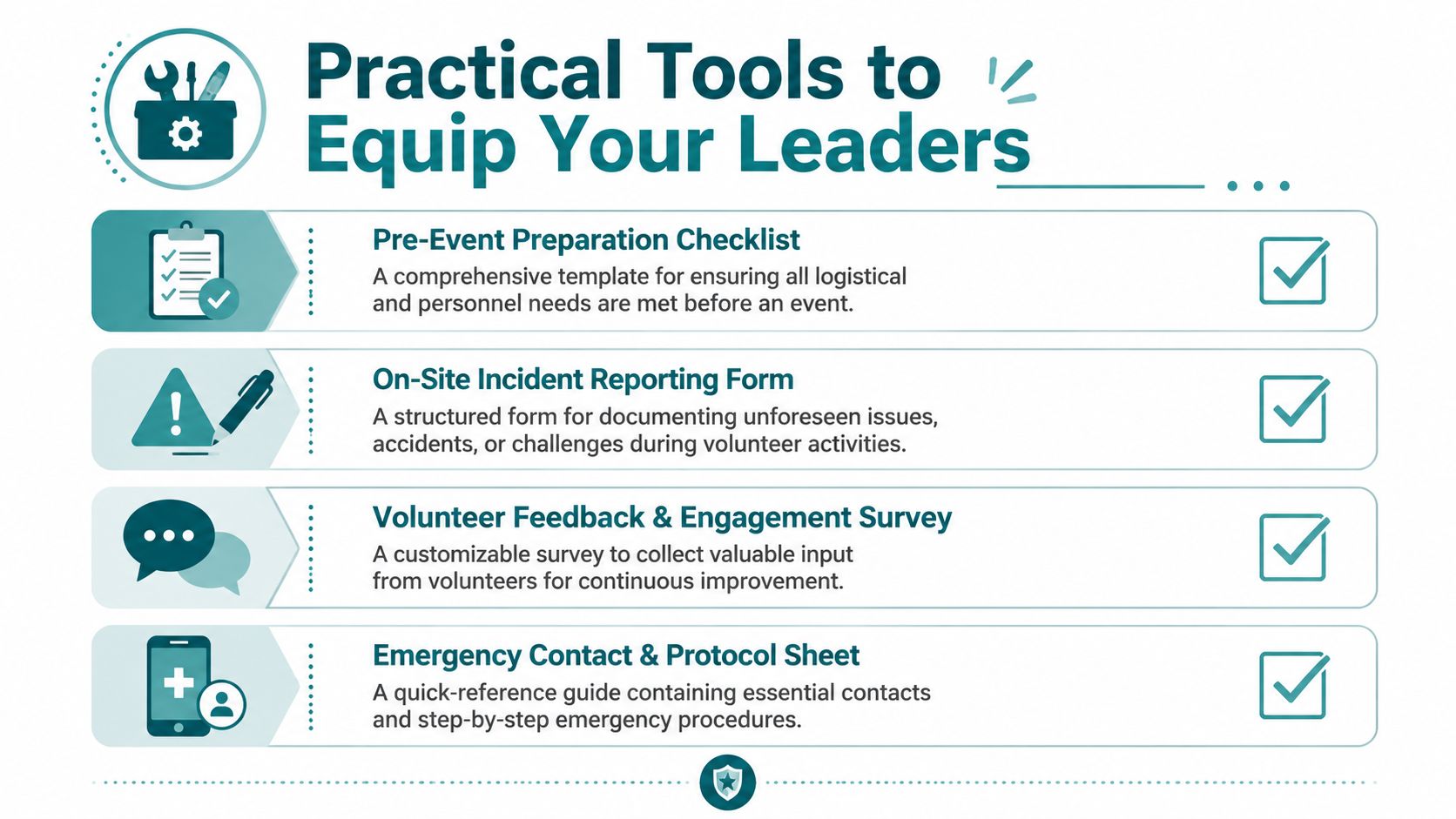
    Practical Tools to Equip Your Leaders

    Warm intentions won't carry a coordinator through a messy morning. Tools will. Good tools reduce mental load, standardize judgment, and help a leader stay present with people instead of drowning in little decisions.

    There's also a retention angle here. Volunteers who receive high-quality training are 83% less likely to leave, according to VolunteerHub's guide to nonprofit volunteer management. If you want coordinators to deliver that kind of training experience, give them equipment for the mind, not just gloves for the hands.

    An infographic titled Practical Tools to Equip Your Leaders listing four essential event management resources for volunteers.

    Four tools I'd hand every new coordinator

    • Pre-event preparation checklist
      Include meeting point, weather review, hazard notes, supply count, team roles, and exit plan. This tool prevents the dumb mistakes that drain a leader before the event starts.

    • On-site incident reporting form
      Keep it simple. Time, place, what happened, who responded, and what changed after. You want clarity, not legal theater.

    • Volunteer feedback and engagement survey
      Ask what felt clear, what felt confusing, and whether the person felt welcomed. Don't bury your coordinators in data. Give them a few questions that lead to action.

    • Emergency contact and protocol sheet
      This should live in every event kit and on every lead coordinator's phone. In a tense moment, nobody wants to dig through old messages.

    What these tools should look like

    I don't like bloated forms. They usually die in a folder. A field tool should be short enough to use with cold hands and a busy brain.

    One hard rule: If a coordinator can't use the form on site in under a minute or two, the form is too fancy.

    Here's a lean setup that works:

    Tool Keep it short by including Leave out
    Checklist top hazards, gear count, roles, weather note long policy text
    Incident form facts, action taken, follow-up needed emotional essays
    Survey welcome, clarity, safety, return interest pages of demographics

    Why tools help people feel safer

    A waiver, for example, isn't just legal paperwork. It's a conversation starter. It tells volunteers, “This work is real. Here are the risks. Here is how we handle them.” That honesty builds trust.

    A shift plan does the same thing. It says nobody is drifting alone. Everybody has a zone, a point person, and a way to ask for help.

    Train your coordinators to carry these tools lightly. They shouldn't hide behind them. They should use them to free up attention for what matters most: reading the room, helping new people settle in, and making good calls while the day moves fast.

    Measuring Success the Caterpillar Way

    A lot of groups judge the day by the pile of bags at the end. I get it. Trash is visible. Weight feels concrete. But if you only measure output, you can miss the health of the team doing the work.

    I'd rather know whether people came back, whether a new volunteer felt included, and whether the group left more steady than they arrived. Those signs tell you if your volunteer coordinator training is working.

    Start with speed into belonging

    One of the easiest ways to lose somebody is to let them linger too long between interest and action. A volunteer management guide warns that a time-to-onboard longer than two months from application to active service drives churn, as explained in VolunteerHub's guide for coordinators reclaiming time and balance. That matches street reality. If people wait too long, life moves on.

    So the first score I care about is simple: how fast does a new person feel like part of the team?

    That doesn't mean rushing safety. It means removing drag. Answer quickly. Give clear instructions. Pair them with a regular. Make the first day easy to understand.

    Use a mixed scorecard

    Don't build your whole dashboard around trash volume. Use a mix of hard signals and human signals.

    • Return rate: Are people showing up again after the first event?
    • Regulars: Do you have a stable core who know the rhythm?
    • Friendship signs: Are people talking after the work instead of vanishing the second it ends?
    • Volunteer-led action: Do people start taking initiative without being pushed?

    Some of this is measurable. Some of it is observational. Both matter.

    If your team leaves with less trash on the block but more strain in their faces, something is off.

    Watch the room after the cleanup

    The best clues usually come after the bags are tied. Do people linger? Do they exchange numbers? Does a first-timer laugh with someone they met an hour ago? Those moments tell you whether your coordinators are building a group people want to belong to.

    I also pay attention to the tone of the debrief. If volunteers feel safe giving honest feedback, your coordinators are doing something right. If everyone is polite but guarded, trust may be thinner than it looks.

    A good training program changes the way leaders see success. They stop asking only, “How much did we collect?” and start asking, “Did we make this a place people want to return to?” That question builds stronger crews.

    Training coordinators for outdoor adversity is really training them to create courage, calm, and connection under strain. When they do that well, the cleanup lasts a morning. The transformation lasts longer.


    If you want to build a tougher, kinder volunteer culture, spend some time with Litter Caterpillars. You'll find a living example of brave, volunteer-first cleanup work in Chicago, plus the kind of energy that turns service into friendship.

  • Illegal Dumping Prevention Your Community Playbook

    Illegal Dumping Prevention Your Community Playbook

    You know that feeling. You turn the corner by your alley, or pull up beside the lot near the bus stop, and there it is again. A couch with the stuffing ripped out. A busted toilet. A mountain of drywall that showed up overnight like somebody emptied a whole renovation into your block and vanished before sunrise.

    That kind of mess gets under your skin.

    I know because that anger is part of why I started cleaning. My own place was a mess for a long time. I had a weird emotional attachment to trash. Every old container, every dead battery, every forgotten bag in the corner felt heavy to me. Then my life cracked open after a chaotic relationship ended, and I made myself a promise. I was going to build a different kind of life with different kinds of people. Cleaner. Braver. More honest.

    Cleaning other people's trash turned out to be easier than cleaning my own.

    The first time we went out, there were only three of us. Chicago hit us with that classic nonsense weather. Hail, slush, freezing wind, rides canceling one after another while we huddled under a tree laughing at our own bad decisions. But something clicked for me in that storm. Service changed the story. Suffering gave it flavor. We weren't helpless anymore.

    That's the spirit behind illegal dumping prevention. You don't need to wait for a perfect grant, a formal committee, or some polished city plan. You can start with one disgusting pile and one stubborn decision.

    Your Call to Action Starts with a Mess

    A dumped couch is never just a couch.

    It's a message. Somebody looked at your block and thought, “Nobody will stop me here.” That stings. It feels personal even when it isn't. You see the same thing enough times and your brain starts telling you that this is just how your street is now.

    I stopped believing that the day I picked up my first bag.

    The pile that changed me

    For me, it wasn't one dramatic crime scene. It was the slow drip of trash and disorder, outside and inside my own life. I had spent years struggling to clean my room, clear my fridge, throw away things that were obviously dead weight. Then I started cleaning outside with other people, and I felt lighter almost right away.

    That's still one of the strangest truths I know. Cleaning up a stranger's mess can wake you up to your own power.

    One morning we found a stretch of street littered with the usual suspects. Food containers, broken plastic, fast-food cups, random clothes, a shopping cart missing a wheel. We didn't fix the whole neighborhood that day. We just filled bags until our hands hurt and the block looked cared for again. Neighbors started talking to us. One brought water. Another pointed toward a side lot and said, “If you can help over there too, that's where they really dump.”

    That's how it starts. One pile points to another. One cleanup turns into a map in your head.
    You don't need permission to care about a place.

    This isn't a tiny problem. In the United States, people illegally dump about 1.5 million tons of waste each year, and cost avoidance is a common reason people do it. A surprising number of businesses also say they don't know the fines for dumping construction waste, according to these illegal dumping facts from BigRentz.

    Start angry, stay useful

    Anger is fine. I've felt it a hundred times.

    What matters is what you do next. If you let that feeling harden into cynicism, the dumpers win. If you turn it into movement, even small movement, your block starts changing. You start changing too.

    Illegal dumping prevention begins long before cameras, calls, and fines. It begins when you stop walking past the mess like it belongs there.

    Find Your Ground Zero

    Don't try to save the whole city on day one. Pick one place that keeps bothering you. Your alley mouth. That dead-end lot. The side of the viaduct where people toss mattresses like they're feeding a beast.

    That spot is your ground zero.

    A woman with a backpack takes notes in front of a ruined building surrounded by illegal trash.

    When I started doing this seriously, I realized many onlookers view a dumping site as a gross blur. You need to look at it like a detective looks at a room. The pile tells a story if you slow down enough to read it.

    If you want to work block by block, it helps to see how your target site fits into the wider area. I like checking a broader neighborhood view with the Northeastern Illinois map and then zooming back into the exact trouble spot.

    Read the trash

    The first clue is the material itself.

    Household bags, old toys, kitchen chairs, and clothing usually point one way. Drywall, shingles, concrete chunks, and paint buckets point another. Tires tell their own story. So do mattresses. You don't need to play detective with perfect certainty. You just need a working theory.

    Use a simple checklist:

    1. What is it
      Write down the types of waste you see. Don't say “junk.” Say “broken dresser, carpet padding, black bags, tire, drywall scraps.”

    2. When did it appear
      If the pile is fresh on Monday morning, weekend activity is a possibility. If it grows in small bits every night, that tells a different story.

    3. How easy is the site
      Look for curb cuts, alley openings, darkness, fences with gaps, and places where a truck can back in fast and leave fast.

    Sketch the scene

    I'm a big believer in ugly field notes. You don't need fancy software. Use your phone, a notebook, or a screenshot with scribbles all over it.

    Mark these things:

    • Access points where a vehicle can pull in
    • Sight lines where nearby homes or stores can see the area
    • Shadows where bad lighting gives cover
    • Nearby anchors like schools, churches, loading docks, and vacant buildings

    A little hand-drawn map can save you weeks of guessing.

    Practical rule: Don't study ten bad spots badly. Study one bad spot well.

    Look for patterns, not drama

    One of the biggest mistakes I see is people reacting only to the latest ugly thing. They chase the newest mattress and ignore the pattern underneath it.

    The pattern is the primary enemy.

    Once you know why a place gets used, your next move gets easier. Maybe the answer is access control. Maybe it's lighting. Maybe it's regular cleanup. Maybe it's a nearby property owner who has stopped paying attention. But you won't know that from a quick glare out the car window. You'll know it because you stood there long enough to understand the place.

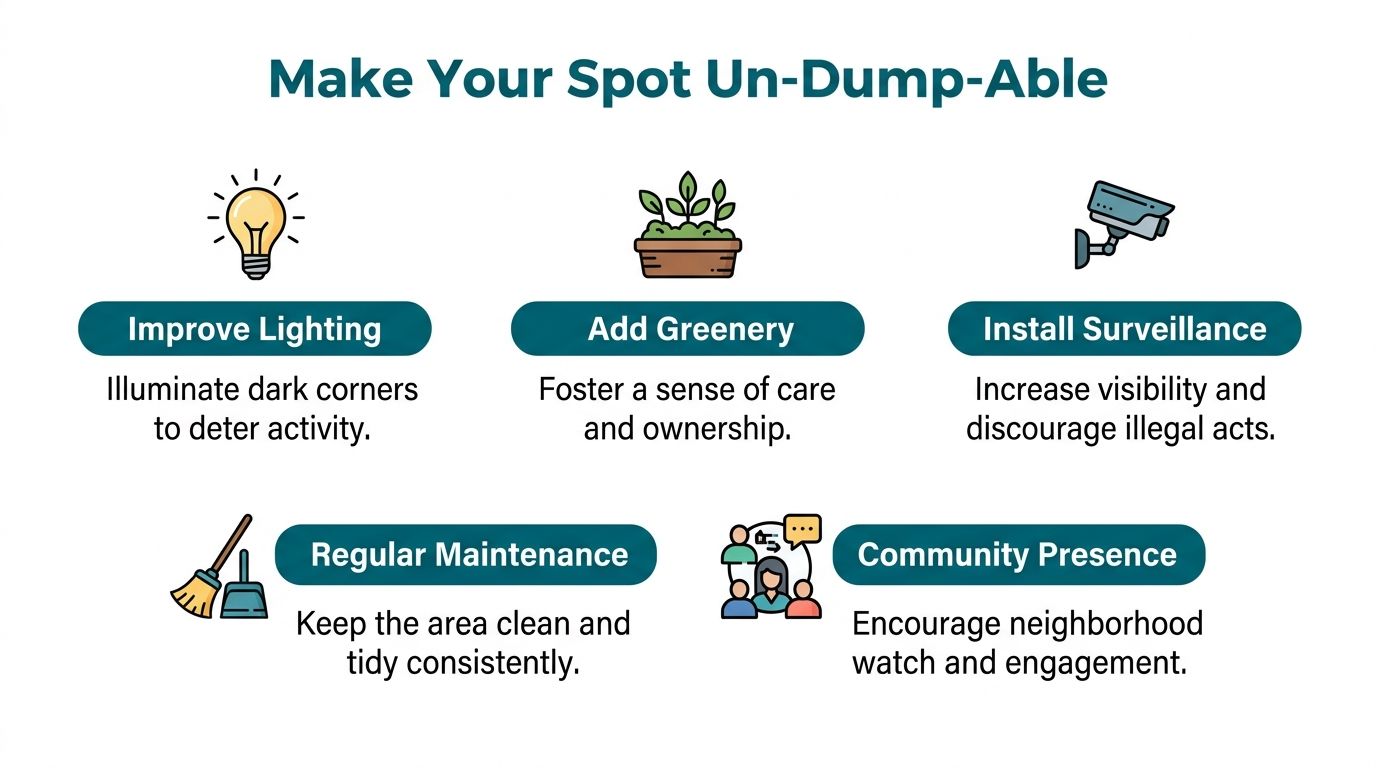
    Make Your Spot Un-Dump-Able

    The fastest way to invite dumping is to let a place look abandoned.

    Dumpers love a spot that feels unloved. Dirt patch, busted fence, no lights, no foot traffic, nobody claiming it. That kind of place is like an unsecured bike outside a train station. You don't have to make your site perfect. You just have to make it feel watched, used, and claimed.

    An infographic titled Make Your Spot Un-Dump-Able with five tips to prevent illegal dumping in areas.

    I think about Tom Sawyer here. He got punished with a fence and turned it into a source of pride. That's how I approach ugly corners. The point isn't to act cheerful about neglect. The point is to flip the script. You make care contagious.

    Make the place feel alive

    I've watched a dead-looking lot change personality with a few simple moves. We cleared the scattered trash, cut back the overgrowth, and gave the edges shape. Once a place has edges, people read it differently. It stops feeling like nowhere.

    Pilot studies show that regular mowing and cleanup make vacant lots less attractive for dumping because they signal active stewardship. Benches, walkways, and high-visibility lighting also remove the secluded feeling dumpers look for, according to this guide on preventing illegal dumping through site design.

    That matches what I've seen with my own eyes. A lot doesn't need to become some fancy mini-park overnight. Even a modest cleanup plus visible care can change behavior.

    Here's the video version of that idea in action.

    Use obstacles that make sense

    You're trying to make illegal dumping inconvenient.

    That can mean beauty. It can also mean friction.

    A few moves work well together:

    • Block the easy drive-in with heavy planters, big rocks, or bollards where cars and trucks usually back up.
    • Light the blind corner with a solar spotlight or other visible lighting.
    • Keep the ground readable by removing scattered debris fast so one bag doesn't invite five more.
    • Give the wall a face with a mural, painted fence, or even bold cleanup signage created by neighbors.

    If you want ideas from groups working on neighborhood care, I'd browse these litter prevention programs and steal what fits your block.

    A quick field table

    Site problem What I'd try first
    Trucks can back right in Planters, rocks, or barriers
    People dump at night Lighting and repeat check-ins
    Lot looks abandoned Mowing, edge cleanup, simple beautification
    Trash returns after each cleanup Faster follow-up and a visible community presence

    A cared-for place is harder to treat like a landfill.

    The point of illegal dumping prevention at the site level is simple. You want the dumper to feel exposed, inconvenienced, and uncertain. You want your neighbors to feel invited. Same block. Different message.

    Build Your Crew Not Just a Volunteer List

    The morning I knew we had something real, three people showed up before sunrise to a nasty little corner lot that kept filling with mattresses and busted cabinets. Nobody asked if enough volunteers had RSVP'd. One neighbor brought coffee in a dented thermos. Another had extra gloves in a grocery bag. We spent two hours hauling wet junk, talking about kids, rent, and who on the block might come next time.

    That is how a crew starts.

    A diverse group of friends smiling and working together on community gardening and home improvement projects.

    A signup sheet can help you count heads. It cannot build trust. Illegal dumping prevention lasts when people feel responsible for each other, not just responsible for a task. On the blocks where we kept the mess from coming back, the difference was never a giant database of names. It was a handful of regulars who knew who needed a ride, who hated lifting tires, and who could make everybody laugh when the work got grim.

    Friendship keeps people coming back.

    Cleanup groups burn out when the whole day feels like free labor with no human warmth. People stay when somebody remembers their name, notices they forgot water, or says, "Take the lighter bags, I got this one." That kind of care turns a Saturday chore into shared ground.

    If you are building from scratch, keep the structure light and the rhythm steady:

    • Start with the people already saying yes. Two committed neighbors beat twenty vague maybes.
    • Use one simple group chat. Fast communication matters more than fancy tools.
    • Pick a repeat time. First Saturday or every other Sunday works better than random calls for help.
    • Give the crew a small identity. A team name, a group photo, or post-cleanup coffee gives people something to belong to.

    If you want practical ways to bring in the right people, these volunteer recruitment strategies can help you start without turning your block into an office job.

    Some of the strongest bonds in our crew were built in bad weather. Cold hands. Muddy boots. A tire that should have taken one person but took three. Those mornings changed people. Neighbors who barely nodded before started checking on each other during the week. Quiet folks began leading corners of the cleanup. A person who came once to "help out" started talking like the block belonged to them, in the best possible way.

    That shift matters. Grassroots dumping prevention works because ordinary people stop seeing themselves as bystanders. They become stewards.

    I would still rather have six steady people than sixty names on a list. Here is what has helped us keep those six coming back:

    If you want Do this
    Better turnout Keep the day and time consistent
    Better retention End with coffee, snacks, or a short hangout
    Better trust Pair new people with regulars
    Better morale Celebrate the strange wins and the hard days

    Litter Caterpillars is one example of a Chicago cleanup group built around recurring meetups and open group chats, which gives neighbors a simple way to join and return.

    People come for the cleanup. They stay because the crew starts to feel like theirs.

    That is the part outsiders miss. We are not just removing trash. We are rebuilding the habit of showing up for one another, and that habit keeps a block cleaner longer than a one-time burst of volunteers ever will.

    Report Smartly and Safely

    When you catch fresh dumping or find a new pile, your first job is not to play hero.

    Your first job is to stay safe.

    Too many people feel pressure to confront someone in the act. I get the urge. I really do. But the smarter move is distance, detail, and documentation. You are much more useful to your neighborhood when you gather clear information and go home safely.

    An infographic detailing five numbered steps to report incidents smartly and safely in your community.

    Evidence beats outrage

    A vague complaint is easy to ignore. A precise report is harder to shrug off.

    If you can do it safely, take photos from a distance. Get the whole pile first. Then capture anything that helps identify the dump, like nearby addresses, alley entrances, company names on debris, or vehicle details if that can be done without risk.

    Use this sequence:

    1. Observe from afar
      If someone is present, don't confront them.

    2. Record the location
      Use the exact address or the nearest cross streets and which side of the alley or lot the waste sits on.

    3. Describe the contents
      Say what's there in plain words. Construction debris, furniture, black bags, tires, appliance parts.

    4. Submit through the right channel
      In Chicago, that often means 311.

    5. Keep your own record
      Save the photos, date, and report confirmation if you get one.

    Know the stakes

    Good reporting matters because the penalties can stack up.

    In Chicago, illegal dumping carries a mandatory fine of at least $300 and up to $600 for each offense, and each day the violation continues can count separately under Chicago Municipal Code 7-28-710.

    That doesn't mean every report leads to consequences. It means your documentation has real value when the city has enough detail to act.

    If you report, report like someone who wants the case to move.

    Protect yourself first

    You don't owe anyone a face-to-face confrontation.

    If you're worried about retaliation, stay even more disciplined. Shoot from farther back. Don't linger. Don't argue. Don't post identifiable details publicly while you're still near the site. Keep the chain simple and official.

    Illegal dumping prevention works better when residents act like calm witnesses, not street enforcers. Your power is in the record.

    Find Your Allies in City Hall

    A report is a transaction. A relationship is a tool.

    Once I learned that, things got easier.

    For a long time, I treated city government like a giant brick wall. You complain, wait, and maybe somebody somewhere sends a truck. But when your crew has field notes, cleanup photos, dates, and a clear ask, the whole interaction changes. You stop sounding like a person venting into the void. You sound like a neighbor who is already doing the work and needs one specific hurdle overcome.

    Show up as a partner

    Your local officials can help with things you can't do alone. They can point you toward the right department, help with special pickups, connect you with property owners, and sometimes support improvements on neglected land.

    I've had much better luck when I send a short message that includes:

    • Who we are
      A neighborhood cleanup crew or a few residents who have been working one site.

    • What we've seen
      The pattern, not just one ugly incident.

    • What we've done
      Cleanup dates, basic documentation, before-and-after photos.

    • What we need
      A sign, a pickup, contact with a landlord, guidance on the lot, or a meeting.

    That last part matters. Ask for one next step, not ten.

    Property owners matter more than people think

    Some blocks get trapped because everybody blames “the city” when the primary choke point is a private owner who stopped caring.

    That's why official connections matter. A survey of successful programs found that 73.1% of respondents rated “Business & Landlord Engagement” as a highly effective intervention, according to the Mattress Recycling Council's illegal dumping best practices report.

    I've seen this play out in a very ordinary way. A lot stays filthy for months. Neighbors keep cleaning the edges. Reports go in. Nothing sticks. Then one conversation finally connects the crew, the office, and the owner or manager who can authorize access, cleanup coordination, or a barrier fix. Suddenly the logjam breaks.

    Bring receipts and invite them outside

    Email is useful. Walking the site together is better.

    If you can get an alderperson's office, ward staffer, or another local official to visit your ground zero, do it. Let them stand where you stand. Let them see the blind corner, the tire ruts, the alley access, the weak fence line.

    People move faster when they can smell the problem.

    That's not about drama. It's about clarity. Your photos help. Your notes help. But a real site visit makes the ask concrete. You are no longer one more complaint in a crowded inbox. You are the organized neighbor who already picked up bags, mapped the problem, and came ready to work with them.

    That's the lane. Stay in it.

    The Real Win Is Keeping It Clean

    On our block, the first cleanup felt like a victory parade. We filled truck beds, stacked busted furniture at the curb, and took the photo everybody takes when a place finally looks like someone loves it again. Four days later, a torn mattress and three contractor bags showed up in the same corner.

    That was the lesson.

    A single cleanup can change the mood of a block. Keeping a place clean changes its future. The work gets quieter after the first big push, and that quieter work is what decides whether a dumping spot dies or keeps coming back.

    I've watched good people burn themselves out by treating one Saturday like the finish line. Then the next mess lands, and it feels personal. It isn't. It usually means the spot still has easy access, weak visibility, or no regular set of eyes on it. A comeback pile does not cancel what you did. It tells you where the next layer of the job is.

    Stewardship beats one-time heroics

    The cleanest corners I know are not maintained by superheroes. They're held by neighbors with a rhythm.

    On one alley we worked, an older guy walking his dog every morning became the first line of defense without ever calling himself an organizer. He noticed new debris fast. A younger neighbor snapped photos and filed reports. Another person could handle a quick bag pickup when it was safe. Nobody did everything. Together, they kept the spot from sliding back into that familiar signal every dumper reads instantly: nobody's watching.

    A simple rotation works:

    • One watcher who notices changes early
    • One reporter who sends clear photos and location details
    • One fixer who handles small, safe touch-up cleanup
    • One connector who keeps nearby neighbors in the loop

    That little bit of structure matters more than hype. A place stays cleaner when care becomes routine.

    Ask why people dump here

    We learned this the hard way too. Some sites attract dumping because they feel hidden. Others attract it because getting rid of bulky trash legally is expensive, confusing, or both.

    Those causes need different answers.

    Research on illegal dumping has found that cost and disposal access can drive the problem, and Los Angeles sanitation officials reported sharp drops in dumping in some areas after free bulky-item collection efforts were expanded, as noted in the City of Los Angeles Bureau of Sanitation report on illegal dumping prevention and bulky item strategies. That matches what we see on the ground. If legal disposal is hard to reach, some people choose the alley and hope nobody stops them.

    So ask the plain question. Is this spot getting hit by opportunists, by contractors dodging fees, by neighbors with no easy pickup option, or by all three? The answer changes your next move.

    Keep the human goal in view

    A clean lot gives people room to breathe.

    You notice it in small ways first. Kids stop skirting around broken glass. The woman from two houses down lingers on the sidewalk instead of rushing past. Somebody drags out a chair. Somebody plants flowers by a fence that used to collect trash. The space starts acting like part of the neighborhood again.

    That is why we keep showing up.

    We may begin with grabbers, gloves, and a pile that makes everybody angry. If we stay with it, we end up with something bigger than a cleanup. We build trust. We build habits. We help each other believe that a block does not have to stay the way we found it.

    Illegal dumping prevention works best when regular people decide a place is worth defending, then keep proving it in public.

    If you want to do this with other people who already know the rhythm of weekend cleanups, hard weather, and stubborn blocks, join Litter Caterpillars. Bring gloves, bring a friend, and start with one mess. That's enough.

  • How to Start a Volunteer Group: Your 2026 Playbook

    How to Start a Volunteer Group: Your 2026 Playbook

    Three of us stood under a tree in a spring hail storm, shaking, waiting for Ubers that kept canceling. We had trash bags in our hands, numb fingers, and one weird thought that changed everything: cleaning other people's messes felt easier than cleaning our own.

    The Spark That Starts the Cleanup

    I didn't start with a grand plan. I started with a mess.

    My apartment was a mess, but that wasn't the hard part. The hard part was that every useless object had a little emotional hook in it. An old jar of blueberry jam from a trip years ago. A stale bag of nuts from one of those short-lived healthy phases. None of it weighed much, but in my head it was all heavy.

    Then my life blew up a bit. A chaotic relationship ended. I looked around and realized I didn't trust myself much. I wasn't consistent. I avoided hard things. I let clutter win.

    So I tried something sideways. I went outside and picked up litter.

    A woman sitting on the floor surrounded by messy paperwork with a bright lightbulb icon above.

    Why other people's messes feel lighter

    This is the part most guides miss. Service isn't only about output. It changes you while you do it.

    When you clean your own mess, shame gets involved. Memory gets involved. Regret gets involved. When you clean a sidewalk, a vacant lot, or an alley, the task is cleaner in your mind. There's a bottle on the ground. You pick it up. The story ends there.

    That simplicity matters.

    I learned a strange truth fast: cleaning other people's messes is way easier than cleaning up our own. And because it's easier, you do it. Then you finish. Then you feel useful. Then your brain starts collecting proof that you can show up and make things better.

    Cleaning public messes gave me a way to practice self-respect without staring directly at my own failures.

    That's a solid starting point for how to start a volunteer group. Your first spark doesn't need to sound noble. It just needs to be honest. Maybe you're lonely. Maybe you're angry at what you keep seeing in your neighborhood. Maybe you need structure. Maybe you need sunlight and better friends.

    Any of those reasons can work.

    Find the part that hits you in the chest

    Your group's early energy comes from one thing: a real motive. People can feel the difference between borrowed language and a lived reason.

    Ask yourself:

    • What problem makes you stop walking? Trash on your block, seniors who need rides, a park nobody uses because it feels neglected.
    • What kind of action gives instant proof? Tangible work helps. You can see a clean street, a painted fence, a stocked pantry.
    • What personal wound does this work bypass? Sometimes service opens a back door into healing.

    A volunteer group gets stronger when the founder knows why they're doing it. Not the polished answer. The true one.

    Mine was simple. I wanted to become cleaner, braver, and more consistent. I wanted to build a social circle around giving instead of taking. Picking up litter gave me a practice field.

    And weirdly, the hardship helped. The cold. The rain. The hail. Shared discomfort gave the day flavor. It turned a chore into a story.

    That story is often where your group begins.

    Find Your Mission Before You Find Your People

    A lot of people start backwards. They make an Instagram page, brainstorm names, invite friends, and only then ask what the group is for.

    That's how you end up with vague energy and weak turnout.

    If you want to learn how to start a volunteer group that lasts, get specific before you recruit. The first real move is a needs assessment. Before you write a mission statement, you must conduct a thorough needs assessment to identify what your community lacks. Given that 6.5% of the global working-age population engages in formal volunteering, your group has to prove why your use of people's time is worth choosing.

    Start with the block, not the brand

    Don't ask, “What kind of organization should I build?”

    Ask, “What is broken near me, and what can I fix with a small crew?”

    Walk your area. Take notes. Talk to the people who already live with the problem. If you care about litter, don't just say, “The city is dirty.” That's too broad. Find the repeated pain points.

    A simple needs assessment can be ugly and still work:

    1. Walk three to five target areas and write down what you see.
    2. Look for repeated patterns like overflowing corners, illegal dumping spots, or neglected park edges.
    3. Ask locals one direct question. What do you wish somebody would fix around here?
    4. Check what already exists so you don't duplicate someone else's effort.
    5. Pick one visible win your group can own.

    That's enough to start.

    Choose a problem people can feel

    Some missions are worthy but fuzzy. Fuzzy missions are harder to recruit for.

    Visible problems have an advantage. If a volunteer shows up for two hours and can see the before and after, the work lands deeper. People feel the shift in their body. The street looks different. Their hands did that.

    Practical rule: Pick a mission that a stranger can understand in one sentence and spot from across the street.

    That's one reason cleanup groups are sticky. The result is concrete. The bag fills up. The lot opens up. The curb stops looking abandoned.

    Filter for the right people

    Focus is your friend. If you try to attract everyone, you attract almost no one.

    Weekend mornings, for example, create a quiet filter. People who show up then usually want to give. They chose service over sleeping in, brunch, or a late night. That doesn't make them better. It just means they fit the culture you're trying to build.

    Your mission needs three clean edges:

    • The problem you solve
    • The kind of person you want beside you
    • The kind of energy you won't build around

    Write your mission after that.

    Keep it plain. “We clean neglected blocks every Saturday morning.” “We visit shut-ins with groceries and conversation.” “We restore neighborhood gardens one bed at a time.” Short beats fancy. Direct beats broad.

    People don't join blur. They join clarity.

    Build an Identity People Want to Join

    Plenty of groups can get a volunteer to show up once. The hard part is getting them to feel like they belong.

    Identity does that job better than logistics ever will.

    My favorite example is still that first cleanup in the hail storm. Three people. Cold hands. No easy exit. It should have been miserable. Instead, it became funny, memorable, and weirdly bonding. We suffered a little together, and the day stopped being a task. It became an origin story.

    A group needs flavor

    Most volunteer groups stop at the practical layer. Gloves, sign-up form, safety talk, group photo. Fine. You need those.

    But if you stop there, your group feels like an errand.

    People stay when the group has flavor. I mean a real shared feel. A logo that means something. A phrase people repeat. A song. A flag. A ritual after the event. Even a running joke. These things sound small until you watch them work.

    An infographic titled Building Your Volunteer Identity, showing the core mission supported by values, stories, and community.

    Pride rituals matter because volunteering is not only labor. It is identity. According to Stand Together's volunteering piece, groups that use badges, theme songs, and flags retain 3.4 times more participants and report 68% higher happiness scores. The same source says 79% of volunteers report higher emotional fulfillment when they tackle visible, tangible problems like litter.

    That tracks with what I've seen. People don't only want to help. They want to feel part of a story worth repeating.

    Borrow from sports, not from office culture

    Sports teams understand something volunteer groups often ignore. People love symbols.

    A jersey, chant, flag, and mascot can turn strangers into a unit fast. You don't need to become corny, but you do need to give your people something to rally around. Office culture gives people name tags and stale muffins. Teams give people colors and songs.

    Use the team model.

    Here are a few identity tools that work:

    • A repeating symbol: A patch, sticker, button, or badge gives people a visible marker.
    • A ritual start: A short huddle, motto, or group photo at the same point each event builds rhythm.
    • A hardship story: Your hail storm, flat tire, muddy cleanup, or freezing morning becomes shared folklore.
    • A playful language: Little phrases and inside jokes make the group feel lived in.

    Pride is not vanity. Pride tells volunteers, “I'm the kind of person who does this.”

    Make volunteers the heroes

    A bad group identity makes the founder the main character. A good one makes the volunteers feel like they joined a crew with a mission.

    That changes how you speak. Don't build your story around your personal sacrifice. Build it around the kind of person your volunteers become when they keep showing up.

    You want someone to leave an event thinking:

    • I'm braver than I thought.
    • I can do hard things with other people.
    • This is my kind of crowd.
    • I want the next chapter.

    That's the deeper answer to how to start a volunteer group people remember. Give the work shape. Give the group a soul. Give the hard days a story people will laugh about later.

    Gather Your First Crew and Get to Work

    Your first crew doesn't need to be big. Mine wasn't. Three people is enough to start a story.

    What matters is that people can say yes fast. If your invite reads like homework, they'll scroll past. If it feels simple, safe, and concrete, you've got a shot.

    Screenshot from https://www.littercaterpillars.com

    Start with direct invitations

    Don't hide behind branding. Text people.

    A first invite should answer five things in plain English: what, where, when, why, and what to bring. Meetup, Instagram, and group chats are enough at the start. You don't need a polished funnel. You need clear words and a real event.

    Here's the shape I like:

    • What we're doing: “Neighborhood trash pickup”
    • Where we're meeting: “Corner of X and Y”
    • When: “Saturday at 9 a.m.”
    • Why it matters: “This block keeps getting ignored”
    • What to bring: “Closed-toe shoes, water, clothes you don't mind getting dirty”

    That's it.

    If you want more ideas on messaging and channels, this guide on volunteer recruitment strategies is a useful place to compare outreach approaches.

    Recruit by role, not by vague enthusiasm

    People respond better when they know the lane they're stepping into.

    That's especially true across age groups. When recruiting, know your audience. 27.2% of Gen X leads in formal volunteering, which makes them a strong fit for structured roles, while 58.7% of Baby Boomers lead in informal helping, which makes them a strong fit for flexible, ad-hoc actions.

    So don't post one mushy invitation and hope for the best. Match the ask to the person.

    A practical split looks like this:

    Group Better ask Example
    Gen X Structured roles Weekly route lead, supply organizer, check-in helper
    Baby Boomers Flexible actions Drop-in cleanup, snack support, one-off neighborhood push
    Students and young professionals Social plus visible work Morning cleanup followed by coffee
    Existing friends Starter roles with low friction Bring gloves, invite one person, help collect bags

    Plan day one like a small field operation

    The first event should feel easy to enter. I like a short script.

    1. Meet at a location people can find without confusion.
    2. Greet everyone by name.
    3. Hand out supplies fast.
    4. Give a short safety talk.
    5. Split into pairs or small teams.
    6. Set a clear end time.
    7. Take one group photo.
    8. End with a quick recap and casual hangout if people want it.

    You don't need to impress people. You need to remove uncertainty.

    If volunteers spend the first twenty minutes wondering what's happening, you've already lost energy you may not get back.

    A good first event also has a visible finish line. Don't try to clean an entire neighborhood on day one. Pick one stretch, one lot, one alley, one park edge. Let people experience completion.

    Here's a look at the kind of field energy that gets people moving:

    Keep the ask honest

    I've learned to avoid overpromising. Don't tell people they're joining a movement if you've never run a cleanup before. Tell them the truth.

    “We're starting small.”
    “We're trying this consistently.”
    “We're building a good crew.”
    “We want this to be useful and fun.”

    That honesty helps the right people trust you.

    And one more thing. End on time.

    A volunteer who gives you two clean hours and leaves smiling is more likely to come back than a volunteer trapped in a sloppy four-hour marathon. Respect the edge of people's energy. That's one of the oldest rules in the game.

    Create a Safe and Simple Structure

    A volunteer group falls apart in boring ways. Confusing sign-ups. Missing waivers. No safety rules. No one knows who is in charge. A new person arrives and just sort of stands there.

    That's avoidable.

    The structure you build is not bureaucracy. It is care. It tells people, “Your time matters. Your body matters. We thought about your first day before you got here.”

    Make joining easy

    The front door matters more than people think. A registration process that takes more than 3 minutes increases volunteer dropout by 45%, and 32% of early volunteer burnout comes from people feeling their role is meaningless according to CivicPlus on creating an effective volunteer program.

    That means your sign-up should feel almost frictionless.

    Use a simple mobile-friendly form. Ask only what you need. Name, contact info, emergency contact if relevant, and anything tied to safety. Don't bury people in fields and legal language before they've even met you.

    Then follow fast with a clear message:
    where to go, what to wear, what to expect, who to contact if they're lost.

    Give every person a role with edges

    A volunteer burns out faster when the role feels foggy. “Come help however” sounds relaxed, but it often creates confusion.

    People feel better when they know where they fit. Keep roles simple:

    • Greeter: Welcomes people and checks names
    • Safety lead: Reviews hazards and watches pace
    • Supply runner: Manages gloves, bags, grabbers, water
    • Route lead: Knows the area and keeps the team together

    That doesn't mean you need a huge hierarchy. It means each person can answer one question: what am I doing today?

    If your work carries physical risk, get smart about it. Review your legal setup, waivers, and coverage early. This overview of volunteer liability insurance is a practical starting point for thinking through protection.

    Your First Cleanup Event Checklist

    Category Item Notes
    Planning Meeting point Pick a place that is easy to find and easy to leave from
    Planning End time Tell people when the event ends before work starts
    Safety Gloves Bring extras in multiple sizes
    Safety Closed-toe shoe reminder Send this before the event, not at the event
    Safety Hazard policy Tell volunteers what they should never pick up
    Supplies Trash bags Bring more than you think you need
    Supplies Grabbers or pickers Helpful, but not required for a first event
    Supplies Water Keep extra on hand
    Communication Group chat or text thread Use one channel so updates don't scatter
    Onboarding Quick briefing Explain the route, the goal, and who to ask for help
    Onboarding New volunteer buddy Pair first-timers with someone calm and friendly
    Wrap-up Disposal plan Know where the collected trash goes before you start

    Field rule: If a first-timer doesn't know where to stand, what to do, or what matters, your system is too loose.

    Written policies calm people down

    Written policies sound formal, but they remove tension. Put basic rules in one place. Weather policy. Safety boundaries. Photo consent. Conduct expectations. What happens if someone finds a needle or other dangerous item. What to do if a volunteer feels sick or unsafe.

    Keep the tone human. Short sentences. Real examples.

    A simple structure lowers anxiety. And lower anxiety gives you more energy for the work itself.

    Keep the Fire Burning with Friendship and Purpose

    Starting is exciting. Staying steady is harder.

    A group lasts because people build habits and relationships around the mission. If your volunteers only feel useful, they may drift away. If they feel useful and connected, they start protecting the group with their own effort.

    Consistency beats intensity

    I like weekly rhythms. Same morning. Same general pattern. People begin to build their life around it.

    That consistency creates trust. It also lowers the mental cost of showing up. Nobody has to wonder when the next chance is. They already know.

    To keep that rhythm healthy, you must develop written policies for safety and consistency, and prepare training that gives volunteers space to ask questions and hear the rules clearly, as explained by VolunteerMatters on starting a volunteer program.

    That kind of structure doesn't make a group stiff. It makes the group dependable.

    Friendship is retention in human form

    I don't think money is the main fuel in volunteer work. Energy is. Attention is. Trust is. Friendship is.

    People come back when they know somebody will smile when they arrive. They come back when there's a shared joke, a post-cleanup coffee, a familiar walking partner, a sense that they'd be missed.

    If you want practical ways to keep people engaged over time, these volunteer retention strategies are worth reading alongside your own observations.

    Try a few simple habits:

    • Celebrate small wins: Name the block you finished, the lot you cleared, or the story from the day.
    • Protect volunteer energy: Don't guilt people. Don't pressure them for money. Don't treat goodwill like an unlimited resource.
    • Leave room for conversation: A few unhurried minutes before or after the event often matters more than one more bag of trash.

    A volunteer group becomes durable when people join for the mission and stay for the friendships.

    Keep reminding people who they are becoming

    The work changes people slowly. That's one of my favorite parts.

    Someone who felt shy starts greeting new volunteers. Someone who never woke up early starts protecting Saturday morning. Someone who felt stuck starts trusting themselves because they kept one promise over and over.

    That's the deeper reward. You clean a street, sure. But you also practice courage, consistency, and care in public with other people. Done long enough, that starts to spill into the rest of life.

    If you're thinking about how to start a volunteer group, start smaller than your ego wants and with more heart than your spreadsheet wants. Then keep showing up. The group will teach you what it needs next.


    If you want a real-world example of this kind of work in motion, visit Litter Caterpillars. You'll find a volunteer-driven cleanup group built on bravery, kindness, friendship, and the belief that service can change a block and the person holding the trash bag.

  • A Bold Guide to Litter Prevention Programs

    A Bold Guide to Litter Prevention Programs

    The first time I picked up litter with friends, hail hit us so hard we had to hide under a tree. Our rides kept canceling, our hands went numb, and somehow that miserable little cleanup became one of my favorite memories.

    Start Where You Are With What You Have

    I'll tell you something awkward. Cleaning up a sidewalk was easier for me than cleaning my own apartment.

    For years, I let junk pile up around me. An old jar in the fridge had a memory attached to it. A broken bag had a story. Every useless object felt heavy. Not physically heavy. Soul heavy. I could step over the mess for months and still not move it.

    Then my life cracked open. I got out of a chaotic relationship, looked around at the room I had built around myself, and realized I couldn't keep living like that. I needed practice doing hard things. I needed to train consistency the way some people train for a marathon. I needed one simple act I could repeat.

    So I picked up one piece of trash outside.

    That sounds tiny because it is tiny. But tiny actions are like the first tooth on a zipper. Once it catches, the whole thing can move.

    A woman holding a trash bag standing in a messy living room needing cleaning and organizing.

    Your first cleanup is personal

    Litter prevention programs are often discussed as if they start with a plan, a committee, or a grant. Mine started with shame, then stubbornness, then a trash bag.

    You don't need a polished origin story. You need a corner that bothers you enough to act. Maybe it's the bus stop with fast-food wrappers pinned against the curb. Maybe it's the alley behind your building where the wind keeps making the same joke with the same plastic bag. Maybe it's the park path you walk every morning and complain about every morning.

    Pick that spot.

    Then do something so small your excuses look silly next to it. Fill one bag. Walk one block. Spend twenty minutes.

    Practical rule: Start before you feel ready. Motivation usually arrives after your hands start moving.

    There's another reason I like this beginning. It changes the shape of the problem in your mind. A giant issue can freeze you. A single cup in the gutter can't.

    According to the Keep America Beautiful 2026 National Litter Study, approximately 35 billion pieces of litter still remain across public spaces in the United States, and the country spends about $11.5 billion annually dealing with it. That number is huge, but I take comfort from it too. Every piece you pick up is part of a real collective effort, even if nobody claps for you.

    Inertia is the real enemy

    Trash looks like the obstacle. It usually isn't.

    A significant obstacle is that sticky feeling in your chest that says, “Someone else should handle this.” Or, “It's too far gone.” Or, “One person can't do much.” I've heard every version because I've said every version.

    Litter prevention programs work best when they break that spell. The first win is not a clean block. The first win is proving to yourself that you're a person who shows up.

    I've seen this happen in weird little flashes. Someone bends down for one bottle and then notices five more. A person who felt useless all week goes home sweaty, tired, and proud. A street that looked abandoned starts to look claimed.

    That's how it begins. Not with perfection. With contact.

    A simple first-day playbook

    If you're stuck, do this:

    • Choose one visible spot: Pick a place you already pass often. Repetition matters more than drama.
    • Bring basic gear: Gloves, a bag, and closed-toe shoes are enough for day one.
    • Set a short timer: Twenty or thirty minutes keeps the task from turning into a mental monster.
    • Leave one note for yourself: Take a photo, or write down how you felt before and after. You're building proof.

    I didn't know any of this would change my life when I started. I just knew I needed to stop waiting for a different personality to arrive and save me.

    You might be waiting for that too. Don't. Start where you are. Use what you have. Grab the first piece.

    Find Your First Three People

    My first group was tiny. Three people, a bad weather forecast, and the kind of optimism that looks a lot like poor planning.

    We got caught in a spring hailstorm. We huddled under a tree, laughing and shivering while our phones lit up with canceled rides. I remember thinking that this should feel like failure. Instead it felt like the beginning of a team. Shared discomfort has a way of cutting through small talk fast. You find out who can laugh. You find out who stays calm. You find out who says, “Same time next week?”

    That's what your first cleanup is really for.

    Screenshot from https://www.littercaterpillars.com

    Look for givers, not spectators

    You don't need a crowd. A crowd can make the first day worse. Too many strangers, too much drift, too much pressure to perform.

    You need your first three people. I like three because it has balance. If one person cancels, the cleanup still happens. If one person is shy, two others can carry the conversation. Three people can make a rough morning feel alive.

    Find them in places where people already lean toward service and curiosity. Community chats. School groups. Neighborhood forums. Weekend clubs. Friends of friends who always say yes to helping someone move a couch.

    When I want to explain how to do this clearly, I point people to a practical guide on how to find volunteers for neighborhood cleanup work.

    Don't recruit with polish. Recruit with honesty. “I'm cleaning this block Saturday morning. Want to join me?” beats a fancy pitch most of the time.

    Make the first ask small and clear

    People say yes when the shape of the ask is obvious.

    Compare these two invitations:

    • “I'm starting a citywide anti-litter initiative.”
    • “I'll be at the corner of Ashland and 18th at 9 a.m. Saturday with gloves and bags. We'll clean for an hour.”

    The first one sounds like homework. The second one sounds real.

    A strong first invite has a few simple parts:

    • Time: Weekend mornings work well because they attract people who want to give part of their day.
    • Place: Choose somewhere easy to find.
    • Length: Keep it short enough that people don't fear getting trapped.
    • Tone: Make it human. “Come help” is better than “Join our mission-driven engagement effort.”

    Let the story do the recruiting

    After that first stormy cleanup, I didn't have to sell the experience very hard. The story did the work.

    “Three of us got stuck in hail, picked up trash anyway, and laughed the whole time.”

    That kind of story has a pulse. People can feel it. It tells them this isn't a sterile volunteer shift where everyone signs a form, poses for a photo, and vanishes. It tells them there's room for grit, humor, and a little absurdity.

    Litter prevention programs live or die on repeat attendance. Repeat attendance grows when the first day gives people a memory, not just a task.

    So if something goes wrong on day one, don't panic. Rain starts. Fine. Someone's late. Fine. The route is rougher than expected. Fine. If the group stays kind and keeps moving, the mess-up becomes flavor. People remember flavor.

    Your Simple Plan for Safety and Supplies

    The fastest way I ever lost a volunteer was not boredom. It was a blackberry thorn.

    We were cleaning an alley behind a row of garages, the kind with busted fencing, dumped fast-food bags, and weeds tall enough to hide trouble. A new guy reached into the brush with bare hands before I could stop him. He came back with a scratched wrist and a look that said, "You people do this for fun?" He never returned.

    That morning taught me something plain. Safety is how you prove this group takes care of its own.

    A safety infographic showing six essential items for volunteer litter prevention teams including protective gear and supplies.

    Pack like you're taking care of friends

    I stopped treating supplies like extras after that. Now I pack for the person who showed up eager, underprepared, and trusting me more than they should.

    My kit stays simple. Sturdy gloves. Litter grabbers. Bright vests. Contractor bags. Hand sanitizer. Sunscreen. Water. A basic first aid kit. Closed-toe shoes are required, and if we are anywhere near traffic, I hand out vests before the first bag comes open.

    None of that is glamorous. That is the point.

    Cheap gloves tear. Thin bags split at the bottom and baptize somebody's shins in old coffee. Short grabbers turn a one-hour cleanup into a lesson in lower-back pain. Good gear changes the mood of the day because people stop bracing for irritation and start paying attention to each other, the street, and the small wins.

    Give the same safety talk every time

    I keep the briefing short enough that nobody zones out and clear enough that nobody has to guess.

    Here's the version I use:

    1. Watch for cars, bikes, loose gravel, and broken pavement.
    2. Do not touch needles, broken glass, or anything suspicious with bare hands.
    3. Stay where someone can see you.
    4. Drink water early, not after you feel lousy.
    5. If a spot feels wrong, leave it and call me over.

    The talk takes about a minute. The effect lasts all morning. It tells people they are not disposable labor. They are teammates.

    If you run public cleanups often, insurance matters too. This guide to volunteer liability insurance for cleanup groups is a good place to sort out the practical side before your group grows.

    A cleanup should send people home tired, proud, and ready to return.

    Pick routes with your eyes open

    I learned route planning from a bad Saturday on a four-lane road.

    On paper, the block looked perfect. Heavy litter, easy parking, visible impact. In real life, it had speeding traffic, no shoulder, nowhere safe to stack full bags, and a bus stop that kept spilling people into our work zone. We spent more energy watching our backs than cleaning. The volunteers were polite about it, but I could feel the trust drain out of the group.

    Now I scout with three questions in mind.

    • Can people enter and leave the area without playing frogger
    • Where do full bags go before pickup
    • What hazards are waiting for us before we even start

    Those questions do more than prevent a rough day. They help match the route to the crew. Families and first-timers get parks, sidewalks, trailheads, and quiet side streets. Experienced volunteers can handle the ugly corners with steeper banks, illegal dumping, or heavier traffic.

    You also start to see the deeper story of a place. A block with constant litter and no working trash can does not have a volunteer problem. It has an infrastructure problem.

    A simple field checklist

    Before I leave home, I run through the same checklist every time:

    Item Why I bring it
    Gloves Protect hands from grime and sharp edges
    Grabbers Save backs and reduce direct contact
    Bright vests Help drivers and cyclists see us
    Water Keeps energy steady
    First aid kit Handles small scrapes fast
    Extra bags Gives the route breathing room

    That list looks almost too plain to matter. Plain works.

    People come back when the day feels cared for. They remember that somebody had extra water. Somebody noticed the blind corner before they stepped into it. Somebody brought enough gloves for the friend who showed up empty-handed. That is how a cleanup stops being a one-off good deed and starts becoming a place where people trust each other.

    Make It an Adventure Not a Chore

    Tom Sawyer understood something a lot of organizers miss. If work feels like punishment, people flee. If work feels like a game with pride attached to it, people lean in.

    That's how I think about retention. You can hand people a grabber and a trash bag, but that alone won't build a team. A team needs flavor. It needs a little theater. It needs something people can belong to.

    A diverse group of volunteers cleaning up trash on a beach to promote environmental conservation efforts.

    Pride keeps people coming back

    I've watched the same basic cleanup feel dead in one group and electric in another. The difference usually isn't the amount of trash. It's the mood.

    When people have symbols, rituals, and inside jokes, they stop feeling like random individuals doing civic homework. They start feeling like they're on a mission together. That can be as simple as a group photo pose, a running joke about the weirdest item found that day, or a song you always play after the last bag is tied.

    Texas A&M found that sustained educational campaigns can reduce litter by up to 50%, according to its review of litter control programs and regulations. I take that personally. Culture is education with a pulse. When you build a cleanup group people want to join, you aren't only removing trash. You're teaching a different way to move through public space.

    People return for the feeling. The bags of trash are proof that the feeling had somewhere to go.

    Give the group a personality

    This part is fun, and it matters.

    You can create identity without spending much money. Pick a color. Make a goofy tradition. Give out homemade badges. Name your routes. Celebrate ridiculous wins. “We cleared the wind tunnel block again.” “We found the cursed alley spoon.” That stuff sounds silly until you watch it work.

    Here are a few ideas that tend to stick:

    • Route names: A cleanup with a nickname is easier to remember than one with only an address.
    • Micro-awards: Best attitude. Sharpest eyes. Strongest hill climb. Keep it light.
    • After-action ritual: Tea, coffee, tacos, or just a ten-minute sidewalk debrief.
    • Weather pride: Cold day? Hot day? Let people feel they did something a little hard together.

    For more ideas, I like practical roundups of volunteer team building activities because they remind you that morale doesn't happen by accident.

    A short video can help spark the right energy before a cleanup:

    Fun is not fluff

    Some people get suspicious when service becomes playful. They think seriousness proves sincerity. I don't buy that.

    If you want people to come back through heat, wind, awkward mornings, and blocks that look rough, you need joy in the engine. Adventure is what makes hard things repeatable. It turns “I have to” into “I was there.”

    Litter prevention programs that feel cold and dutiful often stall out. The ones with personality have legs. People bring friends. They wear the same hat every week. They tell stories afterward. That's the fuel.

    Build Bridges and Find Treasure

    Once you start showing up regularly, the city starts talking back.

    I don't mean that in a mystical way. I mean the cashier notices your gloves. The store owner asks why you're carrying bags at 8 a.m. A neighbor points at an illegal dump site behind a fence. A parks worker tells you when the bins overflow. A person who ignored you for three weeks suddenly waves.

    That's how bridges start. You don't build them with a pitch deck first. You build them by becoming familiar.

    Ask for help in ways people can say yes to

    A lot of groups ask for support too vaguely. “Can you sponsor us?” is a big, mushy request. People freeze when they don't know the shape of the favor.

    I prefer smaller asks. “Can your hardware store knock a little off gloves?” “Can your café save cardboard boxes for sorting supplies?” “Can the alderman's office tell us where bagged trash should go after a cleanup?” Those are answerable.

    When you've been visible for a while, those conversations get easier. People trust movement more than ideas. If they've seen you out there week after week, they know you're not daydreaming. You're already in motion.

    Consistency is social proof in work boots.

    Treasure doesn't always look like money

    One of the best things that can happen to a cleanup group is learning that support has many forms. A business might hand over extra bags. A neighbor might provide a hose. A city worker might explain the pickup schedule. Someone might introduce you to someone else, and that second introduction changes everything.

    I've seen an empty lot stop looking like a liability and start looking like possibility. Places the city had mentally written off can change when a few stubborn people keep returning. Sometimes treasure is literal land. Sometimes it's access. Sometimes it's one brave person inside a system saying, “I can help you with that.”

    Protect volunteer energy from money stress

    I'm stubborn on this point. I don't like putting financial pressure on volunteers.

    Research tied to grant-dependent community models notes that volunteer retention can drop by 40% when financial pressure is introduced, and it also points to a real gap in long-term data on purely volunteer-driven groups, as shown in the Georgia rules tied to clean community funding structures. That tracks with what I've felt on the ground. The second people start worrying that showing up means getting squeezed for cash, the emotional temperature changes.

    So I treat volunteer energy like a rare fuel. I want people to bring their time, their jokes, their muscles, their courage. That's already a lot. I'd rather build external partnerships than pass the burden back onto the people doing the work.

    If you stay open-eyed, your city has hidden doors everywhere. The trick is to keep knocking without sounding desperate, and to remember that your group's reliability is a form of currency all its own.

    Measure What Matters and Keep Going

    One Saturday, we cleaned a block that had beaten us before.

    Wind kept dragging fast-food wrappers out of a busted hedge. A guy across the street watched us like we were wasting our time. One volunteer, brand new, barely said a word for the first half hour. Then she found a child's red scooter half-buried behind a fence, laughed, and called three people over like she had discovered pirate gold. By the end of the morning, the man across the street had brought out his own broom, and the quiet volunteer was trading numbers with two strangers she had met in gloves and safety glasses.

    I still count the bags. I still take before-and-after photos. You need proof of work, especially on the days when the street looks rough again by Tuesday.

    But the score I trust most lives in moments like that one.

    The signs I look for after the bags are tied

    As noted earlier, formal litter programs usually track a baseline, make a plan, and check results. That matters. A volunteer-first group needs that discipline too. I just keep a second scorecard in my head, because a true win is not only a cleaner curb. It is a stronger crew.

    I watch for the person who showed up anxious and leaves standing taller.

    I watch for the first-timer who says, “I didn't know this part of town was like this,” and means it in a good way.

    I watch for the shop owner who starts picking up around their own door because our presence changed the mood of the block.

    Those are not soft extras. Those are signs the cleanup is taking root.

    My favorite scorecard

    After a cleanup, I usually ask myself a handful of plain questions:

    • Did people feel safe? If they did not, that gets fixed first.
    • Did anyone connect with someone new? Friendship keeps people coming back.
    • Did the block feel more settled? Cleaner is good. Cared for is better.
    • Did a new volunteer gain confidence? That person may become your future route leader.
    • Did we return when we said we would? Reliability changes how a neighborhood reads you.

    A neighborhood notices patterns before it trusts promises.

    Staying power beats the big heroic day

    I love a dramatic haul as much as anyone. A mountain of tires or a truck bed full of dumped debris makes for a great photo. It also fades fast if nobody comes back.

    What changes a place is rhythm. Saturday at nine. Gloves on. Quick safety talk. One block, then the next, then the next again a month later. Repetition turns strangers into teammates and teammates into the kind of friends who will help each other move a couch, find a job lead, or talk through a hard week after cleanup is over.

    That part surprised me when I first started. I thought we were building a trash crew. We were really building people who keep promises in public.

    So yes, measure the bags. Measure the hot spots that stay cleaner longer. Measure turnout if that helps you plan. Then ask the harder questions too. Are people becoming steadier? Are they braver than they were last season? Does the street feel less abandoned when your group is around?

    If the answer is yes, keep showing up.

    If you want a real-world example of a volunteer-first cleanup group that mixes grit, friendship, and weekly action, take a look at Litter Caterpillars. It's a Chicago group built around brave mornings, safer cleanups, and the idea that picking up trash can also help people rebuild trust in themselves and each other.

  • Local Environmental Groups: Chicago Impact 2026

    Local Environmental Groups: Chicago Impact 2026

    I used to stare at trash in my own apartment like it was haunted. A jar of blueberry jam from a trip years ago. A bag of nuts from the week I swore I'd become healthy and then didn't. I couldn't throw them out. They felt heavier than they were, like every wrapper and expired thing had a memory glued to it.

    Then I ended a bad relationship and got honest with myself. I wanted to build a life around givers, not takers. I wanted to train the parts of me that were weak: cleanliness, consistency, and bravery. So I started with something strange but simple. I picked up trash outside.

    I learned fast that cleaning up someone else's mess is easier than cleaning up your own. It can even be fun. I showed up for a neighborhood cleanup to challenge myself, and I walked away with new friends, a lighter mind, and a reason to get out of bed on a weekend morning. If you've felt that pull too, this is for you. These local environmental groups can help you find a mission, but more than that, they can help you find your people.

    1. Litter Caterpillars

    Litter Caterpillars

    One cold weekend morning, a few people in gloves filled bag after bag while the rest of the block stayed quiet. By the end, the sidewalk looked different, but so did the group. Strangers were teasing each other, comparing the weirdest things they had found, and making plans for the next cleanup. That is why I keep coming back to Litter Caterpillars in my head. It is not only about trash. It is about what happens to you when you keep showing up.
    Litter Caterpillars is the group I would point you toward if you want action fast and you do better with movement than meetings. They gather on weekend mornings, head out in rough weather, and make it easy to join. You do not need a background in activism. You need shoes you can get dirty and enough curiosity to try one morning outside with other people who care.

    Their style is simple. Show up, clean a block, talk to the people beside you, come back next time. For some personalities, that rhythm works better than formal committees or polished events. If you have been lonely, stuck, or tired of living too much in your head, this kind of work can reset you.

    Why this group stays with people

    Litter Caterpillars has cleaned in all 50 wards of Chicago, including places volunteers are often told to avoid, according to the group's Meetup page for Litter Caterpillars. That says a lot about their character. They do not chase easy wins or pretty backdrops. They go where the mess is real and keep coming back.

    One of the clearest examples is Caterpillar Park in Englewood. The group won a vacant lot at public auction, turned it into a community space, and still has to fight illegal dumping there, as reported in the Chicago Tribune's story on Caterpillar Park. I find that weirdly comforting. The work repeats. You clean a place, life happens, and you return. If you are trying to build resilience in your own life, that lesson lands hard.

    Practical rule: Join this group if you want to see a result before lunch. Carrying a full trash bag back to the meeting point changes your mood more than another hour of scrolling.

    I also like how openly they treat cleanup as community, not just service hours. The flags, badges, songs, group chats, and inside jokes might sound small. They are not. They give shy people a way in. They help new volunteers feel known. They turn a hard, dirty task into something closer to belonging.

    If river work interests you too, their guide to cleaning up rivers in Chicago gives a good sense of how street litter and water pollution connect.

    • Best for grit: A good fit if you like physical work, repetition, and neighborhoods that feel lived in.
    • Best for friendship: A strong choice if you want a group with personality and rituals that help people connect.
    • Best for new habits: Weekend cleanup can anchor your week and make consistency feel natural.

    The tradeoff

    Litter Caterpillars feels hands-on, improvised, and human. If you want a more formal nonprofit structure, another group on this list may suit you better.

    But if you are looking for a place where service can change your city and also change you, this one has a strong pull. You come for the cleanup. You stay because you start to recognize faces, trust yourself more, and feel a little less alone.

    2. Friends of the Chicago River

    Friends of the Chicago River

    If street litter makes you angry, river litter hits differently. It feels like the city's bloodstream is clogged. Friends of the Chicago River is a good fit when you want your volunteer time tied to water, habitat, and a long-running civic rhythm.

    Their home base is the Friends of the Chicago River website, and they run recurring stewardship work tied to the Chicago-Calumet River system. If you're curious how river cleanups connect to broader trash work, I also like this piece on cleaning up rivers in Chicago.

    Who I think should join

    This is the group for people who like structure. You sign up, get clear guidance, and plug into a larger machine. If Litter Caterpillars feels like a scrappy pickup basketball game, Friends of the Chicago River feels more like joining a league with refs and a schedule.

    I also think it's good for students, companies, and neighborhood groups that want a shared project with a clear setting. Water gives people a focal point. When you're standing by the river with gloves on, it's easier to feel what you're protecting.

    The river gives your effort a shape. You can point to a bank, a path, a canoe launch, and say, "I helped right there."

    Where it fits in your life

    The work can be seasonal and weather-sensitive, so you may need to plan ahead. Popular volunteer dates can fill quickly. But if you want logistics, recurring stewardship, and a mission that feels bigger than one block, this is a solid place to start.
    I wouldn't choose this one because it's trendy. I'd choose it if your brain likes order and your heart likes water.

    3. Urban Rivers (The Wild Mile)

    Urban Rivers (The Wild Mile)

    Urban Rivers is for the person who wants an environmental group that feels a little weird in the best way. Floating wetlands. Kayaks. Habitat work in the middle of the city. The whole thing feels like a science project built by people who refused to accept that an urban river has to stay dead-looking.

    You can browse projects and volunteer options on the Urban Rivers website. The Wild Mile is the sort of place that makes a skeptic stop walking and ask questions.

    Why this one feels different

    Some local environmental groups ask you to clean. Urban Rivers lets you clean and build. That mix changes the experience. You aren't only removing damage. You're helping put something living back into place.

    Their River Ranger training also makes this a nice fit for people who want to learn while they volunteer. If your personality leans curious, if you like being taught how systems work, this one can scratch that itch.

    • Best for visual thinkers: You can see the floating habitat and understand the idea fast.
    • Best for hands-on learners: Training adds depth that simple litter pickup sometimes doesn't.
    • Best for people who want a story to tell: Friends will ask what you did, and you'll have an answer better than "I stood around at a fundraiser."

    What to know before you go

    Some roles need planning, training, and comfort on the water. That can be a plus or a barrier, depending on who you are. If you want a fast drop-in volunteer option, another group may be easier.

    Still, I love that Urban Rivers makes environmental work feel inventive. It reminds me that some people heal themselves by restoring order, and some heal themselves by helping build something new.

    4. Alliance for the Great Lakes (Adopt-a-Beach)

    Alliance for the Great Lakes (Adopt‑a‑Beach)

    The first time I joined a beach cleanup, I thought it would feel like a prettier version of picking up trash on a sidewalk. It did not. I filled one bag, looked up, and saw the lake stretching out like it had all the time in the world. The work felt small and big at once. Small in my hands. Big in my chest.

    That is the mood of the Alliance for the Great Lakes. Their Alliance for the Great Lakes site is where you can find the Adopt-a-Beach program and sign-up options for shoreline cleanups. If you end up liking this kind of work, this guide to cleaning up a Chicago park or public green space can help you keep the habit going closer to home too.

    Why some people click with beach cleanups fast

    This one suits people who like patterns. You are not only picking up cups, wrappers, and bottle caps. You are noticing where trash collects, what keeps washing back, and how a place that looks peaceful can still carry a steady stream of human mess.

    That rhythm changes the experience. A beach cleanup can feel less like a chore and more like paying close attention. If you are the kind of person who likes sorting, spotting, and seeing what other people miss, you may feel useful here right away.

    It is also one of the easier groups to bring someone into. A sibling. A date. Your kids. A coworker who says they want to help but never knows where to start. The lakefront does part of the social work for you because people already want to be there.

    What I tell first-timers: If you want your first volunteer day to feel open, calm, and easy to share with other people, start at the beach.

    The honest tradeoff

    This is a seasonal fit for a lot of volunteers. Chicago weather decides a lot for you, and shoreline work is not always the thing you will want in January.

    Still, some personalities need that horizon. They need wind, water, and a task simple enough to quiet the noise in their head for two hours. If that sounds like you, Adopt-a-Beach is more than civic duty. It is a way to find your people while you clear space in yourself too.

    5. Friends of the Parks

    Friends of the Parks

    Some people don't want the edge of alley cleanup or the planning of habitat work. They want a park. Trees, fieldhouses, paths, playgrounds, and a task they can explain to a friend in one sentence. Friends of the Parks is good for that.

    Their Friends of the Parks website is a good place to find citywide park stewardship and major volunteer days. If you're already thinking in neighborhood-park terms, this page on how to clean up a park in Chicago pairs well with it.

    Why parks are emotionally easier

    A park is where city life softens. Kids play there. Grandparents sit there. Dogs drag people there before sunrise. When you clean a park, you get immediate emotional feedback because you can picture who uses it.

    That makes this a great first step for shy people. You're still doing public work, but the setting feels familiar. It doesn't demand a new identity from you on day one.

    • Best for first-timers: Parks are accessible and easy to understand.
    • Best for neighborhood pride: You can return later and see the same bench, path, or ballfield.
    • Best for people who want broad coverage: Citywide park networks give you lots of entry points.

    One honest downside

    The biggest mobilizations cluster around annual events, so if you're chasing frequent large-scale action, you may need to combine this with another group. Still, I think Friends of the Parks is one of the easiest ramps into local environmental groups because the mission feels close to daily life.

    6. Friends of the Forest Preserves (Cook County)

    Friends of the Forest Preserves (Cook County)

    If the city noise is frying your nerves, go farther out. Friends of the Forest Preserves gives you a different kind of volunteer day. Less concrete. More brush, trails, invasive removal, and work that feels slower and deeper.

    You can check current programs and stewardship options on the Friends of the Forest Preserves website. I think this group works well for people who want environmental service to double as recovery time.

    When this is the right fit

    Some local environmental groups meet your need for action. This one can meet your need for quiet. You still sweat, carry, cut, and clear, but the mood is different. It feels less like battling the city and more like caring for a place that can still surprise you.

    I also like this path for people who want to build practical outdoor skills over time. Brush work, stewardship habits, and guided workdays can teach patience. You're not just grabbing obvious trash. You're learning to notice what doesn't belong and what needs room to grow.

    Sometimes the best volunteer choice isn't the loudest one. It's the one that calms you down enough to come back next week.

    What might frustrate you

    Some preserve sites take more travel. If you live in a dense neighborhood and don't drive, getting there can be harder than joining a local block cleanup. And on certain days, the work leans more toward habitat care than simple litter pickup.

    That said, I think this is one of the best options for people who want service without constant urban intensity.

    7. Cleanup Club Chicago (Chicago Environmentalists)

    Cleanup Club Chicago (Chicago Environmentalists)

    A lot of people want to help their city. Fewer people know what kind of group will keep them coming back.

    Cleanup Club Chicago feels like the answer for the person who does better with a text thread than a formal orientation. You show up, grab gloves and a bag, and spend a morning doing something clear and useful with other people who also wanted a reason to get outside. That low-pressure setup matters more than it sounds. For some volunteers, this is the kind of group that turns good intentions into an actual habit.

    You can find them through Cleanup Club Chicago at Chicago Environmentalists. I like this option for people who want environmental service to fit into real life instead of taking it over.

    The kind of person who thrives here

    This group makes sense if your energy comes in waves. Maybe one week you want a scheduled cleanup with other people. Maybe the next week you want to do your own pickup close to home and still feel connected to something bigger. Cleanup Club Chicago leaves room for both.

    It also works well if you are looking for community first and a perfect volunteer identity second. That is part of what made Litter Caterpillars stand out earlier in this article too. Sometimes you do not find your purpose and then join a group. Sometimes you join a group, pick up one bag of trash, meet two good people, and realize your life feels a little less stuck.

    The work itself is simple, which is part of the appeal. You are not trying to learn a complicated system before you can help. You are cleaning a street, a park edge, a sidewalk, or a problem corner that everybody has walked past. That simplicity gives you room to talk, joke, and build friendships while your hands stay busy.

    • Best for flexibility: Easy to join and easy to fit around a changing schedule.
    • Best for social motivation: Good for people who stay committed when service also helps them meet people.
    • Best for straightforward impact: You can see the difference by the end of the cleanup.

    The limitation

    The same loose, grassroots energy that makes this group inviting can also make it less predictable. Some weeks will feel bigger than others. Some cleanup days will depend on who shows up and what the weather does.

    If you want a highly structured program with formal training and a fixed path, another group may fit you better. If you want a welcoming entry point, visible results, and a community that can grow with you, Cleanup Club Chicago is a strong choice.

    Comparison of 7 Local Environmental Groups

    Organization 🔄 Implementation complexity ⚡ Resource requirements 📊 Expected outcomes Ideal use cases ⭐ Key advantages / 💡 Tips
    Litter Caterpillars Low, volunteer‑first, recurring weekly meetups Low, volunteer time, basic tools; limited centralized funding High local visibility and steady neighborhood litter removal Low‑barrier volunteer engagement, neighborhood/lot cleanups, regular weekend volunteers ⭐ Strong community bonds and relentlessness; 💡 Expect physical outdoor work and minimal formal infrastructure
    Friends of the Chicago River Medium, structured nonprofit programs and event coordination Moderate, staff, logistics, water‑safety gear Reliable multi‑site river cleanups and advocacy outcomes Waterway stewardship, corporate/team days, media‑friendly events ⭐ Established reputation and logistics; 💡 Seasonal work, register early
    Urban Rivers (The Wild Mile) Medium‑High, specialized habitat projects and training High, kayaks, floating wetland materials, trained staff High‑visibility habitat restoration and biodiversity monitoring Innovative habitat restoration, storytelling events, trained volunteer roles ⭐ Distinctive site and skills development; 💡 Requires training and water comfort
    Alliance for the Great Lakes (Adopt‑a‑Beach) Medium, standardized shoreline program with protocols Moderate, volunteers, data collection tools, beach supplies Consistent shoreline cleanup with standardized data for advocacy Beach/adopt‑a‑beach programs, corporate beach days, citizen‑science events ⭐ Credible data and family‑friendly events; 💡 Best spring–fall, weather‑dependent
    Friends of the Parks Medium, large annual mobilizations plus year‑round support Variable, major event logistics and steady volunteer base Large‑scale park cleanups and broad community engagement Earth Day mass cleanups, neighborhood park stewardship, volunteer onboarding ⭐ Broad geographic reach and clear logistics; 💡 Peak activity in spring, site work may depend on PACs
    Friends of the Forest Preserves Medium, hands‑on land management with trained leaders Moderate, tools, trained leaders; may require travel to preserves Strong habitat restoration and volunteer skill building Preserve stewardship, teams wanting hands‑on conservation skills ⭐ Strong safety/training culture; 💡 Sites often require driving and can be physically demanding
    Cleanup Club Chicago (Chicago Environmentalists) Low, grassroots, flexible pop‑up cleanups Low, minimal supplies and social media coordination Frequent neighborhood cleanups and campaign amplification DIY pop‑ups, quick partner activations, neighborhood street/park cleanups ⭐ Flexible and fast to mobilize; 💡 Less formal training, best for straightforward litter work

    The Work Is Never Done. That Is the Good Part.

    One Saturday, you fill a trash bag and head home tired, a little sore, and oddly lighter. The next week, there is a fresh fast-food cup in the curb, two bottles by the bus stop, and a torn bag caught in the fence again. For a second, it can feel pointless. Then you realize the ultimate win was never a perfectly clean block. It was becoming the kind of person who comes back.

    That is what Litter Caterpillars made clear earlier in this piece. The bags matter. The cleaner sidewalk matters. But the deeper change happens in repetition. You keep showing up, and somewhere along the way, your weekends gain shape, your body gets stronger, and a few familiar faces turn into friends.

    This field is bigger than any one cleanup crew. Cause IQ's directory of U.S. environmental organizations lists 33,649 environmental organizations employing 154,254 people, generating over $32 billion in annual revenue, and holding $96 billion in assets. Still, almost nobody joins because they studied the numbers first. People join because they are restless, grieving, angry, lonely, or ready to stop scrolling and do something with their hands.

    And people stay for reasons that surprise them.

    A Saturday morning by the river can clear your head better than sleeping in. A park cleanup can introduce you to the neighbor whose name you should have learned three years ago. A beach pickup can give a teenager their first taste of being counted on. Service changes the city a little. It changes the volunteer, too.

    The environmental world also has real blind spots. The American Sociological Association article "Race, Diversity, and Transparency in Environmental Organizations" reports that a 2015 analysis of 324 organizations found people of color made up about 16% of the workforce, while 31.4% of organizations collected diversity data internally and only 4.5% reported it publicly. That matters on the ground. If you join a group, notice who gets welcomed, who makes decisions, and whether the room reflects the neighborhood it wants to serve.

    Trust matters just as much as good intentions. Duke University's Nicholas Institute report, "Understanding Rural Attitudes Toward the Environment and Conservation in America," found that some rural communities trust farmers, ranchers, and scientists more than environmental advocacy groups. City volunteers can learn from that. Listen before proposing fixes. Ask what people need. Help without performing expertise.

    So choose the group that fits your temperament and your season of life. If you like grit, early mornings, and visible results, start where the trash is. If water calms you, go to the river. If you need a gentler entry point, try a park day with families and regulars.

    You do not need to save everything.

    You just need to find your people, pick a corner of the city, and return often enough that the work starts building you back.

  • How to Clean Sidewalks and Find Your Bravery

    How to Clean Sidewalks and Find Your Bravery

    I stood on a filthy stretch of sidewalk with a broom in my hand and the same resistance I used to feel when I looked at my bedroom floor. The stains looked small, but in my chest they felt huge.

    Your Sidewalk Your Story

    I used to live with a kind of mess that didn't stay in the room. It spread into my head. An old container in the fridge wasn't just an old container. It was a memory, a failed plan, a little guilt token. A bag of stale snacks wasn't trash to me. It was proof that I had tried and slipped. Every object felt like it weighed far more than it should.

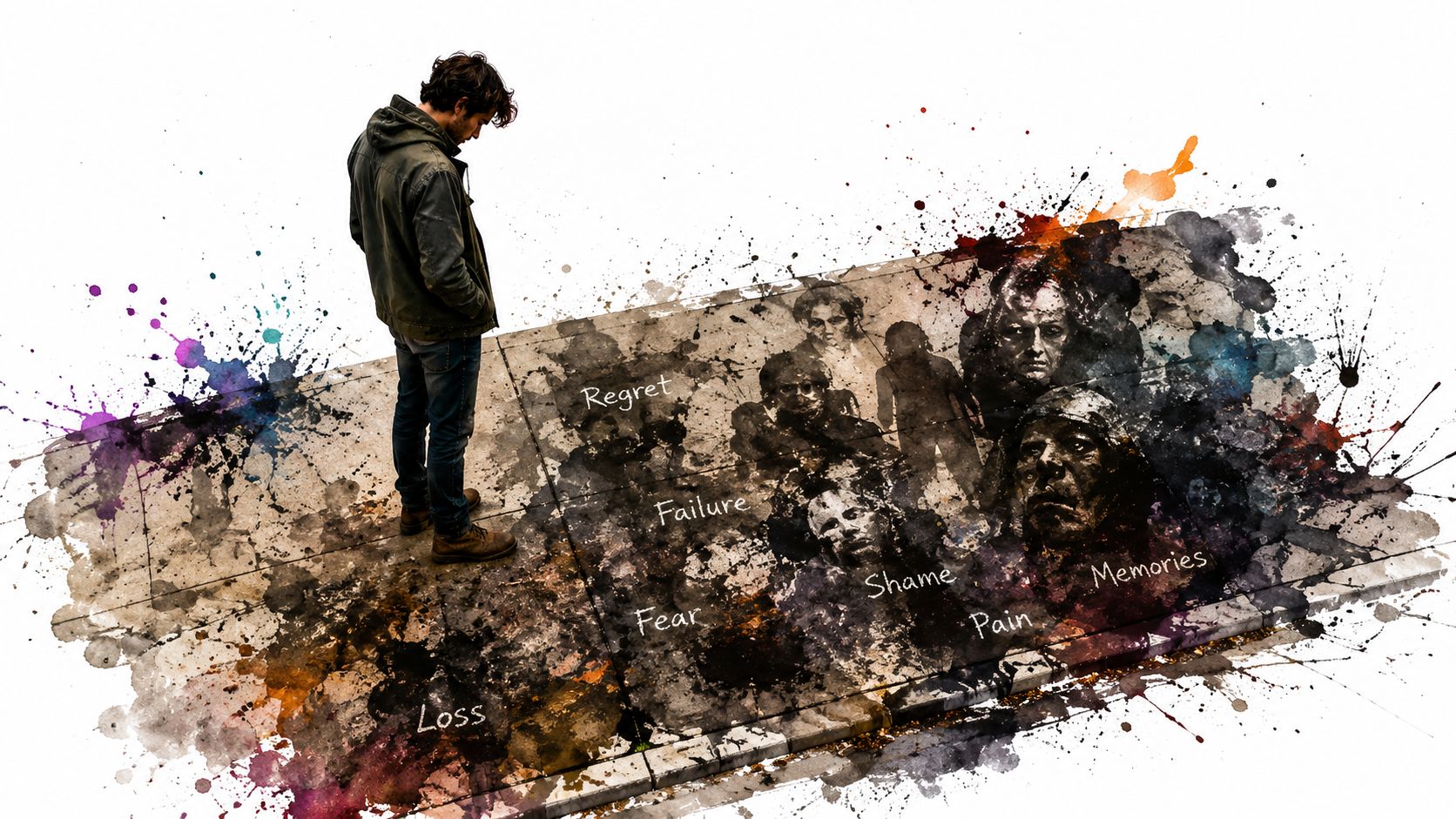
    A dirty sidewalk can hit you the same way.

    You pass the same patch of dark grime every morning. You step over the weeds pushing through the crack. You see the mystery stain near the curb and tell yourself you'll deal with it later. After a while, the sidewalk stops feeling like concrete. It starts feeling like an accusation.

    A person standing over a concrete slab filled with dark, abstract watercolor imagery representing emotional struggles.

    I learned something strange when I started helping clean outdoor spaces. Other people's messes felt easier to face than my own. Outside, I could move. I could act. I didn't have to untangle every emotion before I picked up a brush. I just had to start.

    That first lesson changed me. It also connects to how I fought my social anxiety. Bravery didn't arrive in some shining burst. It came in small, awkward motions. Walk outside. Put on gloves. Sweep one section. Scrub one square. Keep going.

    The weight of a small task

    If you're looking up how to clean sidewalks, maybe you want cleaner concrete. Good. Clean concrete feels better under your feet. But I think you might want something else too. You might want the relief of finally facing a task that's been staring at you.

    Practical rule: Treat the sidewalk like a tiny dragon. Don't negotiate with it for six months. Walk up and poke it with a broom.

    I remember staring at a stretch of pavement that had leaves mashed into the surface, gum flattened into black coins, and a green film near a shady edge. Nothing dramatic. Just enough neglect to create that heavy feeling. I told myself I'd do ten minutes.

    Ten minutes became momentum.

    One square at a time

    That's the trick. You don't clean a whole sidewalk first. You clean the patch right in front of your shoes. Then the next one. Courage works the same way. You don't become brave in theory. You do one mildly annoying thing you were avoiding. Then another.

    Your sidewalk has a story because you do. When you clean it, you're not fixing your whole life. You're proving to yourself that stuck isn't permanent.

    Gearing Up for the Grime

    I love good gear, but I don't mean expensive gear. I mean gear that lets you work safely, comfortably, and with some dignity. If you go outside in flimsy sandals and bare hands, the sidewalk will bully you. If you gear up right, you show up ready.

    First comes safety. Always.

    An infographic titled Gearing Up For The Grime listing six essential tools for cleaning sidewalks safely.

    I want you in thick gloves, safety glasses, and sturdy closed-toe shoes. Concrete scraps, grit, bits of glass, and splashes from cleaning mixes don't care whether you're trying to have a noble little self-improvement morning. Protect your hands. Protect your eyes. Protect your toes.

    Then bring the simple workhorses:

    • Push broom: Use a stiff-bristled push broom to move loose dirt, leaves, grit, and broken-down plant matter before you add water.
    • Long-handled scrub brush: This is your close-combat tool for stains, algae, and packed grime.
    • Bucket: Mix cleaning solution, carry water, or dunk the brush when you need more bite.
    • Garden hose with spray nozzle: A hose helps you wet the surface, rinse soap away, and see what dirt remains after the first pass.

    The quiet heroes from your kitchen

    You don't need to open with harsh chemicals. I often reach for white vinegar and baking soda first. Vinegar helps with organic film and green growth. Baking soda gives you mild grit and odor control. Dish soap can help loosen greasy residue on the surface before you scrub.

    Use these with common sense. Test any cleaner on a small spot first, especially if the concrete is old, stained, sealed, or cracked.

    Gear changes your mood. Gloves tell your brain it's time to work. Shoes tell your body you're staying in the fight.

    If you want to get a feel for the mindset of group cleanup work, I like the spirit behind this trash pickup volunteer page. You prepare first, then you move.

    A basic loadout that works

    Here is the simple sidewalk kit I trust:

    1. Safety glasses for flying grit and splashback
    2. Work gloves for rough surfaces and dirty debris
    3. Closed-toe shoes with grip for wet concrete
    4. Push broom for the dry sweep
    5. Scrub brush for focused stain work
    6. Bucket and hose for mixing and rinsing
    7. Vinegar, baking soda, and dish soap for everyday grime

    A short visual helps if you want to see the rhythm of it before you start.

    Put your uniform on. It sounds silly, but it matters. Half of cleaning is physical. The other half is getting your mind to stop flinching.

    The Two Paths to a Clean Path

    Some days I want the express train. Some days I want the scenic route. Sidewalk cleaning works the same way. You usually have two main options. You can pressure wash, or you can scrub by hand.

    Neither choice is morally superior. You're picking the right boot for the trail in front of you.

    Pressure washing when you want speed

    Pressure washing is fast, loud, and satisfying. It can strip off broad layers of dirt, brighten a large section, and clear shallow organic buildup without making you scrub every inch yourself. If your sidewalk has a wide coat of general filth, pressure washing can save your back and your patience.

    But it has a personality. It can be rough. Older concrete, damaged edges, loose joints, and fragile areas don't always enjoy being blasted. Debris can kick up. Water can carry grime onto nearby walls, shoes, pants, and plants. You need control, not just force.

    Manual scrubbing when you want control

    Manual scrubbing is slower, but it gives you precision. You can work one stain without soaking the whole area. You can ease up around cracks. You can stay quiet on an early morning without sounding like a machine is chewing through the block.

    I like hand scrubbing for targeted messes, smaller sections, and days when I want the work to feel more personal. There is something grounding about seeing the brush move in circles and watching a problem shrink because your arms kept going.

    Factor Pressure Washing Manual Scrubbing
    Speed Faster for large areas Slower, especially on long stretches
    Control Less precise around delicate spots More precise on stains and edges
    Noise Loud Quiet
    Effort on your body Less scrubbing, more equipment handling More elbow grease
    Risk to old concrete Higher if you use too much force Lower because you control pressure
    Best use Broad dirt, general surface cleaning Spot treatment, delicate sections, small jobs

    How I choose in real life

    I ask myself a few direct questions:

    • Is the mess spread out? If dirt coats the whole walkway, pressure washing may make sense.
    • Is the sidewalk old or flaky? If yes, I lean toward brushing.
    • Do I need quiet? If neighbors are close and the morning is still, I scrub.
    • Is the stain local? One ugly patch doesn't need a machine sermon.

    Choose force for broad dirt. Choose patience for specific trouble.

    If you're learning how to clean sidewalks, this choice matters more than people think. A lot of frustration comes from using the wrong method for the mess. People try to blast out one stubborn stain that needed soaking and scrubbing. Or they hand-scrub an entire long path that would have cleaned up faster with a pressure washer.

    I use both. You probably will too. The sidewalk isn't asking for ideology. It wants the right move on the right day.

    Tackling the Toughest Sidewalk Stains

    Every stain has its own attitude. Some cling like an old bad habit. Some sink deep and act innocent. Some spread subtly in the shade until the whole slab looks tired. If you learn the personality of the stain, the fix gets simpler.

    Gum, the sidewalk barnacle

    Chewing gum is clingy. It flattens into the concrete and dares you to attack it the wrong way.

    Start by hardening it. Press an ice cube or a bag of ice against the gum until it stiffens up. Then use a dull scraper or the edge of a sturdy putty knife to lift it. After that, scrub the area with warm water and a little dish soap.

    A lot of people rush straight to scraping soft gum. That usually smears it and turns a small gross circle into a larger gross circle. Freeze first. Then pry.

    Oil, the greedy stain

    Oil is greedy. It doesn't just sit on top. It seeps down and settles in.

    If you catch an oily patch early, cover it with cat litter or cornstarch and let it sit so it can absorb the grease. Sweep that up, then scrub with dish soap and hot water using a stiff brush. You may need more than one round, especially if the stain has been there long enough to get comfortable.

    For stubborn spots, I like to work in stages:

    1. Blot and absorb first with cat litter or cornstarch
    2. Scrub with soap and a stiff brush
    3. Rinse and inspect once the concrete dries a bit
    4. Repeat if needed instead of dumping stronger stuff immediately

    That sequence keeps you from wasting effort. If the oil is still lounging deep in the pores, a single quick scrub won't evict it.

    Some stains don't need violence. They need extraction.

    Algae and green film, the unwelcome guest

    Green growth likes shade, moisture, and neglect. It creeps in, then the sidewalk gets slick and sour-looking.

    Mix white vinegar with water in a bucket or spray bottle. Wet the affected area, apply the vinegar mix, let it sit for a bit, then scrub with a long-handled brush. Rinse well. If the green comes back often, trim back whatever is keeping that area damp and shaded if you can.

    Algae isn't just ugly. It can get slippery. Take your time with it.

    Graffiti, the unwanted tattoo

    Graffiti asks for restraint. I know the urge is to go hard and erase it instantly, but concrete can punish impatience.

    Use a graffiti remover made for masonry or concrete, and test it on a small hidden patch first. Follow the product directions. Apply, wait, scrub, and rinse. You may need several rounds rather than one aggressive attack.

    If the sidewalk has decorative finish, color treatment, or older surface wear, testing first matters even more. You want to remove the mark, not create a pale scar around it.

    Snow and ice, the winter trap

    Winter grime is different. You're not just cleaning. You're trying to prevent slips and protect the concrete.

    A good shovel is your first tool. Get snow off early before footsteps pack it down. For traction, I prefer sand over harsh salts when possible. Sand gives grip. Strong de-icers can be hard on concrete over time, especially if the surface already has cracks.

    When ice locks itself to the sidewalk, chip carefully. Don't swing like you're trying to split firewood. Concrete remembers abuse.

    A simple stain map

    Use this quick guide when you don't want to overthink it:

    • Black gum spots: Freeze, scrape, wash
    • Fresh oil: Absorb, scrub, rinse
    • Green slime: Vinegar mix, wait, scrub
    • Graffiti: Specialized remover, test first
    • Snow and ice: Shovel early, use sand for grip

    I like this part of the job because it reminds me that ugly things aren't all the same. You don't solve every life problem with one tool, and you don't solve every sidewalk stain with one cleaner. Learn the language of the mess in front of you. Then answer it directly.

    Keeping Your Sidewalk Clean for Good

    The dramatic deep clean feels amazing. The quieter win is maintenance. That part took me longer to learn because I used to treat cleaning like a single heroic act. I wanted redemption in one sweep. Life usually doesn't work like that.

    A sidewalk stays clean when you build a rhythm around it.

    The boring habit that saves you

    Sweep once a week. Pull weeds when they're small. Rinse off spills before the sun cooks them into the surface. Check shady corners after damp weather. None of this is glamorous. That's why it works.

    If you ignore a sidewalk for long stretches, dirt layers up and tiny problems become projects. If you keep showing up, the work gets lighter.

    Cleanliness gets easier when you stop treating it like punishment.

    My maintenance loop

    I like a simple loop instead of a big perfect plan:

    • Quick sweep: Move leaves, dirt, and trash before they grind into the concrete
    • Fast weed pull: Grab new growth while the roots are still weak
    • Spot scrub: Handle a fresh stain while it still has manners
    • Small check-in: Look at the edges, cracks, and damp spots before they get weird

    This is one reason I care about how to clean sidewalks as a repeat practice, not a one-time stunt. Consistency changes your relationship to the task. You stop dreading it. You start trusting yourself.

    Stewardship feels different

    There is a special kind of pride in maintaining a space. It isn't loud. It doesn't need applause. You just look down one morning and realize the path is clear because you kept showing up.

    That does something good inside you. It tells your nervous system, "I can handle things before they become chaos." That's useful on concrete, and it's useful everywhere else.

    From a Clean Sidewalk to a Clean Block

    I found out that cleaning gets lighter when other people are there. Someone cracks a joke. Someone brings coffee. Someone points at a stain and says, "I bet I can beat that thing." Suddenly the job has energy.

    Tom Sawyer understood this better than most adults. He turned fence painting into a prize. That's not manipulation at its worst. At its best, it's an invitation. People often want a reason to join something wholesome and a little ridiculous.

    How to invite people without making it weird

    Keep it simple. Knock on a door or send a text. Say you're cleaning your sidewalk on Saturday morning and ask if they want to do theirs at the same time. Tell them you'll bring coffee, music, or donuts. Make the invitation easy to accept.

    Don't make it sound like a committee meeting. Make it sound like a small adventure.

    An infographic titled From a Clean Sidewalk to a Clean Block with five steps for neighborhood cleaning.

    The block changes in ordinary ways

    When people clean side by side, they talk. They learn names. They trade stories about the tree roots wrecking the pavement, the old dog that barks at mail carriers, the best time to catch the morning shade. Friendship doesn't always start with deep confession. Sometimes it starts with two people scrubbing gum off concrete.

    Here are a few ways to make it stick:

    • Keep it short: An hour feels doable.
    • Make it visible: Start where neighbors can see the action.
    • Add one fun thing: Coffee, a playlist, cold fruit, anything.
    • Celebrate the tiny win: Take a look at the block when you're done and actually enjoy it.

    If you want a path into that kind of shared work, this volunteer trash pickup page has the same spirit I believe in. Show up, do good work, meet people who are trying.

    Bravery spreads by contact

    You clean your sidewalk. Then your neighbor notices. Then one more person joins. Soon the block feels less anonymous. That's how community often starts. Not with a speech. With a visible act that tells other people, "I'm willing to care first."

    A clean sidewalk is nice. A block where people know each other because they worked next to each other is better. That's the part I keep coming back to. Concrete gets brighter, sure. But so do people.


    If you want to turn that energy into real-world action, check out Litter Caterpillars. It's a Chicago volunteer group built around bravery, friendship, and the strange fun of cleaning up together. If you've been waiting for a sign to get outside and do something good with other people, this is it.

  • Harrison Smith Park: A Guide for Chicago Volunteers

    Harrison Smith Park: A Guide for Chicago Volunteers

    I once watched somebody show up to a cleanup in Chicago thinking they were headed to a park with a pool in Ohio. We laughed, handed them gloves, and by the end of the morning they said they were glad they got lost.

    Which Harrison Smith Park Are You Looking For

    You probably typed Harrison Smith Park because the name feels clear enough. It isn't. That name sends people in a few different directions, and I get why.

    One path takes you to Harrison Smith Park in Upper Sandusky, Ohio, at 525 E Wyandot Ave, Upper Sandusky, OH 43351, and it has a public swimming pool as its primary amenity according to the Harrison Smith Park listing in Upper Sandusky. If you wanted flip-flops, summer chlorine, and a pool deck, that's your place.

    The Chicago mix-up

    Then Chicago enters the chat and makes everything messier.

    Some people mean Harrison Park in Pilsen. Some mean Smith Park on the West Side. Some mash the names together and search for Harrison Smith Park as if the city fused them overnight. I like that confusion. It feels human. We do this with places the same way we do it with memories. We blur names, but we remember the feeling.

    If you're trying to sort out the Chicago side of this, start with this guide to Harrison Park in Pilsen. It helps if you're looking for the park by the museum, the courts, the fields, the neighborhood rhythm.

    A park name matters less than what your hands do when you get there.

    Why the confusion matters less than you think

    I care about this mix-up for a simple reason. Searchers aren't really searching for a noun. They're searching for a place to go, something to do, and maybe a reason to get out of their own head for a few hours.

    I've seen that search look a hundred different ways. One person wants a calm walk. One wants a place to volunteer. One wants to feel useful after a rough week. One just wants to be around decent people without needing to explain their whole life story first.

    So yes, there is a real Ohio park with a pool. Yes, there is a Harrison Park in Chicago. Yes, there is a Smith Park in Chicago that gets mixed into this too.

    Here's the simple version:

    Search phrase What you may mean What it has
    Harrison Smith Park Upper Sandusky, Ohio Public swimming pool
    Harrison Park Pilsen, Chicago Fields, courts, playground, garden
    Smith Park West Side, Chicago Historic park on former quarry and landfill land

    If you're in Chicago and you're looking for a park with grit in its story, dirt under its fingernails, and the kind of energy that makes you want to do more than stare at grass, you're probably looking for one of the Chicago parks. That's where this story really starts.

    A Chicago Park's Surprising History

    I love places with ugly beginnings. Maybe because I trust them more.

    Smith Park didn't begin as the kind of place where you'd toss a ball around or sit on a bench with a coffee. Smith (Joseph Higgins) Park in Chicago was founded in 1929 after a former quarry and landfill was filled to the brim by the mid-1940s, with the site transferred to the Bureau of Parks and Recreation in 1929, as described in this history of Chicago's West Side quarries.

    From hole to home ground

    Start there for a second. A quarry is a wound in the ground. People cut stone out of it. They take and take until the land looks like a giant missing tooth. Then people start dumping into it. Layer by layer, the city hides its mess in the same place it once carved for material.

    That story hits me hard because it feels familiar. I know what it's like to look at a mess and think, this thing is too old, too tangled, too embarrassing to fix. I know what it's like when every piece of junk has a memory attached to it, and moving one tiny thing feels like lifting a refrigerator with your bare hands.

    Then you look at a place like Smith Park and realize land can recover enough to become useful again. Not magically. Not cleanly. But well enough that kids run around there and neighbors gather there and life keeps happening on top of old damage.

    A timeline graphic showing the transformation of Smith Park from a stone quarry to a community park.

    Why I can't stop thinking about that story

    A lot of us carry quarry years. Then landfill years. Then maybe, if we're stubborn, we build something decent over the top.

    That doesn't erase what came first. It just means the old mess doesn't get the final word.

    Some places make sense only after you know what used to sit under your feet.

    When I walk through a park with that kind of past, I don't feel discouraged. I feel challenged. If a city can take a scar in the earth and turn it into a place where people meet, play, and breathe for a while, then you and I can probably face our own pile of wreckage too.

    Smith Park's history is earthy and blunt. That's why I like it. No fake perfection. Just dirt, trash, labor, time, and another chance.

    Exploring Chicago's Community Green Spaces

    If you want the practical version, here it is. Chicago gives you different flavors of public space, and the two parks tangled up in the Harrison Smith Park search each pull people in for different reasons.

    A vibrant illustration of people enjoying various outdoor activities in Chicago parks, including kayaking, basketball, and gardening.

    Harrison Park in Pilsen

    Harrison Park is the one many Chicago searchers want. You can find it at 1824 S Wood St, Chicago, IL 60608, right next to the National Museum of Mexican Art in Pilsen, according to the Harrison Park page on Tripadvisor.

    And the park itself gives you room to move. Harrison Park's nearly 18 acres include tennis courts, basketball courts, baseball fields, athletic fields for football or soccer, plus a playground and community garden, as noted in Time Out's Harrison Park overview.

    That list matters because it tells you how to use the place.

    • If you want motion: Hit the courts or fields. This is the park for people who don't want to sit still.
    • If you want family time: The playground gives kids something immediate to do while adults breathe for a minute.
    • If you want neighborhood texture: Walk by the garden, circle the edges, and look at who's using the place.

    I like parks more when they have jobs. Harrison Park has jobs. It hosts games, walks, rest, noise, waiting, and small daily rituals.

    Smith Park on the West Side

    Smith Park feels different. The history changes the way I move through it. I pay more attention to edges, low spots, and the way built structures sit in relation to the ground.

    Here's a little street-level look before you go further.

    How to use these parks like a local

    Locals don't overcomplicate it. They pick a reason and go.

    Your mood Better fit Why
    You want activity all around you Harrison Park Courts, fields, and steady movement
    You want to think about place differently Smith Park The ground itself has a story
    You want to explore Pilsen on foot Harrison Park It's next to the museum and easy to pair with a neighborhood walk

    Practical rule: Don't arrive asking, "What's the perfect park?" Ask, "What kind of day am I trying to have?"

    That's a better question. It gets you out the door faster.

    How We Safely Clean Our Parks

    Good intentions aren't enough when you're cleaning ground with a complicated past. You need judgment. You need discipline. You need to know when a trash grabber and a bag are enough, and when they aren't.

    One hard truth sits underneath this work. Parks built on historic landfills in Chicago can have 3–5x higher concentrations of legacy contaminants such as lead, asbestos, and hydrocarbons than naturally formed parks, and that risk can be higher in zones like drainage ditches, as noted in this post about landfill-built park risks in Chicago.

    Brave doesn't mean reckless

    I hate the fake version of courage. The version where somebody acts fearless because they don't know enough to be careful. That's not courage. That's ego wearing work boots.

    Real courage looks more boring. It looks like gloves. It looks like long pants. It looks like stopping to assess a weird material instead of poking it with your hand. It looks like telling a volunteer, "Leave that one. We're not touching it today."

    An infographic detailing safety protocols for volunteers cleaning up former landfill sites to ensure community safety.

    The method I trust

    When I clean a park with old industrial or landfill history, I keep the approach simple and strict.

    • Dress for contact: Wear protective gear that covers skin and keeps your footing steady.
    • Respect the weird stuff: If an item looks sharp, chemical, dusty, sealed, or unfamiliar, don't improvise.
    • Watch the edges: Drainage paths, fence lines, and ditch areas collect trash and can collect risk too.
    • Train before heroics: A volunteer who knows what not to touch is more useful than a volunteer trying to prove something.
    • Have backup plans: First aid, communication, and clear roles matter before the first bag gets filled.

    A lot of volunteer groups skip this because safety sounds less exciting than action shots. I think that's backwards. Safety is what lets good people keep showing up week after week instead of getting burned out, hurt, or scared off.

    If you want to think through the legal and planning side before you organize your own effort, read up on volunteer liability insurance for community cleanups. It helps you understand why structure protects generosity.

    If a park has a rough history, your cleanup plan needs a backbone.

    That isn't fear talking. That's respect.

    Join Us for a Weekend Cleanup

    Weekend mornings have a special energy. The city is quieter, the air feels less chewed up, and the people who show up that early for unpaid work usually have something good inside them.

    I think about Tom Sawyer a lot. He got stuck painting a fence and turned the punishment into an invitation. That's part of the fun here. Work changes shape when you stop treating it like humiliation and start treating it like a dare.

    What your first cleanup feels like

    You arrive a little unsure. Maybe you wonder if everyone already knows each other. Maybe you worry you'll be awkward, underdressed, too quiet, too late, too soft for the job.

    Then somebody hands you a bag.

    That moment matters. Holding a trash bag in a park is strangely clarifying. You stop performing. You stop trying to look interesting. You just start scanning the ground, picking targets, moving forward. Cup. Wrapper. Bottle cap. Broken toy. Fast-food bag snagged under a bush like it was trying to disappear.

    And the weird thing is, your brain starts to quiet down.

    Why the work feels good

    Smith Park got major upgrades in the late 1930s, including a field house with a gymnasium and meeting rooms, according to the Chicago Park District's Smith Park page. I love that detail because it reminds me that parks aren't abstract ideas. They are places where bodies gather, sweat, talk, rest, and return.

    That's why cleanups matter in a practical way. You're not cleaning some symbol. You're clearing a path for an actual person. A kid running near a field. A neighbor walking past. Somebody heading toward a meeting room. Somebody trying to have one decent hour outside.

    If you want a way in, check out weekend volunteer opportunities near you.

    What to expect when you say yes

    Your first cleanup usually includes a few things:

    1. A small moment of hesitation when you realize you're doing real physical work.
    2. A rhythm shift once your hands get busy and conversation starts to happen naturally.
    3. A quiet hit of satisfaction when the pile of full bags grows and a messy patch looks human again.

    Hard work with good people is one of the cleanest pleasures left.

    That's the pitch. No fake glamour. Just a better Saturday morning than doomscrolling.

    Building Friendships One Bag of Trash at a Time

    The first time I went out with a tiny cleanup crew, Chicago threw hail at us like the city was testing our sincerity. We huddled under a tree, freezing, phones out, watching ride after ride cancel. It should have been miserable.

    It was miserable. And it was funny.

    That combination changes people. When you shiver through something dumb and difficult with strangers, they stop feeling like strangers way faster than they would at a bar or a networking event or some polished little mixer where everybody is trying to seem effortless.

    Shared discomfort is glue

    I learned something that day. Cleaning somebody else's mess is often easier than cleaning your own. Maybe because there isn't any shame in it. The ground doesn't judge you. The bottle in the weeds doesn't ask why your apartment is a mess or why your last relationship blew up or why you've been avoiding your own life.

    You just pick it up.

    And when somebody next to you is doing the same thing in cold rain or sharp wind, you trust them a little. They've already shown you one thing that matters. They came.

    Screenshot from https://www.littercaterpillars.com/

    Why people keep coming back

    Friendship doesn't always begin with deep conversation. Sometimes it begins with shared labor, an inside joke, and that look people exchange when a heavy bag finally gets tied shut.

    A cleanup group becomes social in sideways ways:

    • You earn trust fast: People see whether you help, drift off, complain, or stay steady.
    • You get stories immediately: Rain, weird finds, busted grabbers, lost gloves, surprise laughter.
    • You build identity through repetition: Same mission, different block, same people returning.

    I also think service scrubs away a lot of fake hierarchy. Out there, nobody cares who has the best resume. The wind doesn't care either. Trash equalizes people. That's one reason this kind of friendship feels less brittle.

    "We suffered a little together" is a stronger beginning than most small talk.

    If you've been lonely in a crowded city, this matters. You don't need a brilliant opening line. You need a reason to stand next to other people while doing something honest.

    Your Questions About Park Cleanups Answered

    People usually ask the practical stuff first. Good. Practical questions keep everybody safer and calmer.

    Is it actually safe to clean a park with a rough past

    It can be, if you respect the site and don't freeload on optimism. Use protective gear, avoid suspicious material, and treat certain areas with extra caution. If something looks off, leave it and report it through the right channel instead of trying to be a hero.

    What should you bring

    Keep it plain.

    • Wear sturdy clothes: Closed-toe shoes, long pants, and gloves are the baseline.
    • Bring water: Even short cleanups can sneak up on you.
    • Pack light: You don't need a whole expedition setup. You need mobility and common sense.

    Can you come alone

    Yes. A lot of people do. In fact, coming alone is often easier than dragging a half-interested friend who wants credit for almost showing up.

    The work gives you something to do with your hands right away, which takes pressure off conversation. That helps shy people more than they expect.

    What if you're nervous about not knowing anyone

    Then you're normal.

    It's common to feel that way before the first cleanup. The trick is to let the task carry the social weight for a while. You don't need to charm anybody. You just need to participate.

    Can you organize your own cleanup somewhere else

    Yes, including in a place like the Ohio park that comes up in the Harrison Smith Park search. Start small. Learn the site. Ask what risks are unique to that area. Keep your plan tighter than your ambition on day one.

    A simple checklist helps:

    Question Why it matters
    What kind of site is this Park history changes cleanup risk
    Who is coming Group size changes supervision needs
    What will you avoid Boundaries keep volunteers safe
    What happens if something looks hazardous You need a clear answer before you begin

    What mindset should you bring

    Bring humility. Bring energy. Bring a willingness to do unglamorous work.

    Don't bring the fantasy that one cleanup fixes everything. It won't. But one cleanup can fix one morning, one patch of ground, one conversation, one corner of your own drifting life. That's plenty.


    If you want a group that cleans Chicago with courage, humor, and actual care for the people doing the work, visit Litter Caterpillars. You'll find a crew that shows up on weekend mornings, takes safety seriously, and turns trash pickup into friendship, purpose, and a pretty wild kind of fun.