
Tag: chicago volunteering

  • Chicago Environmental Issues: A Guide to Fixing Our City

    Chicago Environmental Issues: A Guide to Fixing Our City

    A few years ago, I stared at a jar of blueberry jam in my fridge and couldn't throw it away. Then I walked outside, saw trash stuck in a gutter after rain, and felt the same paralysis.

    Your Mess Is The City's Mess

    My room used to look like a stalled negotiation between who I was and who I kept pretending I'd become. Old bags of nuts from my healthy phase. Tangled cords from gadgets I swore I'd use again. Receipts, wrappers, clothes on chairs, memories disguised as junk.

    I didn't just have a mess. I had a loyalty problem.

    I stayed loyal to objects long after they stopped serving me. I did the same with people. I held onto bad relationships because throwing things away, whether a moldy container or a selfish person, felt violent. That sounds dramatic until you've tried to toss a four-year-old jar of jam and felt your chest tighten like you're betraying a former version of yourself.

    A distressed person sitting amidst tangled wires and debris before a stylized Chicago city skyline backdrop.

    The day I stopped separating my life from the sidewalk

    After a long chaotic relationship ended, I made a simple promise to myself. I would stop building my life around avoidance. I would practice cleanliness, consistency, and bravery, even if I had to do it badly at first.

    Cleaning my own space still felt heavy. Weirdly, cleaning the street didn't.

    That's part of how this started. Picking up a bottle from a curb felt easier than facing the pile in my bedroom. Someone else's mess didn't carry my history. It didn't argue with me. It didn't ask me to revisit my mistakes. I could just bend down, grab it, and keep moving.

    Practical rule: If your own life feels too tangled to fix, start with one corner of the world you can touch.

    That rule changed me. It also changed how I see chicago environmental issues. People talk about pollution, waste, and environmental justice like they're giant policy topics floating over our heads. I don't experience them that way. I experience them as a sticky can in the grass, a blocked drain before a storm, a sidewalk that tells you nobody has cared for this block in a while.

    Why bravery starts small

    The first cleanup that became our origin story had only three of us. We got caught in a spring hailstorm and huddled under a tree while every Uber seemed to cancel. We were cold, annoyed, laughing, and slightly miserable.

    And I remember thinking three things:

    • Other people's mess is easier: I could pick up street trash faster than I could sort my own emotional junk.
    • Service creates a strange kind of fun: Suffering a little with good people makes a story.
    • Action beats rumination: A full trash bag quiets your mind in a way endless thinking never does.

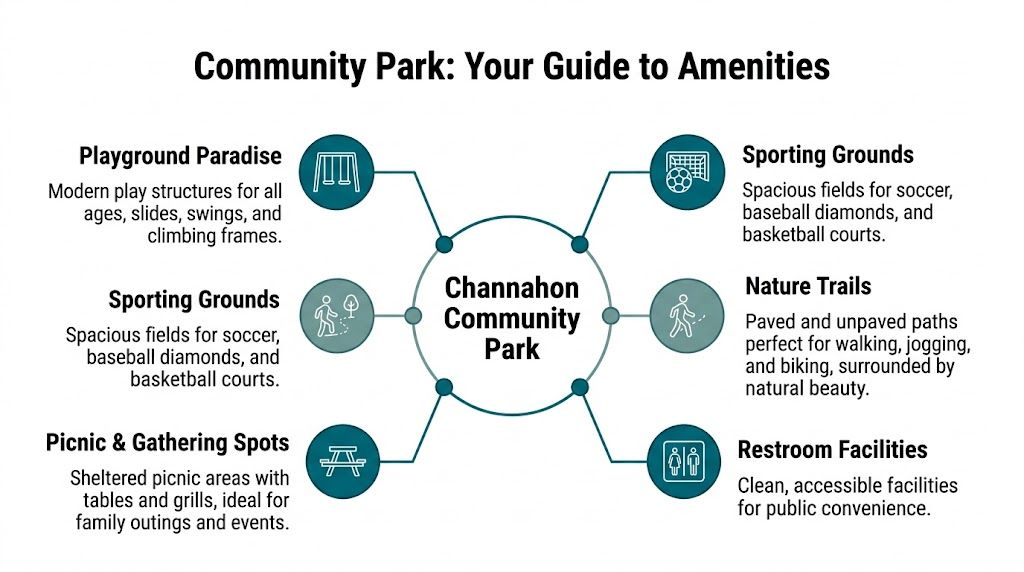
    If you live here, your city probably feels personal already. The block where you walk your dog. The alley behind your apartment. The recycling confusion in your building. If you want a practical place to start sorting that part out, I like using local guides such as Chicago recycling centers.

    I started with trash because I needed a battle I could win. A lot of people do.

    The Invisible Problems Air and Water

    You can ignore bad air because you can't hold it in your hand. That's what makes it slippery. It slips past your attention and goes straight into your lungs.

    Think of Chicago like one giant shared room. We all breathe inside it. Some people are near the open window. Some people are sleeping next to the machine that's coughing smoke.

    A woman wearing a face mask looks toward a stylized watercolor Chicago skyline and polluted river landscape.

    What a bad air day really means

    When people say the air feels off, they're often talking about something real, even if they don't have the language for it. The Chicago-Naperville metro area ranked 15th worst in the nation for ozone pollution, with 20.3 unhealthy ozone days per year in the American Lung Association's 2025 State of the Air report. That same report said the metro area ranked 13th worst in the nation for year-round particle pollution, and it noted a worsening from the previous year. It also said 156 million people, nearly half of Americans, live in places with unhealthy air, which puts Chicago inside a much bigger public health problem, not outside it. You can read that in the American Lung Association's Illinois release on the 2025 State of the Air report.

    That matters because "bad air" isn't an aesthetic complaint. It isn't just haze over the skyline. It's the stuff your body has to process while you bike to work, wait for the bus, or crack a window at night because your apartment is too hot.

    Air pollution feels democratic because the sky covers everybody. It isn't democratic in how it lands.

    Air is shared. Exposure isn't.

    I think about air the same way I think about roommates. If one roommate smokes in the kitchen, everyone deals with it. But the person sleeping closest to the kitchen gets the worst of it.

    That's why citywide averages can fool you. They smooth out the rough edges. They turn somebody's daily burden into a bland sentence.

    Here's the simple version:

    What you notice What might be happening
    Burning smell, haze, irritated throat Ozone and particles may be high
    Dust near heavy industry or trucking routes Localized particulate exposure may be worse
    Fine layer of grime on windowsills or cars Material handling and traffic may be nearby contributors

    Our water is our shared glass

    Now think about water. Lake Michigan is our giant drinking glass. Most of us don't wake up thinking about intake pipes or sewer systems. We turn the faucet and expect trust.

    That trust is fragile.

    Water has a complex hidden life in a city. It gets pulled, treated, pushed through old pipes, used in kitchens and bathrooms, then sent back through another buried network that is rarely seen. When rain hits hard, all that hidden infrastructure gets stress-tested at once. So does our illusion that flushing means "gone."

    A lot of chicago environmental issues work like that. The problem disappears from view, then comes back in another form. Air enters your chest. Water moves through old systems. You don't need a chemistry degree to care. You just need to realize you're already inside the system.

    The Problems You Can See and Feel

    I can show you two blocks that feel like two different cities.

    On one block, somebody swept the storefront, the bins weren't spilling over, and a tree threw enough shade to make you slow down. On the next block, a plastic bag whipped around a fence, cups sat in the gutter, and the sidewalk radiated heat back into your shins.

    That's not theory. That's mood. That's blood pressure. That's whether you walk with your shoulders relaxed or tight.
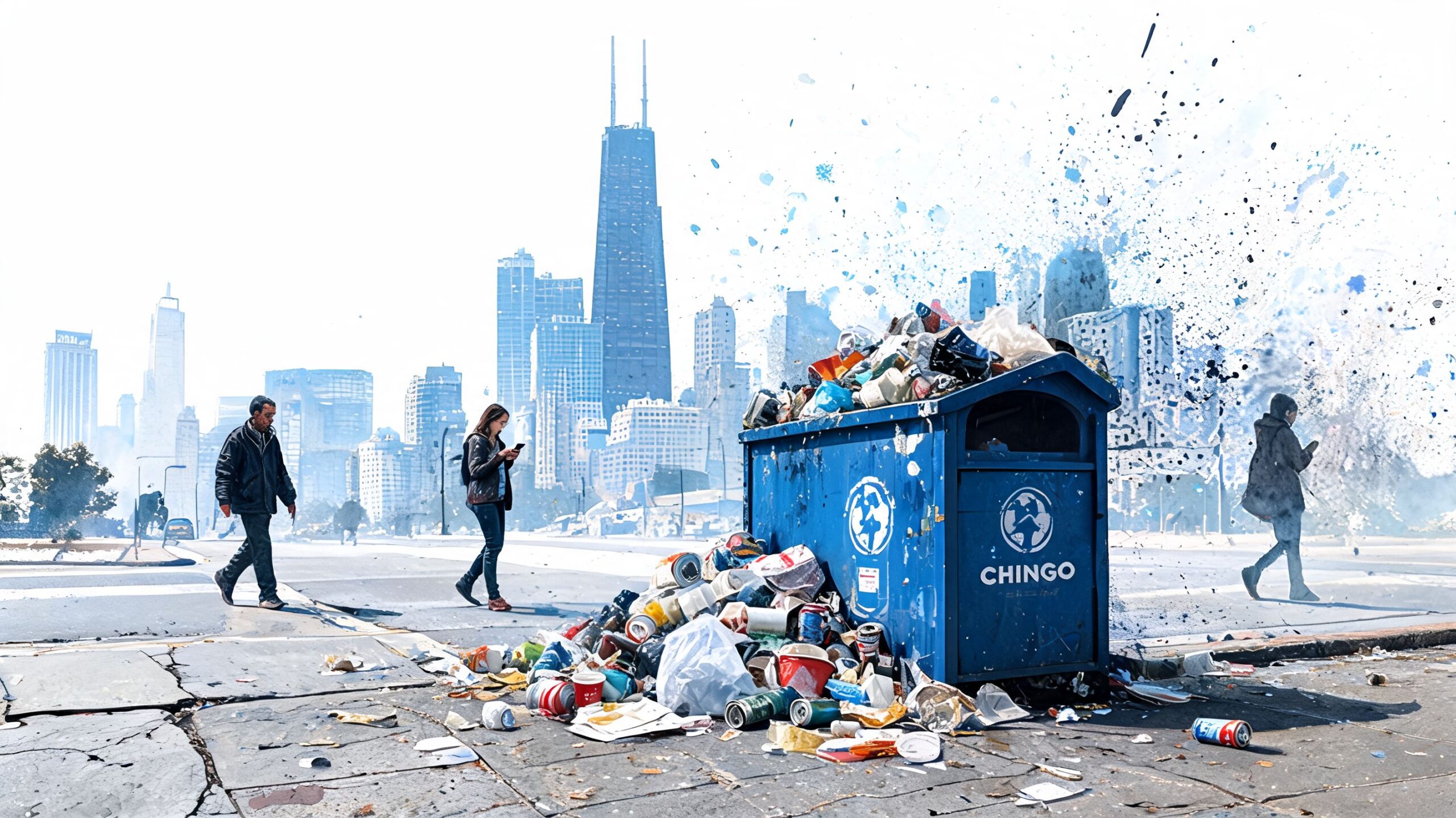
    A person walks past an overflowing blue recycling bin in a polluted Chicago city landscape.

    What one dirty corner does to your brain

    Trash multiplies socially. One cup on the ground gives the next person permission. An overflowing bin tells you the system has already given up for the week. Illegal dumping says something even harsher. It says this place is where unwanted things go.

    People feel that message in their body before they put it into words.

    I think that's why cleanups affect volunteers so quickly. We don't just remove objects. We interrupt a script. We tell the block, "No, this isn't where garbage belongs. People belong here."

    A cleaner street changes what people expect from each other.

    Heat makes neglect feel physical

    Then there's the summer version of the same problem. Streets with more asphalt and fewer trees can feel punishing. You wait at a light and the heat bounces off the road, the cars, the brick, your own face.

    A shaded block changes everything. It changes how long elders can sit outside. It changes whether kids run around or retreat indoors. It changes whether a walk to the store feels normal or draining.

    Here are the differences I notice right away when I move from one block to another:

    • Shade: Trees lower the emotional aggression of a hot day. A block without shade feels sharper.
    • Surface temperature: Blacktop and concrete hold heat and throw it back at you.
    • Street care: Overflowing trash and neglected lots make heat feel worse because the whole place reads as abandoned.

    I don't call these small annoyances. I call them daily conditions. If you live with them long enough, they shape your habits. You go outside less. You trust your neighbors less. You stop expecting beauty from the place where you live.

    That is why visible chicago environmental issues matter. You don't need a report to know when a block feels hostile. Your legs, lungs, eyes, and patience already know.

    Where The Burden Falls Hardest

    Some neighborhoods carry the city's dirtier bargain.

    If you want honesty about chicago environmental issues, you have to stop pretending the burden lands evenly. It doesn't. The city has areas where pollution is a topic, and areas where pollution is a routine neighbor.
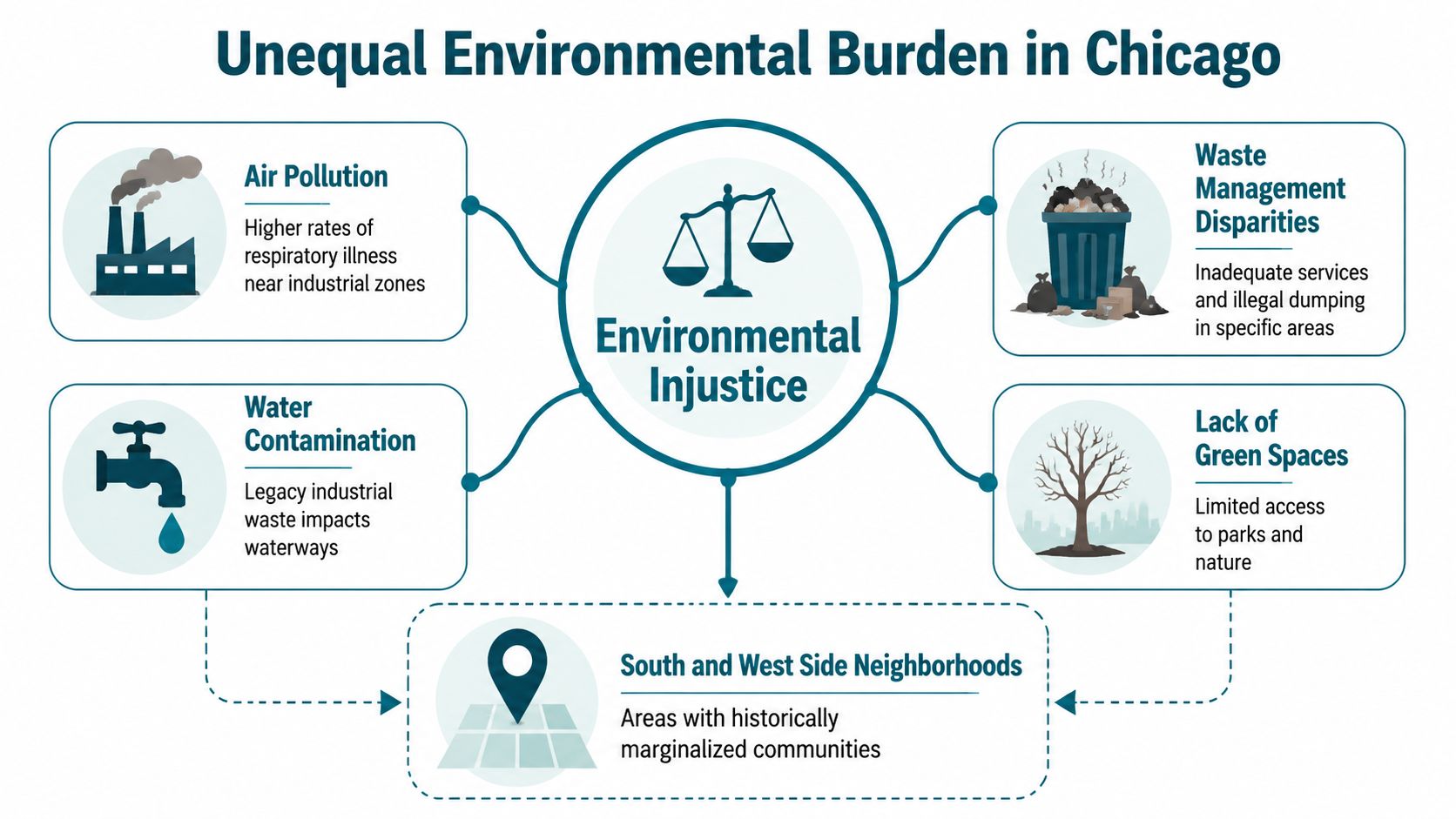
    An infographic titled Unequal Environmental Burden in Chicago, illustrating issues affecting marginalized neighborhoods in the city.

    What the map tells you

    A 2025 factsheet on limited pollution exposure found that Latine Chicagoans are 30% of the citywide population but 37% of the people living in areas with the highest overall pollution exposure. The same report said estimated PM2.5 levels across Chicago range from about 9 to 12 μg/m3, which is above the 2024 U.S. EPA long-term public health standard of 9 μg/m3. You can read that in the CMAP limited pollution exposure factsheet.

    That isn't abstract to me. It means some families live in the part of the shared room where the air is worse, more often, for longer. It means "city average" can hide a street-level truth.

    The Southeast Side problem

    The Southeast Side hits hard because it's not one cleanly isolated source. It's a multi-source industrial exposure zone. Steel production, metal recycling, petroleum handling, and petcoke storage can all add to particulate and metals burdens in the air. EPA notes tied to the area say petroleum coke in southeast Chicago has generated fugitive dust complaints, actions have been taken against petroleum handlers along the Calumet River, and high airborne metals, especially manganese, have been identified there.

    That complexity matters. If several operations can produce overlapping dust and metals, then finger-pointing gets easy and solving the problem gets harder.

    I view it this way:

    • If you measure citywide averages only, you can miss the block that is taking the hit.
    • If sources overlap, one company can shrug and say the dust came from somewhere else.
    • If monitoring is too coarse, residents keep living with uncertainty while officials debate attribution.

    The practical answer is local. Dust suppression. Enclosed conveyance. Paved and cleaned haul roads. Real-time monitoring near active bulk-material handling sites. That kind of targeted work fits the problem better than broad city averages.

    Justice has to be local or it isn't real

    I don't use the phrase environmental justice because it sounds polished. I use it because when one part of the city breathes more grime, drinks through older riskier systems, and gets less day-to-day relief, the issue is moral before it is technical.

    If you want a clearer grounding in that idea, I like this plain-language explainer on what environmental justice means.

    Below is a simple way to think about unequal burden across neighborhoods:

    Burden on the ground What residents may face
    Nearby industrial emissions and dust More daily concern about breathing and outdoor activity
    Older infrastructure and neglected basics More stress around water, housing, and health
    Less tree cover and fewer buffers Hotter blocks and fewer places to recover outside
    Illegal dumping and weaker upkeep Constant signals that care arrives late, if at all

    When people say "the environment," I think that's too vague. I think about who gets the dirty truck route, who gets the dust, who gets the hotter block, who gets told to wait.

    The City's Promises Versus Reality

    The city has plans. Cities always have plans.

    The harder question is whether a parent on the South Side or West Side can feel those plans in daily life. Can they drink from the tap without worrying about old pipes? Can they open a window without bringing in the smell of industrial activity? Can they see a pace that matches the urgency?

    Budget lines don't clean a sink by themselves

    Recent reporting noted that Chicago has made larger investments, including a nearly $200 million FY2022 climate and environmental justice budget, while many households on the South and West Sides still face burdens tied to lead-contaminated drinking water pipes and concentrated industrial pollution. That same reporting frames the issue well. Progress is uneven, and the practical question is whether money is closing gaps fast enough where people need relief most. You can read that in this look at Chicago's environmental justice battles, impacts, and solutions.

    I don't say that to sneer at public spending. Budgets matter. Plans matter. But if a block still lives with the old problem, then the plan hasn't finished the job.

    Reality check: A promise feels real only when a resident can point to a changed pipe, cleaner air, cooler street, or cleaner lot.

    The pace problem

    Disillusionment sets in, leading to burnout. They hear that money has been allocated. They hear that a department has a strategy. They hear language about justice and investment. Then they go outside and the same basics still feel stuck.

    The system has habits that make delay look normal:

    • Slow rules: Agencies move at government speed, even when residents live at body speed.
    • Competing priorities: The neighborhood with the loudest political protection often gets faster attention.
    • Patchwork fixes: One grant, one pilot, one announcement. Meanwhile daily life keeps arriving every morning.

    I don't need every city effort to fail before I criticize the gap. I just need to compare the promise to the pace. If a household still deals with old lead service lines and concentrated pollution after years of speeches, the criticism writes itself.

    What I listen for now

    When officials talk, I try to translate their language into street language.

    Official language Street translation
    Investment Did anything get fixed on the block
    Equity Did the hardest-hit area move first
    Environmental justice Did the burden actually get lighter
    Climate plan Can people feel the change in summer, at the tap, or in the air

    That may sound blunt. Good. Blunt is useful when people have waited too long.

    Finding Your People and Your Power

    I don't think people need more guilt. I think they need a crew.

    When my life felt scrambled, I did not improve because somebody won an argument online about systems. I improved because I started showing up outdoors with other people and doing one useful thing with my hands.

    The first cleanup that changed me

    Our first real cleanup felt ridiculous. Three people. Cold weather snapping at our fingers. Hail coming down. We hid under a tree and watched ride requests vanish. It was inconvenient and kind of funny.

    That day taught me that service gives you structure when your inner life doesn't have much. Pick up. Bag it. Tie it. Move forward. Repeat.

    And something else happened. Friendship got simpler. You don't need perfect small talk when you're dragging soaked trash bags together in bad weather. Shared effort breaks the ice faster than cleverness ever will.

    What people can actually do

    A lot of environmental talk stays stuck at the level of opinion. I care more about motion.

    If you're serious, your options look more like this:

    • Join a cleanup group: A local volunteer group such as Litter Caterpillars organizes regular trash pickups in Chicago, which gives people a direct way to work on visible waste problems with others.
    • Adopt a block habit: Bring a bag on your walk. Clear one stretch over and over until your body knows the route.
    • Pay attention to hotspots: The Southeast Side industrial corridor has overlapping sources tied to airborne metals like manganese and particulate dust from petcoke piles, which means local solutions have to match local conditions rather than rely on citywide averages, as described by Chicago CHEC's overview of issues in Chicago.
    • Stay human: If you recruit friends, make it social. Food after. Coffee after. A group photo. People return when the work has warmth.

    You don't need to feel pure before you start serving. You start serving, and some of the mess inside you begins to loosen.

    Why community action changes the person doing it

    We talk a lot about fixing neighborhoods. I care about that. I also care about what happens to the volunteer.

    Service teaches a stubborn kind of self-respect. You say you'll wake up on a weekend morning and go. Then you go. You endure weather. You do something mildly uncomfortable on purpose. That pattern spills into the rest of your life.

    I've seen people arrive unsure, shy, scattered, hungover from a bad month, and leave steadier. Not healed forever. Just steadier. Sometimes that's enough to start.

    Our values came out of that reality. Bravery because fear and discomfort are part of growth. Kindness because nobody sticks around in a cold moralizing club. Unity because service is easier to sustain when people laugh together.

    I care about policy. I care about monitoring and budgets and all the hard public stuff. But if you ask me where power starts, I won't point first to a document. I'll point to a few people on a sidewalk doing the job in front of them.

    Take Your First Brave Step

    You do not have to solve Chicago.

    You probably shouldn't try. That's one fast way to get overwhelmed and stay home.

    Start smaller. Start with a bag, gloves, one morning, one corner. Start with the piece of trash that annoys you every time you pass it. Start with the block you secretly wish felt different. Start with one act that turns you from spectator into participant.

    A first move that is small enough to do

    If you want your first step to be concrete, use a rule like this:

    1. Pick one recurring place you already pass.
    2. Bring one simple tool such as a bag or grabber.
    3. Work for a short window so you build consistency instead of drama.
    4. Come back again before your brain can turn it into a grand impossible mission.

    That pattern matters. It teaches your body that care is a habit, not a mood.

    Why this changes more than the street

    The strange gift of environmental service is that it cleans two places at once. You clear a sidewalk, and something in you clears too. Shame gets a little quieter. Isolation loosens. You start trusting yourself because you did what you said you'd do.

    If water and air feel too large, begin with what your hands can reach. If you want an outdoor version of that first brave step, one option is joining efforts that clean up rivers and nearby public spaces.

    I think a lot of people are hungry for a more honorable weekend. Less scrolling. Less hiding. More sun, more movement, more usefulness, more people who mean well.

    You don't become brave by waiting to feel ready. You become brave by doing one slightly uncomfortable good thing, then doing another.


    If you want that kind of weekend, take a look at Litter Caterpillars. It's a simple way to meet people, pick up trash, and practice the kind of service that can change a block and steady a life.

  • Fun Community Service Ideas to Connect & Grow

    Fun Community Service Ideas to Connect & Grow

    Cleaning up other people’s mess is easier than your own. I know because my own life was a mess, and I mean the kind of mess where an old jar in the fridge feels emotionally heavier than a dumbbell. I started picking up litter because I needed a way to practice bravery and consistency when I couldn't seem to do either at home.

    The weird part is that it became fun.

    The first time my group got caught in a spring hailstorm, we stood under a tree, freezing, while ride after ride canceled on us. I should’ve hated it. Instead, I felt more alive than I had in months. Doing something hard with other people gave the day flavor. It turned suffering into a story, and the story made me want to come back.

    That’s how I learned something I wish more people would say out loud. Community service can help other people, sure. It can also help you. It can pull you out of your head, get you into your body, and put you next to the kind of people who show up on cold mornings and mean it. A lot of fun community service ideas sound cute on paper but feel stiff in real life. These are different. I’ve seen them work on blocks, in parks, in ugly weather, and in neighborhoods people usually avoid.

    If you want friendship, courage, structure, and a cleaner city, start here.

    1. Neighborhood Block Cleanups with Team Identity

    The first block I cleaned with the Litter Caterpillars looked ordinary from a car window. On foot, it felt different. Crushed cups in the gutter. A wet sweatshirt caught in a chain-link fence. Cigarette packs tucked into the grass like the street had given up on itself. I almost turned around that morning because my own apartment was a mess and I felt like a hypocrite. Instead, I grabbed a neon bag, followed a woman in a yellow beanie, and started picking up one stupid wrapper at a time.

    By the end of the hour, the sidewalk looked better, but that was not the part that got me. It was hearing people yell, "Caterpillars over here," like we were an actual crew. Same color hoodies. Same playlist. Same meeting spot every week. I had shown up to clean a block. I left feeling less alone.

    That is why team identity matters.

    Pick one block. Or three. Bring gloves, bags, and grabbers. Give your crew a name people will remember. Carry a flag if you want to be a little ridiculous. Ridiculous helps. Wear the same color. Put one person in charge of the speaker. Suddenly the cleanup stops feeling like a chore you should do and starts feeling like something you belong to.

    A good block cleanup has a shape people can trust. Ours got stronger when we stopped improvising every detail and kept a few things the same each time.

    • Meet at the same corner so nobody has to guess where the group is
    • Use the same crew name and colors so neighbors recognize you fast
    • Walk a simple route so energy goes into the work, not into debating
    • End with coffee, snacks, or a park bench debrief so strangers become friends
    • Take one group photo so people have proof they were part of something real

    Practical rule: If a new volunteer cannot find you in 30 seconds or explain your group to a friend in one sentence, make the cleanup simpler and more visible.

    I love block cleanups because they are small enough to start now and hard enough to change you. You do not need permits for a giant event or a polished nonprofit vibe. You need a time, a place, a few tools, and the nerve to look a little silly in public. That last part matters more than people admit. Wearing the same color shirt and carrying a grabber down a busy street can feel strangely vulnerable. Then a neighbor waves, a kid asks to help, somebody thanks you from a porch, and your embarrassment shrinks.

    Some Saturdays we rotate to a block nobody in the group has touched before. The mood changes every time. One street gives you friendly hecklers and grandmas cheering from stoops. Another gives you silence, broken bottles, and wind that cuts through your gloves. Both count. Both teach the same lesson. Cleaning up a mess outside can help you face the mess inside, especially when you are doing it beside people who keep showing up.

    2. Park and Green Space Restoration Projects

    The first time our Litter Caterpillars crew restored a park, it was cold enough that my fingers hurt through my gloves. The place looked tired. Crushed cans in the grass. Fast-food wrappers pinned under wet leaves. A bench half-hidden by weeds. I remember thinking, this park looks like how I felt that winter.

    So we started there.

    A park project changes you because you stay in one place long enough to watch it come back to life. On a block cleanup, you move through the mess. In a park, you kneel in it. You pull trash out of bushes, rake dead stuff away, and notice the ground under your feet again. Then something strange happens. As the space looks less abandoned, you do too.

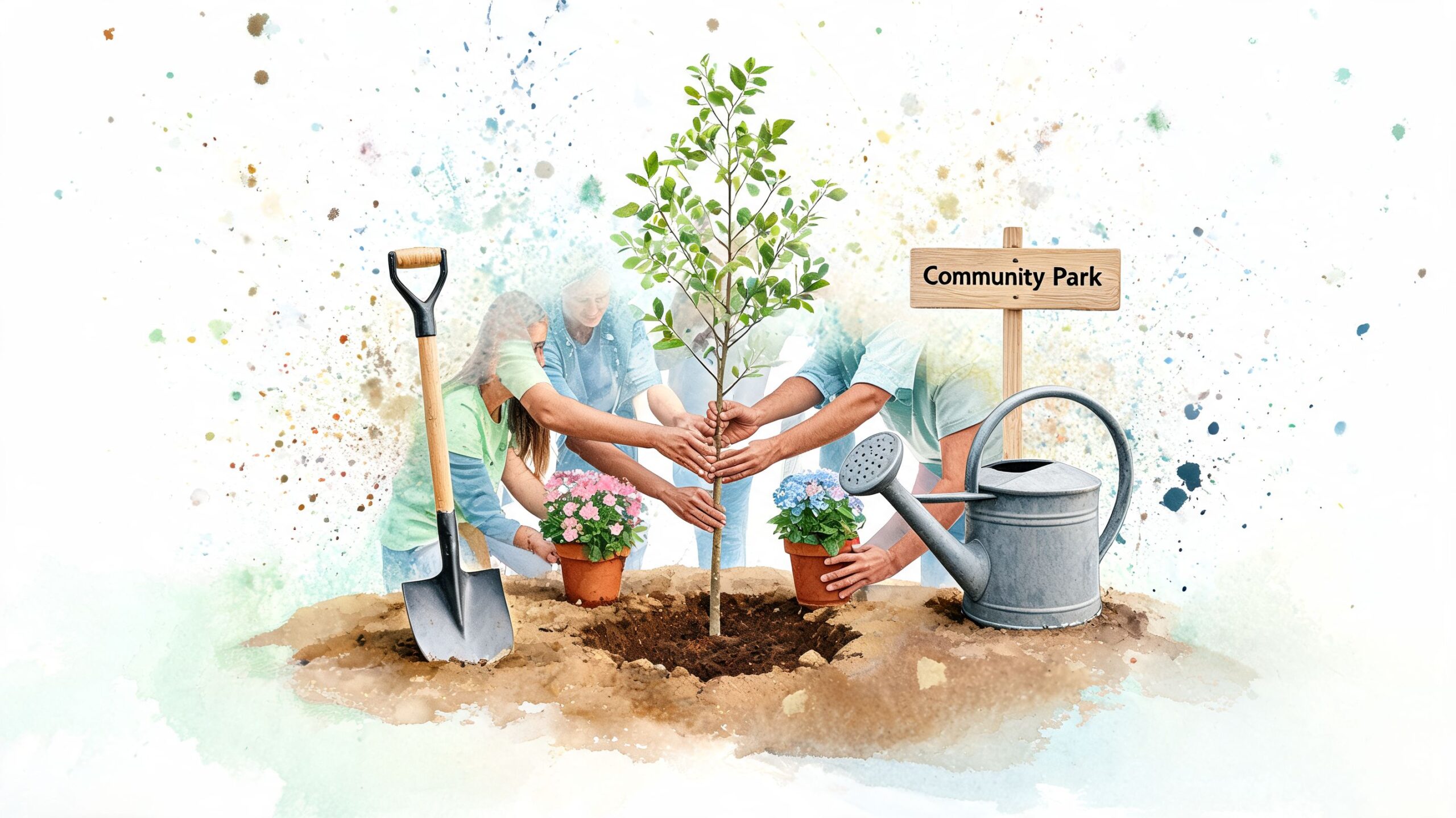
    A diverse group of volunteers planting a young tree together in a vibrant community park garden.

    Start with cleanup. End with care.

    The mistake is trying to make it beautiful on day one. What works better is a simple first pass that gives people a quick win, then a reason to return.

    Here’s the version that has worked for us:

    • Clear litter and obvious hazards first so the change is visible within the first hour
    • Take before photos because you will forget how rough it looked
    • Talk to nearby residents or regular park users because they know which corners get ignored
    • Pick one small add-on for the same day or the next visit like mulch, bulbs, or a planter bed
    • Return often enough to make the space feel claimed because one cleanup helps, but repeated care changes the reputation of the place

    I like these projects because they have a second act. After the bags are full, hope gets practical. You can plant a tree, spread mulch around a bare patch, repaint a sign, or set a bench area right again. Kids start cutting across the grass instead of around it. Dog walkers slow down. Someone who never spoke to you before asks when you’re coming back.

    That part matters more than people think. Plenty of volunteers want service that fits real life, feels social, and lets them see the result with their own eyes, as noted earlier. Park restoration does that well. You can show up for a morning, work hard beside other people, and leave with proof that your effort mattered.

    One of my favorite Litter Caterpillars days ended with muddy boots, six trash bags, two new planters, and a conversation with a guy who said he had avoided that park for months. A week later, he came back and helped. That is how these projects grow. Not through polished speeches. Through visible care.

    Here’s a good visual for what this kind of work can feel like in motion.

    3. Highway and Major Corridor Cleanup Events

    Some service projects feel gentle. This one feels epic.

    If your city lets you partner on a cleanup near a highway, major corridor, or event route, do it. These are the places where litter gathers in a way that feels almost offensive. Cups tumble into fences. Plastic bags snag on brush like sad flags. You fill bags fast, and that speed gives the day momentum.

    I still think about cleaning a highway during a bike-event shutdown. It felt like being allowed backstage in the city.

    Respect the danger

    This kind of project has more edge, so you need more discipline. Bright vests. Safety briefing. Clear boundaries. A meeting point. A trash-drop plan. Somebody in charge who is calm.

    Big corridors make volunteers feel the scale of a city. They also remind you that service is physical work, not an abstract opinion.

    I wouldn’t make this your first volunteer event if your group is brand new. I would make it your third or fourth. By then people know how to move together, listen, and take care of each other.

    There’s also a practical upside. Main roads are visible. When drivers see real humans out there cleaning, the work stops being invisible. That can pull in future volunteers, business partners, and the curious friend who always says, “You should invite me sometime,” and finally means it.

    4. Volunteer-Led Neighborhood Walking Tours and Cleanup

    This one is half service, half field trip, and I love it for newcomers.

    If you’ve ever moved to a city and felt lonely in that weird floating way, a walking tour cleanup is medicine. You’re not just standing around making small talk in a coffee shop. You’re moving. You’re listening. You’re learning where you live while you make it better.

    Ask one volunteer to lead the walk and share stories about the neighborhood. Nothing fancy. A favorite mural, a local bakery, a church that anchors the block, a vacant lot that deserves better. Then clean as you go.

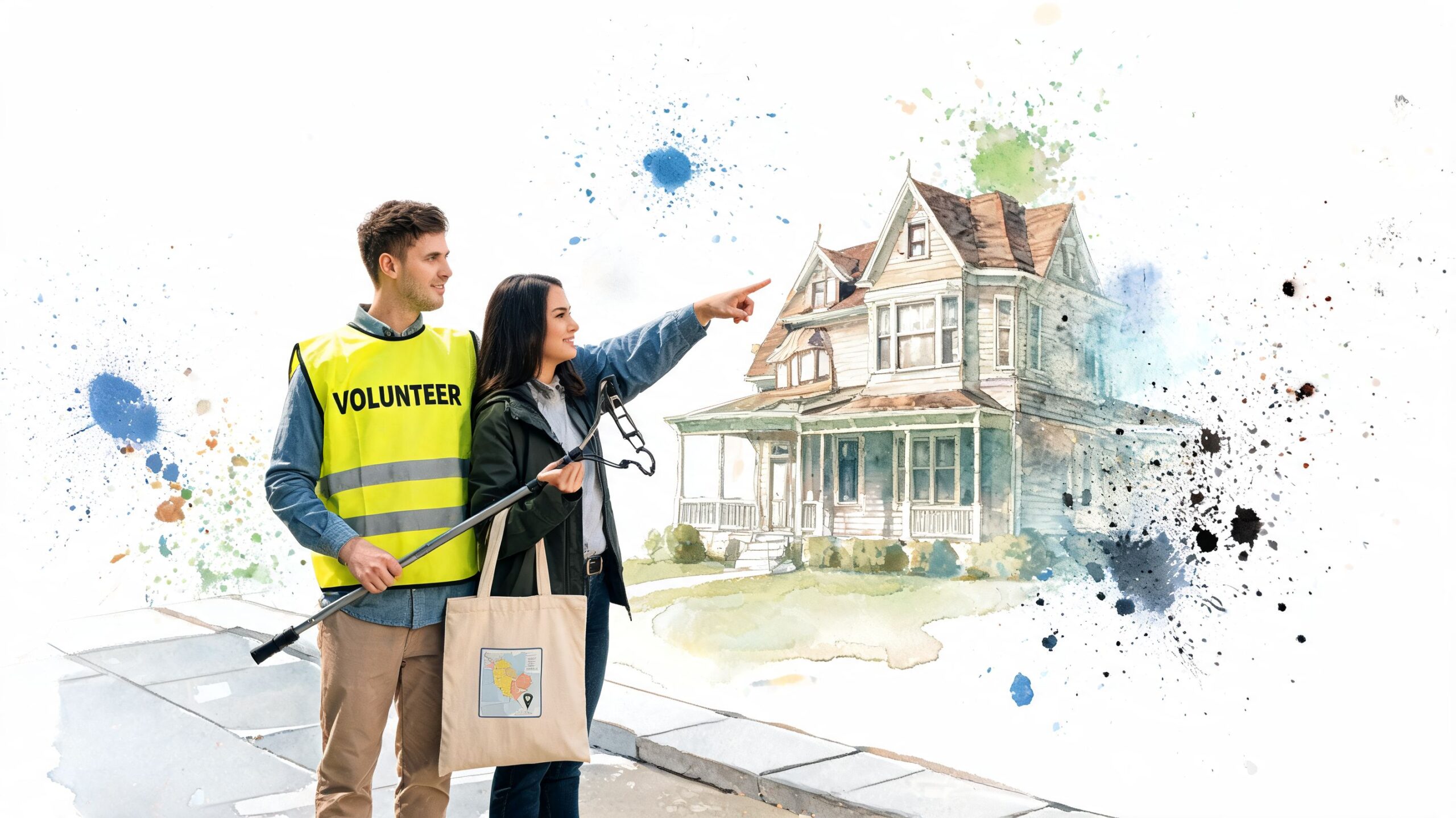
    A male volunteer and a female companion pointing towards a sketch of a house for community planning

    Let curiosity do some of the work

    The social magic here is simple. You don’t need to force connection when the route gives you things to react to. A broken sign. A beautiful courtyard. A bus stop full of trash. A tiny community garden someone clearly fought for.

    I’d keep the group small enough that people can hear each other and cross the street without chaos. Then end somewhere easy, like coffee, tacos, or a park bench if the weather is kind.

    Some of the best fun community service ideas work because they lower the social pressure. Walking side by side is easier than staring across a table. Picking up litter gives your hands something to do while your guard drops.

    5. Youth and Student Leadership Service Corps

    The first time I handed a teen volunteer the clipboard, I could see the panic rise in her face. It was cold, her friends were watching, and our Litter Caterpillars crew was about to head out under a gray sky with wind cutting through every layer. I almost took the job back. I’m glad I didn’t.

    Ten minutes later, she was checking people in, matching first-timers with returning volunteers, and calling out who still needed gloves. By the end of the cleanup, she was the one answering questions from adults.

    That shift matters.

    Young people often show up with more courage than they realize. They just need a real job, not a symbolic one. If you want to build a youth or student service corps, give them work that would inconvenience the group if they dropped it.

    Let students carry the day

    In our group, the fastest way to help someone grow is to trust them in public. A student can lead the safety talk. A high school senior can map the route. A college volunteer can handle the after-photos and write the recap while the details are still fresh. If they mess up a little, good. That’s part of how they get steadier.

    I’ve watched this happen over and over. A quiet kid starts by holding extra bags. Then they greet one new volunteer. Then they explain the plan to the whole group. A month later, they’re the person keeping everyone focused when the weather turns ugly and people want to quit. Cleaning up a block sounds small. Sometimes it’s where a young person finds out, very plainly, that they can stay calm, be useful, and help other people feel safe.

    A student service corps works best with clear roles and one or two adults who know how to stay supportive without taking over.

    Try roles like these:

    • Route captain who learns the area and keeps the team moving
    • Supply lead who tracks gloves, grabbers, and bags
    • Photo lead who documents the work and the people behind it
    • Welcome buddy who stays near first-timers and helps them settle in

    I like youth crews because they bring urgency. They haven’t made peace with broken things yet. They see a trashed lot, an alley full of bottles, a sidewalk that tells everyone nobody cares, and they want to do something now. Being around that changed me. I used to think I was helping young volunteers build confidence. Sometimes they were the ones helping me remember how to stop standing on the sidelines of my own life.

    6. Corporate Team Building Service Days

    The first time the Litter Caterpillars hosted a company cleanup, I expected forced smiles and name tags nobody could read. Instead, I watched a project manager in office shoes crouch beside a storm drain with a guy from accounting, pulling out a wet pile of cups and receipts with two grabbers and a lot of laughter. Twenty minutes in, they had stopped talking about work. By the end, they were arguing about who had found the strangest piece of trash and whether they should come back next month without the company banner.

    That day changed my mind about team building.

    A service day works because the job is honest. You start with a messy block, a parking lot edge full of wrappers, or a fence line everyone has ignored for months. Then you work until the place looks cared for again. If your team has been stuck in meetings, politics, or polite distance, that kind of visible progress cuts through a lot of nonsense. I’ve felt it in myself too. When my head was crowded and my life felt sloppy, picking up trash with other people gave me one clean thing I could finish.

    Corporate groups do best when the day feels grounded in a real place, not staged for a photo.

    What I’ve seen work:

    • Pick a route with an obvious problem so nobody has to wonder why they’re there
    • Keep teams small so people talk, notice things, and stay useful
    • Give one short local briefing about the street, park edge, or corridor they’re serving
    • End with coffee, lunch, or pizza so the conversation keeps going after the bags are tied
    • Share a simple recap with photos and volume collected instead of a long internal presentation

    One more thing matters. Let people get uncomfortable.

    I don’t mean unsafe. I mean real. Wind in your face. Mud on your gloves. That moment when you realize the alley behind the office park is worse than you thought, and you still keep going. Hard things done together have a way of introducing people properly. I’ve seen quiet employees take over bag runs, skeptical managers carry full loads back to the truck, and coworkers who barely spoke in the office start moving like a practiced crew.

    The best company service days leave people a little tired, a little less guarded, and proud in a way happy hour rarely touches. If a few of them come back later on their own, you did more than fill a volunteer slot. You helped them find a sturdier version of themselves outside, and sometimes inside too.

    7. Environmental Education and Cleanup Workshops

    One winter, our Litter Caterpillars crew met in a church basement while sleet tapped the windows hard enough to make a few people question their life choices. A teenager asked why trash always seemed to collect near the same fence line. An older neighbor pointed at the storm drain map on the wall and said, “Because this whole block tilts that way.” Twenty minutes later we were outside, cold, wet, and suddenly seeing the street for what it was. Not random. A system.

    That kind of workshop changed me more than I expected. I used to look at a dirty block and just feel overwhelmed. Learning how litter moves gave the mess edges. It made the problem smaller, clearer, and strangely easier to face. Sometimes that is what you need when your inner life feels scattered too. You pick one thing up, then another, and your brain stops spinning long enough to breathe.

    A good cleanup workshop starts indoors, but only briefly. Use a library room, school cafeteria, field house, or church basement. Show people a few real things they can spot outside: how debris collects near bus stops, how wind pins cups against fences, how neglected corners turn into permission slips for more dumping, how storm drains carry a block’s bad habits downhill.

    Then get outside before the room gets sleepy.

    I’ve found this format works especially well for people who want a reason before they want a grabber. They are curious, a little cautious, and often one good explanation away from joining in. Once they can connect the bottle in the bushes to runoff, foot traffic, or absentee maintenance, the cleanup stops feeling like random labor. It becomes attention. It becomes care.

    The best part is what happens to people’s eyes. After one short lesson, they stop walking past the same old mess half-blind. They notice patterns. They ask better questions. They start saying things like, “This corner needs a can,” or “That alley is feeding this whole curb line.”

    That’s a different kind of service. You are not only clearing trash for an hour. You are teaching people how to read their own neighborhood, and sometimes how to read themselves a little better too.

    8. Social Media Campaign and Volunteer Ambassador Program

    The first post that brought new people into the Litter Caterpillars was not clever. It was a photo of my frozen glove holding a bent license plate we found half-buried in slush. My face looked rough. The sky looked mean. A friend reposted it, wrote, “They were out here in this?” and two strangers showed up at the next cleanup.

    That taught me something fast. People respond to proof.

    A good volunteer ambassador program starts with a few regulars who already tell the truth online. Not the polished person. The honest one. The one who will post the muddy curb, the overloaded bag, the laugh after somebody finds a toy dinosaur in a storm drain, and the coffee stop when everybody finally warms up.

    Let real people carry the message

    Give a handful of volunteers a simple job. Share what happened. Show the meeting spot, one ugly corner, one small win, and one reason you came back.

    That is enough.

    I would also put a QR code on a handout or sign if you have one. It gives passing neighbors an easy way to join before courage fades and life fills the space back in. No pitch. Just a clean path from “I saw you out here” to “I’ll come next time.”

    You do not need perfect branding. You need a voice that sounds like a person with cold hands and a full trash bag.

    Prompts help, especially for people who want to post but freeze up:

    • Why I came today
    • What this block looked like before
    • The weirdest thing I found
    • Who I met
    • Why I’m coming back

    The ambassador part matters because service can feel lonely until you see your people. A post says, “I was here.” Another post says, “You can be here too.” For me, that changed more than turnout. When I started sharing cleanup days openly, I stopped hiding in my own head so much. Picking up a mess outside gave me a way to face my mess inside, and saying that out loud gave other people permission to do the same.

    That is how a cleanup group becomes a magnet. One real story at a time.

    9. Adopt-A-Ward Community Stewardship Program

    One winter, the Litter Caterpillars kept returning to the same ward even after a blizzard packed trash into hedges, chain-link fences, and frozen gutters. The first day, it felt like we were losing. The second week, we knew which alley would be the worst, which bus stop needed extra bags, and which neighbor would wave from the porch and ask if we wanted hot tea.

    That changed me more than any one-off cleanup ever did.

    Adopt-a-ward work is what you do when you stop chasing the easy photo and start building a relationship with a place. You pick a neighborhood zone, corridor, or cluster of blocks, then you keep showing up. Same area. New weather. New mess. New chances to prove to yourself that you can come back even when the excitement is gone.

    Stay long enough to know the route

    Repetition turns cleanup into stewardship. After a few weeks, you stop saying “that part of town” and start saying “our ward.” You know the lot that catches windblown cups, the corner where broken glass keeps coming back, and the stretch of sidewalk that looks better now because your group refused to give up on it.

    I would give each area a captain and a simple group chat. Nothing fancy. Just a person who notices when turnout dips, remembers where supplies are stored, and says, “We’re still on for Saturday.”

    Tracking helps, too, but it does not need to feel corporate. Keep a short log of which blocks you covered, what kinds of trash showed up, who came, and what looked different from last time. A shared note and a few before-and-after photos are enough to help people feel progress in their hands.

    That mattered for me more than I expected. When my own head was a mess, returning to the same streets gave me proof that ugly things can change slowly. You clear one fence line. You come back. It is still better than it was. Sometimes that is the exact reminder you need about your own life.

    A ward program works because it asks for commitment, not novelty. And commitment is where bravery usually starts.

    10. Friendship and Social Connection Facilitation Events

    The first time I felt this click, our Litter Caterpillars crew had finished a cold, miserable cleanup and nobody rushed to their cars. Gloves were off. Trash bags were stacked. Somebody passed around gas station coffee and stale donuts, and we stood there talking like we had known each other longer than two hours. I went home with frozen hands and a quieter mind.

    That surprised me.

    I had shown up for the obvious reason. The block was a mess, and I was a mess too. What I got was a roomless kind of friendship. Side by side, looking outward, doing something useful. For a lot of adults, that is easier than trying to make friends across a dinner table.

    If you want this kind of event to work, build for connection on purpose. Friendship does not always appear just because people wore the same gloves for an hour. Shy people drift. New people hover near the edge. Good intentions are not enough.

    A few things helped our group:

    • Match new volunteers with regulars so nobody spends the first ten minutes pretending to check their phone
    • Ask simple opening questions like what street they grew up on or what weird thing they found during a cleanup
    • Leave time after the work ends for coffee, fruit, soup, or whatever gives people a reason to stay
    • Mark the small stuff like a first event, a birthday, or someone finally getting brave enough to invite a friend

    Four joyful friends laughing during a picnic celebration with a small cake and drinks outdoors

    I stopped caring whether people came only for the cause. Some came because they wanted company. Good. That is honest. A cleanup can give you a job to do with your hands while your guard slowly drops.

    That inner part matters to me more than I expected. Picking up litter with kind people helped me practice being seen without performing. It helped me keep promises to myself. You show up on a windy Saturday, do one hard thing, laugh with somebody near a dumpster, and the knot inside you loosens a little. Cleaning up a mess outside will not fix your whole life, but it can prove you are still capable of change, and sometimes that is how the actual cleanup begins.

    Top 10 Fun Community Service Ideas Comparison

    Program / Model Implementation Complexity 🔄 Resource Requirements ⚡ Expected Outcomes 📊 Effectiveness / Quality ⭐ Key Advantages 💡
    Neighborhood Block Cleanups with Team Identity Moderate, recurring scheduling; occasional permits Low–Moderate, volunteers, basic supplies, branded gear Regular litter reduction; visible neighborhood presence; habit formation High, sustained engagement and local pride Builds camaraderie; flexible participation; strong social component
    Park and Green Space Restoration Projects High, multi‑phase planning, permitting, partnerships High, materials, specialists, funding, equipment Permanent site improvements; improved safety and property perceptions Very High, tangible long‑term transformation Lasting legacy; attracts media/business partners; educational benefits
    Highway and Major Corridor Cleanup Events High, extensive safety/traffic coordination and permits High, many volunteers, traffic control, PPE, insurance Dramatic visual improvement; media attention; volunteer recruitment spikes High, large scale visibility but less frequent Media buzz; attracts new volunteers; often qualifies for city support
    Volunteer‑Led Neighborhood Walking Tours and Cleanup Moderate, guide recruitment and training; scheduling Low–Moderate, trained guides, small supplies Deeper neighborhood knowledge; engaged participants; modest litter removal Moderate, strong for engagement/education, lower volume efficiency Combines tourism + service; appeals to newcomers and explorers
    Youth and Student Leadership Service Corps High, curriculum, mentorship structures, coordination Moderate, staff oversight, training materials, tracking systems Leadership development; sustained volunteer pipeline; documented service hours High, builds long‑term capacity and peer recruitment Scales volunteer base; supports retention; educational credentials
    Corporate Team Building Service Days Moderate, customized logistics and client coordination High, corporate volunteers, coordinators, supplies; funding Large short‑term impact; sponsorships; media/photo opportunities Moderate, strong short‑term results; variable long‑term engagement Generates funding/partnerships; efficient large‑group work; PR value
    Environmental Education and Cleanup Workshops Moderate, curriculum and expert coordination Moderate, speakers, materials, venue More informed volunteers; potential behavior change beyond cleanups High for education impact; moderate for immediate cleanup volume Builds credibility; attracts sustainability advocates; enables deeper impact
    Social Media Campaign and Volunteer Ambassador Program Moderate, content strategy and ambassador training Low, phones, small incentives, management time Increased awareness; youth recruitment; organic reach and storytelling Moderate, strong reach potential; conversion to active volunteers varies Low‑cost marketing; peer‑driven growth; scalable storytelling
    Adopt‑A‑Ward Community Stewardship Program High, coordination across many wards; leadership network Moderate, many volunteers, training, tracking tools Year‑round stewardship; scalable city coverage; measurable progress Very High, sustained local ownership and accountability Deep community relationships; localized identity; scalable model
    Friendship and Social Connection Facilitation Events Moderate, plan social elements and mentorship pairings Low–Moderate, refreshments, spaces, coordinators Higher retention; stronger volunteer networks; improved well‑being High for retention and community health; indirect on immediate metrics Increases retention; fosters belonging; transforms volunteers into advocates

    Go Find Your Fence to Paint

    Tom Sawyer got stuck painting a fence and somehow made other boys want in on it. I love that story because it gets at something simple and honest. Hard work becomes magnetic when you wrap it in pride, friendship, and a little play.

    That’s what these fun community service ideas do. They take dirty, ordinary work and turn it into a challenge you want to accept. A block cleanup becomes a team ritual. A park restoration becomes a place you care about. A walking tour becomes a map into your new city. A post-cleanup coffee becomes the start of a real friendship.

    I didn’t start doing this because I had my life together. I started because I didn’t. My own mess felt impossible. Picking up trash outside gave me a smaller, clearer battle. Bag by bag, block by block, I learned that action can come before feeling ready. That’s true for cleaning a street. It’s true for rebuilding yourself too.

    You don’t need a perfect nonprofit plan or a giant volunteer roster. You need a date, a place, a few supplies, and the nerve to invite somebody. Start with one block. Start with one park edge. Start with one weird little route under the train tracks that everyone ignores. If you keep showing up, the work gets lighter because the story gets stronger.

    There’s plenty of service out there that feels dry and dutiful. I think people are hungry for something more alive. They want structure, but they also want laughter. They want to help, but they also want belonging. They want to do good without pretending they have no needs of their own. I respect that. I think it’s honest.

    If you’re in Chicago, Litter Caterpillars is one real option for this kind of work. The group meets weekly, often on weekend mornings, and builds cleanup around bravery, kindness, and friendship. If you’re somewhere else, steal the spirit and build your own version.

    Go find your fence to paint. Go pick the block everybody skips. Go clean a mess outside and see what happens inside. The point isn’t to fix your whole life in one Saturday. The point is to show up for your city and for yourself, then do it again next week.


    If you want a place to start, Litter Caterpillars has weekly Chicago cleanup events, group identity, and a volunteer-first approach that makes it easy to join, make friends, and do the work.

  • Your Guide to Greene Valley Forest Preserve

    Your Guide to Greene Valley Forest Preserve

    I once bent down for a crushed soda can at Greene Valley and felt my whole week change shape. The wind moved through the grass, my bag crackled, and for one clean second my mind stopped arguing with itself.

    That’s why I keep coming back to greene valley forest preserve. You go there thinking you need a walk, and sometimes you leave with a reset.

    From Personal Mess to Open Meadows

    I’ll be honest with you. I didn’t come to places like Greene Valley because I had my life together. I came because I didn’t.

    My apartment used to feel like a museum of unfinished decisions. A jar in the fridge meant guilt. A pile by the door meant delay. A torn bag I should’ve thrown away last month somehow carried a whole memory, so I kept it. You might know that strange heaviness. The object weighs almost nothing, but your chest acts like it weighs a truck.

    Then one morning I went out because staying inside felt worse.

    I didn’t need a grand plan. I needed one action I could finish. Pick something up. Put it in a bag. Keep walking.

    When open space does part of the work

    Greene Valley gave me room to think because it didn’t crowd me. The meadows felt like someone had opened a window in my head. The trails asked very little from me. Just move your feet. Breathe. Look down. Look up. Repeat.

    That’s the secret I wish more people knew. Cleaning up someone else’s mess can loosen your grip on your own.

    Practical rule: If your mind is jammed, give your hands a job.

    I remember one stretch of trail where I found a bottle near the edge of the path, then a wrapper, then another piece of plastic caught low in the grass. None of it was dramatic. That was the point. I didn’t need drama. I needed proof that small effort still counts.

    By the time I got back to my car, I wasn’t “fixed.” I was steadier.

    Why this place works

    Some places make you perform. They make you feel like you should be faster, fitter, more outdoorsy, more prepared. Greene Valley doesn’t feel like that to me. It feels like a place where you can show up tired, cluttered, restless, and still belong.

    If you’ve been waiting to become a better version of yourself before you go outside and do something useful, stop waiting. Go as you are.

    Bring your confusion. Bring your overthinking. Bring the version of you that keeps putting things off.

    A meadow doesn’t ask for a polished person. A trail doesn’t care if you’ve had a messy year. You take a step anyway. Then another. That’s how order starts. Not with a perfect system. With movement.

    First Steps into Greene Valley

    The first time you arrive, don’t overcomplicate it. Get there, park, and start walking before your brain talks you back into the car.

    Greene Valley sits in south-central DuPage County between Woodridge and Naperville. The land carries an older story under your shoes. It was once farmland owned by William Briggs Greene, and you can still see part of that past in his 1870s barn on the north end. The county trail system around it is huge too. The Forest Preserve District of DuPage County maintains over 175 miles of trails, and a connector from Greene Valley links to Whalon Lake Forest Preserve, as noted in this DuPage County video overview of Greene Valley.

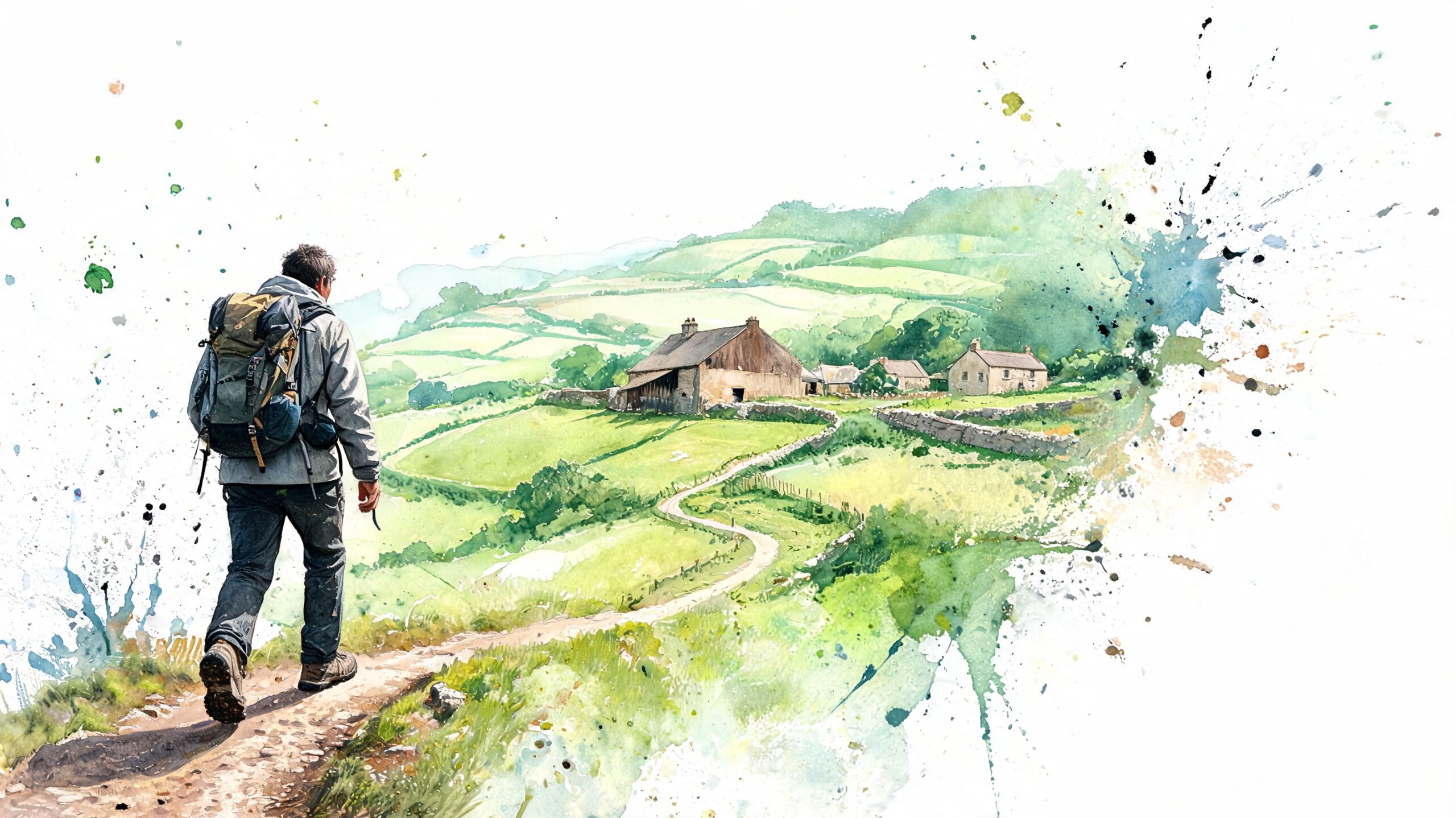
    A hiker with a backpack walks along a dirt path towards a scenic green valley with stone cottages.

    Start simple and start moving

    I think a first visit goes best when you treat it like the beginning of a small expedition, not a test. You don’t need to “see everything.” You need one good hour outside.

    Here’s the approach I’d give a friend:

    • Park and commit fast: Once you arrive, don’t scroll your phone for fifteen minutes. Lock the car and start.
    • Pick a direction, not a masterpiece: Your first route doesn’t need to be perfect. It only needs to get you onto the path.
    • Look for the old bones of the place: Barns, field edges, old tree lines. They remind you this ground had a life before your visit.

    That matters more than people think. When you notice the old farm traces, Greene Valley stops feeling like generic green space. It starts feeling lived-in, changed, worked on, handed forward.

    Use the first visit to build confidence

    If you’re new to forest preserves, this is a good place to practice trust in yourself. Wide paths calm people down. Open views help if dense woods make you uneasy. You can settle into a rhythm without feeling boxed in.

    I also like that Greene Valley plugs into a bigger county system. You can begin here and realize outdoor life isn’t one isolated afternoon. It can become a habit.

    If you want another way to compare nearby preserves before you go, I like this guide to an Illinois forest preserve adventure because it helps you think in terms of experience, not just directions.

    You don’t need wilderness skills to start. You need curiosity, water, decent shoes, and the guts to begin before you feel ready.

    The land itself helps with the rest. You walk. The noise drops. The day gets more honest.

    Finding Your Path on the Trails

    Your shoes tell you a lot at Greene Valley.

    On the crushed limestone, your steps make that steady crunch that sounds like commitment. On the dirt footpaths, the ground softens and your body changes pace without asking permission. That contrast is part of the charm. Greene Valley covers 1,388 acres and has 12 miles of multiuse trails plus 3 miles of footpaths, and it’s one of the county’s most botanically varied places with over 540 native plant species, according to this Greene Valley trail and plant guide.

    Close-up of hiking boots standing on a rocky outcrop in the scenic Greene Valley Forest Preserve.

    Pick a trail by mood, not ego

    I’ve made the mistake of choosing routes to impress myself. That usually ends with me missing what I came for.

    At Greene Valley, I think it’s smarter to choose by state of mind.

    What you need What to choose
    Head-clearing walk A broad limestone route where you can settle into a steady rhythm
    Quiet and texture One of the dirt footpaths where the preserve feels more intimate
    Leg work and momentum A longer loop that keeps you moving without many stops
    Plant watching Slower walking with frequent pauses along varied habitat edges

    That last one matters. If you rush, you miss half the place. A preserve with over 540 native plant species doesn’t reveal itself all at once. It comes in layers. Low flowers near the path. Taller stems catching side light. Leaves with different shapes and tones once you finally slow down enough to notice them.

    The trail can meet you where you are

    One day I needed exertion. I took the wider path and kept a stronger pace until my thoughts stopped repeating themselves. Another day I needed something gentler, so I drifted onto a quieter footpath and let the smaller sounds take over.

    That’s why greene valley forest preserve keeps earning repeat visits. It doesn’t trap you in one style of experience.

    If you want another preserve to compare for a different kind of hiking day, this look at Waterfall Glen Forest Preserve gives you a useful contrast.

    A short video gives a good feel for the terrain and flow before you go:

    Let the place work on you

    You don’t need to conquer all the miles. Let the trail do its quieter job.

    Walk until your shoulders drop. Walk until you stop reaching for your phone every few minutes. Walk until the scale of the preserve helps your problems shrink back down to human size.

    That’s choosing your path in the best sense. Not maximizing distance. Matching the land to the day you have.

    The Wild Inhabitants of the Preserve

    The first real shift happens when you stop treating wildlife like a bonus and start treating it like company.

    At Greene Valley, that shift can happen fast. The preserve’s habitats support over 370 native animal species. Its wetlands are breeding ground for amphibians, and its meadows and forests are home to animals like coyotes, meadowlarks, great horned owls, and white-tailed deer, according to the Greene Valley master plan.

    A watercolor painting featuring a blue jay perched on a branch overlooking a forest with a deer and rabbit.

    Learn to hear before you look

    In spring, the wetlands can erupt with frog and toad calls. If you’ve spent too much time indoors, that sound can almost feel fake at first. Too full. Too alive. Then your ears adjust, and you realize the place has been talking the whole time.

    That’s how I try to walk in preserves now. I listen first.

    • Wet places: Pause and listen for amphibian chorus before you scan the water.
    • Meadows at dawn or dusk: Keep your eyes up and long. Movement often comes before shape.
    • Wooded stretches: Slow down. Owls and deer reward patience more than speed.

    The wild part of a place rarely introduces itself on your schedule.

    A better way to move through the preserve

    I once saw a deer at the edge of the trees because I had stopped to untangle a piece of litter from a branch. If I had kept marching, I would’ve missed it. Service changes your pace. That’s one of the hidden gifts.

    The same goes for birds. Meadowlarks don’t care about your hiking playlist. Coyotes won’t pose because you finally looked up from your map. Greene Valley asks you to become less noisy in every sense.

    Try this on your next visit:

    1. Walk one stretch without talking.
    2. Stop for a full minute when you hear water or birds.
    3. Scan edges, not just open space.
    4. Let one sighting be enough.

    That last one is important. You don’t need to collect wildlife like trophies. One owl heard but not seen can change your whole day. One deer stepping through shadow can make you feel like you entered the preserve for real.

    Be a guest, not an owner

    When you understand that more than 370 native animal species live across these habitats, your posture changes. You stop acting like the place exists for your convenience. You start acting like you’ve been allowed in.

    That’s a better kind of outdoor confidence. Less swagger. More attention.

    Seasonal Rhythms and How to Visit with Respect

    Greene Valley changes its personality every season, and I think that’s part of why people return. You’re never meeting the exact same place twice.

    Spring is restless. The ground softens, birds get louder, and the whole preserve feels like it woke up before you did. Summer has a different mood. The light gets heavier, shade starts to matter, and a walk can feel less like exploration and more like endurance in the best way.

    Let the season choose the lesson

    Autumn sharpens everything. Your footsteps sound cleaner. The air feels direct. You notice distance more.

    Winter strips the preserve down to structure. Paths, trunks, sky, breath. I like winter because it removes excuses. If you go out on a cold day, you usually mean it.

    Here’s how I think about seasonal visits:

    • Spring is for noticing: Watch for small changes, fresh growth, and sound returning.
    • Summer is for discipline: Bring water, start earlier, and respect your limits.
    • Autumn is for longer walks: The air often makes effort feel easier.
    • Winter is for honesty: You find out quickly what kind of mood and gear you brought.

    Respect is a practice, not a slogan

    A lot of people hear “Leave No Trace” and think of a lecture. I don’t hear it that way. I hear basic decency.

    If you borrow a friend’s home, you don’t leave wrappers on the floor. You don’t stomp through what they care for. You don’t turn your convenience into their burden. A preserve deserves the same manners.

    A good visit leaves the place lighter, quieter, and less burdened by your presence.

    That can look simple:

    • Stay aware of where your feet go: Trails exist for a reason.
    • Carry your own trash out: Don’t outsource your mess to the next person.
    • Keep noise down: Sound travels farther than people think.
    • Notice before you act: A photo isn’t worth pushing into sensitive ground.

    Kindness has a physical form

    I think a lot about how respect becomes visible. It’s in the path left unscarred. It’s in the bottle cap you pocket. It’s in the moment when you choose not to force an encounter with wildlife.

    Those tiny acts shape your character because they ask you to do the right thing with no applause waiting. That’s rare. And good for you.

    Greene Valley is a strong place to practice that kind of restraint because it gives a lot. Open room. animal life. quiet. If a place gives you that much, the decent response is to give some care back.

    That’s how a walk turns into stewardship. Not through grand speeches. Through habits.

    Join Us The Litter Caterpillar Cleanup

    There’s a hill at Greene Valley that tells the whole story if you let it.

    The preserve has a 190-foot scenic overlook built on a reclaimed landfill. A place that once held waste now gives people a view. The preserve also has 12 miles of durable trails that help volunteer groups reach litter-heavy and sensitive areas efficiently, according to the DuPage Forest preserve page for Greene Valley.

    I love that. I don’t mean it in a poetic, floaty way. I mean it as a working principle. Trash can become a turning point. A dumped place can become a cared-for place. An ashamed person can become a useful one.

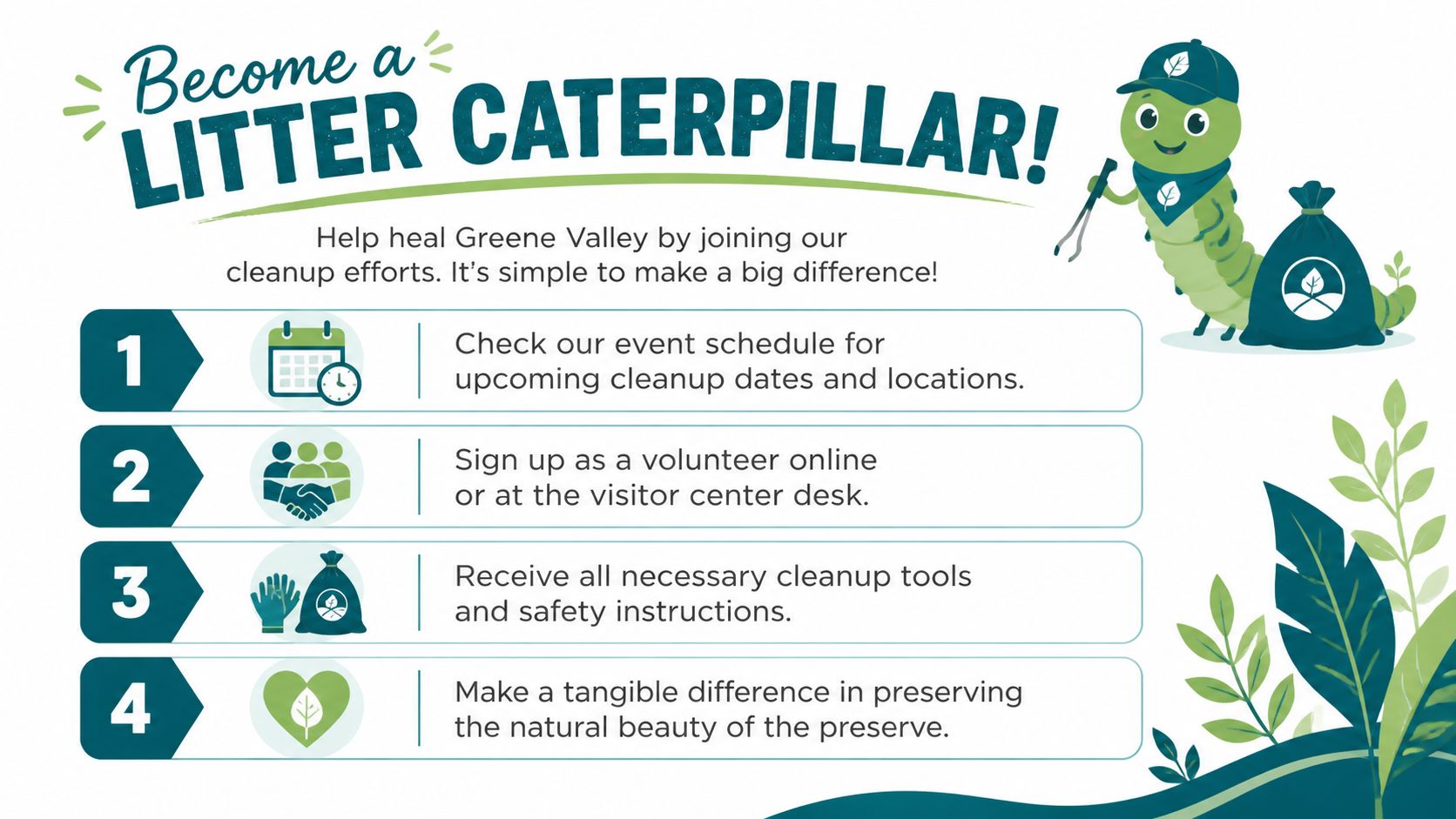
    An infographic titled Become a Litter Caterpillar inviting volunteers to help cleanup Greene Valley Forest Preserve.

    Why a cleanup changes more than the ground

    A cleanup gives you something rare. Visible proof.

    You bend down. You lift the bottle, can, wrapper, or broken plastic. You bag it. The place looks better because you showed up. That’s a very old medicine for the modern mind.

    If you’ve felt stuck, service cuts through the fog because it asks a clear question. Can you help, right here, right now? Usually the answer is yes.

    How to prepare for a cleanup day

    You don’t need elite gear or some rugged identity. You need practical clothes and a willing attitude.

    Here’s the simple version I’d tell any first-timer:

    • Wear clothes that can get dirty: Long pants are smart if you’ll brush past tall grass or work near rough edges.
    • Choose solid shoes: Closed-toe shoes with grip make the day easier.
    • Bring water and basic weather sense: Sun, wind, mud, and chill all change how a cleanup feels.
    • Expect real work: Some stretches are easy. Some ask for patience and grit.

    I think that last part is good for people. Hardship in a meaningful direction feels different from random stress. A full trash bag has weight, but it also has purpose.

    What the day feels like

    Cleanup work has a strange rhythm. At first, people are a little shy. Then someone finds a weird piece of litter, somebody laughs, somebody points out a bird, and the group starts moving like a team.

    You notice the trail in a new way when you’re scanning both beauty and damage. A ditch full of cans stops being background. A clean stretch becomes a small victory. The preserve trains your attention.

    Bring your awkwardness. Bring your uncertainty. Shared work melts both faster than small talk does.

    There’s also relief in the physicality of it. Reach, grab, step, bag, repeat. The body likes a clear assignment. So does the mind.

    How to join without overthinking it

    If you want to volunteer, keep the process plain. Don’t wait for the perfect weekend when your calendar is magically open and your energy is ideal. That weekend doesn’t exist.

    Take these steps instead:

    1. Check the upcoming events through this volunteer trash pickup page.
    2. Sign up for a date that you can realistically make.
    3. Dress for weather, dirt, and movement.
    4. Arrive ready to listen and work with other people.
    5. Let the day be what it is. Muddy, windy, cold, funny, satisfying.

    That’s enough.

    The deeper invitation

    I think a lot of us are hungry for transformation, but we want it to arrive in a dramatic package. New plan. New app. New identity. Cleaner life by next month.

    Usually it’s simpler and less glamorous than that.

    You show up at a preserve. You do a useful task. You get tired for a good reason. You see that your effort changed something outside you, and because of that, something inside you shifts too.

    That’s the true invitation at Greene Valley. It isn’t only to admire open space. It’s to become the kind of person who protects it.

    And maybe, while you’re pulling litter from the edge of a trail or climbing a hill that used to be a landfill, you realize your own messes aren’t permanent either. They can be worked on. They can be faced. They can even become the ground for a better view.


    If that kind of day sounds like your kind of growth, join Litter Caterpillars. Come outside, do hard good work with kind people, and leave greene valley forest preserve better than you found it.

  • MrBeast Ocean Cleanup: Your Guide to Local Action

    MrBeast Ocean Cleanup: Your Guide to Local Action

    I once stared at a jar of old jam in my fridge like it was a boulder. Then I walked outside, picked up one crushed bottle on the sidewalk, and felt lighter than I had in months.

    That’s why the mrbeast ocean cleanup story hits me so hard. A giant mess can freeze you. One small action can unfreeze you.

    That One Mess You Can't Clean

    I didn’t start by caring about ocean policy or plastic systems. I started because my own mess beat me.

    A bag of stale nuts from some failed health kick. A container from a trip I didn’t want to forget. That old jam jar in the back of the fridge. None of it weighed much, but to me each item felt welded in place. I’d look at it, feel shame, close the door, and tell myself I’d deal with it tomorrow.

    Tomorrow kept losing.

    A stressed man sitting at a messy wooden table with a large jar labeled jam.

    When a tiny mess feels huge

    That feeling is why people freeze when they hear about plastic in the ocean. The problem sounds too big, too far away, too ugly. You hear about trash in rivers, on beaches, tangled in weeds, lodged under docks, and your brain does what mine did with that jam jar.

    It says, “Nope. Too much.”

    I get that. I really do.

    Because paralysis doesn’t care about scale. A messy room can break your spirit the same way a polluted shoreline can break your hope. Different size, same feeling. You don’t move because you think your effort won’t matter.

    Sometimes the hardest trash to pick up is the first piece.

    What changed me wasn’t some grand plan. It was one outing, one bag, one miserable stretch of weather, one moment where I realized cleaning other people’s mess felt easier than facing my own. Strange, right? But that’s how a lot of us start. We borrow momentum from service.

    Why this story matters to regular people

    That’s what makes the mrbeast ocean cleanup story useful. I don’t mean useful as internet entertainment. I mean useful in your body, in your Saturday morning, in that stuck part of your life that needs a shove.

    MrBeast looked at an absurdly large mess and started anyway. He didn’t wait for the perfect emotional state. He didn’t solve the whole thing alone. He picked a direction and moved.

    That’s the part I want you to keep.

    If your room is a wreck, wash one cup. If your block is filthy, fill one bag. If the ocean problem makes you feel powerless, remember this. Every giant cleanup begins with somebody willing to look silly for doing something small.

    We love the dramatic before-and-after photos. But the miracle itself is more boring than that. Somebody bends down. Somebody gets their hands dirty. Somebody starts.

    What Was the MrBeast Ocean Cleanup

    The simplest way to explain #TeamSeas is this. Two creators asked the internet to help pay for trash removal, and they made the math easy enough for anyone to understand.

    MrBeast and Mark Rober launched #TeamSeas in October 2021. They set a goal to raise $30 million to remove 30 million pounds of trash. The campaign raised $30 million in 65 days from over 400,000 donors, and by July 2024 it had removed 34,080,191 pounds of trash from oceans, beaches, and rivers worldwide, according to Ocean Conservancy’s campaign wrap-up.

    The genius was the simplicity

    A lot of environmental messaging gets muddy fast. You hear a dozen terms, five organizations, three conflicting solutions, and your brain checks out.

    This campaign cut through that.

    • One dollar, one pound: You didn’t need a lecture to understand what your money did.
    • A clear finish line: People could see the target and rally around it.
    • Familiar faces: MrBeast and Mark Rober made a heavy topic feel approachable.

    It worked like a neighborhood potluck. One person doesn’t bring the whole meal. One person brings chips, another brings fruit, another brings a tray of pasta. Suddenly the table is full. That’s what happened here, except the table was global and the shared dish was cleanup.

    Why people joined so fast

    I think people responded because the ask felt clean.

    No maze. No vague promise. No “support awareness.” You give a dollar, a pound of trash gets removed. That kind of clarity is rare, and people trust clarity.

    Practical rule: If you want people to act, give them a mission they can repeat in one sentence.

    That’s true online, and it’s true on your block. If your cleanup pitch needs five minutes of explanation, people drift. If your pitch is “come help us fill bags and leave this place better than we found it,” people get it right away.

    The mrbeast ocean cleanup campaign was huge, but the engine was simple. That’s why it traveled.

    The Two-Pronged Attack on Trash

    A good cleanup plan doesn’t swing blindly. It picks targets.

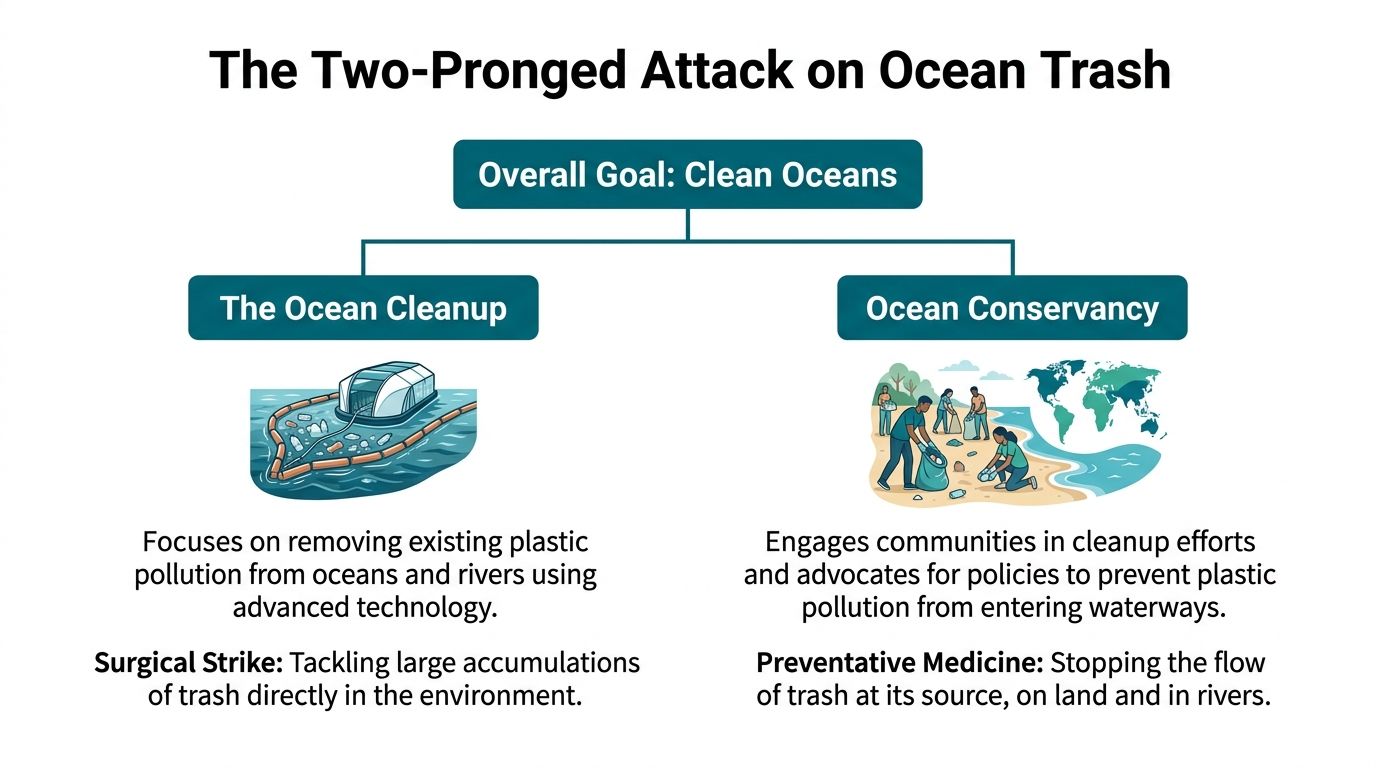
    #TeamSeas used two very different tools for the same problem. I think of it like a two-front fight. One front tried to stop trash before it drifted farther downstream. The other front sent people out to remove what was already choking beaches and coastal areas.

    An infographic showing two organizations, The Ocean Cleanup and Ocean Conservancy, working towards clean oceans.

    The engineering side

    Part of the campaign’s money went to The Ocean Cleanup. Their job focused on rivers.

    The Ocean Cleanup deployed its Interceptor technology, autonomous and solar-powered river barriers with conveyor systems, in high-pollution rivers of the Dominican Republic, Guatemala, Jamaica, and Malaysia. The technology is designed to remove plastic from rivers before it can enter the ocean, as described in The Ocean Cleanup’s #TeamSeas partnership update.

    That matters because rivers are like conveyor belts for litter. If you’ve ever watched trash slide along a curb during hard rain, you already understand the logic. Water carries our laziness farther than we think. A bottle dropped inland doesn’t stay “local” for long.

    So this side of the mrbeast ocean cleanup effort acted like a gatekeeper. Catch the stuff while it’s still moving through a narrower channel. Don’t wait for it to scatter into a much larger body of water.

    The human side

    The other half went to Ocean Conservancy, which worked in a very different way. Less machine, more boots, gloves, grit.

    They organized volunteers for cleanups on beaches and in marine environments. They also went after ghost gear, which means abandoned or lost fishing gear that keeps causing harm long after people leave it behind.

    Here’s the cleanest way to see the difference:

    Partner Main approach What it looked like
    The Ocean Cleanup River interception with technology Interceptor systems catching plastic before it reaches the ocean
    Ocean Conservancy Volunteer-led removal in coastal and marine areas Organized cleanups, gear recovery, direct hands-on work

    I like this split because it mirrors real life. When we clean our homes, we need both. We need a trash can by the door so wrappers don’t pile up again. We also need one painful afternoon to clear the junk already covering the floor.

    Why both approaches mattered

    A lot of people want one perfect answer. There usually isn’t one.

    You need systems that prevent future buildup. You also need people willing to deal with the mess that already exists. If you only build machines, you miss the human labor. If you only send volunteers, you miss the value of intercepting trash upstream.

    A cleanup gets stronger when it combines prevention with removal.

    That’s a lesson you can steal for your own group. Don’t just host pickups. Learn the path trash travels in your area. Which alley dumps into which gutter? Which storm drain carries bottles into the river? Which corner keeps trapping cups and wrappers because the wind circles there?

    The smartest cleanup isn’t always the biggest one. It’s the one that understands the map.

    Lessons for Your Local Cleanup Crew

    The best thing about the mrbeast ocean cleanup isn’t that most of us can copy its scale. We can’t.

    The best thing is that we can copy its design.

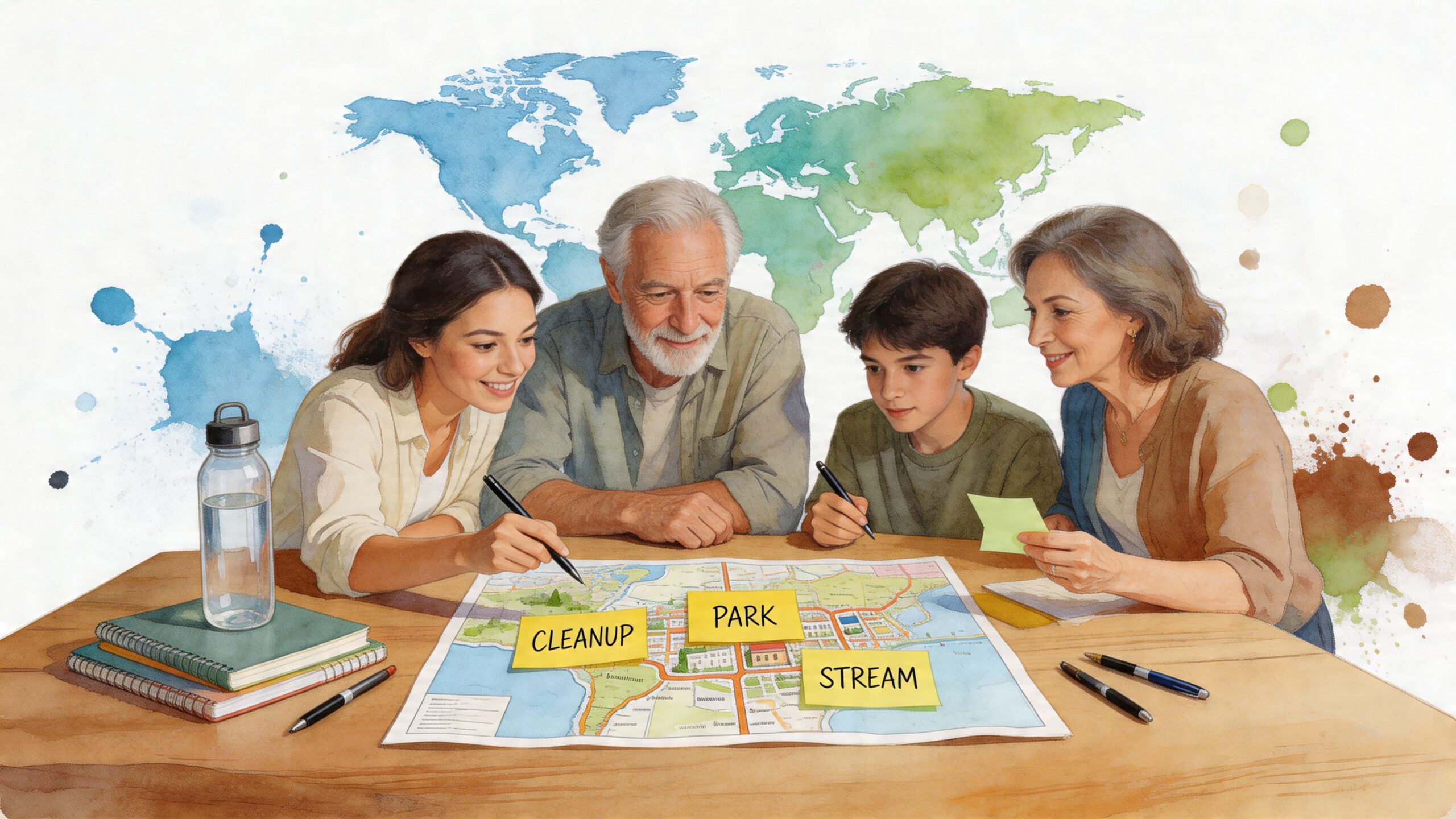
    A family working together on an environmental map project with cleanup and park notes on a table.

    When I’ve seen local cleanup groups stall out, it usually isn’t because people are lazy. It’s because the mission feels fuzzy. Nobody knows where to go, what to bring, or whether the work mattered after it ended. Energy leaks out.

    A strong group fixes that with three moves.

    Make the mission stupid simple

    #TeamSeas had one sentence people could remember. Your group needs one too.

    Don’t say, “We are cultivating civic responsibility through sustainable environmental stewardship.” Nobody talks like that. Say, “We meet, we pick up trash, we leave with full bags.”

    That’s it.

    If you want volunteers, make joining feel light. A page like this guide to volunteer trash pickup events works because it answers the basic human questions fast. Where do I go? What do I bring? Will I feel awkward if I show up alone?

    Those are the actual barriers.

    Give people pride they can wear

    People return to groups that make them feel brave, useful, and seen.

    That doesn’t require celebrity. It requires texture. A group photo. A goofy tradition. A flag. A running joke. A nickname for the route. A ritual coffee stop after the work. These things sound small, but they keep people coming back when the weather turns bad and the novelty wears off.

    Here’s a simple comparison:

    • Weak cleanup group: “Please assist with litter abatement.”
    • Strong cleanup group: “Meet us Saturday. Gloves on at 9. We’re taking this block back.”

    The second one has pulse.

    Field note: Celebration is not fluff. It is how a cleanup becomes a habit.

    Show proof fast

    People need to see what changed.

    Post the bag pile. Take the before shot and the after shot. Keep a simple running log. If somebody spent their morning pulling soggy wrappers from weeds, don’t make them guess whether that effort mattered.

    A short video can help more than a long explanation, especially when people can watch the work happen in real time.

    You don’t need a viral campaign. You need repeatable trust. When people can see a place get cleaner, they start believing they can change other places too.

    And once they believe that, your crew stops feeling like a random volunteer event. It starts feeling like a team.

    Beyond the Stunt The Real Impact

    Some people hear “MrBeast” and roll their eyes. I understand why. Big internet campaigns can feel loud, polished, and a little unreal.

    But if you strip away the thumbnails and chatter, you still have to answer one plain question. Did trash get removed or not?

    In this case, yes.

    Results are stubborn things

    Ocean Conservancy, as #TeamSeas’ beaches and ocean partner, mobilized more than 172,000 volunteers across 73 countries for about 2,000 cleanups targeting ghost gear and other debris, according to The Ocean Cleanup’s #TeamSeas overview.

    That’s not abstract. That’s people waking up, traveling to a cleanup point, bending down, hauling waste, and going home tired.

    And if you care about ocean trash in practical terms, this kind of work is easy to connect to daily life. Fewer nets left drifting. Less debris sitting in coastal habitats. Fewer piles of plastic riding currents and tides.

    Don’t get trapped in motive debates

    I’ve wasted too much of my life waiting for perfect motives, mine and everyone else’s.

    Perfect motives are slippery. Results are easier to inspect.

    If somebody films a cleanup and the place is cleaner after, I care about the cleaner place. If your neighbor thinks your Saturday trash pickup is weird, but the corner stops looking like a dumpster, the corner wins the argument for you.

    That’s one reason I like practical guides on solutions for pollution in the oceans. They pull you away from online sniping and back toward the thing in front of you. Trash has mass. Bags have weight. A cleaner shoreline is visible.

    People can debate style all day. A filled trash bag is hard to argue with.

    The local lesson is simple. Don’t wait for everyone to admire your method. Work first. Let the cleaned space speak.

    Bringing It Home to Chicago

    Chicago will test your sincerity fast.

    You’ll get wind off the lake, slush in your shoes, broken glass near curbs, weird smells in the alleys, and that special kind of cold that makes your fingers feel like borrowed objects. If you still want to show up after that, you’re ready.

    A man picking up a plastic bottle on a beach in front of the Chicago skyline.

    Start safe and stay boring about it

    I mean “boring” as a compliment. Safe cleanup habits should feel repetitive.

    • Wear gloves: Don’t raw-dog street trash. Use sturdy gloves every time.
    • Dress for layers: Chicago weather lies. Start with layers you can remove.
    • Use a grabber if you have one: It saves your back and keeps your hands farther from sharp junk.
    • Work with a buddy: Streets move fast. So do bikes, scooters, and distracted drivers.
    • Skip dangerous items: If you find needles, leaking containers, or anything that feels off, leave it and report it through the right city channel.

    You don’t get extra points for being reckless. You just get hurt.

    Pick a route that sets you up to win

    Don’t begin with the nastiest stretch you can find. That sounds brave, but it often burns people out.

    Start with a route you can realistically finish. A park edge. One commercial block. A bus stop corridor. The strip near a school fence. You want a visible before-and-after. You want volunteers to leave feeling, “We did that.”

    That’s how people build appetite.

    A simple local education page on ocean plastic pollution and connected waterways can also help people see why inland litter matters. Chicago trash doesn’t stay neatly where it started. Wind and rain move it.

    What to bring on your first morning

    I like a short list better than a giant checklist.

    Bring this Why it matters
    Gloves Protects your hands from grime and sharp edges
    Trash bags Gives the outing a clear finish line
    Water You’ll feel better and stay out longer
    Closed-toe shoes Streets and shorelines both bite
    A friend Keeps things safer and less awkward

    If you can, go early. Weekend mornings are underrated. The city feels softer then. You can hear birds between traffic bursts. You can talk while you work.

    And when you finish, don’t rush off. Stand there for a second. Look at the ground you just changed. That moment matters more than people think.

    Start With Your Own Fence

    I keep coming back to Tom Sawyer and that fence.

    He got handed a chore and turned it into something other people wanted to join. That story sticks because it reveals a strange truth. A burden can change shape when you carry it with pride.

    That’s how I see the mrbeast ocean cleanup. A giant ugly task became a shared mission people wanted to take part in. Not because trash is glamorous. It isn’t. Because action feels better than helplessness.

    Your fence might not be an ocean. It might be the alley behind your building. It might be the block where bottles collect by the bus bench. It might be the pile in your own room that you’ve avoided for months because each object feels heavy with memory.

    Start there.

    A small brave act changes the mood

    You do not need a huge platform to begin. You need one bag, one hour, one friend, one route. That’s enough to change the temperature of a day.

    And often that’s enough to change you, too.

    Find the mess that keeps staring at you. Then make it your project, your ritual, your weird little badge of honor.

    That’s the whole thing. Clean your fence. Then invite somebody else to help paint.


    If you want a real-world place to start, join Litter Caterpillars. We pick up trash in Chicago, make room for friendship, and turn ordinary weekend mornings into something you can feel proud of. If you’ve been waiting to become the kind of person who shows up, this is a good place to begin.

  • Erie Lackawanna Trail: A Path to Adventure & Action

    Erie Lackawanna Trail: A Path to Adventure & Action

    I stood on the erie lackawanna trail with a head full of static and a life that felt harder to carry than it should've. The pavement stretched forward in a straight, honest line, and that morning I understood something simple. You don't fix your whole life at once. You take one step.

    Your Journey Begins With a Single Step

    There was a time when I couldn't throw away a jar from the back of my fridge.

    I'm serious. Old food, dead batteries, random receipts, clothes I didn't wear. Every useless object had a little story attached to it, and that story made it feel too heavy to move. My room looked like a stalled-out train yard. My mind did too.

    Then my life cracked open. A relationship ended. The noise stopped. I had to decide whether I'd keep drowning in my own clutter or start doing hard things on purpose.

    So I started small.

    I walked.

    Not because I had a grand plan. Not because I was suddenly disciplined. I walked because movement gave me something my messy apartment didn't. A direction.

    A watercolor painting showing a foot wearing a white sneaker stepping onto a winding dirt trail.

    The first honest move

    The erie lackawanna trail works on you because it asks almost nothing at the start.

    You don't need to be fast. You don't need elite gear. You don't need some glowing social media version of yourself. You just need to show up and put your feet on the path.

    That's why I love trails like this. They don't negotiate with your excuses. The pavement doesn't care if you feel behind in life. It just waits for your next step.

    Practical rule: When life feels jammed, don't ask how to solve everything. Ask where you can walk today.

    I've seen this pattern again and again. A person starts with a short walk because they're tired, angry, lonely, or ashamed. Then the walk turns into a habit. The habit turns into self-respect. The self-respect changes what they tolerate from themselves and from other people.

    That change doesn't look dramatic from the outside. It looks like someone tying their shoes.

    Why this trail hits different

    The erie lackawanna trail isn't just a route through Northwest Indiana. It feels like a decision made visible. You move through town, through open stretches, through places that remind you people built this and people can care for it.

    That's the thing about a trail. It gives your body a clean assignment. Keep going.

    If you've been stuck, come here with humility. Don't come trying to prove you're tough. Come ready to begin. A single mile can do more for you than a month of overthinking.

    From Rails to Recreation A Trail's Second Life

    Long before anyone came here for a calm ride or a clearing-the-head walk, this corridor carried freight and passengers. Steel wheels ran where sneakers and bike tires now roll.

    That matters to me, because I don't trust shallow inspiration. I want proof. I want to know whether something broken, loud, and worn down can become useful again.

    This trail says yes.

    A corridor that changed its purpose

    The story starts with the New York & Erie Railroad Company in 1832, then shifts through a 1960 merger that created the Erie Lackawanna Railroad. After bankruptcy in 1972, absorption by Conrail, and the end of service in 1986, the corridor got a second life as part of the American Discovery Trail, as described by Rails to Trails Conservancy's history of Indiana's Erie Lackawanna Trail.

    I love that sequence because it doesn't read like a fairy tale. It reads like real life.

    Something begins with purpose.
    It grows.
    It falters.
    It gets abandoned.
    Then somebody with vision says, "We're not done with this yet."

    That's not just infrastructure. That's personal recovery.

    The cocoon stage matters

    A lot of us want transformation without the awkward middle. We want the butterfly story without the sealed-up cocoon. But trails like this were built through patience, public effort, and the stubborn belief that old routes still matter.

    The erie lackawanna trail follows a former railroad corridor that once linked the Chicago region to the East Coast. Now people use that same line for walking, biking, and ordinary moments that rebuild a life from the inside out.

    Old corridors don't beg for pity. They wait for someone to see what they can become.

    I've felt that same tension in my own life. I used to think the messy chapters disqualified me. Now I think they trained me to notice potential where other people see waste.

    That's one reason I respect rail-trails so much. They don't erase history. They repurpose it.

    Why second lives should make you braver

    If you're drawn to places like this, you're probably drawn to reinvention too.

    The old rails carried industry. The trail carries people. The mission changed, but the route still serves. That's a powerful lesson. Your life may need a new mission, not a new self.

    If you enjoy this kind of trail story, you'll probably like this look at the Old Plank Trail, another path where movement and memory sit close together.

    When I walk the erie lackawanna trail, I don't just see asphalt. I see evidence that decline isn't always the ending. Sometimes it's the clearing stage before the rebuild.

    Charting Your Course on the Erie Lackawanna

    The first time I brought a small cleanup crew onto this trail, one teenager wanted to start at the rough northern end because it looked tougher. Another volunteer had never ridden farther than a neighborhood loop and needed a calm, confidence-building start. Same trail. Two very different days waiting to happen.

    That is the lesson here. A good route choice is not about proving something. It is about knowing what kind of work, reflection, or recovery the day is asking from you.

    The erie lackawanna trail gives you room to make that choice. The corridor runs from Hammond south through communities such as Highland, Griffith, and Schererville to Crown Point, according to the Indiana Dunes tourism overview of the Erie Lackawanna Trail. That spread matters because each segment carries a different mood, and your starting point shapes what you notice.

    An infographic titled Erie Lackawanna Trail: Your Practical Guide, outlining three trail sections from mile 0 to 17.7.

    How I’d break up the day

    I split this trail into three practical experiences.

    Southern start
    Crown Point is where I send people who want to build trust in themselves. New walkers, families, and anyone coming back from a hard season usually do better when the day begins with steadier rhythm instead of constant decision-making. You can settle in, listen to your breathing, and remember that progress does not need drama.

    Mid-trail flow
    The middle stretch is where effort starts turning into focus. You stop checking the clock so often. You notice the pattern of your steps, the way your shoulders finally drop, and the fact that your mind has gotten quieter. That is one reason I care about trails so much. They give people a place to get honest.

    Northern approach
    The Hammond end asks more from you. You need better awareness at crossings and more patience with the surface. I do not say that to scare anyone off. I say it because adults should choose routes with their eyes open.

    Access points that make sense

    You need an entry point that matches your purpose, not somebody else's bragging rights.

    Trailhead Location Parking Availability Restrooms Key Features
    Crown Point at West Summit Street Available Check locally before departure Southern access, strong option for a longer out-and-back
    Highland trail access Available Check locally before departure Convenient central access in a more developed area
    Hammond near Sibley Street and State Street Limited by context Check locally before departure Northern access, urban setting, better for people comfortable with rougher conditions

    I tell our Litter Caterpillars volunteers the same thing before a cleanup. Pick the start that helps you finish strong. There is no prize for beginning in the section that wears you down fastest.

    Where you need caution

    Local trail guidance from the Northwest Indiana Regional Planning Commission's Erie Lackawanna Trail page describes the route as a major regional corridor, but conditions still vary by segment. The northern end deserves extra attention because street crossings and rougher pavement can break your rhythm fast.

    So handle that section with some discipline.

    • If you're walking: Stay alert near crossings and broken pavement.
    • If you're biking: Ease off speed and give your tires some forgiveness.
    • If you're with kids: Start farther south unless your group already handles busier trail conditions well.
    • If you're using mobility equipment: Research the segment first and choose the smoother sections for a better outing.

    Trails build character when people meet them honestly.

    That honesty is part of our mission. At Litter Caterpillars, we do not look at a path and ask only how far it goes. We ask what kind of neighbor it asks us to become. A route like this can give you a workout, a reset, or a reason to serve the place that carried you for a few miles.

    If you like comparing how different trails shape different kinds of effort, this guide to the Des Plaines River Trail in Chicago, IL offers a useful contrast with a more natural, less paved corridor.

    Gearing Up for Your Trail Experience

    One Saturday morning, a father and his daughter showed up for a cleanup walk with us wearing brand-new sneakers straight out of the box. By mile two, the daughter had a blister, the dad was carrying two bottles in his hands because his pack had no side pockets, and both of them looked ready to quit. We slowed down, shared tape from a first-aid kit, shifted their water into a spare bag, and kept going.

    They finished the day smiling.

    That is the lesson. Good days on the Erie Lackawanna Trail are usually built before you leave the house. At Litter Caterpillars, we see it every season. The people who prepare well do more than enjoy the trail. They stay long enough to notice what needs care, pick up a few pieces of litter, and leave a stretch of public space better than they found it.

    What the surface asks from you

    As noted earlier, the Erie Lackawanna Trail is largely paved, which makes it friendly to walkers, riders, and many people using mobility equipment. That does not mean every mile feels the same. Some northern sections can ride rougher, and that small mistake in gear choice gets loud fast.

    A skinny tire set rock hard can turn a relaxed ride into a rattling one. Shoes with no support can make a short walk feel twice as long. The trail is fair, but it is honest.

    Prepare for the actual surface under your feet.

    A checklist I trust because it has already failed me once

    I used to carry too little water and too much pride. That combination teaches hard lessons. Now I keep the setup simple and repeatable.

    For walkers:

    • Broken-in shoes: Wear the pair that has already proved itself.
    • Water within reach: Easy access means you will drink it.
    • One light layer: A steady walk can turn into a longer outing than you planned.

    For cyclists:

    • Tire pressure with some give: A little mercy helps on rougher pavement.
    • Basic repair gear: Tube or patch kit, pump, and the skill to use them.
    • Comfort at your hands: Gloves or reliable bar tape can save your shoulders on a longer ride.

    For anyone planning to spend real time out there:

    • A charged phone
    • A small first-aid kit
    • A snack that will hold you up
    • Sun protection
    • A turnaround time you are willing to respect

    Flashy gear will not save a sloppy plan

    I have seen riders bring expensive bikes and forget a pump. I have seen walkers dress for a photo and suffer through the second half of the day. Public trails do not care about the costume. They reward steadiness.

    Bring humility, water, and shoes you trust.

    That rule belongs on more than a trail. It belongs in community work too. If you want to help care for a place, show up ready, stay useful, and do not make yourself the emergency.

    My rule for longer outings

    I divide what I carry into two groups. What keeps me moving. What gets me home.

    The first group is water, a layer, and food. The second is a phone, repair basics, and enough honesty to stop when my body starts objecting. That habit has helped me finish cleanup days, training walks, and long rides without turning a good plan into a stupid story.

    Use the trail to build that kind of discipline. It matters out there, and it matters everywhere else too.

    More Than a Walk Activities for Every Explorer

    The erie lackawanna trail can feel like three different places depending on how you use it.

    Show up on a bike and the pavement becomes rhythm. Show up on foot and details start surfacing. Bring kids and snacks, and the day turns into a string of little discoveries instead of a mileage project.

    A happy cyclist riding a road bike past a wooden sign that says Erie Lackawanna Trail.

    The rider's version

    A rider I know loves the middle and southern stretches because he can settle into a smooth cadence and stop fighting traffic for a while. The trail's broad usability makes that possible. You can ride for fitness, but you can also ride just to feel your thoughts line up.

    That difference matters.

    Some days your bike is a machine. Some days it's a broom for the mind.

    The walker's version

    When I walk, I notice the edges.

    The wetlands. The parks. The green cuts alongside the path. The places where birds, insects, and wildflowers push back against the old industrial memory of the corridor. That's one of the quiet gifts of a rail-trail. It lets you move through both history and recovery at the same time.

    A walker can have a full day here without covering heroic distance. Slow miles count.

    The family version

    Families use a trail differently. They don't care about your pace chart.

    They care about whether the surface is forgiving, whether the mood stays light, whether there's room for a stroller, a snack break, and one child who suddenly needs to examine a leaf for six full minutes. On this trail, that kind of day makes sense.

    And if you want a feel for the ride before you go, this video gives a useful visual sense of the path and atmosphere.

    The best trail day usually starts when you stop trying to optimize it.

    Other ways to use the path

    You don't have to label yourself an athlete to belong here.

    • Birding and noticing: The greener stretches reward slow attention.
    • Photography: Old corridor, open sky, changing light. That's enough for a good afternoon.
    • Reflection: Some people need a quiet bench more than a finish line.
    • Training with restraint: If you're serious about mileage, use the smoother sections wisely and respect the rougher ones.

    That's why I keep coming back to the erie lackawanna trail. It isn't one thing. It meets you where you are, then nudges you a little farther.

    Leave It Better Than You Found It Join Our Mission

    I need to say the hard part plainly.

    Walking a trail is good. Cleaning one is better.

    I don't mean that in a smug way. I mean it in the way a shovel is better than a speech when you've got a hole to fill. If you've ever felt helpless, discouraged, or disgusted by the state of the world, service gives your hands something honest to do.

    And honesty changes people.

    Why litter work hits so deep

    For years I struggled to clean my own messes.

    That wasn't laziness in the cartoon sense. It was emotional weight. Every object carried memory, guilt, or some stupid unfinished promise to myself. A bag of trash could feel like a confession.

    Then I learned a strange truth. Cleaning up somebody else's mess can teach you how to face your own.

    When you bend down, pick up a bottle, pull a wrapper from the weeds, or clear a nasty corner nobody else wants to touch, something in you starts to harden in the right way. Not cruel. Just stronger.

    You stop waiting to feel motivated.
    You become useful before you feel ready.

    A hand picking up a small piece of plastic trash from a dirt path in nature.

    The gap on this trail is real

    One reason the erie lackawanna trail stands out to me is that there appears to be a real opening for organized cleanup work. Existing attention leans toward recreation, while interest in litter management and group cleanups remains underserved, as discussed in this review of the missing cleanup angle around the Erie Lackawanna Trail.

    That should challenge you.

    If a place is loved for rides, walks, and family time, then somebody has to love it enough to pick up what gets left behind too. Popularity without stewardship turns into entitlement. People use the place, praise the place, photograph the place, then act surprised when trash collects at the edges.

    That's not somebody else's problem.
    That's ours.

    What service does to a person

    I care about cleanup work because it transforms the volunteer faster than it transforms the ground.

    The ground changes first in the obvious way. Less litter. Cleaner edges. Better feeling. But the deeper shift happens in your character.

    You learn consistency because trash doesn't care about your mood.
    You learn bravery because some places are ugly and public and awkward.
    You learn kindness because service puts you shoulder to shoulder with people who chose to show up.

    A clean path is nice. A person who keeps showing up is better.

    I've seen people come to a cleanup nervous, isolated, uncertain where they fit. Give them gloves, a bag, and one hour of shared work, and they start talking differently. Their posture changes. They laugh easier. They stop performing and start participating.

    That matters more than people think.

    If you want renewal, do the inconvenient thing

    A lot of people say they want community.

    What they usually mean is that they want the feeling of community without the labor that creates it. They want connection without effort, pride without maintenance, belonging without sacrifice.

    It doesn't work like that.

    Community grows where people do mildly inconvenient things together on purpose. They wake up. They travel a little. They carry tools. They do work that doesn't make them look glamorous. Then they eat, talk, joke, and head home stronger.

    That's how a place gets protected.
    That's how a person gets rebuilt.

    How I’d approach cleanup on this trail

    If I were organizing around the erie lackawanna trail, I'd keep the approach simple and tough-minded.

    • Start with the rougher northern zones: Those cracked sections and crossing-heavy areas can collect debris and need more careful attention.
    • Work in short segments: A long trail becomes manageable when people own one section at a time.
    • Keep volunteers safe first: Crossings, gravel transitions, and uneven pavement demand attention and clear judgment.
    • Make the day social, not grim: Service should build courage and friendship, not martyrdom.

    That's how you keep people coming back. Not with guilt. With meaning.

    Your invitation

    If the erie lackawanna trail gives you peace, give something back.

    You don't need to arrive as a hardened environmental crusader. You don't need a dramatic origin story. You don't need to pretend you're fearless. Just be willing to show up and do one useful thing with other people.

    That's enough to begin.

    And if you're ready to turn that impulse into action, this page for volunteer trash pickup is a good place to start finding your lane.

    Come for the trail if you want.
    Stay for the version of yourself that service builds.


    If you're ready to do more than admire clean places, join Litter Caterpillars. Show up on a weekend morning, meet good people, and help turn ordinary ground into a story you're proud to be part of.

  • Gifts for Environmentalists: Sustainable & Inspiring Ideas

    Gifts for Environmentalists: Sustainable & Inspiring Ideas

    I once stared at a jar of blueberry jam in the back of my fridge and felt defeated. It was old, sticky, useless, and somehow heavier than a barbell.

    That’s how I started thinking about gifts for environmentalists. Not as cute green products. As a fight against the dead weight we keep dragging through our homes, our habits, and our holidays.

    My Life Was a Mess Then I Started Picking Up Trash

    My apartment used to look like my mind.

    There were bags of forgotten snacks from abandoned health kicks. Random cables. Empty boxes I swore I’d reuse. Old containers with sentimental stories attached to them, like objects had emotional blackmail power over me.

    The strangest part was this. None of it was physically hard to throw away.

    Emotionally, it felt impossible.

    A man in a grey hoodie holding a black garbage bag full of waste in a cluttered room.

    Every piece of trash had a story

    I could tell you where the old jam came from. I could tell you why that stale bag of nuts mattered. I could tell you who I was trying to be when I bought this thing or saved that thing.

    That was the trap.

    My mess wasn’t just mess. It was memory, guilt, fantasy, and avoidance piled together.

    Then a long, chaotic relationship ended. That breakup hit me like cold water. I saw how much of my life I had let become disorder. Not just my room. My standards. My routines. My courage.

    So I made a few simple promises to myself:

    • Cleanliness: I’d stop negotiating with obvious mess.
    • Consistency: I’d do hard things on repeat, not once in a while.
    • Bravery: I’d stop waiting to feel ready.

    That sounds dramatic for a story about trash, but trash is never just trash. It’s evidence. It shows you what you consume, what you avoid, and what you leave behind.

    Then the mess got bigger than my room

    When I started cleaning my own space, I noticed something ugly about the wider culture too. We buy things to express love, then we wrap those things in more things, then we throw away the evidence by January.

    That isn’t generosity. That’s a landfill with a bow on it.

    The scale of it is hard to ignore. The U.S. Environmental Protection Agency reports that holiday materials such as bows, bags, and wrapping paper contribute 1 million tons of trash to landfills weekly during the festive season, and UK households discard 30% more rubbish over the holidays, equivalent to 1.4 million tonnes of CO2e compared with other times of year, as summarized by Sea Going Green’s write-up on holiday waste.

    I didn’t need a statistic to know the problem was real. I had lived inside a miniature version of it.

    My apartment was what happens when consumption outruns courage.

    Practical rule: If a gift creates clutter, guilt, or instant disposal, it isn’t generous. It’s just delayed trash.

    Picking up trash outside changed me inside

    The first time I went out to pick up litter with a tiny group, the weather turned brutal. Chicago did what Chicago does. Cold. Wet. Mean. We huddled under a tree while rides kept canceling.

    I should have hated it.

    Instead, I felt awake.

    I realized cleaning up other people’s messes felt easier than cleaning my own, and somehow that gave me a back door into changing myself. I could practice discipline in public. I could train bravery in bad weather. I could build a new identity with my hands.

    That’s why I get suspicious of most gift guides. They usually ask, “What should I buy?”

    I think the better question is, “What helps someone become who they want to be?”

    For me, service did that. Sunlight did that. Community did that. Repeated effort did that.

    If you know someone who wants to get braver but freezes in social situations, I’ve seen how small acts of service can loosen that knot. That’s part of why I care so much about practical support like this guide on how to overcome social anxiety.

    A real gift doesn’t just sit there looking ethical. It changes the way someone moves through the world.

    That’s the standard I use now for gifts for environmentalists. If it won’t help someone live lighter, act bolder, or serve better, I don’t want it.

    Rethinking Gifting From The Ground Up

    Most gift guides sell you a cleaner-looking version of the same old habit. Buy another object. Feel noble about it. Hope the packaging looks earthy.

    I don’t buy that anymore.

    Tom Sawyer understood something people still miss. He didn’t win because he had a better product. He won because he made work feel like privilege. He turned fence painting into something people wanted to do.

    That shift matters.

    A gift can be an invitation

    When you give someone a thing, you’re usually giving them possession.

    When you give someone an experience, a responsibility, a role, or a mission, you’re giving them momentum.

    That’s why the strongest gifts for environmentalists often don’t look like gifts at first. They look like a Saturday morning cleanup, a garden workshop, a park pass, a shared ritual, a cause someone can join.

    They have friction. That’s part of the value.

    A lot of people assume the “better” gift is the one that feels polished and complete in the box. I think that idea is backwards. A gift should sometimes ask something of you. Show up. Learn. Carry. Try. Return next week.

    Service can feel like a strange kind of celebration. You come home dirty, tired, and more alive than when you left.

    Why this sticks longer

    There’s a reason experiential and service-based gifts hit differently. They attach emotion to action.

    One object can become background furniture in a week. A shared effort enters your memory like weather. You remember the cold morning, the mud on your shoes, the weird joke someone made, the pride you felt when the block looked different because you were there.

    That pattern matches the gap identified in this piece on gifts for environmentalists, which argues that most content focuses on consumer products while missing community-driven action and personal transformation through service. It also cites contrarian data that service-based activities yield 40% higher long-term behavior change than material gifts.

    That number rings true to me because I’ve watched people change when they participate, not when they merely receive.

    Ask a different question

    Don’t ask, “What can I hand them?”

    Ask questions like these instead:

    • What story could they step into
      A cleanup, workshop, or community day gives them a plot, not just a package.

    • What habit could this reinforce
      A recurring experience beats a one-time novelty.

    • Who could they meet through this
      Environmental action gets stronger when it becomes social.

    • What pride could they earn
      People protect what they help build.

    Here’s the funny part. This approach can feel more generous and less wasteful at the same time.

    That’s rare.

    A good object can help someone. I’m not against objects. I’m against dead objects. Gifts that flatter your intentions but never enter the recipient’s life in a meaningful way.

    The best gifts for environmentalists don’t just signal values. They give those values legs.

    The Environmentalists Toolkit Gifts That Endure

    If you’re going to give a physical gift, give a tool. Not décor pretending to be conscience.

    I think about this the way I think about field gear. If you’re out in wind, rain, slush, heat, mud, and city grime, you don’t want a delicate symbol. You want something that earns its place in your bag.

    A flat lay of eco-friendly products including a stainless steel bottle, bamboo cutlery set, tote bag and trowel.

    Start with one hard question

    Will this item still matter a year from now?

    That question kills a lot of bad gifts immediately.

    A durable environmentalist tool should do at least one of these jobs well:

    • Replace disposables
      It needs to remove a stream of repeat waste from daily life.

    • Survive rough use
      If it breaks fast, it wasn’t sustainable. It was a detour.

    • Travel easily
      Good intentions die when the item is awkward, heavy, or annoying.

    • Age with dignity
      Scratches are fine. Fragility isn’t.

    The stainless steel bottle test

    A reusable bottle is common advice. Fine. Common advice can still be good if you apply standards.

    A high-performance insulated stainless steel water bottle stands out because the details matter. According to Coral Vita’s roundup of gifts for environmentalists, some insulated stainless steel bottles are made from 90% post-consumer recycled steel and can keep drinks cold for up to 75 hours. The same source says replacing 1,000 single-use PET bottles with one reusable steel bottle over five years can avert 35kg of plastic waste and save up to 400kg of CO2e emissions.

    That’s not aesthetic. That’s a working tool.

    A bottle like that helps in real life because it handles long days, bad weather, and forgetful humans. It doesn’t ask for perfect behavior. It supports imperfect people trying to do better.

    Here’s how I’d judge one in practice:

    What to check Why it matters
    Recycled steel content It tells you whether the material story matches the marketing
    Thermal performance A bottle that stays cold longer gets used more
    Wide mouth Easier cleaning means less neglect
    Durability Hard-use gifts should survive drops and rough bags
    Leak resistance Annoying gear gets abandoned fast

    Give uniforms, not souvenirs

    Some of the best physical gifts don’t just solve a problem. They create identity.

    That’s why I love earned clothing more than random merch. A sweatshirt can be just a sweatshirt. Or it can be proof that you showed up enough times to deserve it.

    The green sweatshirts our volunteers get after repeated cleanups, screen-printed by Ximena Laredes, matter because they represent action first. Nobody gets one for agreeing with the mission online. You earn it with mornings, effort, weather, and consistency.

    That’s what more gifts should do. They should mark a threshold.

    A strong gift says, “This is who you are now.” It gives someone a role they can grow into.

    Buy right, not often

    I use a simple filter when I choose physical gifts for environmentalists.

    1. Need beats novelty
      If they already own a working version, think twice.

    2. Longevity beats trend
      A boring workhorse beats a stylish gimmick.

    3. Repairability beats convenience
      The easier it is to maintain, the longer it stays alive.

    4. Daily use beats occasional virtue
      Repetition is where impact lives.

    A short video can help anchor that mindset in something practical.

    The point isn’t to build a prettier pile of stuff. The point is to assemble a compact toolkit someone reaches for again and again. A bottle. A sturdy tote. Reusable cutlery. Gloves that last. A sweatshirt that means something.

    That’s the line. Don’t give more. Give better.

    Gifting Experiences Over Things

    My favorite gifts don’t need shelf space.

    They need a date on the calendar, a little courage, and maybe a pair of shoes you don’t mind getting dirty.

    A comparison chart showing the benefits of gifting experiences compared to the negative impacts of physical things.

    The gift is the new version of you

    I’ve seen people light up most when they get something larger than an object. A chance to join. A chance to vote. A chance to help shape a place that didn’t exist before.

    That’s why I love milestone gifts built around participation.

    After one cleanup, a volunteer earns an iron-on patch. After three, they earn a green sweatshirt. After ten, they earn a vote in decisions for Caterpillar Park in Englewood.

    That last one is my favorite because it’s not a reward in the usual sense. It’s stewardship.

    You aren’t saying, “Thanks for helping.” You’re saying, “You belong here. Help decide what we build.”

    That’s a serious gift.

    Action gifts wear many disguises

    Experience-based gifts for environmentalists don’t have to be dramatic. They just need to pull someone into a deeper relationship with the world around them.

    A few examples work especially well:

    • A learning gift
      Urban gardening classes, native planting workshops, composting lessons, or repair sessions all give someone a skill they can use and share.

    • A place-based gift
      A local land trust membership, a park pass, or a CSA subscription can reconnect someone to seasonality and stewardship. If you’re considering a food-based recurring gift, this guide to finding a CSA near me is a strong place to start.

    • A contribution gift
      A donation in someone’s name can work when it feels concrete and aligned with their values.

    • A participation gift
      This is the strongest category. You’re not outsourcing meaning to a receipt. You’re asking them to show up with you.

    Why this feels bigger than spending

    Physical gifts often peak at the moment of opening.

    Experiences often start there.

    That changes everything. The gift unfolds in time. It keeps producing meaning after the exchange is over. It also leaves room for surprise, which is where real memory lives.

    I think that’s why people often talk about certain days for years and forget many objects within weeks. A morning in the cold, a workshop where you learn to grow food, a volunteer shift that turns strangers into friends. Those become part of your biography.

    Here’s a simple comparison I use:

    Gift type What the recipient gets
    Physical object Possession
    Workshop or pass Skill or access
    Donation Alignment with a cause
    Shared service day Memory, identity, and relationship

    Give someone a story they can enter, not just a package they can open.

    Present the experience like it matters

    People sometimes ruin good experience gifts by making them feel vague.

    Don’t do that.

    If you’re giving an experience, make it tangible. Put the date in writing. Add a note about why you chose it. Include one practical detail that lowers friction, like where to meet, what to wear, or what snack you’ll bring.

    That transforms the gift from a nice idea into a real invitation.

    For environmentalists, that matters even more. A lot of people care a great deal and still feel overwhelmed. A clear on-ramp is often the difference between “someday” and “Saturday.”

    The best gifts for environmentalists help them act on what they already believe.

    The Power of Local and Low-Waste Gifting

    One of the best thank-you gifts I’ve ever seen didn’t come in sleek branding. It came in food form.

    Amish apples, oranges, pears, and eggs from Amish & Healthy Foods stopped people in their tracks. Not because they were flashy. Because they felt honest.

    You could hold them and know they were meant to be used, shared, eaten, and remembered. No clutter. No guilt. No drawer full of regret.

    A hand in a work glove pointing toward a wooden crate full of fresh red apples.

    Why local food lands so hard

    A beautiful piece of fruit does something many consumer gifts can’t. It connects pleasure, place, and impermanence.

    You eat it. You enjoy it. It doesn’t linger as clutter.

    That matters. Especially if you’re buying gifts for environmentalists who already feel tension around consumption. A local, consumable gift says, “I thought about what would nourish you without leaving a mess behind.”

    It also supports the kind of economy many environmentally minded people want to see more of. Smaller scale. More human. More rooted.

    Low-waste can still feel abundant

    Some people hear “low-waste” and imagine something stingy or joyless. Brown paper. No fun. Pure moral homework.

    That’s bad imagination.

    Low-waste gifting can feel rich when you choose wisely. A box of excellent produce. Homemade baked goods. Preserves. Loose-leaf tea in a reusable tin. A handmade seed kit. A scarf used as wrapping that becomes part of the gift.

    You can make this practical with a simple framework:

    • Choose consumables first
      Good food, pantry staples, and handmade edible gifts disappear cleanly into life.

    • Choose reusables only if they’ll be used often
      The broader reusable goods movement responds to a massive plastic problem. The world generates 300 million tons of plastic waste annually, and only 9% is recycled, according to 4ocean’s sustainable gift guide. The same source notes that one durable reusable water bottle can replace 156 disposable ones per year, and one bamboo toothbrush swap saves 4 plastic ones per user annually.

    • Choose wrapping that keeps working
      Cloth wrapping, reusable bags, jars, baskets, and simple paper all beat glossy waste.

    A better kind of wow

    A lot of modern gifts chase the wrong kind of surprise. They aim for novelty.

    I’d rather aim for recognition.

    When someone opens a gift and says, “This is so me,” you nailed it. The Amish produce gifts did that for our team because they felt grounded. They respected appetite, locality, and simplicity all at once.

    That’s hard to fake with mass-market eco branding.

    Here are a few local and low-waste gift ideas that carry that same spirit:

    • Farm share add-ons
      Seasonal produce, eggs, or pantry goods from a nearby grower.

    • Homemade practicals
      Soup, bread, jam, tea blends, or a jarred baking mix.

    • Useful reusables paired with consumables
      A sturdy tote filled with fruit, bread, or local coffee feels more alive than an empty product bundle.

    • Wrapping that becomes useful
      Furoshiki cloth, a bandana, a basket, or a kitchen towel.

    The big idea is simple. Don’t just minimize waste. Maximize intimacy.

    The best gifts for environmentalists often feel less like shopping and more like paying attention.

    How to Gift an Invitation to Join Us

    If you want to give someone bravery, you can’t box it.

    You can, however, create an invitation that makes bravery easier.

    That’s the move I wish more people made when they think about gifts for environmentalists. Don’t just hand someone a product that represents a better life. Invite them into the better life itself.

    Build a volunteer starter kit

    I love the idea of a gift that says, “Come with me.”

    Not “You should do this.” Not “This would be good for you.” Just, “I’m going too.”

    That turns service from pressure into companionship.

    A strong volunteer invitation gift can include:

    • A wearable item
      A sweatshirt, gloves, hat, or work-ready layer helps the gift feel real.

    • A printed plan
      Put the meetup details on paper. Date, time, location, what to bring.

    • A handwritten note
      Keep it plain. “I want to do this with you. Let’s be brave together.”

    • A small comfort item
      Tea, a snack, or hand warmers can remove just enough friction to help someone say yes.

    Make the first step tiny

    Individuals often don’t resist service because they’re selfish. They resist because the first move feels awkward.

    They don’t know where to stand. What to wear. Whether they’ll fit in. Whether they’ll look foolish. Whether they’ll be the only new person.

    That’s why invitation matters so much.

    If you’re giving this kind of gift, reduce uncertainty. Don’t say, “We should volunteer sometime.” That’s fog. Give one clear option and make it easy to accept.

    A real invitation might look like this:

    I found a weekend cleanup. I’m already committed. I’d love to do it with you. I’ll bring gloves and coffee.

    That works because it replaces abstraction with specifics.

    Why this beats another product

    An invitation to serve does a few things at once.

    It gives someone a social anchor. It gives them a useful memory. It gives them a chance to act on values that might otherwise stay trapped inside intention.

    It also creates a clean path from belief to belonging.

    If you want to make that path concrete, use a real event and package it like a gift. Print the details from a volunteer trash pickup page, tuck them into an envelope with a note, and pair it with one practical item they’ll use.

    That gift can change the trajectory of a month, a friendship, sometimes even a life.
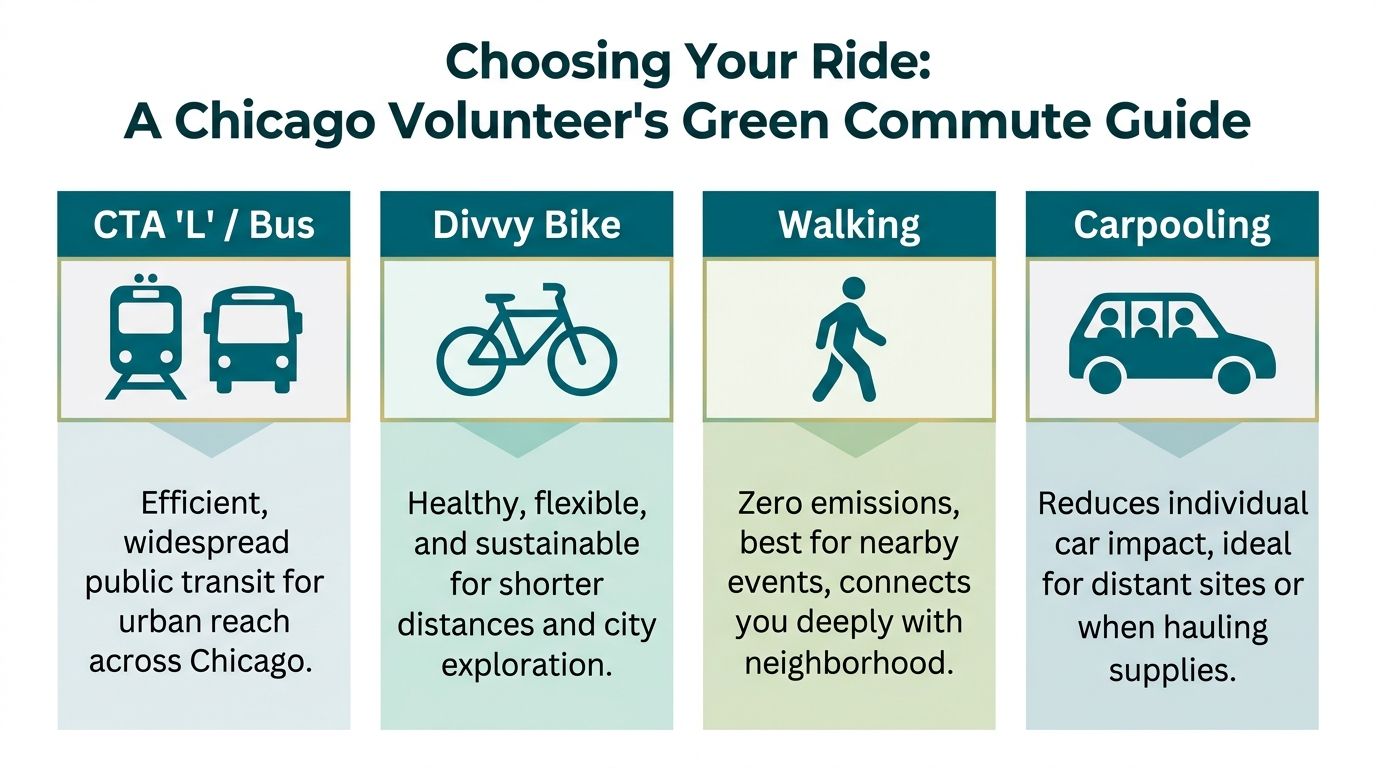
    I know that sounds big. I mean it in a very ordinary way.

    Many transformations begin with someone else making the first step less lonely.

    Conclusion The Best Gift Is a Better World

    I started with a filthy fridge and a room full of emotional clutter.

    I ended up with a different definition of generosity.

    The best gifts for environmentalists aren’t the ones that perform goodness most elegantly. They’re the ones that help someone live with more courage, less waste, and deeper connection. Sometimes that’s a bottle tough enough to survive years of hard use. Sometimes it’s local fruit that disappears into a shared table. Sometimes it’s a patch, a sweatshirt, a workshop, a park vote, or a morning spent doing hard work with kind people.

    I think that’s the thread running through all of it.

    A great gift doesn’t just say, “I know what you like.” It says, “I see who you’re trying to become.”

    That’s why service matters so much to me. It strips away a lot of nonsense. You show up. You carry something. You make a place better. You go home changed in some small but durable way.

    We all have some mess in us. We all have some part of life that feels stuck, heavy, hard to move.

    A worthy gift helps loosen that weight.

    Not by adding more stuff, but by opening a path. Toward simplicity. Toward action. Toward friendship. Toward a world that looks a little better because someone cared enough to do something with their own hands.

    That’s the gift I believe in.


    If you want to give someone more than an object, give them a way into purpose. Litter Caterpillars makes that simple with weekly Chicago cleanups, a brave volunteer culture, and a community built on kindness, resilience, and showing up together.

  • Community Park Channahon IL: Full Guide to Fun & Amenities

    Community Park Channahon IL: Full Guide to Fun & Amenities

    I still remember the first time I wandered into Community Park. I wasn't chasing anything dramatic. I just needed a place where my brain would quiet down, and the park met me like an old friend I somehow hadn't met yet.

    Finding My Green Oasis in Channahon

    I found Community Park on an ordinary day, which is exactly why it stuck with me.

    No parade. No big event. Just open sky, a path ahead of me, and that sudden feeling that I had stumbled into the kind of place where people exhale a little deeper. You know that feeling when a song comes on and somehow matches your mood better than you could've planned? That's what this park felt like.

    A young man standing on a scenic path in a lush, sunlit community park in Channahon, Illinois.

    The kind of place that lets you reset

    I started with a simple walk.

    Kids were off in the distance, burning energy the way kids do. A couple of people moved at that perfect weekend pace, not rushed, not idle, just present. The grass, the trees, the room to breathe, it all worked on me fast.

    Some places entertain you. Other places steady you.

    Community Park in Channahon, IL did the second one for me. It didn't ask for anything. It just gave me space to think. Space to notice. Space to remember that public places can still feel personal.

    A good park doesn't just fill land. It holds memories before you even know you'll make them.

    That first visit reminded me why local green space matters so much. We all need somewhere that isn't home, isn't work, isn't a store, and still feels like it belongs to us. A park does that. It becomes the backdrop for birthdays, pickup games, quiet laps, awkward first bike rides, deep talks, and the kind of short walks that somehow turn into life decisions.

    Why it felt familiar right away

    What hooked me wasn't just the park itself. It was the possibility inside it.

    I could picture a kid learning to climb higher on the playground. I could picture grandparents at a picnic table, watching a family spread out like a blanket over the afternoon. I could picture volunteers showing up with gloves and grabbers, treating the place with the kind of care you'd give a front yard.

    That thought took me back to other paths I've loved, including this stretch of trail culture and local outdoor life at https://www.littercaterpillars.com/old-plank-trail/, where the walk becomes more than exercise. It becomes a way of reconnecting with yourself.

    Community Park gave me that same feeling. Not flashy. Not forced. Just right.

    Your First Look at Community Park

    If you want the fastest way to understand community park channahon il, think of it as Channahon's public living room.

    People gather there without needing a special invitation. Families spread out. Friends reconnect. Kids turn a patch of grass into a kingdom. Adults pretend they're just supervising, then end up having a better time than expected.

    Why this park matters to the village

    Community Park sits inside a much bigger story.

    The Channahon Park District was established in 1971, and it manages Community Park as one of 20 park sites while maintaining over 500 acres of open space for a population estimated at 17,222 in 2023, according to the Channahon village overview on Wikipedia. I love that because it tells you this park didn't happen by accident. People built a system around the idea that everyday recreation matters.

    That's the part I think visitors feel even if they never read a single document. The park feels intentional.

    It feels like a place meant to be used, not just admired from a distance.

    The park as a shared room

    When I say "public living room," I mean a few very practical things:

    • You can show up casually: You don't need a complicated plan. A ball, a stroller, a water bottle, or a sandwich is enough.
    • Different people can use it differently: One person wants a peaceful walk. Another wants to let the kids run wild. Somebody else wants to meet neighbors without making it a whole production.
    • It supports community identity: A park says something about what a town values. Channahon clearly values room to move, play, and connect.

    That's part of why the place lands so well. It serves the everyday version of life.
    Not the polished Instagram version. It's the genuine version.

    What I notice when I arrive

    I notice balance.

    The park feels useful. That's a compliment. Some spaces are pretty but awkward. Others are functional but forgettable. Community Park hits a sweet spot where you can imagine spending time there in a dozen different ways.

    Local lens: The best park isn't always the one with the biggest wow factor. It's the one you can keep returning to for different reasons.

    And that's where this place earns its keep. It becomes part of routine. A quick stop after errands. A weekend reset. A place to let a restless afternoon stretch its legs.

    That's the heart of it for me. Community Park isn't just somewhere to go. It's somewhere a community keeps becoming itself.

    Exploring Every Corner A Guide to Amenities

    The best way to understand a park is to follow a day through it.

    I like to arrive without overplanning. That gives the place room to reveal itself. One corner buzzes. Another feels calm. One family claims a picnic table like they've been doing it for years. A kid sprints toward the playground with the seriousness of an athlete entering a championship.

    This visual guide helps map the experience.

    An infographic titled Community Park: Your Guide to Amenities, listing facilities available at Channahon Community Park.

    Where the energy lives

    The playground always feels like the spark plug.

    You hear it before you study it. Laughter, little footsteps, somebody announcing a big slide decision like it's a moon landing. That's the beauty of a community park. Kids don't need much prompting. Give them space and a structure to climb, and they'll build the story themselves.

    Then there are the sports areas and open fields. Those spaces shift shape depending on who's using them. In one hour, they hold a casual throwaround. In the next, they host determined practice. Later, they become the place where siblings argue over rules no one can fully explain.

    I love parks that leave room for improvisation. Community Park seems built for that.

    The quieter corners matter too

    Not every park moment needs to be loud.

    Some of my favorite minutes happen on the walking paths, where the pace slows and the noise softens. The trail sections invite a different kind of attention. You start noticing trees, shadows, breeze, and the simple relief of moving without a destination.

    If you enjoy learning more about local tree life and how it shapes outdoor spaces, this piece on https://www.littercaterpillars.com/trees-in-illinois/ adds helpful context.

    A paved path in a park can do a lot of emotional heavy lifting. It gives people an easy entry point. You don't need special gear or expert fitness. You just start walking.

    Practical rule: If a park gives you an easy first step, you're more likely to come back for a second visit.

    A shelter or picnic area plays a similar role. It turns a visit into a stay. Suddenly you've got a place for snacks, birthday candles, coolers, paper plates, or a quiet conversation while everyone else plays nearby.

    Later in the day, the park often shifts again. Restrooms, seating, open lawn, and the basic conveniences start to matter more because they make a longer outing easier. Those details aren't glamorous, but they decide whether people stay relaxed or start packing up early.

    Here's a simple way I think about the amenities:

    Park feature What it feels like in real life
    Playground The heartbeat of family visits
    Fields and courts Space for games, practice, and spontaneous competition
    Walking paths A moving reset button
    Picnic spots The anchor for longer gatherings
    Restroom access The unsung hero of a stress-free outing

    A short video can also help you get the feel of the place before you go.

    The true trick isn't trying every amenity in one visit.

    It's letting one part of the park lead you to another. A playground stop becomes a walk. A walk becomes a picnic. A picnic becomes a game. That's how a park stops being a list of features and starts feeling alive.

    The Park Through the Seasons

    A strong park never stays the same. That's one reason I keep coming back.

    In summer, Community Park feels loose and sunlit. People stay longer. Kids move like they have unlimited batteries. The air carries that warm-weather mix of cut grass, sunscreen, and snacks opened too early.

    A happy family enjoys a picnic in a park while children play on a nearby slide

    Summer and fall feel like two different personalities

    Summer belongs to motion.

    The fields seem wider. The playground sounds brighter. Evening hangs around long enough for one more lap, one more toss, one more conversation by the car before everybody heads home. I always feel like the park gives people permission to stretch the day.

    Then fall walks in and changes the tone.

    The same paths that felt lively in July start to feel thoughtful. Leaves turn an ordinary stroll into something cinematic. A bench becomes more tempting. A short visit suddenly feels like enough because the crisp air sharpens everything.

    I love parks in autumn because they make slowing down feel natural.

    Winter strips the place down to its bones

    Winter doesn't erase the park. It reveals it.

    Without the same summer noise, I notice shapes more. Tree lines. Open space. The geometry of paths and fields. A snowy morning can make the whole place feel hushed in the best way, like the park is resting without losing its welcome.

    Not everybody thinks of winter as park season, but I do.

    You won't always stay long. That's fine. Sometimes a quick cold-weather walk does more for your mood than an hour indoors. The park becomes less about activity and more about clarity.

    Cold air has a way of cleaning out mental clutter. Parks help it along.

    Spring always feels like a small rescue

    Spring brings that first green-up that makes everyone in Illinois collectively believe in hope again.

    The ground softens. Trees wake up. Families start testing the season with light jackets and cautious optimism. You can feel the park warming back into its social life.
    I also think spring reminds people that parks aren't finished products. They're living places. They cycle, recover, and invite us back in stages.

    Here are the moments I watch for through the year:

    • Summer evenings: Long light, active fields, and the sense that nobody wants to leave yet.
    • Early fall afternoons: Cooler air and the easiest walking weather of the year.
    • Quiet winter mornings: A calmer version of the park that rewards short visits.
    • Spring weekends: Fresh energy, muddy shoes, and the return of outdoor habits.

    Community Park doesn't ask you to visit only in perfect weather.

    It rewards repeat visits because each season hands you a different version of the same place.

    Practical Tips for a Perfect Park Day

    A smooth park day usually comes down to timing, expectations, and a little local common sense.

    I like parks best when they feel easy. No scrambling for basics. No preventable stress. Just enough planning to protect the fun.

    What I tell friends before they go

    If you're visiting community park channahon il with kids, go earlier than your kids think is necessary. Younger children usually hit their sweet spot before the day gets too hot, too busy, or too meltdown-prone.

    If you're going for a walk or some quiet time, pick an off-peak window. The park still feels welcoming, but you get more breathing room. That matters when what you really want is calm.

    Channahon also serves a notably family-oriented community, with a median age of 38.2 years and 27.4% of residents under 18, according to the Channahon Park District budget document. That lines up with what I feel on the ground. Families shape the rhythm of the space.

    Small moves that make the day better

    I keep my park routine simple:

    • Bring wipes and extra water: These two items solve more problems than almost anything else.
    • Wear shoes you don't have to think about: Parks invite detours. You'll always end up walking more than planned.
    • Claim a home base: If you're with a group, pick a bench, shelter, or table so everyone knows where to regroup.
    • Pack one low-effort activity: A frisbee, ball, bubbles, or sidewalk chalk can rescue an ordinary afternoon.

    I also think it's smart to check official park information before you head out if you need current rules, seasonal details, or facility specifics. Things like hours, reservations, pet rules, and grilling policies can shift, and the official source is always your best bet for that final check.

    My insider mindset

    I don't chase the "perfect" park day anymore. I chase the usable one.

    That means leaving enough room for surprise. Maybe the playground becomes the main event. Maybe the walk does. Maybe lunch lasts longer than expected because nobody wants to move. That's not a plan failing. That's the park doing its job.

    Bring less agenda than you think you need. A good park often fills in the rest.

    And if you're making a half-day of it, build in a little margin. The best park memories rarely happen on a rigid schedule.

    Make This Park Your Own A Call to Action

    Visiting a park is good. Taking responsibility for it changes you.

    That lesson hit me long before I started paying closer attention to suburban green spaces. I learned it the hard way, through cleanup work. Picking up litter sounds small from a distance. Up close, it becomes strangely personal. You notice what people ignore. You notice how fast one bag of trash can make a place feel cared for again.

    A diverse group of volunteers cleaning up trash in a grassy park for a community service project.

    Service changes the person doing it

    I used to think community action started with polished programs and official campaigns.

    Now I think it often starts with one person deciding, "I'm not walking past this." That's a different kind of courage. Not dramatic courage. Daily courage. The kind that turns a public space from somebody else's problem into our shared responsibility.

    Community Park feels like fertile ground for that mindset.

    Existing information about Channahon parks often highlights recreation and mission, but it overlooks litter management and volunteer opportunities, even as county health assessments point to the need to stabilize the built environment and improve access to healthy outdoor spaces, as noted on the Channahon Park District mission and values page. I find that gap interesting because it leaves room for residents to create something meaningful.

    Not everything valuable starts on a flyer.

    A park can become a workshop for character

    Cleaning a park isn't only about trash.

    It's about attention. Pride. Follow-through. Friendship. It's about proving to yourself that you can show up for a place and leave it better than you found it. That's why service in a park feels so direct. The result sits right in front of you.

    A cleaner path.
    A clearer field edge.
    A picnic area that feels more welcoming.
    A child who gets to play without stepping around debris.

    That kind of visible progress matters. It teaches a lesson most modern life hides from us. Our actions still have immediate, physical consequences.

    Some of the best self-improvement doesn't happen in a journal. It happens while doing useful work with other people.

    I also think volunteer cleanup has a sneaky social power. Shared work strips away a lot of awkwardness. You don't need perfect small talk when your hands are busy and the mission is obvious. People bond faster when they're moving in the same direction.

    What your first step can look like

    You don't need to launch a giant movement.

    Start smaller than your ego wants. That's usually the right size.

    • Go on a trash-noticing walk: Bring a bag and gloves on your next visit.
    • Invite one friend: Two people make the act feel lighter and more fun.
    • Pick one zone: A playground edge, a trail segment, or a picnic area is enough.
    • Stay consistent: Repeated care changes how a place feels.

    If you want practical ideas for organizing that kind of effort, this guide on https://www.littercaterpillars.com/clean-up-a-park/ is a useful place to start.

    I love recreation. I love family outings. I love a peaceful walk. But I think the deeper magic of a place like Community Park appears when you stop asking only, "What can I get here?" and start asking, "What can I give here?"

    That's when a park becomes partly yours.

    Your Questions Answered

    Can I bring kids and make a whole morning of it

    Yes. That's one of the strongest ways to enjoy the park. Bring snacks, water, and one simple activity for downtime, and let the park do the rest.

    Should I assume volunteer options are already organized

    I wouldn't assume that. Public information leaves real gaps around cleanup involvement and hands-on stewardship, so if you care about that work, you may need to ask directly or gather a few neighbors yourself.

    What if I want to help but transportation is hard

    That's a real issue, not a minor excuse. For volunteers, transportation was identified as a key cross-cutting issue in Will County health assessments, which matters in a district spanning 360 square miles, according to the Will County community health needs assessment. If you're organizing a cleanup, think about carpooling, meeting at an easy landmark, and making participation simpler for people without a personal vehicle.

    Is this park more for recreation or community action

    Both. That's the beauty of it. You can come for a walk and leave with a stronger sense of belonging. You can come for play and stay for service. A park like this works best when people use it and care for it.


    If this article lit a spark in you, check out Litter Caterpillars. It's a volunteer-driven group built around the idea that cleaning up the outdoors can also help us grow braver, kinder, and more connected. If you want to make friends, serve your community, and turn ordinary mornings into something meaningful, you'll probably feel right at home.

  • Eco Friendly Transport: Our Chicago Cleanup Guide

    Eco Friendly Transport: Our Chicago Cleanup Guide

    The first time I huddled under a tree in Chicago hail after a cleanup, every Uber kept canceling on us. We were cold, wet, carrying grabbers, and somehow more alive than we had felt all week.

    Why Your Commute Is Part of Our Cleanup Story

    I started picking up litter for a strange reason. I could not clean my own life.
    My room felt heavy. My fridge felt heavy. Old containers, expired food, random objects with emotional history. None of it weighed much, but every item felt enormous to me. I knew I needed a way to move again.

    Then I started cleaning public spaces, and something clicked. A bottle on a sidewalk did not come with years of guilt. A chip bag in a bush did not come with a memory attached. I could bend down, pick it up, and keep walking. That simple act started loosening something inside me.

    A woman looking thoughtfully out a window with a city street scene and a messy desk overlaid.

    The mission starts before the cleanup

    I learned that service begins long before your glove touches a piece of trash.

    It starts when you leave your home. It starts with the shoes you put on. It starts with whether you rush into a car in frustration or step outside with intention.

    When you walk to a cleanup, you notice the broken glass near the curb, the alley that needs help, the mural half-hidden behind weeds. When you bike, you feel the distance between neighborhoods in your legs. When you take the train, you see how one city contains many worlds, all stitched together by tracks and effort.

    That matters.

    Eco friendly transport is not just a technical choice. It is a mental shift. You stop treating the trip as dead time and start treating it as part of the work.

    Travel can clean your mind too

    I love the quiet discipline of a good commute. You grab your gloves. You check the weather. You head out even when the sky looks rude. That small act builds character.

    A cleanup day can fail before it begins if you arrive angry, flustered, and disconnected. I have felt that. I have also felt the opposite. I have walked to a site with the cold air waking me up and arrived ready to serve.

    Those are two different versions of the same morning.

    Your route shapes your mindset. If you travel with intention, you arrive with intention.

    For me, green travel and cleanup work belong together because both fight the same enemy. Carelessness. One kind leaves trash on the ground. Another kind treats every trip like someone else will absorb the cost.

    A Saturday morning feels different when you earn it

    There is a special feeling in getting somewhere the hard but honest way. Not miserable hard. Meaningful hard.

    You bike through wind. You wait on a platform with a grabber tucked under your arm. You walk the last few blocks and see the street you came to help before anyone else does. That does something to you.

    It turns you from a spectator into a participant.

    I think a lot about bravery. People usually save that word for giant moments, but I think bravery often looks small. Getting out of bed on a freezing weekend morning is brave. Showing up in a neighborhood you have never visited is brave. Choosing a cleaner way to move through the city when the easier option calls your name is brave too.

    Here is what I want you to carry with you. Your commute is not separate from the cleanup. It is the first bag you pick up. The first act of discipline. The first way you tell the city, and yourself, that you care.

    What Makes Transport Eco-Friendly Anyway

    A lot of people hear the phrase eco friendly transport and think it means buying something expensive or becoming some perfect climate saint. I do not see it that way.

    It's like tools.

    If you need to tighten one screw, you do not grab a sledgehammer. If you need to carry one backpack across a neighborhood, a private car can be the same kind of overkill. Big machine. Big space. Big side effects.

    Use the right tool for the job

    That is the simplest definition I know.

    Eco-friendly transport means choosing a way to move that matches the task with less waste. Sometimes that is walking. Sometimes it is a bike. Sometimes it is a train. Sometimes it is sharing a ride instead of driving alone.

    The point is not purity. The point is fit.

    A short trip to a cleanup with light gear might call for walking. A medium trip with some flexibility might fit a bike. A longer cross-city trip might belong to the train or bus. If you need to haul supplies with friends, carpooling can make sense.

    Why this matters in plain English

    Road traffic carries a giant environmental burden. Road vehicles account for 75% of global transport CO2 emissions, with passenger cars and buses contributing 45.1%, and road transport responsible for about 15% of all global CO2 emissions, according to Neste’s transport emissions data room.

    You do not need to memorize that. You just need to understand the pattern.

    When a city leans too hard on private road travel for everything, the costs spread everywhere. Air. Noise. Space. Stress. Streets stop feeling like places for people and start feeling like channels for machines.

    Green is not only about carbon

    I care about emissions, but I also care about what a trip feels like on the ground.

    A greener mode often does a few things at once:

    • It uses less space: One person walking or biking takes up less room than one person in a car.
    • It creates less noise: Quiet movement changes the mood of a street.
    • It invites awareness: You see more when you are not sealed away from your surroundings.
    • It can build community: Shared routes create chance encounters and repeated human contact.

    That is why I resist reducing this topic to a lecture. The issue lives in your body. You feel it in a loud intersection. You feel it on a calm side street. You feel it when a train drops you off and the neighborhood opens up on foot.

    Eco friendly transport is less about looking virtuous and more about wasting less.

    My rule for daily decisions

    I use a rough filter.

    Ask yourself three questions before you go:

    1. How far am I really going
    2. What am I carrying
    3. What choice gets me there with the least unnecessary impact

    That is it.

    Not every trip will be ideal. Life is messy. Schedules break. Weather turns. But if you keep choosing the right tool more often, your habits change. Then your city changes with you.

    Choosing Your Ride A Chicago Volunteer's Guide

    Chicago does not ask for one perfect commuting style. It asks for adaptability.

    Some cleanup mornings start with calm sunshine and a coffee. Others start with wet gloves, missed trains, and a grabber poking awkwardly out of your tote bag. I have learned to stop asking, “What is the best mode?” and start asking, “What is the best mode for this mission?”

    Infographic

    Four ways I think about the trip

    Walking gives you intimacy.

    You notice dumped cups in tree pits. You spot alleys you want to come back to. You arrive warmed up and grounded. If the event is close, walking is beautiful because it asks almost nothing except your attention.

    Divvy gives you freedom.

    You can improvise. You can stop. You can take the long way through a park if your mind needs air. A bike also turns the city into something you can feel, not just pass through. If you want inspiration for routes beyond cleanup day, I like this guide to bike trails in Illinois for 2026.

    The CTA gives you reach.

    Chicago stretches. A lot. Public transit lets you cross that stretch without making the whole trip about parking. And trains are strong on pure efficiency. Electric trains emit 88 grams of CO2 per mile per passenger, compared with 100 grams for buses and 400 grams for standard cars, according to this electric rail comparison.

    Carpooling gives you practicality.

    Sometimes you have extra supplies. Sometimes the site sits far from your easiest train route. Sometimes you are bringing snacks, water, gloves, and one oddly shaped sign. Sharing a ride can still be a thoughtful choice when it replaces multiple separate car trips.

    Chicago Volunteer Transport Comparison

    Mode Eco-Impact Avg. Cost Gear Friendly? Adventure Factor
    Walking Very low impact Low Best for light gear High if you like neighborhood detail
    Divvy Bike Low impact Moderate Good with backpack and clipped tools High and playful
    CTA L / Bus Strong option for cross-city trips Moderate Good if you pack compactly Medium-high, feels like an expedition
    Carpooling Better than solo driving Shared cost Best for bulky supplies Medium, social and practical

    What I would choose in real volunteer situations

    If the cleanup is near your home, walk.

    You save yourself the hassle of locking up a bike or timing a train. You also get a preview of the street conditions before you arrive.

    If you live a few neighborhoods away and the weather is decent, bike.

    A bike works especially well when you want to stay mobile after the cleanup. Maybe you want to grab lunch with volunteers or explore a new stretch of the city while your energy is high.

    If the event is across town, take the CTA.

    The train and bus network let you show up without the mental drag of driving. I like that public transit turns travel into shared space. You are not isolated. You are already in public life.
    If your group is hauling things, carpool on purpose.
    Fill seats. Consolidate supplies. Make one trip do the work of several.
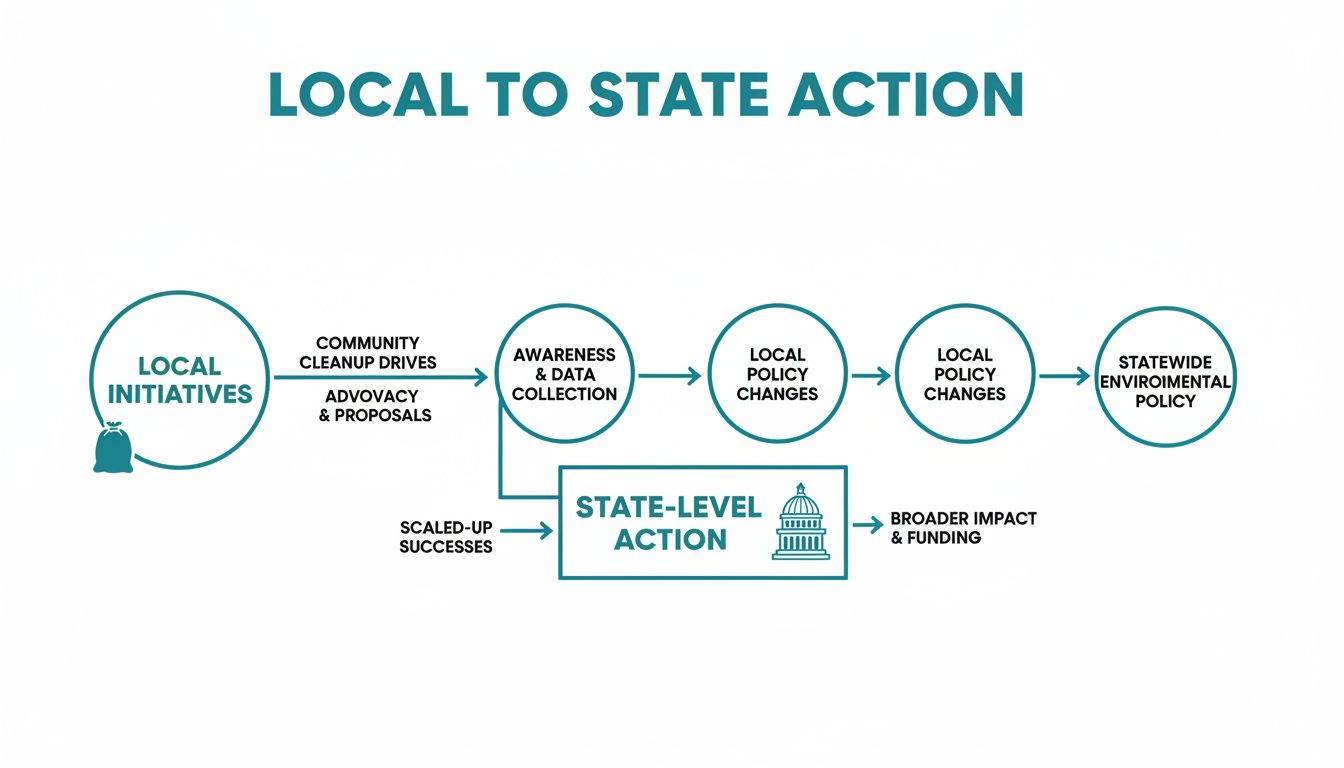
    If you are unsure, choose the option that makes it easiest to show up. Consistency beats fantasy.

    The hidden factor nobody talks about enough

    The best commute is the one that leaves you ready to serve.

    Some modes save time but drain your patience. Others take a bit longer but hand you your focus back. Pay attention to that. Your body knows the difference.

    A cleanup is physical, social, and emotional work. Choose a ride that helps you arrive open, not depleted.

    Navigating Chicago The Caterpillar Way

    I fell in love with Chicago more once I stopped moving through it only for convenience.

    The city changed when I started traveling through it for service. A station was no longer just a station. It became the threshold to a block that needed care. A bike lane stopped being paint on pavement and became a thread connecting people willing to help.

    A young woman wearing a green Litter Caterpillar shirt travels on a train past the Chicago skyline.

    The train turns distance into possibility

    One winter morning, I rode through gray skies toward a cleanup site with a grabber angled against my leg and gloves stuffed in my pocket. The platform was cold enough to make you question your life choices.

    Then the train came. Doors opened. Heat. Light. Other people heading somewhere with their own reasons.

    That is one of my favorite things about the CTA. It rescues the day from self-importance. You are just one person on a city artery, trying to do something useful.

    Chicago’s train lines let you string together neighborhoods that too many people keep mentally separate. If you care about service, that matters. You cannot clean a whole city if you only move through the parts that already feel comfortable.

    For a slower, street-level way to know the city beyond the tracks, I also like these self-guided Chicago walking tours. They help you build neighborhood memory, and that memory makes service more personal.

    The bike convoy feeling

    Bikes create a different mood.

    A small group rolling to a cleanup has its own energy. You feel slightly ridiculous, slightly heroic, and fully awake. Someone has a trash grabber strapped to a rack. Someone else has work gloves clipped to a backpack. Somebody forgot water and realizes it halfway there.

    Good. That is real life.

    I love that kind of travel because it keeps the mission human-sized. You hear each other. You stop for a red light and joke around. You pass blocks where you want to return. The route itself becomes shared memory.

    Protected infrastructure makes all of this more dependable. As noted in Earth911’s discussion of resilient bike infrastructure, Minneapolis has shown that year-round cycling is possible with protected bikeways, and the lesson is simple. Paint isn’t protection. If you want people to ride in rough weather, give them something real.

    That line sticks with me because it applies beyond bikes. People act brave more often when a city meets their courage halfway.

    Here is a short look at the spirit of getting out there anyway.

    Bad weather reveals what you believe

    Some of my favorite cleanup stories start with ugly forecasts.

    Chicago has a way of testing whether your values are decorative or real. Wind, sleet, surprise snow, summer heat. The city asks, “Do you still mean it?”

    Traveling to a cleanup in rough weather strips away excuses fast. If the sidewalks are bad, you learn what curb cuts matter. If the bike lane vanishes under slush, you learn what infrastructure was never serious. If the bus is your lifeline that morning, you learn what reliability feels like in your bones.

    A city shows its character in blue-sky conditions. It shows its truth in bad weather.

    I think that is why eco friendly transport has to be practical, not performative. It has to work on ordinary days and difficult ones. Otherwise it is just marketing.

    Gearing Up for Your Green Commute

    A good commute starts the night before. Not with philosophy. With packing.

    I have made enough dumb mistakes to respect preparation. I have carried awkward gear in flimsy bags. I have underdressed, overdressed, forgotten water, and tried to look cool instead of being ready. Every one of those choices made the mission harder than it needed to be.

    A person holding a travel card next to a water bottle, sneaker, and map on watercolor background.

    Pack like you plan to move

    Your gear should help you travel, not trap you.

    If I am taking transit, I want one bag that stays close to my body and leaves my hands free. If I am biking, I want the weight off my shoulders as much as possible. If I am walking, I want no item bouncing, swinging, or digging into my side.

    Here is the practical checklist I would hand a new volunteer.

    • Gloves first: Put them where you can grab them fast. Outer pocket beats buried at the bottom.
    • Water matters: A reusable bottle saves you from starting tired and dehydrated.
    • Compact layers: Chicago weather changes its mind. Wear light layers you can tie around your waist or pack easily.
    • Transit card or phone ready: Do not fumble at the gate while holding gear.
    • Small snack: Cleanup work feels longer when you are hungry.
    • Simple bag: Backpack beats tote when you are moving through stations, curbs, and crowds.

    Carrying odd gear without hating your life

    Trash grabbers are useful. They are also awkward.

    If you bike, strap a grabber to a rear rack or slide it along the frame if it fits securely. Test it before you leave. You do not want your heroic setup turning into roadside nonsense at the first bump.

    If you take the train, collapse or shorten gear when possible and keep it vertical. That makes you a better neighbor on a crowded car. If you walk, switch hands often and avoid overpacking everything else.

    I also like to use work gloves with enough grip to be useful but not so bulky that I lose dexterity. You do not need fancy. You need reliable.

    Safety is part of the ethic

    I do not think preparation is boring. I think it is respectful.

    You respect your own energy. You respect the people meeting you. You respect the mission enough to arrive ready instead of scattered.

    A few habits help a lot:

    1. Check the route before you leave: Especially if you are combining train, bus, and walking.
    2. Use lights on a bike when visibility drops: Early mornings and cloudy days can get dim fast.
    3. Wear shoes you trust: Cleanup work punishes flimsy shoes.
    4. Tell someone your route if conditions look rough: Basic, simple, smart.

    Bravery works best when you pair it with preparation.

    I have learned that eco friendly transport feels much easier when friction disappears. Pack the right bag. Secure the weird tool. Dress for movement. Then the trip becomes part of your rhythm instead of a problem you must solve from scratch every time.

    Making Green Transport Fair for Every Neighborhood

    If you only talk about eco friendly transport as a personal lifestyle choice, you miss the hardest part.

    Not everyone starts from the same curb.

    Some neighborhoods have better sidewalks, easier train access, safer bike routes, and more visible investment. Other neighborhoods get told to wait, adapt, or settle. Then people act shocked when the greener option feels harder to choose.

    Access is a justice issue

    That is not just inconvenient. It is unfair.

    The U.S. Department of Transportation identifies 35% of census tracts as transportation disadvantaged, and work highlighted by the Systems Change Lab on access to green mobility notes significant disparities in public EV charging access for Black and Hispanic communities in major cities like Chicago.

    I care about that because the gap shows up in everyday life. The cleanest option on paper means less if reaching it is harder, less safe, or less reliable depending on where you live.

    What this means on the ground

    When a neighborhood lacks dependable green mobility, people lose more than a convenient commute.

    They lose time. They lose flexibility. They lose the sense that the city belongs to them equally.

    That also affects volunteer work and neighborhood care. If people from one part of the city can move easily to serve and explore while others face extra barriers, the map of participation gets warped. The neighborhoods that most need solidarity can end up hardest to reach sustainably.

    I think about this a lot when people praise urban sustainability in broad terms. Broad terms can hide sharp edges.

    What I want cities and communities to fight for

    I want a city where green movement does not feel like a privilege badge.

    That means supporting improvements that make sustainable travel real in every ward, not just the fashionable ones. Better connections. Safer routes. Reliable service. Charging access where renters and residents in multi-unit buildings can use it. Infrastructure that respects people who do not have backup options.

    If you care about clean streets, you should care about this too. Environmental work and mobility justice touch the same nerve. They both ask who gets protected, who gets ignored, and who gets told to work around preventable problems.

    For a deeper look at the moral side of this, I recommend reading about environmental justice and how you create change.

    A greener city that excludes whole neighborhoods is not a greener city. It is just a prettier version of the same old inequality.

    I do not want that. I want the kind of city where a kid, a renter, a student, a retiree, and a volunteer with a trash grabber all have a fair shot at moving safely and sustainably.

    Partner With Us to Keep Chicago Moving and Clean

    A cleanup group can remove litter from a block. A network can change what a city believes about itself.

    That is why I think local businesses, schools, clubs, and community groups have such a powerful role here. Eco friendly transport becomes real when people support it together. A lone volunteer can be brave. A whole neighborhood can make bravery normal.

    What partnership can look like

    It does not need to be complicated.

    A bike shop can host a pre-cleanup tune-up morning. A café near a train stop can become a meeting point where volunteers gather before heading out. A community center can offer storage for supplies so fewer people need to haul everything across town. A local employer can encourage staff to join by transit, on foot, or by shared ride.

    Those are small moves. They create real momentum.

    Why this matters for businesses too

    When a business backs cleaner and smarter movement through the city, it is not doing charity theater.

    It is investing in streets people want to spend time on. It is helping neighbors meet one another. It is reducing the friction that stops good intentions from becoming action.

    I think a lot of organizations underestimate how much people remember practical support. If you help volunteers get somewhere warm before a winter cleanup, they remember. If you offer bike parking, water refills, or a reliable meet-up corner, they remember that too.

    That kind of support has soul.

    The bigger story

    The best version of Chicago is not just cleaner. It is more connected.

    People travel across neighborhoods they were taught to fear. They discover local businesses they never would have seen from an expressway. They build confidence using trains, bikes, sidewalks, and shared rides in service of something bigger than themselves.

    That is a city with momentum.

    I want more of that. I want partnerships that make sustainable movement feel welcoming, capable, and full of pride. Not preachy. Not polished to death. Just real. Real people helping other real people get where they need to go so they can do good work together.

    If you run a business or lead an organization, you do not need to solve every transit problem. You just need to take one honest step that makes green movement easier for your community.

    That is how cities change. Not only by plans on paper, but by people who decide to make the next trip better.


    If you want to turn a Saturday morning into something brave, useful, and memorable, join Litter Caterpillars. You can show up, make friends, explore Chicago, and help build a cleaner city one block and one green commute at a time.

  • Your Ultimate Guide to the Des Plaines River Trail Chicago IL in 2026

    Your Ultimate Guide to the Des Plaines River Trail Chicago IL in 2026

    Let me tell you about my escape hatch. It's a place that feels miles away from the city's ceaseless hum, a green ribbon of a path that I swear has saved my sanity more than once: the Des Plaines River Trail Chicago IL.

    My Story with This Trail

    I've been on this trail in every kind of Chicago weather you can imagine—those freezing mornings where your breath hangs in the air like a ghost, and those sticky summer days where you feel like you're wading through soup. For me, and for you too I hope, a trail isn't just a strip of dirt. It's a reset button.

    You know that feeling when you finally clean a hopelessly messy room, and suddenly you can think straight? That’s what this trail does for me. It's my go-to place for untangling the knots in my head. In fact, it’s the very reason our group, Litter Caterpillars, even exists—this wild idea that you can find your own purpose by cleaning up a mess, whether it's the clutter in your own life or a forgotten stretch of riverbank.

    This trail is a beast. The Des Plaines River Trail (DPRT) unfurls for an insane 56.1 miles, a winding journey from the Wisconsin border all the way down to River Grove. I see it as this vital green artery, a life-giving pulse cutting through Lake and Cook Counties, a real-deal escape for the 9.5 million people packed in around here. You can see its entire magnificent scope and history over on TrailLink.

    I believe the trail is alive. Every time I'm on it, it feels like a conversation. It'll test me with a muddy, washed-out path, then turn around and reward me with a quiet moment of staggering beauty I never saw coming.

    Your Map to Getting Out There

    Think of this guide as your personal cheat sheet. I want to help you skip all the "where do I even start?" paralysis and get right to the good stuff.

    We’re going to cover everything you actually need to know so your first (or next) trip is a smashing success:

    • The best spots to park your car and hit the trail.
    • What the path actually feels like to walk, run, or bike on.
    • How you can avoid getting caught off guard by Chicago's famously bipolar weather.

    My goal here is simple: I want to give you the confidence to just go. This trail has been a huge chapter in my own story, and I’m ready for it to become part of yours. Let's get you out there.

    Finding Your Perfect Starting Point

    Staring at a map of a 56-mile trail can feel like staring at a messy room you’ve been avoiding for weeks. You know you want to tackle it, but every corner looks like its own overwhelming project. The secret, I've found, is that once you just pick a spot and begin, you're already moving. The Des Plaines River Trail is full of these starting points, and I want to help you skip the "where do I even park?" headache and get right to the good stuff.

    Let's cut through the analysis paralysis. I'm going to walk you through my favorite trailheads in Cook County, the ones I find myself returning to, the ones closest to the city. My goal is to get you off the pavement and onto the path, soaking up that nature you came for.

    This decision tree might help you figure out your vibe for the day.

    The first step is always the hardest. Let’s take it together.

    My Go-To Trailheads Near Chicago

    Think of these trailheads as different doors into the same wild, wonderful world. Some are bustling with energy, vibrant hubs of activity, while others are quiet little secrets waiting to be discovered. The right one for you just depends on the kind of day you’re looking to have.

    Here are a few I keep coming back to.

    • Allison Woods (North): This is a popular spot, and for good reason. You'll find a massive parking lot and a gateway to a seriously beautiful, wooded part of the trail. It's my pick for a long, uninterrupted walk or ride. This is also where my Litter Caterpillars crew had one of our most epic cleanups. We pulled over 50 bags of trash out of the woods after a spring flood and felt like absolute champions. The energy here is just different.

    • Dam No. 4 Woods-East (Central): If you want to get right up next to the river, this is your place. The trail hugs the water here, and the views are incredible. The parking lot is smaller, so my advice is to hit it on a weekday or get there early on the weekend. It’s a peaceful spot to launch a shorter, more thoughtful journey.

    I remember standing here one quiet Tuesday morning, just watching a heron stalk its breakfast in the shallows. It’s those small, unexpected moments that really get me. They remind you there’s this whole other world humming with life right next to our own.

    • Sunset Bridge Meadow (South): This is the southern anchor of the Cook County trail, and it has a more open, prairie-like feel in some spots. It's a fantastic access point if you're coming from the city or want to connect for a longer ride heading south. If you're getting fired up about exploring and cleaning up our local trails, you might dig what we've written about other local paths. You can check out our guide on the Old Plank Road Trail for more ideas.

    To make it even easier, I've put my favorite access points into a quick table.

    Key Trailheads for the Des Plaines River Trail (Cook County)

    Here's a simple breakdown of the best places for you to park and hop on the trail. No guesswork needed.

    Trailhead Name Nearest Major Intersection Parking Notes Why I Like It
    Allison Woods (North) Milwaukee Ave & IL-294 Large, paved lot. Can fill up on peak weekends, but you can usually find a spot. Great for long distances. You connect to scenic, wooded sections. Home of an epic Litter Caterpillars cleanup!
    Dam No. 4 Woods-East W. Higgins Rd & N. River Rd Smaller gravel lot. You should arrive early or on a weekday to guarantee a spot. Unbeatable river views. The trail is right on the water. It feels quiet and secluded.
    Sunset Bridge Meadow W. North Ave & N. 1st Ave Ample parking in a large, paved lot. Good signage from North Ave. Perfect southern access point. You connect to different ecosystems (prairie, woods). Easy to get to from Chicago.
    Catherine Chevalier Woods E. River Rd & W. Foster Ave Huge lot, but it serves a popular picnic area. Can get very busy, especially summer weekends. Super close to the city and O'Hare. Great for a quick escape. A good place to see deer.

    Choosing any of these spots is a solid win. Just pick one, get out there, and see what you find.

    What to Expect From the Trail Surface

    Close-up of a person's feet in blue running shoes next to a bicycle on a gravel path near a river.

    Look, if you want a perfectly smooth ride, go to a spin class. The Des Plaines River Trail Chicago IL isn't like that, and that’s exactly why I love it. It’s got a bit of grit, a bit of character. It’s real.

    Most of the trail in Cook County is crushed limestone gravel. It's packed down hard, so it's not like you're slogging through sand, but it's not a city sidewalk either. You feel the trail under you. That crunch of gravel is the sound of you leaving the pavement—and all its nonsense—behind.

    I think that not everything has to be easy to be good. Sometimes, the little bit of roughness is what makes it an adventure. It forces you to pay attention and be present.

    Biking This Thing

    If you’re biking, leave your skinny-tired road bike at home. Seriously. It’ll feel jumpy and you’ll spend the whole time worrying about a flat instead of enjoying the ride. You need a bike that can handle a little bit of life.

    Here's what I see working out here:

    • Hybrid Bikes: The jack-of-all-trades. Perfect for riding from your apartment right onto the trail.
    • Gravel Bikes: The name says it all. They were born for this.
    • Mountain Bikes: Total overkill, but you'll feel like you can ride over anything. And honestly, that’s a great feeling to have.

    Bringing the right bike is like showing up to a cleanup with a grabber and a bag—it just makes everything better. You can actually focus on the beauty around you instead of fighting your equipment.

    For the Walkers and Runners

    If you're on foot, your regular running shoes are all you need. I find the gravel is actually way easier on my joints than pounding the concrete mile after mile. You get that satisfying crunch with every step, a rhythm that connects you to the ground.

    And the best part? The trail is almost completely flat. No soul-crushing hills. Nothing. This is what makes the Des Plaines River Trail Chicago IL so incredible—it's for everyone. You can go for an hour or an entire day, and the only thing stopping you is how far you want to go.

    It’s a place for you to find your pace, to let your mind wander, to just be. The lack of hills makes it a mental game, a meditation. It’s about endurance, not just power. Knowing this stuff before you go means you show up ready for the trail's real, unfiltered, and deeply rewarding character.

    Navigating the Seasons and Staying Safe

    Chicago weather. It’s a force of nature, and it doesn't care about your plans. One minute it's a perfect sunny day; the next, you're getting pelted with hail. I learned this the hard way during one of our very first Litter Caterpillar cleanups—three of us, huddled under a tree, shivering, as a freak hailstorm hit.

    The Des Plaines River Trail goes through this same drama every year. Each season tells a different story, and if you want to be part of it, you better learn how to read the signs and prepare for a plot twist.

    Spring Thaws and River Highs

    Spring on the trail is incredible. Wildflowers are pushing up through the dirt, and the whole world feels like it's waking up. But this season has a dark side: flooding. I've learned that the trail's biggest strength—its closeness to the river—is also its biggest weakness.

    The Des Plaines River Trail runs for 31.4 miles through Lake County, cutting through some gorgeous forest preserves. But that whole area is a natural floodplain. When the spring rains come hard, you can expect up to 20-30% of the trail to be underwater and closed off. It's a humbling reminder that we're just guests here. You can even see how serious enthusiasts track these conditions on route-logging sites.

    Before you even think about heading out, you should check the Forest Preserves of Cook County website for closures. It takes literally ten seconds and can save you from a miserable, water-logged failure of a trip.

    Summer Buzz and Autumn Hues

    Summer is when the trail is bursting with life, a dense, green tunnel that feels wild and ancient. It’s beautiful, but you're not the only one out there. I find the mosquitoes are no joke, especially in the humid, shady spots near the water. I never leave home without bug spray, and I always pack more water than I think I’ll need. Don't be a hero; you have to stay hydrated.

    Then comes fall—my absolute favorite time on the trail. The world turns into a masterpiece of red, orange, and gold. The air gets that perfect crispness, the bugs finally die off, and the only sound is the crunch of leaves under your tires or feet. It's pure magic.

    At our cleanups, the safety of our volunteers is our first priority. Always. I believe the same principle applies to any adventure—your safety is the foundation. Being smart about it is what allows you to truly enjoy yourself.

    Your Trail Safety Checklist

    Being safe isn't about being scared; it's about being smart so you can stop worrying and actually have fun. You can think of it like packing the right gear for a cleanup—it's the prep work that makes the real work possible.

    • Tell Someone Your Plan: This is non-negotiable. You must let a friend know where you're going and when you plan to be back. It’s the simplest, most important thing you can do.
    • Be Aware of Your Surroundings: You should ditch both earbuds. Stay present. Say "hello" to people you pass. Your awareness is your best defense.
    • Follow Trail Etiquette: Yell "on your left!" when you're passing. It’s a shared space, and a little common courtesy makes it better for everyone.
    • Pack Smart: Water, a basic first-aid kit, a charged phone, and a snack. It's not much, but it can be a lifesaver if your quick trip turns into a longer-than-expected adventure.

    The Trail Needs You. Are You Bold Enough?

    Happy woman in gloves collects trash into a white bag by a river, two black bags beside her.

    I started Litter Caterpillars because, for most of my life, my own room was a disaster. Cleaning it felt impossible. It was this weird mental block. But I discovered something powerful: cleaning up someone else's mess is WAY easier. It’s a shot of pure satisfaction. It's taking control.

    The Des Plaines River Trail is one of those places I love, a real sanctuary from the city. But let’s be real—its popularity and the river's tendency to flood mean it becomes a magnet for trash. You'll see a plastic bag tangled in a bush, a coffee cup peeking out of the mud… it's the price of being a well-loved place.

    This is where the story gets good. This is where you come in.

    We're the Caterpillars. Join Us.

    I want you to join one of our official Litter Caterpillar events on the Des Plaines River Trail Chicago IL this year, in 2026. Forget what you think you know about cleanup groups. We’re a little different. We bring the gear—gloves, bags, grabbers—and we definitely bring the energy. We even have a theme song.

    When you join us, you’re not just picking up trash. You’re finding your people. You’ll be laughing and sharing stories with a crew that believes showing up—rain or shine—can actually change things. It’s not just work; it's an adventure.

    I’ve learned that cleaning up someone else's mess is way easier than cleaning up your own. It gives you a sense of power and control, a feeling that you can make things right. I believe it’s not just about trash; it’s about taking pride in your home and proving that kindness and a little bit of bravery can actually change the world.

    Or, Start Your Own Adventure

    Can't make an official event? No problem. Maybe you’re a lone wolf. I respect that. Turning any hike into your own cleanup mission is one of the most rewarding feelings there is. It's simple.

    All you need is the will to do it, and a few basic tools:

    • A tough trash bag (a reusable one is a boss move).
    • A pair of thick work or garden gloves. You have to protect your hands.
    • A "grabber" tool. It’s a total back-saver, trust me.

    Just filling one bag on your own is a huge win. You’ll be shocked at how fast it fills and how good you feel. You've literally made the world a better place. If you want to get in the right mindset, you can read our thoughts on cleaning up a river and the philosophy behind it.

    Whether you roll with our crew or go solo, you’re making a statement. You're showing you care. That one brave act inspires others and helps make the Des Plaines River Trail Chicago IL a place we can all be proud of.

    A Few of My Favorite Trail Plans

    Sometimes, you just need a roadmap. It’s like when we show up for a cleanup; knowing the game plan makes everything flow. Whether you have an hour or a whole day for the Des Plaines River Trail, I’ve put together a few of my personal go-to trips to get you started.

    Think of these as story prompts. I’m giving you the setting and the first line; you go out there and write the plot. These are the exact routes I take when I need to clear my head, reconnect with myself, and remember why we do what we do.

    The Quick Escape

    Life gets crazy. I get it. This is your one-hour reset button.

    You should start at Catherine Chevalier Woods, which is surprisingly close to the city. From the parking lot, just head north on the trail for 30 minutes. You’ll find yourself surrounded by trees so fast you’ll forget you were just stuck in traffic. The path is wide, the air feels different, and you can just… walk. After 30 minutes, turn around and walk back. It’s a simple, perfect little journey that delivers an instant dose of nature.

    I truly believe an hour in the woods can do more for you than a week of trying to "relax" at home. It’s about changing your environment to change your mind.

    The Half-Day Biker's Loop

    Are you ready for a little more adventure? This is a killer 12-mile loop that shows you a beautiful, diverse stretch of the trail.

    I recommend you begin at Allison Woods and ride south. You'll pass through shady forests and catch glimpses of the river. Your destination is the Dam No. 4 Woods-East trailhead. It's a great spot to pause, have a snack by the water, and just appreciate the view. Then, hop back on your bike and ride north, retracing your path. The journey back always feels different, I promise.

    And hey, if you're inspired by our local green spaces, you should check out another one of my favorite spots in our guide to Waterfall Glen Forest.

    The Full Nature Immersion

    For those days when you need to go deeper. This is about losing track of time and connecting with the quiet rhythm of the trail itself.

    I suggest you start at Sunset Bridge Meadow and head north. Just keep going. The further you go, the quieter it gets. Don't set a distance goal. Your only goal is to walk until you feel that mental shift—the moment the noise in your head finally fades away and all you can hear is the world around you.

    To help you get a clearer picture, I've put some of these ideas into a table. You can mix and match them, or use them as a jumping-off point to create your own adventure.

    Sample Trail Itineraries

    Itinerary Name Best For Suggested Start Point Approx. Time/Distance
    The Quick Escape A fast, one-hour mental reset Catherine Chevalier Woods 1 hour / ~3 miles
    Half-Day Biker's Loop Seeing a diverse stretch by bike Allison Woods 2-3 hours / 12 miles
    The Full Immersion A long, meditative walk to disconnect Sunset Bridge Meadow As long as you need

    These aren't rules; they're invitations. The real magic happens when you get out there and let the trail guide you. Go find your own favorite spot.

    Stuff You Gotta Know Before You Go

    After what feels like a lifetime spent on this trail—riding it, walking it, and cleaning up every inch of it—you start to hear the same questions over and over. Here’s the real scoop on what people ask me about the Des Plaines River Trail Chicago IL.

    Can I Ride My Road Bike?

    I see this all the time. Someone shows up with their skinny-tired race bike, all excited, and then they hit the trail. The surface is mostly crushed limestone. It's packed, sure, but it's not a silky-smooth road.

    Think of it like this: I believe trying to ride a road bike on this trail is like trying to run a marathon in flip-flops. You might finish, but you're going to be miserable, and you’ll probably break something. Do yourself a favor and bring a hybrid, gravel, or mountain bike. Your teeth (and your bike) will thank you.

    Can I Bring My Dog?

    Absolutely, and you should! This trail is a paradise for dogs. You just have to keep them on a leash—that's the rule, and it's about respecting everyone else out here.

    It’s simple, really. You have to be a good trail citizen. Bring water for your pup, and for the love of all that is good, you must pack out their waste. It's a small thing that makes a huge difference in keeping this place somewhere we all want to be.

    I see bringing your dog as being like bringing a friend to a party. You want them to have a great time, but you're also responsible for making sure they're a good guest.

    How Do I Know if It's Flooded?

    This is a big one, especially in the spring. That river doesn't mess around, and parts of the trail can disappear underwater fast. You shouldn't just show up and hope for the best.

    Your best bet is the Forest Preserves of Cook County website. They have an "Alerts and Closures" page that's usually up-to-date. A ten-second check before you leave the house can save you from a completely wasted trip and a pair of soaked, muddy shoes. Trust me on this.

    Are There Bathrooms?

    Yes, there are—usually. You'll find them at the main trailheads and bigger forest preserve groves. But here’s the reality: "usually" isn't "always." They can be locked up in the off-season or just… out of service.

    My advice? It's the same advice my dad gave me on road trips. You should go before you go. Use the bathroom when you see one at your starting point. You don't want to find yourself doing the potty dance with five miles of trail between you and relief.


    Join us at Litter Caterpillars and turn your love for the trail into action. You can find an event and help us keep Chicago beautiful. https://www.littercaterpillars.com

  • Join the illinois environmental council to drive statewide action

    Join the illinois environmental council to drive statewide action

    It all begins with that twisting in your gut, doesn't it? The moment you see a street you adore buried under a sea of trash. I know that feeling down to my bones. You see, for me, untangling the messes in my own life—my cluttered apartment, my complicated relationships—was a revelation. I discovered that cleaning things up, truly making them right, brings this strange, profound peace.

    That spark is the very soul of why Litter Caterpillars exists. It’s never been just about picking up someone else’s garbage. It's about seizing a piece of your world, your neighborhood, and wrestling it back into something you can be proud of.

    From Our Sidewalks to the Statehouse

    But here’s the truth I’ve stumbled upon over the last few years: our relentless work on the ground, our sweat and our sore backs, is only the opening chapter. In this guide, I want to pull back the curtain and show you how our grassroots hustle on a drizzly Saturday morning connects directly, powerfully, to the monumental changes orchestrated by the Illinois Environmental Council.

    Imagine it like this: we are the frontline soldiers, the boots on the ground, and they are our strategic allies in the capitol building. They take the raw, gritty work we pour our hearts into and forge it into the unyielding steel of actual laws. This is the story of how our small, seemingly isolated acts of defiance ripple outward, gathering momentum until they create a tidal wave of change for all of Illinois.

    When you and I show up with our trash bags and grabbers, we’re doing something far more revolutionary than just cleaning a street. We’re sending a signal.

    Every single piece of litter we wrestle into a bag is like casting a vote for a cleaner, healthier future. We are demonstrating what we value, not with flimsy words, but with undeniable, back-breaking action. That action creates a powerful narrative, a story that echoes far beyond the confines of our own block.

    This chart I made shows you precisely what I mean. It lays out the beautifully simple, yet profoundly powerful, path from our weekend cleanups to real, enforceable statewide policy.

    Diagram illustrating the progression from local environmental initiatives to statewide environmental policy through state-level action.

    It’s crystal clear, isn't it? Our hands-on dedication is the very fuel that powers the advocacy engine, the machine that makes long-term, lasting change an actual reality.

    Turning Local Action Into Statewide Impact

    So, how does that incredible leap actually happen? How does you plucking a single plastic bottle from a gutter in Chicago somehow influence a lawmaker deep down in Springfield? That, my friend, is the alchemy of organizing. The Illinois Environmental Council operates like a colossal megaphone, amplifying the voices of thousands upon thousands of people just like us, spread across the entire state.

    They gather all our individual, scattered efforts, bundle them into an undeniable force, and translate our raw passion into the precise, unignorable language of policy and law. It’s a partnership of breathtaking power.

    You and I focus on the tangible—the immediate, visible mess right in front of us. They, in turn, focus on dismantling the broken, corrupt system that allows our neighborhoods to become dumping grounds in the first place. If you're intrigued by the mechanics of this, you should read up on how community organizing works and discover why it’s such a potent force for change.

    Why It Matters to You

    This profound connection is exactly why your effort on a Saturday morning matters so damn much. You are not just one person cleaning one lonely block; you are a vital part of a massive, statewide movement that is fiercely demanding a better future.

    When the Illinois Environmental Council steps into the ring to fight for stronger anti-pollution laws or to champion clean energy, they are backed by the undeniable actions of people like you. Your very presence at a cleanup proves that everyday Illinoisans care deeply. It gives them the real-world stories, the human faces, they desperately need to win those brutal political battles.

    We are the "why." They are the "how." And together, we get it done.

    What Is the Illinois Environmental Council?

    So, who exactly are these people at the Illinois Environmental Council? I like to think of them as the head coach for ‘Team Illinois Environment.’ Since way back in 1975, they’ve been the indispensable, unifying force that gathers hundreds of us smaller, local groups—the scrappy underdogs—together under one massive banner.

    Just picture it for a second. Imagine all of us—the Litter Caterpillars, the local garden clubs, the passionate conservation folks—all trying to scream at the state capital at the same time. It would be a cacophony, a meaningless wall of noise. The IEC is the conductor that gathers all those individual voices, all that raw energy, and harmonizes it into a single, powerful chorus that lawmakers in Springfield simply cannot ignore.

    They are our champions on the ground, fighting tooth and nail for the laws that protect our clean air, our fresh water, and the beautiful natural spaces that are our birthright. They're the brilliant strategists and the policy wizards who transform our passion into a genuine, formidable political force.

    From Our Streets to Their Scorecard

    Here’s how I see the whole thing playing out: when you and I are out in a park on a Saturday morning, getting our hands dirty, we're doing so much more than just picking up trash. We're making a bold, public declaration about what we, as a community, truly value.

    The Illinois Environmental Council takes that declaration, that statement written in sweat and effort, and carries it directly into the halls of power where laws are born. They are the central nervous system connecting our hard work on the streets to protective, top-down policies that change everything.

    And their influence is undeniably growing. One of their most devastatingly effective tools is the annual Environmental Scorecard, a report that grades every single legislator on how they voted on more than 30 crucial environmental bills.

    The results? They speak for themselves, loud and clear. In a recent legislative session, an astonishing 50 percent of sitting State House Representatives and 45 percent of State Senators earned a perfect 100 percent score.

    That's not just a small change; it's a seismic shift. It's proof positive that our collective environmental push is translating into real, tangible legislative victories. For a group like ours, it shows that our cleanups are part of a much bigger, more intricate ecosystem of change. You can dive into the full scorecard details on their website and see exactly where your own representatives stand.

    The Power of a Unified Voice

    This is precisely why their work is so absolutely critical to what we do. While you and I focus on the visible symptom—the litter choking our streets—the IEC attacks the disease at its source. They fight for policies that slash pollution at the starting line and hold massive corporations accountable for the messes they create.

    They provide our sweat equity with a permanent, legal backbone. They ensure that the hard work we pour into our neighborhoods doesn't just evaporate, but instead builds toward lasting, statewide change that protects the very places we fight so hard to clean. It’s a perfect, powerful partnership.

    The Big Fights They Win For Us

    Illustration of a wind turbine, U.S. Capitol, policy document, leaf with water drop, and growing plant.

    So what does the Illinois Environmental Council actually do? They're out there fighting the colossal battles we couldn’t possibly wage on our own, and they do it by winning one grueling policy fight after another. This is where it gets incredibly exciting, because their work directly impacts the quality of the air you breathe and the water you drink every single day.

    Think of it this way: while we at Litter Caterpillars are on the streets treating the symptom—the endless tide of trash—the IEC is going after the disease itself. They go to the source. They work to dismantle the broken systems that allow all this pollution to pour into our lives in the first place.

    They’re fighting for a future where our cleanups become less necessary, a world where there’s simply less toxic plastic being produced and fewer poisons leaking into the soil of our neighborhoods.

    Building a Clean Energy Future

    One of their most monumental victories is a law you’ve almost certainly heard whispers of: the Climate and Equitable Jobs Act (CEJA). This wasn’t just some minor skirmish; it was a historic, knockout blow against the fossil fuel industry. It's as if they're constructing a brand-new, beautiful house for Illinois’ energy future while the old one was rotting from the inside out, filled with toxins and decay.

    This single law sets our state on a direct path to 100% clean energy by 2050. Just let that sink in for a moment. Imagine a world with no more disgusting coal plants spewing filth into our skies. It also funnels a river of money into creating green jobs, especially for people in the very neighborhoods that have borne the brunt of pollution for decades.

    This means the work you and I do to make our blocks beautiful is now backed by a statewide promise of a cleaner, healthier life for every single person. It’s a straight, unbroken line from our efforts to a more just and sustainable Illinois.

    When you or I pick up a single plastic bottle, we're showing we care about our block. When the Illinois Environmental Council passes a law like CEJA, they are ensuring the entire state gets cleaner for generations to come. It’s the ultimate one-two punch.

    From Our Bags to Their Bills

    And they don't just fight the big, glamorous energy wars. They’re tackling the exact same plastic junk we curse on our cleanups. While you and I are bagging up endless single-use bottles and chip bags, the IEC is deep in the trenches in Springfield, pushing for laws that sever the plastic problem at its root.

    Here’s a quick glimpse at a few of the major fights where they serve as our champions:

    • Protecting Our Water: They work tirelessly to ensure that every single community, from the towers of Chicago down to the riverbanks of Cairo, has access to safe, lead-free drinking water.
    • Fighting Industrial Pollution: They hold the massive corporate polluters' feet to the fire, fighting for stronger regulations on factory farms and industrial plants that threaten our land and poison our rivers.
    • Saving Natural Lands: They champion the crucial funding needed to protect and resurrect Illinois’ breathtaking prairies, forests, and wetlands.

    Every bottle you pick up, every bag you fill—it's a story. It’s a testament. The Illinois Environmental Council takes all our small, individual stories and transforms them into a mountain of powerful evidence. You can see the direct, undeniable line from a discarded coffee cup on your street all the way to a high-stakes policy debate in the statehouse. Their success is our success, magnified a thousand times over.

    Our Part in a Bigger Story of Restoration

    A person plants seedlings in a vibrant field with butterflies and wildflowers, overlooking a distant lake.

    It’s so easy to feel small, to feel insignificant. I get it. You hear that Illinois has lost nearly all of its native prairies and wetlands, and the news hits you like a physical blow, a punch to the gut. But I want to tell you a story of hope—a story that shows how we, the Litter Caterpillars, are plugged into something so much bigger, so much more profound, than just one trashed lot or one neglected neighborhood.

    This is the story of an incredible, breathtaking comeback happening right here in our state. And every single one of us has a vital part to play.

    From Small Lots to Sprawling Prairies

    Do you remember when we first laid eyes on that trashed, forgotten lot and started dreaming up Caterpillar Park? We saw a patch of derelict dirt, choked with weeds and debris, and together, we dared to imagine what it could be.

    Now, I want you to picture that same fierce energy, that same defiant vision, but magnified to a massive, landscape-altering scale. That’s precisely what’s happening at places like the Midewin National Tallgrass Prairie. These are hugely ambitious projects, audacious efforts to bring nature roaring back from the brink, proving that healing our land is not just a dream but an achievable reality when thousands of people get involved.

    The numbers can be brutal, I know. It's true that Illinois has lost a staggering 90% of its original wetlands and that less than 0.01% of its native prairie remains. But even against those devastating losses, a powerful, determined comeback is underway. Since the early 2000s, incredible partnerships between groups like the Illinois Environmental Council, state agencies, and passionate volunteers have restored or enhanced over 100,000 acres of wetlands. That is a colossal victory for our water quality and our wildlife. You can see the proof for yourself and read about these incredible conservation wins in northeastern Illinois.

    Connecting Your Work to a Statewide Comeback

    This is where it all clicks together, where the puzzle pieces snap into place. The work you do with us on a Saturday morning isn't just a drop in an endless bucket. It is a critical, indispensable piece of this statewide mosaic of recovery.

    When you spend an hour with us clearing invasive buckthorn from a small city park, you are helping a massive forest preserve hundreds of miles away breathe a little easier. When you haul old tires out of a riverbank, you are helping a downstream wetland restoration project succeed. You are a vital, active part of the recovery.

    You are directly contributing to the health and vitality of our state’s entire ecosystem. This is the very essence of what it means to practice real what is environmental stewardship: taking personal, profound responsibility for the world that surrounds us.

    Our work sends a powerful signal. It demonstrates to everyone that we believe in bringing things back to life, whether it’s a single city block or thousands of acres of sprawling prairie. You aren’t just picking up trash—you are an active, crucial player in one of the greatest environmental comeback stories our state has ever seen. And that, my friend, is a legacy to be damn proud of.

    How You Can Join the Statewide Movement

    Are you feeling that fire in your belly? You know that surge of pride you get after a cleanup, when you look back at a clean street and know you made it happen? That feeling is the beginning of something much bigger. You’re ready to move beyond our weekend meetups, and I’m going to show you exactly how to channel that energy.

    This is your personal guide to plugging our raw Litter Caterpillars energy directly into the powerhouse that is the Illinois Environmental Council (IEC). Think of it as a beautiful partnership: we bring the fearless passion and the dedicated people, and they bring the statewide megaphone. This is the mechanism by which our hard, sweaty work on the ground transforms into real, lasting change that echoes across all of Illinois.

    From Street Level to State Level

    So, how do we actually make this leap? It's far easier and more accessible than you might think. The IEC has flung open several doors for people like us, whether you have five minutes to spare or you’re ready to dive headfirst into the deep end.

    A ridiculously simple first step is to become an IEC Activist. This isn't some massive, life-altering commitment; it just means you sign up for their emails. When a critical environmental bill is teetering on the edge of a vote, they’ll send you an alert with a dead-simple way to email or call your state representative. It’s an incredibly fast, surprisingly powerful way to make your voice roar without ever leaving your house.

    You can also show up to their events. The Illinois Environmental Council hosts everything from intimate online talks about clean water to their massive, high-energy annual Environmental Lobby Day in Springfield. These are amazing opportunities to meet other people who share your fire, to learn how the system really works, and to feel the immense, collective power of this movement. It’s genuinely inspiring.

    Powering Up as a Group

    For a scrappy crew like ours, the next monumental step is becoming an official member organization. The moment we join the IEC, we’re not just the Litter Caterpillars anymore—we become part of a powerful coalition of over 100 other groups fighting the exact same fight. Suddenly, our voice gets louder, and we gain access to a level of support and resources we could only dream of on our own.

    I’m also genuinely excited about their grant opportunities. This could be our chance to secure funding for bigger, more ambitious projects—just imagine getting the money for better equipment, or even transforming more empty lots into vibrant community parks just like we did with Caterpillar Park. It’s a real, tangible possibility.

    This entire journey, from picking up a single piece of forgotten trash to shaping statewide policy, is what real, meaningful change actually looks like. It's the very core of what being an active, engaged citizen is all about. If you want to delve into the philosophy behind this powerful idea, you should check out the real meaning of civic engagement in our guide.

    Ways to Connect With the Illinois Environmental Council

    Here's a quick, no-nonsense guide on the different ways you can get involved with the IEC, from individual actions you can take right now to powerful group partnerships.

    Action What It Involves Best For
    Become an IEC Activist Signing up for email alerts on key legislation and taking quick, powerful online actions. Individuals who want to make their voice heard instantly.
    Attend an Event Participating in town halls, webinars, or the annual, high-energy Environmental Lobby Day. Anyone wanting to learn more, feel the energy, and connect with others.
    Organizational Membership Your group (like us!) joins the IEC network for advocacy support, resources, and a louder voice. Volunteer groups and non-profits seeking to amplify their impact.
    Donate Providing financial support for their critical legislative and educational work. Individuals and groups who want to invest directly in statewide policy change.

    No matter how you choose to plug in, you’re taking a massive, important step. You’re helping to forge the connection between our gritty work on the streets of Chicago and the hallowed halls of power in Springfield. Let’s do this.

    Your Questions About Working With the IEC

    You've got questions. That's a fantastic sign. It means you’re already looking past the trash bag in your hand and thinking bigger, more strategically. I absolutely love it.

    When I first heard about the Illinois Environmental Council, I had a million questions myself. To me, it sounded like some big, faceless, official organization down in Springfield. I couldn’t for the life of me see how a bunch of us who just like picking up litter could possibly fit into that world.

    It turns out, we fit in perfectly. I’ve put together some straight-up answers to the questions I get asked all the time to show you how a single weekend with the Litter Caterpillars can connect you directly to a powerful, statewide movement.

    Do I Need to Be a Policy Expert to Get Involved?

    Absolutely, unequivocally not. This is the biggest, most damaging myth I hear, and it stops so many good, passionate people from even trying. You don't need to know the first thing about how a bill becomes a law. Seriously. I don't.

    The IEC’s entire job is to wrestle with the tangled, complicated policy stuff. They have the lawyers and the lobbyists who live and breathe that world. Your job is infinitely simpler, and honestly, a thousand times more powerful: just tell your story.

    When you talk to a lawmaker, they don't want a dry lecture on legal jargon. They need to hear why keeping your local park clean matters to you, one of their actual voters who can either keep them in office or kick them out. Your passion is your expertise.

    Think of it this way: you bring the "why," and the Illinois Environmental Council provides the "how." Your voice, as a real human being living in their district, is the living proof they need to show other legislators that these aren't just abstract issues on a piece of paper—they're real issues that real people care about deeply.

    How Can a Small Group Like Ours Influence State Law?

    I asked myself this exact question when we first started. We’re just one small group cleaning up one part of Chicago. How in the world can we possibly change anything in Springfield?

    The answer is collective power. On our own, we’re a single, easily dismissed voice. But as a member of the Illinois Environmental Council, we are suddenly part of a massive coalition of over 100 other organizations. All of a sudden, we represent thousands and thousands of people all across Illinois.

    When the IEC walks into the state capitol, they don't just speak for themselves. They get to say, “I’m here speaking for the Litter Caterpillars in Chicago, and the garden club in Peoria, and the conservation group down in Carbondale.” Our voice gets amplified a hundred times over.

    It's just like a choir. One person singing a song is nice, but it’s easy to ignore. A hundred voices singing the same song in perfect harmony? That’s a force. That’s something that makes people stop in their tracks and listen. By joining together, we stop being a small, insignificant group and become part of a massive team they simply cannot brush aside.

    What's the Difference Between the IEC and the Illinois EPA?

    Fantastic question. I know it's confusing, but the difference between them is incredibly important. Here’s the analogy I always use:

    Think of it like a football game, with a team and the referees.

    • The Illinois Environmental Protection Agency (IEPA) is the government agency—they're the referees. Their job is to enforce the rules that are already on the books. They issue permits, monitor pollution levels, and make sure everyone is playing by the current environmental laws.

    • The Illinois Environmental Council (IEC) is an independent advocacy group—we’re the players and the passionate fans. We are the ones on the field, pushing to change the rules of the game for the better. We fight for new, stronger, tougher laws to protect our air, our water, and our land.

    So, the IEPA is the agency that makes sure a factory is following today’s pollution laws. But the IEC is the group that probably fought for years, even decades, to get those pollution laws passed in the first place.

    The IEPA might manage the cleanup of a toxic waste site, but the IEC is the group that likely spent a decade convincing lawmakers to create the fund that pays for it. They both work tirelessly for a healthier Illinois, just from two very different, but equally vital, angles. You can check out the IEPA’s official role and history over on their website.


    Ready to turn your passion into action and friendship? The Litter Caterpillars meet every single week. Join us for our next cleanup