

You set your alarm for a Saturday cleanup, check the sky at dawn, and see rain on one street, sun on the next, and wind pushing both sideways. You pack a trash bag and a grabber, then you face the big question. Do you go, slow down, or stop?
Read the Forecast and Make the Call
Say you wake before a Saturday cleanup and find rain on the radar. Litter Caterpillars picks up trash rain or shine, including on the coldest days of winter and the hottest days of summer. Still, each shift needs a weather call: go, slow, or stop.
| Conditions | What to check | Default call |
|---|---|---|
| Light rain, no lightning | Radar shows showers clearing within an hour | Go, with wet-weather gear and a shorter loop |
| Steady rain for several hours | Standing water on routes and soaked gear | Slow, cut the shift to 60 minutes and use routes that drain |
| Thunder or lightning | Any lightning or thunder in the area | Stop, and wait 30 minutes after the last thunder |
| Heat advisory for the area | Advisory posted for the shift window | Slow, and check the heat index table before leaving |
| Wind chill below 0°F | Forecast wind chill for the shift | Slow, with warm breaks every hour |
| Ice on sidewalks | Icy patches on the planned route | Stop on those routes and choose another |
How I Read Each Signal
Check the forecast about two hours before start time. Look at air temperature, wind chill, heat index, lightning, and radar. Ask whether volunteers can work safely in those conditions for the planned shift.
A narrow band of showers moving away may call for a different route than rain expected to linger over the area. Match the route and shift length to the forecast, and treat heat and cold as part of the call even under clear skies.
Practical rule: Set a time for the final call, such as 7 a.m. If new danger appears, reassess rather than sticking to the earlier decision.
Post the call in the group chat so everyone gets the same message. Include the meeting point and gear guidance in a few clear lines. Safety comes first, and volunteer happiness comes second. A stop call is a normal part of showing up responsibly.
After each shift, the weather lead writes down the call and any changes. Teams that review workflow runs in ContextFlow can keep a clear record of each step.
What Chicago Weather Covers in One Year
You stand under one tree with two friends during our first pickup. Spring hail hits your jacket, snow starts to fall, and every Uber you call cancels on you. You huddle, you shiver, and you laugh because nobody planned for this mix.

Chicago swings wide. The National Weather Service Chicago records show a high of 105°F on July 24, 1934 and a low of −27°F on January 20, 1985. You face a 132°F difference between those two records.
Rain swings hard too. Chicago got 50.86 inches in its wettest year, 2008, and only 22.22 inches in its driest year, 1962. Snow adds another swing, from 89.7 inches in 1978–79 down to 9.8 inches in 1920–21.
Recent years keep you guessing. The National Weather Service 2025 calendar year summary reports that Chicago recorded 29.79 inches of liquid precipitation in 2025, 8.07 inches below normal. You can face a dry year and still meet a hard storm on your one cleanup morning.
Pack Like You Plan a Road Trip
I pack for a Chicago cleanup like I pack for a road trip across four climates in one week. Monday asks for sunglasses. Friday asks for wool socks. Saturday can ask for both before lunch.
You will meet heat, freezing cold, heavy rain, and deep snow across one year here. Write down the weather you face at your own cleanup spot. Your list gives you honest ground to stand on.
- Hot sun: You bring water, shade stops, and a hat.
- Cold wind: You bring layers, gloves, and a warm break spot.
- Hard rain: You bring a dry spare shirt and a short loop.
- Snow and ice: You bring boots with grip and a route with cleared sidewalks.
I start from that list, and I let conditions shape the day from there.
Why a Bright Dry Morning Can Be the Riskiest
You see a clear blue sky and you relax. I stay alert on that morning. A bright, dry morning can wear you down faster than a rainy one, because heat, sun, and hot pavement work on you while the sky looks friendly.
Say you clean a treeless commercial street at 10 a.m. Sun hits your neck, pavement heats your shoes, and your water bottle empties fast. You feel fine at minute ten. You feel dizzy at minute forty.
Warm months now run hotter in the recent record. The National Centers for Environmental Information report for July 2026 states that July 2026 was the warmest month in the contiguous United States' 132-year record, averaging 76.9°F, 3.3°F above the twentieth-century average. That same report puts precipitation in the driest third of the historical record.
Heat waves also visit more often. The Environmental Protection Agency climate indicators page reports that U.S. heat waves now occur about three times as often as in the 1960s, roughly six per year compared with two, and the average heat-wave season runs 46 days longer.
Heat Index Bands and Your Action
A rain chance alone gives you a weak go or no-go measure. Warmth and rain can move in different directions on the same day. I check the heat index every time, and our heat exhaustion prevention tips give you signs and first steps in plain words.
| Heat index | NWS category | Volunteer action |
|---|---|---|
| 80°F to 90°F | Caution | Water every 30 minutes and a shade stop at each block |
| 90°F to 103°F | Extreme caution | Cut shifts to 45 minutes and run buddy checks |
| 103°F to 124°F | Danger | Move the event to early morning or cancel it |
| 125°F or higher | Extreme danger | Cancel the event |
I check the heat index at start time and again at the midpoint. Paved ground holds heat late into the afternoon, so a fair start can turn rough by the end. I plan shade like I plan bags and grabbers.
I pair you with a buddy on hot days. You watch each other for dizziness, headache, or confusion. You move fast when you see those signs.
You move your buddy into shade, you give water in small sips, and you end that person's shift for the day.
Short shifts feel humbling on a pretty morning. I accept that feeling. You can clean three blocks well and go home steady on your feet.
Staying Warm and Dry on Wet and Freezing Days
Say you reach the second block in light rain. Your jacket is damp, your gloves are wet, and your hands are starting to stiffen. Wet clothing pulls heat from your body, so the air temperature alone may not tell you how cold you are getting.
The OSHA cold stress guide recommends monitoring participants, using a buddy system, scheduling work during the warmest part of the day, and providing frequent warm, dry breaks. On a long shift, plan those breaks indoors or in a heated space.
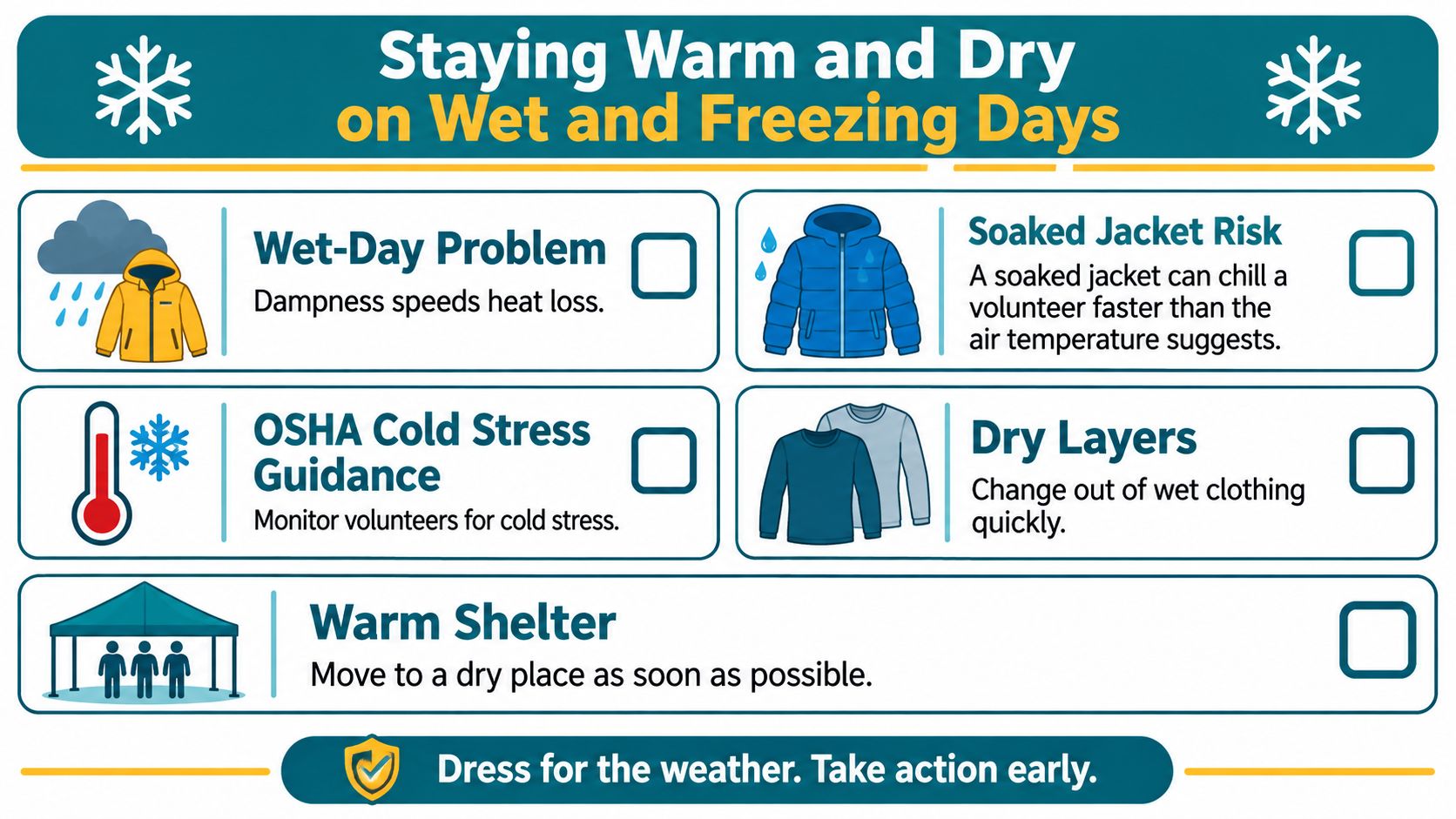
Your Gear Checklist
Before you leave, use this cold weather preparation guide to check what you need. Pack gear that keeps you dry, warm, and visible.
- Waterproof outer layer: Keeps rain from soaking your warm layers.
- Spare dry layer in a bag: Gives you something dry to change into if your clothes get soaked.
- Wool or synthetic socks: Help keep your feet warm. Bring a second pair.
- Gloves with grip: Help you hold a litter grabber while keeping your hands covered.
- Hat that covers your ears: Protects your head and ears from wind.
- Reflective vest: Helps drivers see you on gray, rainy days.
- Closed shoes that drain: Protect your feet and let water escape.
For a muscle strain after a shift, see cold and heat advice from MEDISTIK. During the cleanup, pay attention to cold stress instead of waiting until you get home.
Use the buddy system to watch for shivering that won't stop, numb or pale fingers, slurred speech, or unusual clumsiness. If someone has slurred speech or unusual clumsiness, call for emergency medical help right away. Keep the person warm and out of the activity while help is on the way. For persistent shivering or numb or pale fingers, move them to a warm place and end their shift.
Dry gloves and regular warm, dry breaks can make a wet shift more manageable. A stop call is part of looking after the group when the cold becomes too much.
Run the Call on Site and Afterward
You meet me at the corner, bags in hand, and you want the plan in ten seconds. I state the call as go, slow, or stop. I give the reason in one sentence, and I point to the first block.
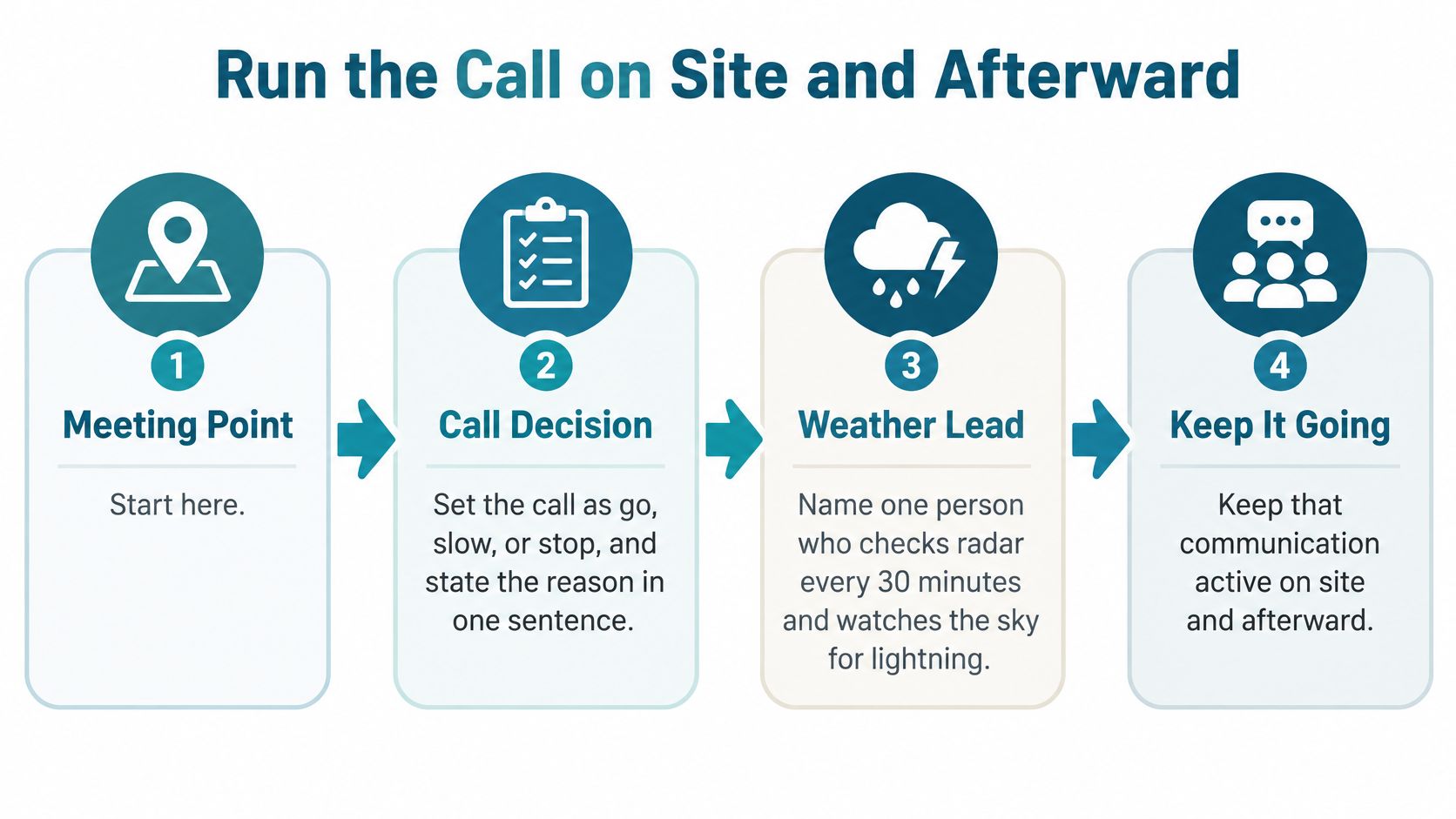
I name one weather lead for the whole shift. That person checks radar every 30 minutes and watches the sky for lightning. One owner gives you one voice, and one voice stops mixed messages.
Our volunteer safety checklist fits in a phone note, and I ask the weather lead to keep that note open during the shift. You can read it while your buddy ties a full bag. Short tools work best outdoors.
Three Steps During the Shift
- Mid-event pause: You hear thunder or you see ice form. You pause the group, you move into shelter, and you restart only after the stop rule clears.
- New call for everyone: Conditions shift. The weather lead announces the new call to every team at once, in person and in the chat.
- Clean close: The shift ends. You record the ward or route, the call you made, and any changes along the way.
Say your team cleans two blocks, then thunder rolls in from the lake. Your weather lead raises a hand, calls stop, and walks you under a store awning. Nobody argues in the rain because you agreed on the rule at the curb.
I keep my priority order plain. Safety of the volunteers always takes first priority, and happiness of the volunteers takes second priority. Comfort sits inside that second spot, and I treat it with care.
A stop call draws no blame from me. You return next week when you trust the call.
I close with a five-minute debrief. I write one line per call and one change for next time. I post the debrief in the group chat so a new volunteer can read real calls before a first shift.
That short record helps the next organizer. You spot patterns fast. Maybe one corner floods after every hard rain, or one street traps heat by noon. You plan around those spots next time.
Adapting Routes and Shifts When Skies Change
Say the forecast shifts at noon and your planned route turns into a wet, slick mess. I drop the old route. Pride cleans zero blocks, and wet shoes on slick concrete end shifts early.
I make three adjustments. First, I shorten the loop and clean the three blocks nearest the meeting point. You finish real ground, and you stay close to shelter if rain returns.
Second, I switch route types. A rail line path or park path can drain faster than a street with water running along the gutters. You trade deep puddles for firmer ground.
Third, I split one long shift into two shorter sessions with a warm break between them. You dry your hands, drink water, and decide again with a clear head.
Three Checks Before You Move
- Shelter check: You confirm a public shelter sits within a few blocks of the new route.
- Access check: You confirm every volunteer can reach the meeting point on foot or by transit.
- Ward check: You confirm the team knows which ward or route each block belongs to, so the record stays accurate.
The City of Chicago ward maps list points of interest such as firehouses, libraries, police stations, schools, post offices, CTA rail lines, parks, and cemeteries. I use those marks to pick meeting points, find nearby public buildings for shelter, plan transit access, and flag blocks that need extra attention.
One team can clean along a rail line while another team cleans around a park. Both teams still record the correct ward for the work. The map holds the boundary steady while you bend the route around weather.
I pick the shelter list before I leave home. I save two options in my phone, such as a library and a firehouse lobby area nearby. You never want to hunt for shelter in hard rain.
Then I tell you the new route in one sentence and post it in the chat. Nobody walks to the old meeting spot. Simple words save wet miles.
Test Your Plan Before the Next Cleanup
A volunteer checks the plan on Friday, then rain and cold wind arrive on Saturday. A one-page rehearsal helps you see whether the calls and gear notes fit the conditions before anyone reaches the curb.
Write down the go, slow, and stop calls, along with the heat index bands, cold stress signs, weather lead's name, and backup meeting point. Then compare the plan with the last three forecasts for your area. Work through each day as a dry run.
Two Fixes From Your Test
- Too strict: A stop call would keep people home on a day that turns out fine. Adjust the threshold and record the reason.
- Too loose: A go call would send people into danger. Tighten the call and name the sign the plan missed.
Say the forecast calls for light rain and cold wind. Your plan says slow, with a 60-minute shift and a warm break. You notice a new volunteer might arrive in thin sneakers, so add a shoe note to the gear line.
Share the finished page in the group chat before the next event. New volunteers can read the rules ahead of time and ask questions before the cleanup starts. If you're joining for the first time, ask one question in the chat before your shift.
A clear plan makes a cleanup easier to prepare for. At Litter Caterpillars, volunteers pick up trash rain or shine, while safety comes first and volunteer happiness comes second.
You can join a Litter Caterpillars cleanup in Chicago and learn the go, slow, and stop calls alongside friendly volunteers. You bring your bag and grabber; we bring a clear plan for the day. Visit Litter Caterpillars to find your first cleanup and meet us at the corner.
Leave a Reply