

I found a fresh silver tag on a brick garage after a night of sleet, and by breakfast the whole alley felt different. You know that feeling. One mark turns a clean wall into permission for the next one.
Why Graffiti Removal in Chicago Feels Different
Last July, a neighbor on our block found a black tag rolled across the side of his shop before he even got the gate up. By lunch, two of us had photos on our phones, one person had called 311, and somebody else was already asking if the city crew or a volunteer cleanup made more sense for that wall. That speed is the part outsiders miss. In Chicago, graffiti cleanup works best when it becomes a habit your block already knows how to do.
That habit feels familiar if you have ever worked a cleanup with friends in an alley after a storm. You do not hold a meeting about one busted bag of trash. You pick it up before the mess spreads. Graffiti works the same way. A fresh mark changes how a storefront, garage, or viaduct feels, and quick action keeps one tag from turning into a cluster.

The city already treats it like block maintenance
Chicago does not handle graffiti like a rare emergency. It runs it as regular city work. The city's records show graffiti requests and completions going back to January 1, 2011, and Streets and Sanitation lists a 10 day target in its city performance metrics dataset.
That matters because you are not begging for special treatment when you report a tag. You are using a standing service. If the wall needs city equipment, city paint-over, or city blasting, report it fast and get in line early.
I have learned to treat 311 like calling in a pothole or a missed cart pickup. It is part of keeping the block steady.
Why the job feels different here
Chicago has alley walls, brick flats, painted cinder block, old limestone, corrugated metal gates, and storefront trim all packed tight on the same stretch. One cleanup method can help on one wall and scar the next. Add winter salt, summer heat, wind off the lake, and foot traffic that never really quits, and you get a city where timing matters almost as much as technique.
That is also why volunteer crews matter. A block with neighbors who report fast, wipe off the easy stuff, and call in city help for the harder surfaces stays cleaner longer. Groups like Litter Caterpillars fit right into that rhythm. They make cleanup social and regular instead of turning every tag into a private headache for one property owner.
What I check first
Before I grab a rag, I slow down for a minute.
- Is this a city job or a neighbor job? Painted walls and raw masonry do not get handled the same way.
- How fresh is the mark? A new tag usually comes off easier than one that has sat through heat, grit, and rain.
- Will a rushed cleanup make the wall uglier? I have seen that happen plenty.
A tag can make your blood rise. I get it. But anger ruins surfaces. I once watched a guy go after old brick like he was stripping rust off a trailer. He got the paint lighter. He also chewed up the face of the wall.
The blocks that stay clear are usually not the blocks with the fanciest tools. They are the blocks that act fast, use 311 at the right time, and know when to bring in a few neighbors instead of letting one mark sit all week.
Read the Wall Before You Touch It
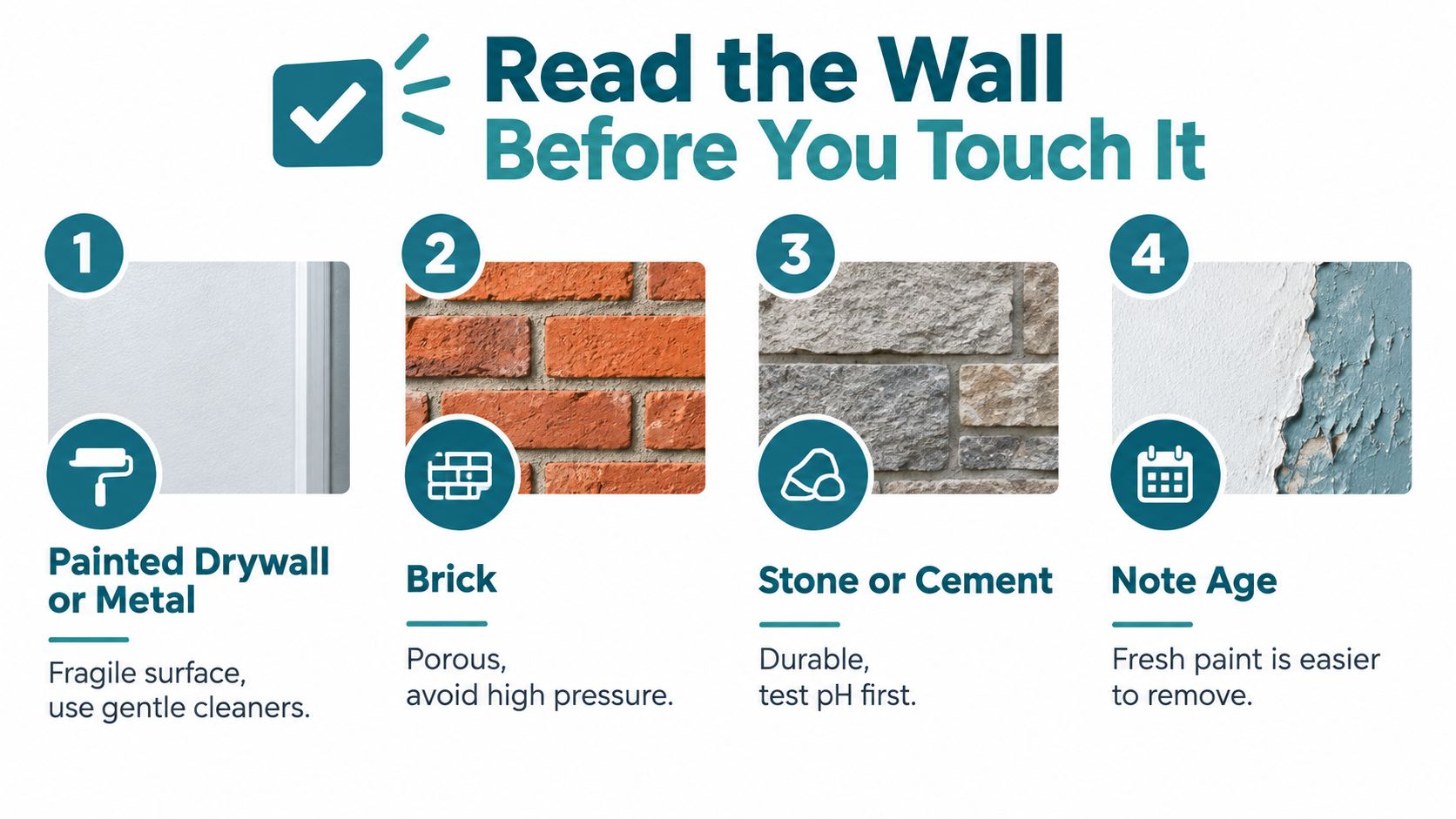
A wall tells you how to clean it if you slow down long enough to look. I treat that first glance the way I treat a pan in the sink. Cast iron, nonstick, and stainless all need different hands. Your wall does too.
The fastest mistake is thinking all graffiti removal is scrubbing. It isn't. In Chicago, the city itself splits the work by surface. It paints over graffiti on painted surfaces, and it blasts graffiti off brick, cement, or stone with a high-pressure baking soda-and-water solution through its 311 service listing.
My one-minute wall check
I do this in about a minute. You can too.
- Surface first: Is it painted drywall, painted wood, raw brick, stone, cement, or metal?
- Age next: Does the paint look fresh and glossy, or old and sun-baked?
- Size and shape: Is it a small marker tag, a spray outline, or a thick fill?
- Location: Is it above a doorway, behind shrubs, near parked cars, or close to plants?
That last part matters more than people think. A wall with roses planted below it needs a different setup than a bare alley wall. So does a storefront with cars bumper-to-bumper out front.
How I read tricky surfaces
Old brick makes me slow down. Soft masonry can scar if you come in too hard. Painted metal is the opposite problem. You can strip the finish before you remove the tag, then you've traded one ugly patch for another.
Here's the quick read I use:
| Surface | What I assume first | My first move |
|---|---|---|
| Painted wall | Paint may lift | Test a hidden spot |
| Metal | Finish may dull | Try the gentlest wipe |
| Brick | Surface may absorb paint | Start mild and patient |
| Stone or cement | May handle more, but still test | Check a small patch first |
Fresh tags are like wet pancake batter on a counter. Old tags are like syrup burned onto the stove.
What to photograph before you act
I always take photos before I clean or report. Nothing fancy. Just clear, useful pictures.
- Wide shot: Show the full wall and where it sits on the building.
- Close shot: Capture the paint color and edges of the tag.
- Reference shot: Include a door, sign, or window so the city crew can spot it fast.
- Angle shot: If the surface is rough, take one side angle to show texture.
Those photos help you with 311, and they help you if the tag returns later. You don't need a whole file system. A simple album on your phone by address works.
The choice usually comes down to two paths
Most of the time, you're deciding between blast or cover. Raw mineral surfaces like brick, stone, and cement usually point one way. Painted or finished surfaces usually point the other.
If you're unsure, that's your answer. Slow down and call the city instead of guessing with somebody's facade.
Safe Ways to Remove Graffiti Without Damaging Surfaces
I once watched a guy attack a tagged brick wall with so much pressure that he cut pale stripes into the masonry. The tag faded. The scar stayed. That wall looked like it had been clawed.
That's the whole game right there. You want the graffiti gone, not the wall with it.
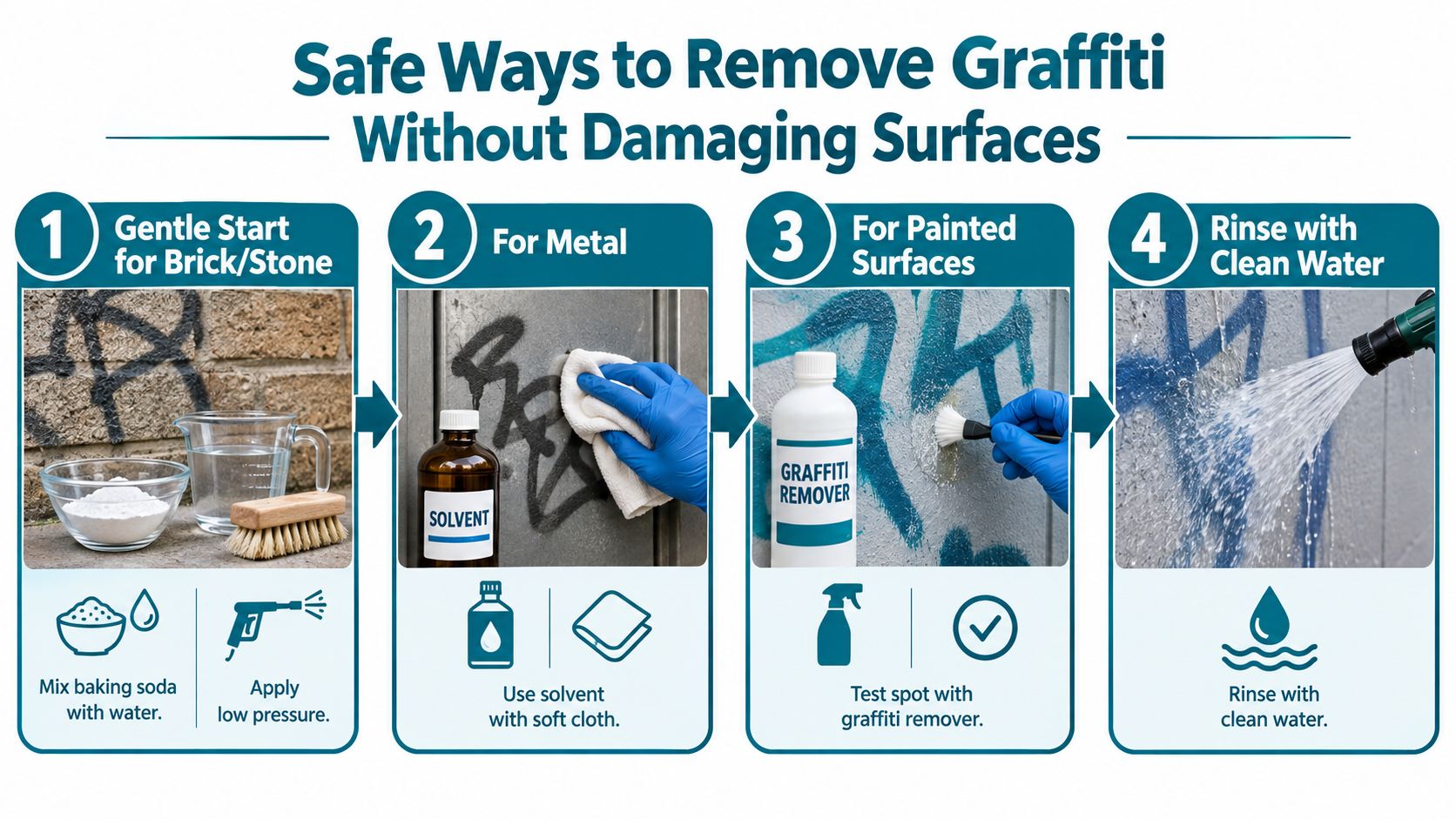
Here's the city's basic split: blast trucks use baking soda under high water pressure on painted graffiti over brick, stone, and other mineral surfaces, while paint trucks cover graffiti on metal or wood, as the city explains in its graffiti removal program page. That surface-first logic is the safest place to start.
On brick and stone, start softer than your instincts want
The city has also described using baking soda-water, citric acid-water, and citrus-based oil in its operations, with tougher cases sometimes ending in repainting. The same city material warns that too-narrow or too-strong pressure-washing can etch masonry, so soft or historic brick should get the gentlest method first in the Department of Streets and Sanitation overview.
That matches what I've learned the hard way. Your first pass should feel almost boring.
Try this order:
- Test a small corner you won't notice if it changes.
- Use the mildest method first on porous surfaces.
- Check the color of the runoff and the wall face itself.
- Stop if the wall lightens unevenly or starts to fuzz.
If the wall starts looking chalky or scraped, back off. You're cleaning paint, not stripping a deck.
Painted surfaces often need cover, not combat
Painted wood, painted metal, and already-coated walls are a different animal. Sometimes the cleanest fix is color-matched paint. I know people hate hearing that because it feels less satisfying than removal. But a good cover coat often beats a patch of smeared solvent damage.
I keep the process plain:
- Match the finish: Flat, satin, and gloss don't hide the same way.
- Feather the edges: Don't paint a hard little square if you can blend wider.
- Let the first coat dry: Rushing the second coat can drag pigment.
- Stand back across the street: That's the test, not your nose-to-wall test.
If you're already in cleanup mode outside, it helps to tidy the whole scene too. A clean sidewalk makes a cleaned wall feel complete. I like the basic habits in this guide on how to clean sidewalks because the same rule applies. Start gentle, protect what's nearby, and don't spread the mess farther down the block.
Here's a quick visual for the flow before you start:
Protect what sits around the wall
Graffiti cleanup gets messy fast. I've seen overspray hit leaves, runoff stain concrete, and rinse water carry color toward a storm drain.
So before I begin, I check the area around the wall:
- Cars nearby: Ask the owner to move if you can.
- Plants at the base: Cover them or redirect runoff.
- Windows and signs: Mask what might catch splash.
- Foot traffic: Keep people clear of wet surfaces.
Use the gentlest tool that gets movement. You can always step up. You can't un-etch brick.
When I stop and hand it off
I stop the moment a wall gives me a bad signal. That might be soft old masonry, a weird coating I can't identify, or a patch where the graffiti has sunk deep into pores.
That's not quitting. That's judgment.
A lot of bad cleanup jobs come from pride. People keep going because they've started. I'd rather leave a tag for city crews than leave permanent damage for the owner.
Chicago Rules Permits and How to Use 311 Right
Rules get annoying when they are written like a maze. So I boil Chicago's graffiti rules down to kitchen-table language.
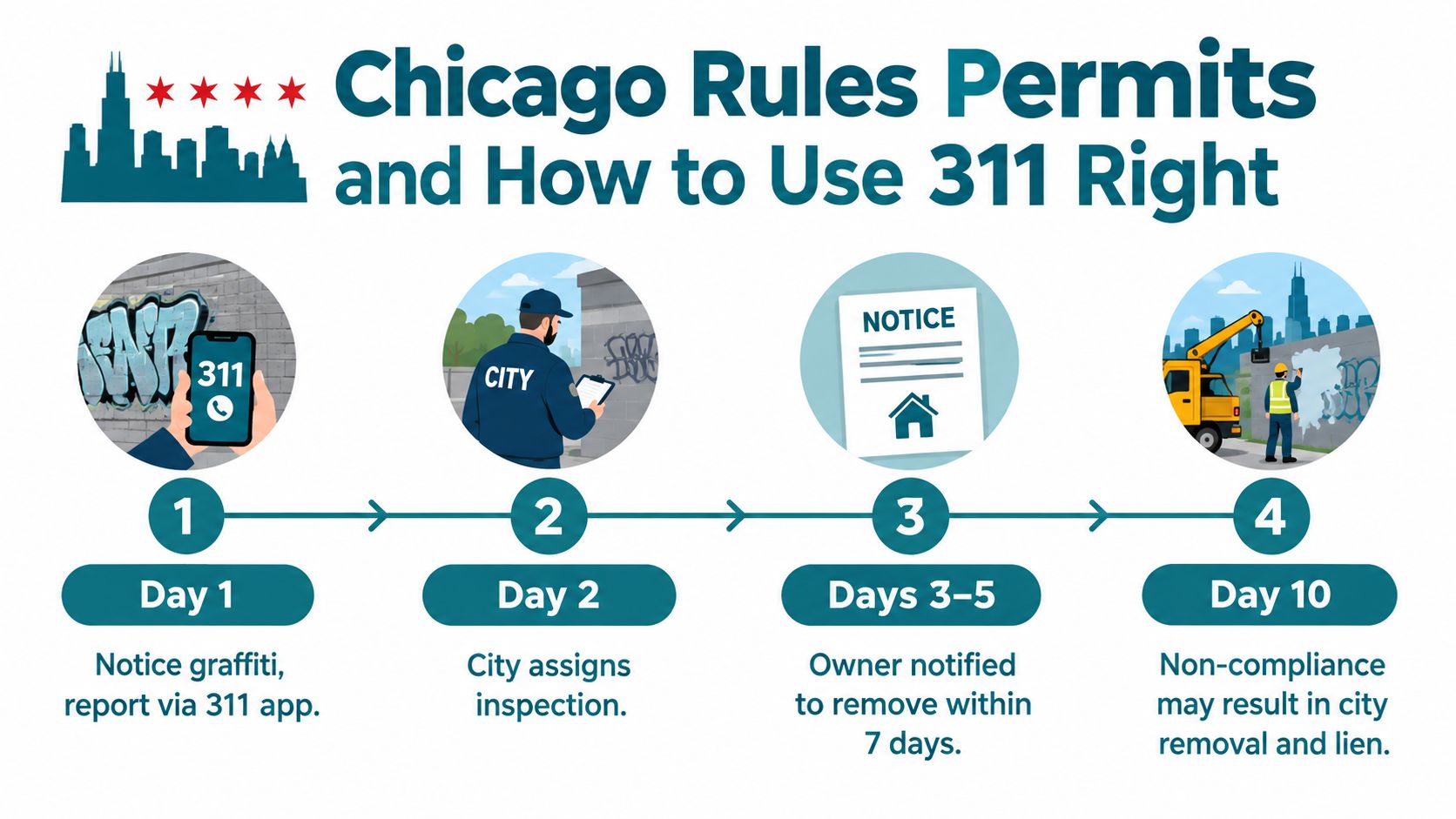
If graffiti shows up on your building and it isn't registered under the city's rules, Chicago treats it as a public nuisance. The owner has to remove or conceal it as soon as it appears, and if the owner doesn't act, the Department of Streets and Sanitation can post notice and then enter the property to abate it after five days, excluding Saturdays, Sundays, and legal holidays, under the Chicago municipal code.
When a permit enters the picture
A lot of owners miss this part. Chicago also has a permit rule for chemical graffiti-removal work on buildings and similar architectural surfaces. If the Department of Streets and Sanitation does the graffiti removal, you don't need that permit. But if you sandblast, grind, or chemically wash a building, structure, statue, or other architectural surface, the permit costs $200 per surface under the Chicago building code provision.
That means the cheap shortcut can get expensive if you skip the paperwork.
If you're already sorting cleanup materials for a property, I'd also keep disposal in mind. This page on City of Chicago hazardous waste disposal is a useful gut check when you're dealing with leftover chemicals, paint-related waste, or other cleanup byproducts.
How I file a 311 request so it moves cleanly
Chicago routes graffiti complaints through 311, and the hotline runs 24/7 at 311 or 312-744-5000, according to this Chicago 311 service information page.
When I report graffiti, I keep the details tight:
- Exact address: Front, alley, garage, viaduct, or side wall.
- Surface type: Brick, metal, wood, painted wall.
- Access note: Gate opened, dog in yard, wall faces alley, and so on.
- Photo set: The same shots you took during your wall check.
Small details help crews avoid wasted trips. “Back wall off alley, red brick, left of garage door” is better than “garage has graffiti.”
What timing feels like right now
Demand is still heavy. Chicago dashboards show 35.3k graffiti-removal requests from January 1 to May 15, 2026, versus 34k over the same period in 2025, a 4% increase, on Transparent Chicago's graffiti metrics page.
That volume changes your expectations. You should report right away. You should give clean location details. And you should understand that a city with tens of thousands of requests in the first part of the year is juggling a lot at once.
Report fast, then decide whether you should also handle an easy cover-up yourself. Waiting to “see if it gets worse” usually wastes time.
Clean Together With Neighbors and Litter Caterpillars
The easiest cleanup I ever did was not easy at all. Four of us met on a cold Saturday. One person brought gloves. One brought coffee. I brought extra trash bags and a tiny paint sample card that matched a fence almost perfectly. We cleaned a tagged side wall, swept glass from the curb, and by noon the corner looked like somebody loved it again.
That's why I like neighborhood cleanup as a habit, not a heroic act. You don't need a speech. You need two or three people who will show up.
A small crew beats a perfect plan
I keep volunteer jobs simple because simple jobs happen.
Here's the split I use on a block cleanup morning:
- One person handles photos and 311 notes. That person documents before and after.
- One person manages supplies. Gloves, rags, tape, water, paint, and cleanup bags.
- One or two people work the wall. They test, wipe, cover, and rinse carefully.
- Another person watches the edges. Cars, foot traffic, kids, pets, and runoff.
That setup keeps people from bunching around the same spot. It also lowers the chance that somebody gets bored and starts improvising with the wrong tool.
Weekend mornings work for a reason
I've found that early weekend meetups pull in the right energy. People come ready to work, then they still have the rest of the day. You don't need to run a military operation. You need a clear start time, a meeting corner, and one person willing to say, “You take that side. I'll tape the trim.”
If you want a framework for the people side of it, this guide on how to organize a neighborhood cleanup has the bones of a plan that works on a Chicago block.
A simple outreach note gets better replies than a fancy one. I use something like this:
“Hey neighbors, a fresh tag showed up on the side wall by the alley. I'm meeting there Saturday morning for a short cleanup and photo report. If you can bring gloves or just an extra set of hands, come by.”
How I talk with shops and landlords
Store owners and landlords usually want the same thing you want. They want the mess gone without drama.
So I keep the ask direct:
| Who I'm asking | What I ask for |
|---|---|
| Store owner | Permission to access wall and match paint |
| Landlord | Contact info, paint details, and gate access |
| Neighbor | Extra water, ladder hold, or photo help |
I don't oversell it. I don't turn it into a campaign. I ask for one concrete thing.
Celebrate the finish line a little
People come back when the cleanup feels human. After we wrap, I like a group photo, a coffee run, or even five minutes of standing around admiring the now-boring wall.
That boring wall is the prize.
And there's another payoff. When several neighbors see the cleanup happen with their own eyes, they start reporting new tags faster next time. The block learns the rhythm.
Keep It Clear With Prevention and Quick Reporting
A clean wall needs a routine, same as a swept porch. If you treat graffiti as a one-time fight, you'll keep reliving the same Saturday. If you treat it as a weekly habit, the job gets lighter.
I use a short loop. Walk the block. Spot new marks. Report what needs city help. Handle the easy stuff quickly. Make notes on what keeps getting hit.
The habits that cut repeat work
Some prevention is plain common sense. Good lighting helps. Fast cleanup helps more. A wall that stays tagged for days keeps inviting attention.
I also like permission-based murals in spots that attract repeat tagging, and anti-graffiti coatings where the surface and budget make sense. Those choices depend on the property. I don't push one answer for every wall.
My basic weekly loop looks like this:
- Check the usual spots: Alley doors, side walls, garage panels, utility-facing walls.
- Log fresh tags right away: Don't wait for a bigger batch.
- Keep a simple note: Date, location, surface, what worked.
- Watch patterns: Same corner, same color, same blind spot.
What I'd put on the fridge
This is the reminder I'd tape up at home:
Clean it fast. Match the method to the wall. Report early. Make the block boring to tag.
That line keeps me from overthinking it. You don't need a giant system. You need repetition.
Your next move this week
Pick one wall you pass all the time. Photograph it. Check whether the surface is painted or mineral. Save the right reporting info in your phone. If a tag shows up, you won't waste a day deciding what to do.
That's how blocks stay cleaner longer. People don't wait for the perfect city response, and they don't wreck surfaces with rushed DIY fixes either. They build a neighborhood reflex. See it. Read it. Act on it.
If you want backup, Litter Caterpillars brings Chicago volunteers together for real, hands-on neighborhood cleanup work, the kind that makes graffiti response and block care easier to sustain. You can join a weekend crew, meet people who show up, and turn one cleaned wall into a cleaner stretch of street.
Leave a Reply