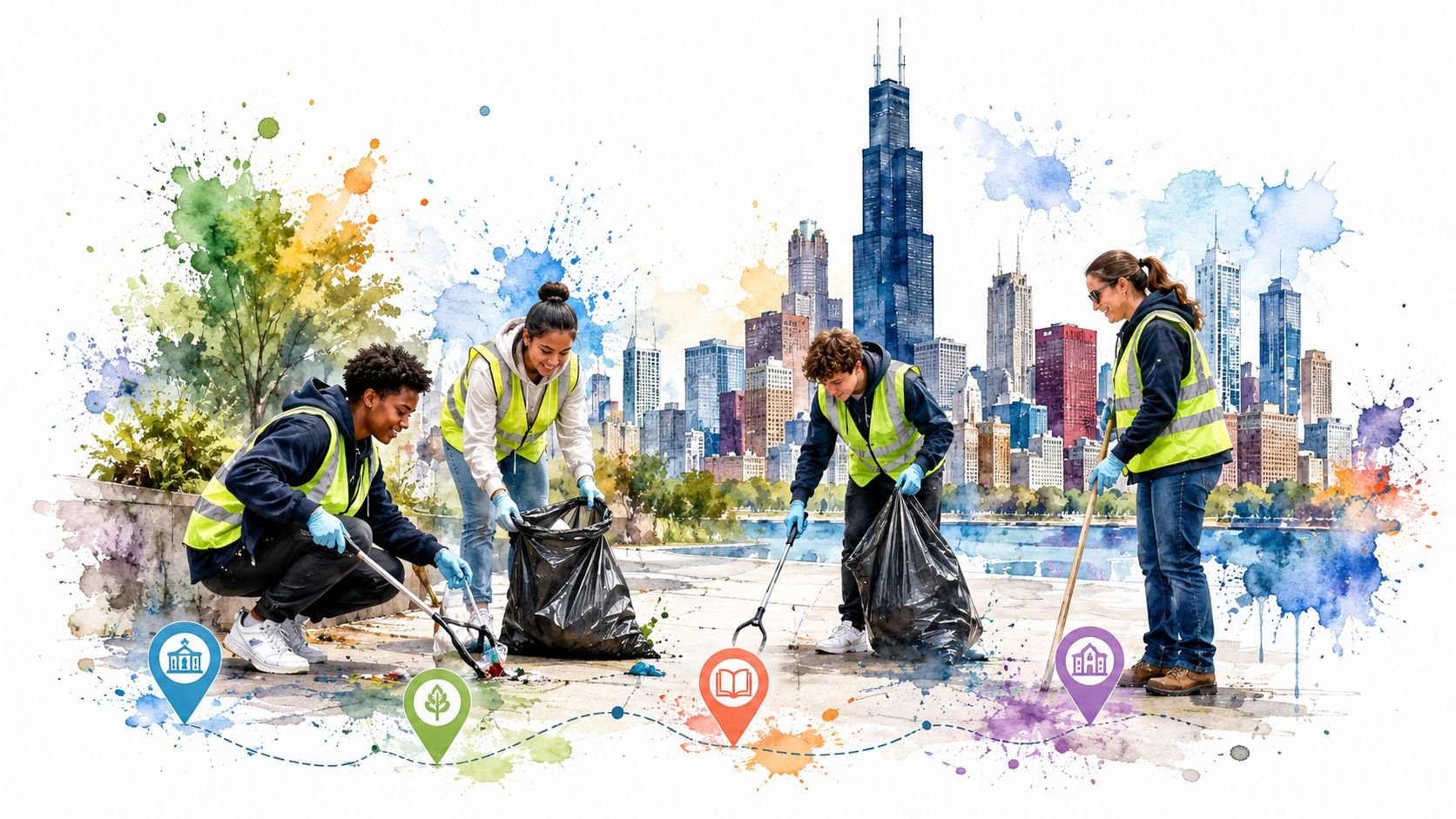
Three of us stood under a tree in a spring hailstorm, laughing while our Uber kept canceling and a strip of trash sat in the gutter like it had nowhere else to go. I remember thinking that cleaning up Chicago can feel weirdly human, messy, cold, a little funny, and a lot more social than people expect. If you want the sidewalk version of service learning Chicago, start right there, not in a worksheet.
Why Service Learning in Chicago Starts on the Sidewalk
The first time I really got service learning, I wasn't in a classroom. I was outside, hands cold, shoes damp, trying to grab wrappers before the wind pushed them under parked cars. The whole thing felt less like a school task and more like a small act of paying attention to the block in front of me.
That's why I like to think of service learning as something you do with your body first. You show up, you notice what's there, and you work with other people who care enough to keep going when the weather turns stupid. If you want a cleaner, more practical way to think about neighborhood action, I've put together a simple guide on how to clean sidewalks, because the details matter when you're on concrete, not in theory.
What the sidewalk teaches
The sidewalk tells the truth fast. You learn where the trash gathers, which corners need gloves, and how much easier it is to keep moving when someone next to you is doing the same work. That's the part most guides skip, the human rhythm of service.
Service learning in Chicago makes the city feel like a classroom without walls. You still need planning, but the lesson changes once you're outside. You see how a weekend cleanup, a school project, or a neighborhood partnership can start with one block and end with a better habit.
I'd rather talk to you about that than give you a polished slogan. If you've ever wanted to do something useful with a Saturday morning, this is the lane.
What Service Learning Actually Means
Service learning isn't just volunteering with a nicer label. I can donate a few hours, take a photo, and leave, and that's still volunteer work. Service learning asks for more structure than that, because it ties the work to learning, reflection, and a real question about the world around you.
Think of ordinary volunteering like running a race without a coach. You move, you sweat, you finish, and you might feel good. Service learning is more like training with someone who helps you study the route, run the miles, and then look at the splits afterward.
The three parts that make it learning
The structure is simple, even if people skip it all the time.
- Preparation: You learn the issue, the site, the people involved, and what the work asks of you.
- Action: You do the service in the world, not just in a classroom discussion.
- Reflection: You write, talk, or think through what happened and what changed.
That last part matters more than many admit. Without reflection, service can turn into motion with no meaning attached. With reflection, the student starts making sense of the work, the neighborhood, and their own assumptions.
Chicago's school framing leans hard into classroom integration, which is why this feels different from a one-off volunteer shift. The work gets tied to what students are already studying, so service sits inside the curriculum instead of hanging off the side like an optional extra.
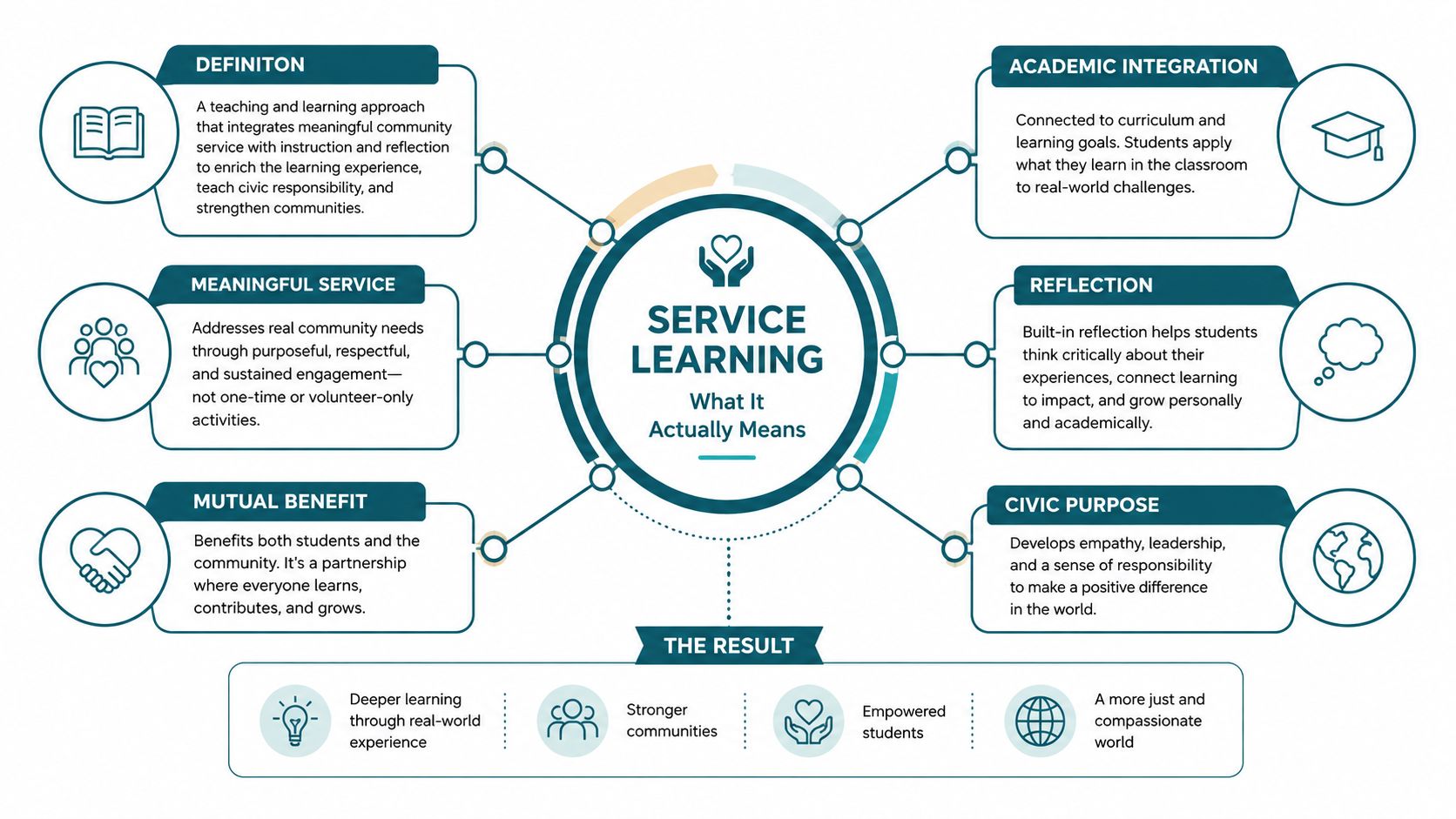
Practical rule: if nobody asks what you learned, who benefited, and what you'd change next time, you're probably looking at volunteering, not service learning.
That's the cleanest way I know to separate the three. Community service is useful. Volunteer work is useful. Service learning turns the usefulness into a learning loop.
How Chicago Public Schools Built Service Learning at City Scale
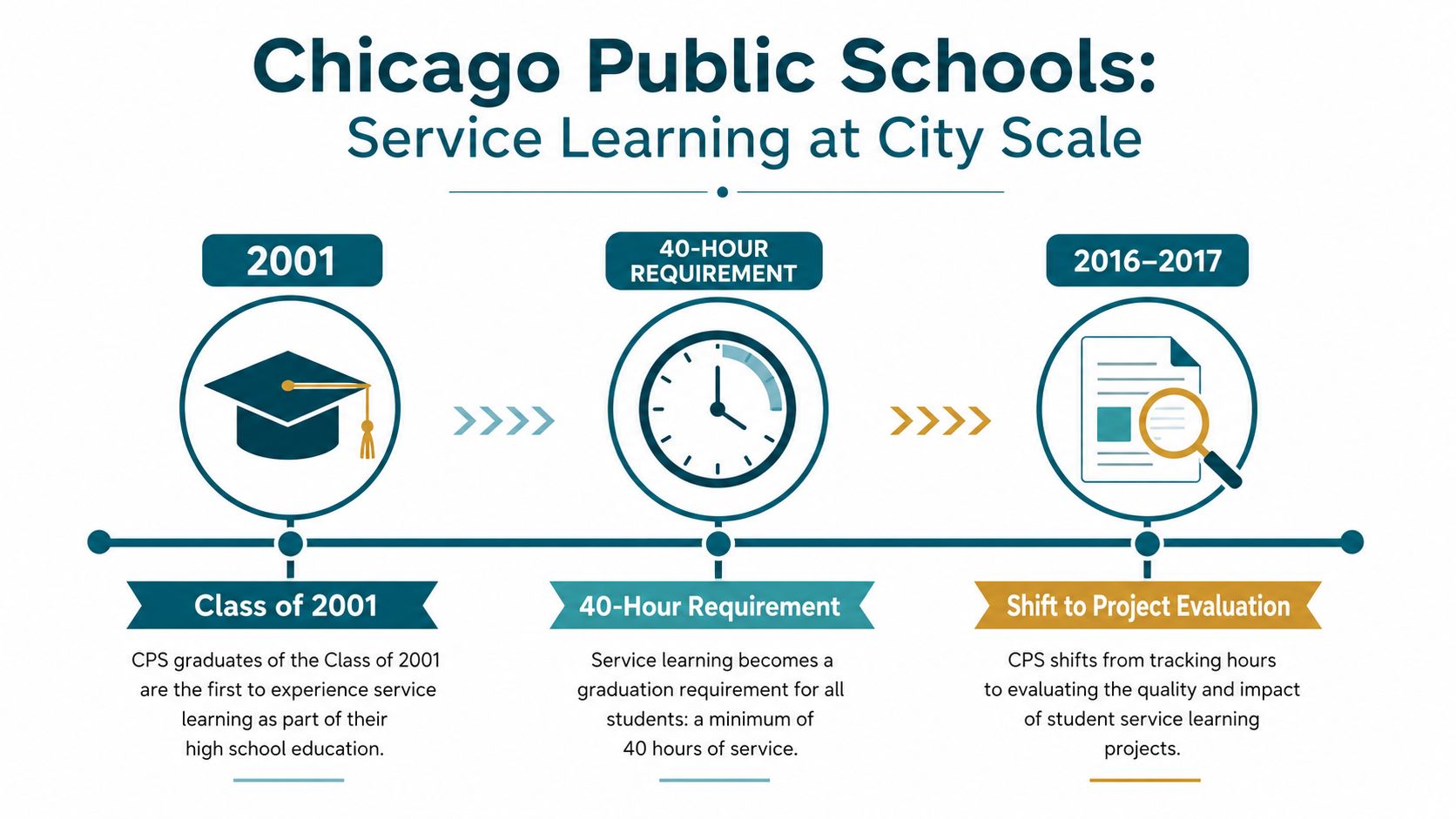
I keep coming back to Chicago Public Schools because the district did something most systems only talk about. A student could finish school and have real neighborhood work attached to the transcript, not just a line about good citizenship. Beginning with the class of 2001, CPS made 40 hours of community service part of the graduation requirement, and by June 4, 2001, the district reported 82,224 students involved, 96.27% of seniors meeting the requirement, 1,719,747 service hours delivered to city recipients, and 188 agency partners (CPS report). That is a lot of clipboard work, bus rides, phone calls, and Saturday mornings stitched together across the city.
From hours to projects
The early model focused on time, which made sense for getting a citywide habit off the ground. Later, CPS pushed the work toward finished projects instead of raw hours. By the 2015-2016 school year, students completed 947 service-learning projects (CPS Ready to Engage). The district then shifted the graduation model in 2016-2017 from 40 service-learning hours to two service-learning projects (CPS service learning page).
That change matters because it asks for more than attendance. A student has to identify a need, connect it to classwork, and finish something that leaves a mark beyond the day of service. CPS describes the current setup as two classroom-integrated service-learning projects, with one in Civics or AP U.S. Government and the other in a different course (CPS service learning). The district also frames the work around preparation, action, and reflection, along with student voice and curriculum links. That keeps service inside schoolwork, where teachers can connect it to what students are studying.
The broader context helps explain why Chicago stands out. CPS pointed to NCES survey data showing that only 32% of public schools nationwide had service-learning at all, including 46% of high schools, 38% of middle schools, and 25% of elementary schools (CPS Ready to Engage). Chicago chose a harder path than most districts, and it made that choice visible at scale.
When I read the district's materials, I also think about how that structure lines up with the kind of weekend cleanup work I see around the city. A project only feels real when someone has to plan the route, show up, pick up the trash, and explain what changed afterward. That is the same logic behind how service learning benefits students and neighborhoods, even when the work starts with a broom instead of a classroom handout.
Chicago moved from asking students to count service time to asking them to complete work tied to class, community, and reflection. That change feels concrete because it is concrete.
The Benefits Students and Communities Feel
I keep coming back to the same scene: a Saturday morning in Chicago, gloves on, grabbers in hand, and a few students trying to solve a sidewalk problem before the coffee gets cold. That is where service learning stops feeling like a school requirement and starts looking like real work. CPS names collaboration, communication, critical thinking/problem solving, and creativity as part of the learning around service, and those skills show up fast when the route changes, the bags fill up, and the group has to decide what to do next (CPS project-based service learning).
What students gain and what partners need
Students usually notice the shift first in their own bodies. They stop treating the day like a performance and start paying attention to the people beside them, the block in front of them, and the problem they are trying to solve together. I've watched that happen when a crew realizes that cleanup takes more than enthusiasm, it takes pacing, communication, and a little patience when one person misses a turn and the work slows down.
Partner sites feel that difference too. When students show up as learners, they ask better questions, listen before they act, and leave space for the people already doing the work.
For communities, the harder question sits underneath all of it. Does the project leave anything behind after the semester ends, or does it disappear when the last sign-in sheet gets packed away? A PubMed study on a culturally relevant, community-based service-learning health curriculum found gains for Latinx sixth graders' health knowledge and for nursing students who learned in ways classroom and clinical practicum could not. That tells me service learning can do more than fill a schedule, while also leaving the neighborhood question in place.
That is why partnership-based work matters so much. Residents need a say in what gets done, how it gets done, and what success looks like once the work is over.
If you want a plain-language breakdown of the payoff for students, organizers, and neighborhoods, I've also put together an overview of service learning benefits in practice.
A Chicago Case Study in Service Learning Through Action
Kevin Tao built Litter Caterpillars out of personal mess, and that matters to me because it keeps the whole thing grounded. He's said he struggled to clean and organize his own space, then decided to engineer his social circle around people who gave a damn about cleanup, consistency, and bravery. That's a very Chicago kind of origin story, blunt and practical, with no fake polish on it.
The hailstorm that became a logo
The first cleanup had only three volunteers. They got caught in a spring hailstorm, huddled under a tree, and watched Uber cancel after Uber cancel while trash sat there waiting for them. That moment became the logo story, and I love it because it sounds exactly like service in real life, inconvenient, a little absurd, and somehow fun once you're already in it.
From there, the group kept going every week, rain or shine, in blizzards, negative wind chills, and scorching heat. They reached all 50 wards, including places other people warned against. That detail matters because it says the work didn't stay in easy neighborhoods or easy weather.
The group also cleaned a highway during a bike-event shutdown and won an empty lot at auction to turn it into Caterpillar Park in Englewood. That's the part that makes the story feel less like a cleanup club and more like a habit that keeps finding new ground.
The values that hold the group together
Litter Caterpillars runs on bravery, kindness, unity, and volunteer-first values. The weekend-morning schedule filters out the energy they don't want, and the group protects volunteer safety and happiness before anything else. I respect that. It's a clean rule.
Practical rule: if a service group treats people like free labor, I back away. If it treats people like humans who need safety, friendship, and clear expectations, I pay attention.
The whole setup feels like service learning after the bell rings and after the syllabus closes. You can join, sweat, laugh, and leave with a story that sticks.
How to Set Up or Join a Service Learning Project in Chicago
I usually tell students to start with the shape of the class before they start hunting for a site. At CPS, service learning now centers on two service-learning projects, not hours alone, and the work has to connect to curriculum, student voice, and reflection. That means the cleanest projects usually begin with a teacher who already knows what the class is trying to learn, then find a neighborhood need that fits.
A real example makes this easier. If your school already has an approved partner, use that. If it lets you propose a site, bring a contact person who can answer the phone, and explain why the site belongs in the class instead of just sounding charitable on paper. I've seen projects stall because the match looked good in a slide deck and fell apart once someone needed gloves, a meeting spot, or a backup plan for weather.
A simple path for students, educators, and nonprofits
For students, I'd keep the first move practical.
- Choose a partner or propose one. Make sure the site can host you and that someone there knows you're coming.
- Get the forms approved. Start with permission, not with a surprise.
- Do the work with a buddy system. Gloves, high-visibility vests, and weather planning are basics, not extras.
- Log what you did. Hours matter in some programs, projects matter in others.
- Write the reflection while the work is still fresh. That's where the learning lands.
I've watched a Saturday cleanup go from awkward to useful once students knew exactly who was leading, what block they were covering, and where trash bags were going at the end. The job gets easier when the rules are plain.
For educators, I'd build from the community need first, then map the class content onto it. Don't invent a fake problem so the lesson looks tidy. Start with something residents already care about, then build checkpoints for preparation, action, and reflection so the class can see its own progress without losing the neighborhood in the process.
For nonprofits, the first job is to define the kind of learner you want in the space. Set a point of contact, write down the safety rules, and say what good behavior looks like before the day starts. If you want a model that keeps volunteers organized around repeated neighborhood work, Litter Caterpillars is one option I'd point to, and its service learning programs show how weekend cleanup events, open group chats, and clear social norms can keep people moving in the same direction.
At the University of Chicago Laboratory Schools, the process gets more formal. Students start service learning in sophomore year, commit to 30 hours of service over the year, submit approved forms before they begin, turn in signed timesheets each quarter, and complete written reflections during and after the service (U-High service learning). It feels like a checkpoint trail, with each form opening the next gate.
If a school or nonprofit wants a clearer picture of how a volunteer-led project gets organized from the ground up, that structure matters more than a polished slogan.
Building Service Habits That Outlast a Semester
One cleanup can feel good for a day. A weekly habit changes how you respond to discomfort, other people's mess, and your own excuses. That's why I keep coming back to repetition, because the first Saturday is about courage, and the twentieth Saturday is about identity.
Tom Sawyer tricked his friends into painting a fence by making the work look like privilege instead of punishment. I think about that a lot in service learning. Pride changes behavior, and when people feel like they belong to something, hard work stops looking like a chore they have to survive.
Chicago works the same way block by block. One ward at a time, one Saturday at a time, one pickup bag at a time, and you start seeing a city built out of ordinary people who kept showing up. That's not a slogan to me. That's a pattern you can join.
Show up this weekend. Bring a friend. Let the habit do what it does.
Service Learning Chicago Questions You Might Still Have
I still get questions on Saturday mornings, usually while people are pulling gloves on, checking trash grabbers, or looking at the block and asking what service learning really means once you step outside the classroom. The quick version is this. It is structured work tied to learning, reflection, and community need, and in Chicago that can look a lot like a cleanup crew meeting before the city wakes up.
How many hours do Loyola students need? Loyola University Chicago sets a minimum of 20 hours per semester for service-learning courses, and undergraduates also need at least one Engaged Learning course totaling at least 3 credit hours before graduation (Loyola service-learning courses).
How does U-High handle it? At the University of Chicago Laboratory Schools, students begin in sophomore year, complete 30 hours over the year, get service forms approved before they begin, submit signed timesheets each quarter, and write reflections during and after the work.
Is this the same as a club requirement? A club can ask for attendance. Service learning asks for preparation, action, and reflection tied to learning, so the work has to connect back to the experience, not just the calendar.
Can adults outside universities join? Yes. Chicago neighborhood groups and volunteer projects often welcome adults, especially when they follow the site's safety rules and expectations. A weekend cleanup usually needs hands, attention, and people who will stay until the last bag is tied off.
Litter Caterpillars is one Chicago option if you want weekend cleanup, real neighborhood work, and a group that treats service like a habit, not a performance. If you want to plug into that kind of Saturday morning action, visit Litter Caterpillars and find a way in that fits your schedule.
Leave a Reply