
Let's be real. Procrastination isn't about laziness; it's an emotional traffic jam. That task you’re putting off feels like a mountain you can't climb, and just the thought of starting leaves you exhausted. To get past it, you have to stop wrestling with the task and start understanding the feeling that’s got you stuck.
Why You Procrastinate and How to Start Changing It

I’ve been there. I once lived in an apartment that was a perfect museum of past mistakes, a chaotic mess I couldn't bring myself to clean.
Every piece of trash told a story I didn't want to hear. An expired jar of blueberry jam from a trip to Michigan four years ago. A bag of almonds from that time I tried to eat healthy and failed spectacularly. Each item weighed less than a pound, but to me, it felt like it weighed 500 pounds. It was stuck, and I was, too.
This isn't just some weird quirk I have. It turns out, about 20% of adults are chronic procrastinators, people like you and me who can turn simple jobs into these massive emotional hurdles that feel impossible to clear.
Untangling the Emotional Knot
So, why do we do this to ourselves? It’s not a character flaw. It’s your brain’s clumsy attempt to shield you from crappy feelings.
Picture a tangled knot of old headphone wires. One wire is your deep-seated fear of failing. Another is the sheer, mind-numbing boredom of the task. A third is just the exhaustion from making one more decision in a day full of them. When they all get twisted together, the whole mess feels so impossible that walking away seems like the only sane thing to do.
The real enemy, I’ve learned, isn't the task. It's the feeling about the task. Usually, it boils down to one of these culprits:
- Perfectionism: The paralyzing thought that if you can't do it perfectly, you shouldn't dare do it at all.
- Fear of Failure: That nagging voice whispering that your efforts won't be good enough, so it’s just safer not to even try.
- Decision Fatigue: Your brain is just plain tired. It has made too many choices today, and it’s defaulting to "no more."
My Breaking Point and the First Step
My own life hit a wall after a chaotic relationship imploded. When I finally looked around at the disaster in my apartment, I saw a perfect mirror of the disaster inside my own head. The clutter wasn't just physical stuff; it was emotional weight I had been carrying.
That recognition, that stark moment of truth, was the first and most important step.
I realized something profound: cleaning someone else’s mess is often far easier than cleaning your own. It detaches you from the emotional weight and helps you build momentum.
This insight is exactly why I started Litter Caterpillars. I found that by cleaning up the city, I was slowly, almost accidentally, learning how to clean up my own life. It reframed the entire challenge. And this is where your journey can begin, too. Not with shame, but with a simple, powerful action. You and I can redesign this habit, and it starts by taking that first small step for someone else. You can see how our community is making a real difference by doing just that.
5 Ways to Actually Stop Procrastinating (For Real This Time)
Alright, figuring out why you put things off is one thing. But theory doesn't get the work done, does it? You need tools that pull you out of the mud right now.
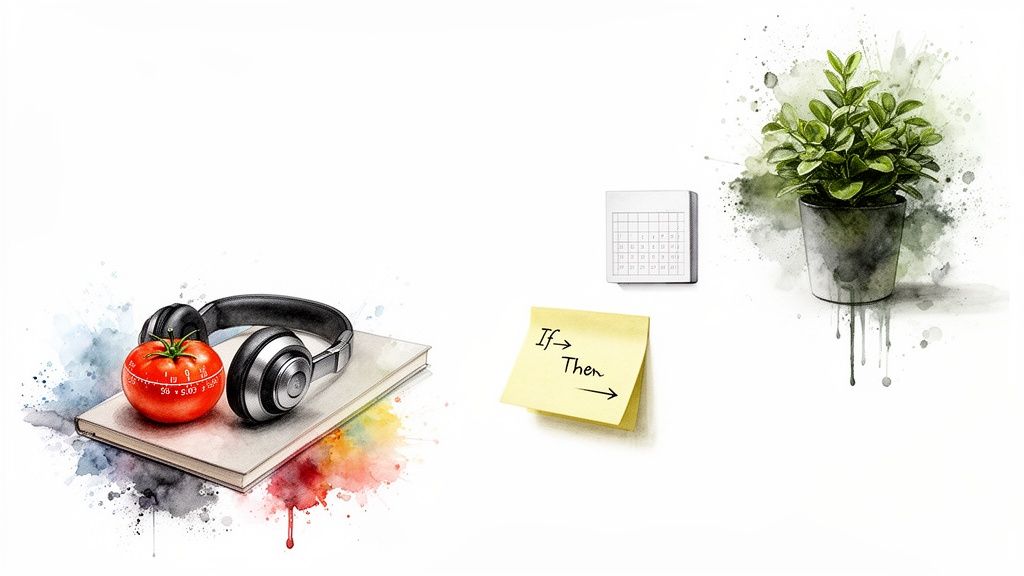
I'm handing you the five methods I personally use to stop staring at the wall and actually start doing things. These aren't just tips; they're clever ways to trick your own brain into getting on board.
Bundle Your Temptations
Let’s start with my favorite, because it feels like you're cheating the system. Temptation Bundling is the genius move of pairing something you want to do with something you need to do. It’s a simple, brilliant bargain you make with yourself.
For me, it was cleaning the kitchen. I dreaded it. The mess felt infinite. At the same time, I was hooked on a true-crime podcast. Then, the lightbulb went off. I made a new rule: I could only listen to the podcast while I was actively cleaning the kitchen.
Suddenly, cleaning wasn't a chore anymore; it was my ticket to the next episode. The kitchen got clean, and I got my podcast fix. This little hack works so well because it connects a task you hate with an immediate reward you crave.
Set an "If-Then" Plan
Look, your willpower is not an endless resource. Don't burn through it by making decisions on the fly. Instead, I want you to create an Implementation Intention—a simple "if-then" plan that decides your next move before you're tempted to bail.
The formula is beautifully simple: If [TRIGGER], then I will [ACTION].
This isn't about "trying" to do something. It's about programming an automatic response.
- Don't say: "I'll try to go to the gym this week."
- Instead, say: "If it is 5:30 PM on Monday, then I will immediately change into my gym clothes and walk out the door."
You’re creating a script for your future self to follow. The decision is already made. No more debating. You just act.
An "if-then" plan is like a GPS for your habits. You program the destination ahead of time, so when you hit a fork in the road—like the choice between the couch and your workout—the route is already set.
Design Your Environment for Success
Your surroundings are quietly shaping your behavior, every single day. If you want to break a habit, make it harder to do. If you want to build a habit, make it ridiculously easy. I call this Environment Design.
Want to stop wasting hours scrolling on your phone at night? Don’t rely on sheer willpower. Leave your phone to charge in the kitchen overnight. That tiny bit of effort it takes to get out of bed and go get it is often enough to break the cycle.
Want to read more? Put a book on your pillow every morning. When you crawl into bed at night, it’s the first thing you have to touch. Making the right choice the easy choice is one of the most powerful moves you can make against procrastination.
Focus with Pomodoros and Timeboxes
Feeling overwhelmed is a massive trigger for procrastination; it makes the task feel like an unscalable mountain. The Pomodoro Technique smashes that feeling by breaking your work into small, manageable sprints.
You just work for 25 minutes, then take a 5-minute break. Simple. After four of these cycles, you take a longer break. The goal isn't to work for hours straight; it's to get 25 minutes of pure, uninterrupted focus. You can do that. Anyone can.
Timeboxing works in a similar way. You assign a fixed time slot in your calendar to one specific task. Instead of a vague "work on report" on your to-do list, you block out "1:00 PM – 2:00 PM: Write first draft of report intro." When the time is up, you're done. It gives tasks a clear beginning and end, which makes them feel far less scary.
To make it even easier, here’s a quick reference guide to these techniques.
Your Procrastination-Busting Toolkit
| Technique | How It Works | Simple Example |
|---|---|---|
| Temptation Bundling | Pair an activity you enjoy with a task you avoid. | "I can only watch my favorite Netflix show while I'm on the treadmill." |
| Implementation Intention | Create a specific "if-then" plan for your actions. | "If my alarm goes off at 7 AM, then I will immediately put on my running shoes." |
| Environment Design | Make good habits easy and bad habits difficult. | Lay out your workout clothes the night before. Unplug the TV after you use it. |
| Pomodoro Technique | Work in focused 25-minute intervals with short breaks. | Set a timer for 25 minutes to clear your inbox. No distractions allowed. |
| Timeboxing | Schedule a fixed time block for a single task. | Block "Wednesday 9-9:30 AM" in your calendar to "Plan weekly meals." |
Think of these not as rigid rules, but as experiments. Play around with them. Find the one or two that click for you and start there. The goal isn't perfection; it's just about getting the ball rolling.
Your Secret Weapon for Building Momentum
Here’s one of the most powerful things I've ever learned about beating procrastination: it’s way easier to clean up someone else’s mess than your own. I know, it sounds completely backward. But this little mental judo move is exactly what you need to build the momentum to finally deal with your own stuff.
This is the magic I stumbled upon when I started Litter Caterpillars. My life was a disaster, and my apartment was the physical proof. But one day, something shifted. I was huddled under a tree with two friends, shivering through a classic Chicago hailstorm after picking up trash. In that moment, I realized that a shared struggle and a shared goal are the ultimate cure for being stuck.
We were solving a problem that was bigger than any one of us. We were cleaning up our city. Suddenly, the 500-pound weight of my own mess felt a whole lot lighter.
The Unstoppable Force of Accountability
When you’re working alone, your brain is a world-class excuse factory. It can conjure a thousand brilliant reasons to put something off until tomorrow. There's no one there to call you out. It’s just you, your couch, and your perfectly logical reasons to fail.
But the second you commit to another person? The entire game changes.
Now it's an appointment. Someone is actually counting on you to show up. Your odds of success don’t just inch up; they explode. In fact, studies show that having a specific accountability appointment can boost your success rate to an incredible 95%.
Accountability is like a gravitational pull. It gently but firmly pulls you toward your goal, even on days you feel like you're floating away. It turns a "maybe I'll do it" into a "must."
This isn't about someone nagging you. It's the difference between a lonely, quiet struggle and a shared mission. It’s about building resilience together.
How to Build Your Circle
You don't need a hundred friends. You just need the right ones. This all starts with mindfully choosing who you let into your world. Are they people who pull you up, or people who are happy to sit with you while you make excuses?
Joining a group with a shared mission—any mission—creates this powerful, positive feedback loop. When we show up for a Litter Caterpillars meetup, we're not just picking up trash. We’re seeing faces we know, we're sharing stories, and we're making a visible impact, together. Showing up stops feeling like a chore because it’s woven into the social fabric of the group. This taps directly into the powerful force of intrinsic motivation.
The formula is dead simple:
- Find a cause: Pick something outside of yourself that you care about, even a tiny bit.
- Show up: Commit to one event. Just one. Don't overthink it.
- Connect: Make it a goal to talk to one new person.
That’s it. You’re not trying to fix your entire life at once. You’re just showing up for someone else. And in the process, you’re learning how to finally show up for yourself.
Navigating Common Procrastination Roadblocks
So you started strong. You had a plan, you were knocking out tasks, and you felt invincible. Then, you wake up one morning and it’s back. That old, heavy feeling. The task suddenly looks like a mountain again, and your motivation is just… gone. You just don’t feel like it.
I know this place. It’s the real enemy, the one that shows up after the initial excitement wears off. This is the moment that matters. Do you let one slip-up turn into a full-on slide back into your old ways? Or do you see it for what it is: just part of the process?
When one of our Litter Caterpillar volunteers misses a weekend meetup, nobody gets shamed. Life happens. The goal isn’t a perfect attendance record; it’s showing up again after you’ve missed one. Bouncing back is the real superpower.
When You Just Don't Feel Like It
Let's be honest: motivation is a flaky friend. It shows up when it wants and disappears without warning. If you wait until you "feel like it," you're going to be waiting a long, long time. The trick isn't to wait for motivation, but to create it with action.
I remember staring down a massive, overwhelming project, feeling totally frozen. My brain was just screaming "NO!" at me. So, I made a deal with myself. I didn't have to finish it. I didn't even have to work on it for an hour. I just had to open the file and write one single sentence. That was the whole deal.
You don't need to conquer the entire mountain today. Your only job is to take the first step. The feeling of accomplishment from that tiny win is often the spark you need to take the next one.
That one sentence was enough to break the spell. It was a small, undeniable piece of proof that the task wasn't impossible. It reminded me that action comes first, and the motivation follows. Not the other way around.
Turning Chores into Privileges
Sometimes a task is just awful. It’s boring, it’s hard, or it’s both. This is when you need to pull a Tom Sawyer. Remember how he was punished by having to paint a fence? He didn’t complain. Instead, he reframed the chore so brilliantly that his friends actually paid him for the "privilege" of helping out.
So how do you paint your own fence? You change the story you're telling yourself about the struggle.
- Is it hard? Good. This is how you build resilience.
- Is it boring? Perfect. This is your chance to practice deep focus.
- Did you fail? Excellent. You just found a way that doesn't work.
This is a huge mental flip. Fear of failure can paralyze us before we even start, but when you embrace the struggle, you take away its power. We talk a lot more about turning this specific roadblock into fuel in our guide to overcoming the fear of failure.
Every roadblock is really just a detour. It’s not a dead end. It’s just the path teaching you something new about the journey.
Alright, you've got the theory, you've got the tools. But knowing how to do a pushup and actually doing one every day are two completely different things. This is where we build the muscle.
Think of the next four weeks as a training program for your mind. This isn't a pass/fail test. It's about building confidence one tiny, almost laughably small, win at a time. You're not trying to become some productivity guru overnight. You're just learning how to show up for yourself, consistently.
It’s about small, deliberate actions that snowball into something unstoppable. Let’s get started.
Your 4-Week Anti-Procrastination Challenge
This weekly guide is your roadmap. The goal isn't perfection; it's momentum. Each week builds on the last, helping you turn these new behaviors into habits that stick. Just focus on one week at a time.
| Week | Weekly Goal | Daily Focus (Example) |
|---|---|---|
| Week 1 | Awareness & Small Starts | Open the document for that report you're dreading. Write one sentence. That's it. |
| Week 2 | Structured Accountability | Text a friend: "I'm tackling the mail pile for 25 mins at 7 PM. Ping you when I'm done." |
| Week 3 | Environment Design | Want to go for a run in the morning? Put your running shoes right by your bed. |
| Week 4 | Habit Locking | Combine all three: A 10-minute task, tell someone you're doing it, and set up your space for it. |
By the end of this challenge, you won't just have strategies; you'll have proof. You’ll have a new set of instincts for taking action.
Week One: Focus on Awareness and Small Starts
This week, your only goal is to prove to yourself that you can start. We’re not finishing anything. We’re not even trying to do a good job. We are simply breaking the awful spell of inaction.
I want you to pick one task you’ve been putting off. Just one. Now, find the absolute smallest, most pathetic first step you can take. I mean microscopic.
- Dreading "clean the apartment"? Your task is to throw away one piece of junk mail.
- Avoiding "write the report"? Your task is to open a doc and give it a title.
- Putting off "do my taxes"? Your task is to find and download the right PDF form.
Do that one tiny thing. That’s your only job for the day. By the end of this week, you’ll have seven small wins under your belt. You’ll have physical proof that you can beat that initial wall of resistance.
Week Two: Introduce Structured Accountability
Okay, you’ve got a little taste of momentum. It feels good, right? Now, let’s add some fuel to that spark. This week, we bring another person into the picture.
Accountability has a weird way of making a fuzzy intention feel like a solid promise.
The real power here isn't about someone nagging you. It's about being seen. The moment you tell someone, "I'm going to do this," it becomes real. You’ve made a social contract, and your brain will work twice as hard not to break it.
Find one person and make one tiny commitment. It could be texting a friend: "I'm going to spend 25 minutes finally sorting my email at 8 PM tonight. I'll message you when I'm done."
Even better? Join a community project, like a Litter Caterpillars weekend meetup. Just commit to showing up. I’ve found that cleaning up someone else's mess is often way easier than cleaning up your own. It builds the exact same muscle of consistency and follow-through.
Week Three: Design Your Environment for Success
Your space is talking to you all day long. It's either nudging you toward your goals or pulling you toward the couch. This week, you become the architect of those nudges. We’re going to make good habits the easy choice and procrastination the hard one.
Pick one habit you want to build and one you want to ditch. Now, redesign your immediate environment to support that.
- Want to read more books? Don't just put one on your nightstand. Put it on your pillow.
- Wasting hours on your phone? Stop charging it by your bed. Move the charger to the kitchen.
- Need to focus on a project? Clear your desk completely. Leave out only the single notebook or laptop you need for that one task.
You’re rigging the game in your favor. Instead of fighting your impulses with finite willpower, you’re removing the temptation before it even has a chance.
Of course, you’ll hit roadblocks. Everyone does. The journey isn’t a straight line.
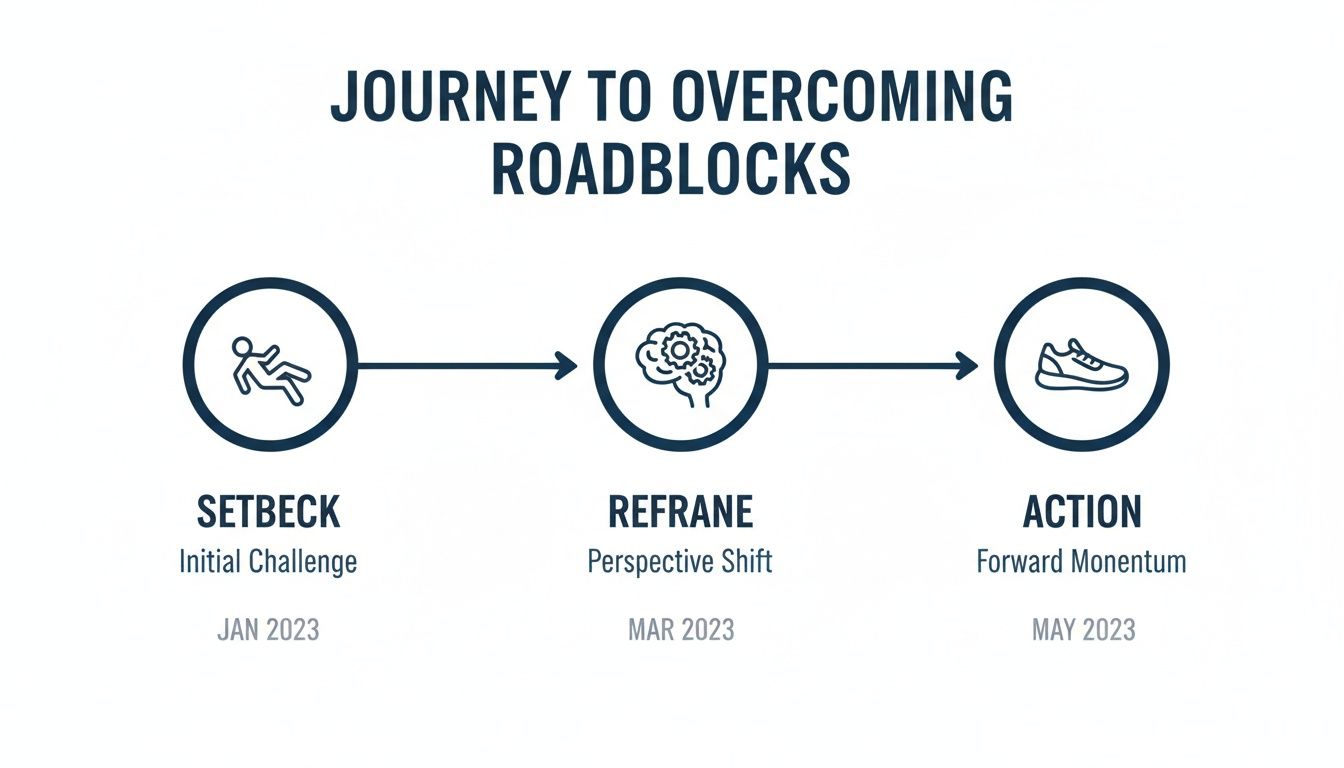
A setback isn't a failure. It’s just a data point. It’s a signal telling you to pause, reframe your approach, and take a new, small action.
Week Four: Lock in Your New Habits
The final week is about making it all stick. You’ve practiced starting small, using accountability, and designing your space. Now, we fuse them together to lock in your progress.
Your mission is to pick one important habit and apply all three principles to it for the entire week. Let's say your goal is to start exercising.
- Start Small: Forget the hour-long workout. Commit to a 10-minute walk.
- Accountability: Schedule those walks with a friend or join a local walking group.
- Environment Design: Lay out your workout clothes and shoes the night before. Make them the first thing you see.
You're no longer the person who wishes they would stop procrastinating. You are now the person who takes small, consistent, and deliberate action. This is who you are now.
Common Hurdles (And How to Jump Over Them)
Let's get into the nitty-gritty. Even with the best plan, you're going to hit roadblocks. I've been there. I get asked these questions all the time, and they’re the little things that can trip you up and make you feel like nothing will ever work.
You're not alone in these feelings. The good news is, the answers are simpler than you think.
Is This Procrastination Thing a Sign of Something Deeper?
This is a big one. Look, procrastination is normal. We all do it. But if you find that putting things off is constantly and severely wrecking your job, your relationships, or just your ability to get through the day, it might be a symptom of something more. Issues like ADHD, anxiety, or depression can often hide behind chronic procrastination.
If that sounds like you, talking to a mental health professional is one of the bravest and smartest things you can do.
For most of us, though, procrastination is just a habit we learned to dodge feelings we don't like. And any habit that was learned can be unlearned. It just takes the right strategy and a bit of consistency.
How Do I Do Stuff That’s Just… Boring?
I feel this in my bones. Some jobs are a total slog. No amount of rah-rah self-talk is going to make filing your taxes a party. This is where you have to get sneaky and use what I call “temptation bundling.”
It’s simple: you pair the miserable task with something you absolutely love. The rule is, you only get the good thing while you’re doing the bad thing.
A few ways I trick myself into action:
- That true-crime podcast I’m obsessed with? I only let myself listen when I’m folding laundry.
- I save the latest episode of that show I love and only watch it while I’m on the treadmill.
- I’ll make myself a really fancy coffee, but only while I'm powering through my messy inbox.
See what happens? The boring task isn't the point anymore. It’s just the ticket you have to punch to get to the good stuff.
I'm Totally Overwhelmed. What's the Very First Step?
When you’re paralyzed by a huge project, the thought of "getting it done" is enough to make your brain shut down. The single most powerful thing you can do is to pick one action so small it feels ridiculous.
I’m not talking about the first big step. I’m talking about something tiny. Microscopic.
Remember my story about the piece of trash that felt like it weighed 500 pounds? Your goal is to find the one that weighs an ounce.
If your apartment is a disaster, don't "clean the kitchen." Your task is to "throw away one piece of junk mail off the counter." If you have to write a massive report, don't "write the introduction." Your task is to "open a new document and type a single sentence."
The point here isn’t to make progress. The point is to break the spell of doing nothing. That one tiny win creates a flicker of momentum. It proves to your brain that the wall in front of you is made of paper, not bricks.
Beating procrastination is all about building momentum, one small action at a time. It’s even more powerful when you do it with others. At Litter Caterpillars, we see this magic happen every single weekend. By showing up to clean our city, we’re really learning how to show up for ourselves.
Join our next meetup and see for yourself. You might be surprised at what you can do. Find the details at https://www.littercaterpillars.com.
Leave a Reply