
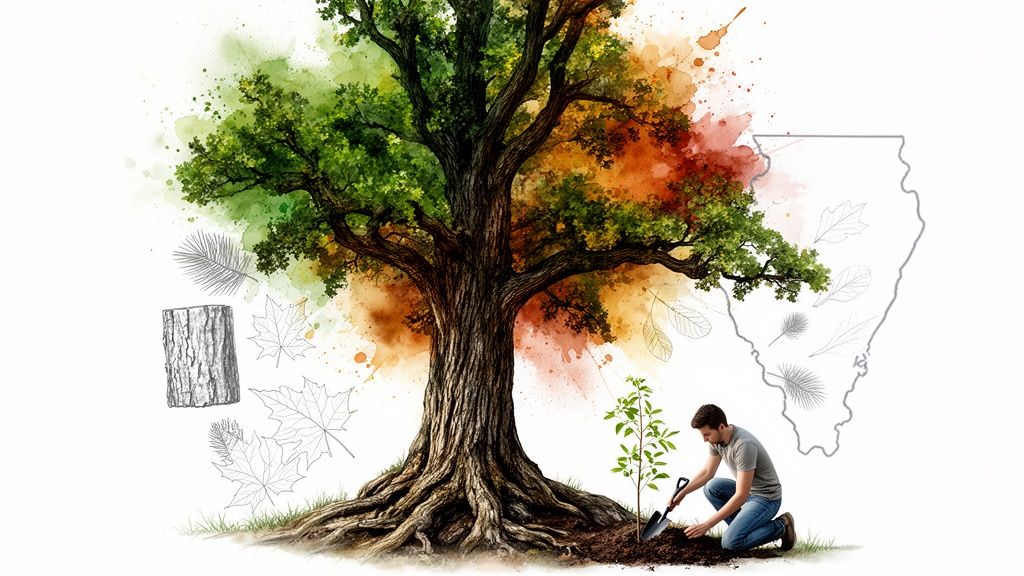
Illinois is home to an incredible world of trees. You've got the mighty Bur Oak—our state tree—the tough-as-nails Shagbark Hickory, and countless others just trying to make it in the city. The best trees in Illinois really just depend on where you’re standing. Are you in one of our sprawling oak-hickory forests, or are you navigating the concrete jungle of Chicago where only the strong survive?
This guide is my personal introduction to all of them.
Our Story Begins Under a Chicago Tree
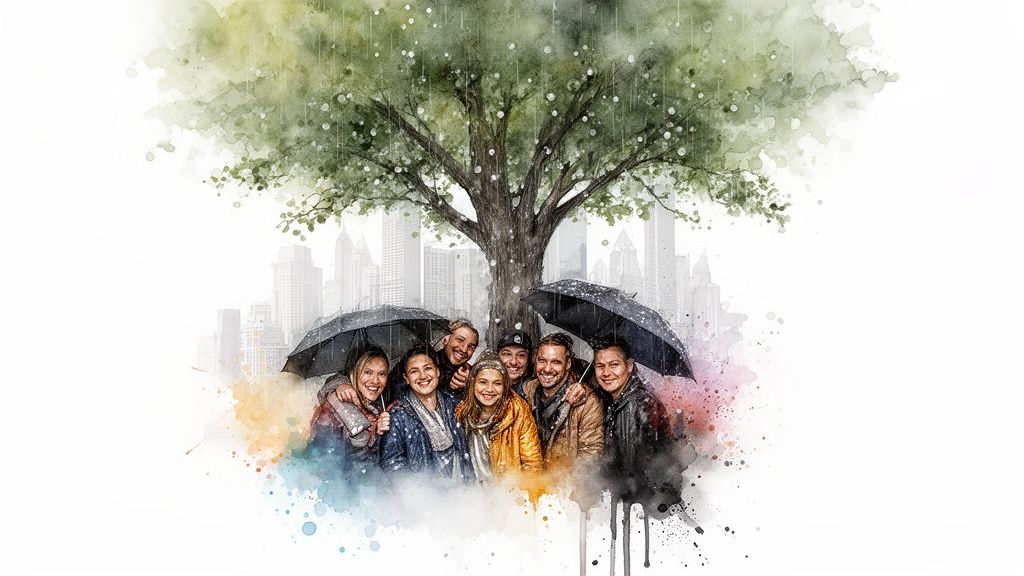
Let me tell you how this all started. It wasn’t in some stuffy meeting room with slide decks and goals. No. It was me, a few friends, and some strangers who’d soon become family, all huddled together under a single tree during a wild Chicago hailstorm. You know the kind. The sky just opens up, throwing marbles at you from above.
We were all freezing, maybe a little scared, but we were safe. That single, sprawling tree was our shelter. In that moment, it wasn't just wood and leaves; it was our guardian. It was a silent protector in a city that can feel so harsh.
Finding Connection in Our Urban Forest
Something clicked for me then. That tree taught me a lesson I’ll never forget: our connection to the world around us is real. It's powerful. It's personal. It’s a bond you feel deep in your bones, a primal sense of belonging that you can't just read about in a book.
This guide is my invitation for you to find that same connection. I want you to see the trees in Illinois not as green background noise, but as living, breathing partners in our mission. They are our allies in building a better, kinder, and tougher city.
This is your field guide to becoming an ally for our urban and wild forests. It's inspired by the simple, powerful act of showing up for your community and for the nature that protects it.
From the ancient, gnarled oaks that have stood for centuries to the tiny, hopeful saplings we plant in forgotten city lots, these trees are symbols of resilience. They’re beacons of hope that remind me that growth is always possible. We see it firsthand in our work, like our efforts to bring more green life to communities like Garfield Park.
This guide is more than just tree ID. I want to help you understand the stories these silent giants tell and learn how we can become part of their story, too. Let’s explore the magnificent trees that make Illinois our home.
The Incredible Comeback Story of Illinois Forests
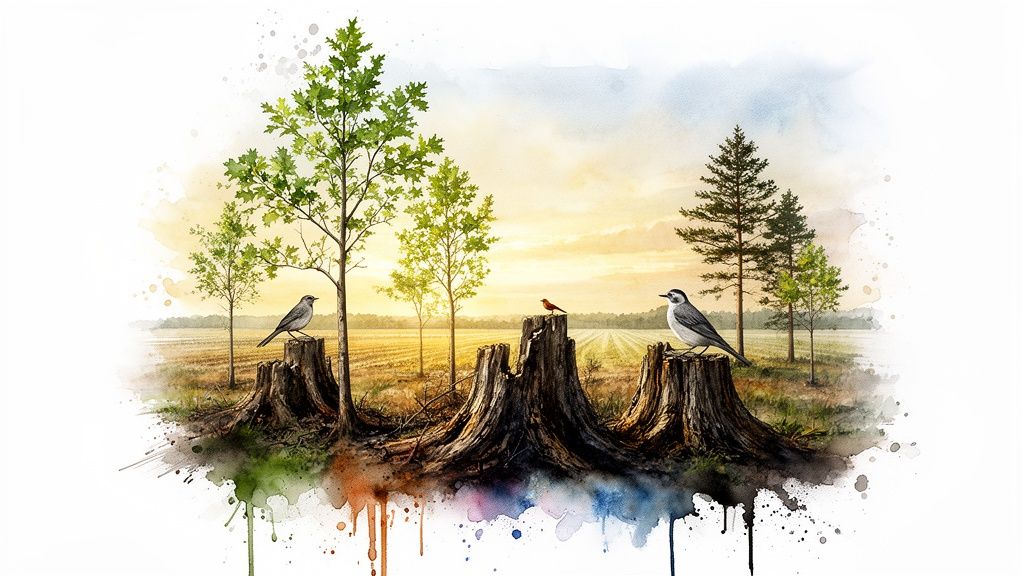
It’s hard to picture now, driving past endless miles of corn and soybeans, but Illinois was once almost entirely wrapped in a blanket of forest. Can you imagine it? A near-unbroken canopy of oaks, hickories, and maples stretching from the Wisconsin border clear down to the Ohio River. An ocean of green.
Then, we showed up. For a century, from 1820 to 1920, the constant sound was the ring of axes and the grind of saws. In what felt like the blink of an eye, we cleared the land with brutal efficiency to build our farms and our cities.
The loss was staggering. We wiped out nearly all of our original, ancient forests. It’s a loss so big it’s hard to even wrap my head around. It’s like tearing down a cathedral to build a parking lot. But that’s not where the story ends. It’s where the real work begins.
The Quiet, Powerful Return
This is the story of resilience that inspires everything I do. Since the middle of the 20th century, the trees in Illinois have been staging a quiet, powerful comeback. It wasn’t a single grand plan, but millions of small, stubborn acts of regrowth. Life finds a way.
This isn't just a history lesson. It's living proof that recovery is possible. It’s a testament that even after we’ve made a huge mess, new life can take root, find the light, and flourish again.
The numbers tell an amazing story. After hitting rock bottom in the early 1900s, our forests have bounced back to cover nearly 5 million acres. That’s a gain of around 2 million acres—an area bigger than the entire state of Delaware—reclaimed by nature. You can explore the full story of this remarkable forest recovery and what it means for the future.
And it wasn't just about the number of trees, but the type of trees. Between 1962 and 1985 alone, the number of maples exploded, increasing by an almost unbelievable 41-fold. The forest was changing its own identity. It was adapting.
From Wasteland to Woodland
So how did this happen? It’s a story of changing priorities and a lot of dedicated people. As old farm fields were abandoned, pioneer trees like cottonwoods and silver maples were the first ones to rush in, their seeds carried on the wind and water to reclaim the bare soil.
They were the first responders, preparing the ground for the slower, more patient species. Oaks and hickories started to follow, their acorns planted by squirrels who’d long forgotten their winter stashes. Slowly, decade by decade, the deep woods started to breathe again.
This comeback story is the exact reason we do what we do as Litter Caterpillars. I look at a trashed-out lot—a forgotten space choked with weeds and garbage—and I see the potential for life. I see the ground where a new tree could grow.
Every piece of litter we pick up is like clearing the way for a sapling. Each bag we fill is an act of faith in the future. We’re proving, block by block, that transformation is possible and that even the most damaged places can become vibrant and full of life again. The trees themselves showed us how.
Meet the Real Stars of Our Neighborhoods
Forget the skyscrapers for a second. It's time for you to meet the real, living landmarks of our local ecosystem. Think of this as my personal introduction to the most important native trees you'll find all across Illinois, from the wild riverbanks to your own city block.
Getting to know these trees is like learning the names of the old-timers in your neighborhood. It changes how you see the place. A simple walk becomes a conversation, connecting you to the natural world in a way that feels like coming home after being away for too long.
The Wise Old Guardian: Bur Oak
Let's start with the undisputed king of the prairie, our official state tree: the Bur Oak (Quercus macrocarpa). When you stand next to a mature Bur Oak, you feel it. This isn't just wood and leaves; it's an ancient being. Its bark is so thick and deeply furrowed it looks like the wise, wrinkled face of a grandparent who has seen it all.
That thick, corky bark isn't just for looks. It's fire-resistant armor. For centuries, as natural fires tore across the Illinois prairies, these oaks just stood their ground, their tough exteriors protecting the life inside. They are true survivors. Finding one is like shaking hands with history itself.
You’ll know a Bur Oak by its acorns, too. They have a unique, fuzzy look, wearing a fringed, shaggy cap that covers more than half the nut. It’s unmistakable.
The Rugged Individualist: Shagbark Hickory
Next up is a tree with a personality you can't ignore: the Shagbark Hickory (Carya ovata). If the Bur Oak is a stoic king, the Shagbark is a rugged frontiersman. You’ll recognize it instantly by its bark, which peels away from the trunk in long, curving strips. It looks like it’s wearing a shaggy coat it refuses to take off.
This isn't just a fashion statement. Those peeling strips of bark create tiny, sheltered apartments, perfect for small bats and insects. It’s a living high-rise for some of our state's most important tiny creatures.
The Shagbark Hickory reminds me that sometimes, our weirdest features—the things that make us look a little rough around the edges—are the very things that provide shelter and value to others. It’s a powerful lesson in finding strength in what makes you different.
In the fall, squirrels go crazy for their nuts. If you're lucky enough to find some, they have a sweet, rich flavor that’s a true taste of the Illinois woods.
The Sky-Reaching White Pine
We think of Illinois as a land of hardwoods, but we have our own magnificent native evergreen: the Eastern White Pine (Pinus strobus). These trees absolutely tower over the landscape, especially in places like Starved Rock State Park. Their feathery needles create a soft, hushing sound in the wind. It's a sound that stills your soul.
Here’s a simple trick I use to identify a White Pine. Just count the letters in the word "W-H-I-T-E"—there are five. Now, look at the pine needles; they grow in bundles of five. It's a handy trick that never fails.
These pines bring a different kind of beauty, especially in winter. Their green branches are a bold promise of life against the stark white snow. Their presence offers a sense of permanence and peace, a vertical reach for the sky that inspires you to stand a little taller yourself.
Learning to Speak Tree
Getting to know the trees around you is a journey, not a pop quiz. You don’t need to memorize Latin names or become a botanist overnight. Just start small. Start paying attention.
- Look at the bark: Is it smooth like a Beech, shaggy like a Hickory, or deeply ridged and tough-looking like an Oak?
- Check out the leaves: Are they shaped like an open hand, like a Maple? Are they simple and oval, or are they complex, made up of many smaller leaflets?
- Notice the shape: Does it stand tall and straight like a Tulip Tree, or does it have wide, muscular branches like an old Oak?
Each of these details is a clue, a piece of a story. By learning to read them, you start to understand the language of the forest. You’ll begin to notice the subtle shifts—the first buds on a Redbud, the insane fall color of a Sugar Maple, the stark and beautiful silhouette of a Sycamore against a winter sky. These are the unsung heroes of Illinois, and they have so much to tell us if we just take a moment to stop and listen.
Planting the Right Tree in the Right Place
Planting a tree is an act of hope. I get it. I see it as a promise to the future, a gift you’re giving to a neighborhood you might not even live in 30 years from now. But in a city like Chicago, it’s not just about digging a hole and walking away. You have to be a matchmaker.
You’ve got to pair the right tree with the right spot. It’s like building a team—you wouldn’t put your toughest member on an easy job and expect them to feel useful. I’ve learned this the hard way, by seeing what thrives and what dies on our city streets. This is my playbook, learned from getting my hands dirty.
The Street Fighters
Let's start with the toughest job: the parkway. That little strip of hell between the sidewalk and the street. It’s a battleground. The soil is packed down like concrete, it gets blasted with road salt all winter, and it bakes in the summer heat reflecting off the asphalt. Only the strong survive here.
These are the trees I call the ‘street fighters.’ They’re built for the front lines.
Ginkgo (Ginkgo biloba): These trees are basically living fossils, and they act like it—they’re almost indestructible. They take pollution, salt, and tight spaces without a fuss. Their fan-shaped leaves turn a crazy, brilliant yellow in the fall. Just one crucial tip: you must plant a male tree. The females drop fruit that smells famously awful. Trust me.
Honeylocust (Gleditsia triacanthos inermis): You see this tree everywhere in Chicago, and for good reason. It’s a workhorse. Its fern-like leaves create a nice dappled shade that doesn’t plunge your street into darkness, and it’s tough as nails. The ‘inermis’ part is key—it means you’re getting a thornless variety!
London Planetree (Platanus x acerifolia): A hybrid cousin of our native Sycamore, this tree is an absolute champion of city life. Its best feature is its peeling, camouflage-patterned bark. It sheds in patches to show off layers of cream, olive, and brown. It's a true piece of living art you can enjoy all year.
Small Yards, Big Impact
Got a small backyard? You don’t need a giant space to make a huge difference. For the smaller spots, you need a tree that delivers a big show without taking over the whole yard. You’re looking for a specialist, not a giant.
My absolute go-to for this is the Serviceberry (Amelanchier). In spring, it’s covered in delicate white flowers, a critical first meal for waking bees. By summer, you get delicious berries you can share with the local robins (if you're fast enough). Then in fall, its leaves erupt in shades of orange and red. It’s a perfect, four-season performer that gives back constantly.
Choosing the right tree isn't just a gardening decision; it's a community one. A well-placed tree becomes a shared asset—giving shade, beauty, and a home for wildlife that benefits everyone on your block for generations.
A great first step on this whole journey is just learning to see the trees already around you. This flowchart is a simple starting point. I use it to help people figure out what they’re looking at by focusing on two of the biggest clues: the bark and the leaves.
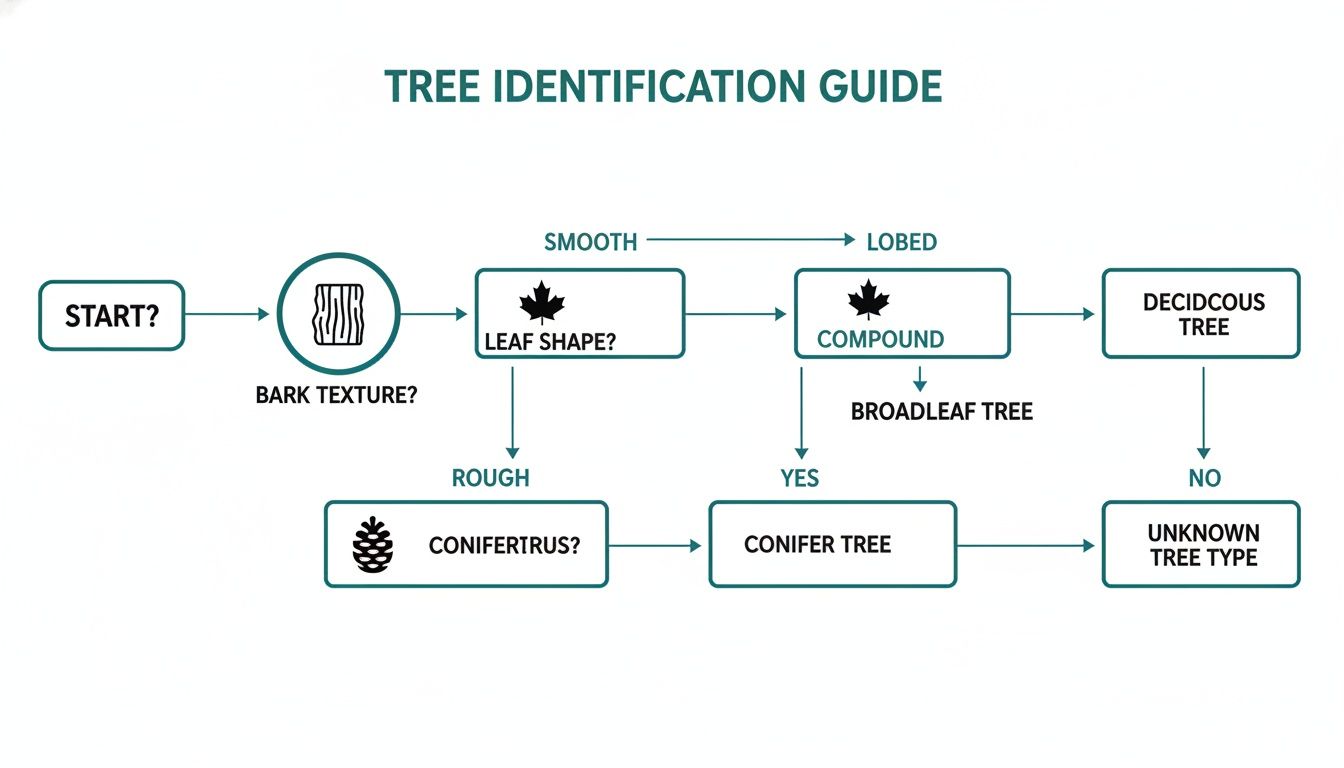
By just looking—really looking—at a couple of key features, you start to unlock the identities of the silent giants that make up Chicago's urban forest.
For a quick reference, think of choosing a tree like picking a teammate for a specific challenge. Here’s a breakdown I put together for some common Chicago situations.
Choosing Your Chicago Tree Teammate
| Situation | Top Tree Choices | Why It Works |
|---|---|---|
| The Parkway "Hellstrip" | Ginkgo (male), Honeylocust, London Planetree | Ultra-tough. Handles salt, pollution, and compacted soil. |
| Small City Backyard | Serviceberry, Redbud, Pagoda Dogwood | Four-season interest without getting huge. Great for wildlife. |
| Need for Fast Shade | Freeman Maple, Northern Catalpa | Grows quickly to provide canopy, but be mindful of placement. |
| Under Power Lines | Crabapple, Hawthorn, Serviceberry | Stays short and won't interfere with utility lines. |
This isn't an exhaustive list, but it's a solid start for finding a tree that won't just survive, but actually thrive, where you plant it.
Trees to Think Twice About
Just as important as knowing what to plant is knowing what not to plant. Some trees are just a headache waiting to happen in a city. The Silver Maple (Acer saccharinum) is a perfect example. Sure, it’s beautiful and grows incredibly fast, but its wood is weak and branches snap off in storms. Its aggressive, shallow roots are notorious for cracking sidewalks and busting into sewer lines.
I love a Weeping Willow as much as the next person, but its water-hungry roots make it a huge risk near any kind of plumbing. Being a good tree matchmaker means thinking about the long game. It means you’re planting a legacy, not a liability.
Why Every Single Tree Is a Community Treasure
So why do I do this? Why do we haul ourselves out of bed on a Saturday morning to plant saplings or pick nasty, soggy trash from the base of a tree? Why are we so obsessed with the trees in Illinois?
I'll tell you why. Because I’ve learned that every single tree is a quiet, tireless fighter.
It's easy to walk past one and just see, well, a tree. Shade and leaves. But you're not just walking past a plant; you're walking past a living, breathing piece of infrastructure that’s working its branches off for you, 24/7.
The Invisible Economics of Our Urban Forest
Let's talk about money. Yeah, money. Because that leafy canopy over your street? That’s not just pretty. It’s an economic powerhouse. It's literally money growing on trees.
It's a hard fact, not some fuzzy feeling. Those trees are boosting property values and slashing our insane summer energy bills by being the best natural air conditioners on the market.
When you add up all the trees lining our streets across the state, the numbers get wild. Illinois has an estimated 6.5 million street trees, and their combined value is over $3 billion. They aren't just decorations; they're an asset, a public investment paying us back every single day. If you don't believe me, just read more Illinois forest facts and see how crucial these green giants are.
An Ecological Goldmine in Our Backyard
Okay, the money is cool. But that’s just the tip of the iceberg. The real magic is what these trees do for the living world all around us. They are the foundation of everything.
Think of our forests as sprawling, chaotic, vibrant cities for wildlife. They're the apartments, the grocery stores, and the nurseries for a staggering number of creatures. You take away the trees, and the whole symphony of life in Illinois just stops.
A single oak tree can support over 500 species of caterpillars. Those caterpillars then become the baby food that keeps our bird populations alive. When you plant one native tree, you’re not just planting a tree—you’re opening a five-star, all-you-can-eat buffet for the entire local food web.
These giants are also our planet’s lungs, and we get to breathe the fresh air they pump out for free. They're constantly scrubbing the filth from our cars and factories out of the air we breathe. They suck up the carbon dioxide warming our planet and trade it for the clean oxygen we need to exist.
Just look at the workload they carry:
- Air Purifiers: They trap dust, ash, and all sorts of nasty junk floating in the air.
- Water Managers: Their roots are like a massive sponge, soaking up stormwater runoff that would otherwise flood our streets and basements.
- Wildlife Sanctuaries: They are the backbone of the habitats that support 75% of our state’s native wildlife.
Every single tree is a champion, fighting for a healthier, wealthier, and more alive Illinois. That’s why we show up. That’s why we fight for every sapling and protect every old giant. We’re not just picking up litter; we’re defending our community’s most valuable treasures.
So, You Want to Help? Here's How You Can Actually Do It.
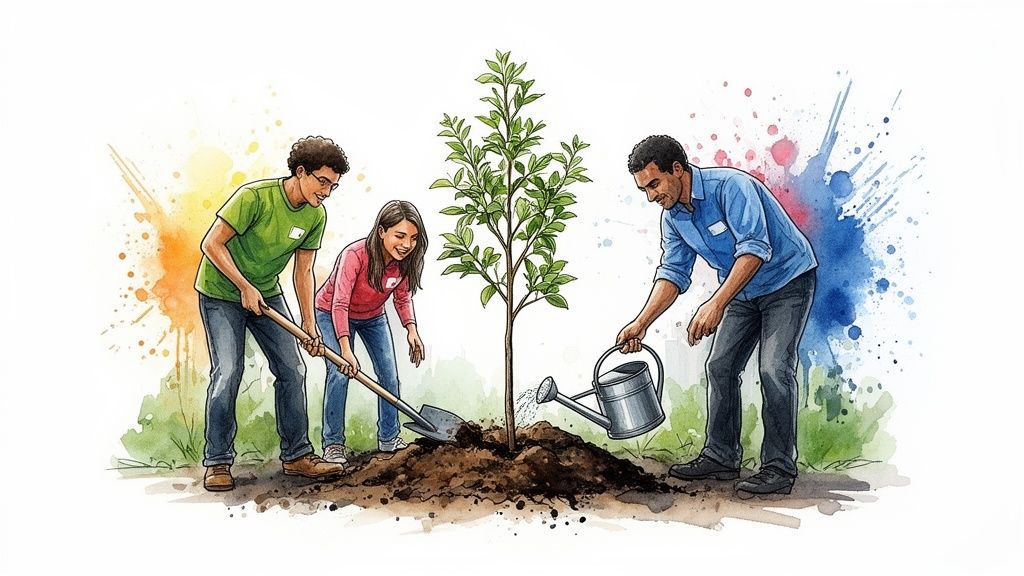
You feel that little nudge, right? That feeling after reading all this that you should do something. Good. Hold onto that. Inspiration is the easy part. The hard part—the part that matters—is turning that feeling into action.
This is my personal invitation to you. This is where you stop just reading and start doing. I'm going to show you exactly how to get your hands dirty with us, the Litter Caterpillars.
From Feeling Good to Doing Good
Our mission is simple. We show up. Every single week, we’re out there cleaning up our city, and a huge part of that is protecting the trees in Illinois. When we haul bags of garbage away from the base of a tree, we're doing more than just making the street look pretty.
It's a rescue mission.
That trash isn't just ugly; it’s poison. It leaches chemicals and microplastics into the soil, contaminating the water and nutrients a tree desperately needs. It literally suffocates the roots, blocking out the air and rain they need to breathe. Our cleanups are the first line of defense for these silent giants.
It’s about taking that good feeling you have right now and turning it into good work. It’s about building a real legacy of growth and kindness that you can point to and say, "I helped make that happen."
Just look at Caterpillar Park in Englewood. We won that forgotten, trash-covered lot at a city auction. Now, we're transforming it from a wasteland into a living, breathing park, one cleanup and one tree at a time. This is the story we’re writing, proving no place is a lost cause if someone is willing to show up.
Your Hands Can Build the Future
Joining us is step one. You’re not just picking up somebody else's mess. You are reclaiming land for the community and for nature. You are becoming a guardian for the trees that give us shade, clean air, and life.
The history here shows you just how big the stakes are. Illinois went through one of the most insane deforestation events in American history, losing an estimated 13.8 million acres of forest between 1820 and 1920. That history shows how fast things can be destroyed, but it also sets the stage for the comeback story that groups like ours are fighting for. You can read more about this historical shift to see why our work is so damn important.
We’re just one part of a bigger movement. If you want to do even more, I want you to check out these other incredible organizations:
- Openlands: These guys do amazing work planting trees all over Chicago and pushing for huge green spaces. Their community tree planting events are a perfect way to make a direct impact.
- The Morton Arboretum: It’s a bit outside the city, but they have tons of volunteer opportunities. You can help with big forest restoration projects or care for their world-famous tree collections.
- Chicago Parks District: They’re always looking for people to help with park cleanups, gardening, and stewardship days in local parks across all neighborhoods.
This is all about becoming a guardian of your own environment. If you want to dig deeper into what that means, you might want to check out our guide to environmental stewardship.
We are so much stronger together. That feeling you have right now? That's the beginning of something real. Let’s get to work.
Answering Your Questions About Illinois Trees
Out on the streets, picking up trash or digging a hole for a new sapling, I get asked a lot of questions. I love it. Questions mean you're starting to look closer. You're seeing the trees in Illinois not just as green background noise, but as living, breathing parts of our community.
You're not the only one asking. Every question is a sign that you’re ready to become a real guardian for our city's forest. Here are the real answers to the things people ask me most often.
What Is the Most Common Tree in Illinois?
That’s like asking what the most common food is in Chicago—it really depends on where you are. If you head out into what's left of our wild spaces, you'll find yourself in oak-hickory country. Trees like the massive White Oak, the Red Oak, and the rugged Shagbark Hickory are the undisputed kings, the true backbone of our state's natural heritage.
But here in the city? It’s a totally different ballgame. Life on a Chicago street is brutal. We depend on the tough guys: Honeylocusts, different kinds of Maples, and Lindens. I've seen these trees planted time and again because they have the grit to survive compacted soil, road salt, and everything else we throw at them.
Can I Plant a Tree on My Parkway in Chicago?
Yes, but you absolutely have to play by the city's rules. That little strip of grass between the sidewalk and the street—the parkway—isn't yours. It belongs to the city, so you can't just start digging.
The best and easiest way is to request a free tree directly from Chicago's Bureau of Forestry. You can also sometimes get a permit to plant one yourself, but it has to be a species from their approved list. This isn't just red tape; I've seen it firsthand, it’s to keep you from planting something that will eventually destroy a sewer line or get tangled in power lines. Your first move is always to call 311 or search for the "Street Trees" program on the city's website.
Think of it like this: cleaning up litter is a health check for our urban trees. When you join one of our cleanups, you're not just making a park look better—you're giving our trees a fighting chance to actually breathe and grow.
How Does Cleaning Up Litter Actually Help Trees?
It helps more than you can imagine. Picture a tree’s roots like its mouth. When trash sits on the ground, every rainfall washes a nasty cocktail of chemicals, oil, and microplastics from that junk straight into the soil. You're literally poisoning the tree's dinner.
Worse, a thick mat of litter acts like a plastic bag over the soil. It smothers it, blocking water and oxygen from getting to the roots. It's like forcing the tree to drink through a clogged straw. Even holiday cheer can turn into trash; I always tell people to learn how to recycle Christmas trees in Chicago to help cut down on waste.
Your journey to becoming a steward for Illinois's trees starts with one small action. Join Litter Caterpillars at our next event. We’ll supply the gloves, the bags, and the community. You just bring your willingness to do the work. Find your event at https://www.littercaterpillars.com.
Leave a Reply