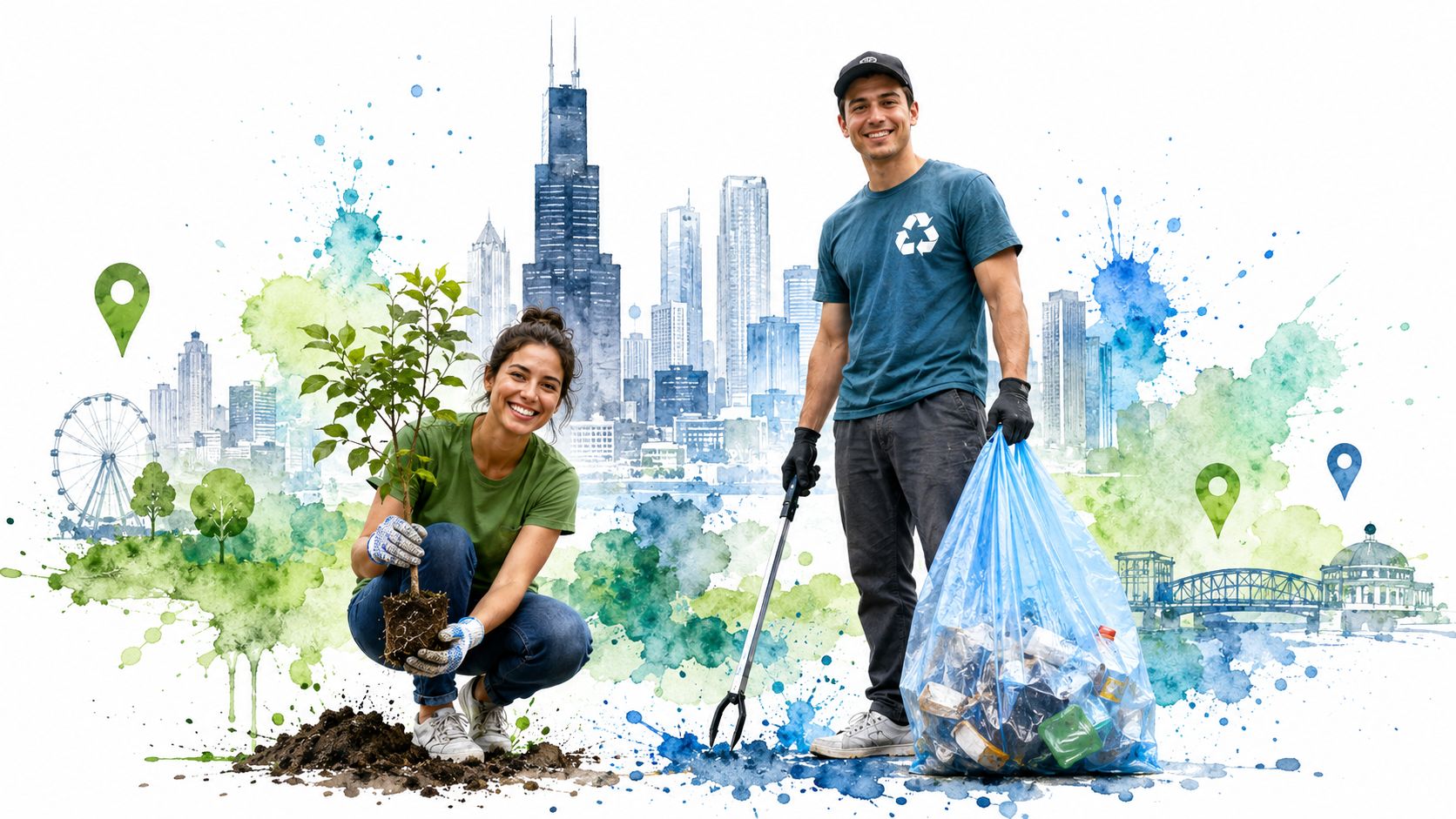
Month: June 2026

  • Local Environmental Groups: Chicago Impact 2026

    Local Environmental Groups: Chicago Impact 2026

    I used to stare at trash in my own apartment like it was haunted. A jar of blueberry jam from a trip years ago. A bag of nuts from the week I swore I'd become healthy and then didn't. I couldn't throw them out. They felt heavier than they were, like every wrapper and expired thing had a memory glued to it.

    Then I ended a bad relationship and got honest with myself. I wanted to build a life around givers, not takers. I wanted to train the parts of me that were weak: cleanliness, consistency, and bravery. So I started with something strange but simple. I picked up trash outside.

    I learned fast that cleaning up someone else's mess is easier than cleaning up your own. It can even be fun. I showed up for a neighborhood cleanup to challenge myself, and I walked away with new friends, a lighter mind, and a reason to get out of bed on a weekend morning. If you've felt that pull too, this is for you. These local environmental groups can help you find a mission, but more than that, they can help you find your people.

    1. Litter Caterpillars
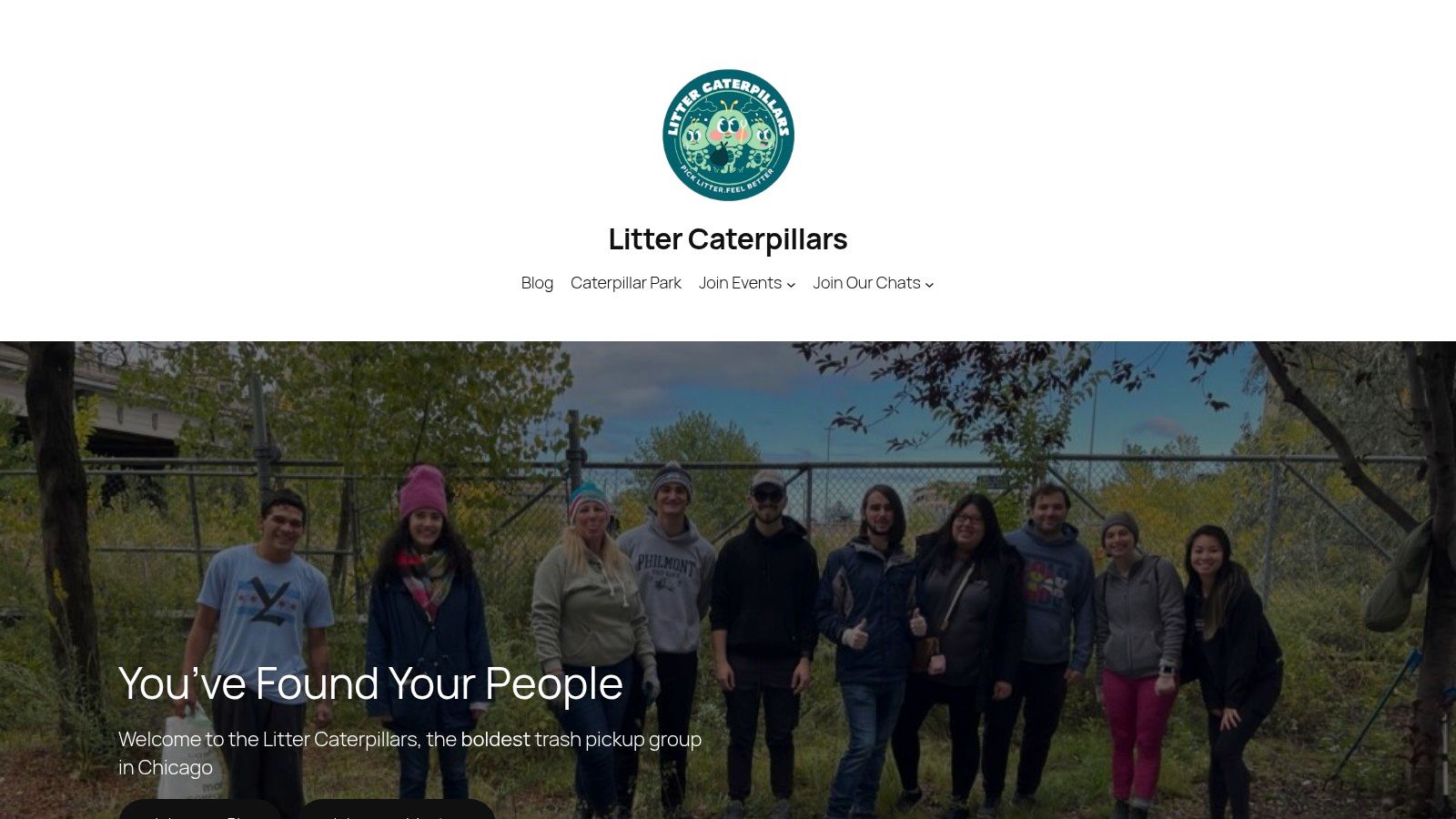
    Litter Caterpillars

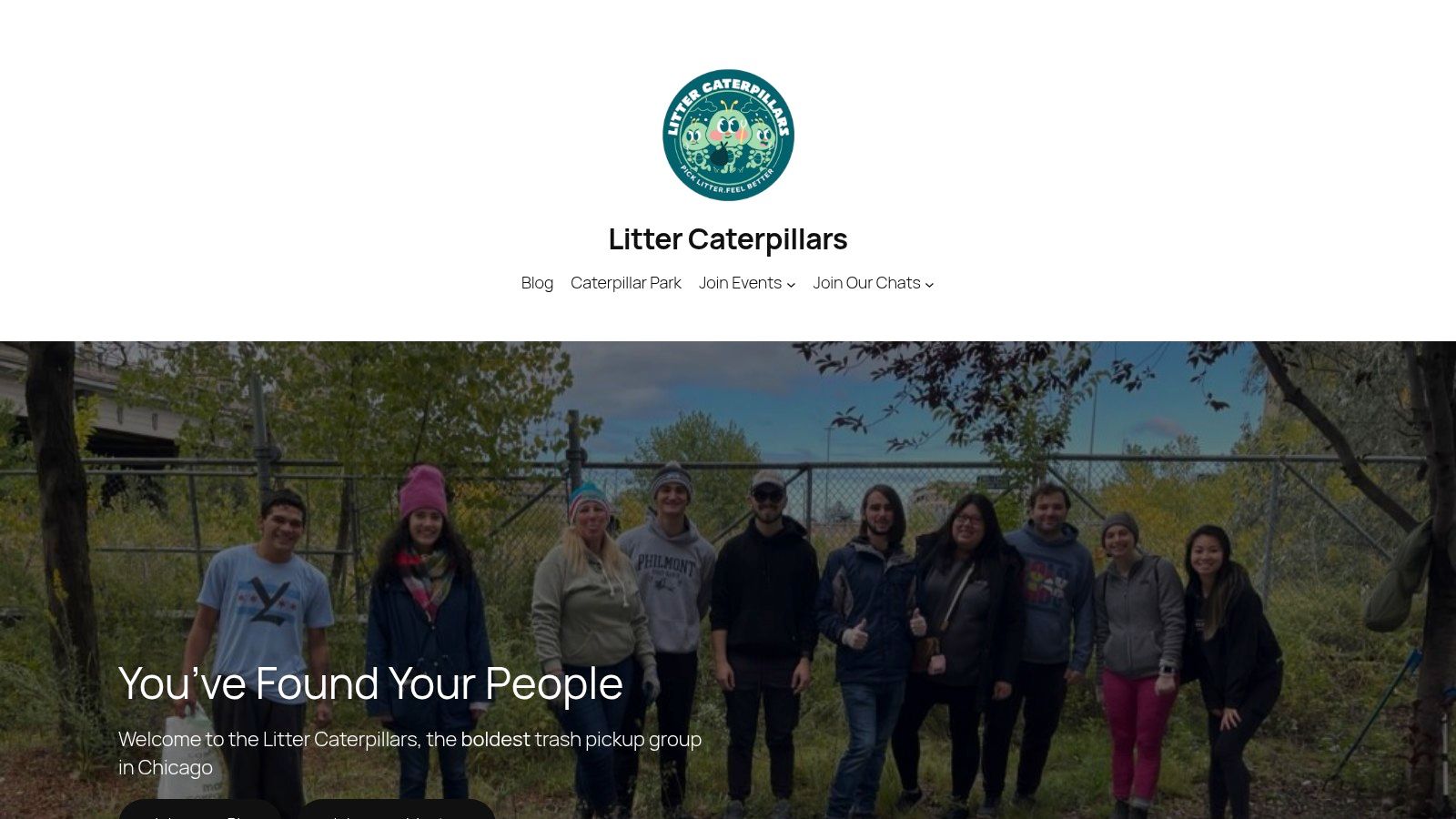
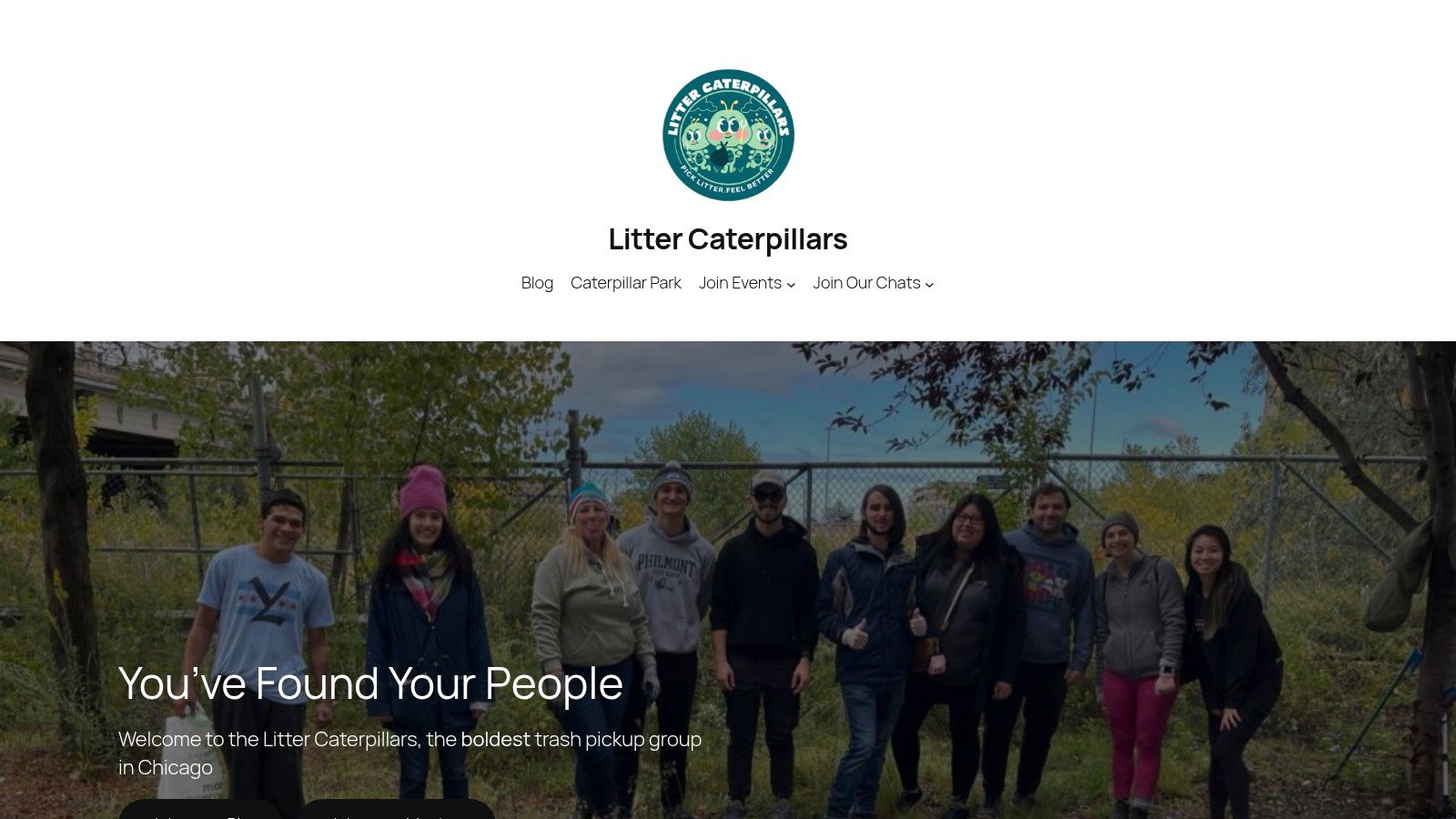
    One cold weekend morning, a few people in gloves filled bag after bag while the rest of the block stayed quiet. By the end, the sidewalk looked different, but so did the group. Strangers were teasing each other, comparing the weirdest things they had found, and making plans for the next cleanup. That is why I keep coming back to Litter Caterpillars in my head. It is not only about trash. It is about what happens to you when you keep showing up.

    Litter Caterpillars is the group I would point you toward if you want action fast and you do better with movement than meetings. They gather on weekend mornings, head out in rough weather, and make it easy to join. You do not need a background in activism. You need shoes you can get dirty and enough curiosity to try one morning outside with other people who care.

    Their style is simple. Show up, clean a block, talk to the people beside you, come back next time. For some personalities, that rhythm works better than formal committees or polished events. If you have been lonely, stuck, or tired of living too much in your head, this kind of work can reset you.

    Why this group stays with people

    Litter Caterpillars has cleaned in all 50 wards of Chicago, including places volunteers are often told to avoid, according to the group's Meetup page for Litter Caterpillars. That says a lot about their character. They do not chase easy wins or pretty backdrops. They go where the mess is real and keep coming back.

    One of the clearest examples is Caterpillar Park in Englewood. The group won a vacant lot at public auction, turned it into a community space, and still has to fight illegal dumping there, as reported in the Chicago Tribune's story on Caterpillar Park. I find that weirdly comforting. The work repeats. You clean a place, life happens, and you return. If you are trying to build resilience in your own life, that lesson lands hard.

    Practical rule: Join this group if you want to see a result before lunch. Carrying a full trash bag back to the meeting point changes your mood more than another hour of scrolling.

    I also like how openly they treat cleanup as community, not just service hours. The flags, badges, songs, group chats, and inside jokes might sound small. They are not. They give shy people a way in. They help new volunteers feel known. They turn a hard, dirty task into something closer to belonging.

    If river work interests you too, their guide to cleaning up rivers in Chicago gives a good sense of how street litter and water pollution connect.

    • Best for grit: A good fit if you like physical work, repetition, and neighborhoods that feel lived in.
    • Best for friendship: A strong choice if you want a group with personality and rituals that help people connect.
    • Best for new habits: Weekend cleanup can anchor your week and make consistency feel natural.

    The tradeoff

    Litter Caterpillars feels hands-on, improvised, and human. If you want a more formal nonprofit structure, another group on this list may suit you better.

    But if you are looking for a place where service can change your city and also change you, this one has a strong pull. You come for the cleanup. You stay because you start to recognize faces, trust yourself more, and feel a little less alone.

    2. Friends of the Chicago River
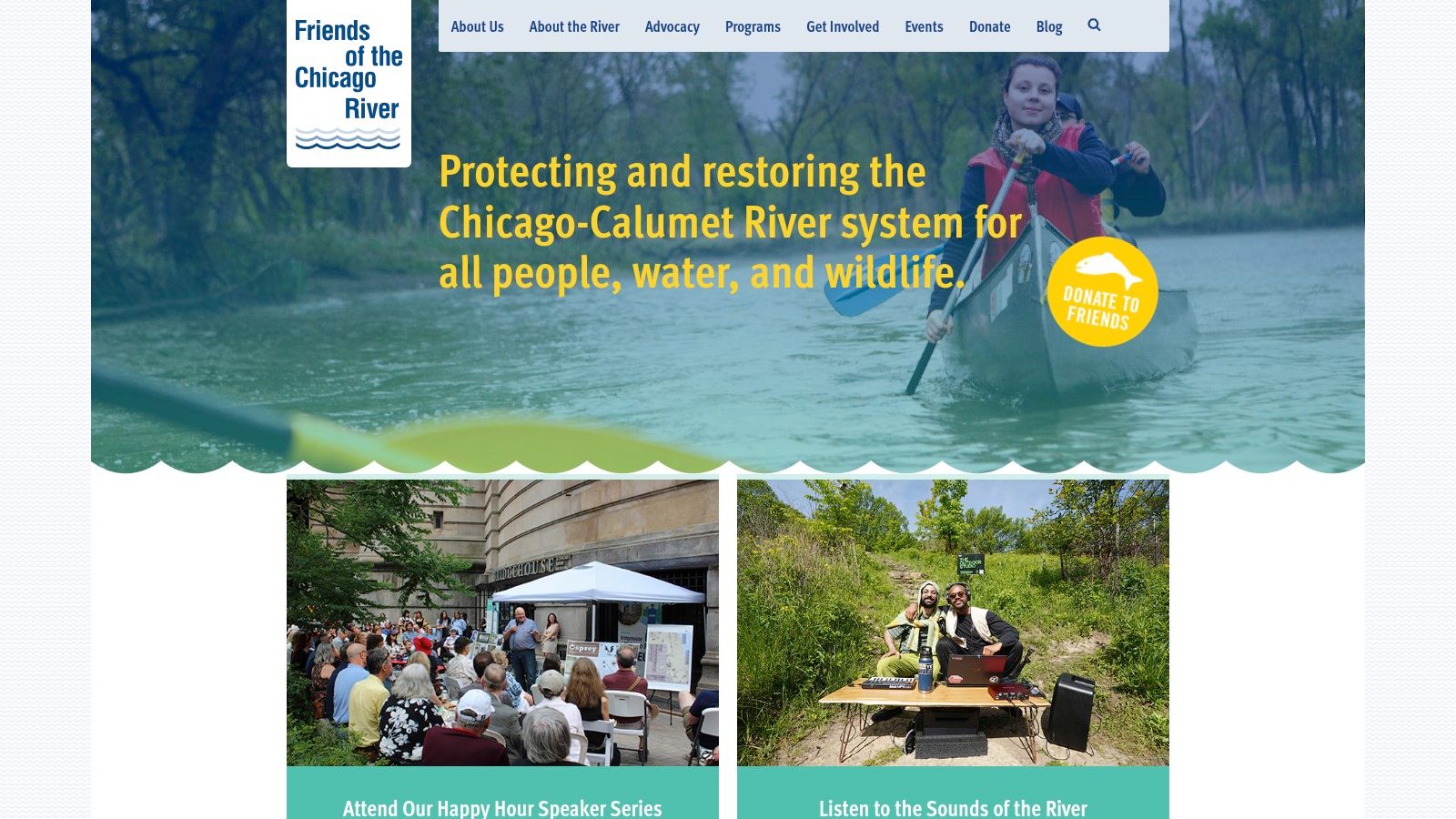
    Friends of the Chicago River

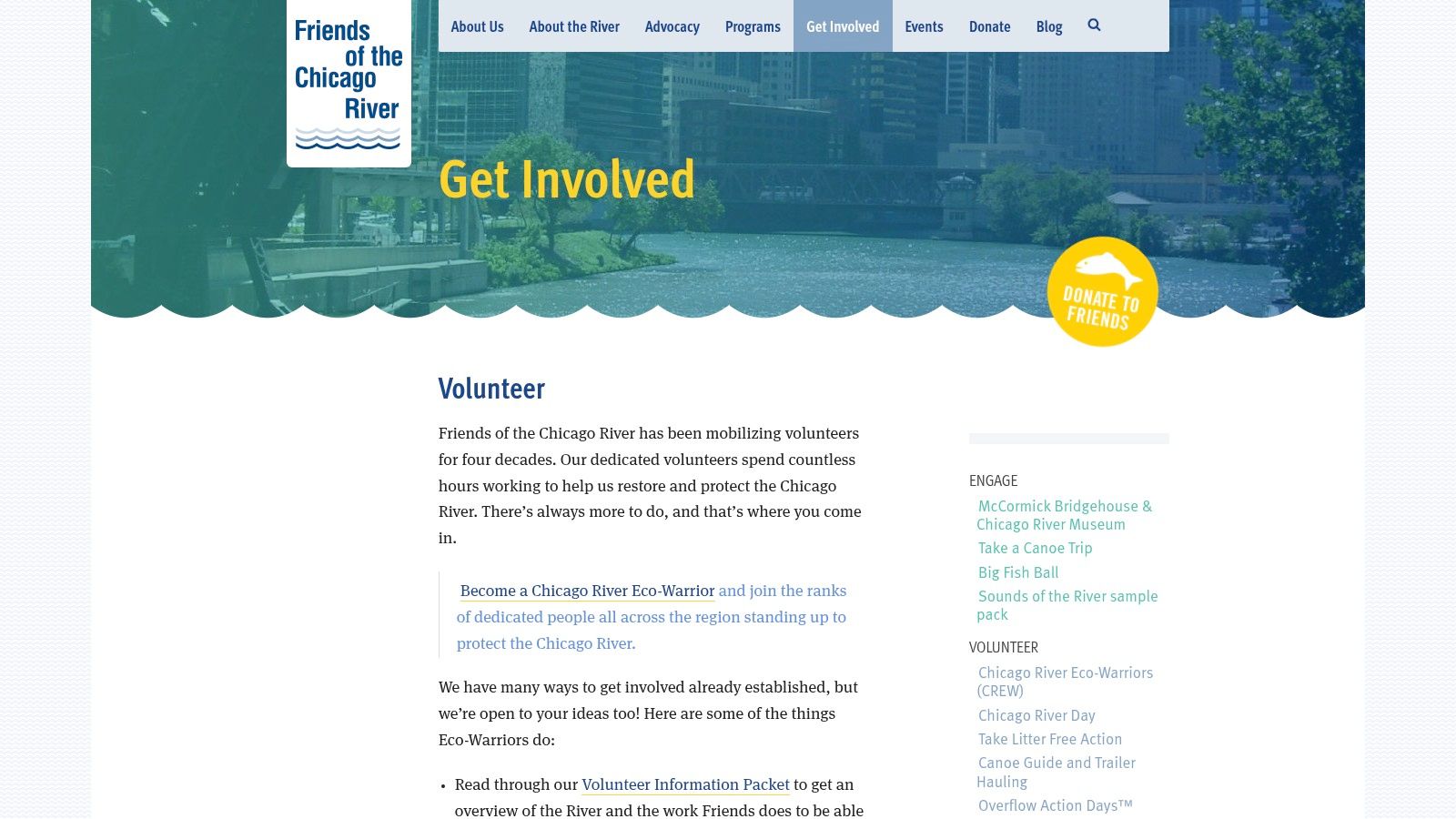
    If street litter makes you angry, river litter hits differently. It feels like the city's bloodstream is clogged. Friends of the Chicago River is a good fit when you want your volunteer time tied to water, habitat, and a long-running civic rhythm.

    Their home base is the Friends of the Chicago River website, and they run recurring stewardship work tied to the Chicago-Calumet River system. If you're curious how river cleanups connect to broader trash work, I also like this piece on cleaning up rivers in Chicago.

    Who I think should join

    This is the group for people who like structure. You sign up, get clear guidance, and plug into a larger machine. If Litter Caterpillars feels like a scrappy pickup basketball game, Friends of the Chicago River feels more like joining a league with refs and a schedule.

    I also think it's good for students, companies, and neighborhood groups that want a shared project with a clear setting. Water gives people a focal point. When you're standing by the river with gloves on, it's easier to feel what you're protecting.

    The river gives your effort a shape. You can point to a bank, a path, a canoe launch, and say, "I helped right there."

    Where it fits in your life

    The work can be seasonal and weather-sensitive, so you may need to plan ahead. Popular volunteer dates can fill quickly. But if you want logistics, recurring stewardship, and a mission that feels bigger than one block, this is a solid place to start.

    I wouldn't choose this one because it's trendy. I'd choose it if your brain likes order and your heart likes water.

    3. Urban Rivers (The Wild Mile)
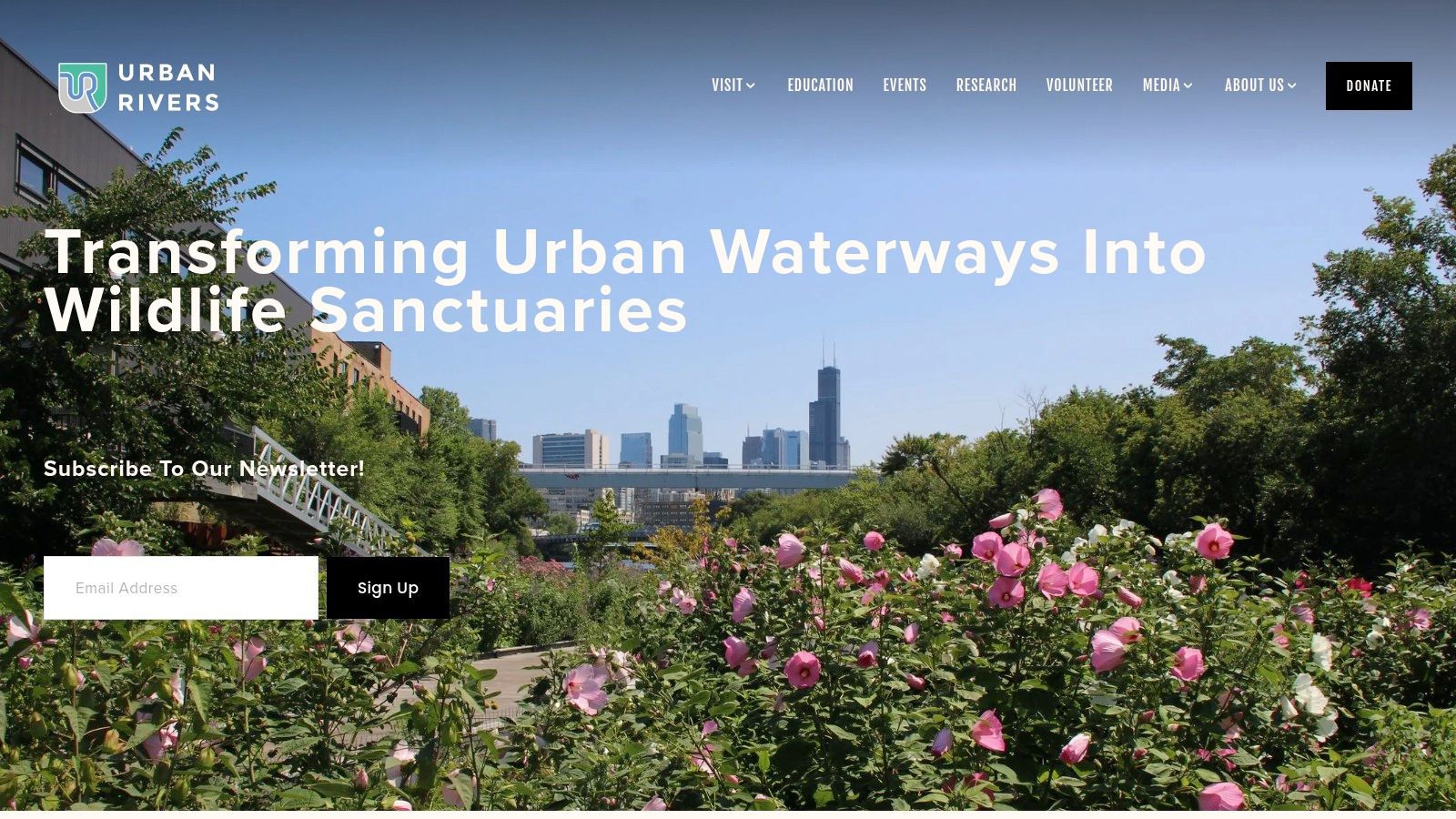
    Urban Rivers (The Wild Mile)

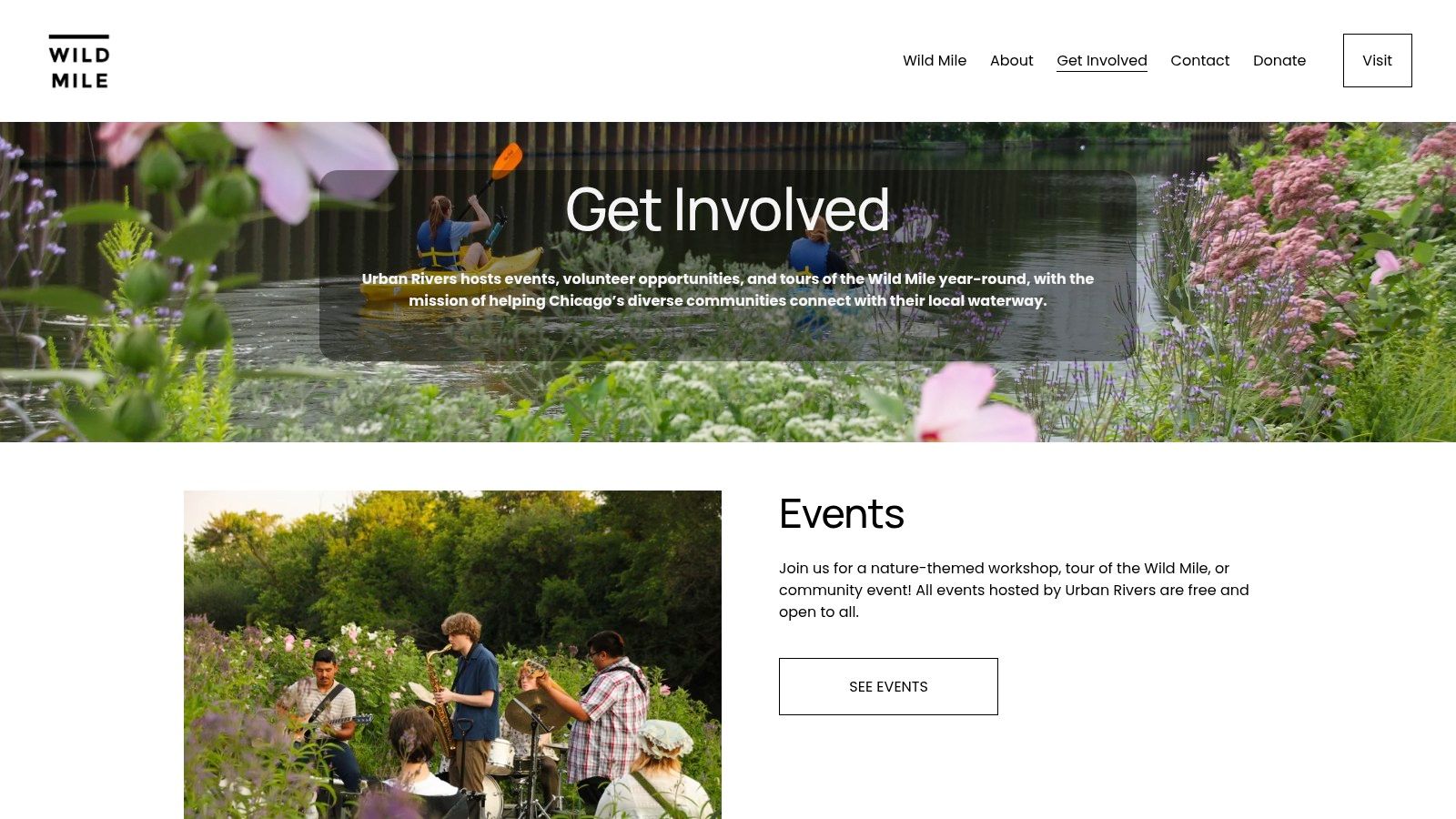
    Urban Rivers is for the person who wants an environmental group that feels a little weird in the best way. Floating wetlands. Kayaks. Habitat work in the middle of the city. The whole thing feels like a science project built by people who refused to accept that an urban river has to stay dead-looking.

    You can browse projects and volunteer options on the Urban Rivers website. The Wild Mile is the sort of place that makes a skeptic stop walking and ask questions.

    Why this one feels different

    Some local environmental groups ask you to clean. Urban Rivers lets you clean and build. That mix changes the experience. You aren't only removing damage. You're helping put something living back into place.

    Their River Ranger training also makes this a nice fit for people who want to learn while they volunteer. If your personality leans curious, if you like being taught how systems work, this one can scratch that itch.

    • Best for visual thinkers: You can see the floating habitat and understand the idea fast.
    • Best for hands-on learners: Training adds depth that simple litter pickup sometimes doesn't.
    • Best for people who want a story to tell: Friends will ask what you did, and you'll have an answer better than "I stood around at a fundraiser."

    What to know before you go

    Some roles need planning, training, and comfort on the water. That can be a plus or a barrier, depending on who you are. If you want a fast drop-in volunteer option, another group may be easier.

    Still, I love that Urban Rivers makes environmental work feel inventive. It reminds me that some people heal themselves by restoring order, and some heal themselves by helping build something new.

    4. Alliance for the Great Lakes (Adopt-a-Beach)
    Alliance for the Great Lakes (Adopt‑a‑Beach)

    The first time I joined a beach cleanup, I thought it would feel like a prettier version of picking up trash on a sidewalk. It did not. I filled one bag, looked up, and saw the lake stretching out like it had all the time in the world. The work felt small and big at once. Small in my hands. Big in my chest.

    That is the mood of the Alliance for the Great Lakes. Their Alliance for the Great Lakes site is where you can find the Adopt-a-Beach program and sign-up options for shoreline cleanups. If you end up liking this kind of work, this guide to cleaning up a Chicago park or public green space can help you keep the habit going closer to home too.

    Why some people click with beach cleanups fast

    This one suits people who like patterns. You are not only picking up cups, wrappers, and bottle caps. You are noticing where trash collects, what keeps washing back, and how a place that looks peaceful can still carry a steady stream of human mess.

    That rhythm changes the experience. A beach cleanup can feel less like a chore and more like paying close attention. If you are the kind of person who likes sorting, spotting, and seeing what other people miss, you may feel useful here right away.

    It is also one of the easier groups to bring someone into. A sibling. A date. Your kids. A coworker who says they want to help but never knows where to start. The lakefront does part of the social work for you because people already want to be there.

    What I tell first-timers: If you want your first volunteer day to feel open, calm, and easy to share with other people, start at the beach.

    The honest tradeoff

    This is a seasonal fit for a lot of volunteers. Chicago weather decides a lot for you, and shoreline work is not always the thing you will want in January.

    Still, some personalities need that horizon. They need wind, water, and a task simple enough to quiet the noise in their head for two hours. If that sounds like you, Adopt-a-Beach is more than civic duty. It is a way to find your people while you clear space in yourself too.

    5. Friends of the Parks
    Friends of the Parks

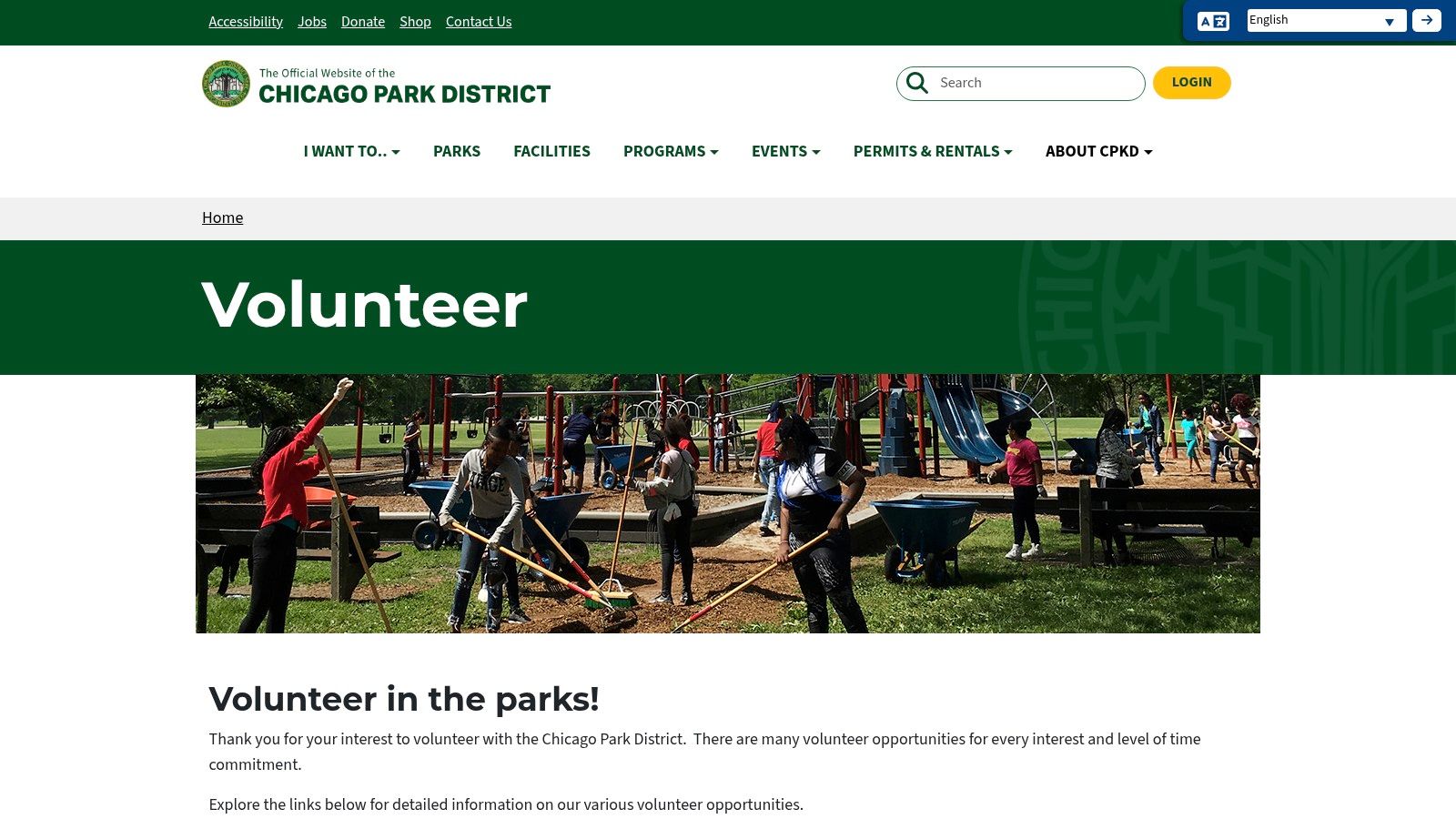
    Some people don't want the edge of alley cleanup or the planning of habitat work. They want a park. Trees, fieldhouses, paths, playgrounds, and a task they can explain to a friend in one sentence. Friends of the Parks is good for that.

    Their Friends of the Parks website is a good place to find citywide park stewardship and major volunteer days. If you're already thinking in neighborhood-park terms, this page on how to clean up a park in Chicago pairs well with it.

    Why parks are emotionally easier

    A park is where city life softens. Kids play there. Grandparents sit there. Dogs drag people there before sunrise. When you clean a park, you get immediate emotional feedback because you can picture who uses it.

    That makes this a great first step for shy people. You're still doing public work, but the setting feels familiar. It doesn't demand a new identity from you on day one.

    • Best for first-timers: Parks are accessible and easy to understand.
    • Best for neighborhood pride: You can return later and see the same bench, path, or ballfield.
    • Best for people who want broad coverage: Citywide park networks give you lots of entry points.

    One honest downside

    The biggest mobilizations cluster around annual events, so if you're chasing frequent large-scale action, you may need to combine this with another group. Still, I think Friends of the Parks is one of the easiest ramps into local environmental groups because the mission feels close to daily life.

    6. Friends of the Forest Preserves (Cook County)
    Friends of the Forest Preserves (Cook County)

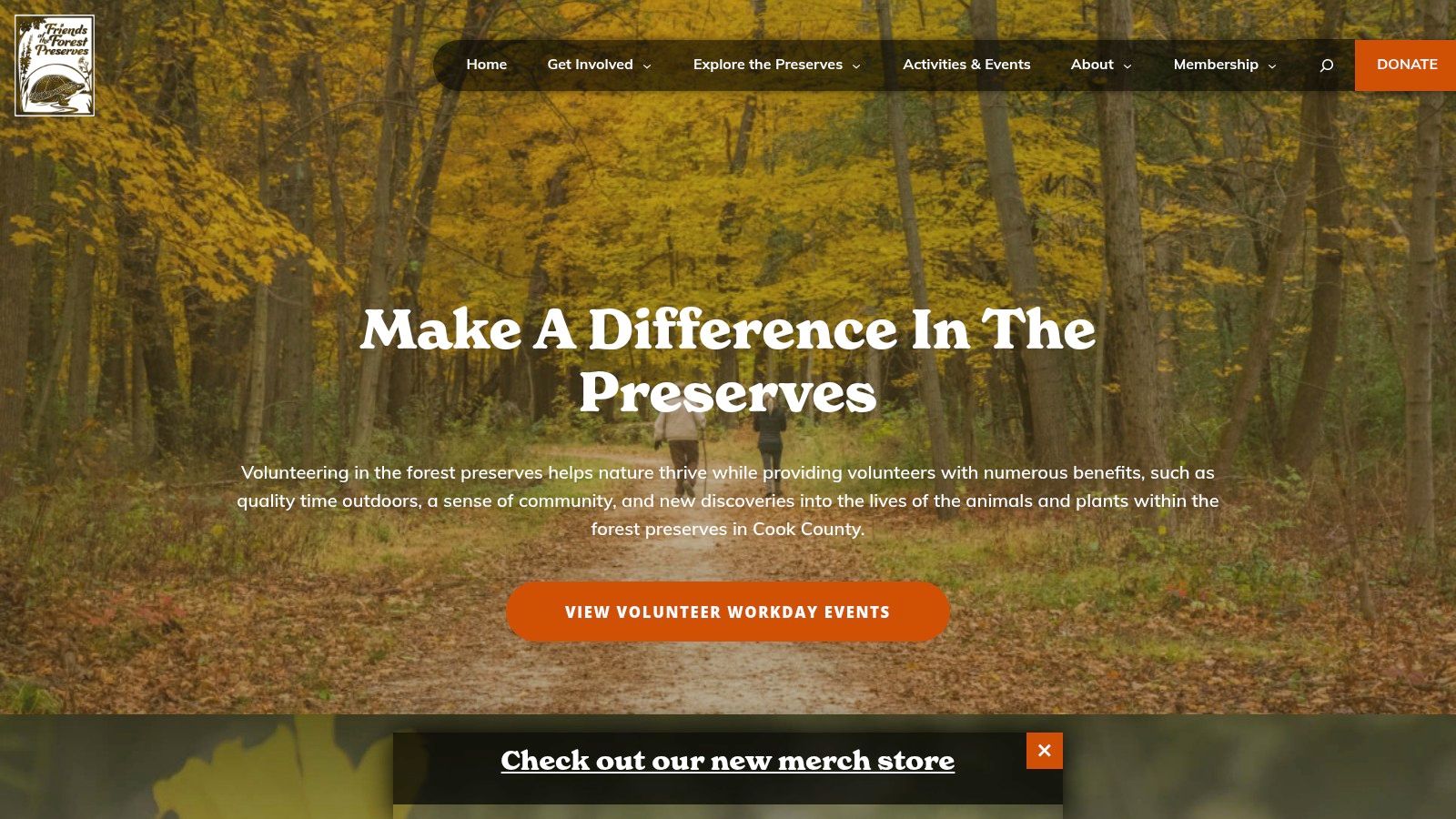
    If the city noise is frying your nerves, go farther out. Friends of the Forest Preserves gives you a different kind of volunteer day. Less concrete. More brush, trails, invasive removal, and work that feels slower and deeper.

    You can check current programs and stewardship options on the Friends of the Forest Preserves website. I think this group works well for people who want environmental service to double as recovery time.

    When this is the right fit

    Some local environmental groups meet your need for action. This one can meet your need for quiet. You still sweat, carry, cut, and clear, but the mood is different. It feels less like battling the city and more like caring for a place that can still surprise you.

    I also like this path for people who want to build practical outdoor skills over time. Brush work, stewardship habits, and guided workdays can teach patience. You're not just grabbing obvious trash. You're learning to notice what doesn't belong and what needs room to grow.

    Sometimes the best volunteer choice isn't the loudest one. It's the one that calms you down enough to come back next week.

    What might frustrate you

    Some preserve sites take more travel. If you live in a dense neighborhood and don't drive, getting there can be harder than joining a local block cleanup. And on certain days, the work leans more toward habitat care than simple litter pickup.

    That said, I think this is one of the best options for people who want service without constant urban intensity.

    7. Cleanup Club Chicago (Chicago Environmentalists)
    Cleanup Club Chicago (Chicago Environmentalists)

    A lot of people want to help their city. Fewer people know what kind of group will keep them coming back.

    Cleanup Club Chicago feels like the answer for the person who does better with a text thread than a formal orientation. You show up, grab gloves and a bag, and spend a morning doing something clear and useful with other people who also wanted a reason to get outside. That low-pressure setup matters more than it sounds. For some volunteers, this is the kind of group that turns good intentions into an actual habit.

    You can find them through Cleanup Club Chicago at Chicago Environmentalists. I like this option for people who want environmental service to fit into real life instead of taking it over.

    The kind of person who thrives here

    This group makes sense if your energy comes in waves. Maybe one week you want a scheduled cleanup with other people. Maybe the next week you want to do your own pickup close to home and still feel connected to something bigger. Cleanup Club Chicago leaves room for both.

    It also works well if you are looking for community first and a perfect volunteer identity second. That is part of what made Litter Caterpillars stand out earlier in this article too. Sometimes you do not find your purpose and then join a group. Sometimes you join a group, pick up one bag of trash, meet two good people, and realize your life feels a little less stuck.

    The work itself is simple, which is part of the appeal. You are not trying to learn a complicated system before you can help. You are cleaning a street, a park edge, a sidewalk, or a problem corner that everybody has walked past. That simplicity gives you room to talk, joke, and build friendships while your hands stay busy.

    • Best for flexibility: Easy to join and easy to fit around a changing schedule.
    • Best for social motivation: Good for people who stay committed when service also helps them meet people.
    • Best for straightforward impact: You can see the difference by the end of the cleanup.

    The limitation

    The same loose, grassroots energy that makes this group inviting can also make it less predictable. Some weeks will feel bigger than others. Some cleanup days will depend on who shows up and what the weather does.

    If you want a highly structured program with formal training and a fixed path, another group may fit you better. If you want a welcoming entry point, visible results, and a community that can grow with you, Cleanup Club Chicago is a strong choice.

    Comparison of 7 Local Environmental Groups

    Organization 🔄 Implementation complexity ⚡ Resource requirements 📊 Expected outcomes Ideal use cases ⭐ Key advantages / 💡 Tips
    Litter Caterpillars Low, volunteer‑first, recurring weekly meetups Low, volunteer time, basic tools; limited centralized funding High local visibility and steady neighborhood litter removal Low‑barrier volunteer engagement, neighborhood/lot cleanups, regular weekend volunteers ⭐ Strong community bonds and relentlessness; 💡 Expect physical outdoor work and minimal formal infrastructure
    Friends of the Chicago River Medium, structured nonprofit programs and event coordination Moderate, staff, logistics, water‑safety gear Reliable multi‑site river cleanups and advocacy outcomes Waterway stewardship, corporate/team days, media‑friendly events ⭐ Established reputation and logistics; 💡 Seasonal work, register early
    Urban Rivers (The Wild Mile) Medium‑High, specialized habitat projects and training High, kayaks, floating wetland materials, trained staff High‑visibility habitat restoration and biodiversity monitoring Innovative habitat restoration, storytelling events, trained volunteer roles ⭐ Distinctive site and skills development; 💡 Requires training and water comfort
    Alliance for the Great Lakes (Adopt‑a‑Beach) Medium, standardized shoreline program with protocols Moderate, volunteers, data collection tools, beach supplies Consistent shoreline cleanup with standardized data for advocacy Beach/adopt‑a‑beach programs, corporate beach days, citizen‑science events ⭐ Credible data and family‑friendly events; 💡 Best spring–fall, weather‑dependent
    Friends of the Parks Medium, large annual mobilizations plus year‑round support Variable, major event logistics and steady volunteer base Large‑scale park cleanups and broad community engagement Earth Day mass cleanups, neighborhood park stewardship, volunteer onboarding ⭐ Broad geographic reach and clear logistics; 💡 Peak activity in spring, site work may depend on PACs
    Friends of the Forest Preserves Medium, hands‑on land management with trained leaders Moderate, tools, trained leaders; may require travel to preserves Strong habitat restoration and volunteer skill building Preserve stewardship, teams wanting hands‑on conservation skills ⭐ Strong safety/training culture; 💡 Sites often require driving and can be physically demanding
    Cleanup Club Chicago (Chicago Environmentalists) Low, grassroots, flexible pop‑up cleanups Low, minimal supplies and social media coordination Frequent neighborhood cleanups and campaign amplification DIY pop‑ups, quick partner activations, neighborhood street/park cleanups ⭐ Flexible and fast to mobilize; 💡 Less formal training, best for straightforward litter work

    The Work Is Never Done. That Is the Good Part.

    One Saturday, you fill a trash bag and head home tired, a little sore, and oddly lighter. The next week, there is a fresh fast-food cup in the curb, two bottles by the bus stop, and a torn bag caught in the fence again. For a second, it can feel pointless. Then you realize the ultimate win was never a perfectly clean block. It was becoming the kind of person who comes back.

    That is what Litter Caterpillars made clear earlier in this piece. The bags matter. The cleaner sidewalk matters. But the deeper change happens in repetition. You keep showing up, and somewhere along the way, your weekends gain shape, your body gets stronger, and a few familiar faces turn into friends.

    This field is bigger than any one cleanup crew. Cause IQ's directory of U.S. environmental organizations lists 33,649 environmental organizations employing 154,254 people, generating over $32 billion in annual revenue, and holding $96 billion in assets. Still, almost nobody joins because they studied the numbers first. People join because they are restless, grieving, angry, lonely, or ready to stop scrolling and do something with their hands.

    And people stay for reasons that surprise them.

    A Saturday morning by the river can clear your head better than sleeping in. A park cleanup can introduce you to the neighbor whose name you should have learned three years ago. A beach pickup can give a teenager their first taste of being counted on. Service changes the city a little. It changes the volunteer, too.

    The environmental world also has real blind spots. The American Sociological Association article "Race, Diversity, and Transparency in Environmental Organizations" reports that a 2015 analysis of 324 organizations found people of color made up about 16% of the workforce, while 31.4% of organizations collected diversity data internally and only 4.5% reported it publicly. That matters on the ground. If you join a group, notice who gets welcomed, who makes decisions, and whether the room reflects the neighborhood it wants to serve.

    Trust matters just as much as good intentions. Duke University's Nicholas Institute report, "Understanding Rural Attitudes Toward the Environment and Conservation in America," found that some rural communities trust farmers, ranchers, and scientists more than environmental advocacy groups. City volunteers can learn from that. Listen before proposing fixes. Ask what people need. Help without performing expertise.

    So choose the group that fits your temperament and your season of life. If you like grit, early mornings, and visible results, start where the trash is. If water calms you, go to the river. If you need a gentler entry point, try a park day with families and regulars.

    You do not need to save everything.

    You just need to find your people, pick a corner of the city, and return often enough that the work starts building you back.

  • What Is Community Service: Your Guide to Impact

    What Is Community Service: Your Guide to Impact

    Trash clung to my life before it ever clung to my grabber. I could stare at an old jar in my fridge for months, not because it was heavy, but because every useless thing carried a memory, and every memory made my room feel impossible.

    Then one cold day, I went outside and picked up someone else's litter. Somehow that was easier. It was even fun.

    My Messy Room and the Start of an Adventure

    I started to understand what community service is when I failed, over and over, at cleaning my own room.

    I'm serious. My place used to feel like a museum of unfinished versions of me. The bag of nuts from the week I swore I'd get healthy. The old blueberry jam from a trip I didn't want to forget. Random papers, boxes, wrappers, half-plans, half-dreams. Every item looked small, but each one felt like it weighed five hundred pounds in my mind.

    Then my life cracked open. I got out of a chaotic relationship that drained me. I looked around and saw mess everywhere. My room was messy. My habits were messy. My social circle was messy. I felt stuck in the kind of way that makes even tiny tasks feel impossible.

    An artistic illustration featuring a human hand reaching toward a single flower growing from scattered items

    Why someone else's mess felt lighter

    So I tried something strange. Instead of fixing my whole life in one dramatic sweep, I went outside to pick up trash in my neighborhood.

    That first cleanup had only a few of us. We got caught in a Chicago spring hailstorm that felt more like a prank than weather. We huddled under a tree, freezing, while ride after ride canceled on us. I should've hated it.

    I didn't.

    I laughed. I felt awake. I realized that cleaning other people's messes was easier than cleaning my own, and that mattered more than I expected. A candy wrapper on the sidewalk didn't come with guilt. A bottle in the gutter didn't ask me to revisit an old regret. I could just bend down, grab it, and make the block a little better.

    Sometimes the first honest step in fixing your life is doing one small useful thing outside your own head.

    The plot started moving again

    That day gave me a weird kind of relief. Service didn't feel like punishment. It felt like motion.

    When you're stuck, motion is gold. You don't need a perfect plan. You need a task you can finish. Pick up the cup. Tie the bag. Walk to the next corner. Say hi to the person next to you. Survive the hail. Tell the story later.

    That's why I still think community service is one of the best ways to restart yourself. It gives you a simple job when your inner life feels too tangled. You don't have to solve everything. You just have to show up and carry one piece of the load.

    What Community Service Really Means

    Community service is simple. You give your time and energy to improve the shared world around you.

    That's it. It's being a good neighbor at a bigger scale. Maybe you clean a sidewalk, stock a pantry shelf, tutor a kid, plant flowers, or help at a library. The action changes, but the heartbeat is the same. You see a need, and you answer it with your time.

    A city is just a giant block party

    I like to think of a neighborhood as one big apartment building. If the hallway is dirty, the lights are broken, and nobody checks on each other, everyone feels it. Community service is what happens when you stop walking past the mess and decide, “I live here too.”

    That choice is common all over the world. About 862.4 million volunteers aged 15 and older take part each month worldwide, or roughly one out of every seven working-age people, according to Better Impact's volunteer facts roundup.

    That number doesn't mean you need to be heroic. It means ordinary people help all the time. Repeatedly. In ways that often look small up close.

    What counts and what doesn't

    A lot of people overcomplicate this. They think service has to be dramatic, formal, or impressive. It doesn't.

    Here's a better way to judge it:

    • Does it help other people or a shared place? Then it's probably service.
    • Does it cost you time, effort, attention, or comfort? Then it's probably real.
    • Does it make life a little easier, cleaner, safer, or kinder for someone else? Then you're in the right lane.

    If you want another angle on public participation, this guide on civic engagement and community action connects the dots between personal effort and shared life.

    Practical rule: If you can point to what got better because you showed up, you're probably doing community service.

    The cleanest definition I know is this: community service is love made visible through action. Nothing fancy. Just hands, time, and follow-through.

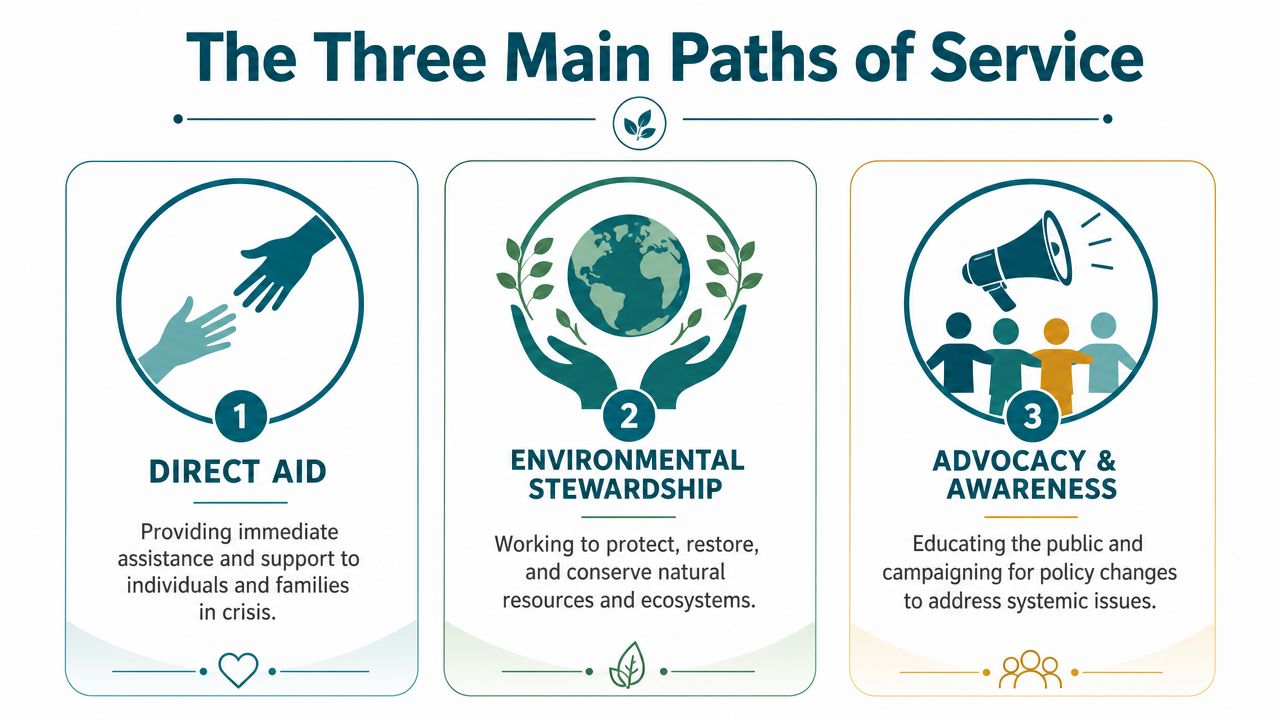
    The Three Main Paths of Service

    People use the phrase community service to mean different things. That's why confusion happens.

    I've seen one person say it after a joyful weekend cleanup, another say it about a court requirement, and a student say it about a class project. All three can fit under the same umbrella, but the reason behind the work changes the experience.

    An infographic detailing the three main paths of service: direct aid, environmental stewardship, and advocacy and awareness.

    Voluntary service

    This is the kind I know best. You choose it.

    Nobody sentences you to it. Nobody grades you on it. You wake up early on a Saturday, pull on your gloves, and go because you want your block, your river, your school, or your neighbors to feel more cared for. Voluntary service has a certain spark because choice changes the mood. You're there on purpose.

    You also learn fast that your reason can be mixed. Maybe you want to help. Maybe you want friends. Maybe you need structure. Maybe you're trying to become braver. That still counts.

    Court-ordered service and service-learning

    Court-ordered service is different. A person does work for the community because the legal system requires it. The task might look similar on the surface, but the starting point is obligation.

    Service-learning has another flavor. A school or training program ties service to reflection and education. You serve, then think about what happened, what you learned, and how the experience connects to a larger lesson.

    Here's a quick comparison:

    Path Why you do it What it often feels like
    Voluntary service Personal choice Freer, social, self-directed
    Court-ordered service Legal requirement Structured, mandatory
    Service-learning Educational goal Reflective, guided, tied to study

    Why motivation matters

    This matters a lot for students. Many people confuse general volunteering with the stricter meaning of community service in academic or professional settings. In medical school prep, direct work with underserved populations often matters most, and 78% of pre-med students overlook that distinction, according to GHL Foundation's discussion of underserved community service.

    So if you're asking what community service is, the full answer is this: the action matters, and the context matters too. Picking up litter, mentoring youth, visiting elders, helping with food distribution, or teaching health basics can all fit. The question is why you're there, who you're helping, and what kind of service the situation calls for.

    The Unexpected Gift You Get from Giving

    I started serving because I wanted to clean streets. I kept serving because it started cleaning up parts of me.

    That sounds dramatic, but I mean it in a plain, practical way. When you keep showing up to help other people, you build traits that are hard to fake. You become steadier. You get less fragile. You stop panicking every time conditions aren't perfect.

    You practice being the person you want to be

    I didn't become brave by reading about bravery. I became brave by standing outside when it was cold, awkward, inconvenient, and a little uncomfortable. I became more reliable by showing up again the next week. Then the week after that.

    Service works like a gym for character. One cleanup won't change your life. Repeated cleanups might.

    Here's what I got from it:

    • Bravery in small doses. Going to unfamiliar blocks, meeting strangers, and doing visible public work trained me to move before I felt fully ready.
    • Consistency I could feel. Weekend after weekend, the habit got stronger than my excuses.
    • Better friendships. Shared work is a great filter. People who wake up to help others usually have something solid in them.

    You find out who you are when the weather gets bad and you stay anyway.

    Volunteer-first groups change the experience

    Group culture matters. A lot.

    The healthiest service spaces I've seen protect the people doing the work. They care about safety. They care about morale. They don't treat volunteers like a wallet with legs. Volunteer-first groups that put safety and happiness ahead of pressure for money create a more sustainable experience, and that changes whether people come back.
    If you want a deeper look at what real results can look like over time, this page on measuring community service impact has a useful framework.

    The caterpillar idea is real to me

    I love the caterpillar image because nobody expects a caterpillar to stay a caterpillar.

    That's how service felt for me. I wasn't trying to become flawless. I was trying to become less afraid, less selfish, less flaky, less trapped in my own head. Service gave me a place to practice that transformation in public, one bag of trash at a time.

    And there's something else. Hard days become good stories. The freezing cleanup. The long walk. The muddy shoes. The weird conversation that turned into a real friendship. Service gives your life texture. It gives the plot somewhere to go.

    Watching Your Neighborhood Come Alive

    The first thing you notice after a cleanup is visual. A block looks calmer. A curb line appears again. Grass comes back into view. The street breathes a little easier.

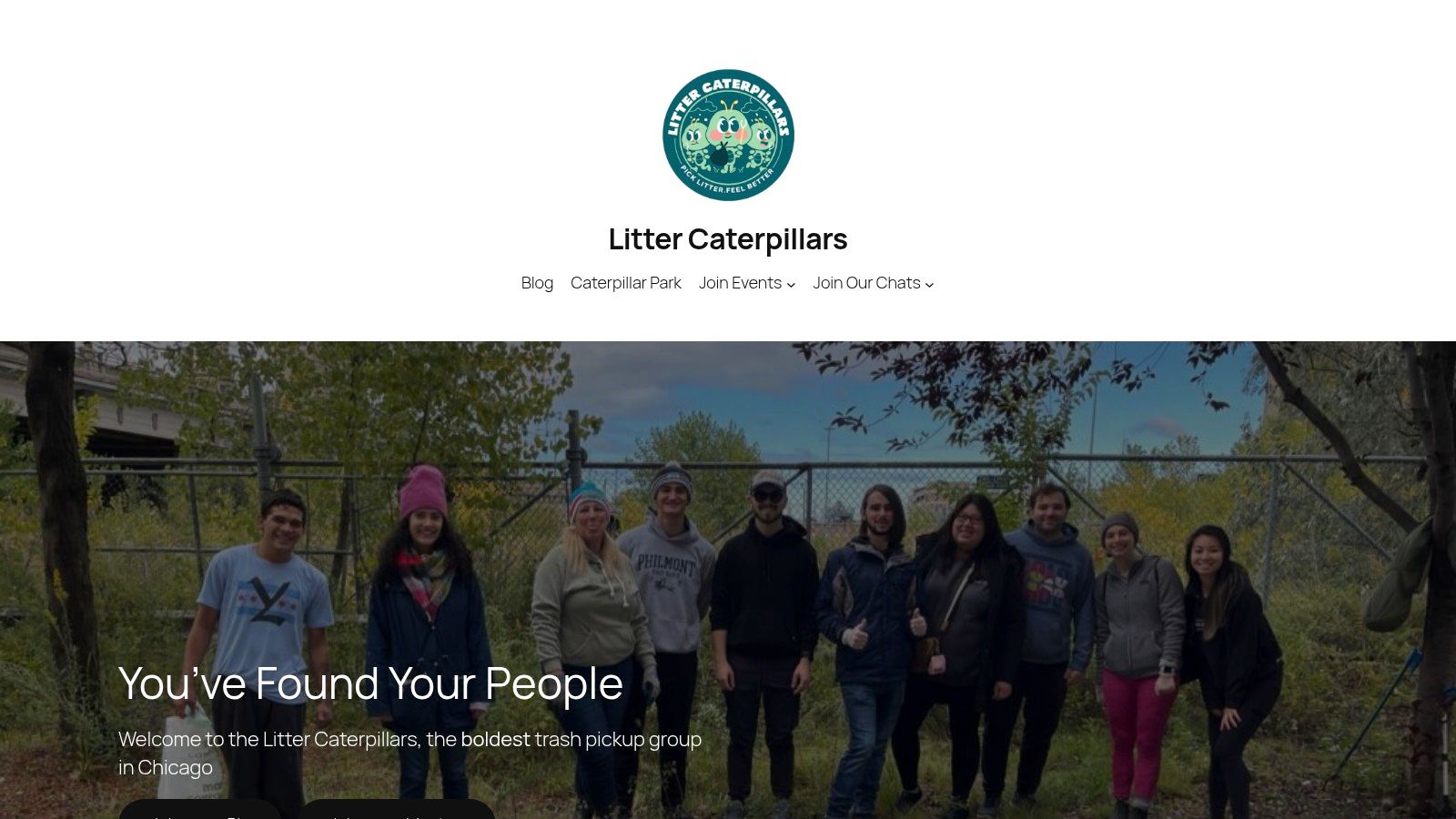
    Screenshot from https://www.littercaterpillars.com

    But the deeper change is emotional. People walking by start talking. Someone thanks you from a porch. A kid stares like you're doing magic with a trash bag and a grabber. Another neighbor starts picking up around their own building a few days later. Service spreads because people copy what they can see.

    Block by block is how a city changes

    I've learned to trust repeated action more than grand speeches. One corner today. Another next week. A rough alley nobody wanted to deal with. A commercial strip full of bottles and wrappers. An empty lot that looked forgotten.

    That kind of work gets especially real in places people avoid. Community service grows when you stop treating some neighborhoods as disposable. Litter Caterpillars has cleaned all 50 Chicago wards, including neighborhoods others often avoid. I love that example because it refuses the lazy map in people's heads, the one that says some areas count more than others.

    There's also a direct environmental side to this work. Litter cleanup helps stop trash from washing into rivers, and the Chicago-Calumet River litter prevention effort shows how local cleanup connects to cleaner waterways.

    A short clip tells that story better than I can:

    You start seeing possibility where you used to see blight

    One of my favorite shifts is internal. You stop looking at an ugly space and thinking, “That's a shame.” You start thinking, “We can do something about that.”

    That mindset changes a neighborhood because it changes the people in it. Cleanup is rarely about making things look cute. It's about telling the truth with your hands. This place matters. These people matter. We're not waiting for someone else.

    A cared-for block invites more care. A neglected block teaches people to give up.

    That's why community service feels alive to me. You can watch the before and after happen in real time.

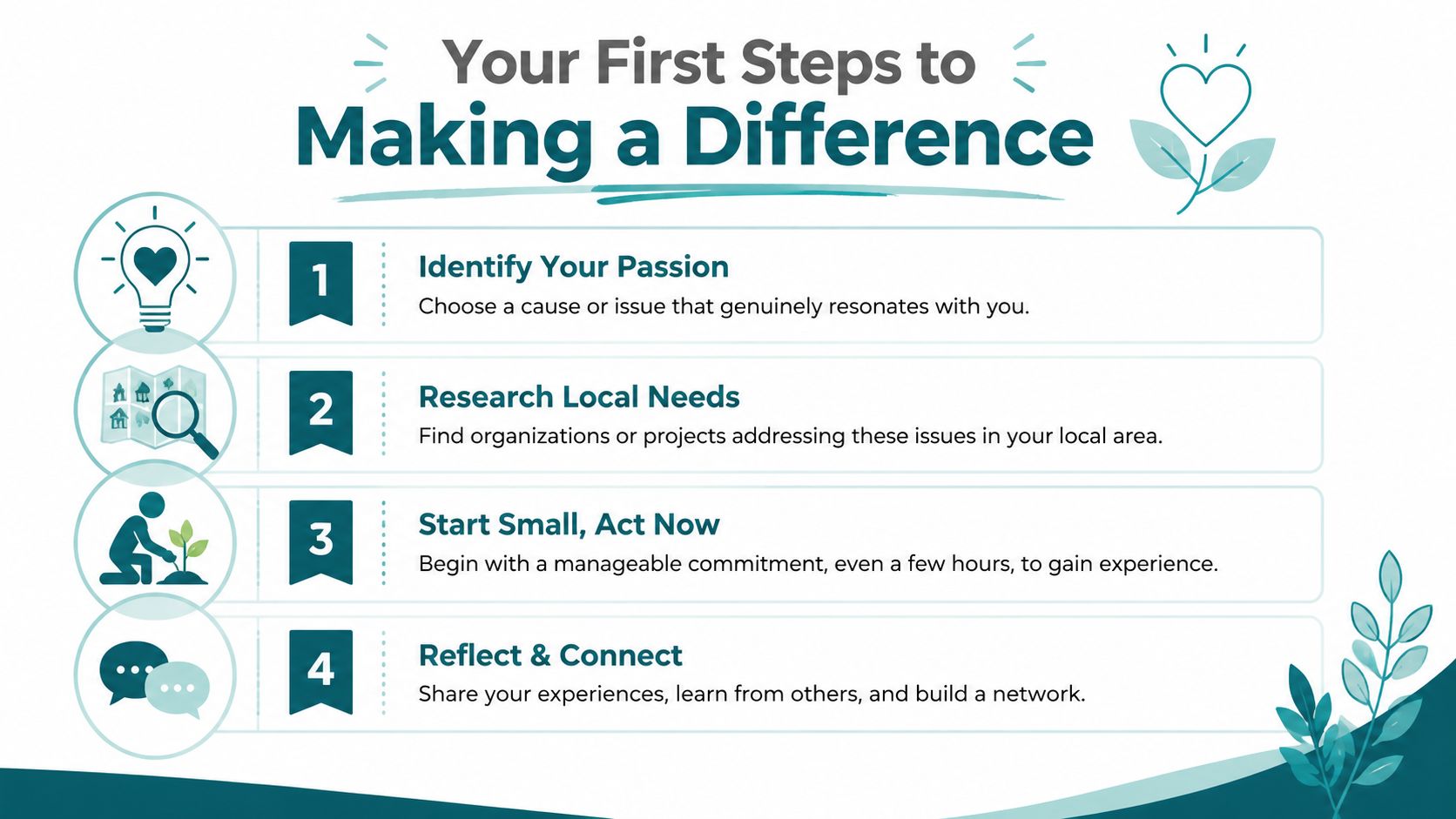
    Your First Steps to Making a Difference

    Individuals don't need more inspiration. They need a first move.

    The good news is that starting is much easier than performing some giant act of goodness. You don't need a full life mission. You need one cause you can stick with long enough to build a habit.

    A four-step infographic illustrating how to start contributing to community service and making a difference.

    Start with fit, then build consistency

    Pick something that pulls at you. If you care about litter, join a cleanup. If you care about hunger, find a pantry. If you care about reading, help at a library. Your odds of staying committed go way up when the work feels personal.

    Then make the commitment small enough that you'll keep it.

    • Choose one lane. Don't sign up for five causes at once. Pick one and learn its rhythm.
    • Check the group culture. Look for clear meeting details, safety norms, and respectful communication.
    • Use a simple schedule. One steady hour each week can change you more than one giant burst once a year.
    • Reflect after each shift. Ask yourself what felt energizing, awkward, useful, or meaningful.

    If you want a practical starting point, this guide to starting volunteering gives a straightforward way to begin. One factual option is Litter Caterpillars, which organizes volunteer trash pickups in Chicago and provides cleanup tools for participants.

    If you need service for school or applications

    Consistency matters even more when service connects to admissions or career goals.

    For academic or professional applications, longitudinal service over 6+ months is prioritized over one-day events by AMCAS and AAMC, according to this PMC article on service learning and sustained engagement. That tracks with what I've seen in real life too. A single service day can be nice. Ongoing service changes how you think, who you know, and what you notice.

    A good starting checklist looks like this:

    1. Pick a cause you can talk about without forcing it.
    2. Find a group that feels safe and grounded.
    3. Commit to a repeat schedule, even if it's modest.
    4. Keep showing up long enough for your presence to mean something.

    You don't have to become a saint. You just have to become dependable. That's where the change begins.


    If you want a simple way to try community service in Chicago, join Litter Caterpillars. You'll spend a morning cleaning a block, meeting other people who like to help, and finding out how much lighter life can feel when you carry one bag of trash at a time.

  • How to Clean Sidewalks and Find Your Bravery

    How to Clean Sidewalks and Find Your Bravery

    I stood on a filthy stretch of sidewalk with a broom in my hand and the same resistance I used to feel when I looked at my bedroom floor. The stains looked small, but in my chest they felt huge.

    Your Sidewalk Your Story

    I used to live with a kind of mess that didn't stay in the room. It spread into my head. An old container in the fridge wasn't just an old container. It was a memory, a failed plan, a little guilt token. A bag of stale snacks wasn't trash to me. It was proof that I had tried and slipped. Every object felt like it weighed far more than it should.

    A dirty sidewalk can hit you the same way.

    You pass the same patch of dark grime every morning. You step over the weeds pushing through the crack. You see the mystery stain near the curb and tell yourself you'll deal with it later. After a while, the sidewalk stops feeling like concrete. It starts feeling like an accusation.

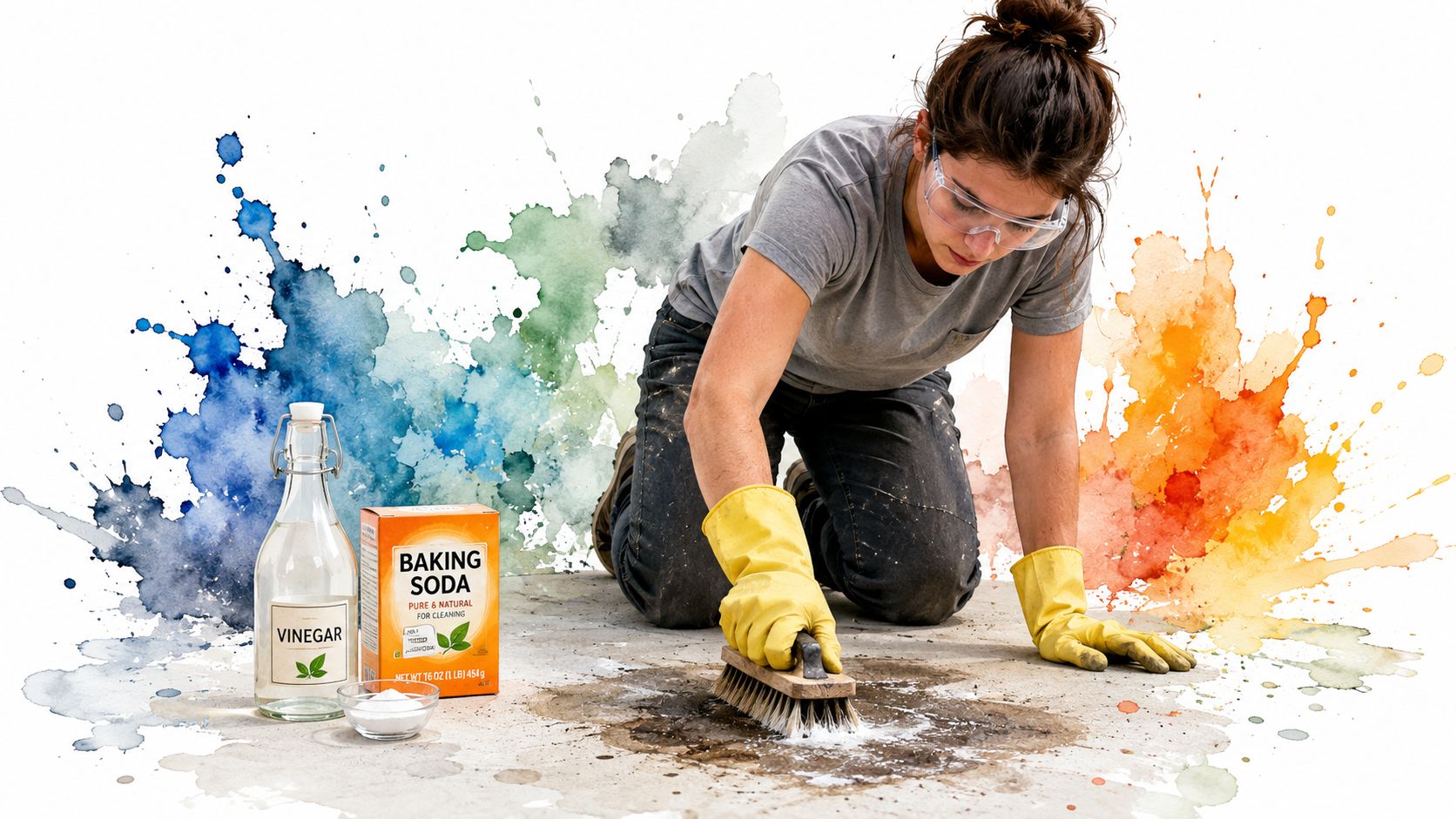
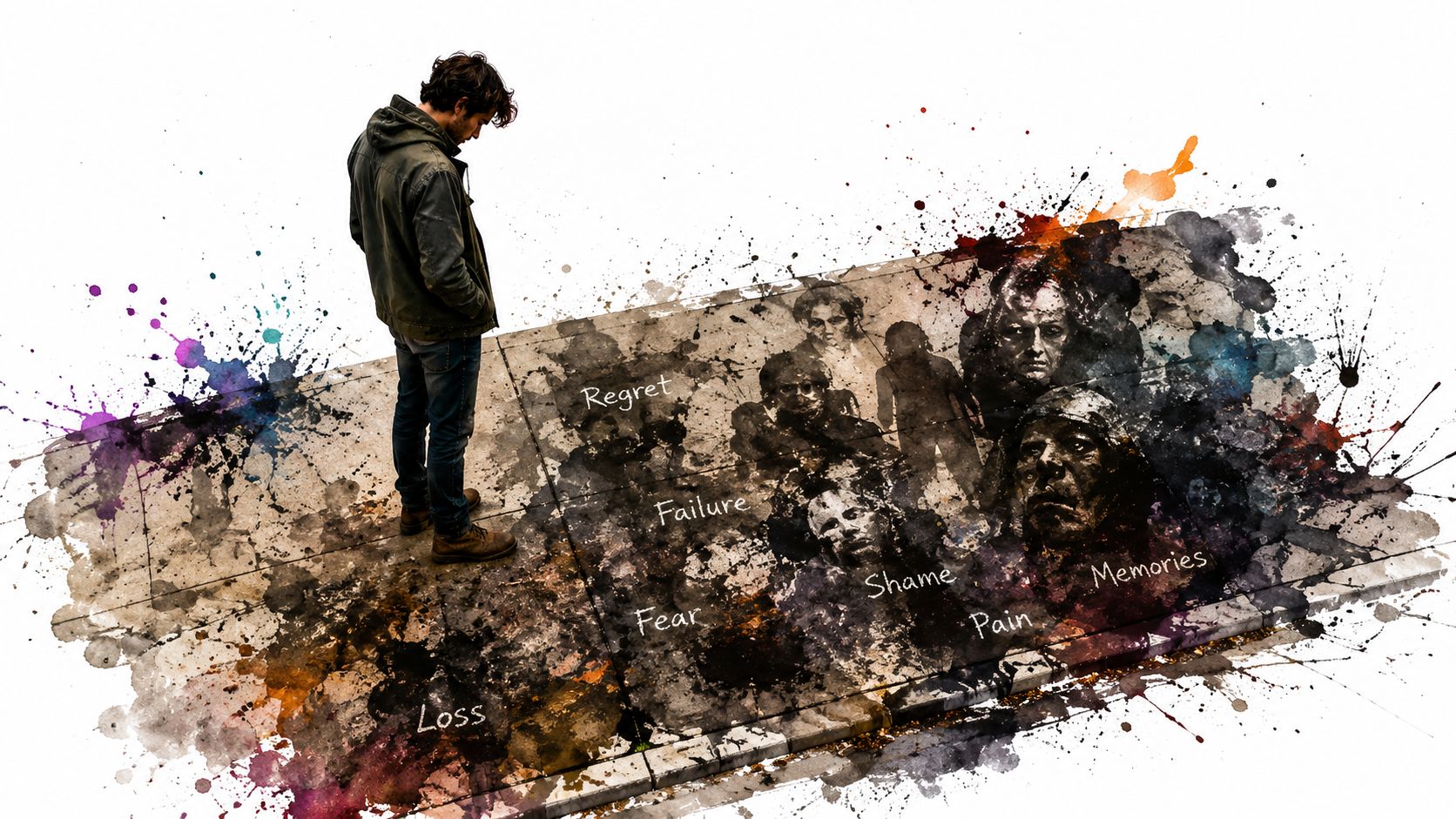
    A person standing over a concrete slab filled with dark, abstract watercolor imagery representing emotional struggles.

    I learned something strange when I started helping clean outdoor spaces. Other people's messes felt easier to face than my own. Outside, I could move. I could act. I didn't have to untangle every emotion before I picked up a brush. I just had to start.

    That first lesson changed me. It also connects to how I fought my social anxiety. Bravery didn't arrive in some shining burst. It came in small, awkward motions. Walk outside. Put on gloves. Sweep one section. Scrub one square. Keep going.

    The weight of a small task

    If you're looking up how to clean sidewalks, maybe you want cleaner concrete. Good. Clean concrete feels better under your feet. But I think you might want something else too. You might want the relief of finally facing a task that's been staring at you.

    Practical rule: Treat the sidewalk like a tiny dragon. Don't negotiate with it for six months. Walk up and poke it with a broom.

    I remember staring at a stretch of pavement that had leaves mashed into the surface, gum flattened into black coins, and a green film near a shady edge. Nothing dramatic. Just enough neglect to create that heavy feeling. I told myself I'd do ten minutes.

    Ten minutes became momentum.

    One square at a time

    That's the trick. You don't clean a whole sidewalk first. You clean the patch right in front of your shoes. Then the next one. Courage works the same way. You don't become brave in theory. You do one mildly annoying thing you were avoiding. Then another.

    Your sidewalk has a story because you do. When you clean it, you're not fixing your whole life. You're proving to yourself that stuck isn't permanent.

    Gearing Up for the Grime

    I love good gear, but I don't mean expensive gear. I mean gear that lets you work safely, comfortably, and with some dignity. If you go outside in flimsy sandals and bare hands, the sidewalk will bully you. If you gear up right, you show up ready.

    First comes safety. Always.

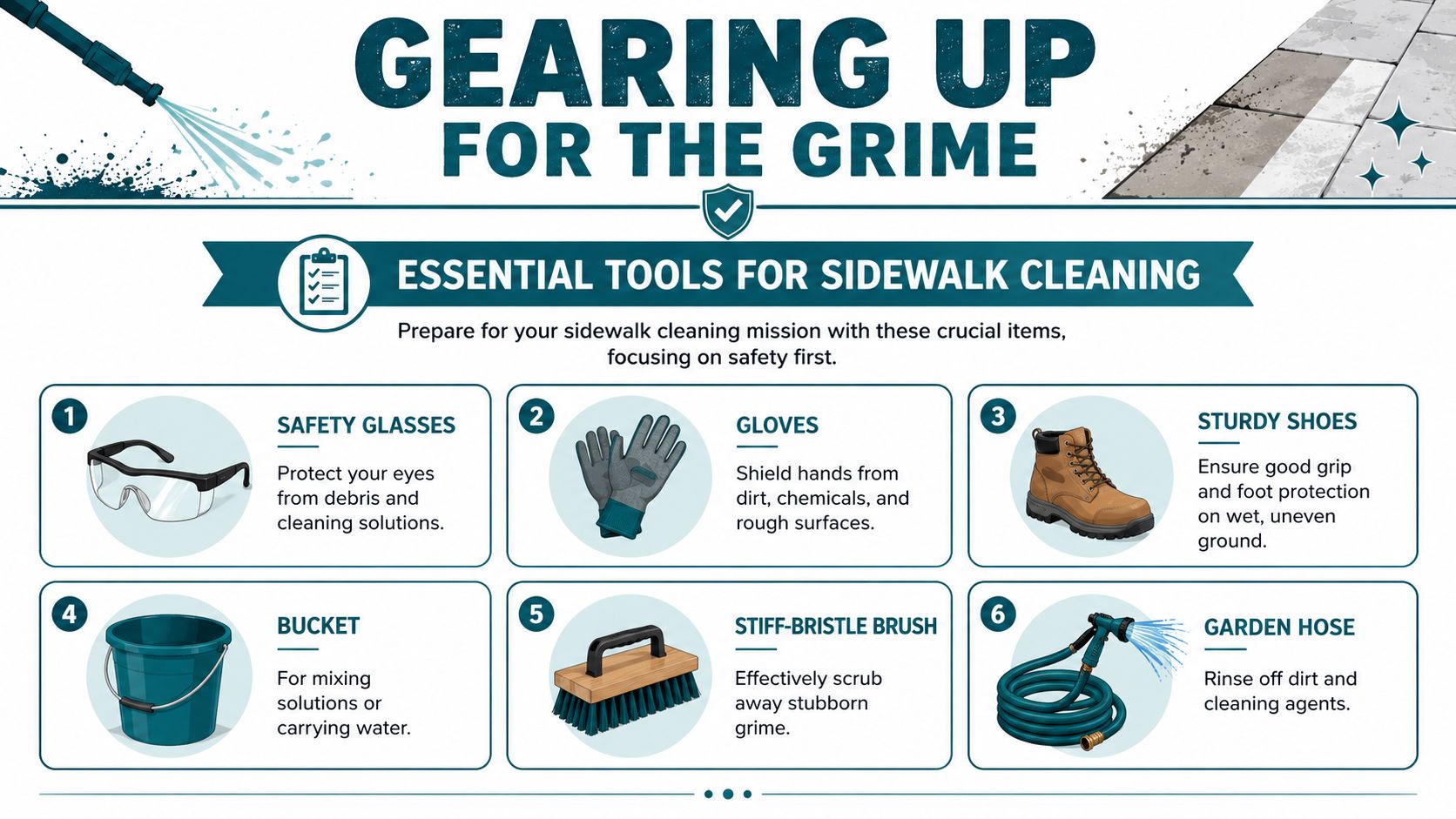
    An infographic titled Gearing Up For The Grime listing six essential tools for cleaning sidewalks safely.

    I want you in thick gloves, safety glasses, and sturdy closed-toe shoes. Concrete scraps, grit, bits of glass, and splashes from cleaning mixes don't care whether you're trying to have a noble little self-improvement morning. Protect your hands. Protect your eyes. Protect your toes.

    Then bring the simple workhorses:

    • Push broom: Use a stiff-bristled push broom to move loose dirt, leaves, grit, and broken-down plant matter before you add water.
    • Long-handled scrub brush: This is your close-combat tool for stains, algae, and packed grime.
    • Bucket: Mix cleaning solution, carry water, or dunk the brush when you need more bite.
    • Garden hose with spray nozzle: A hose helps you wet the surface, rinse soap away, and see what dirt remains after the first pass.

    The quiet heroes from your kitchen

    You don't need to open with harsh chemicals. I often reach for white vinegar and baking soda first. Vinegar helps with organic film and green growth. Baking soda gives you mild grit and odor control. Dish soap can help loosen greasy residue on the surface before you scrub.

    Use these with common sense. Test any cleaner on a small spot first, especially if the concrete is old, stained, sealed, or cracked.

    Gear changes your mood. Gloves tell your brain it's time to work. Shoes tell your body you're staying in the fight.

    If you want to get a feel for the mindset of group cleanup work, I like the spirit behind this trash pickup volunteer page. You prepare first, then you move.

    A basic loadout that works

    Here is the simple sidewalk kit I trust:

    1. Safety glasses for flying grit and splashback
    2. Work gloves for rough surfaces and dirty debris
    3. Closed-toe shoes with grip for wet concrete
    4. Push broom for the dry sweep
    5. Scrub brush for focused stain work
    6. Bucket and hose for mixing and rinsing
    7. Vinegar, baking soda, and dish soap for everyday grime

    A short visual helps if you want to see the rhythm of it before you start.

    Put your uniform on. It sounds silly, but it matters. Half of cleaning is physical. The other half is getting your mind to stop flinching.

    The Two Paths to a Clean Path

    Some days I want the express train. Some days I want the scenic route. Sidewalk cleaning works the same way. You usually have two main options. You can pressure wash, or you can scrub by hand.

    Neither choice is morally superior. You're picking the right boot for the trail in front of you.

    Pressure washing when you want speed

    Pressure washing is fast, loud, and satisfying. It can strip off broad layers of dirt, brighten a large section, and clear shallow organic buildup without making you scrub every inch yourself. If your sidewalk has a wide coat of general filth, pressure washing can save your back and your patience.

    But it has a personality. It can be rough. Older concrete, damaged edges, loose joints, and fragile areas don't always enjoy being blasted. Debris can kick up. Water can carry grime onto nearby walls, shoes, pants, and plants. You need control, not just force.

    Manual scrubbing when you want control

    Manual scrubbing is slower, but it gives you precision. You can work one stain without soaking the whole area. You can ease up around cracks. You can stay quiet on an early morning without sounding like a machine is chewing through the block.

    I like hand scrubbing for targeted messes, smaller sections, and days when I want the work to feel more personal. There is something grounding about seeing the brush move in circles and watching a problem shrink because your arms kept going.

    Factor Pressure Washing Manual Scrubbing
    Speed Faster for large areas Slower, especially on long stretches
    Control Less precise around delicate spots More precise on stains and edges
    Noise Loud Quiet
    Effort on your body Less scrubbing, more equipment handling More elbow grease
    Risk to old concrete Higher if you use too much force Lower because you control pressure
    Best use Broad dirt, general surface cleaning Spot treatment, delicate sections, small jobs

    How I choose in real life

    I ask myself a few direct questions:

    • Is the mess spread out? If dirt coats the whole walkway, pressure washing may make sense.
    • Is the sidewalk old or flaky? If yes, I lean toward brushing.
    • Do I need quiet? If neighbors are close and the morning is still, I scrub.
    • Is the stain local? One ugly patch doesn't need a machine sermon.

    Choose force for broad dirt. Choose patience for specific trouble.

    If you're learning how to clean sidewalks, this choice matters more than people think. A lot of frustration comes from using the wrong method for the mess. People try to blast out one stubborn stain that needed soaking and scrubbing. Or they hand-scrub an entire long path that would have cleaned up faster with a pressure washer.

    I use both. You probably will too. The sidewalk isn't asking for ideology. It wants the right move on the right day.

    Tackling the Toughest Sidewalk Stains

    Every stain has its own attitude. Some cling like an old bad habit. Some sink deep and act innocent. Some spread subtly in the shade until the whole slab looks tired. If you learn the personality of the stain, the fix gets simpler.

    Gum, the sidewalk barnacle

    Chewing gum is clingy. It flattens into the concrete and dares you to attack it the wrong way.

    Start by hardening it. Press an ice cube or a bag of ice against the gum until it stiffens up. Then use a dull scraper or the edge of a sturdy putty knife to lift it. After that, scrub the area with warm water and a little dish soap.

    A lot of people rush straight to scraping soft gum. That usually smears it and turns a small gross circle into a larger gross circle. Freeze first. Then pry.

    Oil, the greedy stain

    Oil is greedy. It doesn't just sit on top. It seeps down and settles in.

    If you catch an oily patch early, cover it with cat litter or cornstarch and let it sit so it can absorb the grease. Sweep that up, then scrub with dish soap and hot water using a stiff brush. You may need more than one round, especially if the stain has been there long enough to get comfortable.

    For stubborn spots, I like to work in stages:

    1. Blot and absorb first with cat litter or cornstarch
    2. Scrub with soap and a stiff brush
    3. Rinse and inspect once the concrete dries a bit
    4. Repeat if needed instead of dumping stronger stuff immediately

    That sequence keeps you from wasting effort. If the oil is still lounging deep in the pores, a single quick scrub won't evict it.

    Some stains don't need violence. They need extraction.

    Algae and green film, the unwelcome guest

    Green growth likes shade, moisture, and neglect. It creeps in, then the sidewalk gets slick and sour-looking.

    Mix white vinegar with water in a bucket or spray bottle. Wet the affected area, apply the vinegar mix, let it sit for a bit, then scrub with a long-handled brush. Rinse well. If the green comes back often, trim back whatever is keeping that area damp and shaded if you can.

    Algae isn't just ugly. It can get slippery. Take your time with it.

    Graffiti, the unwanted tattoo

    Graffiti asks for restraint. I know the urge is to go hard and erase it instantly, but concrete can punish impatience.

    Use a graffiti remover made for masonry or concrete, and test it on a small hidden patch first. Follow the product directions. Apply, wait, scrub, and rinse. You may need several rounds rather than one aggressive attack.

    If the sidewalk has decorative finish, color treatment, or older surface wear, testing first matters even more. You want to remove the mark, not create a pale scar around it.

    Snow and ice, the winter trap

    Winter grime is different. You're not just cleaning. You're trying to prevent slips and protect the concrete.

    A good shovel is your first tool. Get snow off early before footsteps pack it down. For traction, I prefer sand over harsh salts when possible. Sand gives grip. Strong de-icers can be hard on concrete over time, especially if the surface already has cracks.

    When ice locks itself to the sidewalk, chip carefully. Don't swing like you're trying to split firewood. Concrete remembers abuse.

    A simple stain map

    Use this quick guide when you don't want to overthink it:

    • Black gum spots: Freeze, scrape, wash
    • Fresh oil: Absorb, scrub, rinse
    • Green slime: Vinegar mix, wait, scrub
    • Graffiti: Specialized remover, test first
    • Snow and ice: Shovel early, use sand for grip

    I like this part of the job because it reminds me that ugly things aren't all the same. You don't solve every life problem with one tool, and you don't solve every sidewalk stain with one cleaner. Learn the language of the mess in front of you. Then answer it directly.

    Keeping Your Sidewalk Clean for Good

    The dramatic deep clean feels amazing. The quieter win is maintenance. That part took me longer to learn because I used to treat cleaning like a single heroic act. I wanted redemption in one sweep. Life usually doesn't work like that.

    A sidewalk stays clean when you build a rhythm around it.

    The boring habit that saves you

    Sweep once a week. Pull weeds when they're small. Rinse off spills before the sun cooks them into the surface. Check shady corners after damp weather. None of this is glamorous. That's why it works.

    If you ignore a sidewalk for long stretches, dirt layers up and tiny problems become projects. If you keep showing up, the work gets lighter.

    Cleanliness gets easier when you stop treating it like punishment.

    My maintenance loop

    I like a simple loop instead of a big perfect plan:

    • Quick sweep: Move leaves, dirt, and trash before they grind into the concrete
    • Fast weed pull: Grab new growth while the roots are still weak
    • Spot scrub: Handle a fresh stain while it still has manners
    • Small check-in: Look at the edges, cracks, and damp spots before they get weird

    This is one reason I care about how to clean sidewalks as a repeat practice, not a one-time stunt. Consistency changes your relationship to the task. You stop dreading it. You start trusting yourself.

    Stewardship feels different

    There is a special kind of pride in maintaining a space. It isn't loud. It doesn't need applause. You just look down one morning and realize the path is clear because you kept showing up.

    That does something good inside you. It tells your nervous system, "I can handle things before they become chaos." That's useful on concrete, and it's useful everywhere else.

    From a Clean Sidewalk to a Clean Block

    I found out that cleaning gets lighter when other people are there. Someone cracks a joke. Someone brings coffee. Someone points at a stain and says, "I bet I can beat that thing." Suddenly the job has energy.

    Tom Sawyer understood this better than most adults. He turned fence painting into a prize. That's not manipulation at its worst. At its best, it's an invitation. People often want a reason to join something wholesome and a little ridiculous.

    How to invite people without making it weird

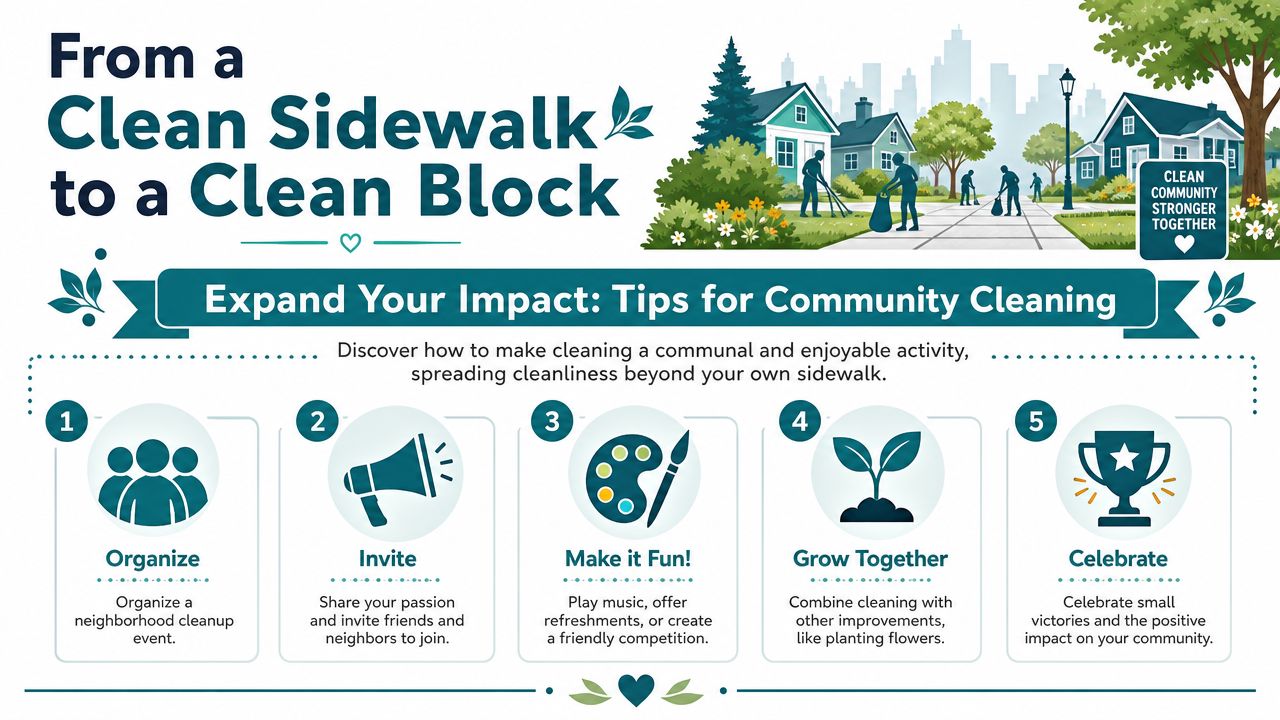
    Keep it simple. Knock on a door or send a text. Say you're cleaning your sidewalk on Saturday morning and ask if they want to do theirs at the same time. Tell them you'll bring coffee, music, or donuts. Make the invitation easy to accept.

    Don't make it sound like a committee meeting. Make it sound like a small adventure.

    An infographic titled From a Clean Sidewalk to a Clean Block with five steps for neighborhood cleaning.

    The block changes in ordinary ways

    When people clean side by side, they talk. They learn names. They trade stories about the tree roots wrecking the pavement, the old dog that barks at mail carriers, the best time to catch the morning shade. Friendship doesn't always start with deep confession. Sometimes it starts with two people scrubbing gum off concrete.

    Here are a few ways to make it stick:

    • Keep it short: An hour feels doable.
    • Make it visible: Start where neighbors can see the action.
    • Add one fun thing: Coffee, a playlist, cold fruit, anything.
    • Celebrate the tiny win: Take a look at the block when you're done and actually enjoy it.

    If you want a path into that kind of shared work, this volunteer trash pickup page has the same spirit I believe in. Show up, do good work, meet people who are trying.

    Bravery spreads by contact

    You clean your sidewalk. Then your neighbor notices. Then one more person joins. Soon the block feels less anonymous. That's how community often starts. Not with a speech. With a visible act that tells other people, "I'm willing to care first."

    A clean sidewalk is nice. A block where people know each other because they worked next to each other is better. That's the part I keep coming back to. Concrete gets brighter, sure. But so do people.


    If you want to turn that energy into real-world action, check out Litter Caterpillars. It's a Chicago volunteer group built around bravery, friendship, and the strange fun of cleaning up together. If you've been waiting for a sign to get outside and do something good with other people, this is it.

  • 7 Outdoor Volunteer Opportunities Near Me to Try in 2026

    7 Outdoor Volunteer Opportunities Near Me to Try in 2026

    I still remember staring at a half-frozen coffee cup on the curb and feeling weirdly relieved. Picking that up was easier than dealing with the mess in my own life. That's why outdoor volunteer opportunities near me stopped feeling like a search term and started feeling like a rope.

    “More Than Just Picking Up Trash”
    I get it. Sometimes life feels like a room that's just too messy to clean. Every little thing feels heavy. You want to make a change, but you don't know where to start. I've been there. The secret I found was that cleaning up someone else's mess is way easier than cleaning up my own. Getting outside, moving my body, and working with other people started a change in me. This isn't just about making a park look nice. It's about finding your strength, your people, and your own story of transformation, one piece of litter or one planted tree at a time.

    Making your search for outdoor volunteer opportunities simple, here are seven Chicago-area options I'd recommend to a friend, and each one gives you a different kind of day, a different kind of dirt under your nails, and a different story to take home.

    1. Litter Caterpillars

    Litter Caterpillars

    The first time I heard about Litter Caterpillars, what got me wasn't the cleanup itself. It was the honesty. A guy was struggling, started picking up trash, and found that one small act gave him something solid to hold onto. I know how real that is. Sometimes you don't need a grand plan. You need gloves, a bag, and a reason to get out the door.

    Litter Caterpillars turns that feeling into a weekly habit. You show up on a Chicago morning, meet strangers who are oddly cheerful about cold weather and dirty work, and head into blocks that have been ignored for too long. Then you watch the place change in your own hands. A sidewalk looks cared for again. An alley stops feeling abandoned. You go home tired, a little gross, and more alive than when you arrived.

    That's why this group sticks with people.

    Founded by Kevin Tao and powered by volunteers, Litter Caterpillars meets week after week, rain or shine, across Chicago. The group has worked in every ward, including corners of the city that rarely get the polished version of civic love. If you want the clearest explanation of why this kind of work matters, their piece on environmental stewardship in everyday language puts it well.

    Why it stays with you

    There's a weird magic in the group's rituals. Flags. Songs. Badges. On paper, it sounds playful. Out on a freezing morning, it gives people courage. Shared rituals turn a cleanup into a crew, and a crew makes it easier to do hard things.

    Kevin's story is a big part of the pull. He started by cleaning up outside because the inside of life felt harder to face. That hit me in the chest when I first learned it. Volunteering can start as service, but sometimes it becomes recovery, confidence, and proof that you can still change something.

    “Suffering and freezing makes things interesting.”

    I love that line because it refuses to dress this up. Some days are uncomfortable. Some sites are messy. You may be hauling bags through wind, heat, or slush. Then someone cracks a joke, you clear a stretch of street that looked hopeless an hour earlier, and suddenly the whole thing feels less like a chore and more like the kind of adventure that changes your posture.

    What you'll probably love, and what might test you

    • Best part: The impact is immediate. You can point to a block, lot, or alley and say, “I helped change that.”
    • Culture: Volunteers come first. Safety matters. The vibe is welcoming, informal, and built for people who want to help instead of perform helping.
    • Community: It's easy to return and get to know people, which matters more than you think when you're trying to build a better life, not just fill a Saturday.
    • Challenge: The work can be physical, and Chicago weather has zero interest in your comfort.
    • Less ideal for: Anyone looking for a polished, corporate-style volunteer program centered on fundraising.

    The stories that come out of this group are part of the appeal too. People don't just pick up litter and disappear. They end up cleaning unusual sites, showing up for neighborhoods that deserve better, and helping create projects big enough to retell later. If you want outdoor volunteer opportunities near me to mean more than a list of places to sign up, start here. Litter Caterpillars makes service feel like the first brave thing you do before the rest of your life catches up.

    2. Chicago Park District Natural Areas Community Stewardship Days

    Chicago Park District – Natural Areas Community Stewardship Days

    Maybe you don't want a big identity shift on day one. Maybe you want to start close to home, in a park you already pass on your dog walk or your commute. That's where Chicago Park District volunteer opportunities make sense.

    These stewardship days focus on natural areas across the city. The work can include beach and dune care, prairie and woodland restoration, trail work, and seasonal cleanups. I like this option for people who want to test the waters without overcomplicating the search for outdoor volunteer opportunities near me.

    Start where you already are

    There's something powerful about helping in a place that already belongs to your weekly life. You stop seeing “the park” as background. You start noticing paths, weeds, shorelines, and the small signs that a place is either cared for or left to slide.

    If you want a better feel for the idea behind this kind of work, I'd read this plain-English take on environmental stewardship. It puts words to the instinct a lot of us already have when we pick up litter or pull invasive growth from a trail edge.

    Practical rule: Pick the site with the easiest commute first. Convenience is underrated. A short trip makes it easier to come back.
    Why you might choose it

    • Near-home access: It's easier to find neighborhood-based service.
    • Flexible rhythm: You can join once or come back regularly.
    • Good for groups: Families, friends, and coworkers can sign up together.
    • Tradeoff: Event timing changes by site, and some tasks depend on the season or the weather.

    This one feels like learning to cook with simple ingredients. Nothing flashy. Just repeated, local action until your hands know what to do.

    3. Friends of the Chicago River Volunteer Stewardship and Chicago River Day

    Friends of the Chicago River – Volunteer Stewardship & Chicago River Day

    The river has a way of making human neglect visible. Trash catches in reeds. Plastic snags against stone. You can't unsee it once you notice. That's why Friends of the Chicago River volunteer programs feel so direct.

    Their stewardship work includes habitat restoration, litter removal, and invasive species work along the Chicago-Calumet river system. If your brain likes the idea of cleaning a place where water, wildlife, and the city all crash into each other, this is a strong choice.

    River work feels immediate

    A river cleanup has a different emotional texture than a park cleanup. Water carries things. It also reveals things. You start thinking about what washes downstream and what gets stuck right where kids walk, birds feed, or plants try to grow.

    If that part of the work pulls you in, this piece on cleaning up a river is worth a read before your first event. It gives you a better sense of why river edges get messy so fast and why regular effort matters.

    One specific route into this world is the Chicago River Eco-Warriors Crew. Their Wildlife Monitor role lets volunteers monitor osprey nesting poles and submit fillable observation sheets monthly to [email protected], according to the CREW Wildlife Monitors page.

    Some days you haul trash. Some days you watch for life returning. Both feel good.

    Good fit for you if

    • You want water-focused work: Riverbanks make impact easy to see.
    • You like options: There are smaller stewardship days and the larger Chicago River Day event.
    • You appreciate guidance: Training and tools are provided on site.
    • You should know: Some sites may be farther from your neighborhood, and popular annual events can fill fast.

    I'd send first-timers here if they want a day that feels earthy and civic at the same time.

    4. Alliance for the Great Lakes Adopt-a-Beach

    The first time I joined a beach cleanup, a kid a few yards away held up a plastic fork like he'd found evidence at a crime scene. He looked at the water, looked at the fork, and just said, “Why is this here?”

    That question stays with you.

    A beach has a way of making the problem feel personal. You're standing where people come to breathe, to swim, to bring their families, and the trash is right there at your feet. That's why Alliance for the Great Lakes volunteer opportunities hit differently for me. The work is simple to understand, and the impact shows up fast.

    Adopt-a-Beach gives you two ways in. You can join a cleanup that already exists, or you can lead one yourself. I love that setup because it meets you where you are. Some people need a low-pressure first step. Some people are ready to text three friends, pick a date, and become the reason a stretch of shoreline looks better by noon.

    That second path matters more than it sounds. A lot of us are waiting to feel qualified before we lead anything. Beach cleanups are a good place to get over that. You show up, learn the system, collect the trash, log what you found, and suddenly you're not just helping. You're becoming the kind of person who starts things.

    For people who want proof their morning mattered

    This program doesn't stop at filling bags. Volunteers also collect standardized litter data, which gives the cleanup a second life after you leave the sand. Your hands do the work. The record of what you found helps show patterns over time.

    The software side of volunteer work has grown with that need. The global volunteer management platforms market was valued at about USD 1.3 billion back in 2024 and is projected to reach USD 3.1 billion by 2033, according to DataHorizzon Research on volunteer management platforms. That makes sense to me. Groups need practical ways to organize people, track events, and keep volunteers coming back.
    Why this one sticks

    • Easy entry point: You can join a local cleanup without taking on a big commitment.
    • Room to grow: If you want more ownership, captain roles let you organize your own site.
    • Clear visual payoff: A dirty beach can look dramatically better in one morning.
    • A little more responsibility: Captaining means handling coordination and reporting, and the busiest months can fill up fast.

    If the Litter Caterpillars story speaks to you, this is one of those places where that spark can turn into courage. You don't have to arrive as an organizer. You can become one by starting here.

    5. Shedd Aquarium Action Days

    Sometimes you want a volunteer day that has a little more scaffolding. You want staff. You want orientation. You want somebody to tell you where the gloves are, what the plan is, and why this patch of shoreline matters. Shedd Aquarium volunteer programs are great for that.

    Action Days include beach and shoreline cleanups, habitat restoration, and citizen-science activities around the Great Lakes. For first-timers, that mix can feel reassuring. You get the outdoor work, but you also get a learning layer that helps the day stick in your mind.

    A good first chapter

    I often think of this option as hiking with a guide your first time on a new trail. Could you stumble through alone? Maybe. But a good guide changes your confidence. They name things. They answer the awkward questions. They make the whole experience less intimidating.

    That's what Shedd does well. If you're nervous about showing up alone, unsure what to wear, or worried you'll do something wrong, this kind of organized day smooths out the fear.

    Small truth: A lot of people don't need more motivation. They need a calmer first experience.

    Best for

    • Beginners: Staff-led events lower the friction.
    • Groups: Classes and companies usually like organized logistics.
    • Curious people: The educational part gives context to the physical work.
    • Limitation: Dates can be limited, events can fill, and some activities may have age requirements.

    I'd also point parents, teachers, and team leaders here. When you're bringing other people, order helps.

    6. Friends of the Forest Preserves Habitat Restoration Workdays

    Friends of the Forest Preserves – Habitat Restoration Workdays (Cook County)

    If city volunteering feels like the shallow end of the pool, Friends of the Forest Preserves volunteer workdays offer an opportunity to swim farther out. These workdays place you in prairies, savannas, wetlands, and woodlands across Cook County. The tasks can include brush cutting, seed collection, trail maintenance, and litter removal.

    I like this option for people who want a routine. Forest work has a rhythm to it. You return to a site and start to recognize what changed since last time, what grew back, what got cleared, what still needs your hands.

    The routine is the point

    A lot of volunteer content treats service like a one-off date. Show up once, smile for a photo, go home. But regular work changes you differently. According to National Environmental Education Foundation guidance on finding outdoor volunteer opportunities, 78% of outdoor volunteers join single-day events, while only 12% take part in weekly recurring programs. That gap is real, and I think it matters.

    Weekly or recurring service gets under your skin in a good way. It becomes less like attending an event and more like becoming the sort of person who shows up.

    If you want language for the bigger project behind this work, this introduction to environmental restoration is useful without getting too academic.

    Why people stick with it

    • Year-round schedule: You can build a habit instead of chasing random dates.
    • Skill growth: Stewardship leaders provide training and tools.
    • Community: You start seeing familiar faces, which changes everything.
    • Tradeoff: Some sites take more travel, and weather exposure is part of the deal.

    This one is for the people who secretly want a harder thing because they know harder things wake them up.

    7. Urban Rivers Wild Mile Chicago Floating Park Volunteers

    Urban Rivers – Wild Mile Chicago (Floating Park) Volunteers

    If you want your volunteer day to feel a little strange in the best way, look at Urban Rivers and the Wild Mile volunteer page. This is floating-park work on the North Branch Canal. You may help maintain floating wetlands, care for shoreline and native plants, remove trash by foot or kayak, or support eco-tours and public events.

    I love that this one feels a little futuristic and handmade at the same time. It's a city project, but it doesn't feel corporate. It feels like a group of people looked at a hard urban edge and said, “We can make this weirder, greener, and more alive.”

    For people who want a memorable first story

    Some volunteer gigs are useful. This one is useful and cinematic. You can end the day having planted on floating habitat or worked beside the water in a place that doesn't look like the Chicago many envision initially.

    There are entry-level roles and leadership paths like Event Facilitator and River Rangers. That range matters if you want to start small and grow into more responsibility later.

    The Forest Preserves of Cook County also has broad outdoor options, including opportunities at nature centers and wooded areas, and even ways to volunteer with a friend instead of alone, according to the Forest Preserves volunteer page. I mention that because some people need a buddy system before they try a more unusual setting like on-water work.

    The Nature Conservancy in Illinois also has outdoor roles that include removing invasive species, collecting native plant seeds, monitoring birds, and tending community gardens, with a zip-code search to find nearby options, according to The Nature Conservancy in Illinois volunteer page. Garfield Park Conservatory has volunteer roles in beekeeping, gardening, composting, and family programs, and notes that most positions have a minimum time commitment while staying flexible for busy adults, according to the Garfield Park Conservatory volunteer page.

    Keep in mind

    • Cool factor: On-water and floating-park work is memorable.
    • Growth path: You can move into leadership if you want more.
    • Good fit: Great for people who like unusual urban nature projects.
    • Watchout: Some roles need comfort near water, and weather can change plans.

    7 Local Outdoor Volunteer Opportunities Comparison

    Program 🔄 Implementation Complexity ⚡ Resource Requirements 📊 Expected Outcomes 💡 Ideal Use Cases ⭐ Key Advantages
    Litter Caterpillars Low coordination overhead; volunteer-led weekly meets Basic cleanup gear; minimal travel; volunteer time Visible neighborhood cleanup; community projects (e.g., park) Residents, students, young professionals seeking social, hands-on work ⭐⭐⭐ Bold identity; strong volunteer retention; easy to join
    Chicago Park District – Natural Areas Stewardship Days Moderate: partner-run schedules vary by site Tools & on-site guidance provided; local travel Native habitat restoration across many parks Hyper-local volunteers, families, recurring stewards ⭐⭐ Neighborhood-scale impact; family/group-friendly
    Friends of the Chicago River – Stewardship & River Day Moderate: site coordination + annual large event Training and tools provided; possible travel to river sites Waterway cleanup, habitat restoration; watershed mobilization Volunteers focused on aquatic ecosystems or large events ⭐⭐⭐ Clear waterway impact; mix of small and large events
    Alliance for the Great Lakes – Adopt-a-Beach Moderate: captain-led or join-a-team options Cleanup supplies; optional data collection/reporting Shoreline litter removal + standardized data for advocacy Flexible volunteers; groups wanting policy-linked data ⭐⭐ Regional reach; data-driven advocacy; flexible scheduling
    Shedd Aquarium – Action Days Higher complexity: staff-led logistics and education Staff supervision, materials, possible age limits Educational restoration and citizen science outcomes First-time volunteers, school groups, corporate teams ⭐⭐ Strong orientation and safety; educational value
    Friends of the Forest Preserves – Habitat Workdays Moderate: recurring calendar with steward leadership Tools, training provided; may require driving Prairie/woodland restoration; year-round opportunities Regular volunteers wanting skills and routine ⭐⭐ Robust schedule; strong restoration community
    Urban Rivers – Wild Mile (Floating Park) Higher: project-based, some on-water coordination Specialized on-water gear; kayak comfort; training High‑visibility urban habitat creation; maintenance of floating wetlands Volunteers seeking unique, skills-building on-water work ⭐⭐⭐ Signature project impact; memorable skill-building experiences

    Your Adventure Starts Now

    The first time I showed up to something like this, I almost bailed. It was early, my shoes were wrong, and part of me still thought volunteering was the kind of thing good people did while the rest of us kept making excuses. Then I spent a morning outside with strangers, picking up trash and talking about life between handfuls of broken glass and coffee cups. I went home tired, muddy, and steadier than I'd felt in months.

    That's the part nobody says clearly enough. These outdoor volunteer opportunities near me gave me more than a cleaner trail or riverbank. They gave me a place to put my restlessness. They gave me proof that I could show up, do something hard, and leave a place better than I found it. For me, that was the start of becoming braver.

    A lot of people already help in informal ways, while fewer connect with organized groups. The same U.S. Census Bureau civic engagement summary notes both that gap and the estimated value of a volunteer hour. I don't bring that up to make kindness sound like bookkeeping. I bring it up because your time matters in both human and practical terms. A few hours on a cold Saturday can clean a shoreline, restore habitat, and change the story you tell yourself about who you are.

    Pick the one that feels alive to you.

    Maybe that's the quick, gritty satisfaction of a neighborhood cleanup. Maybe it's a Park District stewardship day close to home, where you can learn the ropes without feeling overwhelmed. Maybe the river pulls at you, or the lake, or the preserves, or that strange beautiful floating park that makes the city feel new again. Each one gives you a different way in. None of them ask you to arrive as some finished, flawless version of yourself.

    You just have to show up.

    That's why this list matters. It isn't a directory you skim and forget. It's a trailhead. The Litter Caterpillars story carries that spirit. One small act, repeated with other people, can grow into a habit, a community, even a new identity. You start by grabbing a picker or pulling invasive plants. Then one day you notice you've become the person who says yes to hard mornings, fresh air, and work that leaves something real behind.

    If your life feels cramped right now, go outside and help somewhere real. Let the weather be annoying. Let your legs ache. Let your phone stay in your pocket for a few hours.

    You may come home with dirty shoes and a clearer head. You may come home trusting yourself more. Sometimes that's where the whole adventure begins.

  • Harrison Smith Park: A Guide for Chicago Volunteers

    Harrison Smith Park: A Guide for Chicago Volunteers

    I once watched somebody show up to a cleanup in Chicago thinking they were headed to a park with a pool in Ohio. We laughed, handed them gloves, and by the end of the morning they said they were glad they got lost.

    Which Harrison Smith Park Are You Looking For

    You probably typed Harrison Smith Park because the name feels clear enough. It isn't. That name sends people in a few different directions, and I get why.

    One path takes you to Harrison Smith Park in Upper Sandusky, Ohio, at 525 E Wyandot Ave, Upper Sandusky, OH 43351, and it has a public swimming pool as its primary amenity according to the Harrison Smith Park listing in Upper Sandusky. If you wanted flip-flops, summer chlorine, and a pool deck, that's your place.

    The Chicago mix-up

    Then Chicago enters the chat and makes everything messier.

    Some people mean Harrison Park in Pilsen. Some mean Smith Park on the West Side. Some mash the names together and search for Harrison Smith Park as if the city fused them overnight. I like that confusion. It feels human. We do this with places the same way we do it with memories. We blur names, but we remember the feeling.

    If you're trying to sort out the Chicago side of this, start with this guide to Harrison Park in Pilsen. It helps if you're looking for the park by the museum, the courts, the fields, the neighborhood rhythm.

    A park name matters less than what your hands do when you get there.

    Why the confusion matters less than you think

    I care about this mix-up for a simple reason. Searchers aren't really searching for a noun. They're searching for a place to go, something to do, and maybe a reason to get out of their own head for a few hours.

    I've seen that search look a hundred different ways. One person wants a calm walk. One wants a place to volunteer. One wants to feel useful after a rough week. One just wants to be around decent people without needing to explain their whole life story first.

    So yes, there is a real Ohio park with a pool. Yes, there is a Harrison Park in Chicago. Yes, there is a Smith Park in Chicago that gets mixed into this too.

    Here's the simple version:

    Search phrase What you may mean What it has
    Harrison Smith Park Upper Sandusky, Ohio Public swimming pool
    Harrison Park Pilsen, Chicago Fields, courts, playground, garden
    Smith Park West Side, Chicago Historic park on former quarry and landfill land

    If you're in Chicago and you're looking for a park with grit in its story, dirt under its fingernails, and the kind of energy that makes you want to do more than stare at grass, you're probably looking for one of the Chicago parks. That's where this story really starts.

    A Chicago Park's Surprising History

    I love places with ugly beginnings. Maybe because I trust them more.

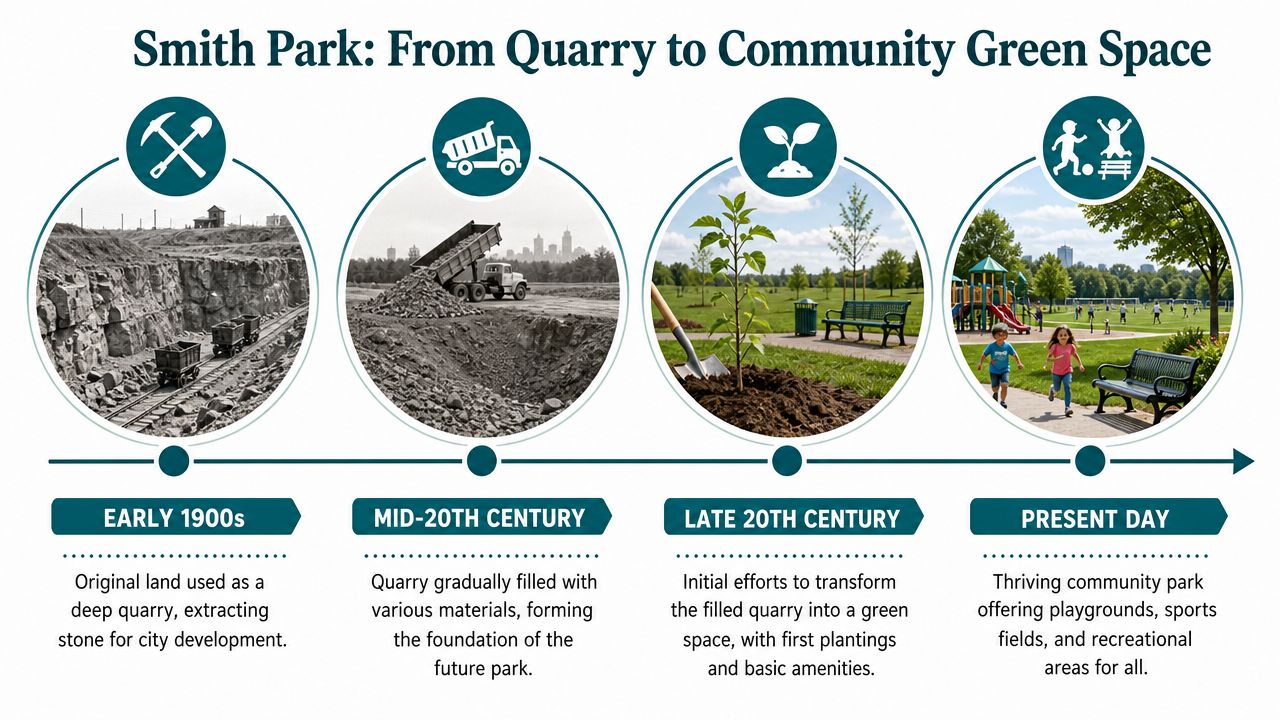
    Smith Park didn't begin as the kind of place where you'd toss a ball around or sit on a bench with a coffee. Smith (Joseph Higgins) Park in Chicago was founded in 1929 after a former quarry and landfill was filled to the brim by the mid-1940s, with the site transferred to the Bureau of Parks and Recreation in 1929, as described in this history of Chicago's West Side quarries.

    From hole to home ground

    Start there for a second. A quarry is a wound in the ground. People cut stone out of it. They take and take until the land looks like a giant missing tooth. Then people start dumping into it. Layer by layer, the city hides its mess in the same place it once carved for material.

    That story hits me hard because it feels familiar. I know what it's like to look at a mess and think, this thing is too old, too tangled, too embarrassing to fix. I know what it's like when every piece of junk has a memory attached to it, and moving one tiny thing feels like lifting a refrigerator with your bare hands.

    Then you look at a place like Smith Park and realize land can recover enough to become useful again. Not magically. Not cleanly. But well enough that kids run around there and neighbors gather there and life keeps happening on top of old damage.

    A timeline graphic showing the transformation of Smith Park from a stone quarry to a community park.

    Why I can't stop thinking about that story

    A lot of us carry quarry years. Then landfill years. Then maybe, if we're stubborn, we build something decent over the top.

    That doesn't erase what came first. It just means the old mess doesn't get the final word.

    Some places make sense only after you know what used to sit under your feet.

    When I walk through a park with that kind of past, I don't feel discouraged. I feel challenged. If a city can take a scar in the earth and turn it into a place where people meet, play, and breathe for a while, then you and I can probably face our own pile of wreckage too.

    Smith Park's history is earthy and blunt. That's why I like it. No fake perfection. Just dirt, trash, labor, time, and another chance.

    Exploring Chicago's Community Green Spaces

    If you want the practical version, here it is. Chicago gives you different flavors of public space, and the two parks tangled up in the Harrison Smith Park search each pull people in for different reasons.

    A vibrant illustration of people enjoying various outdoor activities in Chicago parks, including kayaking, basketball, and gardening.

    Harrison Park in Pilsen

    Harrison Park is the one many Chicago searchers want. You can find it at 1824 S Wood St, Chicago, IL 60608, right next to the National Museum of Mexican Art in Pilsen, according to the Harrison Park page on Tripadvisor.

    And the park itself gives you room to move. Harrison Park's nearly 18 acres include tennis courts, basketball courts, baseball fields, athletic fields for football or soccer, plus a playground and community garden, as noted in Time Out's Harrison Park overview.

    That list matters because it tells you how to use the place.

    • If you want motion: Hit the courts or fields. This is the park for people who don't want to sit still.
    • If you want family time: The playground gives kids something immediate to do while adults breathe for a minute.
    • If you want neighborhood texture: Walk by the garden, circle the edges, and look at who's using the place.

    I like parks more when they have jobs. Harrison Park has jobs. It hosts games, walks, rest, noise, waiting, and small daily rituals.

    Smith Park on the West Side

    Smith Park feels different. The history changes the way I move through it. I pay more attention to edges, low spots, and the way built structures sit in relation to the ground.

    Here's a little street-level look before you go further.

    How to use these parks like a local

    Locals don't overcomplicate it. They pick a reason and go.

    Your mood Better fit Why
    You want activity all around you Harrison Park Courts, fields, and steady movement
    You want to think about place differently Smith Park The ground itself has a story
    You want to explore Pilsen on foot Harrison Park It's next to the museum and easy to pair with a neighborhood walk

    Practical rule: Don't arrive asking, "What's the perfect park?" Ask, "What kind of day am I trying to have?"

    That's a better question. It gets you out the door faster.

    How We Safely Clean Our Parks

    Good intentions aren't enough when you're cleaning ground with a complicated past. You need judgment. You need discipline. You need to know when a trash grabber and a bag are enough, and when they aren't.

    One hard truth sits underneath this work. Parks built on historic landfills in Chicago can have 3–5x higher concentrations of legacy contaminants such as lead, asbestos, and hydrocarbons than naturally formed parks, and that risk can be higher in zones like drainage ditches, as noted in this post about landfill-built park risks in Chicago.

    Brave doesn't mean reckless

    I hate the fake version of courage. The version where somebody acts fearless because they don't know enough to be careful. That's not courage. That's ego wearing work boots.

    Real courage looks more boring. It looks like gloves. It looks like long pants. It looks like stopping to assess a weird material instead of poking it with your hand. It looks like telling a volunteer, "Leave that one. We're not touching it today."

    An infographic detailing safety protocols for volunteers cleaning up former landfill sites to ensure community safety.

    The method I trust

    When I clean a park with old industrial or landfill history, I keep the approach simple and strict.

    • Dress for contact: Wear protective gear that covers skin and keeps your footing steady.
    • Respect the weird stuff: If an item looks sharp, chemical, dusty, sealed, or unfamiliar, don't improvise.
    • Watch the edges: Drainage paths, fence lines, and ditch areas collect trash and can collect risk too.
    • Train before heroics: A volunteer who knows what not to touch is more useful than a volunteer trying to prove something.
    • Have backup plans: First aid, communication, and clear roles matter before the first bag gets filled.

    A lot of volunteer groups skip this because safety sounds less exciting than action shots. I think that's backwards. Safety is what lets good people keep showing up week after week instead of getting burned out, hurt, or scared off.

    If you want to think through the legal and planning side before you organize your own effort, read up on volunteer liability insurance for community cleanups. It helps you understand why structure protects generosity.

    If a park has a rough history, your cleanup plan needs a backbone.

    That isn't fear talking. That's respect.

    Join Us for a Weekend Cleanup

    Weekend mornings have a special energy. The city is quieter, the air feels less chewed up, and the people who show up that early for unpaid work usually have something good inside them.

    I think about Tom Sawyer a lot. He got stuck painting a fence and turned the punishment into an invitation. That's part of the fun here. Work changes shape when you stop treating it like humiliation and start treating it like a dare.

    What your first cleanup feels like

    You arrive a little unsure. Maybe you wonder if everyone already knows each other. Maybe you worry you'll be awkward, underdressed, too quiet, too late, too soft for the job.

    Then somebody hands you a bag.

    That moment matters. Holding a trash bag in a park is strangely clarifying. You stop performing. You stop trying to look interesting. You just start scanning the ground, picking targets, moving forward. Cup. Wrapper. Bottle cap. Broken toy. Fast-food bag snagged under a bush like it was trying to disappear.

    And the weird thing is, your brain starts to quiet down.

    Why the work feels good

    Smith Park got major upgrades in the late 1930s, including a field house with a gymnasium and meeting rooms, according to the Chicago Park District's Smith Park page. I love that detail because it reminds me that parks aren't abstract ideas. They are places where bodies gather, sweat, talk, rest, and return.

    That's why cleanups matter in a practical way. You're not cleaning some symbol. You're clearing a path for an actual person. A kid running near a field. A neighbor walking past. Somebody heading toward a meeting room. Somebody trying to have one decent hour outside.

    If you want a way in, check out weekend volunteer opportunities near you.

    What to expect when you say yes

    Your first cleanup usually includes a few things:

    1. A small moment of hesitation when you realize you're doing real physical work.
    2. A rhythm shift once your hands get busy and conversation starts to happen naturally.
    3. A quiet hit of satisfaction when the pile of full bags grows and a messy patch looks human again.

    Hard work with good people is one of the cleanest pleasures left.

    That's the pitch. No fake glamour. Just a better Saturday morning than doomscrolling.

    Building Friendships One Bag of Trash at a Time

    The first time I went out with a tiny cleanup crew, Chicago threw hail at us like the city was testing our sincerity. We huddled under a tree, freezing, phones out, watching ride after ride cancel. It should have been miserable.

    It was miserable. And it was funny.

    That combination changes people. When you shiver through something dumb and difficult with strangers, they stop feeling like strangers way faster than they would at a bar or a networking event or some polished little mixer where everybody is trying to seem effortless.

    Shared discomfort is glue

    I learned something that day. Cleaning somebody else's mess is often easier than cleaning your own. Maybe because there isn't any shame in it. The ground doesn't judge you. The bottle in the weeds doesn't ask why your apartment is a mess or why your last relationship blew up or why you've been avoiding your own life.

    You just pick it up.

    And when somebody next to you is doing the same thing in cold rain or sharp wind, you trust them a little. They've already shown you one thing that matters. They came.

    Screenshot from https://www.littercaterpillars.com/

    Why people keep coming back

    Friendship doesn't always begin with deep conversation. Sometimes it begins with shared labor, an inside joke, and that look people exchange when a heavy bag finally gets tied shut.

    A cleanup group becomes social in sideways ways:

    • You earn trust fast: People see whether you help, drift off, complain, or stay steady.
    • You get stories immediately: Rain, weird finds, busted grabbers, lost gloves, surprise laughter.
    • You build identity through repetition: Same mission, different block, same people returning.

    I also think service scrubs away a lot of fake hierarchy. Out there, nobody cares who has the best resume. The wind doesn't care either. Trash equalizes people. That's one reason this kind of friendship feels less brittle.

    "We suffered a little together" is a stronger beginning than most small talk.

    If you've been lonely in a crowded city, this matters. You don't need a brilliant opening line. You need a reason to stand next to other people while doing something honest.

    Your Questions About Park Cleanups Answered

    People usually ask the practical stuff first. Good. Practical questions keep everybody safer and calmer.

    Is it actually safe to clean a park with a rough past

    It can be, if you respect the site and don't freeload on optimism. Use protective gear, avoid suspicious material, and treat certain areas with extra caution. If something looks off, leave it and report it through the right channel instead of trying to be a hero.

    What should you bring

    Keep it plain.

    • Wear sturdy clothes: Closed-toe shoes, long pants, and gloves are the baseline.
    • Bring water: Even short cleanups can sneak up on you.
    • Pack light: You don't need a whole expedition setup. You need mobility and common sense.

    Can you come alone

    Yes. A lot of people do. In fact, coming alone is often easier than dragging a half-interested friend who wants credit for almost showing up.

    The work gives you something to do with your hands right away, which takes pressure off conversation. That helps shy people more than they expect.

    What if you're nervous about not knowing anyone

    Then you're normal.

    It's common to feel that way before the first cleanup. The trick is to let the task carry the social weight for a while. You don't need to charm anybody. You just need to participate.

    Can you organize your own cleanup somewhere else

    Yes, including in a place like the Ohio park that comes up in the Harrison Smith Park search. Start small. Learn the site. Ask what risks are unique to that area. Keep your plan tighter than your ambition on day one.

    A simple checklist helps:

    Question Why it matters
    What kind of site is this Park history changes cleanup risk
    Who is coming Group size changes supervision needs
    What will you avoid Boundaries keep volunteers safe
    What happens if something looks hazardous You need a clear answer before you begin

    What mindset should you bring

    Bring humility. Bring energy. Bring a willingness to do unglamorous work.

    Don't bring the fantasy that one cleanup fixes everything. It won't. But one cleanup can fix one morning, one patch of ground, one conversation, one corner of your own drifting life. That's plenty.


    If you want a group that cleans Chicago with courage, humor, and actual care for the people doing the work, visit Litter Caterpillars. You'll find a crew that shows up on weekend mornings, takes safety seriously, and turns trash pickup into friendship, purpose, and a pretty wild kind of fun.

  • Lakeview Pantry Chicago: A Guide to Getting and Giving Help

    Lakeview Pantry Chicago: A Guide to Getting and Giving Help

    Last winter, I watched a woman steady an older man's grocery bags on a slushy corner while another neighbor held the door. Nobody made a speech. They just saw a need and moved.

    A Story of Neighbors in Our City

    That's the feeling I associate with Lakeview Pantry Chicago. They're often looking for an address, hours, or a way to volunteer. What they're really circling is something more basic. They want to know where people in this city still show up for each other.

    Lakeview Pantry, now called Nourishing Hope, began in 1970 and in 2025 it served 50,000 neighbors and distributed more than 6 million pounds of food, according to Nourishing Hope's official site. I don't read that like a cold number. I read it like thousands of grocery bags lifted, carts rolled, doors opened, and kitchen tables made less stressful for one more week.

    A young man and an elderly woman walk down a vibrant street carrying grocery bags while a volunteer cleans.

    If you've ever joined a cleanup, you know how this works. One person picks up one bottle. Another grabs a bag. Then a whole block starts to change. A pantry works in that same rhythm. One volunteer sorts food. One staff member greets a guest. One family gets enough groceries to breathe a little easier. By the end of the day, what started small feels like a city moving together.

    What the name still carries

    A lot of Chicagoans still call it Lakeview Pantry, and that makes sense. Names stick when they're tied to memory. Maybe you donated there years ago. Maybe a friend told you about it. Maybe you passed the building and wondered what happened inside.

    Now the name is Nourishing Hope, but the heartbeat is still local and neighborly. The work has grown wider.

    Chicago runs on these everyday exchanges. A hand on the door. A bag passed over. A stranger who decides not to stay a stranger.

    For people looking for other ways neighbors support neighbors across the city, this roundup of charities in Chicago is a good place to keep reading.

    Why people keep coming back

    Some people come because they need food. Some come because they need a place to help. Some come because they've been on both sides of that line in different years of their lives.

    That's what makes this place easy to understand. It isn't a machine. It's a habit of care.

    More Than a Meal What Nourishing Hope Means

    Food gets you through tonight. Stability helps you get through next month.

    That's the cleanest way I can explain the change from Lakeview Pantry to Nourishing Hope. If your car breaks down, a sandwich helps if you're hungry, but you still need the engine fixed, a ride to work, and someone who knows which shop to call. Hunger works like that too. A bag of groceries matters right away. But a lot of people also need help with stress, housing, work, and the tangle of problems that pile up around an empty fridge.

    The shift to Nourishing Hope points to that wider mission. The organization says the rebrand includes mental health counseling, job assistance, and housing support through its broader social service model, as noted by the Lakeview Roscoe Village Chamber listing for Nourishing Hope.

    An infographic detailing Lakeview Pantry's holistic support programs, including emergency food, case management, and job resources.

    Food is one tool in the toolbox

    I like to think of Nourishing Hope as a workbench instead of a shelf. On that bench, food is one tool. It's the first one you reach for. It solves the immediate problem. Then you look around and see other tools nearby.

    • Emergency food helps when the cabinet is bare and payday is still far off.
    • Case management gives people a real conversation and a plan, not just a quick handoff.
    • Job and housing help gets at the pressure points that make food insecurity keep coming back.

    • Referrals and outside resources connect people to support that one organization alone can't cover.

    That changes the experience. You don't walk away with only groceries. You walk away with more options.

    What that feels like in real life

    Say your rent jumps, your hours get cut, and the stress starts crawling into your sleep. Food help keeps the week from falling apart. A conversation about work or housing can keep the next few months from doing the same. If the strain has gotten heavy, mental health counseling matters too.

    Practical rule: When a pantry also helps with the problems around hunger, asking for food can become the first step instead of the last resort.

    That's why the name change matters in a practical way. It tells you the door opens to more than one kind of help.

    How to Get Help A Friendly Walkthrough

    Asking for help can feel awkward the first time. Individuals typically don't want to explain their situation to a room full of strangers. They want to walk in, get oriented, and leave with dignity intact.

    From what I've seen, Nourishing Hope tries to make that first step less tense. The building itself was designed with that in mind. Its permanent home, designed by Wheeler Kearns Architects, includes a dedicated entrance desk so every guest is greeted by a volunteer, which helps create a more welcoming arrival, according to the Chicago Neighborhood Development Awards project page.

    What to expect when you arrive

    Think of your first visit like walking into a well-run library instead of a chaotic giveaway line. You're not supposed to guess what happens next. Somebody is there to orient you.

    A friendly walkthrough usually looks like this:

    1. Start with the website or a phone call if you can. Check current details before heading over.
    2. Look at location options so you know which site makes the most sense for your trip.
    3. Prepare for a brief intake or check-in. Keep it simple. Bring what the organization asks for.
    4. Expect a greeting at the door. That part matters more than people realize.
    5. Ask about other support if food isn't the only issue on your mind.

    Some people need one visit. Others need a steadier rhythm for a while. Either way, it helps to know that the space was built to feel human.

    A few things I'd tell a friend

    If you're going for the first time, give yourself a little extra time and don't rush in flustered if you can avoid it. If English isn't your first language, or if forms make you nervous, bring a calm friend if the organization allows that kind of support.

    And if you want another example of how neighborhood food support works in Chicago, this piece on Casa Catalina Food Pantry in Chicago, IL gives a useful local comparison.

    Walk in like you belong there, because you do if you need the help.

    Questions worth asking on site

    A first visit gets easier when you ask direct questions.

    Question Why it helps
    What do I need for my next visit? You leave with a clear plan.
    How does scheduling work? You avoid confusion later.
    Can someone tell me about social services? You learn whether more support fits your situation.
    What if I have trouble with online steps? You find out what help is available before it becomes a barrier.

    That last question matters a lot right now, and I'll come back to it in a minute.

    Join the Crew How You Can Help

    Volunteering here feels a lot like any good group project in Chicago. People show up half-awake, grab a task, joke a little, then lock in. Before long, the room has a rhythm. Boxes move. Lists shrink. Somebody learns a name they didn't know an hour ago.
    Nourishing Hope has more than 5,000 volunteers, including adults, children, and families, supporting work like on-site distribution and home delivery, according to Lakeview Pantry's volunteer page.

    Screenshot from https://nourishinghopechi.org/get-involved/volunteer/

    That number tells me something simple. You do not need to be a superhero to join in. Plenty of regular people already have.

    What helping can look like

    Some folks like direct contact. They want to greet guests, pack groceries, or make deliveries. Others prefer behind-the-scenes tasks that keep the day from wobbling.

    Here are a few ways people usually plug in:

    • Hands-on pantry work means sorting, packing, stocking, and keeping food moving where it needs to go.
    • Guest-facing support fits people who are warm, patient, and good at making others feel at ease.
    • Home delivery help works well for volunteers who like a clear route and a clear purpose.
    • Material or financial donations help when your schedule is packed but you still want to contribute.

    None of those roles are glamorous. That's part of the beauty of it. Real care often looks ordinary up close.

    Why volunteering changes the volunteer too

    A lot of us sign up thinking we're only going to help someone else. Then we leave steadier ourselves. We meet people outside our routine. We remember our city is full of generosity that rarely makes noise.

    If you want another route into food-focused service, this guide to Chicago food bank volunteer opportunities can help you compare options and find the right fit.

    A short look at the volunteer side helps make it real:

    Some people donate because they have money. Some volunteer because they have time. Many do both in different seasons of life.

    If you're on the fence

    Go once. That's my advice.

    You don't need a lifelong plan. You need one morning, one shift, one honest try. Places like this run because enough people keep saying yes to one doable act at a time.

    Tips for Your First Visit or Partnership

    The hardest part is often the tiny practical stuff. Which door do I use. What should I bring. Do I need to book online. What if my neighbor doesn't use a smartphone. Those details decide whether help feels easy or far away.

    One issue deserves plain language. Nourishing Hope's system now leans heavily on online bookings, and there is a real access gap for the 40% of food pantry users in the area who do not use smartphones, especially seniors and disabled neighbors. That means convenience for one person can become a wall for another.

    If you're visiting for help

    Start simple and stay organized.

    • Check booking steps early if you use a phone or computer comfortably. Don't wait until the last minute.
    • Write down details on paper if that feels safer than keeping everything on a screen.
    • Bring a support person when possible if technology, forms, or travel feel stressful.
    • Ask staff what the backup plan is if you miss an online step or can't complete it at home.

    If you're helping an older neighbor, don't just send them a link and hope for the best. Sit down with them. Make the appointment together. Write the time clearly. Ask if they need a ride or a reminder call.

    If you're a community group

    Partnership starts with one practical question. What problem can your group reliably solve?

    Maybe your team can help people use digital booking. Maybe you can organize a volunteer day. Maybe you can collect items the pantry needs most. The best partnerships aren't flashy. They remove friction.

    A good first outreach note usually includes:

    What to include Why it matters
    Who you are Staff can place your group quickly
    What kind of help you can repeat Reliability beats a one-time burst
    How many people may join It helps with planning
    What dates or times work It moves the conversation forward

    Keep the human part in view

    When systems move online, some neighbors fall quiet. They don't complain. They just disappear from the process. That's why I think the best support people in Chicago do one extra thing. They notice who isn't in the room.

    If you're comfortable online, use that comfort for somebody else too.

    From a Pantry to a Partnership

    When I think about Lakeview Pantry Chicago, I don't think first about a building or a brand name. I think about motion. A volunteer greeting someone at the desk. A delivery heading out. A person walking in tense and walking out with a little more steadiness.

    That's why this story feels familiar to anyone who has ever done local service. You pick up what someone else couldn't carry alone. Sometimes that's a grocery bag. Sometimes it's a hard week.

    Chicago gets better when more of us treat care like participation instead of applause. If you need help, step toward it. If you can give help, step toward that too. Both acts belong to the same city.


    If you want one more way to put that spirit into motion, join Litter Caterpillars. We clean blocks, build friendships, and practice the same simple habit that keeps pantries, parks, and neighborhoods going. Show up, do one useful thing, and let that small act pull you into a bigger community.

  • Your Northeastern Illinois Map for Action

    Your Northeastern Illinois Map for Action

    I once followed a clean-looking map to a park edge on Chicago's northwest side and found the mess fifty feet off the path, hidden behind a fence where the map showed nothing. We filled bag after bag in a place no pin had named.

    Starting Your Journey on the Map

    The first time I stared at a Northeastern Illinois map, I felt dwarfed by it. Streets stacked on streets. Forest preserves. industrial strips. River bends. Rail lines. Neighborhoods I hadn't walked and places I couldn't pronounce yet. It looked less like guidance and more like a dare.

    That feeling is normal. You open a map of the Chicago region and your brain starts bargaining with you. Stay local. Keep it easy. Pick one block you already know. Don't wander into the unknown. I've heard that voice in my own head plenty of times.

    Then I learned to look at the map like a scavenger hunt.

    A park isn't just green space. It's where cups collect at the edge of a parking lot after a windy weekend. A commercial corridor isn't just a strip of stores. It's where receipts, scratch-offs, and takeout bags tumble toward a storm drain. A dead-end street isn't boring. It's where dumped furniture and busted contractor bags like to hide.

    Maps don't tell you where courage begins. They just get you close enough to step out of the car.

    That's the shift. A map is not there to comfort you. It's there to get you moving. When you stop treating it like a sterile tool and start treating it like a field notebook, the whole region changes shape.

    The first real lesson

    I've had mornings where I picked a spot because it looked simple on the screen and then spent hours finding weird pockets the map never warned me about. A sidewalk ended. A service road curved behind warehouses. A patch of brush swallowed cans, bottles, and fast-food wrappers like a magnet. The map got me to the block. My eyes did the rest.

    So when you start, don't ask, “Can I master all of northeastern Illinois?” Ask something smaller and better.

    • What can I learn in one morning: One ward, one trail entrance, one ugly strip behind one shopping center.
    • What can I carry: Gloves, bags, water, and enough humility to change plans when the ground tells you more than the screen.
    • What am I willing to notice: Overflowing bins, no bins, desire paths, bus stops, fence lines, creek edges.

    A good journey on the map starts with one honest act. You go. You look. You do the work.

    Defining Our Territory

    When I say northeastern Illinois, I don't mean some vague blob around Chicago. I mean a real operating zone. Cook, DuPage, Kane, Kendall, Lake, McHenry, and Will. Big city blocks. Quiet cul-de-sacs. Forest preserve trails. Warehouse belts. Old downtowns. New subdivisions.

    A diagram illustrating the seven counties of Northeastern Illinois with descriptions for each of the regions.

    When you look at the region that way, the map stops feeling abstract. It becomes a work area. You can see where pressure builds. More people, more roads, more parking lots, more edges where litter gets trapped and forgotten.

    The scale matters. Northeastern Illinois, specifically the region containing Chicago, accounts for 84 percent of the entire state's population growth, and the seven fastest-growing municipalities, Chicago, Aurora, Naperville, Joliet, Waukegan, Cicero, and Elgin, are all clustered here, according to the Chicago Metropolitan Agency for Planning archive.

    What that means on the ground

    I don't read that fact like a planner sitting in an office. I read it like somebody holding a trash grabber. Growth means traffic at curbs. Packaging in parking lots. More use of trails and preserves. More pressure on public bins. More corners that look fine on a county map and ugly when you walk them.

    If you want to understand your territory, break it down like this:

    • Cook County: Dense blocks, alleys, transit stops, commercial corridors, and endless little trouble spots.
    • Collar counties: Big roads, retail clusters, creek edges, trailheads, and suburban spaces where people assume somebody else will clean it.
    • Outer edges of the region: Places that look open on a map but still collect roadside dumping and windblown trash.

    How I read the region fast

    I start with a simple scan.

    What I look for Why it matters
    Major roads and interchanges Trash gathers where cars stop, merge, and idle
    Preserves and trails Beautiful places still catch bottles, cans, and snack waste
    Retail strips High turnover means high litter risk
    Borders between land uses The seam between businesses, roads, and green space is often rough

    When I want a reset from city blocks, I spend time studying nearby preserves too. A page like forest preserve paths around Chicago reminds me that “territory” isn't only concrete. It's also woods, water, and the places people use to breathe.

    Field rule: If a map shows connection, look for neglect at the edges of that connection.

    That's the territory. Not glamorous. Real.

    Choosing the Right Map for the Mission

    A road map is fine if all you want is directions. It's weak if you're trying to solve a mess. For cleanup work, I need different maps for different jobs, the way a mechanic needs more than one wrench.

    An infographic comparing simple road maps to specialized maps for effective community litter management and environmental planning.

    The easiest mistake is trusting one map to answer every question. It won't. One map gets you there. Another tells you whose boundary you're crossing. Another hints at why trash keeps showing up in the same ugly pocket after every rain.

    The side by side test

    Here's how I compare map types when I'm planning a mission.

    Map type What it helps me do Where it falls short
    Road map Reach a site fast It hides ownership, terrain, and odd dead spaces
    Ward or political map Track cleanup coverage by area It doesn't show slope, dumping pockets, or trail cut-throughs
    Trail map Find entrances, paths, and hidden access points It may skip nearby commercial spillover
    Historical map Expose old corridors and forgotten uses of land It needs current ground truth to matter

    A ward map can turn a giant city into a checklist. A trail map can show a hidden entrance where volunteers can safely walk in. A historical map can explain why one strange strip behind businesses keeps attracting dumping. Old patterns linger.

    That last part matters in northeastern Illinois. The region's settlement pattern was largely determined in the 1830s by federal surveys that mapped and sold “Canal Lands” to private interests, drastically redrawing where new towns and farms would spring up, as described by the Encyclopedia of Chicago entry on northeastern Illinois. You can still feel that old carving-up of land when you run into awkward corridors, industrial leftovers, and disconnected spaces where nobody quite feels responsible.

    Map choice changes your behavior

    I've learned to match the map to the problem.

    • For block cleanups: I want ward boundaries and street grids.
    • For river or trail days: I want path maps and entry points first.
    • For weird dumping zones: I want old land-use clues and current satellite views.
    • For volunteer planning: I want transit access, parking, bathrooms, and a sane walking route.

    Sometimes I'll study a route before heading toward a trail system like the Des Plaines River Trail near Chicago, because linear spaces fool people. They look simple. Then you arrive and realize the actual work is at the trailhead, under the bridge, beside the lot, and in the brush off the curve.

    The wrong map wastes your legs before you even start.

    If you want a Northeastern Illinois map that helps you act, stop asking which map is best. Ask which map matches the mess in front of you.

    Finding and Using Digital Maps

    Paper maps still have charm, but digital maps are where planning gets sharp. I use them before I leave the house because I'd rather spend my energy cleaning than wandering in circles.

    A hand holding a smartphone showing wildfire risk data next to a computer displaying complex environmental maps.

    The phrase GIS scares people off, but it shouldn't. Geographic Information Systems just means layered maps with useful information. You click around, turn layers on and off, and start seeing a place in context instead of as one flat picture.

    A simple way to scout from home

    One tool worth knowing is the northeastern IL Development Database Web Map. It is an interactive platform built on ArcGIS Online that lets users click on map shapes to get detailed information about development projects, helping groups target areas with high potential for litter and community impact.

    That kind of map is practical. New construction can mean debris on edges, disrupted foot traffic, temporary fencing, and all the little spillover messes that show up when a place is in transition.

    Here's how I use digital maps before a cleanup:

    1. Start broad: Find the zone, then zoom in to the blocks or parcels that look active.
    2. Check access: Parking, sidewalks, trailheads, transit stops, and whether volunteers can move safely.
    3. Look for tension points: Construction near retail, open lots near busy roads, green space near commuter routes.
    4. Save notes: Mark likely hotspots so you're not relying on memory in the field.

    Use the map, then test it

    A screen can save you time, but it can also lie by omission. That's why I like planning digitally and confirming physically. I might spot a development area online, then pair it with a real-world route through a place like the Fox River Valley where public use, natural edges, and commercial activity can overlap in messy ways.

    This quick video helps if you want to think more visually about map-based environmental planning.

    Practical rule: Digital maps are for reducing guesswork, not replacing your judgment.

    The shift is mental. You stop acting like a random person showing up with gloves and start acting like somebody who studied the terrain. That confidence matters. It gets more people to say yes, because your plan sounds real and feels safe.

    Reading Between the Lines What Maps Miss

    The most honest thing I can tell you is this. A map is never the whole truth.

    I've cleaned spots that sat a few yards away from clean lines on a screen and looked like a different universe in person. The official map had roads, parcels, and green patches. What it didn't have was the strip behind the business where cups and mini liquor bottles had piled into wet leaves. It didn't show the shoulder by an event route where people tossed trash fast because they thought nobody would come back for it.

    A hand pointing to a blank space on a colorful watercolor map illustrating urban city planning.

    That blind spot is more extensive than generally perceived. Public maps often define “underserved areas” too broadly for targeted action, and research shows many high-litter zones are in micro-locations like unmarked vacant lots or commercial blocks without bins that standard GIS layers don't capture, according to the CMAP Data Hub material on persistent poverty areas in northeastern Illinois.

    The block is not the block

    A census tract can look like one thing on paper and feel totally different from corner to corner. One side has a bus stop, no public bin, and a stream of foot traffic. The next side has a fence line where wind pins every wrapper. Across the alley, there's an empty lot nobody claims with any pride.

    If you're trying to help a place, broad labels don't save you. Specific observation does.

    • Look behind the front face: Retail strips often hide their worst mess behind the building, not in front.
    • Check the edges of movement: Bus stops, corner stores, trail entrances, and parking lot exits are repeat offenders.
    • Notice what's missing: No trash can is a map detail too. You feel its absence when you're standing there.

    Bravery starts where the map gets fuzzy

    Here, people either level up or stay comfortable. It's easy to clean the obvious park path. It takes a little nerve to inspect the unnamed cut-through, the weedy curb behind the loading dock, or the blank patch beside a highway ramp where the map turns vague.

    Trust your eyes when the map gets quiet.

    I don't mean be reckless. I mean be awake. Go with a buddy. Stay aware. Respect property and safety. But don't let a polished map trick you into thinking the worst problems come with neat labels.

    The true work often lives in the margins. That's why the best Northeastern Illinois map is half official tool and half memory. You build it by walking, noticing, returning, and refusing to avert your eyes.

    Drawing Your Own Map of Impact

    After enough mornings outside, your map changes. So do you.

    You start by thinking you're learning streets, wards, preserves, and counties. Then you notice something else. You're learning your own habits. You're teaching yourself to show up in the cold. To do work that doesn't get applause. To stay cheerful when the corner is worse than you expected.

    That's why I keep coming back to the old Tom Sawyer idea. He turned fence painting into an adventure. I think cleanup work can work the same way, if you choose to see it that way. A hard job gets lighter when you bring curiosity, grit, and a little play into it.

    What your own map starts to include

    • Places you no longer avoid: The weird block doesn't scare you once you've served it.
    • People you know by effort: Friends made while hauling bags feel different from casual acquaintances.
    • Proof that you can change: Every return trip to a cleaner corner teaches your brain that action beats despair.

    You don't need to know every inch of the region before you begin. You just need to claim one piece of it with your own hands. Then another. Then another.

    A Northeastern Illinois map can guide your route. It can't supply your courage. That part is yours.


    If you want to turn Saturday morning into something bold, join Litter Caterpillars. We clean Chicago block by block, make real friends, and go where others usually keep driving. Show up, grab a bag, and help us leave the city better than we found it.

  • Volunteer Liability Insurance: A Founder’s Guide

    Volunteer Liability Insurance: A Founder’s Guide

    Three of us stood under a tree in Chicago, getting pelted by hail, soaked through, watching Uber after Uber cancel. I remember thinking, this is weirdly fun, and also, these people came out here because I asked them to.

    That second feeling is why I care about volunteer liability insurance.

    It All Started with a Hail Storm

    Before the flags, before the nicknames, before Litter Caterpillars became a real crew, there was one ugly Chicago day and a handful of people who showed up anyway.

    We got hit with hail. Our shoes were soaked. Rides kept canceling. Any reasonable person would have called it off. We kept picking up trash.

    That was the day this stopped feeling like a casual meetup I organized online. People came because I asked them to come. They trusted my plan, my judgment, and whether I had thought through what could go wrong. Once that clicked, I couldn't unsee it.

    The moment fun turned into duty

    Volunteer work gets described with soft words. Community. Service. Purpose. I believe in all of that.

    I also believe in looking straight at the ugly part. Public sidewalks get slick. Broken glass hides in grass. Grabbers swing wide. Cars pass too close. Someone twists an ankle stepping off a curb. Someone backs into a parked car while unloading supplies. A normal cleanup can turn into a claim faster than leaders want to admit.

    That is not fear talking. That is leadership.

    If you run a cleanup crew, a church team, a youth group, or a mutual aid operation, you are responsible for more than morale. You are responsible for the conditions you put people into and the backup plan you have when the day goes sideways.

    Brave volunteers still need protection

    Litter Caterpillars was built on heart. It was also built in alleys, on curbs, near traffic, in bad weather, around sharp objects, and with volunteers who were giving their time because they believed the work mattered.

    That combination is beautiful. It also creates real exposure.

    I learned that inspiration is not a safety plan. Good intentions do not pay legal bills. A signed waiver does not magically solve everything. If somebody gets hurt, or somebody says your volunteer caused damage, you need an answer that is better than, “I think we're probably fine.”

    I'd rather spend one afternoon setting up protection than spend six months cleaning up a preventable mess.

    That is how I think about volunteer liability insurance. Not as paperwork. As respect.

    You are telling your people, “I didn't just ask you to be generous. I took your safety and this mission seriously.”

    That matters. Especially on the days when the sky opens up and your crew shows up anyway.

    What Is Volunteer Liability Insurance Anyway

    Let's make this simple. Volunteer liability insurance is a shield.

    It's not a sword. It doesn't go looking for conflict. It doesn't make your group aggressive or paranoid. It gives your organization a way to survive a bad day.

    An infographic explaining volunteer liability insurance using icons of a shield, a sword, and a person.

    What it actually covers

    At the core, this insurance deals with third-party bodily injury or property damage claims. That means someone outside your volunteer team says your volunteer caused harm.

    A plain example works best. A volunteer bends down to grab litter near a busy sidewalk, swings a grabber around too fast, and a passerby falls. Or somebody knocks over a city sign while hauling a bag. Now your group may have a claim on its hands.

    Technically, this insurance covers those third-party claims, and it helps pay defense costs and payments up to the policy limit, which is often at least $1 million for groups working in public spaces, according to Atlas Insurance on volunteer and employee nonprofit coverage.

    Why I think of it as a shield

    A shield doesn't stop every blow from landing. It stops one hit from ending the fight.

    That's how I think about this coverage. Your volunteer still may get accused. Your organization still may need a lawyer. You still may have a stressful week. But one awkward accident doesn't have to wipe out your budget, shut down your events, or scare your whole crew away.

    Here's the cleanest way to understand it:

    • Your volunteer acts by accident: They didn't mean to hurt anyone or damage anything.
    • A third party makes a claim: A pedestrian, property owner, partner group, or city agency says your team caused harm.
    • The policy responds: It can help with legal defense and covered payouts up to the policy limit.

    What it does not mean

    Insurance is not permission to be sloppy. If your volunteers are reckless, no policy is going to fix your culture. And if your policy excludes a specific activity, you can still get burned.

    That's why I tell people to stop treating insurance like magic. It's paperwork, yes. But good paperwork matters when something goes wrong.

    Practical rule: If your volunteers work in public, assume somebody outside your group can get affected by what you do.

    That one mindset shift clears up a lot. You stop asking, “Do we really need this?” and start asking, “What exactly are we exposed to?”

    The Four Shields in Your Armory

    One shield isn't enough for most volunteer groups. You need layers.

    A cleanup event looks simple from the outside. People show up, grab supplies, and start helping. But under the hood, several different risks are moving at once. Somebody could injure a stranger. A volunteer could get hurt. Someone could crash a car on the way to the site. A board member could make a decision that creates a legal problem.

    The four coverages I'd actually care about

    Here's the short version in table form first.

    Insurance Type What It Covers
    General Liability Third-party bodily injury and property damage claims tied to your operations
    Volunteer Accident Insurance Medical expense help for volunteers injured during approved activities
    Non-Owned or Excess Auto Liability Extra protection when volunteers use personal vehicles for group business
    Directors and Officers Insurance Claims tied to leadership decisions, governance, and management conduct

    Now let me translate that into normal language.

    General liability is the big shield

    This is the one most groups start with. If your event harms someone outside the team, general liability is usually the first line of defense.

    If I'm leading a cleanup near traffic, storefronts, or park paths, I assume general liability has to be in place. Public spaces create public consequences. That's just reality.

    Volunteer accident insurance is how you treat your own people

    This one matters because volunteers aren't employees in the usual sense. If somebody twists an ankle, slips on wet grass, or cuts a hand, you don't want to stare at them blankly and say, “Hope your personal insurance handles it.”

    That's bad leadership.

    Volunteer accident coverage can help with medical expenses for the injured volunteer. It changes the emotional tone of the whole group. People feel cared for, not used.

    Auto coverage matters more than most leaders admit

    A lot of volunteer work involves cars, even if the work itself doesn't. People drive to the site. They transport supplies. They pick up water, bags, or signs. They move from one block to another.

    For groups like ours, these policies are often layered. Excess auto liability might provide up to $500,000 per accident over the volunteer's personal policy, while excess accident coverage may pay around $25,000 in medical expenses per incident, often as a no-fault benefit, based on the Fairfax County Volunteer Insurance Program.

    If your events involve people driving for the group, even casually, don't hand-wave this away.

    D and O protects the people making calls

    Directors and Officers insurance feels less exciting because it's about decisions, not dramatic field incidents. But if you have a board, formal leadership, fiscal oversight, or partner obligations, this coverage matters.

    People can challenge how you governed the organization, handled funds, made policy choices, or managed responsibilities. If you lead anything with structure, this is part of the stack.

    My recommendation in plain English

    If I were building a volunteer program from scratch, I'd ask about these four in this order:

    1. General Liability first: Because public-facing harm is the fastest way to face a claim.
    2. Volunteer Accident next: Because your people need care, not just gratitude.
    3. Auto protection after that: Because volunteer driving creates exposure even when nobody thinks of it as “transport work.”
    4. D and O when leadership gets formal: Especially if you have a board, donors, or contracts.

    If your group also runs social events, appreciation days, or mixed-format outings, planning safe logistics matters just as much as planning fun ones. I've found that the same discipline that makes volunteer team building activities work well also makes insurance conversations cleaner. Clear roles, clear movement, clear expectations.

    Buy insurance that matches what your volunteers actually do, not what your mission statement says you do.

    That one sentence will save you a lot of confusion.

    The Waiver Myth and Your Real Risks

    One of the fastest ways a volunteer leader gets blindsided is by mistaking paperwork for protection.

    I learned that early. After a cleanup, somebody would ask, “We got the waiver signed, right?” The question sounds responsible. It isn't enough. A signed waiver helps document that a person understood the activity carried risk. It does not pay for a lawyer, a medical bill, or a claim that drags your group into a fight you cannot afford.

    An infographic comparing the pros and cons of using liability waivers for volunteers and nonprofit organizations.

    A waiver does one job

    Use waivers. I do.

    For a group like Litter Caterpillars, they matter because they force the risk conversation into the open before anyone grabs a bucket or steps near a curb. We are honest about what happens on a real volunteer trash pickup crew. Broken glass. Rusted metal. Slippery ground. Traffic. Heat. Cold. Fatigue. Public spaces with unpredictable people in them.

    That clarity is good leadership.

    But keep the role of the waiver straight. It is a record of disclosure and consent. It is not your backup plan after someone gets hurt or claims your group caused harm.

    Why leaders get this wrong

    Because waivers are cheap, fast, and visible. Insurance is slower and less satisfying. You sign one document and feel like you handled the problem.

    You did not.

    As noted earlier, a huge share of Americans volunteer every year. With that many people serving in parks, streets, schools, events, and neighborhood projects, accidents and disputes are a practical concern. The risk is not theoretical. It shows up in ordinary moments that go bad quickly.

    The risks that actually keep me up at night

    I do not worry much about dramatic movie-scene disasters. I worry about the boring stuff, because the boring stuff happens.

    • A volunteer steps backward at the street edge while tying a trash bag or talking to another person.
    • Someone lifts the wrong thing the wrong way and ends the day with a strained back or a cut hand.
    • Wet pavement, gravel, curbs, and tree roots turn a routine cleanup into a fall.
    • A well-meaning volunteer improvises and reaches into a storm drain, climbs a slope, or handles something that should have been left alone.
    • A driver helping the mission has a problem before, during, or after the event.

    That is how things are. Claims come from normal operations, not just extreme mistakes.

    What a waiver will not do

    A waiver will not fund your defense if someone sues.

    A waiver will not cover medical costs.

    A waiver will not protect the organization because a volunteer signed a form and later says your team was careless, poorly supervised, or unprepared.

    Courts also do not treat every waiver the same way. Wording matters. State law matters. The age of the signer matters. The facts of the incident matter. If your plan depends on one signature page holding up perfectly under pressure, your plan is weak.

    If your protection plan starts and ends with a waiver, you are gambling with your volunteers and your organization.

    My rule for grassroots crews

    Use both. Waivers and insurance. Then add safety briefings, clear roles, site rules, and the discipline to call off work when conditions are bad.

    That stack has saved us from sloppy thinking more than once. A waiver sets expectations. Insurance gives your group a way to survive the cost of a claim. Good field leadership lowers the chance that claim happens in the first place.

    Cheap answers are seductive. They are also expensive later.

    Your Checklist for Getting Covered

    Insurance shopping annoys almost everybody. I get it. It feels slow, vague, and full of jargon. Still, if you break it into steps, it becomes manageable.

    Start with the facts of your operation, not your aspirations. Insurance people don't need your poetry. They need a clear picture of what your volunteers do.

    A five-step checklist illustrating the process for obtaining volunteer liability insurance coverage for your organization.

    Step one is simple documentation

    Write down your activities in plain language.

    • Where you work: Streets, parks, alleys, school grounds, event spaces, river edges, parking lots.
    • What volunteers do: Trash pickup, sorting supplies, sign-in, driving, setup, teardown.
    • How often you operate: Weekly, monthly, seasonal, or occasional.
    • What conditions show up: Heat, cold, rain, traffic, public interaction, uneven terrain.

    This one document saves time later because it keeps you from describing your group differently every time somebody asks.

    Pick someone who understands nonprofits

    You need a broker or advisor who understands volunteer operations. I wouldn't hire someone who mostly insures restaurants and then hope they'll “figure out” a cleanup crew.

    Ask direct questions. Do volunteers count as insureds under this policy? Are there exclusions for outdoor work? How does auto exposure work if volunteers use their own cars? What happens if a partner venue asks for proof of coverage?

    If you're running neighborhood cleanup events, your operations page should also be clear and public. A simple example is a page like volunteer trash pickup events, where the activity is obvious and concrete. That kind of clarity helps everyone, including insurers.

    Here's a useful walkthrough before you talk to providers:

    Compare the policy, not just the price

    People often get lazy. They grab the cheapest quote and feel productive. Don't do that.

    Read the actual coverage language. Look for exclusions. Look for whether volunteers are named or clearly included. Look at the claim type, the limits, and any conditions tied to vehicles, public events, or partner sites.

    Here's the checklist I'd use when comparing options:

    1. Volunteer status: Are volunteers explicitly covered?
    2. Activity fit: Does the policy fit outdoor, public-facing work?
    3. Auto reality: Is there non-owned or excess auto protection?
    4. Medical backup: Is volunteer accident coverage included or available?
    5. Proof of insurance: Can you quickly produce documents for venues, cities, or partners?

    Read the exclusions with more attention than the sales sheet. The exclusions tell you where the holes are.

    Tell the truth about your group

    This part matters. Don't downplay the work to get a cleaner quote. If you clean near roads, say that. If volunteers drive supplies, say that. If weather is part of the routine, say that too.

    Bad surprises during underwriting are annoying. Bad surprises during a claim are much worse.

    The groups that handle insurance best aren't the fanciest ones. They're the honest ones.

    Beyond Insurance Brave and Kind Risk Management

    Insurance is backup. Your real protection is culture.

    You can buy a policy in an afternoon and still run a sloppy, unsafe volunteer program. I've seen leaders obsess over paperwork and then send people out with bad gloves, no briefing, and no plan for traffic. That's backwards.

    Screenshot from https://www.littercaterpillars.com

    What volunteer-first looks like on the ground

    While there is often no legal duty to insure volunteers in the same way you must insure employees, choosing to extend your liability coverage to them is a clear sign that you are a volunteer-first organization, as explained by the National Council for Voluntary Organisations on insurance and volunteers.

    I agree with that. But I'd go further. A volunteer-first organization does four things every single time:

    • It briefs people fast: Where are the hazards, where do we not go, who leads, and how do we stop if something feels off?
    • It gives decent gear: Thick gloves, visible vests, bags that won't split, grabbers that are effective.
    • It normalizes refusal: If a task feels sketchy, volunteers can say no without guilt.
    • It keeps communication open: People can flag danger, confusion, or fatigue without feeling dramatic.

    Kindness is a safety system

    A lot of leaders think safety culture comes from authority. I think it comes from trust.

    If your volunteers feel pressured to prove themselves, they'll make dumb choices. They'll step into traffic, overreach, lift too much, or ignore a bad gut feeling because they don't want to look weak. If they trust you, they'll speak up early.

    That's why volunteer management matters as much as insurance language. Strong volunteer management best practices create the kind of group where people protect each other naturally.

    The safest teams aren't fearless. They're honest.

    My final take

    Get the policy. Read it carefully. Ask annoying questions. Buy enough protection for the work you do.

    Then remember that paper alone won't save your crew. The best defense is a group culture where bravery and caution live in the same room. You want volunteers who are eager, but not reckless. Generous, but not pressured. Kind, but clear-headed.

    That's the kind of team I'd trust in a hail storm.


    If you want to volunteer with a group that takes service, safety, and friendship seriously, check out Litter Caterpillars. We clean Chicago block by block, and we believe protecting volunteers is part of the work.

  • 7 Ideas for Community Service for Students (2026)

    7 Ideas for Community Service for Students (2026)

    I've stood in my kitchen staring at an old bag of nuts and a sticky jar in the back of the fridge like they were boulders. Then I went outside, picked up a stranger's crushed coffee cup, and it felt weirdly easy. That's when community service for students clicked for me.

    Your own mess has history. Other people's mess usually doesn't. You can move it. You can finish something. You can look down at a cleaner sidewalk, a sorted shelf, a planted tree, a happier classmate, and say, “I did that.” That's why service works so well when your brain feels jammed. It gets you out of rumination and into motion.

    This isn't only about hour logs and application blurbs. It's about finding out who you are when it's cold, or awkward, or early, or inconvenient, and you still show up. If you want community service for students that changes you, start with something real, visible, and easy to repeat.

    1. Litter Caterpillars

    Litter Caterpillars

    One of the clearest service stories I've seen starts with a cold Chicago morning, a grabber in your hand, and a block nobody else felt like claiming.

    You show up half-awake. There's fast-food trash pressed into the curb, bottles in the grass, a wet flyer stuck to the sidewalk. An hour later, the pile is in bags, people are laughing, and the street looks like somebody finally cared. That shift matters. You came out to clean a corner, but you also proved to yourself that you can finish something.

    That's the pull of Litter Caterpillars, the Chicago cleanup crew started by Kevin Tao. The idea behind it is stronger than “pick up litter.” If your own life feels backed up, helping clean up somebody else's mess can get you moving again. Weekly cleanups, rough weather, missed sleep, awkward first introductions. It all becomes training. You build courage by doing a simple hard thing on purpose, over and over, with other people beside you.

    Why students remember this one

    Some service programs give you a task and send you home. Litter Caterpillars built a culture people want to return to. Flags, badges, group chats, rituals, a theme song. That sounds goofy until you realize how many students quit volunteering because nothing pulls them back the next week.

    Practical rule: Pick a service group that gives you a reason to come back when your motivation disappears.

    That return factor is a real issue. Researchers at the Do Good Institute found that millions of U.S. high school and college students volunteered each year, while participation rates still sat far below half, according to the Good Intentions Gap in Action report. Interest is not the problem. Repetition is.

    Litter Caterpillars is strong at repetition because the work is visible and the identity is shared. You are not staring at a vague goal. You can point to a cleaner alley, an emptied lot, a park edge with fewer cans and wrappers, and say, “We changed that today.” If you want to understand more about why volunteering helps students grow over time, this kind of visible, recurring service is a powerful example.

    What stands out, and what can test you

    The biggest strength is how concrete it feels. Trash cleanup gives you a before and after in the same morning. Litter Caterpillars also pushed past one-day service and helped transform an empty lot into Caterpillar Park in Englewood. That kind of result changes how you see “small” volunteer work. A few bags of trash can become a habit. A habit can become a crew. A crew can change a block.

    A few practical notes matter.

    • Best part: You can join without money pressure, and the focus stays on volunteering, safety, and community.
    • Best for: Students, new residents, and anyone who wants friendship built into the work.
    • Hard part: It's physical. Weather, walking, and early mornings can wear on you.

    I like that last part more than I used to. Waking up early for a cleanup is not glamorous. That's why it works. You start to see yourself differently when you keep showing up anyway. For some students, community service is a line on a resume. For others, it becomes the place where they get their life back in order. Litter Caterpillars makes a strong case for the second version.

    2. DoSomething.org

    Some days you don't need a grand mission. You need one decent action that fits between class, work, and dinner. That's where DoSomething.org has an edge.

    It's built for teens and young adults who want service without needing a car, a huge time block, or a big group. The platform runs short actions you can do online or in person, and it gives you step-by-step guidance instead of dumping you into confusion. If you've ever wanted community service for students that feels less like “join a committee” and more like “start now,” this one is strong.

    When I'd choose this over an in-person crew

    I'd pick DoSomething if your life is scattered. Maybe your schedule changes every week. Maybe transportation is a pain. Maybe you need a smaller on-ramp before you try a recurring volunteer commitment.

    Its appeal is flexibility. Actions are usually compact, and the platform has photo-proof submission plus downloadable volunteer hour certificates. If you're trying to learn why volunteering helps students grow, this kind of low-friction action is a good first experiment because it removes a lot of excuses.

    Sometimes the best volunteer opportunity is the one you'll actually complete this week.

    There's also a real historical reason this matters. Student service has been common for a long time when schools and organizations make it organized and easy to join. The National Center for Education Statistics reported in 1999 that 64% of public schools had students participating in community service activities recognized by or arranged through the school, and 57% of public schools organized those activities. In schools where students participated, 89% had school-organized opportunities. That data is in the NCES report on student community service.

    The tradeoff

    DoSomething is clean and convenient, but some schools still prefer logs signed by a live supervisor. So before you bet your graduation or club requirements on a certificate, check what your school counselor or advisor accepts.

    • Great fit: Solo students, students with limited transportation, and students who need fast hour documentation.
    • Less ideal: Anyone whose school only accepts supervisor-signed paper forms.
    • Nice bonus: You can test different causes without getting locked into one identity too early.

    3. Habitat for Humanity Youth and Campus Chapters

    If you want service that feels solid, Habitat is hard to ignore. There's something powerful about touching materials, stocking a ReStore shelf, or helping a campus chapter run projects that support housing work. You leave with sore legs sometimes, but also with the feeling that your Saturday had a backbone.

    Habitat for Humanity youth programs give students a few paths in. You can volunteer locally, join or start a campus chapter, help with advocacy and fundraising, work in a ReStore, or try a Collegiate Challenge trip if you're old enough and ready for more commitment.

    Why students keep coming back to Habitat

    Habitat has structure. For a lot of students, that's a gift. You don't need to invent the opportunity from scratch or wonder if the adults know what they're doing.

    If you're searching for more community service ideas for college students, Habitat is one of the cleanest bridges between one-time volunteering and a longer service habit. It also works well for students who like team projects and don't mind rules, waivers, and clearer supervision.

    What I'd tell a nervous first-timer: Start with a ReStore or non-construction role if heights, tools, or job-site noise make you tense.

    The part people forget

    Habitat feels accessible, but local rules matter. Build-site tasks can change by age and affiliate, and some break-trip options bring travel costs or fees. So this isn't always the cheapest path.

    Still, there's a reason many students trust it. It's recognizable, visible, and easy to explain on an application without sounding fake. You worked with people. You showed up. You learned how much planning goes into something as basic as a safe, stable place to live.

    4. buildOn

    buildOn (U.S. Service Learning Program)

    buildOn is for students who don't want service to be random. If you do better when service is tied to school, mentors, teachers, and a long runway, buildOn's U.S. programs make a lot of sense.

    I like this model because it treats service like a practice, not a burst of guilt. In partner high schools, students get after-school and in-class service-learning tied to real community work. That can mean meals programs, tutoring, support for seniors, and leadership development over time instead of a single “volunteer day” photo.

    Why the school-based setup matters

    By the mid-1990s, student participation in service was already broad. One source summarized that an estimated 49% of U.S. students in grades 6 through 12 reported participating in a community service activity during the 1995–96 school year, and later national volunteer data showed continued large-scale adult volunteering as well. The same summary notes that in the year ending September 2023, 75.7 million Americans formally volunteered through organizations, or 28.3% of people age 16 and older. That overview is in the University of Nebraska Omaha service-learning summary.

    That doesn't mean every student turns service into a lasting habit. It does tell me that organized channels work. buildOn leans straight into that reality. If your school is already part of the network, you don't have to wrestle the logistics alone.

    For students curious about service-learning programs, this is one of the clearer examples of what “integrated into school life” looks like.

    The friction point

    The downside is access. buildOn is strongest inside partner schools, so if your campus isn't connected, you may need a teacher or administrator to help open the door. And the international Trek side takes extra commitment.

    • Best for: High school students who want sustained service and leadership, not occasional hour-chasing.
    • Hard part: You may need school buy-in before any of it becomes real.
    • Why I'd still consider it: Consistency gets easier when the opportunity already lives where you spend your week.

    5. Student Conservation Association

    Student Conservation Association (SCA)

    A lot of students do better once they get outside and start using their hands. I've seen what happens when someone spends a morning hauling brush, clearing a trail, or planting trees with a crew. They stop performing “being helpful” and start feeling useful.

    That's why Student Conservation Association stands out. It gives high school and college-age students real conservation work, often in crews and internships that put you in parks, public lands, urban forestry projects, and other outdoor assignments. If Litter Caterpillars begins with picking up one ugly mess on your own street, SCA feels like the next level. You learn what it means to care for a whole place with other people counting on you.

    Why this one changes people

    The shift happens fast. You show up early. You get dirty. You carry tools correctly or somebody gets hurt. You learn that “I forgot” does not help your crew when there's a trail to repair or invasive brush to remove before the heat gets bad.

    That kind of service gets under your skin in a good way.

    A school service club can teach responsibility. Outdoor crew work tests it. You feel the day's effort in your legs, your shoulders, and the quiet way your team starts trusting you more. For some students, that is the moment service stops being a college application line and starts becoming identity.

    There's a practical side too. Organized volunteer programs track hours, placements, and participation carefully, and the systems around volunteer work keep getting more formal. The Credence Research volunteer management platforms report says Independent Sector and the Do Good Institute estimate the value of a volunteer hour at $36.14 in 2025. That does not make your time meaningful by itself, but it does show that serious organizations treat volunteer work as real work.

    What I'd weigh before joining

    SCA makes a lot of sense if you care about climate, parks, forestry, restoration, or outdoor careers and want service that could grow into job skills. Some programs may offer stipends or education awards, depending on the role.

    The hard part is fit. Your region, the season, transportation, and gear can all affect what's available. Some opportunities are local and manageable. Others ask for more planning than a busy student can realistically give.

    Still, I keep coming back to this kind of work because it can straighten you out a little. A cold morning on a conservation crew has a way of cutting through excuses. You show up, do your part, and head home different than you arrived.

    6. Key Club International

    If you want community service for students that lives right inside school, Key Club International is the classic answer. I mean that in a good way. You don't have to build a service life from scratch when your club calendar, sponsor, and officer team already exist.

    Key Club is student-led, which changes the feeling of the work. You aren't only attending projects. You can plan them, recruit friends, run meetings, and learn how messy group leadership really is. That's useful. Service gets more real the second you have to remind other people to bring supplies and show up on time.

    Why this works for shy students too

    A lot of students think leadership clubs are only for polished extroverts. I don't buy that. School clubs are one of the safer places to practice taking up space because the stakes are lower and the rhythm is familiar.

    Key Club has school-based chapters, officer roles, guides, and a path to start or reactivate a chapter. It also has mentorship through Kiwanis sponsors, which can help if you want adults around who understand how to move a project from “good idea” to actual event.

    The downside nobody should hide

    The quality depends a lot on the local club. A strong chapter feels alive. A weak one can feel like a spreadsheet with snacks. There are also dues. The plan notes international dues at US$10, and district or local dues can vary.

    • Strong fit: Students who want recurring service with friends from school.
    • Better than it sounds for: Students who want to learn logistics, public speaking, and project ownership.
    • Watch out for: Dead chapters, uneven energy, and joining for the title instead of the work.

    If your school has a good chapter, it can become the simplest way to make service part of your normal week.

    7. Best Buddies Schools Programs

    Best Buddies – Schools Programs

    Trash cleanup changes a block fast. Best Buddies changes a room more subtly. You feel it when students who usually stay on the edge of school life are suddenly included in the joke, the lunch table, the event, the friendship.

    Best Buddies schools programs pair students with and without intellectual and developmental disabilities through one-to-one friendships, group activities, and leadership roles. There are middle school, high school, and college chapters, plus e-Buddies for virtual connection in some cases.

    Why this can change you

    This kind of service asks more from you than one good Saturday. It asks for patience, attention, consistency, and respect. If you're flaky, people feel it. If you show up, they feel that too.

    I think that's why this model can shape students so profoundly. You aren't dealing with an abstract cause. You're dealing with a person, a name, a conversation, and the responsibility of being someone safe and reliable.

    Community service gets personal fast when somebody notices whether you came back.

    What to know before you jump in

    Best Buddies has a clear chapter structure and strong materials for officers and advisors. That helps. But in-person matching can vary by school or region, and some students may need to help relaunch a chapter instead of stepping into a polished one.

    The plan notes that high school and college chapters are often expected to pay annual chapter dues, commonly around US$350. That cost can be a real barrier, so ask questions early instead of getting excited and then stuck.

    Still, if what you want from service is friendship, empathy, and a reason to become more dependable, this one is hard to fake your way through. That's part of its strength.

    Student Community Service: 7-Program Comparison

    Program 🔄 Implementation Complexity ⚡ Resource Requirements 📊 Expected Outcomes 💡 Ideal Use Cases ⭐ Key Advantages
    Litter Caterpillars Low–moderate (volunteer-run weekly events) Low (volunteers, grabbers, bags; minimal funding) High visible neighborhood cleanups; community projects (e.g., park) Weekend hands-on cleanups; local community-building Consistent visible impact; strong volunteer culture
    DoSomething.org Very low (digital, step-by-step actions) Minimal (internet access, short time blocks) Quick documented actions; volunteer-hour certificates Students needing quick/remote volunteer hours Very accessible and scalable for youth
    Habitat for Humanity – Youth & Campus Chapters Moderate (affiliate coordination; chapter setup) Moderate (training, possible trip fees, volunteer time) Tangible housing/neighborhood impact; resume value Structured campus service, ReStore roles, build projects Recognized brand with training and local support
    buildOn (U.S. Service Learning Program) Moderate (school partnerships; program integration) Low for partners (free in-class resources); requires teacher buy-in Sustained logged service, SEL and leadership gains Partner high schools seeking curriculum-aligned service Structured, school-integrated programs that boost retention
    Student Conservation Association (SCA) Moderate (applications, age limits, crew logistics) Variable (paid crews/stipends available; gear/travel may apply) Skill-building, paid field experience, AmeriCorps pathways Students pursuing conservation, urban forestry, career prep Paid opportunities and clear conservation career pathways
    Key Club International Low–moderate (school chapter with sponsor) Low (student time, small membership dues) Ongoing school-based service; leadership development High school students seeking leadership and service roles Large network, officer training, mentorship pipeline
    Best Buddies – Schools Programs Moderate (chapter setup, buddy matching, training) Moderate (advisor support, possible chapter dues) Measurable inclusion and improved school climate Schools aiming to increase inclusion for students with IDD Comprehensive training/resources and measurable social impact

    Making It Real Your First Step

    You've got options now. Good. Don't turn that into procrastination.

    Pick one thing and move. Send one message. Fill out one form. Join one cleanup. Ask one teacher about a chapter. Community service for students works best when you stop treating it like a personality trait and start treating it like a calendar event.

    If you care about hours, track them like they matter because they do. Use a notebook or a spreadsheet. Log the date, organization, what you did, how long you served, and the name and contact info of the adult in charge. Get signatures or confirmations right away. Don't trust your future self to remember details after three busy weeks.

    Safety matters too. Go with a friend the first time if you can. Tell a parent, guardian, or roommate where you're going. Wear clothes that match the job. If it's outdoor service, think about weather, water, gloves, and sunscreen. If anything feels off, leave. You don't owe anyone your discomfort just because the event has a good cause attached to it.

    Then there's the part students usually mess up on applications. They list duties and forget the story. Don't write like a robot. Write like a person who changed. Say you got up early every Saturday and learned that discipline feels less dramatic than movies make it look. Say you picked up trash with strangers and made actual friends. Say you joined a chapter, kept showing up, and found out reliability is a form of kindness.

    I also think you should be realistic about motivation. You won't always feel inspired. That's normal. Sometimes service is cold hands, awkward introductions, a long bus ride, or a morning when your bed is winning the argument. Go anyway, at least once or twice past the point where the novelty wears off. That's where the true stuff starts. That's where you stop borrowing identity from the cause and start building your own.

    If I had to give you one final push, it's this. Don't wait until your life feels organized enough to help other people. A lot of us started helping because our lives weren't organized. Service gave us a place to practice being the person we wanted to become.


    If you want a version of community service for students that gets you outside, gives you visible wins, and helps you build courage with other people, join Litter Caterpillars. Show up on a weekend morning, pick up one piece of trash, and see what happens to your mood, your habits, and your circle.

  • Social Media for Volunteer Recruitment: A Practical Guide

    Social Media for Volunteer Recruitment: A Practical Guide

    Three of us stood under a tree in a Chicago hailstorm, holding trash bags and laughing because every Uber kept canceling. We were cold, soaked, and weirdly happy. That day taught me more about social media for volunteer recruitment than any polished marketing advice ever could.

    Your Cause Is a Campfire Not a Help Wanted Ad

    I started cleaning the city because I couldn't clean my own life.

    My apartment had turned into a museum of stalled intentions. Old food in the fridge. Forgotten bags from abandoned health kicks. Random junk with too much emotional weight attached to it. A piece of trash can weigh almost nothing in your hand and still feel impossible to move.

    Then I picked up litter on a sidewalk, and it felt easy.

    That shocked me. Cleaning my own mess felt loaded with shame, memory, and self-judgment. Cleaning the city's mess felt clear. It felt useful. It even felt playful. I wasn't trying to become some perfect person. I was just outside, doing one good thing with other people.

    That's the first lesson I want to hand you. People don't join a volunteer group because your flyer says you need help. They join because your cause gives them a way to become someone they want to be.

    Stop posting jobs and start telling a story

    A lot of volunteer posts sound like this:

    • Need-focused: We need ten people Saturday
    • Task-focused: Bring gloves, arrive at nine, cleanup is two hours
    • Organization-focused: Our group is doing important work

    That isn't wrong. It's just thin.

    If I had posted only that, I would've attracted people looking for an errand, not people looking for belonging. And errands are easy to skip.

    A campfire works differently. A campfire gives people warmth, light, and a circle to step into. Your social media has to feel like that. It has to say, "Come stand with us. This is what kind of people we are when things get hard."

    Practical rule: Show your mission through a human moment. Wet shoes. Muddy gloves. A new friend. A before-and-after curb. That's what people remember.

    People want transformation more than instructions

    I care about bags, grabbers, timing, and logistics. You should too. But none of that is the true draw.

    This is the draw: service lets people bring order to chaos. It gives shape to a drifting week. It lets someone who feels stuck do one brave thing before noon.

    That matters right now because the old ways of recruiting aren't enough. Formal volunteering in the U.S. fell from 30% in 2019 to 23.2% in 2021, and almost half of nonprofits say finding enough volunteers is a big problem, according to the Council of Nonprofits volunteer data summary.

    So yes, use social media. Use it hard. That's where people already are.

    But don't use it like a digital bulletin board. Use it like a fire signal.

    The post I'd write now

    If I wanted strangers to feel what we are about, I wouldn't start with "seeking volunteers."

    I'd post a photo of a small group in bad weather, smiling anyway. Then I'd write something like this:

    We got pelted by hail, our rides bailed, and the street still got cleaner. If your week has felt heavy, come help us carry something simple. One bag at a time.

    That's different from recruitment copy. It has a pulse.

    Your cause isn't a help wanted ad. It's a place where people come to practice courage, friendship, and usefulness. If your social media doesn't show that, you'll keep attracting weak interest from people who were never going to stay.

    Find Your People Before You Post Anything

    Weekend mornings tell the truth.

    If you schedule your events for a sleepy Sunday morning, you're saying something about the kind of culture you want. You're choosing people who wake up and give. You're filtering for steadiness. You're telling the world, without saying a word, "This group is for builders."

    That's how I think about volunteer recruitment. Before captions, hashtags, or platform choice, I ask one harder question. Who are you trying to call in, and who are you willing to leave out?

    A diagram illustrating how to define a volunteer audience by aligning with an organization's mission and goals.

    Your audience is a values decision

    Most groups define volunteers by age, neighborhood, or free time. That helps a little. It doesn't go deep enough.

    I want to know what someone is hungry for.

    Do they want fresh air? Structure? New friends? A reason to put their phone away? A chance to be useful? A safer way to meet kind people than a loud bar or a random networking event?

    When you know that, your social media changes. Your words sharpen. Your photos get better. Your event format gets cleaner.

    Here is the filter I like:

    • People I want more of: generous, curious, a little adventurous, willing to wake up, willing to help
    • People who probably won't fit yet: people looking only for entertainment, clout, or a casual drop-in with no real interest in service
    • People on the edge: shy followers, new residents, students, young professionals, people who want community but need a gentle door in

    That last group matters. They may never respond to a cold "volunteer now" post. But they may watch your Stories for weeks. They may like every group photo. They may send one small reply like, "This looks fun." That's not nothing. That's the beginning.

    Social media warms the room

    A lot of people treat social media for volunteer recruitment like a vending machine. Insert post, receive volunteer.

    That isn't how it usually works.

    One piece of guidance I keep coming back to says the true power of social media may be in trust-building before the ask, and asks a better question: which content sequence turns passive followers into dedicated community members? You can read that framing in this VolunteerHub piece on recruiting volunteers on social media.

    That matches what I've felt on the ground. Individuals rarely become volunteers because one graphic told them to sign up. They become volunteers because your account keeps showing them a world they want to enter.

    Your page should feel like a front porch. People linger there before they walk inside.

    Make your message volunteer-first

    Volunteer-first means I don't treat people as labor inventory. I treat them as the mission's living core.

    That changes the message.

    Instead of saying, "We need people to fill spots," say:

    • Identity-driven: We clean together every week, rain or shine
    • Feeling-driven: You'll meet grounded people and leave with your head clearer
    • Safety-driven: We make it easy to join, ask questions, and know what to expect

    If you need help shaping that kind of message, this guide on how to find volunteers is a useful place to compare your own approach against a volunteer-first frame.

    A sharp audience creates sharp content

    If your group is for brave, kind, service-minded people, your content should repel the wrong fit a little.

    That's healthy.

    You do not need everyone. You need your people. The ones who feel relief when they see a Saturday morning cleanup instead of another empty invitation to consume, scroll, and disappear.

    A Social Media Playbook for Finding Volunteers

    If you try to post everywhere, you'll burn out and your pages will feel hollow.

    I would rather see one strong Instagram account and one reliable event home than five neglected platforms. For most volunteer groups, Instagram and Facebook are the power players, and guidance recommends focusing on one or two platforms well, with short-form video and volunteer-created visuals beating text-only posts. That advice appears in this VolunteerHub article on high-impact marketing channels for recruiting volunteers.

    For a local group, I like this setup:

    • Instagram: emotion, proof, group personality
    • Meetup or your event page: logistics, dates, sign-up path
    • Facebook: local reach, resharing, community visibility

    Build your content around values

    At Litter Caterpillars, the strongest posts aren't random updates. They're expressions of values. Bravery. Kindness. Unity.

    That gives you a simple system.

    Bravery posts

    These are your rain posts, cold posts, awkward-first-time posts, and "we showed up anyway" posts.

    Examples:

    • A Reel of volunteers cleaning in ugly weather
    • A photo of a tough block before cleanup with a caption about courage
    • A short clip from the walk to the site, with someone saying they almost didn't come

    These posts work because they show that service has texture. It isn't sterile. It asks something of you.

    Kindness posts

    These are quieter. A newcomer being welcomed. Shared snacks after the event. Someone lending gloves. A caption about how a volunteer had a rough week and felt better after being outside with the crew.

    Kindness content tells shy people, "You will be safe here."

    Unity posts

    Use these when the group itself is the story.

    Try a big post-cleanup photo. Try a carousel where each slide introduces one volunteer. Try a clip of everyone hauling filled bags together. If you work across neighborhoods, show that too. Different blocks, same spirit.

    Field note: The more your content centers volunteers instead of the organization, the easier it is for a stranger to imagine joining.

    What to post on Instagram versus your event page

    Instagram is where people feel your vibe.

    Meetup or your event listing is where they answer practical questions without stress.

    Don't mix those jobs too much.

    Day Content Pillar Post Idea (Instagram) Platform
    Monday Bravery Reel from a tough-weather cleanup with a caption about showing up Instagram
    Tuesday Kindness Volunteer photo and short story about a first-timer feeling welcome Instagram Stories
    Wednesday Unity Group photo with faces, names, and a simple invite for the weekend Instagram
    Thursday Logistics Event post with meeting point, what to bring, and what to expect Meetup
    Friday Credibility Volunteer-generated photo repost with their own caption Instagram Stories
    Saturday Live energy Short clips from the cleanup, bags filled, smiles, neighborhood scenes Instagram Stories
    Sunday Reflection Before-and-after carousel and next event reminder Instagram and Facebook

    On Instagram, use the feed for identity and memory. Use Stories for immediacy. Stories can answer common questions, repost volunteer tags, run a poll, or show weather conditions on the morning of the event.

    On your event page, write like a calm host. Tell people where to meet, what they'll do, what gear is provided, how long it lasts, and what the social vibe is like. If the event has a little adventure in it, say so. If beginners are welcome, say so plainly.

    If you want more ideas for structuring the whole system, this roundup of volunteer recruitment strategies gives a broader menu of approaches beyond social content alone.

    Use volunteer-made content whenever you can

    Your own posts matter. Posts from volunteers matter more.

    Ask people to send one photo, one quick reaction, or one clip after each event. Repost them. That's the social proof that doesn't smell like marketing.

    A volunteer saying, "I came alone and left with friends" beats ten polished graphics.

    Keep the call to action light and clear

    Every post doesn't need a hard ask.

    Some posts should build trust. Others should point to the next step. When you do ask, make it simple:

    • Soft ask: Want to come next time? Reply and I'll send details.
    • Direct ask: Join us Saturday morning. Sign up in the event page.
    • Friend ask: Bring one friend who needs fresh air and a reset.

    That mix matters. If every post shouts, people tune out. If no post invites action, people stay spectators.

    Turning a Like into a Lifelong Volunteer

    The first time someone from Litter Caterpillars showed up after weeks of observing our posts, she told me something I never forgot.

    "I liked three photos, opened the event page twice, and almost talked myself out of coming."

    She did come. She arrived early, stood near the edge of the group, and kept looking like she might bolt. One of our regulars handed her a grabber, asked what part of town she was from, and stayed with her for the first ten minutes. By the end of the cleanup, she was laughing over coffee with people she had met that morning. A month later, she brought her brother. A season later, she was welcoming new people herself.

    That is what social media is for. It is not just a billboard. It is a trailhead.

    Screenshot from https://www.littercaterpillars.com/

    Start with a real conversation

    A like is small, but it is still a signal. Someone is leaning closer.

    Treat that moment with respect. If a person replies to a Story with "this looks awesome," answer the way a good host answers at the front door. Warm, clear, and relaxed.

    I usually send something like this:

    "Glad it caught your eye. We meet on weekend mornings, and first-timers are common. If you want, I'll send the next event details and tell you what the morning usually feels like."

    That works because it answers the question under the question. People are rarely asking only about time and place. They are asking if they will feel stupid, alone, underprepared, or out of place.

    So answer that part too.

    Give nervous people a quieter way in

    Public commitment scares people off. A comment on a post can feel exposed. Showing up alone can feel bigger than the task itself.

    A message thread, an Instagram chat, or a small event group gives people a place to test the waters before they dive in. That is where significant conversion often happens. Someone asks if they need gloves. Someone else asks whether it is okay to come late. Another person admits they have never done anything like this before.

    Good. Those questions mean they are picturing themselves there.

    If a person has to choose between mild embarrassment and staying home, staying home usually wins.

    Remove friction from the handoff

    A lot of groups lose people in the gap between interest and attendance. The post works. The follow-up fails.

    At Litter Caterpillars, we learned to keep the handoff boring in the best possible way. No maze of forms. No five-paragraph reply. No mystery about what the day will feel like. The job is to carry the spark from the screen to the sidewalk before life interrupts.

    Keep that path clean:

    1. Reply while the interest is fresh
    2. Send one clear next step
    3. Say what first-timers should expect
    4. Tell them a real person will greet them
    5. Send a short reminder the day before

    Short beats impressive here. Clarity beats polish.

    The first shift is the real recruitment moment

    Signing up does not make someone part of your community. Their first experience does.

    I have watched this go right, and I have watched it go wrong. When a new volunteer arrives and nobody notices for five minutes, you can almost see the door closing in their mind. When someone greets them by name, introduces them to two steady people, gives them an easy first win, and checks in halfway through, their shoulders drop. They start acting like they belong because, for that morning, they do.

    That first shift needs shape. Greet them fast. Pair them with someone kind. Give them a task that lets them succeed early. Thank them before they leave. If your group hangs around afterward for coffee or a chat on the curb, invite them into that too. A lot of people decide whether to return during the informal twenty minutes after the official work ends.

    This is the volunteer-first philosophy in practice. You are not filling a slot. You are helping a person cross from observer to participant, from participant to regular, from regular to someone who brings others along.

    That is how a movement grows. One human welcome at a time.

    Create a Tribe People Want to Join

    Tom Sawyer got other kids excited about painting a fence because he turned a chore into identity.

    That's not manipulation when the thing is good. That's leadership. If service feels dead, people avoid it. If service feels alive, people wear it proudly.

    A diverse group of cheerful volunteers painting a vibrant mural featuring the text Stronger Together outdoors.

    Symbols matter because people matter

    Flags. Badges. Group photos. Running jokes. A theme song. Shared phrases. These are not fluff.

    They give people a way to say, "I belong here."

    When a volunteer posts a photo holding your flag or wearing something tied to the group, they're doing more than sharing an event. They're trying on an identity. That identity spreads faster on social media than any formal recruitment message.

    A tribe has signs of life. You should build them on purpose.

    • Visible symbols: shirts, stickers, badges, flags, repeated visual motifs
    • Shared rituals: same meetup rhythm, group photo, coffee after, a recurring sign-off phrase
    • Retellable stories: the freezing cleanup, the muddy shoes, the impossible block that looked different by noon

    Partnership posts widen the circle

    A tribe gets stronger when the city can see it.

    Tag the coffee shop near your cleanup. Thank the alderman's office if they supported access. Repost local businesses that share your event. Invite neighborhood groups into the frame. Social media for volunteer recruitment gets more believable when people see your group woven into real streets and real relationships.

    That kind of outreach doesn't need corporate polish. It needs sincerity and consistency.

    If you want a broader framework for keeping people involved after they show up, this guide on volunteer engagement strategies is worth a look.

    A simple video can help push that identity further:

    Pride isn't vanity

    A lot of good-hearted groups are afraid of pride. I think that's a mistake.

    Pride is what makes people invite friends. Pride is what makes someone post after a long morning with sore hands and say, "I did this." Pride is what turns a volunteer from an occasional helper into a carrier of the culture.

    If you want people to join, build something worth identifying with.

    Measure What Matters Growth and Guts

    One Saturday, a cleanup photo from Litter Caterpillars took off.

    Comments poured in. Shares climbed. A dozen people sent heart emojis and wrote, "Love this." It felt like the page had caught fire. Then Sunday came, and only two new volunteers showed up.

    That was a useful bruise.

    Social media can make noise feel like progress. Movements grow on something harder. People who register. People who arrive. People who come back with a friend.

    An infographic showing a funnel diagram illustrating the stages of a volunteer recruitment process on social media.

    Track the full journey

    A post is only the first footstep.

    What matters is the path after that. Did someone click the event page? Did they sign up? Did they stand on the corner at 9 a.m. in old shoes, wondering if they knew anyone yet? Did they leave feeling more like a stranger, or more like they had found their people?

    You do not need a fancy dashboard to see the truth. Start with one plain measure: the share of applicants who show up. As noted earlier, volunteer programs often compare that conversion point because it exposes where the drop happens.

    Then go one step further and follow the full chain.

    If plenty of people view the event but few sign up, the invitation is weak or unclear. If people sign up but disappear before the event, the follow-up is weak. If they attend once and vanish, the problem is not your captions. The experience itself did not give them a reason to return.

    The scoreboard I care about

    I keep coming back to four numbers.

    Metric Why it matters
    First-time volunteers Shows whether your stories and invites are bringing in new people
    Showed up for first shift Shows whether registration, reminders, and logistics are clear
    Returned again Shows whether the experience felt meaningful enough to repeat
    Brought a friend Shows whether the culture is strong enough to spread

    The last two matter most.

    A volunteer list can grow and still stay fragile. A tribe gets stronger when people return without being chased, then pull someone else into the circle. That is how a neighborhood group starts to feel less like an event calendar and more like a living thing.

    Count the people who came back. Count the people who invited someone. That is where the guts of your community live.

    Face the hard answer

    Sometimes your social media is not the problem.

    Sometimes the meeting point is confusing. Sometimes new people arrive and nobody greets them. Sometimes the work feels so transactional that people leave with a full trash bag and an empty heart. I have seen all three. None of them get fixed by posting more often.

    That is the hard part of measurement. It asks for courage, not vanity.

    Use whatever event hub you already have, whether that is Meetup, Facebook Events, or another community platform. Then check whether a first-timer can find three things in seconds: what this is, how to join, and what to expect when they arrive.

    Growth matters. Guts matter more.

    Follower counts can impress outsiders for a minute. Return volunteers build the culture, carry the story, and keep the campfire burning when the algorithm moves on.