
Month: April 2026

  • Chicago Textile Recycling: 10 Ways to Lighten Your Load

    Chicago Textile Recycling: 10 Ways to Lighten Your Load

    That old T-shirt really can feel heavy.

    I know that sounds dramatic, but I’ve felt it. You open a closet to grab one sweater, and suddenly you’re staring at a pile of old versions of yourself. Concert shirts. Work polos. Jeans from a phase you swore you’d get back to. Baby clothes you kept because letting go felt rude, or sad, or somehow permanent. They don’t just fill a shelf. They fill your head.

    That’s part of why I feel a very strong connection to chicago textile recycling. It isn’t just about fabric. It’s about movement. It’s about finally picking something up that sat there for months, maybe years, and saying, “You’re not going to run my life anymore.”

    I started Litter Caterpillars because I know what it’s like to feel buried under mess. Not just visible mess. Emotional mess. Every object had a story attached to it, and every story made the object harder to move. An old jar in the fridge felt like a chapter I hadn’t finished. An old shirt felt like guilt with sleeves. Then I started picking up trash outdoors, in Chicago weather that can make you question all your choices, and I learned something fast. Cleaning up someone else’s mess is weirdly easier than cleaning up your own.

    That’s why this matters so much to me.

    Once you carry a bag of litter down an alley in the cold, you start to understand that action changes your mind faster than thinking does. The same thing happens when you finally sort that mountain of clothes. You don’t just clear space. You prove to yourself that you can act. You can let go. You can serve somebody beyond your apartment walls.

    Chicago needs that spirit. In 2020, the city generated 4.13 million tons of refuse, recycling, and yard waste, while recycling stayed under 9%. That’s a city-sized reminder that small acts still matter, especially when enough of us do them.

    So let’s make this practical. Here are 10 real options for chicago textile recycling, each with a different personality, a different rhythm, and a different kind of fit for your life.

    1. Chicago Textile Recycling (CTR) and Wipeco
    Chicago Textile Recycling (CTR) – division of Wipeco

    The first time I filled a bag with old clothes I had not worn in years, I stood there longer than I want to admit. One sweatshirt reminded me of a job I had outgrown. One stained T-shirt carried the guilt of being "useful someday." Getting rid of them felt less like cleaning and more like telling the truth.

    That is why Chicago Textile Recycling stands out to me. It feels concrete. Local. Built for the messy reality of textiles, not the fantasy that every donation is a perfect blouse heading straight to a grateful new owner.

    CTR and its parent company, Wipeco, handle textiles at real working scale. Clothes, shoes, linens, uniforms, and other fabric items move through an actual system with collection, sorting, baling, and reuse or recycling pathways. I trust that kind of setup more than a mystery bin with no clear story after drop-off.

    And I like the honesty.

    Some items get reused as clothing. Some become wiping cloths. Some are recycled into other material streams. That might sound unglamorous, but it mirrors what letting go often looks like in real life. Your old things do not need a dramatic redemption arc to still do some good. They just need a next use.

    Why CTR feels different

    CTR makes the most sense for people who are doing more than a one-bag closet cleanout. Schools, apartment buildings, offices, property managers, and community organizers can use hosted bins, pickup options, and even secure destruction for branded apparel or uniforms.

    That matters in Chicago. A neighborhood drive can turn one person’s hard decision into a block-wide habit.

    Here’s where CTR fits best:

    • Best for community collections: Great for schools, nonprofits, buildings, and organized drives.
    • Best for tricky textile loads: Worn items, household textiles, and non-boutique pieces may still have value here if they meet acceptance guidelines.
    • Best for people who want a visible process: CTR feels like a working local operation, not a vague handoff.

    Practical rule: Donate textiles clean and dry. Wet or dirty fabric can spoil an entire batch and reduce what can be reused.

    The trade-off is convenience. If you are one tired person with a single bag in the trunk, this may take more planning than a retail drop box or a bin you pass on your usual route.

    Still, this is one of the strongest options for chicago textile recycling if you want your closet cleanout to mean something beyond getting stuff out of sight. CTR turns letting go into local work. And sometimes that is exactly how personal change starts.

    2. USAgain
    USAgain

    Sometimes you don’t need a grand plan. You just need a bin on the way home.

    That’s where USAgain has an edge. If your version of success is finally loading two bags into your trunk and dropping them off without overthinking it, this kind of network can save you from your own excuses.

    I’ve learned that convenience isn’t laziness. Convenience is often what turns good intentions into action.

    Why it works for real life

    USAgain runs outdoor drop bins around the region. That matters because closet cleanouts rarely happen at perfect times. They happen when you’re already tired, already behind, and one more errand feels annoying. A visible bin can be the difference between “I handled it today” and “this bag sits by the door for another month.”

    Its model is reuse first, then recycling for non-wearables. That’s a good fit for mixed bags, especially if your pile includes both presentable items and things that have clearly lived a full life.

    Here's how I see it:

    • Choose USAgain if you want speed: Drop-off is the whole point.
    • Choose USAgain if you like habit stacking: Grocery run, gym stop, donation. Same trip.
    • Choose something else if you need detailed downstream reporting: Bin networks are convenient, but they can feel less personal.

    The tradeoff is that bin quality and maintenance can vary by location. You should use your eyes. If a site looks overstuffed or neglected, don’t force it. A bad bin feels like trying to pour your life back into a closet that’s already collapsed.

    If the drop point looks chaotic, keep driving. Responsible donation starts with choosing a site that looks responsibly managed.

    For chicago textile recycling, USAgain is the sturdy everyday shoe. Not fancy. Not intimate. Just useful, accessible, and easy to repeat.

    3. WasteNot Compost textile collection
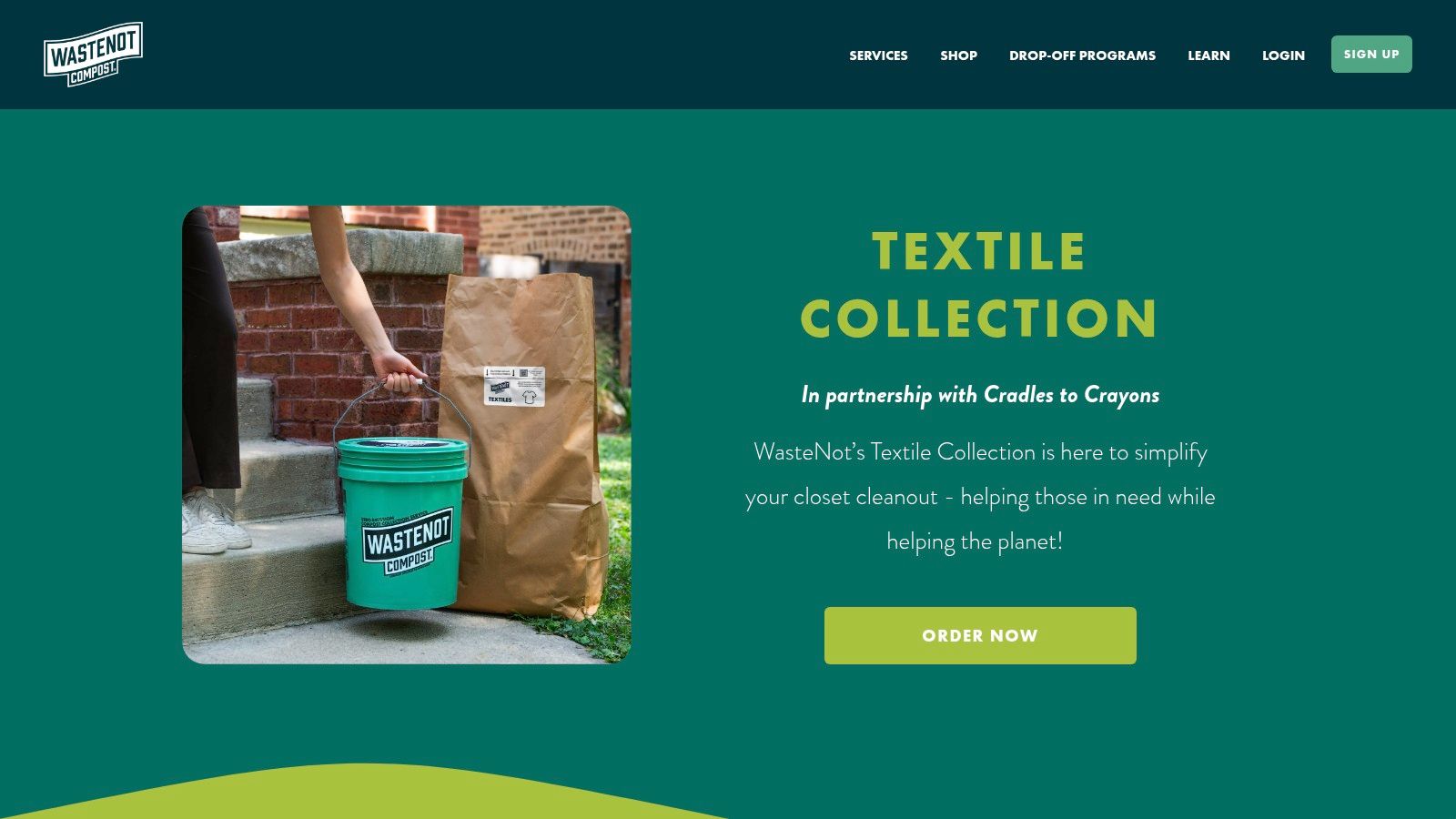
    WasteNot Compost – Textile Collection (with Cradles to Crayons partnership)

    I love services that reduce the number of decisions I have to make. That’s why WasteNot’s textile collection is appealing if you already use them.

    You clean out the fridge. You compost the scraps. You clean out the closet. You set out a textile bag. That rhythm makes sense to me because clutter rarely lives in only one category. When my place gets messy, it’s never just shirts. It’s food waste, paper piles, random bags, and all the little postponed choices stacking into one heavy mood.

    One pickup rhythm, two kinds of relief

    WasteNot accepts clean clothing, shoes, and textiles from its members. Qualifying items go through Cradles to Crayons, and items that don’t meet quality standards still get recycled rather than being removed from the process.

    That’s a powerful emotional design. You don’t need to create a perfect pile. You just need to make a sincere one.

    If you already care about organics, this pairing feels natural. I’d read it alongside composting in Chicago because the mindset is similar. You stop treating “waste” as one final category and start sorting life into better next steps.

    • Best for existing members: This shines if WasteNot is already part of your weekly routine.
    • Best for clean, sorted home cleanouts: The service expects preparation, not a chaotic curb pile.
    • Best for people who want one trusted flow: Fewer vendors, fewer mental tabs left open.

    The limitation is obvious. If you’re not already a WasteNot customer, this isn’t your easiest entry point. It’s a service add-on, not a public walk-up option.

    Still, I respect tools that reward consistency. WasteNot doesn’t feel like a dramatic reset. It feels like a healthy habit. And most personal transformation happens that way. Repeatedly. With a bag by the door and a better choice on a Tuesday morning.

    4. Cradles to Crayons Chicago

    Cradles to Crayons Chicago

    A friend once handed me a bag of toddler clothes and started crying halfway through the handoff. Not because the clothes were in bad shape. Because they were good. Too good. They still held the shape of a life her family had just outgrown.

    That moment taught me something about decluttering. We are rarely sorting fabric alone. We are sorting memory, identity, and the quiet fear that letting go means losing the season that made us.

    Cradles to Crayons Chicago is one of the strongest options in the city for children’s clothing, shoes, coats, and other kid-focused essentials that still have real use left in them. The mission feels personal because it is personal. Your child’s outgrown jacket does not disappear into a vague system. It heads toward another child who needs it.

    That clarity matters on hard cleanout days.

    Cradles to Crayons works especially well for parents who want a local, purposeful home for the pieces that carry emotional weight. I also respect that items outside their acceptance standards may still be directed through recycling partners. That lowers the pressure to build a perfect donation bag before you act.

    If you are already planning errands, it helps to map your stop alongside other recycling centers in Chicago so one trip clears more mental clutter at once. A small route can become a real reset.

    What stands out here:

    • Best for children’s clothing and essentials: This program has a clear lane and a clear recipient.
    • Best for parents processing a life transition: Outgrown sizes often carry more emotion than adult closet cleanouts.
    • Best for people who want giving to feel concrete: The community impact is easy to picture.
    • Limited for adult items: Your own jeans, workwear, and old sweaters need another outlet.

    I keep coming back to the Litter Caterpillars idea that cleaning up the outside world changes your inside world too. A bag of baby clothes by the door can feel small, but sometimes it is the first honest sign that you are ready for the next version of your life. Passing those items on does not erase the chapter. It honors it, then lets it keep serving someone else.

    5. Simple Recycling

    If you live in a participating suburb, Simple Recycling is the kind of service that removes friction so well it almost feels like cheating.

    And I’m for that.

    Some weeks, bravery looks like marching into a blizzard with a trash picker. Other weeks, bravery looks like finally scheduling a pickup instead of pretending the donation bags in your trunk are a personality trait. Home pickup can be the nudge that gets a stuck project moving.

    The convenience play

    Simple Recycling works best for households in participating municipalities rather than Chicago proper. If your suburb offers it, you get on-demand curbside pickup for textiles and other small household items.

    That matters because your cleanout probably isn’t neatly separated. You might have linens, old shoes, a lamp, and a bag of clothes that should’ve left your house two seasons ago. A home service matches real clutter better than a narrow one-item pipeline.

    What I like about this option:

    • You don’t need a special outing: That saves energy.
    • Scheduling creates commitment: Once it’s on the calendar, the pile has a deadline.
    • It suits large cleanouts: Moves, garage resets, and seasonal purges fit well here.

    The catch is geography. If you’re inside Chicago city limits, you may not have access. And if you care a great deal about where each item ends up, you may want a more specialized or local-first route.

    Still, when I think about personal growth, I think about reducing the distance between intention and action. Simple Recycling does that. It shortens the gap. It helps you act before nostalgia talks you into keeping the broken sweater for “paint projects” you never do.

    6. H&M garment collecting

    H&M Garment Collecting

    I’ve had days when the only realistic plan was this. I’m already downtown. I’m already out. I already have the bag in my hand. Just let me finish the job.

    That’s where H&M’s garment collecting program can help. It accepts garments and home textiles from any brand and in any condition through in-store collection boxes.

    Good for imperfect piles

    This is one of the easier chicago textile recycling options for people who don’t have a perfectly curated donation stack. Maybe you’ve got a torn T-shirt, a stretched-out hoodie, and some worn pillowcases. You don’t need the pile to look pretty for this to work.

    I also like retail drop-offs for one simple reason. They meet people where they already are. If someone starts recycling textiles because it fits between errands, I’m not going to sneer at that. I’m going to cheer.

    If you’re building a broader routine around neighborhood reuse habits, you can tie this into your own plan to recycle in Chicago.

    • Best for quick walk-in drops: Especially useful if you work or shop near a store.
    • Best for mixed-condition garments: The acceptance range is broad.
    • Less ideal for tax-minded donors or bulk loads: This is a store collection program, not a full-service logistics partner.

    A small caution. Retail programs depend on store hours, staffing, and in-person flow. If you’re hauling a massive purge, this can feel awkward.

    Bring a manageable bag, not your entire emotional history in six contractor sacks.

    Used well, H&M is the low-barrier option that gets clothes moving instead of marinating in guilt.

    7. Zara clothes collection program

    Zara’s clothes collection program feels made for the person who wants to drop something off while living their normal city life. You’re near the store anyway. You’ve got a bag anyway. You hand it off and keep walking.

    That ease matters more than people admit.

    When I’m trying to change a habit, I look for the path with the fewest chances to bail. A downtown worker, a student, or a weekend shopper can use Zara that way. It fits into movement rather than demanding a separate mission.

    A clean fit for casual drop-offs

    Zara hosts on-site collection containers in stores, and the program sorts items for reuse or recycling. It also connects to the brand’s wider circular efforts, which gives the drop-off a bigger ecosystem than a random bin with no context.

    I’d place Zara in the “urban convenience” category. It’s not for giant volumes. It’s not for a school drive. It’s not for building-wide pickups. It’s for the tote bag full of clothes you finally decided to stop storing.

    Here’s the honest read:

    • Strong fit for downtown routines: Commute, shopping trip, quick handoff.
    • Strong fit for any-brand clothing donations: You don’t have to sort by label.
    • Weak fit for bulky household cleanouts: This isn’t the right tool for a move-out mountain.

    I also think these in-store programs do something subtle but useful. They normalize textile recycling. They put the act in plain sight. That can shift your brain. Once dropping off old clothing feels normal, you’re more likely to keep doing it.

    Zara won’t solve every textile problem in your home. But it can absolutely solve the small pile that keeps staring at you from a chair in the bedroom.

    8. Ridwell Threads
    Ridwell (Threads category)

    Ridwell makes sense to me for one specific kind of person. The person who knows clutter comes in waves and wants a recurring system, not a heroic once-a-year purge.

    That person might be you.

    Ridwell has a Threads category for clothes, shoes, and textiles. Depending on where you live, pickup availability can vary, and there’s also a mail-in option. It’s a paid membership model, so this is less “free neighborhood bin” and more “I’m building a repeatable home system.”

    Why subscriptions help some people

    I used to think paying for structure meant weakness. I don’t think that anymore. Sometimes paying for structure means you finally respect your own patterns. If you know items pile up, and you know you avoid specialty recycling errands, a recurring service can interrupt that cycle before it hardens into another closet landslide.

    Ridwell also appeals to people who want clearer guidance on accepted materials across categories. It isn’t only about textiles. It’s about reducing the number of weird, hard-to-recycle items that end up lingering in your home because they don’t fit ordinary disposal.

    • Best for recurring declutterers: Parents, busy professionals, chronic pilers.
    • Best for multi-material households: If clothes are only one part of your waste puzzle.
    • Worst for one-off budget-minded users: Membership won’t make sense for everyone.

    I wouldn’t recommend Ridwell to somebody who just wants the cheapest way to unload one bag of shirts. But if your real battle is consistency, systems beat motivation almost every time.

    That’s true in volunteering too. The reason Litter Caterpillars works is not because every Saturday feels easy. It works because the rhythm carries us when motivation doesn’t.

    9. Planet Aid
    Planet Aid

    Planet Aid belongs in the conversation because yellow bins are familiar for a reason. Planet Aid offers another bin-based route for clothing and shoes across the broader region, including parts of Illinois.

    I’m a fan of familiar when familiar helps you act.

    One thing I’ve learned doing community cleanup is that infrastructure matters. If people don’t see an obvious path, they default to the easiest path, and the easiest path is often the trash. Visible bins fight that tendency.

    Bin-based and simple

    Planet Aid follows a reuse-first approach, with recycling for non-wearables. That makes it a practical option for standard wardrobe cleanouts where the main goal is to move usable items out of your home responsibly.

    I’d compare it loosely to other donation-bin networks. The value is access. The risk is that neighborhood coverage changes, and not every location feels equally convenient.

    Use it when you want:

    • A free drop-off option
    • A neighborhood bin alternative
    • A straightforward routine without appointments

    Skip it when you need highly specific processing details for each item or when you’re dealing with very contaminated textiles that likely need tighter handling.

    There’s something emotionally helpful about dropping a bag into a bin and hearing it land. It’s a tiny sound, but it marks a decision. Done. Gone. Moved.

    And a lot of healing starts with small completed decisions.

    10. Unique Thrift and Savers donation centers
    Unique Thrift (Savers / Community Donation Centers)

    Some cleanouts are not delicate. They are not aesthetic. They are not a cute little basket of neutral-toned capsule wardrobe pieces. They are huge, messy, and overdue.

    For those days, Unique Thrift’s Community Donation Center has a clear advantage. It’s built for volume.

    When you need speed and throughput

    Drive-up donation lanes matter. If you’re unloading multiple bags and you want the relief of seeing them leave your car in one shot, a high-volume thrift donation center can feel amazing.

    I’ve had moments where I knew that if I brought the bags back upstairs, I’d lose another month to indecision. Some tasks need gentleness. Others need momentum.

    Unique Thrift works well for broad ranges of clothing and soft goods, with resale up front and downstream recycling routes for unsellable textiles when possible. That makes it practical, especially for people doing a serious apartment reset.

    The honest pros and cons look like this:

    • Great for large drop-offs during store hours
    • Great for donors who want an easy car-based unload
    • Less ideal for people who want total clarity on each recycling partner or pathway

    I’d use this option when your real enemy is backlog. Not philosophy. Not perfection. Backlog.

    Chicago Textile Recycling, Top 10 Comparison

    Program Core Offerings ✨ Convenience / Quality ★ Cost / Value 💰 Best For 👥 Standout 🏆
    Chicago Textile Recycling (CTR) – Wipeco Local collection bins & org pickups; secure destruction; wiper/fiber processing ✨ ★★★★, tailored service for orgs (not curbside) 💰 Org/pricing; pickup fees possible 👥 Schools, property managers, events 🏆 Local closed‑loop + certified destruction
    USAgain Wide outdoor bin network; reuse-first; warehouse logistics ✨ ★★★★★, 24/7 drop-off footprint 💰 Free drop-off 👥 Residents after cleanups; bin hosts 🏆 Very convenient network for high volumes
    WasteNot Compost (textile) Textile stream + composting; partnership with Cradles to Crayons ✨ ★★★★, bundled with WasteNot service 💰 Bundled with subscription (customers) 👥 WasteNot subscribers; eco-conscious households 🏆 Combines compost & textile diversion
    Cradles to Crayons Chicago Children’s clothing redistribution; many drop sites & pickups ✨ ★★★★, many local drop-offs; selective pickups 💰 Free donations 👥 Donors of kids’ items; families in need 🏆 Direct local impact for children
    Simple Recycling Free curbside textile pickup in participating suburbs ✨ ★★★★★, home pickup & scheduling 💰 Free for participating households 👥 Suburban residents with service 🏆 Maximizes diversion via curbside pickup
    H&M Garment Collecting In-store drop boxes; accepts any brand/condition ✨ ★★★★, walk-in convenience at stores 💰 Free drop-off 👥 Shoppers; downtown workers 🏆 Accepts damaged textiles many programs refuse
    Zara – Clothes Collection Program In-store donation containers; ties to repair/resale ✨ ★★★★, convenient retail drop-offs 💰 Free drop-off 👥 Shoppers and downtown donors 🏆 Integrated with brand circular programs
    Ridwell (Threads) Subscription mail-in/local pickup; clear acceptance guidance ✨ ★★★★, reliable for subscribers 💰 Paid subscription (recurring) 👥 Recurring users wanting clarity 🏆 Transparent partners & multi-material service
    Planet Aid Yellow donation bins; reuse-first with recycling fallback ✨ ★★★, neighborhood bins; coverage varies 💰 Free drop-off 👥 Local neighborhood donors 🏆 Nonprofit operator with regular reporting
    Unique Thrift (Savers / CDC) Drive‑up donation centers; resale + recycler pathways ✨ ★★★★, fast drops during store hours 💰 Free drop-off; supports nonprofits 👥 Donors with bulk/textile lots 🏆 High-volume processing & nonprofit partnerships

    From Clutter to Clarity Your City is Waiting

    Last winter, I pulled a coat from the back of my closet that I had not worn in years. The pockets still held a train receipt, a grocery list, and a tiny knot in my chest. I kept telling myself I would wear it again, fix the button, become the version of me that still matched that coat. Instead, it sat there taking up space, asking for a decision every time I reached past it.

    So I made one.

    I filled a bag with that coat, two stretched-out sweaters, a lonely sock collection, and a stack of T-shirts from old jobs. Then I carried the bag out the door on a cold Chicago morning. The bag was not especially heavy. My shoulders felt lighter anyway.

    I know that feeling from cleanup days with Litter Caterpillars. You show up to a block that looks tired. Plastic in the weeds. Fast-food cups in the gutter. A shirt twisted around a chain-link fence. You pick up one thing, then another, and the whole street starts looking possible again. The mess loses its power the minute somebody touches it with purpose.

    Closets do that too.

    Choosing a chicago textile recycling option is a practical errand, but it is also a vote for the person you want to be next. You stop treating the past like storage. You use what can still serve someone. You release what cannot stay. You prove to yourself that stuck is not permanent.

    As noted earlier, a huge amount of clothing gets tossed each year even though much of it can be reused or recycled when it is clean and dry. That citywide problem starts in tiny, private places. One bedroom floor. One overstuffed hall closet. One bag finally tied shut and carried downstairs.

    I like that textile recycling does not demand a perfect ending. Some pieces get worn again by someone who needs them. Some get cut into wiping cloths. Some get broken down into fiber and turned into something less glamorous but still useful. That honest second life matters. Personal growth often looks like that too. Not dramatic. Not cinematic. Just useful, real, and better than letting things decay in the dark.

    You do not need a perfect cleanout to make a meaningful one.

    If you are frozen, go smaller. Start with old socks. One shelf. One laundry basket. Give yourself twenty minutes and one clear rule. If you would not choose it today, let it go today.

    That is the deeper lesson in the Litter Caterpillars story, and it is why this work hits harder than people expect. Service changes the person doing it. You head out to help your block, and your own mind settles down a little. You clear an alley, and suddenly answering emails at home feels less impossible. You drop off clothes that have been weighing on you for months, and the room in front of you starts to match the room you wanted in your head.

    Chicago is full of places to begin. A neighborhood bin. A store drop-off. A pickup service. A nonprofit that can pass along children’s items to families who need them. The method matters less than the moment you stop postponing it.

    You started. That counts.

    You moved something out of your home and back into circulation. You made space in your closet, in your mind, and in your city. If this stirred something in you, come put that energy to work with Litter Caterpillars. We’re a volunteer-driven Chicago cleanup group built on bravery, kindness, consistency, and friendship. Join us for a weekend pickup and see what happens when you clean a block, meet good people, and remember that change usually begins with one bag in your hand.


  • Urban Kayaks Chicago IL: Paddle Your City Waterways

    Urban Kayaks Chicago IL: Paddle Your City Waterways

    The first time I slipped a kayak into the Chicago River, I expected a fun afternoon. Instead, I got a hard reset. The glass towers looked less like real estate and more like cliffs, and for the first time I felt that this city had a pulse I could touch.

    Paddling a Different Path in Chicago

    I knew Chicago from sidewalks. I knew it from train platforms, coffee runs, and the long winter trudge with my shoulders up around my ears. Then I saw it from the water.

    From that low seat in a kayak, the whole city changed shape. Bridges stopped being traffic funnels and started feeling like gates. The river stopped looking like background scenery and started acting like a main street that had been there all along, waiting for me to notice.

    A person kayaking on the water with the Chicago skyline in the background, featuring an artistic watercolor style.

    When the city stops being flat

    A kayak is a tiny thing. That’s part of the magic.

    You sit inches above the water, and suddenly Chicago rises around you like a canyon of steel and stone. You hear the slap of paddle blades. You watch sunlight ricochet off windows. You move under buildings that tourists usually photograph from a bridge, not beneath it.

    That’s why urban kayaks chicago il matters to me as more than a search phrase. It points to a very specific kind of experience. You’re not leaving the city to find nature. You’re finding a wilder version of the city itself.

    Chicago also has the scale to make that experience feel bigger than a novelty. The city welcomed over 55 million visitors in 2023, and water-based activities have become part of that hunger for lived experience, not just sightseeing, according to Urban Kayaks company information on Chicago tourism and operations.

    The water gives you a second map of Chicago. Once you see that map, you can't unsee it.

    A small boat can start a new story

    A lot of people think a paddle is just recreation. I get why. You book a slot, grab a life jacket, and push off.

    But something deeper happens when you move through a city under your own power. You notice details you’d otherwise miss. A cormorant on a piling. The texture of old bridge supports. The weird quiet that falls under a span before the downtown noise rushes back in.

    That new attention changes you. It’s a lot like cleanup work in that way. You start because you want to do one simple thing. By the end, you realize the simple thing was just the door.

    Here’s what I mean:

    • At street level, Chicago can feel like a list of errands.
    • From the river, Chicago feels layered, built by human ambition and water at the same time.
    • From your own kayak, that layered city becomes personal. You’re not watching it. You’re moving through it.

    I’ve watched first-timers shove off stiff and nervous, then come back grinning like they discovered a hidden room in their own house. That reaction makes sense. Paddling downtown doesn’t feel like escaping Chicago. It feels like meeting it.

    Your First Chicago Paddle Where to Begin

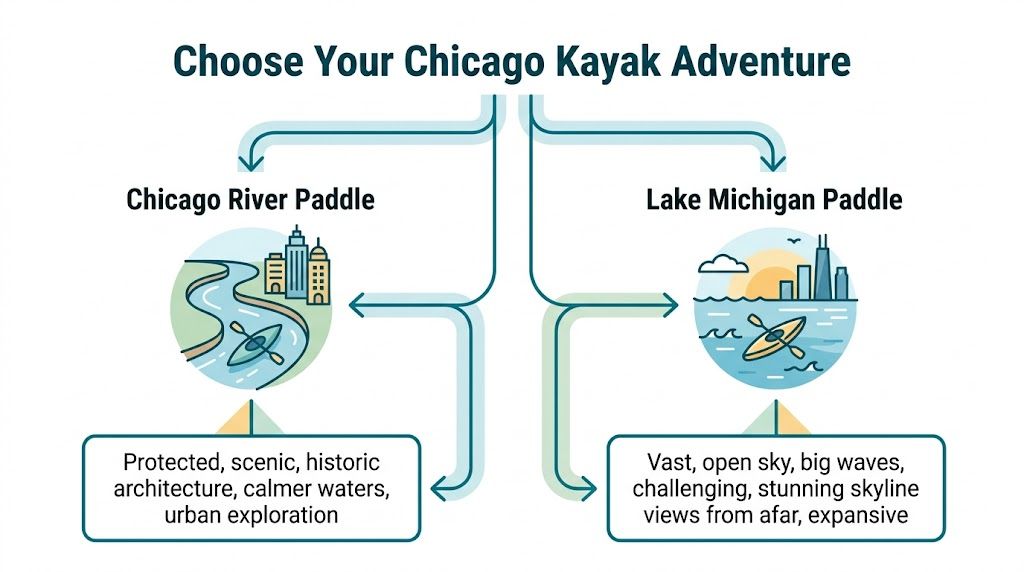
    Your first choice is simple. Do you want the city wrapped around you, or do you want the city spread out in front of you?

    The river feels like walking into a novel. The lake feels like opening a giant door.

    A diagram comparing kayaking on the Chicago River versus Lake Michigan with descriptions of their unique features.

    River or lake

    I tell beginners to pick the experience, not the bragging rights. If you choose based on mood, you usually choose well.

    Route What it feels like Best for
    Chicago River Close, architectural, protected, busy with stories First timers, city lovers, people who want a guided feel
    Lake Michigan Open, airy, horizon-heavy, more exposed Paddlers who want space, skyline views, and more weather awareness

    The Chicago River is intimate. You turn a bend and get brick, glass, old infrastructure, reflections, and that feeling that the city is leaning over to inspect you. The water carries history with you.

    The lakefront is about scale. You don’t just see the skyline. You measure yourself against it. Some people love that immediately. Some discover they’d rather start on the river and build up.

    Launch areas and the vibe they give you

    Different parts of the city feel different from a kayak. That matters.

    • Riverwalk launches give you the classic urban canyon. You’re close to downtown architecture, bridges, and a steady sense of motion.
    • North Branch stretches feel rougher around the edges in a good way. You get more industrial texture, more space to notice birds, and a more local rhythm.
    • Lakefront harbors offer calmer access points to bigger open water. You can ease in, get your bearings, and decide how bold you feel that day.

    If you’re unsure, pick the route that makes you curious rather than the route that makes you nervous.

    Practical rule: If you want your first paddle to feel memorable and manageable, choose the water that helps you relax enough to look around.

    A route with proof of recovery

    One of my favorite examples of why river paddling in Chicago hits so hard is the Wild Mile. It isn’t just pretty. It shows what a city can repair.

    That stretch includes 800 feet of floating gardens, and those habitats have contributed to a 25% increase in fish species, according to Miles Paddled's overview of the Chicago River and Wild Mile. That means your paddle can double as a front-row seat to restoration, not just recreation.

    You glide past greenery and realize this isn’t a fantasy version of urban nature. It’s a worked-on, fought-for, actively recovering place. That matters. It gives the trip weight.

    If you’re going with friends who want something social and outdoorsy, I’d also think about how your paddle fits into a bigger day. Some people pair it with a walk, coffee, or another active outing. If that’s your style, these outdoor group activities for adults in Chicago can help you build the day around the paddle instead of treating it like a one-off booking.

    My honest advice for first-timers

    I’d keep your first outing humble.

    Pick a route with clear boundaries. Go at a time when you won’t feel rushed. Let the city impress you slowly. The best first paddle isn’t the most dramatic one. It’s the one that makes you want to come back next weekend.

    Getting Your Kayak to the Chicago River

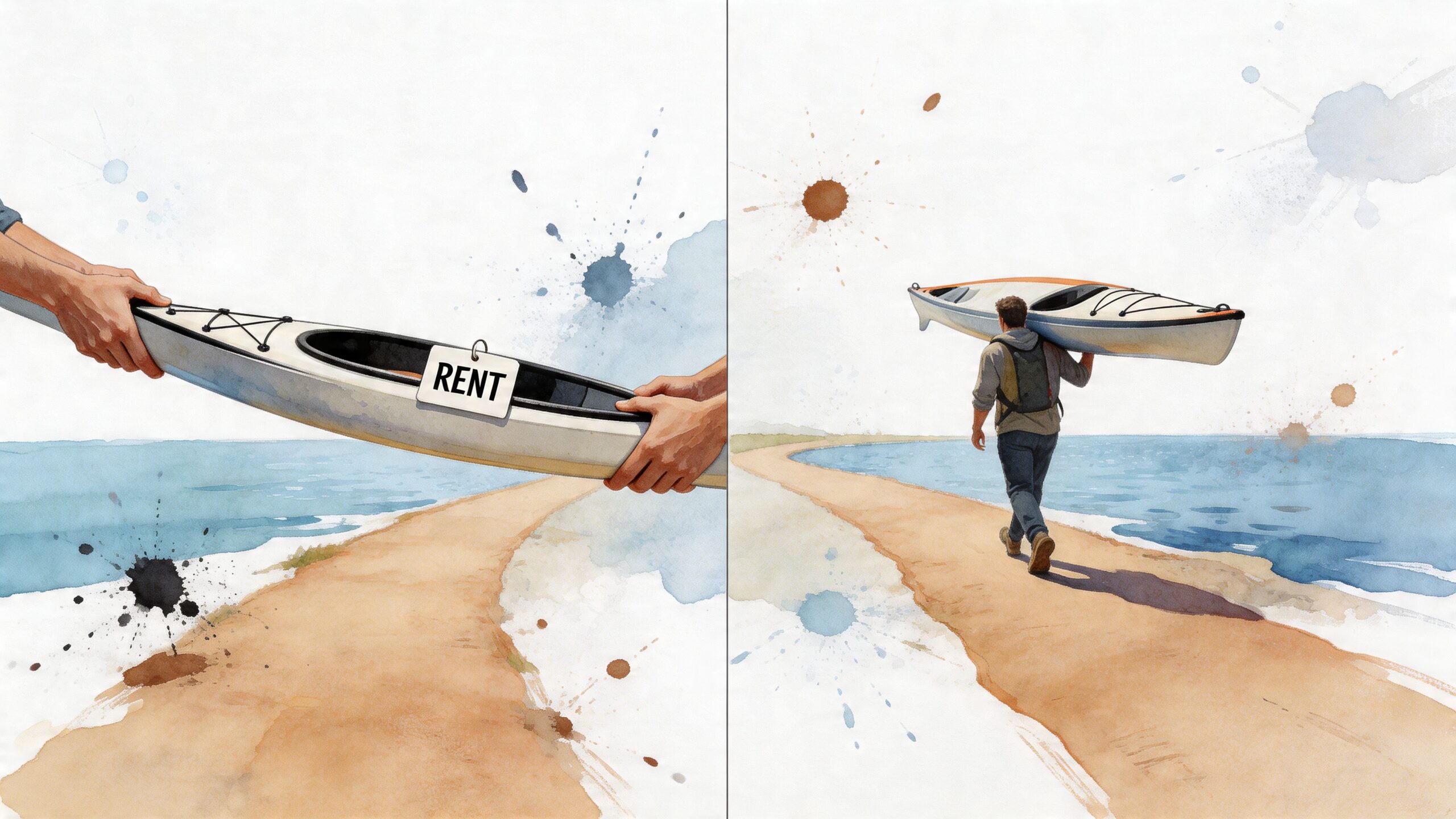
    The first logistical question is usually this. Should you rent, or should you bring your own boat?

    I’ve done both. Renting feels like borrowing confidence. Bringing your own feels like carrying freedom on your roof.

    A watercolor illustration showing a person renting and then carrying a kayak along a beach path.

    Rent first if you're still learning the city

    If this is your first or second time, rent. It removes friction.

    You don’t have to think about storage, straps, loading, unloading, or whether your launch choice makes sense for your skill level. You just show up, listen carefully, wear the gear they give you, and focus on the water.

    That’s especially useful in Chicago because many people want lower-barrier entry into paddling. Local meetup interest has shown 40% interest in winter paddling, along with ongoing demand for beginner-friendly guidance, according to Tripadvisor discussion and review context gathered around Urban Kayaks. That tells me a lot of people are hungry for access, not just adrenaline.

    Bring your own when you want flexibility

    Owning or borrowing your own kayak changes the rhythm of the day. You’re not on anyone else’s schedule.

    You can linger. You can launch early. You can build your whole weekend around the trip. But freedom gets expensive in attention. You have to think like a driver, a porter, and a paddler before you ever touch the water.

    Here’s the street-smart version of that process:

    1. Check your carry plan. A kayak is awkward before it is fun. Know how you’re getting it from car to launch.
    2. Study the launch in advance. Some spots look easy on a map and feel ridiculous when you arrive with a boat on your shoulder.
    3. Pack before you park. Don’t spread loose gear across a curb and sort it out while everyone watches.
    4. Assume the wind will humble you. It often does, even before launch.

    What the launch actually feels like

    The city doesn’t always make paddling obvious. That’s part of its charm and part of its headache.

    Some launch points feel polished and intuitive. Others feel like you’ve found a secret loading dock for a very specific subculture. I’ve walked down paths thinking, This can’t be right, only to arrive at exactly the right place.

    A few habits help:

    • Travel light on your first self-launch. Fewer loose items means fewer chances to fumble.
    • Wear the PFD before you start carrying gear. One less task at the water’s edge.
    • Pause and watch others launch. You’ll learn more in three minutes than from twenty minutes of guessing.

    For people trying to keep the whole outing low-impact, I’d also pay attention to how you get there. If you want ideas for reducing the mess around car-heavy recreation, this guide to eco-friendly transport choices is worth a look.

    Launching your kayak in Chicago feels a little like finding the side door to the city. Once you know where it is, everything gets easier.

    Make logistics boring on purpose

    I want your transport routine to feel boring. That’s a compliment.

    The more ordinary your prep becomes, the more energy you’ll have left for the water itself. You don’t want your big memory of the day to be the parking scramble, the dropped paddle, or the soaked phone. You want the memory to be that first clean glide under a bridge when the city opens up.

    Staying Safe on Chicago's Waterways

    Bravery on the water doesn’t mean acting fearless. It means respecting what can go wrong and preparing so you don’t freeze when conditions change.

    Chicago rewards that mindset. It also punishes sloppy confidence.

    A man kayaking in a swimming pool next to a watercolor illustration of a Chicago river scene.

    Treat the river like a working street

    The Chicago River is not a lazy park lagoon. Boats work there. Tours pass through. Currents move around structures and locks in ways you may not expect.

    I always tell people to think of a barge like a moving building. Don’t argue with it. Don’t try to prove you can slip past. Give large vessels room early, not late.

    Professional instructors train for exactly these urban conditions. ACA-certified training includes hazards like barge traffic and thermal currents from the river locks, and rescue skills such as a bow rescue have to be completed in under 30 seconds in simulated windy conditions, according to Urban Kayaks' ACA Level 2 instructor workshop overview. That should tell you something. The environment is manageable, but it deserves trained respect.

    A few rules I never break

    I keep these simple because simple rules survive stress.

    • Stay visible. Don’t drift where larger craft won’t expect you.
    • Cross busy channels decisively. Commit. Hesitation creates confusion.
    • Look behind you often. Urban paddlers who only look forward miss half the risk.
    • If weather feels off, trust that feeling. The city can turn moody fast.

    You don't earn toughness points for ignoring conditions. You earn a better day by reading them early.

    Weather and water quality both matter

    A blue sky can lie to you. Wind matters. Boat traffic matters. Recent rain matters.

    After storms, I get more cautious about the water itself. The Chicago River has improved a lot, but cleaner doesn’t mean clean in every moment. Pay attention to storm timing, runoff, and whether you have open cuts on your hands.

    That awareness also changes how you touch the water. I avoid casual splashing. I keep hand sanitizer in my dry bag. If I pick up debris, I think about where my hands go next.

    A quick visual refresher can help before you head out:

    Confidence comes from habits

    Most water fear shrinks when you have a repeatable system.

    Situation What I do
    Big boat nearby Hold line, stay predictable, let it pass
    Wind picks up Shorten plans, hug safer water, turn back early
    Crowded stretch Slow down and simplify decisions
    Unsure about conditions Ask, wait, or skip it

    You can be adventurous and disciplined at the same time. In fact, that’s the only kind of adventure I trust in a city waterway.

    Your Chicago Kayaking Gear Checklist

    My gear philosophy is plain. Bring what protects the mission. Skip what turns your boat into a junk drawer.

    You don’t need to cosplay as an expedition paddler to enjoy urban kayaks chicago il. You need a tight setup that covers safety, comfort, and common sense.

    The never-skip items

    • PFD you actually wear. Not under a bungee cord. Not behind the seat. On your body.
    • Whistle. If your voice disappears in wind or traffic noise, a whistle cuts through.
    • Dry bag. Phone, keys, wallet. Water loves loose electronics.
    • Water bottle. City paddles can feel deceptively easy until the sun drains you.
    • Sun protection. Hat, sunscreen, sunglasses with a retainer if you have one.

    The things that make the day smoother

    I’ve learned to value small comforts because they prevent dumb problems.

    • Paddling gloves help if your hands blister easily.
    • Quick-dry clothes beat cotton every time.
    • Water shoes or secure sandals make launches less awkward.
    • A snack helps if you stay out longer than planned.

    Field note: The best gear is the gear you can find quickly when you're tired, wet, and trying not to drop your paddle.

    The one extra item I always respect

    Bring a small trash bag.

    Not because you need to turn every trip into a cleanup mission, but because once you start noticing floating litter, it’s hard to unsee it. Even picking up one bottle or one drifting food container changes your relationship to the river. You stop acting like a visitor and start acting like a steward.

    Paddling with Purpose Join a Waterway Cleanup

    At some point, almost every regular paddler has the same moment. You’re gliding along, feeling good, and then a chip bag catches on a branch or a plastic bottle spins in an eddy like it belongs there.

    That moment can sour the trip. Or it can deepen it.

    The river asks you to participate

    The Chicago River is cleaner than it used to be, but it still receives over 1,200 tons of litter annually through storm drains, according to Urban Kayaks' river tour page discussing river conditions and cleanup potential. I don’t read that as a depressing fact. I read it as a direct invitation.

    A kayak puts you close to problems that people onshore miss. You can reach a bottle wedged against a wall. You can spot debris caught under branches. You can notice patterns, not just isolated trash.

    That’s why I love the idea of litter-paddling. It turns an outing into service without draining the joy out of it.

    How to do it without being reckless

    Don’t try to play hero with every object you see. Smart cleanup matters more than dramatic cleanup.

    I’d keep it simple:

    • Use a mesh bag or small trash bag for lightweight floating debris.
    • Carry a grabber only if it won’t tangle your setup.
    • Leave heavy, submerged, or hazardous items alone.
    • Work calm edges, not busy traffic lines.
    • Wash your hands well after the trip.

    The best cleanup paddlers stay conservative. They collect what they can reach safely and leave the rest for a better-equipped effort.

    Why this changes the whole experience

    Service sharpens your attention. You stop consuming the river and start reading it.

    A skyline paddle is beautiful. A skyline paddle where you remove a few pieces of floating trash feels different. You leave with evidence in your bag that you weren’t just entertained. You helped.

    If you want a better sense of what river stewardship can look like on the ground and on the water, this piece on cleaning up a river with a volunteer mindset offers a useful frame for thinking beyond one-off action.

    A river cleanup doesn't just remove trash. It teaches you to notice what the city has been carrying.

    That’s the transformation I keep coming back to. Recreation wakes you up. Responsibility gives that awakening a direction.

    Your River, Your City, Your Story

    Chicago will always offer easy ways to stay on the surface. You can admire the skyline, snap the photo, eat the meal, and go home with a perfectly fine day.

    Or you can get lower to the water.

    You can feel the wake hit your hull. You can learn the rhythm of bridges and bends. You can notice beauty and neglect in the same hour, then decide that both belong to you because this city belongs to you.

    That’s why I think urban kayaks chicago il is bigger than tourism. A paddle can be a workout, a date, a solo reset, a lesson in courage, or the start of a civic habit. Sometimes it’s all of those at once.

    So write a stronger story than “I visited.” Paddle with alertness. Paddle with humility. Paddle with enough heart that when you come back to shore, the city feels less like a backdrop and more like a relationship.


    If you want that relationship to keep growing after your paddle, join Litter Caterpillars. It’s a bold Chicago volunteer group built around bravery, friendship, and visible action. Show up on a weekend morning, meet good people, and help clean the city block by block.

  • How to Make Friends as an Adult: A Real-World Guide

    How to Make Friends as an Adult: A Real-World Guide

    I once stood in my kitchen holding a jar of ancient blueberry jam like it was evidence from a lost life. Then I looked around at the clutter, the silence, the fallout from a relationship that had drained me, and I realized I didn’t just need to clean my apartment. I needed to rebuild my people.

    The Loneliness Problem I Couldn't Clean Up

    My place used to look like my inner life felt. Crowded. Stale. Weirdly sentimental about things that should’ve gone out weeks ago.

    I had trash with backstories. A half-finished bag of nuts from my brief healthy era. Old receipts from days I couldn’t even remember. The blueberry jam from a trip that mattered more in my memory than it ever did in real life. None of it weighed much, but every item felt heavy. I’m talking emotional cinder block heavy.

    Then a chaotic relationship ended, and the whole illusion cracked. I had spent too long tolerating selfishness, too long calling inconsistency “chemistry,” too long acting like loneliness would solve itself if I just stayed busy. It didn’t. It spread.

    A sad woman crying on a sofa while looking at a torn photograph of a couple.

    When your life gets smaller

    The hardest part of loneliness as an adult isn’t always dramatic. Sometimes it’s stupidly ordinary. You go through a whole weekend and realize nobody saw you outside of a cashier and a screen. You have a funny story and no one to text it to. You need help moving a chair and think, “Who would I even ask?”

    That private pain isn’t just in your head. A 2021 survey on close friendships among U.S. adults found that the share of adults reporting 10 or more close friends fell from 33% in 1990 to 13% in 2021, while 12% reported having no close friends at all.

    That hit me because it explained something I had felt but couldn’t name. I wasn’t failing at adulthood because friendship got harder. Friendship had gotten harder, period.

    Practical rule: If your social life feels broken, stop treating it like a personality defect. Treat it like a problem that needs design, repetition, and courage.

    Why cleaning up someone else’s mess helped me

    I learned something strange when I started helping clean outdoor spaces. Other people’s mess felt easier to face than my own. A candy wrapper on the sidewalk didn’t come with shame. A bottle in the grass didn’t carry my history. I could bend down, grab it, toss it, and feel one tiny burst of order.

    That mattered.

    Because once you’ve spent enough time stuck, momentum matters more than insight. You don’t need another podcast telling you to “put yourself out there.” You need a place to stand, something useful to do with your hands, and a reason to show up when your feelings say stay home.

    I’ve written before about fighting social anxiety one piece of trash at a time, and that phrase still feels true to me. Service gave me a side door into connection. I didn’t have to be dazzling. I just had to be present.

    That’s when I started seeing friendship differently. Not as luck. Not as chemistry. Not as something that falls from the sky when your life gets cute enough.

    More like cleanup.

    You show up. You pick one thing up. Then another. Then another. And one day the place looks different.

    So do you.

    How to Find Your People by Filtering for Givers

    Most adult friendship advice is too polite. It tells you to join a club, download an app, go to a mixer, smile more. Fine. But if you’re serious about how to make friends as an adult, you need a better question than “Where do I meet people?”

    Ask this instead. What kind of activity makes selfish people less likely to show up?

    That question changed everything for me.

    I used to think I had a bad picker in romance and friendship. But the truth was less mysterious. I kept putting myself in environments that rewarded charm, spontaneity, and vibes. Those places can be fun, but they’re terrible filters. A loud room hides a lot. So does a casual social scene where nobody has to sacrifice anything.

    If you want better friends, pick better proving grounds.

    A diverse group of adults and an elderly man sharing cookies and flowers in a park setting.

    Why challenge reveals character

    A warm café is great for catching up with people you already trust. It’s not great for screening new ones. Everybody looks generous when the lighting is soft and the stakes are zero.

    A service activity in bad weather tells you more.

    You notice who shows up early.
    You notice who shares gloves.
    You notice who complains for two hours and who makes the whole thing feel lighter.
    You notice who sees an older volunteer struggling with a bag and helps without turning it into theater.

    That’s what I mean by filtering for givers. Not saints. Not perfect people. Givers. People who can carry a little discomfort without making it everyone else’s problem.

    A strong social life doesn’t come from collecting whoever is available. It comes from building around people with the right instincts.

    The activity is the filter

    The best social settings aren’t always the most comfortable. They’re the most revealing.

    A weekend morning volunteer shift does something a random happy hour doesn’t. It asks for effort. It asks for wakefulness. It asks for a tiny act of selflessness before brunch and errands and scrolling can swallow the day. That alone changes who walks through the door.

    The logic here is simple. If the activity requires consistency, a little grit, and some public usefulness, it naturally attracts people who value those things.

    That isn’t just my opinion. Jen Hatmaker’s article on finding your people includes this idea directly: strategically engineering social circles by activity design is a powerful filtering tool, and scheduling volunteer events on weekend mornings can naturally attract givers over partiers. The same verified material notes that a 2025 Corporation for National & Community Service report found volunteer retention doubles in adversity-groups, which supports the point that shared struggle builds committed circles.

    If you keep meeting flaky, self-involved people, stop blaming your luck and start auditing your settings.

    What this looks like in real life

    I’ve watched people bond faster while carrying trash bags through wind than they ever did at polished networking events. Not because suffering is magical. Because challenge strips away performance.

    Here’s what service-based challenge gives you that generic social advice doesn’t:

    • A built-in job: You don’t have to invent conversation from thin air. You already share a task.
    • Visible character clues: You see kindness, patience, grit, and selfishness in motion.
    • Low-pressure repetition: People come back regularly, so you don’t have to force instant intimacy.
    • A reason to care together: Shared purpose gives the interaction weight.

    That’s why meeting like-minded people through intentional community settings works better than floating through random social noise. The right structure does half the work for you.

    Stop waiting for spontaneous friendship

    A lot of adults still cling to a high school fantasy. You sit near someone enough times, say a few funny things, and suddenly you’re close. That happened more easily when life shoved us into shared spaces every day. Adult life doesn’t do that.

    You have to build your own ecosystem now.

    That means choosing places where the social outcome isn’t the only point. Ironically, that’s what makes connection more likely. When people focus on helping, hauling, sorting, carrying, or fixing, they relax. They reveal themselves. They become easier to trust.

    And trust is the whole game.

    You don’t need to become more universally appealing. You need to become more intentional about where you invest your hours. Friendship grows best where values show up in behavior.

    If you want a tribe, don’t just chase people. Chase a cause that forces good people to become visible.

    Your Step-by-Step Guide to Making the First Move

    The first move feels huge when you’ve been lonely for a while. Your brain turns “say hi” into “perform a TED Talk while being judged by a panel.” I know that feeling well.

    I used to stand near people I wanted to know and act busy. I’d tie a bag. Adjust my sleeve. Look very interested in a random leaf. I was physically present and socially absent. That’s a brutal habit because it lets you tell yourself you’re trying when you’re really hiding.

    The fix started with one idea. You probably think people like you less than they do.

    The liking gap is messing with you

    Dr. Marisa G. Franco’s Acceptance Prophecy Methodology addresses the liking gap, where people underestimate how much others like them by 50-60%. Her approach is simple but powerful. Assume baseline likability. That shift can increase your own friendliness by up to 40% and can raise the success rate of turning group acquaintances into one-on-one friends to 70%, as described in Dr. Franco’s guide to making friends as an adult.

    That idea changed the script in my head.

    Before, I’d leave an interaction thinking, “I was awkward.” After learning this, I started asking, “What if they enjoyed that more than I think?” That one question made me warmer, more direct, and less weirdly defensive.

    You do not need certainty before you act. You need a more generous interpretation of how you’re being received.

    The four-part move

    I like simple systems because anxiety loves fog. Here’s the one I use.

    1. Show up enough times for familiarity to do its job

    Don’t treat the first event like speed dating for best friends. Your first task is repeat exposure. Come back. Let people see your face enough times that your presence starts to feel normal.

    If you disappear after one appearance, nobody has enough material to trust you yet.

    2. Assume they’ll be glad you spoke

    This is the inner move. Before you walk over, say something like, “They probably don’t need me to be impressive. They just need me to be human.”

    That sounds small. It isn’t. It changes your body language. You smile sooner. You stop overediting. You become easier to talk to.

    3. Open with the obvious truth in front of you

    Forget clever. Use what’s happening right now.

    A lot of people freeze because they think the opener has to sparkle. It doesn’t. It has to land. Real life already gives you material.
    Here are a few openers that work because they’re specific and low-pressure:

    Conversation Starters That Actually Work
    The Situation Your Opening Line
    You’re both grabbing supplies “Hey, have you done this route before, or are you winging it like me?”
    It’s freezing or raining “I can’t decide if this weather is miserable or kind of funny.”
    They did something helpful “That was kind of you. You noticed that fast.”
    You keep seeing them each week “I think we’ve been orbiting the same events for a while. I’m glad we finally said hi.”
    You’re walking between tasks “What made you start coming out to this kind of thing?”
    The event just ended “I’m starving after that. Are you headed straight home or doing a recovery snack somewhere?”

    4. Make the tiny invitation before the moment closes

    Many hesitate at this stage. They have a decent conversation, then leave with a polite smile and no bridge to the next one.

    You need a bridge.

    Not a giant one. A wooden plank. Something easy.

    Try these:

    • After a good chat: “I liked talking with you. Want to grab coffee after this next time?”
    • When you’ve seen them more than once: “You seem fun and solid. Want to swap numbers so we can coordinate next week?”
    • When you share a local connection: “You’re in my area too? We should do a neighborhood walk sometime.”

    None of these lines are too much. They’re clear. Adults appreciate clear.

    What awkward people do wrong

    I say this with love because I’ve done every one of these.

    • You hover instead of entering: You stand nearby and hope someone rescues you.
    • You wait for perfect timing: There isn’t any.
    • You talk once and vanish: Repetition builds trust.
    • You confuse chemistry with momentum: A pleasant moment means nothing if nobody follows up.
    • You make the invitation too big: Don’t jump to “we should all take a weekend trip.” Start with coffee.

    A script for the whole interaction

    If you want a practical sequence, use this:

    1. Approach: “Hey, I’m [your name].”
    2. Anchor to the moment: “This wind is trying to humble us.”
    3. Ask one simple question: “How’d you get into this?”
    4. Reflect something back: “That makes sense. I like that.”
    5. End with a small next step: “I’m glad we talked. Want to swap numbers and say hi next time?”

    That’s enough. Really.

    For more ideas on community-building activities for adults, look for settings where people do something together instead of only talking about doing something someday. Shared action makes every one of these steps easier.

    The tough-love truth

    Nobody is coming to tap you on the shoulder and announce that now it’s socially safe for you to begin. Adult friendship often starts when one person decides to risk a mildly awkward moment on purpose.

    Let that person be you.

    You don’t need swagger. You need reps. You need to stop worshipping coolness and start practicing contact. Most friendship failure doesn’t come from rejection. It comes from stalled effort.

    Say hi. Stay a few minutes longer. Ask the follow-up. Make the small invitation.

    That’s how strangers stop being scenery.

    The 200-Hour Journey From Acquaintance to Friend

    Most adults quit too early.

    They meet someone good, have one nice conversation, maybe even exchange numbers, and then they expect the friendship to self-assemble. When it doesn’t, they decide the spark wasn’t real. I used to do that too. I thought closeness should feel spontaneous if it was “meant to be.”

    Friendship is less like lightning and more like stacking firewood. One log doesn’t heat the house. Enough logs, placed regularly, will.

    Friendship takes longer than you think

    Research from the University of Kansas found that adult friendship grows through time spent together. It takes about 50 hours to move from acquaintance to casual friend, 90 hours for a real friendship, and more than 200 hours for a close bond, according to this summary of the University of Kansas friendship research.

    That number can feel discouraging until you understand what it means. It doesn’t mean you need one giant emotional marathon. It means closeness comes from repeated ordinary contact.

    A timeline chart titled The 200-Hour Journey to Friendship showing the time needed for different friendship levels.

    Why recurring activities are a friendship accelerator

    This is why recurring service matters so much. A weekly event solves three adult friendship problems at once.

    First, it removes decision fatigue. You don’t have to keep inventing plans.
    Second, it gives you a stable backdrop for repeated contact.
    Third, it creates a rhythm where following up feels normal instead of random.

    A one-off party gives you a spike. A weekly habit gives you a ladder.

    A working rule: Don’t ask, “Did we click?” Ask, “Did we spend enough time together for trust to form?”

    What those hours actually look like

    People hear 200 hours and picture some dramatic montage. Real friendship is usually built from much less glamorous moments.

    It’s the walk to the train after the event.
    It’s the ten-minute chat while sorting supplies.
    It’s the shared snack afterward.
    It’s texting, “You still going tomorrow?”
    It’s seeing how someone acts when plans get messy.

    The hours count because they accumulate context. You stop knowing only their funny side. You start learning how they handle stress, disappointment, lateness, weather, tiredness, small joy, and boring tasks. That’s when trust stops being theoretical.

    A practical rhythm for the long game

    If you’ve met someone promising, don’t leave it to chance. Use a rhythm.

    Week one

    Talk at the event. Keep it light. Find one point of overlap. Neighborhood, work rhythm, food, books, weird weather tolerance, anything.

    Send a short follow-up if you swapped numbers:
    “I liked talking with you today. Glad we met.”

    Week two

    Find them again. Reference the earlier conversation.
    “How did that exam go?”
    “Did you ever try that coffee place?”
    “Are you still on for next weekend?”

    That one callback matters. It tells them you weren’t just being socially polished. You were paying attention.

    Week three or four

    Add a small one-on-one extension connected to the shared activity.

    • Grab coffee after
    • Walk to the station together
    • Share a meal nearby
    • Invite them to a related errand or neighborhood stop

    Short is better than elaborate. You’re not trying to impress them. You’re trying to widen the lane.

    The mistake of waiting for intensity

    A lot of adults think a real friend should arrive with instant emotional depth. That expectation wrecks good beginnings.

    Close friendship usually starts off humble. You joke about gloves. You compare terrible apartment stories. You complain about wind chill. You remember each other’s names. You carry bags. That can look small from the outside. It isn’t.

    Small interactions are deposits. Keep making them.

    Here’s what helps those deposits grow:

    • Consistency beats charisma: I trust the person who returns.
    • Specific invitations beat vague hopes: “Coffee after next Saturday?” works better than “We should hang sometime.”
    • Shared labor beats endless talking: Doing a task together gives the bond a spine.
    • Follow-up beats fantasy: If you don’t act on a good interaction, it evaporates.

    How to know when to deepen the friendship

    You don’t need a formal milestone. Watch for these signals instead:

    • Conversation expands naturally: You’re not forcing topics anymore.
    • They initiate too: They text first, save you a spot, or ask if you’re coming.
    • You’ve seen each other in different moods: Tired, rushed, happy, annoyed.
    • The hangouts leave the original setting: You talk before or after, not just during.

    When that happens, deepen carefully. Offer a little more of yourself. Not a trauma dump. Just more reality.

    Try:
    “I’ve been trying to build a more solid circle lately.”
    “I’m glad I started showing up here. I needed this more than I realized.”
    “You seem like someone who follows through. I appreciate that.”

    That kind of honesty opens the door without kicking it off the hinges.

    A simple model for reaching 200 hours

    You don’t need to calculate this like a spreadsheet, but it helps to think in seasons.

    If you spend a few hours a week around the same people, plus occasional follow-ups outside the event, those hours add up. The magic isn’t speed. It’s regularity. Adult closeness grows when time stops being accidental.

    I like to think of it in layers:

    1. Recognition
      You know each other’s names and faces.

    2. Familiarity
      You’ve had enough repetition that the interaction feels easy.

    3. Reliability
      You expect to see each other and notice when the other person isn’t there.

    4. Trust
      You share more truth. You help each other. The friendship starts existing outside the original context.

    5. Belonging
      The person becomes part of your real life, not just your Saturday life.

    That’s the journey.

    The emotional payoff of the slow build

    The beauty of recurring challenge is that it sneaks the hours past your resistance. You’re not sitting across from a stranger trying to force intimacy over one expensive drink. You’re living side by side for a while. That’s closer to how childhood and college friendships formed. Not by magic. By repeated exposure, shared inconvenience, and enough ordinary moments to become known.

    If you’ve struggled with how to make friends as an adult, this is the part to tattoo on your brain. Stop judging early connections by intensity. Start judging them by whether the structure allows enough hours to accumulate.

    A good recurring activity isn’t just where you meet people. It’s the machine that turns contact into closeness.

    Show up. Keep showing up. Then make the extra half-step after the event. That’s how acquaintance becomes friend without either of you needing to force it.

    Friendship Is the Reward for Becoming a Better You

    At some point I realized I had been asking the wrong question.

    I kept asking, “How do I get friends?”

    A better question was, “Who am I becoming when nobody’s watching?”

    That question annoyed me at first because I wanted a social solution, not a character arc. I wanted a better calendar, not a better backbone. But friendship kept teaching me the same lesson. The people I most wanted in my life were drawn to bravery, steadiness, kindness, and effort. So if I wanted that kind of circle, I had to practice those traits before I felt fully ready.

    Service changes your posture

    When you serve, something subtle happens. You stop standing in the center of your own insecurity. You still feel shy sometimes. You still overthink. But your attention has somewhere better to go.

    A bag needs carrying.
    A corner needs cleaning.
    A new person looks nervous.
    Someone forgot gloves.
    The job is right there.

    That shift matters because self-consciousness is sticky. Purpose unsticks it.

    I’ve seen people arrive withdrawn, unsure, half-apologetic for taking up space. Then they spend enough time doing useful work beside good people and their whole posture changes. Their jokes come out easier. Their eye contact steadies. Their standards rise. They stop chasing random approval because they’ve started building earned self-respect.

    Friendship often arrives as a side effect. You become more trustworthy to yourself first.

    You don’t attract what you want. You attract what you rehearse

    Tough love enters the scene.

    If you rehearse flakiness, you’ll keep building flaky dynamics.
    If you rehearse hiding, you’ll keep collecting shallow contact.
    If you rehearse chasing exciting but unreliable people, you’ll keep ending up lonely in crowded rooms.

    You need new reps.

    Mark Manson’s Selective Effort Principle argues that investing 10+ hours a week in personal growth can boost your baseline attractiveness by 40%, and that passionate people attract 2.7x more invitations, as described in Mark Manson’s article on making friends. The deeper point matters more than the numbers. Shift from hunting for friends to becoming a person who naturally draws healthier connection.

    That tracks with what I’ve lived. The strongest friendships in my adult life didn’t start when I got more charming. They started when I got more solid.

    Pride helps more than people admit

    A lot of adults feel embarrassed by visible belonging. They think pride is corny. I used to think that too.

    Now I think pride is fuel.

    Teams know this. Marching bands know this. Cities know this. Shared symbols matter because they turn a loose gathering into a living identity. A badge, a ritual, a nickname, a song, a repeated joke, a familiar route, even a goofy tradition after the work is done. Those things say, “We are not just random individuals floating near each other. We are building something.”

    That sense of identity protects friendship because it gives people a reason to return even when life gets messy.

    Here’s what healthy group pride can do:

    • It makes consistency easier: People return to identities, not just events.
    • It softens awkwardness: Ritual gives shy people a script.
    • It creates memory: Shared symbols make ordinary effort feel meaningful.
    • It strengthens courage: Belonging helps people try harder things.

    I’m not saying you need costumes and chants. I’m saying don’t underestimate the power of shared spirit. Adults need it too.

    The caterpillar lesson

    I love the image of a caterpillar because it’s honest. A caterpillar isn’t sleek. It’s not glamorous. It crawls. It does the work slowly. It looks a little ridiculous if you judge it too early.

    That’s most of us in the middle of rebuilding.

    We are not polished when we begin. We are trying. We are carrying our own mess, our old habits, our fear of rejection, our shame about how long we stayed isolated. We are learning consistency after years of drift. We are learning bravery in public. We are learning to be kinder than our old environments taught us to be.

    And if we keep going, we change.

    Not in the fake self-help way where your life becomes perfectly curated. In the real way. You trust yourself more because you’ve kept promises to yourself. You forgive yourself more because you’ve done something useful with your pain. You become easier to love because you’re no longer living entirely from defense.

    That’s when friendship deepens. Not because you performed your way into a circle, but because the person standing there is more available, more grounded, and more aligned.

    What to do this week

    If you’re lonely, don’t turn this article into a thought exercise. Pick a challenge with a purpose and put it on your calendar.

    Do it even if you feel awkward.
    Do it even if you don’t feel instantly at home.
    Do it even if you have to go alone.

    Then return.

    Talk to one person.
    Remember their name.
    Ask one follow-up question.
    Make one tiny invitation.
    Come back next week.

    That’s the playbook. Not glamorous. Effective.

    You do not build a tribe by wishing for one. You build it by becoming someone who can help carry the bags, laugh in bad weather, and stay when the novelty wears off.

    And the wild part is this. Once you start doing that, you won’t just find better friends.

    You’ll like yourself more in their company.


    If you want a place to practice this in real life, Litter Caterpillars offers a simple, brave way in. You show up on a weekend morning, help clean a piece of Chicago, and meet people who chose service over sleep and excuses. That’s a strong starting point for anyone serious about how to make friends as an adult.

  • Your Guide to the Niles Township Food Pantry

    Your Guide to the Niles Township Food Pantry

    I’ve stood in front of a quiet fridge and felt that heavy kind of panic. Not loud panic. The slow one, the kind that sits in your chest while you do math with bread slices and wonder how to stretch tomorrow out of almost nothing.

    That feeling can make you shrink. I know, because I’ve had my own version of it, where simple things felt impossible and every problem weighed way more than it should have. I learned that asking for help isn’t some final defeat. It’s a move. It’s you choosing action over shame.

    If you’re looking for the niles township food pantry, I want to help you move fast and feel steady. This isn’t just a list of places. It’s a practical roadmap for that first brave step, whether you need groceries now, want a backup option, or need food that fits your faith, your schedule, or your family.

    You do not need to be perfect to get help. You just need to start.

    1. Niles Township Food Pantry

    Niles Township Food Pantry (Official)

    The first time you go looking for help, you usually want one thing fast. A place that is real, open, and clear about what happens when you walk in.

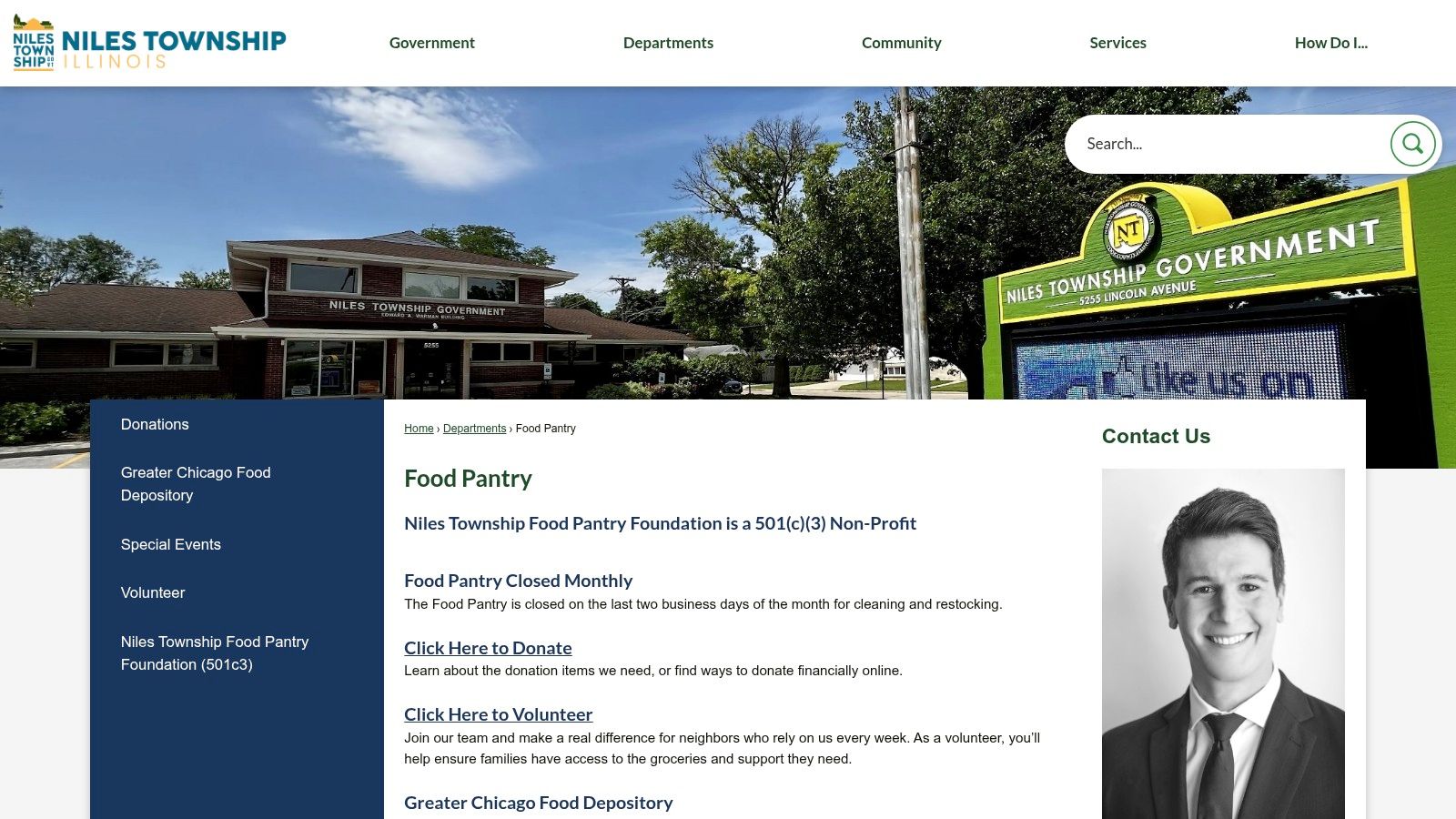
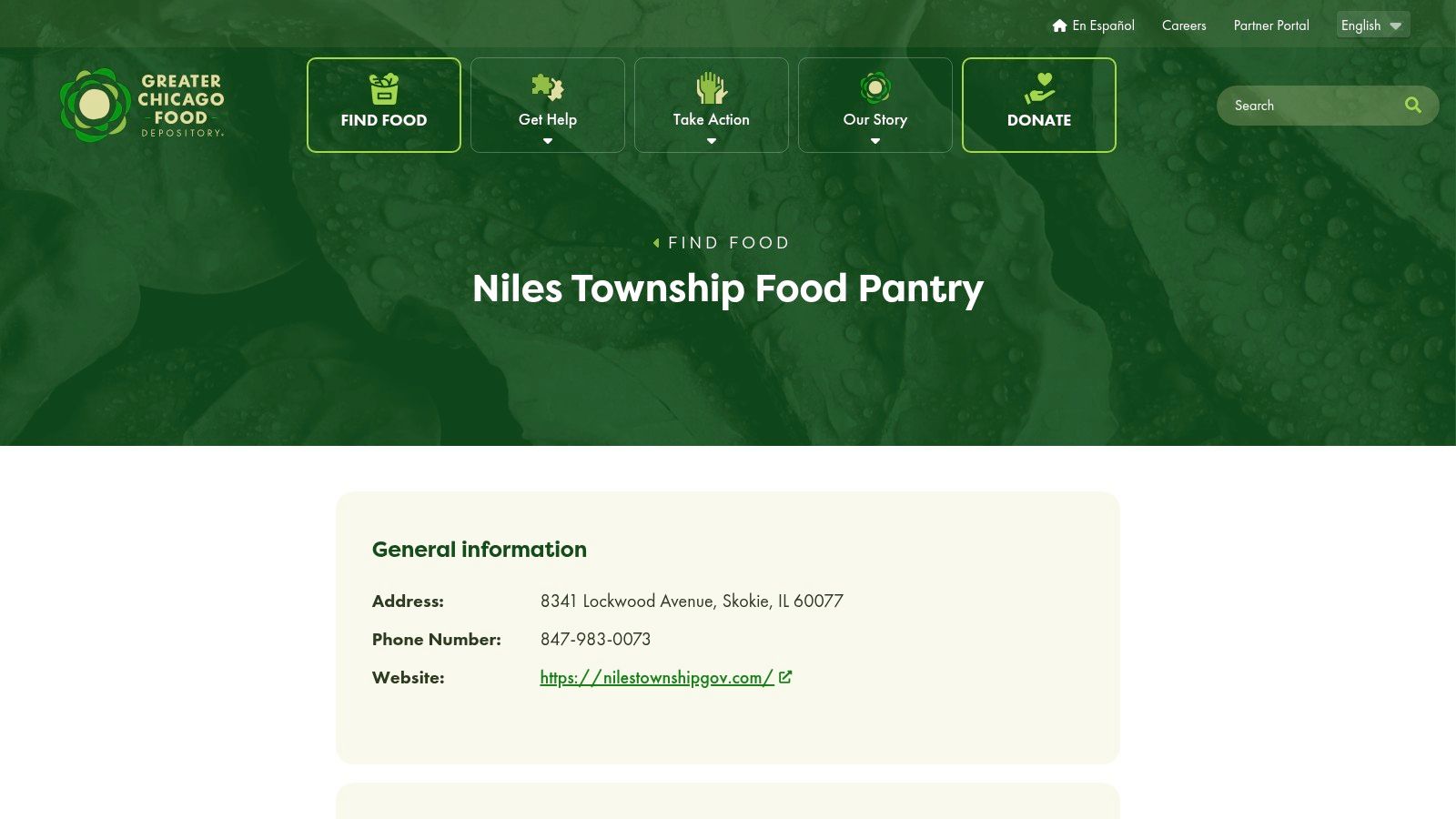
    That’s why I’d start with the official Niles Township Food Pantry page. If you mean the main, government-run niles township food pantry, this is the one people are usually talking about. It serves township residents, explains what ID and proof of residency you need, and lists regular weekday hours. There’s also a Tuesday evening option, which can make a huge difference if your workday leaves no room to breathe.

    I like that kind of clarity. When money is tight and your head is already full, clear instructions can feel like someone handed you a solid step instead of one more problem.

    The pantry is located at the township complex in Skokie, and that matters more than it sounds. You’re walking into a public service with posted rules, contact information, and a routine. For a lot of families, that steadiness lowers the stress. You do not have to guess whether the door will be open or whether anyone will know what to do with you once you arrive.

    There are still boundaries, and I’d rather say that plainly than leave you surprised later. This pantry is built for residents of Niles Township. Before you go, check the page for current requirements and hours, especially if you’re trying to make it work around a job, school pickup, or the end of the month.

    • Best fit: Niles Township residents who want an official pantry with clear rules and dependable service
    • What helps: Posted hours, a Tuesday evening pickup window, and straightforward eligibility information
    • What to plan for: Bring your documents and confirm the schedule before leaving home

    If asking for food feels hard, I want to say this directly. Showing up here is not giving up. It’s you protecting your household in a real, practical way. I’ve learned that strength sometimes looks quiet. You check the hours, gather your papers, and go get what your family needs.

    And if this step changes how you see community, you may want to keep that thread going later through Chicago food bank volunteer opportunities with Litter Caterpillars. Sometimes the road back to solid ground starts with receiving help, then grows into giving it.

    2. Niles Township Food Pantry Foundation

    The first time I looked beyond a pantry door and into the money side of things, I felt calmer. If you’ve ever stood in a parking lot wondering, “Is this place stable? Is it really going to be here next month?” you know that feeling. Seeing the Niles Township Food Pantry Foundation page helped me answer that question in a practical way.

    This page is about the support system behind the food pantry. It shows how people can donate online or by mail, and it points to financial records for anyone who wants a clearer picture of how the foundation operates. You are not applying for groceries here. You’re looking at the part of the operation that helps keep shelves stocked and programs going.

    That matters more than people admit.

    When you need help, trust is part of the meal. You want to know real people are holding this together, not just posting nice words online. For a first-time visitor, that kind of transparency can take the edge off and make the next step feel possible.

    I also like this section for a different reason. Sometimes getting help changes you. You come in worried about this week, and a month later you’re thinking about how to give back when life steadies out. If that sounds like you, another good example is this look at Casa Catalina Food Pantry in Chicago, where community support shows up in a similarly human, local way.

    • Best fit: People who want to verify the organization, donate, or understand who helps fund the pantry
    • What you’ll find: Donation options and access points for financial transparency
    • What to remember: This is a support page, not the place to start if you need pickup details or intake instructions today

    If you’re in a hard stretch, reading a foundation page might seem small. I don’t think it is. Sometimes courage looks like checking whether a place is solid, then letting yourself accept help anyway. That is self-reliance too. You’re doing the work of protecting your family, one clear decision at a time.

    3. Niles Township Food Pantry on Greater Chicago Food Depository

    Niles Township Food Pantry, Greater Chicago Food Depository Listing

    I’ve had days where getting to a pantry already felt like a small mission. You line up a ride, check the time twice, maybe pack the kids into the car, and then that little voice starts up. What if I get there and the hours changed? What if I’m in the wrong place?

    That’s why I like the Greater Chicago Food Depository listing for Niles Township Food Pantry.

    It gives you a second place to confirm the basics before you go. On hard weeks, that matters. A second check can save gas, bus fare, childcare juggling, and the emotional hit of showing up stressed and still not being sure.

    I see this page as a practical tool for brave people who are doing what needs to be done. Looking for help is not drifting. It’s planning. It’s protecting your household. It’s the same kind of steady, clear-headed move I notice in stories like this look at how Casa Catalina Food Pantry serves people in Chicago, where the details of access can shape whether someone gets through the door.

    If you’re helping a parent, a friend, or a neighbor, this listing helps even more. You can confirm the pantry exists in the broader food bank network, check location details, and feel less like you’re sending someone into the unknown.

    The limit is simple. This page is for verification, not intake. It won’t walk you through eligibility or answer every personal question, but it can give you enough clarity to take the next step with more confidence.

    4. Niles Family Services Food Pantry

    Don’t let the names blur together. The township pantry and the Village of Niles pantry are not the same thing, and that distinction can save you a frustrating trip.

    The Village of Niles Family Services Food Pantry page is for Village of Niles residents. It works more like a guided appointment than a walk-in line. You contact staff, schedule a time, and go through a brief financial assessment.

    When a guided process helps

    Some people hate paperwork. I get it. But sometimes a more guided setup helps because staff can point you to things beyond groceries. If your food problem connects to a bigger squeeze, like bills, family stress, or not knowing what programs exist, a conversation can open more doors than a box of pasta alone.

    This one may also feel more private for people who don’t want the uncertainty of a crowd.

    • Strong point: Weekday office-style access by appointment.
    • Best for: Village of Niles residents who want staff guidance and referrals, not just food pickup.
    • Tradeoff: It isn’t a simple walk-in setup, so you need to schedule and complete the intake process.

    One thing I appreciate is that the village material acknowledges real-life variety in need. It also mentions culturally meaningful foods, which matters because food isn’t just calories. It’s memory, routine, faith, comfort, and what your kids will eat.

    5. Rahmah Halal Food Pantry

    Rahmah Halal Food Pantry (Niles)

    I keep thinking about the parent who can stretch a grocery budget to the edge, then still has to ask one more question before walking through a pantry door: Will my family be able to eat this food?

    That question carries more weight than people admit. Food help should meet hunger without asking you to set aside your faith, your routines, or the meals that make home feel like home. The Rahmah Halal Food Pantry listing from Greater Chicago Food Depository points to a Niles option with halal-focused service and set distribution windows on Wednesdays and Saturdays.

    I wanted Rahmah on this list for a reason. Asking for help already takes courage. Asking for help while trying to protect your family’s beliefs and dignity takes even more. Choosing a pantry that fits your life is not being picky. It is you taking care of your people with intention.

    That is why this place stands out.

    Some pantry descriptions stay broad and leave families guessing about what will be on the table. Rahmah answers a more human question first. Can you bring this food home and serve it with peace of mind? For Muslim households, that clarity can remove a whole layer of stress before pickup day even starts.

    I also like what this represents beyond one food box. It shows how community care gets stronger when it respects real lives, real faith, and real cultural needs. If you want to see more groups doing that kind of work, this guide to Chicago charities supported by local volunteers is a good place to look.

    • Best fit: Muslim individuals and families seeking halal food access in or near Niles.
    • Helpful detail: Wednesday and Saturday distribution can give you another option if one day does not work.
    • Limitation: The pickup windows are limited, so planning ahead helps.

    If halal food is a requirement in your home, starting here can save you time, stress, and the discouragement of showing up to the wrong place. Sometimes the brave move is simple. You choose the door that fits your family, and you walk through it.

    6. Humans at Help Foundation Food Pantry

    Humans at Help Foundation (HAHF) Food Pantry (Skokie)

    Some days, the hardest part isn’t hunger. It’s the process. The forms. The fear of saying the wrong thing. The feeling that you need to prove your struggle in neat little boxes.

    That’s why the Humans at Help Foundation food pantry page stands out. It offers a first-come distribution model in Skokie and emphasizes low-barrier access. If you need food and the thought of paperwork makes your chest tighten, this kind of place can feel like a door opening instead of another wall.

    Low barrier can be lifesaving

    I admire this setup because it respects urgency. You might not have all your documents lined up. You might be between addresses. You might just need to feed people before the week breaks you.

    Volunteer-run spaces like this carry a certain kind of warmth. Not polished warmth. Human warmth.

    You do not need to earn kindness by performing your hardship perfectly.

    A practical upside is Saturday access. If weekday hours don’t match your job or caregiving schedule, that can make all the difference. If you care about plugging into neighborhood service more broadly, Chicago charities supported by local volunteers show how this spirit of mutual aid spreads beyond one pantry.

    The tradeoff is that first-come systems can bring lines and changing inventory. I’d treat this as a strong immediate-need option, especially when simplicity matters more than predictability.

    7. CityLine Bible Church Food Pantry

    CityLine Bible Church Food Pantry (Niles)

    I’ve learned that hunger and loneliness often travel together. You can solve one for a day and still feel the other sitting beside you in the car.

    The CityLine Bible Church pantry registration page feels different because it offers food in a setting built around welcome. Their pantry runs on the first and third Saturdays, and they host it inside the café area with breakfast and coffee.

    More than a transaction

    That kind of setup won’t be for everyone. Some people want speed and privacy. Others need warmth just as much as they need groceries. CityLine leans toward warmth.

    I respect that because shame gets quieter when a room feels normal. A coffee cup in your hand can do more for your nerves than people realize.

    • What stands out: Saturday distribution, community feel, and limited delivery for people who can’t get there.
    • Who may like it: Anyone who wants a softer, more relational environment.
    • Possible downside: A church-based setting may not feel comfortable for every person or family.

    If isolation has been part of your struggle, this kind of place can help in two ways at once.

    8. A Just Harvest

    A Just Harvest (Rogers Park, near Niles Township)

    Sometimes you need groceries for the week. Sometimes you need lunch today. I never like articles that pretend those are the same problem.

    A Just Harvest helps because it offers both a weekly pantry and daily grab-and-go lunches. It’s in Rogers Park, so it may be a longer trip depending on where you live, but the low-barrier approach can make that trip worth it.

    Good for the day that’s in front of you

    What I like here is the honesty of the model. It doesn’t assume everybody can wait for the next distribution cycle. If today is the hard day, there’s something for today.

    Their pantry also keeps access simple, with no documentation required for that service according to the organization’s site. That kind of straightforwardness can steady you when everything else feels tangled.

    A hot meal can do something groceries can’t. It buys you a little peace right now.

    If your need is immediate and you don’t want intake hurdles, keep this option in your back pocket. It’s not the niles township food pantry itself, but it’s part of a wider survival map that can keep you moving.

    9. The Friendship Center Chicago

    The Friendship Center Chicago (Albany Park/Lincoln Square)

    If I could redesign every pantry experience, I’d borrow from The Friendship Center Chicago. Their client-choice model lets people select food more like a grocery trip than a prepacked box.

    That may sound like a small detail until you’ve carried home food your family won’t eat. Choice protects dignity, cuts waste, and makes help useful.

    Choice changes the feeling

    I think this is one of the most respectful pantry models around. It treats you like a person making decisions, not a problem being processed.
    They also offer more than shelf food alone. The site highlights home delivery for eligible seniors and people with disabilities, plus a pet food pantry. I love that last part because pets are family in a lot of homes, and feeding them can become one more stress point when money gets tight.
    • Best fit: People who care about choice, dietary fit, and wraparound support.
    • Helpful feature: Delivery can remove a huge barrier for people with mobility limits.
    • Limitation: It’s outside Niles Township, so travel or service boundaries may affect access.

    This is a strong example of what hunger support can look like when dignity stays at the center.

    10. Hersh’s Fridge

    When people talk about community, I usually wait to see if they mean it. A community fridge means it.

    Hersh’s Fridge is a mutual-aid fridge and pantry setup in Skokie with open access. No scheduled intake. No office vibe. You take what you need, and if you’re able later, you leave what you can.

    The late-night lifeline

    I’m especially grateful places like this exist because hunger doesn’t keep office hours. Need can hit at night, after work, between paychecks, or on the wrong side of a missed bus.

    This won’t replace a full pantry trip. Inventory changes, and outdoor mutual-aid setups depend on what neighbors contribute. But for that gap moment, when you need milk, bread, fruit, or just enough to steady the next day, it can be a quiet lifesaver.

    • Best for: After-hours needs, small emergency gaps, and people who want zero paperwork.
    • Beautiful part: It runs on trust.
    • Real limitation: What’s there today may not be there tomorrow.

    I think places like this remind us of something important. Receiving help doesn’t always have to move through official channels to be real. Neighbors can keep each other afloat too.

    Top 10 Niles Township Area Food Pantry Comparison

    Resource Core Features Reliability ★ Access & Cost 💰 Target Audience 👥 Unique Selling Point ✨🏆
    Niles Township Food Pantry (Official) Regular M–F hours, Tue evening, seasonal drives ★★★★☆ Free service; ID/residency required 💰 Township residents needing steady support 👥 Centralized, predictable schedule ✨
    Niles Township Food Pantry Foundation (501c3) Fundraising, 990s, online giving ★★★☆☆ Donation-focused; transparent reporting 💰 Donors & partners tracking impact 👥 Turns dollars into local meals; financial transparency 🏆✨
    GCFD Listing, Niles Township Pantry External listing w/ hours & contact ★★★★☆ Informational; no service cost 💰 Anyone verifying hours before visiting 👥 Official backup source for up-to-date hours ✨
    Niles Family Services Food Pantry (Village of Niles) Appointment-based pickups, assessments ★★★★☆ Free with appointment; village residency limits 💰 Village of Niles residents needing guided help 👥 Personalized intake & referrals; case support ✨
    Rahmah Halal Food Pantry (Niles) Halal items, Wed & Sat windows ★★★★☆ Free; limited windows 💰 Muslim families seeking culturally appropriate food 👥 Culturally responsive halal distribution 🏆✨
    Humans at Help Foundation (HAHF) Pantry (Skokie) No paperwork, volunteer-run, Thurs & Sat ★★★★☆ Free; first-come first-served 💰 People needing immediate, low-barrier help 👥 Radical hospitality, no intake barriers ✨
    CityLine Bible Church Food Pantry (Niles) 1st & 3rd Sat, café setting, limited delivery ★★★★☆ Free; bi-monthly schedule 💰 Those seeking community connection on weekends 👥 Warm breakfast + community vibe; limited delivery ✨
    A Just Harvest (Rogers Park) Daily grab‑and‑go meals + Wed pantry ★★★★★ Free; very low barrier 💰 Anyone needing daily meals or low‑barrier pantry 👥 Daily hot meals + equity-focused services 🏆✨
    The Friendship Center Chicago Client-choice pantry, home delivery, pet pantry ★★★★★ Free; some services by appointment 💰 Clients valuing dignity, seniors, pet owners 👥 Grocery-style choice model & home delivery 🏆✨
    Hersh’s Fridge (Community Fridge, Skokie) 24/7 neighborhood fridge & pantry cabinet ★★★☆☆ Free, always open; donations welcome 💰 Walk-up, after-hours needs; mutual-aid contributors 👥 Round‑the‑clock access; stigma‑reducing mutual aid ✨

    You Are Not Alone in This

    Look at that list for a second. Not as a directory. As proof.

    Proof that when life gets tight, you are not standing by yourself in some empty parking lot, hoping nobody notices you’re struggling. You are standing in a real community, with real people, real shelves, real volunteers, real staff, and real places built for this exact moment.

    That matters, because shame lies to you. It tells you that needing help means you failed. I don’t buy that for a second. I think getting help is a lot like showing up to clean a block that looks too far gone. At first, all you see is the mess. You feel small. Then somebody hands you a bag, somebody else starts on the corner, and suddenly the whole thing changes. You’re not drowning in the problem anymore. You’re part of the response.

    That’s what taking the first step toward the niles township food pantry can feel like.

    And yes, I know the step can still feel hard. You might worry about what to bring, whether you qualify, whether you’ll say something awkward, whether someone will judge you. Most of us can act tough until we need something. Then all the old pride and fear show up at once. But bravery isn’t having no fear. Bravery is moving while fear talks.

    If you live in the township and want the most direct official route, start with the township pantry. If you need a backup confirmation on hours, use the food bank listing. If your schedule is tricky, a Saturday option might fit better. If halal food matters, pick the pantry built for that. If paperwork is the barrier, choose a lower-barrier site. If today’s problem is a hot meal, not next week’s groceries, go where lunch is available. If the hour is late and you just need enough to get through morning, a community fridge can be the bridge.

    You do not need to solve your whole life in one trip.

    You just need one good next move.

    Here’s what I’d do. Pick the place that feels least overwhelming. Put the address in your phone. Pull up the website. Check the hours one more time. Gather the documents if that site needs them. Then go. Not because everything is fixed. Because action creates air. Action gives you a little room to breathe.

    And when you walk through that door, try to leave one thought behind. The thought that you’re taking something you didn’t earn. Communities build these systems because people matter. Because hard seasons happen. Because food should not become a private punishment.

    I’ve learned that strength doesn’t always look like carrying everything alone. Sometimes it looks like admitting the bag is heavy and reaching for another set of hands. That’s not weakness. That’s wisdom.

    So if today is your day to make that move, I’m with you in spirit. Go get the help. Feed your family. Give yourself a little margin. Let that first step count as a win, because it is one.

    You showed up for yourself. You chose motion over shame. That’s how change starts.


    If Litter Caterpillars speaks to you, take a look at Litter Caterpillars. Their whole spirit is about bravery, service, and rebuilding yourself by showing up for your community. If you’ve been through a hard season and want a way to turn that pain into strength, their volunteer work can be a powerful next chapter.

  • Erie Lackawanna Trail: A Path to Adventure & Action

    Erie Lackawanna Trail: A Path to Adventure & Action

    I stood on the erie lackawanna trail with a head full of static and a life that felt harder to carry than it should've. The pavement stretched forward in a straight, honest line, and that morning I understood something simple. You don't fix your whole life at once. You take one step.

    Your Journey Begins With a Single Step

    There was a time when I couldn't throw away a jar from the back of my fridge.

    I'm serious. Old food, dead batteries, random receipts, clothes I didn't wear. Every useless object had a little story attached to it, and that story made it feel too heavy to move. My room looked like a stalled-out train yard. My mind did too.

    Then my life cracked open. A relationship ended. The noise stopped. I had to decide whether I'd keep drowning in my own clutter or start doing hard things on purpose.

    So I started small.

    I walked.

    Not because I had a grand plan. Not because I was suddenly disciplined. I walked because movement gave me something my messy apartment didn't. A direction.

    A watercolor painting showing a foot wearing a white sneaker stepping onto a winding dirt trail.

    The first honest move

    The erie lackawanna trail works on you because it asks almost nothing at the start.

    You don't need to be fast. You don't need elite gear. You don't need some glowing social media version of yourself. You just need to show up and put your feet on the path.

    That's why I love trails like this. They don't negotiate with your excuses. The pavement doesn't care if you feel behind in life. It just waits for your next step.

    Practical rule: When life feels jammed, don't ask how to solve everything. Ask where you can walk today.

    I've seen this pattern again and again. A person starts with a short walk because they're tired, angry, lonely, or ashamed. Then the walk turns into a habit. The habit turns into self-respect. The self-respect changes what they tolerate from themselves and from other people.

    That change doesn't look dramatic from the outside. It looks like someone tying their shoes.

    Why this trail hits different

    The erie lackawanna trail isn't just a route through Northwest Indiana. It feels like a decision made visible. You move through town, through open stretches, through places that remind you people built this and people can care for it.

    That's the thing about a trail. It gives your body a clean assignment. Keep going.

    If you've been stuck, come here with humility. Don't come trying to prove you're tough. Come ready to begin. A single mile can do more for you than a month of overthinking.

    From Rails to Recreation A Trail's Second Life

    Long before anyone came here for a calm ride or a clearing-the-head walk, this corridor carried freight and passengers. Steel wheels ran where sneakers and bike tires now roll.

    That matters to me, because I don't trust shallow inspiration. I want proof. I want to know whether something broken, loud, and worn down can become useful again.

    This trail says yes.

    A corridor that changed its purpose

    The story starts with the New York & Erie Railroad Company in 1832, then shifts through a 1960 merger that created the Erie Lackawanna Railroad. After bankruptcy in 1972, absorption by Conrail, and the end of service in 1986, the corridor got a second life as part of the American Discovery Trail, as described by Rails to Trails Conservancy's history of Indiana's Erie Lackawanna Trail.

    I love that sequence because it doesn't read like a fairy tale. It reads like real life.

    Something begins with purpose.
    It grows.
    It falters.
    It gets abandoned.
    Then somebody with vision says, "We're not done with this yet."

    That's not just infrastructure. That's personal recovery.

    The cocoon stage matters

    A lot of us want transformation without the awkward middle. We want the butterfly story without the sealed-up cocoon. But trails like this were built through patience, public effort, and the stubborn belief that old routes still matter.

    The erie lackawanna trail follows a former railroad corridor that once linked the Chicago region to the East Coast. Now people use that same line for walking, biking, and ordinary moments that rebuild a life from the inside out.

    Old corridors don't beg for pity. They wait for someone to see what they can become.

    I've felt that same tension in my own life. I used to think the messy chapters disqualified me. Now I think they trained me to notice potential where other people see waste.

    That's one reason I respect rail-trails so much. They don't erase history. They repurpose it.

    Why second lives should make you braver

    If you're drawn to places like this, you're probably drawn to reinvention too.

    The old rails carried industry. The trail carries people. The mission changed, but the route still serves. That's a powerful lesson. Your life may need a new mission, not a new self.

    If you enjoy this kind of trail story, you'll probably like this look at the Old Plank Trail, another path where movement and memory sit close together.

    When I walk the erie lackawanna trail, I don't just see asphalt. I see evidence that decline isn't always the ending. Sometimes it's the clearing stage before the rebuild.

    Charting Your Course on the Erie Lackawanna

    The first time I brought a small cleanup crew onto this trail, one teenager wanted to start at the rough northern end because it looked tougher. Another volunteer had never ridden farther than a neighborhood loop and needed a calm, confidence-building start. Same trail. Two very different days waiting to happen.

    That is the lesson here. A good route choice is not about proving something. It is about knowing what kind of work, reflection, or recovery the day is asking from you.

    The erie lackawanna trail gives you room to make that choice. The corridor runs from Hammond south through communities such as Highland, Griffith, and Schererville to Crown Point, according to the Indiana Dunes tourism overview of the Erie Lackawanna Trail. That spread matters because each segment carries a different mood, and your starting point shapes what you notice.

    An infographic titled Erie Lackawanna Trail: Your Practical Guide, outlining three trail sections from mile 0 to 17.7.

    How I’d break up the day

    I split this trail into three practical experiences.

    Southern start
    Crown Point is where I send people who want to build trust in themselves. New walkers, families, and anyone coming back from a hard season usually do better when the day begins with steadier rhythm instead of constant decision-making. You can settle in, listen to your breathing, and remember that progress does not need drama.

    Mid-trail flow
    The middle stretch is where effort starts turning into focus. You stop checking the clock so often. You notice the pattern of your steps, the way your shoulders finally drop, and the fact that your mind has gotten quieter. That is one reason I care about trails so much. They give people a place to get honest.

    Northern approach
    The Hammond end asks more from you. You need better awareness at crossings and more patience with the surface. I do not say that to scare anyone off. I say it because adults should choose routes with their eyes open.

    Access points that make sense

    You need an entry point that matches your purpose, not somebody else's bragging rights.

    Trailhead Location Parking Availability Restrooms Key Features
    Crown Point at West Summit Street Available Check locally before departure Southern access, strong option for a longer out-and-back
    Highland trail access Available Check locally before departure Convenient central access in a more developed area
    Hammond near Sibley Street and State Street Limited by context Check locally before departure Northern access, urban setting, better for people comfortable with rougher conditions

    I tell our Litter Caterpillars volunteers the same thing before a cleanup. Pick the start that helps you finish strong. There is no prize for beginning in the section that wears you down fastest.

    Where you need caution

    Local trail guidance from the Northwest Indiana Regional Planning Commission's Erie Lackawanna Trail page describes the route as a major regional corridor, but conditions still vary by segment. The northern end deserves extra attention because street crossings and rougher pavement can break your rhythm fast.

    So handle that section with some discipline.

    • If you're walking: Stay alert near crossings and broken pavement.
    • If you're biking: Ease off speed and give your tires some forgiveness.
    • If you're with kids: Start farther south unless your group already handles busier trail conditions well.
    • If you're using mobility equipment: Research the segment first and choose the smoother sections for a better outing.

    Trails build character when people meet them honestly.

    That honesty is part of our mission. At Litter Caterpillars, we do not look at a path and ask only how far it goes. We ask what kind of neighbor it asks us to become. A route like this can give you a workout, a reset, or a reason to serve the place that carried you for a few miles.

    If you like comparing how different trails shape different kinds of effort, this guide to the Des Plaines River Trail in Chicago, IL offers a useful contrast with a more natural, less paved corridor.

    Gearing Up for Your Trail Experience

    One Saturday morning, a father and his daughter showed up for a cleanup walk with us wearing brand-new sneakers straight out of the box. By mile two, the daughter had a blister, the dad was carrying two bottles in his hands because his pack had no side pockets, and both of them looked ready to quit. We slowed down, shared tape from a first-aid kit, shifted their water into a spare bag, and kept going.

    They finished the day smiling.

    That is the lesson. Good days on the Erie Lackawanna Trail are usually built before you leave the house. At Litter Caterpillars, we see it every season. The people who prepare well do more than enjoy the trail. They stay long enough to notice what needs care, pick up a few pieces of litter, and leave a stretch of public space better than they found it.

    What the surface asks from you

    As noted earlier, the Erie Lackawanna Trail is largely paved, which makes it friendly to walkers, riders, and many people using mobility equipment. That does not mean every mile feels the same. Some northern sections can ride rougher, and that small mistake in gear choice gets loud fast.

    A skinny tire set rock hard can turn a relaxed ride into a rattling one. Shoes with no support can make a short walk feel twice as long. The trail is fair, but it is honest.

    Prepare for the actual surface under your feet.

    A checklist I trust because it has already failed me once

    I used to carry too little water and too much pride. That combination teaches hard lessons. Now I keep the setup simple and repeatable.

    For walkers:

    • Broken-in shoes: Wear the pair that has already proved itself.
    • Water within reach: Easy access means you will drink it.
    • One light layer: A steady walk can turn into a longer outing than you planned.

    For cyclists:

    • Tire pressure with some give: A little mercy helps on rougher pavement.
    • Basic repair gear: Tube or patch kit, pump, and the skill to use them.
    • Comfort at your hands: Gloves or reliable bar tape can save your shoulders on a longer ride.

    For anyone planning to spend real time out there:

    • A charged phone
    • A small first-aid kit
    • A snack that will hold you up
    • Sun protection
    • A turnaround time you are willing to respect

    Flashy gear will not save a sloppy plan

    I have seen riders bring expensive bikes and forget a pump. I have seen walkers dress for a photo and suffer through the second half of the day. Public trails do not care about the costume. They reward steadiness.

    Bring humility, water, and shoes you trust.

    That rule belongs on more than a trail. It belongs in community work too. If you want to help care for a place, show up ready, stay useful, and do not make yourself the emergency.

    My rule for longer outings

    I divide what I carry into two groups. What keeps me moving. What gets me home.

    The first group is water, a layer, and food. The second is a phone, repair basics, and enough honesty to stop when my body starts objecting. That habit has helped me finish cleanup days, training walks, and long rides without turning a good plan into a stupid story.

    Use the trail to build that kind of discipline. It matters out there, and it matters everywhere else too.

    More Than a Walk Activities for Every Explorer

    The erie lackawanna trail can feel like three different places depending on how you use it.

    Show up on a bike and the pavement becomes rhythm. Show up on foot and details start surfacing. Bring kids and snacks, and the day turns into a string of little discoveries instead of a mileage project.

    A happy cyclist riding a road bike past a wooden sign that says Erie Lackawanna Trail.

    The rider's version

    A rider I know loves the middle and southern stretches because he can settle into a smooth cadence and stop fighting traffic for a while. The trail's broad usability makes that possible. You can ride for fitness, but you can also ride just to feel your thoughts line up.

    That difference matters.

    Some days your bike is a machine. Some days it's a broom for the mind.

    The walker's version

    When I walk, I notice the edges.

    The wetlands. The parks. The green cuts alongside the path. The places where birds, insects, and wildflowers push back against the old industrial memory of the corridor. That's one of the quiet gifts of a rail-trail. It lets you move through both history and recovery at the same time.

    A walker can have a full day here without covering heroic distance. Slow miles count.

    The family version

    Families use a trail differently. They don't care about your pace chart.

    They care about whether the surface is forgiving, whether the mood stays light, whether there's room for a stroller, a snack break, and one child who suddenly needs to examine a leaf for six full minutes. On this trail, that kind of day makes sense.

    And if you want a feel for the ride before you go, this video gives a useful visual sense of the path and atmosphere.

    The best trail day usually starts when you stop trying to optimize it.

    Other ways to use the path

    You don't have to label yourself an athlete to belong here.

    • Birding and noticing: The greener stretches reward slow attention.
    • Photography: Old corridor, open sky, changing light. That's enough for a good afternoon.
    • Reflection: Some people need a quiet bench more than a finish line.
    • Training with restraint: If you're serious about mileage, use the smoother sections wisely and respect the rougher ones.

    That's why I keep coming back to the erie lackawanna trail. It isn't one thing. It meets you where you are, then nudges you a little farther.

    Leave It Better Than You Found It Join Our Mission

    I need to say the hard part plainly.

    Walking a trail is good. Cleaning one is better.

    I don't mean that in a smug way. I mean it in the way a shovel is better than a speech when you've got a hole to fill. If you've ever felt helpless, discouraged, or disgusted by the state of the world, service gives your hands something honest to do.

    And honesty changes people.

    Why litter work hits so deep

    For years I struggled to clean my own messes.

    That wasn't laziness in the cartoon sense. It was emotional weight. Every object carried memory, guilt, or some stupid unfinished promise to myself. A bag of trash could feel like a confession.

    Then I learned a strange truth. Cleaning up somebody else's mess can teach you how to face your own.

    When you bend down, pick up a bottle, pull a wrapper from the weeds, or clear a nasty corner nobody else wants to touch, something in you starts to harden in the right way. Not cruel. Just stronger.

    You stop waiting to feel motivated.
    You become useful before you feel ready.

    A hand picking up a small piece of plastic trash from a dirt path in nature.

    The gap on this trail is real

    One reason the erie lackawanna trail stands out to me is that there appears to be a real opening for organized cleanup work. Existing attention leans toward recreation, while interest in litter management and group cleanups remains underserved, as discussed in this review of the missing cleanup angle around the Erie Lackawanna Trail.

    That should challenge you.

    If a place is loved for rides, walks, and family time, then somebody has to love it enough to pick up what gets left behind too. Popularity without stewardship turns into entitlement. People use the place, praise the place, photograph the place, then act surprised when trash collects at the edges.

    That's not somebody else's problem.
    That's ours.

    What service does to a person

    I care about cleanup work because it transforms the volunteer faster than it transforms the ground.

    The ground changes first in the obvious way. Less litter. Cleaner edges. Better feeling. But the deeper shift happens in your character.

    You learn consistency because trash doesn't care about your mood.
    You learn bravery because some places are ugly and public and awkward.
    You learn kindness because service puts you shoulder to shoulder with people who chose to show up.

    A clean path is nice. A person who keeps showing up is better.

    I've seen people come to a cleanup nervous, isolated, uncertain where they fit. Give them gloves, a bag, and one hour of shared work, and they start talking differently. Their posture changes. They laugh easier. They stop performing and start participating.

    That matters more than people think.

    If you want renewal, do the inconvenient thing

    A lot of people say they want community.

    What they usually mean is that they want the feeling of community without the labor that creates it. They want connection without effort, pride without maintenance, belonging without sacrifice.

    It doesn't work like that.

    Community grows where people do mildly inconvenient things together on purpose. They wake up. They travel a little. They carry tools. They do work that doesn't make them look glamorous. Then they eat, talk, joke, and head home stronger.

    That's how a place gets protected.
    That's how a person gets rebuilt.

    How I’d approach cleanup on this trail

    If I were organizing around the erie lackawanna trail, I'd keep the approach simple and tough-minded.

    • Start with the rougher northern zones: Those cracked sections and crossing-heavy areas can collect debris and need more careful attention.
    • Work in short segments: A long trail becomes manageable when people own one section at a time.
    • Keep volunteers safe first: Crossings, gravel transitions, and uneven pavement demand attention and clear judgment.
    • Make the day social, not grim: Service should build courage and friendship, not martyrdom.

    That's how you keep people coming back. Not with guilt. With meaning.

    Your invitation

    If the erie lackawanna trail gives you peace, give something back.

    You don't need to arrive as a hardened environmental crusader. You don't need a dramatic origin story. You don't need to pretend you're fearless. Just be willing to show up and do one useful thing with other people.

    That's enough to begin.

    And if you're ready to turn that impulse into action, this page for volunteer trash pickup is a good place to start finding your lane.

    Come for the trail if you want.
    Stay for the version of yourself that service builds.


    If you're ready to do more than admire clean places, join Litter Caterpillars. Show up on a weekend morning, meet good people, and help turn ordinary ground into a story you're proud to be part of.

  • Gifts for Environmentalists: Sustainable & Inspiring Ideas

    Gifts for Environmentalists: Sustainable & Inspiring Ideas

    I once stared at a jar of blueberry jam in the back of my fridge and felt defeated. It was old, sticky, useless, and somehow heavier than a barbell.

    That’s how I started thinking about gifts for environmentalists. Not as cute green products. As a fight against the dead weight we keep dragging through our homes, our habits, and our holidays.

    My Life Was a Mess Then I Started Picking Up Trash

    My apartment used to look like my mind.

    There were bags of forgotten snacks from abandoned health kicks. Random cables. Empty boxes I swore I’d reuse. Old containers with sentimental stories attached to them, like objects had emotional blackmail power over me.

    The strangest part was this. None of it was physically hard to throw away.

    Emotionally, it felt impossible.

    A man in a grey hoodie holding a black garbage bag full of waste in a cluttered room.

    Every piece of trash had a story

    I could tell you where the old jam came from. I could tell you why that stale bag of nuts mattered. I could tell you who I was trying to be when I bought this thing or saved that thing.

    That was the trap.

    My mess wasn’t just mess. It was memory, guilt, fantasy, and avoidance piled together.

    Then a long, chaotic relationship ended. That breakup hit me like cold water. I saw how much of my life I had let become disorder. Not just my room. My standards. My routines. My courage.

    So I made a few simple promises to myself:

    • Cleanliness: I’d stop negotiating with obvious mess.
    • Consistency: I’d do hard things on repeat, not once in a while.
    • Bravery: I’d stop waiting to feel ready.

    That sounds dramatic for a story about trash, but trash is never just trash. It’s evidence. It shows you what you consume, what you avoid, and what you leave behind.

    Then the mess got bigger than my room

    When I started cleaning my own space, I noticed something ugly about the wider culture too. We buy things to express love, then we wrap those things in more things, then we throw away the evidence by January.

    That isn’t generosity. That’s a landfill with a bow on it.

    The scale of it is hard to ignore. The U.S. Environmental Protection Agency reports that holiday materials such as bows, bags, and wrapping paper contribute 1 million tons of trash to landfills weekly during the festive season, and UK households discard 30% more rubbish over the holidays, equivalent to 1.4 million tonnes of CO2e compared with other times of year, as summarized by Sea Going Green’s write-up on holiday waste.

    I didn’t need a statistic to know the problem was real. I had lived inside a miniature version of it.

    My apartment was what happens when consumption outruns courage.

    Practical rule: If a gift creates clutter, guilt, or instant disposal, it isn’t generous. It’s just delayed trash.

    Picking up trash outside changed me inside

    The first time I went out to pick up litter with a tiny group, the weather turned brutal. Chicago did what Chicago does. Cold. Wet. Mean. We huddled under a tree while rides kept canceling.

    I should have hated it.

    Instead, I felt awake.

    I realized cleaning up other people’s messes felt easier than cleaning my own, and somehow that gave me a back door into changing myself. I could practice discipline in public. I could train bravery in bad weather. I could build a new identity with my hands.

    That’s why I get suspicious of most gift guides. They usually ask, “What should I buy?”

    I think the better question is, “What helps someone become who they want to be?”

    For me, service did that. Sunlight did that. Community did that. Repeated effort did that.

    If you know someone who wants to get braver but freezes in social situations, I’ve seen how small acts of service can loosen that knot. That’s part of why I care so much about practical support like this guide on how to overcome social anxiety.

    A real gift doesn’t just sit there looking ethical. It changes the way someone moves through the world.

    That’s the standard I use now for gifts for environmentalists. If it won’t help someone live lighter, act bolder, or serve better, I don’t want it.

    Rethinking Gifting From The Ground Up

    Most gift guides sell you a cleaner-looking version of the same old habit. Buy another object. Feel noble about it. Hope the packaging looks earthy.

    I don’t buy that anymore.

    Tom Sawyer understood something people still miss. He didn’t win because he had a better product. He won because he made work feel like privilege. He turned fence painting into something people wanted to do.

    That shift matters.

    A gift can be an invitation

    When you give someone a thing, you’re usually giving them possession.

    When you give someone an experience, a responsibility, a role, or a mission, you’re giving them momentum.

    That’s why the strongest gifts for environmentalists often don’t look like gifts at first. They look like a Saturday morning cleanup, a garden workshop, a park pass, a shared ritual, a cause someone can join.

    They have friction. That’s part of the value.

    A lot of people assume the “better” gift is the one that feels polished and complete in the box. I think that idea is backwards. A gift should sometimes ask something of you. Show up. Learn. Carry. Try. Return next week.

    Service can feel like a strange kind of celebration. You come home dirty, tired, and more alive than when you left.

    Why this sticks longer

    There’s a reason experiential and service-based gifts hit differently. They attach emotion to action.

    One object can become background furniture in a week. A shared effort enters your memory like weather. You remember the cold morning, the mud on your shoes, the weird joke someone made, the pride you felt when the block looked different because you were there.

    That pattern matches the gap identified in this piece on gifts for environmentalists, which argues that most content focuses on consumer products while missing community-driven action and personal transformation through service. It also cites contrarian data that service-based activities yield 40% higher long-term behavior change than material gifts.

    That number rings true to me because I’ve watched people change when they participate, not when they merely receive.

    Ask a different question

    Don’t ask, “What can I hand them?”

    Ask questions like these instead:

    • What story could they step into
      A cleanup, workshop, or community day gives them a plot, not just a package.

    • What habit could this reinforce
      A recurring experience beats a one-time novelty.

    • Who could they meet through this
      Environmental action gets stronger when it becomes social.

    • What pride could they earn
      People protect what they help build.

    Here’s the funny part. This approach can feel more generous and less wasteful at the same time.

    That’s rare.

    A good object can help someone. I’m not against objects. I’m against dead objects. Gifts that flatter your intentions but never enter the recipient’s life in a meaningful way.

    The best gifts for environmentalists don’t just signal values. They give those values legs.

    The Environmentalists Toolkit Gifts That Endure

    If you’re going to give a physical gift, give a tool. Not décor pretending to be conscience.

    I think about this the way I think about field gear. If you’re out in wind, rain, slush, heat, mud, and city grime, you don’t want a delicate symbol. You want something that earns its place in your bag.

    A flat lay of eco-friendly products including a stainless steel bottle, bamboo cutlery set, tote bag and trowel.

    Start with one hard question

    Will this item still matter a year from now?

    That question kills a lot of bad gifts immediately.

    A durable environmentalist tool should do at least one of these jobs well:

    • Replace disposables
      It needs to remove a stream of repeat waste from daily life.

    • Survive rough use
      If it breaks fast, it wasn’t sustainable. It was a detour.

    • Travel easily
      Good intentions die when the item is awkward, heavy, or annoying.

    • Age with dignity
      Scratches are fine. Fragility isn’t.

    The stainless steel bottle test

    A reusable bottle is common advice. Fine. Common advice can still be good if you apply standards.

    A high-performance insulated stainless steel water bottle stands out because the details matter. According to Coral Vita’s roundup of gifts for environmentalists, some insulated stainless steel bottles are made from 90% post-consumer recycled steel and can keep drinks cold for up to 75 hours. The same source says replacing 1,000 single-use PET bottles with one reusable steel bottle over five years can avert 35kg of plastic waste and save up to 400kg of CO2e emissions.

    That’s not aesthetic. That’s a working tool.

    A bottle like that helps in real life because it handles long days, bad weather, and forgetful humans. It doesn’t ask for perfect behavior. It supports imperfect people trying to do better.

    Here’s how I’d judge one in practice:

    What to check Why it matters
    Recycled steel content It tells you whether the material story matches the marketing
    Thermal performance A bottle that stays cold longer gets used more
    Wide mouth Easier cleaning means less neglect
    Durability Hard-use gifts should survive drops and rough bags
    Leak resistance Annoying gear gets abandoned fast

    Give uniforms, not souvenirs

    Some of the best physical gifts don’t just solve a problem. They create identity.

    That’s why I love earned clothing more than random merch. A sweatshirt can be just a sweatshirt. Or it can be proof that you showed up enough times to deserve it.

    The green sweatshirts our volunteers get after repeated cleanups, screen-printed by Ximena Laredes, matter because they represent action first. Nobody gets one for agreeing with the mission online. You earn it with mornings, effort, weather, and consistency.

    That’s what more gifts should do. They should mark a threshold.

    A strong gift says, “This is who you are now.” It gives someone a role they can grow into.

    Buy right, not often

    I use a simple filter when I choose physical gifts for environmentalists.

    1. Need beats novelty
      If they already own a working version, think twice.

    2. Longevity beats trend
      A boring workhorse beats a stylish gimmick.

    3. Repairability beats convenience
      The easier it is to maintain, the longer it stays alive.

    4. Daily use beats occasional virtue
      Repetition is where impact lives.

    A short video can help anchor that mindset in something practical.

    The point isn’t to build a prettier pile of stuff. The point is to assemble a compact toolkit someone reaches for again and again. A bottle. A sturdy tote. Reusable cutlery. Gloves that last. A sweatshirt that means something.

    That’s the line. Don’t give more. Give better.

    Gifting Experiences Over Things

    My favorite gifts don’t need shelf space.

    They need a date on the calendar, a little courage, and maybe a pair of shoes you don’t mind getting dirty.

    A comparison chart showing the benefits of gifting experiences compared to the negative impacts of physical things.

    The gift is the new version of you

    I’ve seen people light up most when they get something larger than an object. A chance to join. A chance to vote. A chance to help shape a place that didn’t exist before.

    That’s why I love milestone gifts built around participation.

    After one cleanup, a volunteer earns an iron-on patch. After three, they earn a green sweatshirt. After ten, they earn a vote in decisions for Caterpillar Park in Englewood.

    That last one is my favorite because it’s not a reward in the usual sense. It’s stewardship.

    You aren’t saying, “Thanks for helping.” You’re saying, “You belong here. Help decide what we build.”

    That’s a serious gift.

    Action gifts wear many disguises

    Experience-based gifts for environmentalists don’t have to be dramatic. They just need to pull someone into a deeper relationship with the world around them.

    A few examples work especially well:

    • A learning gift
      Urban gardening classes, native planting workshops, composting lessons, or repair sessions all give someone a skill they can use and share.

    • A place-based gift
      A local land trust membership, a park pass, or a CSA subscription can reconnect someone to seasonality and stewardship. If you’re considering a food-based recurring gift, this guide to finding a CSA near me is a strong place to start.

    • A contribution gift
      A donation in someone’s name can work when it feels concrete and aligned with their values.

    • A participation gift
      This is the strongest category. You’re not outsourcing meaning to a receipt. You’re asking them to show up with you.

    Why this feels bigger than spending

    Physical gifts often peak at the moment of opening.

    Experiences often start there.

    That changes everything. The gift unfolds in time. It keeps producing meaning after the exchange is over. It also leaves room for surprise, which is where real memory lives.

    I think that’s why people often talk about certain days for years and forget many objects within weeks. A morning in the cold, a workshop where you learn to grow food, a volunteer shift that turns strangers into friends. Those become part of your biography.

    Here’s a simple comparison I use:

    Gift type What the recipient gets
    Physical object Possession
    Workshop or pass Skill or access
    Donation Alignment with a cause
    Shared service day Memory, identity, and relationship

    Give someone a story they can enter, not just a package they can open.

    Present the experience like it matters

    People sometimes ruin good experience gifts by making them feel vague.

    Don’t do that.

    If you’re giving an experience, make it tangible. Put the date in writing. Add a note about why you chose it. Include one practical detail that lowers friction, like where to meet, what to wear, or what snack you’ll bring.

    That transforms the gift from a nice idea into a real invitation.

    For environmentalists, that matters even more. A lot of people care a great deal and still feel overwhelmed. A clear on-ramp is often the difference between “someday” and “Saturday.”

    The best gifts for environmentalists help them act on what they already believe.

    The Power of Local and Low-Waste Gifting

    One of the best thank-you gifts I’ve ever seen didn’t come in sleek branding. It came in food form.

    Amish apples, oranges, pears, and eggs from Amish & Healthy Foods stopped people in their tracks. Not because they were flashy. Because they felt honest.

    You could hold them and know they were meant to be used, shared, eaten, and remembered. No clutter. No guilt. No drawer full of regret.

    A hand in a work glove pointing toward a wooden crate full of fresh red apples.

    Why local food lands so hard

    A beautiful piece of fruit does something many consumer gifts can’t. It connects pleasure, place, and impermanence.

    You eat it. You enjoy it. It doesn’t linger as clutter.

    That matters. Especially if you’re buying gifts for environmentalists who already feel tension around consumption. A local, consumable gift says, “I thought about what would nourish you without leaving a mess behind.”

    It also supports the kind of economy many environmentally minded people want to see more of. Smaller scale. More human. More rooted.

    Low-waste can still feel abundant

    Some people hear “low-waste” and imagine something stingy or joyless. Brown paper. No fun. Pure moral homework.

    That’s bad imagination.

    Low-waste gifting can feel rich when you choose wisely. A box of excellent produce. Homemade baked goods. Preserves. Loose-leaf tea in a reusable tin. A handmade seed kit. A scarf used as wrapping that becomes part of the gift.

    You can make this practical with a simple framework:

    • Choose consumables first
      Good food, pantry staples, and handmade edible gifts disappear cleanly into life.

    • Choose reusables only if they’ll be used often
      The broader reusable goods movement responds to a massive plastic problem. The world generates 300 million tons of plastic waste annually, and only 9% is recycled, according to 4ocean’s sustainable gift guide. The same source notes that one durable reusable water bottle can replace 156 disposable ones per year, and one bamboo toothbrush swap saves 4 plastic ones per user annually.

    • Choose wrapping that keeps working
      Cloth wrapping, reusable bags, jars, baskets, and simple paper all beat glossy waste.

    A better kind of wow

    A lot of modern gifts chase the wrong kind of surprise. They aim for novelty.

    I’d rather aim for recognition.

    When someone opens a gift and says, “This is so me,” you nailed it. The Amish produce gifts did that for our team because they felt grounded. They respected appetite, locality, and simplicity all at once.

    That’s hard to fake with mass-market eco branding.

    Here are a few local and low-waste gift ideas that carry that same spirit:

    • Farm share add-ons
      Seasonal produce, eggs, or pantry goods from a nearby grower.

    • Homemade practicals
      Soup, bread, jam, tea blends, or a jarred baking mix.

    • Useful reusables paired with consumables
      A sturdy tote filled with fruit, bread, or local coffee feels more alive than an empty product bundle.

    • Wrapping that becomes useful
      Furoshiki cloth, a bandana, a basket, or a kitchen towel.

    The big idea is simple. Don’t just minimize waste. Maximize intimacy.

    The best gifts for environmentalists often feel less like shopping and more like paying attention.

    How to Gift an Invitation to Join Us

    If you want to give someone bravery, you can’t box it.

    You can, however, create an invitation that makes bravery easier.

    That’s the move I wish more people made when they think about gifts for environmentalists. Don’t just hand someone a product that represents a better life. Invite them into the better life itself.

    Build a volunteer starter kit

    I love the idea of a gift that says, “Come with me.”

    Not “You should do this.” Not “This would be good for you.” Just, “I’m going too.”

    That turns service from pressure into companionship.

    A strong volunteer invitation gift can include:

    • A wearable item
      A sweatshirt, gloves, hat, or work-ready layer helps the gift feel real.

    • A printed plan
      Put the meetup details on paper. Date, time, location, what to bring.

    • A handwritten note
      Keep it plain. “I want to do this with you. Let’s be brave together.”

    • A small comfort item
      Tea, a snack, or hand warmers can remove just enough friction to help someone say yes.

    Make the first step tiny

    Individuals often don’t resist service because they’re selfish. They resist because the first move feels awkward.

    They don’t know where to stand. What to wear. Whether they’ll fit in. Whether they’ll look foolish. Whether they’ll be the only new person.

    That’s why invitation matters so much.

    If you’re giving this kind of gift, reduce uncertainty. Don’t say, “We should volunteer sometime.” That’s fog. Give one clear option and make it easy to accept.

    A real invitation might look like this:

    I found a weekend cleanup. I’m already committed. I’d love to do it with you. I’ll bring gloves and coffee.

    That works because it replaces abstraction with specifics.

    Why this beats another product

    An invitation to serve does a few things at once.

    It gives someone a social anchor. It gives them a useful memory. It gives them a chance to act on values that might otherwise stay trapped inside intention.

    It also creates a clean path from belief to belonging.

    If you want to make that path concrete, use a real event and package it like a gift. Print the details from a volunteer trash pickup page, tuck them into an envelope with a note, and pair it with one practical item they’ll use.

    That gift can change the trajectory of a month, a friendship, sometimes even a life.

    I know that sounds big. I mean it in a very ordinary way.

    Many transformations begin with someone else making the first step less lonely.

    Conclusion The Best Gift Is a Better World

    I started with a filthy fridge and a room full of emotional clutter.

    I ended up with a different definition of generosity.

    The best gifts for environmentalists aren’t the ones that perform goodness most elegantly. They’re the ones that help someone live with more courage, less waste, and deeper connection. Sometimes that’s a bottle tough enough to survive years of hard use. Sometimes it’s local fruit that disappears into a shared table. Sometimes it’s a patch, a sweatshirt, a workshop, a park vote, or a morning spent doing hard work with kind people.

    I think that’s the thread running through all of it.

    A great gift doesn’t just say, “I know what you like.” It says, “I see who you’re trying to become.”

    That’s why service matters so much to me. It strips away a lot of nonsense. You show up. You carry something. You make a place better. You go home changed in some small but durable way.

    We all have some mess in us. We all have some part of life that feels stuck, heavy, hard to move.

    A worthy gift helps loosen that weight.

    Not by adding more stuff, but by opening a path. Toward simplicity. Toward action. Toward friendship. Toward a world that looks a little better because someone cared enough to do something with their own hands.

    That’s the gift I believe in.


    If you want to give someone more than an object, give them a way into purpose. Litter Caterpillars makes that simple with weekly Chicago cleanups, a brave volunteer culture, and a community built on kindness, resilience, and showing up together.

  • Community Park Channahon IL: Full Guide to Fun & Amenities

    Community Park Channahon IL: Full Guide to Fun & Amenities

    I still remember the first time I wandered into Community Park. I wasn't chasing anything dramatic. I just needed a place where my brain would quiet down, and the park met me like an old friend I somehow hadn't met yet.

    Finding My Green Oasis in Channahon

    I found Community Park on an ordinary day, which is exactly why it stuck with me.

    No parade. No big event. Just open sky, a path ahead of me, and that sudden feeling that I had stumbled into the kind of place where people exhale a little deeper. You know that feeling when a song comes on and somehow matches your mood better than you could've planned? That's what this park felt like.

    A young man standing on a scenic path in a lush, sunlit community park in Channahon, Illinois.

    The kind of place that lets you reset

    I started with a simple walk.

    Kids were off in the distance, burning energy the way kids do. A couple of people moved at that perfect weekend pace, not rushed, not idle, just present. The grass, the trees, the room to breathe, it all worked on me fast.

    Some places entertain you. Other places steady you.

    Community Park in Channahon, IL did the second one for me. It didn't ask for anything. It just gave me space to think. Space to notice. Space to remember that public places can still feel personal.

    A good park doesn't just fill land. It holds memories before you even know you'll make them.

    That first visit reminded me why local green space matters so much. We all need somewhere that isn't home, isn't work, isn't a store, and still feels like it belongs to us. A park does that. It becomes the backdrop for birthdays, pickup games, quiet laps, awkward first bike rides, deep talks, and the kind of short walks that somehow turn into life decisions.

    Why it felt familiar right away

    What hooked me wasn't just the park itself. It was the possibility inside it.

    I could picture a kid learning to climb higher on the playground. I could picture grandparents at a picnic table, watching a family spread out like a blanket over the afternoon. I could picture volunteers showing up with gloves and grabbers, treating the place with the kind of care you'd give a front yard.

    That thought took me back to other paths I've loved, including this stretch of trail culture and local outdoor life at https://www.littercaterpillars.com/old-plank-trail/, where the walk becomes more than exercise. It becomes a way of reconnecting with yourself.

    Community Park gave me that same feeling. Not flashy. Not forced. Just right.

    Your First Look at Community Park

    If you want the fastest way to understand community park channahon il, think of it as Channahon's public living room.

    People gather there without needing a special invitation. Families spread out. Friends reconnect. Kids turn a patch of grass into a kingdom. Adults pretend they're just supervising, then end up having a better time than expected.

    Why this park matters to the village

    Community Park sits inside a much bigger story.

    The Channahon Park District was established in 1971, and it manages Community Park as one of 20 park sites while maintaining over 500 acres of open space for a population estimated at 17,222 in 2023, according to the Channahon village overview on Wikipedia. I love that because it tells you this park didn't happen by accident. People built a system around the idea that everyday recreation matters.

    That's the part I think visitors feel even if they never read a single document. The park feels intentional.

    It feels like a place meant to be used, not just admired from a distance.

    The park as a shared room

    When I say "public living room," I mean a few very practical things:

    • You can show up casually: You don't need a complicated plan. A ball, a stroller, a water bottle, or a sandwich is enough.
    • Different people can use it differently: One person wants a peaceful walk. Another wants to let the kids run wild. Somebody else wants to meet neighbors without making it a whole production.
    • It supports community identity: A park says something about what a town values. Channahon clearly values room to move, play, and connect.

    That's part of why the place lands so well. It serves the everyday version of life.

    Not the polished Instagram version. It's the genuine version.

    What I notice when I arrive

    I notice balance.

    The park feels useful. That's a compliment. Some spaces are pretty but awkward. Others are functional but forgettable. Community Park hits a sweet spot where you can imagine spending time there in a dozen different ways.

    Local lens: The best park isn't always the one with the biggest wow factor. It's the one you can keep returning to for different reasons.

    And that's where this place earns its keep. It becomes part of routine. A quick stop after errands. A weekend reset. A place to let a restless afternoon stretch its legs.

    That's the heart of it for me. Community Park isn't just somewhere to go. It's somewhere a community keeps becoming itself.

    Exploring Every Corner A Guide to Amenities

    The best way to understand a park is to follow a day through it.

    I like to arrive without overplanning. That gives the place room to reveal itself. One corner buzzes. Another feels calm. One family claims a picnic table like they've been doing it for years. A kid sprints toward the playground with the seriousness of an athlete entering a championship.

    This visual guide helps map the experience.

    An infographic titled Community Park: Your Guide to Amenities, listing facilities available at Channahon Community Park.

    Where the energy lives

    The playground always feels like the spark plug.

    You hear it before you study it. Laughter, little footsteps, somebody announcing a big slide decision like it's a moon landing. That's the beauty of a community park. Kids don't need much prompting. Give them space and a structure to climb, and they'll build the story themselves.

    Then there are the sports areas and open fields. Those spaces shift shape depending on who's using them. In one hour, they hold a casual throwaround. In the next, they host determined practice. Later, they become the place where siblings argue over rules no one can fully explain.

    I love parks that leave room for improvisation. Community Park seems built for that.

    The quieter corners matter too

    Not every park moment needs to be loud.

    Some of my favorite minutes happen on the walking paths, where the pace slows and the noise softens. The trail sections invite a different kind of attention. You start noticing trees, shadows, breeze, and the simple relief of moving without a destination.

    If you enjoy learning more about local tree life and how it shapes outdoor spaces, this piece on https://www.littercaterpillars.com/trees-in-illinois/ adds helpful context.

    A paved path in a park can do a lot of emotional heavy lifting. It gives people an easy entry point. You don't need special gear or expert fitness. You just start walking.

    Practical rule: If a park gives you an easy first step, you're more likely to come back for a second visit.

    A shelter or picnic area plays a similar role. It turns a visit into a stay. Suddenly you've got a place for snacks, birthday candles, coolers, paper plates, or a quiet conversation while everyone else plays nearby.

    Later in the day, the park often shifts again. Restrooms, seating, open lawn, and the basic conveniences start to matter more because they make a longer outing easier. Those details aren't glamorous, but they decide whether people stay relaxed or start packing up early.

    Here's a simple way I think about the amenities:

    Park feature What it feels like in real life
    Playground The heartbeat of family visits
    Fields and courts Space for games, practice, and spontaneous competition
    Walking paths A moving reset button
    Picnic spots The anchor for longer gatherings
    Restroom access The unsung hero of a stress-free outing

    A short video can also help you get the feel of the place before you go.

    The true trick isn't trying every amenity in one visit.

    It's letting one part of the park lead you to another. A playground stop becomes a walk. A walk becomes a picnic. A picnic becomes a game. That's how a park stops being a list of features and starts feeling alive.

    The Park Through the Seasons

    A strong park never stays the same. That's one reason I keep coming back.

    In summer, Community Park feels loose and sunlit. People stay longer. Kids move like they have unlimited batteries. The air carries that warm-weather mix of cut grass, sunscreen, and snacks opened too early.

    A happy family enjoys a picnic in a park while children play on a nearby slide

    Summer and fall feel like two different personalities

    Summer belongs to motion.

    The fields seem wider. The playground sounds brighter. Evening hangs around long enough for one more lap, one more toss, one more conversation by the car before everybody heads home. I always feel like the park gives people permission to stretch the day.

    Then fall walks in and changes the tone.

    The same paths that felt lively in July start to feel thoughtful. Leaves turn an ordinary stroll into something cinematic. A bench becomes more tempting. A short visit suddenly feels like enough because the crisp air sharpens everything.

    I love parks in autumn because they make slowing down feel natural.

    Winter strips the place down to its bones

    Winter doesn't erase the park. It reveals it.

    Without the same summer noise, I notice shapes more. Tree lines. Open space. The geometry of paths and fields. A snowy morning can make the whole place feel hushed in the best way, like the park is resting without losing its welcome.

    Not everybody thinks of winter as park season, but I do.

    You won't always stay long. That's fine. Sometimes a quick cold-weather walk does more for your mood than an hour indoors. The park becomes less about activity and more about clarity.

    Cold air has a way of cleaning out mental clutter. Parks help it along.

    Spring always feels like a small rescue

    Spring brings that first green-up that makes everyone in Illinois collectively believe in hope again.

    The ground softens. Trees wake up. Families start testing the season with light jackets and cautious optimism. You can feel the park warming back into its social life.

    I also think spring reminds people that parks aren't finished products. They're living places. They cycle, recover, and invite us back in stages.

    Here are the moments I watch for through the year:

    • Summer evenings: Long light, active fields, and the sense that nobody wants to leave yet.
    • Early fall afternoons: Cooler air and the easiest walking weather of the year.
    • Quiet winter mornings: A calmer version of the park that rewards short visits.
    • Spring weekends: Fresh energy, muddy shoes, and the return of outdoor habits.

    Community Park doesn't ask you to visit only in perfect weather.

    It rewards repeat visits because each season hands you a different version of the same place.

    Practical Tips for a Perfect Park Day

    A smooth park day usually comes down to timing, expectations, and a little local common sense.

    I like parks best when they feel easy. No scrambling for basics. No preventable stress. Just enough planning to protect the fun.

    What I tell friends before they go

    If you're visiting community park channahon il with kids, go earlier than your kids think is necessary. Younger children usually hit their sweet spot before the day gets too hot, too busy, or too meltdown-prone.

    If you're going for a walk or some quiet time, pick an off-peak window. The park still feels welcoming, but you get more breathing room. That matters when what you really want is calm.

    Channahon also serves a notably family-oriented community, with a median age of 38.2 years and 27.4% of residents under 18, according to the Channahon Park District budget document. That lines up with what I feel on the ground. Families shape the rhythm of the space.

    Small moves that make the day better

    I keep my park routine simple:

    • Bring wipes and extra water: These two items solve more problems than almost anything else.
    • Wear shoes you don't have to think about: Parks invite detours. You'll always end up walking more than planned.
    • Claim a home base: If you're with a group, pick a bench, shelter, or table so everyone knows where to regroup.
    • Pack one low-effort activity: A frisbee, ball, bubbles, or sidewalk chalk can rescue an ordinary afternoon.

    I also think it's smart to check official park information before you head out if you need current rules, seasonal details, or facility specifics. Things like hours, reservations, pet rules, and grilling policies can shift, and the official source is always your best bet for that final check.

    My insider mindset

    I don't chase the "perfect" park day anymore. I chase the usable one.

    That means leaving enough room for surprise. Maybe the playground becomes the main event. Maybe the walk does. Maybe lunch lasts longer than expected because nobody wants to move. That's not a plan failing. That's the park doing its job.

    Bring less agenda than you think you need. A good park often fills in the rest.

    And if you're making a half-day of it, build in a little margin. The best park memories rarely happen on a rigid schedule.

    Make This Park Your Own A Call to Action

    Visiting a park is good. Taking responsibility for it changes you.

    That lesson hit me long before I started paying closer attention to suburban green spaces. I learned it the hard way, through cleanup work. Picking up litter sounds small from a distance. Up close, it becomes strangely personal. You notice what people ignore. You notice how fast one bag of trash can make a place feel cared for again.

    A diverse group of volunteers cleaning up trash in a grassy park for a community service project.

    Service changes the person doing it

    I used to think community action started with polished programs and official campaigns.

    Now I think it often starts with one person deciding, "I'm not walking past this." That's a different kind of courage. Not dramatic courage. Daily courage. The kind that turns a public space from somebody else's problem into our shared responsibility.

    Community Park feels like fertile ground for that mindset.

    Existing information about Channahon parks often highlights recreation and mission, but it overlooks litter management and volunteer opportunities, even as county health assessments point to the need to stabilize the built environment and improve access to healthy outdoor spaces, as noted on the Channahon Park District mission and values page. I find that gap interesting because it leaves room for residents to create something meaningful.

    Not everything valuable starts on a flyer.

    A park can become a workshop for character

    Cleaning a park isn't only about trash.

    It's about attention. Pride. Follow-through. Friendship. It's about proving to yourself that you can show up for a place and leave it better than you found it. That's why service in a park feels so direct. The result sits right in front of you.

    A cleaner path.
    A clearer field edge.
    A picnic area that feels more welcoming.
    A child who gets to play without stepping around debris.

    That kind of visible progress matters. It teaches a lesson most modern life hides from us. Our actions still have immediate, physical consequences.

    Some of the best self-improvement doesn't happen in a journal. It happens while doing useful work with other people.

    I also think volunteer cleanup has a sneaky social power. Shared work strips away a lot of awkwardness. You don't need perfect small talk when your hands are busy and the mission is obvious. People bond faster when they're moving in the same direction.

    What your first step can look like

    You don't need to launch a giant movement.

    Start smaller than your ego wants. That's usually the right size.

    • Go on a trash-noticing walk: Bring a bag and gloves on your next visit.
    • Invite one friend: Two people make the act feel lighter and more fun.
    • Pick one zone: A playground edge, a trail segment, or a picnic area is enough.
    • Stay consistent: Repeated care changes how a place feels.

    If you want practical ideas for organizing that kind of effort, this guide on https://www.littercaterpillars.com/clean-up-a-park/ is a useful place to start.

    I love recreation. I love family outings. I love a peaceful walk. But I think the deeper magic of a place like Community Park appears when you stop asking only, "What can I get here?" and start asking, "What can I give here?"

    That's when a park becomes partly yours.

    Your Questions Answered

    Can I bring kids and make a whole morning of it

    Yes. That's one of the strongest ways to enjoy the park. Bring snacks, water, and one simple activity for downtime, and let the park do the rest.

    Should I assume volunteer options are already organized

    I wouldn't assume that. Public information leaves real gaps around cleanup involvement and hands-on stewardship, so if you care about that work, you may need to ask directly or gather a few neighbors yourself.

    What if I want to help but transportation is hard

    That's a real issue, not a minor excuse. For volunteers, transportation was identified as a key cross-cutting issue in Will County health assessments, which matters in a district spanning 360 square miles, according to the Will County community health needs assessment. If you're organizing a cleanup, think about carpooling, meeting at an easy landmark, and making participation simpler for people without a personal vehicle.

    Is this park more for recreation or community action

    Both. That's the beauty of it. You can come for a walk and leave with a stronger sense of belonging. You can come for play and stay for service. A park like this works best when people use it and care for it.


    If this article lit a spark in you, check out Litter Caterpillars. It's a volunteer-driven group built around the idea that cleaning up the outdoors can also help us grow braver, kinder, and more connected. If you want to make friends, serve your community, and turn ordinary mornings into something meaningful, you'll probably feel right at home.

  • 7 Best State Park in Illinois Near Chicago (2026 Guide)

    7 Best State Park in Illinois Near Chicago (2026 Guide)

    I remember staring at a moldy jar in my fridge like it was a moral failure. Then I went outside, picked up trash with other people, and felt lighter before the bag was even full.

    Your mess is heavier than any trash bag. The mail pile. The stale relationship. The habits you keep stepping around. I know that weight because I built Litter Caterpillars out of it. My own life was chaotic, and I learned something weirdly hopeful. Cleaning up someone else’s mess is way easier than cleaning up your own. That’s not avoidance. It’s a doorway. You grab a bag, step onto a trail, and your body learns a lesson your mind has been refusing. You can show up. You can do hard things. You can leave a place better than you found it. If you’re hunting for the best state park in Illinois near Chicago, don’t just ask where the prettiest overlook is. Ask where you’ll finally breathe. Ask where your hands can help your head catch up. Start there.

    1. Adeline Jay Geo-Karis Illinois Beach State Park

    Adeline Jay Geo-Karis Illinois Beach State Park

    When Chicago starts feeling like concrete stacked on top of stress, I want water. Not a decorative fountain. Not a riverwalk with traffic humming behind me. I want a real shoreline and enough wind to blow the stale thoughts out of my skull.

    That’s why Illinois Beach hits hard. It gives you Lake Michigan in a state park setting, which feels different from a city beach. Wilder. Less managed. More honest.

    If you want the official park page, use the Adeline Jay Geo-Karis Illinois Beach State Park website.

    Why this one works

    This park is a strong first answer to the question “what’s the best state park in Illinois near Chicago if I need a reset fast?” because it’s built for simple wins.

    • Water changes your mood: Shoreline walks force your brain to stop clenching.
    • You can keep it easy: Beach access and paved areas make this less intimidating for beginners.
    • You can stay longer: Camping and on-site lodging make it easy to turn a shaky day trip into a real weekend.

    I also like it for cleanup-minded people. Beaches make litter visible. You don’t need some grand environmental theory to understand a bottle cap in the sand. You see it. You pick it up. The place looks better immediately. So do you, on the inside.

    If you spend a lot of time closer to the city, you might also like these ideas for a forest preserve in IL. Sometimes the right first step is the closest one.

    Practical rule: Go early if you want the healing version of the lake, not the crowded version.

    The tradeoff is real. Summer can get busy. Lake conditions can change what areas are pleasant or accessible. That doesn’t ruin the park. It just means you should go with a little humility and check conditions before you drive.

    Illinois Beach is for the person who wants nature without a huge commitment. You can walk, breathe, touch the water, and remember you still belong to the physical world. That matters more than people admit.

    2. Chain O' Lakes State Park

    Chain O' Lakes State Park

    Some parks ask you to hike. This one asks you to move with water.

    Chain O’ Lakes feels social in the best way. Boats. Launches. Camp spots. Trails. People cooking breakfast outside. Kids learning to paddle badly. Adults pretending they know how to tie things down. It has energy. If Starved Rock is drama, Chain O’ Lakes is motion.

    You can check details on the Chain O’ Lakes State Park website.

    Best for people who need momentum

    I recommend this park to people who say they’re “stuck.” Not sad, exactly. Not broken. Just spiritually parked in neutral.

    Water systems teach a blunt lesson. You’re not supposed to sit still forever.

    Here’s what I like about it:

    • You get options: Paddling, boating, fishing, trails, camping. That matters when your group can’t agree on one thing.
    • It works for friend-building: Shared activity kills awkwardness fast.
    • It rewards a full day: You don’t show up, take one photo, and leave. You settle in.

    And that’s the deeper point. A good state park in Illinois near Chicago shouldn’t just entertain you. It should interrupt you. Chain O’ Lakes does that because it makes idleness inconvenient. Once you’re there, you start doing things.

    Some people need silence to reset. Other people need motion. Be honest about which one you are.

    The downside is obvious. Busy water brings busy people. Peak season can feel crowded, and marshy areas can come with mosquitoes. Late-season activity changes can also affect what parts of the park feel open or quiet. None of that is a dealbreaker. It just means this park rewards planning more than spontaneity.

    I’d bring friends here when I want service and fun to sit in the same day. Paddle in the morning. Clean a shoreline edge if you’re doing your own informal stewardship. Eat lunch tired. Laugh harder than you expected. That’s not small. That’s how people start becoming useful to each other.

    3. Moraine Hills State Park & McHenry Dam State Park

    Moraine Hills State Park & McHenry Dam State Park

    This is the pair I’d hand to a beginner.

    Not everyone needs the grand canyon version of Illinois. Some of you need a place where you can show up without pressure, walk without performance, and leave feeling steadier than when you arrived. Moraine Hills and nearby McHenry Dam do that well.

    Use the Moraine Hills State Park website for current park info.

    Easy doesn’t mean weak

    I get annoyed when people act like only the dramatic parks count. That’s ego talking. If your life is messy, the best park is the one you’ll visit.

    Moraine Hills gives you trails, wetlands, lake views, river edges, and bird-heavy quiet without demanding some rugged identity. McHenry Dam adds more river access and fishing energy. Together they create a day that feels full but not punishing.

    A few reasons I’d send a mixed group here:

    • Low-friction day trip: Good if half your group is enthusiastic and the other half almost canceled.
    • Different trail vibes: Helpful when fitness levels don’t match.
    • No camping pressure at Moraine Hills: That makes planning simpler for people who just need a clean morning outdoors.

    I also like this area for volunteer-minded walks. Day-use parks create a psychological boundary. You come, you do the thing, you leave. That can be perfect for someone rebuilding consistency. No overthinking. No giant production. Just a date on the calendar and shoes by the door.

    The real gift

    This place teaches gentleness without laziness. That’s rare.

    A lot of us swing between two bad modes. We either avoid hard things or make everything harder than it has to be so we can feel heroic. Moraine Hills rejects both. It says, take the walk. Notice the water. Pick up the wrapper. Be normal and decent. Repeat.

    The main limitation is also the strength. This is not an overnight adventure base in the same way some other parks are. It’s better for a half-day or full day reset. If that sounds too plain, good. Plain saves lives. Ordinary habits rescue people more often than dramatic breakthroughs do.

    4. Kankakee River State Park

    Kankakee River State Park

    Kankakee River State Park feels like a place where you go to get your head knocked straight.

    Not by cruelty. By clarity.

    There’s something about a rocky river corridor that strips away self-pity. You hear current. You see stone. You understand, very quickly, that nature is not your therapist. It’s better. It doesn’t flatter you.

    You can plan through the Kankakee River State Park website.

    For people who need edge, not comfort

    This park works when you want more than a stroll. The river, the canyon trail, the bike path, the shelters, the campgrounds. It gives you ways to spend your energy on something real.

    That’s why I like it for groups. A park like this lets people spread out across activities and still share one story together.

    If you already love linear trail systems and riverside miles, you might also enjoy the Des Plaines River Trail near Chicago. It scratches a similar itch in a different way.

    Don’t come here to drift around indecisively. Pick the trail. Pick the shelter. Pick the plan.

    I respect Kankakee because it has rules that force respect back. You can’t swim in the park because of the currents and rocky bottom. Good. Not every place should bend to what you feel like doing that day. Sometimes growth starts when you accept the terrain instead of arguing with it.

    Why it sticks with you

    This is one of the better answers if you want a state park in Illinois near Chicago that can hold both activity and reflection. Bike for a while. Sit by the river. Cook something simple. Pick up trash along a corridor where litter looks especially insulting against the natural setting. That contrast wakes people up.

    The caution is straightforward. Check park notices before you go. Infrastructure or area access can shift. If your whole trip depends on one access point being open, you’re planning too tightly anyway.

    Kankakee is a park for rebuilding backbone. Not with motivational speeches. With motion, rock, current, and a day that asks something from you.

    5. Starved Rock State Park

    Starved Rock State Park

    I watched a family spill out of an SUV at Starved Rock like they had been holding their breath since Joliet. Kids sprinted toward the overlook. Dad was still checking his phone. Mom was already pointing at the trees like she needed proof that the world was bigger than errands and bills.

    That’s Starved Rock.

    You drive down from Chicago carrying your own noise, then a canyon wall, a waterfall, or a sweep of the Illinois River cuts straight through it. The park is famous for good reason. It pulls huge crowds, and Time Out Chicago’s report on the Google Maps ranking points to just how many people keep showing up. Use the official Starved Rock State Park website before you go.

    The beauty is real. So is the test.

    A place this loved gets worn down.

    You’ll feel that tension fast. One minute you’re staring into a sandstone canyon, the next you’re stepping around mud, noise, and the leftovers people were too lazy to carry out. Good. Let that bother you. That irritation is useful. It means you still know the difference between a gift and a mess.

    This is why Starved Rock matters to me more than some quieter park with easier logistics. It puts the whole Litter Caterpillars idea right in front of your face. You came out here to clear your head. Fine. Now prove it by helping clear the trail. If you want to turn that impulse into action, start with this guide on how to clean up a park.

    Come for the canyon. Leave with dirt on your hands and a better reason for being there.

    You also need to plan like an adult. High traffic changes the day. Closures change the day too. Enjoy Illinois notes that Starved Rock’s Trail Project Phase 1 is scheduled to run from late March through June 2026, with closures affecting areas including French Canyon and Tonti Bridge, so your route and meetup plan may need to change according to this Enjoy Illinois overview of state parks and forests.

    Who should go

    Go if you need scale.

    Go if your mind has been shrinking to the size of your inbox, your rent, your grudges, your excuses. Starved Rock is big enough to interrupt that. It gives you overlooks, canyon trails, river views, and enough human traffic to remind you that beauty does not stay beautiful by accident.

    I would not send you here for quiet on a busy weekend. I would send you here if you need a first honest step. Show up early. Walk hard. Pick up what somebody else dropped. Sometimes the way out of your internal mess starts with kneeling down in a famous park and doing one unglamorous thing well.

    6. Matthiessen State Park

    Matthiessen State Park

    Matthiessen is the friend of the famous guy.

    It sits near Starved Rock, and that’s exactly why some people overlook it. Big mistake. If you want canyons, bridges, and that sudden feeling that Illinois has more drama in it than outsiders assume, Matthiessen delivers. Sometimes the side character is the one with the better soul.

    You can get official details at the Matthiessen State Park website.

    Smaller stage, sharp payoff

    I love parks like this because they expose a common flaw in people. We chase the place with the giant reputation, then act surprised when everyone else had the same idea.

    Matthiessen often feels like the smarter move. You still get sandstone scenery and waterfall energy, but the experience can feel more compact and manageable. It’s easier to combine with a bigger trip. It’s easier to recommend to someone who wants beauty without spending the whole day in one famous funnel of people.

    That makes it a great “prove it” park.

    • Prove you’ll wake up early: Pair it with another stop.
    • Prove you’ll keep moving: Take the stairs and trails seriously.
    • Prove you don’t need hype: Let the park speak for itself.

    I especially like this park for people who are learning to choose substance over prestige. That sounds dramatic for a park recommendation, but it’s true. Life gets better when you stop outsourcing your judgment to popularity.

    A good test of your honesty

    If you say you want nature, Matthiessen asks whether you mean actual nature or just recognizable nature.

    The tradeoff is simple. Services are more limited than at a larger destination with a lodge and broader built amenities. Capacity can also become a problem on popular weekends. So show up with a little discipline. Bring what you need. Respect closures and access limits. Don’t act shocked that a beautiful place attracts people.

    For me, Matthiessen feels like the park version of quiet confidence. Less chest-thumping. More depth. If your inner life has been noisy lately, that’s a good match.

    7. Buffalo Rock State Park & Effigy Tumuli

    Buffalo Rock State Park & Effigy Tumuli

    Buffalo Rock doesn’t win by size. It wins by surprise.

    You walk short trails. You get river overlooks. You move through prairie restoration space. Then you encounter the Effigy Tumuli, giant earthwork forms shaped into animals and land-based imagination. It’s quieter than the headline parks nearby, and that quiet gives it teeth.

    The official page is the Buffalo Rock State Park website.

    This one is for people who need softness

    Not every breakthrough comes from exhaustion. Some come from walking gently through a place that asks you to pay attention.

    Buffalo Rock is a good choice if your group has mixed abilities, mixed energy, or mixed willingness. It doesn’t demand a huge day. It invites one.

    That invitation matters. A lot of people won’t start if the first step looks too heroic. They’ll start if the day feels possible.

    I also like Buffalo Rock as a counterweight to tourism brain. You don’t need a giant checklist to have a meaningful outdoor day. You need place, time, and enough openness to be affected.

    Quiet parks can still change you

    Illinois state parks as a whole saw 41 million visits in 2024, the highest annual total in 15 years, and the nine parks with more than 1 million annual visitors accounted for 14.2 million visits, about 35% of total traffic. That concentration near accessible corridors tells me something simple. Big parks absorb attention. Smaller parks can absorb you according to NPR Illinois reporting on statewide visitation.

    Buffalo Rock benefits from that contrast. It can feel like a side road off the louder story.

    Its limitations are real. Fewer facilities. Less trail mileage. Less room for large, complicated plans. But if what you want is a humane day outdoors, those limits can become strengths. You don’t need abundance to be transformed. You need contact. With land. With friends. With your better self, the one that’s been waiting for less noise.

    Comparison of 7 Illinois State Parks Near Chicago

    Park (Location) 🔄 Access & ⚡ Travel time Resource requirements (permits / gear) ⭐ Experience quality / Key advantages 📊 Expected activities / Outcomes 💡 Ideal use cases / Tips
    Adeline Jay Geo‑Karis Illinois Beach State Park (Zion, ~50 mi N of Chicago) Easy–moderate access; ~1–1.5 hr from Chicago; seasonal closures possible Campground reservations via ExploreMoreIL; basic beach/swim gear; check erosion/beach advisories ⭐⭐⭐, best for natural Lake Michigan shoreline, dunes & unique plant communities Shoreline walks, swimming (seasonal), camping, trail biking/hiking Visit weekdays or shoulder seasons to avoid crowds; monitor lake/erosion advisories
    Chain O' Lakes State Park (Spring Grove, ~60 mi NW) Moderate access; ~1–1.25 hr; peak boat traffic on busy weekends Extensive camping (230+ sites), boat rentals/concessions; boating/fishing gear recommended ⭐⭐⭐, versatile water‑recreation hub with many launch/trail options Boating, paddling, fishing, family camping, equestrian trails Reserve campsites/boat rentals in advance for summer weekends; expect mosquitoes in marsh areas
    Moraine Hills & McHenry Dam State Park (McHenry, ~50 mi NW) Easy access; ~1 hr; day‑use focused with straightforward parking No camping at Moraine Hills; boat rentals at McHenry Dam; binoculars for birding ⭐⭐, strong for short day outings, birding and mixed‑ability trails Birdwatching (200+ species), short hikes, fishing, half‑day visits Good for short trips from suburbs; bring birding/fishing gear and plan half‑day routes
    Kankakee River State Park (Bourbonnais/Bradley, ~60 mi S) Moderate access; ~1–1.5 hr; linear river corridors with some closures possible Multiple campgrounds (reservable), bike & fishing gear; no swimming due to currents ⭐⭐⭐, excellent river scenery and fishing/biking opportunities Riverfront biking, smallmouth bass/walleye fishing, group picnics, equestrian camping Bring sturdy footwear for rocky trails; check bridge/area closure notices before visiting
    Starved Rock State Park (Utica/Oglesby, ~95 mi SW) Moderate–high access effort; ~1.5–2 hr; very high visitor impact on peak days Campground/resort/lodge reservations available; visitor center; permit for large groups ⭐⭐⭐⭐, iconic canyons & waterfalls with robust visitor services Canyon hikes, waterfall viewing, guided programs, overnight lodge or campground stays Arrive early on weekends or visit off‑peak; verify phased trail closures before travel
    Matthiessen State Park (Oglesby, ~95 mi SW) Moderate access; adjacent to Starved Rock; possible weekend capacity limits No lodge; multi‑use trails (hike/mtb/equestrian); picnic gear ⭐⭐⭐, dramatic canyons with fewer crowds than Starved Rock Canyon photography, hiking, mountain biking, equestrian rides Pair with Starved Rock on the same trip; expect limited services and weekend capacity closures
    Buffalo Rock State Park & Effigy Tumuli (Ottawa, ~85 mi SW) Easy access; ~1.5 hr; small park with short loops and overlooks Minimal facilities; good for educational groups and casual hikers ⭐⭐, quiet river overlooks and unique effigy earthworks Short, flat hikes, river overlooks, educational/nature programs Ideal for mixed‑ability groups, school visits, or as a quieter alternative to nearby canyon parks

    Go Far by Going Together

    You’ve seen the parks. Good. Now I want to challenge you.

    Don’t turn this into content consumption. Don’t just forward this list to a friend, save three tabs, and keep living exactly the same way. That’s what people do when they want the feeling of change without the cost of change.

    Go outside.

    Pick one state park in Illinois near Chicago and commit. Not someday. Not when your apartment is cleaner. Not when your schedule is magically less annoying. Go while your life still feels imperfect. Especially then.

    Because that’s the secret I keep relearning. Nature doesn’t require you to arrive polished. Service doesn’t require you to be fixed. You get fixed by showing up. Slowly. Through repetition. Through weather. Through carrying a bag. Through walking a trail with people who also want to become a little better than they were last month.

    I started Litter Caterpillars because I was losing to my own mess. I’m serious. Old food, clutter, emotional chaos, bad social patterns. It all felt fused together. Then one day I learned that picking up trash outside gave me access to a version of myself I couldn’t reach alone in my room. A braver version. A cleaner version. A kinder version. Not perfect. Just moving.

    That’s why I care about these parks as more than destinations. Illinois Beach can wake you up. Chain O’ Lakes can get you moving. Moraine Hills can make starting feel possible. Kankakee can toughen your spine. Starved Rock can humble you. Matthiessen can teach you to value substance over hype. Buffalo Rock can quiet you enough to hear your own conscience again.

    And the transformation gets bigger when you do it with others.

    I still think about that first hailstorm cleanup. We were cold, stuck, half-laughing, half-miserable, trying to get home while every ride seemed to vanish. It should’ve been awful. Instead it became a story. That’s what shared effort does. It turns discomfort into meaning. It gives your life texture. Suffering together, in the right spirit, stops being pointless. It becomes glue.

    We believe service, sunlight, and friendship can change everything. We are the Litter Caterpillars. We aren’t perfect, but we’re all trying to grow. When you’re ready to stop just visiting beautiful places and start helping heal them, come with us on a Saturday morning. You’ll find out fast that it was never really about the trash. It was about becoming someone who shows up.


    If this stirred something in you, don’t let it die in another open tab. Join Litter Caterpillars and come pick up trash with us in Chicago. You’ll get sunlight, movement, real people, and a chance to build courage the physical way. One bag. One block. One park. One Saturday at a time.

  • Springbrook Prairie Pavilion: Your Guide to Adventure

    Springbrook Prairie Pavilion: Your Guide to Adventure

    I once walked out of a big-box parking lot near dusk with a coffee in one hand and a grocery bag in the other, then looked up and saw open prairie instead of more asphalt. That jolt stayed with me. Springbrook Prairie Pavilion felt like one of those rare places where your errands and your better instincts can meet.

    Finding Your Open Space

    A lot of us know the feeling of being crowded long before we step into a crowded place. I’ve had seasons where every object in my life seemed loaded with memory and guilt. A half-used jar. An old receipt. A bag I meant to donate. None of it looked heavy, but all of it felt heavy.

    Then you get somewhere open, and your chest notices before your mind does.

    That’s what springbrook prairie pavilion represents for me. Not just a shopping center. Not just a nearby preserve. It feels like a release valve. You can arrive carrying stress, indecision, stale routines, and leave with wind in your face and a small sense that your life can change shape.

    The first reset

    My favorite way to think about this place starts with a simple afternoon. You park. You do one ordinary thing first. Pick up groceries. Grab a bite. Walk past storefronts and people moving through their day. Then, absurdly close by, the land opens.

    The contrast matters.

    You don’t need a grand vacation or a dramatic reinvention. Sometimes you need a place that lets you move from noise to horizon in a single outing. Springbrook does that. It gives you a practical entry point into a wider emotional space.

    Some places entertain you. Others loosen the knot you’ve been carrying for weeks.

    That’s why I don’t think of this area as just a destination. I think of it as a threshold. You cross from consumption into attention. You stop asking, “What can I buy?” and start asking, “What can I notice? What can I care for? What can I contribute?”

    Why open space changes you

    Open land does something cluttered rooms can’t. It returns proportion. A problem that looked huge at your kitchen table can shrink when you’re standing under a broad sky with grasses moving in every direction.

    If you already love public green spaces, you’ll enjoy this broader guide to Chicago parks worth exploring. Springbrook belongs in that emotional category, even though it has its own strange and wonderful personality.

    Here’s the practical truth beneath the feeling:

    • You can start small: One walk can reset your mood.
    • You can pair errands with reflection: That makes it easier to show up.
    • You can turn a personal slump into public care: Places like this invite that shift.

    I think that’s why I keep coming back to springbrook prairie pavilion in my mind. It offers room. Physical room, yes, but also moral room: room to breathe, to look up, to become more useful to the place you live.

    Discovering a Place with Two Hearts

    The first time I watched this place reveal itself, a family pushed a cart toward the stores while a child pointed past the parking lot at the open grass beyond it. The adults had come for errands. The child had already spotted the bigger invitation.

    That moment stayed with me because it captures what springbrook prairie pavilion is. It holds two kinds of energy in one shared space, and if you let both of them reach you, a routine stop can turn into a small act of awakening.

    A mind map illustrating the Springbrook Prairie Pavilion, focusing on its dual nature as community space and prairie.

    Heart one is the pavilion

    On one side, you have a place people know how to use right away. They meet for coffee, grab groceries, pick up what the week requires, and keep life moving. The retail center has been part of that daily rhythm for years, and that familiarity matters.

    A useful place can become a gathering place. A gathering place can become a starting place.

    I keep returning to that idea because community action rarely begins in perfect conditions. It begins where people already are. A parking lot meeting point. A shared meal. A quick errand that leaves twenty extra minutes. The pavilion side of springbrook gives you that practical doorway.

    Heart two is the prairie

    Then the scale shifts.

    The nearby preserve opens into a broad grassland protected through years of public care, and the DuPage Forest Preserve’s Springbrook Prairie page describes why it matters for habitat, birdlife, and the region’s living prairie story. You feel that history under your feet. Somebody chose to keep this land breathing.

    I love places where that choice is visible. You can sense it here. The stores say people live here. The prairie says people also decided this life needed room, restraint, and responsibility.

    That is where the two hearts meet. One supports daily needs. The other asks what kind of neighbor you want to be.

    How to read the place

    If you walk in expecting only convenience, you will miss half the lesson. If you come only for scenery, you may miss the civic miracle hiding in plain sight. This corner of suburbia shows what happens when usefulness stands beside preservation and neither one cancels the other out.

    Part What you notice first What it gives you
    Pavilion Stores, parking, daily movement A gathering point, familiar routines, a place to start
    Prairie Trails, grassland, sky Perspective, habitat, and a reason to care for something beyond yourself

    I think that is why this place feels bigger than its map pin. It is not only a stop. It is a test of attention.

    You can rush through it and leave with bags. You can slow down and leave with purpose. For anyone who has ever needed a gentle way back into service, the two hearts of springbrook prairie pavilion offer a simple invitation. Come for what you need. Stay long enough to notice what your community needs too.

    Your Practical Guide to Visiting

    Good adventures usually begin with plain logistics. If you handle the basics well, the place opens up.

    I like to treat springbrook prairie pavilion as a split-purpose outing. One part of your plan belongs to the retail center. The other belongs to the preserve. If you decide which one matters more before you leave home, the whole visit gets easier.

    Start with your purpose

    Ask yourself one question first. Are you going there to walk, to shop, or to blend both?

    If you want trail time, wear shoes you don’t mind putting miles on. If you want errands plus a walk, keep water in the car and leave enough time so the outing doesn’t feel rushed. The beauty of this place is the transition between modes, but only if you give yourself margin.

    Here’s the preparation checklist I’d hand a friend:

    • For a trail-first visit: Bring water, a hat if the sun is strong, and a small bag for your own waste.
    • For a store-first visit: Finish the must-do errand first so your mind can relax later.
    • For sunset seekers: Get there early enough that you’re not racing the light.
    • For mixed groups: Set a meeting point before anyone wanders off toward shops or trails.

    Know what kind of place you’re standing in

    The pavilion itself reflects care for the land beside it. Springbrook Prairie Pavilion is a LEED Gold certified retail center, the first of its kind in the Chicago area, and its design includes high-performance insulation and native plantings that reduces irrigation needs by 50% while cutting operational energy demands by up to 30% compared to standard developments, according to MGNCE’s project page on Springbrook Prairie Pavilion.

    That detail changes how I see the site. I’m not just walking through another shopping center. I’m standing in a place that at least tried to build with some respect for its environmental context.

    A few field-tested habits

    You don’t need much ceremony, but a few choices can improve the day.

    Practical rule: Do the most time-sensitive thing first. Stores have schedules. Walking space gives you more emotional flexibility.

    I also like to keep expectations simple:

    • Don’t overpack the itinerary. This area works best when you leave room to drift.
    • Check the weather before you go. Open prairie feels different when wind picks up.
    • Wear layers if the day looks uncertain. The land has a way of reminding you that forecasts are only forecasts.

    The best visits don’t feel optimized. They feel balanced. You arrive prepared enough that nothing distracts you, then you let the place do the rest.

    Exploring the Trails Beyond the Stores

    The trails are where springbrook prairie pavilion stops being merely convenient and starts becoming memorable.

    You can feel the shift in your body. Concrete gives way to path. Storefront noise fades. The horizon stretches. You start noticing birds, seed heads, the shape of clouds, the long flat language of Illinois land.

    A man with a backpack hiking along a scenic trail surrounded by wildflowers at Springbrook Prairie.

    The trails change your pace

    The preserve offers a 5.5-mile paved trail and a 2-mile hiking-only Henslow’s Trail, according to the DuPage forest preserve information cited earlier. Those two experiences feel different.

    The paved route invites rhythm. You can walk it with a friend, bike it, or use it as a long exhale after a busy week. The hiking-only trail asks for more attention. It narrows your focus. Your steps get quieter. Your thoughts usually do too.

    That’s why I think these trails matter beyond recreation. They create a kind of honest mental reset. Not an expensive one. Not a branded one. The old human relief of moving through open land.

    Why beauty also creates responsibility

    This preserve gets described as a birder’s paradise, and that phrase makes sense. The habitat is precious, and people come because it’s worth seeing. But beauty draws pressure with it.

    An underserved angle stands out here. Despite the preserve’s strong reputation and 5.5 miles of trails, there’s room for volunteer-led cleanups because high foot traffic and proximity to retail create litter risks for endangered bird habitats, especially as restoration projects continue through 2028, as noted on this Springbrook Prairie Pavilion area page.

    That point landed hard for me. We celebrate access, but access creates responsibility. A snack wrapper dropped near a trail edge doesn’t stay “small” for long when habitat is the thing at stake.

    Beauty isn’t self-protecting. People have to protect it.

    I like this short video because it helps put the place in motion rather than in brochure language.

    What to notice while you walk

    If you go, pay attention to more than distance.

    • Listen for contrast: retail hum in the distance, wind close to your ears.
    • Watch the edges: trail edges often reveal where human care is strongest or weakest.
    • Notice what doesn’t belong: cups, plastic, pet waste bags, scraps of packaging.
    • Look up often: prairie settings reward people who stop staring at their shoes.

    That’s the argument I’d make to anyone on the fence. These trails aren’t just a pleasant extra beside the stores. They’re a vital public resource. They help people think better, breathe deeper, and remember that developed places still need wild neighbors. A space like this deserves visitors, and it deserves guardians too.

    The Sawyer Effect Turning Cleanup into Adventure

    I’ve always loved the Tom Sawyer lesson, not because tricking your friends is admirable, but because he understood something real. Energy changes when people feel pride instead of punishment.

    A cleanup can feel like drudgery. Or it can feel like a mission.

    At springbrook prairie pavilion, that shift happens more easily than you’d expect. The setting helps. You’re in a visible, active place where service shows in the surroundings and in the eyes of passing strangers.

    A diverse group of cheerful volunteers cleaning up litter in a community environmental service project together.

    What makes a cleanup feel alive

    The pavilion sits on Naperville’s busiest retail corridor, with 75th Street seeing 60,100 vehicles per day, and that visibility gives volunteer groups a big public audience. The same area also reaches an affluent local demographic with average household income of $118,722, according to Perform Properties’ Springbrook Prairie Pavilion page.

    I don’t read that as a marketing stat. I read it as social influence.

    When people see volunteers working in a prominent place, the act stops being private virtue. It becomes a civic signal. It tells drivers, shoppers, and families that care is normal, effort is admirable, and somebody is willing to go first.

    A simple cleanup script

    If I were organizing a morning there, I’d keep the plan lean and human:

    1. Choose a clear zone. Start with an obvious edge. Parking lot borders, trail access points, or the seam where retail activity meets natural space.
    2. Bring visible tools. Gloves, grabbers, sturdy bags, and bright markers of group identity help people feel part of something.
    3. Give the morning a mood. A shared playlist before or after, coffee, a group photo, a funny team name. Small rituals matter.
    4. End before people burn out. Leave while spirits are still high.

    Field note: People come back when service feels social, safe, and a little bit heroic.

    If you want ideas for organizing your own crew, this guide to volunteer trash pickup is a useful starting point.

    The point is bigger than the bags

    The best cleanup events don’t remove litter; they alter identity.

    Someone arrives thinking, “I’m tagging along.” Then they spend an hour improving a visible place with other people. They leave standing straighter. They start seeing themselves as the kind of person who acts instead of complains.

    That’s the Sawyer effect. You reframe service as participation in a story worth joining.

    At springbrook prairie pavilion, that story writes itself. Cars pass. Shoppers notice. The prairie sits nearby like a reminder of what’s worth defending. You bend down, pick something up, and the act feels oddly dignified; it's not glamorous, but better than glamorous, it is necessary.

    Hosting Your Own Event at the Pavilion

    The first time I saw a community table work in a place like this, it was almost disarmingly simple. Two folding chairs. A handwritten sign. A bin for winter gloves. People who came for groceries slowed down, asked a question, dropped something in, and kept going. By the end of the morning, that little setup had done more than collect supplies. It had changed the mood of the whole corner.

    That is why Springbrook Prairie Pavilion matters. As noted earlier, it already has the visibility and daily rhythm that many organizers spend weeks trying to create from scratch. You are not begging people to find a hidden cause in a hidden place. You are meeting them where life is already happening.

    A diverse group of families and children enjoying a sunny picnic and playtime at a local park pavilion.

    Why this location helps good ideas catch on

    A pavilion tied to everyday errands gives your event a kind of honest momentum. Parents are already out. Teens are already gathering. Neighbors are already passing through with ten spare minutes they did not know they had.

    For service work, that matters.

    A cleanup sign-in table near a recognizable storefront feels approachable. A supply drive here feels visible, not hidden. A meetup before a stewardship walk starts with less confusion because nobody has to decode where to park, where to wait, or whether they are in the right place.

    I love places like this because they have two audiences at once. The people who came on purpose. And the people who discover your effort by accident, then decide to join.

    Build a gathering people can say yes to fast

    You do not need a festival plan. You need a clear invitation.

    A school club can meet here, share a quick welcome, then head toward nearby green space for a service hour. A neighborhood group can set up a donation point with one volunteer greeting passersby and another keeping things organized. A family-led cleanup morning can begin with coffee, gloves, and a simple promise that kids will get to help in a real way, not just stand around while adults talk.

    If budget is the sticking point, start small and study how to find corporate sponsors for local community events. Even one donated batch of water, gloves, snacks, or printed flyers can make a local effort feel cared for.

    Formats that fit the pavilion well

    The best event here is usually the one people understand at a glance.

    Event idea Why it works at the pavilion
    Cleanup meetup Gives volunteers an easy public meeting point before heading out
    Donation or supply drive Catches everyday foot traffic from people already running errands
    Club meetup before a walk Reduces confusion and makes turnout less intimidating
    Family service morning Combines convenience, visibility, and a nearby outdoor purpose

    One caution, learned the hard way. Keep your first event modest enough that you can greet people warmly, answer questions, and end on time. A well-run hour builds trust faster than an ambitious three-hour plan that leaves everyone tired and scattered.

    This is a significant opportunity here. You are not just borrowing a convenient location. You are helping turn an ordinary commercial stop into a place where neighbors notice one another, act on what they care about, and leave feeling a little more responsible for the ground under their feet.

    Your Questions Answered

    A few practical questions decide whether a visit happens this weekend or gets postponed for months. So here are the straight answers.

    Are dogs allowed in the preserve

    Yes. Dogs are welcome on most trails, and they need to stay leashed. The preserve also has an off-leash dog area that requires a permit from the Forest Preserve District of DuPage County.

    The important part isn’t just rule-following. It’s habitat respect. If you bring a dog, clean up after it and keep the place pleasant for wildlife and other visitors.

    Is there a fee to enter the preserve

    Individual entry for hiking, biking, and picnicking is free. That matters because it removes one of the biggest barriers to trying a new outdoor place.

    The preserve is generally open during posted hours from one hour after sunrise to one hour after sunset. I’d check official postings before you go, especially if weather looks rough or your timing is tight.

    Can you fish or picnic there

    Yes to both.

    Picnicking is a natural fit because the setting already invites lingering. You don’t need much. A blanket, simple food, and a willingness to stay off your phone for a while can turn a regular afternoon into something restorative.

    Fishing is allowed in Spring Brook creek if you have a valid Illinois fishing license. That part of the experience connects you to the water side of the preserve, which is easy to overlook when the grassland views take center stage.

    What should you bring for the best visit

    Keep it simple:

    • For walking: good shoes, water, and weather-appropriate layers.
    • For dogs: leash, waste bags, and patience around others.
    • For picnics: pack light and leave no trace.
    • For service-minded visitors: a small bag and gloves can turn a regular walk into a helpful one.

    Springbrook prairie pavilion works best when you treat it as more than a transaction stop. Give yourself enough time to notice what’s around you. That’s when the place starts giving something back.


    If you want more than a solo visit, join Litter Caterpillars. It’s a volunteer-driven Chicago cleanup group built on bravery, kindness, unity, and the simple idea that showing up for a place can change you too.

  • Van Patten Woods Lake County IL: Trails & Wildlife

    Van Patten Woods Lake County IL: Trails & Wildlife

    I once pulled into Van Patten Woods with a head full of noise and a coffee gone cold in the cup holder. By the time I stood near the lake and heard my own footsteps on the gravel, the day felt less like something attacking me and more like something I could shape.

    Your Adventure Begins at Van Patten Woods

    Some places meet you where you are. Van Patten Woods Lake County IL does that for me.

    I don't mean that in a soft, postcard way. I mean it in a genuine way. The way a place feels when your mind is packed with old conversations, unfinished plans, and that stale sense that you've been standing still too long.

    I know that feeling.

    I’ve had seasons when my life looked manageable from the outside but felt cluttered underneath. Not just physically cluttered. Spirit cluttered. The kind where every task feels heavier than it should, and even a simple day trip feels like too much effort.

    Then you get out of the car. You smell damp earth. You see water through the trees. You start walking.

    That’s the invitation here.

    A person standing by a window looking out at a lush forest scene with scattered paint splashes.

    When a walk becomes a reset

    I’ve learned that a forest preserve can do what a pep talk can’t. It gives your body something honest to do. Step. Breathe. Look up. Keep going.

    Van Patten Woods doesn't ask you to become a new person before you arrive. It just asks you to show up.

    That matters.

    If you've ever had one of those mornings where your room is a mess, your phone is full of notifications, and your head feels like a junk drawer, this place can break the spell. Not because it magically fixes your life. Because it gives you one clean action.

    Walk forward.

    You don't need a grand breakthrough in the woods. Sometimes you just need one hour without friction.

    Why this place feels different

    This preserve has a grounded energy. Water, woods, open trail, old history in the soil. It feels close enough to daily life to be reachable and far enough away to let your thoughts loosen their grip.

    If you like pairing one preserve with another, I also like the contrast between this place and MacArthur Woods Forest Preserve. One day can feel expansive and river-worn. Another can feel tucked away and quiet. Both teach the same lesson. Your mind changes when your surroundings change.

    Here’s how I’d frame your first visit:

    • If you feel restless: Start with movement. Don’t overthink the route.
    • If you feel worn down: Go to the water early and sit longer than feels productive.
    • If you feel numb: Pay attention to textures. Gravel under shoes, bark under your palm, wind off the lake.

    The woods won't sort your whole life in an afternoon. But they can help you clear one shelf in your mind. Sometimes that's how change starts.

    How to Get There and What to Expect

    The hardest part of a restorative day is often the front door. Once you commit to leaving home, the rest gets easier.

    Van Patten Woods sits in Wadsworth, Illinois. If you're coming from the Chicago area, the drive feels like a gradual exhale. Buildings thin out. The pace softens. You stop thinking about errands and start thinking about weather, trail shoes, and whether the water will be still.

    Arrive with a simple plan

    Don’t turn this into a military operation. Give yourself a basic plan and let the place do the rest.

    Try this:

    1. Choose your anchor activity. Pick one thing before you leave. Walking, sitting by the lake, paddling, or fishing.
    2. Pack for mud, not for fantasy. Bring water, decent shoes, and one extra layer.
    3. Keep your first visit light. Let curiosity lead more than ambition.

    When you pull in, expect a preserve that feels practical rather than flashy. That’s part of the charm. You’re not there for spectacle. You’re there for contact with something steady.

    You’re stepping into local history

    Van Patten Woods carries weight beyond its tree line. It was the very first forest preserve established by the Lake County Forest Preserves district in 1961, and that first step helped launch a system that now protects over 31,200 acres and more than 200 miles of trails in Lake County, as noted by the Lake County Forest Preserves overview on Wikipedia.

    I like knowing that when I arrive.

    It changes the mood of the place. You’re not just wandering into a random patch of green. You’re walking into the starting point of a larger act of care.

    Practical rule: Treat the arrival like part of the experience. Don’t rush from parking lot brain into trail brain. Pause for a minute before you move.

    What the first few minutes feel like

    Many visitors need those first minutes to recalibrate. You get out. You hear less traffic. You notice more sky. Your shoulders drop a little without asking permission.

    That’s when the preserve starts working on you.

    A few things to expect on the ground:

    • Trail variety: You can keep things easy or stretch into a longer outing.
    • Water access: The lake draws anglers, paddlers, and people who need a horizon line.
    • A lived-in preserve feel: This place feels used in the best sense. It invites return visits.

    If you tend to hesitate before trying somewhere new, this is a good antidote. It’s approachable. It doesn’t demand expertise. It rewards attention.

    Trails for Every Mood and Fitness Level

    Some days I want a trail that asks nothing from me except motion. Other days I want a path that pushes back a little. Van Patten Woods gives you both.

    The preserve has five miles of trails that support hiking, biking, horseback riding, and cross-country skiing, and those routes connect with the Des Plaines River Trail, according to the background details provided earlier in this guide. What matters on the ground is simpler. You can choose the conversation you want to have with yourself.

    The easy loop mood

    When my brain feels overcrowded, I start near the lake.

    That kind of walk works like wiping steam off a mirror. You don’t solve everything. You just see better. A wider, easier route gives you room to settle in without constantly watching your feet.

    This is the route for:

    • Mental overload: You need rhythm more than challenge.
    • A first visit: You want confidence before exploration.
    • A shared walk: You’re with someone and want easy conversation.

    The woods path mood

    Then there are the unpaved stretches through the trees.

    These ask more from your attention. Roots, turns, softer ground, changing light. I like those paths when I’ve been scattered. They pull me back into my body because they require me to notice where I am.

    That’s the hidden gift of a slightly rougher trail. It doesn’t let you drift too far into your own static.

    A dirt path can do what a meditation app can't. It keeps asking, "Are you here or not?"

    The long-haul mood

    Some visitors hit the connector routes and keep going. That’s the day for endurance, for seeing what happens when you stay with your effort a little longer.

    If that sounds like your kind of outing, the regional connection to the Des Plaines River Trail near Chicago gives the whole preserve a bigger horizon. Van Patten Woods can be a destination, but it can also be a launch point.

    Van Patten Woods Trail Overview

    Trail Name Length (Round Trip) Surface Best For
    Sterling Lake area route Flexible Crushed gravel and developed path Easy walks, strollers, calm starts
    Woodland side paths Flexible Unpaved natural surface Presence, quiet, a little more focus
    Des Plaines River Trail connection Flexible Mixed multiuse trail Longer outings, biking, momentum

    I’m keeping the table honest on purpose. The exact route you create depends on your choices once you arrive.

    Pick the trail by feeling, not ego

    A lot of us choose the wrong path because we want to impress ourselves. We pick the longer route when what we need is the gentler one.

    Try asking a better question. Not “What should I accomplish?” Ask “What kind of return do I need?”

    Maybe you need sweat. Maybe you need stillness. Maybe you need to walk until your inner monologue gets bored and goes quiet.

    Van Patten Woods is good at all three.

    What You'll See When You Look Closely

    The lake is the part that catches many people first. Water does that. It gathers your attention and holds it there.

    But Sterling Lake means more when you know what it used to be.

    A split-screen watercolor illustration showing an industrial quarry on the left and a peaceful lake on the right.

    The scar beneath the beauty

    Sterling Lake covers 86 acres, and it began as a gravel quarry mined from the 1930s to the mid-1970s. Then a major restoration effort from 1989 to 1993 reshaped the contaminated site into a stable aquatic ecosystem through sediment capping and shoreline revegetation, as described by Visit Lake County's Van Patten Woods page.

    I love that story because it refuses the easy version of beauty.

    This lake did not appear untouched. People wounded this land first. Then people helped heal it. You can stand at the water’s edge and feel both truths at once.

    That lands hard if you’ve ever looked at your own life and seen old damage.

    Restoration changes how you view a natural area

    When I know the history, I stop seeing a pretty lake and start seeing a record of repair. The shoreline feels more meaningful. The calm feels earned.

    That changes the whole visit.

    You start noticing that recovery usually looks ordinary from the outside. It looks like reeds, water, stable banks, birds moving through space that once held extraction. In a person, recovery often looks ordinary too. Better routines. Cleaner choices. More patience. Less chaos.

    Healing rarely arrives with fireworks. Most of the time it looks like steadier ground.

    Watch the season, not just the scene

    This is a place worth revisiting because the woods keep changing their language.

    Here’s how I think about the seasons:

    • Spring: raw hope, bright mud, the feeling of starting before you feel ready.
    • Summer: full canopy, longer light, a more generous kind of energy.
    • Fall: clarity, edge, the beauty of things letting go.
    • Winter: honesty. No cover. No decoration. Just shape and silence.

    The preserve also carries the practical life of a working natural area. It sits along the Des Plaines River floodplain, and that terrain plays a role in holding and slowing water during heavy rain. I respect places more when they do a job as well as offer comfort.

    Looking takes practice

    A lot of people visit nature and still don’t quite see it. I’ve done that too. I’ve walked while mentally answering emails and left with almost no memory of where I was.

    If you want the woods to hit deeper, slow down enough to notice one thing fully.

    Try one of these:

    • Follow the shoreline with your eyes instead of rushing to the next turn.
    • Stand still under the oaks and listen until the loudest sound changes.
    • Look for contrast between restored water, floodplain, and forest.

    Van Patten Woods teaches a blunt lesson. A damaged place can become generous again. That’s not just ecology. That’s a way to live.

    Designing Your Perfect Day

    A good day in the woods doesn’t happen by accident. It helps to choose your purpose before you arrive.

    When I started getting serious about changing my own habits, I stopped hoping my days would somehow improve on their own. I started designing them. A visit to Van Patten Woods gets better when you do the same.

    An infographic titled Designing Your Perfect Day at Van Patten Woods listing various recreational activity ideas.

    The Solo Reset

    This is the one I recommend when life feels too loud.

    Arrive early. Walk at a brisk pace until your thoughts stop tripping over each other. Then sit by the lake without reaching for your phone.

    That last part matters more than people admit. If you fill every quiet second, you never hear what your mind has been trying to say.

    Good ingredients for this version:

    • A thermos or water bottle
    • Shoes you don’t mind getting dusty
    • A small notebook if thoughts come loose

    The Connector Day

    Some places make conversation easier because your bodies have something simple to do while your minds open up.

    Bring one friend. Keep the plan loose. Walk, pause, point things out, maybe eat lunch after. You don’t need entertainment when the environment does the heavy lifting.

    This kind of day works especially well if a friendship has felt rushed, distracted, or trapped inside restaurants and screens.

    The Water-and-Motion Day

    Sterling Lake gives you more than a view. The preserve offers a wheelchair-accessible floating dock, two fishing piers, and a boat ramp for non-motorized craft, with electric trolling motors allowed, based on the verified park details provided for this article.

    That opens up a different kind of outing.

    Try this blend:

    1. Start with a trail walk.
    2. Shift to fishing or paddling if that’s your thing.
    3. End with a quiet sit before leaving.

    The day feels fuller when it includes both movement and pause.

    The Intentional blueprint

    If you don’t know what to choose, use this filter.

    Day style Best if you feel What to prioritize
    Solo Reset Overstimulated Silence and slow observation
    Connector Day Disconnected Easy walking and conversation
    Water-and-Motion Day Restless Variety and physical engagement

    I think intention is underrated. You don’t need a perfect day. You need a day with shape. Van Patten Woods gives you enough options to build one that meets you where you are.

    Leaving the Woods Better Than You Found It

    Many visitors think a park visit ends with a nice walk, a photo, maybe tired legs. I think that’s too small.

    A place gives you something. You can give something back.

    A happy diverse family picking up trash and cleaning litter from the grass in a park.

    Don’t stay a spectator

    I used to think stewardship belonged to experts, staff, or the especially outdoorsy. That idea falls apart fast once you spend time in real public spaces.

    Public land stays beautiful because people decide it matters.

    At Van Patten Woods, that can be simple. Pick up a stray bottle near the shoreline. Grab a snack wrapper from the trail edge. Set a better tone than the one you found.

    This isn't about guilt. It's about identity.

    Small acts build a stronger self

    One of the strangest truths in life is that helping with an outer mess can steady something inside you.

    There’s a satisfaction in doing one direct, useful thing with your own hands. No performance. No abstract opinions. Just action.

    That’s why I think environmental care is personal care too.

    If this idea resonates, I like the framing in this piece on environmental stewardship. It treats care for a place as a lived practice, not a slogan.

    A field note: Pride grows when you leave evidence that you contributed.

    How to do it without making it weird

    You don’t need to turn your outing into a full cleanup operation. Keep it light and respectful.

    A practical approach:

    • Bring gloves: Lightweight work gloves make it easier to help safely.
    • Use a spare bag: One small bag is enough for incidental litter.
    • Know your limit: Leave hazardous items alone and report them if needed.

    That last point matters. Courage doesn’t mean carelessness.

    Service changes the flavor of the day

    A walk can refresh you. A small act of service can strengthen you.

    That’s the difference.

    When you leave Van Patten Woods after giving something back, the visit sticks differently. The memory has more grit. More ownership. More meaning. You weren't just a consumer of scenery. You joined the life of the place for a moment.

    I think that’s part of growing up, no matter your age. You stop asking only, “What can I get from this place?” You start asking, “How can I honor it?”

    That question improves more than parks.

    Your Questions About Van Patten Woods Answered

    Let’s keep the last details clean and useful.

    Can you bring a dog

    Yes. Dogs are generally welcome if you keep them leashed and clean up after them. Good trail manners make the day better for everyone.

    Are there restrooms

    Yes. You can expect restroom access near main visitor areas. I still recommend handling the basics before you arrive if you want a low-stress start.

    Can you fish at Sterling Lake

    Yes, fishing is part of the draw here. Sterling Lake includes two fishing piers and a wheelchair-accessible floating dock, based on the verified preserve details already referenced in this article.

    Bring whatever licenses and gear Illinois requires for your outing. Check current rules before you go.

    Can you bring a kayak or canoe

    Yes. Non-motorized boats such as canoes, kayaks, and paddleboards are allowed, and electric trolling motors are permitted. The launch is free, and the setup is designed for cartop-style access according to the verified preserve information provided for this piece.

    Is Van Patten Woods accessible

    Parts of it are built with accessibility in mind. The floating dock is accessible, and the easier lake-adjacent routes tend to work better for wheelchairs and strollers than rougher woodland paths.

    Can you camp there

    Yes, but not in the casual, show-up-and-pitch-a-tent sense. The preserve has a rustic campground for organized youth groups of up to 60 participants, and reservations require a permit through the district offices, based on the verified details provided for this article.

    What activities fit best here

    That depends on your mood.

    If you want a short answer, use this:

    • Need peace: walk and sit by the lake
    • Need movement: bike or hike the trail system
    • Need focus: fish, paddle, or take the woods slowly
    • Need connection: bring one good friend and let the preserve carry the conversation

    Van Patten Woods works best when you don’t demand too much from it. Show up ready to notice, and it gives a lot back.


    If you want to turn that energy into action after your visit, check out Litter Caterpillars. It’s a Chicago volunteer group built around service, friendship, and the idea that caring for the environment can also reshape your own life.