
Month: March 2026

  • Paint Disposal Chicago IL: Your Guide to a Clutter-Free Home

    Paint Disposal Chicago IL: Your Guide to a Clutter-Free Home

    Are you staring at that growing pyramid of old paint cans in your garage? I’ve been there. It’s a familiar sight for so many of us in Chicago. When it comes to paint disposal in Chicago IL, figuring out what to do can feel like a heavy task. But the first step is actually pretty simple. Your whole plan really just comes down to one thing: is your paint latex or oil-based?

    The First Step to Responsible Paint Disposal in Chicago

    That collection of half-used cans is a colorful monument to past projects, isn't it? I remember looking at my own pile, feeling the weight of the chore, the silent judgment of a task I kept putting off. But then I imagined turning that clutter back into a clean, usable space. That's where you and I start.

    Before you can figure out the right way to get rid of your old paint, you've got to know exactly what you're working with. This one detail—latex vs. oil—changes everything about how you'll handle it, like choosing between a gentle garden hose and a powerful pressure washer.

    The Can-Side Detective Trick

    I'll let you in on a little trick I use to figure this out in seconds. You don't need a chemistry degree, just the can itself. Flip it over and play detective, looking for the cleanup instructions on the label.

    • If it says "clean up with soap and water," you've got latex paint on your hands.
    • If it tells you to use "mineral spirits" or "paint thinner," you're dealing with oil-based paint.

    It's that easy. A simple sentence that unlocks your next move.

    To make it even clearer, here's a quick reference table I put together.

    Quick Guide to Identifying Your Paint Type

    Use this simple table I made to quickly identify your paint and understand the right disposal path in Chicago.

    Characteristic Latex Paint (Water-Based) Oil-Based Paint (Alkyd)
    Cleanup Instructions "Clean with soap and water" "Clean with mineral spirits or paint thinner"
    Common Use Interior walls, ceilings, general purpose Trim, doors, cabinets, high-moisture areas
    Disposal Path Can be dried and thrown in regular trash Must go to a Household Hazardous Waste facility

    Once you know which type you have, your next steps become crystal clear, like a path emerging from a fog.

    This quick check instantly separates your paint into two completely different disposal paths.
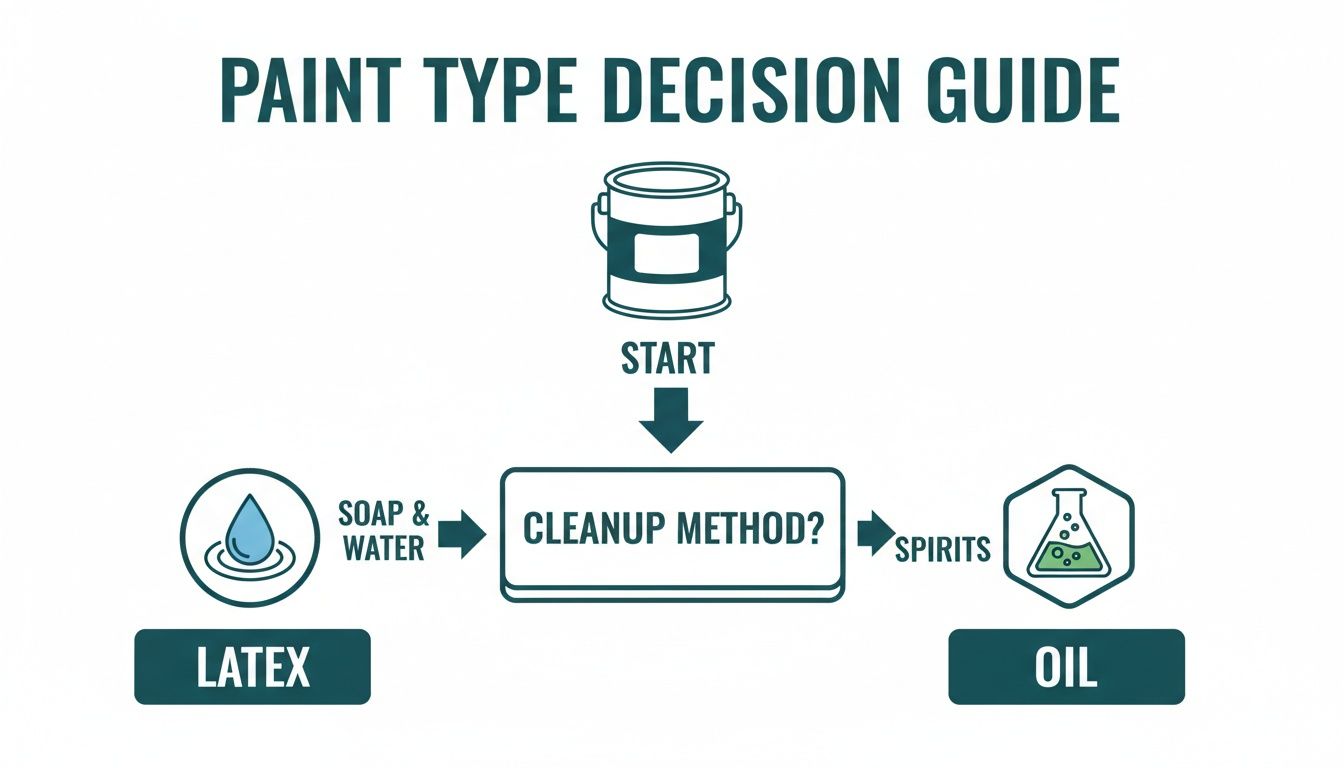
    A flowchart decision guide helping identify paint type: latex or oil, based on cleanup method.

    This simple check instantly separates your paint into two distinct disposal paths, making your next steps clear.

    You might wonder why getting this right is such a big deal. Tossing liquid paint in the alley isn't just a mess; it’s against city regulations and terrible for the environment. Leftover paint is a huge issue. In fact, paint has historically been one of the largest waste streams in Illinois household hazardous waste collections. Old data from the Illinois EPA shows that roughly 75% of participants were bringing paint to disposal events. Imagine a football stadium filled three-quarters full with people, and every single one is holding an old can of paint. That's the scale we're talking about.

    Let's turn that pile of "I'll deal with it later" into a simple, straightforward plan. It's time for you to take back your space and do right by our city.

    How to Handle Old Latex Paint at Home

    A can of latex paint with a brush, a pile of granules, and newspapers for paint disposal.

    So you found out your old paint is latex. Good news! This is the easiest kind of paint to deal with in Chicago. You can actually handle the whole thing right at home, no special trip required.

    Your goal is to turn that sloshing can of liquid into a solid, harmless puck that you can legally toss in your regular trash. Think of it like a weird, satisfying science experiment on your back porch, like making a peculiar cake you have no intention of eating. You’re taking something messy and making it simple.

    The Art of Drying Out Paint

    Your mission, should you choose to accept it, is to get all the water out of the paint. The trick is to use stuff you probably already have lying around the house to soak up the moisture and speed things along.

    I’ve had a lot of success with a few common household items. They’re basically sponges, soaking up all the liquid and leaving behind a solid block of pigment and binders.

    • Cat Litter: This is my go-to. The cheap, clay-based kind works like a charm.
    • Shredded Newspaper: If you have a paper shredder, you’ve got an endless supply of paint-drying magic.
    • Sawdust: Just finished a woodworking project? I put that sawdust to good use.
    • Paint Hardeners: You can also grab commercial paint hardeners at any hardware store. They're made for this exact job and work super fast.

    I'll never forget the first time I tried this. I had a full gallon of "Greige" left from my living room project. I figured I’d just dump a whole bag of cat litter into the can and be done with it. The result was a volcanic, gloopy mess that oozed all over my garage floor like a creature from a B-horror movie. That taught me a valuable lesson: work in small batches!

    My Foolproof Method for Small Batches

    If you only have less than an inch of paint left in the can, just pop the lid off and let it air dry. I find a well-ventilated spot, away from kids and pets. It might take a few days, but it’s the simplest way to do it.

    For bigger amounts, here’s the process I follow now. Find a sturdy cardboard box and line it with a trash bag. I pour a thin layer of paint into the box, no more than an inch deep. Then, I sprinkle in my absorbent of choice—cat litter, sawdust, whatever I’ve got. I stir it all up with a paint stick until it has the consistency of thick oatmeal.

    Let it sit for a day or two until it's completely solid. You can keep adding layers on top until the can is empty. Once the entire mixture is hard as a rock, I tie up the bag and toss the whole box into my regular black garbage cart.

    This simple act is part of a bigger effort to manage waste responsibly—a core part of what we do as Litter Caterpillars. You can check out more tips in my comprehensive guide to recycling in Chicago. It’s a small step that makes a big difference.

    Your Game Plan for Oil-Based Paint Disposal

    Alright, let's talk about oil-based paint. This stuff is a completely different beast from latex. It's officially classified as household hazardous waste (HHW), meaning you absolutely cannot dry it out and toss it in your black cart. The solvents and chemicals inside are serious business, and we have a responsibility to keep them out of our environment.

    I know, "hazardous waste" sounds intimidating. It conjures images of people in hazmat suits. But don't let it scare you off. The process for paint disposal in Chicago IL for oil-based products is actually pretty straightforward, and I’m here to walk you through it. Consider this your personal game plan for handling it the right way.

    Your Destination: Goose Island

    The City of Chicago has a permanent Household Hazardous Waste (HHW) drop-off facility, and it’s your best friend for this task. I found it at 1150 N. North Branch Street on Goose Island—a place that feels a world away from the alleyways where this kind of waste used to end up.

    I think of this place as a dedicated guardian for our city's health. It’s built specifically to handle materials that are too potent for our regular waste stream. Taking your old oil-based paint here isn't just about following the rules; it's a real act of civic care.

    I’ll never forget the feeling of relief the first time I went. Driving away, my car felt lighter, not just because the cans were gone, but because a weight of responsibility had been lifted. I knew I had done my part.

    Insider Tips for a Smooth Drop-Off

    I’ve made this trip more than a few times, and I’ve picked up some tricks to make it as quick and painless as possible. Here’s my advice for a spill-free, stress-free drop-off.

    • Pack Your Car Securely: This is my number one tip. I always place the paint cans inside a sturdy cardboard box or a plastic tub. It keeps them from tipping over on a sharp turn. A paint spill in your trunk is a cleanup nightmare you do not want to deal with.
    • Time Your Visit: The facility gets packed on weekend mornings. If your schedule allows, aim for a weekday afternoon. You’ll be in and out in a flash.
    • Know What to Expect: When you pull up, attendants will wave you into the right lane. You just stay in your car while they do all the heavy lifting, safely unloading the cans for you. It’s a totally contactless and surprisingly efficient system.

    This little journey to Goose Island is more than just an errand. It's a conscious choice to protect our shared home. Every can you drop off is a victory for Lake Michigan, a safeguard for our soil, and a promise to our neighbors that we’re all in this together.

    Properly managing these materials is a huge part of my mission. If you want to dive deeper into what else qualifies as HHW, check out my full guide on Chicago hazardous waste disposal.

    Give Your Unwanted Paint a Second Life

    Hands exchange a 'Free to reuse' paint can and an artist's palette with a smiling woman.

    Before you go through the hassle of drying out that half-used can of ‘Agreeable Gray’ or schlepping it to a drop-off site, I want you to stop for a second. What if that leftover paint is exactly what your neighbor needs to finish their kid's nursery? Or the perfect color for a local high school’s stage play?

    I really believe in the magic of turning one person's "trash" into another's treasure, and that leftover can in your garage is a classic example. It’s not just old paint; it’s untapped potential. Hands down, reuse is the most powerful, community-building, and inspiring way for you to handle paint disposal in Chicago IL.

    This isn't about just ditching something you don't need. It's about seeing your "clutter" as a resource for someone else.

    Turn Your Leftovers into Local Art

    Think about the vibrant murals in Pilsen or Logan Square. Every single one started with a can of paint, with an idea. Your leftovers, no matter how little is in the can, can be part of that same creative energy.

    I’ve learned that tons of local groups are genuinely thrilled to get usable paint. They don't see it as waste; they see it as a gift that helps them stretch their super-tight budgets. Look around your own neighborhood, and you'll find plenty of people who could use it:

    • Community Theaters and School Art Programs: These guys are always looking for paint for sets, props, and art projects. That crazy bright color you used on one accent wall could be the main feature of a school play.
    • Non-Profits and Housing Charities: Groups that fix up homes for people in need can almost always use basic, neutral interior colors.
    • Local Artists and Muralists: I just do a quick search on Instagram for Chicago artists. You'll often find people or collectives who are happy to take paint donations for their next public art piece.

    Giving your paint a second life is the ultimate win-win. You clear out your garage, a deserving group gets a free resource they genuinely need, and together, we keep perfectly good materials out of the waste stream. It’s a small act that ripples outward with positive impact, a story of connection rather than disposal.

    Connecting with Neighbors Who Need Paint

    Sometimes, the best new home for your paint is just a few houses down the street. And finding that home is easier than ever. I’ve had awesome luck using local online groups to pass along stuff I don't need anymore.

    These sites are like the digital version of borrowing a cup of sugar from your neighbor. My absolute favorite way to do this is through my local Buy Nothing Project group on Facebook. I once posted about a half-gallon of perfect white trim paint, and literally within an hour, a guy from three blocks away was at my door. He was so excited because he was just about to go buy the exact same thing! His story was one of gratitude, and my story was one of relief.

    Other great options are Freecycle or even the "free" section on Facebook Marketplace. It’s a dead-simple, direct way to make sure your paint gets used to the very last drop by someone who actually wants it. This is the Litter Caterpillar spirit in action: turning a small problem into a chance for connection and doing some good in your community.

    Discover the PaintCare Illinois Drop-Off Program

    Let me tell you about a secret weapon in the fight against paint can clutter. It’s a true game-changer for paint disposal in Chicago IL that a lot of people I talk to still don’t know about: PaintCare Illinois. This program is like having a magic wand that makes both your old latex and oil-based paint disappear, responsibly and for free.

    I think of it as a neighborhood co-op for leftover paint. It’s an industry-sponsored program that creates a whole network of drop-off sites, turning a massive chore into a simple errand. It’s no longer something you have to plan a special Saturday trip for; it’s just a quick stop on your way to pick up some new lightbulbs.

    From Garage Clutter to Quick Errand

    The real genius of PaintCare is how it uses the places you already go. Your local hardware store or neighborhood paint shop becomes a partner in this effort. I was amazed when I first used their online locator tool and found a drop-off point less than a mile from my apartment. It felt like uncovering a hidden convenience right under my nose, a secret shared just for me.

    Here’s the basic rundown of how you can make this work for you:

    • Find Your Spot: The first move I make is to hit up the PaintCare Illinois website. They have an easy-to-use map where you just punch in your zip code, and boom—it shows you all the participating retail stores nearby.
    • Check the Details: Most spots have a limit, usually around 5 gallons per visit. I always call the specific store ahead of time just to double-check their hours and make sure they have space. Nothing's worse than loading up your car for nothing.
    • Prep Your Cans: Make sure your paint cans are sealed up tight with their original lids. They need to be in their original, labeled containers—no leaky, unlabeled mystery cans. I just pack them upright in a box or tub in my car so they don’t tip over.

    The first time I did this, I took three cans of oil-based paint that had been mocking me from a corner of my closet for years. The whole process at the store took less than five minutes. I just handed them over at the counter, and that was it. No paperwork, no hassle. It was an incredible feeling of accomplishment for such a tiny effort.

    Using programs like PaintCare is more than just convenient; it’s a vital act of city stewardship. The reality we face is stark. The Chicago metropolitan area has less than 10 years of landfill capacity remaining, a critical situation that demands we all embrace zero-waste practices. Choosing proper disposal methods directly extends the life of our regional landfills and protects our environment. You can learn more about the local solid waste plan and see how your actions contribute to a more sustainable Chicago.

    This network transforms paint disposal from a headache into a simple, inspiring act. It’s a powerful reminder that when we create easy, accessible systems, people are eager to do the right thing. It’s a small choice that collectively makes a huge impact, something we at Litter Caterpillars see every single weekend. For more on local waste solutions, you might be interested in my guide to Chicago recycling centers.

    Your Chicago Paint Disposal Questions Answered

    I get tons of questions about the nitty-gritty details of getting rid of old paint. It's totally normal to feel confused—it feels like every can has its own story and its own weird set of rules. My goal is to tackle those nagging questions head-on, so there’s nothing standing between you and a clean, responsibly managed home.

    When you and I make the right way the easy way, we all win. Let's dig into the most common questions I hear about paint disposal in Chicago IL, so you can get this chore done with total confidence.

    What Should I Do with Empty or Rusted Paint Cans?

    This is a great question. The can itself can be a source of confusion, like having an empty bottle of a strange potion—you're not sure if the container itself is still a problem. The short answer is: it depends on what was inside.

    If I have a latex paint can that's totally empty and dry, I can usually just toss it in my blue bin with other metals. The key is to take the lid off. That’s how the recycling collectors can see it’s empty and not a liquid mess waiting to happen.

    For oil-based paint cans, it’s a different story. Even if they seem bone-dry, I treat them as hazardous waste. That chemical residue is no joke. These need to go to a Household Hazardous Waste (HHW) facility or a PaintCare drop-off. If a can is rusted and actually leaking, I seal it up in a plastic bag to contain the mess and get it to an HHW or PaintCare site ASAP.

    Can I Dispose of Spray Paint Cans the Same Way?

    No, and this is a super important one. Aerosol spray paint cans are a totally different animal. I have learned that they are always, without exception, considered hazardous waste.

    Think of them as tiny, pressurized chemical tanks. They’re filled with flammable propellants that can explode or catch fire in sanitation trucks or at recycling centers. It doesn’t matter if you think you’ve sprayed every last drop—that propellant is still in there, waiting to cause trouble.

    You must take all aerosol spray paint cans, empty or not, to a Chicago HHW drop-off facility. I never, ever put them in my blue recycling cart or my black trash cart. It’s a simple rule that protects our sanitation workers and prevents some really dangerous accidents.

    Is There a Limit to How Much Paint I Can Drop Off?

    Yep, there are usually limits. They’re in place to keep these programs running smoothly for everyone and not get overwhelmed. It's all about being a good neighbor. These services are designed for regular folks like you and me cleaning out our garage, not for a contractor emptying a warehouse.

    The City of Chicago's HHW facility on Goose Island is strictly for residential waste. They’re generally pretty cool about it, but if you show up with a pickup truck loaded to the brim, you might get some questions.

    For the PaintCare retail sites, the limit is typically 5 gallons per visit. It’s always a brilliant idea to call the specific store ahead of time. I just confirm their policy and make sure they have room for my drop-off that day.

    Every can you dispose of correctly is a small but powerful act for our city's health. The scale of our collective waste is mind-boggling; in 2020, Chicago generated 4.13 million tons of materials. This staggering number really drives home why every little bit of effort you and I make to manage waste properly matters. You can learn more about Chicago's waste strategy in the city's comprehensive report.


    At Litter Caterpillars, I believe taking care of our city, one small act at a time, is how we build a stronger community. If you're inspired to do more, come join me for a cleanup. You can learn more and sign up at https://www.littercaterpillars.com.


  • A Practical Guide to Chicago Mattress Recycling

    A Practical Guide to Chicago Mattress Recycling

    You can absolutely recycle that old mattress in Chicago. Yes, you can. It’s a choice, really. It's a fork in the road between two very different destinations. You have the city’s bulk pickup, which I've seen far too often just means a sad, lonely trip to the landfill. Or, you can choose the path less traveled—a private recycler, someone who will actually dismantle it and give its bones and guts a brand new life. This guide is your map, your compass, to navigate chicago mattress recycling the way it was meant to be.

    Your Mattress Is More Than Just Junk

    A man operates a mattress cleaning machine next to an old mattress with a city skyline.

    I know that feeling. It’s a gnawing presence in the back of your mind. That old mattress, propped awkwardly against the wall, isn't just an eyesore; it's a heavyweight problem you keep pushing to "tomorrow." It feels immovable, like a forgotten boulder in your guest room, a task that might as well weigh 500 pounds.

    For me, dealing with my own clutter has always been the hardest part of any project. It's as if every single item whispers its own sentimental story, a tiny ghost making it impossible for me to let go. But I stumbled upon something truly powerful through my work with Litter Caterpillars and our community cleanups here in Chicago.

    Turning a Burden Into a Community Win

    Cleaning up someone else's mess—like a mattress heartlessly dumped on a sidewalk—is surprisingly, profoundly empowering. It's a clean, visible, undeniable act that transforms a neighborhood problem into a shared point of pride. That single action sends a ripple of care, a silent message, through the whole community.

    You can harness that same energy to finally tackle your own mattress. This isn't just about hauling junk to the curb. It’s about you, consciously choosing to do better for our city and for the ground beneath our feet.

    Think of this as your first step toward a cleaner Chicago. By choosing recycling over the landfill, you're not just getting rid of an old item; you're actively becoming part of the solution.

    This guide will show you exactly how to handle that mattress, transforming it from your personal burden into a community win. It just feels good, deep in your bones, knowing you’re doing the right thing.

    Why Chicago Mattress Recycling Matters

    The sheer volume of mattress waste is insane. Americans, you and I, throw away roughly 20 million mattresses every single year. It’s a staggering number. That breaks down to over 50,000 of them hitting landfills every single day. This creates a colossal environmental problem, but it’s a story we can change, right here in Chicago. You can read the full research about these mattress waste statistics and see for yourself why this matters so damn much.

    Recycling isn’t just about dodging the landfill; it's about giving valuable materials a second act. When you use a proper recycling service, you make sure that:

    • Steel springs are melted down, reborn as scrap metal for new creations.
    • Foam padding gets shredded and re-spun into soft carpet padding or warm insulation.
    • Wood frames are chipped into fragrant mulch for our city's landscaping.
    • Fibers and fabrics find a new life in other industrial products, continuing their journey.

    Up to 80-90% of a mattress can be recycled. We'll walk through the real-world options for Chicago mattress recycling, turning a chore into an act of profound change for our city.

    So, Why Has Recycling in Chicago Been So Messy?

    Let's be real for a minute. Trying to figure out recycling in Chicago can feel like you've been dropped into a labyrinth with no map. I've been there, standing in front of that blue cart, second-guessing everything, wondering if I'm actually helping or just making things worse. It’s a feeling a lot of us share, a quiet frustration.

    For years, the whole system has made us skeptical, and honestly, we had every right to be. It’s felt a bit like being on a team that keeps telling you they’re winning, but the scoreboard says something completely different. After a while, you just start to lose faith.

    I remember the old 'Blue Bag' program from the 90s. We all did our part, didn't we? We dutifully bagged our recyclables, only to find out so much of it ended up in a landfill anyway. That kind of history sticks with you. It leaves a mark.

    A History of Broken Trust

    The 'Blue Cart' system that came next didn't exactly have a smooth start either. A gigantic part of the problem was a classic, almost storybook conflict of interest. For the longest time, the very company hired to manage our city’s recycling also owned the landfills. It's like asking a fox to guard the henhouse—you can pretty much guess how that story ends, can't you?

    When the company that gets paid to recycle also gets paid to dump, the entire incentive to do the right thing gets twisted and warped. This isn't just a random fact; it's the core reason why our own personal actions matter so, so much.

    This long history of shady dealings is a massive hurdle we’re still trying to clear. In fact, records show that the 1995 'Blue Bag' program only hit about one-third of its reported recycling rates. That little detail, uncovered years later, only poured more fuel on the fire of public distrust. Thankfully, recent reforms are finally starting to rebuild some of that confidence. You can get a clearer picture of Chicago's rocky recycling journey by exploring the challenges and improvements our city has faced.

    Your Mattress Matters More Than You Think

    This history is exactly why figuring out what to do with a big, bulky item like a mattress is so incredibly important. It's our chance to sidestep a system that has failed us and make sure we get a win. Instead of just tossing it into a program with a sketchy track record, you can take control of its destiny.

    Choosing a dedicated Chicago mattress recycling service is a direct, personal action. It's you, with your own two hands, ensuring that your old mattress doesn't become another landfill statistic. You're creating a small, personal victory for the environment where the larger system has dropped the ball for so long.

    This is your chance to write a different story. If you're fired up to learn more, you can also check out our guide on how to recycle more effectively in Chicago. Every small piece of knowledge gives us the power to do better.

    Exploring Your Mattress Disposal Options

    Alright, you’re ready. You're ready to get that mattress out of your space for good. I get it. Let's break down your real options here in Chicago so you can make a choice that actually feels right to you. The path you pick is a big deal—it decides whether your mattress gets a second life or just takes up space in a landfill for the next hundred years.

    First up, you've got the city's bulk pickup service. You can request this by calling 311 or firing up the CHI311 app. It sounds easy, and honestly, it is. But here's the unvarnished truth I've learned from seeing this process up close, again and again: this is a disposal service, not a recycling program. Your mattress will almost certainly be hauled away with regular trash and sent straight to a landfill.

    If you’re just trying to get it gone, that's one route. But if you’re reading this article, I have a feeling you want something better for it.

    Finding True Mattress Recycling Heroes

    This brings us to the real stars of this story: private mattress recyclers. These are the companies doing the hard, dusty, often thankless work of dismantling your old mattress piece by piece. They're the ones who make sure the steel, foam, and wood are actually turned into new materials instead of just becoming more garbage.

    Finding a good one takes a little bit of homework, but believe me, it’s worth the effort. It's like finding a mechanic you trust; once you find them, you stick with them because you know they do the job right.

    • Ask About Their Process: A legitimate recycler will be proud to tell you exactly what they do. You should ask them straight up: "Where do the mattresses go?" and "How are they broken down?"
    • Check for Fees: Real recycling costs money. I know, it stings. But there's labor and transportation involved. Expect a fee, usually somewhere between $70 to $200. If a service sounds too cheap to be true, it probably is.
    • Read Reviews: See what your fellow Chicagoans have said. You should look for comments about punctuality, professionalism, and whether they seemed truly committed to recycling.

    The Donation Dilemma

    What about donation? I get this question all the time. It feels like the kindest option, but it's also the trickiest, like navigating a minefield. Because of strict health and hygiene laws, most big charities like Goodwill or The Salvation Army simply can't accept used mattresses. It’s a huge liability for them.

    It's not completely impossible, though. A few specialized, local organizations like the Chicago Furniture Bank sometimes accept mattresses, but their standards are incredibly high.

    Your mattress would need to be in nearly pristine, stain-free, and structurally perfect condition. You absolutely must call them beforehand to confirm they're even accepting donations and that your mattress meets their strict, non-negotiable criteria.

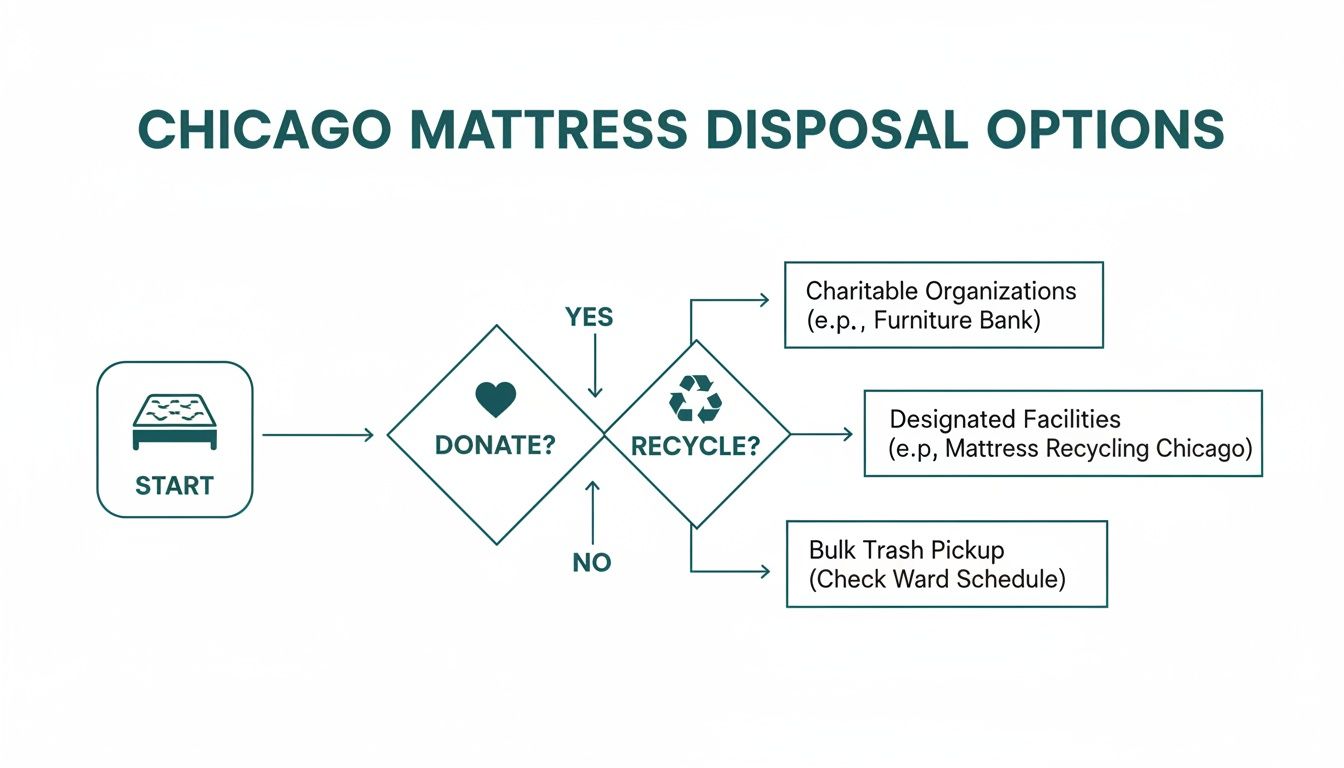
    This quick decision tree can help you see the paths for responsible Chicago mattress recycling.

    Flowchart detailing Chicago mattress disposal options: donate, recycle, or bulk trash pickup.

    As you can see, the path to true recycling or donation requires a more deliberate choice from you than just dragging it to the curb. To find a drop-off location that might be a good fit, you can check out our guide on Chicago recycling centers. It’s all about giving you real choices for a solution you can actually be proud of.

    Preparing Your Mattress for Pickup

    A smiling couple moves a mattress using a hand truck, with stairs and watercolor splashes.

    So you've scheduled your pickup. Awesome! That’s a huge step. Now for the real work: wrestling that beast from your bedroom to its next destination. I want you to think of it like prepping a fragile package for an important delivery—a little effort now makes all the difference in the world.

    First things first: keeping it clean and dry is non-negotiable. This is especially true if you’re using a chicago mattress recycling service or attempting a donation. A wet, grimy mattress will almost certainly be rejected, and all your careful planning goes right down the drain.

    It's like dressing for a Chicago blizzard. You wouldn’t step outside without a coat, right? Your mattress needs that same level of protection against the elements.

    Wrap It Right

    Your new best friend is a humble plastic mattress bag. You can snag one for just a few bucks at any hardware store or online. Sliding your mattress into one of these is the single most important thing you can do.

    This bag is your mattress's armor. It's a shield against rain, snow, dirt, and any potential pests looking for a new, cozy home. It's a simple step that ensures recyclers can actually work with the materials inside. It shows you care. It shows you respect the process.

    A clean, dry mattress is a recyclable mattress. A wet, forgotten one left in the alley becomes a public health problem and a heavy burden for our city crews.

    This small act of wrapping it properly makes a massive difference for everyone, from your neighbors to the collection team who has to pick it up. It’s a sign of respect for the process and for the people who make it all happen.

    The Safety Dance

    Now, let's talk about the move itself. I can't stress this enough: hauling a king-size mattress down three flights of a narrow Logan Square walk-up is a team sport. Please, please don’t try to be a hero and do it alone.

    Grab a friend. A roommate. A neighbor. It’s not just about the weight; it's the sheer awkwardness and the complete lack of good handholds. It’s way too easy to lose your grip, stumble, or punch a hole in the wall. You'll move faster, you'll move safer, and you'll probably share a few laughs along the way.

    Finally, a critical point on timing. Never, ever leave your wrapped mattress on the curb or in the alley until the morning of your scheduled pickup. Leaving it out for days is basically an open invitation for scavengers, pests, and bad weather to undo all your careful prep work.

    And while you're getting your disposal game in order, it's a good time to think about other tricky items. You can check out our guide on how to handle City of Chicago hazardous waste disposal to keep our city even cleaner.

    Thinking Bigger Than Your Own Four Walls

    Okay, so you've figured out how to get rid of your own mattress. That’s a fantastic win. I mean that. Seriously. But what happens when you start looking past your own front door? What if you could take that same energy and wipe out the mattress problem for your entire block, maybe even your whole neighborhood?

    This is where things get really exciting for me. It's where we shift from thinking "my problem" to "our project." I've seen it happen time and again: one person, with just a bit of drive, can spark something huge, turning a dozen separate headaches into one big, collective solution.

    Rally the Neighborhood for a Collection Day

    Picture it: one Saturday morning, everyone on your street drags out that old, dusty mattress they’ve been hiding in the basement. You could organize a neighborhood-wide mattress collection day. It's an incredible way to solve a bunch of problems at once, forge some real community bonds, and see a tangible, visible difference on your block.

    I want you to think of it like a block party, but instead of a potluck where everyone brings a dish, everyone brings an old mattress. The outcome is the same—a cleaner, stronger, more connected neighborhood.

    This isn't just about hauling away junk. It’s an act of collective pride in the places we share. It shows that a few determined people can build a better Chicago, one mattress at a time.

    How to Pull It Off

    The idea might sound massive, I know, but the steps are surprisingly simple. And you don't have to go it alone—in fact, it’s way better if you don’t.

    • Find Your Crew: You should link up with a local community group, your neighborhood association, or even your alderperson's office. They have the megaphone (and often the resources) to get the word out.
    • Team Up with a Recycler: Give one of the private chicago mattress recycling companies we've mentioned a call. A lot of them are eager to partner on community events and might even cut you a deal for a bulk pickup from one single spot.
    • Pick a Time and Place: Grab a weekend day and find a central, easy-to-access location. A church or school parking lot, or a corner of a local park (with permission, of course!) can work perfectly.
    • Spread the Word: You have to use every tool you have. Plaster it on neighborhood Facebook groups, hang flyers in local coffee shops, and just talk to people. Build the hype!

    This kind of volunteer-powered effort is exactly what our city and state need. It’s grassroots action that delivers real, visible results that no policy alone can achieve.

    Illinois has some ambitious goals: a 40% waste diversion rate by 2025 and 50% by 2035. We don't have a state-mandated mattress recycling program like California or Connecticut yet, so these volunteer events are what bridge the gap and push us toward those targets. You can see for yourself how your work fits into Illinois's materials management plan and the bigger picture.

    Taking this on transforms you from someone just handling their own stuff into a true community leader. It’s an inspiring way to show up for your city and your neighbors, proving that real change starts right here on our streets, with us.

    Your Mattress Recycling Questions, Answered

    Getting rid of a mattress in Chicago can feel like a huge headache. I get it. I’ve heard all the questions from people just like you, trying to do the right thing but not knowing where to start. After years of dealing with this stuff, I’ve collected the most common questions to give you the straight-up answers you need.

    Think of me as your guide who’s already been down this road a hundred times. I know the shortcuts, I know the dead ends, and I know how to get it done right.

    Can I Just Leave My Mattress in the Alley?

    I wish it were that simple, but absolutely not. Just dumping your mattress in the alley without scheduling a pickup is asking for a hefty fine and, frankly, making our neighborhood look terrible. You must schedule a bulk item pickup first. You can do this by calling 311 or, even better, by using the CHI311 app.

    But here’s the thing—and it’s a big one—this is a disposal service, not recycling. More often than not, that mattress is taking a one-way trip to a landfill. If you want true Chicago mattress recycling, you need to call a private service that actually breaks these things down.

    Are There Free Mattress Recycling Services in Chicago?

    This is a tough one. A truly free service that promises your mattress gets recycled is pretty much a myth here in the city. Private junk removal and recycling companies are your best bet, but they’ll charge a fee, usually somewhere between $70 and $200.

    I tell people to think of this fee as an investment, not a cost. It’s you doing your part to make sure up to 90% of your mattress gets a new life instead of just sitting in a landfill for a century.

    The city's 311 bulk pickup is technically "free"—in the sense that you already pay for it with your taxes—but again, it's not a recycling program. It’s the difference between tossing a plastic bottle in the trash versus putting it in the blue cart. One is easy, the other is right.

    What Actually Happens When a Mattress Is Recycled?

    It's actually a pretty cool process, like watching a skilled butcher break down an animal, making sure every single part is used. Workers at a recycling facility literally dismantle the mattress by hand, layer by layer, with incredible efficiency.

    • Steel Springs: They pull these out and sell them as scrap metal. They get melted down and forged into something entirely new.
    • Foam & Padding: This stuff gets shredded and is reborn as carpet padding or home insulation. A super practical second life.
    • Wood Frame: The wooden skeleton of the mattress gets chipped into mulch for landscaping or burned for fuel.
    • Fabrics & Fibers: Even the outer fabric can be reused for different industrial things, continuing its useful journey.

    It’s a perfect, beautiful example of turning what we see as "waste" into a whole collection of valuable materials.

    Can I Donate My Mattress if It Is in Good Condition?

    Donating is really, really tricky. Because of strict health rules, big places like Goodwill and The Salvation Army won't touch used mattresses. No exceptions. It's just not worth the risk for them.

    Your best shot might be a smaller, local place like the Chicago Furniture Bank. They might take a mattress, but only if it’s in almost perfect shape—absolutely no stains and it must meet their super high standards. You must call them first to see what their policy is before you even think about hauling it over there.


    I hope these answers clear things up and make you feel ready to take the next step. If doing this one small thing makes you want to build a bigger habit of service, come join us at Litter Caterpillars. We’re a volunteer group dedicated to cleaning up our city and making friends while we do it. Find out more and join an event at https://www.littercaterpillars.com.