
Month: March 2026

  • Your Guide to the Casa Catalina Food Pantry Chicago IL

    Your Guide to the Casa Catalina Food Pantry Chicago IL

    That feeling when you open the fridge and it’s almost empty? It’s a heavy weight, a stone in your gut. I get it. I want to help lift some of that weight by walking you through exactly how you can get help at the Casa Catalina Food Pantry Chicago IL. No confusing steps, no judgment—just me giving you a straightforward guide so you know exactly what to expect.

    Your Practical Guide to Visiting Casa Catalina
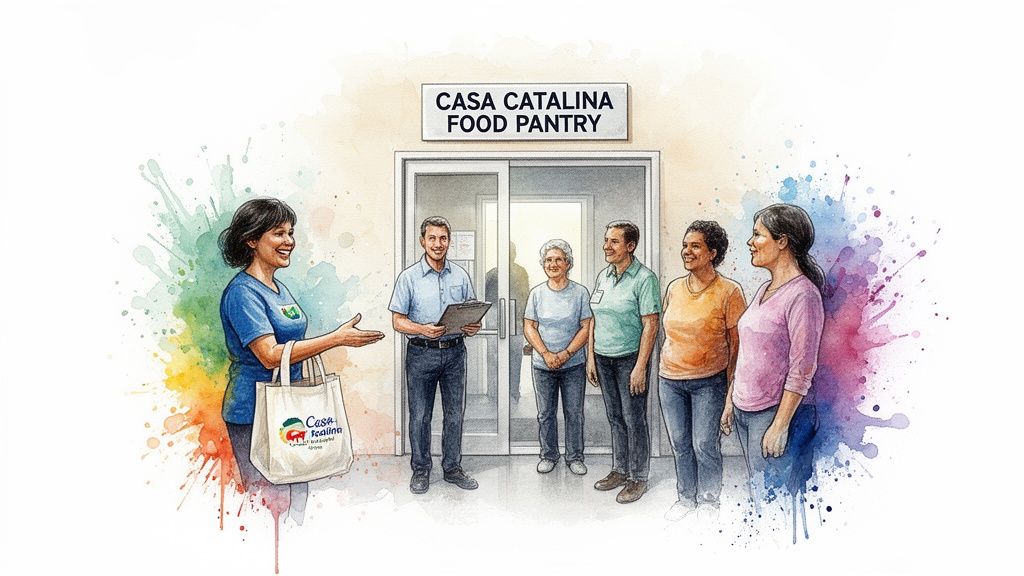
    Watercolor illustration of smiling people outside Casa Catalina Food Pantry, a woman holding a branded bag.

    Walking up to a new place to ask for help can feel incredibly intimidating. I’ve been there. My goal here is to vaporize that anxiety. Let's make sure you arrive at Casa Catalina feeling prepared and welcome, not stressed out and lost.

    This place is so much more than just a food pantry. Seriously. In the very heart of the Back of the Yards neighborhood, it’s a pillar of hope, a real-life testament to what happens when a community truly cares for its own. Here, they treat you like a neighbor, not a number.

    A Beacon in the Back of the Yards

    For over 30 years, Casa Catalina has been a steady presence at 4537 S Ashland Ave. It’s run by Catholic Charities, but its doors are flung wide open for everyone, no matter your story or what you believe. It’s a lighthouse, cutting through the fog for this neighborhood.

    Every single week, this pantry helps between 300 and 350 families. That’s roughly 1,500 to 1,750 of our Chicago neighbors getting the support they need to get by. This only happens because of the monumental deliveries they get—I'm talking about 5,000 to 7,000 pounds of food from the Greater Chicago Food Depository. It’s an incredible, powerful operation.

    I want you to see this not just as giving your time, but as this amazing opportunity for connection, for growth. It's a chance to become part of something truly meaningful in our community.

    My whole mission with Litter Caterpillars is to show you how service can transform us. Casa Catalina operates with that same spirit, treating every person who walks through its doors with a deep, profound sense of dignity. It's about so much more than a meal; it’s about respect. If that fires you up, you should check out our guide on how to start volunteering and find even more ways you can make an impact.

    What It’s Really Like Inside

    Walking into a new place, especially when you’re looking for a little help, can be nerve-wracking. I get it. So let’s walk through the doors of the Casa Catalina food pantry together, you and me, so you know exactly what to expect.

    First thing’s first: forget any old, sad picture you might have in your head of grim lines and identical, pre-packed bags of depressing food. What you'll find here is something else entirely. It's a place built on respect, plain and simple.

    This Isn't a Handout, It's Your Choice

    Casa Catalina was a trailblazer with its "client choice model"—an idea so simple yet so powerful it changes everything. Imagine it less like a pantry and more like a small neighborhood grocery store where you are the shopper. Instead of getting a bag someone else packed, you get to walk the aisles yourself and pick out the items your family will actually eat and enjoy.

    It’s about dignity. Do your kids tear through oatmeal for breakfast? Go ahead and grab it. Is your family all about black beans instead of pinto beans? The choice is entirely yours.

    This system puts you in the driver's seat. It also brilliantly slashes food waste, making sure groceries end up on a dinner plate, not forgotten in the back of a cupboard. It respects you and what your family needs, with options for things like eggs or no eggs, and meat or no meat, depending on your diet.

    "The client choice pantry is a dignified way to help people. It gives them the choices to select food that they want, that they are going to use, and it is a better way to respect people."

    And the support doesn't stop with groceries. Casa Catalina often runs extra programs during the winter, fall, and summer to give even more support to families, kids, and teens. You can read more about how they are bridging Chicago's food gap and creating a place where people feel genuinely supported.

    The volunteers here are amazing. They aren’t there to rush you along; they are there to guide you with a smile and make you feel like a welcome neighbor.

    Why This Pantry Is a Lifeline for Chicago

    Food insecurity isn't some abstract concept. It's a quiet crisis hitting our neighbors, right here in Chicago's vibrant Latino communities. It's a real, heavy struggle that's only gotten worse, and I want to show you the reality behind the numbers.

    The need for a place like Casa Catalina Food Pantry Chicago IL has absolutely exploded. The reasons are both simple and complicated. Just think about summertime. School's out, and suddenly that safety net of free breakfast and lunch is gone. For a family already stretching every single dollar, their grocery budget is now expected to cover a ton of extra meals.

    The Real-Life Impact of the Growing Need

    This isn't a vague issue; it's a full-blown crisis you can measure. Food insecurity among Chicago's Latino families has hit staggering, heart-breaking levels, with 28% of households with children struggling to put food on the table.

    Casa Catalina felt this surge firsthand. They saw 200 new clients walk through their doors between May and June alone as summer kicked off. It’s not just them, either. Across the city, Catholic Charities agencies have seen a staggering 62% jump in need since 2019. This isn't just a small uptick; it's a seismic shift, an earthquake under our feet. You can get a deeper look into these trends from a WTTW news report on Chicago food insecurity.

    This infographic gets to the heart of why Casa Catalina’s client-choice model is so powerful—it’s about giving people control, cutting down on waste, and, most importantly, showing profound respect.
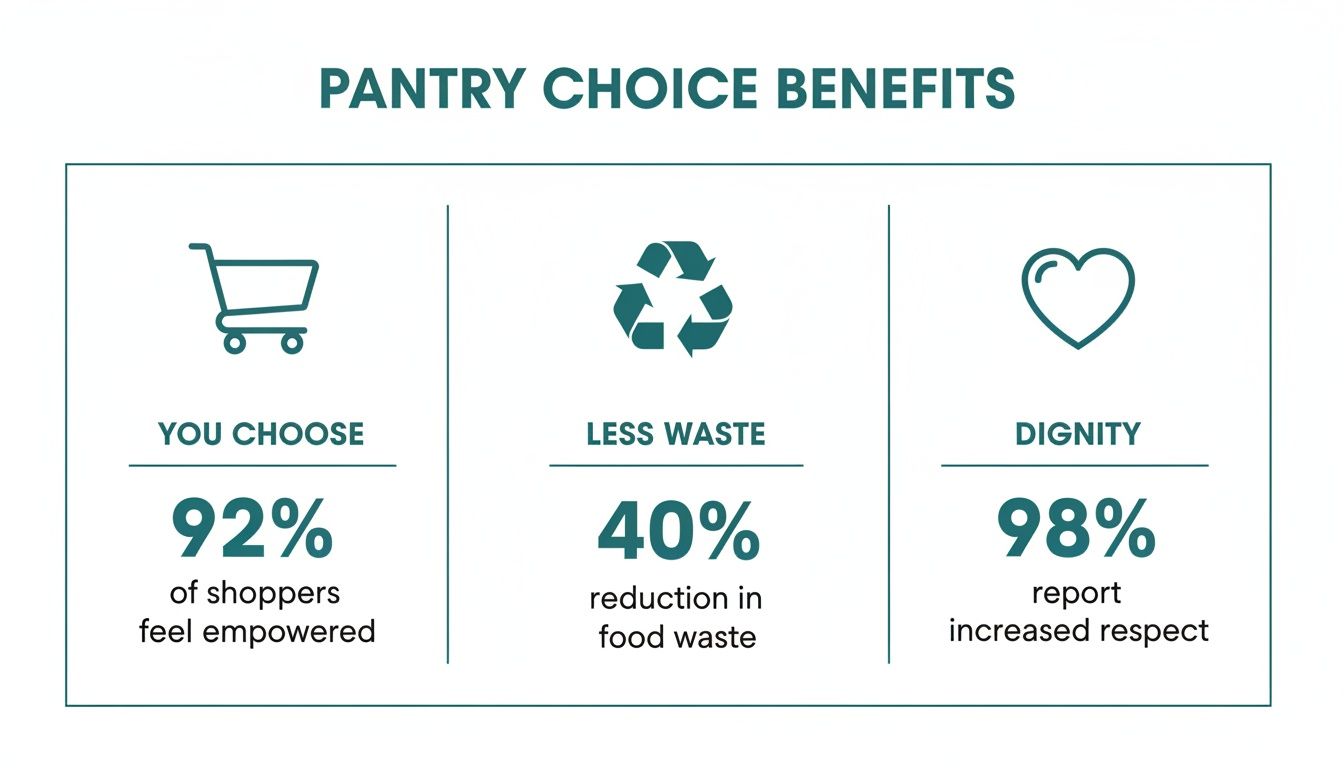
    Infographic showing food pantry choice benefits: shopper empowerment, less waste, and increased respect.

    The big takeaway here is that how we give is just as important as what we give. It turns a handout into a powerful, transformative gesture of dignity.

    This growing need can feel overwhelming, but that’s exactly why places like Casa Catalina are so vital. They are the frontline defense against hunger, a place of refuge in the storm.

    Seeing the "why" isn't about getting discouraged. It's about understanding the incredible purpose behind every single donation and every volunteer hour you give. Every meal you help provide makes a real, tangible difference for a family in our city.

    Every can of beans, every hour you spend sorting produce, every dollar you give—it all becomes part of a much bigger story. It's a story of neighbors showing up for each other with incredible resilience and a hell of a lot of heart.

    Ready to Actually Do Something?
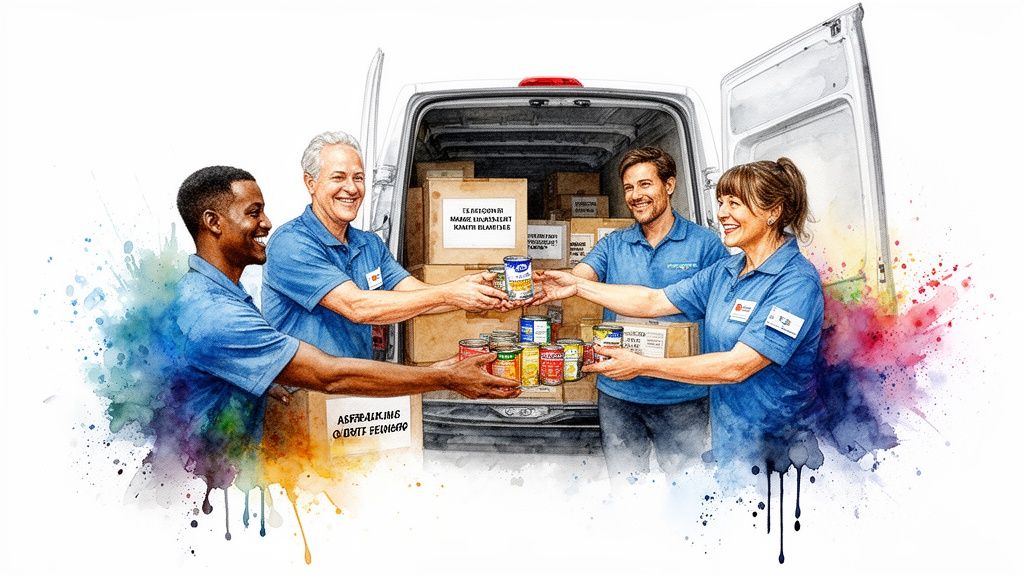
    Four diverse volunteers happily unload boxes and cans from a white delivery van, surrounded by watercolor splashes.

    You know that feeling when you just want to stop talking and start doing? That’s what volunteering at the Casa Catalina Food Pantry Chicago IL is all about. This isn't about feeling good; it's about doing good.

    It's a place where your hands can finally do the work your heart has been asking for.

    Picture this: you're part of a team unloading a truck packed with 7,000 pounds of food. It's real work. You can feel the satisfying weight of the boxes. You're a critical link in the chain that gets that food from a truck bed into the kitchen of a family down the street. It’s so tangible.

    It's Not a Task List, It's Connection

    Sure, there's work to do, but it’s not all about heavy lifting. The real magic happens in the small moments.

    You might be the person who walks with a mom through the aisles, sharing a smile as she finds her kids' favorite cereal. Or maybe you're the one keeping the shelves stocked, making sure the space feels organized and dignified for everyone who walks in.

    There are different jobs for different people, and every single role matters. The team is always looking for new folks to join the crew, and they're flexible with time.

    This isn't just about giving away a few hours of your time. It’s an investment. You're building a real connection to your city and seeing firsthand the impact of showing up. It’s the kind of work that sticks with you long after you go home.

    This is the kind of hands-on service we live for at Litter Caterpillars. If this gets you fired up, you should check out the other volunteer opportunities in Chicago we've found to keep that incredible momentum going.

    Signing up is your first step. It’s your chance to join a community that believes in the simple, powerful act of being there for others. Time to get to work.

    How to Support Through Donations

    It’s easy to feel overwhelmed by the sheer scale of hunger in a city as big as Chicago. But you don't need to solve the whole problem to make a real, concrete difference.

    You can absolutely make sure one family has a good meal on their table tonight. That single can of soup you donate is a direct line of support to a neighbor. It feels incredible to give, doesn't it? Let’s talk about how to turn that powerful feeling into action at the Casa Catalina Food Pantry Chicago IL.

    Donating Food The Smart Way

    When you're grabbing items to donate, I want you to think like you're stocking a pantry from scratch. What are the absolute essentials? What items form the backbone of a week's worth of meals? That’s where you can make the biggest, most direct impact.

    These are the items that are like gold to a food pantry:

    • Shelf-stable proteins: Canned tuna, chicken, and beans (black, pinto, kidney) are the foundation of so many hearty, filling meals.
    • Grains and starches: You can never go wrong with rice, pasta, and cereal. They are absolute must-haves for stretching a budget and keeping bellies full.
    • Jarred and canned goods: Think peanut butter, pasta sauce, and canned vegetables. These provide crucial nutrition and flavor that turn basic ingredients into a real, satisfying meal.

    Here's a pro tip from me to you: always check the expiration dates. Handing over food that’s fresh and ready to use is a small detail that shows a huge amount of care and respect.

    The Power of a Financial Gift

    Donating food is fantastic, but giving money is like handing the pantry a superpower. Why? Because cash is unbelievably flexible.

    A financial gift allows the team at Casa Catalina to use their deep expertise and buying power to get exactly what they need, right when they need it most.

    Every single can of soup, every dollar you give, is a direct act of kindness that makes a world of difference for a family right here in our city.

    This flexibility is a complete game-changer. Maybe they just ran out of eggs, or a local farm is offering a massive discount on fresh produce. Your donation gives them the freedom to jump on those opportunities instantly. Supporting the groups that strengthen our communities is one of the most powerful things we can do. If this fires you up, check out our guide to other impactful charities in Chicago.

    Your Questions, Answered

    Got questions? Good. Hesitation is normal, but I don't want it to stop you from getting help or giving it. Let's clear up the common stuff people ask about Casa Catalina Food Pantry Chicago IL so you can get moving.

    Think of this as the final push from me to you. No more uncertainty. Just clear, direct answers so you can take that first step, whether you're walking through their doors for a bag of groceries or to lend a hand.

    What Paperwork Do I Actually Need?

    Usually, you'll want to bring some form of ID and proof of address, like a recent utility bill. This is just standard procedure to confirm you're in their service area.

    But listen to me, and I mean this: Casa Catalina is a safe zone. They are here for everyone, especially immigrant families who might be worried about this stuff. Don't let a piece of paper stop you from feeding your family. Their mission is food, not gatekeeping.

    If you're stressed about what to bring, just call them. Seriously. A two-minute phone call will solve everything. They want to help you, not turn you away.

    Can I Bring My Whole Crew to Volunteer?

    Hell yes! Volunteering as a group is one of the best ways to make a real dent. It’s like a flash mob of helpfulness—you can knock out a mountain of work in a few hours and have a damn good time doing it.

    Just be smart about it. Have your group leader call their volunteer coordinator and schedule a time. That way, they're ready for you and can put your team to work on something meaningful, like sorting a huge delivery before a big distribution day. Don't just show up.

    What Food Donations Are Most Needed?

    Think basics. Think foundation. The best things you can donate are the non-perishable staples that a family can build a week's worth of meals around.

    • Pantry Powerhouses: I'm talking rice, pasta, cereal, and peanut butter. The stuff that fills bellies and lasts.
    • Canned Heroes: Beans (black, pinto, kidney), canned veggies, and proteins like tuna or chicken are always in high demand.

    These items are absolute gold because they don't spoil. Just do one simple thing: check the expiration date. It's a small act of respect that goes a very long way.


    Here at Litter Caterpillars, we're all about showing up. Whether we're cleaning an abandoned lot or backing up a crucial spot like Casa Catalina, we believe in action. If you're ready to stop thinking about it and start doing it, come find your place with us. We’re out there every single week, making Chicago better and building a community of people who aren't afraid to get their hands dirty. Join the mission at https://www.littercaterpillars.com.
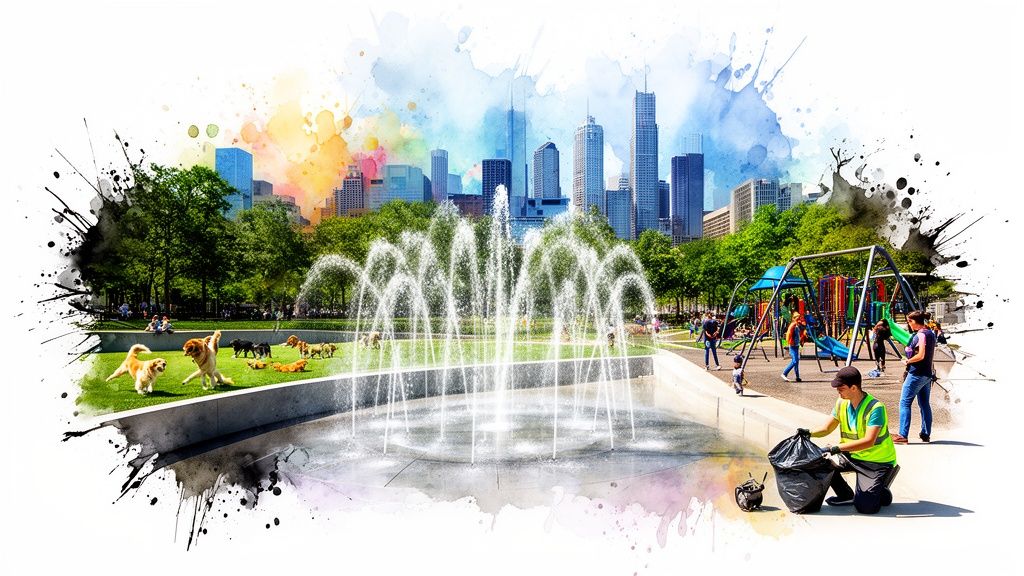
  • Mary Bartelme Park: Your Guide to Chicago’s West Loop Oasis

    Mary Bartelme Park: Your Guide to Chicago’s West Loop Oasis

    I remember walking through the West Loop when it was all grit and noise. The energy was electric, sure, but frantic. Then you step into Mary Bartelme Park, and it’s like the whole city exhales. This isn't just a patch of grass; it’s a story. This place is the neighborhood's backyard, a living, breathing testament to what happens when you decide to fight for something better.

    The Heart of the West Loop

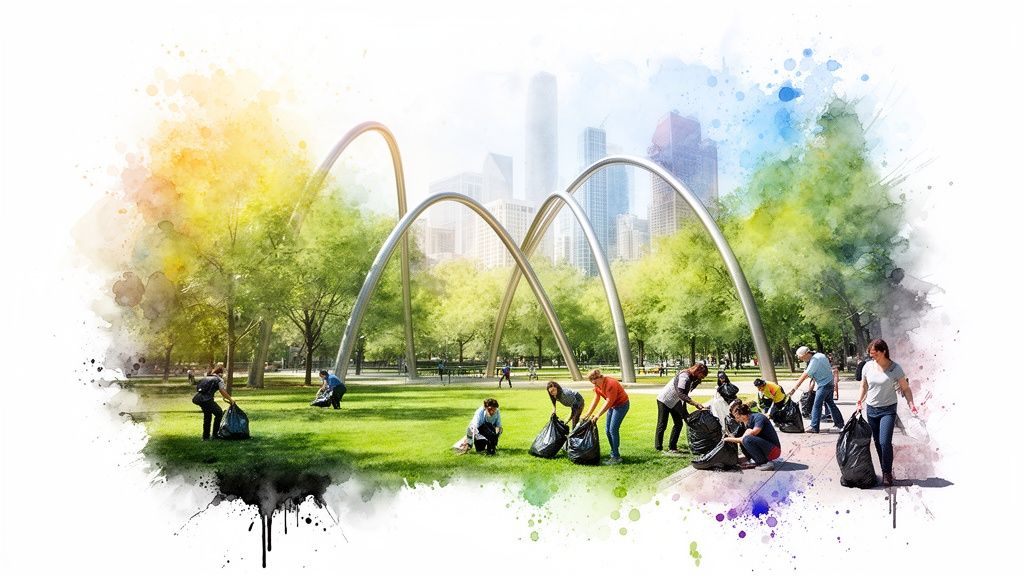
    Volunteers cleaning a vibrant urban park with green grass, trees, and city skyline.

    For a group like us at Litter Caterpillars, a park like this is everything. It’s physical proof of our mission. It shouts from the rooftops that when you care enough to get your hands dirty, real change happens. The journey of this park, from a forgotten industrial wasteland to the soul of the community, is our story written on a much larger scale.

    From Rubble to Oasis

    Not so long ago, I saw the West Loop as all warehouses and steel. As people and families started calling it home, they felt a void. They needed a place to breathe, to play, to just be. So they raised their voices. And they didn't stop until the city listened.

    This park is the answer. It cost $3.1 million and rose from the ashes of an old infirmary. We watched them transform what was a contaminated brownfield into a 2.3-acre green space by August 2010. They even salvaged terracotta from the original building, embedding it in the new walls—a beautiful nod to the past. It’s a story of total metamorphosis, like a butterfly emerging.

    The design here wasn't some cold, top-down plan. I see it as a direct answer to a neighborhood that was starving for a backyard. It proves what's possible when we actually band together.

    A Community's Living Room

    Spend any time here, and you'll see what I mean. I watch families spread out on blankets, their kids screaming with pure joy. I see dog owners laughing and catching up at the sunken dog park. You find people stealing a quiet moment in the seating garden. There's even a little six-foot-tall hill that, believe it or not, gives you a killer view of the skyline. It’s a tiny mountain with a giant reward.

    This is the kind of place we at Litter Caterpillars dream about creating all over Chicago. It’s what happens when you invest in your shared spaces. If you want to see what that kind of community spirit feels like, I recommend exploring more amazing Chicago neighborhoods. Mary Bartelme Park is all the proof you need that even the most forgotten corners of our city can be brought back to life.

    Meet 'Suitcase Mary': The Park's Fearless Namesake

    Two women, one older and one younger, exchange a vintage brown suitcase with watercolor accents.

    When you walk through Mary Bartelme Park, you're on turf named for a woman who was our kind of person—a true Chicago trailblazer with a ton of heart. Her story fires me up. It’s a perfect example of seeing something broken and deciding, "Nope, I'm going to fix this."

    Mary Bartelme wasn't just some historical figure; she was a force. As Illinois' first female judge, she shattered barriers in a world totally dominated by men. But she didn't just sit back and bang a gavel. She got her hands dirty, fighting for the city’s most overlooked kids and young women.

    A Legacy of Dignity

    Picture this: a young woman, fresh out of the court system, completely alone with nothing. Mary Bartelme didn't see a case number; she saw a human being who needed someone in her corner. That's how she got the incredible nickname that stuck: 'Suitcase Mary.'

    She literally gave them suitcases. But this wasn't just an empty gesture. I imagine her filling each one with clothes, toiletries, and basics—everything a person needs to start over with their head held high. It was a simple, powerful message: "You matter. You deserve respect."

    For me, her story is a powerful reminder that real change doesn't always come from grand, sweeping laws. Sometimes, it comes from a single, consistent act of showing up for those who are overlooked.

    More Than Just a Judge

    The sheer scale of what she did blows my mind. In just one decade, she heard over 50,000 cases, a staggering number that cemented her reputation as the single most important figure in the first 25 years of the Cook County Juvenile Court.

    But she went even further. She started 'Mary's Club' group homes—one specifically for African-American girls—to give them a safe place to land and learn real-life skills, instead of just being thrown into the system. You can explore more about her groundbreaking career and see how she fought to build dignity into a system that often lacked it.

    This is the spirit baked into the DNA of Mary Bartelme Park. It’s the same energy that fuels me and my Litter Caterpillars crew every single weekend. She’s the blueprint for civic courage—someone who showed up, didn't flinch, and proved that one person’s brave, kind effort can change thousands of lives.

    A Guided Tour Through The Park's Best Features

    Let's walk through Mary Bartelme Park together. I want to show you why this place feels so special to me. It’s not just a patch of grass—the designers were smart. They built it like a good house, with different rooms for different moods, where every space has a purpose.

    When you first walk up, you can't miss the five giant, stainless steel arches. They curve up towards the sky like massive sculptures, and they're probably the park's most famous feature. But they have a secret. On a blistering Chicago summer day, they suddenly erupt in a cool mist. Watching the kids (and let's be honest, me too) run laughing through the spray is pure joy. It’s art, but it’s also just plain fun.

    The Playground and Dog Park

    Once you’re past the fountains, you'll hit the kids' playground. This isn’t the rusty slide and gravel pit I remember from being a kid. It’s a modern play zone with a bouncy, rubberized floor that softens every trip and fall. The equipment is creative, with unique climbers and little interactive spots that get kids' brains working. I’ve seen so many little ones get this look of total victory after finally figuring out a tricky route to the top.

    Right next door is maybe the most-loved spot in the whole park: the sunken dog park. This is the social club for every four-legged resident in the West Loop. Because it’s built down below ground level, it feels like a secret world, keeping all the barking and happy chaos contained. It’s a little haven of its own where I see owners chat while their pups go wild.

    What I love most is how they separated these zones. It’s brilliant. You can have total, joyful chaos happening in one corner while someone is finding total peace just a few steps away.

    A Quiet Escape and a Skyline View

    If you’re looking for that peace, I suggest you head to the enclosed seating garden. It’s tucked away and surrounded by all these beautiful native plants and flowers, feeling almost like a private little hideaway. It’s my go-to spot to read a book, finish my coffee, or just sit for a minute and watch the world go by.

    Last, we’ll head to the park's highest point—a gentle, grassy hill that only rises about six feet off the ground. It doesn't sound like much, but trust me. When you get to the top, you’re rewarded with this incredible, perfectly clear view of the Chicago skyline. It’s the best seat in the house for watching the sun go down behind the skyscrapers.

    If you're hungry to explore more of the city's amazing green spaces, be sure to check out our guide to other fantastic Chicago parks worth your time.

    Before we move on, I made a quick rundown of what makes this park tick. It’s a great way for you to see all the key features in one place and figure out where you'll want to spend your time.

    Mary Bartelme Park at a Glance

    Feature Best For My Pro Tip
    Misting Archways Families with kids, hot days The mist is on a timer—stick around, and you'll catch it!
    Playground Toddlers & young children The rubber surface is a lifesaver for parents of clumsy climbers.
    Sunken Dog Park Dog owners, social pups I'd go during "yappy hour" (around 5 PM) to meet other dog people.
    Seating Garden Solo visitors, readers Grab a corner bench for the most privacy and quiet.
    Grassy Hill Photographers, sunset watchers The view is best on clear evenings just before sunset.

    These are the highlights, but the real magic is just finding your own little corner of the park and making it yours.

    When you look at a park, what do you really see? Most people just see grass, maybe a playground. I see something totally different. I see a neighborhood's secret weapon. It’s not an expense on a city budget; it's an investment that pumps life back into the streets, the local shops, and the people who live there. It’s like an engine.

    If you don't believe me, just go look at Mary Bartelme Park. It's the perfect proof.

    It all started with a simple, almost radical idea in a concrete-heavy part of the city: give people a beautiful green space to just be. That one move set off a chain reaction. Suddenly, the area wasn't just a grid of streets you pass through; it became a place you go to. I watched people show up for the park, and then they'd stick around for a coffee, grab dinner, or pop into a shop. The park didn't just grow grass; it grew a whole local economy.

    And this isn't just some feel-good story; the numbers don't lie. Homes just a couple blocks from the park now sell for 50% more than the area average. That's a massive deal, proving that green space is basically gold for property values. The park even pulls in its own money, with over $7,500 a year coming from things like event permits and fitness classes. You can dig into all the data on the park's economic boost and see for yourself how this stuff pays off.

    A Community Asset That Shines

    This is the kind of transformation that gets me fired up. When we're out there cleaning a park, we're doing more than just picking up trash. We're polishing a community gem, making it shine so it can make our city a better, more valuable place for everyone. The success of Mary Bartelme Park shows exactly what happens when you care for a space—it becomes a source of pride and a magnet for prosperity.

    It creates this amazing feedback loop. A beautiful park brings you in. You spend money at local businesses. Thriving businesses and higher home values make the neighborhood more desirable. And that success creates more motivation and resources to keep the park beautiful. It just keeps getting better.

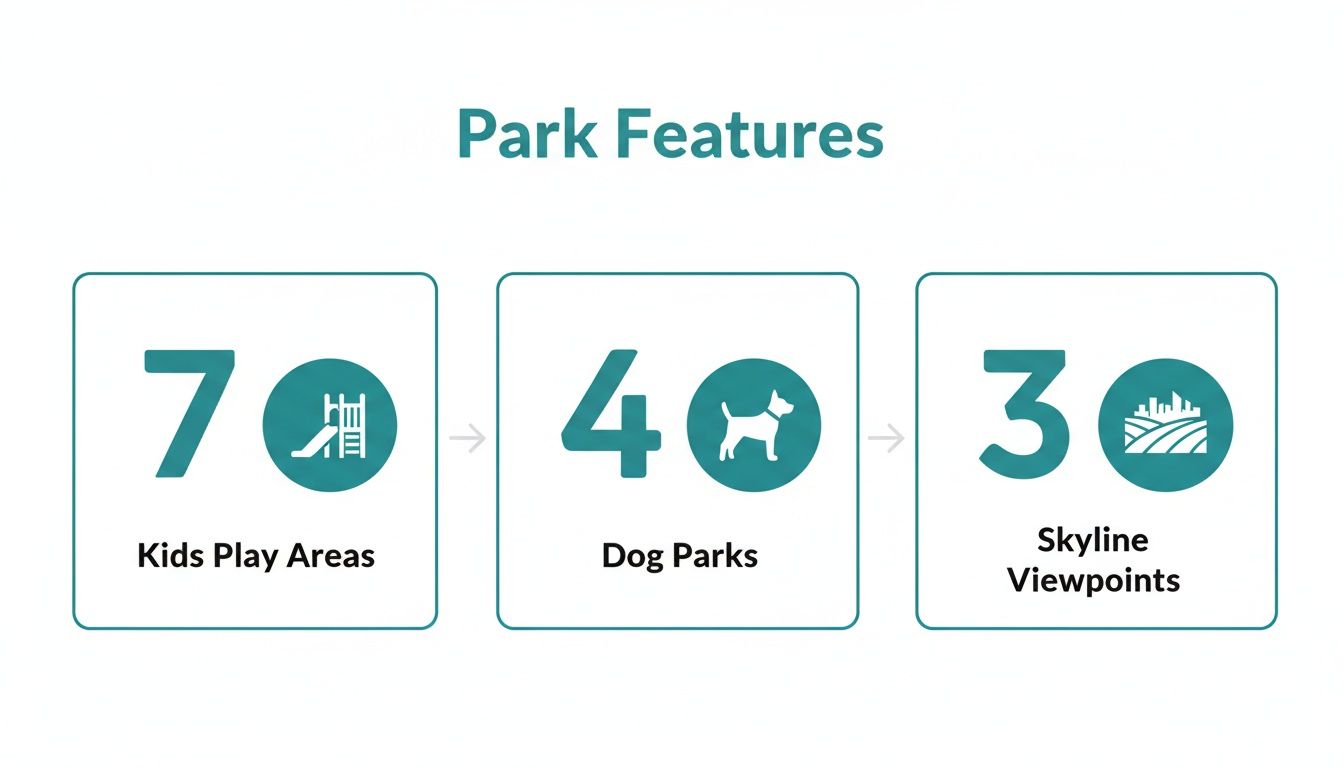
    This infographic gives you a quick look at the features that make it all work.

    Infographic detailing park features: 70 kids play areas, 40 dog parks, 30 skyline viewpoints.

    Each one of those areas—the playground, the dog run, that awesome skyline view—is like its own little magnet. They pull in different people all day long, and every one of them adds to the neighborhood's energy. This isn't just pretty landscaping; it’s a brilliant strategy for building community and commerce, side-by-side.

    Planning Your Visit to Mary Bartelme Park

    Watercolor painting of a person using a tablet in Mary Bartelme Park with a bike and bench.

    Alright, so you're ready to check out Mary Bartelme Park. Good call. I've spent more time here than I can count, so let me give you the real story, the kind of stuff that makes you feel like a regular on your first go. Let's get you there.

    First things first, you'll find the gates open every single day from 6 AM to 11 PM. That's a huge stretch of time, perfect for catching a quiet sunrise or just chilling under the archways after dark. You'll find it at 115 S Sangamon Street, smack in the middle of the West Loop.

    Getting There and Insider Tips

    Getting to the park is easy, which is a big part of why people love it so much. If you're coming by public transit, you've got a couple of solid choices that'll get you close.

    • CTA 'L' Lines: I usually hop on the Green or Pink Lines to the Morgan station, or take the Blue Line to UIC-Halsted. Either way, you're looking at a nice, easy 10-minute walk.
    • Bus Routes: The #8 Halsted and the #20 Madison buses are your friends here. They'll drop you off just a stone's throw from the park entrance.

    Now, if you're thinking about driving… let's talk. Parking in the West Loop can feel like a contact sport. Sure, there’s street parking on Sangamon and the side streets, but finding a spot, especially on a beautiful weekend? It’s a challenge. My honest advice: if you have to drive, get there early in the morning or just be ready to play the circling game for a bit.

    Here's a little secret from me to you: the best time to go is on a weekday morning. The park is practically empty. It's the perfect time to grab a coffee from a nearby spot, claim a bench, and just have the whole place to yourself before the city really gets going.

    Bringing your dog? You're in luck. The sunken dog park has this unofficial "yappy hour" that I see happen around 5 PM. It's when all the neighborhood pups and their people show up. The vibe is super friendly and chaotic in the best way. Just be a good neighbor—keep an eye on your dog and clean up after them. It keeps the space great for everyone.

    No matter how you make your way to Mary Bartelme Park, I promise you, it's worth it. You're not just visiting some patch of grass; you're stepping into the West Loop's living room.

    How You Can Make a Difference in Your Community

    Have you ever walked through a beautiful park like Mary Bartelme and felt a little voice in your head say, "I want to be part of making something like this"? You absolutely can. This is your invitation to step into that power.

    I know how hard it can be to start. For years, just cleaning my own room felt impossible. Every piece of trash had a story, and I was stuck. But then I found a weird trick: cleaning up a public space with other people? That felt fun. It felt like I was actually accomplishing something.

    Join the Litter Caterpillars

    That discovery is what led me to create Litter Caterpillars. Every single weekend, we get together to take care of our city's parks. We get our hands dirty, we make real friends, and we see the difference we’re making right away.

    It’s not about being perfect. It's about the brave and simple act of showing up. It's about deciding you want to be part of the solution, not just wishing for one.

    This is your chance to stop wanting a cleaner Chicago and start building it yourself. We intentionally meet on weekend mornings to filter out the selfishness and bring together people who are givers.

    We practice bravery, find joy in the hard work, and prove every week that a few people who care can make a massive impact. If you're ready to see how it feels to transform a space—and maybe transform yourself a little, too—you can find out how to clean up a park with us. We’d love to see you out there.

    Your Questions, Answered

    People are always asking me about the little things at Mary Bartelme Park. After all the time I've spent here, I've got the real-deal answers, not the generic stuff you find on a city website. Let me get straight to it for you.

    Are There Public Restrooms?

    Yes, and thank God. There's a field house right by the playground with public restrooms. If you're out with kids, you know this is a game-changer.

    The hours can get a little weird depending on the season, but you'll almost always find them open when the park is busy. Just don't push it. My rule of thumb is to assume they lock up a bit before the park itself closes at 11 PM.

    Can I Throw a Party or Host an Event Here?

    I see it all the time—birthday parties, little community meetups, you name it. To do it right and claim your spot, you need a permit from the Chicago Park District.

    It’s not a huge hassle, but my advice is to get on it early, especially if you’re looking at a prime summer weekend. A permit means you won't have to fight for space, which is the last thing you want to deal with.

    When Do They Turn the Fountains On?

    Ah, the misting gateways. On a hot Chicago day, they're pure magic. They are definitely a seasonal thing, though.

    You can usually count on them starting up around Memorial Day weekend. They run all summer and then get shut down sometime after Labor Day once things start to cool off.

    Is It Safe at Night?

    This is the big one you all ask, and my honest answer is yes, it feels very safe. I've noticed the park has good lighting along the paths and under those big metal arches.

    It’s surrounded by homes, so there are always people around, walking dogs or just hanging out, even late into the evening. Of course, it’s still a big city, so you always need to be smart and aware of who's around you. But the vibe here is calm. It’s a park that feels looked after, and that makes all the difference to me.


    Feeling inspired by a park that feels cared for? At Litter Caterpillars, we believe in the power of showing up and making our own neighborhoods shine. Come join us for a cleanup and see the difference you can make with your own two hands.

  • What Is Transformational Leadership and How It Changes You

    What Is Transformational Leadership and How It Changes You

    So, what exactly is transformational leadership? I'll tell you. It’s not about barking orders. It’s a leadership style that inspires you, me, and everyone around us to grow, step up, and become leaders ourselves. It’s about igniting a genuine, positive change.

    That Time a Hailstorm Revealed True Leadership

    My life felt like a mess. A total disaster. Old jam in the fridge, stray nuts on the counter, a relationship that was sinking fast. It was all a chaotic mess in my Chicago apartment, and every piece of that clutter felt like it weighed 500 pounds. A weight I just couldn't move.

    Then came the day that changed everything. A freak hailstorm.

    I found myself shivering under a tree with two strangers, watching hail smack the pavement. A wild thought hit me. Cleaning up this public mess, this shared chaos… it actually felt surprisingly good. It was a jolt of something real.

    Diverse young friends laugh while holding trash bags under a snowy tree in a vibrant watercolor street.

    A Spark in the Cold

    That moment, freezing together in the cold, forged an incredible bond between us. It was the spark. The birth of Litter Caterpillars. I didn’t have a business plan. I didn't have a fancy title. I just had a raw, authentic desire to make a change that other people could see and feel right alongside me.

    This story isn't just about picking up trash. You get that, right? It’s about how my personal vision, born from a moment of pure vulnerability, can light a fire under a shared mission. This is the heart of transformational leadership. You start with an authentic drive that pulls others in, even when it’s cold and the odds are stacked against you.

    You'll see how that one event set a new path for me and for everyone who decided to join. We were turning a personal struggle into a collective strength. That’s the kind of power that moves mountains—or in our case, mountains of litter.

    The Power of Inspiring People

    Look, this approach isn’t just for scrappy volunteer groups like mine. It has a massive impact everywhere. In the business world, I’ve seen leaders who inspire instead of just command. They build teams that don't just hit their targets; they blow them away.

    Transformational leadership has been a game-changer for boosting employee productivity and profitability. A global report from Gallup found that companies with highly engaged employees—often a direct result of this kind of visionary leadership—see 17% higher productivity and an incredible 21% greater profitability.

    This isn't just some feel-good idea; you get real, tangible results. When you feel that the people leading you believe in the mission and genuinely care for you, you show up with your best work. I invite you to dig into more of these transformational leadership statistics and see the hard data for yourself.

    My journey with Litter Caterpillars started with a simple, personal need for change. I wanted to build a community of givers and finally face my own challenges with cleanliness and consistency head-on. By sharing that vision, I found others who felt the exact same way. We weren't just cleaning up parks; we were transforming ourselves, together. That, right there, is the core of transformational leadership.

    So What Is Transformational Leadership Really?

    Forget the textbook definitions for a minute. I want you to feel what transformational leadership is in your gut, because it’s a feeling before it’s some theory you read in a book. It’s not about being a boss; it's about starting a fire.

    You can manage people, or you can build a movement with them. That's the choice.

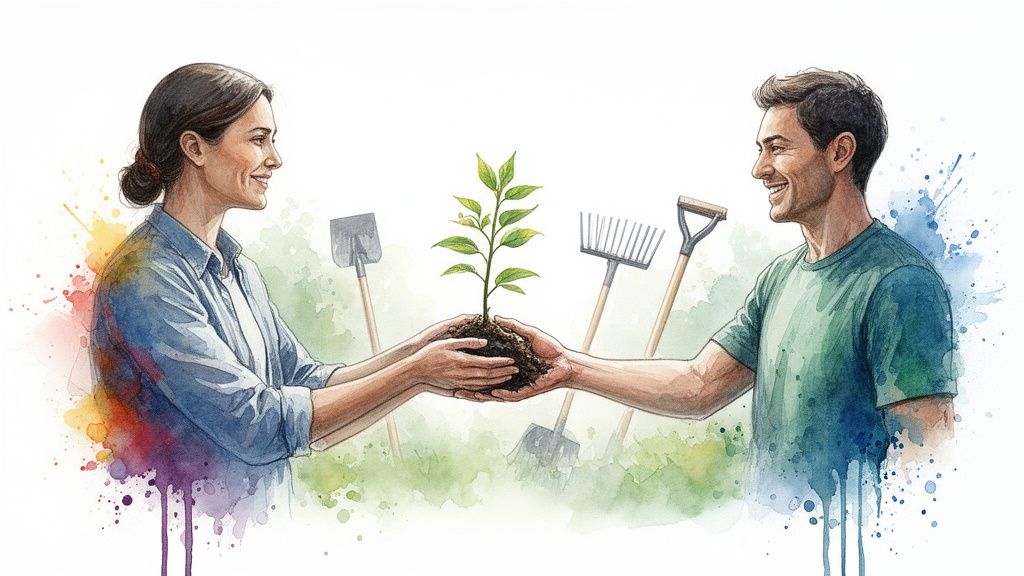
    Let me give you an analogy. Imagine a gardener. The transactional leader is the gardener who just shows up to water the plants. They do the job, sure. The plants don't die. It’s a clean exchange, a box checked. But a transformational leader? That's me. I’m the one down in the dirt, testing the soil, moving plants around to find the best sun, building an environment where the whole garden explodes with life. I'm trying to create something that thrives beyond what anyone thought was possible.

    It's Not a Title, It's a Spark

    This way of leading has nothing to do with power or telling you what to do. It’s about sparking a real, positive change in people. It’s about inspiring you so much that you find the leader inside yourself. When a new person joins Litter Caterpillars, my goal isn't just to hand them a trash bag. My goal is to make them feel that same spark I felt in that hailstorm—that deep pride of making a difference you can see and touch.

    A historian named James MacGregor Burns first put a name to this. He saw leadership as a relationship where both the leader and the "followers" lift each other up to a new level of motivation and purpose. I love that. It’s a powerful idea, and it’s the quiet engine that drives everything we do.

    You’re not just taking orders; you’re buying into a shared dream.

    From a Hailstorm to the Streets of Chicago

    I never read a book and thought, "I'm going to be a transformational leader." I just knew I wanted to build a community of givers—people who showed up because they genuinely cared. The fancy framework came later. The feeling was always there.

    The core ideas of this leadership style are exactly what makes our cleanups feel so different. Here’s how the theory connects to our muddy boots on the ground:

    • A Shared Dream: We’re not just picking up litter. We are taking back our city, one block at a time. And in doing that, we're transforming ourselves.
    • The Real Reward: You don't get a prize at the end. The reward is the work itself. It’s the friendships you make and that feeling of pride when you look back at a clean street.
    • Everyone Leads: I don’t have all the answers. Seriously. Our best ideas for new cleanup spots or community projects come from volunteers who feel like they can speak up and take charge.

    At its heart, transformational leadership is about turning "followers" into more "leaders." It's a leadership style that creates leaders, not just followers.

    In the end, it’s the difference between you asking, “What’s in it for me?” and asking, “What can we build together?” This is what creates that deep sense of purpose and belonging that makes people come back. You don't just volunteer once; you become part of our story.

    The Four 'I's' That Power the Movement

    So, you get it. Transformational leadership isn't some dusty theory from a business textbook; it's the living, breathing engine that powers our Litter Caterpillars movement. But what are the actual gears inside that engine? For me, it all boils down to four key ingredients, which the academics call the "Four I's."

    I know, that sounds a little formal, but I promise you these aren't just buzzwords. They are real actions you'll see and feel at every single one of our cleanups. Let me break down exactly what they mean to me and how you can spot them out in the wild.

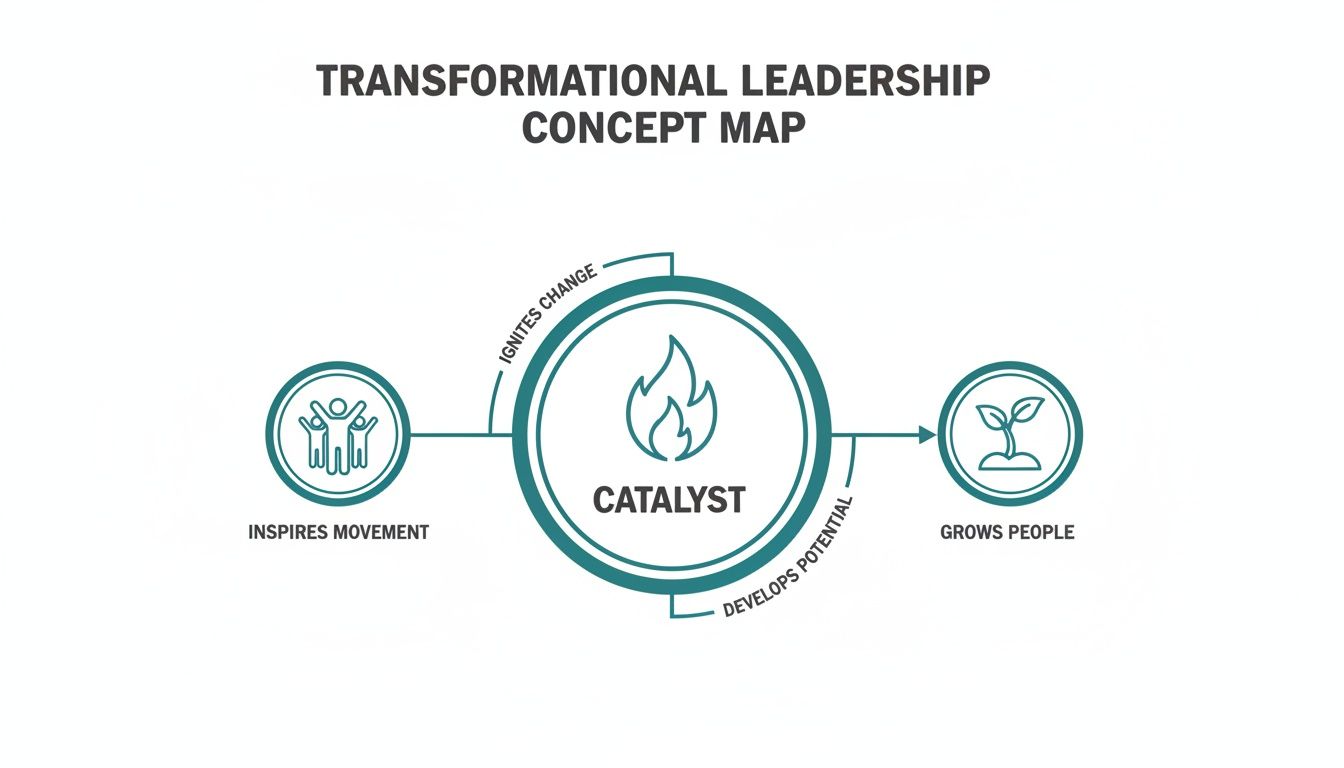
    This map helps show how it all connects. The leadership is the spark, but the real magic is the cycle it creates: inspiring a movement while growing the people within it.

    Concept map illustrating transformational leadership as a catalyst that inspires movement and grows people.

    This image nails it. I'm the catalyst, sure, but the power comes from people like you uniting for a shared mission and transforming yourselves along the way.

    To make this super clear, here’s a quick look at how these four big ideas show up in my day-to-day work at Litter Caterpillars.

    The Four 'I's' in Action at Litter Caterpillars

    The Principle (The 'I') What It Means in Simple Terms How You'll See It at Litter Caterpillars
    Idealized Influence Leading by example. "Walking the walk." Me being the first one at every cleanup, rain or shine. I'm not asking you to do anything I'm not already doing myself.
    Inspirational Motivation Creating a vision people are excited to be a part of. We're not "just" picking up trash; we're reclaiming our city. We have a theme song and flags because pride matters.
    Intellectual Stimulation Encouraging everyone to think, question, and innovate. Asking "What if?" A volunteer asking about an empty lot is how Caterpillar Park was born. Your ideas are our future.
    Individualized Consideration Seeing and supporting each person as an individual. I'll know your name. I'll ask how you're doing, not just what you're doing. This is our "volunteer-first" philosophy.

    Let's dig a little deeper into what each of these really looks like on the ground.

    Idealized Influence: Walking the Walk

    This first 'I' sounds fancy, but I think it's the simplest of them all. It means you are a role model. You show up, do the work, and live the values you talk about. You build trust by being reliable, not by giving speeches.

    For me, it’s not about grandstanding. It’s about being the first one at the meetup spot with a smile, whether it's hailing or scorching hot. When you see me out there week after week, you start to believe this isn't just a weekend hobby for me; it’s a deep commitment.

    Idealized influence is about earning trust through action, not words. You lead by example, inspiring respect because people see you living the mission.

    This builds a deep well of credibility. When you see me willing to get my own hands dirty, you're far more likely to roll up your sleeves and join in. It proves I'm not asking you to do something I wouldn’t do myself.

    Inspirational Motivation: Creating a Shared Story

    This one is my favorite. I call it the Tom Sawyer effect. Remember how he turned the chore of painting a fence into such an exciting opportunity that his friends literally paid to be part of it? That's inspirational motivation. I use it to craft a vision so compelling that you're desperate to join in.

    How do I do it?

    • A Shared Goal: We’re not just picking up litter. We are reclaiming our city, one block at a time. We're transforming forgotten spaces into places of community pride.
    • Silly Traditions: We have a theme song! It sounds ridiculous, I know, but singing it together creates a sense of identity and shared joy that you just can’t get from a dry mission statement.
    • The Power of Pride: We carry flags. We earn badges. These symbols give you a tangible sense of belonging and achievement.

    I’m tapping into something deeper than just completing a task. When you feel that spark, the work itself becomes the reward. I'm igniting that fire inside you, and you can learn more by reading our guide on what is intrinsic motivation.

    Intellectual Stimulation: Challenging the 'Why'

    This 'I' is all about making you think. I want to create an environment where you feel safe to question how things are done and to offer up new, sometimes crazy, ideas. A transactional leader says, "Here's the plan." A transformational leader like me asks, "How can we make this even better?"

    At Litter Caterpillars, this happens all the time. Someone saw an abandoned lot and asked, "What if we turned this into a community garden?" That single question was the seed of intellectual stimulation. We didn’t just clean that lot in Englewood; we brainstormed, planned, and eventually won it at auction to create Caterpillar Park.

    That never would have happened if I just gave orders. It happened because I encouraged everyone to see problems as opportunities. I want you to challenge me. I want you to bring your wild ideas to the table. That’s how we really grow.

    Individualized Consideration: You Matter More Than the Task

    This is the heart and soul of our group. Individualized consideration means I see you as a whole person, not just a pair of hands. Your well-being, your happiness, and your personal growth are my top priorities.

    It shows up in the small things I do:

    • I check in to see how you're doing, not just how much trash you've collected.
    • I remember your name and what you’re passionate about.
    • I make sure you feel safe and supported, especially when we’re in a tough neighborhood.

    This is our "volunteer-first" philosophy in action. It’s how strangers become friends and how a group of individuals becomes a true community. When you feel seen and valued, you don’t just show up to work; you show up for each other. That bond is what makes our mission unstoppable.

    Transformational Versus Transactional Leadership

    Let me paint a picture for you. Two very different coaches.

    Imagine the first one. She’s standing on the sidelines with a clipboard. She yells out, "If we win the championship, I'm buying the whole team a pizza party!" It’s a deal. A simple transaction. A reward for a specific outcome.

    That, in a nutshell, is transactional leadership. It’s a straightforward exchange: you do this thing for me, and I’ll give you that reward. It can work, sure, but that motivation only lasts as long as the pizza sounds good.

    Now, picture the second coach. She’s on the field with you, running the same drills, pushing you past what you thought your limits were. She doesn't just talk about winning the next game. She talks about the pride of the journey, about becoming champions together, and about discovering a strength inside you that you never knew you had. That’s transformational.

    This is the core difference I live by at Litter Caterpillars. I'm not offering you a prize. I'm offering you a chance to become part of a bigger story—and to find a stronger, more connected version of yourself in the process.

    The Exchange vs. The Elevation

    A transactional leader runs on a system of rewards and punishments. They are all about maintaining the status quo. I think of it like a vending machine: you put in the right coin (your effort), and you get your snack (the reward). It’s predictable and can be effective for simple, short-term goals.

    But I'm all about transformational leadership. It's about elevating everyone involved. I don't just manage your expectations; I want to shatter them. I'm raising you to a "higher level of motivation and morality," as James MacGregor Burns first put it.

    I see this all the time. A transactional approach would be me offering a gift card to the person who collects the most trash. A transformational approach is what I actually do: I build a community where the real reward is the feeling of pride you get looking at a clean park, the friendships you forge, and the personal growth you experience just by showing up.

    The core of transactional leadership is "What's in it for me?" The core of transformational leadership is "What can we become together?" It's a shift from a self-focused exchange to a group-focused mission.

    Givers vs. Takers

    This distinction is exactly why I schedule our events on weekend mornings. It's a filter. If you're just looking for a quick transaction, an easy reward, or a party, you probably aren't getting up early on a Saturday to pick up trash with me.

    I'm looking for givers. I'm building a community of people who show up because they believe in the mission, not because they’re getting something in return. Transactional leadership tends to attract "takers," while transformational leadership cultivates "givers."

    This isn't just my philosophical preference; it creates real, powerful outcomes. When you are driven by an internal mission, your performance skyrockets. And it's not just my experience—the data backs this up. One study on IT teams found that transformational leadership drove a stunning 78.1% increase in overall output, simply because of the loyalty and trust it built. This isn't a one-off finding, either; a broad review of studies confirmed that this leadership style boosts performance across all sorts of different sectors.

    Which Is Right for You?

    Honestly, both styles have their place. If you need a simple task done quickly and efficiently, a transactional approach can work wonders.

    But if you want to build something that lasts—something that changes people for the better—you have to aim higher.

    You can't build a movement with pizza parties. You build it with a shared vision, genuine care, and by inspiring people to become the best versions of themselves. It’s a different path. It might be harder, but I promise you, it's also where you'll find the most meaningful change. It's also interesting to see how this compares to other styles focused on service, and you might want to check out our guide on what is servant leadership for another perspective.

    How You Can Become a Transformational Leader Today

    You don’t need a promotion. You don’t need a fancy title or a corner office to start leading. Forget all that. This is about you becoming a force for change right now, with what you've got. I'll show you the small, powerful moves you can make today—at work, in your neighborhood, even with your own family.

    A man and woman in a vibrant watercolor illustration, holding a green plant, symbolizing growth and gardening.

    It all starts with one step. The same one I had to take that day we got caught in the hailstorm. You have to find your 'why.'

    Find and Share Your Authentic 'Why'

    My 'why' was brutally honest. I was sick of the mess in my life, and my apartment was the physical proof. I wanted to build a crew of givers and finally get a grip on my own issues with cleaning and just showing up consistently. That’s it. It wasn't some polished mission statement to save the planet; it was a real, raw need for change that I figured you might be feeling, too.

    Your 'why' doesn't have to move mountains. It just has to be yours.

    • At work: Are you tired of pointless meetings that drain your will to live? Maybe your 'why' is to make that time so efficient and respectful that everyone gets a piece of their day back.
    • In your community: Does that run-down park on the corner bum you out every time you see it? Your 'why' could be to rally your neighbors and turn that eyesore into something beautiful.
    • With your family: Do you wish you all did more than just stare at screens in the same room? Your 'why' could be as simple as starting a weekly game night.

    Once you’ve got it, you have to share it. But don't just complain. Paint a picture for me. Instead of saying, "These meetings are a waste of time," try this: "What if our meetings were so productive we could knock them out 15 minutes early every single time?" You see the difference?

    Practice the Art of Listening to Spark Ideas

    Okay, now for the real work. You've got your vision, but a transformational leader doesn't bark orders. You create the space for other people to jump in and build it with you. I call this Intellectual Stimulation, and it starts with shutting up and listening. I mean really listening, not just waiting for your turn to talk.

    When someone offers you an idea, give them your full attention. Ask questions. "That's interesting, tell me more about how that would work." Or, "What roadblocks do you think we'd hit with that approach?"

    You're doing more than just collecting data. You're showing them their voice actually matters. This builds trust and makes you feel safe enough to share your craziest, most brilliant ideas. Those are the ideas that change everything.

    Being a transformational leader isn't about having all the answers. It’s about asking the right questions to unlock the genius that’s already in the room.

    Show You Care About the Person, Not Just the Project

    This is the glue. This is what holds it all together. Individualized Consideration is about seeing people as human beings, not as cogs in a machine to get something done. It's the small things you do, day in and day out, that show you genuinely give a damn.

    How can you start doing this today?

    1. Welcome the New Person: Be the one who walks over and introduces yourself to the new volunteer or the new hire. Ask them what they're excited about. Ask them what they're nervous about.
    2. Give Specific Praise: "Good job" is lazy. Try this instead: "The way you organized that spreadsheet saved me an hour of headaches. Thank you so much."
    3. Be the Positive Force: When things get tough and everyone's stressed, be the one who offers a word of encouragement or suggests taking a five-minute breather.

    These aren't grand, heroic acts. They are small deposits I make into a bank of trust. When you feel seen and supported by me, you will go to the ends of the earth for a shared goal. To dig deeper into creating this kind of supportive vibe for your team, you can check out our guide on volunteer management best practices.

    This isn't about a five-year plan. It's about making a difference in the next five minutes. That’s how your journey starts.

    Answering Your Questions About Transformational Leadership

    You’ve got questions, I’ve got answers. After years of building Litter Caterpillars from a hailstorm moment into a city-wide movement, I've heard every doubt in the book. I want to tackle the most common things people ask about what is transformational leadership, but using my real journey—not some textbook theory.

    I want to get rid of your excuses so you feel ready to start.

    "But I'm Not Charismatic. Can I Still Be a Leader?"

    No, you don't need to be charismatic. Absolutely not. You don't have to be some super-extroverted, smooth-talking person. I’m a total introvert myself, and I’ve learned that being real is way more powerful than faking charisma.

    It’s about having a vision you actually believe in and sharing it from the gut. Your passion and your commitment—that’s what pulls people in. It's the quiet proof that you show up every week, rain or shine, that builds trust. Not a big speech.

    "Does This Stuff Work in a Normal 9-to-5 Job?"

    Definitely. This isn’t just for volunteer groups picking up trash; you can be a spark for change from any desk, in any office. Just start with your immediate team.

    Here's how you can do it:

    • Actually care about your teammates' goals and help them get there.
    • Encourage people to question old, stupid processes and find better ways to work.
    • Create a vision for your team that’s bigger than just hitting quarterly numbers. What can you accomplish together?

    You can start a positive ripple effect no matter what your job title is. You just have to be the one who decides to start it.

    The hardest part of this leadership style? It takes a ton of personal investment and patience. You're not just making a quick deal; you're building trust and inspiring real change. That takes time and emotional energy. But the result—a team that's genuinely motivated and loyal—is always worth it.

    "What’s the 'Dark Side' of This Leadership Style?"

    This is a really important question. I want you to watch out for the "dark side" of this. Because this style uses a strong vision and personal influence, it can absolutely be twisted by people with bad intentions.

    It's the difference between inspiring you toward a shared, positive goal versus manipulating you for my own gain. This is why the entire foundation has to be an ethical vision and real care for the people I'm leading. Without that moral compass, it's not leadership. It's just persuasion.


    At Litter Caterpillars, we believe in the power of service to transform ourselves and our city. If you’re ready to stop waiting and start leading, join us. You can find all the details and sign up for our next event at https://www.littercaterpillars.com.

  • How to Overcome Procrastination with Strategies That Actually Work

    How to Overcome Procrastination with Strategies That Actually Work

    Let's be real. Procrastination isn't about laziness; it's an emotional traffic jam. That task you’re putting off feels like a mountain you can't climb, and just the thought of starting leaves you exhausted. To get past it, you have to stop wrestling with the task and start understanding the feeling that’s got you stuck.

    Why You Procrastinate and How to Start Changing It

    A grayscale drawing of a woman contemplating next to books and colorful watercolor mountains, symbolizing a growth journey.

    I’ve been there. I once lived in an apartment that was a perfect museum of past mistakes, a chaotic mess I couldn't bring myself to clean.

    Every piece of trash told a story I didn't want to hear. An expired jar of blueberry jam from a trip to Michigan four years ago. A bag of almonds from that time I tried to eat healthy and failed spectacularly. Each item weighed less than a pound, but to me, it felt like it weighed 500 pounds. It was stuck, and I was, too.

    This isn't just some weird quirk I have. It turns out, about 20% of adults are chronic procrastinators, people like you and me who can turn simple jobs into these massive emotional hurdles that feel impossible to clear.

    Untangling the Emotional Knot

    So, why do we do this to ourselves? It’s not a character flaw. It’s your brain’s clumsy attempt to shield you from crappy feelings.

    Picture a tangled knot of old headphone wires. One wire is your deep-seated fear of failing. Another is the sheer, mind-numbing boredom of the task. A third is just the exhaustion from making one more decision in a day full of them. When they all get twisted together, the whole mess feels so impossible that walking away seems like the only sane thing to do.

    The real enemy, I’ve learned, isn't the task. It's the feeling about the task. Usually, it boils down to one of these culprits:

    • Perfectionism: The paralyzing thought that if you can't do it perfectly, you shouldn't dare do it at all.
    • Fear of Failure: That nagging voice whispering that your efforts won't be good enough, so it’s just safer not to even try.
    • Decision Fatigue: Your brain is just plain tired. It has made too many choices today, and it’s defaulting to "no more."

    My Breaking Point and the First Step

    My own life hit a wall after a chaotic relationship imploded. When I finally looked around at the disaster in my apartment, I saw a perfect mirror of the disaster inside my own head. The clutter wasn't just physical stuff; it was emotional weight I had been carrying.

    That recognition, that stark moment of truth, was the first and most important step.

    I realized something profound: cleaning someone else’s mess is often far easier than cleaning your own. It detaches you from the emotional weight and helps you build momentum.

    This insight is exactly why I started Litter Caterpillars. I found that by cleaning up the city, I was slowly, almost accidentally, learning how to clean up my own life. It reframed the entire challenge. And this is where your journey can begin, too. Not with shame, but with a simple, powerful action. You and I can redesign this habit, and it starts by taking that first small step for someone else. You can see how our community is making a real difference by doing just that.

    5 Ways to Actually Stop Procrastinating (For Real This Time)

    Watercolor illustration of productivity tools: Pomodoro timer, headphones, calendar, sticky note, and a plant.

    Alright, figuring out why you put things off is one thing. But theory doesn't get the work done, does it? You need tools that pull you out of the mud right now.

    I'm handing you the five methods I personally use to stop staring at the wall and actually start doing things. These aren't just tips; they're clever ways to trick your own brain into getting on board.

    Bundle Your Temptations

    Let’s start with my favorite, because it feels like you're cheating the system. Temptation Bundling is the genius move of pairing something you want to do with something you need to do. It’s a simple, brilliant bargain you make with yourself.

    For me, it was cleaning the kitchen. I dreaded it. The mess felt infinite. At the same time, I was hooked on a true-crime podcast. Then, the lightbulb went off. I made a new rule: I could only listen to the podcast while I was actively cleaning the kitchen.

    Suddenly, cleaning wasn't a chore anymore; it was my ticket to the next episode. The kitchen got clean, and I got my podcast fix. This little hack works so well because it connects a task you hate with an immediate reward you crave.

    Set an "If-Then" Plan

    Look, your willpower is not an endless resource. Don't burn through it by making decisions on the fly. Instead, I want you to create an Implementation Intention—a simple "if-then" plan that decides your next move before you're tempted to bail.

    The formula is beautifully simple: If [TRIGGER], then I will [ACTION].

    This isn't about "trying" to do something. It's about programming an automatic response.

    • Don't say: "I'll try to go to the gym this week."
    • Instead, say: "If it is 5:30 PM on Monday, then I will immediately change into my gym clothes and walk out the door."

    You’re creating a script for your future self to follow. The decision is already made. No more debating. You just act.

    An "if-then" plan is like a GPS for your habits. You program the destination ahead of time, so when you hit a fork in the road—like the choice between the couch and your workout—the route is already set.

    Design Your Environment for Success

    Your surroundings are quietly shaping your behavior, every single day. If you want to break a habit, make it harder to do. If you want to build a habit, make it ridiculously easy. I call this Environment Design.

    Want to stop wasting hours scrolling on your phone at night? Don’t rely on sheer willpower. Leave your phone to charge in the kitchen overnight. That tiny bit of effort it takes to get out of bed and go get it is often enough to break the cycle.

    Want to read more? Put a book on your pillow every morning. When you crawl into bed at night, it’s the first thing you have to touch. Making the right choice the easy choice is one of the most powerful moves you can make against procrastination.

    Focus with Pomodoros and Timeboxes

    Feeling overwhelmed is a massive trigger for procrastination; it makes the task feel like an unscalable mountain. The Pomodoro Technique smashes that feeling by breaking your work into small, manageable sprints.

    You just work for 25 minutes, then take a 5-minute break. Simple. After four of these cycles, you take a longer break. The goal isn't to work for hours straight; it's to get 25 minutes of pure, uninterrupted focus. You can do that. Anyone can.

    Timeboxing works in a similar way. You assign a fixed time slot in your calendar to one specific task. Instead of a vague "work on report" on your to-do list, you block out "1:00 PM – 2:00 PM: Write first draft of report intro." When the time is up, you're done. It gives tasks a clear beginning and end, which makes them feel far less scary.

    To make it even easier, here’s a quick reference guide to these techniques.

    Your Procrastination-Busting Toolkit

    Technique How It Works Simple Example
    Temptation Bundling Pair an activity you enjoy with a task you avoid. "I can only watch my favorite Netflix show while I'm on the treadmill."
    Implementation Intention Create a specific "if-then" plan for your actions. "If my alarm goes off at 7 AM, then I will immediately put on my running shoes."
    Environment Design Make good habits easy and bad habits difficult. Lay out your workout clothes the night before. Unplug the TV after you use it.
    Pomodoro Technique Work in focused 25-minute intervals with short breaks. Set a timer for 25 minutes to clear your inbox. No distractions allowed.
    Timeboxing Schedule a fixed time block for a single task. Block "Wednesday 9-9:30 AM" in your calendar to "Plan weekly meals."

    Think of these not as rigid rules, but as experiments. Play around with them. Find the one or two that click for you and start there. The goal isn't perfection; it's just about getting the ball rolling.

    Your Secret Weapon for Building Momentum

    Here’s one of the most powerful things I've ever learned about beating procrastination: it’s way easier to clean up someone else’s mess than your own. I know, it sounds completely backward. But this little mental judo move is exactly what you need to build the momentum to finally deal with your own stuff.

    This is the magic I stumbled upon when I started Litter Caterpillars. My life was a disaster, and my apartment was the physical proof. But one day, something shifted. I was huddled under a tree with two friends, shivering through a classic Chicago hailstorm after picking up trash. In that moment, I realized that a shared struggle and a shared goal are the ultimate cure for being stuck.

    We were solving a problem that was bigger than any one of us. We were cleaning up our city. Suddenly, the 500-pound weight of my own mess felt a whole lot lighter.

    The Unstoppable Force of Accountability

    When you’re working alone, your brain is a world-class excuse factory. It can conjure a thousand brilliant reasons to put something off until tomorrow. There's no one there to call you out. It’s just you, your couch, and your perfectly logical reasons to fail.

    But the second you commit to another person? The entire game changes.

    Now it's an appointment. Someone is actually counting on you to show up. Your odds of success don’t just inch up; they explode. In fact, studies show that having a specific accountability appointment can boost your success rate to an incredible 95%.

    Accountability is like a gravitational pull. It gently but firmly pulls you toward your goal, even on days you feel like you're floating away. It turns a "maybe I'll do it" into a "must."

    This isn't about someone nagging you. It's the difference between a lonely, quiet struggle and a shared mission. It’s about building resilience together.

    How to Build Your Circle

    You don't need a hundred friends. You just need the right ones. This all starts with mindfully choosing who you let into your world. Are they people who pull you up, or people who are happy to sit with you while you make excuses?

    Joining a group with a shared mission—any mission—creates this powerful, positive feedback loop. When we show up for a Litter Caterpillars meetup, we're not just picking up trash. We’re seeing faces we know, we're sharing stories, and we're making a visible impact, together. Showing up stops feeling like a chore because it’s woven into the social fabric of the group. This taps directly into the powerful force of intrinsic motivation.

    The formula is dead simple:

    • Find a cause: Pick something outside of yourself that you care about, even a tiny bit.
    • Show up: Commit to one event. Just one. Don't overthink it.
    • Connect: Make it a goal to talk to one new person.

    That’s it. You’re not trying to fix your entire life at once. You’re just showing up for someone else. And in the process, you’re learning how to finally show up for yourself.

    Navigating Common Procrastination Roadblocks

    So you started strong. You had a plan, you were knocking out tasks, and you felt invincible. Then, you wake up one morning and it’s back. That old, heavy feeling. The task suddenly looks like a mountain again, and your motivation is just… gone. You just don’t feel like it.

    I know this place. It’s the real enemy, the one that shows up after the initial excitement wears off. This is the moment that matters. Do you let one slip-up turn into a full-on slide back into your old ways? Or do you see it for what it is: just part of the process?

    When one of our Litter Caterpillar volunteers misses a weekend meetup, nobody gets shamed. Life happens. The goal isn’t a perfect attendance record; it’s showing up again after you’ve missed one. Bouncing back is the real superpower.

    When You Just Don't Feel Like It

    Let's be honest: motivation is a flaky friend. It shows up when it wants and disappears without warning. If you wait until you "feel like it," you're going to be waiting a long, long time. The trick isn't to wait for motivation, but to create it with action.

    I remember staring down a massive, overwhelming project, feeling totally frozen. My brain was just screaming "NO!" at me. So, I made a deal with myself. I didn't have to finish it. I didn't even have to work on it for an hour. I just had to open the file and write one single sentence. That was the whole deal.

    You don't need to conquer the entire mountain today. Your only job is to take the first step. The feeling of accomplishment from that tiny win is often the spark you need to take the next one.

    That one sentence was enough to break the spell. It was a small, undeniable piece of proof that the task wasn't impossible. It reminded me that action comes first, and the motivation follows. Not the other way around.

    Turning Chores into Privileges

    Sometimes a task is just awful. It’s boring, it’s hard, or it’s both. This is when you need to pull a Tom Sawyer. Remember how he was punished by having to paint a fence? He didn’t complain. Instead, he reframed the chore so brilliantly that his friends actually paid him for the "privilege" of helping out.

    So how do you paint your own fence? You change the story you're telling yourself about the struggle.

    • Is it hard? Good. This is how you build resilience.
    • Is it boring? Perfect. This is your chance to practice deep focus.
    • Did you fail? Excellent. You just found a way that doesn't work.

    This is a huge mental flip. Fear of failure can paralyze us before we even start, but when you embrace the struggle, you take away its power. We talk a lot more about turning this specific roadblock into fuel in our guide to overcoming the fear of failure.

    Every roadblock is really just a detour. It’s not a dead end. It’s just the path teaching you something new about the journey.

    Alright, you've got the theory, you've got the tools. But knowing how to do a pushup and actually doing one every day are two completely different things. This is where we build the muscle.

    Think of the next four weeks as a training program for your mind. This isn't a pass/fail test. It's about building confidence one tiny, almost laughably small, win at a time. You're not trying to become some productivity guru overnight. You're just learning how to show up for yourself, consistently.

    It’s about small, deliberate actions that snowball into something unstoppable. Let’s get started.

    Your 4-Week Anti-Procrastination Challenge

    This weekly guide is your roadmap. The goal isn't perfection; it's momentum. Each week builds on the last, helping you turn these new behaviors into habits that stick. Just focus on one week at a time.

    Week Weekly Goal Daily Focus (Example)
    Week 1 Awareness & Small Starts Open the document for that report you're dreading. Write one sentence. That's it.
    Week 2 Structured Accountability Text a friend: "I'm tackling the mail pile for 25 mins at 7 PM. Ping you when I'm done."
    Week 3 Environment Design Want to go for a run in the morning? Put your running shoes right by your bed.
    Week 4 Habit Locking Combine all three: A 10-minute task, tell someone you're doing it, and set up your space for it.

    By the end of this challenge, you won't just have strategies; you'll have proof. You’ll have a new set of instincts for taking action.

    Week One: Focus on Awareness and Small Starts

    This week, your only goal is to prove to yourself that you can start. We’re not finishing anything. We’re not even trying to do a good job. We are simply breaking the awful spell of inaction.

    I want you to pick one task you’ve been putting off. Just one. Now, find the absolute smallest, most pathetic first step you can take. I mean microscopic.

    • Dreading "clean the apartment"? Your task is to throw away one piece of junk mail.
    • Avoiding "write the report"? Your task is to open a doc and give it a title.
    • Putting off "do my taxes"? Your task is to find and download the right PDF form.

    Do that one tiny thing. That’s your only job for the day. By the end of this week, you’ll have seven small wins under your belt. You’ll have physical proof that you can beat that initial wall of resistance.

    Week Two: Introduce Structured Accountability

    Okay, you’ve got a little taste of momentum. It feels good, right? Now, let’s add some fuel to that spark. This week, we bring another person into the picture.

    Accountability has a weird way of making a fuzzy intention feel like a solid promise.

    The real power here isn't about someone nagging you. It's about being seen. The moment you tell someone, "I'm going to do this," it becomes real. You’ve made a social contract, and your brain will work twice as hard not to break it.

    Find one person and make one tiny commitment. It could be texting a friend: "I'm going to spend 25 minutes finally sorting my email at 8 PM tonight. I'll message you when I'm done."

    Even better? Join a community project, like a Litter Caterpillars weekend meetup. Just commit to showing up. I’ve found that cleaning up someone else's mess is often way easier than cleaning up your own. It builds the exact same muscle of consistency and follow-through.

    Week Three: Design Your Environment for Success

    Your space is talking to you all day long. It's either nudging you toward your goals or pulling you toward the couch. This week, you become the architect of those nudges. We’re going to make good habits the easy choice and procrastination the hard one.

    Pick one habit you want to build and one you want to ditch. Now, redesign your immediate environment to support that.

    • Want to read more books? Don't just put one on your nightstand. Put it on your pillow.
    • Wasting hours on your phone? Stop charging it by your bed. Move the charger to the kitchen.
    • Need to focus on a project? Clear your desk completely. Leave out only the single notebook or laptop you need for that one task.

    You’re rigging the game in your favor. Instead of fighting your impulses with finite willpower, you’re removing the temptation before it even has a chance.

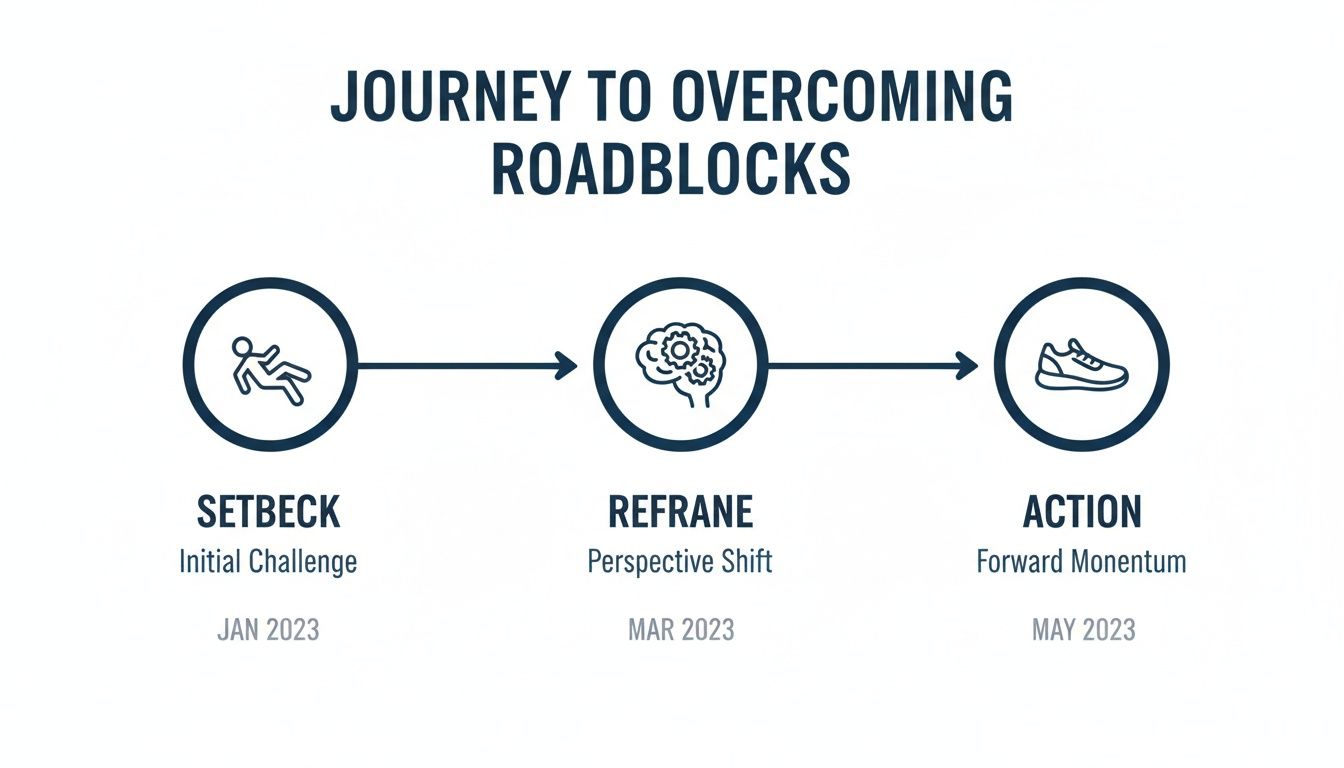
    Of course, you’ll hit roadblocks. Everyone does. The journey isn’t a straight line.

    A visual timeline depicting the journey to overcoming roadblocks through setback, reframe, and action.

    A setback isn't a failure. It’s just a data point. It’s a signal telling you to pause, reframe your approach, and take a new, small action.

    Week Four: Lock in Your New Habits

    The final week is about making it all stick. You’ve practiced starting small, using accountability, and designing your space. Now, we fuse them together to lock in your progress.

    Your mission is to pick one important habit and apply all three principles to it for the entire week. Let's say your goal is to start exercising.

    1. Start Small: Forget the hour-long workout. Commit to a 10-minute walk.
    2. Accountability: Schedule those walks with a friend or join a local walking group.
    3. Environment Design: Lay out your workout clothes and shoes the night before. Make them the first thing you see.

    You're no longer the person who wishes they would stop procrastinating. You are now the person who takes small, consistent, and deliberate action. This is who you are now.

    Common Hurdles (And How to Jump Over Them)

    Let's get into the nitty-gritty. Even with the best plan, you're going to hit roadblocks. I've been there. I get asked these questions all the time, and they’re the little things that can trip you up and make you feel like nothing will ever work.

    You're not alone in these feelings. The good news is, the answers are simpler than you think.

    Is This Procrastination Thing a Sign of Something Deeper?

    This is a big one. Look, procrastination is normal. We all do it. But if you find that putting things off is constantly and severely wrecking your job, your relationships, or just your ability to get through the day, it might be a symptom of something more. Issues like ADHD, anxiety, or depression can often hide behind chronic procrastination.

    If that sounds like you, talking to a mental health professional is one of the bravest and smartest things you can do.

    For most of us, though, procrastination is just a habit we learned to dodge feelings we don't like. And any habit that was learned can be unlearned. It just takes the right strategy and a bit of consistency.

    How Do I Do Stuff That’s Just… Boring?

    I feel this in my bones. Some jobs are a total slog. No amount of rah-rah self-talk is going to make filing your taxes a party. This is where you have to get sneaky and use what I call “temptation bundling.”

    It’s simple: you pair the miserable task with something you absolutely love. The rule is, you only get the good thing while you’re doing the bad thing.

    A few ways I trick myself into action:

    • That true-crime podcast I’m obsessed with? I only let myself listen when I’m folding laundry.
    • I save the latest episode of that show I love and only watch it while I’m on the treadmill.
    • I’ll make myself a really fancy coffee, but only while I'm powering through my messy inbox.

    See what happens? The boring task isn't the point anymore. It’s just the ticket you have to punch to get to the good stuff.

    I'm Totally Overwhelmed. What's the Very First Step?

    When you’re paralyzed by a huge project, the thought of "getting it done" is enough to make your brain shut down. The single most powerful thing you can do is to pick one action so small it feels ridiculous.

    I’m not talking about the first big step. I’m talking about something tiny. Microscopic.

    Remember my story about the piece of trash that felt like it weighed 500 pounds? Your goal is to find the one that weighs an ounce.

    If your apartment is a disaster, don't "clean the kitchen." Your task is to "throw away one piece of junk mail off the counter." If you have to write a massive report, don't "write the introduction." Your task is to "open a new document and type a single sentence."

    The point here isn’t to make progress. The point is to break the spell of doing nothing. That one tiny win creates a flicker of momentum. It proves to your brain that the wall in front of you is made of paper, not bricks.


    Beating procrastination is all about building momentum, one small action at a time. It’s even more powerful when you do it with others. At Litter Caterpillars, we see this magic happen every single weekend. By showing up to clean our city, we’re really learning how to show up for ourselves.

    Join our next meetup and see for yourself. You might be surprised at what you can do. Find the details at https://www.littercaterpillars.com.
  • What Is the Pacific Ocean Garbage Patch, Really? And How Do We Fix It?

    What Is the Pacific Ocean Garbage Patch, Really? And How Do We Fix It?

    Let me get one thing straight with you. The Great Pacific Garbage Patch isn’t some giant island of trash you can go walk on. I want you to forget that picture. The reality is way, way scarier. Imagine a hazy, swirling soup of plastic confetti, a ghost in the water, stretching for thousands upon thousands of miles. That's the real monster we're up against.

    The Invisible Crisis in the Pacific

    Watercolor artwork illustrating a vast ocean filled with plastic pollution, forming a swirling garbage patch.

    When I first heard about the pacific ocean garbage patch, I pictured it, too. A solid mass, like some monument to all our trash. But that’s not it. It’s sneakier than that. It’s less like a floating landfill and more like a cosmic nebula—but instead of stardust, it’s a swirling vortex of our plastic sins.

    I need you to see it. This whole mess is trapped between Hawaii and California. Huge, rotating ocean currents, which we call gyres, act like a giant bathtub drain. They suck in trash from all over the Pacific Rim, pulling it in and holding it there in a slow, endless, mesmerizing spin.

    The Scale of the Problem

    It’s hard to get your head around how big this thing is. Believe me. This isn’t some problem you can just ignore in a far-off corner of the world. It’s massive. It’s everywhere.

    The Great Pacific Garbage Patch covers 1.6 million square kilometers. That’s twice the size of Texas. Or three times the size of France. And inside that soup, scientists tell me there are between 80,000 and 100,000 tonnes of plastic. It’s so spread out, so hazy and ghost-like, that you can’t even see it from a satellite. An invisible monster.

    Just let that sink into your gut for a second. An area three times the size of a country, completely choked with plastic dust. For me, it’s a gut punch, a brutal reminder that what you and I do on land ends up haunting the oceans.

    Why This Myth Matters

    So why do I care so much about debunking that "trash island" myth? Because if you think it’s a solid island, the solution sounds simple. Just go out there with a big net and scoop it all up. Problem solved, right?

    Wrong. You know it’s never that easy. It's way more complicated. The huge majority of this plastic isn't floating bottles or bags. It’s tiny, almost invisible fragments, what we call microplastics, hanging in the water column like dust motes in a sunbeam. They’re everywhere, from the surface all the way down to the dark, silent ocean floor.

    Facing that truth is the only way you and I can find real solutions. It shows us that cleanup is incredibly hard, and the real fight is stopping more plastic from ever getting there in the first place.

    My whole journey with Litter Caterpillars started with a simple, personal idea: cleaning up someone else’s mess is powerful. It didn't start with me trying to save the world. It started with me trying to clean up the chaos in my own life. Tackling something as huge as the pacific ocean garbage patch starts the same way—with one small, real step you take on the street right where you live.

    How Our Trash Takes a One-Way Trip to the Pacific

    So, why does all this junk end up in the middle of nowhere? It's not a coincidence. I want you to picture the Earth’s oceans as a series of massive, slow-motion whirlpools. We call these gyres, and they’re like giant conveyor belts for absolutely everything that floats.

    A plastic bag you see tossed into a river in Asia or a bottle cap washed off a California beach doesn't just hang around. Oh no. It gets swept up by smaller currents, eventually finding its way into one of these huge, unforgiving systems. The one we’re talking about, the one responsible for the garbage patch, is the North Pacific Subtropical Gyre.

    The Great Pacific Conveyor Belt

    Think of this gyre as a natural trap. I see it as a huge, rotating current that slowly, patiently pulls everything toward its calm, quiet center. Once debris gets caught in this spiral, it’s almost impossible for it to escape. You’re on a one-way ticket, no returns.

    This is how a single piece of your trash can travel thousands of miles to join the plastic soup we now call the Great Pacific Garbage Patch. For me, it’s a powerful, and frankly, heartbreaking lesson in how connected we all are. It shows us, with startling clarity, that our local actions have consequences that ripple across the entire planet.

    This is the journey that bottle takes—breaking down from a single object into countless, more dangerous fragments.

    A diagram illustrating the breakdown journey of a plastic bottle into smaller pieces and microplastics.

    When you look at that, it makes it clear: plastic doesn't just disappear. It just becomes a more pervasive and insidious type of pollution that you can't see.

    An Ever-Growing Monster

    And this conveyor belt never stops. This problem isn't just staying the same; you and I know it's getting worse at a terrifying speed. Recent research I read found that the plastic concentration in the Great Pacific Garbage Patch has absolutely exploded.

    It’s an almost unbelievable jump, and it proves this thing is actively growing while we watch.

    Scientists now estimate there are 1.8 trillion pieces of plastic floating in the patch. I did the math. That breaks down to about 250 pieces of debris for every single human on Earth. For you. For me.

    But what’s really revealing is the breakdown of what this trash actually is. The table below shows just how deceptive the numbers can be. While tiny microplastics dominate the piece count, it's the larger, heavier items that make up most of the patch's total weight.

    Plastic Breakdown in the Great Pacific Garbage Patch

    Plastic Category Contribution by Count Contribution by Mass
    Microplastics (0.05–0.5 cm) 94% 8%
    Mesoplastics (0.5–5 cm) ~5% 11%
    Macroplastics (5–50 cm) ~1% 22%
    Megaplastics (>50 cm) <0.01% 53%

    What does this tell you? It shows a shocking truth: a staggering 46% of the patch's total mass is made up of fishing nets, often called "ghost nets." These are nets that were lost or abandoned, and they continue to drift aimlessly, entangling and killing marine life for decades.

    This is exactly why our mission at Litter Caterpillars is so critical. When you pick up a plastic bottle on a Chicago street, you're doing more than just cleaning your neighborhood. You are cutting off the supply chain to this oceanic monster right at the source. You are stopping that bottle from ever starting its long, destructive journey.

    Your local action is a global solution. It's that simple. It really is.

    The Ripple Effect on Marine Life and Our Health

    Watercolor art of a sea turtle approaching a clear plastic bag filled with trash.

    This isn't just a story about trash. I know you know that. It's about life. Now that we've seen how this toxic soup gets stirred up in the ocean, you and I have to face the heartbreaking reality of what it does to the creatures living there. The fallout from our garbage problem doesn't just stay in one place; it touches everything.

    For a second, I want you to imagine you’re a sea turtle. Your entire world runs on ancient instincts, and one of those instincts screams that jellyfish are a great meal. But then you see a flimsy plastic bag, dancing in the current. It looks exactly like your next meal. For thousands of turtles, this simple, tragic mistake is a death sentence.

    The Silent Killers in the Deep

    And it’s not just the turtles. I want you to picture a massive albatross, a bird that soars for thousands of miles over the open sea. It swoops down to grab food for its chicks waiting back at the nest, but its beak closes around colorful bits of plastic and bottle caps instead of squid.

    It flies back and regurgitates this plastic junk into the mouths of its babies. They slowly starve to death, their bellies completely full of our garbage. This is real. It's happening.

    This is the grim, direct impact of the big stuff floating around. But there’s a much more sinister killer lurking in that hazy water. We call them ‘ghost nets.’

    These are gigantic fishing nets, some as big as football fields, that were lost or just ditched at sea. They don't just sink and go away. They keep doing the one thing they were made for: they trap and kill, endlessly. For decades, these nets drift silently through the ocean, entangling whales, dolphins, seals, and sharks in a slow, horrible struggle.

    The Poison on Your Plate

    But the devastation doesn't end with the animals we can see. As you and I have learned, most of the plastic out there isn't in big, floating chunks. The real danger is the microscopic dust it all breaks down into.

    The Great Pacific Garbage Patch holds an estimated 1.8 trillion individual pieces of plastic. But here's the kicker you need to know: microplastics make up 94 percent of that count, while only accounting for 8 percent of the total weight. If you want to dive deeper, you can learn more about these shocking findings on the plastic count versus mass.

    This invisible confetti gets into everything. It's eaten by plankton, the microscopic organisms that are the absolute foundation of the entire marine food web. You can think of plankton as the grass of the ocean—everything above it depends on it.

    Those tiny, plastic-filled plankton get eaten by small fish. Then, bigger fish eat the small fish. And on and on it goes, right up the food chain. At every single step, the concentration of plastic and the toxins stuck to it gets higher and higher.

    We call this process biomagnification. Imagine you eat a slightly spicy pepper. Now imagine another person eating a hundred of those peppers, all at once. That's what happens as plastic moves up the food chain—the toxic load just gets bigger and bigger.

    Eventually, that same fish might end up on a dinner plate. Maybe even yours. All of a sudden, that garbage patch doesn't feel so far away, does it? The plastic we threw out is literally coming back to haunt us, hidden in the food we eat.

    This isn't just some "environmental issue" anymore. It's a human health crisis in the making. We're only just starting to figure out what eating these microplastics does to our bodies, but one thing I know for sure: it can't be good. Facing these hard truths isn't about you feeling guilty—it’s about finding the courage and the motivation to actually do something about it.

    Can We Actually Clean It Up? Finding Hope on the Horizon

    After all that, I bet you're asking the one question that really counts: Is there any hope? Can we actually clean up this overwhelming mess?

    My answer is a loud, clear, "Yes." But it's probably not in the way you're thinking.

    This isn't a story about defeat. For me, it's a story about the incredible people—the innovators and fighters on the front lines—who absolutely refuse to give up. Their fight gives me hope, and I think it should give you hope, too.

    The Bold Dream of Cleaning the Oceans

    When you picture cleaning up the garbage patch, you’re probably imagining some massive, ambitious project. And you'd be right. The most famous effort comes from a non-profit called The Ocean Cleanup. These are the people who dared to dream big, building huge systems to pull plastic straight from the ocean gyres.

    It’s an incredible mission. They use two ships to drag a massive barrier—almost 2,200 meters long—through the water. This net skims the surface, funneling the plastic together so it can be hauled out. Just recently, they pulled a record-breaking 11,400 kilograms of trash from the ocean in one go.

    Their system is now so good it can sweep an area the size of a football field every five seconds. It’s pretty amazing what people can come up with when they try.

    But here’s the biggest lesson they’ve learned, a lesson I want you to remember: cleaning the ocean is like trying to mop a flooded bathroom while the tub is still overflowing. You can mop all day, but you'll never get ahead until you turn off the faucet.

    The Real Front Line in This Fight

    This is where the story gets interesting for me. The folks at The Ocean Cleanup are doing heroic work, but even they'll tell you the real solution isn't out in the middle of the Pacific. The most powerful weapon you and I have is prevention.

    Real hope isn’t some magic-bullet solution out there somewhere. It’s the collective power of people on the ground, stopping plastic at the source. That’s you, and that’s me. We’re the ones who can turn off the faucet.

    This is the whole reason I started Litter Caterpillars. The real battle against the Great Pacific Garbage Patch isn't fought in the Pacific; it's fought on the streets of Chicago, in your town's parks, and along the banks of every local river. Each piece of plastic you and I pick up is one less piece that starts the long journey to the sea.

    You can dive deeper into how we fight back by checking out our guide to practical solutions for pollution in the oceans.

    Our entire mission is built on this one simple truth. When we get together on a weekend morning to clean a neglected lot, we are directly defending the oceans. We are the front line. Every single volunteer who shows up, rain or shine, becomes a guardian of our waterways.

    The real heroes of this story are the everyday people, like you, who decide to do something. Hope isn’t just on the horizon; it’s in your hands, one piece of litter at a time.

    When you think about the Great Pacific Garbage Patch, does it make you feel overwhelmed? I get it. I’ve been there. Staring at a plastic soup a million miles away from a city street corner makes the problem feel impossibly huge and totally disconnected from our lives.

    But I need you to hold onto this one truth: every single piece of plastic in that patch started its journey on land. It started on a street just like yours. A bottle cap that rolled into a gutter. A grocery bag that got snatched by the wind. That’s where the story begins. And that’s where your power is.

    This whole journey for me, starting Litter Caterpillars, didn’t begin with some grand mission to save the planet. It came from a desperate need to clean up the chaos in my own life. In doing that, I stumbled onto something powerful: the simple act of cleaning up somebody else's mess—a park, a sidewalk—was a profoundly healing thing. It brought a strange kind of order to my own world that I never saw coming.

    It Starts with a Single Choice

    Look, I’m not asking you to save the world. I’m here to tell you that you don't have to. You just have to start with one thing.

    The problem of the pacific ocean garbage patch feels impossible, right? But it’s not one single problem. It’s billions of tiny, individual problems all adding up. And that means the solution is also made up of billions of tiny, individual actions you and I can take.

    • Pick up one piece of trash. Seriously, just one. You see that plastic bottle on the sidewalk? Don't walk past it. Pick it up. That’s one less bottle on a journey to the ocean.
    • Refuse one plastic item. When they offer you a plastic straw or a disposable bag, just say no. That one choice you make, repeated over and over, sends a powerful message.
    • Start one conversation. Ask a friend if they’ve ever thought about where their trash goes. You don’t have to preach. Just plant a seed.

    This is how you start. It’s not about some huge, life-changing gesture. It’s about a small, deliberate choice. It's about taking that crushing feeling of helplessness and turning it into one concrete action you can control right now.

    I learned that cleaning other people's messes is way easier than cleaning up our own. And in a strange way, it's what allows you to start cleaning your own. The weight of your own problems feels lighter when your hands are busy solving someone else's.

    You Are the Faucet

    Remember how I said cleaning the ocean is like mopping a flooded bathroom while the tub is still overflowing? You, right here, are standing right next to the faucet. Every single time you stop a piece of litter on your street, you are turning that faucet off, just a tiny bit.

    You are the first line of defense. The cleanup tech out on the ocean is amazing, but it's the last resort. The real fight is won or lost right here—on our streets, in our parks, and along our riverbanks. Most of the plastic choking our oceans starts on land, washed into storm drains and rivers. When you act locally, you have a direct impact on this global crisis. You can also check out our guide on other ways to reduce plastic use in your daily life.

    From Chaos to Transformation

    My life was a mess. Every piece of trash in my house had a story, a memory that made it feel impossible to throw away. It weighed me down. I felt completely stuck. It was only when I decided to clean up messes that weren't even mine that something inside me finally started to shift.

    I took all the chaos, frustration, and hurt from my own life and turned it into action. And what I found was a strange kind of joy. I found real friendship. I found purpose shivering in a hailstorm with two other people, realizing that shared struggle is what forges the strongest bonds.

    That’s what this is all about for me. This isn't just about picking up trash. It's about transforming yourself. It’s about taking something that feels broken and making it whole again—starting with a small patch of your own neighborhood, and maybe, just maybe, a small part of yourself, too.

    Your power isn't way out there in the middle of the ocean. It’s right here, in your hands, on your street. This is how we heal our planet. And this is how we heal ourselves. Together.

    Let's Talk Straight About This Garbage Patch

    When you hear about the Great Pacific Garbage Patch, your mind jumps to all sorts of places. I get it. The whole thing sounds massive, confusing, and honestly, a little hopeless. But getting straight answers is the first step to figuring out how we can actually fight back.

    Here are the questions I hear all the time.

    So, Can You See This Thing From Space?

    Absolutely not. This is probably the biggest myth out there, and you and I need to kill it. We’ve all been shown pictures of a solid island of floating trash, but that’s not what we’re dealing with. The truth is way, way scarier.

    It isn’t a continent of plastic bottles you can stand on. The huge majority of it is tiny microplastics, just like I talked about before. These little fragments are floating under the surface, making the water look like a murky, polluted soup. A satellite can't see it. Heck, even if you were on a boat in the middle of the patch, you might not see a giant pile of junk—just cloudy, dead-looking water. It's an invisible enemy, and that's what makes it so dangerous.

    If We All Stop Using Plastic, Will It Just Go Away?

    I wish it were that easy. I really do. If every single person on the planet stopped using plastic right this second, the garbage patch wouldn't just vanish. The damage is already done. That plastic is already out there, and it's going to stick around for centuries, slowly breaking apart.

    All those pieces swirling in the ocean will just keep getting smaller and smaller, poisoning sea life for hundreds of years. This is exactly why you and I have to fight this war on two fronts. We need prevention to cut off the supply of new plastic, and we need real, hands-on cleanup to deal with the mess we’ve already made.

    It’s like finding a leak in your roof. You can't just put a bucket under the drip and call it a day, right? You have to climb up there and actually patch the hole. We have to do both.

    Isn't Recycling Supposed to Fix This?

    Recycling is part of the answer, but it’s not the magic bullet you might think it is. It helps, sure, but it's not even close to being a complete solution. Think about this with me: globally, only about 9% of all the plastic we produce ever gets recycled. The rest? It goes to landfills, gets burned, or ends up right in our environment.

    The real power is in the old-school mantra: Reduce, Reuse, and then Recycle. The biggest difference you can make is to stop buying so much single-use plastic in the first place. Recycling is the last resort, not your first move. It can't solve a problem that starts with us making way too much of this stuff to begin with.


    At Litter Caterpillars, I believe the strongest action you can take is right here, in your own neighborhood. When you join one of our weekend cleanups, you're not just picking up trash. You’re stopping plastic at the source, meeting people who actually care, and finding a new kind of purpose. Come join us and be part of the solution, one street at a time. You can find your next event at https://www.littercaterpillars.com.
  • A Guide to the Real Garbage Island Cleanup

    A Guide to the Real Garbage Island Cleanup

    I need to tell you about my room. It wasn't just messy; it was a disaster zone. A place where every takeout container, every bag of clothes I was supposed to donate, felt like an anchor, just weighing me down. My life was completely stuck until a painful breakup shattered everything. Suddenly, I saw the mess for what it was.

    The Mess in My Room and the Mess in Our Ocean

    I decided I had to face the things that scared me most: consistency, cleanliness, and courage. That personal fight? It was the tiny seed that, somehow, miraculously, grew into Litter Caterpillars. The whole thing started with just three of us, shivering our butts off in a Chicago hailstorm, finding this bizarre, powerful joy in picking up other people's trash.

    Strangely, it felt a whole lot easier than cleaning up my own life.

    This guide isn't just another doom-and-gloom article about the giant ‘garbage islands’ swirling in the middle of our oceans. It’s about connecting that feeling we all know—of being totally overwhelmed, whether it’s by a cluttered room or a trashed planet—to the wild power of doing one small, brave thing. This is my story, but I have a feeling parts of it will sound a lot like yours.

    From Personal Clutter to Global Cleanup

    Have you ever looked at a mess so big you just shut down? That’s what hearing about ocean plastic feels like for most people. It's a problem that seems a million miles away, impossibly huge, and something we feel like we have zero control over. My room was my own private garbage patch, and every little thing was a piece of the past I just couldn't seem to let go of.

    But then, I stumbled onto a secret.

    The act of cleaning for someone else—for my city, for my neighbors—gave me the strength I couldn't find to clean for myself. It was an outward expression of the inner change I desperately wanted to make.

    And that’s what this whole guide is really about. We're going to dig into what these garbage patches actually are, cutting through the myths to get to the real science. We will look at the gritty, frustrating challenges of trying to run a garbage island cleanup across thousands of miles of open sea.

    But most importantly, I want to show you how your actions, right here in your own neighborhood, are the most powerful weapon we have in this global fight. My story with Litter Caterpillars is living proof that the road to a cleaner planet literally starts on your own sidewalk.

    • I’ll show you the journey of a single plastic bottle, from a street in Chicago all the way to the Great Pacific Garbage Patch.
    • You'll see exactly why consistent, local cleanups are the ultimate form of prevention.
    • And you’ll realize you don’t have to feel helpless. You can be a hero in this story, too.

    What Is a Garbage Island Really?

    Let’s get one thing straight. When I say “garbage island,” you probably picture something solid, right? A floating continent of trash you could almost walk on. I used to think that, too. The name is completely misleading, and the reality is way more sinister.

    Forget the idea of an "island." Instead, I want you to imagine a thick, swirling plastic soup. That’s what we’re really talking about. Scientists call them ocean gyres—these are just colossal, slow-motion whirlpools created by the Earth’s own currents. They act like giant drains, and for decades, they've been sucking in our plastic waste.

    A Plastic Soup, Not a Solid Island

    These gyres don’t just collect our trash; they shred it. The constant churning and the harsh sun break down bigger plastics—bottles, bags, fishing gear—into smaller and smaller fragments. This creates a horrifying blend of junk you can see and a hazy smog of nearly invisible microplastics.

    This is why "garbage island cleanup" isn't as simple as it sounds. You can't just sail out with a big net and scoop it all up. Imagine trying to strain pepper out of a swimming pool. The plastic has become part of the ocean itself. You can learn more about how these patches form in our guide on what an ocean garbage patch is.

    The real terror of the Great Pacific Garbage Patch isn't that it's a solid island. It's that it's a toxic, soupy mess that has become part of the ocean itself, spanning an area so vast it's hard to even comprehend.

    The scale is just staggering. A big study in 2018 sent out boats and planes to actually map this thing, giving us the clearest picture we've ever had. What they found is hard to wrap your head around.

    The Great Pacific Garbage Patch covers a mind-blowing 1.6 million square kilometers—that’s an area twice the size of Texas. It holds an estimated 1.8 trillion pieces of plastic weighing up to 100,000 metric tons. And get this: abandoned fishing nets make up almost half of that weight.

    Infographic showing the immense scale of the Great Pacific Garbage Patch with its size, plastic pieces, and weight.

    When you see the numbers laid out like that, it stops being abstract data. It feels like a physical weight on the planet. This isn’t just trash; it’s a man-made plague, and it’s going to take our bravest efforts to even begin to fix it.

    The Two Fronts of Our Cleanup War

    When you stare at a problem as huge as the plastic choking our oceans, it’s easy to feel helpless. It’s like trying to bail water out of a sinking ship with a teaspoon. You scoop and you scoop, but the water just keeps pouring in. To ever win, you can't just bail; you have to find the hole and patch it. This is exactly what the garbage island cleanup fight looks like—a war on two completely different fronts.

    The first front is the "downstream" battle. This is the stuff that makes the news—massive, high-tech systems out in the middle of the ocean, trying to scoop plastic out of that giant, swirling soup. These are heroic efforts, and the people doing it are true warriors. They're tackling the mess we've already made.

    But then there's the second front. This is the "upstream" fight, and this is where you and I have the most power.

    Upstream vs. Downstream Cleanup

    Think about it like this: cleaning the ocean gyres is like performing emergency surgery. It’s absolutely necessary to save the patient. But stopping plastic from getting into the water in the first place? That’s prevention. That’s building a healthy lifestyle so you never need surgery to begin with.

    This upstream battle isn't fought in the middle of the Pacific. It's fought on our streets, in our rivers, and along our coastlines. It’s about cutting off the plastic monster at its source.

    The hard truth is, if we only focus on scooping plastic out of the ocean, we'll be fighting that battle forever. It's a noble cause, but it's like trying to mop up a flood while the faucet is still gushing. You have to turn off the tap.

    This means that picking up a single plastic bottle on a Chicago sidewalk is a real, genuine act of ocean cleanup. You are stopping that piece of trash before it can start its long journey down a storm drain, into a river, and out to sea. You become the gatekeeper.

    Two Fronts of the Garbage Island Cleanup Battle

    To really get it, you have to see how these two strategies fit together. One is the emergency response, and the other is the long-term cure. Both are essential if we're actually going to win this thing.

    Approach Focus Example Methods Key Players Analogy
    Downstream Cleanup Removing the plastic that's already in the open ocean gyres. Huge floating barriers, collection ships, "ghost net" removal projects. Organizations like The Ocean Cleanup, research institutes. Performing emergency surgery on a very sick patient.
    Upstream Cleanup Stopping plastic from ever reaching the ocean. River Interceptors, shoreline cleanups, better waste management, and local litter pickups (like Litter Caterpillars!). Local volunteers, community groups, YOU. Teaching the patient how to live a healthy life so they never get sick again.

    See? Neither one is more "important" than the other. They are two halves of the same solution. The downstream heroes are buying us time by cleaning up the disaster we've already created.

    But we, the upstream warriors, have the power to decide how big tomorrow’s disaster will be. Every local cleanup, every piece of trash you stop from blowing into a gutter, is a victory. It’s you, planting a flag and declaring that you refuse to let the problem get any worse.

    How We Can Actually Clean the Ocean

    Watercolor painting of boats and people cleaning up a floating 'garbage island' of plastic waste in the ocean.

    Let’s be real. When you see pictures of those garbage islands, it’s easy to feel completely defeated. Is a full-on garbage island cleanup even possible? It feels too big, too far away, and frankly, hopeless. But I want to tell you about the people who are actually doing it.

    Meet The Ocean Cleanup, a project born from the wild idea of a teenager who just refused to accept that the problem was unsolvable. He saw a path forward, and that spark has ignited one of the most ambitious environmental cleanups our planet has ever seen.

    Their story isn’t some fairy tale. It’s a real-world saga of trial and error, of massive wins and crushing failures. It’s the same spirit we channel every weekend with Litter Caterpillars—you show up, you try something brave, and you refuse to believe the mess is bigger than you are.

    A Brave Idea Takes to the Seas

    The core of their plan was genius. Instead of chasing plastic all over the ocean, why not let the ocean bring the plastic to you? They engineered huge, U-shaped floating barriers designed to drift with the currents, just a little bit slower than the plastic itself.

    Think of it like being a goalie in a giant, slow-motion soccer match where your net moves to intercept the ball. This small speed difference is enough to funnel the trash into a concentrated collection area. They’re using the ocean’s own power as a tool for healing.

    And it’s working. In one 2024 mission, they used AI-powered drones and special imaging to hunt down ghost nets—the deadliest plastic out there. By knowing exactly where to go, they pulled in 200 tons in a single trip. That’s not just a drop in the bucket; it’s proof that we can make a real dent.

    The Milestones That Give Us Hope

    These aren’t just small victories; they’re tangible proof that with enough grit and smarts, we can fix this. Their work in the Great Pacific Garbage Patch, using floating systems that harness the gyre's own currents, is a testament to what's possible. In just a few years, they’ve collected millions of kilograms of plastic, hitting a stunning milestone of 1 million kilograms extracted by 2026. This is the kind of progress that shuts down the despair.

    This is the kind of bold action we need—people taking on a problem that everyone else said was impossible. You can learn more about different solutions for pollution in the oceans in another one of our guides.

    The success of these ocean cleanup missions isn't just about the technology. It's a story of human persistence. It’s about the courage to try something that might fail, learn from it, and come back stronger.

    The Ocean Cleanup’s story is the global version of what we do on the streets of Chicago. They are the downstream heroes, tackling the disaster that's already out there. We’re the upstream crew, fighting to turn off the tap.

    Why Your Fight Starts on the Sidewalk

    A person kneels, picking up plastic bottles from a stylized path near a watercolor ocean.

    It sounds crazy, but the battle for our oceans is won or lost right here on our city streets. It’s a paradox, I know. But it’s the absolute truth. Think about it: you can’t fix a flooded basement just by mopping the floor. You have to find the busted pipe and shut off the gushing water.

    Our sidewalks and storm drains are that busted pipe. A staggering 90% of all ocean plastic doesn't get dumped from ships. It flows into the sea from just a handful of major rivers, acting like pollution superhighways that carry our trash from deep inland all the way out to sea.

    The Journey of a Single Bottle

    I want you to really picture this. Someone in Chicago drops a plastic bottle. The next big rain washes it into a storm drain. From there, that single bottle starts an epic, disastrous voyage—into the Des Plaines River, then the Illinois River, down the mighty Mississippi, and finally, it’s spit out into the Gulf of Mexico.

    This isn’t some abstract idea. It's the real, physical path that millions of plastic items take every year. It’s a direct supply line from our neighborhoods to the sea. And it's the single most important place we can step in and make a real difference in any garbage island cleanup.

    This is where my whole story at Litter Caterpillars comes full circle. Our obsessive, rain-or-shine mission to clean every corner of Chicago isn't just about making things look nice. It’s a direct act of upstream prevention.

    We’re cutting off the supply chain of ocean pollution right at the source. We are the gatekeepers. Your hands, picking up that one bottle, are the first and most powerful line of defense there is.

    This work is a profound act of global citizenship disguised as picking up litter. I remember pulling old, mud-caked tires out of a vacant lot in Englewood, thinking about where they could have ended up. Or the time we cleaned a whole highway stretch just before a huge bike event.

    We weren't just clearing a path for cyclists; we were stopping hundreds of pounds of junk from ever beginning its journey to the ocean.

    You Are the First Line of Defense

    Every cleanup feels like we're plugging another hole in a leaky dam. These aren't just feel-good local projects. They are direct, measurable strikes against global ocean plastic. We might not have giant ships scooping trash out of the Pacific, but we have something just as powerful: the ability to stop the problem before it even starts.

    The heroes cleaning the gyres are doing vital emergency surgery. We, on the streets, are the preventative medicine.

    It’s an incredible feeling to realize that your two hands, grabbing a discarded bag on your street, are connected to this massive global fight. This is where your power truly lies. You can learn more about joining this movement and find opportunities for volunteer trash pickup right in your own community.

    How You Can Become a Litter Caterpillar

    Feeling that fire in your belly? Good. That feeling is contagious. You don’t need to build a giant ship and sail to the middle of the Pacific to make a real difference in the garbage island cleanup effort. You just have to show up.

    Joining the Litter Caterpillars is about way more than just picking up trash. For me, it was a way to heal. I started this group to beat my own demons, and I found that healing by cleaning up my city for other people. It’s about changing yourself through service and finding real, solid friendships in a shared struggle.

    It’s about taking a deep, real pride in the place you call home.

    Find Your Tribe

    There's a reason we meet on weekend mornings. It’s a filter. It draws in the givers, the kind of people who want to wake up and build something together instead of just consuming. We're not your typical volunteer group; we have theme songs, flags, and badges.

    Why? Because kindness and service deserve to feel powerful. They deserve an identity.

    This isn't just about cleaning; it's about belonging. We are creating a story together, one where showing up for your community is the most heroic thing you can possibly do. Your transformation begins the moment you decide to pick up that first piece of litter.

    Joining us is simple. No secret handshakes or weird rituals. We want to make it as easy as possible for you to find us and jump right in.

    • Find us on Meetup: I post all our weekly cleanups on our Litter Caterpillars Meetup page. This is the best place to see where we're headed next and RSVP.
    • Follow us on Instagram: Get a feel for our vibe and see the proof of our work by following @littercaterpillars on Instagram. I share stories, photos, and updates from every single event.
    • Join the Group Chat: Once you come to an event, we’ll add you to our open group chat. This is where the real friendships are made—planning post-cleanup hangs and cheering each other on.

    Our Volunteer-First Philosophy

    When you come to one of our cleanups, you’ll see our priorities are crystal clear. We have a volunteer-first philosophy that shapes everything we do. It’s all about creating a space where you can show up and contribute without any pressure.

    Our Core Values:

    1. Bravery: I believe just showing up is an act of courage. We celebrate facing challenges, whether that’s a freezing Chicago morning or a really disgusting patch of trash.
    2. Kindness & Unity: We’re here to build each other up, not compete. "If you want to go fast go alone. If you want to go far, go together."
    3. Service: You will never be asked for money here. Ever. Your time and energy are the most valuable gifts you can possibly give, and we protect that fiercely.

    This is your invitation. It's a chance to make an impact you can actually see, build friendships that matter, and become part of a story that's bigger than any one of us.

    Answering Your Burning Questions

    Whenever I share the story of Litter Caterpillars, the same questions always surface. I see the confusion in people's eyes—how does picking up trash in a Chicago lot connect to those massive garbage islands floating in the ocean? It’s a fair question. Let's tackle some of those doubts you might be wrestling with.

    Once you truly see the connection between your own two hands and the health of our oceans, you'll get it. You'll realize just how much power you've had all along.

    Does Picking Up Chicago Litter Really Help the Oceans?

    Yes. 100%. Think of it like this: your house is flooding because the bathtub upstairs is overflowing. Downstairs, some very brave people are trying to mop up the mess. That’s the garbage island cleanup—an essential but overwhelming task.

    But when you pick up litter in Chicago? You’re the one running upstairs to shut off the faucet.

    A staggering amount of ocean plastic starts its journey on land. It gets dropped on our streets, washed into our sewers, and then funneled through rivers that act like expressways to the sea. Every piece of trash you snag from a curb is one less piece starting that journey. You are literally cutting off the supply chain at its source.

    What's the Single Most Powerful Thing I Can Do?

    Trade that feeling of helplessness for one single, concrete action. The most powerful thing you can do, honestly, is to join a cleanup. Or better yet, start one. It creates a ripple effect that’s bigger than you can imagine.

    You don't just remove hundreds of pounds of trash yourself. You inspire your neighbors. You build a visible culture of care and responsibility. You prove to everyone watching that change isn't just a fantasy—it's happening right here, right now.

    Consistent, collective action will always, always be more powerful than one person trying to do it all alone.

    Okay, But Why All the Talk About Struggle and Bravery?

    Because that’s where the real magic is. I’m not kidding. True transformation—the kind that changes you deep down—is always born from shared struggle. Like I always say, getting caught in that first hailstorm is what made our work "fun" and "advanced the plot."

    When you step out of your comfort zone with other people, you build a type of resilience you can't find anywhere else. You prove to yourself that you can do hard things. That new strength then bleeds into every other part of your life. The struggle is the flavor that makes the friendship real and the story worth telling. It’s the entire point.


    Are you ready to stop feeling helpless and start making a real, visible difference? Join Litter Caterpillars and find out how powerful you truly are. Your city needs you, and your new friends are waiting. Find our next cleanup at https://www.littercaterpillars.com.

  • 7 Incredible Chicago Walking Tours Self Guided for 2026

    7 Incredible Chicago Walking Tours Self Guided for 2026

    I used to see Chicago's streets as just a grid, a map to get from point A to point B. A blur. Then, one Saturday, I did something different. I grabbed a trash bag, a litter picker, and went for a walk. But I wasn't just walking; I was seeing. The city wasn't just a backdrop anymore. It was alive, and I was a part of it. That simple act, picking up a single discarded coffee cup on the Magnificent Mile, changed everything for me. It turned a mindless stroll into a mission. A story.

    I want you to feel that. That profound connection. It's why I'm writing this. I realized the biggest wall between me and helping wasn't a lack of desire, it was just not knowing where to start. How do you explore a new neighborhood and do some good at the same time? I found my answer by pairing my cleanups with some incredible Chicago walking tours self guided apps and websites. These tools became my personal storytellers, whispering secrets of the Loop's architectural giants and Pilsen's vibrant murals right into my ear while I did my part.

    In this list, I'm giving you the keys to the kingdom. These are the absolute best platforms I've found. I’ve used every single one, and I'll show you exactly how they work. You'll discover the audio magic of VoiceMap, the gamified quests of Questo, and the hyper-local routes from ChicagoWalkTours. My mission is to give you everything you need to turn your next walk into your own story of discovery and service. Let's find your perfect tour, grab a bag, and explore with purpose.

    1. VoiceMap (Chicago audio walking tours)

    Imagine you're walking downtown. You've got a personal storyteller in your ear, someone who lives and breathes Chicago, pointing out the hidden gargoyles and forgotten histories you’d normally walk right past. That's the feeling VoiceMap gives you. It's like a backstage pass to the city. This platform transforms your smartphone into an expert guide, using your phone’s GPS to automatically play these rich audio narratives as you move. It's perfect for someone like me who loves a good story but wants the freedom to wander off-path for a moment. You download a tour, you pop in your headphones, and you let the city's saga unfold around you.

    VoiceMap (Chicago audio walking tours)

    What I love about VoiceMap is the human element. These aren't robots. They're real Chicagoans—historians, journalists, passionate locals—sharing their world with you. The app hands you a clear map with a starting point, so you know exactly where to begin your adventure, whether it’s by the Art Institute for a journey through the Loop or deep in the glowing Theater District. Once you download the tour, it works offline. A lifesaver for your data and battery.

    Why It Stands Out

    VoiceMap's magic is its hands-free, immersive experience. The GPS-triggered audio means your eyes are on the city, not on your phone. It’s like a podcast that moves with you, responding to your every step. See a cool coffee shop? A perfect photo op? Just pause the tour. The story will wait for you. This flexibility makes it one of my top choices for a truly self-guided Chicago walking tour.

    Pro-Tip: I always check the tour's total distance and time on its page before I start. This helps me plan my whole day, including where I might stop for lunch or a quick Litter Caterpillars cleanup!

    Making an Impact with VoiceMap

    Weaving a community cleanup into your VoiceMap tour is easy and feels great. Here’s a little game plan for you:

    • Pre-Tour Prep: Pack a small bag for recyclables and another for trash. The Art Institute, a common starting point, has public bins all around, making it a perfect spot to begin with a clean slate.
    • Pause for Purpose: When your audio guide points out a major landmark like Millennium Park, hit pause. Give yourself a 10-minute break to collect stray litter around the benches or gardens where people gather.
    • The Final Sweep: Most tours end near a train station or a busy plaza. Before you call it a day, do one last sweep of the area around the tour's endpoint. It's a powerful way to leave the neighborhood even more beautiful than you found it.

    You can find their Chicago tours at: https://voicemap.me

    2. GPSmyCity – Walks in 1K+ Cities (Chicago collection)

    Think of GPSmyCity as a sprawling, digital library of urban adventures, with a massive Chicago section right at your fingertips. If you're like me and crave variety—wanting to see the architectural canyons of the Loop one day and the quiet, historic streets of Old Town the next—this app is your key. It offers a colossal catalog of self-guided routes, complete with maps and turn-by-turn directions. Many of these walks even have optional audio, giving you a clear path and the stories behind the sights.

    GPSmyCity – Walks in 1K+ Cities (Chicago collection)

    What I get a kick out of with GPSmyCity is its sheer breadth. You can explore Millennium Park one weekend and Chinatown the next, all within the same app. The offline maps are a godsend, especially downtown where the skyscrapers can make your signal vanish. I love that I can download my walk and navigate without a single worry about data. The coolest part? You can even build your own custom walk from scratch, connecting your personal points of interest into a unique route that’s all yours.

    Why It Stands Out

    GPSmyCity's power is its massive volume and wild flexibility. It has one of the widest selections of Chicago neighborhoods and themes available anywhere. That custom route builder is a fantastic tool for us locals. I can use it to plan a specific cleanup route that hits my favorite spots or known problem areas. While the interface and audio quality can vary because the catalog is so huge, having that many options makes it a powerhouse for any chicago walking tours self guided experience.

    Pro-Tip: Since the price for each walk is shown inside the app, I suggest browsing the full Chicago catalog first. I make a little wishlist of tours, then decide which ones to grab. This helps me plan my city explorations without any surprises.

    Making an Impact with GPSmyCity

    With so many routes to choose from, you can turn any neighborhood exploration into a cleanup mission. Here’s how you can make a real difference:

    • Build a Cleanup Route: I use the "Create Your Own Walk" feature to design a route specifically for a Litter Caterpillars event. I pinpoint known litter hotspots, public parks, and a final drop-off location near recycling bins.
    • Neighborhood Focus: Choose a specific neighborhood tour, like the one for Old Town or the University of Chicago. Focus your cleanup efforts entirely within that tour's boundaries. The app’s map will keep you on track as you beautify the area, block by block.
    • Pre-Walk Planning: Before you start, download the tour to use it offline and pack your cleanup kit. The starting points for many tours, like the Magnificent Mile or Navy Pier, are high-traffic zones and perfect places for you to make an immediate, visible impact.

    You can find their Chicago tours at: https://www.gpsmycity.com/gps-tour-guides/chicago-567.html

    3. Questo (self-guided, gamified walking tours and scavenger hunts)

    What if exploring Chicago felt less like a history lecture and more like you were the hero in your own adventure movie? That’s the electrifying twist Questo brings to the game. This app turns your self-guided walking tour into an interactive quest, where you're solving puzzles and cracking codes to unlock the city's hidden secrets. It’s an absolutely brilliant way to engage your brain and your legs, turning a simple walk through the Loop or Chinatown into a story that you are actively creating. You're not just a spectator; you're the main character on a mission.

    Questo (self-guided, gamified walking tours and scavenger hunts)

    Questo makes discovering Chicago a challenge, whether you're by yourself or with a team. The app gives you a starting point and a storyline—maybe you're hunting for ghosts in Lincoln Park or solving a fictional murder mystery downtown. As you follow the map, your phone feeds you clues that force you to look closely at architecture, statues, and plaques to find the answers. Every correct solution unlocks the next location, creating this thrilling breadcrumb trail of discovery. Plus, the quests clearly list the distance and time, so you can pick an adventure that fits your day.

    Why It Stands Out

    Questo's gamified approach is its secret weapon. Instead of just listening, you become an active problem-solver. This makes it incredibly fun for groups, families, or anyone like me with a competitive streak. The excitement of solving a tough clue together turns a walk into a powerful team-building event you’ll actually remember. This unique format really motivates you to keep going, pushing you to explore corners of the city you might have otherwise completely ignored. It’s one of the most hands-on chicago walking tours self guided experiences out there.

    Pro-Tip: Some of these clues are really tricky! Don't feel bad about using the in-app hints if you get stuck. I've had to. The point is to have fun and keep the adventure moving, not to get frustrated in one spot for an hour.

    Making an Impact with Questo

    The mission-based structure of a Questo tour is the perfect skeleton for a community service project. Here’s how you can blend your quest with a cleanup:

    • Assemble Your Quest Team: Questo is amazing with friends. Turn your cleanup into a social event—it's a great way to meet new people and figure out how to make friends in Chicago. At each stop, you can divide your team into “puzzle solvers” and “litter collectors.”
    • "Solve and Sweep" Method: When you arrive at a location to solve a puzzle, pause the game. I like to set a 10-minute timer for my group to clean the immediate area while one or two people focus on cracking the clue. This keeps everyone in on the action.
    • Reward at the Finish Line: A lot of these quests end in a park or plaza. Make this your final cleanup zone. Once you officially complete the quest, celebrate your victory with a dedicated 15-minute sweep of the area, leaving it even better than you found it.

    You can find their Chicago tours at: https://questoapp.com/chicago

    4. Free Tours by Foot (FTBF) – Chicago self-guided routes

    What if you could explore Chicago's incredible neighborhoods with a super-detailed, well-researched guide, all without spending a single dollar? That’s exactly what Free Tours by Foot gives you. This website offers these wonderfully thorough, step-by-step written itineraries that you can follow right from your phone's browser. It’s like they handed you a history book and a local’s secret guide all rolled into one, letting you discover everything from Millennium Park to the vibrant streets of Pilsen and Wicker Park at your own speed.

    Free Tours by Foot (FTBF) – Chicago self-guided routes

    The beauty of FTBF is its simplicity and depth. You don’t need an app. You just pull up the guide on your phone. Each stop on the tour is explained with rich historical context and fun facts. I especially love their food-focused tours, which give you specific restaurant suggestions in neighborhoods like Greektown and Andersonville. The content is impressively current (I saw updates as recent as February 2025), so you know you can trust the information for your Chicago walking tours self guided adventure.

    Why It Stands Out

    Free Tours by Foot stands out by offering something incredibly valuable for free. The sheer number of neighborhood options they offer takes you far beyond the usual downtown loop, pushing you to dig deeper into Chicago's cultural soul. Unlike an audio tour, a text-based guide lets me absorb information at my own pace—perfect for people like us who like to read and re-read the interesting details. It's a classic, old-school approach in a digital format that just works.

    Pro-Tip: Before I head out, I always take a few screenshots of the key directions or map sections. This creates a backup just in case I hit a spot with bad cell service, so I know I can keep navigating without a problem.

    Making an Impact with FTBF

    The stop-and-read rhythm of these tours creates perfect little windows for a community cleanup. Here's how you can weave your exploration with purpose:

    • Prep for Pilsen: If you do the Pilsen food tour, you'll be stopping a lot to read about murals and taquerias. Designate one person as the "navigator" to read aloud while others scan the area for litter, especially around the bustling 18th Street corridor.
    • Wicker Park Cleanup: The Wicker Park route takes you right through high-traffic spots like the Damen and Milwaukee intersection. At each numbered stop on the guide, I challenge myself and my friends to a five-minute micro-cleanup. You'll be amazed at how much you can collect while you're learning about the area's history.
    • Food Tour Finale: On the food-centric walks in Chinatown or Greektown, your tour ends after you've probably grabbed a bite. I like to pay it forward by cleaning up any stray napkins, containers, or receipts left around the public seating areas or near the restaurant I just enjoyed.

    You can find their Chicago tours at: https://freetoursbyfoot.com/self-guided-chicago-walking-tours

    5. Choose Chicago – Chicago Greeter self-guided tours (official tourism board)

    What if you could explore Chicago with advice you knew you could trust, straight from the city’s official welcome wagon? That’s what you get with Choose Chicago, the city's tourism board. They've teamed up with the amazing Chicago Greeter program to create a whole series of self-guided walking tours that feel like getting an inside scoop from a local friend. These are not just generic routes. They are thoughtful journeys through our diverse neighborhoods, designed by experts who live and breathe Chicago culture. They offer a fantastic, reliable starting point for anyone new to the city or even for us locals wanting to understand a neighborhood's soul a little better.

    Choose Chicago – Chicago Greeter self-guided tours (official tourism board)

    The beauty of these tours is their simplicity. Their accessibility. You don’t need a special app or a subscription. The routes are available as printable PDFs or mobile-friendly web pages, complete with a clear map and engaging descriptions of key landmarks. I love this low-tech approach because it lets me disconnect from my notifications and really connect with the streets. One minute I'm learning about historic Polish cathedrals in Wicker Park, and the next, I'm discovering incredible public art in Pilsen. It’s a straightforward, trustworthy way for you to begin your Chicago walking tours self guided adventure.

    Why It Stands Out

    Choose Chicago stands out because it's the official, authoritative source. You can trust the information is accurate, visitor-friendly, and really highlights what makes each neighborhood so special. While other platforms might focus heavily on the downtown Loop, these guides really encourage you to venture into the vibrant communities that form the city's true heart. It’s a free, no-fuss resource that empowers you to explore with total confidence.

    Pro-Tip: The website also explains how you can book a free, in-person Chicago Greeter tour with a local volunteer. I think of the self-guided tour as a "scouting mission" to figure out which neighborhood I'd like to explore even more deeply with a personal guide later on.

    Making an Impact with Choose Chicago

    These map-based tours are perfect for a structured community cleanup. The clear routes allow you to plan your Litter Caterpillars mission with precision.

    • Pre-Tour Prep: Before you head out, print the tour map or save it to your phone. Pack your cleanup kit with bags and gloves. Many of these neighborhood tours start near a local park or plaza, which is an ideal spot for an initial sweep.
    • Pause for Purpose: As you walk from one point of interest to the next, pay attention to the sidewalks and parkways. When you stop to read about a historic building or a unique mural, take five minutes to collect any litter in that immediate area.
    • The Final Sweep: The tours often conclude near a commercial street with plenty of shops and restaurants. These high-traffic zones are a great place for a final cleanup effort. You'll leave the neighborhood’s main drag looking pristine for residents and visitors alike.

    You can find their Chicago tours at: https://www.choosechicago.com/chicago-greeter

    6. L Stop Tours – Self-Guided Neighborhood Tours (local operator)

    What if you could explore Chicago's real, authentic neighborhoods just like a local, guided by the very people who lead tours for a living? That’s the brilliant idea behind L Stop Tours. This is a Chicago-based company offering completely free, self-guided walking tours designed by actual, working tour guides. All their routes are built around our city's iconic 'L' train system, making it incredibly easy for you to hop off at a stop and immediately start an adventure in a place like Wicker Park, Andersonville, or even the historic Union Stock Yards.

    L Stop Tours – Self-Guided Neighborhood Tours (local operator)

    The tours themselves are presented as simple web pages or downloadable PDFs, packed with historical context, architectural notes, and genuinely useful local tips. It feels like getting insider knowledge without the price tag. You just pull up the guide on your phone and follow the text-based directions. Each route clearly lists the estimated time, so you can plan your day with confidence. This is your chance to discover the places where real Chicagoans live and work, far from the typical tourist traps.

    Why It Stands Out

    L Stop Tours is all about authenticity. Because the routes are created by professional local guides, you get practical, on-the-ground insights you'll never find in a generic travel app. This makes it an amazing resource for a chicago walking tours self guided experience that feels genuine and truly neighborhood-centric. The focus on 'L' stop access also empowers you to confidently navigate the city using public transit. While it doesn't have fancy GPS audio, its simple, text-based format is a huge plus for anyone who, like me, prefers reading and wants to save their phone battery.

    Pro-Tip: Check out their "DIY Pub Crawls" section for a fun twist! I think these routes are perfect for an evening cleanup-and-celebrate event. You and your friends can tidy up a few blocks, then reward yourselves at a historic local tavern recommended by the guide.

    Making an Impact with L Stop Tours

    The neighborhood-first approach of L Stop Tours is a perfect match for a focused community cleanup. Here's how you can blend your exploration with purpose:

    • Choose Your Neighborhood: Pick a tour that inspires you, maybe a tour of Wicker Park, which offers a great mix of bustling commercial streets and quieter residential blocks.
    • Clean Around the CTA: 'L' stations are magnets for traffic and always need a little love. Before you even start the tour's official route, spend 15 minutes cleaning up around the station entrance and platforms.
    • Follow the Guide, Fill the Bag: As you follow the text-based guide from one point of interest to the next, make it a game to collect any litter you see along the way. The clear, step-by-step route helps you focus your cleanup on a specific, manageable area, ensuring you make a visible difference by the time you reach the final stop.

    You can find their Chicago tours at: https://www.lstoptours.com/self-guided-tours

    7. ChicagoWalkTours (free, locally curated self-guided tours + itinerary builder)

    What if you just want a simple map and a list of cool things to see, made by locals who know the city inside and out? No fuss. No frills. That’s exactly what you get with ChicagoWalkTours. This website is a breath of fresh air for me—no app downloads, no logins, just free, beautifully curated routes that you can pull up on your phone's browser. It feels like getting a list of recommendations from a trusted friend who knows all the best spots, from iconic architecture to vibrant neighborhood art.

    ChicagoWalkTours (free, locally curated self-guided tours + itinerary builder)

    This platform is unapologetically Chicago-focused, offering themed walks like the "Pilsen Art & Culture Walk" that take you far beyond the downtown core. Each tour clearly lists the estimated time, distance, and difficulty, so you can plan your day perfectly. I personally love the lightweight itinerary builder, which lets me mix and match stops from different tours to create my own unique adventure. It’s perfect for organizing a group cleanup or a weekend outing with friends without any hassle at all.

    Why It Stands Out

    ChicagoWalkTours shines because of its simplicity and local flavor. Because it’s just text and a map, you have total control. You’re not chained to an audio track; you can read about a stop, look around, and move on whenever you please. I find this format is ideal for group activities because everyone can easily follow along on their own phone. It's a fantastic, free resource for a chicago walking tours self guided experience that feels both authentic and incredibly flexible.

    Pro-Tip: I use the itinerary builder all the time to plan cleanup routes. You can combine a few stops from the "Lincoln Park Nature Walk" with your own known litter hotspots. Then just share the custom link with your volunteer group so everyone has the same game plan.

    Making an Impact with ChicagoWalkTours

    The straightforward nature of these tours makes them perfect for integrating a focused cleanup effort. Here’s how you can make it work:

    • Pilsen Mural Cleanup: Choose the "Pilsen Art & Culture Walk." The murals are incredible backdrops for your work. Focus on the public spaces and alleyways between the art stops, where litter often accumulates.
    • Park-to-Park Path: Use the itinerary builder to create a route connecting two or three of Chicago's beautiful parks. Spend 15 minutes at each park clearing litter from benches and pathways before walking to the next one.
    • The Loop Sweep: On the "Architecture Highlights" tour, I assign each landmark as a mini-cleanup zone. Spend five minutes at the base of each iconic building. You’ll be surprised how much you can collect in these high-traffic spots.

    You can find their Chicago tours at: https://chicagowalktours.com

    Chicago Self-Guided Walking Tours — 7-Option Comparison

    Tour Implementation Complexity (🔄) Resource Requirements (⚡) Expected Outcomes (📊⭐) Ideal Use Cases (💡) Key Advantages (⭐)
    VoiceMap (Chicago audio walking tours) 🔄🔄 — App setup, start-at-point requirement ⚡⚡ — Smartphone, download storage, per‑tour purchase 📊⭐ — Polished narrated storytelling, clear turn-by-turn guidance 💡 — Solo walkers who want narrated, immersive routes ⭐ — Professional narration, offline audio, precise route maps
    GPSmyCity – Walks in 1K+ Cities 🔄🔄 — App with many variable-format routes ⚡⚡ — Smartphone, offline maps, some in‑app purchases 📊⭐ — Broad neighborhood coverage; quality varies by route 💡 — Users seeking many themes and custom routes ⭐ — Largest catalog, custom walk builder, offline maps
    Questo (gamified quests & scavenger hunts) 🔄🔄🔄 — Puzzle flow requires active interaction ⚡⚡ — Smartphone, continuous phone use, optional bundles 📊⭐ — Highly engaging, game-driven exploration (less narration) 💡 — Groups, families, team‑building and interactive fun ⭐ — Gamified challenges, social play, themed mysteries
    Free Tours by Foot (FTBF) 🔄 — Simple web-based step-by-step guides ⚡ — Phone/browser only; free access 📊 — Informative historical/context notes; no audio auto-play 💡 — Budget travelers and history-focused self-guides ⭐ — Free, detailed routes, food-focused options, regularly updated
    Choose Chicago – Chicago Greeter tours 🔄 — Low complexity; printable/mobile routes ⚡ — Free access; no app required 📊 — Reliable, vetted neighborhood introductions 💡 — Newcomers seeking official, trusted guidance ⭐ — Official, visitor-friendly content; curated by local experts
    L Stop Tours – Self-Guided Neighborhood Tours 🔄 — Low; text/PDF neighborhood routes ⚡ — Free PDFs/web pages; CTA-focused tips 📊 — Neighborhood-centric, transit-integrated outings 💡 — Residents and transit-based explorers ⭐ — Local guide authorship, CTA-linked routes, free
    ChicagoWalkTours (local site + itinerary builder) 🔄 — Low; simple site and builder ⚡ — Free browser access; no login 📊 — Focused Chicago routes with time/difficulty labels 💡 — Quick planning for groups or short meetups ⭐ — Chicago-only focus, easy itinerary builder, shareable routes

    Your First Step is the Bravest One

    We’ve just journeyed through a digital city of maps, stories, and secret paths. From the game-like adventures of Questo to the local-first insights of ChicagoWalkTours, it’s clear to me that a deeper, more meaningful connection to Chicago is right here, at your fingertips. You now hold a toolkit overflowing with possibilities for your very own chicago walking tours self guided experience.

    I like to think of it like this: I’ve just handed you seven different keys. Each key unlocks a different door to the same magnificent house—our city of Chicago. One key, from VoiceMap, might lead you to a grand ballroom filled with historical audio narratives. Another, a scrappy key from Free Tours by Foot, might open a side door into a quiet, sunlit garden no one else seems to know about.

    The truth is, there's no single "best" key. The right one is simply the one that feels best in your hand today.

    Choosing Your First Key

    So, how do you pick? This isn’t about finding the perfect tool; it’s about matching a tool to your mood, your mission, right now. Let me help you sort through that keyring.

    • If you crave stories and a soundtrack: Start with VoiceMap. It’s like having a local historian whispering in your ear, turning a simple walk into a cinematic journey. It's perfect for those solo days when you want to feel a part of something bigger.
    • If you’re a planner who loves options: GPSmyCity is your best friend. With its huge library, you can build a personal collection of walks, making it a reliable companion for months of future explorations.
    • If you have a competitive streak or are walking with friends: Download Questo. The game-like structure and puzzles transform a neighborhood tour into a shared adventure. It’s a fantastic way to break the ice and see the city through a lens of playful discovery.
    • If you're budget-conscious and self-motivated: The free PDF routes from Free Tours by Foot are a gift. They require a bit more self-direction from you, but they put you firmly in the driver's seat of your own exploration.
    • If you want the official, trusted path: The Choose Chicago Greeter tours offer a polished, reliable introduction to the city's main attractions, curated by the people who know it best.

    The most important thing I can tell you is this isn't a final exam. You can't choose wrong. The beauty of these chicago walking tours self guided tools is their flexibility. Try one this weekend. If it doesn't click for you, try another next weekend. Each walk, each app, each map is just another chance for you to see your city, and maybe yourself, in a new light.

    Turning Your Walk into a Legacy

    Every single tour we've talked about has a hidden layer, an opportunity that goes beyond just sightseeing. It’s the chance for you to leave each street, each park, each block a little better than you found it. Weaving a quick cleanup into your walk is the most powerful way I know to transform your personal journey into a community gift.

    It's a simple, profound act. As you pause to admire a piece of architecture or listen to a story on your audio tour, just take 30 seconds to pick up the litter at your feet. Find that designated checkpoint we mentioned in each guide. It doesn't have to be a huge effort. Even one piece of trash you pull from a gutter is a victory. It’s your small act of rebellion against neglect, your vote for a cleaner, more beautiful Chicago.

    You are more than just a tourist in your own city. You are a steward. You are a guardian. Every step you take can be one of purpose. So, download that first app. Pick that first neighborhood. And as you walk, remember that your presence, your attention, and your care are what truly make this city shine. Your first step on that sidewalk isn't just the start of a tour; it's a brave declaration that you are here, you are paying attention, and you are ready to make a difference.


    Ready to turn your next walk into a mission of positive change? Join a community event with Litter Caterpillars to connect with fellow city-lovers and make a visible impact. We provide the supplies and the spirit; you bring your new neighborhood knowledge and a desire to help our city thrive. Explore upcoming events and join the movement at Litter Caterpillars.

  • What Is Environmental Restoration and How Can You Be a Part of It

    What Is Environmental Restoration and How Can You Be a Part of It

    So, what exactly is environmental restoration? I find the textbook answer a bit dry: assisting the recovery of an ecosystem that has been degraded, damaged, or destroyed.

    That definition misses the soul of it. A better way I think about it is giving nature a helping hand, like a friend, so it can start to heal itself. It's an act of hope.

    What Is Environmental Restoration Anyway?

    Have you ever felt like your own life was a total mess? I know I have. There were times my apartment got so cluttered, old food piling up in the fridge, that every single object felt like it weighed 500 pounds, loaded down with stories I just couldn't let go of. My life felt just as disorganized as my living space.

    This personal struggle I faced is the perfect analogy for understanding environmental restoration. Imagine a vacant city lot. It's choked with weeds. It's covered in trash and broken glass. This is a space that's been neglected, damaged, and forgotten. You can't just leave it alone and hope for the best; the damage is already done.

    That’s where you and I come in. Environmental restoration is our act of stepping into that lot, clearing out all the junk, and actively working to bring it back to life. I want you to see that it’s not just about cleaning up—it’s about rebuilding from the ground up, with purpose.

    More Than Just a Cleanup Job

    Honestly, the real reason I started Litter Caterpillars was to clean up my own life. I discovered something strange: cleaning up someone else’s mess—the city's mess—was way easier and more empowering. This is the exact same idea in restoration. We aren't just tidying up a space; we are creating the right conditions for life to come roaring back.

    This process involves a few key, deliberate steps I've learned to take:

    • Removing Harm: This means you get rid of the bad stuff first. Think pollutants, invasive weeds, or all the physical trash that’s stopping the ecosystem from working properly.
    • Reintroducing Life: Once the junk is gone, we bring back the good stuff. You can plant native flowers, trees, and grasses that actually belong in that specific place.
    • Rebuilding Structure: Sometimes you have to rebuild the foundation itself, like restoring the natural bends in a stream or rebuilding the soil health so new plants can actually take root.

    Essentially, we’re giving that little piece of land the tools it needs to start its own healing journey. I see it as a true partnership with nature.

    It helps me to see how restoration stacks up against other environmental actions people talk about. They're all important, but you'll see they are not the same thing.

    Restoration vs Other Green Actions

    Understanding the key differences between common environmental terms.

    Action What It Means Real-World Analogy
    Restoration Actively rebuilding a damaged ecosystem to its former state. Performing surgery and physical therapy after a serious injury.
    Conservation Protecting existing healthy ecosystems from future harm. Eating healthy and exercising to prevent future health problems.
    Remediation Focusing specifically on cleaning up pollutants from soil or water. Detoxing the body by removing a specific harmful substance.
    Rehabilitation Improving a degraded ecosystem without aiming for its original state. Helping someone walk again with a prosthetic leg—it's functional, but not the original.

    Each of these plays a role, but restoration is unique because it's about actively turning back the clock on damage.

    A Journey of Transformation

    My own transformation started the moment I decided to face the things that were hardest for me: cleanliness, consistency, and bravery. I started a trash pickup group to intentionally build my social circle with givers and to prove to myself I could actually show up, week after week.

    This act of service became a mirror for my own restoration. By cleaning up our city, I was cleaning up my own internal landscape. We are all caterpillars, trying to transform ourselves. Helping our environment is a powerful way for you to begin.

    This is the core of what environmental restoration feels like. It’s an active, hopeful process. It’s about taking a broken piece of the world and, with our own two hands, helping it become whole again.

    For anyone curious about how this connects to a broader sense of responsibility, you might be interested in our guide on environmental stewardship. It's a powerful framework for understanding our role in protecting and healing the planet.

    From Your Block to the Entire Planet

    Have you ever picked up a single plastic bottle and wondered, does this even matter? I’m here to tell you: it’s everything. That one small act connects you to a massive, global movement of healing. Each piece of trash you bag, each native seed you plant, creates a ripple that travels far beyond your block.

    I’ll never forget our first Litter Caterpillars outing. A wild story. There were only three of us, and in classic Chicago fashion, a beautiful spring day turned on us and unleashed a freak hailstorm. We huddled under a tree, shivering, watching every single Uber cancel on us one by one. And in that moment, I had a strange thought: this is actually fun. The suffering added a kind of flavor to it.

    Cold and miserable, that's where our identity was forged. We learned that cleaning up other people's messes is incredibly empowering. I realized it takes a certain kind of bravery to serve your community, especially when it’s uncomfortable.

    The Power in a Single Action

    That spirit of "bravery in service," born in a hailstorm, is the exact same energy that fuels enormous international restoration projects. Your effort on a Saturday morning isn't some isolated good deed; you are part of something huge. The core of what is environmental restoration is simply taking action, no matter how small it feels.

    The decision to show up for your patch of earth—your park, your block, your riverbank—is the first and most important step. It’s a vote of confidence in the future, a declaration that you believe things can get better.

    This is what we're talking about. Restoration isn't some fuzzy concept; it's about real work.

    Diagram explaining environmental restoration through healing ecosystems, assisting nature, and rebuilding habitats with icons.

    It boils down to healing what's broken, giving nature a helping hand to recover, and actively rebuilding habitats that have been lost. It’s a powerful mix of hands-on help and letting nature do what it does best.

    A Global Ripple Effect

    Those small, local actions you take? They add up to a tremendous global force. Our planet is facing huge challenges from deforestation, unchecked city growth, and a climate that’s spinning out of control. But people everywhere are responding. They're creating not just ecological change but massive economic momentum, too.

    The push to restore degraded lands is now a booming industry. In 2023, the global ecological restoration market was valued at an incredible USD 14.25 billion. It’s projected to surge to USD 24.65 billion by 2033, growing at a steady 5.63% each year. This isn't just about planting trees; it’s about creating jobs, building resilient communities, and investing in a healthier planet. You can see the explosive growth for yourself in recent market reports.

    This growth proves that governments and big industries are finally catching on to what volunteers like you have known all along: healing our environment is one of the best investments we can possibly make. It's proof that the work you do matters on a scale you might not even be able to see.

    You Are Part of the Wave

    When we started Litter Caterpillars, we weren’t thinking about global markets. I was thinking about the trash on our streets in Chicago. But the truth is, the two are directly connected.

    Community-led projects like ours create waves. They inspire others, they build local skills, and they show what's possible when people work together. This local momentum often pushes for bigger, system-wide changes.

    • You build community resilience: Cleaning a park with your neighbors isn't just about picking up litter. You're building relationships and a shared sense of ownership.
    • You create a proof of concept: A small, successful project can attract more resources for bigger efforts down the line. It shows the world what works.
    • You inspire a culture of stewardship: Your actions show others that they can make a difference, too, creating a cycle of positive change.

    So, the next time you’re out there, know that your hands are part of a global force for good. That one bottle you grab is one less piece of plastic in the ocean. That one invasive weed you pull gives a native plant a fighting chance. You are part of the answer.

    The Different Ways We Heal Our World

    Environmental restoration isn’t some magic wand you can wave over a trashed-out landscape. It’s more like a doctor's bag, but for the Earth. You wouldn't put a band-aid on a broken bone, right? Same idea here. You can’t use the same technique for a forest after a wildfire as you would for a polluted river snaking through a city.

    Every single place has its own story of what went wrong. Our job is to listen to that story—really listen—and then pick the right tools to help it start healing. The real skill behind what is environmental restoration is knowing what to do and when. It’s creative, it’s hands-on, and it’s happening all around you.

    From Forests to Floodplains

    When most people I talk to think of restoration, they probably picture planting trees. And yeah, reforestation is a huge one. After a fire torches a mountainside, I see replanting as giving it a fresh start. It stops the soil from washing away and brings back a home for all the critters that lost theirs.

    Then you have wetland restoration. I think of this as unclogging our planet's kidneys. Wetlands are supposed to be these incredible natural filters that clean our water and soak up floods. But for centuries, we've just been draining them to build stuff. Bringing them back means restoring that natural sponge, which is one of our best defenses against pollution and crazy weather.

    And of course, you've got coastal restoration. This is all about rebuilding sand dunes, replanting marshes, and even restoring oyster reefs to protect our shorelines. These living barriers honestly work better than concrete seawalls, and they’re usually cheaper too.

    This isn't just some niche hobby for nature lovers anymore; it's becoming a massive global movement. The market for this kind of work is projected to be worth $5 billion in 2025 and is expected to shoot up to $9 billion by 2033. That growth is happening because we’re finally getting serious about biodiversity loss and climate change, and people are realizing nature has the best solutions. You can read more about these exciting market trends to see how healing nature is becoming big business.

    Urban Restoration: A Special Kind of Healing

    My passion, and the work we do every single week at Litter Caterpillars, is a special category: urban restoration. Here in Chicago, we see firsthand how even the most forgotten, junk-filled corners of a city can be brought back to life. We’re turning trashed-out lots into vibrant green spaces that actually serve the community.

    Urban restoration is different because it’s not just about healing the land; it’s about healing people and neighborhoods, too. When we turn an empty lot into a little park, we're not just planting flowers. We’re creating a place for neighbors to meet, for kids to play safely.

    There are some amazing techniques we can use right here in the city:

    • The Miyawaki Method: This is an incredible approach where you plant a super-dense, diverse mix of native plants in a small area. Because they have to compete for sunlight, they grow insanely fast—up to 10 times faster than normal. You can basically create a tiny, self-sufficient forest in just a few years.
    • Soil Bioremediation: Sometimes the ground itself is sick, contaminated with all sorts of nasty stuff. We can actually use special plants and microbes to "supercharge" the soil, helping it break down those toxins and become healthy enough to support life again.
    • Green Infrastructure: This just means using nature to solve city problems. Think rain gardens that soak up stormwater so our sewers don't overflow, or green roofs that cool down buildings and cut energy bills.

    At its heart, urban restoration is an act of hope. It’s a declaration that no space is too small or too damaged to be healed. It’s about seeing the potential for life in a patch of dirt and having the bravery to help bring it forth.

    From a massive coastline to a small park down your street, the idea is the same. We figure out what’s wrong, pick the right remedy, and give nature the support it needs to come roaring back. You have the power to be a part of this healing, right where you are.

    Stories of Transformation: Real Restoration in Action

    A man plants a young tree in a field of vibrant wildflowers with a spade.

    It’s easy for me to talk about restoration methods, but seeing a place change with your own eyes? That’s something else entirely. The real power is in the stories. They show that behind all the science, there are people—full of hope and bravery—making a real difference.

    Let me tell you one of those stories. It’s one that’s still being written, and it’s one that I and the Litter Caterpillars are incredibly proud to be a part of. It’s the story of Caterpillar Park.

    From Abandoned Lot to Community Asset

    In the heart of Englewood, on Chicago’s South Side, there was an empty lot. Like a lot of them, it was just a forgotten space, collecting trash and telling a story of neglect. But we looked at it and saw something totally different. We saw potential.

    So we did something that felt a little nuts at the time: we entered a city auction and bought it. Just like that, this abandoned piece of land was ours. This wasn't just a purchase; it was a commitment. It was us putting our values of bravery, kindness, and unity into action.

    Our dream for this lot is to turn it from a forgotten space into a living, breathing part of the community. This is what environmental restoration is all about on the ground floor. It’s about taking ownership, getting your hands dirty, and believing you can bring life back to a place that desperately needs it. Caterpillar Park is our living experiment in urban restoration.

    This project is more than just planting flowers. It's about planting roots in a community and showing that with a little courage and a lot of teamwork, we can create pockets of beauty and hope right where we live.

    The Big Picture: A Global Goal

    Our work in Englewood is just one tiny piece of a huge puzzle. While we’re focused on a single lot in Chicago, it’s inspiring to know we’re not alone. People all over the world are working toward the exact same goal, but on a massive scale.

    In fact, the world has set some incredibly ambitious targets. One of the boldest is a global agreement to get at least 30% of the world’s degraded lands and seas under effective restoration by 2030. This isn't some vague promise; it's a real, measurable target that countries are working on right now under the Kunming-Montreal Global Biodiversity Framework. Starting in 2026, nations will report their progress, turning these big ideas into real action. If you're curious, you can learn more about countries advancing their restoration monitoring.

    It just goes to show that from a small group of volunteers in one city to a coordinated global effort, the mission is exactly the same: to heal our planet, piece by piece.

    Inspiring Projects Near and Far

    This spirit of restoration is catching fire everywhere, with incredible stories popping up all over. These projects, big and small, show the amazing creativity and dedication people bring to healing their own local environments.

    Here are a few that I find really inspiring:

    • Oyster Reef Restoration: On Long Island Sound, I see groups rebuilding oyster reefs. This isn't just about seafood; these reefs are natural walls that protect coastlines from erosion and act as powerful water filters, cleaning the entire area.
    • Indigenous-Led Learning: A project in Connecticut is building a center that mixes modern green design with traditional Tribal knowledge. I find this a beautiful example of how respecting cultural heritage can lead to stronger, more sustainable communities.
    • From Soil to Sound: A college in New York is showing urban agriculture students how soil health directly impacts the health of nearby waterways. They’re learning firsthand how to use green infrastructure to fight city pollution.

    These stories, from our own Caterpillar Park to the shores of the Atlantic, are all part of the same powerful movement. They prove that restoration is happening everywhere, driven by people who believe in a better future. The problems we face, like waste and pollution, are everywhere, which is why actions even far from the coast matter. For a closer look at that connection, you can read also about the impact of littering on our beaches. Every piece of land is connected to our water.

    Why This Is So Much Bigger Than a Clean Park

    The benefits of environmental restoration go way beyond just having a cleaner-looking neighborhood. When we get our hands dirty, we’re not just picking up litter; we’re transforming ourselves and our communities from the inside out. I see it happen every single week.

    This work sparks change on three different levels all at once: for nature, for us as people, and even for our wallets. It's an investment that pays you back in ways you’d never expect.

    The Big Win for Nature

    First, let's talk about the ecological win. When we restore a piece of land, we’re doing a lot more than just making it look nice. We’re bringing back biodiversity. A healthy ecosystem isn't some neat, tidy lawn; it’s a chaotic, beautiful symphony of different plants, insects, and animals all working together.

    Think of a restored area as a stronger, more resilient community. I've seen how a single native garden can support hundreds of species of bees and butterflies. A mowed lawn? It supports almost nothing. By bringing back what's supposed to be there, we’re creating a much tougher, more adaptable environment.

    It's like building an immune system for our planet. A diverse ecosystem can handle shocks like droughts or floods, just like a healthy body can fight off a cold. Restoration makes our shared home stronger.

    This resilience is everything. I've read about how a healthy floodplain can soak up massive amounts of rainwater, protecting homes from getting destroyed. Restored coastal marshes become natural shields against storm surges. We're not just planting flowers; we're rebuilding nature's own defense system.

    The Big Win for People

    This is the part that gets me the most fired up. When I first started Litter Caterpillars, I had a secret mission: I wanted to engineer my social circle with givers. I was sick of selfishness and wanted to surround myself with people who show up. It worked better than I ever could have imagined.

    Our weekend morning meetups do exactly that. They build real, solid friendships. When you work side-by-side with someone—sweating, laughing, and getting dirty for a cause you both believe in—you build a kind of trust you just can't get anywhere else.

    • Building Real Community: These projects become magnets for people who actually care. You meet your neighbors, you hear their stories, and you build a shared pride in the place you all call home.
    • Fixing Your Headspace: Being outside, working with your hands, and seeing the direct impact of your effort is unbelievably good for the soul. I find it fights that feeling of helplessness and gives you a powerful sense of purpose.
    • Learning to Trust Yourself: This has been a huge one for me personally. The simple act of service—of just showing up, again and again—helps you learn to trust and forgive yourself. It’s not just about the trash; it’s about personal growth, unity, and the redemption that comes from serving something bigger than yourself.

    The Big Win for Your Wallet

    Okay, let's talk about the money. It might sound weird to connect volunteer work with economic benefits, but the link is there and it's crystal clear. Environmental restoration is actually an economic engine.

    It all starts with jobs. I see ecologists, landscape architects, equipment operators, and nursery workers—all these people are needed for bigger projects. This creates stable, green jobs that put money directly back into local communities.

    But the benefits don't stop there. Study after study shows that green spaces jack up property values. A clean, beautiful park makes a neighborhood a place where people want to live. That empty lot we turned into a garden? It just made the whole block more valuable.

    So, the next time you see a group of volunteers out on a Saturday morning, remember what’s really going on. They aren’t just cleaning a park. They’re rebuilding an ecosystem, forging a stronger community, and creating real economic value—all at the same time. This is the profound, layered impact of what we do.

    How You Can Step Up and Join Us

    Watercolor art of cleaning tools, a trash bag, and a smartphone with a 'Cleanup 10AM' reminder.

    Okay, so you feel it, right? That little fire starting inside you. The voice that says, "I can do that. I want to do that." Good. That's exactly how this whole thing starts. The best part is, you don’t need a special degree or a bunch of free time to make a real, visible impact.

    I get it, though. It can feel like a big leap. But joining a group like ours, the Litter Caterpillars, is about as simple as it gets. We post all our cleanups on Meetup and Instagram. There are never any strings attached. We put the happiness and safety of our volunteers above all else—it’s our core belief. Just show up, and we'll put everything you need right in your hands.

    Find Your Crew (Or Build It)

    If you're in Chicago, finding us is easy. But what if you're not? The spirit of environmental restoration isn't confined to one city. You can bring this energy right to your own hometown. Remember Tom Sawyer? He was stuck with a boring chore—painting a fence—but he convinced all his friends it was the most fun thing they could possibly do.

    You can create that exact same magic. Here's a simple way I'd start:

    • Find Your Spot: Is there a park, a street corner, or a local trail that’s been bugging you? That’s it. That’s your ground zero.
    • Rally a Couple of Friends: Just send a text. "Hey, I'm going to clean up this spot on Saturday at 10 AM. Want to join for an hour?" Keep it simple.
    • Embrace the Adventure: Bring some gloves, bags, and just begin. I promise, the first five minutes might feel a little awkward, but that feeling will melt away fast. You might even get hailed on, and you’ll walk away with an amazing story to tell.

    This is your chance to step into your power, make new friends, and become a part of your city's transformation story. It’s not just about picking up trash; it’s about choosing to be a giver.

    It All Starts With One Small Step

    The most critical part is simply starting. The journey from a trashed-out lot to a beautiful community garden begins with one person deciding to pick up one piece of litter. Every single restoration project, no matter how big, starts with that one small act of bravery.

    You have that bravery in you. You have the power to organize a small group and carve out a pocket of beauty and hope in your own neighborhood. We’ve put together some practical advice if you'd like to learn more about how to start a volunteer trash pickup. I think you'll find it's a lot simpler than you imagine.

    Your community is waiting for someone just like you to take that first step. Will it be you?

    Your Questions, Answered

    Whenever I share our story, people get fired up. I love it. But then the questions start bubbling up—the "buts" and "what ifs" that can stop you from taking that first step. I get it. I’ve been there. Let's tackle some of the big ones.

    "But I Don't Have Any Skills… Or a Grabber."

    You don't need them. Seriously. The only thing you need to bring is yourself.

    Your willingness to show up on a chilly Saturday morning is the only skill that matters. At Litter Caterpillars, we handle the rest—gloves, bags, the plan. My job is to make sure you're safe and that you connect with someone new. A positive attitude is the only tool we require. Just show up.

    "How Do I Know It's Not Just a Waste of Time?"

    This is a real question. You want to know that your sweat and effort are actually changing things, not just a feel-good moment. I respect that. Look for the groups who are obsessed with the "after" picture.

    The best projects are the ones that are in it for the long haul. They use native plants, they bring in local experts, and they build a community that keeps coming back. If a group is tracking things—like counting the birds that return or testing the water to see if it’s getting cleaner—that’s a huge sign they’re serious about real, lasting change.

    "Isn't This Just Conservation?"

    Ah, yes. The classic. They sound the same, but they're worlds apart. Let me break it down the way I see it:

    • Conservation is about protecting what's already perfect. It's building a fortress around a pristine, untouched forest to keep it safe. It’s important, but it's a defensive game.
    • Restoration is about healing what's broken. It's active. It's like being a surgeon for the land, stitching wounds and helping that struggling patch of earth grow back stronger than before.

    One prevents the wound; the other heals it. Both are crucial, but restoration is where we get our hands dirty. It’s where we get to bring life back to the places our cities forgot.


    Ready to stop asking questions and start making a difference? Litter Caterpillars is your crew. We make it simple to find a cleanup, meet other givers, and become part of your city's comeback story. Check out our upcoming events and join us!

  • Outdoor Group Activities for Adults: 12 Inspiring Ideas to Try This Season

    Outdoor Group Activities for Adults: 12 Inspiring Ideas to Try This Season

    Remember that time you tried to organize a group outing? The endless back-and-forth, the canceled plans, the feeling that you were herding cats. I've been there. My life used to feel like a cluttered room, each piece of junk holding a story I couldn't let go of. A four-year-old jar of jam from a trip to Michigan wasn't just jam; it was a 500-pound weight of indecision.

    Breaking free from a messy relationship forced me to confront the mess in my own life. I realized I needed a change, not just a tidy apartment, but a tidy soul. I decided to engineer my social circle for givers, for people who show up. That's how I discovered that cleaning up someone else's mess is way easier than cleaning up your own.

    It's how I learned that suffering through a Chicago hailstorm with two friends, trying to pick up trash, could be the most profound kind of fun. It adds flavor to the story of your life. You're here because you're looking for more than just another brunch. You want connection, purpose, and a story worth telling. This list of outdoor group activities for adults is your map to finding your people and transforming yourself through shared action.

    1. Community Litter Cleanup Events

    You can transform your local park. Imagine it. Neglected one moment, cherished the next, all in a single morning. Community litter cleanups are powerful outdoor group activities for adults that merge environmental action with real human connection. You and your group adopt a public space, whether it's a neighborhood street, a park, or a riverbank, and you work together to clear it of trash. It’s more than just picking up wrappers; it's a way you can reclaim and beautify your shared environment, one bag at a time. I've found this simple act builds immense pride in your community.

    The key is consistency and creating a sense of team identity. Look at the Chicago-based group Litter Caterpillars. They organize cleanups every weekend, rain or shine, across all 50 city wards. This creates a reliable and welcoming opportunity for anyone to join in.

    Pro-Tip: Make your event an experience. I suggest creating a team name, designing a simple flag or logo for t-shirts, and even making a group playlist. These small touches transform a chore into a mission, turning volunteers into a proud, unified team.

    You can easily organize your own. Use social media or Meetup to schedule your first event, partner with local businesses for supplies or post-cleanup coffee, and always prioritize safety with gloves and clear instructions. By documenting the before-and-after results, you create a powerful visual story that inspires others to join. For a deep dive into organizing your own successful initiative, you can learn more about the community cleanup model and its impact.

    2. Neighborhood Walking Tours with Environmental Focus

    Imagine exploring a new corner of your city not just as a tourist, but as a caretaker. Neighborhood walking tours with an environmental focus are fantastic outdoor group activities for adults that blend urban discovery with a mission. Your group embarks on a guided walk through a local neighborhood, uncovering its history and unique character while also identifying and addressing small environmental issues, like picking up litter along the way. It’s a chance for you to see your city with fresh eyes and leave it a little better than you found it.

    This approach transforms a simple walk into a shared adventure, connecting you to new places and to each other. I see it as an ideal activity for newcomers looking to understand their city's fabric or for long-time residents eager to explore all of its hidden gems. By combining light cleanup with learning, you create an accessible entry point for community service that feels more like an exploration than a chore.

    A diverse group of people, including volunteers, engaging in outdoor community activities with a map and litter bag.

    Pro-Tip: Partner with a local historian or a passionate community leader to guide the tour. Their stories bring a neighborhood's architecture, green spaces, and culture to life. I believe this adds an authentic, personal layer that Google Maps can't replicate, making the experience truly memorable.

    You can easily get one started by picking a theme, like "Historic Pubs and Parks" or "Street Art and Green Alleys," to attract a specific crowd. Promote it on social media as a beginner-friendly way to get involved with groups like Litter Caterpillars. I recommend ending the walk at a local coffee shop or eatery to support small businesses and give everyone a chance to connect. To get inspired, you can explore some of Chicago's unique neighborhoods and start planning your first route.

    3. Group Hiking and Trail Maintenance

    Imagine turning a day hike into an act of creation. A world where every step you take helps preserve the path for others. Group hiking and trail maintenance combines the physical challenge of exploring nature with the rewarding work of environmental stewardship. You and your group can adopt a trail in a local park or forest preserve, clearing overgrown paths, removing invasive species, and ensuring the route remains safe and accessible. It’s one of the most hands-on outdoor group activities for adults, forging a deep connection to the land you’re enjoying.

    This isn't just about pulling weeds; it's about you actively shaping the wilderness for the better. I see groups like those organized through the Chicago Parks Foundation or the American Hiking Society show how powerful this model can be. They empower volunteers to become caretakers of beloved natural spaces.

    Pro-Tip: Turn your hike into a story. I encourage you to document the "before" state of a cluttered or overgrown trail section and celebrate the "after" transformation. Sharing this visual progress builds a powerful sense of accomplishment and inspires more people to join your cause.

    Organizing is straightforward. Partner with your local park district for guidance and tools, and offer hikes with varying difficulty levels to include everyone. You can learn more about how a simple group outing can make a real difference by exploring the impact of trail stewardship and seeing what’s possible.

    4. Social Sports Leagues and Outdoor Games

    Picture yourself under the sun. You're diving for a frisbee or kicking a ball past the goalie, surrounded by friends who are cheering you on. Social sports leagues are fantastic outdoor group activities for adults that prioritize fun and friendship over fierce competition. You and your group can join or create a team for kickball, volleyball, or even frisbee golf, turning a public park into your very own stadium of camaraderie. It’s less about the final score and more about the shared laughter and high-fives I see along the way.

    The goal is to build community through accessible, lighthearted play. Look at groups like Rage Volleyball, which offers recreational leagues nationwide where anyone can join, regardless of skill. I've seen how they focus on creating a welcoming space where making friends is just as important as playing the game.

    Pro-Tip: Weave purpose into your play. You could create team names tied to your neighborhoods or a cause you support. I've even seen leagues require a small volunteer commitment as part of participation, such as joining one park cleanup a season, to strengthen community bonds beyond the field.

    You can start by joining an existing league or gathering friends for a weekly game. Use social media to find local pickup games or check out park district programs. I always suggest scheduling post-game social time at a local spot to build friendships. To see how recreational sports can build a strong, positive community, you can learn more about the Rage Volleyball model and its approach to inclusive fun.

    5. Community Garden and Green Space Projects

    Imagine turning a forgotten, vacant lot into a vibrant garden buzzing with life. Community garden and green space projects are incredible outdoor group activities for adults that let you put down roots, literally and figuratively. Your group can adopt a neglected patch of public land, transforming it into a pocket park, a pollinator haven, or a productive vegetable garden. This is more than just planting flowers; it's an act of permanent, beautiful change that nourishes both the environment and your community’s spirit.

    Three adults happily planting colorful flowers in a raised garden bed, surrounded by lush plants and gardening tools.

    The power lies in collective, consistent effort. I look at Caterpillar Park in Englewood, a space created by volunteers from the Litter Caterpillars. They turned an abandoned lot into a green oasis, showing how dedicated groups can create lasting assets. This kind of project offers a tangible legacy that grows and evolves with each passing season.

    Pro-Tip: Make your planting days a celebration. You should host a "Planting Party" with music, food, and drinks. Create educational signs for the plants you've chosen, explaining their benefits to local wildlife. I find this turns the hard work into a festive community event and a shared learning experience.

    You can start your own green space revival. Partner with local schools or community centers to find a suitable plot, and focus on native plants that thrive in the Chicago climate. I recommend creating a simple online sign-up for watering and maintenance duties to keep the garden flourishing. By documenting the transformation from a barren lot to a lush garden, you create a powerful visual story that will inspire your neighbors to grab a trowel and join in. For a deeper look at urban farming and community impact, you can explore the Growing Power model.

    6. Outdoor Documentary Screenings and Nature Talks

    Imagine gathering with friends under the stars. But not for a blockbuster movie. For a powerful story about our planet. Outdoor documentary screenings and nature talks are inspiring outdoor group activities for adults that turn a park or public square into a classroom and a catalyst for change. You and your group can organize an event to watch a film, listen to a local expert on conservation or ecology, and discuss how to take meaningful action together. It’s a perfect blend of entertainment, education, and community connection.

    This approach combines the relaxed atmosphere of a picnic with the intellectual spark of a great discussion. I see many cities hosting environmental film festivals in outdoor settings, drawing crowds to learn about critical issues. By choosing films that highlight both problems and solutions, you can motivate your group to move from awareness to action.

    Pro-Tip: Make your screening a complete experience. I suggest you invite a local biologist or a leader from an environmental nonprofit to introduce the film and lead a Q&A session afterward. Partner with a local food truck for snacks, and have a QR code ready that links to a resource guide with volunteer opportunities.

    You can easily get started by using a projector and a portable screen in a local park (be sure to check permit requirements). Promote your event on social media, focusing on the film’s theme and the opportunity for great conversation. I find these screenings are a fantastic way to build a volunteer pipeline, turning an evening of shared learning into a team ready for your next big project. For inspiration, check out the programming at events like the Chicago Environmental Film Festival to see how powerful stories can be.

    7. Outdoor Fitness Classes and Wellness Groups

    Imagine starting your weekend with deep breaths of fresh park air, surrounded by neighbors moving and stretching together. Outdoor fitness classes are incredible group activities for adults that fuse your physical health with the joy of community. You and your friends can join or organize anything from yoga and bootcamps to running clubs, all held in the open beauty of a local park. It’s about building strength and resilience together, turning a simple workout into a shared experience of wellness and connection.

    This approach thrives on accessibility and a welcoming spirit. I look at the global phenomenon of Parkrun, which hosts free, volunteer-led 5K runs every weekend. It’s not about speed; it's about participation and creating a positive, supportive atmosphere where everyone from seasoned runners to first-time walkers feels they belong.

    Pro-Tip: Integrate your wellness with service. I suggest scheduling a quick 15-minute park cleanup before your yoga session or after your run. This small act connects your group’s commitment to personal health with a shared responsibility for your community’s environment, making your fitness routine even more meaningful.

    Organizing your own group is simple. Start with a free yoga or stretching session on a Saturday morning and spread the word on social media. I recommend partnering with a local fitness instructor or even a health-conscious brand for equipment. By creating a consistent, friendly space, you build more than muscle; you build a resilient community. For inspiration on free, community-led fitness, you can explore the Parkrun model and see how it brings people together worldwide.

    8. Outdoor Skill-Building Workshops and Training

    Imagine learning how to build a rain barrel, identify invasive plants, or master basic wilderness first aid alongside your friends. Outdoor skill-building workshops are incredible group activities for adults that turn a day in the park into a hands-on classroom. Your group gathers to learn a practical, real-world competency from an expert, building confidence and capability that you can apply to future service projects or your own backyard. It’s about gaining competence, not just completing a task.

    The goal is to create a cycle of learning and doing. I see organizations like the Chicago Park District and local REI stores offering a wide range of these programs, teaching everything from Leave No Trace principles to urban ecology. By participating, you’re not just having fun; you're becoming a more skilled and valuable steward of your environment.

    Pro-Tip: Start a mentorship program within your group. I recommend pairing seasoned volunteers with newcomers for a specific skill, like using a new tool or leading a small team. This personal connection speeds up learning and builds strong bonds founded on mutual support and shared growth.

    You can easily set up your own workshop. Partner with a local expert, community garden, or nonprofit to host a session. I think you should focus on high-value, accessible skills first, like proper tool safety or basic plant identification. You could host a CPR and first aid certification day to prepare everyone for future events. To learn more about the types of skills that can benefit your group, you can explore offerings from outdoor education leaders for inspiration.

    9. Outdoor Social Dining and Picnic Gatherings

    Picture a long table in a sunlit park. It’s filled with shared dishes and new friends, the air alive with laughter and conversation. Outdoor social dining and picnic gatherings are incredible outdoor group activities for adults that turn a simple meal into a cornerstone of community. You and your group come together for a potluck, a themed barbecue, or a celebratory feast in a public space. I find it’s a powerful way to build genuine connections, transforming a casual get-together into a meaningful tradition.

    The magic lies in making the meal an event in itself. You should consider tying it to another activity, like a volunteer appreciation barbecue after a park cleanup or a solstice potluck to mark the changing seasons. I believe this creates a shared experience that feels earned and celebratory.

    Pro-Tip: Make it a potluck with a theme. An international heritage potluck where everyone brings a dish representing their background, for instance, sparks conversation and creates a rich, inclusive dining experience. I find this approach lowers costs and gives everyone a stake in the gathering’s success.

    You can easily set this up. Secure any necessary permits, especially for larger groups in places like Chicago parks, and establish clear food safety guidelines. By incorporating music, games, or celebrating milestones, you build a welcoming atmosphere that people will want to return to again and again. I know these gatherings are more than just food; they are about nourishing community bonds.

    10. Outdoor Art Projects and Community Murals

    Imagine turning a dull, gray wall into a vibrant canvas that tells your community's story. Outdoor art projects are fantastic group activities for adults that transform public spaces with creativity and color. You and your group can collaborate on painting a large-scale mural or creating a public sculpture, turning a neglected corner into a landmark. This isn't just about painting; it's a powerful act of collective expression that builds deep-seated neighborhood pride and visual identity.

    Two people painting a large board with colorful watercolor splashes, using paint rollers and surrounded by paint cans.

    The core idea is creative collaboration and ownership. I look at Philadelphia's Mural Arts program, which has created thousands of public artworks across the city. They engage community members in every step, from design concepts to the final brushstroke, ensuring the art truly reflects the people who live there. I believe this approach makes residents stakeholders in their environment's beauty.

    Pro-Tip: Host a "design day" where neighbors can vote on mural themes or contribute ideas. I think this ensures the final piece resonates deeply with everyone. Partner with a local artist to guide the process, but let the community's voice lead the creative direction.

    You can start small by securing permission for a single wall. Use social media to recruit volunteers and partner with local hardware stores for paint donations. I recommend documenting the transformation with before-and-after photos to create a compelling narrative that can inspire future projects and secure more support. To see how large-scale initiatives operate, you can explore the Mural Arts Philadelphia model and see its city-wide impact.

    11. Outdoor Documentary-Inspired Service Challenges

    Imagine turning the powerful message of an environmental documentary into a real-world mission. Outdoor documentary-inspired service challenges are exciting outdoor group activities for adults that transform education into action. Your group chooses an environmental theme, like plastic reduction or local biodiversity, and builds a team-based competition around it. You don't just learn about a problem; you actively work together to solve a piece of it, documenting your impact along the way. It’s like being the heroes in your own environmental story.

    The goal is to gamify volunteerism with a purpose. I think of events like the Great American Cleanup, but with a thematic, competitive twist. Teams might earn points for bags of invasive species removed, the number of native trees planted, or the most creative "upcycled" art piece made from collected waste. This structure channels competitive energy into positive, measurable outcomes.

    Pro-Tip: Focus on celebrating participation over just winning. You should create multiple award categories—like "Most Spirited Team," "Best Educational Post," or "Biggest Impact"—so everyone feels recognized. I believe this keeps the spirit of service and unity at the heart of the challenge, preventing it from becoming just another competition.

    You can organize your own challenge by picking a documentary or a local issue that resonates with your group. Create a simple scorecard, set a timeline, and use social media to share progress and inspire friendly rivalry. I know the real prize is the collective achievement and the story you create together. When you tie action to education, you build a deeper, more lasting commitment to protecting our shared planet.

    12. Outdoor Networking and Professional Development Events

    Imagine building your professional network not in a stuffy conference room. But while restoring a community garden or clearing a local trail. Service-oriented outdoor gatherings are fantastic group activities for adults that blend your career growth with tangible community impact. You and other professionals volunteer on a shared project, allowing for authentic connections to form naturally. It’s less about exchanging business cards and more about collaborating on a meaningful task, which I believe reveals character and builds trust far better than a typical mixer.

    This model turns networking from a transactional chore into a shared mission. I've noticed professional associations and even LinkedIn groups are starting to organize these events, recognizing that applying skills like project management or strategic planning to a volunteer project creates powerful bonds. It’s an opportunity for mentorship to flourish as senior and junior professionals work side-by-side, solving real problems together.

    Pro-Tip: Frame the event as authentic community service, not just a resume-builder. I encourage you to foster mentorship across all experience levels and host a casual post-event gathering at a local park or cafe to continue the conversations. This keeps the focus on genuine relationship building.

    You can initiate this within your own company or professional circle. Partner with a local nonprofit that needs skilled volunteers, or team up with your chamber of commerce. By focusing on the shared work and the collective impact, you create a space where professional growth and community service become one and the same. For ideas on how groups can organize with purpose, you can learn more about the Litter Caterpillars' community-first model and its values of kindness and unity.

    12-Item Comparison: Adult Outdoor Group Activities

    Activity Implementation Complexity 🔄 Resource Requirements ⚡ Expected Outcomes 📊 Ideal Use Cases 💡 Key Advantages ⭐
    Community Litter Cleanup Events Moderate — recurring coordination, safety & disposal logistics Low–Moderate — volunteers, gloves, bags, waste partnerships Regular visible cleanliness, steady volunteer retention, social cohesion Urban neighborhoods, underserved corridors, routine stewardship High-impact, inclusive, easy volunteer entry
    Neighborhood Walking Tours with Environmental Focus Low–Moderate — route planning and knowledgeable guides needed Low — volunteers, maps, light cleanup supplies Increased neighborhood awareness, new volunteer recruitment Newcomer engagement, outreach across multiple wards Educational, low-barrier, builds local familiarity
    Group Hiking and Trail Maintenance Moderate–High — permits, travel logistics, technical tasks Moderate–High — transportation, tools, trained leaders Protected trails, improved access, strong fitness community Regional parks, forest preserves, ecological restoration projects Combines fitness with conservation; attracts committed volunteers
    Social Sports Leagues and Outdoor Games Moderate — scheduling, venues, inclusive management Moderate — fields/courts, equipment, organizers Strong friendships, regular attendance, gateway to service Young professionals, recreational-focused recruitment Fun-first engagement that converts to service participation
    Community Garden and Green Space Projects High — land agreements, long-term maintenance planning High — soil, plants, water access, horticultural expertise Lasting beautification, food/education benefits, biodiversity gains Vacant lot transformations, food security initiatives Permanent visible change; skills-building and multi-season engagement
    Outdoor Documentary Screenings & Nature Talks Low — event planning and AV setup Low — AV equipment, permits, speaker honoraria Increased awareness, inspiration, volunteer pipeline growth Awareness campaigns, community education, pre-service outreach Low physical barrier; scalable and partnership-friendly
    Outdoor Fitness Classes & Wellness Groups Low–Moderate — instructor recruitment, liability management Low — instructors, minimal equipment, permits Improved fitness, recurring engagement, volunteer readiness Health-focused outreach, prep for heavier service tasks Regular habit formation; attracts health-conscious participants
    Outdoor Skill-Building Workshops & Training Moderate — qualified instructors and curriculum design Moderate — tools, materials, certified trainers Improved volunteer competence, leadership development Preparing volunteers for complex projects and safety-critical roles Builds capability and confidence; creates leadership pipeline
    Outdoor Social Dining & Picnic Gatherings Low — permits and food-safety planning Low — food coordination, seating, permits Strong social bonds, volunteer appreciation, retention Celebration events, post-service gatherings, cultural exchange High warmth and retention effects; accessible to all
    Outdoor Art Projects & Community Murals High — design approvals, property agreements, multi-day events High — artists, paint, scaffolding, permits Dramatic placemaking, neighborhood pride, reduced blight Beautification campaigns, community identity projects Highly visible, creative engagement; strong publicity potential
    Documentary-Inspired Service Challenges Moderate — rules, tracking, documentation systems Moderate — tracking tools, prizes, coordination Measurable impact, increased engagement, social media content Short-term campaigns, fundraising drives, team competitions Gamifies service to boost motivation and measurable outcomes
    Outdoor Networking & Professional Development Events Moderate — curated programming, balance of service/networking Moderate — venues, facilitation, coordination Professional connections, leadership recruitment, sponsorships Corporate volunteer days, young professional outreach Leverages career motivations for sustained civic engagement

    Your Next Chapter Starts Outside

    We’ve just walked through twelve different doorways. From community cleanups and trail maintenance to outdoor art projects and social picnics, each one is an invitation. An invitation for you to step out of the quiet isolation of your daily routine and into a world buzzing with connection, purpose, and fresh air. Think of this list not as a set of instructions, but as a map of possibilities for finding incredible outdoor group activities for adults.

    I see so many of us living like caterpillars, inching along in our own little worlds, focused on our immediate tasks. We're all good, well-intentioned people, but we're often separate. We’ve been told that changing the world is some grand, impossible task, so we focus on our own small leaf. But what if we started inching along together? The activities we covered show that building community and making an impact doesn't require a heroic solo effort. It just requires you showing up.

    Finding Your Fence to Paint

    Remember the story of Tom Sawyer? He turned the chore of painting a fence into the most sought-after activity in town. He didn't just get the fence painted; he created an experience. He made his friends feel like they were part of something exclusive, something adventurous. That's the real magic behind every idea I've shared in this article.

    • Community Litter Cleanup: It's not just picking up trash. It's you reclaiming your neighborhood's pride, one piece at a time, with people who care as much as you do.
    • Group Hiking and Trail Maintenance: It’s more than a workout. It's about you being a guardian of the wild spaces that give us peace, ensuring others can find that same solace.
    • Community Garden Projects: You're not just digging in the dirt. You are a co-creator of a living, breathing oasis that will feed and inspire your neighbors.

    The power of these outdoor group activities for adults lies in this shift in perspective. You're not just "volunteering" or "exercising." You are building something tangible, forging genuine friendships, and writing a new story for yourself and your community. Pride, identity, and unity aren't just for sports teams anymore. It's time for kind, dedicated people like you to claim that feeling.

    So, what are you waiting for? Your next chapter really does start outside. Don't overthink it. Don't wait for the perfect moment or the perfect group of friends. Just pick one. Show up. The adventure, and the people you're meant to meet, are already out there waiting for you.


    Ready to turn that first step into a powerful stride? At Litter Caterpillars, we make community cleanups simple, social, and incredibly fun, embodying the spirit of these outdoor group activities for adults. Join an event or learn how to lead your own at Litter Caterpillars and start your transformation today.

  • The Ocean Garbage Patch: My Journey From a Messy Room to the Sea

    The Ocean Garbage Patch: My Journey From a Messy Room to the Sea

    When you hear "ocean garbage patch," what do you see in your mind? I bet you're picturing a floating continent of trash, a solid island of plastic bottles and bags you could almost walk on. The real story is much stranger, and if I'm being honest, it's more disturbing.

    It's less of a solid island and more of a toxic, plastic soup. Imagine a colossal, swirling cloud of confetti-sized plastic bits, churning for thousands of miles just under the surface, all trapped by powerful, rotating ocean currents called gyres.

    Confronting the Mess, One Piece at a Time

    Young person on a bed with a jar of jam, sneakers, jeans, and a watercolor wave.

    I have a story for you. It's not about some huge, far-off environmental issue. It’s about my messy room. You see, for most of my life, I've had a terrible time cleaning and organizing my own things. As my living space got messier and messier, my life felt messier, too.

    Every single forgotten thing had a story, a sentimental weight that went way beyond its physical form. I'm thinking of an old jam jar shoved in the back of my fridge, a souvenir from a trip to Michigan four years ago. Or a bag of nuts I bought when I tried to eat healthy and failed spectacularly.

    These things weren’t just clutter. To me, they were anchors.

    The Weight of a Single Jar

    That jam jar weighed less than a pound, but in my head, it felt like a 500-pound weight of failure. I just couldn't bring myself to move it. It was so much easier to shut the fridge door and pretend it wasn’t there. I think you might know that feeling. It's the same paralysis that can wash over you when you hear about something as enormous as the ocean garbage patch. It feels too big, too distant, too heavy to even start thinking about.

    But my journey to understand our planet's plastic problem starts right there, in my messy room. It begins with a discovery: facing one tiny, insignificant piece of my own mess gave me the courage to take on the world's.

    This is the idea we’re going to explore together: The bravery you build in your own life is the exact same bravery we need to heal our planet. It’s not about being perfect. It’s about taking that first, hard step.

    This is exactly why I started Litter Caterpillars. I found out a strange truth: cleaning my own life felt impossible, but cleaning up public spaces with friends? That felt inspiring. It turned a chore into a mission.

    Throughout this guide, we'll look at the shocking reality of the ocean garbage patch through this very personal lens. You'll see how:

    • Picking up a single piece of litter connects you to a global fight.
    • Building a community in our own neighborhoods, like we do here in Chicago, is the secret to solving worldwide problems.
    • Finding the courage to do hard things, together, is how we transform ourselves and our world.

    What Is an Ocean Garbage Patch, Really?

    Let's ditch that idea of a floating garbage island. Instead, I want you to imagine a giant, swirling plastic soup. It’s less like a solid mass and more like a nasty smog that hangs just under the water's surface. This isn't one clump of trash. It’s a hazy mess of debris spread out over thousands of miles, where the sun and waves have broken down most of the plastic into countless tiny, confetti-like pieces.

    These little fragments, we call them microplastics, are the real heart of the problem. They turn huge areas of the ocean into a murky, polluted broth. This is what makes the garbage patch practically invisible from a boat and impossible to see on satellite photos. You could sail right through the middle of one on a calm day and not notice anything besides a weird, oily sheen on the water.

    The Great Pacific Garbage Patch

    The most infamous of these zones is the Great Pacific Garbage Patch—a massive monument to our plastic addiction. This is the one you’ve probably heard about, swirling in the ocean halfway between Hawaii and California. Its size just blows my mind.

    To give you some perspective, the Great Pacific Garbage Patch covers an estimated 1.6 million square kilometers. That’s an area twice the size of Texas, or three times the size of France. Inside this zone, scientists figure there are about 1.8 trillion pieces of plastic. That breaks down to roughly 250 pieces for every single person on Earth. While it’s mostly that plastic soup, the total weight is around 80,000 tonnes, which is like having over 740 Boeing 777 jets floating out there. You can get a deeper look at these wild stats over at wifitalents.com.
    This map really shows you the scale of the plastic concentration. It’s not just one spot.

    As you can see, the debris is most dense at the center, but the entire area is a huge soupy mess.

    Not an Island, but a Toxic Cloud

    So, if it’s not an island, what is it? The best analogy I have is a cloud. From far away, a cloud looks solid, right? But if you fly a plane through it, you realize it's just a whole lot of air and water vapor.

    The ocean garbage patch is exactly like that. It's not something solid you can stand on; it’s a three-dimensional pollution zone. The plastic junk is scattered from the surface all the way down to the ocean floor, with the thickest concentration floating in the top layer of the water.

    This is what makes it so dangerous. It’s a toxic, hazy cloud that has basically become part of the ocean itself. It's a permanent feature of our planet now, built one piece of trash at a time—trash that started in our streets, rivers, and on our coastlines. Getting our heads around this truth—that it's not an island, but a pervasive, soupy mess—is the first real step to tackling the challenge ahead of us. It’s a problem that's been woven right into the fabric of our oceans.

    Tracing a Candy Wrapper from Chicago to the Pacific

    Watercolor illustration of a candy wrapper spilling liquid, with a path leading to a city skyline.

    This is going to sound crazy, but stick with me. I want you to picture one little candy wrapper, dropped on a busy street right here in Chicago, ending up in a massive ocean garbage patch thousands of miles away. It feels like a problem for someone else, somewhere else. A world away.

    But it’s not. The journey from our sidewalks to the middle of the ocean is terrifyingly direct. Let's follow the path of that single piece of trash. You’ll see exactly how a moment of carelessness in our city becomes part of a global crisis.

    Think about a bright red candy wrapper, let go near a bus stop in the Loop. It gets kicked around for a day or two. Then, a classic Chicago storm hits.

    That rush of rainwater is all it takes. The wrapper is swept into a storm drain, and just like that, its fate is sealed. It’s just entered a one-way highway to the sea.

    The Urban Expressway for Trash

    Our city’s waterways—the Chicago River, the canals, and Lake Michigan—aren't just scenery. I want you to see them for what they’ve become: expressways for our trash. That wrapper is now in the sewer system, which flushes it right into the Chicago River. We see the effects of this firsthand every week, and if you want to understand the real challenge we’re up against, check out our guide on cleaning up a river right here in our community.

    From the river, it's a quick trip into Lake Michigan. Now it’s in the Great Lakes system, starting a much longer trip. It drifts with the current through Lake Huron, Lake Erie, and Lake Ontario. It might take months, maybe years, but it will eventually pass through the St. Lawrence Seaway and get spit out into the North Atlantic.

    It has now officially left our neighborhood and entered the planet’s circulatory system. This is where the story gets truly wild.

    Riding the Great Ocean Conveyor Belt

    Out in the open ocean, that wrapper is grabbed by a force bigger than any river. It gets pulled into a massive, spinning system of currents called an ocean gyre.

    Think of a gyre as a planetary whirlpool, a slow-motion vortex as big as a continent. We have five major ones on Earth. They act like giant drains, sucking in anything that floats from thousands of miles away and trapping it all in their calm, stable center.

    This is the engine that builds an ocean garbage patch. Our little red wrapper from Chicago is now in the Atlantic, where it might get caught in the North Atlantic Gyre. Or, if it rides the currents just right, it could travel south, whip around the tip of Africa, and find its way into the Pacific.

    Once it’s caught in the gigantic North Pacific Gyre, its journey is over. It joins trillions of other plastic pieces—scraps of bags from Tokyo, empty bottles from L.A., and tangled fishing nets from who knows where. It will just sit there, slowly breaking down under the sun, becoming part of that toxic plastic soup we’re all fighting against.

    • Step 1: Trash enters a local waterway (a Chicago storm drain).
    • Step 2: It travels through a regional system (the Great Lakes).
    • Step 3: It enters a major ocean (the Atlantic).
    • Step 4: It is captured by a global force (an ocean gyre).

    That single candy wrapper, from a careless moment in our own city, has finished its journey. It’s now a permanent resident of the Great Pacific Garbage Patch. It’s the proof that when we throw something "away," there is no away. It all connects back.

    This problem is so much bigger than an ugly, littered ocean. The ocean garbage patch isn’t some passive island of trash just floating there. It's an active and devastating menace. To get the full picture, you have to hear the stories of the creatures that call the ocean home.

    I want you to picture a sea turtle, one of those ancient, graceful animals. It’s swimming and sees what looks like a beautiful, shimmering jellyfish—its favorite meal—pulsing in the water. But it’s not food. It's a plastic bag. The turtle eats it, and that single mistake can block its entire digestive system, leading to a slow, agonizing death.

    This isn't some freak accident. It’s happening constantly. Seabirds live out a similar nightmare. They fly for hundreds of miles, scooping up what they believe is food for their chicks. But they come back to the nest with a belly full of sharp, colorful plastic shards. They regurgitate this trash into their babies' mouths, and the chicks, their stomachs full of garbage they can't digest, starve to death.

    The Invisible Killer: Microplastics

    As gut-wrenching as those stories are, they’re only the most obvious part of the crisis. The real tragedy is unfolding on a microscopic level. It's an invisible threat that has already contaminated every corner of the ocean and is now making its way back to us.

    When those bigger pieces of plastic—the bottles, bags, and fishing gear—get beaten down by the sun and waves, they don't break down and disappear like a banana peel. They just shatter. They break into smaller and smaller pieces, becoming what we call microplastics. These are tiny fragments, often smaller than a grain of rice, and they are the true poison of the ocean garbage patch.

    It's like dissolving a poison tablet in a giant jug of water. You can't see the poison anymore, but you know the whole thing is toxic. That's what microplastics have done to our oceans. They’ve turned the water itself into a chemical soup.

    These tiny plastic bits act like little toxic sponges. They soak up all the nasty chemicals floating around in the seawater, like pesticides and industrial waste. So now you have a tiny particle that is both plastic and poison. You can see the shocking reality of this in our post with some powerful plastic pollution pictures.

    A Poison Pill Climbing the Food Chain

    And this is where the problem comes right back to bite us. The journey of these toxic microplastics starts at the very bottom of the food web.

    • First, plankton eat them. These microscopic organisms are the foundation of all life in the sea, and they're mistaking these tiny bits of plastic for food.
    • Next, small fish eat the plankton. With every plankton they swallow, the dose of plastic and the toxins stuck to it grows inside their bodies.
    • Then, bigger predators eat the small fish. A single tuna or swordfish eats hundreds of these smaller fish, accumulating all that plastic contamination into its own body.

    This process is called biomagnification. With every step up the food chain, the concentration of plastic and poison gets stronger. The predators at the very top end up with the highest, most dangerous levels of pollution in their systems.

    And who sits at the top of that food chain? We do. The fish that lands on your dinner plate could be carrying a lifetime of plastic pollution. This isn't a scare tactic; it’s the scientific reality we're just starting to wrap our heads around. The plastic we threw "away" is coming back for us, one microscopic piece at a time. This isn't just about biodiversity or ocean health anymore—it's about our own.

    How Do You Measure a Ghost?

    Trying to get a handle on the sheer scale of the ocean garbage patch is one thing. But how do you even start to measure something so massive, so spread out, and so… hazy? It’s not like you can point a satellite at it and get a clean picture. From space, it's mostly a ghost that haunts our seas.

    This means scientists have to get creative. They have to get tough. You can't fix a problem until you're brave enough to look it right in the eye and size it up. You have to get out there. And that's exactly what they've done, launching some of the most complex expeditions in modern history to map this invisible threat.

    They send out fleets of boats that crisscross the gyres, pulling special nets designed to skim the surface for debris. But that only shows you part of the picture. So, they also fly aircraft low over the water, using advanced sensors and sharp-eyed observers to spot and count the bigger killers the nets can miss—like those deadly "ghost nets."

    Uncovering a Deeper, Harsher Truth

    Early guesses about the size of the garbage patch were disturbingly low. It wasn't because the science was bad, but the tools were still catching up. More recent, groundbreaking studies have painted a much starker—and more accurate—picture.

    The most ambitious sampling project ever done for the Great Pacific Garbage Patch was a monumental effort. It involved 30 different boats, 652 specialized nets, and massive aerial surveys. This heroic work showed the problem was 4 to 16 times larger than we ever thought. The total mass is now estimated at a staggering 100,000 tonnes. You can dive into the incredible science behind these findings at The Ocean Cleanup.

    The data reveals a critical paradox. To truly understand what we're up against, the numbers are key.

    Understanding the Great Pacific Garbage Patch by the Numbers

    Metric Statistic What This Means
    Microplastic Count 94% of total pieces The overwhelming number of items are tiny fragments, creating a plastic "smog."
    Macroplastic Mass 75% of total mass The vast majority of the patch's weight comes from larger, heavier objects.

    This is the central contradiction. By count, the patch is an endless soup of feather-light microplastics. But by weight, it's a junkyard of nets, bottles, and buoys. This explains why it’s an invisible, soupy mess instead of a solid island of trash.

    The Real Dangers Visualized

    This infographic cuts through the numbers to show the direct, brutal impact plastic has on the animals that call the ocean home.

    Infographic showing plastic dangers to marine life: entanglement, ingestion, and food chain contamination.

    From a turtle caught in a plastic bag to a seabird feeding plastic to its chick, the image makes the abstract danger of the patch devastatingly real.

    Measuring this mess isn't just about collecting data. It's an act of courage. It shows us exactly what we're facing. This scientific grit is what inspires the rest of us to act. It gives us a target to aim for and proves that even when a problem seems invisible, dedicated people can drag it into the light.

    You Can Be the Hero of This Story

    Thinking about the ocean garbage patch feels huge, doesn't it? It's so massive and far away that it can make you feel completely powerless. What can one person in Chicago possibly do about it?

    It turns out, you can do everything.

    I started Litter Caterpillars because I had trouble cleaning my own life and my own apartment. It was a private, impossible struggle. But I stumbled upon a strange truth: cleaning up public spaces with friends isn't just easier—it's inspiring. It builds a kind of courage and connection I never expected.

    A Chore That Becomes a Mission

    Remember Tom Sawyer? He was stuck with the awful chore of painting a fence, but he reframed it as a fun event that his friends actually paid him to join. That’s the exact spirit we bring to cleaning our city. We take a task that feels like a burden and turn it into a mission filled with friendship, pride, and purpose.

    This is your invitation to join that mission. We’re going to show you a few real, practical steps you can take right now. And the answer isn't just about trying to use less plastic, even though that helps.

    The real answer is about showing up.

    We are not perfect. We are Caterpillars, transforming ourselves and our city through service.

    The first step isn't about saving the world. It’s about discovering the strange, wonderful fun of making a difference right where you stand.

    From One Person to a Community of Power

    It’s normal to feel helpless when you see the scale of the ocean garbage patch. But what you do by yourself, when multiplied by a community, becomes an unstoppable force. This is how we fight back.

    Here are three ways you can start making a real impact today:

    1. Stop Throwing Things “Away.” Every time you hold a piece of plastic, don't think about throwing it "away." Instead, ask yourself, "Where does this actually go?" That simple mental shift is the first step. It forces you to see that there’s no magic place where our trash just disappears.

    2. Pick One Small Sacrifice. Don’t try to become zero-waste overnight. You'll just burn out. Instead, choose one single thing. Maybe you refuse plastic straws. Maybe you commit to always bringing a reusable bag. Maybe you switch to a reusable water bottle. Master that one thing until it’s a habit. That small win will give you the confidence for the next one. For more ideas, check out our guide on practical solutions for pollution in the oceans.

    3. Show Up for Your Community. This is the most important step. Seriously. Join a local cleanup. Feel what it’s like to work next to other people, turning a dirty street corner into something you can all be proud of. The courage you find out there is contagious. It’s the fuel that will power you to do more.

    You don't have to solve the entire ocean garbage patch by yourself. You just have to pick up the first piece of trash. We'll be right there with you, picking up the second.

    Alright, let's cut through the noise. When you start learning about the ocean garbage patch, the questions pile up fast. It feels huge, hopeless even. But every question is a first step. It means you're paying attention.

    Let's tackle some of the big ones head-on.

    So, Can We Just Go Out and Clean It All Up?

    This is always the first question, and I love it. It comes from that gut instinct to just fix the damn thing. The simple answer is yes, people are trying. But it's an unbelievably tough fight.

    The "garbage patch" isn't a solid island of trash you can just walk on. It's more like a thick, soupy plastic smog stretching over an area three times the size of France. Most of it is tiny plastic bits. Imagine trying to scoop smoke out of the air with a fishing net. That's the challenge.

    Big, heroic projects are out there, but they're slow and costly. The real, lasting win? It starts right here on land. We have to turn off the faucet before we even think about mopping the floor.

    Is This Plastic Going to Be There Forever?

    This one's a heavy thought. Plastic doesn't just rot away like an apple core. The sun beats down on it, and it photodegrades—which just means it shatters. It breaks into smaller and smaller and smaller pieces, down to microscopic specks. But it never, ever truly disappears.

    That's right. Every single piece of plastic ever made is still on this planet in some form. It's a terrifying idea. But I see it another way: it makes every bottle, every wrapper, every single piece of trash we stop from reaching the water a permanent victory.

    Why Should I Care? I Live in Chicago, Miles From Any Ocean.

    I get it. The ocean feels a world away. But remember that candy wrapper we found? It gets washed into a storm drain, then into the Chicago River, then Lake Michigan, then the St. Lawrence Seaway, and boom—the Atlantic. We are all upstream from the ocean.

    And this isn't just some far-off problem for fish. This plastic soup comes back to haunt all of us.

    • Our Food: Those tiny plastic bits get eaten by fish, which then end up on our plates. We're literally eating our own trash.
    • Our Climate: The ocean is the planet's lung and heart. Choking it with plastic cripples its ability to keep our climate stable.
    • Our Health: Nasty chemicals love to stick to plastic. As these plastics enter our food and water, those toxins come along for the ride.

    The ocean might seem distant, but its health is tied directly to our own survival. That's why every cleanup we do right here in Chicago is a direct act of ocean rescue.


    The problem is massive. It's easy to feel helpless. But our power isn't in trying to solve it all at once. Our power comes from showing up, together, and doing what we can, right where we are.

    At Litter Caterpillars, we turn that helplessness into action, sweat, and friendship. If you're tired of just worrying and ready to be part of the solution, join us for a cleanup. Come see how good it feels to make a real difference, one piece of trash at a time.

    Find your next chance to volunteer with us!