

So, what exactly is transformational leadership? I'll tell you. It’s not about barking orders. It’s a leadership style that inspires you, me, and everyone around us to grow, step up, and become leaders ourselves. It’s about igniting a genuine, positive change.
That Time a Hailstorm Revealed True Leadership
My life felt like a mess. A total disaster. Old jam in the fridge, stray nuts on the counter, a relationship that was sinking fast. It was all a chaotic mess in my Chicago apartment, and every piece of that clutter felt like it weighed 500 pounds. A weight I just couldn't move.
Then came the day that changed everything. A freak hailstorm.
I found myself shivering under a tree with two strangers, watching hail smack the pavement. A wild thought hit me. Cleaning up this public mess, this shared chaos… it actually felt surprisingly good. It was a jolt of something real.

A Spark in the Cold
That moment, freezing together in the cold, forged an incredible bond between us. It was the spark. The birth of Litter Caterpillars. I didn’t have a business plan. I didn't have a fancy title. I just had a raw, authentic desire to make a change that other people could see and feel right alongside me.
This story isn't just about picking up trash. You get that, right? It’s about how my personal vision, born from a moment of pure vulnerability, can light a fire under a shared mission. This is the heart of transformational leadership. You start with an authentic drive that pulls others in, even when it’s cold and the odds are stacked against you.
You'll see how that one event set a new path for me and for everyone who decided to join. We were turning a personal struggle into a collective strength. That’s the kind of power that moves mountains—or in our case, mountains of litter.
The Power of Inspiring People
Look, this approach isn’t just for scrappy volunteer groups like mine. It has a massive impact everywhere. In the business world, I’ve seen leaders who inspire instead of just command. They build teams that don't just hit their targets; they blow them away.
Transformational leadership has been a game-changer for boosting employee productivity and profitability. A global report from Gallup found that companies with highly engaged employees—often a direct result of this kind of visionary leadership—see 17% higher productivity and an incredible 21% greater profitability.
This isn't just some feel-good idea; you get real, tangible results. When you feel that the people leading you believe in the mission and genuinely care for you, you show up with your best work. I invite you to dig into more of these transformational leadership statistics and see the hard data for yourself.
My journey with Litter Caterpillars started with a simple, personal need for change. I wanted to build a community of givers and finally face my own challenges with cleanliness and consistency head-on. By sharing that vision, I found others who felt the exact same way. We weren't just cleaning up parks; we were transforming ourselves, together. That, right there, is the core of transformational leadership.
So What Is Transformational Leadership Really?
Forget the textbook definitions for a minute. I want you to feel what transformational leadership is in your gut, because it’s a feeling before it’s some theory you read in a book. It’s not about being a boss; it's about starting a fire.
You can manage people, or you can build a movement with them. That's the choice.
Let me give you an analogy. Imagine a gardener. The transactional leader is the gardener who just shows up to water the plants. They do the job, sure. The plants don't die. It’s a clean exchange, a box checked. But a transformational leader? That's me. I’m the one down in the dirt, testing the soil, moving plants around to find the best sun, building an environment where the whole garden explodes with life. I'm trying to create something that thrives beyond what anyone thought was possible.
It's Not a Title, It's a Spark
This way of leading has nothing to do with power or telling you what to do. It’s about sparking a real, positive change in people. It’s about inspiring you so much that you find the leader inside yourself. When a new person joins Litter Caterpillars, my goal isn't just to hand them a trash bag. My goal is to make them feel that same spark I felt in that hailstorm—that deep pride of making a difference you can see and touch.
A historian named James MacGregor Burns first put a name to this. He saw leadership as a relationship where both the leader and the "followers" lift each other up to a new level of motivation and purpose. I love that. It’s a powerful idea, and it’s the quiet engine that drives everything we do.
You’re not just taking orders; you’re buying into a shared dream.
From a Hailstorm to the Streets of Chicago
I never read a book and thought, "I'm going to be a transformational leader." I just knew I wanted to build a community of givers—people who showed up because they genuinely cared. The fancy framework came later. The feeling was always there.
The core ideas of this leadership style are exactly what makes our cleanups feel so different. Here’s how the theory connects to our muddy boots on the ground:
- A Shared Dream: We’re not just picking up litter. We are taking back our city, one block at a time. And in doing that, we're transforming ourselves.
- The Real Reward: You don't get a prize at the end. The reward is the work itself. It’s the friendships you make and that feeling of pride when you look back at a clean street.
- Everyone Leads: I don’t have all the answers. Seriously. Our best ideas for new cleanup spots or community projects come from volunteers who feel like they can speak up and take charge.
At its heart, transformational leadership is about turning "followers" into more "leaders." It's a leadership style that creates leaders, not just followers.
In the end, it’s the difference between you asking, “What’s in it for me?” and asking, “What can we build together?” This is what creates that deep sense of purpose and belonging that makes people come back. You don't just volunteer once; you become part of our story.
The Four 'I's' That Power the Movement
So, you get it. Transformational leadership isn't some dusty theory from a business textbook; it's the living, breathing engine that powers our Litter Caterpillars movement. But what are the actual gears inside that engine? For me, it all boils down to four key ingredients, which the academics call the "Four I's."
I know, that sounds a little formal, but I promise you these aren't just buzzwords. They are real actions you'll see and feel at every single one of our cleanups. Let me break down exactly what they mean to me and how you can spot them out in the wild.
This map helps show how it all connects. The leadership is the spark, but the real magic is the cycle it creates: inspiring a movement while growing the people within it.
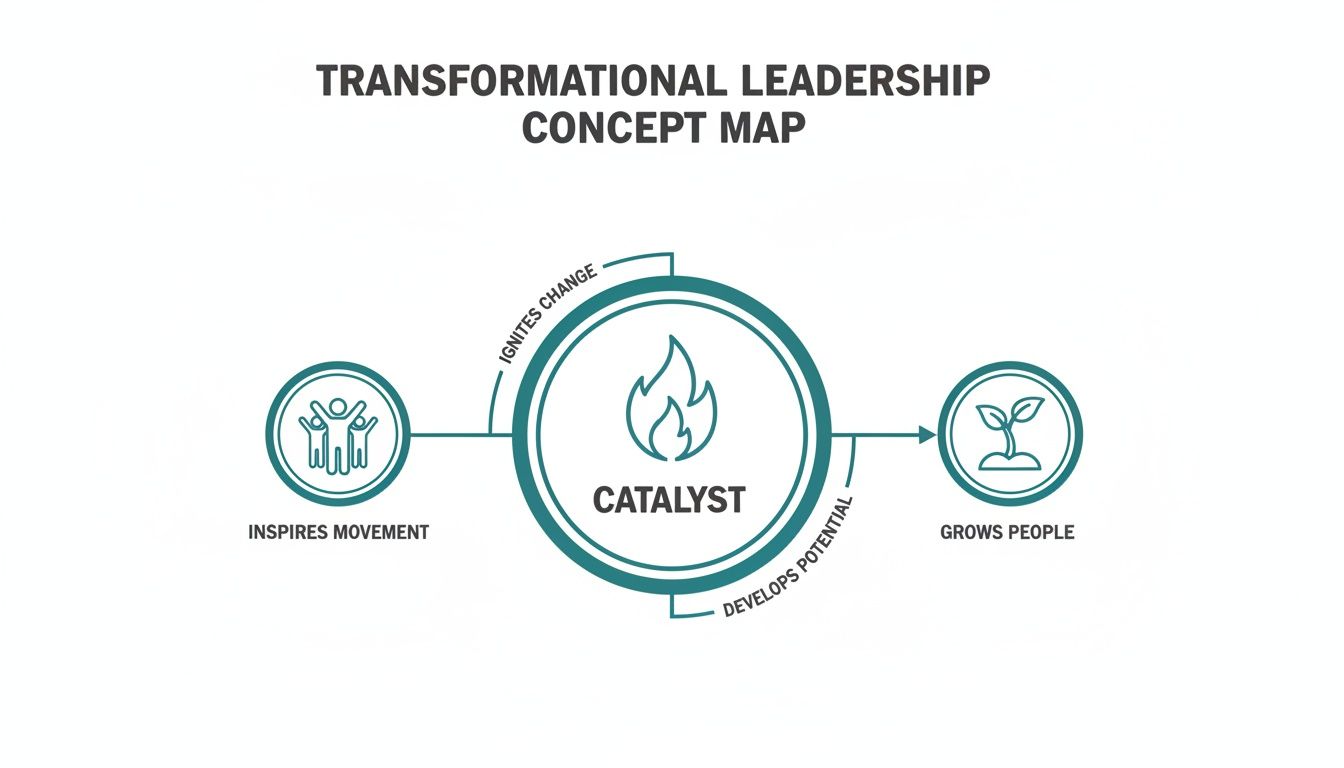
This image nails it. I'm the catalyst, sure, but the power comes from people like you uniting for a shared mission and transforming yourselves along the way.
To make this super clear, here’s a quick look at how these four big ideas show up in my day-to-day work at Litter Caterpillars.
The Four 'I's' in Action at Litter Caterpillars
| The Principle (The 'I') | What It Means in Simple Terms | How You'll See It at Litter Caterpillars |
|---|---|---|
| Idealized Influence | Leading by example. "Walking the walk." | Me being the first one at every cleanup, rain or shine. I'm not asking you to do anything I'm not already doing myself. |
| Inspirational Motivation | Creating a vision people are excited to be a part of. | We're not "just" picking up trash; we're reclaiming our city. We have a theme song and flags because pride matters. |
| Intellectual Stimulation | Encouraging everyone to think, question, and innovate. | Asking "What if?" A volunteer asking about an empty lot is how Caterpillar Park was born. Your ideas are our future. |
| Individualized Consideration | Seeing and supporting each person as an individual. | I'll know your name. I'll ask how you're doing, not just what you're doing. This is our "volunteer-first" philosophy. |
Let's dig a little deeper into what each of these really looks like on the ground.
Idealized Influence: Walking the Walk
This first 'I' sounds fancy, but I think it's the simplest of them all. It means you are a role model. You show up, do the work, and live the values you talk about. You build trust by being reliable, not by giving speeches.
For me, it’s not about grandstanding. It’s about being the first one at the meetup spot with a smile, whether it's hailing or scorching hot. When you see me out there week after week, you start to believe this isn't just a weekend hobby for me; it’s a deep commitment.
Idealized influence is about earning trust through action, not words. You lead by example, inspiring respect because people see you living the mission.
This builds a deep well of credibility. When you see me willing to get my own hands dirty, you're far more likely to roll up your sleeves and join in. It proves I'm not asking you to do something I wouldn’t do myself.
Inspirational Motivation: Creating a Shared Story
This one is my favorite. I call it the Tom Sawyer effect. Remember how he turned the chore of painting a fence into such an exciting opportunity that his friends literally paid to be part of it? That's inspirational motivation. I use it to craft a vision so compelling that you're desperate to join in.
How do I do it?
- A Shared Goal: We’re not just picking up litter. We are reclaiming our city, one block at a time. We're transforming forgotten spaces into places of community pride.
- Silly Traditions: We have a theme song! It sounds ridiculous, I know, but singing it together creates a sense of identity and shared joy that you just can’t get from a dry mission statement.
- The Power of Pride: We carry flags. We earn badges. These symbols give you a tangible sense of belonging and achievement.
I’m tapping into something deeper than just completing a task. When you feel that spark, the work itself becomes the reward. I'm igniting that fire inside you, and you can learn more by reading our guide on what is intrinsic motivation.
Intellectual Stimulation: Challenging the 'Why'
This 'I' is all about making you think. I want to create an environment where you feel safe to question how things are done and to offer up new, sometimes crazy, ideas. A transactional leader says, "Here's the plan." A transformational leader like me asks, "How can we make this even better?"
At Litter Caterpillars, this happens all the time. Someone saw an abandoned lot and asked, "What if we turned this into a community garden?" That single question was the seed of intellectual stimulation. We didn’t just clean that lot in Englewood; we brainstormed, planned, and eventually won it at auction to create Caterpillar Park.
That never would have happened if I just gave orders. It happened because I encouraged everyone to see problems as opportunities. I want you to challenge me. I want you to bring your wild ideas to the table. That’s how we really grow.
Individualized Consideration: You Matter More Than the Task
This is the heart and soul of our group. Individualized consideration means I see you as a whole person, not just a pair of hands. Your well-being, your happiness, and your personal growth are my top priorities.
It shows up in the small things I do:
- I check in to see how you're doing, not just how much trash you've collected.
- I remember your name and what you’re passionate about.
- I make sure you feel safe and supported, especially when we’re in a tough neighborhood.
This is our "volunteer-first" philosophy in action. It’s how strangers become friends and how a group of individuals becomes a true community. When you feel seen and valued, you don’t just show up to work; you show up for each other. That bond is what makes our mission unstoppable.
Transformational Versus Transactional Leadership
Let me paint a picture for you. Two very different coaches.
Imagine the first one. She’s standing on the sidelines with a clipboard. She yells out, "If we win the championship, I'm buying the whole team a pizza party!" It’s a deal. A simple transaction. A reward for a specific outcome.
That, in a nutshell, is transactional leadership. It’s a straightforward exchange: you do this thing for me, and I’ll give you that reward. It can work, sure, but that motivation only lasts as long as the pizza sounds good.
Now, picture the second coach. She’s on the field with you, running the same drills, pushing you past what you thought your limits were. She doesn't just talk about winning the next game. She talks about the pride of the journey, about becoming champions together, and about discovering a strength inside you that you never knew you had. That’s transformational.
This is the core difference I live by at Litter Caterpillars. I'm not offering you a prize. I'm offering you a chance to become part of a bigger story—and to find a stronger, more connected version of yourself in the process.
The Exchange vs. The Elevation
A transactional leader runs on a system of rewards and punishments. They are all about maintaining the status quo. I think of it like a vending machine: you put in the right coin (your effort), and you get your snack (the reward). It’s predictable and can be effective for simple, short-term goals.
But I'm all about transformational leadership. It's about elevating everyone involved. I don't just manage your expectations; I want to shatter them. I'm raising you to a "higher level of motivation and morality," as James MacGregor Burns first put it.
I see this all the time. A transactional approach would be me offering a gift card to the person who collects the most trash. A transformational approach is what I actually do: I build a community where the real reward is the feeling of pride you get looking at a clean park, the friendships you forge, and the personal growth you experience just by showing up.
The core of transactional leadership is "What's in it for me?" The core of transformational leadership is "What can we become together?" It's a shift from a self-focused exchange to a group-focused mission.
Givers vs. Takers
This distinction is exactly why I schedule our events on weekend mornings. It's a filter. If you're just looking for a quick transaction, an easy reward, or a party, you probably aren't getting up early on a Saturday to pick up trash with me.
I'm looking for givers. I'm building a community of people who show up because they believe in the mission, not because they’re getting something in return. Transactional leadership tends to attract "takers," while transformational leadership cultivates "givers."
This isn't just my philosophical preference; it creates real, powerful outcomes. When you are driven by an internal mission, your performance skyrockets. And it's not just my experience—the data backs this up. One study on IT teams found that transformational leadership drove a stunning 78.1% increase in overall output, simply because of the loyalty and trust it built. This isn't a one-off finding, either; a broad review of studies confirmed that this leadership style boosts performance across all sorts of different sectors.
Which Is Right for You?
Honestly, both styles have their place. If you need a simple task done quickly and efficiently, a transactional approach can work wonders.
But if you want to build something that lasts—something that changes people for the better—you have to aim higher.
You can't build a movement with pizza parties. You build it with a shared vision, genuine care, and by inspiring people to become the best versions of themselves. It’s a different path. It might be harder, but I promise you, it's also where you'll find the most meaningful change. It's also interesting to see how this compares to other styles focused on service, and you might want to check out our guide on what is servant leadership for another perspective.
How You Can Become a Transformational Leader Today
You don’t need a promotion. You don’t need a fancy title or a corner office to start leading. Forget all that. This is about you becoming a force for change right now, with what you've got. I'll show you the small, powerful moves you can make today—at work, in your neighborhood, even with your own family.

It all starts with one step. The same one I had to take that day we got caught in the hailstorm. You have to find your 'why.'
Find and Share Your Authentic 'Why'
My 'why' was brutally honest. I was sick of the mess in my life, and my apartment was the physical proof. I wanted to build a crew of givers and finally get a grip on my own issues with cleaning and just showing up consistently. That’s it. It wasn't some polished mission statement to save the planet; it was a real, raw need for change that I figured you might be feeling, too.
Your 'why' doesn't have to move mountains. It just has to be yours.
- At work: Are you tired of pointless meetings that drain your will to live? Maybe your 'why' is to make that time so efficient and respectful that everyone gets a piece of their day back.
- In your community: Does that run-down park on the corner bum you out every time you see it? Your 'why' could be to rally your neighbors and turn that eyesore into something beautiful.
- With your family: Do you wish you all did more than just stare at screens in the same room? Your 'why' could be as simple as starting a weekly game night.
Once you’ve got it, you have to share it. But don't just complain. Paint a picture for me. Instead of saying, "These meetings are a waste of time," try this: "What if our meetings were so productive we could knock them out 15 minutes early every single time?" You see the difference?
Practice the Art of Listening to Spark Ideas
Okay, now for the real work. You've got your vision, but a transformational leader doesn't bark orders. You create the space for other people to jump in and build it with you. I call this Intellectual Stimulation, and it starts with shutting up and listening. I mean really listening, not just waiting for your turn to talk.
When someone offers you an idea, give them your full attention. Ask questions. "That's interesting, tell me more about how that would work." Or, "What roadblocks do you think we'd hit with that approach?"
You're doing more than just collecting data. You're showing them their voice actually matters. This builds trust and makes you feel safe enough to share your craziest, most brilliant ideas. Those are the ideas that change everything.
Being a transformational leader isn't about having all the answers. It’s about asking the right questions to unlock the genius that’s already in the room.
Show You Care About the Person, Not Just the Project
This is the glue. This is what holds it all together. Individualized Consideration is about seeing people as human beings, not as cogs in a machine to get something done. It's the small things you do, day in and day out, that show you genuinely give a damn.
How can you start doing this today?
- Welcome the New Person: Be the one who walks over and introduces yourself to the new volunteer or the new hire. Ask them what they're excited about. Ask them what they're nervous about.
- Give Specific Praise: "Good job" is lazy. Try this instead: "The way you organized that spreadsheet saved me an hour of headaches. Thank you so much."
- Be the Positive Force: When things get tough and everyone's stressed, be the one who offers a word of encouragement or suggests taking a five-minute breather.
These aren't grand, heroic acts. They are small deposits I make into a bank of trust. When you feel seen and supported by me, you will go to the ends of the earth for a shared goal. To dig deeper into creating this kind of supportive vibe for your team, you can check out our guide on volunteer management best practices.
This isn't about a five-year plan. It's about making a difference in the next five minutes. That’s how your journey starts.
Answering Your Questions About Transformational Leadership
You’ve got questions, I’ve got answers. After years of building Litter Caterpillars from a hailstorm moment into a city-wide movement, I've heard every doubt in the book. I want to tackle the most common things people ask about what is transformational leadership, but using my real journey—not some textbook theory.
I want to get rid of your excuses so you feel ready to start.
"But I'm Not Charismatic. Can I Still Be a Leader?"
No, you don't need to be charismatic. Absolutely not. You don't have to be some super-extroverted, smooth-talking person. I’m a total introvert myself, and I’ve learned that being real is way more powerful than faking charisma.
It’s about having a vision you actually believe in and sharing it from the gut. Your passion and your commitment—that’s what pulls people in. It's the quiet proof that you show up every week, rain or shine, that builds trust. Not a big speech.
"Does This Stuff Work in a Normal 9-to-5 Job?"
Definitely. This isn’t just for volunteer groups picking up trash; you can be a spark for change from any desk, in any office. Just start with your immediate team.
Here's how you can do it:
- Actually care about your teammates' goals and help them get there.
- Encourage people to question old, stupid processes and find better ways to work.
- Create a vision for your team that’s bigger than just hitting quarterly numbers. What can you accomplish together?
You can start a positive ripple effect no matter what your job title is. You just have to be the one who decides to start it.
The hardest part of this leadership style? It takes a ton of personal investment and patience. You're not just making a quick deal; you're building trust and inspiring real change. That takes time and emotional energy. But the result—a team that's genuinely motivated and loyal—is always worth it.
"What’s the 'Dark Side' of This Leadership Style?"
This is a really important question. I want you to watch out for the "dark side" of this. Because this style uses a strong vision and personal influence, it can absolutely be twisted by people with bad intentions.
It's the difference between inspiring you toward a shared, positive goal versus manipulating you for my own gain. This is why the entire foundation has to be an ethical vision and real care for the people I'm leading. Without that moral compass, it's not leadership. It's just persuasion.
At Litter Caterpillars, we believe in the power of service to transform ourselves and our city. If you’re ready to stop waiting and start leading, join us. You can find all the details and sign up for our next event at https://www.littercaterpillars.com.