

At 6:10 on a Saturday morning, frost coated my gloves before the first bag filled. Three neighbors watched the street wake up, then one of them tied a second bag to the cart and said, “Let's keep going.”
That small decision captures a weekend cleaning schedule better than any color-coded calendar. The hard part isn't writing a list. It's protecting enough energy, clarity, and goodwill for people to show up again next week.
Why a Weekend Cleaning Schedule Is Worth Building
At one cleanup, rain soaked my sleeves before the first row was finished. A volunteer who had never joined us before stood beside the bag pile, unsure where to start. Another regular greeted them, pointed out the boundary, and worked alongside them until the route felt familiar. By the end, the newcomer stayed for the final count and asked about the next Saturday.
That morning changed how I judge a weekend cleaning schedule. Its value is not a prettier checklist. It is the shared ritual around the work: people know where to meet, what to bring, how long the effort lasts, and who will notice when they arrive.
The household version carries a similar weight. A household cleaning survey reported by Home Clean Secrets found that Americans spend nearly six hours each week cleaning their homes. Without a plan, that work can occupy every spare pocket of a weekend. A scheduled block gives chores a visible place, so the rest of the day does not feel like an unfinished job waiting in every room.
I learned the human side through small failures. One new volunteer left early because nobody explained the route. Another came back after a difficult week because someone greeted them by name, offered a familiar task, and showed them exactly where to work.
Those details decide whether a group becomes a recurring crew. The greeting at arrival, the gear table, the safety circle, and the closing thank-you create a rhythm people can trust. Volunteers may forget how many bags they filled. They remember whether they felt lost, rushed, or welcome.
Practical rule: Build the morning so a tired person can understand it within a few minutes.
For a home reset, the same principle applies. A schedule should make the work visible without making the household feel trapped by it. The point is a repeatable Saturday ritual that leaves room for changing weather, uneven energy, and the people doing the work.
Why Saturday Mornings Win for Cleaning
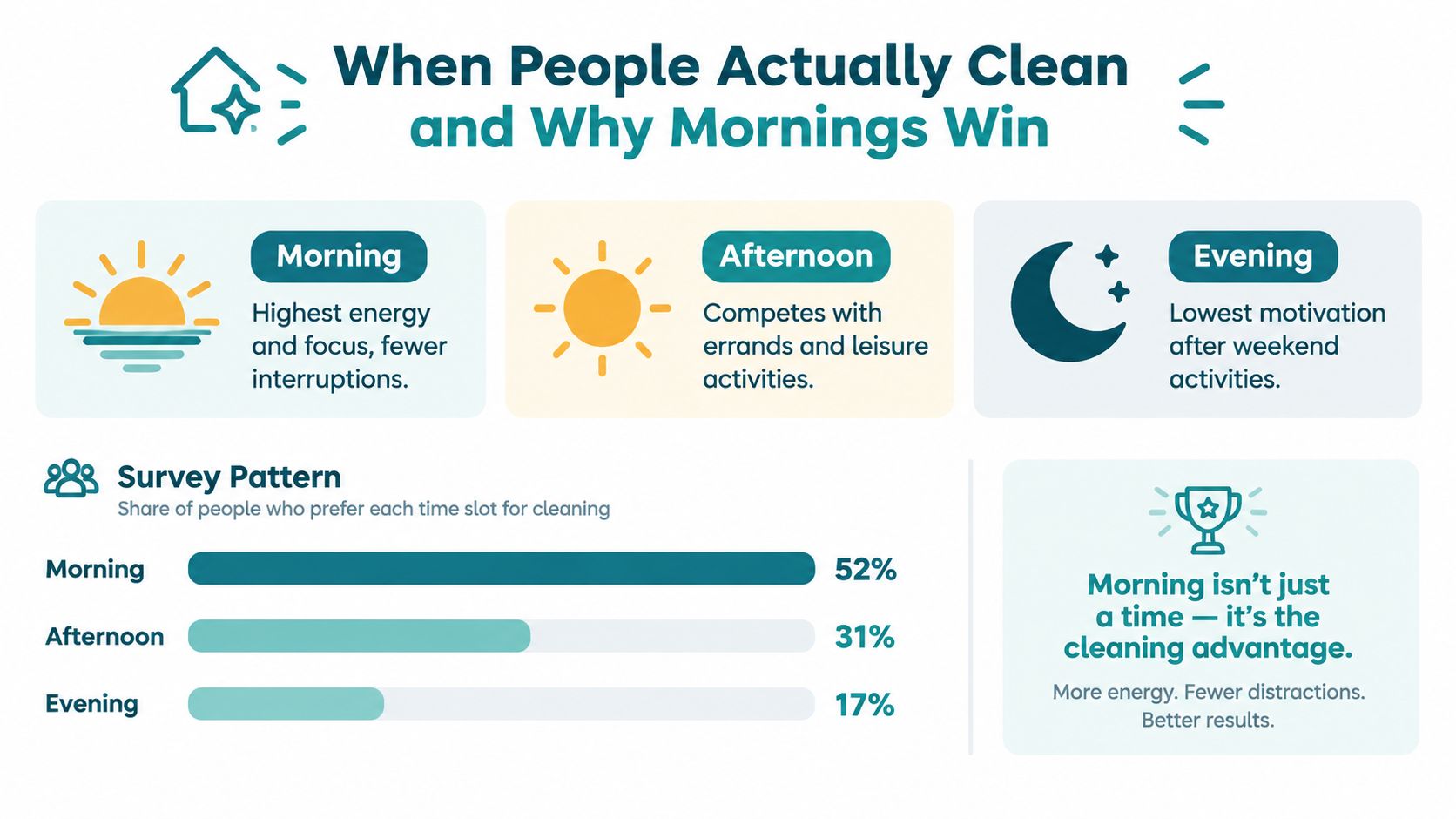
At our Saturday cleanups, the first hour often decided the whole day. People arrived with more focus, daylight made hazards easier to see, and finishing early left room for family plans or recovery. A commissioned study likewise found Saturday morning was the most popular cleaning time, while Sunday night and early Monday morning ranked among the least popular periods, according to Study Finds' summary of the cleaning survey.
That timing matters for a volunteer crew because energy is shared. On a hot morning, a clear start helped us collect more before fatigue turned small frustrations into arguments. In winter, daylight and a defined finish made the work feel manageable. The schedule had to respect the people carrying it, not only the bags or tools.
U.S. time-use data shows that weekend days bring more housework than weekdays, 40% compared with 35%, while food preparation and cleanup appear slightly more often on weekdays, 66% compared with 63%, according to HerWay's household chore statistics. That supports a practical split. Put the higher-friction work in a weekend morning block, then leave space for errands, worship, rest, recreation, or an unplanned change of weather.
Morning, afternoon, or evening
| Time | What helps | What gets in the way |
|---|---|---|
| Morning | Cooler air, daylight, sharper focus, and a clean finish before the day expands | Shift workers, religious observance, sleeping children, and local noise rules |
| Afternoon | More daylight and easier access for people who need a slower start | Heat, errands, sports, shopping, and family plans |
| Evening | Cooler temperatures in summer and availability after work | Low motivation, darkness, traffic visibility, and Sunday-night fatigue |
A flexible household rhythm can also protect goodwill. People do not all bring the same energy each weekend, so the morning block should absorb the tasks that keep being postponed rather than demand one exhausting marathon.
A workable default
Start on Saturday at 8:00 a.m., work for three hours, and keep Sunday morning available for Saturday conflicts. In a home, shorten the block to the jobs that create the most resistance, while routine wiping, dishes, and tidying stay on other days. For overnight workers or people observing Saturday religious practices, Sunday morning preserves the same social ritual without asking anyone to choose between participation and personal commitments.
Your Sample Weekend Morning Itinerary
At 8:00 a.m., I put the map on the hood of the truck, greet each volunteer by name, and give the morning a visible shape. Short blocks keep instructions from competing with the work, while the closing count gives people proof that their cold hands or tired legs changed the site.
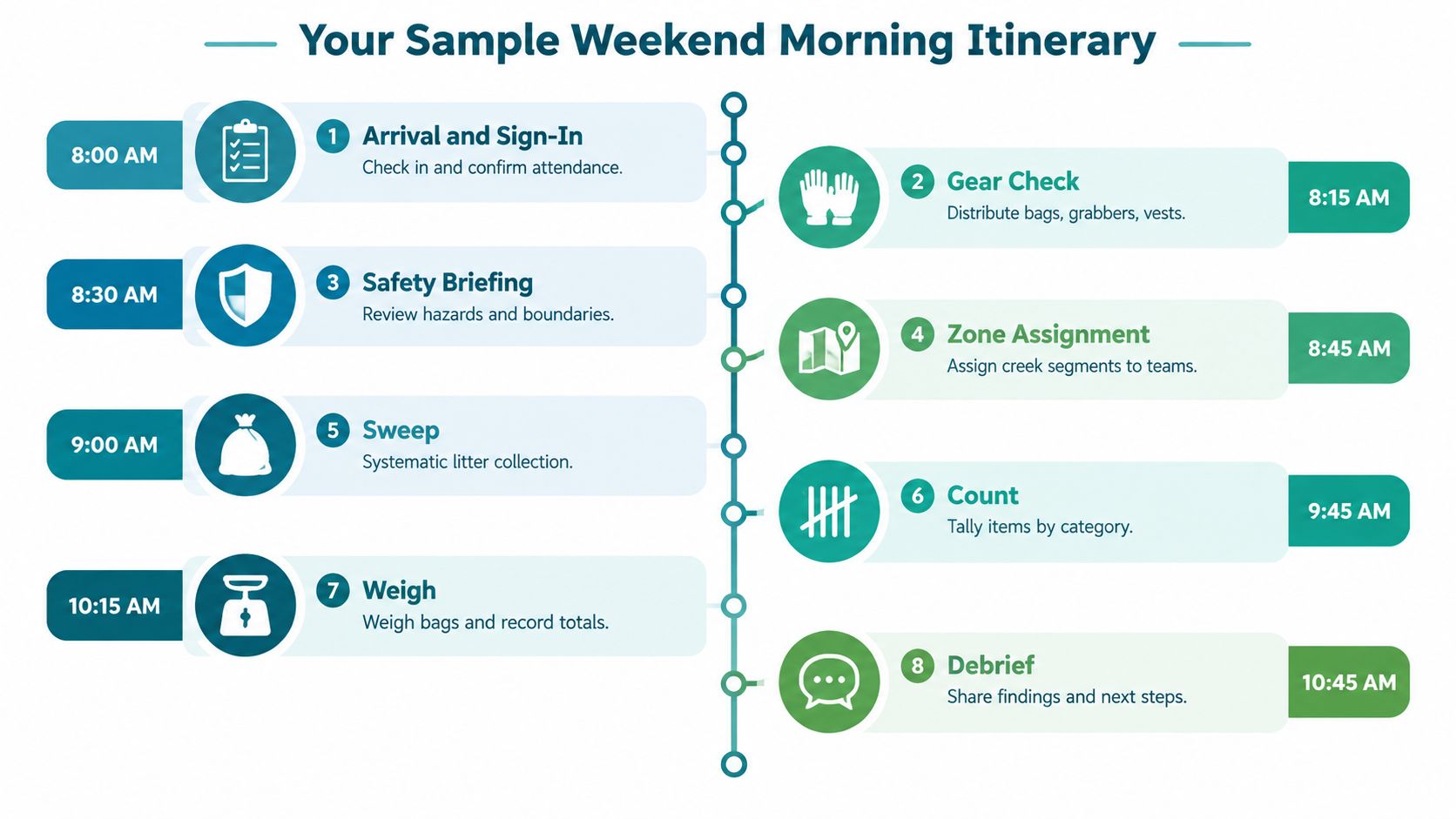
The three-hour plan below follows the creek-litter cleanup protocol, using a briefing, fixed sections, a collection point, and material counting.
The three-hour version
- 8:00 to 8:15, arrival and sign-in: The captain greets each person, records attendance, checks emergency contacts if the group uses them, and hands out a map. Late arrivals use a visible sign-in point instead of breaking into the briefing.
- 8:15 to 8:30, gear check: A supply lead distributes bags, grabbers, gloves, water reminders, and high-visibility clothing for roadside work. Everyone confirms a buddy before leaving the meeting point.
- 8:30 to 8:45, safety briefing: The captain names boundaries, traffic risks, unstable ground, heat concerns, sharps handling, and the buddy rule. Volunteers learn which items stay untouched and whom to contact when they find one.
- 8:45 to 9:00, zone assignment: The route lead gives each team a fixed start and end point. Volunteers repeat their segment aloud, which prevents wandering and makes the route easy to check.
- 9:00 to 9:45, systematic sweep: Teams move in one direction, fill bags, leave hazardous items alone, and bring full bags to the agreed drop point. The lead watches the pace and checks that nobody works alone.
- 9:45 to 10:15, count and sort: The sort team groups material by category and records totals on a tally sheet. A full count can expose debris a visual scan misses and show how material accumulates over time, as described in this roadside-litter audit framework.
- 10:15 to 10:45, weigh and record: The captain records bag totals, unusual items, and unfinished areas. The group photographs the final collection point when that image will help plan the next visit.
- 10:45 to 11:00, debrief and recognition: Each volunteer shares one observation. The captain thanks named contributors, then the team agrees on the next meeting point.
The 90-minute version
For a smaller group, use 8:00 to 8:15 for arrival and gear, 8:15 to 8:25 for safety, 8:25 to 8:35 for segment assignments, 8:35 to 9:10 for the sweep, 9:10 to 9:25 for sorting and counting, and 9:25 to 9:30 for weighing, cleanup, and thanks. Keep the order even when the blocks shrink.
Captain's cue sheet: “Check in, choose a buddy, inspect your gear, hear the hazards, repeat your segment, sweep toward the drop point, leave dangerous objects alone, bring bags back, count what we collected, and finish together.”
Splitting the Crew Into Roles and Segments
At one cleanup, I told everyone to spread out and search. Within minutes, two volunteers were picking through the same pile while another stood alone near the road. Since then, I assign ownership before anyone leaves the parking lot. Clear roles protect the work and the people doing it.
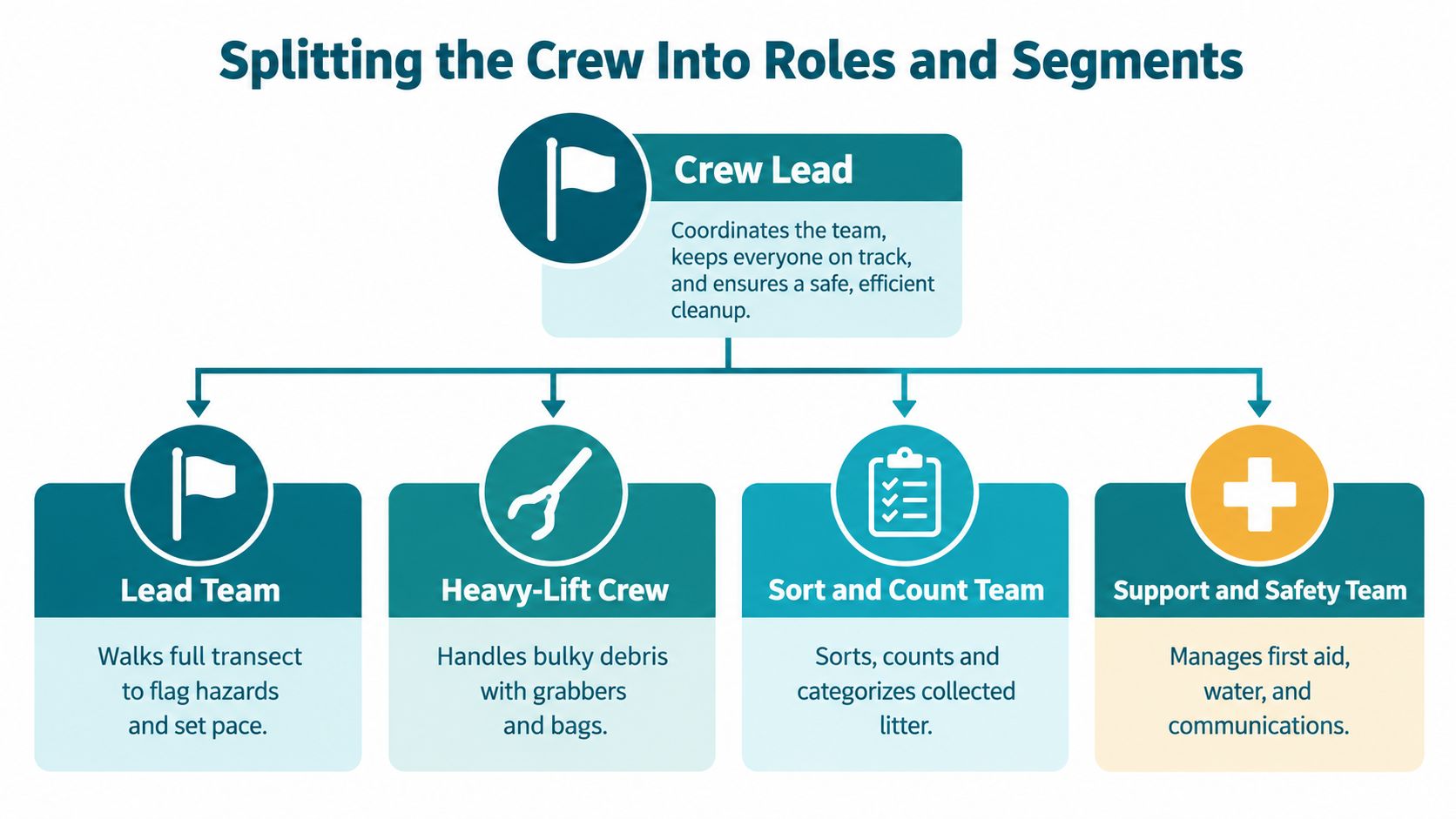
The creek-cleanup methodology uses briefings, subteams, fixed sections, and a central collection point. I adapt that structure for weekend mornings, where a familiar routine helps new volunteers join without feeling lost.
Four roles that prevent drift
- Lead team: Two people check the route, mark hazards, confirm the boundaries, and set a pace that keeps volunteers connected.
- Heavy-lift crew: Volunteers with grabbers and sturdy bags handle bulky debris within safe reach. They leave objects that are dangerously heavy, unstable, or too deep to retrieve.
- Sort-and-count team: This group stays near the collection point, separates material by type, and records each category on a tally sheet. One litter audit recorded 5,348 items before an intervention and 4,933 afterward across 27 litter types. Your local count can be smaller. Consistency matters more than scale.
- Support and safety team: This pair carries first-aid supplies, watches traffic and footing, tracks water pauses, and checks that each person remains with a buddy.
I write every assignment on a card and tape it to a grabber or supply kit. New volunteers work beside experienced people for their first few sessions. They learn the route, the signals, and the quiet habits that keep a group together.
Fixed segments make the work measurable
Give each subteam a printed map showing its start, finish, bag drop, and regroup time. If one group finds a dense patch, the lead records it rather than sending everyone toward the same pile.
A fixed segment also gives returning volunteers a clear memory of what changed. One litter report found that plastics made up 80.7% of counted litter at surveyed sites. That finding may support a plastic-focused plan on one route, while another area calls for attention to glass, food packaging, or construction scraps. The point is to let each weekend's record shape the next assignment, without turning volunteers into competing crews.
Weather, Safety, and No-Show Contingencies
Chicago has taught me to respect forecasts and distrust optimism. I've stood under hail with a crew that wanted to keep going, and I've sent people home on a bright morning because the route had become unsafe. A captain protects the people first, then the bags.
Use a laminated contingency card. Read it before every cleanup, even when the sky looks friendly.
Weather changes the plan
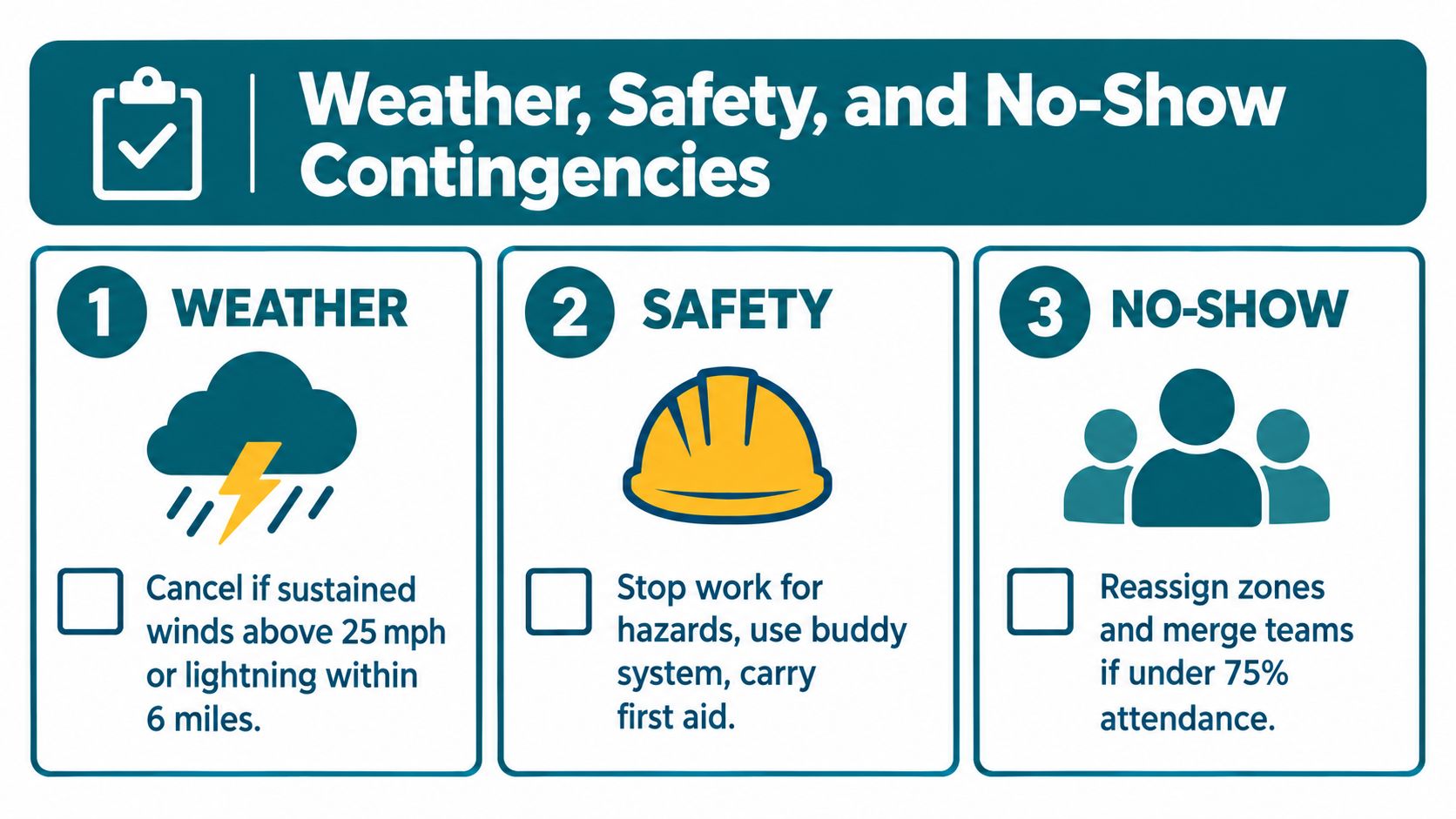
Set your weather decision before volunteers leave home. A captain can cancel, shorten, or move the event when conditions create unsafe footing, poor visibility, dangerous heat, or lightning exposure. Send the message early, include the next meeting option, and don't make people wait at the site for a debate.
For hot mornings, start earlier, build in water pauses, and keep the route near shade when possible. For cold or wet mornings, ask volunteers to bring layers and spare socks. The volunteer site manager guide advises gloves, closed-toe or sturdy shoes, long pants or sleeves, bright clothing for roadside work, sunscreen, and water.
Hazardous debris stops the sweep
Never let enthusiasm turn into hand-to-hand contact with danger. Volunteers must leave syringes, needles, sharp metal, old batteries, and unidentifiable objects alone. Mark the location, notify the lead, and contact the responsible authority for disposal, following the guidance in this household hazardous-waste cleanup safety guide.
Every volunteer should work with a buddy. Official cleanup guidance says crews should receive a safety briefing, work in teams of at least two, and use adult supervision for minors. The community cleanup safety checklist gives captains a practical reference for repeating that briefing.
No-shows need a quiet backup plan
Design each role so the work still functions when attendance drops. Pack supplies in role kits, print the tally sheet before arrival, and keep a two-person fallback team ready to absorb extra people or cover a missing group. If a zone becomes too large, close it and record it for a later morning instead of stretching volunteers beyond safe limits.
Keeping Volunteers Coming Back Week After Week
Pizza helps, but it rarely explains why someone returns in freezing rain. I've seen people come back because another volunteer remembered their name, handed them the flag, or saved them a place in the circle.
People need a visible way to belong. A cloth patch or wristband after a volunteer completes a third cleanup gives regulars a small marker they can wear. A shared song, a group photo, or a familiar route can create the same feeling without spending much money.
Give the morning a repeatable rhythm
Start each event with the same short circle. Everyone says their name, assigned segment, and one small fact. The format takes little time, but it lets new people speak before the work begins and gives returning volunteers a reason to greet one another.
End with a few rituals that make effort visible:
- Read shoutouts aloud: Thank someone who carried heavy bags, helped a newcomer, spotted a hazard, or kept the count organized.
- Update the tally board: Write the morning's categories where people can see them before they leave.
- Take one group photo: Stand beside the collected bags, with permission from everyone included.
- Rotate ownership: Let a different volunteer carry the flag, choose the song, lead the tally, or bring snacks.
I've found that identity works better than pressure. Volunteers shouldn't feel trapped by guilt or asked to prove their worth. They should know that their presence changes the morning and that the group will welcome them when life interrupts.
For more ideas on building a dependable group, review these volunteer retention strategies. Then send a short Sunday evening message with the count, two photos, and the next segment. That message keeps the thread alive without turning service into an obligation.
Your First Saturday With This Schedule
Your first event will feel exposed. People will watch for direction, the weather may change, and a small delay can decide whether the morning feels warm or chaotic. You don't need a perfect production. You need a captain who arrives prepared and speaks clearly.
Arrive 15 minutes early. Post the route map, set out bags and grabbers, place water where everyone can see it, and keep a printed roster beside your phone. Run a brief safety talk, pair people into two- or three-person pods, and give every pod a fixed section. Announce the end time before anyone starts so parents, shift workers, and people with afternoon plans can trust the schedule.
The final 10 minutes should include bag counting, one specific thank-you, and notes for next week. Write down a missing supply, a confusing turn, a slippery area, or a segment that took longer than expected. Those notes turn one morning into a system.
First-weekend checklist
- Route: Print the map and mark start, finish, bag drop, and regroup points.
- Safety: Prepare the briefing, first-aid supplies, hazard instructions, and buddy assignments.
- Gear: Pack gloves, grabbers, bags, bright clothing, and sturdy footwear.
- Comfort: Bring water, sunscreen, layers, and a hat when conditions call for them.
- Communication: Charge your phone and save the lead contact before arrival.
- Attendance: Print the roster and leave space for walk-in volunteers.
- Closeout: Carry a tally sheet, pen, camera, and a place to record next week's notes.
Groups looking for a regular service rhythm can study weekend volunteer work on Saturdays and adapt the same approach to their own block, home, school, or park.
The first Saturday may produce fewer bags than you hoped. That's fine. People will remember whether they felt safe, useful, and welcome. One morning repeated with care can outlast a large event that leaves everyone exhausted.
Litter Caterpillars organizes recurring weekend morning trash pickups in Chicago, with clear meetup details, shared roles, and a volunteer-first approach to safety and friendship. Visit Litter Caterpillars to find an upcoming cleanup and bring this weekend cleaning schedule to life with a crew.