
At 9:14 on a Saturday morning, my gloves were soaked, the hail was bouncing off the cemetery pavement, and five of us were still trying to keep our trash bags from filling with water. That cleanup taught me the best trash pickup schedule isn't the one that looks neat on a calendar. It's the one people can trust.
The First Pickup That Started Everything
Our first cleanup began under a cemetery awning on Chicago's North Side. Hail hammered the sidewalk. The bags sagged like water weights, and every glove felt useless within minutes. Five volunteers huddled together, watching the sky and wondering whether the person who planned the event had lost his mind.
That person was me.
I had wanted a clean start, a simple act of service, and a reason to bring people together. Instead, I got a Chicago spring storm that turned a short litter walk into a cold endurance test. We still picked up what we could. We laughed at the absurdity, took shelter when the weather demanded it, and went home with a lesson I couldn't ignore.
A schedule isn't bureaucracy. It's a promise between the organizer and the volunteer. It tells people when to wake up, what to wear, where to park, how long they'll work, and who will make the call if the weather turns rough. Without that promise, a cleanup depends on enthusiasm alone. Enthusiasm fades quickly when people don't know whether anyone else will show.
Practical rule: A schedule should make showing up feel simple before the work begins.
Municipal systems often use weekly collection as the baseline for basic household waste service. The UN SDG metadata defines basic collection as service at least once a week for one year, which helps explain why weekly pickup remains a familiar reference point in many communities (UN SDG metadata on household waste collection). Volunteer groups can borrow that rhythm without copying a city route. A recurring morning gives the group a dependable beat.
Since that first storm, I've learned that the calendar matters less than the habit built around it. The rest of this guide draws from that hailstorm, winter cleanups, hot Chicago mornings, and every Saturday when a small crew became a reliable one.
Choosing the Right Day Time and Frequency
Start with your volunteers, not your preferred time. Send one simple poll: “What recurring cleanup slot can you attend most often?” Give people a short list of realistic choices, then choose the slot that receives dependable support rather than the slot that sounds ideal.
Use a four-part decision
Pick a fixed window. Try 8 a.m. Saturday for families and early risers, 6 p.m. Thursday for after-work crews, or the second Sunday of each month for a monthly stewardship group. Keep the day and start time stable long enough for people to build it into their lives.
Match frequency to litter pressure. Busy corridors usually need a weekly visit. A park may work better on a biweekly rhythm, while a quieter greenway may only need a monthly cleanup. Waste collection systems already use different cadences for different streams. A 2020 door-to-door study found that households set out paper and cardboard at weekly, two-week, and monthly intervals, while glass followed a less frequent pattern for many participants (material-specific collection behavior in a door-to-door system). Your group can use the same logic. Let the site tell you how often to return.
Set a route limit. Use the 60/90 rule. Plan for a route that takes about an hour, and never let the full event run longer than 90 minutes from arrival to group photo. Volunteers who finish with energy are more likely to come back. Volunteers who finish exhausted often remember the strain more clearly than the result.
Review after several visits. Track attendance, bag count, weather, problem spots, and actual finish time. A mediocre slot that runs consistently for six months beats a perfect slot that your team abandons after three attempts.
Route length also affects safety. A compact route keeps the group visible, makes supply support easier, and limits the distance people carry full bags. For larger service areas, use a planning sequence that moves from policy review to broad route design, route balancing, crew paths, and later adjustment. The waste collection planning guidance recommends compact, non-overlapping routes, balanced collection and hauling time, and avoiding heavily traveled streets during rush periods.
I treat the schedule as a social contract. The route can change after you learn more, but the promise to meet should change only for a clear reason.
Why Weekend Mornings Win Every Time
The first cold Saturday morning usually reveals whether a cleanup can become a habit. People arrive with coffee, daylight, and enough time to settle into the route. Weekend mornings give volunteer groups a reliable starting point: cooler air makes walking and lifting easier, daylight exposes hazards, and coffee or brunch offers a social finish that a work shift rarely provides.
Weekday evenings can serve a committed crew, especially near offices or transit. They bring more friction, though. Commuting delays, darkness, dinner plans, and end-of-day fatigue can turn a willing volunteer into a no-show. Evening events work best as a supplement, not the only chance to participate.
Pop-up pickups help when a storm, festival, illegal dumping incident, or construction project changes a block quickly. Their flexibility comes at a cost. People cannot build a standing habit around an uncertain date. Recent operations research examines collection models that use bin-fill information, traffic, weather, and route re-optimization instead of relying on a rigid calendar (dynamic waste collection and route re-optimization research). Volunteer groups can borrow that flexibility for urgent work while keeping a dependable weekly rhythm for the people who return.
| Metric | Weekend Morning | Weekday Evening | On-Demand / Pop-Up |
|---|---|---|---|
| Attendance pattern | Usually steadier for recurring groups | More sensitive to work and travel | Unpredictable unless the issue feels urgent |
| Energy | Fresh start, cooler conditions, daylight | Mixed energy after the workday | Depends on notice and event urgency |
| Social habit | Easy to connect cleanup with coffee or brunch | Social time competes with dinner and commuting | Requires fast coordination |
| Best use | Weekly community routine | Supplementary crew or special route | Overflow, urgent litter, or event response |
| Main trade-off | Competes with family, sports, and religious plans | Darkness and fatigue | Weak routine and difficult planning |
Before setting a recurring date, check youth sports schedules, religious calendars, neighborhood festivals, and major city events. A short local survey can prevent months of weak attendance. Organizers planning public-facing weekend outreach can also use these weekend canvassing best practices to manage arrival points and volunteer flow.
The exact Chicago day may change, but consistency matters more than perfection. A weekend cleaning schedule gives people a repeatable way to make service part of their identity. Weekend mornings work for many groups because one time slot supports attendance, safety, conversation, and the return habit together.
Seasonal Adjustments and Weather Contingencies
Chicago weather demands a plan with branches. I don't treat a forecast as an automatic cancellation. I treat it as a design variable that changes the route, start time, supplies, and decision deadline.
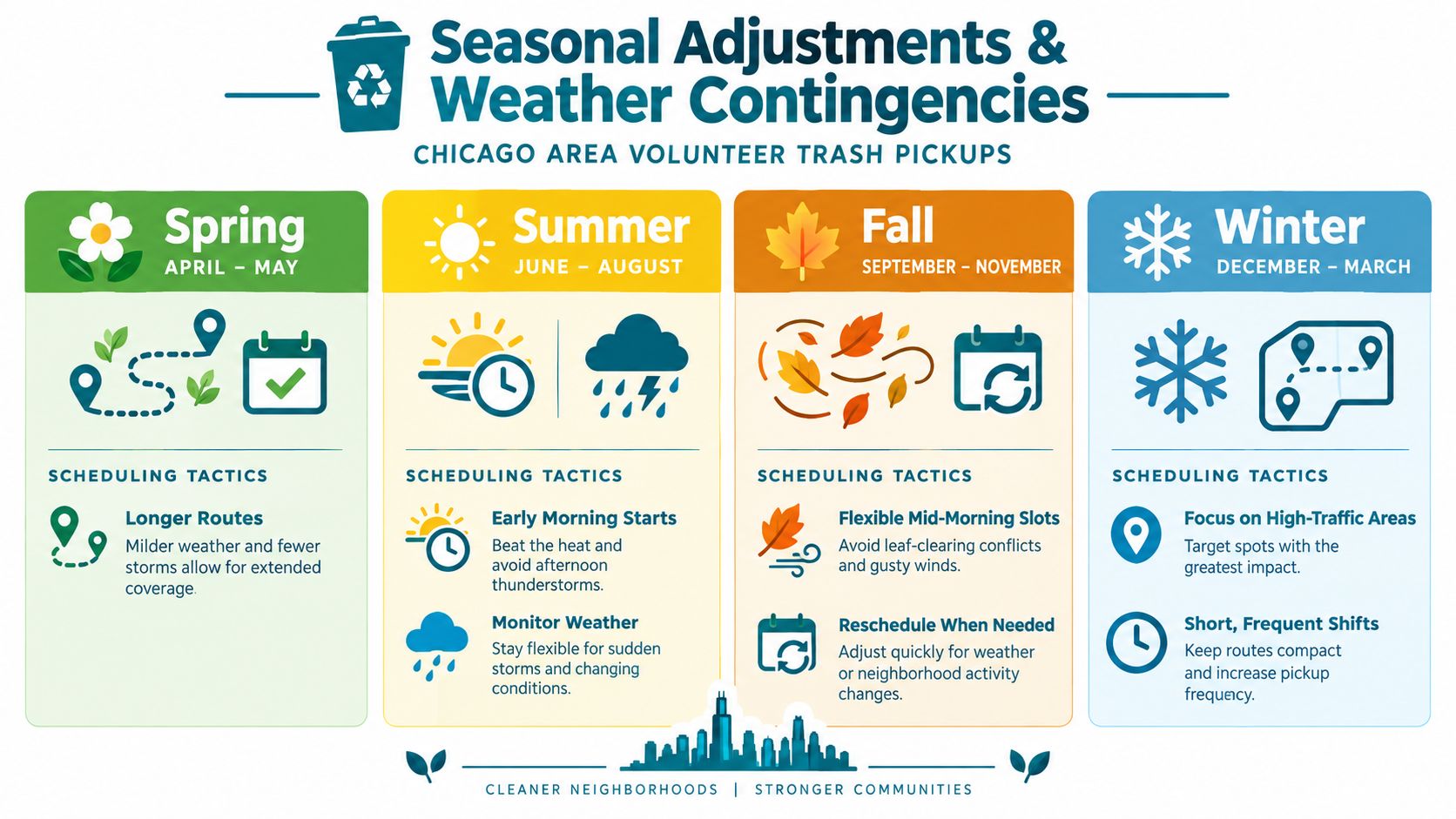
Build the year around conditions
Spring, April through May: Give the group its longest routes when temperatures feel manageable and daylight arrives early. Alley garbage often needs attention after winter, so start with routes that have visible accumulation. Keep a storm alternative ready because spring can turn quickly.
Summer, June through August: Start at 7 a.m. to avoid the hottest part of the day. Cap the shift at 90 minutes, schedule hydration breaks every 30 minutes, provide sun protection, and use buddy checks every 20 minutes. If heat or thunderstorms threaten the route, shorten the coverage rather than asking people to push through.
Fall, September through October: Return to the standard 8 to 10 a.m. window. Use the season to welcome people returning from summer travel, but watch for gusty conditions, wet leaves, and neighborhood conflicts around fall cleanup work.
Winter, November through March: Compress the route to busy, visible areas. Shorten the shift to 60 minutes, prepare cold-injury training, and place hand warmers with the supplies. A small crew on a short route can do better work than a large group standing around in dangerous cold.
Use three weather colors
- Green, proceed: Keep the route and normal start time.
- Yellow, proceed with adjustments: Shorten the route, add water or warm gear, change the start time, or move the meeting point.
- Red, postpone: Cancel outdoor work or move indoors to sort recyclables and prepare supplies.
The A Rocha cleanup manual recommends morning starts, daylight operations, and avoiding the coldest and hottest hours. It also advises fixed meeting points, closing times, multiple volunteer groups, and designated safety officers (community litter cleanup safety guidance).
Check the forecast at 72, 48, and 12 hours before pickup. Send every update through one channel, whether that's a text tree, GroupMe, or WhatsApp. Name one cancellation authority. Volunteers shouldn't debate safety in five separate chats while standing outside in hail.
Ready to Use Schedule Templates
A reliable template protects volunteer energy before the first bag is filled. Keep the recurring pieces fixed, then put changing details in one shared Google Sheet. Static fields should cover safety rules, supply standards, waiver language, role descriptions, and the weather decision process. The sheet can track dates, captains, routes, attendance, conditions, and follow-up notes.
Template A for a neighborhood cleanup
Copy this structure into your event document:
- Schedule: Second Saturday of every month, 9:00 to 10:30 a.m.
- Meeting point: Park pavilion.
- Route plan: Rotate three two-block routes.
- Leadership: Two co-leaders, one route captain per assigned route.
- Supplies: Gloves, bags, grabbers, first-aid kit, water, sanitizer, and a weighing method.
- Registration: RSVP link plus emergency contact and waiver fields.
- Closing ritual: Group photo, bag count, and post-pickup coffee.
- Google Sheet fields: Month, route, captain, theme, attendance, conditions, supply gaps, and next action.
The fixed structure makes the cleanup familiar, while the monthly route and theme give returning volunteers something new to own. Keep the signup fields, safety language, and role definitions fixed. Organizers building a shared sheet can also use these free volunteer scheduling tools.
Use a 12-month map so each pickup has a clear reason to return:
| Month | Route | Captain | Theme |
|---|---|---|---|
| January | Park edge | Assigned captain | Winter walkway check |
| February | Residential blocks | Assigned captain | Snowmelt litter sweep |
| March | Alley route | Assigned captain | Alley Sweep |
| April | Creek edge | Assigned captain | Creek Cleanup and Earth Day tie-in |
| May | Tree-lined blocks | Assigned captain | Arbor Day route |
| June | Park perimeter | Assigned captain | Summer Park Patrol |
| July | Commercial corridor | Assigned captain | Busy-block cleanup |
| August | Greenway | Assigned captain | Greenway Care |
| September | School approach | Assigned captain | Back-to-routine sweep |
| October | Alleys | Assigned captain | Fall Alley Sweep |
| November | River access route | Assigned captain | River Stewardship |
| December | Short central route | Assigned captain | Winter Welcome |
Change the captain and route in the sheet, but leave the operating language alone. For larger operations, organizers can adapt ideas from workflow scheduling for operations managers to clarify route ownership, dependencies, and handoffs. That distinction matters in Chicago: a familiar process helps people arrive ready, while clear ownership prevents a rainy morning or a missing supply from derailing the group.
Template B for a special event pickup
Use the week before the event for permits, gear staging, and the volunteer roster. Set a cap of 40 volunteers so station leads can keep sight of the group. A larger crowd may collect more quickly, but it also creates more check-in, communication, and safety work. On event day, use this sequence:
| Time | Action |
|---|---|
| 7:00 a.m. | Setup, supplies, signs, and check-in |
| 8:00 a.m. | Safety briefing and zone assignments |
| 8:30 a.m. | Stations open |
| 11:30 a.m. | Final sweep and bag consolidation |
| Noon | Wrap and group photo |
| 1:00 p.m. | Debrief with station leads |
The Chicago River Day model offers a useful structure. Place stations at regular intervals, use color-coded zones, and complete release-of-liability paperwork before crews leave the meeting point. Keep the signup sheet consistent across both templates: name, email, t-shirt size, emergency contact, waiver status, and role. Roles should include greeter, photographer, route lead, and supply manager.
| Element | Neighborhood Weekly | Special Event |
|---|---|---|
| Planning window | Recurring monthly setup | Pre-event permits and staging |
| Volunteer size | Flexible small crew | Capped roster |
| Route design | Three rotating routes | Color-coded zones and stations |
| Leadership | Two co-leaders | Station leads and event coordinator |
| Follow-up | Coffee and next date | Debrief and issue log |
Turning First Timers Into Regulars
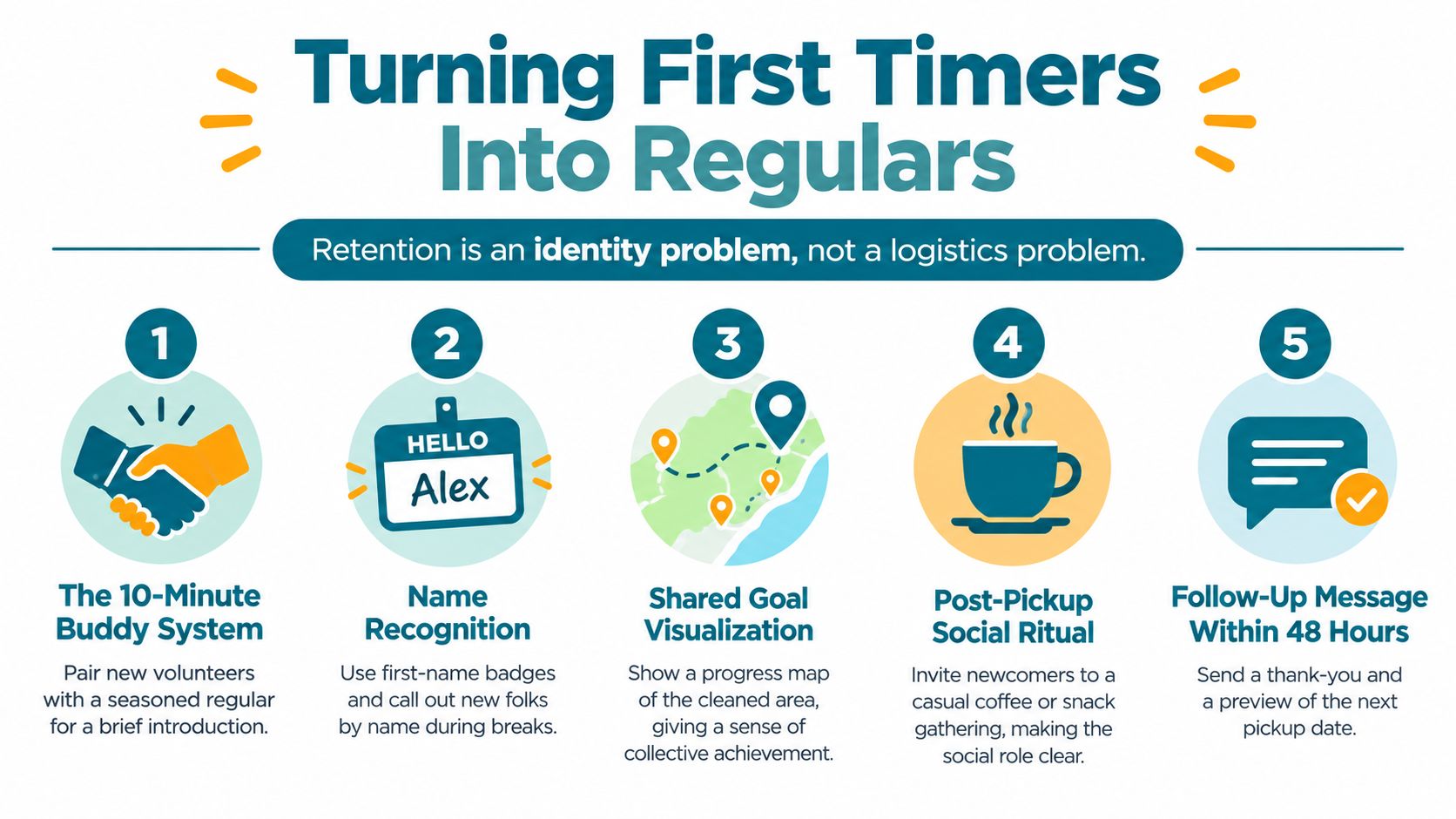
A route map gets people to the meeting point. Belonging gets them back. After a first pickup, people return when the group remembers their name, trusts them with a role, and gives them a clear reason to expect the next meeting. That social habit matters as much as the schedule.
Five habits that build return visits
1. Start with a 10-minute welcome circle. Introduce everyone by first name, ask why they came, and pair newcomers with a buddy. Keep it brief so the work begins on time and nobody feels stuck before the cleanup.
2. Make the result visible. Weigh the bags at the end of the shift and post the totals in a shared channel. A concrete record helps volunteers connect one hour of work with a visible result. Use the same simple process each week.
3. Name the role, not the task. Assign titles such as Route Lead, Sort Captain, or Safety Officer. A title signals trust and clarifies how that person contributes. “Volunteer” explains why someone arrived. A role explains what they own.
4. Build a closing ritual. Coffee, donuts, and a five-minute story from a returning member create a natural ending. People remember conversations, jokes, familiar faces, and the cleaned block together. That social connection makes the next invitation feel like a standing part of the neighborhood, rather than another obligation.
5. Send the next invitation within 48 hours. Include a personal thank-you, a photo, and the next month's date. Make the return path obvious so the person does not have to search for the group again.
These habits match the identity-first approach in volunteer retention strategies. The organizer's job is to remove the awkward gap between “I came once” and “this is my group.” In Chicago weather, that connection also helps people stay committed when a cold morning or a changed plan tests turnout.
Neighborhood crews show the pattern in different ways. A Logan Square group I followed grew from a small starting crew into a much larger base of regulars. A Rogers Park shoreline team saw fewer dropouts after assigning clear roles, while a Pilsen cleanup brought more first-timers back after adding the 48-hour invitation. These are local operating stories from the groups used for this article, not published benchmarks. Use them to shape your own experiments, not to promise a fixed result.
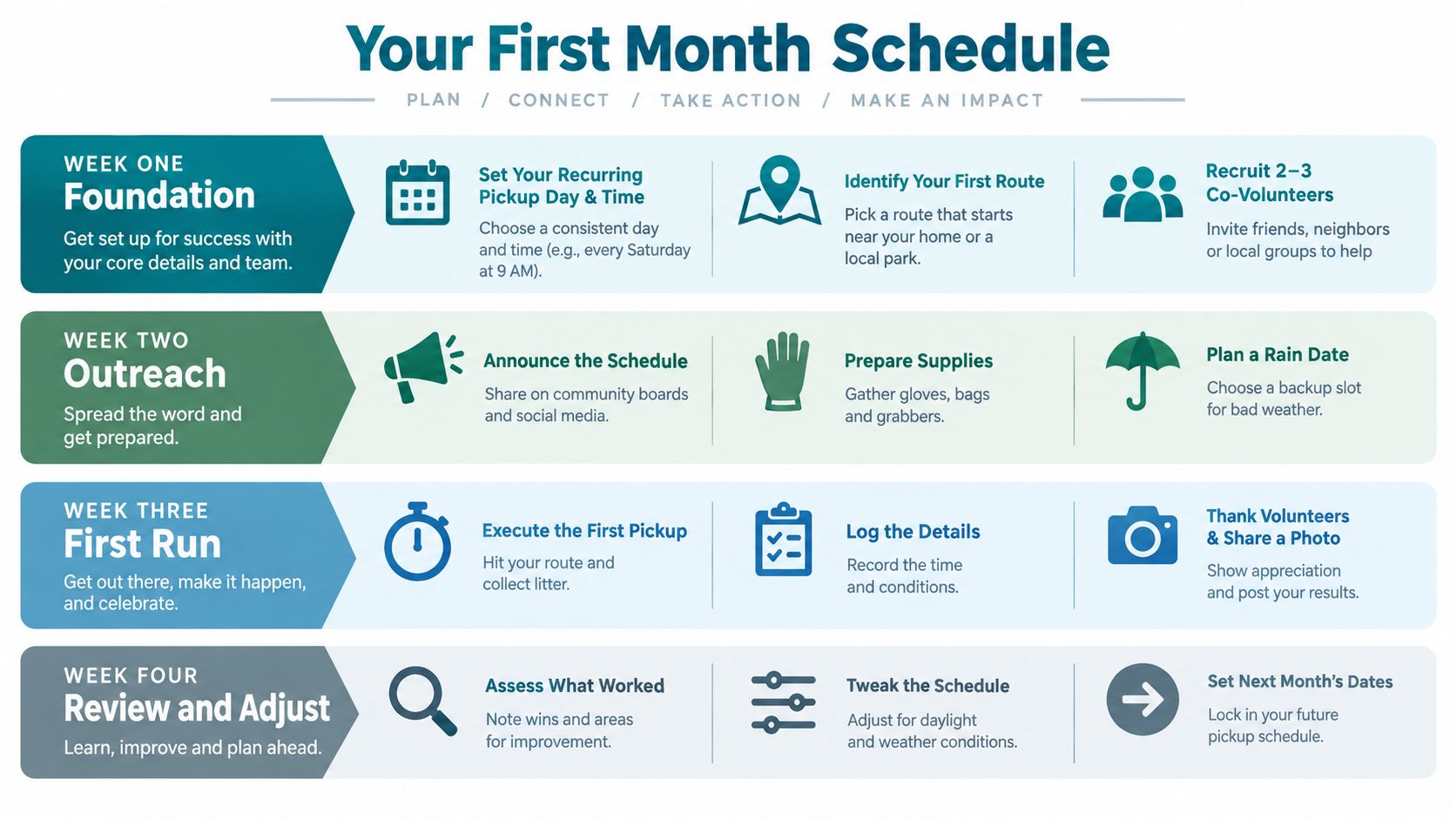
Your First Month Checklist
A first month succeeds when volunteers know what will happen before they arrive, and when the organizer learns enough to make the next pickup easier. Track the meeting point, route length, timing, weather decision, and arrival instructions. These details turn a one-off event into a weekly habit.
Week one, set the foundation
- Announce the recurring Saturday slot.
- Choose a first route near a home, park, or familiar landmark.
- Assign a cleanup captain.
- Recruit 2 to 3 co-volunteers.
- Confirm gloves, bags, grabbers, water, first aid, and communication access.
- Create a signup sheet with roles, emergency contacts, and waiver status.
Keep the public message short. State the meeting point, arrival time, route length, expected finish, clothing advice, and weather policy. A clear commitment helps people decide quickly, especially when the cleanup competes with errands, family plans, or a cold Chicago morning.
Week two, run the first pickup
Arrive before the group. Test sign-in, inspect the route, and explain safety boundaries before anyone starts collecting. Record the actual start and finish times, weather, bag volume, confusing intersections, and locations that need city collection rather than volunteer handling.
Run through the cancellation protocol, even under a calm forecast. Volunteers should know who sends the message, which channel carries it, and what happens after postponement. For a practical inspection routine, adapt use this checklist for daily walk-throughs to sidewalks, alleys, parks, and supply areas.
Week three, adjust with evidence
Review attendance and comments while the details are fresh. If people arrive late, clarify the arrival time or move the meeting point. If the route ends early, add a nearby block. If it runs long, remove the least visible segment. Change one variable at a time so the crew can tell what improved the experience.
Send a thank-you message with a group photo and the next date. Ask one direct question: “What would make the next pickup easier to attend?”
Week four, lock the backup plan
Choose seasonal backup dates. Assign a co-organizer by day 30, so the schedule does not depend on one person's memory, phone, or energy. Store the route map, contact list, supply inventory, and weather decision in one shared location.
Live litter reports, QR-code sign-ins, weather, traffic, and route changes may eventually help crews direct time toward areas that need attention. Those tools support judgment, but a dependable invitation still creates the habit. Volunteers return because the meeting rhythm is clear and the crew feels like theirs.
Block the next four Saturdays now, then assign a cleanup captain to each one.