Tag: volunteering

  • Natural Land Institute: Protecting Nature’s Future

    Natural Land Institute: Protecting Nature’s Future

    You might walk past a small patch of prairie or a tree-lined lot and wonder who keeps it from slipping back into weeds, trash, or pavement. I think that question opens the door to Natural Land Institute, because its work sits right at that meeting point between land, people, and long-term care. When you look closely, you start to see that conservation is not a single act. It is a series of choices about what to buy, what to protect, what to restore, and what to leave quiet.

    Introduction to Natural Land Institute

    A protected place can look simple from the trail. You see grasses bending in the wind, a wet pocket tucked below the trees, or a quiet edge of woodland, and it is easy to miss the careful work that keeps those features intact. The real question is who makes those decisions, and how they keep the land from being altered too quickly.

    Natural Land Institute works in northern Illinois as a private, member-supported 501(c)(3) land trust founded in 1958, with a focus on preserving land and natural diversity in 12 counties in northern Illinois. That matters because NLI is not structured like a park district. A park system is usually built for broad public use. A land trust has a different task, protecting land first and then deciding, case by case, how much access the site can support.

    That difference causes a lot of confusion. People often hear “protected land” and assume “public park,” yet those terms do not always mean the same thing. Conservation work often depends on restraint, because habitat may need rest, repair, or limited foot traffic before it can handle more use.

    Practical rule: when you see a protected property, ask two questions, who owns it, and how do people use it?

    That simple habit helps you read NLI's work more clearly. Once those two questions are in place, the rest of the picture becomes easier to follow.

    Natural Land Institute history and mission

    NLI began with a simple conservation decision: protect land so it can keep doing its work long after the first season ends. In 1958, a small group started what became Natural Land Institute, and that early choice still shapes the organization's direction today. Over time, member support helped the group grow into a land trust focused on preserving land and natural diversity across 12 counties in northern Illinois.
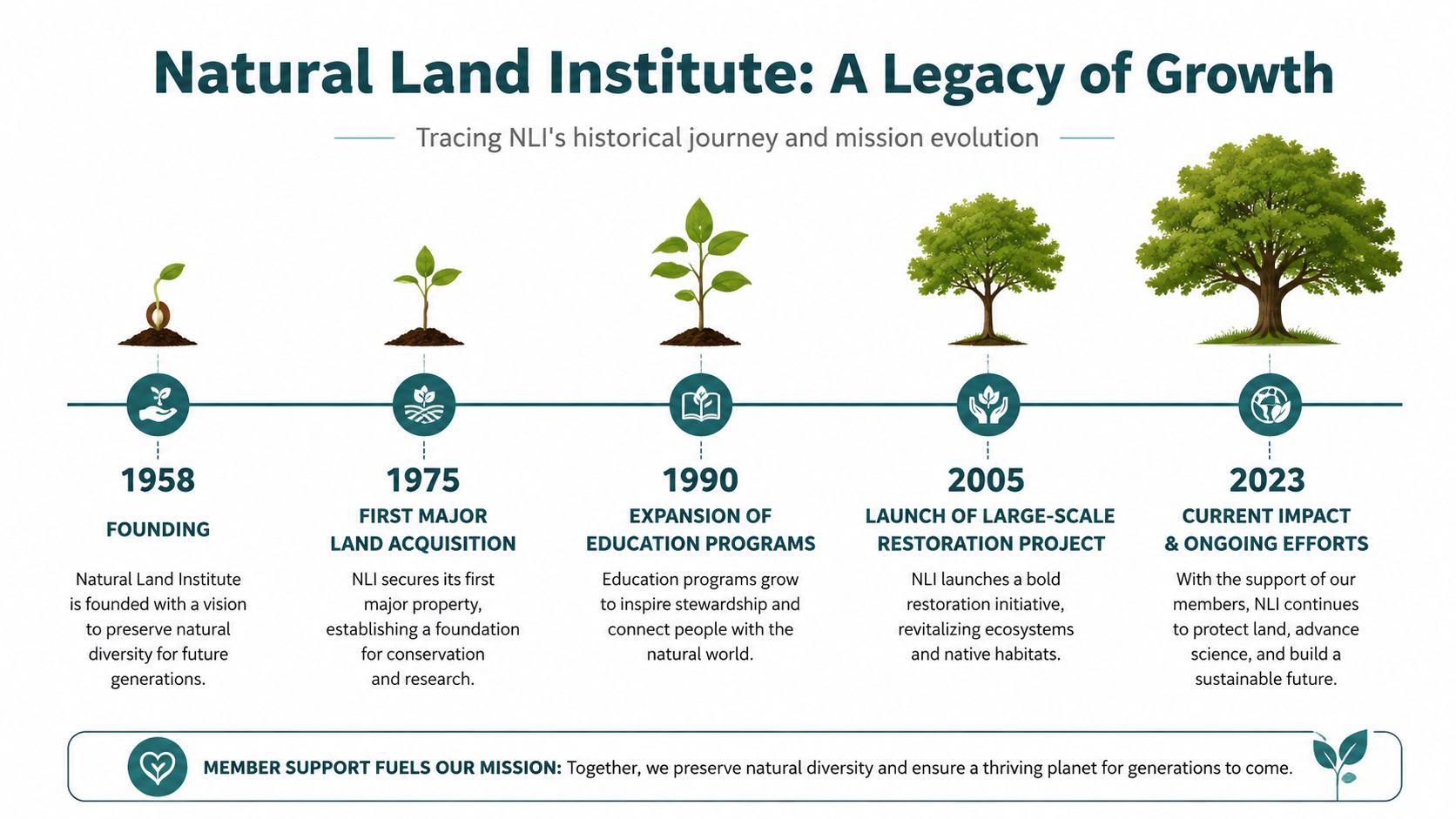
    A timeline graphic showing the historical growth of the Natural Land Institute from 1958 to 2023.

    What member support changes

    Member-supported groups work differently from places that depend on one large funding source. When people join, donate, volunteer, or renew, they help keep the work moving from one season to the next. That matters for a land trust because protection does not end when a property is acquired. The ongoing work continues through monitoring, repair, and patient care, the kind of steady attention that keeps a trail from eroding and a wetland from being pushed past its limits.

    NLI's own materials show how broad that effort has become. The organization says it has protected more than 18,000 acres in Illinois since 1958 (2021 Annual Report). Another profile lists more than 16,000 acres protected, which means the number can vary depending on the source and the year being cited (Project World Impact profile). I treat that variation as a reminder to check the date on any conservation claim before assuming it is the final count.

    Why the mission stays narrow

    NLI focuses on one mission, protecting land and natural diversity. That may sound narrow, but the focus matters. A land trust works best when it knows exactly what it is guarding, the same way a forest path stays clear when each marker points in one direction instead of many.

    That clarity also helps explain why local groups and volunteers can fit into the work in different ways. Some help with stewardship. Some help with monitoring or events. Others support public understanding of why access rules exist in the first place. The mission stays centered on land protection, while the people around it form the network that keeps the work grounded.

    Explore Natural Land Institute preserves

    Some protected places welcome your boots. Others ask you to look from the edge and leave the ground alone. That difference is one of the first things I want you to notice when you visit land protected by Natural Land Institute. A preserve is not always a park in the everyday sense, and that's where many visitors get confused.

    How to choose a place to visit

    Start with the access rule, then look at the site size, then decide what kind of outing you want. If you want a walking destination, look for public access language. If you want to learn how restoration works, a site with limited access may still be the right fit for an organized event or a guided workday.

    Preserve Location Access Size
    Des Plaines Dolomite Prairies Land and Water Reserve Northern Illinois Check current access details before going Preserved natural area
    Nygren Wetland Preserve Rockton area Event-based and preserve-specific access Wetland preserve
    Silver Creek Woods Preserve Northern Illinois Sometimes open through organized programs Private protected natural area

    For the most up-to-date visitor guidance on one site, I'd start with the Des Plaines Dolomite Prairies Land and Water Reserve page.

    Why access rules vary

    A reserve can protect birds, plants, soil, or water quality by limiting where people walk. That can feel odd if you expect every protected acre to act like a neighborhood park. But conservation often needs quiet zones, especially where restoration is still underway or where rare habitat could suffer from too much traffic.

    I like to think of preserve access like opening doors in a house with delicate furniture. You don't swing every door wide open. You choose the rooms where guests can move freely, and you keep other rooms closed so nothing gets damaged. That's the same kind of judgment land trusts use when they decide how a preserve should work for visitors.

    Understand conservation programs at NLI

    A protected parcel can start as one kind of project and grow into several. NLI uses a range of conservation tools, and each one fits a different situation, like choosing the right path through a wet meadow instead of forcing every visitor onto the same trail.
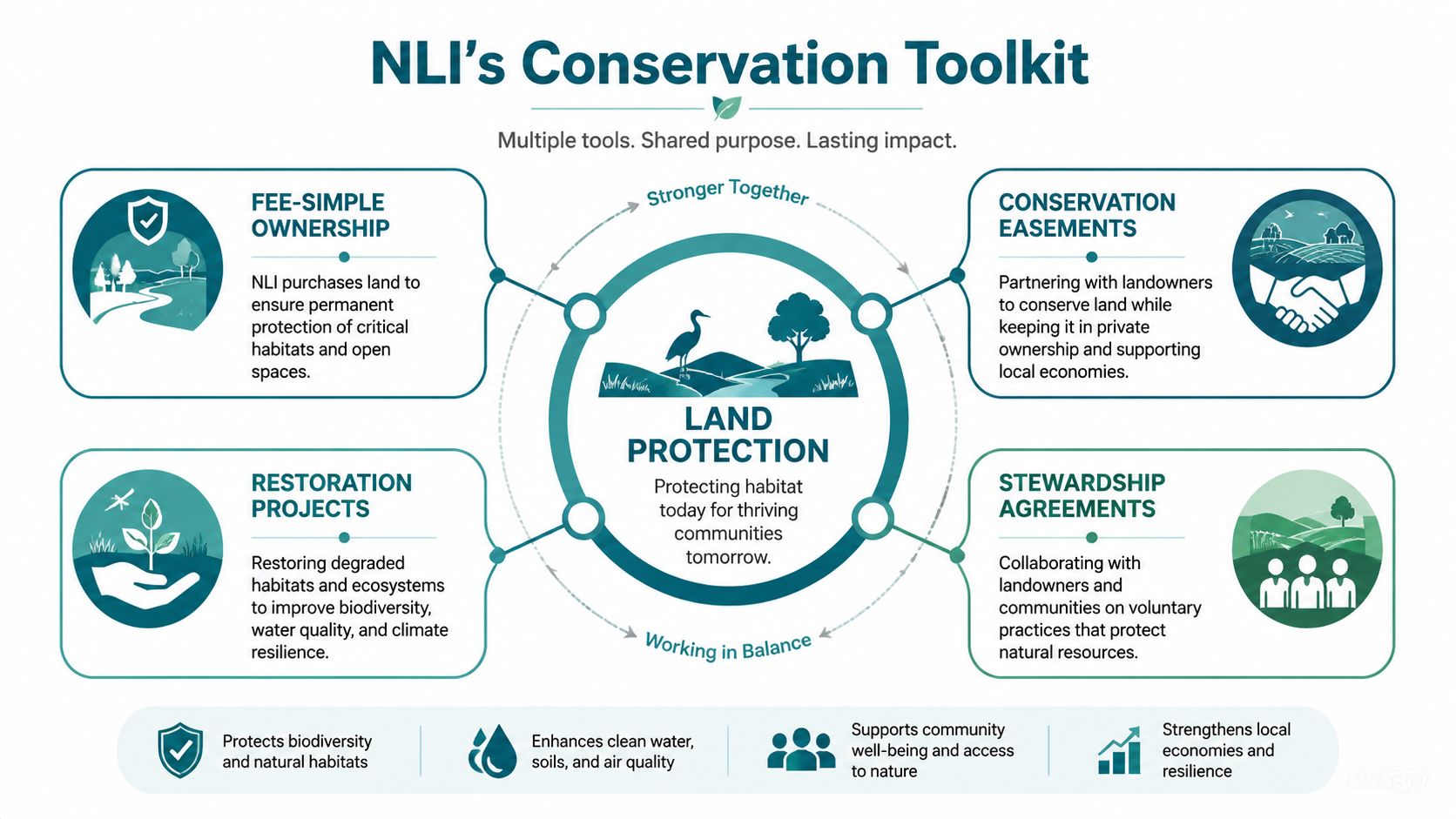
    An infographic titled NLI's Conservation Toolkit illustrating four methods for land protection and environmental preservation.

    The hidden mechanics of protection

    NLI's public materials say the organization has protected more than 18,000 acres since 1958, but the work behind that total is spread across different methods, including easements, stewardship, and restoration. That matters because “protected” does not always mean the same thing. In one case, NLI may own the land outright. In another, it may work with a landowner who keeps the property while agreeing to protect specific natural features. In a third, the focus may be on bringing a damaged site back to health after acquisition.

    Why the tools work together

    The tools function like different sections of a field pack, each carrying a separate job.

    • Fee-simple ownership means the land trust owns the property and can direct how it is managed.
    • Conservation easements let a landowner keep the land while limiting actions that would harm habitat.
    • Restoration projects help a site recover from invasive species, erosion, or neglect.
    • Stewardship agreements set ongoing care expectations so the work does not stop after the first season.

    That mix shows why land protection and public access are related, but not the same thing. A place can be protected for habitat and still have limited public use, which matters to neighbors, donors, and volunteers who want a clearer picture of what “saving land” involves.

    The brief video below offers another way to understand how habitat work and land care show up on the ground.

    One practical way to support this work is through environmental stewardship programs, because stewardship is where protection becomes real maintenance, the steady care that keeps a site healthy after the initial conservation decision.

    Volunteer and partnership opportunities with NLI

    A lot of people hear “volunteer” and think about picking up trash by themselves. NLI makes room for something broader than that. When a land trust needs help, the work can include stewardship days, citizen science, and group-based support that fits better with a crew than with a solo schedule.

    Where a cleanup group fits

    If you already work with a team that likes outdoor service, you can bring those habits into conservation without forcing them into a parking-lot cleanup mold. Habitat work often needs hands that can pull invasives, clear light debris, watch for site issues, and follow instructions from staff. That is a natural fit for groups that already know how to show up, listen, and work safely.

    How groups can help without crowding the site

    I'd treat partnership like trail etiquette. Move with the purpose the site needs, not the purpose you arrived with. That means asking where help is useful, what tools staff want you to bring, and whether the land can handle foot traffic on a given day.

    • Stewardship days work well when you want supervised field work.
    • Citizen science works well when you can observe carefully and record what you see.
    • Easement monitoring walks work well when the site needs a check-in rather than a cleanup.

    If you want a starting point for group service ideas, the environmental volunteer opportunities page gives a helpful model for how volunteer crews can organize around outdoor work.

    A good partnership does not ask a preserve to change for your group. It asks your group to fit the preserve's needs.

    That mindset keeps people useful and keeps the land from taking more pressure than it can handle.

    Events membership and donation options

    If you want to help NLI, start with the path that fits your life right now. Some people give money. Some give time. Some do both. The practical choice is to pick one starting point first, then build from there.

    A simple way to join in

    Membership is the most direct first step if you want an ongoing connection to the organization. It works like joining a trail crew that keeps returning to clear the path, not just showing up once and leaving. Member support helps a land trust plan beyond a single season, and the group's long-running work has depended on that steady kind of backing.

    Donations work the same way in a different form. They give the organization room to keep caring for land that is already protected, which is a job that continues long after a preserve is acquired.

    If you would rather give time than money, watch for events tied to field work, outings, and seasonal gatherings. NLI's event listings include nature-focused fundraisers and on-site activities, so you can enter the work through a visit, a volunteer day, or a community gathering (NLI event listing). That path helps people see conservation up close, instead of treating it like something distant and abstract.

    What to do first

    1. Choose your role. Decide whether you want to visit, volunteer, donate, or join as a member.
    2. Check the event calendar. Look for field days and gatherings that match your schedule.
    3. Read the site notes. Some preserves need special access or event registration.
    4. Set a donation habit if you can. A recurring gift is often easier to keep than a one-time decision.
    5. Bring a friend or group. Shared plans are easier to keep.

    A simple next step is often enough. You do not need to know every land trust term on day one. You only need one clear way to begin, then let your involvement grow from there.

    Impact metrics and stewardship challenges

    A preserve may look quiet from the trailhead, but the work behind it is constant. Natural Land Institute's footprint in Illinois is measured in protected acres, and public reporting shows the organization has secured a large amount of land since its founding. That scale matters because each tract carries its own needs, from prairie burns to wetland care, and the work does not stop once land is acquired.
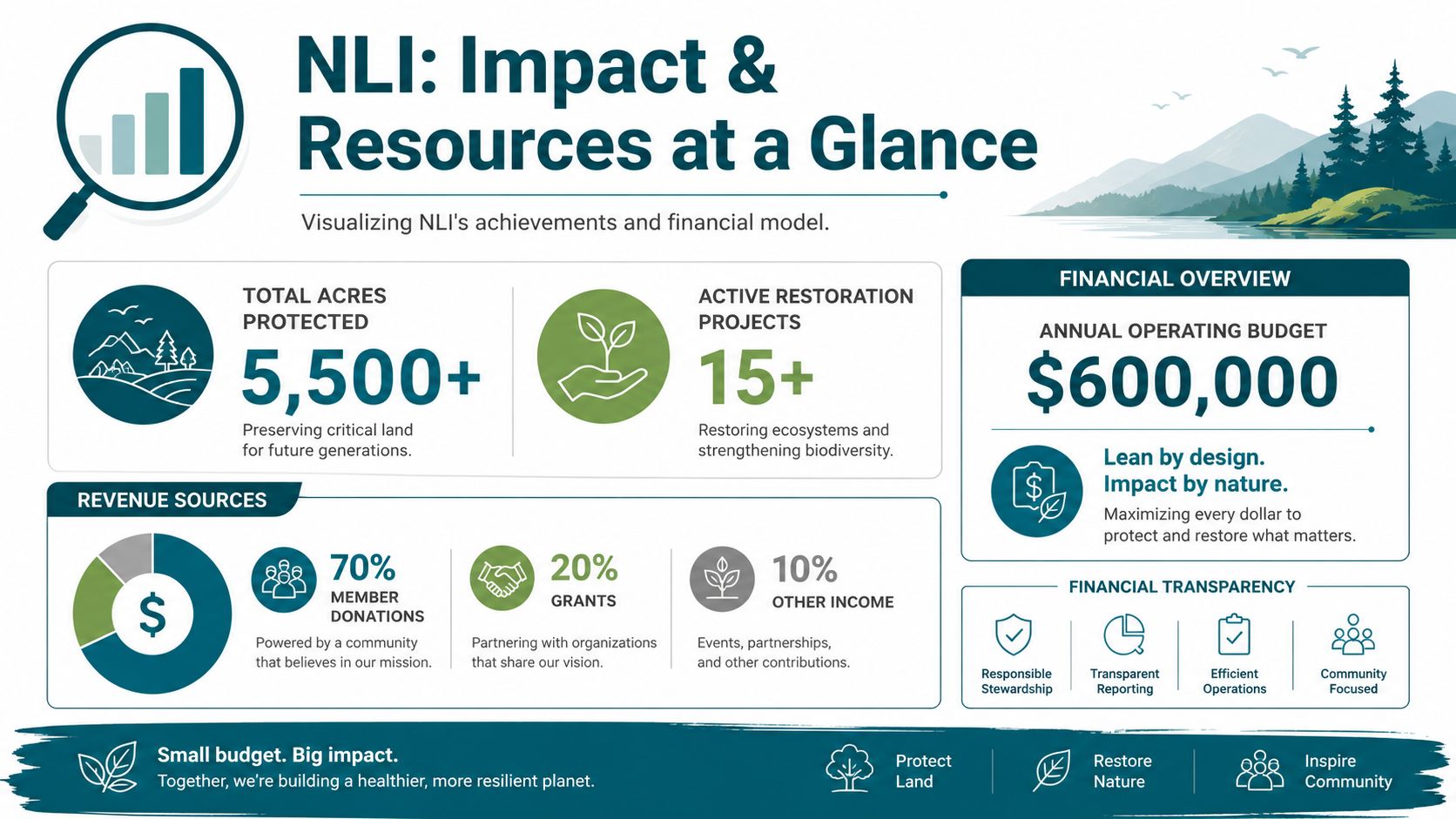
    An infographic showing Natural Land Institute's impact metrics, annual budget, and financial revenue breakdown for environmental protection.

    The financial side looks modest compared with the size of the conservation job. Public reporting shows a lean operating budget and a revenue mix that does not rely on a single source, which suggests the group has to plan carefully and keep many parts of its work moving at once. That is common in land protection. Protecting a place is one task, but keeping it healthy is a longer one.

    What the money has to cover

    Protected land does not pause for budget cycles. Invasive species keep spreading, trails wear down under use, and native plant communities need repeated care to recover and stay stable. Staff time, equipment, and field visits all cost money, and those costs continue after a preserve is secured.

    That is the part many people miss when they celebrate a land purchase.

    Why maintenance is the harder question

    The harder question is care over time. Climate stress, restoration work, and long-term monitoring all call for steady funding and patient labor, much like tending a garden that keeps changing with the seasons. The preserve may already be protected, but protection is not the same as hands-off management.

    That is why donors, volunteers, and neighbors matter in practical ways. Some people help by giving money, which supports ongoing stewardship. Others help by showing up for workdays, field tasks, or events that keep a preserve functioning as a living place instead of a frozen one. The question is simple to ask and harder to answer, who keeps paying attention after the public spotlight moves on?

    Practical rule: if you want a preserve to stay healthy, ask how it gets cared for after the ribbon-cutting ends.

    I think that is the clearest place for local support to matter. It keeps the focus on the ground truth of conservation, the work continues.

    Practical steps to visit and get involved

    Start with one preserve and one action. Check access rules before you drive out, because some protected places need event registration or limited use. Then choose one next move, visit, volunteer, join, or donate, and put it on your calendar today.

    1. Plan a visit. Pick a preserve and read its current access notes.
    2. Sign up for a volunteer day. Choose a stewardship event that matches your comfort level.
    3. Bring your group. Ask staff where a crew can help without disrupting habitat.
    4. Join as a member or donor. Pick a giving level you can keep up.
    5. Follow future events. Field trips and seasonal gatherings make it easier to stay involved.

    If you want to turn a single walk into a real habit of conservation, start now. A first visit teaches you how land trusts think, and the next step is yours to take.


    A CTA for Litter Caterpillars.

  • What is social responsibility? Practical steps to make a difference today

    What is social responsibility? Practical steps to make a difference today

    I used to think social responsibility was a term reserved for corporate boardrooms, a phantom phrase haunting glossy annual reports. It felt colossal, impersonal, and a million miles away from my daily grind.

    Then my own world imploded. A relationship shattered, my apartment became a monument to chaos… I was submerged, drowning in my own life's clutter. Cleaning it up felt impossible. But a peculiar thought surfaced: what if, instead of tackling my own mess, I went out and cleaned up someone else's? The city's mess.

    The moment I stepped out that first day, litter picker in hand, it all clicked into place. Social responsibility isn't about having your own life flawlessly curated. It's about showing up for the world that exists beyond your front door.

    It’s this beautifully simple, profoundly powerful idea that we're all intricately woven together. Imagine society is a vast, sprawling quilt—you, me, every single person—we’re each a single thread. When you tug on one, even the tiniest one, the entire pattern ripples and shifts. That’s it. You’re making choices that fortify the entire fabric, not just your own little patch.

    The Three Layers of Making a Difference

    To really grasp what social responsibility is, you have to see its DNA expressed at different scales—from your own quiet decision to a multinational corporation's sweeping mission.

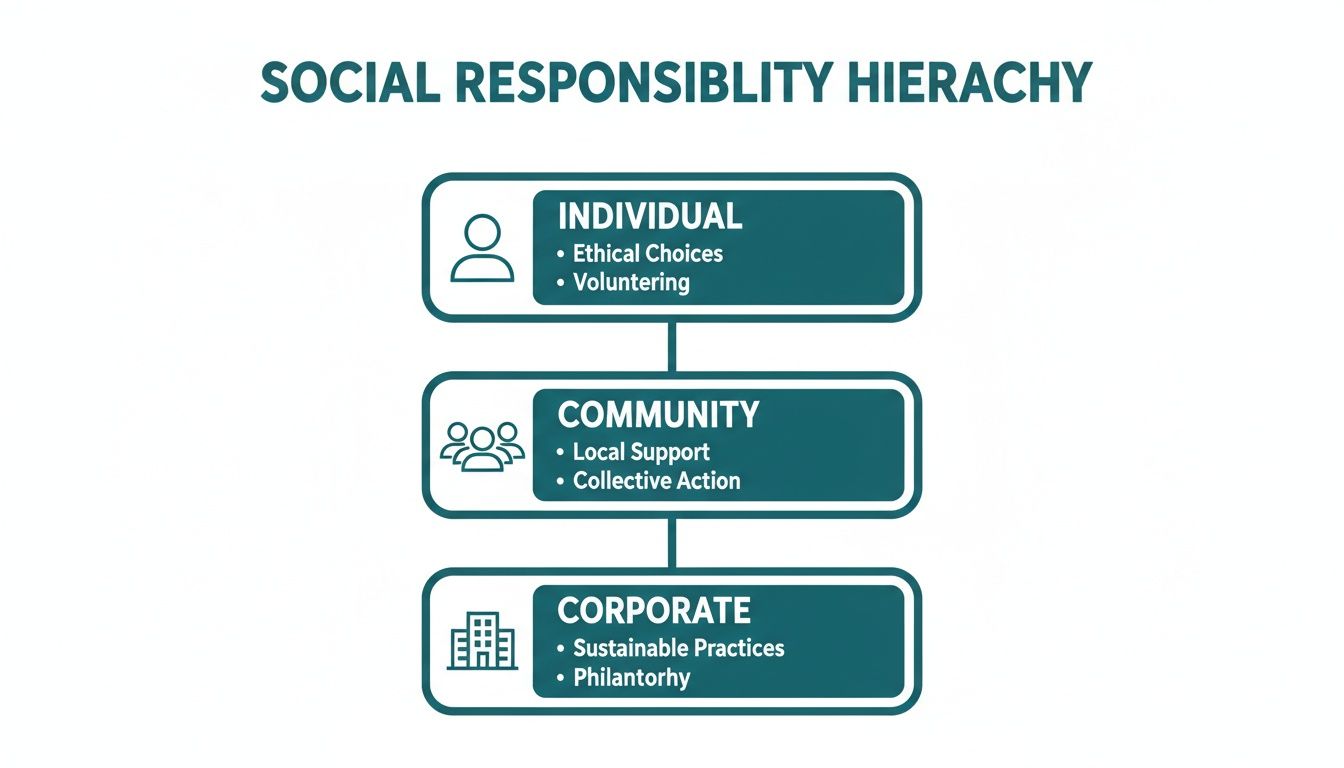
    This diagram unpacks it perfectly, illustrating how genuine change grows from the ground up, starting with you.

    A hierarchy diagram illustrating social responsibility at individual, community, and corporate levels with specific examples.

    This visual illuminates a crucial truth: real impact isn't a one-way street, trickling down from on high. It's a living feedback loop. Your personal choices ignite community action, and vibrant communities, in turn, compel corporations to elevate their game.

    Let me break down how this dynamic plays out in the real world.

    The Three Dimensions of Social Responsibility

    A straightforward look at how responsibility scales from a single person to a global corporation.

    Dimension Who It Involves Example in Action
    Individual You, me, every single person. You choose to bike to work instead of drive. I volunteer on a Saturday. We simply check in on an elderly neighbor.
    Community & Civic Neighborhood groups, local non-profits, city-wide initiatives. A group like Litter Caterpillars orchestrates weekly cleanups, or a community garden materializes, offering fresh produce for local families.
    Corporate (CSR) Small businesses and global corporations. A local coffee shop meticulously sources fair-trade beans, or a tech giant invests in renewable energy to power its sprawling data centers.

    As you can see, these layers aren't sealed off in silos. They're perpetually dancing with one another.

    One person’s unyielding dedication to recycling can spark a neighborhood-wide composting revolution. A community that passionately demands pristine parks can pressure local businesses to abandon single-use plastics. It all begins with the defiant belief that what you do actually, fundamentally matters.

    This mindset is a kindred spirit to another potent idea, which you can explore in our guide on what is environmental stewardship. Everything ignites the moment you decide to take that first small, powerful step.

    The Surprising Joy of Tackling a Shared Mess

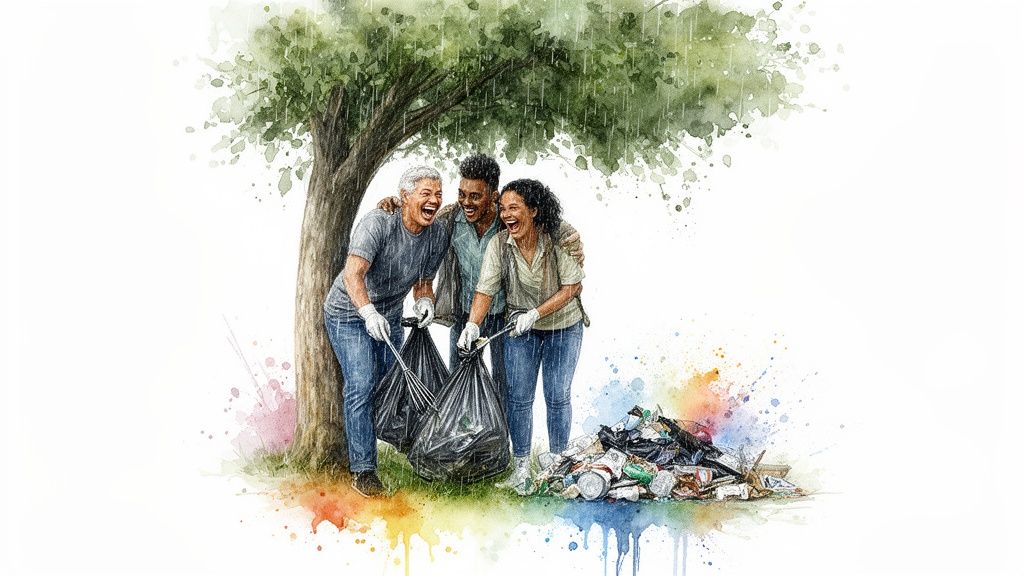
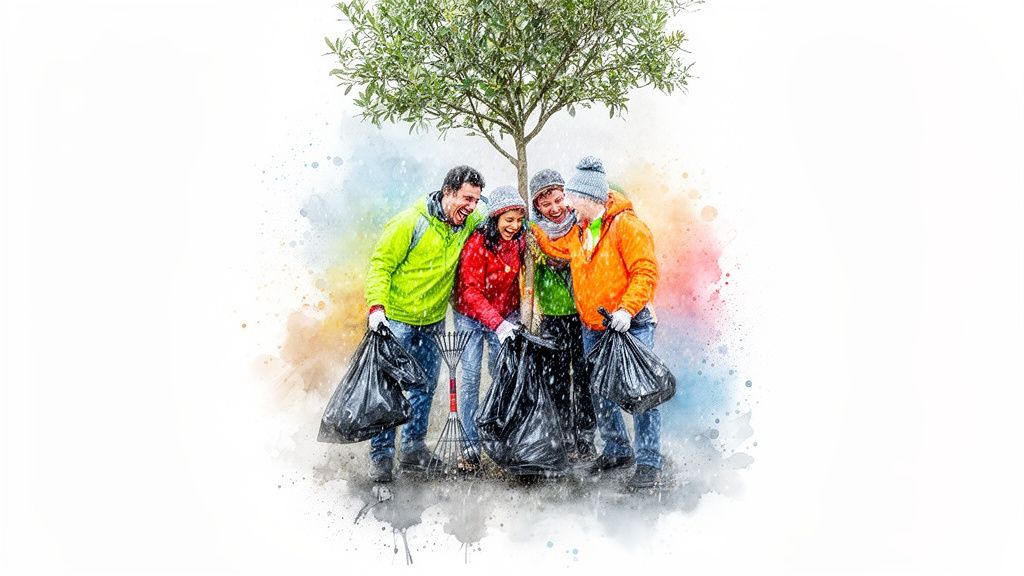
    Three diverse people joyfully collecting trash under a tree in a watercolor painting, promoting environmental cleanup.

    You know that feeling? It's infinitely easier to help a friend conquer their chaotic garage than to confront your own overstuffed closet. A profound psychological truth hides in that sensation, and it's the secret ingredient that makes groups like ours thrive. Let me transport you back to our very first cleanup.

    We were a trio, armed with trash grabbers and only a hazy notion of our mission. Then, in a display of classic Chicago drama, a serene spring day erupted into violence. A freak hailstorm ambushed us, forcing us to huddle beneath a flimsy tree as ice pellets rained down like tiny hammers.

    And in that shared, shivering moment of misery, something profound clicked for me. Confronting a collective mess—the city's litter—felt strangely, wonderfully liberating.

    Detached from Personal Baggage

    This mess wasn't my mess. It carried none of the emotional gravity of my own to-do list, where each piece of clutter whispers a story of procrastination or past failure. The city's trash was just… trash.

    Tackling a problem that doesn't personally belong to you unleashes pure, unfiltered purpose. It vaporizes self-judgment, replacing it with a simple, achievable mission.

    This detachment is a superpower. It transforms a potentially demoralizing chore into an exhilarating adventure. You aren't fixing a personal shortcoming; you are contributing to a collective triumph.

    This is the very point where the idea of what is social responsibility sheds its heavy, obligatory skin and reveals itself as a wellspring of unexpected joy. It's about discovering your own strength by focusing on something orders of magnitude bigger than yourself. When you pivot your focus outward, you unearth a part of you that you never knew existed.

    Turning Struggle into a Story

    That hailstorm could have been the unceremonious end of our fledgling group. Instead, it became our origin story. Why? Because shared struggle forges bonds of steel.

    Facing a challenge together ignites a few spectacular things:

    • It builds resilience: Enduring a small, shared hardship like a sudden storm makes you feel like you can conquer mountains.
    • It creates instant community: Nothing connects people faster than a shared "can you believe this is happening?" moment.
    • It makes the work memorable: The struggle adds flavor, a narrative spice. It elevates a simple task into a story you’ll genuinely want to tell later.

    Suddenly, you’re not just picking up litter anymore. You're part of a crew that stared down a storm. You're a protagonist in a story of progress, where every filled trash bag is a victorious chapter. It’s in these moments that the true meaning of social responsibility reveals itself—not as a duty, but as a path to connection, growth, and even a bit of wild fun.

    How Big Companies and Local Groups Build Trust

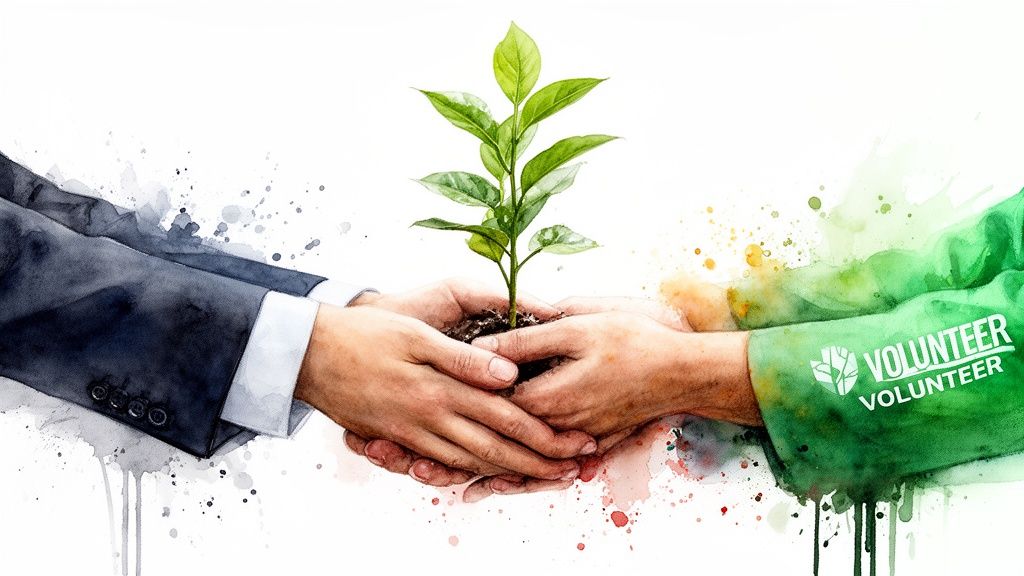
    Watercolor image of a businessperson and a volunteer holding a green plant, symbolizing growth and collaboration.

    It's not just us out there, wielding trash grabbers on a brisk Chicago morning. The most gargantuan, powerful corporations on Earth are wrestling with the very same idea we are. They have a more polished name for it: Corporate Social Responsibility, or CSR. But strip away the acronyms, and it boils down to one elemental thing: trust.

    For decades, the gospel of business was brutally simple: a company's sole duty was to enrich its shareholders. The planet? The community? Someone else's problem. But something seismic has shifted in the landscape.

    Today, you, me, and millions of others are raising our voices, demanding more. We expect the brands we champion to be good neighbors. We want them to be accountable for their impact on the world, not just their profit margins. And you know what? They're listening.

    From Afterthought to Essential Strategy

    This isn't some ephemeral trend; it's a tectonic shift in the very mechanics of business. The proof is etched in the data.

    An astonishing 98% of S&P 500 companies now publish dedicated CSR or sustainability reports. Let that sink in. Just a few years ago, that figure was a negligible fraction. This explosive growth signals how social responsibility has morphed from a "nice-to-have" PR maneuver into a core tenet for survival.

    Why the sudden corporate enlightenment? Because they finally deciphered the code: doing good is good for business.

    Trust is the new currency of the modern economy. When a company invests in its community, it’s making a deposit. When it pollutes a river or ignores its workers, it’s making a catastrophic withdrawal.

    This new reality has birthed a playbook for how businesses earn that invaluable trust.

    The Two Sides of the Same Coin

    At first glance, a global behemoth cutting a multi-million dollar check for a climate initiative seems galaxies away from a small crew cleaning a neighborhood park. But I see them as two faces of the same coin. Both actions are grappling with one fundamental question: do you show up for your community?

    • Corporate Level: This is the macro-level stuff. A company might pour capital into renewable energy, enforce fair labor practices throughout its labyrinthine supply chain, or architect programs to diversify its workforce. These are the grand gestures that prove to customers and employees that the company’s values transcend the bottom line.
    • Community Level: This is where we live and breathe. When we show up every weekend, come rain or shine, we are making a tangible, visible promise to our neighbors. We are proving, block by block, that we care.

    Whether it’s a global titan or a handful of us armed with trash bags, the objective is identical. It’s about forging a reputation built on the bedrock of consistent, positive action. For us, the action is picking up litter. For a corporation, it might be an intricate sustainability program. Both are potent declarations saying, "We're here, and we're trying to help."

    We help businesses understand how to forge this connection at a local level—you can learn more about our corporate social responsibility programs. At the end of the day, building a better future begins with proving you can be counted on.

    The Values That Fuel Our Mission

    Three smiling friends in colorful raincoats and casual clothes walking, holding hands, with watercolor splashes.

    It’s one thing to comprehend what is social responsibility as an abstract concept. It’s a whole different beast to breathe life into it, week after grueling week, in the messy real world. That requires more than a solid plan; it demands a pulse. A heartbeat.

    You need a set of values that act as your North Star when the work gets hard, the weather turns hostile, and the siren song of staying home seems irresistible. For us, it all distills down to three core beliefs. These aren’t just words we splash on a website. They're the fuel. They're the reason we show up.

    Bravery to Begin

    First, let's talk about Bravery. I’m referring to the audacity to get uncomfortable. It’s showing up for a cleanup in a corner of the city you’ve never explored. It’s venturing out when the forecast screams rain, or worse. This is the fertile ground where real magic sprouts, because nobody ever grew by remaining cocooned in their comfort zone.

    Think about Tom Sawyer, condemned to the dreary punishment of whitewashing a fence. He could have sulked. He could have complained. Instead, he executed a brilliant psychological maneuver, reframing the chore as an exclusive, can’t-miss opportunity, convincing his friends they were lucky to even try. He made drudgery look like a privilege.

    That's the spirit. We unearth joy in the challenge. We lean into the tempestuous days because those are the ones that weave the best stories and forge the most unbreakable friendships. Real social responsibility ignites with the bravery to simply begin, especially when it’s inconvenient.

    Kindness as Our Compass

    Next up is Kindness. But perhaps not in the way you’re imagining. For us, kindness manifests as a fierce, unwavering protection of our volunteers' energy. Your time, your spirit, your well-being—that is the most precious resource we possess. It is the engine that powers this entire beautiful machine.

    This is precisely why I schedule our events on weekend mornings. It's a deliberate choice to convene a community of givers—people willing to launch their weekend with an act of service. It’s also why we will never, ever ask you for money.

    Your time and positive energy are the only currencies that hold value here. We believe that true service is a gift, not a transaction.

    By prioritizing our volunteers, we ensure this space always remains a sanctuary of joy and connection, not one of obligation. That’s my promise to you. Kindness is our compass, and it always points toward what’s best for the people who make all of this possible.

    Unity in Our Purpose

    Finally, there’s Unity. We are absolutely, unshakeably committed to bringing people together from all 50 wards of Chicago. This city can sometimes feel like an archipelago of disconnected islands, but we know its most profound strength lies in its connections.

    There’s an old proverb: "If you want to go fast, go alone. If you want to go far, go together." We are in this for the long haul.

    Every single cleanup is an act of bridge-building. It's living proof that we are stronger, happier, and exponentially more effective when we work side-by-side. Unity isn't just about showing up in different zip codes; it's about cultivating a shared sense of ownership for our entire city and proving that together, we can manifest the change we all yearn to see.

    So, You In? Here’s Your Personal Invitation

    Hopefully, by this point, you're feeling it—that little ember that starts to glow when you realize you can actually be part of something tangible, something bigger than yourself. If you are, consider this your official, personal invitation from me to you. Come join us.

    This is the exact moment where the concept of what is social responsibility ceases to be mere words on a screen and transforms into a real-life adventure. I've opened the door, and I want to show you just how exhilarating it is to step through it.

    Whether you're a newcomer to Chicago, searching for some of the most genuine, kind-hearted souls in this city, or you just crave the satisfaction of seeing the tangible, visible impact of your own two hands—you belong with us. I've got a spot saved just for you.

    How to Join the Adventure

    Getting involved is as simple as I could possibly make it. We've demolished all the usual barriers because I know the most vital thing you can bring is your own energy. I want you to feel excited, not burdened.

    Here’s the deal:

    • Find Us Easily: We post all our upcoming cleanups on Meetup and Instagram. Give us a follow, and you'll know precisely where we'll be next weekend. No ambiguity.
    • No Gear Needed: I mean it. Just show up. We bring everything—gloves, trash bags, those awesome litter grabber thingies. All you need to bring is yourself.
    • Your Happiness Is the Priority: This isn't about pressure. It’s about connection, fun, and doing something good. You'll discover that a cleaner city is an incredible side effect of forging real friendships.

    This journey isn’t merely about picking up trash. It's about personal metamorphosis. I’ve personally watched new volunteers arrive, shy and hesitant, and within a few months, they’re leading their own neighborhood cleanups, radiating a confidence they never knew they possessed. They discovered their own strength by showing up for others.

    A Community Built on Doing Stuff

    This isn't just my story. It’s a collective narrative we all write together every single weekend—a story penned by incredible people who choose to give their time. Deep friendships have been forged side-by-side, sharing laughs over the absurd things people discard and bolstering each other when the Chicago weather gets a little theatrical. This is where you find your people.

    Sure, corporate philanthropy is a juggernaut. US companies donate billions annually. But when policies shift or that support evaporates, the raw, undeniable power of people on the ground—of grassroots unity—shines through. It’s the untamed energy of volunteers that actually changes worlds.

    This is your chance to step into a story of bravery and kindness. It’s a chance to find the fun in service and see how it changes you from the inside out.

    We’ve seen firsthand how a small group with a shared purpose can ignite a massive, visible change. The only thing missing is you.

    If you’re ready to jump in but aren’t sure where to start, we've got your back. Check out our guide on how to find volunteer work that actually feels right for you.

    Your Questions Answered

    Jumping into something new, especially with a group of strangers, can feel a little strange. I get it. You probably have a few questions swirling in your mind. Let’s cut right to the chase and tackle those head-on.

    My goal is to give you the real answers, no fluff, so you can feel completely at ease about showing up.

    "My Schedule is Crazy. What's the Commitment?"

    Life is a whirlwind. Work is relentless. We know. That's precisely why we don't believe in commitments. Your time and energy are a gift, and we treat them as such.

    There is zero long-term commitment. I'm serious. Come once a year, once a month, or whenever you feel that magnetic pull to get out there and do something real. I post everything on platforms like Meetup so you can just pop in and RSVP when it aligns with your life. No pressure, no guilt. We’re just happy to have you, whenever that may be.

    "Do I Need to Buy a Bunch of Gear?"

    Nope! Not a single thing. We've got all the gear covered, so you don't have to worry about a thing.

    We provide everything you'll need to safely and effectively clean up our city:

    • Heavy-duty gloves to protect your hands.
    • Tough trash bags that won't give up.
    • Litter grabbers so you don't have to break your back.

    We have a 'volunteer-first' rule. That means we obliterate as many hurdles as possible. I want you to focus on the mission and the people you're with, not on remembering to bring a trash poker.

    Just show up. Wear some comfortable clothes and shoes you don’t mind getting a little dirty. That’s it.

    "Is It Safe? We're Going All Over the City."

    Your safety is our absolute, non-negotiable priority. Always. This isn't just rhetoric; it's woven into the very fabric of how we operate.

    The most crucial rule we have is that we always stick together. There’s a powerful safety in numbers, and we look out for each other like a family. When we venture into all 50 wards, we’re sending a profound message that every part of Chicago is worth caring for. We’re not just picking up trash—we’re showing up, building trust, and proving that unity makes us all stronger.


    At Litter Caterpillars, we believe that when you show up for your city, you start to transform yourself. We’re not just cleaning streets; we’re building a community of brave, kind people who are proud to make a real difference. Come find your people. https://www.littercaterpillars.com