
You can recycle batteries in Chicago by dropping them off at special collection sites, like city-run hazardous waste spots or big retailers like The Home Depot and Best Buy. But whatever you do, never toss them in your blue curbside bin—they're a huge fire risk for the people who handle our city's waste.
The Hidden Power in Your Junk Drawer
We all have one. That drawer, that box, that dark corner of a closet where dead batteries go to die. The AAs from the remote that saw you through a thousand movie nights, the 9-volt from the smoke detector that kept your family safe, the lithium-ion cell from an old phone holding years of memories. Each one is a tiny, forgotten monument.
But let's be real. It’s a mess. A pile of clutter and procrastination that feels way heavier than it actually is.
For years, my own apartment was a mirror of that drawer. Every old jam jar, every expired bag of nuts—it all had a story, and I couldn't let go. Each thing weighed less than a pound, but emotionally, it might as well have been 500. Trying to clean that personal mess felt impossible.
From Personal Mess to Public Mission
Then, something clicked. I realized cleaning up someone else's mess—litter on the sidewalk, trash in a park—was so much easier. That's how Litter Caterpillars got started. A few of us met to pick up trash, got caught in a classic Chicago hailstorm, and discovered something wild: tackling a visible, shared problem together isn't just easy, it's fun. It builds guts and connection.
That small act of cleaning a public space started a chain reaction. It gave me the strength to deal with my own messes, physical and emotional. This guide to recycling batteries in Chicago is built on that very same idea.
We believe taking care of the small, forgotten things is an act of bravery. It’s how you practice kindness, build trust in yourself, and prove that making a real impact is way easier than you think.
This isn’t just a how-to guide. It's an invitation. A challenge to see that junk drawer not as a burden, but as your next big adventure. It’s your first step.
One Battery at a Time
That single dead battery? That's where you start. Think of it like the first domino. When you choose to recycle batteries in Chicago, you’re doing more than just preventing a fire at a sorting facility or keeping toxic metals out of the ground. You’re taking control. You're making a choice to leave things better than you found them.
This simple move plugs you into a whole city of people who care. And just like picking up that first piece of litter, it can spark something bigger inside you.
- It’s personal growth: Cleaning up small messes builds the muscle you need to tackle bigger challenges in your life.
- It’s an act of kindness: You’re protecting sanitation workers and making our city safer for everyone.
- It’s a source of real joy: There's a special kind of satisfaction that comes from doing the right thing, especially when you do it with others.
So, let's open that drawer together. Let’s grab those spent batteries and get them ready for their next life. Your mission, should you choose to accept it, starts right now.
Your Chicago Battery Recycling Mission Briefing
Alright, you’ve decided to tackle that drawer full of old batteries. Awesome. Before you charge in, let's talk strategy. Think of this as your field guide for doing it right, because knowing why this matters is just as important as knowing how.
Not all batteries are created equal. Some are steady, everyday workhorses, while others are tiny powerhouses that need a bit more respect.
Getting to Know Your Battery Stash
Let's break down the common types you’ll find lurking in your home. This isn't a pop quiz; it’s about knowing your gear so you can handle it properly.
Here’s a quick rundown of the usual suspects.
| Your Guide to Common Household Batteries | ||
|---|---|---|
| Battery Type | Commonly Found In | How to Prepare for Recycling |
| Alkaline (AA, AAA, C, D, 9V) | Remote controls, flashlights, clocks, kids' toys. The classics. | Just bag them up. For 9V batteries, tape the two little metal snaps on top. Easy. |
| Lithium-Ion & Lithium Polymer (Li-ion, LiPo) | The rechargeable crew: Old cell phones, laptops, tablets, vapes, cordless drills. | CRITICAL: Tape the metal ends with clear or electrical tape. This prevents them from sparking. Bag them separately. |
| Button & Coin Cells | The tiny silver discs: Watches, hearing aids, car key fobs, singing greeting cards. | Tape these little guys, too, or stick them on a strip of packing tape. They’re small but potent. |
Each of these powered a small part of your life. Now, it's our turn to give them a second one.
The #1 Rule: Never, Ever Use the Blue Bin
Listen up, because this is the most important part: batteries of any kind can absolutely never go in your blue curbside recycling bin. Seriously.
Think of that bin like a party with a very strict guest list: paper, cardboard, cans, and plastic bottles only. Batteries are the gate-crashers that start fires.
When a battery, especially a lithium-ion one, gets crushed in a recycling truck, it can spark and ignite all the dry paper around it. This is a huge fire hazard that puts sanitation workers and entire recycling facilities at risk.
Keeping batteries out of the blue bin is a simple act of kindness. It protects the people who work hard every day to keep our city running. You’re looking out for your team.
Prep Work: A Simple Act of Care
Getting your batteries ready for their journey is easy, but it’s a crucial sign of respect for everyone down the line. It's a small, mindful act that prevents big, dangerous problems.
For any rechargeable battery (like from a laptop) or any battery with exposed metal ends (like a 9-volt), the most important step is to tape the ends. A small piece of clear packing tape or electrical tape over the contacts is all you need. This simple move is like putting a safety on a firework—it prevents sparks.
This visual guide breaks down the simple choices you'll make.
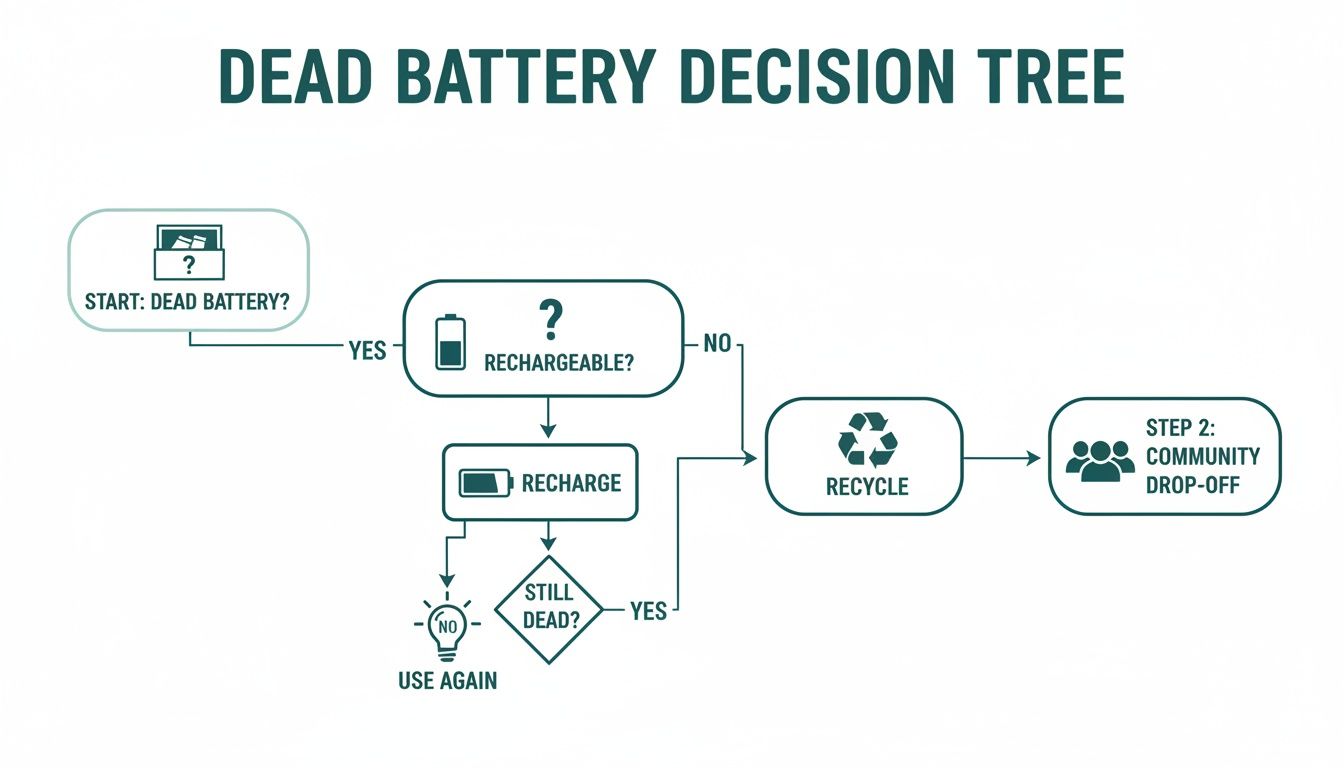
As you can see, every battery has a path forward, and it’s a lot simpler than you think to make the right call.
The Bigger Picture in Chicago
Your personal mission connects to a much larger city-wide effort. The truth is, Chicago has a lot of room for improvement. Our city's recycling rates are stubbornly low, and a big reason is "contamination"—when the wrong things get thrown in the blue bin.
The good news? Illinois recently passed a law that requires battery producers to fund better collection programs, with big goals to recover 60-70 percent of batteries. For groups like ours, this is huge.
A stronger city-wide system means the batteries we all collect have a better chance of actually being recycled. This new framework promises more drop-off points and better support, making it easier for every single one of us to do our part. By joining this effort, you're not just cleaning a drawer; you're helping build a more resilient Chicago.
If this kind of hands-on work inspires you, check out our guide to environmental volunteer opportunities in Chicago to find more ways to make a difference.
Find Your Local Battery Drop Off Point
Alright, your batteries are taped, bagged, and ready for their next adventure. You’ve done the hard part—you faced the drawer. Now comes the fun part: finding them a new home.
Think of this as your guide to the network of good people and places across Chicago ready to help you do the right thing. You’re not alone in this; a whole system is waiting for you.
City Of Chicago Household Hazardous Waste (HHW) Sites
This is the big one. The City of Chicago runs a permanent drop-off facility for all sorts of household hazardous waste, and your old batteries are VIPs on their guest list. This is the official route to ensure your batteries are handled with the most care.
It’s located at 1150 N. North Branch Street on Goose Island. Think of it as Grand Central Station for tricky-to-recycle items. It’s a drive-through service, which makes things incredibly simple.
- When to Go: Tuesdays (7:00 AM to 12:00 PM), Thursdays (2:00 PM to 7:00 PM), and the first Saturday of every month (8:00 AM to 3:00 PM).
- What to Expect: Seriously, it’s a no-fuss process. You don't even need to get out of your car. Just have your batteries ready in your trunk or back seat.
- Pro Tip: This is the absolute best place to take any damaged, swollen, or leaking batteries. The staff there are trained pros. Don't mess around with those.
The city also hosts periodic HHW collection events across different wards. Keep an eye on the Department of Streets and Sanitation website for an event near you. These pop-ups bring the service right to your neighborhood.
Your Neighborhood Retail Partners
Sometimes, a special trip isn't in the cards. That’s where many big-box retailers have stepped up to become community collection hubs. You’re probably already shopping at these places anyway.
These stores are like friendly outposts on your recycling journey.
- The Home Depot & Lowe's: Look for the Call2Recycle collection boxes, usually right near the entrance or by customer service. They’re a fantastic spot for rechargeable batteries from power tools, laptops, and phones.
- Best Buy: This is my go-to for all sorts of electronic waste, including rechargeable batteries. Their collection kiosks are typically just inside the main entrance. You can’t miss them.
- Staples: Another great spot for rechargeable batteries. Their drop-off bins are often located near their tech recycling services area.
The simple act of adding "drop off batteries" to your weekend to-do list alongside "buy groceries" is a powerful habit. It transforms a chore into a seamless act of community care.
The Hidden Network of Call2Recycle
Beyond the big stores, there's a huge, unsung network of drop-off spots powered by Call2Recycle. This is where the real treasure hunt begins, uncovering convenient spots you might walk past every day.
Call2Recycle is a non-profit that has placed collection boxes in thousands of local hardware stores, libraries, and municipal buildings. Finding one in Chicago is as easy as using their online locator. You’ll be surprised to discover a drop-off point in a local library or a small hardware store just a few blocks away.
This network is proof that opportunities to do good are all around us, often hidden in plain sight.
Taking this extra step is a small act of bravery that ripples through the entire system. When things like batteries get tossed in the blue bin, they can ruin entire batches of good recyclables. By using these dedicated drop-off points, you’re helping solve that problem directly.
It’s like clearing a path for others to follow. And just like we find ways to recycle Christmas trees in Chicago after the holidays, finding a home for old batteries is a seasonal cleanup we can all get behind.
Become a Recycling Hero in Your Community
One person choosing to recycle batteries in Chicago is a great start. But an entire apartment building? A whole block?
That’s a movement.
This is your call to action. We live by the idea that "if you want to go far, go together." A single person cleaning a park is nice. A group of people cleaning a park becomes a force of nature.

This is your fearless guide to becoming that force of nature right where you live. It’s about organizing your own community battery drive and showing everyone how easy it is to make an impact together.
The Power of a Single Cardboard Box
You don’t need a grant or a permit to start. All you need is a cardboard box and a little bit of courage.
Think about a central spot where people already go. The lobby of your building, the mailroom, the counter at your favorite local coffee shop. These are perfect headquarters for your mission.
One of our volunteers, Sarah, started this way. She put a clearly labeled box next to the mailboxes in her Logan Square three-flat with a simple, handwritten sign: "Dead Batteries Live Here!" Within a week, it was half full. Her neighbors didn't need a lecture; they just needed an easy way to do the right thing.
Spreading the Word with Kindness
Once your box is in place, it’s time to rally the troops. This isn't about shaming people into action. It's about inviting them on a fun, simple mission.
Create a simple flyer—you can design one for free online or just write it out. The key is to keep the message clear, kind, and empowering.
Your Flyer Should Include:
- A Friendly Headline: "Let's Power Up Our Recycling!" or "Give Your Old Batteries a New Life!"
- The Why (in one sentence): "Did you know batteries can cause fires in recycling trucks? Let's keep our sanitation workers safe!"
- The How (super simple): "Just drop your old household batteries in the collection box in the lobby. Please tape the ends of rechargeable ones!"
- The Who: "Your neighbor, [Your Name] from Apt 3B."
Put these flyers on a community bulletin board or slip them under doors. People want to help. You're just making it ridiculously easy for them.
The goal isn't just to collect batteries. It's to create a small act of connection. It’s a way of saying, "Hey, we're in this together, and we can make our little corner of the world better."
This small effort turns an individual task into a shared victory. It’s the same spirit we bring when we’re cleaning up trash across the city, turning a chore into a chance for community.
Making It an Event
Want to take it to the next level? Make it an event. Announce a "Battery Drive Weekend" for your building or your block.
Set up a collection table for a few hours on a Saturday morning. Bring some coffee or donuts. Play some music. Suddenly, recycling isn't a chore; it’s a neighborhood get-together. It’s a chance to meet the people you share walls with.
This is how movements start. Not with a grand plan, but with small, consistent acts of service that bring people together. A few years ago, there were just three of us picking up trash in a hailstorm. Now, we're a city-wide family. Your battery drive can be the spark that builds a stronger, kinder community right where you are.
Once your box is full, you become the hero who completes the mission. Bag up the batteries, make sure the terminals are taped, and take them to a drop-off spot. Then, post a "Thank You" note celebrating your collective success. You didn't just recycle batteries; you built something together.
So, you’ve done it. You stared down the junk drawer, learned what goes where, and found the drop-off spots. You get it now—choosing to recycle batteries in Chicago isn't just another chore. It's a way of showing up for our city and, more importantly, for yourself.
It reminds me of that first trash pickup, the one where we got caught in a hailstorm. We didn't set out with some grand mission to clean all 50 wards. It started with just showing up. Your journey is the same. It starts with one battery.
This Is Just the Beginning
This guide isn’t the finish line; it’s the starting block. When you take care of these small, forgotten things, you're building a powerful kind of self-trust. You're learning to handle your own messes, both the ones in your drawer and the ones in your life, one AA at a time.
Service has a funny way of changing you from the inside out. It makes you more resilient. It proves you have the power to make things better, right where you are. That feeling you get from doing the right thing becomes its own reward, fueling the next brave step you take.
The real transformation doesn’t happen when the battery lands in the recycling bin. It happens the moment you decide to act. That's the spark.
Come Find Your People
We’d love for you to join us, the Litter Caterpillars. This isn't just an invitation to pick up trash. It's an invitation to find real friendship, discover a deeper purpose, and experience the weird kind of joy that comes from showing up for Chicago and for each other.
There’s a whole community of givers here, ready to welcome you. People who, like us, think that suffering through a little cold or rain for a good cause is a lot more interesting than sitting at home.
Your transformation is waiting. It’s in that junk drawer. It’s on the sidewalk outside your door. It all starts with one small choice.
What’s your next move?
Common Questions We Get About Battery Recycling
Thinking about how to recycle batteries in Chicago brings up a lot of questions. That’s a good thing. It means you're being intentional. Let's tackle some of the most common ones we hear.
Can I Really Not Put Any Batteries in My Blue Bin?
Yep, that's 100% correct. Never, ever, ever put batteries of any kind in your blue curbside recycling bin. Think of the blue bin as being just for paper, cans, and plastics.
Batteries are like special agents on a different mission. When they end up in the wrong place, they get crushed, spark, and cause devastating fires that risk the lives of sanitation workers. It's a tiny choice for you that makes a world of difference for them. It’s a small act of bravery and kindness.
What's the Biggest Mistake People Make?
The most common—and most dangerous—mistake is not taping the ends of rechargeable, lithium-ion, or 9-volt batteries. It sounds so small, but when those metal ends touch each other or another piece of metal, they can short-circuit and ignite.
A simple piece of clear tape over the ends is a tiny act of care that prevents a huge safety hazard.
The second biggest mistake is what we call "wish-cycling"—tossing them in the blue bin and just hoping for the best. Hope is awesome, but for batteries, we need a plan.
How Do I Handle a Swollen or Damaged Battery?
A swollen, puffy, or damaged battery is a serious fire risk and must be handled with extreme care. This is a moment that calls for both bravery and caution.
Don't just toss it in the trash or a regular recycling bin. Instead, place it in a non-flammable container like a glass jar filled with sand or kitty litter to keep it stable. Immediately take it to a City of Chicago Household Hazardous Waste (HHW) facility and let the staff know you have a damaged battery. They are trained to handle these things safely.
Are Alkaline Batteries Like AAs Still Hazardous?
Modern alkaline batteries (the AAs and AAAs in your remote) are way safer than their older, mercury-filled ancestors. While they can legally go in the trash in many places, recycling them is always the kinder, more impactful choice. It's about leaving things better than you found them.
Recycling alkaline batteries recovers valuable materials like steel and zinc, reduces the need for destructive mining, and keeps even small amounts of heavy metals out of our landfills. It’s an easy win for the planet and a simple way to practice service in our daily lives.
Ready to take the next brave step? Join Litter Caterpillars at one of our weekly cleanups and discover the power of service, friendship, and showing up for our city. Find your next event and your new community at https://www.littercaterpillars.com.