Tag: prairie restoration

  • Midewin Welcome Center: Gateway to the Prairie

    Midewin Welcome Center: Gateway to the Prairie

    I once left a Chicago cleanup with black gloves, a full trash bag, and that familiar feeling that I had only shaved a corner off a much bigger mess. A few days later I drove out to Midewin, walked into the Midewin Welcome Center, and felt that same feeling again, except this time it came with wind, grass, and hope.

    Finding a Bigger Mess to Clean

    The first time I drove south after a city cleanup, my gloves were still on the passenger seat. They smelled like wet cardboard and old coffee. At a stoplight, I looked at that crumpled pair of gloves and had the oddest thought. Street litter was not the only mess I wanted to help with anymore.

    Midewin pulled me for that reason.

    It was once the site of the Joliet Army Ammunition Plant. Now people come there to witness a long repair job in progress, the kind that takes patience, public will, and a willingness to keep showing up after the novelty wears off. That made sense to me right away. Litter Caterpillars know that feeling. You clear one block, then come back next week and clear it again, and somewhere in that repetition your own habits start changing too.

    Why this place hit me

    A restored prairie sounds romantic from far away. Up close, it feels more honest than romantic. You are standing near ground that carries a heavy history, and you are also standing in a place where people chose not to leave the damage as the final story.

    That landed hard for me.

    In the city, our work can feel small. One bottle. One fast-food bag. One storm drain pulled clear before the rain comes. At Midewin, the scale gets bigger, but the lesson stays the same. Repair happens through repeated care. People remove what harms, protect what can return, and make room for life to come back slowly.

    Practical rule: Go to Midewin when you need proof that slow work still counts.

    A trip for people who like sleeves rolled up

    I would not call Midewin a polished attraction. I liked that. The place feels like a public invitation to witness recovery while it is still underway.

    That is why the Welcome Center matters before you ever set foot on a trail. It gives you a way to enter the prairie with the right frame of mind. You are not arriving to consume a pretty view and leave. You are arriving to learn how damaged ground gets another chance, and what your part in that story can be.

    For me, that changed the whole drive. I was not heading out for a break from cleanup work. I was heading toward a bigger version of the same calling. Restore what has been neglected. Respect the time it takes. Come back. Bring others. Let the work outside you shape the work inside you too.

    Your First Step into the Prairie

    The first time I drove down from the city, I felt that familiar cleanup-day doubt. Did I pack enough water. Was I leaving too late. Was this going to be one of those trips where I spend more time in the car than on the ground. Then the roads opened up, the buildings fell back, and the whole day started to loosen its grip on me.

    That shift matters.

    For Litter Caterpillars people, the drive to Midewin can feel like going to meet an older cousin of the work we already do. In the city, we clear a block, a curb line, a patch of weeds behind a fence. Out here, you arrive at a place trying to recover at prairie scale. The Welcome Center gives that feeling a place to land before your feet hit the trail.
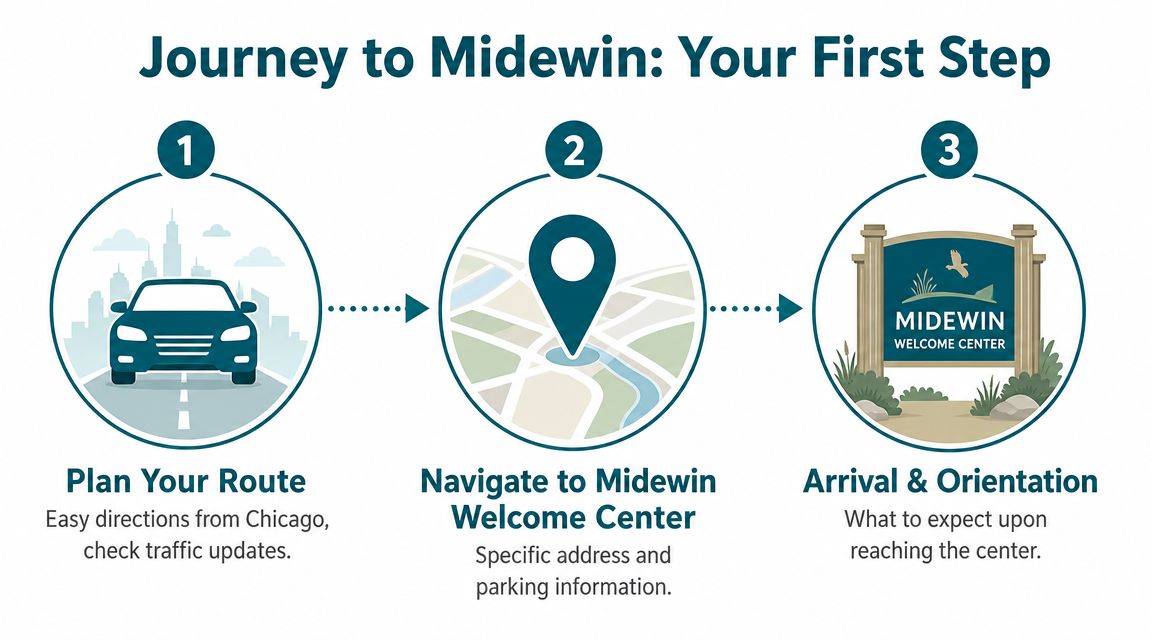
    A three-step infographic showing how to plan a visit to the Midewin Welcome Center.

    The part that makes the day go better

    Keep the plan simple. Pick a morning when you are not already depleted. Leave early enough that you do not turn the whole trip into a rushed errand. Bring what you would bring for a long, open walk instead of a quick stop.

    I have learned that prairie time punishes sloppy city habits. A late start feels later. Sun feels bigger. Wind has opinions. If you roll in hungry, underdressed, or irritated, you will notice all of that before you notice anything beautiful.

    A few things earn their place in the car every time:

    • Water and a snack
    • Good walking shoes
    • One extra layer
    • A notebook, or your phone notes app, if quiet places tend to pull thoughts out of you

    If you have ever visited Goose Lake Prairie State Natural Area and watched your pace change once the horizon opened up, you already know the rhythm I mean.

    Why the Welcome Center comes first

    The Welcome Center works like a reset point. You stop being a driver passing through and become a visitor who is paying attention.

    I would not skip it, even on a day when you feel eager to get straight outside. Starting here helps you settle your mind, use the restroom, look over the layout, and shake off that city habit of treating every destination like something to conquer quickly. That small pause changes the visit. You arrive less like a consumer and more like a participant.

    That distinction stayed with me. Restoration asks for a different kind of presence. It asks you to notice what has returned, what is still missing, and how much care sits behind ground that looks calm.

    What it feels like when you pull in

    You are not arriving at a flashy attraction. You are arriving at a working threshold.

    I like that. It fits the place.

    The Welcome Center is the point where scattered intentions become an actual day in the prairie. You get your bearings. You slow down enough to be teachable. You remember that healing land, like healing a neighborhood or your own habits, starts with one honest step taken on purpose.

    What You Will Discover Inside

    The first time I stepped into the Midewin Welcome Center, I expected something plain and procedural. A counter. A brochure rack. Maybe a map and a quick restroom stop. Instead, I felt the day slow down in a good way.

    Inside, the story of the land starts taking shape. The Forest Service says the center has exhibit clusters on glaciers, wetlands, prairies, wildlife, and the site's restoration timeline, and it has trail maps, program guides, and brochures that help you plan your way through the large trail system on the Midewin Welcome Center page from the Forest Service.

    The room changes what you see outside

    That matters more than it sounds. Before you go in, you may think you're driving out to see “some grass.” After you spend a little time with the exhibits, the prairie gets sharper. The ground has a past. The water has a story. The animals stop feeling random. Even the flatness starts to read differently.

    I had that same shift at Goose Lake Prairie State Natural Area. Once you learn how a prairie works, your eyes stop sliding over it. You notice textures, little changes in height, wet areas, bird movement, and the strange power of a place that doesn't scream for attention.

    What stayed with me

    The restoration timeline hit hardest. I'm drawn to any place that admits, openly, that repair takes a long time. In a city, we often want proof fast. We want the before-and-after photo. We want the cleaned lot, the organized room, the redeemed week.

    Midewin doesn't let you think that way for long. Inside the Welcome Center, you start to understand that renewal is a chain of ordinary acts. Someone studies. Someone plants. Someone monitors. Someone explains. Someone comes back.

    A map is useful, but context is better. Once you know what you're walking through, every mile feels less like exercise and more like attention.

    Don't rush this part

    If you're anything like me, your instinct might be to hurry outside. Fight that instinct. Spend a little time with the exhibits. Ask questions if staff are available. Take the brochure. Study the trail map.

    That indoor pause is like sorting your cleanup supplies before hitting the street. It doesn't look dramatic, but it changes the whole day. You leave the building carrying more than paper. You leave with a way of seeing.

    From the Center to the Trails

    The first time I walked out of the Welcome Center, I stopped after maybe twenty steps.

    Nothing dramatic happened. No bison crossed the road. No hawk swooped overhead on cue. I just felt the city pace fall off my body. The building had given me names, history, and a map. Outside, all of that turned into a real place with wind in it.

    What struck me most was the room. Midewin gives you space to settle down and pay attention. You stop checking how fast you are going. You start noticing where the ground holds water, where the grasses shift, where a bird keeps returning to the same patch. For Litter Caterpillars people, that change feels familiar. It is the same shift that happens on a cleanup when you stop rushing for a full bag and begin seeing the block clearly.
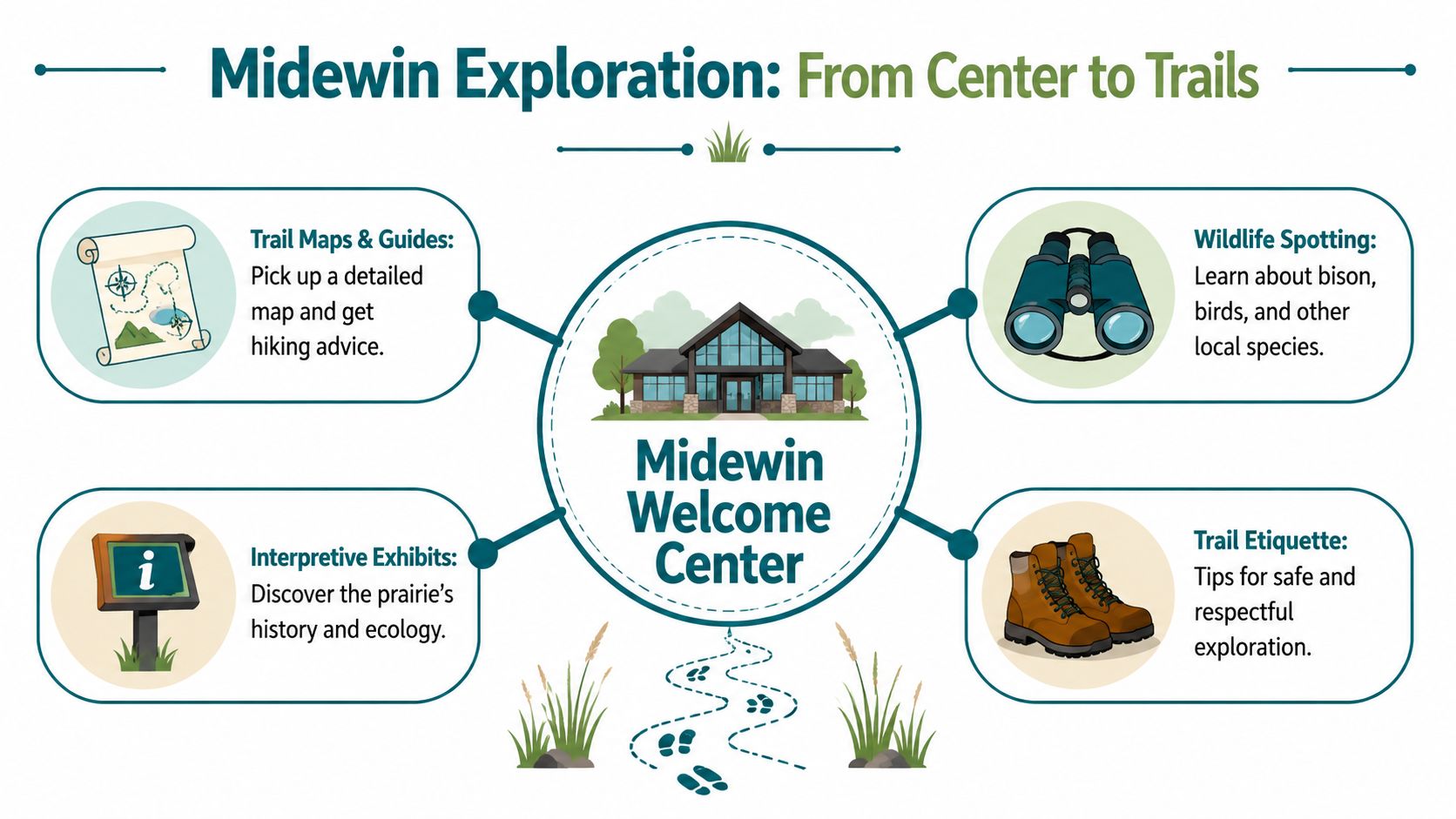
    An infographic titled Midewin Exploration showcasing resources like maps, wildlife spotting, exhibits, and trail etiquette tips.

    How I choose a trail day

    I do better here when I choose the day before I choose the route.

    Day you want What I'd do
    Quiet reset Take a shorter walk and stop often. Let the place slow you down.
    Longer effort Use the map from the center and commit to a fuller hike. Bring more water than you expect to need.
    Learning day Match your walk to one or two things you noticed inside. Watch for wetlands, birds, and plant changes rather than trying to see everything.

    That little decision saves me from turning a prairie visit into another city habit where I chase completion instead of paying attention.

    Start with a basecamp mindset

    The Welcome Center works best as a place to gather yourself, then head out with purpose. A prairie can look simple from a distance, but openness asks something from you. It asks for patience, water, and a little humility.

    I learned that same lesson at Springbrook Prairie Pavilion. Wide ground is not empty ground. It rewards people who slow down enough to catch small signs of life and recovery.

    Trail etiquette that feels close to cleanup ethics

    A first visit goes better when you carry the same respect you would bring to a neighborhood cleanup.

    • Keep the map with you so you can stay oriented without guessing.
    • Walk carefully because restoration is ongoing and the place is still being tended.
    • Pause longer than feels normal. The prairie reveals itself in layers.
    • Leave with care in your body. Even when you take nothing and change nothing physically, your attention matters.

    That last part stays with me. In the city, we pick up what was dropped and try to leave a corner better than we found it. At Midewin, the service is quieter. You practice restraint. You let the prairie be what it is. You learn that restoration is not always about doing more. Sometimes it is about moving through a recovering place without adding to the mess.

    How We Can Partner with the Prairie

    A few steps outside the Welcome Center, I watched a kid crouch beside the path and study a plant like it was giving instructions. His dad stood over him with the map folded wrong, smiling anyway. Nobody looked polished. They looked the way our cleanup crews look at the start of a Saturday morning. Ready to help, not fully sure how yet.

    That is the spirit I would bring to Midewin.

    A conceptual illustration of hands planting a sapling at Midewin National Tallgrass Prairie featuring diverse community involvement.

    Service changes the day

    As noted earlier, the Welcome Center offers different ways to learn through the year, including guided programs in the warmer season and educational events in colder months. I love that rhythm. It lets your first visit be simple. You show up, listen, walk, and let the place work on you a little.

    That pattern feels familiar to me because it matches the way restoration usually starts in the city. We do not begin with mastery. We begin by noticing what has been neglected, then returning with more care the next time.

    If you want language for that shift, this guide on what environmental restoration means in practice puts clear words to it. Repairing land and repairing ourselves often follow the same motions. Show up. Remove what harms. Protect what can grow. Repeat.

    A few ways to show up well

    One good day at Midewin can start a longer habit. Here are a few honest ways to make the visit feel like participation instead of consumption:

    • Join a program or tour if one is available. A guided walk can help you notice signs of recovery you would pass right by on your own.
    • Bring one person who has been tired in the city kind of way. The prairie has a way of stretching out your thoughts until they stop bumping into each other.
    • Make it a service-minded outing with a community group. Litter Caterpillars does that through volunteer trash pickups across Chicago, and a prairie visit can carry the same spirit of care into a different kind of environment.

    Here's a good video to watch if you want the mood before the drive:

    Stewardship starts smaller than you think

    I do not think stewardship begins with a title.

    It begins the moment you stop asking, “What can I get from this place?” and start asking, “How can I move through this place without making recovery harder?” At Midewin, that may mean staying on the trail, paying attention during a program, or bringing home a steadier idea of what care looks like. Quiet service still counts.

    That is why a trip here can feel bigger than a day trip. You leave with more than prairie photos. You leave with a sharper standard for your own life. The grasslands are being restored over time, through patience and repeated care. Our blocks, our habits, and our own worn-out parts usually heal the same way. One return. One better choice. One piece of trash, or one careful step, at a time.

    Your Midewin Field Guide Questions Answered

    I've found that most hesitation about a first trip has less to do with desire and more to do with tiny practical questions. So here are the answers I'd give a friend the night before we go.

    What should I wear

    Wear clothes you can walk in for a while without fussing. I'd choose comfortable shoes, light layers, and something you don't mind getting a little dusty. Prairie weather can feel open and direct, so I'd rather have one extra layer in the car than wish I'd packed it.

    If it's sunny, act like you're going to spend time with very little shade. If it's cooler, don't let the city fool you into thinking the open ground will feel the same.

    What should I bring

    Keep it simple.

    • Water because open trails can dry you out fast.
    • Snacks if you think you'll stay longer than planned.
    • Your phone or a paper note with your basic plan for the day.
    • Curiosity. I know that sounds corny, but this place gets better when you slow your eyes down.

    Is it good for a first-time prairie visitor

    Yes. In fact, I think the Midewin Welcome Center makes it easier for first-timers because you can orient yourself inside before you head out. You don't need to pretend you already understand what you're seeing. Start with the exhibits. Get a map. Ask a question.

    Is it good for kids

    I think so, especially if you frame the trip the right way. Don't sell it as a forced march through educational content. Sell it as a discovery day. Let kids look for birds, notice water, compare grasses, and learn that restoration is real work done by real people.

    What if the weather shifts

    Treat weather as part of the day, not a betrayal. Still, use judgment. If conditions look rough, adjust your walk, spend more time inside, or save the longer trail for another visit. There's no prize for pretending discomfort is wisdom.

    Field note: The best prairie days usually come from flexibility. A shorter walk with full attention beats a stubborn epic hike every time.

    Should I plan around programs

    If you like structure, yes. Educational programming and tours are especially available from April to October, so that's a good window if you want your visit to include more guided learning. If you prefer a quieter day, just use the center for orientation and head out on your own path.

    What mindset should I bring

    Bring the same mindset you'd bring to service. Be useful. Be observant. Don't rush the process. Let scale humble you a little.

    That's really why I keep thinking about this place. The Midewin Welcome Center isn't just where you pick up a map. It's where a regular person from a messy city life can remember that repair is possible, even when it happens slowly, even when it happens over years, even when the work looks plain from the outside.


    If you want more days like this, and more chances to turn service into friendship and self-respect, take a look at Litter Caterpillars. We organize volunteer cleanups around Chicago for people who want to show up, do good work, and grow through it.
  • Des Plaines Dolomite Prairies Land and Water Reserve

    Des Plaines Dolomite Prairies Land and Water Reserve

    I once brought a friend here after a week when my head felt as cluttered as an alley after a windy day. We stepped out of the car, heard the grass moving before we really saw it, and my shoulders dropped for the first time all week.

    More Than Just a Patch of Grass

    The first time I walked into the Des Plaines Dolomite Prairies Land and Water Reserve, I expected something polite. A few nice plants. A trail. Maybe a sign or two. What I got felt closer to stepping into an old argument between stone, weather, and stubborn life.

    You know that feeling when your room gets messy enough that you stop seeing individual objects and just see one big failure? I know that feeling too well. For me, city life can do that. Sirens stack on top of deadlines. The sidewalk has broken glass, a fast-food bag pinned to a fence, and one lonely weed forcing itself through concrete like it has something to prove.

    Then I come here, and the whole lesson changes.

    This place doesn't look manicured. It doesn't flatter you. It asks you to pay attention. The grasses lean, the rock sits close beneath the soil, and the ground feels like it's holding a memory older than anything bothering you today. That honesty is part of why I love it.

    A man sits on a park bench, blending from a grayscale city into a colorful, vibrant natural landscape.

    What this place felt like to me

    I didn't come here as some polished nature guy with perfect hiking habits. I came here as a person who needed a reset. I needed a place that wasn't trying to sell me calm with curated signs and gift-shop energy. I needed a place that felt earned.

    The prairie gave me that.

    It reminded me of a forgotten city corner that still has dignity. A vacant lot can look dead until you kneel down and see volunteer sunflowers, ants hauling impossible crumbs, and roots splitting bad pavement. This reserve gives me that same feeling, except bigger, older, and wilder.

    If you spend most of your days in Chicago, you might like places with rough edges because they tell the truth. This reserve tells the truth.

    Some places cheer you up by distracting you. This one helps by making you smaller in the best way.

    If you're looking for a doorway out of noise

    Maybe you're tired. Maybe you want to get outside but don't want a fake version of nature. Maybe you want a place where you can walk slowly and feel your thoughts sort themselves out without forcing it.

    That's what this can be.

    If you're already exploring nearby preserves, you might also like this guide to the forest preserve experience around Chicago. But this reserve has its own mood. It feels leaner. Sharper. Like a place built for people who don't mind getting a little dirt on their shoes and a little perspective in their chest.

    A Prairie Forged in Floods

    The first time I understood this place, I was standing beside a volunteer on a cool morning after rain. He scraped the toe of his boot across a bare patch near the trail and said, "There. That's the whole lesson." Under a skim of soil, the rock sat close to the surface, plain and stubborn. You could feel right away that this prairie had not been given easy terms.

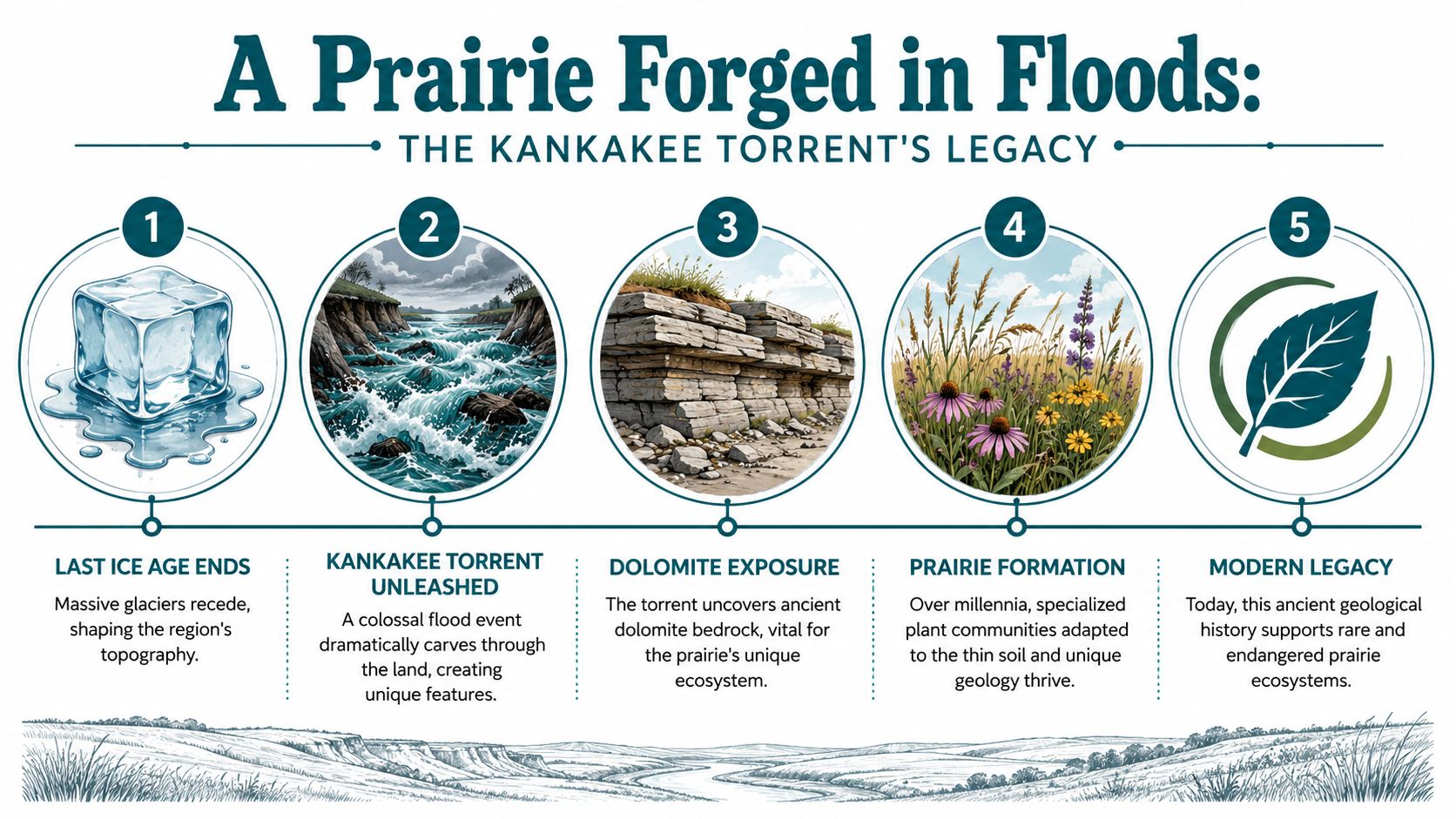
    Long before our workdays, field notebooks, and muddy gloves, floodwater carved the ground hard enough to expose dolomite bedrock. That old force still sets the rules here, as described by the Illinois Department of Natural Resources page for the reserve.

    An infographic showing the geological history of Kankakee Torrent and the formation of dolomite prairie ecosystems.

    The bones of the place

    A lot of Illinois hides its bedrock under deeper, softer soil. Here, the ground often feels spare. Thin soil dries fast in some spots. Water lingers differently in others. Plants do not get much room for laziness, so the ones that last are the ones built for pressure.

    That is one reason I bring new volunteers here when they are unsure of themselves. The prairie runs on limits. It grows beauty out of hard conditions. If you have ever felt scraped down by life and still kept going, this ground makes sense in your body before it makes sense in your head.

    I usually explain the sequence like this:

    • Ancient floodwater tore through the area.
    • Dolomite bedrock ended up close to the surface.
    • Soil stayed thin across many patches.
    • Prairie and wetland communities adapted to those constraints.

    Why the ground keeps changing under your feet

    You can hear it in how people talk once they have walked a little farther. One person says the trail felt dry and open. Another swears the next stretch felt damp, almost hidden. They are both right.

    The reserve holds several prairie and wetland community types, including a large area of Grade C dolomite prairie. That mix grows from the same rough geologic base noted earlier. The result is a place that keeps shifting mood as you move, a training field for attention. You learn to notice small changes. You slow down. You get less sure of your first impression, which is healthy work for a person, not just a hiker.

    This short video helps if you want a visual companion before your visit.

    How I explain a dolomite prairie to a friend

    I keep it simple. A dolomite prairie is a place where life has to earn its footing.

    Roots grip shallow soil. Water comes and goes on unforgiving terms. The plants that stay are the ones that can handle exposure, scarcity, and change. That is why volunteer work here never feels like charity to me. The prairie is teaching the same lesson it asks of its plants. Stand firm. Adapt. Work with others. Keep going.

    Field note: When the trail goes quiet, look down. The ground usually explains the rest.

    Discovering the Prairie's Treasures

    The first time I brought a new volunteer here, she stopped after ten minutes and said, "I thought this place would ask me to look far out." Instead, she was crouched over a hand-sized patch of ground, grinning at a tiny bloom pushing up through stone and short grass. That is how this reserve gets you. It trains your eyes first, then your character.

    You start to understand the place by getting low, staying quiet, and letting small things matter.

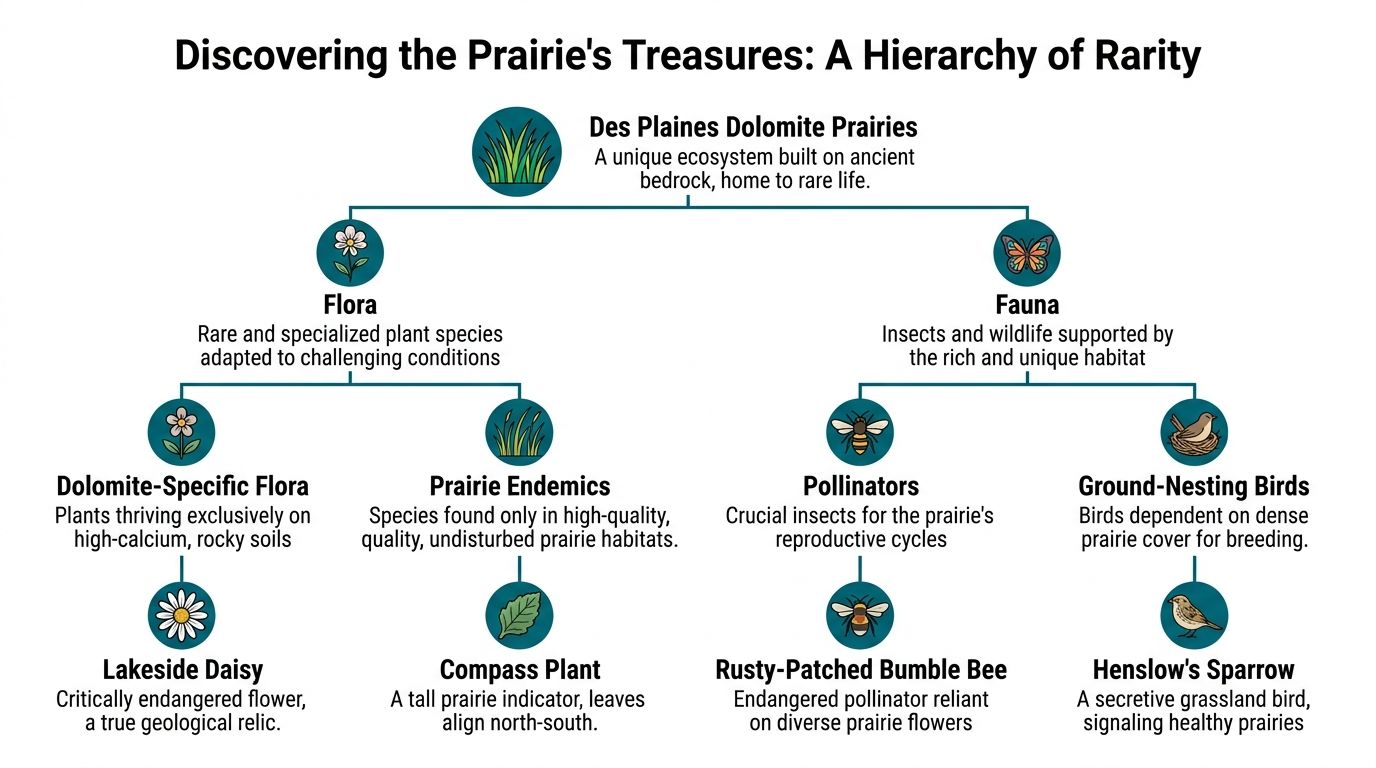
    A hierarchical flowchart describing the rare flora and fauna found in Des Plaines Dolomite Prairies ecosystem.

    Why a small remnant can change how you walk

    A friend once asked why our group gets so protective over what, to an untrained eye, looks like a modest stretch of prairie. I told him about the moment that changed me. I had paused to pull trash near a rough, open patch, and one of the older stewards waved me over like he was pointing out a jewel. He did not raise his voice. He just said, "Look carefully. Almost none of this is left."

    That landed hard.

    As noted earlier from state conservation material, this reserve holds a rare, high-quality remnant of dry-mesic dolomite prairie. Once you know that, your pace changes. You place your boots with more care. You stop treating the ground like background and start treating it like an elder that barely survived.

    What the prairie gives to people who pay attention

    I do not promise dramatic sightings on command. Prairie days do not work like that. What I can promise is that attention gets rewarded here, and the reward often comes in forms that make you better at more than hiking.

    Here is what I tell new volunteers to watch for:

    • A change in footing: Ground that turns stonier or thinner often marks a shift in the living community around you.
    • Small flowers close to the soil: The prairie hides some of its best work down low, where hurried visitors never look.
    • Busy insects over one patch: Pollinators will often show you the best stopping point before your own eyes do.
    • Birds dropping into cover: That quick movement tells you the structure of the grass is doing real work for wildlife.

    State information also notes that the reserve supports threatened and endangered species. I never turn that into a scavenger hunt. A place like this asks for respect, not conquest. Sometimes the bravest thing a person can do outdoors is accept that seeing less can still teach more.

    One volunteer in our group learned that the hard way, then the good way. He came hoping for a big checklist day. Instead, he spent an hour helping clear a small stretch near the trail and left talking about one insect he had watched move from flower to flower. He had noticed a pattern, slowed his breathing, and finally stopped trying to win the walk. That proved to be the most valuable discovery.

    A better way to search for treasure

    Kneel if the ground allows it. Stay with one square foot longer than feels natural. Let your eyes sort out stem from shadow, bloom from gravel, movement from wind.

    That simple act becomes practice for the rest of life. You get steadier. You get humbler. You become more useful to the people beside you because you are finally paying attention.

    If you want to build a longer day around that same habit of slow observation, this guide to the Des Plaines River Trail near Chicago is a good companion route.

    And when you find something beautiful, leave it where it is. The best thing you carry home from this prairie is sharper attention, and maybe a little more courage than you had when you arrived.

    Finding Your Way Around the Reserve

    The first visit always feels easier when somebody gives you the plain version. So here's my plain version.

    Treat the Des Plaines Dolomite Prairies Land and Water Reserve like a field trip, not a rush job. Give yourself time to park, stand still for a minute, and let your eyes adjust to open ground. Prairie spaces can seem visually quiet at first, then suddenly full.

    I also like pairing a visit here with other nearby outdoor routes. If you want another option for the same general part of the region, this guide to the Des Plaines River Trail near Chicago can help you build a longer day outside.

    My advice before you leave home

    Don't overpack. You don't need to dress like you're crossing a mountain range. Wear sturdy shoes, bring water, and expect uneven ground in places. If the weather turns, let that be part of the day instead of a crisis.

    Here's the quick-reference version I wish somebody had handed me early on.

    Item Details
    Setting A protected reserve within the Des Plaines Fish and Wildlife Area in Will County, Illinois
    Best first move Start slow and let your eyes adjust before you try to "find" anything
    Footwear Closed-toe shoes with grip make the walk more comfortable
    What to bring Water, sun protection, and patience
    Mindset Come ready to observe more than to conquer mileage
    Facilities Check current official guidance before you go, since access details can change
    Pets and rules Verify current site rules before your visit and stay on marked paths where allowed
    Ideal pace Unhurried. This place rewards people who stop often

    How I move through a place like this

    I don't chase every turn. I pick a direction, walk gently, and pay attention to changes underfoot. That matters more here than trying to rack up distance.

    Three habits help a lot:

    1. Start with the edges. Transitional areas often wake up your attention.
    2. Turn around halfway. The view back often feels completely different.
    3. Leave margin in your schedule. The best moments usually happen when you aren't rushing to the next thing.

    Practical rule: If you catch yourself checking your phone every few minutes, stop walking and listen for one full minute.

    How to Visit with Purpose

    A lot of people visit prairies the way they scroll. Fast eyes. Quick judgment. If nothing flashy appears, they move on.

    I think this place asks for another kind of visit. Slower. More deliberate. More willing to let small things matter.

    Pick a season, then pick a question

    I like giving each visit one question instead of one goal. In spring, my question might be, "What's waking up low to the ground?" In late summer, I ask, "Which plants are holding themselves tallest?" In fall, I pay attention to color, seed heads, and the sound of dry grass moving in the wind.

    That little shift changes everything. You stop grading the day by whether you got a perfect sighting. You start noticing patterns.

    A few simple ways to make the visit deeper:

    • Get low once or twice. Crouching changes your whole relationship with the prairie.
    • Look at one square of ground. Stay with it longer than feels natural.
    • Follow one sound. Wind, insects, birds, your own footsteps. Let one sound lead your focus.
    • Notice the rock story. Even if you can't see bedrock directly, remember what's shaping the plants.

    Respect is a form of attention

    Purpose isn't only about curiosity. It's also about restraint.

    Stay on the path where you're supposed to. Leave flowers, seed heads, and anything living where you found them. Don't treat the reserve like a backdrop for content. Treat it like a place with its own rules and its own pace.

    I learned this the hard way in nature spaces. I used to arrive wanting a payoff. A beautiful photo. A breakthrough thought. A clean emotional reset. Now I try to arrive ready to receive whatever the day gives me.

    That makes the good moments stronger.

    Some visits feel full right away. Others feel quiet until the drive home, when you realize your mind got lighter out there.

    Small practices that change the day

    If you're bringing a friend, ask them what they noticed before you tell them what you noticed. That keeps the place from turning into a lecture. If you're coming alone, try walking one stretch in silence with no music.

    You don't need a grand ritual. You need a little patience and a willingness to be taught by details.

    Answering the Call to Protect This Place

    The older I get, the less I believe in the idea that special places stay special on their own. They need help. Usually practical help. Hands, time, restraint, and people who are willing to do unglamorous work.

    Prairie care often looks like that. You don't always get a dramatic before-and-after reveal. Sometimes the work is slow, repetitive, sweaty, and absolutely worth doing.

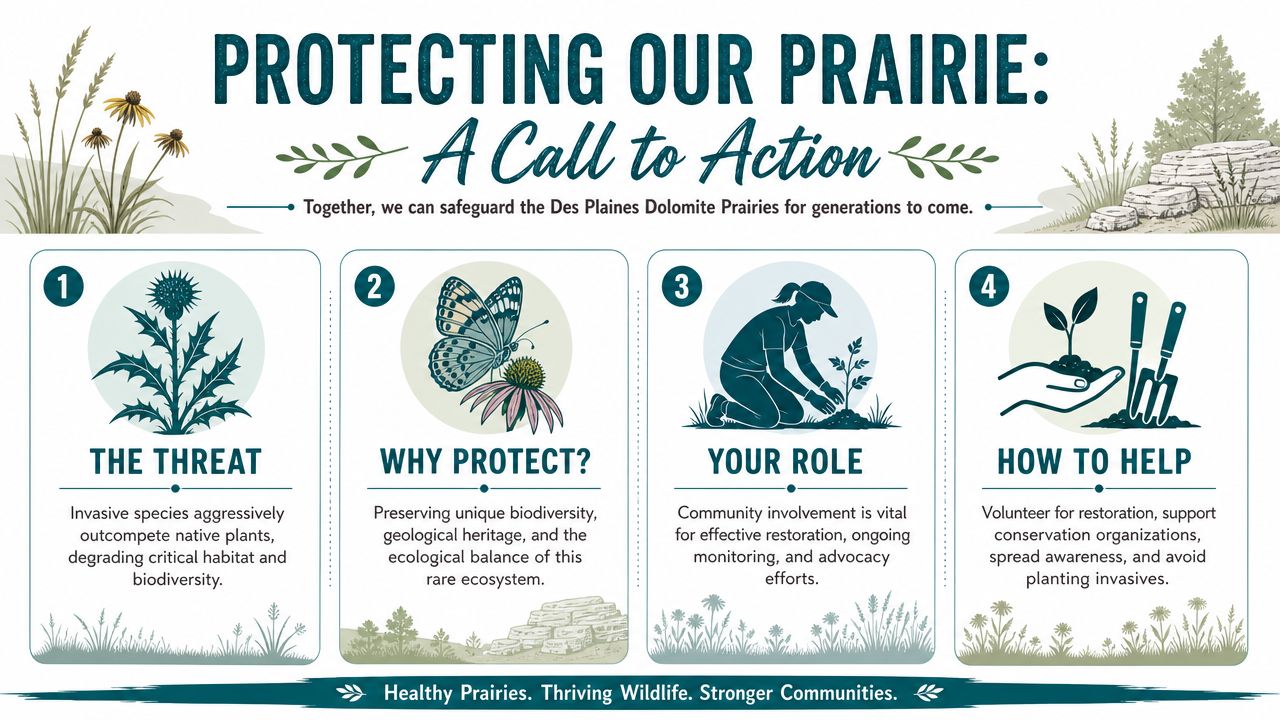
    An infographic detailing the conservation importance and community action steps for protecting the Des Plaines Dolomite Prairies.

    Why service changes the person doing it

    I've seen this over and over in outdoor volunteer spaces. Someone arrives a little shy, a little unsure, maybe just wanting to do one decent thing with their morning. Then they spend a couple hours picking up debris, hauling brush, or helping with habitat work. By the end, they stand differently.

    Work with your hands can do that.

    Nature service is good medicine for people who overthink. It gives your mind a job it can finish. You pull, carry, bag, clear, stack. The body understands what the mind has been circling.

    That's one reason I think stewardship matters so much. It doesn't only help the place. It trains you.

    What protecting a prairie can look like

    I don't mean everybody needs to become a full-time field ecologist. I mean regular people can become useful fast.

    That help can take a few forms:

    • Show up for workdays. Habitat care often needs willing hands more than perfect expertise.
    • Learn the rules of the site. Respect prevents damage.
    • Stay observant. Care starts with noticing what doesn't belong.
    • Bring a friend. Courage spreads socially. So does care.

    If you want a grounding idea for that mindset, I like the language in this piece on environmental stewardship. It puts words to something simple. A place does better when people decide it is partly their job.

    Bravery can be quiet

    When people hear "be brave," they often picture something loud. I think bravery out here is quieter than that.

    Bravery is waking up early and going anyway. Bravery is joining a volunteer day when you don't know anyone. Bravery is getting dirty, asking dumb questions, and learning in public. Bravery is deciding that care isn't embarrassing.

    If you want to feel less powerless, help a real place with your real hands.

    I love that prairie work can humble you without humiliating you. The plants don't care about your résumé. The ground doesn't care how polished you sound. You either help, or you don't. That's very freeing.

    And once you've done that kind of work, even once, a reserve like this stops being scenery. It becomes somewhere you feel responsible to.

    Your Story with the Prairie Starts Here

    By the time I leave this place, I usually feel two things at once. Smaller, and steadier.

    That's a good combination.

    The Des Plaines Dolomite Prairies Land and Water Reserve has its own long story in rock and grass and thin soil, but that isn't the only story here. There's also the one you bring with you. Maybe yours is a solo walk because your week got too loud. Maybe it's a family morning where somebody young sees prairie ground up close for the first time. Maybe it's the day you decide you want your weekends to include service, sweat, and actual human connection.

    I don't think personal growth always arrives through giant breakthroughs. Sometimes it starts when you walk into a place that asks you to slow down, pay attention, and care for something outside yourself. A prairie can train that in you. Subtly. Repeatedly.

    So go. Wear the shoes you don't mind getting dusty. Bring water. Give the place more time than feels efficient. Let the grasses, stone, and open sky work on you a little.

    Then come back.

    Because that's how a place changes you. Not in one dramatic scene, but through return.


    If this kind of outdoor service and honest community speaks to you, take a look at Litter Caterpillars. It's a Chicago volunteer group built around bravery, friendship, and caring for the environment with your own two hands.