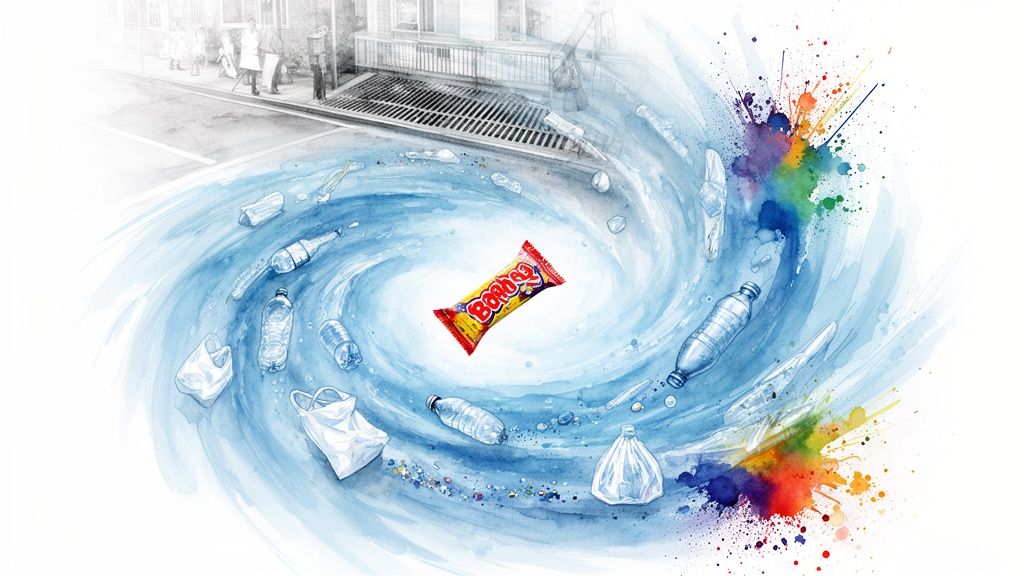
When you hear "ocean garbage patch," what do you see in your mind? I bet you're picturing a floating continent of trash, a solid island of plastic bottles and bags you could almost walk on. The real story is much stranger, and if I'm being honest, it's more disturbing.
It's less of a solid island and more of a toxic, plastic soup. Imagine a colossal, swirling cloud of confetti-sized plastic bits, churning for thousands of miles just under the surface, all trapped by powerful, rotating ocean currents called gyres.
Confronting the Mess, One Piece at a Time
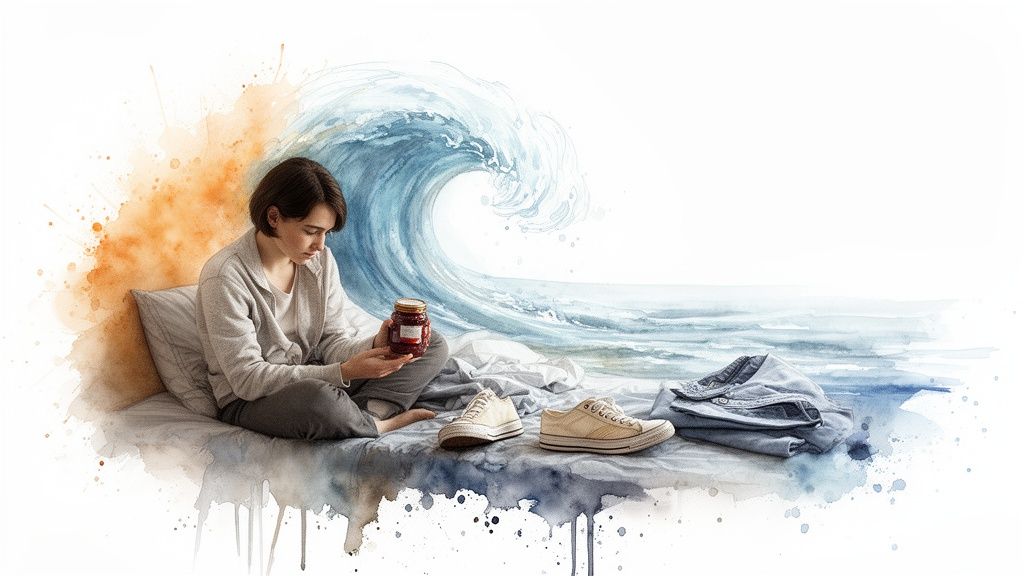
I have a story for you. It's not about some huge, far-off environmental issue. It’s about my messy room. You see, for most of my life, I've had a terrible time cleaning and organizing my own things. As my living space got messier and messier, my life felt messier, too.
Every single forgotten thing had a story, a sentimental weight that went way beyond its physical form. I'm thinking of an old jam jar shoved in the back of my fridge, a souvenir from a trip to Michigan four years ago. Or a bag of nuts I bought when I tried to eat healthy and failed spectacularly.
These things weren’t just clutter. To me, they were anchors.
The Weight of a Single Jar
That jam jar weighed less than a pound, but in my head, it felt like a 500-pound weight of failure. I just couldn't bring myself to move it. It was so much easier to shut the fridge door and pretend it wasn’t there. I think you might know that feeling. It's the same paralysis that can wash over you when you hear about something as enormous as the ocean garbage patch. It feels too big, too distant, too heavy to even start thinking about.
But my journey to understand our planet's plastic problem starts right there, in my messy room. It begins with a discovery: facing one tiny, insignificant piece of my own mess gave me the courage to take on the world's.
This is the idea we’re going to explore together: The bravery you build in your own life is the exact same bravery we need to heal our planet. It’s not about being perfect. It’s about taking that first, hard step.
This is exactly why I started Litter Caterpillars. I found out a strange truth: cleaning my own life felt impossible, but cleaning up public spaces with friends? That felt inspiring. It turned a chore into a mission.
Throughout this guide, we'll look at the shocking reality of the ocean garbage patch through this very personal lens. You'll see how:
- Picking up a single piece of litter connects you to a global fight.
- Building a community in our own neighborhoods, like we do here in Chicago, is the secret to solving worldwide problems.
- Finding the courage to do hard things, together, is how we transform ourselves and our world.
What Is an Ocean Garbage Patch, Really?
Let's ditch that idea of a floating garbage island. Instead, I want you to imagine a giant, swirling plastic soup. It’s less like a solid mass and more like a nasty smog that hangs just under the water's surface. This isn't one clump of trash. It’s a hazy mess of debris spread out over thousands of miles, where the sun and waves have broken down most of the plastic into countless tiny, confetti-like pieces.
These little fragments, we call them microplastics, are the real heart of the problem. They turn huge areas of the ocean into a murky, polluted broth. This is what makes the garbage patch practically invisible from a boat and impossible to see on satellite photos. You could sail right through the middle of one on a calm day and not notice anything besides a weird, oily sheen on the water.
The Great Pacific Garbage Patch
The most infamous of these zones is the Great Pacific Garbage Patch—a massive monument to our plastic addiction. This is the one you’ve probably heard about, swirling in the ocean halfway between Hawaii and California. Its size just blows my mind.
To give you some perspective, the Great Pacific Garbage Patch covers an estimated 1.6 million square kilometers. That’s an area twice the size of Texas, or three times the size of France. Inside this zone, scientists figure there are about 1.8 trillion pieces of plastic. That breaks down to roughly 250 pieces for every single person on Earth. While it’s mostly that plastic soup, the total weight is around 80,000 tonnes, which is like having over 740 Boeing 777 jets floating out there. You can get a deeper look at these wild stats over at wifitalents.com.
This map really shows you the scale of the plastic concentration. It’s not just one spot.
As you can see, the debris is most dense at the center, but the entire area is a huge soupy mess.
Not an Island, but a Toxic Cloud
So, if it’s not an island, what is it? The best analogy I have is a cloud. From far away, a cloud looks solid, right? But if you fly a plane through it, you realize it's just a whole lot of air and water vapor.
The ocean garbage patch is exactly like that. It's not something solid you can stand on; it’s a three-dimensional pollution zone. The plastic junk is scattered from the surface all the way down to the ocean floor, with the thickest concentration floating in the top layer of the water.
This is what makes it so dangerous. It’s a toxic, hazy cloud that has basically become part of the ocean itself. It's a permanent feature of our planet now, built one piece of trash at a time—trash that started in our streets, rivers, and on our coastlines. Getting our heads around this truth—that it's not an island, but a pervasive, soupy mess—is the first real step to tackling the challenge ahead of us. It’s a problem that's been woven right into the fabric of our oceans.
Tracing a Candy Wrapper from Chicago to the Pacific
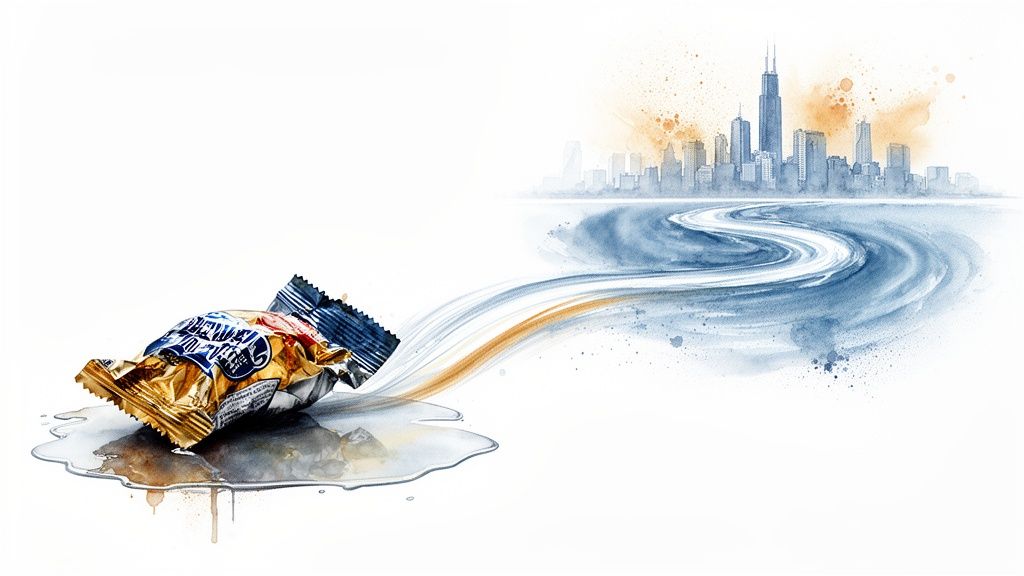
This is going to sound crazy, but stick with me. I want you to picture one little candy wrapper, dropped on a busy street right here in Chicago, ending up in a massive ocean garbage patch thousands of miles away. It feels like a problem for someone else, somewhere else. A world away.
But it’s not. The journey from our sidewalks to the middle of the ocean is terrifyingly direct. Let's follow the path of that single piece of trash. You’ll see exactly how a moment of carelessness in our city becomes part of a global crisis.
Think about a bright red candy wrapper, let go near a bus stop in the Loop. It gets kicked around for a day or two. Then, a classic Chicago storm hits.
That rush of rainwater is all it takes. The wrapper is swept into a storm drain, and just like that, its fate is sealed. It’s just entered a one-way highway to the sea.
The Urban Expressway for Trash
Our city’s waterways—the Chicago River, the canals, and Lake Michigan—aren't just scenery. I want you to see them for what they’ve become: expressways for our trash. That wrapper is now in the sewer system, which flushes it right into the Chicago River. We see the effects of this firsthand every week, and if you want to understand the real challenge we’re up against, check out our guide on cleaning up a river right here in our community.
From the river, it's a quick trip into Lake Michigan. Now it’s in the Great Lakes system, starting a much longer trip. It drifts with the current through Lake Huron, Lake Erie, and Lake Ontario. It might take months, maybe years, but it will eventually pass through the St. Lawrence Seaway and get spit out into the North Atlantic.
It has now officially left our neighborhood and entered the planet’s circulatory system. This is where the story gets truly wild.
Riding the Great Ocean Conveyor Belt
Out in the open ocean, that wrapper is grabbed by a force bigger than any river. It gets pulled into a massive, spinning system of currents called an ocean gyre.
Think of a gyre as a planetary whirlpool, a slow-motion vortex as big as a continent. We have five major ones on Earth. They act like giant drains, sucking in anything that floats from thousands of miles away and trapping it all in their calm, stable center.
This is the engine that builds an ocean garbage patch. Our little red wrapper from Chicago is now in the Atlantic, where it might get caught in the North Atlantic Gyre. Or, if it rides the currents just right, it could travel south, whip around the tip of Africa, and find its way into the Pacific.
Once it’s caught in the gigantic North Pacific Gyre, its journey is over. It joins trillions of other plastic pieces—scraps of bags from Tokyo, empty bottles from L.A., and tangled fishing nets from who knows where. It will just sit there, slowly breaking down under the sun, becoming part of that toxic plastic soup we’re all fighting against.
- Step 1: Trash enters a local waterway (a Chicago storm drain).
- Step 2: It travels through a regional system (the Great Lakes).
- Step 3: It enters a major ocean (the Atlantic).
- Step 4: It is captured by a global force (an ocean gyre).
That single candy wrapper, from a careless moment in our own city, has finished its journey. It’s now a permanent resident of the Great Pacific Garbage Patch. It’s the proof that when we throw something "away," there is no away. It all connects back.
This problem is so much bigger than an ugly, littered ocean. The ocean garbage patch isn’t some passive island of trash just floating there. It's an active and devastating menace. To get the full picture, you have to hear the stories of the creatures that call the ocean home.
I want you to picture a sea turtle, one of those ancient, graceful animals. It’s swimming and sees what looks like a beautiful, shimmering jellyfish—its favorite meal—pulsing in the water. But it’s not food. It's a plastic bag. The turtle eats it, and that single mistake can block its entire digestive system, leading to a slow, agonizing death.
This isn't some freak accident. It’s happening constantly. Seabirds live out a similar nightmare. They fly for hundreds of miles, scooping up what they believe is food for their chicks. But they come back to the nest with a belly full of sharp, colorful plastic shards. They regurgitate this trash into their babies' mouths, and the chicks, their stomachs full of garbage they can't digest, starve to death.
The Invisible Killer: Microplastics
As gut-wrenching as those stories are, they’re only the most obvious part of the crisis. The real tragedy is unfolding on a microscopic level. It's an invisible threat that has already contaminated every corner of the ocean and is now making its way back to us.
When those bigger pieces of plastic—the bottles, bags, and fishing gear—get beaten down by the sun and waves, they don't break down and disappear like a banana peel. They just shatter. They break into smaller and smaller pieces, becoming what we call microplastics. These are tiny fragments, often smaller than a grain of rice, and they are the true poison of the ocean garbage patch.
It's like dissolving a poison tablet in a giant jug of water. You can't see the poison anymore, but you know the whole thing is toxic. That's what microplastics have done to our oceans. They’ve turned the water itself into a chemical soup.
These tiny plastic bits act like little toxic sponges. They soak up all the nasty chemicals floating around in the seawater, like pesticides and industrial waste. So now you have a tiny particle that is both plastic and poison. You can see the shocking reality of this in our post with some powerful plastic pollution pictures.
A Poison Pill Climbing the Food Chain
And this is where the problem comes right back to bite us. The journey of these toxic microplastics starts at the very bottom of the food web.
- First, plankton eat them. These microscopic organisms are the foundation of all life in the sea, and they're mistaking these tiny bits of plastic for food.
- Next, small fish eat the plankton. With every plankton they swallow, the dose of plastic and the toxins stuck to it grows inside their bodies.
- Then, bigger predators eat the small fish. A single tuna or swordfish eats hundreds of these smaller fish, accumulating all that plastic contamination into its own body.
This process is called biomagnification. With every step up the food chain, the concentration of plastic and poison gets stronger. The predators at the very top end up with the highest, most dangerous levels of pollution in their systems.
And who sits at the top of that food chain? We do. The fish that lands on your dinner plate could be carrying a lifetime of plastic pollution. This isn't a scare tactic; it’s the scientific reality we're just starting to wrap our heads around. The plastic we threw "away" is coming back for us, one microscopic piece at a time. This isn't just about biodiversity or ocean health anymore—it's about our own.
How Do You Measure a Ghost?
Trying to get a handle on the sheer scale of the ocean garbage patch is one thing. But how do you even start to measure something so massive, so spread out, and so… hazy? It’s not like you can point a satellite at it and get a clean picture. From space, it's mostly a ghost that haunts our seas.
This means scientists have to get creative. They have to get tough. You can't fix a problem until you're brave enough to look it right in the eye and size it up. You have to get out there. And that's exactly what they've done, launching some of the most complex expeditions in modern history to map this invisible threat.
They send out fleets of boats that crisscross the gyres, pulling special nets designed to skim the surface for debris. But that only shows you part of the picture. So, they also fly aircraft low over the water, using advanced sensors and sharp-eyed observers to spot and count the bigger killers the nets can miss—like those deadly "ghost nets."
Uncovering a Deeper, Harsher Truth
Early guesses about the size of the garbage patch were disturbingly low. It wasn't because the science was bad, but the tools were still catching up. More recent, groundbreaking studies have painted a much starker—and more accurate—picture.
The most ambitious sampling project ever done for the Great Pacific Garbage Patch was a monumental effort. It involved 30 different boats, 652 specialized nets, and massive aerial surveys. This heroic work showed the problem was 4 to 16 times larger than we ever thought. The total mass is now estimated at a staggering 100,000 tonnes. You can dive into the incredible science behind these findings at The Ocean Cleanup.
The data reveals a critical paradox. To truly understand what we're up against, the numbers are key.
Understanding the Great Pacific Garbage Patch by the Numbers
| Metric | Statistic | What This Means |
|---|---|---|
| Microplastic Count | 94% of total pieces | The overwhelming number of items are tiny fragments, creating a plastic "smog." |
| Macroplastic Mass | 75% of total mass | The vast majority of the patch's weight comes from larger, heavier objects. |
This is the central contradiction. By count, the patch is an endless soup of feather-light microplastics. But by weight, it's a junkyard of nets, bottles, and buoys. This explains why it’s an invisible, soupy mess instead of a solid island of trash.
The Real Dangers Visualized
This infographic cuts through the numbers to show the direct, brutal impact plastic has on the animals that call the ocean home.
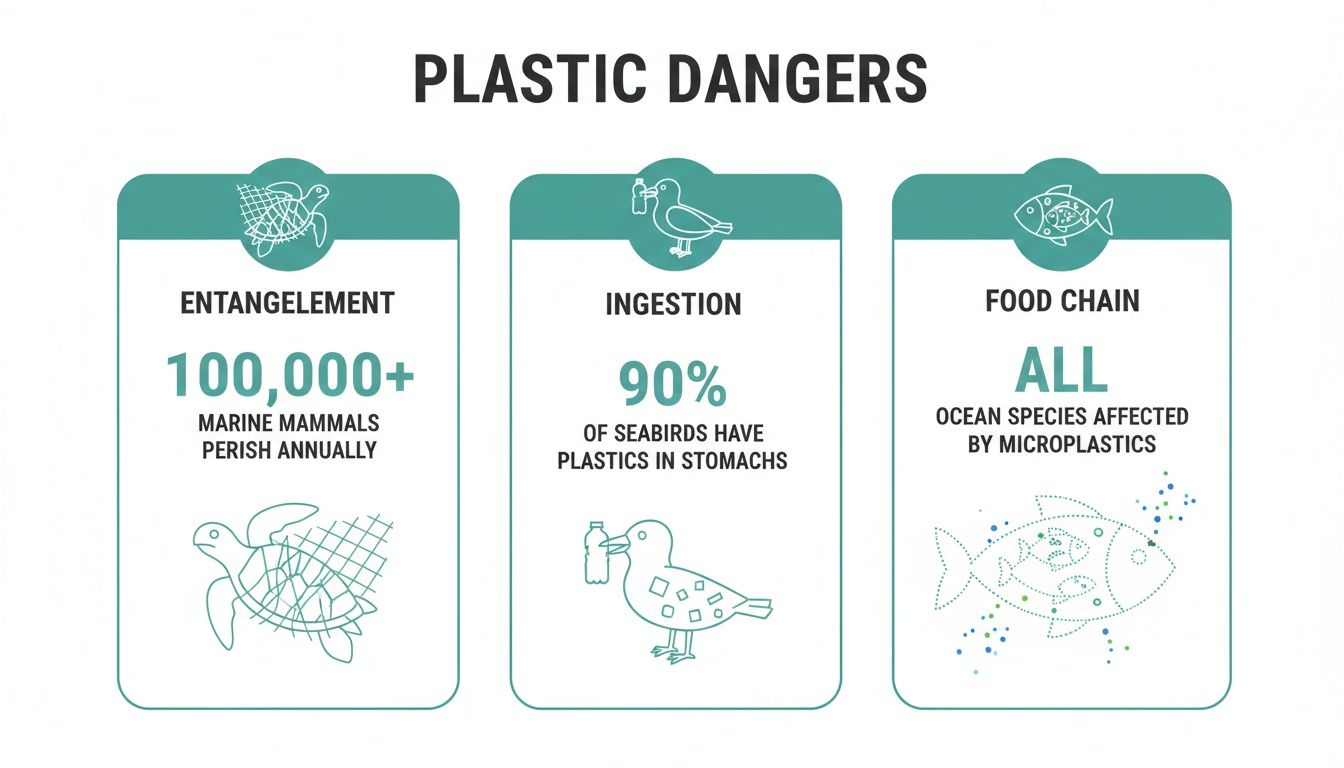
From a turtle caught in a plastic bag to a seabird feeding plastic to its chick, the image makes the abstract danger of the patch devastatingly real.
Measuring this mess isn't just about collecting data. It's an act of courage. It shows us exactly what we're facing. This scientific grit is what inspires the rest of us to act. It gives us a target to aim for and proves that even when a problem seems invisible, dedicated people can drag it into the light.
You Can Be the Hero of This Story
Thinking about the ocean garbage patch feels huge, doesn't it? It's so massive and far away that it can make you feel completely powerless. What can one person in Chicago possibly do about it?
It turns out, you can do everything.
I started Litter Caterpillars because I had trouble cleaning my own life and my own apartment. It was a private, impossible struggle. But I stumbled upon a strange truth: cleaning up public spaces with friends isn't just easier—it's inspiring. It builds a kind of courage and connection I never expected.
A Chore That Becomes a Mission
Remember Tom Sawyer? He was stuck with the awful chore of painting a fence, but he reframed it as a fun event that his friends actually paid him to join. That’s the exact spirit we bring to cleaning our city. We take a task that feels like a burden and turn it into a mission filled with friendship, pride, and purpose.
This is your invitation to join that mission. We’re going to show you a few real, practical steps you can take right now. And the answer isn't just about trying to use less plastic, even though that helps.
The real answer is about showing up.
We are not perfect. We are Caterpillars, transforming ourselves and our city through service.
The first step isn't about saving the world. It’s about discovering the strange, wonderful fun of making a difference right where you stand.
From One Person to a Community of Power
It’s normal to feel helpless when you see the scale of the ocean garbage patch. But what you do by yourself, when multiplied by a community, becomes an unstoppable force. This is how we fight back.
Here are three ways you can start making a real impact today:
Stop Throwing Things “Away.” Every time you hold a piece of plastic, don't think about throwing it "away." Instead, ask yourself, "Where does this actually go?" That simple mental shift is the first step. It forces you to see that there’s no magic place where our trash just disappears.
Pick One Small Sacrifice. Don’t try to become zero-waste overnight. You'll just burn out. Instead, choose one single thing. Maybe you refuse plastic straws. Maybe you commit to always bringing a reusable bag. Maybe you switch to a reusable water bottle. Master that one thing until it’s a habit. That small win will give you the confidence for the next one. For more ideas, check out our guide on practical solutions for pollution in the oceans.
Show Up for Your Community. This is the most important step. Seriously. Join a local cleanup. Feel what it’s like to work next to other people, turning a dirty street corner into something you can all be proud of. The courage you find out there is contagious. It’s the fuel that will power you to do more.
You don't have to solve the entire ocean garbage patch by yourself. You just have to pick up the first piece of trash. We'll be right there with you, picking up the second.
Alright, let's cut through the noise. When you start learning about the ocean garbage patch, the questions pile up fast. It feels huge, hopeless even. But every question is a first step. It means you're paying attention.
Let's tackle some of the big ones head-on.
So, Can We Just Go Out and Clean It All Up?
This is always the first question, and I love it. It comes from that gut instinct to just fix the damn thing. The simple answer is yes, people are trying. But it's an unbelievably tough fight.
The "garbage patch" isn't a solid island of trash you can just walk on. It's more like a thick, soupy plastic smog stretching over an area three times the size of France. Most of it is tiny plastic bits. Imagine trying to scoop smoke out of the air with a fishing net. That's the challenge.
Big, heroic projects are out there, but they're slow and costly. The real, lasting win? It starts right here on land. We have to turn off the faucet before we even think about mopping the floor.
Is This Plastic Going to Be There Forever?
This one's a heavy thought. Plastic doesn't just rot away like an apple core. The sun beats down on it, and it photodegrades—which just means it shatters. It breaks into smaller and smaller and smaller pieces, down to microscopic specks. But it never, ever truly disappears.
That's right. Every single piece of plastic ever made is still on this planet in some form. It's a terrifying idea. But I see it another way: it makes every bottle, every wrapper, every single piece of trash we stop from reaching the water a permanent victory.
Why Should I Care? I Live in Chicago, Miles From Any Ocean.
I get it. The ocean feels a world away. But remember that candy wrapper we found? It gets washed into a storm drain, then into the Chicago River, then Lake Michigan, then the St. Lawrence Seaway, and boom—the Atlantic. We are all upstream from the ocean.
And this isn't just some far-off problem for fish. This plastic soup comes back to haunt all of us.
- Our Food: Those tiny plastic bits get eaten by fish, which then end up on our plates. We're literally eating our own trash.
- Our Climate: The ocean is the planet's lung and heart. Choking it with plastic cripples its ability to keep our climate stable.
- Our Health: Nasty chemicals love to stick to plastic. As these plastics enter our food and water, those toxins come along for the ride.
The ocean might seem distant, but its health is tied directly to our own survival. That's why every cleanup we do right here in Chicago is a direct act of ocean rescue.
The problem is massive. It's easy to feel helpless. But our power isn't in trying to solve it all at once. Our power comes from showing up, together, and doing what we can, right where we are.
At Litter Caterpillars, we turn that helplessness into action, sweat, and friendship. If you're tired of just worrying and ready to be part of the solution, join us for a cleanup. Come see how good it feels to make a real difference, one piece of trash at a time.