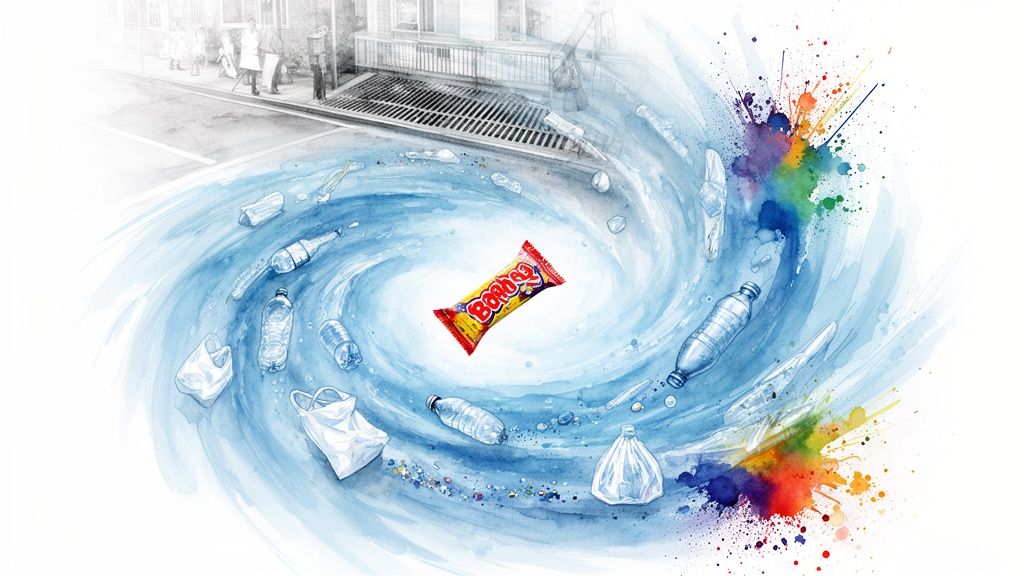
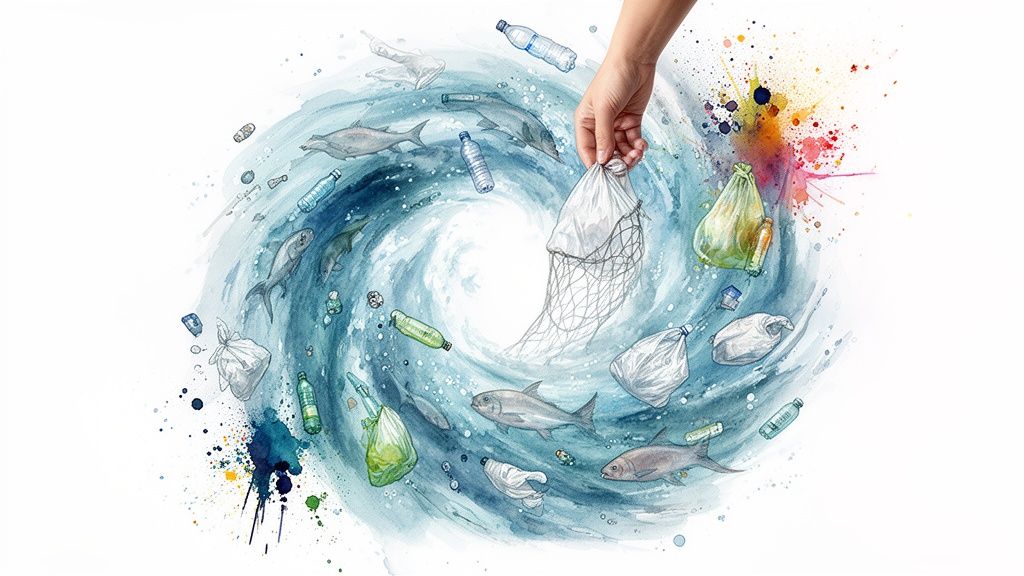
Let me get one thing straight with you. The Great Pacific Garbage Patch isn’t some giant island of trash you can go walk on. I want you to forget that picture. The reality is way, way scarier. Imagine a hazy, swirling soup of plastic confetti, a ghost in the water, stretching for thousands upon thousands of miles. That's the real monster we're up against.
The Invisible Crisis in the Pacific
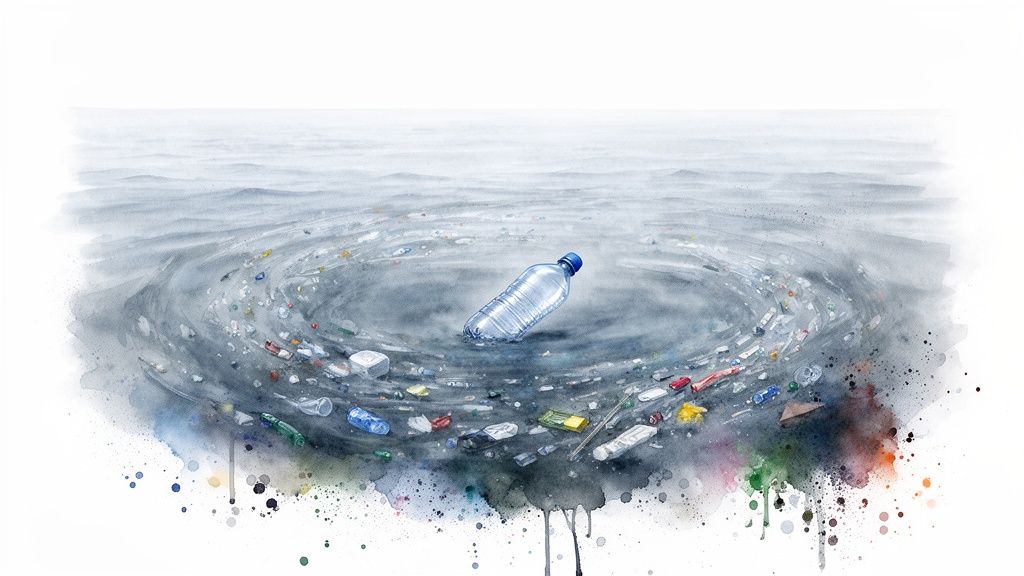
When I first heard about the pacific ocean garbage patch, I pictured it, too. A solid mass, like some monument to all our trash. But that’s not it. It’s sneakier than that. It’s less like a floating landfill and more like a cosmic nebula—but instead of stardust, it’s a swirling vortex of our plastic sins.
I need you to see it. This whole mess is trapped between Hawaii and California. Huge, rotating ocean currents, which we call gyres, act like a giant bathtub drain. They suck in trash from all over the Pacific Rim, pulling it in and holding it there in a slow, endless, mesmerizing spin.
The Scale of the Problem
It’s hard to get your head around how big this thing is. Believe me. This isn’t some problem you can just ignore in a far-off corner of the world. It’s massive. It’s everywhere.
The Great Pacific Garbage Patch covers 1.6 million square kilometers. That’s twice the size of Texas. Or three times the size of France. And inside that soup, scientists tell me there are between 80,000 and 100,000 tonnes of plastic. It’s so spread out, so hazy and ghost-like, that you can’t even see it from a satellite. An invisible monster.
Just let that sink into your gut for a second. An area three times the size of a country, completely choked with plastic dust. For me, it’s a gut punch, a brutal reminder that what you and I do on land ends up haunting the oceans.
Why This Myth Matters
So why do I care so much about debunking that "trash island" myth? Because if you think it’s a solid island, the solution sounds simple. Just go out there with a big net and scoop it all up. Problem solved, right?
Wrong. You know it’s never that easy. It's way more complicated. The huge majority of this plastic isn't floating bottles or bags. It’s tiny, almost invisible fragments, what we call microplastics, hanging in the water column like dust motes in a sunbeam. They’re everywhere, from the surface all the way down to the dark, silent ocean floor.
Facing that truth is the only way you and I can find real solutions. It shows us that cleanup is incredibly hard, and the real fight is stopping more plastic from ever getting there in the first place.
My whole journey with Litter Caterpillars started with a simple, personal idea: cleaning up someone else’s mess is powerful. It didn't start with me trying to save the world. It started with me trying to clean up the chaos in my own life. Tackling something as huge as the pacific ocean garbage patch starts the same way—with one small, real step you take on the street right where you live.
How Our Trash Takes a One-Way Trip to the Pacific
So, why does all this junk end up in the middle of nowhere? It's not a coincidence. I want you to picture the Earth’s oceans as a series of massive, slow-motion whirlpools. We call these gyres, and they’re like giant conveyor belts for absolutely everything that floats.
A plastic bag you see tossed into a river in Asia or a bottle cap washed off a California beach doesn't just hang around. Oh no. It gets swept up by smaller currents, eventually finding its way into one of these huge, unforgiving systems. The one we’re talking about, the one responsible for the garbage patch, is the North Pacific Subtropical Gyre.
The Great Pacific Conveyor Belt
Think of this gyre as a natural trap. I see it as a huge, rotating current that slowly, patiently pulls everything toward its calm, quiet center. Once debris gets caught in this spiral, it’s almost impossible for it to escape. You’re on a one-way ticket, no returns.
This is how a single piece of your trash can travel thousands of miles to join the plastic soup we now call the Great Pacific Garbage Patch. For me, it’s a powerful, and frankly, heartbreaking lesson in how connected we all are. It shows us, with startling clarity, that our local actions have consequences that ripple across the entire planet.
This is the journey that bottle takes—breaking down from a single object into countless, more dangerous fragments.
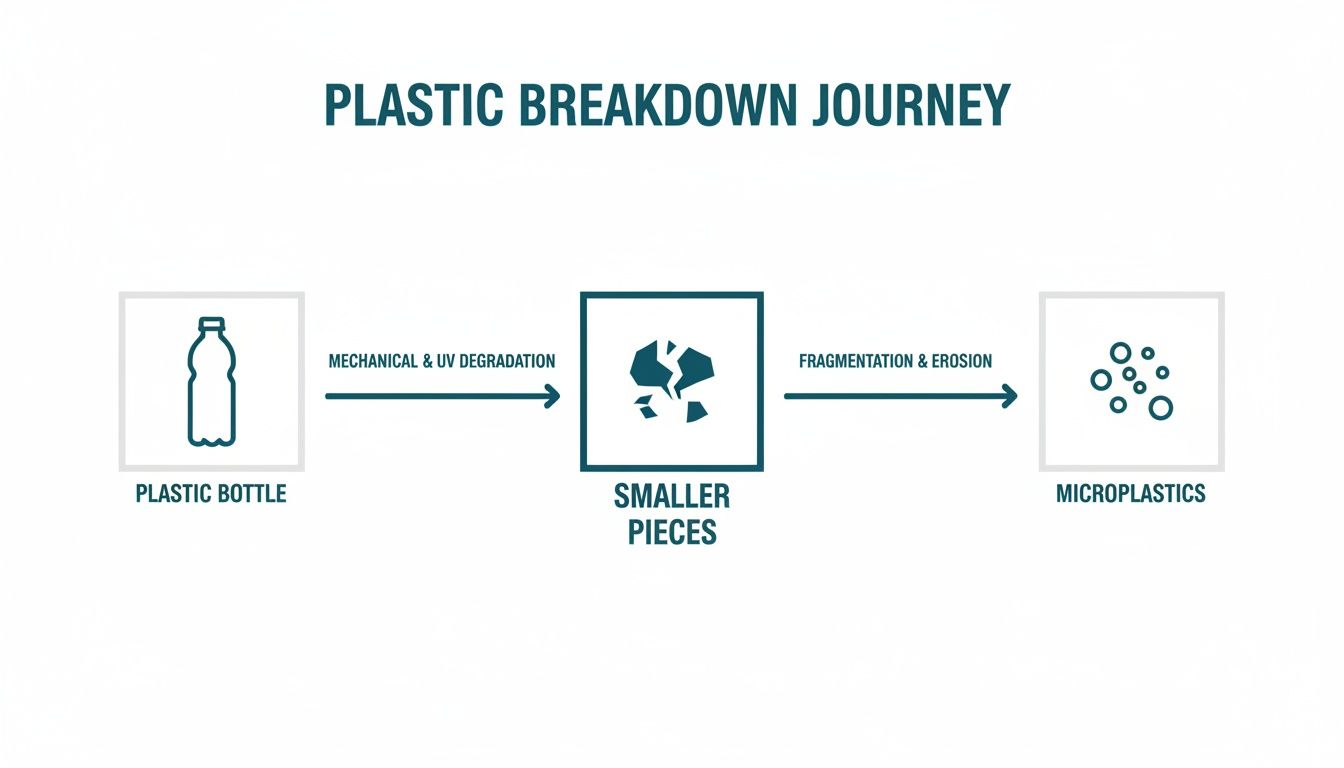
When you look at that, it makes it clear: plastic doesn't just disappear. It just becomes a more pervasive and insidious type of pollution that you can't see.
An Ever-Growing Monster
And this conveyor belt never stops. This problem isn't just staying the same; you and I know it's getting worse at a terrifying speed. Recent research I read found that the plastic concentration in the Great Pacific Garbage Patch has absolutely exploded.
It’s an almost unbelievable jump, and it proves this thing is actively growing while we watch.
Scientists now estimate there are 1.8 trillion pieces of plastic floating in the patch. I did the math. That breaks down to about 250 pieces of debris for every single human on Earth. For you. For me.
But what’s really revealing is the breakdown of what this trash actually is. The table below shows just how deceptive the numbers can be. While tiny microplastics dominate the piece count, it's the larger, heavier items that make up most of the patch's total weight.
Plastic Breakdown in the Great Pacific Garbage Patch
| Plastic Category | Contribution by Count | Contribution by Mass |
|---|---|---|
| Microplastics (0.05–0.5 cm) | 94% | 8% |
| Mesoplastics (0.5–5 cm) | ~5% | 11% |
| Macroplastics (5–50 cm) | ~1% | 22% |
| Megaplastics (>50 cm) | <0.01% | 53% |
What does this tell you? It shows a shocking truth: a staggering 46% of the patch's total mass is made up of fishing nets, often called "ghost nets." These are nets that were lost or abandoned, and they continue to drift aimlessly, entangling and killing marine life for decades.
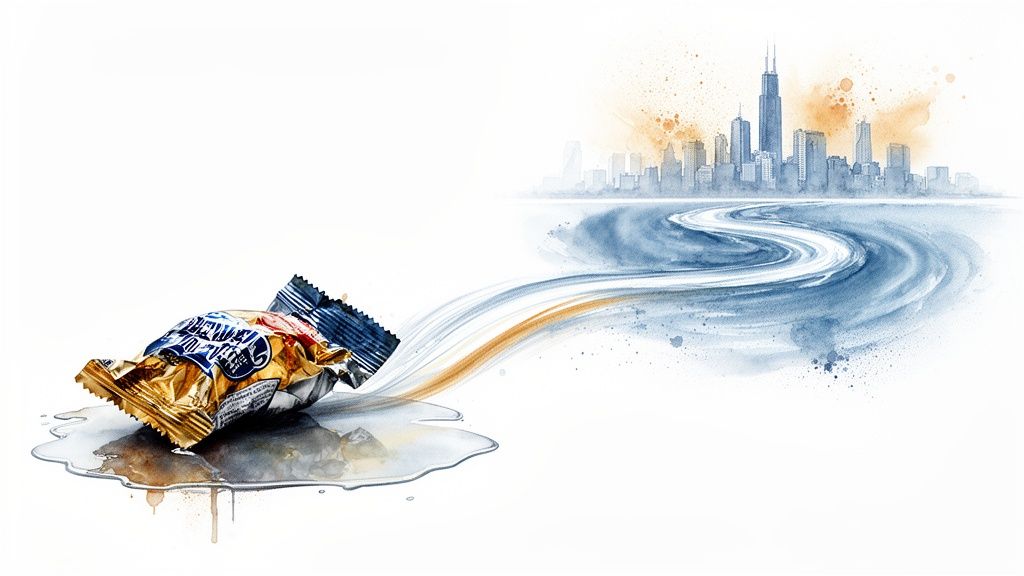
This is exactly why our mission at Litter Caterpillars is so critical. When you pick up a plastic bottle on a Chicago street, you're doing more than just cleaning your neighborhood. You are cutting off the supply chain to this oceanic monster right at the source. You are stopping that bottle from ever starting its long, destructive journey.
Your local action is a global solution. It's that simple. It really is.
The Ripple Effect on Marine Life and Our Health
This isn't just a story about trash. I know you know that. It's about life. Now that we've seen how this toxic soup gets stirred up in the ocean, you and I have to face the heartbreaking reality of what it does to the creatures living there. The fallout from our garbage problem doesn't just stay in one place; it touches everything.
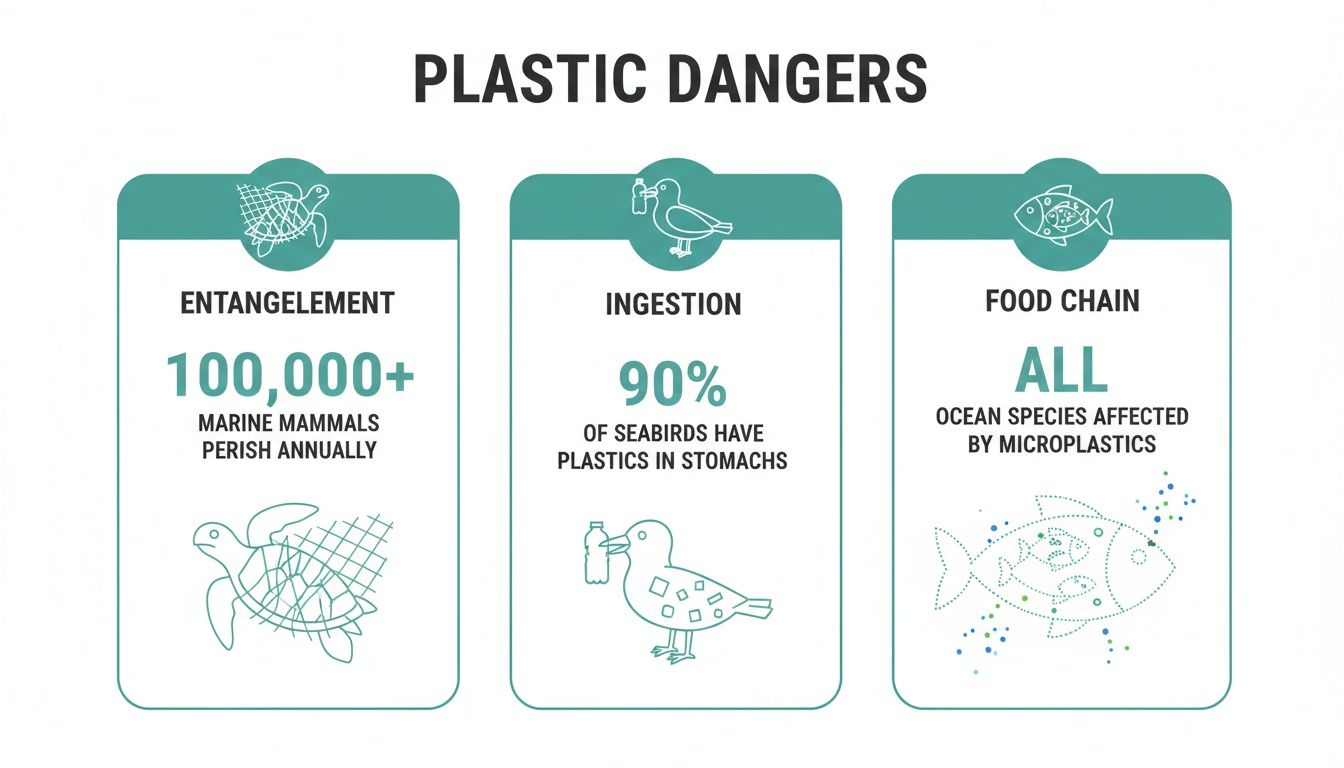
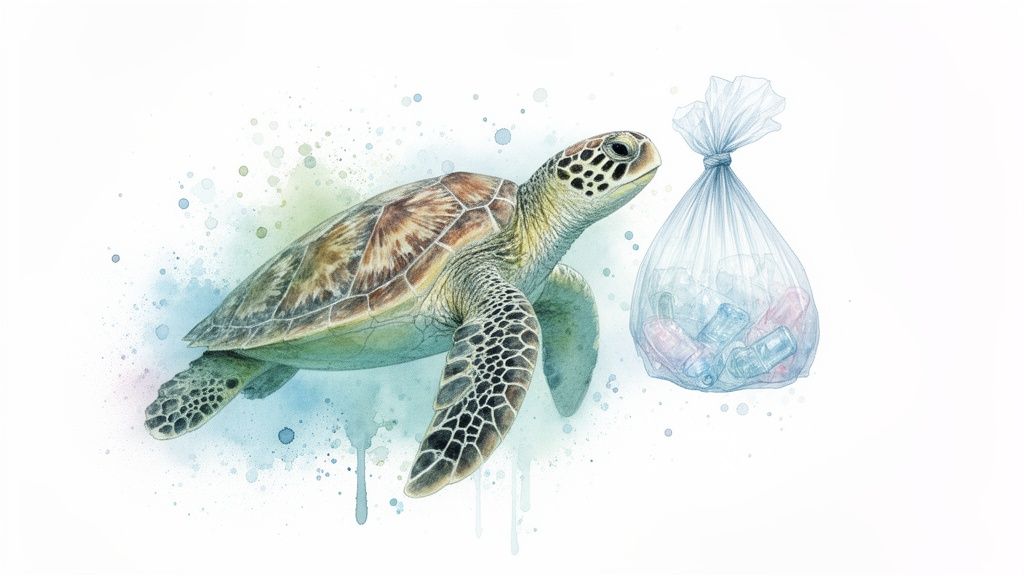
For a second, I want you to imagine you’re a sea turtle. Your entire world runs on ancient instincts, and one of those instincts screams that jellyfish are a great meal. But then you see a flimsy plastic bag, dancing in the current. It looks exactly like your next meal. For thousands of turtles, this simple, tragic mistake is a death sentence.
The Silent Killers in the Deep
And it’s not just the turtles. I want you to picture a massive albatross, a bird that soars for thousands of miles over the open sea. It swoops down to grab food for its chicks waiting back at the nest, but its beak closes around colorful bits of plastic and bottle caps instead of squid.
It flies back and regurgitates this plastic junk into the mouths of its babies. They slowly starve to death, their bellies completely full of our garbage. This is real. It's happening.
This is the grim, direct impact of the big stuff floating around. But there’s a much more sinister killer lurking in that hazy water. We call them ‘ghost nets.’
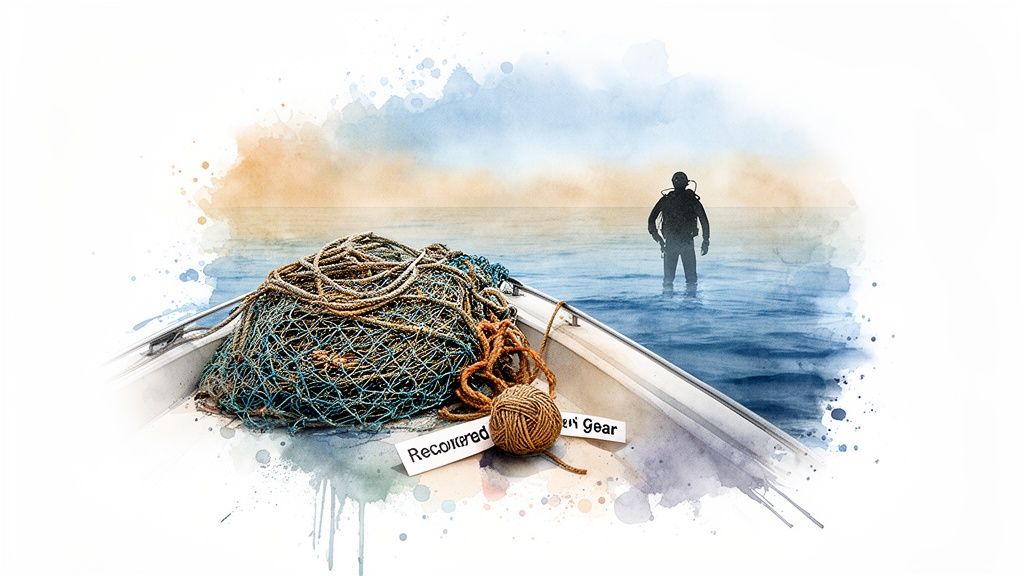
These are gigantic fishing nets, some as big as football fields, that were lost or just ditched at sea. They don't just sink and go away. They keep doing the one thing they were made for: they trap and kill, endlessly. For decades, these nets drift silently through the ocean, entangling whales, dolphins, seals, and sharks in a slow, horrible struggle.
The Poison on Your Plate
But the devastation doesn't end with the animals we can see. As you and I have learned, most of the plastic out there isn't in big, floating chunks. The real danger is the microscopic dust it all breaks down into.
The Great Pacific Garbage Patch holds an estimated 1.8 trillion individual pieces of plastic. But here's the kicker you need to know: microplastics make up 94 percent of that count, while only accounting for 8 percent of the total weight. If you want to dive deeper, you can learn more about these shocking findings on the plastic count versus mass.
This invisible confetti gets into everything. It's eaten by plankton, the microscopic organisms that are the absolute foundation of the entire marine food web. You can think of plankton as the grass of the ocean—everything above it depends on it.
Those tiny, plastic-filled plankton get eaten by small fish. Then, bigger fish eat the small fish. And on and on it goes, right up the food chain. At every single step, the concentration of plastic and the toxins stuck to it gets higher and higher.
We call this process biomagnification. Imagine you eat a slightly spicy pepper. Now imagine another person eating a hundred of those peppers, all at once. That's what happens as plastic moves up the food chain—the toxic load just gets bigger and bigger.
Eventually, that same fish might end up on a dinner plate. Maybe even yours. All of a sudden, that garbage patch doesn't feel so far away, does it? The plastic we threw out is literally coming back to haunt us, hidden in the food we eat.
This isn't just some "environmental issue" anymore. It's a human health crisis in the making. We're only just starting to figure out what eating these microplastics does to our bodies, but one thing I know for sure: it can't be good. Facing these hard truths isn't about you feeling guilty—it’s about finding the courage and the motivation to actually do something about it.
Can We Actually Clean It Up? Finding Hope on the Horizon
After all that, I bet you're asking the one question that really counts: Is there any hope? Can we actually clean up this overwhelming mess?
My answer is a loud, clear, "Yes." But it's probably not in the way you're thinking.
This isn't a story about defeat. For me, it's a story about the incredible people—the innovators and fighters on the front lines—who absolutely refuse to give up. Their fight gives me hope, and I think it should give you hope, too.
The Bold Dream of Cleaning the Oceans
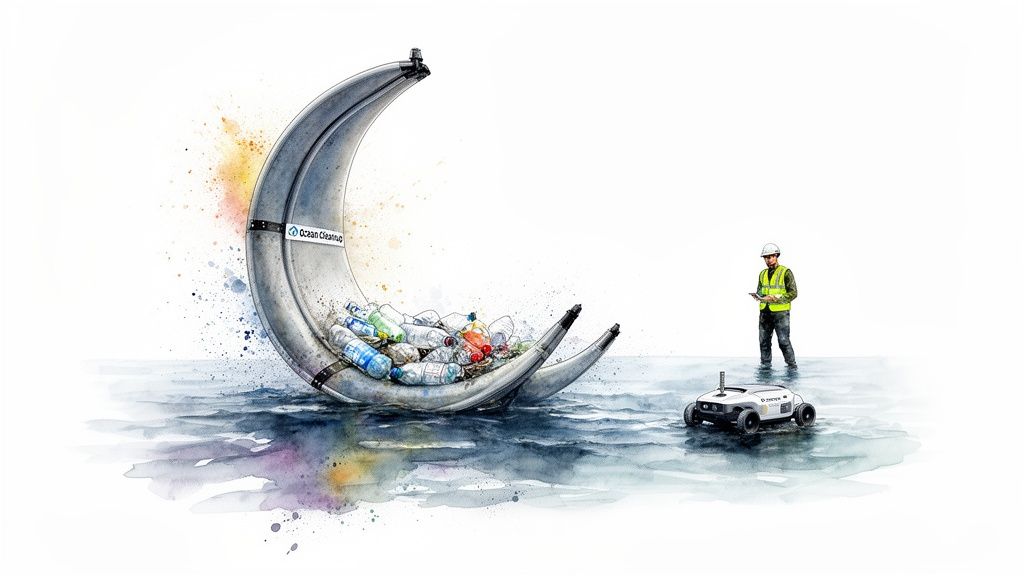
When you picture cleaning up the garbage patch, you’re probably imagining some massive, ambitious project. And you'd be right. The most famous effort comes from a non-profit called The Ocean Cleanup. These are the people who dared to dream big, building huge systems to pull plastic straight from the ocean gyres.
It’s an incredible mission. They use two ships to drag a massive barrier—almost 2,200 meters long—through the water. This net skims the surface, funneling the plastic together so it can be hauled out. Just recently, they pulled a record-breaking 11,400 kilograms of trash from the ocean in one go.
Their system is now so good it can sweep an area the size of a football field every five seconds. It’s pretty amazing what people can come up with when they try.
But here’s the biggest lesson they’ve learned, a lesson I want you to remember: cleaning the ocean is like trying to mop a flooded bathroom while the tub is still overflowing. You can mop all day, but you'll never get ahead until you turn off the faucet.
The Real Front Line in This Fight
This is where the story gets interesting for me. The folks at The Ocean Cleanup are doing heroic work, but even they'll tell you the real solution isn't out in the middle of the Pacific. The most powerful weapon you and I have is prevention.
Real hope isn’t some magic-bullet solution out there somewhere. It’s the collective power of people on the ground, stopping plastic at the source. That’s you, and that’s me. We’re the ones who can turn off the faucet.
This is the whole reason I started Litter Caterpillars. The real battle against the Great Pacific Garbage Patch isn't fought in the Pacific; it's fought on the streets of Chicago, in your town's parks, and along the banks of every local river. Each piece of plastic you and I pick up is one less piece that starts the long journey to the sea.
You can dive deeper into how we fight back by checking out our guide to practical solutions for pollution in the oceans.
Our entire mission is built on this one simple truth. When we get together on a weekend morning to clean a neglected lot, we are directly defending the oceans. We are the front line. Every single volunteer who shows up, rain or shine, becomes a guardian of our waterways.
The real heroes of this story are the everyday people, like you, who decide to do something. Hope isn’t just on the horizon; it’s in your hands, one piece of litter at a time.
When you think about the Great Pacific Garbage Patch, does it make you feel overwhelmed? I get it. I’ve been there. Staring at a plastic soup a million miles away from a city street corner makes the problem feel impossibly huge and totally disconnected from our lives.
But I need you to hold onto this one truth: every single piece of plastic in that patch started its journey on land. It started on a street just like yours. A bottle cap that rolled into a gutter. A grocery bag that got snatched by the wind. That’s where the story begins. And that’s where your power is.
This whole journey for me, starting Litter Caterpillars, didn’t begin with some grand mission to save the planet. It came from a desperate need to clean up the chaos in my own life. In doing that, I stumbled onto something powerful: the simple act of cleaning up somebody else's mess—a park, a sidewalk—was a profoundly healing thing. It brought a strange kind of order to my own world that I never saw coming.
It Starts with a Single Choice
Look, I’m not asking you to save the world. I’m here to tell you that you don't have to. You just have to start with one thing.
The problem of the pacific ocean garbage patch feels impossible, right? But it’s not one single problem. It’s billions of tiny, individual problems all adding up. And that means the solution is also made up of billions of tiny, individual actions you and I can take.
- Pick up one piece of trash. Seriously, just one. You see that plastic bottle on the sidewalk? Don't walk past it. Pick it up. That’s one less bottle on a journey to the ocean.
- Refuse one plastic item. When they offer you a plastic straw or a disposable bag, just say no. That one choice you make, repeated over and over, sends a powerful message.
- Start one conversation. Ask a friend if they’ve ever thought about where their trash goes. You don’t have to preach. Just plant a seed.
This is how you start. It’s not about some huge, life-changing gesture. It’s about a small, deliberate choice. It's about taking that crushing feeling of helplessness and turning it into one concrete action you can control right now.
I learned that cleaning other people's messes is way easier than cleaning up our own. And in a strange way, it's what allows you to start cleaning your own. The weight of your own problems feels lighter when your hands are busy solving someone else's.
You Are the Faucet
Remember how I said cleaning the ocean is like mopping a flooded bathroom while the tub is still overflowing? You, right here, are standing right next to the faucet. Every single time you stop a piece of litter on your street, you are turning that faucet off, just a tiny bit.
You are the first line of defense. The cleanup tech out on the ocean is amazing, but it's the last resort. The real fight is won or lost right here—on our streets, in our parks, and along our riverbanks. Most of the plastic choking our oceans starts on land, washed into storm drains and rivers. When you act locally, you have a direct impact on this global crisis. You can also check out our guide on other ways to reduce plastic use in your daily life.
From Chaos to Transformation
My life was a mess. Every piece of trash in my house had a story, a memory that made it feel impossible to throw away. It weighed me down. I felt completely stuck. It was only when I decided to clean up messes that weren't even mine that something inside me finally started to shift.
I took all the chaos, frustration, and hurt from my own life and turned it into action. And what I found was a strange kind of joy. I found real friendship. I found purpose shivering in a hailstorm with two other people, realizing that shared struggle is what forges the strongest bonds.
That’s what this is all about for me. This isn't just about picking up trash. It's about transforming yourself. It’s about taking something that feels broken and making it whole again—starting with a small patch of your own neighborhood, and maybe, just maybe, a small part of yourself, too.
Your power isn't way out there in the middle of the ocean. It’s right here, in your hands, on your street. This is how we heal our planet. And this is how we heal ourselves. Together.
Let's Talk Straight About This Garbage Patch
When you hear about the Great Pacific Garbage Patch, your mind jumps to all sorts of places. I get it. The whole thing sounds massive, confusing, and honestly, a little hopeless. But getting straight answers is the first step to figuring out how we can actually fight back.
Here are the questions I hear all the time.
So, Can You See This Thing From Space?
Absolutely not. This is probably the biggest myth out there, and you and I need to kill it. We’ve all been shown pictures of a solid island of floating trash, but that’s not what we’re dealing with. The truth is way, way scarier.
It isn’t a continent of plastic bottles you can stand on. The huge majority of it is tiny microplastics, just like I talked about before. These little fragments are floating under the surface, making the water look like a murky, polluted soup. A satellite can't see it. Heck, even if you were on a boat in the middle of the patch, you might not see a giant pile of junk—just cloudy, dead-looking water. It's an invisible enemy, and that's what makes it so dangerous.
If We All Stop Using Plastic, Will It Just Go Away?
I wish it were that easy. I really do. If every single person on the planet stopped using plastic right this second, the garbage patch wouldn't just vanish. The damage is already done. That plastic is already out there, and it's going to stick around for centuries, slowly breaking apart.
All those pieces swirling in the ocean will just keep getting smaller and smaller, poisoning sea life for hundreds of years. This is exactly why you and I have to fight this war on two fronts. We need prevention to cut off the supply of new plastic, and we need real, hands-on cleanup to deal with the mess we’ve already made.
It’s like finding a leak in your roof. You can't just put a bucket under the drip and call it a day, right? You have to climb up there and actually patch the hole. We have to do both.
Isn't Recycling Supposed to Fix This?
Recycling is part of the answer, but it’s not the magic bullet you might think it is. It helps, sure, but it's not even close to being a complete solution. Think about this with me: globally, only about 9% of all the plastic we produce ever gets recycled. The rest? It goes to landfills, gets burned, or ends up right in our environment.
The real power is in the old-school mantra: Reduce, Reuse, and then Recycle. The biggest difference you can make is to stop buying so much single-use plastic in the first place. Recycling is the last resort, not your first move. It can't solve a problem that starts with us making way too much of this stuff to begin with.
At Litter Caterpillars, I believe the strongest action you can take is right here, in your own neighborhood. When you join one of our weekend cleanups, you're not just picking up trash. You’re stopping plastic at the source, meeting people who actually care, and finding a new kind of purpose. Come join us and be part of the solution, one street at a time. You can find your next event at https://www.littercaterpillars.com.