
Tag: making friends

  • How to Make Friends as an Adult: A Real-World Guide

    How to Make Friends as an Adult: A Real-World Guide

    I once stood in my kitchen holding a jar of ancient blueberry jam like it was evidence from a lost life. Then I looked around at the clutter, the silence, the fallout from a relationship that had drained me, and I realized I didn’t just need to clean my apartment. I needed to rebuild my people.

    The Loneliness Problem I Couldn't Clean Up

    My place used to look like my inner life felt. Crowded. Stale. Weirdly sentimental about things that should’ve gone out weeks ago.

    I had trash with backstories. A half-finished bag of nuts from my brief healthy era. Old receipts from days I couldn’t even remember. The blueberry jam from a trip that mattered more in my memory than it ever did in real life. None of it weighed much, but every item felt heavy. I’m talking emotional cinder block heavy.

    Then a chaotic relationship ended, and the whole illusion cracked. I had spent too long tolerating selfishness, too long calling inconsistency “chemistry,” too long acting like loneliness would solve itself if I just stayed busy. It didn’t. It spread.

    A sad woman crying on a sofa while looking at a torn photograph of a couple.

    When your life gets smaller

    The hardest part of loneliness as an adult isn’t always dramatic. Sometimes it’s stupidly ordinary. You go through a whole weekend and realize nobody saw you outside of a cashier and a screen. You have a funny story and no one to text it to. You need help moving a chair and think, “Who would I even ask?”

    That private pain isn’t just in your head. A 2021 survey on close friendships among U.S. adults found that the share of adults reporting 10 or more close friends fell from 33% in 1990 to 13% in 2021, while 12% reported having no close friends at all.

    That hit me because it explained something I had felt but couldn’t name. I wasn’t failing at adulthood because friendship got harder. Friendship had gotten harder, period.

    Practical rule: If your social life feels broken, stop treating it like a personality defect. Treat it like a problem that needs design, repetition, and courage.

    Why cleaning up someone else’s mess helped me

    I learned something strange when I started helping clean outdoor spaces. Other people’s mess felt easier to face than my own. A candy wrapper on the sidewalk didn’t come with shame. A bottle in the grass didn’t carry my history. I could bend down, grab it, toss it, and feel one tiny burst of order.

    That mattered.

    Because once you’ve spent enough time stuck, momentum matters more than insight. You don’t need another podcast telling you to “put yourself out there.” You need a place to stand, something useful to do with your hands, and a reason to show up when your feelings say stay home.

    I’ve written before about fighting social anxiety one piece of trash at a time, and that phrase still feels true to me. Service gave me a side door into connection. I didn’t have to be dazzling. I just had to be present.

    That’s when I started seeing friendship differently. Not as luck. Not as chemistry. Not as something that falls from the sky when your life gets cute enough.

    More like cleanup.

    You show up. You pick one thing up. Then another. Then another. And one day the place looks different.

    So do you.

    How to Find Your People by Filtering for Givers

    Most adult friendship advice is too polite. It tells you to join a club, download an app, go to a mixer, smile more. Fine. But if you’re serious about how to make friends as an adult, you need a better question than “Where do I meet people?”

    Ask this instead. What kind of activity makes selfish people less likely to show up?

    That question changed everything for me.

    I used to think I had a bad picker in romance and friendship. But the truth was less mysterious. I kept putting myself in environments that rewarded charm, spontaneity, and vibes. Those places can be fun, but they’re terrible filters. A loud room hides a lot. So does a casual social scene where nobody has to sacrifice anything.

    If you want better friends, pick better proving grounds.
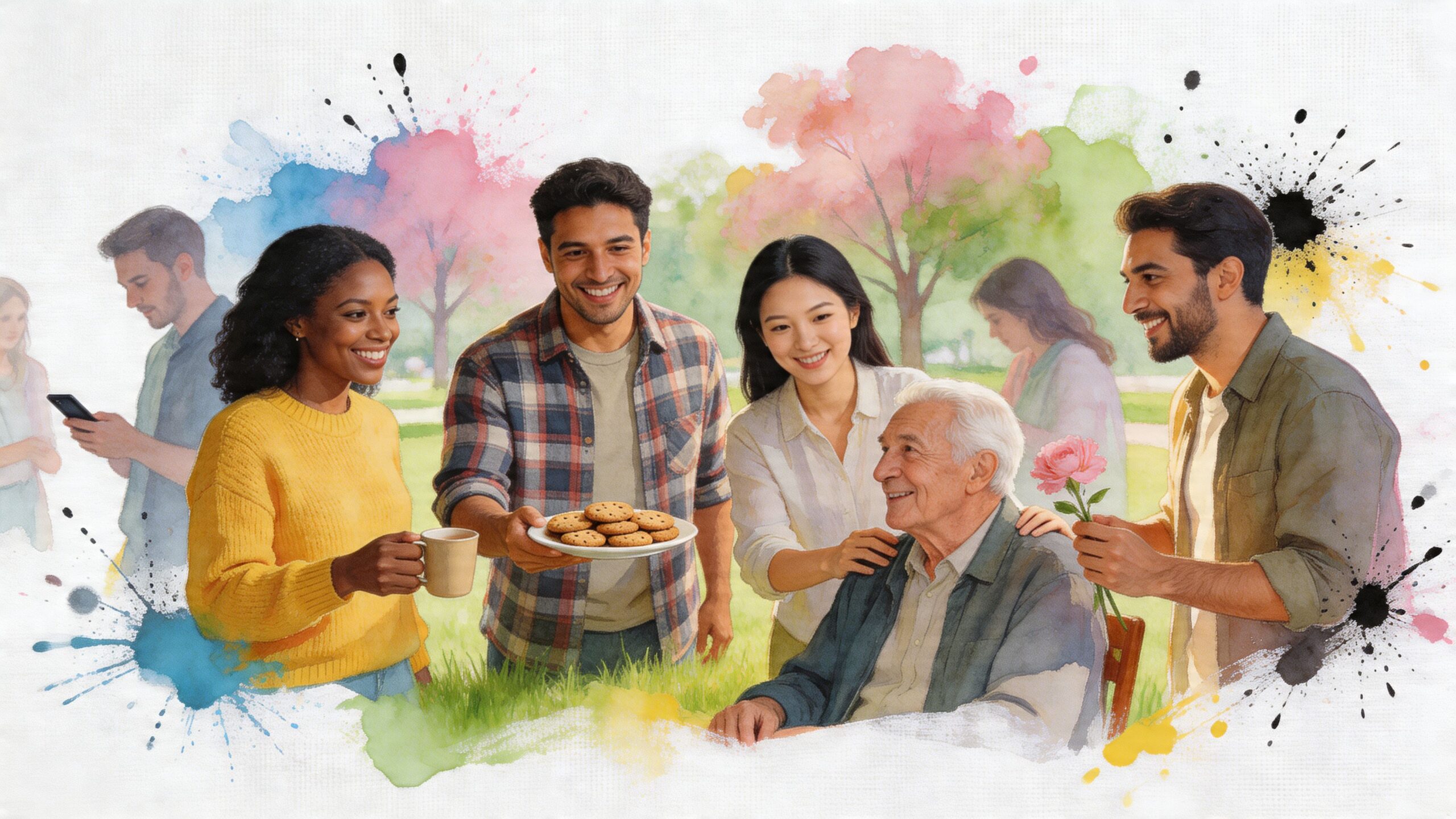
    A diverse group of adults and an elderly man sharing cookies and flowers in a park setting.

    Why challenge reveals character

    A warm café is great for catching up with people you already trust. It’s not great for screening new ones. Everybody looks generous when the lighting is soft and the stakes are zero.

    A service activity in bad weather tells you more.

    You notice who shows up early.
    You notice who shares gloves.
    You notice who complains for two hours and who makes the whole thing feel lighter.
    You notice who sees an older volunteer struggling with a bag and helps without turning it into theater.

    That’s what I mean by filtering for givers. Not saints. Not perfect people. Givers. People who can carry a little discomfort without making it everyone else’s problem.

    A strong social life doesn’t come from collecting whoever is available. It comes from building around people with the right instincts.

    The activity is the filter

    The best social settings aren’t always the most comfortable. They’re the most revealing.

    A weekend morning volunteer shift does something a random happy hour doesn’t. It asks for effort. It asks for wakefulness. It asks for a tiny act of selflessness before brunch and errands and scrolling can swallow the day. That alone changes who walks through the door.

    The logic here is simple. If the activity requires consistency, a little grit, and some public usefulness, it naturally attracts people who value those things.

    That isn’t just my opinion. Jen Hatmaker’s article on finding your people includes this idea directly: strategically engineering social circles by activity design is a powerful filtering tool, and scheduling volunteer events on weekend mornings can naturally attract givers over partiers. The same verified material notes that a 2025 Corporation for National & Community Service report found volunteer retention doubles in adversity-groups, which supports the point that shared struggle builds committed circles.

    If you keep meeting flaky, self-involved people, stop blaming your luck and start auditing your settings.

    What this looks like in real life

    I’ve watched people bond faster while carrying trash bags through wind than they ever did at polished networking events. Not because suffering is magical. Because challenge strips away performance.

    Here’s what service-based challenge gives you that generic social advice doesn’t:

    • A built-in job: You don’t have to invent conversation from thin air. You already share a task.
    • Visible character clues: You see kindness, patience, grit, and selfishness in motion.
    • Low-pressure repetition: People come back regularly, so you don’t have to force instant intimacy.
    • A reason to care together: Shared purpose gives the interaction weight.

    That’s why meeting like-minded people through intentional community settings works better than floating through random social noise. The right structure does half the work for you.

    Stop waiting for spontaneous friendship

    A lot of adults still cling to a high school fantasy. You sit near someone enough times, say a few funny things, and suddenly you’re close. That happened more easily when life shoved us into shared spaces every day. Adult life doesn’t do that.

    You have to build your own ecosystem now.

    That means choosing places where the social outcome isn’t the only point. Ironically, that’s what makes connection more likely. When people focus on helping, hauling, sorting, carrying, or fixing, they relax. They reveal themselves. They become easier to trust.

    And trust is the whole game.

    You don’t need to become more universally appealing. You need to become more intentional about where you invest your hours. Friendship grows best where values show up in behavior.

    If you want a tribe, don’t just chase people. Chase a cause that forces good people to become visible.

    Your Step-by-Step Guide to Making the First Move

    The first move feels huge when you’ve been lonely for a while. Your brain turns “say hi” into “perform a TED Talk while being judged by a panel.” I know that feeling well.

    I used to stand near people I wanted to know and act busy. I’d tie a bag. Adjust my sleeve. Look very interested in a random leaf. I was physically present and socially absent. That’s a brutal habit because it lets you tell yourself you’re trying when you’re really hiding.

    The fix started with one idea. You probably think people like you less than they do.

    The liking gap is messing with you

    Dr. Marisa G. Franco’s Acceptance Prophecy Methodology addresses the liking gap, where people underestimate how much others like them by 50-60%. Her approach is simple but powerful. Assume baseline likability. That shift can increase your own friendliness by up to 40% and can raise the success rate of turning group acquaintances into one-on-one friends to 70%, as described in Dr. Franco’s guide to making friends as an adult.

    That idea changed the script in my head.

    Before, I’d leave an interaction thinking, “I was awkward.” After learning this, I started asking, “What if they enjoyed that more than I think?” That one question made me warmer, more direct, and less weirdly defensive.

    You do not need certainty before you act. You need a more generous interpretation of how you’re being received.

    The four-part move

    I like simple systems because anxiety loves fog. Here’s the one I use.

    1. Show up enough times for familiarity to do its job

    Don’t treat the first event like speed dating for best friends. Your first task is repeat exposure. Come back. Let people see your face enough times that your presence starts to feel normal.

    If you disappear after one appearance, nobody has enough material to trust you yet.

    2. Assume they’ll be glad you spoke

    This is the inner move. Before you walk over, say something like, “They probably don’t need me to be impressive. They just need me to be human.”

    That sounds small. It isn’t. It changes your body language. You smile sooner. You stop overediting. You become easier to talk to.

    3. Open with the obvious truth in front of you

    Forget clever. Use what’s happening right now.

    A lot of people freeze because they think the opener has to sparkle. It doesn’t. It has to land. Real life already gives you material.

    Here are a few openers that work because they’re specific and low-pressure:

    Conversation Starters That Actually Work
    The Situation Your Opening Line
    You’re both grabbing supplies “Hey, have you done this route before, or are you winging it like me?”
    It’s freezing or raining “I can’t decide if this weather is miserable or kind of funny.”
    They did something helpful “That was kind of you. You noticed that fast.”
    You keep seeing them each week “I think we’ve been orbiting the same events for a while. I’m glad we finally said hi.”
    You’re walking between tasks “What made you start coming out to this kind of thing?”
    The event just ended “I’m starving after that. Are you headed straight home or doing a recovery snack somewhere?”

    4. Make the tiny invitation before the moment closes

    Many hesitate at this stage. They have a decent conversation, then leave with a polite smile and no bridge to the next one.

    You need a bridge.

    Not a giant one. A wooden plank. Something easy.

    Try these:

    • After a good chat: “I liked talking with you. Want to grab coffee after this next time?”
    • When you’ve seen them more than once: “You seem fun and solid. Want to swap numbers so we can coordinate next week?”
    • When you share a local connection: “You’re in my area too? We should do a neighborhood walk sometime.”

    None of these lines are too much. They’re clear. Adults appreciate clear.

    What awkward people do wrong

    I say this with love because I’ve done every one of these.

    • You hover instead of entering: You stand nearby and hope someone rescues you.
    • You wait for perfect timing: There isn’t any.
    • You talk once and vanish: Repetition builds trust.
    • You confuse chemistry with momentum: A pleasant moment means nothing if nobody follows up.
    • You make the invitation too big: Don’t jump to “we should all take a weekend trip.” Start with coffee.

    A script for the whole interaction

    If you want a practical sequence, use this:

    1. Approach: “Hey, I’m [your name].”
    2. Anchor to the moment: “This wind is trying to humble us.”
    3. Ask one simple question: “How’d you get into this?”
    4. Reflect something back: “That makes sense. I like that.”
    5. End with a small next step: “I’m glad we talked. Want to swap numbers and say hi next time?”

    That’s enough. Really.

    For more ideas on community-building activities for adults, look for settings where people do something together instead of only talking about doing something someday. Shared action makes every one of these steps easier.

    The tough-love truth

    Nobody is coming to tap you on the shoulder and announce that now it’s socially safe for you to begin. Adult friendship often starts when one person decides to risk a mildly awkward moment on purpose.

    Let that person be you.

    You don’t need swagger. You need reps. You need to stop worshipping coolness and start practicing contact. Most friendship failure doesn’t come from rejection. It comes from stalled effort.

    Say hi. Stay a few minutes longer. Ask the follow-up. Make the small invitation.

    That’s how strangers stop being scenery.

    The 200-Hour Journey From Acquaintance to Friend

    Most adults quit too early.

    They meet someone good, have one nice conversation, maybe even exchange numbers, and then they expect the friendship to self-assemble. When it doesn’t, they decide the spark wasn’t real. I used to do that too. I thought closeness should feel spontaneous if it was “meant to be.”

    Friendship is less like lightning and more like stacking firewood. One log doesn’t heat the house. Enough logs, placed regularly, will.

    Friendship takes longer than you think

    Research from the University of Kansas found that adult friendship grows through time spent together. It takes about 50 hours to move from acquaintance to casual friend, 90 hours for a real friendship, and more than 200 hours for a close bond, according to this summary of the University of Kansas friendship research.

    That number can feel discouraging until you understand what it means. It doesn’t mean you need one giant emotional marathon. It means closeness comes from repeated ordinary contact.

    A timeline chart titled The 200-Hour Journey to Friendship showing the time needed for different friendship levels.

    Why recurring activities are a friendship accelerator

    This is why recurring service matters so much. A weekly event solves three adult friendship problems at once.

    First, it removes decision fatigue. You don’t have to keep inventing plans.
    Second, it gives you a stable backdrop for repeated contact.
    Third, it creates a rhythm where following up feels normal instead of random.

    A one-off party gives you a spike. A weekly habit gives you a ladder.

    A working rule: Don’t ask, “Did we click?” Ask, “Did we spend enough time together for trust to form?”

    What those hours actually look like

    People hear 200 hours and picture some dramatic montage. Real friendship is usually built from much less glamorous moments.

    It’s the walk to the train after the event.
    It’s the ten-minute chat while sorting supplies.
    It’s the shared snack afterward.
    It’s texting, “You still going tomorrow?”
    It’s seeing how someone acts when plans get messy.

    The hours count because they accumulate context. You stop knowing only their funny side. You start learning how they handle stress, disappointment, lateness, weather, tiredness, small joy, and boring tasks. That’s when trust stops being theoretical.

    A practical rhythm for the long game

    If you’ve met someone promising, don’t leave it to chance. Use a rhythm.

    Week one

    Talk at the event. Keep it light. Find one point of overlap. Neighborhood, work rhythm, food, books, weird weather tolerance, anything.

    Send a short follow-up if you swapped numbers:
    “I liked talking with you today. Glad we met.”

    Week two

    Find them again. Reference the earlier conversation.
    “How did that exam go?”
    “Did you ever try that coffee place?”
    “Are you still on for next weekend?”

    That one callback matters. It tells them you weren’t just being socially polished. You were paying attention.

    Week three or four

    Add a small one-on-one extension connected to the shared activity.

    • Grab coffee after
    • Walk to the station together
    • Share a meal nearby
    • Invite them to a related errand or neighborhood stop

    Short is better than elaborate. You’re not trying to impress them. You’re trying to widen the lane.

    The mistake of waiting for intensity

    A lot of adults think a real friend should arrive with instant emotional depth. That expectation wrecks good beginnings.

    Close friendship usually starts off humble. You joke about gloves. You compare terrible apartment stories. You complain about wind chill. You remember each other’s names. You carry bags. That can look small from the outside. It isn’t.

    Small interactions are deposits. Keep making them.

    Here’s what helps those deposits grow:

    • Consistency beats charisma: I trust the person who returns.
    • Specific invitations beat vague hopes: “Coffee after next Saturday?” works better than “We should hang sometime.”
    • Shared labor beats endless talking: Doing a task together gives the bond a spine.
    • Follow-up beats fantasy: If you don’t act on a good interaction, it evaporates.

    How to know when to deepen the friendship

    You don’t need a formal milestone. Watch for these signals instead:

    • Conversation expands naturally: You’re not forcing topics anymore.
    • They initiate too: They text first, save you a spot, or ask if you’re coming.
    • You’ve seen each other in different moods: Tired, rushed, happy, annoyed.
    • The hangouts leave the original setting: You talk before or after, not just during.

    When that happens, deepen carefully. Offer a little more of yourself. Not a trauma dump. Just more reality.

    Try:
    “I’ve been trying to build a more solid circle lately.”
    “I’m glad I started showing up here. I needed this more than I realized.”
    “You seem like someone who follows through. I appreciate that.”

    That kind of honesty opens the door without kicking it off the hinges.

    A simple model for reaching 200 hours

    You don’t need to calculate this like a spreadsheet, but it helps to think in seasons.

    If you spend a few hours a week around the same people, plus occasional follow-ups outside the event, those hours add up. The magic isn’t speed. It’s regularity. Adult closeness grows when time stops being accidental.

    I like to think of it in layers:

    1. Recognition
      You know each other’s names and faces.

    2. Familiarity
      You’ve had enough repetition that the interaction feels easy.

    3. Reliability
      You expect to see each other and notice when the other person isn’t there.

    4. Trust
      You share more truth. You help each other. The friendship starts existing outside the original context.

    5. Belonging
      The person becomes part of your real life, not just your Saturday life.

    That’s the journey.

    The emotional payoff of the slow build

    The beauty of recurring challenge is that it sneaks the hours past your resistance. You’re not sitting across from a stranger trying to force intimacy over one expensive drink. You’re living side by side for a while. That’s closer to how childhood and college friendships formed. Not by magic. By repeated exposure, shared inconvenience, and enough ordinary moments to become known.

    If you’ve struggled with how to make friends as an adult, this is the part to tattoo on your brain. Stop judging early connections by intensity. Start judging them by whether the structure allows enough hours to accumulate.

    A good recurring activity isn’t just where you meet people. It’s the machine that turns contact into closeness.

    Show up. Keep showing up. Then make the extra half-step after the event. That’s how acquaintance becomes friend without either of you needing to force it.

    Friendship Is the Reward for Becoming a Better You

    At some point I realized I had been asking the wrong question.

    I kept asking, “How do I get friends?”

    A better question was, “Who am I becoming when nobody’s watching?”

    That question annoyed me at first because I wanted a social solution, not a character arc. I wanted a better calendar, not a better backbone. But friendship kept teaching me the same lesson. The people I most wanted in my life were drawn to bravery, steadiness, kindness, and effort. So if I wanted that kind of circle, I had to practice those traits before I felt fully ready.

    Service changes your posture

    When you serve, something subtle happens. You stop standing in the center of your own insecurity. You still feel shy sometimes. You still overthink. But your attention has somewhere better to go.

    A bag needs carrying.
    A corner needs cleaning.
    A new person looks nervous.
    Someone forgot gloves.
    The job is right there.

    That shift matters because self-consciousness is sticky. Purpose unsticks it.

    I’ve seen people arrive withdrawn, unsure, half-apologetic for taking up space. Then they spend enough time doing useful work beside good people and their whole posture changes. Their jokes come out easier. Their eye contact steadies. Their standards rise. They stop chasing random approval because they’ve started building earned self-respect.

    Friendship often arrives as a side effect. You become more trustworthy to yourself first.

    You don’t attract what you want. You attract what you rehearse

    Tough love enters the scene.

    If you rehearse flakiness, you’ll keep building flaky dynamics.
    If you rehearse hiding, you’ll keep collecting shallow contact.
    If you rehearse chasing exciting but unreliable people, you’ll keep ending up lonely in crowded rooms.

    You need new reps.

    Mark Manson’s Selective Effort Principle argues that investing 10+ hours a week in personal growth can boost your baseline attractiveness by 40%, and that passionate people attract 2.7x more invitations, as described in Mark Manson’s article on making friends. The deeper point matters more than the numbers. Shift from hunting for friends to becoming a person who naturally draws healthier connection.

    That tracks with what I’ve lived. The strongest friendships in my adult life didn’t start when I got more charming. They started when I got more solid.

    Pride helps more than people admit

    A lot of adults feel embarrassed by visible belonging. They think pride is corny. I used to think that too.

    Now I think pride is fuel.

    Teams know this. Marching bands know this. Cities know this. Shared symbols matter because they turn a loose gathering into a living identity. A badge, a ritual, a nickname, a song, a repeated joke, a familiar route, even a goofy tradition after the work is done. Those things say, “We are not just random individuals floating near each other. We are building something.”

    That sense of identity protects friendship because it gives people a reason to return even when life gets messy.

    Here’s what healthy group pride can do:

    • It makes consistency easier: People return to identities, not just events.
    • It softens awkwardness: Ritual gives shy people a script.
    • It creates memory: Shared symbols make ordinary effort feel meaningful.
    • It strengthens courage: Belonging helps people try harder things.

    I’m not saying you need costumes and chants. I’m saying don’t underestimate the power of shared spirit. Adults need it too.

    The caterpillar lesson

    I love the image of a caterpillar because it’s honest. A caterpillar isn’t sleek. It’s not glamorous. It crawls. It does the work slowly. It looks a little ridiculous if you judge it too early.

    That’s most of us in the middle of rebuilding.

    We are not polished when we begin. We are trying. We are carrying our own mess, our old habits, our fear of rejection, our shame about how long we stayed isolated. We are learning consistency after years of drift. We are learning bravery in public. We are learning to be kinder than our old environments taught us to be.

    And if we keep going, we change.

    Not in the fake self-help way where your life becomes perfectly curated. In the real way. You trust yourself more because you’ve kept promises to yourself. You forgive yourself more because you’ve done something useful with your pain. You become easier to love because you’re no longer living entirely from defense.

    That’s when friendship deepens. Not because you performed your way into a circle, but because the person standing there is more available, more grounded, and more aligned.

    What to do this week

    If you’re lonely, don’t turn this article into a thought exercise. Pick a challenge with a purpose and put it on your calendar.

    Do it even if you feel awkward.
    Do it even if you don’t feel instantly at home.
    Do it even if you have to go alone.

    Then return.

    Talk to one person.
    Remember their name.
    Ask one follow-up question.
    Make one tiny invitation.
    Come back next week.

    That’s the playbook. Not glamorous. Effective.

    You do not build a tribe by wishing for one. You build it by becoming someone who can help carry the bags, laugh in bad weather, and stay when the novelty wears off.

    And the wild part is this. Once you start doing that, you won’t just find better friends.

    You’ll like yourself more in their company.


    If you want a place to practice this in real life, Litter Caterpillars offers a simple, brave way in. You show up on a weekend morning, help clean a piece of Chicago, and meet people who chose service over sleep and excuses. That’s a strong starting point for anyone serious about how to make friends as an adult.


  • Discover young professional networking events: 8 Chicago picks for connections

    Discover young professional networking events: 8 Chicago picks for connections

    I remember it. The stale air. The forced smiles. That lukewarm glass of wine in my hand, a flimsy shield against the awkwardness. You’re supposed to be "networking," but it feels like you're performing a role in a play you never auditioned for. It’s a transaction. A hollow exchange of titles and elevator pitches. I’ve been there. You’ve been there. It’s exhausting.

    For a long time, I thought this was just the price of admission. The cost of climbing some ladder I wasn't even sure I wanted to be on. I’d come home with a pocketful of business cards, these little paper tombstones of conversations I’d already forgotten. But here’s the secret: the problem isn’t you. It never was. The problem is the game itself. A game designed for shallow handshakes, not deep hand-holds.

    What if we just ripped up the rulebook? Imagine networking wasn't something you did, but something that happened. Something that grew organically while you were busy doing something else—something meaningful. Like solving a real problem with a small team of brilliant people. Or discovering a hidden corner of your city. That’s what we’re going to explore.

    I’m going to walk you through 8 kinds of young professional networking events that feel less like work and more like life. These aren't about collecting contacts like they're trading cards. This is about finding your people. The ones who get it. The ones you build things with.

    1. Volunteer-First Community Service Events

    Picture this. You're not balancing a tiny plate of cheese cubes and trying to shout over music. Instead, you're side-by-side with someone, both of you covered in a little bit of dirt, working to restore a neighborhood garden. You laugh about a stubborn weed. You high-five after planting a tree. That’s where the real connection happens. Volunteer-first events are like a networking life-hack; they flip the entire script. The goal isn't to network. The goal is to get something done, together. The networking? That’s just the beautiful, inevitable consequence.

    You show up. You grab a tool. You start working. Suddenly, you're not a "Marketing Manager" talking to a "Software Engineer." You're just two people, united in purpose. The conversations flow without effort because they’re rooted in a shared action, not a shared agenda. I promise you, the strongest professional relationships I’ve ever built were forged not in boardrooms, but in parks and on trails.

    Who This Suits Best

    This is for you. If you're done with the performance of networking and you just want something real. It’s a magnet for people who are driven by purpose, not just profit. You’ll find your tribe here if you believe that what you do is more important than what you call yourself.

    Real-World Examples in Action

    • Litter Caterpillars: I have to start here. This Chicago group turned weekly cleanups in all 50 city wards into a movement. You explore the city, you make a real, visible difference, and you meet amazing people. It’s brilliant.
    • Surfrider Foundation: Their beach cleanups are electric. You connect with other young professionals who are just as passionate about protecting our oceans as you are.
    • Sierra Club Chapters: They host trail maintenance days that are perfect for people who want to mix their love for the outdoors with genuine community building.

    Key Insight: Think of it like building a bridge. You can talk about building a bridge all day, or you can pick up a hammer and start building it with someone. Which one creates a stronger bond?

    How to Maximize Your Experience

    To turn these young professional networking events into a core part of your life, you have to treat it like a relationship, not a transaction.

    • Become a Regular: Show up. Again and again. Consistency is the soil where deep roots grow. When people see you week after week, trust builds naturally.
    • Arrive Early, Stay Late: The real gold is often found in the margins. The conversations you have while setting up, or the casual coffee you grab with a few people after the event is done—that’s where friendships start.
    • Mentor a Newcomer: Once you know the ropes, take a new person under your wing. Be their guide for the day. Teaching is one of the most powerful ways to connect and establish yourself as a leader.

    You build your best network when you’re not trying to build a network at all. You just show up to serve. If you feel that spark, go find volunteer work near you that speaks to your soul.

    2. Skills-Swap and Peer Learning Circles

    Forget the sage on the stage. The one-way firehose of information that puts you to sleep. Imagine a circle. A small group where, one minute, you’re the student, soaking up knowledge, and the next, you’re the teacher, sharing your own expertise. This is a skills-swap. It’s a living, breathing workshop where networking is transformed from a passive sport into a collaborative jam session.

    You might show up to learn the basics of SEO from a digital marketing guru. And that same guru might be there to learn your secrets for crafting a killer presentation. The whole pyramid of hierarchy just melts away. Respect here isn't earned from a fancy job title. It’s earned by what you know and your willingness to share it. It’s a community built on a simple, powerful idea: let’s all get better, together.

    Who This Suits Best

    This is your jam if you learn by doing. If you believe that everyone has something to teach and something to learn. This space is built for ambitious people who want to collect skills, not just business cards. If you want a network of people you can actually call when you’re stuck on a problem, you’ve found your home.

    Real-World Examples in Action

    • Lean In Circles: These are powerhouse groups for women. They meet regularly in a confidential space to mentor each other, learn new leadership skills, and tackle challenges as a team.
    • Nonprofit Leadership Cohorts: I’ve seen organizations like Nonprofit HR create these amazing cohorts where emerging leaders come together to share their struggles and master everything from fundraising to board management.
    • Tech Community "Lunch and Learns": A classic for a reason. Developers, designers, and project managers get together over pizza to teach each other the latest coding trick or design tool. It’s simple, effective, and collaborative.

    Key Insight: Teaching is like learning something twice. When you teach a skill, you solidify it for yourself and earn someone's deep respect. When you learn from a peer, you create a bond of gratitude that lasts.

    How to Maximize Your Experience

    To squeeze every drop of value from these young professional networking events, you have to be more than just a face in the crowd. You have to be a participant.

    • Offer to Lead a Session: Don't wait for an invitation. Step up. You have a skill someone else wants to learn, whether it’s managing your inbox or reading a spreadsheet. Proposing a topic is the fastest way to become a leader in the group.
    • Come Prepared to Learn: When it’s your turn to be the student, do your homework. If the topic is new to you, read an article or two beforehand. Showing up with thoughtful questions tells the facilitator you value their time.
    • Follow Up with Action: This is the big one. If someone teaches you a new skill, go use it. Then, circle back and tell them how it went. "Hey, I used that Excel formula you taught me and it saved me an hour." That feedback is pure gold and cements your connection.

    You’re not just trading information. You’re trading trust. You’re building a network of people you’ve actively helped and who have actively helped you.

    3. Themed Neighborhood Exploration Tours

    Stop thinking of networking as an event you have to endure. Start thinking of it as an adventure you get to join. Imagine you’re not in a beige conference room; you’re walking through a historic Chicago neighborhood, uncovering its secrets. Then, you and your new friends roll up your sleeves to help clean a local park. This is what a themed neighborhood tour does—it combines the thrill of discovery with the soul of community service.

    The city becomes your meeting room. Your agenda is a map. The conversations happen naturally as you walk, discovering a hidden piece of street art or learning the story behind an old building. The shared experience of seeing your city with fresh eyes, and then leaving it a little better than you found it, is a powerful glue.

    A young couple walks a city street, man points, holding coffee, map floats by vibrant graffiti wall.

    Who This Suits Best

    This is for the curious. The explorer. The person who believes that the best way to understand a place is to walk its streets. If you want to build a connection to your city while you build connections with people, this is for you. It attracts an adventurous, open-minded crowd that cares about the story of their community.

    Real-World Examples in Action

    • Litter Caterpillars: Their 50-ward model is genius. Each event is a deep dive into a new Chicago neighborhood. You learn its history, meet its people, support its local businesses, and clean its streets.
    • Jane's Walk: These are citizen-led walking tours inspired by the great urbanist Jane Jacobs. They are less of a tour and more of a walking conversation about what makes a neighborhood tick.
    • Neighborhood-Focused Groups: I’ve seen so many young professional groups do this. They'll organize a food tour of a specific neighborhood, or a historical walk that ends at a local brewery. It’s social, educational, and fun.

    Key Insight: Think about your best travel memories. They’re almost always tied to a specific place and a shared experience. These tours do the same thing, but in your own backyard. You’re creating a shared memory, and that's a powerful foundation for any relationship.

    How to Maximize Your Experience

    To make these explorations more than just a pleasant afternoon, you have to be an active participant in the adventure.

    • Create a 'Passport': Get a small notebook. Every time you explore a new neighborhood, jot down one cool fact you learned and the name of one person you connected with. It turns the series of events into a personal quest.
    • Be the Storyteller: Before you go, spend five minutes on Google. Find one fascinating, obscure fact about the neighborhood. Sharing that with the group is a simple, powerful way to add value and start a conversation.
    • Lead a 'Before & After': Offer to be the unofficial photographer. Snap a picture of a spot before the cleanup and another one after. It's a small act of leadership that gets you talking to everyone and creates a great story to share online later.

    When you turn your city into a playground for connection, you build a network that’s as rich and diverse as the neighborhoods themselves.

    4. Purpose-Driven Cohort Programs

    Imagine this. You're not just at a one-off event. You've joined a crew. A team of twenty other passionate people, all committed to tackling a massive challenge together over the next six months—like launching a city-wide composting initiative. You meet every week. You learn together. You push each other. You build something real. That’s a purpose-driven cohort.

    This model is the antithesis of the fleeting, superficial networking event. It’s an investment. It’s a commitment. You're not just meeting people; you're becoming part of a tribe that is moving in a single, powerful direction. The bonds you forge in a cohort are different. They're deeper. They're forged in the fires of shared struggle and shared success. These aren’t just contacts; they become your allies.

    Who This Suits Best

    This is for you if you're hungry for depth and accountability. If you’re tired of conversations that only scratch the surface and you want to be part of something bigger than yourself. A cohort is a launchpad for ambitious people who want a structured journey toward growth, supported by a community that has their back.

    Real-World Examples in Action

    • StartingBloc: They run these incredible fellowship programs that are like a boot camp for social innovators. You go through an intensive institute and then you have this lifelong network of support.
    • Green 2.0 Leadership Program: This is a cohort-based program laser-focused on advancing racial equity in the environmental movement. It’s powerful, necessary work.
    • Local Caterpillar 'Leadership Track': This is the next level. They train small, local cohorts to become leaders who can organize their own community cleanup groups. It’s about creating a ripple effect of impact.

    Key Insight: It’s like the difference between being a fan in the stands and a player on the team. When you’re on the team, you’re invested. You win together, you lose together, and you build a bond that spectators can only imagine.

    How to Maximize Your Experience

    To truly harness the power of these intensive young professional networking events, you have to go all in.

    • Commit Fully: Show up. To everything. The retreats, the weekly calls, the optional coffee meetups. The real magic happens in the consistent, cumulative time you spend together.
    • Be Vulnerable and Open: The strength of the cohort is directly proportional to the honesty of its members. Share your real struggles, not just your polished wins. That’s what allows the group to actually help you.
    • Champion Others: Make it your mission to help your fellow members succeed. Make introductions for them. Share resources that could help them. Celebrate their victories as if they were your own. What you give, you will get back tenfold.

    Joining a cohort isn't like attending an event. It’s like enrolling in a shared destiny. You’re building a network that will be a foundational part of your career for years to come.

    5. Impact-Focused Happy Hours and Social Gatherings

    Picture a happy hour. But instead of the usual forced chatter about quarterly reports, the room is buzzing with conversations about building a better city. The energy is different. It’s inspiring. This is an impact-focused happy hour, where the price of admission isn't a business card, but a shared passion for making a difference.

    These gatherings intentionally lower the stakes. They’re casual, often held in a local coffee shop or a park. The goal is to strip away the pretense and create a space where you can connect as a human first, and a professional second. The conversations naturally shift from "So, what do you do?" to "So, what are you passionate about?" And that one small change makes all the difference in the world.

    Four diverse young professionals networking over coffee and croissants at a vibrant event.

    Who This Suits Best

    This is your scene if you believe your work should mean something. It’s for you if you’re tired of the schmooze-fest and you want to build a network of people who are driven by purpose. If you want to leave a networking event feeling energized and inspired, not drained and cynical, this is your place.

    Real-World Examples in Action

    • Litter Caterpillars: After their weekly cleanups, the group often heads to a local coffee shop. This is where the magic really solidifies. Over a warm drink, volunteers share stories, laugh, and build real friendships.
    • B1G1 (Business for Good): Their mixers are incredible. They bring together entrepreneurs and professionals who are all focused on embedding social impact directly into their business.
    • Impact Hub Chicago: This is a nexus for social innovators. Their community events, from workshops to casual social hours, are a magnet for people who want to change the world.

    Key Insight: It's like tuning a radio. When you tune it to a specific frequency—in this case, "purpose"—you filter out all the static. You attract people who are on your wavelength, and the connection is immediate and clear.

    How to Maximize Your Experience

    To make these young professional networking events more than just a pleasant evening, you need to be a gentle catalyst for connection.

    • Invite a Speaker: Ask a leader from a local nonprofit or a social entrepreneur to come share a five-minute story. It sets the tone and gives everyone something meaningful to talk about.
    • Show Up with Questions: Have a couple of go-to questions that go beyond the surface. Something like, "What's a project you're working on that you're really excited about right now?"
    • Rotate Venues: By hosting these in different neighborhoods each month, you make it easier for new people to join and you get to support a bunch of cool local businesses.
    • Be a Connector: If you see someone standing alone, bring them into your conversation. The simple act of introduction is a powerful form of leadership that makes the whole community stronger.

    When you center your social gatherings on purpose, you create an environment where authentic relationships aren't just possible; they’re inevitable. Dig into these community building activities for adults for more ideas.

    6. Mentorship Matching and One-on-One Programs

    Forget trying to get five minutes with a keynote speaker in a crowded ballroom. Imagine having their undivided attention for an hour, every month. A dedicated guide. Someone who’s already walked the path you’re on, who is there just for you. This is the superpower of mentorship programs. They swap the chaos of the crowd for the focused intimacy of a one-on-one relationship.

    These programs aren’t about random chance. They are about intentional connection. You are thoughtfully paired with an experienced professional whose job is to help you navigate your next steps, build new skills, and avoid the pitfalls they fell into. It’s not about collecting a contact. It's about gaining a champion, an advisor, and a confidante.

    Who This Suits Best

    This is for you if you’re at a crossroads. If you feel stuck, or you’re thinking about a big career change, or you simply want to fast-track your growth. A mentor provides the kind of personalized, strategic guidance you will never find at a happy hour. It’s for people who value the depth of one strong relationship over the breadth of a hundred shallow ones.

    Real-World Examples in Action

    • Green 2.0: This organization runs mentorship programs specifically designed to lift up leaders of color in the environmental sector. It’s about creating real pathways to power and influence.
    • Local Lean In Circles: Many local chapters build mentorship right into their programming, connecting women with experienced leaders who can help them break through barriers.
    • University Partnerships: Your alumni association is a goldmine. Many of them have formal programs that will pair you, a recent grad, with a seasoned pro in your field. It’s a direct line to invaluable industry wisdom.

    Key Insight: A good mentor is like a personal trainer for your career. They don’t lift the weights for you, but they show you the right form, push you to do one more rep, and spot you so you don’t get crushed.

    How to Maximize Your Experience

    To turn a mentorship into a truly life-changing relationship, you have to be the one driving it. You are the CEO of this relationship.

    • Set Clear Goals: Before you even meet, know what you want. A promotion? A new skill? Advice on a specific project? Write it down and share it with your mentor in the first meeting.
    • Drive the Agenda: Don't show up and say, "So, what should we talk about?" That's your job. Come to every single meeting with a list of questions, challenges, and ideas you want to workshop.
    • Follow Through and Report Back: This is crucial. When your mentor gives you advice or suggests an action, go do it. Then, in your next meeting, report back on how it went. This shows them you’re serious and builds momentum.

    When you invest in these structured young professional networking events, you’re not just growing your network. You’re building a personal board of directors for your career.

    7. Project-Based Collaborative Teams

    Let’s move beyond just talking. Let’s build something. Imagine you and a small, dedicated team spend the next three months turning a vacant, trash-filled lot into a beautiful community garden. Or maybe you work together to develop a real policy proposal for your city council. This is the power of a project-based team. It turns networking from a conversation into a creation.

    Four young professionals discuss a landscape design model with miniature trees and blueprints.

    This is a whole different ballgame. It requires you to rely on each other, to solve problems on the fly, to navigate disagreements, and to celebrate a shared victory. The relationships you build in the trenches of a real project are incredibly strong. They are forged in the heat of action.

    Who This Suits Best

    This is for the doers. The builders. The people who get more satisfaction from a finished project than a finished conversation. If you want to develop real, tangible skills—like project management, leadership, and teamwork—while making a visible impact on your community, this is where you belong.

    Real-World Examples in Action

    • Litter Caterpillars: Their "Caterpillar Park" project is the perfect example. A team of volunteers took an empty lot in Englewood and, through sheer teamwork and dedication, transformed it into a vibrant public space.
    • Code for America Brigades: These are local squads of tech professionals who team up to build apps and websites that solve real civic problems for their city. It’s collaborative, high-impact work.
    • Young Invincibles: They often launch project-based campaigns, like advocating for environmental justice policies, where young professionals work together as a team to research, strategize, and make their voices heard.

    Key Insight: When you build something together, you create a shared story of success. The professional connections you make aren't just contacts anymore. They become your co-conspirators, your partners in creation.

    How to Maximize Your Experience

    To make these young professional networking events a success for both you and the project, you need to show up ready to collaborate.

    • Choose a Passion Project: Don't just pick any project. Pick the one that makes your heart beat a little faster. Your genuine passion will be a magnet for other passionate people.
    • Define Roles Early: The first thing your team should do is figure out who is doing what. Having clear roles and responsibilities is the secret to a happy, effective team.
    • Document the Journey: Be the team's storyteller. Take pictures. Write short updates. When you’re done, you’ll have this amazing record of what you accomplished together, which is powerful for everyone's portfolio and for the soul.

    By creating something real with other people, you build a network that is grounded in shared accomplishment. If you want to dive deeper, you can explore these powerful community engagement strategies.

    8. Identity-Driven Community and Cultural Affinity Networking

    Imagine you walk into a room and you can just… breathe. You don't have to explain yourself. You don't have to translate your experiences. You are seen. You are understood. This is the profound power of identity-driven networking. These are events created by and for young professionals who share a common identity—be it race, gender, ethnicity, or sexual orientation.

    These spaces are sanctuaries. They are designed for connection, for solidarity, and for the celebration of shared culture. The networking that happens here is different. It’s less about climbing a ladder and more about building a foundation. It’s about finding your people, sharing strategies for navigating systems that weren't built for you, and drawing incredible strength from the community.

    Who This Suits Best

    This is for you if you've ever felt like the "only one" in the room. If you are tired of code-switching and you just want to connect with peers who get it without you having to say a word. If you see your identity not as a barrier, but as a source of immense power and pride, these are your spaces.

    Real-World Examples in Action

    • Sanctuary 'Queer in Green': These groups create these amazing, vibrant communities across the country for LGBTQ+ professionals in the environmental movement to connect, collaborate, and support each other.
    • Chicago Black Environmental Activists: This group is a vital hub for Black leaders to network, organize, and fight for environmental justice in their own communities.
    • 1% for the Planet: They have specific programs that focus on women in sustainability, creating powerful mentorship opportunities and support systems for female leaders in a male-dominated field.

    Key Insight: Psychological safety is the bedrock of genuine connection. When you feel safe enough to bring your whole, authentic self to the table, networking ceases to be a performance and becomes an act of community building.

    How to Maximize Your Experience

    To honor and contribute to these essential young professional networking events, you have to show up with a spirit of mutual support.

    • Invest in the Community: Don't just be a taker. Be a giver. Actively participate. Offer your help. Share your knowledge. The strength of the community depends on the contributions of its members.
    • Share Your Story: Vulnerability is the currency of trust. Sharing your own journey—the highs and the lows—is what forges the deep, authentic bonds that make these groups so powerful.
    • Become a Mentor or Mentee: Look for ways to lift as you climb. Offer to mentor someone who is just starting out, or seek guidance from someone who has navigated the path ahead of you. This is how we build collective power.

    By connecting with your community, you build a network that is more than just a professional asset. It is a lifeline. A source of strength, resilience, and profound belonging.

    8-Format Comparison: Young Professional Networking Events

    Program 🔄 Implementation complexity ⚡ Resource requirements 📊 Expected outcomes 💡 Ideal use cases ⭐ Key advantages
    Volunteer-First Community Service Events Medium — ongoing coordination, volunteer leadership needed Low–Medium — volunteers, basic supplies, light refreshments Tangible neighborhood impact, steady visibility, authentic friendships Young professionals seeking purpose-driven social bonds and city exploration Builds deep bonds, filters for values-aligned members, habit-forming
    Skills-Swap and Peer Learning Circles Low–Medium — small-group facilitation, rotating leaders Low — space (or virtual), facilitators, simple materials Improved skills, leadership development, stronger professional ties Peers wanting practical skill exchange and leadership practice Empowers participants as teachers; low cost; repeatable
    Themed Neighborhood Exploration Tours Medium–High — route planning, partner coordination, logistics Medium — guides/partners, transit, partner refreshments Discovery-driven engagement, local business support, shareable content Newcomers and adventurous professionals who want exploration + service High appeal for exploration; creates cross-ward connections and social content
    Purpose-Driven Cohort Programs High — curriculum design, cohort management, alumni systems High — facilitators, materials, possible retreat/event costs Deep relationships, measurable growth, ongoing alumni network Professionals seeking sustained development and accountability Creates lasting networks, clear milestones, high retention of committed members
    Impact-Focused Happy Hours & Socials Low — venue booking and light facilitation Low–Medium — venue/refreshments, occasional speaker fees Low-commitment engagement, moderate relationship formation, community outreach Introverts/newcomers and those preferring casual entry to community Accessible, low barrier to entry; easy to run regularly; supports local venues
    Mentorship Matching & One-on-One Programs Medium–High — careful matching, training, ongoing support Medium — mentor recruitment, training, coordination tools High-impact personal growth, retention, leadership development Individuals seeking tailored career guidance and long-term growth Produces highest-impact professional relationships; personalized guidance
    Project-Based Collaborative Teams High — project scoping, team management, deliverable oversight Medium–High — materials, facilitation, sustained volunteer time Tangible community projects, portfolio outcomes, strong team bonds Action-oriented professionals who want measurable community impact Delivers concrete outcomes and develops diverse skills through collaboration
    Identity-Driven Community & Cultural Affinity Networking Medium — skilled facilitation, cultural competency, outreach Low–Medium — facilitators, safe-space resources, accessibility supports Increased belonging, representation, leadership within identity groups Young professionals seeking identity-affirming spaces (e.g., women, BIPOC, LGBTQ+) Fosters belonging and safety; accelerates leadership from underrepresented groups

    Your Network Is Your Life – Start Building It That Way

    So, there you have it. A whole universe of possibilities beyond the stuffy mixer. We’ve journeyed from cleaning up parks to building civic apps, from learning new skills in a small circle to finding strength in a shared identity. The old way—the transactional, soul-crushing way—is dead. It’s over. You have a choice. You can build a network based on something real.

    Modern young professional networking events are an inversion of the old model. They are not about what you can get. They are about what you can give. What you can contribute. What you can build. The connection is the byproduct of the mission. It’s that simple. And each of the paths we explored is just a different door into that same, beautiful truth.

    From Ideas to Action: Your First Step

    I know what you might be thinking. It's so much easier to just stay on the couch. Showing up somewhere new, by yourself, takes courage. I get it. But let me offer you a new frame. Every single person you meet is a potential new direction for your life. The right conversation can unlock an opportunity you never knew existed. The right friendship can change the way you see everything.

    My own life changed forever not at some fancy gala, but while picking up trash in a hailstorm. Seriously. I was huddled under a tree with two strangers, all of us soaked and laughing, and I realized: this is it. This is community. It wasn’t a business card exchange. It was a shared experience. A tiny, perfect moment of shared purpose. And it taught me a lesson I will never forget:

    The strongest bonds aren’t forged over cocktails; they’re forged in collaboration. They are built when you’re side-by-side, working towards a common goal, creating tangible change.

    That’s the secret sauce. You don’t have to be the smoothest talker in the room. You just have to be willing to roll up your sleeves. The pressure to "perform" evaporates when the focus is on the work, not on you.

    Your Challenge: Just Pick One

    So here is my challenge to you. Pick one. That’s it. Just one of these ideas that made something flicker inside you. Don't analyze it to death. Don't wait for the perfect moment.

    • Feel a pull to learn something new? Find a skills-swap.
    • Crave a tangible, visible impact? Sign up for a volunteer event.
    • Longing for a community that just gets you? Seek out an affinity group.

    The goal is to break the inertia. To move from thinking to doing. Show up. Bring your curiosity. Offer your help. The people you’re meant to meet are out there, waiting. They’re not at a mixer. They’re out there, doing the work. Go find them. Your network is not just a tool for your career; it is the fabric of your life. Start weaving it with purpose.


    Ready to put this all into action? The best way to build a network with impact is to start with service. Join me and a community of incredible people at Litter Caterpillars, where we turn neighborhood cleanups into the most meaningful (and fun) young professional networking events in Chicago. Find your next event and sign up at Litter Caterpillars.