
You finish a sandwich at the bus stop, glance down, and two wrappers already sit under the bench. Your hand opens, and the cup hits the pavement before you argue with yourself. That small scene is where I start when I ask why do people litter.
Five Reasons People Litter Even When They Know Better
People litter mostly because the setting makes dropping trash feel easy, normal, and unlikely to matter.
I start with the biggest watch of real behavior I can point you to. Environmental psychologist Wesley Schultz led an observational project, and a Waste360 account of that study says it tracked approximately 9,700 people in public spaces across 10 U.S. states. 17% of people littered overall, and 65% of smokers discarded cigarette butts improperly. 81% of observed littering was intentional rather than accidental. Those people made a choice. They didn't just fumble.
Read the map by setting
Treat the table as a map, not a ranking. Each reason bites hardest in a different place.
| Reason | What the Evidence Shows | What It Means for a Cleanup Group |
|---|---|---|
| Convenience | Passive litter from vehicles and roads accounts for about 40% of litter, and people litter more when bins are absent, distant, or full | Place bins where people already drop trash |
| Social cues | 33% of participants littered when nobody modeled cleanup, and littering fell to zero when someone similar picked up litter and signaled disapproval | Clean spaces and visible stewardship change behavior |
| Values gap | 90.06% of residents in a 2025 Behbahan, Iran study agreed that throwing waste on the ground was wrong, yet 89% reported littering | Focus on habits and friction, not guilt |
| Weak perceived enforcement | Only 31% of surveyed people in a New South Wales review perceived a meaningful risk of a littering fine | Make consequences visible, not only written down |
| Intentional choices | 81% of observed littering in the 10-state study was intentional rather than accidental | Treat littering as a decision that the setting shapes |
Convenience wins at a corner with no can. Your hand wants the short exit, so I put a bin where cups already land.
Social cues work like a crowded sidewalk. If nobody bends down, the next person copies the stillness.
The values gap is the awkward one. People can call littering wrong and still do it when the moment feels small.
Weak perceived enforcement shows up when the block feels unseen. A fine on a poster doesn't tug if you never picture a patrol.
Intentional choice ties the map together. Most of the littering in that 10-state watch was a decision, and the street helped shape it.
Practical rule: Change the setting before you try to change someone's mind. A bin, a clean stretch, and a person who picks up one cup move faster than a lecture.
Think of the last cup, wrapper, or butt you dropped. Name which of the five reasons applied. I do this on my own walk home, and the answer is almost never "I don't care."
Why Good People Drop Trash Anyway
You love your local park. On the drive home you still toss a cup out the car window, then feel a small sting and keep going.
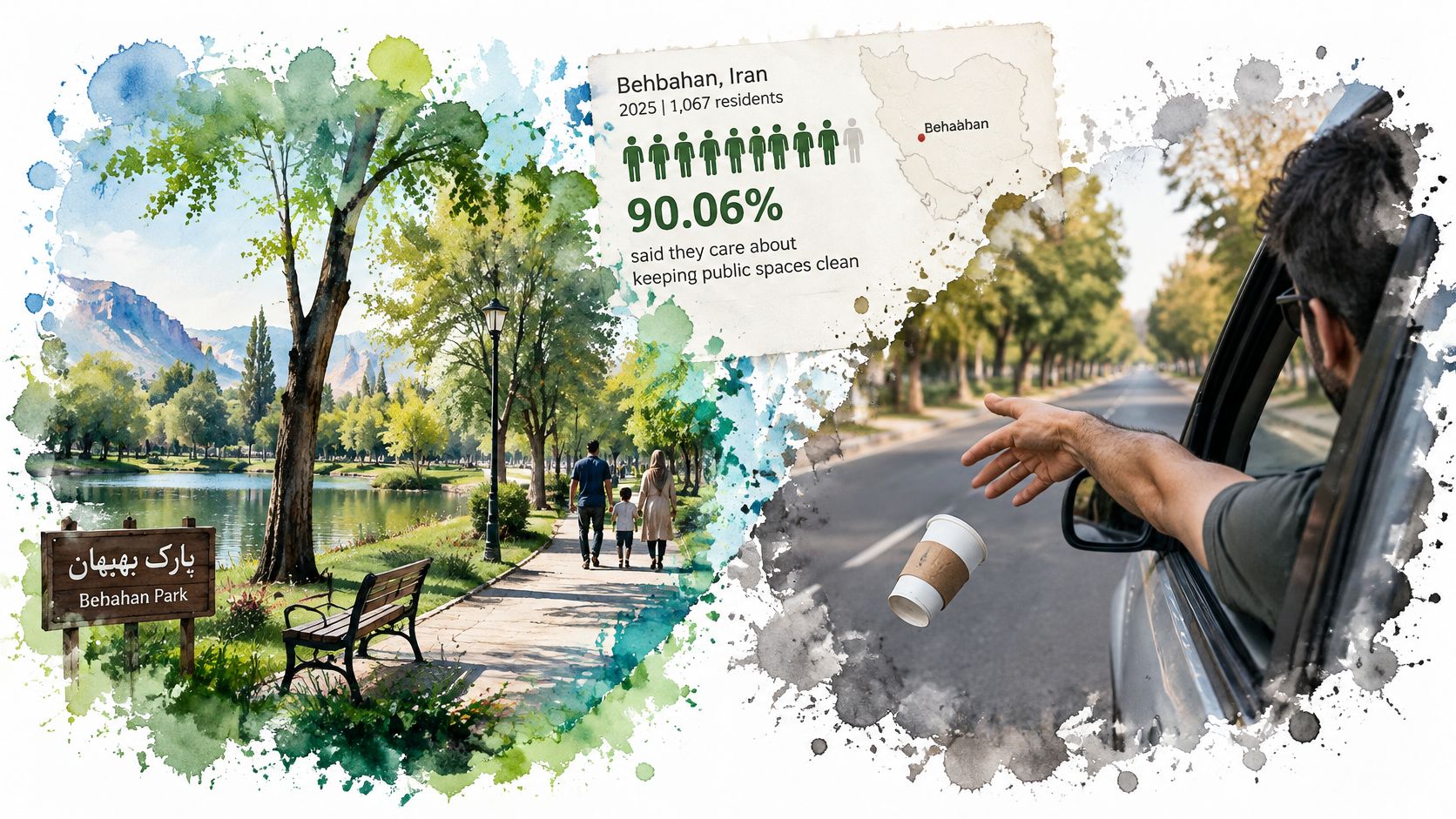
A 2025 study in Scientific Reports asked 1,067 residents aged 15 to 55 in Behbahan, Iran. 90.06% agreed that throwing waste on the ground was wrong, and 89.3% said they could avoid littering by using a trash bin. 89% still reported littering behavior. I read that gap as a side door. You lock the front door on principle. You leave the side door open and don't notice until the wind hits it.
The excuses I hear in my own head
Three lines show up again and again.
Someone else will clean it. In that same Behbahan study, 90.62% believed all litter was collected by the municipal cleaning system. The cup feels temporary, so your hand lets go.
The spot already looks spoiled. One wrapper under the bench tells you the place is written off. Your cup joins a story that seems finished.
Holding it is too much trouble. More than 80% of those residents said they could hold waste for several minutes until they found a container. The ability sits right there. The moment still wins.
Anonymity opens the side door wider. You may drop a cigarette if the corner feels unseen and you don't picture anyone catching you. Shame speeches rarely close that door. A closer bin does. So does a neighbor you can see bending down, because the choice stops feeling private.
I care more about what intrinsic motivation looks like on a block than about a scolding. If you already believe littering is wrong, you don't need a new belief. You need a habit that fires when your hand is full.
Before you scroll on, watch how a single visible choice spreads. I use this clip when I talk with new volunteers, because it shows copying in real time.
List three places where you dropped something, or nearly did. Name the excuse you used each time. Mine are usually "they'll get it" at the curb, "it's already dirty" at the alley, and "I'll miss the light" in the car.
How Missing Bins Turn Your Hand Into a Litter Tool
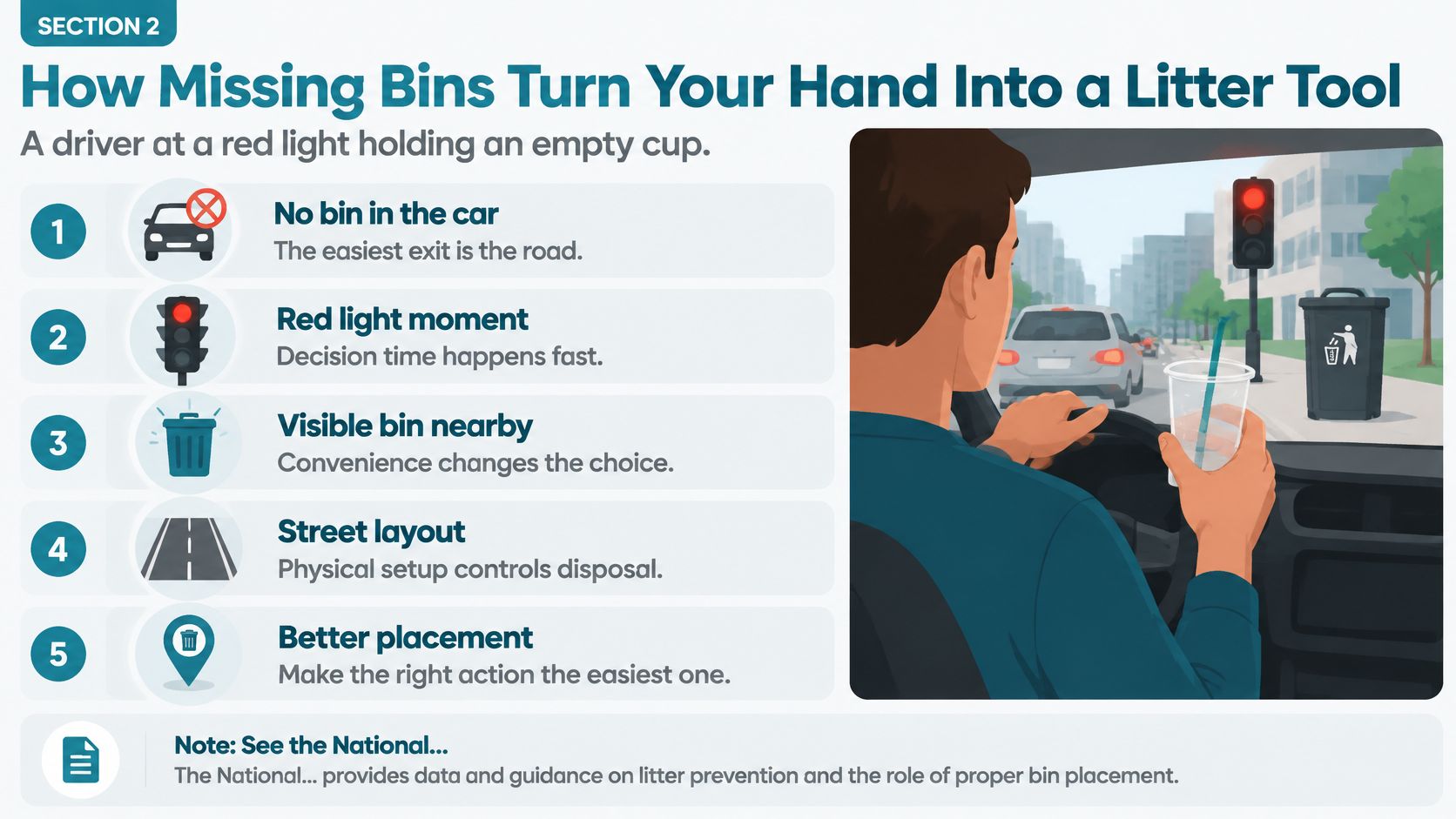
At a red light, an empty cup rolls around the passenger seat. There's no bin in the car, and the light changes before you decide where to put it. A nearby public bin could make the next choice easier.
What the street asks of your hand
Materials from the National Wildlife Federation, drawing on Keep America Beautiful, identify three common triggers: no trash can, a can that is too far away, and a container that is full. The same material estimates that passive litter, such as trash thrown from vehicles or left along roads, accounts for about 40% of litter. A cup tossed at a stoplight and a bag left beside the road both reveal a gap between where people discard things and where a bin is available.
Every extra step makes disposal less convenient. You can see the calculation: carry the wrapper to a bin, or drop it where you stand. An intercept-survey writeup from California State University found that people were less likely to litter when receptacles were available and easy to reach. Younger participants littered more when their own anti-littering norms were weaker. A well-placed bin makes the considerate choice easier to act on.
Food packaging can create the same problem on a walk home. You finish a snack, but the nearest bin is around the corner. A container near the places where people buy food, wait for transit, or gather gives them somewhere to put the trash before it reaches the pavement.
Placement tests you can run this weekend
- Count first. Walk 100 meters and tally litter at different times of day and as people pass. Write down the count before moving anything.
- Follow the route. Mark food sales, transit exits, event routes, and drinking spots. If the nearest bin is past the corner, that corner may need one.
- Check the rim. A full can can be as unusable as no can. Note when it overflows, not only whether it is there.
- Measure again. After a bin is added or moved, count litter over the same 100 meters. A lower count suggests the placement or capacity may have helped. If the count stays level, the street may need attention beyond bin placement.
- Set a weekly emptying routine. If a block has no container, ask the city or ward office about one, and check options for recycling bins in Chicago. A predictable schedule keeps a bin usable and signals that someone is paying attention to the block.
A bin you can see from the place your hand opens beats one you have to hunt for.
Choose a weekly time to check the container and empty it before trash spills over. That small routine keeps the bin useful and shows neighbors that this stretch of street is cared for.
Why Litter Breeds More Litter on the Street
You step off the bus and wrappers crowd the space under the bench. You drop your cup. You didn't hold a meeting about it. You read the scene as an invitation.
A controlled littering experiment, summarized by The Atlantic, found that 33% of participants littered when nobody demonstrated cleanup. When participants saw someone similar pick up litter and signal disapproval, littering fell from roughly one-third of the group to zero. I treat that like a roadside speed limit. You don't only read the sign. You watch the cars around you, and you match them.
The circle, then the reverse
Descriptive norms are what you think other people do here. A workplace field experiment written up by Queensland University of Technology researchers found that observing norm violations increased the probability of littering by approximately 40%. The circle runs in plain steps. Litter says the rule is ignored. Your restraint drops. You add one more item. The next person reads a louder message.
The reverse circle is the same machine with the sign flipped. One clean block says people on this street care. The cigarette-butt field experiment in that same paper found about 0.5 fewer butts during a two-hour period on clean grounds. The change is small. I still want it, because a modest cue is a cue you can repeat.
Clear the whole stretch in one pass. A simulation study in the Journal of Artificial Societies and Social Simulation suggests a single piece of litter can raise how noticeable litter is without clearly strengthening approval or disapproval. A half-finished cleanup leaves the visible mess that keeps the signal alive. I pull every wrapper I can see, then I photograph the bare pavement so neighbors see the new cue, not a pile of bags.
Would you match the speed of the car in front of you, or the number painted on the sign? On a littered block, most of us match the car.
Remove the visible litter fast. Let residents see you and your neighbors at work, bags in hand, talking like this is a normal Saturday. The test I trust is simple. Walk the same stretch two weeks later. If the bench is bare, the cue held. If wrappers returned, the cleanup was a visit, not a norm.
The question I still can't close from the research is this. Does a volunteer cleanup that nobody repeats fade within weeks? I assume yes until a second count proves me wrong.
Why Fines Alone Rarely Stop Littering
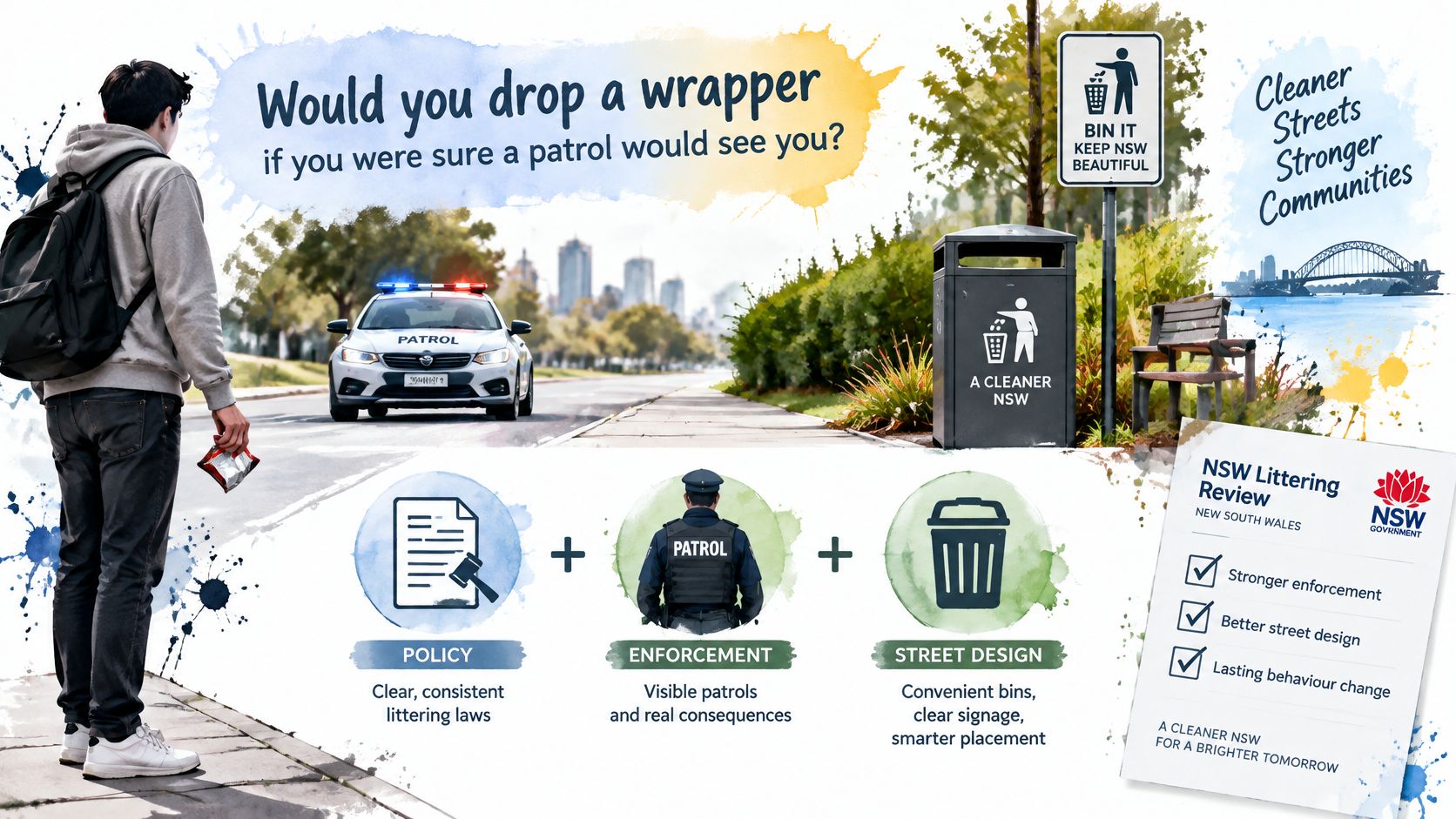
A café owner can post a fine notice by the door, yet still find cups beside the sidewalk bin. A rule has little pull when people doubt anyone will enforce it. A New South Wales Environment Protection Authority review reports that only 31% of surveyed people perceived a meaningful risk of receiving a littering fine. The review found fines did not appear more effective than other prevention strategies, including awareness campaigns. Smokers formed a distinct group whose littering habits were reinforced by social norms.
Certainty beats the size of the number
A large fine that feels unlikely to arrive may have little effect. Enforcement matters when people believe they could be seen, not just when the amount printed on a notice rises. Rules still have a place, but they cannot replace a nearby bin or a street that feels cared for.
Street design can support the rule. Put bins where people walk and pause, including near building entrances and food sales points. Make signs direct: “Cups go here” gives someone a clear next move.
Litter often gathers where bins are scarce, pickup is slow, or foot traffic is heavy. Service gaps are places to investigate, not proof that residents care less. Map bin locations and pickup routes to see where a block needs help first.
Ask three practical questions: How often does pickup run here? Where are the bins? Do repeat litter spots receive extra service? Shared rules work better when people can see them. For a building with written standards, understanding homeowners association rule violations can help clarify how rules and follow-through fit together.
Fines and thoughtful street design work best together. A consequence can set a boundary, while a well-placed bin makes the right choice easier. Each piece of litter signals something about the street; removing it and making disposal convenient helps set a different norm.
How Chicago Groups Can Clean, Sign and Bin a Block
Say a café owner sees wrappers collecting beside the bus stop each morning. A cleanup can clear the stretch, but a return visit shows whether the block has started to change. Litter Caterpillars, a volunteer group based in Chicago, has cleaned all 50 wards, including areas people were told to avoid. The group meets on weekend mornings and has picked up trash every single week.
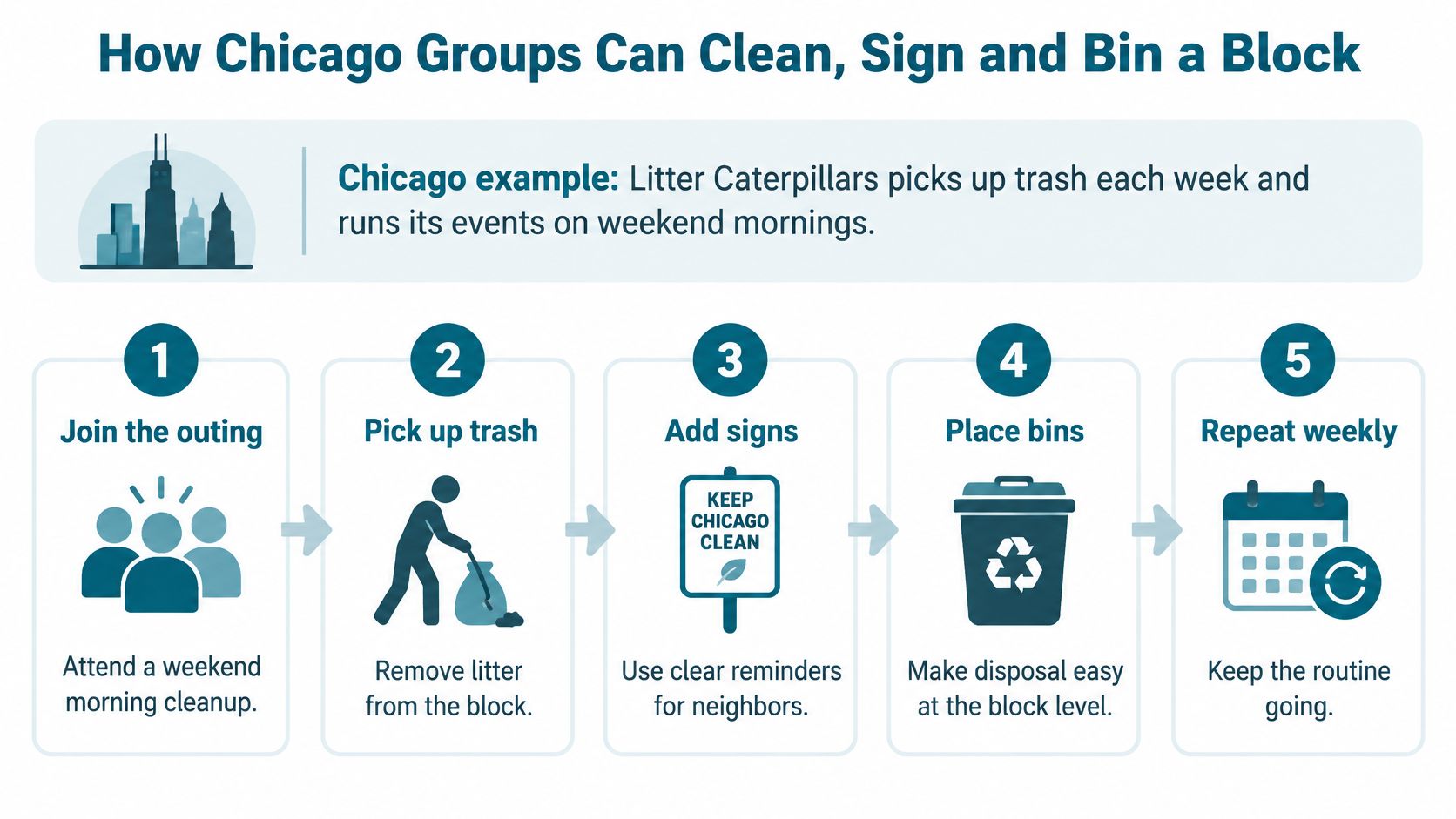
Six steps and why each one earns its place
- Count litter on 100 meters for 10 minutes. Start with a baseline before cleanup. The number of bags collected can feel satisfying, but counting what remains on the ground helps you compare the same stretch over time.
- Clear every visible item on that stretch in one pass. A block that looks only partly cared for can signal that litter is still acceptable there. Aim for a clean, visible reset.
- Map bins and note gaps near bus stops and food sales. Mark bins that are missing, full, or hard to see. This gives residents and businesses a concrete place to start.
- Request or place a bin, and set a service time. Keep the bin usable by arranging when it will be emptied. An overflowing can sends a different signal from a clear, accessible one.
- Add a sign that points to the bin in friendly wording. “Cups and wrappers go in the green can” gives people a simple action. A scolding sign can turn a practical cue into a confrontation.
- Recount after two weeks, then again at thirty days. Compare the same stretch each time. If the count stays level, consider whether the bin needs a better location, more capacity, or more frequent emptying.
How I read the numbers
| Action | Best Block Fit | What to Measure |
|---|---|---|
| Weekly volunteer pickup | Blocks with recurring litter and frequent foot traffic | Litter items per 100 meters each week |
| Bin placement audit | Bus stops, food sales points, and event routes | Bin use and overflow days |
| Signage with friendly wording | Stretches where litter returns soon after a cleanup | Litter items per 100 meters before and after the sign |
| Pairing with block residents | Blocks with active residents or business owners | Number of residents and business owners who join each cleanup |
| 30-day recheck | Every cleaned block | Whether counts stay flat or drop |
Compare the two-week and thirty-day counts before choosing what to change. If litter keeps returning, adjust the bin's location, capacity, or emptying schedule rather than adding another lecture. Litter Caterpillars' weekly weekend trash pickups offer a way to keep returning to the same block and make cleanup a regular neighborhood habit.
Residents and local businesses can help maintain that signal between cleanups. A shop owner can keep an eye on the bin, while a neighbor can flag when it is full. Bring the count sheet to the conversation so everyone can focus on what is happening along the block, not on blaming the people who use it.
Start with one block you pass every day. Count the litter, note the bin gaps, and bring your observations to a Litter Caterpillars weekend outing. Together, neighbors can make care for the street visible, one block at a time.
We pick up trash across Chicago every week, on weekend mornings. If you have been asking why people litter on your street, join the next outing with Litter Caterpillars.