
Let me tell you a story about a four-year-old jar of blueberry jam. For me, social anxiety wasn't just sweaty palms in a crowd. It wasn’t a racing heart before a party. It was a physical weight, a quiet paralysis that made my world shrink day by day until it was the size of my messy apartment.
It was the force that kept me from cleaning out my own fridge. That jam jar sat in the back, a small, sticky monument to a life I had put on hold. A souvenir from a Michigan trip four years ago. And like so many other things in my home, it felt immovable. Each item tethered to a memory, a failure, a future I was too scared to face. Cleaning up my own space felt impossible. Each piece of trash, no matter how small, carried the weight of my past. To me, that jar might as well have weighed 500 pounds.
My Breaking Point
My life hit a wall after a chaotic, painful breakup. Suddenly I was alone, surrounded by the physical and emotional clutter of a relationship that had drained every ounce of my energy. I was stuck. The person I’d been with was always out, always partying. I realized I had been living a life that wasn't mine. At all.
That’s when I knew. Something had to change. A deep, fundamental shift.
I made two promises to myself. First, I would mindfully engineer my social world. I would filter for kindness and filter out selfishness. I desperately needed people who gave more than they took. Second, I would directly confront the things that had always been my personal demons: cleanliness, consistency, and bravery.
This journey to beat social anxiety didn’t start at a loud party. It didn’t begin at a networking event. It started with a quiet decision to face myself, my apartment, and the life I had let spiral completely out of control.
Surprisingly, this path didn’t lead me to a therapist's office. Not at first. It led me to picking up other people's trash on the streets of Chicago.
From a Messy Fridge to a Cleaner City
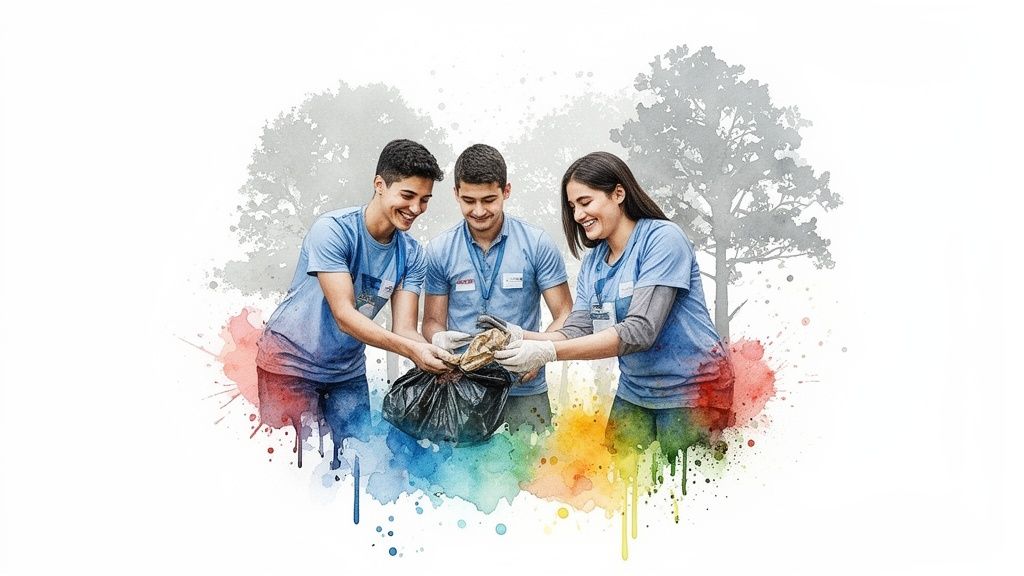
I stumbled on a strange truth. Cleaning up other people's messes was profoundly easier than cleaning up my own. It disconnected the task from all the emotional baggage I was carrying. My own trash screamed failure; a stranger's trash was just… trash. This small insight was the seed that grew into Litter Caterpillars, a community cleanup group I started.
This is the raw story of how I began to dismantle my fear. If you're struggling to figure out how to overcome social anxiety, you might find the answer isn't always about forcing yourself into the situations you dread most.
Sometimes, it’s about finding a new way to show up in the world. It's about discovering an activity with a purpose that's bigger than your fear. If this approach resonates with you, you can learn more about how to start volunteering and find a group that fits.
This was my first step. It wasn't about conquering a crowd. It was about conquering my own life, one small, messy, and surprisingly empowering step at a time.
What Social Anxiety Actually Feels Like
Let's get real about what it’s like to live with social anxiety. It’s not just being “shy.” It’s not being an “introvert.” It’s a full-body, five-alarm fire that goes off in situations most people don’t even think twice about. A complete system meltdown.
For me, it was that gut-wrenching panic before making a simple phone call. I’d spend an hour scripting the first line, rehearsing it over and over, only to let the call go to voicemail anyway. Then, for hours, my mind would spin. A vicious cycle, replaying every word I managed to say in a conversation, absolutely convinced I sounded like a complete and utter idiot.
And the inner critic? That voice is relentless. It’s the constant whisper that everyone is judging you. That your hands are shaking too much. That the blush creeping up your neck is a giant neon sign broadcasting your own inadequacy to the entire world. It’s an emotional and physical beatdown. Day after day.
Why Your Brain Gets Stuck on Red Alert
Think of your brain's fear center—the amygdala—as a security guard who’s had way too much coffee. A jumpy, overzealous guard. In social anxiety, that guard works overtime, flagging everything as a potential threat. A quick chat with a cashier? Threat. A team meeting at work? Major threat. It sees danger everywhere.
Your brain actually gets rewired by this constant alarm. It carves a well-worn path for that fear response. The more you avoid the things that set off the alarm, the more you convince your brain the danger is real. You're teaching it to be afraid.
The urge to just stay home—to say no to the party, to ignore the call—feels like self-protection. But that avoidance is the very thing that feeds the anxiety. It makes its cage smaller and tighter every single time you give in.
This is the trap. The thing you do to feel safe in the moment is what keeps you stuck for the long haul. My own path out started when I saw this cycle for what it was. Sometimes, you have to hit a low point before you can find the fire to break free.
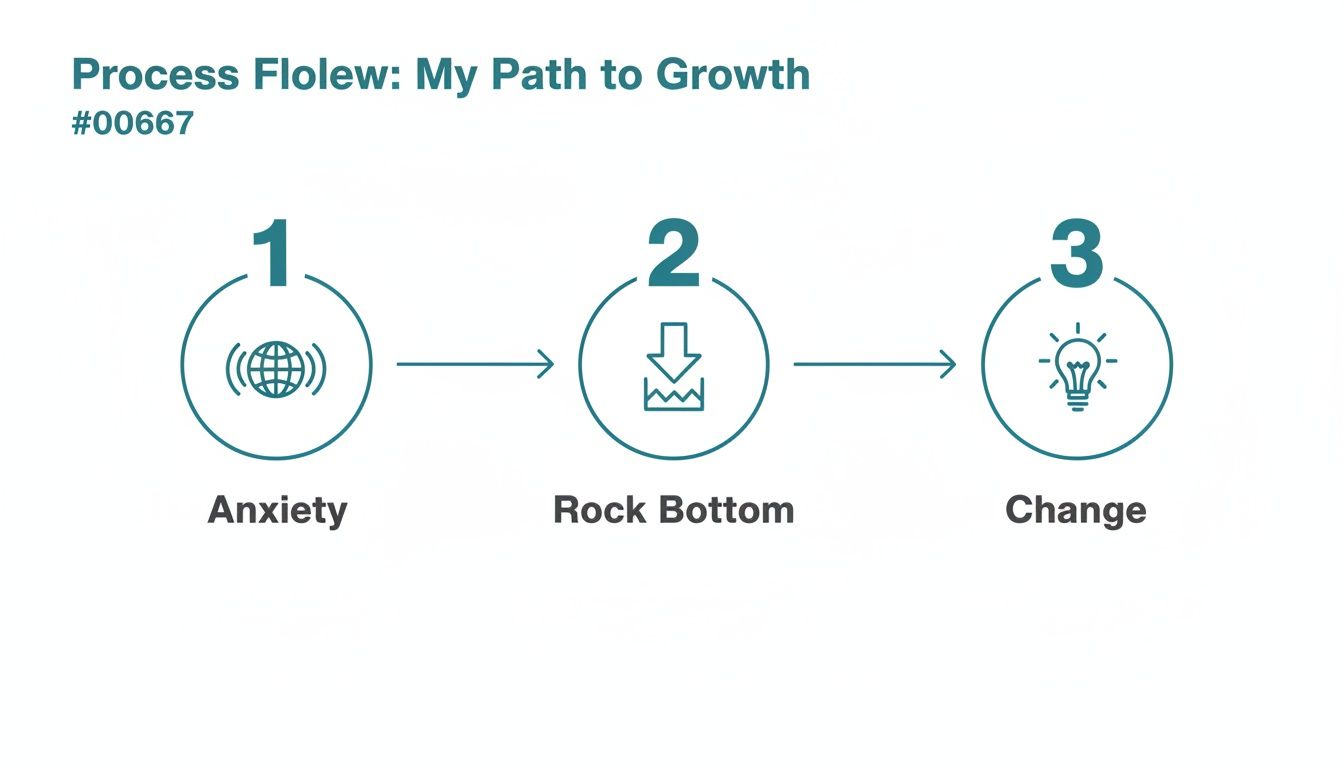
As you can see, that breaking point is often the catalyst. It’s the moment that finally forces us to find a new way forward. To decide to face the fear head-on.
You Are So Far from Alone in This
If this struggle makes you feel isolated, I need you to hear this: you're not. That feeling of your heart pounding as you think about joining a group of strangers for a weekend cleanup? That exact feeling is shared by 7.1% of U.S. adults. That’s about 15 million people. Think about that. You are part of a huge, unseen community.
And there’s so much hope in what we know works. The science is on our side. Exposure therapy, the gold standard for treatment, shows that 60-90% of people see a huge drop in their symptoms after just 12-16 weeks of practice. That's incredible.
In fact, studies show that getting out there in the real world—like joining a friendly group to pick up litter—can slash avoidance behaviors by 75% on average. You can read more about these stats straight from the National Institute of Mental Health.
The numbers prove your experience is valid, but they also light up the path forward. It’s not about suddenly becoming a social butterfly. It’s about learning to sit with the discomfort and retrain your brain. It's about teaching that over-caffeinated security guard that it can finally, finally stand down. You can learn that the "threats" aren't threats at all.
Finding Your Purpose to Push Through the Fear
My biggest breakthrough didn't come from a therapist's couch. It happened on a miserable Saturday, stuck in a freak Chicago hailstorm with two people I’d just met. It was my first cleanup with a group I founded, Litter Caterpillars. As we huddled under a flimsy awning, something clicked. We were cold. We were wet. Our Ubers kept canceling. But we were suffering with a purpose.
That hailstorm became my anchor. It taught me that having a "why" that’s bigger than your fear is the most powerful weapon you can wield. This is how you find your own hailstorm moment—an activity that completely flips the script on what you think you can handle.

Building Your Personal Exposure Ladder
The idea of "exposure" therapy sounds terrifying, I know. It makes you think of being forced into your worst nightmare, like giving a speech to a stadium packed with critics. That's not what this is. We’re building a ladder. One tiny, manageable step at a time. The first step should feel almost laughably small.
Your first step might literally be opening your front door and standing outside for 60 seconds. That's it. Or maybe walking to the end of the block and back. The point isn’t to conquer a huge fear on day one. It's to do one tiny thing your brain is screaming at you not to do, and survive.
The secret is finding a structured, low-pressure social setting where the focus isn't on you. It's about having a shared task. A mission. Something that gives you something to do with your hands and a natural reason for being there.
This changes everything. That crushing pressure to be charming or funny just melts away when the real goal is, say, pulling an old, rusty tire out of a bush together.
The Power of a Shared Task
My time with Litter Caterpillars taught me a crucial lesson. When you show up to clean a park, the task itself creates a perfect social buffer. It's like a shield. It solves three of the biggest problems social anxiety throws at you:
- The Pressure to Talk: You don't have to scramble for things to say. The trash is the built-in talking point. "Wow, can you believe someone just left this here?" is the easiest conversation starter in the world. No clever anecdotes required.
- The Fear of Awkward Silence: Silence isn't awkward when you're both focused on picking up litter. It’s just comfortable, parallel activity. You can work next to someone for 20 minutes without a word, and it feels completely normal. Productive, even.
- The Worry About Being Judged: Let’s be real. Anyone willing to spend their Saturday morning picking up trash is probably not there to scrutinize your every move. An activity like this naturally filters for kind, non-judgmental people. The jerks are still in bed.
It’s like being a character in a play. You have a role (cleaner), a set (the park), and even a loose script (talk about the trash). This structure removes the terrifying guesswork of a normal social event. It gives your anxious brain a job, pulling its focus away from the internal chaos and onto the outside world.
Finding an activity with this kind of built-in purpose taps into a special kind of drive. You can learn more about how this works by exploring what intrinsic motivation is and how it helps you push through discomfort.
Finding Your "Why"
Your "why" doesn't have to be some grand mission to save the planet. It just has to matter to you more than staying home does. Think about what genuinely pulls at you. What do you care about?
- Do you love animals? Volunteer to walk dogs at a shelter. The dog gives you a purpose and is an instant, non-judgmental buddy. They don't care if you say something awkward.
- Find peace in nature? Join a group that maintains hiking trails or works in a community garden. Feel the dirt under your fingernails.
- Are you passionate about books? See if you can help sort donations at your local library. The quiet rustle of pages is a comforting soundtrack.
The key is to connect your action to a value you truly hold. When your motivation comes from a place of real purpose, it creates a strange and powerful kind of courage. You stop thinking, "I'm so anxious about meeting people," and start thinking, "Those dogs really need a walk," or "This park needs our help."
This is how you find a reason to show up that's more compelling than your fear's reason for you to hide. It's how you start turning that suffering into a story. And your fear into fuel.
Building Resilience Through Community and Action
Social anxiety loves to keep you isolated. It's a hermit. It whispers that you’re the only one who feels this way and that hiding is the safest bet. But community is its kryptonite. Getting involved with other people on a shared mission is where the real, lasting change happens.
I’m talking about the simple, almost profound act of just showing up. Again and again. Week after week. It's a quiet promise you make to yourself and to the group. Over time, that consistency builds a new kind of self-trust you can actually lean on. A foundation.
The Psychology of Getting Your Hands Dirty
The real shift happens when you’re forced to get out of your own head. An activity-based community service, like a cleanup, yanks your focus outward. You stop replaying every awkward word you might have said because you’re too busy looking for the next piece of trash or asking someone to help you lift a heavy bag. Your brain literally has a better job to do.
This gives you a tangible sense of competence. You're not just thinking; you are doing. Your hands are busy, your body is moving, and you can see the direct result of your effort. A cleaner park is undeniable proof that you showed up. That you made a difference.
Your inner story starts to change. The narrative shifts from, "I am the anxious person in this group," to, "I am one of the people cleaning this park." You begin to define yourself by your actions, not just your internal feelings.
This action-oriented identity is a powerful shield against anxiety's lies. You're building a new mental muscle, one that gets stronger every single time you show up.
Finding a Safe Place to Be Brave
A truly supportive community doesn't happen by accident. You have to build it. At Litter Caterpillars, we built our entire philosophy on three pillars: bravery, kindness, and unity. We deliberately created a space where it's safe to be imperfect. Bravery isn't about being fearless; it's about showing up even when you're scared. Especially then.
Kindness is our filter, and unity is our glue. You aren't just picking up litter. You are picking up resilience. You're building a new foundation for yourself, piece by piece, alongside people who actually get it.
It's a surprisingly common struggle, and this approach is more effective than you might think. While an estimated 5-10% of people worldwide grapple with social anxiety—making it the third most common mental disorder—consistent community service acts as a powerful antidote.
In fact, data shows that weekly group activities can lead to a 50-65% reduction in symptoms within just 3-6 months. One analysis even tied volunteering to a 40% drop in anxiety scores, a trend we’ve seen firsthand at Litter Caterpillars through three years of weekly cleanups. It's a clear roadmap for shifting your focus from internal fear to external purpose. If you want to go deeper, you can explore more social anxiety epidemiology research.
How to Build Your Crew
The goal is to find or create a community where your presence genuinely matters. You don't have to start something as big as Litter Caterpillars. It can be small. You just have to start.
- Look for purpose-driven groups. Search for local park cleanups, trail maintenance crews, or animal shelter volunteer days. The shared task is your social safety net.
- Start with one friend. Ask one person to join you for a simple, consistent activity, like a weekly walk to pick up litter on your own block. Building consistency with just one other person is a huge win. A massive step.
- Be the spark. If you can't find a group, be the person who creates one. Post on a neighborhood board or a local social media page. You’d be surprised how many people are out there, just waiting for someone else to take the first step.
By doing this, you're not just hoping to find friends; you're actively building your own support system. For more ideas on getting started, check out our guide to community building activities for adults. You're rewriting your story from 'I am anxious' to 'I am someone who shows up and contributes.'
Rewriting Your Inner Story from Anxious to Brave
Let's get one thing straight: you're never going to "cure" fear. It's not a disease. Trying to erase it is an impossible mission that will just burn you out. The real work is changing how you see it. Fear doesn't have to be a stop sign. It can be a compass, pointing you directly toward growth.
It reminds me of the Tom Sawyer principle. His aunt punishes him by making him paint a fence, a boring chore. But he doesn't sulk. He flips the script. He masterfully reframes the work as an exclusive, can't-miss adventure, and soon his friends are begging him for a chance to paint.
You can do the same thing with your anxiety. Those scary social moments aren't punishments. They are opportunities. Chances to practice being the person you want to become. This is about the internal work—the mental tools you need to fight back against the stories that keep you stuck.
Challenge Your Anxious Thoughts
Your anxious brain is an incredible storyteller. Seriously, it could win an Oscar for fiction. It can spin a whole epic of rejection and humiliation from a single missed glance. Someone looks away while you're talking, and your mind doesn't just think, "Oh, they're distracted." It screams, "I'm boring! They hate me! Everyone thinks I'm a fraud!"
This is what therapists call cognitive distortions. It’s your mind playing tricks on you, and the first step is to stop falling for them. You have to become a detective. You must search for the facts, not just the feelings.
When you feel that spiral starting, pull out these questions:
- "What's the actual evidence this person is judging me right now?" (Spoiler: there's usually none.)
- "What are some other, way more likely reasons for what just happened?" (Maybe they're tired. Maybe their shoe is untied. Maybe they're thinking about lunch.)
- "If my best friend told me this exact story, what advice would I give them?" (You'd tell them to stop being so hard on themselves, wouldn't you?)
Fighting these thoughts feels like house-training a puppy. It's messy at first. It feels like you're getting nowhere. But with enough consistency, you can train your mind to stop jumping to the worst-case scenario every single time.
Build a New Identity
For years, my identity was just "the anxious guy." That was the label I wore. It decided what I did and, more often, what I didn't do. But you are not your anxiety. It's something you experience, not who you are.
This sounds small, but it’s a massive shift. At Litter Caterpillars, we do things that might seem a little silly, like using theme songs and giving out badges for milestones. But it's all intentional. These symbols create a sense of shared pride and forward motion. They give you a new identity to try on.
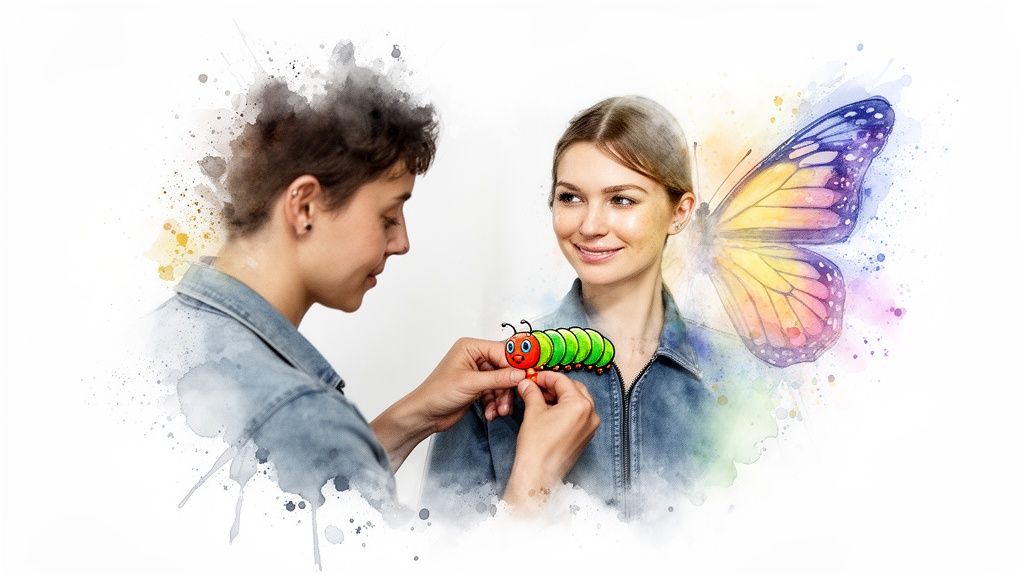
You stop being "the anxious person" and start becoming a "Caterpillar"—someone who shows up, someone who helps out, someone who is brave enough to be in the middle of a transformation. Your identity gets tied to your actions, not your fears.
What new identity could you build? Maybe you want to be "the person who loves walking dogs at the shelter" or "the one who helps out at the community garden." Give yourself a new role to play, and then start showing up for it. Act as if.
Forgive Your Past Self
One of the heaviest parts of social anxiety is the shame. All the parties you bailed on. The friendships that faded. The opportunities you watched fly by while you stood frozen on the sidelines. That regret can chain you to the person you used to be.
You have to forgive yourself. Your past self wasn't weak or flawed. They were just trying to protect you from what felt like a very real danger, using the only tools they had at the time.
Think of it this way: avoidance was a coping strategy. A flawed one, sure, but it's what you knew. Thank that part of you for trying to keep you safe, and then gently let it know that you’ve got a new strategy now. You're taking the wheel.
This self-compassion is absolutely non-negotiable. Beating yourself up for past avoidance just fuels more anxiety for the future. True bravery starts with being kind to the person you were. You aren't erasing that chapter of your story; you're just finally, finally turning the page.
Got Questions? Let's Talk.
If you're still reading, it means a part of you is ready. Ready to do something different. That’s huge. But I also know that's when the "what ifs" start getting really loud. I’ve been there. Let’s get into those fears, because they’re real and they’re what hold us back.
It’s completely normal to feel that knot in your stomach. The idea of just showing up somewhere new is terrifying. It feels like jumping into a cold lake—you know the shock is coming. But we aren't about cannonballing into the deep end here. We're about dipping a toe in. Then maybe an ankle.
"But What if I Have a Panic Attack?"
This is the big one, right? The fear that you’ll lose control. That you'll melt down right there, in front of everybody. I get it. I’ve had my heart try to beat its way out of my chest in a room full of people. I’ve felt that hot wave of dread that makes you want to dematerialize.
Here’s the thing I had to learn the hard way: the point isn’t to never feel panic. The point is to learn you can handle it. That you can ride the wave.
With a group like Litter Caterpillars, the focus is already on something else—the trash, the park, the task at hand. If you feel that panic creeping in, you have built-in outs. You can take a minute to yourself. You can get really focused on bagging up litter. You can just quietly tell someone, "Hey, I need a second." People are a lot more understanding than your anxiety wants you to believe.
A game-changer for me was creating an escape plan that wasn't just "bolt for home." My plan became: "I'll walk to the end of the block, do my breathing exercise for two minutes, and then I will walk back." Just doing that proves to your brain that you are in charge, not the anxiety.
"I'm Not in Chicago. How Can I Find a Group?"
What we do at Litter Caterpillars isn't about some kind of Chicago magic—it’s about a simple, powerful formula you can find or create almost anywhere. You just need a shared activity and a regular meetup. That's the secret sauce.
- Look for activity-first volunteer groups. Check out sites like VolunteerMatch or Meetup, and even local groups on Facebook. Search for things like park cleanups, animal shelter dog walking, or community gardens.
- The shared purpose is everything. The activity needs to be the main event. This takes all the pressure off you to be a sparkling conversationalist. You’re there to do a thing together, and any chat that happens is a bonus, not a requirement.
- Don't be afraid to start it yourself. Seriously. If you can’t find a group, be the one who starts it. It can be as simple as you and one friend deciding to clean up a local park every other Saturday. You might just be the person other people have been waiting for.
"When Is It Time for Professional Help?"
Community and self-help are incredibly powerful. They are life-changing. But they aren't a substitute for professional care, especially when things are really tough. I think of it this way: our group is the practice field where you run the plays. A good therapist is your expert coach, helping you perfect your technique and strategy.
If your social anxiety is making it impossible to work, to keep up with your relationships, or even to leave your house, that's a clear signal to get professional help. If you're also struggling with depression or have any thoughts of harming yourself, please, reach out to a professional immediately. Today.
A therapist who specializes in Cognitive Behavioral Therapy (CBT) can give you a structured plan that works right alongside the real-world practice you're getting. There is zero shame in getting that kind of expert guidance. It's a sign of strength to build the best support team you possibly can.
This whole journey is about transformation. One small, brave step at a time. If you're in Chicago and you're ready to take that step with a crew that gets it, come join us at Litter Caterpillars. We’re here to help you find your purpose, build your confidence, and make a real difference—for the city and for yourself.
Learn more and sign up at https://www.littercaterpillars.com. We'll see you out there.