

I came to grassy lake forest preserve on one of those Chicago days when my mind felt like a junk drawer. By the time I reached the first quiet stretch of trail, the noise in my head had started to loosen, like a knot finally giving up.
Finding Your Wild in Chicago's Backyard
Some places don't announce themselves. They wait for you to arrive tired.
That was my experience with grassy lake forest preserve. I didn't come looking for a grand revelation. I came looking for a break from traffic, screens, errands, and the strange way a city can make you feel surrounded all day and still disconnected from yourself. Then the path opened, the air changed, and the whole afternoon took on that rare feeling of being wider than my thoughts.
When the city gets too loud
Chicago trains you to move fast. You learn to cross streets quickly, answer messages quickly, even rest quickly. But your body keeps score. After enough weeks of concrete and urgency, you start craving something older and slower.
Grassy Lake answered that craving for me in a very physical way. The soundscape changed first. I stopped hearing engines and started hearing wind move through leaves. Then the visual field changed. Instead of brick, signs, and lanes, I saw long stretches of green and water catching light through the trees.

I think that's why this place hits so hard. It doesn't feel like a decorative patch of nature squeezed between roads. It feels like a real refuge. The kind that lets you exhale before you realize you've been holding your breath.
You don't always need a dramatic reset. Sometimes you need a trail, some open sky, and enough quiet to hear your own mind again.
A place that changes your pace
I love preserves that don't rush me into a performance. Grassy Lake doesn't ask you to summit anything, prove anything, or post anything. You can come here messy, distracted, overworked, or grieving. The trails don't care. The oak woods don't care. The river keeps moving beside you anyway.
That feels close to the spirit of service work. When I think about the Litter Caterpillars idea of transformation through action, I don't think of some polished before-and-after story. I think of this kind of place. You show up as you are. You walk. You notice. You pick up one thing. Maybe trash, maybe your own scattered thoughts. Bit by bit, the environment outside and the mind inside both start to clear.
What this place gives back
The gift of grassy lake forest preserve isn't just scenery. It's contrast.
- You trade noise for texture. Leaves rustle, gravel crunches, water shifts against the bank.
- You trade pressure for presence. A walk becomes enough.
- You trade numbness for attention. You start noticing shadows, birdsong, and the shape of the trail ahead.
That's why I keep thinking of it as a secret, even though it isn't hidden. It's just easy to miss if you've forgotten how much you need wildness close to home.
Your First Visit to Grassy Lake Forest Preserve
The drive into Lake Barrington feels like a gentle untangling. Roads soften. Houses thin out. Then grassy lake forest preserve arrives as more than a pin on a map. It feels like the edge of one world and the start of another.

What to know before you step out
This preserve sits in Lake Barrington, Illinois, and covers approximately 689 acres along the Fox River, according to the Lake County Forest Preserves overview of Grassy Lake. That size matters. It means you shouldn't think of this as a quick roadside stop. Think of it as a vast natural area you enter.
When I visit a preserve for the first time, I try to lower the stress before I arrive. I wear shoes I don't mind getting dusty. I bring water. I leave room in the day so I don't turn the whole visit into another timed assignment.
How I’d approach a first-time arrival
If we were going together, I'd tell you to keep your first visit simple.
- Start with the obvious trailhead. Your first goal isn't to see everything. It's to get oriented and feel at ease.
- Pause at the parking area for a minute. Listen before you walk. That tiny reset changes the whole mood.
- Choose the firmer path first. Gravel tends to feel easier for strollers, steady footing, or anyone who wants less guesswork.
If you've explored other local preserves and liked that mix of accessibility and immersion, you might also enjoy this MacArthur Woods Forest Preserve guide from Litter Caterpillars. I like pairing spots like these because each one teaches you a slightly different rhythm of the region.
Practical rule: On your first visit, don't chase every turn. Follow the route that lets your shoulders drop.
What the place feels like at the start
The first few minutes matter more than people admit. I've had beautiful parks lose me because I felt confused right away. Grassy Lake didn't do that. It felt spacious, but not hostile. Natural, but not forbidding.
You'll likely notice that the preserve invites different kinds of visitors at once. Some people come to walk in peace. Some come to look for river views. Some come because they need a place where their thoughts can spread out a little. That's part of its charm. It meets you where you are.
A low-pressure first visit plan
If you're worried about overplanning, use this easy sequence:
- Arrive with one goal. Mine is usually, "Take a calm walk and notice three beautiful things."
- Stick to one main route at first. Let the preserve reveal itself gradually.
- Leave while you still like it. The best first visits end with you wanting to come back.
That last part matters. A preserve becomes yours through repetition, not conquest.
Exploring the Trails and Waterways
The best walk I had at grassy lake forest preserve started with no plan beyond "keep going until the day feels different." That turned out to be enough.
The trail gave me gravel first, then softer ground, then long views where the land and water seemed to exchange places. I remember one stretch where meadow colors opened up beside the path, and another where the trees pulled in close and made the light feel cool and green. That's what I love here. The preserve doesn't unfold like a straight line. It unfolds like a conversation.
Walking the preserve by feel
Some preserves reward intensity. This one rewards attention.
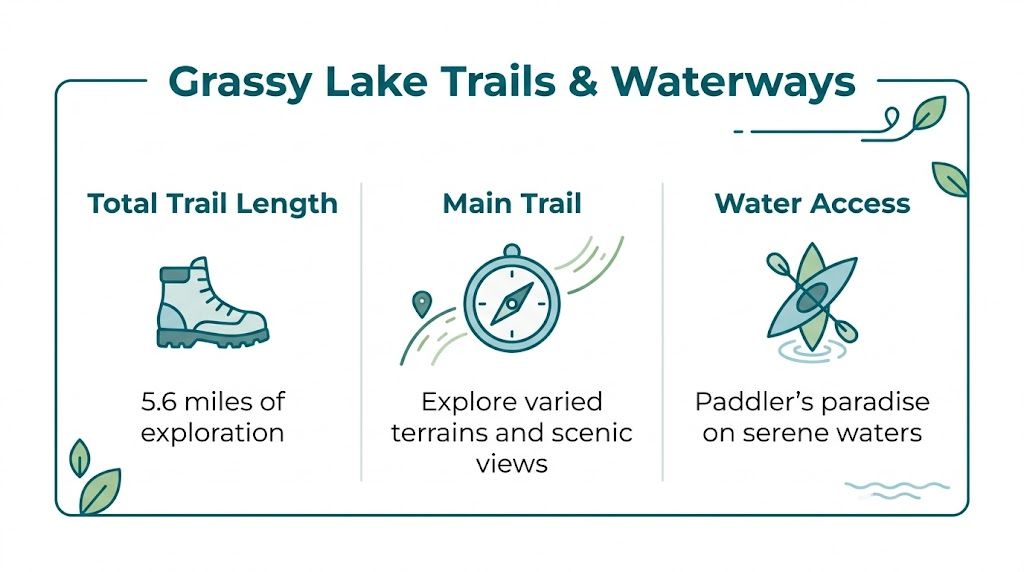
Grassy Lake offers 5.6 miles of gravel and mowed grass trails, with six scenic overlooks that open onto the Fox River Valley and the lake itself. I like that mix because it gives you choices without overwhelming you. You can keep things easy, or you can follow the trail until the scenery feels a little more untamed.
Here's a simple way to think about the different experiences.
| Grassy Lake Trail Overview | Approx. Length | Surface | Best For |
|---|---|---|---|
| Main loop feel | Part of the 5.6 miles | Gravel | Easy walking, first visits, steady footing |
| Meadow stretches | Part of the 5.6 miles | Mowed grass | Slower wandering, wildflower moods, quiet |
| Overlook connections | Spread across the preserve | Mixed | Views, photos, reflection |
I kept the table broad on purpose. Out on the trail, you won't experience these areas as rigid categories. You'll experience them as shifts in mood.
The overlooks change everything
I always think a trail becomes memorable when it gives you a reason to stop. The overlooks at grassy lake forest preserve do that.
One view might widen into river valley light. Another might frame the lake so still that it looks like the sky forgot where to end. I found myself lingering longer than expected, not because I had some checklist, but because the views made me want to be less efficient and more awake.
Later in the walk, I watched the water and thought about how Chicagoans often look outward for escape. Weekend trip. Flight. Big plan. But sometimes the medicine is local. Sometimes it's one preserve close enough to return to, often enough that the place starts teaching you your own patterns.
For a different kind of water-centered outing, this Urban Kayaks Chicago tag page offers a city-facing contrast. I love both experiences for opposite reasons. One lets you see Chicago from the water. The other lets you forget the city for a while.
Water changes the walk
The Fox River doesn't just sit beside the preserve as scenery. It shapes the whole feeling of the place. You sense it in the humidity, the birds, the bends in the trail, the moments when the land seems to lean toward the shoreline.
If you're the kind of person who likes seeing a place before visiting, this quick look helps capture the feel of the area.
Some trails make you want to finish them. These trails make you want to stay in them.
How I’d choose a route
If you asked me what to do based on your mood, I'd say this:
- For a quiet reset: take the route that keeps you near meadow and woodland edges, where sounds come in layers.
- For a scenic visit: seek out the overlooks and give yourself permission to stop at each one.
- For movement: stay on the gravel stretches and keep a steady pace.
- For a softer, more reflective walk: choose the grassy paths and let the day unfold slowly.
That last option feels most aligned with the inner life of the preserve. You don't stride through it. You let it work on you.
A Living Breathing Ecosystem
One of my favorite moments at grassy lake forest preserve wasn't dramatic at all. I had stopped near a wetter patch of habitat, and the whole place seemed to hum at once. Frog sound. Insect sound. Wind moving across plants. It felt less like visiting a park and more like standing inside a living machine that had been running long before I arrived.
The beauty here has structure
What moves me most about this preserve is its variety. You don't just get one habitat repeated over and over. You move through woodlands, meadows, marshy ground, river edges, and places where glacial history still seems written into the shape of the land. The result is a preserve that feels layered rather than flat.
I think that's why every season would tell a different story here. In one part of the year, you'd notice fresh green growth and birds moving through. In another, seed heads and dry grasses would catch the light. Even when you don't know the names of everything, you can feel that the place is ecologically busy.
Wagner Fen and the story of resilience
The part of the preserve that stayed with me most strongly was the idea of Wagner Fen. I love fens because they feel delicate and stubborn at the same time, like they survive by holding a very precise balance.
That balance matters here. The Wagner Fen portion supports habitat for eight endangered and threatened species and has seen restoration work that led to the near-total eradication of invasive purple loosestrife. I keep returning to that story because it says something larger than "management succeeded." It says people can choose to protect a place carefully enough that life returns.
Restoration isn't abstract out here. It looks like patient work, repeated attention, and a habitat getting another chance.
Why this matters beyond botany
I don't separate ecological restoration from personal restoration very neatly anymore. Maybe that's the Litter Caterpillars influence on me. When you spend time cleaning up places, you stop seeing damage as final. You start seeing it as a condition that invites response.
That's what Wagner Fen represents in my mind. Not perfection. Recovery.
- A damaged place can still hold rare life.
- An invasive problem can be pushed back with persistence.
- A community can decide that a natural area is worth protecting, even when the work is slow.
That last point feels important. Slow care is still care. In fact, it's often the most durable kind.
The preserve teaches a larger lesson
When I walk grassy lake forest preserve, I don't just see beauty. I see evidence. Evidence that ecosystems can rebound when people stop treating them as background scenery. Evidence that attention matters. Evidence that service can be practical and sacred at the same time.
A fen, a marsh, a stand of oaks, a patch of sedge meadow. None of these things shout. They ask for a quieter kind of loyalty.
And maybe that's why this place changes people. It doesn't entertain you into loving it. It asks you to notice enough that love becomes responsibility.
Your Grassy Lake Itinerary
Different people need different days. Sometimes I want a long quiet walk where nobody asks anything of me. Other times I want a small mission, a reason to pay closer attention. Grassy lake forest preserve works beautifully for both.
Here are four ways I'd shape a visit, depending on who you are and what you're craving.
If you’re bringing kids
Keep it playful and low stakes. Children don't need a perfect plan. They need room to discover.
Try this rhythm:
- Start on the easiest firm path. Kids settle in faster when footing feels simple.
- Turn the walk into a treasure hunt. Look for feathers, frog sounds, acorns, unusual leaves, or a patch of light on the water.
- Stop before anyone melts down. A short, happy visit beats an ambitious one.
I also like giving kids one job that feels real. "Can you spot trail litter if you see any?" changes a walk into stewardship without making it heavy.
If you’re here for birds and quiet watching
Bring patience before you bring gear. The preserve rewards stillness.
I’d build the day around edges. Woodland edge. Meadow edge. Water edge. Birds often reveal themselves where habitats meet, and even when you don't spot anything rare, the waiting sharpens your senses in a good way.
Walk slower than feels natural for the first ten minutes. The preserve starts showing you more when you stop barging through it.
A birder's visit can be beautifully simple:
- Arrive early if you can. The place feels softer and less interrupted.
- Pick one overlook and stay there longer than usual. Let movement come to you.
- Listen first. Sound often leads your eyes.
If the river is calling you
Some people arrive and immediately orient toward water. I get that.
Use the trails to work your way toward river views and access areas, and treat the shoreline with care. River-focused visits feel best when they mix movement with pause. Walk, stop, watch the current, move again. That rhythm lets the Fox River become more than a backdrop.
If you're hoping to fish, I’d focus less on "covering ground" and more on finding a spot where you can settle. A place becomes generous when you stop demanding too much from it.
If you’ve got a dog and want an easy outing
Dogs often read a preserve better than we do. They notice scent, shade, moisture, and energy before we consciously do. For that reason, I like choosing the calmer, more open-feeling routes for a dog walk, especially on a first visit.
A few common-sense habits make the day better:
- Keep the walk paced, not rushed. Sniffing is part of the outing.
- Bring water and waste bags. Stewardship starts with the basics.
- Choose a route you can leave easily. Dogs, like people, have days.
The deeper truth is that your itinerary doesn't need to be elaborate. The best grassy lake forest preserve day usually has only three ingredients. Time, attention, and enough humility to let the place lead.
How You Can Protect This Treasure
A beautiful place can still be in trouble. I think that's important to say plainly.
Grassy Lake itself carries one of those quiet environmental stories that most visitors would never notice at first glance. The water can look calm, the trails can feel healing, and yet the lake can still struggle beneath the surface. That's often how ecological damage works. Not as a dramatic movie scene, but as a slow clouding.
What’s happening in the lake
The lake has eutrophic conditions tied to high phosphorus levels, and common carp play a role by stirring up bottom sediments. Restoration strategies named in the lake report include carp removal and revegetation to improve water quality, as described in the Grassy Lake report from Lake County.
It's like shaking a dusty rug over and over inside a room. Even if the room has good bones, the air stays cloudy. Carp do something similar in shallow water when they disturb sediments that hold nutrients. The result is a system that struggles to clear itself.
Why small actions still matter
That kind of problem can sound huge, and it is. But huge problems still break down into human-sized actions.
You and I may not remove carp ourselves. We may not lead a revegetation plan. But we can support the conditions that make restoration more possible.
- Respect the shoreline. Trampled edges and careless disturbance don't help fragile systems.
- Pack out what you bring in. Trash and debris never stay "small" for long in a water-connected environment.
- Join volunteer stewardship when you can. Organized service days turn concern into actual labor.
- Pay attention. People protect what they know how to see.
One option for people who want a structured way to build that habit is the environmental stewardship programs offered by Litter Caterpillars. Their model centers on volunteer cleanup and shared outdoor service. That's one practical lane among many for people who want to connect care with action.
A place doesn't stay beautiful because people admire it. It stays beautiful because people take responsibility for it.
The inner reason to help
I don't think service matters only because it improves an area. I think service matters because it changes the person doing it.
Picking up litter that isn't yours is a strange act at first. It can feel unfair. Then, if you keep doing it, something flips. You stop seeing yourself as a victim of the mess around you. You become a participant in repair. That shift is powerful, whether you're cleaning a city block, a forest preserve edge, or your own overcomplicated life.
That's the Litter Caterpillars ethos I keep carrying with me into places like grassy lake forest preserve. We heal ourselves by helping heal what surrounds us. Not all at once. Not perfectly. One bag, one walk, one morning, one brave choice at a time.
If enough of us adopt that posture, preserves stop being scenic escapes we consume. They become relationships we honor.
If grassy lake forest preserve stirred something in you, don't leave that feeling on the trail. Bring it into action with Litter Caterpillars, a Chicago volunteer group built around cleanup, friendship, and the idea that service can transform both a place and the person showing up for it.