
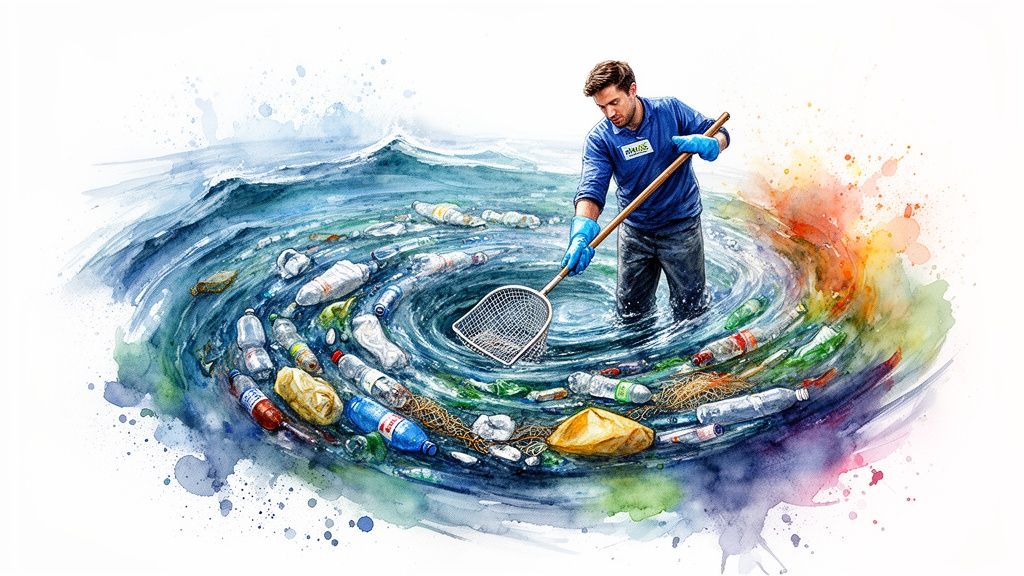
I need to tell you about my room. It wasn't just messy; it was a disaster zone. A place where every takeout container, every bag of clothes I was supposed to donate, felt like an anchor, just weighing me down. My life was completely stuck until a painful breakup shattered everything. Suddenly, I saw the mess for what it was.
The Mess in My Room and the Mess in Our Ocean
I decided I had to face the things that scared me most: consistency, cleanliness, and courage. That personal fight? It was the tiny seed that, somehow, miraculously, grew into Litter Caterpillars. The whole thing started with just three of us, shivering our butts off in a Chicago hailstorm, finding this bizarre, powerful joy in picking up other people's trash.
Strangely, it felt a whole lot easier than cleaning up my own life.
This guide isn't just another doom-and-gloom article about the giant ‘garbage islands’ swirling in the middle of our oceans. It’s about connecting that feeling we all know—of being totally overwhelmed, whether it’s by a cluttered room or a trashed planet—to the wild power of doing one small, brave thing. This is my story, but I have a feeling parts of it will sound a lot like yours.
From Personal Clutter to Global Cleanup
Have you ever looked at a mess so big you just shut down? That’s what hearing about ocean plastic feels like for most people. It's a problem that seems a million miles away, impossibly huge, and something we feel like we have zero control over. My room was my own private garbage patch, and every little thing was a piece of the past I just couldn't seem to let go of.
But then, I stumbled onto a secret.
The act of cleaning for someone else—for my city, for my neighbors—gave me the strength I couldn't find to clean for myself. It was an outward expression of the inner change I desperately wanted to make.
And that’s what this whole guide is really about. We're going to dig into what these garbage patches actually are, cutting through the myths to get to the real science. We will look at the gritty, frustrating challenges of trying to run a garbage island cleanup across thousands of miles of open sea.
But most importantly, I want to show you how your actions, right here in your own neighborhood, are the most powerful weapon we have in this global fight. My story with Litter Caterpillars is living proof that the road to a cleaner planet literally starts on your own sidewalk.
- I’ll show you the journey of a single plastic bottle, from a street in Chicago all the way to the Great Pacific Garbage Patch.
- You'll see exactly why consistent, local cleanups are the ultimate form of prevention.
- And you’ll realize you don’t have to feel helpless. You can be a hero in this story, too.
What Is a Garbage Island Really?
Let’s get one thing straight. When I say “garbage island,” you probably picture something solid, right? A floating continent of trash you could almost walk on. I used to think that, too. The name is completely misleading, and the reality is way more sinister.
Forget the idea of an "island." Instead, I want you to imagine a thick, swirling plastic soup. That’s what we’re really talking about. Scientists call them ocean gyres—these are just colossal, slow-motion whirlpools created by the Earth’s own currents. They act like giant drains, and for decades, they've been sucking in our plastic waste.
A Plastic Soup, Not a Solid Island
These gyres don’t just collect our trash; they shred it. The constant churning and the harsh sun break down bigger plastics—bottles, bags, fishing gear—into smaller and smaller fragments. This creates a horrifying blend of junk you can see and a hazy smog of nearly invisible microplastics.
This is why "garbage island cleanup" isn't as simple as it sounds. You can't just sail out with a big net and scoop it all up. Imagine trying to strain pepper out of a swimming pool. The plastic has become part of the ocean itself. You can learn more about how these patches form in our guide on what an ocean garbage patch is.
The real terror of the Great Pacific Garbage Patch isn't that it's a solid island. It's that it's a toxic, soupy mess that has become part of the ocean itself, spanning an area so vast it's hard to even comprehend.
The scale is just staggering. A big study in 2018 sent out boats and planes to actually map this thing, giving us the clearest picture we've ever had. What they found is hard to wrap your head around.
The Great Pacific Garbage Patch covers a mind-blowing 1.6 million square kilometers—that’s an area twice the size of Texas. It holds an estimated 1.8 trillion pieces of plastic weighing up to 100,000 metric tons. And get this: abandoned fishing nets make up almost half of that weight.
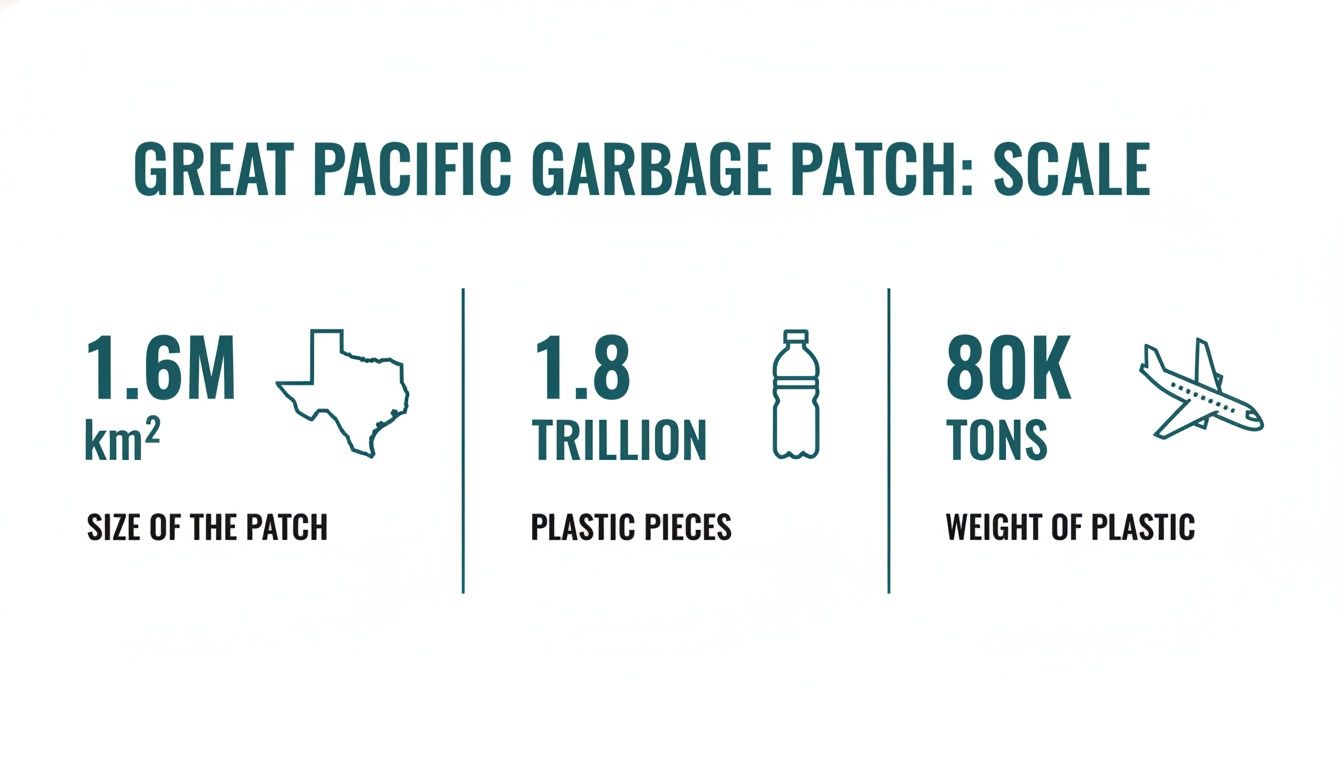
When you see the numbers laid out like that, it stops being abstract data. It feels like a physical weight on the planet. This isn’t just trash; it’s a man-made plague, and it’s going to take our bravest efforts to even begin to fix it.
The Two Fronts of Our Cleanup War
When you stare at a problem as huge as the plastic choking our oceans, it’s easy to feel helpless. It’s like trying to bail water out of a sinking ship with a teaspoon. You scoop and you scoop, but the water just keeps pouring in. To ever win, you can't just bail; you have to find the hole and patch it. This is exactly what the garbage island cleanup fight looks like—a war on two completely different fronts.
The first front is the "downstream" battle. This is the stuff that makes the news—massive, high-tech systems out in the middle of the ocean, trying to scoop plastic out of that giant, swirling soup. These are heroic efforts, and the people doing it are true warriors. They're tackling the mess we've already made.
But then there's the second front. This is the "upstream" fight, and this is where you and I have the most power.
Upstream vs. Downstream Cleanup
Think about it like this: cleaning the ocean gyres is like performing emergency surgery. It’s absolutely necessary to save the patient. But stopping plastic from getting into the water in the first place? That’s prevention. That’s building a healthy lifestyle so you never need surgery to begin with.
This upstream battle isn't fought in the middle of the Pacific. It's fought on our streets, in our rivers, and along our coastlines. It’s about cutting off the plastic monster at its source.
The hard truth is, if we only focus on scooping plastic out of the ocean, we'll be fighting that battle forever. It's a noble cause, but it's like trying to mop up a flood while the faucet is still gushing. You have to turn off the tap.
This means that picking up a single plastic bottle on a Chicago sidewalk is a real, genuine act of ocean cleanup. You are stopping that piece of trash before it can start its long journey down a storm drain, into a river, and out to sea. You become the gatekeeper.
Two Fronts of the Garbage Island Cleanup Battle
To really get it, you have to see how these two strategies fit together. One is the emergency response, and the other is the long-term cure. Both are essential if we're actually going to win this thing.
| Approach | Focus | Example Methods | Key Players | Analogy |
|---|---|---|---|---|
| Downstream Cleanup | Removing the plastic that's already in the open ocean gyres. | Huge floating barriers, collection ships, "ghost net" removal projects. | Organizations like The Ocean Cleanup, research institutes. | Performing emergency surgery on a very sick patient. |
| Upstream Cleanup | Stopping plastic from ever reaching the ocean. | River Interceptors, shoreline cleanups, better waste management, and local litter pickups (like Litter Caterpillars!). | Local volunteers, community groups, YOU. | Teaching the patient how to live a healthy life so they never get sick again. |
See? Neither one is more "important" than the other. They are two halves of the same solution. The downstream heroes are buying us time by cleaning up the disaster we've already created.
But we, the upstream warriors, have the power to decide how big tomorrow’s disaster will be. Every local cleanup, every piece of trash you stop from blowing into a gutter, is a victory. It’s you, planting a flag and declaring that you refuse to let the problem get any worse.
How We Can Actually Clean the Ocean
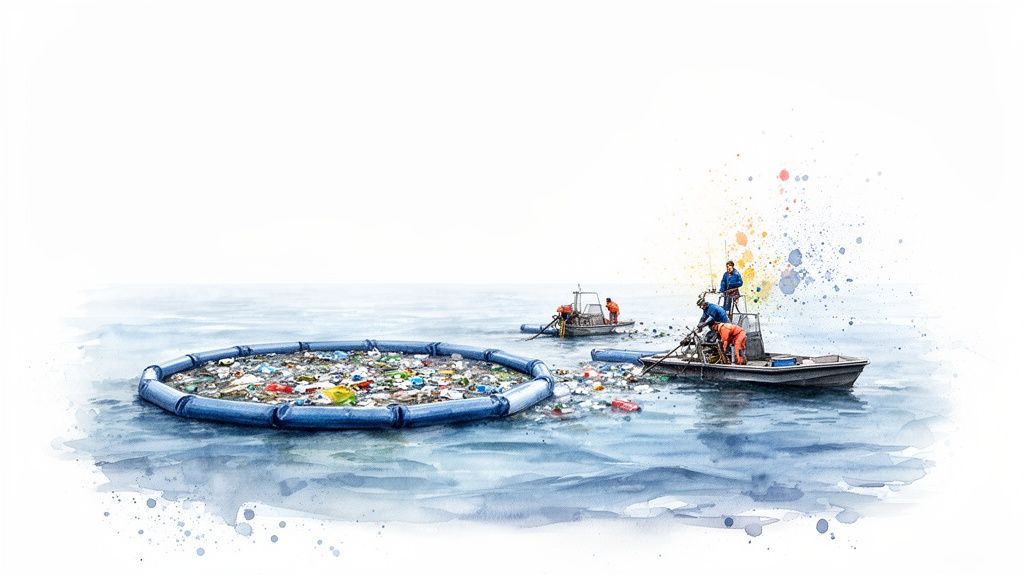
Let’s be real. When you see pictures of those garbage islands, it’s easy to feel completely defeated. Is a full-on garbage island cleanup even possible? It feels too big, too far away, and frankly, hopeless. But I want to tell you about the people who are actually doing it.
Meet The Ocean Cleanup, a project born from the wild idea of a teenager who just refused to accept that the problem was unsolvable. He saw a path forward, and that spark has ignited one of the most ambitious environmental cleanups our planet has ever seen.
Their story isn’t some fairy tale. It’s a real-world saga of trial and error, of massive wins and crushing failures. It’s the same spirit we channel every weekend with Litter Caterpillars—you show up, you try something brave, and you refuse to believe the mess is bigger than you are.
A Brave Idea Takes to the Seas
The core of their plan was genius. Instead of chasing plastic all over the ocean, why not let the ocean bring the plastic to you? They engineered huge, U-shaped floating barriers designed to drift with the currents, just a little bit slower than the plastic itself.
Think of it like being a goalie in a giant, slow-motion soccer match where your net moves to intercept the ball. This small speed difference is enough to funnel the trash into a concentrated collection area. They’re using the ocean’s own power as a tool for healing.
And it’s working. In one 2024 mission, they used AI-powered drones and special imaging to hunt down ghost nets—the deadliest plastic out there. By knowing exactly where to go, they pulled in 200 tons in a single trip. That’s not just a drop in the bucket; it’s proof that we can make a real dent.
The Milestones That Give Us Hope
These aren’t just small victories; they’re tangible proof that with enough grit and smarts, we can fix this. Their work in the Great Pacific Garbage Patch, using floating systems that harness the gyre's own currents, is a testament to what's possible. In just a few years, they’ve collected millions of kilograms of plastic, hitting a stunning milestone of 1 million kilograms extracted by 2026. This is the kind of progress that shuts down the despair.
This is the kind of bold action we need—people taking on a problem that everyone else said was impossible. You can learn more about different solutions for pollution in the oceans in another one of our guides.
The success of these ocean cleanup missions isn't just about the technology. It's a story of human persistence. It’s about the courage to try something that might fail, learn from it, and come back stronger.
The Ocean Cleanup’s story is the global version of what we do on the streets of Chicago. They are the downstream heroes, tackling the disaster that's already out there. We’re the upstream crew, fighting to turn off the tap.
Why Your Fight Starts on the Sidewalk
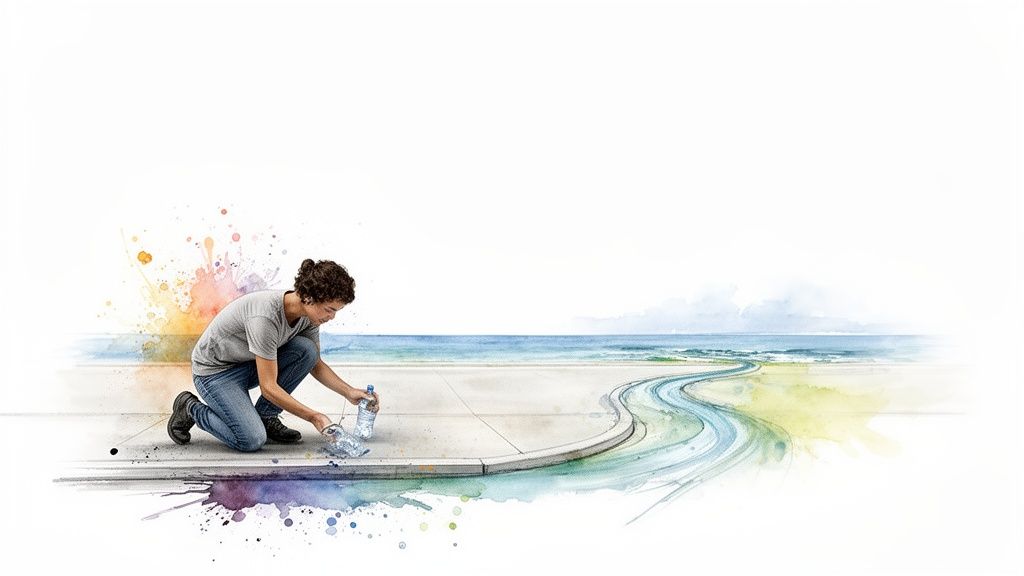
It sounds crazy, but the battle for our oceans is won or lost right here on our city streets. It’s a paradox, I know. But it’s the absolute truth. Think about it: you can’t fix a flooded basement just by mopping the floor. You have to find the busted pipe and shut off the gushing water.
Our sidewalks and storm drains are that busted pipe. A staggering 90% of all ocean plastic doesn't get dumped from ships. It flows into the sea from just a handful of major rivers, acting like pollution superhighways that carry our trash from deep inland all the way out to sea.
The Journey of a Single Bottle
I want you to really picture this. Someone in Chicago drops a plastic bottle. The next big rain washes it into a storm drain. From there, that single bottle starts an epic, disastrous voyage—into the Des Plaines River, then the Illinois River, down the mighty Mississippi, and finally, it’s spit out into the Gulf of Mexico.
This isn’t some abstract idea. It's the real, physical path that millions of plastic items take every year. It’s a direct supply line from our neighborhoods to the sea. And it's the single most important place we can step in and make a real difference in any garbage island cleanup.
This is where my whole story at Litter Caterpillars comes full circle. Our obsessive, rain-or-shine mission to clean every corner of Chicago isn't just about making things look nice. It’s a direct act of upstream prevention.
We’re cutting off the supply chain of ocean pollution right at the source. We are the gatekeepers. Your hands, picking up that one bottle, are the first and most powerful line of defense there is.
This work is a profound act of global citizenship disguised as picking up litter. I remember pulling old, mud-caked tires out of a vacant lot in Englewood, thinking about where they could have ended up. Or the time we cleaned a whole highway stretch just before a huge bike event.
We weren't just clearing a path for cyclists; we were stopping hundreds of pounds of junk from ever beginning its journey to the ocean.
You Are the First Line of Defense
Every cleanup feels like we're plugging another hole in a leaky dam. These aren't just feel-good local projects. They are direct, measurable strikes against global ocean plastic. We might not have giant ships scooping trash out of the Pacific, but we have something just as powerful: the ability to stop the problem before it even starts.
The heroes cleaning the gyres are doing vital emergency surgery. We, on the streets, are the preventative medicine.
It’s an incredible feeling to realize that your two hands, grabbing a discarded bag on your street, are connected to this massive global fight. This is where your power truly lies. You can learn more about joining this movement and find opportunities for volunteer trash pickup right in your own community.
How You Can Become a Litter Caterpillar
Feeling that fire in your belly? Good. That feeling is contagious. You don’t need to build a giant ship and sail to the middle of the Pacific to make a real difference in the garbage island cleanup effort. You just have to show up.
Joining the Litter Caterpillars is about way more than just picking up trash. For me, it was a way to heal. I started this group to beat my own demons, and I found that healing by cleaning up my city for other people. It’s about changing yourself through service and finding real, solid friendships in a shared struggle.
It’s about taking a deep, real pride in the place you call home.
Find Your Tribe
There's a reason we meet on weekend mornings. It’s a filter. It draws in the givers, the kind of people who want to wake up and build something together instead of just consuming. We're not your typical volunteer group; we have theme songs, flags, and badges.
Why? Because kindness and service deserve to feel powerful. They deserve an identity.
This isn't just about cleaning; it's about belonging. We are creating a story together, one where showing up for your community is the most heroic thing you can possibly do. Your transformation begins the moment you decide to pick up that first piece of litter.
Joining us is simple. No secret handshakes or weird rituals. We want to make it as easy as possible for you to find us and jump right in.
- Find us on Meetup: I post all our weekly cleanups on our Litter Caterpillars Meetup page. This is the best place to see where we're headed next and RSVP.
- Follow us on Instagram: Get a feel for our vibe and see the proof of our work by following @littercaterpillars on Instagram. I share stories, photos, and updates from every single event.
- Join the Group Chat: Once you come to an event, we’ll add you to our open group chat. This is where the real friendships are made—planning post-cleanup hangs and cheering each other on.
Our Volunteer-First Philosophy
When you come to one of our cleanups, you’ll see our priorities are crystal clear. We have a volunteer-first philosophy that shapes everything we do. It’s all about creating a space where you can show up and contribute without any pressure.
Our Core Values:
- Bravery: I believe just showing up is an act of courage. We celebrate facing challenges, whether that’s a freezing Chicago morning or a really disgusting patch of trash.
- Kindness & Unity: We’re here to build each other up, not compete. "If you want to go fast go alone. If you want to go far, go together."
- Service: You will never be asked for money here. Ever. Your time and energy are the most valuable gifts you can possibly give, and we protect that fiercely.
This is your invitation. It's a chance to make an impact you can actually see, build friendships that matter, and become part of a story that's bigger than any one of us.
Answering Your Burning Questions
Whenever I share the story of Litter Caterpillars, the same questions always surface. I see the confusion in people's eyes—how does picking up trash in a Chicago lot connect to those massive garbage islands floating in the ocean? It’s a fair question. Let's tackle some of those doubts you might be wrestling with.
Once you truly see the connection between your own two hands and the health of our oceans, you'll get it. You'll realize just how much power you've had all along.
Does Picking Up Chicago Litter Really Help the Oceans?
Yes. 100%. Think of it like this: your house is flooding because the bathtub upstairs is overflowing. Downstairs, some very brave people are trying to mop up the mess. That’s the garbage island cleanup—an essential but overwhelming task.
But when you pick up litter in Chicago? You’re the one running upstairs to shut off the faucet.
A staggering amount of ocean plastic starts its journey on land. It gets dropped on our streets, washed into our sewers, and then funneled through rivers that act like expressways to the sea. Every piece of trash you snag from a curb is one less piece starting that journey. You are literally cutting off the supply chain at its source.
What's the Single Most Powerful Thing I Can Do?
Trade that feeling of helplessness for one single, concrete action. The most powerful thing you can do, honestly, is to join a cleanup. Or better yet, start one. It creates a ripple effect that’s bigger than you can imagine.
You don't just remove hundreds of pounds of trash yourself. You inspire your neighbors. You build a visible culture of care and responsibility. You prove to everyone watching that change isn't just a fantasy—it's happening right here, right now.
Consistent, collective action will always, always be more powerful than one person trying to do it all alone.
Okay, But Why All the Talk About Struggle and Bravery?
Because that’s where the real magic is. I’m not kidding. True transformation—the kind that changes you deep down—is always born from shared struggle. Like I always say, getting caught in that first hailstorm is what made our work "fun" and "advanced the plot."
When you step out of your comfort zone with other people, you build a type of resilience you can't find anywhere else. You prove to yourself that you can do hard things. That new strength then bleeds into every other part of your life. The struggle is the flavor that makes the friendship real and the story worth telling. It’s the entire point.
Are you ready to stop feeling helpless and start making a real, visible difference? Join Litter Caterpillars and find out how powerful you truly are. Your city needs you, and your new friends are waiting. Find our next cleanup at https://www.littercaterpillars.com.