Tag: environmental volunteering

  • Volunteer Trash Pick Up Guide to Transforming Your Community

    Volunteer Trash Pick Up Guide to Transforming Your Community

    I'll tell you a secret. A volunteer trash pick up isn't just about cleaning a street. It’s a strange and powerful way to find your courage, build friendships with incredible people, and start cleaning up the chaos inside your own head.

    How Picking Up Trash Can Change Your Life

    I didn't start picking up trash to save the world. Not even close. I started because my own life was a complete disaster.

    I was stuck. Trapped. I felt suffocated by the clutter of past failures and a chaotic relationship that had just imploded. It was like living in a house where every surface was covered in junk. That old jar of jam in the back of my fridge wasn't just jam anymore; it was a monument to a trip that felt like a lifetime ago. Every piece of trash I couldn't bring myself to throw away felt like it weighed 500 pounds.

    I’d hit a breaking point. I knew something had to change, and I decided to mindfully engineer my social circle, filtering out selfishness and forcing myself to embrace things that terrified me: consistency, cleanliness, and bravery. And I learned something fast—cleaning up other people's messes is way easier than cleaning up your own.
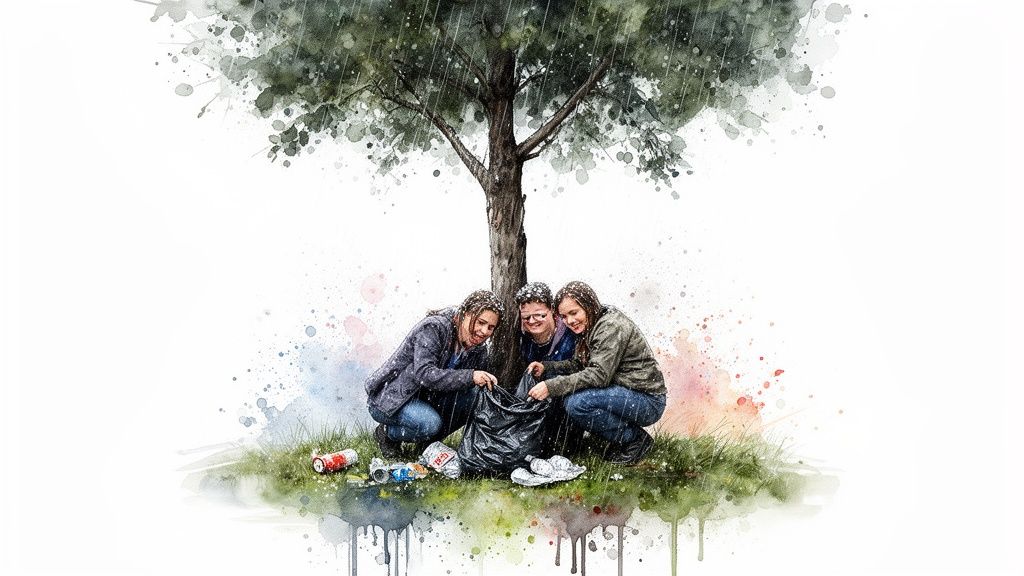
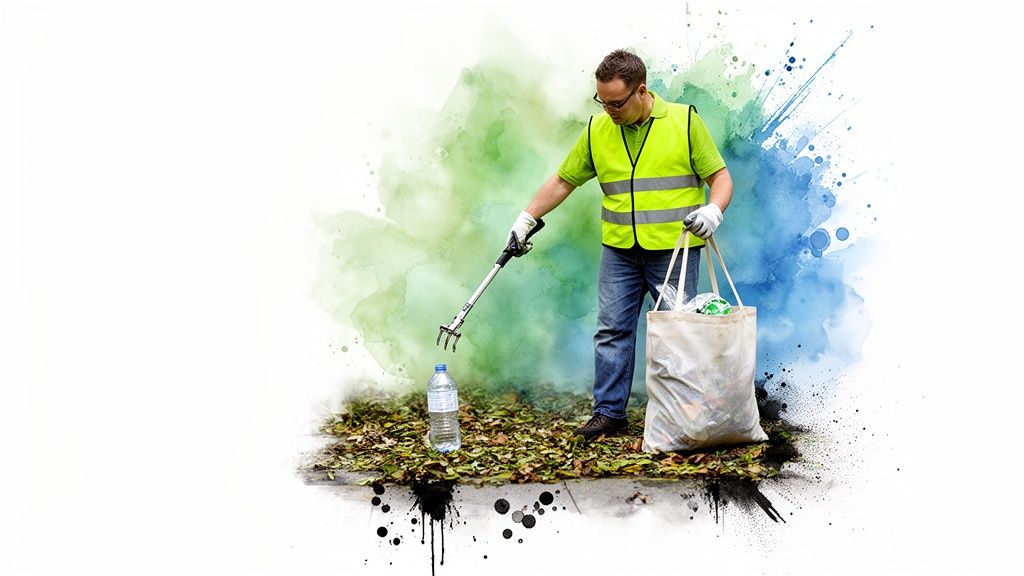
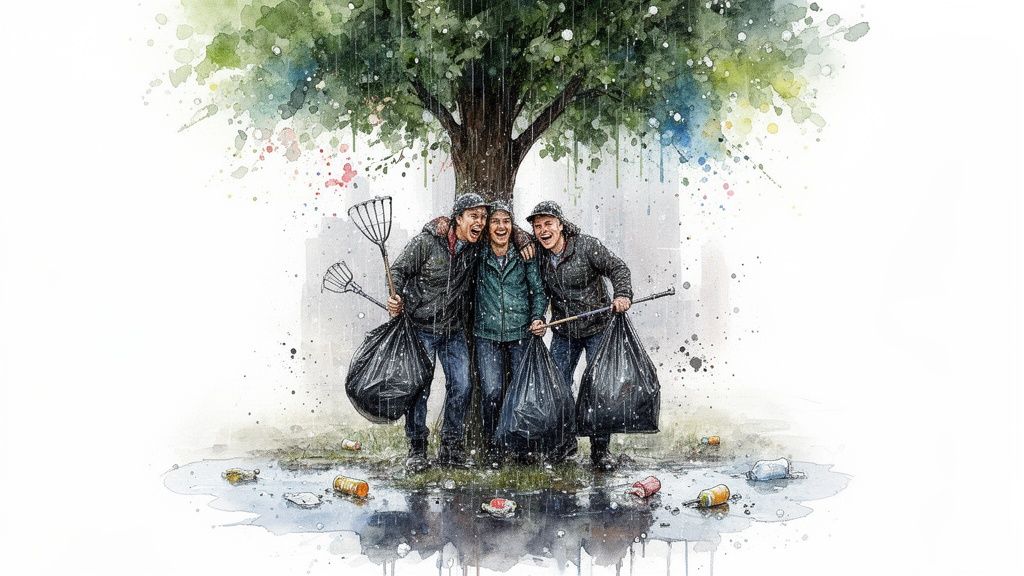
    Three young people in a watercolor style, collecting litter under a tree during a rainy cleanup.

    A Hailstorm and a Beginning

    My very first cleanup? I remember it like it was yesterday. It was just me and two friends. And, of course, a freak Chicago hailstorm decided to join us. We were huddled under a tree, shivering, watching Uber after Uber cancel on us. It was cold. It was absurd. It was, honestly, pretty miserable.

    But in that moment, something clicked. Shared struggle doesn't just build character; it forges unbreakable bonds. That freezing, bizarre experience taught me that facing a challenge together, no matter how small, adds a certain "flavor" to life. It moves the plot forward. It showed me that service is one of the most powerful tools for personal transformation.

    I realized that picking up trash wasn't a punishment. It was an adventure. A way to turn a personal low point into a powerful mission for a cleaner city and a clearer mind.

    Finding Your People and Your Purpose

    This simple act connects you to something so much bigger than yourself. It's not just about what you remove from the environment; it’s about what you build in its place. Every cleanup becomes a chance to meet people who share a fundamental kindness—people who just show up.

    You start to see your city not as a backdrop, but as a home you're actively tending to. It’s a journey where you find both your courage and your community.

    • You prove you can be consistent. Showing up week after week, rain or shine, builds a new level of self-trust. A promise you keep to yourself.
    • You find real connection. Working alongside someone toward a shared goal is one of the most natural ways to form friendships.
    • You see immediate impact. An hour of work results in a visibly cleaner park. A sidewalk transformed. It’s a tangible reward that’s incredibly satisfying.

    And this feeling isn't just happening in Chicago. It’s a global movement. Imagine millions of us banding together—that's the magic of World Cleanup Day. Since 2018, this initiative has rallied over 114 million volunteers across 211 countries to remove more than 708,000 tonnes of waste.

    Groups like ours, the Litter Caterpillars, embody this spirit right here at home, showing up every single week to prove that small actions create huge ripples.

    This guide is about helping you start that same journey. You can learn more about my philosophy on cleaning up trash in other articles. Think of this as your first step toward transforming not only your neighborhood, but yourself.

    Finding Your Cleanup Crew

    So, you feel that fire in your belly. The urge to get out there and actually do something. That’s the hardest part, and you've already done it. But then the big question hits: where do I find my people? It can feel like you’re trying to find a secret club, but I promise, the doors are wide open if you know where to knock.

    Finding the right group for a volunteer trash pick up is more than just plugging a time into your calendar. It's like finding a good coffee shop—some are quiet and intense, others are loud and full of energy. You have to find your spot. You're looking for a vibe, a crew you actually want to hang out with.

    Digital Campfires Where Communities Gather

    When I was just starting out, I hit the internet to find my real-world crew. It felt a bit weird at first, but platforms like Meetup and even Instagram are basically the modern town square where we connect over things we care about. They are powerful.

    I found out pretty fast that Meetup is perfect for this. Just search for "trash pickup" or "community cleanup" and you'll probably find a bunch of groups right in your city that you never knew existed. It's how a ton of people found us, the Litter Caterpillars. They saw a post, felt a connection to our mission of being brave and kind, and just showed up.

    Instagram is another place that's surprisingly good for finding your people. Search hashtags like #chicagocleanup, #trashtag, or #volunteertrashpickup. You’ll see pictures and stories from groups out in the wild, which gives you a real feel for their energy before you even commit.

    A great event post tells you a lot more than just the time and place. It shows you the group's heart. Look for posts that talk about community, safety, and making sure volunteers have a good time—not just getting a job done.

    How to Spot a Great Group

    Okay, so you’ve found a few potential crews. How do you pick one? It’s all about reading between the lines. I’ve learned that a group’s true character really comes through in how they talk about their events. A great group doesn't just want your time; they want you to have a positive, safe experience.

    Here’s the mental checklist I use when I’m checking out a new group:

    • Do they talk about safety? Look for mentions of them providing gloves, bags, and doing a quick safety talk. It shows they put you, the volunteer, first. Always.
    • Is the vibe welcoming? Read their event descriptions. Do they sound friendly? Are they encouraging to newbies? Green flags are phrases like "first-timers welcome" or "come alone and leave with friends."
    • Are they consistent? A group that meets regularly—say, every weekend—is usually more organized and has a solid community. It shows they’re in it for the long haul.

    I’ll never forget one of our regulars telling me he was super nervous to come to his first event alone. He saw our photos on Instagram—just a bunch of people smiling in a blizzard, holding trash bags like they were trophies—and said he knew this was a group that found joy in the work. He showed up. He’s been with us ever since.

    That's the feeling you're looking for. The journey of how to find volunteer work is really about finding that sense of belonging. Your crew is out there. Waiting.

    Your First Volunteer Trash Pick Up

    Showing up to your first volunteer trash pick up can feel a bit like the first day of school. You're excited, maybe a little nervous, and you definitely don't want to show up unprepared. Let’s walk through what you can expect. Think of this as your pre-game pep talk, designed to make your first cleanup so awesome you’ll be hooked.
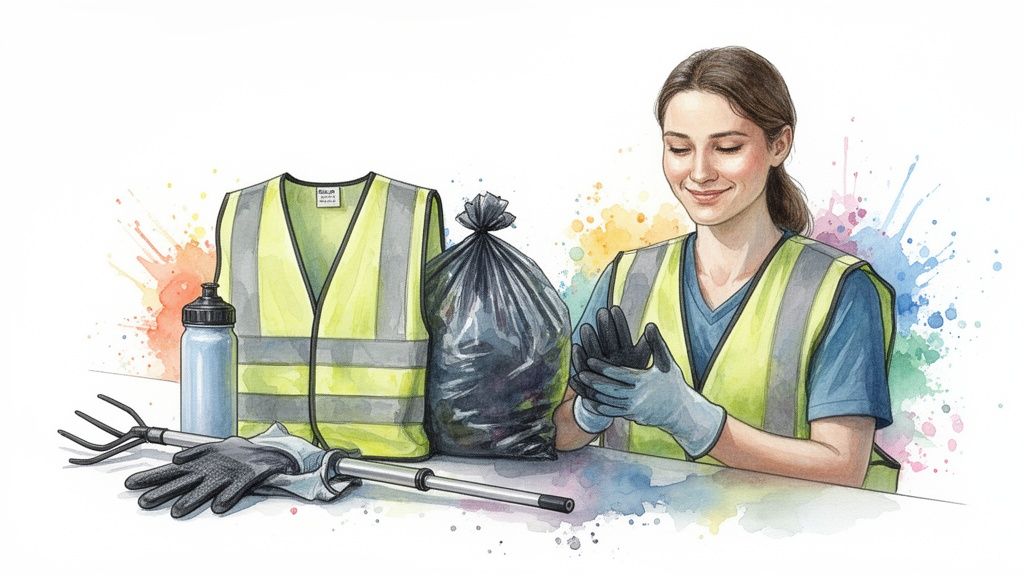
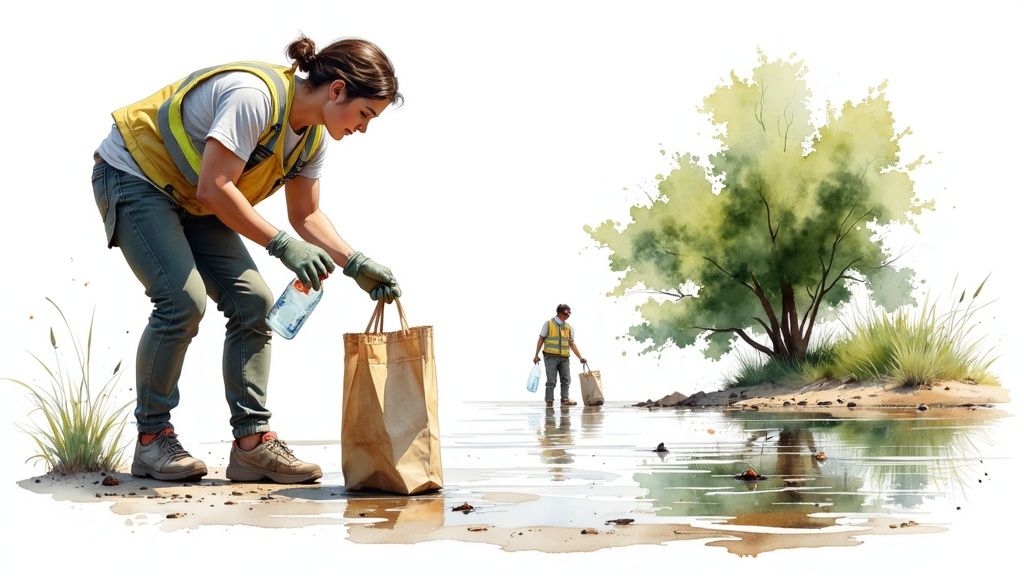
    A smiling woman in a high-visibility vest and gloves, with a trash bag and cleanup tools.

    From my experience, the biggest hurdle isn't the trash itself—it's the uncertainty. You’re putting yourself out there, meeting new people, and diving into something new. That takes real courage. Give yourself credit for even considering it.

    Dressing for the Adventure

    Your outfit is your first line of defense. Remember that hailstorm I mentioned? It taught me a vital lesson: nature doesn’t care about your plans. Comfort and safety are everything. This isn't a fashion show; it's a mission.

    • Closed-toe shoes are non-negotiable. You’ll be walking on uneven ground and encountering things you can't see. Sturdy boots or old sneakers are your best friend.
    • Wear layers you can move in. The weather can turn on a dime, especially in Chicago. A t-shirt, a hoodie, and a light jacket give you options.
    • Choose bright colors if you can. Especially if you're cleaning up near a road, being visible is key to staying safe. Think of yourself as a friendly, helpful traffic cone.

    Think of it like dressing for a hike. Forget fashion; this is all about function. You need to be ready for anything, from a sudden downpour to a surprisingly sunny day.

    What to Bring and What to Expect

    A good organizer will handle the core supplies, but being personally prepared makes the whole experience smoother. It’s the difference between just getting through it and actually having a great time.

    Here's a quick reference for what to bring versus what a great organizer should provide, ensuring you're prepared and safe.

    Your Essential Cleanup Day Checklist

    What You Should Bring What the Group Should Provide
    A reusable water bottle to stay hydrated Heavy-duty, puncture-resistant gloves
    Sunscreen and a hat for sun protection Durable trash bags
    Your phone for photos and emergencies Trash grabbers or "pickers"
    An open mind and a positive attitude Hand sanitizer and a first-aid kit

    Being prepared helps you focus on what really matters: the people and the mission.

    The most important thing you can bring is a willingness to connect. This isn't just a chore; it’s a social event disguised as community service. The trash is just the icebreaker.

    Embracing the Mindset

    Okay, you’re dressed, you’re packed, and you've arrived. Now what? Your first instinct might be to grab a bag and furiously start picking. My advice? Slow down.

    Pace yourself. This is a marathon, not a sprint. Take a moment to look around and introduce yourself to the person next to you. A simple "Hey, I'm new here" is the perfect opener. Every single person here was a first-timer once. We all remember that feeling.

    You will find weird stuff. It’s part of the fun. I’ve found everything from a single high heel to a perfectly preserved (and unopened) can of peas from the 1980s. When you do, share it! It's a great way to start a conversation and get a laugh with your fellow volunteers.

    Focus on the shared mission. You're all there for the same reason—you care. That common ground is a powerful foundation for friendship. By the end of the day, you’ll leave with more than just a full trash bag; you’ll leave with a sense of accomplishment and a few new friends.

    Leading Your Own Community Cleanup

    Do you feel that fire to start your own crew? That's a huge step. A monumental one. When I first started this, I wasn't trying to lead anyone. I was just trying to show up for myself and fix my own life. But leadership is what happens when you keep showing up. If you're feeling that pull, it means you're ready to build something real.

    So, I’m opening up my personal playbook. This is how we plan and run a cleanup that's safe, effective, and honestly, a strange new form of "fun." You're not just picking a spot on a map; you're crafting an experience. Think of yourself as an event planner, but your main guests are your neighbors and the guest of honor is your community. You’re building something from scratch.

    Scouting Your Mission

    First thing's first: you must become a scout. Before you can lead a volunteer trash pick up, you need a location. This is more art than science. I like to just walk or bike through neighborhoods, keeping my eyes peeled for the spots that look forgotten—but are still safe for a group to work in.

    Look for a place that tells a story. Is there a park that’s become an unofficial dumping ground? An underpass people just avoid? These are perfect. Why? Because the "before and after" will be so dramatic it gives your volunteers that incredible feeling of victory.

    I always make sure my route has:

    • Safe access: No one should be dodging fast-moving traffic or climbing over sketchy terrain. The safety of your volunteers is everything. It comes first, always.
    • A clear start and end point: This keeps the group together and makes your life a million times easier. I’ve found a one-mile loop or a half-mile down a single street works perfectly.
    • A "trash hotspot": You want a concentrated mess. A dragon to slay. It gives the crew a clear, satisfying challenge and a visible win at the end.

    Once you think you have a spot, you have to walk the route yourself. Take notes. See some broken glass? Overgrown thorns? Make a mental note. Knowing the territory gives you the confidence to lead everyone else through it.

    Scheduling for Success

    Timing is everything. You might think any weekend afternoon will work, but I’ve found that weekend mornings are pure magic. We intentionally schedule our events for Saturday or Sunday mornings because it filters for a certain kind of person: the giver.

    People who drag themselves out of bed early on a weekend aren't looking for a party. They are there to serve. They’re the ones who are ready to build consistent, positive habits. Kicking off your day with service just sets a powerful tone for the whole weekend.

    The goal isn’t just to get people to show up once. It's to create an experience so positive and fulfilling that it becomes a cherished part of their routine. A weekend morning cleanup can be that anchor.

    This one small choice says a lot about your group's identity. It signals that you're about purpose and connection, not just killing time. It’s a quiet way of saying, "We’re here to do the hard work, together."

    The Unspoken Contract: The Safety Briefing

    This is the most important part of your job. Before a single piece of trash gets picked up, you deliver a safety briefing. Every. Single. Time. It doesn’t need to be some long, dramatic speech, but it is absolutely non-negotiable.

    Your safety talk is an unspoken contract with your volunteers. It tells them, "I see you, I value your time, and I will do everything in my power to keep you from getting hurt."

    I always cover these key points:

    • Point out known hazards: "Watch out for the broken glass over by that fence." I mention what I saw on my scout walk.
    • Explain the "don'ts": No sharp objects (especially needles), no trying to lift heavy furniture by yourself, and no wandering off into sketchy areas alone.
    • Set the boundaries: I clearly define the cleanup zone so nobody gets lost. "We're cleaning from this corner down to the blue building."
    • Have a communication plan: "If you need anything, find me. I’ll be the one in the bright green hat."

    This briefing does more than just keep people safe—it builds trust. It shows you’re a leader who actually cares about their team, not just the task. And that trust is the foundation of any real community. My leadership isn’t measured by how much trash we collect, but by how well I take care of the people who show up to help. You're not just cleaning a street; you are building a movement, one small, safe, and powerful event at a time.

    Building a Community That Lasts

    Let me tell you a secret: a volunteer trash pick up is almost never about the trash. It’s the perfect excuse. The stage we set to build friendships and community, using the shared task as the glue that brings us all together. The real victory isn't a clean street; it's the tough, supportive crew you build along the way.

    But this doesn't just happen. You can't just hope a community forms; you have to intentionally build the container for it. My whole philosophy is “volunteer-first.” This means protecting the energy of the people who show up is your most sacred duty as an organizer. Their time and spirit are the fuel for this whole mission. You must guard it.

    This also means you never, ever pressure people for money. Their presence is the donation.

    The Volunteer-First Philosophy

    When someone decides to spend their Saturday morning with you instead of sleeping in, they’re giving you something incredibly precious. Your job is to honor that gift. This isn't a transaction; it's a relationship built on mutual respect and a shared desire to do some good.

    Think of your volunteer group like a garden. You can't just throw seeds on the ground and expect a harvest. You have to nurture it. This means prioritizing safety, but it also means prioritizing joy. It's about creating an environment where people feel seen, valued, and actually want to come back.

    The goal isn’t just to get people to show up once. It’s to create an experience so positive and fulfilling that it becomes a cherished part of their routine. A weekend morning cleanup can be that anchor.

    This volunteer-first mindset changes everything. When people feel safe and appreciated, they relax. They open up. They stop being just a group of individuals picking up litter and start becoming a team, a family. This is how you build a movement that lasts. If you want to dive deeper, you can check out my guide on effective volunteer retention strategies.

    Fostering Connection Beyond the Cleanup

    So, how do you actually do it? You create spaces for connection that exist outside the two hours you’re filling trash bags. The work itself is a great icebreaker, but the real bonds form when people can just be themselves.

    I use a group chat, not just for event logistics, but for casual conversation. People share photos of their pets, talk about their week, or ask for recommendations. It keeps the community spirit alive long after the gloves come off.

    This process chart shows the basic flow for leading a cleanup, but the real work—the community building—happens between these steps.
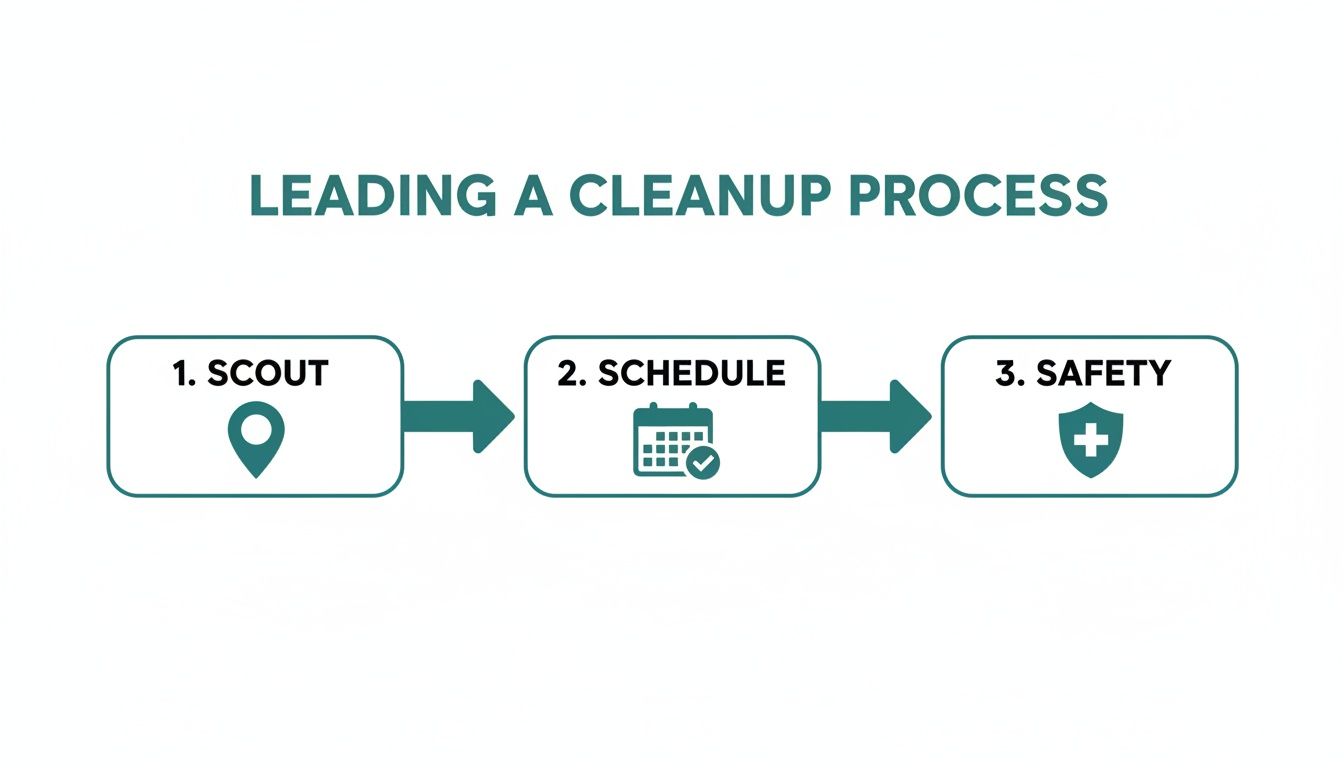
    Flowchart illustrating the three steps to lead a cleanup process: scout, schedule, and safety.

    While scouting, scheduling, and safety are the skeleton of an event, the community is its heart.

    We also celebrate milestones. We have badges for attending a certain number of cleanups or for braving a blizzard. It’s a simple, fun way to acknowledge dedication and create a shared identity. It’s like getting a merit badge for being a good human, and it makes people proud to be a part of something.

    • Create a shared identity. We have flags and a theme song. It sounds a little goofy, I know, but it works. It gives people pride and a sense of belonging.
    • Encourage casual hangouts. After a cleanup, a few of us might grab coffee. It’s not an official part of the event, but it’s where real friendships solidify.
    • Tell your group's story. I share photos and celebrate our wins on social media. I want people to see the impact they’re making and the fun they’re having.

    The power of this is immense. Look at beach cleanups. The Surfrider Foundation shattered records last year, removing 365,000 pounds of trash thanks to 40,000 dedicated volunteers nationwide. Those are huge numbers, but they’re driven by the same spirit we have. It all comes back to prioritizing volunteer joy and safety above everything else.

    From Empty Lot to Community Park

    Let me tell you a story. A few years ago, my little group of friends noticed a forgotten, trash-filled empty lot in Englewood. So we cleaned it. And then we cleaned it again. We started dreaming about what it could be.

    So we did something crazy. We pooled our money, we entered a city auction, and we won. We bought that empty lot. Today, it’s no longer a dumping ground; it's on its way to becoming Caterpillar Park, a green space for the whole neighborhood.

    That’s what a dedicated community can do. It starts with a few people who decide to show up, and it grows into a force that can literally reshape a city, block by block. It was never just about the trash. It was about building something that would last.

    Common Questions We Get All The Time

    You've got questions, and I've got answers. After years of running these cleanups every single week, in every kind of Chicago weather imaginable, I've heard them all. It's totally normal to wonder about the little details before you dive into your first volunteer trash pick up. Honestly, the fact you're even asking shows you care, and that’s what matters most.

    Here are some of the things people often ask before they grab a bag and join us for the first time.

    What If the Weather Is Terrible?

    I’ll let you in on a little secret: we kind of love it when the weather gets weird. We go out rain or shine, in blizzards and heatwaves. Why? Because suffering and freezing together actually makes things interesting. It gives the day "flavor." It advances the plot!

    Of course, your safety is my number one priority. I’ll absolutely cancel for truly dangerous conditions like lightning or extreme winds. But a little rain or snow? That just makes us feel that much more accomplished at the end. It's a badge of honor.

    A good organizer will always communicate clearly about any weather plans. My advice? Just dress in layers, bring a great attitude, and be ready for an adventure. You might be surprised by how much fun you have when things get a little crazy.

    Do I Have to Bring My Own Bags and Gloves?

    Nope, you shouldn't have to. Any well-run cleanup will provide the essentials to keep you safe and effective. We always show up with heavy-duty trash bags, puncture-resistant gloves, and plenty of hand sanitizer for everyone.

    Protecting my volunteers is the most important job I have as an organizer, and that starts with having the right gear ready to go. You’re giving me your time; the least I can do is give you the tools. That said, if you have a favorite pair of work gloves or your own trusty trash grabber, by all means, bring them along! Just check the event description, but expect the basics to be covered.

    I'm Coming Alone and I'm a Little Nervous.

    First off, it's incredibly brave to show up to something new by yourself. Be proud of that. Seriously. You are taking a step that most people are too afraid to take. Second, I can almost guarantee you won't be the only one. So many of our most dedicated regulars came alone their very first time.

    My best advice is to just focus on the task at hand. The simple, shared act of working alongside someone is a wonderfully low-pressure way to start a conversation. You can just point to some bizarre piece of trash and ask, "Wow, have you ever seen anything like that before?"

    The shared mission does all the hard work for you. You're all there for the same reason, and that creates an instant connection. Just show up. I promise, the community will find you.

    At our events, I try to create a welcoming vibe from the very start. We have a theme song. We introduce new people. You've already done the hardest part by deciding to come out.

    How Can I Convince My Friends to Join Me?

    Don't frame it as a chore. You have to be like Tom Sawyer painting the fence—make it sound like the coolest, most exclusive club in town. Tell them it’s a weird, fun adventure, a way to explore a new neighborhood you'd never see otherwise and get some fresh air.

    Talk about the deep satisfaction of seeing a tangible result—a clean street that was filthy an hour ago. And definitely highlight the social side: it's a chance to meet other cool, kind people who actually care.

    Be honest about the challenge, too. Say something like, "It might be tough, and the weather might be crazy, but it'll be a story to tell." That sense of shared purpose and adventure is way more compelling than just asking, "Hey, want to pick up garbage with me?"


    Ready to start your own transformation? Join Litter Caterpillars at our next cleanup and see how service, friendship, and a little bravery can change everything. Find our next event and become part of our story at https://www.littercaterpillars.com.
  • How to Clean Up Rivers: My Guide to Sparking Real Change

    How to Clean Up Rivers: My Guide to Sparking Real Change

    You see it, don't you? The plastic bags snagged on branches, the Styrofoam cups bobbing by the shore. You feel that little sting, that whisper in your gut that says, someone should do something. I know that feeling. It's a fire starter. This guide is everything I've learned about how to clean up rivers—how you and I can turn that frustration into a force of nature, one bag of trash at a time.

    Your River Is Calling, Let's Answer

    Staring at a polluted river can feel like looking at a mountain of debt. Where do you even begin? My whole journey kicked off from that same spot, feeling small and powerless. But I stumbled upon a weird truth: cleaning up our shared spaces, our community's living room, is somehow more energizing and way more fun than cleaning my own apartment.

    You don't need some grand, flawless blueprint. Forget perfect. Just be brave enough to start.

    Why This Work Echoes Louder Than You Think

    It's so easy to drown in despair when you see a river choked with our carelessness. But that feeling? That's not the end. It's the beginning. Every single person who ever made a difference started right there, stewing in that same frustration.

    My first cleanup—I’ll never forget it. Three of us. Just three. A freak hailstorm exploded over us in Chicago. Huddled under a bridge, teeth chattering, I had this lightning-strike thought: there is a strange, powerful joy in tackling a mess that belongs to all of us.

    This isn't just about bagging litter. It's a reclamation. It’s you planting a flag, a small act of rebellion against apathy. We're mending not just the earth but our frayed connections to each other and to the places we call home. The problem is a giant, yes, but so is our collective spirit.

    Look at the Ganges River in India to understand the stakes. A sacred artery for over 500 million people, but it’s suffocating under raw sewage and industrial poison. This isn't just an eyesore; it's a killer, causing over 100,000 deaths a year from waterborne diseases. The story is global: a horrifying 80% of wastewater gushes untreated into our planet's rivers, leading to 485,000 deaths annually.

    I've learned that one person with a trash bag feels like a whisper. But a group of people with trash bags? That's a roar. It becomes a story. And stories are the sparks that light the next fire.

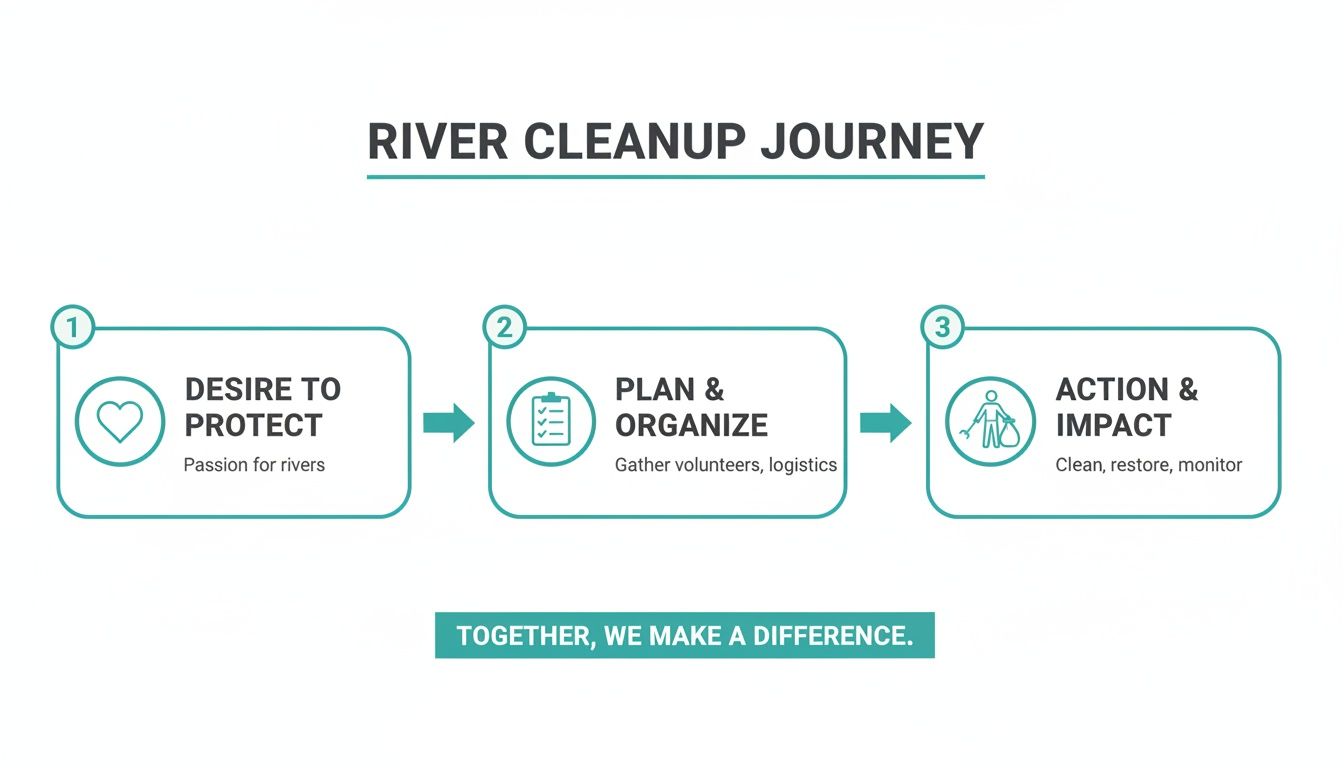
    From Desire to Action

    The path to a clean river always follows a simple, human arc. It ignites with a feeling, solidifies into a plan, and then erupts into action.

    A three-step flowchart illustrating the river cleanup journey from desire to action and impact.

    This map shows you the way. Every colossal cleanup begins with that tiny, personal spark—your desire to fix what's broken. You channel that spark through smart planning, and boom: you create real, visible impact.

    Think of me as your guide through this whole adventure. I’m going to pour out everything I’ve learned on the ground, leading cleanups in sun, sleet, and sideways rain. This is your personal roadmap. You can dive deeper into the whole philosophy behind cleaning up trash in our communities and how it changes us from the inside out.

    Let's do this. Together.

    Your River Cleanup Action Plan at a Glance

    To make this crystal clear, I've mapped out the whole journey in a table. Use this as your compass to navigate from that first flicker of an idea all the way to celebrating your victory.

    Phase Key Actions Why It Matters
    1. The Spark You spot a problem, feel that pull to act, and make a promise to yourself to do something. This is your fuel. Without that genuine fire in your belly, the hard work of planning will feel like a chore.
    2. The Plan You scout the site, tackle permits, round up tools, recruit your crew, and build a rock-solid safety plan. Good planning is the antidote to chaos. It ensures your event is safe, powerful, and doesn't backfire.
    3. The Action You host the event, lead your volunteers, and manage every piece of collected waste like a pro. This is where the magic ignites. Your plan breathes life, and the river starts breathing again, one bag at a time.
    4. The Impact You measure your results, thank your heroes, shout your story from the rooftops, and plan the sequel. This is how you close the loop. It builds a wave of momentum that turns a single day into a true movement.

    Don't see this table as a rigid prison of rules. It’s a flexible framework, a skeleton you can build on. Every river is different, but these core phases will always point you toward success.

    Laying the Groundwork for a Safe and Successful Cleanup

    Before you rally a single soul, you need a battle plan. I want you to think of yourself as a detective for your river. You’re not just spotting trash; you're uncovering opportunities, sniffing out dangers, and mapping out a strategy for a friendly invasion—against grime and neglect.

    This prep work is everything. Skipping it is like trying to build a house on a swamp. It's all the invisible effort that makes the big day feel smooth, safe, and ridiculously triumphant. Trust me, I’ve seen events implode from poor planning, and I want to help you sidestep those landmines from day one.

    Becoming a River Scout

    First mission: get your boots on the ground. You have to walk the turf you plan to clean, but with new eyes. You're looking for more than just the biggest heap of junk.

    You're searching for the site's story. I remember scouting a stretch of the Chicago River and finding a literal mountain of old car tires. I learned that for decades, people used tires for "bank stabilization," a method we now know is a spectacular failure. That bit of history totally reshaped our entire approach to that cleanup.

    Here's what I look for on my first scouting trip:

    • Access Points: Where can your people safely get to the water's edge? I hunt for gentle slopes, existing paths, or park entrances. I steer clear of steep, crumbling banks like they're the plague.
    • Trash Hotspots: Pinpoint where the litter is clustered. What kind of trash is it—plastic bottles, construction debris, an old sofa? This intel tells you what weapons to bring to the fight.
    • Potential Hazards: Are there slick rocks, angry patches of poison ivy, or hornet nests lurking in the trees? Your number one job is to be a guardian for your crew.
    • Staging Area: Where will you build your glorious mountain of collected trash? It needs to be easy for a truck to reach but not blocking a public path.

    Navigating the Permit Maze

    Okay, let's talk about the thing that makes everyone groan: paperwork. Permits. It sounds like a dentist appointment, I know. But getting the right blessing from your city's parks department or local government is the secret key to a stress-free day. It's not about bureaucracy; it's about being a good dance partner.

    Imagine this: you've got 50 fired-up volunteers, and mid-cleanup, a park ranger rolls up and shuts you down because you skipped a step. All that incredible energy just vanishes into thin air. I've watched it happen. It's a gut punch.

    A single phone call can prevent all that heartache.

    Here’s the simple script I use for that first call: "Hi, my name is [Your Name], and I'm a resident who's tired of seeing our river looking sad. I'm getting a small group of volunteers together to clean up the bank at [Location] on [Date]. Could you tell me who I need to talk to, to make sure we do this the right way?"

    This approach shows you're a responsible citizen, not a rogue agent. It flips the city from a potential hurdle into your most powerful ally. Nine times out of ten, they’ll not only say yes but will offer you free trash bags, gloves, or even a special trash pickup.

    Preparing for a Safe Cleanup Day

    Last but not least, let's get serious about safety. Your volunteers are your most precious asset. Protecting them is the most sacred part of your job. A safe, well-run event is an event people will return to, again and again.

    Your safety plan doesn’t need to be some 50-page legal tome. It’s just about smart prep. Start with a solid first-aid kit. You can buy one ready-made, but I always beef mine up with extras from the school of hard knocks:

    • Extra antiseptic wipes (you'll use them all)
    • Tweezers for splinters
    • Saline solution for flushing gunk out of eyes
    • Instant cold packs

    Beyond the kit, your most powerful safety tool is your voice. A clear, confident safety briefing at the start of the day sets the whole tone. It shows everyone you've got their back. This is how you build the trust you need to clean up rivers as a team.

    Building Your Cleanup Crew of Passionate Volunteers

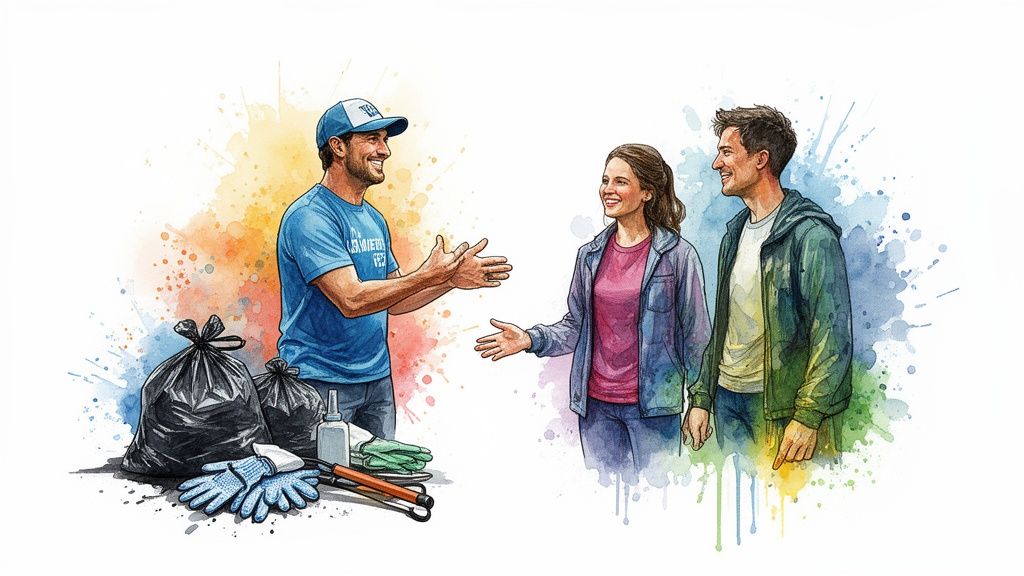
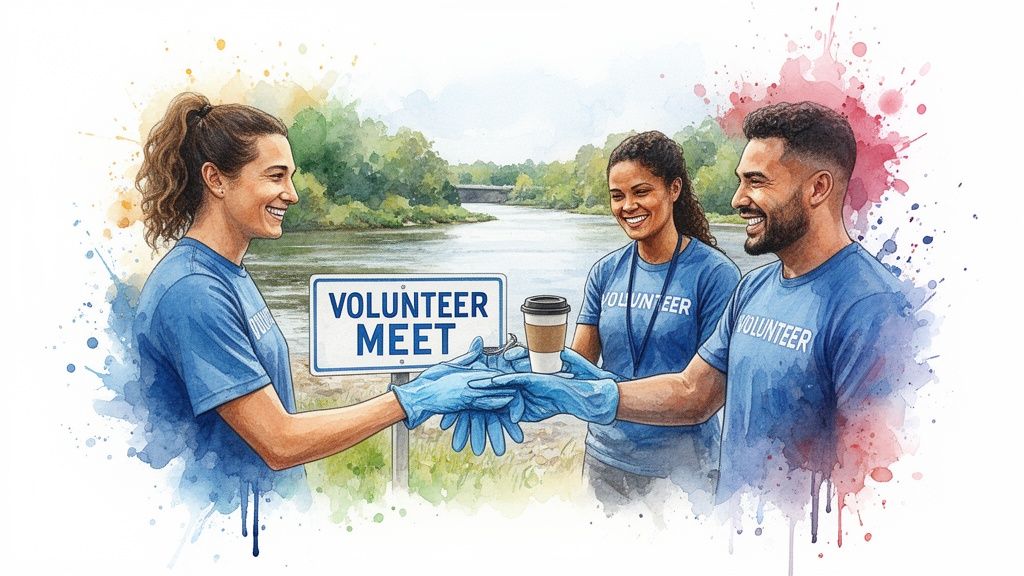
    Three happy diverse volunteers near a river exchanging gloves and coffee at a clean-up meet.

    You cannot do this alone. Believe me, I tried. I once thought my own two hands were enough to tackle a trashed-out stretch of riverbank. It’s like trying to bail out the ocean with a teaspoon—a noble idea, but you’ll just end up soaked, exhausted, and demoralized.

    The real lightning strikes when you build a crew. Your own band of litter-fighting misfits. This is how you transform a solo crusade into a community bonfire. I still see us, that first day—just three of us, shivering through that Chicago hailstorm. Now? Now we're a force.

    I’m going to show you exactly how I grew that tiny, frozen tribe into a steady flame.

    Crafting a Call That Attracts Givers

    First, you have to send up a flare. But not just any flare. You need to write a call for help that resonates with the right kind of people—the givers, the doers, the folks who show up to make a difference, not just to snag a selfie.

    Think of your volunteer post on Meetup or a local Facebook group as a magnet. You want it to pull in people who vibrate on your same frequency. Be honest. Be real. Be a little bit of a poet. Don’t just announce, “We’re picking up trash.” Tell them why this river, this patch of earth, is worth fighting for.

    Here’s a version of what I post:

    "Do you ever walk by the river and feel that little punch in the gut when you see the trash? Me too. I'm getting a group of friendly folks together who want to turn that frustration into action. We bring the bags, gloves, and good vibes—you just bring yourself. Let's make our city a little better, together."

    This simple message does a few powerful things:

    • It validates their feelings: It starts from that place of shared frustration. You're not alone.
    • It’s disarmingly simple: "You just bring yourself" removes every barrier to entry.
    • It sets a positive, can-do tone: It's about being part of the solution.

    When you frame it like this, you’re not begging for free labor; you're inviting them to join a cause. If you want to dive deeper, you can learn a lot more about how to find volunteers who are ready to go all in.

    The Power of Community Partnerships

    Once you get a few regulars, you can start weaving partnerships with local businesses. This is a game-changer. It anchors your little cleanup crew into the very fabric of the neighborhood, making your work visible and proving that the community has your back.

    Start small. I literally started by walking into my favorite coffee shop. I told the owner what we were doing down by the river and just asked, "Hey, would you ever consider donating a big pot of coffee for our crew on Saturday mornings?" He was ecstatic to help. That small gesture—a warm cup of joe on a chilly morning—became a symbol of our community's support.

    Here are a few other ideas that have worked for me:

    • The Coffee Shop: A big dispenser of coffee or hot chocolate is liquid gold.
    • The Hardware Store: Ask for a small discount on heavy-duty gloves or trash grabbers.
    • The Local Pizzeria: See if they'll chip in a couple of free pies for a post-cleanup celebration.
    • A Community Garden: Ask if you can use their bins for any green waste you find.

    These aren't just transactions; you're building relationships. When a business helps you out, you shout them out on social media. You thank them publicly. It creates this beautiful feedback loop of mutual support.

    Making It More Than Just Work

    This is the most critical piece of advice, so listen close. If you want people to come back, you must make it fun. Picking up trash is hard. It can be smelly and gross. But it can also be ridiculously joyful if you create the right atmosphere.

    Think of your cleanup less like a chore and more like a party with a purpose. I always bring a portable speaker and blast an upbeat playlist. We tell bad jokes, we share stories, we high-five over every disgusting, mud-caked thing we pull from the river.

    The work is serious, but our vibe is anything but. We've figured out how to turn the struggle into a shared story, an adventure that bonds us. Simple things, like grabbing a coffee together afterward, transform the entire experience. It gives everyone a chance to connect as human beings, not just as trash-pickers.

    That connection? That's the superglue. That’s what will keep your crew coming back to clean up rivers with you, again and again.

    Turning Passion Into Action on Cleanup Day

    Alright, the day has arrived. You’ve got coffee steaming, the sun is (hopefully) showing its face, and there’s a low hum of anticipation in the air. This is it. This is the moment all your planning and passion gets unleashed.

    Here’s your guide to running a cleanup that’s not just effective, but electric—the kind of day that makes people pull out their phones and block off their calendars for your next one before they even leave.

    It all starts with the morning huddle. This is not a formality. This is where you light the fuse for the entire day. Gather everyone in a circle, look them in the eye, and welcome them like the heroes they are. Their energy is the fuel.

    The All-Important Morning Huddle

    Your safety briefing needs to be quick, clear, and honestly, a little bit thrilling. A good briefing feels more like a pre-game pep talk than a boring lecture. You have to hit the absolute must-knows with confidence and a smile.

    First things first: you thank them. You thank them for showing up, for choosing this over sleeping in. You remind everyone that their time is the most valuable currency you have. Then, you pivot to the crucial safety stuff.

    Here’s my huddle checklist:

    • Acknowledge the Land: If you can, a quick mention of the area's native history adds a layer of respect and deepens the purpose of your work.
    • Point Out the Booby Traps: Be specific. "Watch out for those slick rocks by the water's edge, and the bank gets real steep over there, so find your footing."
    • Explain the Tools: "Use your grabbers for everything. I'm serious. Never, ever pick up anything sharp or unidentifiable with your bare hands."
    • Identify the "Do Not Touch" List: This is non-negotiable. "If you see anything that looks like a chemical drum, a needle, or a dead animal, do not touch it. Mark the spot, and come find me or a team lead. We have a plan for that."
    • Show Them Home Base: "Every full bag of trash comes right back here to this tarp. We're going to build a glorious mountain of accomplishment today!"

    This quick talk does more than keep people safe. It shows them you're in command, that you care about them. That builds trust, and trust is the bedrock of any volunteer army.

    Managing the On-the-Ground Logistics

    Once you break the huddle, it’s go-time. Handing out gear can become a mosh pit if you’re not ready. I like to have everything laid out: piles of gloves by size, stacks of bags, and grabbers ready to go. Let people get kitted out, then you can start pointing them to different zones.

    Think of yourself as a friendly field marshal. You're not just barking orders; you're directing energy. I've found it's a game-changer to divide a large site into smaller, bite-sized zones and assign small teams to each. It gives people a sense of ownership and makes a colossal task feel conquerable. You'd be amazed what a team of four can do to a 50-foot stretch of riverbank.

    Your central trash drop-off is your rallying point. Keep it organized. As volunteers drag back full bags, give them a high-five. Cheer for that bag. Every single one is a trophy. This is how you clean up rivers effectively—you celebrate the small wins, all day long.

    I’ve learned that the little struggles often become the best stories. A sudden downpour, someone slipping in the mud, or a ridiculously heavy tire that takes three people to haul out—these are the moments that forge real bonds.

    Embrace the beautiful chaos of it all. As the leader, your calm, positive energy is a contagion. If you're having fun, they will too. Keep walking the site, checking in with your teams, offering water, and thanking them relentlessly. You’re not just directing a cleanup; you’re hosting an experience. Their passion got them here. Your job is to make sure they leave with that passion burning even hotter.

    Showcasing Your Impact to Build Momentum

    Man with a camera stands by a large pile of 12 black trash bags next to a river.

    The work isn't over when you tie off that last bag of trash. In many ways, the real work is just beginning.

    This is your moment to show the world—and more importantly, to show your volunteers—what you all just accomplished. This is how you take a single day of sweat and grit and turn it into a tidal wave of momentum for the next event.

    You have to tell the story. A pile of trash bags is just a pile of trash bags until you give it a soul. It's a story of change, of community, of defiance. Your job now is to become the storyteller.

    Making the Invisible Visible

    First, let's talk numbers. Numbers have a superpower. They’re a universal language that cuts through the noise and shows undeniable results. It’s like stepping on a scale after a month of hard work; that number proves your effort mattered.

    You don't need a science lab. Just keep it simple but be religious about it. At every single cleanup, I make sure we track a few key things.

    • Bag Count: This is the easiest win. Just count every single bag you fill.
    • Volunteer Hours: Multiply your number of volunteers by how many hours you worked. This number is huge—it shows the incredible gift of time your community gave.
    • Total Weight: This one is a game-changer. I bought a cheap digital luggage scale for $10, and it's one of the best tools in my arsenal. Weighing each bag gives you a jaw-dropping total that a simple bag count can’t touch.

    These numbers become your weapons for good. They prove you're not just "picking up some litter." You're making a measurable dent in the fight to clean up rivers.

    Capturing the Heart of the Story

    Now, let's get visual. A picture truly is worth a thousand words, especially when you’re trying to bottle the spirit of your day.

    During the cleanup, I’m always snapping photos, but I'm not just taking pictures of trash. I’m hunting for moments.

    A shot of two strangers laughing as they wrestle a tire from the mud. A close-up of a volunteer’s muddy, gloved hand. A wide-angle "before" shot of a trashed-out bank, followed by a triumphant "after" shot of that same spot, now breathing again. These are the images that tell the human story behind your numbers.

    Your volunteers are the heroes of this story. Frame them that way. Your photos and videos should be a celebration of their effort, their smiles, their resilience. When people see themselves making a real difference, they come back for more.

    This is also how you connect your little local skirmish to the bigger, global war. It’s easy to feel crushed when you hear that the Yangtze River dumps a mind-boggling 1,469,481 tons of plastic into the ocean every year. But our focused cleanups are a real part of the answer. Groups in the Clean Currents Coalition have already pulled over 7.3 million kilograms of debris from rivers since 2020. This proves our local efforts are part of a massive, winning strategy. You can learn more about how river cleanups are tackling ocean pollution.

    Sharing Your Victory with the World

    After the event, it's time to craft the perfect social media post. This isn't just a "thanks for coming" note. It's a victory speech, a public thank-you card, and a recruitment poster all rolled into one.

    Here’s a simple formula that never fails me:

    1. Lead with Gratitude: Start by worshipping your amazing volunteers. They are the whole story. Tag them if you can.
    2. Show the Proof: Post your absolute best photos and videos. That "before and after" shot is pure gold.
    3. Share the Numbers: Hit them with the cold, hard facts. "Today, 15 volunteers gave 45 hours of their lives to our river and hauled out 527 pounds of trash!"
    4. Tag Your Partners: Give a public high-five to the coffee shop that donated coffee or the business that sponsored your supplies.
    5. A Call to Action: Don't just fade out. End with an invitation to the next battle.

    Each cleanup is a chapter. Sharing the story is how you invite your whole community to help you write the next one.

    Keeping the Current Flowing After the Cleanup

    You did it. The river is breathing a little easier, your crew is heading home with muddy boots and full hearts, and you're exhausted but glowing with pride. The real work, though, isn't just in the bags you collected. It's in what happens now.

    This is how you turn one incredible day into a genuine movement to clean up rivers. The work isn’t done when you tie the last knot. It’s done after you've sent a real, heartfelt thank you, celebrated the win, and taken a moment to heal yourself. This follow-up is the current that keeps everything moving forward.

    From a Single Event to a Lasting Community

    A thank-you email is non-negotiable. And it has to be more than a sterile "thanks for coming." I always make mine personal, sharing the final stats—the total weight, the number of volunteers—so every single person feels the epic scale of what they helped build. A great message makes every person feel seen.

    But don't stop there. This is your chance to bottle that lightning. While everyone is still buzzing, start a simple group chat or a private social media group. It instantly becomes a home for sharing photos, keeping the good vibes alive, and—most importantly—announcing the next event while the fire is still hot. We've written a lot more about specific volunteer retention strategies that have worked magic for our crew.

    Your data is your new superpower. Those numbers—500 pounds of trash, 30 tires, 1,000 plastic bottles—are not just for a social media post. They are evidence. They are ammunition. You can take that data straight to your local city council meeting and push for bigger changes, like more public trash cans or a crackdown on illegal dumping.

    The work can feel like trying to empty the ocean, especially when you think about the scale of the global crisis. But every local cleanup is a piece of the solution. It’s a mirror of the resilience shown at places like Indonesia's Citarum River, one of the world's most polluted.

    There, powerful coalitions have cleared 7.3 million kilograms of debris since 2020. It's a stunning blueprint for how focused, community-powered efforts create monumental change. You can read more about this inspiring Citarum River cleanup story and see how your small acts ripple out into a huge global movement.

    Taking Care of the Leader

    Finally, let’s talk about you. The one who started this whole thing. This work is brave, it is vital, and it can be draining. You pour so much of your soul into this, and it is absolutely essential that you refill your own well.

    Don't just leap into planning the next event. Stop. Breathe. Celebrate your own victory. Take a day off. Go for a quiet walk by the very river you just helped heal, but this time, leave the trash grabber at home.

    Leading with kindness, strength, and relentless optimism requires you to be kind to yourself first. Recharge your spirit. Your river and your community need your fire for the long haul.

    The Questions I Always Get

    When you first decide you want to do this, your brain probably sounds like a pinball machine. I get it. I’ve heard just about every question you can think of. Let's wrestle with some of the big ones.

    People always ask me, "Do I really need a permit just to pick up trash?" It's a fair question. You don't ask for permission to clean your own house, right? But a river is different. It’s a public space, a shared artery.

    Getting the city or park district on your side isn't about red tape. It's about turning them into your most powerful ally. They can handle the massive headache of waste disposal. Think of it less like asking for permission and more like inviting a giant to join your team. It's a game-changer.

    What if I Find Something Dangerous?

    This one comes up constantly: "What if I find something scary, like a needle or a chemical barrel?" It’s a real possibility, and your safety trumps everything. The rule is brutally simple: if you don't know what it is, you do not touch it.

    You are not a hazmat expert. You are the eyes on the ground.

    • Mark the spot: Use bright flagging tape or something to make the location obvious.
    • Tell your leader: Immediately find me or another leader. We have contacts for professional removal.
    • Walk away: Feel proud. You found a real danger and let the experts handle it.

    You are a volunteer, not a superhero. Your bravery is in showing up and working smart, not in taking stupid risks. Protecting yourself is the most important thing you’ll do all day.

    And my favorite question of all: "What if only a few people show up?" I love this one. It gets right to the soul of this work. My very first event had exactly three of us. We got caught in a hailstorm. It was miserable, it was glorious, and I will never forget it.

    Success is not a head count. Success is the fact that you showed up at all. A small, fired-up crew will run circles around a big, uninspired crowd. Every single person who comes out to clean up rivers is a universe of victory. It always, always starts small.


    At Litter Caterpillars, we believe in the raw power of just showing up. We turn that nagging feeling into real, dirty, beautiful action. If you're in Chicago and you want to join a crew that finds joy in service, come get your hands dirty with us. Learn more and sign up at LitterCaterpillars.com.

  • Your Guide to Becoming a Picking Up Trash Volunteer

    Your Guide to Becoming a Picking Up Trash Volunteer

    I believe becoming a picking up trash volunteer is more than just a good deed. It's a surprisingly simple act that can completely shift your world.

    You're literally sorting through other people's messes, and in doing so, you start organizing your own life, one discarded bottle cap at a time. It's an adventure. It might start with you holding a single trash bag, but I've seen it lead people to real personal growth and a sense of community they never saw coming.

    How Picking Up Trash Can Transform Your Life

    I never would have guessed that dedicating my weekends to sifting through garbage would be the thing that helped me get my own life together. For years, my apartment was a shipwreck, and my life felt just as cluttered. Every single piece of junk—old food, forgotten trinkets—held a story I couldn't seem to let go of. That weight was an anchor, and moving forward felt like trying to swim with it chained to my ankle.

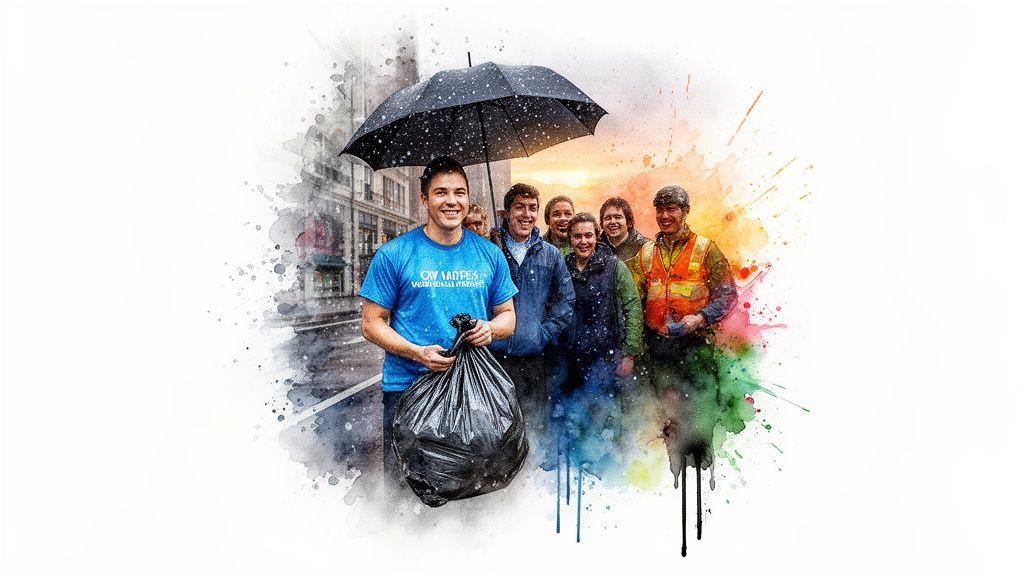
    Smiling diverse volunteers with an umbrella, holding a trash bag during a community cleanup on a street.

    Then, a long, chaotic relationship finally imploded. I knew something had to give. I decided to lean into the things that had always been the hardest for me: cleanliness, consistency, and bravery. And that's how Litter Caterpillars was born—out of my own personal need to create order from chaos.

    The Origin Story in a Hailstorm

    Our very first cleanup was a complete comedy of errors. A tiny crew of three of us showed up, and within minutes, the Chicago sky just ripped open with a wild hailstorm. We were soaked, freezing, huddled under a tree as every single Uber canceled on us, one by one. It should have been a total disaster.

    But it wasn't. It became our origin story.

    In that moment of shared misery, something clicked for me. I realized that cleaning up someone else’s mess was way easier than facing my own. This tiny, miserable adventure bonded us in a way nothing else could. I saw that it was never just about picking up trash; it was about showing up for each other. You can read more about my philosophy on cleaning up trash on our site.

    We discovered that suffering together builds resilience. It forges the most unlikely friendships. It adds a flavor to life, another page to the story. It advances the plot.

    Finding Joy in Simple Service

    Now, three years later, we meet every single week, no matter what. We’ve faced blizzards, negative wind chills, and scorching summer days. And each time we show up, we prove to ourselves that we're capable of more than we think.

    This simple act of service has taught me more than I ever could have imagined:

    • Tangible Impact: You can physically see the difference you're making, block by block. It's an instant reward, a hit of pure satisfaction.
    • Building Resilience: Braving the elements to do something good for your community builds an incredible inner strength. You feel like a low-key superhero.
    • Forging Friendships: There's a special connection, a kind of battlefield camaraderie, that forms when you work alongside others toward a common goal.

    Becoming a picking up trash volunteer isn’t just about the environment. It's about clearing your mind, building your character, and finding your people. I invite you to see the world—and yourself—in a totally new light.

    Finding Your Volunteer Cleanup Crew

    So, you feel that pull. That little spark that says you want to get out there and actually do something. But where do you even start? Where do you find your people? It can feel a bit like you’re trying to find a secret club, but I promise, it's easier than you think to find a community that’s as passionate about picking up trash as you are.

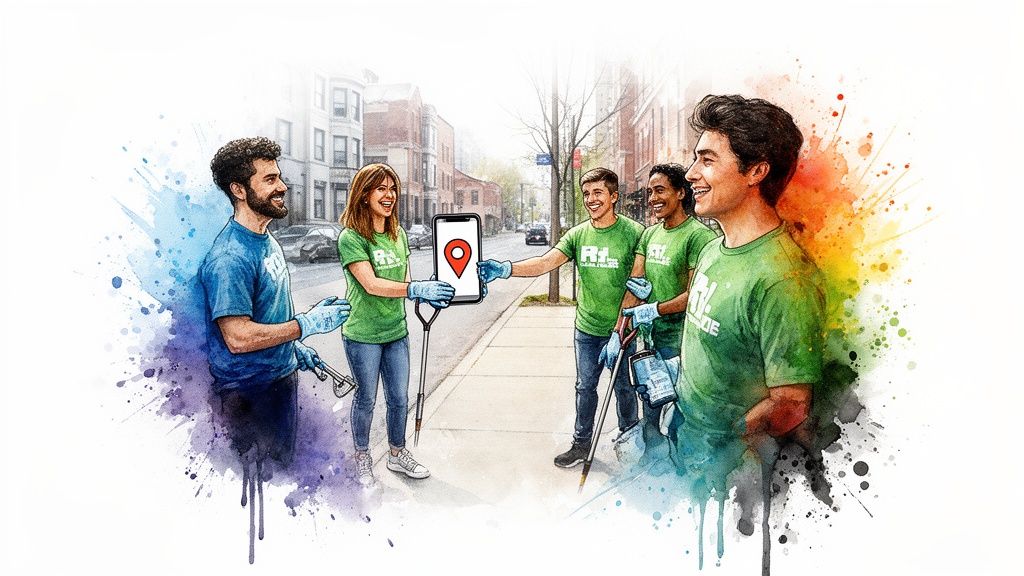
    Diverse volunteers happily cleaning a city street, using an app to locate cleanup areas.

    Think of it like dating—you’ve got to figure out what you’re looking for. Are you after a casual, once-a-month meetup? Or are you ready to join a hardcore crew like mine that shows up every single weekend, no matter what Chicago's weather throws at us? Both exist, and both are awesome.

    Here at Litter Caterpillars, we use platforms like Meetup and Instagram to connect with new faces every week. I see people join our group who are brand new to the city, just looking to make friends and explore neighborhoods they’ve never seen. They find us, show up one Saturday morning, and by noon, they’re laughing with total strangers, feeling like they’ve finally found their tribe.

    How to Find Your People

    Your search can start with a few simple clicks. I want you to just cast a wide net and see what you can catch. These platforms are buzzing with groups just waiting for someone like you to join in.

    • Meetup: This is my personal favorite and how most of our members find us. A quick search for "litter cleanup" or "environmental volunteering" will probably pull up groups right in your neighborhood.
    • Social Media: Instagram and Facebook are goldmines. Search hashtags like #trashcleanup, #plogging, or #[YourCity]volunteers. You’ll discover posts, events, and groups you can join on the spot.
    • Local Organizations: Don’t forget to check the websites for your city’s park district or local environmental non-profits. They’re often hosting or promoting cleanup events.

    A great volunteer group doesn’t just clean up; it builds you up. It should feel like a team where everyone has your back, ensuring you’re safe, valued, and actually having a good time while doing important work.

    Vetting a Group for Safety and Vibe

    Once you find a potential crew, I recommend you do a little homework. Look at their past event photos. Do people look happy? Engaged?

    Most importantly, a good group will make their commitment to volunteer safety crystal clear. At Litter Caterpillars, this is our absolute top priority. I kick off every single event with a safety talk because I want you focused on the fun and the impact, not worrying about hazards.

    Finding a group that matches your energy is everything. I’ve seen people join us who were initially shy and reserved. But after a few cleanups—sharing stories while bagging up litter—they open up and become the heart of our crew. That’s the magic of it.

    For more guidance on finding opportunities, you can explore our tips on environmental volunteering near you. Take that first step; your crew is out there waiting for you.

    The Essential Gear and Safety Checklist

    Showing up is half the battle when you decide to become a picking up trash volunteer. But showing up prepared? That’s what separates a one-time good deed from a legit, safe, and surprisingly fun habit.

    I want you to think of it this way: Batman doesn't just wander out of the Batcave. He has his utility belt. Your gear is your utility belt. It’s what gives you the confidence to face down whatever mess the city throws at you.

    Here at Litter Caterpillars, I’ve seen countless people go from nervously standing on the sidewalk to becoming cleanup pros. That transformation always starts with getting your hands on the right tools. You don't need a ton of stuff, but what you have needs to be right.

    Your Must-Have Cleanup Kit

    First, let's talk about the absolute essentials. I consider these the non-negotiables that keep you safe and make the work a million times easier. I’ve been to enough cleanups to know that the people having the most fun are the ones who feel protected and ready for anything.

    Here’s what I never leave the house without:

    • Sturdy Gloves: This is your first line of defense. Don't even think about those flimsy latex gloves. You need real protection—think gardening or work gloves that can handle sharp edges and mystery goo.
    • A Litter Grabber: This thing is a total game-changer. It saves your back and keeps you a safe distance from whatever you’re picking up. Plus, let's be honest, it’s basically a real-life claw machine where you win every single time.
    • Durable Trash Bags: You need bags that won't give up and split open at the first sign of a pointy stick. Contractor bags are the gold standard, but any heavy-duty bag will work.
    • Closed-Toe Shoes: This is a big one. I'm serious. You’ll be on uneven ground, maybe near broken glass or rusty metal. Protect your feet. Sturdy sneakers or boots are a must.

    To make it even easier, here's a quick rundown of the gear we recommend at Litter Caterpillars, separating the must-haves from the nice-to-haves.

    Essential Cleanup Gear at a Glance

    Item Why You Need It Pro Tip from Me
    Sturdy Gloves Protects your hands from sharp objects, chemicals, and general grossness. We prefer leather-palmed work gloves. They last longer and offer the best protection.
    Litter Grabber Saves your back from endless bending and keeps you from directly touching trash. Look for one with a rubberized grip. It makes grabbing small, slick items way easier.
    Heavy-Duty Bags Prevents rips and spills. A broken bag is a huge mess and morale killer. 30-gallon contractor bags are our go-to. They're tough enough for almost anything.
    Closed-Toe Shoes Shields your feet from glass, nails, and uneven terrain. A top safety rule. Waterproof boots are a godsend on dewy mornings or after it rains. Dry feet = happy volunteer.
    Water Bottle (Optional) Hydration is key, especially during our summer cleanups. You'll be working up a sweat. I suggest you get a reusable bottle with a carabiner clip so you can attach it to your belt or bag.
    Sunscreen/Hat (Optional) Protects you from sunburn. Even on cloudy days, the sun can get you. A wide-brimmed hat is better than a baseball cap for protecting your neck and ears.

    Having the right gear isn't just about safety; it’s about feeling capable and ready to make a real difference without worrying about the small stuff.

    Safety Is the Main Event

    Look, picking up trash in a city like Chicago has its own set of rules. We've cleaned along busy highways, in overgrown lots, and under sketchy bridges. In every single situation, your safety isn't just a talking point—it's everything. Your well-being is always more important than a stray bottle cap.

    I remember we were clearing a dense patch of weeds near an off-ramp, and someone found a little baggie with some weird stuff in it. They didn't touch it. They remembered my rule: when in doubt, leave it out. We marked the spot and moved on. That's the mindset. You're here to pick up litter, not to become a hazmat expert.

    Your most important tool is your awareness. Always pay attention to traffic. Watch where you step. Look at what you’re about to pick up. A safe volunteer is an effective volunteer.

    Always bring water, especially on those hot days that sneak up on you. Wear bright clothes so cars and your teammates can see you. We also insist on working in pairs or groups—it's safer, and honestly, way more fun. You’re part of a crew, never out there alone.

    For things that need special handling, you have to know what to do. My guide on City of Chicago hazardous waste disposal breaks down what to leave for the professionals. Being a great volunteer means knowing your limits. With the right gear and a safety-first attitude, you’re ready to go.

    How to Organize Your Own Neighborhood Cleanup

    See that little spark you're feeling? That voice in your head saying, "I could do this"? That's exactly how I got started with Litter Caterpillars. Leading the charge is an incredible feeling. Putting together your own cleanup multiplies your impact in ways you can’t even imagine yet. It’s like planting a single seed and watching a whole garden bloom.

    This is your roadmap. It doesn't matter if you're wrangling three of your best friends or thirty neighbors you've never met. The principles are the same, and I'm going to share everything I learned turning a personal mission into a city-wide movement.

    Laying the Groundwork for Success

    Before you send a single text or make a social media post, you need a plan. A great cleanup isn't just about showing up with a trash bag. It's about making it easy and inspiring for others to show up with you. I want you to think of yourself as a party host—your job is to create the right vibe and handle the logistics so everyone else can have a good, meaningful time.

    One of my first big lessons was about timing. I quickly learned that scheduling on weekend mornings, especially Saturdays, taps into a unique energy. The people who show up are givers, ready to kick off their weekend with purpose.

    Here’s where you should start:

    • Scout Your Location: Walk around your neighborhood with fresh eyes. Is there a park that needs some love? A specific street that’s always a mess? Pick a spot where your crew's efforts will make a huge, visible difference.
    • Set a Date and Time: Choose a weekend morning a few weeks out. This gives people enough time to plan and builds a little anticipation. A two-hour window is perfect—long enough to make an impact, but short enough that it doesn't feel like a huge commitment.
    • Define a Clear Goal: Is the mission to clear one block? A whole park? Having a specific, achievable goal keeps everyone focused and motivated. "Let's clean the entire city" is daunting. "Let's make this playground beautiful again" is inspiring.

    You’re not just cleaning a street; you’re building a temporary community centered on a shared goal. Your planning is the foundation that makes the whole experience feel powerful and worthwhile for every single picking up trash volunteer.

    Building Your Crew and Gathering Supplies

    Once your plan is in place, it’s time to rally the troops. I know this part can feel intimidating, but people genuinely want to help. You just have to give them a clear and easy way to say "yes."

    I suggest starting with your inner circle—friends, family, coworkers. A simple, personal text or call is incredibly effective. From there, you can branch out. Post in neighborhood Facebook groups or on Nextdoor. Keep the message simple and positive: "Join me for a couple of hours to make our neighborhood shine!"

    As you recruit, you also need to think about supplies. You don't need a massive budget. In fact, you can often get everything you need for free. Before you spend a dime, reach out to local hardware stores or even cafes. You’d be surprised how many businesses are willing to donate a box of trash bags or a case of water to support a local effort.

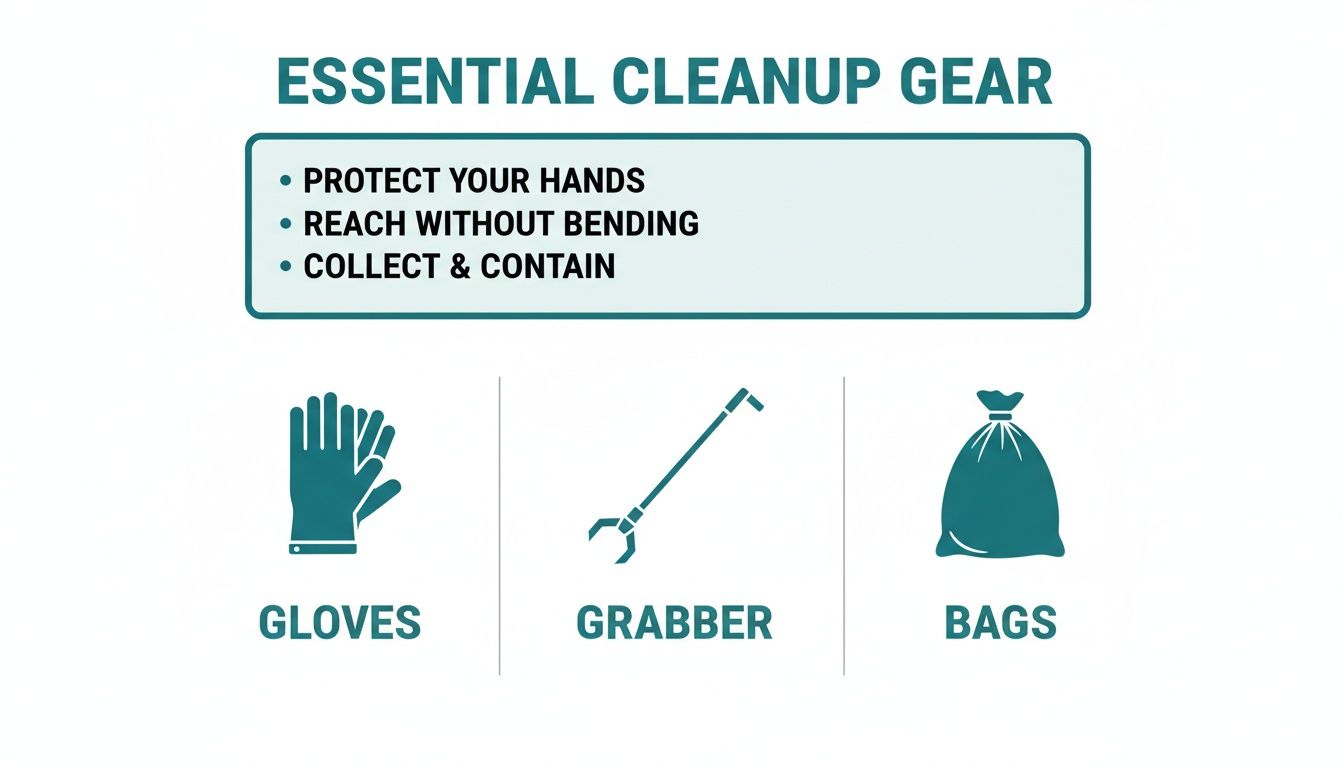
    For any new organizer, I believe it's crucial to have the essential gear on hand so everyone can participate safely and effectively.

    Essential cleanup gear: gloves, grabber tool, and trash bags for safe and efficient waste collection.

    This picture nails the three non-negotiables: tough gloves, a reliable grabber, and strong bags.

    The final piece of the puzzle is figuring out trash disposal. For a small group, you might be able to use your own residential bins. For a bigger haul, a quick call to your city’s sanitation department is all it takes. Many cities offer special pickups for volunteer cleanups if you schedule it in advance.

    Organizing your first event might feel like a huge leap, but it really just starts with one small step. I remember when my little crew from Litter Caterpillars won a vacant lot at a city auction. It started as just another cleanup spot, but it became a dream. We’re now turning it into a community park.

    That's what's possible when you decide to lead.

    Your Local Effort Is a Global Movement

    I get it. Sometimes, when I'm out on a quiet Chicago street with just a grabber and a bag, it's easy to feel small. You look at the sheer scale of the mess and think, "Am I even making a dent?" It feels like you’re just one person trying to bail out the ocean with a teacup.

    But then I remember something incredible. You aren't just one person. When you decide to start picking up trash, you're stepping into a current, joining a massive river of millions of people all over the world who are doing the exact same thing. You’re part of a global team.

    That little piece of plastic you just snagged? Someone in Tokyo and someone in Rio de Janeiro just did the same thing. That feeling of satisfaction you get from seeing a clean patch of grass? That feeling is being shared right now, across continents.

    The Power of Millions of Teacups

    It's so easy to dismiss our own actions, but when millions of us act together, the numbers become staggering. They paint a picture of what's possible when we all just decide to show up.

    Just look at the International Coastal Cleanup (ICC), an event that shatters records year after year. In one massive push, over 486,000 volunteers worldwide collected more than 7.4 million pounds of trash. That’s not just a statistic; that’s nearly half a million stories of people, just like you, showing up.

    Your single act of service isn't a drop in the ocean. It's the drop that starts the ripple, which joins another ripple, until it becomes a wave of change felt across the globe.

    Think about that for a second. That’s the collective power of individuals who refused to feel small. Among that haul, they scooped up over 1.4 million food wrappers alone, turning ordinary citizens into debris detectives who help scientists and policymakers understand the true scale of our plastic problem.

    You Are Part of the Solution

    Every time you fill a bag, you're adding to this global momentum. You're not just cleaning a single block in your city; you're casting a vote for a cleaner world. You are a crucial part of a worldwide wave of positive change.

    So, the next time you're out there, feeling like your effort is just a tiny gesture, I want you to remember those numbers. Remember the hundreds of thousands of others standing with you in spirit.

    • You're joining a movement that spans borders and languages.
    • You're providing real-world data that drives policy change.
    • You're inspiring others in your own community to join in, even if you don't realize it.

    Your work matters far beyond what you can see at your feet. It’s proof that no act of kindness is too small when we all do it together. You are the movement.

    Your Cleanup Questions Answered

    Jumping into your first trash pickup can feel like the first day of school. You're excited, maybe a little nervous, and you definitely have questions. I've heard them all at our Litter Caterpillars meetups, and I want to tackle the ones that pop up most often.

    Think of this as our little chat before the main event. It's the part where you realize everyone's here for the same reason—to do a little good and meet some great people along the way.

    What If I Can Only Come Sometimes?

    That's totally fine! Life is messy and unpredictable. I believe your volunteer energy is a precious thing, and you should use it when you feel inspired, not because you feel obligated.

    The best groups, including mine, are built on a "come when you can" philosophy. Just showing up once makes a real difference. This is about building a positive, sustainable habit, not adding another chore to your to-do list.

    Your presence is a gift, never an expectation. Whether you join us once a year or every single Saturday, you are a valued part of the crew from the moment you arrive.

    Do I Need to Bring My Own Gear?

    Good question. It really depends on the group. Many established crews like Litter Caterpillars provide all the essentials—we’ve got a stash of grabbers, gloves, and bags ready for you.

    Still, it's always smart to check the event description or shoot the organizer a quick message beforehand. If you get hooked and plan on making this a regular thing, I think investing in your own comfy gloves or a lightweight grabber is a great move. The one thing you should always bring is a pair of sturdy, closed-toe shoes. Your feet will thank you.

    How Safe Is It, Really?

    Your safety is the absolute number one priority. Period. A responsible volunteer group will always start with clear safety guidelines. It’s not about being fearful; it’s about being smart so you can focus on the rewarding work.

    I kick off every single one of our events with a quick safety briefing. This always covers a few key rules:

    • Know what to avoid: Never, ever touch sharps, broken glass, or anything that looks like hazardous waste.
    • Stay aware of your surroundings: Keep an eye on traffic and watch where you step. It's easy to get in the zone.
    • Work with your crew: Sticking together is way safer and honestly, a lot more fun.

    Follow these simple rules, and you'll have an incredibly safe and fulfilling experience.

    What Happens to All the Trash?

    Ah, the logistics puzzle! For smaller cleanups, we might just use our personal waste bins. For our bigger events, I coordinate directly with the city’s sanitation department for a special pickup. We always have a solid disposal plan before the event even starts, so all you have to do is focus on cleaning.


    Ready to turn that inspiration into action? Join Litter Caterpillars at our next cleanup and see for yourself how a simple act of service can build friendships and transform our city. Find our next event and become part of our story at https://www.littercaterpillars.com.
  • What Is Environmental Stewardship: A Practical Guide to Caring for Our Planet

    What Is Environmental Stewardship: A Practical Guide to Caring for Our Planet

    Let me tell you what environmental stewardship really is. It’s about taking care of this place we all call home. It’s a simple, yet wildly powerful idea: you and I have a personal responsibility to look after our natural world. We do this through smart, sustainable choices, ensuring this planet stays healthy and vibrant for the people who come after us.

    What Is Environmental Stewardship, Really?

    I used to hear the term "environmental stewardship" and, I'll be honest, my mind would conjure images of scientists in sterile lab coats or maybe activists chaining themselves to ancient trees. It felt… distant. Definitely not for an everyday person like me.

    But the real meaning hits much closer to home. Imagine you’re a good neighbor. Now, imagine your neighborhood is the entire planet. See? It’s not about grand, impossible gestures that feel out of reach. It starts with a single, quiet decision you make to take ownership of your small corner of the world.

    This feeling of ownership can start anywhere. Maybe for you, it's finally decluttering that one chaotic drawer in your kitchen or figuring out, once and for all, what actually goes in the blue recycling bin. For me, it started with cleaning up my own wildly messy apartment. That small act of bringing order to my personal space somehow, almost magically, spilled out onto the streets of Chicago.

    Stewardship is a mindset that grows. It’s a seed. It starts small and transforms you from the inside out.

    The Three Levels of Stewardship

    This journey of care isn't just one big, monolithic thing; it unfolds in layers, like an onion. It starts with you, expands to your community, and ultimately impacts the entire planet.

    As you can see, huge planetary change isn't a top-down mandate. It’s built on a foundation of your choices and our collective community action. It all starts with you.

    This mindset isn’t about following a rigid set of rules someone else made up. I want you to ask yourself one simple question in everything you do: "Am I leaving this place better than I found it?"

    This applies to everything—from a picnic spot in Lincoln Park to the global climate crisis. Your answer to that question, followed by your action, is the very soul of environmental stewardship.

    Stewardship is the active expression of responsibility. It’s turning that passive, nagging feeling of “someone should do something” into the active decision, “I will do something.”

    This active decision is where the magic happens. It's where you discover that strange, surprising joy that comes from service. For a lot of us, the simple act of cleaning up trash is the perfect first step. It's visible. It's immediate. It connects you directly to your environment, showing you the real, tangible difference one person can make.

    Finding Purpose in a Hailstorm

    My journey into this whole environmental stewardship thing didn’t kick off with some grand, planet-saving vision. It actually started with my messy apartment. My life was chaotic, and my living space was a perfect mirror—every forgotten takeout container and pile of clothes a monument to my own indecision.

    It took a pretty brutal breakup to finally jolt me awake. I looked at the life I had and knew I had to build something new, something centered around giving instead of just taking. It was time for me to finally face the things that terrified me: cleanliness, consistency, and just showing up for something bigger than myself.

    So, I started small. I decided to try cleaning up a public space.

    The First Cleanup

    Our very first cleanup was… not glamorous. At all. There were only three of us. We met on a spring day in Chicago that decided to turn on us, unleashing a freak hailstorm that felt more like a blizzard than a spring shower. The sky went dark. Ice pellets hammered down on us.

    We huddled under a tree, totally soaked, shivering, watching as every single Uber we called canceled on us. In that miserable, freezing moment, something just clicked. An epiphany hit me as hard as the hail.

    Cleaning up someone else’s mess is surprisingly more joyful than facing your own. It pulls you out of your head and plugs you into a tangible, immediate purpose.

    That shared struggle forged an unbreakable bond between the three of us. It gave our little mission a soul. We weren’t just picking up trash anymore; we were weathering a storm together, both literally and figuratively.

    From Personal Chaos to Collective Action

    That hailstorm taught me what environmental stewardship really feels like. It’s not about being perfect or having all the answers. It’s about showing up, especially when it’s hard, and finding a weird kind of fun in the suffering. It adds a little flavor to the story, you know?

    That one experience completely shifted my perspective. Creating order in a public park was a direct extension of the order I was trying to create in my own life. It proved that my own personal transformation could spark change in the community. By facing my own fears—of mess, of inconsistency—I stumbled into a mission that was more rewarding than I ever could have imagined.

    Your journey can start the same way. It doesn’t begin with a global plan. It begins with the simple, brave decision to clean up the space right in front of you.

    How One Small Act Can Ignite a Movement

    Do you ever wonder if picking up one piece of trash actually makes a difference? I’m here to tell you it’s the only thing that ever has. That one small, repeated act is the seed of every great movement. It’s the spark. The tiny little flame that ignites a wildfire of change.

    Three smiling people in the rain clean up litter with rakes and trash bags under a tree.

    For three years, we've shown up every single week at Litter Caterpillars. Every. Single. Week. We’ve picked up trash through Chicago blizzards, suffocating heatwaves, and pouring rain. That kind of consistency creates a visible ripple effect, and you can feel it spreading through a neighborhood. It shows people someone cares, which gives them permission to care, too.

    The Tom Sawyer Effect

    You know the story of Tom Sawyer, right? It’s a simple but powerful analogy from Mark Twain's classic. When Tom had to whitewash a fence as punishment, he didn’t mope. He attacked the chore with so much infectious joy and pride that his friends started begging—they even paid him—for a chance to help.

    That’s exactly what we do. We bring that same energy to our cleanups. We treat the work like an adventure, not a chore.

    When you treat service like a privilege instead of a punishment, people can't help but want to join in. Joy is contagious, and a shared purpose is one of the most powerful forces on Earth.

    This is the heart of our approach to environmental stewardship. We aren't just cleaning streets; we're building a community around the joyful act of giving back. My whole mission is to make service so appealing that it becomes irresistible.

    Building a Team for Change

    We use bright yellow flags, a theme song, and team badges. It’s not just me being silly—it’s about building a real identity around service. When you feel like you belong to something bigger than yourself, when you're part of a team, the work completely transforms. It stops being about picking up litter and becomes a shared mission. A quest.

    This isn’t just about making our streets look better for a day. It’s about so much more:

    • Reclaiming our public spaces and sending a loud, clear message that these places are loved and protected.
    • Forging real friendships built on shared effort and a common goal, not just casual chit-chat.
    • Proving that a handful of determined people can absolutely spark a city-wide transformation.

    Every piece of trash you pick up is a vote for the kind of world you want to live in. It's a small act of defiance against apathy and a testament to the power of just showing up. One person, one bag, one block at a time—that's how we change the world.

    A Global Chorus Demanding Change

    When we're out on Chicago’s streets, picking up litter one piece at a time, it's easy to feel small. You might look at the bag in your hand and wonder if you're just a drop in an ocean of problems. I'm here to tell you that your small act is actually a local verse in a massive global song—a chorus of voices demanding a better world.

    If you feel that deep, unshakable desire for a healthier planet, you are not alone. You are part of an overwhelming, powerful majority.

    A group of cheerful volunteers cleans up litter, holding a flag and trash bags, in a vibrant watercolor style.

    A Unified Global Voice

    Let's be real, sometimes it can feel like apathy or greed are winning. But the data tells a very different, much more hopeful story. People everywhere are waking up.

    A groundbreaking study, the Global Green Attitudes Survey, found something stunning: an incredible 84% of people worldwide would choose stronger environmental protections, even if it meant slower economic growth. Think about that. This isn't just a sentiment in wealthy countries. The passion for action is actually strongest in developing nations, with huge numbers of people in places like India (82%), China (79%), and Nigeria (79%) saying they're taking more personal action now than they did last year. You can read the full research about these powerful global attitudes.

    This isn't just a trend; it's a fundamental shift in human values. People are sending a clear, unambiguous message to our leaders: environmental stewardship is no longer a niche hobby for a few. It is a non-negotiable demand from the citizens of Earth.

    Your choice to act locally—whether you join a cleanup, plant a garden, or simply consume more mindfully—is an echo of this powerful, worldwide chorus. You aren’t just one person; you are a vital voice in a global movement calling for a better future.

    Your Action Is Your Voice

    This global perspective reframes everything. When you pick up that discarded coffee cup on your block, you aren’t just cleaning a sidewalk in Chicago. You are standing in solidarity with a farmer in Nigeria planting trees and a student in India choosing to recycle.

    Your actions are your vote for the future you want. They're a tangible expression of a shared human value that transcends borders, cultures, and languages. The desire to care for our home, to be a good steward, is a fundamental part of who we are.

    So, the next time you feel small, remember this global chorus. You are part of something immense. Your individual effort is what gives this global movement its power, proving that the answer to "what is environmental stewardship?" is found in the collective heartbeat of humanity demanding change.

    Stewardship from the Streets to the Boardroom

    That little decision you make to just own your space and pick up some trash? It’s not just happening on street corners anymore. The same spirit that gets us out there on a Saturday morning is finally starting to echo in the world’s biggest corporate boardrooms.

    It’s the same core idea, whether you’re cleaning a park or running a Fortune 500 company: you have to take responsibility for your impact.

    For a long time, it felt like a battle between everyday people like you and me and these giant, faceless corporations. But the tide is turning. That grassroots mindset is scaling up, and companies are finally starting to listen. This isn't just fluffy PR, either.

    The biggest companies in the world are setting real carbon targets, hiring VPs of sustainability, and even tying executive bonuses to hitting green goals. Investors are now pouring trillions of dollars into businesses that can actually prove they're serious about this stuff.

    The Proof Is in the Numbers

    The demand for corporate transparency is massive, and it’s not going away. A recent report found that an incredible 95% of the world's 250 largest companies now publish their carbon targets. On top of that, over 22,100 companies—representing half the world's market cap—are sharing their environmental data through platforms like CDP. You can see for yourself just how widespread this movement is and dig into the numbers.

    This shift isn't happening in a bubble. It lines up with the same accountability frameworks used by global groups like the United Nations to track our progress toward a healthier planet. It’s a powerful validation of the work you and I do every single weekend.

    The core principle is the same everywhere: we are all responsible for the mark we leave on this world. The spirit of stewardship connects a neighborhood cleanup directly to a corporate sustainability report.

    This link proves that what you do locally is perfectly aligned with a global movement. When a company adopts greener practices, it's following the lead set by people like you. You can learn more about how businesses are stepping up by exploring different corporate social responsibility programs that are making a real difference.

    Your time spent volunteering is part of a much bigger story—one that’s reshaping our world from the ground up.

    How to Start Your Stewardship Journey Today

    Feeling that spark? Good. Let's turn that inspiration into action, right now.

    You don't need a special degree, a bunch of free time, or any expensive gear to become an environmental steward. You just need to show up.

    This is your personal invitation. It’s your no-fluff, practical guide to getting involved with Litter Caterpillars this weekend. We host events every single Saturday and Sunday, hitting all of Chicago's 50 wards. There's always a place for you.

    What to Expect at Your First Cleanup

    Joining us is simple. I know the first step is always the hardest, but I promise it's worth it. When you come to an event, you’ll find a group of the kindest, most welcoming people you’ve ever met. We bring everything you need—gloves, bags, and trash grabbers.

    Our entire philosophy is "volunteer-first." Your safety and your happiness are my only real priorities. We're not here to hit you up for money or pressure you into anything. We’re here to build a genuine community of givers who find real joy in service.

    Showing up is the most powerful thing you can do. It’s a vote for the world you want to live in—a world where people care for their spaces and for each other.

    Our meetups are designed to let you find your own rhythm. You might be the quiet type who puts on headphones and gets in the zone. You might be the social butterfly making new friends. Both are perfect.

    This is your chance to make a visible difference right where you live, connect with some amazing people, and discover that strange, wonderful joy that comes from leaving a place better than you found it.

    You can see our upcoming events and easily sign up to volunteer for a trash pickup on our website. It’s the easiest, most rewarding decision you'll make all week. I can't wait to meet you.

    Common Questions About Getting Started

    Watercolor illustration of smiling volunteers with cleaning supplies, ready for an environmental clean-up.

    You’ve got questions, and that’s a fantastic sign. It means you're already thinking like a steward, ready to take that next step. Here are a few things people like you often ask me before jumping in.

    Do I Need Any Special Gear?

    Nope, not a thing! We live by a "volunteer-first" philosophy, which means I make sure we provide everything you need to make an impact: gloves, bags, and trash grabbers.

    Your only job is to show up with a good attitude, ready to meet some amazing people. We handle all the logistics so you can focus on the community and the pure joy of service.

    What If I Can't Make It Every Weekend?

    That is completely okay! We're here to create opportunities, not obligations.

    We show up every single weekend so you can join us whenever it fits your life—whether that’s once a week or once a season. Every single hour you put in makes a visible difference you can actually see and feel.

    The strength of our community comes from our collective consistency, not from placing heavy demands on any one person. Your presence is always a gift.

    Is Stewardship Only About Picking Up Litter?

    Picking up litter is a powerful and visible start, but trust me, it’s just the beginning. True environmental stewardship is a mindset you carry into every part of your life.

    It’s about consuming less, conserving resources, and advocating for a healthier world for everyone. Our cleanups are the gateway—the first step to building habits of service and awareness that will empower you to make a positive impact everywhere you go.


    Ready to turn inspiration into action? Join the Litter Caterpillars community and discover the joy of making a real difference, one block at a time. Find your next cleanup event here!

  • Cleaning Up a River: Your Guide to Making a Real Difference

    Cleaning Up a River: Your Guide to Making a Real Difference

    It all starts with one person and one trash bag.

    Seriously. That’s it. That’s the secret to sparking massive, positive change in your community. Forget needing some grand, complicated plan or a massive team. You just have to be brave enough to start.

    The Unbelievable Power of a Single Trash Bag

    Man in a cap and shirt carrying a bag walks along a serene riverbank at golden hour.

    You know that feeling, right? You're walking along the river, and you see plastic bottles and old bags tangled in the reeds. Your heart sinks. It's that familiar pang of sadness mixed with a heavy dose of helplessness, the sense that the problem is just too big for one person to tackle.

    We're here to tell you that’s a lie. The real magic isn't in some massive, top-down initiative. It's in the simple, brave act of just starting.

    This whole guide is built on one core belief: you have the power to create incredible change.

    We’ve seen it happen. I remember a few friends who were just fed up with seeing the same stretch of their local river choked with trash. One Saturday, armed with nothing more than gloves, trash bags, and a shared feeling of "enough is enough," they just started cleaning. That one small act of bravery snowballed into a community-wide movement that made the whole town proud.

    From Helpless to Hopeful

    This isn't about being some credentialed environmental expert. It's about being a neighbor who gives a damn. We want to help you shift your mindset from "someone should really do something about this" to "I can actually do something amazing."

    The journey of cleaning up a river isn't just about the impact—it's deeply rewarding and, believe it or not, a ton of fun. You meet people who care as much as you do. You get to see the direct result of your work. It's pure, simple, and good.

    Sure, the scale of the problem can feel overwhelming. Globally, it’s estimated that 1.95 million metric tonnes of plastic flows down our rivers every single year. But that number isn’t a reason for despair; it's a call to action. Small, dedicated groups are already making a huge dent in it, one kind act at a time.

    "Think of a river cleanup like Tom Sawyer painting the fence. He didn't see it as a chore; he made it an adventure so compelling that his friends literally paid him for the chance to help. That’s the spirit we’re channeling here—turning service into something joyful and magnetic."

    This guide is your playbook for turning that spark of inspiration into a real, tangible, and fun event. It’s as much about your personal growth as it is about community service. You'll find that the tools you need for both are way simpler than you think. In fact, you can apply these same principles anywhere—you might even check out our guide on cleaning up trash in your neighborhood.

    Let's get one thing straight: it’s a LOT easier to make an impact than you think. Let's show you how.

    How to Plan Your First Cleanup Adventure

    That little spark you're feeling? Let's turn it into a full-blown bonfire. This is where your good intentions start growing legs, where your kindness gets an action plan. But hold off on the complicated spreadsheets and dry logistics for now. The real adventure of cleaning up a river starts with something much simpler: a walk.

    The very first step is just about getting out there and being a curious explorer in your own backyard. Lace up some comfy shoes and go scout a stretch of your local river. What do you actually see? Is it a minefield of plastic bottles tangled in tree branches? A sad graveyard of old tires half-sunk in the mud? Or is it maybe just a light dusting of everyday trash that feels totally doable for a small crew?

    I'll never forget a story I heard about a group out in the Midwest. They were scouting a park that looked pretty clean on the surface. But one person, with a bit of a brave streak, spotted a faint trail of old construction debris leading into the woods. They followed it. Not even 50 yards off the main path, they discovered a massive illegal dumping site, completely hidden from sight. That one curious walk turned their small litter pickup into a major restoration project. That’s the power of looking a little closer.

    Become a River Detective

    Think of this first walk as a recon mission. You’re gathering intel. You're not just spotting trash; you're getting a feel for the terrain, understanding the challenges, and seeing the opportunities. It's like mapping out a hiking trail before you lead a group on it. A little prep work here builds a ton of confidence for the main event.

    Before you start planning anything, you need to know what you're up against. Your initial scouting trip is all about gathering the on-the-ground facts that will shape your entire event.

    Use this checklist as your guide when you first walk the site. It’ll help you spot the critical details that make the difference between a chaotic day and a smooth, successful cleanup.

    Your Initial River Scouting Checklist

    Area to Assess What to Look For (Examples) Why It Matters
    Volunteer Access Are there official parking lots? Paved or unpaved trails? Public boat ramps or easy-to-walk-down banks? You need safe, clear entry points for your crew. Kindness means not making people scramble down a treacherous, muddy hill to help out.
    Trash Hotspots Look for eddies where trash collects, areas under bridges, or sections near storm drains. This helps you focus your energy. You can direct teams to the highest-impact zones right away instead of having them wander aimlessly.
    Safety Hazards Steep, slippery banks? Patches of poison ivy? Areas with fast-moving water or hidden drop-offs? Volunteer safety is everything. Identifying hazards beforehand lets you warn everyone and mark off any no-go zones on the day of the event. Being brave doesn't mean being reckless.
    The "Big Stuff" Discarded furniture, shopping carts, tires, appliances, or anything that looks like it might contain chemicals. These items often require special equipment, more people, or specific disposal methods. You need to know about them early to plan properly.

    This scouting trip does more than just give you data; it gives you a story. It transforms your mission from a vague "let's clean the river" into a powerful, concrete goal: "We're going to clear that huge pile of styrofoam from under the old bridge." That’s something people can rally behind.

    Starting the Conversation with Your City

    Alright, now for the part that sometimes makes people nervous: talking to local officials. Let's reframe this. This isn't some bureaucratic chore; it's a conversation with a potential partner. You're the one bravely stepping up to improve a public space—most city and park departments will be thrilled to have your help.

    Your first call should probably be to your local Parks and Recreation Department. When you connect, be direct, friendly, and fearless.

    Instead of asking, "Am I allowed to do this?" try framing it this way: "Hi! I'm leading a group of neighbors who are excited to help clean up the riverbank at Lincoln Park. What’s the best way we can coordinate with you to make sure our event is safe and successful?"

    That small shift in language changes the entire dynamic. You’re not a kid asking for permission; you’re an organized leader asking for a partnership. It shows you’re serious and that you respect the process.

    This one conversation can be a goldmine. They can give you crucial info on waste disposal, flag any sensitive wildlife areas to avoid, and sometimes even provide supplies like bags and gloves. Building this relationship from the start makes your event solid, safe, and way more impactful.

    How to Rally Your Crew of River Champions

    A river cleanup is a team sport. Its magic doesn’t come from a perfectly executed plan; it comes from people showing up for each other and for a piece of earth they care about. This is where we gather your crew, but let’s throw out the idea of a boring, formal volunteer call.

    Think of this as inviting friends to a party with a purpose. Your passion is the real invitation.

    This isn’t about begging for help. It’s about sharing an opportunity to do something that feels good, something that connects us to our community and to each other. It’s a chance to spend a few hours outside, get our hands a little dirty, and see a tangible, beautiful result at the end of it.

    The real power of cleaning up a river is that it’s a shared victory.

    Finding Your First Believers

    Forget mass emails and generic flyers, at least for now. Your first champions are probably already in your life.

    Start with the people who get you. The friend you go hiking with, the person you grab coffee with every week, the neighbor who also complains about the trash in the park. Your invitation can be as simple as: “Hey, I’m putting together a small group to clean up that messy spot by the old bridge next Saturday morning. Want to join me? We’ll grab pizza after.”

    That’s it. It’s personal, it’s kind, and it’s brave. You’re stepping up and inviting others into your vision.

    The goal isn't to recruit an army overnight. It's to find your first few "yeses." Those first few people are like the kindling for a campfire; their energy and belief will attract others and help the movement grow.

    From there, the circle widens. Think about the natural gathering spots in your community. Where do people who care about local spaces already hang out?

    • Local Coffee Shops: Chat with the owner or manager. Ask if you can leave a small, story-driven postcard at the counter.
    • Outdoor & Hobby Groups: Connect with local hiking clubs, bird-watching societies, or even book groups. Their members already value community and the outdoors.
    • Neighborhood Social Media Pages: Craft a post that tells a story, not just a call for volunteers. Instead of "Volunteers Needed," try something like, "Felt heartbroken seeing all the plastic along our river this morning. I’m going out with a few friends on Saturday at 10 AM to do something about it. Anyone want to be a hero with us?"

    Telling a simple, authentic story connects with people on an emotional level. It transforms a task into a mission. And if you’re looking for more creative ways to spread the word, our guide on how to find volunteers offers even more ideas for building your team.

    The Gentle Art of Asking for Help

    Now let’s talk about partnerships. Asking a local business for support can feel intimidating, but it’s just another conversation. You’re not asking for a handout; you’re offering them a chance to be a hero in their own community story.

    People want to help—they often just need a clear and kind invitation. When you walk into that local hardware store or pizzeria, go in with a smile and a simple, direct request.

    Scenario: Asking a Hardware Store for Supplies

    • Don't say: "Can you donate something to my event?"
    • Do say: "Hi, I’m Sarah. A few of us neighbors are cleaning up the riverbank behind the library this weekend. We're so excited, but we're short on work gloves for everyone. Would you be willing to help us out by donating a few pairs? We’d be sure to give your store a huge thank you on our social media page."

    Scenario: Asking a Pizzeria for Post-Cleanup Food

    • Don't say: "We need food for our volunteers."
    • Do say: "Hi, I’m Mike. Our community group is spending Saturday morning cleaning up trash along Miller Creek. We’re expecting about 20 people to come out. We’d love to celebrate their hard work afterward and were wondering if you might be able to help us with a couple of pizzas? It would mean the world to our crew."

    This approach is kind, specific, and honors their contribution. You are inviting them to be part of the celebration.

    Building these small, local partnerships is how a one-day event starts to feel like a true community movement. You’re not just cleaning up a river; you’re weaving a stronger, more connected neighborhood, one brave and kind conversation at a time.

    Your Game Plan for a Safe and Unforgettable Cleanup Day

    The big day is finally here. This is the moment it all pays off. What follows is your playbook for turning a great idea into a lasting memory—an event that’s not just effective, but safe, fun, and genuinely empowering for every single person who shows up.

    Forget the dry, boring safety manuals. Today, you're not just an organizer; you're an expedition leader. Your job is to make safety feel like empowerment, not a list of restrictive rules. It’s about creating an atmosphere where everyone feels looked after, confident, and ready to make a real difference.

    Crafting a Safety Briefing That Actually Connects

    Think of the pre-cleanup huddle as a campfire gathering, not a lecture. This is your chance to set the tone for the whole day. Get everyone in a circle, make eye contact, and speak from the heart. This is where a group of strangers becomes a unified, caring team.

    A good briefing is the foundation of a safe event. Keep it engaging, clear, and kind.

    • Talk About the Hazards Honestly: Be upfront about the real risks. Mention slippery banks, poison ivy, and the potential for sharp objects. You're not trying to scare people; you're equipping them. Frame it like, "We're going to be brave and smart out there today, and that means looking out for each other."
    • Show, Don't Just Tell: Demonstrate how to do things right. The most important one? Show everyone the proper way to lift a heavy bag—bend with your knees, not your back. It’s a simple move that prevents a world of hurt.
    • Make the Buddy System Mandatory: This one is non-negotiable. Pair people up and tell them their main job is to keep an eye on their partner. This instantly builds camaraderie and creates a web of safety across the entire group.

    The story of the Citarum River in Indonesia really puts this in perspective. Cleanup crews there pulled a staggering 3,200 tons of waste from the river in a single year. That same river has mercury levels 100 times above safety standards. It’s a stark reminder of why safety has to be number one—you never know what’s lurking in the water.

    Your Essential Gear Checklist

    Having the right equipment is an act of care for your volunteers. It tells them you’ve thought about their well-being from the start. You don't need a warehouse full of gear, just the smart essentials.

    Here’s a simple, can't-skip list:

    • Puncture-Proof Gloves: This is your #1 priority. Hands need to be protected from glass, metal, and whatever else is hiding in the mud.
    • Sturdy Trash Bags: Get the heavy-duty kind. The last thing you want are bags ripping open when they're full of wet, jagged debris.
    • A Well-Stocked First-Aid Kit: Make sure it's easy to find and at least one other person knows where it is. Stock it with bandages, antiseptic wipes, pain relievers, and anything else you might need.
    • Hand Sanitizer and Wipes: An absolute must for a quick clean-up before grabbing a snack or after handling particularly grimy trash.
    • Buckets or Tubs: These are surprisingly useful for carrying smaller bits of trash or consolidating half-full bags, which makes the whole process way more efficient.

    These principles for a safe event apply everywhere, from riverbanks to city squares. For more tips on group safety and logistics, check out our guide on how to clean up a park.

    Building Your Base Camp and Logistics Flow

    Every great expedition needs a base camp. For your cleanup, this is the heart of the operation—a central spot where people check in, grab supplies, take a break, and connect. It doesn't have to be fancy. A pop-up tent or a couple of folding tables under a shady tree works perfectly.

    This graphic shows the simple journey that got you and your team to this point.

    A graphic illustrating a team building journey with three steps: Inspire, Partner, and Gather.

    Each step—inspiring others, partnering with your community, and gathering your crew—is what makes a successful and safe cleanup day possible.

    "A well-organized base camp is a message to your volunteers: 'You are valued here. Your comfort and safety matter.' It turns a tough job into a supported mission."

    Set up clear stations for water, snacks, and sorting the trash. A simple system—one pile for recycling, one for general trash—makes the final disposal so much easier. This central hub ensures nobody gets lost, everyone stays hydrated, and the day runs like a well-oiled machine. Make sure you've coordinated your waste pickup ahead of time so the fruits of your labor don't just become a new eyesore.

    Finally, designate a photographer. Capturing the smiles, the teamwork, and the triumphant moments will tell the story of your success long after the last bag is gone.

    How to Turn One Great Day into a Lasting Movement

    Six diverse volunteers celebrate a successful outdoor cleanup, displaying a '2,000lb removed' sign.

    The last bag of trash is tied off, and that quiet sense of victory settles over your crew. This feeling right here? This is the most important part of your entire river cleanup. It's the spark that can ignite a lasting movement, but only if you tend to it.

    Don't let this incredible energy just fizzle out as people head home. The work isn't truly over until you’ve honored the effort. This is your victory lap, and it's where a one-day event transforms into a real community of river champions.

    Celebrate Your Champions

    Think of your cleanup as a championship game. You wouldn't win the Super Bowl and then just quietly walk off the field, right? You celebrate! Your volunteers are the MVPs, and they absolutely deserve to feel like it.

    A celebration doesn't need to be fancy or expensive. Its only job is to be genuine.

    • Host an immediate after-party. This could be as simple as pizzas and sodas at a nearby park or moving the crew to a local cafe that offered you a discount. The goal is to give everyone a chance to connect as friends, not just as fellow workers.
    • Give a heartfelt thank you speech. Before everyone scatters, get them together. Look them in the eye and tell them what their effort means. Share a specific, memorable moment from the day—maybe someone pulling a particularly gnarly tire from the mud.
    • Share the glory. Get photos up on your social media pages within 24 hours. Tag anyone you can, and shower praise on your team and community partners. Make your volunteers the heroes of the story, because they are.

    This simple act of celebration tells every single person that their time and sweat were seen, valued, and deeply appreciated. That feeling is what brings them back.

    The Power of Cold, Hard Data

    Now, let's give all that hard work a voice that can speak to city councils, potential sponsors, and future volunteers. The most powerful way to do that is with data. Numbers tell a story that's impossible to ignore.

    Before the trash is hauled away, take a few minutes for this crucial step: weigh the collected trash. A simple bathroom scale or a luggage scale can do the trick. Tally up the total weight and count the number of bags you filled.

    Imagine telling your town, "Today, our team of 50 neighbors removed 2,000 pounds of plastic, tires, and debris from our river in just three hours." That’s not just a feel-good story; it’s a headline that demands attention and inspires action.

    This data becomes your proof of impact. It’s the evidence you can use in grant applications, partnership proposals, and media outreach. It quantifies your effort and turns a day of cleaning up into a measurable community achievement.

    Keeping the Campfire Burning

    Your event created a powerful burst of positive energy. The final piece of the puzzle is to capture that energy and keep it glowing. Don't let the community you just built fade away.

    This is about creating a real legacy for your river.

    1. Follow Up Fast: Send a thank-you email to all participants within 48 hours. Share the final stats (pounds of trash collected!), include a link to the photo gallery, and give a shout-out to your partners.
    2. Create a Hub: Start a simple Facebook group or an email newsletter. This gives your river champions a place to stay connected, share ideas, and hear about future events. It’s their community space.
    3. Plant the Seed for Next Time: In your follow-up, mention that you're already thinking about the next cleanup. This simple act turns a single event into the beginning of a sustained effort.

    This data-driven approach is critical on a global scale, too. We know that ten major rivers are responsible for an astonishing 90% of all plastic that flows into the world's oceans. Reporting your local data contributes to a bigger picture, showing how targeted cleanups can make a massive difference. You can read more about these global pollution statistics and discover why every piece of data matters.

    By celebrating your people, measuring your impact, and building a community, you turn one great day into an unstoppable force for good. You’ve shown everyone just how easy—and fun—it is to make a real difference.

    Your Questions About River Cleanups Answered

    So, you feel that pull. You're ready to do something brave and kind for your river. But then the questions start creeping in, the little "what ifs" that can stop you cold if you let them.

    Let's drag those questions out into the sunlight and tackle them head-on. These aren't roadblocks; they're just the last few turns you need to figure out before the real adventure begins. We've been there, and we've got the answers to help you lead with confidence.

    What If I Can't Get Official Permission?

    This is a classic fear, but don't let it kill your momentum. It's almost never a hard "no." It's usually just a matter of finding the right person to talk to.

    Your first stop should be your local parks and recreation department. When you call, don't frame it as asking for permission. Frame it as offering a gift. You're a community leader bringing a team of passionate people to beautify a public space they're in charge of—for free.

    If that’s a dead end, look up a local environmental nonprofit. These folks often have relationships with city officials already baked in. They might partner with you or just give you the right name to call.

    "Sometimes, the kindest path is the simplest one. Grab a few friends for a 'plogging' walk—jogging and picking up litter. This small, brave act often requires no permits and shows you're serious. It builds the foundation for something much bigger."

    How Do We Handle Large or Hazardous Items?

    Your crew's safety is everything. This is where your kindness as a leader has to be fierce. Their job is the everyday stuff—plastic bottles, foam cups, chip bags. For anything else, the rule is simple and absolute.

    If you come across big items like tires or furniture, or anything that looks sketchy like sealed drums or chemical containers, the rule is: Do Not Touch.

    In this situation, your team's job is to become expert witnesses.

    • Flag it: Have volunteers mark the spot so it's easy to find again.
    • Document it: Snap a quick photo on a phone.
    • Report it: Mark the location on a map and call it in to the right people, like your city’s public works or environmental protection agency.

    You're their eyes on the ground. Reporting these bigger problems is a huge part of the mission. It’s an act of bravery that protects your people and the river.

    How Can I Keep Volunteers Motivated for Future Events?

    The trick to turning first-timers into a loyal crew isn't complicated: make them feel seen, valued, and part of a team that wins. You’re not just filling a roster; you're building a community.

    It all starts on cleanup day. Be organized. Be positive. Thank everyone, out loud, for their hard work. Let them stand back and see the massive pile of trash they collected together. Let them feel their impact.

    Then, follow up within 48 hours. Send an email celebrating what you all accomplished. Use the numbers: “Together, we pulled 800 pounds of trash out of our river!” Fill it with pictures of people smiling, working, and looking proud.

    The real magic, though, is giving that energy a home. Start a simple Facebook group or an email list to share updates and celebrate the wins. When you focus on the shared passion, the cleanup stops being a one-time chore and becomes a joyful, ongoing movement they can't wait to join again.


    At Litter Caterpillars, we believe in showing up for our city and each other, one piece of trash at a time. If you’re in Chicago and ready to find friendship and purpose through service, join our next adventure. Learn more about our mission and find an event at https://www.littercaterpillars.com.
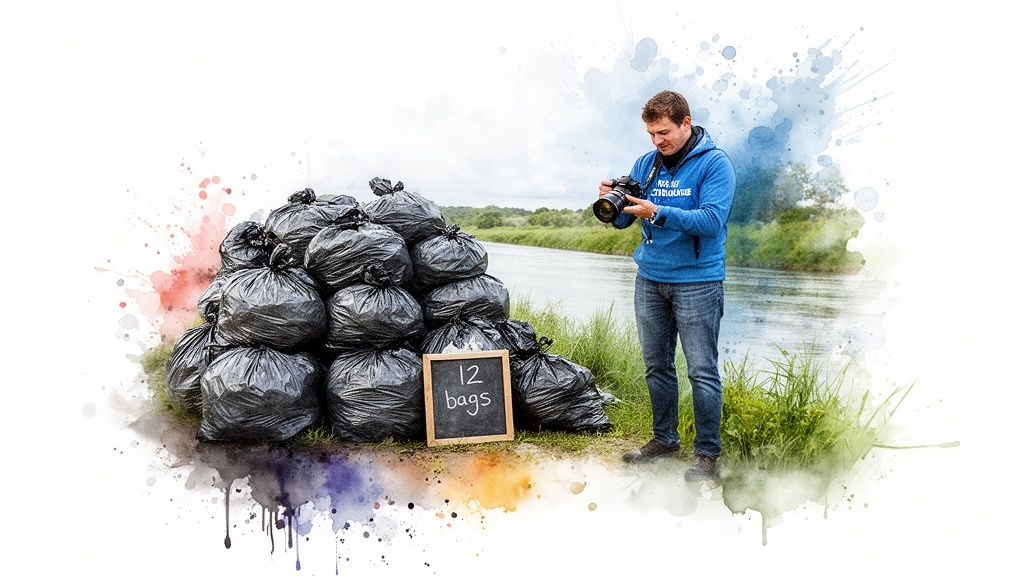
  • 7 Unforgettable Volunteer Opportunities Chicago Offers in 2026

    7 Unforgettable Volunteer Opportunities Chicago Offers in 2026

    Feeling that itch to do something more? To connect with your city in a way that’s real, raw, and leaves a visible mark? You’re not alone. The truth is, making an impact in Chicago is a lot easier, and a lot more fun, than you think. It's not just about grand gestures; it's about showing up, finding your people, and embracing a little grit to transform not just a neighborhood, but yourself.

    This isn't your grandpa's charity bake sale. This is about finding bravery in the unexpected, kindness in shared work, and discovering the incredible power you hold to build a better city, one weekend at a time. My own journey started when I realized cleaning up other people's messes was way easier than cleaning up my own. That simple act, picking up litter with a few friends in a freak hailstorm, sparked a movement and taught me that a little suffering can make life interesting. It "advanced the plot" of my life, and it can do the same for yours.

    We believe in the redeeming and transforming power of service, sunlight, and friendship. We are all caterpillars trying to transform ourselves. This guide is your starting point. We've cut through the noise to bring you a comprehensive roundup of the best groups and platforms to find volunteer opportunities in Chicago. From gritty, all-weather cleanup crews like the Litter Caterpillars to city-wide platforms connecting you with hundreds of nonprofits, we’ll show you exactly where to look. Each entry includes details on how to join, what to expect, and direct links to get you started immediately. Ready to find your crew and start your transformation? Let's dive in.

    1. Litter Caterpillars

    WARNING: We're not your Grandpa's trash pickup group! For those searching for truly impactful volunteer opportunities in Chicago, Litter Caterpillars offers an experience that is as unconventional as it is transformative. We're the toughest trash pickup group in Chicago—we pick up trash rain or shine, in the coldest days of winter and the hottest days of summer. This is for the brave, the kind, and anyone ready to turn a simple act of service into a powerful engine for personal and community growth.

    We're the first and only trash pickup group to clean up all 50 wards of Chicago, including the ones you've been told to stay away from. And we're the first and only trash pickup group that has won an empty lot at auction—we're currently building Caterpillar Park in Englewood! Our central vision is simple: We believe in the redeeming power of service, outdoors, sunlight, and friendship. That’s why we are Caterpillars. We are not perfect, but we are all trying to transform ourselves.

    A group of Litter Caterpillars volunteers posing with trash bags and pickup tools after a successful neighborhood cleanup event in Chicago.

    What Makes Litter Caterpillars a Standout Choice?

    Litter Caterpillars stands apart with its fierce, volunteer-first philosophy. Volunteer energy is the force with which the world changes. It is fragile and must be protected above all else. That's why the safety and happiness of our volunteers always come first. Unlike other 501c3s, we will never pump our volunteers for money. We do everything we can to encourage the growth of friendships. We believe that fear, failure, and even suffering are good—they lead to growth.

    Sports teams and countries have long realized the power of giving people pride and identity; it’s time that kind people step into our power too. We borrow flags, badges, and even a theme song to give people pride. This approach transforms volunteering from a chore into an adventure, fostering a community of "givers" who are committed to consistency, kindness, and bravery. So here's our question for you: Are you tough enough?

    How to Get Involved and What to Expect

    Joining the Litter Caterpillars is refreshingly simple and designed for immediate action. There are no lengthy applications or formal orientations. The best way to jump in is through our active online communities.

    • Find Your Crew: Connect instantly by joining our Instagram group chat or our community on Geneva. Event details, locations, and updates are shared here. You can also follow our journey on Meetup and Instagram.
    • What to Bring: Just bring yourself and a positive attitude. The group provides all necessary supplies like gloves, bags, and trash grabbers. Dress for the weather, be it sun, rain, or snow.
    • The Vibe: Expect high energy, friendly faces, and a powerful sense of accomplishment. Weekend morning meetups are intentionally scheduled to attract service-minded individuals and filter out selfishness, making it a fantastic way to build a social circle rooted in shared values.

    This organization is perfect for anyone seeking a low-commitment but high-impact way to make friends, improve Chicago’s neighborhoods, and challenge themselves.


    Feature Breakdown How Litter Caterpillars Delivers
    Accessibility Extremely High. No formal sign-up needed. Join via Instagram or Geneva group chats and just show up.
    Commitment Level Flexible. Come once or become a weekly regular. The consistent schedule makes it easy to build a habit.
    Community & Social Central Focus. Culture is built around forming friendships, mutual support, and shared pride in the work.
    Impact Citywide & Tangible. Cleaned all 50 wards, building a park from an auctioned lot. You see the results of your work immediately.

    Pros and Cons for the Aspiring Volunteer

    Pros:

    • Unmatched Citywide Impact: A proven track record of cleaning every single Chicago ward and creating a permanent community green space.
    • Strong, Welcoming Community: A "volunteer-first" culture that prioritizes safety, happiness, and building genuine friendships over fundraising.
    • Consistent and Reliable Schedule: Weekly weekend morning events create a dependable outlet for service and help foster commitment.
    • High-Energy and Inspirational: Documented cleanups and popular social media presence create momentum and make it easy to see the group’s impact. You can learn more about our mission and recent projects on the Litter Caterpillars blog.

    Cons:

    • Physically Demanding: The work involves being outdoors in all weather conditions, which may not be suitable for everyone.
    • Non-Traditional Structure: As it's not a standard 501(c)(3), there is no formal fundraising arm or promise of tax-deductible donations.

    Ultimately, Litter Caterpillars asks a simple question: Are you tough enough? If you’re ready to prove that kindness and bravery can change a city, you’ll find your people here.

    Visit the Litter Caterpillars Website

    2. Idealist (includes VolunteerMatch listings)

    If you’re looking for the most comprehensive, one-stop shop for volunteer opportunities in Chicago, Idealist is the digital equivalent of Grand Central Station for social impact. It’s a massive, trusted marketplace where countless nonprofits, grassroots groups, and community organizations post their needs. What makes it especially powerful today is its integration with VolunteerMatch, effectively combining two of the largest volunteer databases into a single, searchable platform. This means you get an unparalleled breadth of options, from one-time event help at a neighborhood festival to long-term board service for a major cultural institution.

    Idealist (includes VolunteerMatch listings)

    The platform is designed for discovery. You can start with a broad search for "Chicago" and then use its robust filtering system to narrow down the perfect role. This isn't just about finding something to do; it's about finding the right something. You can filter by cause area (like environmental work or youth mentoring), skills you want to use (like graphic design or event planning), and even commitment level. This precision helps transform what could be an overwhelming firehose of listings into a manageable, personalized list of possibilities.

    Key Insight: The true power of Idealist lies in its consolidation. By bringing VolunteerMatch into its fold, it saves you from having to search multiple sites. This efficiency is crucial, allowing you to spend less time searching and more time doing what matters: making a difference.

    What to Expect When You Use Idealist

    The user experience is straightforward. Each listing typically includes a detailed role description, the organization's mission, time commitment, and application instructions. This clarity is a huge advantage, as it helps you understand exactly what you're signing up for before you even click "apply." While some listings redirect to an organization's own website to complete an application, many allow you to express interest directly through the Idealist platform.

    The sheer volume is both a strength and a potential challenge. For every polished listing from a large nonprofit, you might find a sparser one from a smaller, all-volunteer group. This is where your bravery and kindness come in. Don't dismiss an opportunity just because the posting isn't perfect. That small group might be doing incredible work and just needs someone with your spirit to jump in. Like us Litter Caterpillars, they might be small but mighty, focused on the real work of transformation.

    How to Find Your Perfect Match on Idealist

    To get the most out of the platform, follow these simple steps:

    1. Start Broad, Then Filter: Begin with a general search for "volunteer opportunities Chicago" to see the full scope.
    2. Use Keywords: Search for specific interests like "park cleanup," "tutoring," or "food pantry."
    3. Filter with Intention: Use the filters on the left-hand side to specify your availability (e.g., "Good for Weekends"), whether you want an in-person or remote role, and the type of work you'd like to do.
    4. Save Your Search: Create an account to save your search parameters and receive email alerts when new opportunities that match your criteria are posted.

    Website: https://www.idealist.org/en/volunteer-in-chicago/

    3. Points of Light Engage (formerly All for Good)

    If you’re the type of person who thrives on concrete action, Points of Light’s Engage platform is where you’ll find your rhythm. This national powerhouse, which absorbed the popular All for Good site, is dedicated to mobilizing volunteers for hands-on service. It’s less about abstract roles and more about tangible, shift-based work. For those looking for volunteer opportunities in Chicago that involve rolling up your sleeves, this is a go-to resource for food banks, health organizations, and event-based service.

    Points of Light Engage (formerly All for Good)

    The platform excels at logistics. Its listings often include specific shift times, locations, and the exact tasks you’ll be performing, like sorting donations at a warehouse or serving meals at a shelter. This clarity makes it incredibly easy to plan and commit, whether you’re organizing a corporate service day or just looking to fill a free Saturday morning with meaningful work. It cuts through the ambiguity and gets straight to the action, connecting you directly with the frontline needs of Chicago communities.

    Key Insight: The strength of Points of Light Engage lies in its focus on structured, in-person service. This makes it an invaluable tool for groups and individuals who want to show up, do the work, and see an immediate impact without a lengthy onboarding process.

    What to Expect When You Use Points of Light Engage

    The platform feels like a straightforward, no-nonsense directory. You search by location, and it presents you with a list of time-sensitive needs. Each posting details the what, when, and where, often with a direct link to sign up on the organization's own calendar. This direct pipeline to organizations like the Greater Chicago Food Depository or local marathon organizers is highly efficient.

    Because it aggregates posts from many different partners, the level of detail can vary. Some listings are incredibly thorough, while others might be more basic. This is where your bravery comes into play. A simple posting might be from an organization that puts all its energy into service, not marketing. These are often the places where your help is needed most, places that value doing over talking, just like we do when we're out cleaning a forgotten lot, rain or shine.

    How to Find Your Perfect Match on Points of Light Engage

    To navigate the site effectively and find an opportunity that energizes you, try these steps:

    1. Use the Map and Location Search: Start by entering "Chicago, IL" to see all local listings. Use the map view to find opportunities in your neighborhood or an area you want to support.
    2. Filter by "Good For": The filters are your best friend here. You can select "Good for Groups," "Good for Kids," or "Good for 55+" to find roles suited to your specific situation.
    3. Look for Specific Tasks: Search for keywords related to hands-on work, such as "food pantry," "sorting," "event staff," or "warehouse."
    4. Check the Calendar: Pay close attention to the dates and times listed. Many opportunities are for specific, one-time events, making it easy to drop in and make a difference.

    Website: https://engage.pointsoflight.org/

    4. Chicago Cares

    If you're looking for a curated, hyper-local gateway into the heart of Chicago’s volunteer scene, Chicago Cares is your answer. For decades, this organization has been the city's premier volunteer connector, building deep relationships with community partners and creating hands-on projects that address real, neighborhood-driven needs. It's less of a massive, open marketplace and more of a guided tour, making it an incredible on-ramp for anyone new to volunteering or seeking structured, staff-supported experiences. This is where you can truly show up and make an immediate, tangible impact.

    Chicago Cares

    The platform specializes in translating community needs, particularly on the South and West Sides, into accessible service projects. You'll find a centralized calendar packed with everything from sorting donations at a food pantry to revitalizing a community garden or helping students with their homework. Their focus on providing orientation and support makes it easy for first-timers to dive in without feeling intimidated. It’s about building a city where everyone can be a part of the solution, fostering kindness and unity through shared action.

    Key Insight: Chicago Cares excels at removing the friction for new volunteers. Their structured, pre-planned projects mean you don't have to coordinate logistics; you just sign up, show up, and contribute. This managed approach makes it one of the best places to start your journey of giving back in Chicago.

    What to Expect When You Use Chicago Cares

    The user experience is built around a project calendar. Each listing clearly outlines the project's goal, the community partner you'll be serving, the time and location, and any specific requirements. The registration process is simple and handled directly through their site. Because they vet and organize these events, you can trust that your time will be used effectively.

    This focus on well-organized projects is a huge benefit, but it also means that popular events can fill up quickly. This isn't a flaw; it's a sign of a vibrant, engaged community. It teaches a valuable lesson in bravery and persistence. If you miss one opportunity, another is always around the corner. Like us at Litter Caterpillars, the goal is consistent action. We know that showing up, week after week, is how true transformation happens.

    How to Find Your Perfect Match on Chicago Cares

    To make the most of what Chicago Cares offers, try these steps:

    1. Explore the Volunteer Calendar: Browse the calendar to get a feel for the types of projects available and see what sparks your interest.
    2. Filter by Cause or Community: Use the filters to find opportunities aligned with your passions, whether it's education, hunger, or the environment. You can also search for projects in specific neighborhoods.
    3. Sign Up for an Orientation: If you're new to the platform, consider attending a new volunteer orientation to learn more about their work and how to get involved.
    4. Register for a Project: Don't hesitate! When you find a project that excites you, sign up. These spots are valuable because they represent a real commitment to a community partner.

    Website: https://www.chicagocares.org/

    5. United Way of Metro Chicago – Volunteer Portal

    If you’re looking for curated, high-impact volunteer opportunities in Chicago with trusted, pre-vetted nonprofits, the United Way of Metro Chicago’s portal is a fantastic, focused resource. Unlike massive, open-ended search engines, United Way acts as a guide, connecting you directly with its network of community partners. This creates a sense of trust and quality control, ensuring that your time and energy are channeled into well-organized, meaningful projects that address critical needs across the city and suburbs.

    This portal is particularly powerful for those who appreciate structure. Whether you're an individual looking to help out for a day or a corporate team seeking a large-scale service event, United Way offers a clear path. You’ll find everything from on-site roles like supporting a food pantry in Rogers Park or gardening at a community center in Englewood to virtual opportunities like conducting mock interviews for job seekers. It’s a direct line to the heartbeat of Chicago’s established social good network.

    Key Insight: United Way excels at creating organized, turnkey volunteer experiences. By focusing on its partner agencies, it removes the guesswork and connects you with reputable organizations that are deeply embedded in their communities, making it an excellent starting point for both individuals and corporate groups.

    What to Expect When You Use the United Way Portal

    The experience is built around a self-service portal that is clean and easy to navigate. Each opportunity is clearly detailed, outlining the specific tasks, the partner organization's mission, the time commitment, and the location. This clarity helps you feel confident and prepared before you even sign up. The platform also allows you to track your volunteer hours, follow your favorite agencies, and easily coordinate sign-ups for small groups.

    The portal's strength is its connection to United Way's annual campaigns and "Days of Action," which mobilize hundreds of volunteers for concentrated, one-day service blitzes. While the overall inventory of opportunities might be smaller than a national platform, the quality and organization are top-notch. It’s a reminder that sometimes the most powerful acts of service come from joining an established, coordinated effort. It’s about bravely stepping into a structured role where your kindness can have an immediate and visible impact.

    How to Find Your Perfect Match on the Portal

    To get the most out of the United Way platform, try these steps:

    1. Browse Current Opportunities: Start by exploring the main volunteer page to see what's available right now, from kit-packing drives to seasonal events.
    2. Filter by Interest and Location: Use the portal's search functions to narrow down roles by cause area (like education or health) and location across Cook County.
    3. Look for "Days of Action": Keep an eye out for their large-scale annual service events, which are a great way to meet fellow volunteers and make a big impact in a single day.
    4. Explore Corporate & Group Options: If you're organizing a team, check out their specific offerings for corporate groups, which often include tailored events.

    Website: https://liveunitedchicago.org/volunteers/

    6. Serve Illinois (State of Illinois volunteer portal)

    For those drawn to civic duty and state-supported initiatives, Serve Illinois acts as the official gateway. This isn't just another search engine; it's the portal from the Serve Illinois Commission, part of the Department of Human Services. Think of it as the state government's handshake, inviting you to take part in everything from large-scale disaster response training to hyper-local service day events. It’s a credible, official starting point for finding volunteer opportunities in Chicago that are connected to public service and community resilience.

    Serve Illinois (State of Illinois volunteer portal)

    Unlike a traditional volunteer marketplace, Serve Illinois is more of a central hub that connects you to other resources. It shines by providing clear pathways into national service programs like AmeriCorps and VISTA, which are incredible opportunities for deep, transformative experiences. It also serves as a directory, pointing you toward vetted partner organizations (like Chicago Cares) that manage the on-the-ground sign-ups. This approach positions it as a trusted guide rather than an all-in-one platform.

    Key Insight: Serve Illinois is your best bet for finding volunteer roles that align with state and national service priorities. It’s less about sifting through hundreds of grassroots listings and more about stepping into structured, often impactful, programs that have government backing and a wide-reaching vision.

    What to Expect When You Use Serve Illinois

    The user experience is more informational than interactive. You won't find thousands of filterable listings directly on the site. Instead, you'll find resources, program descriptions, and links that direct you to the right place. For example, you might discover a statewide call for volunteers for a specific service day or find a direct link to the AmeriCorps application portal.

    This structure requires a bit of bravery and an extra click or two. You’re navigating a system, not just a website. But this is where kindness to yourself comes in handy. Be patient. The opportunities it uncovers are often unique, providing a different flavor of service compared to other platforms. It’s about finding a role that fits into a larger, coordinated effort to uplift communities across the entire state, starting right here in Chicago.

    How to Find Your Perfect Match on Serve Illinois

    To effectively use this state-level resource, adjust your approach:

    1. Explore the Programs: Start by reading about the major initiatives like AmeriCorps, Senior Corps, and the Governor's Volunteer Service Awards to see what inspires you.
    2. Use the Directory: Look for the "Volunteer Connector Organizations" to find local partners in Chicago and Cook County that have their own databases of opportunities.
    3. Check for Service Days: Keep an eye out for announcements about major events like MLK Day of Service, where the state coordinates widespread volunteer efforts.
    4. Follow the Links: Don't be afraid to click through to partner websites. Serve Illinois has done the work of vetting these organizations for you.

    Website: https://serve.illinois.gov/

    7. Chicago Park District – Volunteer Programs

    If your idea of making a difference involves fresh air, green spaces, and the satisfying feeling of dirt under your fingernails, the Chicago Park District is your direct portal to hands-on environmental action. This isn't just a website; it's an invitation to become a guardian of the city's lungs. From the sandy shores of Lake Michigan to the quiet nature sanctuaries tucked away in neighborhoods, the Park District offers a structured way to connect with the land and leave it better than you found it. It’s the perfect place for those who want to see the immediate, tangible results of their kindness.

    Chicago Park District – Volunteer Programs

    The platform is designed for direct engagement with Chicago's natural beauty. It provides clear pathways for every level of commitment, whether you're looking to join a one-day park cleanup with your friends or want to dive deeper into long-term ecological stewardship. You can help mulch trees, remove invasive species, assist with community garden projects, or support a massive city-wide event. This variety ensures you can find a role that fits your schedule, interests, and desire to work outdoors.

    Key Insight: The true value here is hyper-local impact. You aren't just volunteering in Chicago; you are nurturing the specific park down the street where kids play and neighbors gather. This direct connection to your own community's green space makes the work deeply personal and rewarding.

    What to Expect When You Use the Park District Portal

    The experience is straightforward and geared toward getting you on-site. One-day events and community stewardship workdays often have minimal barriers to entry; you can typically sign up, fill out a waiver, and show up ready to work. For longer-term or specialized roles, especially those involving coaching youth sports or acting as a docent, expect a more formal application process that includes a background check. This layered approach ensures both accessibility for casual volunteers and safety for dedicated programs.

    The opportunities are incredibly diverse but can be seasonal and weather-dependent, which requires a bit of flexibility and bravery. Like us at Litter Caterpillars, we know that a little rain (or even a Chicago-style blizzard) can’t stop a determined heart. That’s the spirit you’ll find among fellow park volunteers, people who aren’t afraid to get a little muddy for a great cause.

    How to Find Your Perfect Match with the Park District

    To find the right role for your outdoor spirit, follow these steps:

    1. Explore the Main Volunteer Page: Start by visiting the central volunteer hub to see the main categories, like "Natural Areas," "One-Day Service Projects," and "Long-Term Volunteers."
    2. Check the Events Calendar: The Park District often lists large-scale cleanup events and workdays on their main events calendar.
    3. Identify Your Local Park Advisory Council (PAC): Many individual parks have their own PACs that organize local volunteer efforts. Find your local PAC to get involved right in your neighborhood.
    4. Be Prepared for the Elements: Once you sign up, dress for the weather. True transformation happens when you show up, rain or shine, ready to contribute.

    Website: https://www.chicagoparkdistrict.com/volunteer

    7-Way Comparison of Chicago Volunteer Opportunities

    Program Implementation Complexity 🔄 Resource Requirements ⚡ Expected Outcomes 📊 Ideal Use Cases 💡 Key Advantages ⭐
    Litter Caterpillars Low formal admin; volunteer-led weekly meetups Minimal funds; supplies (bags/gloves) and volunteer time Visible neighborhood cleanups and a built community park Weekend neighborhood cleanups; low-commitment social volunteering High local visibility and consistent turnout; strong community culture
    Idealist (inc. VolunteerMatch) Moderate — centralized marketplace with many listings Internet access; time to search/filter and apply Broad selection of roles with mixed quality/detail Searching many causes, remote/hybrid or specific skills Very large inventory; trusted brand and aggregated listings
    Points of Light Engage Moderate — searchable portal with shift calendars Web access; ability to sign up for scheduled shifts Reliable shift-based placements (one-day and recurring) Group logistics, event staffing, and hands-on service days Strong pipeline for warehousing/meal service; clear shift times
    Chicago Cares Low–Moderate — staff-curated local projects and support Volunteer time; orientation provided for newcomers Staff-supported neighborhood projects and youth-friendly roles First-time volunteers, groups, and neighborhood partnership work Local curation and strong community partner relationships
    United Way of Metro Chicago – Volunteer Portal Moderate — portal with group coordination features Portal access; scheduling and group-signup tools Structured, partner-driven events and volunteer-hour tracking Corporate teams, organized group events, seasonal drives Quality control via United Way partners; solid group tools
    Serve Illinois (state portal) Low — informational hub linking to partners Web access; follow-through on partner sites for sign-up Access to state initiatives, disaster response, AmeriCorps pathways Public-sector/aligned volunteering and service-day events Official state-backed credibility and national service pathways
    Chicago Park District – Volunteer Programs Moderate — site-specific scheduling; screening for long roles Outdoor gear; occasional background checks for youth roles Recurring park stewardship, events, and long-term docent roles Environmental stewardship, youth sports, park event support Hyper-local impact, frequent workdays, clear stewardship paths

    So, Are You Tough Enough to Be Kind?

    We’ve journeyed through a landscape of opportunities, a map of Chicago drawn not by streets and L stops, but by the potential for impact. From the city-wide reach of Chicago Cares to the specific environmental missions of the Chicago Park District, the tools and platforms are laid out before you. The path to making a difference has never been clearer or more accessible. You've seen how platforms like Idealist and Points of Light Engage can act as your personal compass, pointing you toward a cause that resonates with your soul.

    But knowing where to go is only the first step. The real question isn't about the tools, it's about the will. Finding the right volunteer opportunity is a lot like mindfully engineering your social circle. It’s a deliberate act of filtering for what truly matters: kindness, consistency, and a healthy dose of bravery. It’s about deciding who you want to be and surrounding yourself with the people and experiences that will help you become that person. This isn't just about giving your time; it's about investing in your own transformation.

    Choosing Your Path to Impact

    Remember, the goal isn't to find the "perfect" opportunity. The goal is to start. Each platform we’ve explored serves a unique purpose, just as each act of service creates a unique ripple.

    • For the Connector: If you thrive on options and want to survey the entire landscape, portals like Idealist and Serve Illinois are your go-to. They are vast libraries of need, waiting for you to find your chapter.
    • For the Team Player: If you're looking to join a structured, team-based project, especially for corporate groups or those new to volunteering, Chicago Cares and the United Way of Metro Chicago offer curated, well-organized experiences that make it easy to jump in.
    • For the Nature Lover: If your heart calls you outdoors, the Chicago Park District’s programs offer a direct line to preserving the green spaces that are the lungs of our city.

    The most important takeaway is this: action is the antidote to apathy. Every piece of trash has a story, a weight. For me, it used to feel like 500 pounds. But I learned a powerful secret: cleaning up someone else's mess is infinitely easier than cleaning up our own. In that simple act, you discover a strange and wonderful kind of fun. You prove to yourself that you can face a challenge, endure a little discomfort, and come out stronger on the other side.

    Advancing Your Own Plot

    Life isn't a straight line. It’s a story filled with unexpected hailstorms, canceled Ubers, and moments of doubt. But suffering, failing, and trying again? That’s not the end of the story. That’s the flavor. That’s what advances the plot.

    Whether you're braving a Chicago blizzard to clean a neglected lot or mentoring a student on a quiet Saturday, you are writing your next chapter. You are building the muscle of bravery. You are choosing kindness. You are showing up for yourself by showing up for your community. Don't wait for the perfect moment or for the fear to disappear. It won’t. But you can act anyway. Pick one opportunity from this list. Just one. Show up. And discover just how tough, how kind, and how powerful you truly are.

    Chicago isn't just a place on a map. It’s a community, a living entity that thrives on the collective energy of its people. It's waiting for you to add your verse.


    Ready to prove you're tough enough to be kind? Join the Litter Caterpillars for a Chicago volunteer opportunity where bravery, friendship, and service collide. We’re out there every single week, rain or shine, transforming ourselves and our city, one piece of trash at a time. Learn more and sign up for our next event at Litter Caterpillars.

    Article created using Outrank